
Wilton Manors City Zoning Code
ARTICLE 30
- URBAN CENTER MIXED-USE DISTRICTS2
WILTON DRIVE ARTS AND ENTERTAINMENT DISTRICT (WDAE)
TRANSIT-ORIENTED CORRIDOR NORTH DISTRICT (TOC-N)
TRANSIT-ORIENTED CORRIDOR SOUTH DISTRICT (TOC-S)
TRANSIT-ORIENTED CORRIDOR EAST DISTRICT (TOC-E)
TRANSIT-ORIENTED CORRIDOR WEST DISTRICT (TOC-W)
Editor's note—Ord. No. 2021-011, § 2, adopted August 24, 2021, amended Article 30, §§ 030-010—030-110 and 030-140 in its entirety to read as herein set out. Former Article 30, §§ 030-010—030-110 and 030-140, pertained to similar subject matter, and derived from Ord. No. 999, adopted February 13, 2012; Ord. No. 2013-0012, adopted September 10, 2013; Ord. No. 2016-016, adopted July 25, 2017; Ord. No. 2020-003, adopted September 22, 2020 and Ord. No. 2020-009, adopted September 22, 2020.
Sec. 030-010.- Purpose and intent.
The purpose of the Urban Center Mixed-Use Districts ("Urban Center Districts") is to encourage and facilitate the development of a mixture of residential units, entertainment, cultural facilities, restaurants, shopping, commercial, retail, and professional office uses within a safe and convenient walkable environment that supports all modes of transportation, and specifically supports high-frequency bus and commuter rail service, and meets the needs of the residential and working populations of the City. This Article encourages and directs orderly, compatible development and redevelopment that relates to the desirable pedestrian nature of the Urban Center Districts, enhances the aesthetics and physical appearance of the Urban Center Districts through implementation of specific site and building design regulations, ensures a prosperous and viable twenty-four (24) hour urban environment, and reinforces the role of the Urban Center Districts as a community gathering and meeting place for residents and visitors.
The Urban Center District regulations are intended to promote the cultural, economic, educational, and general welfare of the residents of the City by encouraging a mix of uses that enhances the visibility of publicly funded cultural facilities, parks, and other improvements. The Urban Center District regulations are also intended to promote viable neighborhoods integrating commercial and residential uses. The Urban Center District regulations provide incentives for new development and redevelopment that will enhance and expand the high-quality urban, mixed-use environment that has been established around the Wilton Drive corridor.
The alcoholic beverage regulations are intended to promote the location of restaurants and entertainment facilities in the City's Urban Center Districts by exempting such uses from the distance separation requirements established in Section 050-020, Establishments selling alcoholic beverages; location restrictions, and from certain provisions of Chapter 3 of the City Code.
The parking regulations are intended to promote the location of restaurants, entertainment facilities and other high-demand parking uses within the City's Urban Center Districts by superseding the off-street parking requirements established by Article 135, Off-Street Parking with standards for parking that accurately reflect the parking efficiencies that are achieved with a mix of land uses of urban intensity and transit-oriented design. The parking regulations are intended to encourage pedestrian-oriented uses such as outdoor dining, and promote the pedestrian character and nature of the Urban Center Districts, which is located proximate to vibrant residential neighborhoods. Location of such uses in proximity to each other within the Urban Center Districts will promote walkability and discourage excessive automobile use.
(Ord. No. 2021-011, § 2, 8-24-21)
Sec. 030-015. - Planned train station development.
(A)
Applicability. A commuter rail station is a permitted use within all of the Urban Center Districts adjacent to the FEC railroad corridor. The provisions of this Section shall govern the development of a commuter rail station and any appurtenant development located on the same or adjacent parcels of land under unified control and master planned as a unit.
(B)
Intent. The intent of this Section is to provide the flexibility necessary and appropriate for siting a commuter rail station, including supporting and complimentary uses such as parking, urban open space, pedestrian amenities, convenient retail, dining and personal service businesses, and integrated high-density residential and office development.
(C)
Recognizing the importance of a commuter rail station to the development and economic well-being of the City's Urban Center Districts, the Planning and Zoning Board may waive or modify any development standard at the time of site plan approval that it deems necessary and appropriate to facilitate the development of a commuter rail station and supporting uses, consistent with the intent of this Article.
(Ord. No. 2021-011, § 2, 8-24-21)
Sec. 030-020. - Definitions.
For the purpose of this Article, certain terms and words are hereby defined.
Absolute maximum height shall mean the total height of a building that includes the base height of a particular zoning district plus the addition of height provided through incentives that a development must provide based on criteria set forth in this Article.
Acre shall mean a gross acre, as defined in Section 010-030.
Affordable housing shall mean housing for which monthly rents or monthly mortgage payments (including taxes, utilities, and insurance) do not exceed thirty (30) percent of an amount representing the percentage (very low = fifty (50) percent; low = eighty (80) percent; moderate = one hundred twenty (120) percent) of the median income limits adjusted for family size for the households, as defined in section 420.004, Florida Statutes, as amended.
Arcade shall mean a covered walkway or passageway to be used by pedestrians.
Artisanal use/studio shall mean premises used primarily for the repair, manufacture and sale of domestic furniture and arts and crafts. The work must take place entirely within an enclosed structure using only hand-held and/or table-mounted manual and electric tools. The use may include manufacturing processes such as, but not limited to, enameling, painting, or plating.
Awning shall mean a temporary canvas or other material covering extending from and attached to the facade of a building, without ground supports, primarily used for protection from the sun.
Awning roof structure shall mean a semi-permanent canvas or other material covering with ground supports, open on all sides except where attached to a building.
Balcon shall mean a small balcony that projects no more than one and one-half (1.5) feet from the facade of a building and no more than eight (8) inches from either side of a door or window.
Balcony shall mean a platform that extends from the facade of a building and is enclosed by a railing or parapet wall.
Buildable lot depth shall mean the depth of a lot after all right-of-way dedications are made, and excluding the minimum required frontage setbacks.
Civic use shall mean premises used primarily for education, cultural performances, gatherings and displays administered by not-for-profit cultural, educational, and religious organizations.
Clinic, medical clinic shall mean a facility which does not provide for overnight accommodations, wherein professional services concerning personal health of humans are administered by, including but not limited to, medical doctors, chiropractors, osteopaths, podiatrists, optometrists, dentists, dental hygienists, counselors, therapists, clinical social workers, psychologists, psychiatrists, naturopaths, physical therapists or any other such profession which may lawfully be practiced in the State of Florida. The term clinic/medical clinic shall also include, but shall not be limited to, any type of infusion or intravenous therapy, alcohol or chemical dependency treatment centers licensed pursuant to F.S. Chapter 397, mental health treatment centers licensed pursuant to F.S. Chapter 394, urgent care centers, inpatient testing service centers, eating disorder treatment centers, physical rehabilitation centers licensed pursuant to F.S. § 400.062, Pain management clinics, hospitals, nursing homes and assisted living facilities are excluded from this definition. A clinic, medical clinic that allows overnight accommodations shall be treated as a hospital for purposes of determining permissible zoning districts.
Colonnade shall mean a roofed structure or upper floor balcony that extends over the pedestrian area and is open to the rights-of-way except for supporting columns or piers set at regular intervals supporting the roofed structure or balcony.
Community hubs shall mean areas within the City's Mixed-Use Zoning districts where a higher density and intensity of uses are planned within mixed-use developments with a pedestrian-friendly environment that fosters walkability and accessibility.
Commercial use shall mean premises used primarily for the conduct of retail, office, business, government service, artisanal, and food, beverage, and restaurant uses.
Courtyard shall mean an open space area, typically located between adjacent buildings and containing walkways, landscaping, street furniture, or other pedestrian amenities with a minimum paved area of forty (40) percent.
Dwelling, minimum floor area shall mean the minimum floor area of a residential dwelling shall be six hundred (600) square feet. Hotel rooms are exempt from this definition, however, must meet the minimum square feet for a dwelling unit or sleeping room per the Florida Building Code, as amended from time to time. A unit designated and constructed as an affordable housing dwelling unit shall have a minimum floor area of four hundred (400) square feet.
Facade shall mean the vertical surface of a building, set substantially parallel to a frontage line or lot line.
First floor shall mean the floor at ground or street level.
Food and/or beverage carts shall mean: For purposes of these regulations, a food and/or beverage cart shall be defined as any portable vending device, pushcart, or other wheeled vehicle or device which may be moved without the assistance of a motor used for the displaying, storing or transporting of food and/or beverages offered for sale by a vendor.
Frontage line shall mean:
(1)
The rear line of the pedestrian realm frontage setback requirements fronting any public right-of-way, except alleyways. The frontage line shall follow the rear edge of the sight distance triangle at intersections or the pedestrian realm frontage setback requirements, whichever depth is greater.
Hotel shall mean any public lodging establishment containing sleeping room accommodations for guests and providing the services generally provided by a hotel and recognized as a hotel in the community in which it is situated or by the industry.
Live/work building shall mean a building with one or more ground floor work units, each of which is internally connected to a dwelling unit located behind the work unit on the ground floor, or above the work unit on an upper floor, such that the work unit and dwelling unit are designed, constructed, and maintained in title and function as a single live/work unit. A live/work building may also have dwelling units that are not connected to a work unit, but cannot have work units that are separate and unconnected from a dwelling unit. Ground floor work units may extend to upper floors, provided that all floors of the live/work unit are internally connected.
Low-income person shall mean one or more natural persons or a family, that has a total annual household income between fifty (50) to eighty (80) percent of the area median income for households as defined by the most recent Housing and Urban Development data for Broward County and as adjusted for household size.
Mixed uses shall mean a stacking of land uses with commercial, lodging/hotel, civic, institutional, and residential uses on the ground floor, and residential, non-residential, and/or parking on all stories above the ground floor.
Moderate income person shall mean one or more natural persons or a family, that has a total annual household income between eighty (80) to one hundred twenty (120) percent of the area median income for households as defined by the most recent Housing and Urban Development data for Broward County and as adjusted for household size.
Non-residential uses shall mean any use that is not residential in nature however a residential amenity space, including but not limited to parking/parking garages shall not be considered as a non-residential use.
Parapet shall mean a low, protective wall at the edge of a terrace, balcony, or roof, especially that part of an exterior wall that rises above the roof for screening of mechanical equipment.
Plaza shall mean an open space area, typically located between adjacent buildings and containing walkways, landscaping, street furniture, or other pedestrian amenities with a minimum paved area of sixty-five (65) percent. Plazas differ from courtyards in that plazas contain a majority of paved area and are publicly accessible.
Pedestrian amenity areas shall mean pedestrian areas abutting frontage lines in the absence of a facade limited to plazas, outdoor dining areas, courtyards, or arcades. Paved area shall consist of materials compatible with materials utilized in other onsite pedestrian areas. Where a streetscape master plan has been adopted by the City, paved areas not separated from the frontage line by a change in elevation shall require a wall or planter, no greater than thirty-six (36) inches, to utilize the selected paving materials palette of the respective streetscape master plan.
Pedestrian realm frontage shall mean building frontages measured from and parallel to the property lines along public rights-of-way, except alleyways. The setback from the back edge of the pedestrian realm frontage forms the frontage line where the front wall of the adjacent building or streetwall shall be located as required in this Article.
Primary streets and primary street frontages shall mean lot frontages on all of the following streets: Wilton Drive, North Dixie Highway, NE 26th Street east of Dixie Highway, and NE 26th Street west of Dixie Highway on the north side only, Oakland Park Boulevard, N. Andrews Avenue and NE 6th Avenue.
Secondary streets and secondary street frontages shall mean lot frontages on all of the following streets: NE 24th Street and NE 13th Avenue, south of NE 26th Street, Powerline Road, and NW 29th Street west of N. Andrews Avenue.
Sidewalk shall mean the portion of property lying adjacent to or within the public rights-of-way, paved and used for pedestrian travel.
Sidewalk cafe shall mean the placing, locating or permitting of the placing or locating of chairs and tables within the sidewalk area adjacent to a business licensed to operate as a restaurant, as defined in the ULDR.
Storefront shall mean the portion of a building containing commercial uses with display windows.
Story shall mean the space in a building between two (2) adjacent floor levels.
Street activation shall mean an enhanced site design of the pedestrian realm frontage area to accommodate permanent improvements to include seating, furnishings, an amenity that will allow people to congregate and socialize. Where food and beverage establishments are provided on the ground floor, then they shall provide a sidewalk plan identifying how temporary outdoor seating and furnishings will be accommodated in lieu of permanent furnishings and improvements.
Street frontage line shall mean the line setback from the property line as defined by the street frontage requirements.
Streetscape frontage shall mean a portion of the pedestrian realm frontage immediately abutting the edge of the public right-of-way. This area shall be designated for streetscape improvements consistent with the requirements of any adopted streetscape master plan.
Tier shall mean a level or group of levels within a building within the Mixed-use zoning district where a setback or other required elements may be required to create variations and modulations in the building facade and massing.
Transition line shall mean a horizontal line along the whole width of a facade expressed by a material change, trim line, balcon, balcony, etc.
Very low-income person shall mean one or more natural persons or a family, that has a total annual household income that does not exceed fifty (50) percent of the area median income for households as defined by the most recent Housing and Urban Development data for Broward County and as adjusted for household size.
(Ord. No. 2021-011, § 2, 8-24-21; Ord. No. 2023-005, § 2, 12-12-23)
_____
Sec. 030-030. - Detailed table of permitted and prohibited uses.
Numbers in parenthesis (#) refer to specific use provisions below the table.
Specific use provisions (see footnote references in table, above).
(1)
Shall be located within its own freestanding building, or within a tenant space of a building occupied by retail, service, heavy commercial or industrial uses, but not office, sit-down restaurant, or lodging uses, and a minimum one hundred (100) feet from a principal dwelling, measured as the shortest airline distance between exterior building walls of the kennel or animal clinic and dwelling unit. All treatment rooms and kennels shall be maintained within a completely enclosed, soundproof building that contains all animal noises and odors from detection from adjacent tenant spaces and properties.
(2)
No storage of vehicles is permitted.
(3)
See Section 030-033, Alcoholic beverage sale within the Urban Center Districts.
(4)
Convenience stores are permitted only within the ground floor of a multiple-story building that is constructed to the frontage line as required in this Article for new construction.
(5)
See Section 030-032, Residential uses.
(6)
Laundromats are subject to the supplemental use regulations in Section 050-060, Laundromats, and are permitted only within multiple-story mixed-use buildings that are constructed to the frontage line as required in this Article for new construction.
(7)
May include outdoor filming activity and outdoor storage of vehicles and other large props used exclusively for filming purposes. Outdoor use is subject to the screening provisions that apply to outdoor storage yards, including Section 150-030(D).
(8)
Motor fuel pumps are limited to locations that legally existed as of February 14, 2012.
(9)
For automobiles, motorcycles and trucks, but excluding heavy trucks and all commercial motor vehicles, all as defined under F.S. § 320.01, as may be amended from time to time.
(10)
Maximum floor area of any such use shall not exceed twenty-five hundred (2,500) square feet of gross floor area.
(11)
Sidewalk cafes are subject to Section 050-080.
(12)
Food and/or beverage carts are subject to the following regulations:
a.
Food and/or beverage carts are permitted to locate only on private property through the extension of an existing City of Wilton Manors business tax receipt for an existing food and/or beverage establishment.
b.
Food and/or beverage carts require the issuance of a local business tax receipt for operation of such vending cart.
c.
Food and/or beverage carts shall not be subject to parking requirements.
d.
Maximum cart dimensions shall not exceed five (5) feet in width by ten (10) feet in length.
e.
All food and/or beverage carts shall be located so as not to impede on-site pedestrian and vehicular traffic and must provide a clear passageway of at least four (4) feet between the food and/or beverage cart and any building or structure.
f.
Any signage shall be attached to the cart and shall be limited to six (6) square feet for vendor identification and six (6) square feet for display of price and product information.
(13)
At least seventy-five (75) percent of sleeping rooms within each residential institution must be complete and independent dwelling units as defined in Article 10 ULDR.
(14)
Distance separation. The listed use shall not be permitted unless the closest projection of the building or outdoor sales area, if any, from public or private elementary, middle, or secondary schools, and child daycare facilities to the closest projection measures a minimum of five hundred (500) feet.
(15)
See Section 4-6 City Code of Ordinances.
(16)
Coffee shop and tea house are defined as a business operation involving the principal sale of coffee or tea. No drive-through hours shall be permitted between the hours of 10:00 p.m. and 5:00 a.m. Drive-through facilities shall allow for vehicle stacking distances that accommodate anticipated demand without impairing traffic circulation.
(17)
See Article 030-160, Microbreweries, Microwineries, Brewpubs, Brewery, and Micro-distillery within the Urban Center Districts.
(18)
Requires a building onsite. Storage can be located either inside or outside the building.
(19)
Only on lots allowed prior to the adoption of this Article.
(20)
No drive through hours shall be permitted between the hours of 10:00 p.m. and 5:00 a.m. Drive-through facilities shall allow for vehicle stacking distances that accommodate anticipated demand without impairing traffic circulation. A business is not permitted to be one hundred (100) percent drive-through. A drive-through business is required to have seating, inside and/or outside; dine-in service and/or walk up service during the business hours of operation.
(Ord. No. 2021-011, § 2, 8-24-21; Ord. No. 2023-005, § 2, 12-12-23)
Sec. 030-031. - General use provisions; accessory uses and structures.
(A)
Uses not listed. Uses not specifically permitted that the Director of Community Development Services, or designee, determines to be similar in character to one or more permitted uses in nature and intensity shall be permitted, provided the use is not specifically prohibited in the applicable district, and provided the use is not specifically listed as permitted, conditionally permitted or prohibited in another district.
(B)
Loading and unloading. No delivery or pickup is permitted between the hours of 9:00 p.m. and 7:00 a.m.
(C)
Commercial vehicle parking. Overnight parking of commercial vehicles is subject to the restrictions of Section 025-030.
(D)
Consistency with FLUM. Flexibility provisions of the Comprehensive Plan and Broward County Land Use Plan (BCLUP) ("flexibility provisions") must be utilized where any use is inconsistent with the underlying Future Land Use Plan Map (FLUM) designation of the lot upon which the use is located. The flexibility provisions are incorporated by reference herein.
(E)
Retail use. Individual types of retail uses that are regulated separately from general retail are not permitted as general retail uses.
(F)
Display of merchandise. All merchandise in the Urban Center Districts shall be stored and displayed within an enclosed building within private property and not encroaching onto the public right-of-way, with the exception of garden shops, plant nurseries, and sales and rental of motor vehicles, and non-vehicular watercraft.
(G)
Retail sales establishments may include incidental and subordinate processing, repair and rental accessory activities, provided that all processing and repair of merchandise occurs within the principal building.
(H)
All uses shall comply with Chapter 21 of the City Code.
(I)
Permitted accessory uses and structures. Accessory uses to principal uses are permitted, except as provided in Subsection (J), below. The following accessory uses and structures are expressly permitted:
(1)
Outdoor dining/sidewalk cafes pursuant to Section 050-080, Sidewalk cafes.
(2)
Manufacturing, enameling, painting, or plating storage and distribution uses accessory to artisanal uses, as defined herein.
(3)
Wholesale sales and storage are permitted accessory to retail use only.
(4)
Parking structures (public and private).
(J)
Specifically prohibited accessory uses and structures. The following accessory uses and structures are specifically prohibited:
(1)
Open or outside storage.
(2)
Animal boarding or kennel, except in compliance with use condition number (1) in Section 030-030.
(Ord. No. 2023-005, § 2, 12-12-23)
Sec. 030-032. - Residential uses.
Residential uses are subject to the following regulations within the WDAE District where flexibility units are allocated in the WDAE District, and within the TOC-N, TOC-S, TOC-E, and TOC-W Districts where either residential units or the flexibility provisions are utilized for residential development.
(A)
Pool of flexibility and redevelopment units established. A pool of flexibility units and affordable housing flexibility units as well as redevelopment units have been established for use on parcels designated commercial within the Urban Center Districts, subject to regulations outlined below. The Department of Community Development Services shall maintain charts reflecting the total units available. As such units are utilized, the Department of Community Development Services shall update the charts to reflect utilization of such units. It is the intention of the City to distribute such units evenly throughout the Urban Center Districts. However, in no instance shall the density of an individual parcel utilizing such flexibility units exceed sixty (60) units per gross acre.
(B)
Standards for allocation of residential units. In accordance with the City's Comprehensive plan and BCLUP as may be amended from time to time, residential units shall be applied to parcels in the following manner:
(1)
A minimum percentage of commercial/non-residential uses shall be provided in a mixed commercial/residential structure on the first floor as follows. Parking and/or parking garage square footage are not included in the first floor percentage calculations. The first floor of all mixed-use buildings fronting a primary street must have one hundred (100) percent commercial uses along the street frontage.
a.
Wilton Drive: At least eighty (80) percent of the first floor to be designated for commercial use, excluding office uses. No more than twenty (20) percent of the overall commercial/non-residential uses can be office and/or ancillary to the residential use.
b.
NE 26 Street, east of Dixie Highway: No more than twenty (20) percent of the overall commercial/non-residential uses can be ancillary to the residential use.
c.
Dixie Highway: At least eighty (80) percent of the first floor to be designated for commercial use, excluding office uses. No more than twenty (20) percent of the overall commercial/non-residential uses can be office and/or ancillary to the residential use.
d.
Oakland Park Boulevard: No more than twenty (20) percent of the overall commercial/non-residential uses can be ancillary to the residential use.
e.
NE 6 Avenue: No more than twenty (20) percent of the overall commercial/non-residential uses can be ancillary to the residential use.
f.
Andrews Avenue: At least eighty (80) percent of the first floor to be designated for commercial use, excluding office uses. No more than twenty (20) percent of the overall commercial/non-residential uses can be office and/or ancillary to the residential use.
(2)
Residential units within the same structure as commercial uses for the owner, manager or caretaker of the commercial uses may be located in areas designated commercial without the application of flexibility units.
(C)
Additional standards. In addition, the following criteria shall apply to all development:
(1)
Residential uses may be allowed on frontages only when the primary entrance to each unit faces the street and when it is not separated from the street with a fence taller than thirty-six (36) inches;
(2)
Townhomes are not permitted with frontage along Wilton Drive and TOC-N.
(D)
Developer Agreement and Restrictive Covenant. Any residential use that is developed in the WDAE, TOC-N, TOC-S, TOC-E, or TOC-W Districts shall require the developer to enter into an agreement with the City. The agreement shall include all conditions of development approval imposed by City staff, PZB, and the City Commission. Additionally, the agreement shall require the developer to record a restrictive covenant, which shall run with the land and be binding on developer's heirs, successors, assigns, and transferees. Both the developer's agreement and the restrictive covenant are subject to review and approval of the City Attorney and, at a minimum will require an opinion of title or similar evidence of the status of title and encumbrances. The restrictive covenant shall require the entire parcel of property that is being developed with the residential use to remain as one parcel under common ownership and may not be subdivided, without the consent of the City Commission, which consent may be withheld or conditioned in the sole discretion of the City Commission.
(Ord. No. 2021-011, § 2, 8-24-21; Ord. No. 2023-005, § 2, 12-12-23)
Sec. 030-033. - Alcoholic beverage sale within the urban center districts.
(A)
Minimum distance requirements between establishments. There shall be no minimum distance separation required between any place of business within the Urban Center Districts licensed by the state to sell alcoholic beverages for consumption on premises and any other place of business licensed by the state to sell alcoholic beverages on or off the premises within the Urban Center Districts.
(B)
Places of business licensed to sell alcoholic beverages either for consumption on or off premises located outside of the Urban Center Districts and existing at the time of enactment of this Section shall not be nonconforming for failure to satisfy the minimum required distance separation from any establishment located within the Urban Center Districts licensed to sell alcoholic beverages. For the purpose of minimum distance separation requirements between places of business within the Urban Center Districts licensed to sell alcoholic beverages and places of business similarly licensed outside the Urban Center Districts which were not in existence at the time of enactment of this Section, distance separation shall be measured from the edges of the Urban Center Districts, and not to any physical establishment within the Urban Center Districts, and all of the Urban Center Districts shall thereafter be considered one establishment licensed to sell alcoholic beverages.
(C)
Minimum distance required from place of worship or school. There shall be no minimum distance required between any place of business within the Urban Center Districts licensed by the state to sell alcoholic beverages for consumption on or off premises and any place of worship or school.
(D)
Outdoor sale of alcoholic beverages. Places of business within the Urban Center Districts, properly licensed by the state to sell alcoholic beverages, may sell and serve alcoholic beverages outdoors at any location within the Urban Center Districts and under the control of the licensee, provided the ULDR otherwise permit the business at the location and the City licenses the business to sell beverages outdoors, including, but not limited to, sidewalk cafes, outdoor areas designated for food or beverage consumption, or both, adjacent to and operated in concert with a place of business operated within the enclosed premises, licensed freestanding structures including outdoor bars and kiosks selling food and beverages including alcoholic beverages, and pushcart type vehicles (excluding permitted vending carts on public property).
(E)
Alcoholic beverage regulations. Except as specifically set forth herein, businesses licensed to sell alcoholic beverages by the state shall comply with the alcoholic beverage regulations provided in the ULDR.
(F)
Hours of sale.
(1)
No vendor shall sell or offer for sale or deliver or serve upon the premises of such vendor, within the Urban Center Districts, any liquor, beer or wine regardless of alcoholic content on Monday through Friday between the hours of 2:00 a.m. and 7:00 a.m., and on Saturday and Sunday between the hours of 3:00 a.m. and 7:00 a.m. within the Urban Center Districts.
(2)
No person shall sell or offer for sale or deliver, within the Urban Center Districts, any liquor, beer or wine, regardless of alcoholic content, by package, bottle or container on Monday through Friday between the hours of 2:00 a.m. and 7:00 a.m., or on Saturday and Sunday between the hours of 3:00 a.m. and 7:00 a.m.
(Ord. No. 2021-011, § 2, 8-24-21)
Sec. 030-034. - Nonconforming uses.
(A)
Intent. It is the intent of this Section to recognize that the transformation of the Urban Center Mixed-Use Districts from predominantly industrial and heavy commercial in nature to a transit-oriented urban center will in part be dependent upon infrastructure investments and supporting market conditions, the timing of which is uncertain. Accordingly, classes of uses that conformed to the requirements of the previous zoning designations, but which have been made nonconforming by the adoption of the TOC districts, are given more latitude to continue than would otherwise be the case for a nonconforming use.
(B)
Applicability.
(1)
This Section applies to the Urban Center Mixed-Use Districts.
(2)
This Section supersedes any conflicting regulation in Article 15 ULDR, Division 1, Nonconforming Uses. All provisions of Article 15 not in conflict with this Section shall apply.
(C)
Changes in nonconforming use.
(1)
A use that is nonconforming as to the Urban Center Mixed-Use District regulations, but which was permitted or conditionally permitted in the zoning designation in effect prior to the adoption of the Urban Center Mixed-Use Districts, may be replaced by another use that is permitted or conditionally permitted in the prior district, subject to compliance with all requirements applicable to such use, including the requirement to obtain conditional use approval, if applicable.
(2)
Once a nonconforming use is replaced with a use that is permitted or conditionally permitted in the Urban Center Mixed-Use Districts, such use shall not thereafter be replaced by a nonconforming use.
(3)
A change of use within the TOC-N and TOC-S Districts will not require provision of additional parking pursuant to Section 135-060 unless the principal building increases in size by more than twenty (20) percent, or if the new use is a food and/or beverage establishment, bar, lounge or nightclub, which must meet the requirements of Section 030-060.
(D)
Discontinuance of nonconforming use.Section 015-030 shall apply to the discontinuance of nonconforming uses.
(E)
Moving or expansion of a nonconforming use. A use that is nonconforming as to the Urban Center Mixed-Use District use regulations, but which was permitted or conditionally permitted in the zoning designation in effect prior to the adoption of the Urban Center Mixed-Use Districts, may be moved, extended or expanded. The moving, extending or expansion of a nonconforming building is subject to Article 15, ULDR, Division 2, Nonconforming Buildings.
(F)
Repair and alteration of a building devoted to a nonconforming use. A building devoted to a nonconforming use may be repaired and altered in compliance with all applicable development standards and regulations of the ULDR. The repair and alteration of a nonconforming building devoted to a nonconforming use is subject to Article 15, ULDR.
(G)
Destruction of a building devoted to a nonconforming use.
(1)
A conforming building devoted to a nonconforming use may be repaired, rebuilt and restored in the event of damage or destruction, in compliance with all applicable development standards and regulations of the ULDR.
(2)
A nonconforming building devoted to a nonconforming use may be repaired, rebuilt and restored only in compliance with Section 015-090, Destruction of a nonconforming building.
(Ord. No. 2021-011, § 2, 8-24-21)
Sec. 030-038 - Absolute maximum height.
Absolute maximum height (allowable base height plus additional incentive height) within the Mixed-Use Districts shall be set by the map and table shown below. If the map allows for additional height, the development shall meet all Additional Heights Incentive Design Standards criteria set forth in this Article.
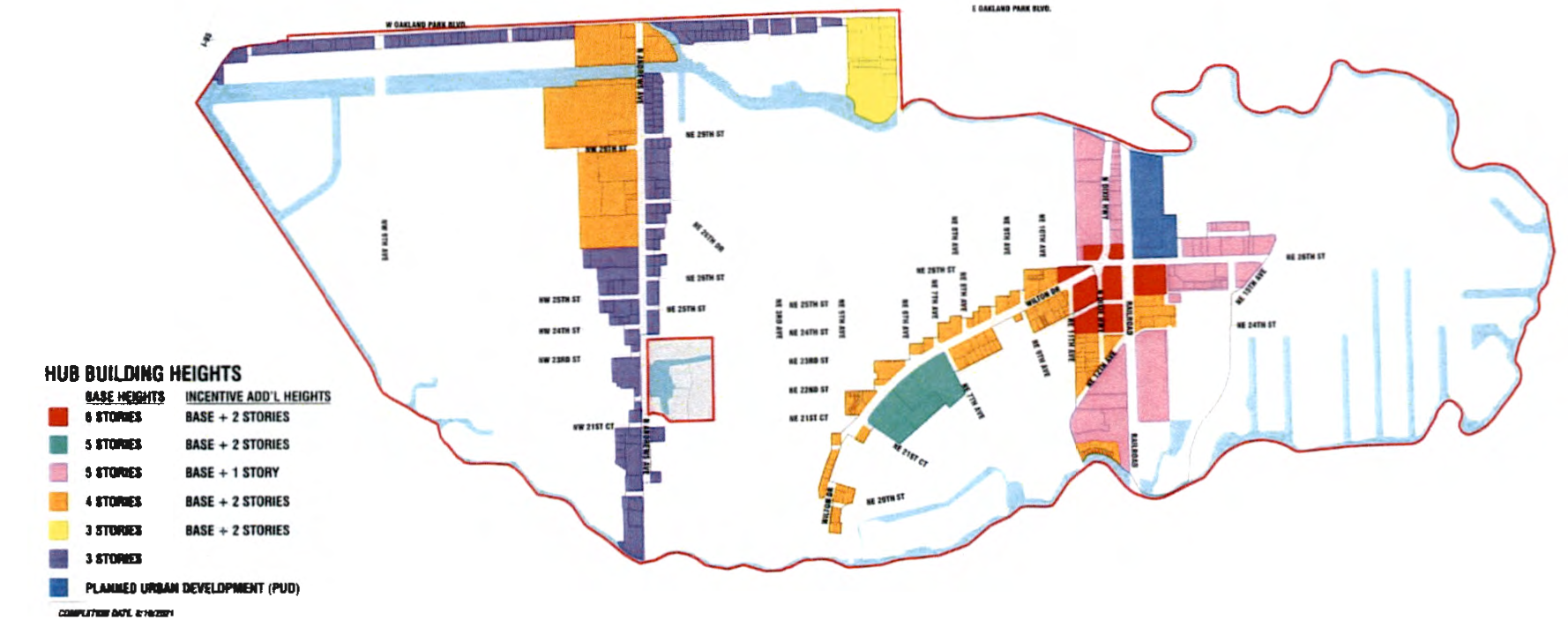
(Ord. No. 2021-011, § 2, 8-24-21)
Sec. 030-040. - Standards for lots and urban form.
Pedestrian Realm Frontage Design Standards
(A)
The Development Review Committee may approve additional pedestrian realm frontage requirements at the time of site plan approval upon its determination that the additional width will provide for greater pedestrian amenities, such as but not limited to, a plaza or expanded outdoor dining and entertainment area, and will not compromise the sense of street enclosure.
(B)
The Planning and Zoning Board, when considering a site plan application, may eliminate or reduce the depth of the pedestrian realm frontage up to a maximum of three (3) feet upon lots that would have a buildable depth of less than one hundred sixty (160) feet, without the need for a variance or exception, provided that the waiver or reduction is needed to accommodate a parking structure with a liner building fronting the street, or otherwise is required in order for the site to accommodate a building of at least two (2) stories in height.
(C)
It is not the intent of this Section to require demolition or alteration of an existing building in order to create a pedestrian realm frontage. The Planning and Zoning Board may approve alternate streetscape frontage requirements in these instances.
(D)
The pedestrian realm frontage shall be comprised of a publicly accessible, continuous paved area, with a minimum paved coverage of sixty-five (65) percent. The pedestrian realm frontage shall contain furnishings including bicycle racks, street furniture, landscaping and planters, outdoor lighting, and may include outdoor dining and other pedestrian amenities. When fronting Wilton Drive, all amenities provided within the pedestrian realm frontage shall be consistent with the Wilton Drive Streetscape Plan.
(E)
The Streetscape Frontage area within the pedestrian realm frontage shall be improved consistent with the requirements of any applicable adopted streetscape master plan designated for its street. Where such a master plan does not exist, the Streetscape Frontage shall be entirely landscaped, except where a minimum six (6) foot wide sidewalk may be provided for public access where a sidewalk does not already exist. The streetscape frontage shall be maintained entirely free of any permanent objects or obstructions. The streetscape frontage shall be landscaped with low shrubs, groundcovers and trees pursuant to this Article. The streetscape frontage may include street furniture limited to benches, trash receptacles and bus shelters.
(F)
The Planning and Zoning Board may approve alternate streetscape frontage requirements for parcels exceeding two (2) gross acres that abut the FEC Railroad right-of-way, and on irregularly shaped lots, provided the Planning and Zoning Board finds the alternatives are consistent with the intent of this Article.
Additional Height Incentive Design Standards
To receive additional height, properties shall meet all eight (8) of the following criteria along with one (1) optional requirement, without exception. No variances shall be granted for any of the following:
(A)
The project must be mixed-use.
(B)
Open space dedication. A minimum of ten (10) percent of the total lot area is required for any open space dedications to create publicly accessible open space open to the general public including plazas and courtyards with fountains or public art installations to create quality public space for people to gather at no charge. Open space shall mean plazas, courtyards and any other public space where people can gather, in addition to rooftops.
(C)
Enhanced landscaping. Additional twenty-five (25) percent of height of trees, palms and landscaping above minimum code requirements, and additional twenty-five (25) percent of the required number of trees, palms and landscaping, and integrate landscaping into the existing palate of the roadway as well as public spaces within the development. The trees, palms and landscaping must be Florida native and/or drought tolerant.
(D)
Building shall meet Green Building Code requirements as identified in Article 170 with double the points of each use identified in the Article.
(E)
Inclusion of arcades or other acceptable weather protection for pedestrians.
(F)
Provide enhanced drainage on site that exceeds Broward County code requirements; the onsite stormwater system should show that the ten-year three-day storm does not exceed the lowest catch basin rim and that the fifty-year three-day storm does not exceed the site berm or provide at least ten (10) percent additional pervious area beyond the requirements in Section 030-090.
(G)
At least two (2) parking spaces dedicated to ride share within the project area. The two (2) ride share parking spaces shall be inclusive of two (2) required standard parking spaces.
(H)
Affordable housing component. For projects requesting additional stories, a minimum of two point five (2.5) percent of the total proposed residential units shall be dedicated as affordable housing or payment in lieu of the two point five (2.5) percent dedication in the amount of $50,000.00 per unit for the total number of units dedicated as affordable units. A hotel shall be exempt from the affordable housing component. If a project provides payment in lieu of, the monies shall be deposited into the City of Wilton Manors Affordable Housing Trust Fund. Effective October 1 of each year, the payment in lieu of fee shall be adjusted by the change in the Consumer Price Index (CPI), Miami-Fort Lauderdale-West Palm Beach, all items for December of the previous calendar year. If a project constructs the affordable housing units. the units shall be part of the project and shall remain affordable for a minimum of thirty (30) years from the date of issuance of a Certificate of Occupancy for the project. A declaration of restrictive covenant shall be entered into with the City prior to the issuance of the first building permit. The restrictive covenant shall run with the land and be binding on the developer's heirs, successors, assigns, and transferees. The restrictive covenant is subject to review and approval of the City Commission and, at a minimum will require an opinion of title or similar evidence of the status of title and encumbrances. In the event an affordable housing component is provided hereunder, no additional payment shall be required under Section 080-090 ULDR.
(I)
In addition to the required criteria, one of the following additional criteria shall be provided from the following, without exception:
(1)
A minimum of two (2) art installments accessible to the public as outlined in an adopted Public Arts Policy by the City Commission. In the event a Public Arts Policy is not adopted by the City Commission, the minimum of two (2) art installments accessible to the public may be approved by the Community Development Service Director. This can include, but not be limited to, public art, mural, water fountain, or artistic installation;
(2)
Alternate transportation or multi-modal infrastructure in addition to pedestrian and bicycle facilities; or
(3)
Water/drainage alternate site design components to include extensive use of bioswales (provided they are not located within the Pedestrian Realm frontage area) in conjunction with other low-impact development strategies, or use of grey water.
(J)
Notwithstanding anything contained herein to the contrary, a stand-alone hotel that is not part of a mixed use development, and is a permitted use, shall be entitled to receive additional height by meeting the requirements of Section 030-038 (C), (D), (F), and (G), in addition to one of the criteria set forth in Section 030-038(1).
(Ord. No. 2021-011, § 2, 8-24-21; Ord. No. 2023-005, § 2, 12-12-23; Ord. No. 2024-010, § 2, 11-26-24)
Sec. 030-041. - Site design standards.
(A)
Site design shall incorporate safe and convenient vehicular use areas and pedestrian ways, with canopy trees with adequate provisions for root growth, shrubs and landscaping, lighting, sidewalks and other pedestrian amenities, signage and other site elements intended to result in a comprehensive, compatible design.
(B)
Site design shall promote principles of Crime Prevention Through Environmental Design (CPTED) as promulgated by the Office of the Attorney General of the State of Florida, including:
(1)
Natural access control. Through use of sidewalks, pavement, lighting and landscaping to clearly guide the public to and from entrances and exits.
(2)
Territorial reinforcement. Through use of pavement treatments, landscaping, art, signage, screening and fences to define and outline ownership of property.
(3)
Natural surveillance/visibility. Through placement and design of physical features to maximize visibility; through placement of persons and/or activities to maximize surveillance possibilities; and through lighting to provide nighttime illumination of parking lots, walkways, entrances and exits.
(4)
Maintenance. Through use of low maintenance landscaping and lighting treatment to facilitate CPTED principles of natural surveillance, natural access control and territorial reinforcement.
(5)
Defensible space.
(C)
Overhead utilities. Site design shall include relocation of overhead utilities underground unless waived by the City Commission. All new development and redevelopment shall require all utilities within the property to be underground.
(D)
Loading areas, mechanical equipment, transformer boxes, dumpster enclosures. Structures and uses that are required in in this Article to be screened shall not be located adjacent to a frontage line, and shall not be visible from any public rights-of-way.
(E)
Lighted landscaping and signage shall direct glare away from pedestrian and vehicular areas and be shielded.
(F)
Outdoor vending machines are not permitted in any street-side yard, and shall not be visible from any public rights-of-way.
(G)
Surface parking shall be set back a minimum of ten (10) feet from every frontage line and eight (8) feet from any pedestrian amenity area.
(H)
When abutting a residential parcel with less than three (3) residential units, fronting building facades shall provide permanent architectural features or be designed in a manner to prevent visibility onto abutting properties.
(I)
Street activation. First floor activities shall activate streets socially and economically to enhance the general public health and maximize social interaction.
(Ord. No. 2021-011, § 2, 8-24-21)
Sec. 030-050. - Building design provisions.
(A)
Appurtenances may be permitted to extend above the building height limit for a distance sufficient to accommodate building design and screening for mechanical equipment such as elevator shafts and cooling towers and condensers, as provided in Section 045-020.
(B)
Transition lines shall be provided at the top of the first tier of a multiple-story building. Transition lines can be expressed by a material change, trim line, balcony, etc., and may be detailed to accommodate an awning or other architectural facade element.
(C)
Architectural style. The City does hereby adopt by reference the Wilton Manors Main Street Design Guidelines endorsed by the City Commission on October 10, 2006. A copy of the publication is available at the Department of Community Development Services.
(D)
Prohibited design themes. Pre-designed or standardized corporate designs, and fantasy architecture (ships, animals, castles, etc.) are not acceptable within the Urban Center Districts. Custom-designed corporate architecture is encouraged and permitted.
(E)
Facade design. Facade elements shall be arranged in an orderly manner. Porticos, awnings, loggias, colonnades, terraces, balconies, and balcons are encouraged to reduce massing and provide visual appeal to building design.
(F)
Roof standards. Sloped roofs shall be within a 4:12 to 12:12 slope range. Flat roofs may be used for balconies and shall have railings. Parapet walls shall enclose flat roofs not used as balconies and shall conceal mechanical equipment.
(G)
Finish materials standards. The primary exterior finish materials on all facades shall be limited to stucco (including synthetics), stone, tile, masonry, or other similar materials, appropriate for the design, as approved by the Director of Community Development Services, or designee. Exposed, non-textured flat masonry block is not an acceptable exterior finish material. All materials shall be true and durable; foam trims and applications shall not be allowed.
(H)
Mechanical equipment screening. Building design shall include appropriate screening for mechanical equipment. Screening for such mechanical equipment shall be designed as an integral part of the building and located away from a frontage line.
(I)
Entrance standards. Buildings shall have a principal pedestrian entrance facing a frontage line. Storefronts shall have their principal pedestrian entrance facing a frontage line.
(1)
Each ground story dwelling unit shall be accessed directly from the sidewalk. A stoop entrance, elevated between two (2) and three (3) feet above sidewalk grade is required unless a private, gated and fenced yard at least eight (8) feet in depth is provided for each unit. Stoops and fenced yards are permitted to encroach into the pedestrian realm frontage on secondary street only up to a maximum of five (5) feet. Individual porches are permitted to front streets other than primary and secondary streets as defined in this Article if elevated between two (2) and three (3) feet from sidewalk grade.
(2)
Lobby entrances to multiple dwelling units may be at sidewalk grade and shall front the right-of-way.
(3)
Courtyards that open to the sidewalk shall not be limited in width provided the remainder of the building is constructed on the frontage line.
(J)
Building frontage standards.
(1)
Buildings shall address the street at the pedestrian level and be built at a human scale.
(2)
Buildings shall be aligned to the greatest extent possible with frontage lines.
(3)
Buildings shall be oriented to front towards public rights-of-way to the greatest extent possible.
Primary street and secondary street sixty-five (65) percent of street frontage. Other streets more than fifty (50) percent.
(4)
Where abutting buildings have dissimilar frontage setbacks, the property with the least restrictive frontage setback shall transition the setback of its façade so as to not create any side walls greater than five (5) feet in depth perpendicular to the frontage line.
(K)
Private open space. Buildings shall form and protect private open space. To accomplish this, private courtyards, outdoor dining areas, plazas, and arcades are encouraged. Private open space shall not be used to meet the requirements of public amenity areas required as a condition of obtaining additional height.
(L)
Parking structures. Parking structures shall be placed behind liner buildings at frontage lines without exception; and they shall be architecturally designed at the frontage line to appear as part of the building facade. Liner buildings shall be designed to accommodate active uses; habitable spaces limited to uses such as walkways and corridors shall not qualify as a liner building. The design of parking structures shall complement other structures on-site and shall be incorporated into the overall site and building design for compatibility.
(M)
Facade and architectural projections standards.
(1)
First floor facades of mixed-use or non-residential buildings shall be a minimum of sixty-five (65) percent glass, with architectural elements and signage integrally designed. All windows along the building façade shall be clear or lightly tinted. At least seventy (70) percent of the first floor facade shall be fenestrated from an elevation of two (2) feet to eight (8) feet above sidewalk grade.
(2)
All facades not on frontage lines shall incorporate the same surface materials and similar design elements and proportions, with attractive entrances and consideration for pedestrian pass-throughs such as arcades. Blank walls exceeding six-hundred (600) square feet in surface area shall not be allowed.
(3)
Only when fronting primary and secondary streets:
a.
Signature architectural elements structurally integral to the design of the facade and intended to provide shade and protection from inclement weather may extend forward of the frontage line within the pedestrian realm frontage line but not closer than ten (10) feet to the rear edge of the streetscape frontage.
b.
Awnings, canopies, balconies and architectural elements may extend forward of the frontage line within the pedestrian realm frontage forward of the frontage line up to eight (8) feet.
For all other streets, awnings, canopies, balconies and architectural elements may extend forward of the frontage line up to two (2) feet.
(4)
Awnings used in conjunction with a balcony above the first floor shall not extend beyond the balcony railing.
(5)
First floor awnings shall be no more than ten (10) feet in height, measured to the lower drip edge of the awning, from finished grade directly beneath such awning.
(6)
Buildings located on corner lots at intersections and buildings abutting accessways may require a chamfered or rounded facade for visibility purposes. Such requirement shall be determined by the Director of Community Development Services, or designee, using the principles and standards set forth in this Article.
(N)
Commercial uses restriction in setbacks. No outdoor commercial uses are allowed within any setback facing a single-family residential property.
(O)
Additional site features. No dumpster enclosure, generator or mechanical equipment shall be located within the required setback facing a single-family residential property.
(P)
Build out of commercial space(s). Commercial tenant spaces shall be designed and constructed with flexible infrastructure to accommodate future uses.
(Ord. No. 2021-011, § 2, 8-24-21; Ord. No. 2023-005, § 2, 12-12-23)
Sec. 030-060. - Off-street parking requirements.
(A)
Required parking for uses not described herein shall be provided as required in Article 135, Off-Street Parking. For the purposes of this Section, required parking shall be determined based on gross building area.
(B)
Commercial uses:
(1)
Retail (WDAE):
a.
Existing buildings that increase in overall size and new buildings: No parking required.
(2)
Retail (TOC-N, TOC-S, TOC-E, and TOC-W):
a.
Existing buildings that do not increase in overall size by more than twenty (20) percent: No additional parking required.
b.
New Buildings and existing buildings that increase in overall size by more than twenty (20) percent: One space per five hundred (500) square feet.
(3)
Office (WDAE, TOC-N, TOC-S, TOC-E, and TOC-W):
a.
Existing buildings that do not increase in overall size by more than twenty (20) percent: No additional parking required.
b.
New buildings and existing buildings that increase in overall size by more than twenty (20) percent: One per three hundred (300) square feet.
(4)
Restaurants (TOC-N, TOC-S, TOC-E, and TOC-W):
a.
Sit-down dining in existing, existing buildings that increase in overall size by more than twenty (20) percent and new buildings: Three (3) spaces per one thousand (1,000) square feet.
b.
Take-out dining or counter service food establishments in existing, existing buildings that increase in overall size by more than twenty (20) percent and new buildings that have a customer service area of three hundred (300) square feet or less: One space per three hundred (300) square feet or less of customer service area plus one additional space for the overall establishment. Restaurants with customer service areas greater than 300 square feet will be required to meet the requirements of [Subsection] (4)a, above. Customer service area is defined in Section 135-080.
(5)
Restaurants (WDAE):
a.
Sit-down dining, take out dining or counter service food establishments in existing, existing buildings that increase in overall size by more than twenty (20) percent and new buildings: One (1) space per five hundred (500) square feet.
(6)
Bar, lounge or nightclub (TOC-N, TOC-S, TOC-E, and TOC-W):
a.
Existing buildings that increase in overall size by more than twenty (20) percent and new buildings: One (1) space per one hundred (100) square feet.
(7)
Bar, lounge or nightclub (WDAE):
a.
Existing buildings that increase in overall size by more than twenty (20) percent and new buildings: One (1) space per five hundred (500) square feet.
(C)
In reference to all requirements in Subsection B: Change in ownership, use or occupancy will require compliance with these regulations. Credit will be considered for prior satisfaction of these regulations through payment in lieu provided for parking or otherwise paid to the extent that parking was provided. Notwithstanding anything contained herein to the contrary, a change of use within the TOC-N and TOC-S Districts will not require provision of additional parking pursuant to Section 135-060 unless the principal building increases in size by more than twenty (20) percent, or if the new use is a food and/or beverage establishment, bar, lounge or nightclub, which must meet the requirements of Section 030-110.
(D)
Dwelling. Multi-family:
(1)
Freestanding dwellings or part of a mixed-use building—One and one-half (1.5) spaces per each residential unit.
(2)
Multi-family units designated as affordable housing—One (1) space per affordable housing designated unit.
(E)
Hotel or motel: Zero point seventy-five (0.75) space per each room/key.
(F)
Outdoor dining and sidewalk cafes: Three (3) spaces per one thousand (1,000) square feet is required for outdoor dining areas and sidewalk cafes greater than two hundred (200) square feet when such uses are accessory to a larger food, beverage, or restaurant use, in the WDAE, and one space per one hundred (100) square feet for outdoor dining areas or sidewalk cafes associated with a bar, lounge or nightclub greater than two hundred (200) square feet in the TOC-N, TOC-S, TOC-E, and TOC-W.
(G)
Train station: Twenty (20) spaces or one space per 200 square feet of gross floor area, whichever is greater. Additional uses, co-located within a train station parcel or development, require additional parking pursuant to this Article.
(H)
In the event the Director approves a parking needs analysis, justifying an alternative parking generation rate(s) pursuant to Section 135-040, Alternative parking generation standards, the applicant shall pay a fee in lieu of parking based on the difference between required and provided parking, or provide alternative parking area(s) to accommodate required parking needs. For example, if one hundred (100) spaces are required and eighty (80) spaces are provided based on approval of a parking needs analysis, the applicant shall pay a fee in lieu of parking equal to the value of twenty (20) spaces (the difference between required and provided parking). The fee to be paid shall be a one-time fee as established by the City Commission and shall be paid in accordance with the procedure established by the City Commission. The payment in lieu of parking option shall not exceed seventy-five (75) percent of the required parking.
(I)
On-street parking. On-street parking abutting a lot on which the business is located shall not count toward fulfilling the parking requirement of that lot.
(J)
Valet parking. Valet parking and the stacking of vehicles shall be permitted in accordance with Section 135-020(I).
(K)
Joint use and off-site facilities. Joint use and off-site facilities shall be permitted in accordance with Section 135-030.
(L)
Parking design standards and off-street loading facilities. Certain parking design standards and off-street loading facilities requirements found elsewhere in the ULDR may be waived by the Director of Community Development Services, or designee, when such standards conflict with the character and nature of the Urban Center Districts. An example of such a standard would be a requirement for adjacent developments to connect parking aisles for cross access between properties. Some buildings could be built too close together to provide for such connection. Another example of such a standard would be requiring a loading area. Some businesses do not receive deliveries from vehicles that require the space provided by a loading area.
(1)
All parking areas shall be used for vehicular parking only. No sales, rental, storage, repair, dismantling, or service areas shall be located in parking areas.
(2)
Driveways, accessways, and access aisles shall be interconnected with existing driveways, accessways, and access aisles in parking areas on abutting developed properties to the greatest extent possible. Where abutting properties are developed in such a manner that interconnection of driveways, accessways, and access aisles is physically impossible, no connection shall be required.
(3)
Pedestrian circulation shall be considered in the design of parking areas. Pedestrian crosswalks shall be provided where necessary and appropriate, shall be distinguished by textured or special paving, such as brick pavers or stamped concrete, and shall be integrated into the pedestrian network of sidewalks and walkways.
(4)
Parking areas shall be designed to not allow vehicles to back directly onto public rights-of-way.
(5)
Surface and structured parking facilities shall be set back at least ten (10) feet from each frontage line.
(6)
Parking exposure on a frontage line shall be an opening no greater than twenty-five (25) feet to allow for pedestrian and vehicular access.
(7)
Buildings elevated over surface parking areas shall not be permitted on frontage lines unless a building facade screens the surface parking from view within the public rights-of-way.
(Ord. No. 2021-011, § 2, 8-24-21; Ord. No. 2023-005, § 2, 12-12-23)
Sec. 030-061. - Planned train station development—Parking exceptions.
(A)
Development standards. The development standards of the applicable Urban Center District shall apply, except as follows:
(1)
Off-street parking requirements for retail, dining and personal service uses that are integrated into the train station site design shall be waived provided that the standard parking requirement for such uses would not exceed twenty (20) percent of the amount of parking provided for train commuters, and provided that a minimum of twenty (20) spaces or one space per two hundred (200) square feet of gross floor area, whichever is greater are provided.
Example:
(Ord. No. 2021-011, § 2, 8-24-21)
Sec. 030-062. - Payment in lieu of parking.
(A)
Applicability. Properties with existing buildings as of the date of the adoption of this ordinance, shall be able to utilize the payment in lieu of process. Any new development or redevelopment where a new building is constructed is required to meet the parking standards set forth in this Article.
(B)
Payment. In the event the Director of Community Development Services, or designee, authorizes a payment in lieu of parking, the applicant shall pay a fee per parking space based on the difference between required and provided parking. For food and beverage establishment projects two thousand (2,000) square feet or less, and outdoor dining areas, the fee shall be reduced by fifty (50) percent. The fee shall be paid at the time of final site plan approval or upon issuance of a building permit, whichever shall occur first. The payment of the parking fee shall be in addition to all other fees, charges or assessments. The payment in lieu of parking option shall not exceed seventy-five (75) percent of the required parking twenty (20) parking spaces, whichever is less. The fee is determined and may be modified by resolution of the City Commission.
(C)
Trust fund. The City Commission hereby creates the "Parking Fee Trust Account" which shall be maintained separate and apart from all other City accounts. Payments in lieu of parking shall, upon receipt by the City, be deposited into the Parking Fee Trust Account immediately upon receipt. The monies deposited into the Parking Fee Trust Account shall be used solely for the purpose of providing growth-necessitated capital improvements to the City's Parking System including, but not limited to:
(1)
Land acquisition, including any cost of acquisition.
(2)
Fees for professional services, including but not limited to architecture, engineering, surveying, landscaping, soils and material testing, legal, appraisals, and construction management.
(3)
Design and construction documents.
(4)
Site development and on-site and off-site improvements incidental to the construction thereto.
(5)
Any permitting or application fees necessary for the construction.
(6)
Design and construction of parking for recreational facilities.
(7)
Design and construction of drainage facilities required by the construction of parking facilities or improvements thereto.
(8)
Relocating utilities required by the construction of parking facilities or improvements or additions thereto.
(9)
Landscaping in parking and pedestrian areas.
(10)
Acquisition of capital equipment for the City Parking System.
(11)
Repayment of monies borrowed from any budgetary fund of the City which were used to fund growth necessitated capital improvements to the City Parking System as provided herein.
(12)
Payment of principal and interest, necessary reserves and costs of issuance under any bonds or other indebtedness issued by the City to fund growth-necessitated improvements and additions to the City Parking System subsequent to the effective date of this Ordinance.
(13)
Costs related to the administration, collection, and implementation of the parking impact fees.
(Ord. No. 2021-011, § 2, 8-24-21)
Sec. 030-070. - Fences and walls.
(A)
Fences are useful for separating uses, defining transitions from the public sidewalk to private property, guiding pedestrians to entrances, and screening unsightly views. Fences shall be subject to the provisions of this Article, except as follows.
(B)
Chain-link fences are prohibited.
(C)
Decorative fencing is permitted in all Urban Center Districts, and is the only type of fencing permitted in any front yard. Decorative fencing shall not exceed three (3) feet in height unless otherwise provided. Approved decorative fencing materials shall be limited to decorative aluminum, steel, and iron.
(D)
Whenever possible, fences should be combined with other elements such as plant material.
(E)
Fences shall generally be considered an extension of the adjacent structure or architectural elements, and the materials and colors should be compatible.
(F)
Walls or fences shall be used to screen pedestrian routes and spaces from service, utility, or sanitation areas, and shall include a minimum three (3) foot wide landscape strip to soften their appearance. This landscape strip shall include shrubs in compliance with the landscaping requirements of the ULDR, and shall be properly maintained.
(Ord. No. 2021-011, § 2, 8-24-21)
Sec. 030-080. - Right-of-way and street improvement requirements.
(A)
Compliance required. Dedication of right-of-way and construction and installation (or payment-in-lieu) of street and streetscape improvements pursuant to this Section is required upon any of the following events:
(1)
Construction of a new principal building.
(2)
Any event that requires a nonconforming building or building and premises to comply with the requirements of this Article pursuant to Article 15, Nonconforming uses, buildings and lots.
(3)
Expansion of a principal building by fifty (50) percent or more.
(B)
Payment in-lieu of construction. The City may require the property owner to make payment to the City in lieu of constructing certain improvements, in order that the City will construct the improvements when sufficient right-of-way becomes available to improve larger segments of the corridor in a single undertaking, for the benefit of realizing cost efficiencies and providing for continuity in streetscape. The amount of payment shall be determined by dividing the total estimated cost of all improvements within a typical block face by the length of the block face in linear feet, to determine the average cost per linear foot for all improvements. Each lot shall be responsible for payment in the amount of the average cost per foot multiplied by the number of linear feet of street frontage.
(C)
Dedication requirements. When required by Subsection (A), dedication of right-of-way—or a general purpose easement if acceptable to the City Attorney—to the City shall be as follows to complete the applicable street half section:
(1)
North Dixie Highway, between NE 11th Avenue and NE 26th Street: fifty-four (54) feet of right-of-way is required west of functional centerline (double yellow line), and thirty-four (34) feet is required east of the functional centerline, for a total section of seventy-eight (78) feet. The original street section consists of thirty (30) feet west of the functional centerline and twenty-five (25) feet east of the functional centerline. The full street section consists of two (2) travel lanes, each ten (10) feet in width; forty-five (45) degree angled parking on each side; and six (6) foot Roadside Zones separated from the parallel parking by a curb, and six (6) foot Pedestrian Zones on each side of the street. See the figure below for the illustrated street section.
(2)
North Dixie Highway north of NE 26th Street: right-of-way shall be dedicated from each side of the street in the amount of ten (10) feet, which is also the minimum setback required by Broward County adjacent to a Trafficway. The City dedication requirement is supplemental to the right-of-way required in the Trafficways Plan. Therefore, buildings may be constructed at the back of the dedicated right-of-way.
North Dixie Highway required street section; NE 11th Avenue to NE 26th Street
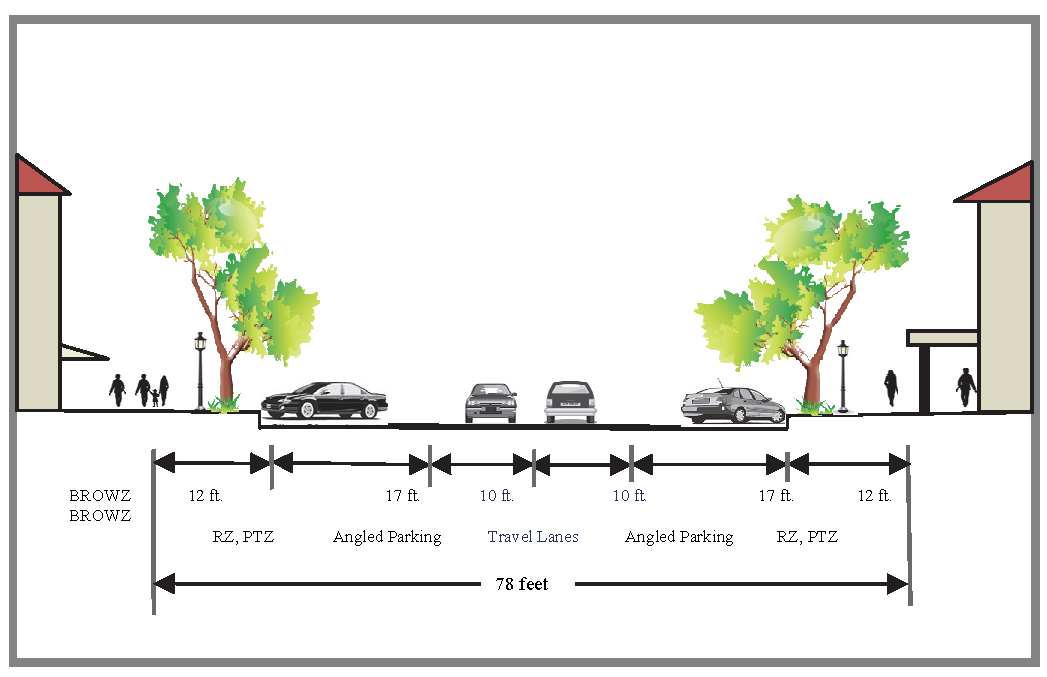
North Dixie Highway required street section
(D)
Improvements required. Pursuant to Subsection (A), the property owner shall be responsible for constructing the following improvements, or making payment in-lieu of construction to the City as provided in Subsection (B), to the City's specifications:
(1)
Construct, stripe and sign on-street parking spaces.
(2)
Construct curbing.
(3)
Relocate storm drains if necessary.
(4)
Construct sidewalk.
(5)
Construct irrigated street tree trench and install required landscape materials.
(6)
Bury power lines or relocate to the rear lot line, as determined by the Planning and Zoning Board.
(7)
Relocate utility cabinets out of view from the public right-of-way, to the extent authorized by the applicable utility.
(Ord. No. 2021-011, § 2, 8-24-21)
Sec. 030-090. - Landscaping; pervious area.
(A)
The minimum pervious area requirement is established is a percentage of lot area in the table below. The symbol (<) means "less than" and the symbol (>) means "greater than."
(B)
Notwithstanding Subsection (A), all townhouse lots shall provide a minimum twenty (20) percent landscaped pervious area.
(Ord. No. 2021-011, § 2, 8-24-21)
Sec. 030-091. - Landscaping; planting and screening.
This Section supplements Article 150 ULDR. In the case of conflict, this Section shall prevail. Pervious areas shall contain appropriate trees, hedges, groundcovers, and shrubs outlined in Article 150, Landscaping.
Pedestrian Realm Frontage Landscape Requirements.
(A)
Except where regulated by a specific streetscape plan, all streetscape frontage areas shall be landscaped with low shrubs, groundcovers and shade trees. One shade tree for each twenty-five (25) linear feet of frontage shall be planted. Palms may be substituted for trees at a rate of five (5) large species palms per one tree; a minimum of one or a maximum of ten (10) percent of required trees may be substituted for palms. Trees shall be evenly placed.
(B)
All pervious areas within the streetscape frontage area shall be planted with shrubs. Ten (10) shrubs or groundcovers are required per tree.
(C)
Sod or synthetic turf shall not be used in any streetscape frontage areas.
(D)
All landscaping shall be irrigated by an automatic irrigation system with a separate zone than dedicated solely to the Streetscape Frontage areas, separated by a valve from other areas serviced by the same system.
(E)
All shade trees planted in hardscape surface areas anywhere within the Pedestrian Frontage area shall, without exception, be planted within a tree trench that accommodates sufficient root growth for the planted tree to reach maturity and remain healthy, with a minimum of one hundred (100) cubic yards of root growth volume per tree, allowing a fifty (50) percent shared root growth volume to be shared with another tree. All tree trenches shall be backfilled with Cornell University (CU) Structural Soils or equal. A series of interconnected trenches is encouraged to provide for water distribution and assist with stormwater drainage.
(F)
All shade trees, without exception, shall require the installation of an advanced structural soil cells system (Silva Cells or approved equal) for the immediate root-growth area extending a minimum of eight (8) feet from the trunk of the tree.
(G)
All shade trees, without exception, shall require a minimum of sixteen (16) square feet around each tree trunk to be covered with a permeable stabilized porous aggregate material, such as Addapave or equal, or other permeable surface designed for such use in order to ensure adequate air and water penetration. The use of rubberized surfaces shall not be allowed.
(H)
All landscaping within the pedestrian realm frontage area shall include the installation of irrigation and character up-lighting as an integral part of the design of the overall frontage area and shall be complimentary to the fronting facade of the building.
(I)
Rear and side landscape buffers.
(1)
A ten-foot-wide landscape buffer shall be required along all side and rear lot lines abutting a single-family use. When the side or rear property lines face a single-family use across a non-primary or non-secondary street, a buffer shall be required along the street frontage facing the single-family use. The landscape buffer shall include the following:
a.
An eight (8) foot tall concrete or concrete masonry wall finished on both sides with stucco.
b.
A continuous hedge planted at a minimum height of six (6) feet and spaced to completely cover the wall within a one-year time period. If fronting a street and/or across from a single-family use property, a second continuous hedge line shall be placed along the entire frontage of the face of the wall facing the single-family property.
c.
Canopy shade trees, such as Live Oaks or equal, spaced a maximum of twenty-five (25) feet apart. Where conflicts with overhead utility lines exist, smaller trees, such as Green Buttonwoods or equal, may be used instead and shall be spaced a maximum of fifteen (15) feet apart.
d.
The buffer shall be placed on the outside of any intervening alley.
e.
A concrete wall and continuous hedge are not permitted on properties across a waterway from a single-family use.
(2)
A ten (10) foot wide landscape buffer shall be required along all side and rear lot lines when abutting a non-single-family zoned property. The buffer shall include the following:
a.
A six (6) foot tall fence or wall.
b.
A continuous hedge planted at a minimum height of four (4) feet and spaced to completely cover the wall within a one-year time period.
c.
Canopy shade trees, such as Live Oaks or equal, spaced a maximum of twenty-five (25) feet apart. Where conflicts with overhead utility lines exist, smaller trees, such as Green Buttonwoods or equal, may be used instead by shall be spaced a maximum of fifteen (15) feet apart.
d.
The buffer shall be placed on the outside of any intervening alley.
e.
No Side buffer is required for the WDAE district.
(3)
A ten (10) foot-wide buffer is required abutting the FEC Railroad right-of-way.
(4)
A minimum fifteen (15) foot-wide landscape buffer is required abutting a public park and shall meet the landscape buffer requirements.
(J)
Unbuilt frontage. Any portion of the pedestrian realm frontage on a primary or secondary street frontage that is not lined by a building facade or interrupted by a driveway or walkway shall be screened from the public sidewalk along all primary and secondary streets by a street wall. Such streetwall shall not be required when pedestrian amenity areas limited to plazas, outdoor dining, arcades, or courtyard areas are provided.
(1)
Streetwalls shall be six (6) feet in height. The lower two (2) feet shall be solid and opaque, and the remainder shall consist of at least thirty-five (35) percent open screening (ex: iron or aluminum) consistent with Crime Prevention Through Environmental Design (CPTED) principles, and constructed and painted to match the adjacent building facade.
(2)
Living walls may be utilized, where the wall is partially covered with a vine, provided the opacity limitation for a streetwall above three and one-half (3.5) feet is not exceeded.
(3)
Street walls shall be placed at the rear edge of the pedestrian realm frontage, and a four (4) foot wide planting strip shall occupy the portion of the pedestrian realm frontage forward of the wall. Streetwalls shall not be placed closer than five (5) feet from the back edge of a public sidewalk, and a planting strip shall be placed in between the sidewalk and wall.
(4)
Streetwalls may have openings no greater than twenty-five (25) feet to allow for pedestrian and vehicular access.
(K)
Surface parking landscaping. Surface parking areas shall be landscaped in accordance with the following criteria:
(1)
Appropriate trees, hedges, groundcovers, and shrubs as required in Article 150, Landscaping.
(2)
Each separate landscaped area shall have a minimum dimension of five (5) feet and a minimum area of twenty-five (25) square feet.
(3)
Twenty (20) shrubs or groundcovers are required for each required tree.
(4)
Trees planted in hard surface areas shall require tree grates or other approved devices to ensure adequate air and water penetration.
(5)
Each separate landscaped area shall include at least one shade tree, with the remaining area adequately landscaped with shrubs, groundcovers or other approved landscaping material. At least twenty-five (25) percent of trees shall be shade species with a minimum height at installation of ten (10) to twelve (12) feet. Palm and flowering species are encouraged. Three (3) palms may substitute for each shade tree. Trees may be grouped to provide additional canopy for shading purposes.
(6)
Surface parking rows shall be terminated with landscaped terminal islands.
(7)
Interior islands within surface parking areas shall also be provided as follows based upon the number of parking spaces provided:
a.
Lots with more than sixty (60) spaces: One island for every twelve (12) parking spaces or fraction thereof provided.
b.
Lots with fewer than sixty (60) spaces are required to provide five (5) percent pervious landscaped area within or abutting the parking area, which can be in any form having a minimum dimension set forth in this Subsection. The intent of this provision is to allow maximum flexibility in the design of small parking facilities on small lots.
c.
Landscape islands shall be at least ten (10) feet in width and eighteen (18) feet in length. Upon approval from the Director of Community Development Services, or designee, interior islands may be grouped with terminal islands to provide larger landscaped areas when site conditions permit. When such islands are grouped, the overall area shall not be reduced. For example, when combining an interior island with a terminal island, the overall required minimum area would be twenty (20) feet by eighteen (18) feet. Each terminal and interior island shall contain at least one tree. One tree per each thirty (30) lineal feet of parking row and one tree for each fifteen hundred (1,500) square feet of paved area is required.
(8)
Parking areas shall be adequately curbed to protect landscaping from vehicular encroachment. Wheel stops or curbing shall be provided in each parking space.
(9)
When parking areas with sixty (60) or more parking spaces abut side or rear property lines, a buffer area of at least five (5) feet in width shall be provided between the property line and parking area.
(10)
All landscaped areas shall be appropriately irrigated and maintained and shall be designed to accept drainage from adjacent paved area.
(11)
Landscaping shall be located to allow for interconnection of driveways, accessways, and access aisles on abutting properties when such interconnection is possible.
(L)
Other landscaping and screening requirements.
(1)
All lot area not used for parking, loading or pedestrian area must be pervious and landscaped pursuant to Article 150.
(2)
Loading docks and service areas shall be screened with landscaping or fencing to prevent direct views of such areas from adjacent properties and public rights-of-way and to prevent exhaust, glare, and noise.
(3)
Existing, nonconforming outdoor storage areas shall be fully screened from view of adjacent properties and public rights-of-way with landscaping or fencing. Note: outdoor storage is not a permitted use.
(4)
Mechanical equipment, dumpsters, above-ground transformer boxes and backflow preventers shall be screened pursuant to Section 150-180.
(Ord. No. 2021-011, § 2, 8-24-21; Ord. No. 2023-005, § 2, 12-12-23)
Sec. 030-120. - Right-of-way and street improvement requirements.
(A)
Compliance required. Dedication of right-of-way and construction and installation (or payment-in-lieu) of street and streetscape improvements pursuant to this Section is required upon any of the following events:
(1)
Construction of a new principal building.
(2)
Any event that requires a nonconforming building or building and premises to comply with the requirements of this Article pursuant to Article 15, Nonconforming uses, buildings and lots.
(3)
Expansion of a principal building by fifty (50) percent or more.
(B)
Payment in-lieu of construction. The City may require the property owner to make payment to the City in lieu of constructing certain improvements, in order that the City will construct the improvements when sufficient right-of-way becomes available to improve larger segments of the corridor in a single undertaking, for the benefit of realizing cost efficiencies and providing for continuity in streetscape. The amount of payment shall be determined by dividing the total estimated cost of all improvements within a typical block face by the length of the block face in linear feet, to determine the average cost per linear foot for all improvements. Each lot shall be responsible for payment in the amount of the average cost per foot multiplied by the number of linear feet of street frontage.
(C)
Dedication requirements. When required by Subsection (A), dedication of right-of-way—or a general purpose easement if acceptable to the City Attorney—to the City shall be as follows to complete the applicable street half section:
(1)
North Dixie Highway, between NE 11th Avenue and NE 26th Street: fifty-four (54) feet of right-of-way is required west of functional centerline (double yellow line), and thirty-four (34) feet is required east of the functional centerline, for a total section of seventy-eight (78) feet. The original street section consists of thirty (30) feet west of the functional centerline and twenty-five (25) feet east of the functional centerline. The full street section consists of two (2) travel lanes, each ten (10) feet in width; forty-five (45) degree angled parking on each side; and six (6) foot Roadside Zones separated from the parallel parking by a curb, and six (6) foot Pedestrian Zones on each side of the street. See the figure below for the illustrated street section.
(2)
North Dixie Highway north of NE 26th Street: right-of-way shall be dedicated from each side of the street in the amount of ten (10) feet, which is also the minimum setback required by Broward County adjacent to a Trafficway. The City dedication requirement is supplemental to the right-of-way required in the Trafficways Plan. Therefore, buildings may be constructed at the back of the dedicated right-of-way.
North Dixie Highway required street section; NE 11th Avenue to NE 26th Street
North Dixie Highway required street section
(D)
Improvements required. Pursuant to Subsection (A), the property owner shall be responsible for constructing the following improvements, or making payment in-lieu of construction to the City as provided in Subsection (B), to the City's specifications:
(1)
Construct, stripe and sign on-street parking spaces.
(2)
Construct curbing.
(3)
Relocate storm drains if necessary.
(4)
Construct sidewalk.
(5)
Construct irrigated street tree trench and install required landscape materials.
(6)
Bury power lines or relocate to the rear lot line, as determined by the Planning & Zoning Board.
(7)
Relocate utility cabinets out of view from the public right-of-way, to the extent authorized by the applicable utility.
(Ord. No. 999, § 3, 2-13-12)
Sec. 030-130. - Signage.
Signage in the Urban Center Mixed Use Districts shall be permitted in accordance with Article 145. The definitions set forth in Article 145 are incorporated herein in this Section. To the extent of any conflict between this Article and Article 145, this Article shall control. Signage may only be erected or displayed as follows:
(A)
Sign band. A single external, horizontal sign band may be applied to the facade of a building, provided that the sign band shall not exceed two (2) feet in vertical dimension by any length. Such sign band may contain multiple individual signs, but all must refer to an establishment within the building or may contain a noncommercial message. Such sign band shall consist of individual letters applied directly to the facade. In the event individual letters cannot be applied directly to the facade, a signboard may be approved by the Director of Community Development Services, or the Director of Community Development Services' designee. A maximum of one (1) sign band per tenant per street frontage shall be permitted. Within each sign band, signs shall be complementary relative to color, lettering or graphic style, material, and method of illumination unless otherwise approved through a Master Sign Plan for the subject parcel.
(B)
Top-of-building sign. Top-of-building signs are permitted only for mixed use and/or commercial buildings of three (3) stories or more. These signs are intended to allow identification of the building by name or logo.
(1)
Development standards: the following standards apply to all top-of-building signs.
a)
Number of top-of-building signs: The number of top-of-building signs shall be limited to two (2) per building, and no more than one (1) sign may be mounted on each building face.
b)
Height: The following standards are required for letter/symbol height.
c)
Placement: Top-of-building signs shall be placed an equal distance below the eave line and above the upper-story window line, unless otherwise approved by the Director of Community Development Services. Letters shall be located a distance of no closer than one-half (½) the letter height to the top, sides, and bottom of the building parapet, or top of the window line, and are limited to forty (40) percent of the width of the parapet, unless otherwise approved by the Director of Community Development Services.
d)
Only letters, or individually fabricated letters or symbols are permitted. No cabinet signs are permitted.
e)
Illumination. A top-of-building sign may be illuminated, but only with internal illumination of individual letters, logos, or symbols.
(B)
Address numbers. Address numbers shall be between six (6) and eight (8) inches in vertical height or as otherwise required by the Florida Building Code.
(C)
Perpendicular/suspended/projecting signs. Such signs may be attached to a building, perpendicular to the facade, and extending a maximum of five (5) feet from the facade. The bottom of the sign shall be no less than eight (8) feet in height as measured in accordance with the Article 145, Sign Regulations. Perpendicular signs may also be suspended beneath awnings. Perpendicular signs shall not exceed one and one-half (1.5) feet by five (5) feet in dimension. One individual perpendicular sign per business is permitted. When an establishment has awning signage, perpendicular signage shall not be permitted.
(D)
Awning signage. The vertical drip of an awning may be stenciled with letters no more than eight (8) inches in vertical dimension by any length. Signage shall not be permitted on sloped or curved portions of an awning. When an establishment has a perpendicular sign, awning signage shall not be permitted.
(E)
Window signs. Signs on the interior and exterior of a window or painted on a window shall be limited to no more than ten (10) percent of the window area, up to a maximum of twelve (12) square feet in area with a maximum letter size of six (6) inches. No sign, display, merchandise, or window tinting shall be placed on or adjacent to any window that would interfere with a clear, unobstructed view of the interior of an establishment from the outside and in particular of the cash register area(s) from the pedestrian area.
Illuminated window signs shall be limited to the following:
(1)
May only remain illuminated during business hours and from dusk to dawn.
(2)
Shall be limited to one illuminated sign per every ten (10) lineal feet not to exceed four (4) illuminated signs per business.
(3)
Size shall be limited to four (4) square feet per sign.
(4)
Shall not be counted towards the total area permitted for window signs.
(F)
Wall-mounted building directory sign. A single wall-mounted building directory sign per building is permitted. Wall-mounted directory signs are limited to a maximum of twenty (20) square feet. When a building fronts on multiple rights-of-way, two (2) such signs shall be permitted at a maximum of ten (10) square feet per sign.
(G)
Monument signs. Freestanding monument signs shall be limited only to commercial and mixed-use properties and shall meet the following regulations:
(1)
Maximum allowable number of signs: One (1) per lot.
(2)
Maximum allowable signage area per sign: Twenty-four (24) square feet.
(3)
Maximum height of sign structure: Six (6) feet.
(4)
Permitted type of sign: Type-One or Type-Two.
(5)
The base of all monument signs shall comply with the landscaping requirements in Section 150-180. There shall not be more than one monument sign per lot.
(6)
Minimum setback from front property line: Five (5) feet.
(7)
Minimum setback from side property line: The minimum setback from an interior side property line is twenty-five (25) percent of the lot width or fifty (50) feet, whichever is less, except that a sign may be located closer to an interior side lot line if it will be separated by a distance of at least twice this required setback from the signage on an adjoining property. Signage shall not be located within the clear site distance requirement of Section 155-070, "Clear site triangles" (where applicable).
(H)
Sandwich board signs or sidewalk signs (a.k.a. A-frame sign). Sandwich board or sidewalk signs are permitted on the sidewalk immediately adjacent to private property they advertise or they may contain a noncommercial message based upon the following design criteria:
(1)
Minimum sidewalk width: Clear passageway free of signage, tables, and chairs must be maintained in such a manner that a minimum five-foot-wide clear pedestrian path on the sidewalk is maintained at all times.
(2)
Maximum number of signs: Shall be limited to one sign per business establishment.
(3)
Maximum height: Signs shall be no more than three (3) feet above the sidewalk, and no materials such as papers, balloons, wind socks, inflatable characters, and similarly related materials, may be added to the sign to increase its height and/or width. The height of such signs may not be artificially increased above the allowed maximum by placing material underneath the base of such sign.
(4)
Location: Sandwich board or sidewalk signs shall be located in the business entryway or immediately adjacent to the front of the business. In multiple tenant buildings where a storefront is more than twenty (20) feet from the frontage line of a street, each tenant may place a sandwich board sign on the sidewalk directly in front of the multiple tenant building and must comply with all other requirements of this Section.
(5)
Permitted hours of display: Sandwich board or sidewalk signs may be displayed by the business only during the hours when the business is open to the public and shall be brought inside at the close of business hours and stored indoors.
(6)
No sandwich board or sidewalk sign shall be placed in the public street right-of-way or in a public parking place.
(7)
All sandwich board and sidewalk signs shall be able to withstand strong winds and shall not present public right-of-way and roadway hazards. Such signage shall not be placed so as to obstruct vehicular traffic sight distance triangle requirements, nor shall such signage impede pedestrian traffic in any way, nor violate the provisions of the Americans with Disabilities Act (ADA).
(8)
All sandwich board and sidewalk signs shall be constructed of weather resistant material.
(9)
Design standards: No sandwich board or sidewalk sign may contain lights or electronic components of any kind, nor shall it contain foil, mirrors, bare unfinished metals, reflective materials, or other such prohibited materials herein which could create hazardous conditions to motorists, bicyclists, or pedestrians. Sandwich board and sidewalk signs should be artistic in nature, and use graphics, symbols, or illustrations, and designed to show the product or service being offered. Wood, chalkboard, finished metal, and other similar materials are encouraged.
(10)
Content neutrality as to sign message (viewpoint). Notwithstanding anything to the contrary contained in this Section, no sign or sign structure shall be subject to any limitation based upon the content (viewpoint) of the message contained on such sign or displayed on such sign structure.
(11)
Substitution of noncommercial speech for commercial speech. Notwithstanding anything contained herein to the contrary, any sign erected pursuant to the provisions of this Section may, at the option of the owner, contain either a non-commercial message unrelated to the business located adjacent to the premises where the sign is erected or a lawful commercial message (i.e. On-Premises). The noncommercial message may occupy the entire sign face or any portion thereof. The sign face may be changed from commercial to noncommercial messages, or from one noncommercial message to another, as frequently as desired by the owner of the sign and without the need for City approval unless otherwise required by the Florida Building Code, provided the sign conforms to all regulations herein, including permitted sign type, size, and design criteria.
(I)
Menu boards/boxes. A menu board is a wall-mounted display that features the actual menu for an establishment. Menu boards shall be located within twenty (20) feet of the establishment advertised. Menu boards shall not exceed six (6) square feet and may be lighted and enclosed with a glass-front case. A single menu board is permitted per establishment. Menu boards may be located in the five-foot pedestrian area with no setback required, or within the public rights-of-way upon approval from the Emergency Management/Utilities Director or the Emergency Management/Utilities Director's designee.
(J)
Illuminated signs. Sign illumination shall be by rear-mounted lighting or wall-mounted, downward-pointing decorative light fixtures or as otherwise permitted in this Article and Article 145.
(K)
Signs not permitted.
(1)
Automatic, revolving, rotating, electric, changing, or otherwise moving signs.
(2)
Pole signs.
(3)
Feather flag sign or feather banner.
(4)
Roof-mounted signs.
(5)
Inflatable signs and balloons.
(6)
Off-premise signs except as permitted by Article 145, Signage Regulations.
(7)
Banner or paper signs attached to a building facade or placed within a storefront window.
(8)
Vehicular signage on a parked vehicle that advertises a business or product.
(9)
Multiple-tenant mixed-use and strictly commercial buildings shall require approval of a master signage plan by the Director of Community Development Services. Any modification to a master signage plan is subject to review and approval by the Director of Community Development Services.
(10)
Lighted signs shall be situated to direct glare away from pedestrian and vehicular areas.
(11)
Signage identified in Section 145-070.
(L)
Wall signs. Wall signs must follow the regulations of Article 145.
(Ord. No. 999, § 3, 2-13-12; Ord. No. 2013-0012, § 2, 9-10-13; Ord. No. 2016-016, § 2, 7-25-17; Ord. No. 2020-003, § 2, 9-22-20; Ord. No. 2023-005, § 2, 12-12-23)
Sec. 030-140. - Exceptions.
(A)
The Director of Community Development Services, or designee, may grant minor exceptions to regulations of this Article when such exceptions further the pedestrian character and nature of the Urban Center Districts or result in enhanced building or site design. All exceptions shall be documented in writing and noted on the approved site plan. The Director of Community Development Services, or designee, shall provide notice of the intent to grant an exception on the City's website, by mail notice to property owners located within three hundred (300) feet of the subject property, and posted in City Hall. The notice shall state that any party may appeal the decision pursuant to the procedures and timeframes set forth in Article 125 ULDR.
(B)
The Planning and Zoning Board may grant exceptions to the regulations of this Article when the Planning & Zoning Board determines that the application of a provision of this Article to a particular property will create a result or hardship that is not self-created by the property owner or developer, and is clearly not intended, as evidenced by the plain language in Section 030-010 and the principles established in this Article. Exceptions shall be processed as variances consistent with Article 120, provided that the criteria of this Subsection shall supersede those of Section 120-030(A)(1).
(C)
In accordance with F.S. §§ 526.111, 526.121, and 553.79, as amended, this Article shall not apply to the design, construction, or location of signage advertising the retail price of gasoline.
(D)
In accordance with F.S. § 553.79, as amended, this Article does not authorize the City to adopt or enforce any regulation that conflicts with or impairs corporate trademarks, service marks, trade dress, logos, color patterns, design scheme insignia, image standards, or other features of corporate branding identity on real property or improvements thereon used in activities conducted under F.S. ch. 526, or in carrying out business activities defined as a franchise by Federal Trade Commission regulations in 16 C.F.R. section 436.1, et seq. This subsection does not affect any requirement for design and construction in the Florida Building Code.
(Ord. No. 2021-011, § 2, 8-24-21)
Sec. 030-150. - Valet parking permits for use of public property.
(A)
Separate Permit Required. The City Commission, by resolution, may designate parking spaces on City property that may be used by Valet Parking Operators. The City will issue valet parking permits to Valet Parking Operators who conduct their operations on City property designated by resolution of the City Commission. No valet parking shall occur on City property without the Valet Parking Operator securing a valet parking permit from the Finance Department's Parking office. Valet parking permits shall only be issued to operators who are licensed by the City pursuant to this Section. The application fee for each permit shall be established by resolution of the City Commission.
(B)
Requirements. No valet parking permit shall be issued without the proof of the following:
(1)
Approval from the City's Risk Manager indicating that the Valet Parking Operation has met the following insurance requirements:
a.
Automobile Liability. Bodily injury and property damage liability covering all owned, non-owned and hired automobiles for limits of not less than $1,000,000.00 bodily injury each person, each accident and $1,000,000.00 property damage, or $1,000,000.00 combined single limit each occurrence/aggregate.
b.
Commercial General Liability. Bodily injury and property damage liability as shall protect the City and any subcontractor from claims of bodily injury or property damage which arise from operations performed by the Valet Parking Operation, any subcontractor or any person directly or indirectly employed by either. The amounts of such insurance shall not be less than $1,000,000.00 bodily injury each occurrence/aggregate and $1,000,000.00 property damage each occurrence/aggregate or $1,000,000.00 bodily injury and property damage combined single limits each occurrence/aggregate. This insurance shall include coverage for products/completed operation, personal injury liability and contractual liability assumed under the indemnity provision of the insurance coverage which coverage shall be on an occurrence basis.
c.
Workers' Compensation Insurance. Meeting the statutory requirements of the State of Florida and Employers Liability - $100,000.00 per accident limit, $500,000.00 disease per policy limit, $100,000.00 disease each employee limit, providing coverage for employees and owners.
d.
Theft, Disappearance and Destruction Coverage. Protecting against loss of money and securities, inside the premises and outside the premises in the care and custody of a messenger in an amount not less than $100,000.00.
e.
Fidelity Blanket Employee Dishonesty. Covering the Company, its agents or employees, in an amount not less than $500,000.00 per employee.
f.
Valet Parking Operators must submit a Certificate of Insurance and a certified copy of their policies to the City's Risk Manager for determination that the insurance requirements of the Ordinance from which this Section derives have been met.
g.
Each Valet Parking Operator receiving a permit for use of public property shall indemnify, hold harmless and defend the City, its officers, agents and employees against and assume all liability for any and all claims, suits, actions, damages, liabilities, expenditures, or causes of actions of any kind arising from its use of the public streets or public parking spaces for the purposes authorized in this Section and resulting or accruing from any alleged negligence, act, omission or error of the Valet Parking Operation, its agents or employees and/or arising from the failure of the Valet Parking Operation, its agents or employees to comply with each and every requirement of this Section or with any other City or county ordinance or state or federal law or regulation applicable to the Valet Parking Operation resulting in or relating to bodily injury, loss of life or limb or damage to property sustained by any person, firm, corporation or other business entity. The Valet Parking Operator hereby agrees to hold the City, its officers, agents and employees harmless from and against all judgments, orders, decrees, attorney's fees, costs, expenses and liabilities incurred in and about any such claim, investigation or defense thereof, which may be entered, incurred or assessed as a result of the foregoing. The Valet Parking Operator shall defend, at its sole cost and expense, any legal action, claim or proceeding instituted by any person against the City, its officers, agents, and employees as a result in any claim, suit or cause of action accruing from activities authorized by this Section, for injuries to body, limb or property as set forth above.
(2)
If organized, the Valet Parking Operator shall provide a copy of its articles of formation or organization;
(3)
Notarized written authorization on company letterhead from owners/operators of the City-licensed commercial establishments for which the Valet Parking Operator is providing parking services; and
(4)
Valid Local Business Tax Registration from the City.
(C)
Term and renewal.
(1)
The term of each permit shall be for one (1) year.
(2)
Renewal shall be on an annual basis and shall only be granted after approval from the City's Risk Manager and the Finance Department's Parking Office.
(3)
Permit holders shall be entitled to priority for the same spaces upon annual renewal.
(4)
In the event valet parking is provided by a business in order to satisfy the conditions for insurance of a building permit, certificate of occupancy, business tax receipt, site plan or other development order ("development approvals") and the business does not maintain the required parking, any and all development approvals shall be rescinded.
(5)
A business shall not be permitted to satisfy its parking requirements with valet parking spaces in excess of thirty-three (33) percent or ten (10) of the required parking spaces, whichever is less.
(D)
Cancellation and Revocation. The City shall cancel and revoke the permit if the Valet Parking Operator no longer services the commercial establishment which authorized its operation at that location. This cancellation and revocation may be effective whether the Valet Parking Operator voluntarily discontinues service to the establishment, the establishment cancels and revokes authorization for the Valet Parking Operator to service the location, or the Finance Department's Parking Office cancels and revokes authorization for the Valet Parking Operator to service the location. Cancellation and revocation of the valet parking permit under this paragraph shall be effective immediately upon service of the notice of cancellation. The Finance Department's Parking Office shall inform in writing the commercial establishment being serviced by the Valet Parking Operator, of any cancellation and revocation by hand delivery or certified mail, return receipt requested. Service of the notice of cancellation and revocation shall be by hand delivery or certified mail, return receipt requested.
(E)
Employees and Valet Parking Operators Code of Conduct. The Valet Parking Operators shall require its employees and independent contractors to meet the following requirements:
(1)
All employees who operate motor vehicles shall have a valid Florida driver's license in good standing and shall abide by all City and Broward County traffic regulations;
(2)
All employees shall be in similar uniform;
(3)
All employees shall wear on their uniform, a name-tag identifying the employee's name;
(4)
All supervisors shall wear on their uniform, a name-tag identifying them as such;
(5)
All employees shall perform their duties in a courteous and professional manner;
(6)
Valet Parking Operators shall submit to the Finance Department's Parking Office a list of all employees employed by the Valet Parking Operator who are engaged in valet services and deletions or additions to the valet employee roster shall be reported monthly. The employee report shall be submitted to the attention of the Finance Department's Parking Office or his/her designee no later than the fifth day of each month. The employee list shall contain the name of the employee and the employee's valid Florida Driver's License number. A photocopy of each employee's valid Florida Driver's License shall be submitted for each employee on the roster. Failure to comply with this paragraph shall result in a fine of $25.00 per day to the Valet Parking Operator.
(F)
Enforcement; Fine Schedule; Right of Appeal.
(1)
Enforcement: The Finance Department's Parking Office shall enforce the provisions of this Ordinance. The Police Department and Code Enforcement Department shall also assist the Finance Department's Parking Office in the enforcement of the Valet Parking Operators code of conduct, as set forth herein. This shall not preclude other law enforcement agencies or regulatory bodies from any action as necessary to assure compliance with this division and all applicable laws. If a parking enforcement specialist finds a violation of this division, the parking enforcement specialist shall issue a notice of violation to the violator. The notice shall inform the violator of the nature of the violation, amount of fine for which the violator may be liable, instructions and due date for paying the fine, notice that the violation may be appealed by requesting an administrative hearing before the Special Magistrate within ten (10) days after service of the notice of violation and that failure to appeal the violation within the ten (10) days, shall constitute an admission of the violation and a waiver of the right to a hearing.
(2)
Fines. The following civil fines shall be imposed for each violation per location:
a.
Illegal ramping. Illegal use of public right-of-way for the purpose of accepting or delivering a vehicle or accepting or delivering a vehicle when a vehicle is stored in the assigned ramp for over fifteen (15) minutes.
b.
Illegal storage. Illegal storage of vehicle(s) in public facilities and/or public right-of-way or in unauthorized private storage location(s) as described in permit (local business tax receipt).
c.
Operation without valet permit. $50.00 per offense/per day.
d.
Penalty for lapse in required insurance coverage (from date of lapse). $150.00 per offense/per day.
e.
No name tag. $25.00 per offense.
f.
No uniform. $25.00 per offense.
g.
No valid Florida driver's license. $25.00 per offense and immediate removal of the employee from the Valet Parking Operation.
h.
Non-compliance with valet employee list. $25.00 per day.
i.
Special Magistrate review. The Special Magistrate may consider, inter alia, the following factors when determining the amount of the fine:
1.
Number and type of violations under permit where violation originated (specific location).
2.
Permitted location utilization (hours/number of days a week location is operational).
3.
Parking and traffic conditions existing at the subject location at the time of the violation.
(3)
Rights of violators; payment of fine; right to appeal; failure to pay civil fine, or to appeal.
a.
A violator who has been served with a Notice of Violation shall elect either to:
1.
Pay the civil fine in the manner indicated on the notice; or
2.
Request an administrative hearing within ten (10) days of receipt of the violation before a Special Magistrate appointed by the City Commission upon recommendation of the City Manager, to appeal the decision of the parking department or other department which resulted in the issuance of the notice of violation.
b.
The procedures for appeal by administrative hearing of the notice of violation shall be as set forth in this Code, and amendments thereto.
(3)
If the named violator after notice fails to pay the civil fine or fails to timely request an administrative hearing before a Special Magistrate, the Special Magistrate shall be informed of such failure by report from the Parking Department. Failure of the named violator to appeal the decision of the Parking Department within the prescribed time period shall constitute a waiver of the violator's right to administrative hearing before the Special Magistrate. A waiver of the right to an administrative hearing shall be treated as an admission of the violation and penalties may be assessed accordingly.
c.
Any party aggrieved by the decision of a Special Magistrate may appeal that decision to a court of competent jurisdiction.
(4)
Recovery of unpaid fines.
a.
The City may institute proceedings in a court of competent jurisdiction to compel payment of civil fines.
b.
A certified copy of an order imposing a civil fine may be recorded in the public records and thereafter shall constitute a lien upon any other real or personal property owned by the violator and it may be enforced in the same manner as a court judgment by the sheriffs of this state, including levy against the personal property, but shall not be deemed to be a court judgment except for enforcement purposes. After two (2) months from the filing of any such lien which remains unpaid, the City may foreclose or otherwise execute upon the lien.
c.
As an additional means of enforcement, the City may seek injunctive relief and/or follow procedures to revoke an occupational license as set forth in this Code when there are repeated violations of this division.
d.
Additionally, the parking department, shall withhold issuance of any new valet permits and leased public on-street/curbside valet parking spaces, and suspend current valet permits until past due violations are paid in full. The parking department reserves the right to bring forward to the Special Magistrate any party who has waived their right to appeal and has over three (3) outstanding violations.
(5)
Valet Parking Operator's responsibility for vehicles in its possession. Valet Parking Operators shall pay all fines and fees, including towing charges, arising in connection with a patron's vehicle which is in the possession of the Valet Parking Operator at the time such charge is incurred. This does not preclude the Valet Parking Operator from also being cited by the parking department for violations of this Section which resulted in the imposition of the fines and fee.
(Ord. No. 996, § 2, 2-29-12; Ord. No. 2023-005, § 2, 12-12-23)
Sec. 030-160. - Microbreweries, microwineries, microdistilleries, brewpubs, and brewery.
(A)
Purpose. Due to economies of scale in production, distribution, marketing, and advertising, national and super-regional breweries have dominated the beer industry for decades. These large-scale production facilities are traditionally assigned to industrial zoning classifications. Starting in the 1980s, local, independent breweries emerged as a competitive market segment within the beer industry and by the turn of the twenty-first (21st) century, the increased demand for small production facilities and mixed-use concepts began to reshape certain expectations about the potential impacts of this land-use type when developed on a smaller scale. The purpose of this Section is to recognize the emergence of this specialized market segment and establish appropriate standards allowing for the typical range of activities, while mitigating any associated, undesirable impacts.
(B)
Applicability.
(1)
This Section shall apply to microbrewery, microwinery, brewpub, and brewery uses. Breweries are generally divided into three (3) distinct market segments: Brewpub, microbrewery, and brewery.
(2)
This Section does not apply to temporary or special events authorized by other sections of this chapter.
(C)
Establishment. Microbrewery, microwinery, brewpub and brewery uses shall be permitted as provided in Section 030-060, Detailed table of permitted and prohibited uses.
(D)
Development standards.
(1)
Brewpub.
a.
In addition to the development standards of the zoning district, applicable general development standards and where applicable, development standards for an establishment that meets the definition of a brewpub shall comply with the following:
b.
No more than fifty (50) percent of the total gross floor area of the establishment shall be used for the brewery function including, but not limited to, the brewhouse, boiling and water treatment areas, bottling and kegging lines, malt milling and storage, fermentation tanks, conditioning tanks and serving tanks;
c.
Where permitted by City Code, Broward County Code, state and federal law, retail carryout sale of beer produced on the premises shall be allowed in specialty containers holding no more than a U.S. gallon (three thousand seven hundred eighty-five (3,785) ml/one hundred twenty-eight (128) U.S. fluid ounces). These containers are commonly referred to as growlers;
d.
Brewpubs may sell beer in keg containers larger than a U.S. gallon (three thousand seven hundred eighty-five (3,785) ml/one hundred twenty-eight (128) U.S. fluid ounces) to an individual. Brewpubs may sell beer in keg containers larger than a U.S. gallon (three thousand seven hundred eighty-five (3,785) ml/one hundred twenty-eight (128) U.S. fluid ounces) for the following purposes and in the following amounts:
1.
An unlimited number of kegs for special events, the primary purpose of which is the exposition of beers brewed by brewpubs and microbreweries, which include the participation of at least three (3) such brewers;
2.
An unlimited number of kegs for city co-sponsored events where the purpose of the event is not for commercial profit and where the beer is not wholesaled to the event co-sponsors but is instead, dispensed by employees of the brewpub.
e.
All mechanical equipment visible from the street (excluding alleys), and adjacent residential use or residential zoning district shall be screened using architectural features consistent with the principal structure;
f.
Access and loading bays shall not face toward any street, excluding alleys;
g.
Access and loading bays facing an adjacent residential use or residential zoning district, shall have the doors closed at all times, except during the movement of raw materials, other supplies and finished products into and out of the building;
h.
Service trucks for the purpose of loading and unloading materials and equipment shall be restricted to between the hours of 8:00 a.m. and 8:00 p.m. Monday through Saturday and between 11:00 a.m. and 7:00 p.m. on Sundays and national holidays;
i.
No outdoor storage shall be allowed. This prohibition includes the use of portable storage units, cargo containers and tractor trailers.
(2)
Microbrewery, microwinery and micro-distillery.
a.
In addition to the development standards of the zoning district, applicable general development standards, and where applicable, an establishment that meets the definition of a microbrewery, microwinery and micro-distillery shall comply with the following:
1.
The microbrewery shall produce no more than fifteen thousand (15,000) barrels (four hundred sixty-five thousand (465,000) U.S. gallons/17,602.16 hectoliters) of beer per year; the microwinery shall produce no more than two thousand (2,000) barrels of wine per year; and the micro-distillery shall produce no more than seventy-five thousand (75,000) gallons of spirits per year.
2.
This use shall be permitted only in conjunction with a restaurant or bar:
a.
No more than seventy-five (75) percent of the total gross floor space of the establishment shall be used for the brewery function including, but not limited to, the brewhouse, boiling and water treatment areas, bottling and kegging lines, malt milling and storage, fermentation tanks, conditioning tanks and serving tanks;
b.
The façade of any accessory use(s) shall be oriented toward the street, excluding alleys;
c.
Pedestrian connections shall be provided between the public sidewalks and the primary entrance(s) to any accessory use(s).
3.
All mechanical equipment visible from the street (excluding alleys), an adjacent residential use or residential zoning district shall be screened using architectural features consistent with the principal structure;
4.
Access and loading bays shall not face toward any street, excluding alleys;
5.
Access and loading bays facing any alley, adjacent residential use or residential zoning district, shall have the doors closed at all times, except during the movement of raw materials, other supplies and finished products into and out of the building;
6.
Service trucks for the purpose of loading and unloading materials and equipment shall be restricted to between the hours of 8:00 a.m. and 8:00 p.m. Monday through Saturday and between 11:00 a.m. and 7:00 p.m. on Sundays and national holidays;
7.
No outdoor storage shall be allowed, including the use of portable storage units, cargo containers and tractor trailers, except as follows: Spent or used grain, which is a natural byproduct of the brewing process, may be stored outdoors for a period of time not to exceed twenty-four (24) hours. The temporary storage area of spent or used grain shall be:
a.
Designated on the approved site plan;
b.
Permitted within the interior side or rear yard or within the minimum building setbacks;
c.
Prohibited within any yard abutting a residential use or residential zoning district;
d.
Fully enclosed within a suitable container, secured and screened behind a solid, opaque fence or wall measuring a minimum five (5) feet in height.
3.
Brewery. Breweries shall comply with the development standards of the zoning district and applicable general development standards set forth for microbrewery, microwinery and micro-distillery.
(Ord. No. 2020-009, § 3, 9-22-20; Ord. No. 2023-005, § 2, 12-12-23)

