
Winchester City Zoning Code
ARTICLE 13
1 - COTTAGE HOUSING DEVELOPMENT DESIGN STANDARDS1
Editor's note— Article 13.1 established 8/9/11, Case TA-11-125, Ord. No. 2011-36.
Sec. 13.1-1.- Purpose and intent.
The general purpose of the cottage housing development design standards are as follows:
A.
A cottage housing development is an alternative type of detached housing providing small residences that replicate the size, proportionality and character of craftsman-style homes built in the 1910s to 1930s, for households of typically one to two individuals. Cottage housing is provided as part of the city's overall housing strategy which intends to encourage affordability, innovation and variety in housing design and site development while ensuring compatibility with existing neighborhoods, and to promote a variety of housing choices to meet the needs of a population diverse in age, income, household composition and individual needs.
B.
The cottage housing development design standards contained in this article are intended to create a small community of cottages oriented around open space that is pedestrian-oriented and minimizes the visibility of off-street parking. These design standards are intended to ensure that cottage housing developments include pedestrian amenities and take advantage of existing natural features on the site including topography and vegetation. The cottage housing development design standards are intended to maintain traditional cottage amenities and proportions and ensure that cottage housing developments contribute to the overall community character. Alternative designs that meet the objectives of the design standards may be reviewed through the conditional use permit process to accomplish the objectives of this article.
C.
Cottage housing may allow higher residential density than is normally allowed in the underlying zoning district. This increased density is possible through the use of smaller than average dwelling unit sizes, clustered parking, and site design standards.
D.
All cottage housing developments are subject to current city stormwater standards and shall incorporate stormwater low impact development techniques whenever possible.
Sec. 13.1-2. - Applicability, application process, and design review.
Applicability of this article, application procedure and the process for design review are pursuant to Article 18, General Provisions, and Article 19, Site Plan Requirements.
Sec. 13.1-3. - Density, number of cottage housing units and minimum lot area.
A.
In cottage housing developments the permitted densities shall be as follows:
Table 13.1-3
B.
Projects that exceed the above maximums must be processed as planned unit developments per Article 13 of the Winchester Zoning Ordinance.
Sec. 13.1-4. - Existing nonconforming structures and accessory two-family dwelling units.
A.
On a lot to be used for a cottage housing development, an existing detached single-family dwelling, which may be nonconforming with respect to the standards of this article, shall be permitted to remain, but the extent of the nonconformity may not be increased. Such nonconforming dwelling units shall be included in the maximum permitted cottage density.
1.
Nonconforming dwelling units may be modified to be more consistent with this article. For example, roof pitches may be increased consistent with Section 13.1-5, but the building ground floor or total floor area may not be increased greater than permitted by Section 13.1-11.
B.
New accessory two-family dwelling units are not permitted in cottage housing developments. All residential units in a cottage housing development count towards the maximum permitted density. An existing accessory two-family dwelling may be counted as a cottage unit if the property is developed subject to the provisions of this article.
Sec. 13.1-5. - Building height.
A.
Objective. Structures in cottage housing developments shall be designed to be single-story or single-story plus a loft. Because the base density is higher and building separation less than on typical residential lots, it is important to maintain a feeling of adequate light and open space by providing more restrictive maximum roof heights and roof proportion standards.
1.
The maximum roof pitch for a cottage housing structure shall be 12/12, and the minimum roof pitch shall be 8/12.
2.
Maximum floor to floor height for lofts shall not exceed ten feet zero inches.
Sec. 13.1-6. - Variations in building design.
A.
Objective. Cottage housing development structures shall provide variety and visual interest by using a combination of building elements, features and treatments in cottages as well as garages. Structures must include building articulation, change in materials or textures, windows, or other architectural features. A minimum of at least one side articulation or roof break shall occur for street-facing façades or common open spaces or walkways to the common open spaces. No blank walls are allowed.
1.
Exterior trim elements consistent with traditional cottage design and small home craftsmanship reminiscent of craftsman-style houses of 1910s to 1930s shall be incorporated into the building design and overall character.
2.
Roofs in cottage housing developments shall have eaves to recognize traditional cottage design traits to efficiently shed rain, and provide rain protection for exterior walls. Eaves of at least 12 inches shall be provided on all cottage structures on all four sides of each building.
3.
Changes in materials in a vertical wall shall occur at an internal corner or a logical transition such as aligning with a window edge or chimney.
4.
Transition in materials on a wall surface, such as shingle or lap siding, shall be required to have a material separation, such as a trim band board.
5.
Exterior wall material may consist of wood, cement fiber board, stucco, standard sized brick and stone. Simulated stone, wood, stone or brick may be used to detail homes.
6.
Trim may be wood, cement fiberboard, stucco, or stone materials. Trim is required around all doors and windows and must be used on all elevations. Window and door trim with a minimum width of 3½ inches shall be provided on all cottage housing development structures.
7.
Departures from these standards shall be reviewed through the alternative design review process. Alternative designs shall demonstrate a coherent cottage housing design based upon traditional design principles including weather protection.
Sec. 13.1-7. - Covered main entry porches.
A.
Objective. All residences in cottage housing developments shall be provided with a covered main entry porch to create a private outdoor space protected from the weather and provide a transition from the interior private residential space to the semi-private outdoor space. Covered porches shall be usable both in design and dimension.
1.
Cottage homes shall have a covered main entry porch with a floor area measuring at least 60 square feet in size.
2.
The floor of the covered main entry porch shall have minimum dimensions of not less than five feet in any direction (length or width).
Diagram 13.1-7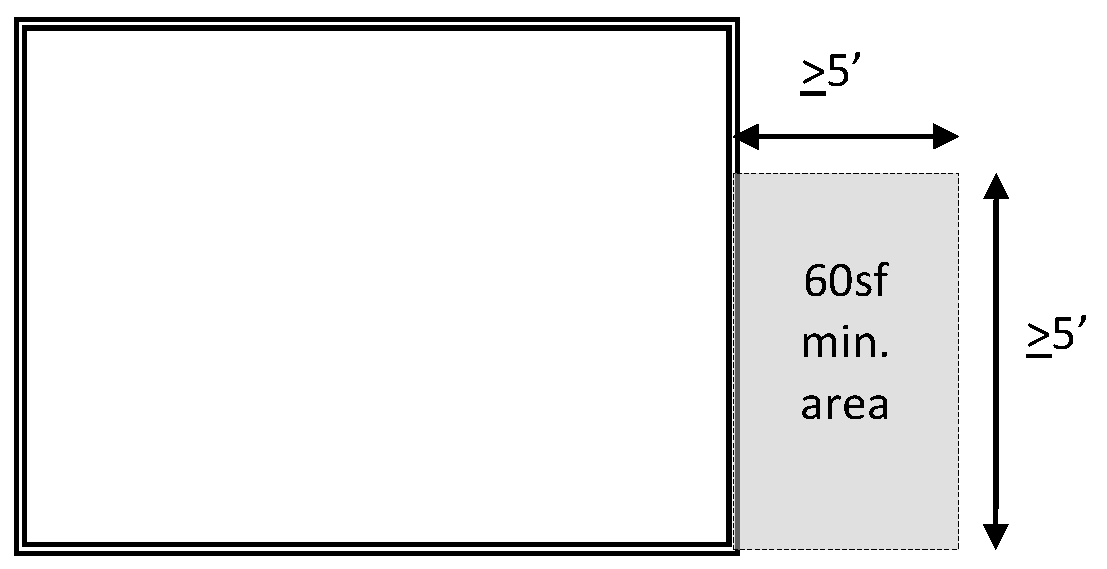
Sec. 13.1-8. - Street-facing façades.
A.
Objective. The street-facing façades of cottages in a cottage housing development will contribute to the neighborhood by including attractive design details such as windows, changes in materials, and views of front doors or porches. The main entries of some cottages will be visible from the adjacent streets to provide a visual pedestrian connection with the surrounding neighborhood.
1.
All cottages shall have street-facing façades that avoid blank walls or appear to "turn their backs" to the street. All cottages shall include one or more of the following on street-facing façades:
a.
Changes in exterior siding material and paint color;
b.
Windows which may include bay windows; and/or
c.
Building modulation with a depth measuring at least one foot.
2.
At least one cottage shall have its front main entry door and/or front porches visible from each street frontage.
Sec. 13.1-9. - Lot coverage area.
A.
Objective. Cottage housing developments shall not exceed underlying lot coverage standards for the respective zoning district to maintain residential neighborhood character and the balance of built structures to open spaces.
1.
Notwithstanding the provisions of Section 13.1-13, Common Open Space, the appropriate landscaped area requirements found in Section 19-5-2.a of this Ordinance shall be provided; and the maximum lot coverage permitted for all structures in cottage housing developments shall not reduce this required landscaped area.
2.
The use of paver stones, pervious pavement, grasscrete®, or other types of low impact stormwater development techniques are encouraged for walkways and parking areas.
Example of Grasscrete Pavers in Plan View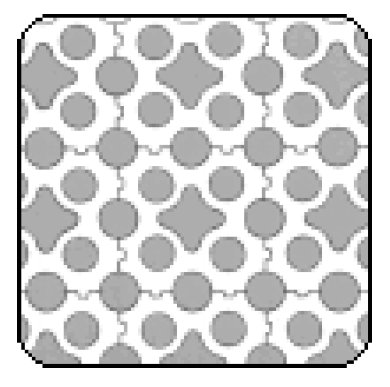
Table 13.1-9
(Ord. No. 2024-17, 11-26-2024; Ord. No. 2025-31, 10-28-2025)
Sec. 13.1-10. - Cottage floor area.
A.
Objective. Structures in cottage housing developments shall be designed to be single story or single story plus a loft. Residences in cottage housing developments are primarily intended for one- and two-person households and their occasional guests. Maintaining the maximum square footage of residences in cottage housing developments is necessary to prevent overbuilding of the site and to not exceed available off-street parking.
1.
The maximum ground floor gross area for an individual principal structure in a cottage housing development shall not exceed 864 square feet.
2.
Lofts can be no more than 50 percent of the net floor area of the main level.
Sec. 13.1-11. - Yards—Building setbacks from exterior lot lines.
A.
Objective. Exterior lot line building setbacks in cottage housing developments are based upon the allowed density of cottage housing as well as the small size of the structures. Flexible setbacks are allowed per the discretion of the Building Official and Planning Director to obtain improved site design and to avoid impacting existing physical features on the site such as trees.
Table 13.1-11
* The minimum rear yard shall be ten feet, unless abutting an alley, in which case, the minimum setback shall be five feet.
Sec. 13.1-12. - Cottage housing development building separation.
A.
Objective. Structures within cottage housing developments shall observe minimum setbacks from other cottage housing development structures to avoid overcrowding the site and to maintain a sense of privacy within the cottages themselves.
1.
All buildings within a cottage housing development shall maintain a minimum separation of 12 feet from cottages within a cottage housing development measured from the nearest point of the exterior walls. Accessory buildings shall comply with building code requirements for separation from non-cottage structures.
Sec. 13.1-13. - Common open space.
A.
Objective. Open space that is commonly owned by all members of a cottage housing development is an important feature of any site design. It is intended that the open space be adequately sized and centrally located with individual cottage entrances oriented towards the open space.
1.
Common Open Space. A minimum of 400 square feet per cottage unit of common open space is required. Parking areas, yard setbacks, spaces between buildings of 12 feet or less in width, private open space, and driveways do not qualify as common open space.
2.
Proximity to Common Open Space.
a.
At least 50 percent of the cottage units shall abut a common open space. All of the cottage units shall be within 60 feet walking distance measured from the nearest entrance of the cottage along the shortest safe walking route to the nearest point of the common open space. The common open space shall have cottages abutting at least two sides.
b.
For the purposes of cottage housing, "common open space" shall be the central space that may be used by all occupants of the cottage housing development.
Sec. 13.1-14. - Private open space.
A.
Objective. Each residential unit in a cottage housing development shall be provided an area of private open space. The private open space shall separate the main entrance to the cottage from the common open space to create a sense of privacy and shall be oriented to take advantage of solar orientation and other natural features to create a small but pleasant private yard area. The private open space may be separated from the common open space with a small hedge, picket fence, or other similar visual separation to create a sense of separate ownership.
1.
Each cottage unit shall be provided with a minimum of 200 square feet of usable private open space separated from the common open space by a hedge or fence not to exceed 36 inches in height.
2.
No dimension of the private open space shall be less than eight feet.
Sec. 13.1-15. - Tree conservation.
A.
Objective. Cottage housing developments shall be designed to incorporate existing trees to the extent possible. New trees shall be located to create amenities in the common open space, private open space, provide shade where appropriate, to create separation between buildings when desired, and to screen and soften the perimeter of parking areas and street facing sides of cottage housing developments.
1.
Preservation of existing trees, and/or new trees, shall be provided consistent with the standards for landscaping and tree preservation as identified within Sections 19-5-4 and 19-5-5 of this Ordinance. Native trees and other vegetation shall be preserved to the extent possible and the overall site design shall take advantage of the location of existing trees as well as natural openings or clearings on forested sites.
(Ord. No. 2024-17, 11-26-2024)
Sec. 13.1-16. - Stormwater low impact development techniques.
A.
Objective. Cottage housing developments shall be designed to take advantage of open space and landscaped features to utilize stormwater low impact development techniques including natural filtration and on-site infiltration of stormwater.
1.
Low impact development techniques for stormwater management shall be used wherever possible. Such techniques may include the use of pervious pavers in parking areas and for walkways, directing roof drains and parking lot runoff to landscape beds, green or living roofs, and the use of rain barrels.
2.
Cottages should be located so as to maximize natural stormwater functions. Cottages shall be clustered and parking areas shall be located to preserve as much contiguous, permanently undeveloped open space and native vegetation as possible.
Sec. 13.1-17. - Off-street parking.
A.
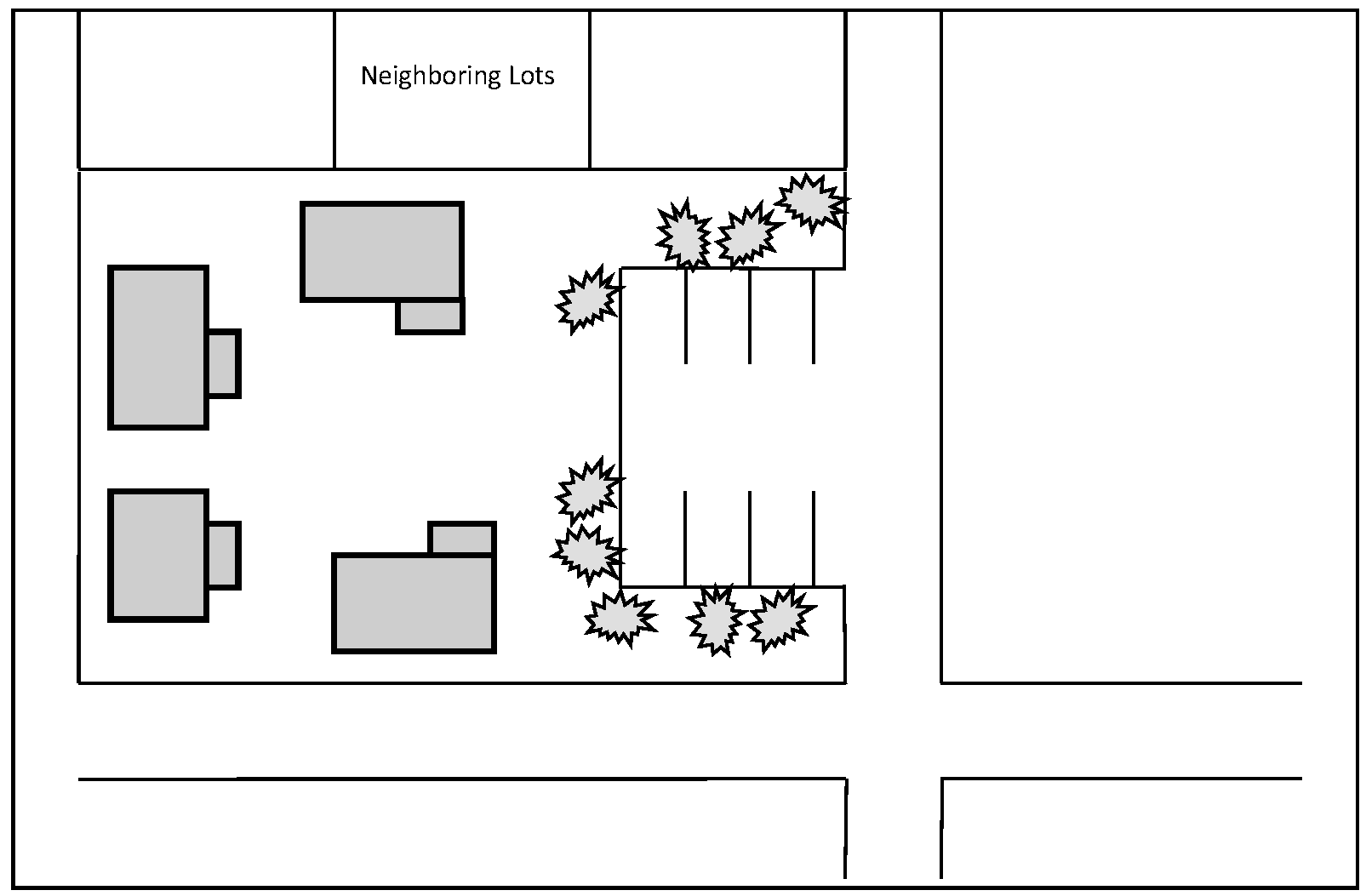
Objective. Off-street parking space requirements for cottage housing developments shall be consistent with Section 18-6-5 of this Ordinance. Off-street parking shall be located and designed to be less visible from frontage streets than the cottages themselves. Off-street parking shall be designed to maintain a pedestrian character for the overall cottage housing development. Clustering parking to the side or rear of a cottage project will most often best accomplish these goals. However, on a site-specific basis, design solutions other than clustering may be found to meet this objective through the alternative design process. Parking areas shall be attractively landscaped to screen parking from adjacent properties and public rights-of-way and shall meet applicable parking lot landscape standards, as provided for within this article and Article 19 of this Ordinance.
1.
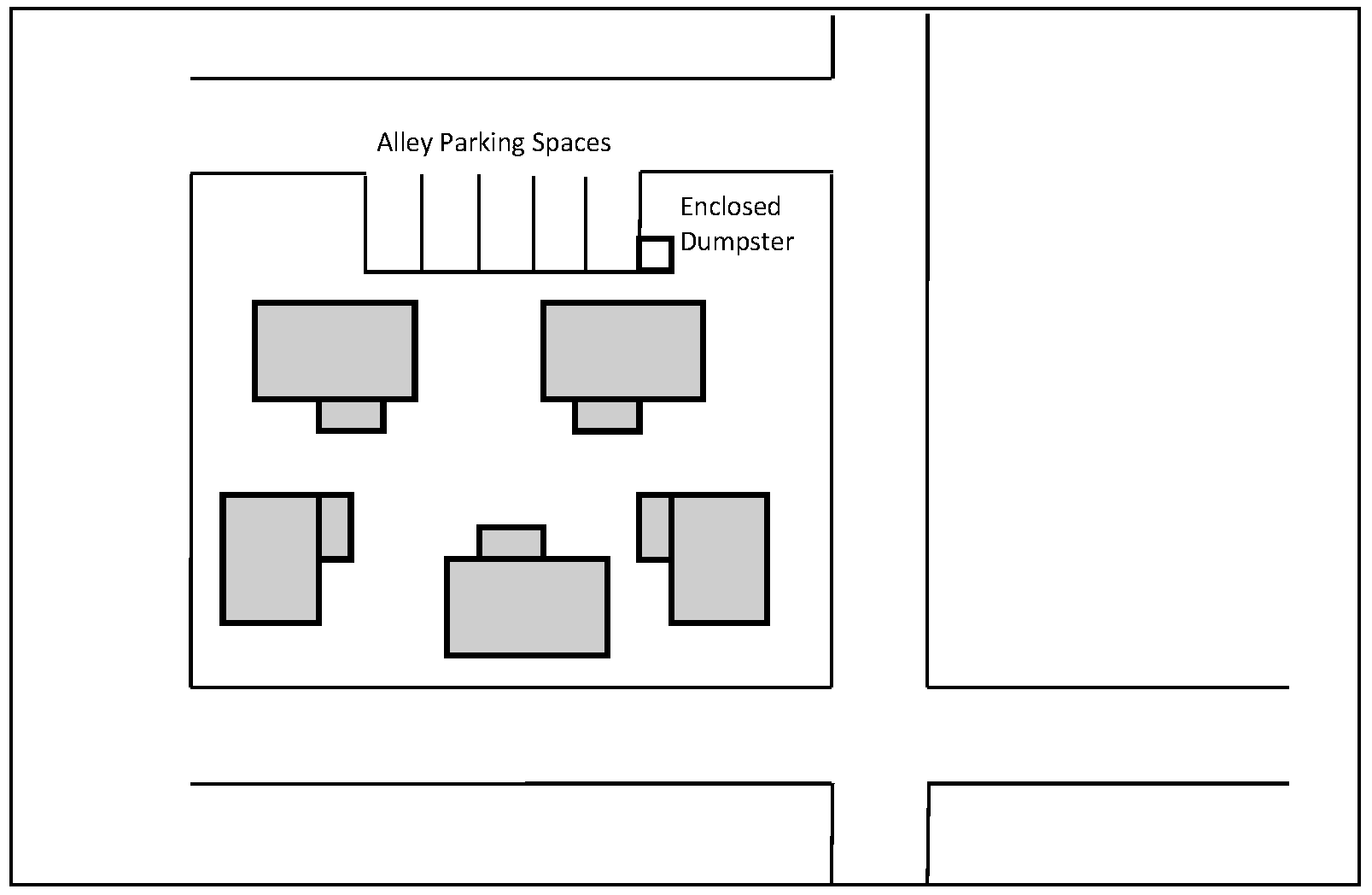
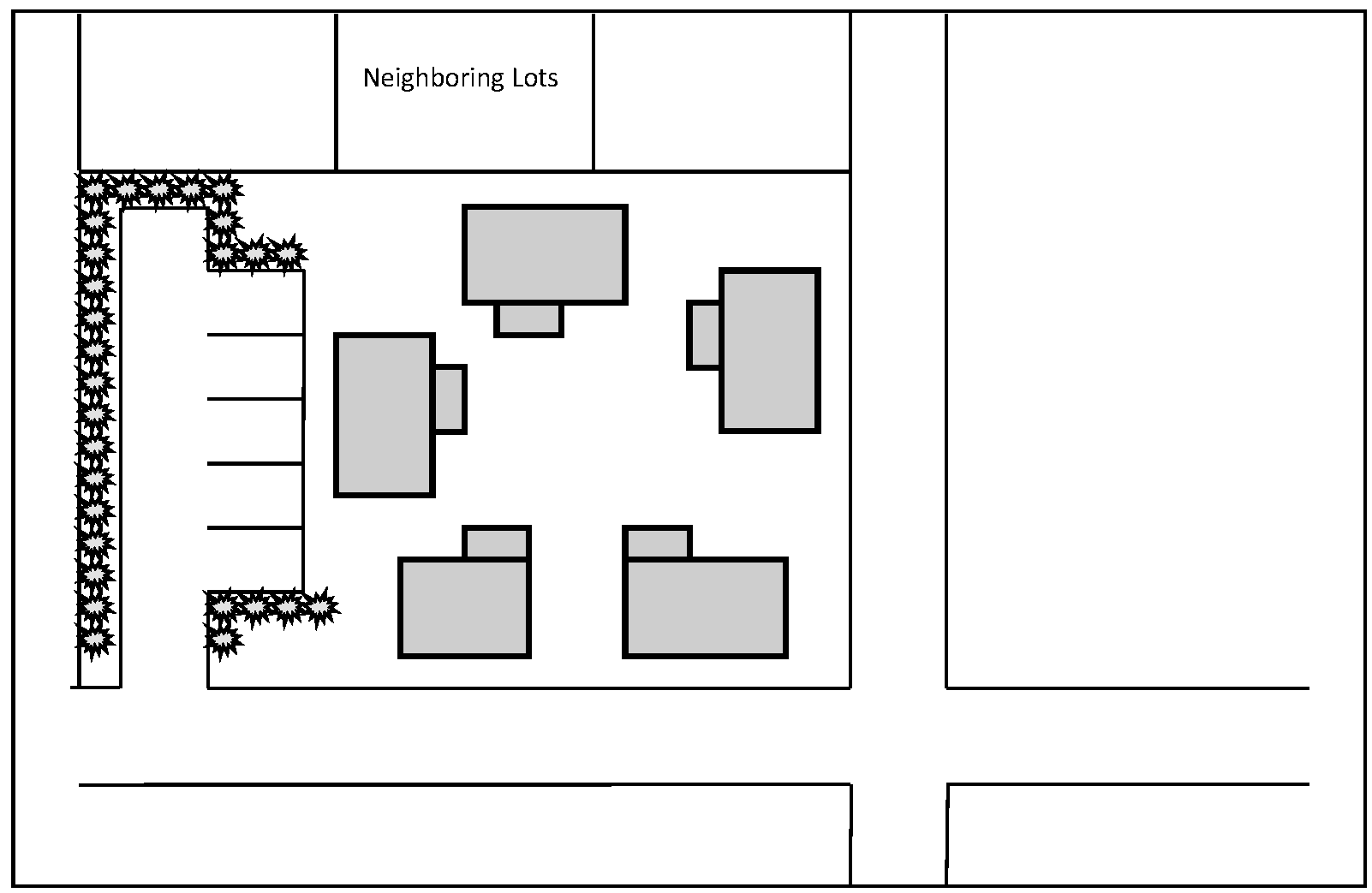
Off-Street Parking Location. Parking shall be located on the cottage housing development property. Off-street parking lots shall be located to the side or rear of the cottage housing development (see illustrations below). Parking lots shall not be located between the cottage housing development and the primary street frontage.
a.
Off-Street Parking Screening. Off-street parking may be located in or under a non-cottage parking structure (such as a single or multi-auto carport or garage), but such structures shall not be attached to individual cottages. Uncovered parking is also permitted; provided that off-street parking shall be screened from direct street view from one or more street façades by garage doors, or by a fence and landscaping.
b.
Preferred Locations. Preferred locations for parking, in descending order of preference, are as follows:
i.
To the rear of cottage housing units accessed by an alley.
ii.
To the side of cottage housing units accessed by a private driveway.
iii.
Parking on the side (non-primary street) screened from the side street by either garage doors, landscaping, and/or fencing.
c.
Parking Lot Landscaping. Parking lot landscaping shall comply with the requirements of Section 19-5-4 of this Ordinance.
(Ord. No. 2024-17, 11-26-2024)
Sec. 13.1-18. - Fire-lane access and turnaround provisions.
A.
Objective. Cottage housing developments shall be designed so as to allow for the safe and unobstructed access to individual dwellings by emergency responders (i.e., fire, rescue, police), for the purposes of protecting life, property and overall public safety.
1.
Fire apparatus access roads shall be in accordance with Chapter 10, Fire Prevention, of the Winchester City Code, and the Virginia Statewide Fire Prevention Code, as amended.
2.
Dead-end fire apparatus access roads in excess of 150 feet shall be provided with width and turnaround provisions in accordance with the Table and Diagrams below:
Table 13.1-18
Diagram 13.1-18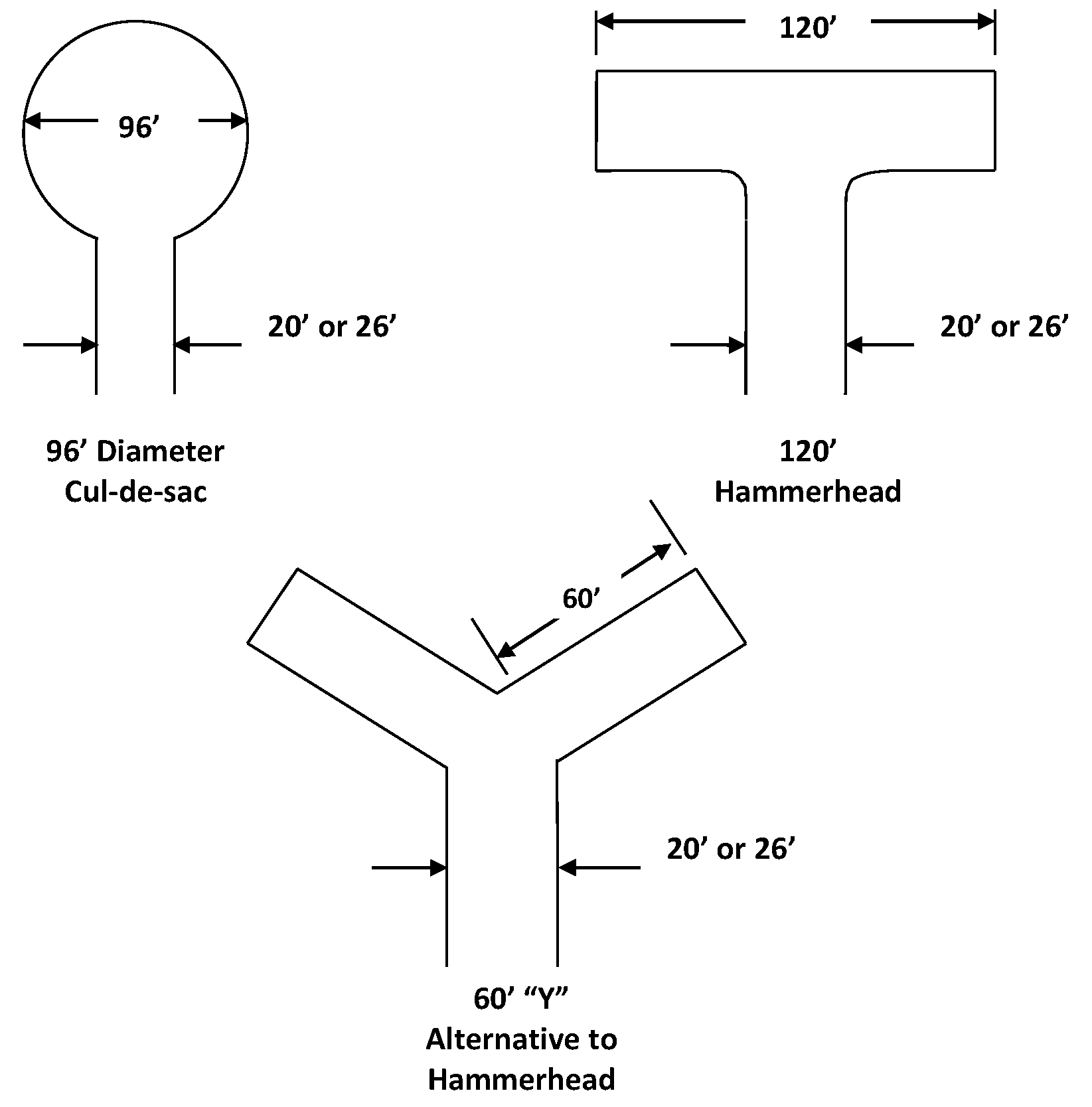
Sec. 13.1-19. - Exterior lighting and heating/cooling equipment noise.
A.
Objective. Cottage housing developments should be designed to minimize light and noise impacts both within the development and to adjacent properties.
1.
Where provided, exterior lighting shall be mounted as low as possible, pointed downward, and the light source shall be shielded from direct observation from above, adjacent properties, and public rights-of-way. Lighting "spillover" to adjacent properties shall be avoided.
2.
Heating and cooling equipment for cottage housing developments shall be designed and appropriately screened to cause little or no visual and/or noise impacts within the development and to adjacent properties.
Sec. 13.1-20. - Required separation of cottage housing developments.
A.
Objective. Cottage housing developments in single-family zoning districts shall be separated from each other by a minimum distance to promote housing-type diversity, to reduce potential cumulative impacts of cottage housing development, and to help protect neighborhood character.
1.
Each cottage housing development shall be separated from any other cottage housing development by a distance of at least 1,000 feet or one block, whichever is greater.
Sec. 13.1-21. - Ownership and residential use of cottages.
A.
All cottage housing developments shall be developed as residential condominiums, pursuant to the provisions found in Code of Virginia, Tit. 55, Ch. 4.2 et seq., known commonly as the "Condominium Act." Appropriate documentation of formal legal ownership of the development shall be recorded with the Commonwealth of Virginia, the Winchester Circuit Court Clerk, and the Tax Assessor's Office with the City of Winchester.
1.
Cottages are for residential use only and may not be operated as transient accommodations.
Sec. 13.1-22. - Alternative site design.
It is possible that an alternative design may fulfill the intent of this article, while not complying with the provisions herein. Requests for alternative designs shall be processed as a Conditional Use Permit, pursuant to Section 18-2 of this Ordinance and Article 19, Site Plan Requirements.

