
Winchester City Zoning Code
ARTICLE 14
3 - NEIGHBORHOOD DESIGN DISTRICT—NDD1
STATEMENT OF INTENT
This Neighborhood Design District (NDD) is intended to allow a flexible mix of residential, commercial, and other uses in designated areas, producing centers of activity that incorporate new and existing structures, as well as community-oriented streetscapes and civic spaces. Neighborhood Design District regulations incorporate features of the B-1 Central Business District zone, PUD Planned Unit Development zone, and CE Corridor Enhancement District to promote connectivity, the integration of residential and commercial uses, and the development of parks and recreational areas to foster community. The NDD implements the Comprehensive Plan by encouraging development in conformance with the Neighborhood Design District area plans in the Comprehensive Plan. It promotes development that includes the following design features:
a.
A mix of land uses, including commercial and residential uses within the same structure
b.
Buildings located close to the street
c.
Active, pedestrian-oriented streetscapes
d.
Meaningful public parks and civic spaces
e.
Higher development densities and taller structures
f.
Buildings with articulated facades and adequate provision of windows
g.
A mix of new structures and creative reuse of existing buildings
h.
High-quality design that contributes to the character of neighborhoods and the City
Editor's note—Ord. No. 2025-27, adopted Oct. 28, 2025, amended Ch. 14.3 in its entirety to read as herein set out. Former Ch. 14.3, §§ 14.3-1—14.3-16, pertained to similar subject matter, and derived from Ord. No. 2025-25, adopted March 11, 2025.
Sec. 14.3-1.- Applicability.
Except as otherwise provided herein, the provisions of this Article shall apply to all lands within the boundaries of the Neighborhood Design Districts (NDD) as delineated upon the City of Winchester, Virginia, Zoning Map. The boundary of the NDD District shall be depicted as a surveyed line on any site plan or subdivision plat proposed for property located within this district. Where the property is split by this line, these provisions shall apply only to the portion within the district.
(Ord. No. 2025-27, 10-28-2025)
Sec. 14.3-2. - General provisions.
14.3-2-1
A site plan shall be required for all development in the NDD.
14.3-2-2
Any use, activity, lot, or structure subject to the provisions of the NDD, which does not conform to the provisions of the NDD district shall be subject to Article 17, nonconformities, of this Ordinance.
14.3-2-3
Adaptive reuse of existing structures is encouraged within NDD's in accordance with each district's approved concept plan. The Planning Director may grant additional waivers to the development standards, where appropriate and encouraged by the NDD concept plans, to enable the adaptive reuse of existing structures.
(Ord. No. 2025-27, 10-28-2025)
Sec. 14.3-3. - Area regulations.
The minimum lot area for permitted uses in this district shall be as follows:
14.3-3-1
Single family detached dwellings - 4,000 square feet per unit.
14.3-3-2
Two family dwellings - 1,500 square feet per dwelling unit.
14.3-3-3
Townhouse dwellings, other permitted, and conditional uses - No minimum lot area.
(Ord. No. 2025-27, 10-28-2025)
Sec. 14.3-4. - Lot width regulations.
The minimum lot width for uses in this district shall be as follows
14.3-4-1
Single family detached dwellings - 30 feet.
14.3-4-2
Two family dwelling units - 25 feet per unit for structures where the two units are side-by-side or 30 feet total where one unit is situated behind or above the other unit, except for the minimal amount of ground level entry floor area needed for an upper-level unit.
14.3-4-3
Townhouse dwelling units, All other permitted and conditional uses - No minimum lot width.
(Ord. No. 2025-27, 10-28-2025)
Sec. 14.3-5. - Build-to-zone regulations.
The minimum and maximum build-to-zone for uses in this district shall be as follows:
14.3-5-1
Single family and two-family dwellings: Ten feet minimum and 30 feet maximum.
14.3-5-2
Townhouse dwellings: Five feet minimum and 15 feet maximum.
14.3-5-3
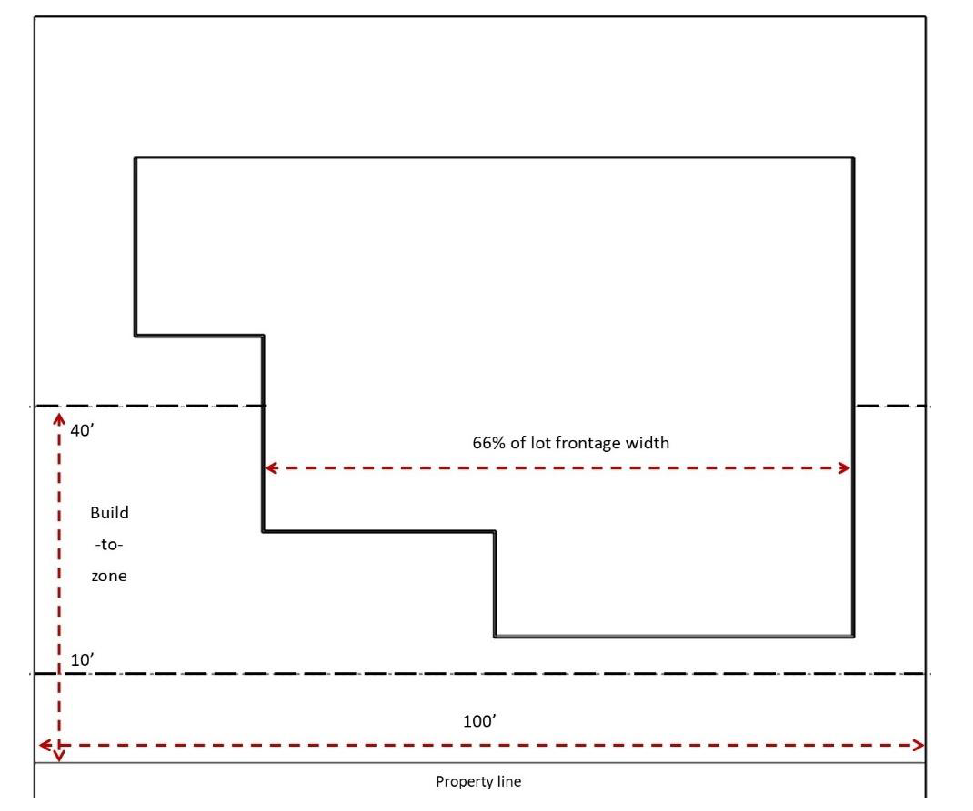
All other uses: Ten feet minimum and 40 feet maximum
a.
At least 66 percent of a site's lot frontage width must have a front building facade built within the build-to-zone.
b.
Special treatments to ground floor street façades, such as porches, turrets, and other major architectural elements may be within seven feet of a block corner.
14.3-5-4
For canopies covering gasoline or other petroleum pumps or dispensers, there shall be a 20-foot setback required from any street or from any street right-of-way. No setback shall be required for canopies to be installed above existing islands or replacement islands provided the replacement islands come no closer to the street right-of-way than the closest existing island to the right-of-way and provided dispensing of petroleum does not cease for more than six consecutive months anytime subsequent to adoption of this amendment.
(Ord. No. 2025-27, 10-28-2025)
Sec. 14.3-6. - Block length.
14.3-6-1
Where new streets are created, a minimum block length of 200 feet and maximum block length of 400 feet shall be required.
14.3-6-2
New blocks greater than 300 feet in length shall have an alley or pedestrian pathway with a right-of-way width of at least 30 feet providing through-access to another street, alley, or civic space.
(Ord. No. 2025-27, 10-28-2025)
Sec. 14.3-7. - Yard regulations.
14.3-7-1
Side.
a.
Single family detached dwellings and Two-family Dwellings - five feet
b.
Townhouse dwellings - five feet except along common property lines of units within the same townhouse dwelling in which case the common side yard equals zero feet.
c.
Other permitted and conditional uses - None, except when a use is abutting a residential district, in which case there shall be a 25-foot minimum side yard.
14.3-7-2
Rear.
a.
Single family detached dwellings and Two-family Dwellings ten feet.
b.
Townhouse dwellings ten feet.
c.
Other permitted and conditional uses - None, except that when a use is abutting a residential district, in which case there shall be a 25-foot minimum rear yard.
14.3-7-3
Corner-side. For all uses the yard area shall be equal to the minimum regulations found in Section 14.3-5.
(Ord. No. 2025-27, 10-28-2025)
Sec. 14.3-8. - Height regulations.
14.3-8-1
All principal structures in the build-to range shall meet a minimum height of the lesser of two floors or 20 feet above grade.
14.3-8-2
Accessory structures may be one or two floors in height, but in no case shall they exceed 20 feet above grade and may not exceed the height of the principal structure.
14.3-8-2
All buildings may be erected up to 100 feet from grade, except that:
a.
Church spires, belfries, cupolas, chimneys, flues, flag poles, television antennas, radio aerials, and equipment penthouses are exempt.
b.
Where immediately adjacent to any residential zone, buildings shall be limited to no greater than 35 feet at the rear or side yard line and the height of buildings must be stepped back one horizontal foot for each vertical foot of height above 35 feet.
(Ord. No. 2025-27, 10-28-2025)
Sec. 14.3-9. - District specific development standards
14.3-9-1
Development in the NDD district shall comply with the following building and site design standards excluding single family detached and two-family attached dwellings:
1.
All exterior walls of buildings facing public or private streets shall incorporate variations in the façade and roofline, such as variation in building materials and color, to reduce their perceived mass and scale. Long monotonous facades of more than 40 feet in length along the front and corner side elevation, and 60 feet in length for non-corner and rear elevations shall be avoided. Buildings shall incorporate two or more of the following features on each facade facing a street:
a.
Variations in roof form and parapet heights;
b.
Distinct changes in texture and color of wall surfaces;
c.
Ground level arcades and second floor galleries or balconies;
d.
Protected and recessed entries;
e.
Vertical accents or focal points; and
f.
Other physical or visual breaks as deemed appropriate by the Planning Director.
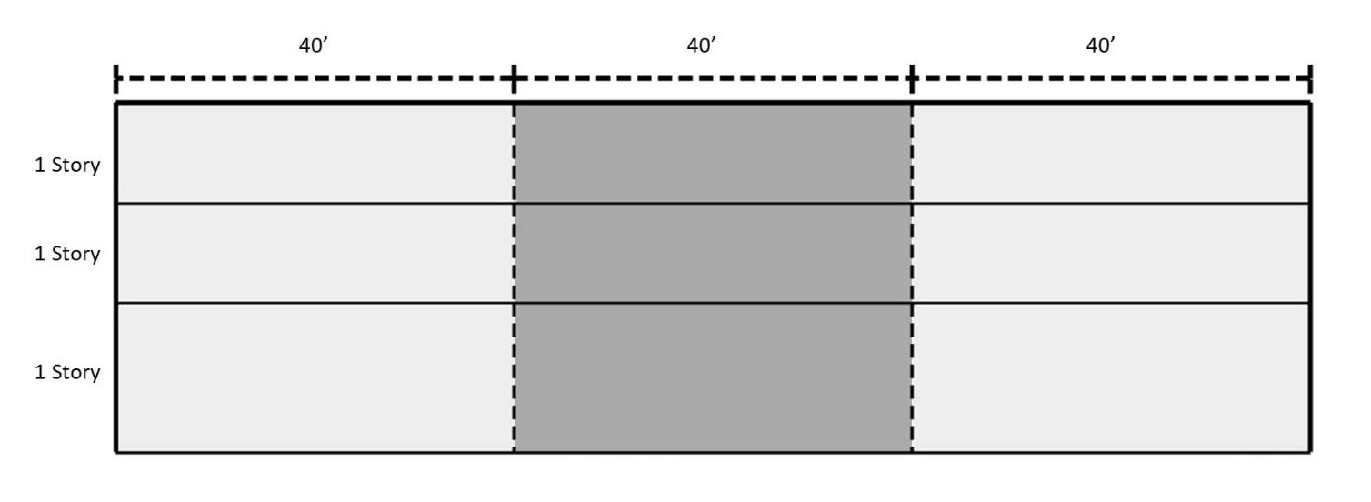
No building façade segment without a physical or visual façade break may exceed 40 feet in length along the front and corner-side elevation, and 60 feet in length for non-corner and rear elevations.
2.
Pedestrian access shall be provided.
3.
Buildings with street frontage shall have at least one primary pedestrian entrance opening to the street.
4.
No exterior portion of any building shall consist of unfinished or unpainted concrete.
5.
Off street parking shall be buffered from view from public streets or when abutting a residential district by situating it behind buildings or behind low walls compatible with the architecture of the building façade or behind perennial vegetation such that parking is not visible from pedestrian ways on public streets.
6.
All roof-based mechanical equipment, as well as vents, pipes, antennas, satellite dishes, and other roof penetrations (except chimneys), shall be located on the rear elevations or otherwise be configured, to the maximum extent practicable, to have a minimal visual impact as seen from the street.
7.
Existing limestone freestanding or retaining walls shall be preserved.
i.
A conditional use permit may be sought for situations where either (1) a property owner can demonstrate that compliance with the above is technically impractical to maintain functionality of the property or (2) Council makes a finding that the proposed alternative design is desirable and consistent with neighborhood character.
14.3-9-2
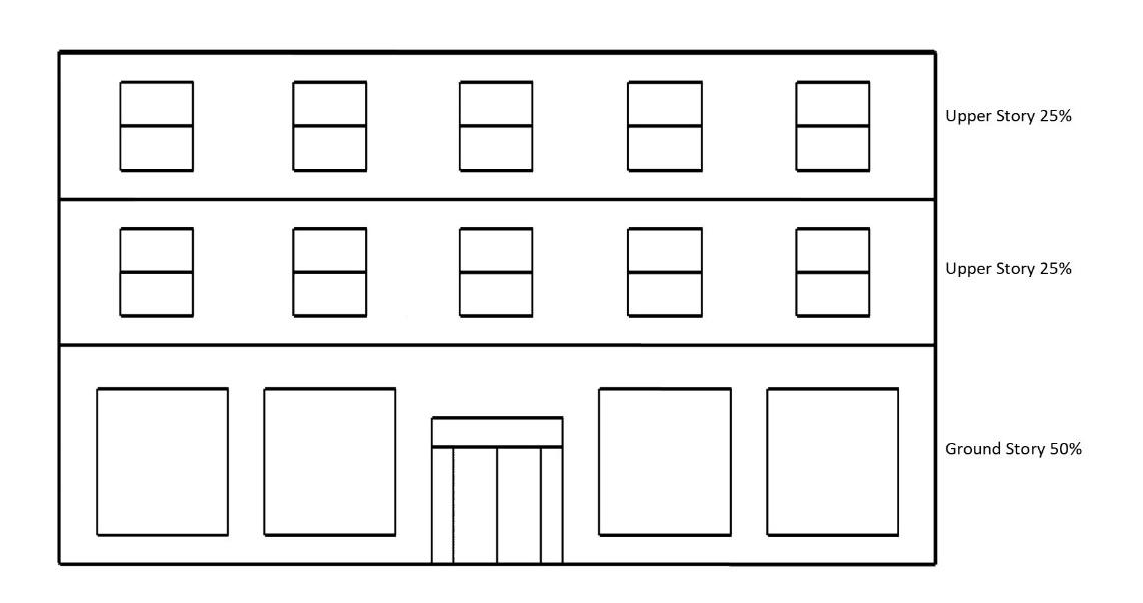
Facade transparency requirements: Façade transparency is the amount of opening within the frames of windows and doors as a percentage of the building façade. To promote an active streetscape, a minimum amount of façade transparency is required for building façades facing public and private streets, pedestrian passages, and civic spaces. Doors meeting this requirement shall contain at least 50 percent glass. Single family detached, two family attached, and townhouse dwellings shall be exempt from these requirements. The Planning Director may grant additional waivers or modifications to this requirement for churches and institutional uses.
1.
Minimum ground story transparency. Ground story transparency is measured between two and 12 feet above the abutting sidewalk. A minimum ground story transparency of 50 percent is required excepting ground floor residential uses, which shall provide a minimum transparency of 25 percent.
2.
Minimum upper story transparency. A general minimum transparency requirement is measured from floor to floor of each story above the ground story. A minimum upper story transparency of 25 percent is required.
(Ord. No. 2025-27, 10-28-2025)
Sec. 14.3-10. - Use regulations.
Structures and land to be used shall be for the following uses.
14.3-10-1
Single-family detached dwellings.
14.3-10-2
Two-family detached dwellings.
14.3-10-3
Townhouses, in accordance with Section 9-9.
14.3-10-4
Multifamily dwellings. A copy of the proposed floor plans and a Covenants and Restrictions document shall be provided with the application for any multifamily project. The document shall include provisions addressing:
a.
A copy of any covenants and restrictions placed on the property.
b.
A project overview specifying the number of units, percentage of each bedroom type, dwelling unit sizes in square feet, and the ownership structure of the units.
c.
A property management and maintenance plan to include a budget for operational expenses and how trash will be stored and collected.
14.3-10-5
Home occupations conducted in the main building, including homeshares operated as an accessory use in accordance with Sections 18-19 and 18-29 of this Ordinance.
14.3-10-6
Accessory uses, as defined.
14.3-10-7
Banks and financial institutions, not including alternative financial institutions, as defined.
14.3-10-8
Churches.
14.3-10-9
Contractors' offices and display rooms.
14.3-10-10
Convenience service establishments such as, but not limited to, barber shops, beauty parlors, tailors, and automatic self-service laundries.
14.3-10-11
Day nursery or day care centers.
14.3-10-12
Fire and rescue squad stations.
14.3-10-13
Funeral homes, excluding crematories.
14.3-10-14
Government offices.
14.3-10-15
Bed and Breakfast Inns, Bed and Breakfast Homestays, Hotels and motels.
14.3-10-16
Institutions of higher education.
14.3-10-17
Laundry or dry-cleaning establishments.
14.3-10-18
Library.
14.3-10-19
Museums and public arts galleries.
14.3-10-20
Offices, business and professional.
14.3-10-21
Parking garages.
14.3-10-22
Post office.
14.3-10-23
Printing shops.
14.3-10-24
Artisan manufacturing with facilities of 5,000 square feet or less.
14.3-10-25
Public utilities, such as poles, lines, distribution transformers, pipes, meters, water and sewer lines, booster or relay stations, transformer substations, transmission lines and towers.
14.3-10-26
Radio or television broadcasting stations, studios, or offices.
14.3-10-27
Repair services or businesses, including repair of bicycles, guns, radios, television sets, electrical appliances, locks, refrigerators and other home appliances, shoes, toys, typewriters, watches and clocks, provided that no equipment over five horsepower shall be used.
14.3-10-28
Restaurants, with the following restrictions.
a.
Restaurants within the core area shall not have a drive through.
b.
Restaurants outside of the core area may have a drive through, but only in the rear.
14.3-10-29
Retail stores.
14.3-10-30
Schools, private and public.
14.3-10-31
Outdoor storage of materials and supplies and display of merchandise for sale or rent incidental to the conduct of any permitted uses on the lot as provided for in Section 18-20 of this Ordinance. In no case shall the outdoor storage area be greater than 50 percent of the footprint area of the buildings on-site.
14.3-10-32
Theaters, motion picture theaters, and assembly halls, but excluding drive-in theaters.
14.3-10-33
Wholesale businesses where loading areas are completely screened from street view.
14.3-10-34
Off-Street Parking Areas as defined in Section 18-6 of this Ordinance for permitted and conditional uses in the NDD District and access drives for permitted and conditional uses in the B-1, B-2, RB-1, RO-1, CM-1, EIP, MC, HE-1, and PUD Districts, in accordance with Section 18-6 of this Ordinance.
14.3-10-35
Signs in accordance with Section 18-8 of this Ordinance.
14.3-10-36
Group Home and assisted living facility in which no more than eight persons reside as residential occupancy by a single family.
14.3-10-37
Physical fitness or martial arts establishments, and interior recreation centers.
14.3-10-38
Assembling establishments not involved in any on-site manufacturing that are not objectionable because of smoke, odor, dust, or noise with not more than ten persons employed.
14.3-10-39
Bakeries.
14.3-10-40
Arenas, Amphitheaters, and Stadiums provided that no such structure is situated within 200 feet of any residential district, as measured from the structure containing the establishment or the off-street parking area to the residential zone property line.
14.3-10-41
Entertainment Establishments, located in the core area or at least 200 feet from a residentially zoned property, as measured from the structure containing the establishment or the off-street parking area to the residential zone property line.
14.3-10-42
Distillery, brewery, cidery, microdistillery, microbrewery, nanobrewery, or winery.
14.3-10-43
Short-term rentals, subject to the use standards of Section 18-29 of this Ordinance.
14.3-10-44
Wireless facilities and wireless support structures eligible for administrative review per Section 18-30-4.
14.3-10-45
Youth activity centers and similar facilities for adults.
14.3-10-46
Bowling alley.
14.3-10-47
Pool and billiards rooms, and video game arcades.
14.3-10-48
Smoking lounges, as defined as an enclosed structure or room that is set aside to be used for the smoking of cigarettes, cigars, hookah, or other similar products, or vaping, provided that no such use shall be located within 200 feet of a similar use, public/private school, playground, or public park.
14.3-10-49
Banquet halls, wedding venues, and community centers.
14.3-10-50
Food commissary or catering establishment.
14.3-10-51
Private clubs and lodges.
14.3-10-52
Any use authorized under an existing Planned Unit Development (PUD) for the subject parcel.
14.3-10-53
For any lot on which an M-1 Limited Industrial use lawfully existed as of October 28, 2025, the lot may be used for the M-1 Limited Industrial use that existed on October 28, 2025, provided that (i) other M-1 Limited Industrial uses not present on the lot as of October 28, 2025, shall not be established by right, and (ii) the gross square footage created by construction of new buildings devoted to such use, or additions or expansions to existing buildings devoted to such use, does not exceed ten percent of the gross square footage that existed on October 28, 2025. As used herein, the term "gross square footage" shall not include additional square footage created solely by the internal alteration of existing buildings.
(Ord. No. 2025-27, 10-28-2025)
Sec. 14.3-11. - Uses requiring a conditional use permit.
14.3-11-1
The establishment of new or expansion of existing automobile and truck sales and service establishments and rental agencies, provided that vehicle lifts and pits and all service and repair of motor vehicles shall be within a building enclosed on all sides, and shall be subject to the standards in section 14.3-13.
14.3-11-2
Nursing and rest homes, and assisted living facilities.
14.3-11-3
Repealed.
14.3-11-4
Service stations, provided that all repair of vehicles take place in a fully enclosed building.
14.3-11-5
Wireless facilities and wireless support structures not eligible for administrative review.
14.3-11-6
Artisan manufacturing with facilities 5,001 square feet or more, provided that off-street loading is provided per Section 18-6-7 notwithstanding the exception under Section 18-6-6 of this Ordinance; or vertical farming uses to be conducted entirely within an industrialized container, subject to the requirements in Section 18-17.1.
14.3-11-7
Tobacco and vape retail establishments, provided that no such use is located within 500 feet of any other tobacco and vape retail establishments or residentially zoned property.
14.3-11-8
Home occupations conducted in an accessory structure in accordance with Section 18-19-2.6.
14.3-11-9
Home Improvement Donation Center.
14.3-11-10
For any lot on which an M-1 Limited Industrial use lawfully existed as of October 28, 2025, the lot may be used for the M-1 Limited Industrial use that existed on October 28, 2025, provided that (i) other M-1 Limited Industrial uses not present on the lot as of October 28, 2025, shall not be established by right, and (ii) the gross square footage created by construction of new buildings devoted to such use, or additions or expansions to existing buildings devoted to such use, does not exceed 25 percent of the gross square footage that existed on October 28, 2025. As used herein, the term "gross square footage" shall not include additional square footage created solely by the internal alteration of existing buildings.
(Ord. No. 2025-27, 10-28-2025)
Sec. 14.3-12. - Pre-existing planned unit developments.
14.3-12-1
The Neighborhood Design District provisions are not intended to override existing, approved Planned Unit Developments (PUDs). As the purposes of PUDs and NDDs complement each other by promoting mixed-uses, higher density, and meaningful greenspaces, the goals of the NDD are met by pre-existing PUDs, and the provisions as set forth in this Article shall not apply to approved PUDs. The Neighborhood Design District shall fully incorporate and allow any PUD approved prior to the establishment of this district, including all uses, setbacks, heights, densities, street requirements, open spaces, and design standards included in the PUD. This provision shall only apply to PUDs that have not expired in accordance with section 13-4-4.5 or per the Code of Virginia § 15.2-2261.
(Ord. No. 2025-27, 10-28-2025)
Sec. 14.3-13. - Core area requirements and boundaries.
14.3-13-1
Neighborhood Design District development should generally conform to plans established in the individual Neighborhood Design District studies of each planned district, including variations in development intensity across the district and an identifiable district center or node.
14.3-13-2
Residential uses on the ground floor shall not be permitted within 100 feet of the public right-of-way that defines the core area of each Neighborhood Design District.
14.3-13-3
The establishment of new automobile and truck sales, service establishments, and rental agencies, including parking and display of vehicles, shall not be permitted within any core area as defined in Section 14.3-13.
14.3-13-4
Cedar Valley Neighborhood Design District core area. The core area of the Cedar Valley Neighborhood Design District shall be defined as any portion of land within 200 feet of the public right-of-way of Valley Avenue.
14.3-13-5
Cider Hill Neighborhood Design District core area. The core area of the Cider Hill Neighborhood Design District shall be defined as any portion of land within 250 feet of the public right-of-way of Commercial Street between Fairmont Avenue and North Loudoun Street.
(Ord. No. 2025-27, 10-28-2025)
Sec. 14.3-14. - Residential density regulations.
14.3-14-1
The density in this district shall be 50 residential units per acre of lot area.
14.3-14-2
Multifamily projects with greater than 50 units shall provide on site, Outdoor amenity spaces such as a tennis court, basketball court, swimming pool, pickleball court, picnic canopy, community gardens, firepits, or other similar amenities.
(Ord. No. 2025-27, 10-28-2025)
Sec. 14.3-15. - Civic space requirements.
14.3-15-1
Each development in an NDD that is greater than one acre must devote at least ten percent of gross acreage to civic space, as defined in Section 14.3-15-4 of this ordinance. The civic space shall be in lieu of the minimum landscape area requirements in Section 19-5-2.a.
14.3-15-2
Access. Required civic spaces must:
a.
Provide outdoor common open space that conforms to Section 5-10 of this ordinance and that is located at the ground level and is open and provides clear visual connections to pedestrians on an adjacent public sidewalk; and
b.
Be designated and reserved on site(s) to be determined during site plan approval.
14.3-15-3
Cash-in-lieu of civic space. Cash-in-lieu of civic space(s) may be provided to the City to assist with off-site construction of a required civic space shown on the Concept Plan, provided:
a.
The required civic space shown on the Concept Plan is located within one-quarter of a mile; and the required on-site civic space is less than 0.2 acres in size; or,
b.
The development is less than two acres in size.
14.3-15-4
Civic Space Design Standards.
(Ord. No. 2025-27, 10-28-2025)
Sec. 14.3-16. - Off-street parking.
14.3-16-1
The following shall serve as the off-street parking minimum and maximum requirements and shall only apply to surface, off-street parking areas. Single-family and two-family dwellings shall be exempt from these standards and shall follow the requirements found in Section 18-6-5.1.
1.
Minimum: the minimum required amount of off-street parking spaces shall be equal to 50 percent of the requirements found in section 18-6-5.1, except for any development within a core area as defined in Section 14.3-14, in which case there is no parking minimum. The Planning Director may grant a waiver for this requirement if the main structure or use is within 700 feet, as determined by Section 18-6-3.1.a, of a parking garage that is open to public use.
2.
Maximum: The parking requirements found in Section 18-6-5.1 shall serve as the maximum allowed number of parking spaces for any development within an NDD, except for any development within a core area as defined in Section 14.3-14, in which case the parking maximum shall be 50 percent of the requirements found in Section 18-6-5.1. Parking stalls for vendors that are part of civic space design standards, as defined in Section 14.3-15-4, are exempt.
(Ord. No. 2025-27, 10-28-2025)

