
Winchester City Zoning Code
ARTICLE 18
GENERAL PROVISIONS
Sec. 18-1.- Zoning use permit.
[18-1-1
Zoning use permit.]
(7/25/17, Case TA-17-287, Ord. No. 2017-20)
18-1-1.1
If a proposed use, the building it is situated within, and the property it is located upon are in conformity with the provisions of this Ordinance, a zoning use permit shall be issued by the Zoning Administrator. Pending the issuance of this permit, a temporary zoning use permit may be issued. Such temporary use permit shall not be construed as in any way altering the respective rights, duties, or obligations of the owner, tenant(s), or the City relating to the use or occupancy of the land or building or any other matter covered by this Ordinance.
(10/11/83, Case 83-06, Ord. No. 034-83; 7/25/17, Case TA-17-287, Ord. No. 2017-20)
18-1-1.2
Written application for a zoning use permit for the use of vacant land or for a change in the use of land or a building, for a change of a nonconforming use, for the enlargement of a use, or for the continuation of a use as provided in Section one of this Article, shall be made to the Administrator using the City's application form. If the proposed use is in conformity with the provisions of this Ordinance, and of all other applicable laws and ordinances, as certified to the Zoning Administrator by the officers, bodies, or agencies responsible for the administration thereof, the zoning use permit shall be issued within five working days after the complete application for the same has been made. A permit issued under this section does not indicate compliance with any City codes or Ordinance other than the Zoning Ordinance.
(7/25/17, Case TA-17-287, Ord. No. 2017-20)
18-1-1.3
Prior to the initiation of an application for a zoning use permit or for any other action as outlined in Code of Virginia, § 15.2-2286(B) et seq., the applicant shall produce satisfactory evidence that any delinquent real estate taxes owed to the City of Winchester which have been properly assessed against the subject property have been paid.
(9/8/09, Case TA-09-87, Ord. No. 2009-25; 7/25/17, Case TA-17-287, Ord. No. 2017-20)
18-1-2
When required.
18-1-2.1
A zoning use permit shall be obtained from the Administrator for any of the following, and no occupancy, use, change or enlargement of use shall take place until such zoning use permit has been issued by the Administrator:
a.
Occupancy and use of a building hereafter erected.
b.
Change in the use of an existing building.
c.
Occupancy and use of vacant land, except for any agricultural use.
d.
Change in the use of land, except for any agricultural use.
e.
Any change in the intensity or scope of a nonconforming use.
f.
Enlargement of any use with respect to the unit of measurement specified in this chapter as the basis for determining the amount of required automobile parking space, whether the same is specified in terms of floor area, dwelling units, seats, or any other element of size of the use.
(7/25/17, Case TA-17-287, Ord. No. 2017-20)
18-1-2.2
Repealed.
(7/25/17, Case TA-17-287, Ord. No. 2017-20)
18-1-3
Not to permit violations of law. No zoning use permit shall be deemed to validate any violation of any provision of any law or ordinance.
(7/25/17, Case TA-17-287, Ord. No. 2017-20)
18-1-4
Effect. A zoning use permit shall be deemed to authorize, and is required for, both initial and continued occupancy and use of the building or land to which it applies and shall continue in effect so long as such building and the use thereof or of such land is in full conformity with the provisions of this Ordinance and any requirements made pursuant thereto. A zoning use permit may be denied, suspended, or revoked by the Administrator where upon request of the Administrator an applicant fails to produce satisfactory evidence that all delinquent business, personal property, meals, transient occupancy and admissions taxes owed by the business to the City have been paid, or it is otherwise determined that such taxes have not been paid. On the serving of notice of any violation of any of such provisions or requirements with respect to any building, or the use thereof or of land, the zoning use permit for such use shall thereupon become null and void if the issue is not corrected within the time prescribed in the notice of violation. If such nullification occurs, a new permit shall be required for any further use of such building or land.
(9/8/09, Case TA-09-87, Ord. No. 2009-25; 7/25/17, Case TA-17-287, Ord. No. 2017-20)
18-1-5
For buildings or land when regulations change. On written request by the owner, the Administrator shall issue a zoning use permit for any use of a building or of land existing at the time of the adoption of this Ordinance or at the time of the adoption of any amendments of this Ordinance changing the regulations applying to such building or land, certifying, after inspection and investigation, the extent and kind of such use and whether the same conforms to the provisions of this chapter for the district in which it is situated or is a nonconforming use. The Zoning Administrator may require such proof as may be necessary to enable him to make a determination in the matter, and the furnishings of such proof shall be a condition of his acting on the request.
(7/25/17, Case TA-17-287, Ord. No. 2017-20)
18-1-6
Certificates of occupancy.
(7/25/17, Case TA-17-287, Ord. No. 2017-20)
A.
No building or structure shall be used or occupied except in accordance with a valid certificate of occupancy issued by the City's building code official.
B.
Whenever a structure is constructed or altered resulting in the need for the issuance of a Certificate of Occupancy per the Virginia Uniform Statewide Building Code, the Administrator shall approve such certificate only upon completion of all applicable Zoning Ordinance requirements. The Administrator's signature on a certificate of occupancy shall constitute his certification that the use that is subject of the certificate is lawful under the provisions of the City's zoning ordinance.
C.
A temporary certificate of occupancy may be considered and issued by the Administrator only when all required site improvements have been completed or properly bonded per Article 19 of this Ordinance.
Sec. 18-2. - Conditional use permit.
18-2-1
Conditional use permit.
(10/11/83, Case 83-06, Ord. No. 034-83)
18-2-1.1
Conditional use permits may be granted by the City Council for any of the uses for which a permit is required by the provisions of this Ordinance. In granting any such use permit, the City Council may impose any such conditions in connection therewith as will assure that it will conform with the requirements contained herein and will continue to do so, and may require a guarantee or bond to ensure that the conditions imposed are being and will continue to be complied with. A conditional use permit shall not be issued unless the City Council shall find that:
a.
The proposal as submitted or as modified will not affect adversely the health, safety, or welfare of persons residing or working in the neighborhood of the proposed use; and will not be detrimental to public welfare or injurious to the property or improvements in the neighborhood. Among matters to be considered in this connection are traffic congestion, noise, lights, dust, odor, fumes, and vibration, with due regard for timing of operation, screening, and other matters which might be regulated to mitigate adverse impact.
b.
The proposal as submitted or modified will conform to the Comprehensive Plan, or to specific elements of such plan, and the official policies adopted in relation thereto, including the purposes and the expressed intent of this Ordinance.
18-2-1.2
Repealed.
(2/11/20, Case TA-19-598, Ord. No. 2020-01)
18-2-1.3
Reasonable accommodations for qualifying persons or groups of persons with disabilities or other protected class who are adversely affected by application of the Winchester Zoning Ordinance. Common Council reserves the right to make modifications in policies, practices, and procedures relating to the application of this Zoning Ordinance including but not limited to the issuance of a Conditional Use Permit or other reasonable accommodation, notwithstanding any restriction or prohibitions contained herein, in order to avoid discrimination under the Americans With Disabilities Act or other applicable federal law or controlling legal authority, on the basis of disability or other lawfully protected criteria, unless it can be demonstrated that making the modifications would fundamentally alter the nature of the service, program, or activity affected or would otherwise pose an undue hardship to the City.
(7/25/17, Case TA-17-287, Ord. No. 2017-20)
18-2-3
Procedures.
18-2-3.1
The procedures governing the application for and the granting of conditional use permit where required by this Ordinance shall be as follows:
(10/11/83, Case 83-06, Ord. No. 034-83)
18-2-3.2
The applicant, who shall be a record owner, or contract owner with written approval of the owner, of the land involved (if a contract owner, copy of said contract shall be filed with and made a part of application), shall make application for the use permit to the Administrator on the form provided for that purpose, giving all information required by such form, including such other information which the Administrator may deem necessary for an intelligent consideration of the project for which a permit is desired. The application shall be accompanied by the fee as per Section 23-8, evidence of delinquent tax payment per Section 23-9, and disclosure of real party interest per Section 23-10 of this Ordinance and ten copies of the following:
(10/13/92, Case TA-92-02, Ord. No. 016-92; 8/16/02, Case TA-02-04, Ord. No. 014-2002)
18-2-3.3
A site plan in accordance with Article 19 of this Ordinance.
18-2-3.4
The front, side, and rear elevations and floor plans of the proposed buildings.
18-2-3.5
Public Notice and Hearing. The Administrator shall submit the conditional use permit application and copies of the site plan to the Commission, which shall make a recommendation to City Council which shall approve, approve with conditions, or deny the application. No such use permits shall be considered by the Commission or the Council except after notice and hearing as per Section 23-7-1 of this Ordinance. Written notice shall be provided per Section 23-7-2 of this Ordinance for both the Commission and City Council hearings.
(2/9/88, Case TA-87-14, Ord. No. 009-88; 10/13/92, Case TA-92-02, Ord. No. 016-92)
18-2-3.6
Notification Signs. For the hearing by both the Commission and City Council, the applicant shall place notification signage as per Section 23-7-3 of this Ordinance.
(2/9/88, Case TA-87-14, Ord. No. 009-88; 10/13/92, Case TA-92-02, Ord. No. 016-92)
18-2-3.7
Upon the granting of a use permit, one copy of the site plan, upon which has been indicated the changes or restrictions, if any, required by the City Council or the Board of Zoning Appeals, shall be returned to the applicant, who may thereafter conduct the operations for which permits has been granted only in such manner and for such a time as the permit and the certified drawing shall specify. A use permit shall be valid for only the specific use it covers in the specific location designated.
18-2-3.8
Expiration. Notwithstanding any specific provision of any condition imposed by City Council in conjunction with the granting of a Conditional Use Permit which may conflict with this general provision, a Conditional Use Permit shall expire immediately upon any of the following occurrences: a) the use does not commence within one year of approval; b) the use ceases for more than one year; or, c) the use changes to another use allowed in the district. In cases where government action impedes reasonable operation of the use, these provisions shall not include the duration of such restrictions. Where permits are granted for portions of a site and/or structure, the expiration shall apply to just that portion of the site and/or structure.
(10/13/92, Case TA-92-02, Ord. No. 016-92; 6/13/00, Case TA-00-03, Ord. No. 015-2000; 2/10/09, Case TA-08-10, Ord. No. 2009-06)
18-2-3.9
Revocation by City Council. If the applicant or successor fails to comply with any conditions imposed by City Council per Section 18-2-1.1, City Council may, in accordance with Code of Virginia, § 15.2-2286 et seq., either amend or revoke the Conditional Use Permit upon notification from the Administrator of such failure to comply. No such amendment or revocation shall be considered by City Council until a public hearing has been held per Section 23-7-1 of this Ordinance.
(2/10/09, Case TA-08-10, Ord. No. 2009-06)
Sec. 18-3. - Uses not provided for.
18-3-1
Uses not specifically permitted in any district established under this Ordinance shall not be allowed. Persons desiring inclusion in this Ordinance of a use not specifically permitted shall apply for an amendment to the text of the Ordinance, following the provisions of Article 22, AMENDMENTS.
(10/11/83, Case 83-06, Ord. No. 034-83)
Sec. 18-4. - Occupancy of dwelling units.
18-4-1
Intent. The purpose of this Section is to promote the health, safety and general welfare of the public within the residential section of the City of Winchester by providing occupancy standards set forth in this section. Notwithstanding any other provision of this Ordinance, occupancy of dwelling units shall be limited to the maximum number of occupants allowed by this Section, to protect against threats to neighborhood quality that can accompany overcrowding of land, or undue density of population in relation to existing or available community facilities caused by excessive occupancy.
(1/10/06, Case TA-05-05, Ord. No. 001-2006)
18-4-2
Dwelling Unit Occupancy. The maximum number of adult occupants permitted in a dwelling unit is based upon the size of the entire dwelling unit. The following table outlines these limits for dwelling units, other than those identified as multifamily or condominium dwellings.
(10/9/07, Case TA-07-02, Ord. No. 2007-41)
*Adult occupant means any individual 18 years of age or older, living or sleeping in a building for more than thirty days in a given year and/or who uses the dwelling as their legal address.
**Livable FloorArea means any section of the dwelling unit that provides adequate light, heat and electrical service and is not already designated as a closet or bathroom.
In a condominium or Multifamily units, the number of adults allowed is calculated by taking the square footage of the dwelling unit and dividing by 200. The result gives the number of adults who may live in that dwelling unit according to this standard. Occupancy shall also conform to the limits prescribed in Sections 18-4-4 and 18-4-6 of this Ordinance.
18-4-3
Occupancy Standards for Bedrooms. One occupant per bedroom requires at least 70 square feet of bedroom floor area. Two or more occupants requires at least 50 square feet of bedroom floor area per person. The table below specifies the maximum number of occupants per room that would be allowed in a specified dwelling unit based on the floor area of each designated bedroom.
(1/10/06, Case TA-05-05, Ord. No. 001-2006)
Required Bedroom Area
*Number of occupants includes adults and children.
18-4-4
Requirements for Bedroom Classification.
(1/10/06, Case TA-05-05, Ord. No. 001-2006)
a)
Two means of exit must be available from a bedroom, with one being a door or window leading directly to the exterior.
b)
A window exit must have a width of at least 20 inches, a height of at least 24 inches, and a clear opening at least 5.7 square feet in area. A window sill may be a maximum of 44 inches.
c)
An exit must not lead through another sleeping area or a bathroom.
d)
Sleeping rooms built after 1996 must have an electrically-powered smoke detector, interconnected with smoke detectors in other sleeping rooms.
18-4-5
Living Space Requirement. When determining the maximum occupancy load for a dwelling unit, the table below mandates the minimum required areas that can accommodate the occupant's living space. This minimum square footage must be in addition to the required Occupancy Standards for Bedrooms set out in Section 18-4-4 of this Ordinance.
(1/10/06, Case TA-05-05, Ord. No. 001-2006)
*Number of occupants includes adults and children.
18-4-6
An owner of a dwelling unit that occupies or allows the occupancy of a dwelling unit by a number of occupants in excess of the maximum occupancy prescribed shall forthwith lower the occupancy to a level consistent with the limits of this Ordinance. An occupant of a dwelling unit occupied by a number of occupants in excess of the maximum occupancy here prescribed shall forthwith lower the occupancy to a level consistent with the limits of this Ordinance.
(1/10/06, Case TA-05-05, Ord. No. 001-2006)
18-4-7
The Administrator or one of his/her agents is authorized to investigate incidents of possible excessive occupancy in the City. In exercising the powers granted by this section, the Administrator or the designated agent may inspect buildings according to the procedures set out in Code of Virginia, § 15.2-1745 and § 27-98.2. Upon the Administrator's conclusion that there exists excessive occupancy of a dwelling unit, the Administrator, on behalf of the City, may seek an injunction to limit, lower or control the number of occupants in the dwelling unit.
(1/10/06, Case TA-05-05, Ord. No. 001-2006)
18-4-8
When determining if excessive occupancy exists in a dwelling, the Administrator or one of his/her agents shall conduct an investigation and keep the findings on file for a period of no less than five years. The investigation will collect information about indicators of excessive occupancy including, but not limited to: number of vehicles stored and registered at the dwelling, water usage, amount of trash, number of complaints from surrounding property owners, and number of people seen entering and exiting the dwelling at various times during the day.
(1/10/06, Case TA-05-05, Ord. No. 001-2006)
Sec. 18-4.1. - Use of dwelling units.
18-4.1-1
In any district in which residential uses are allowed or legally exist, a Dwelling Unit, as defined in Section 1-2-31 of this Ordinance must be used for occupancy by a Family as defined in Section 1-2-36, of this Ordinance for residential purposes as its principal use. Any use for residential occupancy by any other entity or person(s) shall constitute a violation of this Ordinance.
(10/9/07, Case TA-07-02, Ord. No. 2007-41)
18-4.1-2
Transient use of a dwelling unit, other than a group home, assisted living facility, homeshare or short term rental, as defined in Section 1-2 of the Ordinance, is not permitted in any district, without either a zoning use permit, conditional use permit or a certificate of nonconforming use as may be required by this Ordinance.
(9/14/10, Case TA-10-333, Ord. No. 2010-38; 7/25/17, Case TA-17-287, Ord. No. 2017-200; 6/12/18, Case TA-18-151, Ord. No. 2018-16)
18-4.1-3
Prima Facie evidence that a Dwelling Unit is being used for transient purposes or for a non-permitted boardinghouse, as defined in Section 1-2-12 of this Ordinance, shall include the existence of any one or more of the following characteristics: separate rental agreements for different occupants: exterior locking mechanisms on interior doors of rooms for occupants: separate entrances from the exterior of the building for individual occupants; and normally common areas of dwelling unit, such as the living room, family room or dining room, being used as sleeping areas or not being available on an equal or common basis to all occupants.
Sec. 18-5. - Use and storage of recreational vehicles.
18-5-1
No recreational vehicle (RV), as defined in Section 1-2-77, shall be used for living, sleeping, or other occupancy when parked and/or stored on any property within the City.
(5/13/08, Case TA 07-06, Ord. No. 2008-24)
(Ord. No. 2023-35, 1-23-2024)
18-5-2
Recreational vehicles owned, leased, or otherwise kept by owners and/or occupants of a property may be parked and/or stored on private property, provided that the property has an approved residential use, in accordance with the following requirements:
a.
For Single-Family Detached and Two-Family Dwellings, recreational vehicles exceeding an average height of 84" shall be parked on an improved surface behind the front and corner-side yard lines of the main building and shall not exceed two recreational vehicles per dwelling. Recreational vehicles that do not exceed an average height of 84" may be parked in a required front or corner-side yard, in accordance with the provisions of Section 18-6-3.5.
b.
Recreational vehicles that exceed an average height of 84" may be parked on an improved surface within the front or corner-side yard of the main building for a period not exceeding 48 hours within a 30 continuous day period for maintenance, loading, and unloading purposes, provided that such recreational vehicles shall:
(i)
Be licensed for the current year; and
(ii)
Conform to the regulations found in sections 18-12 regarding visual obstruction.
The 30-day period shall begin once the recreational vehicle is parked on the property and continues until the 30-day period ends or the max of 48 hours has been reached.
c.
For Townhouse developments and Multiple-Family Dwellings, recreational vehicles shall be parked on an improved surface behind the front and corner-side yard setback lines and within a clearly designated area noted on the site plan as approved by the Director of Planning. The maximum number of recreational vehicles per dwelling unit shall be equivalent to no more than one such vehicle per five dwelling units. When there are less than five dwelling units, the total number of recreational vehicles permitted on the property shall not exceed one.
d.
Recreational vehicles that are openly stored on the property shall conform to the regulations found within Section 18-6-10, regarding storage of inoperable vehicles.
e.
This section shall not apply to commercial sales of recreational vehicles or service repair shops where an RV is awaiting repair. The commercial storage and sale of recreational vehicles shall adhere to the provisions within sections 18-20.
(Ord. No. 2023-35, § 1, 1-23-2024)
18-5-3
Reserved.
Editor's note— Ord. No. 2023-35, § 3, adopted Jan. 23, 2024, repealed § 18-5-3, which pertained to recreational equipment used for occupancy.
Sec. 18-6. - Minimum off-street parking.
[18-6-1]
The purpose of these regulations is to set forth off-street parking, display, standing, and loading requirements for permitted uses, in accordance with the intensity of such uses; and, to provide adequate parking for the traveling public in order to reduce traffic hazards and conflicts between motor vehicles and alternate methods of transportation; to allow flexibility in addressing vehicle parking, loading, and access issues; to present a variety of strategies to solve parking issues; to encourage walking and alternate modes of transportation; and to maintain and enhance a transportation system that is consistent with environmental goals and clean air.
(10/13/09, Case TA-09-89, Ord. No. 2009-27)
18-6-1.1
Every use or structure instituted, constructed, erected, enlarged, or structurally altered after the effective date of this Ordinance shall provide off-street parking areas in accordance with the provisions of this article, except as otherwise provided for in this Article, or for change of use within an existing nonresidential structure as specifically stated below (10/13/09, Case TA-09-89, Ord. No. 2009-27):
a.
Where off-street parking area as defined in Sections 18-6-2.3, 18-6-3.4 and 18-6-3.5 is included; and, where there is no enlargement of the existing structure, no additional parking is required.
b.
Where off-street parking area as defined in Sections 18-6-2.3, 18-6-3.4 and 18-6-3.5 does not exist; and, where there is no enlargement of the existing structure, a minimum of 80 percent of the total required off-street parking for the use(s) shall be provided.
c.
In all cases, when the change of use generates an off-street parking area requirement for no more than five vehicles and where there exists on-street parking, no additional parking is required.
18-6-1.2
Such off-street parking areas shall be maintained and continued as long as the use is continued.
(1/12/93, Case TA-92-03, Ord. No. 001-93; 10/13/09, Case TA-09-89, Ord. No. 2009-27)
18-6-1.3
No owner or operator of any structure or use affected by this Article shall discontinue, change, or dispense with the required off-street parking areas without establishing alternative facilities which meet the requirements of this Article.
(1/12/93, Case TA-92-03, Ord. No. 001-93; 10/13/09, Case TA-09-89, Ord. No. 2009-27)
18-6-1.4
No person, firm, or corporation shall utilize such structure or use without providing the off-street parking areas to meet the requirements of and be in compliance with this Article.
(1/12/93, Case TA-92-03, Ord. No. 001-93)
18-6-1.5
When a permitted use is nonconforming as to the quantity of required off-street parking areas, and said use is enlarged with respect to the unit of measurement specified in this Section as the basis for determining the amount of parking, loading and standing spaces, additional off-street parking areas shall be required only on the basis of the enlargement of the permitted use, except in the following circumstances (10/13/09, Case TA-09-89, Ord. No. 2009-27):
a.
Where the enlargement is less than 25 percent of the structure's gross floor area, but not more than 1,000 square feet, no additional parking is required.
b.
The Director of Planning may grant a reduction or waiver of this requirement in the B-1, RB-1, PC, and PUD Districts upon a determination that:
(i)
Space limitations do not permit the provision of additional parking;
(ii)
There is on-street parking available; and/or
(iii)
The provision of additional parking would necessitate the demolition of an existing structure, in whole or in part.
18-6-1.6
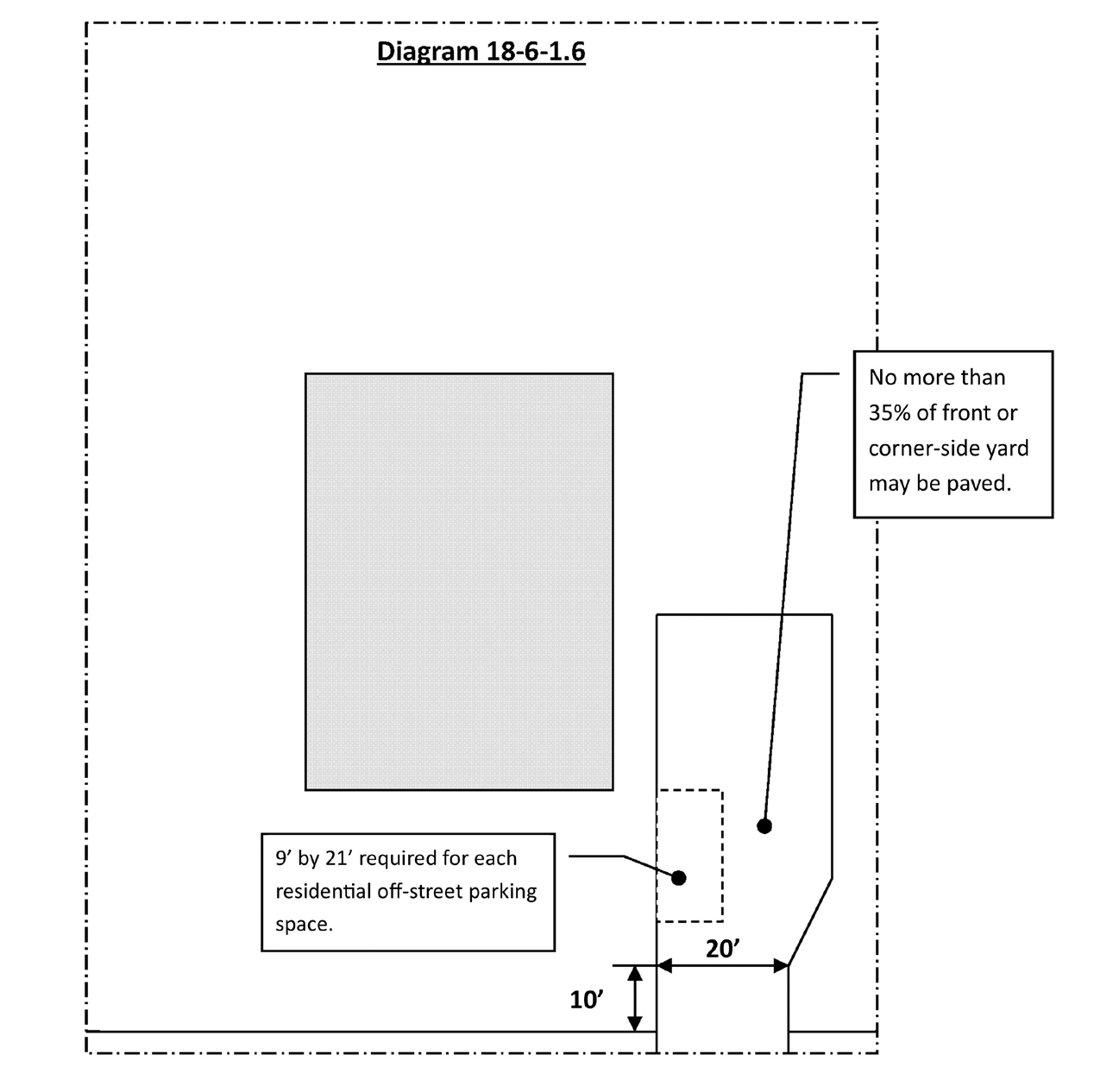
Off-street parking for single-family detached dwellings shall be exempt from all provisions of this Article except for Sections 18-6-3.5 and 18-6-5. Required off-street parking spaces for single-family detached dwellings shall be at least nine feet wide and 21 feet in length. Driveways in front and corner-side yards of lots improved with single family detached dwellings shall not exceed 20 feet in width for the first ten feet adjacent to the front lot line and shall not encumber more than 35 percent of said yard, except that any lot improved with a single-family detached dwelling may, at a minimum, provide a nine foot wide by 21 foot-long off-street parking area in said yard unless otherwise approved by a PUD or conditional zoning. See diagram 18-6-1.6.
(1/12/93, Case TA-92-03, Ord. No. 001-93; 1/14/03, Case TA-02-09, Ord. No. 002-2003; 10/13/09, Case TA-09-89, Ord. No. 2009-27)
(Ord. No. 2023-35, § 1, 1-23-2024)
18-6-2
Definitions.
18-6-2.1
Building Capacity. The seating capacity of a structure or the number of employees shall be the maximum which can be accommodated on the premises.
18-6-2.2
Loading Space. A space or a portion of any area designated, required, or by its nature used as an area for the temporary parking of motor vehicles while transferring, loading, or unloading goods, merchandise, products, or while performing services. Such space shall be a minimum of ten feet in width, 25 feet in length, and 15 feet in height.
18-6-2.3
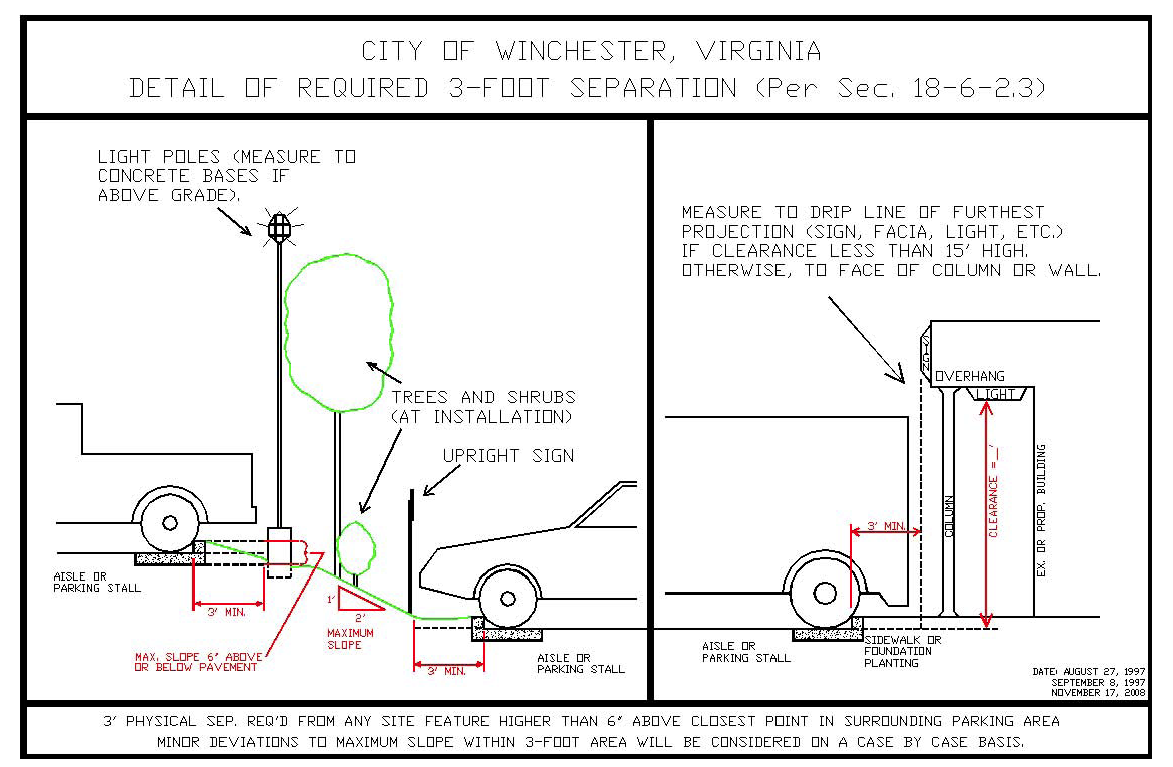
Off-Street Parking Area. An area of land other than within a public right-of-way required or provided to accommodate parking spaces, standing spaces, vehicular display or storage spaces, loading spaces, and necessary access drives, aisles and islands which are wholly segregated from any other portion of the site by continuous curbing except for ingress or egress connections, loading bays, areas where a sidewalk provides a sufficient raised edge, or places providing required handicap access. A separation of at least three feet from any site feature more than six inches above or below the elevation of the closest point in the parking area shall be provided, except as provided for in sections 18-6-2.3.1 and 18-6-2.5. The Director of Planning may permit a reduction of up to two feet in the paved length of required spaces, where such spaces are adjacent to a planting island or other physical separation, excluding accessible routes (main building ingress/egress areas and sidewalks), that permits the overhanging of vehicles parked in such spaces. Parking areas may be surface lots or within structures. Curbing and separation standards herein may be waived by the Director of Planning when it can be demonstrated that the waiver(s) will not encourage undesirable nor unsafe vehicle encroachment. Portions of structures allocated to parking shall not be subject to the provisions of Section 18-6-4.
(9/13/88, Case TA-88-05, Ord. No. 035-88; 1/12/93, Case TA-92-03, Ord. No. 001-93; 8/8/95, Case TA-95-03, Ord. No. 032-95; 10/13/09, Case TA-09-89, Ord. No. 2009-27; 10/27/20, Case TA-20-365, Ord. No. 2020-53)
(Ord. No. 2023-35, § 1, 1-23-2024)
18-6-2.3.1
Use of bollards generally. Where the minimum three-foot separation as required in Section 18-6-2.3 cannot be satisfied, but separation is not otherwise required by the Uniform Statewide Building Code, bollards may be used based on the following criteria:
a.
Constructed of steel not less than four inches in diameter;
b.
Spaced not more than four feet between posts on center;
c.
Set no less than three feet deep in a concrete footing of not less than 15 inches diameter;
d.
Set with the top of the posts not less than three feet above finished grade; and
e.
Located no less than three feet from any protected object.
(Ord. No. 2023-35, § 2, 1-23-2024)
18-6-2.4
Parking Space. A portion of an off-street parking area used for the temporary storage of a passenger vehicle. Except as elsewhere noted, in order to be credited as a required space, the following minimum standards must be met:
(1/12/93, Case TA-92-03, Ord. No. 001-93; 10/13/09, Case TA-09-89, Ord. No. 2009-27)
Note: Aisles are two-way for 90 degree angled parking, and one-way for all other angles. Perpendicular (90 degree) parking is encouraged. Where a parking space fronts upon another parking space and is not separated by means of curbed landscaped median of four feet or more in width, said space shall be increased by two feet in depth to allow for vehicle overhang. In parking areas containing more than ten parking spaces, the Director of Planning may allow up to 30 percent of the required off-street parking spaces to be designed for compact cars. All compact spaces shall be clearly marked as such. The required minimum width for compact spaces is eight feet.
(9/13/88, Case TA-88-05, Ord. No. 035-88; 10/13/09, Case TA-09-89, Ord. No. 2009-27)
18-6-2.5
Main Building Ingress/Egress Area. The space lying between a main building and immediately adjacent perpendicular parking areas, used primarily for pedestrian access from parking areas to building access point(s) and which is less than 18 feet wide and is defined by curbing that is a minimum of six-inches above immediately adjacent parking surface grade. The ingress/egress areas may also contain outdoor seating and/or display of materials and supplies for sale which do not obstruct pedestrian access.
(10/27/20, Case TA-20-365, Ord. No. 2020-53; Ord. No. 2023-35, § 1, 1-23-2024)
18-6-2.5.1
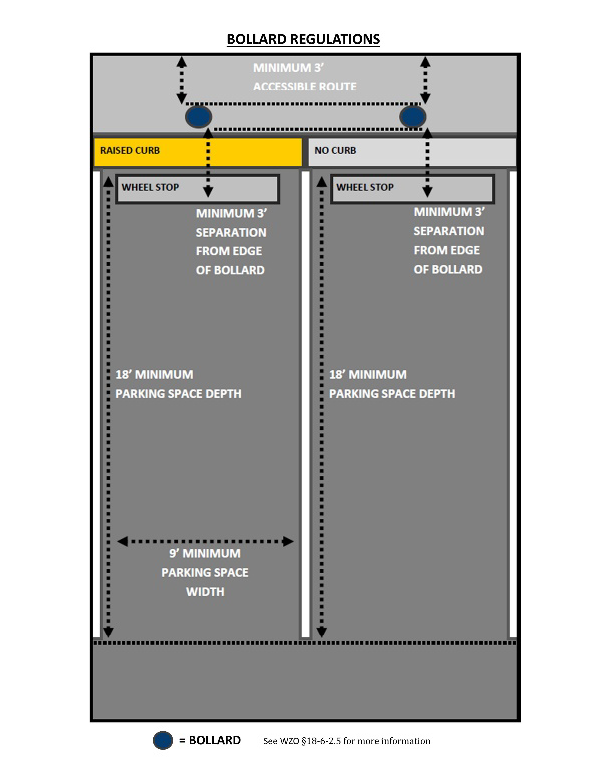
Use of bollards in lieu of curbing for main building ingress/egress areas. Bollards may be used in lieu of curbing for delineating and separating parking and ingress/egress areas provided the following:
a.
The ingress/egress area surface shall be a distinctly different color than the parking surface set along the edge of the parking area at a minimum width of 60 inches; and,
b.
Bollards shall be placed at the head of each parking space using any one of the design standards shown in the diagram below
(Ord. No. 2023-35, § 2, 1-23-2024)
18-6-2.5a
Reserved.
Editor's note— Ord. No. 2023-35, § 3, adopted Jan. 23, 2024, repealed § 18-6-2.5a, which pertained to building ingress egress areas and derived from Ord. No. 2020-53, adopted Oct. 27, 2020.
18-6-2.6
Standing Space. A space by its nature used as an area for the temporary stopping of a motor vehicle, while under the control of its driver, for the purpose of embarking or discharging passengers, baggage, or merchandise, or for the purpose of utilizing special motor vehicle-oriented services. Such space shall be a minimum of 8.5 feet in width and 18 feet in length.
(1/12/93, Case TA-92-03, Ord. No. 001-93; 10/13/09, Case TA-09-89, Ord. No. 2009-27)
18-6-3.
General provisions.
18-6-3.1
Location of Off-Street Parking Areas. The off-street parking areas required by this Article shall be located on the same lot or parcel of land that they are intended to serve, except as follows:
(1/12/93, Case TA-92-03, Ord. No. 001-93; 10/13/09, Case TA-09-89, Ord. No. 2009-27)
a.
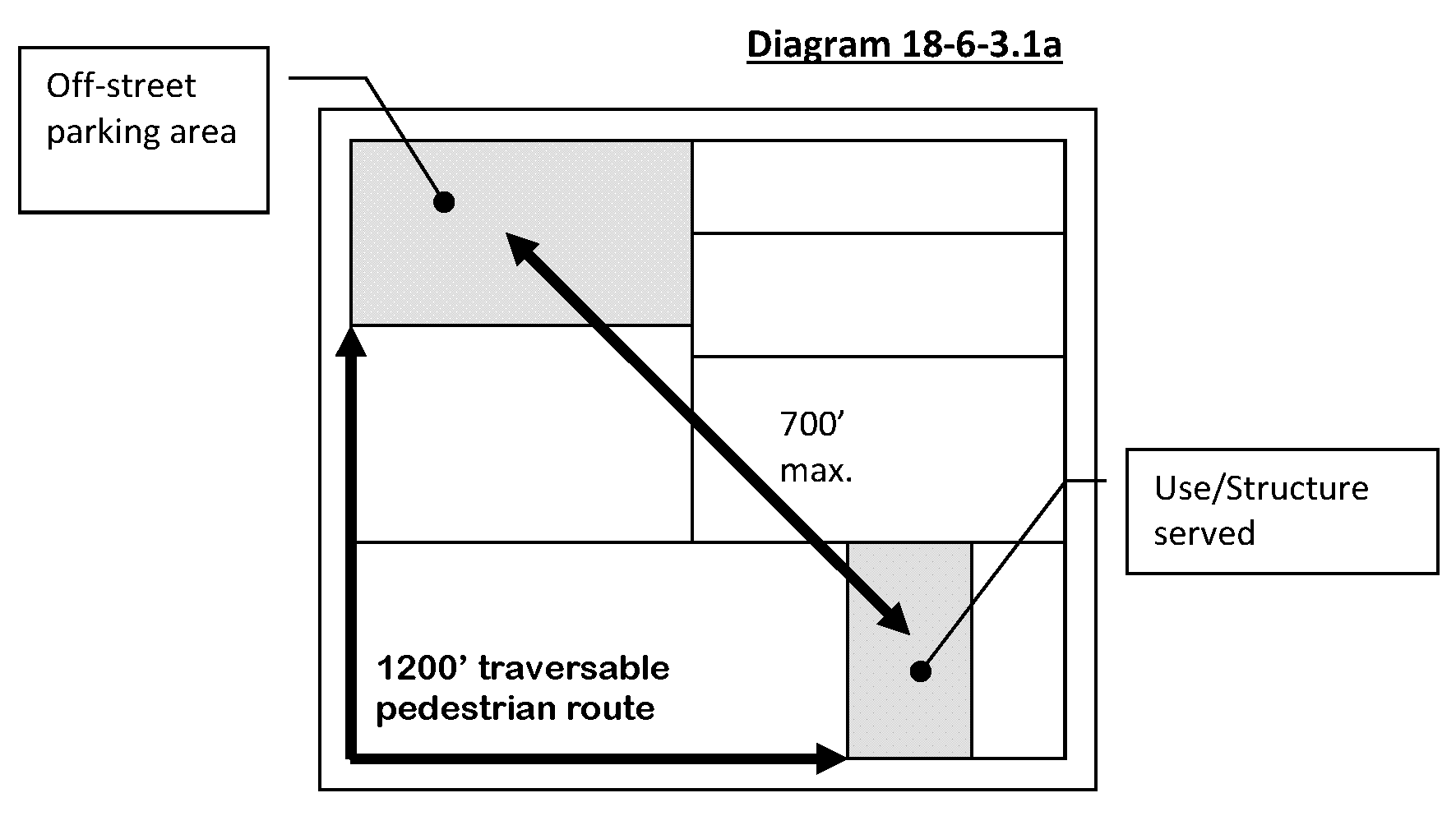
Off-site spaces shall be within 700 feet of the use or structure served. For the purpose of this requirement, distance from parking spaces to the use or structure served shall be measured in a straight line from the nearest parking space to the use served. However, no space shall be more than 1,200 feet away from the use or structure served as measured along a traversable pedestrian route. See diagram 18-6-3.1a.
b.
Off-site parking spaces may be located in a different zoning district than the use or structure served, if permitted by right or by conditional use permit in such zoning district.
c.
An off-site location must either: (i) be located on land in the same ownership as that of the use or structure served, or in the case of cooperative provision of parking space as described in Section 18-6-3.7, in the ownership of at least one of the participants in such provisions, or (ii) be subject to arrangements (such as long-term lease, recorded easement, etc., providing the required parking arrangements for a period of at least 25 years) as will assure the availability of such space for the duration of the use or structure to be served.
d.
No changes shall be made to any off-site parking lot that would reduce the parking available for a use or structure served by such lot, unless alternate parking arrangements are made to provide an equivalent number of spaces and such alternate arrangements are approved by the Director of Planning.
e.
All required handicapped parking spaces must be located on-site in accordance with ICC A117.1.
(Ord. No. 2025-31, 10-28-2025)
f.
All required loading spaces for a use or structure must be located on-site.
18-6-3.2
Off-Street Parking Area Buffer. No off-street parking area required or provided for any use other than single-family detached residential shall be situated within ten feet of any front or corner side property line nor within five feet of any side or rear property line except as follows:
a.
In the Central Business District (B-1) and Residential Business (RB-1) zones, where off-street parking areas shall not be situated within four feet of front and corner side property lines nor three feet of side and rear property lines;
b.
Along common property lines over which combined or shared off-street parking areas have been approved as per Section 18-6-3.1 of this Ordinance, where no buffer is required;
c.
Along side or rear property lines of any lots in districts other than B-1 and RB-1 districts abutting a residential zoning district where the abutting property is vacant or residentially used, in which case a 15-foot-wide buffer area shall be provided, and;
d.
Along side or rear property lines of any lots in the B-1 and RB-1 districts abutting a residential zoning district where the abutting property is vacant or residentially used, in which case a six-foot-wide buffer area shall be provided if the parking serves any use other than residential.
(1/12/93, Case TA-92-03, Ord. No. 001-93; 5/8/01, Case TA-01-01, Ord. No. 017-2001; 11/9/2021, Ord. No. 2021-51)
18-6-3.3
Private streets and common drives shall not encroach into required yards for Townhouse developments. (01/14/02, Case TA-02-09, Ord. No. 002-2002)
18-6-3.4
Delineating Parking Spaces. Whenever five or more parking spaces are provided, such spaces shall be delineated by painted lines, curb stops, signs, or other acceptable means that will ensure the availability of the required number of parking spaces.
(10/11/83, Case 83-06, Ord. No. 034-83)
18-6-3.5
Surfacing of Off-Street Parking Areas. Except as noted below, off-street parking areas shall be surfaced with a minimum of two inches of compacted bituminous concrete on a suitable base except that the Director of Planning may waive this requirement where another material is found to be more appropriate. Construction shall be to City specifications.
(9/13/88, Case TA-88-05, Ord. No. 035-88; 12/11/90, Case TA-90-06, Ord. No. 043-90; 1/12/93, Case TA-92-03, Ord. No. 001-93; 5/13/08, Case TA-07-06, Ord. No. 2008-24; 10/13/09, Case TA-09-89, Ord. No. 2009-27)
a.
Alternative surface improvement materials that are pervious and can aid in storm water management and run-off reduction are encouraged, in particular for off-street parking areas located within a Floodplain (FP) overlay District and for individual parking spaces outside of main vehicular travelways.
18-6-3.5.1
Residential Off-Street Parking Area Requirements. In addition to those provisions outlined in Section 18-6-3.5, the following shall apply to off-street parking areas within residential properties: (10/13/09, Case TA-09-89, Ord. No. 2009-27)
a.
No person shall park any motor vehicle, trailer, or semi-trailer in the front, corner-side, side, or rear yard of any lot, improved with a single-family dwelling, zoned for residential use, except on an improved surface.
(5/13/08, Case TA-07-06, Ord. No. 2008-24)
b.
For properties containing the residential use and occupancy of a single-family detached dwelling, parking area and access driveway surfaces shall be designed and improved using accepted engineering practices for usability and longevity with asphalt, concrete, unit pavers or similar material approved by the City Engineer and shall be designed so as not to create or increase adverse effects on adjoining properties as a result of surface drainage.
(5/13/08, Case TA-07-06, Ord. No. 2008-24)
c.
Parking areas and access driveways located within a required front or corner-side yard on residential lots improved with a single-family dwelling shall not consist of gravel. Gravel may be used as an alternate improved surface material for parking areas within the side or rear yard of any lot improved with a single-family dwelling, zoned for residential use.
(5/13/08, Case TA-07-06, Ord. No. 2008-24)
d.
For properties and sites containing multifamily and townhouse dwelling residential uses with three or more bedrooms, an attached or detached garage bay may be counted as one required off-street parking space if:
(i)
The garage bay provides an unobstructed parking surface at a minimum of 11 feet wide by 21 feet in length (depth);
(ii)
The garage be on the same property or site as the dwelling it serves; The detached garage is not a parking facility owned and/or maintained by the City of Winchester or other City-appointed entity; and
(iii)
At least one additional parking space that meets off-street parking site plan standards is provided either on-site on the same property or on-site in a shared off-street parking area.
(Ord. No. 2023-35, § 2, 1-23-2024)
18-6-3.6
Access and Site Planning Requirements. Ingress and egress to the property, and traffic lanes, parking spaces and loading and service areas on the premises shall form a convenient and well-organized system appropriate to the uses in the building. No off-street parking area shall be designed to permit backing out directly onto a public street. Entrances and exits shall be so arranged so as to minimize conflicts with traffic on public streets and to reduce traffic noises on portions of the lot where there might be adverse effects on residential uses on the property or on any uses on adjacent property. Inter-parcel connectors providing vehicular connections between adjacent parcels are encouraged. Where applicable, driveways shall be aligned with existing and proposed median crossings and driveways on the opposite street side.
(10/12/93, Case TA-93-05, Ord. No. 034-94)
A.
Minimum driveway spacing standards shall apply to development on lots in the B-2, CM-1, M-1, M-2, and RO-1 Districts in order to provide safe and convenient access and efficient travel on City streets. Standards for minimum spacing between adjacent driveways as well as between driveways and street intersections shall be as follows:
Category II and III Streets (per Subdivision Ordinance Section 2-2-32 and 2-2-33);
For all Category I Streets (per Subdivision Ordinance Section 2-2-31) minimum required spacing shall be 60 feet.
Distances shall be measured from the tangents to the curb returns of the driveways and/or intersecting street. Divided driveways (one-way in/out) shall be considered one driveway.
B.
Exceptions to the above minimum driveway spacing standards may be allowed by the Commission upon recommendation of the Director of Public Works or his/her designee when based upon horizontal or vertical characteristics of the adjoining street. Exceptions may also be allowed by the Commission for existing lots where existing frontage does not provide adequate spacing to adjacent driveways or intersections. Such exceptions shall be considered in the following manner:
1.
If frontage exists along more than one street and at least one frontage meets the spacing standards for that category of street, then no exceptions shall be considered for the other deficient street frontage(s).
2.
If no frontages provide adequate distance to meet the above driveway spacing standards then the applicant must first demonstrate that shared access from an adjacent lot with an existing driveway cannot be secured. A written request for shared access (at the existing driveway or at a mutually agreeable replacement location) must be sent by registered or certified mail to the immediately adjacent property owner(s). A separate driveway to the subject lot will be considered upon written rejection of shared access from the adjacent property owner(s) or the expiration of a 30 day response period. If a separate driveway is allowed on the subject lot, the owner shall grant a vehicular access easement to allow for a future inter-parcel connector to at least one adjacent lot.
3.
If a lot has more than one frontage and no frontage provides adequate spacing for a driveway and if all adjacent property owners refuse shared access from their property per the procedures set forth in the preceding subsection, then one access shall be allowed along the lowest category street with the lowest speed limit or as specifically recommended otherwise by the Commission.
C.
Driveways, parking, loading, and service areas shall be so located, designed, constructed, maintained, and operated as to minimize the impact or adverse visual effects and noise on other portions of the property and on surrounding property, particularly residential property and where necessary, fences, walls, and/or vegetative screening shall be provided and maintained to further these purposes. Loading docks, service bays, and overhead doors shall not be oriented so as to be visible from a public street. The Administrator may waive this requirement after consultation with the Commission upon a showing that such orientation cannot be reasonably achieved in which case screening shall be provided to buffer street view according to Section 19-5-4.d of this Ordinance.
(1/12/93, Case TA-92-03, Ord. No. 001-93; Ord. No. 2025-31, 10-28-2025)
18-6-3.7
Cooperative parking arrangements.
(10/13/09, Case TA-09-89, Ord. No. 2009-27)
a.
With the approval of the Director of Planning, required off-street parking may be provided cooperatively for two or more uses of the same or different types, provided that arrangements are made (a long-term lease, recorded easement, etc.) such as will assure the availability of such space for the duration of the use to be served, and provided further that, unless reduced by the Director as set forth below, the number of spaces provided shall not be less than the sum of the individual requirements.
b.
Cooperative parking arrangements shall provide off-street parking spaces as per the provisions of Section 18-6-3.1a.
c.
Once approved by the Director, any subsequent change to a cooperative parking arrangement that affects the availability and convenience of the shared space shall constitute grounds for revocation of the occupancy certificates for the uses served.
18-6-4
Calculating number of off-street parking.
18-6-4.1
In calculating the number of such parking spaces, the following rules shall govern:
a.
Floor area shall mean the gross floor area of the specific use.
b.
When the units of measurements determining the number of required parking spaces result in the requirements of a fractional space, any fraction up to and including one-half shall be disregarded, and fractions over one-half shall require one additional parking space.
c.
The parking space requirement for a use not specifically mentioned herein shall be the same as required for a use of similar nature.
d.
In the case of mixed uses, the parking spaces required shall equal the sum of the requirements of the various uses computed separately, except as otherwise provided in this Article.
(5/9/00, Case TA-99-07, Ord. No. 012-2000)
e.
Off-street parking facilities supplied to meet the needs of one use shall not be considered as meeting the off-street parking needs of any other use, except that time-shared parking arrangements may be allowed for uses within buildings existing at the time of adoption of this Ordinance. All time-shared parking shall be in accordance with the following chart and provisions:
The minimum number of off-street parking spaces required under a time-shared arrangement shall be calculated by multiplying the number of spaces normally required for each land use per Section 18-6-5 of this Ordinance by the appropriate percentages corresponding to the land use and time of use figures below. All land uses on the site(s) considered for time-shared parking must be included in the calculation. The number of parking spaces required shall be determined by totaling the resulting numbers in each column. The column total that generates the highest number of spaces then becomes the minimum parking requirements.
Time-shared off-street parking may be provided off-site per Section 18-6-3.1 of this Ordinance. However, if any portion of the shared parking is provided off-site, the written agreement thereto assuring the retention for such purposes shall be recorded in the land records in addition to being filed with the Zoning Administrator.
Reserved parking spaces, spaces requiring special security access or on-site payment of fees by the user shall not be shared. Any change of use on the site(s) employing a time-shared parking arrangement shall require documentation to be submitted with the certificate of occupancy to ensure that the quantity of shared parking is sufficient per the above table.
(2/12/08, Case TA-07-09, Ord. No. 2008-11; 10/13/09, Case TA-09-89, Ord. No. 2009-27; 7/10/12, Case TA-12-187, Ord. No. 2012-20)
18-6-5
Amount of off-street parking required.
18-6-5.1
The off-street parking required by this Article shall be provided and maintained on the basis of the following requirements specified in the following tables, except as otherwise provided in this Article:
(9/12/89, Case TA-89-01, Ord. No. 022-89; 4/10/90, Case TA-89-14, Ord. No. 012-90; 7/8/97, Case TA-97-05, Ord. No. 016-97; 10/13/09, Case TA-09-89, Ord. No. 2009-27; 6/8/10, Case TA-10-111, Ord. No. 2010-19; 7/10/12, Case TA-12-187, Ord. No. 2012-20)
Table 18-6-5.1
(6/12/18, Case TA-18-151, Ord. No. 2018-16)
18-6-5.2
Parking of Trucks and Buses in Residential Districts.
18-6-5.2a
Trucks or buses of over one-half ton shall not be parked in any required front yard in a residential district, except for purposes of making pickup or deliveries.
18-6-6
Special exceptions from off-street parking and loading requirements.
(9/14/82, Case 82-04, Ord. No. 016-82; 8/22/06, Case TA-06-04, Ord. No. 030-2006; 10/13/09, Case TA-09-89, Ord. No. 2009-27)
18-6-6.1
The following shall be exempt from the provision of off-street parking and loading spaces required by this Article: (10/13/09, Case TA-09-89, Ord. No. 2009-27)
a.
Uses located within the boundaries of Parking District "A" as depicted in Diagram 18-6-6.
b.
Buildings, containing nonresidential uses, which are located 300 feet from a municipal parking lot of adequate capacity as determined by the Zoning Administrator
c.
A Neighborhood Convenience Establishment or market garden, as defined, for which a conditional use permit has been granted, except that off-street parking and loading may be required as a condition of the permit.
(10/12/10, Case TA-10-418, Ord. No. 2010-51)
18-6-6.2
The following shall be granted a 50 percent reduction of off-street parking and loading spaces required by this Article:
(10/13/09, Case TA-09-89, Ord. No. 2009-27)
a.
Uses located within the boundaries of Parking District "B" as depicted in Diagram 18-6-6.
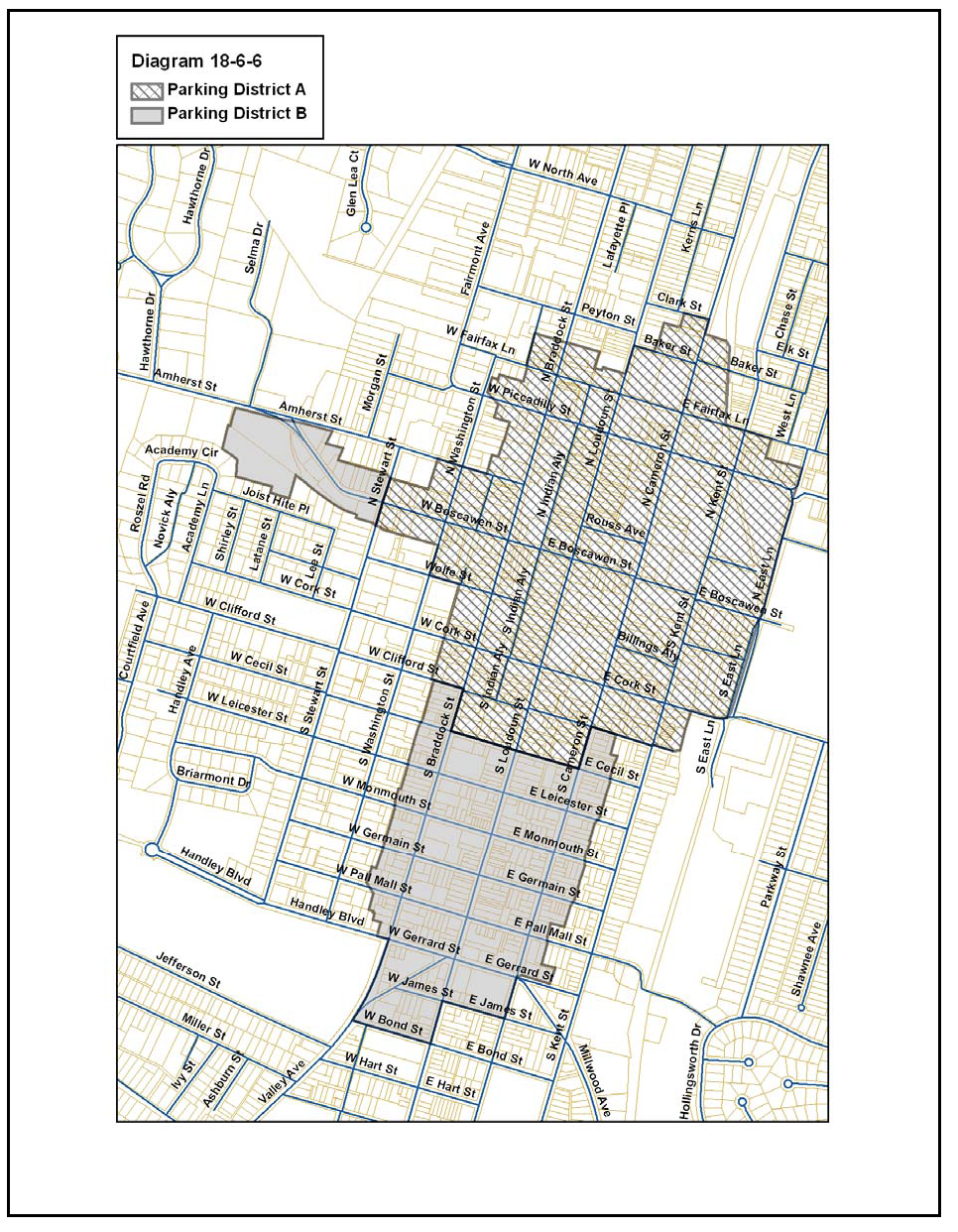
18-6-6.3
Certain reductions in the number of required off-street parking spaces for particular use shall be allowed, under the following circumstances (10/13/09, Case TA-09-89, Ord. No. 2009-27):
a.
Where a use is located within 300 feet of a transit stop on an existing City transit route, the number of parking spaces required for such use shall be reduced by (i) 20 percent for uses located within a Corridor Enhancement (CE) District as defined in Article 14.2 of this Ordinance; or (ii) ten percent for uses not located within a CE District. Where a use is located between 301 and 600 feet of a transit stop on an existing City transit route, a similar reduction of spaces shall be granted, in an amount equal to one-half of the percentage(s) specified in clauses (i) and (ii), above.
b.
Where bicycle lockers are provided on-site, the number of required off-street parking spaces shall be reduced by:
(i)
Ten percent for every (5) lockers, for uses located within the Central Business (B-1) and Residential Business (RB-1) Zoning District(s); or
(ii)
Five percent for every five lockers for uses located within any other zoning districts.
c.
When the proposed construction, alteration, renovation, or re-construction of a building is designated with LEED ® certification, the following percentages of reduction shall be allowed:
d.
The total number of required parking spaces may not be reduced as a result of any bonus(es) listed in paragraphs (a) through (c), above, by more than (i) 35 percent for uses located within the B-1 or RB-1 Zoning Districts; or (ii) 20 percent for uses located elsewhere, however this shall not be construed to limit the reduction for Gold or Platinum LEED ® certification as provided for in paragraph (c) above.
18-6-7
Amount of off-street loading required.
18-6-7.1
There shall be provided on the premises used for the following purposes in any district at the time any building or structure is constructed, reconstructed, enlarged, extended, or structurally altered, spaces for off-street loading, except as otherwise provided in this Article in accordance with the following schedule:
a.
For each retail store, storage, warehouse, wholesale establishment, industrial plant, factory, freight terminal, market, restaurant, mortuary, laundry, dry cleaning establishment, or similar use which has an aggregate floor area of:
1.
Over 10,000 square feet but not over 25,000 square feet—one space.
2.
Over 25,000 square feet but not over 60,000 square feet—two spaces.
3.
Over 60,000 square feet but not over 120,000 square feet—three spaces.
4.
Over 120,000 square feet but not over 200,000 square feet—four spaces.
5.
Over 200,000 square feet but not over 290,000 square feet—five spaces.
6.
For each additional 90,000 square feet or major faction thereof—one space.
b.
For each apartment building having over 50 dwelling units - one space.
c.
For each auditorium, museum, assembly hall, community center, hotel, office building, sports arena, stadium, gymnasium, hospital, sanitarium, or similar use which has an aggregate gross floor area of:
1.
Over 10,000 square feet but not over 40,000 square feet—one space.
2.
Over 40,000 square feet but not over 100,000 square feet—two spaces.
(4/12/83, Case 83-01, Ord. No. 012-83)
3.
For each additional 90,000 square feet over 100,000 square feet or major fraction thereof—one space.
(4/12/83, Case 83-01, Ord. No. 012-83)
d.
For any use not specifically mentioned in this section, the requirements for off-street loading, for a use which is so mentioned and to which the unmentioned use is similar, shall apply.
1.
Off-street loading facilities supplied to meet the needs of one use shall not be considered as meeting the off-street loading needs of any other use.
2.
No area of a facility supplied to meet the required off-street parking facilities for use shall be utilized for or deemed to meet the requirements of this Article for off-street loading facilities.
18-6-8
Amount of standing space required.
(1/12/93, Case TA-92-03, Ord. No. 001-93)
18-6-8.1
The off-street standing spaces required by this Article may be stacked in one or more clearly delineated lanes which do not impede circulation on the site and shall be provided and maintained on the basis of the following requirements specified in the following table, except as otherwise provided in this Article:
18-6-9
Deferral of required parking for certain uses. For general office, storage uses, furniture stores and home improvement establishments, construction of up to one-third of the number of required off-street parking spaces may be deferred on the condition that all required parking shall be fully designed and depicted on the approved site plan in compliance with all applicable standards. The applicant shall, each October, measure the average utilization of existing parking spaces for two consecutive Saturdays at noon and report the same to the Administrator within two weeks. The Administrator may measure utilization over a similar period at any time, however. If utilization exceeds 85 percent then the applicant shall make arrangements to construct a quantity of additional parking within a timeframe established by the Administrator.
(07/13/99, Case TA-99-01, Ord. No. 017-99; 10/13/09, Case TA-09-89, Ord. No. 2009-27)
18-6-9.1
Special parking provisions for regional malls. For regional shopping malls of at least 500,000 square feet, the off-street parking requirements shall be calculated using the gross leasable area (GLA) of the mall. Regional shopping malls that, at the time of occupancy, are situated on public transit routes and provide bicycle and/or pedestrian facilities, thus reducing demand for parking of personal automobiles, shall be allowed to provide a reduced minimum amount of off-street parking at a rate of one parking space for every 300 square feet of GLA.
(11/14/06, Case TA-06-05, Ord. No. 033-2006; 10/13/09, Case TA-09-89, Ord. No. 2009-27)
18-6-9.2
Waivers. The Administrator may waive off-street parking requirements for a single-family detached dwelling proposed on an existing lot of record, upon a determination that (i) the dwelling is not located on a corner lot, (ii) the lot on which the dwelling is located has no access to a public or private alley, and (iii) the lot has fewer than 30 feet of street frontage.
(10/13/09, Case TA-09-89, Ord. No. 2009-27)
18-6-10
Inoperable motor vehicle storage.
(5/9/06, Case TA-06-03, Ord. No. 21-2006)
18-6-10.1
No person shall keep, except within a fully enclosed building or structure or otherwise shielded or screened from view, on any property zoned for residential or commercial purposes, any inoperable motor vehicle, as defined in Section 1-2-52.1 of this Ordinance. "Shielded or screened from view" means not visible by someone standing at ground level from outside the property on which the subject vehicle is located.
(2/12/08, Case TA-07-07, Ord. No. 2008-10)
18-6-10.2
The provisions of this Section shall not apply to a licensed business which on June 26, 1970 was regularly engaged in business as an automobile dealer, salvage dealer, or scrap processor. The exception for such licensed business shall only apply to such property on which the said property was operated on June 26, 1970, and on which said business has continued to operate without interruption.
18-6-10.3
Removal and disposal of inoperable motor vehicles.
(2/12/08, Case TA-07-07, Ord. No. 2008-10)
(a)
The owners of property zoned for residential or commercial purposes not otherwise exempt in Section 18-6-10.2 shall remove therefrom any such inoperable motor vehicles that are not kept within a fully enclosed building or structure within 15 days of Notice of Violation. Notice given pursuant to this Section shall be sent by the Administrator, or his or her designee, using registered or certified mail, return receipt requested, to the owner of the premises on which such inoperable vehicle is located. The notice shall explain the violation, provide a description of the vehicle, and shall set forth the consequences of failing to comply.
(2/12/08, Case TA-07-07, Ord. No. 2008-10)
(b)
The City of Winchester, through its agents or employees, may remove any such inoperable vehicle, whenever the owner of the premises, after reasonable notice, has failed to do so. In the event the City so removes any such inoperable motor vehicle after having given such reasonable notice, the City may dispose of such inoperable vehicle after giving 30 days additional notice to the owner of the vehicle.
(2/12/08, Case TA-07-07, Ord. No. 2008-10)
18-6-10.4
Cost of removal and disposal of inoperable motor vehicles.
(a)
The cost associated with removal and disposal of such inoperable motor vehicle shall be chargeable to the owner of the vehicle or premises, and maybe collected by the City of Winchester as taxes and levies are collected.
(b)
Every cost authorized by this Section with which the owner of the premises shall have been assessed shall constitute a lien against the property from which the vehicle was removed, the lien to continue until actual payment of such cost shall have been paid to the City.
(2/12/08, Case TA-07-07, Ord. No. 2008-10)
Sec. 18-7. - Special regulations pertaining to the Primary and Secondary Downtown Assessment Districts.
(4/9/13, Case TA-13-35, Ord. No. 2013-08)
18-7-1
Use of sidewalks. The sidewalks in the Primary and Secondary Downtown Assessment Districts, as defined in Section 25-1 of the Winchester City Code, may be used by proprietors, owners, or tenants of businesses abutting the sidewalks, or outside vendors, subject to the provisions within this Section.
The permitted use of such sidewalks pursuant to this Section shall be considered a license and privilege that is authorized at the discretion of the City and shall not in any way be deemed to constitute a transfer of any property rights whatsoever from the City. The City reserves the right to reject or rescind any permit authorized in accordance with the provisions of this Article.
18-7-1.1
Permit Required. Any person or business using the sidewalks in the Primary and Secondary Downtown Assessment Districts must first obtain a permit from the Administrator. The Administrator may consult with the Downtown Manager, Old Town Development Board, Board of Architectural Review, the Commissioner of the Revenue, Health Department, or any other such agencies deemed necessary prior to approving or denying the issuance of such permit, and may impose conditions upon the applicant which are deemed necessary to protect the Mall surface, sidewalks, street furniture, and appurtenances.
18-7-1.2
Insurance/Damages. The applicant for any such permit shall provide a Certificate of Insurance, which shall be currently maintained throughout the term of the permit, indicating that the City is an additional insured on a policy of liability insurance issued to the applicant by an insurance company licensed to do business in Virginia with a single limit of not less than $1,000,000.00.
Property Damages: Any person or entity that has been issued a permit pursuant to this Article (hereinafter "Permittee") shall immediately notify the City of Winchester Facility Maintenance Director and Risk Manager of all damage to property for which a permit has been issued pursuant to this Article, including but not limited to: damages to utilities, finished surfaces, and trees.
Deliveries and Storage: It shall be the responsibility of the Permittee to make all arrangements for delivery, unloading, receiving and storing of materials to be placed inside the lessor's building. No shipments, goods, or products shall be stored in the areas for which a permit has been issued pursuant to this Article. The City of Winchester will not assume any responsibility.
Notification and Handling of an Insurance Claim: The Permittee shall be responsible for ensuring that all matters concerning insurance claims by third parties arising as a result of the acts and omissions of the lessor's operations or his subcontractors, are handled in a professional manner. To this end, the City expects the lessor to act responsibly with regard to prompt payment of valid insurance claims and upon notice of a claim, the lessor shall immediately notify the City's Risk Manager, investigate and document the claim, and make a liability determination within ten business days. Pending subrogation between the lessor and/or sub-contractor and/or any insurance carrier will not be cause for delay in payment of a valid claim. Default of this provision may result in default this agreement and jeopardize the lessor's future lease with the City of Winchester.
18-7-1.3
Indemnification and Hold Harmless Agreement. The applicant for such permit shall provide a signed indemnification and hold harmless agreement, on a form approved by the City Attorney, in which the applicant agrees to indemnify and hold the City, its officers, agents, and employees, harmless from any claims for damages to person or property growing out of any activity with the applicant's activities conducted in connection with the permit herein described or caused by the operation or location of the activity on the City's property.
18-7-1.4
Fee. A fee per Section 23-8-18 is required upon issuance of any such permit.
18-7-1.5
Duration. Any such permit issued shall be non-transferable and, shall be valid from January one through December 31 of each year, or for any part thereof except as otherwise revoked, rescinded or limited by the provisions of this Article. The application fee will remain the same regardless of the date received, and the fee will not be refunded or prorated based on the date of the application. Upon expiration or revocation of any such permit, the applicant must apply for a new permit to continue using the sidewalk.
18-7-1.6
Certificate of Appropriateness. All furniture, signs and other elements to be used on the sidewalks must receive a Certificate of Appropriateness per Article 14. For items subject to Administrative Review per Section 14-5, the permit application shall concurrently serve as application for the Certificate of Appropriateness.
18-7-1.7
Area Available for Use.
a.
Width. For businesses abutting the sidewalk, use of the sidewalk shall not exceed the width of the individual store front or the width of the lot fronting the Primary or Secondary Downtown Assessment District.
b.
Depth.
1)
Primary Downtown Assessment District. No sidewalk area extending more than 15 from the abutting storefront toward the center line of Mall shall be used. However, in all cases, no use of area within a designated fire lane shall be permitted.
2)
Secondary Downtown Assessment District. No sidewalk area closer than five feet to the curb shall be used. However, in all cases, a minimum clear path of travel of three feet must be provided.
c.
Outside Vendors. Availability of space to be determined in consultation with the Downtown Manager and in consideration of, but not limited to, the following factors: proximity to existing storefronts or doors; proximity to businesses trading in similar goods/services; ability to provide safe and convenient passage for passersby; and scheduled events.
18-7-1.8
Revocation of Permits. The Administrator may immediately revoke any permit specified in this Section if it is determined at the discretion of the Zoning Administrator that the conditions therein have not been met by the applicant. A permit may also be immediately revoked or suspended if it is determined at the discretion of the Administrator that the continued use of the space poses a threat to public health, safety, or welfare, or if such use is determined to be inconsistent with the best interests of the City of Winchester.
The Administrator may immediately revoke any permit specified in this Section if it is determined that the permit holder is not maintaining compliance with all applicable laws and regulations related to the use of the permitted space or if the permit holder fails to promptly respond to lawful requests by the Administrator related to the use of the permitted space.
The use of the space described under this Chapter may also be temporarily suspended for Special Events. The City will make reasonable efforts to notify permit holders in advance so that all privately owned items including but not limited to tables, chairs, and barricades may be removed by the permit holder prior to such Special Events. Upon a permit holder's failure to timely remove the items, such items may be removed in accordance with Section 18-7-2.2(b).
(Ord. No.2022-11, 5-24-2022)
18-7-2
Outdoor dining area. As used herein, "outdoor dining area" shall mean any group of tables, chairs, benches, and suitable devices maintained for the purpose of sale and/or consumption of food, refreshments, and beverages of all kinds as an extension of a restaurant licensed under the Regulations of the Virginia Department of Health or a microbrewery, nanobrewery, microdistillery or winery as defined in this Ordinance. Applicants for outdoor dining areas are encouraged to review the Old Town Winchester Outdoor Dining Guidelines as adopted by the Old Town Development Board.
18-7-2.1
In addition to the requirements in Section 18-7-1, applicants for an outdoor dining area must also submit:
a.
Health License. Evidence showing that the applicant has obtained a license to operate as a restaurant from the Virginia Department of Health. Such license shall be currently maintained throughout the term of the permit. Businesses operating as a microbrewery, nanobrewery, microdistillery, or winery are exempt from this provision unless their operation includes food sales in need of a Virginia Department of Health license.
b.
ABC License. If alcoholic beverages are to be sold by the applicant, evidence that the applicant has a valid license for same issued by the Virginia Alcoholic Beverage Control Board, and that it specifically meets that Board's requirements for "outside terraces or patio dining area". Such license shall be currently maintained throughout the term of the permit.
c.
Site Sketch. A scaled plan indicating the location of the proposed dining area, the layout of tables, chairs, enclosure, etc. and all existing obstructions (fire hydrants, tree wells, planters, lamp posts, and public egress) in the area.
d.
Details. Details clearly indicating the materials, color, and construction of the enclosure, furniture, and all elements. Such details must include the methods in which the enclosure shall be supported. No enclosure or other elements shall be fastened to the sidewalk or adjoining buildings.
18-7-2.2
As a condition of obtaining and keeping a permit for an outdoor dining area, the applicant is deemed to have agreed to the following terms and conditions:
a.
All outdoor dining areas will be of such design so as to be easily removed for special events, snow removal, emergency access, or other circumstances which require that the sidewalks be cleared of all such dining areas, as determined by City Council or by the Chief of Police. A directive from the Chief of Police or the City Council to clear the area of all furniture, fixtures, decorations, etc., connected with the café operation shall be promptly complied with by the business without question and without unnecessary delay, and the area shall remain cleared of such material until directed otherwise by City Council or the Chief of Police.
b.
Upon failure of the permit holder to remove such items upon reasonable Notice, the City is authorized to remove the items and require the permit holder to reimburse the City for the expense of such removal.
c.
The entire area delineated for the outdoor dining area must be maintained in a neat and orderly fashion, whether or not the area is actually in use. When in use, the area shall be periodically cleaned throughout the business day, and, especially, at the end of each business day. All food shall be provided by waiter or waitress service, unless self-service operations are approved as a part of the permit. Extensions or enlargements of the area delineated beyond those described in the business' application are expressly prohibited.
d.
All furniture, fixtures, enclosures, and all elements shall be periodically maintained so that they retain full function as well as present a neat, attractive appearance.
e.
The outdoor dining area shall operate only when the business to which a permit has been issued is allowed to operate. In addition, the business shall be responsible to see to it that patrons violate no laws of the Commonwealth or Ordinances of the City, to expressly include the City's Noise Ordinance. A business holding a permit shall have the right to limit access and occupancy to only bona fide paying customers, and shall have the same right to deny access or service in the outdoor dining area as it enjoys in its own premises, provided, however, that no person shall be denied access or service purely on the basis of race, color, religion, national origin, sex, pregnancy, childbirth or related medical conditions, age (except for minimum age requirements in relation to the sale of alcoholic beverages), marital status or physical disability.
(9/25/18, Case TA-18-468, Ord. No. 2018-25)
18-7-3
Portable sign. Portable signs shall not exceed six square feet in area. Applicants for portable signs are encouraged to review the Winchester Historic District Design Guidelines as published by the Board of Architectural Review.
18-7-3.1
In addition to the requirements in Section 18-7-1, applicants for portable signs must also submit:
a.
Site Sketch. A scaled plan indicating the location of the proposed sign and all existing obstructions (fire hydrants, tree wells, planters, lamp posts, and public egress) in the area. Such sign generally shall not impede pedestrian traffic. In all cases, a minimum clear path of travel of three feet must be provided.
b.
Details. Details clearly indicating the dimensions, materials, color, construction, etc. of the sign. Such details must include the method in which the sign shall be supported. No portable sign shall be fastened to the sidewalk or adjoining buildings.
18-7-4
Display of merchandise. Businesses abutting sidewalks may apply to use such areas for the display of merchandise for the purpose of attracting customers into such businesses, and not expressly for the sale of such items on display. Such displays shall incorporate, or be representative of, merchandise that is regularly sold as part of the business.
18-7-4.1
In addition to the requirements in Section 18-7-1, applicants for display of merchandise must also submit:
a.
Site Sketch. A scaled plan indicating the location of the proposed display and all existing obstructions (fire hydrants, tree wells, planters, lamp posts, and public egress) in the area. Such display generally shall not impede pedestrian traffic. In all cases, a minimum clear path of travel of three feet must be provided.
b.
Details. Details clearly indicating the materials, color, construction, etc. of any racks, tables, or other elements which shall be used to display merchandise. Such details must include the methods in which the display elements shall be supported. No elements shall be fastened to the sidewalk or adjoining buildings.
c.
Schedule for display. A description of the days, hours, and frequency of outdoor display.
18-7-5
Outside vendors. Vendors without an adjoining storefront and operating from carts or other portable vending apparatuses may apply for a permit to use sidewalk area in the Primary and Secondary Downtown Assessment Districts. As there are limited areas for such vendors to locate without conflicting with existing storefronts, all such vendors shall schedule a pre-application meeting with the Administrator to discuss the pending application. No such permit shall be issued unless it is determined that the design of the vending apparatus and its proposed use is compatible with the design and character of the District and shall be issued only for the vending of food and beverages, flowers, arts and crafts, handicrafts, and similar products and services.
18-7-5.1
In addition to the requirements in Section 18-7-1, applicants for permits as outside vendors must also submit:
a.
Health License. For food and beverage vendors, evidence showing that the applicant has obtained a license to operate as such from the Virginia Department of Health. Such license shall be currently maintained throughout the term of the permit.
b.
Site Sketch. A scaled plan indicating the location of the proposed vending apparatus and all existing obstructions (fire hydrants, tree wells, planters, lamp posts, and public egress) in the area. Such apparatus generally shall not impede pedestrian traffic. In all cases, a minimum clear path of travel of three feet must be provided.
c.
Details. Details clearly indicating the materials, color, construction, etc. of the vending apparatus and any other elements which shall be used. Such details must include the methods in which the apparatus shall be supported. No apparatus or elements shall be fastened to the sidewalk or adjoining buildings.
d.
Schedule for vending. A detailed description of the specific dates and hours of vending proposed. Outside vendor fees will be determined based on the proposed schedule and shall not be refunded due to non-use of approved dates for any reason.
18-7-5.2
As a condition of obtaining and keeping a permit as an outside vendor, the applicant is deemed to have agreed to the following terms and conditions:
a.
The entire area delineated for the vending must be maintained in a neat and orderly fashion. When in use, the area shall be periodically cleaned throughout the business day, and, especially, at the end of each business day. Extensions or enlargements of the area delineated beyond those described in the application are expressly prohibited.
b.
The vending apparatus and all elements shall be periodically maintained so that they retain full function as well as present a neat, attractive appearance.
c.
The vendor may be moved from time to time or use prohibited at the discretion of the Administrator or Downtown Manager due to scheduled promotions or other special events being held in the District.
18-7-6
Special events. Special Events in the Primary and Secondary Downtown Assessment Districts shall be governed by the provisions of Chapter 14, Article IX of Winchester City Code.
Sec. 18-8. - Signs.[1]
18-8-1
Findings, purpose and intent.
A.
Signs may obstruct views, distract motorists, and pose other problems that legitimately call for regulation. The purpose of this article is to regulate the size, color, illumination, movement, materials, location, height and condition of all signs placed on private property for exterior observation, thus ensuring the protection of property values, the character of the various neighborhoods, the creation of a convenient, attractive and harmonious community, protection against destruction of or encroachment upon historic areas, and the safety and welfare of pedestrians and wheeled traffic, while providing convenience to citizens and encouraging economic development. This article allows adequate communication through signage while encouraging aesthetic quality in the design, location, size and purpose of all signs. This article shall be interpreted in a manner consistent with the First Amendment guarantee of free speech. If any provision of this article is found by a court of competent jurisdiction to be invalid, such finding shall not affect the validity of other provisions of this article which can be given effect without the invalid provision.
B.
Signs not expressly permitted as being allowed by right or by conditional use permit under this article, by specific requirements in another portion of this chapter, or otherwise expressly allowed by City Council are forbidden.
C.
A sign placed on land or on a building for the purpose of identification, protection or directing persons to a use conducted therein shall be deemed to be an integral but accessory and subordinate part of the principal use of land or building. Therefore, the intent of this article is to establish limitations on signs in order to ensure they are appropriate to the land, building or use to which they are appurtenant and are adequate for their intended purpose while balancing the individual and community interests identified in subsection A. of this section.
D.
These regulations are intended to promote signs that are compatible with the use of the property to which they are appurtenant, landscape and architecture of surrounding buildings, are legible and appropriate to the activity to which they pertain, are not distracting to motorists, and are constructed and maintained in a structurally sound and attractive condition.
E.
These regulations distinguish between portions of the City designed for primarily vehicular access and portions of the City designed for primarily pedestrian access.
F.
These regulations do not regulate every form and instance of visual speech that may be displayed anywhere within the jurisdictional limits of the City. Rather, they are intended to regulate those forms and instances that are most likely to meaningfully affect one or more of the purposes set forth above.
G.
These regulations do not entirely eliminate all of the harms that may be created by the installation and display of signs. Rather, they strike an appropriate balance that preserves ample channels of communication by means of visual display while still reducing and mitigating the extent of the harms caused by signs.
(12/12/17, Case TA-17-485, Ord. No. 2017-33)
18-8-2
Definitions.
A-Frame sign means a one or two-faced sign with supports that are connected at the top and separated at the base, forming an "A" shape not more than four feet high. These are also referred to as "sandwich board" signs. They are included in the term "portable sign."
Advertising means any words, symbol, color or design used to call attention to a commercial product, service, or activity.
Animated sign means a sign or part of a sign that is designed to rotate, move or appear to rotate or move. Such a sign is sometimes referred to as a "moving sign."
Awning sign means a sign placed directly on the surface of an awning.
Banner means a temporary sign of flexible material designed to be installed with attachments at the corners.
Building frontage means the length of the main wall of a building which physically encloses usable interior space and which is the architecturally designed wall that contains the main entrance for use by the general public.
Business sign means a sign which directs attention to a product, service or commercial activity available on the premises.
Canopy sign means a sign attached to a canopy.
Chalk-board sign means a single or double-faced, framed slate or chalk-board that can be written on with chalk or similar markers.
Changeable copy sign means a sign or part of a sign that is designed so that characters, letters or illustrations can be changed or rearranged without altering the face or surface of the sign.
Feather sign means a lightweight, portable sign mounted along one edge on a single, vertical, flexible pole the physical structure of which at may resemble a sail, bow, or teardrop.
Flag means a piece of cloth or similar material, typically oblong or square, attachable by one edge to a pole or rope and used as a symbol or decoration; this does not include pennants.
Flashing sign means a sign that includes lights that flash, blink, or turn on and off intermittently.
Freestanding sign means any non-portable sign supported by a fence, retaining wall, or by upright structural members or braces on or in the ground and not attached to a building, and includes pole signs and monument signs.
Height means the maximum vertical distance from the base of the sign at normal grade to the top of the highest attached component of the sign. Normal grade shall be construed to be the lower of:
(1)
Existing grade prior to construction; or
(2)
The newly established grade after construction, exclusive of any filling, berming, mounding or excavating primarily for the purpose of mounting or elevating the sign.
Illegal sign means any sign erected without a required permit or which otherwise does not comply with any provisions of this article.
Illuminated sign means a sign that is backlit, internally lighted, or indirectly lighted.
Marquee means a permanent structure projecting beyond a building wall at an entrance to a building or extending along and projecting beyond the building's wall and generally designed and constructed to provide protection against the weather.
Marquee sign means a sign attached to and made a part of a marquee or any similar projections from a building, with changeable, fixed or both types of lettering in use.
Monument sign means a sign affixed to a structure built on grade in which the sign and the structure are an integral part of one another; not a pole sign.
Mural means a sign that is hand produced or machine graphic applied or affixed to the exterior of a building wall or to any other structure through the application of paint, canvas, tile, metals panels, or other mediums generally so that the wall and/or structure becomes the background surface or platform for the graphic, generally for the purpose of decoration, artistic expression, and/or commercial messaging. Murals that do not display, allude to, or refer to commercial messaging, will not be counted towards signage allocations.
(Ord. No. 2023-35, § 1, 1-23-2024)
Nonconforming sign means any sign which was lawfully erected in compliance with applicable regulations of the City and maintained prior to the effective date of this chapter of the zoning ordinance and which fails to conform to current standards and restrictions of the zoning ordinance.
Off-premises sign means a sign that directs attention to a business, product, service or activity conducted, sold or offered at a location other than the premises on which the sign is erected.
Pole sign means a sign that is mounted on one or more freestanding poles.
Portable sign means any temporary sign not affixed to a building, structure, vehicle or permanently affixed to the ground. It does not include a flag or banner. Signs shall be considered not permanently affixed to the ground if the sign is pushed, hammered or similarly put into the ground.
Projecting sign means any sign, other than a wall, awning, canopy or marquee sign, affixed to a building and supported only by the wall on which it is mounted.
Public area means any public place, public right-of-way, any parking area or right-of-way open to use by the general public.
Roof sign means a sign erected or constructed, in whole or in part, upon or above the highest point of a building with a flat roof, or the lowest portion of a roof for any building with a pitched roof.
Sign means any object, device, display, or structure, or part thereof, visible from any public area which is designed and used to attract attention to an institution, organization, business, product, service, event, or location by any means involving words, letters, figures, designs, symbols, fixtures, logos, colors, illumination, or projected images. The term does not include public art, architectural elements incorporated into the style or function of a building, or flags of any nation, state, or other geopolitical entity not related to a commercial business, product or service. The term "sign" also does not include the display of merchandise for sale on the site of the display.
Sign face means the portion of a sign structure bearing the message.
Sign structure means any structure bearing a sign face.
Temporary sign means a sign constructed of cloth, canvas, vinyl, paper, plywood, fabric, or other material not well suited to provide a durable substrate or, if made of some other material, is neither permanently installed in the ground nor permanently affixed to a building or structure which is permanently installed in the ground.
Vehicle or trailer sign means any sign attached to or displayed on a vehicle, if the vehicle or trailer is used for the primary purpose of advertising a business establishment, product, service or activity. Any such vehicle or trailer shall, without limitation, be considered to be used for the primary purpose of advertising if it fails to display current license plates, inspection sticker, or municipal decal, if the vehicle is inoperable, if evidence of paid-to-date local taxes cannot be made available, or if the sign alters the standard design of such vehicle or trailer.
Wall sign means any sign attached to a wall or painted on or against a flat vertical surface of a structure.
Window sign means any sign visible outside the window and attached to or within 18 inches in front of or behind the surface of a window or door.
(12/12/17, Case TA-17-485, Ord. No. 2017-33)
18-8-3
Permit required.
A.
A sign permit is required prior to the display and erection of any sign except as provided in Section 18-8-4 of this article.
B.
Application for permit.
1)
An application for sign permit shall be filed with the Zoning Administrator on forms furnished by that department. The applicant shall provide sufficient information to determine if the proposed sign is permitted under the Zoning Ordinance and other applicable laws, regulations and ordinances. An application for a temporary sign shall state the dates intended for erection and removal of the sign.
2)
The Zoning Administrator or designee shall promptly process the sign permit application and approve the application, reject the application, or notify the applicant of deficiencies in the application within 15 business days after receipt. Any application that complies with all provisions of this Zoning Ordinance, the Uniform Statewide Building Code, and other applicable laws regulations and ordinances shall be approved.
3)
If the application is rejected, the Administrator shall provide a list of the reasons for the rejection in writing. An application shall be rejected for non-compliance with the terms of the Zoning Ordinance, building code, or other applicable law, regulation, or ordinance.
C.
Overlay district regulations. All signs in the Historic Winchester (HW) or Corridor Enhancement (CE) district require a Certificate of Appropriateness as provided for in this Ordinance except when a sign permit is not required.
(12/12/17, Case TA-17-485, Ord. No. 2017-33)
18-8-4.
Permit not required.
A sign permit is not required for:
A.
Signs erected by a governmental body or required by law.
B.
Flags not containing any commercial advertising.
C.
The changing of messages on marquees and the repair of an existing permitted sign, except that repair of a nonconforming sign must comply with Section 18-8-9.
D.
Temporary signs as follows:
1)
One sign, located on a property where a building permit is active, with a total area of up to 16 square feet and a maximum height of six feet when the sign abuts a road with a speed limit of 25 miles per hour or less, when the sign abuts a road with a speed limit greater than 25 miles per hour but less than 55 miles per hour not more than one sign with a total area of up to 32 square feet and maximum height of eight feet, and when the sign abuts a road with a speed limit of 55 miles per hour or greater one sign with a total area of up to 64 square feet and maximum height of 16 square feet.
2)
On any property for sale or rent, not more than one sign with a total area of up to 16 square feet and a maximum height of six feet when the sign abuts a road with a speed limit of 25 miles per hour or less, when the sign abuts a road with a speed limit greater than 25 miles per hour but less than 55 miles per hour not more than one sign with a total area of up to 32 square feet and maximum height of eight feet, and when the sign abuts a road with a speed limit of 55 miles per hour or greater one sign with a total area of up to 64 square feet and maximum height of 16 feet.
3)
Official notices or advertisements posted or displayed under the direction of any public or court officer in the performance of his official or directed duties; provided, that all such signs shall be removed no more than ten days after their purpose has been accomplished.
4)
On a property containing a residential use, one or more temporary signs with a total area of no more than 16 square feet, and which are removed within 90 days after being erected.
5)
Any sign installed and located on the interior of a commercial or industrial development that is not legible or visible from off-site that is not designed to be legible or visible from off-site.
E.
Pavement markings. Any sign applied directly and entirely to and flush with an asphalt, concrete, or similar paved surface.
F.
Window sign(s), provided that the signs on each window or door do not exceed 25 percent of the total area of the window or door.
G.
Portable signs authorized within the Primary and Secondary Assessment districts, per Section 18-7 of this Ordinance. Such signs shall be governed by the permitting provisions of that section.
H.
Freestanding and building mounted signs primarily oriented towards outdoor athletic facilities, provided that no freestanding sign is taller than 25 feet. Such signs should be oriented so that they are not visible from public streets. In all zoning districts such signs may utilize internal illumination, consistent with Sections 18-8-8B.1) and 18-8-B.2). Signs authorized by this section shall not be attributable to the allowances otherwise permitted on a property.
(12/12/17, Case TA-17-485, Ord. No. 2017-33; 9/24/19, Case TA-19-516, Ord. No. 2019-35)
18-8-5
Prohibited signs.
In addition to signs prohibited elsewhere in this Code or by applicable state or federal law, the following signs are prohibited:
A.
General prohibitions.
1)
Signs that violate any law of the Commonwealth relating to outdoor advertising.
2)
Signs attached to natural vegetation.
3)
Signs simulating, or which are likely to be confused with, a traffic control sign or any other sign displayed by a public authority. Any such sign is subject to immediate removal and disposal by an authorized City official as a nuisance.
4)
Vehicle or trailer signs.
5)
Any sign displayed which does not comply with all applicable regulations of this Ordinance.
B.
Prohibitions based on materials.
1)
Animated and feather flag signs. This subsection does not apply to flags expressly permitted under this article or the changing of the message content no more often than once every 60 seconds.
2)
Flashing signs or other signs displaying flashing, scrolling or intermittent lights or lights of changing degrees of intensity, except where such signs are expressly permitted within this article. This applies to signs mounted within one foot of the interior side of a window when primarily designed for outside viewing and the structure is located within 85 feet of the street.
3)
Signs consisting of illuminated tubing, strings of lights or illumination devices such as LEDs.
4)
Signs that emit smoke, flame, scent, mist, aerosol, liquid or gas.
5)
Signs that emit sound.
6)
Any electronic sign that is generated by a series of moving images, such as an LED, digital display, or other video technology, whether displayed on a building, vehicle, or mobile unit.
7)
Strings of pennants visible from, and within 50 feet of, any public way.
8)
Moored balloons, inflatable signs, or other floating signs that are tethered to the ground.
9)
Temporary signs, as defined, being used or intended to be used as a permanent sign.
(Ord. No. 2023-35, 1-23-2024)
C.
Prohibitions based on location.
1)
Off-premises signs, unless specifically permitted by this chapter.
2)
Signs erected on public land other than those placed or installed by an authorized City official for an official governmental or public purpose, required by law without such approval, or permitted under Virginia Code § 24.2-310 E. Any sign not so authorized is subject to immediate removal and disposal by any authorized City official. Removal of the sign under this provision does not preclude prosecution of the person responsible for the sign.
(Ord. No. 2023-35, § 2, 1-23-2024)
3)
Signs on the roof surface or extending above the roofline of a building or its parapet wall.
4)
Neon signs, except behind windows.
5)
Any sign located in the vision triangle formed by any two intersecting streets, as regulated by the provisions of Section 18-12 of this Ordinance.
6)
Window signs whose aggregate area on a window or door exceeds 25 percent of the total area of the window or door.
7)
Any sign with a minimum clearance of less than eight feet above a walkway or sidewalk or less than 15 feet above a driveway or alley.
(12/12/17, Case TA-17-485, Ord. No. 2017-33)
18-8-6
Measurements of sign area and height.
A.
Supports, uprights or structure on which any sign is supported shall not be included in determining the sign area unless such supports, uprights or structure are designed in such a way as to form an integral background of the display; except, however, when a sign is placed on a fence, wall, planter, or other similar structure that is designed to serve a separate purpose other than to support the sign, the entire area of such structure shall not be computed. In such cases, the sign area shall be computed in accordance with the following provisions.
B.
Sign area.
1)
Sign area is calculated under the following principles:
i.
With signs that are regular polygons or circles, the area can be calculated by the mathematical formula for that polygon or circle. With signs that are not regular polygons or circles, the sign area is calculated using all that area within a maximum of three abutting or overlapping rectangles that enclose the sign face.
ii.
The permitted area of a double-faced sign shall be considered to be the area on one side only. If one face contains a larger sign area than the other, the larger face shall be used in calculating the sign area. The two faces of a double-faced sign must be parallel with one another and not have more than two feet in between sign faces.
iii.
For projecting signs with a thickness of four inches or more, the sign area also includes the area of the visible sides of the sign, calculated as a rectangle enclosing each entire side view.
iv.
For A-frame and sandwich board signs, only one face is used to calculate sign area.
2)
The supports, uprights or structure on which any sign is supported shall not be included in determining the sign area unless such supports, uprights or structure area are designed in such a manner as to form an integral background of the display.
(12/12/17, Case TA-17-485, Ord. No. 2017-33)
18-8-7
Maintenance and removal.
A.
All signs shall be constructed and mounted in compliance with the Virginia Uniform Statewide Building Code.
B.
All signs and components thereof shall be maintained in good repair and in a safe, neat and clean condition.
C.
The owner of any advertising sign, other than a permitted off-premises sign, located on commercial property where the use or business has ceased operating shall, within 60 days of the cessation of use or business operation, replace the sign face with a blank face until such time as a use or business has resumed operating on the property.
D.
Sign condition, safety hazard, nuisance abatement, and abandonment.
1)
Any sign which becomes a safety hazard or which is not kept in a reasonably good state of repair shall be put in a safe and good state of repair within 30 days of a written notice to the owner and permit holder.
2)
Any sign which constitutes a nuisance may be abated by the City under the requirements of Virginia Code §§ 15.2-900, 15.2-906, and/or 15.2-1115.
(12/12/17, Case TA-17-485, Ord. No. 2017-33)
18-8-8
General requirements.
A.
Placement. Except as otherwise permitted, all freestanding signs shall be set back from any property line by at least five feet.
B.
Illumination. All permitted signs may be backlit, internally lighted, or indirectly lighted, unless such lighting is specifically prohibited in this article.
1)
The light from any illuminated sign shall not cause direct glare into or upon any building or property owner other than the building or property to which the sign may be related.
2)
Neither the direct nor reflected light from primary light sources shall create a traffic hazard to operators of motor vehicles on public thoroughfares.
3)
Electronic message board signs shall not change message with a greater frequency than once every 60 seconds in order to prevent traffic hazards to operators of motor vehicles on public thoroughfares.
(12/12/17, Case TA-17-485, Ord. No. 2017-33)
18-8-9
Nonconforming signs.
A.
Signs lawfully existing on the effective date of this chapter or prior ordinances, which do not conform to the provisions of this chapter, and signs which are accessory to a nonconforming use shall be deemed to be nonconforming signs and may remain except as qualified below. The burden of establishing nonconforming status of signs and of the physical characteristics/location of such signs shall be that of the owner of the property. Upon notice from the Zoning Administrator, a property owner shall submit verification that sign(s) were lawfully existing at time of erection. Failure to provide such verification shall be cause for order to remove sign(s) or bring sign(s) into compliance with the current ordinance.
B.
No nonconforming sign shall be enlarged nor shall any feature of a nonconforming sign, such as illumination, be increased.
C.
Nothing in this section shall be deemed to prevent keeping in good repair a nonconforming sign. Nonconforming signs shall not be extended or structurally reconstructed or altered in any manner, except a sign face may be changed so long as the new face is equal to or reduced in height and/or sign area.
D.
No nonconforming sign shall be moved for any distance on the same lot or to any other lot unless such change in location will make the sign conform in all respects to the provisions of this article.
E.
A nonconforming sign that is destroyed or damaged by any casualty to an extent not exceeding 50 percent of its area may be restored within two years after such destruction or damage but shall not be enlarged in any manner. If such sign is so destroyed or damaged to an extent exceeding 50 percent, it shall not be reconstructed but may be replaced with a sign that is in full accordance with the provisions of this article.
F.
A nonconforming sign which is changed to become conforming or is replaced by a conforming sign shall no longer be deemed nonconforming, and thereafter such sign shall be in accordance with the provisions of this article.
G.
A nonconforming sign structure shall be subject to the removal provisions of Section 18-8-7. In addition, a nonconforming sign structure shall be removed if the use to which it is accessory has not been in operation for a period of two years or more. Such sign structure shall be removed by the owner or lessee of the property. If the owner or lessee fails to remove the sign structure, the Zoning Administrator or designee shall give the owner 15 days' written notice to remove it. Upon failure to comply with this notice, the Zoning Administrator or designee may enter the property upon which the sign is located and remove any such sign or may initiate such action as may be necessary to gain compliance with this provision. The cost of such removal shall be chargeable to the owner of the property.
(12/12/17, Case TA-17-485, Ord. No. 2017-33)
18-8-10
Noncommercial signs.
A.
Substitution. Wherever this article permits a sign with commercial content, non-commercial content is also permitted subject to the same requirements of size, color, illumination, movement, materials, location, height and construction.
B.
Off-site signs for noncommercial use of limited duration. With a permit, a noncommercial use may erect up to three off-site signs on properties in any zoning district with the consent of the persons in charge of such properties. Each sign shall be no more than 16 square feet in area and eight feet in height. The area of the sign counts against the maximum sign area permitted on that lot. No more than one permitted temporary sign may be displayed per lot. Display of signs shall be limited to 30 days at a time. Each organization shall be limited to the display of such signs no more than four times within any calendar year.
(12/12/17, Case TA-17-485, Ord. No. 2017-33)
18-8-11
Signs permitted in the LR, MR, HR, HR-1, AND PUD Districts.
A.
Provisions for single-family and two-family uses.
1)
Permanent signs.
2)
Temporary signs.
3)
Other provisions.
i.
One building mounted or freestanding sign up to 50 square feet and no more than eight feet tall is permitted per public street entrance to a Planned Unit Development (PUD) or subdivision.
ii.
Any number of temporary signs with noncommercial messages are permitted.
iii.
Up to three temporary signs with commercial messages are permitted at one time and shall be allowed only while the following activities are occurring on the property:
1.
Commercial activity lawfully conducted on the premises other than home occupations pursuant to Section 18-19, including the lawful occasional sale of personal property (such as through a garage sale or yard sale). Such signs shall be removed within 24 hours after the end of the sale or conclusion of commercial activity.
2.
Sale, rental or lease of the premises. Such signs shall be removed no later than the date on which the deed, lease or other document representing the transaction is completed.
B.
Provisions for townhouses and multifamily uses.
1)
Permanent signs.
2)
Temporary signs.
3)
Other provisions.
i.
One building mounted or freestanding sign up to 50 square feet and no more than eight feet tall is permitted per public street entrance to a Planned Unit Development (PUD), subdivision, or apartment complex containing with at least 50 units.
ii.
All freestanding signs in these districts must be monument style signs.
iii.
Any number of temporary signs with noncommercial messages are permitted.
iv.
Signs with commercial messages are permitted and shall be allowed only while the following activities are occurring on the property:
1.
Commercial activity lawfully conducted on the premises other than home occupations pursuant to Section 18-19, including the lawful occasional sale of personal property (such as through a garage sale or yard sale). Such signs shall be removed within 24 hours after the end of the sale or conclusion of commercial activity.
2.
Sale, rental or lease of the premises. Such signs shall be removed no later than the date on which the deed, lease or other document representing the transaction is completed.
C.
Provisions for all other permitted uses.
1)
Permanent signs.
2)
Temporary signs.
3)
Other provisions.
i.
Institutional uses may have building mounted signage of one square foot per one linear foot of building frontage up to a maximum of 50 square feet. One freestanding sign may be permitted up to 50 square feet per public street frontage. When more than one freestanding sign is permitted there shall be at least 300-feet of spacing between signs.
ii.
All other permitted uses may have building mounted signage of one square foot per one linear foot of building frontage up to a maximum of 25 square feet. One freestanding sign may be permitted up to 25 square feet per public street frontage. When more than one freestanding sign is permitted there shall be at least 300-feet of spacing between signs.
iii.
If a commercial use is occurring within a Planned Unit Development, the sign shall conform to the commercial signage provisions of the underlying zoning district.
iv.
Any number of temporary signs with noncommercial messages are permitted.
v.
One temporary sign per 50 linear feet of lot width bearing commercial messages are permitted at one time and shall be allowed. A minimum of one and maximum of four temporary signs based upon this ratio may be displayed only while the following activities are occurring on the property:
1.
Commercial activity lawfully conducted on the premises. Such signs shall be removed within 24 hours after the end of the sale or conclusion of commercial activity.
2.
Sale, rental or lease of the premises. Such signs shall be removed no later than the date on which the deed, lease or other document representing the transaction is completed.
vi.
In addition to the freestanding signs allowed above, signs up to four square feet and four feet in height may be installed adjacent to off-street parking area when utilized for controlling vehicular and pedestrian traffic within a development. No more than two such signs shall be installed within 100 feet of one another unless required by a public authority for recognized traffic management needs.
(12/12/17, Case TA-17-485, Ord. No. 2017-33)
18-8-12
Signs Permitted in the B-1 District.
A.
Permanent signs.
B.
Temporary Signs.
C.
Other provisions.
1)
For commercial centers, no more than one freestanding sign shall be permitted, limited in area to 50 square feet, and shall not extend higher than 20 feet.
2)
Projecting signs and signs attached to the bottom of a marquee or roof overhang shall not project more than six feet from the building front nor closer than two feet from the nearest curb line. Projecting signs shall not exceed six square feet in area.
3)
For building mounted signs, if a property has frontage on more than one street, each street shall be considered a separate frontage.
4)
Any number of temporary signs with noncommercial messages are permitted.
5)
One temporary sign per 50 linear feet of lot width bearing commercial messages are permitted at one time and shall be allowed. A minimum of one and maximum of four temporary signs based upon this ratio may be displayed only while the following activities are occurring on the property:
i.
Commercial activity lawfully conducted on the premises. Such signs shall be removed within 24 hours after the end of the sale or conclusion of commercial activity.
ii.
Sale, rental or lease of the premises. Such signs shall be removed no later than the date on which the deed, lease or other document representing the transaction is completed.
6)
Menu boards for restaurants may be installed provided the signs shall be designed and oriented so as to limit primary viewing to persons using drive through facilities and menus shall be displayed only on the drive through standing space side.
7)
Portable signs authorized within the Primary and Secondary Assessment districts, per Section 18-7 of this Ordinance, shall be limited to a maximum of one such sign per entrance into the adjacent building. Such signs shall be governed by the permitting provisions of that section.
8)
For service stations, a group of fuel pumps may have additional signs not exceeding an aggregate area of 12 square feet for each pump.
9)
In addition to the freestanding signs allowed above, signs up to four square feet and four feet in height may be installed adjacent to off-street parking area when utilized for controlling vehicular and pedestrian traffic within a development. No more than two such signs shall be installed within 100 feet of one another unless required by a public authority for recognized traffic management needs.
(12/12/17, Case TA-17-485, Ord. No. 2017-33)
18-8-13
Signs permitted in PC District.
A.
Permanent signs.
B.
Temporary signs.
C.
Other provisions.
(1)
For commercial centers, no more than one freestanding sign shall be permitted, limited in area to 50 square feet, and shall not extend higher than 20 feet.
(2)
Projecting signs and signs attached to the bottom of a marquee or roof overhang shall not project more than six feet from the building front. Projecting signs shall not exceed six square feet in area. No sign shall project closer than two feet to the property line.
(3)
Any number of temporary signs with noncommercial messages are permitted.
(4)
One temporary sign per 50 linear feet of lot width bearing commercial messages are permitted at one time and shall be allowed. A minimum of one and maximum of four temporary signs based upon this ratio may be displayed only while the following activities are occurring on the property:
i.
Commercial activity lawfully conducted on the premises. Such signs shall be removed within 24 hours after the end of the sale or conclusion of commercial activity.
ii.
Sale, rental or lease of the premises. Such signs shall be removed no later than the date on which the deed, lease or other document representing the transaction is completed.
(5)
Menu boards for restaurants may be installed provided the signs shall be designed and oriented so as to limit primary viewing to persons using drive through facilities and menus shall be displayed only on the drive through standing space side.
(6)
In addition to the freestanding signs allowed above, signs up to four square feet and four feet in height may be installed adjacent to off-street parking area when utilized for controlling vehicular and pedestrian traffic within a development. No more than two such signs shall be installed within 100 feet of one another unless required by a public authority for recognized traffic management needs.
(12/12/17, Case TA-17-485, Ord. No. 2017-33)
18-8-14
Signs Permitted in the B-2, CM-1, M-1, and M-2 Districts.
A.
Permanent signs.
B.
Temporary signs.
C.
Other provisions.
1)
For commercial centers and buildings housing more than three tenants, freestanding signage may be allocated per one of the following:
i.
One sign for every 1,200 linear feet of public street frontage. The first such sign shall not exceed 150 square feet in area nor 30 feet in height, and any additional such signs shall not each exceed 75 square feet in area nor 25 feet in height; or
ii.
One sign for each public street frontage. The first such sign shall not each exceed 75 square feet in area nor 25 feet in height, and any additional such signs shall not each exceed 50 square feet in area nor 20 feet in height; or
iii.
One sign for each main building within the limits of the development. Such sign(s) shall not each exceed 25 square feet in area nor six feet in height. For commercial centers with at least 500 linear feet of public street frontage, one sign not exceeding 50 square feet in area nor 25 feet in height shall be permitted in addition to the low rise signage.
2)
For regional shopping centers with a floor area of more than 500,000 square feet, one freestanding sign shall be permitted for each entrance into the shopping center from a public street. One sign may be 200 square feet in area, and shall not extend higher than 30 feet. All other freestanding signs shall be limited in area to 75 square feet, and shall not extend higher than 25 feet. No other freestanding signs shall be permitted, except that an individual enterprise with a direct access to a highway defined as a thoroughfare street in the Comprehensive Plan shall be permitted one freestanding sign not to exceed 75 square feet in area, and limited in height to 25 feet. In addition, when a regional shopping center as defined above is adjacent to the Interstate Route 81 right-of-way, one sign not exceeding 300 square feet in area, not extending higher than 75 feet, and not projecting beyond the property line, shall be allowed. Furthermore, building mounted signs may be permitted up to 200 square feet in size per sign with a cumulative total of building mounted signs not to exceed 2,800 square feet.
3)
For commercial uses located not more than 1,000 feet from the center line of the Interstate Route 81 right-of-way where it intersects with the center line of the right-of-way of any highway that provides entrances and exits to the Interstate Highway, one permitted freestanding sign in Section 18-8-14.A. may be replaced with one high rise sign, not exceeding 200 square feet in area and not extending higher than 75 feet.
4)
For commercial centers with at least 800 linear feet of frontage on the right-of-way of Interstate 81 that are in the CM-1 District, except regional shopping centers as provided for in Section 18-8-14.C.(2), one permitted freestanding sign in Section 18-8-6.2.b. may be replaced with one freestanding sign not exceeding 200 square feet in area nor 40 feet height. Such sign shall be no further than 100 feet from the Interstate right-of-way line; shall be no closer than 300 feet to a freestanding sign on an adjacent commercial center; and shall be at least 1,000 feet from residentially zoned land.
5)
For commercial centers and buildings housing more than three tenants, building mounted signage may be allocated on the basis of one and one-half square feet of building mounted sign area for each linear foot of tenant space. Only the wall(s) containing a customer entrance shall be used to calculate the frontage. If the tenant space has frontage and entrances on more than one street, each frontage shall be considered a separate frontage.
6)
Any number of temporary signs with noncommercial messages are permitted.
7)
One temporary sign per 50 linear feet of lot width bearing commercial messages are permitted at one time and shall be allowed. A minimum of one and maximum of four temporary signs based upon this ratio may be displayed only while the following activities are occurring on the property:
i.
Commercial activity lawfully conducted on the premises. Such signs shall be removed within 24 hours after the end of the sale or conclusion of commercial activity.
ii.
Sale, rental or lease of the premises. Such signs shall be removed no later than the date on which the deed, lease or other document representing the transaction is completed.
8)
Menu boards for restaurants may be installed provided the signs shall be designed and oriented so as to limit primary viewing to persons using drive through facilities and menus shall be displayed only on the drive through standing space side.
9)
For service stations, a group of fuel pumps may have additional signs not exceeding an aggregate area of 12 square feet for each pump.
10)
In addition to the freestanding signs allowed above, signs up to four square feet and four feet in height may be installed adjacent to off-street parking area when utilized for controlling vehicular and pedestrian traffic within a development. No more than two such signs shall be installed within 100 feet of one another unless required by a public authority for recognized traffic management needs.
(12/12/17, Case TA-17-485, Ord. No. 2017-33; 1/22/19, Case TA-18-748, Ord. No. 2018-36)
18-8-15
Signs permitted in the RO-1 District.
A.
Permanent sign.
B.
Temporary signs.
C.
Other provisions.
1)
Properties for which obtained a conditional use permit pursuant to Section 14.2-6.10 pertaining to building footprint may have building mounted signs on the basis of one square foot of signage per linear foot of building frontage. In such cases total building mounted signage shall not exceed 100 square feet.
2)
Properties for which obtained a conditional use permit pursuant to Section 14.2-6.10 pertaining to building footprint may have either one 50 square foot freestanding sign or two 25 square foot freestanding signs. If more than one sign is utilized, the signs must be located at least 100 feet from each other.
3)
Any number of temporary signs with noncommercial messages are permitted.
4)
One temporary sign per 50 linear feet of lot width bearing commercial messages are permitted at one time and shall be allowed. A minimum of one and maximum of four temporary signs based upon this ratio may be displayed only while the following activities are occurring on the property:
i.
Commercial activity lawfully conducted on the premises. Such signs shall be removed within 24 hours after the end of the sale or conclusion of commercial activity.
ii.
Sale, rental or lease of the premises. Such signs shall be removed no later than the date on which the deed, lease or other document representing the transaction is completed.
5)
In addition to the freestanding signs allowed above, signs up to four square feet and four feet in height may be installed adjacent to off-street parking area when utilized for controlling vehicular and pedestrian traffic within a development. No more than two such signs shall be installed within 100 feet of one another unless required by a public authority for recognized traffic management needs.
18-8-16
Permitted signs in the RB-1 District.
A.
Permanent signs.
B.
Temporary signs.
C.
Other provisions.
1)
No more than one projecting sign shall be permitted per building, with the sign area limited to a maximum of six square feet per sign. No sign shall extend more than six feet from the plane of the building to which it is attached nor closer than two feet from the nearest curb line.
2)
Any number of temporary signs with noncommercial messages are permitted.
3)
One temporary sign per 50 linear feet of lot width bearing commercial messages are permitted at one time and shall be allowed. A minimum of one and maximum of four temporary signs based upon this ratio may be displayed only while the following activities are occurring on the property:
i.
Commercial activity lawfully conducted on the premises. Such signs shall be removed within 24 hours after the end of the sale or conclusion of commercial activity.
ii.
Sale, rental or lease of the premises. Such signs shall be removed no later than the date on which the deed, lease or other document representing the transaction is completed.
b.
In addition to the freestanding signs allowed above, signs up to four square feet and four feet in height may be installed adjacent to off-street parking area when utilized for controlling vehicular and pedestrian traffic within a development. No more than two such signs shall be installed within 100 feet of one another unless required by a public authority for recognized traffic management needs.
(12/12/17, Case TA-17-485, Ord. No. 2017-33)
18-8-17
Signs permitted in the HS District.
A.
Permanent signs.
B.
Temporary signs.
C.
Other provisions.
1)
Any number of temporary signs with noncommercial messages are permitted.
2)
One temporary sign per 50 linear feet of lot width bearing commercial messages are permitted at one time and shall be allowed. A minimum of one and maximum of four temporary signs based upon this ratio may be displayed only while the following activities are occurring on the property:
i.
Commercial activity lawfully conducted on the premises. Such signs shall be removed within 24 hours after the end of the sale or conclusion of commercial activity.
ii.
Sale, rental or lease of the premises. Such signs shall be removed no later than the date on which the deed, lease or other document representing the transaction is completed.
3)
In addition to the freestanding signs allowed above, signs up to ten square feet and four feet in height may be installed adjacent to off-street parking area. No more than two such signs shall be installed within 100 feet of one another.
(12/12/17, Case TA-17-485, Ord. No. 2017-33)
18-8-18
Signs permitted in the MC District.
A.
Permanent signs.
B.
Temporary signs.
C.
Other provisions.
1)
Building mounted signs.
i.
Signage shall be allowed on the basis of square footage determined from calculating either effective building frontage or actual building frontage. Effective building frontage shall mean a lineal measurement of the effective length of the affected building based on the viewable frontage where a building mounted sign will be seen. Actual building frontage shall mean a lineal measurement of the actual physical length of the building wall/face on which the building mounted sign is to be mounted. See diagram (Table 18-8-18 and Diagrams 18-8-18.1a. and 18-8-18.1b.) below for clarification. Each shall be used in creating a base maximum area allowable for building mounted signs as follows:
1.
For building mounted signs, the allowable area shall be determined by modifying the effective building frontage by a factor of one and one-half. Such signs may not be wall mounted below a height of 65 feet zero inches above grade, and may not exceed 1,000 square feet in area. No more than one such sign shall be allowed per Effective Frontage.
2.
For building mounted signs higher than two stories, the allowable area shall be determined by the effective building frontage as a direct relation to square footage. Such signs may not be wall mounted below a height of 30 feet zero inches and no higher than 65 feet zero inches above grade, and may not exceed 500 square feet in area. No more than one such sign shall be allowed per Effective Frontage in addition to that listed above.
3.
For building mounted signs two stories or less in height, the allowable area shall be determined by the actual building frontage as a direct relation to square footage. Such signs may not be wall mounted higher than 30 feet zero inches above grade, and may not exceed 200 square feet in area. No more than one such sign shall be allowed per actual frontage in addition to that listed above.
4.
For canopy mounted signs, the allowable area shall be determined by the actual frontage of the canopy from the side which the sign will be viewed as a direct relation to square footage. Such signs may not be mounted higher than 25 feet zero inches above grade, and may not exceed 100 square feet in area. No more than one such sign shall be allowed per actual frontage in addition to that listed above.
Table 18-8-18.
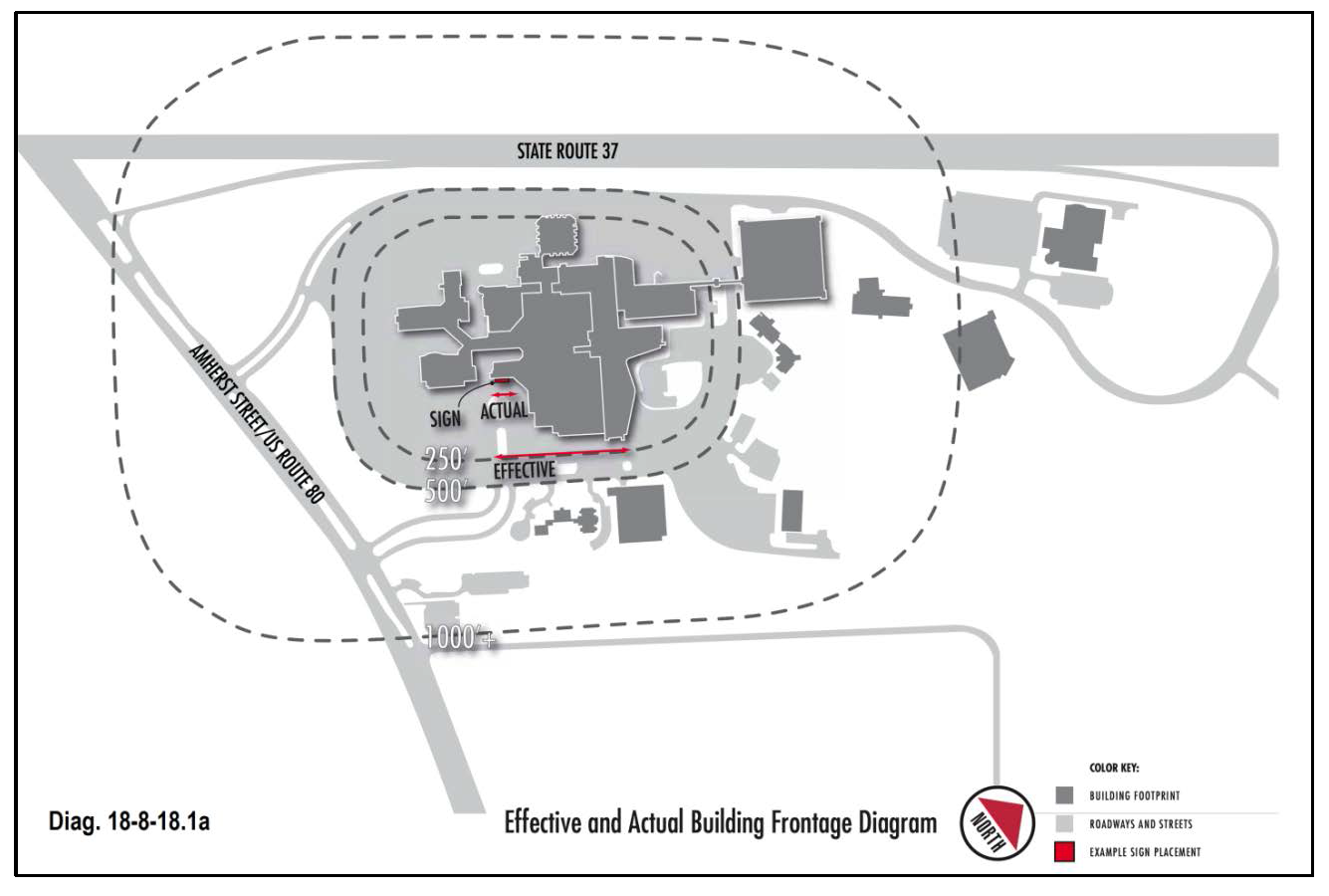
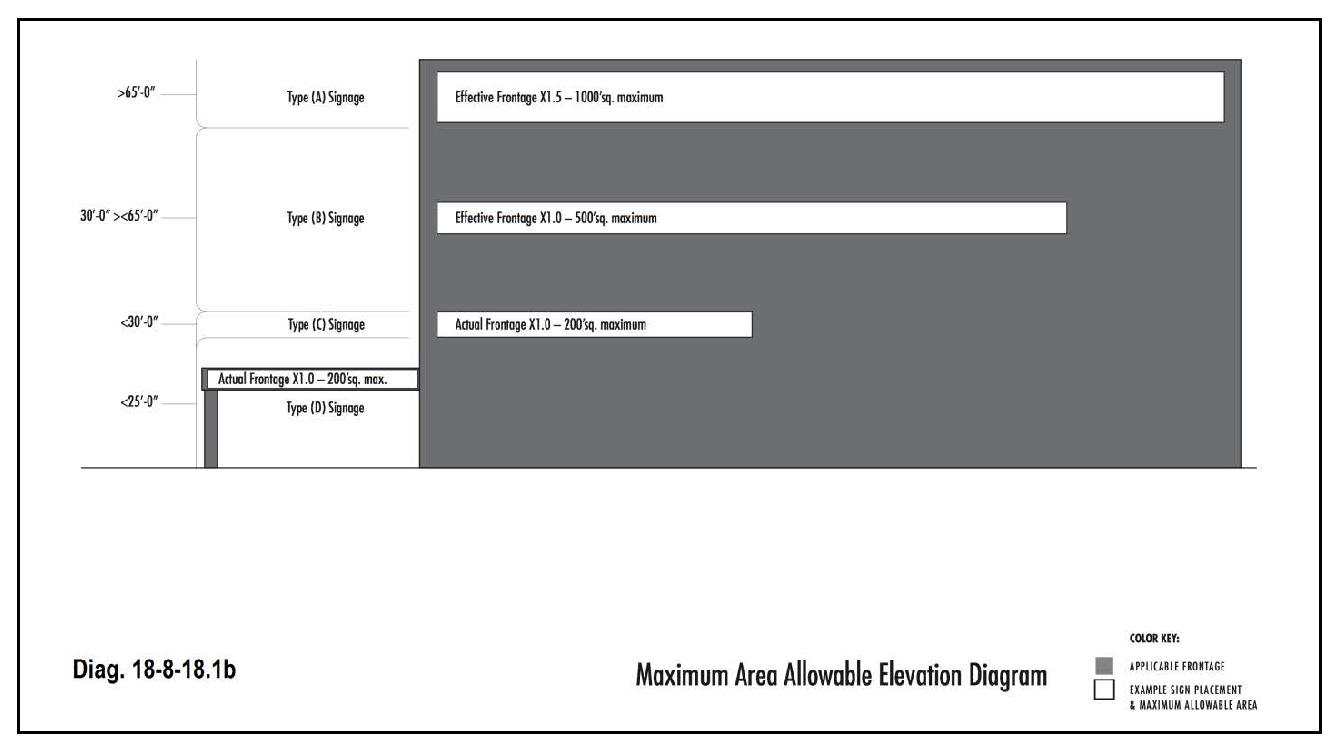
2)
Freestanding signs.
i.
Freestanding signs, unless otherwise specified, shall not exceed 72 square feet in area, and shall not extend higher than 20 feet. No more than one freestanding sign shall be permitted for each building. Additional signs not exceeding 72 square feet in area and 20 feet in height shall be permitted when installed along interior roads and parking lots. No freestanding sign shall project beyond the property line.
ii.
No more than one freestanding sign shall be permitted for a general hospital, limited in area to 50 square feet, and shall not extend higher than 25 feet. No freestanding sign shall project beyond the property line.
iii.
One freestanding sign shall be limited for each entrance to the medical center from a public street or right-of-way. The freestanding signs shall be limited in area to 160 square feet and shall not extend higher than 25 feet. No freestanding sign shall project beyond the property line.
3)
Signs primarily oriented towards a heliport shall be exempt from regulation.
4)
Any number of temporary signs with noncommercial messages are permitted.
5)
One temporary sign per 50 linear feet of lot width bearing commercial messages are permitted at one time and shall be allowed. A minimum of one and maximum of four temporary signs based upon this ratio may be displayed only while the following activities are occurring on the property:
i.
Commercial activity lawfully conducted on the premises. Such signs shall be removed within 24 hours after the end of the sale or conclusion of commercial activity.
ii.
Sale, rental or lease of the premises. Such signs shall be removed no later than the date on which the deed, lease or other document representing the transaction is completed.
(12/12/17, Case TA-17-485, Ord. No. 2017-33; 11/24/20, Case TA-20-532, Ord. No. 2020-54)
18-8-19
Signs permitted in the HE-1 District.
A.
Permanent signs.
B.
Temporary signs.
C.
Other provisions.
1)
In addition to the one building sign permitted per building entrance, one building mounted sign up to 75 square feet may be installed per building.
2)
In addition to the one freestanding sign permitted by building entrance, the following freestanding signs may be used:
i.
One freestanding sign per entrance to the campus from a public street. Such signage shall not be greater than 50 square feet nor have a height of greater than 20 feet.
ii.
Signs along interior roads and parking lots up to 20 square feet and ten feet tall. No more than two such signs may be located within 100 feet of each other.
3)
Any number of temporary signs with noncommercial messages are permitted.
4)
One temporary sign per 50 linear feet of lot width bearing commercial messages are permitted at one time and shall be allowed. A minimum of one and maximum of four temporary signs based upon this ratio may be displayed only while the following activities are occurring on the property:
i.
Commercial activity lawfully conducted on the premises. Such signs shall be removed within 24 hours after the end of the sale or conclusion of commercial activity.
ii.
Sale, rental or lease of the premises. Such signs shall be removed no later than the date on which the deed, lease or other document representing the transaction is completed.
5)
In addition to the freestanding signs allowed above, signs up to four square feet and four feet in height may be installed adjacent to off-street parking area when utilized for controlling vehicular and pedestrian traffic within a development. No more than two such signs shall be installed within 100 feet of one another unless required by a public authority for recognized traffic management needs.
(12/12/17, Case TA-17-485, Ord. No. 2017-33)
18-8-20
Signs permitted in the EIP District.
A.
Permanent signs.
B.
Temporary signs.
C.
Other provisions.
1)
In addition to the one building sign permitted per building entrance, one building mounted sign up to 75 square feet may be installed per building.
2)
In addition to the one freestanding sign permitted by building entrance, the following freestanding signs may be used:
i.
One freestanding sign per entrance to the campus from a public street. Such signage shall not be greater than 50 square feet nor have a height of greater than 20 feet.
ii.
Signs along interior roads and parking lots up to 20 square feet and ten feet tall. No more than two such signs may be located within 100 feet of each other
3)
Any number of temporary signs with noncommercial messages are permitted.
4)
One temporary sign per 50 linear feet of lot width bearing commercial messages are permitted at one time and shall be allowed. A minimum of one and maximum of four temporary signs based upon this ratio may be displayed only while the following activities are occurring on the property:
i.
Commercial activity lawfully conducted on the premises. Such signs shall be removed within 24 hours after the end of the sale or conclusion of commercial activity.
ii.
Sale, rental or lease of the premises. Such signs shall be removed no later than the date on which the deed, lease or other document representing the transaction is completed.
5)
In addition to the freestanding signs allowed above, signs up to four square feet and four feet in height may be installed adjacent to off-street parking area when utilized for controlling vehicular and pedestrian traffic within a development. No more than two such signs shall be installed within 100 feet of one another unless required by a public authority for recognized traffic management needs.
(12/12/17, Case TA-17-485, Ord. No. 2017-33)
18-8-21
Signs Permitted in the NDD.
A.
Permanent Signs.
B.
Permanent Signs Adaptive Reuse.
C.
Temporary Signs.
D.
Other Provisions.
1.
For buildings with three or more commercial tenants, no more than one freestanding sign shall be permitted. It shall be limited to an area of 50 square feet.
2.
For buildings housing multiple tenants, building-mounted signage may be allocated based on one square foot of sign area for each linear foot of tenant frontage, with a main customer entrance up to the maximum listed in section 18-8-21.A.
3.
For building mounted signs, if a property has frontage on more than one street, each street shall be considered a separate frontage. Each frontage not containing a customer entrance is limited to one square foot per linear foot of frontage up to a maximum of 50 square feet.
4.
For commercial centers or residential developments with three or more main buildings, one additional freestanding sign per public street (two-way) entrance may be permitted up to five feet in height and 15 square feet. These signs shall not include tenant signs and must be no closer than 500 linear feet from each other.
5.
Projecting signage attached to the building shall not project more than six feet from the building nor closer than two feet from the nearest curb-line. Projecting signs shall be at least eight feet above grade from the bottom of the sign. Projecting signs shall not exceed six square feet. No more than one projecting sign per tenant space.
6.
Roof mounted signs, banners, and pennants are prohibited, portable and temporary signs should not be used.
7.
The message portion of the signs shall have no more than three colors.
8.
Internally illuminated signs shall have a dark background with light letters.
9.
Any number of temporary signs with noncommercial messages are permitted.
10.
One temporary sign per 50 linear feet of lot width, with a maximum of four temporary signs in total, bearing commercial messages, is permitted at one time and shall be allowed. Only while the following activities are occurring on the property:
i.
Commercial activity lawfully conducted on the premises. Such signs shall be removed within 24 hours after the end of the sale or conclusion of commercial activity.
ii.
Sale, rental or lease of the premises. Such signs shall be removed no later than the date on which the deed, lease or other document representing the transaction is completed.
11.
For service stations, a group of fuel pumps may have additional signs not exceeding an aggregate area of 12 square feet for each pump.
12.
In addition to the freestanding signs allowed above, signs up to four square feet and four feet in height may be installed adjacent to off-street parking area when utilized for controlling vehicular and pedestrian traffic within a development. No more than two such signs shall be installed within 100 feet of one another unless required by a public authority for recognized traffic management needs.
(Ord. No. 2025-27, 10-28-2025)
18-8-21
Signs in the Historic Winchester (HW) district.
A.
In no case shall signage in the Historic Winchester (HW) district be internally illuminated.
B.
In addition to the provisions of this chapter, signage shall conform to the provisions of Article 14 of this Ordinance.
C.
Temporary signage in the Historic Winchester (HW) district shall only consist of the following sign types: A-frame, chalkboard, portable sign, flag, and banners when firmly attached to a building at all four corners of the banner.
(12/12/17, Case TA-17-485, Ord. No. 2017-33)
18-8-22
Signs in the Corridor Enhancement (CE) district.
A.
Signs within an established Corridor Enhancement (CE) Overlay District shall conform to the provisions of Article 14.2 of this Ordinance.
(12/12/17, Case TA-17-485, Ord. No. 2017-33)
Editor's note— Ord. No. 2017-33, Case TA-17-485, adopted Dec. 12, 2017, repealed the former § 18-8, and enacted a new § 18-8 as set out herein. The former § 18-8 pertained to the similar subject matter and derived from 8/11/87, Case TA 87-04 Ord. No. 025-87; 12/8/87, Case TA-87-08, Ord. No. 043-87; 10/11/88, Case TA-88-07, Ord. No. 039-88; 5/8/90, Case TA-90-01, Ord. No. 016-90; 6/12/90, Case TA-89-11, Ord. No. 018-90; 7/10/90, Case TA-90-04, Ord. No. 026-90; 2/9/93, Case TA-92-04, Ord. No. 004-93; 3/8/94, Case TA-93-09, Ord. No. 005-94; 4/12/94, Case TA-94-04, Ord. No. 012-94; 10/8/96, Case TA-96-06, Ord. No. 026-96; 11/12/96, Case TA-95-09, Ord. No. 030-96; 1/9/97, Case TA-97-11, Ord. No. 034-097; 3/11/97, Case TA-96-08, Ord. No. 007-97; 9/9/97, TA-97-07, Ord. No. 021-97; 4/14/98, TA-97-12, Ord. No. 008-98; 6/9/98, TA-98-02, Ord. No. 016-98; 9/11/01, Case TA-01-02, Ord. No. 029-2001; 10/9/01, Case No. TA-01-05, Ord. No. 034-2001; 3/8/05, TA-04-08, Ord. No. 007-2005; 9/13/05, Case TA-05-02, Ord. No. 025-2005; 9/9/08, Case TA-08-06 Ord. No. 2008-39; 10/12/10, Case TA-10-418, Ord. No. 2010-51; 7/12/11, Case TA-11-222, Ord. No. 2011-20; 8/9/11, Case TA-11-303, Ord. No. 2011-35; 12/10/13, Case TA-13-138, Ord. No. 2013-14; and 4/24/15, Case TA-14-770, Ord. No. 2015-06.
Sec. 18-9. - Special regulations regarding yards.
18-9-1
Yards and open space. No yard or other space provided about any building for the purpose of complying with the provisions of this Ordinance shall be considered as providing a yard or other open space for any other building, and no yard or other open space on one lot shall be considered as providing a yard or open space on any other lot.
18-9-2
Yard encroachments. Every part of every required yard shall be open and unobstructed from the ground to the sky except as hereinafter provided or as otherwise permitted in this Ordinance:
18-9-2.1
Unenclosed porches, decks, or terraces not over three feet above the ground except for railings and roof structures, may extend five feet into a required front yard or corner side yard, ten feet into a required rear yard, and three feet into a required non-corner side yard, provided that any such structure having a roof shall not extend into any required yard area to a greater distance than one-half the required yard depth or width.
(8/16/02, Case TA-02-02, Ord. No. 010-2002)
18-9-2.2
An open, unenclosed paved terrace may project into the required front yard for a distance not exceeding ten feet.
18-9-2.3
Chimneys, fireplaces, or pilasters may not project over two feet into a required yard.
18-9-2.4
Handicap accessibility ramps and steps and staircases without roofs may extend into required yard provided that any access ramp built into the setbacks does not extend further than is necessary per the requirements of the Virginia Uniform Statewide Building Code.
(8/16/02, Case TA-02-02, Ord. No. 010-2002; 1/13/04, Case TA-03-04, Ord. No. 002-2004)
18-9-2.5
Reserved.
Editor's note— Ord. No.2021-6, adopted May 25, 2021, repealed § 18-9-2.5, which pertained to an unenclosed carport.
18-9-2.6
Trash and recycling enclosures may extend into any required rear and side yard but not nearer to any rear or side lot line than a distance of three feet, except for enclosures serving nonresidential uses when adjacent to a residentially zoned lot, in which case a minimum of 15 feet of separation shall be provided.
(1/9/01, Case TA-00-10, Ord. No. 003-2001)
18-9-2.7
Utility boxes, transformers and similar structures which do not create noise, odor, glare, vibration, light, dust or excessive heat and which are less than six feet in height, may be installed in any required rear or side yard.
(1/9/01, Case TA-00-10, Ord. No. 003-2001; 8/16/02, Case TA-02-02, Ord. No. 009-2002)
18-9-2.8
Repealed.
(8/16/02, Case TA-02-01, Ord. No. 009-2002; 5/9/17, Case TA-17-111, Ord. No. 2017-11; 12/12/17, Case TA-17-646, Ord. No. 2017-35)
18-9-2.9
Repealed.
(8/16/02, Case TA-02-01, Ord. No. 009-2002; 12/12/17, Case TA-17-646, Ord. No. 2017-35)
18-9-2.10
Repealed.
(10/12/10, Case TA-10-386, Ord. No. 2010-50; 12/12/17, Case TA-17-646, Ord. No. 2017-35)
18-9-2.11
Repealed.
(12/22/15, Case TA-15-589, Ord. No. 2015-27; 12/12/17, Case TA-17-646, Ord. No. 2017-35)
(Ord. No.2021-6, 5-25-2021)
18-9-3
Fences/walls.
18-9-3.1
Prior to the installation of any fence, retaining wall or non-retaining wall, a permit shall be obtained from the Administrator. Such permit shall require a fee as provided in Section 23-8. The Administrator may require evidence from the applicant that the proposed fence location does not conflict with any established drainage or utility easement.
(12/12/17, Case TA-17-646, Ord. No. 2017-35)
18-9-3.2
Fences shall be subject to the following requirements pertaining to height, opacity, minimum setback, and special provisions.
(12/12/17, Case TA-17-646, Ord. No. 2017-35)
(Ord. No. 2023-35, § 1, 1-23-2024)
18-9-3.2.1
Fences in a non-primary front yard or corner side yard, may have a zero-foot setback from the corresponding property line, provided that the fence is no greater than four-feet in height and has a minimum of 25 percent openness (e.g., picket, chain link, rail, etc.).
(Ord. No. 2023-35, § 2, 1-23-2024)
18-9-3.3
No person shall erect or maintain a fence, wall or other barrier wholly or partially on any lot or premises within the city on a property that is zoned LR, MR, HR, or HR-1, where such fence, wall or barrier is made of, or includes, barbed ends, barbed wire or razor wire, or any similar materials, unless such fence is specifically approved for a use permitted through the conditional use permit process.
(12/12/17, Case TA-17-646, Ord. No. 2017-35)
18-9-3.4
In the M-1 and M-2 districts, fences up to five feet in height may be installed in a required front or corner side yard provided a setback of at least ten feet is met from the respective front or corner side property line. Any fence that encroaches more than half of the required setback shall have landscape screening installed between the fence and the front or corner side yard property line consistent with Section 19-5-4.d. of this Ordinance. Fences installed pursuant to this section shall not be made of, or include, barbed ends, barbed wire or razor wire, or any similar material.
(12/12/17, Case TA-17-646, Ord. No. 2017-35Ord. No. 2024-17, 11-26-2024)
18-9-3.5
Retaining walls shall be subject to the following requirements pertaining to height and minimum setback, except as per Section 18-12 of this Ordinance. Any retaining wall over three feet in height shall include a railing, fence, or hedge at least 36 inches high along the top to protect persons from injury due to falling.
(12/12/17, Case TA-17-646, Ord. No. 2017-35)
18-9-3.6
Non-retaining walls shall be subject to the following requirements pertaining to height and minimum setback, except as per Section 18-12 of this Ordinance:
(12/12/17, Case TA-17-646, Ord. No. 2017-35)
18-9-4
For the purposes of this section, a conditional use permit may be sought for situations where either (1) a property owner can demonstrate that compliance with the above is technically impractical to maintain functionality of the property or (2) Council makes a finding that the proposed alternative design is desirable and consistent with neighborhood character.
(5/9/17, Case TA-17-111, Ord. No. 2017-11; 12/12/17, Case TA-17-646, Ord. No. 2017-35)
Sec. 18-10. - Accessory uses and structures.
18-10-1
In all districts, accessory buildings or structures shall not be located in a front, side, or corner side yard, unless specifically provided for elsewhere by the provisions of this Ordinance.
(5/8/90, Case TA-90-01, Ord. No. 016-90)
(Ord. No. 2023-35, § 1, 1-23-2024)
18-10-1.1
On double frontage lots and multi-corner lots, accessory structures may be located in a non-primary front yard provided the structure is set back from the nearest front property line the same distance as the required rear yard for the district. The structure must comply with the height and area coverage limitations otherwise required for accessory structures in rear yards.
(5/9/17, Case TA-17-111, Ord. No. 2017-11)
18-10-2
Accessory structures shall not exceed 12 feet in height on any property located in a residential district outside of the delineated boundaries of the Winchester Historic Overlay District. Notwithstanding any other provisions within this Ordinance, accessory structures which meet the side and rear yard requirements for the district shall not exceed the height of the existing main building or the height limit for the residential district in which the structures are located, whichever is less.
(3/11/08, Case TA-07-08, Ord. No. 2008-13)
18-10-2.1
Exceptions to the permitted building height of accessory structures located within the required side and/or rear yard areas shall only apply to residential properties improved with single-family detached dwelling units which were constructed 75 years ago or prior thereto, and are located within the Winchester Historic Overlay District, as defined in Section 14-1 of this Ordinance. In these cases, appropriate building heights for accessory structures shall be determines by the Board of Architectural Review through the Certificate of Appropriateness process outlined in this Ordinance. The Zoning Administrator may allow heights of accessory structures to extend to maximum height of 18 feet when the following findings can be made in writing:
a.
The additional height is necessary to allow architectural integrity and harmony between the accessory structure and the principle structure, as determined by the Board of Architectural Review;
b.
An Accessory Structure height of 18 feet will not result in adverse conditions to adjoining properties nor will it prove injurious to public health or safety; and
c.
All other requirements of the Zoning Ordinance and the Uniform Statewide Building Code have and will be met.
(3/11/08, Case TA-07-08, Ord. No. 2008-13)
(Ord. No. 2023-35, § 1, 1-23-2024)
18-10-3
Repealed.
(8/16/02, Case TA-02-01, Ord. No. 009-2002; 12/12/17, Case TA-17-646, Ord. No. 2017-35)
18-10-4
No setback from side or rear lot lines shall be required.
(10/11/83, Case 83-06, Ord. No. 034-83)
18-10-5
Steps and staircases shall be permitted in any non-required yard.
(8/16/02, Case TA-02-02, Ord. No. 009-2002)
18-10-6
Accessory buildings permitted in rear yards of residential districts shall not occupy a combined total area of more than 30 percent of said yard.
(5/8/90, Case TA-90-01, Ord. No. 016-90)
18-10-7
Except as provided for in Section 18-10-8, no accessory building shall be constructed upon a lot until the construction of a main building has actually commenced; and no accessory building shall be used unless the main building on a lot is completed and used, except that in the LR, MR, and HR districts one accessory building may be located on a parcel on which no main building exists if such parcel is immediately adjacent to a parcel on which a single family dwelling is located and both parcels are under common ownership. Such accessory building shall be for a use accessory to the main building and shall be located in the rear yard. The rear yard for the parcel without a main building is defined as being equal to the rear yard for the immediately adjacent commonly owned parcel on which a main building is located. In no case may the accessory building encroach into the front setback or corner side yard for the parcel on which the accessory building is located.
(5/8/90, Case TA-90-01, Ord. No. 016-90; 10/12/10, Case TA-10-418, Ord. No. 2010-51)
18-10-8
The following accessory uses and structures shall be permitted on a lot that has been approved for use as a community garden or market garden:
(10/12/10, Case TA-10-418, Ord. No. 2010-51)
18-10-8.1
Hoophouses, cold-frames, and similar planting preparation houses, temporarily used to extend the growing season;
18-10-8.2
Benches, bike racks, raised/accessible planting beds, compost bins, picnic tables, seasonal farm stands, fences, garden art, rain barrel systems, and children's play areas;
18-10-8.3
Buildings, limited to tool sheds, greenhouses, shade pavilions, barns, rest-room facilities with composting toilets, and planting preparation houses; provided that the combined area of all buildings shall not exceed 15 percent of the garden site lot area.
a.
Buildings associated with community gardens and market gardens shall be set back from side and rear property lines of any property located in a residentially-zoned district a minimum distance of five feet; and,
b.
Buildings shall not be located within a required front or corner-side yard.
18-10-9
Donation Drop-off Boxes.
(1/8/13, Case TA-12-473, Ord. No. 2012-36)
a.
Donation drop-off boxes shall be permitted in all zoning districts provide they are located on a property that contains a place of worship or building containing a charitable use as a permitted primary use.
b.
Donation drop-off boxes shall not be located in any provided front or corner-side yard, nor located in any required side yard.
c.
Donation drop-off boxes shall not obstruct pedestrian or vehicular circulation, nor be located in public rights-of-way, landscape areas, required parking spaces, fire lanes, loading zones, or any other location that may cause hazardous conditions, constitute a threat to the public safety, or create a condition detrimental to surrounding land uses.
d.
Donation drop-off boxes shall be clearly marked to identify the specific items and materials requested to be left for donation, the name of the operator or owner of the container, the entity responsible for maintenance of the drop-off box and removal of materials and trash from the immediate area, and a telephone number where the owner, operator or agent may be reached at any time.
e.
No more than two donation drop-off boxes shall be located on any property, and each donation drop-off box shall a capacity of no larger than six cubic yards and a maximum height of seven feet.
f.
Landscape screening on conformance with Section 19-5-4 shall be installed if the donation drop-off box is located within 15 feet of a residentially used property.
(Ord. No. 2024-17, 11-26-2024)
g.
Prior to placement of a donation drop-off box on a property, a zoning permit and site sketch shall be submitted to and approved by the Zoning Administrator to ensure compliance with all provisions of this section.
h.
Subsections a and f shall not be applicable to properly maintained donation drop-off boxes installed by a local charitable or religious place of worship, placed on other properties with permission.
18-10-10
Temporary Family Health Care Structures.
A.
For the purposes of this Section:
1.
"Caregiver" means an adult who provides care for a mentally or physically impaired person within the Commonwealth. A caregiver shall be either related by blood, marriage, or adoption to or the legally appointed guardian of the mentally or physically impaired person for who he is caring.
2.
"Mentally or physically impaired person" means a person who is a resident of Virginia and who requires assistance with two or more activities of daily living, as defined in Code of Virginia, § 63.2-2200, as certified in a writing provided by a physician licensed by the Commonwealth.
3.
"Temporary family health care structure" means a transportable residential structure, providing an environment facilitating a caregiver's provision of care for a mentally or physically impaired person, that (i) is primarily assembled at a location other than its site of installation; (ii) is limited to one occupant who shall be the mentally or physically impaired person or, in the case of a married couple, two occupants, one of whom is a mentally or physically impaired person, and the other requires assistance with one or more activities of daily living as defined in Code of Virginia, § 63.2-2200, as certified in writing by a physician licensed in the Commonwealth; (iii) has no more than 300 gross square feet; and (iv) complies with applicable provisions of the Industrialized Building Safety Law and the Uniform Statewide Building Code. Placing the temporary family health care structure on a permanent foundation shall not be required or permitted.
B.
Temporary family health care structures shall be permitted as an accessory use in LR, MR, HR, HR-1, RB-1, RO-1, B-1, and PUD districts as a permitted accessory use to an existing single family residential use. Such structures shall be (i) for use by a caregiver in providing care for a mentally or physically impaired person and (ii) on property owned or occupied by the caregiver as his residence.
C.
Only one family health care structure shall be allowed on a lot or parcel of land.
D.
Any person proposing to install a temporary family health care structure shall first obtain a permit from the Administrator.
E.
The Administrator may require that the applicant provide evidence of compliance with this section on an annual basis as long as the temporary family health care structure remains on the property. Such evidence may involve the inspection by the Administrator of the temporary family health care structure at reasonable times convenient to the caregiver, not limited to any annual compliance confirmation.
F.
Any temporary family health care structure installed pursuant to this Section may be required to connect to any water, sewer, and electric utilities that are serving the primary residence on the property and shall comply with all applicable requirements of the Virginia Department of Health.
G.
No signage advertising or otherwise promoting the existence of the structure shall be permitted either on the exterior of the temporary family health care structure or elsewhere on the property.
H.
Any temporary family health care structure installed pursuant to this Section shall be removed within 60 days of the date on which the temporary family health care structure was last occupied by a mentally or physically impaired person receiving services or in need of the assistance provided for in this section.
I.
The Administrator may revoke the permit granted pursuant to subsection D if the permit holder violates any provision of this section. Additionally, the Administrator may seek injunctive relief or other appropriate actions or proceedings in the circuit court of that locality to ensure compliance with this section.
J.
Any proposed temporary health care structure must meet the same location, setback, lot coverage requirements and limitations set forth in this Article for other accessory structures.
(11/11/14, Case TA-14-477, Ord. No. 2014-39)
18-10-11
A conditional use permit may be sought for sections 18-10-1 through 18-10-6, for situations where either (1) a property owner can demonstrate that compliance with the above is technically impractical to maintain functionality of the property or (2) Council makes a finding that the proposed alternative design is desirable and consistent with neighborhood character.
(5/9/17, Case TA-17-111, Ord. No. 2017-11)
Sec. 18-10.1. - Special regulations pertaining to solar energy systems.
18-10.1-1
Structure Mounted Systems: Solar energy systems that generate energy for on- site use are permitted by right as an accessory use when they are mounted to structures which are used for a permitted principal use, or structures accessory thereto which are used chiefly for an accessory use unrelated to solar, provided that the surface mounted solar energy system conforms to all of the following requirements:
a.
A surface-mounted solar energy system may not be located on any surface, excluding roofs, of a structure that fronts a public right-of-way.
b.
A surface-mounted solar energy system may not project more than 12 inches from any surface of any structure, unless allowed pursuant to subsections c or d.
c.
On a pitched roof surface which does not front a public right-of-way, a surface- mounted solar energy system may project vertically up to the highest point of the pitch.
d.
On a flat roof surface, a surface-mounted solar energy system may project vertically up to five feet provided that the system is screened from view from the public right-of-way with a parapet of similar structure or is otherwise not visible from the public right-of-way.
e.
No surface-mounted solar energy system that is mounted on a roof may project horizontally past the edge of the roof.
f.
No surface-mounted solar energy system may project or encroach onto an adjoining property.
g.
The limitations in this Section shall not apply to structure-mounted solar energy systems located on properties that are principally used for solar energy systems.
(3/22/22, Ord. No. 2022-7)
18-10.1-2
Freestanding (Ground Mounted) Systems: Solar energy systems that are freestanding (ground mounted) and generate energy for on-site use are permitted by right as an accessory use provided that they comply with all of the following requirements:
a.
Freestanding solar energy systems must be screened from the public right-of-way per Sec. 19-5-4, if located within the Historic Winchester (HW) or Corridor Enhancement (CE) Overlay Districts.
(Ord. No. 2024-17, 11-26-2024)
b.
Freestanding solar energy systems may not be located in a required front yard.
c.
Freestanding solar energy systems are permitted where no principal structure exists, if the principal use of the property is for solar energy systems.
(3/22/22, Ord. No. 2022-7)
18-10.1-3
General Regulations for solar energy systems:
a.
No solar energy system may exceed the height limitations applicable in the zoning district.
b.
All distribution lines for solar energy systems shall be installed underground.
c.
All batteries used in connection with a solar energy system must be located within an enclosed cabinet or within a building.
d.
All solar energy systems must receive approval of a Certificate of Appropriateness if located within the Historic Winchester (HW) or Corridor Enhancement (CE) Overlay Districts.
e.
Any solar energy system that is a principal use shall require a written decommissioning agreement, pursuant to Virginia Code § 15.2-2241.2 and reasonably satisfactory to the Zoning Administrator, which agreement shall provide for financial assurance to the City of such decommissioning.
f.
Any solar energy system that is a principal use shall satisfy the minimum required improvements and standards, as applicable, in Section 19-5.
(3/22/22, Ord. No. 2022-7)
Sec. 18-11. - Deleted.
(10/11/83, case 83-06, Ord. No. 034-83)
Sec. 18-12. - Visual obstruction.
18-12-1
On a corner lot in any district other than the Central Business District, B-1, no obstructions between 2½ feet and eight feet above the street grade level shall be maintained in the area bounded by the curb line, or edge of pavement, where there are no curbs, adjacent to such corner lots, and a line joining points along said lines 25 feet from the point of intersection. This section shall not apply to tree trunks (not including foliage or branches), light poles, utility poles, or sign poles.
(6/12/90, Case TA-89-11, Ord. No. 018-90; 8/16/02, Case TA-02-01, Ord. No. 009-2002)
(Ord. No. 2023-35, § 1, 1-23-2024)
Sec. 18-13. - Drainage.
(8/13/85, case 85-02, Ord. No. 011-85)
18-13-1
No building shall be erected on any land and no change shall be made in the existing contours of any land, including any change in the course, width, or elevation of any natural or other drainage channel, in any manner that will obstruct, interfere with, or substantially change the drainage from such land to the detriment of neighboring lands. Factors to be considered in determining substantial change shall include the recommendations of the Winchester Storm Drainage Study and adopted storm drainage standards of the Virginia Department of Transportation. In his administration of this requirement, the Zoning Administrator shall refer any application submitted to him to the Public Services Director for a determination in the matter.
18-13-2
Development within a drainage shed involving a change of land use is normally associated with an increase in impervious area resulting in a greater quantity as well as a more rapid and frequent concentration of stormwater runoff. The construction of storm drainage improvements is required along waterways as development progresses in order to alleviate flood damage and arrest deterioration of existing drainageways. The extent and character of such improvements shall be designed to provide for the adequate correction of deficiencies. Improvements shall extend downstream to a point where damages to existing properties from additional runoff will be minimized. The purpose and intent is to require a subdivider or developer of land to construct needed storm drainage facilities or to pay his pro rata share of the cost of providing reasonable and necessary drainage facilities located outside the property limits of the land owned or controlled by the subdivider or developer but necessitated or required, at least in part, by the construction or improvement of his subdivision or development.
18-13-3
Where the developer requests that he may be permitted to contribute his share of the cost toward the correction of off-site storm drainage deficiencies in lieu of constructing the required improvements, the City may accept such contribution towards their correction or the City may require that the developer construct the improvement required to make such corrections.
18-13-4
Where a developer is permitted to either construct or provide the funds for the construction of more than his pro rata share of the downstream off-site drainage improvements so that he may proceed with the improvement of his land without damaging the properties of others, the City will endeavor to collect, on a pro rata basis, any funds expended beyond his proportionate share from other properties within the drainage shed served by such drainage improvements when such properties are developed within a period of ten years from the date that the drainage improvements are financed or constructed. These funds shall be returned to the initial developer or his assigns only if collected by the City from the subsequent developers. The initial developer has right of action to recover from a subsequent developer his pro rata cost for his use of the facilities installed by the initial developer.
18-13-5
Calculation of pro rata cost.
18-13-5.1
When directed to do so by the City Manager, the Public Services Director or his designee shall study and compute the total estimated cost of ultimate drainage facilities required to serve a drainage shed when and if such drainage shed is fully developed in accordance with the adopted Comprehensive Plan and Zoning Ordinance for the City. The computation of estimated costs shall include any engineering studies for the drainage. The total estimated cost of storm drainage construction, and easement and flood plain easement acquisition costs where necessary, shall also be included. When this total cost is computed, it shall be updated every six months by applying the Engineering New-Record cost index factor to the construction costs. The above study with its attendant cost figures shall constitute the general drainage improvement program for the affected drainage shed.
18-13-5.2
When a general drainage improvement program has been established, a pro rata share of the total cost of the program shall be determined as follows:
1.
The estimated increased volume of storm water runoff for the drainage shed, when fully developed in accordance with the adopted Comprehensive Plan and Ordinance, shall be computed.
2.
The increased volume of storm water runoff caused by a subdivision or other development shall be computed.
3.
The ratio of the volume of storm water runoff caused by a subdivision or other development to the estimated total volume of storm water runoff for the drainage shed, expressed as a percentage shall be applied to the total cost of the drainage improvement program for the drainage shed. The resultant figure shall be the pro rata share for the subdivision or development.
18-13-6
Payment of pro rata share. The payment of the pro rata share shall be due prior to the approval of the plans for a subdivision. Where a subdivision has been previously approved or where the subdivision of land does not occur, the payment of the pro rata share shall be prior to the issuance of any building permits.
Sec. 18-14. - Erection of buildings.
Every building hereafter erected shall be located on a lot as herein defined, said lot having its principal frontage on a public street of record, except as otherwise permitted in this Ordinance for townhouses and planned development.
Sec. 18-15. - Obstruction of public right-of-way.
Unless explicitly permitted elsewhere in this Ordinance, no building, structure, sign, merchandise, or other obstruction shall be located or conducted on any public right-of-way.
(4/9/13, Case TA-13-35, Ord. No. 2013-08)
Sec. 18-16. - Nuisances.
Nothing shall be allowable on the premises in any district, provided for in this Ordinance, that shall be in any way offensive or noxious by reason of the emission of odors, fumes, dust, smoke, light, vibration, or noise. Nor shall anything by constructed or maintained that would in any way constitute an eyesore or nuisance to adjacent property owners or residents or to the community.
Sec. 18-17. - Mobile home, mobile office, mobile sales unit, and mobile storage unit (hereinafter known collectively as mobile units).
(1/13/98, Case TA-97-10, Ord. No. 001-98; 7/25/17, Case TA-17-287, Ord. No. 2017-20)
18-17-1
No mobile units shall be located within the corporate limits of the City unless specifically permitted by this Ordinance. However, Section 18-17 shall not apply to mobile homes or mobile offices temporarily used at construction sites by contractors or subcontractors for non-dwelling purposes in conjunction with approved construction projects.
(1/13/98, TA-97-10, Ord. No. 001-98; 7/25/17, Case TA-17-287, Ord. No. 2017-20)
18-17-2
The Administrator may, upon application by a property owner or lessee, grant a temporary permit to locate a mobile unit to be used for non-dwelling purposes. For purposes of this Section the term mobile storage unit shall include licensed or unlicensed tractor trailer trailers that are used for storage and remain on site for more than five days as well as containers trucked to and unloaded at the site. A temporary permit shall not be issued until the Administrator determines that the location of the mobile unit meets the setback and yard requirements for a permanent structure in the applicable zoning district and that there is adequate parking, fire protection, pedestrian access, sight obstruction and separation from off-street parking areas. Mobile storage units shall occupy an area no larger than ten percent of the gross floor area of the primary use served by the unit or 400 square feet whichever is greater. A waiver of the off-street parking area paving requirements of this Ordinance may be granted by the Administrator when it can be shown that another material is more appropriate and adjoining streets or properties will not be adversely affected. In reaching such determinations, the Administrator shall seek advice from appropriate City departments. The maximum time for the initial temporary permit for mobile units other than mobile storage units is one year from the date of initial occupancy. The maximum time for the temporary permit mobile storage units is 120 days from the effective date of the permit. There shall be a minimum of 11 months between the issuance of one mobile storage unit permit and issuance of a new mobile storage unit permit associated with the same user.
(1/13/98, Case TA-97-10, Ord. No. 001-98; 7/25/17, Case TA-17-287, Ord. No. 2017-20)
18-17-3
Repealed.
(7/25/17, Case TA-17-287, Ord. No. 2017-20)
18-17-4
Repealed.
(7/25/17, Case TA-17-287, Ord. No. 2017-20)
18-17-5
Requests for renewal of an initial permit shall be referred to the Commission for review and to City Council for approval. An application shall be considered a renewal application if the application is received within 60 days of the expiration of a temporary or event permit for the same location. The maximum duration for each permit renewal is one year from the expiration of the last permit, unless Council determines a longer approval period is appropriate.
(7/25/17, Case TA-17-287, Ord. No. 2017-20)
18-17-6
City Council, when acting on an initial or renewal application, may exercise discretion and waive or modify applicable standards when the applicant has shown just cause and when such a waiver or modification is appropriate for a temporary use.
18-17-7
The applicant for initial permit or renewal of a permit shall submit to the Administrator a letter outlining the request, a sketch site plan drawn to scale which addresses the factors outlined above and the fee as per Section 23-8 of this Ordinance.
Sec. 18-17.1. - Special regulations regarding vertical farming uses in industrialized containers.
For
the purpose of this Section, the term industrialized container, as defined in Section 1-2-51.2, does not include mobile offices or trailers, mobile sales offices, or mobile refuse containers. Industrialized containers are subject to the following:
1.
Must be placed on a property that has a principal structure;
2.
There shall be no more than six industrialized containers on any site;
3.
Shall not be attached to a non-industrialized container or other structures, excluding other industrialized containers;
4.
Shall not be stacked atop one another, regardless of design;
5.
Must be connected to City water and sewer, as determined by the Zoning Administrator with consultation from the Public Utilities Department;
6.
Must be parallel to a public road. Any container(s) placed entirely behind and in-line with the edge of a parallelly situated container may be placed perpendicular to road provided that there is no more than three feet of separation between the perpendicular and parallel situated containers;
7.
Must include two of the following architectural features to soften the shape and enhance the appearance of the containers:
a.
Live, foundation plantings that are minimum of three feet in depth and span along the entire width of any portion of a container that fronts a road, excluding where rough openings or entrances are on the container; or
b.
A painted mural on any wall(s) of a container that front a street, where the mural is of a size that is no less than 50 percent of said wall(s) for the longer walls or no less than 75 percent of a wall for shorter walls; or
c.
Porches, shed roofs, or awnings that span at least half of the container width for the longer walls that front a street;
d.
Pitched or gable roof that spans the entire length of the longest side of the container;
8.
Shall not have storage or display atop the containers;
9.
Must be free of any visible signs of deterioration such as rust or peeling paint.
(6/27/23, Case TA-23-170, Ord. No. 2023-17)
Sec. 18-18. - Projection of structures beyond property lines.
18-18-1
No marquee, permanent awnings, pent roofs, porches, or similar structures that will be permanently attached to a City sidewalk or will be less than eight feet above a City sidewalk, shall be erected, altered, or remodeled to extend closer to the curb line than any other adjacent existing building, porch, or other structure, but in no case closer than five feet in from the curb line.
(7/11/78)
18-18-2
Marquees, permanent awnings, pent roofs, or similar structures shall not project closer than five feet in from the curb line, and shall not be less than eight feet above a City sidewalk.
(7/11/78)
18-18-3
Marquees, permanent awnings, pent roofs, or similar structures attached to buildings fronting on the Loudoun Street Mall shall not project more than four feet from the front property line, and shall not be less than eight feet above the City sidewalk.
(7/11/78)
Sec. 18-19. - Home occupations.
(10/11/83, Case TA-83-06, Ord. No. 034-83)
18-19-1
Home occupations are permitted in any dwelling unit.
18-19-2
A home occupation is an accessory use of a dwelling unit for gainful employment involving the manufacture, provision, or sale of goods and/or service, including the sale of food and/or non-food crops produced on the site; and conducted in a dwelling unit except as allowed in an accessory structure per the Conditional Use Permitting provisions identified in Section 18-19-2.6. Home Occupations shall only be engaged in by a person or persons residing in the dwelling unit, provided that:
(10/12/10, Case TA-10-418, Ord. No. 2010-51; 1/14/14, Case TA-13-493, Ord. No. 2013-41)
18-19-2.1
It is clearly incidental and subordinate to the dwelling unit's use for residential purposes by its occupants;
18-19-2.2
With the exception of an accessory garden use and as provided in Section 18-19-2.6, it is conducted in the main building and does not result in alteration of the appearance of the dwelling unit or the lot on which it is located. There shall be no interruption, congestion or change to the character of the neighborhood in terms of traffic or vehicular parking resulting from the operation of the home occupation.
(10/12/10, Case TA-10-418, Ord. No. 2010-51; 1/14/14, Case TA-13-493, Ord. No. 2013-41);
18-19-2.3
With the exception of displaying food and/or non-food crops produced on the site, it is not identified by any sign or by a display of merchandise visible from the exterior of the building (10/12/10, Case TA-10-418, Ord. No. 2010-51);
18-19-2.4
It does not involve the storage of goods and materials in excess of 50 square feet of floor area. This storage may be either in the main building or an accessory building, but it shall not be permitted outdoors;
18-19-2.5
No equipment or process shall be used in such home occupation which creates noise, vibration, glare, fumes, odors, or electrical interference beyond what normally occurs in the applicable zoning district.
18-19-2.6
A conditional use permit shall be required for any home occupation that proposes to involve the use of an accessory structure as part of a home occupation. In addition to the provisions of this Section, home occupations must conform to the entirety of Section 18-19. In no case shall the floor area used in the accessory structure exceed 50 percent of the gross floor areas of the residential dwelling unit. A conditional use permit application for home occupations under this Section shall include the following
(1/14/14, Case TA-13-493, Ord. No. 2013-41):
a.
Property survey or sketch drawn to scale detailing the setbacks of the accessory structure and distances to each of the property lines as well as the distances to structures within 50 feet on immediately adjacent properties.
b.
A scaled interior layout sketch illustrating the proposed home occupation in the accessory structure.
c.
A letter outlining the scope and nature of the occupation, involving operating hours, days of the week, and similar details, as well as an explanation of conformance with Section 18-2-1.1 of this Ordinance.
18-19-3
The operation of a family day home may occur as an accessory and subordinate use to a residence provided the following:
(9/14/10, Case TA-10-337, Ord. No. 2010-40, 11/11/14, Case TA-14-477, Ord. No. 2014-39, 9/22/15, Case TA-15-376, Ord. No. 2015-17)
A.
A family day home for not more than four children shall be considered as residential occupancy by a single family; and, therefore does not require a Certificate of Home Occupation.
B.
A family day home serving five through 12 children, exclusive of the provider's own children and any children who reside in the home, shall obtain a Certificate of Home Occupation and shall be licensed by the Virginia Department of Social Services, provided the following:
1.
Prior to the issuance of a Certificate of Home Occupation for a family day home serving five through 12 children, the applicant shall send a notice developed by the Administrator to each adjacent property owner by registered or certified mail, and shall provide proof to the Administrator of the completion of such mailings.
2.
If the Administrator receives no written objection from a person so notified within 30 days of the date of sending the letter and determines that the family day home otherwise complies with the provisions of this Ordinance, the Administrator may issue the permit sought.
3.
Any applicant denied a permit through this administrative process may request that the application be considered by City Council after a hearing following public notice per Section 23-7-1 of this Ordinance.
4.
Upon such hearing, City Council may, in its discretion, approve the permit, subject to such conditions as agreed upon by the applicant and the locality, or deny the permit.
C.
No family day home shall care for more than four children under the age of two, including the provider's own children and any children who reside in the home, unless the family day home is licensed or voluntarily registered.
D.
A family day home where the children in care are all related to the provider by blood or marriage shall not be required to be licensed or obligated to obtain a Certificate of Home Occupation.
18-19-4
Permitted home occupations shall not in any event include:
(1/14/14, Case TA-13-493, Ord. No. 2013-41; 11/10/15, Case TA-15-441, Ord. No. 2015-26)
-
Bookstores or motion picture theaters
-
Animal hospitals and kennels
-
Bed and breakfast homestays and boarding houses
-
Massage therapy (other than strictly a home office used for record keeping)
-
Motor vehicle sales, repair, equipment installation, and similar activities
-
Pet Daycare, training or grooming exceeding care of more than one pet at a time, excluding those of the tenant of the dwelling unit
-
Private Clubs or Lodges
-
Restaurants
-
Tourist Homes
-
Vehicle towing, demolishing, or salvaging
-
Brewery, distillery, microbrewery, microdistillery, nanobrewery, winery
18-19-5
A yard sale shall be considered a permitted home occupation, subject to the following:
18-19-5.1
No more than two yards sales may be conducted at any street address within a 12 month period. For the purposes of this section, each dwelling unit in a multifamily dwelling shall be considered a separate street address. If there is no space to hold the sale at the sale holder's address, the yard sale may be held at a property within 300 feet. Such a yard sale counts as a yard sale at the property where the sale is actually held.
(3/8/94, Case TA-94-01, Ord. No. 006-94)
18-19-5.2
Each yard sale may be held a maximum of two consecutive days, and only during the hours of 8:00 a.m. to 6:00 p.m.
(3/8/94, Case TA-94-01, Ord. No. 006-94; 12/10/13, Case TA-13-138, Ord. No. 2013-14)
18-19-5.3
A zoning use permit shall not be required for any yard sale conducted pursuant to this Section.
(3/8/94, Case TA-94-01, Ord. No. 006-94; 7/25/17, Case TA-17-287, Ord. No. 2017-20)
18-19-5.4
Without the limitation on the authority and responsibility of the Zoning Administrator, or the Board of Zoning Appeals, the Police Department of the City shall have the responsibility and authority to inspect any yard sale to determine compliance with the terms of this Article, and shall have authority to enforce the provisions of this Article, including the authority to file charges under Section 21-2 of this Ordinance against any person operating a yard sale in violation hereof.
(10/14/86, Ord. No. 016-86)
Sec. 18-20. - Storage of materials and supplies and display of merchandise for sale or rent.
(10/17/95, Case TA-95-04, Ord. No. 053-95)
18-20-1
The Commission or Administrator, as provided for in the following Sections, may, upon application by a property owner or lessee, grant a permit for outdoor storage of materials and supplies or for outdoor display of merchandise for sale or rent, hereinafter known as storage or display. A permit shall not be issued until the Commission or Administrator determines the storage or display meets the requirements of this Ordinance, the City Code or Public Utilities Standards for each of the following areas: screening or buffering, off-street parking, landscaped area, stormwater management, fire protection, vehicle and pedestrian access, signage, sight obstruction, and separation from off-street parking areas. Display of merchandise for sale or rent located adjacent to standing and loading spaces, including petroleum dispensers, need not comply with the off-street parking separation requirements. In reaching such determinations, the Commission or Administrator may seek advice from appropriate City departments. No permit is required for display of merchandise for sale or rent if the area covered by such display does not exceed two percent of the floor area of the permanent building on the lot, but not to exceed 200 square feet, if the height does not exceed six feet and if the location meets the setback and yard requirements for a permanent building on the lot.
(10/17/95, Case TA-95-04, Ord. No. 053-95)
18-20-2
Permanent storage or display is allowed as provided for in the following table. There must be a permitted or conditional use on the property. The storage or display must be incidental to the conduct of such use. A site plan prepared in accordance with Article 19 of this Ordinance shall be submitted for Commission approval.
(10/17/95, Case TA-95-04, Ord. No. 053-95)
18-20-3
Seasonal storage or display allowed as provided for in the following table. A site sketch addressing the elements in Section 18-20-1 of this Ordinance accompanied by the fee as per Section 23-8-14 of this Ordinance shall be submitted to the Administrator for approval. Two seasonal permits per lot per 12 month period are allowed. Each permit shall be for no longer than three months.
(10/17/95, Case TA-95-04, Ord. No. 053-95)
18-20-4
Temporary storage or display is allowed as provided for in the following table. Temporary storage or display is limited to two periods per lot per year. Each period shall be no longer than 14 days. No permit is required.
(10/17/95, Case TA-95-04, Ord. No. 053-95)
18-20-5
Storage or display is allowed as shown in the following table if required screening and/or landscaping is provided. No storage or display shall be situated within ten feet of any front or corner side property line nor within five feet of any side or rear property line except in the Central Business District (B-1) and Residential Business (RB-1) zones, where storage or display shall not be situated within four feet of front and corner side property lines nor three feet of side and rear property lines. The requirement for landscaping or screening may be waived by the Commission or Administrator where the waiver is not adverse to the purpose of this Section and the applicant establishes that in his specific case an undue hardship would result from a strict enforcement of this Section, or that the requirement is unreasonable. The following uses shall be exempt from the screening requirements of Table Items A and D of this Section: sales, leases, or rentals of motor vehicles as defined in Code of Virginia, § 46.2-100; nursery plant stock for nurseries, and agricultural and construction equipment sales or rentals. Any other person who demonstrates to the Administrator or Commission on appeal that the items requested to be stored or displayed outside are similar in nature to the categories of items exempt from street screening shall also be exempt from the street-screening provisions of this Section.
(10/17/95, Case TA-95-04, Ord. No. 053-95; 3/8/05, TA-04-08, Ord. No. 007-2005)
N/A
Not allowed.
A
Raised landscaping meeting Section 19-5-4.b of this Ordinance to adjacent streets.
B
Opaque screening meeting Section 19-5-4.d of this Ordinance to adjacent residential uses.
C
Opaque screening meeting Section 19-5-4.d of this Ordinance to adjacent residential zones.
D
Opaque screening meeting Section 19-5-4.d of this Ordinance to adjacent streets
E
Opaque screening meeting Section 19-5-4.d of this Ordinance to adjacent property in a less intense zoning district.
F
No additional screening or landscaping requirements.
(Ord. No. 2024-17, 11-26-2024)
Sec. 18-21. - Lot area calculation.
18-21-1
For purposes of calculating required lot area, Total Project Area, and landscaping, buffer, and recreational area, narrow portions of lots which are less than one-third (1/3) of the required lot width shall be excluded from the calculations.
(12/13/88, Case TA-88-10, Ord No. 052-88)
Sec. 18-22. - Underground installation of wire and cable utilities.
(9/12/89, Case TA-89-03, Ord. No. 024-89)
18-22-1
For any new projects, or for any remodeling or renovation of an existing project which requires an increase in service capacity, distribution lines for electrical, telephone, cable television and any other services requiring wires or cables shall be installed underground. The Administrator may waive, after petition by the property owner, this requirement for residential work when the administrator determines that such waiver is warranted because there are few if any utility poles on the project side of the street and a waiver will prevent the installation of additional utility poles. Such petition shall be made in the form prescribed by the Administrator and accompanied by the fee as per Article 23 of this Ordinance.
(9/12/89, Case TA-89-03, Ord. No. 024-89; 12-13-94, TA-94-11, Ord. No. 002-95)
Sec. 18-23. - Re-advertisement fees.
18-23-1
In the event any public hearing required by this Ordinance is delayed at the request of an applicant, the applicant shall pay a re-advertisement fee as per Section 23-8 prior to the deadline for applications for the desired public hearing date.
(4/10/90, Case TA-90-13, Ord. No. 011-90; 3/14/06, Case TA-05-07, Ord. No. 09-2006)
Sec. 18-24. - Entertainment establishments.
(10/22/13, Case TA-13-146, Ord. No. 2013-28)
All entertainment establishments must meet the following minimum standards. Failure to maintain compliance shall result in the operation being declared in violation of the Zoning Ordinance. If an establishment desires to deviate from any of these standards, a conditional use permit shall be required.
18-24-1
General standards.
18-24-1.1
All exterior doors and windows must remain closed during operating hours.
18-24-1.2
No more than three criminal police calls, as determined by the Chief of Police, may be attributable to the establishment within a thirty day continuous period, after which private security shall be required in a manner approved by the Chief of Police.
18-24-1.3
Hours of operation on Sundays through Thursdays shall not occur outside of 8:00 a.m. to 11:00 p.m. and Fridays and Saturdays shall not occur outside of 8:00 a.m. until 2:00 a.m. the following day.
18-24-1.4
The business shall comply with applicable noise and maximum sound level regulations per Chapter 17 of Winchester City Code, as amended.
Sec. 18-25. - Mobile food establishments.
The intent of this section is to establish basic operational standards for mobile food establishments as well as appropriate protections of public health, safety and welfare for their operation on private property. Mobile food establishments are by definition itinerant and not permanent fixtures to a specific property.
(2/10/15, Case TA-14-698, Ord. No. 2015-01)
18-25-1
General requirements.
A.
For the purposes of this Section, the terms permittee, operator, and vendor all shall mean a licensed mobile food establishment, as defined in Section 1-2-65.1.
B.
A mobile food establishment permit authorized by the Administrator shall be required prior to the operation of a mobile food establishment on a privately owned parcel.
C.
A mobile food establishment permit allows the permittee to operate at up to ten different properties. An applicant may apply for more than one such permit. A fee as provided in Section 23-8 of this Ordinance shall be required for each permit.
D.
A mobile food establishment permit is valid through December 31 of the year upon which the permit was issued.
E.
A mobile food establishment does not include outside vendors permitted pursuant to Section 18-7 of this Ordinance pertaining to uses on the public sidewalk in the Primary and Secondary Assessment districts.
F.
A mobile food establishment permit may be revoked by the Zoning Administrator at any time due to the failure of the permit holder to comply with all requirements of this Article and other applicable federal, state, and local laws. Notice of revocation shall be made in writing to the permit holder. Any person aggrieved by such notice may appeal the revocation in accordance with Article 21 of this Ordinance.
G.
No permit authorized by this Section and issued by the Administrator shall authorize a mobile food establishment to operate on or from a public street.
18-25-2
Application requirements.
A.
Applicants for a mobile food establishment permit authorizing the operation on private property must provide:
1)
A City business license (or a statement from the Commissioner of Revenue that no City business license is required);
2)
A valid permit from the Virginia Department of Health stating that the mobile unit meets all applicable standards. A valid health permit must be maintained for the duration of the mobile food establishment permit;
3)
Written permission from the owner(s) of the private properties upon which the permittee will operate;
4)
Description of the days of the week and hours of operation for proposed vending at each proposed property; and.
5)
A sketch to be approved by the Zoning Administrator for each property, illustrating access to the site, all parking areas, routes for ingress and egress, placement of the mobile food unit, distance from the property lines, garbage receptacles and any other feature associated with the mobile food unit;
B.
A permit shall not be required for the location or setup of a mobile food establishment on private property for the catering or providing of food service to a closed private event (such as weddings, birthdays, picnics, etc.). During such an event no public vending shall be permitted.
C.
A permit and fee shall not be required for individual mobile food establishments if the operator is participating in an approved fair, festival, or similar event on private property, approved by a temporary event permit pursuant to Section 18-17-3 of this Ordinance.
18-25-3
Operational requirements.
A.
No vendor shall remain on site at one property for more than 48 consecutive hours.
B.
Vendors shall comply with Article 17 of City Code pertaining to noise control.
C.
Only food and non-alcoholic beverages incidental to the permitted vendor shall be sold from the mobile unit. Retail sales of merchandise are permitted as an accessory use to the primary use of food sales.
D.
One 10' x 10' tent and table that fits underneath may be utilized to provide condiments to patrons.
E.
Portable receptacles for the disposal of waste materials or other litter shall be provided. All waste shall be removed and disposed of daily by the mobile food establishment operator. Public trash receptacles shall not be used for compliance with this section.
F.
No liquid or solid wastes may be discharged from the mobile unit.
G.
Signage:
1)
Signage may be imprinted on the exterior body of a licensed mobile food establishment and include the use of an attached or detached menu board.
2)
Advertisements for businesses other than the mobile food establishment may not be utilized.
H.
No tables or chairs for patron's use may be set up in association with the mobile food establishment.
I.
The operator of a permitted mobile food establishment must conspicuously display the approved permit for public inspection.
J.
All required taxes must be paid and in conformance with Article 27 of City Code.
K.
A three-foot wide clearance area must be maintained around the mobile food establishment.
18-25-4
Location requirements.
A.
Mobile food establishments shall only be permitted in districts that permit a restaurant by-right.
B.
Mobile units may be located in any off-street parking lot in a location that does not block any drive aisles, ingress and egress from the property, or designated fire lanes. In no situation shall vendors be permitted to operate on grass, dirt or other non-improved parking surfaces.
C.
No parking space that satisfies a Zoning Ordinance parking requirement shall be converted into a parking space or vending area to accommodate a mobile food establishment.
Sec. 18-26. - Breweries and distilleries.
(11/10/15, Case TA-15-441, Ord. No. 2015-26; 7/25/17, Case TA-17-287, Ord. No. 2017-20)
For the purposes of this section the terms breweries and distilleries include all types of such facilities including Breweries, Distilleries, Microbreweries, Microdistilleries, Nanobreweries, and Wineries.
A.
All manufacturing, brewing, and/or bottling and canning associated with breweries and distilleries must occur within a fully enclosed building.
B.
Outdoor storage of materials shall only be permitted in the M-1 and M-2 districts. Such permitted outdoor storage shall meet the requirements provided in Section 18-20-5.
C.
All loading and unloading docks should be oriented away from public streets whenever feasible.
D.
Any brewery or distillery providing entertainment, must meet the requirements provided for entertainment establishments in Section 18-24.
Sec. 18-27. - Temporary uses.
(7/25/17, Case TA-17-287, Ord. No. 2017-20)
18-27-1
Purpose and Intent: There are certain uses that may be permissible on a temporary basis subject to the controls, limitations and regulations of this section. The following sections provide the procedures and criteria used by the Zoning Administrator in reviewing temporary use applications. This section shall not be used for temporary use approval granted in lieu of permanent approval pursuant to Section 18-1 of this Ordinance. A temporary permit may not be issued for a use which otherwise requires a conditional use permit.
18-27-2
A temporary permit shall be required prior to the establishment of any of the following temporary uses:
A.
Temporary sales event, such as fireworks stands, holiday decoration sales, tent sales, and similar short term sales events. These events do not include yard sales, car washes, or fundraiser events. Only three such permits may be issued per property per 12-month period, and the limit for such temporary event approval shall be limited to 30 days per permit.
B.
Bona fide festivals, fairs, carnivals, bazaars or similar events operating on private property, to cover all mobile facilities authorized by the event's sponsor to participate in the event. The maximum time for such a permit is limited to the duration of the event.
18-27-3
A temporary permit shall not be required for the following:
A.
Yard sales conducted on a residential property by the resident of the dwelling unit on such property in accordance with Section 18-19-5.
B.
A use for which there is a permit otherwise required in the Zoning Ordinance, including but not limited to uses on in the Primary or Secondary Assessment district, mobile food establishments and mobile units.
C.
An event on private property which is closed to the public, such as weddings, corporate picnics, etc.
D.
An event for which a Special Event permit is required pursuant to Article 14 of City Code.
18-27-4
General standards for permitting temporary uses.
A.
Adjacent uses shall be suitably protected from any adverse effects of the use, including noise and glare.
B.
The use shall not create hazardous conditions for vehicular traffic, or result in traffic in excess of the normal volumes of the streets serving the use as determined by the Public Services Director and Chief of Police.
C.
Adequate refuse management, security, emergency services, and similar necessary facilities and services shall be available for the temporary use, and all necessary sanitary facilities shall be approved by the appropriate health agency.
D.
The site is suitable for the proposed use, considering flood hazards and other conditions that may constitute a danger to life, health, or property.
E.
Adequate parking is available either on-site or through an off-site parking agreement pursuant to the parameters of Section 18-6-3.1.
F.
A requested temporary permit as authorized in this Section must be submitted on a form developed by the Administrator and submitted with a scaled site sketch detailing the location of the use and any temporary structures or facilities associated with the use, and a fee as provided in Section 23-8 of this Ordinance.
G.
The Administrator may consult with any appropriate City or outside agencies to ensure that public health, safety and welfare requirements are satisfied with the proposal.
H.
The Administrator may impose conditions to ensure that the potential impacts of the proposed temporary use are mitigated and public health, safety, and welfare are protected.
Sec. 18-28. - Reserved.
Editor's note— Ord. No. 2023-35, § 3, adopted Jan. 23, 2024, repealed § 18-28, which pertained to radon control methods and derived from Ord. No. 2017-20, Case TA-17-287, adopted July 25, 2017.
Sec. 18-29. - Homeshares and short term rentals.
18-29-1
A zoning use permit pursuant to Section 18-1 of this Article shall be required prior to the commencement of a homeshare or short term rental use, unless explicitly exempt from registration requirements per Code of Virginia 15.2-983.B.2. Any permit issued to a homeshare or short term rental operator is non-transferrable.
A.
Any operator who offers a property as a short term rental or homeshare and fails to comply with the regulations in this Section shall be deemed to be in violation of this Section and may be subject to civil penalties not to exceed $500.00 per violation. The property shall not be offered as a short term rental or homeshare until the operation is in full compliance with this Section and the outstanding civil penalties are paid in full.
B.
The Zoning Administrator may prohibit a property from being offered as a short term rental or homeshare if the property has had violations relating to this Section on more than three occasions.
18-29-2
Homeshare use requirements:
A.
Shall only be operated as a home occupation pursuant to Section 18-19 of this Ordinance.
B.
The operator shall only be an owner who utilizes and resides at the dwelling as his/her primary residence. An owner must reside at the dwelling when being rented to guests.
C.
No more than two rooms shall be rented to guests at one time.
D.
Shall not be rented to more than four guests at one time.
E.
Shall comply with provisions A through O of Section 18-29-2 of this Ordinance.
18-29-3
Short term rental use requirements:
A.
A fire extinguisher shall be provided and visible in all kitchen and cooking areas; smoke detectors shall be installed in all locations as identified in the Uniform Statewide Building Code; and a carbon monoxide detector must be installed on each floor in every dwelling.
B.
No exterior signage for the use may be utilized.
C.
The short term rental operator shall comply with all registration, filing and taxation requirements with the Commissioner of Revenue's and Treasurer's offices.
D.
Off-street parking must be available at the dwelling unit in accordance with Section 18-6, subject to special exemptions or reductions for properties located within Parking Districts A and B as provided in Section 18-6-6.
E.
The use at all times must comply with applicable noise and maximum sound level regulations per Chapter 17 of Winchester City Code, as amended.
F.
By submitting an application for a short term rental, an applicant authorizes the Administrator or designee to enter the subject property, upon reasonable advance written notice to the applicant, at least one time during the calendar year to verify that the short term rental is being operated in accordance with the regulations set forth within this Section.
G.
A property management plan must be submitted to the Administrator, illustrating how the operator will handle neighborhood complaints, trash collection/removal, noise, and other neighborhood concerns.
H.
The short term rental shall not be marketed or used for weddings, receptions, or other events.
I.
No food shall be prepared for or served to guests by the owner or operator of the short term rental. Utilization of kitchen facilities within the short term rental by guests shall not be restricted.
J.
The owner of any property applying for a short term rental, or the owner of the controlling entity that owns a property applying for a short term rental, must sign the application for a short term rental.
K.
Subleasing, defined as a lease of a property by a tenant to a subtenant, of short term rentals is permitted provided that the property owner provides explicit permission through written notice and/or a lease agreement stating that subleasing for the purposes of short term rentals and/or a homeshare is permitted.
L.
The operator must identify a responsible party who will be immediately available to respond to and resolve issues and complaints that arise during use of the property as a short term rental.
M.
Emergency information must be conspicuously posted inside the property, including contact information for the party responsible for management of the facility.
N.
Multifamily and mixed-use structures are excluded from the ability to utilize the short term rental use whether owner occupied or not. Single family homes and townhouses are the only eligible structures types.
O.
All short term rental operators are responsible for keeping a ledger containing the dates and amount charged for any stay that occurs. That information will be provided to the Commissioner of the Revenue and the Zoning Administrator on an annual basis.
P.
The total number of sleeping rooms available for rental is limited to a maximum of five sleeping rooms. Structures that exceed five bedrooms are prohibited from operating a short term rental.
Q.
Short term rentals may exceed the occupancy regulations found under 1-2-36. The total number of adult renters allowed in a short-term rental shall be limited to two adults per available sleeping room, with a total maximum of ten total occupants including children. Double booking which consists of more than one booking transaction occurring at the same time is not allowed. Occupancy may be further limited under the Building Code.
(Ord. No. 2021-33, 11-23-2021; Ord. No. 2025-31, 10-28-2025)
Editor's note— Ord. No. 2021-33, adopted November 23-2021, amended § 18-29 in its entirety to read as herein set out. Former § 18-29, pertained to similar subject matter, and derived from 6/12/18, Case TA-18-151, Ord. No. 2018-16.
Sec. 18-30. - Wireless facilities
18-30-1
Purpose. The regulations set forth in this article are to regulate wireless telecommunications facilities as defined in Article 1, Definitions. They are to provide opportunities to supply wireless telecommunications services in the city with minimal negative impact to the community while respecting both residential neighborhoods and commercial areas. Any wireless communications infrastructure terms referenced in this section that are not expressly defined in Section 1-2 of this Ordinance are hereby defined in accordance with the definitions set forth in § 15.2-2316.3 of the Code of Virginia, as amended.
18-30-2
Zoning permit requirement.
A.
A zoning permit is required for all wireless facilities and wireless support structures, except that no zoning permit is required for the following:
1.
Routine maintenance.
2.
The replacement of wireless facilities or wireless support structures within a six-foot perimeter with wireless facilities or wireless support structures that are substantially similar or the same size or smaller.
3.
The installation, placement, maintenance or replacement of micro-wireless facilities that are suspended on cables or lines that are strung between existing utility poles in compliance with national safety codes.
18-30-3
Performance standards for wireless facilities and wireless support structures. Wireless facilities, except for wireless facility minor modifications and the placement of small cell facilities on existing structures, shall comply with the following:
A.
For new wireless support structures, all possible means for sharing space on existing towers or on existing buildings or other structures have been exhausted and no alternative other than constructing a new wireless support structure exists.
B.
Wireless support structures shall comply with the main building setback and yard requirements for the underlying zoning district.
C.
Other than associated equipment cabinets and other equipment that may be located on the ground, such equipment shall be collocated.
D.
Wireless support structures located outside of the public right-of-way shall have all utility connections installed underground.
E.
The height of any wireless facility shall be no more than the minimum to accomplish required coverage. In no case shall any wireless facility exceed 75 feet in height in a LR, MR, HR, HR-1, RO-1, RB-1, PUD or HS Districts, nor 100 feet in the B-1, B-2, CM-1, PC, MC, EIP or HE-1 Districts, nor 200 feet in the M-1 or M-2 Districts;
F.
The construction of the wireless facility and wireless support structure is of a design which minimizes the visual impact, and the tower and wireless facilities have been camouflaged and/or screened from adjacent properties and rights-of-way to the maximum extent practicable. To this end, the proposal must provide for retention of existing stands of trees and the installation of screening where existing trees do not mitigate the visual impact of the facility. Such screening must, as a minimum, meet the requirements of Section 19-5-4d. of this Ordinance. For wireless facilities approved by conditional use permit, the Planning Commission may recommend and the City Council may require additional trees and screening when the minimum provisions do not mitigate adverse visual impacts of the facility;
(Ord. No. 2024-17, 11-26-2024)
G.
There will be no material potential interference with other existing communications facilities or with future communications facilities that have already been designed and planned for a specific location or that have been reserved for future public safety communications channels.
H.
Support structures shall be designed to collapse upon themselves or to collapse to the smallest possible area should structural failure occur. The applicant shall submit written certification and supporting documentation from a structural engineer to this effect.
18-30-4
Administrative wireless facility reviews.
A.
The following categories of new wireless facilities and modifications to existing facilities shall be eligible for administrative review:
1.
The installation or construction of a new structure that is not more than 50 feet above ground level, provided that the structure with attached wireless facilities is (i) not more than ten feet above the tallest existing utility pole located within 500 feet of the new structure within the same public right-of-way or within the existing line of utility poles; (ii) not located within the boundaries of a local, state, or federal historic district, nor located within a corridor enhancement overlay district; and (iii) designed to support small cell facilities.
2.
Co-location on any existing structure of a wireless facility that is not a small cell facility provided that the wireless facility does not project higher than the existing support structure.
3.
Installation of a small cell facility on an existing structure.
4.
Applications eligible for administrative review under this section shall comply with the following:
5.
An application for an administrative zoning permit shall be submitted for review by the Zoning Administrator on such forms and subject to such procedures as the Zoning Administrator may establish.
6.
Applications shall include, and shall be considered complete only if they include, all of the following:
i.
Name, address, telephone numbers, and email addresses of the property owner, the applicant, and the ultimate owner of the wireless facility.
ii.
Documentation from the property owner consenting to the installation of the wireless facility.
iii.
If a new structure will be erected, a site plan shall be submitted to the Planning Director for approval pursuant to Article 19.
iv.
A statement that the proposed wireless facility is, or is not, a minor modification within the scope of 47 C.F.R. § 1.6100(c).
v.
Plans detailing (1) the structure on which the wireless facility will be located, (2) the elevation and dimensions of all existing and proposed equipment and structures, and (3) the cubic area of the proposed wireless facilities in the aggregate and each individual component.
vi.
Documentation and exhibits demonstrating that the structure with attached wireless facilities is not more than ten feet above the tallest existing utility pole located within 500 feet of the new structure within the same public right-of-way or within the existing line of utility poles
vii.
Evidence that the proposal will not materially interfere with other pre-existing communications facilities or with future communications facilities that have already been designed and planned for a specific location or that have been reserved for future public safety communications channels.
viii.
The required fee per Section 23-8 of this Ordinance.
ix.
Evidence that required approval has been secured for any additional zoning requirements as provided in this Ordinance, including but not limited to: site plan approval and certificates of appropriateness for facilities in the Historic Winchester (HW) or Corridor Enhancement (CE) districts, as applicable.
7.
Applications for small cell facilities may include up to 35 zoning permit requests under one application.
18-30-5
Requests for small cell facilities and minor modifications.
A.
A complete application to place a small cell facility on an existing structure shall be reviewed within 60 days, unless the City notifies the applicant in writing that an additional 30 days is required. Any disapproval of an application to place a small cell facility on an existing structure shall be in writing, and accompanied by a written explanation of the reasons for disapproval, which reasons shall be limited to the following:
1.
Material potential interference with other pre-existing communications facilities or with future communications facilities that have already been designed and planned for a specific location or that have been reserved for future public safety communications facilities.
2.
Public safety or other critical public service needs.
3.
Only in the case of installation on or in publicly owned or publicly controlled property, excluding privately owned structures where the applicant has an agreement for attachment to the structure, aesthetic impact or the absence of all required approvals from all departments, authorities, and agencies with jurisdiction over such property.
4.
Conflict with the regulations in any historical or architectural district.
5.
A complete application for a wireless facility minor modification shall be reviewed within 60 days and shall be approved unless the City determines that the request is not a minor modification.
[18-30-6]
Removal of defective or abandoned wireless telecommunications facilities.
A.
Any component of a wireless telecommunications facility that is found to be defective or unsafe shall be repaired immediately by the owner or operator to comply with federal, state, and local safety standards or removed within 30 days upon receipt of written notice.
B.
A wireless telecommunications facility that is not operated for a continuous period of 24 months shall be considered abandoned. The owner of the property on which the facility is located shall be notified in writing and given 90 days from the receipt of the written notice to remove the facility and all associated components and equipment and return the site to its condition prior to construction of the facility or to a seeded or sodded condition.
Upon receipt of the notice, the first 30 days of the 90 day rectification period shall be the amount of time the property owner has to demonstrate the facility has not been abandoned. If the property owner fails to prove the facility is actively operating, the owner shall have the remaining 60 days to remove the facility.
(2/11/20, Case TA-19-598, Ord. No. 2020-01)
Sec. 18-31. - Humanitarian service facilities.
18-31-1
The purpose of Humanitarian service facilities is to provide transient lodging accommodations as defined in Section 1-2-51.2 of the Zoning Ordinance. Humanitarian service facilities shall not operate as permanent residential dwellings or drug rehabilitative treatment facilities.
18-31-2
Humanitarian service facilities are required to adhere to all applicable provisions of the Winchester Zoning Ordinance and City Code unless otherwise stated within this Section. Conditions may be modified by a Conditional Use Permit as approved by the Common Council.
18-31-3
Humanitarian service facilities and/or their operators:
A.
Shall be permitted as a primary or an accessory use or upon the issuance of a Conditional Use Permit in accordance with this Ordinance. Conditional Use Permits issued pursuant to this Article shall be subject to the following:
i.
A review by the Zoning Administrator every year. The Zoning Administrator at his or her discretion, may forward for review by the Common Council; and
ii.
Are not transferrable.
B.
May include facilities necessary to support the intent of providing basic needs and assistance with securing permanent housing for the facilities guests, including, but not limited to:
i.
Bathing and personal hygiene;
ii.
Dining and food preparation;
iii.
Food, clothing, and personal hygiene items distribution;
iv.
Coordination of social, welfare, or housing services or benefits, or other charitable assistance and their respective administrative offices;
v.
Outpatient counseling services;
vi.
Basic medical care; and/or
vii.
Parenting, workforce, or life skills coaching/education.
C.
Shall provide supervision by facility staff or volunteers at all times guests are present;
D.
Shall only provide or facilitate medical care, psychiatric services, or substance abuse treatment when conducted by, or under the direct supervision of, appropriately-licensed medical professionals;
i.
Opioid replacement treatment, medically-managed substance withdrawal treatment, or any similar pharmaceutical-based substance abuse treatment shall not be provided or allowed to be provided on-site.
ii.
Any guests shall not stay within the facility for longer than 12 consecutive months.
E.
Shall maintain and produce to the Zoning Administrator upon request, documentation of facility guests' length of stay to sufficiently demonstrate that the facility is not being utilized as a primary or permanent residence. Such documentation is not required to contain protected personal information;
F.
Shall not permit alcohol, recreational cannabis, or illegal substances to be possessed, used, or consumed on-site. This provision shall not apply to marijuana in the form of cannabis products as that term is defined in § 54.1-3408.3 of the Code of Virginia and shall not apply to any person who possesses such cannabis product pursuant to a valid written certification issued by a practitioner in the course of their professional practice pursuant to § 54.1-3408.3 of the Code of Virginia for treatment or to alleviate the symptoms of the person's diagnosed condition or disease.
G.
Shall not require financial compensation in exchange for lodging. Operators may charge program and/or service fees;
H.
May exceed the occupancy regulations found under Section 1-2-36 of the Zoning Ordinance. The maximum occupancy of a Humanitarian service facility shall be the lowest number established by any of the following criteria:
i.
The Certificate of Occupancy issued by the Building Official;
ii.
By order of the Fire Marshal; or
iii.
As a condition imposed by the Common Council, after consulting with the Building Official and Fire Marshal.
I.
Shall maintain all necessary licensures for activities subject to local, state, or federal regulations;
J.
Shall have documented policies, procedures, and/or plans for the following:
i.
To ensure the safety of facility guests, staff, visitors, and the public respective of the facility's operations; and
ii.
To promote or assist guests with securing sustainable permanent residence and prevent the facility from being utilized by guests as a permanent residence.
18-31-4
When a local state of emergency is declared in the City, the Common Council may issue temporary use permits to allow for the operation of a Humanitarian service facility in any zoned district. Temporary use permits issued in accordance with this Section:
A.
Must comply with Section 18-31-3 of this Ordinance unless otherwise modified by the Common Council;
B.
May remain valid for the duration of the declared local state of emergency, or a period of time during the declared local state of emergency as determined by the Common Council, not to exceed 12 months;
C.
Must cease operation within seven days following the termination of the local state of emergency;
D.
Shall require the issuance of a Temporary Certificate of Occupancy by the Building Official; and
E.
Shall not require a permit application fee.
(Ord. No. 2025-4, 7-8-2025)

