
Winter Springs City Zoning Code
ARTICLE V
- SUPPLEMENTAL DISTRICT REGULATIONS
DIVISION 3. - SITING AND REGULATION OF TELECOMMUNICATIONS TOWERS[8]
Editor's note— Ord. No. 645, § I, adopted July 14, 1997, amended the Code by adding provisions designated as § 20-434. In order to avoid conflicts in section numbering the editor has redesignated the provisions of Ord. No. 645 as § 20-451.
Sec. 20-411. - Trailers in residential areas.
(a)
No house trailers will be permitted in residential zone areas except for residential zones specifically providing for mobile homes. Except as provided in subparagraph (b), campers, camp trailers and boats and trailers will be permitted if kept in a garage, carport, rear yard or side yard not fronting any street, providing no one occupies them.
(b)
Campers, camp trailers and boats and trailers may be parked temporarily in the driveway of residential zone areas for a period of time not to exceed forty-eight (48) hours within any ten (10) consecutive day time period for the limited purposes of loading, unloading and general maintenance. For purposes of this section, "driveway" shall mean the private access area designed and approved for the parking of private vehicles.
(Ord. No. 44, § 44.74, 1-8-68; Ord. No. 2001-06, § 2, 1-22-01)
Sec. 20-412. - Trailer uses.
Trailers may be kept only in areas designated as trailer parks, except as designated in section 20-432. A temporary permit may be obtained from the city commission for use in commercial, rural and residential (areas).
(Ord. No. 44, § 44.75, 1-8-68)
Sec. 20-413. - Animals.
No one shall keep the following animals in R-1, R-1A and R-1AA residential zone areas: Horses, cows, pigs, chickens, geese, goats or any other fowl or livestock.
(Ord. No. 44, § 44.77, 1-8-68; Ord. No. 2024-08, § 2, 8-26-24)
Sec. 20-414. - Exceptions.
Horses and ponies may be permitted in R-1AA areas provided at least one (1) acre of land is available for each animal.
(Ord. No. 44, § 44.78, 1-8-68)
Sec. 20-415. - Reserved.
Editor's note— Former section 20-415 pertained to the number of dogs or cats sufficient to be considered a kennel a derived from Ord. No. 44, § 44.79, adopted Jan. 1, 1968.
Sec. 20-416. - Kennel zoning.
Kennels will be allowed in C-2 commercial and R-U zoned areas.
(Ord. No. 44, § 44.80, 1-8-68)
Sec. 20-417. - Residential wall buffers required.
Any developer or property owner proposing a commercial or multi-family development or redevelopment adjacent to a single-family zoning district or use shall construct, at the developer's expense, an opaque wall of six (6) feet in height along the full length of the property line between such development or redevelopment and the adjacent single-family zoning district or use. A wall shall also be required for a proposed commercial development or redevelopment adjacent to a multi-family zoning district or use, as required above. The wall shall be constructed of concrete block, brick or other durable material (wood not allowed) which is compatible with the surrounding area, and acceptable to the development review committee as to compatibility, design, and compliance with this section and the City Code. The wall requirements of this section shall apply internally within the boundaries of town center, but only to buffer loading docks, service areas, and trash disposal facilities from adjacent single-family or multi-family residential uses. If a wall is required internally within the town center, the wall requirement may be waived or varied by the development review committee and city commission pursuant to the waiver or variance criteria and procedure set forth in the Town Center District Code. The wall requirements of this section shall also apply along the boundary of property that also constitutes the outer perimeter of the existing area zoned town center.
(Ord. No. 2000-07, § 2.B, 5-8-00; Ord. No. 2019-09, § 2, 6-10-19)
Editor's note— Ord. No. 2000-07, § 2.B, adopted May, 8, 2000, amended the Code by adding provisions designated as § 20-434. In order to conform to the reorganization of the provisions of this article, the provisions of § 2.B of Ord. No. 2000-07 have been redesignated as § 20-417 by the editor.
Sec. 20-418. - Gasoline stations.
(a)
For purposes of this section, a "gasoline station" shall include any building or structure or parcel of land used for the storage and sale of gasoline or other motor fuels, whether such storage and sale is a principal or accessory use on the land.
(b)
There shall be a minimum air line distance of three hundred fifty (350) feet, measured in a straight line from the nearest points of lot boundaries, between a proposed gasoline station and any existing gasoline station or between a proposed gasoline station and any lot zoned residential or any lot on which a school or playground is proposed or exists.
(c)
There shall be a minimum air line distance of three hundred fifty (350) feet, measured in a straight line from the nearest points of lot boundaries, between a proposed residential lot, school, or playground and any existing gasoline station.
(d)
This section shall not apply to any pending gasoline station application which is "vested" as provided by law, or any gasoline station lawfully existing and operating at the effective date of this section. However, if any such gasoline station shall discontinue or abandon its operations, for at least ninety (90) consecutive days at a property, then this section shall apply to said property.
(Ord. No. 2001-13, § 2, 7-23-01)
Editor's note— Ord. No. 2001-13, adopted July 23, 2001, added provisons designated as section 20-417. In order to avoid conflicts in section numbering, the editor has redesignated the provisions of Ord. No. 2001-13 as section 20-418.
Sec. 20-419. - Limitations on residential densities.
(a)
This section is intended to be supplemental, and in addition to, any other provision of the City Code relative to establishing the residential density of all development projects within the city. It is also the intent of this section to grant the city commission the maximum authority to establish residential densities on a project-by-project basis under the criteria and standards set forth in this section. In the event of any conflict between the residential densities established by this section and any other applicable provision of the City Code, the lowest residential density shall apply.
(b)
In cases where applicable zoning district classification of a property does not provide a specific residential density cap or establishes a maximum residential cap, the residential density for a specific development project shall be established by the city commission on a project-by-project basis pursuant to the following standards and criteria:
(1)
The proposed residential density shall be consistent with the city's comprehensive plan.
(2)
The proposed residential density shall be compatible and in harmony with the surrounding existing and planned uses.
(3)
Adequate programmed city services exist to accommodate the proposed residential density including, but not limited to, water, sewer, refuse, solid waste, parks and recreation, and police and fire protection.
(4)
The proposed residential density shall leave ample green and open space on the subject property in order to avoid overcrowding and congestion of residents, to provide sufficient on-site recreational and leisure amenities, and to provide an aesthetically pleasing and livable development project.
(5)
The proposed residential density shall not be contrary to any adopted economic development objective of the city.
(c)
Any residential density established by the city commission under this section for a particular property shall become the maximum residential density allowed for that property, subject to possible further reduction in density due to site plan, final engineering, and conservation requirements and constraints.
(Ord. No. 2006-03, § 2, 5-22-06)
Sec. 20-420. - Secondary metals recyclers and similar non-hazardous recyclers.
Secondary metals recyclers and similar recyclers of other non-hazardous recyclable materials shall be subject to the following:
(1)
Purchase transactions shall only be permitted between the hours of 7:00 a.m. and 7:00 p.m. every day.
(Ord. No. 2012-07, § 2, 2-27-12)
Sec. 20-421. - Pill mills.
Pill mills are strictly prohibited. For purposes of this section, a pill mill is any doctor's office, clinic, or health care facility that routinely colludes in prescribing and dispensing of controlled substances in violation of federal law or Florida Statutes and regulations, or any pain management clinic, whatever its title, including but not limited to a "wellness center," "urgent care facility," or "detox center," that fails to register with the State of Florida as required by section 458.3265 or section 459.0137, Florida Statutes.
(Ord. No. 2012-09, § 4, 7-23-12)
Editor's note— Ord. No. 2012, § 4, adopted July 23, 2012, added provisions numbered as § 20-420. In order to avoid conflicts in section numbering the editor has redesignated these added provisions as § 20-421.
Sec. 20-422. - Public, private and charter school and daycare center siting criteria.
Daycare centers and schools (hereinafter referred to as "school" in this section) present unique planning/zoning issues and challenges for the city and surrounding land uses. Therefore, all schools must be deemed compatible with surrounding land uses by the city before any development permit may be issued for a new school or the expansion of existing school. In addition to complying with any other applicable provision of the City Code including, but not limited to, conditional use requirements, and applicable provisions of the city's comprehensive plan, compatibility shall be determined by satisfying all of the following factors:
(1)
The location of the school must serve as a focal point for the community and shall not have an adverse impact on neighborhood quality and harmony.
(2)
A comprehensive assessment of critical transportation issues, including provision of adequate roadway capacity, transit capacity and bikeways shall be performed for a proposed school prior to any development to ensure safe and efficient transport of students to and from any school.
(3)
New school sites must minimize potential detrimental impacts on adjacent uses by providing sufficient on-site parking, sufficient internal vehicular circulation to ensure that unsafe stacking of vehicles on access roads does not occur, containment of off-site light spillage and glare, and reduction of off-site noise through compliance with the city's buffer requirements.
(4)
Demonstrate whether the size and shape of the site, the proposed access and internal circulation, recreational amenities, and the design enhancements proposed will be adequate to accommodate the scale and intensity of the proposed development. The site shall be of sufficient size to accommodate design amenities such as screening, buffers, landscaping, open space, off-street parking, drop off and pick-up zones, and other similar site plan improvements needed to mitigate against potential adverse impacts of the proposed use.
(5)
Demonstrate whether the proposed school use is compatible and harmonious with adjacent land uses by avoiding location next to incompatible existing land uses such as bars and alcoholic establishments, industrial and high intensity commercial uses, adult oriented businesses, and potentially noxious uses that could materially be harmful to children or interfere with an educational environment.
(6)
Demonstrate whether or not the new school site will adversely impact land use activities in the immediate vicinity by providing appropriate and sufficient buffering, on-site parking, internal vehicular circulation to ensure safe stacking of vehicles with no interference to adjacent road access and traffic patterns.
(7)
Demonstrate whether construction of off-site improvements are necessary or not, including but not limited to: signalization, installation of deceleration lanes, roadway striping for crosswalks, safe directional/warning signage and installation of sidewalks.
(8)
Demonstrate that facilities such as sanitary sewer and potable water will be available at the time demanded by the new school site, and that services such as public safety can be provided.
(9)
Demonstrate whether or not the proposed use will have an adverse impact on public services, including water, sewer, surface water management, police, fire, parks and recreation, streets, public transportation, and bicycle and pedestrian facilities.
(10)
New school sites shall have safe means of ingress and egress for pedestrians, bicycles, cars, buses, service vehicles and emergency vehicles. High schools and other major school facilities shall be located with access to collector or arterial roads, rather than relying solely on local roads.
(11)
Ensure compliance with the United States Department of Transportation's Safe Route to Schools initiative.
(12)
Demonstrate that safe road, bicycle, and sidewalk connections to and from proposed school sites will be provided.
(13)
Demonstrate that the proposed use will not have an adverse impact on the local economy, including governmental fiscal impact, employment, and property values.
(14)
Demonstrate that negative fiscal impacts on the city for city services which are not covered by general ad valorem taxes, assessments, permit fees, and service charges are mitigated against by the school.
(Ord. No. 2014-09, § 2, 4-28-14; Ord. No. 2019-09, § 2, 6-10-19)
Editor's note— Ord. No. 2014-09, § 3, adopted April 28, 2014, added provisions numbered as § 20-421. In order to avoid conflicts in section numbering the editor has redesignated these provisions as § 20-422.
Sec. 20-423. - Self-service storage facilities.
(a)
Intent and purpose. It is the intent and purpose of this section to provide minimum design and operational requirements for self-service storage facilities located within the city. Additional requirements may be imposed by the city commission on a project-specific basis by development agreement and/or by conditional use permit to protect the public health, safety and welfare.
(b)
Supplemental design standards. In addition to other applicable design standards set forth in the City Code, the following minimum design standards shall apply to the construction of new self-service storage facilities:
(1)
Storage facilities shall be designed to ensure that access to the individual storage units shall only be gained from the interior of a building(s) or from individual storage unit doors that face the interior of the property and are not visible from any right-of-way or neighboring property.
(2)
The main office entrance of the storage facility for design purposes shall be located at ground level and oriented towards the street side. The main office entrance foyer shall contain a minimum interior space dimension of at least twelve (12) feet in height and five hundred (500) square feet in size. This space shall be used as the main entrance foyer for customers even if the majority of customers using the facility enter through loading docks, bays, doors or other entrances. However, up to twenty-five (25) percent of this space may also be used for storage supply sales and office use to support the rental of the storage units.
(3)
If the storage facility abuts a residentially zoned property or existing residential development, the facility loading bays, entrances, docks or doors shall not be located on any side abutting the residentially zoned property or residential development and shall not be visible from said residential property.
(4)
Loading bays, docks, entrances to individual storage units or bays may not be located on a street facing side of a building.
(5)
Storage facility access shall be secured such that access to the individual storage units shall only be gained after passing through a gate or entering a building through a secured access point.
(6)
Fences and walls including entry gates shall be constructed of high quality materials and shall be compatible and in harmony with the design and materials of the facilities and site. Decorative metal or wrought iron fences are preferred. Chain-link or similar fences, barbed wire or razor wire fences and walls made of precast concrete are prohibited. Fences or walls are not allowed between the main or front building on the site and the street.
(7)
Storage facility buildings shall be surfaced in high quality materials compatible and in harmony with the site. Unfaced concrete block, painted masonry, tilt-up and pre-cast concrete panels and prefabricated metal sheets are prohibited. Prefabricated buildings are not allowed.
(8)
Exterior colors, including any internal corridors or doors visible through windows, shall be muted tones.
(9)
The facade of the storage facility building shall have exterior vertical surfaces with at least fifty (50) percent of the area covered by a material or combination of materials such as decorative brick veneer, stone, stucco, textured block or similar decorative materials. All materials shall be of high quality.
(10)
Storage facility buildings shall be clad with a mix of durable, low maintenance materials that convey the appearance of high quality. Upon final aesthetic review approval by the city, allowed cladding materials shall include high grade metal composite materials with a factory-applied finish, brick, brick veneer, stone, simulated stone, stucco, cement fiberboard, and concrete masonry units with integrated color, provided the outer surface is either split face or ground faced, or a combination of the two. Prohibited cladding materials include unbacked, noncomposite sheet metal products (e.g., standing-seam metal or flat panels that can be easily dented), smooth faced concrete masonry units that are painted or unfinished, board or batten siding, plastic or vinyl siding or unfinished wood.
(11)
Single-story storage facility buildings shall have a gable or hipped roof.
(12)
Streetscape landscaping required by the City Code shall not be fenced.
(13)
Electrical service to the storage units shall be for lighting and climate control only. No electrical outlets are permitted inside individual storage units. Lighting fixtures and switches shall be of secure design that will not allow the tapping of fixtures for other purposes.
(14)
The minimum setbacks shall be as follows for storage facility buildings and these shall take precedence over any other applicable setback requirements in the applicable zoning district and the S.R. 434 Corridor Overlay District:
i.
Front: fifty (50) feet.
ii.
Side and rear: twenty-five (25) feet.
(15)
Self-service storage facilities shall not exceed two (2) stories in height of occupiable space (as defined by the Florida Building Code, Chapter 2).
(16)
Exterior lighting for self-service storage facilities shall consist of fully cutoff or fully shielded light sources to protect adjacent properties from glare. Light levels at a property line for the self-service storage facility adjacent to residentially zoned property or existing residential development shall not exceed 0.05 footcandles.
(c)
Operational requirements. In addition to other applicable operational standards set forth in the City Code (e.g., noise and other nuisance standards), the following minimum operational standards shall apply to self-service storage facilities and tenants of individual storage units:
(1)
Individual storage units shall not be used for activities such as residences, offices, workshops, studios, or hobby or rehearsal areas. Further, storage units shall not be used for manufacturing, fabrication or processing of goods, services or repair of vehicles, engines, appliances or other equipment, or any other industrial activity whatsoever. In addition, storage units shall not be used for commercial activity or places of business of any kind including, but not limited to, retail sales, garage or estate sales, or auctions.
(2)
Storage of flammable, explosive, perishable or hazardous materials within individual storage units and on site is prohibited.
(3)
The storage of gasoline powered motor vehicles within an individual storage unit is prohibited.
(4)
Keeping of animals is prohibited.
(5)
Storage facilities shall not operate or allow tenant access between the hours of 10:00 p.m. and 6:00 a.m., except for storage facilities that were approved by the city commission by development agreement, and are operational, prior to the effective date of this subsection.
(6)
All goods and property shall be stored in an enclosed building, outdoor storage of goods and property shall be prohibited.
(7)
Storage pods or shipping containers are prohibited on the property.
(8)
Storage facilities shall have security access control to buildings and individual storage units and enhanced electronic video surveillance of the property.
(9)
Rental agreements shall provide tenants with written notice of the minimum operational standards set forth in this section and any other conditions imposed by the conditional use permit or any development agreement approved by the city commission.
(d)
Distancing requirements. There shall be a minimum air line distance of five hundred (500) feet, measured in a straight line from the nearest points of lot boundaries, between self-service storage facilities.
(Ord. No. 2022-11, § 2, 1-23-23)
Sec. 20-425. - Medical marijuana dispensaries prohibited.
Medical marijuana treatment center dispensing facilities shall be prohibited from locating in any district of the city. The city will not accept, process or approve any request or application for a development order, building permit, or other approval associated with a proposed medical marijuana treatment center dispensing facility.
(Ord. No. 2018-01, § 2, 3-12-18)
Sec. 20-431. - Parking, storage or maintenance of certain vehicles prohibited in residentially zoned districts.
In order to protect and promote the public health, safety and welfare, and among other purposes, to provide light, safety from fire, safety from other damages and to protect property owners from certain general nuisances associated with the unregulated parking, storage or maintenance of certain vehicles, the parking, storage or maintenance of certain vehicles as herein specified in the areas herein specified are prohibited except as herein provided:
(1)
Prohibitions:
a.
Except as provided in section 20-434 below, no person owning, renting or leasing real property in a residential zoned district shall cause or allow to be parked on any residential property a commercial vehicle as defined in section 20-432.
b.
No person owning, renting, leasing or otherwise being in control of the use of any lot, parcel or piece of real property located in a residentially zoned district or living thereupon shall cause or allow any vehicles as enumerated in (1)a. above to be parked, stored or maintained upon such property.
c.
No recreational vehicles shall be occupied as temporary living quarters while such recreational vehicle is parked or stored within a residentially zoned district in the city. No recreational vehicle parked or stored in the city shall have its wheels removed except for repair or maintenance.
d.
No recreational vehicle shall be parked in such a way that it shall obstruct the view of traffic or impede the vision of vehicular traffic.
e.
No more than one (1) recreational vehicle shall be parked on an owner's property at any one (1) time.
f.
All recreational vehicles and boats parked or stored in a residentially zoned district, or upon any property containing a residential use, shall be parked or stored behind the front building line. No recreational vehicle in excess of twenty-eight (28) feet in length or boat in excess of twenty-three (23) feet in length, shall be parked or stored in a residentially zoned district, or upon any property containing a residential use, without a permit issued by the city manager or the city manager's designee. A permit shall not be issued unless the following criteria are met:
1.
The recreational vehicle, boat or boat trailer shall be parked or stored behind the front building line and parked on a paved parking surface, provided, however, that a permit may be issued for a boat which, as of the effective date of this code section [July 28, 2014], has regularly been parked on an unpaved parking surface behind the front building line for at least sixty (60) days.
2.
The recreational vehicle, boat or boat trailer shall be located in the driveway area permitted for the parking of passenger cars provided such driveway area is located behind the front building line. There must remain sufficient area in the driveway for the off-street parking of two (2) passenger cars without blocking the sidewalk area.
3.
The recreational vehicle or boat shall not be used as a living unit when parked in a residential district or upon any property containing a residential use.
4.
A recreational vehicle, boat or boat trailer must be inspected to ensure it is in a state of good repair with respect to exterior appearances. Recreational vehicles shall have a valid registration and license plate. Boats and boat trailers must be registered in accordance with Florida law. Prior to a permit being issued, the property owner shall grant the City access to the recreational vehicle, boat or boat trailer for purpose of this inspection.
5.
The recreational vehicle, boat or boat trailer must be screened on all sides with a minimum six-foot wall, opaque landscaping, or opaque fence. If landscaping is used for screening, said landscaping must be maintained in a manner to provide adequate screening. The area where the recreational vehicle, boat or boat trailer is parked must be maintained in such a manner as to prevent the growth of high weeds and the presence of garbage and other debris.
6.
The recreational vehicle, boat or boat trailer shall be owned by a person residing on the subject property.
The city manager shall be permitted to impose reasonable special conditions on permits issued under this subsection to the extent required to ensure compliance with the aforementioned criteria. In addition, permits approved under this subsection shall specify and be limited to the recreational vehicle, boat or boat trailer set forth in the permit application, and shall contain a description of the approved parking location on the subject property. Any permit issued under this subsection shall automatically expire twelve (12) months after issuance. Application may be made to renew such permit subject to all of the criteria, terms and conditions set forth in this subsection.
g.
It shall be a violation of this chapter to park any vehicle enumerated in (1)a. above or to park any recreational vehicle, boat or boat trailer within the right-of-way of any city street, alley, lane, way, drive or other thoroughfare overnight.
(2)
Exceptions. The parking, storage or maintenance of certain vehicles will be permitted in residentially zoned districts as exceptions to (1)a. through (1)h. above as follows:
a.
Recreational vehicles may be occupied during parking or storage if a permit has been issued in accordance with section 20-412.
b.
A combination of boat trailer with boat and a recreational vehicle is permissible as an exception to (1)e. above.
c.
Any person owning, renting, leasing or otherwise being in control of the use of any lot, parcel or piece of real property located in a residentially zoned district and contiguous to the parcel upon which that person's residence is located may use such contiguous lot as if it were a separate piece of owner's property for the parking of vehicles subject to the restrictions set forth in this section. Provided, however, that no vehicle owned, operated or under the direct control by other than the person owning, renting, leasing or otherwise being in control of the use of such lot, parcel or piece of real property shall be parked thereupon.
d.
Commercial vehicles as described in section 20-431 shall be allowed on public streets or within privately owned driveways or on residential property for the limited and temporary purpose of loading or unloading goods or materials for the property owner upon whose property or adjacent to whose property the commercial vehicle is parked.
(3)
Definitions. As used in this section, the following words are to be interpreted as having their commonly accepted meanings as well as the following specific definitions. If the two (2) definitions are in conflict, the definition provided herein is to prevail:
a.
Boat trailer. A trailer designed to carry a boat is a boat trailer with or without a boat thereon. If with a boat, then both boat and trailer will be measured.
b.
Camping trailer. A vehicular portable structure mounted on wheels, constructed with collapsible partial side walls of fabric, plastic or other material, for folding compactly while being drawn by another vehicle, and when unfolded at the site or location providing temporary living quarters, and the primary design of which is for recreation, camping or travel use.
c.
Travel trailer. A vehicular portable structure built on a chassis designed to be pulled by an automobile or truck and to be used as a dwelling for recreation, travel or living purposes. The vehicle shall be equipped with tanks for storage of water and for holding of sewerage and shall have an interior light system operable from a source of power from within the vehicle.
d.
Motor home. A structure, built on and made an integral part of a self-propelled motor vehicle chassis primarily designed to provide temporary living quarters for recreation, camping or travel use.
e.
Occupy. To reside in or use as owner, tenant or occupant for the purpose of eating, sleeping, bathing, entertaining or such other activities.
f.
Overnight. A period commencing at 7:00 p.m. on one (1) day and terminating at 7:00 a.m. on the day immediately following or any period therein contained of more than seven (7) hours.
g.
Owner's property. The property of owners of the parked or stored vehicle. This section only applies to property in residentially zoned districts.
h.
Recreational vehicle. Camping trailer, truck camper, motor home, house trailer or other such vehicle designed or modified to provide temporary living quarters or designed or modified to facilitate recreation, camping or travel by accommodating the needs for temporary quarters.
i.
Residentially zoned districts. Any residential district as identified in chapter 20, article III. Such districts to include but not be limited to: R-U, R-1AAA, R-C1, R-1AA, R-1A, R-1 and R-3.
j.
State of good repair. The vehicle must be functional, usable and in such a state as it may be used without further repair or alteration for the purpose for which it is intended.
k.
Temporary living quarters. Any vehicle used on a temporary basis for the purpose of eating, sleeping, bathing, resting, entertaining or other such activities normally associated with residential property or recreational vehicles.
l.
Truck camper. A portable structure, designed to be loaded onto, or affixed to, the bed or chassis of a truck, constructed to provide temporary living quarters for recreation, camping or travel use.
(4)
Penalty.
a.
It is unlawful for any person to violate this division or fail to comply with any of its requirements. The judge shall consider the costs incurred in enforcing this division in determining the amount of any fine assessed.
b.
The owner or tenant of any building, structure, premises or part thereof, and any other person who commits, participates in, assists in, or maintains such violation may each be found guilty of a separate offense and suffer the penalties herein provided.
c.
Nothing herein contained shall prevent the city from taking such other lawful action as is necessary to prevent or remedy any violation or nuisance.
(Ord. No. 44, § 44.81, 1-8-68; Ord. No. 170, § 2, 7-11-78; Ord. No. 721, § 2, 6-28-99; Ord. No. 2014-12, § 2, 7-28-14; Ord. No. 2024-08, § 2, 8-26-24)
Sec. 20-432. - Commercial vehicle—Definition.
For purposes of this chapter, commercial vehicles are defined to be all trailers, over sized vehicles, commercially registered vehicles, and construction equipment of any type used in or designed to be used in business; all vehicles temporarily or permanently designed to accommodate, support, house, store, deliver or transport material, supplies, equipment machinery or power plants of all types; all construction related equipment; and all vehicles of any type, trailers and construction equipment upon which a business name or sign is permanently or temporarily affixed.
(Ord. No. 44, § 44.82, 1-8-68; Ord. No. 721, § 3, 6-28-99; Ord. No. 2009-07, § 2, 7-27-09)
Sec. 20-433. - Storage, repair, etc., of disabled motor vehicles; approved.
The term "disabled motor vehicle" shall refer to any motor-driven vehicle, regardless of size, which is incapable of being self-propelled upon the public streets, including a current motor vehicle license.
(1)
Disabled vehicles shall not be permitted in front yards or side yards; provided, however, that a reasonable time (not to exceed forty-eight (48) hours from the time of disability) shall be permitted for the removal or servicing of a disabled motor vehicle in an emergency caused by accident or sudden breakdown of the vehicle.
(2)
One (1) disabled motor vehicle may be permitted in the rear yard of a residential, commercial or industrial lot as an accessory use to the main use of the lot; provided, that such vehicle is not located in any open space required by the zoning laws. Service and repair work may be performed on such vehicle, and parts, tools and equipment incidental to such service and repair thereto may be stored and used. Nothing contained herein shall be construed as authorizing the disassembling, tearing down, or scrapping of a motor vehicle or to permit one (1) motor vehicle to be scavenged, stripped for parts for some use on another vehicle; provided, however, that a disabled vehicle shall not be permitted to remain outside of a building for a period in excess of thirty (30) days on any lot used for residential purposes.
(Ord. No. 44, § 44.85, 1-8-68)
Sec. 20-434. - Authorized commercial vehicles in residential areas.
(a)
One (1) commercial vehicle per dwelling unit may be parked in residentially zoned districts of the city provided:
(1)
Said vehicle is not a semi-trailer truck tractor or semi-trailer truck trailer;
(2)
Said vehicle is not a stake body or flat bed truck;
(3)
Said vehicle is not construction-related equipment such as a backhoe, front-end loader, utility tractor, etc.;
(4)
Said vehicle is not a vehicle of any type used to transport hazardous materials as defined by law;
(5)
Said vehicle is not a utility trailer of more than twelve (12) feet in length, inclusive of tool boxes and other storage areas, however exclusive of the tongue hitch;
(6)
Said vehicle is not a single or dual rear wheeled vehicle in excess of ten thousand eight hundred (10,800) pounds gross vehicle weight, or twenty-two (22) feet in length, or in excess of eight (8) ft. in height.
(b)
A homeowners association as defined in the Florida Statutes, apartment complex, or mobile home park may set aside common property, owned by the association, complex, or park, as an area set aside for the storage or parking of commercial and/or recreational vehicles, provided said area is fenced by an opaque fence not less than six (6) feet in height that totally prevents the viewing of said vehicles from surrounding properties and roadways.
(Ord. No. 721, § 4, 6-28-99; Ord. No. 754, § 1, 12-6-99; Ord. No. 2003-24, § 2, 6-23-03; Ord. No. 2009-07, § 2, 7-27-09)
Sec. 20-435. - Authorized commercial vehicles in residentially zoned districts.
Utility vehicles used to maintain the site of one (1) acre or more and are adequately screened so that they are not visible from an abutting property or any rights-of-way are permitted; or horse trailers of any length are permitted within any parcel of one (1) acre or more within a residentially zoned district that allows horses to be kept provided that the trailers are not visible from any rights-of-way or abutting property.
(Ord. No. 721, § 5, 6-28-99; Ord. No. 731, § 1, 8-11-99)
Sec. 20-436. - Authorized commercial vehicles—Limited-term parking permits.
(a)
One (1) authorized commercial vehicle per dwelling unit, as defined in section 20-434 above and not to exceed ten (10) feet in height, may be exempted from the garaging and fencing requirements of section 20-434 until July 2, 2001, if the dwelling unit of the owner, user, or caretaker of the authorized commercial vehicle does not have a garage or fence capable of screening the vehicle from view as provided in section 20-434 provided that the owner, user, or caretaker of the authorized commercial vehicle shall have first acquired from the city a limited term parking permit which shall be clearly affixed upon the rear window or rear panel of the authorized commercial vehicle.
(b)
Following the termination of the period of the permit the commercial vehicle must comply in all respects with section 20-434 or be removed from the residential zoned district.
(c)
No authorized commercial vehicle as defined in section 20-434 may be provided a limited term parking permit later than December 31, 1999.
(d)
A permit may be transferred to a similar authorized commercial vehicle as defined in section 20-434 for the duration of any applicable permit provided that a new permit is acquired from the city and the original permit is returned to the city.
(e)
Lost limited term parking permits must be replaced by the city and affixed upon the vehicle as provided herein before the vehicle can be parked in a residentially zoned district of the city.
(f)
Limited term parking permits may be purchased from the city for a price of twenty-five dollars ($25.00). Transferred and replacement limited term parking permits may be purchased from the city for a price of twenty-five dollars ($25.00).
(Ord. No. 721, § 6, 6-28-99; Ord. No. 747, § 1, 11-22-99; Ord. No. 2019-09, § 2, 6-10-19)
Sec. 20-437. - Exempted vehicles.
(a)
Governmental vehicles. Police, fire, rescue, and other governmental vehicles which serve a vital public safety, health or welfare purpose as determined by the city are exempted from the restrictions of this section and may be parked in residentially zoned districts of the city.
(b)
Automobiles. Automobiles which may be used in business but which do not have visible commercial lettering, signage, materials, supplies, equipment, storage racks attached thereto or stored thereupon are exempted from the restrictions on the parking of commercial vehicles.
(Ord. No. 721. § 7, 6-28-99; Ord. No. 731, § 2, 8-11-99)
Sec. 20-438. - Parking vehicles in residential front yards and on sidewalks prohibited.
(a)
The parking of any vehicle within the front yard of any residential lot shall be prohibited unless said vehicle is parked on a driveway and/or designated parking area that meet the requirements set forth in section 20-439 of the City Code.
(b)
The parking of any vehicle on or over any sidewalk adjacent to any residential lot is hereby prohibited. For purposes of this subsection, the term sidewalk shall be as defined in section 316.003, Florida Statutes, and shall include any portion of a sidewalk that traverses a driveway.
(c)
A violation of this section may be prosecuted before the code enforcement board or special magistrate or shall be classified as class I civil citation violation.
(Ord. No. 2009-02, § 2, 8-10-09; Ord. No. 2015-22, § 18, 10-26-15)
Sec. 20-439. - Parking areas on residential lots; design requirements.
(a)
Permitted parking locations. On residential lots, vehicles shall be parked within a garage, carport, or on a driveway and/or designated parking area.
(b)
Definitions. For purposes of this section, the following terms shall be defined as follows:
(1)
"Driveway" shall mean a path designed for vehicles, and permitted by the city, that connects a residential unit or garage with a public or private street.
(2)
"Designated parking area" shall mean a separate outdoor area on a residential lot which is designed in accordance with the requirements of this section for the parking of vehicles.
(3)
"Redeveloped" shall mean (i) a tear down of an existing residential unit for purposes of constructing a new residential unit on the same lot as the tear down; (ii) the construction of a new driveway or designated parking area on a residential lot; (iii) the construction of an additional garage or carport; and (iv) the expansion of an existing residential unit by more than fifty (50) percent of the existing gross square footage.
(c)
Minimum driveway design requirements. The minimum design standards for driveways constructed on residential lots are as follows:
(1)
The width of the driveway shall not exceed the width of the garage or carport, whichever is greater. If the lot does not have a garage or carport, the minimum width shall be ten (10) feet.
(2)
The driveway shall not be located in the middle of the front yard unless the driveway is designed and permitted to be circular or unless the lot configuration, natural topography, natural feature, or entrance alignment with a public or private street prevent the driveway from being located elsewhere.
(3)
The driveway shall be constructed with one or more of the approved construction materials identified in subsection (e).
(4)
The driveway meets other applicable design standards set forth in the City Code including, but not limited to, the technical specifications set forth in chapter 9.
(d)
Minimum designated parking area design standards. The minimum design standards for designated parking areas constructed on residential lots are as follows:
(1)
A maximum of one designated parking area shall be allowed per residential lot to the extent that sufficient area exists, within the front or side yard on the lot, to safely accommodate at least one vehicle within the designated parking area.
(2)
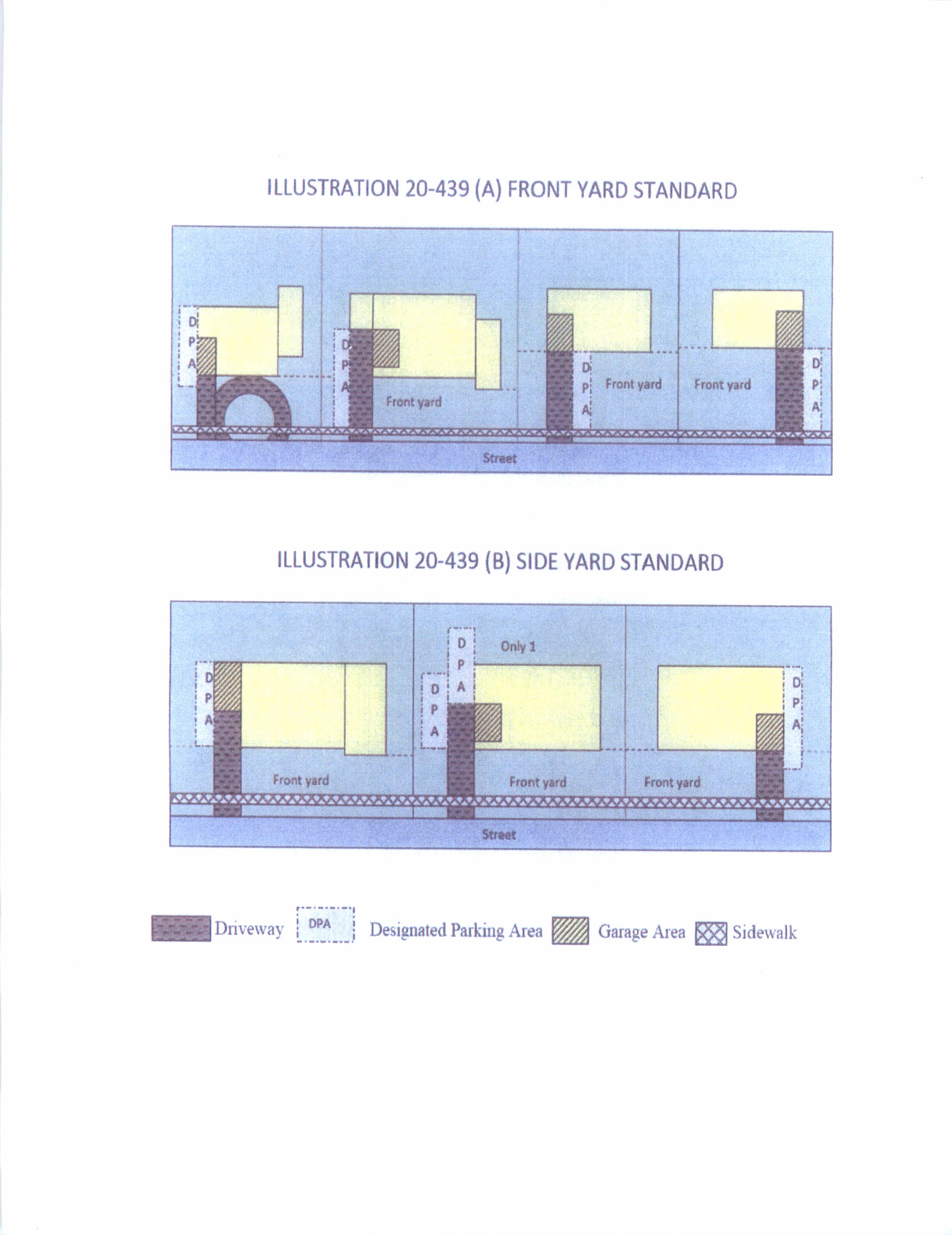
If the designated parking area is located within the front yard, the designated parking area shall be located parallel and adjacent to one side of an existing driveway on the lot, and the designated parking area shall not extend beyond any sidewalk located on or adjacent to the lot. (See Illustration 20-439 below.)
(3)
If the designated parking area is located within the side yard, the designated parking area shall be required to extend from an existing driveway. (See attached Illustration 20-439 below.)
(4)
The designated parking area shall be constructed with one or more of the approved construction materials identified in subsection (e).
(5)
The designated parking area shall not exceed twelve (12) feet in width.
(e)
Approved construction materials. Driveways and designated parking areas on residential lots shall be constructed of the following materials:
(1)
For residential lots developed or redeveloped after August 11, 2009, driveways and designated parking areas shall be constructed of concrete, asphalt, decorative pavers, brick, Eco-brick, crushed rock, gravel, geo-web with gravel, or turf block. However, mulch may be used for designated parking areas provided an impervious border is constructed pursuant to subparagraph (e)(3).
(2)
Subject to the conditions set forth in subsection (e)(1) and (3), driveways and designated parking areas on residential lots that are existing on August 11, 2009 shall be allowed to continue to use existing construction materials, provided said materials are concrete, asphalt, decorative pavers, brick, Eco-brick, crushed rock, gravel, geo-web with gravel, turf block, mulch, bark, or compacted or stabilized earth.
(3)
Whenever a driveway or designated parking area is constructed of gravel, geo-web, crushed rock, mulch or bark in accordance with the requirements of this section, the area shall be defined by an impervious border which is intended to reduce the migration of the materials used to construct said area.
(f)
When driveway construction permit required. A driveway construction permit shall be required from the building division, community development department, whenever impervious materials are used to construct a driveway or designated parking area, or whenever a new designated parking area is constructed on any residential lot.
(Ord. No. 2009-02, § 2, 8-10-09; Ord. No. 2025-01, § 4, 1-27-25)
Sec. 20-451. - Telecommunications towers.
(a)
Definitions.
Antenna shall mean a transmitting and/or receiving device used in telecommunications that radiates or captures electromagnetic waves, including directional antennas, such as panel and microwave dish antennas, and omni-directional antennas, such as whips, excluding radar antennas, amateur radio antennas and satellite earth stations.
Co-location shall mean telecommunications towers that have the potential to have three (3) or more carrier antennas located on it.
Development review committee shall mean the city staff composed of the city manager, land development coordinator, city engineer, public works/utilities director, community development coordinator, building official, police chief, fire chief.
Guyed tower shall mean a telecommunications tower that is supported, in whole or in part, by guy wires and ground anchors.
Lattice tower shall mean a telecommunications tower that is constructed with a series of struts forming a non-solid surface tower, without guy wires standing on and fastened to an in-ground pier.
Microwave shall mean a dish antenna, or a dish-like antenna used to link communication sites together by wireless transmission of voice or data.
Monopole tower shall mean a telecommunications tower consisting of a single pole or spire self supported by a permanent foundation, constructed without guy wires with ground anchors.
Panel antenna shall mean an array of antennas designed to concentrate a radio signal in a particular area.
Personal wireless services shall mean any personal wireless service defined in the Federal Telecommunications Act which includes Federal Communication Commission (FCC) licensed commercial wireless telecommunications services including cellular, personal communication services (PCS), specialized mobile radio (SMR), enhanced specialized mobile radio (ESMR), paging as well as unlicensed wireless services, and common carrier wireless exchange access services.
Stealth facility shall mean any telecommunications facility which is designed to blend into the surrounding environment. Examples of stealth facilities include architecturally screened roof-mounted antennas, antennas integrated into architectural elements, and telecommunications towers designed to look like light poles, mono-power poles or trees.
Telecommunications tower shall mean a monopole tower constructed as a free-standing structure greater than thirty-five (35) feet and no more than one hundred sixty-five (165) feet in height including antenna, which supports communication, transmission or receiving equipment. The term includes towers for the transmission or receiving television, AM/FM radio, digital, microwave, cellular telephones, or similar forms of electronic communication. The term excludes radar towers, radio support structures licensed by the FCC, transportable communication devices, private home use of satellite dishes and television antennas and satellite earth stations.
Whip antenna shall mean a cylindrical antenna that transmits signals in three hundred sixty degrees (360) degrees.
(b)
Findings and intent. The city has with increasing frequency received requests to approve sites for telecommunications towers. Land development regulations have not adequately identified specific procedures to address recurring issues relating to the approval of locations for telecommunications towers. Therefore, it is the intent of this section to address the recurrent issues pertaining to the approval of telecommunications towers upon parcels located in the city. Accordingly, the city commission finds that the promulgation of this section is warranted and necessary:
(1)
To protect residential areas and land uses from the potential adverse impacts of telecommunications towers when placed at inappropriate locations or permitted without adequate controls and regulation consistent with the provisions of law;
(2)
To minimize the adverse visual impacts resulting from telecommunications towers through sound and practical design, siting, landscape screening, and innovative camouflaging techniques all in accordance with generally acceptable engineering and planning principles and the public health, safety and welfare;
(3)
To avoid potential damage to adjacent properties through sound engineering and planning and the prudent and careful approval of telecommunications tower sites and structures;
(4)
To require shared use/co-location of existing and new telecommunications towers (capability of having space for three (3) or more carriers) to avoid proliferation of towers throughout the city. One (1) co-located position shall be reserved exclusively for the use of the city;
(5)
To ensure that location of telecommunications towers is consistent with the provisions of the City of Winter Springs Comprehensive Plan, the East Central Florida Regional Policy Plan, the state comprehensive plan as well as the provisions of state and federal law;
(6)
To fix a fair and reasonable compensation, by resolution of the city commission, to be paid to the city for the privilege to locate a telecommunications tower in the city and defray the administrative costs of reviewing the applications. Also, a fee shall apply separately to each antenna user on the tower or other support structure. Fee rates shall be renegotiable when contract expires;
(7)
To discourage new telecommunication towers and to encourage the use of existing structures including, but not limited to, rooftops, sports lighting, utility poles, and church steeples for deploying personal wireless service facilities; and
(8)
To encourage the use of the lowest height technology to provide personal wireless services including, but not limited to, micro cell technology.
(c)
Applicability.
(1)
All new telecommunications towers and antennas in the city shall be subject to these regulations and all other applicable regulations. For purposes of measurement, telecommunications tower setbacks as listed in subsection (f)(1) shall be calculated and applied to facilities located in the city, irrespective of other municipal and county jurisdictional boundaries.
(2)
All new communications antennas (i.e., stealth rooftop or building mounted antennas) which are not attached to telecommunications towers shall comply with subsection (f)(11).
(3)
All telecommunication towers existing on July 14, 1997 shall be allowed to continue their usage as they presently exist. Routine maintenance shall be permitted on such existing towers. New construction other than routine maintenance on an existing telecommunications tower shall comply with the requirements of this section.
(4)
For purposes of implementing this section, a telecommunications tower that has received city approval or building permit, but has not yet been constructed, shall be considered an existing tower so long as such approval is current and not expired.
(d)
Location, permitted uses and conditional uses.
(1)
All telecommunication towers shall comply with the following development standards:
(i)
They shall be located as far as technically feasible from properties that are designated residential on the city's future land use or zoning maps and shall comply with all other applicable distance standards which are set forth in the City Code;
(ii)
To the extent technically feasible. the lowest height technology shall be incorporated including, but not limited to, micro cell technology;
(iii)
Towers shall be erected to a height that is the minimum height necessary to technically serve the applicant's needs, but not exceeding the lesser of one hundred sixty-five (165) [feet] or a height calculated based on a tower setback of one hundred twenty-five (125) percent of the tower height measured at grade from the base of the tower to the closest residentially zoned property line;
(iv)
The most effective stealth technology (including stealth towers) shall be incorporated;
(v)
The location shall be the least visually intrusive location in the community;
(vi)
The proposed tower shall be located in an area where the visual impact on the community is minimized to the greatest extent practicable;
(vii)
Antennas shall be close-mounted or concealed. However, concealment shall be encouraged and preferred to the greatest extent practicable; and
(viii)
The visual impact of all towers shall be reduced or eliminated to the maximum extent possible by concealment camouflage, and disguise.
(2)
In addition to the standards set forth in subsection (1) above, the location of all proposed telecommunication tower sites shall be determined based upon a tiered zoning system. Specifically, a telecommunication tower shall be allowed as either a permitted use or a conditional use depending upon the location of the applicable site:
(i)
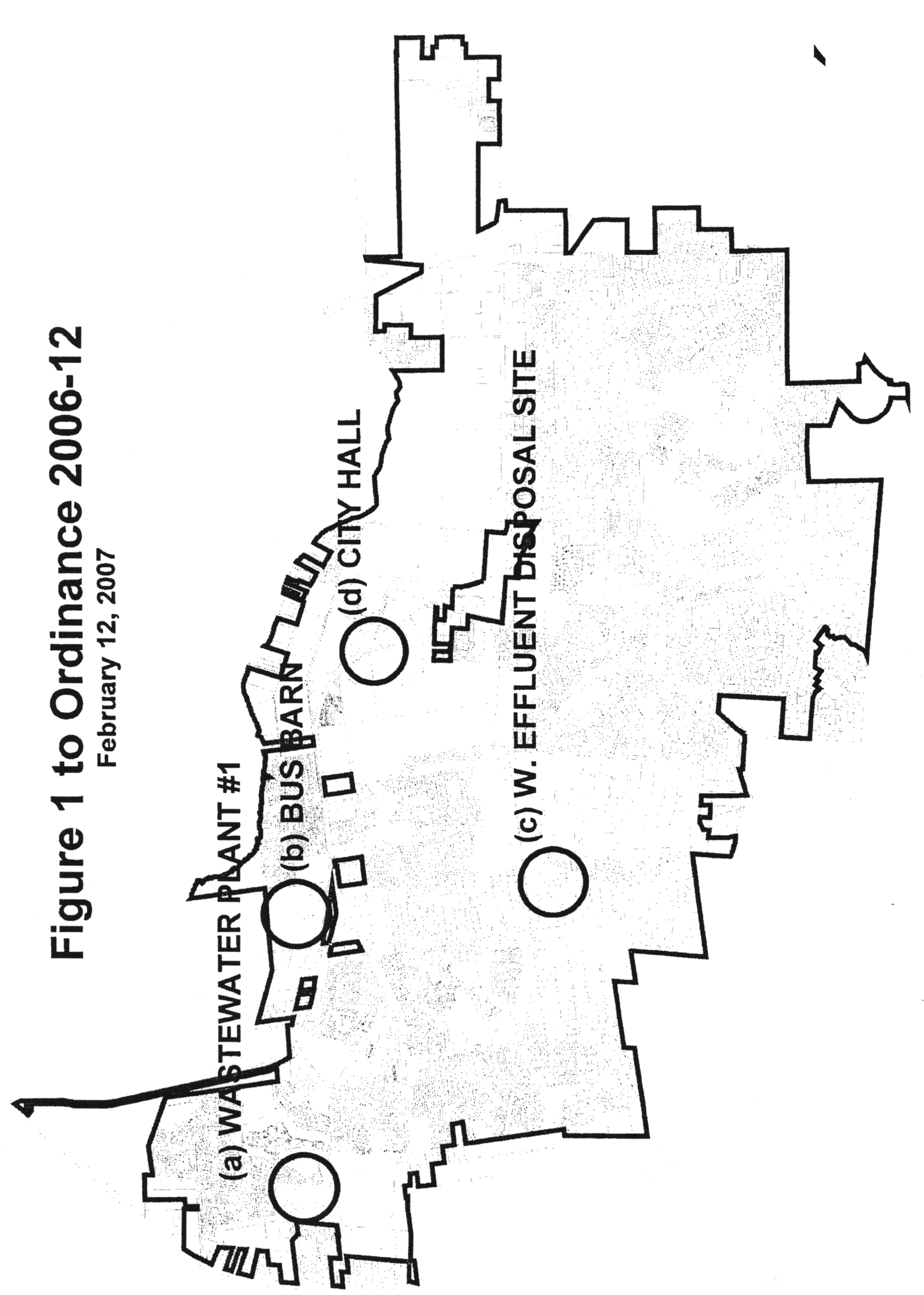
Tier One. Telecommunication towers shall be a permitted use at the following sites (see map attachment Figure 1 dated February 12, 2007) subject to other regulations which may apply:
a.
City of Winter Springs Wastewater Treatment Plant #l/West Plant.
b.
Proximate area of the Seminole County School Board Consolidated Services Facility (a/k/a Bus Barn).
c.
City of Winter Springs West Effluent Disposal Sites: at the southeast quadrant of Site 16 east of the southern percolation ponds.
d.
City of Winter Springs City Hall.
(ii)
Tier Two. A telecommunication tower shall be considered a conditional use at the following locations, provided the proposed tower complies with the standards of this section and complies with the conditional use criteria set forth in 20-33 of the City Code:
a.
On property owned by the City of Winter Springs that is designated public/semi-public on the city's future land use map; or
b.
On an existing commercial or industrial building, not located or incorporated within a single family residential area, provided the tower does not extend more than ten (10) feet above the roof line of the building and the tower does not exceed the applicable maximum height limitation in the City Code; or
c.
Within (enclosed) an existing church steeple or other type of existing structure which exists for a primary purpose other than for personal wireless services. It is the intent of this subsection to take advantage of existing structures for providing personal wireless services and not to allow the construction of new structures for said purposes; or
d.
Upon existing sports lighting structures, utility structures, and water tanks, provided the structure is not located within a single family residential area, the tower does not extend more than ten (10) feet above the top of the existing structure, and the tower does not exceed the applicable maximum height limitation in the City Code: or
Permitted Sites for Telecommunications Towers
e.
On the site of the proposed Fire Station #3 which is to be located on the south side of S.R. 434 in Tuscawilla Tract 15, Parcel 3 (approximately 2,300 feet west of Vistawilla Drive). Said tower, if approved, shall not exceed one hundred twenty (120) feet.
(iii)
Tier Three. If an applicant presents to the city competent substantial evidence which demonstrates that Tier One and Tier Two locations are not available or technically feasible for the location of a tower, a telecommunication tower shall be considered a conditional use on the following preferred sites. which are listed in order of preference. The preferred sites shall be considered in the sequence listed below and the applicant shall be required to demonstrate, based on technical feasibility, that a more preferred site is not available or suitable before requesting a lessor preferred site:
a.
Property which has a future land use designation of industrial.
b.
Property which has a future land use designation of mixed use and is part of a development of regional impact.
c.
Densely wooded or concealed areas limited to a golf course and areas of property which have been designated conservation by perpetual easement and on the city's future land use map. If a new telecommunication tower is placed within trees or wooded areas, the tower shall be concealed by the surrounding trees or wooded areas to the maximum extent possible to minimize the visibility of the tower from any road, occupied building, and fairway if located on a golf course. Trees can be existing on the subject property or installed to meet the requirements of this subsection, or they can be a combination of both.
d.
Property which has a future land use designation of Greeneway Interchange.
All other locations shall be prohibited. Further. the construction of a tower for speculative purposes shall be prohibited. For purposes of this Code, it shall be deemed primae facie evidence that a tower is being built for speculative purposes if the applicant can not provide with the application written evidence that one (1) or more carriers have committed to locate on the proposed tower within three (3) months of the construction of the tower for a period of at least five (5) years.
(e)
Site plan; application; technical supporting data.
(1)
Any telecommunications company or entity that intends to install a telecommunications tower in the city shall file a site plan for review and approval by the city in accordance with the City Code. All proposed towers requiring conditional use approval shall be reviewed by the planning and zoning board for compliance with this section and other applicable provisions of the City Code. Upon review, the planning and zoning board shall make a recommendation to the city commission of either approval, approval with conditions, or denial.
(2)
All applications shall contain the information required by the city to process applicable building permits, aesthetic review pursuant to section 9-600 et seq. of the City Code, site plan permits, and any other required development permits. Applications shall be processed within the time frames required by law. Additionally, at a minimum, the following information shall also be provided by the applicant:
a.
Name, address, telephone number, and original signatures of the applicant and all co-applicants.
b.
Detailed description of the request.
c.
Location information including legal description of subject property, parcel identification, geographic coordinates, and name of nearest roads, street addresses, or other landmarks.
d.
Scaled elevation and engineering drawings depicting the proposed tower and related facilities including all mounts, antennas, collocation spaces, and equipment facilities.
e.
A current property appraiser aerial delineating the subject property, the proposed tower and related facilities within one thousand (1,000) feet of the proposed tower and facilities.
f.
For proposed towers within trees and wooded areas, a tree survey identifying the type, size (DBH) and height of existing and/or proposed trees within a seventy-five-foot radius of the proposed tower and related facilities.
g.
Future land use and zoning designation of the subject property.
h.
Any applicable letters of approval for the proposed request received by the applicant from any other government agency including the FAA, FDOT, and FCC (if permitted by law).
i.
Documentation of location and site selection process, including search ring, location and siting criteria, alternative sites in the area, and site selection methodology.
j.
To the extent permitted or required by law, technical data, maps and analysis showing the area to be served by the proposed tower and personal wireless service facilities and any claimed gaps in coverage where the applicant desires to erect a tower. In addition, technical data and maps demonstrating any other proposed, existing, and authorized towers in the service area as the proposed tower and related facilities.
k.
Documentation evidencing that one or more carriers have committed to locate an antennae on the proposed tower for purposes of providing personal wireless services.
(3)
The applicant shall provide a visual impact report that provides a line-of-sight analysis including scaled and colored front, side, and rear elevation drawings or photographs that depict the proposed tower and related facilities. The drawings or photographs shall also depict any significant natural and manmade features that affect the buffering of the potential visual impact of the proposed tower and related facilities. Upon receipt of the visual impact report, the city may require the applicant to conduct a visual impact demonstration consisting of a minimum of two hour balloon test, which shall demonstrate the maximum height of the proposed tower. The balloon test shall be scheduled with the city and representatives of the city shall be present at the proposed site for purposes of evaluating the test.
(4)
For purposes of demonstrating technical feasibility under this section 20-451, the applicant shall be required to submit, in conjunction with a site plan application and to the extent permitted or required by law, technical data indicating that the proposed tower is the only technically feasible available site to assure telecommunications services coverage needs to area citizens. Further, such technical data not for speculative, untried telecommunications uses, but is for current technology recognized or approved for service area needs and market conditions under applicable state, federal or local laws, regulations or ordinances. All such technical data shall be provided at cost to the applicant. The city may, in approximate cases in its sole discretion, retain the service of technically competent consultants to evaluate the data submitted by an applicant to justify an additional tower pursuant to this section. The applicant shall post a deposit with the city manager or his designee in a sum such that the applicant for the additional telecommunication tower pays the full cost of technical review of such tower by city's consultant.
(f)
Performance standards/design criteria.
(1)
Setbacks.
a.
Telecommunications tower setbacks shall be measured from the base of the tower to the property line of the parcel on which it is located.
b.
The setback requirements shall be a minimum of ten (10) feet from any lot line and shall comply with setback requirements in this section or the City Code for setbacks from adjoining uses.
(2)
Separation of towers from off-site uses used to calculate maximum tower height. Separation distances between telecommunications towers and the lot line of any residential zoned property shall be used to determine the maximum height of a proposed tower. The maximum height of any tower shall not exceed one hundred sixty-five (165) feet provided however that the distance from the tower base to the nearest lot line of residentially zoned property shall be a minimum of one hundred twenty-five (125) percent of the tower height.
(3)
Measurement of height.
a.
Measurement of telecommunications tower height shall include antenna, base pad, and any and all other appurtenances and shall be measured from the finished grade of the parcel on which the telecommunications tower is located.
b.
Telecommunications towers shall not exceed one hundred sixty five (165) feet in height which shall include the antenna.
(4)
Illumination. Telecommunications towers shall not be artificially lighted except to assure human safety as required by the Federal Aviation Administration.
(5)
Finished color. Telecommunications towers not requiring FAA painting/marking shall be of such color that will blend with the surrounding environment.
(6)
Structural design.
a.
Site plan(s) are required and shall be submitted for approval as defined in Chapter 20 Zoning (if applicable) and/or Chapter 9 Land Development, Code of Ordinances, City of Winter Springs, Florida.
b.
Telecommunications towers shall be constructed in accordance with the EIA/TIA 222-E Standards as published by the Electronic Industries Association, which may be amended from time to time, ASCE 7-95, "Minimum Design Load for Buildings and Structures," (Wind Loads Chapter), as published by the American Society of Civil Engineers, and further defined by ASCE 7-88, "Guide to the Use of the Wind Load Provisions", both which may be amended from time to time, and all City of Winter Springs construction/building codes as indicated in a statement signed, sealed and dated by a professional engineer licensed to practice in the State of Florida.
c.
Such statement shall also describe the tower's capacity, number and type of antennas it can accommodate. No tower shall be permitted to exceed its loading capacity. For all towers attached to existing structures, the statement shall include certification that the structure can support the load imposed by the tower.
d.
All new telecommunications towers, and those existing towers to be modified, shall have the capability of having space for three (3) or more carriers. Upon request by the city, one (1) of these spaces shall be reserved exclusively for the use of the City of Winter Springs. Tower owners shall accommodate other antenna users on their towers.
e.
Further, any improvements and/or additions (i.e., antenna, satellite dishes, etc.) shall require submission of a site plan signed, sealed and dated by a professional engineer licensed in the State of Florida which provides substantial competent evidence of compliance with the EIT/TIA 222-E Standards ASCE 7-95, "Minimum Design Load for Buildings and Structures," (Wind Loads Chapter), as published by the American Society of Civil Engineers, and further defined by ASCE 7-88, "Guide to the Use of the Wind Load Provisions," both which may be amended from time to time, in effect at the time of said improvement or addition.
(7)
Public notice. Notice of any request, under this section, shall be published (in a newspaper of general circulation) and personal notification shall be given to all property owners located within three (3) times the height of the tower area. Personal notification shall mean notice sent by first class U.S. mail, and to the board of directors of duly recognized homeowners associations.
(8)
Signage. No commercial signage or advertising shall be permitted on a telecommunication tower unless otherwise required by law or the signage pertains only to the posting of the property relative to trespassing. The use of any portion of a tower or perimeter fence/wall for signs or advertising purposes, including company name, banners, streamers, etc., shall be prohibited.
(9)
Fencing.
a.
A vinyl coated chain-link fence or masonry wall not less than eight (8) feet in height from finished grade shall be installed by the applicant around each telecommunications tower. Barbed wire or other fencing method to prevent pedestrian access to the tower, not to exceed two (2) feet in height, shall be installed along the top of the fence or wall, but shall not be included when calculating the height of the fence or wall.
b.
Access to the tower through the fence or wall shall be through a gate which shall be locked at all times the tower site is not being occupied by the person or entity in charge of the telecommunications tower or site.
(10)
Landscaping. The visual impacts of a telecommunications tower shall be mitigated for nearby viewers through landscaping or other screening materials at the base of the tower and ancillary structures in order to maintain visual aesthetics for those who must view the site on a regular basis including, but not limited to, proximate residents and the travelling public. The following landscaping and buffering requirements shall be required around the perimeter of the tower and accessory structures;
a.
A row of shade trees of minimum of eight (8) feet tall that will reach heights of forty (40) plus feet, two and one-half (2 ½) inches in caliper, and a maximum of ten (10) feet apart shall be planted around the outside perimeter of the fence/wall;
b.
A continuous hedge shall be planted in front of the tree line referenced above; it shall be at least thirty (30) inches high at planting capable of growing to at least thirty-six (36) inches in height within eighteen (18) months shall be planted in front of the tree line referenced above;
c.
All landscaping shall be of the evergreen variety being a minimum quality of Florida #1.
d.
All landscaping shall be xeriscape tolerant and shall be properly maintained by the telecommunications tower owner/operator to ensure good health and viability.
The use of existing vegetation shall be preserved to the maximum extent practicable and may be used as a substitute or supplement towards meeting landscaping requirements.
(11)
Antennas on buildings. Stealth rooftop or building mounted antennas may be erected. Any stealth rooftop or building mounted antennas which are not attached to a telecommunications tower, shall be a permitted ancillary use to any commercial, industrial, public buildings, utility installation, and recreation (sites greater than ten (10) acres in size) land uses indicated on the future land use map of the city's comprehensive plan provided that:
a.
Antennas shall only be permitted on buildings which are at least fifty (50) feet in height (the height requirement may be waived if public safety needs warrant the antenna);
b.
Antennas may not extend more than twenty (20) feet above the highest point of a roof (this requirement may be waived if public safety needs warrant additional height);
c.
Antennas and related equipment buildings shall be located or screened to minimize the visual impact of the antenna upon adjacent properties and shall be of a material or color which matches the exterior of the building or structure upon which it is situated;
d.
No commercial advertising shall be allowed on an antenna or supporting structure;
e.
No signals, lights, illumination shall be permitted on an antenna or equipment building unless required by the Federal Communications Commission (FCC) or the Federal Aviation Administration (FAA): and
f.
No more than one (1) total unmanned equipment building shall contain more than seven hundred fifty (750) square feet of gross floor area or be more than twelve (12) feet in height. All building shall be subject to regulations of the building department; and
(12)
Equipment storage. Mobile or immobile equipment not used in direct support of a telecommunications tower facility shall not be stored or parked on the site of the tower unless repairs to the tower are being made, and are in progress.
(13)
Schedule of structural integrity. Telecommunication tower owners/operators shall submit to the building department a certified statement from a qualified, registered, professional engineer, licensed in the State of Florida, attesting to the structural and electrical integrity of the tower on the following schedule:
a.
All towers examined one year after initial construction.
b.
All towers every five (5) years;
c.
The city may require such certified statement after a nearby unusually severe storm event as determined by the (NOAA) national weather service.
(14)
Transmission/reception interference. Each application to allow construction or modification of a telecommunications tower shall include a certified statement from a qualified, registered, professional engineer, licensed in the State of Florida, attesting that the construction of the tower, including receiving and transmitting functions, shall not interfere with public safety communications and the usual and customary transmission or reception of radio, television, etc., service enjoyed by adjacent residential and non-residential properties.
(15)
Prohibitions with certain principal uses. Telecommunications towers are prohibited when a proposed or existing principal use includes the storage, distribution, or sale of volatile, explosive, or hazardous wastes such as LP gas, propane, gasoline, natural gas, and corrosive or dangerous chemicals. This prohibition does not apply to emergency generators.
(g)
Co-location of communications antennas. The City of Winter Springs desires to minimize the number and general proliferation of communication towers. This section is intended to insure that telecommunication towers that are permitted within the City of Winter Springs are utilized in a manner that provides for the maximum number of service providers upon each tower within the context of technical feasibility and safety.
Further, this section is intended to minimize the number of such towers within the city. Specifically, as a minimum, telecommunications towers exceeding one hundred (100) feet in height shall be engineered and constructed to accommodate three (3) communication providers. The city shall have the authority to require, specify and otherwise stipulate that telecommunication towers be engineered and constructed in a manner that provides for three (3) co-locations as part of the conditional use and/or site plan approval processes. As a condition of approval of all telecommunication towers and to the extent that co-location is technically feasible, all owners of existing telecommunication towers shall, upon request of another service provider and for reasonable and agreed upon consideration, permit additional communication service providers upon such existing telecommunication tower. Applicants desiring to construct new telecommunication towers shall submit written documentation that clearly explains the need for and reasons for the proposed construction of a new telecommunication tower rather than locating proposed antenna array/communication equipment upon an existing tower. Such documentation shall include plans of existing and future towers by the applicant/provider in question, correspondence with existing telecommunication tower owners and may include a cost analysis of alternatives. Existing service providers, e.g., existing telecommunication tower owners, that are unwilling, upon request of another service provider, to allow co-location upon such existing tower, shall submit written documentation to the city with reasons and justification as to why such co-location cannot be accomplished. Competition between service providers shall not be considered to be a valid reason for preventing or otherwise obstructing co-location. The city shall determine whether the applicant and/or existing provider are reasonable and correct in their respective assertions. If the city determines that either party is being unreasonable or otherwise uncooperative, the city shall deny the applicant's request for a new tower and/or the city may cause the existing telecommunication tower's approval to be revoked and said existing tower to be removed. Such determination involving existing tower owners shall be made in writing and adopted by a majority vote of the city commission upon holding an advertised public hearing and notification of the owner at least fifteen (15) days prior to such hearing. Upon adoption of such determination by the city commission, the existing tower owner and the property upon which such tower is located shall be considered to be a violation of the city's Land Development Regulations and shall be subject to any and all remedies and penalties thereof.
To minimize adverse visual impacts associated with the proliferation and clustering of telecommunications towers, co-location of communications antennas by more than one (1) carrier on existing or new telecommunication towers shall take precedent over the construction of new single-use telecommunications towers as follows:
(1)
Proposed communications antennas shall co-locate onto existing telecommunications towers.
(2)
Type of construction. A telecommunications tower which is reconstructed to accommodate the co-location of an additional communications antenna shall be of a monopole tower type. Stealth-designed monopoles are encouraged.
(3)
Height. An existing telecommunications tower may be modified or rebuilt to the allowed height including antennas by compliance with this article;
(4)
Onsite-location.
a.
A Telecommunications tower which is being rebuilt to accommodate the co-location of an additional communications antenna may be moved onsite, but shall comply with or maximize setback requirements from residentially zoned property.
b.
After a telecommunication tower is rebuilt to accommodate co-location, only one (1) tower shall remain on the site;
(h)
Certification of compliance with Federal Communications Commission (FCC) NIER Standards. Prior to receiving final inspection by the Winter Springs Building Department, documented certification shall be submitted to the FCC, with copy to the land development coordinator, certifying that the telecommunications facility complies with all current FCC regulations for non-ionizing electromagnetic radiation (NIER).
(i)
Abandonment.
(1)
In the event the use of any telecommunications tower has been discontinued for a period of one-hundred eighty (180) consecutive days, the tower shall be deemed to be abandoned. Determination of the date of abandonment shall be made by the building official who shall have the right to request documentation and/or affidavits from the telecommunications tower owner/operator regarding the issue of tower usage. The telecommunications tower owner/operator shall provide all requested information within ten (10) working days of a request being made, and failure to so provide shall be deemed to constitute one hundred eighty days (180) days of non-use of the tower. Upon such abandonment, the owner/operator of the tower shall have an additional ninety (90) days within which to:
a.
Reactivate the use of the tower or transfer the tower to another owner/operator who makes actual use of the tower; or
b.
Dismantle and remove the tower. With regard to towers that received conditional use approval, ninety (90) days after dismantling or the expiration of the two-hundred seventy (270) day period as set forth in this section, the conditional use and/or variance for the tower shall automatically expire.
(2)
The City of Winter Springs, upon abandonment, and at its discretion, may assume ownership of the tower at no cost, or require the owner to dismantle the tower at the owner's expense. If the decision is to dismantle the tower, the property shall be cleared of all appurtenances and returned to its natural state.
(3)
An appropriate surety instrument to assure dismantling costs shall be provided by the owner prior to a tower construction permit.
(Ord. No. 645, § 1, 7-14-97; Ord. No. 678, § 1, 10-13-97; Ord. No. 2004-49, § 2, 12-13-04; Ord. No. 2006-12, § 2, 2-12-06; Ord. No. 2010-09, § 2, 4-26-10)
Sec. 20-452. - Home occupations or home offices.
(a)
A home occupation or home office, as defined in section 20-1 of the City Code, is permitted in all residential zoning categories provided that:
(1)
The home occupation or home office use shall be incidental and subordinate to the residential use of the dwelling unit. Further, the area used for the home occupation or home office shall not exceed an area greater than thirty (30) percent of the air-conditioned portion of the dwelling unit.
(2)
The home occupation or home office use shall not negatively impact the residential character of the neighborhood in which it is located by introducing uses or conditions that are incompatible with the peace and harmony of the residential neighborhood.
(3)
The home occupation or home office is conducted entirely within the dwelling unit or within a permitted accessory building. A home occupation or home office is not permitted within an accessory dwelling unit.
(4)
There shall be no exterior advertising of the home occupation on the outside of the dwelling unit or permitted accessory building.
(5)
There shall be no exterior storage or display on the premises of material or equipment used as a part of the home occupation or home office. Commercial vehicles shall be regulated pursuant to section 20-431 et seq. of the City Code.
(6)
The following uses shall not be considered a home occupation or home office:
a.
Adult entertainment establishments;
b.
Antique shops;
c.
Art studio for group instruction;
d.
Auto service and repair;
e.
Mechanical service and repair;
f.
Barber and cosmetology services;
g.
Band or music instruction for groups;
h.
Bed and breakfast facilities;
i.
Clubs, private;
j.
Drive-in facilities;
k.
Eating and drinking establishments;
l.
Escort services;
m.
Food processing and handling, commercial (except that cottage food operations, as defined in section 20-1 of the City Code, may be considered a home occupation or home office);
n.
Fortune tellers;
o.
Funeral homes;
p.
Group instruction for more than two (2) people;
q.
Health spas;
r.
Hospitals and clinics;
s.
Hotels/motels;
t.
Kennels or overnight boarding of animals;
u.
Massage therapy;
v.
Photographic studios involving chemicals or client visitors;
w.
Retail commercial operations;
x.
Sexually oriented businesses;
y.
Vehicle sales or rental;
z.
Tattoo parlors;
aa.
Health care providers; or
bb.
Pain management clinics, as defined by section 458.3265 or section 459.0137, Florida Statutes.
cc.
Any other use or activity similar in nature or purpose to those listed herein and any other use or activity inconsistent with the requirements of this Code.
(7)
No person other than inhabitants residing on the premises of the dwelling unit shall be engaged on the premises of the home occupation or home office.
(8)
No traffic/parking shall be generated by the home occupation or home office in greater volumes than would normally be expected in accordance with industry traffic and parking standards for a residential unit located in a residential neighborhood.
(9)
No dangerous, toxic or hazardous material shall be used or stored on the premises in connection with the home occupation or home office, except, however, this provision shall not be construed as prohibiting a person from using or storing products that are normally used or stored at a residence for purely domestic or household purposes such as cleaning, lawn fertilizer and pest control products.
(10)
No equipment or process used in the home occupation or home office shall create noise, smoke, dust, heat, vibration, glare, fumes, odors or air pollution off the premises on which the home occupation or home office exists.
(b)
A home occupation or home office is permitted in the town center subject to the provisions of section 20-324(7).
(c)
All home occupations and home offices shall be required to obtain a business tax receipt as required by section 10-26 of the City Code, prior to the start of such use. In addition to any other submittals required for a business tax receipt, the applicant shall also submit the following:
(1)
The exact nature of the home occupation or home office;
(2)
Total air-conditioned floor area (square feet) of the residence; and
(3)
Amount of area, measured in square feet, to be utilized in conducting the home occupation or home office.
(Ord. No. 2011-08, § 2, 10-10-11; Ord. No. 2012-09, § 5, 7-23-12; Ord. No. 2016-05, § 2, 2-22-16)

