
Woodhaven City Zoning Code
ARTICLE III
- DISTRICTS
DIVISION 5. - O-1 OFFICE DISTRICT[4]
Cross reference— Businesses, ch. 22.
DIVISION 6. - B-1 LOCAL BUSINESS DISTRICTS[5]
Cross reference— Businesses, ch. 22.
DIVISION 7. - B-2 COMMUNITY BUSINESS DISTRICTS[6]
Cross reference— Businesses, ch. 22.
DIVISION 8. - B-3 GENERAL BUSINESS DISTRICTS[7]
Cross reference— Businesses, ch. 22.
DIVISION 9. - IRO INDUSTRIAL RESEARCH OFFICE DISTRICTS[8]
Cross reference— Businesses, ch. 22.
DIVISION 10. - I-1 LIGHT INDUSTRIAL DISTRICTS[9]
Cross reference— Businesses, ch. 22.
DIVISION 11. - I-2 HEAVY INDUSTRIAL DISTRICTS[10]
Editor's note—Ord. No. 25-049, adopted July 1, 2025, amended div. 11 in its entirety to read as herein set out. Former div. 11 pertained to the same subject matter, consisted of §§ 110-441—110-444, and derived from ordinances adopted November 1, 1967; August 4, 1992; Ord. No. 08-121, adopted July 1, 2008; and Ord. No. 09-040, adopted April 7, 2009.
Cross reference— Businesses, ch. 22.
DIVISION 12. - RESERVED[11]
Editor's note—Ord. No. 14-123 , adopted December 2, 2014, deleted §§ 110-471—110-477, which pertained to P-1 Vehicular parking districts, and derived from and ordinance adopted November 1, 1967; and August 18, 1977.
Sec. 110-141.- Areas.
For the purpose of convenience, the municipality is hereby divided into areas which are placed on maps.
(Ord. of 11-1-1967, § 3-1)
Sec. 110-142. - Districts established.
For the purposes of this chapter, the municipality is hereby divided into the following districts:
B-1 local business district
B-2 community business district
B-3 general business district
CBD central business district
I-1 industrial 1 district
I-2 industrial 2 district
IRO industrial research office district
OFA one-family attached
R-1 one-family residential
R-2 one-family residential
R-T two-family residential district
R-M multiple-family residential district
TC-PUD town center planned unit development
(Ord. of 11-1-1967, § 3.2; Ord. No. 11-099, 7-19-2011; Ord. No. 14-123, § 1, 12-2-2014)
Sec. 110-143. - Zoning maps; adoption by reference.
Each area shall be set forth on a map containing such information as may be acceptable to the council and showing by appropriate means the various districts into which the area is divided, which maps shall be entitled, "Zoning Maps of the Municipality," and shall bear the date adopted or amended. It shall be the duty of the mayor and clerk to authenticate such records by placing their official signatures thereon. All such maps with all explanatory matter thereon are hereby made a part of this chapter by reference, and shall be as much a part of this chapter as if the matters and information set forth thereon were all fully described in this section.
(Ord. of 11-1-1967, § 3.3)
Sec. 110-144. - District boundaries interpreted.
Where uncertainty exists with respect to the boundaries of any of the districts established in this chapter, as shown on the zoning map, the following rules shall be applied:
(1)
Where district boundaries are indicated as approximately following the centerline of streets or highways, street lines or highway right-of-way lines, such centerlines, street lines, or highway right-of-way lines shall be construed to be such boundaries.
(2)
Where district boundaries are so indicated that they approximately follow the lot lines, such lot lines shall be construed to be such boundaries.
(3)
Where district boundaries are so indicated that they are approximately parallel to the centerline of streets, or the centerlines of right-of-way lines of highways, such district boundaries shall be construed as being parallel thereto and at such distances therefrom as indicated on the zoning map. If no such distance is given, such dimension shall be determined by the use of the scale shown on such zoning map.
(4)
Where the boundary of a district follows a railroad line, such boundaries shall be deemed to be located midway between the main tracks of such railroad line.
(5)
Where the boundary of a district follows a stream, lake or other body of water, such boundary line shall be deemed to be at the limit of the jurisdiction of the municipality unless otherwise indicated.
(6)
Where the boundary of a district follows a subdivision boundary line, such boundary line shall be construed to be such district boundary line.
(7)
Where unzoned property may exist, or where, due to the scale, lack of detail or illegibility of the zoning map accompanying this chapter, there is any uncertainty, contradiction or confliction as to the intended location of any district boundaries shown thereon, interpretation concerning the exact location of district boundary lines shall be determined, upon written application, or upon its own motion, by the board of appeals.
(Ord. of 11-1-1967, § 3.4)
Sec. 110-145. - Zoning of vacated areas.
Whenever any street, alley or other public way, within the municipality, shall be vacated, such street, alley or other public way, or its portion, shall automatically be classified in the same zone district as the property to which it attaches.
(Ord. of 11-1-1967, § 3.5)
Sec. 110-146. - Zoning of annexed areas.
Any area annexed to the municipality shall immediately, upon such annexation, be automatically classified as an R-1 district until a zoning map for such area has been adopted by the council. The planning commission shall recommend appropriate zoning for such area within three months after the matter is referred to it by the council.
(Ord. of 11-1-1967, § 3.6)
Sec. 110-147. - District requirements.
All buildings and uses in any district shall be subject to the provisions of article V, supplementary regulations, and article VI, general exceptions.
(Ord. of 11-1-1967, § 3.7)
Sec. 110-171.- Intent of districts.
The R-1 through R-2 one-family residential districts are designed to be the most restrictive of the residential districts. The intent is to provide for an environment of predominantly low-density, one-family detached dwellings along with other residentially related facilities which serve the residents in the R-1 through R-2 districts.
(Ord. of 11-1-1967, § 4.0; Ord. of 10-18-1977, § 20)
Sec. 110-172. - Principal uses permitted.
In a one-family residential district (R-1 through R-2), no building or land shall be used and no building shall be erected except for one or more of the following specified uses, unless otherwise provided in this chapter:
(1)
One-family detached dwellings, site-built.
(2)
Farms.
(3)
Publicly owned and operated libraries, parks, parkways and recreational facilities.
(4)
Municipal buildings and uses.
(5)
Public elementary schools offering courses in general education and not operated for profit.
(6)
Accessory buildings and uses, customarily incident to any of the permitted uses.
(Ord. of 11-1-1967, § 4.1; Ord. of 10-18-1977, § 21; Ord. of 5-3-1983, § 4)
Sec. 110-173. - Uses permissible subject to special use permits.
The following uses shall be permitted in the R-1 through R-2 districts, subject to the conditions imposed in this section for each use:
(1)
Utility and public service facilities and uses, without storage yards, when operating requirements necessitate the locating of such facilities within the districts in order to serve the immediate vicinity, subject to the approval of the zoning board of appeals.
(2)
Swimming pool clubs when incorporated as a nonprofit club or organization maintaining and operating a swimming pool with a specified limitation of members, either by subdivision, or other specified areas, for the exclusive use of members and their guests, all subject to the following conditions:
a.
As a condition to the original granting of such permit and the operation of such nonprofit swimming pool club, as a part of such application, the applicant shall obtain from 100 percent of the freeholders residing or owning property, within a 150-foot radius, immediately adjoining any property line of the site proposed for development, a written statement or waiver addressed to the council recommending that such approval be granted. Also, approval from 51 percent of the homeowners within 1,000 feet shall be received in writing.
b.
In those instances where the proposed site is not to be situated on a lot of record, the proposed site shall have one property line abutting a major thoroughfare (see major thoroughfare plan), and the site shall be so planned as to provide ingress and egress directly onto such major thoroughfare.
c.
Front, side and rear yards shall be at least 80 feet wide, except on those sides adjacent to nonresidential districts, and shall be landscaped in trees, shrubs, grass and terrace areas. All such landscaping shall be maintained in a healthy condition. There shall be no parking or structures permitted in these yards, except for required entrance drives and those walls and/or fences used to obscure the use from abutting residential districts.
d.
Buildings erected on the premises shall not exceed one story in height.
e.
All lighting shall be shielded to reduce glare and shall be so arranged and maintained as to direct the light away from all residential lands which adjoin the site.
f.
Whenever the parking plan is so laid out as to beam automobile headlights toward any residential land, a decorative obscuring concrete poured wall, masonry wall with brick veneer toward the residential district, or berm at least four feet, six inches in height, measured from the surface of the parking lot, shall be provided along the entire side of the parking area.
g.
Whenever a swimming pool is constructed under this chapter, such pool area shall be provided with a protective fence, six feet in height, and entry shall be provided by means of a controlled gate.
(3)
Colleges, universities and other such institutions of higher learning, public and private, offering courses in general, technical or religious education, and not operated for profit, all subject to the following conditions:
a.
Any use permitted in this section shall be developed only on sites of at least 40 acres in area, and shall not be permitted on any portion of a recorded subdivision plat.
b.
All ingress to and egress from such site shall be directly onto a major thoroughfare having an existing or planned right-of-way of at least 120 feet in width.
c.
No building other than a structure for residential purposes shall be closer than 75 feet to any property line.
(4)
Churches and other facilities normally incidental thereto, subject to the following conditions:
a.
Buildings of greater than the maximum height allowed in article IV, schedule of use regulations, may be allowed, provided that front, side and rear yards are increased above the minimum required yards by one foot for each foot of building height that exceeds the maximum height allowed.
b.
The site shall be so located as to have at least one property line abutting a major or secondary thoroughfare as designated on the major thoroughfare plan.
c.
A columbarium park shall be permitted as an accessory use to a church, but not a religious retreat or rectory facility, after review and approval by the planning commission of a site plan, subject to the following conditions:
1.
No part of the columbarium park may be located within a required yard.
2.
All structures located within the columbarium park shall be no more than four feet in height and shall be compatible with the architecture of the church.
3.
Exterior building materials used on any structure shall be comparable to and compatible with those materials used on the principal structure.
4.
The columbarium park shall be located upon and not exceed five percent of the area of the lot which the principal use is located.
5.
The individual columbarium vaults shall be totally obscured from the view of adjacent property by a suitable wall or greenbelt as approved by the planning commission.
6.
The area occupied by the columbarium park shall not be considered as landscaped open space for the purpose of computing minimum open space and landscape improvements for the overall site and/or required plantings.
(5)
Private noncommercial recreational areas, other than subdivision open space facilities; institutional or community recreation centers, subject to the following conditions:
a.
The proposed site for any of the uses permitted in this section which would attract persons from, or are intended to serve, areas beyond the immediate neighborhood shall have at least one property line abutting a major thoroughfare, and the site shall be so planned as to provide all ingress and egress directly onto or from such major thoroughfare.
b.
Front, side and rear yards shall be at least 80 feet wide, and shall be landscaped in trees, shrubs and grass. All such landscaping shall be maintained in a healthy condition. There shall be no parking or structures permitted in these yards, except required entrance drives and those walls used to obscure the use from abutting residential districts.
c.
Off-street parking shall be provided so as to accommodate not less than one-half of the member families and/or individual members. The planning commission may modify the off-street parking requirements in those instances wherein it is specifically determined that the users will originate from the immediately adjacent areas, and will therefore be pedestrian. Prior to the issuance of a building permit or zoning compliance permit, bylaws of the organization shall be provided in order to establish the membership involved for computing the off-street parking requirements. In those cases wherein the proposed use or organization does not have bylaws or formal membership, the off-street parking requirement shall be determined by the planning commission on the basis of usage.
(6)
Golf courses, which may or may not be operated for profit, subject to the following conditions:
a.
The site shall be so planned as to provide all ingress and egress directly onto or from a major thoroughfare.
b.
The site plan shall be laid out to achieve a relationship between the major thoroughfare and any proposed service roads, entrances, driveways and parking areas which will encourage pedestrian and vehicular traffic safety.
c.
Development features, including the principal and accessory buildings and structures, shall be so located and related as to minimize the possibilities of any adverse affects upon adjacent property. This shall mean that all principal or accessory buildings shall be not less than 200 feet from any property line of abutting residentially zoned lands; provided, however, that where topographic conditions are such that buildings would be screened from the view, the planning commission may modify this requirement.
d.
The minimum number of off-street parking spaces to be provided shall be ten spaces per hole, plus one space per employee, plus spaces as required under article V, supplementary regulations, for each accessory use, such as a restaurant or bar.
e.
Whenever a swimming pool is to be provided, such pool shall be provided with a protective fence six feet in height, and entry shall be by means of a controlled gate.
(7)
Accessory buildings and uses customarily incident to any of the permitted uses in this section.
(8)
Private stables which provide stables, paddocks and permit
horses to pasture on the premises shall:
a.
Provide a minimum site area of five acres for the first horse, plus one acre for each additional horse.
b.
In no instance locate a stable or confined paddock area nearer than 100 feet to any property line. Any horse may, however, be pastured to the property line, provided that it is properly fenced.
c.
No stable or confined paddock area shall be located closer than 50 feet to any dwelling on the premises.
d.
Stables and confined paddock areas shall be kept clean and the manure handled in such a manner as to control odor and flies.
(9)
Public, parochial or private intermediate or secondary schools and parochial or private elementary schools offering courses in general education. Access to the site shall be provided only to an existing or proposed major thoroughfare, freeway service drive or secondary thoroughfare, etc.
(10)
Manufactured detached one-family dwellings, subject to the provisions of section 110-839.
(11)
Cemeteries and/or mausoleums, subject to the following conditions:
a.
Any such site shall have its principal frontage on a major arterial or collector street as designated on the city master plan. Access to the site shall be from such major or collector street.
b.
Cemetery facilities for the burial and/or interment of human or pet remains are permitted, provided that any major structures such as mausoleums, crypts, chapels, crematoriums or service buildings are located at least 80 feet from any property line abutting any residential zoning district. Individual burial sites with markers or crypts, not over six feet in height, may be located not closer than ten feet to any side or rear property line abutting any residential zoning district.
c.
Columbarium parks may be located adjacent to residential zoning districts, provided that no part of the park is closer than the yard requirement of the abutting residential district, the walls not exceed four feet in height and none of the interment vaults are visible to abutting residential areas.
d.
Outside storage shall be limited to normal landscape materials and shall be totally obscured from any adjacent zoning districts. Any such storage areas shall be related to the service building. All equipment and other supplies shall be stored inside the service building.
e.
A setback of at least 25 feet shall be provided to any public street. This area shall be landscaped in lawn and plantings which do not create any sight distance limitations on vehicular and vehicular/pedestrian movements. This front yard setback area shall also be kept clear of any walls and/or berms which exceed two feet in height.
f.
On those sides of the site abutting any residential zoning district, an obscuring screen shall be provided. This obscuring feature may utilize a decorative masonry wall four feet in height, a ten-foot wide greenbelt, berm, or combination. A chainlink fence, not over six feet in height, may be installed for security purposes, but will not be considered as any obscuring requirements. The minimum walls and screening requirements along a public street is reduced to a decorative wall or a berm with a maximum height of two feet and/or a planting plan which will partially obscure the development. This reduction is intended to facilitate reasonable visibility for security purposes.
(Ord. of 11-1-1967, § 4.2; Ord. of 10-18-1977, §§ 22, 63; Ord. of 5-3-1988, § 7; Ord. of 5-17-1988, § 1; Ord. of 6-20-1989, § 2; Ord. No. 08-058, 4-1-2008)
Editor's note— Ord. No. 08-058, adopted Apr. 1, 2008, change the title of § 110-173 from uses permissible on special approval to uses permissible subject to special use permits.
Sec. 110-174. - Area, bulk and yard setback requirements.
See article IV, schedule of use regulations, limiting the height and bulk of buildings, the minimum size of lot permitted by land use, maximum density permitted, and providing minimum yard setback requirements for the R-1 through R-2 districts.
Sec. 110-185.- Intent of district.
The OFA one-family attached districts are designed to provide sites for attached one-family dwelling structures and related uses. Such sites provide for transitional use areas in locations with a strong one-family type of environment. The OFA district is intended to permit the attachment of dwelling units, under stated conditions, at a medium density and with features and characteristics of detached one-family homes in the area. It also permits the opportunity to provide sites on the oddly configured parcels that have remained fallow for periods of time.
(Ord. No. 08-170, 10-7-2008)
Sec. 110-186. - Principal uses permitted.
(a)
In the OFA one-family attached district no building or land shall be used and no building shall be erected except for one or more of the following specified uses unless otherwise provided in this chapter:
(1)
Attached townhome dwellings whose living area extends from the foundation to the roof above in structures containing two to four dwelling units.
(2)
Detached one-family dwellings complying with the standards of the R-2 one-family district.
(3)
Accessory buildings and uses, customarily incidental to any of the permitted uses.
(b)
Publicly owned and operated recreational facilities such as: parks, parkways, trails (non-motorized, except power propelled wheelchairs for handicapped persons) and other recreational facilities that are part of community wide system that is mutually compatible and beneficial to the community and the nonresidential area involved.
(Ord. No. 08-170, 10-7-2008; Ord. No. 09-072, 5-19-2009)
Sec. 110-187. - Uses permitted subject to a special use permit.
The following uses shall be permitted in OFA district, subject to the following condition and those of any findings of a special use permit:
(1)
Nursery schools, day nurseries and child care centers (not including dormitories); provided, however, that for each child so cared for, there is provided and maintained a minimum of 100 square feet of outdoor play area. Such play space shall have a total minimum area of at least 1,000 square feet, and shall be fenced or screened from any adjoining land with planting. Any use permitted in this subsection shall not be permitted in the interior of any residential block.
(2)
Housing for the elderly, not to exceed a height of two stories, when the following conditions are met:
a.
A planned development consisting of at least five acres with cottage type dwellings and/or apartment type dwelling units; and common services containing, but not limited to, central dining rooms, recreational rooms, central lounge and workshops;
b.
All dwellings shall consist of at least 350 square feet per unit;
c.
The maximum extent of development shall not exceed 15 dwelling units per acre, and total coverage shall not exceed 25 percent for all buildings (including dwelling units and related service buildings).
(3)
Convalescent homes, not to exceed a height of two stories, when the following conditions are met:
a.
The site shall be so developed as to create a land to building ratio on the lot or parcel whereby for each one bed in the convalescent home there shall be provided not less than 1,250 square feet of open space. The 1,250 square feet of land area per bed shall provide for landscape setting, offstreet parking, service drives, loading space, yard requirements and space required for accessory uses. The 1,250 square feet requirement is over and above the building coverage area;
b.
No building shall be closer than 40 feet to any property line;
c.
The proposed site shall have at least one property line abutting a major thoroughfare (a thoroughfare of at least 120 feet of right-of-way, existing or proposed);
d.
All ingress and egress to the offstreet parking area, for guests, employees and staff, as well as any other uses of the facility, shall be directly from a major thoroughfare.
(4)
Manufactured townhome dwellings, subject to the provisions of section 110-839.
(5)
Accessory buildings and uses customarily incident to any of the uses described in this section.
(Ord. No. 08-170, 10-7-2008)
Sec. 110-188. - Required conditions for townhome developments.
The planning commission, in its evaluation process, shall consider existing and potential development in the area and the reasonableness of the request from the standpoint of established and acceptable principals of land use planning. Developers who plat or divide parcels of land and leave parcels of vacant land adjacent to major and secondary thoroughfares with the intent of seeking one-family attached development shall submit a concept development plan to the planning commission for review and discussion prior to completing any final plans for the plat or land divisions.
Approval of any one-family attached development plan(s) requires that the following conditions have been met:
(1)
One-family attached structures shall contain two to four dwellings. Each dwelling shall extend from its foundation/basement upwards to the roof of the structure; stacking units one above the other shall not be permitted.
(2)
Each dwelling shall provide access doors on the front and rear of the units with adjacent landscaped area. The rear entry area shall also include a private patio area.
(3)
The front facade of the structures shall be sufficiently distinguished in off-sets, architectural features and/or materials to distinguish between the individual living units. The front plane of the building shall not appear as a straight flat wall.
(4)
The entire site area shall serve only residents of the living units and their social guests.
(5)
Access drives providing primary circulation patterns within the development shall be designed and arranged to facilitate safe and convenient movements for resident, service and emergency vehicle movements. Such drives shall accommodate service and emergency vehicles and be constructed in a manner acceptable to the community including rolled concrete curbs.
(6)
Parking spaces shall be conveniently accessible to the living units they serve. Unless a parking space is specifically assigned to a particular living unit, parking spaces shall be located 15 feet to any window or door of living units.
(7)
A setback of at least 25 feet shall be provided between any living area, garage and required parking area and any public thoroughfare right-of-way line. Access drives/driveways which approximately parallel a public thoroughfare shall not be located in the required 25-foot setback along such thoroughfare.
(8)
The minimum setback between any living areas and garages and the edge of interior access drives shall be 25 feet.
(9)
In order to facilitate the safe separation of vehicular and pedestrian traffic a four-foot wide sidewalk shall be provided along both sides of access drives in the areas where they intersect with public road rights-of-way. Sidewalks shall also be provided along both sides of access drives that are necessary to the convenient and safe movement of pedestrians within the development. In situations where access drives do not have units abutting one or both sides of the drive a determination shall be made as to the need for sidewalks along a particular portion of the access drive. Unless otherwise specified interior sidewalks may be placed adjacent to the curbs. If the applicant disagrees with the determination of the planning commission regarding the placement of interior sidewalks, a public hearing shall be required under the terms and conditions of a special use permit.
(10)
The minimum main building setback to exterior property lines immediately abutting single-family zoning districts shall be 35 feet, unless a greater setback is required by the following formula which reflects the length and height of buildings:
S = (L + 2H) ÷ 3
S—Required setback.
L—Length of building which is determined by measuring the total distance along an exterior property line which would be intersected by perpendicular lines extended from a building when viewed from above. Minimum setbacks shall be measured from the closest point of a building to the exterior property line for the building which have reasonably consistent setbacks over a length of the building. Buildings which have a varied setback resulting in a continuously increasing setback when moving from one end of the building to the other may use the average setback of the building, provided that not more than 25 percent of the building length may be located within the required setback; however, if any portion of a building involves a garage that requires crossing a sidewalk a minimum setback to the curb line of 25 feet shall be provided. In no instance shall the building be located closer than 35 feet to any exterior property line. A maximum building length of 120 feet shall be observed.
H—Height of building is the difference between the mean finished grade elevation and the mean height of the building. The minimum main building setback to exterior property lines abutting other than single-family districts is 35 feet. The minimum setback to exterior property lines for an accessory building is ten feet, unless the preceding formula requires a greater setback when abutting a single-family zoning district.
(11)
The minimum spacing between buildings is regulated according to the length and height of buildings as set forth in the formula presented in section 110-511 footnote (d). The 30-foot minimum spacing between the ends of buildings may be reduced to 15 feet when the ends of such buildings contain no doors or windows; half windows serving bathrooms being excluded.
(12)
The minimum required floor area for a dwelling unit is 1,200 square feet.
(13)
A maximum building height of two stories and 32 feet shall be permitted for dwelling units.
(14)
Density. Maximum density permitted is as follows:
7.0 dwelling units per acre
These density factors include all land devoted to private interior driveways and circulation routes. When the site contains wetlands, floodplains or other unbuildable acres, a maximum of 25 percent of such unbuildable area may be included in the computations for density purposes.
(15)
Offstreet parking requirements are those for multiple family dwellings. The stacking of required parking spaces, one behind another, shall not be permitted.
(16)
Any outside parking and/or dumpster area provided on the site shall be subject to the screening requirements of section 110-745, walls and berms.
(17)
The site plan shall be arranged to provide consideration of physical and visual relationships between the proposed dwellings, their outside living space, and to adjacent uses. Consideration shall be given to the retention and enhancement of natural features which afford transitional features.
(18)
At least two deciduous or evergreen trees having a caliper of at least three inches shall be provided for each dwelling unit. Existing trees may be considered as meeting this requirement, or portions, when it is found they are distributed about the site in a manner which will complement the site appearance and complement each of the dwellings.
(Ord. No. 08-170, 10-7-2008)
Sec. 110-201.- Intent of district.
The R-T two-family residential districts are designed to afford a transition of use in existing housing areas by permitting new construction or conversion of existing structures between adjacent residential and commercial, office, thoroughfares or other uses which would affect residential character. This R-T district also allows the construction of new two-family residences where slightly greater densities are permitted.
(Ord. of 11-1-1967, § 5.0; Ord. of 10-18-1977, § 23)
Sec. 110-202. - Principal uses permitted.
In an R-T two-family residential district, no building or land shall be used and no building shall be erected except for one or more of the following specified uses, unless otherwise provided in this chapter:
(1)
All principal uses permitted and as regulated in the one-family residential districts.
(2)
Two-family dwellings, site-built.
(3)
Accessory buildings and uses, customarily incident to any of such permitted uses.
(Ord. of 11-1-1967, § 5.1; Ord. of 5-3-1983, § 5)
Sec. 110-203. - Uses permissible subject to special use permits.
The following uses shall be permitted in the R-T district, subject to the following conditions imposed for each such use: Manufactured two-family dwellings, subject to the provisions of section 110-839.
(Ord. of 11-1-1967, § 5.2; Ord. of 5-3-1983, § 8; Ord. No. 08-058, 4-1-2008)
Editor's note— Ord. No. 08-058, adopted Apr. 1, 2008, change the title of § 110-173 from uses permissible on special approval to uses permissible subject to special use permits.
Sec. 110-204. - Area, bulk and yard setback requirements.
See article IV, schedule of use regulations, limiting the height and bulk of buildings, the minimum size of lot permitted by land use, maximum density permitted, and providing minimum yard setback requirements in the R-T district.
(Ord. of 11-1-1967, § 5.3; Ord. of 5-3-1983, § 8)
Sec. 110-231.- Intent of district.
The R-M multiple-family residential districts are designed to provide sites for multiple-family dwelling structures, and related uses, which will generally serve as zones of transition between the nonresidential and low-density, single-family districts. The R-M multiple-family district is further provided to serve the limited needs for the apartment type of unit in an otherwise medium-density, single-family community.
(Ord. of 11-1-1967, § 6.0; Ord. of 10-18-1977, § 22)
Sec. 110-232. - Principal uses permitted.
(a)
In an R-M multiple-family district, no building or land shall be used and no building shall be erected except for one or more of the following specified uses, unless otherwise provided in this chapter:
(1)
All principal uses permitted in the R-T two-family residential districts with the lot area, yards and floor area requirements equal to at least the requirements of the immediate abutting residential district.
(2)
Multiple-family dwellings, site-built.
a.
Row houses.
b.
Terraces.
c.
Apartments.
(3)
Accessory buildings and uses customarily incident to any of such permitted uses.
(b)
Required conditions. Approval of any multiple family development plan(s) requires that the following conditions have also been met:
(1)
The entire site area shall be developed to serve only residents of the living units and their routine visitors.
(2)
For purposes of these provisions access drives shall be those interior circulation routes that provide common vehicular access directly to garages and/or to parking compound areas for residents of a development. Such access drives have limited continuity within the development and connect to designated public major or secondary thoroughfares as depicted on the city's master plan. These latter public routes in turn provide connections throughout the city and surrounding area. Access drive connections to minor residential streets shall only be permitted subsequent to the applicant obtaining approval under the terms and conditions of a special use permit. During any such hearing process the applicant shall demonstrate that the proposed development together with its resulting traffic pattern(s) will be compatible with existing and potential development patterns in the area and the community-at-large.
(3)
Access drives providing primary circulation patterns within the development shall be designed and arranged to facilitate safe and convenient movements for resident, service and emergency vehicle movements. Such drives shall accommodate service and emergency vehicles and be constructed in a manner acceptable to the community including rolled concrete curbs.
(4)
Parking spaces shall be conveniently accessible to the living units they serve. Unless a parking space is specifically assigned to a particular living unit, parking spaces shall be located 15 feet to any window or door of living units.
(5)
Parking spaces and their maneuvering aisles shall not occupy more that 35 percent of any minimum required yard that is adjacent to a public street right-of-way, such areas shall also be located at least 15 feet from any such right-of-way line. Any parking spaces located within a minimum required front setback adjacent to a public street shall not be covered and/or enclosed.
(6)
In order to facilitate the safe separation of vehicular and pedestrian traffic a four-foot wide sidewalk shall be provided along both sides of access drives in the areas where they intersect with public road rights-of-way. Sidewalks shall also be provided along both sides of access drives that are necessary to the convenient and safe movement of pedestrians within the development. In situations where access drives do not have units abutting one or both sides of the drive a determination shall be made as to the need for sidewalks along a particular portion of the access drive. Unless otherwise specified interior sidewalks may be placed adjacent to the curbs. If the applicant disagrees with the determination of the planning commission regarding the placement of interior sidewalks, a public hearing shall be required under the terms and conditions of a special use permit.
(7)
Dwelling units together with their attached garages shall be setback at least 20 feet from the curb line of any access drive. In situations where access to a garage involves backing across a required general circulation sidewalk the minimum required setback between the curb line and the building/garage shall be increased to at least 25 feet.
(8)
At least one tree per dwelling unit, having a caliper of not less than 2½ inches, shall be planted in reasonable proximity to each dwelling unit. Plantings shall be arranged in such a manner as to complement the development and/or break-up the expanse of paved areas. Foundation plantings shall also be provided to complement the buildings, trees and lawn areas.
(Ord. of 11-1-1967, § 6.1; Ord. No. 20-18, § 1, 2-22-1971; Ord. of 1-20-1976, § 1; Ord. of 10-18-1977, §§ 23, 64; Ord. of 5-3-1983, § 6; Ord. of 12-4-2001)
Sec. 110-233. - Uses permissible subject to special use permits.
The following uses shall be permitted in the R-M district, subject to the following conditions imposed for each use:
(1)
Nursery schools, day nurseries and child care centers (not including dormitories); provided, however, that for each child so cared for, there is provided and maintained a minimum of 100 square feet of outdoor play area. Such play space shall have a total minimum area of at least 1,000 square feet, and shall be fenced or screened from any adjoining land with planting. Any use permitted in this subsection shall not be permitted in the interior of any residential block.
(2)
General hospitals, except those for criminals and those solely for the treatment of persons who are mentally ill or have contagious disease, not to exceed four stories, when the following conditions are met:
a.
All such hospitals shall be developed only on sites consisting of at least five acres in area.
b.
The proposed site shall have at least one property line abutting a major thoroughfare (a thoroughfare of at least 120 feet of right-of-way, existing or proposed).
c.
The minimum distance of any main or accessory building from bounding lot lines or streets shall be at least 100 feet for front, rear and side yards for all two-story structures. For every story above two, the minimum yard distance shall be increased by at least 20 feet.
d.
Ambulance and delivery areas shall be obscured from all residential view with a decorative obscuring concrete wall, poured masonry wall with brick veneer facing adjoining properties or a berm six feet in height. Ingress and egress to the site shall be directly from a major thoroughfare (a thoroughfare of at least 120 feet of right-of-way, existing or proposed).
e.
All ingress and egress to the off-street parking area, for guests, employees, staff, as well as any other uses of the facilities, shall be directly from a major thoroughfare.
(3)
Housing for the elderly, not to exceed a height of two stories, when the following conditions are met:
a.
A planned development consisting of at least five acres with cottage type dwellings and/or apartment type dwelling units; and common services containing, but not limited to, central dining rooms, recreational room, central lounge and workshops.
b.
All dwelling shall consist of at least 350 square feet per unit. In the instance of memory care units within assisted living facilities, the minimum shall be 300 square feet.
c.
The maximum extent of development shall not exceed 15 dwelling units per acre, and total coverage shall not exceed 25 percent for all buildings (including dwelling units and related service buildings).
d.
The site shall have 1,500 square feet of open space for every one bed. The open space shall provide for a landscaped setting, and may not include, off-street parking, service drives, loading space, yard requirements, and space required for accessory uses.
(4)
Convalescent homes, not to exceed a height of two stories, when the following conditions are met:
a.
The site shall be so developed as to create a land to building ratio on the lot or parcel whereby for each one bed in the convalescent home there shall be provided not less than 1,250 square feet of open space. The 1,250 square feet of land area per bed shall provide for landscape setting, off-street parking, service drives, loading space, yard requirements and space required for accessory uses. The 1,250 square feet requirement is over and above the building coverage area.
b.
No building shall be closer than 40 feet to any property line.
c.
The proposed site shall have at least one property line abutting a major thoroughfare (a thoroughfare of at least 120 feet of right-of-way, existing or proposed).
d.
All ingress and egress to the off-street parking area, for guests, employees and staff, as well as any other uses of the facility, shall be directly from a major thoroughfare.
(5)
Manufactured multiple dwellings, subject to the provisions of section 110-839.
(6)
Accessory buildings and uses customarily incident to any of the uses described in this section.
(Ord. of 11-1-1967, § 6.2; Ord. of 10-18-1977, § 65; Ord. of 5-3-1983, § 8; Ord. No. 08-058, 4-1-2008; Ord. No. 19-102, 10-1-2019)
Editor's note— Ord. No. 08-058, adopted Apr. 1, 2008, change the title of § 110-173 from uses permissible on special approval to uses permissible subject to special use permits.
Sec. 110-234. - Mobile home parks.
(a)
Generally. Mobile home parks may be permitted in an R-M district after the park plan therefor has been approved by the planning commission of the municipality to ensure adequate streets and open spaces essential to the public health, welfare and convenience and to ensure that such plan is in accordance with the spirit and purposes of such zoning chapter. Mobile home parks are allowed in multiple-family districts when the mobile home park functions as a transition between the multiple-family and an industrial use. Mobile home parks shall only be permitted within an R-M district, where the R-M district abuts an I-1 limited industrial district and providing that the mobile home parks have one entire side abutting the I-1 limited industrial district. Further, no mobile home parks shall be developed within 400 feet of any R district or any existing or proposed major thoroughfare as defined on the thoroughfare plan for the city. Mobile home parks shall further be subject to the requirements and conditions set forth in this section.
(b)
General conditions.
(1)
Access to and from the trailer court shall be to the nearest major thoroughfare by means of a public right-of-way of not less than 60 feet in width. No access shall be permitted through a single-family residential district.
(2)
The tract or parcel of land being proposed for a mobile home park shall be of such land area as to provide for a minimum of 75 mobile home sites, exclusive of streets, buildings, structures, greenbelts, enclosures and recreational areas.
(3)
Each mobile home site shall contain a minimum area of 5,000 square feet. Each site shall be at least 50 feet in width. All such mobile home sites shall be computed exclusive of roads, sidewalks, greenbelts, service drives, facilities and recreation space.
(4)
Each mobile home site shall be provided with a concrete apron of sufficient width and length to park and support a mobile home.
(5)
Each mobile home park shall have an entrance road or drive of not less than 30 feet constructed of a hard surface, subject to the approval of the city engineer and built in accordance with standard road building practice. A concrete sidewalk, at least four feet in width, shall be constructed on each side of the entrance road or drive and connect to the sidewalks within the mobile home park.
(6)
All fences, other than the greenbelt surrounding the park, shall be uniform in height and shall be constructed in such a manner as to provide firefighters access to all sides of each trailer coach.
(7)
Fire hydrants and water lines of a size, type, pressure and volume, as specified by the city engineering department, shall be placed within such trailer park so that no trailer site shall be located more than 500 feet from a fire hydrant.
(8)
A concrete walk, at least 36 inches wide, from service walk to trailer coach entrance shall be provided.
(9)
There shall be provided an area of not less than 250 square feet for each trailer space to be used for recreational purposes, with a minimum total area of not less than 20,000 square feet, which shall be generally no longer than 1½ times its width. Such an area shall be graded, developed, sodded and maintained by the management, so as to provide healthful recreation for the residents of the mobile home park.
(10)
The front yard, and any side yard adjacent to a street, shall be landscaped within one year, and the entire mobile home park shall be maintained in good, clean, presentable condition at all times.
(11)
No business of any kind shall be conducted in any mobile home park, except that the management's office may serve the residents of the park; however, no merchandise shall be sold thereon. Further, that no vehicle which will create a nuisance shall be parked within a trailer park.
(12)
All fuel oil and all gas tanks located on each trailer site shall be in a uniform manner and screened from view. All tanks shall be equipped with vent pipes and fused valves.
(13)
There shall be no storage of any kind under trailers, unless skirted.
(c)
Additional requirements.
(1)
The boundaries of each site shall be clearly and permanently designated according to the dimensions and the locations shown on the approved plot plan.
(2)
There shall be one side yard between the site plot line and the mobile home of 20 feet on the entrance side and there shall be a total side yard of 30 feet.
(3)
Buildings or structures which are accessory to the mobile home park shall have a front and rear yard of at least 40 feet, and side yards of at least 20 feet each. In addition, off-street parking shall be provided for such buildings or structures used by management as provided in this chapter.
(4)
Each mobile home site shall provide for a front yard of at least 20 feet, such space to be between the front site line and the front of the mobile home and a rear yard of at least 15 feet.
(5)
Each mobile home site shall abut or face a service right-of-way having a width of not less than 40 feet. The right-of-way shall be improved with a blacktop or poured concrete street or road at least 24 feet in width and a four-foot concrete sidewalk on each side of the street or road. The street or road shall be designed and graded for adequate storm sewer drainage and shall be provided with curbs and gutters. The streets or roads shall be constructed of a hard surface, subject to the approval of the city engineer and built according to standard road building practice.
(6)
Parking spaces shall be provided in accordance with section 110-602.
(7)
The mobile home park shall provide a 12-foot greenbelt adjacent to all abutting properties and public rights-of-way. The greenbelt shall be located within the mobile home park site and shall comply with division 4 of article V of this chapter. In the alternative, the planning commission may permit the mobile home park owner to erect an obscuring wall or fence not less than four feet, six inches, or more than five feet in height, on all sides of the trailer court. The planning commission may require a combination of both the greenbelt and the obscuring wall or fence adjacent to any public rights-of-way.
(8)
Street and yard lights sufficient to permit safe movement of vehicles and pedestrians at night shall be provided, and shall be so located and shaded as to direct the light away from adjacent properties.
(9)
The cost of all improvements shall be placed in escrow prior to the issuance of a building permit and insurance and bonds satisfactory to the city shall likewise be provided.
(d)
Compliance with state law. All mobile home park developments shall further comply with Public Act No. 243 of 1959 (MCL 125.1001 et seq., MSA 5.278(31) et seq.).
(e)
Approval of planning commission and building permit prerequisites to building or altering. No person shall construct or engage in the construction of any mobile home park or make any addition or alteration to a mobile home park that either alters the number of sites for mobile homes within the park or affects the facilities required therein without first obtaining the approval of the planning commission and securing a building permit authorizing the construction, addition or alteration.
(f)
Plans and specifications for construction or alteration. Each person who desires to construct or alter a mobile home park shall submit to the city and the planning commission construction plans and specifications prepared by a registered professional engineer or architect and which shall include:
(1)
A plan of the entire tract or parcel including the legal description of the lands involved. If the mobile home park is to be constructed in stages, the plan must show the individual areas to be developed. The plan must show the continuity of streets and other facilities and the provision for recreation areas in relation to the proposed use.
(2)
The layout and location of all facilities and of all provisions made for lighting of buildings and park area.
(3)
The location and size of all roadways and sidewalks within the mobile home park.
(g)
Permit fee; state permit required; plans filed with state. The fee for the construction permit shall be paid to the city at the time the permit is actually issued. No permit shall be issued until the applicant has received a construction permit from the state as required by Public Act No. 243 of 1959 (MCL 125.1001 et seq., MSA 5.278(31) et seq.), and a copy of the plans submitted to the state have been filed with the city.
(h)
Toilet and lavatory facilities required. No site within the mobile home park shall be occupied by any mobile home or trailer coach unless such mobile home or trailer coach is equipped with toilet, lavatory and fixtures for tub or shower bathing within the mobile home or trailer coach.
(i)
Minimum square feet of mobile homes. Each mobile home in the mobile home park shall have a minimum of 480 square feet of floor space for the first two occupants, and an additional 100 square feet of floor space for each occupant over two.
(j)
Storage of recreational equipment on mobile home sites. Campers, boats, trailers, trailer coaches, snowmobiles and similar recreational equipment owned by the occupant may be stored on individual mobile home sites when the following conditions are met:
(1)
All storage shall be in the rear yard only.
(2)
All provisions of Public Act No. 243 of 1959 (MCL 125.1001 et seq., MSA 5.278(31) et seq.), as amended, are followed.
(3)
All storage shall be at least four feet from any site line.
(4)
All items stored are in good working order and must be maintained so as not to be detrimental to the appearance of the park.
(5)
The area occupied by stored items shall not exceed 200 square feet.
(k)
Certificate of occupancy for mobile home sites required. It shall be unlawful for any person to occupy a mobile home site or for any owner or agent of such site to permit the occupation of any mobile home site for any purpose until a certificate of occupancy has been issued by the building inspector. The certificate of occupancy shall state that the mobile home park complies with all the provisions of this chapter, as amended, and the plan as approved by the planning commission.
(l)
Most restrictive provisions of chapter to govern in case of conflicts. Whenever any provision of this section imposes overlapping or contradictory requirements to any other provision of this chapter or other ordinances of the city, that provision which is more restrictive or imposes higher standards or requirements shall govern.
(Ord. of 11-1-1967, § 6.3; Ord. No. 20-19, § 1, 3-20-1971; Ord. of 10-18-1977, § 66; Ord. of 10-7-1980)
Sec. 110-235. - Area, bulk and yard setback requirements.
See article IV, schedule of use regulations, limiting the height and bulk of buildings, the minimum size of lot permitted by land use, maximum density permitted and providing minimum yard setback requirements in the R-M district.
(Ord. of 11-1-1967, § 6.4; Ord. No. 20-19, § 1, 3-20-1971)
Sec. 110-237. - Multiple-dwelling suppression system.
All multiple dwelling structures, regulated under this chapter shall be required to install and maintain, in each residential unit a kitchen hood suppression fire hood suppression system.
(Ord. No. 18-093, 11-6-2018)
Sec. 110-271.- Intent of district.
The O-1 office district is designed to accommodate those office activities which are compatible with residential uses and may therefore be used as transitions between more intensive land uses and neighboring residential development. To that end, office uses are oriented toward those activities of a smaller scale, located in attractive landscaped settings and which do not generate larger volumes of traffic or portray other characteristics of more intensive land uses. In some situations, larger scale office activities may be permitted subject to special review and approval of the use and its operational characteristics, the particular area in which it would be located and any applicable developmental requirements necessary to achieve and maintain the purposes intended for this O-1 district.
(Ord. of 11-1-1967, § 7.0; Ord. of 8-4-1992, § 1)
Sec. 110-272. - Principal uses permitted.
Uses permitted in the O-1 district are limited to those which demonstrate reasonable compatibility with adjacent and neighboring residential uses by virtue of their more limited size, scale of activity and operational characteristics. Uses generally considered most likely to conform with the intent and requirements as set forth in this section include those requiring and/or providing less than 40 parking spaces and characterized by, but are not necessarily limited to, the following types of uses:
(1)
Offices accommodating executive, administrative, sales representatives, accountants, business advisors, lawyers, architects, engineers and insurance agencies.
(2)
Business offices of nonprofit agencies such as civic, social, fraternal, union, political and religious (not including general assembly, social or meeting halls).
(3)
Medical and dental offices (not including clinics or other groupings which generate large turnovers in traffic, emergency room operations and/or beds for overnight stays).
(4)
Offices of banks, savings and loans and credit unions (not including major corporate offices or drive-through facilities).
(5)
Professional studios of artists, photographers, etc., (not involving class instructions involving more than five students at any one-time or major exhibit and/or sales areas).
(6)
Publicly owned and operated recreational facilities such as: parks, parkways, trails (non-motorized, except power propelled wheelchairs for handicapped persons) and other recreational facilities that are part of community wide system that is mutually compatible and beneficial to the community and the nonresidential area involved.
(7)
Other uses which are similar to the uses in this section, and which conform to the intents and purposes of this O-1 district.
(8)
Accessory structures and uses customarily incident to the permitted uses in this section.
(Ord. of 11-1-1967, § 7-1; Ord. of 8-4-1992, § 1; Ord. No. 09-072, 5-19-2009)
Sec. 110-273. - Uses permitted subject to special use permits.
Under some circumstances and/or stated conditions, it may be possible to consider and approve larger and/or more intensive office activities in the O-1 district when it can be demonstrated that such a facility is compatible with adjacent development (as zoned and planned) and the community-at-large in relation to the particular situation involved. Typically, this will require more detailed and explicit explanations as to the proposed use and its specific characteristics as to its: type, size and scale of activity; relationship to existing and proposed uses in the area; abutment to nonresidential uses; transitional features (both manmade and natural); any proposed curtailments and/or restrictions on activities and/or business hours, etc. which would aid in creating compatible land use patterns and fulfilling the purposes set forth in this section. In addition to the uses and conditions set forth in this section any applicant shall also be required to comply with all terms and conditions of division 5 of article V of this chapter, special use permits, under which the use will be considered for approval. Typical uses which may be considered for approval, together with additional basic requirements and/or review directives, are as follows:
(1)
Larger scale offices, offices offering classes or instruction to more than five persons at one time together with related activities, any or all of which require and/or provide 40 or more parking spaces, may be considered for approval when it can be demonstrated that: traffic movements will not reflect a continuous turnover; the traffic will be primarily private passenger vehicles; more active portions of the site used for vehicular circulation, major pedestrian paths, parking and servicing areas shall be located no closer than 50 feet to any residential district (this requirement may be increased or decreased when related to more intensive uses or where physical barriers prevent future residential development on adjacent properties); the hours and/or types of activities will be compatible with adjacent uses and the community-at-large; and safe and convenient vehicular and pedestrian patterns shall be established internally and also in relation to adjoining routes.
(2)
Office activities with not more than one drive-through window may be considered when: any such window and its access route is located not less than 50 feet from any adjacent residential district, no more than 15 vehicles per hour are served, and no evidence of any communication system shall be detectable beyond the property line and the hours of operation are limited to between 9:00 a.m. and 7:00 p.m. A conventional banking drive-through may be permitted when the site occupied by the main building and the drive-through area are separated from neighboring residential districts by: other buildable nonresidential zoning districts, any physical feature or barrier which will maintain a separation of at least 100 feet between the main facility and any portion of the drive-through, and any residential zoning district; any such use shall also be subject to the noise and hour limitations noted in this subsection. It shall also be determined that the proposed facility will not create any unsafe and/or undesirable turning movements in relation to abutting thoroughfares, driveways and sidewalks or otherwise adversely effect any abutting major or secondary arterial and that no points of ingress or egress shall be made to any abutting minor residential street.
(3)
A funeral home may be permitted when: all points of access are from a major or secondary arterial as designated on the city master plan; any public parking areas are separated from any adjacent residential areas by a decorative masonry wall, located on the property line, and at least a 20-foot greenbelt improved and maintained with living plant material and trees; and all service doors used for major deliveries and the arrival and/or departure of the deceased shall be fully screened from the view of abutting residential uses.
(4)
A medical clinic and/or hospital may be considered provided: the building is located at least 100 feet from any residential district; all delivery areas including emergency entrances and all points of public egress shall be located at least 150 feet from any residential district; and all parking areas and circulation routes shall be separated from any adjoining residential districts by a decorative masonry wall, located on the property line, and at least a 20-foot wide greenbelt improved and maintained with living ground cover and trees.
(5)
Day care centers subject to the provision of: a minimum separation of at least 20 feet between any outdoor passive or active use area or any vehicular parking, circulation and/or service area and any adjacent residential district; a screenwall shall also be required on the property line opposite any such outside areas; a setback of at least 25 feet shall be provided between any residential district and any portion of the main building; and care shall be extended only during normal business hours and shall not include any overnight facilities.
(6)
In a situation where this O-1 district is utilized as a transitional device between other nonresidential districts and/or between such districts and a major or secondary arterial, as designated on the city master plan, a more intensive office complex may be approved, subject to finding that the following objectives can be met: that the use as set forth represents a compatible land use improvement to the area; that the quantity of traffic is compatible with reasonable traffic characteristics in the area; that traffic movements can be reasonably coordinated with existing and projected volumes and turning movements in the area; and that the reasonable combinations of driveways and/or service drives have been achieved in the area.
(7)
Retail sales strictly incidental to principal permitted uses may be allowed, provided that any such use is not visible from the exterior of the building and the area set forth for the display and its viewing does not occupy more than 25 percent of the usable floor area of the floor upon which it is located. Uses which may be considered typical include: a pharmacy, hearing aid, prosthesis or optical sales accessory to a professional service rendered in the building; art objects and other decorating objects utilized by an interior decorator serving tenants of the building; and office equipment, supplies and/or services rendered primarily to tenants of the building.
(8)
Churches and their ancillary facilities may be permitted when it can be demonstrated that their location is compatible with neighboring residential uses through the provision of desirable building and use area setbacks and transition improvements. In addition, points of ingress and egress shall be from major and secondary thoroughfares and shall not conflict with safe and convenient vehicular and pedestrian movements in the area. It shall also be demonstrated that the church facility will not conflict with the proper and efficient development of the office district or as it relates to other nonresidential uses in the area.
(9)
Uses which are similar to the ones in this section and those which can offer conclusive proof that they can comply with all applicable requirements for similar uses set forth in this section or any other requirements deemed reasonable and necessary after the required public hearing may also be considered under this section.
(Ord. of 11-1-1967, § 7.2; Ord. of 8-4-1992, § 1)
Sec. 110-274. - Required conditions.
(a)
All uses as permitted in the O-1 district, unless otherwise specifically amended under a special use permit, shall comply with the following basic requirements:
(1)
All uses and activities, excluding incidental traffic, parking and service activities, shall be conducted within a wholly enclosed building.
(2)
Only normal office refuse stored in approved containers located within an approved dumpster enclosure is permitted to be stored outside the building.
(3)
The parking of any commercial trucks, trailers or other such vehicles is limited to not more than three such vehicles between the hours of 8:00 a.m. and 9:00 p.m., during normal delivery and/or service activities when located in the required loading/service areas. No such vehicle shall be stored or parked out-of-doors on the site overnight.
(4)
Warehousing of any products or other items shall be purely incidental to the principal permitted use and shall not occupy more than 25 percent of the area occupied by the use to which it is accessory.
(b)
See articles IV and V of this chapter for regulations governing height, setback, lot requirements, parking, loading, landscaping, screening, signage, site plan and other related requirements in the O-1 district.
(Ord. of 11-1-1967, § 7.3; Ord. of 8-4-1992, § 1)
Sec. 110-301.- Intent of district.
The B-1 local business districts, as established in this division, are designed solely to fulfill day-to-day convenience shopping and service needs of persons residing in adjacent residential areas. It is further intended that those businesses and services which are permitted shall be smaller in size and scale of operation as compared to the supermarket type stores which derive a majority of their income from a wider market area. The size of the commercial development area is also intended to be smaller in scale to restrict the intensity of activities and thereby serve to minimize conflicts with neighboring residential uses which they serve. Local business uses are also encouraged to locate in planned development areas, as opposed to strip commercial areas, which will also serve to: better control traffic movements, facilitate the provision of more effective transitional devices, and thereby further minimize possible neighborhood conflicts.
(Ord. of 11-1-1967, § 8.0; Ord. of 8-4-1992, § 2)
Sec. 110-302. - Principal uses permitted.
All permitted uses in the B-1 district shall be restricted to those which derive a majority of their income and/or activities from the sale of goods and/or services to those persons residing in adjacent residential neighborhood areas.
(1)
Principal permitted uses as set forth in the O-1 office district, subject to regulations as set forth for the B-1 district.
(2)
Generally recognized neighborhood type businesses supplying food and/or beverages such as: groceries, meats, fish, fowl, dairy products, baked goods, delicatessens, candies, fruits and vegetables, beverages, and alcoholic beverages for consumption off the premises only.
(3)
Generally recognized neighborhood type retail stores offering such items as: dry goods, flowers, jewelry, gifts, paint/wallpaper, hobby and craft supplies, tobacco and sundry small household articles.
(4)
Generally recognized neighborhood type service establishments offering such services as: barbershop and beauty shop, cleaning (dropoff and pickup only, no processing), shoe repair, watch repair, small household electronics and appliance repair, tailors, video rentals and quick printing.
(5)
Eating establishments shall be limited to those providing limited seating inside the building, generally 25 or less persons, are not fast food type of facilities generating quick patron turnovers and/or generating frequent delivery trips, are closed between the hours of 11:00 p.m. and 7:00 a.m., and do not allow consumption of food or beverages on the premises outside of the building.
(6)
Other uses which are similar to the uses in this section and which conform to the intents and purposes of this B-1 district.
(7)
Accessory structures and uses customarily incident to the permitted uses in this section.
(Ord. of 11-1-1967, § 8.1; Ord. of 8-4-1992, § 2)
Sec. 110-303. - Uses permitted subject to special use permits.
In some situations in the B-1 district, it may be possible to consider some variations from the conditions and limitations set forth in section 110-302. Any such deviation must continue to reflect the basic intent to avoid uses involving primary service to a larger market area, the creation of business activities with incompatible land use characteristics, or any other features which conflict with the proper development of this B-1 district and the surrounding area. Requests for exceptions will be processed under the procedures and requirements for special use permits, division 5 of article V of this chapter. These requirements are further supplemented by indicators as to the basic types of uses which will be considered together with additional basic standards and/or conditions which will also be involved in the review and consideration process. These items are as follows:
(1)
Neighborhood type businesses which possess or subsequently develop characteristics involving a larger market area and/or more intensive land use activities shall demonstrate that the use will still represent a significant value to the neighboring residential areas and that there are mitigating circumstances and/or conditions which will properly compensate for any increase in the character or intensity of any land uses and that the neighboring residential area will not be adversely effected. Factors to be considered in such situations involve, but are not necessarily limited to: transitional considerations which would provide separations from adjacent residential by other nonresidential zoning districts, legally established and operated semipublic uses, natural features which preclude development and/or a meaningful increase in setbacks to buildings, other use areas and screening devices such as walls, greenbelts, or other permanent open areas. Consideration shall also be given to resulting traffic patterns, turning movements and conflicts, hours of operation and site activities during all hours of the day and week.
(2)
Any business which proposes to extend business activities beyond the exterior walls of the building in the form of a drive-through operation, open air walkup window or by providing outside seating for the consumption of food and/or beverages shall demonstrate conclusively that the proposed use does not represent a fast food or drive-in restaurant; will not adversely affect adjacent residential and/or nonresidential uses or the community-at-large; and is buffered from any adjacent residential districts by other nonresidential zoning districts, physical features or other established and legally operating nonresidential uses. The minimum separation between any such site and adjacent residential shall be 100 feet and may be increased as deemed necessary following findings at the public hearing. The concerns for traffic in subsection (1) of this section are also applicable to this review, in addition any drive-through activity shall be limited to not more than 25 vehicles during any 60 consecutive minutes.
(3)
The review of any of the uses in this section or similar activities shall consider all of the applicable factors in subsection (1) of this section, together with any additional concerns which are found in technical reviews, during the public hearing and/or subsequent discussions of the request. In order to achieve the intent of the chapter, the planning commission may also require such plantings, walls, greenbelts, operational restrictions, coordination of driveways and/or the installation of service drives as deemed reasonable and necessary.
(Ord. of 11-1-1967, § 8.2; Ord. of 8-4-1992, § 2)
Sec. 110-304. - Required conditions.
(a)
Unless otherwise modified through a special use permit, the following conditions and requirements are applicable to all permitted uses in the B-1 district:
(1)
All uses and use activities shall occur within a completely enclosed building.
(2)
All businesses shall deal directly with consumers derived primarily from adjacent residential neighborhood areas. Any goods produced on the premises shall be sold to retail customers on the premises.
(3)
All materials, supplies, inventories, discards and rubbish shall be stored within the building or an approved dumpster and dumpster enclosure. The storage of materials and/or supplies in any vehicle, trailer, tent or other temporary shelter is not permitted.
(4)
The on-site parking of vehicles utilized only in the principal permitted business shall be limited to not more than three such vehicles at any one time during normal business hours. No vehicle or object, containing advertising, shall be visible from any public thoroughfare. The overnight parking and/or storage of any car, truck, van, trailer, tractor, portable or any temporary object shall be limited to not more than one such item and only if that vehicle or object is removed from the site on a daily basis during a majority of the normal workday and shall be parked in the rear yard.
(b)
See articles IV and V of this chapter for regulations governing height, setback, lot requirements, parking, loading, landscaping, screening, signage, site plan and other related requirements for the B-1 district.
(Ord. of 11-1-1967, § 8-3; Ord. of 8-4-1992, § 2)
Sec. 110-321.- Intent of district.
The B-2 community business district is intended to permit a wider range of business activities and services than is permitted in the local business district. Community business uses generally reflect larger facilities and/or more intensive activities, serve a larger trade area, generate more traffic and therefore require additional considerations with respect to relationships to neighboring residential uses as well as other nonresidential uses. These B-2 districts are generally characterized by an integrated or planned clusters of establishments served by a common parking area and also tend to generate other major and/or ancillary shopping facilities in nearby areas. The aggregate effect is to create a wider range of consumer shopping opportunities and thereby a stronger drawing power which consequently results in more intensive land use and traffic patterns. In order to most effectively meet these objectives, such B-2 districts are typically placed in locations easily accessible to several major thoroughfare routes with proper attention given to reasonable transitions to abutting residential uses.
(Ord. of 11-1-1967, § 9.0; Ord. of 8-4-1992, § 3)
Sec. 110-322. - Principal uses permitted.
Uses as permitted in the B-2 district shall include retail and service establishments dealing directly with consumers, and all such activities shall be conducted wholly within completely enclosed buildings, unless otherwise specifically provided for. Uses included with those principal uses are as follows:
(1)
All principal permitted uses in the O-1 office and the B-1 local business districts subject to the regulations as set forth for the B-2 district.
(2)
Retail stores furnishing: clothing, shoes, gifts, appliances, furniture, supermarket type stores, etc. Warehousing of merchandise shall not occupy more than 25 percent of the usable floor of the facility unless it is totally utilized in fulfilling retail sales activities at that specific location; warehousing for distribution to other sales facilities is not permitted.
(3)
Service establishments (including showroom/office/workshop) of activities such as: decorator, printer, upholsterer, photo reproduction, home appliance and electronics repair, baker, electrician, plumber or other similar activity. Warehousing and/or repair activities shall be limited to not more than 25 percent of the usable floor area.
(4)
Theaters, assembly halls, concert halls, private clubs or lodge halls, or similar places of assembly.
(5)
Restaurants, or other places serving food and/or beverages (except those having the character of a drive-in or drive-through).
(6)
Schools (business, commercial, trade, music or dance).
(7)
Radio and television studios, without construction yards.
(8)
Health and athletic clubs.
(9)
Medical or dental clinics.
(10)
Other uses which are similar to the uses in this section and which conform to the intents and purposes of this B-2 district.
(11)
Accessory structures and uses customarily incident to the permitted uses in this section.
(Ord. of 11-1-1967, § 9.1; Ord. of 8-4-1992, § 3)
Sec. 110-323. - Uses permitted subject to special use permits.
While the basic nature and character of this B-2 district reflects more intensive land uses, the underlying intent is to create proper functional and physical environments which can meet the needs of both larger market areas while providing compatibility with neighboring land uses and the community-at-large. There are additional uses which may under certain situations and/or conditions be compatible with the basic intent of this B-2 district. Such uses, however, require special review and consideration of their particular characteristics and attributes and as they relate to the neighboring uses and areas and the community-at-large. The following review criteria and requirements are intended to supplement other provisions of this chapter, particularly division 5 of article V of this chapter, special use permits, under which any such use will be processed for approval.
(1)
Open air businesses for the sale of trees, shrubbery, plants, flowers, fruits and vegetables, and landscape supplies. Any such business shall be operated as an accessory use to a principal permitted use occurring within a completely enclosed building. Display and sales areas shall be located contiguous to the principal building and shall observe all setbacks required of a main building. All outside display and sales areas shall be maintained in a neat and orderly condition, loose materials such as dirt, gravel or other bulk supplies shall be limited to not more than ten percent of the outside display and/or sales area and must be located within approved storage bins or other devices. No outside display and/or sales items shall be stacked or stored to a height exceeding six feet in height and shall be so located as to not restrict proper and safe vehicular and pedestrian visibility and movements. Parking shall comply with all municipal requirements including hard surfacing. If dual use of parking areas is proposed, it shall be demonstrated that the sufficient parking is available for site uses during all authorized periods of outside sales and/or displays.
(2)
Out-of-doors recreational and/or entertainment facilities such as: miniature golf, golf driving range, waterslides, go-cart tracks, children's amusement parks, batting cages, children's theaters or similar facilities may be considered when part of a planned commercial development. While recreational uses may provide a valuable element in community living, they may also generate abnormally high levels of traffic, noise, lights, vibrations, odors and pedestrian conflicts in an area which could not reasonably tolerate such intrusions without suffering adverse functional and financial impacts. Therefore, the consideration of any such request shall include specific attention to factors such as: attendance characteristics, duration of use, site and/or lighting, traffic volumes and movements, hours of operation, noise levels and controls, fencing and other transition devices, traffic and/or crowd control, both on-site and in adjacent areas.
(3)
New car dealerships, provided that such areas are so located as to avoid disruptions to convenient vehicular and/or pedestrian patterns utilizing adjacent retail shopping areas. In addition, the structural arrangement and/or design of service buildings on-site shall prevent or minimize the visibility of numerous vehicular service doors from adjacent public thoroughfares. Service areas shall be so located and operated as to avoid adverse effects on neighboring uses; particularly residential areas during night hours. Speaker systems which may be heard outside the building shall be used for paging only, shall not exceed 50 decibels at the property line and shall not be used between the hours of 9:00 p.m. and 8:00 a.m. There shall be no outside storage of discarded parts, supplies, partially dismantled cars or other unsightly objects.
(4)
Rental facilities offering cars, trucks, other vehicles and/or equipment are permitted subject to: display areas being setback at least 15 feet from any right-of-way line or from any residential district. Representative samples of different rental items may be permitted in the front yard, but extensive quantities of duplicate items shall be stored in the side and rear yards. Screening of equipment rental storage areas in side and rear yards shall be required from all residential districts and from O-1, B-1 and other B-2 districts.
(5)
Incidental vehicular repair and/or service facilities dealing primarily with family type vehicles are permitted when such activities are accessory to a major retail establishment which is developed as part of a planned retail center. Repairs are limited to those which typically can be completed in one day and does not involve partially dismantled vehicles being stored out-of-doors on-site which awaiting parts and/or repairs. Not more than one vehicle per service stall may be parked out-of-doors overnight and then only on the night before it is repaired. No discarded parts and/or supplies shall be stored out-of-doors. The types of services and supplies provided shall not create any environmental hazards or other detrimental effects on neighboring properties or the community-at-large by virtue of smoke, odor, dust, fumes, noise, vibrations, intermittent flashing lights, toxic materials or any other adverse influence.
(6)
Gasoline filling stations are permitted which can demonstrate that they are incidental to a planned shopping center development and are so located that they are accessed primarily from major points of ingress and egress to the commercial center and/or from peripheral drives around the parking lot of the planned center. No repairs or servicing are to be permitted, and there shall be no outside storage of parts, supplies, display items, other items for sale or distribution, trash or other discards.
(7)
Veterinary hospitals are permitted when it can be demonstrated that no adverse effects will be generated due to: animal noises outside the building, no objectionable odors and/or fumes are created as the result of any incineration activities, and/or the storage of animal wastes.
(8)
Drive-through type facilities providing multiple service window positions and/or frequent vehicular turnovers are permitted when it can be demonstrated that: the use is incidental to an interior sales and/or service operation which is the principal and dominant land use activity on the site; proper and safe vehicular stacking, parking, servicing and circulation is provided for vehicles and between vehicles and pedestrians both on site and with respect to adjoining properties; and points of ingress and egress to the site shall also be so designed and arranged as to avoid any adverse impacts on adjacent properties, thoroughfares, sidewalks and/or intersections. All communication systems shall be so designed and operated as to avoid creating any adverse effects on adjacent properties.
(9)
Arcades and/or coin-operated amusement centers may be permitted subject to compliance with all other municipal requirements and that the proposed use: is so located as not to interfere with convenient and uninterrupted vehicular and pedestrian movements in the area; and will operate in such a manner as to avoid conflicts with other nonresidential uses and public, quasi-public and residential uses in neighboring areas, and the community-at-large. The operator and property owner of the premises and parking area involved shall indicate their complete agreement to provide any necessary interior and exterior supervision and security to avoid any conflicts with neighboring nonresidential and residential uses which may occur during any stage of the operation and may be the reason for termination of the subject special use permit if not resolved to the city's satisfaction within a reasonable period of time.
(10)
A living unit accessory to a use permitted within this B-2 district when such is essential to the normal and routine operation of the principal permitted activity.
(11)
The sales and/or administrative offices of a heating, plumbing, electrical contractor, together with a limited workshop not occupying more than 25 percent of the total floor area, may be considered when it can be demonstrated that the proposed use will not result in: the creation of any form of a contractor's yard and/or distribution center; any discarded materials and/or supplies shall not be stored out-of-doors; any trailers and/or mobile offices being stored out-of-doors on the site overnight; any adverse effects on neighboring properties due to noise, intermittent lights, vibrations, odors, fumes, dust, hours of operation, and hazardous materials; any violation of any other requirement of this chapter; or any other requirement of the city.
(12)
Uses permitted in the O-1 office and B-1 local business districts by special use permits may be permitted under similar review and approval procedures and requirements in this B-2 district if not already permitted or provided for in this section.
(Ord. of 11-1-1967, § 9.2; Ord. of 8-4-1992, § 3)
Sec. 110-324. - Required conditions.
Unless otherwise modified through a special use permit, the following conditions and requirements are applicable to all permitted uses in the B-2 district:
(1)
All uses shall occur within a completely enclosed building, unless otherwise specifically permitted, under no circumstances shall any outside activities constitute any hazards to health, serve to attract or harbor animals, rodents or otherwise create any undesirable effects which adversely influences any adjacent properties and/or the community-at-large.
(2)
The outside parking and/or storage of any commercial vehicles, cars, vans, trailers, equipment, or any other moveable or transportable items shall be limited to those which are: necessary and accessory to the principal permitted use, fully operable, licensed when such is required by law for highway use, removed from the site for more than 75 percent of the time during normal business hours, located in a side or rear yard, shall not violate any signage limitations imposed by this chapter; and shall not be located in any required parking, service, greenbelt or environmental sensitive area. Unless otherwise specifically provided for, the outside parking or storage of any such item overnight shall be limited to licensed vehicles only. No more than five such vehicles may be stored outside overnight, subject to the following conditions: they are located in a rear or side yard and are screened from view of adjacent office, commercial and residential use districts and public thoroughfares.
(3)
Unless specifically authorized, no items shall be displayed outside for sale, lease, gift and/or promotional purposes.
(4)
All activities shall be conducted in such a manner as to avoid being a nuisance and/or otherwise adversely effect adjacent properties and/or the community-at-large.
(5)
In addition to the conditions required in this division, see articles IV and V of this chapter for regulations governing height, setback, lot requirements, parking, loading, landscaping, screening, signage, site plan and other related requirements in the B-2 district.
(Ord. of 11-1-1967, § 9.3; Ord. of 8-4-1992, § 3)
Sec. 110-351.- Intent of district.
The B-3 general business districts are designed to provide for more intensive and extensive business types which are more frequently the object of a special purpose trip as opposed to the multiple purpose stop and shop around trips characteristic of a planned shopping center visit. Such uses are therefore more frequently freestanding uses or groupings of similar intensive type activities. The more intensive land use characteristics coupled with more frequent vehicular turnover requires careful consideration to avoid and/or minimize conflicts with neighboring land uses (particularly residential uses), public thoroughfares and the community-at-large.
(Ord. of 11-1-1967, § 10.0; Ord. of 8-4-1992, § 4)
Sec. 110-352. - Principal uses permitted.
Uses as permitted in the B-3 general business district shall be limited to one or more of the following specified uses and shall be conducted within a totally enclosed building with no outside service, sales and/or storage unless otherwise specifically provided for in this chapter:
(1)
All principal permitted uses in the B-1 local business and the B-2 community business districts, excluding O-1 office uses, subject to the regulations as set forth for the B-3 district.
(2)
Service establishments (including showroom/office/workshop) of activities such as: decorator, printer, upholsterer, photo reproduction, home appliance and electronics repair, baker, electrician or plumber. Warehousing and/or repair activities shall be limited to not more than 50 percent of the usable floor area.
(3)
Used vehicle, boat, trailer and/or recreational vehicle sales. All repair activities shall be incidental to the sales operation and any such repair and/or service facilities shall be so located on the site as to minimize their view from any adjacent public thoroughfares and use areas.
(4)
Mortuary establishments.
(5)
Municipal, public utility: exchanges, pump houses and/or substations serving primarily areas outside of the city; but not including outside storage yards.
(6)
Other uses which are similar to the uses in this section, and which conform to the intent and purposes of this B-3 district.
(7)
Accessory structures and uses customarily incident to the permitted uses in this section.
(Ord. of 11-1-1967, § 10.1; Ord. of 8-4-1992, § 4; Ord. No. 12-025, 2-21-2012)
Sec. 110-353. - Uses permitted subject to special use permits.
The basic nature and character of this B-3 district reflects more intensive land uses frequently situated at freestanding locations. The more intensive use characteristics indicates a greater potential for conflicts between such uses and neighboring areas unless careful consideration is given to basic land use relationships, traffic and circulation concerns, setback and transition requirements. Uses which possess even more intensive use characteristics are therefore considered under additional terms and conditions set forth in this section and as further regulated under the terms of special use permits, division 5 of article V of this chapter, under which any review and approval will be processed. Uses subject to consideration under these conditions are as follows:
(1)
Open air businesses for the sale of trees, shrubbery, plants, flowers, fruits and vegetables and landscape supplies. Any such business shall be operated in conjunction with accessory office/administrative space which is located within a completely enclosed building which complies with all other requirements of the city. Display and sales areas shall observe all setbacks required of a main building. All outside display and sales areas shall be maintained in a nest and orderly condition, loose materials such as dirt, gravel and other bulk supplies/materials shall be limited to not more than 25 percent of the outside area and shall be placed within approved storage binds or other devices. No display items shall be stacked or stored to a height exceeding six feet in height and shall be so located as to not restrict proper and safe vehicular and pedestrian movements. Parking shall comply with all municipal requirements including hard surfacing. If dual use of parking areas is proposed, it shall be demonstrated that the sufficient parking is available for all site uses during all authorized periods of outside displays and sales.
(2)
Out-of-doors recreational and/or entertainment facilities such as: miniature golf, golf driving range, waterslides, go-cart tracks, children's amusement parks, batting cages, ball diamond complexes, concert facilities or other places of assembly. The consideration of any such request shall include specific attention to factors such as: attendance characteristics, site lights/lighting, traffic volumes and movements, hours of operation, noise levels and controls, fencing and other transition devices, traffic and/or crowd control, both on-site and in adjacent areas, and the relationship and effect on planned and zoned uses in the area and the community-at-large.
(3)
Outdoor sales for the sale and/or lease of: used cars, trucks, trailers, boats, recreational vehicles, subject to the following requirements:
a.
A permanent office facility complying with all the requirements of the city shall be provided.
b.
All outside sales/display areas shall be set back at least 15 feet from any public road right-of-way.
c.
The lot shall be designed and constructed in accordance with all hard surfacing and drainage requirements of the city.
d.
Points of ingress and egress shall be located at least 60 feet from the intersection of any two streets.
e.
The servicing of vehicles shall be accomplished only within a wholly enclosed building. Damaged and/or partially dismantled vehicles shall be stored within a wholly enclosed building. All new, used and discarded parts shall be kept within a wholly enclosed building. All repair activities shall be conducted in such a manner as to not constitute a nuisance and/or hazard to adjoining and neighboring uses.
(4)
Gasoline service stations which provide fueling and service (repair and/or service activities shall not include major engine, transmission and body repair) are permitted, subject to the following requirements: all repair activities shall be conducted with a completely enclosed building, and there shall be no outside storage of partially dismantled vehicles, inoperable vehicles, new and used parts, discarded parts and any other displays of any items. The outside parking of vehicles overnight shall be limited to no more than one per service bay and shall be limited to only those vehicles which will be repaired the next day. All repair activities shall be conducted in such a manner as to not constitute any nuisance and/or hazard to adjoining and neighboring uses by reason of: dust, noise, fumes, odors, vibrations, intermittent lights or hazardous materials.
(5)
Motels and hotels shall be so arranged and located on the site so as to minimize conflicts with adjacent properties as they relate to late arriving and early departing guests. Points of ingress and egress to the site shall also be located to minimize conflicts with the adjoining thoroughfares and driveways. Parking shall be provided which will adequately serve all the uses which attract motorists and/or users at simultaneous points in time.
(6)
Automobile service facilities providing: tire (not recapping), battery, muffler, undercoating, auto glass, reupholstering, quick change oil and lubrication, wheel balancing, shock absorbers and motor tuneups, subject to the following:
a.
There shall be no outside display of parts and/or products.
b.
All repair activities shall be conducted within a wholly enclosed building.
c.
All repair activities and dumpster areas shall be set back at least 25 feet from any residential district.
d.
The outside parking of vehicles overnight shall be limited to no more than one per service bay and shall be limited to only those vehicles which will be repaired the next day.
e.
There shall be no outside storage of new, used, discarded parts or partially dismantled vehicles.
f.
The business shall be operated in such a manner as to avoid problems with adjacent properties due to: noise, dust, fumes, odors, flashing lights, vibration, hazardous and/or toxic materials.
(7)
Drive-through facilities, including restaurants, auto washes, banks and drive-ins, subject to the following requirements:
a.
The main and any accessory building shall be setback 50 feet from any adjacent public right-of-way or property line.
b.
Points of ingress and egress shall be located at least 60 feet from any street intersections and shall be so located as to avoid conflicts by reasons of having inadequate stacking for vehicles both on and off the premises, and/or undesirable turning movements to adjoining and neighboring properties.
c.
Such restaurants constructed adjacent to other commercial developments shall have a direct vehicular access connection where possible.
d.
Drive-through facilities and stacking lanes shall not be located between a building and a public or private street to minimize the visual effects of passers-by.
e.
Circulation patterns shall be so arranged on site as to provide for safe and convenient separation between pedestrians and vehicles. Stacking lanes shall be designed to prevent circulation congestion, both on site and on adjacent public streets. Patrons shall be restricted from unnecessary circling of the site and/or loitering on the site. The circulation shall:
1.
Separate drive-through traffic from site circulation;
2.
Not impede or impair access into or out of parking spaces or stacking lanes;
3.
Not impede or impair vehicle or pedestrian traffic movement; and
4.
Minimize conflicts between pedestrian and vehicular traffic with physical and visual separation between the two.
f.
Stacking lanes shall not interfere with required loading and trash storage areas and loading or trash operations shall not impede or impair vehicle movement. If said stacking lane is curbed, an emergency by-pass or exit shall be provided.
g.
All communication systems on the site shall be so designed, arranged and utilized as to avoid being audible beyond the property lines.
h.
The hours of operation and control of site activities shall not result in conflicts with adjoining and/or neighboring properties.
i.
A six-foot high decorative obscuring wall, privacy fence or landscaping shall be provided along any property line adjacent to a residential zoning district.
j.
Drive-up menu board signs shall be allowed based upon the following standards:
1.
Not more than two signs shall be displayed per business. When two signs are displayed the maximum sign area allowed for each separate sign is 20 square feet and eight feet in height. The maximum sign area for a single sign is 40 square feet.
2.
Menu board signs shall be located adjacent to the building provided the sign is not legible from a public street or right-of-way.
k.
All trash storage areas shall comply with section 110-750. Additionally if visible from any street, trash storage areas shall be screened from view to the satisfaction of the planning commission.
l.
The site shall be so designed and constructed as to minimize conflicts with adjacent properties and shall have particular attention given to transition devices and requirements to neighboring properties. In addition to the concerns set forth in sub items a through j above, attention shall also be given to circulation and/or parking patterns that may create conflicts or distractions resulting from headlights of vehicles on site. Potential conflicts shall not only include neighboring properties, but traffic on adjacent access/services drives, sidewalks and public streets. Transitional devices such as walls, berms, and greenbelts that afford year round obscuring may be required particularly when abutting public streets.
m.
Drive-through and drive-in restaurants are not permitted on an out-lot where the rear yard is visible from interior access streets and other properties.
(8)
Uses permitted under special use permits in the office and other commercial districts may be permitted under a special use permit in this B-3 district if not otherwise provided for in this section. The approval of any such use shall be subject to any of the conditions deemed necessary to achieve proper and reasonable land use development and the objectives and intents as set forth in the respective districts and for special use permits.
(Ord. of 11-1-1967, § 10.2; Ord. of 8-4-1992, § 4; Ord. No. 10-051, 2-16-2010; Ord. No. 10-250, 12-7-2010)
Sec. 110-354. - Required conditions.
Unless otherwise modified through a special use permit, the following conditions and requirements are applicable to all permitted uses in the B-3 district:
(1)
All uses shall occur within a completely enclosed building, unless other otherwise specifically permitted, under no circumstances shall any outside activities constitute any hazards to health, serve to attract or harbor animals, rodents, etc., or otherwise create any undesirable effects which adversely influences any adjacent properties and/or the community-at-large.
(2)
The outside storage of any commercial vehicles, cars, vans, trailers, equipment, etc., shall be limited to those which are fully operable, licensed as required and moved off the site on a regular basis. No more than five such vehicles, etc., may be left outside overnight at any one time and then only when left in a side or rear yard which is screened from adjacent office, commercial and residential uses and public thoroughfares.
(3)
Unless specifically authorized, no items shall be displayed outside for sale, lease, gift and/or promotional purposes.
(4)
All activities shall be conducted in such a manner as to avoid being a nuisance and/or otherwise adversely effect adjacent properties and/or the community-at-large.
(5)
See articles IV and V of this chapter for regulations governing height, setback, lot requirements, parking, loading, landscaping, screening, signage, site plan and other related requirements for the B-3 district.
(Ord. of 11-1-1967, § 10.3; Ord. of 8-4-1992, § 4)
Sec. 110-381.- Intent of district.
The IRO industrial research office districts are designed to provide for uses which are of an office, research, technical or limited industrial nature; uses which offer limited impact outside of the building and beyond the site. The IRO district is intended to encourage research and technical activities as principal uses and thereby create a compatible and complementary industrial-technical development district. It is also intended that certain ancillary service activities be permitted as conveniences and incentives to the creation of an even more self-sufficient industrial, research and technical environment. In combination, these uses reflect more intensive use characteristics which require careful consideration in terms of internal factors as well as those relating to adjacent and community-wide factors.
(Ord. of 11-1-1967, § 10A.1; Ord. of 8-4-1992, § 5)
Sec. 110-382. - Principal uses permitted.
In an IRO industrial research office district, no building or land shall be erected except for one or more of the following specified uses unless otherwise provided in this chapter. Permissible uses, as outlined in this section, are limited to those whose functional, physical and visual effects will contribute to a viable industrial/research and technical environment and, to that end, exclude those uses and/or activities which will conflict with that goal.
(1)
Any use charged with the principal function of basic research, design and pilot or experimental product development.
(2)
Office buildings for: executive, administrative, professional, accounting, engineering, legal, advertising, design, clerical, stenographic, drafting and sales.
(3)
Banks, credit unions, and savings and loan associations serving the development area.
(4)
Medical: clinics, laboratories and offices.
(5)
Industrial uses when conducted wholly within a completely enclosed building and when utilizing materials and techniques complementary to an industrial research/office environment. Typically, production will involve the assembly and/or processing of articles from previously prepared materials and/or prototype activities whose external effects do not conflict with the basic intent of the IRO district.
(6)
Publicly owned and operated recreational facilities such as: parks, parkways, trails (non-motorized, except power propelled wheelchairs for handicapped persons) and other recreational facilities that are part of community wide system that is mutually compatible and beneficial to the community and the nonresidential area involved.
(7)
Other uses which are similar to the uses in this section and which conform to the intents and purposes of this IRO district.
(8)
Accessory structures and uses customarily incident to the permitted uses in this section.
(Ord. of 11-1-1967, § 10A.2; Ord. of 8-4-1992, § 5; Ord. No. 09-072, 5-19-2009)
Sec. 110-383. - Uses permitted subject to special use permits.
The more diverse and expanded range of uses in the IRO district may generate a need for several types of special use permit requests as follows: In some instances, a proposed industrial activity may present some possible implications and/or effects which could be contrary to the basic spirit of this IRO district which require special acknowledgement and limitation. There are certain retail and service activities which may complement the principal permitted uses but must be limited to avoid their becoming important uses which compete and conflict with the intended industrial research environment. Permitted retail and service uses are intended to be incidental in nature and for the convenience of workers and visitors to the permitted industrial, research and office environment. Permitted retail and service uses are intended to be incidental in nature and for the convenience of workers and visitors to the permitted industrial, research and office uses. It is also intended that such uses will be developed as part of a comprehensive site plan as opposed to individual freestanding buildings serving a wide market area beyond the IRO district. Special use permits shall be processed under the terms and conditions of division 5 of article V of this chapter, special use permits, as supplemented by requirements set forth in this section. Potential special permit uses and supplemental guidelines are as follows:
(1)
Industrial uses whose basic nature may include allied activities featuring more extensive: warehousing, heavy manufacturing and/or lower worker/employee density characteristics shall require special use permit approval to establish and ensure the operation of only those uses and activities which comply with the intent of this IRO district. The approval of warehousing, heavy manufacturing activities and low employee density per square foot of floor area shall be permitted only as minor and incidental to the principal permitted uses and shall not conflict with such principal use of the premises and/or any adjacent properties.
(2)
Retail and service activities may be permitted within multiple story buildings whose principal function includes uses set forth as principal permitted uses in the section 110-382. To that end, any of the following types of uses shall occupy, in aggregate, not more than 25 percent of the total floor area of the building in which they are located; shall be accessible from the interior of the building only; and shall provide parking based upon a ratio of one parking space per 200 square feet of usable floor area, regardless of the type of use involved, exclusive of restaurants. Restaurant parking needs shall be calculated based upon one space for each four persons within the maximum seating capacity, as established by the city. Uses which are considered as being considered for approval include the following:
a.
Personal service and retail establishments such as: barbershop and beauty shop, cleaning pickup store, tailor shop, gift and tobacco shop, books and magazines, printing and reproduction, office furniture and supplies, design services and other similar uses.
b.
Restaurants or other places serving food or beverage, but not including drive-ins or drive-through facilities.
c.
Indoor recreational facilities and/or health clubs whose principal membership and/or users is derived from the immediate development complex.
(3)
Motels, hotels and residence suites whose principal function is serving nonresidential development in the area. Convention and training centers may be included within the development complex.
Such uses may be freestanding but shall be so located as not to conflict with a planned development potential.
(4)
Municipal and public utility facilities but not including storage yards.
(5)
Similar types of uses which comply with the state intent and purpose of this IRO district.
(Ord. of 11-1-1967, § 10A.3; Ord. of 8-4-1992, § 5)
Sec. 110-384. - Required conditions.
Unless otherwise modified through a special use permit, the following conditions and requirements are applicable to all permitted uses in the IRO district:
(1)
The intent to create an industrial, research, office and technical complex indicates a desire and need to carefully pursue and enforce all provisions relative to open space, greenbelt and planned development goals and objectives. In order to facilitate that goal, there are height variations which may be achieved under certain conditions as set forth in the schedule of regulations.
(2)
All uses shall occur within a completely enclosed building, outside storage is permitted in approved dumpster enclosures only.
(3)
The outside storage of trucks, semitractors and trailers shall not exceed one such vehicle for each 5,000 square feet of floor area devoted to production activities. Warehousing shall be permitted as an accessory use only and shall not occupy more than 25 percent of the gross floor area devoted to production or processing.
(4)
All activities and materials utilized in permitted activities shall not constitute any hazards or obnoxious impacts on other permitted uses. If the site area involved in a proposed development is suspected of containing any hazardous materials, the applicant shall submit an environmental site assessment phase I, prepared by qualified persons, and any subsequent documentation necessary to verify that the site is clear of contamination. The applicant shall also file with the city fire marshal all necessary federal and state documents as required by law for all regulated materials.
(5)
See articles IV and V of this chapter for regulations governing height, setback, lot requirements, parking, loading, landscaping, screening, signage, site plan and other related requirements for the IRO district.
(Ord. of 11-1-1967, § 10A.4; Ord. of 8-4-1992, § 5)
Sec. 110-411.- Intent of district.
The I-1 light industrial districts are designed to accommodate primarily smaller scale activities of a light (restricted) industrial nature. It is further the intent of this I-1 district that these uses serve to create an attractive and functional industrial environment which is an incentive to the development of an ever stronger and more durable economic base for the community. An attractive light industrial park type of environment represents an added value to the community in its improved ability to coexist with other use districts with less concern for land use conflicts. The I-1 district is so structured as to permit, along with other specified uses, the manufacturing, compounding, processing, packaging, assembly or treatment of finished products from previously prepared material. It is further intended that the processing of raw material for shipment in bulk form, to be used in an industrial operation at another location, not be permitted. The intent of this I-1 district is further defined by the following goals and objectives:
(1)
To provide sufficient space, in appropriate locations, to meet the city's future needs for a diverse yet compatible range of light industrial uses and related activities.
(2)
To protect the most desirable use of land in accordance with a well-considered plan. To protect and enhance the character of development in each area and to conserve and promote the value of land, buildings, other structures and thereby create a more viable and durable economic base for the city.
(3)
To restrict light manufacturing and related accessory activities to those which are free from danger of fire, explosion, toxic and noxious matter, radiation, other hazards and from offensive noise, vibration, smoke, odor, dust, fumes, flashing and/or intermittent lights and other factors which adversely effect adjacent properties and the community-at-large.
(4)
To provide for such activities which are of such size and intensity of use that they are compatible with other light industrial uses and facilitate proper coordination with neighboring uses from the standpoint of both functional and visual considerations.
(5)
To be able to better utilize and implement the city's master land use plan. This guide to future land use development is intended to provide for a balance of land uses arranged in desirable and compatible patterns which avoids undesirable encroachments and/or conflicts between differing land uses.
(Ord. of 11-1-1967, § 11.0; Ord. of 8-4-1992, § 6)
Sec. 110-412. - Principal uses permitted.
In I-1 light industrial districts, principal permitted uses are oriented to those which are characterized by less intensive activities of a smaller size and scale then typically found in heavy industrial, general manufacturing areas. Light industrial uses also have a tendency to locate in industrial park types of settings where uses are conducted within totally enclosed buildings with little if any outside activities permitted. More frequently permitted operations are conducted in buildings which are smaller in size 30,000 square feet or less in floor area) and concentrate upon production activities, together with administrative functions; truck traffic and service needs are incidental activities. In pursuance of these primary objectives, no building or land shall be used and no building shall be erected except for one or more of the following specified uses unless otherwise provided for in this chapter:
(1)
Any use charged with the principal function of basic research, design and pilot or experimental product development when conducted within a totally enclosed building. The use of any stamping press shall be limited to prototype presses used on an occasional basis only.
(2)
Typical production activities involve the assembly and/or processing of articles from previously prepared materials and/or limited prototype activities whose external effects do not conflict with the basic intent of the I-1 district nor adversely effect in any manner adjacent and neighboring uses. Fabrication is limited to light metals and materials only. Typical types of uses which may be permitted are as follows:
a.
Tool, die, gauge and machine shops manufacturing small parts.
b.
Plastic molding and extrusion uses.
c.
Printing, engraving and binding shops.
d.
Manufacture of small toys, novelties, metal or rubber stamps or other small molded products.
e.
Manufacture, assemble and/or repair of small appliances, electronic instruments and devices.
f.
Experimental or testing laboratories.
g.
Manufacture and repair of signs, light sheet metal products, windows and doors.
h.
Office and workshop of electricians, plumbers and other contractors (excluding outside storage).
i.
Miniwarehouses or self-storage warehouses.
(3)
Trade or industrial schools conducted within totally enclosed buildings.
(4)
Office and/or laboratory functions related to manufacturing, distribution, technical and developmental services.
(5)
Publicly owned and operated recreational facilities such as: parks, parkways, trails (non-motorized, except power propelled wheelchairs for handicapped persons) and other recreational facilities that are part of community wide system that is mutually compatible and beneficial to the community and the nonresidential area involved.
(6)
Other uses similar and no more objectionable than those uses in this section.
(7)
Accessory structures and uses incidental in size and function to any of the permitted uses in this section.
(Ord. of 11-1-1967, § 11.1; Ord. of 8-4-1992, § 6; Ord. No. 09-072, 5-19-2009)
Sec. 110-413. - Uses permitted subject to special use permits.
The principal permitted uses as set forth in section 110-412 provide for restricted light industrial activities and reflect the need to promote reasonable and desirable transitions between such districts and adjoining districts and public thoroughfares. In some situations a slightly less restrictive criteria may be utilized provided there is no reduction in the basic regulations governing the types of uses which are involved. Special use permits shall be processed under the terms and conditions of division 5, article V, of this chapter, special use permits, as supplemented by requirements set forth in this section. Supplemental guidelines and/or criteria which shall also be utilized in considering any deviation from the basis requirements are as follows:
(1)
Buildings in excess of 30,000 square feet may be considered when it is determined that the anticipated use and potential subsequent users are consistent with the basic intent and purpose of the light industrial district and that a subsequent rezoning to a more intensive use district is not likely to be necessary to facilitate the reuse of any such buildings and/or structures in the future. The building and site plan shall be so designed, arranged, landscaped and constructed as to minimize adverse impacts related to its size on neighboring uses and public thoroughfares. Traffic patterns and volumes created by the facility shall not create adverse impacts on neighboring uses or public thoroughfares serving the area or the community-at-large.
(2)
The outside storage of pallets or containers incidental to the principal permitted use may be permitted when the following conditions are met:
a.
Any such materials so stored shall be located in the rear yard and shall not be visible to any nonindustrial use district or any public thoroughfare for any reason.
b.
The total amount of land so occupied shall not exceed ten square feet for each 1,000 square feet of principal district area.
c.
The area occupied by any such storage use shall be enclosed by a decorative masonry wall six feet in height, and its access opening shall be so located or covered by gates as to prevent visibility of stored materials from adjoining properties and public thoroughfares.
d.
Any materials or objects placed within any such enclosure shall not exceed the height of the enclosure.
(3)
Commercial kennels and veterinary clinics when such uses are conducted within a completely enclosed building. There shall not be any exterior runs or adverse effects created by the storage and/or disposal of animal wastes or the burning of any materials or carcasses.
(4)
Metal buffing and polishing (not involving plating).
(5)
Fraternal lodges and clubs not operated for profit when the following conditions are met:
a.
The site is accessed from a major thoroughfare as designated on the city's master plan.
b.
The site is adjacent to a B-2 community business or B-3 general business district.
c.
The use shall comply to the I-1 light industrial district regulations.
(6)
Public utility buildings, transformer stations and substations, gas regulator stations necessary to service the area but not including outside construction yards or supply storage. Structures not enclosed within a building shall be screened from view of neighboring uses and thoroughfares by walls, berms or greenbelts.
(7)
Any activity which involves the outside parking and/or storage of fleet vehicles, trucks, semitrucks and trailers which exceeds a ratio of one such vehicle for each 3,400 square feet of floor area devoted to manufacturing, processing or finishing shall be required to comply with the following requirements (excluding, from this limitation, employee vehicles utilized for daily commuting):
a.
Access routes utilized by these vehicles when entering or leaving the premises shall not adversely effect any neighboring uses.
b.
Resulting traffic volumes and turning movements shall be coordinated with traffic and turning movements on abutting streets to prevent any undesirable conflicts.
c.
Any such parking/storage area shall only be occupied by fully operational vehicles moved off the site on at least a regular weekly basis.
d.
Any such area shall not be located closer than 300 feet to any residential zoning district boundary.
e.
Any such area shall be located in a rear yard and shall be so located and screened as to effectively obscure the visibility of any such vehicles from neighboring residential districts and/or public thoroughfares.
(8)
Day care centers may be permitted when the following conditions are met:
a.
The center is part of a planned industrial development and use of the facility is derived primarily from serving employees of the planned development.
b.
The center shall not provide dormitory living quarters.
(9)
Flexible land uses to be considered in this district shall be evaluated upon their compatibility and conformance with the spirit and intent for planning and zoning as set forth in the city's master plan together with accepted principles of land use planning. It will remain imperative that any proposal(s) to expand the range of uses permitted will be reflected in plans and land use arrangements that provide areas of such size and arrangement that there is compatibility provided between the uses proposed together with neighboring uses and traffic ways. Uses to be considered with other basic requirements and procedures area as follows:
a.
Basic uses and requirements. In addition to those of this section and district:
1.
Uses as set forth and regulated in the IRO Industrial, Research and Office District.
2.
Manufacturing/warehousing facilities that functionally benefit from providing a showroom and sales area that is integrated into the overall business operation and customer convenience.
3.
Residential uses that are of such size, shape, type and location that their inclusion represents a logical and desirable attribute of the overall site plan and compatibility within the site and with the neighboring areas. Residential garages shall be de-emphasized or side/rear facing.
4.
Careful consideration shall be given to the orientation of the proposed use(s) with respect to setbacks, sizing of the respective properties, buffering between uses, proper separation of traffic patterns both on site and with respect to adjoining areas.
5.
Increased density may be allowed in exchange for greater retention of open green space.
6.
Retention of existing beneficial vegetation and natural resources is required to the extent possible. Non-motorized pathways should also be included and comply with the American with Disabilities Act.
7.
A traffic analysis shall be provided in conformance with the standards set forth elsewhere in this section.
8.
All uses shall conform with the restrictions set forth for the I-1 Light Industrial district regarding outside storage; outdoor displays shall not be permitted.
9.
Applicants shall be aware that due to the greater divergence of potential uses permitted under this option that a set of development restrictions, guidelines and any cross easement agreements will be required for city attorney review and approval prior to any final approvals.
b.
Concept plans. The first step in seeking approval of a flexible use is the preparation of a concept plan in accordance with the basic requirements set forth below. The planner will prepare an analysis of the plans for planning commission review and approval. Following such review the city council shall review the concept plan and planning commission comments and make a decision on the concept plan. Required information is as follows:
1.
A list of the principals involved including the name, addresses of the primary contact person, the site engineer, site planner, landscape architect and traffic engineer.
2.
A site inventory map that includes:
i.
Existing trees of six inches or more in caliper and/or groupings of trees that may serve as buffers or be incorporated into a landscape plan;
ii.
Wetland and/or floodplain areas that will influence site design;
iii.
Any other natural features that will assist in developing a site plan that reflects concern for the environment;
iv.
Any existing development to be retained.
3.
A preliminary site plan indicating preliminary layout of building footprint areas, parking areas and loading areas. Indicate the type of use proposed with an estimate of size and nature of construction materials to be used. Indicate any departures contemplated from existing zoning ordinance requirements and any mitigating considerations.
4.
Indicate on the site plan planned points of ingress and egress to the site and significant interior site circulation patterns. Preliminary results of the traffic study shall be provided.
5.
Indicate plans to incorporate existing vegetation, wetland and floodplains into a comprehensive site plan. A summary of the methods and materials to be used in providing compatibility and buffering between proposed use(s) and neighboring areas
6.
Provide a narrative summary of architectural features and concepts to be used in the development along with the basic building materials to be used. Illustrative drawings, if available, will be helpful.
7.
An estimated time schedule for completion of the various phases of design and construction work.
8.
Acknowledgement by the applicant of the need for any protective covenants and cross-easement agreements for a planned unit type of development with diverse ownership.
9.
The applicant shall request a predevelopment meeting with a gathering of city officials to facilitate more efficient design and construction associations.
10.
If the city determines that significant changes are necessary in the concept site plan they reserve the right to require modified plans be submitted in accordance with the discrepancies noted. If the changes are essentially minor in nature the applicant may proceed with preparation of the final site plan and information for the special use permit public hearing. The applicant shall also be aware that approval of the concept plan or final site plan does not infer or grant approval of any engineering, building, public safety or any other required agency approvals; therefore, they should maintain an ongoing relationship with appropriate authorities.
c.
Final site and development plan. Following receipt of final concept plan approval or conditioned approval the applicant may proceed with preparation of the final site plan documents and information for the special use permit public hearing subject to compliance with all noted conditions of approval. Completed copies of the site plan and special use permit application forms shall be provided.
1.
The site and building plans shall conform to all zoning ordinance requirements unless otherwise specifically waived and include any mitigation measures required by the traffic study.
2.
The final traffic study shall be reviewed and conditionally approved by the city prior to scheduling the public hearing.
3.
Illustrative boards shall be prepared for the public hearing(s) providing information on the site plan, building elevations, building materials, lighting plan and traffic patterns and improvements.
4.
The applicant shall have submitted all necessary protective covenants and/or cross-easement agreements for city attorney review and approval in sufficient time prior to the hearing for comment.
(10)
Other uses similar and no more objectionable than those in this section.
(11)
Accessory structures and uses incidental in size and function to the regulated uses in this section.
(Ord. of 11-1-1967, § 11.2; Ord. of 8-4-1992, § 6; Ord. No. 08-121, §§ 1, 2, 7-1-2008; Ord. No. 09-039, 4-7-2009)
Sec. 110-414. - Required conditions.
Unless otherwise specifically approved, the following conditions and requirements are applicable to all permitted uses in the I-1 district:
(1)
All manufacturing, assembling, processing and/or storage of materials, products, equipment and ancillary activities shall be conducted within completely enclosed buildings unless otherwise specifically provided for.
(2)
All materials and processes involved in any permitted uses shall not represent any hazard or risk to any human or animal life or to the environment due to dust, odors, smoke, fumes, radiation, other emissions, vibrations, noise, discharges or leaks of any hazardous or toxic materials or gases to the working or living environment.
(3)
Any activity which initially or subsequently utilizes any materials regulated by federal or state requirements shall first file all necessary documentation as required by law with the city fire marshal.
(4)
The outside parking and/or storage of trucks, semitractors and trailers shall not exceed one such vehicle for each 3,400 square feet of floor area in principal use buildings. All such vehicles shall be located in the rear yard and shall be screened from the view of any neighboring residential district or public thoroughfare by an obscuring wall, greenbelt, berm or greenbelt and berm in combination. All such vehicles shall be fully operational, moved off the site on at least a weekly basis and shall not be used for storage. Employee vehicles utilized for commuting purposes are excluded from this limitation.
(5)
All activities shall be limited to those which do not prevent or inhibit the reasonable use and enjoyment of neighboring properties.
(6)
See articles IV and V of this chapter for regulations governing height, setback, lot requirements, parking, loading, landscaping, screening, signage, site and other related requirements for the I-1 district.
(Ord. of 11-1-1967, § 11.3; Ord. of 8-4-1992, § 6)
Sec. 110-441.- Intent of district.
The I-2 heavy industrial districts are designed to accommodate manufacturing, assembling and fabricating activities where the nature, scale and intensity of activities are more likely to exert external effects on surrounding districts. Manufacturing, processing and compounding of semifinished or finished products from raw material as well as from previously prepared materials is permitted. These activities can involve those which require extensive heavy equipment and/or equipment which requires special installation, separation and operational considerations to minimize adverse impacts on surrounding uses and the community-at-large. This I-2 district also accommodates large scale and specialized facilities which have regional importance and therefore require additional consideration of transportation needs and impacts. The more intensive use characteristics of this I-2 district indicates a need to regulate operations and locations so as to protect and insulate more restrictive use districts, particularly residential, from adverse impacts. These operational and locational considerations reflect basic physical, functional and environmental concerns. The scale and nature of such activities, together with more intensive service functions and the potential need for expanded outdoor activities, also indicates a need to consider visual characteristics and impacts. Based upon these basic criteria, it is the intent of this I-2 district to establish principal permitted uses which are reasonably regulated with more standardized requirements and to require special use permit review and requirements for the more intensive heavy industrial uses which are more likely to exert adverse impacts on neighboring uses. Utilization of the special use permit will also permit some degree of latitude in determining appropriate requirements in differing situations.
(Ord. No. 25-049, 7-1-2025)
Sec. 110-442. - Definitions.
The following words, terms and phrases, when used in this article, shall have the meanings ascribed to them in this section, except where the context clearly indicates a different meaning:
Truck terminal means a facility to which goods, except raw or unprocessed agricultural products, natural minerals, equipment or other resources, are delivered for immediate distribution or to be amalgamated or divided for delivery in larger or smaller units to other points, or for distribution, amalgamation, or division involving transfer to other modes of transportation.
Warehouse means a building used for long-term and short-term storage and wholesale of manufactured products, supplies, and equipment related to the operation of a single business. Warehousing uses may also consist of operations where online orders of various items are received, stored, and then delivered to residents on a short-term basis. These uses may also be commonly referred to as fulfillment centers or e-commerce warehouses. The use will include truck loading, unloading, and outdoor storage of vehicles, equipment, or material provided the area dedicated to the outdoor storage of trucks and trailers is no more than the area of the warehouse building. Where the area dedicated to the outdoor storage of trucks and trailers exceeds the area of the warehouse building or the number of truck parking spaces exceeds the number of dock doors, the use shall be considered a truck terminal.
(Ord. No. 25-049, 7-1-2025)
Sec. 110-443. - Principal uses permitted.
While principal permitted uses in the I-2 district include heavier types of manufacturing and distribution activities whose external effects may extend beyond property lines, these uses, by right, are limited to those whose effects are more predictable and therefore capable of being regulated under more standardized requirements. Principal permitted uses are therefore more restrictive and provide primarily for uses which: do not involve the more extensive use or production of hazardous or toxic materials either as a processing agent, product component or as a byproduct, and do not involve a total employment of any one shift of more than 500 persons or uses which require more extensive outside storage. Unless otherwise provided for in this chapter, no land or building shall be used or erected except for one or more of the following specified uses:
(1)
All principal permitted uses and uses subject to special use permits as set forth in the I-1 light industrial district, subject to the schedule of regulations for this district, unless otherwise provided for in this I-2 district.
(2)
Manufacturing, processing, compounding, assembling, fabricating and finishing of semi-finished or finished products from raw material as well as from previously prepared materials. Permissible activities and uses, unless otherwise regulated, include the following:
a.
Machine and tool shops.
b.
Hardware and cutlery.
c.
Clothing manufacturing.
d.
Automotive parts and supplies.
e.
Stamping, screw machine operations and automotive assembly activities, provided that there is no evidence beyond the property line by reason of dust, odor, noise, fumes or vibrations.
f.
Household goods and furnishings.
g.
Electronic equipment and supplies.
h.
Similar uses and activities to the ones in this section.
(3)
Warehouse establishments, subject to the following guidelines:
a.
Any warehouse use shall not be located next to a residential use or zoning district
b.
All forms of exterior lighting along site perimeters shall have full downcast shielding
c.
Any form of outdoor storage shall be located in the rear yard.
(4)
Any other production, processing, servicing, repair or other use or activity similar to the above ones in this section and which complies with all other applicable regulations and requirements.
(5)
Accessory structures and uses customarily incidental to the uses in this section.
(Ord. No. 25-049, 7-1-2025)
Sec. 110-444. - Uses permitted subject to special use permits.
The increased intensity of uses which may be considered under I-2 heavy industrial usage presents a wider array of activities and facilities which can exert differing impacts on the site, the surrounding area, the community and the environment. For those reasons, a variety of more intensive industrial facilities will require review and approval under a special use permit. Requirements and procedures are set forth in division 5 of article V of this chapter, which are further supplemented by requirements and guidelines as set forth in the following:
(1)
Manufacturing uses and activities, as permitted in this division, which provide for 500 or more employees on any one shift shall provide a site plan which properly provides for:
a.
A coordinated circulation plan which provides for employee and service vehicular movements which will avoid conflicts with traffic movements on abutting public thoroughfares providing access to the site.
b.
Ingress and egress to the site which shall be from a major thoroughfare as designated on the city master plan. Any such access points shall be carefully coordinated with street intersections and other driveways in the area.
c.
Projected traffic patterns in the area which shall not create adverse impacts on minor residential streets in the neighboring area or the community-at-large.
d.
The site plan which provides proper relationships and transition areas between proposed uses on the site and existing and potential uses in the surrounding areas. The placement of large building masses or more intensive use areas in closer proximity to more restrictive use districts, particularly residential districts, should be accompanied by mitigating transitional devices such as enhanced greenbelts, increased setbacks or a combination of these alternatives.
e.
Site design proposals which shall be coordinated with appropriate public agencies, and the applicant shall utilize the services of a qualified traffic engineer in the site plan preparation process.
(2)
Any uses which involve materials regulated by federal or state agencies shall file necessary documentation with the city fire marshal.
(3)
Uses which utilize materials or operations which may represent increased hazards to employees and/or the environment shall present a written plan for containment and control of these materials on the site and from contact with employees together with preventive measures proposed to prohibit their leaking or discharge onto the ground, into drains, wetlands or floodplains. Drawings shall be included as part of the plan when necessary. Activities which are considered more hazardous are as follows:
a.
Chemical plants.
b.
Lime, gypsum or plaster manufacturing and/or storage.
c.
Oil/petroleum refining and/or storage.
d.
Coal, coke and fuel storage.
e.
Paint and varnish manufacturing and/or warehousing.
f.
Dry cleaning plants.
g.
Corrosive or acid alkali manufacturing and/or storage.
h.
Corrosive gases manufacturing and/or storage.
i.
Food processing plants.
j.
Animal feeding and/or processing facilities.
k.
Lumber and planing mills.
l.
Paper and cardboard manufacturing/processing plants.
m.
Brewing and/or distillation facilities.
n.
Metal cleaning, polishing and plating facilities.
o.
Junkyards and scrap yards.
p.
Power generating plants.
q.
Composting operations.
r.
Incinerators.
s.
Blast furnaces, steel furnaces, blooming or rolling mills or smelting operations.
t.
Radioactive material production.
u.
Tire manufacturing or processing facilities.
v.
Battery storage facilities.
w.
Other uses similar to the ones in this section which utilize or produce any hazardous or toxic material or emissions in any manufacturing, servicing, processing, warehousing or repair activities.
(4)
Junkyards and places so-called, for the dismantling, wrecking, storage and disposing of junk and/or refuse materials, subject to the following additional requirements:
a.
Any such area shall be located at least 300 feet from the boundary of any I-2 heavy industrial district.
b.
Any such out-of-doors area shall be located at least 100 feet from any public road right-of-way and shall be so situated and screened that any materials located within any such area is not visible from any neighboring residential districts or from any passing traffic on adjacent or neighboring thoroughfares, bridges or overpasses.
c.
Any of the junk material located at such a facility shall be placed within a building or within an area enclosed by an eight-foot-high decorative masonry wall, a totally obscuring greenbelt or a totally obscuring berm and greenbelt in combination.
d.
No junk or material located within any outdoor area shall be stacked higher than the enclosing device or eight feet, whichever is less.
e.
All junk shall be stored in such a fashion as to prevent the burrowing of rodents and other vermin under or within the junk.
f.
All junk shall be so arranged as to provide and maintain necessary year-round emergency access routes throughout all storage areas, as determined by the city fire marshal.
g.
No hazardous or toxic materials shall be discharged, allowed to leak or otherwise be released to the ground or air. The storage and disposal of all such materials shall be in full accordance with all federal, state and local requirements. Any areas occupied by parts containing hazardous materials shall be so designed and constructed as to preclude any such material from penetrating into the soil or otherwise entering the environment.
(5)
Uses such as truck terminals, contractor's yards, heavy equipment sales and service, major auto and truck repair facilities, lumberyards or service industries which involve open storage/loading and service areas where the area dedicated to the outdoor storage of trucks and trailers exceeds the area of the warehouse building or the number of truck parking spaces exceeds the number of dock doors.
a.
Any such areas shall be located in the rear yard and shall be located at least 200 feet from any property boundary or 100 feet to any public thoroughfare right-of-way line.
b.
Any such area shall be obscured from view from public thoroughfares and neighboring nonindustrial districts by an eight-foot-high decorative masonry wall, a totally obscuring greenbelt or a totally obscuring berm and greenbelt in combination. Berm and greenbelt requirements are found in section 110-750, landscaping and screening.
c.
Materials stored within any such area shall be limited to the height of the obscuring device; this excludes trucks or equipment which is typically manufactured to a greater height. In the case of equipment, such as cranes or lift devices which may be extended to a greater height, they shall be stored in the lowest possible configuration.
d.
When considering outside storage areas which contains larger quantities or volumes of large, manufactured equipment (higher than eight feet in height) or is extensive in size, locations should be sought which minimizes their visibility from public thoroughfares. Sites which are readily visible from roadway overpasses should be avoided or extensive greenbelt plantings should be distributed about the site to reduce the visual impact of a vast paved industrial area.
e.
Points of ingress and egress shall be coordinated with traffic and turning movements in the area. There shall not be any displays of any items in required front yard greenbelts.
(Ord. No. 25-049, 7-1-2025)
Sec. 110-445. - Required conditions.
Unless otherwise specifically modified, the following conditions and requirements are applicable to all permitted uses in the I-2 district:
(1)
All manufacturing and other permitted uses shall be conducted within a completely enclosed building, unless otherwise provided for.
(2)
The outside storage of pallets or containers incidental to the principal permitted use shall be permitted when the following conditions are met:
a.
Any such area shall be located within the rear yard and shall not be visible from any residential district or public thoroughfare.
b.
The total amount of land occupied by such storage use shall not exceed 50 square feet for each 1,000 square feet of principal building area.
c.
The area occupied by such storage shall be enclosed by at least a chain-link fence on those sides abutting other heavy industrial uses. On those sides visible to a public thoroughfare or a residential zoning district, a decorative masonry screen wall, totally obscuring greenbelt, berm or greenbelt and berm in combination shall be provided which is between six and eight feet in height.
d.
Any materials placed within the required screening shall be limited to the height of the screen device.
(3)
All uses and activities as provided for in this section shall comply with all provisions relative to hazardous and toxic materials.
(4)
The outside parking and/or storage of trucks, semi tractors and trailers shall not exceed one such vehicle for each 3,400 square feet of floor area in principal use buildings when such areas are visible from public thoroughfares or residential use districts. Any such area shall be screened by a decorative masonry wall, greenbelt, berm, or berm and greenbelt in combination.
(5)
All activities shall be limited to those which do not prevent or inhibit the reasonable use and enjoyment of other properties in the area.
(6)
See articles IV and V of this chapter for regulations governing height, setback, lot requirements, parking, loading, landscaping, screening, signage, site plan and other related requirements for I-2 districts.
(Ord. No. 25-049, 7-1-2025)
Sec. 110-481.- Intent of district.
The intent of the Central Business District, CBD, is to encourage high-quality and distinctive development that will further the goal of creating a viable downtown, shopping, entertainment, and cultural center in Woodhaven. The CBD is intended to encourage mixed use development, including multiple-family residential, office, retail, entertainment, and personal service uses. The CBD will reflect an inviting and vibrant identity for the city while requiring land use planning and development techniques that result in a pleasing visual character. Land uses, building design, signage, lighting, landscaping, and all aspects of development are regulated to further the intent and goals of the downtown development plan.
(Ord. of 10-7-2003(1))
Sec. 110-482. - Implementation objectives.
In order to implement the concepts from the downtown development plan, the following objectives shall be followed:
(1)
Encourage a mixture of compatible uses including residential, retail, service and office.
(2)
The pedestrian environment within the downtown area is essential for developing a sense of community. All new developments within the CBD shall provide amenities designed to promote and enhance pedestrian facilities.
(3)
Vehicular circulation and parking shall be accommodated without impacting the pedestrian experience. Adequate measures shall be provided to reduce vehicular/pedestrian circulation conflicts.
(4)
The architectural character of new and renovated buildings shall be harmonious with the overall design plan for the downtown development plan.
(5)
Signs shall be of a scale, height, material, and illumination which reflect the traditional concepts being promoted in the CBD and the downtown development plan.
(6)
Minimize the impact of commercial development on adjacent residential districts. Buildings located near the perimeter of the CBD shall be designed to provide a harmonious transition between the retail or mixed-use development and its residential neighbors.
(7)
Provide for public and quasi-public cultural uses needed to compliment commercial development or that are compatible with commercial development.
(8)
Ensure the provision of adequate infrastructure and services for the CBD including off-street parking and loading facilities.
(Ord. of 10-7-2003(1))
Sec. 110-483. - Exceptions.
Exceptions to the requirements within this division may be made when renovation of a business existing at the time of adoption of the ordinance from which this division derives is proposed. The existing business may be permitted to renovate their site when traditional downtown design principles are applied and the planning commission finds that the site, after renovation, will meet the objectives of this division, and the downtown development plan. This only applies to existing businesses wishing to renovate their existing building. Exceptions would not be permitted for new development or redevelopment of a site. Generally redevelopment would include expansion of an existing building or the tearing down of an existing building for new development on the same site. The planning commission would determine when improvements constitute redevelopment of a site.
(Ord. of 10-7-2003(1))
Sec. 110-484. - Uses permitted.
Permitted uses in the CBD include multiple family residential, office, retail and service establishments. Retail and service establishment shall be limited to those dealing directly with consumers, and all such activities shall be conducted wholly within completely enclosed buildings, unless otherwise specifically provided for. Uses allowed as principal uses include the following:
(1)
Retail business and service uses not exceeding 40,000 square feet in size for a single use:
a.
Convenience stores
b.
Specialty food stores
c.
Bakeries
d.
Flower shop including outdoor seasonal sales but without permanent outdoor storage
e.
Grocery stores
f.
Hardware stores
g.
Dance and instructional studios
h.
Photography studios
i.
Clothing, apparel, and jewelry or similar accessories stores
j.
Gift and specialty shops
k.
Art galleries
l.
Dry-cleaning and garment services
m.
Personal service (including barber/beauty salon, small appliance repair)
n.
Drug stores w/o drive through service
o.
Restaurants (w/o drive through service)
p.
Movie and performing arts theaters
(2)
Office:
a.
Professional business offices
b.
Medical and dental offices
c.
Financial institutions (w/o drive-through facilities)
(3)
Multiple family when part of a mixed use development, subject to the following conditions:
a.
Residential shall not exceed 50 percent of the total floor area of a project where the non- residential use occupies a separate building; or
b.
Where residential is proposed within a mixed use building with residential over first floor retail, the residential use shall not exceed 67 percent of the total floor area of a project This percentage may be increased to 75 percent when a four-story building is proposed.
(4)
Publicly owned and operated recreational facilities such as: parks, parkways, trails (non-motorized, except power propelled wheelchairs for handicapped persons) and other recreational facilities that are part of community wide system that is mutually compatible and beneficial to the community and the nonresidential area involved.
(5)
Uses similar to those listed above, as determined by the city may be considered as uses permitted subject to special use permits (See subsection 110-485(4)).
(Ord. of 10-7-2003(1); Ord. No. 09-072, 5-19-2009)
Sec. 110-485. - Uses permitted subject to special use permits.
All special land uses are subject to the review and approval process as outlined within sections 110-652 and 110-654 in addition to the DDA review outlined within section 110-493.
(1)
New car dealerships, provided that such areas are so located as to avoid disruptions to convenient vehicular and/or pedestrian patterns utilizing adjacent retail shopping areas. In addition, the structural arrangement and/or design of service buildings on-site shall prevent or minimize the visibility of numerous vehicular service doors from adjacent public thoroughfares. Service areas shall be so located and operated as to avoid adverse effects on neighboring uses; particularly residential areas during night hours. There shall be no outside storage of discarded parts, supplies, partially dismantled cars or other unsightly objects.
(2)
"Big box" commercial developments (single commercial user within a structure exceeding 40,000 square feet in gross area) that are designed, by virtue of their size, to serve a regional market are not considered consistent with the intent of the CBD. However, these large scale businesses may be considered as a special land use if unique design elements are incorporated into the facade and design of their building that represent a traditional downtown development, buildings are located close to the street, and the planning commission determines that the development will meet the intent of the central business district.
(3)
Financial institutions and other uses with a drive-through facility where the drive-through is determined accessory to the main use which excludes fast food uses, as determined by the planning commission. The drive through facility must be located in the rear or side yard and effectively screened from view and may not interfere with pedestrian circulation.
(4)
The residential density permitted for a CBD development may be increased as permitted by subsection 110-653(6). The plan must show that all of the objectives of this section have been met or exceeded, as determined by the approving body, based on recommendations from the DDA, staff and consultants, and the planning commission.
(5)
It is recognized that every conceivable use cannot be identified in this chapter. Anticipating that new uses will arise over time, this section authorizes the city council, to permit a proposed use subject to a finding of compatibility with the permitted uses in the CBD. In determining similarity, the city council shall make the following findings:
a.
The proposed use shall meet the intent of, and be consistent with the goals, objectives and policies of the downtown development plan (adopted April, 2003);
b.
The proposed use shall meet the stated intent and implementation objectives of the CBD;
c.
The proposed use shall not adversely impact the public health, safety and general welfare of the community; and
d.
The proposed use shall share the characteristics common with, and not be of greater intensity, density or generate more environmental impact, than those uses listed as uses permitted in the CBD.
(Ord. of 10-7-2003(1))
Sec. 110-486. - Uses not permitted.
(a)
When a use is not specifically listed in this article, it shall be understood that the use is prohibited unless the standards of subsection 110-484(4) are met. In addition, the following uses are considered inconsistent with the intent of the CBD and would not be permitted:
(1)
Uses that are principally of a drive-through or drive-in nature excluding those listed under subsection 110-485(3) above.
(2)
Gasoline and auto service stations.
(3)
Car washes, both enclosed and self-serve.
(4)
Automotive repair shops.
(Ord. of 10-7-2003(1))
Sec. 110-487. - Required conditions.
Unless otherwise modified through a special use permit, the following conditions and requirements are applicable to all uses in the CBD district:
(1)
All uses and use activities shall occur within a completely enclosed building, excluding restaurants with outdoor seating and unless otherwise specifically permitted. Under no circumstances shall any outside activities constitute any hazards to health, serve to attract or harbor animals, rodents or otherwise create any undesirable effects which adversely influence any adjacent properties and/or the community at large.
(2)
All developments shall be designed according to the central business district design guidelines developed by the city.
(3)
The outside, overnight parking and/or storage of any commercial vehicles is prohibited except for the storage of vehicle inventory for new car dealerships. Commercial vehicle parking will be considered temporary if the vehicle is removed from the site more than 50 percent of normal business hours.
(4)
Outdoor display and merchandising of goods or materials shall be prohibited except as provided for below:
a.
The display of retail merchandise that is not of a permanent nature and is removed at the close of business each day or by 10:00 p.m., whichever is later;
b.
The display is located against the building wall, does not extend more than three feet into the sidewalk and a minimum six-foot-wide pedestrian path maintained; and
c.
The display area does not exceed 30 percent of the length of the storefront.
(5)
Restaurants are encouraged to have outdoor seating areas provided that a six-foot-wide pedestrian path remains clear between the building and the street, as illustrated on an approved site plan. Building features such as canopies and awnings may protrude into the public right-of-way as long as they conform to the terms and conditions of the Central Business District Design Guidelines l.06, and Woodhaven Commercial Design Guidelines—Awnings and Seasonal Outdoor Seating.
(6)
Noise levels shall be maintained as to protect the comfort, quiet and repose of persons in the area. Noise levels at all property lines shall not exceed 55 db(A) between the hours of 7:00 a.m. to 10:00 p.m. and 50 db(A) at all other hours. (Db(A) means the sound pressure level in decibels measured on the A scale of a standard sound level meter having characteristics defined by the American National Standards Institute).
(Ord. of 10-7-2003(1); Ord. No. 08-171, 10-7-2008)
Sec. 110-488. - Nonresidential requirements.
(a)
Minimum nonresidential yard setbacks. Building and parking setbacks from other CBD zoned districts shall be a minimum of ten feet. Building setbacks for mixed use or residential buildings from nonresidentially zoned properties which are not zoned or planned for CBD shall be the greater of 30 feet or the height of the building. This setback may be reduced to no less than ten feet if the building is limited to nonresidential uses.
(b)
The placement of CBD residential uses adjacent to other single or multi-family dwelling districts is encouraged. At their discretion, planning commission may specifically approve a nonresidential or mixed use structures located adjacent to a one-family residential district. The building setback for any CBD use to a one-family district property line shall meet the requirements of section 110-511 footnote (d) for an R-M multiple family building abutting a one-family zoning district.
(c)
Parking is not permitted within any required yard; however, the setback may be waived if the site is designed to connect with the adjacent property. If the adjacent property is already developed, then in order to waive the required setback, parking must be connected with the adjacent property's parking lot and/or driveway. An irrevocable, reciprocal easement agreement for access will be required.
(d)
Unless otherwise provided for herein, front and street-side building and parking setbacks shall be measured from the centerline of each road right-of-way (R.O.W),as follows:
Note— There is no maximum parking setback from a road right-of-way. Corner clearance as defined by this zoning ordinance must be maintained for all existing and proposed driveways and public and private streets.
(e)
Building and parking setbacks from rights-of-way or private road easements may be modified to reflect the street design recommendations within Chapter 9, Streetscape Design Plan of the Woodhaven DDA Plan for developments proposing to implement the recommendations of that section of the plan, including but not limited to Center Avenue and Sunset Avenue improvements.
(f)
The attaching of buildings is encouraged to promote a downtown character. Where nonresidential buildings are not attached the distances between buildings on the same lot shall be governed by section 110-511, footnote (d).
(g)
All business, services or processing, except for off-street parking or loading and, where permitted, outside dining, shall be conducted within a completely enclosed building. Loading and unloading shall take place in the rear yard or, in the case of a lot with frontage on more than one road, an interior side yard.
(Ord. of 10-7-2003(1))
Sec. 110-489. - Residential requirements (including mixed-use).
(a)
The maximum density permitted shall be that permitted within the R-M multiple family residential district. Mixed-use developments with first floor retail or office and residential upper stories may use the entire net site area to calculate allowable density, less regulated wetlands and all rights-of-way or private road easements, subject to complying with parking, landscaping, and open space requirements for the combined residential and nonresidential uses. Where residential and nonresidential uses are separated on the same site, the maximum residential density is determined by taking the net site area less all areas used for nonresidential purposes including buildings, setbacks, parking and loading areas, landscaping, and screening. See also subsection (g) below.
(b)
Building heights for mixed use projects where residential uses are proposed above nonresidential uses, may be increased to a maximum of four stories or 44 feet.
(c)
Nonresidential uses shall not be permitted above a residential use, in any case.
(d)
Residential uses may be in the form of two-family and multiple family residential units. Stand-alone residential structures shall be constructed as townhouses, with a single unit occupying a minimum of two floors; provided however, that apartment flats or "stacked ranch" units are permitted if they provide an exterior facade with the appearance of townhouse-style construction, as deemed appropriate by the city.
(e)
No multiple family or mixed use building shall exceed 180 feet in length. This length may be modified to no more than 300 feet for senior housing/assisted living developments where common kitchen and community living areas are proposed within residential buildings.
(f)
Front and side entry garages are not considered consistent with the intent of the central business district. Garages shall be placed behind the main structure for both residential and mixed use developments so as to effectively screen them from major thoroughfares and roadways internal to the development. Garages may be attached or detached and accessed by driveways or by use of alleyways. Parking may also be provided in underground garages.
(g)
Subject to conformance with the standards of this section, the final approval of overall density for residential uses shall be at the discretion of the municipality based on the development's consistency with the intent of the CBD, the downtown development plan, the standards contained in this division, and the impact such density would have upon open space, adjoining property, water and sewer services, storm water drainage, road capacity, traffic, fire and police services, schools, character of the area, and any planned public and private improvements in the area. In addition, the following standards shall be considered:
(1)
Innovative planning and design excellence;
(2)
Relationship to adjacent land uses;
(3)
Pedestrian and/or vehicular safety provisions;
(4)
Aesthetic quality in terms of design, exterior materials and landscaping, and pedestrian character, including internal compatibility within the development as well as its relationship to surrounding properties;
(5)
Provisions designed to enhance the project character for the users of the project.
(Ord. of 10-7-2003(1))
Sec. 110-490. - Landscape and screening requirements.
(a)
The intent of this section is to improve the appearance of developments within the CBD, including off-street parking and vehicular use areas and property abutting public rights-of-way, require buffering between non-compatible land uses, and provide areas for pedestrian movement within paved areas and along public rights-of-way. The design recommendations within Chapter 9, Streetscape Design, of the downtown development plan is made part of this subsection. All landscaping and screening within CBD development should incorporate the standards outlined within that chapter of the DDA plan.
(b)
In order to provide for appropriate planting time, all landscaped areas must be planted within eight months of completion of a project or phase of a project, as outlined under section 110-632. Financial guarantees for landscaping will be required as provided for in section 110-633.
(c)
A landscape plan shall be required to be submitted with all final site plans for development within the CBD. The plan shall include at a minimum the following items:
(1)
Location, type and size of all existing plant materials showing those materials to be saved, to be moved and to be removed. If the site contains regulated wetlands, the plant shall so state and identify location.
(2)
Location, type, and size of all proposed plant materials.
(3)
Locations of all existing and proposed buildings, easements, parking spaces, driveways, and public rights-of-way.
(4)
A planting list for all proposed landscape materials showing caliper sizes, height of material, method of installation, botanical and common names, type and amount of mulch, ground cover, grasses, and root type, and quantity of materials for each species.
(5)
The depiction of typical straight cross-section including slope, height and width of berms and type of ground cover.
(6)
Materials, height, and type of construction of all masonry walls including footings, where applicable.
(7)
An irrigation system plan for watering and draining landscaped areas.
(8)
A maintenance and installation plan.
(d)
Minimum plant type, location and size requirements are as follows:
(1)
Trees shall not be planted closer than four feet to any property line.
(2)
Staggering plantings into two or more rows and grouping plantings together in order to create visual appeal and variety in the landscaping is required.
(3)
Large shade or evergreen trees shall not be located within public water, sewer, or storm drainage easements. Shrubs and small ornamental trees may be allowed.
(4)
Minimum plant size shall be as follows:
a.
Evergreens and similar plants shall be a minimum of five feet in height with an average spread of 30 inches.
b.
Deciduous trees shall have a minimum caliper of three inches.
c.
Shrubs shall have a minimum spread of two feet.
(5)
The table below provides the standards for various types of screening and landscaping required:
(e)
The following table specifies the minimum required screening and landscaping between different CBD uses and adjacent zoning district.
* Screen wall shall be a minimum of six feet in height.
(f)
A minimum of five percent of each development over 20 acres will be required to be developed as open space. Open space areas must be designed to provide an attractive natural and/or pedestrian environment within developments that achieve the recommendations for pocket parks or pedestrian plazas outlined within the Downtown Development Plan (Adopted April, 2003). Narrow landscaped strips, landscaped end islands, and similar areas that are less than 20 feet wide are not considered useable open space and shall not comprise more than ten percent of the required open space on the site. This requirement may not be circumvented by phasing a project where phases are less than 20 acres and where the development as a whole would meet this threshold. This requirement may be modified by the city council where appropriate and only for developments that meet the implementation objectives outlined under section 110-482 and exceed the standards outlined within this district with regard to quality of architectural design, pedestrian environment, connection and coordination with adjacent CBD development, and landscape design. Up to 25 percent of the required open space may be composed of areas required to be preserved as regulated wetlands or for storm water purposes. (Example: A 20-acre site is required to have at least one acre of open space, 0.25 acre of this open space could include a landscaped detention area, a maximum of 0.5 acre can be within small landscaped islands, and the remainder or 0.25 acres of the site must be within useable open space). The maintenance of all open space within the development shall be the responsibility of the owner(s) of the property.
(Ord. of 10-7-2003(1))
Sec. 110-491. - Streetscape standards.
(a)
Streetscape amenities. The use of decorative, pedestrian-scale parking lot lighting, public pathways, bicycle racks, and similar site features shall be an integral part of any site plan in the CBD. The development of urban pocket parks, plazas, village greens and other pedestrian areas is required. All such amenities shall be privately owned and maintained and it is encouraged that such amenities will be available for public use and enjoyment. Significant recreation amenities, available for public uses, may be proposed for consideration as public parks to be owned, operated, and maintained by the city. Acceptance of such facilities as public parks shall be at the sole discretion of the city council.
(b)
Sidewalks and bicycle paths. Sidewalks are required along all roadways for all developments. In addition, there shall be a system of internal pedestrian connections within and between all developments and between all buildings within a single development to enable pedestrians to safely access buildings and adjacent developments.
(c)
Pedestrian and vehicular connections. Pedestrian and vehicular connections between adjacent parcels will also be required, as deemed appropriate by the planning commission.
(Ord. of 10-7-2003(1))
Sec. 110-492. - Parking and loading standards.
(a)
Parking shall be required for all developments based on the minimum parking required for each individual use and designed according to the provision of this section and the standards within article V, division 3, Parking regulations.
(b)
All parking lots shall be located at the rear or side of buildings and screened. Limited parking in the front of buildings may be permitted within the parking setbacks mentioned under section 110-488 (See typical front yard parking design below). Front yard parking cannot exceed one bay of parking, which includes one row of parking and parking aisle.
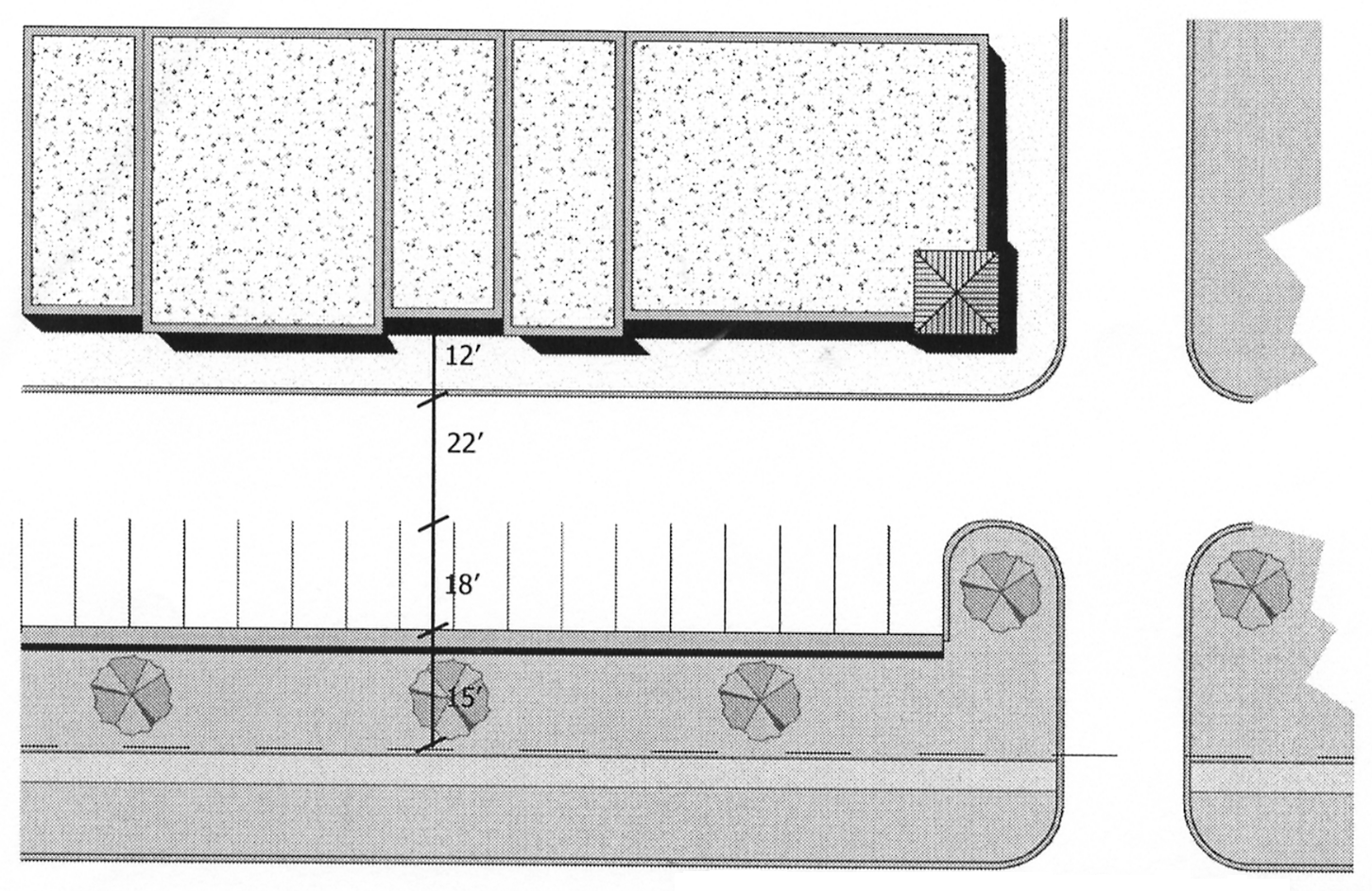
Typical Front Parking Lot Design
(c)
Off-street parking shall not be placed within ten feet of any wall of a dwelling structure which contains openings involving living areas, and no closer than five feet to any wall that does not contain such openings.
(d)
Shared parking may be permitted between two or more uses when the minimum parking requirements of the use requiring the largest number of parking spaces has been met and the applicant has demonstrated that the peak parking demand for one use will not overlap with the peak parking demand for other uses. A shared parking analysis prepared by the applicant and approved by the city will be required to justify a reduction in parking. In no case may parking be reduced by more than 30 percent than the minimum required for each individual use, as determined under subsection (a) above. Any area set aside for land banked parking cannot be used towards minimum open space requirements.
(e)
To help insure that future parking demands are considered, the planning commission may require 50 percent of the parking that is reduced to be land banked. One example where land banked parking may be necessary is when the potential exists for a change in use of a building from office to retail where peak parking demands would also change. The land banked parking area will be landscaped and provided in addition to minimum open space or park requirements.
(f)
An irrevocable, reciprocal use easement agreement may be required for all nonresidential developments that permit shared parking between uses within the same development.
(g)
Pedestrian and vehicular connections between adjacent parcels and parking lots will be required, as deemed appropriate by the planning commission.
(h)
Parking lots shall be screened from all public rights-of-way by either a three-foot ornamental brick wall or an alternative screening treatment that will effectively result in an equivalent opacity, as approved by the planning commission.
(i)
All rows of parking shall include landscaped end islands. Islands must be a minimum of eight feet in width and designed to be four feet shorter than adjacent parking stalls. Islands must be curbed to prevent automobiles from encroaching into landscaped areas.
(j)
Loading areas are required for all office and commercial developments. Loading areas must be placed within the rear yard and effectively screened from all public rights-of-way. More than one loading area per building may be required dependent on site and use demands. Plans must demonstrate how deliveries will be handled and must identify that all vehicular circulation can be accomplished on the site without interference to parking areas, pedestrian features, or public rights-of-way.
(Ord. of 10-7-2003(1))
Sec. 110-493. - Review and approval process.
(a)
The review and approval process for all developments within the CBD will follow a three-step approach. If special land use review and approval is required, then the city council will have final approval authority.
(b)
Prior to submitting a concept plan for review and approval, a pre-application conference must be held with city staff, consultants, and other appropriate officials deemed necessary by the city. A general concept (the number of copies will be determined by the administration) for the proposed development must be submitted when the conference is scheduled. A minimum of one week review time will be allotted prior to holding the pre-application meeting.
(c)
The second step is concept plan review and approval as follows:
(1)
A concept plan shall be required to be submitted for any use or development for which the city requires the submission of a site plan. The concept plan must be submitted to and approved by the DDA prior to submitting a site plan for approval to the city.
(2)
A concept plan must be submitted to the city prior to a regularly scheduled DDA meeting. Deadlines for submitting completed applications shall be in accordance with city policy.
(3)
The concept plan may also be reviewed by appropriate city and DDA officials who may include the city planner, the DDA director, city engineer and appropriate department heads.
(4)
The concept plan, at a minimum, shall include the following information:
a.
Identification of specific uses of a site;
b.
Location of all buildings and parking areas;
c.
Detailed building architectural and elevation plans, including the type and color of all materials proposed. A sample board may be requested;
d.
Site topography; and
e.
Conceptual park, open space, and landscaping layout.
f.
Application form, which identifies the property address, the name and address of property owner(s), the proposed developer(s), and all design, team members.
(5)
The DDA shall receive the concept plan and review the plan for compatibility with the approved DDA plan. The DDA will then provide a recommendation on the concept plan to the planning commission.
(6)
After receiving a concept plan approval from the DDA, the applicant can proceed with review and approval of the site plan. If the concept plan is not approved, the applicant must revise their plan and resubmit it to the DDA and the review process outlined in subsection (2) begins again. If the applicant is unable to obtain approval of the concept plan by the DDA he/she may request site plan approval, however, the planning commission shall not be required to grant site plan approval in the absence of concept plan approval by the DDA.
(7)
Approval of a concept plan provides a basis from which the applicant can develop their site plan and in no way guarantees or implies approval of the site plan.
(d)
The third step is review and approval of the site plan and special land use, if applicable. The site plan process for a CBD development would follow the same process as outlined in section article V, division 8, Site plan requirements.
(e)
The site plan shall contain the items required in article V, division 8 of the zoning ordinance as well as the following information:
(1)
Landscape plan as outlined within this section;
(2)
Lighting plan completed consistent with ordinance requirements;
(3)
Detailed elevations of all proposed buildings;
(4)
A sign plan that incorporates the elements of DDA sign design guidelines;
(5)
If the concept plan includes a special land use the planning commission's recommendation will be sent to city council for approval.
(f)
Sign plan applications for new or modified signs for an existing site within the CBD will require planning commission review and approval to ensure conformance with the CBD design guidelines.
(Ord. of 10-7-2003(1); Ord. of 10-5-2004; Ord. No. 06-126, 12-5-2006; Ord. No. 12-182, 11-20-2012; Ord. No. 17-069, 6-6-2017)
Sec. 110-494.- Intent.
The town center PUD zoning district is intended to allow for a complementary blend of governmental, recreational, cultural, and institutional retail and service uses at a central location to serve as a gathering place or town center for residents of the city. Such uses are intended to complement office, recreational, institutional and residential uses in the area. Site development standards proposed and uses permitted herein are designed to achieve a development design and character which promotes multiple land uses and encourages this area as a central gathering place for city residents.
(Ord. No. 11-098, 7-19-2011)
Sec. 110-495. - Eligible property; general procedure.
Property which is eligible for town center PUD district is designated for satellite retail/office, downtown, or flexible development according to the city master plan may be rezoned "Town Center PUD". The application for rezoning to town center PUD shall be made by the applicant and shall be reviewed by the planning commission and the city council according to the procedures provided by section 110-101, Changes and Amendments.
Any rezoning request for a town center PUD district must be accompanied by a site plan in accordance with the requirements of article 5, division 8, Site Plan Review. In addition, this plan must illustrate the total development of the land proposed for rezoning and the relationship of the development to other existing building and structures on adjacent lands zoned in the town center PUD district or designated for such use under the terms of the master plan, so as to assist the planning commission and the city council in evaluating whether the proposed project complies with the intent and standards of the town center PUD district.
(Ord. No. 11-098, 7-19-2011)
Sec. 110-496. - Use regulation.
Property which is zoned town center planned unit development shall not be used except in accordance with the submitted site plan approved under article 5, division 8, Site Plan Review, for one or more of the following permitted uses:
(a)
Governmental and public service uses, including offices for municipal, state, federal or other governmental agencies; public libraries, public museums and public art galleries.
(b)
Homes for the elderly or retired.
(c)
Retail and service uses permitted in the town center PUD district shall be as follows: coffee shop; bakery; ice cream shop; non-drive-through restaurants; book store; card and flower shop; barber and beauty shop; and bank. Permitted retail and service uses shall be of a size and nature complementary to existing nearby governmental, office, recreational and residential uses, and shall be intended to enhance the general purposes of the town center PUD as a gathering place.
(d)
Other principal uses which are determined by the planning commission to be:
(1)
Similar in character and operation to the permitted uses described above;
(2)
Closely complimentary and enhances the permitted uses; and
(3)
Compatible with the intent and purposes of the town center PUD district.
(4)
Legally non-conforming uses at the time of adoption of this district.
(e)
Accessory uses and buildings which are compatible with the intent and purposes of the town center PUD district.
(Ord. No. 11-098, 7-19-2011)
Sec. 110-497. - Site development standards and conditions.
Development plans for the use of land within the town center PUD district shall at a minimum comply with the standards and conditions provided in this division, in addition to the standards and conditions applicable to all districts as set forth in article IV, Schedule of Use Regulations, design standards and any other applicable provisions of this article.
(a)
Area requirements. To be considered for rezoning to town center PUD, the minimum lot size shall be five acres unless this requirement is waived by the planning commission.
(b)
Landscaping and buffer zones.
(1)
A 25-foot buffer or planting strip, landscaped and maintained as required by this article, shall also be provided along major thoroughfares.
(2)
A 50-foot buffer or planting strip, landscaped and maintained as required by this article, shall be provided to serve as a protective screen between any permitted use within the town center PUD and adjacent property with is zoned residential.
(c)
Off-street parking and loading. Off-street parking and loading spaces shall be provided as required by article V, division 3, Parking Regulations.
(d)
Design, appearance, and mix of town center uses.
(1)
The mix of uses proposed for a town center PUD project shall be compatible with and advance the intent and purpose of the Town Center PUD district to function as a central gathering place.
(2)
Proposed buildings shall be grouped or positioned in appropriate relationship to existing lands, buildings and structures in the town center PUD district, so as to create the intended town center atmosphere and appearance.
(3)
Walkways, paths, trails, bike paths, benches, picnic tables, and similar features shall be provided as determined necessary by the planning commission to enhance the use of the site by pedestrians.
(4)
Outdoor enhancements or accessory uses (including flower gardens, pavilions, gazebos, nature trails, pools and streams, bridges and other similar amenities) shall be provided as determined necessary by the planning commission to promote the intended town center atmosphere within the town center PUD district.
(Ord. No. 11-098, 7-19-2011)
Sec. 110-498.- Intent and purpose.
The purpose of this section is to permit coordinated development on appropriate sites with unique conditions such as, but not limited to: significant natural features the property owner and city wish to preserve; land that exhibits development constraints; or the opportunity to mix compatible uses and/or residential development types in a unique and flexible way that could not otherwise be accomplished through traditional development methods.
The PUD overlay district standards are provided to permit flexibility in the regulation of land development; to encourage innovation in land use, form of ownership and design, layout, and type of structures constructed; to preserve significant natural features and open space; to promote efficient provision of public services and utilities; to minimize adverse traffic impacts; to provide adequate housing and employment; to encourage development of recreational amenities; to ensure compatibility of design between neighboring properties; and to encourage the use and improvement of existing sites when the uniform regulations contained in other zoning districts alone do not provide adequate protection and safeguards for the site or its surrounding areas.
The PUD standards shall not be used as a technique to circumvent the intent of the zoning ordinance, to avoid imposition of specific zoning ordinance standards, or the planning upon which it is based. Thus, the provisions of this section are designed to promote land use substantially consistent with the underlying zoning, with modifications and departures from generally applicable requirements made to provide the applicant and city with flexibility in design on the basis of the total PUD plan approved by the city and consistent with the spirit and intent of the master plan.
(Ord. No. 16-082, § 2, 7-5-2016)
Sec. 110-499. - Qualifying conditions.
Planned unit developments may be allowed as an overlay of any zoning classification upon determination by the city council that all of the following criteria are met:
(1)
The planned unit development site shall be under the control of one owner or group of owners acting as a unified development team and shall be capable of being planned and developed as one integral unit.
(2)
The site size is a minimum of three acres of contiguous land. A smaller area of property contiguous to an approved PUD may be reviewed for addition to that PUD under the major amendment provisions of this chapter.
(3)
If a commercial component is part of a residential development proposed on residentially zoned property then the minimum site size shall be ten acres.
(4)
As determined by the city council, following review and recommendation by the planning commission, a finding shall be made that the site has significant natural or historic features which will be preserved through development under the PUD overlay standards; or
The PUD will provide a complementary mixture of uses considered desirable but not available at the proposed scale in the city; or
The PUD will provide a variety of housing types that are considered by the city to be desirable; or
The PUD shall provide a unique design that preserves common open space not likely to be realized under the requirements of the underlying zoning district.
(5)
The planned unit development will result in a recognizable and substantial benefit to the ultimate users of the project and to the community, as demonstrated by the applicant to the satisfaction of city council, where such benefit would otherwise be infeasible or unlikely to be achieved.
(6)
In relation to development permitted by the underlying zoning, the proposed type and density of use(s) shall not result in an unreasonable increase in traffic or the use of public services, facilities and utilities unless the applicant proposes to construct adequate public improvements to mitigate the impact of additional demand on public facilities. In addition, the PUD shall not place an unreasonable burden upon the subject and/or surrounding land and/or property owners and occupants.
(7)
In relation to development permitted by the underlying zoning, the proposed development shall not result in an unreasonable negative impact upon surrounding properties.
(8)
For a PUD with a mixture of uses, the project shall be designed to achieve a synergistic relationship between the uses. The various uses shall be integrated with pedestrian and vehicular access systems and open spaces. For all PUD projects, site design elements should be developed in a consistent manner throughout the entire site (e.g. landscaping, signs, lighting, etc.).
(9)
The proposed development shall not have an adverse impact upon the city's master plan and shall be consistent with the master plan's spirit and intent, as well as the spirit and intent of the city's zoning ordinance.
(Ord. No. 16-082, § 2, 7-5-2016)
Sec. 110-500. - Project design standards.
Any planned unit development shall comply with the following project design standards:
(1)
Location. A planned unit development may be approved in any location in the City, subject to qualifying conditions and standards for review and approval as provided for herein.
(2)
Uses permitted. The flexibility of the PUD provides opportunities to develop projects with either a single type of land use or a variety of land uses combined to form a unified development based on the underlying zoning. The following shall determine permitted uses:
a.
Underlying zoning is residential. Single-family, two—family, multiple-family dwellings, other uses permitted in the underlying zoning district, and accessory uses customarily permitted in residential districts. For residential PUDs less than ten acres, non-residential uses shall not be permitted except for the following: 1) limited retail and personal service uses for the exclusive use of the residents of the PUD may be permitted upon the city council finding, after review and recommendation by the planning commission, that the use is clearly accessory and that no advertising or marketing to patrons outside the PUD shall be permitted, and 2) non-residential uses listed in the underlying residential district may be permitted upon review in the context of the PUD site and impact on the surrounding area. The applicant shall demonstrate to the satisfaction of the city council that this section has been met.
Residentially-zoned PUDs of ten acres or more may be permitted to incorporate non-residential development dedicated to neighborhood office or neighborhood retail uses on up to ten percent of the developed acreage provided, however, that the total gross floor area devoted to retail and restaurant uses shall not exceed 50,000 square feet.
b.
Underlying zoning is office or commercial. The city council may permit residential, office and commercial uses, and other uses, upon finding that the organization of uses meets the intent of this division and PUD design standards.
c.
Underlying zoning is research and development or industrial. The City Council may permit office, commercial, light industrial, and research and development uses, and other uses, upon finding that the organization of uses meets the intent of this division and PUD design standards.
d.
Underlying zoning contains multiple districts. If the property includes a combination of underlying zoning districts the resulting development mix shall be determined based upon a finding that the organization of uses meets the intent of this division and PUD design standards
e.
Any PUD proposing a mixture of residential and non-residential uses may develop mixed-use buildings where residential is located above non-residential uses. This provision will be subject to approval by the planning commission subject to the adequacy of building, site, access, and parking design.
(3)
Residential density. PUD density shall be regulated as follows:
a.
Underlying zoning is residential. The number of dwelling units permitted shall be based on the density permitted in the underlying zoning district. The city council may increase the overall density by up to 20 percent (a "density bonus") upon a determination that significant natural features would be preserved that would otherwise be lost if the site were developed under a more traditional subdivision plan or that an open space/park area is to be developed as part of the PUD that is open to the public and is deemed by the city council to be a recognizable and substantial public benefit. Also, the city council shall find that city services can accommodate the increased density. The applicant shall submit a conventional conceptual plan (parallel plan) that illustrates that the number of units the applicant is proposing in the PUD is consistent with the standards in this division. Granting of a density bonus is at the sole discretion of the city council after a review of the PUD plan in relation to the master plan, zoning ordinance, and consideration of impact on the public health, safety and general welfare, public facilities, services, and adjoining properties.
b.
Underlying zoning is nonresidential. The density established by the planning commission and city council shall be consistent with the spirit and intent of the master plan and the standards in this division, based upon a determination that such density will not adversely affect water and sewer services, storm water drainage, road capacity, traffic, parks and recreation, fire and police services, schools, character of the area, and any planned public and private improvements in this area. The density for any proposed residential uses in a nonresidential district shall be determined by the planning commission and city council, but in no case shall residential density exceed 20 percent more than the density permitted in the R-M Multiple Family Residential District for the area designated for residential or in the case of mixed-use (residential and non-residential) buildings for the portion of the site designed for mixed-use buildings.
(4)
Buffering between uses in a mixed use PUD. The placement of PUD residential uses adjacent to single or multi-family residential districts sharing a common boundary is encouraged. At its discretion, the city council may specifically approve a non-residential or mixed-use structure located adjacent to a residential district. Parking, loading, and vehicular traffic ways shall be separated and buffered from residential units within the PUD and other residential districts adjacent to the PUD project in a manner consistent with good site design and planning principles and as otherwise determined by the city, provided it is recognized that this provision may have limited application to multi-use buildings. When non-residential uses adjoin residentially zoned property outside of the PUD, noise reduction and screening methods including landscape berms or decorative walls shall be required at the discretion of the planning commission and city council.
(5)
Open space. The PUD development shall incorporate 15 percent of the total site as open space for the sole benefit, use and enjoyment of present and future occupants of the PUD. Required open space areas shall be contiguous to the maximum extent practical. If natural features are present on the site, such open space must include those natural features. Required open space shall be permanently set aside through covenant, deed restriction, easement or similar legal instrument acceptable to the city. If agreed to by the city council, in its discretion, the open space may be conveyed to the city for the use of the general public. Such open space shall not include required yards or buffers, parking areas, drives, rights-of-way, utility or road easements, storm water detention ponds or structures. At least 30 percent of the open space required by this section shall be upland, non-wetland areas.
(6)
Natural features. The development shall be designed to promote preservation of natural resources and natural features, taking into consideration the local, state and national concern for the protection and preservation of natural resources and natural features. Design guidelines to be considered are as follows:
a.
Wherever possible natural drainage shall be retained and improved if necessary.
b.
Natural site amenities and sensitive environmental features shall be preserved to the maximum extent feasible.
c.
The location of existing trees and unique vegetation should be considered in the selection of building location, utility placement, circulation patterns and paved areas.
d.
Floodplain areas shall be preserved as permanent open space.
e.
The natural topography of the site shall be considered in the design of the project. Major grade changes should be avoided and protective measures shall be taken to protect steep slopes and prevent unnecessary soil erosion.
(7)
Dimensional standards. The setbacks and other dimensional standards for various uses shall be based on the following:
a.
Single family residential uses shall comply with the yard (setback), height and minimum floor area regulations applicable to the R-2 district, provided that the averaged lot size, one-family clustering and subdivision open space option standards may be utilized.
b.
Multiple family uses shall comply with the regulations applicable to the Multiple Family District.
c.
Office, commercial, industrial, and mixed uses shall comply with the zoning regulations for the least intensive zoning district which permits the use.
d.
See subsection (9), additional considerations, which provides for flexibility in approving relaxation of dimensional requirements subject to conditions.
(8)
Building appearance standards. The PUD review process shall place significant emphasis on the quality of architecture design and exterior building materials. PUD projects shall demonstrate adherence to high standards of design. Building materials such as brick and stone are strongly encouraged. When big box retail, large office buildings, large industrial buildings and similar structures are proposed, large blank walls without articulation shall not be permitted. Notwithstanding any other provisions in this division, the city planner, the planning commission, and the city council will apply quality design standards on a case by case basis, whether or not such design standards are specifically enumerated in an ordinance, guideline or otherwise.
(9)
Additional considerations. The planning commission and city council shall take into account the following considerations, as the same may be relevant to a particular project: perimeter setback and berming; roadway, drainage and utility design; underground installation of utilities; insulating the pedestrian circulation system from vehicular thoroughfares and ways; connecting internal pedestrian circulation systems with external paths, whether existing or proposed; achievement of an integrated development with respect to signage, lighting, landscaping and building materials; and noise reduction and visual screening mechanisms, particularly in cases where nonresidential uses adjoin off-site residentially-zoned property.
Consistent with the PUD concept, and toward encouraging flexibility and creativity in development, departures from compliance with the standards provided for in the zoning ordinance may be granted at the discretion of the city council as part of the PUD approval process. Such departures may be authorized on the condition that there are features or planning mechanisms deemed adequate by the city council designed into the project for the purpose of achieving the objectives intended to be accomplished with respect to each of the regulations from which a departure is sought. Any deviations from ordinance standards will require the applicant to provide substitute safeguards for each regulation for which there is noncompliance, in whole or in part, in the development plan.
(Ord. No. 16-082, § 2, 7-5-2016)
Sec. 110-501. - PUD application and review process.
All PUD applications shall follow a three-step review process including 1) pre-application conference, 2) conceptual PUD site plan review and approval, and 3) final site plan review and approval. If a rezoning of the subject site is required, the applicant may seek a rezoning concurrent with and contingent upon the application for conceptual PUD site plan approval. Prior to the preparation of the PUD application, the developer shall participate in two pre-application conferences: one with staff and one with the planning commission. After the pre-application conferences, the applicant may submit a formal request for PUD approval along with a conceptual PUD site plan for review by the planning commission. The conceptual PUD site plan and the adoption of the PUD overlay zoning district shall require the approval of the city council after the planning commission public hearing and recommendation. The final site plan shall be reviewed and approved by the planning commission.
(1)
Pre-application conferences. Prior to formal submission of an application for planned unit development approval, the applicant shall meet with the administrator, city planner, building official, director of public works, fire chief, police chief, and other city personnel and consultants as the city planner deems appropriate. The purpose of such a conference is to provide information and guidance that will assist the applicant in preparation of the application and conceptual plan. This shall be followed by an informal pre-application conference with the planning commission. No formal action shall be taken at pre-application conferences.
The applicant shall present at such a conference or conferences, at minimum, a sketch plan of the proposed planned unit development; a legal description of the property in question; the total number of acres in the project; a statement of the approximate number of residential units and the approximate regulations to be sought; the number of acres to be preserved as open or recreational space; and, the natural features to be preserved in general.
(2)
Conceptual PUD application. The applicant shall prepare and submit to the city a request for PUD approval with a conceptual PUD site plan meeting the submittal requirements in this division (subsection (5)) and a traffic impact study following section 110-741(c)(13) and (14). The conceptual PUD site plan shall illustrate uses within each component, road layout, parking area and open space.
(3)
Planning commission review and public hearing. The planning commission shall review the conceptual PUD site plan and the impact assessment. The planning commission shall set a date for a public hearing after the submittal requirements noted in subsection (5) have been met. Notice of the public hearing shall be given by one publication in a newspaper of general circulation in the city, and by mail or personal delivery to the owners of property for which approval is being considered, to all persons whom real property is assessed within 300 feet of the subject property, and to the occupants of all structures within 300 feet of the subject property regardless of whether the property or occupant is located within the city. The notice shall be given not less than 15 days before the public hearing date, in accordance with Section 103 of the Michigan Zoning Enabling Act, P.A. 110 of 2006, as amended, (M.C.L. 125.3101 et seq.). The notice shall specify that the city is considering both an amendment to the zoning map (to add the PUD designation for the subject site) and the conceptual PUD site plan. The notice shall also describe the nature of the request, indicate the property that is subject of the request including a listing of all existing street addresses within the subject property, state when and where the request will be considered, and indicate when and where written comments will be received concerning the request. The planning commission shall conduct the public hearing, and submit a recommendation on the requested PUD overlay zoning to the city council.
(4)
City council review. The city council shall review the requested PUD overlay zoning and the conceptual PUD site plan and either approve, deny or approve with a list of conditions made part of the approval. The city council may require a resubmittal of the conceptual PUD site plan reflecting the conditions for administrative approval by the city planner prior to submittal of a final site plan.
(5)
Approval of development agreement. Following approval of the conceptual PUD site plan, the applicant's attorney shall submit a draft development agreement in accordance with section K. [110-502]. The city council is the approving body of the development agreement after receiving comments from the city attorney and city planner.
(6)
Final site plan. The final site plan shall be submitted to planning commission for approval. If application for final site plan approval is not requested by the applicant within 18 months of the PUD development agreement — which is approved by city council following the preliminary conceptual PUD plan approval — the conceptual PUD site plan approval shall expire and resubmittal of the conceptual PUD application shall be required. The city council may extend the conceptual PUD approval period up to an additional two years, if requested in writing by the applicant prior to the expiration date.
(7)
Combined approval. The applicant may submit for conceptual PUD site plan and final site plan concurrently in order to expedite the review process timeline. All required information for both approvals shall be provided at the time of submittal and all applicable review fees for each level of review shall be paid. The final site plan approval by the planning commission shall be subject to approval by the city council of both the conceptual PUD site plan and development agreement.
(Ord. No. 16-082, § 2, 7-5-2016)
Sec. 110-502. - Conceptual PUD submittal requirements.
The purpose of the conceptual PUD review is to provide a mechanism whereby the applicant can obtain approval of the proposed project in concept and then prepare a final site plan and engineering documents. Submittal requirements for the PUD conceptual site plan review are listed below.
(1)
Current proof of ownership of the land to be utilized or evidence of a contractual ability to acquire such land, such as an option or purchase agreement.
(2)
A completed application form, supplied by the city clerk and an application fee. A separate escrow deposit may be required for administrative charges to review the PUD submittal.
(3)
Fifteen copies of a traffic impact study. Additional copies may be required for city council packets.
(4)
The planning commission, city council or the city planner may request that the applicant provide a market study demonstrating the market demand and feasibility of the proposed PUD project.
(5)
Sheet size of submittal drawings shall be at least 24 inches by 36 inches, with graphics at an engineer's scale. The applicant shall also submit a set of plans as a pdf file on 11-inch by 17-inch digital sheets, with at least one sheet in color, highlighting landscaped and open space areas.
(6)
Cover sheet providing:
a.
The applicant's name;
b.
The name of the development;
c.
The preparer's name and professional seal of architect, engineer, surveyor or landscape architect indicating license or registration in the state;
d.
Date of preparation and any revisions;
e.
North arrow;
f.
Property lines and dimensions;
g.
Complete and current legal description and size of property in acres;
h.
Small location sketch of the subject site and area within one mile; and scale;
i.
Existing zoning and current land use of applicant's property and all abutting properties and of properties across any public or private street from the PUD site;
j.
Lot lines and all structures on the property and within 200 feet of the PUD property lines;
k.
Location of any access points on both sides of the street within 300 feet of the PUD site along streets where access to the PUD is proposed.
(7)
A plan sheet(s) labeled existing site conditions, including: the locations of existing buildings and structures; rights-of-way and easements; significant natural and historical features; existing drainage patterns (by arrow); surface water bodies and floodplain areas; wetlands over one acres in size; the limits of major stands of trees; and a tree survey indicating the locations, species and caliper of all trees with a caliper over eight inches, measured four feet above grade. The detailed tree survey may be delayed until final site plan review, if approved by the city council, following review and a recommendation by the planning commission, if the applicant provides an outline of how significant stands of trees, if any exist on site, can be preserved. Replacement trees shall be as regulated in the city's commercial design standards (see Table 2, Approved Plant Materials). This sheet shall also illustrate existing topography of the entire site at two-foot contour intervals and a general description of grades within 100 feet of the site. A reduced copy of this sheet may be included in the impact assessment.
(8)
A conceptual PUD site plan sheet including:
a.
Conceptual layout of proposed land use, acreage allotted to each use, residential density overall and by underlying zoning district
b.
If the conceptual PUD plan includes a request for a residential density bonus, the applicant shall submit a parallel plan illustrating the number of units that could be developed on the site under a conventional development scenario. The parallel plan shall be based upon the underlying zoning and must demonstrate that the density proposed for the PUD is consistent with this division. If a parallel plan is required, there shall be a separate review fee charged in addition to the PUD review fee to cover the city's cost of reviewing the parallel plan.
c.
Building footprints, setbacks and spacing; lot sizes; structures, roadways, parking areas, drives, driveways, pedestrian paths, existing signs, and any existing structures to be removed.
d.
General location and type of landscaping proposed (evergreen, deciduous, berm, etc.) noting existing trees over eight inches in caliper to be retained, and any woodlands that will be designated as "areas not to be disturbed" in development of the PUD.
e.
A preliminary layout of contemplated storm water drainage, detention pond location, water supply and wastewater disposal systems, any public or private easements, and a note of any utility lines to be removed.
f.
If all or part of the PUD project is expected to be a platted subdivision, the conceptual PUD site plan shall also meet all the submittal requirements for a tentative preliminary plat, as described in the city subdivision regulations.
g.
If a multi-phase planned unit development is proposed, identification of the areas included in each phase and a demonstration that each phase shall meet the requirements of this division and the city's subdivision regulations. For residential uses, the number, type and density of housing by phase shall be identified.
h.
General list of anticipated deviations from applicable underlying zoning ordinance regulations that will be sought, and a concise statement indicating the approach proposed to ensure that any such deviations will achieve the objectives and intent of this section.
i.
A written narrative describing the recognizable and substantial public benefit to be provided to the project and the community as a whole as part of the proposed PUD development plan.
(Ord. No. 16-082, § 2, 7-5-2016)
Sec. 110-503. - Standards for approval of conceptual PUD site plan.
Based upon the standards below, the planning commission may recommend denial, approval, or approval with conditions, and the city council may deny, approve, or approve with conditions (including those recommended by the planning commission and/or additional conditions imposed by the city council) the proposed conceptual planned unit development plan. Upon the approval of the conceptual PUD site plan and development agreement (below) by the city council, the property shall be designated as planned unit development overlay zoning on the official zoning map.
(1)
The planned unit development meets the qualification and project design requirements.
(2)
The uses proposed will have a beneficial effect, in terms of public health, safety, welfare, or convenience, on present and future potential surrounding land uses. The uses proposed will not adversely affect the public utility and circulation system, surrounding properties, or the environment.
(3)
The conceptual plan will be able to meet the final site plan review standards for design, setbacks, and all applicable standards of this zoning ordinance unless deviations are specifically requested and approved.
(4)
If the PUD includes a platted subdivision, the conceptual plan will comply with the city subdivision regulations and the requirements of the county department of roads. The conceptual PUD site plan may be considered a tentative preliminary plat for purposes of a concurrent review process or the applicant may submit the tentative preliminary plat at a later date, following approval of the conceptual PUD site plan.
(5)
The proposed development does not have an adverse impact upon the city's master plan and is consistent with the master plan's spirit and intent, as well as the spirit and intent of the city's zoning ordinance.
(6)
Judicious effort has been used to protect and preserve significant natural and historical features, surface and underground water bodies and the integrity of the land.
(7)
Public water and sewer facilities are available or planned in accordance with the city water and sewer ordinance.
(8)
Safe, convenient, uncongested, and well-defined vehicular and pedestrian circulation within and to the site will be provided. Drives, streets, and other elements shall be designed to discourage through traffic, while promoting safe and efficient traffic operations within the site and at its access points.
(9)
The planned unit development will result in a recognizable and substantial benefit to the ultimate users of the project and to the community, as demonstrated by the applicant, where such benefit would otherwise be unfeasible or unlikely to be achieved.
(Ord. No. 16-082, § 2, 7-5-2016)
Sec. 110-504. - Final site plan submittal procedures and approval.
(a)
The purpose of the final review is to consider the final site plan that is consistent with the approved conceptual PUD site plan. Upon receiving approval for the overall conceptual PUD site plan the applicant may seek final site plan approval for the individual buildings or project components in phases, subject to consistency with approved phasing plan. Receipt of a building permit shall require signoff by the city planner and building department.
(b)
The final submittal shall include the materials required for all final site plans in the city, plus the following:
(1)
A copy of the approved development agreement recorded with the county register of deeds that describes the terms and conditions of the approval and the rights and obligations of each party.
(2)
A separately delineated specification of all the deviations from this division, which would otherwise be applicable to the uses and development proposed in the absence of these planned unit development regulations (i.e. a specific list of requested deviations vs. standard requirements).
(3)
The reasons and mechanisms to be utilized for the protection of the public health, safety and welfare in lieu of the regulations from which deviations are sought shall also be specified.
(c)
The final site plan shall be reviewed by the planning commission according to the procedures outlined in section 110-741, site plan review. The final site plan for individual phases shall be subject to approval by the planning commission. The design and proposed uses shall be consistent with the approved conceptual plan. The planning commission may require an updated version of the traffic impact study for an individual phase if the proposed use or layout has changed from the approved concept plan.
(d)
For any condominium section of a PUD, the applicant shall provide a copy of the master deed and condominium association bylaws for approval by the city council. The condominium documents shall provide limits on use of common areas or open space accessory structures such as swimming pools, decks, playground equipment and buildings. A plan shall be provided indicating the limits of such accessory structures within a defined envelope.
(e)
Final site plan approval of a PUD, PUD phase or a building within a PUD shall be effective for a period of three years. Further submittals under the PUD procedures shall be accepted for review upon a showing of substantial progress in development of previously approved phases, or upon a showing of good cause for not having made such progress.
(Ord. No. 16-082, § 2, 7-5-2016)
Sec. 110-505. - Appeals and violations.
(a)
The zoning board of appeals shall have the authority to hear and decide appeal requests by individual property owners for dimensional, bulk, & height variances from the zoning ordinance. However, the zoning board of appeals shall not have the authority to reverse an order or decision of the city council, change conditions imposed by the city council or make interpretations related to the PUD site plan or development agreement.
(b)
A violation of the PUD plan shall be considered a violation of this division.
(Ord. No. 16-082, § 2, 7-5-2016)
Sec. 110-506. - Amendments and deviations from approved final site plan.
(a)
Deviations from the approved final site plan may occur only when an applicant or its successor notifies the city planner of the proposed amendment to such approved site plan in writing, accompanied by a site plan illustrating the proposed change. The result shall be received prior to initiation of any construction in conflict with the approved final site plan.
(b)
Procedure. Within 14 days of receipt of a request to amend the final site plan, the city planner shall determine whether the change is major, warranting review by the city council, or (minor), allowing administrative approval, as noted below.
(c)
Minor changes. The city planner may approve the proposed revision upon finding the change would not alter the basic design nor any condition imposed upon the original plan approval by the city council. The city planner shall inform the planning commission and city council of such approval in writing. The city planner shall consider the following when determining a change to be minor:
(1)
For residential buildings, the size of structures may be reduced; or increased by five percent, provided the overall density of units does not increase and the minimum square footage requirements are met.
(2)
Gross floor area of non-residential buildings may be decreased or increased by up to five percent or 10,000 square feet, whichever is smaller.
(3)
Floor plans may be changed if consistent with the character of the use.
(4)
Horizontal and/or vertical elevations may be altered by up to five percent.
(5)
Relocation of a building by up to five feet, if consistent with required setbacks and other standards.
(6)
Designated "areas not to be disturbed" may be increased.
(7)
Plantings approved in the final landscaping plan may be replaced by similar types of landscaping on a one-to-one or greater basis provided the trees are consistent with Table 2, Approved Plant Materials, from the city's commercial design standards. Any trees to be preserved, which are lost during construction, may be replaced by at least two trees of the same or similar species consistent with Table 2, Approved Plant Materials, in the city's commercial design standards.
(8)
Improvements or slight relocation of site access or circulation, such as inclusion of deceleration lanes, boulevards, curbing, pedestrian/bicycle paths, etc.
(9)
Changes of building materials to another of higher quality, as determined by the city planner.
(10)
Slight modification of sign placement or reduction of size.
(11)
Internal rearrangement of parking lot that does not affect the number of parking spaces or alter access locations or design.
(12)
Changes required or requested by the city, county or state for safety reasons.
(d)
Major changes. Where the city planner determines the requested amendment to the approved final site plan is not minor, or if there is a request to expand the land area included within the PUD, submittal of an amended application for review and approval by the city council is required. If the city council determines that the proposed modifications to the final site plan significantly alter the intent of the conceptual PUD site plan or significantly modify the on-site or off-site impacts of the plan, a revised conceptual PUD site plan shall be submitted according to the procedures outlined in this section, including a new public hearing and review and recommendation by the planning commission prior to city council action. If the PUD is being expanded in size, the previously submitted impact assessment and traffic study shall be updated to reflect new conditions and the expected impacts associated with the subject area.
(Ord. No. 16-082, § 2, 7-5-2016)
Sec. 110-507. - Development agreement.
(a)
Upon obtaining approval of a conceptual PUD site plan, the applicant and city council shall enter into a development agreement that describes the terms and conditions of the approval and the rights and obligations of each party. The development agreement may be approved by the city council immediately following approval of the conceptual PUD site plan or it may be placed on a subsequent agenda of the city council. The applicant shall reimburse the city for all fees for city legal counsel and consultant participation and/or review of the development agreement.
(b)
The approved development agreement shall be recorded with the county register of deeds.
(c)
In the event that the conceptual PUD site plan requires a major amendment, the development agreement shall be amended to reflect the approved changes and recorded. Action to amend a development agreement requires approval by the city council.

