
Woodhaven City Zoning Code
ARTICLE V
- SUPPLEMENTARY REGULATIONS
DIVISION 3. - PARKING REGULATIONS[12]
Cross reference— Traffic and vehicles, ch. 98.
DIVISION 8. - SITE PLAN REQUIREMENTS[13]
Cross reference— Buildings and building regulations, ch. 18.
DIVISION 10. - HOME OCCUPATIONS[14]
Cross reference— Businesses, ch. 22.
Sec. 110-551. - Conflicting regulations.
Wherever any provision of this chapter imposes more stringent requirements, regulations, restrictions or limitations than are imposed or required by the provisions of any other law or ordinance, then the provisions of this chapter shall govern. Whenever the provisions of any other law or ordinance imposes more stringent requirements than are imposed or required by this chapter, then the provisions of such law or ordinance shall govern.
(Ord. of 11-1-1967, § 15.1)
Sec. 110-552. - Scope.
No building or structure or its part, shall hereafter be erected, constructed or altered and maintained, and no new use or change shall be made or maintained of any building, structure or land, or its part, except in conformity with the provisions of this chapter.
(Ord. of 11-1-1967, § 15.2)
Sec. 110-571. - General provisions.
(a)
When within the districts established by this chapter, or amendments that may later be adopted, there exist lots, structures and uses of land and structures which were lawful before this chapter was passed or amended, but which would be prohibited, regulated, or restricted under the terms of this chapter or future amendment, it is the intent of this chapter to permit these nonconformities to continue until they are removed, but not to encourage their survival. Such uses are declared by this chapter to be incompatible with permitted uses in the districts involved. It is further the intent of this chapter that nonconformities shall not be enlarged upon, expanded or extended, nor be used as grounds for adding other structures or uses prohibited elsewhere in the same district.
(b)
A nonconforming use of a structure, a nonconforming use of land, or a nonconforming use of a structure and land shall not be extended or enlarged after passage of this chapter by attachment on a building or premises of additional signs intended to be seen from off the premises, or by the addition of other uses of a nature which would be prohibited generally in the district involved.
(c)
To avoid undue hardships, nothing in this chapter shall be deemed to require a change in the plans, construction or designated use of any building on which actual construction was lawfully begun prior to the effective date of adoption or amendment of this chapter and upon which actual building construction has been diligently carried on. Actual construction is hereby defined to include the placing of construction materials in permanent position and fastened in a permanent manner; except that where demolition or removal of an existing building has been substantially begun preparatory to rebuilding, such demolition or removal shall be deemed to be actual construction, provided that work shall be diligently carried on until completion of the building involved.
(Ord. of 11-1-1967, § 15.3)
Sec. 110-572. - Nonconforming lots.
In any district in which single-family dwellings are permitted, notwithstanding limitation imposed by other provisions of this chapter, a single-family dwelling and customary accessory buildings may be erected on any single lot of record at the effective date of adoption or amendment of this chapter. This provision shall apply even though such lot fails to meet the requirements for area or width; or both, that are generally applicable in the district, provided that yard dimensions and other requirements not involving area or width, or both, of the lot shall conform to the regulations for the district in which such lot is located. Variance yard requirements shall be obtained through approval of the board of appeals.
(Ord. of 11-1-1967, § 15.4)
Sec. 110-573. - Nonconforming uses of land.
Where, at the effective date of adoption or amendment of this chapter, lawful use of land exists that is made no longer permissible under the terms of this chapter as enacted or amended, such use may be continued, so long as it remains otherwise lawful, subject to the following provisions:
(1)
No such nonconforming use shall be enlarged or increased, nor extended to occupy a greater area of land than was occupied at the effective date of adoption or amendment of this chapter. This provision shall not apply to existing single-family residential uses, which may be altered so long as the alteration conforms with existing building codes, setback requirements, and safety codes.
(2)
No such nonconforming use shall be moved, in whole or in part, to any other portion of the lot or parcel occupied by such use at the effective date of adoption or amendment of this chapter.
(3)
If such nonconforming use of land, is abandoned, any subsequent use of such land shall conform to the regulations specified by this chapter for the district in which such land is located.
(Ord. of 11-1-1967, § 15.5; Ord. No. 08-040, 3-4-2008)
Sec. 110-574. - Nonconforming structures.
Where a lawful structure exists at the effective date of adoption or amendment of this chapter that could not be built under the items of this chapter, such structure may be continued so long as it remains otherwise lawful, subject to the following provisions:
(1)
No such structures may be enlarged or altered in a way which increases its nonconformity. This provision shall not apply to existing single-family residential uses, which may be altered so long as the alteration conforms with existing building codes, setback requirements, and safety codes.
(2)
Should such structure be destroyed by any means to an extent of more than 50 percent of its replacement cost at time of destruction, it shall not be reconstructed except in conformity with the provisions of this chapter. This provision shall not apply to existing single-family residential uses, as such uses shall be permitted to be rebuilt or reconstructed subject to current building and safety codes.
(3)
Should such structure be moved for any reason for any distance whatever, it shall thereafter conform to the regulations for the district in which it is located after it is moved.
(Ord. of 11-1-1967, § 15.6; Ord. No. 08-040, 3-4-2008)
Sec. 110-575. - Nonconforming uses of structures and land.
If a lawful use of a structure, or of structure and land in combination, exists at the effective date of adoption or amendment of this chapter, which would not be allowed in the district under the terms of this chapter, the lawful use may be continued so long as it remains otherwise lawful, subject to the following provisions:
(1)
No existing structure devoted to a use not permitted by this chapter in the district in which it is located shall be enlarged, extended, constructed, reconstructed, moved or structurally altered except in changing the use of the structure to a use permitted in the district in which it is located. This provision shall not apply to existing single-family residential uses, which may be altered so long as the alteration conforms with existing building codes, setback requirements, and safety codes.
(2)
Any nonconforming use may be extended throughout any parts of a building which were manifestly arranged or designed for such use, and which existed at the time of adoption or amendment of this chapter, but no such use shall be extended to occupy any land outside such building.
(3)
If no structural alterations are made, any nonconforming use of a structure, or structure and premises, may be changed to another nonconforming use, provided that the board of appeals, either by general rule or by making findings in the specific case, shall find that the proposed use is equally appropriate or more appropriate in the district than the existing nonconforming use. In permitting such change, the board of appeals may require appropriate conditions and safeguards in accord with the purpose and intent of this chapter.
(4)
Any structure, or structure and land in combination, in or on which a nonconforming use is superseded by a permitted use, shall thereafter conform to the regulations for the district in which such structure is located, and the nonconforming use may not thereafter be resumed.
(5)
When a nonconforming use of a structure, or structure and premises in combination, is, abandoned, it shall not thereafter be used except in conformance with the regulations of the district in which it is located.
(6)
Where nonconforming use status applies to a structure and premises in combination, removal or destruction of the structure shall eliminate the nonconforming status of the land. This provision shall not apply to existing single-family residential uses.
(Ord. of 11-1-1967, § 15.7; Ord. No. 08-040, 3-4-2008)
Sec. 110-576. - Repairs and maintenance.
On any building devoted, in whole or in part, to any nonconforming use, work may be done in any period of 12 consecutive months on ordinary repairs, or on repair or replacement of nonbearing walls, fixtures, wiring or plumbing to an extent not exceeding 50 percent of the assessed value of the building, provided that the cubic content of the building as it existed at the time of passage or amendment of this chapter shall not be increased. Nothing in this chapter shall be deemed to prevent the strengthening or restoring to a safe condition of any building or its part declared to be unsafe by any official charged with protecting the public safety, upon order of such official. This section shall not apply to any existing single-family residential use, which may be repaired without regard to the stated percentage limitations.
(Ord. of 11-1-1967, § 15.8; Ord. No. 08-040, 3-4-2008)
Sec. 110-577. - Uses under exception provisions not nonconforming uses.
Any use for which a special exception is permitted as provided in this chapter shall not be deemed a nonconforming use, but shall without further action be deemed a conforming use in such district.
(Ord. of 11-1-1967, § 15.9)
Sec. 110-578. - Change of tenancy or ownership.
There may be a change of tenancy, ownership or management of any existing nonconforming uses of land, structures and premises, provided that there is no change in the nature or character of such nonconforming uses.
(Ord. of 11-1-1967, § 15.10)
Sec. 110-579. - Accessory buildings and uses.
Accessory buildings, except as otherwise permitted in this chapter, shall be subject to the following regulations:
(1)
Where the accessory building is structurally attached to a main building, it shall be subject to, and must conform to, all regulations of this chapter, applicable to main buildings.
(2)
Accessory buildings shall not be erected in any required yard, except a rear yard.
(3)
For purposes of computing limitations of lot coverage by accessory uses in the R-1, R-2 and R-T districts, refer to section 110-511, schedule of regulations, the last column in the table.
(4)
No detached accessory building shall be located closer than ten feet to any main building nor shall it be located closer than three feet to any side or rear lot line. In those instances where the rear lot line is coterminous with an alley right-of-way, the accessory building shall be no closer than one foot to such rear lot line. In no instance shall an accessory structure be located within a dedicated easement right-of-way.
(5)
No detached accessory building in an R-1, R-2, R-T or R-M district shall exceed one story, and no portion of the roof shall exceed 14 feet in height. No detached accessory building in a B-1, B-2, B-3 or O-1 district shall exceed one story or 14 feet in height. Accessory buildings in all other districts may be constructed to equal the permitted maximum height of structures in such districts, subject to board of appeals review and approval if the building exceeds one story of 14 feet in overall height.
(6)
When an accessory building is located on a corner lot, the side lot line of which is substantially a continuation of the front lot line of the lot to its rear, such building shall not project beyond the front yard line required on the lot in rear of such corner lot. When an accessory building is located on a corner lot, the side lot line of which is substantially a continuation of the side lot line of the lot to its rear, such building shall not project beyond the side yard line of the lot in the rear of such corner lot.
(7)
When an accessory building, in any residence, business or office district, is intended for other than the storage of private motor vehicles, the accessory use shall be subject to the approval of the board of appeals.
(8)
Satellite dish antennas shall be permitted, subject to the following conditions and procedures: Any such antenna shall be located in the rear yard, not be located in any required easement, be set back from any side or rear property line a minimum distance of three feet or the height of the antenna (whichever is greater), be so located and installed as to minimize its visibility from neighboring residential properties and public thoroughfares, conforms to all applicable building and electrical standards and also complies with the following requirements:
a.
Any such antenna, which is ground-mounted, and does not exceed an overall height of six feet above the average normal grade elevation within 25 feet of the antenna location, may be approved by the building inspector when it is found that all of the applicable requirements have been met.
b.
Satellite dish antennas, with a diameter of two feet or less, may be approved by the building official, subject to the following conditions:
1.
When located as a freestanding structure, it shall be placed in a rear or side yard, and no part of the antenna or its mounting pole shall be higher than 14 feet above the lot grade. No part of the antenna structure shall be closer than five feet to any lot line and shall not be located in any easement.
2.
When attached to a building or chimney, it shall be so located as to minimize its view from any public street. The antenna shall be positioned on the rear side of a roof or chimney, the top edge of the antenna being positioned lower than the height of the ridge line of the roof or as close to the height as possible.
3.
The installation of any such antenna shall conform to all building requirements of the city. Any deviations from these locational requirements shall be referred to the zoning board of appeals for variance approval.
(9)
Private antennas, of an open element nature or monopole nature, accessory to residential uses, may be constructed to a maximum height of 35 feet in the R-1 and R-2 single-family districts. The maximum height of any such antenna structure in the R-1 and R-2 districts may be increased to a maximum of 65 feet on acreage parcels, two acres in size or greater, provided that all other requirements with respect to location and setbacks are met. The maximum total wind resistant surface of any such antennas, excluding the supporting tower or mast, shall not exceed seven square feet in area. Private antennas constructed in the R-T and R-M districts or under the cluster options shall be reviewed and approved by the zoning board of appeals if they exceed the maximum height of a structure as provided for in article IV of this chapter. The board of appeals, in reviewing such requests, shall consider the location, size, heights, number of proposed and potential antennas and their relationship to structures on the site and adjacent property lines and the recommendation of the planning commission. Private noncommercial antennas, of an open element or monopole nature, in the O-1, B-1, B-2, B-3, I-1 and I-2 districts may be constructed to a height as provided for in article IV of this chapter. Any antenna which exceeds this height shall be subject to the review and approval of the zoning board of appeals. The board of appeals in reviewing any such request shall consider the height, size, location and number of antennas as related to structures and uses on the site and adjacent property lines and the recommendation of the planning commission. The maximum height of the structure shall be computed from the average grade of the lot or parcel of land within 25 feet of the antenna location. The antenna shall also be set back from any lot line a distance equal to the overall height of the antenna above the average lot grade. The location and assembly of the supporting tower and its transmitting and/or receiving antennas shall be so arranged that no portion of the tower or its antenna shall penetrate the vertical plane to any adjacent line if such tower and antennas were to topple over in its normal assemblage configuration. Any antenna constructed in the city shall comply with all applicable local, state and federal requirements with respect to construction and operation including prescribed requirements on interference.
(10)
The aggregate sum of the wind resistant surface of any antennas, excluding the supporting tower or mast, shall not exceed seven square feet in area for each residence or nonresidential establishment served by such antennas unless otherwise provided for, or unless approved by the board of appeals. The approval of a satellite antenna exceeding seven square feet in area does not infer approval of any additional antennas.
(11)
Wind generators may be permitted in rear yards when the following conditions are met:
a.
The highest point of any portion of the generator shall not exceed 35 feet above the average grade of the lot.
b.
The generator device shall be placed no closer to any side or rear lot than the total distance between the grade of the lot at the base of the tower and the highest point of any portion of the generator.
c.
The maximum diameter formed by a circle encompassing the outermost portions of the blades or other wind activated surfaces shall not exceed 30 percent of the distance between the ground and the highest point of any portion of the wind generator. The generator shall be so located that no portion of the structure would penetrate the vertical plane of any adjacent property line if it were to topple over in its normally assembled configuration.
d.
The construction of the tower, blades, base structure, accessory building and wiring shall meet all applicable local building codes and ordinances.
(12)
Freestanding solar panels shall be considered an accessory building and shall be subject to the requirements for such, together with all other applicable building codes and ordinances.
(Ord. of 11-1-1967, § 15.11; Ord. of 10-18-1977, § 46; Ord. of 5-3-1983, § 1; Ord. of 6-20-1989, § 4; Ord. of 8-4-1992, § 9; Ord. of 3-2-1993, § 1; Ord. of 4-4-1995, § 1)
Sec. 110-601. - General requirements.
There shall be provided in all districts at the time of erection or enlargement of any main building or structure, automobile off-street parking space with adequate access to all spaces. The number of off-street parking spaces, in conjunction with all land or building uses, shall be provided, prior to the issuance of a certificate of occupancy, as prescribed in this section.
(1)
Off-street parking for other than residential uses shall be either on the same lot or within 300 feet of the building it is intended to serve, measured from the nearest point of the building to the nearest point of the off-street parking lot. Ownership shall be shown of all lots or parcels intended for use as parking by the applicant.
(2)
Residential off-street parking spaces shall consist of a driveway, garage or a combination, and shall be constructed of hard-surfaced material in accordance with specifications approved by the city engineer, and shall be located on the premises they are intended to serve and subject to the provisions of section 110-579, accessory buildings. Supplemental vehicular parking may be permitted in the front yards of one- and two-family dwellings, subject to the following conditions:
a.
Any vehicle parking shall occur on approved hard-surfaced areas only.
b.
Approved parking surface shall not occupy more than 33 percent of any front yard.
c.
Any vehicles parked in the front yard shall be licensed and operable vehicles which are moved on and off the premises on a regular, daily or not less than weekly basis. Such parking areas shall not be used for the storage and/or more than routine maintenance of a vehicle; it does not include dismantling and/or heavy repairs.
d.
Any vehicles within this area shall have a rated capacity of one ton or less.
(3)
Any area once designated as required off-street parking shall never be changed to any other use unless and until equal facilities are provided elsewhere.
(4)
Off-street parking existing at the effective date of this chapter in connection with the operation of an existing building or use shall not be reduced to an amount less than required for a similar new building or use.
(5)
Two or more buildings or uses may collectively provide the required off-street parking in which case the required number of parking spaces shall not be less than the sum of the requirements for the several individual uses computed separately
(6)
In the instance of dual functions of off-street parking spaces where operating hours of buildings do not overlap, the board of appeals may grant an exception.
(7)
The storage of merchandise, motor vehicles for sale, trucks or the repair of vehicles is prohibited.
(8)
For those uses not specifically mentioned, the requirements for off-street parking facilities shall be in accordance with a use which the board of appeals considers as being similar in type.
(9)
For the purpose of computing the number of parking spaces required, the definition of the term "usable floor area," in section 110-2, parking terms, shall govern.
(Ord. of 11-1-1967, § 15.12; Ord. No. 20-35, § 1, 12-28-1973; Ord. of 8-15-1989, § 1)
_____
Sec. 110-602. - Off-street parking requirements.
The minimum number of off-street parking spaces by type of use shall be determined in accordance with the following schedule:
In the instance of dual function of off-street parking spaces by more than one land use, the planning commission may permit a reduction in the number of parking spaces required by this section. The applicant shall submit a shared parking study, prepared by a firm or individual with demonstrated experience in parking analysis, for consideration by the planning commission. the methodology used in the report shall be generally consistent with guidelines set forth in Shared Parking (4th Printing 1990) prepared for the Urban Land Institute. In the instance of phased projects, the applicant shall provide empirical evidence of the success of the shared parking approved in earlier phases prior to the approval of a subsequent phase.
(Ord. of 11-1-1967, § 15.13; Ord. No. 20-23, § 2, 7-30-1971; Ord. of 10-18-1977, §§ 47—56; Ord. of 10-7-1980; Ord. of 2-2-1988, § 1; Ord. of 7-5-2005(1))
Sec. 110-603. - Off-street parking space layout standards, construction and maintenance.
Wherever the off-street parking requirements in this chapter require the building of an off-street parking facility, such off-street parking lots shall be laid out, constructed and maintained in accordance with the following standards and regulations:
(1)
No parking lot shall be constructed unless and until a permit therefor is issued by the building inspector. Application for a permit shall be submitted to the building department in such form as may be determined by the building inspector, and shall be accompanied with two sets of plans for the development and construction of the parking lot showing that the provisions of this section will be fully complied with.
(2)
Plans for the layout of off-street parking facilities shall be in accord with the following minimum requirements:
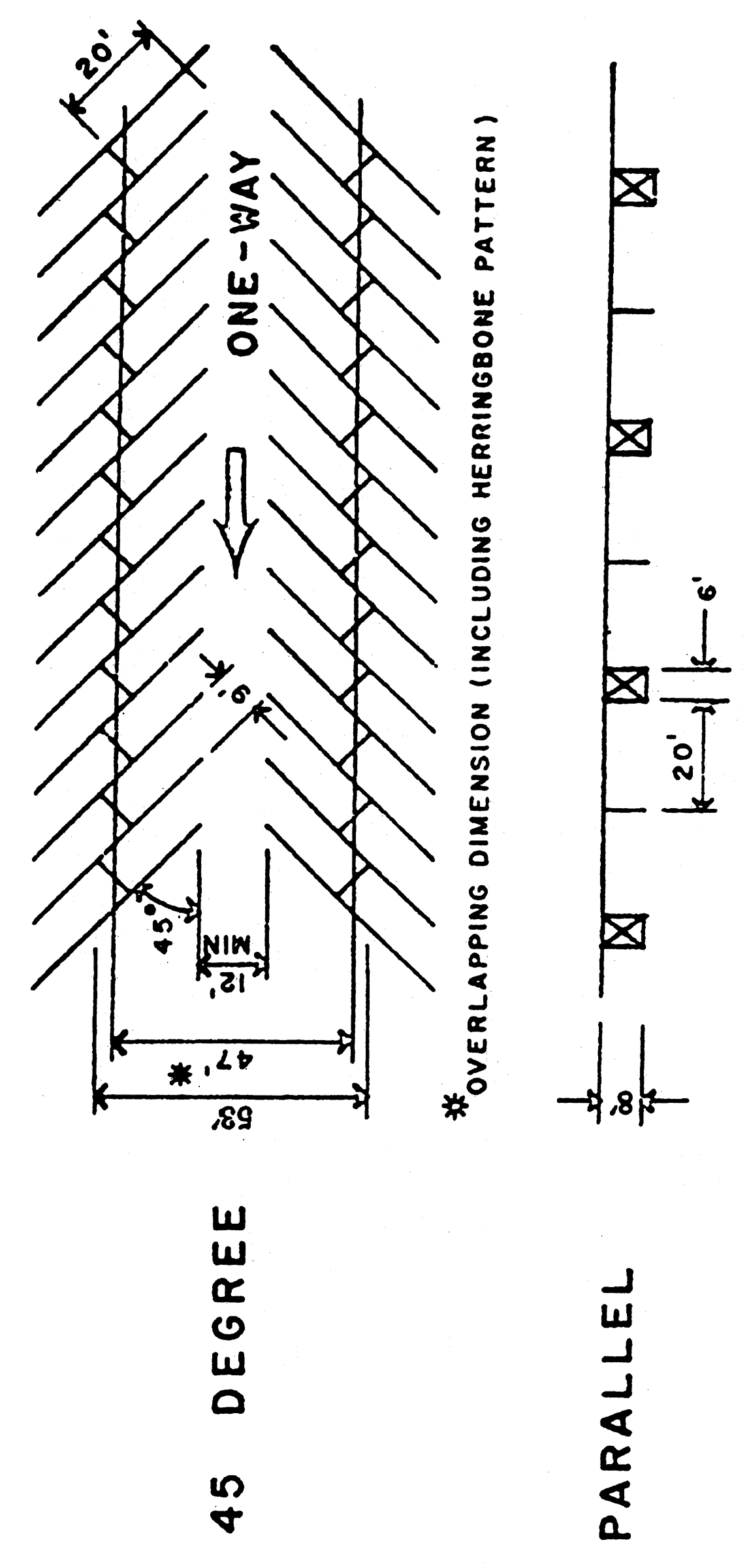
PARKING LAYOUTS (Cont'd.)
(3)
All spaces shall be provided adequate access by means of maneuvering lanes. Backing directly onto a street shall be prohibited.
(4)
Adequate ingress and egress to the parking lot by means of clearly limited and defined drivers shall be provided for all vehicles. Ingress and egress to a parking lot lying in the area zoned for other than single-family residential use shall not be across land zoned for single-family residential use. The minimum width of an access drive shall be at least 11 feet per lot. Adequate radii shall be provided to permit the turning of cars, emergency vehicles and other vehicles necessary to service the site.
(5)
Drives shared by more than one site shall be required where possible. Cross access easements to facilitate vehicular and pedestrian traffic movement between sites served by shared drives shall be a condition of site plan approval where applicable.
(6)
All maneuvering lane widths shall permit one-way traffic movement, except that the 90-degree pattern may permit two-way movement.
(7)
Each entrance and exit to and from any off-street parking lot located in an area zoned for other than single-family residential use shall be at least 25 feet distance from adjacent property located in any single-family residential district.
(8)
Obscuring devices. The off-street parking area shall be provided with a continuous decorative obscuring concrete poured wall, masonry wall with brick veneer facing the adjacent properties, or berm not less than four feet, six inches in height, measured from the surface of the parking area. This obscuring device shall be provided on all sides where the next zoning district is designated as a residential district. When a front yard setback is required, all land between such wall and berm and the front property line or street right-of-way line shall be kept free from refuse and debris and shall be landscaped with deciduous shrubs, evergreen materials, ornamental trees and living ground cover. All such landscaping and planting shall be maintained in a healthy, growing condition, neat and orderly in appearance. Where commercial parking space abuts a thoroughfare, a three and one-half-foot high brick knee wall or berm shall be provided. An obscuring vegetation barrier which can be maintained at three and one-half feet in height may be considered where a wall or berm are not feasible due to underground utility easements.
(9)
The entire parking area, including parking spaces and maneuvering lanes, required under this section, shall be provided with asphaltic or concrete surfacing in accordance with specifications approved by the city engineer. The parking area shall be surfaced within one year of the date of the permit is issued. Off-street parking areas shall be drained so as to dispose of all surface water accumulated in the parking area in such a way as to preclude drainage of water onto adjacent property or toward buildings.
(10)
Parking lot landscaping. The off-street parking area shall have a planting area of at least five feet in width abutting and along any dedicated street right-of-way or easement. This area shall not be used in fulfilling any other landscaped open space requirements in this subsection. This area shall be planted and maintained in a living ground cover and shall be coordinated into the overall landscape planting for the site and parking lot. In addition to the preceding open space requirements, other landscaped areas amounting to at least 15 square feet for each parking space shall be provided. These areas shall be distributed about the parking lot and along the building façade to break up the expanse of paving and provide a more attractive setting for the site and building. In the event a covered walkway or other structural features makes the installation of foundation plantings impractical then planter islands in the parking lot shall be so located to provide plant material areas that soften the building façade. A minimum of at least one tree for each six parking spaces or portion shall be provided within the required landscaped areas in this section. Trees shall be at least ten feet in height or a minimum caliper of at least three inches for deciduous trees and five feet in height and 30 inches in spread for evergreens at the time of planting. Such trees shall be distributed about the landscaped areas as to further break up the expanse of parking and provide a more desirable setting for the site and building. When the planning commission determines that a four and one-half-foot tall wall is not appropriate between multi-family and single-family residential districts an obscuring barrier of plantings which can be maintained at a height of four feet shall be installed to obscure headlight glare. See section 110-631 et seq. for additional landscape requirements. The preceding requirements are exclusive of any required greenbelt transition areas or other open areas required under special use permit approvals unless otherwise specified. All required planting areas shall be landscaped in grass, ground cover, shrubs, trees or other living plant material.
(11)
All lighting used to illuminate any off-street parking area shall be so installed as to be confined within and directed on to the parking area only.
(12)
In all cases where a wall extends to an alley which is a means of ingress and egress to an off-street parking area, it shall be permissible to end the wall not more than ten feet from such alley line in order to permit a wider means of access to the parking area.
(13)
Pedestrian walkway access shall be provided from sidewalks on abutting thoroughfares to commercial buildings.
(14)
The board of appeals, upon application by the property owner of the off-street parking area, may modify the yard or wall requirements where, in unusual circumstances, no good purpose would be served by compliance with the requirements of this section.
(15)
Stop signs shall be included on both sides of all pedestrian crossings of parking lot roadways. Such crossings shall be identified by painted lines perpendicular to the roadway.
(16)
Acceleration and deceleration lanes shall be included at entrances to large developments that will significantly impact traffic conditions.
(Ord. of 11-1-1967, § 15.14; Ord. No. 20-36, §§ 1, 2, 12-28-1973; Ord. of 10-18-1977, §§ 57, 58, 75; Ord. of 8-4-1992, § 8; Ord. of 9-21-2004(1); Ord. No. 08-130, 8-5-2008; Ord. No. 14-009, 2-4-2014; Ord. No. 14-080, 7-15-2014; Ord. No. 14-123, § 2, 12-2-2014; Ord. No. 17-070, 6-6-2017)
Sec. 110-604. - Off-street loading and unloading.
On the same premises with every building, structure or its part, involving the receipt or distribution of vehicles or materials or merchandise, there shall be provided and maintained on the lot adequate space for standing, loading and unloading in order to avoid undue interference with public use of dedicated rights-of-way. Such space shall be provided as follows:
(1)
All spaces in B-1, B-2, B-3 and O-1 districts shall be provided in the ratio required in section 110-511, subsection note (g), under minimum rear yards.
(2)
All spaces in an I-1 and I-2 district shall be laid out in the dimension of at least ten by 65 or 650 square feet in area. Loading dock approaches shall be provided with a permanent, durable and dustless surface. All spaces shall be provided in the following ratio of spaces to usable floor area:
Sec. 110-631. - Financial guarantee.
Wherever in this chapter a greenbelt or planting area is required, the developer shall provide a financial guarantee in the form of cash or certified funds to the city prior to the issuance of any building permit. The amount of the guarantee shall be determined by the building official and shall reflect prevailing prices for the respective quantities and types of activities involved, together with field and seasonal conditions. If any planting program extends into the following construction season, an adjustment in the amount of the financial guarantee shall also be considered to properly reflect any projected changes in costs.
(Ord. of 11-1-1967, § 15.16; Ord. No. 20-37, § 1, 12-28-1973; Ord. of 10-2-1979, § 8; Ord. of 9-1-1981, § 3; Ord. of 12-18-1990, § 1; Ord. No. 09-023, 2-17-2009)
Sec. 110-632. - Planting and approval; certificate of occupancy.
All greenbelt and planting areas shall be planted and approved prior to the issuance of any certificate of occupancy. A temporary certificate of occupancy due to incomplete plantings may be issued when it is demonstrated to the building official that sufficient progress has and is being made in the planting program and/or the season is not conducive to reasonable and acceptable planting conditions. The length of any such temporary certificate of occupancy shall provide for the earliest reasonable completion, but shall not exceed eight months.
(Ord. of 11-1-1967, § 15.16; Ord. No. 20-37, § 1, 12-28-1973; Ord. of 10-2-1979, § 8; Ord. of 9-1-1981, § 3; Ord. of 12-18-1990, § 1)
Sec. 110-633. - Quality of materials; replacement.
Developers shall utilize healthy and vigorous planting materials and adhere to all appropriate standards of handling, installation, watering and maintenance. To ensure compliance with these requirements, the financial guarantees shall extend through the next full growing season. Any dead or unhealthy planting materials shall be replaced promptly in accordance with all appropriate standards. As a further safeguard, the building official may retain up to 90 percent of any financial guarantee throughout the guarantee period.
(Ord. of 11-1-1967, § 15.16; Ord. No. 20-37, § 1, 12-28-1973; Ord. of 10-2-1979, § 8; Ord. of 9-1-1981, § 3; Ord. of 12-18-1990, § 1)
Sec. 110-651. - Intent of division.
The intent of this division is to set forth the basic and specialized review process and requirements necessary to evaluate and control certain uses within the city, hereby declared to be special uses; and further to determine which uses are any other reasonable requirements which will provide for their development and operation without adversely affecting the public health, safety and welfare of the city as a whole. Various land use activities are provided for in one or more zoning districts. The criteria for such allocations is based upon similarities in the nature of the uses and their relationship to other such uses and in turn their relationship to adjacent land uses and thoroughfares. The zoning districts are established to coordinate with and provide for effectuation of the master plan in a logical and desirable manner. Various existing and specialized uses whose operational characteristics and influences require special consideration if they are to be effectively and reasonably permitted in the city.
(Ord. of 11-1-1967, § 15.17.1; Ord. No. 20-19, § 1, 3-20-1971; Ord. of 6-16-1987, § 2; Ord. of 8-16-1988, § 1)
Sec. 110-652. - Filing and processing procedure generally.
The procedure and requirements for filing and processing special use permits are as follows:
(1)
Applications for special use permits shall be filed with the city clerk on a form provided by the city.
(2)
Each application shall be accompanied by a fee as established by resolution of the city council.
(3)
The application shall also include such information as required by section 110-741, site plan review.
(4)
The complete application shall be signed by the fee holder of the affected property.
(Ord. of 11-1-1967, §§ 15.17.2.1—15.17.2.4; Ord. No. 20-19, § 1, 3-20-1971; Ord. of 6-16-1987, § 2; Ord. of 8-16-1988, § 1)
Sec. 110-653. - Basic requirements for review of specified and nonspecified uses.
The following are basic requirements for reviewing various specified and nonspecified uses:
(1)
Outdoor theaters. Because outdoor theaters possess the unique characteristics of being primarily used after darkness and since they develop a concentration of vehicular traffic in terms of ingress and egress from their parking area, they shall be permitted in I-1 districts only. Outdoor theaters shall further be subject to the following conditions:
a.
The proposed internal design shall receive approval from the building inspector and the city engineer as to adequacy of drainage, lighting and other technical aspects.
b.
Points of ingress and egress shall be available to the outdoor theater from abutting major thoroughfares (120-foot right-of-way or greater), and shall not be available from any residential street.
c.
All vehicles, waiting or standing to enter the facility, shall be provided off-street waiting space. No vehicle shall be permitted to wait or stand within a dedicated right-of-way.
d.
The area shall be so laid out as to prevent the movie screen from being viewed from residential area or adjacent major thoroughfares. All lighting used to illuminate the area shall be so installed as to be confined within, and directed onto, the premises of the outdoor theater site.
(2)
Wireless communication towers. Wireless communication towers, including their respective transmission towers, relay and/or receiving antennas and normal accessory facilities involved in television, radio, microwave, cable systems, cellular, personal communication and similar communication services and facilities, shall be permitted when found to be essential or desirable to the public convenience or welfare and in conformance with the following requirements:
a.
The applicant shall submit a written statement and technical verification regarding the nature of any transmissions, electromagnetic fields or any other radiation emitted from the facility and any potential hazards to humans, animals and/or any other materials or property in the area.
b.
A written explanation of the design characteristics and ability of the structures and attendant facilities to withstand winds, ice and other naturally occurring address the potential for the tower or other mounting structure and/or antennas to topple over, or collapse, and what tower configuration should be expected in such an event. Technical documentation of any information regarding these concerns shall also be provided together with actual tower conditions experienced when any such facilities were damaged in other locales. Monopole (stealth or equivalent type) antennae structures shall be encouraged where such are technologically feasible. Monopoles or other stealth type structures, as opposed to web or lattice type towers, are considered particularly desirable when locations in closer proximity to residential zoning districts are involved.
c.
In order to maximize the efficiency of providing such services while minimizing the impact of such facilities on the city, colocation of such facilities on a tower are strongly encouraged. An applicant shall furnish written documentation as to why a colocation, at another site, is not feasible and whether they have in fact contacted the owners of existing facilities to determine if colocation is possible. If the application represents a new tower/antennae facility, the applicant shall provide a letter of intent to lease any excess space on a tower facility and commit itself to:
1.
Promptly respond to any requests for information from a potential co-user of their tower/antennae.
2.
Negotiate in good faith and allow for leased, shared use of the facility when it is technically practical.
3.
Make no more than reasonable charge for a shared use lease.
If the application involves colocation on a tower previously approved under a special use permit and the additional facilities conform with the original spirit, intent and requirements of the special use permit, the public hearing requirement may be waived and approval shall only include a site plan and documentation by the co-user as to their compliance with all of the terms and conditions required of the host applicant.
d.
The development of any such facility, together with accessory uses, shall be in such a location, size and character as to be compatible with the orderly development of the zoning district in which it is situated and shall not be detrimental to the orderly and reasonable development or use of properties in the adjacent areas or the community-at-large. Furthermore, the location and improvement of facilities, as provided for in this subsection (2), shall also be subject to the following additional requirements:
1.
Towers may be located in IRO, I-1 and I-2 industrial districts, provided that the location of such facilities does not represent a hazard to the use and/or development of other permitted uses on the site and in the area. Tower locations within a B-2 or B-3 district may be considered when they are located adjacent to an industrial zoning district or an unbuildable parcel of land such as a wetland or floodplain or are so located on the commercial site as to not adversely affect the commercial development area or any neighboring residential areas.
2.
The tower may be located on a site with existing or other potential principal uses. The site shall be of such size and shape that the proposed tower facility may be developed in compliance with all requirements of the city, and any such tower/antennae shall not exceed 150 feet in height above the average grade around the structure it's mounted upon.
3.
Setback requirements will be determined in relation to the tower/antennae design and collapse data previously required in this division. Minimum setback requirements, unless otherwise provided for, are as follows:
i.
When adjacent to nonresidential zoning districts, the setback shall not be less than the overall height of the tower/antennas; this setback requirement shall also apply to any accessory buildings. If the design and collapse data the tower properly documents its ability to collapse down upon itself, the setback requirements to any side or rear yard property line, abutting a nonresidential zoning district, may be reduced to one-half the overall height of the tower. In no instance shall any tower facility be located within a front yard. Accessory buildings shall be screened from the view of any public right-of-way by an obscuring greenbelt.
ii.
When adjacent to any residential zoning district, the tower setback shall not be less than the overall height of the tower/antennas plus 50 feet; this setback shall also apply to all accessory buildings. If the tower design and collapse data for the tower properly documents it ability to collapse down upon itself, the setback requirement to any side or rear yard property line, abutting any residential district, may be reduced to the overall height of the of the tower/antennas. In no instance shall any tower be located within a front yard. Accessory buildings and uses shall be screened from the view of any public right-of-way and residential zoning district by an obscuring greenbelt.
iii.
Further modifications to the side and rear yard setbacks may be considered when it is documented that the adjacent property is unbuildable due to wetlands, floodplains or other significant limitations. It shall also be found that no adverse effects on reasonable development patterns in the area would be created.
e.
All structures, buildings and required improvements shall comply with all other applicable codes and ordinances, and shall be continuously maintained in a safe, healthful and complying condition. The permit may include a requirement for periodic structural and safety inspections and reports as deemed necessary by the city council.
f.
The applicant shall submit a letter agreeing that should any tower/antennae facility, approved under this section, cease to be used for its approved use, it shall be removed from the site within 180 days of such cessation. Removal of the tower/antennae and its accessory use facilities shall also include removing the top three feet of the caisson upon which the tower is located and covering the remaining portion with topsoil. The letter of agreement may include a financial guarantee, if deemed appropriate by the city council, to ensure removal of any or all of the facilities approved under the special use permit. Any such agreement, including any financial guarantee, shall be in a form acceptable to the city council. The financial guarantee may also include a provision for periodic adjustments, to the guarantee, to reflect changes in the Consumer Price Index or other similarly established and accepted price indexes.
(3)
Outdoor parks; commercial use. Commercial recreational uses of an outdoor park (i.e., baseball, softball, tennis, racquetball, motocross, skateboard, amusement, etc.) may be permitted in B-3 or I-1 or I-2 districts when it is found that:
a.
Access to the site is from a major thoroughfare.
b.
The location of the facility will not adversely affect the development and/or utilization of the commercial or adjacent land use area.
c.
Lighting is shielded to the property in question.
d.
Noises generated by participants, equipment or traffic will be compatible with adjacent uses.
e.
All parking will be located on the subject site and meet all ordinance requirements.
f.
The hours of operation will be compatible with adjacent uses.
g.
Necessary screening and/or transitional area will be provided where deemed necessary.
(4)
Adult entertainment uses.
a.
It has been demonstrated that the establishment of adult businesses in business districts, which are immediately adjacent to and which serve residential neighborhoods, has deleterious effects on both business and residential segments of the neighborhood, causing blight and a downgrading of property values. A prohibition against the establishment of more than two regulated uses within 1,000 feet of each other serves to avoid the clustering of certain businesses, which, when located in close proximity to each other, tend to create a skid row atmosphere. However, such prohibition fails to avoid the deleterious effects of blight and devaluation of both business and residential property values resulting from the establishment of adult bookstores, adult motion picture theaters, adult minimotion picture theaters, adult motion picture arcade, adult motel, adult massage parlor, adult model studio, adult sexual encounter center, and adult cabarets in a business district which is immediately adjacent to and which serves residential neighborhoods. The concern for and pride in the orderly planning and development of a neighborhood should be encouraged and fostered in those persons who comprise the business and residential segments of that neighborhood. The planning commission and the city council should be guided by the expressed will of those businesses and residences which are immediately adjacent to the proposed location of and, therefore, most affected by the existence of any adult bookstore, adult motion picture, adult minimotion picture theater, adult cabaret, etc. For purposes of this section, the provisions of this subsection (4) shall control.
b.
Definitions. The following words, terms and phrases, when used in this subsection (4), shall have the meanings ascribed to them in this subsection (4)b., except where the context clearly indicates a different meaning:
1.
Adult entertainment use. Any use of land, whether vacant or combined with structures or vehicles thereon by which such property is devoted to displaying or exhibiting material for entertainment, a significant portion of which includes matter or actions depicting, describing or presenting "specified sexual activities" or "specified anatomical areas." Adult entertainment uses shall include, but not be limited to, the following:
i.
An adult motion picture theater is an enclosed building with a capacity of 50 or more persons used for presenting material which has a significant portion of any motion picture or other display depicting or relating to "specified sexual activities" or "specified anatomical areas" for observation by patrons therein.
ii.
An adult minimotion picture theater is an enclosed building with a capacity for less than 50 persons used for presenting material which has a significant portion of any motion picture or other display depicting, describing or presenting "specified sexual activities" or "specified anatomical areas."
iii.
An adult motion picture arcade is any place to which the public is permitted or invited wherein coin-operated or slug-operated, or electronically or mechanically controlled still or motion picture machines, projectors or other image producing devices are maintained to show images to five or fewer persons per machine at any one time, and where a significant portion of images so displayed depict, describe or relate to "specified sexual activities" or "specified anatomical areas."
iv.
An adult bookstore is a use which has a display containing books, magazines, periodicals, slides, pictures, cassettes or other printed or recorded material which has a significant portion of its content or exhibit matter or action depicting, describing or relating to "specified sexual activities" or "specified anatomical area" or an establishment with (substantial) segment or section devoted to the sale of display of such material.
v.
An adult cabaret is a nightclub, theater or other establishment which features live performances by topless and/or bottomless dancers, "go-go" dancers, exotic dancers, strippers or similar entertainers, where a significant portion of such performances show, depict or describe "specified sexual activities" or "specified anatomical areas."
vi.
An adult motel is a motel wherein matter, actions or other displays are presented which contain a significant portion depicting, describing, or relating to "specified sexual activities" or "specified anatomical areas."
vii.
An adult massage parlor is any place where, for any form of consideration or gratuity, massage, alcohol rub, administration or fomentations, electric or magnetic treatment or any other treatment or manipulation of the human body occurs as part of, or in connection with, "specified sexual activities" or where any person providing such treatment, manipulation or service related thereto exposes "specified anatomical areas."
viii.
An adult model studio is any place where, for any form of consideration or gratuity, figure models who display "specified anatomical areas" are painted, sculptured, photographed or similarly depicted by persons paying such considerations or gratuities, except that this subsection shall not apply to any bona fide art school or similar educational institution.
ix.
An adult sexual encounter center is any business, agency or person who, for any form of consideration or gratuity, provides a place where three or more congregate, assemble or associate for the purpose of engaging in "specified sexual activities" or exposing "specified anatomical areas."
2.
Significant portion. As used in the definitions in subsection 4(b) of this section, the phrase "significant portion" shall mean and include:
i.
Any one or more portions of the display having continuous duration in excess of five minutes;
ii.
The aggregate of portions of the display having a duration equal to ten percent or more of the display; and/or
iii.
The aggregate of portions of the collection of any materials or exhibits composing the display equal to ten percent or more of the display.
3.
Display. As used in the definitions in subsection (4)b. of this section, the word "display" shall mean any single motion or still picture, presentation, dance or exhibition, live act, or collection of visual materials such as books, slides, periodicals, pictures, video cassettes or any other printed or recorded matter which is open to view or available to the general population whether for free or otherwise.
4.
Specified sexual activities shall mean:
i.
Human genitals in a state of sexual stimulation or arousal.
ii.
Acts of human masturbation, sexual intercourse or sodomy.
iii.
Fondling or other erotic touching of human genitals, pubic region, buttock or female breast.
5.
Specified anatomical areas shall mean:
i.
Less than completely and opaquely covered human genitals, pubic region, buttock, or female breast below a point immediately above the top of the areola; and
ii.
Human male genitals in a discernibly turgid state, even if completely and opaquely covered.
6.
Regulated uses. Those uses and activities which require licenses, approval or permits by city regulations.
c.
Dispersal regulations.
1.
Location. No adult entertainment use shall be located within 1,000 feet of any other adult entertainment use nor within 600 feet of any of the uses set forth below. Such distance shall be measured along the centerline of the street or address between two fixed points on the centerlines determined by projecting straight lines at right angles from the part of the listed uses in this subsection (4)c. nearest to the contemplated location of the structure containing the adult entertainment use and from the contemplated location of the structure containing the adult entertainment use nearest to a use listed in this subsection (4)c.
i.
All class C establishments licensed by the state liquor control commission.
ii.
Pool or billiard halls.
iii.
Coin-operated amusement centers.
iv.
Teenage discos or dancehalls.
v.
Ice or roller skating rinks.
vi.
Pawnshops.
vii.
Indoor or drive-in movie theaters.
viii.
Any public park.
ix.
Any church.
x.
Any public or private school having a curriculum including kindergarten or any one or more of the grades, one through 12.
xi.
Any other regulated uses as defined in this subsection (4).
2.
Prohibited zone. No adult entertainment use shall be located within 600 feet of any area zoned residential. Such required distances shall be measured by a straight line between a point of the boundary line of a zoned residential area nearest to the contemplated structure or contemplated location of the structure containing the adult entertainment use to a point on the contemplated structure or contemplated location of the structure containing the adult entertainment use nearest to the boundary line of a zoned residential area.
3.
Acceptable zones. No adult entertainment use shall be located in any zoning district except a B-3 and I-1 district.
4.
Freestanding building required. All adult entertainment uses shall be contained in a freestanding building.
5.
Display content. No adult use shall be conducted in any manner that permits the observation of any material depicting, describing or relating to specified sexual activities or specified anatomical areas from any public way or from any property not regulated as an adult entertainment use. This subsection shall apply to any display, decoration, sign, show window or other opening.
d.
Variance requirements. In addition to all other requirements for the obtaining of a variance from the provisions of this subsection (4), as set forth in other portions of this chapter, the city council may waive the limiting regulations of this division if all of the following findings are made:
1.
The proposed use will not be contrary to the public interest or injurious to the nearby properties, and that the spirit and intent of this chapter will be observed.
2.
The proposed use will not enlarge or encourage the development of a skid row area.
3.
The person seeking to establish the adult entertainment use shall include a petition which affirmatively demonstrates the approval of the proposed adult entertainment use by 50 percent of the persons owning or occupying premises within a radius of 600 feet of the proposed use. The petitioner shall attempt to contact all occupied premises within this radius, and must maintain a list of all addresses at which no contact was made. The circulator of the petition requesting a variance shall subscribe to a sworn affidavit attesting to the fact that the petition was circulated and that the circulator personally witnessed the signatures on the petition and that to the best of their knowledge such signatures were affixed to the petition by the person whose name appeared thereon. The city council shall not consider the requested waiver under the previous section until the petition shall have been filed and verified to the satisfaction of that council.
(5)
Arcades. Arcades which represent a principal use of a structure shall only be permitted in the B-3 general business district, subject to the following conditions:
a.
Any such use shall not be located closer than 100 feet to any residential district.
b.
The site shall be so located as to abut a major thoroughfare, and all ingress and egress shall be directly from such major thoroughfare.
c.
The location and hours of operation shall be such that the facility, together with its users, shall not adversely affect the development and utilization of adjacent and neighboring properties. Particular concern shall be given to adverse effects resulting from the congregation and/or loitering on the premises, including areas outside the building. The applicant, together with the owner of the building and site area, if other persons are involved, shall agree that all necessary measures shall be taken to avoid any adverse effects and that any problems relating to the arcade operation that persist for more than a total of 30 days will result in immediate revocation of the occupancy certificate for the arcade.
(6)
Multiple-family mid-rise and/or senior housing facilities. In order to establish some flexibility in meeting a changing market demand for housing facilities, it may be possible to grant an increase in height limitations and a variation in density when certain conditions and objectives can be met. Any deviation from established standards will be considered in the context of the development patterns and character of the area around the proposed project and those of the city as a whole. It is not the stated or implied intent of this section to provide for unwarranted conversions of existing multiple zoned or planned areas to greater heights and densities. Existing development standards within the R-M multiple residential zoning district provide for proper and reasonable development and use of these areas and the attendant needs of accessory parking and necessary open space. The simple fact that an increase in height and consequently, an increase in density may be achieved, is not the mandated purpose of this division. The purpose of this division is to permit an increase in height to accommodate mid-rise residential structures in such locations which are properly related to resident needs and services, to the needs and rights of adjacent land uses and the abilities of the city to properly service the proposed use. It is also the intent of this division to consider variations in height and/or densities for independent living units for senior when it is demonstrated that the functional impact will not adversely impact the area. It is not the intent of the latter provision to permit mid-rise structures in the middle of a single-family area. To this end, the following conditions shall be considered in evaluating requests for special land use permits:
a.
The proposed site shall be approximately two acres or larger in size and of such configuration as to permit proper development of the site.
b.
The location shall be compatible with adjacent zoning patterns and/or proposed land uses as designated on the master plan.
c.
Vehicular access to the site shall be from a major thoroughfare. In the instance of senior citizen independent living units, access via a collector or local thoroughfare may be considered when it is demonstrated that the resulting traffic will not represent any increase in volumes and character or traffic over that than if the subject site were development for single-family usage. The intent of this latter provision is to accommodate small scale independent senior housing facilities and may involve permitting such a use in a one-family zoning district when conversion of a school or quasi-public building is involved. In the instance of a senior assisted living facility, access may be via a collector or local thoroughfare.
d.
An increase in height shall be related to the nature and character of the abutting areas as presently zoned and as designated on the master plan. It is intended that heights will be increased on those sites having access from a major thoroughfare and when the abutting uses are either primarily nonresidential in nature and/or are unbuildable in nature. Increases in height shall be limited to five stories. Increases in height shall also be related to factors of accessibility as provided on the site plan and the abilities of the city to service the proposed construction.
e.
The site plan will also be carefully considered with respect to safe and convenient traffic and pedestrian movements to and from the site and within the site. Landscaping will also be considered in terms of its complimenting the building, its site and adjacent areas. Site plans resulting in a primary concentration of landscaping in the front yard, with the balance of the site occupied by building and parking, without any provisions for planting islands and transition greenbelts, are not considered desirable.
f.
Setbacks shall be related to those set forth in section 110-511 for R-M multiple residential districts. A reduction in setback may be granted only when it can be determined that there are special conditions and/or unbuildable areas in adjacent areas which indicate that uses involved will not be adversely affected by a reduction in setback.
g.
Increases in density may be permitted for four and five story buildings when it can be determined that any increased impacts can be accommodated and served by the city. The upper density limits for four- and five-story buildings will be related to the following schedule of lot area per dwelling unit:
Density increases, however, will also be reviewed in terms of the provision and maintenance of proper parking, landscaping and circulation requirements. There shall be no increase in functional densities and adverse impacts affecting single-family areas. Increases from two to three stories shall not involve increases in density and may be permitted when it is demonstrated that such an increase is warranted by reason of floodplains, wetlands and/or the preservation of other significant environmental or physical site features.
(7)
Uses not otherwise specified. Other uses which have not been specifically mentioned may be processed under a special use permit if they possess unique or innovative operational or development characteristics. Any such use must be processed and reviewed in accordance with the procedures and requirements set forth in this division.
(Ord. of 11-1-1967, § 15.17.2.5; Ord. No. 20-19, § 1, 3-20-1971; Ord. of 6-16-1987, § 2; Ord. of 8-16-1988, § 1; Ord. of 4-1-1997, § 1; Ord. No. 19-102, 10-1-2019)
Sec. 110-654. - Public hearing; notice; council decision on application; conditions.
(a)
Upon receipt of a complete application which involves a discretionary decision, notice shall be given to including all owners of record of property and occupants of structures, within a radius of 300 feet of the premises in question, such notice to be delivered personally or by mail addressed to the respective owners at the addresses given in the latest assessment roll and published in a newspaper of general circulation in the City of Woodhaven. If the name of the occupant is not known, the term "occupant" may be used in making notification. Notification need not be given to more than one occupant of a structure, except that if a structure contains more than one dwelling unit or spatial area owned or leased by different individuals, partnerships, businesses or organizations, one occupant of each unit of spatial area shall receive notice. In the case of a single structure containing more than four dwelling units or other distinct spatial areas owned or leased by different individuals, partnerships, businesses or organizations, notice may be given to the manager or owner of the structure who shall be requested to post the notice at the primary entrance to the structure. The notice shall:
(1)
Describe the nature of the special land use request;
(2)
Indicate the property which is the subject of the special land use request including the existing street addresses contained in that property;
(3)
State when and where the special land use request will be considered;
(4)
Indicate when and where written comments will be received concerning the request;
(5)
Indicate that a public hearing on the application may be requested by owners of record or occupants of structures within 300 feet of the property being considered for a special land use, regardless of whether the property or occupant is located within the city.
(b)
At the initiative of city council, or at the request of the applicant, a real property owner whose property is assessed within 300 feet of the property or an occupant of a structure, within a radius of 300 feet of the property, a public hearing shall be held before a discretionary decision is made on the request for a special land use. Following the public hearing, the planning commission shall forward a copy of the application, the minutes of the public hearing, and the planning commission recommendation to the city council. The city council shall review and make final determination on the application. The city council shall also have the authority to grant variances from zoning standards which are determined to be consistent with the terms, spirit and intent of the special use permit application and conformance to proper principals of planning and zoning.
(c)
Reasonable conditions may be required in conjunction with the approval of a special land use, planned unit development, or other land uses or activities permitted by discretionary decision. The conditions may include conditions necessary to ensure that public services and facilities affected by a proposed land use or activity will be capable of accommodating increased service and facility loads caused by the land use or activity, to protect the natural environment and conserve natural resources and energy, to ensure compatibility with adjacent uses of land, and to promote the use of land in a socially and economically desirable manner.
(d)
Prior to approving any application for a special use permit, the city council shall find adequate evidence that the proposed use:
(1)
Will be harmonious with and in accordance with the general objectives of the master plan.
(2)
Will be designed, constructed, operated and maintained in harmony with the existing and intended character of the general vicinity and so that such use will not change the essential character of that area.
(3)
Will not be hazardous or disturbing to existing or future neighboring uses.
(4)
Will represent a substantial improvement to property in the immediate vicinity and to the community as a whole.
(5)
Will be served adequately by essential public services and facilities, such as highways, streets, drainage structures, police and fire protection and refuse disposal, or persons or agencies responsible for the establishment of the proposed use shall be able to provide adequately for such services.
(6)
Will not create excessive additional requirements at public cost for public facilities and services, and will not be detrimental to the economic welfare of the community.
(7)
Will not involve uses, activities, processes, materials, equipment and conditions of operation that will be detrimental to any persons, property, or the general welfare by reason of excessive smoke, fumes, glare, noise, vibration or odors.
(8)
Will be consistent with the intent and purposes of this chapter.
(9)
Will be in compliance with all other applicable codes and ordinances.
(e)
The decision on a special land use shall be incorporated in a statement of findings and conclusions relative to the special land use which specifies the bases of the decision of any conditions imposed. Further, it shall be noted that all approvals of special land use are tied to the specific property noted in the special land use application.
(Ord. of 11-1-1967, § 15.17.2.6; Ord. No. 20-19, § 1, 3-20-1971; Ord. of 6-16-1987, § 2; Ord. of 8-16-1988, § 1; Ord. of 6-1-1999; Ord. No. 07-114, 9-4-2007; Ord. No. 12-002, 1-3-2012)
Sec. 110-655. - Compliance with division provisions.
In order to ensure that the proposed use under a special use permit fulfills the requirements of this division:
(1)
The planning commission may recommend and the city council require such additional conditions and safeguards as deemed necessary to ensure that public services and facilities affected by a proposed land use or activity will be capable of accommodating increased service and facility loads caused by the land use or activity, to protect the natural environment and conserve natural resources and energy, to ensure compatibility with adjacent uses of land, and to promote the use of land in a socially and economically desirable manner. The breach of any condition, safeguard or requirement, and the failure to correct such breach within 30 days after an order to correct such condition is issued by the city council, shall be reason for immediate revocation of the permit. Additional time for correction of the cited violation may be allowed by the city council upon submission of proof of good and sufficient cause. Conditions and requirements stated as a part of special use permit authorizations shall be continuing obligations of the holders of such permits and are binding upon their heirs and assigns and upon any persons taking title to the affected property which such special use permit is in effect. Accordingly, the special use permit shall be recorded with the county register of deeds. The special use permit may also require that a specified percentage of authorized construction be completed within a stated time, as a condition to the issuance of the permit.
(2)
The discontinuance of a special use after a specified time may be a condition to the issuance of the permit. Renewal of a special use permit may be granted after a review and determination by the city council, after recommendation of the planning commission, that continuing private need and public benefit will be served by such renewal, provided that the renewal application shall be in accord with standards and requirements in effect at the time that the renewal is requested.
(3)
If a use of a site is permitted by a special use permit and such use becomes authorized by a rezoning of the affected site, then the special use permit may be terminated. Such termination may be initiated only after determination by the planning commission that the development status of the site is in accordance with requirements of the zoning district in which it is to be placed, and with the development plan of the city.
(4)
No application for a special use permit which has been denied by the city council shall be resubmitted until the expiration of one year from the date of such denial, except on grounds of newly discovered evidence or proof of changed conditions, sufficient to justify reconsideration by the planning commission. Each reapplication will be treated as a new application.
(Ord. of 11-1-1967, § 15.17.2.7; Ord. No. 20-19, § 1, 3-20-1971; Ord. of 6-16-1987, § 2; Ord. of 8-16-1988, § 1)
Sec. 110-681. - Generally.
No use otherwise allowed shall be permitted within any use district which does not conform to the standards of use, occupancy and operation, which standards are hereby established as the minimum requirements to be maintained within such area.
(Ord. of 11-1-1967, § 15.18)
Sec. 110-682. - Smoke.
(a)
It shall be unlawful for any person to permit the emission of any smoke from any source whatever to a density greater than that density described as No. 1 of Ringelmann Chart; provided, however, that the following exceptions shall be permitted: Smoke, the shade or appearance of which is equal to, but not darker than, No. 2 of the Ringelmann Chart for periods aggregating four minutes in any 30 minutes. The council may also approve excessive smoke emissions when associated with an essential firefighting training program.
(b)
Method of measurement. For the purpose of grading the density of smoke, the Ringelmann Chart, as now published and used by the United States Bureau of mines, which is hereby made a part of this chapter, shall be the standard. However, the Umbra scope readings of smoke densities may be used when correlated with the Ringelmann Chart.
(c)
All other airborne emissions shall, at a minimum, comply with the applicable federal and state standards.
(Ord. of 11-1-1967, § 15.19; Ord. No. 17-071, 6-6-2017)
Sec. 110-683. - Dust, dirt and fly ash.
(a)
No person shall operate or cause to be operated, maintain or cause to be maintained any process for any purpose, or furnace or combustion device for the burning of coal or other natural or synthetic fuels, without maintaining and operating, while using such process or furnace or combustion device recognized and approved equipment, means, method, device or contrivance to reduce the quantity of gasborne or airborne solids of fumes emitted into the open air, which is operated in conjunction with such process, furnace or combustion device so that the quantity of gasborne or airborne solids shall not exceed 0.20 grains per cubic foot of the carrying medium at a temperature of 500 degrees Fahrenheit.
(b)
Method of measurement. For the purpose of determining the adequacy of such devices, these conditions are to be conformed to when the percentage of excess air in the stack does not exceed 50 percent at full load. Such requirements shall be measured by the A.S.M.E. Test Code for dust-separating apparatus. All other forms of dust, dirt and fly ash shall be completely eliminated insofar as escape or emission into the open air is concerned. The building inspector may require such additional data as is deemed necessary to show that adequate and approved provisions for the prevention and elimination of dust, dirt and fly ash have been made.
(Ord. of 11-1-1967, § 15.20)
Sec. 110-684. - Storage.
In all business, office and industrial districts, the open storage of any equipment, vehicles and all materials shall be screened from public view, from a street and from adjoining properties by an enclosure consisting of a wall which may, depending upon the land usage, be required to be eight feet in height. In no instance shall such wall be less than four feet, six inches, measured from the surface of the adjacent building footing. In all residential districts, the storage of dismantled vehicles shall be within completely enclosed accessory structures. Open storage of trailer coaches may be permitted upon review and approval of the board of appeals. In granting approval, the board of appeals shall require storage in the rear yard and shall prohibit connection of utilities to the stored trailer, and further, shall prohibit occupancy of the trailer. The board of appeals may establish specific conditions in approving storage to ensure that public health, safety and welfare are maintained.
(Ord. of 11-1-1967, § 15.21; Ord. of 11-4-1986, § 2)
Sec. 110-685. - Glare and radioactive materials.
Glare from any process (such as or similar to arc welding or acetylene torch cutting) which emits harmful rays shall be performed in such a manner as not to extend beyond the property line, and as not to create a public nuisance or hazard along lot lines. Radioactive materials and wastes, and including electromagnetic radiation such as X-ray machine operation, shall not be emitted to exceed quantities established as safe by the U.S. Bureau of Standards, when measured at the property line.
(Ord. of 11-1-1967, § 15.22)
Sec. 110-686. - Fire and explosive hazards.
The storage and handling of flammable liquids, liquefied petroleum, gases and explosives shall comply with the state rules and regulations as established by Public Act No. 207 of 1941 (MCL 29.1 et seq., MSA 4.559(1) et seq.).
(Ord. of 11-1-1967, § 15.23)
Cross reference— Fire prevention and protection, ch. 46.
Sec. 110-687. - Noise.
(a)
Noise shall not be emitted in excess of the sound pressure levels specified in the table below (other than ambient background noises produced by sources not under the control of this ordinance such as from street traffic. In residential areas the occasional noise of a lawn mower, snow blower, church bells, etc. or a construction project shall be excluded when such events are conducted at times and locations to minimize interference with neighboring properties). The noise source shall be measured at any point along the property line or within the property line of the receiving premises to determine compliance with this section.
Allowable Noise Levels (in dBA) with Time of Day Allowance
Measurement of the sound shall be made with a sound level meter using an A-weighted scale, which conforms to specifications of the American National Standards Institute, or the sound levels shall be measured by an equivalent, accepted method employed by the acoustical engineering profession.
(b)
Objectionable noises, due to intermittence, high frequency, or shrillness, shall be muffled so as not be become a nuisance to adjacent uses.
(c)
Sound amplifying equipment shall be so shielded, directed, and/or placed so as not to become a nuisance to adjacent uses. Outside sound-amplifying equipment shall be prohibited if in any instance the equipment is louder than the noise levels specified in subsection (a) above.
(Ord. of 11-1-1967, § 15.24; Ord. No. 06-068, 7-5-2006)
Sec. 110-688. - Odors.
Any condition or operation which results in the creation of odors of such intensity and character as to be detrimental to the health and welfare of the public or which interferes unreasonably with the comfort of the public shall be removed, stopped, or so modified as to remove the odor.
(Ord. No. 17-071, § 2, 6-6-2017)
Sec. 110-689. - Waste disposal.
All solid, liquid, and sanitary wastes shall be treated and disposed of in accordance with the standards of the City of Woodhaven, Wayne County, and the State of Michigan. Treatment or disposal of waste shall not create a hazard or nuisance to neighboring uses.
(Ord. No. 17-071, § 2, 6-6-2017)
Sec. 110-690. - Electrical disturbance, electromagnetic, or radio frequency interferences.
No use shall:
(1)
Create any electrical disturbance that adversely affects any operations or equipment other than those of the creator of such disturbance.
(2)
Cause, create, or contribute to the interference with electronic signals (including television and radio broadcasting transmission) to the extent that the operation of any equipment not owned by the creator of such disturbance is adversely affected.
(Ord. No. 17-071, § 2, 6-6-2017)
Sec 110-691. - Hazardous substances.
Use, storage and handling of hazardous substances; storage and disposal of solid, liquid and sanitary wastes shall comply with the following:
(1)
It shall be unlawful for any person, firm, corporation or other legal entity to pollute, impair or destroy the air, water, soils or other natural resources within the city through the use, storage and handling of hazardous substances and/or wastes or the storage and disposal of solid, liquid, gaseous and/or sanitary wastes.
(2)
Any person, firm, corporation or other legal entity operating a business or conducting an activity shall disclose the use, storage or generation of hazardous substances, in conjunction with the following:
a.
Upon submission of a site plan;
b.
Upon any change of use or occupancy of a structure or premises; or
c.
Upon any change of the manner in which such substances are handled, and/or in the event of a change in the type of substances to be handled.
(3)
Prior to city approval of a business or activity which uses, stores, or generates hazardous substances, the site plan and manner of storage shall be reviewed by the city fire department. All businesses and facilities which use, store, or generate hazardous substances in quantities greater than 100 kilograms per month shall comply with the following standards:
a.
Above-ground storage.
1.
Hazardous substances shall be stored only in product-tight containers within locations approved by the building department and fire department.
2.
Secondary containment of hazardous substances shall be provided for all facilities. Secondary containment shall be sufficient to store the substance for the maximum anticipated period of time necessary for the recovery of any released substance.
3.
Outdoor storage of hazardous substances is prohibited except in product-tight containers which are protected from weather, leakage, accidental damage and vandalism through secondary containment. Secondary containment shall be sufficient to store the equivalent of the primary container plus an allowance for the expected accumulation of precipitation.
4.
Facilities for above-ground storage shall be screened from public view. Such screening shall be designed to ensure access by the fire department and permit the circulation of air around the storage facility.
b.
Underground storage. State and federal agency requirements for storage, leak detection, record keeping, spill prevention, emergency response, transport and disposal shall be met.
(Ord. No. 17-071, § 2, 6-6-2017)
Sec. 110-711. - Applicable conditions.
The following conditions shall apply to all signs erected and located in any use district:
(1)
Except for the following nature of signs, none shall be erected, installed, altered or relocated unless and until all necessary building and zoning permits have been issued by the building official and/or ordinance officer for any such sign(s). When a development is proposed that involves a new freestanding sign or a new freestanding sign on an existing development the request shall be reviewed and approved as set forth herein. The replacement of panels on a conforming sign or on a nonconforming sign or a new wall sign on an existing development may be approved by the building official and/or ordinance officer subject to the conditions subsequently set forth in this section. In issuing any such permits factors of design and construction related to appropriate building and zoning requirements and the general public safety shall also be considered.
(a)
Freestanding signs that include the name of the resident, or residence. See sections 110-713 and 110-714.
(b)
Real estate signs used for advertising land or buildings for rent, lease or sale and when located on the land or building intended to be rented, leased or sold. See sections 110-713 and 110-714.
(c)
Political signs in R-1 and R-2 districts. See sections 110-713 and 110-714.
(2)
Maximum sign area shall mean all sign faces, surfaces and/or sides including supplemental signs e.g. ATM and Lotto signs. In addition, when viewing any side of a sign and the visible surface area of the sign frame together with the surface area of any support, decorative panels and other panels exceed 40 percent of the sign area(s) the excess area over the 40 percent shall be counted as sign area for the purpose of computing the permissible sign area.
(3)
No sign, except those established and maintained by the municipality, county, state or federal governments, shall be located in, project into, or overhang public right-of-way or dedicated public easement.
(4)
No sign otherwise permitted shall project above or beyond the maximum height limitation as provided for in sections 110-713 and 110-714, except that for a planned commercial or shopping center development involving five acres or more under one ownership.
(5)
All directional signs required for the purpose of orientation, when established by the municipality, county, state or federal government shall be permitted in all use districts.
(6)
Signs shall not be painted directly on the wall or roof of a building.
(7)
Non-accessory signs (billboards) shall be permitted only in I-2 industrial districts, as provided for in section 110-713 and 110-714, except that non-accessory signs pertaining to real estate development located within the municipality and designed to promote the sale of lots or homes within a subdivision located within the municipality may be permitted on a temporary basis in any use district, but shall not be located upon subdivided land unless such land is part of the subdivision being advertised for sale and shall be subject to the requirements and conditions of all codes and ordinances of the city.
(8)
Illumination of signs shall be directed or shielded downward so as not to interfere with the vision of persons on the adjacent highway or adjacent property owners and shall comply with all other requirements of the city.
(9)
No signs or billboards shall be located in a manner that will obscure the vision of drivers using streets, access drives or otherwise conflict with any traffic control devices.
(10)
All signs and billboards shall be maintained in a neat, orderly and safe condition.
(11)
Signs painted on, or otherwise affixed to, trucks, trailers, or other vehicles shall be subject to the terms and conditions set forth in this division for portable signs unless the following conditions are met:
(a)
The vehicle or trailer has a valid license.
(b)
The vehicle or trailer is operable and usable for transportation, deliveries and/or service accessory to the principal on-site use it serves.
(c)
The vehicle or trailer is moved from the site more than 50 percent of time during normal business hours.
(d)
Any such truck and/or trailer parked on the site during non-business hours shall be located either in the rear yard, loading service area or side yard but only if obscured from view from a public thoroughfare.
(12)
Replacement signs. When a sign is to be replaced, it shall thereafter conform to all requirements of this zoning ordinance. This shall not prevent the lawful continuance of non-conforming signs that were legally established prior to the current requirements of the zoning ordinance. The following provisions shall apply to replacement of panels and signs intended to replace non-conforming signs:
(a)
The owner of a non-conforming sign may replace a panel or face of the sign in order to identify a new tenant, use or occupant or refurbish such sign as permitted in that zoning district provided the sign is not enlarged or otherwise made more non-conforming. Approval of replacement panels may be granted by the building official and/or ordinance officer, if they conform to building and safety requirements of the city. All signs located within the downtown development district shall be reviewed by the DDA for conformance with the CBD study and adopted design guidelines for the DDA and shall advise the city official, board, commission or council responsible for approving any such sign of its conformance or non-conformance with said guidelines.
(b)
The replacement of a non-conforming sign or signs with a sign that conforms to the current requirements of the zoning ordinance may be approved by the building official and/or ordinance officer, following review by the DDA if the sign is located within the DDA district, without the need for formal planning commission review and approval.
(13)
Lighting of signs. Lighting shall be decorative in nature, shielded and shall not interfere with pedestrians or drivers.
(Ord. of 11-1-1967, §§ 15.25(a), 15.25(b); Ord. No. 20-10, § 1, 2-20-1969; Ord. of 12-17-1974, §§ 1, 2, 6; Ord. of 10-18-1977, § 1; Ord. of 8-15-1989, § 3; Ord. of 8-15-2000; Ord. No. 06-069, 7-5-2006)
Sec. 110-712. - Definitions.
The following words, terms and phrases, when used in this division shall have the meanings assigned to them in this section, except where the context clearly indicates a different meaning:
Accessory sign means a sign which pertains to the principal use of the premises.
Advertising sign means a non-accessory sign and shall relate to a business, use or service not carried on the premises upon which the sign is placed.
Billboards mean a non-accessory sign.
Bulletin board or announcement sign means a business sign of the following nature:
(1)
Church name and service, school activities, etc.
(2)
A directory of offices, commercial or industrial activities, activities within a building or planned grouping of buildings.
Business sign means an accessory sign and shall relate to the business, activity or service conducted on the premises upon which the sign is placed.
Canopy sign means a sign attached to the underside of a permanent structure that essentially serves as a covered pedestrian walkway that is attached to a building and is in close proximity to the use it serves. Maximum display area of such a sign is one square foot for each one lineal foot the structure extends out from the building facade. The sign shall not project out beyond the edge of the structure it is mounted under nor shall be closer than two feet to any curb line. The maximum size of any such sign shall not exceed eight square feet. A minimum clearance of eight feet shall be provided between the bottom of the sign and the grade below.
Directional sign means a sign to direct vehicular or pedestrian traffic to parking areas, loading areas or portions of buildings and shall not be used for advertising purposes.
Electronic message center (EMC) is that portion of permitted sign that contains electronically programmed or controlled changeable information. Such information may include temperature and time, product prices, products, special events of activities taking place on the premises. All EMC's shall be subject to a public hearing by the planning commission.
Festoon sign means a business sign where incandescent light bulbs, pennants or other such features are hung or stung overhead and are not an integral physical part of the building or structure they are intended to serve.
Flashing or animated sign means a sign that intermittently reflects lights or has movement from an artificial or natural source or has movement that is of a flashing or scintillating nature or has varying intensities of illumination that may distract drivers or possible confusion with emergency vehicle warning lights.
Freestanding sign means a sign not attached to a building, subject to the conditions and requirements of this chapter where otherwise applicable, includes pylon, monument/ground and other freestanding signs.
Identification and nameplate sign means a sign stating the name of a person, firm or name of or description of, a certain permitted use.
Maximum size of sign means the area encircled within a continuous outer perimeter boundary encompassing all letters, logos, symbols, filigrees, frames, etc. or grouping of signs including supplemental signs e.g. ATM and Lotto; includes all solid and open surface areas and shall include all faces of a sign or signs. Excluded from this computation when viewing a sign face from its respective sides are any surface area(s) created by supporting uprights, columns, panels or other features where their aggregate surface areas is less than 40 percent of the sign area of the associated sign face. Street address numbers up to 12 inches in height are also excluded from area computations. Wall signs that are located on a panel or framed area that differentiates between the sign and the surface upon which they are located shall include the panel or framed area in the size computation. Channel type letters mounted on a facade without any distinguishing background shall include the area encompassed within the perimeter boundary line drawn around the outer edges of the letters.
Monument sign is a freestanding sign attached to a base or structure having a permanent location on the ground and characterized by a lower sign height. Any such sign shall comply with the lower height restriction for such signs in the respective zoning districts.
Non-accessory sign means a sign that does not pertain to the principal use of the premises.
Political sign means a sign relating to the election of person to public office, or relating to a political party, or relating to a matter to be voted upon at an election called by a public body.
Portable sign means a sign affixed to a vehicle or trailer, carried by a person or any other sign not permanently attached to the ground that permits it to be moved or transported.
Projecting (hanging) sign means a sign attached to a building or other structure and extending in whole or part, more than 18 inches beyond the surface of the portion of the building to which it is affixed. Such sign shall not extend over public property.
Pylon sign is a freestanding sign with a majority of the space between the sign and the grade being open in nature and thereby facilitating better visibility between vehicles and/or vehicles and pedestrians. The minimum required distance between the bottom of the sign and the ground that is to be primarily open is ten feet.
Real estate development signs mean a business sign relating to a subdivision or other real estate development to indicate a proposed start or to inform relative to availability.
Real estate sign means a sign placed upon a property advertising that particular property for sale, lease or rent.
Replacement sign means the lawful replacement of a sign panel within an existing sign or sign structure that does not increase the sign area or otherwise modify the size of the sign.
Sign means the use of any words, numerals, figures, devices, designs, or trademarks by which anything is made known so as to show an individual firm, profession, business, product or message and are visible to the general public.
Temporary window sign means any paper, poster board, plastic film, cloth or similar material and its associated message sign, when permitted, that is designed to be placed on or behind a display window and be visible from outside a business building; such sign shall occupy not more than 25 percent of the window area.
Wall sign means a sign erected on or fastened against the wall or mansard of a building structure with the exposed face of the sign in a plane approximately parallel to the plane of such wall and not extending more than 18 inches beyond the surface of the building wall or mansard on which erected or fastened. Wall signs also include window signs whether permanent or temporary but exclude signs indicating hours or being open.
(Ord. of 11-1-1967, § 15.25(b); Ord. No. 20-10, § 1, 2-20-1969; Ord. of 12-17-1974, §§ 1, 2, 6; Ord. of 10-18-1977, § 1; Ord. of 8-15-1989, § 3; Ord. No. 06-069, 7-5-2006; Ord. No. 08-120, §§ 1, 2, 7-1-2008; Ord. No. 13-182, 12-3-2013)
Cross reference— Definitions generally, § 1-2.
Sec. 110-713. - Requirements relative to height, area and type.
In addition to sections 110-711 and 110-712, the following requirements relative to height, area and types of signs apply as follows:
Legend:
(a) — Indicates applicable footnote
0 — Denotes type of structure not permitted
x — Denotes type of structure permitted
(Ord. of 11-1-1967, § 15.26 tablenotes; Ord. No. 20-10, § 1, 2-20-1969; Ord. of 12-7-1974, §§ 3—5; Ord. of 10-18-1977, § 2; Ord. of 10-7-1980; Ord. of 9-4-1984, §§ 3, 4; Ord. of 2-21-1989, § 1; Ord. of 8-15-1989, § 4; Ord. of 4-3-1990, § 1; Ord. No. 06-069, 7-5-2006; Ord. No. 08-120, § 3, 7-1-2008; Ord. No. 14-123, § 3, 12-2-2014)
Sec. 110-714. - Footnotes to table of section 110-713.
(a)
Non-accessory billboard signs. Non-accessory billboard signs shall be permitted in the I-2 heavy industrial district only, but shall be spaced no closer than 1,000 feet between signs on the same side of the right-of-way. The maximum height of any sign shall not exceed 40 feet and shall be setback at least 75 feet from any property line except those abutting any residential district, in which case the setback shall be a minimum of at least 300 feet. The maximum size of any such sign with one sign surface is 500 square feet. Signs with dual sign surfaces shall not exceed 720 square feet, with no one side exceeding 360 square feet in sign area. Dual faced signs shall be constructed as one basic sign structure, having at least one edge of the sign surface in common with the other sign surface, the interior angle formed by a two-sided sign shall not exceed 30 degrees.
Electronic message centers are permitted subject to special use permits. Light output shall not be greater than reflected light from illuminated billboards. Programming shall not include scrolling or flashing lights.
(b)
Political signs. Political signs shall be subject to other applicable conditions and requirements of this section for an election called by a public body. Such signs shall not be located in, project into or overhang a public right-of-way or dedicated public easement and shall not exceed 16 square feet in all districts except I-1 or I-2 districts, in which such signs may be up to 200 square feet. Permits shall be required for all such political signs other than those erected in residential districts. All political signs erected must be erected by the landowner or with the written permission of the landowner. No such sign shall create any problem of visibility between vehicles and/or between pedestrians.
(c)
B-1 and O-1 districts business signs.
(1)
Basic requirements. Only monument signs are permitted and the size of such sign is related to the parcel frontage along an abutting major or secondary thoroughfare as designated on the city's master plan. The permitted size of a sign shall include all sign surfaces and shall include window signs unless otherwise excluded. The size of the sign shall also require that when a sign face is viewed from a particular side the surface area of any frame, pole, panel or other supporting structure(s) for the sign shall not exceed 40 percent of the visible sign area.
(2)
Freestanding signs. Monument signs shall be setback not less than 15 feet from any street right-of-way line. In situations where uses are served by a marginal access drive the sign shall be setback at least ten feet and so located as to provide proper sight distances between vehicles and pedestrians. The minimum setback to any abutting residential zoning district is 40 feet.
Unless otherwise provided for herein the maximum total size of all such sign surfaces shall not exceed one-half square foot for each lineal foot of lot frontage on a particular major or secondary thoroughfare. In no instance shall the size of said sign exceed 75 square feet. The maximum height of a monument sign above grade shall be eight feet.
Unless otherwise provided for herein a maximum of one monument sign shall be permitted per structure or planned grouping of structures. In the event that a use has frontage on two major and/or secondary thoroughfares and each such thoroughfare has at least 200 feet of frontage one such sign may be placed on each frontage.
(3)
Wall signs. Wall signs involve "primary" and "secondary" signs. A primary wall sign is oriented toward the public entrance(s) to a facility or to the facade that is most visible from a major or secondary thoroughfare without adversely affecting neighboring residential areas as determined by the building official. Once the permissible size of the primary sign is established it also becomes the basis determining the size of a secondary wall sign. The maximum size of all primary wall sign areas is related to a ratio of three-quarters square feet for each one lineal foot of facade adjacent to interior space occupied by said user. In the event a user does not have signage on a freestanding sign the ratio for determining the sign size may be increased to one square foot for each one lineal foot of facade adjacent to interior space occupied by said user. However, a primary wall sign shall not exceed five percent coverage of the facade area involved in the calculation or 100 square feet whichever is less.
A secondary wall sign may be permitted subject to the following limitations. Any such sign shall be located on a facade that is at least 300 feet from any residential zoning district boundary. One secondary sign shall be permitted provided such sign shall not exceed 20 percent of the permissible primary wall sign area nor occupy more than two percent of the facade it is located upon or 30 square feet whichever is less.
When tenants share a common public entrance a common wall sign may be placed near this entrance. Each tenant is limited to three square feet of such signage with the aggregate size of the overall sign not exceeding 50 square feet.
Establishments serving food or beverages on the premise may place a daily menu display on the building wall near the door in a weatherproof case without product advertisements. The size of the case shall accommodate the menu provided to customers but shall not exceed two square feet.
(4)
Electronic message center (EMC). An electronic message center (EMC) may be permitted subject to approval under a special use permit. Conditions of such approval are the following:
a.
Size of the EMC is limited to 50 percent of the total sign surface it is a part of up to a maximum of 15 square feet;
b.
Location of sign with respect to conflicts with safe traffic movements on neighboring roadways;
c.
EMC's may be operated from 8.:00 a.m. to 10:00 p.m. only;
d.
Frequency of message change shall be no more than once every 60 seconds;
e.
There shall be no message change from dusk to 10:00 p.m.;
f.
All EMC's shall include light sensors; and be capable of programming variable light output;
g.
Light output shall be programmed to dim in response to ambient light;
h.
Light output shall be dimmed to 30 percent after dusk;
i.
Scrolling messages are not permitted;
j.
EMC owners shall permit city, state, and federal governments to post messages in the event of an emergency;
k.
Message copy shall not include flashing light.
(d)
B-2, B-3, IRO and I-1 signs.
(1)
Basic requirements. The size of freestanding signs (pylon and monument) is related to the parcel frontage along an abutting major or secondary thoroughfare major and secondary thoroughfares are designated on the city's master plan. The permitted size of such sign shall include all sign surface areas and shall include window signs unless otherwise excluded. The permitted size of such signs shall also require that when a sign face is viewed from a particular side the aggregate amount of visible surface areas created by any frame, pole, decorative or other panels or other supporting members for the sign shall not exceed 40 percent of the sign face area.
(2)
Freestanding signs. Unless otherwise provided for herein a freestanding sign shall be setback not less than 15 feet from any street right-of-way line. In situation where uses are served by a marginal access drive a pylon sign shall be setback at least two feet toward the building from the service drive and monument type signs shall be setback at least ten feet and so located as to provide proper sight distances between vehicles and vehicles/pedestrians. The minimum setback to a property line abutting a residential zoning district is 100 feet for a pylon sign and 40 feet to a monument sign. The minimum setback to an abutting nonresidential zoning district is 30 feet for a pylon sign and 20 feet for a monument sign.
Unless otherwise provided for herein the maximum size of all sign surfaces shall not exceed three-fourths of a square foot for each lineal foot of lot frontage on the abutting thoroughfare; maximum sign size is 150 square feet unless otherwise provided for herein. In instances where a development does not elect to use any pylon type signs a monument type sign(s) maybe increased by ten percent in size provided proper sight distances are observed in all traffic and/or traffic pedestrian areas. The maximum height of a pylon sign shall not exceed 20 feet or eight feet for a monument sign.
Unless otherwise provided for herein a maximum of one freestanding sign shall be permitted per structure or planned groupings of structures. An additional freestanding sign may be permitted for a second frontage when such a development has frontage on two major/secondary thoroughfares and each such area has at least 300 lineal feet of frontage. An additional freestanding sign may also be permitted, along a particular major or secondary thoroughfare, when such frontage exceeds 500 feet in length provided the aggregate size of such signs shall not exceed that permitted by the lineal frontage involved nor the maximum permitted sign size and that any such signs shall be spaced at least 200 feet apart and shall comply with all other setback requirements.
(3)
Wall signs. Wall signs involve "primary" and "secondary" wall signs. A "primary wall sign" is oriented toward the public entrance(s) to a facility or to a facade that is most visible from a major or secondary thoroughfare without adversely effecting neighboring residential area. Once the permissible size of the primary wall sign is established it also becomes the basis for determining the size of any "secondary wall sign(s)". The maximum size of all sign surfaces for a primary sign is related to a ratio of 1.5 square foot for each one lineal foot of facade adjacent to interior space occupied by said user up to a maximum to 250 square feet. In the event a user does not have any signage on a freestanding sign the ratio for determining size may be increased to 1.75 square feet for each one lineal foot of facade occupied by said user. If a use is setback over 100 feet from any major or secondary thoroughfare and it does not have more that four square feet of signage on a freestanding sign listing tenants in a planned development the ratio of 1.75 maybe used for determining wall sign sizing. However, a primary wall sign shall not exceed eight percent of the primary facade or 300 square feet whichever is less.
"Secondary wall signs" may be permitted up to three additional facades when deemed appropriate subject to the following limitations: Any such sign shall not exceed 25 percent of the permissible primary wall sign area and shall be located more than 200 feet to any residential zoning district boundary. Such secondary signs may be increased a square foot for each square foot the primary wall sign is less than permitted. However, no secondary sign shall be larger than the primary sign. Signs shall not occupy more than five percent of the facade it is located upon or 70 square feet, whichever is less.
When tenants share a common public entrance a common wall sign may be placed next to this entrance. Each tenant is limited to three square feet with the aggregate size of such a sign not exceeding 60 square feet.
Establishments providing food and beverages on the premises may place a daily menu display on the building wall near the door in a weatherproof case without product advertisements. The size of the case shall accommodate the menu provided to customers but shall not exceed two square feet.
(4)
Electronic message center (EMC). An EMC may be permitted subject to approval by the planning commission following a public hearing. Conditions of such approval are the following:
a.
Size of the EMC is limited to 50 percent of the total sign surface it is a part of up to a maximum of 38 square feet per side (e.g. 3'8" X 9' 11");
b.
Location of sign with respect to conflicts with safe traffic movements on neighboring roadways;
c.
Frequency of message change shall be no more than once every 30 seconds;
d.
All EMC's shall include light sensors; and be capable of programming variable light output.
e.
Light output shall be programmed to dim in response to ambient light;
f.
Scrolling messages are not permitted;
g.
EMC owners shall permit city, state, and federal governments to post messages in the event of an emergency;
h.
Message copy shall not include flashing light.
(e)
CBD (central business district) signs.
(1)
Basic requirements. The size of freestanding signs is related to the parcel frontage along an abutting major or secondary thoroughfare as designated on the city's master plan. The permitted size of such a sign shall include all sign surface areas and also requires that when a sign face is viewed from a particular side the aggregate amount of visible surface area created by any frame, pole, decorative panel or any other solid or filigreed surface area shall not exceed 40 percent of the visible sign face area. Window signs shall be included within the total permitted sign area, unless they are exempted by another provision herein.
It is understood that the basic intent of the central business district (CBD) zoning district is to create a vital business area assuming the role of a more traditional downtown shopping area. Toward that end the use of freestanding signs is discouraged; however, it is also recognized that a number of the existing businesses in this area have preexisting freestanding signs and the city requests that property owners consider modifications that would either eliminate or bring such signs into closer harmony with the design concepts proposed for the CBD district. It should be noted that the permitted signs in the CBD district are oriented to provide for a greater diversity of sign types, particularly when efforts are made to incorporate elements recommended in the DDA (downtown development authority) central business district study and its related design concepts.
The design of signs within this district shall seek to enhance architectural features of a building and the district. In this respect consideration shall be given to the size, shape, color, texture and lighting of signs in relation to the architecture of the building. Use of quality materials is required. Materials such as metal, stone, hard wood and brass plating are permitted. Exposed neon tubing may be used in conjunction with other types of materials to artistically emphasize the business name or logo. Back-lit, halo-lit illumination, or reverse channel letters with a halo illumination are highly encourage for lighting purposes. Transformers, raceways and other mechanical equipment for signs shall be hidden from public view.
Within the CBD zoning district any sign installation or modification, shall require planning commission approval prior to issuance of a building permit by the building official and/or ordinance officer.
(2)
Freestanding signs. The installation of new freestanding signs is strongly discouraged within the CBD district to minimize clutter and distractions to the overall environment of a downtown type area. In view of some existing development patterns it may be reasonable to provide for a freestanding sign to serve uses that are setback a substantial distance from the public roadways serving the site. In terms of any new signs they shall be of a monument nature and shall be predicated on a size that limits all sign surfaces to an aggregate total of not more than three-quarters of a square foot of signage for each lineal foot of lot frontage along a major/secondary thoroughfare as designated on the city's master plan. One such sign per structure or planned grouping of structures is permitted with a maximum of all freestanding sign surfaces on a sign not exceeding 150 square feet with a sign height not exceeding eight feet. In the event the site fronts on two major/secondary thoroughfares and the frontage on each such street is 300 feet or more one such sign may be permitted on each such street. Freestanding signs must maintain the minimum corner clearance defined in section 110-744.
In the event the proposed sign activity involves the refacing of an existing sign the applicant and the city shall seek to achieve a compromise in size and/or design if the applicant presents a compelling case that the sign is a legal nonconforming use, is in proper structural condition and is essential to the reasonable use of the property. If a compromise arrangement cannot be reached then a public hearing under the basic terms and conditions of a special use permit, division 5 of this article shall be held to determine the individual merits of presentations by both parties.
(3)
Wall signs. Wall signs involve "primary" and "secondary" wall signs. A "primary wall sign" is oriented toward the public entrance(s) to a facility or to a facade that is most visible from a major or secondary thoroughfare without adversely affecting neighboring residential areas. Once the permissible size of the primary sign is established it also becomes the basis for determining the size of any "secondary wall sign(s)". The maximum size of a primary sign is related to ratio of 1.5 square feet for each one lineal foot of facade adjacent to interior space occupied by said user provided that the total sign area contained in all primary signs not exceed eight percent of the facade involved in the size determination or 250 square feet whichever is less primary signs include: wall, awning, canopy, marquee, projecting/hanging, window/door, plaque, permanent banners and restaurant menus. In situations where the city finds an applicant is developing an improvement plan that reflects comprehensive coordination with the design and development guidelines provided by The DDA development plan exclusions to the sign area limitations are permitted to be granted. Potential exclusions involve the following types of signs:
a.
Projecting (hanging) sign or permanent banner - An applicant may elect to utilize one of these two types of signs. Either sign shall be installed with at least eight feet of clearance between the bottom of the sign and the grade level below it and shall not overhang any public right-of-way. Such a sign(s) shall have 12 inches of clearance to the wall it is affixed to and shall not exceed five square feet in total sign area nor project more that 36 inches from the wall. Signs may only contain the business name and logo.
b.
Canopy - Is applicable only when fixed canopy or covered walkway is provided at the front of the building. Such colors shall be coordinated and compatible with the awning and the rest of the building's facade. Sign lettering or logo shall comprise no more than 30 percent of the exterior surface of the awning or canopy. Backlit awnings/canopies are prohibited. Awnings should be projected over individual doors and windows, and shall not be continuous over the entire width of the facade. Awnings shall be mounted on wood or metal framing of the door or window, and not the wall surrounding the opening. Appropriate materials for awnings and canopies are matte finish canvas or similar fabrics, glass or metal.
c.
Plaque - A small version of wall sign not extending outward more than two inches from the wall listing the name of the facility and placed close to the entrance doorway and not exceeding two square feet in area.
d.
Restaurant menu - A weatherproof case where the daily menu may be exhibited without product advertisements and shall be placed on the building wall near the public entrance. The size shall accommodate the menu provided to diners at the table but shall not exceed two square feet in area
e.
Permanent window signs - Permanent window signs shall not exceed 25 percent of the window area so that visibility into and out of the window is not obscured. Sign copy shall not exceed eight inches in height. Window sign copy shall be applied directly to the glazed area or hung inside the window there by concealing all mounting hardware and equipment.
f.
For multiple store buildings where upper floors may be to leased to separate nonresidential users, 25 percent of the permitted wall sign area for the building will be allowed to these upper floor tenants.
g.
Signs indicating the hours of operation and indicating whether the facility is open or closed are excluded from sign area limitations provided they are of a standard size and design and do not exceed four square feet in area.
"Secondary wall signs" may be permitted (up to three) additional facades provided the facades are oriented to public access points or are readily visible to the public thoroughfare providing primary access to the facility. Any such sign shall not exceed 25 percent of the permissible primary sign area and shall be located at least 200 feet from any residential district boundary. Such secondary signs may be increased a square foot for each square foot the primary wall sign is less than permitted. However, no secondary sign shall be larger than the primary sign. Such signs shall not occupy more than five percent of the facade it is located upon or 70 square feet whichever is less.
When tenants share a common public entrance a common wall sign may be placed next to this entrance. Each tenant is limited to two square feet with the aggregate size of sign not exceeding 60 square feet.
(4)
Electronic message center (EMC). An electronic message center (EMC) may be permitted subject to approval by the Planning Commission following a public hearing. Conditions of such approval are the following:
a.
Size of the EMC is limited to 50 percent of the total sign surface it is a part of up to a maximum of 38 square feet per side (e.g.. 3'8" X 9' 11");
b.
Location of sign with respect to conflicts with safe traffic movements on neighboring roadways;
c.
Frequency of message change shall be no more than once every 30 seconds;
d.
All EMC's shall include light sensors; and be capable of programming variable light output;
e.
Light output shall be programmed to dim in response to ambient light;
f.
Scrolling messages are not permitted;
g.
EMC owners shall permit city, state, and federal governments to post messages in the event of an emergency;
h.
Message copy shall not include flashing light.
(f)
I-2 signs.
(1)
Basic requirements. The size of freestanding signs is related to the parcel frontage along any abutting major or secondary thoroughfare as designated on the city's master plan. The permitted size of such a sign shall include all sign surface areas and also required that when a sign face is viewed from a particular side the aggregate amount of visible surface area created by any frame, pole, decorative panel or any other solid or filigreed surface area shall not exceed 40 percent of the visible sign face area. Unless otherwise excluded window signs are considered in size limitations on wall signs. Electronic message centers and flashing signs are not permitted. (I-2 signs are intended to identifty the business and not for advertisement).
(2)
Freestanding signs. Freestanding signs shall be setback not less than 15 feet from any street right-of-way line. In situations where uses are served by a marginal access drive a pylon sign shall be setback at least two feet toward the building from the service drive and monument type signs shall be setback at least ten feet and so located as to provide proper sight distance between vehicles and vehicles/pedestrians.. The minimum setback to a residential district zoning district line is at least 100 feet for a pylon sign and 50 feet for a monument sign. The minimum setback to an abutting nonresidential zoning district is 40 feet for a pylon sign and 20 feet for a monument sign.
Unless otherwise provided for herein the maximum size of all sign surfaces shall not exceed three-fourths square feet for each lineal foot of lot frontage along a particular major, secondary or internal industrial drive. The maximum size of such a sign shall not exceed 150 square feet. The height of a pylon size shall not exceed 20 feet or eight feet for a monument sign.
Unless otherwise provided for herein a maximum of one freestanding sign shall be permitted per structure or planned group of structures. In the event that a use has frontage on two major/secondary thoroughfares or internal industrial drive and each such roadway has a frontage of at least 300 feet, one such sign may be placed along each such frontage and shall be subject to the above ratios of sign area per lineal footage of frontage.
(3)
Wall signs. Wall signs involve "primary" and "secondary" signs. A "primary wall sign" is oriented toward the public entrance(s) to a facility or to a facade that is most visible from a major or secondary thoroughfare without adversely effecting neighboring residential areas. Once the permissible size of the primary wall sign is established it also becomes the basis for determine the size of any "secondary wall sign(s)". The maximum size of a primary is related to a ratio of one and one-half square feet for each one lineal foot of facade adjacent to interior space occupied by said user. In the event a use does not have any signage on a freestanding sign the ratio for determining sign size may be increased to one and three-quarters square feet. If a use is setback over 100 feet from any major/secondary thoroughfare or internal industrial drive and does not have more than four square feet of signage on a pylon or monument sign listing tenants in a development the ratio for determining sign size may also be increased to one and three-quarters. However, a primary wall sign shall not exceed eight percent of the primary facade or 250 square feet whichever is less.
Up to three secondary wall sign may be permitted when deemed appropriate subject to the following limitations: any such sign shall be located on a facade that is at least 300 feet from any residential zoning district line. Such secondary signs may be increased a square foot for each square foot the primary wall sign is less than permitted. However, no secondary sign shall be larger than the primary sign and it does not exceed 25 percent of the permissible primary wall sign area or exceed five percent of the facade it is located upon or 70 square feet whichever is less.
When tenants share a common public entrance a common wall sign may be placed near this entrance. Each tenant is limited to four square feet with the aggregate size of the sign not exceeding 80 square feet.
(g)
Nonresidential uses in residential districts.
(1)
Basic requirements (nonresidential uses). In any residential districts, such signs shall be restricted to such uses as are permitted and regulated.
(2)
Freestanding signs. One freestanding accessory sign shall be permitted in a required yard, provided that it is located no closer than 15 feet to: any existing or proposed right-of-way line (whichever is greater) or driveway offering access to the site. Furthermore, any such sign shall be located at least 50 feet to residential zoning district boundary and 15 feet to any exterior property line abutting any nonresidential zoning district. The maximum area of any such sign shall not exceed one-quarter square feet for each lineal foot of lot frontage on a major or secondary thoroughfare as designated on the city's master plan and shall not exceed a total of 32 square feet for all sign surfaces. The height of the sing shall not exceed a total of 32 square feet for all sign surfaces. The master plan and shall not exceed a total of 32 square feet for all sign surfaces. The height of the sign shall not exceed six feet above the average established grade within 50 feet of the sign.
(3)
Wall signs. One wall sign facing the frontage access street shall be permitted provided it does not exceed ten percent of the façade upon which it is located or 30 square feet whichever is less.
(4)
Electronic message center (EMC). An electronic message center (EMC) may be permitted subject to approval by the planning commission following a public hearing. Conditions of such approval are the following:
a.
Size of the EMC is limited to 50 percent of the total sign surface it is a part of up to a maximum of 15 square feet;
b.
Location of sign with respect to conflicts with safe traffic movements on neighboring roadways;
c.
EMCs may be operated from 8:00 a.m. to 10:00 p.m. only;
d.
Frequency of message change shall be no more than once every 30 seconds;
e.
There shall be no message change from dusk to 10:00 p.m.
f.
All EMC's shall include light sensors; and be capable of programming variable light output;
g.
Light output shall be programmed to dim in response to ambient light;
h.
Light output shall be dimmed to 30 percent after dusk;
i.
Scrolling messages are not permitted;
j.
EMC owners shall permit city, state, and federal governments to post messages in the event of an emergency;
k.
Message copy shall not include flashing light.
(h)
Directional signs. On-site directional signs for other than residential uses are permitted behind the minimum front yard setback line excluding such a sign at the access drive point provided it is located at least 15 feet from the right-of-way one. Any such sign shall be limited to not more than four feet in height and four square feet in area and shall not contain any advertising and shall be used to direct traffic to parking areas, loading areas or portion of the building. In the event directional type signs are used to create guides or information stations along a pedestrian trail all such signs shall seek to follow the size and placement guidelines as closely as possible but shall also convey all necessary information in a manner that does not create nay unsafe traffic or pedestrian conditions.
(i)
Residential identification signs—One- and two-family. Unless otherwise provided for herein a dwelling shall be limited to its house numbers and an identification nameplate not exceeding two square feet in area.
(j)
Identification sign—Multiple developments. A freestanding sign identifying a multiple-family development is governed by the standards set forth in footnote (h).
(k)
Real estate sales signs. Signs used for advertising individual land and/or buildings for sale, rent and/or lease shall be permitted when located on the land or building intended to be sold, rented and/or leased. Such signs shall not exceed eight square feet in area.
(l)
Real estate development signs.
(1)
Basic requirements. Real estate development signs pertaining to the promotion of sales and/or rental of new development projects are permitted as both accessory and non-accessory signs. Such signs may be permitted on a temporary basis to facilitate such sales and/or rentals and shall require an approved building permit from the building official that states the conditions and time period during which the permit is valid. Approved signs may be erected approximately 60 days prior to anticipate construction and shall be removed within 14 days of the selling or leasing of the last unit(s). Temporary sign permits shall not initially exceed 18 months in duration any may be considered for renewal on up to 12 month extensions. In the instance where multiple signs are involved on larger projects the process of renewal shall consider the reasonableness of reducing the number of signs to avoid site clutter, interference with occupied units and/or sight restrictions.
(2)
Residential developments. Residential development signage shall be related to the scale of the development and the type of street the project fronts on. Along a major or secondary thoroughfare, the aggregate size of signs shall not exceed one-quarter-square-foot of signage for each lineal foot of frontage: no one sign surface shall contain more than 24 square feet or an aggregate total of over 100 square feet along any such frontage. Unless it is demonstrated to the building official that adverse conditions would be created such signs shall be setback at least 15 feet from the right-of-way; setbacks of 50 feet shall be observed to any adjacent nonresidential zoning district and not less than 100 feet to any residential district. A distance of at least 300 feet shall be provided between any such signs.
(3)
Nonresidential developments. In the case of nonresidential types of development, the ratio of signage per front foot may be increased to one-half-square-foot per lineal foot of frontage. The maximum size of any sign surface shall not exceed 32 square feet or an aggregate sign area total of 128 square feet along any one particular thoroughfare.
(4)
Off-site signs. Off-site signs relating to any such development shall not be located on subdivided or developed residential properties or minor residential streets unless it can be demonstrated that such a sign is essential to directing people to the development project and written permission is obtained from the property owner(s). The placement of off-site signs in a nonresidential zoning district shall require frontage on a major thoroughfare and any sign surface shall not exceed 32 square feet nor shall all such signs exceed a total signage area of 64 square feet. The number of off-site signs pertaining to a development project area shall be kept to a minimum and shall not exceed three such signs under any circumstances.
(m)
Entranceway structure signs. When an entranceway structure is proposed in conjunction with section 110-743 a sign may be placed on such a structure indicating the name of the development subject to the following limitations: no advertising is permitted on the sign; the sign shall not extend above or beyond the structure. The maximum size of a sign is 32 square feet per structure and shall include all sign faces.
(n)
Special event signs—Temporary signs.
(1)
Basic requirements. Special event signs shall include those permitted for grand openings and/or special promotion events. The building official shall be responsible for issuing such permits. All such temporary signs and/or devices shall be anchored, mounted or otherwise secured in a manner that will avoid creating danger to the public, distraction to drivers, dangerous traffic movement or create inappropriate stress on components or electrical services that represent a potential hazard to the structures and/or public. Unless otherwise specifically provided for inflatable devices are not considered as appropriate temporary sign devices and shall not be permitted.
(2)
Grand openings. For a grand opening involving a new business activity or a change in ownership additional signage utilizing two of the following options will be considered: a temporary sign banner stating "grand opening", a portable sign or pennants (festoons). A temporary banner shall conform to the size limitation of the primary permitted wall sign. A portable sign whether trailer or ground mounted shall not exceed 100 square feet of total sign surfaces. The location of such signs shall observe, as closely as possible, the 15-foot setback from public street rights-of-ways and shall not create sight distance problems between vehicular movements or between vehicles and pedestrians. A string of pennants (flag) with a length not exceeding two lineal feet for each lineal foot of principal building faced with direct public visibility. The maximum aggregate length of all such strings shall not exceed 200 feet nor contain pennants with area exceeding one-half-square-foot per lineal foot of string. In the case of a vehicular or similar type of dealer individual pennants or balloon may be mounted to vehicles provided the pennants or balloons not exceed one square foot of pennant or balloon per two feet of permissible string length. Balloons and/or other inflatable devices shall be specifically limited to those of a smaller nature, approximately 14 inches in diameter or smaller. The authorization of special event signage as set forth above shall only be permitted for not more than 15 days during any 12 consecutive months.
(3)
Sales promotion events. In the case of a planned shopping center or grouping of buildings special event signage shall not involve more than 15 consecutive days at one time and the aggregate number of days for any such displays shall not exceed 60 days in any 12 consecutive months.
(4)
Residential area events. Special event signs may be permitted n residential areas when accessory to "permitted uses" in said areas. Signs shall be located on the premises involved and shall be limited to non-profit organizations. Permits for such activities shall not be issued for more than 15 days at a time nor more than 60 days during any 12 consecutive months. The location of such signs shall observe the 15-foot setback from public street rights-of-ways as closely as possible and shall not create sight distance problems between vehicles or between vehicles and pedestrians. All such temporary signs and/or devices shall be anchored, mounted or otherwise secured in a manner that will avoid creating dangers to the public, distractions to drivers and/or create inappropriate stresses on building components or any electrical services that may result in danger to the public.
(5)
Municipal events. Municipal signs pertaining to public event activities, serving the city, may be placed in strategic locations as public notices.
(Ord. of 11-1-1967, § 15.26 footnotes; Ord. No. 20-10, § 1, 2-20-1969; Ord. of 12-7-1974, §§ 3—5; Ord. of 10-18-1977, § 2; Ord. of 10-7-1980; Ord. of 9-4-1984, §§ 3, 4; Ord. of 2-21-1989, § 1; Ord. of 8-15-1989, § 4; Ord. of 4-3-1990, § 1; Ord. No. 06-069, 7-5-2006; Ord. No. 08-120, §§ 4—13, 7-1-2008; Ord. No. 11-097, §§ 1—3, 7-19-2011; Ord. No. 14-008, 2-4-2014; Ord. No. 14-123, § 4, 12-2-2014)
Sec. 110-741. - Site plan review (all districts).
(a)
A pre-application conference is required prior to all major site plan applications to ensure that Woodhaven ordinances, policies, and guidelines are considered at the beginning of site design. Such conferences will include the planning consultant and representatives from all of the affected city departments. Formal pre-application conferences may be waived for minor and low impact applications by agreement of the planning consultant, building official, and planning commission chair.
(b)
A site plan shall be submitted to the planning commission for approval of:
(1)
Any use or development for which the submission of a site plan is required by any provision of this chapter.
(2)
Any development, except one-family residential, for which off-street parking areas are provided as required in section 110-602, off-street parking requirements.
(3)
Any use in OFA, R-M, B-1, B-2, B-3, O-1, I-1 or I-2 district lying contiguous to or across a street from a single-family residential district.
(4)
Any use which lies contiguous to a major thoroughfare.
(5)
All residentially related uses permitted in one-family districts such as, but not limited to: churches, schools and public facilities.
(c)
Every site plan submitted to the planning commission shall contain such information and be in such form as the planning commission may prescribe in its rules and/or as set forth herein. Applicable data to be provided shall provide accurate and sufficient data for all buildings and/or structures that effect or involve factors of visibility, site circulation and safety and the reasonable review and analysis of any proposed buildings, structures or other improvements required as part of a proposed development. Such information may include but is not limited to such data as:
(1)
Floor plans and elevations of proposed buildings together with all other proposed accessory buildings and/or structures on an accurate composite site plan as set forth on the site plan check sheet.
(2)
Adjacent zoning districts.
(3)
Building setbacks together with the foot print of adjacent buildings/structures within 100 feet of the property boundaries.
(4)
The location of all driveways on abutting properties and those on the opposite side of the street within 100 feet of the property boundaries or as projected across the right-of-way.
(5)
A landscape plan indicating the location and type(s) of materials proposed together with the schedule of proposed planting materials. Wet lands must be identified and preserved or mitigated in accord with state and/or local requirements. A vegetation plan shall identify protected trees and ensure preservation or mitigation in accord with local requirements. A financial guarantee in the form of cash or certified funds for the minimum landscaping required by subsection 110-603(9) and the city commercial design guidelines "planting requirements" shall be provided prior to issuance of any building permit.
(6)
Required schedules of floor areas, living units, off-street parking requirements, loading areas and landscaping.
(7)
Details of proposed screening devices and dumpster enclosures.
(8)
Site lighting plans including fixture details, locations and lighting levels over the site.
(9)
Required site plan information shall be provided on sheets that are signed and sealed.
(10)
Existing and proposed public and private sidewalks. Sidewalks shall be provided along all thoroughfares and extend into developments along all access roadways. Stop signs shall be included on both sides of all pedestrian crossings of parking lot roadways. Such crossings shall be identified by painted lines perpendicular to the roadway.
(11)
With the exception of permissible replacement signs as set forth in section 110-711 the location of any new freestanding or wall sign with all necessary supporting documentation shall be submitted for site plan approval.
(12)
The location of any surface or underground stormwater detention areas.
(13)
A traffic assessment for all developments expected to generate 500 to 749 one-directional trips during an average day or 50 to 99 trips one-directional trips during the peak hour. A traffic assessment would include the following:
a.
Trip generation analysis based on the anticipated peak hour trips according to the latest edition of Trip Generation published by the Institute Transportation Engineers;
b.
A description of the site, surroundings, and study area. Illustrations and a narrative should describe the characteristics of the site and adjacent roadway system (functional classification, lanes, speed limits, etc.);
c.
Description of proposed use including number and type of dwelling units, floor area, and number of employees;
d.
Description of existing traffic conditions including peak-hour traffic volumes on streets adjacent to the site, roadway characteristics, and all existing driveways;
e.
Projected traffic generated shall be distributed on to the existing street network to project turning movements at site access points and at nearby intersections. Projected turning movements shall be illustrated in the report.
f.
Access design and access management standards that support the proposed driveways will provide safe and efficient traffic operation and be in accordance with the standards of the city and applicable road agencies;
g.
Service drives, interconnected parking, appropriate curb cut spacing and shared driveway curb cuts are encouraged.
(14)
A full traffic impact study (TIS) for all developments expected to generate 750 or more one-directional trips during an average day or 100 or more one-directional trips during the peak hour. A TIS would include the information required for a traffic assessment outlined above, as well as the following:
a.
A level of service or capacity analysis at the proposed access points using the procedures outlined in the most recent edition of the Highway Capacity Manual published by the Transportation Research Board.
b.
A level of service or capacity analysis at off-site intersections where forecasted site-generated traffic would constitute at least five percent of existing traffic unless specifically waived in advance by the city or its designated consultant.
c.
The study should outline mitigation measures and demonstrate any changes to the level of service achieved by these measures.
No site plan shall be approved until such plan has been reviewed by the planning commission for compliance with all applicable ordinances and regulations of the city. Any use which handles materials regulated by state or federal agencies, due to their hazardous nature, shall file all required information with the city fire department as prescribed by law. In any situation where a proposed development involves a site which has been occupied or is believed to be effected by an activity involving materials which are regulated by the federal or state governments, due to their hazardous nature, an environmental site assessment phase I will be required to be filed with the site plan. This assessment shall be prepared by experienced and qualified professionals. Should the phase I report or any subsequent required report indicate any site contamination, improvement of any portion of the site adversely impacted or effected by the contamination shall be delayed until the applicant can furnish proof that the problem is corrected or that a mitigation plan has been approved by MDEQ, or other regulating agency, and that such due care plan is satisfactorily underway and the proposed site improvements will not adversely effect the mitigation operation.
(15)
Acceleration and deceleration lanes shall be included at entrances to large developments that will significantly impact traffic conditions.
(d)
In the process of reviewing the site plan, the planning commission shall consider:
(1)
One-family residential development on the basis of a subdivision.
(2)
The location and design of driveways providing vehicular ingress to and egress from the site, in relation to streets giving access to the site, and in relation to pedestrian traffic.
(3)
The traffic circulation features within the site and location of automobile parking areas, and shall make such requirements with respect to any matters as will ensure:
a.
Safety and convenience of both vehicular and pedestrian traffic both within the site and in relation to access streets, including perimeter and interior sidewalks for pedestrian traffic except when the planning commission shall find no necessity for such sidewalks.
b.
Satisfactory and harmonious relations between the development on the site and the existing and prospective development of contiguous land and adjacent neighborhoods.
c.
Adequate and efficient movements of handicapped persons, emergency vehicles and other vehicles necessary to service the site.
(4)
In order to achieve desirable circulation and development, the planning commission may recommend and the council may require the dedication of public right-of-way through the site area to any site plan approval.
(5)
The planning commission may further require landscaping, fences and walls in pursuance of these objectives and the landscaping fences and walls shall be provided and maintained as a condition of the establishment and the continued maintenance of any use to which they are appurtenant.
(6)
In those instances wherein the planning commission finds that an excessive number of ingress and/or egress points may occur with relation to major or secondary thoroughfares, thereby diminishing the carrying capacity of the thoroughfares and/or creating other traffic, and/or land use transitional problems, they may require marginal access streets as defined in the city's subdivision chapter (chapter 58 of this Code) or marginal access drives as defined in this chapter, as follows:
a.
In approving the site plan, the planning commission may recommend marginal access drives or marginal access streets. For a narrow frontage, which will require a single outlet, the planning commission may recommend that money be placed in escrow with the city so as to provide for such streets or drives equal in length to the frontage of the property involved. Marginal access streets and drives shall be so designed and arranged as to promote efficient and safe traffic and turning movements. Sufficient separation shall be provided between any public roadways and/or drives to provide a proper turning radius which will seek to minimize any interruptions in traffic flow in either traffic way. A marginal access drive shall have a minimum pavement width of 22 feet, back-of-curb to back-of-curb. Landscaping adjacent to marginal access drives or streets shall not obscure the visibility of vehicular and/or pedestrian traffic and freestanding signs between such streets or drives and major or secondary thoroughfares shall not be permitted.
b.
The planning commission shall require marginal access drives for all subdivisions having residential lots facing onto major thoroughfares. Where practical, the planning commission shall require side lot or rear lot relationships to major thoroughfares.
c.
Drives shared by more than one site shall be required where possible. Cross access easements to facilitate vehicular and pedestrian traffic movement between sites served by shared drives shall be a condition of site plan approval where applicable.
(7)
All site plan approvals granted by the planning commission, pursuant to the requirements of this section, shall be valid for a period of one year from the date of approval.
(8)
That parking spaces are adequate for the proposed land use in accord with section 110-602 and meet all other requirements of division 3, Parking Regulations. (Building Code 2003) Chapter 11 - Accessibility and ICC ANSI 1998). Due to the regions higher than average number of assessable parking permits, the number of required assessable spaces should be 25 percent greater than the required minimum rounded to the next higher number of spaces. Consideration should be given to shared parking where appropriate and supported by a professionally prepared shared parking study and approved by the city traffic analyst.
(9)
A planning commission finding of compatibility with the master plan shall be part of all special use permit, and flexible development, and rezoning approvals.
(10)
For all major developments and rezoning requests, consider sewer capacity and the municipal cost of services as detailed in the Woodhaven Master Plan of 2006 Table A2-4 Cost revenue—Hierarchy of land use. Ensure that appropriate service providers find that existing services are adequate or that additional service infrastructures or mitigation is required.
(11)
Commercial developments shall adhere to the Woodhaven Commercial Design Guidelines adopted on July 8, 2008 or the Central Business District Guidelines adopted on December 23, 2003.
(e)
When, in reviewing a site plan, the planning commission determines a special and/or unique problem exists which requires additional consideration, they shall schedule a public hearing to determine the appropriate requirements and improvements.
(f)
Prior to the issuance of a building permit, the applicant shall file, or have filed, with the clerk a cash deposit or certified check. The city council may also accept, at their discretion, a guarantee furnished by a subcontractor or a lending institution when the municipality is listed as an interested body of such a guarantee. The amount of such guarantee shall cover all improvements not normally covered in the building permit, i.e., berms, walls, landscaping, lighting, surfacing of drives, parking, service drives, acceleration/deceleration lanes, bypass lanes and other traffic control devices, reclamation, etc. The guarantee shall include a schedule of costs assigned to the different improvements and shall properly reflect the size and scope of the project, current prevailing costs, and the cost of making such improvements. Monies may be released to the applicant in proportion to work on the different elements after inspection of work and approval of the building official and/or director of engineering. Any such partial release of funds shall be less ten percent (except as otherwise provided for the landscape guarantee) which shall be retained by the city until all work has been completed and subsequently inspected and approved by the building official and/or director of engineering. In instances where all improvements, as required in this section, are not completed and a temporary certificate of occupancy is requested, the estimated cost of such remaining improvements shall be reviewed and verified by the building official. Due consideration shall be given to any economic effects resulting from changing costs and/or extension into another construction season. If the estimated cost has changed, then a revised guarantee, acceptable to the city council, shall be filed with the city clerk covering such improvements.
(Ord. of 11-1-1967, § 15.27; Ord. No. 20-27, § 2, 2-1-1973; Ord. of 6-15-1976, § 1; Ord. of 8-16-1977, § 2; Ord. of 10-18-1977, §§ 3, 59, 60; Ord. of 10-2-1979, § 10; Ord. of 12-18-1990, § 1; Ord. of 8-4-1992, § 10; Ord. of 7-5-2005(2); Ord. No. 06-125, 12-5-2006; Ord. No. 08-129, 8-5-2008; Ord. No. 09-024, 2-17-2009; Ord. No. 14-009, 2-4-2014; Ord. No. 14-081, 7-15-2014; Ord. No. 14-123, § 5, 12-2-2014)
Sec. 110-742. - Exterior lighting.
(a)
Intent. It is the intent of this section to regulate exterior lighting for such things as parking lots, buildings, and signs in a manner that establishes appropriate minimum levels of illumination, prevents unnecessary glare for drivers on adjacent thoroughfares, reduces spill-over onto adjacent residential properties and reduces unnecessary transmission of light into the night sky. This section is not intended to eliminate the need for an applicant to seek out professional assistance to determine appropriate lighting for the use and design proposed.
(b)
Exterior lighting for nonresidential uses. Exterior lighting shall be designed to minimize glare, reduce spill-over onto adjacent properties, and provide appropriate levels of illumination, but shall not result in excessive nighttime illumination. The following conditions shall apply to exterior lighting for all nonresidential uses:
(1)
Light levels shall meet the minimum need for safety, security and illumination of a specific use, as determined by the planning commission or the building inspector/zoning administrator, based upon a lighting plan submitted with the applicant's site plan.
(2)
To control glare, all light fixtures shall have a cut-off angle of less than 90 degrees, except decorative pedestrian fixtures of 100 watts or less.
(3)
Light fixtures shall be located at least five feet from any property line and shall be directed and shielded to cast light away from adjacent properties and streets. No direct light source shall be visible at the property line five feet above grade, and the maximum illumination levels at any property line shall not exceed 1½ footcandles.
(4)
Glare control shall be accomplished primarily through the proper selection and application of lighting equipment. Only after those means have been exhausted shall landscaping, fencing and similar screening methods be considered acceptable means for reducing glare.
(5)
Lamps with true color rendition are preferred, such as incandescent and metal halide lamps. The use of mercury vapor and low and high pressure sodium lamps are prohibited. However, the planning commission may permit the use of high pressure sodium lighting at the intersections of driveways with public streets when the average illumination level on the ground does not exceed six footcandles.
(6)
Artificial light shall be maintained stationary and constant in intensity and color at all times when in use. There shall be no flashing, oscillating, moving or intermittent type of lighting or illumination. In addition, there shall be no bare bulb illumination of any kind exposed to public view.
(7)
Maximum permitted fixture height:
a.
Parking lot luminaries shall not exceed 20 feet when located in the interior and 16 feet when located around the perimeter of the parking area.
b.
Unshielded pedestrian fixtures shall not exceed ten feet.
c.
All building mounted light fixtures shall not be mounted in excess of the maximum height limitation of the district in which they are located.
(8)
Lighting used to accentuate an architectural element of a building may be appropriate in limited circumstances. Architectural lighting, if proposed, shall be accomplished through the use of full cut-off fixtures positioned to enhance an architectural feature while not permitting lighting above the roof-line. The use of bare bulb fixtures, strings of lights and the like are considered inappropriate lighting applications due to their uncontrolled light distribution. The planning commission may consider limited use of tube lighting and/or neon lighting if it is found to be complimentary to the design of a development and used only to enhance an architectural element of a building rather than an entire face of a building. Only "halo" lighting shall be approved for these applications, where the source of the light is not directly visible. The reduction and control of glare and light trespass will also be considered by the planning commission.
(c)
Exterior lighting for residential uses. Residential exterior lighting shall be designed to minimize glare, reduce spill-over onto adjacent properties, and provide appropriate levels of illumination, but shall not result in excessive nighttime illumination. The following conditions shall apply to exterior lighting for all residential uses:
(1)
Light levels shall meet the minimum need for safety, security and illumination of the residence, as determined by the building inspector.
(2)
To control glare, all light fixtures shall have a cut-off angle of less than 90 degrees, except decorative pedestrian fixtures and wall-mounted lights of 100 watts or less.
(3)
Light fixtures shall be located at least five feet from any property line and shall be directed and shielded to cast light away from adjacent residential properties and streets. No direct light source shall be visible at the property line five feet above grade, and the maximum illumination levels at any property line shall not exceed one-half footcandle.
(4)
Glare control shall be accomplished primarily through the proper selection and application of lighting equipment. Only after those means have been exhausted shall landscaping, fencing and similar screening methods be considered acceptable means for reducing glare.
(5)
Maximum permitted fixture height:
a.
Driveway and parking area luminaries shall not exceed 14 feet when located in the interior and ten feet when located around the perimeter of the residential parcel.
b.
Unshielded pedestrian fixtures shall not exceed eight feet.
c.
All other light fixtures shall be building-mounted so as not to exceed the maximum height limitation of the district.
(d)
Exterior lighting levels in all districts. The intensity of exterior lighting in all use districts shall be limited to the following minimum / maximum levels:
Minimum
1
Footcandle Amounts
for Various Land Uses
Notes:
1 The maximum allowable footcandle levels shall be governed by the 4:1 ratio of average to minimum illumination of the surface being lit, expressed as the average across the total area of the site or building being lighted, or directly beneath a canopy, divided by the minimum. The planning commission may modify these requirements where they determine it is necessary to protect nearby residences or driver visibility on adjacent roads.
2 Apron areas are away from the gasoline pump island, used for parking or vehicle storage.
3 Light fixtures mounted on canopies shall be installed so that the lens cover is recessed or flush with the bottom surface (ceiling) of the canopy and/or shielded by the fixture or the edge of the canopy.
4 The planning commission may require special conditions for properties adjacent to residential uses and districts.
Example Application of
Selected Standards
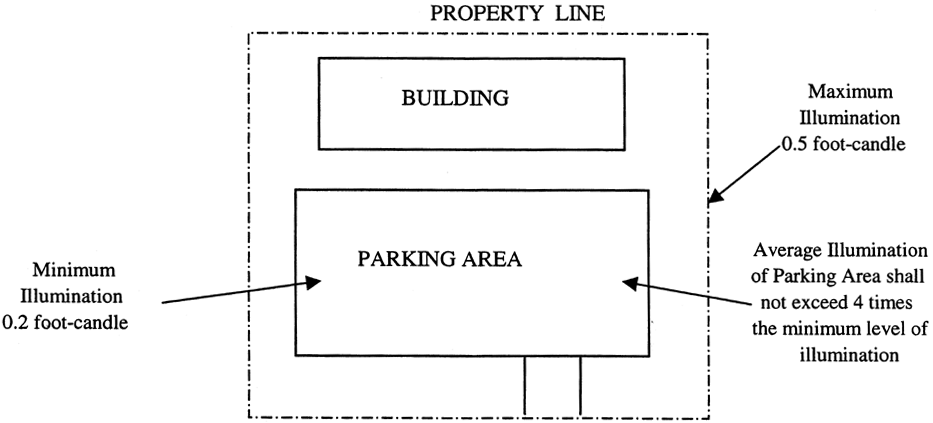
(e)
Exemptions. The following uses shall be exempt from the provisions of this section:
(1)
Roadway lighting required by the appropriate public agency for health, safety and welfare purposes;
(2)
Construction lighting approved by the building department as part of a building permit;
(3)
Flag lighting, provided that the illumination is the minimum level necessary, and that the light source is aimed and shielded to direct light only onto the intended target and to prevent glare for motorists and pedestrians;
(4)
Emergency lighting approved by the city, provided the lighting is discontinued upon the abatement of the emergency necessitating said lighting; and
(5)
Other temporary lighting determined to be reasonable and appropriate by the City of Woodhaven.
(Ord. of 11-1-1967, § 15.28; Ord. of 9-21-2004(2))
Sec. 110-743. - Entranceway structures.
When the planning commission determines that an entranceway structure shall be necessary and/or complimentary to the identification of a development, they shall utilize the following standards in reviewing and approving such a structure:
(1)
Any such structure shall be adjacent to a major or secondary thoroughfare and directly related to the points of ingress or egress from such thoroughfare.
(2)
Any such structure shall be set back at least 15 feet from any existing or planned right-of-way, whichever is greater, or any driveway surface offering ingress and/or egress to such development.
(3)
Any such entranceway structure shall not exceed six feet in height or 20 feet in length. One such structure may be permitted on either side of the approved major access points to the development. The approval of any structure within a private drive median shall only be approved after specific consideration of proper sight distances. The planning commission shall obtain the recommendation of the public service director prior to approving any entranceway structures which do not meet the setbacks required to a main building.
(4)
The approval of such a structure is further regulated by section 110-744, corner clearance, and the placement of any identification sign upon such a structure is also limited by section 110-713.
(Ord. of 11-1-1967, § 15.29; Ord. of 94-1984, § 1)
Sec. 110-744. - Corner clearance.
No fence, wall, shrubbery, sign or other obstruction to vision above a height of two feet from the established street grades shall be permitted within the triangular area formed at the intersection of any street right-of-way lines by a straight line drawn between such right-of-way lines at a distance along each line of 25 feet from their point of intersection.
(Ord. of 11-1-1967, § 15.30)
Sec. 110-745. - Reserved.
Editor's note— Ord. No. 25-050, adopted July 1, 2025, deleted § 110-745, which pertained to walls and berms, and derived from ordinances adopted November 1, 1967; October 18, 1977; October 2, 1979; and Ord. No. 14-123, adopted December 2, 2014.
Sec. 110-746. - Moving of buildings.
No building, in whole or semicomplete form, or any portion of a building, which has been wholly or partially erected on any premises located outside the municipality shall be placed on any premises within the municipality. Furthermore, no structure which has been wholly or partially erected on any premises located outside the municipality shall be placed on any premises within the municipality without the approval of the council based upon inspection by the building official of the city.
(Ord. of 11-1-1967, § 15.32; Ord. No. 20-3, § 1, 7-15-1968; Ord. No. 20-22, § 1, 5-25-1971)
Sec. 110-747. - Fences (residential).
Fences are permitted or required, subject to the following:
(1)
Fences in all residential districts that are located within side and/or rear yards shall not exceed six feet, three inches in height. Fences located in front yards shall be limited to decorative types that are constructed for limited landscape effects only and shall not be used for enclosure. Decorative fences may include those of a split rail, picket or other durable manufactured nature that do not exceed 24 inches in height. The forgoing height limitations exclude any required railings on permitted porches and/or barrier free ramps.
(2)
The height of fences shall be measured from the average grade of the lot within 50 feet of any point of the fence and shall not be increased by berms or other artificial features that would elevate the fence. Decorative caps on fence posts may be permitted provided such caps do not exceed eight inches for fences or four to six feet in height and a proportional height for fences of a lesser height. The use of decorative caps shall be limited to those line and corner posts used in the installation of standardized fence panels and shall not involve a subterfuge to increase the permitted fence height.
(3)
In addition to the corner clearance requirements set forth in this ordinance, no fences, plantings or other improvements shall be constructed that will obstruct visibility between a driveway and a sidewalk or traffic way. Such minimum sight restrictions shall apply to a ten-foot triangle at the corners of a driveway as it intersects a sidewalk, street or alley. The ten-foot legs of the triangle shall extend away from any such intersection and no fence, wall, shrub, or tree shall obstruct vision between two and eight feet above the grade of the intersection.
(4)
In situations where a proposed fence is adjacent to an existing fence, the new fence shall be placed in such a manner as to permit convenient and proper maintenance of the intervening area with conventional lawn equipment. Any such area shall not be permitted to be occupied by weeds, debris or otherwise attract or harbor animals.
(5)
When a rear lot line of a home on a corner lot abuts the front yard of an adjacent lot, the fence shall be setback 25 feet from the side street line and for a distance of 25 feet from the lot line of the adjacent home.
(6)
Fences on lots of record shall not contain: electric current or charges, barbed wire, other sharp and/or any other hazardous material or projections, unless otherwise specifically proved for herein.
(7)
An approved zoning permit shall be obtained from the building inspector or ordinance officer prior to any fence erection, movement or alteration in accord with section 110-32.
(Ord. of 11-1-1967, § 15.33; Ord. No. 20-5, § 2, 9-3-1968; Ord. No. 20-30, § 1, 7-26-1973; Ord. of 5-17-1977, § 1; Ord. of 10-18-1977, §§ 61, 62; Ord. of 3-5-2002; Ord. No. 10-052, 2-16-2010)
Sec. 110-748. - Fences and walls (nonresidential).
Fences or walls in all nonresidential districts are permitted or required, subject to the following:
(1)
Fences and walls in all office, business and industrial districts which enclose property and are located within side or rear yards as provided in section 110-474 shall not exceed the following heights:
(2)
Fences or walls shall not be located in required front yards unless approved by the zoning board of appeals or when required as screening to adjacent residential property. In no instance shall a fence or wall be located in a required front yard so that it obscures the visibility of traffic at an intersection, as it enters or leaves the premises in question. When the use has a common frontage along any street with a residential district, the fence or wall shall have a setback of at least 25 feet.
(3)
Fences shall not contain barbed wire, electric current or charges of electricity, unless approved by the zoning board of appeals as being needed for security purposes.
(4)
All fences or walls shall comply with the requirements of the building code, city Ordinance No. 12 (chapter 18 of this Code), as it applies to installation and materials, and all other relevant laws and ordinances not in conflict with this section including, but not limited to, section 110-684 regarding walls and fences used for screening open storage.
(Ord. of 11-1-1967, § 15.34; Ord. No. 20-11, § 1, 10-1-1969)
Sec. 110-749. - Building sites.
(a)
The building inspector, when receiving plans for new construction, shall review the proposed building and its conformance with applicable setback and accessory use requirements. This review shall also consider the size, shape and configuration of any vacant portion of the site which would be difficult or impossible to utilize and/or develop in subsequent expansion or development phases, the concern being that the approval of any proposed building plans not landlock a parcel of land and/or encourage a rezoning request which would be inconsistent with the master plan and reasonable standards of land use development. When such a situation is deemed to exist, the building inspector shall inform the planning commission and planner of such concerns when the proposed development involves a site plan requiring planning commission approval. The planning commission and planner shall consider any adverse effects which may be created and may require such modifications to the site plan as deemed necessary and reasonable to avoid and/or minimize such problems.
(b)
In the case of unplatted or other larger parcels of land which could accommodate additional development in the future, consideration shall be given to the placement of structures which would encourage rezonings or other variances when additional development is desired. The construction of dwellings across platted lot lines shall be avoided when the resulting building sites and/or dwellings exceed the average site and/or dwelling unit sizes within 300 feet of the proposed use. The concern being that such sites and/or dwellings (will or may) result in rezoning or variance requests which are inconsistent with existing or potential development in the area.
(Ord. of 11-1-1967, § 15.35; Ord. of 9-4-1984, § 2)
Sec. 110-750. - Landscaping and screening.
(a)
Minimum requirements. The provisions of this article shall be considered as minimum standards for landscaping and screening. Developers and owners of lots or uses subject to these standards are encouraged to exceed these minimums through the use of enhanced landscape design, or larger or more extensive plant materials.
(b)
Permitted modifications to standards. In consideration of the overall site design, existing site conditions and impact of a specific use, and in consideration of the amount of existing plant material or other screening elements to be retained on the site, the planning commission may approve modifications to the specific standards of this article, provided that the alternative is in keeping with the intent of this article and the purpose of the ordinance codified in this section. In determining whether a modification is appropriate, the planning commission shall consider the following:
(1)
Where unique site conditions (such as steep slopes and other topographic features, utility easements, or inadequate setback area) would hinder compliance with the strict standards of this article, the planning commission may permit the substitution of any greenbelt or other landscaping requirement with a wall or fence in compliance with section 110-747 (residential fences), section 110-748 (commercial fences and walls), or combination of a wall or fence and an alternative landscape design.
(2)
Parking, vehicular circulation, or land use are such that required landscaping would not enhance the site or result in the desired screening effect.
(3)
The public benefits intended by strict application of these regulations could be better achieved with a plan that varies from the strict requirements of the ordinance, provided that the alternative design would produce substantially the same results in terms of screening, durability, and permanence.
(4)
Where an existing building is undergoing redevelopment, improvement, a change in use, or expansion, the proposed improvements are in reasonable proportion to the size and configuration of the site, and the scale of proposed building improvements, expansions or other site improvements.
_____(c)
[Summary of general requirements.] The following table summarizes the landscaping regulations contained in this article:
Summary of General Requirements
Footnotes to table above:
[1]
See Sections 14.04 and 14.05 for detailed requirements.
[2]
General Site Landscaping for:
-
Manufactured housing parks: Two trees plus four shrubs per lot.
-
Multiple-family uses: Two trees plus four shrubs per dwelling unit.
[3]
Eight shrubs may be substituted for each tree.
[4]
Evergreens must be closely spaced (no further than 15 feet apart) to form complete visual barrier within three years.
[5]
Berms shall have slopes no steeper than one foot vertical for each three feet horizontal. Thus, the minimum width is equal to total height multiplied by three. Maximum height of berms in the front yard: Three feet.
[6]
Minimum area of each parking lot landscaped area: 150 square feet.
[7]
Fractional number of plantings shall be rounded up to the next whole number.
Summary of Specific Requirements per District
(d)
General site requirements. All developed portions of the site shall conform to the following general landscaping standards, except where specific landscape elements (such as a greenbelt, berms, or screening) are required:
(1)
All unpaved portions within the developed portion of the site shall be planted with grass or other appropriate ground cover, shrubbery, or other suitable live plant materials, which shall extend to any abutting street pavement edge. Lawn areas shall be planted with sod or hydro-seeded.
(2)
One evergreen or deciduous tree shall be planted per 3,000 square feet of unpaved open area on non-residential parcels for which specific landscaping requirements do not otherwise apply.
(e)
Landscaping adjacent to road rights-of-way. Where required, landscaping adjacent to road rights-of-way shall comply with the following planting requirements:
Landscape Material Planting Requirements
For the purposes of computing length of road frontage, openings for driveways and sidewalks shall not be counted. Trees and shrubs may be planted in uniform intervals or informal groupings.
(1)
Location and dimensions. Required landscaping adjacent to roads shall be located totally on private property within a planting strip adjacent to the road right-of-way. The minimum width of the planting strip shall be ten feet.
Example of landscaping adjacent to roads: Length of road frontage: 250 feet minus 30-foot driveway = 220 feet
Required Number of Plants
(f)
Berms. Where required, berms shall conform to the following standards:
(1)
Dimensions. Unless otherwise deemed appropriate by the planning commission, required berms shall be measured from the grade of the parking lot or flat ground adjacent to the berm, and shall be constructed with slopes no steeper than one foot vertical for each three feet horizontal (33 percent slope), with at least a two-foot flat area on top.
Berms may undulate in height, subject to review and approval of berm design as shown on the site plan. Unless otherwise indicated, the maximum height of required berms shall be three feet.
(2)
Protection from erosion. Required berms shall be planted with sod, ground cover, or other suitable live plant materials to prevent erosion. The use of railroad ties, cement blocks, and other types of construction materials to retain the shape and height of a berm shall be prohibited unless specifically reviewed and approved by the planning commission.
(3)
Required plantings.
a.
Berms located in the front yard of nonresidential parcels. Berms located in the front yard of nonresidential parcels shall be landscaped in accordance with the requirements of subsection 110-750(e), landscaping adjacent to road rights-of-way.
b.
Berms used for screening other than in the front yard. Berms used for screening other than in the front yard shall be landscaped in accordance with the requirements of subsection 110-750(h), screening.
(4)
Measurement of berm length. For the purpose of calculating required plant material, berm length shall be measured along an extension of the highest elevation line connecting the lowest elevation lines at opposite ends of the berm.
(g)
Greenbelts. Where required, greenbelts shall conform to the following standards:
(1)
Measurement of greenbelt length. For the purpose of calculating required plant material, greenbelt length shall be measured along the exterior edge of the greenbelt.
(2)
Dimensions. The minimum width of the greenbelt shall be ten feet.
(3)
General planting requirements.
a.
Groundcover requirements. Grass, ground cover, or other suitable live plant materials shall be planted over the entire greenbelt area, except where paved walkways are used.
b.
Tree and shrub requirements. Greenbelts used for screening shall be landscaped in accordance with the requirements of subsection 110-750(h), screening. Greenbelts not intended for screening purposes shall include a minimum of one deciduous or evergreen tree for each 30 lineal feet (or portion thereof) of required greenbelt. Alternatively, eight shrubs may be substituted for each required tree.
c.
Distance from sidewalk. To provide adequate sight distance and minimize damage to public facilities, trees and shrubs shall not be placed closer than four feet to any public or private sidewalk.
(h)
Screening.
(1)
General screening requirements. Unless otherwise specified, wherever an evergreen or landscaped screen is required, screening shall consist of closely spaced evergreen plantings (i.e., no farther than 15 feet apart) which can be reasonably expected to form a complete visual barrier that is at least six feet above ground level within three years of planting.
Deciduous plant materials may also be used, provided that a complete visual barrier can be maintained throughout the year. Wherever screening is required adjacent to a residential district or existing residential use, the screening must be installed prior to the beginning of site grading and general construction. Where such activity would result in damage to the required screening, temporary construction fencing shall be erected and maintained until it is feasible to install the required screening.
(2)
Screening of equipment. Mechanical equipment, such as air compressors, pool pumps, transformers, generators, sprinkler pumps, satellite dish antennae, air conditioners, and similar equipment shall be screened on all sides visible from public rights-of-way, or adjoining properties or uses.
Such screening shall exceed the vertical height of the equipment being screened by at least six inches (plant materials shall exceed this height within two years of planting). A minimum two-foot open area should be maintained around such equipment to facilitate repairs, if necessary.
(3)
Screening of dumpster enclosures. Any new or altered use which requires site plan review under section 110-741, site plan review, and has an outdoor trash storage area shall comply with the following requirements:
a.
Any such area shall be limited to normal refuse, which is collected on a regular basis and shall be maintained in a neat, orderly and sanitary condition.
b.
In no instance shall any such refuse be visible above the required enclosure.
c.
A decorative masonry wall of six feet in height shall enclose three sides of the storage area. Bollards or other protective devices shall be installed at the opening and to the rear of any storage area to prevent damage to the surrounding walls. The surface under any such storage area shall be constructed of concrete which complies with local building requirements. Six feet tall evergreen vegetation on three sides will also be accepted.
d.
Any such storage area shall be located in a rear yard and/or be so located and arranged as to minimize its visibility from adjacent streets and uses. The planning commission may require an obscuring gate when the visibility of such a storage area, from a public street or adjacent use, is deemed to render an adverse influence. In no instance shall any such area be located in a front yard.
e.
A 25-foot setback is required for trash storage areas to any lot line abutting a residential district or use.
(i)
Parking lot landscaping. In addition to required screening, all off-street parking areas shall be landscaped as follows:
(1)
Landscaping ratio. Off-street parking areas containing ten or more parking spaces shall be provided with at least 20 square feet of interior grass landscaping per parking space. Parking lot landscaping shall be designed to improve the safety of pedestrian and vehicular traffic, guide traffic movement, and improve the appearance of the parking area.
(2)
Minimum area. Landscaped areas in parking lots shall be no less than five feet in any single dimension and no less than 150 square feet in area. Landscaped areas in or adjacent to parking lots shall be protected with curbing or other means to prevent encroachment of vehicles.
(3)
Other landscaping. Required landscaping elsewhere on the parcel shall not be counted in meeting the parking lot landscaping requirements.
(4)
Required plantings. Requirements for plant material shall be based on the location, size, and shape of the parking lot landscaped area, as described in the following table:
Minimum Required Plantings for Parking Lot Landscaping
(5)
[Parking lot plantings.] Parking lot plantings shall comply with the unobstructed sight distance standards of section 110-744, corner clearance. The landscape plan shall indicate the types, sizes, and quantities of plant material proposed for such area.
(j)
Landscaping of rights-of-way. Public rights-of-way located adjacent to required landscape areas and greenbelts shall be planted with grass or other suitable live ground cover and shall be maintained by the owner or occupant of the adjacent property as if the rights-of-way were part of the required landscaped areas or greenbelts.
(k)
Maintenance of unobstructed visibility for drivers. No landscaping shall be established or maintained on any parcel or in any parking lot that will obstruct the view of drivers. Parking lot plantings shall comply with the unobstructed sight distance standards of section 110-744, corner clearance.
(l)
Potential damage to utilities. In no case shall landscaping material be planted in a way that will interfere with or cause damage to underground utility lines, fire hydrants, public roads, or other public facilities. Species of trees whose roots are known to cause damage to public roadways, sewers, or other utilities shall not be planted closer than 15 feet from any such roadways, sewers, or utilities. It is the responsibility of the developer to determine the location of any utility easements that may require a greater setback than the table below:
Landscape Material Spacing from Utilities
(m)
Landscaping of divider medians and cul-de-sacs. Where traffic on driveways, maneuvering lanes, private roads, or similar vehicle accessways is separated by a divider median, the median shall be curbed and have a minimum width of ten feet. A minimum of one deciduous or evergreen tree shall be planted for each 30 lineal feet or portion thereof of median. Trees may be planted at uniform intervals, at random, or in groupings, but in no instance shall the center-to-center distance between trees exceed 60 feet. Cul-de-sacs and site entrances shall be landscaped with species tolerant of roadside conditions in Wayne County.
(n)
Irrigation. A method of irrigation must be available to all landscaped areas. Accommodation shall be made to ensure protection of drip lines of plantings.
(o)
Street trees in single-family districts. A minimum of one deciduous tree, measuring at least two and one-half inches in trunk diameter at the time of planting, shall be planted on each single-family parcel or lot on which a new dwelling unit is proposed to be constructed for each 40 feet of street frontage measured at the right-of-way line.
(Ord. No. 25-050, 7-1-2025)
Editor's note— Ord. No. 25-050, adopted July 1, 2025, amended § 110-750 in its entirety to read as herein set out. Former § 110-750 pertained to screening of trash storage area, and derived from ordinances adopted November 1, 1967; November 4, 1986; and Ord. No. 18-077, adopted September 4, 2018.
Sec. 110-751. - Specific requirements per district.
(a)
Requirements for business, office, and industrial districts. All lots or parcels located in business, office, and industrial zoning districts shall comply with the following landscaping requirements:
(1)
General site landscaping. All developed portions of the site shall conform to the standards of subsection 110-750(d), general site requirements, except where specific landscape elements are required.
(2)
Landscaping adjacent to road. All commercial, office, and industrial developments shall comply with the requirements of subsection 110-750(e), landscaping adjacent to road rights-of-way).
(3)
Berm requirements. A berm may be used to screen off-street parking from view of the road, in which case the berm shall be a maximum of three feet in height and shall be planted in accordance with subsection 110-750(f), berms. The berm shall be located totally on private property, adjacent to the road right-of-way. Berms are not intended as an effective screening device between zoning districts.
(4)
Screening. Screening in the form of a landscaped berm or greenbelt shall be required wherever a nonresidential use in a commercial, office, or industrial district abuts directly upon land zoned or used for residential purposes, and where loading areas would be visible from residential districts or uses.
a.
Landscaped screening shall comply with the requirements of subsection 110-750(h), screening. If the length of the adjoining residentially zoned or used property is less than 200 feet, a wall or solid fence with a planting strip a minimum of three feet in width may be erected in lieu of a berm or greenbelt, subject to site plan approval.
b.
The landscaping in the planting strip shall consist of appropriate landscaping material and be arranged to provide a maximum opacity to a minimum height of four feet within three years.
(5)
Parking lot landscaping. Off-street parking areas containing greater than ten spaces shall comply with the requirements for parking lot landscaping in subsection 110-750(i). All off-street parking areas shall be screened on those sides which abut or are across the street from a residential zoning district or residential use by a landscape screen, berm, wall or fence. A landscape screen, berm, wall or fence may be used.
Landscape screening shall comply with the requirements of subsection 110-750(h), screening. If a wall or fence is used instead of landscaping, the requirements of section 110-747, residential fences, or section 110-748, commercial fences and walls, shall be complied with, but a landscaped greenbelt shall be required on the side of the wall facing the residential district or use.
(b)
Requirements for multiple-family developments. All lots or parcels of land used for multiple-family development shall comply with the following landscaping requirements:
(1)
General site landscaping. A minimum of two deciduous or evergreen trees plus four shrubs shall be planted per dwelling unit. Unless otherwise specified, required landscaping elsewhere in the multiple-family development shall not be counted in meeting these requirements for trees. A method of irrigation shall be provided.
(2)
Landscaping adjacent to road. All multiple-family developments shall comply with the requirements of subsection 110-750(e), landscaping adjacent to road rights-of-way.
(3)
Greenbelt privacy screen. A landscaped privacy screen shall be provided where multiple-family dwellings are designed so that rear open areas or patio areas front onto a public street. The screen may consist of a combination of trees, shrubs, and berms, and shall be subject to site plan review by the planning commission.
(4)
Parking lot landscaping. Off-street parking areas in all yards must be screened with a hedge not more than four feet in height. Hedges shall comply with the height and location standards of section 110-744, corner clearance. Off-street parking areas containing greater than ten spaces shall comply with the requirements of subsection 110-750(i), parking lot landscaping.
(c)
Requirements for nonresidential uses in residential districts. All nonresidential uses located in residential zoning districts shall comply with the following landscaping requirements:
(1)
General site landscaping. All developed portions of the site shall conform to subsection 110-750(d), general site requirements, except where specific landscape elements are required.
(2)
Landscaping adjacent to road. All nonresidential developments located in residential districts shall comply with the requirements of subsection 110-750(e), landscaping adjacent to road rights-of-way).
(3)
Berm requirements. A berm may be used to screen off-street parking from view of the road, in which case the berm shall be a maximum of three feet in height and shall be planted in accordance with subsection 110-750(f), berms. The berm shall be located totally on private property, adjacent to the road right-of-way.
(4)
Screening. Screening in the form of a landscaped berm, greenbelt, or wall shall be required wherever a nonresidential use abuts directly upon land zoned or used for residential purposes. Landscape screening shall comply with the requirements of subsection 110-750(h), screening.
(5)
Parking lot landscaping. Off-street parking areas containing greater than ten spaces shall comply with the requirements of subsection 110-750(i), parking lot landscaping. All off-street parking areas shall be screened on those sides which abut or are across the street from a residential zoning district or residential use by a landscape screen, berm, wall or fence.
(d)
Requirements for development in the CBD district. Landscaping measures for all uses within the CBD district are subject to the requirements of section 110-490 instead of this section.
(Ord. No. 25-050, 7-1-2025)
Editor's note— Ord. No. 25-050, adopted July 1, 2025, amended § 110-751 in its entirety to read as herein set out. Former § 110-751 pertained to donation drop-off boxes, and derived from Ord. No. 12-175, adopted November 7, 2012.
Sec. 110-752. - Landscape materials standards.
Unless otherwise specified, all landscape materials shall comply with the following standards:
(a)
Plant quality. Plant materials used in compliance with the provisions of the ordinance codified in this section shall be nursery grown, free of pests and diseases, hardy in Southeast Michigan, in conformance with the standards of the American Association of Nurserymen and shall have passed inspections required under state regulations. An appropriate variety of plantings hall be provided to ensure long term survival of mature plants.
(b)
Non-living plant material. Plastic and other non-living plant materials shall not be considered acceptable to meet the landscaping requirements of this section.
=_;
(c)
Plant material specifications. The following specifications shall apply to all plant material proposed in accordance with the landscaping requirements of this section:
Summary of Plant Materials Specifications
(1)
Deciduous trees. Deciduous shade trees shall be a minimum of three inches in caliper measured 12 inches above grade with the first branch a minimum of four feet above grade when planted.
(2)
Deciduous ornamental trees. Deciduous ornamental trees shall be a minimum of one and one-half inches in caliper measured six inches above grade with a minimum height of four feet above grade when planted.
(3)
Evergreen trees. Evergreen trees shall be a minimum of six feet in height when planted. Furthermore, evergreen trees shall have a minimum spread of two and one-half feet, and the size of the burlap wrapped root ball shall be at least ten times the caliper measured six inches above grade.
(4)
Shrubs. Shrubs shall be a minimum of two feet in height when planted. Low growing shrubs shall have a minimum spread of two feet when planted.
(5)
Hedges. Hedges shall be planted and maintained in a manner that forms a continuous, unbroken, visual screen within two years after planting, barring unusual growing conditions, such as drought or disease. Hedges shall be a minimum of two feet in height when planted.
(6)
Ground cover. Ground cover used in lieu of turf grasses in whole or in part shall be planted in such a manner as to present a finished appearance and reasonably complete coverage after one complete growing season.
(7)
Grass. Grasses shall be planted using species normally grown as permanent lawns in southeastern Michigan. Grass, sod, and seed shall be clean and free of weeds, pests, and diseases. Grass may be sodded, plugged, sprigged or seeded. Where grass is to be established by a method other than complete sodding or seeding, nurse grass seed shall be sown for immediate effect and protection until complete coverage is otherwise achieved. Straw or other mulch shall be used to protect newly seeded areas.
(8)
Mulch. Mulch used around trees, shrubs, and vines shall be a minimum of three inches deep and installed in a manner as to present a finished appearance and shall be replaced every two years.
(d)
Planting schedule. All site plans shall contain a planting schedule providing information on all proposed trees, shrubs, grasses, and any other proposed landscape feature. Information required includes the species (botanical and common name), size, quantity, and spacing of all plantings. All proposed planting species are subject to the approval by the city department of public works, and shall not contain any invasive species.
(Ord. No. 25-050, 7-1-2025)
Sec. 110-753. - Installation and maintenance.
The following standards shall be observed where installation and maintenance of landscape materials are required:
(a)
Installation. Landscaping shall be installed in a sound, workmanlike manner to ensure the continued growth of healthy plant material. Trees, shrubs, hedges, and vines shall be generously mulched at the time of planting.
(b)
Installation of perimeter landscaping. Landscaping along the perimeter shall be installed prior to construction, except where such landscaping would be destroyed during construction.
(c)
Seeding or sodding. Lots or parcels shall be seeded or sodded within 90 days after occupancy.
(d)
Protection from vehicles. Landscaping shall be protected from vehicles through use of curbs or wheel stops in parking lots. Landscape areas shall be elevated above the pavement to a height that is adequate to protect the plants from snow removal, salt, and other hazards. Tree protections measures must be shown on the landscape plan for any existing trees to be preserved during construction.
(e)
Financial guarantee. For all projects, unless waived by the planning commission, a financial guarantee as required by section 110-631 shall be provided prior to the beginning construction. The guarantee shall be held by the city for a year after landscape installation has been completed to ensure all plant materials are in good condition. The city reserves the right to retain a financial guarantee in the event any damaged landscape material is not replaced before a certificate of occupancy is granted.
(f)
Maintenance. Landscaping required by this section shall be maintained in a healthy, neat, and orderly appearance, free from refuse and debris. A healthy, neat and orderly appearance includes: proper pruning, regular mowing of lawns, removal of all litter and the replacement of dead and unhealthy plant material.
(1)
All unhealthy and dead plant material shall be replaced immediately upon notice from the building official, unless the season is not appropriate for planting, in which case such plant material shall be replaced at the beginning of the next planting season.
(2)
All landscaped areas shall be provided with a readily available and acceptable supply of water. Underground irrigation systems are required. Trees, shrubs, and other plantings and lawn areas shall be watered regularly throughout the growing season.
(3)
All constructed or manufactured landscape elements, such as, but not limited to, benches, retaining walls, edging, and so forth, shall be maintained in good condition and neat appearance. Rotted, deteriorated, or damaged landscape elements shall be repaired, replaced, or removed.
(g)
Treatment of existing plant materials. The following regulations shall apply to existing plant material:
(1)
Consideration of existing elements in landscape design. In instances where healthy plant material exists on a site prior to its development, the planning commission may permit substitution of such plant material in place of the requirements set forth previously in this article, provided such substitution is in keeping with the spirit and intent of this article and ordinance. Existing hedges, berms, walls, or other landscape elements may be used to satisfy the requirements set forth previously, provided that such landscaping is in conformance with the requirements of this section.
(2)
Preservation of existing plant material. Site plans shall show all existing trees which are located in the portions of the site that will be built upon or otherwise altered and are five inches or greater in caliper, measured 12 inches above grade.
Trees shall be labeled "To Be Removed" or "To Be Saved" on the site plan. If existing plant material is labeled "To Be Saved" on the site plan, protective measures shall be implemented, such as the placement of fencing at the dripline around each tree. No vehicle or other construction equipment shall be parked or stored within the dripline of any tree or other plant material intended to be saved.
Trees to be preserved may provide credit toward the required trees for greenbelts, buffers, and parking lot landscaping. To obtain credit, the preserved trees shall be of a high quality and at least two and one half inches caliper measured 12 inches above grade. Trees to be preserved shall be counted for credit only if they are located on the developed portion of the site as determined by the planning commission. One preserved tree shall count towards one credit.
(3)
In the event that healthy trees that are intended to meet the requirements of the ordinance are cut down, damaged or destroyed during construction, the removed trees shall be replaced with the same species as the damaged or removed tree, in accordance with the schedule of preserved tree credits, unless otherwise approved by the city, based on consideration of the site and building configuration, available planting space, and similar considerations:
(h)
Planting location exceptions. Special exceptions to allow alternate planting locations after planning commission review shall be granted when outside engineering or jurisdictional review requires such proposed locations to be moved for utility operation or other factors determined necessary by the DPW director.
_____Schedule of Damaged or Removed Tree Replacement
(Ord. No. 25-050, 7-1-2025)
Sec. 110-771. - Garage sales.
Garage sales shall be permitted in residential districts, subject to the following requirements:
(1)
Only used household effects common to normal daily household living may be sold to consumers. Typically, sales items include: household furniture, home fixtures and appliances, shop equipment, homeowner repair items, clothing, homeowner lawn and garden equipment and supplies. These types and quantities of items being sold shall reflect those normally acquired by a family and shall not include commercial and industrial items. Re-sale of newly purchased items is prohibited. A garage sale is for the purpose of selling normal and conventional household items no longer needed by a household in their daily living. It is not a means of conducting a business in any residential zoning district.
(2)
Sale items may be displayed in the home, yard, garage and driveway but shall not occupy any public property. Any items displayed outside of a building shall not be so located longer than 24 hours prior to, or subsequent to, the sale.
(3)
Not more than four garage sales shall be permitted at the same location in any 12 consecutive months. Any such garage sale shall not exceed 72 consecutive hours in duration. If a subdivision or apartment wide sale proposes closure of a public thoroughfare, then specific council approval shall also be obtained for the sale, and other special requirements and closure of the public right-of-way. Sale hours shall not commence earlier than 8:00 a.m. or extend beyond 8:00 p.m. each day.
(4)
The applicant shall be able to demonstrate that there is adequate parking on the site and/or adjacent streets and also that no problems will be created due to abnormal noise or lights.
(5)
The occasional parking of a single car, in the parking area, with a "for sale" sign in the window does not constitute a garage sale.
(6)
A maximum of three temporary signs not exceeding two square feet in area each may be permitted. Any such signs shall only be displayed during the actual sale period, shall not be placed upon public property, and shall require authorization of the owner/resident of any private property involved.
(Ord. of 11-1-1967, § 15.38; Ord. of 4-17-1990, § 1; Ord. No. 13-003, 1-2-2013)
Sec. 110-772. - Temporary outside sales.
Upon review and approval of the building official, permits may be issued for temporary outside displays and/or sales of seasonal and/or certain specialty items. The building official, in issuing any such permits, shall, however, find that any such activities shall not occupy parking and/or loading areas required during the same period; shall not obstruct proper pedestrian movements in parking lots and/or along sidewalks; that the area and mass occupied by such activities shall not obstruct proper sight distances; shall be located on private property; and shall not occupy required planting areas. In addition, the amount of land occupied by any such use area shall represent a minor and incidental activity in proportion to the principal permitted use and shall not create any conflicts between any permanent uses and temporary uses permitted under this division. The types of temporary uses and further limitations on such uses are as follows:
(1)
The outside display of produce, fertilizers, plants and gardening supplies may be permitted, subject to the preceding limitations, and provided that any such activities do not occur for more than 60 days during any 12 consecutive months, and such displays are clearly incidental and directly related to the principal use permitted.
(2)
Sidewalk sales, subject to the preceding limitations and, furthermore, that any such sales shall not occur for more than 30 days out of any 12 consecutive months, and that such sales are clearly incidental and directly related to the principal use permitted.
(3)
The sale of Christmas trees, bazaars, fairs and other such sales activities by nonprofit and/or private organizations may be permitted, subject to the preceding limitations. Furthermore, any such activities shall be limited to 45 days out of any 12 consecutive months.
(4)
The area utilized for any such activities shall attempt to observe building area setbacks as required and as related to adjacent sites.
(5)
The building official shall make, or cause to be made, sufficient inspections to ensure the compliance with the provisions of this chapter and other applicable provisions of the city ordinances by the personnel conducting such sales.
(Ord. of 11-1-1967, § 15.39; Ord. of 12-18-1990, § 1)
Sec. 110-791. - Generally.
Home occupations may be permitted in residential dwelling units when the applicant demonstrates that such uses are secondary and incidental to the principal use of the dwelling as a residential living unit. The planning commission shall determine that any such home occupation will not adversely effect neighboring residential uses nor detract from a desirable residential environment in the neighborhood area. The city council shall then approve or disapprove such application after planning commission review and referral. Uses may be permitted as a home occupation where it conforms with the various standards and requirements set forth for type I (incidental) or type II (special use permit) home occupations. The standards and procedures are contained in this division.
(Ord. of 9-17-1996, § 1(15.40))
Sec. 110-792. - Basic requirements.
The following requirements shall be applicable to all home occupations:
(1)
No outside storage of materials, goods, supplies or other items is permitted.
(2)
Only full-time residents of the premises shall be involved in home occupation activities occurring on the premises. Other persons who may be involved in off-site activities related to the home occupation shall not park on the premises while so involved.
(3)
No structural modifications or exterior changes in the appearance of the building shall be made, including the providing of a separate means of entrance and exit. No visual evidence of the activity shall be possible from outside the building.
(4)
No equipment, materials or processes which are incompatible with the use of the dwelling for residential purposes shall be used or stored upon the site.
(5)
No such use or activity shall create any noise, dust, fumes, odors, vibrations, electrical or electronic emissions or magnetic fields, intermittent or flashing lights or glare which are detectable to the normal senses of persons or equipment located off the premises.
(6)
The activity shall be in full conformity with all local, state and federal laws and requirements.
(7)
No signs relating to the home occupation shall be permitted other than the street address and name of the resident as provided for in this division.
(Ord. of 9-17-1996, § 1(15.40(a)))
Sec. 110-793. - Type I, incidental home occupations.
Incidental home occupations shall be minor in physical and functional characteristics and shall be strictly incidental to the principal use and occupancy of the dwelling for residential purposes. Such type I uses shall be deemed as permitted accessory uses in single-family, two-family, multiple-family, and mobile home dwellings when they fully and continuously comply with the preceding basic requirements and the following additional requirements:
(1)
Such uses shall only involve those activities, processes, products and/or services which are provided to a user, buyer or subscriber primarily through telephone, fax, modem, and off-site contacts.
(2)
Client pickups shall be by appointment only, within a limited number of hours, which do not conflict with adjacent or neighboring properties. Acceptable levels of vehicular trips, generated by other than residents of the premises, shall not exceed five visitations per week by clients and/or delivery/pickups. All such trips shall involve only personal type vehicles or delivery type vans.
(3)
Home occupations shall only involve equipment and/or processes characteristic of a home office, home workshop or home handicraft activity.
(4)
All home occupation activities shall be conducted entirely within the main residential dwelling and not more than 15 percent of the floor area within such dwelling shall be devoted to such home occupation. Freestanding accessory buildings, together with attached garages, patio areas and breezeways, are excluded from such use and computation.
(5)
The building department shall issue a violation notice for anyone who violates required conditions and shall obtain full compliance or cause the activity to be terminated. If applicable, the operator of any activity in violation of type I requirements may seek approval of the use under terms and conditions of a type II home occupation as set forth in section 110-794.
(Ord. of 9-17-1996, § 1(15.40(b)))
Sec. 110-794. - Type II, special use home occupations.
In limited situations, home occupations may be considered which involve a higher-intensity use characteristic than the incidental home occupation. Any such consideration shall provide for the protection and maintenance of a reasonable and desirable residential environment expected by residents in a residential neighborhood area, as determined by planning commission review and city council approval. Such home occupations shall be considered under the basic procedures and requirements established in division 5, article V, of this chapter, together with the provisions of this division and according to the following additional requirements:
(1)
The proposed use is located within a detached single-family dwelling and attached accessory structure unless otherwise provided for in this division. No more than 20 percent of the dwelling and attached accessory building shall be devoted to such home occupation. Further, the home occupation shall not reduce the amount of garage parking to a point where on-street parking is
required.
(2)
The use shall not involve products, services and/or activities resulting in traffic patterns inconsistent with those normally experienced in a residential neighborhood. Vehicular visitations generated by clients and pickups/deliveries related to the home occupation shall not exceed ten such visitations during any weekly period.
(3)
The applicant shall agree in writing on forms to be provided by the city, that all activities related to the home occupation, which results in visits to the premises by nonresidents, shall be provided in such a manner as to avoid conflicts with adjacent and neighboring properties. Any such agreement shall specifically set forth the number of hours and days during which these contacts will take place and such contacts shall be substantially less than those provided in a conventional business or office setting.
(4)
Home occupations involving periodic sales gatherings in the home shall indicate in writing on forms provided by the city, as to the frequency and volume of such gatherings. The applicant shall provide a drawing indicating available off-street and on-street parking. Pursuant to these requirements, a home occupation may involve periodic instructions in crafts or fine arts.
(5)
The repair and/or servicing of vehicles, including recreational vehicles, and/or other similar equipment shall not be deemed as customary home occupations.
(6)
Service activities which involve the keeping of a commercial vehicle (less than one ton in rated capacity), for use off the premises shall be limited to one such vehicle. All other equipment and/or supplies, including trailers, plows, mowers, etc., utilized in this activity shall only be kept on the premises when located within an accessory building. The presence of the service vehicle, plus ancillary equipment and supplies, shall not occupy off-street parking spaces required by other residents of the dwelling therefore necessitating on-street parking.
(Ord. of 9-17-1996, § 1(15.40(c)))
Sec. 110-795. - Arts, crafts in single-family residence.
An occupant of a single-family residence may give instruction in a craft or fine art within the residence, subject to the city's regulations relating to noise, advertising, traffic, hours of operation or other conditions which may apply to the use of a residence.
(Ord. No. 07-114, 9-4-2007)
Sec. 110-811. - Large scale commercial establishment.
(a)
Intent. It is the intent of this section to regulate large scale commercial establishments exceeding 20,000 square feet in gross floor area (hereinafter "large scale commercial establishments"), whether located as an individual use on a single site or as part of a shopping center with a grouping of attached and/or detached buildings. While it is recognized that large scale commercial establishments may provide goods and services to city residents, such uses are primarily focused on attracting consumers from a market area larger than the city. Therefore, specific standards are required to ensure that large scale establishments can be adequately served by and do not create an inordinate impact upon roads, utilities, storm drainage, groundwater recharge, water quality, air quality, and police and fire services.
It is further intended by this section that large scale commercial establishments be designed in a manner that is harmonious with the overall character of the city consistent with the city master plan and CBD design standards. To allow for flexibility and optimal site design for developments within the central business district, the standards that are more stringent will apply.
(b)
Location. Large scale commercial establishments may be located only within the general business district B-3; and the central business districts CBD.
(c)
Design standards. The applicant shall demonstrate in the submission of a site plan and supportive material that the following design standards are met:
(1)
Aesthetic character.
a.
Facades and exterior walls.
1.
The facades of commercial and mixed-use buildings shall be divided into a base, middle and top.
2.
The ground level of the building shall attract pedestrian interest using windows, articulated entrances, and architectural details.
3.
All buildings must have doors or openings to the street and transparent glass windows.
4.
The play of light and shadow on the façade shall be accomplished by material transitions and a minimum one and one-half-inch variation in the wall plane.
5.
Architectural features, materials, and the articulation of a faced of a building shall be continued on all sides visible from a public street.
6.
Facades greater than 100 feet in length, measured horizontally, shall incorporate projections or recesses extending at least 20 percent of the length of the facade. No uninterrupted length of any facade shall exceed 100 horizontal feet.
7.
Ground floor facades that face public streets shall have arcades, display windows, entry areas, awnings or other such features along no less than 50 percent of their horizontal length.
8.
Building facades must include a repeating pattern that includes no less than two of the following elements:
i.
Color change;
ii.
Texture change;
iii.
An expression of architectural or structural bays through a change in plane no less than 12 inches in width, such as an offset, reveal or projecting rib (see illustration available in [the] building department).
9.
The applicant may be required to present several design examples to compare and contrast the proposed project (see attached illustration).
b.
Roofs. The roof design shall incorporate one or more of the following features depending upon the nature of the roof, the building design, and the existing site conditions.
1.
Flat roofs. Parapets concealing flat roofs and rooftop equipment such as HVAC units from public view are required on all sides. Parapets shall not exceed one-third of the height of the supporting wall at any point.
2.
Pitched roof.
i.
Overhanging eaves, extending no less than three feet past the supporting walls;
ii.
An average slope greater than or equal to one-foot of vertical rise for every three feet of horizontal run and less than or equal to one-foot of vertical rise for every one-foot of horizontal run;
iii.
Three or more roof slope planes.
3.
Green roof. An environmentally friendly or green roof system designed, in part, to mitigate or address the city's concerns regarding storm water runoff, drainage, water quality, and other problems associated with impervious surfaces.
c.
Materials and colors.
1.
Predominant exterior building materials shall be high quality materials, including, but not limited to, brick, stone, and integrally tinted/textured concrete masonry units. Low quality monolithic materials such as stucco or EIFS systems shall be permitted only as an enhancement to the overall façade of a building. See Table X for allowed building material composition. (See attached illustration.)
[TABLE X]
* A maximum of ten percent may be permitted subject to review and approval of the DDA.
2.
Facade colors shall be low reflectance, subtle, neutral or earth tone colors. The use of high-intensity colors, metallic colors, black or fluorescent colors shall be prohibited.
3.
Building trim and accent areas may feature brighter colors, including primary colors, but neon tubing shall not be an acceptable feature for building trim or accent areas.
4.
Architectural features, materials and the articulation of a façade of a building shall be continued on all sides visible from a public street.
5.
Exterior building materials shall provide texture to at least 50 percent of the facade and shall not be completely made up of tilt-up concrete panels or prefabricated steel panels.
d.
Entryways. Each principal building on a site shall have clearly defined, highly visible customer entrances featuring no less than three of the following:
1.
Canopies or porticos;
2.
Overhangs;
3.
Recesses/projection;
4.
Arcades;
5.
Raised corniced parapets over the door;
6.
Peaked roof forms;
7.
Arches;
8.
Outdoor patios;
9.
Display windows;
10.
Architectural details such as tile work and moldings which are integrated into the building structure and design;
11.
Integral planters or wing walls that incorporate landscaped areas and/or places for sitting;
12.
Pavement/material changes at drive crossings to better define pedestrian cross walks.
e.
Community space. Each site shall include at least four of the following features:
1.
Patio/seating area;
2.
Pedestrian plaza with benches;
3.
Transportation center;
4.
Window shopping walkway;
5.
Outdoor playground area;
6.
Kiosk area;
7.
Water feature;
8.
Bicycle parking; or
9.
Other such feature or amenity that, in the sole discretion of the planning commission, helps to mitigate the size of the large scale commercial establishment and resultant diffusion of land uses and to maintain the character of the city by providing community gathering areas, relief for patrons and greater aesthetic appeal.
Each of these features shall:
1.
Have direct access to the public sidewalk network, and
2.
Not be constructed of materials that are inferior to the principal materials of the building and landscape.
(2)
Site design.
a.
Parking lot location. No more than 50 percent of the off-street parking area devoted to the large scale commercial establishment shall be located between the front facade of the principal building and the main road frontage. Depending on the site design, this amount may be increased or decreased at the sole discretion of the planning commission.
The remainder of the parking shall be distributed on the other sides of the building or separated by means of intervening buildings, amenities, or site features.
b.
Parking lot screening. Parking lots shall be screened from all public right-of-ways be either a three-foot ornamental brick wall or an alternative screening treatment that will effectively result in an equivalent opacity, as approved by the planning commission.
c.
Connectivity. The site design must provide direct connections and safe street crossings to adjacent land uses. Cross access easements are required where available. Pavement/material changes at drive crossings shall be installed to better define pedestrian cross walks and be distinguished from other driving surfaces through the use of durable, low maintenance surface materials such as brick pavers or stamped concrete.
d.
Pedestrian circulation.
1.
Sidewalks at least six feet in width shall be provided along all sides of the lot that abut a public street.
2.
Internal pedestrian walkways, no less than six feet in width, shall be provided connecting the public sidewalk to the principal customer entrance of all principal buildings on the site. At a minimum, walkways shall connect focal points of pedestrian activity such as, but not limited to, transit stops, street crossings, building and store entry points, and shall feature adjoining landscaped areas that include trees, shrubs, benches, flower beds, ground covers or other such materials for no less than 50 percent of the length of the walkway.
3.
Internal pedestrian walkways, no less than six feet in width, shall be provided along the full length of the building along any facade featuring a customer entrance, and along any facade abutting public parking areas. Such sidewalks shall be located at least ten feet from the facade of the building to provide planting beds for foundation landscaping, except where features such as arcades or entryways are part of the facade.
4.
All internal pedestrian walkways which cross or are incorporated with vehicular driving surfaces shall be distinguished from such driving surfaces through the use of durable, low maintenance surface materials such as pavers, bricks or scored concrete to enhance pedestrian safety and comfort, as well as the attractiveness of the walkways. In addition, stop signs shall be required adjacent to such walkways. Surface materials used for internal pedestrian walkway shall be designed to accommodate shopping carts.
e.
Delivery/loading operations. Loading docks, trash collection, outdoor storage and similar facilities and functions shall be incorporated into the overall design of the building and the landscaping so that the visual and acoustic impacts of these functions are fully contained and out of view from adjacent properties and public streets on all sides. Use of screening materials that are different from or inferior to the principal materials of the building and landscape is prohibited. Loading areas must be screened by a wing wall to completely obscure parked trucks. The wall must be composed of brick or other approved materials that match the main building.
Dumpster enclosures shall be used to contain refuse in a clean and orderly manner. Screening for refuse and utilities shall be considered as an integral part of the design. In addition, utility equipment such as transformers, telephone switching boxes, and the like, shall be screened in a similar manner to that of a shared dumpster enclosure.
No delivery, loading, trash removal or compaction, or other such operations shall be permitted between the hours of 10:00 p.m. and 7:00 a.m. unless the applicant submits evidence that sound barriers between all areas for such operations effectively reduce noise emissions to a level of 45 dB, as measured at the lot line of any adjoining residential property.
f.
Landscaping.
1.
General site landscaping. All undeveloped portions of the site shall conform to the following general landscaping standards, except where the specific landscape elements described below are required:
i.
Ground cover requirements. All undeveloped portions of the site shall be planted with native grasses, ground cover, or shrubs, which shall extend to any abutting street pavement edge.
ii.
Tree and shrub requirements. A native mixture of evergreen and deciduous trees shall be planted at the rate of one-tree per 3,000 square feet or portion thereof on any undeveloped open area for which specific landscaping requirements do not apply. Required trees shall be planted in irregular intervals or in groupings.
2.
Landscaping adjacent to road. A planting strip at least 20 feet wide shall be provided adjacent to all public and private roads. A planting strip of greater than 20 feet wide may be required in order to ensure that adjoining or facing premises and public roads are effectively screened from car lights, noise and traffic movement. The planting strip shall be located entirely on private property adjacent to the road right-of-way.
3.
i.
Ground cover requirements. The entire planting strip shall be planted with native grasses, ground cover, or shrubs except where paved walkways are used.
ii.
Tree and shrub requirements. The following minimum planting requirements shall apply:
iii.
For the purposes of computing length of road frontage, openings for driveways and sidewalks shall not be counted. Trees and shrubs shall be planted in irregular intervals or in groupings.
iv.
Greenbelt. A greenbelt at least 20 feet wide shall be required along the side and rear property lines. A greenbelt of greater than 20 feet wide may be required in order to ensure that the building and parking areas are effectively screened from any adjoining residential land use. The greenbelt shall be located between the property line and any developed or paved area, including parking areas, access drives and buildings.
A.
Ground cover requirements. The entire greenbelt shall be planted with native grasses, ground cover, or shrubs except where paved walkways are used.
B.
Tree and shrub requirements. The following minimum planting requirements shall apply:
For the purposes of computing required plant material, greenbelt length shall be measured along the exterior edge of the greenbelt. Trees and shrubs shall be planted in irregular intervals or in groupings.
v.
Parking lot landscaping. All parking areas shall be landscaped in accordance with the requirements for parking lot landscaping according to the provision of this section and within article V, division 3, parking regulations.
vi.
Dumpster enclosures. Dumpster enclosures shall be located at the rear of the building, and designed in accordance with section 110-750.
vii.
Transformer/utility pad screening. All ground located transformer/utility pads shall be located at the rear of the building, and screened by four-foot tall, 80 percent opacity shrubbery plantings.
viii.
Safety. All landscaping must be designed and maintained so that safe vehicle sight distance is not affected at entrances, exits or at street intersections.
ix.
Irrigation and maintenance plan. An irrigation and maintenance plan is required as part of a landscape plan.
(d)
Impervious surface reduction/infiltration enhancement. It is recognized that due to specific requirements of any given development, inflexible application of ordinance requirements may result in development with excessive paving and stormwater run-off and a waste of space that could be left as open space. Either through procedures prescribed by this section or creative land development techniques, deviations from requirements allowing for reduction in impervious surfaces may be permitted during the site plan review process whenever it is determined that such deviations are more likely to meet the intent of impervious surface reduction, infiltration enhancement and shared parking opportunities where appropriate.
(1)
General standards.
a.
Priority shall be placed on site design which maintains natural drainage patterns and watercourses. Alterations to natural drainage patterns shall not create flooding or degradation in water quality for adjacent or downstream property owners.
b.
The use of swales and buffer strips vegetated with desirable native materials is required unless shown as impractical as a method of storm water conveyance so as to decrease runoff velocity, allow for biofiltration, allow suspended sediment particles to settle and remove pollutants. Tolerance for water saturation, sunlight, pesticides, metals and salts shall be required in determining appropriate plantings.
c.
Drainage systems shall be designed to have a natural appearance and to be visually attractive. The integration of storm water conveyance systems and retention and detention ponds in the overall concept is recommended. Ponds with a naturally contoured rather than square or rectangular, design and appearance are encouraged.
d.
Where large amounts of grease and oil may accumulate as in the case of large areas of impervious surfaces for parking, oil separators shall be required.
e.
Land banking in open space parking and areas of shared parking facilities are encouraged to satisfy ordinance parking requirements.
f.
Electric car parking spaces with appropriate charging stations shall be provided.
g.
Reduce the overall imperviousness associated with parking lots by placing parking underground, using porous materials to surface all or part of the parking areas, incorporating efficient stall dimensions, incorporating efficient parking lanes, or by minimizing stall dimensions.
h.
Create naturally vegetative buffer systems along all drainage ways of sufficient width to satisfactorily protect and enhance the drainage way and ensure its continued functionality. Critical environmental features such as 100-year floodplains, steep slopes and wetlands shall be considered eligible as part of a vegetative buffer system if the situation and orientation of such elements serve the purpose of providing a natural buffer.
i.
Direct roof top run off to pervious areas such as yards, open channels or vegetated areas and avoid routing roof top run off to the roadway, parking area and the storm water conveyance system, or employ an environmentally friendly or green roof system designed, in part to mitigate or address the city's concerns regarding storm water runoff, drainage, water quality and other problems associated with impervious surfaces.
(e)
Driveways.
(1)
Number of driveways per parcel.
a.
A maximum of one two-way driveway opening or a pair of one-way driveway openings shall be permitted to a particular site from each adjacent public road.
b.
Based on the recommendation of the county road commission and/or city engineer that an additional driveway is in the interests of safe traffic operation, the planning commission may permit one additional driveway entrance along a continuous site with frontage in excess of 300 feet or two additional driveway entrances along a continuous site with frontage in excess of 600 feet.
(2)
Driveway access standards. Driveways shall conform to the following performance standards or to standards adopted by the county road commission or the city, whichever is more stringent:
a.
Driveway design and placement must be in harmony with internal circulation and parking design such that the entrance can absorb the maximum rate of inbound traffic during a normal peak traffic period.
b.
There must be sufficient on-site space to accommodate at least three queued vehicles waiting to park and/or at least three queued vehicles waiting to exit without using a portion of the public right-of-way obstructing existing vehicle sight distance, or otherwise interfering with street traffic.
c.
Provisions for circulation between adjacent parcels are encouraged through coordinated cross access easements or joint parking systems.
d.
Driveways shall be designed to accommodate all vehicle types having occasion to enter and exit the site, including delivery vehicles. There shall be clear delineation and/or separation, where appropriate, of entry and exit lanes within driveways.
(3)
Flexibility in parking. It is recognized that, due to the specific requirements of any given development, inflexible application of the parking standards set forth in article V, division 3 parking regulations may result in development with inadequate parking or parking far in excess of that which is needed. The former situation may lead to traffic congestion or unauthorized parking on adjacent streets or neighboring sites. The latter situation may result in excessive paving and storm water runoff and a waste of space which could be left as open space.
Deviations from the requirements of article V, division 3 are permissible and may require more or allow less parking whenever such deviations are more likely to provide a sufficient number of parking spaces to accommodate the specific characteristics of the use in question. More parking than what is required by article V, division 3 may only be permitted if designed and developed as pervious.
The planning commission may condition approval on a deviation from the requirements of article V, division 3 that bind such approval to the specific use in question. In such case, further conditions may be imposed which ensure that adequate reserve area is set aside for future parking, if needed. Where an area is set aside for reserve parking, it shall be easily developed, not devoted to a use other than open space, and shall be designed to accommodate attendant facilities such as maneuvering lanes and drainage.
SECTION 110-811—ILLUSTRATIONS
(Ord. No. 13-002, 1-2-2013)

