
Woodlake City Zoning Code
CHAPTER 17
54 - PARKING AND LOADING STANDARDS
17.54.010 - Purpose.
In order to attempt to reduce traffic congestion and a shortage of curb spaces, off-street parking and off-street loading facilities shall be required as a part of new land uses and major alterations and expansion of existing land uses. Off-street parking and loading areas are intended to be laid out in a manner that will ensure their usefulness, protect public safety, and where appropriate, insulate surrounding land uses from their impact.
(Ord. No. 650, § 3, 4-28-2025)
17.54.020 - Application.
The parking and loading standards in this chapter shall apply to all zone districts unless otherwise specified.
(Ord. No. 650, § 3, 4-28-2025)
17.54.030 - General location and use of parking areas.
The land areas set aside for parking to meet the provisions of this chapter shall be usable and accessible for the type of off-street parking that is required. Off-street vehicle parking is restricted to only approved off-street parking facilities as designed and developed in accordance with this chapter.
(Ord. No. 650, § 3, 4-28-2025)
17.54.040 - Number of parking spaces required.
A.
At the time of initial occupancy of a site or any existing structure, or of the construction of a building, or of a major alteration or expansion of a site or building, or a change in the use of property that requires additional parking spaces, the number of off-street parking facilities for automobiles shall be provided in accordance with Table 17.54.040-1.
B.
For the purposes of this section, square feet shall mean the gross square feet of a building. Employees shall mean the expected number of employees determined at the time a use commences.
C.
If, in the application of the requirements of this section, a fractional number is obtained, one (1) parking space shall be provided for a fraction of one-half or more, and no parking space shall be required for a fraction of less than one-half.
(Ord. No. 650, § 3, 4-28-2025)
17.54.050 - Exceptions to required number of spaces.
A.
No additional parking spaces shall be required for a change in use or a building enlargement of less than one thousand (1,000) square feet in an existing building located within the Mixed Use zone.
B.
In the event a change in use requires an increase of two (2) or less off-street parking spaces, no additional parking spaces shall be required.
C.
No additional off-street parking facilities shall be required solely because of the remodeling of an existing use or building unless there is a change in use or increase in floor area or other unit of measurement as the result of such remodeling.
D.
The total requirements for off-street parking facilities for a mixed-use development on the same site shall be ninety (90) percent of the sum of the parking space requirements for the various uses.
E.
No existing land use or structure shall be deemed to be a nonconforming use solely because of the lack of off-street parking or off-street loading facilities prescribed in this chapter.
(Ord. No. 650, § 3, 4-28-2025)
17.54.060 - Joint use of parking.
A.
Where two (2) or more non-residential uses share a single parking lot, the number of required parking spaces may be reduced by a maximum of twenty (20) percent, as long as the total number of spaces is not less than the required for the use requiring the largest number of spaces.
B.
Where non-residential uses share a single parking lot and it can be demonstrated that the uses operate at different times of the day (an evening use versus a day-time use), the required number of parking spaces may be reduced by up to fifty (50) percent of the combined parking requirements of the two (2) uses.
(Ord. No. 650, § 3, 4-28-2025)
17.54.070 - Common parking areas.
Common parking areas for uses that are not integrated shopping centers may be provided in lieu of the individual requirements contained in this chapter, but the plans for such facilities shall be approved by the community development director as to size, shape and relationship to the sites to be served. The total number of such off-street parking spaces shall be reduced by fifteen (15) percent if the site has three thousand (3,000) square feet or more of building floor space.
(Ord. No. 650, § 3, 4-28-2025)
17.54.090 - Location of parking spaces.
A.
Off-street parking and off-street loading shall be located on the same site as the use for which they are required or on an adjoining site, except that within the Mixed-Use zone may locate required off-street parking within six hundred (600) feet of the use for which the spaces are required, measured by the shortest route of pedestrian access.
B.
All parking spaces, whether required by this chapter or in addition to that which is required, shall be located on a lot or parcel behind the front building setback and outside of a street-side yard setback.
(Ord. No. 650, § 3, 4-28-2025)
17.54.100 - Standards for off-street parking facilities.
Off-street parking facilities shall conform to the following standards and be approved by the director in accordance with Chapter 17.54:
A.
All parking areas shall have ingress and egress to and from a street or alley as required by the city's standard specifications.
B.
Sufficient room for turning and maneuvering vehicles shall be provided on the site, and shall meet the Fire Code.
C.
Developed parking areas are to be utilized by all vehicles associated with or visiting the site.
D.
The parking of vehicles on lawn, landscaped areas, or other areas not designed for parking is prohibited.
E.
Entrances and exits to parking lots and other parking facilities shall be provided only at locations approved by the director.
F.
Parking lot lighting shall be deflected away from adjoining sites so as not to cause glare to surrounding properties.
G.
No commercial repair work or servicing of vehicles shall be conducted in a parking area.
H.
Parking areas, aisles, and access drives shall be paved with a solid material so as to provide a durable, dustless surface and shall be so graded and drained as to dispose of surface water, except that long-term storage areas for vehicles in the C-S and I districts may be surfaced with rock, gravel, granite, or solid paving.
I.
All commercial parking lots shall be landscaped and shall be provided with pedestrian-oriented circulation patterns.
J.
Parking lots for commercial development should have pedestrian-oriented circulation patterns.
K.
Parking areas shall be designed to the city's standard specifications and approval by the city engineer.
(Ord. No. 650, § 3, 4-28-2025)
17.54.110 - Parking dimensions.
A.
A standard parking space shall not be less than nineteen (19) feet in length and nine (9) feet in width, exclusive of aisles and access drives. The length of the space may be reduced by up to two (2) feet where the top of the parking space is adjacent to low groundcover or sidewalk that is at least six (6) feet wide and allows for vehicle overhang.
B.
A compact parking space shall not be less than sixteen (16) feet in length and eight (8) feet in width and marked for compact cars. Parking lots with ten (10) or more spaces may substitute up to twenty (20) percent of all parking spaces in a parking lot or parking structure with compact parking spaces. There shall be no more than two (2) compact spaces adjacent to each other
C.
Motorcycle spaces shall be a minimum size of four (4) feet by eight (8) feet. Parking lots with forty (40) or more spaces may substitute up to 2.5 percent of all standard parking spaces with motorcycle spaces if they are located within one hundred fifty (150) feet of a building entry.
D.
The dimensions, design, and construction of parking spaces reserved for handicapped access shall meet the latest adopted California Uniform Building Code.
E.
The layout of a parking lot shall mee the dimensions shown in Figure 17.54.110-1, Parking Lot Design Standards.
Figure 17.54.110-1 Parking Lot Design Standards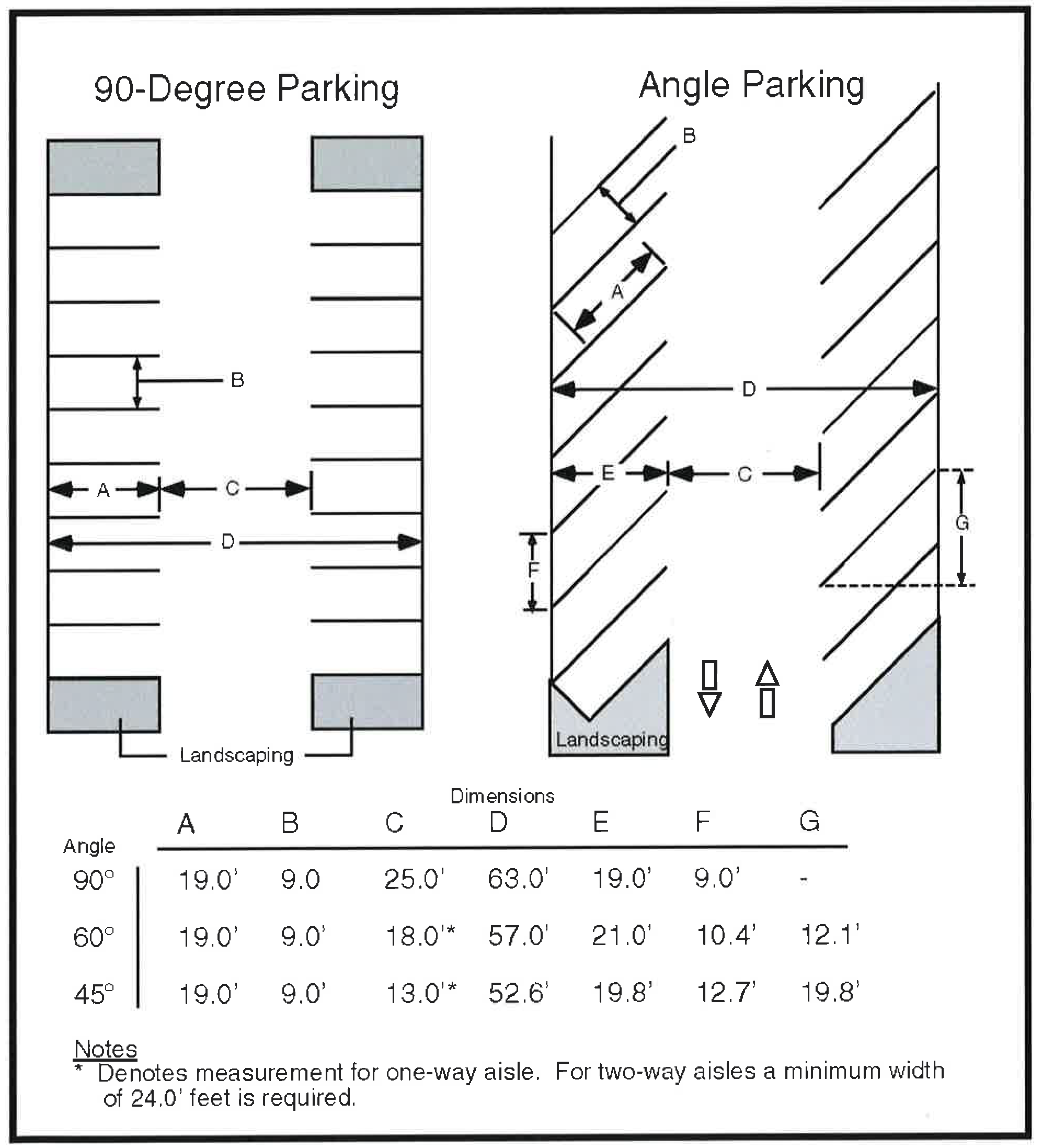
(Ord. No. 650, § 3, 4-28-2025)
17.54.120 - Off-street loading facilities required.
At least one (1) off-street loading space shall be provided in connection with a building having a gross floor area of ten thousand (10,000) square feet or more and intended for a use that typically receives or delivers goods. This requirement shall not apply to a building adjacent to a public alley. The director may waive this requirement for buildings located within the Mixed-Use District.
(Ord. No. 650, § 3, 4-28-2025)
17.54.130 - Standards for off-street loading facilities.
Off-street loading facilities shall conform to the following standards:
A.
Commercial, industrial, office, institutional, and public uses exceeding ten thousand (10,000) square feet in size shall be required to install an off-street loading facility unless the planning director finds that due to the operational nature of the use, none or more than one (1) off-street loading space should be required.
B.
To the extent possible, loading facilities should be located at the rear or side of the building that they are to serve.
C.
Streets and alleys shall not be used as loading or unloading areas, nor shall trucks use streets and alleys for maneuvering trailers into a loading space.
D.
Loading facilities, at a minimum, shall have a length of twenty-five (25) feet, a width of twelve (12) feet, and an overhead clearance of fourteen (14) feet. All loading surfaces shall be paved consistent with Woodlake's Improvements Manual.
E.
Where a loading facility is near or adjacent to a residential district or other noise-sensitive land uses, noise-attenuating design measures will be incorporated into the project. These design measures could include increased setback distances, the construction of a seven-foot solid block wall, landscaping, or locating the loading facilities away from noise-sensitive land uses.
F.
All loading facilities shall be lighted to provide adequate illumination of the loading area for safety and security reasons. Where a loading area is near or adjacent to a residential district or other light-sensitive uses, the lighting shall be directed away from these uses.
(Ord. No. 650, § 3, 4-28-2025)
17.54.140 - Replacement of off-street parking and off-street loading facilities.
Unless specifically stated otherwise in this title, no off-street parking or off-street loading facility provided per this chapter shall be reduced in capacity or in an area without sufficient additional capacity or additional area being provided to comply with the requirements of this chapter.
(Ord. No. 650, § 3, 4-28-2025)
17.54.160 - Landscaping of parking areas.
A.
Parking areas are to have at least one (1) tree placed after every four (4) lineal parking spaces. Landscaped areas shall be distributed throughout the parking area and peripheral areas to the extent practical in consideration of the size and design of the parking area. Landscaped areas shall be delineated by a six-inch-wide and six-inch-high concrete curb. Parking lots developed next to a street shall provide a landscape buffer between the street and the parking lot of at least five (5) feet in width. When parking lots face a residential district, directly across the street, there shall be a four-foot high hedge to block headlights from shining into residential structures.
B.
Parking lot landscaping shall be designed and constructed in accordance with Figure 17.54.160-1, Typical Parking Lot Landscaping Scheme.
Figure 17.54.160-1 Typical Parking Lot Landscaping Scheme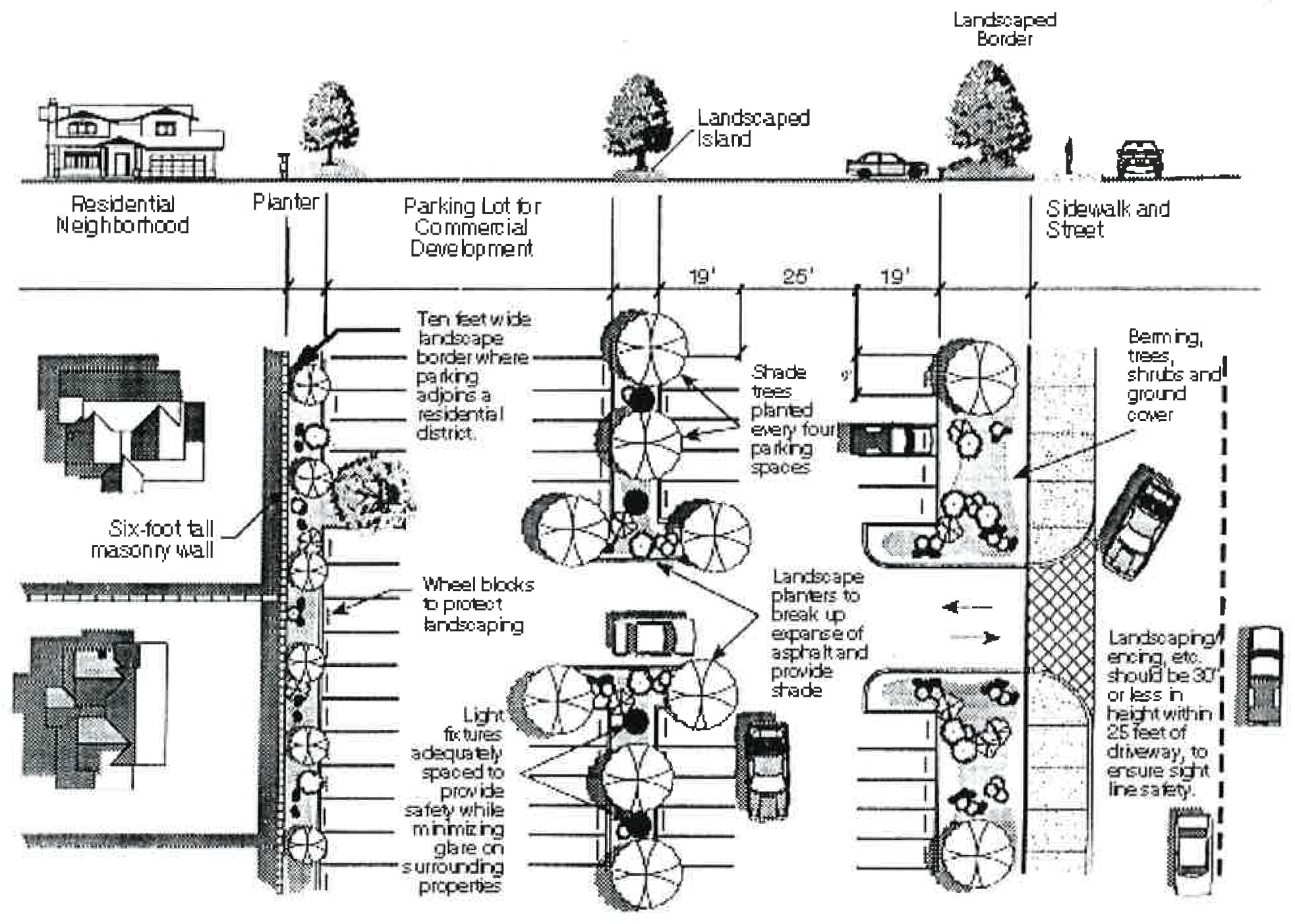
(Ord. No. 650, § 3, 4-28-2025)
17.54.170 - Parking for bicycle and low-emission vehicles.
Parking for bicycles and low-emission vehicles shall be provided in accordance with the latest adopted version of the California Building Code.
(Ord. No. 650, § 3, 4-28-2025)
17.54.180 - Garage conversions of required parking to living space.
A.
It is the purpose of this section to allow, in certain cases and subject to specific design requirements, the conversion of garages and carports for living space in circumstances where the provisions of Section 17.54.140 cannot be met post-conversion.
B.
Garage conversions are allowed if the following requirements are met:
1.
The area converted shall be subject to all applicable building code requirements.
2.
The garage door shall either be removed from the structure and replaced with a wall, or a wall shall be constructed behind the pre-existing garage door with the garage door remaining in place. The exterior elevation of the conversion shall be compatible in design with the existing dwelling.
C.
Required parking is not required to be replaced for garage conversions if there is space in a driveway for at least two (2) parking spaces. The spaces are not required to be covered and may be tandem spaces.
(Ord. No. 650, § 3, 4-28-2025)
17.54.190 - Unimproved Lots.
Vacant or unimproved lots shall not be used as vehicle parking facilities and/or outdoor storage of equipment, construction equipment, and similar uses unless fenced appropriately, as determined by Site Plan Review Committee per Chapter 17.72.
(Ord. No. 650, § 3, 4-28-2025)

