
Woodland City Zoning Code
CHAPTER 17
36 - HIGHWAY COMMERCIAL DISTRICT C-2
17.36.010 - Purpose.
The highway commercial district (C-2) is a zoning classification providing for commercial services which are accessible by automobiles and trucks, require extensive outdoor storage or display areas as well as off-street parking and loading areas. This classification is intended to minimize any undesirable impacts of these uses on other nearby uses and zoning districts. Furthermore, the district provides for uses which will complement and not adversely compete with other commercial use districts.
(Ord. 490 § 9.01 (part), 1979)
17.36.020 - Permitted uses.
The following uses only are permitted in the C-2 districts; all other uses are not permitted or are permitted as a conditional use pursuant to this chapter.
1.
Automobile and truck tire sales and repair;
2.
Automobile diagnostic and repair facilities, major and minor repairs;
3.
Automobile service stations and car washes;
4.
Automobile, truck, motorcycle, bicycle, recreational boat, recreational vehicle, and mobile home sales dealerships with related equipment, services, repair and parts facilities;
5.
Commercial parking lots and garages;
6.
Commercial recreation and entertainment facilities;
7.
Drive-in and fast food restaurants;
8.
Dry cleaning and pressing, except those using volatile or combustible materials and chemicals or using high pressure steam tanks or boilers;
9.
Farm machinery sales and service;
10.
Feed and seed stores;
11.
Food lockers, primarily retail;
12.
Funeral homes, mortuaries and living quarters for owners or a resident manager only (living quarters are to be within the funeral home or mortuary);
13.
Furniture and home furnishing establishments;
14.
Grocery stores;
15.
Lumber and building supply yards;
16.
Motels, hotels and living quarters for owners or a resident manager only (living quarters are to be within the hotel or motel);
17.
Nurseries, greenhouses, yard and garden supplies;
18.
Pet stores;
19.
Police and fire stations;
20.
Public parks and recreation facilities;
21.
Public transportation system terminals;
22.
Real estate offices;
23.
Restaurant and hotel supply;
24.
Restaurants, cafes, drinking establishments pursuant to state law;
25.
Retail stores including sales of marijuana pursuant to Chapter 17.50;
26.
Shopping centers;
27.
Signs pursuant to Chapter 17.52;
28.
Reserved;
29.
Uses permitted in the C-1 central business district except for residential uses which shall not be permitted in the C-2 district;
30.
Veterinary offices and clinics with no outside animal runs; dog grooming facilities;
31.
Professional and business offices;
32.
Churches;
33.
Bed and breakfast inns;
34.
On-site hazardous waste treatment and storage facilities as an accessory use to any activity generating hazardous waste and lawfully permitted in this zone, provided that such facilities must meet the state siting criteria adopted pursuant to the requirements of RCW 70.105.210 as now or hereafter amended;
35.
Banks and financial services;
36.
Electric vehicle infrastructure; and
37.
Wireless Communication Facilities. New attached facilities and colocations consistent with Section 17.71.195.
(Ord. 816 § 1, 1996: Ord. 671 § 4, 1988; Ord. 656 § 2, 1987: Ord. 654 § 7, 1987; Ord. 573 § 6, 1984; Ord. 536 §§ 11, 21, 1982; Ord. 501 § 2, 1980; Ord. 490 § 9.01(A), 1979)
(Ord. No. 1257, § 8, 1-7-2013; Ord. No. 1412, § 1, 6-17-2019; Ord. No. 1447, § 4, 2-3-2020; Ord. No. 1461, § 4, 8-17-2020; Ord. No. 1505, § 1, 6-20-2022; Ord. No. 1584, § 1, 2-2-2026)
17.36.025 - Conditional uses—Administrative.
The following uses in the highway commercial district (C-2) require administrative conditional use permit approval from the community development director per Chapter 17.72:
A.
Vending stands or kiosk (e.g. espresso stands).
(Ord. 982 § 4, 2003)
(Ord. No. 1378, § 72, 11-21-2016)
17.36.026 - Administrative temporary uses.
The following uses in the highway commercial district (C-2) require temporary use permit approval from the community development director per Chapter 17.70:
A.
Roadside produce stand;
B.
Farmer's market.
(Ord. 982 § 4, 2003)
(Ord. No. 1378, § 73, 11-21-2016)
17.36.030 - Conditional uses—Hearing examiner.
The following uses in the highway commercial district (C-2) require conditional use permit approval from the hearing examiner per Chapter 17.72:
1.
Schools;
2.
Public utility uses including electrical substations and transfer facilities but not power generating units;
3.
Recreational vehicle camper parks located East of Interstate 5;
4.
Veterinary offices and clinics with outside animal runs;
5.
Commercial dispatch and maintenance facility;
6.
Bakeries producing for the wholesale market with retail sales limited to items produced on the premises;
7.
Laboratories and research organizations;
8.
Light manufacturing and fabrication of raw or previously processed metals and materials, the process or end product of which conforms with applicable restrictions regarding noise, smoke, dust, odors, toxic gases, vibration, glare, and heat, and which does not create physical hazards, such as fire or explosion, to adjacent buildings and uses;
9.
Processing, packaging, and distribution of goods and services;
10.
Warehousing, storage, and distribution centers, including freight handling terminals; provided that docking and loading activities do not use any public street, alley or sidewalk;
11.
Child day care center;
12.
Wireless Communication Facilities. New support towers consistent with Section 17.71.195.
(Ord. 988 § 1, 2003: Ord. 982 § 4, 2003: Ord. 941 § 2, 2001: Ord. 781 § 1, 1994: Ord. 573 §§ 4, 5, 1984; Ord. 520 § 3, 1981: Ord. 490 § 9.01(C), 1979)
17.36.040 - Prohibited uses.
The following uses are specifically not permitted in the C-2 district:
A.
Any use whose operation constitutes a nuisance by reason of smoke, fumes, odors, steam, gases, vibration, noise, hazards or other causes readily detectable beyond property lines;
B.
Dismantling, storage, and sales on inoperable vehicles, used parts, junk and related items;
C.
Recreational vehicle camper parks located West of Interstate 5;
D.
Reserved;
E.
Medical marijuana cooperative;
F.
Storage facilities, such as self-storage or recreational vehicle storage businesses.
(Ord. 490 § 9.01(B), 1979)
(Ord. No. 1429, 2-19-2019; Ord. No. 1440, § 7, 10-21-2019; Ord. No. 1461, § 5, 8-17-2020; Ord. No. 1584, § 2, 2-2-2026)
17.36.050 - Lots—Minimum size.
Minimum lot size is ten thousand square feet.
(Ord. 490 § 9.01(D)(1), 1979)
17.36.060 - Lots—Width and depth.
There are no limitations for minimum lot width and depth.
(Ord. 490 § 9.01(D)(2), 1979)
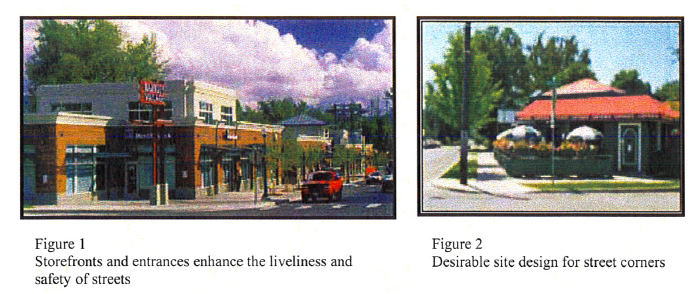
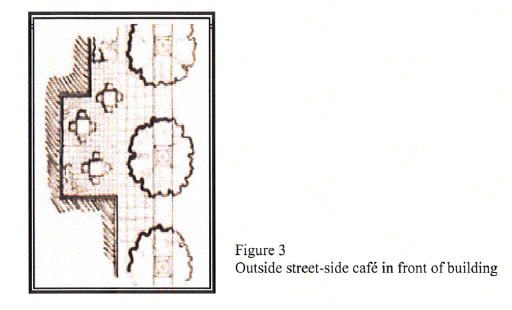
17.36.070 - Building setbacks. (See Figures 1 through 3.)
Intent: To establish active, vibrant, and lively C-2 uses within close proximity to the public streets and sidewalks.
All setbacks shall be measured from the most protruding portion of the building or use to the appropriate property line.
1.
Front Yard and Street Side Yard Setbacks: Buildings shall be set as close as possible to all of the fronting and side public streets.
2.
Zero Setback Requirements on State Highways, Major Arterials, and Minor Arterials: When the subject parcel fronts on a State Highway, Major Arterial, or Minor Arterial, a minimum of forty percent of the facade length of building shall abut the fronting sidewalks. In multi-building developments, a minimum of thirty percent of the total facade length of buildings shall abut the fronting sidewalks. When the subject property is a corner lot or double-frontage lot, the above standards shall also apply to each facade facing the side or secondary street.
3.
When the applicant demonstrates that requirements outlined in WMC 17.36.070.1 or 17.36.070.2 cannot be reasonably met or proposes to locate pedestrian-friendly space between the building and fronting or side public street, the setback area shall feature generous landscaping, benches, or outside cafe. This may be permitted at the discretion of the approving authority without a variance being obtained.
4.
Buildings on Street Corners: Buildings located on the corners of public streets may be set back from the corner property lines only when generous sidewalks and street landscaping are provided in the setback area. To ensure safety of motorists, bicyclists, and pedestrians, a vision clearance area shall be provided on the corner property or within the right-of-way. The vision clearance area shall be the triangle area within twenty feet from the corner of curb lines, or from the corner of property lines where there is no sidewalk. Trees, shrubs, landscaping materials, and other objects/structures shall not exceed three feet in height within the vision clearance areas.
5.
Side Yard and Rear Yard Setbacks: No limitations except where the subject property abuts a residential zoning district, the side/rear yard setbacks shall be a minimum of twenty feet and shall be increased one foot for each foot the C-2 use building height is increased over twenty-five feet.
(Ord. No. 1176, § 1, 1-4-2010)
Editor's note— Ord. No. 1176, § 1, adopted January 4, 2010, amended former §§ 17.36.070—17.36.160 to read as herein set out in §§ 17.36.070—17.36.130. See also the Code Comparative Table and Disposition List.
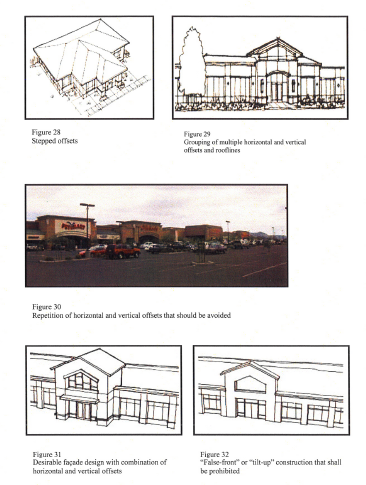
17.36.080 - Building height. (See Figures 31 and 32.)
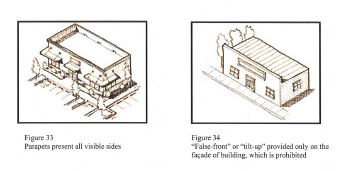
C-2 use buildings shall be a maximum of forty-five feet and a minimum of fifteen feet in height, provided where the C-2 use abuts a residential zone, the height shall not exceed that permitted by the residential zone. "False-fronts" or "tilt-ups" provided only on the facade of building shall be prohibited and shall not be used to meet the minimum building height requirements.
(Ord. No. 1176, § 1, 1-4-2010)
Note— See the editor's note at § 17.36.070.
17.36.090 - Lot coverage.
There are no limitations for lot coverage.
(Ord. No. 1176, § 1, 1-4-2010)
Note— See the editor's note at § 17.36.070.
17.36.100 - Off-street parking.
17.36.110 - Reserved.
Editor's note— Ord. No. 1256, § 1, adopted January 7, 2013, repealed § 17.36.110, which pertained to storm drainage and derived from Ord. No. 1176, adopted January 4, 2010.
17.36.120 - Building and yard maintenance.
All buildings and yards in the C-2 district shall be maintained in a neat and orderly manner. Landscaping shall be maintained in a healthy and presentable state. Nonfunctional vehicles, machinery, appliances, steel drums, boxes, crates, pallets, and C-2 use related equipment and materials shall not be openly stored in side and rear yards.
(Ord. No. 1176, § 1, 1-4-2010)
Note— See the editor's note at § 17.36.070.
17.36.130 - Architectural and site design standards.
A.
Title and Purpose. The purpose of this chapter is to produce development that meets various objectives. These include:
1.
Create a physical environment that emphasizes buildings and landscaping, rather than parking lots, driveways, or large signs.
2.
Maintain the scale, texture, and architectural context of development.
3.
Encourage creative and innovative designs for sites and building designs.
4.
Allow for infill development that is sensitive to the existing urban design context.
5.
Protect and enhance the business environment and property values within the city in manners that support and stimulate business and industry and also promote desirability of investment and occupancy in business and other properties.
B.
Submittal Requirements. Site and elevation plans that are to scale and stamped by a registered architect in the State of Washington shall be submitted and approved prior to issuance of the site plan approval.
C.
Variance from Architectural and Site Design Standards. The city recognizes that strict adherence to the standards outlined in WMC 17.36.130 may prevent innovative and desirable designs that would achieve or exceed the intents of standards. Whenever there are difficulties that result from physical peculiarities of the property which make it difficult to implement these standards, the hearing examiner shall have the authority to grant a variance from strict compliance with specific standards or requirements. The hearing examiner shall review such variance applications at an open record public hearing in accordance with the procedure outlined in WMC 19.06.070 and render decisions based on the criteria outlined in WMC 17.81.020.B, the intents of applicable standards, and applicable provisions in the Woodland Comprehensive Plan. Any such deviations so granted shall be specifically identified in the site and elevation plans.
D.
Master Plan Required. Every commercial park/development or binding site plan that is larger than five acres in size located within the highway commercial (C-2) zoning district shall contain covenants establishing a master site and building design plan so the entire commercial project, upon completion, exhibits conformity in design style per WMC 17.36.130, the Woodland Architectural and Site Design Standards. Any part or phase of the commercial park/development or binding site plan shall exhibit conformance with the approved master plan. A copy of the draft covenants shall be submitted with the application. A copy of the recorded covenants shall be submitted prior to commencement of any on-site work for the project.
E.
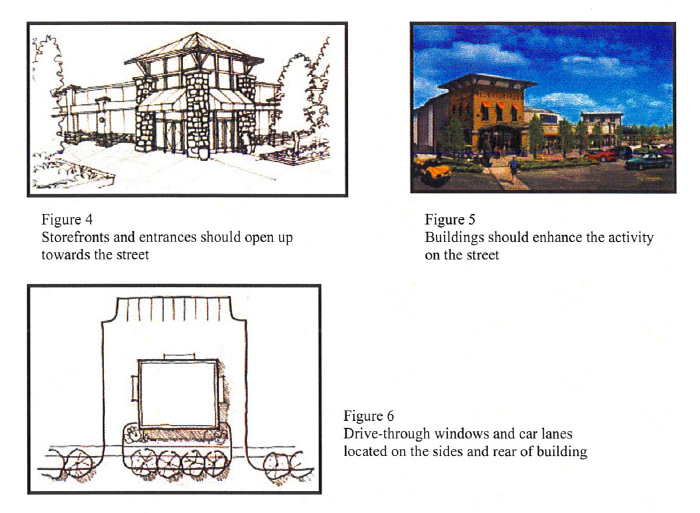
Orientation to the Street. (See Figures 4 through 6.) Intent: To ensure that buildings contribute to the liveliness and safety of streets and provide activity and interest along the street.
1.
Buildings, along with trees and landscaping, shall be predominant rather than parking lots, driveways, or freestanding signs. Buildings should not turn their backs to the streets.
2.
People traveling along the state highways, major arterials, and minor arterials should be able to see storefronts, windows, merchandise, and other aspects of business activity.
3.
Features such as inset or angled corners and entrances, display windows, or corner roof features should be provided at intersections of public streets and alley entrances.
4.
Unless reasonably impractical, parking lots, drive aisles, drive-through lanes, auto repair bay openings, car-wash openings, display areas, and outside storage area shall not be allowed between the building and public street or in an area that is visible from a public street or space even if enclosed or partially enclosed by structural elements. When such an area is proposed between the building and public street or in the area that is visible from a public street or space, comply with WMC 17.36.130.N.4 and 17.36.130.N.5.
5.
Solar orientation and local climate should be considered in siting buildings to promote energy conservation.
F.
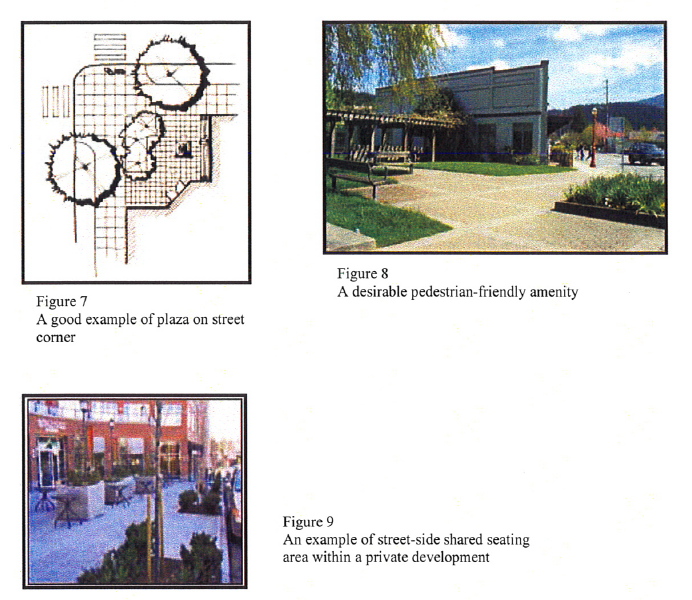
Plazas, Courtyards, and Seating Areas. (See Figures 7 through 9.) Intent: To provide a pedestrian-friendly environment by creating a variety of usable and interesting open spaces within developments.
1.
Buildings larger than four thousand square feet shall have plazas, courtyards, or other pedestrian amenities or spaces at or near their main entrances. Pedestrian spaces should be a minimum of one square foot of plaza per one hundred square feet of both existing and proposed building areas.
2.
Plazas, courtyards and other pedestrian amenities or spaces should include at least three of the following:
a)
Special interest landscape.
b)
Pedestrian scale bollard or other accent lighting.
c)
Special paving, such as colored/stained concrete, brick, or other unit paver.
d)
Public art.
e)
Seating, such as benches, tables, or low seating walls.
f)
Drinking fountain.
g)
Water feature.
h)
An element not listed here that meets the intent.
G.
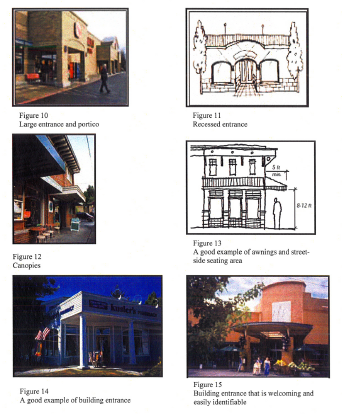
Entrances. (See Figures 10 through 15.) Intent: To ensure that entrances are easily identifiable and accessible from public streets and sidewalks.
1.
Principal building entry shall be visible from the fronting public street and marked by at least one element from Group A and one element from Group B:
Group A:
Large entry doors
Recessed entrance
Protruding entrance
Plaza entrance
Group B:
Canopy
Portico
Overhang
2.
Weather Protection. Canopies and/or awnings shall be provided along a minimum of sixty percent of the facades that give access to the building. The minimum depth of any sidewalk canopy/awning shall be five feet. The vertical clearance between the underside of a canopy/awning and the sidewalk shall be at least eight feet and no more than twelve feet, except for vehicle entrances. Canopy/awning should be provided to emphasize the bays and enhance overall architectural patters of the storefronts.
H.
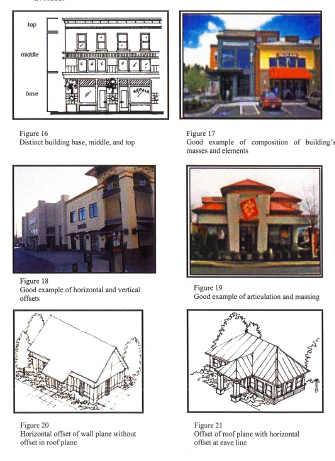
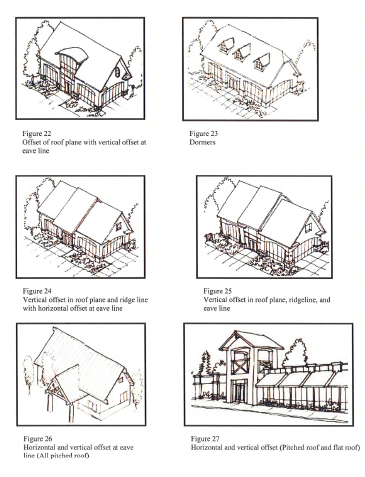
Articulation/Massing. (See Figures 16 through 34.) Intent: To reduce the apparent bulk of buildings over twenty feet in height or width and maintain pedestrian scale. To create a unifying concept through composition of the building's larger masses and elements.
1.
Facade Standards. A building facade that is twenty feet or taller or twenty feet or longer and visible from a public street, public space, or residential zone shall comply with the following Facade Standards a) through j) below.
a)
Building facades shall have a distinct base at the ground level, middle, and top using articulation and materials such as stone, masonry, or decorative concrete to provide pedestrian-scale and architectural interest.
b)
The top of the building shall emphasize a distinct profile or outline with elements such as a projecting parapet, cornice, upper level setback, or pitched roofline.
c)
The middle of the building may be distinguished by a change in materials or color, windows, balconies, stepbacks, and signage.
d)
Facade Modulation Standards. The facade of buildings shall have horizontal offsets, i.e., recesses and projections from the main body of the buildings, to avoid monotonous large walls. Columns, bands, or textural treatment should be effectively used to augment the overall design of buildings.
e)
Building facades shall have vertical offsets in the cornice lines or rooflines in a manner that reduces massive scale of the building and enhance the overall design of buildings.
f)
Repetition of identical vertical or horizontal offsets should be avoided.
g)
Buildings shall avoid the appearance of "false-front" or "tilt-up" construction. When used, the parapets shall be present on all visible sides. "False-fronts" or "tilt-ups" provided only on the facade of building shall be prohibited and shall not be used to meet the minimum building height requirements outlined in WMC 17.36.080. In addition, see WMC 17.36.130.H.6, Roofline Standards.
h)
When there is a change in the building plane, a change in the building materials, colors, or patterns should also occur.
i)
Ample articulated window treatments should be provided in facades using mullions, recesses, complementary articulation around doorways and balconies, etc.
j)
Lighting fixtures shall be provided in a way that enhances the overall design of buildings and landscaping. Lighting of expansive wall planes or the use of architectural lighting that results in hot spots on walls or roof planes should be avoided.
2.
Materials and Colors.
a)
Building materials and building techniques of high durability and high quality should be used. Recycled and ecologically friendly materials should be encouraged.
b)
Accent colors should be used in a way to enhance or highlight building design, and not in a manner that creates clutter or otherwise detracts from building design.
3.
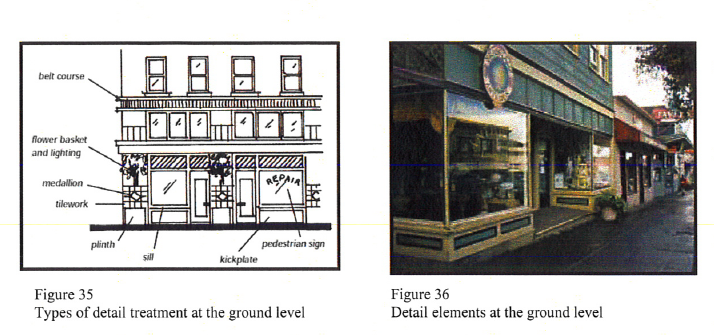
Ground Level Details. (See Figures 35 and 36.) Intent: To reinforce the character of the streetscape by encouraging the greatest amount of visual interest along the ground level of buildings. Facades of buildings that are visible from a public street, public space, or residential zone shall be designed to be pedestrian-friendly through the inclusion of at least three of the following elements:
(i)
Kickplates for storefront windows
(ii)
Projecting window sills
(iii)
Pedestrian scale signs
(iv)
Canopies
(v)
Plinths
(vi)
Containers for seasonal plantings
(vii)
Ornamental tilework
(viii)
Medallions
(ix)
Lighting or hanging baskets supported by ornamental brackets
(x)
An element not listed here that meets the intent
4.
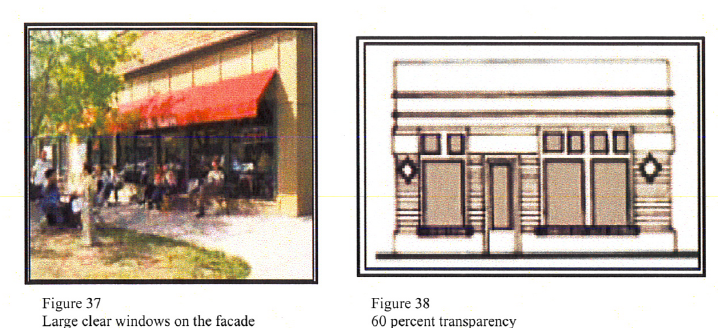
Transparency. (See Figures 37 and 38.) Intent: To provide a visual connection between activities inside and outside of buildings, and encourage pedestrian activities on the fronting public streets.
a)
A minimum of thirty percent of any ground floor facade* 1 that is visible from any public street, public space, or residential zone shall be comprised of windows with clear "vision" glass* 2 .
b)
A minimum of forty percent of any ground floor facade* 1 located closer than sixty feet to a state highway, major arterial, or minor arterial shall be comprised of windows with clear "vision" glass* 2 .
c)
A minimum of sixty percent of any ground floor facade* 1 located closer than twenty feet to a state highway, major arterial, or minor arterial shall be comprised of windows with clear, "vision" glass* 2 . Display windows may be used to meet this requirement.
d)
A minimum of twenty percent of any upper floor facade that is visible from any public street, public space, or residential zone shall be comprised of windows with clear "vision" glass.
e)
For facades that do not have windows, see WMC 17.36.130.H.5, Blank Wall Treatments.
f)
Energy efficient windows should be used.
* 1 The portion of the facade between three feet and seven feet above grade.
* 2 Clear "vision" glass shall be transparent, and shall not include translucent or reflective glass.
5.
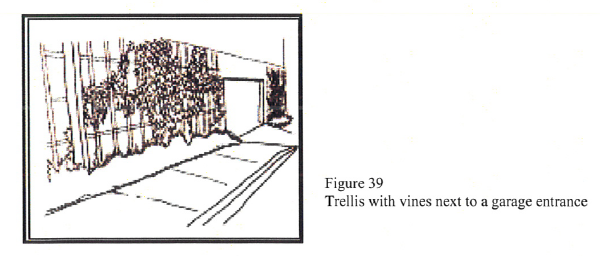
Blank Wall Treatments. (See Figure 39.) Intent: To reduce the appearance and mass of blank walls (walls without windows, showcases, displays, and pedestrian entries) through the use of various architectural and landscaping treatments.
A blank wall longer than thirty feet that is visible from a public street, public space, or residential zone shall incorporate two or more of the following:
a)
Vegetation, such as trees, shrubs, ground cover and/or vines adjacent to the wall.
b)
Artwork, such as bas-relief sculpture, mosaic, mural, etc.
c)
Seating area with special paving and seasonal plantings.
d)
Architectural detailing, reveals, contrasting materials or other special visual interest.
6.
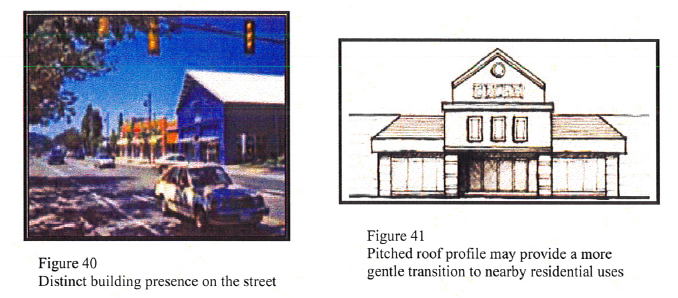
Roofline. (See Figures 40 and 41.) Intent: To ensure that rooflines present a distinct profile and appearance for the building, reduce the massive scale of buildings, and express the neighborhood character.
Commercial buildings with flat roofs shall have extended parapets and projecting cornices on all visible sides to create a prominent edge when viewed against the sky. Cornices shall be made of a different material and color than the predominant siding of the building.
I.
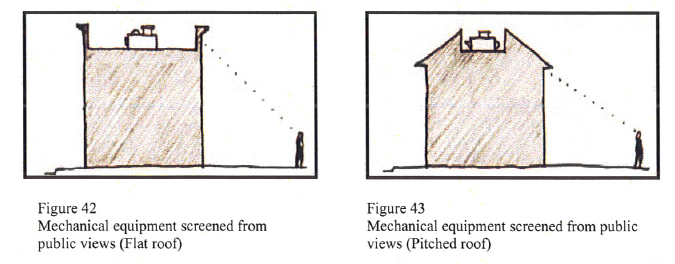
Screening Rooftop Equipment. (See Figures 42 and 43.) Intent: To screen rooftop mechanical and communications equipment from the ground level of nearby public streets, public space, and residential zone of the similar elevation.
1.
Mechanical equipment shall be fully screened by an extended parapet wall, other roof forms, or permanent evergreen trees in a roof garden that is integrated with the overall architecture of the building.
2.
Communication equipment should be blended in with the design of the roofs rather than being merely attached to the roof deck.
J.
Sidewalks and Street Trees. Intent: to maintain a continuous, safe and consistent street frontage an character throughout the site and the abutting public right-of-way.
1.
Private and public sidewalk areas shall maintain a clear zone of a minimum of five feet for pedestrian travel.
2.
Where required or proposed, street trees within the public right-of-way shall be spaced equivalent to one every thirty feet in tree pits or four feet wide continuous planted area. Tree pits may be planted or have pavers. All proposed planting activity shall comply with Section 12.28, Woodland Street Trees Standards.
3.
Street trees shall be a minimum of one and one-half inches in caliper and approved by the City. See WMC 12.28.100 for Prohibited Street Trees.
K.
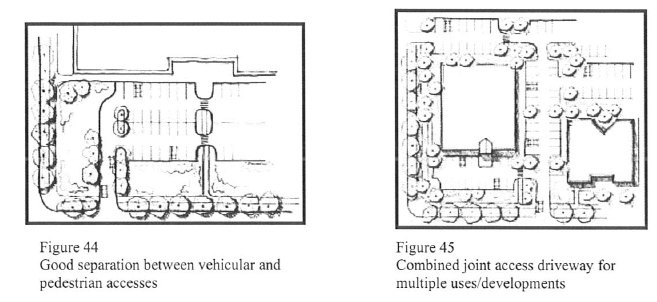
Curb Cuts and Driveways. (See Figures 44 and 45.) Intent: To enhance pedestrian safety and activity by consolidating driveways, while providing for adequate vehicular and service access.
1.
Each C-2 use parcel shall be limited to a maximum of two points of vehicular access on a state highway, major arterial, or minor arterial. When the subject property is a corner lot or double-frontage lot abutting a state highway, major arterial, and/or minor arterial, the total number of access for each C-2 use parcel shall be limited to a maximum of two points of vehicular access on such streets.
2.
Obstructions to pedestrian and bicyclist movement and the number of vehicular turning movements should be minimized.
3.
Closely spaced adjacent driveways in the same development shall be combined for joint access unless such consolidation is impractical or will cause a hazard. Adjacent developments should share driveways to the greatest extent possible. Shared-access agreements between properties should be strongly encouraged.
L.
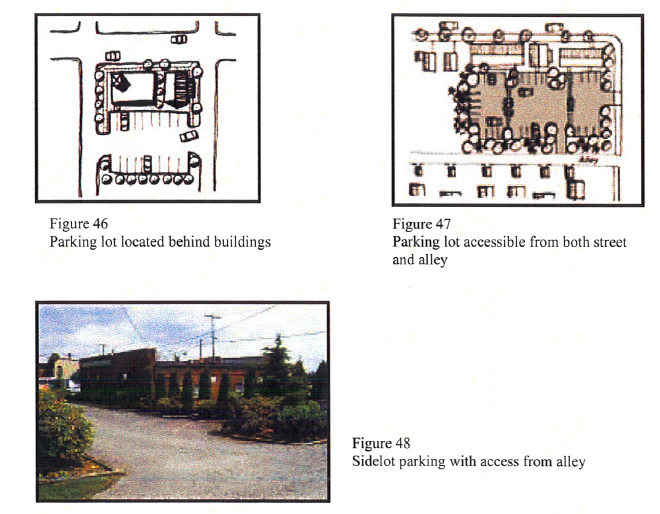
Location of Parking Lot. (See Figures 46 through 48.) Intent: To maintain a contiguous and active pedestrian realm along street fronts by locating parking lots behind or beside the buildings. This ensures that parking lots would be as visually unobtrusive as possible while at the same time maintaining visibility for public safety.
1.
Parking lots shall be located behind or beside the buildings, when physically feasible. In addition, see WMC 17.56 for the Off-Street Parking and Loading Requirements. Where parking lots, drive aisles, drive-through lanes, auto repair bay openings, car-wash openings, display areas, and outside storage area are allowed to be located between the building and public street, such areas shall be screened per WMC 17.36.130.L.4 and 17.36.130.N.5.
2.
Parking lots shall not be located on corners of public streets.
3.
The secondary street and alleys should be effectively used by means of access to parking lots, when feasible.
M.
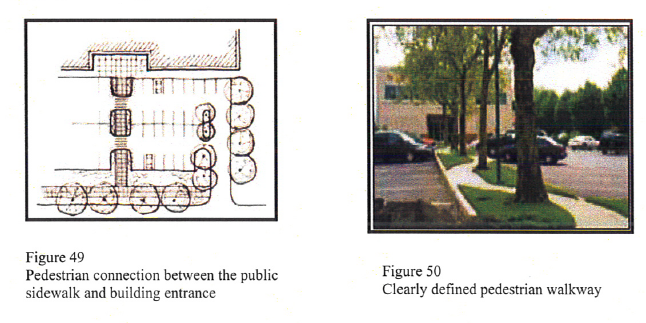
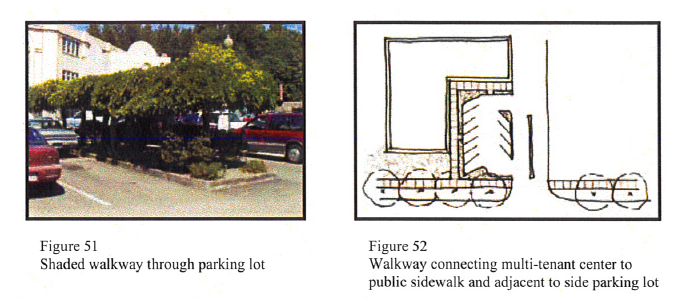
Pedestrian and Bicyclist Connections. (See Figures 49 through 52.) Intent: To create a network of safe and attractive linkages for pedestrians through parking lots.
1.
Clearly defined pedestrian connections not less than five feet wide shall be provided throughout the site:
a)
Between the abutting public street(s)/sidewalk(s) and building entrances,
b)
Between parking lots and building entrances, and
c)
Around the buildings in a way that connects all tenants on the site.
2.
Pedestrian connections shall be clearly defined in a combination of two or more of the following ways:
a)
A six-inch vertical curb in combination with a raised walkway.
b)
A trellis.
c)
Special railing.
d)
Bollards.
e)
Special paving.
f)
Low seat wall and/or other architectural features.
g)
A continuous landscape area a minimum of three feet wide on at least one side of the walkway, except when walkway crosses vehicular travel lanes.
h)
Pedestrian scale lighting, bollard lighting, accent lighting, or combination thereof to aid in pedestrian way finding.
i)
An element not listed here that meets the intent.
3.
On large sites where no public street exists within the site, a grid street system should be created within the project to enhance the flow of vehicles, pedestrians, and bicyclists throughout the site.
4.
Bicycle parking areas should be provided near the public entrances of buildings.
N.
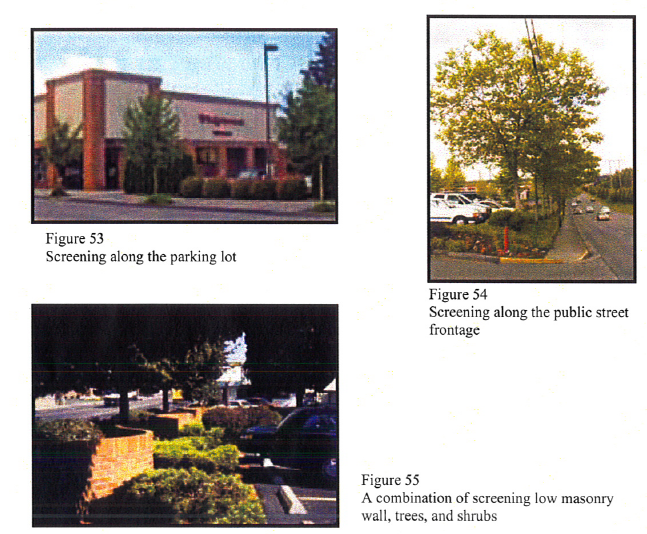
Site Screening and Buffers. (See Figures 53 through 55.) Intent: To mitigate impacts of C-2 uses on the surrounding non-commercial uses and increase the compatibility of C-2 uses with that of other adjacent and nearby uses.
1.
Street Frontage Landscaping. A minimum of five feet wide landscaped strip consisting of trees, shrubs, and plant groundcover shall be planted along the entire public street frontage area, excluding the ingress and egress points and the areas where structures and pedestrian-oriented space are located.
2.
Abutting Residential and Public/Quasi-Public/Institutional (PQPI) Zones. C-2 uses which abut a residential or PQPI zone along the side and/or rear property lines shall provide a sight-obscuring fence or wall a minimum of six feet in height, but no more than eight feet in height along the full frontage of the property lines, between the building and property line. A barbed wire fence or chain link fence containing slats does not qualify as a sight-obscuring fence for the purposes of this section. In addition, a mixture of evergreen and deciduous trees and shrubs not less than six feet in height shall be densely provided along the full frontage of the outer side of such fence or wall.
3.
Vision Clearance Areas. To ensure safety of motorists, bicyclists, and pedestrians, a vision clearance area shall be provided on the corner property or within the right-of-way. The vision clearance area shall be the triangle area within twenty feet from the corner of sidewalks, or where there is no sidewalk the corner of property lines or the corner of driveway boundary and property line. Trees, shrubs, landscaping materials, and other objects/structures shall not exceed three feet in height within the vision clearance areas.
4.
Where parking lots are allowed to be located between the building and public street or in an area that is visible from a public street or space, such parking lots shall be screened from the adjacent public street or space with a minimum of ten feet wide planting area including one or a combination of the following treatments:
a.
Low walls made of concrete, masonry, or other similar material and not exceeding a maximum height of three feet, with evergreen shrubs and groundcover materials along the outer side of the wall.
b.
Raised planter walls planted with a minimum of eighty percent evergreen shrubs not to exceed a total height of three feet, including planter wall and landscape planting, and evergreen groundcover materials along the outer side of the planter wall.
c.
Shrubs of which at least eighty percent are evergreen, not to exceed a total height of three feet, and evergreen groundcover materials.
d.
Landscape plantings consisting of trees of which at least eighty percent are deciduous, shrubs of which at least eighty percent are evergreen, and evergreen groundcover materials. A clear view between three and eight feet above the ground shall be maintained.
e.
An element not listed here that meets the intent.
5.
Where drive aisles, drive-through lanes, auto repair bay openings, car-wash openings, display areas, and outside storage area are allowed to be located between the building and public street or in an area that is visible from a public street or space, such an area shall be substantially screened with walls and/or evergreen trees and shrubs from the adjacent public street or space with a minimum of ten feet wide planting between such an area and the public street or space.
6.
Walls and raised planters shall not exceed a maximum height of three feet, unless all of the following are provided:
a.
Screen treatment does not create a safety hazard.
b.
Portion of treatment that is above three feet in height is a minimum seventy-five percent transparent (i.e. see-through metal railing, trellis, or other similar treatment). A barbed wire fence or chain link fence containing slats does not qualify as a transparent fence for the purposes of this section.
c.
Portion of wall/landscape treatment that is above three feet in height provides added visual interest, detail, and character suitable to the character of the development.
7.
Where walls are provided, landscape planting areas shall be a minimum width of five feet and shall be located adjacent to the public right-of-way.
8.
Use of fences located in the Front Yard or Street Side Yard should be minimized. Where fencing is necessary or required, a human scale should be maintained along the public street by providing pedestrian connections through use of gates or openings at frequent intervals. Considerations should be given to visual interest in terms of fence materials, texture, and colors. Barbed wire fence or chain link fencing shall not be used on any public street frontage.
9.
Fencing around parking lots may be allowed only if all of the following conditions are met:
a.
All screen fencing shall not exceed a maximum height of six feet, and any portion higher than three feet must be seventy-five percent transparent,
b.
Fencing and architectural details should complement the materials used in the development, and
c.
Barbed wire fence or chain link fencing shall not be used on any public street frontage.
O.
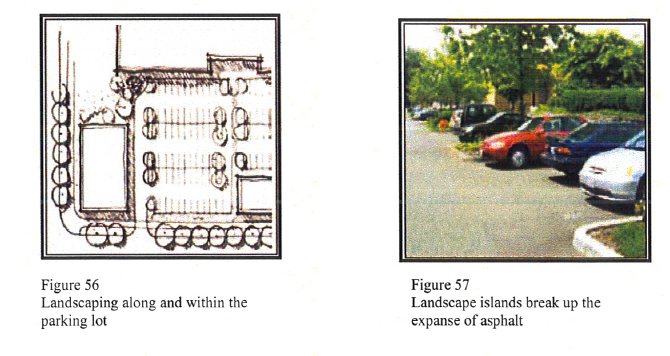
Parking Lot Landscaping (See Figures 56 and 57.) Intent: To mitigate the visual impact of parking lots through landscaped areas and/or architectural features that complement the overall design and character of development.
1.
Parking lot landscaping shall reinforce pedestrian and vehicular circulation, especially parking lot entrances, ends of driving aisles, and pedestrian walkways leading through parking lots.
2.
The minimum number of trees required in the interior landscape area in parking lots shall be dependent upon the location of the parking lot in relation to the building and public right-of-way:
a.
Where the parking lot is located between the building and public street, a minimum of one tree for every five spaces shall be provided (1:5).
b.
Where the parking lot is located to the side of the building and partially abuts the public street, a minimum of one tree for every six spaces shall be provided (1:6).
c.
Where the parking lot is located behind the building and is not visible from the public street or space, a minimum of one tree for every seven spaces shall be provided (1:7).
d.
Landscape islands should be provided at the both ends and in between to break up the parking area.
3.
Trees and other landscaping should be evenly distributed throughout the site.
4.
To protect vegetation, a minimum four-foot area from the base shall be provided for all trees and shrubs where vehicle overhang extends into landscape areas.
5.
Parking lots are encouraged to meet stormwater drainage requirements by using Low Impact Development (LID) techniques where possible and practical.
P.
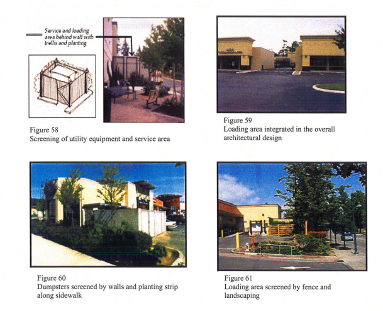
Screening of Trash and Service Areas. (See Figures 58 through 61.) Intent: To screen trash and service areas from public view.
1.
All mechanical and communication equipment, loading docks, garbage receptacles, and recycling containers shall be fully screened from public view. A decorative wall (i.e., masonry, wood, or similar quality material), evergreen hedge, and/or opaque fence shall be used for screening. A barbed wire fence or chain link fence containing slats does not qualify as a sight-obscuring fence for the purposes of this section.
2.
No loading docks shall be located between the building and public street unless no other location is reasonable.
Q.
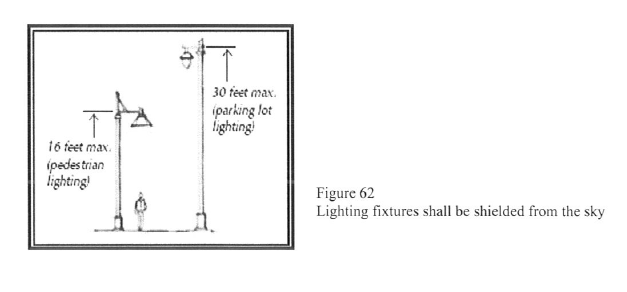
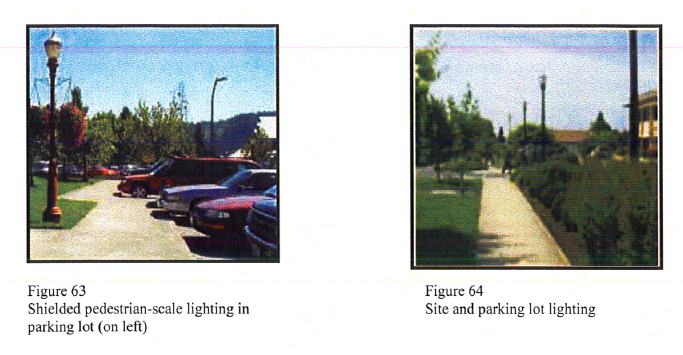
Lighting. (See Figures 62 through 64.) Intent: To mitigate visual impact of lighting and ensure that lighting contributes to the character of the streetscape and does not disturb adjacent developments and residences.
1.
City-approved fixtures and specifications shall be used for lighting within the public right-of-way.
2.
Lighting used in parking lots shall not exceed a maximum of thirty feet in height. Pedestrian scale lighting shall be a maximum of sixteen feet in height.
3.
Lighting elements throughout and surrounding the site should be complementary, including pedestrian pathway, accent and parking lot lighting, lighting of adjacent developments, and the public right-of-way.
4.
All lighting should be shielded from the sky and adjacent properties and structures, either through exterior shields or through optics within the fixture.
5.
Parking lot lighting should be appropriate to create adequate visibility at night and evenly distributed to increase security.
6.
Lighting design should comply with the Illuminating Engineering Society of North America's Recommended Practices and Design Guidelines, latest editions, or other publication approved by the City, for each applicable lighting type (i.e., parking lots, walkways, etc.).
7.
Lighting, including permitted illuminated signs, shall be designed and arranged so as not to:
a)
Reflect or cast glare into any residential zone,
b)
Glitter or flash, or
c)
Conflict with the readability of traffic signs and control signals.
R.
Sign Design.
1.
Creativity. Intent: to encourage interesting, creative and unique approaches to the design of signage.
(i)
All signs shall be designed and installed in a manner that enhances the overall site and building designs.
(ii)
Projecting signs, supported by ornamental brackets and oriented to pedestrians, are strongly encouraged.
(ii)
All signs shall comply with WMC 17.52, Sign Requirements.
2.
Historic Signage. Intent: to preserve the unique character of Woodland.
(i)
Existing historic signs that feature the character of the area should be retained, wherever possible.
3.
Pedestrian-Oriented Signs. Intent: to provide signs that complement and strengthen the pedestrian use of the C-2 zoning district.
(i)
Pedestrian signs include projecting signs (blade signs), window signs (painted on glass or hung behind glass), logo signs (symbols, shapes), wall signs over entrance, A-board and freestanding sidewalk signs.
(ii)
All signs shall comply with WMC 17.52, Sign Requirements.
(Ord. No. 1176, § 1, 1-4-2010; Ord. No. 1546, § 15, 12-18-2023)
Note— See the editor's note at § 17.36.070.

