Woodland City Zoning Code
CHAPTER 17
08 - DEFINITIONS
17.08.001 - Undefined words and phrases.
The definition of any word or phrase not listed in this chapter which is in question when administering this title shall be defined by the development review committee from one of the following sources. The sources shall be utilized by finding the desired definition from source number one, but if it is not available there, then source number two may be used and so on. The sources are as follows:
A.
Any city resolution, ordinance, code or regulation;
B.
Any statute or regulation of the state of Washington;
C.
Legal definitions from Washington common law or a law dictionary;
D.
The common dictionary.
(Ord. 939 § 2 (part), 2000)
17.08.005 - Generally.
For the purposes of this title, unless the context requires otherwise, the words and terms defined in this chapter shall have the meanings ascribed to them in this chapter.
(Ord. 939 § 2 (part), 2000)
17.08.007 - Abutting.
"Abutting" means bordering upon, to touch upon, in physical contact with. Properties are considered abutting even though the area of contact may be only a point.
(Ord. 939 § 2 (part), 2000)
17.08.008 - Access.
"Access" means a way or means of approach to provide vehicular or pedestrian physical entrance to a property.
(Ord. 939 § 2 (part), 2000)
17.08.010 - Accessory dwelling unit.
"Accessory dwelling unit" means a second dwelling unit either in or added to an existing single-family detached dwelling, or in a separate accessory structure on the same lot as the main dwelling, for use as a complete, independent living facility with provision within the accessory apartment for cooking, eating, sanitation, and sleeping. Such a dwelling is an accessory use to the main dwelling. Accessory units are also commonly known as "mother-in-law" units or "carriage houses."
(Ord. 939 § 2 (part), 2000)
17.08.015 - Accessory building.
"Accessory building" means a building or structure housing an accessory use, such as a detached garage, detached carport, tool or garden sheds, cabanas, and covered swimming pools unless otherwise noted in this title.
(Ord. No. 1304, § 2, 10-6-2014)
Editor's note— Ord. No. 1304, § 2, adopted October 6, 2014, repealed the former § 17.08.015, and enacted a new § 17.08.015 as set out herein. The former § 17.08.015 pertained to accessory use building or structure and derived from Ord. No. 939, 2000.
17.08.016 - Accessory use.
"Accessory use" means a use which is subordinate in area, extent, or purpose to the principle use on the same lot.
(Ord. No. 1304, § 3, 10-6-2014)
17.08.020 - Adjacent.
"Adjacent" means nearby and not necessarily abutting.
(Ord. 939 § 2 (part), 2000)
17.08.022 - Adult day care.
"Adult day care" means a facility which provides, on a recurrent basis for periods of less than twenty-four hours, supervision and social activities in a group setting, and which serves socially isolated persons, or persons who cannot be left unsupervised. Persons may have physical, cognitive, or emotional impairments, but any required treatment is provided outside the social day care program.
(Ord. 939 § 2 (part), 2000)
17.08.023 - Adult family home.
"Adult family home" means a regular family abode of a person or persons who are providing personal care, room, and board to more than one, but not more than four, adults who are not related by blood or marriage to the person or persons providing the services; except that a maximum of six adults may be permitted if the Department of Social and Health Services determines that the home is of adequate size and that the home and provider are capable of meeting the standards and qualifications established in Chapter 70.128 RCW.
(Ord. 939 § 2 (part), 2000)
17.08.025 - Agriculture.
"Agriculture" means the tilling of the soil, the raising of crops, forestry, horticulture, gardening, keeping or raising of livestock and poultry, and any agricultural industry or business such as dairies, nurseries, greenhouses, or similar uses.
(Ord. 939 § 2 (part), 2000)
17.08.030 - Alley.
"Alley" means a public thoroughfare or way which affords only a secondary means of access to abutting property. Access is usually limited to on-site vehicular parking and utility service.
(Ord. 939 § 2 (part), 2000)
17.08.035 - Amendment.
"Amendment" means a change in the wording, context or substance of this title, or the Woodland comprehensive plan, a change in the zone boundaries upon zoning maps adopted under this title, or a change in the land use designations upon the comprehensive plan map.
(Ord. 939 § 2 (part), 2000)
17.08.037 - Animal shelter.
"Animal shelter" means a place where dogs, cats or other stray or homeless animals are sheltered. Activities and services may include kenneling, animal clinic, pet counseling and sales, as well as animal disposal.
(Ord. No. 1263, § 6, 4-15-2013)
17.08.040 - Animal, small.
"Small animal" means any animal other than livestock or animals considered to be predatory or wild.
(Ord. 939 § 2 (part), 2000)
17.08.042 - Antenna.
"Antenna" means any system of wires, poles, rods, reflecting disks, or similar devices used for the transmission or reception of electromagnetic waves external to or attached to any building.
(Ord. 939 § 2 (part), 2000)
17.08.043 - Antenna, satellite dish.
"Satellite dish antenna" means a device incorporating a reflective surface that is solid, open mesh, or bar configured and is in the shape of a shallow dish, cone, horn, or cornucopia. Such device is used to transmit and/or receive radio or electromagnetic waves between terrestrially and/or orbitally based uses. This definition is meant to include but not be limited to what are commonly referred to as satellite earth stations, TVROs (television reception only satellite dish antennae), and satellite microwave antennae.
(Ord. 939 § 2 (part), 2000)
17.08.045 - Apartments.
"Apartments" means a building design for the purpose of human habitation which contains two or more dwelling units.
(Ord. 939 § 2 (part), 2000)
17.08.047 - Artisan/craft shop.
"Artisan/craft shop" means a retail store selling art glass, ceramics, clothing, jewelry, paintings, sculpture, and other handcrafted items, where the facility includes an area for the crafting of the items being sold.
(Ord. No. 1263, § 6, 4-15-2013)
17.08.050 - Assisted living facilities.
"Assisted living facilities" means apartments in an apartment complex but with additional services beyond retirement units. The services include all of those provided in retirement homes, as well as more personal care services such as giving medications, assisting with bathing, dressing, transporting to a doctor, etc. Some assisted living facilities specialize in dementia care where a secured environment is needed for confused residents who might wander off.
(Ord. 939 § 2 (part), 2000)
17.08.055 - Automobile, boat and trailer sales area.
"Automobile, boat and trailer sales area" means an open area, other than a street, used for the display, sale or rental on the premises of new or used automobiles, boats or trailers, and where no repair work is done except minor incidental repair to items sold.
(Ord. 939 § 2 (part), 2000)
17.08.060 - Automobile and truck repair, major.
"Major automobile and truck repair" means the rebuilding and reconditioning of automobiles and of trucks over one and one-half tons in capacity, which include: auto and truck body and frame repair and straightening, vehicle painting, motor vehicle dismantling and wrecking, and engine, transmission, and suspension rebuilding. These uses normally require outdoor storage of vehicles under repair or used for parts.
(Ord. 939 § 2 (part), 2000)
17.08.065 - Automobile and truck repair, minor.
"Minor automobile and truck repair" means general maintenance, tune-up, and replacement with new or reconditioned parts to automobiles and trucks not exceeding one and one-half tons in capacity, but not including operations specified under Section 17.08.060. Activities include: ignition system tune-ups, oil and lubricating, clutch, starter, alternator, water pump, and fuel pump replacement, front end realignment, tire balancing, muffler and suspension repair, and electric system repairs.
(Ord. 939 § 2 (part), 2000)
17.08.070 - Automobile wrecking yard.
"Automobile wrecking yard" means an area outside of an enclosed building where motor vehicles are disassembled, dismantled or junked, or where vehicles not in operable condition or used parts of motor vehicles are stored.
(Ord. 939 § 2 (part), 2000)
17.08.075 - Basement.
"Basement" means that portion of a building partly underground and having at least one-half of its height, or more than five feet, below the exterior ground's grade level. If the finished floor level directly above the basement is more than five feet above grade, such basement shall be considered a story.
(Ord. 939 § 2 (part), 2000)
17.08.076 - Battery charging station.
"Battery charging station" means a public or private electrical component assembly or cluster of component assemblies designed specifically to charge batteries within electric vehicles, which meet or exceed any standards, codes, and regulations set forth by Chapter 19.27 RCW, as amended, and consistent with rules adopted under RCW 19.27.540, as amended.
(Ord. No. 1257, § 1, 1-7-2013)
17.08.076.3 - Battery exchange station.
"Battery exchange station" means a fully automated facility that will enable an electric vehicle with a swappable battery to enter a drive lane and exchange the depleted battery with a fully charged battery through a fully automated process, which meets or exceeds any standards, codes, and regulations set forth by Chapter 19.27 RCW and consistent with rules adopted under RCW 19.27.540.
(Ord. No. 1257, § 1, 1-7-2013)
17.08.077 - Bed and breakfast.
"Bed and breakfast" means a lodging where five or fewer guest rooms are provided to guests by a resident operator for a fee by pre-arrangement on a daily or short-term, temporary basis. A breakfast and/or light snacks may be served to those renting rooms in the bed and breakfast. No cooking facilities are provided in the individual rooms.
(Ord. 939 § 2 (part), 2000)
17.08.080 - Billboard.
17.08.085 - Block.
"Block" means all property abutting upon one side of a street between intersecting and intercepting streets, or between a street and railroad right-of-way, waterway, terminus or dead-end street. An intercepting street shall determine only the boundary of the block on the side of the street which it intercepts.
(Ord. 939 § 2 (part), 2000)
17.08.088 - Board and care homes.
"Board and care homes" means homes generally licensed to care for ten to fifteen functionally disabled or frail older adults. Services provided include meals, social activities, laundry, housekeeping, medication supervision, and personal care services. Typically, residents have a sleeping room (private or semi-private) and share living rooms and family rooms. They are often large homes adapted for board and care. Usually there is twenty-four-hour a day staff coverage. Some specialize in caring for developmentally disabled or chronically mentally ill adults. They may also be referred to as "residential care facilities" and "congregate care facilities."
(Ord. 939 § 2 (part), 2000)
17.08.090 - Boardinghouse.
"Boardinghouse" means a building with not more than five guest rooms where meals (with or without lodging) are provided for compensation for not more than ten persons, but shall not include rest homes or convalescent homes. Guest rooms numbering six or more in any building shall constitute a hotel. The term "lodginghouse" is synonymous with "boardinghouse."
(Ord. 939 § 2 (part), 2000)
17.08.095 - Boat.
"Boat" means a vessel designed to travel on water.
(Ord. 939 § 2 (part), 2000)
17.08.100 - Building.
"Building" means any structure having a roof. When a use is required to be within a building, or where special authority granted pursuant to this title requires that a use shall be within an entirely enclosed building, the term "building" means one so designated and constructed that all exterior walls of the structure shall be solid from the ground to the roof line, and shall contain no openings except for windows and doors which are designed so that they may be closed.
(Ord. 939 § 2 (part), 2000)
17.08.105 - Building department.
"Building department" means the designated building department of the city.
(Ord. 939 § 2 (part), 2000)
17.08.110 - Building height.
"Building height" means the vertical distance from the grade to the highest point of the coping of a flat roof, or the deck line of a mansard roof, or the average height of the highest gable of a pitch or hip roof. (Refer to Figure 17.08 A).
(Ord. 939 § 2 (part), 2000)
17.08.115 - Building line.
"Building line" means a line established at the minimum distance a building may be located from any property line or right-of-way as determined by the standards of this title.
(Ord. 939 § 2 (part), 2000)
17.08.120 - Building, main.
"Main building" means the principal building or other structure on a lot or building site designed or used to accommodate the primary use to which the premises are devoted. Where a permissible use involves more than one building or structure designed or used for the primary purpose, as in the case of group houses, each such permissible building or other structure on a lot or building site as defined by this title shall be construed as comprising a main building or structure.
(Ord. 939 § 2 (part), 2000)
17.08.125 - Building site.
"Building site" means a parcel of land assigned to a use, to a main building, or to a main building and its accessory buildings, together with all yards and open spaces required by this title, whether the area so devoted is comprised of one lot, a combination of lots, or a combination of lots and fractions of lots, or a piece of unsubdivided land.
(Ord. 939 § 2 (part), 2000)
17.08.130 - Business.
"Business" means the purchase, sale, offering for sale, or other transaction involving the handling or disposition of any article, service, substance or commodity for livelihood or profit; or the management or occupancy of office buildings, offices, recreational or amusement enterprises by professions and trades or persons rendering services.
(Ord. 939 § 2 (part), 2000)
17.08.135 - Camper park.
This definition includes the terms "trailer park," "trailer court," and "public trailer court" and means a plot of ground divided into lots or sites under ownership or management of one person, firm or corporation, or unit of government for the purpose of temporarily locating or allowing camper vehicles for dwelling or sleeping purposes.
(Ord. 939 § 2 (part), 2000)
17.08.140 - Camper vehicle.
"Camper vehicle" means a travel trailer, pickup camper, converted bus, tent trailer, motor home, camping trailer, or similar vehicular dwelling used for travel, vacation, or recreational purposes.
(Ord. 939 § 2 (part), 2000)
17.08.145 - Carport.
"Carport" means a private garage which is open to the weather on at least forty percent of the total area of its sides.
(Ord. 939 § 2 (part), 2000)
17.08.150 - Cemetery.
"Cemetery" means land used or intended to be used for the burial of the human dead and dedicated for cemetery purposes, including columbariums, crematories, mausoleums, and mortuaries when operated in conjunction with and within the boundary of such cemetery.
(Ord. 939 § 2 (part), 2000)
17.08.155 - Charging levels.
"Charging levels" means the standardized indicators of electrical force, or voltage, at which an electric vehicle's battery is recharged. The terms 1, 2, and 3 are the most common EV charging levels, and include the following specifications: Level 1 is considered slow charging, Level 2 is considered medium charging, and Level 3 is considered fast or rapid charging.
(Ord. No. 1257, § 1, 1-7-2013)
17.08.160 - Church.
"Church" means an establishment or group of people with the principal purpose of religious worship and for which the principal building or other structure contains the sanctuary or principal place of worship.
(Ord. 939 § 2 (part), 2000)
17.08.165 - Classification.
"Classification" means a category in the broad list of land uses, in which category, certain uses, either individually or as to type, are identified as possessing similar characteristics or performance standards and are permitted as compatible uses in the same zone or classification. A classification, as the term is employed in this title, includes provisions, conditions and requirements related to the location of permitted uses.
(Ord. 939 § 2 (part), 2000)
17.08.170 - Clinic.
"Clinic" means a building or portion of a building containing offices for providing medical, dental, psychiatric or chiropractic services for outpatients only.
(Ord. 939 § 2 (part), 2000)
17.08.175 - Club.
"Club" means an association of persons for some common purpose, but not including groups organized primarily to render a service which is customarily carried on as a business.
(Ord. 939 § 2 (part), 2000)
17.08.180 - College.
"College" means a public or private post-secondary educational institution, granting associate, bachelor and/or graduate degrees.
(Ord. 939 § 2 (part), 2000)
17.08.185 - Community club.
"Community club" means a building and related grounds used for social, civic, or recreational purposes and owned and operated by a private nonprofit institution or organization serving the neighborhood in which it is located and open to the general public on equal basis and where no business activities are carried on.
(Ord. 939 § 2 (part), 2000)
17.08.187 - Commercial vehicles.
"Commercial vehicles" means any vehicle with or without identifying commercial signage, which is used primarily for a commercial purpose.
(Ord. 978 § 1, 2003)
17.08.188 - Commercial vehicle repair.
"Commercial vehicle repair" means general maintenance, tune-up, and replacement with new or reconditioned parts to any vehicle identified as commercial, which includes but not limited to: ignition system tune-ups, oil and lubricating, clutch, starter, alternator, water pump, and fuel pump replacement, front end realignment, tire balancing, muffler and suspension repair, and electric system repairs.
(Ord. 978 § 1, 2003)
17.08.190 - Conditional use.
"Conditional use" means a use permitted in one or more zones as defined by this title, but which, because of characteristics peculiar to each such use, or because of size, technological processes or equipment, or because of the exact location with reference to surroundings, streets, and existing improvements or demands upon public facilities, requires a special degree of control to make such uses consistent and compatible with other existing or permissible uses in the same zone or zones.
(Ord. 939 § 2 (part), 2000)
17.08.195 - Conditional use permit.
"Conditional use permit" means the documented evidence of authority granted by the hearing examiner to locate a conditional use at a particular location.
(Ord. 939 § 2 (part), 2000)
17.08.197 - Conditional use permit — (Administrative).
"Conditional use permit — Administrative" means any use listed as an Administrative Conditional Use that shall be considered by the director or his designee.
(Ord. 978 § 1, 2003)
17.08.200 - Condominium.
"Condominium" means joint ownership of real property in which each owner enjoys exclusive ownership of an individual apartment or, unit with or without a parcel of land by holding a fee simple title thereto and retaining an undivided interest, as tenants in common, in the common facilities and areas of buildings.
(Ord. 939 § 2 (part), 2000)
17.08.205 - Contiguous.
"Contiguous" means the same as "abutting."
(Ord. 939 § 2 (part), 2000)
17.08.207 - Continuing care or life care communities.
"Continuing care or life care communities" means communities which offer a variety of living arrangements from small houses, to retirement apartments, to nursing home levels. Residents may move from one level to another as their needs change. A variety of services such as beauty and barber shops, organized social activities, exercise, and crafts may be offered.
(Ord. 939 § 2 (part), 2000)
17.08.209 - Cooperative, medical marijuana.
"Cooperative, medical marijuana" means a cooperative formed by qualified patients or providers as defined by RCW 69.51A and licensed by the Washington State Liquor Control Board for the purpose of acquiring and supplying the resources needed to produce and process marijuana only for medical use by members of the cooperative.
(Ord. No. 1440, §§ 1, 2, 10-21-2019)
17.08.210 - Court.
"Court" means any portion of the interior of a lot or building site which is fully or partially surrounded by buildings or other structures and which is not a required yard or open space.
(Ord. 939 § 2 (part), 2000)
17.08.215 - Day care facility.
"Child day care center" means a state licensed entity regularly providing care for thirteen or more children for periods of less than twenty-four hours. A day-care center is not located in a private family residence unless the portion of the residence to which the children have access is used exclusively for the children during the hours the center is open or is separate from the usual quarters of the family.
(Ord. 988 § 2, 2003: Ord. 939 § 2 (part), 2000)
17.08.220 - Density.
"Density" means a measure of the intensity of permitted residential development in terms of dwelling units per acre.
(Ord. 939 § 2 (part), 2000)
17.08.225 - Density, gross.
"Gross density" means the total number of dwelling units divided by the total land area of the site, excluding nothing.
(Ord. 939 § 2 (part), 2000)
17.08.227 - Density, net.
"Net density" means the total number of dwelling units divided by the net area of the lot or site. The net area excludes streets, alleys, public open spaces, utility rights-of-way, easements, and other public facilities or utility facilities.
(Ord. 939 § 2 (part), 2000)
17.08.230 - Detonable materials.
"Detonable material" means those materials which are generally unstable and will explode violently from a rather moderate initiating force. Some will detonate upon impact, from vigorous burning, or react violently in the presence of impurities or heat. Detonable materials include but are not limited to: all primary explosives such as lead azide, lead styphnate, fulminates and tetracene; all high explosives such as TNT, RDX, HMX, PETN, and picric acid; propellants and components thereof such as nitrocellulose, black powder, boron hydrides, hydrazine and its derivatives; pyrotechnics and fireworks such as magnesium powder, potassium chlorate and potassium nitrate; blasting explosives such as dynamite and nitroglycerine, unstable organic compounds such as acetylides, tetrazoles and ozonides; strong unstable oxidizing agents such as perchloric acid, perchlorates, chlorates, and hydrogen peroxide in concentrations greater than thirty-five percent; and nuclear fuels, fissionable materials and products and reactor elements such as Uranium 235 and Plutonium 239.
(Ord. 939 § 2 (part), 2000)
17.08.232 - Development.
"Development" means:
A.
Any activity, other than a normal agricultural or forestry activity, which materially affects the existing condition of land or improvements, such as:
1.
Substantial excavation or deposit of earth or other fill, grading, driving of pilings, or alteration in the banks of any river or other body of water. For the purposes of this title, "substantial excavation or deposit" means the movement of more than fifty cubic yards of earth or other fill, occurring within any twelve-month time period;
2.
Relocation, diversion, grading, driving of pilings, or placement of fill in any natural drainage;
3.
Construction, reconstruction or alteration of any improvement;
4.
Dumping, storing or parking (which is a substantial or primary use) of any objects or materials whether mobile or immobile, liquid or solid; or
5.
Commencement of any principal or substantial use of land or improvements and every change in its type, intensity or features.
B.
Any subdivision of land or change in the legal relationship of persons to land, such as the division of land into two or more parcels or units to facilitate separate transfers of title to each parcel or unit.
(Ord. 939 § 2 (part), 2000)
17.08.233 - Director.
"Director" means the community development director or his/her designee.
(Ord. 978 § 1, 2003)
(Ord. No. 1378, § 65, 11-21-2016)
17.08.234 - Dispatch.
"Dispatch" means to send off or away; — particularly applied to scheduling, coordination of routes and commercial vehicles.
(Ord. 978 § 1, 2003)
17.08.234.1 - Display garden.
"Display garden" means a plot of ground set up to openly view herbs, fruits, flowers, shrubs and/or trees.
(Ord. 978 § 1, 2003)
17.08.235 - District.
"District" means a portion of the city within which certain uses of land and buildings are permitted, and certain other uses of land and buildings are prohibited, all as set forth and specified within this title.
(Ord. 939 § 2 (part), 2000)
17.08.240 - Drive-in business.
"Drive-in business" means a business or a portion of a business where a customer is permitted or encouraged either by the design of physical facilities or by service and/or packaging procedures, to carry on business in the off-street parking or paved area accessory to the business while seated in a motor vehicle. In some instances, customers may need to get out of the vehicle to obtain the product or service. This definition shall include but not be limited to gas stations, car washes, and drive-in restaurants, dry cleaners or banks.
(Ord. 939 § 2 (part), 2000)
17.08.242 - Drive-through facility.
"Drive-through facility" means a facility or structure that is designed to allow drivers to remain in their vehicles before and during an activity on the site. Drive-through facilities may serve the primary use of the site or may serve accessory uses. Examples are drive-up windows; menu boards; order boards or boxes; and quick-lube or quick-oil change facilities.
(Ord. No. 1263, § 6, 4-15-2013)
17.08.243 - Drug treatment facility.
"Drug treatment facility" means a facility that offers inpatient detoxification services and drug rehabilitation counseling. Drug treatment facility does not mean residential structures occupied by persons with handicaps, also known as group homes, where "handicap" is defined by the Federal Fair Housing Amendments Act of 1988 (42 U.S.C. Section 3602). Drug treatment facility also does not mean facilities used as meeting space for Alcoholics Anonymous or Narcotics Anonymous meetings.
(Ord. No. 1263, § 6, 4-15-2013)
17.08.245 - Dwelling.
"Dwelling" means a building or portion thereof designed exclusively for residential purposes, including one-family, two-family and multiple-family dwellings, but not including hotels, boardinghouses, or motel units having no kitchens.
(Ord. 939 § 2 (part), 2000)
17.08.255 - Dwelling, multiple.
"Multiple dwelling" means a building or portion thereof, designed for occupancy by three or more families living and cooking independently of each other. Such building or portion thereof has a common roof or the dwelling units are joined by a common roof to form a triplex, four-plex or apartment house structure.
(Ord. 939 § 2 (part), 2000)
17.08.260 - Dwelling, single-family.
"Single-family dwelling" means a detached structure designed for and occupied exclusively by one family and the household employees of that family. The building generally contains only one kitchen unit and utilities and services for one dwelling unit and is constructed or assembled on-site. This definition does not include mobile homes.
(Ord. 939 § 2 (part), 2000)
17.08.265 - Dwelling, two-family.
"Two-family dwelling" (or duplex) means a detached structure designed for and occupied by two families living and cooking independently of each other. Such a two-family dwelling unit has a common roof or two separate dwelling units are joined by a common roof.
(Ord. 939 § 2 (part), 2000)
17.08.270 - Dwelling unit.
"Dwelling unit" means one or more rooms designed for or occupied by one family for living or sleeping purposes and containing kitchen facilities for use solely by one family. All rooms comprising a dwelling unit shall have access through an interior door to other parts of the dwelling unit. A "bachelor," "studio," or "efficiency" apartment constitutes a dwelling unit within the meaning of this title.
(Ord. 939 § 2 (part), 2000)
17.08.275 - Educational institution.
"Educational institution" means elementary, junior high, high schools, junior colleges, colleges or universities, or other schools giving general academic instruction in the several branches of learning and study required by the Education Code of the state.
(Ord. 939 § 2 (part), 2000)
17.08.276 - Electric vehicle.
"Electric vehicle" means any vehicle that operates, either partially or exclusively, on electrical energy from the grid, or an off-board source, that is stored on-board for motive purpose. "Electric vehicle" includes the following:
A.
"Battery electric vehicle (BEV)" means any vehicle that operates exclusively on electrical energy from an off-board source that is stored in the vehicle's batteries; and produces zero tailpipe emissions or pollution when stationary or operating.
B.
"Plug-in hybrid electric vehicle (PHEV)" means an electric vehicle that (1) contains an internal combustion engine and also allows power to be delivered to drive wheels by an electric motor; (2) charges its battery primarily by connecting to the grid or other off-board electrical source; (3) may additionally be able to sustain battery charge using an on-board internal-combustion-driven generator; and (4) has the ability to travel powered by electricity.
C.
"Neighborhood electric vehicle" means a self-propelled, electrically powered four-wheeled motor vehicle whose speed attainable in one mile is more than twenty miles per hour and not more than twenty-five miles per hour and conforms to federal regulations under Title 49 C.F.R. Part 571.500.
D.
"Medium-speed electric vehicle" means a self-propelled, electrically powered four-wheeled motor vehicle equipped with a roll cage or crush proof body design, whose speed attainable in one mile is more than twenty-five miles per hour but not more than thirty-five miles per hour and otherwise meets or exceeds the federal regulations set forth in 49 C.F.R. Sec. 571.500.
(Ord. No. 1257, § 1, 1-7-2013)
17.08.277 - Electric vehicle charging station.
"Electric vehicle charging station" means a public or private parking space that is served by battery charging station equipment that has as its primary purpose the transfer of electric energy (by conductive or inductive means) to a battery or other energy storage device in an electric vehicle. An electric vehicle charging station equipped with Level 1 or Level 2 charging equipment is permitted outright as an accessory use to any principal use.
(Ord. No. 1257, § 1, 1-7-2013)
17.08.278 - Electric vehicle charging station—Public.
"Electric vehicle charging station—public" means an electric vehicle charging station that is (1) publicly owned and publicly available (e.g., park and ride parking, public library parking lot, on-street parking) or (2) privately owned and publicly available (e.g., shopping center parking).
(Ord. No. 1257, § 1, 1-7-2013)
17.08.278.3 - Electric vehicle charging station—Restricted.
"Electric vehicle charging station—restricted" means an electric vehicle charging station that is (1) privately owned and restricted access (e.g., single-family home, executive parking, designated employee parking) or (2) publicly owned and restricted (e.g., fleet parking with no access to the general public).
(Ord. No. 1257, § 1, 1-7-2013)
17.08.278.5 - Electric vehicle infrastructure.
"Electric vehicle infrastructure" means structures, machinery, and equipment necessary and integral to support an electric vehicle, including battery charging stations, rapid charging stations, and battery exchange stations.
(Ord. No. 1257, § 1, 1-7-2013)
17.08.280 - Equipment, heavy duty.
"Heavy duty equipment" means high-capacity mechanical devices for moving earth or other materials, mobile power units, including, but not limited to, carryalls, graders, loading and unloading devices, cranes, draglines, trench diggers, tractors, augers, caterpillars, concrete mixers and conveyors, harvesters, combines or other major agricultural equipment and similar devices.
(Ord. 939 § 2 (part), 2000)
17.08.285 - Erected.
"Erected" means the construction, reconstruction or alteration of a building or structure, changing the walls, roof, foundation, or square foot floor area.
(Ord. 939 § 2 (part), 2000)
17.08.288 - Event center.
"Event center" means a building used primarily by groups for celebratory events, meetings, and other events. Typically food service and alcohol are associated with this use.
(Ord. No. 1263, § 6, 4-15-2013)
17.08.290 - Family.
"Family" means an individual, or two or more persons related by blood, marriage, or adoption. For the purposes of this title, "family" includes a group of not more than five persons who are not related, but who are living and sharing kitchen facilities together as a single housekeeping unit. (Six or more unrelated persons living together constitutes a "group residence." See Section 17.08.351.
(Ord. 939 § 2 (part), 2000)
17.08.292 - Farmer's market.
"Farmer's market" means an open-air temporary grouping of vendors in a common location, usually selling produce, freshly prepared foods, handmade crafts, or other unique goods.
(Ord. 978 § 1, 2003)
17.08.295 - Fence.
"Fence" means a masonry wall, or a barrier composed of posts connected by boards, rails, panels, wire or a hedge for the purpose of enclosing space or separating parcels of land. The term "fence" does not include a retaining wall.
(Ord. 939 § 2 (part), 2000)
17.08.300 - Flammable.
"Flammable" means any mixture, substance or compound which will emit a flammable vapor at a temperature at or below three hundred degrees Fahrenheit when tested in a Taglibue open cup tester; if a liquid, then one having a flash point below two hundred degrees Fahrenheit and having a vapor pressure not exceeding forty pounds per square inch (absolute) at one hundred degrees Fahrenheit.
(Ord. 939 § 2 (part), 2000)
17.08.305 - Flammable liquids and gases.
"Flammable liquids and gases" means any of those liquids and gases which can be detonated by its particular flash point. These include gasoline, ethyl alcohol, fuel oil, ethylene glycol, propane, liquid natural gas, natural gas, and similar materials.
(Ord. 939 § 2 (part), 2000)
17.08.310 - Flammable solid materials.
"Flammable solid materials" means those materials which will burn or explode when exposed to a source of fire or heat. Rates of burning or explosion vary greatly depending upon the material form and characteristics, and range from incombustible (exposed to a flame for at least five minutes) to intense burning. Materials in this range include: all forms of wood and wood products and cardboard to pyroxylin, powdered magnesium, pyrotechnics, and similar products.
(Ord. 939 § 2 (part), 2000)
17.08.315 - Floor area.
A.
"Floor area" means a total floor area within the walls of all buildings on a lot or building site, except for the spaces there devoted to vents, shafts and light courts, except for the area devoted exclusively to loading and unloading facilities and to parking of motor vehicles.
B.
For determining off-street parking and loading requirements, "floor area" means the sum of the gross horizontal area of the several floors of the building or portion thereof devoted to such use, including accessory storage areas located within selling or working space such as counters, racks, or closets, and any basement floor area devoted to retailing activities, to the production or processing of goods, or to business or professional offices. "Floor area," for purposes of determining off-street parking spaces shall not include:
1.
Floor areas devoted to storage purposes unless noted as otherwise in this title;
2.
Floor areas devoted to off-street parking or loading facilities including aisle, ramps, and maneuvering space; and
3.
Basement floor areas other than areas devoted to retailing production, business, or professional office activities.
(Ord. 939 § 2 (part), 2000)
17.08.320 - Foster home.
"Foster home" means any state, federally or locally approved dwelling used as a home for children or adults not including nursing homes.
(Ord. 939 § 2 (part), 2000)
17.08.330 - Fraternity, sorority, or group student house.
A "fraternity, sorority, or group student house" means a building occupied by and maintained exclusively for, students affiliated with an academic or professional college or university or other recognized institutions of higher learning, and when regulated by such institution.
(Ord. 939 § 2 (part), 2000)
17.08.335 - Fronting street.
"Fronting street" means the street which provides main ingress and egress to subject property.
(Ord. 939 § 2 (part), 2000)
17.08.340 - Garage, private.
"Private garage" means an accessory building either separate from or a portion of the main activity building, enclosed on not less than three sides and designed or used only for the storage of vehicles and household items of the occupants of the main building or buildings.
(Ord. 939 § 2 (part), 2000)
17.08.345 - Garage, public.
"Public garage" means a building other than a private garage, used for the care, repair or storage of vehicles or where such vehicles are kept for remuneration, hire or sale.
(Ord. 939 § 2 (part), 2000)
17.08.347 - Garage sale.
"Garage sale" means the sale of used household or personal articles such as furniture, tools, or clothing held on the seller's own premises.
(Ord. 939 § 2 (part), 2000)
17.08.350 - Grade.
"Grade" means the average of the finished ground level at the center of all exterior walls of a building. In case walls are parallel to and within five feet of a sidewalk, the sidewalk shall be considered the finished ground level.
(Ord. 939 § 2 (part), 2000)
17.08.350.1 - Gross vehicle weight rating (GVWR).
"Gross vehicle weight rating" (GVWR) means the value specified by the manufacturer as the maximum load weight of a single vehicle.
(Ord. No. 1212, § 1, 6-6-2011)
17.08.351 - Group residence.
"Group residence" means any residence where six or more unrelated persons live together in a dwelling unit, or an institution where any number of unrelated persons are provided medical or psychological treatment or care as a primary function. For the purpose of this definition, any number of related family members shall be counted as one person. (A group of not more than five unrelated persons living together constitutes a "family"; (see Section 17.08.290.) Separate requirements are adopted for the following subcategories of group living situations:
A.
"Group home" means any dwelling unit used as a home for six to fourteen unrelated persons. Incidental medical or psychological treatment, supervision, training or other support services may be provided to members of the household. Supervision may be provided by a resident or nonresident.
B.
"Institution" means any federally, state or locally approved dwelling used as a home for any number of unrelated persons where medical or psychological treatment or care is provided to residents and/or nonresidents as a primary function.
C.
"Large group home" means any dwelling unit used as a home for fifteen or more unrelated persons. Incidental medical or psychological treatment, supervision, training or other support services may be provided to members of the household. Supervision may be provided by residents or nonresidents.
(Ord. 939 § 2 (part), 2000)
17.08.352 - Guest house.
"Guest house" means living quarters within an accessory building for the sole use of the occupants of the premises, persons employed on the premises or for temporary use by the guests of the occupants of the premises. Guest houses shall have no kitchen facilities and shall not be rented or otherwise used as a separate dwelling.
(Ord. 939 § 2 (part), 2000)
17.08.354 - Hazardous waste.
"Hazardous waste" means and includes all dangerous and extremely hazardous waste as defined in RCW Chapter 70.105, as now or hereafter amended.
(Ord. 939 § 2 (part), 2000)
17.08.355 - Hazardous waste treatment and storage facility.
"Hazardous waste treatment and storage facility" means a location at which hazardous waste is treated and/or stored.
(Ord. 939 § 2 (part), 2000)
17.08.357 - Home occupation.
"Home occupation" means any accessory activity customarily conducted in a dwelling, or in a building or structure accessory to a dwelling, for gainful employment involving the manufacture, provision or sale of goods and/or services, and where the residential character of the dwelling and neighborhood is maintained.
(Ord. 939 § 2 (part), 2000)
17.08.359 - Hospice.
"Hospice" means a facility or program designed to provide a caring environment for supplying the physical and emotional needs of the terminally ill.
(Ord. 939 § 2 (part), 2000)
17.08.360 - Hospital.
"Hospital" means an institution specializing in giving clinical, temporary and emergency services of a medical or surgical nature to human patients and licensed by state law to provide facilities and services in surgery, obstetrics and general medical practice.
(Ord. 939 § 2 (part), 2000)
17.08.370 - Hotel.
"Hotel" means any building containing six or more guest rooms intended or designed to be used, or which are used, rented or hired out to be occupied, or which are occupied for sleeping purposes by guests. Access to individual units is predominately by means of common interior hallways.
(Ord. 939 § 2 (part), 2000)
17.08.375 - Intersection visibility clearance.
"Intersection visibility clearance" means a space, approximately triangular in shape, on a corner lot, in which nothing is permitted to be built, placed or grown in a manner that would impede visibility. The triangular area is defined by two sides which are lines drawn from the corner of the right-of-way of intersecting streets and the third side, or hypotenuse, which is a line connecting the two sides.
(Ord. 939 § 2 (part), 2000)
17.08.380 - Junkyard.
"Junkyard" means an area of more than one thousand square feet of any parcel of land where junk, waste, discarded or salvaged materials are bought, sold, exchanged, stored, baled, packed, disassembled or handled, including automobile wrecking yards, building wrecking yards or places or yards devoted to the storage of inoperable vehicles, salvaged building, wrecking or structural steel materials and equipment. A junkyard does not include such uses when conducted entirely within an enclosed building, nor pawnshops or establishments for the sale, purchase or storage of used furniture or household equipment, used cars in operable condition or the processing of used, discarded or salvaged materials as part of a manufacturing operation.
(Ord. 939 § 2 (part), 2000)
17.08.385 - Kennel.
"Kennel" means a house, enclosure, or other structure in which five or more dogs over six months of age are kept for breeding, sale, training, boarding, or sporting purposes or kept or cared for as pets or for any other purpose.
(Ord. 939 § 2 (part), 2000)
17.08.388 - Kiosk.
"Kiosk" means a small structure with one or more open sides that is used to vend merchandise (as newspapers) or services (as film developing).
(Ord. 978 § 1, 2003)
17.08.390 - Kitchen.
"Kitchen" means any room or rooms or portion thereof used for or designed for the cooking and preparation of food.
(Ord. 939 § 2 (part), 2000)
17.08.392 - Laundry/dry cleaning (industrial).
"Laundry/dry cleaning (industrial)" means a business supplying bulk laundry services, such as linen and uniform services on a rental or contract basis. May also include cleaning carpets and upholstery.
(Ord. No. 1263, § 6, 4-15-2013)
17.08.393 - Live-work unit.
"Live-work unit" means a structure or portion of a structure: (1) that combines a commercial or manufacturing activity that is allowed in the zone with a residential living space for the owner of the commercial or manufacturing business, or the owner's employee, and that person's household; (2) where the resident owner or employee of the business is responsible for the commercial or manufacturing activity performed; and (3) where the commercial or manufacturing activity conducted takes place subject to a valid business license associated with the premises.
(Ord. No. 1263, § 6, 4-15-2013)
17.08.395 - Livestock.
"Livestock" means horses, bovine, sheep, goats, swine, donkeys, mules, llama, reindeer, and other domesticated animals normally associated with the commercial rearing and sale thereof or products thereof.
(Ord. 939 § 2 (part), 2000)
17.08.400 - Loading space.
"Loading space" means an on-site space, berth, or dock with temporary parking for the transfer of merchandise, materials, or passengers.
(Ord. 939 § 2 (part), 2000)
17.08.405 - Lot.
A "lot" is a platted or unplatted parcel of land of record either unoccupied, occupied, or to be occupied by a principal use or structure together with such yards and open spaces as required by this title.
(Ord. 939 § 2 (part), 2000)
17.08.410 - Lot area.
"Lot area" means the total horizontal area within the boundary lines of a lot.
(Ord. 939 § 2 (part), 2000)
17.08.412 - Lot area, net.
"Net lot area" means the land space contained within the various lines forming the perimeter boundary of any described lot, tract or parcel of land, excluding land lying below the line of vegetation or natural shoreline (except for a body of water entirely confined within said property), public or private streets, alleys, public open spaces, utility rights-of-way, and other public facilities/uses.
(Ord. 939 § 2 (part), 2000)
17.08.415 - Lot, corner.
"Corner lot" means a lot situated at the intersection of two streets or roads, by which the interior angle does not exceed one hundred thirty-five degrees. Refer to Figure 17.08 D).
(Ord. 939 § 2 (part), 2000)
17.08.420 - Lot coverage.
"Lot coverage" means the maximum allowable coverage of a lot by buildings and structures as established by this title; except in the LDR districts where lot coverage includes driveways and other paved areas.
(Ord. 939 § 2 (part), 2000)
17.08.425 - Lot depth.
"Lot depth" means the horizontal length of a straight line drawn from the midpoint of the front lot line and at right angles to such line, when possible, to its intersection with a line parallel to the front lot line and passing through the midpoint of the rear lot line. In the case of a lot having a curved frontline, the front lot line shall be a line drawn tangent to the curve connecting the points of intersection of side lot lines with the front lot line.
(Ord. 939 § 2 (part), 2000)
17.08.430 - Lot, double frontage.
"Double frontage lot" means a lot with street frontage along two opposite boundaries. On a "double frontage lot" both street lines shall be deemed front lot line. Such a lot is also known as a "through lot." (Refer to Figure 17.08 D.)
(Ord. 939 § 2 (part), 2000)
17.08.435 - Lot, interior.
"Interior lot" means a lot other than a corner lot or a reverse corner lot or a double frontage (through) lot. (Refer to Figure 17.08 D.)
(Ord. 939 § 2 (part), 2000)
17.08.440 - Lot line, front.
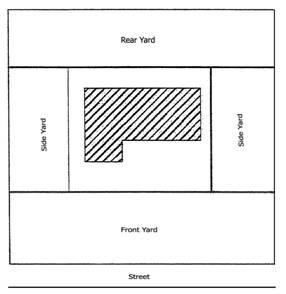
"Front lot line" means that boundary of a lot which is along an existing or dedicated public street, or where no public street exists, along a private road, easement or access way. On an interior lot, it is the lot line abutting a street; or, on a pipestem (flag) lot, it is the interior lot line most parallel to and nearest the street from which access is obtained. On a corner lot, the front yard shall be determined by the director, to be the yard which best conforms to the pattern of the adjacent block faces. On a "through lot," both street lines shall be deemed front lot lines. (Refer to Figures 17.08 B and C.)
(Ord. 939 § 2 (part), 2000)
17.08.450 - Lot line, rear.
"Rear lot line" means a lot line which is most nearly opposite and most distant from the front lot line. For the purpose of establishing the rear lot line of a triangular or trapezoidal lot, or of a lot the rear line of which is formed by two or more lines, the following shall apply.
A.
For a triangular or gore-shaped lot, a line ten feet in length within the lot and farthest removed from the front lot line and at right angles to the line comprising the depth of such lot shall be used as the rear lot line
B.
In the case of a trapezoidal lot, the rear line of which is not parallel to the front lot line, the rear lot line shall be deemed to be a line at right angles to the line comprising the depth of such lot and drawn through a point bisecting the recorded rear lot line. (Refer to Figure 17.08 C.)
(Ord. 939 § 2 (part), 2000)
17.08.455 - Lot line, side.
The "side lot line" shall be any boundary of a lot which is not a front line or a rear lot line. (Refer to Figure 17.08 B.)
(Ord. 939 § 2 (part), 2000)
17.08.460 - Lot line, side street.
"Side street lot line" means a lot line which is not a front line or a rear lot line.
(Ord. 939 § 2 (part), 2000)
17.08.465 - Lot line, street.
"Street lot line" means a lot line abutting upon a street.
(Ord. 939 § 2 (part), 2000)
17.08.470 - Lot of record.
"Lot of record" means a lot as shown on an officially recorded plat or short plat or a parcel of land officially recorded or registered as a unit of property and is described by metes and bounds, and lawfully established on the date of recording of the instrument first referencing the lot.
(Ord. 939 § 2 (part), 2000)
17.08.472 - Lot, pipestem.
"Pipestem lot" (flag lot) means an interior lot in which the buildable area is not bounded laterally by a public or private road, and which gains road access by means of a lot extension, a driveway easement, or the terminus of a private or public road. (Refer to Figure 17.08D.)
(Ord. 939 § 2 (part), 2000)
17.08.475 - Lot, reverse frontage.
A "reverse frontage lot" is a double frontage lot for which the boundary along one of the streets is established as the rear lot line, and over the rear of which is a utility easement. The rear lot line of the lot shall be that boundary abutting a primary arterial, railroad right-of-way or other disadvantageous use.
(Ord. 939 § 2 (part), 2000)
17.08.480 - Lot, reversed corner.
A "reversed corner lot" is a corner lot where the side lot lines are substantially a continuation of the front lot line of the first lot to its rear. This type of lot reverses the depth from the normal pattern of interior lots on the street. (Refer to Figure 17.08D.)
(Ord. 939 § 2 (part), 2000)
17.08.490 - Lot width.
"Lot width" means the horizontal distance between side lot lines, measured at the required front setback line.
(Ord. 939 § 2 (part), 2000)
17.08.491 - Manufactured home.
"Manufactured home" means a structure, built to conform to national standards embodied in the National Manufactured Housing Construction and Safety Standards Act of 1974, 42 USC 5401, et seq., administered by the United States Department of Housing and Urban Development, transportable in one or more sections, which, in the traveling mode, is twelve body feet or more in width or thirty-six body feet or more in length, or when erected on the site is eight hundred and sixty-four or more square feet, and which is built on a permanent chassis and designed to be used as a dwelling with or without a permanent foundation as defined within the International Residential Code (IRC), connected to the required utilities, and includes mandatory plumbing, heating, air conditioning and electrical systems contained therein. A manufactured home displays a certificate from the United States Department of Housing and Urban Development.
(Ord. 1055 § 1 (part), 2005: Ord. 939 § 2 (part), 2000)
17.08.491.1 - Manufactured home, new.
"Manufactured home, new" means a manufactured home that has not been previously occupied. The most commonly accepted definition of a "new manufactured home" also recognizes manufactured homes used as model homes as new.
(Ord. 1055 § 1 (part), 2005)
17.08.492 - Manufactured home park.
"Manufactured home park" means a tract of land designed and maintained under a single ownership or unified control where two or more spaces or pads are provided solely for rent or lease for the placement of manufactured homes or mobile homes for residential purposes.
(Ord. 939 § 2 (part), 2000)
17.08.493 - Manufactured home site.
"Manufactured home site" means a parcel of land within a manufactured home subdivision park or lot of record, for the accommodation of one manufactured home, its accessory buildings or structures and accessory equipment for the exclusive use of the occupants. In the case of a manufactured home park, the boundaries of a manufactured home site are established on the approved plot plan. In the case of a manufactured home subdivision, the boundaries of the manufactured home site are the platted lot lines as established by the recorded subdivision. In the case of a lot of record, means a lot shown on an officially recorded plat or short plat or parcel of land officially recorded or registered as a unit of property and is described by metes and bounds, and lawfully established on the date of recording of the instrument first referencing the lot.
(Ord. 1055 § 1 (part), 2005: Ord. 939 § 2 (part), 2000)
17.08.494 - Manufactured home subdivision.
"Manufactured home subdivision" means a subdivision approved in accordance with subdivision standards in Title 16 of this code, meeting or exceeding the requirements of this code, and where the lots are principally intended to accommodate manufactured homes as residences. The lots within the subdivision shall be held in private ownership.
(Ord. 939 § 2 (part), 2000)
17.08.494.1 - Manufacturing.
"Manufacturing" means those industrial or manufacturing activities which are engaged in the production of articles or a product from raw or prepared materials by giving them new forms and qualities.
(Ord. 978 § 1, 2003)
17.08.495 - May.
"May," as applied in this title, means that which is not strictly mandatory but permissible and involves a choice in some cases.
(Ord. 939 § 2 (part), 2000)
17.08.497 - Microbrewery, microdistillery, or microwinery.
"Microbrewery, microdistillery, or microwinery" means a small-scale business located in a building where the primary use is for restaurant, retail, or tasting room, and which specializes in producing limited quantities of wine, beer, or other alcoholic beverage.
(Ord. No. 1263, § 6, 4-15-2013)
17.08.500 - Miniature hoofed animal.
"Miniature hoofed animal" means a horse, donkey, or goat breed that reaches no more than thirty-eight inches in height when fully grown.
(Ord. No. 1249, § 1, 10-1-2012)
17.08.505 - Mobile home.
"Mobile home" means a structure transportable in one or more sections which, in the traveling mode, is eight body feet or more in width or forty body feet or more in length or when erected on site, is three hundred twenty or more square feet and which is built on a permanent chassis and designed to be used as a dwelling with our without a permanent foundation as defined within the International Residential Code (IRC), connected to required utilities and includes the plumbing, heating, air conditioning and electrical systems contained therein and manufactured property to June 15, 1976.
(Ord. 1055 § 1 (part), 2005: Ord. 939 § 2 (part), 2000)
17.08.515 - Modular home.
"Modular home" means a factory-assembled structure, meeting Washington State Uniform Building Code Standards, and Title 14 of this code, designed primarily for use as a dwelling when connected to the required utilities that include plumbing, heating and electrical systems contained therein, does not contain its own running gear, and must be mounted on a permanent foundation. A modular home does not include a mobile home or manufactured home.
(Ord. 939 § 2 (part), 2000)
17.08.520 - Motel.
"Motel" means a lodging use, located in a structure in which access to individual units is predominately by means of common exterior corridors, and in which a majority of rooms are provided to guests on a daily or short-term basis, and in which off-street parking is provided on the lot.
(Ord. 939 § 2 (part), 2000)
17.08.525 - Motor home.
"Motor home" means a motorized vehicle designated and equipped for living, usually as a temporary dwelling while touring and vacationing.
(Ord. 939 § 2 (part), 2000)
17.08.526 - Museum.
"Museum" means a building devoted to the care, study and display of objects of lasting interest.
(Ord. 978 § 1, 2003)
17.08.530 - Neighborhood commercial.
"Neighborhood commercial," in this title is a zoning classification providing for commercial services which, for convenience purposes, is located in or near residential districts. The allowable uses provide for the sale of convenience goods (food, over-the-counter drugs, and sundries).
(Ord. 939 § 2 (part), 2000)
17.08.535 - Nonconforming use or structure.
"Nonconforming use or structure" means an activity or structure in lawful use before the effective date of the ordinance codified in this title and which is either prohibited by or does not conform to the regulations and standards of this title once enacted.
(Ord. 939 § 2 (part), 2000)
17.08.536 - Off-site hazardous waste treatment or storage facility.
"Off-site hazardous waste treatment or storage facility" means facilities that treat and store hazardous waste from generators on properties other than that on which the facility is located.
(Ord. 939 § 2 (part), 2000)
17.08.537 - On-site hazardous waste treatment or storage facility.
"On-site hazardous waste treatment or storage facility" means a facility that stores or treats hazardous waste generated on the same, geographically contiguous or bordering properties.
(Ord. 939 § 2 (part), 2000)
17.08.540 - Outdoor advertising.
"Outdoor advertising" means all publicly displayed messages such as signs, billboards, placards, pennants, or posters whose purpose is to provide official or commercial information, direction, and advertising.
(Ord. 939 § 2 (part), 2000)
17.08.545 - Outdoor advertising structure.
"Outdoor advertising structure" means a structure used for outdoor advertising purposes upon which an advertising display or message is or can be placed.
(Ord. 939 § 2 (part), 2000)
17.08.547 - Owner.
"Owner" means owner of record of property or contract purchaser of property.
(Ord. 939 § 2 (part), 2000)
17.08.548 - Parking area.
"Parking area" means an area accessible to vehicles, which area is provided, improved, maintained and used for the sole purpose of accommodating a motor vehicle.
(Ord. 939 § 2 (part), 2000)
17.08.550 - Parking space.
"Parking space" is an off-street parking area for motor vehicles not less than nine by twenty feet in area, having access to a public street or alley, or private driveway.
(Ord. 939 § 2 (part), 2000)
17.08.555 - Person.
"Person" means an individual, firm, partnership, association, corporation, cooperative, public or municipal corporation, or unit of federal, state, or local government.
(Ord. 939 § 2 (part), 2000)
17.08.560 - Planned unit residential development.
"Planned unit residential development" means a type of subdivision characterized by a unified site design, clustering of buildings, provision of common open space, density increases, and a mix of building types and land uses and subject to Chapter 16.22 of this code.
(Ord. 939 § 2 (part), 2000)
17.08.565 - Planning commission.
"Planning commission" means the Woodland planning commission.
(Ord. 939 § 2 (part), 2000)
17.08.570 - Preexisting use or structure.
"Preexisting use or structure" means a use or structure, or portion thereof, which was lawfully constructed prior to the effective date of the ordinance codified in this title, but which, because of the application of this title, no longer conforms to the standards in this title.
(Ord. 939 § 2 (part), 2000)
17.08.572 - Preschool.
"Preschool" means a public or private facility which provides instruction for children who are not old enough to attend a public elementary school. Preschools differ from day care facilities by the number of hours children are kept. Preschools do not keep children for more than four hours. All the children arrive at approximately the same time and leave at approximately the same time.
(Ord. 939 § 2 (part), 2000)
17.08.573 - Principal use.
"Principal use" means the main use of land or buildings as distinguished from an accessory use.
(Ord. 939 § 2 (part), 2000)
17.08.575 - Professional offices.
"Professional offices" means offices maintained and used as a place of business conducted by persons engaged in recognized professions, and others whose business activity consists primarily of services to the person as distinguished from the handling of commodities.
(Ord. 939 § 2 (part), 2000)
17.08.577 - Public facilities.
"Public facilities" means buildings or uses of land owned and operated by a public agency for such purposes as providing places for public assembly and recreation, operating services of benefit to the public, or for the administration of public affairs. Examples include, but are not limited to, city offices, police and fire stations, senior center, museum, and maintenance facilities. Public housing, utility facilities, streets, and parks do not constitute a public facility.
(Ord. 939 § 2 (part), 2000)
17.08.580 - Public utility.
"Public utility" means a private corporation performing a public service and subject to special governmental regulations; or, a governmental agency or district performing a similar public service, the services by either of which are paid for directly by individual recipients. Such services shall include, but are not limited to, water supply, electric power, gas, and transportation of persons and freight.
(Ord. 939 § 2 (part), 2000)
17.08.590 - Rapid charging station.
"Rapid charging station" means an industrial grade electrical outlet that allows for faster recharging of electric vehicle batteries through higher power levels and that meets or exceeds any standards, codes, and regulations set forth by Chapter 19.28 RCW and consistent with rules adopted under RCW 19.27.540.
(Ord. No. 1257, § 1, 1-7-2013)
17.08.595 - Recorded.
"Recorded" means, unless otherwise stated, filed for record with the auditors of the counties of Cowlitz and Clark, state of Washington.
(Ord. 939 § 2 (part), 2000)
17.08.597 - Recreation vehicle.
"Recreational vehicle" means a vehicle which is permanently designed and intended for use for temporary housing or recreational purposes. Recreational vehicles include campers, travel trailers, motor homes, boats, or trailers.
(Ord. 939 § 2 (part), 2000)
17.08.600 - Recreational vehicle park.
For a definition of "recreational vehicle park," see Section 17.08.135.
(Ord. 939 § 2 (part), 2000)
17.08.605 - Residence.
"Residence" means a building or structure, or portion thereof, which is designed for and used to provide a place of abode for human beings, but not including hotel or motel units having no kitchens. The term "residence" includes the term "residential" as referring to the type of or intended use of a building or structure.
(Ord. 939 § 2 (part), 2000)
17.08.610 - Rest home, convalescent home, guest home, home for the aged.
"Rest home," "convalescent home," "guest home" and "home for the aged" means a home operated similarly to a boardinghouse, but not restricted to any number of guests or guest rooms, and the operator of which is licensed by the state or counties to give special care and supervision to his or her charges, and in which nursing, dietary and other personal services are furnished to convalescents, invalids, and aged persons, but in which homes are kept no persons suffering from a mental sickness, mental disease, disorder or ailment, or from a contagious or communicable disease, and in which homes are performed no surgery, maternity or other primary treatments such as are customarily provided in sanitariums or hospitals, and in which no persons are kept or served who normally would be admissible to a mental hospital.
(Ord. 939 § 2 (part), 2000)
17.08.613 - Retailer, marijuana.
"Marijuana retailer" means a facility licensed by the Washington State Liquor Control Board for the sale to consumers of usable marijuana and marijuana-infused products.
(Ord. No. 1440, §§ 1, 3, 10-21-2019)
17.08.615 - Retaining wall.
"Retaining wall" means any wall used to resist the lateral displacement of any material.
(Ord. 939 § 2 (part), 2000)
17.08.617 - Retirement homes.
"Retirement homes" mean apartments in an apartment complex with extra services included in the rent, such as meals, light housekeeping, laundry and recreational programs.
(Ord. 939 § 2 (part), 2000)
17.08.619 - Retreat center.
"Retreat center" means a business used for workshops, seminars, and conferences with accommodations for sleeping, food preparation and eating, recreation, entertainment, and meeting rooms to be used only by participants in the center's activities. It shall not mean centers devoted to substance abuse, medical rehabilitation, or centers devoted to the reintegration of persons released from prison or jail.
(Ord. No. 1232, 3-19-2012)
17.08.625 - Right-of-way.
"Right-of-way" means a strip of land occupied or intended to be occupied by a street, crosswalk, railroad, pipeline, power line, water main, sanitary or storm sewer main, shade trees, or for another special use. Rights-of-way are separate and distinct from the lots or parcels adjoining such right-of-way and are not included in the dimensions or areas of lots or parcels.
(Ord. 939 § 2 (part), 2000)
17.08.630 - Roadside produce stand.
"Roadside produce stand" means an establishment engaged in the retail sale of local fresh fruits and vegetables and having permanent or semi-permanent structures associated with such use.
(Ord. 978 § 1, 2003)
17.08.635 - Roadway.
A "roadway" is that portion of a street and alley right-of-way that is improved for vehicular traffic.
(Ord. 939 § 2 (part), 2000)
17.08.640 - Roof.
"Roof" means a structural covering over any portion of a building or structure, including the projections beyond the walls or supports of the building or structure.
(Ord. 939 § 2 (part), 2000)
17.08.642 - Rooming and boardinghouse.
"Rooming and boardinghouse" means any premises which is principally a dwelling unit, which provides lodging with meals, for five or fewer rooms, and where the principal function is providing lodging for compensation. Resident rooms numbering six or more shall constitute a motel or hotel. This definition does not include nursing or convalescent homes, group residences or any other situation where persons are not living and working together as a single housekeeping unit.
(Ord. 939 § 2 (part), 2000)
17.08.645 - Sanitarium.
"Sanitarium" means a health station or retreat or other place where resident patients are kept, and which specializes in giving clinical, temporary and emergency services of a medical or surgical nature to patients and injured persons and licensed by state agencies under provisions of law to provide facilities and services in surgery, obstetrics and general medical practice, as distinguished from treatment of mental and nervous disorders and alcoholics, but not excluding surgical and postsurgical treatment of mental cases.
(Ord. 939 § 2 (part), 2000)
17.08.650 - School.
"School" means a public or private facility that provides a curriculum of primary and/or secondary academic instruction, including kindergartens, elementary schools, junior high schools, and high school.
(Ord. 939 § 2 (part), 2000)
17.08.652 - Seasonal uses.
"Seasonal uses" means sale of seasonal goods, in any nonresidential zone, for a period not to exceed six months in any twelve-month period.
(Ord. 978 § 1, 2003)
17.08.655 - Service station, automobile.
"Automobile service station" means a facility for the retail sale of petroleum products and automotive accessories and for the repair and maintenance of cars and light trucks, exclusive of body repair and painting and major auto/truck rebuilding.
(Ord. 939 § 2 (part), 2000)
17.08.700 - Setback.
"Setback" means the distance that buildings or uses must be removed from their lot lines.
(Ord. 939 § 2 (part), 2000)
17.08.702 - Sexually-oriented business.
"Sexually-oriented business" means those businesses defined as follows:
A.
"Adult arcade" means an establishment where, for any form of consideration, one or more still or motion picture projectors, slide projectors, or similar machines, or other image-producing machines, for viewing by five or fewer persons each, are used to show films, motion pictures, video cassettes, slides, or other photographic reproductions which are characterized by the depiction or description of "Specified Sexual Activities" or "Specified Anatomical Areas".
B.
"Adult bookstore, adult novelty store, or adult video store" means a commercial establishment which has a significant or substantial portion of its stock-in-trade or a significant or substantial portion of its revenues or devotes a significant or substantial portion of its interior business or advertising to the sale or rental for any form of consideration, of any one or more of the following:
1.
Books, magazines, periodicals, or other printed matter, or photographs, films, motion pictures, video cassettes, slides, CDs or other visual representations which are characterized by the depiction or description of specified sexual activities or specified anatomical areas; or
2.
An establishment may have other principal business purposes that do not involve the offering for sale or rental of materials depicting or describing specified sexual activities or specified anatomical areas, and still be categorized as an adult bookstore, adult novelty store, or adult video store. Such other business purposes will not serve to exempt such establishments from being categorized as an adult bookstore, adult novelty store, or adult video store so long as one of its principal business purposes is offering for sale or rental, for some form of consideration, the specified materials which depict or describe specified anatomical areas or specified sexual activities.
3.
Video stores that sell and/or rent only video tapes, CDs, or other photographic reproductions and associated equipment shall come within this definition if twenty percent or more of its stock-in-trade or revenues come from the rental or sale of video tapes, CDs, or photographic reproductions or associated equipment which are characterized by the depiction or description of specified sexual activities or specified anatomical areas.
C.
"Adult cabaret" means a nightclub, bar, restaurant, or similar commercial establishment, whether or not alcoholic beverages are served, which features: 1) persons who appear nude or semi-nude; 2) live performances which are characterized by the exposure of specified anatomical areas or by specified sexual activities; 3) films, motion pictures, video cassettes, slides, or other photographic reproductions which are characterized by the depiction or description of specified sexual activities or specified anatomical areas.
D.
"Adult motel" means a hotel, motel or similar commercial establishment which:
1.
Offers accommodation to the public for any form of consideration and provides patrons with closed-circuit television transmissions, films, motion pictures, video cassettes, slides, or other photographic reproductions which are characterized by the depiction or description of "Specified Sexual Activities" or "Specified Anatomical Areas," and which has a sign visible from the public right-of-way which advertises the availability of this adult type of photographic reproductions; or
2.
Offers a sleeping room for rent for a period of time that is less than twenty hours; or
3.
Allows a tenant or occupant of a sleeping room to sub-rent the room for a period of time which is less than twenty hours.
E.
"Adult motion picture theater" means a commercial establishment where films, motion pictures, video cassettes, slides, or similar photographic reproductions characterized by the depiction or description of specified sexual activities or specified anatomical areas are regularly shown for any form of consideration.
F.
"Adult theater" means a concert hall, theater, auditorium, or similar commercial establishment which, for any form of consideration, regularly features persons who appear nude or semi-nude, or live performances which are characterized by exposure of specified anatomical areas or specified sexual activities.
G.
"Escort agency" means a person or business association who furnishes, offers to furnish, or advertises to furnish escorts as one of its primary business purposes for a fee, tip, or other consideration.
H.
"Nude or semi-nude model studio" means any place where a person who appears nude or semi-nude or displays specified anatomical areas, is provided for money or any form of consideration to be observed, sketched, drawn, painted, sculptured, photographed, or similarly depicted by other persons.
(Ord. 976 § 1, 2003)
17.08.705 - Shall.
"Shall," as applied in this title, means that which is mandatory.
(Ord. 939 § 2 (part), 2000)
17.08.710 - Shopping center.
"Shopping center" means a group of architecturally unified commercial establishments built on a site which is planned, developed, owned, and managed as an operating unit related in its location, size and type of shops to the trade area that the unit serves. The unit provides on-site parking in definite relationship to the types and floor area of the stores.
(Ord. 939 § 2 (part), 2000)
17.08.715 - Should.
"Should," as applied in this title, means that which is recommended but not absolutely required.
(Ord. 939 § 2 (part) 2000)
17.08.720 - Sign.
"Sign" means any device designed to inform or attract the attention of persons not on the premises on which the sign is located; provided, however, that the following shall not be included in the application of the regulations in this title:
A.
Flags and insignia of any government except when displayed in connection with commercial promotion;
B.
Legal notices, identification, informational or directional signs erected or required by governmental bodies;
C.
Integral decorative or architectural features of buildings;
D.
Signs directing and guiding traffic and parking on private property, but bearing no advertising matter.
(Ord. 939 § 2 (part), 2000)
17.08.725 - Sign, changing image.
A "changing image sign" means any sign that, through the use of moving elements, flashing or sequential lights, lighting elements, or other automated method, results in movement, the appearance of movement, or change of sign image or text. Changing image signs do not include otherwise static signs where illumination is turned off and back on not more than once every twenty-four hours. (Amended during 4-01 supplement; Ord. 939 § 2 (part), 2000)
17.08.730 - Sign, freestanding.
"Freestanding sign" is a sign or advertising display which is not supported by a building, but which is supported by one or more upright, poles, or braces which are in or on the ground.
(Ord. 939 § 2 (part), 2000)
17.08.735 - Sign, gross area of.
The "gross area of a sign" means the area within a continuous perimeter enclosing the outer limits of the sign face, but not including structural elements which are not a part of the display. The "gross area" of a two-faced sign equals the area of one side. The "gross area of a spherical, cubical or polyhedral sign" equals one-half the total surface area.
(Ord. 939 § 2 (part), 2000)
17.08.737 - Sign, incidental.
"Incidental sign" means a small sign, emblem or decal informing the public of goods, facilities or services available on the premises, (e.g. credit card sign or a sign indicating hours of business which does not exceed two square feet in size).
(Ord. 978 § 1, 2003)
17.08.740 - Sign, nameplate.
"Nameplate sign" means a sign which indicates no more than the name, address and home occupation of the resident of the premises.
(Ord. 939 § 2 (part), 2000)
17.08.745 - Sign, off-site.
"Sign, off-site" is a sign other than an on-site sign.
(Ord. 939 § 2 (part), 2000)
17.08.750 - Sign, on-site.
"Sign, on-site" means a sign relating in its subject matter to the premises on which it is located, or to products, accommodation, services, or activities on the premises. On-site signs shall also include temporary signs such as those placed on a sidewalk during business hours, in front of a business establishment.
(Ord. 939 § 2 (part), 2000)
17.08.755 - Sign, projecting.
"Projecting sign" means a sign attached to and supported by a wall of a building or structure and projecting six inches or more therefrom.
(Ord. 939 § 2 (part), 2000)
17.08.760 - Sign, public or semipublic identification.
"Public or semipublic identification sign" means a sign which directs attention to public or semipublic buildings, including but not limited to schools, libraries and hospitals.
(Ord. 939 § 2 (part), 2000)
17.08.765 - Sign, real estate.
"Real estate sign" means a temporary sign which directs attention to the sale, lease or rental of a particular building, property or premises upon which it is displayed.
(Ord. 939 § 2 (part), 2000)
17.08.770 - Sign, roof.
"Roof sign" means a sign or advertising display supported by and erected on or above a roof or parapet of a building or similar structure.
(Ord. 939 § 2 (part), 2000)
17.08.775 - Sign, wall.
"Wall sign" means a sign or advertising display attached to, painted on, or supported by a wall of a building or similar structure with the exposed face of the sign in a plane with and no more than six inches away from the wall.
(Ord. 939 § 2 (part), 2000)
17.08.780 - Sign, window.
"Window sign" means a sign attached to or otherwise obscuring vision, in whole or in part, through a window. It is intended to be viewed by persons outside of the building.
(Ord. 939 § 2 (part), 2000)
17.08.785 - Single-family dwelling.
"Single-family dwelling" means a detached building designed exclusively for residential purposes for one family, including site-built homes, specified manufactured homes or modular homes.
(Ord. 1055 § 1 (part), 2005: Ord. 939 § 2 (part), 2000)
17.08.786 - State siting criteria.
"State siting criteria" means the criteria currently or hereafter developed by the Washington State Department of Ecology under the authority of RCW 70.105.210 for the siting of hazardous waste management facilities.
(Ord. 939 § 2 (part), 2000)
17.08.787 - Storage, hazardous waste.
"Storage, hazardous waste" means the holding of hazardous waste for a temporary period. Accumulation of hazardous waste, by an on-site generator is not storage as long as the generator complies with the applicable requirements of WAC 173-200 and 173-210, as now or hereafter amended.
(Ord. No. 1461, § 2, 8-17-2020)
Editor's note— Ord. No. 1461, § 2, adopted August 17, 2020, repealed the former § 17.08.787, and enacted a new § 17.08.787 as set out herein. The former § 17.08.787 pertained to storage and derived from Ord. No. 939, 2000.
17.08.788 - Storage, self.
"Storage, self" (or "storage" for non-hazardous uses) means a storage facility for household goods and other personal property which includes, but is not limited to, facilities for mini-storage, mini-warehouse, containers, or recreational vehicles and boats. Storage may occur within a structure, under cover, outside, and/or within a container or other storage vessel or structure. Storage of household goods at a residence for non-commercial purposes is not considered a self-storage use, provided it is incidental to the residence.
(Ord. No. 1461, § 3, 8-17-2020)
17.08.790 - Story.
"Story" means that portion of a building included between the upper surface of any floor and the upper surface of the floor next above, except that the topmost story shall be that portion of a building included between the upper surface of the topmost floor and the ceiling or roof above. If the furnished floor level directly above a usable or unused under-floor space is more than six feet above grade as defined herein for more than fifty percent of the total perimeter or is more than twelve feet above grade as defined herein at any point, such usable or unused under-floor space shall be considered as a story.
(Ord. 939 § 2 (part), 2000)
17.08.795 - Street.
"Street" means a public or recorded private thoroughfare which affords primary means of access to abutting property. A recorded private thoroughfare may be a recorded easement for ingress or egress of a platted street designated as a private thoroughfare for access of abutting property but for which the city assumes no responsibility of ownership and is available for use to the abutting property owners only. A private thoroughfare not recorded with a county auditor shall not be considered a street.
(Ord. 939 § 2 (part), 2000)
17.08.800 - Street, access.
"Access street" means a street, usually limited continuity, which serves primarily to provide access to abutting property.
(Ord. 939 § 2 (part), 2000)
17.08.805 - Street, arterial.
"Arterial street" means a street that connects major traffic generators and is designed for the purpose of moving high volumes of traffic.
(Ord. 939 § 2 (part), 2000)
17.08.810 - Street, cul-de-sac.
A "cul-de-sac street" is a short street having one end open to traffic and the other end permanently terminated and provided with a vehicular turnaround.
(Ord. 939 § 2 (part), 2000)
17.08.815 - Street, side.
"Side street" means a street which is adjacent to a corner lot or a reverse corner lot and which extends in the general direction of the line determining the depth of the lot.
(Ord. 939 § 2 (part), 2000)
17.08.820 - Structural alteration.
"Structural alteration" means any change in the supporting members of a building or structure, such as foundations, bearing walls, columns, beams, floor or floor joists, girders or rafters, or changes in the exterior dimensions of the building or structure, or increase in floor space.
(Ord. 939 § 2 (part), 2000)
17.08.825 - Structure.
"Structure" means anything constructed in the ground, or anything erected which required location on the ground or water, or is attached to something having location on or in the ground, but not including driveways or other paved areas.
(Ord. 939 § 2 (part), 2000)
17.08.828 - Temporary use.
"Temporary use" means a use of property, which is not otherwise regulated, beyond business registration, by other city ordinances or regulations.
(Ord. 978 § 1, 2003)
17.08.830 - Trailer, automobile.
"Automobile trailer" means a vehicle without motor power, designed to be drawn by motor vehicle and to be used for human habitation or for carrying persons and property.
(Ord. 939 § 2 (part), 2000)
17.08.832 - Treatment.
"Treatment" means the physical, chemicals or biological processing of hazardous waste to make such waste nondangerous or less dangerous, safer for transport, amenable for energy or material resource recovery, amenable for storage, or reduced in volume. A hazardous waste treatment facility requires a state dangerous waste permit under the provisions of WAC Chapter 173-303.
(Ord. 939 § 2 (part), 2000)
17.08.835 - Townhouse.
"Townhouse" means one of a series of attached dwelling units, each having its principal access from the ground floor and each separated from adjacent units by a common continuous wall from basement to roof.
(Ord. 939 § 2 (part), 2000)
17.08.840 - University.
See "college," Section 17.08.180.
(Ord. 939 § 2 (part), 2000)
17.08.845 - Use.
"Use" of property means the purpose or activity for which the land, or building thereon, is designed, arranged or intended, or for which it is occupied or maintained and shall include any manner of performance or operation of such activity with respect to the provision of this title. The definition of "use" also includes the definition of "development."
(Ord. 939 § 2 (part), 2000)
17.08.850 - Use, preexisting.
"Preexisting use" means a lawful use of land or structure in existence on the effective date of the ordinance codified in this title or at the time of any amendments thereto and which does not conform to the use regulations of the zone in which such use is located.
(Ord. 939 § 2 (part), 2000)
17.08.855 - Use, principal.
See "principal use," Section 17.08.573.
(Ord. 939 § 2 (part), 2000)
17.08.857 - Utility yard.
"Utility yard" means a location used for the storage and maintenance of materials, equipment and vehicles to facilitate the provision of utility services. A utility yard is frequently colocated with a utility office.
(Ord. 939 § 2 (part), 2000)
17.08.860 - Variance.
A "variance" is the means by which an adjustment is made in the application of the specific regulations of a zoning ordinance to a particular piece of property because of special circumstances applicable to it, and to which said property is deprived of privileges commonly enjoyed by other properties in the same vicinity and zone and which adjustment remedies disparity in privileges.
(Ord. 939 § 2 (part), 2000)
17.08.862 - Variance, use.
A "use variance" is a variance granted for a use or structure that is not permitted in the zoning district.
(Ord. 939 § 2 (part), 2000)
17.08.863 - Vending stand.
"Vending stand" means a business contained in a structure, which can serve customers who remain in their vehicles, by means of a drive-up window (e.g. espresso stand).
(Ord. 978 § 1, 2003)
17.08.864 - Warehousing.
"Warehousing" means a building specially designed for receipt, storage and handling of goods.
(Ord. 978 § 1, 2003)
17.08.864.3 - Wholesale sales.
"Wholesale sales" means firms involved in the sale, lease, or rent of products primarily intended for industrial, institutional, or commercial businesses. The uses emphasize on-site sales or order taking and often include display areas. Businesses may or may not be open to the general public but sales to the general public are limited as a result of the way in which the firm operates. Products may be picked up on site or delivered to the customer.
(Ord. No. 1263, § 6, 4-15-2013)
17.08.864.5 - Wrecking yard.
"Wrecking yard" means the dismantling or disassembling of motor vehicles, or the storage, sale, or dumping of dismantled, partially dismantled, obsolete, or wrecked vehicles or their parts.
(Ord. No. 1263, § 6, 4-15-2013)
17.08.865 - Yards, types and measurements.
"Yard" means an open, unoccupied space, other than a court (as defined in the Uniform Building Code), unobstructed from the ground to the sky, except where specifically provided by this code, on the lot on which a building is situated. (Refer to Figure 17.08 E.)
A.
"Front yard" means an area extending across the full width of the lot and lying between the lot front line and a line drawn parallel thereto, and at a distance therefrom equal to the required front yard depth as prescribed in each classification.
B.
"Side yard" means an area extending from the front yard line to the rear yard line at a depth measured from the side lot line to a line drawn parallel thereto at a distance equal to the required side yard depth as prescribed in each classification.
C.
"Rear yard" means an area extending across the full width of the lot and lying between the lot rear line and a line drawn parallel thereto, at a distance equal to the required rear yard depth as prescribed in each classification.
(Ord. 939 § 2 (part), 2000)
17.08.870 - Zone.
"Zone" means an area accurately defined as to boundaries and location, and classified by the zoning code as available for certain types of uses and within which other types of uses are excluded.
(Ord. 939 § 2 (part), 2000)
Figure 17.08 A
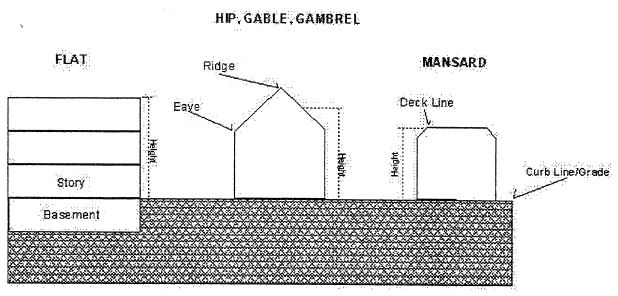
Figure 17.08 B
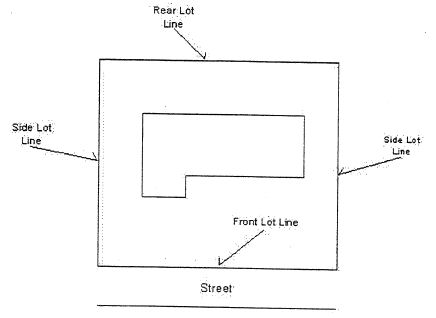
Figure 17.08 C
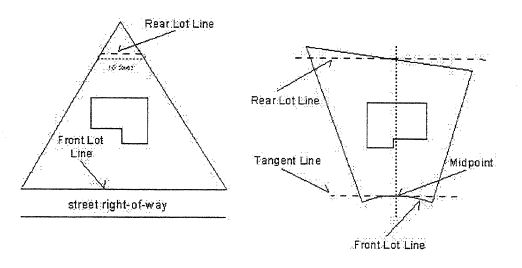
Figure 17.08 D
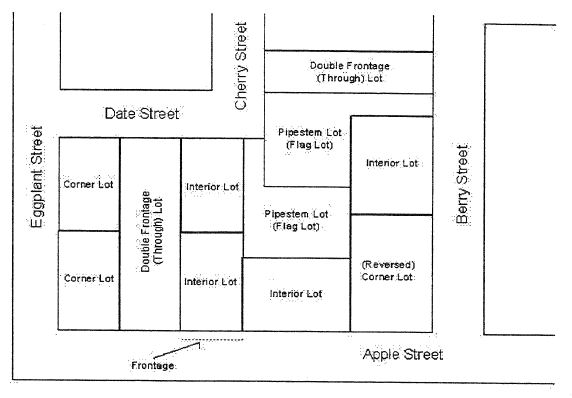
Figure 17.08 E