
Yadkinville City Zoning Code
ARTICLE 2
- ADMINISTRATIVE PROCEDURES AND ENFORCEMENT2
Editor's note— Ord. No. 2021-04(ZTA), § 3, adopted February 7, 2022, amended the title of Article 2 to read as herein set out. The former Article 2 title pertained to Administration, Procedures and Enforcement.
2.1 - Administration.
The purpose of this Section is to set forth the powers and duties of the Development Ordinance Administrator, Technical Review Committee, Planning Board, Board of Adjustment, and Town Board of Commissioners as they relate to this Ordinance.
2.1.1 Administrator.
A.
The position of Administrator is hereby authorized and shall be designated by the Town Manager to interpret, apply and enforce the provisions of this Ordinance in accordance with the terms hereof. The Administrator may provide written interpretations, and may issue such permits, orders and take such other enforcement actions as may be set forth in this Ordinance.
B.
The Administrator may be referred in this Ordinance as "Planning Director", "Zoning Administrator", "Subdivision Administrator", or "Development Ordinance Administrator".
C.
The Administrator shall maintain a record of all Zoning Permits, development approvals, Certificates of Compliance, and ordinance amendments on file in the Town Hall, and copies shall be made available on request to interested parties.
2.1.2 Technical Review Committee (TRC).
A.
The Technical Review Committee (TRC) is hereby established in order to assist the Administrator with the review of site development plans for zoning permits other than single-family and two-family residential development. The TRC shall consist of the following representatives or their designees, as applicable:
1.
Administrator.
2.
Town Engineer.
3.
Public Works Director.
4.
Fire Marshal.
5.
Yadkin County Emergency Management.
6.
Yadkin County Building Inspections.
7.
Yadkin County Health Department.
8.
North Carolina Department of Transportation.
9.
Other local, state, or federal agencies that have an interest in the proposed development.
B.
The TRC shall meet on an as needed basis as determined by the Administrator.
2.1.3 Planning Board.
2.1.3.1 Establishment and composition.
A.
A Planning Board for the Town is hereby created under the authority of NC GS 160D-301.
B.
The Town Planning Board shall consist of seven (7) members, including a proportional number of ETJ representatives as required by NC GS 160D-307, and may have up to two (2) alternate members to serve in the absence of regular members. At the discretion of the Town Board of Commissioners, the same members of the Planning Board may serve as the Board of Adjustment.
C.
Appointments are made by the Town Board of Commissioners and shall be residents of the Town. ETJ appointments shall be made by the Yadkin County Commissioners in accordance with NC GS 160D-307.
D.
Planning Board members shall be appointed for three (3) year terms. Terms shall be staggered so as to allow the appointment of new members each year. Upon expiration of a member's term of office, that member is expected to continue service until a replacement is appointed by the Town Board of Commissioners or Yadkin County Commissioners, as applicable.
E.
Vacancies occurring on the Planning Board shall be filled by the Town Board of Commissioners or County Commissioners for the remaining portion of an unexpired term.
F.
The Town Board of Commissioners may remove members for cause upon written charges after a public hearing.
2.1.3.2 Rules of procedure.
A.
The Planning Board shall prescribe rules and regulations and by-laws for the conduct of its meetings and other proceedings.
B.
Regular meetings of the Planning Board shall be held at such times and places as the Planning Board shall determine, and special meetings of the Board shall be held upon call of the chairman at such time and place as he may designate, reasonable notice of such meeting being given to each member and to the public.
C.
Any member of the Planning Board who misses more than three (3) consecutive regular meetings or more than half of the regular meetings in a calendar year shall lose his or her status as a member of the Planning Board and shall be replaced or reappointed by the Town Board. Absences due to sickness, death other emergencies of like nature shall be recognized as approved absences and shall not affect the member's status on the Board; except that in the event of a long illness or other such cause for prolonged absence, the member shall be replaced.
D.
The Planning Board shall select from its membership a chairman and vice chairman to serve for a period of one (1) year, or until their successors are elected. Elections shall take place each year at the first meeting held after July 1.
E.
All meetings of the Planning Board shall be open to the public. The Planning Board shall keep a full record of its proceedings and minutes of its meetings showing the business transacted at each meeting, and shall submit copies thereof to the Town Clerk. Regular updates on the actions of the Planning Board shall be provided to the Town Board of Commissioners.
2.1.3.3 Powers and duties.
A.
The Planning Board shall serve in an advisory capacity to the Town Board of Commissioners, providing recommendations to the Town Board pertaining to zoning amendments. The Board shall also make determinations on alternate design proposals as set forth in Section 2.2.9.
B.
The Town Board of Commissioners may request the Planning Board to advise them on other matters as designated in NC GS 160D-301 including:
1.
To make studies of the Town and surrounding areas;
2.
To determine objectives to be sought in the development of the Town;
3.
To propose and recommend plans for achieving these objectives;
4.
To develop and recommend to the Town Board of Commissioners policies, ordinances, administrative procedures and other means for carrying out plans in a coordinated and efficient manner;
5.
To advise the Town Board of Commissioners concerning the use and amendment of means for carrying out plans; and
6.
To designate redevelopment areas.
2.1.4 Board of Adjustment.
2.1.4.1 Establishment and composition.
A.
A Board of Adjustment is hereby created as provided in NC GS 160D-302.
B.
The Board of Adjustment shall consist of seven (7) members, including a proportional number of ETJ representatives as required by NC GS 160D-307, and may have up to two (2) alternate members to serve in the absence of regular members. At the discretion of the Town Board of Commissioners, the same members of the Planning Board may serve as the Board of Adjustment.
C.
Appointments made by the Town Board of Commissioners and shall be residents of the Town. ETJ appointments shall be made by the Yadkin County Commissioners in accordance with NC GS 160D-307. At the time of their appointment, members shall hold no other official municipal government position except on the Planning Board or housing authority board.
D.
Board of Adjustment members shall be appointed for three (3) year terms. Terms shall be staggered so as to allow the appointment of new members each year. Upon expiration of a member's term of office, that member is expected to continue service until a replacement is appointed by the Board of Commissioners.
E.
Vacancies occurring on the Board of Adjustment shall be filled by the Town Board of Commissioners or County Commissioners for the remaining portion of an unexpired term.
2.1.4.2 Rules of procedure.
A.
The Board of Adjustment shall prescribe rules and regulations and by-laws for the conduct of its meetings and other proceedings.
B.
Regular meetings of the Board of Adjustment shall be held at such times and places as the Board of Adjustment shall determine, and special meetings of the Board shall be held upon call of the chairman at such time and place as he may designate, reasonable notice of such meeting being given to each member and to the public.
C.
Any member of the Board of Adjustment who misses more than three (3) consecutive regular meetings or more than half of the regular meetings in a calendar year shall lose his or her status as a member of the Board of Adjustment and shall be replaced or reappointed by the Town Board. Absences due to sickness, death other emergencies of like nature shall be recognized as approved absences and shall not affect the member's status on the Board; except that in the event of a long illness or other such cause for prolonged absence, the member shall be replaced.
D.
The Board of Adjustment shall select from its membership a chairman and vice chairman to serve for a period of one (1) year, or until their successors are elected. Elections shall take place each year at the first meeting held after July 1.
E.
All meetings of the Board of Adjustment shall be open to the public. The Board shall keep minutes of its proceedings, showing the vote of each member upon each question, or if absent or failing to vote, an indication of such fact. The final disposition of appeals, variances and conditional uses shall be made by recorded resolution indicating the reasons of the Board therefor and all pertinent findings of fact, all of which shall be a public record.
F.
No final action shall be taken on any matter unless a quorum is present. A quorum shall consist of a majority of the total members of the Board. Four-fifths (⅘) of the Board shall be necessary to grant a Variance. A majority of the members shall be required to decide any other quasi-judicial matter or to determine an appeal made in the nature of certiorari. For the purposes of this subsection, vacant positions on the Board and members who are disqualified from voting on a quasi-judicial matter shall not be considered members of the Board for calculation of the requisite majority if there are no qualified alternates to take the place of such members.
G.
Members of the Board of Adjustment may not participate in or vote on any matter on which they have a fixed opinion prior to the hearing, have undisclosed ex parte (without equal representation) communications or close family, business or associational ties with an affected person, or have a financial interest in the outcome of the case. If an objection is raised to a member's participation and that member does not recuse himself or herself, the remaining members shall by majority vote rule on the objection.
2.1.4.3 Powers and duties. The Board of Adjustment shall have the following powers and duties pursuant to NC GS 160D-302:
A.
To hear and decide requests for Minor Special Use Permits, in accordance with Section 2.2.5;
B.
To authorize, in specific cases, Variances from the terms of this Ordinance as will not be contrary to the public interest where, owing to special conditions, a literal enforcement of the provisions of this Ordinance would result in unnecessary hardship, in accordance with Section 2.2.6;
C.
To hear and decide Appeals from any order, requirement, decision or determination made by an administrative official charged with the enforcement of this Ordinance, in accordance with Section 2.2.7;
D.
To hear and decide requests for Certificates of Nonconformity Adjustment as set forth in Section 2.2.8;
E.
To perform the powers and duties of the Watershed Review Board when a Variance is requested from the Watershed Protection Standards as set forth in Section 4.3.2, subject to the requirement of North Carolina General Statute 14, Article 21;
F.
To perform the powers and duties as set forth in the Flood Damage Prevention regulations as set forth in Section 4.3.3;
2.1.5 Town Board of Commissioners.
A.
The Town Board of Commissioners shall hold the following powers and duties related to this Ordinance:
1.
To review, hold public hearings and make decisions for Text Amendments, Map Amendments and to hold evidentiary hearings for Major Special Use Permits;
2.
To make decisions on all issues related to the Development Ordinance, Zoning Map, Comprehensive Plan and other land use plans which may be adopted from time to time;
3.
To enter into development agreements per NC GS 160D Article 10.
B.
The duties of the Town Board of Commissioners in connection with this Ordinance shall not include the hearing and passing upon of disputed questions that may arise in connection with the enforcement thereof, but the procedure for determining such questions shall be as prescribed in this Ordinance.
(ZTA Ord. No. 2021-02, § 2, 4-5-21; ZTA Ord. No. 2021-03, §§ 7—9, 5-3-21)
2.2 - Procedures.
2.2.1 Purpose. The purpose of this Section is to establish orderly processes to develop land within the Town of Yadkinville. It is also the intent of this Section to provide a clear and comprehensive development process that is fair and equitable to all interests including the applicants, affected neighbors, Town staff, related agencies, the Planning Board, Board of Adjustment, and the Town Board of Commissioners.
2.2.2 Applicability.
A.
The development review process applies to all new development and alterations of existing development within the Town.
B.
The Administrator may waive the required development review for a change in principal use, where such change would not result in a change in lot coverage, parking, or other site characteristics. The development review may also be waived if the Administrator determines that the submission of a development plan in accordance with this Section would serve no useful purpose. The following chart indicates the appropriate approval process for each development type:
Table 2.1 Approval Processes
2.2.3 Zoning permits.
2.2.3.1 General provisions.
A.
No building, sign or other structure shall be erected, moved, extended or enlarged, or structurally altered, nor shall the use of any building or property be changed, nor shall any grading, excavation, or filling of any lot be commenced until the Administrator has issued a development approval or Zoning Permit for such, stating that the building and/or the proposed use thereof complies with the provisions of this Ordinance. Notwithstanding any other provisions of this Ordinance, no Zoning Permit is necessary for the following uses:
1.
Street construction or repair;
2.
Electric power, telephone, telegraph, cable television, gas, water and sewer lines, wires or pipes, together with supporting poles or structures, located within a public right-of-way;
3.
Specific signs exempted in Article 6 of this Ordinance;
4.
Mailboxes, newspaper boxes, birdhouses, flag poles, pump covers and doghouses; and
5.
Interior alterations and renovations which do not alter the footprint, elevation, height, or use of an otherwise conforming use and/or structure;
B.
All applications for Zoning Permits must be complete before the Administrator is required to consider the application. An application is complete when it contains all the information necessary for the permit-issuing authority to decide whether or not the development, if completed as proposed, will comply with all of the requirements of this Ordinance. A fee shall be paid, as provided in the schedule of fees adopted by the Town Board.
C.
Applications for a Zoning Permit will be accepted only from persons having the legal authority to take action in accordance with the permit. This means that applications should be made by the owners of property, or their agents, or persons who have contracted to purchase property contingent upon their ability to acquire the necessary permits under this Ordinance, or the agents of such persons (who may make application in the name of such owners, lessees, or contract vendees). The Administrator may require an applicant to submit evidence of his/her authority to submit the application whenever there appears to be a reasonable basis for questioning this authority.
D.
The Administrator shall verify the location of the property in relation to any regulated Special Flood Hazard Area. Any property located within a Special Flood Hazard Area shall be subject to the Flood Damage Prevention Standards of Section 4.3.3, including the issuance of a Floodplain Development Permit.
E.
The issuance of a valid Zoning Permit shall confer with it the right to undertake and complete the development and/or use of property under the terms and conditions of such permit provided that such action is authorized by the permit is commenced within six (6) months of issuance and provided that all other permits are obtained. Otherwise the permit shall be void. After a Zoning Permit has expired, no building permit or Certificate of Occupancy may be issued for the proposed use, until application for such use is repeated and a new Zoning Permit issued under current provisions. No Building Permit shall be issued by Yadkin County and no building shall be occupied until a Zoning Permit is approved.
F.
If the Zoning Permit is denied, the applicant may appeal the action of the Administrator to the Board of Adjustment as provided for herein. Such appeal shall be made within 30 days of such permit denial, in accordance with Section 2.2.7 and NC GS 160D-405.
G.
A record of all Zoning Permits shall be kept on file in the office of the Administrator and copies shall be furnished, upon request.
H.
No building which has been erected, added to, relocated, or structurally altered shall be used or occupied until a Certificate of Occupancy has been issued by the Yadkin County Building Inspector stating that the building or structure or part thereof complies with the North Carolina State Building Code. No previously unoccupied structure shall be occupied until a Certificate of Occupancy is issued. No temporary utilities shall be connected until a Building Permit is issued. No permanent utilities shall be connected until a Certificate of Occupancy is issued.
2.2.3.2 Zoning permit procedures for single-family residential, two-family residential and accessory structures. Zoning Permits for single-family residential, two-family residential, and accessory structures shall be approved administratively. The steps in the boxes below correspond with a detailed description of each step of the process on the following pages:
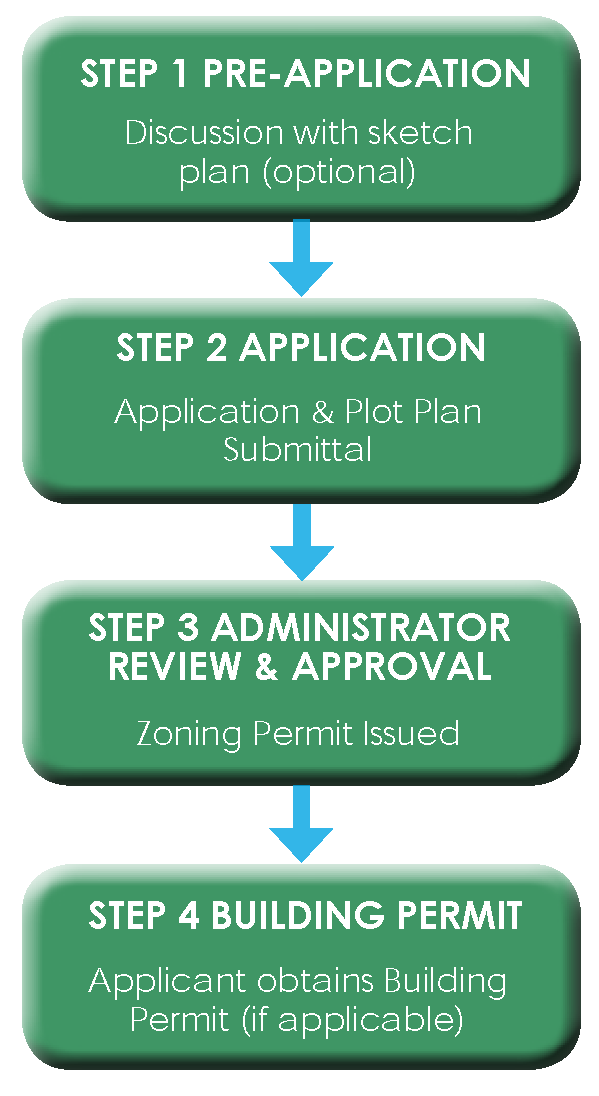
Step 1. Pre-application discussion with sketch plan (optional).
A.
To minimize development planning costs, avoid misunderstanding or misinterpretation, and ensure compliance with the requirements of this Ordinance, pre-application consultation between the applicant and the Administrator concerning the application of this Ordinance to the proposed development is recommended.
B.
Before submitting a Zoning Permit application and Plot Plan, the applicant may submit to the Administrator a Sketch Plan showing the proposed development. The Administrator shall advise the developer or his authorized agent of the regulations pertaining to the proposed development and the procedures to be followed.
Step 2. Application and plot plan submittal. The applicant shall submit the application, fee, and Plot Plan to the Administrator with the following information:
A.
The shape and dimensions of the lot on which the proposed building or use is to be erected or conducted;
B.
The location of the said lot with respect to adjacent rights-of-way;
C.
The shape, dimensions, and location of all buildings, existing and proposed, on the said lot;
D.
The nature of the proposed use of the building or land, including the extent and location of the use, on the said lot;
E.
The location and dimensions of off-street parking and the means of ingress and egress to such space; and
F.
Any other information which the Administrator may deem necessary for consideration in enforcing the provisions of this Ordinance.
Step 3. Administrator review and approval.
A.
The Administrator shall review the application and Plot Plan in accordance with the requirements of this Ordinance and any other applicable requirements.
B.
The Administrator may request other applicable agencies to provide comments regarding the proposed development.
C.
If the application and Plot Plan are found to meet all of the applicable regulations of this Ordinance, then the Administrator shall issue a Zoning Permit.
D.
If the Zoning Permit is denied, the applicant may appeal the action of the Administrator to the Board of Adjustment as provided for herein. Such appeal shall be made within 30 days of such permit denial.
Step 4. Additional approvals (if applicable). Following approval of the Zoning Permit, the applicant may obtain a Building Permit from Yadkin County Building Inspections, if applicable. Following satisfactory completion of work in accordance with North Carolina State Building Code, Yadkin County Building Inspections may issue a Certificate of Occupancy.
2.2.3.3 Zoning permit procedures for signs. Zoning permits for signs shall be approved administratively. The steps in the boxes below correspond with a detailed description of each step of the process on the following pages.
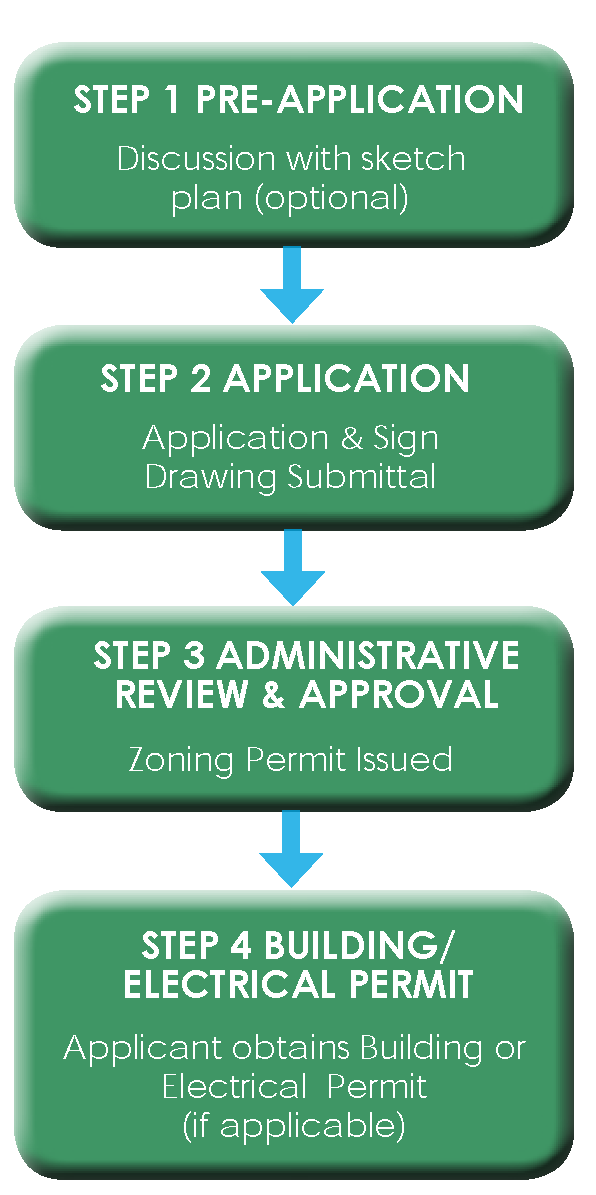
Step 1. Pre-application discussion with sketch plan (optional).
A.
To minimize development planning costs, avoid misunderstanding or misinterpretation, and ensure compliance with the requirements of this Ordinance, pre-application consultation between the applicant and the Administrator or designee concerning the application of this Ordinance to the proposed signage is recommended.
B.
Before submitting a Zoning Permit application, the applicant may submit to the Administrator a sketch showing the proposed sign. The Administrator shall advise the sign owner or his authorized agent of the regulations pertaining to the proposed sign and the procedures to be followed.
Step 2. Application and sign drawing submittal. The applicant shall submit the application, fee and a drawing of the sign and its location with the following information:
A.
The shape, dimensions, content, colors, and type of the sign;
B.
The location of the sign on the lot with respect to buildings, parking lots, property lines and adjacent rights-of-way;
C.
Whether the sign is internally or externally illuminated (electric permit may be required from Yadkin County Building Inspections);
D.
For wall signs, the building length and height; and
E.
Any other information which the Administrator may deem necessary for consideration in enforcing the provisions of this Ordinance.
Step 3. Administrator review and approval.
A.
The Administrator shall review the application and drawing in accordance with the requirements of this Ordinance and any other applicable requirements.
B.
If the application and drawing are found to meet all of the applicable regulations of this Ordinance, then the Administrator shall issue a Zoning Permit for the sign.
C.
If the Zoning Permit is denied, the applicant may appeal the action of the Administrator to the Board of Adjustment, as provided for herein. Such appeal shall be made within 30 days of such permit denial.
Step 4. Applicant obtains building or electrical permit (if applicable). Following approval of the Zoning Permit for an illuminated sign, the applicant may obtain a Building Permit or Electrical Permit from Yadkin County Building Inspections, if required.
2.2.3.4 Zoning permit procedures for multi-family residential and non-residential development. Zoning permits for multi-family residential and non-residential development shall be approved administratively. The steps in the boxes below correspond with a detailed description of each step of the process on the following pages.
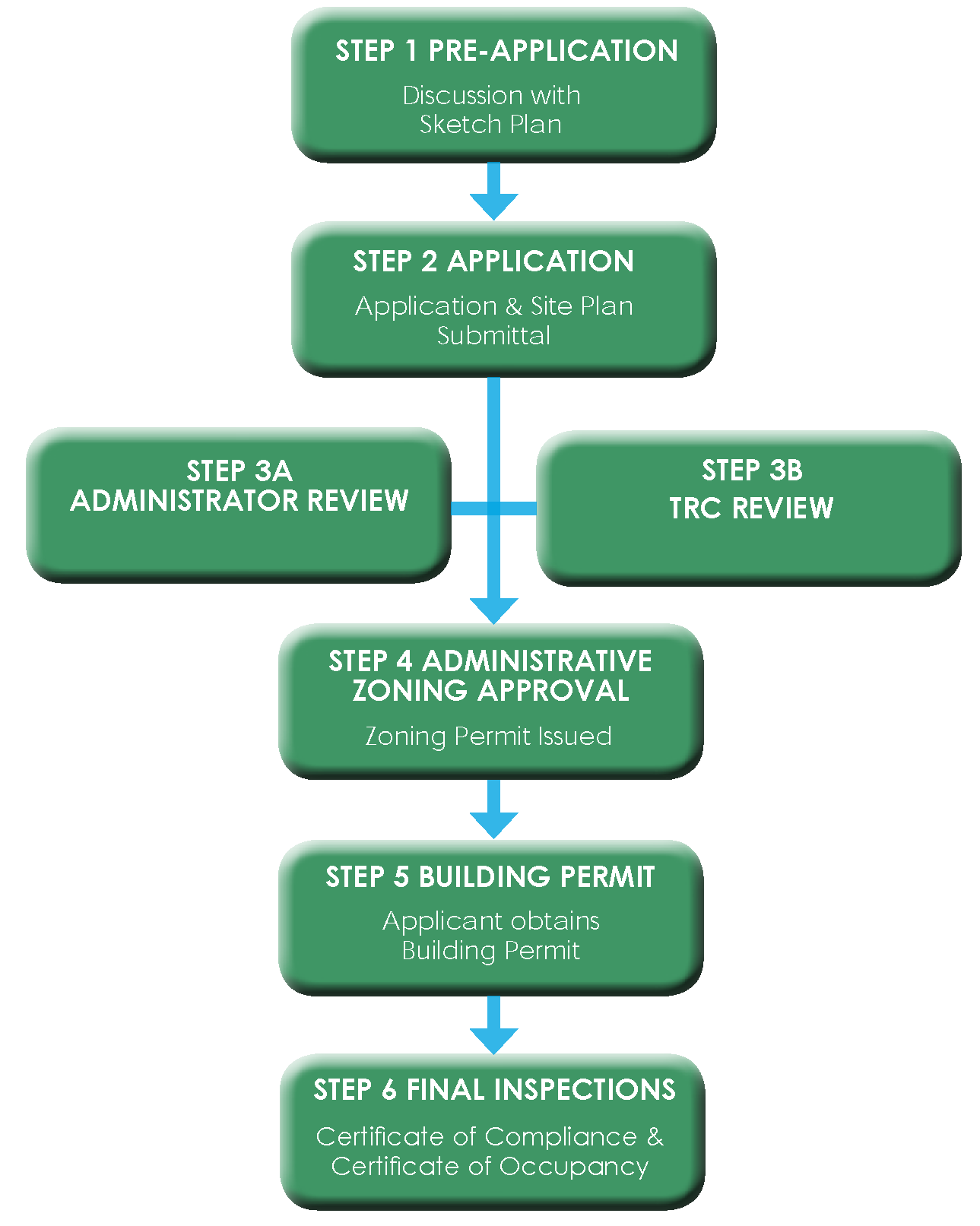
Step 1. Pre-application discussion with sketch plan.
A.
To minimize development planning costs, avoid misunderstanding or misinterpretation, and ensure compliance with the requirements of this Ordinance, pre-application consultation between the developer and the Administrator concerning the application of this Ordinance to the proposed development is required. It is the intent to provide a preliminary review of a property's development potential and staff direction for additional needed information, but not as a type of approval.
B.
Before submitting an application and Site Plan, the developer shall submit to the Administrator a Sketch Plan (either digital or hard copy) drawn at a scale no smaller than one (1) inch to 50 feet (1:50) with the following information.
1.
Property boundaries with total acreage and relationship to adjacent properties and vicinity.
2.
Proposed site layout including proposed structures, existing structures, and the intended use of structures, and parking.
3.
Proposed site access and designation as public or private.
4.
Topography in five (5) foot contour intervals and existing water courses.
5.
Location of nearest existing and proposed water and sewer line sizes and types and statements regarding how property will be served with water, sewer, and fire protection.
6.
Sketch of any proposed drainage facilities.
7.
Zoning of subject and adjacent properties.
C.
The Administrator shall review the Sketch Plan for general compliance with the requirements of this Ordinance and any other applicable requirements within 14 days of submittal. The Administrator shall advise the developer or his authorized agent of the regulations pertaining to the proposed development and the procedures to be followed. Any development is subject to other state and federal (and potentially private utility) requirements. For any requirements applying to a development, the Town of Yadkinville will require a letter from the regulating agency as proof of compliance. Proof of compliance will directly affect issuance of any Zoning Permit or Certificate of Compliance. These include, but are not limited to:
1.
Wetlands—US Army Corps of Engineers.
2.
Soil and Erosion Control (compliance with ALL size developments, including those under an acre)—NC Department of Environmental Quality (NCDEQ).
3.
Drive entrances—NC Department of Transportation and Town of Yadkinville.
4.
Other applicable agencies.
D.
One (1) copy of the Sketch Plan shall be retained on file and one (1) copy shall be returned to the developer or his authorized agent along with any comments made by the Administrator concerning the proposed development.
Step 2. Applicant submits application and site plan.
A.
The applicant shall submit the application, fee and the Site Plan that provides the following information:
1.
Title Block: Development name, developer's name, north arrow, scale (denoted graphically and numerically), date of plan preparation an revision, location of development (township, county and state), name and seal of registered surveyor or engineer preparing plan
2.
Vicinity Map: A sketch vicinity map showing the location of the development in relation to the surrounding area.
3.
Site Data: Acreage in total tract, acreage in right-of-way, existing and proposed impervious area, acreage in open space (if required), residential density in dwelling units per acre (if applicable).
4.
Zoning and Town Limits: Indicate both on and adjacent to the land to be developed, the location of Town limits, zoning of property and location of zoning lines if property is located in more than one (1) zone.
5.
Tract Boundaries: Exact boundaries of the tract or portion thereof to be developed, with all bearings and distances accurately shown.
6.
Property Lines: Property lines and owners' names of record of all adjoining properties and/or adjoining development of record which intersect with the perimeter of the tract being developed.
7.
Topographic Lines: Topographic contour lines at five (5) foot intervals.
8.
Natural Features/Critical and Sensitive Areas: Streams, creeks, ponds, reservoirs, location of the floodway and flood fringe boundaries if applicable, wetlands, farmland, rock outcrops, wooded areas, slopes greater than 25%, significant cultural features including cemeteries and National Register of Historic Places landmarks or districts.
9.
Existing Physical Features: Existing physical features including buildings, streets (include names, whether public or private, right-of-way, pavement type and width), railroads, power lines, drainage ways, culverts and drainpipes, sewer and water mains and any public utility easements on and adjacent to the tract being developed.
10.
Proposed Site Layout: All proposed building and parking locations with dimensions, easements, designation of any dedication or reservations to be made, building setback lines (if applicable) and proposed use of land.
11.
Circulation Layout: Proposed streets and alleys, showing pavement widths; rights-of-way; curbing if any; percent of finished grades, street names and a street profiles.
12.
Water and Sewer: Provision of water and wastewater disposal shall be indicated by one (1) of the following methods:
•
Utility Plan: Plans showing water and sewer system layouts including location of lines, line sizes, location of manholes, pumps, hydrants, force mains or treatment facilities and the connection of the proposed system(s) with existing systems.
•
Health Department Approval: Location plans for individual water supply and septic system as approved by Yadkin County Health Department (if connection to Town systems not possible)
13.
Stormwater System: Plans for proposed drainage facilities, including location and dimensions of open drainage ways, storm sewers, culverts, retaining ponds or areas where water is to be diverted through grading, including calculations and any other evidence necessary to ensure that the proposed method of drainage is adequate to safeguard property in the Town.
14.
Grading and Soil and Erosion Control Plan: A Soil and Erosion Control Plan approved by NCDEQ.
15.
Driveway Permits: Any driveway permits approved by NCDOT.
16.
Article 4 and Article 5 Standards: Demonstration that all of the development standards of Article 4 and Article 5 have been met to potentially include:
•
Landscaping Plan.
•
Lighting Plan.
•
Building Elevations: exterior wall materials, roof materials, dimensions, window area.
17.
Other Improvements: Proposed location and description of any other improvements including, but not limited to, school sites, pedestrian or bike ways, reserved open space or recreational facilities (indicate whether public or private), commercial areas, or buffer strips.
B.
The following submittal requirements may be altered by the Administrator as applicable.
1.
Four (4) full-size paper copies for initial review and two (2) copies for revisions.
2.
One (1) digital copy in PDF format.
Step 3A and B. Administrator/technical review committee review.
A.
The Administrator and the Technical Review Committee shall review the Site Plan in accordance with the requirements of this Ordinance and any other applicable local, state, or federal requirements.
B.
The Technical Review Committee may provide comments to the Administrator regarding the proposed development. It shall be the responsibility of the Administrator to ensure that the comments are communicated to and addressed by the developer.
Step 4. Administrative zoning approval. If a Site Plan is found to meet all of the applicable regulations of this Ordinance, then the Zoning Administrator shall issue a Zoning Permit.
Step 5. Applicant obtains building permit. Following Zoning Permit approval by the Administrator, the applicant may then obtain a Building Permit from Yadkin County Building Inspections.
Step 6. Final inspections for certificates of compliance and occupancy. Following construction and prior the issuance of a Certificate of Occupancy by the Yadkin County Building Inspector, the Administrator shall coordinate a final site development inspection to ensure that the approved plan has been followed and all required improvements have been installed to Town development standards. Upon satisfactory completion of all required improvements a Certificate of Compliance shall be issued by the Administrator, and the Certificate of Occupancy may be issued by the Building Inspector.
2.2.3.5 Certificate of compliance.
A.
A Certificate of Compliance shall be issued by the Administrator following the completion of any work subject to the issuance of a Zoning Permit under Section 2.2.3, verifying that work was completed in accordance with the approved permit.
B.
A Certificate of Compliance is also required prior to the occupancy of any existing building for which there has been a change of use or occupant. The Administrator shall first verify that the proposed use is permitted and that adequate parking is provided for the proposed use in accordance with the requirements of Section 4.5. A satisfactory inspection by the Fire Marshal shall also be obtained prior to occupancy. A record of said inspection shall be provided to the Administrator. Once the use, parking, and fire safety have been verified, the Administrator may issue a Certificate of Compliance to permit occupancy. Any interior upfit work done to the building may also require a Building Permit and associated Certificate of Occupancy from Yadkin County.
2.2.4 Subdivisions.
2.2.4.1 Subdivisions defined.
A.
All plats and proposed subdivisions shall be reviewed by the Administrator for initial determination as to whether the proposed subdivision is to be classified as a subdivision or is exempt from subdivision requirements.
B.
In accordance with NC GS 160D-802, "Subdivision" shall mean all divisions of a tract or parcel of land into two (2) or more lots, building sites, or other divisions for the purpose of sale or building development (whether immediate or future) and shall include all divisions of land involving the dedication of a new street or a change in existing streets; but the following shall not be included within this definition nor be subject to the regulations of this Section:
1.
The combination or recombination of portions of previously subdivided and recorded Lots where the total number of lots is not increased and the resultant Lots are equal to or exceed the standards of this Ordinance;
2.
The division of land into parcels greater than 10 acres where no street right-of-way dedication is involved;
3.
The public acquisition by purchase of strips of land for the widening or opening of streets;
4.
The division of a tract in single ownership whose entire area is no greater than two (2) acres into not more than three (3) lots, where no street right-of-way dedication is involved and where the resultant Lots are equal to or exceed the standards of this Ordinance;
5.
The division of a tract into parcels in accordance with the terms of a probated will or in accordance with intestate succession under NC GS 160D, Article 8.
C.
A subdivision plat may only be required for recordation for the division of a tract or parcel of land in single ownership if all of the following criteria are met:
1.
The tract or parcel to be divided is not exempted under subsection (B).
2.
No part of the tract or parcel to be divided has been divided under this subsection in the 10 years prior to division.
3.
The entire area of the tract or parcel to be divided is greater than five (5) acres.
4.
After division, no more than three (3) lots result from the division.
5.
After division, all resultant lots comply with all of the following:
•
Any lot dimension size requirements of the applicable land-use regulations, if any.
•
The use of the lots is in conformity with the applicable zoning requirements, if any.
•
A permanent means of ingress and egress is recorded for each lot.
2.2.4.2 Subdivisions exemption. If the Administrator determines that a division of land does not meet the definition of a subdivision as set forth by NC GS 160D-802, then the division shall be considered a subdivision exemption and shall not be subject to the subdivision review process. The Administrator shall ensure that resultant lots comply with the dimensional, frontage and access requirements of the zoning district in which the property is located. Where a public street is to be created, dedicated and platted as part of the division, the division shall not be exempt from the provisions of this Ordinance regardless of any other factors. If the Administrator determines that the proposed division is exempt from the subdivision provisions of this Ordinance, the plat shall be endorsed with the following certificate, signed and dated by all record property owner(s) with direct interest in the property and the Administrator:
Exempt Plat Certificate
I certify that this plat is exempt from subdivision regulations in accordance with NC GS 160D-802 and meets the minimum zoning standards of the Town of Yadkinville.
2.2.4.3 Major subdivision defined. Major Subdivisions are those subdivisions which involve more than five (5) lots or more or which involve the dedication of new street right-of-way (excluding widening), utility extension of greater than 100 feet, Conservation Developments as permitted by Section 4.2.4, or dedication or reservation of land for open space, school sites and other public purposes.
2.2.4.4 Minor subdivision defined. Minor Subdivisions include all other subdivisions that do not meet the definitions of exempt subdivision and major subdivision above.
2.2.4.5 Minor subdivision exemption. Pursuant to NC GS 160D-802(c) only a minor subdivision plat for recordation will be required for the division of a tract or parcel of land in single ownership if all of the following criteria are met:
1.
The tract or parcel to be divided is not exempted under NC GS 160D-802 and Section 2.2.4.2 of this Ordinance.
2.
No part of the tract or parcel to be divided has been divided under this subsection in the 10 years prior to division.
3.
The entire area of the tract or parcel to be divided is greater than five acres.
4.
After division, no more than three lots result from the division.
5.
After division, all resultant lots comply with all of the following:
a.
Any lot dimension size requirements of the applicable land-use regulations, if any.
b.
The use of the lots is in conformity with the applicable zoning requirements, if any.
c.
A permanent means of ingress and egress is recorded for each lot.
2.2.4.6 Subdivision procedures. Subdivision preliminary plats, construction drawings, and final plats shall be approved administratively. The steps in the boxes below correspond with a detailed description of each step of the process on the following pages. The abbreviated Minor Subdivision plat review process only includes steps 1 and 6—10.
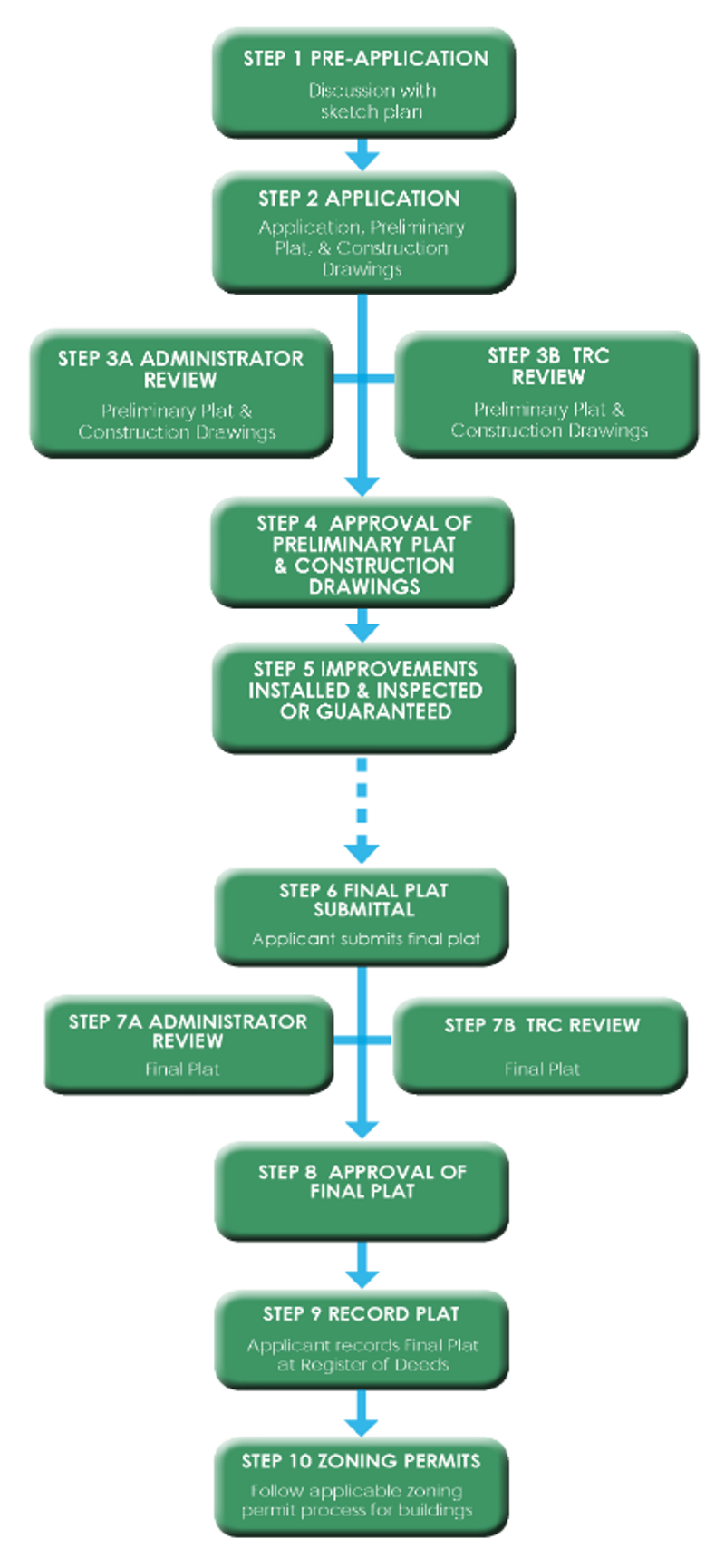
Step 1. Pre-application discussion with sketch plan.
A.
To minimize development planning costs, avoid misunderstanding or misinterpretation, and ensure compliance with the requirements of this Ordinance, pre-application consultation between the developer and the Administrator concerning the application of this Ordinance to the proposed development is required. It is the intent to provide a preliminary review of a property's development potential and staff direction for additional needed information, but not as a type of approval.
B.
Before submitting an application and Preliminary Plat with associated construction drawings, the developer shall submit to the Administrator a Sketch Plan (either digital or hard copy) drawn at a scale no smaller than one (1) inch to 100 feet (1:100) with the following information.
1.
Property boundaries with total acreage and relationship to adjacent properties and vicinity.
2.
Proposed site layout including proposed lots, streets, and land uses.
3.
Proposed site access and designation as public or private.
4.
Topography in five (5) foot contour intervals and existing water courses.
5.
Location of nearest existing and proposed water and sewer line sizes and types and statements regarding how property will be served with water, sewer, and fire protection.
6.
Sketch of any proposed drainage facilities.
7.
Zoning of subject and adjacent properties.
C.
The Administrator shall review the Sketch Plan for general compliance with the requirements of this Ordinance and any other applicable requirements within 14 days of submittal. The Administrator shall advise the developer or his authorized agent of the regulations pertaining to the proposed development and the procedures to be followed. Any development is subject to other state and federal (and potentially private utility) requirements. For any requirements applying to a development, the Town of Yadkinville will require a letter from the regulating agency as proof of compliance. Proof of compliance will directly affect issuance of any Zoning Permit or Certificate of Compliance. These include, but are not limited to:
1.
Wetlands—US Army Corps of Engineers.
2.
Soil and Erosion Control (compliance with ALL size developments, including those under an acre)—NC Department of Environmental Quality (NCDEQ).
3.
Drive entrances—NC Department of Transportation and Town of Yadkinville.
4.
Other applicable agencies.
D.
One (1) hard copy and one (1) digital copy of the Sketch Plan shall be retained on file by the Administrator, and one (1) digital or hard copy shall be returned to the developer or his authorized agent along with any comments made by the Administrator concerning the proposed development.
Step 2. Applicant submits application, preliminary plat, & associated construction drawings.
A.
The applicant shall submit the application, fee, Preliminary Plat and associated construction drawings, prepared by a surveyor or professional engineer licensed and registered to practice in North Carolina, that provide the following information:
1.
Title Block: Development name, developer's name, north arrow, scale (denoted graphically and numerically), date of plat preparation, location of development (township, county and state), name and seal of registered land surveyor preparing the plat.
2.
Vicinity Map and North Arrow: A sketch vicinity map showing the location of the development in relation to the surrounding area.
3.
Site Data: Acreage in total tract, smallest lot size, total number of lots, lineal feet of streets.
4.
Zoning and Town Limits: Indicate both on and adjacent to the land to be subdivided the location of Town limits, zoning of property and location of zoning lines if property is located in more than one (1) zone.
5.
Tract Boundaries: Exact boundaries of the tract or portion thereof to be subdivided, with all bearings and distances accurately shown.
6.
Property Lines: Property lines and owners' names of record of all adjoining properties and/or adjoining development of record which intersect with the perimeter of the tract being subdivided.
7.
Topographic Lines: Topographic contour lines at five (5) foot intervals.
8.
Natural Features/Critical and Sensitive Areas: streams, creeks, ponds, reservoirs, location of the floodway and flood fringe boundaries if applicable, wetlands, farmland, rock outcrops, wooded areas, slopes greater than 25%; significant cultural features including cemeteries and National Register of Historic Places landmarks or districts.
9.
Existing Physical Features: Existing physical features including buildings, streets (include names, whether public or private, right-of-way, pavement type and width), railroads, power lines, drainage ways, culverts and drainpipes, sewer and water mains and any public utility easements on and adjacent to the tract being subdivided.
10.
Proposed Lot Layout: All proposed lot and street right-of-way lines with approximate dimensions, lot and block numbers, all easements, designation of any dedication or reservations to be made, building setback lines (if applicable) and proposed use of land if other than single family residences.
11.
Street Layout: Proposed streets and alleys, showing pavement widths; rights-of-way; curbing if any; percent of finished grades, street names and a street profiles.
12.
Street Maintenance: Statement whether streets are private or are to be turned over for maintenance to the Town of Yadkinville or NCDOT.
13.
Water and Sewer: Provision of water and wastewater disposal shall be indicated by one (1) of the following methods:
•
Utility Plan: Plans showing water and sewer system layouts including location of lines, line sizes, location of manholes, pumps, hydrants, force mains or treatment facilities and the connection of the proposed system(s) with existing systems. A typical trench section shall be shown. Letters of approval for the plans for the proposed sanitary sewer and water distribution systems from the appropriate agencies.
•
Health Department Approval: Location plans for individual water supply and septic system as approved by Yadkin County Health Department (if connection to Town systems not possible)
14.
Stormwater System: Plans for proposed drainage facilities, including location and dimensions of open drainage ways, storm sewers, culverts, retaining ponds or areas where water is to be diverted through grading, including calculations and any other evidence necessary to ensure that the proposed method of drainage is adequate to safeguard property in the Town.
15.
Grading and Soil and Erosion Control Plan: A Soil and Erosion Control Plan approved by NCDEQ.
16.
Driveway Permits: Any driveway permits approved by NCDOT.
17.
Article 4 Standards: Demonstration that all of the development standards of Article 4 have been met to potentially include:
•
Landscaping Plan.
•
Lighting Plan.
18.
Other Improvements: Proposed location and description of any other improvements including, but not limited to, school sites, pedestrian or bike ways, buffers, reserved open space or recreational facilities as required by Section 4.3.4 (indicate whether public or private), along with deed restrictions or covenants for the maintenance of such.
19.
Phasing: All phase lines shall be shown on the Preliminary Plat. If a subdivision that is to be built in phases includes common area improvements that are designed to relate to, benefit, or be used by the entire subdivision (such as a swimming pool or tennis courts in a residential subdivision) then, as part of his/her application for subdivision approval, the developer shall submit a proposed schedule for completion of such common area improvements. The schedule shall relate completion of such common area improvements to completion of one (1) or more phases of the entire subdivision. Once a schedule of improvements has been approved, no land may be used or no buildings may be occupied, and no subdivision lots may be sold except in accordance with the schedule approved.
B.
The following submittal requirements may be altered by the Administrator as applicable.
1.
Four (4) full-size paper copies for initial review and two (2) copies for revisions.
2.
One (1) digital copy in PDF format.
Step 3A and B. Administrator/technical review committee review of preliminary plat.
A.
The Administrator and the Technical Review Committee shall review the Preliminary Plat and associated construction drawings in accordance with the requirements of this Ordinance and any other applicable local, state, or federal requirements. The review shall be completed within 30 days and the developer shall be notified of any deficiencies to be corrected in order to approve.
B.
The Technical Review Committee may provide comments to the Administrator regarding the proposed development. It shall be the responsibility of the Administrator to ensure that the comments are communicated to and addressed by the developer.
Step 4. Approval of preliminary plat and construction drawings.
A.
If a Preliminary Plat and associated construction drawings are found to meet all of the applicable regulations of this Ordinance, then the Administrator shall approve the Plat.
B.
One (1) hard copy and one (1) digital copy of the approved Preliminary Plat and associated construction drawings shall be retained on file by the Administrator.
Step 5. Improvements installed and inspected or guaranteed.
A.
Following Preliminary Plat approval, the developer may proceed with the installation of improvements as shown on the approved construction drawings, and as set forth in Section 4.6 Infrastructure Standards.
B.
Approval of the Final Plat shall be subject to the developer having installed the required improvements or having guaranteed, to the satisfaction of the Town, the installation of said improvements. The Town Engineer shall inspect the improvements to ensure compliance with Town standards prior to approval of the Final Plat. Underground utilities shall be inspected by the Town Engineer and/or utility provider before they are covered.
C.
In lieu of requiring the completion, installation and dedication of all improvements prior to Final Plat approval, the Town may enter into an agreement with the developer whereby the developer shall agree to complete all required improvements as specified by the approved Preliminary Plat for that portion of the subdivision to be shown on the Final Plat within one (1) year of Final Plat approval. Once the security required herein is provided, the Final Plat may be approved by the Administrator, if all other requirements of this Ordinance are met. The Administrator shall require a certified cost estimate from a licensed contractor or engineer for the cost of completion of such improvements. The Administrator may direct the Finance Director to release a portion of any security posted as the improvements are completed. The developer shall provide one (1) of the following guarantees in lieu of installation, in accordance with NC GS 160D-804:
1.
Surety Performance Bond(s): The developer shall obtain a performance bond(s) from a surety bonding company authorized to do business in North Carolina. The bond(s) shall be payable to the Town of Yadkinville, and shall be in the amount of 1.25 times the entire cost, as estimated by a licensed engineer. The duration of the bond(s) shall be until such time as the improvements are accepted by the Town or a default is declared.
2.
Cash or Equivalent Security: The developer shall deposit cash, an irrevocable letter of credit, or other instrument readily convertible into cash at face value, either with the County or in a non-interest bearing escrow account with a financial institution designated as an official depository by the Town. The amount of deposit shall be 1.25 times the cost, as estimated by a licensed engineer. If cash or other instrument is deposited in escrow with a financial institution as provided above, then the developer shall file with the Administrator an agreement between the financial institution and himself guaranteeing the following:
•
That said escrow account shall be held in trust until released by the Administrator and may not be used or pledged by the developer in any other matter during the term of the escrow; and
•
That in the case of a failure on the part of the developer to complete said improvements, the financial institution shall, upon notification by the Administrator and submission by the Administrator to the financial institution of an engineer's estimate of the amount needed to complete the improvements, immediately either pay to the Town of Yadkinville the funds estimated to complete the improvements, up to the full balance of the escrow account, or deliver to the county any other instruments endorsed or otherwise made payable to the Town.
•
Upon default, meaning failure on the part of the developer to complete the required improvements in a timely manner as spelled out in the performance bond or escrow agreement, then the surety, or the financial institution holding the escrow account shall, if requested by the Town, pay all or any portion of the bond or escrow fund to the Town of Yadkinville up to the amount needed to complete the improvements based on an engineering estimate. Upon payment, the Administrator, in his discretion, may expend such portion of said funds as it deems necessary to complete all or any portion of the required improvements. The Town shall return to the developer any funds not spent in completing the improvements.
Step 6. Final plat submittal.
A.
Following completion or guarantee of improvements, the applicant shall submit the applicable application, fee and the Final Plat(s). The Final Plat(s) submitted shall constitute only that portion of the approved Preliminary Plat which the developer proposed to develop and record at the time of submission. Final Plats shall be prepared by a Registered Land Surveyor currently licensed and registered in the State of North Carolina by the North Carolina State Board of Registration for Professional Engineers and Land Surveyors. Final Plats shall conform to the provisions for plats, developments and mapping requirements set forth in NC GS 47-30 and the Manual of Practice for Land Surveying in North Carolina. Final Plats shall be of a size suitable for recording with the Yadkin County Register of Deeds and shall be at a scale of not less than one inch equals 100 feet (1"=100'). Maps may be placed on more than one (1) sheet with appropriate match lines.
B.
Final Plats shall include the following information:
1.
Title Block: Subdivision name, north arrow, scale denoted graphically and numerically, date of plat preparation and township, county and state in which the subdivision is located and the name(s) of the owner(s) and the registered surveyor responsible for the subdivision (including the seal and registration number of the registered surveyor).
2.
Tract Boundaries: The exact boundary lines of the tract to be subdivided fully dimensioned by lengths and bearings and the location of intersecting boundary lines and adjoining lands.
3.
Adjoining Property Owners: The names and deed references of owners of adjoining properties and adjoining developments of record (proposed or under review).
4.
Zoning and Town Limits: Indicate both on and adjacent to the land to be subdivided the location of Town limits, zoning of property and location of zoning lines if property is located in more than one (1) zone.
5.
Setbacks and Building Envelopes: Provide the minimum building setbacks in both table format and on the lot.
6.
Location of Improvements: All visible and apparent rights-of-way, watercourses, utilities, roadways and other such improvements shall be accurately located where crossing or forming any boundary line of the property shown.
7.
Surveying Data: Sufficient engineering data to determine readily and reproduce on the ground every straight or curved boundary line, street line, lot line, right-of-way line, easement line and setback line, including dimensions, bearings or deflection angles, radii, central angles and tangent distances for the centerline of curved streets and curved property lines that are not the boundary of curved streets.
8.
Monuments: The accurate locations and descriptions of all monument, markers and control points.
9.
Lot and Block Numbers: The blocks numbered consecutively throughout the entire subdivision and the lot numbered consecutively throughout each block.
10.
Setback Lines: Minimum building setback lines, if applicable.
11.
Streets: Street names, right-of-way lines and percents grade of all streets and the location and width of all adjacent streets and easements. Designation shall be made as to whether said streets are to be designated as public or private.
12.
Utility and Drainage easements: Locations of water, sanitary sewer and storm drainage easements
13.
Right-of-Way: The location and dimensions of all rights-of-way, utility or other easements, natural buffers, pedestrian or bicycle paths and areas to be dedicated to public use with the purpose of each stated.
14.
Flood Information: The location of the floodway and flood fringe boundaries, if applicable.
15.
Open Space: The location of dedicated open space with a note that the land shall not be developed for any purposes other than the designated open space type.
16.
Forms of Final Certifications: The following certificates shall be shown on the original and all copies of the Final Plat:
• Certificate of Approval by the Administrator
I hereby certify that this final plat meets the requirements of the Town of Yadkinville Development Ordinance and may be recorded.
• Certificate of Ownership and Dedication
I (We) hereby certify that I am (we are) owner(s) of the property shown and described herein, that the property is within the jurisdiction of the Town of Yadkinville and that I (we) hereby adopt this plan of subdivision with my (our) free consent and hereby establish all lots and dedicate all streets, alleys, walks, parks and other open spaces to public or private use as noted.
___________
Owner(s)
• Certificate of Survey and Accuracy
I, ___________, PLS ___________certify that this plat was drawn under my supervision from an actual survey made under my supervision (deed description recorded in book ___ page ___ , etc.) (other); that the boundaries not surveyed are clearly indicated as drawn from information found in book ___ page ___; that the ratio of precision as calculated is 1: ___ ; that this plat was prepared in accordance with G.S. 47-30 as amended. Witness my original signature, registration number and seal this _____ day of ______ A.D., 20___.
Seal or Stamp
___________
Surveyor
___________
Registration # (maximum allowable error: 1:10,000)
• Review Officer Certificate
State of North Carolina, County of Yadkin I, ___________, Review Officer of Yadkin County, certify that the map or plat to which this certification is affixed meets all statutory requirements for recording.
___________
Review Officer Date
• Register of Deeds Certificate
State of North Carolina, County of Yadkin
This instrument was presented for registration and recorded in Map Book _______, Page ___ this ___ day of _______, 20___ at _______ (a.m./p.m.)
___________
Register of Deeds
• Certificate of Approval of Design and Installation of Streets, Utilities and Other Required Improvements (if applicable)
I hereby certify that all streets, public utilities and other required improvements have been installed in an acceptable manner and according to N.C. Department of Transportation and/or Town of Yadkinville specifications and standards or as otherwise provided for in this Ordinance, or that guarantees for the installation of the required improvements in an amount and manner satisfactory to Yadkinville have been submitted.
_________________________________
Professional Engineer Registration Number Date Official Seal
or
______________________
Public Works Director Date
• NCDOT Construction Standards Certification (if applicable)
Department of Transportation, Division of Highways
Proposed Subdivision Road Construction Standards Certificate
Approved: District Engineer Date:________
• Onsite Water and/or Sewer Note (where appropriate)
Note:(ALL the LOTS) or (LOTS# _______) as shown on this Plat are proposed to be served with on-site water and/or sewer systems. The lots as shown meet the minimum size prescribed by the Yadkin County Health Department for such system(s). However, the recording of this Plat does not guarantee that any such lots will meet the requirements for the approval by the Health Department for such on-site system(s). Health Department approval for such systems is required.
• Special Flood Hazard Area Note (Word to represent actual situation)
Note: (Part of) this property (does/does not) lie in a Special Flood Hazard Area Reference: Floodway Panel # _______ Date: ________ (of Panel) (If part of the property is in a Special Flood Hazard Area it shall be shown graphically on the Plat and comply with the Flood Damage Prevention Regulations of Section 4.3.3)
C.
The following submittal requirements may be altered by the Administrator as applicable.
1.
Four (4) full-size paper copies for initial review and two (2) for revisions.
2.
One (1) digital copy in PDF format.
Step 7A and B. Administrator/technical review committee review of final plat.;b2;
A.
The Administrator and the Technical Review Committee shall review the Final Plat in accordance with the approved Preliminary Plat, requirements of this Ordinance, and any other applicable local, state, or federal requirements. The review shall be completed within 30 days and the developer shall be notified of any deficiencies to be corrected in order to approve.
B.
The Technical Review Committee may provide comments to the Administrator regarding the proposed development. It shall be the responsibility of the Administrator to ensure that the comments are communicated to and addressed by the developer.
Step 8. Approval of final plat. If the Final Plat is found to meet all of the applicable regulations of this Ordinance, then the Administrator shall ensure that all applicable certificates are signed and approve the Plat for recordation at the Yadkin County Register of Deeds.
Step 9. Record plat. Following approval, the applicant shall record the Plat at the Yadkin County Register of Deeds within 30 days of the date of approval. Otherwise, said plat shall be void and may subject to the entire review process.
Step 10. Zoning permits. Following recordation of the Plat, the appropriate Zoning Permit process in Section 2.2.3 shall be followed for any construction or establishment of uses on individual lots.
2.2.4.7 No subdivision or improvements without plat approval.
A.
The Review Officer or Yadkin County Register of Deeds, pursuant to NC GS 47-30.2, shall not certify or record a plat of a subdivision of land lying within the jurisdiction of this Ordinance that has not been approved in accordance with the provisions contained herein; nor shall the Clerk of Superior Court order or direct the recording of a plat if the recording would be in conflict with the visions or intent of this Ordinance. Without the approval, the filing or recording of a subdivision plat shall be null and void.
B.
No person may subdivide land except in accordance with all of the provisions of this Ordinance. In particular, no person may subdivide land unless and until a Final Plat of the subdivision has been approved and recorded in the Yadkin County Register of Deeds.
C.
No grading or physical improvements to land to be subdivided may be commenced except in accordance with and pursuant to the approved Preliminary Plat.
D.
No Zoning Permit or Building Permit shall be issued by the Town of Yadkinville for the construction of any building on any lot within a proposed subdivision until a Final Plat of said subdivision has been approved in a manner as prescribed by this Ordinance and recorded at the Yadkin County Register of Deeds Office.
E.
A Final Plat must be recorded before final sale or lease of lots can occur. However, the developer, upon approval of a Preliminary Plat, may enter into contracts to sell or lease the lots shown on the approved Preliminary Plat, provided that the contract does all of the following:
1.
Incorporates as an attachment a copy of the approved Preliminary Plat referenced in the contract and obligates the owner to deliver to the buyer a copy of the approved and recorded Final Plat prior to closing and conveyance.
2.
Plainly and conspicuously notifies the prospective buyer or lessee that a final subdivision plat has not been approved or recorded at the time of the contract, that no governmental body will incur any obligation to the prospective buyer or lessee with respect to the approval of the final subdivision plat, that changes between the Preliminary and Final Plats are possible, and that the contract or lease may be terminated without breach by the buyer or lessee if the final approved and recorded plat differs in any material respect from the approved Preliminary Plat.
3.
Provides that if the approved and approved and recorded Final Plat does not differ in any material respect from the plat referred to in the contract, the buyer or lessee may not be required by the seller or lessor to close any earlier than 5 days after the delivery of a copy of the final approved and recorded plat.
4.
Provides that if the approved and recorded Final Plat differs in any material respect from the approved Preliminary Plat referred to in the contract, the buyer or lessee may not be required by the seller or lessor to close any earlier than 15 days after the delivery of the final approved and recorded plat, during which 15-day period the buyer or lessee may terminate the contract without breach or any further obligation and may receive a refund of all earnest money or prepaid purchase price.
2.2.4.8 Phased subdivisions.
A.
All phase lines shall be shown on the Preliminary Plat.
B.
If a subdivision that is to be built in phases includes common area improvements that are designed to relate to, benefit, or be used by the entire subdivision (such as a swimming pool or tennis courts in a residential subdivision) then, as part of his/her application for subdivision approval, the developer shall submit a proposed schedule for completion of such common area improvements. The schedule shall relate completion of such common area improvements to completion of one (1) or more phases of the entire subdivision. Once a schedule of improvements has been approved, no land may be used or no buildings may be occupied, and no subdivision lots may be sold except in accordance with the schedule approved.
2.2.4.9 Preliminary plat validity.
A.
The approval of a Preliminary Plat shall be effective for two (2) years from the date of approval. By the end of that time period, a Final Plat shall have been approved and recorded Any plat or portion thereof not receiving final approval within the time period set forth herein shall be null and void except under the following conditions:
1.
The subdivision is built in sections or phases, and was approved as part of the Preliminary Plat; and
2.
The period between the approval date of the Preliminary Plat and the approval date of the Final Plat for the first phase does not exceed two (2) years; and
3.
The period between the approval date of the Final Plat of the first phase and the approval date(s) of the Final Plat(s) of any subsequent phase(s) does not exceed the time limits specified in the phasing schedule of the Preliminary Plat.
B.
The Administrator may, upon expiration of a Preliminary Plat, re-approve the expired Preliminary Plat or portions thereof, as long as the subdivision design and conditions of approval are in compliance with this Ordinance, and any other applicable Town ordinances and/or plans in effect at the time of application for re-approval, and changes to the original design or conditions of approval are considered minor.
C.
The applicant shall submit an amended application for review as an original application substantial amendments or modifications are proposed after Preliminary Plat Approval. This shall not apply to minor changes. A change may be considered a minor change if it does not involve any of the following:
1.
Any substantive change in a condition of approval;
2.
An increase in the number of building lots proposed;
3.
Any substantial change in the location of, or any decrease in, the amount of open space, buffers, or areas reserved for recreational use;
4.
Any substantial change in pedestrian and/or vehicular access or circulation including road classification;
5.
Any change in the provision of services such as water supply and wastewater disposal; and
6.
Any substantial change in the location of utilities or other easements.
2.2.4.10 Dedication and maintenance of improvements.
A.
Approval of a Plat does not constitute acceptance by the Town of the offer of dedication of any streets, sidewalks, parks, or other public facilities shown on a Plat.
B.
After a minimum of one (1) year of maintenance by the developer from the date that street installation was approved, the Town may accept any such offer of dedication by resolution of the Town Board of Commissioners following satisfactory inspection by the Town Engineer and/or Public Works Director for compliance with Town standards. For dedication of improvements within a street right-of-way in a residential subdivision, a minimum of 75% of the units shall be complete prior to acceptance of dedication and maintenance by the Town.
C.
All facilities and improvements with respect to which the owner makes an offer of dedication to public use shall be maintained by the owner until such offer of dedication is accepted by the appropriate public authority.
2.2.4.11 Re-platting procedures. For any re-platting or re-subdivision of land, the same procedures, rules and regulations shall apply as prescribed herein for an original subdivision. Lot sizes may, however, be varied on an approved plan after recording, provided that:
A.
No lot or tract of land shall be created or sold that is smaller than the size shown on the approved plan;
B.
Drainage, easements or rights-of-way shall not be changed;
C.
Street alignment and block sizes shall not be changed;
D.
The property line between the back of the lots shall not be changed;
E.
The rear portion of lots shall not be subdivided from the front part;
F.
The character of the area shall be maintained; and
G.
Minor changes in routing of electric, natural gas, and telephone service do not require an additional review of the plat.
2.2.5 Special use permits.
A.
Applicability. Uses identified as requiring a special use in Table 3.1, Permitted Uses Table shall be approved as a Minor Special Use Permit or a Major Use Permit in accordance with the procedures and standards of this section, prior to development. A special use is a use that may be appropriate in a zoning district, but because of its nature, extent, and external effects, requires special consideration of its location, design, and methods of operation before it can be deemed appropriate in the district and compatible with its surroundings.
B.
Special Use Procedures. Pursuant to NC GS 160D-302 and NC GS 160D-705, the Board of Adjustment may hear and decide requests for Minor Special Use Permits, and the Town Board of Commissioners may hear and decide request for Major Special Use Permits, for uses indicated in the Permitted Uses Table 3.1 in Section 3.4.3 and as otherwise set forth in this Ordinance. The steps in the boxes below correspond with a detailed description of each step of the process on the following pages.
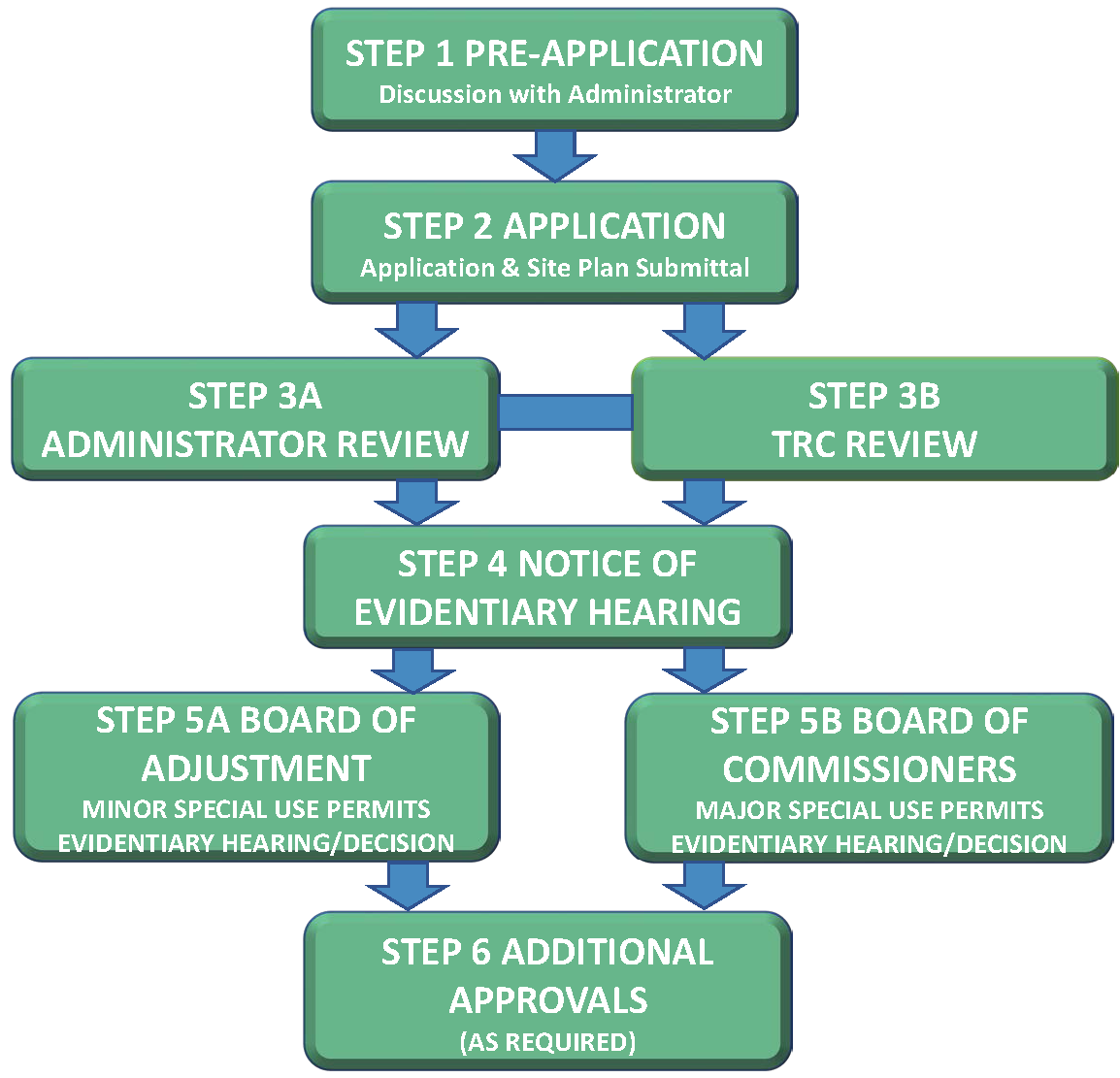
Step 1. Pre-application discussion with administrator. To minimize costs, avoid misunderstanding or misinterpretation, and ensure compliance with the requirements of this Ordinance, pre-application consultation between the applicant and the Administrator concerning the application is required.
Step 2. Application and site plan submittal.
A.
The property owner and applicant (when separate entity from the property owner) shall submit the Minor Special Use Permit or the Major Special Use application, fee, and associated site plan a minimum of 45 days prior to the Board of Adjustment or the Board of Commissioners evidentiary hearing at which the request is designated to be heard. Additional time may be needed for Technical Review Committee review in Step 3. Site plans shall include, at a minimum, the following information:
1.
Survey of the property at a scale no smaller than one inch equals 50 feet (1"=50').
2.
North arrow.
3.
Lot lines with bearings and distances.
4.
Zoning district and applicable overlay districts.
5.
Adjacent property owner names, parcel number and zoning.
6.
Total acreage.
7.
Proposed buildings and parking.
8.
Existing and proposed impervious area in square feet and as a percentage of the site.
9.
Proposed building setbacks (as they relate to the variance request.
10.
Any other pertinent information to provide substantial, material, and competent evidence to support the findings-of-fact.
C.
The following submittal requirements may be altered by the Administrator applicable:
1.
Nine (9) full-size paper copies of the Site Plan for the Board of Adjustment or the Board of Commissioners and staff.
2.
One (1) digital copy in PDF format or comparable format.
D.
When required, a traffic impact analysis shall be submitted for review with the submittal of an application for a Minor Special Use Permit or a Major Special Use Permit.
Step 3A and B. Administrator/technical review committee review.
A.
The Administrator and the Technical Review Committee shall review the Site Plan in accordance with the requirements of this Ordinance and any other applicable local, state or federal requirements.
B.
The Technical Review Committee may provide comments to the Administrator regarding the proposed development. It shall be the responsibility of the Administrator to ensure that the commends are communicated to and addressed by the applicant.
C.
The Administrator shall prepare a staff report, and provide a recommendation in a Accordance with Section 2.2.5 Step 5.
Step 4. Notice of evidentiary hearing. The Administrator shall provide notice of the evidentiary hearing in the following manner as prescribed by NC GS 160D-406. Notice of Board of Adjustment or Board of Commissioners evidentiary hearings shall be mailed to the person or entity whose application is the subject of the hearing; to the owner of the property that is the subject of the hearing if separate entity from the applicant; and to the owners of all parcels of land abutting the parcel of land that is the subject of the hearing, as well as those properties separated from the subject property by street, railroad, or other transportation corridor. In the absence of evidence to the contrary, the Town may rely on the Yadkin County tax listing to determine owners of property entitled to mailed notice. The notice must be deposited in the mail at least 10 days, but not more than 25 days, prior to the date of the hearing. Within that same time period the Town shall also prominently post a notice of the hearing on the site that is the subject of the hearing or on an adjacent street or highway right-of-way.
Step 5. Evidentiary hearing and decision.
A.
The Board of Adjustment shall conduct a quasi-judicial evidentiary hearing for a Minor Special Use Permit. Sworn testimony shall be provided by witnesses speaking before the Board on the matter to establish facts of the case. The Board must allow parties with standing to participate fully in the evidentiary hearing, as defined by NC GS 160D-1402(c), including presenting evidence, cross-examining witnesses, objecting to evidence, and making legal arguments; and may allow non-parties to present competent, material, and substantial evidence that is not repetitive. The Board of Adjustment shall grant a Minor Special Use Permit upon affirmative findings made for each of the following:
1.
That the use will not materially endanger the public health or safety, if located where proposed according to the plan submitted and approved;
2.
That the use complies with all required standards, conditions and specifications of this Ordinance;
3.
That the use will not substantially injure the value of adjoining or abutting property, or that the special use is a public necessity; and
4.
That the location and character of the special use, if developed according to the plan as submitted and approved, will be in harmony with the area in which it is to be located; and
5.
That the location and character of the special use, if developed according to The plan as submitted and approved, will be in general conformity with the Comprehensive Plan and other adopted plans and policy guidance.
B.
The Town Board of Commissioners shall conduct a quasi-judicial evidentiary hearing for a Major Special Use Permit. Sworn testimony shall be provided by witnesses speaking before the Board on the matter to establish facts of the case. The Board must allow parties with standing to participate fully in the evidentiary hearing, as defined by NC GS 160D-1402(c), including presenting evidence, cross-examining witnesses, objecting to evidence, and making legal arguments; and may allow non-parties to present competent, material, and substantial evidence that is not repetitive. At its discretion the Board of Commissioners may refer the request to the Planning Board for an informal advisory review pursuant to NC GS 160D-301. The Board of Commissioners shall grant a Major Special Use Permit upon affirmative findings made for each of the following:
1.
That the use will not materially endanger the public health or safety, if located where proposed according to the plan submitted and approved;
2.
That the use complies with all required standards, conditions and specifications of this Ordinance;
3.
That the use will not substantially injure the value of adjoining or abutting property, or that the special use is a public necessity; and
4.
That the location and character of the special use, if developed according to the plan as submitted and approved, will be in harmony with the area in which it is to be located; and
5.
That the location and character of the special use, if developed according to The plan as submitted and approved, will be in general conformity with the Comprehensive Plan and other adopted plans and policy guidance.
C.
Conditions of Approval. In granting a Minor Special Use Permit or a Major Special Use Permit, the Board of Adjustment or the Town Board of Commissioners may impose such additional restrictions and requirements upon such Permit as it may deem necessary in order that the purpose and intent of this Ordinance are served, public welfare secured, and substantial justice done. Any conditions of approval shall meet or exceed the minimum requirements of this Development Ordinance. If all requirements and conditions are accepted by the applicant/landowner by written consent, the Board of Adjustment or the Town Board of Commissioners shall authorize the issuance of the Minor or Major Special Use Permit, otherwise the Permit shall be denied. Any Minor or Major Special Use Permit so authorized shall be perpetually binding upon the property included in such permit unless subsequently changed or amended by the Board, as provided for in this Section. In addition to the conditions specifically imposed in this Ordinance and such further conditions as the Board of Adjustment or Board of Commissioners may deem reasonable and appropriate, Minor and Major Special Uses shall comply with all other regulations for the zoning district in which they are located.
D.
The concurring vote of a simple majority of the Board of Adjustment shall be necessary to grant a Minor Special Use Permit. The concurring vote of a simple majority of the Town Board of Commissioners shall be necessary to grant a Major Special Use Permit. For the purposes of this subsection, vacant positions on the Board and members who are disqualified from voting on a quasi-judicial matter shall not be considered members of the Board for calculation of the requisite majority if there are no qualified alternates available to take the place of such members.
E.
The Board of Adjustment or the Town Board of Commissioners shall determine contested facts and make its decision within a reasonable time. Every quasi-judicial decision shall be based upon competent, material, and substantial evidence in the record. Each quasi-judicial decision shall be reduced to writing and reflect the either Board's determination of contested facts and their application to the applicable standards. The written decision shall be signed by the chair or other duly authorized member of either Board. A quasi-judicial decision is effective upon filing the written decision with the clerk to the Board or such other office or official as the ordinance specifies. The decision of the Board of Adjustment or the Town Board of Commissioners shall be delivered by personal delivery, electronic mail, or by first-class mail to the applicant, property owner, and to any person who has submitted a written request for a copy, prior to the date the decision becomes effective. The person required to provide notice shall certify that proper notice has been made.
F.
Every quasi-judicial decision shall be subject to review by the Superior Court by proceedings in the nature of certiorari pursuant to NC GS 160D-1405. A petition for review shall be filed with the Clerk of Superior Court by the later of 30 days after the decision is effective or after a written copy thereof is given in accordance this Section. When first-class mail is used to deliver notice, three (3) days shall be added to the time to file the petition.
G.
In accordance with NC GS 160D-406(f), the Chair of the Board of Adjustment or any member acting as chair and the clerk to the Board are authorized to oaths to witnesses in any matter coming before the Board.
The Mayor of the Town Board of Commissioners or any member acting as chair of the clerk to the Board are authorized to administer oaths to witnesses in any matter coming before the Board.
H.
If the Board of Adjustment denies the Minor Special Use Permit, or the Town Board of Commissioners denies the Major Special Use Permit, it shall enter the reason for its action in the minutes of the meeting at which the action is taken. Any appeal shall be taken from the action of the Board of Adjustment in granting or denying a Minor Special Use Permit, or from the Town Board of Commissioners in granting or denying a Major Special Use Permit through the Yadkin County Superior Court within thirty (30) days of the decision.
I.
Reapplication After Denial. When the Board of Adjustment has denied any application for a Minor Special Use Permit, it shall not, thereafter, accept any other application for the same request until the expiration of six (6) months from the date of such previous denial.
When the Town Board of Commissioners has denied any application for a Major Special Use Permit, it shall not, thereafter, accept any other application for the same request until the expiration of six (6) month from the date of such previous denial.
J.
Amendments.
1.
Amendments to Minor Special Use Permits.
a.
The Board of Adjustment may approve an amendment to a Minor Special Use Permit requested by the applicant, upon receipt of a report from the Planning Director on the proposed amendment.
i.
The Board of Adjustment may approve a minor change to a special use request without a public hearing. A minor change includes changes to conditions of a special use or associated site plan which will result in equal or better performance of the conditions and that do not alter the objectives and purposes of the special use.
ii.
Requested changes to a special use request which are not minor in nature require a public hearing.
b.
An amendment to a Minor Special Use Permit includes changes to conditions of a special use or associated site plan which will result in equal or better performance of the conditions and that do not alter the objectives and purposes of the Minor Special Use, and do not involve a change in uses permitted or the density of overall development permitted.
c.
In granting an amendment to a Minor Special Use Permit, the Board of Adjustment may require such conditions as will address the objectives of the requirements or conditions changed.
2.
Amendments to Major Special Use Permits.
a.
The Town Board of Commissioners may change or amend any Major Special Use Permit, after an evidentiary hearing and subject to the same consideration as provided for in this Article for the original issuance of Major Special Use Permit. No proposal to amend or change any Major Special Use Permit shall be considered within three (3) months of the date of the original authorization of such Permit or within three (3) months of hearing of any previous proposal to amend or change any such Permit. If multiple parcels of land are subject to a Major Special Use Permit, the owners of individual parcels may apply for permit modifications so long as the modification would not result in other properties failing to meet the terms of the Major Special Use Permit or regulations.
b.
An amendment to a Major Special Use Permit includes changes to conditions of a special use or associated site plan which will result in equal or better performance of the conditions and that do not alter the objectives and purposes of the Minor Special Use.
c.
In granting an amendment to a Major Special Use Permit, the Board of Commissioners may require such conditions as will address the objectives of the requirements or conditions changed.
K.
Failure to Comply with Approved Plans.
1.
In the event of failure to comply with the plans approved by the Board of Adjustment, or with any other conditions imposed upon the Minor Special Use Permit, no building permits for further construction or Certificates of Occupancy under this Minor Special Use Permit shall be issued, and all completed structures shall be regarded as nonconforming uses subject to the provisions of this Ordinance, until such time as the terms of the Minor Special Use Permit have been satisfied.
2.
In the event of failure to comply with the plans approved by the Board of Commissioners, or with any other conditions imposed upon the Major Special Use Permit, no zoning permits for further construction or Certificates of Occupancy under this Major Special Use Permit shall be issued, and all completed structures shall be regarded as nonconforming uses subject to the provisions of this Ordinance, until such time as the terms of the Major Special Use Permit have been satisfied.
L.
Effect.
1.
A Minor Special Use Permit and the associated site plan approval, and a Major Special Use Permit and the associated site plan approval are perpetually binding and run with the land, unless amended.
2.
An action invalidating a special use condition of approval for any reason shall render the special use null and void.
Step 6. Additional approvals (as required). Following the approval of a Minor Special Use Permit by the Board of Adjustment, or a Major Special Use Permit by the Board of Commissioners, the applicant may need to obtain additional approvals which may include subdivision, Zoning Permit, and/or Building Permit approval before work may begin. Special uses shall also meet all applicable federal and state requirements for location and operation. Failure to maintain compliance with those requirements may result in revocation of the special use.
Expiration of minor and major special use permits.
A.
General.
1.
Unless otherwise stated in the special use approval, a special use shall expire and become null and void one (1) year after the date of issuance if work has not been substantially commenced, as evidenced by a building permit not having been issued and a footing inspection for a building on the site having not been passed, or the applicant has not requested an extension in accordance with subsection B below.
2.
If development as a special use is discontinued for a period exceeding one (1) year, or if a special use is replaced by a use otherwise permitted by right in the zoning district, the special use approval is deemed abandoned and the special use approval is null and void.
B.
Extension.
1.
An applicant may request an extension of a special use approval in writing to the Administrator at least 30 days prior to expiration.
2.
Extension requests are considered as minor changes and shall be reviewed and approved by the original approval board (either the Board of Adjustment or the Town Board of Commissioners) in accordance with Section 2.2.5 Step 5J.
2.2.6 Variances. Pursuant to NC GS 160D-705(d), the Board of Adjustment may authorize Variances from the terms of this Ordinance as will not be contrary to the public interest where, owing to special conditions, a literal enforcement of the provisions of this Ordinance would result in unnecessary hardship. The steps in the boxes below correspond with a detailed description of each step of the process on the following pages.
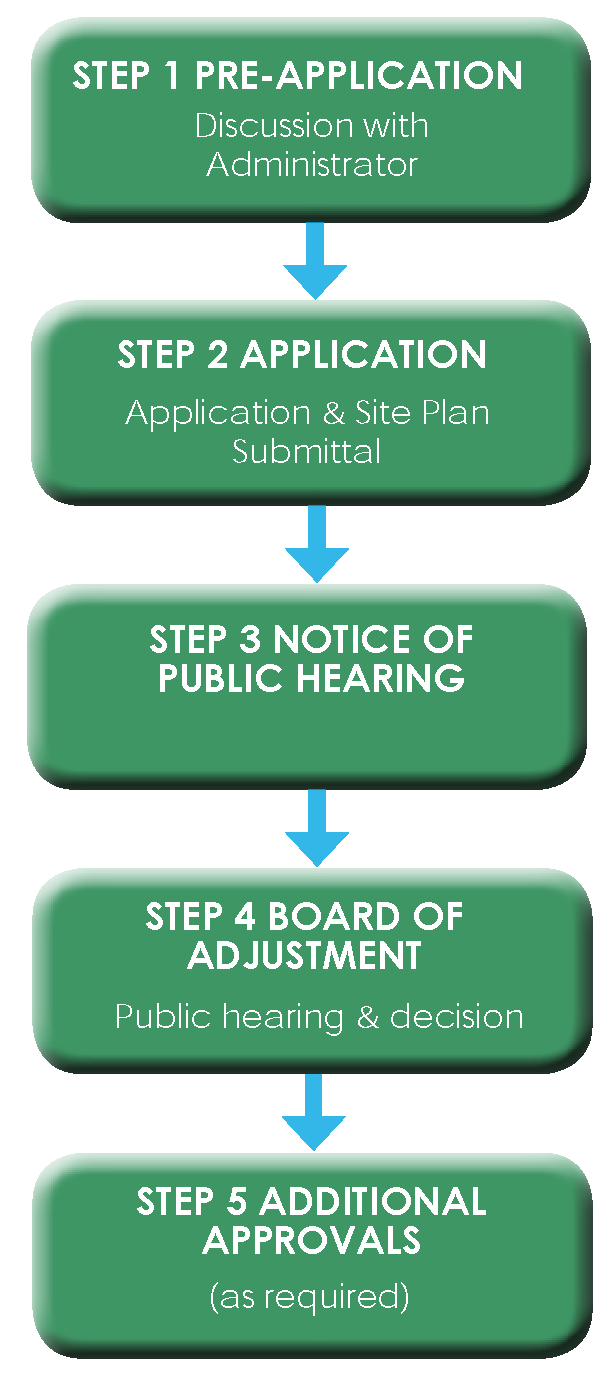
Step 1. Pre-application discussion with administrator. To minimize costs, avoid misunderstanding or misinterpretation, and ensure compliance with the requirements of this Ordinance, pre-application consultation between the applicant and the Administrator concerning the application is required.
Step 2. Applicant submits application and site plan submittal.
A.
The applicant shall submit the Variance application, fee and the Site Plan that provides, at a minimum, the following information:
1.
Survey of the property at a scale no smaller than one inch equals 50 feet (1"=50').
2.
North arrow.
3.
Lot lines with bearings and distances.
4.
Zoning district and applicable overlay districts.
5.
Adjacent property owner names, parcel numbers and zoning.
6.
Total acreage.
7.
Proposed buildings and parking.
8.
Existing and proposed impervious area in square feet and as a percentage of the site.
9.
Proposed building setbacks (as they relate to the variance request).
10.
Any other information pertinent to providing substantial, material, and competent evidence of a hardship preventing reasonable use of the property if the requirements of this Ordinance are followed.
B.
The following submittal requirements may be altered by the Administrator as applicable:
1.
Nine (9) full-size paper copies of the Site Plan for the Board of Adjustment and staff.
2.
One (1) digital copy in PDF format or comparable format.
Step 3. Notice of evidentiary hearing. The Administrator shall provide notice of the evidentiary hearing in the following manner as prescribed by NC GS 160D-406 Notice of Board of Adjustment hearings shall be mailed to the person or entity whose application is the subject of the hearing; to the owner of the property that is the subject of the hearing if the owner did not initiate the hearing; and to the owners of all parcels of land abutting the parcel of land that is the subject of the hearing, as well as those properties separated from the subject property by street, railroad, or other transportation corridor. In the absence of evidence to the contrary, the Town may rely on the Yadkin County tax listing to determine owners of property entitled to mailed notice. The notice must be deposited in the mail at least 10 days, but not more than 25 days, prior to the date of the hearing. Within that same time period, the Town shall also prominently post a notice of the hearing on the site that is the subject of the hearing or on an adjacent street or highway right-of-way.
Step 4. Board of adjustment evidentiary hearing and decision.
A.
The Board of Adjustment shall conduct a quasi-judicial evidentiary hearing. Sworn testimony shall be provided by witnesses speaking before the Board on the matter to establish facts of the case. In accordance with NC GS 160D-406(f), the chair of the Board or any member acting as chair and the clerk to the Board are authorized to administer oaths to witnesses in any matter coming before the Board. When unnecessary hardships would result from carrying out the strict letter of a zoning ordinance, the Board of Adjustment shall vary any of the provisions of the ordinance upon a showing of all of the following:
1.
Unnecessary hardship would result from the strict application of the ordinance. It shall not be necessary to demonstrate that in the absence of the variance, no reasonable use can be made of the property.
2.
The hardship results from conditions that are peculiar to the property, such as location, size, or topography. Hardships resulting from personal circumstances, as well as hardships resulting from conditions that are common to the neighborhood or the general public, may not be the basis for granting a variance. A variance may be granted when necessary and appropriate to make a reasonable accommodation under the Federal Fair Housing Act for a person with a disability.
3.
The hardship did not result from actions taken by the applicant or the property owner. The act of purchasing property with knowledge that circumstances exist that may justify the granting of a variance shall not be regarded as a self-created hardship.
4.
The requested variance is consistent with the spirit, purpose, and intent of the regulation, such that public safety is secured, and substantial justice is achieved.
B.
No change in permitted uses may be authorized by variance.
C.
Appropriate conditions may be imposed on any variance, provided that the conditions are reasonably related to the variance. Any other ordinance that regulates land use or development may provide for variances consistent with the provisions of this subsection.
D.
No change in permitted uses may be authorized by variance. Appropriate conditions may be imposed on any variance, provided that the conditions are reasonably related to the variance. Any other development regulation that regulates land use or development may provide for variances from the provisions of those ordinances consistent with the provisions of this subsection.
E.
The Board may continue an evidentiary hearing that has been convened without further advertisement. If an evidentiary hearing is set for a given date and a quorum of the board is not then present, the hearing shall be continued until the next regular board meeting without further advertisement.
F.
The concurring vote of four-fifths (⅘) of the Board shall be necessary to grant a variance. For the purposes of this subsection, vacant positions on the Board and members who are disqualified from voting on a quasi-judicial matter under NC GS 160D-1-9(d) shall not be considered members of the Board for calculation of the requisite majority if there are no qualified alternates available to take the place of such members.
G.
The Board shall determine contested facts and make its decision within a reasonable time. Every quasi-judicial decision shall be based upon competent, material, and substantial evidence in the record to establish facts of the case. The evidentiary hearing must have testimony under oath; must allow parties with standing to participate fully in the evidentiary hearing, as defined by NC GS 160D-1402(c), including presenting evidence, cross-examining witnesses, objecting to evidence, and making legal arguments; and may allow non-parties to present competent, material, and substantial evidence that is not repetitive. When hearing an appeal, the Board may reverse or affirm, wholly or partly, or may modify the decision appealed from and shall make any order, requirement, decision, or determination that ought to be made. Each quasi-judicial decision shall be reduced to writing and reflect the Board's determination of contested facts and their application to the applicable standards. The written decision shall be signed by the chair or other duly authorized member of the Board. A quasi-judicial decision is effective upon filing the written decision with the clerk to the Board or such other office or official as the ordinance specifies. The decision of the Board shall be delivered by personal delivery, electronic mail, or by first-class mail to the applicant, property owner, and to any person who has submitted a written request for a copy, prior to the date the decision becomes effective. The person required to provide notice shall certify to the local government that proper notice has been made and the certificate shall be deemed conclusive in the absence of fraud.
H.
Every quasi-judicial decision shall be subject to review by the superior court by proceedings in the nature of certiorari pursuant to NC GS 160D-1402. Appeals shall be filed with the times as specified in NC GS 160D-1405(d). When first-class mail is used to deliver notice, three (3) days shall be added to the time to file the petition.
Step 5: Additional approvals (as required). Following the approval of a variance by the Board of Adjustment, the applicant may need to obtain additional approvals which may include subdivision, Zoning Permit, and/or Building Permit approval before work may begin.
2.2.7 Appeals.
2.2.7.1 General provisions.
A.
The Board of Adjustment shall hear and decide appeals of decisions of administrative officials charged with enforcement of the Development Ordinance and may hear appeals arising out of any other ordinance that regulates land use or development, pursuant to all of the following:
B.
Any person who has standing under NC GS 160D-1402, or the Town, may appeal a decision to the Board of Adjustment unless a different board is provided or authorized otherwise by statute or an ordinance adopted pursuant to Chapter NC GS 160D. If this function of the Board of Adjustment is assigned to any other board pursuant to NC GS 160D-302(b), that board shall comply with all of the procedures and processes applicable to the Board of Adjustment hearing appeals. Appeal of a decision made pursuant to an erosion and sedimentation control regulation, a stormwater control regulation, or a provision of the housing code shall not be made to the Board of Adjustment unless required by a local government ordinance or code provision.
C.
The official who made the decision shall give written notice to the owner of the property that is the subject of the decision and to the party who sought the decision, if different from the owner.
D.
The written notice shall be delivered by personal delivery, electronic mail, or first-class mail.
E.
Pursuant to NC GS 160D-406 the owner or other party shall have 30 days from receipt of the written notice within which to file an appeal. Any other person with standing to appeal shall have 30 days from receipt from any source of actual or constructive notice of the decision within which to file an appeal.
F.
An appeal of a notice of violation or other enforcement order stays enforcement of the action appeal from and accrual of any fines assessed unless the official who made the decision certifies to the board after notice of appeal has been filed that because of the fats stated in an affidavit, a stay would cause imminent peril to life or property or because the violation in transitory in nature, a stay would seriously interfere with enforcement of the development regulation. In that case, enforcement proceedings shall not be stayed except by a restraining order, which may be granted by a court. If enforcement proceedings are not stayed, the appellant may file with the official a request for an expedited hearing of the appeal, and the board shall meet to hear the appeal within 15 days after such a request is filed. Notwithstanding the foregoing, appeals of decisions granting a development approval or otherwise affirming that a proposed use of property is consistent with the development regulation shall not stay the further review of an application for development approvals to use such property; in these situations the appellant or local government may request and the board may grant a stay of the final decision of development approval applications, including building permits affected by the issue being appealed.
G.
Alternate dispute resolution. The parties to an appeal that has been made under this section may agree to mediation or other forms of alternative dispute resolution. The development regulation may set standards and procedures to facilitate and manage such voluntary alternative dispute resolution.
2.2.7.2 Appeal procedures. Pursuant to NC GS 160D-403(c), the Board of Adjustment shall hear and decide Appeals from any order, requirement, decision or determination made by an administrative official charged with the enforcement of this Ordinance. The steps in the boxes below correspond with a detailed description of each step of the process on the following pages.
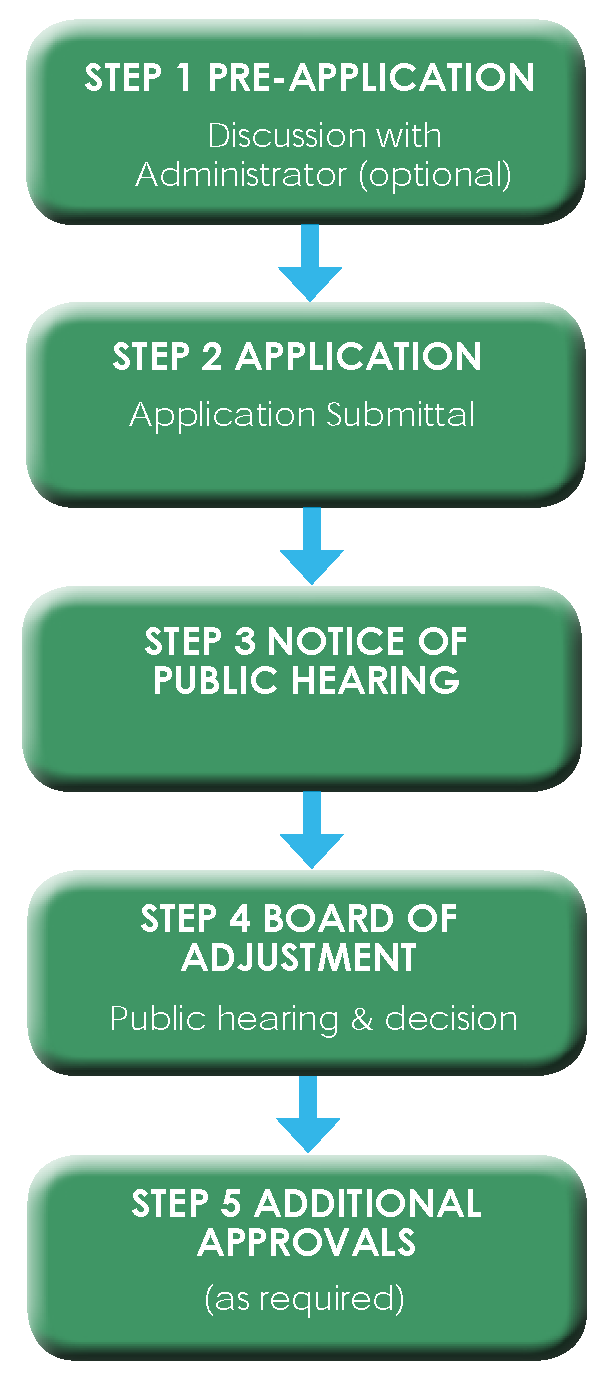
Step 1. Pre-application discussion with administrator (optional).
A.
To minimize costs, avoid misunderstanding or misinterpretation, and ensure compliance with the requirements of this Ordinance, pre-application consultation between the applicant and the Administrator concerning the application is recommended. The Administrator shall review the request and discuss it with the applicant.
B.
The parties to an appeal that has been made under this subsection may agree to mediation or other forms of alternative dispute resolution.
Step 2. Application submittal. The applicant shall submit the application, fee and any other information pertinent to the appeal request.
Step 3. Notice of evidentiary hearing. The Administrator shall provide notice of the evidentiary hearing in the following manner as prescribed by NC GS 160D-406. Notice of hearing shall be mailed to the person or entity whose application is the subject of the hearing, to the owner of the property that is the subject of the hearing (if the owner did not initiate the hearing), and to owners of property adjacent to the property for which the Appeal is requested, as well as those properties separated from the subject property by street, railroad, or other transportation corridor. The mailed notices shall be deposited in the mail at least 10 days, but no more than 25 days, prior to the date of the hearing. The Town shall also prominently post a notice of the hearing on the site that is the subject of the hearing on an adjacent street or highway right-of-way. This notice shall be posted at least 10 days, but no more than 25 days, prior to the date of the hearing.
Step 4. Board of adjustment public hearing and decision.
A.
The official who made the decision being appealed shall transmit to the Board all documents and exhibits constituting the record upon which the action appealed from is taken. The official shall also provide a copy of the record to the appellant and to the owner of the property that is the subject of the appeal if the appellant is not the owner.
B.
The Board of Adjustment shall conduct a quasi-judicial evidentiary hearing. Sworn testimony shall be provided by witnesses speaking before the Board on the matter to establish facts of the case. The evidentiary hearing must have testimony under oath; must allow parties with standing to participate fully in the evidentiary hearing, as defined by NC GS 160D-1402(c), including presenting evidence, cross-examining witnesses, objecting to evidence, and making legal arguments; and may allow non-parties to present competent, material, and substantial evidence that is not repetitive.
C.
The official who made the decision shall be present at the hearing as a witness. The appellant shall not be limited at the hearing to matters stated in the notice of appeal. If any party or the Town would be unduly prejudiced by the presentation of matters not presented in the notice of appeal, the Board shall continue the hearing. The Board of Adjustment may reverse or affirm, wholly or partly, or may modify the decision appealed from and shall make any order, requirement, decision, or determination that ought to be made. The Board shall have all the powers of the official who made the decision.
D.
When hearing an appeal pursuant to NC GS 160D-705(b) according to the provisions of NC GS 160D-405 and NC GS D-406 or any other appeal in the nature of certiorari, the hearing shall be based on the record and the scope of review shall be as provided in NC GS 160D-405 and NC GS [160]D-406.
E.
A simple majority of the members of the Board of Adjustment shall be required to determine an appeal made in the nature of certiorari. For the purposes of this subsection, vacant positions on the Board and members who are disqualified from voting on a quasi-judicial matter shall not be considered members of the Board for calculation of the requisite majority if there are no qualified alternates available to take the place of such members. The Board of Adjustment shall hear and decide the appeal within a reasonable time.
F.
The Board shall determine contested facts and make its decision within a reasonable time. Every quasi-judicial decision shall be based upon competent, material, and substantial evidence in the record. Each quasi-judicial decision shall be reduced to writing and reflect the Board's determination of contested facts and their application to the applicable standards. The written decision shall be signed by the Chair or other duly authorized member of the Board. A quasi-judicial decision is effective upon filing the written decision with the clerk to the Board or such other office or official as the ordinance specifies. The decision of the Board shall be delivered by personal delivery, electronic mail, or by first-class mail to the applicant, property owner, and to any person who has submitted a written request for a copy, prior to the date the decision becomes effective. The person required to provide notice shall certify that proper notice has been made.
G.
Every quasi-judicial decision shall be subject to review by the superior court by proceedings in the nature of certiorari pursuant to NC GS 160D-1405. A petition for shall be filed with the clerk of superior court by the later of 30 days after the decision is effective or after a written copy thereof is given in accordance with subdivision (1) of this subsection. When first-class mail is used to deliver notice, three (3) days shall be added to the time to file the petition.
Step 5: Additional approvals (as required). Following any reversal of a decision by the Board of Adjustment, the applicant may need to obtain additional approvals which may include Zoning Permit and Building Permit approval before any work may begin.
2.2.8 Certificate of nonconformity adjustment. A Certificate of Nonconformity Adjustment may be granted by the Board of Adjustment to enlarge, expand, or otherwise alter a nonconforming use or structure as set forth in Article 7. Certificates shall be issued in accordance with quasi-judicial proceedings prescribed in NC GS 160D-403(c). The steps in the boxes below correspond with a detailed description of each step of the process on the following pages.
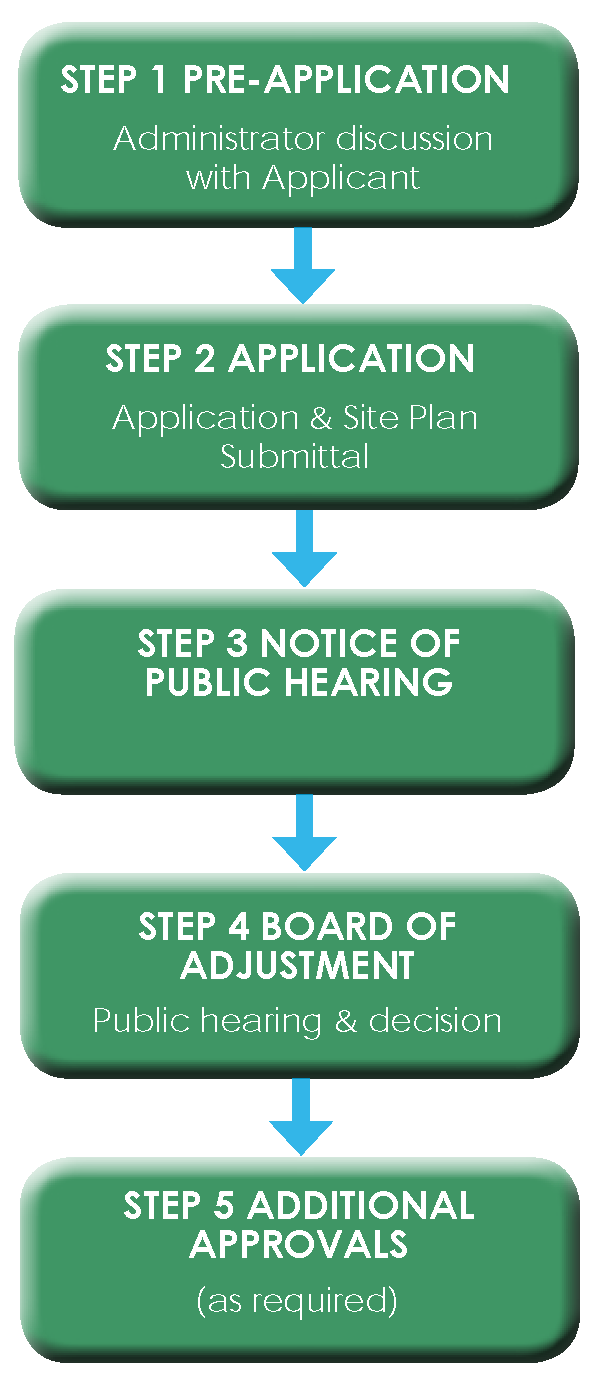
Step 1. Pre-application discussion. To minimize costs, avoid misunderstanding or misinterpretation, and ensure compliance with the requirements of this Ordinance, pre-application consultation between the applicant and the Administrator concerning the Certificate of Nonconformity Adjustment application is required. The Administrator shall review the request and discuss it with the applicant.
Step 2. Application and site plan (if applicable) submittal.
A.
If the request for a Certificate of Nonconformity Adjustment involves new construction, addition, or the use of previously vacant land, then the applicant shall provide a Site Plan with the application and fee. The Site Plan shall provide, at a minimum, the following information:
1.
Survey of the property at a scale no smaller than one inch equals 50 feet (1"=50').
2.
North arrow.
3.
Lot lines with bearings and distances.
4.
Zoning district and applicable overlay districts.
5.
Adjacent property owner names, parcel numbers and zoning.
6.
Total acreage.
7.
Proposed buildings and parking.
8.
Impervious area in total area and as a percentage of the site.
9.
Proposed building setbacks.
10.
Any other information pertinent to providing substantial, material, and competent evidence of a hardship preventing reasonable use of the property if the requirements of this Ordinance are followed.
B.
The following submittal requirements may be altered by the Zoning Administrator as applicable.
1.
Nine (9) full-size paper copies of the Site Plan for the Board of Adjustment and staff.
2.
One (1) digital copy in PDF format or comparable format.
Step 3. Notice of evidentiary hearing. The Administrator shall provide notice of the evidentiary hearing in the following manner as prescribed by NC GS 160D-406. Notice of hearing shall be mailed to the person or entity whose application is the subject of the hearing, to the owner of the property that is the subject of the hearing (if the owner did not initiate the hearing), and to owners of property adjacent to the property for which the Certificate of Nonconformity Adjustment is requested, as well as those properties separated from the subject property by street, railroad, or other transportation corridor. The mailed notices shall be deposited in the mail at least 10 days, but no more than 25 days, prior to the date of the evidentiary hearing. The Town shall also prominently post a notice of the hearing on the site that is the subject of the hearing on an adjacent street or highway right-of-way. This notice shall be posted at least 10 days, but no more than 25 days, prior to the date of the hearing.
Step 4. Board of adjustment evidentiary hearing and decision.
A.
The Board of Adjustment shall conduct a quasi-judicial evidentiary hearing. Sworn testimony shall be provided by witnesses speaking before the Board on the matter to establish facts of the case. The evidentiary hearing must have testimony under oath; must allow parties with standing to participate fully in the evidentiary hearing, as defined by NC GS 160D-1402(c), including presenting evidence, cross-examining witnesses, objecting to evidence, and making legal arguments; and may allow non-parties to present competent, material, and substantial evidence that is not repetitive.
B.
The Board of Adjustment shall make the following findings-of-fact in granting a Certificate of Nonconformity Adjustment:
1.
The request will not increase the intensity of an existing nonconforming use by substantially increasing noise, traffic, or other measurable physical effects.
2.
The Certificate of Nonconformity Adjustment is necessary to continue the use of the property in the same manner that it has been used in the past.
3.
The nonconforming situation is being presented in a way that does not detract from the property values or aesthetics of the surrounding area.
4.
The requested Certificate of Nonconformity Adjustment is consistent with the spirit, purpose, and intent of the Ordinance, such that public safety is secured, and substantial justice is achieved.
C.
A simple majority of the members of the Board of Adjustment shall be required to grant a Certificate of Nonconformity Adjustment. For the purposes of this subsection, vacant positions on the Board and members who are disqualified from voting on a quasi-judicial matter shall not be considered members of the Board for calculation of the requisite majority if there are no qualified alternates available to take the place of such members.
D.
The Board shall determine contested facts and make its decision within a reasonable time. Every quasi-judicial decision shall be based upon competent, material, and substantial evidence in the record. Each quasi-judicial decision shall be reduced to writing and reflect the Board's determination of contested facts and their application to the applicable standards. The written decision shall be signed by the Chair or other duly authorized member of the Board. A quasi-judicial decision is effective upon filing the written decision with the clerk to the Board or such other office or official as the ordinance specifies. The decision of the Board shall be delivered by personal delivery, electronic mail, or by first-class mail to the applicant, property owner, and to any person who has submitted a written request for a copy, prior to the date the decision becomes effective. The person required to provide notice shall certify that proper notice has been made.
E.
Every quasi-judicial decision shall be subject to review by the superior court by proceedings in the nature of certiorari pursuant to NC GS 160D-1405. A petition for shall be filed with the clerk of superior court by the later of 30 days after the decision is effective or after a written copy thereof is given in accordance with subdivision (1) of this subsection. When first-class mail is used to deliver notice, three (3) days shall be added to the time to file the petition.
Step 5: Additional approvals (as required). Following the approval of a Certificate of Nonconformity Adjustment by the Board of Adjustment, the applicant may need to obtain additional approvals which may include Zoning Permit and Building Permit approval before work may begin.
2.2.9 Alternative design proposal. The Planning Board may approve alternative design proposals that differ from the requirements of Article 4 or 5 of this Ordinance in regards to landscaping, parking, infrastructure or building design due to unique site circumstances or creative design proposals, provided that the intent of this Ordinance is met. The steps in the boxes below correspond with a detailed description of each step of the process on the following pages.
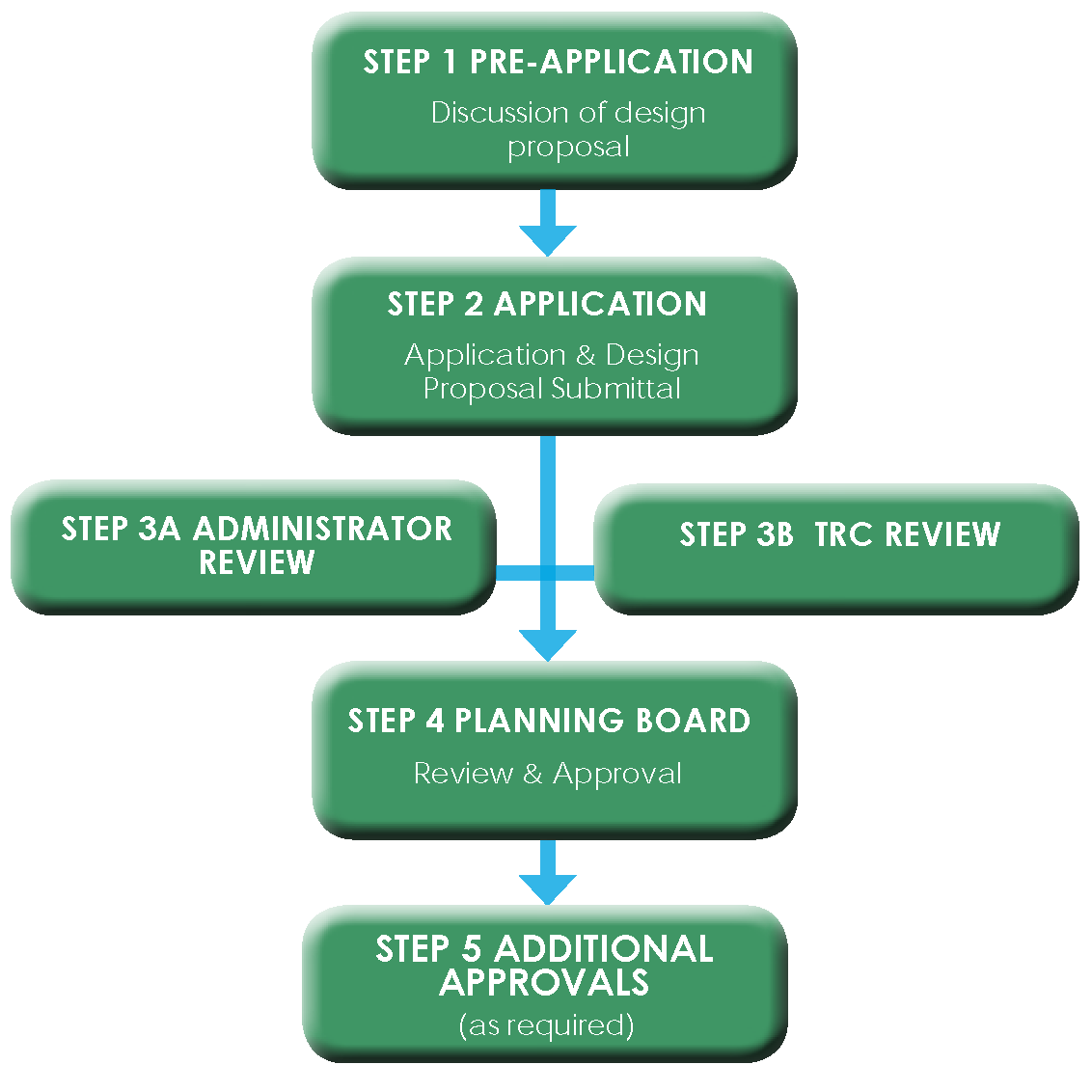
Step 1. Pre-application discussion. To minimize costs, avoid misunderstanding or misinterpretation, and ensure compliance with the requirements of this Ordinance, pre-application consultation between the applicant and the Administrator concerning the Alternative Design Proposal application is required. The Administrator shall review the request and discuss it with the applicant.
Step 2. Application and design proposal submittal. The applicant shall submit the application, fee and any other information pertinent to the alternative design proposal including a Site Plan in accordance with Section 2.2.3.4 (Step 2) or Subdivision Preliminary Plat in accordance with Section 2.2.4.5 (Step 2), whichever is applicable.
Step 3A and B. Administrator/technical review committee review.
A.
The Administrator and Technical Review Committee shall review the Alternative Design Proposal in accordance with the requirements of this Ordinance and any other applicable local, state, or federal requirements.
B.
The Technical Review Committee may provide comments to the Administrator regarding the proposed development. The Administrator shall include these comments in its report to the Planning Board.
Step 4. Planning board review and recommendation.
A.
The Administrator shall present any properly completed application for Alternative Design Proposals to the Planning Board.
B.
In considering the Alternative Design Proposal, the Planning Board shall take into account the following criteria:
1.
The proposed project represents a design in site and/or architecture which will result in a development that is equivalent to or superior to that achievable under the applicable regulations,
2.
The proposed project will be compatible with surrounding development in materials, scale, massing, and site layout.
3.
The proposed project is consistent with the intent of this Ordinance and substantially meets the requirements herein.
4.
The proposed project is consistent with adopted plans and policies of the Town.
C.
Based on the review criteria, the Planning Board shall approve, approve with conditions or deny of the proposal by simple majority vote of those present and voting.
D.
Approval of an Alternative Design Proposal shall require a simple majority of Planning Board members present.
Step 5. Additional approvals (as required). Following the approval of an Alternative Design by the Planning Board, the applicant may need to obtain additional approvals which may include Zoning Permit and Building Permit approval before any work may begin.
2.2.10 Map amendments (Rezonings). The Town Board of Commissioners may amend the Zoning Map in accordance with this section and NC GS 160D-601. The steps in the boxes below correspond with a detailed description of each step of the process on the following pages.
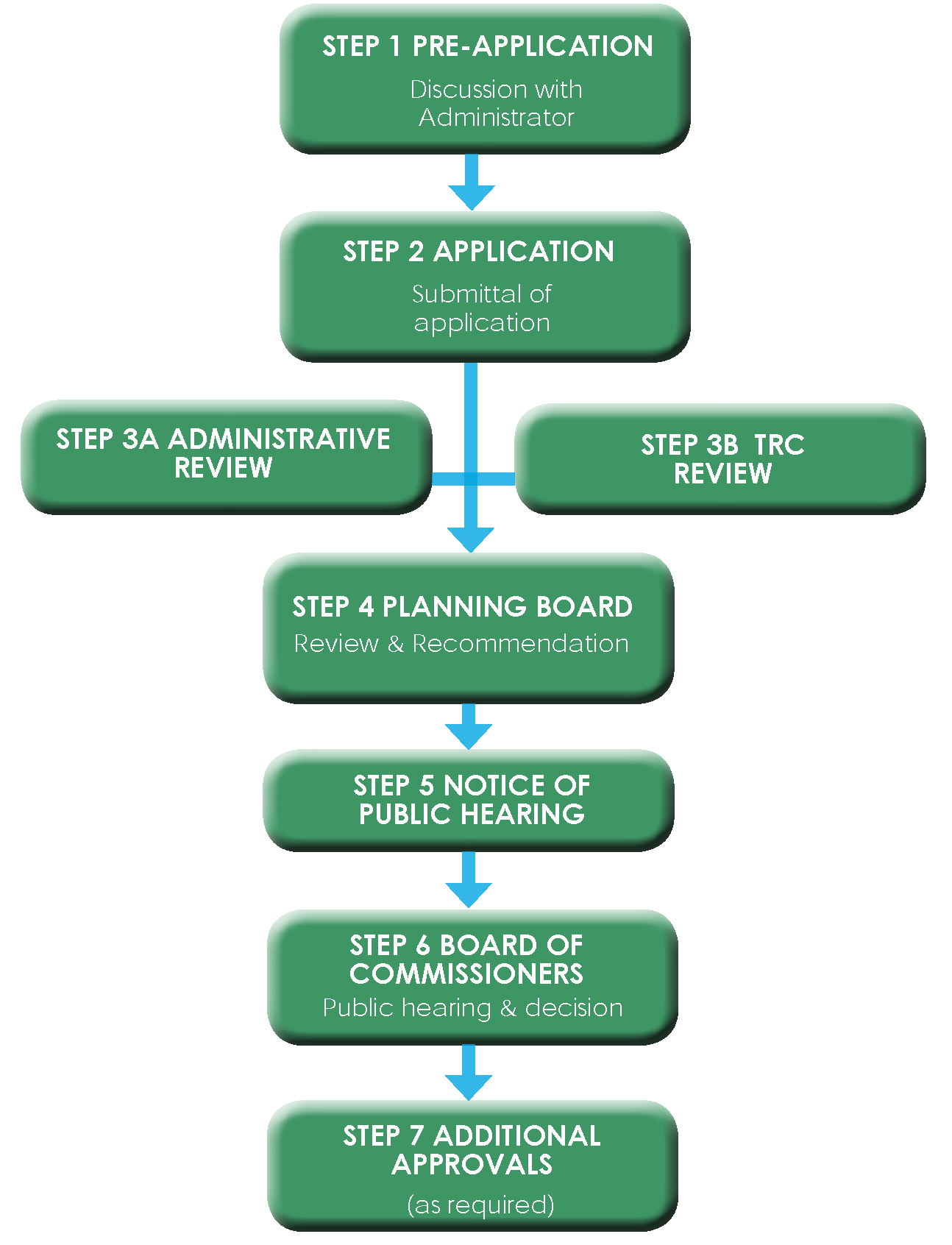
Step 1. Pre-application discussion with administrator.
A.
To minimize costs, avoid misunderstanding or misinterpretation, and ensure compliance with the requirements of this Ordinance, pre-application consultation between the applicant and the Administrator concerning the proposed map amendment is required. The Administrator shall review the request and discuss it with the applicant.
B.
For Conditional Zoning District requests, a sketch plan also be provided by the applicant for the discussion. At a minimum, the plan shall provide the information required for a sketch plan in accordance with Section 2.2.3.3 Site Plan (Step 1) or Section 2.2.4.5 Subdivision (Step 1), whichever is applicable.
Step 2. Application submittal.
A.
The applicant shall submit the application, fee and any other information pertinent to the proposed map amendment. All applications for map amendments shall contain a description of the proposed change and how the proposed change is consistent with the Town's Comprehensive Plan and how it is reasonable and in the public interest.
B.
Requests for Conditional Zoning Districts shall include a site specific plan that, at a minimum, provides the information required for a sketch plan in accordance with Section 2.2.3.4 (Step 1) or Subdivision Preliminary Plat in accordance with Section 2.2.4.5 (Step 1), whichever is applicable.
C.
Applications to amend the Zoning Map may be initiated by the Town Board or the landowner. Third-party rezonings are prohibited. Conditional Zoning District requests may only be initiated by the property owner or agent of legal or equitable interest in the subject property. All owners of the property are to be included in the rezoning. Specific conditions addressing additional fees, design requirements and other development considerations may be proposed as part of the application by the petitioner, or the Town or its agencies, but only those conditions mutually approved may be incorporated into the zoning regulations. Conditions and site-specific standards proposed in a conditional district shall be limited to those that address the conformance of the development and use of the site to Town ordinances, plans adopted pursuant to NC GS 160D-501, or the impacts reasonable expected to be generated by the development or use of the site.
D.
The Administrator shall ensure that the application contains all the required information as specified in this Section. Applications and submittals which are not complete, or otherwise do not comply with the provisions of this Section shall not be scheduled, but shall be returned to the applicant with a notation of the deficiencies in the application.
E.
Specific development proposals may not be considered by staff, the Planning Board, or the Town Board of Commissioners, unless the request is submitted as Conditional Zoning District.
Step 3A and 3B. Administrator/technical review committee review.
A.
The Administrator and Technical Review Committee shall review the proposed map amendment and prepare a staff report with an assessment of how the rezoning relates to the Comprehensive Plan and surrounding zoning and land uses. Staff shall also include all Technical Review Committee comments in the report.
B.
The Technical Review Committee shall review the proposed map amendment and provide comments on how the rezoning will affect utilities, roads, and other infrastructure or services.
Step 4. Planning board review and recommendation.
A.
The Planning Board shall review on the proposed amendment and shall either recommend approval or denial of an amendment by simple majority vote of those present and voting.
B.
The Planning Board shall include with its recommendation a written statement regarding the consistency of the request with the Comprehensive Plan and other adopted Town plans and policies and the surrounding area.
C.
A tie vote by the Planning Board shall be considered to be a recommendation for denial for such amendment. If the Planning Board should fail to act on any proposal amendment within 30 days after it is presented to the Commission such failure to act shall be considered to be a favorable recommendation for the purposes of this procedure.
D.
The Planning Board's recommendation shall be forwarded to the Town Board of Commissioners prior to the public hearing.
Step 5. Notice of public hearing. In accordance with NC GS 160D-601, the following notices shall be provided prior to the public hearing:
A.
A notice shall be published in a newspaper having general circulation in the Town once a week for two (2) consecutive weeks provided that the first notice is published not less than 10 days nor more than 25 days prior to the date scheduled for the public hearing.
B.
A notice of the public hearing shall also be sent by first class mail by the Administrator or designee to the affected property and to property owners of all parcels of land abutting the affected property, including properties separated by a street, railroad, or other transportation corridor. The notice shall be mailed to the last addresses listed for property owners on the county tax abstracts. The notice must be deposited in the mail at least 10 but not more than 25 days prior to the date of the hearing. Pursuant to NC GS 160D-602(b). A mailed notice shall not be required if a rezoning (map amendment) directly affects more than 50 properties owned by a total of at least 50 different property owners. Instead, the Town may elect to use expanded published notice not less than one-half (½) of the newspaper page in size. However, property owners whose addresses are not within the general circulation area of the newspaper shall still receive a notice of public hearing by first class mail.
C.
The Town shall conspicuously post a notice of public hearing at the site proposed for the zoning amendment or on an adjacent public street or highway right-of-way. The notice shall be posted within the same time period specified for mailed notices of the hearing, at least 10 but not more than 25 days prior to the date of the hearing. When multiple parcels are included within a proposed map amendment, a posting on each individual parcel is not required, but the Town shall post sufficient notices to provide reasonable notice to interested persons. The notice shall be removed only after the public hearing has been held.
Step 6. Town Board of Commissioners public hearing and decision.
A.
The Town Board of Commissioners shall take action on map amendments after a public hearing has been held.
B.
Prior to adopting or rejecting any zoning amendment, the Town Board shall adopt one of the following statements which shall not be subject to judicial review:
1.
A statement approving the amendment and describing whether its action is consistent its consistency with an adopted comprehensive plan and explaining why the board considers the action taken to be is reasonable and in the public interest; or
2.
A statement rejecting the amendment and describing its inconsistency with an adopted comprehensive plan and explaining why the action taken is reasonable and in the public interest; or
3.
A statement approving the zoning amendment and containing at least all of the following:
• A declaration that the approval is also deemed an amendment to the Comprehensive Plan. The Town Board shall not require any additional request or application for amendment to the Comprehensive Plan.
•
An explanation of the change in conditions the Town Board took into account in amending the Zoning Map to meet the development needs of the community.
•
Why the action was reasonable and in the public interest.
C.
A statement analyzing the reasonableness shall also be prepared and included in the Town Board's action for any proposed Conditional Zoning District or small-scale rezoning.
D.
Specific conditions applicable to a Conditional Zoning District may be proposed by the applicant or the Town, but only those conditions mutually approved by the Town and the applicant may be incorporated into the approval. Conditions and site-specific standards imposed in a Conditional Zoning District shall be limited to those that address the conformance of the development and use of the site to the Development Ordinance and Comprehensive Plan and those that address the impacts reasonably expected to be generated by the development or use of the site.
E.
Approval of a map amendment shall require a simple majority of the Town Board of Commissioners.
F.
No application for the same zoning district applicable to the same property or any part thereof shall be filed until the expiration of one (1) year from the date of final determination by the Town Board.
G.
Fees submitted for withdrawn cases shall not be refundable once the proposal has been advertised.
Step 7. Additional approvals (as required).
A.
Following the approval of a map amendment by the Town Board, the applicant may need to obtain additional approvals which may include Zoning Permit and Building Permit approval before any work may begin.
B.
If no Zoning Permit has been issued or Preliminary Plat has been approved within one year of the date of approval, or a Zoning Permit or Building Permit has expired for an approved Conditional Zoning District, then the Town Board may vote to rescind the Conditional Zoning District after having held a public hearing. The zoning district shall revert to the district in place prior to the approval of the Conditional Zoning District.
C.
When requested by the landowner and applicant (where applicable), the Planning Director may administratively approve a Minor Modification to the conditions associated with an approved Conditional Zoning District. No proposal for a Minor Modification shall be considered within three (3) months of the date of the original approval or within three (3) months of hearing any previous proposal for a Minor Modification of the Conditional Zoning District. A Minor Modification includes modifications in conditional district standards or associated site plan that do not involve a change in uses permitted or the density of overall development permitted, which will result in equal or better performance and that do not alter the objectives and purposes of the Conditional Zoning District.
D.
When requested by the landowner and applicant (where applicable), the Town Board of Commissioners may grant a Major Modification to the conditions associated with an approved Conditional Zoning District, after a public hearing and subject to the same consideration as provided for in the original approval. No proposal for a Major Modification shall be considered within three (3) months of the date of the original approval or within three (3) months of hearing any previous proposal for a Major Modification of the Conditional Zoning District. A Major Modification is a modification including changes to conditional district standards or the associated site plan of a Conditional Zoning District that involve a change in uses permitted or the density of overall development permitted, which will result in equal or better performance of the conditions and that do not alter the objectives and purpose of the Conditional Zoning District. In granting a Major Modification, the Town Board may require such conditions as will address the objectives of the requirements or conditions changed.
2.2.11 Floating Zoning Districts. The Town Board of Commissioners may amend the Zoning Map to create floating zoning districts in accordance with this section and NCGS 160D-601.
The steps in the flow chart which follows correspond with a detailed description of each step of the process provided in this section. This section provides a uniform means for reviewing and deciding amendments to the Official Zoning Map to establish a floating zoning district. This Ordinance establishes two basic types of floating zoning districts:
1.
Planned unit development districts, of which there are two types:
a.
Planned Development-Residential (PD-R) District; and
b.
Planned Development-Mixed Use (PD-M) District
2.
Tiny House Development (THD) District.
Floating Zoning Districts Process
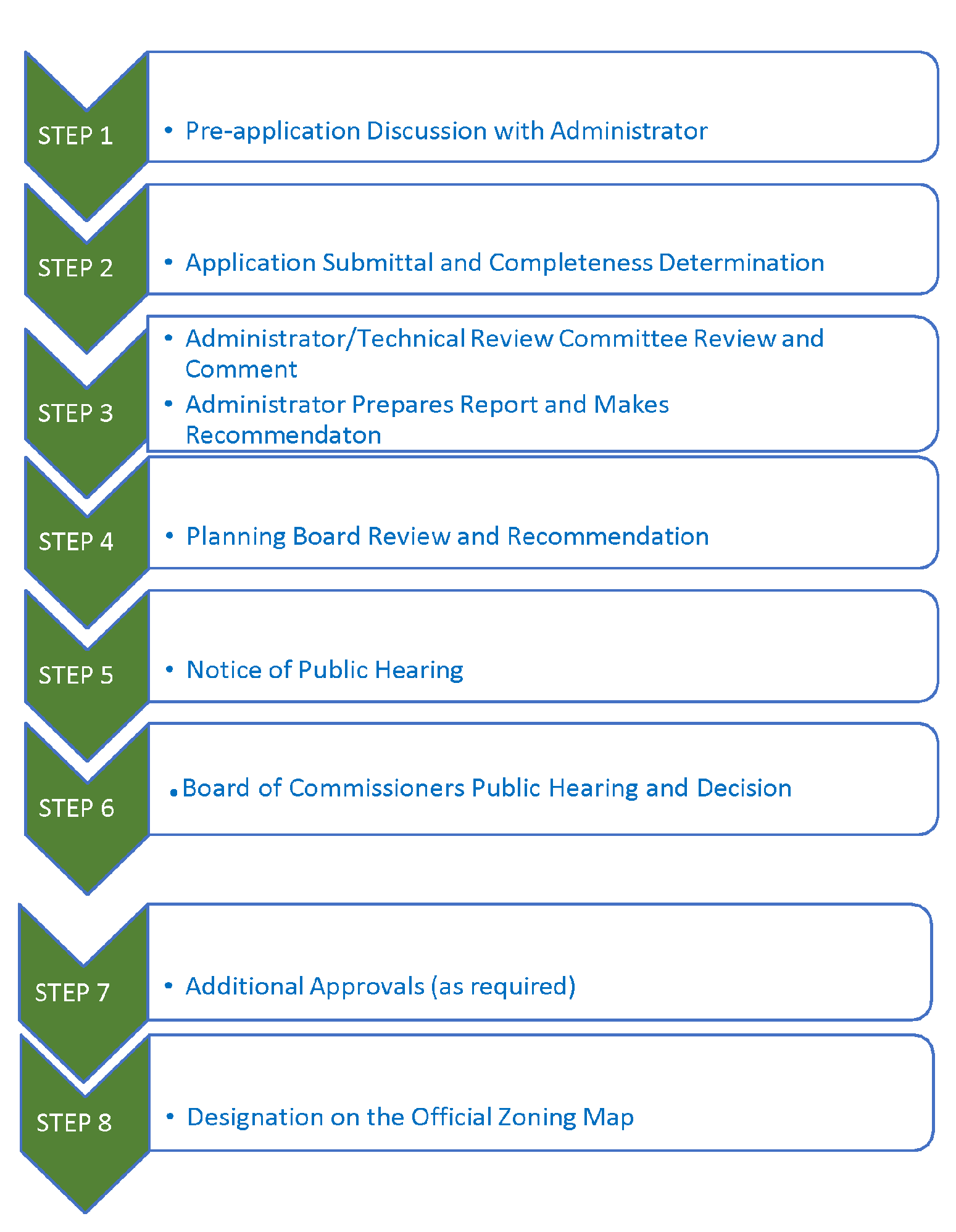
Step 1. Pre-application Discussion with Administrator.
A.
The purpose of a pre-application conference is to provide an opportunity for the applicant to learn about the submittal requirements, procedures, and standards applicable to a floating zoning district development application. A pre-application conference is also an opportunity for town staff to become familiar with, and offer preliminary comments about, the scope, features, and impacts of the proposed development, as it relates to the standards in this Ordinance.
B.
As a follow-up to the initial pre-application conference, and at least two (2) weeks prior to submittal of the official application, a sketch Master Plan and draft Statement of Intent and Development Standards document based on the requirements of Section 3.4 shall be submitted for Administrator review and comment.
Step 2. Application Submittal and Acceptance.
A.
Floating zoning district applications may only be initiated by the applicant as well as all landowner(s) of the land subject to the application.
B.
When required, a traffic impact analysis shall be submitted for review with the submittal of an application for a floating zoning district.
C.
The applicant shall submit the application, fee and any other information pertinent to the proposed floating zoning district map amendment. All applications for floating zoning district map amendments shall contain a master plan map and a statement of intent and development standards completed in accordance with Section 3.4.
D.
The Administrator shall ensure that the application contains all the required information as specified in this Section and Section 3.4. Applications and submittals which are not complete, or otherwise do not comply with the provisions of this Section shall not be scheduled but shall be returned to the applicant with a notation of the deficiencies in the application.
E.
An applicant may change the standards associated with a floating zoning district application until 22 days prior to the initial review by the Planning Board. After that time, the applicant may only propose changes in accordance with the following:
1.
Changes shall be made in writing to the Planning Director during or after the meeting conducted by the Planning Board when the changes are in response to comments or recommendations made by the Planning Board, but no closer than two (2) business days prior to final action by the Board of Commissioners on the floating zoning district application;
2.
Proposed changes shall be signed by all landowners or those authorized to submit the application, and the applicant; and
3.
Proposed changes shall be recommended by the Planning Board, or approved by the Board of Commissioners, depending upon the time the changes were submitted by the applicant.
Step 3. Administrator/Technical Review Committee (TRC) Review and Comment.
A.
After the application has been received the Technical Review Committee (TRC) shall review the floating zoning district map amendment application and comment on how the request will affect utilities, roads, and other infrastructure or Town services.
B.
After the application has been received, and following review by the TRC, the Administrator shall review the floating zoning district map amendment application, prepare and prepare a staff report with an assessment of how the application relates to the Comprehensive Plan and surrounding zoning and land uses. Staff shall also include all TRC comments in the report. The Administrator shall provide a recommendation to the Planning Board and the Board of Commissioners.
Step 4. Planning Board Review and Recommendation.
A.
The Planning Board shall review the proposed floating zoning district map amendment and shall either recommend approval or denial of an amendment by simple majority vote of those present and voting.
B.
The Planning Board shall include with its recommendation a written statement regarding the consistency of the request with the Comprehensive Plan and other adopted Town plans and policies, and the surrounding area.
C.
During its review of the application, the Planning Board may suggest revisions to the proposed development standards (including the master plan map). Only those revisions agreed to by the applicant shall be incorporated into the application.
D.
A tie vote by the Planning Board shall be considered to be a recommendation for denial for such amendment. If the Planning Board should fail to act on any proposed amendment within 35 days after it is presented to the Board such failure to act shall be considered to be a favorable recommendation for the purposes of the procedure.
E.
The Planning Board's recommendation shall be forwarded to the Town Board of Commissioners prior it's public hearing on the application.
Step 5. Notice of Public Hearing. In accordance with NCGS 160D-601, the following notices shall be provided prior to the public hearing.
A.
A notice shall be published in a newspaper have general circulation in the Town of Yadkinville once a week for two (2) consecutive weeks provided that the first notice is published not less than 10 days nor more than 24 days prior to the date scheduled for the public hearing.
B.
A notice of the public hearing shall also be sent by first class mail by the Administrator or designee to the affected property and to owners of all parcels of land abutting the affected property, including properties separated by a street, railroad, or other transportation corridor. The notice shall be mailed to the last addresses listed for property owners on the county tax abstracts. The notice must be deposited in the mail at least 10 but not more than 25 days prior to the date of the hearing. Pursuant to NC GS 160D-602(b), a mailed notice shall not be required if a rezoning (map amendment) directly affects more than 50 properties owned by a total of at least 50 different property owners. Instead, the Town may elect to use expanded published notice not less than one-half (½) of the newspaper page in size. However, property owners whose addresses are not within the general circulation area of the newspaper shall still receive a notice of public hearing by first class mail.
C.
The Town shall conspicuously post a notice of public hearing at the site proposed for the zoning amendment or on an adjacent public street or highway right-of-way. The notice shall be posted within the same time period specified for mailed notices of the public hearing, at least 10 but not more than 25 days prior to the date of the hearing. When multiple parcels are included within a proposed map amendment, a posting on each individual parcel is not required, but the Town shall post sufficient notices to provide reasonable notice to interested persons. The notice shall be removed only after the public hearing has been held.
Step 6. Town Board of Commissioners Public Hearing and Decision.
A.
The Town Board of Commissioners shall take action on floating zoning district map amendments after a public hearing has been held.
B.
Specific additional conditions applicable to the floating zoning district map amendment may be proposed by the applicant or the Town, but only those conditions mutually approved by the Town and the applicant may be incorporated into the approval. Conditions and site-specific standards imposed shall be limited to those that address the conformance of the development and use of the site to the Development Ordinance and Comprehensive Plan and those that address the impacts reasonably expected to be generated by the development or use of the site.
C.
When adopting or rejecting any floating zoning district map amendment, the Town Board of Commissioners shall adopt one of the following statements which shall not be subject to judicial review:
1.
A statement approving the amendment and describing whether its action is consistent with the adopted comprehensive plan and explaining why the board considers the action taken to be reasonable and in the public interest; or
2.
A statement rejecting the amendment and describing its inconsistency with the adopted comprehensive plan and explaining why the action taken is reasonable and in the public interest; or
3.
A statement approving the floating zoning district map amendment and containing at least all of the following:
• A declaration that the approval is also deemed an amendment to the Comprehensive Plan. The Town Board shall not require any additional request or application for amendment to the Comprehensive Plan.
• An explanation of the development conditions the Town Board of Commissioners took into account in amending the Zoning Map to meet the development needs of the community.
• Whether and the extent to which the proposed floating zoning district is appropriate for its proposed location, and its consistent with the Town's adopted policy guidance.
• Why a decision to approve the proposed floating zoning district would be reasonable and in the public interest.
• Whether the proposed floating zoning district will result in a development that is compatible with the character of surrounding existing or proposed development and land uses. Where there are issues of compatibility, how the proposed floating zoning district provides for the appropriate transition areas that address incompatibility through increased buffering, landscaping, fencing, building height, mass and scale or other means designed to promote a complimentary character of development. Determination of complimentary character may be based on densities/intensities, use types, lot sizes and dimensions, building height, mass and scale, exterior lighting, siting of services areas, or other aspects that may be identified by the Town Board of Commissioners.
• Whether the applicant's proposed floating zoning district, including master plan, development standards, and statement of intent will satisfactorily:
◦ Minimize or effectively mitigate any identified adverse impact on adjacent and nearby land, such as that caused by traffic, parking, noise, lighting, trash, loading areas, etc.;
◦ Minimize or effectively mitigate any identified adverse environmental impact on water and air resources, minimize land disturbance, preserve trees and protects habitat.;
◦ Minimize or effectively mitigate any identified adverse impact on municipal facilities and services, such as streets, potable water and waste facilities, parks, police and fire.; and
◦ Minimize or effectively mitigate any identified adverse effect on this use, enjoyment or value of adjacent lands.
• Whether and the extent to which there have been changes in the type or nature of development in the area of the proposed floating zoning district that support the application.
• Whether and the extent to which the proposed floating zoning district will result in development that promotes a logical, preferred, and orderly development pattern.
D.
Approval of a floating zoning district map amendment shall require a simple majority of the Town Board of Commissioners.
E.
No application for the same floating zoning district map amendment applicable to the same property or any part thereof shall be filed until the expiration of one (1) year from the date of final determination by the Town Board of Commissioners.
F.
Fees submitted for withdrawn cases shall not be refunded once the proposal has been advertised.
Step 7. Additional Approvals (as required).
A.
Following the approval of a floating zoning district map amendment by the Town Board of Commissioners, the applicant may need to obtain additional approvals which may include but not be limited to a preliminary plat, group development plan, site plan, zoning permit approval and building permit approval (from Yadkin County) before any work may begin, and approvals from the State for driveways, grading, and/or stormwater, etc.
B.
If no zoning permit has been issued or development plan has been approved within one (1) year of the date of approval, or if a zoning permit or building permit has expired, then the Town Board of Commissioners may vote to rescind the floating zoning district after having held a public hearing, and the floating zoning district shall revert to the district in place prior to the approval of the floating zoning district.
C.
When requested by the landowner and applicant, the Administrator may administratively approve a Minor Modification to the conditions associated with an approved floating zoning district. No proposal for a Minor Modification shall be considered within three (3) months of the date of the original approval or within three (3) months of hearing any previous proposal for a Minor Modification of the floating zoning district. A Minor Modification includes modifications in floating district standards or associated master plan, statement of intention, or development standards that do not involve a change in uses permitted or the density of overall development permitted, which will result in equal or better performance, and that do not alter the objectives and purposes of the approved floating zoning district.
D.
When requested by the landowner and applicant, the Town Board of Commissioners may grant a Major Modification to the conditions associated with an approved floating zoning district, after a public hearing and subject to the same consideration as provided for in the original approval. No proposal for a Major Modification shall be considered within three (3) months of the date of the original approval or within three (3) months of hearing any previous proposal for a Major Modification of the floating zoning district. A Major Modification is a modification including changes to floating district standards or the associated master plan, statement of intention, or development standards of an approved floating zoning district that involve a change in uses permitted or the density of overall development permitted, which will result in equal or better performance of the conditions but do not alter the objectives and purpose of the floating zoning district. In granting a Major Modification, the Town Board of Commissioners may require such conditions as will address the objectives of the requirements or conditions changed.
Step 8. Designation on the Official Zoning Map.
A.
The Planning Director shall have the floating zoning district classification placed on the Official Zoning Map promptly after approval by the Board of Commissioners.
2.2.12 Text amendments. The Town Board of Commissioners may amend the text of this Development Ordinance in accordance with this section and NC GS 160D-601. The steps in the boxes below correspond with a detailed description of each step of the process on the following pages.
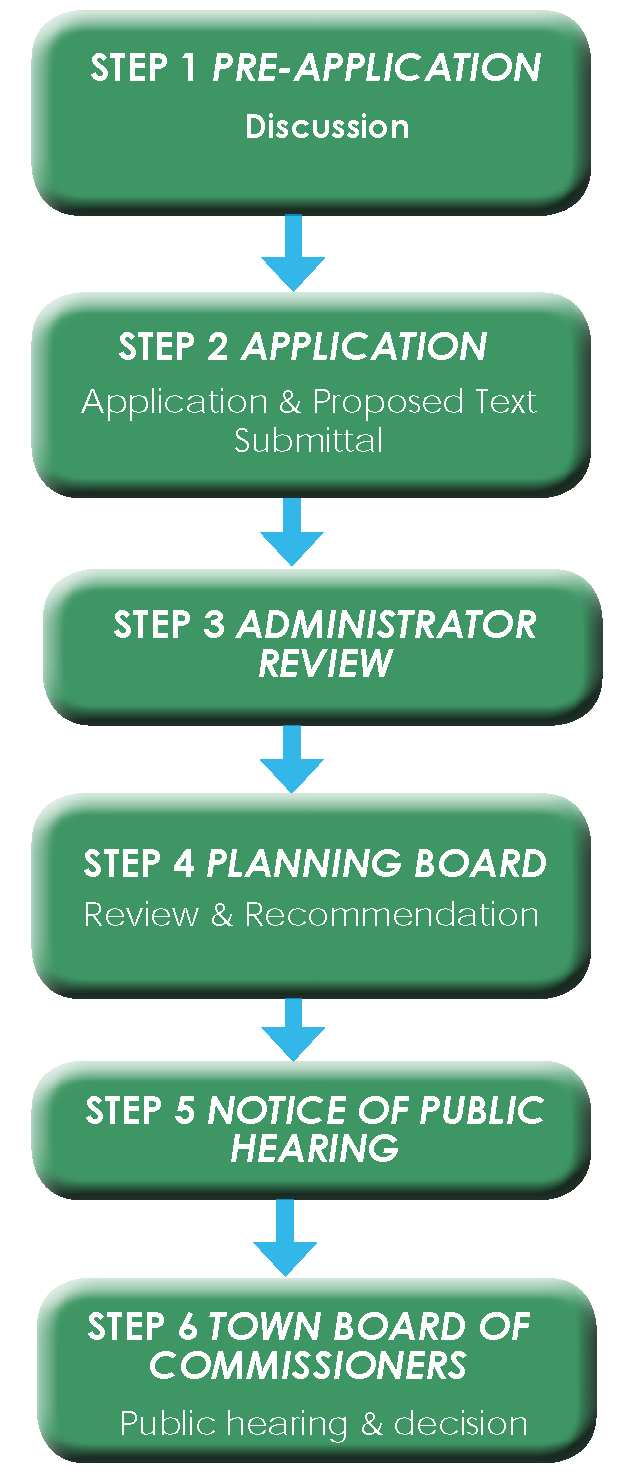
Step 1. Pre-application discussion. To minimize costs, avoid misunderstanding or misinterpretation, and ensure compliance with the requirements of this Ordinance, pre-application consultation between the applicant and the Administrator concerning the proposed text amendment is required. The Administrator shall review the request and discuss it with the applicant.
Step 2. Application and Proposed text submittal.
A.
The applicant shall submit the application, fee and any other information pertinent to the proposed map amendment. All applications for map amendments shall contain a description of the proposed change and how the proposed change is consistent with the Town's Comprehensive Plan and how it is reasonable and in the public interest.
B.
Applications to amend the text of the Development Ordinance may be initiated by the Town Board of Commissioners, Planning Board, Town Staff, or anyone who owns property or resides in the area of jurisdiction of this Ordinance or the agent of such person.
C.
The Administrator shall ensure that the application contains all the required information as specified in this Section. Applications and submittals which are not complete, or otherwise do not comply with the provisions of this Section shall not be scheduled, but shall be returned to the applicant with a notation of the deficiencies in the application.
D.
Completed applications shall be received a minimum of 30 days prior to the Planning Board meeting at which the proposed amendment is scheduled to be considered.
E.
Specific development proposals may not be considered by staff, the Planning Board, or Town Board. These entities may only consider the impacts of the proposed text amendment on all affected zoning districts or potential development projects.
Step 3. Administrator review. The Administrator shall review the proposed text amendment and prepare a staff report with an assessment of how the rezoning relates to the Comprehensive Plan and surrounding zoning and land uses.
Step 4. Planning board review and recommendation.
A.
The Planning Board shall review on the proposed amendment and shall either recommend approval or denial of an amendment by simple majority vote of those present and voting.
B.
The Planning Board shall include with its recommendation a written statement regarding the consistency of the request with the Comprehensive Plan and other adopted Town plans and policies and the surrounding area.
C.
A tie vote by the Planning Board shall be considered to be a recommendation for denial for such amendment. If the Planning Board should fail to act on any proposal amendment within 30 days after it is presented to the Board, such failure to act shall be considered to be a favorable recommendation for the purposes of this procedure.
D.
The Planning Board's recommendation shall be forwarded to the Town Board of Commissioners prior to the public hearing.
Step 5. Notice of public hearing. A notice shall be published in a newspaper having general circulation in the Town once a week for two (2) consecutive weeks provided that the first notice is published not less than 10 days nor more than 25 days prior to the date established for the public hearing.
Step 6. Town Board public hearing and decision.
A.
The Town Board of Commissioners shall take action on text amendments after a public hearing has been held.
B.
Prior to adopting or rejecting any zoning amendment, the Town Board shall adopt one of the following statements which shall not be subject to judicial review:
1.
A statement approving the amendment and describing whether its action is consistent its consistency with an adopted comprehensive plan and explaining why the board considers the action taken to be is reasonable and in the public interest; or
2.
A statement rejecting the amendment and describing its inconsistency with an adopted comprehensive plan and explaining why the action taken is reasonable and in the public interest; or
3.
A statement approving the zoning amendment and containing at least all of the following:
•
A declaration that the approval is also deemed an amendment to the Comprehensive Plan. The Town Board shall not require any additional request or application for amendment to the Comprehensive Plan.
•
An explanation of the change in conditions the Town Board took into account in amending the Development Ordinance to meet the development needs of the community.
•
Why the action was reasonable and in the public interest.
(ZTA Ord. No. 2021-02, §§ 3, 4, 4-5-21; ZTA Ord. No. 2021-03, §§ 10—17, 5-3-21; Ord. No. 2021-05, §§ 4, 5, 12-6-21; ZTA Ord. No. 2021-04, § 3, 2-7-22)
2.3 - Enforcement.
2.3.1 Violations. Any of the following shall be a violation of this Ordinance and shall be subject to the enforcement remedies and penalties provided by this Section and by State law, specifically NC GS 160A-175, and 160D-404:
2.3.1.1 Development or use without permit. To engage in any development, use, construction, remodeling, or other activity of any nature upon land or improvements thereon subject to the jurisdiction of this Ordinance without all required permits, certificates, or other forms of authorization as set forth in this Ordinance.
2.3.1.2 Development or use inconsistent with permit. To engage in any development, use, construction, remodeling, or other activity of any nature in any way inconsistent with any approved plan, permit, certificate, or other form or authorization granted for such activity.
2.3.1.3 Violation by act or omission. To violate, by act or omission, any term, variance, modification, condition, or qualification placed by the Town Board of Commissioners or its agent Boards upon any required permit, certificate, or other form of authorization for the use, development, or other activity upon land or improvements thereon.
2.3.1.4 Use or structure in violation. To erect, construct, reconstruct, alter, repair, convert, maintain, or use any building, structure, or sign or to use any land in violation or contravention of this Ordinance or any other regulation made under the authority conferred thereby.
2.3.1.5 Continuing a violation. Each day's continuance of any of the above violations is a separate and distinct offense.
2.3.2 Enforcement procedures.
A.
If the Administrator finds that any of the provisions of this Ordinance are being violated, then he or she shall notify the person responsible for such violation, indicating the nature of the violation and ordering the action necessary to correct it. The Administrator or designee shall order discontinuance of illegal use of land, buildings, or structures; removal of illegal buildings or structures or additions; alterations, or structural changes thereto; discontinuance of any illegal work being done; or shall take any other action authorized by this Ordinance to insure compliance with or to prevent violations of its provisions.
B.
Violators include any person who owns, leases, occupies, manages, designs or builds any structure or land development activity in violation of this chapter and any person who owns, leases, or occupies a use in violation of this chapter. A violation may be charged against more than one violator.
2.3.2.1 Inspection and investigation.
A.
When a violation of this Ordinance occurs, or is alleged to have occurred, any person may file a written or verbal complaint. Such complaint shall state fully the cause and basis thereof and shall be filed with the Administrator or designee. An investigation shall be made within 10 days. Actions as provided in these regulations shall be taken.
B.
The Administrator or designee shall have the right upon presentation of proper credentials, or inspection warrant if necessary, to enter on any premises within the jurisdiction at any reasonable hour for the purposes of inspection, determination of plan compliance, or other enforcement action.
C.
The Administrator shall have the power to conduct such investigations, as he may reasonably deem necessary to carry out his duties as prescribed in this Ordinance and, for the purpose of investigating and inspecting the sites of any complaints or alleged violations of this Ordinance.
D.
The Administrator shall have the power to require written statements; certificates, certifications, or the filing of reports with respect to pertinent questions relating to complains or alleged violations of this Ordinance.
2.3.2.2 Notice of violation.
A.
If the owner of the land, building, structure, sign or use in violation fails to take prompt corrective action, the Administrator or designee shall give the owner or occupant written notice (by certified or registered mail to his last known address, by personal service, or by posting notice conspicuously on the property) of the following:
1.
That the land, building, structure, sign, or use is in violation of this Ordinance;
2.
The nature of the violation and citation of the Section(s) of the Ordinance being violated;
3.
The general measures necessary to remedy the violation;
4.
Notice of right to appeal; and
5.
The time period in which the violation needs to be corrected before civil penalties are incurred, in accordance with Section 2.3.4. If the violation is in the nature of an infraction for which an order of abatement would be appropriate in a civil proceeding, a reasonable period of time must be stated in which the violation must be abated.
2.3.2.3 Appeal. Any owner or occupant who has received a Notice of Violation may appeal in writing the decision of the Administrator to the Board of Adjustment within 30 days following the date of the Notice of Violation. The Board of Adjustment shall hear an appeal subject to the provisions set forth in NC GS 160D-405 and Section 2.2.6 of this Ordinance. The Board of Adjustment may affirm, modify or revoke the Notice of Violation. In the absence of an appeal, the decision of the Administrator shall be final. Citations that follow the original Notice of Violation may not be appealed.
2.3.2.4 Failure to comply with notice. If the owner or occupant of a property fails to comply with a Notice of Violation from which no appeal has been taken, or a final decision by the Board of Adjustment following an appeal, the owner or occupant shall be subject to the remedies and penalties as set forth in Section 2.3.3 and 2.3.4 or to such remedies and penalties as may be provided by the State law.
2.3.3 Remedies. Any or all of the following procedures may be used to enforce the provisions of this Ordinance:
2.3.3.1 Injunction. Any violation of this Ordinance or of any condition, order, requirement, or remedy adopted pursuant hereto may be restrained, corrected, abated, mandated, or enjoined by other appropriate proceeding pursuant to State law.
2.3.3.2 Civil penalties. Any person who violates any provision of this Ordinance shall be subject to the assessment of a civil penalty under the procedures provided in Section 2.3.4.
2.3.3.3 Denial of permit or certificate. The Administrator shall withhold or deny any permit, certificate, or other authorization on any land, building, structure, sign, or use for which there is an uncorrected violation, or of a condition or qualification of a permit, certificate, or other authorization previously granted.
2.3.3.4 Conditional permit or temporary certificate. The Administrator may condition the authorization of any permit or certificate upon the correction of the deficiency, payment of civil penalties within a specified time, or the posting of a compliance security approved by appropriate governmental authority.
2.3.3.5 Stop work orders. Whenever a building, structure, sign, or part thereof is being constructed, reconstructed, altered or repaired in violation of this Ordinance, the Administrator may order the work to be immediately stopped. The stop work order shall be in writing and directed to the owner, occupant or person doing the work. The stop work order shall state the specific work to be stopped, the specific reasons for the stoppage and the conditions under which the work may be resumed. Such action shall be in accordance with NC GS 160D-404(b) or the NC Building Code.
2.3.3.6 Revocation of permits or certificates. The Administrator may revoke and require the return of a permit or certificate by notifying the permit holder in writing, stating the reason for the revocation. Permits or certificates shall be revoked for any substantial departure from the approved application, plans, or specifications; refusal or failure to comply with the requirements of State or local laws; or for false statements or misrepresentations made in securing the permit or certificate. Any permit or certificate mistakenly issued in violation of an applicable State or local law may also be revoked.
2.3.4 Penalties.
A.
Violations of this Ordinance shall constitute the following penalty:
1.
A civil penalty upon the issuance of a citation for said violations as hereinafter provided. The civil penalty, if not paid to the Town within 15 days of the issuance of a citation, may be recovered by the Town in a civil action in the nature of debt. Said civil penalties shall be in the amounts shown below for each violation and each day any single violation continues shall be a separate violation. Civil citations are set forth in Table 2.2 below:
Table 2.2 Civil penalties
B.
In addition to the civil penalties set out above, any provision of this Ordinance may be enforced by an appropriate equitable remedy issued from any court of competent jurisdiction. In such case, the general court of justice shall have jurisdiction to issue such orders as may be appropriate, and it shall not be a defense to the application of the Town for equitable relief that there is an adequate remedy at law.
C.
Any provision of this Ordinance that makes unlawful a condition existing upon or use made of real property may be enforced by injunction and order of abatement by General Court of Justice. When a violation of such a provision occurs, the Town may apply to the appropriate division of the General Court of Justice for a mandatory or prohibitory injunction and/or of abatement commanding the defendant to correct the unlawful condition upon or cease the unlawful use of the property. The action shall be governed in all respects by laws and rules governing civil proceedings, including the Rules of Civil Procedure in general and Rule 65 in particular.
D.
An order of abatement may direct that buildings or other structures on the property by closed, demolished or removed; that fixtures, furniture or other movable property be removed from buildings on the property; that improvements or repairs be made; or that any other action be taken that is necessary to bring the property into compliance with this Ordinance. If the defendant fails or refused to comply with an injunction or with an order of abatement within the time allowed by the court, he may be cited for contempt, and the Town may execute the order of abatement. The Town shall have a lien on the property for the cost of executing an order of abatement in the nature of a mechanic's and material man's lien. The defendant may secure cancellation of an order of abatement by paying all costs of the proceedings and posting a bond for compliance with the order. The bond shall be given with sureties approved by the Clerk of Superior Court in an amount approved by the judge before whom the matter is heard and shall be conditioned on the defendant's full compliance with the terms of the order of abatement within a time fixed by the judge. Cancellation of an order of abatement shall not suspend or cancel an injunction issued in conjunction therewith.
E.
Where the Administrator determines that the period of time stated in the original warning citation is not sufficient for abatement based upon the work required or Consent Agreement, the Administrator may amend the warning citation to provide additional time. The warning citation shall specify that a second citation shall incur civil penalty, together with costs and attorney fees.
F.
Upon failure of the violator to obey the Notice of Violation/Warning Citation, a civil citation shall be issued by the Administrator or designee and either served directly on the violator, his duly designated agent, or registered agent if a corporation, either in person or posted in the United States Postal Service by certified or registered mail to violator's last known address, by personal service, or by posting notice conspicuously on the property. The violator shall be deemed to have been served upon the mailing, serving, or posting of said citation. The citation shall direct the violator to pay the civil assessment within 15 days of the date of citation, or alternatively to pay the citation by mail. The violation for which the citation is issued must have been corrected by the time the citation is paid; otherwise further citations shall be issued. Citations may be issued for each day the offense continues until the prohibited activity is ceased or abated.
G.
If the violator fails to respond to a citation within 10 days of its issuance or pay the penalty prescribed therein within 15 days, the Town may institute a civil action in the nature of debt in the appropriate division of the North Carolina General Court of Justice for the collection of penalty, costs, attorney fees and such other relief as permitted by law.
H.
The Environmental Management Commission may take any appropriate preventive or remedial enforcement action authorized under NC GS 143-214.5 against any person who violates any minimum statewide water supply watershed management requirement.
(ZTA Ord. No. 2021-03, § 18, 5-3-21; Ord. No. 2021-05, § 3, 12-6-21)

