
Yadkinville City Zoning Code
ARTICLE 5
- BUILDING DESIGN STANDARDS
5.1 - Purpose and applicability.
5.1.1 Purpose. The purpose of this Section is to ensure architectural and design compatibility and the establishment and preservation of architectural character throughout Yadkinville. Enumerated in the sections below are general building design standards for nonresidential and multifamily buildings, as well as for buildings in the Central Business (CB) zoning district.
5.1.2 Applicability.
The standards of this section shall apply to all nonresidential and multi-family residential development that are subject to Site Plan review and/or the issuance of a Zoning Permit and meet the following additional criteria:
A.
The standards shall apply to all new non-residential and multi-family residential construction and expansions of greater than 20% of the gross floor area of the building.
B.
Nonresidential building design standards shall not apply to existing residential structures that are undergoing a change-of-use to a non-residential use as permitted by this Ordinance.
C.
If a nonconforming nonresidential building is being expanded by greater than 20%, then the existing portion of the building shall comply with the following standards:
1.
A minimum of one (1) vertical articulation element listed in Section 5.4.4 shall be incorporated into the front façade.
2.
A minimum of one (1) horizontal articulation element listed in Section 5.4.5 shall be incorporated into the front façade.
3.
All unscreened mechanical, utility equipment, loading areas, and solid waste receptables shall be screened per Section 4.4.7.
Figure 5.1 Example of Building Expansion Design
Compliance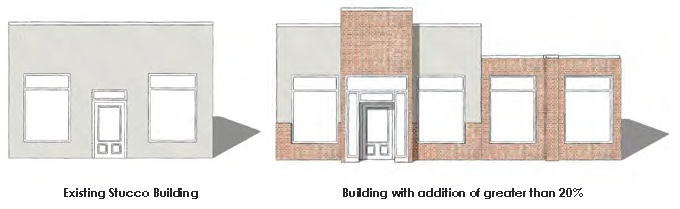
(Ord. of 11-2-2020, ZTA 2020-01)
5.2 - General standards.
A.
The primary entrance shall be architecturally and functionally designed on the front façade facing the primary public street, except that building's interior to a development may be arranged to front a common courtyard, parking area, driveway, or private street. Building entrances shall be emphasized using massing, architectural features, and/or changes in the roofline.
B.
The front façade of the principal structure shall be parallel to the front lot line and street. Any side of a building that faces an arterial or collector street that is not screened from view by a berm or landscaping shall be treated as a front façade.
C.
Manufactured housing shall not be used as permanent structures except in the RM-H district.
D.
Modular buildings and shipping containers shall not be used as permanent structures unless such meet NC Building Code, are placed on a permanent masonry foundation, and meet all of the other design standards for buildings in the district in which they are located.
5.3 - Multi-family and townhome residential design standards.
5.3.1 Wall materials.
A.
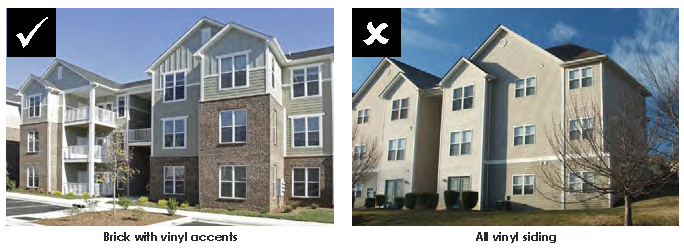
Exterior wall materials shall be wood, fiber cement board, brick, stone, vinyl, or similar materials.
B.
A minimum of two (2) materials shall be mixed on all façades, and a minimum of 50% of all façades shall be brick, stone, or a material similar in appearance and durability. Brick, stone or similar heavy materials shall be located below lighter materials such as wood or vinyl.
5.3.2 Roofs.
A.
Roof materials shall be asphalt shingles, wood shakes, standing seam metal, slate, tile, or similar materials. Gutter and downspout color shall match either the trim color or primary building material color.
B.
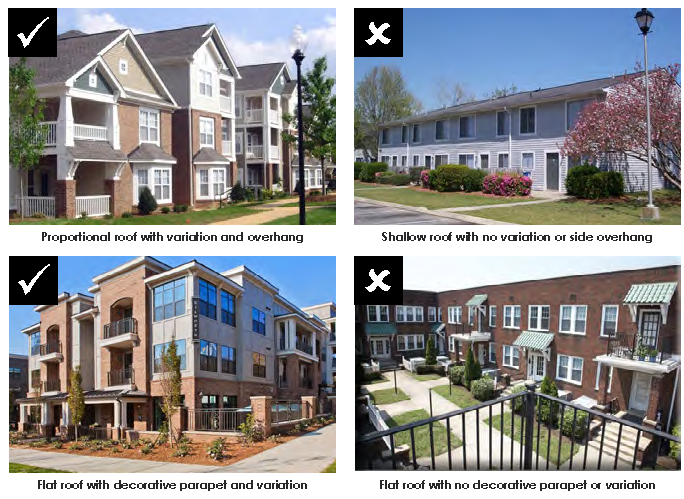
Pitched roofs for one-story buildings shall have a slope of between 4:12 and 8:12. Pitched roofs for one-and-a-half (1½) or multiple story buildings shall have a slope of between 6:12 and 12:12. Flat roofs shall have a parapet wall with a decorative cap or cornice.
C.
Architectural elements such as height variations, gables, dormers, cupolas, towers, and other similar elements shall be incorporated into the roof design at a minimum of every 25 linear feet on all façades.
D.
Roofs shall be in scale with the building and shall have an overhang of six (6) inches or more to facilitate proper water run-off.
5.3.3 Garages.
A.
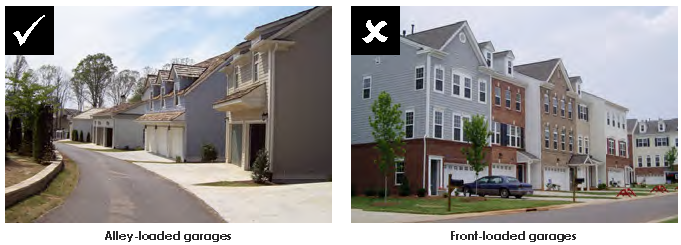
Garages shall not be located on the primary/front façade.
B.
All garages shall be located on alleys or parking courtyards to the rear or interior of the building or building block.
5.3.4 Windows.
A.
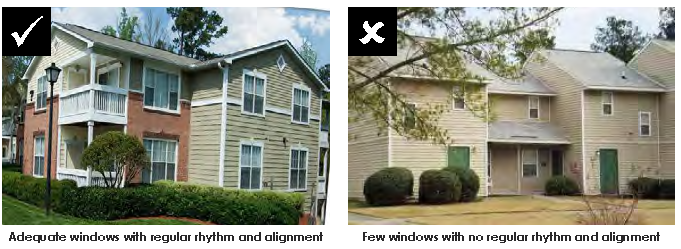
A minimum of 25% of the primary façade and 20% of all secondary/corner side façades shall be composed of window area.
B.
Windows shall follow a regular rhythm and be aligned on and between floors.
5.3.5 Façade articulation.
A.
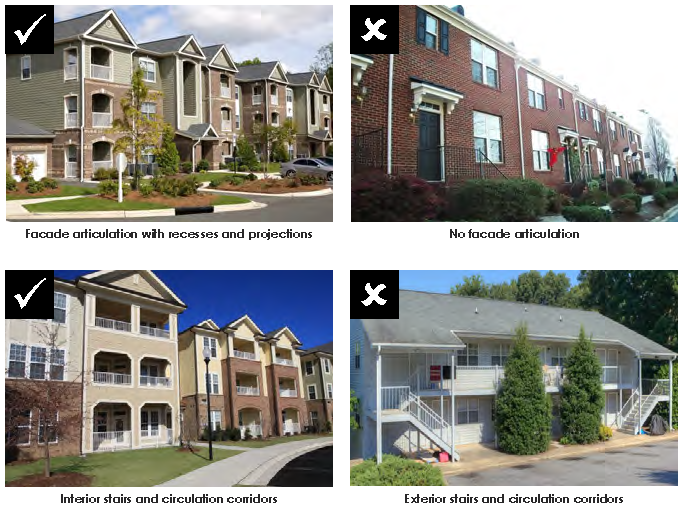
Façade articulation in the form of gables, projections, recesses, and/or porches or balconies of a minimum of three (3) feet in depth shall be located a minimum of every 25 feet along the all façades.
B.
Exterior stairs and open circulation corridors shall not be located on the front façade.
5.4 - Nonresidential design standards.
5.4.1 Architectural compatibility and cohesiveness.
A.
Buildings shall be designed so that each side of the building is architecturally compatible with each other side of the building, unless otherwise exempted by a specific provision of this Section.
B.
Where more than one (1) building is being constructed as part of a larger common development plan, each building in that development, including pad sites and out parcels, buildings shall be designed with a cohesive architectural aesthetic throughout the development. Architectural compatibility within a development may include the use of the following methods:
1.
Similar building materials;
2.
Similarly colored building materials;
3.
Proportional quantities of building materials on building façades;
4.
Similar roof forms; and/or
5.
Similar architectural detailing.
C.
Additions to existing buildings shall match the materials of the building. If the existing building is constructed of nonconforming materials and the addition is greater than 20% of the gross floor area, then the addition shall incorporate a permitted primary material into the design of the addition and the front façade.
5.4.2 Building wall types. Different design standards apply to different types of building walls. For the purposes of this Section, building walls shall be divided into the following categories:
5.4.2.1 Primary building wall/Façade. A primary building wall/façade is any building wall plane which is oriented toward a public street or internal access drive, or which contains the primary building entrance (single tenant structures) or entrances (multi-tenant structures). Buildings on corners have more than one primary building wall. Primary building walls are always active building walls.
Figure 5.2 Primary Building Wall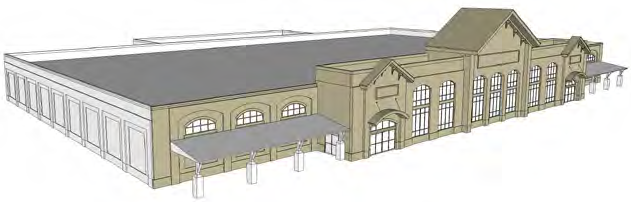
5.4.2.2 Secondary building wall. All building wall planes that are not defined as a Primary Building Wall or as a Utility/Service Building Wall are Secondary Building Walls. Secondary building walls may be active or inactive depending on location and access to the building.
Figure 5.3 Secondary Building Wall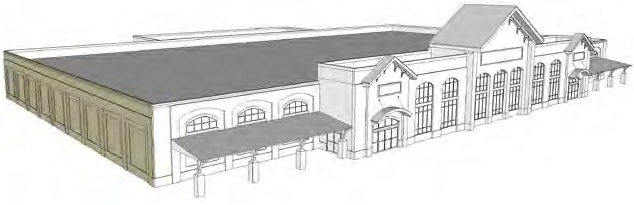
5.4.2.3 Utility/Service building walls. A utility/service building wall is the wall plane, or portion thereof, that contains utility and service areas. Utility/service building walls shall not front on the primary street. Any utility/service building walls visible from a major thoroughfare shall meet the requirements for a secondary building wall or be screened by a Type 1 buffer yard per Section 4.4.3.
Figure 5.4 Utility/Service Building Wall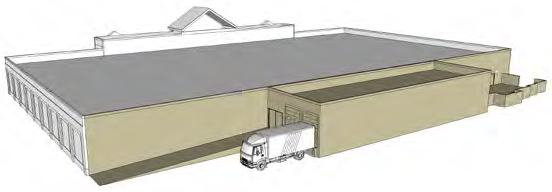
5.4.2.4 Industrial building walls. An Industrial Building Wall includes each wall plane of an industrial, warehousing, or similarly used building, located within the LI or HI zoning districts, which does not contain space used for offices, customer service, retail areas, product display areas or similar nonindustrial spaces. Any industrial building walls located within 250 feet of a major thoroughfare shall meet the requirements for a secondary building wall or be screened by a Type 1 buffer yard per Section 4.4.3.
Figure 5.5 Industrial Building Wall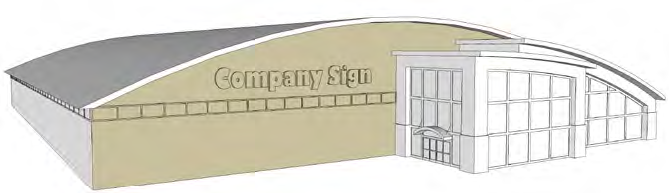
5.4.2.5 Active building wall. An active building wall is any building wall plane, or portion of a wall plane, whether along a primary or secondary building wall, which:
•
Contains a customer entrance;
•
Is oriented toward a public street or internal access drive;
•
Is adjacent to a pedestrian walkway; or
•
Is adjacent to a customer parking area.
Figure 5.6 Building Wall Types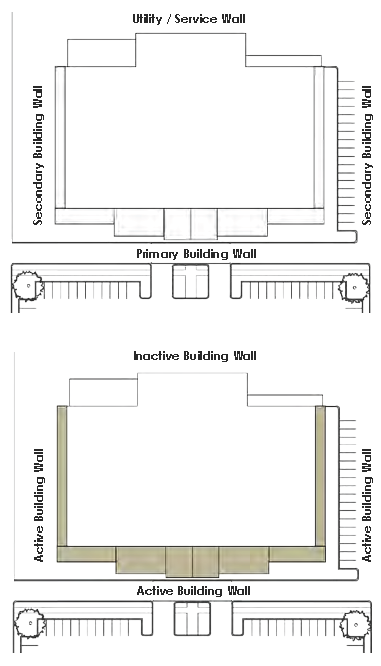
5.4.3 Building modulation.
A.
Building modulation is the varying of the footprint of a building by projecting or recessing portions of the façade from the base plane of the building wall. The use of a modulated façade helps to define the most important portion(s) of a building (such as customer entrances), reduces monotony along building walls and helps to distinguish adjacent buildings from each other by encouraging distinctive designs. The following building modulation standards apply to all non-residential buildings of greater than 50 linear feet on the primary façade:
1.
Primary building walls shall be modulated through the use of projections or recessions of the building wall from the base wall plane.
2.
Projections or recessions used to meet this requirement shall project or recede from the base wall plane by a minimum of one (1) foot for buildings under 100 feet wide a minimum of three (3) feet for buildings over 100 feet wide.
3.
The combined length of the modulating feature(s) shall be a minimum of 35% of the width of the base wall plane.
Figure 5.7 Building Modulation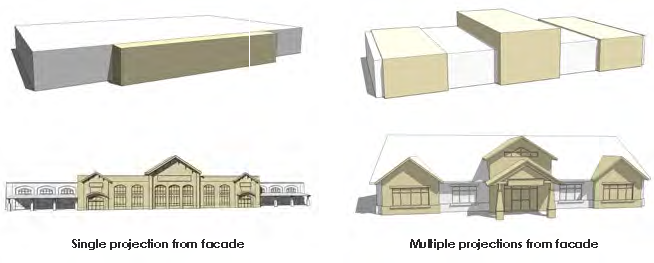
5.4.4 Vertical articulation.
A.
Vertical articulation is used to give emphasis to the height of a building and to provide relief along the vertical wall plane. Appropriate vertical articulation techniques vary based on the size and height of a building, as well as its architectural style. Vertical articulation shall be provided on each vertical building wall plane as required below. Utility/Service and Industrial building wall types shall be exempt from these standards.
B.
Buildings that are three (3) or more stories or more than 35 feet above grade shall be designed with a visually distinct base. The base shall extend a minimum of 10% and maximum of 20% of the height of the vertical wall plane from grade.
C.
The primary and secondary building walls of non-residential Buildings shall be vertically articulated by using a minimum of two (2) of the techniques listed below:
•
Using visually "heavy" building materials, such as stone, on lower surfaces when a "lighter" material is used on higher surfaces. Using larger or more coarsely faced building materials on lower surfaces and smaller or more finely textured materials on higher surfaces;
•
Using different colors of materials along the vertical wall plane, with darker colors used on lower surfaces and lighter colors used on higher surfaces;
•
Including gables or minor pitched roof forms that coordinate with building modulation;
•
Using stepped parapet walls;
•
Providing towers or similar features that extend vertically above the top of the building wall;
•
Varying the height of different portions of a building;
•
Using tall windows, particularly when coupled with an arched frame at the top;
•
Using distinct masonry patterns or inlays that extend vertically along the building wall; or
•
Using pilasters or engaged columns that extend vertically along the building wall.
Figure 5.8 Vertical Articulation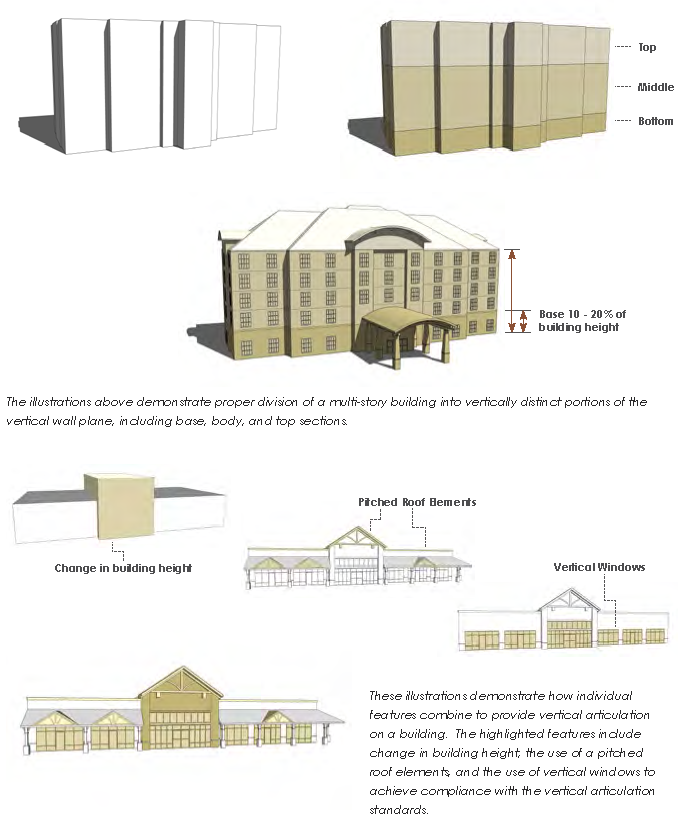
5.4.5 Horizontal articulation.
A.
Horizontal articulation is used to provide visual interest along the horizontal wall plane and to define the human scale of a building. Appropriate horizontal articulation techniques vary based on the architectural style of a building, as well as its intended use. Utility/Service and Industrial building wall types shall be exempt from these standards.
B.
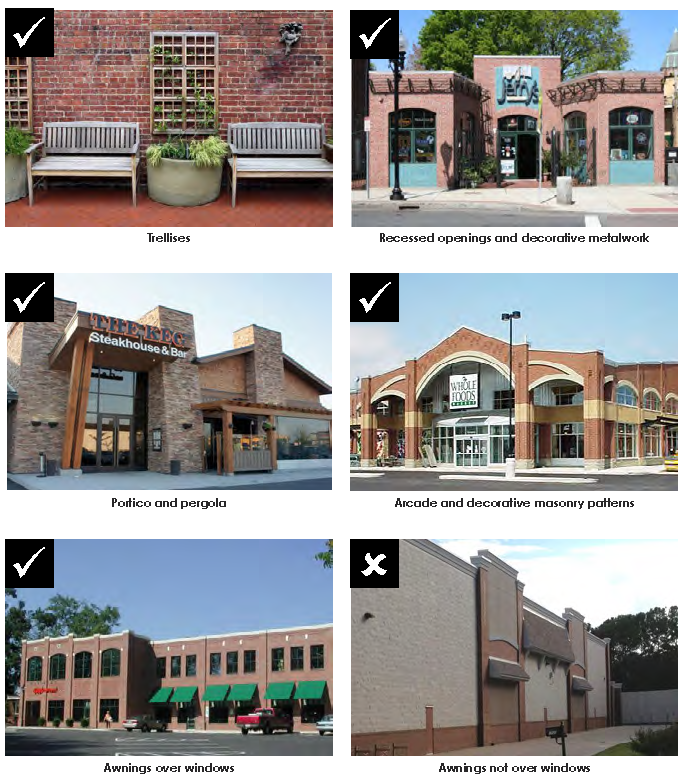
Ground floor primary and secondary building walls shall be articulated in a manner that provides visual interest and emphasizes the human scale by using one (1) or more of the below referenced techniques, or by an equally effective method that achieves the stated goal:
C.
A minimum of 75% of the width of the horizontal wall plane of the primary façade(s) shall contain articulating features (see Figure 5.9 below). More than one feature type may be used to meet this requirement. A minimum of 50% of the width of the horizontal wall plane of secondary building walls shall contain articulating features (see Figure 5.9 below). More than one feature type may be used to meet this requirement. Features used to satisfy these requirements shall not be separated by a gap wider than 10 feet between the outer edges of each individual feature.
D.
Features used to satisfy this requirement shall be appropriate to the context of the wall on which they are placed. An example of an inappropriate use of an architectural feature would be to place an awning in a location that does not cover a pedestrian walkway or window.
Figure 5.9 Horizontal Articulation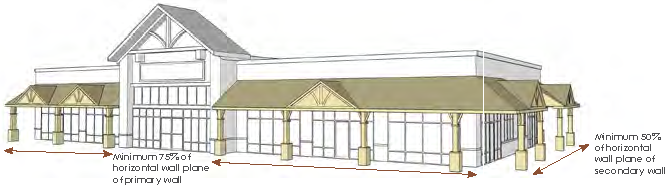
5.4.6 Roof form and materials.
A.
A roof is an integral structural component of the building and should be varied to reinforce the rhythm and scale of the façades. The standards of this section shall apply to roofs of non-residential structures. Industrial building wall types shall be exempt from these standards, except that all roof-mounted mechanical equipment shall be screened in accordance with Section 5.4.12.
B.
Pitched roof materials shall consist of asphalt shingles or standing seam metal in muted, earth tone colors.
C.
Pitched roofs shall be simple hip, shed or gable forms. Mansard roofs are prohibited. Pitched roof forms shall utilize eaves which overhang the building wall a minimum of 12 inches. A pitched primary roof form shall have a minimum pitch of 6 inches of vertical rise to each 12 inches of horizontal run (6:12) and a maximum pitch of 12 inches of vertical rise to each 12 inches of horizontal run (12:12). Secondary roof forms shall have a minimum pitch of 4 inches of vertical rise to each 12 inches of horizontal run (4:12).
D.
Roof pitches of less than 2:12 and flat roofs shall incorporate a parapet wall along the primary and secondary building walls. An articulated cornice or cap shall be provided along those portions of a parapet wall that are located above a section of a building that projects from the base wall plane. Cornices or caps shall continue around all sides of a parapet wall on which they are required, and may only terminate at an interior building corner or continue at least eight (8) feet around an exterior building corner.
E.
Parapet walls on primary façades shall contain at least one (1) change in height of at least one (1) foot a minimum of every 25 feet, through the use of a stepped wall or the inclusion of a minor pitched roof form. Height changes shall align with the modulation of the building wall. Parapet walls may not exceed 10 feet in height at any point along the wall.
Figure 5.10 Pitched Roof Types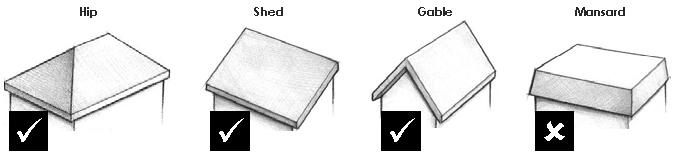
Figure 5.11 Roof Form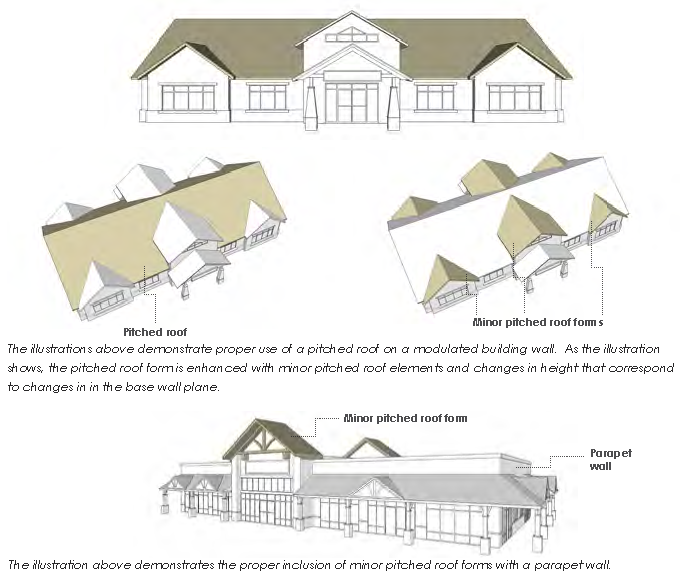
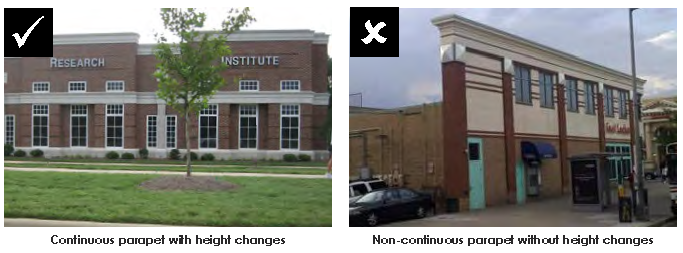
5.4.7 Façade materials and color.
5.4.7.1 Primary and secondary façades.
A.
New construction including additions.
1.
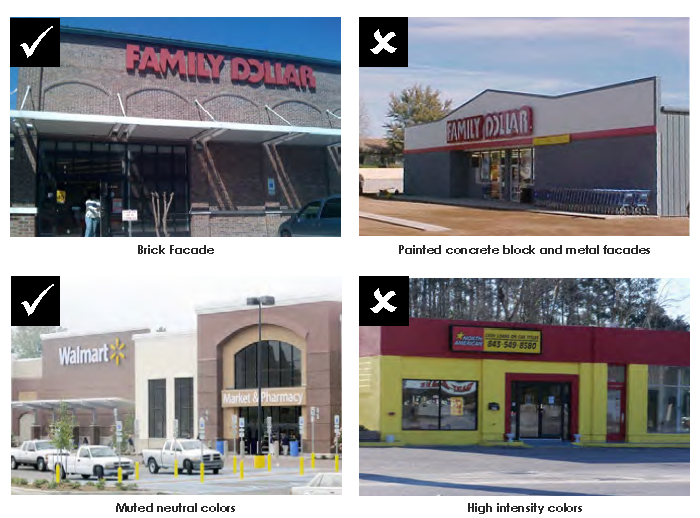
Brick, hard coat stucco, natural stone, architectural cast stone EIFS (Exterior Insulation Finishing System), glass or other comparable, durable materials that are consistent with the purpose and intent of the Building Design Standards and approved during the plan review process shall be used as cladding over a minimum of 50% of the surface area of each primary building façade and 25% of each secondary building façade. Windows and other glazed areas shall be excluded from the calculation of the surface area of a building wall for the purpose of the material proportion standards.
2.
The following materials may be used as cladding on up to 50% of the surface area of any primary building façade and 75% of the surface area of any secondary building façades:
•
Wood clapboard or fiber cement board horizontal or vertical siding
•
Vinyl siding horizontal or vertical siding
•
Stucco or exterior insulation and finishing system (EIFS)
•
Ceramic tile/terracotta
•
Split-faced concrete block
•
Architectural grade metal (shall not exceed 10% of any primary or secondary façade)
3.
All other materials not expressly permitted are prohibited.
4.
All façade material application shall be in compliance with manufacturer specifications and the North Carolina Building Code.
5.
Colors—Primary and secondary façade colors shall be low-reflective, subtle, neutral or earth tone colors. The use of high-intensity, fluorescent, or neon colors is not permitted. Building trim and accent areas may feature brighter colors, as approved during the plan review process. Traditional or standards franchise colors shall also comply with this section.
B.
Existing buildings.
1.
Where existing brick buildings have been painted, the primary surfaces of the buildings may only be repainted with low-reflective, subtle, neutral or earth tone colors, subtle, and neutral colors. The use of high-intensity, metallic, fluorescent, or neon colors is not permitted. Building trim and accent areas may feature brighter floors, as approved during the plan review process. Traditional or standard franchise colors shall also comply with this section.
Figure 5.12 Primary Materials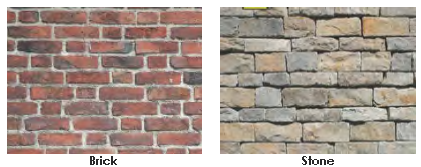
Figure 5.13 Secondary Materials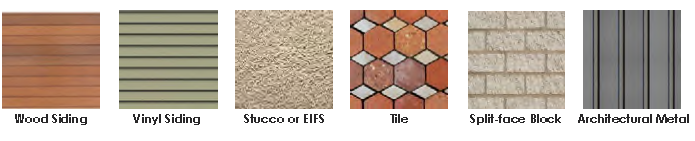
5.4.7.2 Utility/Service façades. In addition to the materials permitted on primary and secondary façades, the following materials may be used on utility/service façades that are not generally visible to the public, provided that the materials are either integrally colored or painted to match the color of the materials used to clad the greatest proportion of the surface area of the primary and secondary building façades:
•
Stucco or Exterior Insulation and Finishing Systems (EIFS)
•
Split-faced concrete block
•
Architectural precast panels
5.4.7.3 Industrial building façades. In addition to the materials permitted on primary and secondary walls for nonresidential buildings, the following materials may be used on industrial building façades, provided that the materials are either integrally colored or painted to match the color of the materials used to clad the greatest proportion of the surface area of the primary and secondary building façades of office, customer service, and retail portions.
•
Stucco or Exterior Insulation and Finishing Systems (EIFS)
•
Split-faced concrete block
•
Architectural grade metal
However, building façades located within 250 feet of a major thoroughfare shall meet the minimum material requirements for a secondary building façade, unless a Type 2 buffer in accordance with Section 4.4.3 Buffer Yards is installed along the thoroughfare frontage.
Figure 5.14 Materials Examples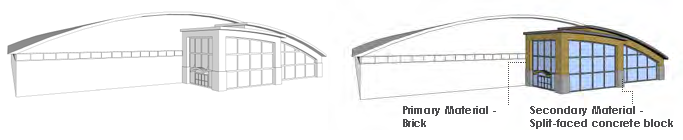
Figure 5.15 Materials Examples (Cont.)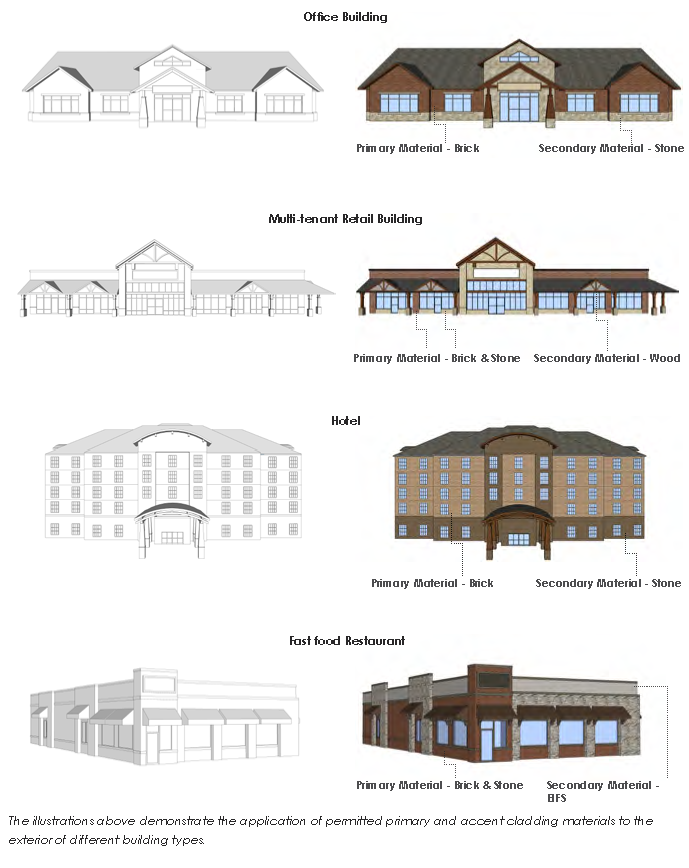
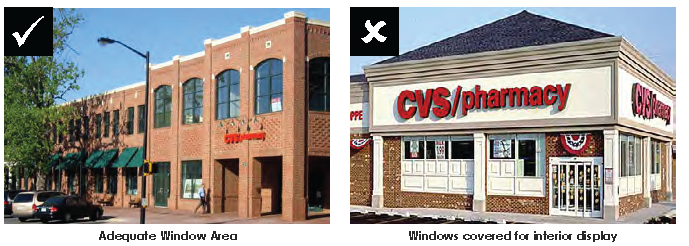
5.4.8 Windows and glazing.
A.
The use of glazed (glass) surface areas on a building wall enhances the aesthetic character of the building by adding a transparent contrast to the other cladding materials used on the wall. Transparent surfaces also increase the "activity" of a building wall by making interior spaces visible to the outside, particularly in the vicinity of customer entrances and along building walls that are adjacent to pedestrian walkways. Methods of achieving transparency can include the use of glass doors, windows and curtain walls. Industrial and Utility/Service building walls and uses listed under the "Institutional and Civic" uses category in the Permitted Uses Table are exempt from the minimum glazing standards.
B.
At least 25% of the primary building wall shall contain glazed area. For buildings located on a corner, the secondary street façade shall be at least 10% windows. Glazing shall not comprise more than 75% of a primary secondary building wall.
C.
Each upper story building wall shall contain a roughly proportional amount of glazed area as each other story above the ground floor. Windows shall be aligned vertically and horizontally between floors follow the same window rhythm.
D.
Windows shall be inset from the surrounding wall cladding material by a minimum of two (2) inches with the bottom sill a minimum of 12 inches and maximum of 48 inches above grade.
E.
Glazed areas shall not be separated by a distance of greater than 20 feet on any portion of a building wall on which glazing is required.
F.
Glass that obscures interior visibility may not be used to satisfy the minimum glazing requirement, except false windows may only be used to satisfy the minimum glazing requirement if they mimic true windows, are lit during nighttime business hours, and are not covered with pictures, words or other advertising materials.
G.
Windows shall be proportioned so that they emphasize the vertical rather than horizontal dimension of the opening. This may be achieved by either proportioning the window opening so that its height is greater than its width, or, when a horizontal window opening is used, using internal framing that divides the window into vertically proportioned elements. Transom and accent windows, occupying no more than 5% of the building wall on which they are located, may be horizontally oriented.
Figure 5.16 Windows and Glazing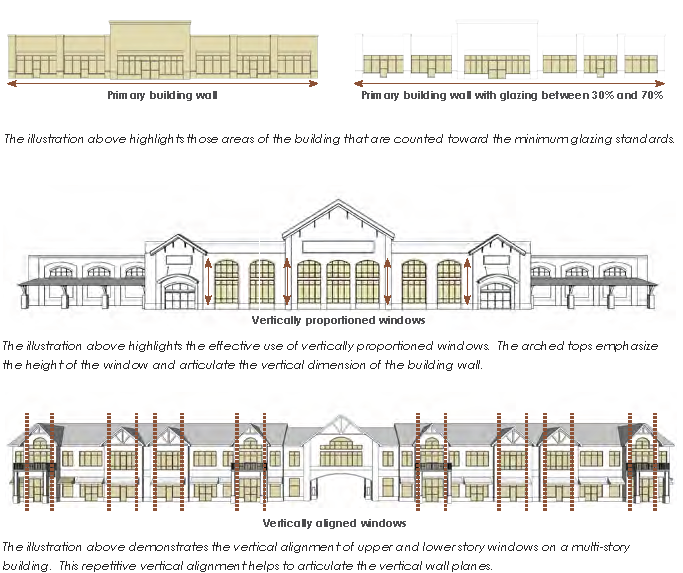
5.4.9 Building entrances.
A.
The primary entrance(s) to each building or tenant space shall be oriented toward the adjacent public street, or, when located in the interior of a larger development, toward an internal access drive.
B.
Buildings with a gross floor area of more than 50,000 square feet shall provide a minimum of two (2) customer entrances on the primary façade which are separated by a minimum distance of 100 linear feet from their outer edges. Industrial building walls are exempt from this requirement.
C.
Primary customer entrances shall be clearly defined by distinct architectural features. Each primary entrance shall be defined by a minimum of two (2) of the following features:
•
Awnings or porticos
•
Recesses/projections of the building wall
•
Arcades
•
Raised corniced parapets over the entry
•
Pitched roof forms
•
Arched architectural features
•
Display windows
•
Columns or similar vertical features
•
The use of cladding materials around the entrance that are visually distinct from other materials on the building wall.
•
Masonry, tile, metal or glass inlays around the entrance.
Figure 5.17 Building Entrances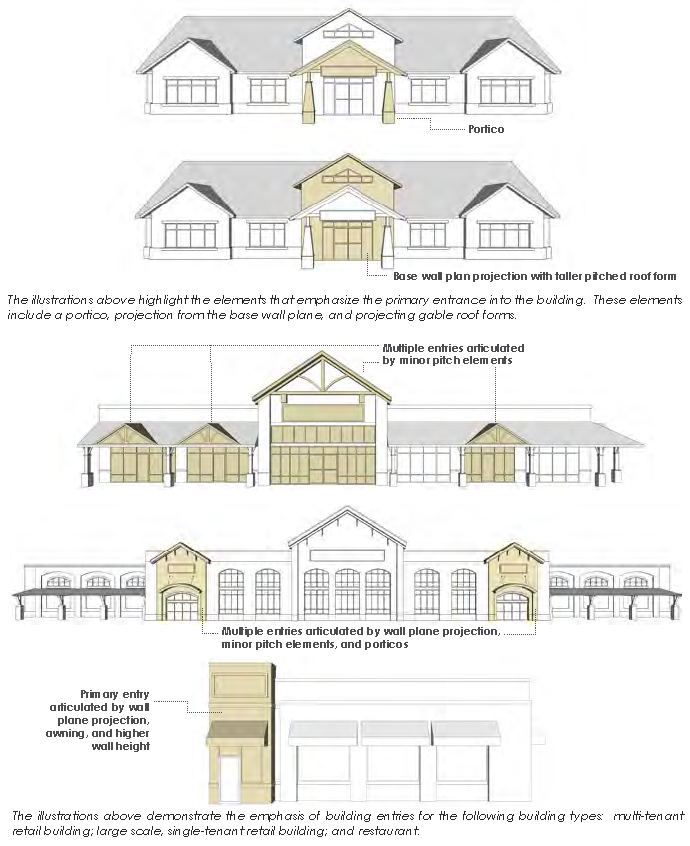
5.4.10 Awnings.
A.
Awning material shall be canvas or architectural grade (non-corrugated) metal with a matte, non-reflective finish.
B.
Awnings shall not be backlit or outlined with neon, LED or other lighting.
C.
Awnings shall be placed at the top of window or doorway openings, and shall not extend beyond such openings.
D.
No awning shall extend more than the width of the sidewalk or 10 feet, whichever is less and shall maintain a clear height of at least eight (8) feet above grade.
E.
Awnings shall be self-supporting from the wall. No supports shall rest on or interfere with the use of pedestrian walkways or streets. In no case, shall any awning extend beyond the street curb or interfere with street trees or public utilities.
Figure 5.18 Awnings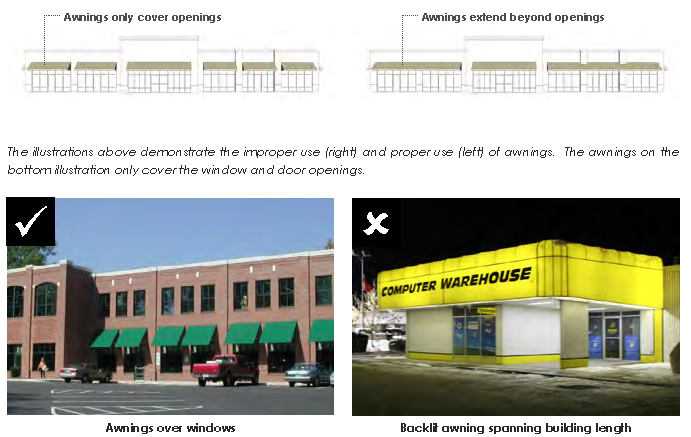
5.4.11 Orientation of certain features.
A.
Buildings shall be oriented in a manner that drive-through windows, menu/ordering areas and automobile service bay doors do not face the primary fronting street or major thoroughfare when viewed at a point in the street that is directly perpendicular to the center of the primary façade.
B.
Building walls that contain utility and service areas shall be oriented so that they are not visible from adjacent public streets or internal access drives (except dedicated service drives).
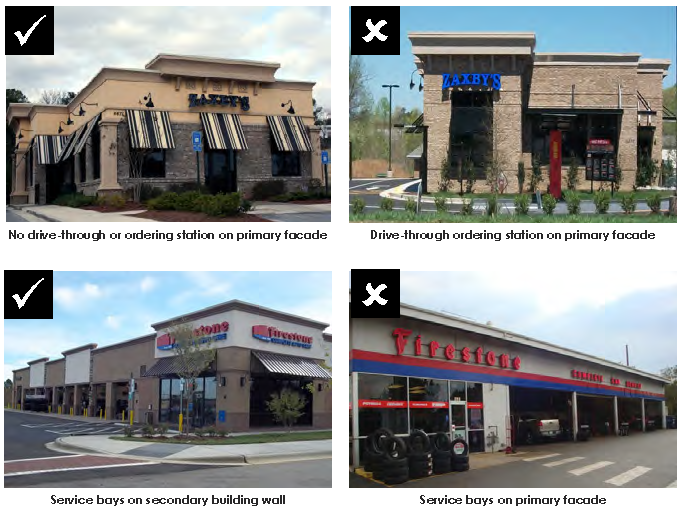
5.4.12 Mechanical and utility equipment.
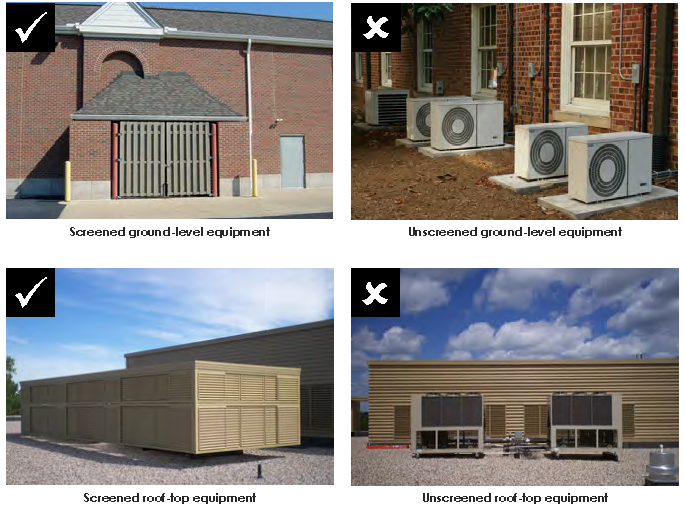
A.
All building mounted mechanical and utility equipment shall be located on the utility/service façade.
B.
Ground level building mounted mechanical and utility equipment shall be screened by walls that are composed of the same cladding material that is used on the building wall adjacent to their mounting location.
C.
Mechanical and utility equipment which extends along the vertical wall plane above a height of six (6) feet from grade shall be painted to match the color of the primary material on that building wall.
D.
All rooftop mounted mechanical equipment shall be screened or located in a manner that it is not visible from any point along an active building wall.
5.4.13 Accessory building design.
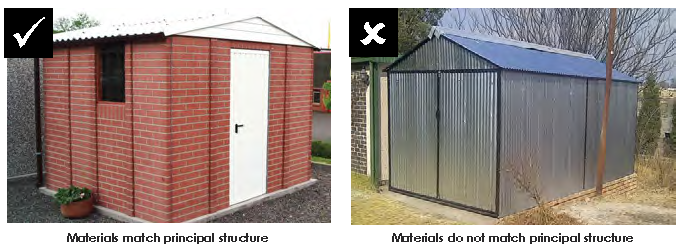
A.
The exterior materials of non-residential accessory buildings shall substantially match the primary and/or secondary materials of the principal structure and surrounding buildings.
B.
Accessory structures shall be located in the rear yard and shall not exceed 15 feet or the height of the principal structure, whichever is less.
(Ord. of 11-2-2020, ZTA 2020-01)
5.5 - Central Business (CB) District design standards.
The standards of this Section apply to all buildings in the CB zoning district, that are subject to Site Plan review and/or the issuance of a Zoning Permit. The standards are intended to maintain downtown Yadkinville's character and ensure that infill development is compatible with the downtown's historic and small-town character and the artistic spirit created by Yadkin Cultural Arts Center, and to encourage compatible redevelopment and revitalization to create a vibrant and attractive downtown.
5.5.1 Façade types. Different design standards apply to different types of building walls. For the purposes of this Section, building walls shall be divided into the following categories:
5.5.1.1 Primary/Front façade. Any building wall plane which is oriented toward a street right-of-way and contains the primary building entrance.
5.5.1.2 Secondary/Corner side façade. Building wall planes that do not contain the primary entrance to the building (but may contain a secondary entrance) and face a secondary street right-of-way on a corner lot.
5.5.1.3 Side interior façade. Building wall planes that do not face a street right-of-way and are generally perpendicular to the primary/front façade. In a Central Business district setting, these façades often directly abut the side interior façade of an adjacent structure and do not contain windows or doorways.
5.5.1.4 Rear façade. Building wall planes that face the rear yard and generally parallel to the primary/front façade. In a Central Business district setting, these façades often face rear alley ways.
Figure 5.19 Façade Types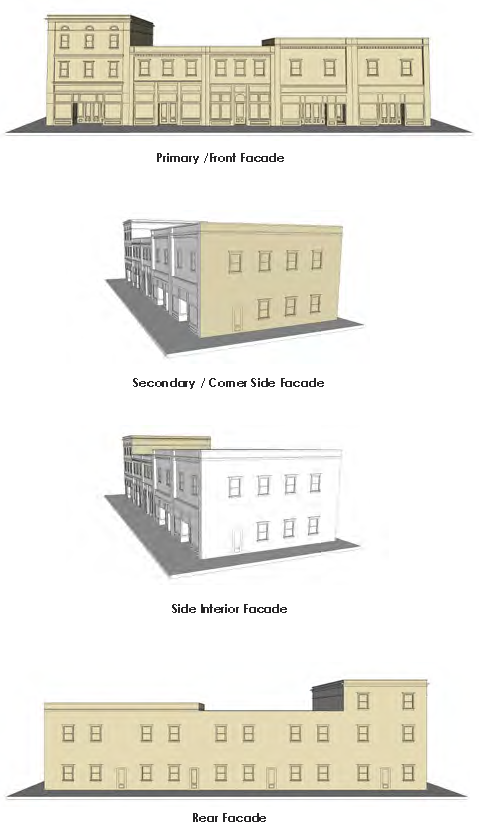
5.5.2 Building orientation.
A.
Building orientation refers to how the structure is placed on a property, with particular focus on the primary façade of the structure.
B.
Structures shall be oriented so that their primary façade faces, and is parallel with, the principal street on which they are located.
C.
On corner lots, both façades shall be oriented so that they face, and are parallel with, the adjoining streets.
Figure 5.20 Building Orientation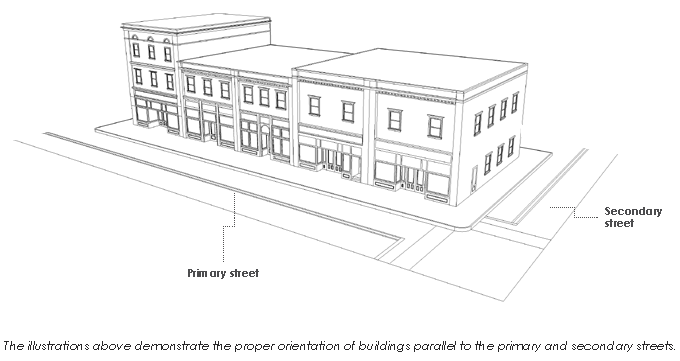
5.5.3 Building massing and scale.
A.
A building's mass defines its relationship to other structures and the street, as well as contributes to an area's identity. Neighboring buildings of similar size and massing work together to create a pleasing streetscape and provide consistency between adjacent buildings with different designs. A building's scale refers to its perceived size in relation to a person (i.e., human scale) or neighboring structures (i.e., architectural scale). Adjacent buildings sharing human-scaled architectural elements (e.g., windows, doors, porches, vestibules, stoops, awnings at entrance level, other ground-level pedestrian amenities) help establish an inviting, pedestrian-oriented streetscape.
B.
New construction on lots that are significantly wider than adjacent existing lots shall utilize a design that divides and proportions the building to replicate the massing and scale of adjacent buildings.
C.
Where other buildings within 250 feet on the same side of the street and within the same block occupy the full width of the lot at the front build-to line, the new construction shall occupy the full width of the lot at the build-to line between the side lot lines unless sufficient width exists to provide driveway or pedestrian access to a rear parking area. Such pedestrian access shall be a minimum of six (6) feet wide.
Figure 5.22 Massing and Scale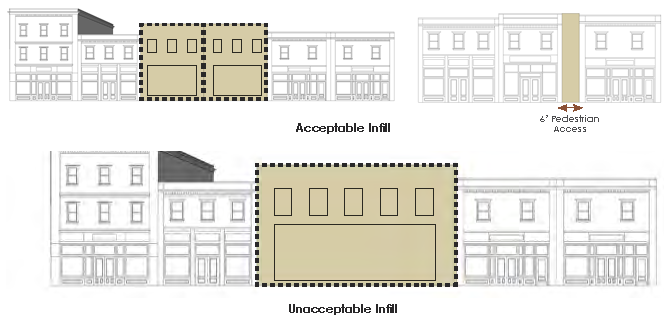
Figure 5.23 Example Infill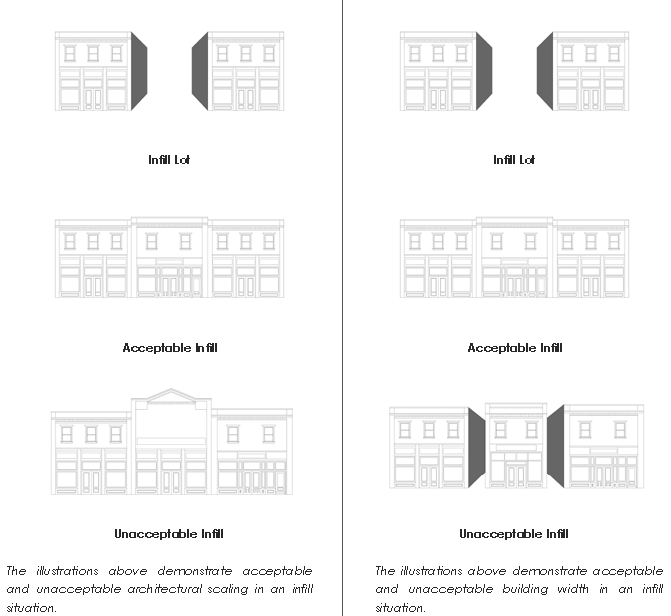
5.5.4 Building façade articulation.
A.
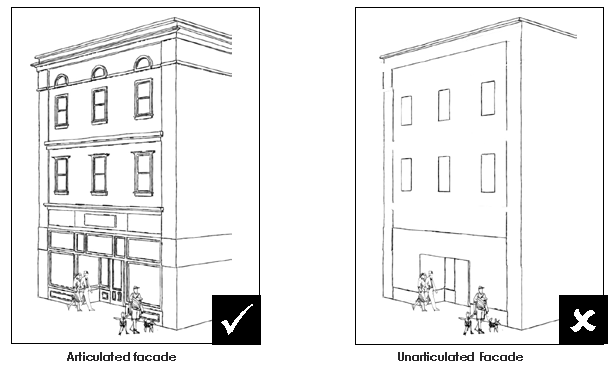
The use of architectural features and detailing on a building façade helps to define the scale and massing of a building. Elements should proportion a structure into a discernible base, middle and top, with an emphasis on accentuating the human scale along the façade of the ground story to create an inviting environment for pedestrians.
B.
Architectural features and ornamentation shall be required on all façades of a building facing a public street to provide articulation and define the scale of the building.
C.
No primary or secondary/side corner façade shall have a length of wall greater than 10 feet without doors, windows, or horizontal articulation feature (as described in Subsection D) are prohibited.
D.
Buildings shall be vertically articulated by using a minimum of two (2) of the techniques listed below and depicted in the following Figure:
•
Using different colors of materials along the vertical wall plane, with darker colors used on lower surfaces and lighter colors used on higher surfaces
•
Providing a mid-level cornice
•
Recessing upper stories on multi-story buildings
•
Using stepped parapet walls
•
Providing towers or similar features that extend vertically above the top of the building wall
•
Varying the height of different portions of a building
•
Using distinct masonry patterns or inlays that extend vertically along the building wall
•
Using piers or engaged columns that extend vertically along the building wall
E.
Building walls shall be horizontally articulated in a manner that provides visual interest and emphasizes the human scale by using two (2) or more of the below referenced techniques, or by an equally effective method that achieves the stated goal:
• Awnings
• Trellises
• Arcades
• Transom Windows
• Decorative masonry patterns
• Decorative metalwork
• Decorative inlays of brick, masonry, wood, stone or tile
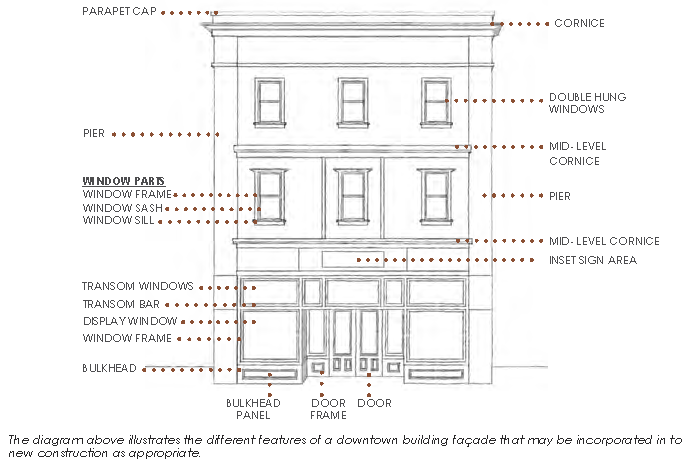
The diagram above illustrates the different features of a downtown building façade
that may be incorporated in to new construction as appropriate.
5.5.5 Roof form.
A.
The predominant roof from of all other buildings within 250 feet on the same side of the street and within the same block shall be the roof form used for new construction. For flat roofs, parapets walls are required on any façade facing a public street.
B.
Parapets walls shall extend a minimum of two (2) feet above the top of the building wall, but shall not extend more than five (5) feet above the main building wall.
C.
Parapet wall height for adjoining buildings with the same number of stories shall vary by a minimum of two (2) feet and a maximum of five (5) feet. Stepped or vertically articulated parapet walls may exceed these height limitations within the middle 30% of the building façade, but in no case shall the highest point of a stepped parapet exceed eight (8) feet in height above the main building wall.
D.
Exposed gutters and downspouts are prohibited on the primary façade of a building.
E.
Gutters, downspouts and scuppers shall be placed so that they are concealed from view from the primary façade or secondary façades that front on a public sidewalk.
Figure 5.25 Roof Form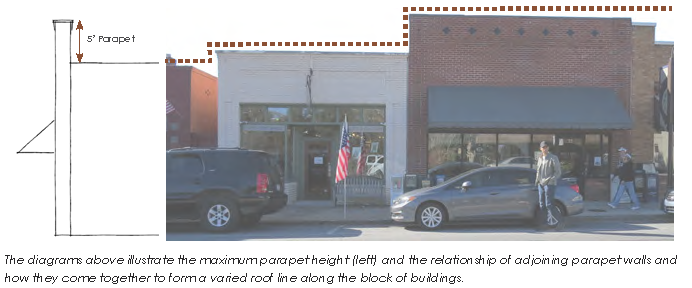
5.5.6 Materials.
A.
A minimum of 75% of primary and secondary façades shall be clad architectural quality, individually set, naturally colored brick, granite, limestone, marble or similar slab or block stone are allowed for use on the primary surfaces of exposed building façades. No more than two (2) styles of masonry may be utilized on a façade.
B.
Masonry shall be applied in a manner that emphasizes the storefront, window openings, projecting lentils, corbeling adjacent to and/or as a part of the cornice features, building piers, and other ornamental features.
C.
Masonry shall be applied in a manner that adds interest to the façade by utilizing techniques that vary the patterns of brick through the use of a variety of brick course patterns and designs.
D.
Special attention shall be given to corners to ensure the brick course work is wrapped in a continuous manner along all sides of the building.
E.
Where there are multiple exposed façades facing public streets, the same course patterns, brick styles and other characteristics shall be applied equally to each façade. Rear façades may be designed without any architectural detailing, but shall use the primary building materials.
F.
Treated wood, stacked stone, exterior quality tile, stucco or EIFS, cast or preformed concrete and architectural grade metal may be utilized on building surfaces where the primary cladding materials are not applied, provided that such materials (excluding glazed areas) do not exceed 25% of the surface area of the façade.
G.
If exposed lintels are used in construction, they shall be made of stone or brick, and shall project a minimum of three (3) inches from the surface of the building.
H.
Upper story and mid-level cornices may be included on the primary building façade. Cornices may be constructed of brick, architectural grade metal or cast concrete.
I.
The primary building surface may include decorative inlays that do not total more than 10% of the primary façade surface area. Inlay materials may include, tile, natural stone, decorative glass, or similar materials.
Figure 5.26 Materials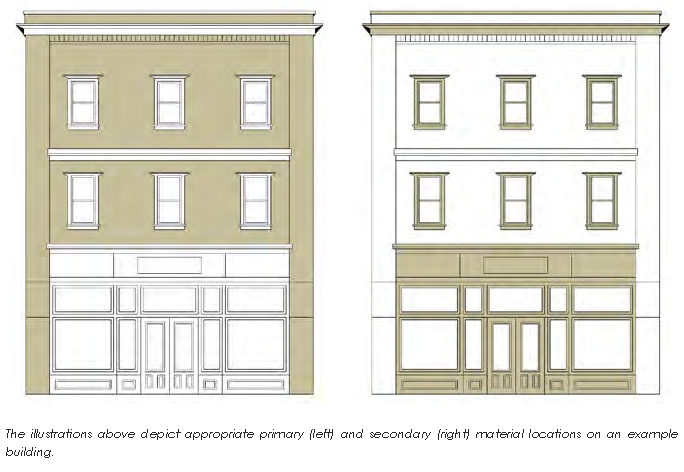
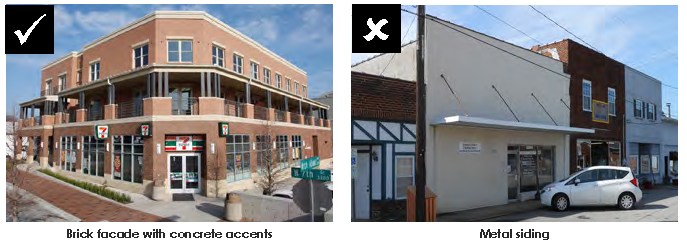
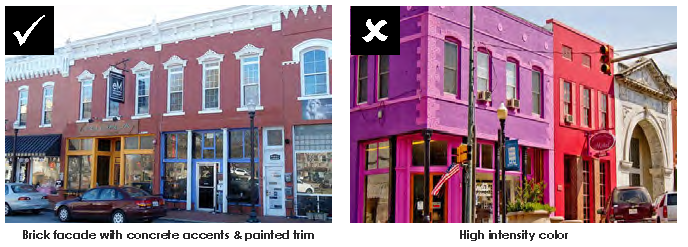
5.5.7 Façade color.
A.
For new construction including additions, brick and stone shall be unpainted and naturally colored.
Where existing brick building have not been painted, they shall remain unpainted and naturally colored. Where existing brick buildings have been painted, the primary surfaces of the buildings may only be repainted with low reflectance, earth tone, muted, subtle, and neutral colors.
B.
Reserved.
C.
For new construction or existing buildings, building trim and accent areas may feature or be painted brighter colors, excepted as provided in subsection D. below, and as approved during the plan and/or permit review process.
D.
The use of high-intensity, metallic, fluorescent, or neon colors is not permitted.
E.
Traditional or standard franchise colors shall also comply with this section.
Figure 5.27 Building Color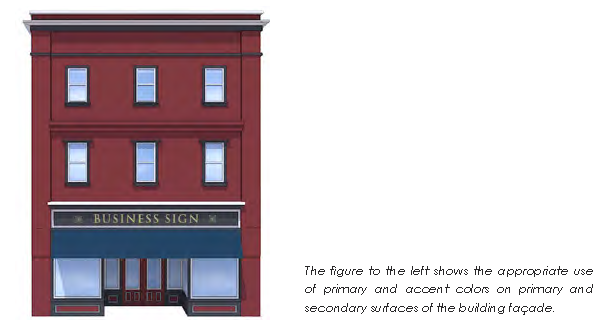
5.5.8 Storefront design.
A.
The storefront is the public face of a building and the most prominent feature at the pedestrian scale. A storefront designed to be open and inviting will help to welcome patrons inside, while a storefront that is hardened presents the opposite message. Most storefronts have an abundance of glass, which is a contributing factor in good storefront design since the openness of the glass invites browsing and allows pedestrians to see interior activity. Good storefront design also allows for pedestrians to be able to view the interior of the building from the main portion of the sidewalk. Therefore, excessively recessed storefronts are discouraged since they require a passerby to leave the main sidewalk to see clearly into the storefront.
B.
Buildings shall be designed so that the majority (greater than 50%) of the width of the storefront wall is located immediately adjacent to the public sidewalk. Storefronts shall run the length of the first floor façade between the exterior building piers.
C.
No more than 20% of the storefront wall may be recessed beyond eight (8) feet from the public sidewalk.
D.
Storefront design shall be proportional to that of other buildings within the same block on the same side of the street without being an exact replication of those buildings.
E.
Bulkheads should be neither too high, blocking the view of pedestrians, nor too low, so that a completely glass walled storefront is created. Bulkheads shall be constructed along all storefront areas, excluding customer entrances. Bulkheads shall be a minimum of 24 inches and maximum of 36 inches in height. Bulkheads may be constructed of brick, wood, or a combination of those two materials. Bulkheads shall include architectural detailing such as inlays, trim, changes in color or changes in material.
F.
A minimum of 70% and maximum of 90% of the surface area of the storefront shall consist of transparent glass between a height of two (2) feet and 10 feet above the grade of the adjacent sidewalk. Glass block does not count toward this requirement.
G.
Reflective or opaque glass is prohibited.
H.
Permanent bars, gates, shutters, fencing or other barrier materials are prohibited on the exterior of a primary façade. Security gates may be used after business hours.
Figure 5.28 Storefront Design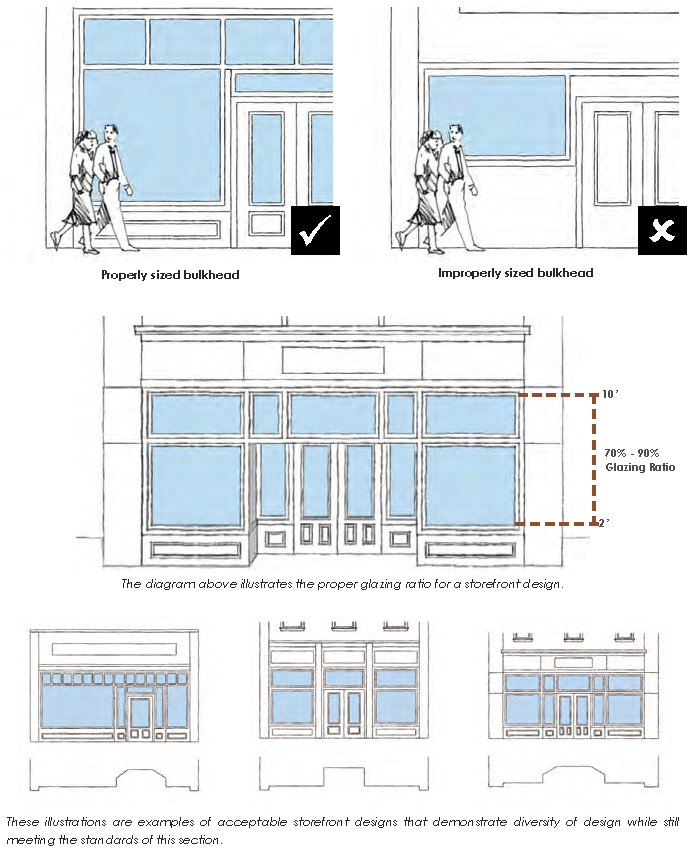
5.5.9 Upper-story windows.
A.
Upper-story windows shall have a minimum height to width ratio of two to one (2:1) and a maximum height to width ratio of three to one (3:1).
B.
Windows shall have the appearance of operable double hung windows.
C.
Upper-story windows should align horizontally with windows on the same story and be centered on windows below.
D.
Reflective or opaque glass is prohibited.
E.
A minimum of 30% of the linear width of each upper floor shall contain glazed area.
Figure 5.29 Upper-Story Windows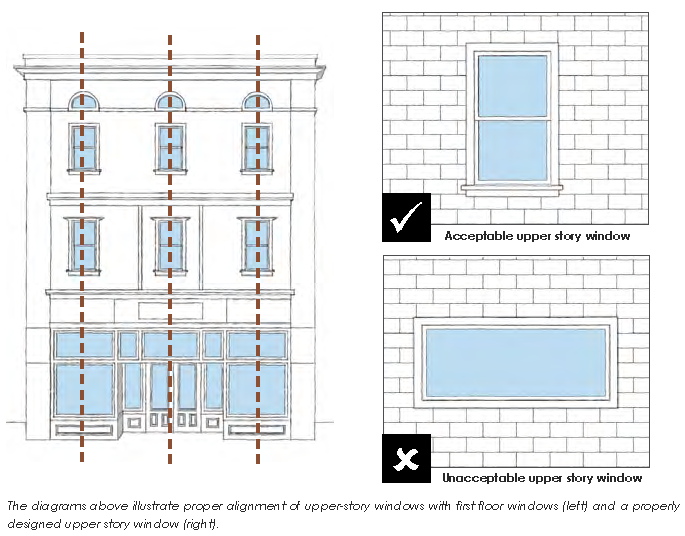
Figure 5.30 Upper-Story Windows (Cont.)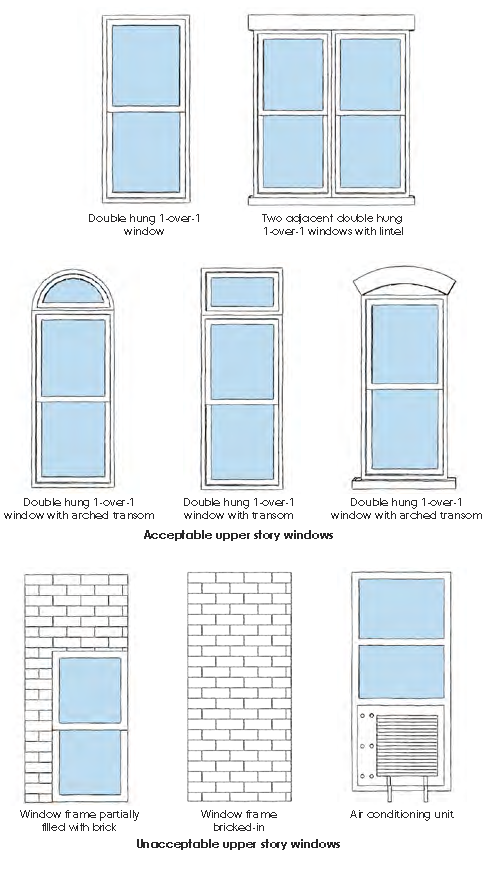
5.5.10 Entrances.
A.
From a pedestrian point of view, doors and entranceways are one of the most obvious and recognizable building features. The door and entranceway is a gateway to building interior. Therefore it is important that the entrance be perceived as a cohesive element of the storefront façade and not as a separate entity.
B.
Primary entrances of first floor uses shall face the primary street frontage, while secondary entrances may face parking areas or secondary street frontages.
C.
On primary and secondary street frontages, the surface area of primary and secondary entrance doors to first floor uses shall have a minimum glazed area of 70%.
D.
Reflective or opaque glass is prohibited.
Figure 5.31 Entrance Doors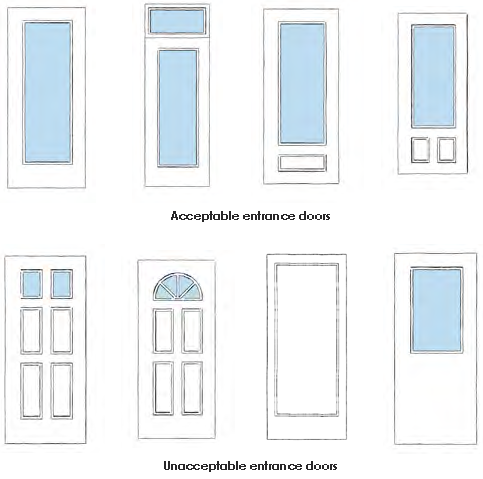
5.5.11 Awnings and canopies.
A.
Awnings and canopies can serve many functions such as stimulating visual interest, protecting pedestrians from weather, and shielding items from sun damage in storefront displays.
B.
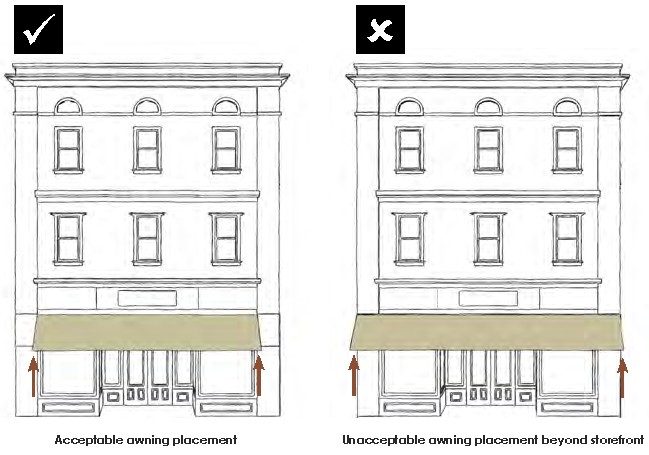
Awnings shall not extend past the storefront area into the building piers. Awning shape shall relate to the window or door opening. Barrel shaped awnings should be used to complement arched openings while rectangular awnings should be used on rectangular openings.
C.
When there are multiple storefronts, awnings/canopies should correspond in size, color, and material. Buildings with multiple storefronts shall use separate awnings for each storefront. Awnings and canopies shall not block architectural features, including transom windows, and shall be attached to the vertical wall and lead to the public entrance.
D.
Awnings and canopies may extend up to 80% of the width of the sidewalk area in front of the building or nine (9) feet, whichever is less, subject to any encroachment permit which may be required by the North Carolina Department of Transportation, or the Town. In no case shall an awning or canopy extend beyond the curb line of the street, nor shall it interfere with the growth or maintenance of street trees, or maintenance of street lights or street signs. Awnings and canopies shall be at least eight (8) feet above the grade of the sidewalk.
E.
Acceptable materials include woven cloth, canvas or architectural metal. The use of fluorescent or neon colors is not permitted. Backlighting of awnings is not permitted.
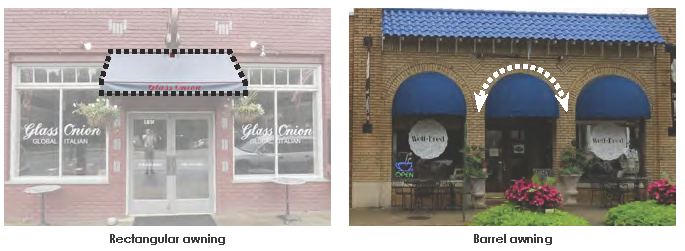
Figure 5.32 Awning Placement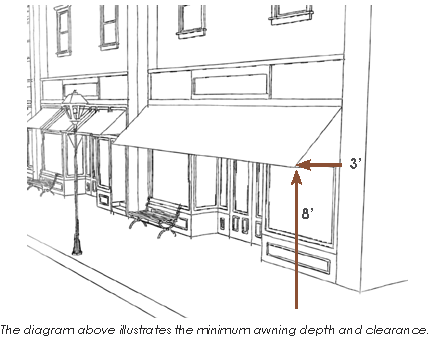
5.5.12 Lighting.
A.
Building-mounted lighting may be used to draw attention to window displays, signs, store information and a building's architectural details.
B.
Building-mounted lighting shall provide particular focus on the architectural integration of lighting into the overall design of the structure.
C.
Lighting shall be directed onto the display or building element not onto the street or adjacent properties.
D.
Lighting fixtures shall complement the architectural elements within the existing façade.
E.
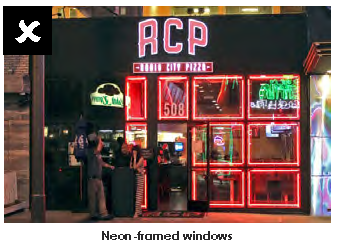
Framing window displays or other architectural features of the building with neon or tube lighting is not permitted, except for theater uses.
F.
Lighting shall be in full compliance with all other outdoor lighting provisions, as set forth in Section 4.6.5.
5.5.13 Mechanical and utility equipment. Mechanical and utility equipment shall be screened in the same manner as required in Section 5.4.12.
(Ord. of 11-2-2020, ZTA 2020-01)

