
Young Harris City Zoning Code
ARTICLE III
- GENERAL PROVISIONS
Section 3.1. - Zoning map.
The official zoning map of the City of Young Harris, Georgia, is that map adopted on the same date and time as this ordinance, signed by the clerk of the City of Young Harris, Georgia, and maintained in the office of the city clerk of the City of Young Harris, Georgia.
Said official zoning map and all explanatory matter thereon accompany and are hereby made a part of this zoning ordinance. The official zoning map shall indicate the date of adoption and most recent amendment. The original of the official zoning map shall be kept in the office of the city clerk.
The official zoning map may be kept electronically in a geographic information system and such electronic data shall constitute an integral part of the zoning map. The zoning administrator may make copies of the official zoning map available to the public for a reasonable fee.
Section 3.2. - Map amendment.
If, in accordance with the provisions of this ordinance, changes are made in district boundaries portrayed on the zoning map, such changes shall be made on the official zoning map promptly after the amendment has been approved by the city council.
See appendix for most current map date.
In the event that the official zoning map becomes damaged, destroyed, lost, difficult to interpret because of the nature or number of changes and additions or the mayor and city council deem an updated official zoning map to be necessary, the mayor and city council may by resolution adopt a new official zoning map which shall supersede the prior official zoning map. The new official zoning map may correct drafting or other errors or omissions in the prior official zoning map. The new official zoning map shall be identified by the signature of the mayor attested to by the city administrator and bearing the seal of the city under the following words: "This is to certify that this is the official zoning map of the City of Young Harris, and this map supersedes and replaces any previously adopted zoning map."
Section 3.3. - Interpretation of district boundaries.
Where uncertainty exists with respect to the boundaries of any of the aforesaid districts as shown on the zoning map, the following shall apply:
(1)
Where district boundaries are indicated as approximately following the centerlines of streets or highways, centerlines of streams or drainageways, street lines, or highway right-of-way lines, such centerlines, street lines, or highway right-of-way lines shall be construed to be such boundaries.
(2)
Where district boundaries are so indicated that they approximately follow the lot lines, such lot lines shall be construed to be said boundaries.
(3)
Where district boundaries are so indicated that they are approximately parallel to the centerlines of streets or highways, or rights-of-way of same, such district boundaries shall be construed as being parallel thereto and at such distance therefrom as indicated on the zoning map. If no distance is given, such dimensions shall be determined by the use of the scale of said zoning map.
(4)
Where a district boundary line, as appearing on the zoning map, divides a lot in single ownership at the time of enactment of this ordinance, the district requirements for the most restricted portion of such lot shall be deemed to apply to the whole thereof, provided that such extension shall not include any part of such a lot more than 35 feet beyond the district boundary line.
Section 3.4. - Overlay districts
The city may adopt overlay districts, including for purposes of historic preservation. If adopted, they shall be delineated and shown as an overlay district on the official zoning map.
Section 3.5. - Use.
No building, structure or land shall hereafter be used or occupied, and no building, structure or a part thereof shall be placed upon, erected, constructed, reconstructed, moved or altered, except in conformity with the regulations herein specified for the district in which it is located. Except as expressly provided in this ordinance, there shall only be one principal use per lot.
This provision shall not be construed to prevent the construction of more than one detached single-family condominium; multiple-family dwelling; office; institutional, commercial or industrial building upon a single lot, in districts permitting a mixed use.
Section 3.6. - Height and density.
No building or structure shall hereafter be erected, constructed, reconstructed, or altered to:
(1)
Exceed the height limits;
(2)
House a greater number of families or occupy a smaller lot area per family than is required herein; or
(3)
Have narrower or smaller front or side yards than are required herein.
Section 3.7. - Lot size and occupancy.
No lot may be created by plat or by instrument that does not meet the minimum area as contained in this ordinance for the district in which the land is located. No lot shall be reduced in size so that the lot width, size of yards, lot area, or any other requirement of this ordinance is not maintained. This section shall not apply when a portion of a lot is acquired for a public utility use.
Section 3.8. - Yards and other spaces.
No part of a yard, other open space, the off-street parking, or loading space required adjacent to any building for the purpose of complying with the provisions of this ordinance, shall be included as a part of the yard, off-street parking, or loading space required for another building.
However, where shared parking is feasible, a permit may be granted.
Section 3.9. - Number of buildings per lot.
Within any district, more than one building housing a permitted use together with accessory buildings may be constructed upon any tract of land, provided that front, rear and side yard setbacks are complied with.
Section 3.10. - Public street frontage.
No building shall be erected on a lot which does not abut, for at least 25 feet, on a public street.
Section 3.11. - Continuance of nonconforming uses.
The use of any building, structure or land legally existing at the time of the enactment of this ordinance, or an amendment thereto, but which does not conform with the provisions of this ordinance or an amendment thereto, may be continued, with the following exceptions:
(1)
A nonconforming use of any building, structure or land shall not be:
(a)
Changed to another nonconforming use;
(b)
Reestablished after discontinuance for six months;
(c)
Extended, except in conformity with this ordinance;
(d)
Rebuilt, altered, or repaired after damage exceeding 75 percent of its replacement cost at the time of destruction, except in conformity with this ordinance.
Section 3.12. - Off-street automobile parking.
Off-street automobile parking shall be provided on every lot on which any of the following uses are hereafter established. The number of automobile parking spaces provided shall be at least as great as the number specified below for various uses, or as stipulated in an approved comprehensive parking plan.
(1)
Automobile repair garages - one space for each regular employee, plus one space for each 250 square feet of floor area used for repair work;
(2)
Dormitories - one space per two students;
(3)
Gasoline filling stations - three spaces for each grease rack or similar facility, plus one space for each gas pump;
(4)
Hospitals, nursing homes or similar institutions - one space for each two beds, plus one space for each staff or visiting doctor, plus one space for each three employees;
(5)
Motels, hotels and tourist courts - one space for each guest bedroom, plus one space for each two employees;
(6)
Industrial - one space for each employee on a single shift, plus one space for each company vehicle operating from the premises;
(7)
Lodges and clubs - one space for each ten members;
(8)
Manufactured homes - two spaces for each manufactured home;
(9)
Offices - one space for each 300 square feet of floor space;
(10)
Places of amusement or assembly, without fixed seats - one space for each 200 square feet of floor space devoted to patron use;
(11)
Places of public assembly - one space for each three seats in the principal assembly room;
(12)
Residential - two spaces for each dwelling unit;
(13)
Restaurants - one space for each 75 square feet of floor area devoted to patron use, plus one space for each four employees, plus four spaces for each outside serving window;
(14)
Retail businesses - one space for each 250 square feet of sales space;
(15)
Rooming houses and boardinghouses - one space for each two bedrooms;
(16)
Wholesale businesses - one space for each employee.
Each space shall be at least 162 square feet in area and shall have vehicular access to a public street. Turning space shall be provided, except for single-family residences, so that no vehicle will be required to back into the street.
Section 3.13. - Location of parking spaces on other property.
To ensure quality-growth-oriented principles, shared parking is encouraged where feasible.
If the required automobile parking spaces cannot be reasonably provided on the same lot on which the principal use is conducted, such spaces may be provided through shared parking agreements, approved off-street parking or designated city parking lots.
Section 3.14. - Extension of parking spaces into a residential district.
Required parking spaces may extend up to 120 feet into a residential zoning district, provided that:
(1)
The parking space adjoins a special or general business district;
(2)
The parking space has as its only access, or fronts upon, the same street as the property in the special or general business district for which it provides the required parking spaces;
(3)
The parking space is visually separated from abutting properties in the adjoining residential district by suitable screening devices; and
(4)
Designated street parking is available and does not inhibit the flow of traffic.
Section 3.15. - Off-street loading and unloading spaces.
Every building or structure requiring the loading and unloading of vehicles shall provide space as indicated herein. This includes, but is not limited to, business, trade or industry. Such space shall have access to an alley, or if there is no alley, to a street.
A proposed plan to accommodate any regular delivery services shall be submitted with an application for a building permit, and must be approved by the city council.
The minimum loading and unloading space required is as follows:
(1)
Zoning districts SB, GB, and SI - one space of 300 square feet for each 3,000 square feet of floor area or fraction thereof;
(2)
Zoning districts I - one space of 500 square feet for each 10,000 square feet of floor area or fraction thereof.
Section 3.16. - Vision clearance.
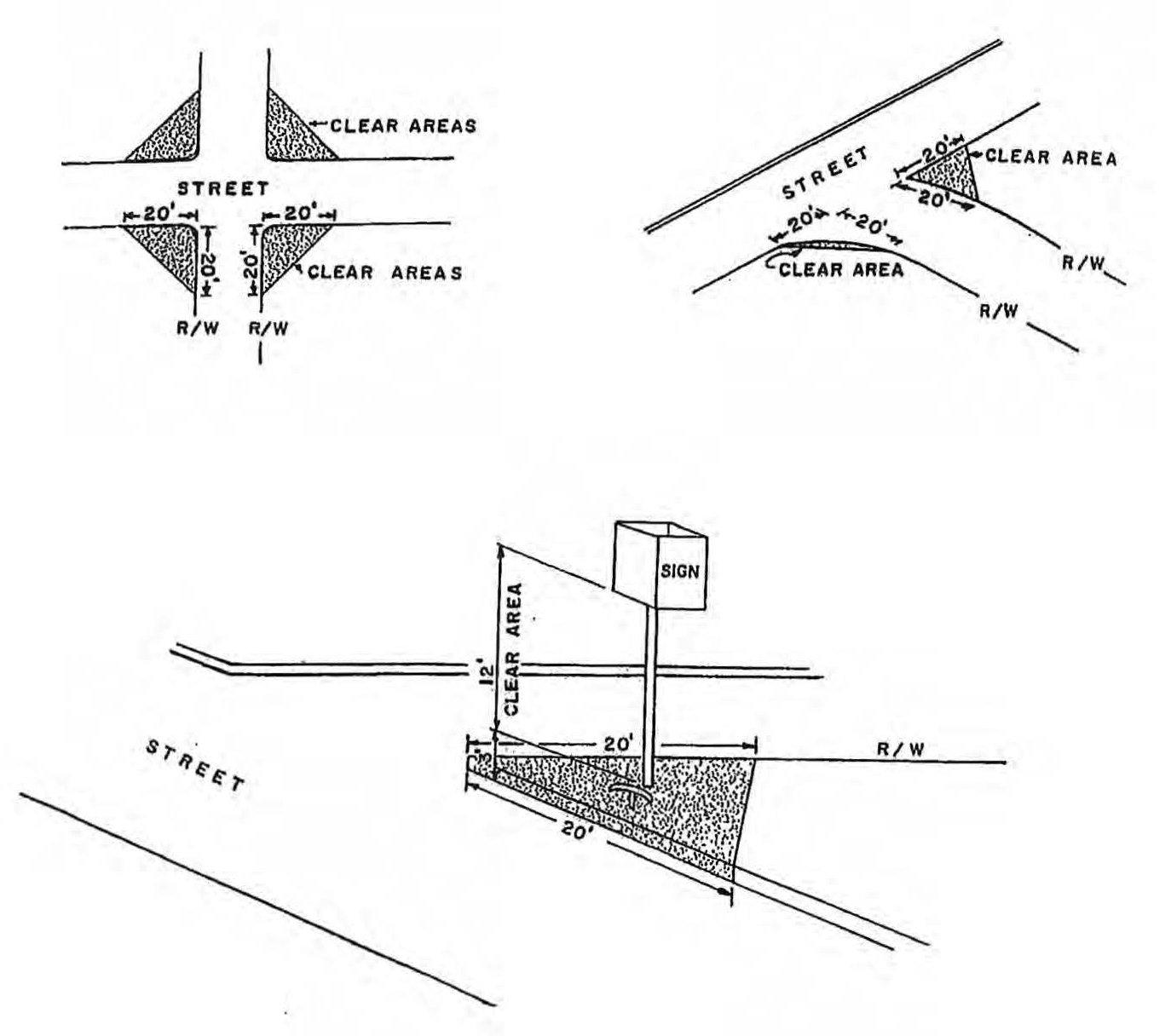
The areas at the corners of an intersection, which may vary based on type of street and intersection geometry, are to be kept free of shrubs, ground covers, berms, fences, structures, or other materials or items between three feet in height to 12 feet as measured from the ground.
No fence, wall, sign, hedge or planting which obstructs the sight lines at elevations between three feet and 12 feet above any roadway, with the exception of utility poles, shall be placed or permitted to remain on any corner lot within a sight visibility triangle as defined by this zoning ordinance. Unless otherwise specified by the zoning administrator, the area regulated shall be within a triangular area formed by the intersection of the right-of-way lines of two streets or a street intersection with a railroad right-of-way line, and a diagonal line which intersects the right-of-way lines at two points, each 20 feet distance from the intersection of the right-of-way lines, or, in the case of a rounded corner, from the point of intersection of their tangents; provided, however, signs, lights, or similar objects which are totally located at least 12 feet above the finished grade shall be permitted. See the following illustrations.
In such cases as right-of-way lines do not exist or cannot be determined, said measurements shall be made from points 15 feet from the centerline of the existing road or ten feet from the existing pavement or roadbed, whichever is greater.
VISIBILITY AT INTERSECTIONS
Section 3.17. - Classification of streets.
For the purpose of this ordinance, all streets in the City of Young Harris, Georgia, are hereby divided into the following two classes:
(1)
Major or arterial streets.
(2)
Local streets.
Section 3.18. - Appearance of property.
(1)
Trash and debris. All property (other than where explicitly permitted, such as a junk yard or salvage yard) must be free of the following: scrap metal; junked, inoperative or broken appliances (including engines and vehicles or parts of vehicles); junked, inoperative or broken equipment (such as lawn mowers, bicycles, machines); construction or demolition debris; other waste, garbage or refuse such as old tires, discarded carpet, discarded household furniture, bottles, cans, or similar; stumps, branches, dirt, and other debris from land disturbance and grading (except incident to a valid permit); and household trash (except in a trash container). Such items may be kept in an enclosed building or enclosed garage erected pursuant to a building permit or otherwise lawfully permitted, but may not be kept in the open.
(2)
Tall grass. All property, whether residential, commercial or industrial, containing turf grass, landscaping strips, or other landscaping, must keep the grass cut to below 12 inches. Grass fields grown for designated stormwater management areas, grazing or other agricultural purposes, and sod farms shall be exempt, except that in no event shall the front and side yards of a residentially-used structure be exempt.
(3)
Storage of construction or commercial materials. Storage of lumber, dumpsters, shipping containers, wood pallets, pipe, concrete blocks, other construction material, or other commercial material, or any commercial inventory (including products for sale, use or repair in off-site businesses), or materials associated with a commercial operation, shall be prohibited on residentially-zoned or residentially-used property, unless associated with or required by a permitted use on the property (including repair or construction of a structure that is itself a permitted use, e.g., construction of a single-family residence on said property).
(4)
Junk cars.
(a)
No automobile, vehicle or trailer of any kind or type, without a valid license plate attached thereto, shall be parked or stand on any residentially-zoned property or other zoned property unless it shall be in a completely enclosed building or on property properly zoned as a junk yard, except for such off-road vehicles which by law do not require a license plate, provided the same is in operating condition.
(b)
No automobile, vehicle or trailer of any kind or type, which shall be inoperative or in a junk condition, or abandoned, shall be parked or stand on any property unless (i) it shall be in an enclosed building; (ii) it shall be on the premises of a business enterprise operated in a lawful manner, when necessary to the operation of such business enterprise; or (iii) it shall be on property lawfully occupied and used for repair, reconditioning or remodeling of vehicles in conformance with this ordinance. For purposes of repair or restoration, one inoperable and unregistered vehicle may be kept in the rear yard of a property, provided it is not visible from the street, is screened from all neighbors by a privacy fence in the rear yard, and is repaired or restored, removed, or placed in a fully enclosed building, within six months. Such vehicle shall not be stored in any side yard or any setback or buffer area.
(5)
Tires. The storage of new or used tires on any property is prohibited unless the same are stored within an enclosed building or garage. It is illegal to discard or abandon tires on any property other than a lawful landfill.
(6)
Yard sales. Yard sales are permitted, however, neither merchandise display nor sales activity shall occur more frequently than four days in any one calendar month.
(7)
Invasive plants. Invasive plants are to be kept five feet from adjoining property lines.
Section 3.19. - Exterior lighting.
(1)
In all zoning districts, any exterior lighting installed after the effective date of this ordinance shall comply with restrictions of this section.
(2)
Exterior illumination shall be designed and installed so that it is not a nuisance to neighboring properties or a hazard to traffic upon the public right-of-way. Exterior lighting shall meet the following design standards:
(a)
Light sources shall be concealed or shielded with luminaries with cut-offs with an angle not exceeding 90 degrees to minimize the glare and light diffusion onto neighboring properties and the public right-of-way.
(b)
Light fixtures used to illuminate particular objects or signs shall use a narrow cone beam or light that does not extend beyond the illuminated object.
(c)
For upward-directed lighting, direct light emissions shall not be visible above the building roof line.
(d)
All exterior lighting luminaries shall be mounted no higher than 15 feet, including lighting in parking lots.
(e)
Lighting for public or private streets shall be shielded.
Section 3.20. - Mechanical sound-making devices.
It is unlawful for any person or persons to play, use, operate, or permit to be played, used, or operated any radio receiving device, television, stereo, musical instrument, phonograph sound amplifier or other machines or devices for the producing, reproducing or amplifying of sound and/or noise at such a volume and in such a manner so as to create, or cause to be created, any noises or sounds which are plainly audible at a distance of 100 feet or more from the building, structure, or motor vehicle or in the case of real property, beyond the property limits, in which it is located, whichever is farthest, between the hours of 12:00 midnight and 7:00 a.m. of every day.

