
Ypsilanti City Zoning Code
ARTICLE II
DEFINITIONS AND LANGUAGE
Sec. 122-200.- Interpretation of language.
For the purpose of this chapter, the following rules of interpretation shall apply to the text of this chapter:
(a)
The particular shall control the general.
(b)
In the case of any difference of meaning or implication between the text of this chapter and any caption or illustration, the text shall control.
(c)
The word "shall" is always mandatory and not discretionary. The word "may" is permissive and discretionary.
(d)
Words used in the present tense shall include the future. Words used in the singular number shall include the plural, and the plural the singular, unless the context clearly indicates the contrary.
(e)
A "building" or "structure" includes any part thereof.
(f)
The phrase "used for" includes "arranged for," "designed for" "intended for," "maintained for," or "occupied for."
(g)
The word "person" includes an individual, a corporation, a partnership, a public utility, firm, an incorporated association, or any other similar entity.
(h)
Unless the context clearly indicates the contrary, or a regulation involves two or more items, conditions, provisions, or events connected by the conjunction "and," "or," "either … or," the conjunction shall be interpreted as follows:
(1)
"And" indicates that all the connected items, conditions, provisions, or events shall apply.
(2)
"Or" indicates that the connected items, conditions, or provisions, or events may apply singly or in any combination.
(3)
"Either … or" indicates that the connected items, conditions, or provisions, or events may apply singly or in any combination.
(i)
Terms not defined in this chapter shall have the meaning customarily assigned to them.
Sec. 122-201. - Interpretation and conflict.
(a)
In interpreting and applying the provisions of this chapter, such provisions shall be held to be the minimum requirements adopted for the promotion of the public health, morals, safety, comfort, convenience, prosperity, and general welfare.
(b)
It is not intended by this chapter to repeal, abrogate, annul or in any way to impair or interfere with any existing provision of any law or ordinance other than the above described zoning ordinance, or with any rules, regulations, or permits previously adopted or issued or which shall be adopted or issued pursuant to the law relating to the use of the buildings or premises; provided, however, that where this chapter imposes a greater restriction than is required by an existing ordinance or by rules, regulations or permits, the provisions of this chapter shall control.
Sec. 122-202. - Rule of construction.
The rule that a penalty statute is to be strictly construed shall not apply to this chapter or any of the provisions thereof. All provisions of this chapter shall be construed according to the fair import of their terms, to promote justice, and to effect the objectives of this chapter.
Sec. 122-203. - Definitions.
The following words, terms and phrases when used in this chapter shall have the meanings ascribed to them in this section, except where the context clearly indicates a different meaning:
A
Abandon means, in relation to nonconformities, to refer to uses, businesses, or establishments which have ceased to operate or exist; or to buildings, structures, or properties which have ceased to be occupied or used or for which no owner can be found, for a period of 365 consecutive days where there is an intent demonstrated by the property owner to abandon the nonconforming use by action consistent with §122-348(a)(5) or §122-349(e).
Accessory use, building or structure means a use, building, or structure which is clearly incidental to, customarily found in connection with, subordinate to, and is located on the same zoning lot as the principal use or structure to which it is exclusively related.
Adjacent. See "lot, adjacent."
Administrative officer means an employee of the city who is charged with administering a department or major function of the city, such as city manager, city clerk, city treasurer, city assessor, police chief, fire chief, city planner, community and economic development director, or building inspection supervisor.
Adult drop-in center means a facility offering counseling, recreation, supervision, education or a place to pass the day to physically, mentally, or emotionally impaired adult individuals who may stop at any time and stay an unspecified period of time during its business hours.
Adult foster care facility. A governmental or nongovernmental establishment having as its principal function the receiving of adults, 18 years of age or older, for foster care in accordance with Act No. 218 of the Public Acts of Michigan of 1979, and the adult foster care administrative rules as administered by the state department of social services. It includes facilities and foster care family homes for adults who are aged, emotionally disturbed, developmentally disabled, or physically handicapped who require continuous supervision on an ongoing basis but who do not require continuous nursing care. The following four types of adult foster care homes are provided for by these rules:
(1)
Adult foster care family home. A private residence with the approved capacity to receive not more than six adults who shall be provided foster care for five or more days a week and for two or more consecutive weeks. The adult foster care family home licensee shall be a member of the household and an occupant of the residence.
(2)
Adult foster care small group home. An adult foster care facility with the approved capacity of not more than 12 adults who shall be provided foster care. Conformance to local zoning is required only if seven or more residents will live in the home.
(3)
Adult foster care large group home. An adult foster care facility with the approved capacity to receive at least 13 but not more than 20 adults who shall be provided foster care. Conformance to local zoning is required.
(4)
Adult foster care congregate facility. An adult foster care facility with the approved capacity to receive more than 20 adults who shall be provided foster care. Conformance to local zoning is required.
Adult regulated uses. The following are classified as types of adult regulated uses.
(1)
Adult book or supply store means an establishment having 20 percent or more of its stock in trade or its sales devoted to the distribution, display, or storage of books, magazines, and other periodicals and/or photographs, drawings, slides, films, video tapes, recording tapes, and/or novelty items which are distinguished or characterized by their emphasis on matters depicting, describing, or relating to specified sexual activities or specified anatomical areas. Such establishment or the segment or section devoted to the sale or display of such material in an establishment is customarily not open to the public generally but only to one or more classes of the public, excluding any minor by reason of age.
(2)
Adult mini-motion picture theater means an enclosed building with a capacity for less than 50 persons used for presenting material distinguished or characterized by an emphasis on matter depicting, describing or relating to specified sexual activities or specified anatomical areas, for observation by patrons therein. Such establishment is customarily not open to the public generally, but only to one or more classes of the public, excluding any minor by reason of age.
(3)
Adult motel/hotel means a building in which lodging is provided or offered to the public for compensation and which is open to transient guests where the room charge is made by the hour, and/or in which books, magazines and other periodicals or materials which are distinguished or characterized by their emphasis on matter depicting, describing or relating to specified sexual activities or specified anatomical areas, may be sold or rented, or where motion pictures or video tapes with an emphasis on specified sexual activities or specified anatomical areas are available for viewing on an in-room viewing screen or television monitor.
(4)
Adult motion picture theater or adult live stage performing theater means an enclosed building with a capacity of 50 or more persons used for presenting material distinguished or characterized by an emphasis on matter depicting, describing or relating to specified sexual activities or specified anatomical areas for observation by patrons therein. Such establishment is customarily not open to the public generally, but only to one or more classes of the public, excluding any minor by reason of age.
(5)
Cabaret means an establishment which features any of the following: topless dancers and/or bottomless dancers, strippers, or topless and/or bottomless waitpersons or employees or any other form of nude or partially nude service or entertainment.
(6)
Feature means to give prominence to a certain activity, person, or persons on a recurring, ongoing basis.
(7)
Massage parlor or massage establishment means a place where manipulated massage or manipulated exercises are practiced for pay upon the human body by anyone using mechanical, therapeutic, or bathing devices or techniques, other than the following: a duly licensed massage therapist, physician, osteopath, or chiropractor; a registered or practical nurse operating under a physician's directions; or, registered physical or occupational therapists or speech pathologists who treat patients referred by a licensed physician and operate only under such physician's direction. A massage establishment may include, but is not limited to, establishments commonly known as massage parlors, health spas, sauna baths, Turkish bathhouses, and steam baths. Massage establishments shall not include properly-licensed hospitals, offices of a duly licensed massage therapist, medical clinics, or nursing homes, or beauty salons or barbershops in which massages are administered only to the scalp, the face, the neck or the shoulders; or other establishments that offer massages performed by a duly licensed massage therapist.
(8)
Nude means the showing of the human male or female genitals, pubic area, vulva, or anus with less than a fully opaque covering, or the showing of the female breast with less than a fully opaque covering of any part of the nipple and areola. For purposes of this chapter, a "fully opaque covering" must be non-flesh colored, shall not consist of any substance that can be washed or peeled off the skin (such as paint, make-up, or latex), and shall not simulate the appearance of the anatomical area that it covers.
(9)
Partially nude means the showing of the female breast below a horizontal line across the top of the areola and extending across the width of the breast at that point, or the showing of the male or female buttocks. This definition shall include the lower portion of the human female breast, but shall not include any portion of the cleavage of the human female breasts exhibited by a bikini, dress, blouse, shirt, leotard, or similar wearing apparel provided the areola is not exposed in whole or in part.
(10)
Specified anatomical areas means portions of the human body defined as follows:
(i)
Less than completely and opaquely covered human genitals, pubic region, buttocks, or female breast below the point immediately above the top of the areola; and
(ii)
Human male genitals in a discernibly turgid state, even if completely and opaquely covered.
(11)
Specified sexual activities means the explicit display of one or more of the following:
(i)
Human genitals in a state of sexual stimulation or arousal.
(ii)
Acts of human masturbation, sexual intercourse, or sodomy.
(iii)
Fondling or other erotic touching of human genitals, pubic region, buttocks, or female breast.
(12)
Used for presenting means utilized for showing the described material or performances on a recurring, ongoing basis.
Alley means a public right-of-way which affords only a secondary means of access to abutting property and not intended for general vehicular traffic circulation.
Alternative energy means photovoltaic energy, solar thermal energy, geothermal energy, and wind energy production.
Alteration means any change, addition or modification in construction or type of occupancy; any change in the structural members of a building, such as walls, partitions, stairways, columns, beams, girders; any change in the width or number of exits; any substantial changes in the roof or exterior walls; any change in the location of a building; any change in the number of off-street parking spaces or loading areas or means of egress and ingress to the site; or any change which may be referred to as "altered" or "reconstructed" or "change of use."
Alternative paving means alternatives to traditional impervious asphalt or concrete paving techniques that save energy, decrease the heat island effect, and/or increase stormwater infiltration. This includes pervious paving and pavers and geogrid installations, but does not include loose gravel.
Ambient lighting means general indoor lighting intended to provide uniform illumination.
Antenna means the arrangement of wires or metal rods used in the sending and receiving of electromagnetic waves.
Antenna support structure means any mast, pole, tripod, tower, or similar structure used to support an antenna.
Antenna system means the combination of an antenna and antenna support structure.
Arts and crafts studios mean facilities that are used as work space for an artist or crafter or an instruction place for the study of an art or craft. Arts uses shall include, but are not limited to, the fine arts such as music, dance, film (except for adult regulated uses), and photography. Craft uses include the handmade production of articles other than food, such as pottery, glass items, neon sculpture, jewelry, silk screening, needle work, stone and wood work, metalworking or casting, and similar items.
Auction house means a permanent facility where items of merchandise are sold and physically conveyed to the highest bidder in an enclosed facility. This does not include on-line auction activities or temporary auctions.
Automobile means, unless specifically indicated otherwise, any vehicle including cars, trucks, pickups, vans, commercial vehicles, motorcycles, and the like.
Automobile filling station means any building, structure or land used for the retail sale of fuels, lubricants, and automobile accessories and the making of minor repairs to vehicles or parts thereof totally enclosed within a building. An automobile filling station shall not include engine and transmission rebuilding, reconditioning or general repairs; collision service such as body, frame or fender straightening or repair; steam cleaning, undercoating and rustproofing; painting and similar exterior detailing; machining; and similar servicing, rebuilding or repairs that normally require significant disassembly or storing the automobiles on the premises overnight.
Automobile repair means repair of automobiles including engine tune-ups and servicing of brakes, air conditioning, exhaust systems; oil change or lubrication; wheel alignment or balancing; or similar servicing, engine and transmission rebuilding, reconditioning or general repairs; collision service such as body, frame or fender straightening or repair; steam cleaning, undercoating and rustproofing; painting and similar exterior detailing; machining; and similar servicing, rebuilding or repairs.
Automobile share organization means a membership-based car-share service to the public and manages, maintains and insures motor vehicles for shared use 24-hours a day by individual and group members. This definition does not include automobile rental services where vehicles are leased by the day and vehicles are stored, washed and/or repaired in the same facility.
Automobile share parking means a parking space or spaces which it is located and dedicated for use by any automobile share organization through a deed restriction, condition of city approval, or license agreement.
Automobile wash/detailing means any building or premises or portions thereof used for washing and/or detailing motor vehicles and includes automatic, self-service and hand wash facilities.
Awning means a structure generally constructed so as to shade a window or door opening on a building, which is made of rigid or nonrigid materials stretched over a frame attached to a building and which may or may not be constructed so as to be raised or retracted to a position against the building when not in use.
B
Bar/lounge means an establishment which is operated primarily for the dispensing of alcoholic beverages, although the sale of prepared food or snacks may also be permitted. If an establishment includes a bar or lounge and a separate dining facility, the establishment shall be considered a bar/lounge if more than 50 percent of the usable floor area of the entire establishment is used for the bar/lounge. Brewpubs, as defined and licensed by the State of Michigan, shall be considered a bar/lounge.
Base flood means the flood having a one percent probability of being equaled or exceeded in any given year as determined by the Federal Insurance Administration and/or the U.S. Army Corps of Engineers; also referred to as the 100-year flood.
Base flood elevation means the height of the base flood in relation to the National Geodetic Vertical Datum of 1929. Basement. See "story, basement."
Bed and breakfast lodging means a structure which was constructed for and is used for single-family residential purposes, but which may have as an accessory use a temporary lodging for travelers/guests where bedrooms are rented on a nightly basis with breakfast included in the price of the room.
Bedroom means any private room in a dwelling unit suitable for regular use for sleeping purposes, as defined in the building code. Bedrooms can include rooms designated on development floor plans as dens, studies, or libraries but not living rooms, family rooms, dining rooms, kitchens, bathrooms, laundry rooms, and mud rooms. Any room designated as other than a bedroom but which in the judgment of the city planner and the building official or planning commission could normally be usable for sleeping purposes shall be considered a bedroom. Any bedroom designed for occupation shall have minimum space requirements as established by the building code for existing structures or as established by the building code adopted by the this Code for new construction, additions or repairs.
Berm means a continuous, raised earthen mound with a flattened top and sloped sides, capable of supporting live landscaping materials, and with a height and width that complies with the requirements of this chapter.
Board of appeals means the zoning board of appeals of the city, created pursuant to the provisions of Act No. 110 of the Public Acts of Michigan of 2006 (MCL 125.3101 et seq.), as amended. Boarding house. See "roominghouse."
Body art facility means any location that provides, as a primary function, tattooing, branding, body-piercing, or similar body modification for a non-medical purpose. Body art facilities shall be regulated as required by State of Michigan Act 149 of the Public Acts of 2007, as amended, and shall comply with all inspections, licensing, and other procedures required by that act or by regulations established by Washtenaw County.
Brewer/distiller/wine maker means a facility in which beer, wine or other alcoholic beverages are brewed, fermented, or distilled and then packaged and stored for distribution and, if allowed by licenses and zoning, consumption; and for possesses the appropriate license(s) from the State of Michigan and the federal government. Accessory uses to the facility, if allowed by the state license, such as direct to consumer sales, tasting rooms and restaurants are regulated by zoning district.
Building means any temporary or permanent structure, having a roof or other covering, used or built for the support, enclosure, shelter, or protection of persons, animals, chattel or property of any kind, designed primarily for shelter rather than as a means of conveyance. A building shall not include such structures as signs, fences or smokestacks.
Building code means chapter 18 of this Code.
Building, completely enclosed means a building separated on all sides from the adjacent open space or from other building or structures by a permanent roof and exterior walls having only window and normal entrance or exit doors.
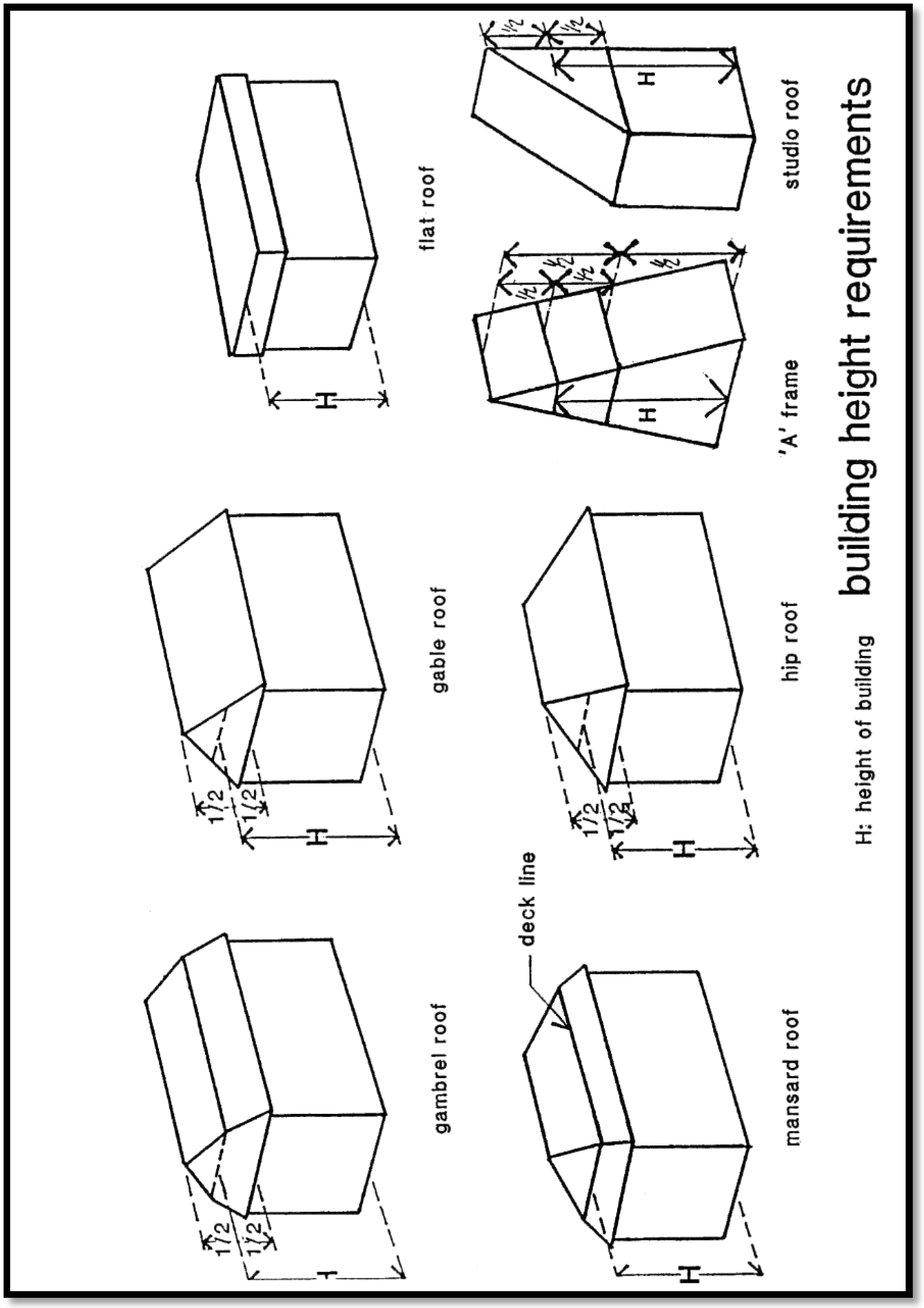
Building height means the vertical distance from the established grade of the center of the front of the building to the highest point of the roof surface of a flat roof; to the deck line of mansard roof; to the mean height level between the eaves and ridge for a hip, gambrel or gabled roof; and 75 percent of the height of "A" frame. Chimneys, spires, antenna, and similar projections other than signs shall not be included in calculating building height.
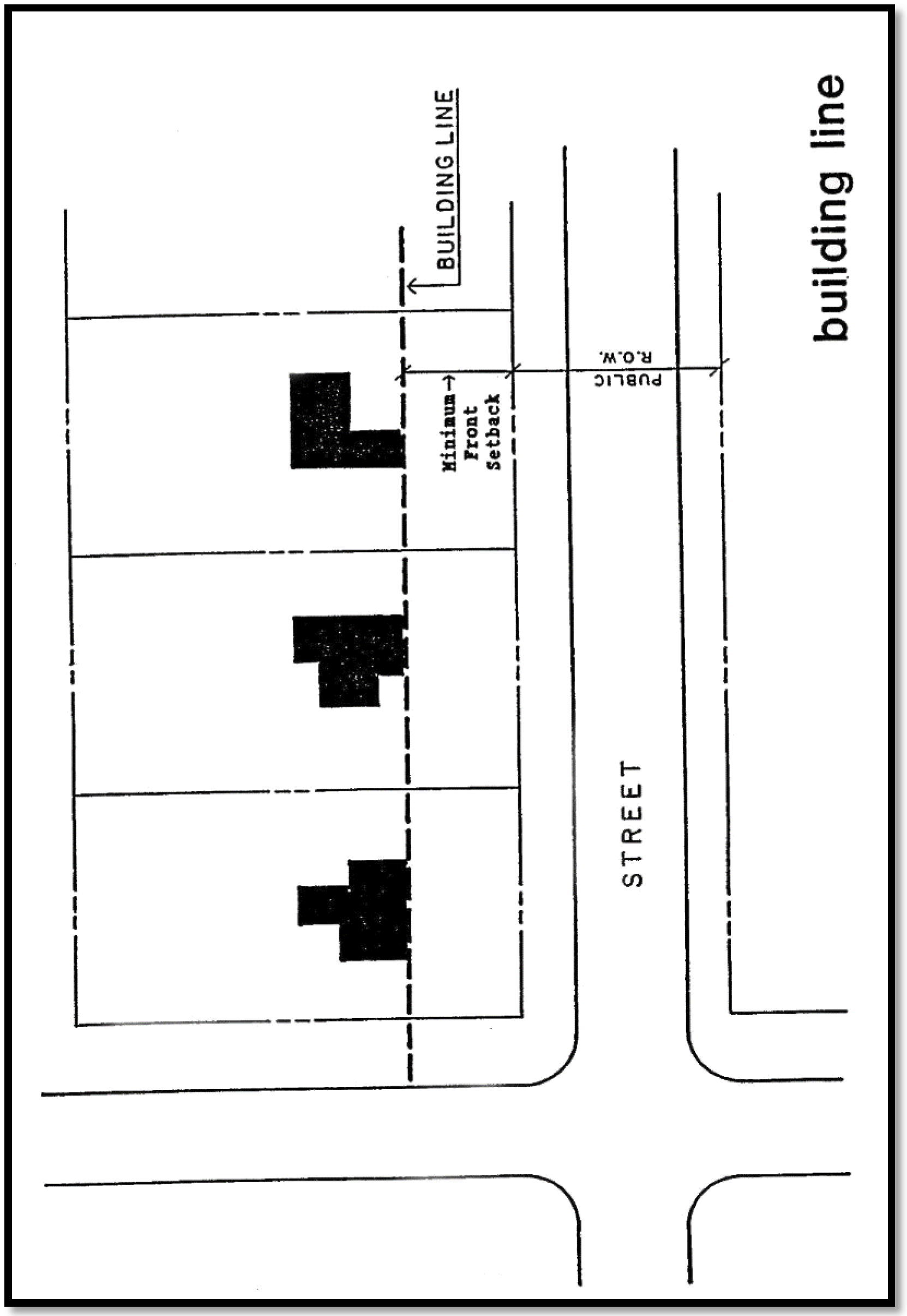
Building line means a line parallel to the front lot line that separates all parts of a building from the open spaces adjacent thereto on the same lot. For the purposes of this chapter, a minimum building line is the same as a required front yard setback line.
Building, principal means a building or group of buildings in which is conducted the main or principal use of the lot on which the building is situated. See "accessory use, building, or structure" and "use, principal."
Building, temporary means a building which is not permanently affixed to the property, and is permitted to exist for a specific reason for a specific period of time. An example of temporary building is a trailer used on a construction site.
Bulk means a composite characteristic of a given building as located upon a given lot; not definable as a single quantity, but involving all of the following characteristics:
(1)
Size and height of the building;
(2)
Location of exterior walls at all levels in relation to lot lines, streets, or to other buildings;
(3)
Gross floor area of the building in relation to lot area;
(4)
All open spaces allocated to the building; and
(5)
Amount of lot area provided per dwelling unit.
C
Canopy means a roof-like structure, other than an awning, made of rigid and durable materials with frames attached to and made a part of the building and further supported by a frame to the ground or sidewalk; or in the case of an automobile filling station or automobile repair garage that sells fuels, a canopy is a roof-like structure that is supported mainly by vertical support beams and not walls, it may or may not be attached to the principal building, and is designed to shelter the fuel pumps.
Carport means a structure consisting of a roof supported by posts which is otherwise open to the elements on at least two sides, which is mainly used for storage of automobiles.
Change of use constitutes the conversion of an existing structure from one class or type of use to another. Such a change may or may not include exterior building alterations.
Child care means the following:
(1)
Family day care home means a private home, licensed by the state, in which one but less than seven minor children are received for care and supervision for periods of less than 24 hours a day, unattended by a parent or legal guardian, except children related to an adult member of the family by blood, marriage, or adoption. Family day care home includes a home that gives care to an unrelated minor child for more than four weeks during a calendar year.
(2)
Group day care home means a private home, licensed by the state, in which more than six but not more than 12 minor children are given care and supervision for periods of less than 24 hours a day unattended by a parent or legal guardian, except children related to an adult member of the family by blood, marriage or adoption. Group day care home includes a home that gives care to an unrelated minor child for more than four weeks during a calendar year.
(3)
Child care center or day care center means a commercial facility, licensed by the state, receiving one or more children for care for periods of less than 24 hours a day, and where the parents or guardians are not immediately available to the child. Child care center or day care center includes a facility which provides care for not less than two consecutive weeks, regardless of the number of hours of care per day. The facility is generally described as a child care center, day care center, day nursery, nursery school, parent cooperative preschool, play group, or drop-in center. Child care center or day care center does not include a Sunday school, a vacation Bible school, or a religious instructional class that is conducted by a religious organization where children are in attendance for not more than three hours per day for an indefinite period or not more than eight hours per day for a period not to exceed four weeks during a 12-month period, or a facility operated by a religious organization where children are cared for not more than three hours while persons responsible for the children are attending religious services. State law reference(s)—Child care organizations, defined, MCL 722.111, MSA 25.358(11).
Cistern means a storage container that capture a larger volume of runoff stormwater than a rain barrel.
City means the City of Ypsilanti, Washtenaw County, Michigan.
City council means the city council of Ypsilanti, Washtenaw County, Michigan.
Club or lodge, private means a nonprofit association of persons who are bona fide dues paying members which owns or leases premises, the use of which is restricted to members and their guests. The facilities owned or used by such organization may be referred to as a "club" or "lodge" in this chapter.
Coin-operated amusement device means any mechanical or electrical device which provides amusement or entertainment which may be operated or set in motion upon the insertion of a coin or token, or payment of a fee. This definition shall not include juke boxes, music machines, telephone devices, machines which dispense merchandise or machines or devices that provide film or video tape presentations to a customer/user who is merely a passive spectator of such presentation. This exclusion shall not be deemed to exclude any machines or devices in which the customer/user is engaged in a form of competition against the machine or another customer/user.
Color temperature refers to the color appearance of light, measured in Kelvins (K).
Commission means the planning commission of the City of Ypsilanti, Michigan.
Communication device means an apparatus such as an antenna system or satellite dish stations of which the principal function is to send or receive television, radio, or data microwave signals.
Communication facilities, mobile means and includes all structures and accessory facilities relating to the use of the radio frequency spectrum for the purpose of transmitting or receiving radio signals. This may include, but not be limited to, cellular telephone towers, radio towers, television towers, telephone devices and exchanges, micro-wave relay towers, telephone transmission equipment building and commercial mobile radio service facilities. Not included within this definition are: citizen band radio facilities; short wave facilities; ham, amateur radio facilities; satellite dishes; and, governmental facilities which are subject to state or federal law or regulations which preempt municipal regulatory authority.
Communications facilities, mobile attached means mobile communication facilities that are affixed to existing structures, such as existing buildings, towers, water tanks, utility poles, and the like. A wireless communication support structure proposed to be newly established shall not be included within this definition.
Communication support structures, mobile means structures erected or modified to support wireless communication antennas. Support structures within this definition include, but not be limited to, monopoles, lattice towers, light poles, wood poles and guyed towers, or other structures which appear to be something other than a mere support structure.
Communication facility, co-location means the location by two or more wireless communication providers of mobile communication towers on a common structure, tower, or building, with the view toward reducing the overall number of structures required to support wireless communication antennas within the community.
Condominium means ownership in common with others of a parcel of land and certain parts of a building thereon which would normally be used by all of the occupants, such as yards, foundations, basements, floors, walls, hallways, stairways, elevators and all other related common elements, together with individual ownership in fee of a particular dwelling unit in such building.
Condominium Act means Act No. 59 of the Public Acts of Michigan of 1978 (MCL 559.101 et seq., MSA 26.50(101) et seq.), as amended.
Condominium lot means that portion of a condominium project designed and intended for separate ownership and/or exclusive use, as described in the master deed. Condominium lot is further defined as:
(1)
A condominium unit consisting of the area under a building envelope and the contiguous area around the building envelope which, by itself, meets the minimum area and yard requirements for lots within each zoning district.
(2)
The contiguous limited common element under and surrounding a condominium unit that is or will be assigned to the owner of the condominium unit, for the owner's exclusive use, and which, together with the condominium unit, meets the minimum area and yard requirements for lots within each zoning district.
Condominium structure or building envelope means the principal building or structure intended for or constructed upon a lot or building site, together with any attached accessory structures. For example, in a residential development, the condominium structure or building envelope would refer to the house and any attached garage.
Condominium unit means that portion of the condominium project designed and intended for separate ownership and use, as described in the master deed, regardless of whether it is intended for residential, office, industrial, business, or recreational use as a time-share unit, or any other type of use.
Cooperative housing means a multiple dwelling owned by a corporation which leases its units to stockholders/shareholders on a proprietary lease arrangement.
Correctional facility means a place of confinement for persons who have broken the law, are awaiting trial, and/or have been convicted of criminal offenses.
Curb cut means the entrance to or exit from a property provided for vehicular traffic to or from a public or private thoroughfare.
Craft manufacturing means establishments manufacturing and/or assembling products primarily by hand or with hand tools and/or domestic mechanical equipment. Items produced may include, but are not limited to, custom furniture and woodworking, ceramics and glass, items intended for consumption, personal care products, candle making, jewelry making, custom textile manufacturing and crafts production.
D
Department of community and economic development means the city department which reviews site plans, variance applications, proposed planned unit developments, and other applications associated with this chapter in order to provide information and recommendations that will assist the planning commission and zoning board of appeals in their determinations.
Designated consumption establishment means a facility licensed and authorized to permit adults 21 years of age and older to consume marihuana products at the location indicated on the state license.
District means a portion of the city within which, on a uniform basis, certain uses of land and/or buildings are permitted and within which certain regulations and requirements apply under the provisions of this chapter, such as building type, building height, building setback, and intensity of use.
Dormitory means those facilities used for housing students, which are owned and controlled by an educational institution and which are to be distinguished from hotels, motels, and boardinghouses. The terms "dormitory" and "residence hall" are to be used synonymously.
Drive-through service means a business activity so developed that its retail or service character provides a driveway approach and waiting spaces for motor vehicles so as to serve patrons while seated in their motor vehicle. An automatic teller machine or similar device shall not be included in this definition, provided that the device is not staffed and does not use any type of amplification device.
Dwelling means a building or portion thereof, containing sleeping, kitchen, and bathroom facilities designed for and occupied by one family, excluding hotels, motels, and inns. In no case shall a travel trailer, motor home, automobile, tent, or other portable building defined as a recreational vehicle be considered a dwelling. In the case of mixed occupancy where a building is occupied in part as a dwelling unit, the part so occupied shall be deemed a dwelling unit for the purposes of this chapter.
Dwelling, accessory means living or sleeping quarters, temporary or permanent, in an accessory building. Accessory dwelling units are prohibited in travel trailers, motor homes, or other recreational vehicle, auto chassis, boat, or portable building.
Dwelling, manufactured (also known as a "mobile home") means a vehicular, portable structure built on a chassis and designed to be used without a permanent foundation as a dwelling when connected to required utilities and which is, or is intended to be, attached to the ground, to another structure, or to a utility system on the same premises for more than 30 consecutive days. The unit shall be labeled as prescribed under the provisions of the mobile homes construction safety standards as promulgated by the United States Department of Housing and Urban Development being 24 CFR 3280. Recreational vehicles as described and regulated shall not be considered "mobile homes" for the purpose of this chapter. See also "dwelling, one-family or single-family."
Dwelling, premanufactured means an assembly of materials or products intended to comprise all or part of a building or structure, and that is assembled, at other than the final location of the unit of the building or structure, by a repetitive process under circumstances intended to ensure uniformity of quality and material content. The unit shall be labeled as prescribed in R408.31137 of the Michigan Department of Labor, Construction Code Commission Administrative Rules Part 11. See also "Dwelling, one-family or single-family."
Dwelling, multiple means a building designed for and occupied by three or more families living independently with separate housekeeping, cooking, and bathroom facilities for each. Multiple dwelling units include the following:
(1)
Apartment. An apartment is an attached dwelling unit with party walls, contained in a building with other apartment units which are reached from a common stair landing or walkway, or are accessed directly from the outside.
(2)
Efficiency unit or studio apartment. An efficiency unit or studio apartment is a type of multiple-family or apartment unit consisting of one principal room with sleeping facilities, plus bathroom and kitchen facilities, hallways, closets, and/or a dining alcove located directly off the principal room. Sleeping facilities may also be separated from the principal living space by dividers or lofts.
Dwelling, one-family or single-family means a detached building containing not more than one dwelling unit designed for residential use.
Dwelling, two-family or duplex means a detached building, designed exclusively to be occupied by two families living independently of each other, with separate housekeeping, cooking, and bathroom facilities for each.
Dwelling unit, single-family attached or townhouse means an attached single-family dwelling unit with party walls, designed as part of a series of three or more dwellings, with its own front door which opens to the outdoors at front level, and typically with its own basement utility connections, and front and rear yards. A townhouse may be located on its own lot, or may be located on land commonly owned by a condominium association or similar association. Townhouses are also commonly known as rowhouses.
E
Easement means a grant of one or more of the property rights by the property owner to and/or for the use by the public, a corporation, or another person or entity. The term "easement" often applies to public or private rights-of-way and to "utility easements" which give utility companies the right to use land for the construction and maintenance of utilities.
Encroachment means any construction, structure, filling grading, or deposition of materials in, upon, across or projecting into a floodplain, channel, or floodway.
Erected means built, constructed, reconstructed, moved upon, or any physical operations on land required for the building. Excavations, fill, drainage, and installation of utilities shall be considered part of erected.
Essential services means the erection, construction, alteration, or maintenance by public utilities or municipal departments or City licensed cable television companies or underground, surface, or overhead gas, steam, electrical, fuel or water systems for the purposes of transmission, distribution, collection, communication, supply or disposal; including towers, poles, boxes, wires, mains, drains, sewers, pipes, conduits, cables, fire alarm and police call boxes, traffic signals, hydrants, and similar equipment, which are necessary for the furnishing of adequate service by such utilities or municipal departments for the general health, safety, and welfare of the public. The location, size, and intensity of essential services shall be regulated by the standards of this chapter. Essential services shall also not include communication providers when there is more than one entity servicing a geographic area and which are not regulated by the state public service commission.
Excavation means the removal or movement of soil, sand, stone, gravel, or fill dirt, except for common household gardening, farming, and general ground care.
Excess marihuana grower means a facility holding five class C marihuana grower licenses and licensed to cultivate marihuana and sell or otherwise transfer marihuana to marihuana establishments.
F
Family means:
(1)
One individual;
(2)
A group of two or more persons related by blood, marriage or adoption, together with foster children; together with:
(i)
No more than two domestic workers employed by the household; or
(ii)
No more than three additional unrelated persons occupying the unit as boarders, roomers, or guests; all of whom are domiciled together as a common, domestic, household in a single dwelling unit;
(3)
A group of persons, none of whom are related to each other by blood, marriage, or adoption, who reside together in a single dwelling unit, provided that the total number of occupants in such group shall not exceed five, unless otherwise provided for in this chapter. Room areas shall comply with the following standards:
(i)
Living room area shall contain not less than 120 square feet.
(ii)
Dining room area shall contain not less than 80 square feet.
(iii)
Sleeping room area shall contain not less than 70 square feet for one person, plus at least 50 square feet for every additional person in that sleeping room.
(4)
A collective number of individuals living together in one dwelling unit, whose relationship is of a continuing, nontransient, domestic character, and who are cooking and living as a single, nonprofit housekeeping unit. This definition shall not include any society, club, fraternity, sorority, association, lodge, coterie, organization, or group of students or other individuals whose domestic relationship is of a transitory or seasonal nature or for an anticipated limited duration of a school term or terms or other similar determinable period.
Family day care home. See "child care."
Farmers' market means an indoor or outdoor market open to the public offering for sale at retail vegetables, produce, other farm products, and value-added food products, occurring in a pre-designated area, where the vendors are individuals who have grown or produced the food products or have taken the same on consignment for retail sale.
FBFM means the flood boundary and floodway map, used as a floodplain management map that depicts, based on detailed analyses, the boundaries of the 100-year and 500-year floods and the 100-year floodway. For the purposes of this chapter, the FBFM is the map titled Flood Insurance Rate Map(s) (FIRMS) Washtenaw County (All Jurisdictions) panel number(s) of 26161C; 00269E, 0288E, 0407E, and 0426E dated 4/3/12.
Fence means a permanent or temporary unroofed barrier enclosing or bordering a plot of land or portion thereof composed of wood, shrubs or suitable manmade materials for the purpose of preventing or controlling entrance, confining within, screening, or marking a boundary.
Fill means the deposit or dumping of any matter onto or into the ground, except for common household gardening, farming, and general ground care.
Firearms sales establishment means a place of business of a firearms dealer. A firearms dealer is any person engaged in the wholesale or retail sale of firearms, the repair of firearms, or the creation or fitting of special barrels, stocks, or trigger mechanisms for firearms. A firearms sales establishment shall be defined as only those establishments principally engaged in the display or sale of firearms or ammunition. A firearms sales establishment is not a store of a generally recognized retail nature, which may include firearms or ammunition as an incidental and accessory use, nor a range where less than half of the public area is devoted to sales. This does not include home occupations.
FIRM means the flood insurance rate map titled Flood Insurance Rate Map(s) (FIRMS) Washtenaw County (All Jurisdictions) panel number(s) of 26161C; 00269E, 0288E, 0407E, and 0426E dated 4/3/12.
Flood means a temporary increase in the stage of a river or stream resulting in the inundation of lands not normally covered by water.
Flood insurance study means the engineering study performed by FEMA to identify flood-prone areas, insurance risk zones, and other flood data and contained in a document titled, Flood Insurance Study, Washtenaw County (All Jurisdictions) Community Number 260216, dated April 3, 2012.
Floodplain means that area of land adjoining a river or stream which will be inundated by a 100-year flood.
Floodway means the channel of a river, stream, creek, or other watercourse and the adjacent land areas that must be reserved in order to discharge the base flood without cumulatively increasing the water surface elevation more than one foot. In the city, the floodway includes the Huron River and Paint Creek along with the adjoining land, as shown on the Federal Emergency Management Agency insurance maps.
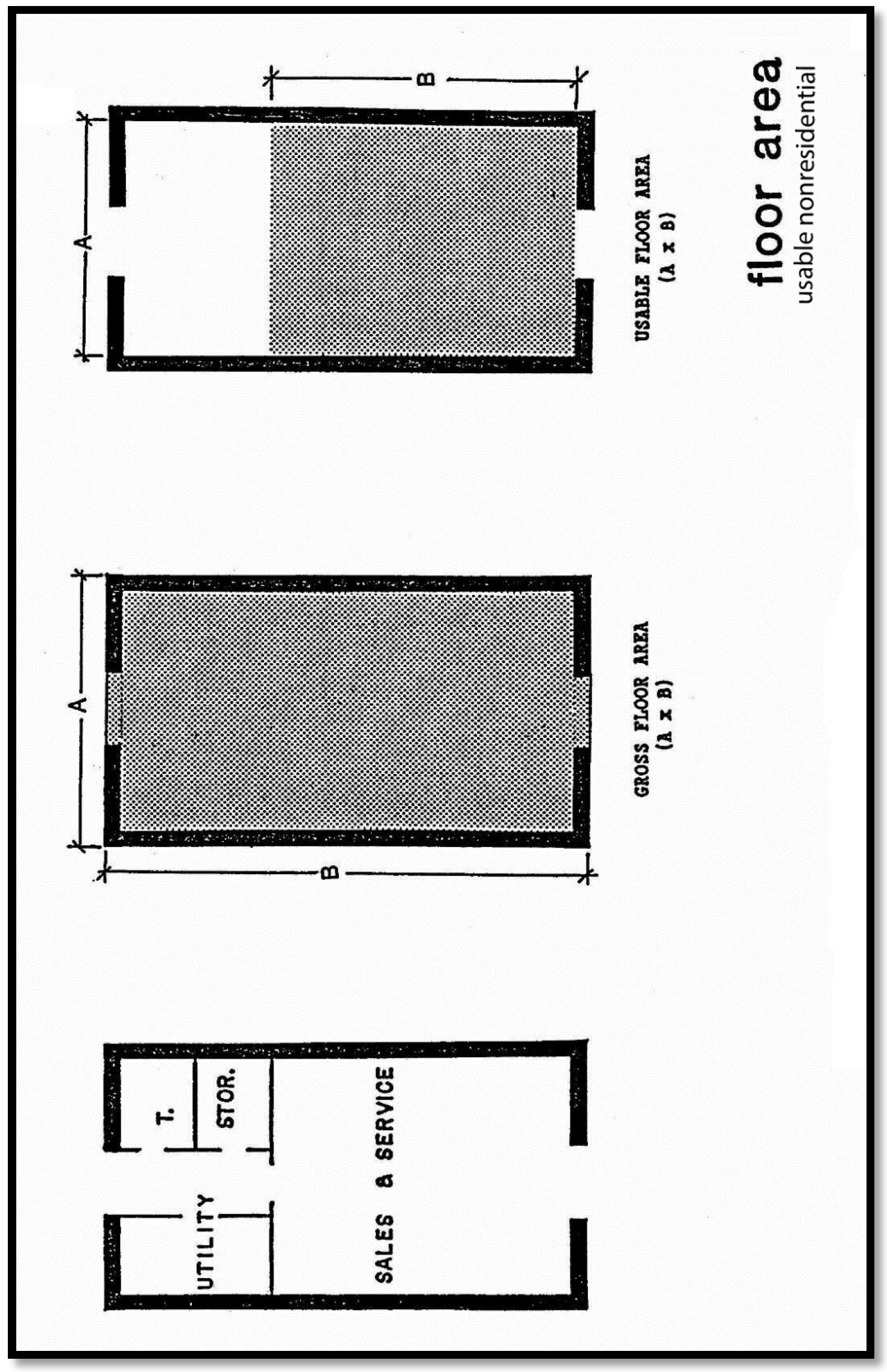
Floor area, gross means the total area of a building measured by taking the outside dimensions of the building at each floor level intended for occupancy or storage, not including any uncovered or unenclosed porches, patios, or decks.
Floor area, usable nonresidential means the sum of the horizontal areas of each floor, measured from the interior faces of the exterior walls, including all areas used for, intended to be used for, and accessible for the sale of merchandise, provision of services, or service to patrons, clients or customers. Floor area which is used for or intended to be used for the storage or processing of merchandise, or for utilities shall be excluded from the computations of usable nonresidential floor area. If precise floor plans are not available for calculations, usable nonresidential floor area shall be 80 percent of gross nonresidential floor area.
Floor area, usable residential means the gross floor area minus area in basements, unfinished attics, attic floor area with less than five feet vertical distance from floor to finished ceiling, attached garages, uncovered or enclosed porches, patios, terraces, carports, breezeways, decks, or verandas.
Footcandle means a unit of light intensity; one lumen per square foot.
Foster family home. A private residence, licensed by the state, that houses four or fewer foster children, up to age 19, under constant child care and supervision. Under Act No. 116 of the Public Acts of Michigan of 1973 (MCL 722.111 et seq., MSA 25.358(11) et seq.), a foster family home does not require local zoning approval before being licensed by the state department of social services.
Foster family group home. A private residence, licensed by the state, that houses five or six foster children, up to age 19, under constant care and supervision. Under Act No. 116 of the Public Acts of Michigan of 1973 (MCL 722.111 et seq., MSA 25.358(11) et seq.), a foster family group home shall be considered a residential use of property for the purposes of zoning and permitted use in all residential zones and is not subject to a special use permit or procedure different from those required for other dwellings of similar density in the same zone.
Fraternity or sorority house means a building, rented, occupied or owned by a national or local chapter of some regularly organized college fraternity or sorority which is officially recognized by a college or university, or by or on its behalf by a building corporation or association composed of members of such fraternity or sorority, as a place of residence.
Frontage, private refers to the side of the building that faces the primary street, and includes the area between the building façade and the lot line.
Frontage, public means between the face of the curb and the back of the sidewalk. It includes the sidewalk, street trees, street lighting, and any landscaped planting strips that there may be. The public frontage is the crucial area where pedestrians circulate and access property and buildings. It serves as the walkable urban districts' primary source of public open spaces, where people often mingle, converse, play, and eat. The public frontage is both an important part of the transportation system and of the social and economic fabric.
Fully shielded means a light fixture that is enclosed in such a manner that all light is directed downward.
Full cutoff fixture means a lighting fixture that emits no light above the horizontal plane of the fixture.
G
Garage means an accessory building or portion of a principal building used or designed to be used primarily for the storage of motor vehicles, boats, or trailers owned and used by the occupants of the building to which it is accessory.
Garden/community garden means land used to grow and harvest food or non-food crops for personal or group use. The products of gardens/community gardens may or may not be for commercial purposes.
Gas station. See "automobile filling station."
Geothermal energy means power extracted from heat stored in the earth. Geothermal resources include: all products of geothermal processes embracing indigenous steam, hot water and hot brines; steam and other gases, hot water and brines resulting from water, other fluids or gas artificially introduced into geothermal formations; heat or other associated energy found in geothermal formations, including any artificial stimulation or induction thereof; and, any mineral or minerals, exclusive of fossil fuels and helium gas, which may be present in solution or in association with geothermal steam, water or brines.
Glare means direct or reflective light emitted by a lamp, luminous tube lighting, or other light source.
Grade means the average level of the finished surface of the ground adjacent to the exterior walls of the building or structure.
Greenbelt means a strip of land of definite width and location reserved for the planting of a combination of shrubs, trees, and ground cover to serve as an obscuring screen or buffer for noise or visual enhancement, in accordance with the requirements of this chapter.
Greenhouse, commercial means a space, building, structure, or combination thereof, where live trees, shrubs, and other plants used in gardening and landscaping are propagated, stored, and/or offered for sale on the premises. If business is conducted primarily outdoors, see "open air business."
Group residence means a building used as a residence by a group of persons who are not a family on a weekly or longer basis. Typical uses include cooperatives, sororities and fraternities. This definition does not include boarding houses, roominghouses or other group living more specifically defined in this chapter, specifically any group living or care facility licensed by the State of Michigan.
Ground cover means low-growing plants that form a dense, extensive growth after one complete growing season, and tend to prevent weeds and soil erosion.
H
Holiday lighting. See "Seasonal lighting."
Home occupation means an occupation or profession carried on by a member or members of the immediate family residing on the premises which use is clearly incidental and secondary to the use of the dwelling for dwelling purposes; does not change the character thereof; and which does not endanger the health, safety, and welfare of any other persons residing in that area by reason of noise, noxious odors, unsanitary or unsightly conditions, fire hazards and the like.
Homeless shelter means a facility which provides congregate style temporary lodging with or without meals and supportive services on the premises to primarily the homeless for more than four (4) weeks in any calendar year. A shelter does not provide such lodging to any individual (1) who is required because of age, mental disability or other reason to reside either in a public or private institution or (2) who is imprisoned or otherwise detained pursuant to either federal or state law. A shelter for the homeless is considered a different land use than adult foster care facilities, supportive housing, nursing homes, temporary emergency shelters, or warming centers.
Hospital means an institution which is licensed by the state department of health to provide in-patient and out-patient medical and major surgical services for the sick and injured, and which may include such related facilities as laboratories, medical testing services, central service facilities, and staff offices.
Hotel or motel means a building in which lodging is provided and offered to the public for compensation, which is open to transient guests generally on a per-day basis and not for long-term lodging, in distinction from a roominghouse, bed and breakfast lodging, or inn. Hotels or motels customarily provide services such as desk service, maid service, laundering of linens, the use of furniture, etc. No kitchen or cooking facilities are to be provided, with the exception of units for use of the manager or caretaker; unless approved by the planning commission as a special use.
I
Indoor firearms range means an indoor facility operated for the purpose of shooting with firearms, whether publicly or privately owned and whether or not operated for profit.
Ingress and egress means, and is generally used in reference to a driveway which allows vehicles to enter or leave a parcel of property, or to a sidewalk or entranceway which allows pedestrians to enter or leave a parcel of property, a building, or another location.
Indoor recreation means recreation uses occurring entirely inside a building including bowling alleys, gymnasiums or court sports facilities, tennis clubs, roller or ice skating rinks, recreation centers, personal fitness centers, and similar recreation use.
Inn. See "bed and breakfast."
J
Junk means any motor vehicles, machinery, appliances, products or merchandise with parts missing, or other scrap materials that are damaged, deteriorated, or are in a condition which prevents their use for the purpose for which the product was manufactured.
Junkyard means an area where waste and used or secondhand materials are bought and sold, exchanged, stored, baled, packed, disassembled, or handled including, but not limited to: junk, scrap iron, metals, paper, rags, tires, bottles, and automobiles.
K
Kennel means any lot or premises on which four or more dogs, cats, or other domestic animals six months or older are kept, either permanently or temporarily, either for sale, breeding, boarding, training, hobby, protection, grooming or as pet; and may offer provision for minor medical treatment, including animal shelters.
L
Laboratory means a place devoted to experimental, routine, or basic study such as testing and analytical operations and in which the manufacturing of products, except prototypes, is not performed.
Landscaping means the treatment of the ground surface with live plant materials such as, but not limited to, grass, ground cover, trees, shrubs, vines, edible plants, and flowers. A landscape design may include other decorative manmade materials such as wood chips, crushed stone, boulder, raised garden beds, or mulch. Structural features such as fountains, pools, statues, and benches may also be considered a part of landscaping, but only if provided in combination with live plant material. Artificial plant materials shall not be counted towards meeting the requirements for landscaping.
Loading space, off-street means an off-street space of definite size and dimensions in accordance with the requirements of this chapter, which is safely and conveniently located on the same lot as the building or buildings being served, for the temporary parking of delivery vehicles while loading and unloading merchandise and materials.
Lot (or zoning lot or parcel) means a piece of land under one ownership and control that is at least sufficient in size to meet the minimum requirements for use, coverage, area, setbacks, parking, and open space as required by this chapter. A lot shall have frontage on a street. A lot may consist of the following:
(1)
A single lot of record. (See "lot of record").
(2)
A portion of a lot of record.
(3)
A combination of complete lots of record, or portion thereof.
(4)
A piece of land described by metes and bounds.
Lot, abutting means lots which share a common interior lot line and which are not separated by a public or private right-of-way or easement.
Lot, adjacent means lots which adjoin each other or which are separated only by a public or private right-of-way or easement.
Lot, contiguous means lots adjoining each other.
Lot, corner means a lot of which at least two adjacent sides abut their full length upon a street, provided that such two sides intersect at an angle of not more than 135 degrees. Where a lot is on a curve, if the tangents through the extreme point of the street lines of such lot make an interior angle of not more than 135 degrees, it shall be considered a corner lot. In the case of a corner lot with a curved street line, the corner is that point on the street lot line nearest to the point of intersection of the tangents described above. Tangents are straight lines extended from the outer edges of a curve which intersect to form a corner.
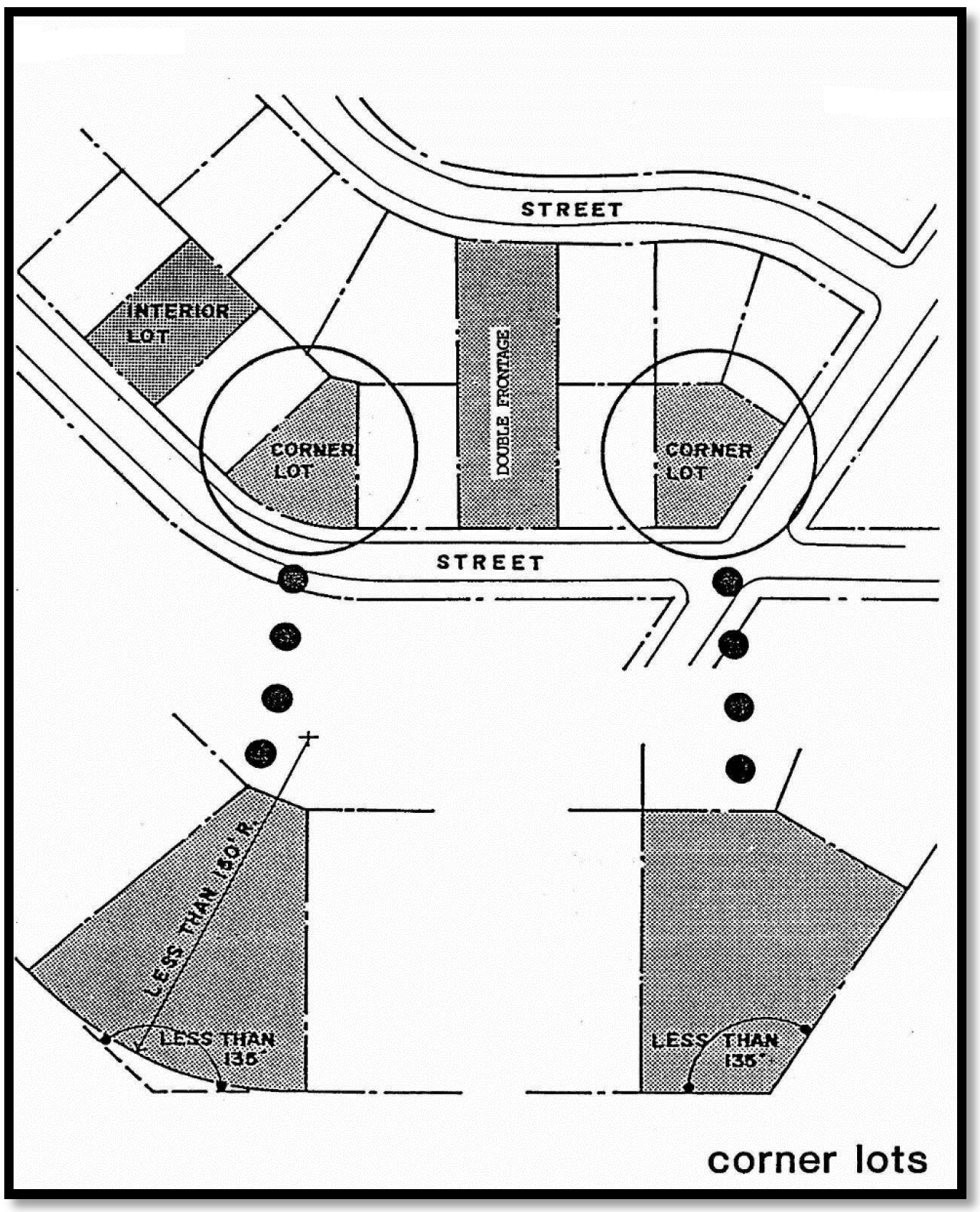
Lot, double frontage means a lot other than a corner lot having frontage on two more or less parallel streets. Also called a through lot. In the case of a row of double frontage lots, one street shall be designated as the front street for all lots in the plat. If there are existing buildings in the same block fronting on one or both of the streets, the required minimum front yard setback shall be observed on the street where buildings presently front.
Lot, interior means a lot other than a corner lot.
Lot area means the total horizontal area within the lot lines of a lot, exclusive of any abutting public street right-of-way or private road easements, or the area of any lake, except that any lot which abuts an alley, may include the area of half the width of such alley where it abuts the lot in determining the total area of that lot.
Lot coverage means the part or percent of the lot that is occupied by buildings or structures.
Lot depth means the horizontal distance between the front and rear lot lines, measured along the midpoint between the side lot lines.
Lot line means any line separating a parcel of land from another. Lot lines are further defined as follows:
(1)
Front lot line means, in the case of an interior lot abutting on one public or private street, the line separating the lot from such street right-of-way. In the case of a corner or double frontage lot, the front lot line shall be that line separating such lot from the street which is designated as the front street in the plat and/or in the request for a building permit.
(2)
Rear lot line means the lot line which is opposite and most distant from the front lot line. In the case of irregular, triangular, wedge shaped, or lots that are pointed in the rear, the rear lot line shall be an imaginary line parallel to the front lot line, not less than ten feet in length, lying farthest from the front lot line and wholly within the lot.
(3)
Side lot line means any lot line other than the front or rear lot lines. A side lot line separating a lot from a street is a street side lot line. A side lot line separating a lot from another lot or lots is an interior side lot line.
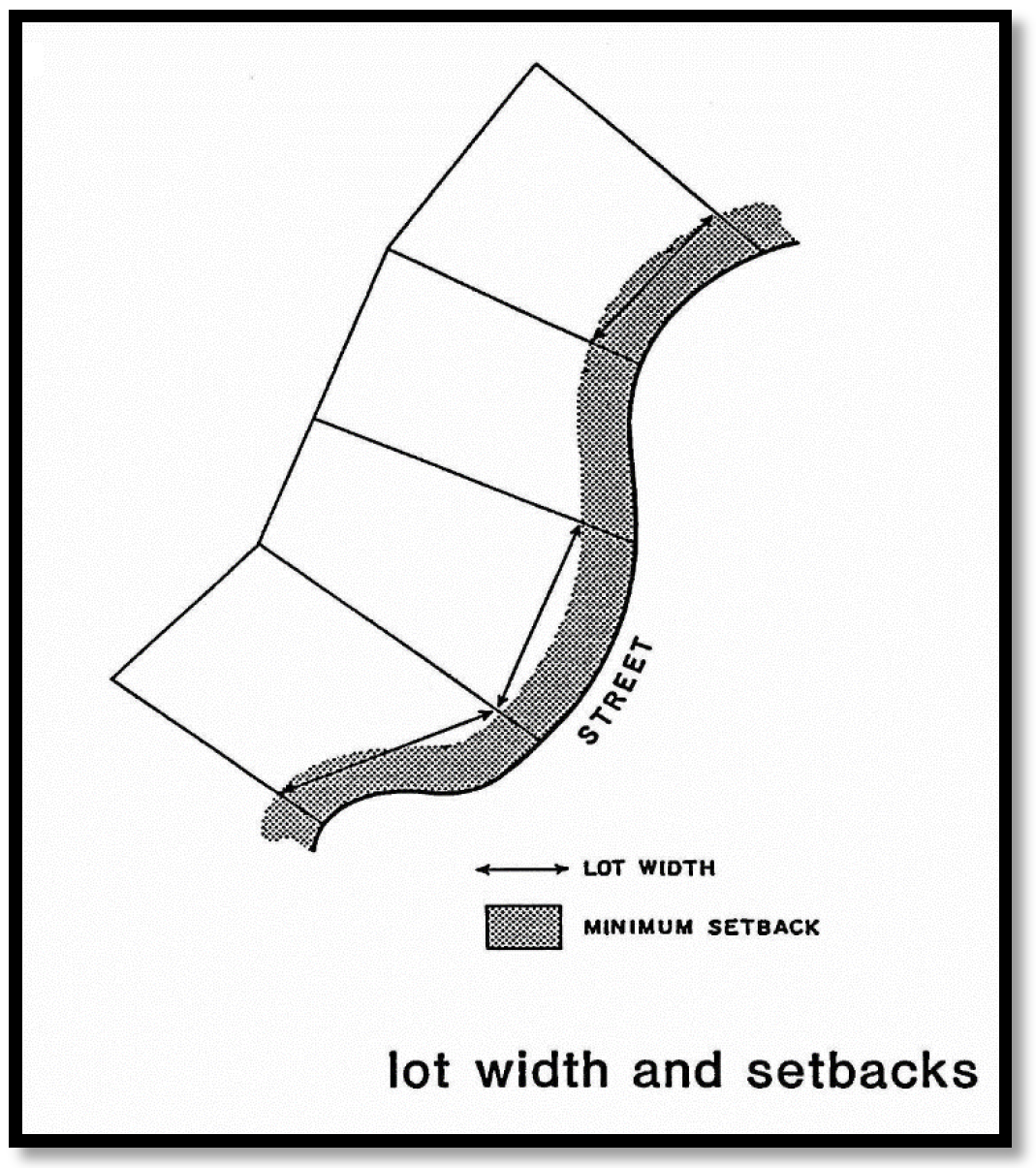
(4)
Interior lot line means any lot line which does not separate a lot from a street right-of-way. A lot line which separates a lot from an alley right-of-way shall be considered an interior lot line.
Lot of record means a lot or parcel of land, the deed of which has been recorded in the office of the registrar of deeds of the county.
Lot split or consolidation means the dividing or uniting of lots by virtue of changes in the deeds in the office of the county registrar of deeds and/or the city treasurer.
Lot, through. See "lot, double-frontage."
Lot width means the straight line distance between the side lot lines, measured at the two points where the minimum front yard setback line intersects the side lot lines.
Lumens means a measure of total light output from a source.
M
Major thoroughfare. See "street."
Marihuana dispensary or provisioning center means a facility that sells, supplies, or provides marijuana to registered qualifying patients, directly or through a registered primary caregiver; and as defined by the Michigan Medical Marihuana Facilities Licensing Act, PA 281 of 2016, as amended.
Marihuana growing and/or processing facility means a facility for the cultivation and/or processing of medical or recreational marihuana into a usable form. Also a "grower" or "processor" as defined by the Medical Marihuana Facilities Licensing Act, PA 281 of 2016, as amended, or a "marihuana grower" or "marihuana processor" as defined by the Michigan Regulation and Taxation of Marihuana Act, Initiated Law 1 of 2018.
Marihuana microbusiness means a facility licensed to cultivate not more than 150 marihuana plants; process and package marihuana; and sell or otherwise transfer marihuana to individuals who are 21 years of age or older or to a marihuana safety compliance facility, but not to other marihuana establishments as defined by the Michigan Regulation and Taxation of Marihuana Act Initiated Law 1 of 2018.
Marihuana retailer means a facility that sells, supplies, or provides recreational marihuana to individuals directly; and as defined by the Michigan Regulation and Taxation of Marihuana Act Initiated Law 1 of 2018.
Marihuana safety compliance facilities means a facility to test marihuana, including certification for potency and the presence of contaminant as defined by the Michigan Regulation and Taxation of Marihuana Act Initiated Law 1 of 2018.
Marihuana secure transporter means a facility licensed to obtain marihuana from marihuana establishments in order to transport marihuana to marihuana establishment as defined by the Michigan Regulation and Taxation of Marihuana Act Initiated Law 1 of 2018.
Massage parlor or massage establishment. See "adult regulated uses."
Massage therapist means an office where massage is performed for financial compensation only by individuals who satisfy the requirements of the Massage Therapy Licensing Act (PA 471 of 2008) as amended.
Master deed means the legal document prepared and recorded pursuant to Act No. 59 of the Public Acts of Michigan of 1978 (MCL 559.101 et seq., MSA 26.50(101) et seq.), as amended, to which is attached as exhibits and incorporated by reference the approved bylaws for the project and the approved condominium subdivision plan for the project.
Master plan means a document which is prepared under the guidance of the city planning commission and consists of graphic and written materials which indicate the general location for streets, parks, schools, public buildings, and all physical development of the city. The master plan is intended as a guide for all development within the city, and is used to guide the zoning board of appeals and the planning commission in all decisions before those bodies. The master plan is updated periodically.
Medical or dental clinic or office means an office of physicians, dentists, massage therapists, or similar professionals or which is staffed on a rotational basis with personnel from an area hospital, where persons are examined or treated on an outpatient basis only, including outpatient surgery.
Medical marijuana facility means a "marihuana facility" as defined by the Michigan Medical Marihuana Facilities Licensing Act.
Medical marijuana home occupation means the cultivation of medical marijuana by a registered primary caregiver as defined in Section 3 of the Act, MCL 333.26423(g), in compliance with the General Rules of the Michigan Department of Community Health, the Michigan Medical Marijuana Act, Initiated Law 1 of 2008, MCL 333.26423(e), within a single family dwelling that is the registered primary caregiver's primary residence and which cultivation is in conformity with the restrictions and regulations contained in the Act and in the state regulations developed by the Michigan Department of Community Health (MCDH). Medical marijuana home use does not include any multi-family dwelling.
State Law reference— Michigan Medical Marihuana Act, Initiated Law 1 of 2008, MCL 333.264 et seq.
Mezzanine. See "story, mezzanine."
Microbrewer/small distiller/small wine maker means a facility in which a limited amount beer, wine or other alcoholic beverages, defined by the State of Michigan Liquor Control Commission, are brewed, fermented, or distilled and then packaged and stored for distribution.
Motel. See "hotel" or "motel."
Motion-activated light means a light fixture that automatically turns on when it detects movement.
Municipality means the city.
Mural means a hand-produced work of visual art that is tiled or painted directly upon, or affixed directly to, an exterior wall of a building; considered ornamentation.
N
Nonconforming lot means a lot which was lawfully in existence at the effective date of the ordinance from which this chapter is derived, or amendments thereto, and which does not now conform to the lot size, lot width, or other provisions of this chapter for the zoning district in which it is located.
Nonconforming structure means a building or structure which was lawful on the effective date of adoption or amendment of this chapter, but which does not conform to the new chapter regulations for lot area, lot area per dwelling unit, lot width, lot coverage, floor area, height, greenbelts or screening, off-street parking, loading space, yard, or other requirements of the zoning district in which it is located.
Nonconforming use means a use which was lawfully in existence at the effective date of the ordinance from which this chapter is derived, or amendment thereto, and which does not now conform to the use regulations of this chapter for the zoning district in which it is now located. A nonconforming use may include a use that requires a special use permit under current regulations contained in this chapter, where under previous regulations a special use permit was not required or granted.
Nuisance means any offensive, annoying, or disturbing practice or object, which prevents the free use of one's property, or which renders its ordinary use or physical occupation uncomfortable. A nuisance commonly involves continuous or recurrent acts which give offense to the senses, violate the laws of decency, obstruct reasonable and comfortable use of property, or endanger life and health.
Nursery, day nursery, or nursery school. See "child care center."
Nursing home, convalescent home, or rest home means a home for the care of the aged, infirm, or those suffering from physical or mental disorders, wherein two or more persons are housed or lodged and furnished with nursing care. Such facilities are licensed in accordance with Act No. 368 of the Public Acts of Michigan of 1978 (MCL 333.20101 et seq., MSA 14.15(20101) et seq.), as amended.
O
Occupancy, change of means an abandonment of an existing use and the substitution of a use of a different kind or class, or the expansion of a use.
Occupied means used in any way at the time in question.
Open air business means any business that is conducted primarily out-of-doors. Unless otherwise specified, open air businesses shall include, but are not limited to:
(1)
Retail sales of garden supplies and equipment, including but not limited to: trees, shrubbery, plants, flowers, seed, topsoil, trellises, and lawn furniture.
(2)
Roadside stands for the sale of agricultural products, including fruits, vegetables, and Christmas trees.
(3)
Outdoor display and sale of model garages, swimming pools, playground equipment, and similar uses.
Open space means that part of a lot, including courts and/or yards, which is open and unobstructed from its lowest level to the sky, and is accessible to all occupants upon the zoning lot.
Ornamental lighting means decorative lighting used to accent features of buildings or landscapes, not primarily for illumination.
Ornamental uplighting means lighting used to illuminate architectural or landscape features from below.
Ownership, change in means whenever the title to the property is transferred to another person, including purchase by land contract.
P
Parcel. See "lot."
Park means either a publicly owned and designated park, or an amenity provided and maintained by a property owner for public use.
Parking garage means a building for the storage only of noncommercial vehicles of occupants in the same block or abutting blocks and providing no service to vehicles stored therein.
Parking lot, community means a parking lot on public or privately-owned property which provides parking with or without compensation for uses located in the general area in which it is situated.
Parking, off-street means an area not located within a public right-of-way which provides vehicular parking spaces along with adequate drives and aisles for maneuvering so as to provide for safe and convenient ingress and egress to the parking area.
Parking space means an area, enclosed or unenclosed, of definite length and width as designated in this chapter, to store one automobile or other vehicle which is fully accessible by a driveway connecting the parking space with a street, road or alley and permitting ingress and egress of an automobile. The term "parking space" is exclusive of the access drives and aisles thereto.
Party wall means a wall starting from the foundation and extending continuously through all stories to or above the roof that separates one building from another and that is in joint use by each building.
Passive solar building means a building with walls and roof that are predominantly transparent or translucent and does not have a foundation or permanent electrical utilities. Primarily used to grow plants. It may also be called a hoophouse or greenhouse.
Performance standard means a criteria or limit relating to nuisance elements which a particular use or operation may not exceed. Performance standards are typically established to control noise, odor, smoke, toxic or noxious matter, vibration, fire and explosive hazards, glare, heat, or other effects.
Person means an individual, trustee, executor, fiduciary, corporation, firm, partnership, association, organization, sole proprietor, or other legal entity acting as a unit.
Personal service establishment means a retail, office, or service business that is characterized by a one-on-one interaction between a customer and a proprietor or employee of the business. Includes but is not limited to the following types of establishments: tailor, beauty salon &/or barber, cobbler, locksmith, small appliance repair, graphic design or printmaking services, or postal center.
Planned unit development (PUD) means an area planned and developed as a single entity containing one or more residential clusters or planned unit residential developments or one or more public, quasi-public, commercial or industrial areas.
Planning Commission means the city planning commission, created pursuant to the provision of Act No. 110 of the Public Acts of Michigan of 2006 (MCL 125.3101 et seq.).
Porous paving means systems that allow water to pass freely through interstitial space ingrained throughout the paving matrix, thereby transforming traditionally impervious surfaces such as pervious concrete and asphalt, interlocking pavers, reinforced gravel and grass paving.
Principal use. See "use, principal."
Private street or road. See "street."
Public utility means any persons, firm, corporation, municipal department, or board, duly authorized through government rate regulation (such as by the state public utilities commission or the City) to furnish to the public under government regulations any of the following: electricity, gas, steam, communications services, cable television services, transportation services, water, sewer service, or sewage treatment.
Premises means a lot or property together with all buildings or structures thereon.
R
Rain gardens mean landscaped depressions that can be built to any size or shape. Also known as "bio-retention cells," they are designed to allow water to settle and infiltrate into the soil.
Recycling center means an enclosed area or storage facility where area residents can drop off recyclable household wastes such as newspapers, cans, bottles, plastics, and cardboard which may be sorted and stored for short periods of time on the site until hauled away to another location for processing, reuse, or safe disposal.
Religious institution means any structure wherein persons regularly assemble for religious activity or worship, including such uses normally accessory thereto, such as a fellowship hall, religious classrooms, parsonages or rectories, and offices. Where a group of persons, who are affiliated with a religious organization, reside together within a dwelling which is the principal building on a site, such dwelling shall not be considered a religious institution.
Refuse means the miscellaneous waste materials resulting from housekeeping, mercantile enterprises, trades, manufacturing and office, including other waste matter such as slag, stone, broken concrete, fly ash, sashes, tin cans, glass, scrap metal, rubber, paper, rags, chemicals, or any similar or related combinations thereof.
Research use means facilities for scientific research, and the design, development and testing of electrical, electronic, magnetic, optical and computer and telecommunications components in advance of product manufacturing, and the assembly of related products from parts produced offsite, where the manufacturing activity is secondary to the research and development activities, and includes pharmaceutical, chemical, and biotechnology research and development.
Residentially zoned means any zoning district, outside of a Center or Corridor District, where single family dwellings or two-family dwellings are a permitted use.
Restaurant means any establishment whose principal business is the sale of food and beverages to the customer in a ready-to-consume state, and whose method of operation is characteristic of a carry-out, drive-in, drive-through, fast food, or sit-down restaurant, as defined below. Any restaurant which combines elements of two or more of the following types of restaurants shall be subject to the regulations of the most restrictive restaurant type employed:
(1)
Restaurant, carry-out. A restaurant whose method of operation involves the sale of food, beverages, and/or frozen desserts in disposable or edible containers or wrappers in a ready-to-consume state for consumption off the premises, typically from a counter or window inside the building. Indoor seating for consumption on the premises is typically not present.
(2)
Restaurant, drive-in. A restaurant whose method of operation involves delivery of prepared food so as to allow its consumption in a motor vehicle or elsewhere on the premises, but outside of an enclosed building.
(3)
Restaurant, drive-through. A restaurant whose method of operation involves the delivery of the prepared food to the customer in a motor vehicle, typically through a drive-through window, for consumption off the premises. Indoor seating for consumption on the premises is typically not present.
(4)
Restaurant, fast food. A restaurant whose method of operation involves minimum waiting for delivery of ready-to-consume food to the customer at a counter for consumption at tables, booths, or stands inside the structure or out, or for consumption off the premises, but not in a motor vehicle at the site.
(5)
Restaurant, sit-down. A restaurant whose method of operation involves either:
(i)
The delivery of prepared food by servers (waitpersons) to customers seated at tables within a completely enclosed building; or
(ii)
The prepared food is acquired by customers at a cafeteria line or ordering counter and is subsequently consumed by the customers at tables within a completely enclosed building.
Right-of-way means a right-of-way dedicated to or owned by a public body and available for use by the general public. In the case of public streets, the right-of-way often includes curbs, lawn strips (also referred to as the margin or parkway), sidewalks, and lighting and drainage facilities.
Room, for the purpose of determining lot area requirements and density in a multi-family district, means a living room, dining room, or bedroom, and any other room equal to at least eighty (80) square feet in area. A room shall not include the area in kitchen, sanitary facilities, utility provisions, corridors, hallways and storage.
Roominghouse means a building, other than a hotel or motel, bed and breakfast lodging, or inn, where for compensation or by prearrangement for definite periods of time, lodging or lodging and meals are provided for three or more unrelated persons, not living as group or household. The term "unit" as it refers to a roominghouse shall mean sleeping room, or a room which may be used as a sleeping room. (See "sleeping room.") A boardinghouse or lodginghouse shall be deemed a roominghouse for the purposes of this chapter.
S
Satellite antenna means an accessory structure which at its widest dimension is in excess of 36 inches, capable of receiving signals from orbiting satellites and other extraterrestrial sources, together with other equipment related to such purposes.
School means any building, playing field, or property used for school purposes to impart instruction to children in grades kindergarten through 12, when provided by a public, private, denominational, or parochial school, except those buildings used primarily for adult education or college extension courses.
Screen or screening means a wall, non-wire fence, or combination of plantings of sufficient height, length, and opacity to form a visual barrier
Seasonal lighting, also known as holiday lighting, refers to temporary lighting displays associated with holidays or cultural events, not exceeding 90 consecutive days per calendar year.
Self-storage facility means a building or group of buildings in a controlled access compound that contains individual compartmentalized and controlled access stalls or lockers of no more than 500 square feet each for the dead storage of customers' goods or wares in enclosed buildings.
Setback means the distance between a front, side, or rear lot line and the nearest supporting member of a structure on the lot. The "minimum required setback" is the minimum distance between a front, side, or rear lot line and the nearest supporting member of a structure (including, but not limited to, the foundation, bay windows or similar architectural features at the ground floor level supported by the building or the ground, and enclosed or covered porches) in order to conform to the required yard setback provisions of this chapter. For a site condominium, setbacks are measured from the respective front, side, and rear yard area lines associated with the condominium lot to the respective front, side, and rear of the condominium structure/building envelope.
SIGNS
Sign means any visual or graphic device designed to inform or attract attention and which is designed to be visible from outside any building or structure in which, upon which, or attached to which it may be located.
Sign, abandoned means a sign that contains or exhibits broken panels, visible rust, visible rot, damaged support structures, or which is otherwise dilapidated, unsightly, or unkempt; and for which the business or property owner has not accepted maintenance responsibility or intentionally altered for a period of no less than 365 days, where such acts evidence an intent to abandon.
Sign, animated means a sign that uses light emitting elements including but not limited to light bulbs, fixtures, LEDs, fiber optic lighting to create a continuously scrolling, flashing, or animated effect.
Sign, awning means a sign that is painted on, attached to, or an integral part of an awning or canopy; considered a building-mounted sign.
Sign, banner means a sign consisting of a large piece of cloth or similar flexible material; considered a temporary sign.
Sign, billboard means any freestanding permanent sign that is more than ten feet tall and has an area of more than 300 sf, and as defined in the Highway Advertising Act of 1972, PA 106 of 1972, as amended.
Sign, building-mounted means a sign that is attached to a building. Such signs may include, but are not limited to awning, projecting, wall, and window signs.
Sign, electronic message means a sign with a message displayed on a surface with an electronically illuminated changeable copy area, often composed of LEDs.
Sign, freestanding means any sign not attached to a building, including monument or pole signs.
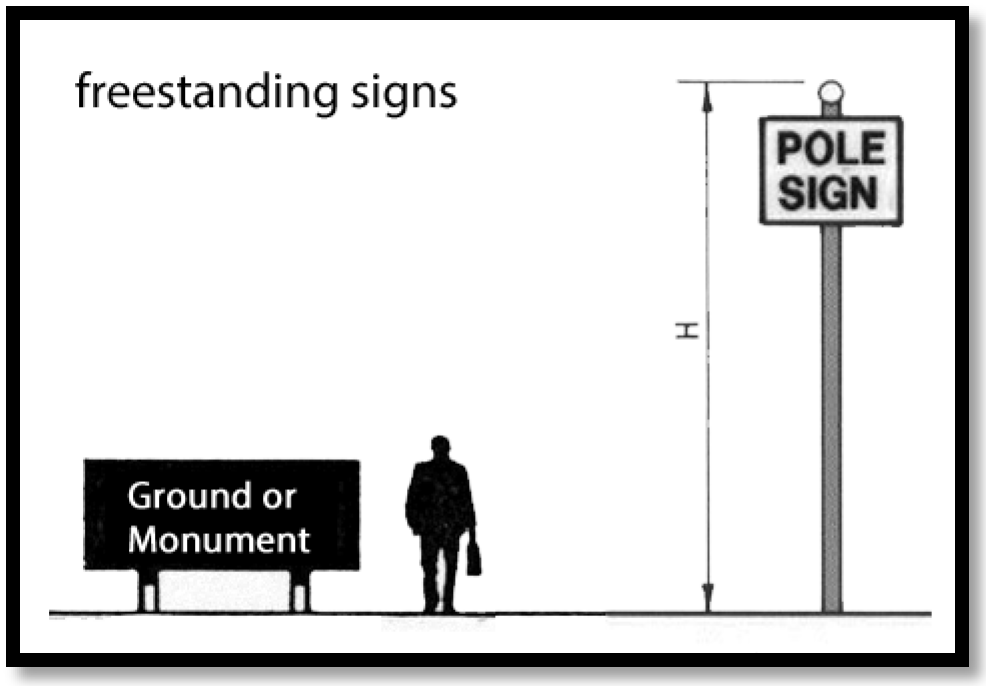
Sign, historic marker means a sign that is erected by a duly organized local historic preservation organization.
Sign, illuminated means a sign that provides artificial light directly or through transparent or translucent material from a source connected to or within such a sign, on which is illuminated by a light so shielded as to prevent direct rays from being visible from the public right-of-way.
Sign, inflatable means a sign that is intended to be expanded by air or other gas for its proper display or support; considered a temporary sign.
Sign, mechanical means a sign that has any visible moving parts, mechanical movement or other apparent visible movement, achieved by electrical or mechanical means or action of normal wind currents.
Sign, overhead banner means a sign consisting of a large piece of cloth or similar flexible material suspended across a street or other public space and attached at each end; considered a temporary sign.
Sign, permanent means a sign that is securely anchored and affixed to the ground or a building in a manner such that it can remain in place without maintenance for an indefinite period of time, often one year or more.
Sign, projecting means a sign which is attached directly to the building wall or suspended under an awning, canopy, or marquee, and which extends more than 18 inches from the face of the wall; considered a building-mounted sign.
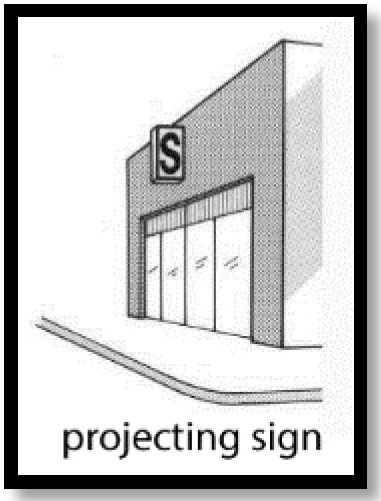
Sign, public means a sign erected or installed by a government entity.
Sign, roof means a sign which is constructed and maintained upon or above the roof of a building, marquee, or parapet wall and which is wholly or partially supported by such building; considered a type of building-mounted sign.
Sign, sidewalk means a temporary sign placed within the pedestrian right-of-way. These types of signs include "A" Frame and "T" Frame styles.
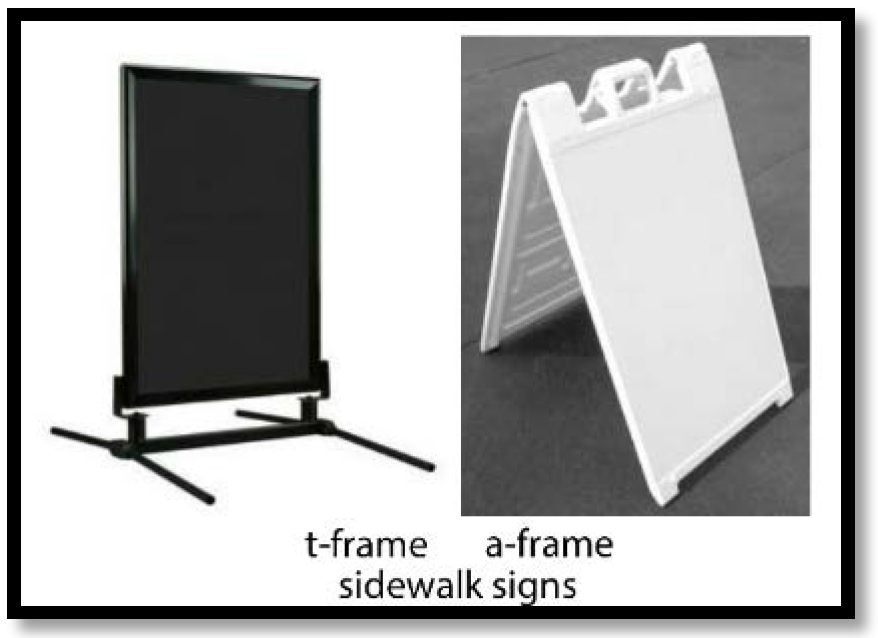
Sign, temporary means signs not permanently affixed to the ground or to a building, often constructed of cloth, canvas, fabric, plastic or other light temporary material, with or without a structural frame.
Sign, wall means a sign which is painted on or attached directly to a building wall that extends 18 inches or less from the face of the wall and which does not extend above the parapet, eaves, or building façade; considered a type of building-mounted sign.
Sign, window means any sign within a building placed within 12 inches of a window or upon a window pane and that is visible from the exterior of the building, not including merchandise located in a window.
Sign area means the gross surface area within a single continuous perimeter enclosing the extreme limits of all sign copy, or the surface of any internally-illuminated sign. Such perimeter does not include any structural or framing elements lying outside the limits of such sign and not forming an integral part of the display. Where a sign has two or more faces, the sign area shall equal the total area of all sign faces, except where two faces are placed back to back and are at no point more than three feet apart, in which case the sign area is considered to be the area of the larger face.
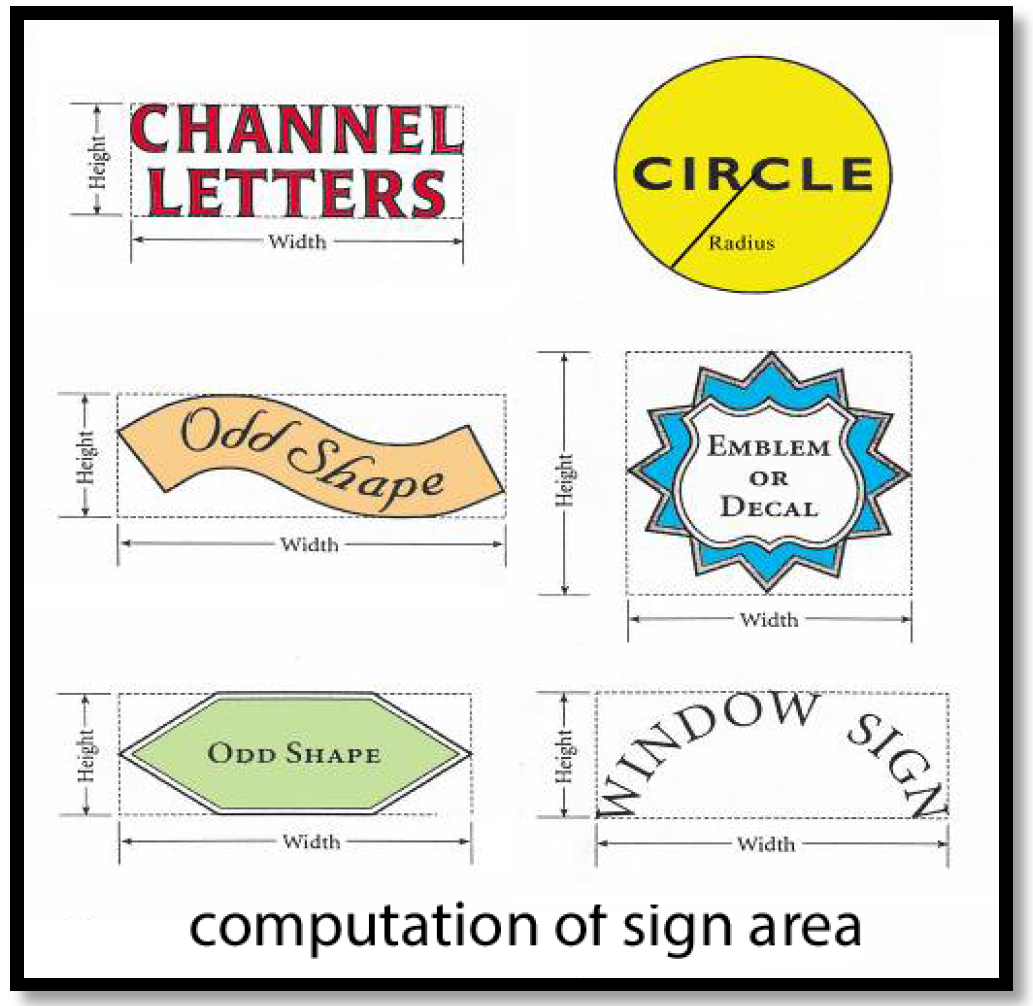
Sign height means the vertical distance measured from the average grade at the sign location to the highest point of the sign.
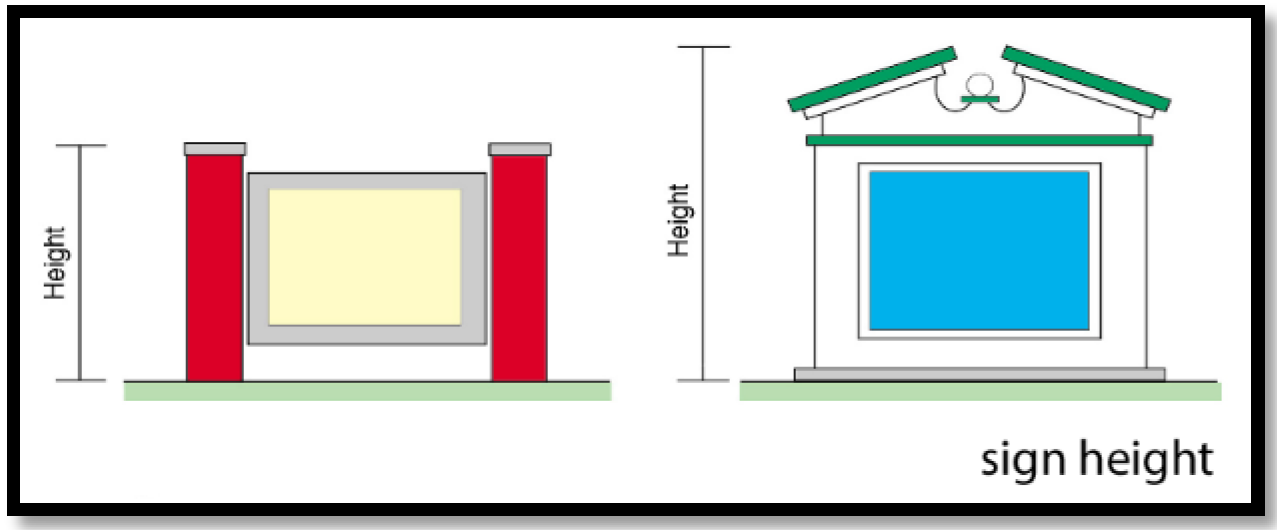
Sign structure means anything constructed or erected for the exclusive purpose of supporting a sign.
Site plan means a detailed plan showing all features of a proposed development so that the proposal may be evaluated to determine whether it meets the provisions of this chapter.
Sky glow means the brightening of the night sky over populated areas caused by outdoor lighting and reflection.
Sleeping room means a single room within a roominghouse which is usually individually rented and the entry door to the room is individually locked requiring the use of a key to gain access, and which is primarily used for sleeping purposes. The occupants may have direct access within the building to sanitary facilities, kitchen facilities and dining facilities or may share these facilities in common with other residents. See "roominghouse."
Solar collector means a device, substance, or element that relies upon sunshine to absorb and transform direct solar radiation through a medium to generate energy that can be used to heat or cool a building, heat or pump water, or generate electricity or other application that would otherwise require the use of a non-renewable energy source.
Solar farm means large areas of land with several photovoltaic modules and inverters, or parabolic troughs placed on them for large scale energy generation.
Sorority house. See "fraternity or sorority house."
Special use means a use that would be detrimental to other uses permitted in the same zoning district unless carefully controlled as to the number, area, size, exterior design, location, or relation to the adjacent properties and to the neighborhood or city as a whole, and may be permitted if the proper safeguards are taken. Formerly called conditional use.
Story means that portion of a building included between the upper surface of any floor and the upper surface of the next floor above it, or any portion of a building between the topmost floor and the roof having a usable floor area which exceeds two-thirds of the usable floor area of the floor immediately below it. Mezzanines and basements shall be deemed full stories as specified within their definitions.
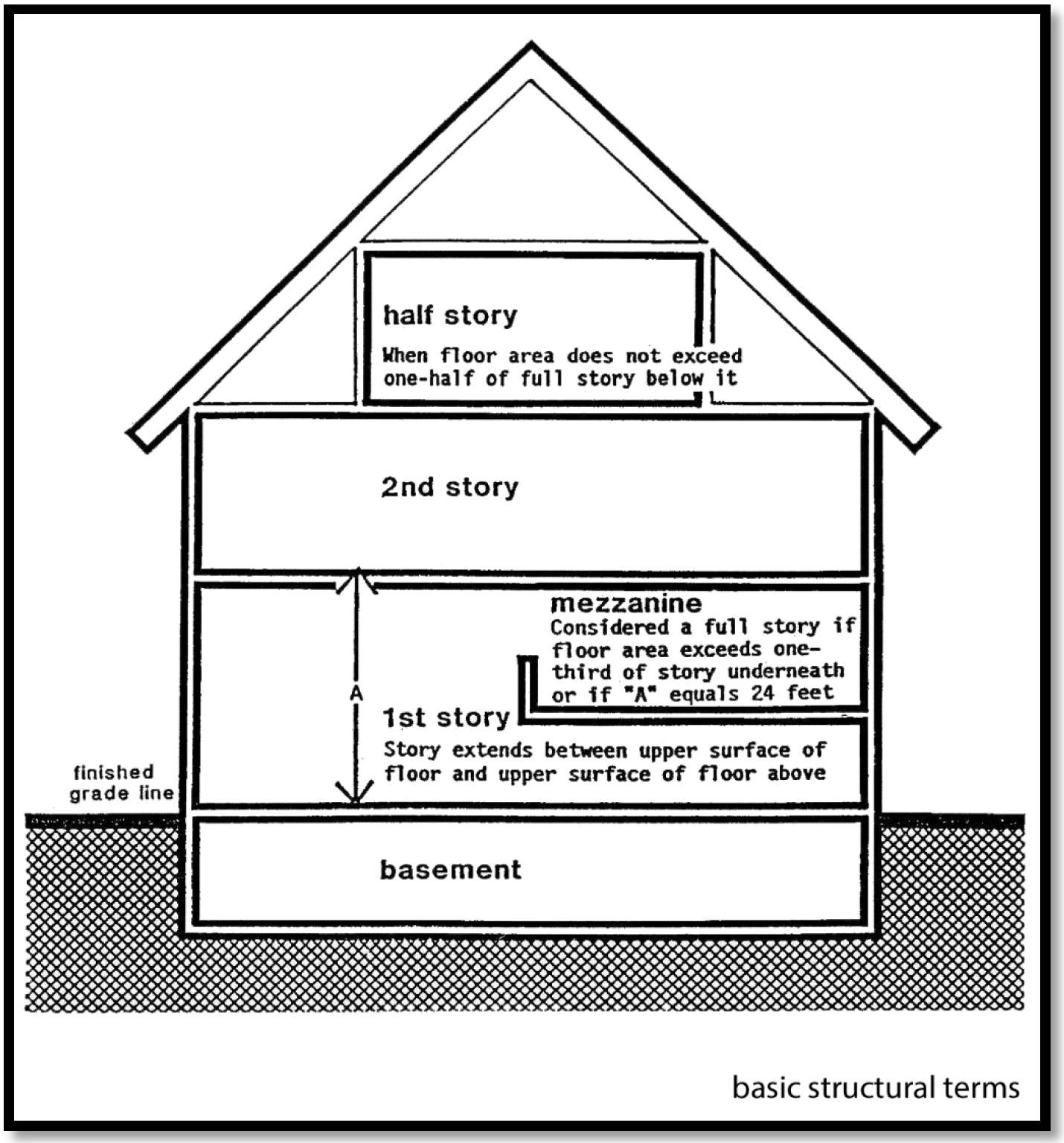
(1)
A mezzanine shall be deemed a full story when it covers more than one-third of the area of the story underneath such mezzanine, or if the vertical distance from the floor next below the mezzanine to the floor next above it is 24 feet or more.
(2)
A basement shall be considered a story above grade where the finished surface of the floor above the basement is:
(i)
More than six feet above grade plane;
(ii)
More than six feet above the finished ground level for more than 50 percent of the total building perimeter; or
(iii)
More than 12 feet above the finished ground level at any point.
(3)
Story, first means the lowest story of the ground story of any building that is not a basement, except that any basement or cellar used for residential purposes shall be deemed the first story.
(4)
Story, half means a partial story under a gable, hip or gambrel roof, the usable floor area which does not exceed two-thirds of the floor area of the uppermost full story.
Street means a public or private street, road, or thoroughfare intended primarily to provide vehicular circulation and access to abutting property. Various types of streets are defined as follows:
(1)
Collector street means a street whose principal function is to carry traffic between local or minor streets and major streets but may also provide direct access to abutting properties.
(2)
Cul-de-sac means a street that terminates in a vehicular turnaround.
(3)
Local or minor street means a street whose function is to provide access to abutting properties.
(4)
Major thoroughfare means a street that carries high volumes of traffic and serves as a main avenue through or around the city. Major thoroughfares may also be referred to as major streets or arterial streets. For the purposes of this chapter, major thoroughfares shall include those streets designated as "state trunkline," "county primary," or "major street" on the most recently approved City of Ypsilanti Act 51 map (P.A. 1951).
Street line means a dividing line between a street and a lot, also known as the right-of-way line.
Street, primary means the street to which a property is addressed; if a property has more than one address, then the primary street is the one that has the higher National Functional Classification (NFC); if the property has more than one address and the NFC levels are equal, then the primary street is the one that has more frontage.
Street, private means a street or road under private ownership which has been constructed for the purposes of providing access to adjoining property and which is normally open to the public so that persons other than the occupants of adjoining property may travel thereon, but which has not been accepted for maintenance by the city, county, state, or federal government.
Street, public means a street or road, the right-of-way and improvements of which have been accepted for maintenance by the City, county, state or federal government.
Structure means anything constructed or erected in, on, over or below the ground. All buildings are structures, however, not all structures are buildings. Structures include, but are not limited to, principal and accessory buildings, tower, decks, fences, privacy screens, wall, antennae, swimming pools, and sign structures.
Structure, accessory. See "accessory use, building, or structure."
Subdivision plat means the division of a tract of land into two or more lots, building sites, or other divisions for the purpose of sale or building development, in accordance with the land division act, Act No. 288 of the Public Acts of Michigan of 1967 (MCL 560.101 et seq., MSA 26.430(101) et seq.), as amended.
Substance abuse treatment facility means:
(1)
Boarding. Any facility providing substance abuse treatment or preventive or addictive counseling, including the dispensing of or distribution of drugs as part of the treatment, where individuals receiving the treatment live on the premises for a period of time, including overnight stays.
(2)
Walk-in. Any facility providing substance abuse treatment or preventive or addictive counseling, including the dispensing or distribution of drugs as part of the treatment plan, where no one resides on the premises overnight.
Supportive services are services provided to residents of supportive housing for the purpose of facilitating the independence of residents, and may be provided on the premises, or off-site. Some examples are case management, medical or psychological counseling and supervision, child care, transportation, and job training.
Swale, biofiltration means shallow drainage ways with low-pitched side slopes that detain, evaporate, and/or infiltrate the runoff associated with a storm event. They are designed to remove silt and sediment-associated pollutants before discharging to storm sewers and to reduce volume if soils allow for infiltration. Swales may be rock-lined or vegetated.
Swimming pool means any structure or container located either above or below grade designed to hold water to a depth of greater than two feet when filled, and intended for swimming, bathing, or aquatic recreation. A swimming pool does not include plastic, canvas, or rubber portable pools temporarily erected upon the ground holding less than 300 gallons of water nor decorative pools with less than two feet of water depth.
T
Temporary use or building. See "building, temporary" or "use, temporary."
Theater means an enclosed building used for presenting performances or motion pictures which are observed by paying patrons from seats situated within the building.
Townhouse. See "dwelling unit, single-family attached or townhouse."
Toxic or hazardous waste means waste or a combination of waste and other discarded material including solid, liquid, semi-solid or contained gaseous material which because of its quantity, concentration, or physical, chemical, or infectious characteristics may cause or significantly contribute to the following if improperly treated, stored, transported, disposed of, or otherwise managed:
(1)
An increase in mortality;
(2)
An increase in serious irreversible illness;
(3)
Serious incapacitating, but reversible illness; or
(4)
Substantial present or potential hazard to human health or the environment.
Tree means a self-supporting woody, deciduous or evergreen plant with a well-defined central stem which normally grows to a mature height of 15 feet or more in the county.
U
Use means the purpose for which land, lots, or building thereon is designed, arranged, or intended, or for which it is occupied, maintained, or leased.
Use, accessory. See "accessory use, building, or structure."
Use, nonconforming. See "nonconforming use."
Use, permitted means a use which may be lawfully established in a particular district or districts provided it conforms with all requirements, regulations, and standards of such district.
Use, principal means the main use of land and/or buildings and the main purpose for which land and buildings exist.
Use, special. See "special use."
Use, temporary means a use permitted to exist during a specified period of time under conditions and procedures as provided in this chapter.
Use, unclassified means a use that is not specifically or implicitly addressed in this chapter, often due to emerging technologies or omissions within this chapter. Such uses are so differentiated from uses or categories specified in this chapter that the standards of this chapter cannot be reasonably applied to them.
Use, residential means a use classified as residential under the building code, generally including single-family residences, one- and two-family homes and group living. For the purposes of the zoning ordinance, this shall not include hotels or bed and breakfasts.
Use, non-residential means any use not classified as residential under the building code. For the purposes of the zoning Ordinance, this includes hotels and bed and breakfasts.
V
Variance means a modification of the literal provisions of this chapter in accordance with the provisions of this chapter in cases where strict enforcement would cause undue hardship as a result of special circumstances affecting an individual property that do not generally affect other properties in the same zoning district.
Vehicle storage facility means a building or portion thereof or an outdoor controlled-access compound, designed or used exclusively for long-term or seasonal storage of four or more automobiles, trucks, tractors, boats, mobile homes, recreational vehicles and trailers, and other types of vehicles. A vehicle storage facility may be combined with a self-storage facility.
Vehicle, commercial means a truck or motor vehicle with cab and chassis and with a stake, rack, body, dump body, wrecker body, tanker body or any other body, the mounted height of which exceeds the height of the cab roof more than eight inches. Any truck or motor vehicle which has a commercial license plate and is designed to accommodate a body length in excess of nine feet. Commercial vehicles shall not include motor homes or recreational vehicles, but shall include construction equipment such as backhoes, power shovels, bulldozers, earth moving equipment, semi trucks, tractors and trailers.
Vehicle, inoperable means any motor vehicle which, by reason of dismantling, disrepair, or other causes, is incapable of being propelled under its own power or any motor vehicle which meets any of the three of the following requirements: has any missing or broken windows; has a missing hood; has a missing door; has missing or flat tires; has missing trunk lid; has a missing engine, or any substantial part thereof; is inoperable because of missing or defective steering mechanism; does not have any or all of the following: operable head lights, parking lights, clearance lights, tail lights, stop lights.
Vehicle, motor means any wheeled vehicle which is self-propelled or intended to be self-propelled.
Vehicle, recreational means a boat, snowmobile, off-road vehicle, camper travel trailer, motor home, pick-up camper, trailer which is designed for private recreational or recreational travel use and/or has a recreational license plate. Any trailer which is principally used for transporting any of the above shall also be considered a recreational vehicle.
Vehicle, unlicensed means any motor vehicle that does not have lawfully affixed to it a valid, unexpired license plate.
Vehicle, untitled means any motor vehicle which has not been titled in accordance with the law.
Vegetated roof means the roof of a building that is partially or completely covered with vegetation, including for food production, and a growing medium, planted over a waterproofing membrane.
Veterinary clinic or hospital means a place for the care, diagnosis, and treatment of sick or injured animals, or those in need of medical or minor surgical attention. A veterinary clinic or hospital may include customary pens, animal runs, or cages enclosed within the walls of the clinic building.
W
Warehouse means an enclosed building used for the storage of commercial goods or wares which are intended for sale, transfer or processing.
Window outline lighting means continuous or segmented lighting (e.g., LED strips) placed around window perimeters, visible from outside.
Y
Yard means an open space between a building and the adjoining lot lines, unoccupied and unobstructed by any portion of a structure from the ground upward, except as otherwise provided in this chapter. The minimum required setback is the minimum depth of a front, rear, or side yard necessary to conform to the required yard setback provision of this chapter.
(1)
Yard, front means a yard extending across the front of a lot and being the minimum horizontal distance between the street line and the principal building or any projections thereof other than projection of uncovered steps, unenclosed balconies or unenclosed porches.
(2)
Yard, rear means a yard extending across the full width of the lot between the rear lot line and the nearest point of the principal building. On all lots, the rear yard shall be opposite the front yard.
(3)
Yard, side means a yard between a principal building and the side lot line, extending from the front yard to the rear yard, the width of which shall be the horizontal distance from the nearest point of the side lot line to the nearest point on the principal building.
(4)
Yard, street side means a yard between the principal building and the street side lot line on a corner lot, extending from the front yard rearward to the rear lot line, the width of which shall be the horizontal distance of the side lot line to the nearest point on the principal building.
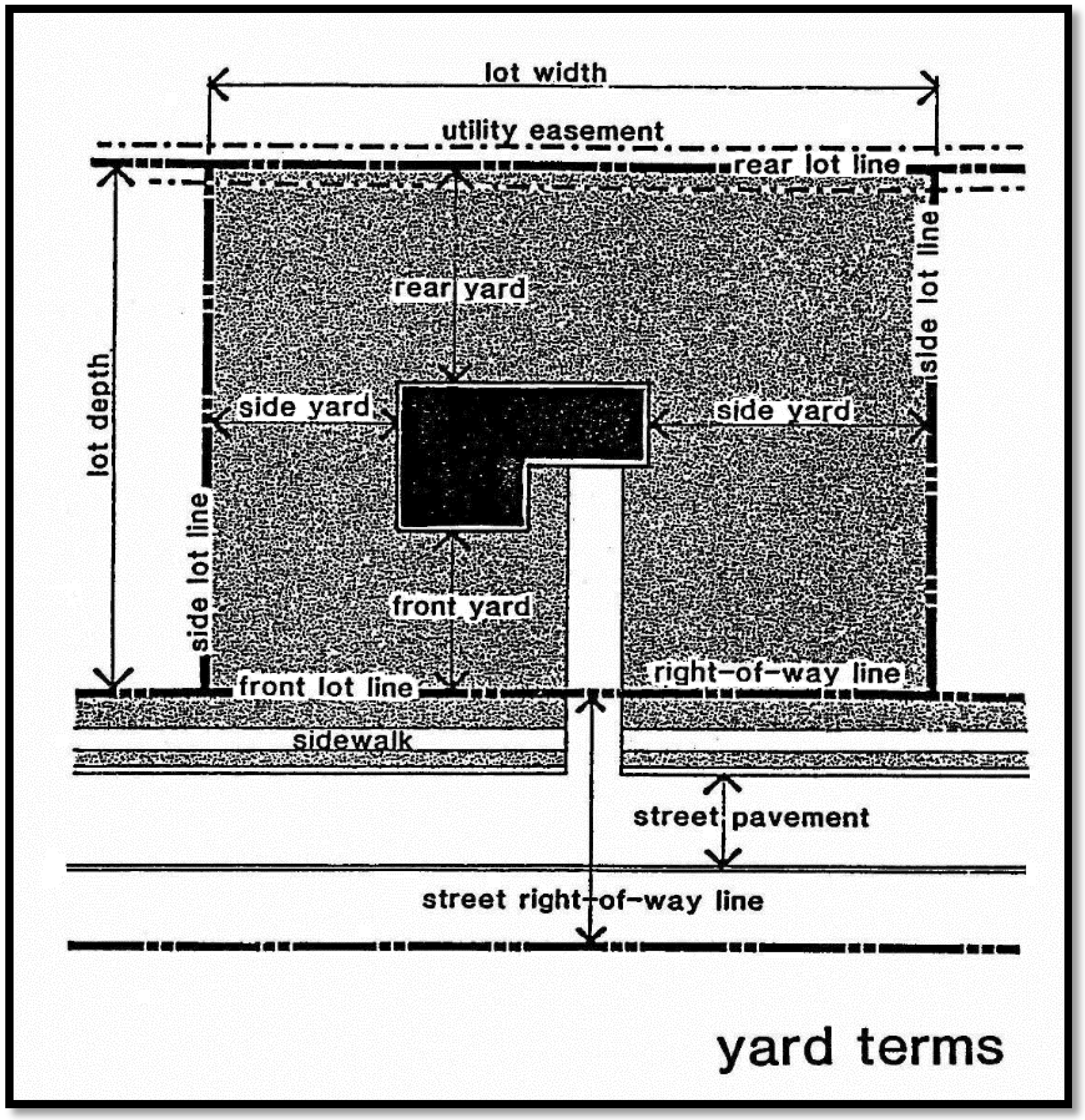
Z
Zoning map means the zoning map of the city together with all amendments subsequently adopted.
(Ord. No. 1305, 4-3-2018; Ord. No. 1335, 4-2-2019; Ord. No. 1354, 1-21-2020; Ord. No. 1370, 12-1-2020; Ord. No. 1379, 9-14-2021; Ord. No. 1385, 3-1-2022; Ord. No. 1406, 3-7-2023; Ord. No. 1429, § 1, 5-28-2024; Ord. No. 1453, 10-21-2025)

