
Ypsilanti City Zoning Code
ARTICLE VI
SITE REGULATIONS
Sec. 122-600. - Scope.
The provisions of this chapter apply to all lots and parcels of land and to every building, structure, or use, and extends vertically. No lot, building, structure, or part thereof, must hereafter be located, erected, altered, occupied, or used except in conformity with the provisions of this chapter. The general provisions of this article apply unless specifically stated otherwise.
Sec. 122-601. - Control of heat, glare, fumes, dust, noise, etc.
Every use must be so conducted and operated that it is not obnoxious or dangerous by reason of heat, glare, fumes, dust, noise, radiation, vibration, or odors beyond the lot on which the use is located. Furthermore, it shall be unlawful for any person to create, assist in creating, permit, continue, or permit the continuance of any public nuisance as defined and regulated under article II of chapter 42.
Sec. 122-602. - Damaged or destroyed buildings.
(a)
The owner of any building or structure which has been damaged or destroyed by fire, windstorm, or other casualty must repair such damage within six months after its occurrence. However, nonconforming buildings and structures may only be repaired when in conformance with article III, division 3 "nonconformities."
(b)
In the event the building or structure is damaged beyond repair, or repairs are not permitted by the terms of this chapter, then any part left standing after such damage or destruction must be demolished within six months of its occurrence pursuant to a permit granted by the city building department.
Sec. 122-603. - Moving of buildings or structures.
The moving of a building or structure to a different location must be considered as the erection of a new building and all provisions, regulations, and requirements relative to the erection of a new building must be applicable thereto. A performance guarantee may be required prior to such moving as provided in §122-317.
Sec. 122-604. - Dumping on land prohibited.
The use of land for the dumping or disposal of scrap metal, junk, junk cars, parts of automobiles, trucks, and boats; tires, garbage, rubbish, or other refuse; or of ashes, slag, or other wastes or by-products; is not permitted in any zoning district.
Sec. 122-605. - Depositing or burying garbage; excavation or filling.
(a)
The deposit or burying of garbage anywhere in the city is expressly prohibited.
(b)
The removal or filling of topsoil, sand, gravel or other material from or on the land is not permitted in any zoning district unless a site plan for such excavation or filling has first been approved by the planning commission and a permit is issued by the Building Department. Before approving such plan, the planning commission must determine that such removal will not cause standing water to collect or, at the expiration date of such permit, leave the surface of the land in an unsuitable condition or unfit for other land uses permitted in the district in which the removal or filling occurs; and that such fill or removal will not cause water or other materials to encroach on any public street, sidewalk, or adjacent property not owned by the applicant. When appropriate, the city may require that such fill or excavation areas are protected with fencing, rail guards, and warning signs.
(c)
This section does not apply to the normal removal or filling of soil for the construction of an approved building or structure when such plans have received site plan approval and a permit for such construction has been issued by the building department, or for the demolition of such when such demolition has received a permit from the building department.
(d)
This section is also not intended to regulate common household gardening, household composting, or general ground care.
Sec. 122-606. - Dwelling on rear of lot.
(a)
No building on the same lot and in the rear of a principal building may be used as a dwelling, nor may any building be located in front of a building used as a dwelling on the same lot, except as provided by this chapter, as legal accessory dwelling unit, or within an approved planned unit development.
(b)
The only exceptions to this requirement are dormitories, rectories, convents, or similar living quarters operated and maintained in connection with a religious institution, school, hospital, or similar institution.
Sec. 122-607. - Building entrances, rights-of-way, and easements.
(a)
Building entrance must face street. No principal building can be placed on a lot unless the building is situated in such a manner that the front entry into the building faces the street to which the property is addressed.
(b)
Construction of permanent structure over right-of-way or easement unlawful. It is unlawful for any person to install, erect, cause or permit the installation of a permanent structure (such as a garage, building, swimming pool, fence, or tree) on or across an easement of record which will prevent or interfere with the free right or opportunity to use or make accessible such easement for its proper use, without prior authorization by city council and/or the holder of such easement.
(c)
Planned easements. All site plans must show planned easements for non-motorized pathways in the City of Ypsilanti's non-motorized plan, a 50 to 100 foot conservation and/or access easement along any Huron River frontage, the ReImagine Washtenaw Corridor Improvement Study and any planned road easement expansions approved by city council. A proposed expansion of a structure or new building where the building or structure encroaches from the required setback from a planned easement for a street must be approved by the planning commission.
Sec. 122-608. - Trash receptacles and dumpsters.
Any new or altered commercial use, including residential uses with three or more units, which requires zoning compliance review and has an outdoor trash storage area must comply with the following requirements:
(a)
No outdoor trash storage area may be located in any front yard or any required side yard setback which is adjacent to a street, unless there is no alternative as established by the city planner or the planning commission. In no instance may any trash receptacle or dumpster be located within or block a designated parking space.
(b)
Any outdoor trash storage area must be limited to normal refuse which is collected on a regular basis and must be maintained in a neat, orderly and sanitary condition. This maintenance is the responsibility of the owner of the premises on which the containers are placed.
(c)
Adequate vehicular access must be provided to such containers for truck pickup either via a public alley or vehicular access aisle which does not conflict with the use of off-street parking spaces or entrances to or exits from principal buildings nearby.
(d)
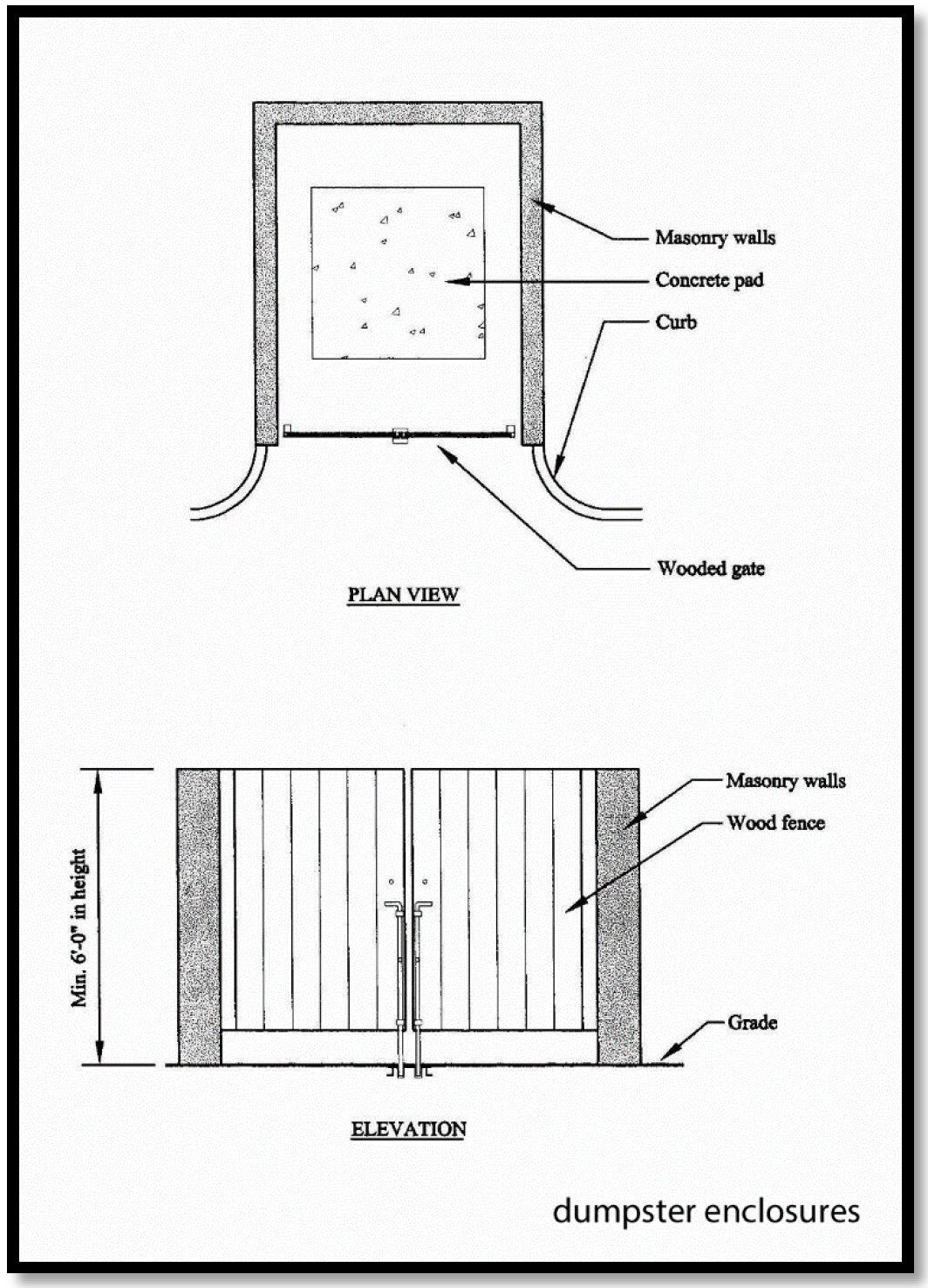
All trash storage areas must be on a paved pad, and must be screened with an enclosure at least one foot taller than the dumpster.
(e)
Where a dumpster is the primary means of collecting refuse, the trash storage area must be on a concrete pad, and screened with an enclosure at least six feet in height. The enclosure must be of a solid brick or masonry wall on three sides with an 80 percent opacity wooden swing door on the fourth side.
Sec. 122-609. - Lighting.
(a)
Purpose. In alignment with the goals of the master plan, this outdoor lighting ordinance is intended to protect the health and welfare of all residents of the City of Ypsilanti, enhance the city's unique historic character and overall quality of life, prevent the installation of inappropriate or poorly designed outdoor lighting, limit the increase of harmful sky glow, and preserve the natural night sky for the benefit of Ypsilanti's residents, visitors, wildlife, and surrounding environment.
(b)
Applicability.
(1)
This article applies to all sources of exterior or interior lighting designed to be seen from the exterior installed or replaced within the city after the effective date of this article, with the following exceptions:
(i)
Lighting requirements mandated by a legal jurisdiction with broader authority,
(ii)
Temporary lighting approved by the city for special events or festivals.
(iii)
Seasonal or ornamental lighting.
(iv)
Lighting fixtures designated as historic under the purviews of section 122-352(d).
(2)
Existing outdoor lighting lawfully installed prior to the effective date and not meeting the requirements of this article shall be considered legal and repairable, but nonconforming. All nonconforming light fixtures may continue to be used and maintained until one of the following occurs:
(i)
A determination by the city planner, building department, or code enforcement that an exterior light source produces glare, light trespass, or visual distraction; or, otherwise, poses a threat to public safety or significantly impacts adjacent properties, as defined by professionally recognized standards such as those of the International Dark-Sky Association (IDA)
(ii)
A new or substantially modified commercial use - including residential developments with three or more units - that requires site plan reviews.
(iii)
Replacement of a nonconforming light fixture.
(c)
Light fixture specifications.
(1)
All exterior lighting installed after the effective date of this article shall comply with the following specifications:
(i)
The maximum allowable color temperature for light fixtures shall not exceed 3000 Kelvin.
(ii)
All light fixtures, unless otherwise exempted, shall be full cutoff, fully shielded, and directed downwards to prevent "sky glow."
(iii)
Exterior lighting originating on a site may not exceed one-half footcandles at the lot line, except for buildings that exist or are constructed on the lot line, in which case lighting shall not exceed eight footcandles at the lot line.
(iv)
Where outdoor lighting is required by this chapter, the light intensity provided at ground level must be a minimum of one-third footcandle, but shall not exceed 15 footcandles, anywhere in the area to be illuminated.
(v)
All lighting shall be designed to prevent off-site glare.
(vi)
Motion-activated lights are permitted, provided that they comply fully with this section and the lighting is kept in good working order. Motion-activated lighting shall not be activated by movement beyond the lot line.
(vii)
Freestanding pole lighting specifications.
1.
Exterior freestanding light fixtures shall not exceed 20 feet in height or the height of the principal building on the site, whichever is less. The planning commission may modify the height restrictions in commercial or industrial districts up to 30 feet in height, based on consideration of the following: the position and height of buildings, the character of the proposed use, and the character of surrounding land uses.
(viii)
Wall-mounted lighting specifications.
1.
All light fixtures, unless otherwise exempted, shall be aimed no higher than 45 degrees below horizontal.
(ix)
Ornamental uplighting.
1.
Ornamental uplighting intended to highlight ornamental features of a building or landscape is permitted, subject to the approval of the city planner or planning commission, provided that light output is not designed to exceed 400 lumens per fixture nor a color temperature of 3000K.
(2)
Lighting within the historic district shall be subject to historic district regulations and guidelines.
(3)
Prohibitions.
(i)
Flashing, blinking, or oscillating lights are strictly prohibited.
(ii)
The outlining of windows, including, but not limited to, LED strip lights and neon-like window outlines, is prohibited if visible from a public right-of-way and found to produce glare, light trespass, or visual clutter inconsistent with neighborhood character. Seasonal lighting is exempted from this prohibition.
(d)
Administrative requirements.
(1)
Whenever a site plan or electrical permit for exterior lighting is applied for, an exterior lighting plan shall be submitted along with a compliance statement of the proposed work. The submitted exterior lighting plan may be approved administratively by the city planner; however, the city planner may defer approval to the planning commission.
(2)
Appeals. Any determination made under this section by the city planner or planning commission may be appealed to the zoning board of appeals per section 122-371.
(Ord. No. 1453, 10-21-2025)
Sec. 122-610. - Grades; elevation differentials.
The grading of all building lots must be such as to divert water away from buildings and to prevent standing water and soil saturation detrimental to structures, lot use, and surrounding property.
Sec. 122-611. - Steep slopes protection.
This section is intended to protect resources in environmentally sensitive areas to ensure that development does not result in erosion and in flooding during site preparation and the development process. Site alterations, re-grading, filling or the clearing of vegetation, or any other activity deemed detrimental to any environmentally sensitive area or resource prior to the submission of plans for subdivision or land development are a violation of this ordinance.
(a)
General design standards. Structures must be designed in a manner that requires a minimum amount of alteration to the steep slope and that otherwise complies with the grading standards in item b of this section, except where a geologic hazard investigation report recommends otherwise, multi-level building design and/or terracing must be used. Otherwise, structures must be sited on existing level areas of the site. Particular caution must be taken to prevent increases in the rate of stormwater runoff and erosion downslope of any steep slope development site.
(b)
Specific design standards. The following specific design standards must be met on sites with steep slopes:
(1)
Any site disturbance of slopes exceeding 12 percent must be minimized.
(2)
No site disturbance must be allowed on slopes exceeding 15 percent, except under the following circumstances.
(i)
Grading for a portion of a driveway accessing a single family dwelling when it can be demonstrated that no other routing which avoids slopes exceeding 15 percent is possible.
(ii)
Upon submission of a report by a certified soil or geotechnical engineer indicating that the steep slope may be safety developed and execution of a provision agreeing to hold the City of Ypsilanti harmless from any claims of damages due to approval of such development. If development is allowed to proceed under this subsection, no more than 15 percent of such areas must be developed and/or re-graded or stripped of vegetation.
(iii)
Finished slopes of all cuts and fills must not exceed three-to-one (3:1 or 33%), unless the applicant can demonstrate that steeper slopes can be stabilized and maintained adequately.
Sec. 122-612. - Retaining walls.
Retaining walls in excess of one foot in height require a building permit. All retaining walls must be designed and built so as to safely resist lateral pressures of soil behind them and be safely supported by soil beneath them. Additionally, retaining walls must be maintained in structurally sound and safe repair and must not impair drainage or create negative impacts on any other lot.
Sec. 122-613. - Height exceptions.
(a)
The height requirements of all zoning districts may be exceeded by chimneys, flagpoles, church spires, belfries, cupolas, domes, or other similar architectural embellishments, roof mounted communication antennas, water towers, observation towers, power transmission towers, radio towers, masts, smokestacks, ventilators, skylights, derricks, conveyors, cooling towers, and other similar and necessary mechanical appurtenances pertaining to the permitted uses of the districts in which they are located; provided that they do not exceed the maximum permitted height for buildings in a given district by more than ten feet.
(b)
In the PMD district, chimneys, cooling and fire towers, elevator buildings, parapets, roof storage tanks, communication towers and other necessary appurtenances are permitted to heights greater than ten feet above the maximum permitted building height; provided such appurtenances are located at least the same distance from any adjoining property line as their height.
Sec. 122-620. - Altered land parcel.
(a)
No lot or parcel of land may be divided, altered or reduced by sale, gift, or other disposition so that the yards, parking area, or other open spaces, or the land area thereof is less than the minimum requirements of this chapter.
(b)
No lot, parcel of land, parking area, or other open space may be reduced so as to increase its noncompliance with the minimum requirements of this chapter.
Sec. 122-621. - Area requirements.
In determining lot, land, yard, parking area or other open space requirements, no area may serve to meet such requirements for more than one principal building or use, and no area necessary for compliance with the space requirements for one principal building or use be included in the calculation of the space requirements for any other building, structure, or use.
Sec. 122-623. - Lots adjoining alleys.
In calculating the area of a lot that adjoins an alley for the purpose of applying lot area requirements of this chapter, one-half the width of such alley abutting the lot is considered as part of such lot.
Sec. 122-624. - Determinations by zoning board of appeals.
When yard regulations cannot reasonably be complied with, or where their application cannot be determined on lots of peculiar shape, topography or due to architectural or site arrangement, such regulations may be modified or determined by the zoning board of appeals.
Sec. 122-625. - Land division.
(a)
Lot split or consolidation. The division of lots must take place in accordance with the land division act, Act No. 288 of the Public Acts of Michigan of 1967 (MCL 560.101 et seq., MSA 26.430(101) et seq.), as amended. Pursuant to the authority granted the city to regulate the division of a lot or parcel of land in a recorded plat, the division of a lot or other parcel of land in a recorded plat is prohibited unless first approved by the city assessor and city planner in accordance with the land division act, Act No. 288 of the Public Acts of Michigan of 1967 (MCL 560.101 et seq., MSA 26.430(101) et seq.).
(b)
Subdivision plats. The subdivision of a tract of land into two or more lots, building sites, or other divisions for the purpose of sale or building development, must take place in accordance with the land division act, Act No. 288 of the Public Acts of Michigan of 1967 (MCL 560.101 et seq., MSA 26.430(101) et seq.), as amended.
Sec. 122-630. - Purpose.
The intent of this section is to:
•
Protect and preserve the appearance, character, and value of the community;
•
Minimize noise, air, soil, groundwater, surface water and visual pollution;
•
Minimize soil erosion and runoff, provide protection from wind and sun, mitigate the heat island effect and promote energy conservation;
•
Improve the overall aesthetics and appearance, divide the expanse of pavement, and define parking areas and vehicular circulation within off-street parking lots and other off-street parking facilities;
•
Buffer residential areas and lower-intensity land uses from more intense land uses;
•
Encourage an appropriate mixture of plant material, such as evergreen and deciduous trees and shrubs, to protect against disease infestation and produce a more aesthetic and cohesive design;
•
Encourage the integration of existing vegetation in landscape plans and preservation of specimen trees.
Sec. 122-631. - Landscape plan requirements.
A separate detailed landscape and tree protection plan at a scale of not greater than 1"=50' must be submitted to the City as part of the site plan review or tentative preliminary plat review. The landscape/tree protection plan must demonstrate that all requirements of this Division are met and must include, but not necessarily be limited to, the following items:
(a)
Location, spacing, size (caliper), root type (shallow or deep) and descriptions for each plant type (deciduous, evergreen, annual, or perennial) to be planted.
(b)
Location, size (caliper), root type (shallow or deep), health and species name of all trees and plants to remain on the site. If trees or plants are proposed to be remain, information showing how these trees and plants will be protected during construction must be shown.
(c)
Typical straight cross section including slope, height, and width of berms.
(d)
Typical construction details to resolve specific site conditions, such as landscape walls and tree wells used to preserve existing trees or maintain natural grade.
(e)
Details in either text or drawing form to ensure proper installation and establishment of proposed plant materials as prescribed by the American Standard for Nursery Stock.
(f)
Identification and description of grass and other ground cover to be planted and method of planting (sod, plugs, sprigs or seeds).
(g)
Identification of landscape maintenance program in accordance with §122-633.
Sec. 122-632. - Landscape elements.
The following minimum standards apply:
(a)
Quality. Plant materials must be of generally acceptable varieties and species that are not invasive, free from insects and diseases, hardy to Washtenaw County, conform to the current minimum standard of the American Standard for Nursery Stock, and must have proof of any required governmental regulations and/or inspections.
(b)
Composition. A mixture of plant material and species, such as evergreen deciduous trees and shrubs, is recommended as a protective measure against insect and disease infestation. A limited mixture of hardy species is recommended rather than a large quantity of different species to produce a more aesthetic, cohesive design and avoid a disorderly appearing arrangement.
(c)
Quantity. Plant quantities may not count to satisfy more than one requirement, unless otherwise stated within the requirement.
(d)
Berms. Berms are only permitted at the discretion of the planning commission. If permitted, they must be constructed with slopes not to exceed a 1:3 gradient, and protected with sod, seed, or other form of natural ground cover.
(e)
Tree species. All trees must be a species on a list of approved trees maintained by the City of Ypsilanti, with the exception of fruit-bearing trees. Fruit-bearing trees are allowed in yard areas where they do not overhang sidewalks, walkways, or parking lots. The planning commission may allow species not on list of approved trees, with a finding that the species is appropriate to the circumstance.
(f)
Minimum size requirements. Where landscaping is required the following schedule sets forth minimum size requirements for representative landscape materials:
(g)
Credit for existing vegetation. The preservation and incorporation of existing trees and shrubs is encouraged. Existing shrubs and trees may be used to satisfy the requirements of this section, if all of the following requirements apply:
(1)
Paving or other impervious site improvements do not encroach upon the drip line of the existing tree(s) to be preserved.
(2)
If existing plant material is labeled "To Remain" on site plans by the applicant or required by the city, protective techniques must be installed during construction. No vehicle or other construction equipment may be parked or stored within the drip line of any plant material intended to be saved.
(3)
The shrubs and/or trees are in good health. In the event that healthy shrubs or trees which are used to meet the minimum requirements of this ordinance or those labeled to remain are cut down, destroyed, damaged, or excavated at the drip line, as determined by the city, the applicant must replace them with trees which meet ordinance requirements.
(4)
The trees or shrubs proposed for credit are not a species that is invasive, brittle, susceptible to disease and insects, has a root structure that will interfere with underground utilities, drops excessive litter or other undesirable characteristics. Species ineligible for credit include but are not limited to: ash (Fraxinus), black locust (Robinia spp.), black walnut (Juglans nigra), Siberian elm (Ulmus pumila); box elder (Acer negundo), tree-of-heaven (Ailanthus spp), and gingko female (Gingko biloba).
(5)
The shrubs and/or trees meet the following minimum sizes and may receive credit in lieu of new plantings based on size shown in the table below:
Sec. 122-633. - Installation, maintenance, and completion.
(a)
All required landscaping must be planted before obtaining a certificate of occupancy, or a temporary certificate of occupancy may be issued once the appropriate financial guarantee as set forth in §122-317 is placed in escrow in the amount of the cost of landscaping, to be released only after landscaping is completed.
(b)
All landscaping and landscape elements must be planted, and earth moving or grading performed, in a sound and professional manner, according to accepted planting and grading procedures.
(c)
All plant material must be maintained in good condition so as to present a healthy, neat and orderly appearance and must be trimmed or pruned in such a manner so as to not alter their natural growth potential.
(d)
The owner of property required to be landscaped by this ordinance must maintain such landscaping in a strong and healthy condition, free from physical damage or injury arising from lack of water, chemical damage, insects, diseases, blight or other causes. All materials used to satisfy the requirements of this ordinance which become unhealthy or dead must be replaced within six months of damage or death or the next appropriate planting period, whichever comes first.
(e)
All landscaped areas must be provided with a readily available and acceptable water supply. Underground sprinkler systems may be installed, utilized and maintained in order to ensure the proper watering of all plant materials on the sites.
Sec. 122-634. - Screening between conflicting land uses.
(a)
Screening between land uses is required when:
•
Required elsewhere in this chapter;
•
When a PMD zoning district abuts any other zoning district;
•
When a HHS, HC, NC, or GC zoning district abuts a R-1, CN-SF, CN-Mid, CN, or MD zoning district;
•
When a non-residential use abuts a property where a residential use occupies the first floor of the principal structure;
•
Any building with three dwelling units or more abuts an a building with an equal or lesser number of dwelling units in the R-1, CN-SF, or CN-Mid zoning districts.
(b)
The quantities of plant material required by this section may not count for the quantities required elsewhere in this ordinance.
(c)
Location. Screening must be provided along all lot lines between conflicting land uses when required by this section. The planning commission may approve a waiver for the location of the screen upon a finding that the location of utilities interfere with the proposed location; it may also approve a waiver upon a finding that the height of the screening must conform with section 122-635.
(d)
Construction. Screens must be a wall, fence, or landscape buffer at least six (6) feet in height.
(1)
A wall or fence must be at least 80 percent opaque and may be constructed of face brick, poured-in-place simulated face brick, precast brick face panels having simulated face brick, stone, wood, or other durable material, subject to discretionary approval of the approving body. Wire or chainlink fencing with slats is not permitted.
(2)
A landscape buffer must consist of evergreen trees and evergreen shrubbery to maintain a minimum opacity of at least 80 percent. To achieve effective screening, landscape materials must be planted in a staggered manner.
Sec. 122-635. - Fences and walls.
Except as otherwise required by this ordinance, the following regulations apply:
(a)
The use of barbed wire, spikes, nails, or any other sharp point or instrument of any kind on top or on the sides of any fence is prohibited. Planning commission may waive this restriction with a finding that such materials are in the interest of public safety.
(b)
No fence may be constructed or maintained which is charged or connected with an electrical current.
(c)
Retaining walls must be designed and constructed in accordance with applicable building code requirements and the requirements of §122-612.
(d)
Temporary construction fences and fences required for protection around excavations must comply with the building code. Such fences must be removed upon the issuance of a certificate of occupancy.
Sec. 122-636. - Street trees.
The frontage of all public or private streets for any new or altered use which requires site plan review must be landscaped with street trees as follows:
(a)
Location. The street trees must be centered between the sidewalk and the back of street curb. Planning commission may grant a waiver of this condition with a finding that utilities necessitate a different location, or that the proposed location of the trees will align with already-established street trees along the same block face, provided that said existing trees are to remain.
(b)
Quantity. A minimum of one tree for every 30 lineal feet of frontage, inclusive of proposed or existing access drives. Existing trees in good health to be preserved may count towards the street tree requirements.
(c)
Planting area size. Tree pits provided for street trees must be sufficient for the species of tree provided. Where no sufficient planting bed exists or can be provided for street trees within the right-of-way, the applicant may choose to either plant and maintain the required trees within the front yard; or to provide a fee in lieu of planting in the amount of 100 percent of the materials and installation cost.
Sec. 122-637. - Foundation landscaping.
Foundation plantings are required in the MD zoning districts and in the GC and NC zoning districts for the single story commercial building and large footprint single story commercial building types, and must meet the following standards:
(a)
Location. Foundation plantings must be provided along the front or sides of any buildings which face a public road and/or is adjacent to a parking lot or other area which provides access to the building(s) by the general public. Foundation planting areas must be between the front or sides of the building and any paved area, adjacent to the building.
(b)
Quantity. Foundation planting areas must contain a minimum of six shrubs per 30 lineal feet of applicable building frontage.
(c)
Planting area size. Individual planting areas must be of a size appropriate to the proposed plantings, but no less than four feet in depth, measured perpendicular from the building.
Sec. 122-638. - Site landscaping.
Inclusive of any landscaping required by this section, at least ten percent of the site area, excluding existing public rights-of-way, must be landscaped. Such site area landscaping may include a combination of the preservation of existing tree cover, planting of new trees and plant material, landscape plazas, gardens, vegetated roofs, and foundation landscaping beds.
Sec. 122-639. - Accessory stormwater control features.
(a)
Swales. Biofiltration swales are permitted in all districts.
(b)
Pervious paving. Pervious paving is permitted in all districts, subject to adopted engineering standards.
(c)
Rain gardens. Rain gardens installed accessory to one- or two-family uses in the R-1 district or the townhouse, cottage, or house building types in the CN, CN-Mid, CN-SF districts do not require engineering review.
(d)
Rain barrels or cisterns. Rain barrels or cisterns are permitted in all districts.
(1)
Underground cisterns or rain barrels are subject to engineering review and constructed in accordance with the state building code.
(2)
Aboveground rain barrel or cistern systems in excess of 250 gallons accessory to the mansion, estate, apartment house, courtyard apartment, apartment building, commercial/mixed-use small, commercial/mixed-use medium, commercial/mixed-use large, single-story commercial building, large footprint single story commercial building, multiple story, or institutional building types; or in excess of 250 gallons and located in the R-1 district not accessory to a single-family use; or in excess of 250 gallons and located in the MD or PMD districts, must conform to the accessory building standards in place for those building types and be subject to engineering review and constructed in accordance with the building code.
(e)
Vegetated roofs. Vegetated roof systems are permitted in all districts in accordance with the building code.
(f)
Other methods. Other methods of onsite stormwater control may be submitted to the city planner and, at their discretion, may be approved, approved subject to another city department(s) review, approved subject to planning commission review, or denied.
(g)
The plant material required by this section may be used to meet plant material quantity and placement requirements of this chapter, provided that planning commission or other approving body finds that the intent of this chapter is met.
Sec. 122-640. - Screening of electrical equipment and transformers.
(a)
Transformers that may be visible from any primary visual exposure area must be screened with either plantings or a durable non-combustible enclosure which are unified and harmonious with the overall architectural theme, and meet utility provider standards for location and maintenance.
(b)
Utility equipment must be mounted on the side of a building wherever possible, and must be located where it is substantially screened from public view.
Sec. 122-641. - Modifications or exceptions to requirements.
(a)
Buildings abutting property lines. Required screening may be omitted along any lot line where a building wall exists immediately abutting the lot line.
(b)
Location adjustments. Where property line screening is required, the location may be adjusted at the discretion of the planning commission so that the screening may be constructed at or within the setback area, provided the areas between the screening and the property lines are landscaped or retain their natural vegetative state.
(c)
Planning commission modifications. Any other requirements of this Section may be waived or modified through site plan approval, provided the planning commission first makes a finding that:
(1)
That the topographic features or special characteristics of the site create conditions so that the strict application of the provisions of this section will result in less effective screening and landscaping than alternative landscape designs; or
(2)
That the public benefit intended to be secured by this section will exist with less than the required landscaping or screening; or
(3)
The historic district designation on the property precludes the ability to require any or all of the landscape requirements.
(d)
In the case of conflicting land use screening, with the finding that the design and placement of the screen meets the intent of the zoning ordinance in general and the zoning district in particular.
Sec. 122-650. - Purpose.
The intent of this division is to regulate accessory structures and uses in order to preserve adequate open spaces and separation between uses which may impact adjacent properties. Accessory uses and structures are generally permitted uses in their respective zoning districts, subject to the provisions of the this division.
Sec. 122-651. - General standards for accessory structures.
(a)
Attached accessory structures. Where an accessory structure is attached to and made a part of the principal building (excluding breezeways or canopies), such accessory structure must comply in all respects with the requirements of this chapter applicable to the principal building.
(b)
Detached accessory structures. The following standards, unless otherwise stated in this chapter, govern all detached accessory structures. A "detached accessory structure" is one which is not attached to the principal structure; however, a breezeway or other enclosed or roofed over connecting way may connect the principal structure to an accessory structure provided that such breezeway or connecting way does not exceed eight feet in width and does not exceed the height of the accessory structure. Detached accessory structures include, but are not limited to, garages, sheds, toolhouses, swimming pools, tennis or basketball courts or other recreational equipment.
(1)
Building permit. No accessory structure may be erected, moved, altered, or razed until a building permit has been obtained from the building department.
(2)
Height. The maximum height for a detached accessory structure must be 15 feet; except in the PMD district, in which accessory structures may be constructed equal to the permitted maximum height of structures in such district, subject to planning commission review and approval, except where otherwise noted.
(3)
Location. All detached accessory structures must be located in rear yards or side yards. On corner lots, detached accessory structures cannot be located in the required street side yard setback. In no instance may an accessory structure be located within a dedicated easement.
(4)
Setback and ground coverage requirements. All detached accessory structures must meet the setback and ground coverage regulations for the underlying zoning district and, if applicable, building type.
(5)
Architecture/siding. The architectural character of all accessory buildings must be compatible with that of the principal building. All accessory buildings in all zones except the PMD district, must be sided and roofed with materials which are complementary with the principal building.
(6)
Sleeping quarters. The use of any accessory building for the overnight housing of persons is prohibited, unless expressly permitted by this chapter or this Code.
(7)
Mobile homes. Mobile homes are not permitted as an accessory use to a permitted principal use.
(8)
Subdivision of lots. No parcel or lot may be subdivided unless and until all detached accessory buildings comply with this chapter with respect to allowable size and setback requirements for the proposed lot on which the buildings are to be located.
(Ord. No. 1331, 1-8-2019)
Sec. 122-652. - Enclosed storage of liquid and solid fuels.
Storage within enclosures of liquid and solid fuels shall be permitted subject to the conditions hereinafter imposed:
(a)
All storage tanks and the handling of all flammable liquids shall be in compliance with the building code as adopted by this Code.
(b)
Below-ground storage tanks shall be located no closer than 50 feet from any property line and, when required, shall be registered with the state fire marshal.
Sec. 122-653. - Swimming pools.
Prior to the issuance of a building permit for the construction of an outdoor swimming pool in any zoning district, the following provisions must be satisfied:
(a)
An application for a building permit must be accompanied by a complete and detailed set of plans and specifications for the swimming pool, including type of construction, size, location on lot in relation to lot lines and buildings on the site, fencing, and related equipment, which show that the following minimum standards will be met.
(b)
The swimming pool must be located no closer than ten feet to any side or rear lot line, and no part of any pool may be constructed within a front yard or required side yard setback adjacent to a street.
(c)
Swimming pools must be located a minimum of four feet from any building on the same parcel and a minimum of 25 feet from any dwelling on an adjoining lot which is located within an R1, MD, CN-SF, CN-Mid or CN district.
(d)
All pool associated wiring and wiring in, around, over or under the pool must comply with the latest edition of the National Electrical Code as adopted by this Code.
(e)
All swimming pools must be enclosed by a fence of a type not readily climbed by children which must be at least five feet in height from the ground level. However, if the entire yard of the residence is enclosed, then this provision may be waived by the building department upon inspection and approval of the yard's enclosure; or if the pool is of a portable or above ground type, with a wall height of at least five feet above the surrounding ground surface, and of such construction as not to be readily climbed by children, then the ends of the fence may be attached to the pool structure and the fence need be erected only around the immediate area of the ladder and other means of access to the pool. Gates must be of self-closing latch type with the latch on the inside of the gate, not readily available for children to open. Gates must be securely locked when the pool is not in use. Pools must be enclosed by such fence before water is placed in pool. All fences are subject to the requirements of §122-635.
(f)
Water retained in any pool regardless of depth must be maintained clean and sanitary as provided in the Building Code, water treatment standards.
(g)
The building department has the right at any reasonable hour to inspect any swimming pool for the purpose of determining that all the provisions of this chapter are fulfilled and complied with. Any outdoor swimming pool installed, operated or maintained in violation of the provision of this section constitutes a nuisance, and the city may, in addition to the penalties set forth in §122-375, maintain any proper action for the abatement of such nuisance.
Sec. 122-654. - Porches, decks, balconies, fire escapes, and barrier-free access ramps.
(a)
Porches, decks, terraces and balconies.
(1)
An open or unenclosed porch or terrace may project into a required front yard setback for not more than ten feet, unless otherwise regulated within this chapter. An open, unenclosed terrace or patio flush with the ground is not subject to this restriction.
(2)
An open or unenclosed porch or terrace over nine inches in height must meet all side and rear yard setback requirements.
(3)
An open or unenclosed balcony may project into a required front yard setback for not more than ten feet, but must meet all side and rear yard requirements.
(4)
All enclosed porches, decks, or balconies are an integral part of a building and must meet all yard setback requirements of that structure.
(b)
Fire escapes. No fire escape can be located within any front yard. All fire escapes must meet all side and rear yard setback requirements.
(c)
Barrier-free access ramps. Barrier-free access ramps may be located within any front, side or rear yard, provided that no portion of the ramp which exceeds over 36 inches in height is located within any required minimum yard setback area. This provision may be waived by the building department for a temporary barrier-free access ramp to a single-or two-family dwelling, provided that the building department finds that such proposed barrier-free ramp will not pose a fire or safety hazard, and will not obstruct traffic vision. A temporary barrier-free access ramp must be removed within 14 days after the person needing the ramp ceases to occupy a dwelling.
(d)
Architectural features. Window sills, cornices, eaves, bay windows, and other architectural features may project into a required side yard not more than two inches for each one foot of width of such side yard; and may extend into any front or rear yard not more than three feet.
Sec. 122-660. - Purpose.
The purpose of this article shall be to permit such signs as will not, by reason of their size, location, construction or manner of display, endanger life or limb, interfere with traffic safety, or otherwise endanger the public morals, health or safety. It is further the intent of this article to:
•
Maintain and enhance the aesthetic value of the city;
•
Encourage free expression of ideas and dissemination of messages, regardless of content, using signs that are compatible with their surroundings and legible under the circumstances in which they are seen;
•
Enhance pedestrian and vehicular traffic safety;
•
Minimize the adverse effects of signs on nearby public and private property;
•
Protect and enhance economic vitality by assuring aesthetic appeal for residents and visitors;
•
Preserve property values;
•
Enhance the effectiveness of permitted signs and directional and warning signs;
•
Seek the removal of illegal signs and encourage the replacement or removal of nonconforming signs that are incompatible with the purpose of this article.
Sec. 122-661. - Generally.
(a)
Building permit required. Except as provided in this chapter, no sign shall be constructed or erected prior to the issuance of a permit by the building department, and approval from other applicable reviewing bodies.
(b)
Public rights-of-way. Signs shall be expressly prohibited from locating in all public rights-of-way and dedicated public easements except as otherwise provided for in this ordinance, and as follows:
(1)
Signs erected by the city or other governmental entities
(2)
Overhead banners
(3)
Sidewalk signs
(4)
Building mounted signs may project over a public right-of-way or easement provided they comply with the applicable design standards for the specific type of sign and that they maintain a minimum clearance of eight feet. A projecting sign shall project not more than four feet from the wall of a building and shall not project above the front wall of the building.
(c)
Signs exempted.
(1)
Any sign required by city ordinance or state law, as applicable. This includes, but is not limited to, address signs, fire department connection signs, or signs indicating barrier-free parking locations.
(2)
Any sign less than three square feet in area and five feet in height on the interior of a site placed so as to be oriented and clearly legible to persons on the site, provided that each sign be no closer than twenty feet to another such sign.
(3)
Drive-through signs. Any use that includes a drive-through is permitted to have signs up to a maximum height of six feet and a maximum area of 32 square foot per drive-through use, located in the rear of the site, when placed so as to be oriented and clearly legible to persons on the site.
(4)
Signs erected by a public body. Any sign or marker erected by the city, county, state, or other municipal body is not subject to these requirements.
(d)
Traffic and pedestrian hazards. The placement, size, content, coloring or manner of illumination of signs shall not create traffic or pedestrian hazards. No sign shall make use of the words "stop," "look," "danger" or other word, phrase or symbol in a manner that is confusing or misleading. No sign or flashing light shall be erected or maintained in any manner which, by reason of its size, location, context, coloring or manner of illumination, shall constitute a traffic hazard or which shall interfere with the visibility of any traffic control device.
(e)
Obstruction prohibited. No sign shall be placed so as to obstruct any fire escape, required exitway, window, or door opening used as a means of passage or as access for firefighting purposes.
(f)
Obstruction to ventilation. A sign shall not be attached in any form, shape or manner which will interfere with any opening required for ventilation by the building code; except that such signs may be erected in front of and may cover transom windows when not in violation of the provisions of this chapter.
(g)
Maintenance. All signs, sign frames, sign copy area, panels, structural elements, lamps and electrical hardware shall be maintained in good repair and working order, so as to present a neat and orderly appearance. Non-galvanized or corrosion-resistant materials shall be painted when necessary to prevent corrosion.
(h)
Authorized sign contractors. Every person before engaging or continuing in the business of constructing, repairing or dismantling signs, poster boards or other display signs in the city, shall first furnish the city a public liability insurance policy, approved by the city attorney, with minimum limits of $300,000.00 combined single limit bodily injury and/or property damage, and the contractor agrees to indemnify the city from all damage suits or actions of every nature brought or claimed against the contractor for or on account of injuries to persons or damages to property received or sustained by any person or person through any act of omission or negligence of such erector, agents or employees in the erection, repair or dismantling of any sign, poster board or other display sign. Such policy shall contain a clause whereby such policy cannot be canceled until after a written notice of intention to cancel has been filed with the city clerk at least 30 days prior to the date of cancellation.
(i)
Sign area calculation. The square footage of a two-, three- or four-faced sign shall mean the square footage of the largest face of the sign.
(Ord. No. 1334, 3-5-2019)
Sec. 122-662 - Construction requirements.
(a)
All signs shall conform to the city building code unless more stringent requirements are specified in this article. Signs and sign structures shall be designed and constructed to resist wind and seismic forces as specified in this section. All bracing systems shall be designed and constructed to transfer lateral forces to the foundation. For signs on building the dead and lateral loads shall be transmitted through the structural frame of the building to the ground in such a manner as not to overstress any of the elements thereof.
(b)
The overturning movement produced from lateral forces shall in no case exceed two-thirds of the deadload resisting movement. Uplift due to overturning shall be adequately resisted by proper anchorage to the ground or the structural frame of the building. The weight of earth imposed over footings may be used in determining the dead-load resisting movement. Such earth shall be carefully placed and thoroughly compacted.
(c)
Wind loads. For the purpose of design, wind pressure shall be taken upon the gross area of the vertical projection of all signs and sign structures at not less than 20 pounds per square foot for those portions less than 60 feet above the ground.
(d)
Allowable stresses. The design of wood, concrete or steel members shall conform to the requirements of the most recently adopted version of the Michigan Building Code, and loads, vertical and horizontal, exerted on the soil shall not produce stresses exceeding those specified therein. The working stresses of wire rope and its fastenings shall not exceed 25 percent of the ultimate strength of the rope or fasteners. Working stresses for wind or seismic loads combined with deadloads may be increased as specified in the Michigan Building Code.
(e)
Supports. The supports for all signs or sign structures shall be placed in or upon private property and shall be securely built, constructed and erected in conformance with the requirements of this chapter.
(f)
Fastenings. Signs attached to masonry, concrete or steel shall be safely and securely fastened thereto by means of metal anchors, bolts, or approved expansion screws of sufficient size and anchorage to support safely the loads applied. Anchors which attach signs to masonry surfaces shall be inserted into mortar joints.
Sec. 122-663. - Sign permit requirements.
(a)
Application for sign permits shall be made upon forms provided by the building department.
(b)
Applications for signs other than overhead banners shall contain or have attached thereto the following information:
(1)
Name, telephone number and address of applicant.
(2)
Name, address and telephone number of owner or lessee of the premises upon which the sign is to be erected.
(3)
A written statement signed by the owner or lessee of the premises upon which the sign is to be erected, indicating their consent thereto, or the signed contract between the parties.
(4)
The address of the premises upon which the sign is to be attached or erected.
(5)
One set of plans showing the dimensions, materials, height and method of anchorage of the sign.
(6)
Position of the sign in relation to nearby buildings, structures and property lines.
(7)
Insurance policy or proof of financial security as required in §122-661(h).
(8)
On electrical signs, certification by Underwriters Laboratory or some other recognized testing laboratory. Electrical sign installations shall comply with Article 600 of the National Electrical Code.
(9)
Such other information as deemed necessary to show compliance with this article.
(c)
Application for overhead banners shall contain or have attached thereto, the following information:
(1)
The name of organization or group sponsoring the banner.
(2)
Phrase on the banner, and/or sketch of the content
(3)
Location where banner is to be erected.
(4)
The dates the banner will be hung.
(5)
The name, address and telephone number of the applicant.
(6)
Insurance policy or proof of financial security as required in §122-661(h).
(7)
Such other information as deemed necessary to show compliance with this article and with Act No. 200 of the Public Acts of Michigan of 1969 (MCL 247.321 et seq., MSA 9.140(21) et seq.), and R247.271—R247.279 of the Michigan Administrative Code, 1979.
(d)
Application for sidewalk signs shall include a sidewalk occupancy permit application.
Sec. 122-664. - Prohibited signs.
The following signs are prohibited in all zoning districts:
(a)
Unsafe signs. When any sign or sign structure becomes insecure, in danger of falling, or otherwise unsafe, or if any sign or sign structure shall be unlawfully installed, erected, or maintained in violation of any of the provisions of this chapter, or prohibited signs, it shall be considered a nuisance per se. The owner or lessee shall, upon receipt of written notice of the building official, immediately in the case of an unsafe sign make such sign conform to the provisions of this article or shall remove it. If, after ten days, the notice is not complied with, the building official may remove such sign at the expense of the owner or lessee after having obtained an order from the administrative hearings bureau. The cost, including actual attorney fees, shall be assessed against the property as provided in Article VIII of the City Charter.
(b)
Prohibited signs.
(1)
Animated signs.
(2)
Portable signs, not including sidewalk signs.
(3)
Signs mounted upon a roof.
(4)
Signs containing obscene material. Signs containing symbols that area or purports to be an imitation of or resembles, or which may be mistaken for a traffic control device or that attempts to direct the movement of traffic.
(5)
Mechanical signs.
(6)
Reserved.
(7)
Signs not specifically permitted under the sections of this chapter.
(8)
Signs with less than six feet horizontal clearance or 12 feet vertical clearance from overhead electrical conductors which are energized in excess of 250 volts.
(Ord. No. 1440, 10-4-2024)
Sec. 122-665. - Sign design standards.
(a)
Freestanding signs.
(1)
Materials. Freestanding signs shall be constructed out of decorative materials that complement the design of principal buildings within the development. Natural materials such as stone, decorative masonry, wood, or metal are preferred sign construction materials. The use of exposed neon tubing in conjunction with other types of materials to emphasize the business name or logo is permitted.
(2)
Billboards. New billboard permits will be issued only in the following cases:
(i)
For non-digital billboards, when one non-conforming billboard is removed
(ii)
For digital billboards, when two non-conforming billboards are removed.
(3)
Digital billboards.
(i)
The message displayed on digital billboards may change a maximum of once every six seconds.
(ii)
All billboards must provide a setback from any adjacent residential zoning district equal to the height of the billboard.
(iii)
Billboard structures which have two or more panels stacked, one above the other, are not permitted.
(iv)
Double-faced billboard structures (two panels mounted on the same structure back-to-back) are permitted.
(v)
Spacing between billboards shall be 1,000 feet as provided in the Highway Advertising Act of 1972, as amended.
(vi)
All billboard structures shall be of steel. No wood or other combustible material shall be permitted to support such signs.
(vii)
Billboard structures shall be restricted to and used only with respect to interstate highways, freeways or primary highways as set forth in the Highway Advertising Act, Act No. 106 of the Public Acts of Michigan of 1972 (MCL 252.301 et seq., MSA 9.391(101) et seq.).
(4)
Sidewalk signs.
(i)
Sidewalk signs may have a maximum area of six square feet per side.
(ii)
Sidewalk signs may be located on the sidewalk adjacent to the applicant's business.
(iii)
Sidewalk signs shall be located such that they will not impede pedestrian traffic on the sidewalk, and such that they will not present a hazard to vehicular traffic.
(iv)
Sidewalk signs may not be permanently affixed to any object, structure, or the ground.
(v)
Sidewalk signs may only be displayed during business hours and shall be removed when the business to which the sign is accessory is closed.
(vi)
Each business may have a maximum of one sidewalk sign.
(vii)
Sidewalk signs shall be made of durable materials.
(b)
Building mounted signs.
(1)
Location. Building mounted signs may be located on any façade that faces a street, parking area, alley, or on a façade where a public entrance is located.
(2)
Minimum height. Signs that project more than 18 inches into a right-of-way or over an entrance or other pedestrian or vehicular access point shall maintain a minimum clearance of eight feet between the grade level below the sign and the lowest part of the sign, inclusive of sign structures and support devices.
(3)
Materials.
(i)
Building mounted signs shall incorporate exterior materials, finishes and colors that are the same, similar, or complementary to those used on the principal building.
(ii)
Building mounted signs shall be professionally constructed using high-quality materials such as metal, stone, hard wood, or brass. The use of exposed neon tubing is permitted.
(iii)
Reserved.
(iv)
Neon tubing outlining windows or other architectural features is prohibited.
(4)
Window signs. May not occupy more than 25 percent of the total transparent area of any individual window.
(5)
Banners. Banner requirements shall be as follows:
(i)
The banner must be made of nonflammable material that will not shred and has adequate air holes. For banners hanging overhead across a street, roadway or highway the banner must contain at least three air holes for every 40 feet.
(ii)
The building department shall be permitted to inspect the banner or a sample of material prior to it being erected.
(iii)
The banner must be securely attached, sufficient to withstand storms, including strong gusts of wind and continuous pounding by the elements. The manner of attachment shall first be submitted to the building department.
(iv)
If a banner becomes partially unsecured, it shall be immediately reattached or removed by the entity which erected it.
(v)
If a banner begins to shred, it shall be immediately repaired or removed by the entity which erected it.
(vi)
If the entity which erected the banner fails to comply with is the standards of section (iii) or fails to remove the banner by the time the permit expires, the city shall remove the banner and shall charge the cost thereof to the entity erecting the banner.
(vii)
Any banner permit may be canceled by the city if the installation becomes dangerous to motorists or pedestrians, unduly interferes with free movement of traffic or otherwise endangers the health, safety or welfare of persons in the city.
(viii)
A banner shall not have displayed thereon any symbol which is or purports to be an imitation of or resembles, or which may be mistaken for a traffic control device or which attempts to direct the movement of traffic.
(ix)
A banner shall be considered a temporary sign.
(c)
Electronic message board signs. Building mounted signs and freestanding signs may include an electronic message board, subject to the following:
(1)
Required area, height, and setbacks. The maximum area for an electronic message board sign shall be no greater than 50 percent of the zoning district's maximum area for freestanding or building-mounted signs. The maximum height and minimum setbacks shall comply with the zoning district's allowances for freestanding or building-mounted signs.
(2)
Maximum number. No more than one electronic message board sign shall be located on a single lot of land.
(3)
Change of message shall not occur more than once every two minutes.
(4)
Lights shall never blink or flash. Message change sequence shall not involve flashing or other animations but shall be an instantaneous change.
(5)
Illumination. Illumination from an electronic message board sign shall not exceed 0.3 footcandles when measured at the property line of the subject lot.
(6)
Colors. Messages shall be in monochrome text, and electronic display areas shall be black.
(7)
Electronic message board signs shall not be illuminated between the hours of 9:00 p.m. and 6:00 a.m.
(8)
Signs shall be programmed to go dark in the event of a malfunction.
(d)
Sign illumination.
(1)
Applicability.
(i)
These standards apply to all new or modified permanent sign lighting, both internal and external, installed or altered after the effective date of this article. The following are exempt from the requirements of this section:
i.
Sign lighting required by a government agency.
ii.
Bare bulb illumination for theater marquees approved by the planning commission.
iii.
Historic lighting determined to be historically significant per section 122-352(d).
(2)
General standards for sign illumination.
(i)
Permitted illumination types.
i.
Permanent signs may be illuminated internally or externally, unless otherwise prohibited in this section.
ii.
External sign lighting shall be fully shielded, directed only at the sign surface, and installed to minimize glare, light trespass, and sky glow, unless otherwise permitted in this section.
iii.
Uplighting permanent signs is permitted, given that the following standards are met:
1.
Fixtures shall be fully shielded, ground-mounted or base-mounted, and angled to prevent any light from projecting above the horizontal plane at the top of the sign.
2.
Each fixture shall not exceed 400 lumens.
3.
Uplighting shall only be used on signs with non-reflective, matte finishes to minimize glare.
iv.
Internal illumination shall be limited to halo-lit channel letters or signs with opaque backgrounds and translucent text or logos.
(ii)
Lighting levels and color temperature.
i.
Exterior lighting originating on a site may not exceed one-half footcandles at the lot line, except for buildings that exist or are constructed on the lot line, in which case lighting shall not exceed eight footcandles at the lot line.
ii.
All illuminated signs shall have a maximum color temperature of 3000 Kelvin.
(iii)
Hours of illumination.
i.
Sign lighting shall be turned off between 11:00 p.m. and 6:00 a.m., or one hour after business closing, whichever is later.
(iv)
Prohibited sign lighting practices.
i.
Flashing, blinking, rotating, chasing, strobe, or oscillating sign illumination is prohibited.
(Ord. No. 1440, 10-4-2024Ord. No. 1453, 10-21-2025)
Sec. 122-670. - Circulation standards.
Circulation standards are intended to preserve and improve walkability and pedestrian/bicyclist safety within the walkable urban districts, while maintaining adequate vehicular access.
(a)
General.
(1)
Streets are intended for use by vehicular and pedestrian traffic and to provide access to parcels.
(2)
Streets generally consist of vehicular travel and/or parking lanes and public frontages.
(3)
Streets must be designed in context with the urban form and desired design speed of the districts through which they pass. The public frontages of streets that pass from one district to another must be adjusted accordingly or, alternatively, the district may follow the alignment of the street to the depth of one lot, retaining a single public frontage throughout its trajectory.
(4)
Pedestrian comfort and safety is the primary consideration of the public frontage. Design conflict between vehicular and pedestrian movement generally must be decided in favor of the pedestrian.
(5)
Each lot must front a street, pedestrian passage, and/or civic space, such as a park. An entrance to the building with required frontage must face the street or, if a street is not present, the planning commission may approve an entrance on the pedestrian passage or civic space.
(6)
All circulation plans must include the easements for non-motorized pathways in the City of Ypsilanti's non-motorized plan, the ReImagine Washtenaw Corridor Improvement Study, and any planned road easement expansions approved by city council.
(b)
Vehicular access for infill and new development. A system of joint use driveways and cross access easements must be established wherever feasible and the building site must incorporate the following:
(1)
An alley or system of alleys extending the entire length of each parcel served to provide for driveway separation consistent with access management classification system and standards.
(2)
Stub-outs and other design features to make it visually obvious that the abutting properties may be tied in to provide cross access via a service drive;
(3)
A unified access and circulation system plan that includes coordinated or shared parking areas is encouraged wherever feasible.
(c)
Access for sites comprised of more than one building type, under the same ownership
(1)
In the interest of promoting unified access and circulation systems, development sites under the same ownership or consolidated for the purposes of development and comprised of more than one building site are not considered separate properties in relation to the access standards of this Code.
(2)
The number of connections permitted must be the minimum number necessary to provide reasonable access to these properties, not the maximum permitted for that frontage. All necessary easements, agreements, and stipulations required under joint use driveways and cross access easements must be met. This also applies to phased development plans.
(3)
The street network shall be designed to define blocks as established by district. The block perimeter is measured as the sum of lot frontage lines. Block perimeter at the edge of the development parcel is subject to approval by the planning commission.
(i)
Centers and core neighborhoods (C, CN, CN-SF, CN-Mid): Block perimeter must not exceed a total length of 1600 feet and the maximum block length shall generally be 400 feet.
(ii)
Corridors and health and human services (HC, NC, GC, HHS): Block perimeter must not exceed a total length of 2,000 feet and the maximum block length shall generally be 500 feet.
(4)
In center districts, a continuous network of rear and side alleys or lanes must serve as the primary means of vehicular ingress to individual lots whenever possible. Alley or lane entrances should generally align so as to provide ease of access for service vehicles.
(5)
All streets must terminate at other streets, forming a network. Internal streets must connect wherever possible to those on adjacent sites. Cul-de-sacs are subject to approval by the planning commission to accommodate specific site conditions only.
Sec. 122-671. - Public service access.
All buildings and structures must be provided with adequate access for fire, police, sanitation, and public works vehicles. The planning commission may require paved turnaround areas to allow adequate maneuverability for public service vehicles on a site.
Sec. 122-672. - Sidewalks.
(a)
For all development projects, either a new public sidewalk or if necessary the reconstruction of existing sidewalks, must be provided along the perimeter of the lot which abuts any street. New or reconstructed sidewalks must be aligned with existing or proposed sidewalks and must be constructed to city standards and subject to chapter 94 of the City Code of Ordinances.
(b)
This requirement may be modified by the planning commission as follows:
(1)
A shared-use path may be provided in lieu of a sidewalk, upon a finding that any portion of the perimeter of a lot is planned to be part of an area-wide non-motorized network that requires such a facility.
(2)
A fee in lieu of construction may be provided by the development in the amount of 100 percent of the construction cost, upon a finding that any portion of the perimeter of a lot is included in a transportation project programmed in the city's 5-year capital improvement plan, or with a finding that sidewalk construction at this location is impractical due to lack of connectivity. Any fee paid for this purpose is reserved for non-motorized improvements as a part of the identified transportation project or for path and sidewalk construction throughout the city, respectively.
(3)
Any easement required for the construction, maintenance, or operation of a modified facility must be included on the site plan at the time the modification is requested.
Sec. 122-673. - Direct access to major thoroughfare.
Whenever this chapter requires that direct access to a major thoroughfare be provided, one of the following provisions must be met:
(a)
Direct driveway ingress and egress is provided from the site directly to a major thoroughfare.
(b)
Access to the site from a major thoroughfare does not traverse through or abut any land zoned R1, MD, CN-SF, CN-Mid, and CN.
Sec. 122-674. - Street frontage requirements.
No lot can contain any building used in whole or in part for any purpose unless such lot abuts the minimum lot width of the building type or zoning district on at least one street; or unless it has an exclusive, unobstructed private easement of access or right-of-way of at least 50 feet wide to a street. No more than one single-family dwelling or one nonresidential land use for such frontage or easement will be permitted.
Sec. 122-675. - Traffic visibility.
(a)
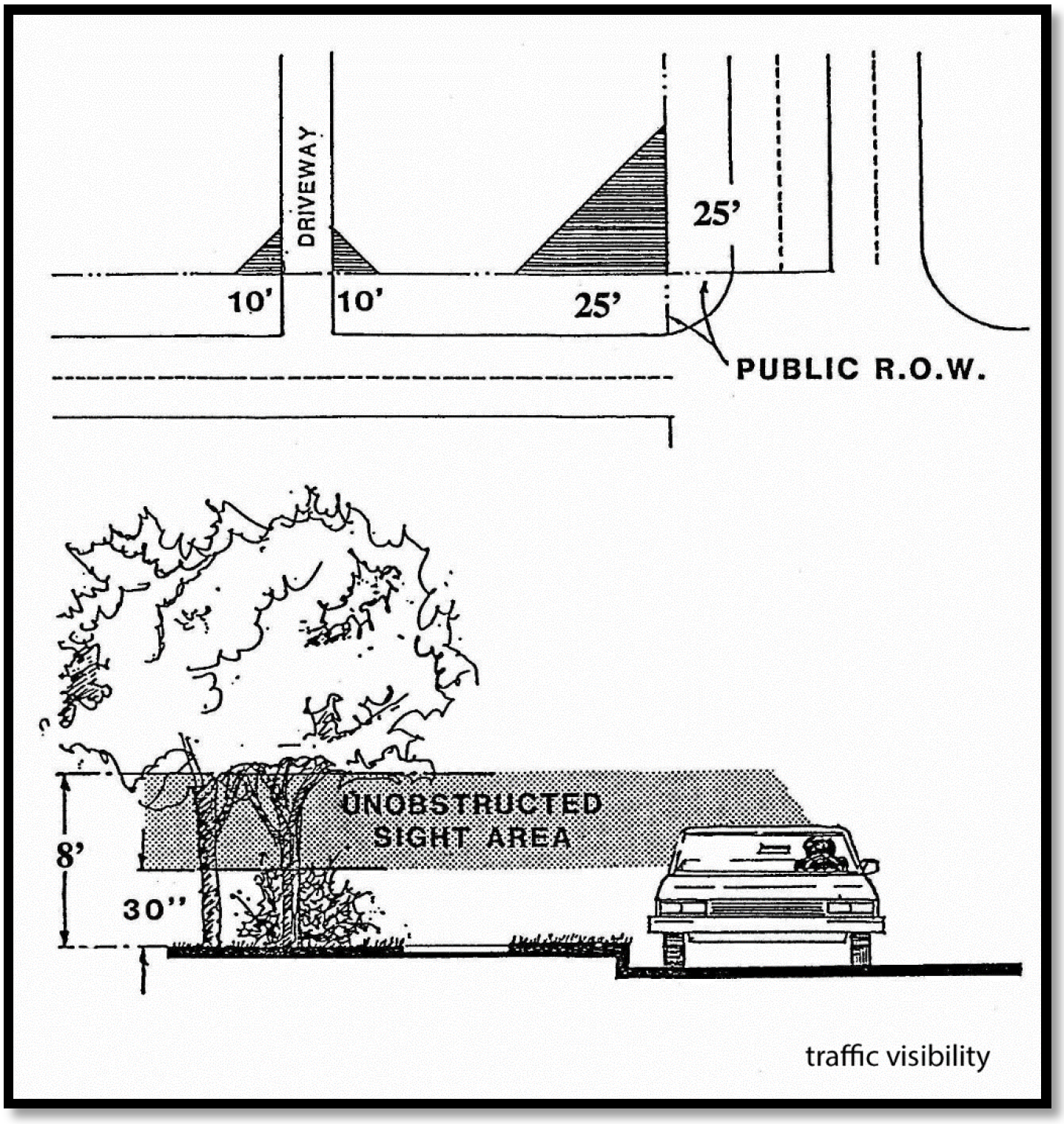
No structure, wall, fence, vehicle, shrubbery, or trees can be erected, parked, planted or maintained on any lot which will obstruct the view of the driver of a vehicle approaching an intersection or maneuvering from a driveway. Provided, shrubbery and low fences or walls not exceeding 30 inches in height above the curb level and branches of trees not less than eight feet above the street level will be permitted.
(b)
This means, in the case of an intersection, that there must be provided an unobstructed triangular area formed by the street property lines and a line connecting them at points 25 feet from the intersection of the pavement edge lines, or in the case of a rounded corner, from the intersection of the street property lines extended. In the case of a driveway, there must be provided an unobstructed triangular area formed by the street right-of-way line, the edge of the driveway, and a line connecting them at points ten feet from the intersection of the street right-of-way line and driveway edge.
Sec. 122-680. - Purpose.
The purpose of this division is to recognize that motor vehicles, while part of the social and economic well-being of the community, can cause conditions and problems of parking and storage which can have a negative impact on the safety, appearance, health and welfare of the community. It is the intent of this article to provide standards for the parking and storage of motor vehicles in order to ensure that off-street parking facilities are in harmony with the use of surrounding properties and all modes of transportation; maintain barrier-free pedestrian access, ensure adequate accessibility to the off-street parking facilities from city street; and to set standards for design and construction of parking facilities compatible with the health, safety and general welfare of the community.
Sec. 122-681. - Scope.
In all zoning districts, off-street parking facilities shall be provided for the storage and parking of motor vehicles and bicycles for the use of occupants, employees, and patrons of all buildings, structures, residences, businesses, or establishments erected, altered, constructed, changed in use, or commenced after the effective date of the ordinance from which this chapter derives. Such space (or spaces) shall be maintained and not be encroached upon, unless an equivalent number of such spaces are provided elsewhere, in conformance with this chapter.
(a)
New or altered buildings. No building or structure shall hereafter be erected, and no existing structure may be so altered that it is increased in size or intensity of use, unless adequate parking space, as required by the provisions of this division, is provided for the entire building or structure as erected or altered.
(b)
Change in use. The use of any building or structure shall not be changed if additional parking space would be required as a result of the change in use, unless the minimum parking space as required by the provisions of this division is provided for the entire building.
(c)
Areas excepted. The provisions of this section regarding quantity of spaces provided shall not apply to uses in the center district or existing commercial uses in the historic corridor zoning districts, except those spaces required for upper-story dwellings. A fee in lieu of providing off-street parking for upper-story units in the center or historic corridor is permitted in accordance with §122-697.
Sec. 122-682. - Off-street parking layout and construction for one- and two-family dwellings.
Off-street parking facilities required for one- and two-family dwellings shall consist of a parking strip, apron, driveway, garage, carport, or combination thereof and shall be located on the premises they are intended to serve subject to the provisions of §122-651. Further, parking areas serving one- and two-family dwellings shall be subject to the following:
(a)
Ingress and egress. No individual curb cut to a street or alley for a single driveway shall exceed 20 feet in width. The total width of all curb cuts shall not exceed 35 feet on all property lines. On lots with a lot width of 60 feet or less, no more than one curb cut to a single street is permitted. All curb cuts accessing Washtenaw Avenue (M-17) must comply with the Michigan Department of Transportation M-17 Access Management Plan.
(b)
Driveways. On lots used for one-family or two-family residential purposes, maneuvering or backing of vehicles into a street or alley is permitted. Driveways may cross the required front yard, or the required street side yard on a corner lot, provided that the total area of the driveway do not exceed 30 percent of the area of such required yard. Driveways may have no less than nine feet of clear width.
(c)
Surfacing. Parking areas and driveways shall be surfaced with crushed limestone or similar gravel material, or shall be hard surfaced with asphalt, concrete, or similar bonded material. Porous paving is also allowed. However, parking areas which are designed for five or more spaces must meet the requirements of section 122-683. That portion of the driveway between the lot line and the public way shall be paved with concrete a minimum of six inches thick for residential occupancies. Curb cuts along state trunk lines shall comply with the requirements of the state department of transportation. All other curb cuts shall comply with adopted standards of the Department of Public Works. Surfacing for parking areas and driveways shall be no closer than two feet from property lines, except where connecting to the public way. The city planner may waive this requirement in whole or in part with a finding that the lot shares a common access and common parking with the adjoining lot, or that stormwater, landscaping, and other similar concerns have been adequately addressed with other methods.
(d)
Parking in yards. No parking shall be permitted in the front yard, or in the street side yard on a corner lot, except on a driveway which leads to a parking area that is beyond the front line of the structure and the space is in compliance with section 122-685.
(Ord. No. 1374, 3-2-2021)
Sec. 122-683. - Off-street parking layout and construction for all other uses.
Off-street parking facilities required for multiple-family and nonresidential uses shall be located on the same lot or parcel as the building or use they are intended to serve, or within 300 feet of such building or use, measured from the nearest point of the building to the nearest point of the off-street parking lot. A shared parking agreement or use easement for the land intended for shared parking must be on file with the county register of deeds, in order for the shared parking spaces to satisfy the quantity requirement. Parking spaces may be located within buildings or structures consistent with the building code.
(a)
Review and approval requirements. Except for off-street parking accessory to single- or two-family dwelling units, review and approval is required for off-street parking areas in accordance with article III of this chapter.
(b)
Ingress and egress. Adequate ingress and egress to such parking lot shall be provided by means of clearly defined and limited drives having a minimum width of 20 feet for two-way traffic and ten feet for one-way traffic, with a maximum of 30 feet. All such drives shall be located so as to minimize traffic congestion.
(1)
On lots with a lot width of 100 feet or less, no more than one curb cut to a single street is permitted.
(2)
All curb cuts accessing Washtenaw Avenue (M-17) must comply with the Michigan Department of Transportation M-17 Access Management Plan and the ReImagine Washtenaw Corridor Improvement Study.
(3)
All curb cuts and approaches to such parking lots shall comply with adopted city standards for curb cuts.
(4)
Ingress and egress for the parking area in an area zoned CN-Mid, CN, HC, NC, GC, C, HHS, PMD shall not cross land zoned for P, R1 or CN-SF.
(5)
Parking lot driveways shall be situated so as to minimize vehicle headlights from shining on residential dwellings.
(6)
Where possible, curb cuts shall be located across from any existing curb cuts on the opposite side of the street, or shall be offset from any opposite-side curb cuts by at least 25 feet.
(7)
No curb cut for a parking lot may be closer than 50 feet to the intersection of any two streets as measured along the street right-of-way line. However, the planning commission may allow a curb cut for a parking lot situated on a small land parcel located no closer than 20 feet to the intersection of any two streets, upon finding that no other access points in compliance with city ordinances is possible due to the size of the parcel.
(c)
Access. All parking spaces shall be provided adequate access by pedestrians and vehicles:
(1)
Walkways in parking lots. Paved walkways a minimum of five feet in width shall be provided for access to adjacent parks, commercial areas, transit stops, anticipated walkways and institutions. Pedestrian movement shall be accommodated within parking lots through raised walkways, marked crosswalks or similar methods.
(2)
Vehicular access. All parking spaces must be accessible to vehicles by means of maneuvering aisles. Except for one-and two-family uses, maneuvering or backing from a parking space directly onto a street or walkway shall be prohibited, and all parking spaces shall be designed so that any motor vehicle may be parked or unparked without moving another vehicle.
(d)
Maneuvering drives. Each driveway providing access to an off-street parking lot containing five or more parking spaces shall be a minimum of ten feet in width. Where a turning radius is necessary, it shall be an arc that allows unobstructed vehicle flow.
(e)
Surfacing. All parking and loading facilities and access drives shall be paved with a durable bonded material in accordance with accepted engineering standards, or alternative surfacing materials to minimize impervious surface and stormwater runoff, employ environmental and other best practices, and achieve low impact design, at the discretion of the city engineer. Use of pervious alternative surfaces is encouraged in proximity to the Huron River and Paint Creek. Paving materials proposed to improve aesthetics may also be considered by the city planner and the planning commission. Alternative surfaces proposed shall be reviewed by the city's consulting engineer.
(f)
Drainage. All off-street parking and loading areas shall be graded and drained to public storm sewers. As an alternative, if in the opinion of the city's consulting engineer, the soils are of a type which will allow for efficient drainage, the use of drywells, infiltration trenches, swales, bio-retention or other best management practices for controlling urban runoff quality are permitted. No surface water shall be permitted to drain onto adjoining properties, unless there is a common engineered drainage system shared with the adjoining property or an appropriate watershed easement has been obtained. No surface water drainage from an off-street parking lot shall be permitted to drain across a public sidewalk.
(g)
Setback from street. Parking lot setbacks are designated by the zoning district in which they are located. An allowed exception are circular drives, which may be located in a required minimum front yard or street side yard, provided that such drives shall be designed so that no parking space is located closer than 25 feet to any street right-of-way line.
(h)
Setback from adjacent lot. Parking areas are required to be ten feet from any adjacent lot. Planning commission may waive this requirement in whole or in part with a finding that the lot shares a common access and common parking with the adjoining lot, or that stormwater, landscaping, and other similar concerns have been adequately addressed with other methods.
(i)
Striping. For parking lots containing five or more spaces, all spaces shall be outlined with three-inch wide strips of white or yellow paint, except that barrier-free spaces shall be blue, with a symbol of compliance in blue, and signed in accordance with the State Barrier-Free Code.
(j)
Wheel stops. For parking lots containing five or more spaces or accessory to commercial uses, wheel stops or curbing shall be provided for all parking spaces to prevent any vehicle from projecting beyond the parking lot area, bumping any wall or fence, or encroaching upon any landscaping. In all cases where parking lots abut public or private sidewalks, continuous concrete curbing or bumper stops, at least six inches high, shall be placed so that a motor vehicle cannot be driven or parked on, or hang over, any part of any sidewalk.
(k)
Lighting. With the exception of multiple-family dwellings on individual lots containing no more than four units, parking and loading facilities utilized during night-time hours shall be artificially illuminated. All such outdoor lighting shall meet the requirements of §122-609.
(l)
Maintenance. All off-street parking areas, including striping, shall be maintained in good usable condition, and when necessary shall be treated to prevent dust or other nuisances. Such parking areas and drives shall also be kept free of litter, debris, and refuse.
(m)
Additional requirements. In addition to the above requirements, parking areas shall comply with additional requirements or conditions which may be deemed as reasonably necessary by the planning commission for the protection of abutting lots.
(Ord. No. 1334, 3-5-2019)
Sec. 122-684. - Parking screening and landscaping.
(a)
Intent. Separate landscape areas shall be provided within parking lots so as to break up the broad expanse of pavement, mitigate heat island effect, support storm water management, and guide the circulation of vehicular and pedestrian traffic.
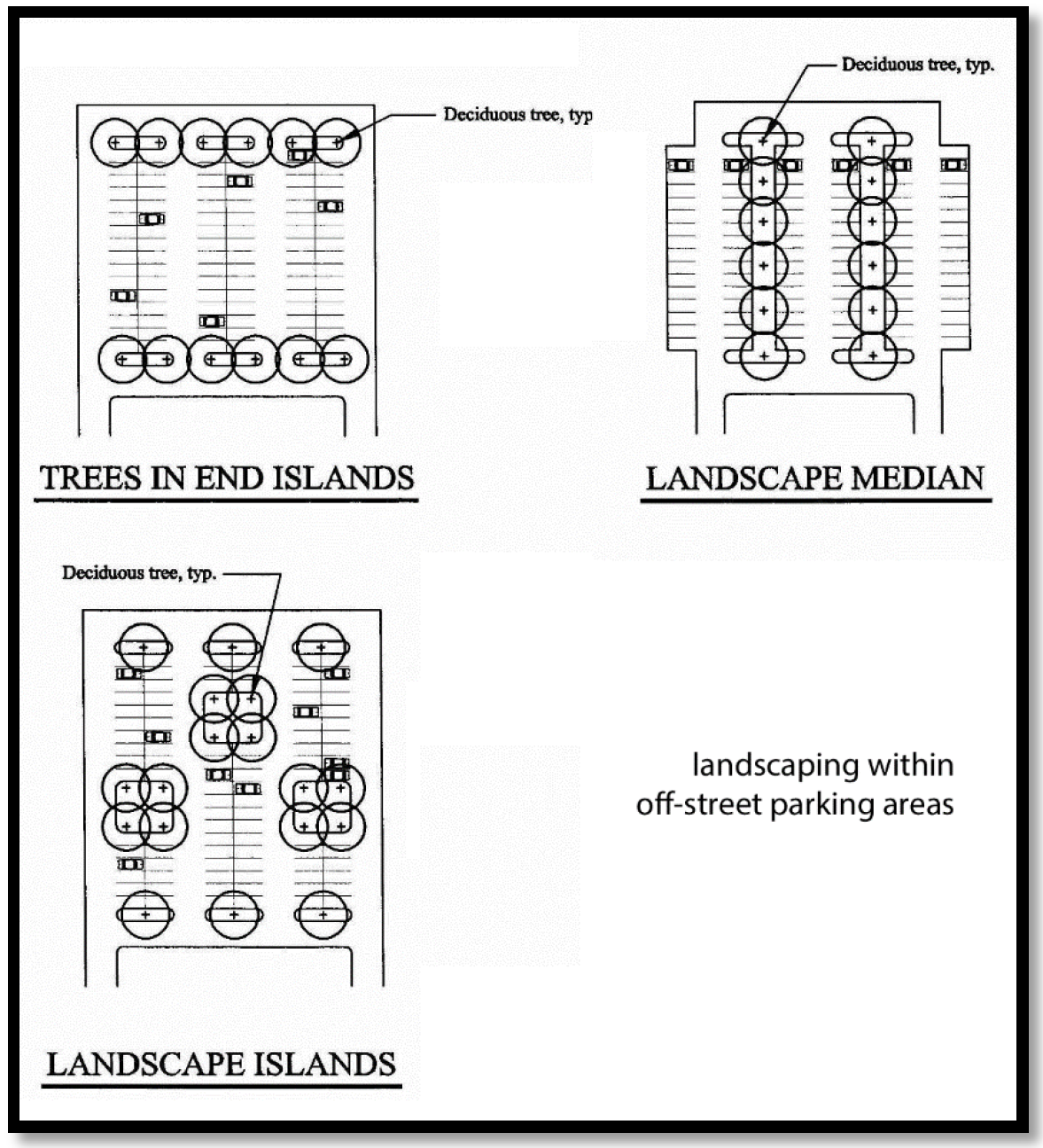
(b)
Required landscaping within off-street parking areas. Separate landscape areas shall be provided within off-street parking areas in accordance with the following requirements:
(1)
There shall be a minimum of one tree for every eight parking spaces, provided that a landscape island shall be provided for no more than 16 continuous spaces.
(2)
Landscape islands must meet the following size requirements:
(i)
Landscape islands containing a tree shall be a minimum of 160 square feet and a minimum of nine feet wide.
(ii)
Landscape islands containing a pedestrian pathway shall be a minimum of 11 feet wide, with a pathway of a minimum width of five feet and minimum three feet wide landscape area on both sides.
(iii)
If landscaped islands are not used for storm water infiltration, the islands must be raised and curbed.
(3)
The ends of all parking aisles and corners shall be protected with a curbed island.
(4)
A minimum distance of three feet from the backside of the curb and the proposed landscape plantings shall be provided. Where vehicles overhang a landscape island or strip, a minimum distance of five feet from the backside of the curb and the proposed landscape plantings shall be provided.
(5)
Shrubs and/or ground covers which will not impede vehicular visibility in accordance with this ordinance may also be included.
(c)
Required landscaping at the perimeter of off-street parking areas, loading zones, and access drives. Separate landscape areas shall be provided at the perimeter of off-street parking areas in accordance with the following requirements. This landscaping cannot be counted toward any other landscaping requirement except for the "site landscaping" minimum percentage.
(1)
Off-street parking areas in the side and rear yard which abut a R-1, MD, CN, CN-Mid, CN-SF zoning district must be screened in accordance with §122-634.
(2)
All off-street parking areas that are visible from a public road shall be screened from view with a solid wall or landscape planting achieving at least 80 percent opacity year-round at least three feet in height but no more than four feet in height, in conformance with §122-675.
(3)
All land between a parking lot and any street right-of-way shall be kept free from refuse and debris and must be landscaped. The ground area shall be planted in lawn or other live ground covering. All such landscaping and plantings shall be maintained in a healthy, growing condition, neat and orderly in appearance.
(d)
Landscaped areas, walls, structures, and walks shall be properly protected from vehicular encroachment or overhang through appropriate wheel stops or curbs, as well as a distance of at least three feet.
Sec. 122-685. - Parking dimensions.
(a)
All off-street parking facilities required by this chapter shall be of adequate size and design to provide safe and reasonably direct ingress and egress from an alley or street. All parking spaces shall be adequate for parking a motor vehicle with room for opening doors on both sides.
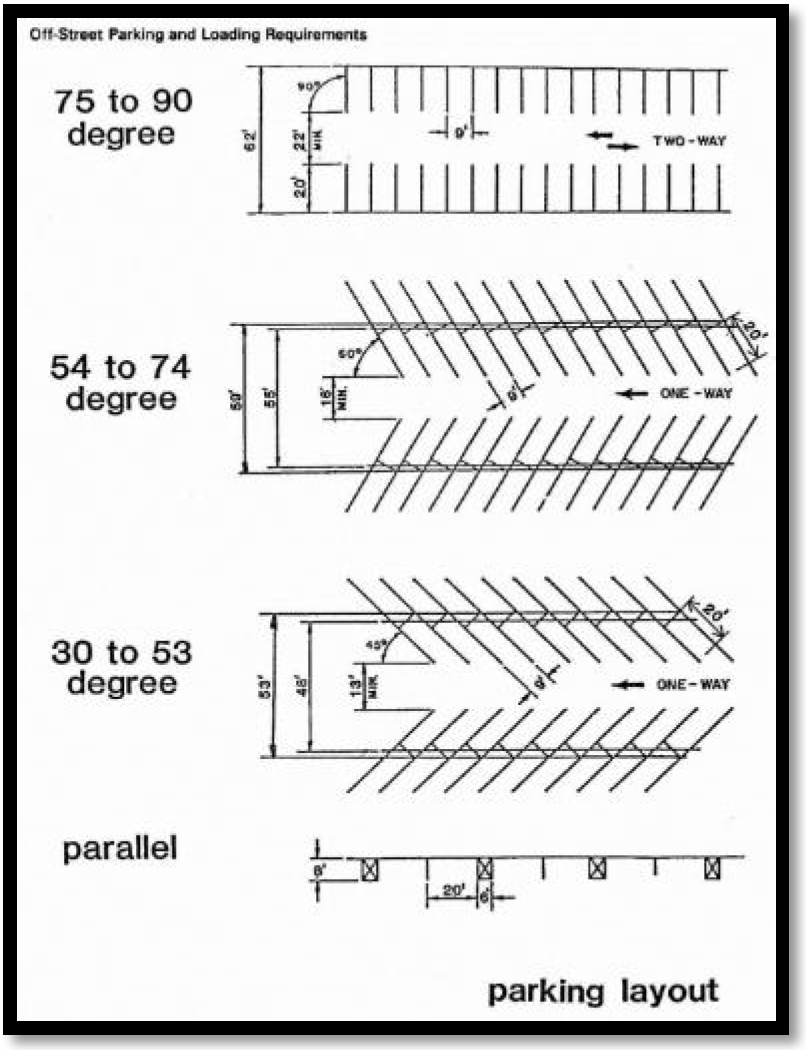
(b)
Parking spaces required by this article shall be at least nine feet wide and 18 feet long (16 feet long if two feet of overhang is provided when parking against a curb). Spaces directly adjacent to a fence, wall or enclosure shall be increased by one foot in width. Barrier free parking spaces must be designed as required by and in conformity with state law.
(c)
Up to 20 percent of the parking spaces may be designated as small car spaces, which shall be at least eight feet wide and 16 feet long and clearly signed for "compact cars."
(d)
Up to ten percent of the parking spaces may be designated as motorcycle spaces, which shall be at least five feet wide and clearly signed for "motorcycles."
(e)
Minimum standards. The minimum standards for parking spaces and aisles are indicated in the table below.
(Ord. No. 1385, 3-1-2022)
Sec. 122-686. - Barrier-free parking spaces.
Off-street parking facilities as required under this chapter shall include parking spaces which are reserved for physically handicapped persons in accordance with the state barrier free design requirement of the state building code.
Sec. 122-690. - Generally.
Any person, organization, or establishment who has any ownership interest in or the control of any real estate within the city is required to provide and maintain in a usable condition off-street parking spaces as follows:
(a)
Repair prohibited. No repairs or service to vehicles shall be permitted on areas designated as required off-street parking.
(b)
Display of vehicles for sale. The parking of motor vehicles, recreational vehicles, and trailers which are possessed expressly and solely for sale by persons or businesses licensed by the state for such sales are permitted only when in accordance with the requirements of each respective zoning district and the specific provisions of §122-545 regarding the outdoor sales of vehicles. Otherwise, the display of vehicles for sale in designated off-street parking areas is prohibited.
(c)
Use of loading space. Loading spaces, as required under §122-695, shall not be counted or used for required parking.
(d)
Usable floor area and gross floor area. For the purpose of computing the number of parking spaces required, the definitions for "usable floor area" and "gross floor area" in §122-203 shall apply.
(e)
Fractional requirements. When units or measurements determining number of required parking spaces result in requirement of a fractional space, any fraction up to one-half shall be disregarded and fractions including and over one-half shall require one parking space.
(f)
Uses not specified. For those uses not specifically mentioned under §122-691, the requirements for off-street parking facilities shall be in accord with a use which the city planner considers similar in type.
(g)
Nonoverlapping operating hours. In the instance of land uses requiring off-street parking spaces where operating hours of the uses do not overlap, the city planner may grant exception to the individual parking requirements of §122-691.
(h)
Use of parking lots for storage.
(1)
Except as provided under subsection (h)2 of this section, a parking lot may not be used for the storage or parking of trailers, mobile homes, travel trailers, boats, boat trailers, or junked or wrecked vehicles of any type; for the storage of merchandise or industrial equipment or materials; or as a dump for refuse of any description.
(2)
The parking out-of-doors of motor vehicles which are used as part of a permitted commercial or industrial use, including automobiles, trucks, or trailers, are permitted on off-street parking lots outside normal business hours of such commercial or industrial use; provided no more than a total of five automobiles and three commercial trucks or trailers each weighing less than 10,000 pounds shall be permitted. The outdoor storage of more than five automobiles and three trucks or trailers shall be permitted only after special use approval by the planning commission in accordance with the provisions of article III, division 2, subdivision III of this chapter.
(Ord. No. 1335, 4-2-2019; Ord. No. 1354, 1-21-2020; Ord. No. 1370, 12-1-2020)
Sec. 122-691. - Minimum and maximum number of parking spaces.
The minimum number of off-street parking spaces by type of use in all zoning district shall be determined in accordance with the following schedule. The maximum number of off-street parking spaces must not exceed 120 percent of the required parking spaces, except for those uses in the "residential" category, which are not subject to a maximum. The planning commission may grant waivers as noted in §122-692.
(Ord. No. 1334, 3-5-2019)
Sec. 122-692. - Parking requirement reductions.
Off-street parking requirements may be reduced subject to the following regulations.
(a)
Transit. Parking requirements may be reduced by up to 20 percent for buildings, structures, or uses within 750 feet of a commuter rail station or bus transit center or within 500 feet of a transit stop, provided said stop or center is approachable via sidewalk. In situations where this would result in a discount of more than ten spaces, a traffic study may be required to demonstrate that a sufficient number of vehicle drivers would immediately opt for transit, and therefore would not result in adverse parking impacts on surrounding properties. The ride shall verify that the transit station or transit stop is not scheduled to move in the five-year plan for the ride.
(b)
Car-sharing and carpooling spaces. Parking spaces reserved, signed, and enforced for hourly car rental/car-sharing services may count as four regular parking spaces. Parking spaces reserved, signed, and enforced for carpooling or vanpooling services may count as two regular parking spaces.
(c)
Electric car parking/charging spaces. Electric car spaces shall include a power outlet for use by the parked car. Such spaces should be closest to the main entrance (exclusive of barrier-free spaces). Parking spaces reserved, signed, and enforced for electric car charging stations may count as two regular parking spaces.
(d)
Bicycle spaces. Parking requirements may be reduced by one space for every four covered, secure bicycle parking spaces provided on site. Parking requirements may be further reduced by four spaces where free showers are available for employee use within the building.
(e)
Seasonal bicycle parking. Up to five percent of vehicle parking spaces may be occupied by bike racks April through October in the walkable urban districts.
(f)
Walkable urban districts. The parking requirements in each of the walkable urban zoning districts, with the exception of general corridor, shall be halved. Planning commission has the authority to waive 50 percent of the parking requirements for uses located in general corridor with a finding that the area immediately surrounding the use is highly walkable.
(g)
Planning commission authority. The planning commission shall have the authority to waive the number of required off-street parking spaces, in addition to the reductions above, by up to 20 percent, with a finding that there is a special circumstance that particularly relates to the size of an existing parcel and building in combination, and/or character of the proposed use.
(Ord. No. 1334, 3-5-2019)
Sec. 122-693. - Required bicycle parking.
Any development requiring vehicle parking spaces shall be required to provide bicycle parking. Off-street parking areas shall contain at least one bicycle parking space for every five spaces provided for motor vehicles, or fraction thereof, with a minimum of two bicycle parking spaces provided. In the center, historic corridor, and neighborhood corridor districts, bicycle facilities provided in the public right-of-way may be used in parking calculations.
Sec. 122-694. - Off-street stacking spaces for drive-through facilities.
(a)
Drive-in or drive-through windows. On the same premises with every building, structure, or part thereof, erected or occupied for the purpose of serving customers in their automobiles by means of a service window or similar arrangement, such as drive-in banks, restaurants, or cleaning establishments, there shall be provided two off-street stacking spaces for each service window or transaction station in compliance with subsection (c) of this section. Six off-street stacking spaces shall be provided for each drive-through transaction station of a restaurant.
(b)
Automobile servicing. Self-service automobile and car wash establishments shall provide three off-street stacking spaces for each washing stall. Quick oil change facilities shall provide three off-street stacking spaces per each oil change service bay. Automobile and car wash establishments, other than self-service, shall provide stacking spaces equal in number to four times the maximum capacity of the motor vehicle wash for automobiles awaiting entrance. The term "maximum capacity" shall mean the greatest number of possible automobiles undergoing some phase of washing at the same time.
(c)
Stacking space dimensions. Each stacking space shall be a minimum dimension of ten feet in width and 20 feet in length.
Sec. 122-695. - Off-street loading space requirements.
With the exception of uses located within the center district, there shall be provided and maintained on the same premises with every building, structure, or part thereof involving the receipt or distribution of vehicles or materials or merchandise, including but not limited to retail stores, wholesale stores, markets, hotels, hospitals, offices, and laundries, adequate space for standing, loading, and unloading in order to avoid undue interference with public use of dedicated rights-of-way and vehicular circulation on the site.
(a)
Such off-street loading spaces shall be provided as specified in the table below. The planning commission may modify these requirements upon making the determination that another standard would be more appropriate because of the number or type of deliveries experienced by a particular business or use.
(b)
All loading spaces shall be located within a nonrequired rear yard, or a nonrequired side yard which does not abut or lie across a street from a residential zoning district; but in no case shall loading spaces be permitted in a front yard. Loading spaces shall be subject to primary building setbacks.
(c)
No loading space shall be located closer than 50 feet to any R1, MD, CN-SF, CN-Mid, CN, or HHS district, unless located within a completely enclosed building or enclosed on all sides facing the district by a solid concrete or masonry wall not less than six feet in height.
(d)
Loading space areas shall be provided with a paved surface having an asphaltic or Portland cement binder so as to provide a permanent, durable and dustless surface. All loading spaces shall have a minimum 14-foot high clearance.
(e)
Loading areas shall not utilize any area required for the maneuvering of vehicles into parking spaces or block general vehicular circulation on a site.
(f)
A truck turning plan must be provided.
Sec. 122-696. - Special assessment districts.
When a property is located within a special assessment district created for the purpose of constructing a municipal parking lot or structure, and an assessment has been levied against the entire building site, the owner of such property may petition the planning commission for approval of substituting such public parking for all or a portion of the required off-street parking spaces. The planning commission shall determine that the petitioner's property is adequately served by the public parking facility in such a way that the objectives and intent of this article shall be secured. To accomplish this end, the planning commission shall have the power to require such conditions as deemed appropriate. The planning commission shall consider the assessment of benefits in the special assessment district in determining the adequacy of service by the public facility.
Sec. 122-697. - Fee in lieu of providing off-street parking.
(a)
Intent. The intent of the fee in lieu of providing off-street parking is to encourage the development of apartment units above ground floor commercial uses, in existing buildings, in the center district. It is recognized that many structures in these business districts were constructed at zero lot lines, and often the structure covers the lot completely. Therefore, parking spaces on the lot or contiguous to the lot cannot be provided. For those building owners who cannot provide the amount of required parking pursuant to this chapter, and whose upper floor space has not been legally occupied within one year of their application for payment of such a fee in lieu of parking, they shall be charged a fee according to the number of bedrooms in the residential units. Upon payment of this fee, the owner or applicant will be permitted to develop or rehabilitate these residential units without providing the parking required by this chapter. The fee will be held by the city for parking capital improvements, which will be used to provide increased parking and transportation infrastructure such as transit stops, bicycle facilities, and pedestrian pathways for the areas where these buildings are located.
(b)
Condition for allowing payment of fee in lieu of providing off-street parking. Property owners who meet all of the following requirements shall be entitled to apply for payment of fee in lieu of providing off-street parking:
(1)
They are the owner, or have permission of the owner, of a building which can provide residential units above ground floor commercial uses.
(2)
The building is located in the center district within the city.
(3)
The property, by virtue of its construction, cannot meet parking requirements in the district.
(4)
The residential unit or units have not been legally occupied within one year prior to making application.
(c)
Application.
(1)
An application for permission to use such payment in lieu of providing off-street parking shall be made as part of an application to the city planner.
(2)
The permit shall contain the following information:
(i)
Name, address and phone number of property owner and name, address and phone number of applicant, if different than owner.
(ii)
Address of property requiring fee in lieu of providing off-street parking.
(iii)
Plan showing the layout of the proposed residential units, including size of rooms and identification of bedroom space.
(iv)
Description of commercial use on ground floor level.
(v)
A site plan which shall include:
(a)
Dimensions and size of parcel.
(b)
Location of structure on parcel.
(c)
If any parking is available on the site, its location must be indicated, including access, stall size, etc.
(d)
Description of location of parking to be used by tenants.
(3)
Application fee. An application fee shall be paid at the time of submitting the application to the city planner.
(d)
Approval procedures.
(1)
The city planner shall consider the following in making his/her determination:
(i)
Whether the owner can provide on-site parking that meets ordinance standards.
(ii)
Whether the owner can modify available parking space, or loading space, located on-site to meet ordinance standards.
(2)
If the city planner determines that the owner cannot provide on-site parking to meet ordinance standards, or can only provide partial on-site parking to meet ordinance standards, and the other requirements of this article are met, then he/she shall make a specific finding regarding the number of spaces which are required for the residential units, which shall allow the city treasurer to compute the amount of fee in lieu of parking.
(e)
Condition. The off-street parking requirement satisfied by fee in lieu of parking shall run with the land. If any subsequent change in use should occur, which requires additional parking, then the owner shall make a new application to the city pursuant to this chapter for such additional parking. An additional application fee shall be paid when such application is submitted. An additional fee shall be due prior to the issuance of a building permit to allow the additional modifications.

