
Yuba County Unincorporated
City Zoning Code
City Zoning Code
DIVISION VI
GENERAL TERMS
CHAPTER 11.74 - LAND USE REGULATION TABLE
Table 11.74 prescribes the land use regulations for each zone district. The table also notes additional use regulations that apply to various uses. Section numbers in the right hand column refer to other sections of this Code. Additional development regulations by zone district and use may apply as outlined in Chapter 11.04, Zones and Districts.
NOTE: Table 11.74 is comprised from each of the zoning district tables in Division II, Zoning and Overlay Districts. In case of conflict between Table 11.74 and the land use regulation tables in Division II, the tables in Division II shall apply.
(Ord. No. 1624)
11.72.010. - Purpose and applicability.
Use classifications describe one or more uses of land having similar characteristics, but do not list every use or activity that may appropriately be within the classification. In cases where a specific land use or activity is not listed, the CDSA Director shall assign the land use or activity to a classification that is substantially similar in character to other use classifications listed pursuant to the requirements listed in Section 11.02.030, Rules of Interpretation.
(Ord. No. 1624)
11.72.020. - Residential use classifications.
Residential housing types.
Single-unit dwelling, detached. A dwelling unit designed for occupancy by one household, and located on a separate parcel from any other unit (except second living units, where permitted). This classification includes individual manufactured housing units installed on a foundation system pursuant to Section 18551 of the California Health and Safety Code.
Single-unit dwelling, attached. A dwelling unit designed for occupancy by one household, located on a single parcel, and attached through common vertical walls to one or more dwellings on abutting parcels. Types of dwelling units include but are not limited to townhouses, row-houses, zero-lot-line homes and semi-attached dwellings where only the garage wall is in common (attached) with the garage wall of the dwelling unit on the adjacent parcel.
Accessory dwelling unit. An attached or detached residential dwelling unit that provides complete and independent living facilities for one or more persons, including permanent provisions for living, sleeping, eating, cooking and sanitation on the same parcel as an existing single-family or multi-family dwelling or where a single-family or multi-family dwelling will be situation. An accessory dwelling unit also includes an efficiency unit, as defined in Section 17958.1 of the Health and Safety Code, and a manufactured home, as defined in Section 18007 of the Health and Safety Code.
Duplex/two-unit dwelling. A single structure that contains two dwelling units on a single parcel, (duplex), or two detached single-unit dwellings on a single parcel. This use is distinguished from an Accessory Dwelling Unit, which is an accessory residential unit as defined by State law and this Chapter.
Efficiency kitchen. An efficiency kitchen includes a cooking facility with appliances and a food preparation counter and storage cabinets that are of useable size.
Junior accessory dwelling unit. An attached accessory dwelling unit that is no more than 500 square feet and is contained entirely within a single-family residence. A junior accessory dwelling unit may include separate sanitation facilities or may share sanitation facilities with the existing structure. For the purposes of life/safety regulations and providing utilities such as water, sewer, power, or other utilities, a junior accessory dwelling unit shall not be considered a separate or new dwelling unit.
Multi-unit residential. Three or more attached or detached dwelling units on a single or on adjoining parcels (excluding air-space parcels). Types of multiple unit dwellings include townhouses, tri-plexes, condominiums, cottages and courtyard developments, garden apartments, age restricted housing developments, and multi-story apartment buildings. This use includes multi-unit development in which individual units are occupied exclusively by one or more persons 62 years of age or older.
Caretaker residence. A dwelling unit occupied by employees or caretakers of the primary use on the parcel.
Family day care. A residential day-care facility licensed by the State of California that is located in a single-unit dwelling or other dwelling unit where the resident of the dwelling provides care and supervision for children or adults for periods of less than 24 hours a day.
Small. A facility that provides care for six or fewer children, including children who reside at the home and are under the age of ten; or six or fewer adults.
Large. A facility that provides care for seven to 14 children, including children who reside at the home and are under the age of ten; or seven to twelve adults.
Home occupation. An occupation or commercial use that is incidental and secondary to a property's primary residential use. A home occupation use shall not change the residential character of the property and/or neighborhood and shall meet the requirements set forth in Section 11.32.140, Home Occupations.
Low-barrier navigation centers. A housing first, low-barrier, service-enriched shelter focused on moving people into permanent housing that provides temporary living facilities while case managers connect individuals experiencing homelessness to income, public benefits, health services, shelter, and housing. "Low Barrier" means best practices to reduce barriers to entry, and may include, but is not limited to, the following:
(1)
The presence of partners if it is not a population-specific site, such as for survivors of domestic violence or sexual assault, women, or youth.
(2)
Pets.
(3)
The storage of possessions.
(4)
Privacy, such as partitions around beds in a dormitory setting or in larger rooms containing more than two beds, or private rooms.
(5)
"Use by right" has the meaning defined in subdivision (i) of Section 65583.2. Division 13 (commencing with Section 21000) of the Public Resources Code shall not apply to actions taken by a public agency to lease, convey, or encumber land owned by a public agency, or to facilitate the lease, conveyance, or encumbrance of land owned by a public agency, or to provide financial assistance to, or otherwise approve, a Low-Barrier Navigation Center constructed or allowed by this Section.
Mobile home park. A development designed to accommodate mobile or manufactured homes including development with facilities and amenities used in common by occupants who rent, lease, or own spaces for mobile or manufactured homes through a subdivision, cooperative, condominium or other form of resident ownership.
Residential boarding facility. Shared living quarters of up to two per room within a primary residence, offered for rent for permanent or semi-transient residents on a weekly or longer basis. This classification includes, rooming and boarding houses, dormitories and other types of organizational housing, private residential clubs, and extended stay hotels intended for long-term occupancy (30 days or more) that may also include efficiency units/kitchenettes but excludes Agricultural Employee Housing, Hotels and Motels, Social Service Facilities, and Residential Care Facilities.
Residential care facilities. Facilities that are licensed by the State of California to provide permanent living accommodations and 24-hour primarily non-medical care and supervision for persons in need of personal services, supervision, protection, or assistance for sustaining the activities of daily living. Living accommodations are shared living quarters with or without separate kitchen or bathroom facilities for each sleeping room or unit. This classification includes facilities that are operated for profit as well as those operated by public or not-for-profit institutions, including but not limited to: hospices, nursing homes, convalescent facilities, age restricted residential care facilities, and group homes for minors, persons with disabilities, and people in recovery from alcohol or drug addictions. This use classification excludes Transitional Housing and Supportive Housing.
Residential care, general. A facility providing care for more than six persons.
Residential care, limited. A facility providing care for six or fewer persons.
Residential lodging. See Agricultural Homestays and Bed and Breakfast under Commercial Lodging.
Single room occupancy (SRO). A residential facility containing individual secured rooms that may have individual or shared kitchen and/or bathroom facilities. May also include efficiency dwelling units that meet California Building Code requirements.
Social service facility. A non-licensed residential facility designed for the provision of personal services in addition to living accommodations whether for profit or non-profit. Living accommodations are typically shared living quarters with or without separate kitchen or bathroom facilities for each sleeping room or unit. Personal services may include, but are not limited to, protection, care, supervision, counseling, guidance, training, education, therapy, faith based services, or other nonmedical care. The service facility may include food distribution and homeless services with no on-site residence. The services may be provided on or off site. Facilities typically have a designated focus such as but not limited to recovery from drugs or alcohol, reintegration from prison or mental institutions, and domestic violence shelters. Provision of housing and services is typically contingent upon compliance with the facility's programs or for a set period of time and therefore is temporary in nature. This classification excludes families and single housekeeping units; California State licensed residential care facilities; emergency shelters; and, transitional and supportive housing.
Social service facility, general. A facility providing care for more than six persons.
Social service facility, limited. A facility providing care for six or fewer persons.
Supportive housing. Dwelling units with no limit on length of stay, that are occupied by the target population as defined in the California Health and Safety Code, and that are linked to onsite or offsite services that assist the supportive housing resident in retaining housing, improving his or her health status, and maximizing his or her ability to live and, when possible, work in the community.
Transitional housing. Dwelling units configured as rental housing developments, but operated under program requirements that call for the termination of assistance and recirculation of the assisted unit to another eligible program recipient at some predetermined future point in time, which shall be no less than six months.
(Ord. No. 1624)
11.72.030. - Public and semi-public use classifications.
Cemetery. Establishments primarily engaged in operating sites or structures reserved for the interment of human or animal remains, including mausoleums, burial places, and memorial gardens.
Colleges and trade schools, public or private. Institutions of higher education providing curricula of a general, religious or professional nature, typically granting recognized degrees, including conference centers and academic retreats associated with such institutions. This classification includes colleges, universities, business and computer schools, technical and trade schools, but excludes personal instructional services such as music lessons.
Community assembly. A facility for public or private meetings including community centers, banquet centers, religious assembly facilities, civic and private auditoriums, union halls, meeting halls for clubs and other membership organizations. This classification includes functionally related facilities for the use of members and attendees such as kitchens, bars, multi-purpose rooms, and storage. It does not include gymnasiums or other sports facilities, or facilities such as day care centers and schools that are separately classified and regulated.
Community garden/urban agriculture. Use of land for, and limited to, the cultivation of herbs, fruits, flowers, or vegetables, including the cultivation and tillage of soil and the production, cultivation, growing, and harvesting of any horticultural commodity. Produce stands without ranch marketing activities may be permitted. The classification specifically excludes plants classified as federally controlled substances.
Cultural institutions. Public or private institutions engaged primarily in the display or preservation of objects of interest in the arts or sciences that are open to the public on a regular basis. This classification includes performing arts centers for theater, music, dance, and events; buildings of an educational, charitable or philanthropic nature; libraries; museums; historical sites; aquariums; and art galleries.
Outdoor and large scale cultural institutions. Includes zoos, botanical gardens, amphitheaters, or facilities that are greater than 30,000 square feet in size.
Day care centers. Non-residential establishments providing non-medical care for persons on a less than 24-hour basis. This classification includes nursery schools, preschools, and day care facilities for children or adults, and any other non-residential day care facility licensed by the State of California.
Detention facility. A facility providing housing, care, and supervision for persons confined by law under the direction and control of any law enforcement agency including the California State Department of Corrections, Federal Bureau of Prisons, and the U.S. Immigration and Naturalization Service.
Elderly and long-term care. Establishments that provide 24-hour medical, convalescent or chronic care to individuals who, by reason of advanced age, chronic illness or infirmity, are unable to care for themselves, and are licensed as sub-acute or skilled nursing facilities by the State of California, including but not limited to, rest homes and convalescent hospitals, but does not include Residential Care, Hospitals, or Clinics.
Emergency shelter. A permanent facility which provides shelter with minimal supportive services for homeless families or individual persons where occupancy is limited to six months or less, as defined in the California Health and Safety Code. Lodging, meals, laundry facilities, bathing, and/or other basic non-medical support services may be provided. (See Section 11.32.100 for additional regulations.)
Temporary emergency shelter. A church, public building, quasi-public facility, or other facility legally permitted for public assembly uses which provides temporary shelter to homeless or displaced persons due to a catastrophe. Such accommodations may include warming/cooling stations, temporary lodging, meals, laundry facilities, bathing, or other basic non-medical support services. (See Section 11.32.310(G) for additional regulations.)
Essential/emergency service facility. Facilities providing public-safety or emergency services, including police/sheriff stations, fire protection, ambulance services, emergency operation centers, emergency dispatch center, public works, and their associated, training and maintenance facilities. This classification also includes corporation yards for government agencies.
Government offices. Administrative, clerical, or public contact offices of a government agency, including postal facilities and courts, together with incidental storage and maintenance of vehicles. This classification excludes equipment service centers, and similar facilities that primarily provide maintenance and repair services and storage facilities for vehicles and equipment.
Hospitals and clinics. Public or private State-licensed facilities providing medical, surgical, psychiatric, or emergency medical services to sick or injured persons. This classification includes facilities for inpatient or outpatient treatment, including substance-abuse programs as well as training, research, and administrative services for patients and employees. This classification excludes veterinaries and animal hospitals (see Animal Care, Sales, and Services).
Hospital. A facility providing medical, psychiatric, or surgical services for sick or injured persons primarily on an in-patient basis, and including ancillary facilities for outpatient and emergency treatment, helipads, diagnostic services, pharmacies (excluding facilities that only dispense Schedule 1/Class 1 controlled substances), training, research, administration, and services to patients, employees, or visitors.
Clinic. A facility providing medical, psychiatric, or surgical service for sick or injured persons exclusively on an out-patient basis including emergency treatment, diagnostic services, administration, and related services such as but not limited to pharmacies (excluding facilities that only dispense Schedule 1/Class 1 controlled substances), to patients who are not lodged overnight. Services may be available without a prior appointment. This classification includes licensed facilities offering substance abuse treatment, blood banks and plasma centers, and emergency medical services offered exclusively on an out-patient basis. This classification does not include private medical and dental offices that typically require appointments and are usually smaller scale.
Park and recreation facilities, public. Includes both passive and active areas used as parks, playgrounds, recreation facilities, trails, wildlife preserves, public campgrounds, related open spaces, and other recreational activities on publicly owned land. This classification also includes playing fields, courts, gymnasiums, swimming pools, spray parks, skate parks, picnic facilities, tennis courts, golf courses, botanical gardens, as well as related food concessions or community centers within the facilities.
Passive recreation. Recreational activities that involve the existing natural resources and has minimal impact or development. Passive recreation generally consists of open space and or trail systems (including minor improvements such as grading and culverts necessary for trail construction) for such activities as hiking, walking, biking, horseback riding, and picnicking.
Active recreation. Recreation activities requiring some constructed facilities and/or playing fields.
Parking, public or private. Surface lots and structures for use of occupants, employees, or patrons on the subject site or offering noncommercial vehicle parking to the public for a fee when such use is not incidental to another on-site activity. This classification also includes park-n-ride lots.
Schools, public or private. Facilities for primary or secondary education, including, charter schools, private and parochial schools having curricula comparable to that required in the public schools of the State of California.
(Ord. No. 1624)
11.72.040. - Commercial use classifications.
Adult-oriented business. An establishment that, as a regular and substantial course of conduct, offers, sells or distributes adult-oriented merchandise, or that offers to its patrons materials, products, merchandise, services, entertainment or performances that have sexual arousal, sexual gratification, and/or sexual stimulation as their dominant theme, or are characterized by an emphasis on specified sexual activities or specified anatomical areas and are not customarily open to the general public because they exclude minors by virtue of their age. This classification does not include any establishment offering licensed professional services related to this topic so long as no merchandise is being offered, sold or distributed.
Animal care, sales and services. Retail sales and services related to the boarding, grooming, and care of household pets including:
Pet sales and associated services. Retail sales of household pets, supplies and associated ancillary services such as but not limited to grooming and vaccination clinics. This classification excludes dog walking and similar pet care services not carried out at a fixed location, and excludes purely retail pet supply stores (see Retail Sales) that do not sell animals or provide on-site animal services and excludes purely pet grooming facilities.
Grooming. Typical uses are limited to dog bathing and clipping salons and pet grooming shops. This classification excludes dog walking and similar pet care services not carried out at a fixed location, excludes pet sales, and excludes purely retail pet supply stores (see Retail Sales) that do not sell animals or provide on-site animal services.
Kennels. Any enclosure, building, or structure where dogs or other household pets are kept, bred or maintained in a confined manor for commercial or non-commercial purposes (hobby kennel). Typical uses include pet boarding, pet day care, and animal shelters, but exclude pet shops and animal hospitals that provide 24-hour accommodation of animals receiving medical or grooming services, and exclude dogs or other household pets kept for a private use associated with the parcel, and excludes dogs that are a necessary part of an agricultural operation such as dogs used to herd farm animals.
Veterinary services. Veterinary services for household pets and domestic farm animals. This classification allows 24-hour accommodation of animals receiving medical services and may include incidental kennels and boarding.
Banks and financial institutions. Institutions such as banks, credit unions, lending institutions, trust companies, credit agencies, brokers and dealers in securities and commodity contracts, investment companies, and similar financial services.
Bars and drinking establishments. Establishments such as bars, taverns, pubs, and similar establishments where alcoholic beverages are sold and consumed on-site, where any food service is subordinate to the sale of alcoholic beverages. Uses may include indoor entertainment such as live music and dancing. For outdoor entertainment uses see "Special Events" and "Outdoor Entertainment".
Business services. Establishments providing goods and services to other businesses on a fee or contract basis, including printing and copying, advertising and mailing, office equipment rental and leasing, office security, custodial services, photo finishing, taxi or delivery services with two or fewer fleet vehicles on-site.
Entertainment and recreation. Provision of participant or spectator sports and entertainment to the general public on privately owned land.
Campground. Any area or tract of land where one or more lots or campsites are rented or leased, or held out for rent or lease, to accommodate tents, trailers, and RV's for transient occupancy (30 days or less), whether or not individual sewer hookups are available to individual campsites. This classification also includes related services such as but not limited to cabins, lodges, recreational amenities, shower and laundry facilities and other incidental retail services.
Hunting/fishing club. Privately operated areas and facilities for club members engaged in the pursuit of fish and game species that may include incidental uses such as a shooting range, water recreation activities such as skiing, and overnight accommodations and club house for participants in the club.
Incidental hunting and fishing. Consistent with the requirements of County Code 8.80.030 (discharge of firearms); property owners may allow incidental hunting or fishing on their properties. These activities should primarily be day use and do not include erection of permanent structures, camps, or other facilities established for the sole purpose of allowing hunting or fishing to occur on-site.
Indoor entertainment and recreation. Sport, recreation, and entertainment uses conducted within a building, such as billiard parlors, bowling alleys, cinema, theaters, concert halls, card rooms, health clubs, dance halls, skating rinks, tennis and racquetball club facilities, poolrooms, indoor shooting ranges and amusement arcades. This classification may include restaurants, bars, snack bars, and other incidental retail services to patrons.
Outdoor entertainment. This classification includes predominantly spectator uses conducted outside of or partially within a building such as amusement and theme parks, sports stadiums and arenas, racetracks, amphitheaters, drive-in theaters, equestrian and rodeo facilities. This classification may include restaurants, bars, snack bars, and other incidental retail services to patrons.
Outdoor sports and recreation. This classification encompasses all outdoor activities, including but not limited to commercially operated, predominantly participant sports and recreation activities conducted wholly or partially outside of a building such as golf courses, tennis courts, swimming pools, outdoor batting cages, shooting and archery ranges, drop zones, ball fields, riding stables, motocross/ATV parks, and sport courts and courses. This classification may include restaurants, bars, snack bars, and other incidental retail services to patrons.
Special events-entertainment and recreation. A use established for a fixed period of time, with special conditions needing to be met that are associated with the use, and with the intent that such use will terminate automatically upon expiration of the fixed time-period unless permission to conduct the use is renewed. Examples of special events would be large gatherings of people not normally associated with the current use such as concerts, weddings, carnivals and festivals on non-residential properties, and on residential properties five acres or greater in size. See Section 11.32.310, Temporary Uses, for additional requirements.
Food and beverage sales. Retail sales of food and beverages for off-site preparation and consumption. Typical uses include food markets, groceries, and liquor stores.
Farm to market events. Temporary but recurrent outdoor retail sales of approved and/or permitted food, plants, flowers, and value-added products such as livestock products, jellies, breads, and smoked meats that are predominantly locally-grown or produced by the vendors who sell them. May have incidental sales of handcrafts, prepared food, or commodities from local businesses. See Section 11.32.310, Temporary Uses.
Farmers markets. Temporary but recurrent outdoor retail sales of agricultural products such as fruits, nuts, and vegetables that are operated in accordance with the California Food and Agriculture Code regulations governing Certified Farmer's Markets.
General grocery market. Retail establishments primarily engaged in selling of food and grocery items for offsite preparation and consumption with limited seating for consumption of on-site prepared foods. Typical uses include supermarkets, neighborhood grocery stores, and specialty food stores, such as retail bakeries; candy, nuts and confectionary stores; meat or produce markets; vitamin and health food stores; cheese stores; and delicatessens. This classification may include small-scale specialty food production such as pasta and tortilla shops with retail sales.
Liquor stores. Retail establishments primarily engaged in selling packaged alcoholic beverages such as ale, beer, wine and liquor.
Food preparation. Businesses preparing and/or packaging food and beverages, sold primarily at a retail level and primarily for off-site consumption, excluding those of an industrial character wherein the primary purpose is to distribute goods produced in a bulk, wholesale manner. Seating area for onsite consumption of goods is limited to ten percent of gross floor area or 500 square feet, whichever is less, and no drive-through facilities (for establishments requiring more space or drive-through see Restaurants). Typical uses include bakeries, donut shops, small-scale specialty food production, and micro-breweries/wineries, but does not include mobile food vending sales, and cottage food businesses (see Home Occupations).
Minor food preparation (commercial kitchens). A business establishment that requires a commercial kitchen or food preparation area for the preparation of food and meals, where such food and meals are delivered to another location for consumption. Typical uses include culinary incubators (commercial kitchen rental) and catering kitchens including those used to prepare food for mobile food vendors or ranch marketing operations.
Funeral parlors and interment services. An establishment primarily engaged in the provision of services involving the care, preparation, or disposition of the human remains and conducting memorial services. Typical uses include a crematory, columbarium, mausoleum, or mortuary.
Lodging. An establishment providing overnight accommodations to transient patrons for payment for periods of less than 30 consecutive calendar days. Lodging may include the incidental provision of food, drink, sales, and services for the convenience of overnight guests.
Agricultural homestays. Lodging facilities operated by the resident of the property on which the facility is located that is accessory and subordinate to the on-site, bona fide agricultural or ranching operations and may be in addition to other Ranch Marketing uses. Activities may include lodging, overnight camping, horseback riding, cattle drives and similar uses. This classification does not include agricultural labor housing.
Bed and breakfast. A single-unit dwelling occupied by an owner-operator providing lodging accommodations of one or more bedrooms for compensation where each room is limited to no more than two transient adult guests and no more than two children 12 years and under for a duration not to exceed seven nights. Only breakfast and snacks may be served and only to overnight guests. Weddings and other events are subject to compliance with the Special Events provisions (See Section 11.32.301, Temporary Uses).
Retreat center. Establishments engaged in recreational, educational, therapeutic, and similar activities, with day use and overnight facilities to serve the guests. The use differs from Commercial Recreation by being focused on self-improvement in a natural setting, although indoor facilities such as conference rooms, lodging, and dining facilities for the guests may be included. It includes, but is not limited to conference, retreat, or outdoor education centers, church camps and health resort-spas but does not include health clubs and beauty salons/day spas where no lodging facilities are provided.
Hotels and motels. An establishment providing overnight lodging to transient patrons. These establishments may provide additional services, such as conference and meeting rooms, restaurants, bars, or recreation facilities available to guests or to the general public. This use classification includes hotels, motor lodges, motels, Inns, hostels and tourist courts, but does not include Single Room Occupancy, Boarding Facilities, Residential Care Facilities, Social Service Facilities, Hunting/Fishing Clubs, or Bed and Breakfast establishments that are within a single-unit residence or which are separately defined and regulated.
Maintenance and repair services. Establishments engaged in the indoor maintenance or repair of small office machines, household appliances, furniture, and similar items. This classification excludes maintenance and repair of vehicles or boats (see Automotive/Vehicle Sales and Services) and personal apparel (see Personal Services).
Manufactured home sales lots. Retail sales establishments providing outdoor display of mobile or manufactured homes for sale or lease to the public.
Offices.
Business and professional. Offices of firms or organizations providing professional, executive, management, or administrative services, such as accounting, architectural, computer software design, engineering, graphic design, interior design, legal offices, real estate offices, tax preparations offices, and travel agencies.
Medical and dental. Office use providing consultation, diagnosis, therapeutic, preventive, or corrective personal treatment services to patients under their care and primarily by appointment only, by doctors, dentists, medical and dental laboratories, and similar practitioners of medical and healing arts for humans licensed for such practice by the State of California. Incidental medical and/or dental research within the office is considered part of the office use, where it supports the on-site patient services.
Personal services.
General personal services. Provision of recurrently needed services of a personal nature. This classification includes barber shops and beauty salons, seamstresses, tailors, day spas, dry cleaning for individuals (excluding large-scale bulk cleaning plants), shoe repair shops, self-service laundries, video rental stores, photocopying and photo finishing services, and travel agencies mainly intended for the consumer. This classification also includes massage establishments in which all persons engaged in the practice of massage are certified pursuant to the California Business and Professions Code Section.
Instructional services. Establishments that offer specialized programs in personal growth and development such as music, martial arts, vocal, fitness and dancing instruction. This classification includes businesses that would generally be referred to as health clubs wherein one or more of these services are provided, however no overnight lodging is provided.
Tattoo or body modification parlor. An establishment whose principal business activity is one or more of the following: 1) using ink or other substances that result in the permanent coloration of the skin through the use of needles or other instruments designed to contact or puncture the skin; or 2) creation of an opening in the body of a person for the purpose of inserting jewelry or other decoration.
Restaurant. Establishments located in a building and engaged in the sale of prepared food and beverages for on premise consumption or as an option "to-go". Typical uses include full-service restaurants, fast-food restaurants, sandwich shops, ice cream parlors, pizza parlors, and donut or coffee shops with large seating areas and/or drive-through. The sale of alcoholic beverages is secondary to the sale of prepared food. This classification does not include Bars and Drinking Establishments, Food Preparation, or mobile food vendors (see Section 11.32.170 Mobile Vendors).
With drive-through. Restaurants which contain one or more drive-up windows, and may contain seating.
Without drive-through. Restaurants where food and beverages are ordered and served at a table or walk-up counter, only.
Retail sales.
Building materials and services. Retail sales of building supplies and ancillary rental of equipment needed for their installation. This classification includes lumber yards and establishments devoted principally to taxable retail sales of building materials, wherein the materials may be stored indoors and/or outdoors, and with up to 30 percent of the products sold being similar to what is found in the Nurseries and Garden Centers use such as trees, bushes and bagged garden soil. This definition does not include Construction and Material Yards, hardware stores less than 10,000 square feet in floor area or Nurseries and Garden Centers.
General retail. The retail sale or rental of merchandise not specifically listed under another use classification. This classification includes individual retail establishments with 70,000 square feet or less of sales area, primarily located indoors; including department stores, clothing stores, furniture stores, pet supply stores, small hardware stores (with 10,000 square feet or less of floor area), and businesses retailing goods such as similar to: toys, hobby materials, jewelry, consumer electronics, photographic supplies and services (including portraiture and retail photo processing), medical supplies and equipment, pharmacies (excluding facilities that only dispense Schedule 1/Class 1 controlled substances), sporting goods, home furnishings, home improvements, office supplies, bicycles, and new automotive parts and accessories (excluding vehicle service and installation). Retail sales may be combined with other services such as office machine, computer, electronics, and similar small-item repairs.
Large format retail. Individual retail establishments with over 70,000 square feet of sales area, primarily located indoors, that sell merchandise and bulk goods for individual consumption, including membership warehouse clubs.
Neighborhood services. Establishments primarily engaged in the provision of frequently or recurrently needed small personal items for residents within a reasonable walking distance and that is operated primarily for the convenience of the walk-in shopper or someone purchasing just a few items. These include various general retail sales, primarily located indoors, such as neighborhood grocery stores, convenience markets, and drugstores that are less than 6,000 square feet in gross area or when more than one building or use do not exceed 6,000 square feet for the entire center. This classification does not include fuel pumps or propane/natural gas refill services (see Service Station).
Nurseries and garden centers. Establishments primarily engaged in outdoor sales of nursery and garden products—such as trees, shrubs, plants, seeds, bulbs, and sod—that are predominantly grown elsewhere and may supplement with ancillary and related landscape and gardening items such as fencing, fountains, irrigation equipment, decorative rocks, stackable walls and stepping stones. These establishments may sell a limited amount of a product they grow themselves. Fertilizer and soil products are predominantly stored and sold in package form. This classification includes wholesale and retail nurseries offering plants for sale.
Vehicle sales and services. Retail or wholesale businesses that sell, rent, and/or repair vehicles such as automobiles, pickup trucks (under 11,500 GVW), boats, recreational vehicles, trucks, trailers, motorcycles and ATVs, and on and off road light (under 50 HP) and heavy (50 HP and above) equipment including the following:
Rental, sales and leasing. Rental, sale or lease, retail or wholesale, of automobiles, pickup trucks, motorcycles, boats, recreational vehicles, trailers (under 15,000 GVW), and light equipment together with services and repairs consistent with the use classification "Vehicle Service and Repair, Minor". Typical uses include automobile and recreational vehicle sales lots where full range of repair services are not provided, and car rental agencies.
Service and repair, minor. The service and minor repair of automobiles, pickup trucks, boats, motorcycles, recreational vehicles, trailers (under 15,000 GVW), and light equipment, including the incidental sale, installation, and servicing of related equipment and parts. This classification includes the replacement of tires, parts (including minor body parts), and liquids where repairs are made or service provided in enclosed bays and typically within the same day and vehicles are not commonly stored overnight. This classification excludes disassembly, removal or replacement of major components such as engines, transmissions or axles; or major body work; or other operations that generate excessive noise, objectionable odors or hazardous materials, and towing services. It also excludes repair of trucks, trailers over 15,000 GVW, and heavy equipment. Typical uses include tire and brake shops, and "express" lube and service establishments.
Repair, major. Repairs of a nature greater than as defined in "Vehicle Service and Repair, Minor" of automobiles, pickup trucks, boats, motorcycles, recreational vehicles, trailers (under 15,000 GVW), and light equipment; including the incidental sale, installation, and servicing of related equipment and parts, generally on an overnight basis. Typical uses include full service repair and body shops, vehicle painting, and automobile or recreational vehicle dealers where full repair services are provided. This classification excludes vehicle dismantling or salvaging and tire retreading or recapping.
Trucks and heavy equipment sales, service, repair and rental. Sales, servicing, rental, fueling, servicing, repairing, and washing of trucks (greater than 11,500 GVW) and trailers (greater than 15,000 GVW), and heavy equipment. Sales of new or used automobiles or pickup trucks are excluded from this classification. For equipment used exclusively for agriculture, see "Farm Machinery and Equipment, Sales and Service".
Service station. Establishments primarily engaged in retailing automotive fuels or retailing these fuels in combination with activities, such as providing minor vehicle repair services; selling automotive parts, and accessories; and/or providing incidental food and retail services.
Towing and impound. Establishments primarily engaged in towing light or heavy motor vehicles, both local and long distance. These establishments may provide incidental services, such as vehicle storage and emergency road repair services but no dismantling (for dismantling, see Salvage and Wrecking).
Washing. Washing, waxing, vacuuming, or cleaning of automobiles or similar light vehicles, including self-serve or automatic washing facilities.
(Ord. No. 1624)
11.72.050. - Industrial use classifications.
Construction and material yards. Storage of construction materials or equipment on a site other than a construction site. This classification also includes non-government agency corporation yards and establishments that sell bulk landscaping materials such as soil or bark by the ton.
Custom manufacturing. Establishments primarily engaged in on-site production of goods by hand manufacturing or artistic endeavor, which involves only the use of hand tools or small mechanical equipment and the incidental direct sale to consumers of only those goods produced on-site (Display/retail area: ten percent of gross floor area not to exceed 300 square feet). Incidental sales restriction does not apply to wholesale distribution or on-line point of sale operations where customers do not physically come to the establishment to purchase or pick-up merchandise. Typical uses include ceramic studios, candle making shops, woodworking, and custom jewelry manufacturers.
General industrial. Manufacturing of products from extracted or raw materials or recycled or secondary materials, or bulk storage and handling of such products and materials. This classification includes operations such as biomass energy conversion; food and beverage processing; production apparel manufacturing; photographic processing plants; leather and allied product manufacturing; wood product manufacturing (furniture, cabinets, trusses, manufactured housing, etc...); paper manufacturing; plastics and rubber products manufacturing; nonmetallic mineral product manufacturing; primary metal manufacturing; fabricated metal product manufacturing; automotive and heavy equipment manufacturing; and soil amendment processing (excluding fertilizers deemed to be highly combustible or hazardous). Incidental retail sales/display area of goods produced on-site shall not exceed of ten percent of gross floor area or 1,000 square feet whichever is less. Incidental sales restriction does not apply to wholesale distribution or on-line point of sale operations where customers do not physically come to the establishment to purchase or pick-up merchandise.
Intensive industrial. Industrial uses that regularly use hazardous chemicals or procedures or produce hazardous materials or byproducts, including the following: manufacturing of acetylene, cement, lime, gypsum or plaster-of-paris, chlorine, corrosive acid or fertilizer, insecticides, disinfectants, poisons, explosives, paint, lacquer, varnish, petroleum products, coal products, plastic and synthetic resins, and radioactive materials. This subcategory also includes petrochemical tank farms, gasification plants, smelting, oil refining, asphalt and concrete plants, chemical manufacturing, and tanneries. Intensive industrial uses have high potential for external impacts on the surrounding area in terms of noise, vibration, odor, hours of operation, and traffic. Incidental retail sales/display area of goods produced on-site shall not exceed of ten percent of gross floor area or 1,000 square feet whichever is less. Incidental sales restriction does not apply to wholesale distribution or on-line point of sale operations where customers do not physically come to the establishment to purchase or pick-up merchandise.
Limited industrial. Establishments engaged in light industrial activities taking place primarily within enclosed buildings and producing minimal impacts on nearby properties in regards to items such as noise, light, air quality, and storage/use of hazardous materials. This classification includes manufacturing finished parts or products primarily from previously prepared materials; micro-breweries; commercial laundries and dry cleaning plants; monument works; printing, engraving and publishing; computer and electronic product manufacturing; furniture and related product manufacturing; and industrial services. Incidental retail sales/display area of goods produced on-site shall not exceed of ten percent of gross floor area or 1,000 square feet whichever is less. Incidental sales restriction does not apply to wholesale distribution or on-line point of sale operations where customers do not physically come to the establishment to purchase or pick-up merchandise.
Recycling facility. A facility for receiving, temporarily storing, transferring and/or processing materials for recycling, reuse, or final disposal. This use classification does not include waste transfer facilities that operate as materials recovery, recycling, and solid waste transfer operations, which are classified as utilities.
Recycling collection facility. An incidental use associated with commercial uses that serves as a neighborhood drop off point for the temporary storage of California Redemption Value eligible recyclable materials but where the processing and sorting of such items is not conducted on-site with the exception of reverse vending machines. A reverse vending machine is an automated mechanical device that accepts, sorts and processes recyclable materials and issues a cash refund or a redeemable credit slip.
Recycling processing facility. A facility that receives, sorts, stores and/or processes recyclable materials excluding vehicles and similar equipment (see salvage and wrecking).
Research and development. A facility for scientific research and the design, development, and testing of electrical, electronic, magnetic, optical, pharmaceutical, chemical, and biotechnology components and products in advance of product manufacturing. Includes assembly of related products from parts produced off-site where the manufacturing activity is secondary to the research and development activities.
Salvage and wrecking. Storage and dismantling of vehicles and equipment for sale of parts, as well as their collection, storage, exchange or sale of goods including, but not limited to, any used building materials, used containers or steel drums, used tires, and similar or related articles or property.
Warehousing, storage, and distribution. Storage and distribution facilities without sales to the public on-site or direct public access except for public storage in small individual space exclusively and directly accessible to a specific tenant. This classification includes mini-warehouses.
Auction facilities. A building or outdoor enclosed area used for the public sale of goods, wares, merchandise, equipment, or vehicles to the highest bidder. This classification does not include livestock sales outside of agricultural zones.
Chemical, mineral, and explosives storage. Establishments not meeting the intent of the intensive industrial or service station use wherein their business is the storage of hazardous materials including but not limited to: bottled gas, chemicals, minerals and ores, petroleum or petroleum-based fuels, fireworks, and explosives. The quantity of material triggering this use will be as determined by the Yuba County Certified Unified Program Agency.
Indoor warehousing, wholesaling and distribution. Indoor storage and sale of goods to other firms for resale; storage of goods for transfer to retail outlets of the same firm; or storage and sale of materials and supplies used in production or operation, including janitorial and restaurant supplies. Wholesalers are primarily engaged in business-to-business sales, but may sell to individual consumers through mail or internet orders. They normally operate from a warehouse or office having little or no display of merchandise, and are not designed to solicit walk-in traffic. This classification does not include retail sale of building materials (see building materials and services).
Outdoor storage. Storage of vehicles or commercial goods or materials in open lots. The outdoor storage of automobiles, boats, and RVs for personal uses shall be considered Personal Storage (See Personal Storage).
Personal storage. Facilities offering enclosed storage with individual access for personal effects, household goods, and/or recreational vehicles including mini-warehouses and mini-storage. This use excludes workshops, hobby shops, manufacturing, or commercial activity.
(Ord. No. 1624)
11.72.060. - Transportation, communication, and utilities use classifications.
Airports and heliports. General, military, and private aviation facilities for the takeoff and landing of airplanes, helicopters, and aircraft including runways, helipads, drop zones, aircraft storage buildings, public terminal building and parking, air freight terminal, baggage handling facility, aircraft hangar and public transportation and related facilities, including bus operations, servicing and storage. Also includes support activities such as fueling and maintenance, storage, airport operations and air traffic control, incidental retail sales, coffee shops and snack shops and airport administrative facilities, including airport offices, terminals, operations buildings, communications equipment, buildings and structures, control towers, lights, and other equipment and structures required by the United States Government and/or the State for the safety of aircraft operations.
Agricultural runways and facilities. Aviation facilities for the takeoff and landing of airplanes and helicopters, including runways, aircraft storage buildings/hangers and related facilities directly related to agricultural operations.
Communication facilities. Facilities for the provision of broadcasting and other information relay services through the use of electronic and telephonic mechanisms. Broadcasting and other communication services accomplished through electronic or telephonic mechanisms, as well as structures and equipment cabinets designed to support one or more reception/transmission systems. Typical uses include wireless telecommunication towers and facilities, radio towers, television towers, telephone exchange/microwave relay towers, cellular telephone transmission/personal communications systems towers, and associated equipment cabinets and enclosures.
Freight/truck terminals and warehouses. Facilities for freight, courier, and postal services by truck or rail including moving and storage businesses. This classification includes truck stops, commercial vehicle parking and short-term storage but does not include local messenger and local delivery services (see Light Fleet-Based Services) or mini-warehouses (see Personal Storage).
Light fleet-based services. Passenger transportation services, local delivery services, medical transport, and other businesses that rely on fleets of three or more vehicles with rated capacities less than 11,500 GVW. This classification includes parking, dispatching, and offices for taxicab and limousine operations, ambulance services, non-emergency medical transport, local messenger and document delivery services, home cleaning services, pest control services, and similar businesses. This classification does not include towing operations (see Vehicle Sales and Service, Towing and Impound) or taxi or delivery services with two or fewer fleet vehicles on-site (see Business Services).
Transportation passenger terminals. Facilities for passenger transportation operations. Includes rail stations and bus terminals but does not include terminals serving airports or heliports.
Utilities, major. Power generating plants; solid waste collection, including transfer stations and materials recovery facilities; landfills; commercial composting and waste reduction facilities; solid waste treatment and disposal; wastewater treatment plants; potable water facilities occupying more than one acre of land and/or with treatment facilities; elevated water storage tanks; and, similar facilities of public agencies or public/private utilities. This classification also includes associated corporation yards.
Utilities, minor. Facilities necessary to support the operations of a utility or special district, involving only minor structures and occupying up to one acre of land, such as electric substations, electrical distribution lines, water wells without treatment facilities, non-elevated water storage tanks, lift/pumping stations, and underground water and sewer lines.
On-site biomass facilities. Biomass facilities that utilize waste from on-site timber or agricultural operations or adjacent properties under same ownership that generate less than three MW of energy and utilize less than three acres of land for the biomass facility and related staging/storage areas. Biomass facilities that bring in waste from multiple or off-site locations, generate more than three MW of energy or utilize more than three acres of land are classified as a major utility.
Renewable energy systems.
Personal hydro energy system. Hydro energy system (also known as micro hydropower systems) and associated controls or conversion electronics and is intended to reduce on-site consumption of utility power. Small hydro systems are ancillary structures to a principally permitted use and shall not exceed power consumption. Hydro Energy Systems may require state or federal permits from agencies such as but not limited to the Army Corps of Engineers, California Energy Commission, or Department of Fish and Wildlife.
Personal solar energy system. Any solar collector or other solar energy device, or any structural design feature whose primary purpose is to provide for the collection, storage and distribution of solar energy for space heating or cooling, for water heating or which is intended to reduce on-site consumption of utility power. Small solar energy systems are ancillary structures to a principally permitted use and may be mounted on a building or on the ground. Small solar energy systems shall not exceed power consumption.
Solar power generation facilities. Power plant that uses solar energy to generate electricity and whose primary function is the provision of electricity to the electrical distribution system or transmission grid.
Personal wind energy system. Wind energy system consisting of a wind turbine, a tower, and associated controls or conversion electronics and is intended to reduce on-site consumption of utility power. Small wind energy systems are ancillary structures to a principally permitted use and may be mounted on a building or on the ground. Small wind energy systems shall not exceed power consumption.
Wind power generation facilities. Power plant that uses wind turbines to generate electricity, whose primary function is the provision of electricity to the electrical distribution system or transmission grid.
(Ord. No. 1624)
11.72.070. - Agricultural and natural resource use classifications.
Agricultural labor housing. Living accommodations for employees and their immediate families employed for the exclusive purpose of agricultural pursuits either on the premises or off site. It includes single or multi-unit dwellings, including mobile homes and dormitories. Any housing occupied by the landowner, the landowner's spouse, or their children, parents or siblings is not considered farm labor housing.
Agricultural processing. A building, facility, or covered area used for the cooking, dehydrating, refining, bottling, canning, milling, or other treatment of agricultural products. May include warehousing, packaging, and/or distribution as secondary uses. This classification does not include slaughterhouses, dairies, feed lots, or manufacturing of secondary products associated with uses such as commercial kitchens and bakeries.
Animal raising—Grazing. The raising, keeping, or feeding of domestic farm animals where the primary source of food is the vegetation grown on the site, including irrigated and non-irrigated pastures. This classification includes dairying as an accessory use on ranches with milk producing animals so long as the primary food source is vegetation grown on site.
Animal raising—Imported feed. The raising, keeping, or feeding of domestic farm animals where the primary source of food is other than the vegetation grown on-site. This classification also includes outdoor aviaries, apiaries, aquaculture, wild or exotic animals, and household pets.
Crop production. Agricultural and horticultural uses including but not limited to production of grains, field crops, vegetables, fruits, nut trees, herbs, flowers and seed production, nursery stock and ornamental plant production (including those plants, trees, shrubs, and ground covers grown in containers, green houses, shade structures, under cover and in the ground), tree and sod farms, associated crop preparation services and harvesting activities including but not limited to, mechanical soil preparation, irrigation system construction, hydroponics, spraying, crop processing and sales of the agricultural crop only. The classification excludes wholesale or retail nurseries (see Nurseries and Garden Centers) and growing of plants classified as federal controlled substances.
Custom farming. An agricultural management business that provides a variety of agricultural services including but not limited to planting, pruning, harvesting, irrigation services, integrated pest management, equipment services, and agricultural labor. This shall also include greenhouses and/or agricultural power for farming purposes on vacant property.
Dairy. Shelter and other facilities for the feeding and milking of cattle and other milk producing animals, and the extraction of milk, where the milk may be processed either on or off-site.
Farm machinery and equipment, sales and service. The sale, service, and repair of machinery and equipment primarily associated with agriculture. See Vehicle Sales and Services for sale, service or repair of all other types of equipment.
Feed and farm supply store. An establishment primarily engaged in selling or renting agricultural machinery, equipment, and supplies for use in soil preparation and maintenance, the planting and harvesting of crops, and other operations and processes pertaining to farming and ranching such as feed sales, irrigation equipment, fertilizer, agricultural sprays, livestock equipment, small indoor livestock such as rabbits and chickens, and fencing. The sale of agricultural equipment does not include tractors and other motorized, self-propelled farm vehicles, which are included under "Farm Machinery and Equipment, Sales & Maintenance".
Mining. The act or process of extracting resources, such as rock, sand, gravel, ores, coal, oil, clay, hydrocarbons, or mineral from the earth. The term also includes quarrying; excavating; drilling; well operation, dredging and oil and gas exploration and development; milling, such as crushing, screening, washing, bagging and flotation; and other preparation customarily done at the mine site or as part of a mining activity such as but not limited to batch plants, administrative offices, corporation yards, repair and machine shops, laboratories, retorting facilities and similar accessory buildings and uses necessary for the primary mining operation.
Subsurface mining. The act of mining operations that are conducted below the surface of the ground except for surface access, and vent and escape shafts.
Surface mining. All, or any part of mining operations that involve the removal of overburden and mining directly from the mineral deposit, open-pit mining of naturally exposed mineral, mining by the auger method, dredging and quarrying, or surface work related to a subsurface mine.
Packing and storage, agricultural. The handling and storage, without any processing as described in the Agricultural Processing use, of fruit, grain, vegetables, trees, and other crops to ready it for shipping and sales without changing the nature of the product (includes cold storage).
On-site products. The handling of agricultural products produced on the same parcel of land which the packing facility is located, or on adjacent parcels under the same ownership, lease, or management.
Off-site products. The handling of agricultural products produced on parcels of land different from that on which the packing facilities are located.
Produce stand. Seasonal stands used primarily for the display or sale of unprocessed and value added agricultural products sold directly to consumers from a farm site.
Ranch marketing. Commercial activities conducted on agricultural lands which are accessory, incidental to, and compatible with the agricultural operation conducted thereon. This classification may be used in conjunction with lodging meeting the agricultural homestays and bed and breakfast use classifications. Ranch marketing may include processing, packaging, the sale of agricultural products, and the following types of uses:
Bake shop. A facility for the preparation of food items in which agricultural products grown on-site are used as a main ingredient for at least one of the baked goods, such as apples used to make apple pies, apple turnovers, or other apple pastries. Baked goods made from other ingredients may be offered for sale concurrently with goods made from produce grown on-site.
Dining facility. An establishment where food is prepared and served to the public in an established seating area.
Handicrafts. Products that are made domestically by hand, normally sold by the person who made them, and do not include items that are mass produced by others.
Farm store. A permanent structure, intended to be used for the display or sale of unprocessed and processed agricultural products grown and/or processed in the Yuba Sutter area and sold directly to consumers. May include incidental sales of non-agriculturally related goods such as but not limited to prepackaged beverages and snacks; promotional materials; and other local products/crafts.
Food stand. A facility for serving prepared food for consumption on the premises where indoor seating and dining facilities do not exist.
Recreation and entertainment. Self-pick fruit and vegetables, trails, picnic facilities, corn/hay mazes, pony rides, petting zoo, mini train rides, wagon rides, tours, and similar activities that are ancillary to other ranch marketing activities.
Special events—Ranch marketing. A use established for a fixed period of time that promotes the agricultural value of the facility, with special conditions needing to be met that are associated with the use, and with the intent that such use will terminate automatically upon expiration of the fixed time-period unless permission to conduct the use is renewed. Examples of special events would be large gatherings of people such as weddings and harvest festivals.
Resource protection and restoration. Lands and management activities dedicated to the protection and conservation of natural resources, such as aquatic environments, wetland and sensitive riparian habitat, water recharge areas, and rare or endangered plant or animal habitat.
Sales lot, feed lot, stockyard. An open, fenced lot where cattle and other livestock are fed prior to slaughter or transport, and which may include auction or other sales activities.
Slaughterhouse. Establishments engaged in the commercial butchering of animals, including facilities dedicated for dead animal reduction and fat rendering.
Timber.
Timber production. The operation and harvesting of timber tracts, tree farms, forest nurseries, whether planted or of natural growth, standing or down, including Christmas trees and nursery stock for restocking commercial forest land and related activities such as reforestation services; also the gathering of gums, barks, sap, moss and other forest products.
Timber processing. Sawmills including mills producing finished lumber or processes that reduce the wood for use in the manufacture of different goods.
Wineries and tasting rooms. A retail sales facility that is incidental to the primary on site use, where customers may taste and purchase beverage and food products grown and/or processed on the site or neighboring properties under the same ownership and/or lease. Products offered for tasting and sale may include wine, olive oil, honey, cheese, and/or other food and beverage products.
(Ord. No. 1624)
11.73.010. - List of terms.
Abutting or adjoining
Access
Accessory building
Accessory structure
Accessory use
Acre, gross
Acre, net
Adjacent
Address coordinator
Aggrieved person
Agricultural Commissioner
Agriculture
Community garden
Garden/home produce
Urban agriculture
Agricultural (farm) employee
Agricultural employee housing
Farmworker dwelling unit
Farmworker housing complex
Alley
Alteration
Americans with Disabilities Act (ADA)
Arborist
Area, gross
Balcony
Base district
Basement
Bedroom
Bicycle parking, long-term
Bicycle parking, short-term
Block
Board
Buffer
Building
Building, accessory
Building, main
Building code
Building footprint
Building front
Building frontage
Building height
Building site
Build-to line
California Environmental Quality Act (CEQA)
Canopy
Carport
Chief building official
Community Development and Services Agency (CDSA)
Compatible
Conditionally permitted
Construction
Conversion
County
County surveyor
Circulation terms
Highway
Freeway
Arterial
Collector road
Local road
Decision-making authority
Discretionary decision
Legislative action
Ministerial decision
Quasi-judicial action
Deck
Demolition
Density, gross
Density, net
Development
Development agreement
Director of Community Development And Services Agency (CDSA)
Director of environmental health
Director of planning
Director of public works
Director of office of emergency services
District
Double frontage lot
Drive-through facilities
Driveway
Dwelling unit
Guest quarters
Easement
Effective date
Electrical code
Emergency
Environmental review
Environmental Impact Report (EIR)
Erect
Façade
Family
Fence
Feasible
Firearm
Flex space
Floor area
Floor Area Ratio (FAR)
Footprint
Frontage, street (frontage, lot)
Garage
General Plan
Glare
Government code
Grade
Existing or natural grade
Finished grade
Grading
Grading plan
Grading work
Ground floor
Habitation
Hazardous materials
Heat
Hedge
Height
Home occupation
Household
Illegal use
In-lieu fees
Intensity of use
Intersection, street
Kitchen
Outdoor kitchen
Land division terms
Advisory agency
Bikeway
Block
Community apartment
Condominium
Construction costs
Conversion
Cooperative, stock
Cul-de-sac
Final map
Improvement
Improvement plan
Local public parks agency
Lot line adjustment
Merger
Parcel
Parcel map
Pedestrian way
Planting strip
Private street
Record of survey
Remainder
Standard specifications
Subdivider
Subdivision
Subdivision design
Subdivision Map Act (SMA)
Tentative map
Tentative parcel map
Tentative subdivision map
Tract map
Vesting tentative map
Landscaping
Landscaping terms
Anti-drain (check) valve
Automatic controller
Backflow prevention device
Drip irrigation
Emitter
Homeowner-provided landscaping
Hydrozone
Irrigation efficiency
Mulch
Operation pressure
Overhead sprinkler irrigation systems
Overspray
Pervious
Rain sensor
Runoff
Soil moisture sensor
Lighting terms
Foot-candle
Light fixture
Light fixture cutoff
Shielded fixture
Living room
Lot
Lot coverage
Lot depth
Lot frontage
Lot line
Lot line types
Front lot line
Interior lot line
Rear lot line
Side lot line
Street side lot line
Lot types
Lot, abutting
Lot, corner
Lot, flag
Lot, interior
Lot, key
Lot, reversed corner
Lot, through
Lot width
Maintenance and repair
Manufactured home
Mezzanine
Mining
Mobile home
National Environmental Protection Act (NEPA)
Neighborhood services
Noise terms
Ambient noise level
Decibel
Noise
Noise Level Reduction (NLR)
Nonconforming use and development terms
Abandoned
Nonconforming building or structure
Nonconforming lot
Nonconforming sign
Nonconforming use
Nuisance
Official plan line
On-Site
Open space types
Private open space
Common open space
Usable open space
Outdoor storage
Owner
Parcel (lot)
Parking area
Parking space, off-street
Peak hour
Permit
Permitted use
Person
Personal use
Persons with disabilities
Pre-existing
Production housing
Project
Public workshop
Qualified applicant
Recreational vehicle
Rescission
Right-of-way
Screening
Setback
Sidewalk
Sign-related terms
Abandoned sign
Animated sign
Area of sign
Awning sign
Banner
Building frontage
Building-mounted sign
Canopy
Construction sign
Directional sign
Electronic message center sign
Fence sign
Flag
Freestanding sign
Height
Illegal sign
Illuminated sign
Inflatable sign
Interior illumination
Logo
Marquee sign
Mansard
Master sign program
Monument sign
Neon sign
Off-site advertising sign
Off-site directional sign
Parapet
Pennant
Pole sign
Political sign
Portable sign
Projecting sign
Real estate sign
Roof sign
Sign
Sign area
Sign copy
Sign face
Temporary sign
Wall sign
Window sign
Single Room Occupancy (SRO)
Site
Specific plan
State
Story
Street
Street line
Structure
Accessory structure
Permanent structure
Primary structure (main structure)
Temporary structure
Structural alteration
Swimming pool
Tandem parking
Temporary uses
Garage sales
Outdoor sales, temporary and seasonal
Unit
Urban area
Urbanizing area
Use
Use, accessory
Use, incidental
Use, primary
Use classification
Use permit
Valley Growth Boundary (VGB)
Variance
Vehicle
Vibration
Visible
Wall
Weekday
Wireless communication terms
Antenna
Amateur radio antenna
Base station
Camouflage wireless facility
Carrier on Wheels (COW)
Co-location
Communication tower
Eligible facilities request
Emergency service radio
Ground-mounted
Lattice tower
Monopole
Substantial modification
Transmission equipment
Wireless communication facility
Workshop
Yard
Front yard
Interior side yard
Street side yard
Rear yard
Zoning administrator
Zoning district
(Ord. No. 1624)
11.73.020. - Definitions.
When making zoning compliance determinations the Zoning Administrator or Planning Director may also utilize the American Planning Association "A Planners Dictionary" for uses and definitions not included in this Title.
Abutting, adjacent, or adjoining. Having a common border, boundary, or lot line.
Access. The place, or way through which pedestrians and/or vehicles shall have safe, adequate and usable ingress and egress to a property or use as required by this Code.
Accessory building. See Building, Accessory.
Accessory structure. See Structure, Accessory.
Accessory use. See Use, Accessory.
Acre, gross. A measure of total land area of a lot or site, including areas to be dedicated for public rights-of-way, streets, schools, or other dedications.
Acre, net. A measure of land area of a lot or site remaining after dedication of all areas for public rights-of-way, streets, schools, or other dedications.
Adjacent. See Abutting.
Address coordinator. The Community Development and Services Agency's Public Works Director or such Director's authorized designee.
Affordable housing. Dwelling units with a sales price or rent within the means of a low or moderate-income household, as defined by state or federal legislation. As used in this Development Code:
(1)
Very low-income refers to family units/household whose annual income is 50 percent or less of the area's median income as defined in Health and Safety Code Section 50105 (Government Code Section 65915(b)(1)(B)).
(2)
Low-income refers to family units/households whose annual income is between 50 percent and 80 percent of the area's median income, as defined in Health and Safety Code Section 50079.5 (Government Code Section 65915(b)(1)(A)).
(3)
Moderate-income refers to family units/households whose annual income is between 80 and 120 percent of the area's median income, as defined in Health and Safety Code Section 50093 (Government Code Section 65915(b)(1)(D)).
Affordable housing benefits. Means one or more of the following:
(1)
A density bonus pursuant to Section 11.30.050.
(2)
An incentive pursuant to Section 11.30.110.
(3)
A development standard waiver or modification pursuant to Section 11.30.110(4).
(4)
A parking standard modification pursuant to Section 11.30.120.
Affordable housing cost. The definition set forth in Health and Safety Code Section 50052.5 (Government Code Section 65915(c)(1)).
Affordable housing developer. The applicant or permittee of a qualified housing development and its assignees or successors in interest.
Aggrieved person. Any person who, in person or through a representative, appeared at a County public hearing in conjunction with a decision or action appealed or who, by other appropriate means prior to a hearing, informed the local government of the nature of his or her concerns or who, for good cause, was unable to do either.
Agricultural commissioner. Either directly or through authorized agents directs countywide programs including but not limited to agricultural management, weights and measures, coordinates the local enforcement of laws and regulations for the promotion and protection of agriculture, control of pests and pesticides.
Agriculture. Land used for agricultural purposes, including farming, pasturage, timber, aquaculture, horticulture, floriculture, viticulture, apiaries, and animal and poultry husbandry. Agriculture does not include the cultivation of any crop not recognized as a crop commodity by the United States Department of Agriculture. For purposes of this Code, agriculture means commercial operations where the primary purpose is the sale of animals or products either retail or wholesale and does not include the growing of crops or raising of animals for individual home use or consumption.
Community garden. An otherwise undeveloped parcel divided into multiple plots for the growing and harvesting of food crops or nonfood crops such as flowers, primarily for the personal use of the growers, that is established, operated, and maintained by a group of persons.
Garden/home produce. Edible landscaping on a lot developed with one or more dwellings and devoted to the personal use of the occupants of the dwelling or edible landscaping on a parcel developed with a nonresidential use, where the garden is incidental to the primary use of the lot (i.e. vegetable or herb garden for a restaurant).
Urban agriculture. Commercial agriculture activities located within the valley growth boundary on properties that are not designated for agricultural use. Urban agriculture is intended to be an interim use of land that is designated for other purposes.
Agricultural (farm) employee. A person who works full or part-time (24 hours or more per week) in the service of a bona fide commercial agricultural operation(s) in any of the branches of farming, which includes, but is not limited to:
• Tilling and cultivation of the soil associated with commercial crop production;
• Raising, production, and cultivation of commercial livestock for the production of food and/or fiber;
• Growing and harvesting of any commercial agricultural or horticultural commodities;
• Commercial raising of bees, fur-bearing animals or poultry;
• Preparation and processing of farm products for market; or
• Timber or forestry operations.
Agricultural (farm) employee housing. Housing for agricultural employees provided by the employer and maintained in connection with the agricultural operation.
Farmworker dwelling unit. Is a structure which is occupied solely by up to six agricultural (farm) employees or one agricultural (farm) employee and the worker's household. The accommodations shall consist of living quarters designed for long-term residential occupancy with provisions for sleeping, eating, cooking and sanitation.
Farmworker housing complex. A living unit or units for agricultural (farm) employees in group quarters. The units may be of an alternative housing type that meet state and federal standards for livability and durability, including manufactured housing, factory-built housing, and other forms of prefabricated housing, and barracks-style housing in which the employees share common cooking and sanitary facilities.
Alley. A public or private right-of-way not more than 24 feet in width that is primarily designed to serve as secondary vehicular access to the rear or side of those properties whose principal frontage is on some other street. Area devoted to alleys shall not be included in net density calculations.
Alteration. Any change, addition or modification that changes the exterior architectural appearance or materials of a structure or object. Alteration includes changes in exterior surfaces, changes in materials, additions, remodels, demolitions, and relocation of buildings or structures, but excludes ordinary maintenance and repairs.
Americans with Disabilities Act (ADA). United States Public Law 101-336, 104 Stat. 327 (July 26, 1990), codified at 42 U.S.C. Section 12101 et seq.
Arborists. Engaged in the care and maintenance of trees, shrubs, and/or plants. This includes tree removal services and disposal of hazard trees.
Area, gross. The horizontal area within the boundaries of a lot or site including any area for future streets, parks, and other dedications.
Balcony. A platform that projects from the wall of a building, enclosed by a railing or parapet for the private use of tenants or for exterior access to the above grade living units.
Base district. A zoning district that includes use, height, bulk, space, and development standards for the regulation of development in a particular area.
Basement. A non-habitable space beneath the first or ground floor of a building the ceiling of which does not extend more than four feet above finished grade.
Bedroom. Any room located within a dwelling unit that is used primarily for sleeping purposes by its residents and that contains at least 70 square feet of floor area. Rooms designated as a "den", "library", "study", "loft" or other extra room that satisfies this definition and is not a kitchen, living room, or bath will be considered a bedroom.
Bicycle parking, long-term. Bicycle parking that is designed to serve employees, students, residents, commuters, and others who generally stay at a site for four hours or longer.
Bicycle parking, short-term. Bicycle parking that is designed to serve shoppers, customers, messengers, guests, and other visitors to a site who generally stay for a period of less than four hours.
Block. The frontage along one side of a street between the two nearest intersecting streets.
Board. The Board of Supervisors of Yuba County.
Buffer. A strip of land which may or may not include: landscaping, berms, walls, fences, and building setbacks, that is located between land uses of different character and is intended to mitigate the negative impacts of the more intense use from adjacent uses. An appropriate buffer may vary depending on uses, location, zoning districts, size and intensity, etc., and shall be determined by the decision-making authority.
Building. Any structure having a roof supported by columns or walls and intended for the shelter, housing or enclosure of any individual, animal, process, equipment, goods, or materials.
Building, accessory. Any building used as an accessory to residential, commercial, recreational, industrial, or educational purposes as defined in the California Building Code with 1989 amendments, Chapter 11, Group M, Division 1, Occupancy that requires a building permit.
Building, main. A building in which is conducted the principal use of the lot on which it is situated.
Building code. Any ordinance of the County governing the type and method of construction of buildings, signs, and sign structures and any amendments thereto and any substitute therefore including, but not limited to, the California Building Code, other state-adopted uniform codes and the Minimum Building Security Standards Ordinance.
Building footprint. See Footprint.
Building front. That portion of the main building which affords public entry. In the case of a building with more than one public entry, the entrance with the assigned address shall be considered the main public entry.
Building frontage. The lineal dimension, parallel to the ground, of a building abutting on a public street, or a parking lot accessory to that business even though another business may also have entitlement to that parking lot.
Building height. See Height.
Building site. A lot or parcel of land occupied or to be occupied, by a main building and accessory buildings together with such open spaces as are required by the terms of this title and having its principal frontage on a street, road, highway, or waterway.
Build-to line. A line parallel to the lot line where the facade of the building is required to be located.
California Environmental Quality Act (CEQA). State law, pursuant to California Public Resources Code Section 21000 et seq. or any successor statute, that requires public agencies to document and consider the environmental effects of a proposed action before a decision.
Canopy. A roofed shelter projecting over a sidewalk, driveway, entry, window, or similar area that may be wholly supported by a building or may be wholly or partially supported by columns, poles, or braces extending from the ground.
Carport. An accessory structure that is roofed but permanently open on at least two sides and maintained for the storage of motor vehicles.
Chief building official. The person designated by the County of Yuba to administer the provisions of the adopted building code and such other related ordinances (i.e. electrical, plumbing, and Title 24).
Childcare facility. A child daycare facility other than a family daycare home, including, but not limited to, infant centers, preschools, extended daycare facilities, and school-age childcare centers (Government Code Section 65915(h)(4).)
Community Development and Services Agency (CDSA). The agency which provides planning and direction over those County functions that provide land use planning, management of natural resources, building, inspection and code enforcement services, and other permit and land use services to the citizens of Yuba County. The agency includes the departments of Planning, Building, Environmental Health, Public Works, and land development core functions such as infrastructure planning; surveying and mapping; permits and construction; and, code enforcement.
Common interest development. Any of the following: a community apartment project, a condominium project, a planned development, and a stock cooperative pursuant to Civil Code Section 1351(c) and pursuant to Civil Code Section 4100. All common interest development units must be offered to the public for purchase (Government Code Section 65915(b)(1)(D).)
Compatible. That which is harmonious with and will not adversely affect surrounding buildings and/or uses.
Conditionally permitted. Permitted subject to approval of an Administrative Use Permit, Minor Use Permit or Conditional Use Permit.
Construction. Construction, erection, enlargement, alteration, conversion or movement of any building, structures, together with any scientific surveys associated therewith.
Conversion. The discontinuance of a certain use or occupancy and the establishment of a different use or occupancy, including the creation of separate ownership of existing real property together with a separate interest in space of a building.
County. The County of Yuba.
County surveyor. The Community Development and Services Agency's County Surveyor.
Circulation terms.
Highway. A roadway with limited access and few cross streets generally along high-volume corridors that connect cities or unincorporated communities.
Freeway. A multi-lane, divided highway with a minimum of two lanes in each direction and access provided at interchanges.
Arterial. A road that accommodates longer distance travel, but also provides access to adjacent residential, commercial, and industrial properties.
Collector road. A two-lane roadway that collects traffic from adjacent developments and delivers that traffic to Freeways, Highways, and Arterials. These roads have limited to moderate access control.
Local road. A road that provides direct access to abutting land and provides for traffic movement within a single-neighborhood or part of a neighborhood. Local Roads are designed for low traffic volumes and speeds.
Decision-making authority. An individual or body vested with the authority to make recommendations or act on application requests including ministerial decisions, legislative actions and quasi-judicial actions.
Discretionary decision. A decision or action requiring the exercise of judgment, or deliberation on the part of the decision-making authority in the process of approving or disapproving a particular activity such as a development application. CEQA applies in situations where a governmental agency can use its judgment in deciding whether and how to carry out or approve a project.
Legislative action. The Yuba County Board of Supervisors is the legislative body of the County that has the power to adopt ordinances, regulations, policies and other documents that have the force of the law. A legislative action is a planning, zoning or other land use decision resulting in a general rule or policy applicable to an entire zoning district, a large number of individuals or properties, or that establishes or modifies policy or procedure.
Ministerial decision. A decision involving little or no personal judgment by the decision-making authority as to the wisdom or manner of carrying out the project or request. A ministerial decision involves only the use of fixed standards or objective measurements. Common examples of ministerial permits or decisions include building permits, encroachment permits, and zoning clearances. Ministerial projects are exempt from the requirements of CEQA. In the absence of any discretionary provision contained in the local ordinance or other law establishing the requirements for the permit, license, or other entitlement for use, the following actions shall be presumed to be ministerial:
(1)
Issuance of building permits.
(2)
Issuance of business licenses.
(3)
Approval of final subdivision maps.
(4)
Approval of individual utility service connections and disconnections.
Quasi-judicial action. An action by the decision-making authority that involves the application of adopted policies and regulations to a specific development application as well as discretionary judgment on whether the request should be approved or denied based on information presented.
Deck. A platform, either freestanding or attached to a building that is supported by pillars or posts. See also Balcony.
Demolition. The intentional destruction and removal of 50 percent or more of the enclosing exterior walls and 50 percent of the roof of any structure.
Density bonus. A process by which a County can increase the density within a development project by a percentage established by law or through which the County offers incentives that support economic viability in return for guarantees with respect to the preservation of the rights of use or sale for affordable housing purposes.
Density bonus units. Dwelling units granted pursuant to Section 11.30.040 that exceed the otherwise maximum allowable residential density.
Density, gross. The number of dwelling units per gross acre of land area.
Density, net. The number of dwelling units per acre of land excluding street rights-of-way, easements, public open space, land under water, and certified wetlands and floodplains. Setbacks for wetlands and other sensitive areas and private open space shall not be excluded in calculating net density.
Development. Any manmade change to improved or unimproved real estate, including but not limited to the division of a parcel of land into two or more parcels; the construction, reconstruction, conversion, structural alteration, relocation, or enlargement of any structure; any mining, excavation, landfill or land disturbance; and any use or extension of the use of land.
Development agreement. A contract duly executed and legally binding between Yuba County and a developer(s) that delineates the terms and conditions agreed upon by two or more parties.
Development standard. A site or construction condition, including, but not limited to, a height limitation, a setback requirement, a floor area ratio, an on-site open-space requirement, or a parking ratio, that applies to a residential development pursuant to the Development Code, the General Plan or other County condition, law, policy, resolution, or regulation (Government Code Section 65915(o)(1)).
Director of Building and Code Enforcement. The Director of Building and Code Enforcement acting either directly or through authorized agents within the Community Development and Services Agency, and any successor department that may exist in the future.
Director of Community Development and Services Agency (CDSA). The director of all departments within the Community Development and Services Agency of Yuba County, California acting either directly or through authorized agents.
Director of Environmental Health. The Director of the Environmental Health Department acting either directly or through authorized agents within the Community Development and Services Agency, and any successor department that may exist in the future.
Director of Office of Emergency Services. The Director of the Office of Emergency Services of Yuba County, acting either directly or through authorized agents.
Director of Planning. The Director of the Planning Department acting either directly or through authorized agents within the Community Development and Services Agency, and any successor department that may exist in the future.
Director of Public Works. The Director of the Public Works Department acting either directly or through authorized agents within the Community Development and Services Agency, and any successor department that may exist in the future.
District. See Zoning District.
Double frontage lot. See Lot, Through.
Drive-through facilities. Facilities designed to enable persons to receive a service or purchase or consume goods while remaining within a motor vehicle, typically associated with banks, eating, and drinking establishments, pharmacies, and other commercial uses.
Driveway. An access way that provides vehicular access between a street and the parking or loading facilities located on an adjacent property.
Dwelling unit. Any building or portion thereof which contains living facilities, including provisions for sleeping, eating, cooking and/or sanitation for not more than one family.
Guest quarters. Shall mean an accessory structure which consists of detached living quarters of a permanent type of construction, which may include a bathroom and other living space, but not kitchen facilities and shall not exceed 1,200 square feet in size unless an Administrative Use Permit is approved (Guest Quarters includes pool houses, cabanas, art studios, bonus/recreation rooms and similar structures). All utilities serving the guest quarters shall be common to and dependent on the primary residence. Guest Quarters on septic systems may require modifications to the septic system or a separate system. The guest quarters shall not be leased, subleased, rented, or sub-rented separately from the main dwelling.
Easement. A portion of land created by grant or agreement for specific purpose; an easement is the right, privilege or interest that one party has in the land of another. Examples include, but are not limited to public or private access easements for utilities or conservation.
Effective date. The date on which a permit or other approval becomes enforceable or otherwise takes effect, rather than the date it was signed or circulated.
Electrical code. Any ordinance of the County regulating the alteration, repair and the installation and use of electricity or electrical fixtures.
Eligible housing development. A development that satisfies all of the following criteria:
(1)
The development is a multifamily housing development that contains five or more residential units, exclusive of any other floor area ratio bonus or incentive or concession awarded pursuant to this Chapter.
(2)
The development is located within one of the following:
a.
An urban infill site that is within a transit priority area.
b.
One-half-mile of a major transit stop.
(3)
The site of the development is zoned to allow residential use or mixed-use with a minimum planned density of at least 20 dwelling units per acre and does not include any land zoned for low-density residential use or for exclusive nonresidential use.
(4)
The applicant and the development satisfy the replacement requirements specified in subdivision (c) of Government Code Section 65915.
(5)
The development includes at least 20 percent of the units, excluding any additional units allowed under a floor area ratio bonus or other incentives or concessions provided pursuant to this Chapter, with an affordable housing cost or affordable rent to, and occupied by, persons with a household income equal to or less than 50 percent of the area median income, as determined pursuant to Section 50093 of the Health and Safety Code, and subject to an affordability restriction for a minimum of 55 years.
(6)
The development complies with the height requirements applicable to the underlying zone. A development shall not be eligible to use a floor area ratio bonus or other incentives or concessions provided pursuant to this Chapter to relieve the development from a maximum height limitation.
Emergency. A sudden unexpected occurrence demanding immediate action to prevent or mitigate loss or damage to life, health, property or essential public services.
Environmental review. An evaluation process pursuant to CEQA to determine whether a proposed project may have a significant impact on the environment.
Environmental Impact Report (EIR). An Environmental Impact Report as required under the California Environmental Quality Act, Public Resources Code Section 21000 et seq.
Erect. To build, construct, attach, hang, place, suspend or affix to or upon any surface. Such term shall also include the painting of wall signs.
Facade. The exterior wall of a building exposed to public view or that wall viewed by persons not within the building. The portion of any exterior elevation of a building extending vertically from the grade to the top of a parapet wall or eave, and horizontally across the entire width of the building elevation.
Family. One or more persons living together as a single nonprofit housekeeping unit and sharing common living, sleeping, cooking and eating facilities. Members of a "family" need not be related by blood but are distinguished from a group occupying a hotel, club, fraternity or sorority house, residential boarding house, or residential care or social service facility.
Fence. An artificially-constructed barrier of any material or combination of materials erected to enclose or screen an area of land.
Feasible. Capable of being accomplished in a successful manner within a reasonable period of time, taking into account economic, environmental, social and technological factors.
Firearm. A gun, pistol, revolver, rifle or any devise, designed or modified to be used as a weapon, from which is expelled through a barrel a projectile by the force of an explosion or other form of combustion.
Flex space. Floor area constructed so that it can be adapted for office, retail, or restaurant use in the future, but may be used for other uses in the interim. Warehouse or shell building that is not air conditioned but can be converted into larger or smaller air conditioned spaces based on need.
Floor area. The total floor area in a building (including basements, mezzanines, interior balconies, and upper stories or levels in a multistory building) unless otherwise stipulated; e.g., "ground" floor area.
Floor Area Ratio (FAR). The ratio of gross building area of the eligible housing development, excluding structured parking areas, proposed for the project divided by the net lot area. For purposes of this paragraph, "gross building area" means the sum of all finished areas of all floors of a building included within the outside faces of its exterior walls.
Floor area ratio bonus. An allowance for an eligible housing development to use a floor area ratio over the otherwise maximum allowable density permitted under the applicable zoning ordinance and land use elements of the General Plan of a county or city.
Foot-candle. See Lighting Terms.
Footprint. The horizontal area, as seen in plan view, of a building or structure, measured from the outside of exterior walls and supporting columns, and excluding eaves.
Frontage, street (frontage, lot). That portion of a lot or parcel of land that borders a street. "Street frontage" shall be measured along the common lot line separating said lot or parcel of land from the street, highway, or parkway.
Garage. A building or portion of a building that is enclosed and roofed and designed for the storage of motor vehicles.
General plan. The Yuba County 2030 General Plan, a comprehensive declaration of goals, policies, and programs for the future development of the County or future versions adopted by the County.
Glare. The effect produced by a light source within the visual field that is sufficiently brighter than the level to which the eyes are adapted, such as to cause annoyance, discomfort or loss of visual performance and ability.
Government code. The Government Code of the State of California.
Grade. The location of the ground surface.
Existing or natural grade. Ground elevation prior to any grading or other site preparation related to, or to be incorporated into, a proposed development or alteration of an existing development.
Finished grade. Final ground elevation after the completion of any grading or other site preparation related to, or to be incorporated into, a proposed development or alteration of an existing development.
Grading. Any land excavation or filling or combination thereof, or the removal, plowing under or burial of vegetative groundcover.
Grading plan. A plan prepared in accordance with this Section showing grading and related work.
Grading work. Grading and related work, such as, but not limited to, drainage improvements and erosion and sediment control.
Ground floor. The first floor of a building other than a cellar or basement that is closest to finished grade.
Habitation. Regular and exclusive use of a space or structure for shelter and other residential purposes in a manner that is private and separate from another residence on the same lot.
Hazardous materials. Any material, including any substance, waste, or combination thereof, which because of its quantity, concentration, or physical, chemical, or infectious characteristics may cause, or significantly contribute to, a substantial present or potential hazard to human health, safety, property, or the environment when improperly treated, stored, transported, disposed of, or otherwise managed.
Heat. Thermal energy of a radioactive, conductive, or convective nature.
Hedge. A group of closely planted shrubs, bushes, or other plants that form a compact barrier and is utilized similar to a fence that protects, shields, or separates an area of land.
Height. The vertical distance from the highest point of any structure to the ground level directly below. See Section 11.03.050, Measuring Height.
Home occupation. A commercial use conducted on residential property by the inhabitants of the subject residence, which is incidental and secondary to the residential use of the dwelling. See Section 11.32.140, Home Occupations.
Household. One or more persons living together in a single dwelling unit, with common access to, and common use of, all living and eating areas and all areas and facilities for the preparation and storage of food; who typically share living expenses, including rent or mortgage payments, food costs and utilities; and who maintain a single mortgage, lease, or rental agreement for all members of the household.
Housing development. A development project of five or more residential units and includes a subdivision or common interest development that is approved by the County and consists of residential units or unimproved residential lots, and either a project to substantially rehabilitate and convert an existing commercial building to residential use or the substantial rehabilitation of an existing multifamily dwelling where the result of the rehabilitation would be a net increase in available residential units (Government Code Section 65915(i)).
Illegal use. Any use of land or building that does not have the currently required permits and was originally constructed and/or established without permits required for the use at the time it was brought into existence.
Incentive. Means "incentives and concessions" as that phrase is used in Government Code Section 65915.
In-lieu fees. A cash payment required as a substitute for a dedication and/or improvement of land by an owner or developer of property.
Intensity of use. The impacts a particular use or the use in combination with other uses has on its surroundings or on its demand for services and natural resources. Measures of intensity include but are not limited to requirements for water, gas, electricity, or public services; number of automobile trips generated by a use; parking demand; number of employees on a site; hours of operation; the amount of noise, light or glare generated; the number of persons attracted to the site, or, in eating establishments, the number of seats.
Intersection, street. The area common to two or more intersecting streets.
Kitchen. Any room or space within a building intended to be used for the cooking or preparation of food that includes one or more of the following: stove or cooktop, sink with drainage piping larger than one and one-half inches, or 220 volt electrical receptacle.
Outdoor kitchen. Outdoor cooking and food preparation area that is incidental to the primary kitchen facilities of the dwelling unit and are located in an unenclosed area of the back or side yard that may be roofed but is open on at least two sides and exposed to the weather.
Land division terms:
Advisory agency. A designated official or an official body charged with the duty of making investigations and reports on the design and development of proposed divisions of real property, the imposing of requirements of conditions thereon, or having the authority by local ordinance to approve, conditionally approve, or disapprove maps.
Bikeway. A right-of-way either on or off a street that is used as a travel route for bicycles either independently or jointly with other means of transportation.
Block. The area of land within a subdivision which area is entirely bounded by streets, highways or ways, except alleys, or the exterior boundary or boundaries of the subdivision.
Community apartment. One residential unit within a community apartment project. A community apartment project is a development in which an undivided interest in land is coupled with the right of exclusive occupancy of any housing unit located on the land. For the purposes of this division, "community apartment" shall mean the same thing and shall be treated in the same manner as a unit as defined herein.
Condominium. An estate in real property consisting of an undivided interest in common in a portion of a parcel of real property, together with a separate interest in space in a residential building such as an apartment. A condominium may include, in addition, a separate interest in other portions of such real property. For purposes of this division, the term "condominium" shall be deemed to include a stock cooperative or planned development.
Construction costs. The total cost required to construct, rebuild, repair, remodel, or make an addition to an existing building, including all permanent work and permanent equipment, excluding landscaping.
Conversion. The creation of separate ownership of existing real property together with a separate interest in space of a building.
Cooperative, stock. A corporation holding title to improved real property in which shareholders receive rights to exclusive occupancy of portions of the real property, which rights of occupancy are transferable concurrently with transfer of the shares. The term "stock cooperative" does not include a limited equity housing cooperative.
Cul-de-sac. A street having only one outlet for vehicular traffic that conforms to County standards.
Final map. A map showing a subdivision for which a tentative and final map are required by the Subdivision Map Act or this division (i.e., a major subdivision), prepared in accordance with the provisions of this division and the Subdivision Map Act designed to be recorded in the office of the Yuba County Recorder.
Improvement. Any streets, traffic controls, roads, highways, freeways, bridges, overcrossings, street interchanges, flood control or storm drainage facilities, sanitary sewer facilities, lighting facilities, other utilities and landscaping to be installed, or agreed to be installed, by the subdivider on the land to be used for public or private streets, highways and easements, as are necessary for the general use of the lot owners in the subdivision and local neighborhood traffic and drainage needs as a condition precedent to the approval and acceptance of the final map. Any other specific improvements or type of improvements, the installation of which, either by, or by a combination of, the subdivider, public agencies, private utilities, or any other entity approved by the County, is necessary to ensure consistency with, or implementation of, the General Plan or any applicable specific plan.
Improvement plan. One or more County standard engineered drawings, done according to the County's standard, which show in detail the improvements which are to be installed in any particular development, including but not limited to plan and profile views of streets, sewers, storm drains, and associated facilities.
Local public parks agency. A public agency that provides park and recreational services on a community-wide level and to the area within which a proposed development described in this Section will be located, designated by the Board of Supervisors to act on behalf of the County for the purposes of parkland dedication requirements.
Lot line adjustment. A shift or rotation of an existing lot line of four or fewer existing adjoining parcels in which the land is taken from one parcel and added to an adjoining parcel where a greater number of parcels than originally existed is not created.
Merger. The joining of two or more contiguous parcels of land under one ownership into one parcel.
Parcel. A legally subdivided plot of land shown on a map of record. Also referred to as "lot."
Parcel map. A map showing a division of land of four or fewer parcels as required by this division, prepared in accordance with the provisions of this division and the Subdivision Map Act. A map showing division of land into more than four parcels where each parcel created has a gross area of 20 acres or more or land having approved access to public street which comprises a part of a tract for industrial or commercial development may also be processed as a Parcel Map pursuant to the Subdivision Map Act and this Code.
Pedestrian way. A right-of-way designed for use by pedestrians and bicyclists that is not designed for or used by automotive vehicles and is not located within a street right-of-way.
Planting strip. A strip adjoining the curb within a street right-of-way which is designed to separate the sidewalk from the roadway or to prevent access to abutting properties from the roadway and which is intended to be planted with trees or otherwise landscaped.
Private street. Any street, roadway or access way, lying in whole or in part within a subdivision that is privately owned and maintained and provides access to a development.
Public workshop. A meeting that is open to the public for the purposes of educating the public on a topic, soliciting input or comments from the public on a topic, or receiving direction from a decision-making authority on a topic. When the primary purpose of the workshop is for educating the decision-making authority or for CDSA staff to receive direction from the decision-making authority the workshop may also be referred to as a study session. Public workshops are not subject to the noticing requirements required for public hearings, but at a minimum shall have an agenda or workshop notification posted 72 hours prior to the workshop (excluding workshops related to emergencies) on the Board of Supervisors and/or CDSA bulletin boards located within the County Government Center. Workshops do not include meetings between CDSA staff and project applicants or with individual members of the public, or small stakeholder groups.
Record of survey. A map prepared by a registered civil engineer or licensed land surveyor for the purpose of depicting a field survey of the land made in conformance with the Land Surveyors' Act.
Remainder. That portion of an existing parcel which is not designated on the required map as part of the subdivision. The remainder shall not be considered as part of the subdivision but shall be shown on the required map as part of the area surrounding the subdivision.
Standard specifications. "Standard Specifications" shall refer to the current Yuba County Standard Plans and Standard Specifications.
Subdivider. A person, firm, corporation, partnership or association who proposes to divide, divides or causes to be divided real property into a subdivision for himself or for others. Employees and consultants of such persons or entities, acting in that capacity, are not "subdividers."
Subdivision. The division by any subdivider of any units or units of any improved or unimproved land or any portion thereof, shown on the latest equalized assessment roll as a unit or as contiguous units, including subdivisions for the purpose of sale, lease or financing, whether immediate or future. "Subdivision" includes a condominium project as defined in Civil Code Section 1351(f), a community apartment project, as defined in Civil Code Section 1351(d), or the conversion of five or more existing dwelling units to a stock cooperative, as defined in Civil Code Section 1351(m). Parcels of property shall be considered as contiguous units, even if separated by roads, streets, utility easements, or railroad rights-of-way.
Subdivision design. The overall layout of the proposed subdivision including, but not limited to, the arrangement of streets and intersections, the layout and size of lots, the widths and locations of easements and rights-of-way for utilities, drainage structures, sewers, the nature and location of public or semi-public facilities, programs for the preservation of natural features, and the installation of public improvements.
Subdivision Map Act (SMA). State of California Government Code Sections 66410 to 66499.
Tentative map. A map made for the purpose of showing the design and improvements of a proposed subdivision and the existing conditions in and around it.
Tentative parcel map. A map made for the purpose of showing the design and improvements of a proposed parcel map.
Tentative subdivision map. A map made for the purpose of showing the design and improvements of a proposed tract map.
Vesting tentative map. A tentative map for a subdivision that shall have printed conspicuously on its face the words "Vesting Tentative Map" at the time it is filed in accordance with Chapter 11.42, Vesting Tentative Maps, and is thereafter processed in accordance with the provisions hereof.
Landscaping. The planting, configuration and maintenance of trees, ground cover, shrubbery and other plant material, decorative natural and structural features (walls, fences, hedges, trellises, fountains, sculptures), earth patterning and bedding materials, and other similar site improvements that serve an aesthetic or functional purpose.
Landscaping terms.
Automatic controller. An automatic timing device used to remotely control valves that operate an irrigation system.
Backflow prevention device. A safety device used to prevent pollution or contamination of the water supply due to the reverse flow of water from the irrigation system.
Anti-drain (check) valve. A valve located under a sprinkler head, or other location in the irrigation system, to hold water in the system to prevent drainage from sprinkler heads when the sprinkler is off.
Drip irrigation. Any non-spray low volume irrigation system specifically designed to apply small volumes of water slowly at or near the root zone of plants utilizing emission devices with a flow rate measured in gallons per hour.
Emitter. A drip irrigation emission device that delivers water slowly from the system to the soil.
Homeowner-provided landscaping. Any landscaping either installed by a private individual for a single-family residence or installed by a licensed contractor hired by a homeowner. A homeowner, for purposes of this definition, is a person who occupies the dwelling he or she owns. This definition excludes speculative homes, which are not owner-occupied dwellings.
Hydrozone. A portion of the landscaped area having plants with similar water needs.
Irrigation efficiency. The measurement of the amount of water beneficially used divided by the amount of water applied. Irrigation efficiency is derived from measurements and estimates of irrigation system characteristics and management practices.
Mulch. Any organic material such as leaves, bark, straw, compost, or inorganic mineral materials such as rocks, gravel, and decomposed granite left loose and applied to the soil surface for the beneficial purposes of reducing evaporation, suppressing weeds, moderating soil temperature, and preventing soil erosion.
Operation pressure. The pressure at which an irrigation system is designed by the manufacturer to operate.
Overhead sprinkler irrigation systems. Systems that deliver water through the air (e.g., spray heads and rotors).
Overspray. The irrigation water which is delivered beyond the target area.
Pervious. Any surface or material that allows the passage of water through the material and into the underlying soil.
Rain sensor. A component which automatically suspends an irrigation event when it rains.
Runoff. Water which is not absorbed by the soil or landscape to which it is applied and flows from the landscape area.
Soil moisture sensor. A device that measures the amount of water in the soil. The device may also suspend or initiate an irrigation event.
Lighting terms.
Foot-candle. A quantitative unit of measure for luminance. One foot-candle is equal to the amount of light generated by one candle shining on one square foot surface located one foot away.
Light fixture. The assembly that holds a lamp and may include an assembly housing, a mounting bracket or pole socket, a lamp holder, a ballast, a reflector or mirrors, and a refractor or lens.
Light fixture cutoff. Light fixtures are classified as full cutoff, cutoff, semi-cutoff, or non-cutoff according to the most recent adopted criteria of the Illuminating Engineering Society of North America (IESNA). The four IESNA classifications are defined as follows (IESNA 2000):
Full cutoff. The luminous intensity (in candelas) at or above an angle of 90 degrees above nadir is zero, and the luminous intensity (in candelas) at or above a vertical angle of 80 degrees above nadir does not numerically exceed ten percent of the luminous flux (in lumens) of the lamp or lamps in the luminaire.
Cutoff. The luminous intensity (in candelas) at or above an angle of 90 degrees above nadir does not numerically exceed two and one-half percent of the luminous flux (in lumens) of the lamp or lamps in the luminary, and the luminous intensity (in candelas) at or above a vertical angle of 80 degrees above nadir does not numerically exceed ten percent of the luminous flux (in lumens) of the lamp or lamps in the luminary.
Semi-cutoff. The luminous intensity (in candelas) at or above an angle of 90 degrees above nadir does not numerically exceed five percent of the luminous flux (in lumens) of the lamp or lamps in the luminary, and the luminous intensity (in candelas) at or above a vertical angle of 80 degrees above nadir does not numerically exceed 20 percent of the luminous flux (in lumens) of the lamp or lamps in the luminary.
Non-cutoff. There is no candela limitation in the zone above maximum candela.
Shielded fixture. Outdoor light fixtures shielded or constructed so that light rays emitted by the lamp are projected below the horizontal plane passing through the lowest point on the fixture from which light is emitted.
Living room. The principal room in a dwelling unit designed for general living purposes rather than for sleeping.
Located within one-half mile of a major transit stop. Any point on a proposed development, for which an applicant seeks a density bonus, other incentives or concessions, waivers or reductions of development standards, or a vehicular parking ratio pursuant to this Section, is within one-half-mile of any point on the property on which a major transit stop is located, including any parking lot owned by the transit authority or other local agency operating the major transit stop.
Lot. A parcel or portion of land separated from other parcels or portions by description, as on a subdivision, parcel, or record of survey map or by metes and bounds, for purpose of sale, lease or separate use.
Lot coverage. The portion of a lot that is covered by structures, including principal and accessory buildings, garages, carports, and roofed porches, but not including unenclosed and unroofed decks, landings, or balconies. See Section 11.03.100, Determining Lot Coverage.
Lot depth. The distance from the midpoint of the front property line of a lot to the midpoint of the rear property line, or to the most distant point on any other lot line where there is no rear lot line. See Section 11.03.070, Measuring Lot Width and Depth.
Lot frontage. The portion of a lot that fronts on or adjoins a street.
Lot line. A line separating the lot from a street; the side from a street or adjoining property; the rear from an alley or street or adjoining property.
Lot line types.
Front lot line. The lot line that abuts a street or public right-of-way. For corner lots, the shortest side fronting a public street is considered the front lot line regardless of which street is used for vehicle or pedestrian access, or street address.
Interior lot line. Any lot line that is not adjacent to a street.
Rear lot line. The lot line that is opposite and most distant from the front lot line. Where no lot line is within 45 degrees of being parallel to the front lot line, a line ten feet in length within the lot, parallel to and at the maximum possible distance from the front lot line, will be deemed the rear lot line for the purpose of establishing the minimum rear yard.
Side lot line. Any lot line that is not a front or rear lot line.
Street side lot line. A side lot line of a corner lot that is adjacent to a street.
Figure 11.73.020(A): Lot Lines Types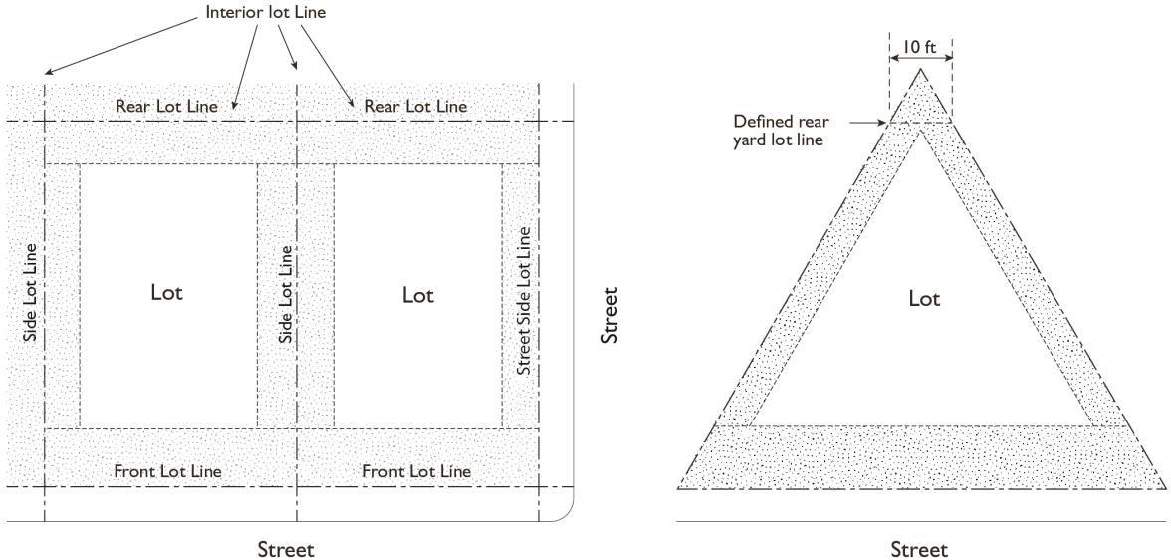
Lot types.
Lot, abutting. A lot having a common property line or separated by a public path or lane, private street, or easement to the subject lot.
Lot, corner. A lot or parcel situated at the intersection of two or more streets that have an angle intersection measured within said lot or parcel of not more than 135 degrees.
Lot, flag. A lot with access to a street by means of a strip of land having less than the required site width but not less than 15 feet of frontage. The length of a strip shall be measured from the frontage line to the nearest point of intersection with that lot line parallel or most nearly parallel to the frontage line.
Lot, interior. A lot or parcel of land other than a corner or flag lot.
Lot, key. An interior lot adjoining the rear lot line of a reversed corner lot.
Lot, reversed corner. A corner lot, the street side lot line of which is substantially a continuation of the front line of a lot or parcel of land which adjoins the rear lot line of said lot.
Lot, through. A lot having frontage on two parallel or approximately parallel streets.
Figure 11.73.020(B): Lot and Yard Types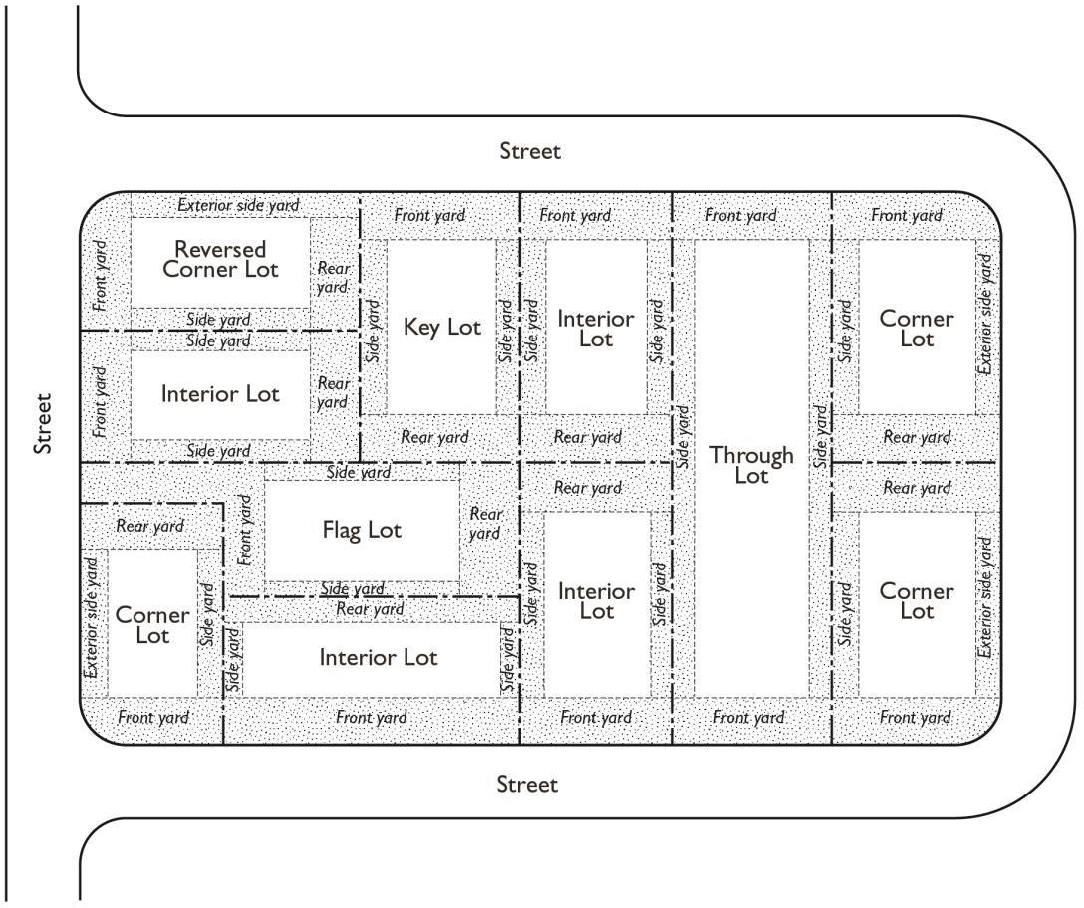
Lot width. The distance between the side lot lines, measured at a right angle to the lot depth at the midpoint of the lot depth line. See Section 11.03.070, Measuring Lot Width and Depth.
Maintenance and repair. The repair or replacement of nonbearing walls, fixtures, wiring, roof or plumbing that restores the character, scope, size or design of a structure to its previously existing, authorized, and undamaged condition.
Manufactured (mobile) home. A structure constructed on or after June 15, 1976 in compliance with state standards in effect at the time of construction, is transportable in one or more sections, is built on a permanent chassis and designed to be used as a single-family dwelling with or without a foundation system when connected to the required utilities, and includes the plumbing, heating, air conditioning, and electrical systems. "Manufactured home" includes any structure that meets all the requirements of this paragraph and with respect to which the manufacturer voluntarily files a certification and complies with the standards established under the National Manufactured Housing Construction and Safety Act of 1974.
Mezzanine. An intermediate floor within a building interior without complete enclosing interior walls or partitions that is not separated from the floor or level below by a wall and has a floor area that is no greater than one third of the total floor area of the floor below. See Story.
Major transit stop. A site in which there is unobstructed access to the major transit stop from the development, containing any of the following:
(1)
An existing rail or bus rapid transit station.
(2)
A ferry terminal served by either a bus or rail transit service.
(3)
The intersection of two or more major bus routes with a frequency of service interval of 15 minutes or less during the morning and afternoon peak commute periods. (Section 21155(b) of the Public Resources Code.)
A development shall be considered to have unobstructed access to a major transit stop if a resident is able to access the major transit stop without encountering natural or constructed impediments.
Market-rate unit. A dwelling unit that is not an affordable unit.
Maximum allowable residential density. The density allowed under the Development Code and the Land Use Element of the General Plan, or if a range of density is permitted, means the maximum allowable density for the specific district density range applicable to the project. If the density allowed under the Development Code is inconsistent with the density allowed under the Land Use Element of the General Plan, the General Plan density shall prevail (Government Code Section 65915(o)(2)).
Minimum affordable housing component. A housing development project that includes a minimum of any of the following:
(1)
Very low-income minimum affordable housing component - Provides at least five percent of the total units for very low-income household residents (Government Code Section 65915(b)(1)(B));
(2)
Low-income minimum affordable housing component - Provides at least ten percent of the total units for low-income households (Government Code Section 65915(b)(1)(A)); or
(3)
Moderate-income minimum affordable housing component - Provides at least ten percent of the total dwelling units in a common interest development for moderate-income households (Government Code Section 65915(b)(1)(D)).
Mining and Surface Mining Act (SMARA). For purposes of regulating mining activities the County shall utilize the definitions included in the California Mining and Geology Board's SMARA Regulations and Public Resources Code PRC Subsections 2725 to 2735.
National Environmental Policy Act (NEPA). NEPA [42 U.S.C. 4321 et seq.] was signed into law on January 1, 1970. The Act establishes national environmental policy and goals for the protection, maintenance, and enhancement of the environment and provides a process for implementing these goals within the federal agencies.
Noise terms.
Ambient noise level. The composite of noise from all sources excluding an alleged offensive noise. In this context, the ambient noise level represents the normal or existing level of environmental noise at a given location for a specified time of day or night.
Decibel. A unit for measuring the amplitude of a sound, equal to 20 times the logarithm to the base ten of the ratio of the pressure of the sound measured to the reference pressure, which is 20 micropascals.
Noise. Any sound that annoys or disturbs humans or which causes or tends to cause an adverse psychological or physiological effect on humans.
Noise Level Reduction (NLR). The difference in decibels of noise level from the outside of a building to the interior of a building, generally resulting from various construction methods and the materials used in walls, windows, ceilings, doors, and vents of a building.
Nonconforming use and development terms.
Abandoned. A use that has ceased or a structure that has been vacated for a time period as specified in this Code. Abandonment does not include temporary or short-term interruptions to a use or occupancy of a structure during periods of remodeling, maintaining, or otherwise improving or rearranging a facility.
Nonconforming building or structure. Any building or structure that was lawfully established and in compliance with all applicable ordinances and laws at the time it was constructed but which, due to the application of this Code or any amendment thereto, no longer complies with all the applicable regulation and standards of development in the zone in which it is located.
Nonconforming lot. A lot, the area, dimensions, or location of which was lawful prior to the effective date of this Code, or any amendment thereto, but which fails by reason of such adoption, revision, or amendment to conform to the present requirements of the zoning district.
Nonconforming sign. A sign that lawfully existed prior to but which fails by reason of such adoption or amendment to conform to all of the standards and regulation of this Code.
Nonconforming use. A use of a structure or land that was lawfully established and maintained, but which does not conform with currently applicable use regulations for the district in which it is located by reason of adoption or amendment of this Code.
Nuisance. Anything which is injurious to health, or is indecent or offensive to the senses, or an obstruction to the free use and enjoyment of property, or a violation of this Code.
Official plan line (ultimate right-of-way). The boundaries and limits of a planned right-of-way, including the future right-of-way of an existing street as it is proposed to be widened and including all lands necessary for the building, widening or maintenance of any road, street, highway or any other type of public way which planned right-of-way is based on the general plan.
On-site. Located on the lot that is the subject of discussion.
Open space types.
Private open space. Open areas for outdoor living and recreation that are adjacent and directly accessible to a single dwelling unit, reserved for the exclusive use of residents of the dwelling unit and their guests.
Common open space. Areas for outdoor living and recreation that are intended for the use of residents and guests of more than one dwelling unit.
Usable open space. Outdoor areas that provide for outdoor living and/or recreation for the use of residents.
Other incentives of equivalent financial value. The reduction or waiver of requirements that the County might otherwise apply as conditions of condominium conversion approval, but shall not be construed to require the County to provide cash transfer payments or other monetary compensation (Government Code Section 65915.5(c)).
Outdoor storage. The keeping, in an unroofed area, of any goods, junk, material, merchandise, or vehicles in the same place for more than 24 hours, except for the keeping of building materials reasonably required for construction work on the premises pursuant to a valid and current building permit issued by the County.
Overlay district. An area where certain additional requirements are superimposed upon a base zone district such as but not limited to Floodplain, Airport Environs, and Planning Reserve districts.
Owner. The person shown as the legal owner of the property on the latest equalized assessment roll in the office of the County Assessor.
Parcel (lot). Land described as a lot or parcel in a recorded deed or shown as a lot or parcel on a subdivision map or parcel map on file in the County Recorder's Office.
Parking area. An area of a lot, structure, or any other area, including driveways, which is designed for and the primary purpose of which is to provide for the temporary storage of operable motor vehicles.
Parking space, off-street. An area, covered or uncovered, designed and usable for the temporary storage of a vehicle, which is paved and accessible by an automobile without permanent obstruction.
Peak hour. Period of time with the greatest amount of activity and vehicles on the site.
Permit. Any zoning certificate or clearance, administrative use permit, minor conditional use permit, conditional use permit, temporary use permit, building permit, license, certificate, approval, or other entitlement for development and/or use of property as required by any public agency.
Permitted use. Any use allowed in a zoning district without a requirement for approval of a use permit, but subject to any restrictions applicable to that zoning district.
Person. Any individual, firm, corporation or public agency whether principal, agent, employee or otherwise.
Persons and/or families of lower income. Persons or families whose income does not exceed 80 percent of area median income, adjusted for family size by the California Department of Housing and Community Development (HCD), in accordance with adjustment factors adopted and amended from time to time by the United States Department of Housing and Urban Development (HUD) pursuant to Section 8 of the United States Housing Act of 1937.
Personal use. An activity conducted on private property for the enjoyment of the property owner and their household and occasional use by family and friends known personally by the owner that is not part of a commercial or business endeavor.
Persons with disabilities. Persons who have a medical, physical, or mental condition, disorder or disability as defined in California Government Code Section 12926, that limits one or more major life activities.
Planning director. The Director of the department currently known as the "Planning Department" within the Community Development and Services Agency, and any successor department that may exist in the future.
Pre-existing. In existence prior to the effective date of this Code.
Production housing (tract housing). A type of housing development in which multiple similar homes are built on a tract of land which is subdivided into individual lots. Using stock plans or master building plans the homes may offer a few options (i.e. trim types, bonus rooms, third car garages, etc...) but the homes while "stick built" (constructed on site) are not truly custom built homes.
Project. Any proposal for a new or changed use or for new construction, alteration, or enlargement of any structure, that is subject to the provisions of this Code. This term also refers to any action that qualifies as a "project" as defined by the California Environmental Quality Act.
Qualified applicant. The property owner, the owner's agent, or any person, corporation, partnership or other legal entity that has a legal or equitable title to land that is the subject of a development proposal or is the holder of an option or contract to purchase such land or otherwise has an enforceable proprietary interest in such land.
Qualified housing development. A housing development that meets the requirements of Section 11.30.040 for density bonus.
Qualified land. Land offered for donation in accordance with Section 11.30.080 that meets the criteria set forth in Subsection 11.30.080(a).
Recreational vehicle. A motor home, travel trailer, truck camper, or camping trailer with or without motor power designed for human habitation for recreational, emergency, or other occupancy, which meets all of the following criteria:
•
It contains less than 320 square feet of internal living room area, excluding built-in equipment, including but not limited to wardrobe, closets, cabinets, kitchen units, or fixtures, and a bath or toilet room;
•
It contains 400 square feet or less of gross area measured at maximum horizontal projections;
•
It is built on a single chassis; and
•
It is either self-propelled, truck-mounted, or permanently towable on the highways without a permit issued by the appropriate state agency.
Rescission. The County's unilateral unmaking of an approval for a legally sufficient reason, such as applicant's material breach of a condition.
Right-of-way. A strip of land acquired by reservation, dedication, forced dedication, prescription or condemnation and intended to be occupied or occupied by a road, railroad, electric transmission lines, oil or gas pipeline, water line, sanitary sewer, storm drain, bicycle/pedestrian path, or other similar use.
Screening. Screening refers to a wall, fence, hedge, informal planting, or berm, provided for the purpose of buffering a building or activity from neighboring areas or from the street.
Setback. The area between a property line and a building or structure which must be kept clear or open. See Section 11.03.040, Measuring Distances, and Section 11.03.120, Determining Setbacks (Yards).
Senior citizen housing development. A residential development that is developed, substantially rehabilitated, or substantially renovated for senior citizens and that has at least 35 senior citizen housing development units (Government Code Section 65915(b)(1)(C).)
Senior citizen housing development unit. A residential dwelling unit in a senior citizen housing development that is available to, and occupied by, a senior citizen, as defined in Civil Code Section 51.3.
Sidewalk. A paved walkway, bikeway, or combination of those designed for use by the public, generally within the public right-of-way and generally parallel to a public street.
Sign-related terms. The following terms are related to Chapter 11.27, Signs.
Abandoned sign. A sign remaining in place or not maintained for a period of 90 days which no longer advertises or identifies an ongoing business, product, or service available on the business premise where the sign is located.
Animated sign. A sign that uses movement or change of lighting to depict action or create a special effect or scene.
Area of sign. The area included within the outer dimensions of a sign face display area including all portions not part of the necessary supporting structure; a double-faced sign whose faces are parallel or no more than 30 degrees apart shall be deemed to be a single sign for the purposes of determining sign area. In the case of a sign placed on a wall or other structure surface, the area shall be computed by enclosing the sign within sets of parallel lines.
Awning sign. A sign painted or otherwise affixed permanently to the exterior surface of an awning. For purposes of this Code, awning means shelter projecting from and supported by the exterior wall of a building and constructed of a rigid frame covered by a flexible skin (e.g., as fabric, synthetic material, or thin sheet metal).
Banner. A temporary sign made of fabric or any non-rigid material with no enclosing framework.
Building-mounted sign. Any sign mounted or erected on or against any building or façade, including all wall signs, awning and canopy signs and projecting signs.
Canopy. A rigid multi-sided structure covered with fabric, metal, or other material and supported by columns or posts embedded in the ground, or cantilevered out from the main structure.
Construction sign. A temporary sign describing in words and/or drawings a planned future development project on a property.
Directional sign. An on-site sign designed to direct or guide pedestrian or vehicular traffic and which is non-advertising in nature, except for a logo and directional information, (e.g., handicapped parking, one way, exit, and entrance).
Electronic message center sign. A sign whose informational content can be changed or altered by electric, electro-mechanical, electronic, or any other artificial energy means.
Fence sign. A sign attached to or painted onto any freestanding wall or fence.
Flag. A loose fabric or membrane secured to a pole or rod, which flutters and moves with air or wind movement.
Freestanding sign. A sign that is permanently supported upon the ground by poles or braces and is not attached to any building or other structure.
Height. The vertical distance measured from the lowest ground level directly beneath the sign to the highest point at the top of the sign. The ground level shall be either the natural grade or finished grade, whichever is lowest.
Illegal sign. A sign that does not meet the requirements of this Code or that does not have legal nonconforming status.
Illuminated sign. A sign with an artificial source of light incorporated internally or externally for the purpose of illuminating the sign.
Inflatable sign. A form of inflatable device (e.g., shaped as an animal, blimp, or other object) that is displayed, printed, or painted on the surface of an inflatable background, and is primarily installed outside a building to attract attention to or to advertise a business, a business location, a service, a product, or an event. An inflatable sign shall not be considered a balloon.
Interior illumination. Lighting whose source is contained within the sign.
Logo. A specially designed graphic symbol of a business establishment, a company, or any other legal private or public entity.
Marquee sign. A sign advertising an event, performance, service, seminar, conference, or show, and displayed on a permanent roof-like structure or canopy made of rigid materials supported by and extending from the facade of a building.
Mansard. A wall which has a slope equal to or greater than two vertical feet for each horizontal foot and has been designed to look like a roof.
Master sign program. A coordinated program of signage designed to encourage consistency in signage for developments with multiple tenants or for developments with a single tenant proposing multiple signs.
Monument sign. A low-profile freestanding sign erected upon or supported solely by a planter, pedestal base, or similar ground structure approximately the same dimension as the height of the sign and which is designed to incorporate the architectural theme and building material of the building on the premises.
Neon sign. A sign with tubing that is internally illuminated by neon or other electrically charged gas.
Off-site advertising sign. A sign structure or billboard, whether freestanding or mounted on an existing building, built for the purpose of advertising an establishment, product or service that is not available on the property upon which the sign is located at the time the sign structure was erected.
Off-site directional sign. A sign offering directional information to a business, location or place located in an area different from where the sign is located.
Parapet. That portion of the building wall that extends above the roof of the building.
Pennant. A device made of flexible materials, (e.g., cloth, paper, or plastic) that may or may not contain copy, and which is installed for the purpose of attracting attention.
Pole sign. A freestanding sign supported by one or more poles.
Political sign. A temporary sign installed that advertises a political candidate, a political party, or a political issue.
Portable sign. A sign not permanently attached to, mounted upon, or affixed to a building, structure, or the ground. Portable signs include A-frame signs, sandwich board signs, and signs on wheels.
Projecting sign. A sign, the sign surface of which is not parallel to the face of the supporting wall and which is supported wholly by the wall. This definition shall include V- or wing-type signs.
Real estate sign. A temporary sign indicating that the premises on which the sign is located is for sale, lease, or rent. These signs typically include rider signs that describe amenities such as swimming pools and spas, open house signs, subdivision signs, and off-site directional signs.
Roof sign. A sign erected, constructed, and attached to and/or maintained upon or above any roof or portion of a roof of any building, including a mansard roof. For the purposes of this Code, a mansard roof is any roof or parapet wall with roofing material for siding that slopes from 30 degrees to 90 degrees and does not have a ridgeline.
Sign. Any letters, figure, visual symbol, emblem, logo, object, or display, or any combination thereof, designed or used to identify, attract attention to, advertise, or communicate information. Signs include display surfaces together with such facilities as are utilized in supporting, maintaining, and illuminating the display surfaces.
Sign area. See Area of Sign.
Sign copy. Any words, letters, logos, numbers, figures, design, or other symbolic representation incorporated into a sign.
Sign face. The surface or surfaces used for the display of a sign message as seen from any one direction.
Temporary sign. A sign that is designed or intended to be temporarily mounted or displayed and that is not intended for permanent or long-term use.
Wall sign. A sign painted or installed on or attached to a wall and which is parallel to the building facade. This definition includes painted, channel letters, and can signs.
Window sign. A sign painted or installed on a glass window or door or located within 12 inches from inside the window in a manner that it can be viewed from the exterior of a structure.
Single Room Occupancy (SRO). A residential rental facility containing individual secured rooms (residential unit) that have a minimum floor area of 120 square feet that may have individual or shared kitchen and/or bathroom facilities. SROs may also include efficiency dwelling units that meet California Building Code requirements. SROs shall be developed as a multi-unit development or located on the upper stories of a commercial building where mixed uses are permitted. Each unit shall be occupied by no more than two persons and is offered on a monthly rental basis.
Site. Any lot or parcel of land or combination of contiguous lots or parcels of land, whether held separately or joined together in common ownership or occupancy where grading or construction is to be performed or has been performed.
Specific, adverse impact. A significant, quantifiable, direct, and unavoidable impact, based on objective, identified written public health or safety standards, policies, or conditions as they existed on the date the application for the housing development was deemed complete. Inconsistency with the Development Code or General Plan land use designation shall not constitute a specific, adverse impact upon public health or safety (Government Code Section 65589.5(d)(2)).
Specific plan. A plan for a defined area that is consistent with the General Plan and with the provisions of the California Government Code, Section 65450 et seq.
State. The State of California.
Story. That portion of a building included between the upper surface of any floor and the upper surface of the floor next above, except that the topmost story shall be that portion of a building included between the upper surface of the topmost floor and the roof above.
Street. A public or private right-of-way whose function is to carry vehicular traffic and other modes of travel, or provide vehicular access to abutting property.
Street line. The boundary between a street and a lot or parcel of land.
Structure. That which is built or constructed or any piece of work artificially built up or composed of parts joined in some definite manner.
Accessory structure. A subordinate structure, the use of which is incidental to that of the main structure on the same lot.
Permanent structure. Anything constructed or erected which requires a fixed location on the ground, or is attached to a building or other structure having fixed location on the ground.
Primary structure (main structure). A structure housing the principal use of a site or functioning as the principal use.
Temporary structure. A structure without any foundation or footings and which is intended to be removed when the designated time period, activity, or use for which the temporary structure was erected has ceased.
Structural alteration. Any change of the supporting members of a building, such as bearing walls, columns, beams or girders, floor joists, ceiling joists, or roof rafters.
Swimming pool. A structure, whether above or below grade level, designed to hold water over 24 inches deep and is intended for swimming, recreational bathing or wading. Swimming pools includes in-ground, above ground and on-ground pools; hot tubs; and fixed-in-place wading pools. Does not include portable wading pools and similar structures which are not permanently installed and do not require water filtration, circulation, or purification systems.
Tandem parking. An arrangement of parking spaces such that one or more spaces must be driven across in order to access another space or spaces.
Temporary uses. The following terms are related to Section 11.32.310, Temporary Uses.
Garage sales. The sale or offering for sale to the general public of over five items of personal property on a portion of a lot that contains a residence, whether inside or outside any building.
Outdoor sales, temporary and seasonal. The sale or offering for sale to the general public of merchandise outside of a permanent structure on property owned or leased by the person, firm, or corporation. These sales are of a limited duration and conducted on an occasional basis, and are secondary or incidental to the principal permitted use or structure existing on the property.
Total units and total dwelling units. Dwelling units other than density bonus units (Government Code Section 65915(b)(3)).
Unit. See Dwelling Unit.
Urban area. Developed areas that are defined by the U.S. Census Bureau as contiguous census block groups with a population density of at least 1,000 people per square mile with any census block groups around this core having a density of at least 500 people per square mile.
For purposes of environmental review under the California Environmental Quality Act, use of the term "Urban area" is limited to areas mapped and designated as urbanized by the U.S. Bureau of the Census.
For flood control purposes: "Urban area" is defined as a developed area in which there are 10,000 residents or more (Government Code Section 65007(j)).
For water quality purposes the term urbanized area shall be as determined by the statewide NPDES permit.
Urbanizing area. A developed area or an area outside a developed area that is planned or anticipated to have 10,000 residents or more within the next ten years. (Government Code Section 65007(k).)
Use. The purpose for which a site or structure is arranged, designed, intended, constructed, erected, moved, altered, or enlarged for which either a site or a structure is or may be occupied or maintained.
Use, accessory. A use that is customarily associated with, and is incidental and subordinate to, the principal use and located on the same lot as the principal use.
Use, incidental. A secondary use of a lot and/or building that is located on the same lot but is not customarily associated with the primary use.
Use, primary. A primary or dominant use established, or proposed to be established, on a lot.
Use classification. A system of classifying uses into a limited number of use types on the basis of common functional, product, or compatibility characteristics. All use types are grouped into the following categories: residential; public and semi-public; commercial; industrial; transportation, communication, and utilities; and agricultural and natural resources. See Chapter 11.72, Use Classifications.
Use permit. A discretionary permit, such as an administrative use, minor conditional use, or conditional use permit, which may be granted by the appropriate review authority to provide for the accommodation of land uses with special site or design requirements, operating characteristics, or potential adverse effects on surroundings, which are not permitted as of right but which may be approved upon completion of a review process and, where necessary, the imposition of special conditions of approval by the permit granting authority. See Chapter 11.57, Use Permits.
Valley Growth Boundary (VGB). An area designated in the 2030 General Plan that includes the existing suburban and urbanized communities of Linda, Olivehurst, Plumas Lake, the North Arboga Study Area, Sports and Entertainment Zone, as well as new job generating areas adjacent to Highway 65 and future growth areas identified as planning reserve.
Variance. A discretionary grant of permission to depart from the specific requirements of this Code that is warranted when, due to special circumstances regarding the physical characteristics of the property, the strict application of standards would deprive the property of privileges available to other property in the same zoning classification. See Chapter 11.59, Variances.
Vehicle. Any vehicle, as vehicle is defined by the California Vehicle Code, including any automobile, camper, camp trailer, trailer, trailer coach, motorcycle, house car, boat, or similar conveyance.
Vibration. A periodic motion of the particles of an elastic body or medium in alternately opposite directions from the position of equilibrium.
Visible. Capable of being seen (whether or not legible) by a person of normal height and visual acuity walking or driving on a public road, sidewalk or pedestrian way.
Wall. Any vertical exterior surface of building or any part thereof, including windows.
Weekday. Any day, Monday through Friday, that is not a federal, state, or local holiday.
Wireless communication terms. The following terms are related to Section 11.32.300, Wireless Communications Facilities.
Antenna. Any system of wires, poles, rods, reflecting discs, or similar devices used for the transmission or receiving of electromagnetic radio frequency waves.
Amateur radio antenna. Any antenna used to receive or transmit radio signals on the amateur radio bandwidth, as designated by federal regulations.
Base station. The transmission and associated equipment and non-tower support structures at a fixed location that enable FCC-licensed or authorized wireless communications between user equipment and a communications network. May also be referred to as the equipment compound or wireless facility lease area.
Camouflage wireless facility. To disguise a wireless facility by incorporating it into the architectural design of a building or structure or by utilizing design and siting techniques that disguise the wireless facility as a structure or object other than a wireless facility, which is either already present in the area or blends in with the existing environment. Examples of camouflage techniques include, but are not limited to, trees, clock towers, bell steeples, light poles and flag poles. The use of mono-pines (or similar faux vegetation) shall not be considered appropriate camouflage unless integrated into the surrounding landscape with the use of live trees, new or existing structures or other design features.
Carrier on Wheels or Cell on Wheels (COW). A portable self-contained wireless facility that can be moved to a location and set up to provide wireless services on a temporary or emergency basis. A COW is typically vehicle-mounted and contains a telescoping boom as the antenna support structure.
Co-location. The location of two or more wireless communication facilities on a single support structure or otherwise sharing a common location. For the purposes of this Chapter, collocation shall also include the location of wireless communication facilities with other facilities such as water tanks, light standards, and other utility facilities and structures that are capable of structurally supporting the attachment of wireless facilities in compliance with applicable codes.
Communication tower. Any structure that is used to transmit or receive electromagnetic radio frequency waves or that supports such a device.
Eligible facilities request. A request for modification of an existing wireless tower or base station that involves co-location of new transmission equipment or replacement or modification of existing equipment but does not include a substantial modification.
Emergency service radio. Radio and related wireless communication facilities necessary for the operations of public-safety, emergency services or governmental agencies such as dispatch, emergency response, and related communications. Wireless communication facilities shall be deemed an ancillary use and exempt from the provisions of this Chapter if they are located on the same site as an essential/emergency service facility and are exclusively used for government or public safety purposes.
Ground-mounted. A facility that is fully or partially supported by a platform, framework, pole, or other structural system that is affixed to or placed directly on or in the ground.
Lattice tower. A structure, guyed or freestanding, erected on the ground, which generally consists of metal crossed strips or bars to support antennas and equipment.
Substantial modification. A modification to an existing wireless facility that meets any one or more of the following criteria:
(1)
Increases the existing vertical height of the wireless support structure by: (a) more than ten percent, or (b) the height of one additional antenna array with separation from the nearest existing antenna not to exceed 20 feet, whichever is greater;
(2)
Adds an appurtenance to the body of a wireless support structure that protrudes horizontally from the edge of the wireless support structure more than 20 feet, or more than the width of the wireless support structure at the level of the appurtenance, whichever is greater (except where necessary to shelter the antenna from inclement weather or to connect the antenna to the tower via cable); and/or,
(3)
Increases the square footage of the existing equipment compound by more than 2,500 square feet.
Monopole. A facility that consists of a single pole structure erected on the ground to support wireless communication antennas and connecting appurtenances.
Transmission equipment. Any equipment that facilitates transmission for any FCC-licensed or authorized wireless communication service, including, but not limited to, radio transceivers, antennas and other relevant equipment associated with and necessary to their operation, including coaxial or fiber-optic cable, and regular and back-up power supply.
Wireless communication facility. A facility containing communication towers and/or antennas and any related equipment for the purpose of transmitting or receiving electromagnetic radio frequency waves.
Yard. An open space on a lot that is unoccupied and unobstructed from the ground upward, except as otherwise permitted by this Code.
Front yard (area). A yard extending across the front of a lot for the full width of the lot between the side lot lines. The depth of a front yard setback shall be a distance specified by this Code for the district in which it is located and measured inward from the front lot line. The front yard area includes all areas up to the face of the primary building.
Interior side yard. A yard extending along an interior side of a lot from the front lot line to the rear lot line, and to a depth specified by this Code for the district in which it is located and measured inward from the interior side lot line.
Street side yard. A yard extending along the street side of a corner lot from the front lot line to the rear lot line, and to a depth specified by this Code for the district in which it is located and measured inward from the street side lot line.
Rear yard. A yard extending across the rear of a lot for its full width between side lot lines, and to a depth specified by this Code for the district in which it is located. If a lot has no rear lot line, a line ten feet in length within the lot, parallel to and at the maximum possible distance from the front lot line, will be deemed the rear lot line for the purpose of establishing the minimum rear yard.
Zoning administrator. A staff member of the Community Development and Services Agency appointed by the CDSA Director charged with enforcing and administering the zoning provisions of the Development Code.
Zoning district. A specifically delineated area or district in the County within which regulations and requirements uniformly govern the use, placement, spacing, and size of land and buildings.
(Ord. No. 1624)

