
Yukon City Zoning Code
ARTICLE 3
- DISTRICTS AND USES
Sec. 215-301. - Zoning districts established.
For the purposes of this UDC and the promotion of public health, safety and general welfare of the community, the following districts are hereby established for the City of Yukon, Oklahoma.
A.
Agricultural District.
A - Agricultural District
B.
Residential Districts.
R-1 - Single Family District
R-2 - Medium Density District
R-3 - Multifamily District
RR - Rural Residential District
MH - Manufactured/Mobile Home District
C.
Commercial Districts.
C-O - Office District
C-N - Neighborhood Commercial District
C-G - General Commercial District
C-H - Heavy Commercial District
D.
Industrial Districts.
I-1 - Light Industrial District
I-2 - Heavy Industrial District
E.
Special Purpose Districts.
CB - Central Business District
OR - Office Research District
F.
Special Development Types.
PUD - Planned Unit Development
SPUD - Simplified Planned Unit Development
G.
Overlay Districts.
I-40 Corridor Overlay District
Urban Core Overlay District
(Ord. No. 1438, § I, 8-1-2023)
Sec. 215-302. - District intent statements.
A.
A - Agricultural district. The agricultural district is intended to protect undeveloped areas from intensive uses and allow farming and ranching operations.
B.
R-1 - Single-family district. The single-family district is intended to provide quiet, low-density areas for single-family living with related recreational, religious, and educational facilities protected from all commercial and industrial activity.
C.
R-2 - Medium density district. The medium density district is intended to provide a quiet, slightly higher population density area through townhomes, duplexes, triplexes and four-plexes.
D.
R-3 - Multifamily district. The multifamily district is intended to provide higher density areas through high-rise, mid-rise, and garden apartments in proximity to daily needs.
E.
M-H - Manufactured/mobile home district. The manufactured/mobile home district is intended to encourage the development of properly planned mobile home parks and subdivisions in residential environments and to establish standards for the size, design, and quality of mobile home parks and subdivisions.
F.
RR - Rural residential. The rural residential district is intended as rural-style development of a single-family residential dwelling on a lot intended for areas where a community sewer and water are not planned in the near future, but where other public services may be available, and topography and soil conditions allow development at a low population density that can rely on site water supply and waste disposal systems without creating public health hazards. This rural residential district is intended primarily for areas devoted to large-lot suburban residential use. The regulations and restrictions in this RR district are intended to protect the residential character of these areas and conserve Yukon's environmental resources.
G.
C-O - Office district. The office district is intended for general and professional office and related activity to meet the needs of the community in such a manner as to not be offensive to a general neighborhood containing residential, religious, recreational, and educational elements. It is intended that this district be located so as not to introduce traffic onto solely residential streets or become an intrusion into a Residential District, but to serve as a buffer between residential and more intensive commercial activities.
H.
C-N - Neighborhood commercial district. The neighborhood commercial district is intended for a unified grouping in one or more buildings of retail shops and stores and personal services of limited size and service area that provide for the regular needs and are for the convenience of the people residing in the adjacent residential neighborhoods where retail shops and personal services are not otherwise readily available.
I.
C-G - General commercial district. The intent of the general commercial district is to accommodate regional commercial centers, medium and large-scale development that may generate a sizeable amount of traffic and typically requires higher amounts of off-street parking and appropriate landscaping and screening materials.
J.
C-H - Heavy commercial district. The heavy commercial district is intended as a district in which the principal use of land is for establishments offering accommodations, motorist supplies and services, and recreation services and supplies and areas of more intense commercial use, including those related to motor vehicles and outdoor storage.
K.
CB - Central business district. The regulations for the central business district are intended to provide for orderly redevelopment through a mix of commercial, retail, office, and residential uses. Residential dwelling units are allowed above the ground floor.
L.
I-1 - Light industrial district. The intent of the light industrial district is to provide a location for industries which do not by their nature create nuisances and for commercial uses that either due to the nature of their operation are best located in the I-1, light industrial district, or are either supportive, or compatible or not detrimental to the industrial activities allowed.
M.
I-2 - Heavy industrial district. The intent of the heavy industrial district is to provide a location for industries which may by their nature create some nuisance. The intent is to preserve this land especially for such industry in locations with access to arterial streets as designated on the comprehensive plan, as well as locations generally accessible to railroad transportation.
N.
O-R - Office research district. The office research district is intended to accommodate larger office structures such as office parks, research and development facilities, and which may include limited light industrial uses with no outside impacts. Residential dwelling units are allowed above the ground floor; and multi-family uses are allowed, as a part of an overall office/industrial use.
O.
PUD - Planned unit development. The intent of the planned unit development is to promote innovative design in development through flexibility in uses and bulk regulations. This district is intended to provide efficient use of land, quality open space, balanced variety of housing choices, and thoughtful approaches to natural site features. The PUD is not intended to be utilized only for the purpose of obtaining a variance to the bulk standards or other UDC requirements. The planned unit development is meant for larger scale development, on sites five acres or larger.
P.
SPUD - Simplified planned unit development. The intent of the simplified planned unit development is to promote innovative design in development through flexibility in uses and bulk regulations. This district is intended to provide efficient use of land, quality open space, balanced variety of housing choices, and thoughtful approaches to natural site features. The SPUD is not intended to be utilized only for the purpose of obtaining a variance to the bulk standards or other UDC requirements. The simplified planned unit development is meant for smaller scale, often infill, development, on sites less than five acres.
Q.
I-40 corridor overlay district. The intent of the I-40 corridor overlay district is to ensure the orderly development of commercial and entertainment uses with a regional draw while addressing issues of site design, signage, landscaping and access management.
R.
Urban core overlay district. The intent of the urban core overlay district is to ensure the orderly redevelopment of the core of Yukon while addressing issues of site design, density and intensity, signage, landscaping and allowing a mix of uses.
(Ord. No. 1438, § I, 8-1-2023)
Sec. 215-303. - Zoning map.
A.
Incorporated. The locations and boundaries of zoning districts shall be established by ordinance and shall be delineated and shown on a map entitled "Zoning Map of the City of Yukon, Oklahoma," and the zoning map is hereby incorporated as a part of this UDC.
B.
District boundaries established. The boundaries of a zoning district shall extend to a centerline of abutting streets, regardless of the legal description used in establishing such districts. In the event of uncertainty in the exact boundaries of any of the districts as shown on the official "Zoning Map of the City of Yukon, Oklahoma," the planning commission, upon written application or upon its own motion, shall recommend the location of such boundaries to the city council, and the city council shall make the final determination.
C.
Maintenance of official zoning map. It shall be the duty of development services director or designee to maintain an up-to-date official "Zoning Map of the City of Yukon, Oklahoma" including all amendments directly adopted by the city council.
(Ord. No. 1438, § I, 8-1-2023)
Sec. 215-304. - Permitted use table.
Where the letter "P" appears in the permitted use table the use shall be permitted by right. Where the letter "C" appears in the permitted use table these uses shall be subject to conditions outlined in section 215-308.B, conditional uses. Where the letters "SP" appears in the permitted use table the use shall be subject to standards outlined in section 215-308.E, special permit uses and shall be subject to public review processes outlined in article 7, administration, section 215-709.
A.
Residential uses table.
B.
Public/institutional use table.
C.
Commercial use table.
D.
Industrial use table.
(Ord. No. 1438, § I, 8-1-2023; Ord. No. 1454, § I, 8-20-2024; Ord. No. 1458, § 1, 10-1-2024; Ord. No. 1472, § 1, 4-15-2025)
Sec. 215-305. - Use categories.
This section defines the use categories and specific use types listed in section 215-304.
A.
Residential uses.
1.
Household living: This use category is typified by an individual household dwelling unit. Specific types of household living include, but are not limited to:
a.
Accessory Dwelling Unit: A dwelling for one household erected as an accessory structure to a principal dwelling unit, all located on one lot. Accessory dwelling units are not allowed by right in any zoning district. They may be approved as a part of a PUD or SPUD. No more than one accessory dwelling unit is allowed per parcel.
b.
Dwelling, above ground floor: A dwelling located above the ground floor of a nonresidential use.
c.
Dwelling, duplex: A building (attached or detached) containing two dwelling units located on one lot, or on two lots with a shared wall, designed for and used by two households.
d.
Dwelling, triplex: A building (attached or detached) containing three dwelling units located on one lot, designed for, and used by three households.
e.
Dwelling, four-plex: A building (attached or detached) containing four dwelling units located on one lot, designed for, and used by four households.
f.
Dwelling, multifamily: A building containing more than four dwelling units located on one lot.
g.
Dwelling, single-family attached: A dwelling unit on one lot attached to another dwelling unit on an adjoining lot with a common wall or party wall extending from ground to roof between the units, and with separate outdoor entrances. Commonly includes condominiums, townhouses and rowhouses.
h.
Dwelling, single-family detached: A dwelling unit located on one lot and having no walls in common with adjoining dwellings.
i.
Dwelling, zero lot line: A detached dwelling unit that has only one side yard.
j.
Mobile/manufactured home park: A site under single ownership, with required improvements and utilities for the long-term parking of mobile/manufactured homes on individual home sites, which may include services and facilities for the residents.
k.
Mobile/manufactured home subdivision: A subdivision with required improvements and utilities for the long-term parking of mobile/manufactured homes on individual home lots under individual ownership, which may include services and facilities for the residents.
2.
Group living: This use category is characterized by residential occupancy of a structure by a group of people who do not meet the definition of "household living." Generally, group living facilities have common eating area for residents, and can have other common spaces such as recreational facilities. Residents in group living facilities may receive care, treatment, or training. Caregivers may or may not reside at the site. Specific use types include, but are not limited to:
a.
Boarding, dormitory, and rooming house: A building arranged or used for lodging, with or without meals, for compensation and not occupied as a single-family unit.
b.
Group home: A community-based residential facility where two or more persons with developmental or physical disabilities who require specialized living arrangements, lodging, meals, and supervision by a nonrelated person or persons for a monthly fee or charge.
c.
Convalescent home, nursing home, or assisted living facility: A home for the aged, recuperating, chronically ill, or incurable persons, in which two or more persons not of the immediate family are received, kept, or provided with food and shelter or care for compensation, but not including hospitals, clinics, or similar institutions devoted primarily to the diagnosis and treatment of disease or injury.
B.
Public/institutional uses.
1.
Community service: Uses including buildings, structures, or facilities owned, operated, or occupied by a governmental entity or private organization to provide a service to the public. Specific use types include, but are not limited to:
a.
Cemetery: Land used or dedicated to the interment of human or animal remains, including columbaria, mausoleums, and mortuaries.
b.
Government administration and civic buildings: An office of a governmental agency that provides administrative and/or direct services to the public, such as, but not limited to, post offices, employment offices, building permit offices, public assistance offices, or motor vehicle licensing and registration services.
c.
Municipal or community recreation center: A facility providing recreation/pool facilities and/or meeting rooms, and typically oriented to the recreational needs of the residents of the surrounding area.
d.
Places of assembly: A building or structure, or group of buildings or structures, intended primarily for the conducting of organized assembly. May include, but are not limited to religious facilities, assembly halls, and fraternal/social clubs. Accessory uses may include meeting rooms, offices, and childcare provided for persons while they are attending assembly functions.
e.
Public safety facility: A facility used to conduct publicly owned safety and emergency services, such as, but not limited to, fire stations, police stations, emergency medical and ambulance services.
2.
Cultural facility: A cultural facility displays or preserves objects of interest or provides facilities for one or more of the arts or sciences. May include ancillary uses such as offices, gift shops, and storage areas. Specific use types include, but are not limited to, the following:
a.
Art gallery or museum, public: Any permanent institution for the collection and display of objects of art or science, sponsored by a public or quasi-public agency and open and available to the public.
b.
Library, public: A permanent facility for storing and loaning books, periodicals, reference materials, audio and videotapes, and other similar media for use by the public.
3.
Childcare facility: Facilities licensed by the State of Oklahoma (state), according to the Oklahoma Child Care Facilities Licensing Act (10 O.S., §§ 401—410), that provide care for children on a regular basis away from their primary residence, not including public or private schools, or facilities where children are cared for while guardians or occupied on the premises or in the immediate vicinity. Provided, however, this definition shall not include custody of children fixed by a court, children related by blood or marriage within the third degree to the custodial person. Ancillary uses may include open space, kitchen/food preparation facilities, playgrounds, and administrative offices.
a.
Childcare center: Facilities that offer care programs for 30 or more hours per week as defined by the state. These can include a commercial day care or nursery school.
b.
Home day care: Any home which receives up to seven children for care apart from their natural parents, legal guardians or custodians, for regular periods of time for compensation. This use includes family child care homes as defined by the state.
c.
Home day care, large: Any home which receives eight to 12 children for care apart from their natural parents, legal guardians or custodians, received for regular periods of time for compensation, and may have more than one care provider. This use includes large child care homes as defined by the state.
4.
Education: These uses are public, private, and parochial institutions at the primary, elementary, middle, high school, or post-secondary level, or trade or business schools, which provide educational instruction to students. Accessory uses include play areas, cafeterias, recreational and sport facilities, auditoriums, and before- or after-school day care. Specific use types include, but are not limited to:
a.
College or university. A degree-granting institution, other than a trade or technical school, that provides education beyond the high school level. The use includes, but is not limited to, classroom buildings, offices, laboratories, lecture halls, athletic facilities, and dormitories.
b.
Elementary school. An educational institution that satisfies the compulsory education laws of the State of Oklahoma for students in elementary grades. This definition includes both public schools and private schools.
c.
Middle school or high school. An educational institution that satisfies the compulsory education laws of the State of Oklahoma for students in secondary education. This definition includes both public schools and private non-boarding schools.
d.
Trade or technical school. A secondary or higher education facility primarily teaching usable skills that prepares students for jobs in a trade or in industry, construction, or commerce, and meeting all applicable state requirements for a facility of its type.
5.
Health care facility: These uses are characterized by activities focusing on medical services, particularly licensed public or private institutions that provide primary health services and medical or surgical care to persons suffering from illness, disease, injury, deformity, or other physical or mental conditions. Accessory uses may include, but are not limited to, laboratories, outpatient, or training facilities. Specific use types include, but are not limited to:
a.
Medical office or clinic: An establishment primarily engaged in furnishing, on an outpatient basis, chiropractic, dental, medical, surgical, medical imaging, or other services to individuals, including the offices of chiropractors, physicians, dentists, and other health practitioners, medical and dental laboratories, and outpatient care facilities. Patients are not kept overnight.
b.
Hospital: A building or portion thereof for the accommodation of sick, injured, or infirm persons. Services include the keeping of patients overnight.
c.
Micro or specialty hospital: These medium-scale facilities (20,000 to 50,000 square feet) offer emergency medicine and specialty medical services, including in-patient procedures with up to 15 short-stay beds.
6.
Parks and recreation: These uses focus on natural areas, consisting mostly of vegetative landscaping including public outdoor recreation, community gardens, or public squares. There tends to be few structures. Accessory uses may include, but are not limited to, clubhouses, playgrounds, maintenance facilities, and concessions. Specific use types include, but are not limited to:
a.
Arboretum or botanical garden: A public or private facility for the demonstration and observation of the cultivation of flowers, fruits, vegetables, or ornamental plants.
b.
Campground: A parcel of ground upon which two or more campsites are located, established, or maintained for occupancy by camping units of the public as temporary living quarters for recreation, education, or vacation purposes.
c.
Community playfields and parks: A tract of land owned by a governmental or quasi-governmental entity and available to the public for recreational purposes, including indoor recreational facilities, swimming pools, playgrounds, and athletic fields.
7.
Telecommunication facility: This use category transmits analog or digital or information amongst points using electromagnetic signals via antennas, microwave dishes, and similar structures. This use category does not include small wireless facilities as defined by State law. Supporting equipment includes buildings, shelters, cabinets, towers, and electrical equipment. Specific use types include:
a.
Freestanding tower: A structure (includes monopoles and guyed and lattice construction steel structures) in a fixed location used as an antenna or to support antennas for the primary purpose of transmitting and/or receiving electronic signals.
b.
Building or tower-mounted antenna: A physical device that is attached to an existing freestanding tower, building or other structure though which electromagnetic, wireless telecommunications signals authorized by the Federal Communications Commission are transmitted or received.
c.
Broadcasting, transmitting, or recording studio: A building or portion of a building used as a place for radio or television broadcasting or recording.
8.
Transportation facility: This category includes facilities that receive and discharge passengers and freight. Accessory uses include, but are not limited to, freight handling areas, concessions, offices, parking, and maintenance and fueling facilities. Specific use types include, but are not limited to:
a.
Airport: A place where aircraft can land and depart, usually equipped with landing field facilities for refueling and repair, and various accommodations for passengers.
b.
Bus and passenger train terminal: Any premises for the transient housing or parking of motor-driven buses or trains and the loading and unloading of passengers.
c.
Helipad: A small, designated area, usually with a prepared surface, on a heliport used for landing, or parking of helicopters temporarily.
d.
Railroad: Areas for transferring passengers or goods on trains along rails/tracks, which may include equipment storage or maintenance, terminals, fueling, and accommodations for passengers.
9.
Utility: This use category includes public or private utilities, which are infrastructure services providing regional, community-wide, or neighborhood services. Ancillary uses may include, but are not limited to control, monitoring, data, or transmission equipment, and structures.
a.
Utility facility, major: A service of a regional nature that normally entails the construction of new buildings or structures, and that typically has employees on the site on an ongoing basis. Examples include, but are not limited to, water works, reservoirs, power plants, and waste treatment plants.
b.
Utility facility, minor: A service that is necessary to support development within the immediate vicinity and that involves only minor structures. Employees typically are not located at the site on an ongoing basis. Examples include, but are not limited to, utility lines, electric transformer stations; gas regulator stations; communication buildings; and well, water, and sewer pumping stations.
C.
Commercial uses.
1.
Agriculture: Use of land for farming, ranching, dairying, pasturage, horticulture, animal and poultry husbandry, and associated uses. Ancillary uses such as harvesting, sorting, boxing, composting, etc., is expected if they are secondary to that of normal agricultural activities.
a.
Agriculture, animal raising (except hogs): The keeping of animals for commercial purposes or for personal use of the owner or occupant. Examples include, but are not limited to, beef ranches, chicken farms, dairy farms, sheep grazing, etc. Except the uses shall not include the commercial feeding of swine or other animals, stockyards or commercial feed lots.
b.
Agriculture, crops: The cultivation of agricultural products such as wheat, forage, fruit trees, canes, annual or perennial vegetables or cut flowers grown for home consumption, or commercial sale.
c.
Confined feeding operations: A nontraditional, noncustomary and intensive agricultural operation including commercial feed pens, poultry ranch, or other intensive agricultural activities where livestock is concentrated in enclosures of such limited size that the major portion of the necessary food supply for the livestock must be imported. Examples include commercial feedlots, concentrated animal feeding operation (CAFO), and stockyards.
d.
Horticulture: The cultivation and storage of horticultural and floricultural specialties such as flowering plants, shrubs, trees, forbs, and annual bedding plants intended for ornamental or landscaping purposes.
e.
Retail, farm products sold on premises: The operation of a retail stand for the display and sale of products produced on the premises or on other property owned or leased by the vendor. The stand must not be located in the right-of-way and shall not exceed 200 square feet in area.
2.
Animal sales and services: Animal sales and services uses, not incidental to agricultural uses, that involve the selling, boarding, or care of animals on a commercial basis. Related ancillary uses may include confinement facilities for animals and storage areas. Specific use types include, but are not limited to:
a.
Animal care (indoor): Building or land uses, designed or arranged for the care of animals without outdoor activity. Includes animal grooming, animal hospital, veterinary clinic, pet clinic, animal boarding, animal shelter, cattery, kennel, and doggy day care.
b.
Animal care (outdoor): Building or land used, designed, or arranged for the care of animals that includes overnight and outdoor activity. Includes animal grooming, animal hospital, veterinary clinic, pet clinic, animal boarding, animal shelter, cattery, kennel, and doggy day care.
c.
Animal pet shop, retail: A retail establishment offering small animals, fish, or birds for sale as pets and where all such creatures are housed within the building.
d.
Animal training school: A facility that specializes in the training of household animals. Indoor runs only.
3.
Food and beverage service: Food and beverage service businesses serve prepared food or beverages for consumption on or off the premises. Accessory uses may include food preparation areas, offices, and indoor storage. Specific use types include, but are not limited to:
a.
Bar/nightclub: A structure or part of a structure used primarily for the sale or dispensing of alcoholic beverages or liquor by the drink. Dancing and musical entertainment are permitted.
b.
Catering service: An establishment that prepares food for service at a remote site.
c.
Fruit and vegetable market: A building, structure, or tract of land which may include open-air stands that is used for the primary purpose of retail sales of fresh fruits, vegetables, flowers, herbs, or plants. This definition can also include the accessory sales of other unprocessed foodstuffs, home processed food products, baked goods, and homemade handicrafts in accordance with state law.
d.
Restaurant (without drive-through): An area or structure in which the principal use is the preparation and sale of food and beverages. Operations may or may not include outdoor seating areas or outdoor food service, but the operation does not include a drive-through or drive-in facility.
e.
Restaurant (with drive-through or drive in): An eating/drinking establishment in which the principal business is the sale of foods or beverages to the customer in a ready-to-consume state and in which the design or method of operation of all or any portion of the business allows food or beverages to be served directly to the customer in a motor vehicle without the need for the customer to exit the motor vehicle.
f.
Micro food and beverage production: An establishment that produces, bottles, and/or distributes limited quantities of food or beverages that are not part of a restaurant type use. Typical examples include, but are not limited to, microbreweries, cideries, brewpubs, wine blending, and limited food production.
4.
Office: These uses are characterized by activities generally focusing on business or professional services, but not medical or health care related. Accessory uses may include cafeterias, health facilities, parking, or other amenities primarily for the use of employees in the firm or building. Specific use types include, but are not limited to:
a.
Office, business or professional: An establishment that provides executive, management, administrative, or professional services, but not involving the sale of merchandise except as incidental to a permitted use. Typical examples include, but are not limited to, real estate, insurance, property management, investment, employment, travel, advertising, law, architecture, design, engineering, accounting, call centers, and similar offices.
b.
Research laboratory: A facility for conducting medical or scientific research, investigation, testing, or experimentation; however, this does not include facilities for the manufacture or sale of products, except as incidental to the main purpose of the laboratory. This definition includes electronic and telecommunications laboratories, including assembly.
5.
Recreation and entertainment, outdoor: Outdoor recreation and entertainment uses provide recreation or entertainment activities outside of an enclosed environment. Accessory uses may include, but are not limited to, concessions, snack bars, parking, and maintenance facilities. Specific use types include, but are not limited to:
a.
General outdoor recreation, lighted: Intensely developed, and externally lit, recreational uses such as amusement parks, miniature golf courses, golf courses, commercial tennis courts, batting cages, skateboard or skate parks or courses, bicycle motocross courses, water parks or slides, drive-in movie theaters, courses for paramilitary games, and archery facilities.
b.
General outdoor recreation, unlighted: Same as above, except no lighting of fields or premises allowing operation and use at night.
c.
Major entertainment facility: A large open or partially enclosed space used for games or major events, and partly or entirely surrounded by tiers of seats for spectators, includes arenas and stadiums.
d.
Racetrack (auto, dog, or horse): A delineated course where animals or vehicles are entered in competition against one another or against time, including tracks used only in the training of animals.
e.
RV campground/park: Any plot or parcel of real estate upon which two or more recreational vehicles sites are located, established, maintained, or occupied for dwelling or sleeping purposes for the public as temporary (not to exceed 14 consecutive days) living quarters for recreation or vacation purposes regardless of whether a charge is made for such accommodation.
f.
Shooting range: An outdoor facility wherein firearms are shot at targets under strict rules of conduct and safety.
g.
Zoo: An area, building, or structures that contain wild or domesticated animals on exhibition for viewing by the public.
6.
Recreation and entertainment, indoor: Indoor recreation and entertainment uses provide recreation or entertainment activities within an enclosed environment. Accessory uses may include concessions, snack bars, parking, and maintenance facilities. Specific use types include, but are not limited to:
a.
Art gallery or museum, private: Any permanent institution for the collection and display of objects of art or science, not operated by a public or quasi-public agency.
b.
Fitness and recreational sports center: A facility primarily featuring equipment for exercise and other active physical fitness and/or recreational sports activities, such as swimming, skating, racquet sports, aerobic dance, gymnasium facilities, indoor soccer, yoga, and other kinds of sports and fitness facilities.
c.
General indoor recreation: An establishment offering entertainment, game playing, or similar amusements to the public within an enclosed building. This shall include, but is not limited to, arcades, bowling alleys, billiard parlors, bingo parlors, laser tag parlors, and indoor shooting ranges.
d.
Major entertainment facility: A space designed to accommodate activities that generally draw 1,000 persons or more to specific indoor events or shows. Activities are generally of a spectator nature. Examples include auditoriums, performing arts centers, arenas, and coliseums. Accessory uses may include restaurants, bars, concessions, parking, and maintenance facilities.
e.
Movie theatre: An indoor theater for the showing of motion pictures.
f.
Sexually oriented business, include the following:
i.
Adult amusement or entertainment: Amusement or entertainment that is distinguished or characterized by an emphasis on acts or material depicting, describing, or relating to sexual conduct or specified anatomical areas, including, but not limited to, topless or bottomless dancers, exotic dancers, strippers, or similar entertainment.
ii.
Adult bookstore: An establishment wherein ten percent or more of its display area consists of books, film, videos, magazines, periodicals, games, novelties, or other materials that are depicting or describing sexual conduct or specified anatomical areas.
iii.
Adult motion picture theater, picture arcade, or mini motion picture theater: Any enclosed building presenting material (still or motion pictures) distinguished or characterized by an emphasis on depicting or describing sexual conduct or specified anatomical areas.
7.
Personal services: Establishments that provide individual services related to personal needs directly to customers at the site of the business, or that receives goods from or returns goods to the customer, which have been treated or processed at that location or another location. Specific use types include, but are not limited to:
a.
Dry cleaning and laundry service: An establishment where laundry or dry cleaning is dropped off by customers or picked up by customers and that also includes on-site laundry and/or cleaning activities, including related operation of equipment and machinery.
b.
Financial institution, with drive-thru: An establishment that provides banking services, lending, or similar financial services to individuals and businesses. This definition includes those institutions engaged in the on-site circulation of cash money and check-cashing facilities but shall not include bail bond brokers. The establishment has a drive-through facility.
c.
Financial institution, without drive-thru: Same as the above use, but with no drive-through facility
d.
Funeral services: An establishment for the preparation of the deceased for burial and rituals connected with, and conducted before, burial or cremation.
e.
General personal services: An establishment that provides care, advice, aid, maintenance, repair, treatment, or similar semi-technical, technical, or experienced assistance, other than the practice of a profession and wholesale or retail sale of goods. Examples include, but are not limited to, shoe repair, beauty and barber shops, massage therapy, tanning salons, tattoo and/or piercing salons; and dry-cleaning pick-up and drop-off shops that do not conduct dry cleaning on the premises. This can also include domestic animal grooming facilities that do not provide on-site kenneling beyond what is necessary to provide the grooming service.
f.
Instructional services: A specialized instructional establishment that provides on-site training of business, artistic, or commercial skills. Examples include, but are not limited to, fine arts schools, computer instructional services, and driving schools. This use does not include establishments that teach skills that prepare students for jobs in a trade which are classified under trade/technical schools.
g.
Personal storage: A building or group of buildings in a controlled access compound that contains varying sizes of individual, compartmentalized, and controlled access stalls or lockers for the storage of customers' goods or wares.
8.
Retail (sales): Establishments engaged in the sale, lease, or rent of new or used products to the public. No outdoor display of merchandise is permitted unless specifically authorized by this UDC. Accessory uses may include offices, parking, storage of goods, and assembly, repackaging, or repair of goods for onsite sale. Specific use types include, but are not limited to:
a.
Alcoholic beverages, retail sales. A retail establishment, such as a liquor store, licensed to sell alcoholic beverages such as beer, wine, and liquor. No on-site consumption is allowed.
b.
Convenience store with gas sales: An establishment engaged in the sale of convenience goods, such as, but not limited to, pre-packaged food items, tobacco, over-the-counter drugs, periodicals, and other household goods; and which also provides the retail sale of petroleum products that are dispensed through gasoline pumps and other supplies for motor vehicles.
c.
Horticulture nursery sales: Land or buildings used to raise flowers, shrubs, trees, and other plants for retail sale.
d.
Open-air or street market: Premises intended for individual vendors who display and sale merchandise in small quantities including, but not limited to, household goods, appliances, tools, food, and arts and crafts. The display and sale of merchandise may be indoor or outdoor in facilities including, but not limited to, building, open air, or partially enclosed booths or stalls. This definition does not include retail sidewalk sales or garage sales.
e.
Retail, minor: Retail establishments not elsewhere classified that provide goods directly to the consumer, under 15,000 square feet in gross floor area, including, but are not limited to: Apparel shops, appliance sales, auto parts store, bait shop, bakeries, bookstores, camera shops, clothing stores, convenience stores without gas pumps, department stores, electronic stores, factory outlet stores, florists, grocery stores, furniture stores, hardware and building.
f.
Retail, major: Retail establishments not elsewhere classified that provide goods directly to the consumer, over 15,000 square feet in gross floor area, and/or has a drive through, including, but are not limited to: Apparel shops, appliance sales, auto parts store, bait shop, bakeries, bookstores, camera shops, clothing stores, convenience stores without gas pumps, department stores, electronic stores, factory outlet stores, florists, grocery stores, furniture stores, hardware and building.
9.
Vehicles and equipment: Includes a broad range of uses for the maintenance, sale, or rental of vehicles and related equipment. Specific use types include, but are not limited to:
a.
Boat and/or RV storage: A location where boats and/or recreational vehicles are stored for 72 hours or more.
b.
Car wash: A facility for the cleaning of automobiles, either self-serve facilities or employees to perform washing operations.
c.
Parking structure:A structure designed with one (1) or more levels partially or fully enclosed, used for the parking of motor vehicles. The facility may be above, below, or partially below ground. This use does not include private carports or garages for household use.
d.
Vehicle sales and rental: An establishment engaged in the display, sale, leasing, or rental of new or used motor vehicles. Vehicles include, but are not limited to, automobiles, light trucks, vans, trailers, recreational vehicles, motorcycles, boats, personal watercraft, utility trailers, all-terrain vehicles, and mobile homes.
e.
Vehicle service and repair, heavy: An establishment engaged in the major repair and maintenance of automobiles, motorcycles, trucks, vans, trailers, recreational vehicles, boats, mobile homes, or snowmobiles. Services include engine, transmission, or differential repair or replacement; body, fender, or upholstery work; and painting.
f.
Vehicle service and repair, light: An establishment engaged in light maintenance activities such as engine tune-ups; oil change or lubrication; carburetor cleaning; muffler replacement; brake repair; tire shops; and detailing and polishing. Vehicle parts are sold and are ordinarily installed on the premises. No overnight, outside storage of vehicles or materials is allowed.
10.
Visitor accommodation: facilities engaged in the for-profit provision of lodging to transient visitors for a defined period.
a.
Bed and breakfast: A small lodging establishment that provides overnight accommodation and meal(s) to travelers.
b.
Hotel or motel: Lodging services that provide room accommodations for travelers and may include food, drink, and other sales and services intended for the convenience of guests and the broader public.
c.
Short-term rental: Lodging services where the property owner rents short term (no more than 30 consecutive days) either entire units or rooms of a residential home or unit. This does not permit by the hour rental of pools or other outdoor features (pergolas, cabanas, hot tubs, etc.), exclusive of the rental of the residential home or unit.
D.
Industrial uses.
1.
Industrial service: An establishment engaged in the repair or servicing of agricultural, industrial, business, or consumer machinery, equipment, or products. Specific use types include, but are not limited to:
a.
Crematorium: A location containing properly installed, certified apparatus intended for use in the act of cremation, not including a funeral parlor or public area.
b.
Fossil fuel storage: A permanent facility for the storage of fossil fuels and fossil fuel byproducts including, but not limited to, gasoline, diesel fuel, and motor oil. Uses include those that store such products for transportation. Storage of gaseous products such as liquefied natural gas (LNG), compressed natural gas (CNG), butane, and propane for immediate use by the final consumer are included in this definition.
c.
General industrial service: Establishments engaged in the storage, repair, or servicing of agricultural, industrial, business, or consumer machinery, equipment, products, or byproducts. Examples include, but are not limited to, construction materials storage; welding shops, machine shops; tool repair; electric motor repair; repair of scientific or professional instruments; repair or storage of heavy machinery; heavy truck servicing and repair; aircraft servicing and repair; tire retreading or recapping.
2.
Manufacturing and production: An establishment engaged in the manufacturing, processing, fabrication, packaging, or assembly of goods. Natural, constructed, raw, secondary, or partially completed materials may be used. Products may be finished or semi-finished and are generally made for the wholesale market, for transfer to other plants, or to order for firms or consumers. Custom industry is included, meaning places primarily engaged in the on-site production of goods by hand manufacturing involving the use of hand tools and small-scale equipment. Goods are generally not displayed or sold on site, but if so, such activity is an ancillary part of sales. Specific use types include, but are not limited to:
a.
Assembly, light: An establishment engaged only in the assembly of goods. No manufacturing of parts occurs. Goods are shipped to the establishment, assembled, packaged, and reshipped.
b.
Manufacturing, light: An establishment engaged in the manufacture, predominantly from previously prepared materials, of finished products or parts, including processing, fabrication, assembly, treatment, and packaging of such products, and incidental storage, sales, and distribution of such products, but excluding basic industrial processing. The manufacture, assembly, research, or processing of products and goods occurs entirely within an enclosed structure requiring no outdoor industrial wastewater treatment system, and producing no airborne emissions, objectionable noise, glare, odor, vibrations, smoke or dust associated with the industrial operation. Outdoor storage of raw materials and products is not permitted. Examples include, but are not limited to airplane, automobile, or truck assembly, remodeling, or repair; bottling works; boat building, computer chip manufacturing; machine or blacksmith shops; metalworking or welding shops; paint shops; and printing and publishing shops.
c.
Manufacturing, heavy: Uses that do not meet the light manufacturing criteria set forth above. These uses have the potential to produce noise, vibrations, smoke, dust, and odor that have the potential to cause adverse impacts. Outdoor storage of raw materials and products is permitted with proper screening. Examples include, but are not limited to, refining or initial processing of raw materials; rolling, drawing, or extruding of metals; asphalt batching plants; sawmills; meat slaughtering or packing house; and manufacture or packaging of cement products, concrete batch plants, feed, fertilizer, flour, glue, paint, petroleum products, soap, turpentine, varnish, charcoal, or distilled products.
d.
Agriculture, hog raising: The raising or breeding of hogs or pigs.
e.
Agriculture, animal processing: Processing of animals for meat and animal waste processing including offal, bones, and hides. Examples include abattoir, slaughterhouse and butchers for personal consumption (retail sales or small-scale butcher shops are not included in this use definition).
3.
Mining and processing: Extractive operations involving certain mineral processing and manufacturing operations, which directly utilize minerals, at or near the source.
a.
Mining and processing - minerals and raw materials: Places primarily devoted to surface or subsurface mining, excavation, or extraction of metallic and nonmetallic materials with essential on-site processing of such products. Typical uses are a borrow pit, sandpit, quarry, or mine.
b.
Mining and processing - oil and gas: Places primarily devoted to subsurface mining of oil and gas. Typical uses are oil and gas drilling operations.
4.
Warehouse and freight movement: Establishments engaged in the storage or delivery of goods. Accessory uses may include offices, truck fleet parking, and maintenance areas. Specific use types include, but are not limited to:
a.
Motor freight terminal: A facility for freight pickup, distribution, and storage. This may include intermodal distribution facilities for truck or shipping transport.
b.
Office warehouse: A structure containing both offices and a warehouse for storing products associated with the business. This use is for plumbers, electricians, and similar tradespeople for the officing, storage and operating of small operations without retail sales to the public.
c.
Storage yard: Any lot or portion of a lot that is used for the sole purposes of the outdoor storage of fully operable motor vehicles, construction equipment, construction materials, or other tangible materials and equipment.
d.
Warehouse: A structure used for storing materials, goods, or property.
e.
Wholesale establishment: An establishment primarily engaged in the sale or distribution of goods and materials in large quantity to retailers or other businesses for resale to individual or business customers. Manufacturing, resource extraction, bulk storage of hazardous materials, or scrap or salvage operations are excluded.
5.
Waste and salvage: Waste and salvage firms receive solid or liquid wastes from others for disposal on the site or for transfer to another location. The category includes uses that collect sanitary wastes or uses that manufacture or produce goods or energy from the composting of organic material or processing of scrap or waste material. Waste and salvage uses also include uses that receive hazardous wastes from others. Accessory uses may include recycling of materials, offices, and repackaging and shipment of byproducts. Specific use types include, but are not limited to:
a.
Auto salvage yard: Any lot upon which two or more motor vehicles of any kind, which are incapable of being operated due to condition or lack of license or registration, have been placed for the purpose of obtaining parts for recycling or resale.
b.
Scrap operations: Places of business primarily engaged in the storage, sale, dismantling or processing of used or waste materials that are not intended for reuse in their original form. Typical uses include junk yards, salvage yards or auto salvage yard.
c.
Recycling center (outdoor/indoor): A facility in which recoverable resources such as newspapers, glassware, plastics, and metal cans are recycled, reprocessed, and treated to return such products to a condition in which they can again be used for production. Not a junkyard or salvage yard.
d.
Solid waste disposal: A method or system of solid waste disposal in which the waste is disposed or buried in layers, compacted by earth or disposed by incineration.
(Ord. No. 1438, § I, 8-1-2023)
Sec. 215-306. - Accessory structures and uses.
A.
Purpose. This section allows the establishment of accessory uses that are incidental and subordinate to the principal use.
B.
Approval. All principal uses allowed in a zoning district shall be deemed to include those accessory uses, structures, and activities typically associated with the use, unless specifically prohibited in this UDC. Accessory uses are subject to the standards in this section.
C.
General standards.
1.
Same ownership required: The principal use and accessory use shall be under the same ownership.
2.
Same utility meter required: The principal use and accessory use shall utilize the same utility meter, with the exception of an approved accessory dwelling unit.
3.
Same lot: The accessory use shall occur on the same lot(s) as the principal use.
4.
Compliance: All accessory uses and structures shall comply with all standards of the UDC applicable to the principal use with which they are associated.
5.
Accessory buildings in residential districts:
a.
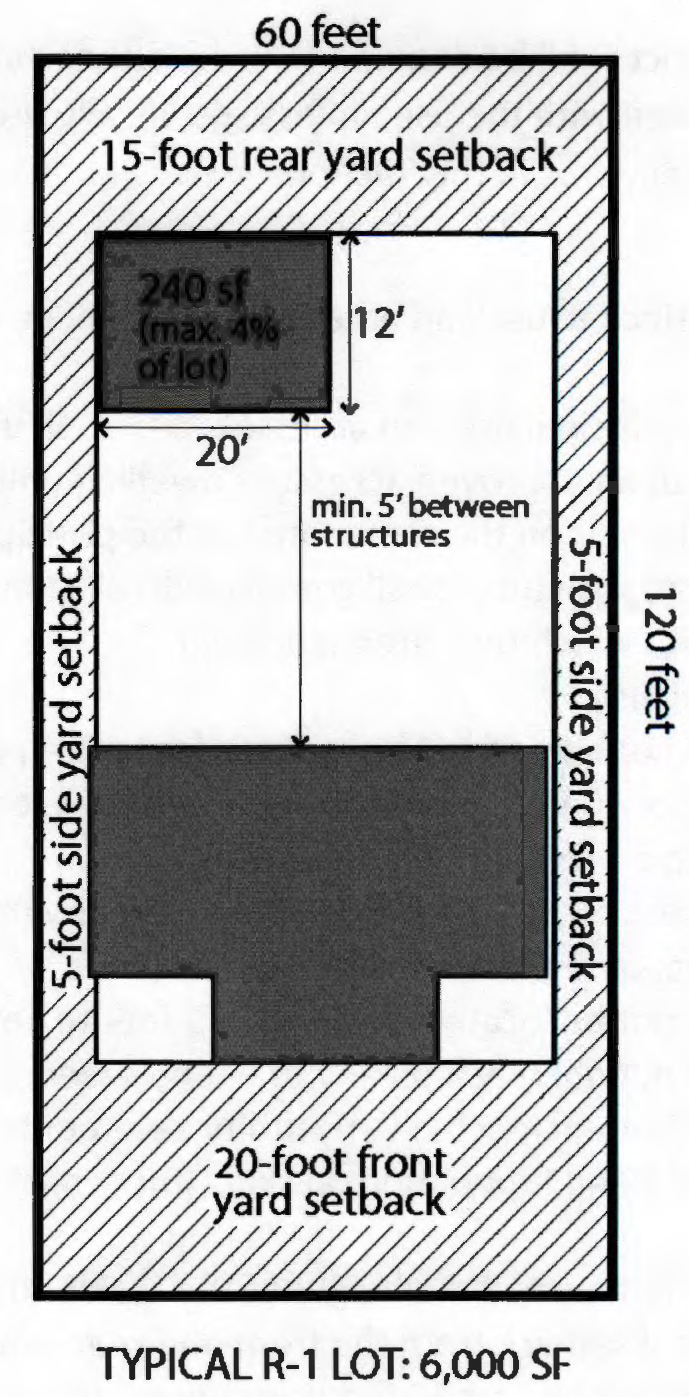
Accessory buildings shall not exceed in total square footage four percent of the square footage of the lot or ten percent of the square footage of the house; for a total lot coverage of up to a maximum of 40 percent.
b.
All accessory buildings must comply with side yard and rear yard setback and building line requirements of the district within which it lies.
c.
Accessory buildings shall not be located closer than five feet to any other structure.
d.
Accessory buildings shall not encroach on any drainage easements.
e.
Accessory buildings shall not encroach on any utility easements without an approved revocable permit and foundation on skids (moveable, non-permanent foundation).
f.
Accessory buildings shall not exceed the height of the residential structure, provided that an additional setback from the front and rear setback requirements of one foot for every foot of height over ten feet is required. (Note: No accessory building shall exceed a maximum of 30 feet in height.)
g.
Accessory buildings shall not have uncoated metal on the exterior.
D.
Additional standards to specific accessory structures.
1.
Book exchange box.
a.
Prohibited in the public right-of-way, unless an approved revocable permit exists.
b.
Must be located so that it does not impede pedestrian access or circulation or create an unsafe condition.
c.
Limited to 60 inches high, 36 inches wide and deep.
d.
Must be constructed in such a manner that the contents are protected from the elements.
e.
Enclosures shall be sized and arranged such that no person or child is able to enter.
2.
Food pantry box.
a.
Must be located in nonresidential districts, or as an accessory to an allowed place of assembly use in any district.
b.
Prohibited in the public right-of-way.
c.
Must be located so that it does not impede pedestrian access or circulation or create an unsafe condition.
d.
Limited to 60 inches high, 36 inches wide and deep.
e.
Must be constructed in such a manner that the contents are protected from the elements.
f.
Enclosures shall be sized and arranged such that no person or child is able to enter.
3.
Carport.
a.
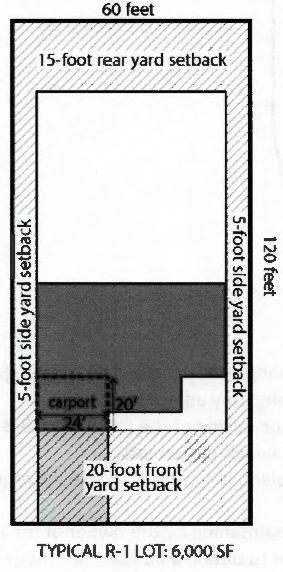
All carports must comply with side yard and rear yard setback requirements of the district within which it lies. A carport may extend beyond the required front yard setback provided that of the front yard setback no part of the carport may extend into the five feet nearest the street and no part thereof extends into any sight triangle.
b.
All carports shall be permanently open on two sides from the grade surface to the eave line provided that all carports that extend into the front yard setback shall be permanently open on three sides from grade surface to the eave line.
c.
All carports shall be located over a permanent hard surface drive.
d.
Carports constructed in conjunction with dwelling shall not exceed 18 feet in width for a single garage and/or driveway or parking space and shall not exceed 24 feet in width for a double garage and/or driveway.
e.
No carport shall exceed 24 feet in width nor 20 feet in length when measured from eave line to eave line.
f.
There shall be no more than one carport per dwelling unit for single-family developments.
g.
Carports shall be designed, constructed, erected, and installed in accordance with the codes and regulations as adopted by the City of Yukon.
h.
Carports shall be kept in an attractive state in good repair, and in a safe and sanitary condition.
i.
Carports contribute to the building coverage restrictions of the zoning district.
4.
Fences and walls.
a.
Rear yard fences shall:
i.
Be constructed, designed, and arranged to provide visual separation of uses, irrespective of vegetation.
ii.
Not be less than four feet nor more than eight feet in height.
iii.
Be constructed with all braces and supports on the interior.
b.
Front yard fences shall:
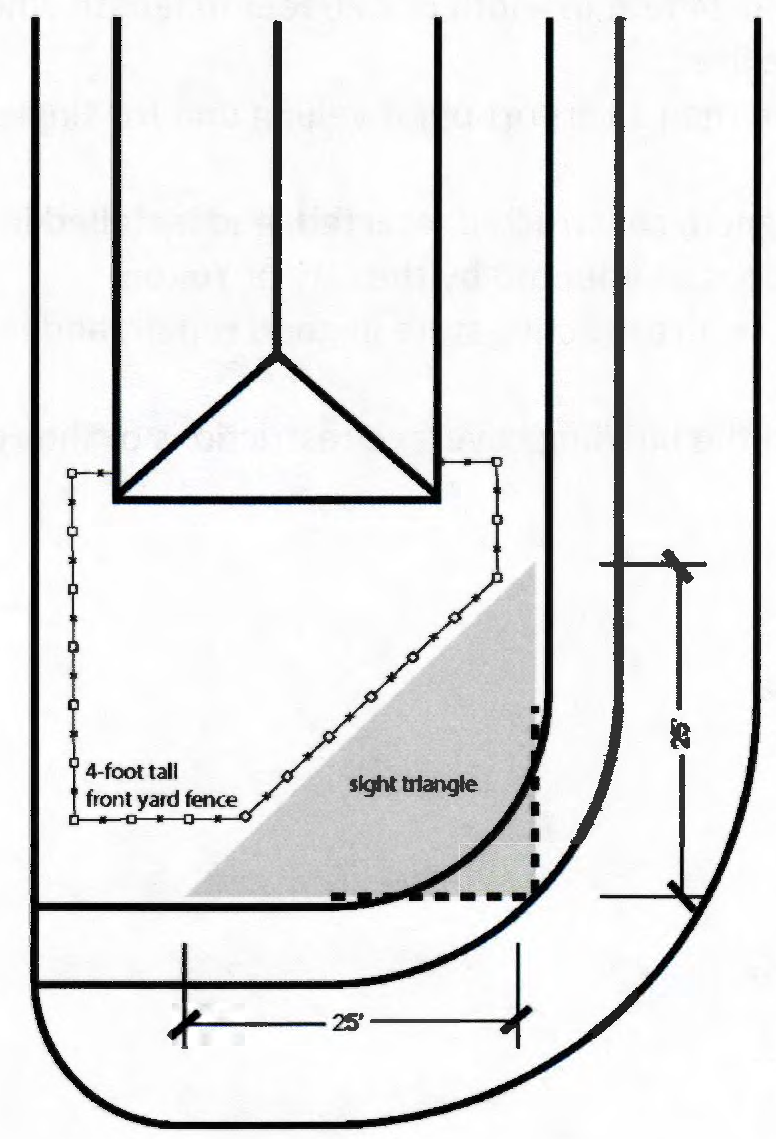
i.
Be four feet or less in height, except on corner lots.
ii.
On any corner lot on which a front and side yard is required, no wall, fence, sign, structure, or any plant growth which obstructs sight lines at elevations between two feet and six feet above the crown of the adjacent roadway shall be placed or maintained within a triangle formed by measuring from the point of intersection of the front and exterior side lot lines a distance of 25 feet along said front and side lot lines and connecting the points so established to form a sight triangle on the area of the lot adjacent to the street intersection.
c.
The installation of a fence shall not change and/or affect the grading and/or drainage of stormwater from the lot and any adjacent lots.
d.
Fences shall be located inside the property line of the lot the fence is installed on.
e.
Fences shall not be installed in any drainage easements.
f.
If the property is located in the floodplain, it is subject to specific requirements of the City of Yukon floodplain permit.
g.
The screening wall or fence shall be maintained by the owner of the lot.
h.
Fences or screening walls are required to obtain a building permit prior to construction.
5.
Mechanical equipment. To include heating, ventilation, and air conditioning (HVAC) equipment, electrical generators, and similar equipment.
a.
Ground-mounted mechanical equipment shall not be located in the front yard.
b.
Roof-mounted mechanical equipment shall be screened by the height of the building wall or by a wall or enclosure of sufficient height that mechanical equipment is screened from view by an observer standing on ground level at any place along the property lines of the subject property. The mechanical equipment or wall shall provide a minimum separation as defined by the manufacturer's requirements for the particular mechanical equipment to be screened. The top of the enclosure may be left open.
6.
Refuse containers.
a.
Individual refuse containers should be stored along the interior side or rear yard of the structure, except when moved for pick up.
7.
Dumpsters.
a.
No dumpsters may be located on any public right-of-way.
b.
All dumpsters must be fully enclosed on three sides by a solid fence or wall.
c.
Dumpsters shall be screened from view on all sides by a person standing at ground level with an enclosure or the wall of the building such enclosure is adjacent to the enclosure shall be of the same veneer as the principal building by a fence or wall not less than six feet in height, but tall enough to fully screen the type of refuse container(s) used, or by enclosure within a building.
d.
Landscaping shall be provided on three sides of the enclosure to provide additional site screening and shall be maintained, where applicable.
e.
Access to the enclosure shall utilize the appropriate turning radius to accommodate the refuse vehicle truck. All refuse containers, whether recyclable or disposable, shall be screened.
f.
The service route approach and exit shall have a clear path for use in servicing the enclosure by the collection vehicle. The route shall have a minimum horizontal dimension of 20 feet wide with 14 feet of overhead clearance.
g.
A separate exit that allows the truck to continue moving forward rather than having to back up is preferred. However, a paved hammerhead turn-around 15 feet wide and 50 feet long or a 75-foot diameter cul-de-sac may be used. Parking cannot be permitted in the cul-de-sac or turn-around area. Maximum back-up distance is 50 feet for any backing maneuver and shall be in a straight line.
h.
All streets, alleys, driveways, and all direct access shall provide for a minimum vehicle turning radius of 34 feet for the inside wheel and 50 feet for the outside wheel.
i.
Each container service area shall have a clear approach of 20 feet wide by 50 feet in length for the collection vehicle to line up with the container. Additionally, 25 feet of vertical clearance from overhead obstructions is required to lift and empty the container. This vertical zone runs from the back of the container toward the front of the truck for 20 feet past the front of the container.
i.
A concrete approach loading pad shall be constructed in front of each refuse enclosure at least 12 feet wide by 12 feet long, and a minimum of eight inches thickness of concrete at a standard of 3,500 PSI (pounds per square inch).
ii.
A concrete pad shall be a minimum of 12 feet wide by eight feet deep and a minimum of six inches thickness of concrete pad for the container(s) enclosure at a standard of 3,500 PSI.
iii.
An enclosure shall be a minimum inside dimension of 12 feet wide by eight feet deep of enclosure is required to accommodate largest size refuse container(s).
iv.
An enclosure gate shall be a minimum inside dimension of 12 feet for the enclosure gate(s) opening is required.
v.
Keeper latches are required to hold gate(s) in the fully opened position of 120-degree minimum while the refuse container(s) is being serviced.
vi.
Six-inch diameter by four feet high pipe bollards are required inside each enclosure to protect the gate(s) and the enclosure walls from damages by the refuse container(s) movement.
vii.
Minimum of 15 feet wide by 50 feet long of unobstructed approach path is required for the collection truck to access the container(s) enclosure.
viii.
Turn around area must be provided to allow the collection truck to exit without backing onto public thoroughfares or streets.
j.
Enclosure construction: The width of the enclosure will vary depending on the type, size, and number of containers. Gates shall be installed so that there is a minimum eight feet of depth created within each enclosure. A single container enclosure is the minimum size enclosure allowed and only when the establishment is generating four cubic yards or less of solid waste per week. All other enclosures shall allow sufficient space for at least one container for solid waste and a second container of at least equal size for storing and collecting separated cardboard. Multiple enclosures may also be required depending on the size of the development and type(s) of use.
Enclosures that will be used by food establishments shall also provide for a four-foot area within the enclosure for a separate waste cooking oil container of sufficient size to collect waste cooking oil generated on site. This oil container shall be placed so that it will not interfere with the collectors' ability to service the enclosure either by blocking access or as a result of leaking oil that creates a hazard for drivers.
k.
Service approach: The area in front of all front loading, rear loading, roll-off, and compactor enclosures shall not be used for parking and shall be painted, striped, and marked "No Parking". i. An area extending for 40 feet in front of the enclosure shall not have a slope greater than four percent.
i.
The service approach shall extend 12 feet beyond the enclosure floor and be the width of the enclosure opening and shall be constructed to withstand trucks weighing up to 62,000 GVW. Concrete surfacing shall be used.
ii.
The service approach surface shall be the same elevation as the enclosure floor threshold and the surrounding surfaces with a minimum slope of one-eighth inch (one percent grade) per foot away from the enclosure floor so as to direct runoff away from the enclosure.
l.
Enclosure floor: The enclosure floor shall extend outward four inches beyond the enclosure walls on a 90-percent compacted base.
i.
The enclosure floor shall be concrete constructed and sloped one percent to the front and cast in place to withstand 35,000 pounds of direct force, a minimum of six inches thick with #4 bars on 18-inch centers traveling both directions and being centered within the pavement thickness.
ii.
Steel pipes (bollards) six inches diameter and four feet high are required between the container and the enclosure's rear and side walls to prevent the container from damaging the enclosure while being serviced. Bollards shall be placed no closer than within six inches of the walls. Bollards shall not be placed outside of the enclosure where they will create interference with gate operations, parking spaces, or create traffic hazards.
iii.
The enclosure shall be large enough to provide a minimum of 24 inches on each side of the containers placed side by side and 36 inches from the front of the container to the gate.
m.
Gates: Double service gates are required on all enclosures. Gates shall be solid architectural metal panels painted to incorporate the overall design theme of the development. The solid waste and recycling area should not be visible through the gates.
i.
The service gates shall have a minimum opening of 12 feet with the gates hung outside of this span. Gates shall have a maximum of three inches of clearance from the ground and shall be the same height as the walls.
ii.
Gates shall be free hanging with no center pole. The gates shall be designed to ensure access and removal of each container without having to move the container.
iii.
Gates shall be constructed using two-inch by two-inch by one-fourths-inch steel angle or tube for a frame. Diagonal bracing shall be used with continuous welded joints throughout.
iv.
Gates shall be hung on six-inch steel square or round jambs with a thickness of one-fourth-inch minimum. Jambs shall be concrete filled with two inches of clearance between the jamb and the end of the wall.
n.
Hinges and locks: Gate shall be secured to the steel jambs with a minimum of three metal hinges continuously welded to the gate and jamb or be able to rotate around the jamb.
i.
Gates shall open 120 degrees and be constructed with a mechanism that will provide a means of securing the gate doors in both an opened and closed position. Solid rod cane bolts three-fourths inch in diameter with four-inch handles installed a minimum of 36 inches above ground level on the outside of the gates with one-inch inside diameter cane bolt receptacles placed three inches deep and flush with the concrete surface may be used when constructed.
ii.
Gates must be secured when closed but not locked. A latch shall be installed on the exterior of the gate and the latch rods shall be a minimum of 36 inches above ground level. Solid latch rods shall be a minimum of three-fourths inch in diameter. The receiver shall be three inches deep and one inch inside diameter.
o.
Storage inside enclosure—Maintenance: The enclosure space shall not be used for purposes other than for the storage and collection in containers of refuse, recyclable materials, and waste cooking oil.
i.
Owner or tenant shall keep the enclosure clean with all solid waste and recyclables placed in the proper receptacle. No trash or recyclables may be stored on the enclosure floor on either a temporary or permanent basis. Storage of hazardous material is not allowed in the enclosure.
ii.
All solid waste, recycling, and waste cooking oil containers are required to have lids that must be closed when not in use to contain litter and prevent odor, pests, and possible stormwater pollution.
p.
Modifications: Where, in the opinion of the public works director, there exist extraordinary conditions of topography, land ownership, adjacent development, historic district consideration, or other circumstances not provided for in these standards, the manager may modify these standards as deemed appropriate in the public interest. In modifying these standards or requirements of these provisions, the public works director may make such additional requirements as appears necessary, in their judgment, to secure substantially the objectives of the standards or requirements which are modified, providing the modifications do not conflict with any other ordinance or regulation. All items not specifically covered by these standards will be judged on a case-by-case basis by the public works director without setting precedent.
8.
Swimming pools and associated equipment.
a.
No private swimming pool or associated equipment may be located within a front yard.
b.
Pools shall not be placed closer than five feet to the primary building.
c.
Swimming pools and/or pool decks shall not encroach into any utility easements or building setback lines.
9.
Wind turbines (private).
a.
Wind turbines may be designed as either vertical or horizontal axis turbines with or without exposed blades, including designs that combine elements of the different types of turbines.
b.
Wind turbines are subject to the following height restrictions:
i.
The maximum height of any ground-mounted wind turbine is the maximum height allowed in the district. A taller height may be allowed by variance.
ii.
The maximum height of any wind turbine mounted upon a structure is 15 feet above the height of such structure.
iii.
Maximum height is the total height of the turbine system, including the tower and the maximum vertical height of the turbine blades. Maximum height therefore is calculated measuring the length of a prop at maximum vertical rotation to the base of the tower. The maximum height of any ground-mounted wind turbine is measured from grade to the length of a prop at maximum vertical rotation.
iv.
No portion of exposed turbine blades (vertical access wind turbine) may be within 20 feet of the ground. Unexposed turbine blades (horizontal access wind turbine) may be within ten feet of the ground.
c.
Ground-mounted wind turbines are permitted only in the rear yard. No part of the wind system structure, including guy wire anchors, may be located closer than ten feet to any lot line. The tower must be set back from all lot lines equal to the height of the system. No principal buildings may be located within this area.
d.
All wind turbines must be equipped with manual (electronic or mechanical) and automatic over speed controls to limit the blade rotation speed to within the design limits of the wind energy system.
E.
Additional standards to specific accessory uses.
1.
Apiary.
a.
These standards do not apply to agriculturally zoned land.
b.
Permitted only in the rear yard and must be located at least ten feet from any lot line and the principal building.
c.
Where a colony is located within 25 feet of a lot line, as measured from the nearest point on the hive to the lot line, the beekeeper must establish and maintain a flyway barrier at least six feet in height consisting of a hedge, fence, solid wall, or combination that is parallel to the lot line and extends ten feet beyond the colony in each direction so that bees are forced to fly at an elevation of at least six feet aboveground level over adjacent lots in the vicinity of the apiary; or elevate the colony six feet above ground level.
2.
Bar.
a.
Commercial establishments open to the public that serves alcoholic beverages for consumption on the premises but is incidental and subordinate to the principal commercial use.
b.
The accessory use bar must not occupy more than 25 percent of the floor area of the principal commercial use.
c.
The accessory use bar must occupy the same principal building and entrance as the principal commercial use.
d.
If food or beverages are consumed in an outdoor seating/activity area between the hours of 11:00 p.m. and 8:00 a.m., the outdoor seating/activity area shall be separated by a distance of at least 100 feet from the nearest abutting property line of a residential use. Distances shall be measured from the closest edge of the outdoor seating/activity area to the nearest abutting property line of the residential use.
3.
Home-based business.
a.
Area: The business shall be located within an enclosed dwelling or accessory building and shall be no more than ten percent of the primary structure.
b.
Employees/residency: The home occupation shall employ no more than one person who does not reside on the premises. This does not apply to home daycares as licensed by the state.
c.
Prohibitions: The following are not allowed:
1.
Outdoor display or storage of goods associated with the home occupation.
2.
Signs visible from outside the dwelling or accessory building.
3.
Wholesale or retail sales of goods.
4.
Auto or motorized engine repair, painting, or body work.
5.
Barber/beauty shop, hair salon with more than one chair.
d.
Traffic: The home-based business must not create greater vehicular or pedestrian traffic than normal for a residential area. The home-based business and any related activity must not create any traffic hazards or nuisances in public rights-of-way.
e.
Visitors: No more than four clients, patients, pupils, or customers are permitted at any given time. Such visits must occur between 7:00 a.m. and 7:00 p.m.
4.
Outdoor sales and display.
a.
Retail establishments and vehicle sales and rental are permitted to have accessory outdoor sales and display of merchandise.
b.
Required parking areas may not be used for outdoor display.
c.
Goods may not be left outside when the establishment is not open, unless adequately secured to prevent theft and vandalism.
(Ord. No. 1438, § I, 8-1-2023)
Sec. 215-307. - Temporary uses.
This section authorizes the development services director or designated representative, to allow certain temporary uses of a limited duration, which comply with the specific use standards of this section in addition to all other applicable provisions of this UDC. This section is intended to ensure that such uses do not negatively affect adjacent land, are discontinued upon the expiration of a set time, and do not involve the construction of permanent buildings or structures.
A.
Farmer's market.
1.
Management plan. Required as part of the temporary use permit application that demonstrates the following:
a.
The on-site presence of a representative of the farmers' market during hours of operation who directs the operations of vendors participating in the market.
b.
An established set of operating rules addressing the governance structure of the market, hours of operation, and maintenance when open to the public.
c.
A general site plan of vendor stalls, visitor facilities, such as any seating areas and restrooms, and all ingress and egress points to the site.
d.
Provision for waste removal.
e.
The days and hours of internal operation, including vendor set-up and take-down times.
2.
Parking. Off-street parking is required to be provided according to article 5 of this UDC, except parking shall not be required in the urban core overlay district.
B.
Temporary outdoor events.
1.
Outdoor carnivals, concerts, festivals, revivals, and similar gatherings for a maximum of 30 days per lot per year and no more than ten consecutive days per occurrence. City-sponsored gatherings are exempt from the maximum day's restriction.
2.
Must meet all other applicable requirements of Code of Ordinances, City of Yukon, Oklahoma.
C.
Seasonal sales.
1.
Outdoor seasonal sales are allowed for a maximum of 90 days per lot per year.
2.
Sales must not take place in any required parking space.
D.
Sidewalk sales.
1.
Any person who owns or operates a street-level retail business within the urban core overlay district shall be allowed to display for sale any goods, wares, or merchandise on the sidewalk directly in front of the business, or provide seating for customers, provided that:
a.
A five-foot clear passage is maintained along the sidewalk from curb edge to the beginning of the sidewalk display.
b.
Display and sales occur when the retail business is open.
c.
All fixtures used for display and sales are removeable and no such fixtures remain on the sidewalk when the retail business is closed.
E.
Subdivision sales office or model home.
1.
One temporary sales office for use in development of a new subdivision may be established and operated within any platted subdivision, and then only upon a platted lot within the boundaries of that subdivision for a period not exceeding three years from the date the plat of such subdivision is recorded.
2.
Phased development as part of an overall subdivision development plan by a single developer shall be considered a subdivision for the purpose of this section.
3.
A subdivision sales office may be in a permanent residential structure and may not be used to facilitate sales in any other subdivision.
4.
Model homes may be utilized as a temporary subdivision sales office as described above.
5.
If the garage is utilized as a temporary subdivision sales office the garage shall be converted back to a garage when the model home is no longer needed or sold.
(Ord. No. 1438, § I, 8-1-2023)
Sec. 215-308. - Use standards.
This section defines the standards for certain uses described in section 215-305.
A.
Limitation on use.
1.
Application of regulations in districts authorized. No land, building, structure, or improvement shall be used and no building, structure, or improvement shall be made, erected, constructed, moved, altered, enlarged, or rebuilt which is designed, arranged, or intended to be used or maintained for any purpose or in any manner except in accordance with the use, height, area, coverage, yard, space, and other requirements established in the district in which such land, building, structure, or improvement is located, and such use is authorized, except as provided by article 8, nonconformities.
2.
Application of regulations to the uses of a more restricted district. Whenever the specific district regulations pertaining to one district permit the uses of a more restricted district, such uses shall be subject to the conditions set forth in the regulations of the more restricted district, unless otherwise specified.
3.
Height exceptions. The following structures shall not be subject to the height limitations of the district in which they are located:
a.
Farm buildings not intended for human occupancy.
4.
Location of package stores, mixed beverage establishments, bottle clubs and beer and wine establishments. The location of a retail package store, mixed beverage establishment, bottle club, and beer and wine establishment shall be subject to the zoning ordinances of the city and according to Canadian County and state law.
B.
Conditional uses. Where the letter "C" appears in the permitted use table found in section 215-304 these uses in said districts shall be subject to conditional review and approvals. Certain uses of land or buildings exhibit unique characteristics that necessitate the application of special standards to coexist with adjacent and nearby uses, and the neighborhood or land use areas in which they are to be placed. Approvals processes for conditional uses are detailed in article 7, administration section 215-709, conditional uses.
1.
Accessory dwelling unit.
a.
Shall be located on corner lot, and/or
b.
Located on lot with alley access
c.
And the accessory dwelling unit shall either take access from the alley, if present, or shall utilize existing driveway cut without widening. If located on a corner lot, access may be taken from the intersecting (opposite) street.
d.
No more than one accessory dwelling unit is allowed per lot.
2.
Animal care (indoor).
a.
No overnight activity associated with the care of animals is allowed. For the purposes of this section "overnight" constitutes the hours between 10:00 p.m. and 7:00 a.m.
b.
Outdoor activity, including, but not limited to, walking and bathing of animals, is permitted during the day, provided that no more than four animals are engaged in outdoor activity at a time, and the outdoor facilities are located at least 50-feet from any residence. For the purposes of this section "during the day" constitutes the hours between 7:00 a.m. and 10:00 p.m.
3.
Animal care (outdoor).
a.
The boarding of large animals is limited to clinics on parcels of at least five acres.
b.
Outdoor boarding is limited to short-term care incidental to the treatment clinic or primary use and must be a secondary use of the property.
c.
Outdoor runs, kennels and boarding areas shall not be located closer than 150 feet to property lines.
4.
Arboretum or botanical garden.
a.
The site shall front or have direct access to a street meeting design standards for at least a collector street.
b.
No off-street parking or loading space shall be located closer than 20 feet to any lot line abutting a residential district.
5.
Art gallery or museum, public.
a.
The site shall front or have direct access to a street meeting design standards for at least a collector street.
b.
No off-street parking or loading space shall be located closer than 20 feet to any lot line abutting a residential district.
6.
Bar.
a.
Public entrance doors of bars may not be located within 50-feet of any residentially zoned property, as measured in a straight line from the nearest point on the residentially zoned lot (not including right-of-way) to the nearest public entrance door of the bar or the nearest portion of any outdoor seating/dining area, whichever is a greater setback.
b.
Shall not be located within 300-feet of any public or private school or church property primarily and regularly used for worship services and religious activities unless a waiver meeting state statutes is obtained. Required separation distance shall be measured from the nearest property line of such public or private, school or church use to the nearest perimeter wall of the bar.
c.
Shall not be located within 300 feet of any sexually oriented business. Required separation distance shall be measured in a straight line between the nearest perimeter walls of the portions of the buildings occupied sexually oriented business.
d.
If food or beverages are consumed in an outdoor seating/activity area between the hours of 11:00 p.m. and 8:00 a.m., the outdoor seating/activity area shall be separated by a distance of at least 100 feet from the nearest abutting property line of a residential use. Distances shall be measured from the closest edge of the outdoor seating/activity area to the nearest abutting property line of the residential use.
7.
Building or tower mounted antenna.
a.
An antenna may not extend more than 20 feet above the highest point of the building, or, if located on an architectural feature such as a steeple or bell tower, may not protrude above that structure; provided, however, that the board of adjustment may modify such requirements through the variance request process.
b.
The antenna must comply with all applicable Federal Communications Commission and Federal Aviation Administration regulations.
c.
The antenna must comply with all applicable building codes.
d.
Antennas may be attached to existing towers and to city-owned buildings and structures. When an existing tower must be modified to accommodate the collocation of antennas, the tower may not result in a height increase of more than 30 feet above the height of the existing tower.
8.
Campground.
a.
The site shall front or have direct access to a street meeting design standards for at least an arterial street.
b.
The site shall not abut, nor be within 300 feet of a residential district.
9.
Carwash.
a.
The site shall front or have direct access to a street meeting design standards for at least a collector street.
b.
No building shall be located closer than 20 feet to any lot line abutting a residential district.
10.
Childcare center.
a.
The site shall front or have direct access to a street meeting design standards for at least a collector street.
b.
No off-street parking or loading space shall be located closer than 20 feet to any lot line abutting a residential district.
11.
Convenience store with gas sales.
a.
The site shall front or have direct access to a street meeting design standards for at least a collector street.
b.
No building shall be located closer than 20 feet to any lot line abutting a residential district.
12.
Dry cleaning and laundry service.
a.
The site shall front or have direct access to a street meeting design standards for at least a collector street.
b.
No building shall be located closer than 20 feet to any lot line abutting a residential district.
c.
If a drive-thru pick-up window is provided adequate queuing space for three vehicles must be provided. Queuing in drive aisles or public right of way is not allowed.
13.
Dwelling, zero lot line.
a.
Minimum lot size: 4,000 square feet per dwelling unit.
b.
Minimum lot width: 40 feet; corner lots: 50 feet.
c.
Maximum building height: 35 feet.
d.
Front yard setback: 25 feet.
e.
Side yard setback: Zero feet from one interior lot line, and ten feet from opposite line; corner side yards: Ten feet.
f.
Rear yard setback: Ten feet.
14.
Funeral services.
a.
Must be located in a stand-alone building, or
b.
Utilize side and/or rear entrances for the transportation of the deceased.
15.
General outdoor recreation, lighted.
a.
The site shall front or have direct access to a street meeting design standards for at least an arterial street.
b.
The site shall not abut, nor be within 300 feet of a residential district.
16.
General outdoor recreation, unlighted.
a.
The site shall front or have direct access to a street meeting design standards for at least an arterial street.
b.
No off-street parking or loading space shall be located closer than 20 feet to any lot line abutting a residential district.
17.
Hotel or motel.
a.
Minimum lot size: Two acres.
b.
The site shall front or have direct access to a street meeting design standards for at least an arterial street.
c.
No off-street parking or loading space shall be located closer than 20 feet to any lot line abutting a residential district.
18.
Fitness and recreational sports center.
a.
The site shall front or have direct access to a street meeting design standards for at least a collector street.
b.
No off-street parking or loading space shall be located closer than 20 feet to any lot line abutting a residential district.
19.
Major entertainment facility.
a.
The site shall front or have direct access to a street meeting design standards for at least an arterial street.
b.
The site shall not abut, nor be within 300 feet of a residential district.
20.
Municipal or community recreation center.
a.
The site shall front or have direct access to a street meeting minimum design standards for at least a collector street.
b.
All lighting shall be arranged so that there will be no annoying glare directed or reflected toward adjacent property.
c.
Off-street parking or loading spaces shall be located a minimum of 20 feet from any lot line abutting a residential district.
d.
No building shall be located closer than 20 feet to any lot line abutting any residential use.
21.
Open air or street market.
a.
Management plan that demonstrates the following:
i.
The on-site presence of a representative of the market during hours of operation who directs the operations of vendors participating in the market.
ii.
An established set of operating rules addressing the governance structure of the market, hours of operation, and maintenance when open to the public.
iii.
A general site plan of vendor stalls, visitor facilities, such as any seating areas and restrooms, and all ingress and egress points to the site.
iv.
Provision for waste removal.
v.
The days and hours of internal operation, including vendor set-up and take-down times.
b.
Parking. Off-street parking is required to be provided according to article 5 of this UDC, except parking shall not be required in the urban core overlay district.
22.
Parking structure.
a.
Minimum lot size: One acre.
b.
The site shall front or have access to a street meeting design standard for at least a collector street.
23.
Personal storage.
a.
The site shall front or have direct access to a street meeting design standard for at least a collector street.
b.
No wholesale or retail sales shall be permitted from the personal storage units
c.
No outside storage is permitted.
d.
No maintenance, repair or mechanical work shall be permitted.
e.
No sales or storage of highly combustible materials shall be permitted.
24.
Places of assembly.
a.
The development must meet landscaping and lighting standards in article 5.
b.
The site shall front or have direct access to, a street meeting design standards for at least a collector street.
25.
Racetrack.
a.
The site shall front or have direct access to a street meeting design standards for at least an arterial street.
b.
The site shall not abut, nor be within 300 feet of a residential district.
26.
RV campground/park.
a.
Conditions for approval in the MH district:
i.
The site shall have front or have direct access to a street meeting design standards for at least a collector street.
ii.
Transient accommodations, limited to travel trailers or recreational vehicles only, shall occupy no more than 25 percent of the total number of spaces in any manufactured (mobile) home park/subdivision.
iii.
The space for each recreational vehicle shall be provided with a permanent hard-surfaced pad.
b.
Conditions for approval in A or I-1 districts:
i.
The site shall front or have direct access to a street meeting design standards for at least an arterial street.
ii.
The site shall not abut nor be within 300-feet of a residential district.
iii.
The maximum density shall be ten recreational vehicle spaces per acre.
iv.
Open space shall be provided in the ration of at least 400 square feet per recreational vehicle space.
v.
Sight-proof screening shall be provided around all sides of the site, except where transversed by driveways. Sight triangles shall be observed.
vi.
The space for each recreational vehicle shall be provided with a permanent hard-surfaced pad.
27.
Research laboratory.
a.
No product manufacturing and no outside storage, display or activity shall be allowed. All activities must take place within a completely enclosed building.
28.
Vehicle service and repair, major.
a.
The site shall front or have direct access to, a street meeting design standards for at least a collector street.
b.
No building shall be located closer than 20 feet to any lot line abutting a residential district.
c.
A site proof screen shall be erected along any lot line abutting a residential district.
C.
Special permit uses. Where the letters "SP" appears in the permitted use table found in section 215-304 these uses in said districts shall be subject to public review processes outlined in article 7, administration section 215-709, special permit uses.
1.
Prior to approval of an application for special permit, the planning commission and city council shall make a determination that the following standards have been met.
a.
The proposed use conforms to the policies within the comprehensive plan.
b.
The proposed use does not adversely affect the use of the neighboring properties.
c.
Vehicle traffic generated will not be hazardous or in conflict with the existing traffic (vehicular or pedestrian) in the area.
d.
Adequate utility, drainage, parking, loading, signs, access, and other necessary public facilities to serve the use shall meet the adopted codes of the city.
e.
The site shall front or have direct access to a street having adequate right-of-way and improvements to support the traffic generated by the proposed use.
f.
The city council may impose specific conditions, using existing city codes as a guide. Conditions may be related to permitted uses, lot sizes, setbacks, height limitations, required facilities, buffers, open space areas, lighting, signage, landscaping, parking and loading, compatibility, density, bonding, insurance and other development standards and operational conditions. These conditions shall be indicated to be important to the welfare and protection of adjacent property and the community as whole and shall not be arbitrary. Such conditions may include, but are not limited to:
i.
A requirement that all machinery and operations be located within an enclosed building.
ii.
A requirement that certain areas be screened from view of surrounding neighborhoods.
iii.
Increased screening and/or landscaping standards.
iv.
Limits of no access or access management restrictions.
v.
Dedication of easements.
2.
Standards for specific uses.
a.
Agriculture, animal processing.
i.
The site shall take access from an arterial street.
ii.
Off-street parking or loading spaces shall be located a minimum of 20 feet from any lot line abutting a residential district.
iii.
All buildings shall be setback at least 50 feet from all property lines.
b.
Airport or helipad.
i.
A site plan shall be submitted showing intended size, layout, and specifications of all improvements, surrounding land uses, and description of property.
ii.
An operations plan shall be submitted which shall include:
1.
Proposed uses of facility, types of operation and hours of operation.
2.
Routes of approach and departure.
3.
Designated emergency landing areas.
4.
Description of the relations of the facility to established airports, helistops and heliports.
5.
Expansion plans.
6.
Methods of mitigating the effects on noise, lighting, and pollution.
iii.
Other requirements:
1.
A statement on public need for the facility.
2.
If the proposed site is on a structure a structural report by a registered structural engineer must be provided.
3.
Site improvements shall be in conformance with the development regulations of the zoning district in which it is located.
4.
The site shall conform to all requirements established by local, state, and federal regulatory agencies for aviation activities.
5.
All helicopter landing pads at ground level shall have controlled access to protect people on the ground.
6.
All lighting shall be arranged so that there will be no glare directed or reflected toward adjacent property.
7.
Off-street parking or loading spaces shall be located a minimum of 20 feet from any lot line abutting a residential district.
c.
Auto salvage yard.
i.
The use must be located a minimum of 200 feet from any residential district, school, hospital, park, or place of public assembly.
ii.
The site shall take access from an arterial street.
iii.
The site shall be opaquely screened on all sides of the property line by a minimum eight-foot-tall fence.
iv.
All outdoor storage areas for automobile, truck, boat and recreational vehicle salvage yards shall be on a permanent hard-surfaced area.
d.
Bed and breakfast.
i.
Guest rooms shall not include cooking facilities.
ii.
A maximum of ten bedrooms may be provided for registered guests. No other bedrooms shall be used by other roomers, borders or guests.
iii.
The maximum stay by any guest shall be limited to 30 days.
iv.
All required guest parking shall be provided on-site.
e.
Crematorium.
i.
The site shall take access from an arterial street.
ii.
Off-street parking or loading spaces shall be located a minimum of 20 feet from any lot line abutting a residential district.
iii.
All buildings shall be set back at least 50 feet from all property lines.
iv.
Uses that are legally in existence at the time of adoption of this UDC are permitted to persist, provided that no expansion occurs to increase the floor area of the establishment.
f.
Confined feeding operation.
i.
The site shall be at least 20 acres in size.
ii.
No such use shall be permitted within one-half mile of any residential district.
iii.
The applicant shall submit a plan of existing or proposed water and waste disposal facilities to show that the proposed use will meet all local, state, and federal requirements.
g.
Freestanding tower.
i.
The following requirements apply to all towers unless otherwise expressly approved by the city council as a part of the special permit approval:
1.
Refer to section 24-6 of Code of Ordinances, City of Yukon, Oklahoma for setback and height requirements for communication towers.
2.
Accessory buildings are subject to applicable zoning district building setback requirements.
3.
Towers must be enclosed by security fencing that this at least six feet in height or be equipped with an appropriate anti-climbing device.
h.
Mining and processing - minerals and raw materials.
i.
No use shall be permitted within 200 feet of a residential district.
ii.
No excavation, stockpiling of material, or accessory or incidental use of the mining operation shall be permitted within 70 feet of any property line, street right-of-way, drainage, or utility easement.
i.
Recycling center (outdoor/indoor).
i.
Minimum lot size: Two acres.
ii.
The site shall take access from an arterial street.
iii.
The site shall be screened on all sides of the property line by a minimum eight-foot-tall fence.
j.
Scrap operations.
i.
Minimum lot size: Two acres.
ii.
The use must be located a minimum of 200 feet from any residential district, school, hospital, park, or place of public assembly.
iii.
The site shall take access from an arterial street.
iv.
The site shall be opaquely screened on all sides of the property line by a minimum eight-foot-tall fence.
k.
Sexually oriented business.
i.
Findings and restrictions applicable to sexually oriented business: The city council has found that sexually oriented businesses require special supervision from the public safety agencies and community development agencies of the city in order to protect and preserve the health, safety, morals and welfare of the patrons of such businesses as well as the citizens of the city. Sexually oriented businesses are frequently used for unlawful sexual activities, including prostitution and sexual liaisons of a casual nature. There is convincing documented evidence that sexually oriented businesses, because of their very nature, have a deleterious effect on existing businesses around them and the surrounding residential areas adjacent to them, causing increased crime and the downgrading of property values. It is recognized that sexually oriented businesses, due to their nature, have serious and objectionable operational characteristics that contribute to urban blight and downgrade the quality of life in the adjacent area. The city council desires to minimize and control these adverse effects and thereby protect the health, safety, and welfare of the citizenry. This is done to protect the citizens from increased crime, preserve the quality of life, preserve the property values and character of surrounding neighborhoods, and deter the spread of urban blight. The city council does not condone or legitimize the distribution of obscene material. The council recognizes that state and federal law prohibits the distribution of obscene materials, and therefore expects and encourages all law enforcement officials to enforce state obscenity statutes against any such illegal activities within the city. Based on these findings, it is the intent of the city council to regulate sexually oriented businesses in order to promote the health, safety, morals, and general welfare of the citizens of the city, and to establish reasonable and uniform regulations to prevent the deleterious location and concentration of sexually oriented businesses within the city.
ii.
The location of sexually oriented businesses shall be in compliance with applicable commercial zoning regulations of the city and may not be located within 1,000 feet of:
1.
Any building primarily and regularly used for worship services or religious activities;
2.
Any public or private educational facility, including, but not limited to, child day care facilities, nursery schools, preschools, kindergartens, elementary schools, private schools, intermediate schools, junior high schools, middle schools, high schools, vocational schools, secondary schools, continuation schools, special education schools, junior colleges, and universities; a school includes the school grounds, but does not include facilities used primarily for another purpose such as offices and vehicle maintenance facilities and only incidentally used by students;
3.
Any public park or recreational area which has been designated for park or recreational activities including, but not limited to, a park, playground, nature trail, swimming pool, reservoir, athletic field, golf course, basketball or tennis courts, wilderness area, or other similar land within the city which is under the control, operation, or management of the parks department or any public trusts, provided that a recreation area as used in this article shall not be interpreted as including turnpikes and highways that also contain jogging or bicycle paths;
4.
Any public library;
5.
A premises licensed pursuant to the alcoholic beverage control regulations of the state where any beverage containing alcohol is sold, distributed or served;
6.
An entertainment business which is oriented primarily towards children or family entertainment;
7.
Any other sexually oriented business; or
8.
Any land zoned or used for residential purposes.
iii.
The distance between a sexually oriented business and any use named above shall be measured in a straight line, without regard to the intervening structures, objects, or political boundaries, from the nearest exterior boundary of the parcel or the premises where a sexually oriented business is conducted, to the nearest property boundary of the premises of a listed use. For purposes of determining measured distance, property situated on the opposite side of the street shall be considered as if it were located on the same side of the street with the sexually oriented business.
iv.
The business may not operate between the hours of 11:00 p.m. and 9:00 a.m. the following day and may not operate on Sunday.
v.
No one under the age of 21 years may be allowed to enter or be upon, or be employed by, such business.
vi.
No beer, wine, alcoholic beverage, mixed drinks, or any other similar substance which is regulated by the Oklahoma Alcoholic Beverage Law Enforcement Commission, or which requires a license from local government as a condition to selling may be served or sold within or upon the premises.
vii.
Any other conditions determined to be appropriate by city staff, the planning commission, or the city council.
viii.
Any person, firm, or corporation who violates any provision of this article shall be guilty of an offense, and upon conviction shall be punished, subject to the provisions of chapter 1 of the Code of Ordinance of the City of Yukon. For purposes of this provision, each day that the violation occurs shall be deemed a separate violation.
l.
Short-term rental.
i.
Provide a certified ownership list within a 600-foot radius of the exterior boundary of the subject boundary.
ii.
Obtain and maintain a city-issued short-term rental license.
iii.
Required information to be posted and provided to renters/guests:
1.
License registration, including license number and expiration date.
2.
Operator's name and phone number.
3.
Property manager name and phone number.
4.
Location of any on-site and off-site parking spaces available for guests.
5.
Occupancy limits.
6.
Information on relevant burn bans, water restrictions, and trash collection rules and dates.
7.
Floor plan with fire exit and escape routes.
iv.
Use of the short-term rental for any commercial or social event is prohibited.
v.
A licensee or guest of a short-term rental shall not use or allow use of sound equipment, amplified music, and/or musical instruments.
vi.
A licensee or guest of a short-term rental shall not violate any parking ordinances, noise ordinances or any other ordinance of the City of Yukon Municipal Code.
m.
Solid waste disposal.
i.
Minimum lot size: 40 acres.
ii.
Shall be approved in accordance with state and federal regulations and guidelines.
iii.
The site shall take access from an arterial street.
iv.
No activity area shall be permitted within 1,500 feet of an occupied dwelling.
v.
A fence or wall of not less than eight feet in height as measured from finished grade shall be provided around the use.
(Ord. No. 1438, § I, 8-1-2023)
Sec. 215-309. - Short-term rentals and bed and breakfast establishments.
A.
Purpose: The purpose of this section is to facilitate the permitting, licensing and regulation of short-term rentals and bed and breakfast establishments.
B.
Applicable definitions:
1.
Bed and breakfast: A small lodging establishment that provides overnight accommodation and meal(s) to travelers (for no more than 30 consecutive days).
2.
Short-term rental: Lodging services where the property owner rents short term (no more than 30 consecutive days) either entire units or rooms of a residential home or unit. This does not permit by the hour rental of pools or other outdoor features (pergolas, cabanas, hot tubs, etc.), exclusive of the rental of the residential home or unit.
3.
Short-term rental license: Annual license required to operate a short-term rental or bed and breakfast.
4.
Special use permit: A special permit that must be granted by city council to allow a deviation in use from the allowable uses listed for the zoning district where the property is located.
C.
Process for approval:
1.
A pre-inspection of the property will be conducted prior to application for a special use permit.
2.
In order to deviate from zoning requirements, an application for a special use permit must be submitted along with a complete site plan, proof of ownership and an ownership list of all properties within a 600-foot radius of the exterior boundary of the subject boundary prepared by a bonded abstractor. The site plan shall show the location of all structures and proposed off-street parking. (See article 3, section 304, permitted uses table and article 7, section 709, special permit uses for the permitting process.)
3.
Staff shall review the application for completeness and upon complete application shall schedule the application for an upcoming planning commission agenda for consideration and shall distribute the application to other appropriate departments for review.
4.
Planning commission shall hold a public hearing in accordance with state statutes and article 7, section 704. Within a reasonable time from the close of the public hearing the planning commission shall forward its findings of fact and recommendation of either approval, approval with conditions, or denial on applications for special use permit uses to the city council.
5.
The city council shall consider the application within a reasonable time after receiving the findings of fact.
6.
Upon city council approval of a special use permit (SUP) for use of property as a short-term rental or bed and breakfast, an application for a short-term rental license must be submitted within one year.
7.
After passing inspection by development services building inspection staff, a short-term rental license will be issued. This license must be maintained and renewed annually. If all items passed the pre-inspection, a post-inspection will not be required.
D.
Standards for specific use:
1.
Required length of stay.
i.
The minimum stay by any guest shall be limited to one night.
ii.
Homes, yards and pools cannot be leased out by the hour.
2.
Bed and breakfast standards.
i.
Guest rooms shall not include cooking facilities.
ii.
A maximum of ten bedrooms may be provided for registered guests. No other bedrooms shall be used by other roomers, borders or guests.
iii.
All required guest parking shall be provided on-site.
iv.
Include all items listed under short-term rental below:
3.
Short-term rental standards.
i.
The maximum stay by any guest shall be limited to 30 days.
ii.
Obtain and maintain a city-issued short term rental license.
iii.
Required information to be posted and provided to renters/guests:
1.
License registration, including license number and expiration.
2.
Operator's name and phone number.
3.
Property manager name and phone number.
4.
Location of on-site and off-site parking spaces available for guests.
5.
Occupancy limits.
6.
Information on relevant burn bans, water restrictions, and trash collection rules and dates.
7.
Floor plan with fire exit and escape routes.
iv.
Use of the short-term rental for any commercial or social event is prohibited.
v.
A licensee or guest of a short-term rental shall not use or allow use of sound equipment, amplified music, and/or musical instruments.
vi.
Any applicant who has previously operated a short-term rental within the City of Yukon without first obtaining the required special use permit and short-term rental license shall be subject to a one-year probationary period. During this probationary period, all outstanding fees, penalties, and compliance issues must be fully paid and resolved prior to filing for an issuance of a special use permit and short-term rental license.
E.
Terms:
1.
Status of special permit uses: Once a special use permit has been granted, the use shall not be enlarged, extended, increased in intensity, or relocated without application for a new special use permit.
2.
Revocation: A special use permit may be revoked by subsequent action of the city council after 30 days' notice to the owner of the subject property and a public hearing before said council, upon a finding that the conditions imposed on the issuance of the permit or the standards for special permits set out in this section, as amended, have not been satisfied or the use has become incompatible with other uses of land within or without the zoning district.
3.
Expiration: All approvals of special use permits shall expire by default if:
i.
If the use, once established, has been discontinued or abandoned for a period of 12 months.
ii.
If use is not established by obtaining a short-term rental license within 12 months of city council approval of special use permit.
iii.
If proposed construction is not initiated within 12 months.
iv.
If the property is sold or changes ownership.
F.
Violations:
1.
It shall be unlawful to operate or advertise a property for use as a short-term rental prior to obtaining a short-term rental license.
2.
If the development services director shall find that any of the provisions of this section 309 are being violated, they shall notify in writing the persons responsible for such violations, indicating the nature of the violation and/ordering the action necessary to correct it, and shall take such other action as is authorized by law to ensure compliance with or to prevent violation of its provisions.
3.
It shall be unlawful to lease a pool, yard, or other outdoor feature per hour, exclusive of the rental of an entire home that has an active short-term rental license for the time of a required minimum stay.
G.
Penalties:
1.
Any person who shall violate any provision of this ordinance [Ord. No. 1452], or who shall fail to comply with an order properly made in connection with the enforcement of this ordinance [Ord. No. 1452] shall be guilty of an offense and, upon conviction thereof, shall be punished as provided in chapter 1, section 1-7 of the Code of Ordinance, City of Yukon, Oklahoma.
2.
City council may revoke special use permit. (See terms above.)
H.
Fines: Unless another penalty is expressly provided, every person convicted of a violation of any provision of the Code or any ordinance, rule or regulation adopted or issued in pursuance thereof shall be punished by a fine up to $750.00 or as outlined in chapter 1, sections 1-7 of the Code of Ordinances, City of Yukon, Oklahoma.
a.
Fine schedule for short-term rental use:
(Ord. No. 1444, § I, 2-20-2024; Ord. No. 1472, § 1, 4-15-2025; Ord. No. 1482, § I, 12-16-2025)
Sec. 215-310. - Data centers.
A.
Purpose. This ordinance [section] establishes comprehensive regulations for the location, design, and operation of data centers within the City of Yukon. It seeks to ensure compatibility with surrounding land uses, enhance the visual quality of public spaces, protect residential areas from environmental impacts, and provide meaningful public benefit.
B.
Applicability. This ordinance [section] applies to all new data centers and any expansion of existing data centers. Data centers shall be a permitted use by right within the I-1 Light Industrial District.
C.
Definitions.
1.
Data center: A facility or facilities used to house, and in which are operated, maintained and replaced from time to time, computer systems, associated components, and supporting infrastructure, including, but not limited to, telecommunications and storage systems, cooling systems, power supplies and systems for managing electrical and mechanical performance and equipment used for the transformation, transmission, distribution and management of electricity for on-site uses, internet-related equipment, data communications connections, private communication towers, environmental controls and security devices.
2.
Designated land use: Any agricultural, residential, school, park, hospital, or place of worship.
3.
Public frontage: Any edge of a property that abuts a public street or highway right-of-way.
D.
Site design standards.
1.
Setbacks.
a.
Minimum of 50 feet from all property lines adjacent to designated land uses.
b.
Minimum 100 feet along all public frontage.
2.
Maximum lot coverage.
a.
Lot coverage including all buildings shall not exceed 75 percent.
3.
Building height and massing.
a.
Maximum height: 80 feet.
b.
Height shall be measured to the top of the parapet.
c.
Towers that are accessory to a data center shall not exceed 100 feet in height and shall not be located within 200 feet of the property boundary.
4.
Architectural design features.
a.
Facades facing a public frontage must incorporate at least three of the following:
i.
Changes in wall plane, material, pattern, texture or color.
ii.
Fenestration, including false windows.
iii.
Decorative metal or masonry panels.
iv.
Integrated public art or murals.
v.
Changes in wall height.
b.
Facades are required to have a change in façade surface at least every 200 horizontal feet.
5.
Screening of equipment.
a.
Rooftop and ground-level mechanical equipment must be fully screened from public frontages using architectural elements or dense vegetation.
6.
Fencing and security walls.
a.
Chain link, barbed, or razor wire prohibited along public/residential frontages.
b.
Vinyl coated chain link, decorative metal, masonry, or green-screen fencing encouraged.
c.
Max height: Ten feet.
d.
Maintain 50 percent visual transparency or integrate public art.
7.
Cooling towers and on-site power generation.
a.
Shall not be within required front yard setback.
b.
Fully screened from public frontages with fencing and dense evergreen landscaping.
c.
Equipment must be enclosed within non-reflective, sound-attenuated housing.
d.
Rooftop units must be screened from public frontages by parapets if visible from the public right-of-way.
e.
Generator testing is allowed only Monday through Friday, 10:00 a.m.—4:00 p.m., except in the event of emergencies.
f.
No testing on holiday or weekends unless for emergency readiness.
8.
Parking requirements.
a.
Minimum of one parking space per 5,000 square feet of gross floor area.
b.
At least one ADA-accessible parking space for every 25 total spaces.
c.
Bicycle parking is required at a ratio of one space per ten vehicle spaces.
d.
Parking areas must include shade trees per subsection (4)(A) and be screened from public frontages with landscaping or fencing.
E.
Landscaping standards.
1.
Perimeter landscaping.
a.
Public frontages must include:
i.
A 50-foot-deep minimum landscaped strip.
ii.
Ine canopy tree per 30 linear feet.
iii.
Three shrubs per ten linear feet.
iv.
Native, pollinator-friendly species encouraged.
2.
Required buffers.
a.
Where adjacent to designated land uses:
i.
A 30-foot landscaped buffer with a solid decorative fence (minimum six feet), and staggered rows of evergreen trees (minimum six feet tall at planting)
3.
Parking lot landscaping.
a.
Interior landscaping must comprise ten percent of paved area.
b.
One shade tree per eight parking spaces, placed to maximize canopy where possible.
4.
Green infrastructure.
a.
Integrate bioswales or rain gardens into the design of the stormwater detention system.
b.
Encourage low-water, low-maintenance native plantings.
5.
Maintenance.
a.
Landscaping must be regularly maintained.
b.
Dead/damaged plants must be replaced within 30 days of notification.
F.
Noise mitigation.
1.
Operational noise limits.
a.
Must not exceed:
i.
55 dBA at any point on the property line abutting a residential use (nighttime).
ii.
65 dBA in commercial areas at the property line.
b.
This section shall not apply to testing or emergency scenarios.
c.
The limits established herein shall apply only to the data center and shall not take into account background noise levels.
2.
Monitoring.
a.
Annual acoustic inspection reports must be submitted to the city.
G.
Lighting standards.
1.
Purpose: To provide adequate site illumination for safety and security while minimizing light spillover, glare, and skyglow.
2.
Requirements: All lighting should be pointed towards facilities and shielded from designated land uses.
a.
Fixture design:
i.
All exterior lighting must be full cut-off, downcast, and dark-sky compliant.
ii.
LED lights must be 3,000 or lower in color temperature to reduce harshness.
iii.
Decorative or pedestrian-scale lighting encouraged along pedestrian pathways and public frontages.
b.
Height limits:
i.
Maximum pole height:
a.
20 feet in parking and internal drive areas.
b.
18 feet along public frontages or pedestrian pathways.
c.
Lighting plan submission:
i.
A photometric plan showing foot-candle levels must be submitted with development applications.
ii.
Lighting must not exceed one foot-candles at residential property lines.
d.
Security lighting:
i.
Motion-activated lighting or dimmable systems required for areas not open to the public.
ii.
Lighting for mechanical or service areas must be fully screened from public view.
H.
Fencing and security walls.
1.
Purpose: To ensure security features are visually compatible with the urban landscape environment and do not create fortress-like conditions.
2.
Requirements:
a.
Location and height:
i.
Security fences must be located behind required landscape buffers unless integrated with public art or design features.
ii.
Maximum height: Ten feet, unless a variance is approved for special security conditions.
b.
Material standards:
i.
Prohibited: Non-vinyl coated chain link, barbed wire, concertina wire, or razor wire along public frontages or residential frontages.
ii.
Permitted:
1.
Chain link (vinyl coated).
2.
Decorative metal or wrought-iron-style fencing.
3.
Brick, stone, or composite material walls.
4.
Perforated or laser-cut metal panels with a design motif.
3.
Transparency and design:
a.
Fences along public frontages must maintain at least 50 percent visual transparency unless softened by landscaping.
b.
Encouraged:
i.
Use of green screening (trellises, vines).
ii.
Murals, reliefs, or art panels integrated into solid fences.
iii.
Collaboration with local artists for custom screen panels.
4.
Screening for security cameras:
a.
All mounted cameras must be unobtrusive and coordinated with the fence or lighting design.
b.
No visible cabling or industrial conduit on public frontages.
I.
Cooling towers and on-site power generation requirements.
1.
Purpose and applicability. To ensure cooling towers, generators and other large mechanical systems are sited and screened to protect surrounding uses and enhance public-facing design quality.
This section establishes design and operational standards for on-site power generation facilities, including, but not limited to, diesel generators, natural gas turbines, fuel cells and battery storage systems, to ensure compatibility with surrounding development, public safety and environmental quality.
These requirements apply to all new developments proposing on-site power generation, including backup and emergency systems, within the city limits.
2.
Cooling towers.
a.
Location:
i.
Prohibited within 50 feet of any property line abutting a designated land use.
3.
Screening.
a.
Must be screened from public frontages using:
i.
Architectural enclosures consistent with building materials, or
ii.
A combination of fencing and evergreen landscaping at least six feet in height at planting.
b.
Rooftop cooling towers must include parapets or screening walls.
4.
Detention/retention.
a.
A detention/retention pond is required to be approved by the city engineer.
b.
The pond must meet all discharge requirements and environmental codes.
5.
On-site power generation and utility substations.
a.
Permitted types: Permitted systems include:
i.
Diesel or natural gas generators (must meet EPA Tier 4 Final standards or equivalent).
ii.
Renewable energy systems (e.g. solar panel with battery storage).
iii.
Fuel cells.
iv.
Battery energy storage systems (BESS).
v.
Substations are allowed as a matter of right within this zoning district.
b.
Permitting. All systems must be reviewed and permitted by the city's development services department, fire department and all other applicable entities. Must comply with all local fire and environmental codes.
6.
Air quality compliance. All fossil-fuel systems must comply with the Oklahoma DEQ air permitting and emissions requirements.
J.
Application requirements.
1.
Design statement:
a.
Project description: Including list of owners and/or developers with contact information, including email addresses; general location and relationship to the surroundings; project description/concept; and conformance to the policies within the comprehensive plan.
b.
Development standards: Including design regulations; tract specifics; utilities information and street and access regulations (including driveway separation, number of access points, street design).
c.
Development sequencing: Including a description of proposed project scheduling/phasing and platting requirements.
2.
Exhibits: Representations of the development:
a.
Legal description, including tracts, if applicable.
b.
Topography map: prepared with a white background, at a scale of one inch = 100 feet.
c.
Site plan: prepared with a white background, at a scale of one inch = 100 feet and showing all elements described above, building lines, location/vicinity map, location of streets within development area and adjacent streets with right-of-way and location of driveways.
d.
Proposed building elevations: prepared with a white background at an appropriate architectural scale that depicts delineation of finish materials and shows the height, length, width and appearance of proposed structures.
e.
Sound and photometric proposal shall be submitted.
f.
Plans should also show the size and location of required onsite detention facilities.
K.
Enforcement. Violations may result in fines of up to $1,000.00 per day.
L.
Severability. If any section, clause, or provision of this ordinance is held invalid, the remainder shall not be affected and shall remain in full force and effect.
M.
Effective date—Emergency clause. It being immediately necessary for the preservation of the public peace, health, and safety of the City of Yukon, Oklahoma, and the inhabitants thereof, an emergency is hereby declared to exist. By reason whereof it is necessary that this ordinance shall go into full effect and be of force immediately upon its passage and publication.
(Ord. No. 1479, 8-13-2025)

