
Yukon City Zoning Code
ARTICLE 5
- GENERAL DEVELOPMENT STANDARDS
Sec. 215-501. - Applicability.
These standards shall apply to all land within the municipal boundaries of the City of Yukon, except where otherwise specified.
(Ord. No. 1438, § I, 8-1-2023)
Sec. 215-502. - Streetscape standards.
A.
Street plan. The arrangement, character, extent, width, grade and location of all streets in a proposed subdivision shall conform to the comprehensive plan and these regulations.
1.
All such streets shall be related to existing and proposed streets in the area, topographical conditions, public convenience and safety, and existing and proposed land uses along such streets.
2.
All streets shall be platted in such a manner that all resulting lots shall conform to the applicable zoning regulations.
3.
Where such streets are not shown in the comprehensive plan, the arrangements of these streets in the subdivision shall either:
a.
Provide for the continuation or appropriate projection of existing streets in the surrounding areas; or
b.
Conform to a preliminary plat approved or adopted by the planning commission.
4.
Minor and collector streets shall be laid out to discourage through traffic.
5.
Where a residential subdivision abuts or contains an existing or proposed arterial [street], the planning commission shall require:
a.
Marginal access streets;
b.
Reverse frontage with screen planting contained in a nonaccess reservation along the rear property line;
c.
Deep lots with rear service streets; or
d.
Such other treatment as may be necessary for the adequate protection and stabilization of residential properties and to afford separation of through and local traffic.
6.
Reserve strips designed and used for the primary purpose of controlling access to minor streets by parties or persons other than a public agency shall be prohibited.
B.
Street alignment and grade.
1.
Street jogs with centerline offsets of less than 125 feet shall be avoided.
2.
A tangent of not less than 100 feet in length shall be introduced between reverse curves on arterial and collector streets.
3.
Minimum clear sight distance, measured along the chord of the centerline, shall be provided on all streets as follows:
4.
Minimum grade of all streets shall be 0.5 percent. Except where unusual topographic conditions justify an exception, the maximum grade of streets shall not be greater than the following:
5.
Planning commission shall have the authority to make recommendation to city council, and city council shall have authority to approve variations in the above alignments and grades due to unique topographic or other conditions.
_____
C.
Street design.
1.
Streets shall conform to the comprehensive plan, and the following classifications:
2.
All streets shall be paved according to the established standards adopted by the City Council.
3.
The following minimum standards shall apply:
4.
Half streets shall be prohibited, except where essential to the reasonable development of the subdivision in conformity with the other requirements of these regulations.
5.
In no event shall lots facing a one-half minor residential street be permitted.
6.
Wherever an existing half street is adjacent to a tract to be subdivided, the other half of the street shall be platted within such tract.
7.
Where a subdivision borders on or contains a railroad right-of-way or limited access highway, the planning commission may require a street approximately parallel to and on each side of such right-of-way.
(Ord. No. 1438, § I, 8-1-2023)
_____
Sec. 215-503. - Access management.
A.
That the construction of commercial or industrial driveways on all major and minor arterials, and collector streets within the corporate limits of the City of Yukon, Oklahoma, is hereby limited to those lots whose only frontage is on a collector street or primary arterial. An arterial or collector street for the purpose of this UDC being the same as designated and defined by the Comprehensive Plan of the City of Yukon, Oklahoma, and such other arterial and collector streets as the council by ordinance may designate and define.
B.
Commercial or industrial subdivisions should have access to an arterial or collector street, but shall not have access to a local street.
C.
To ensure traffic safety, appropriate nonaccess provisions shall be designated and dimensioned along all abutting streets in commercial and industrial subdivisions, and along major streets in residential subdivisions. A description of such nonaccess provisions shall appear upon the plat.
D.
Individual residential driveways will be so located on each lot to avoid direct vehicular access to or from any expressway or arterial street, except for those in A, agricultural district. Driveways in new additions should be located to enable direct access primarily to or from a local street or, if necessary, to the collector streets which serve as feeders to or distributors from the arterial streets. The construction of driveways on all arterial and collector streets within the corporate limits of the City of Yukon, Oklahoma, in existing additions is limited to those lots whose only frontage is on a collector or arterial street.
E.
Commercial, industrial or mixed-use driveway and street intersection minimum separation (in feet).
F.
Commercial, industrial or mixed-use driveway to driveway separation standards (in feet) * .
* Excludes residential districts and uses.
G.
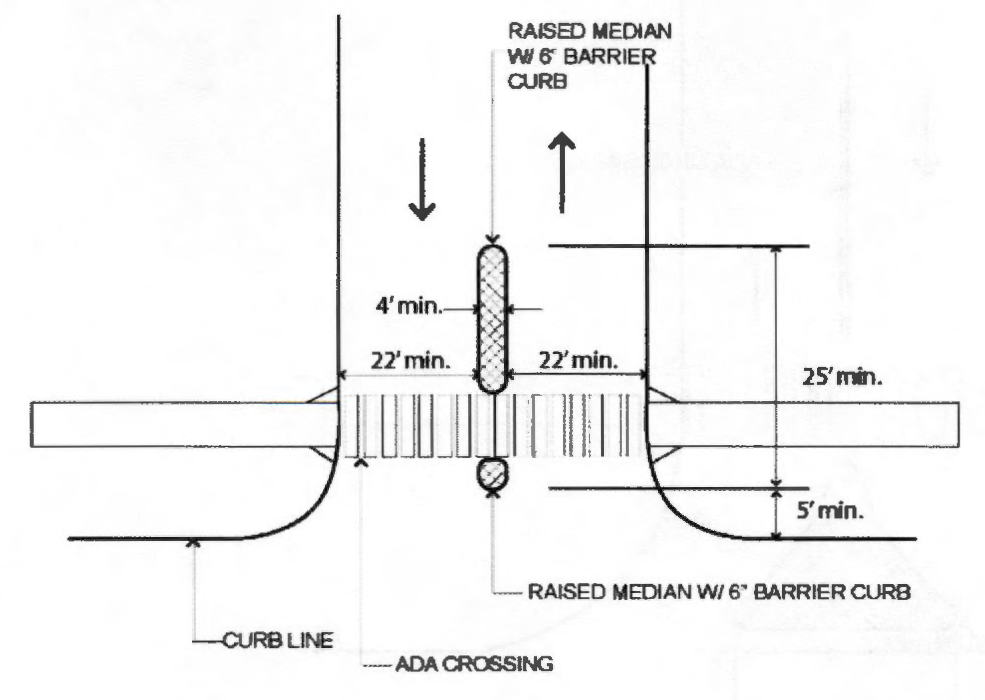
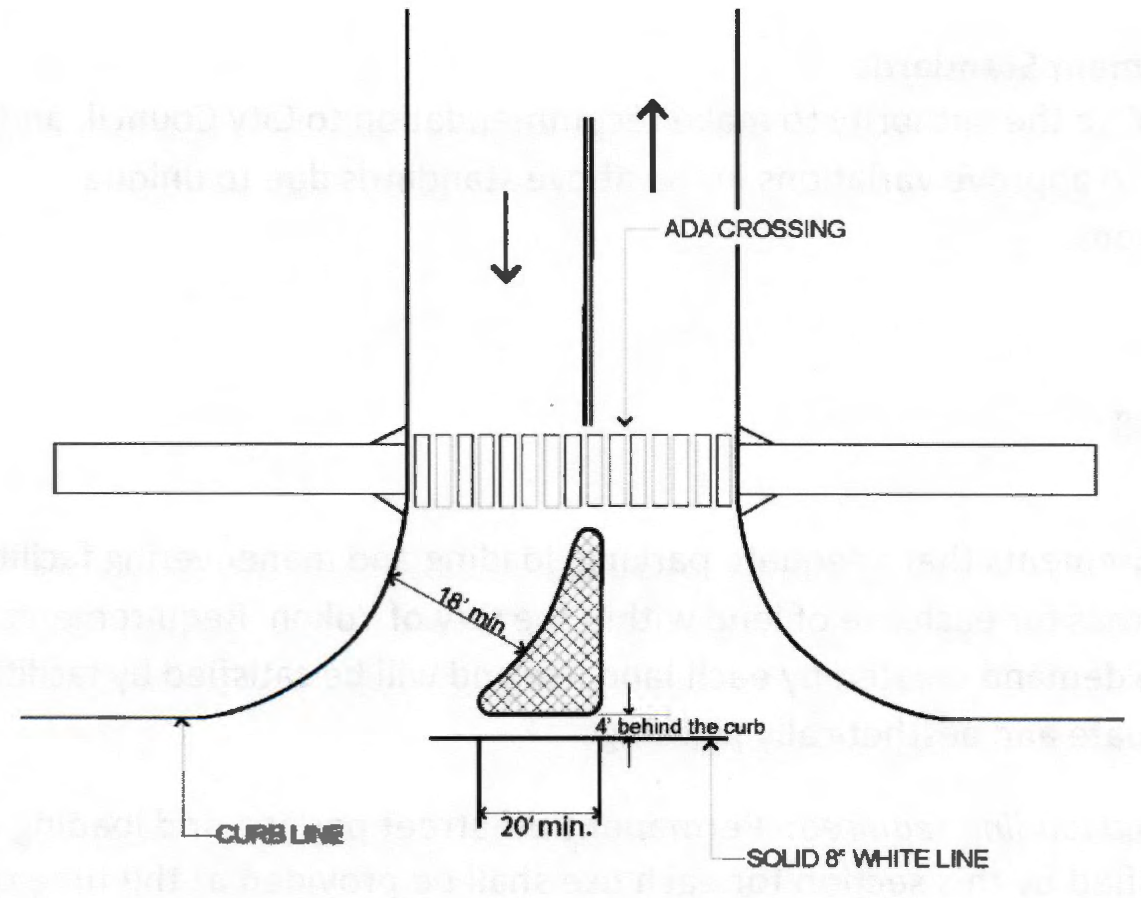
Access controls. The following illustrate acceptable access controls. Alternatives to these may be approved by the city engineer.
H.
Variance to access management standards. Planning commission shall have the authority to make recommendation to city council, and city council shall have authority to approve variations in the above standards due to unique topographic or other conditions.
(Ord. No. 1438, § I, 8-1-2023)
Sec. 215-504. - Parking and loading.
A.
Purpose. It is the intent of these requirements that adequate parking, loading and maneuvering facilities be provided on off-the-street areas for each use of land within the City of Yukon. Requirements are intended to be based on the demand created by each land use and will be satisfied by facilities which are functionally adequate and aesthetically pleasing.
1.
Off-street parking and loading required. Permanent off-street parking and loading areas in the amount specified by this section for each use shall be provided at the time of the erection of any building, or at the time any principal building is enlarged or increased, in the amount required for the enlargement or increase in capacity by adding dwelling units, guest rooms, seats or floor area, or before conversion from one type of use or occupancy to another.
2.
Use of public right-of-way prohibited. No portion of any required off-street space shall occupy or use any public street, right-of-way, alley or other public property, unless approved by city engineer. Parking spaces which use any street or public right-of-way as a direct means of access without the intermediate use of service aisles and entrances of at least the minimum standards specified by this section shall be prohibited, unless approved by city engineer. A public alley shall be the only public right-of-way area permitted for maneuvering space to reach a required parking stall.
3.
Required lot coverage. Off-street parking areas shall not count towards the lot coverage requirements in any districts, unless otherwise specified.
4.
Location. The off-street parking lot shall be located within 200 feet, exclusive of street and alley widths, of the principal use and shall have direct access to a street or alley.
5.
Property owner responsibility. It shall be the responsibility of the property owner to certify at the time of building permit application that the site plan is sufficient to provide spaces and facilities necessary to ensure that no activity will take place on public streets or property not under their control. Any use developed after the date of adoption of these regulations which fails to provide for its off-street parking, loading and access needs according to this provision shall be in violation of the zoning ordinance. Upon determination by the development services director or designee that a property owner has not provided adequate parking or loading space to serve his operation, said property owner shall be required to either develop additional parking or loading space or reduce the size of the operation to fit the space available.
6.
Ownership or control. The land on which the off-street parking or loading facility is located shall be owner[-controlled] or controlled by the same entity which owns or controls the land on which the principal use is located unless a joint use agreement is in place in the case of shared/joint parking.
B.
Applicability and exemptions. The standards contained herein represent minimum requirements. These requirements shall apply to all uses in all districts unless otherwise specified.
1.
Central business district. Uses within the CB zoning district are exempt from the off-street parking requirements of subsection L.
2.
National Register of Historic Places. Buildings and places listed in the National Register of Historic Places are exempt from the off-street parking requirements of subsection L.
C.
Approval procedures for off-street parking, loading and access.
1.
New construction or remodeling. No building permit shall be approved until a plan has been reviewed and approved by the city staff as a part of the building and site plan review process. No certificate of occupancy shall be issued until all off-street parking and loading facilities have been constructed in accordance with the approved building permit.
2.
Plan and information required. The applicant for a building permit for new construction, expansion or remodeling shall submit a plan showing the number, location, and size of parking spaces. The applicant shall submit information regarding the projected number of employees, seating capacities, gross floor area, gross leasable area, number of dwelling units and any of the appropriate data necessary to verify compliance with these regulations.
3.
Plans for surfacing of parking areas. Plans for surfacing of all off-street parking areas, aisles and access driveways, including detailed drainage plans, shall be reviewed and approved by the city staff for compliance with city specifications.
4.
Interpretation and appeal. If questions of interpretation or application of these requirements to particular uses or structures arise, the city staff shall, based on findings of fact, make a determination of the off-street parking, loading or access requirements. Any aggrieved property owner may appeal such determination to the board of adjustment under the procedure specified in section 215-701 of this chapter.
D.
Joint parking. The required parking space for any number of separate uses may be combined in a joint parking facility under the following conditions.
1.
Multiple ownerships or structures. Where there are multiple ownerships or structures, each owner shall provide evidence of a permanent legal instrument which has been filed of record with the county clerk and which guarantees the permanent right to use of the parking facility.
2.
Churches. One-half of the required parking spaces for churches may be included in the total of required parking spaces for other uses that do not operate after 6:00 p.m. or on Sundays; provided, that the nearest property line of said parking area is located within 300 feet of the church property line.
3.
Cumulative effect. Where more than one facility shows evidence of joint use agreements for common access and a cross parking arrangement resulting in reduced street access points, parking requirements will be based upon the cumulative gross floor area of all structures.
E.
Residential parking design.
1.
Single-family, duplex and multifamily residential structures located on one lot may use a paved driveway to fulfill the minimum parking requirements of this section. The space for each automobile on the paved area shall be a minimum of nine feet in width and 20 feet in length and shall not be located on the street right-of-way. The residential driveway shall conform to the driveway design requirements as specified in section 215-406.4(A)(2).
2.
In residential zoning districts all vehicles shall be parked on permanently hard-surfaced driveways or parking areas.
F.
Parking area construction standards.
1.
Paving. All off-street parking areas, aisles and access driveways shall be permanently paved with hard-surfaced pavement. All portions of access driveways on public right-of-way connected to paved streets for which the grade has been established must be permanently paved with hard-surfaced pavement and comply with all Yukon city codes relating to driveway construction. Permanent hard-surfaced pavement shall mean a surface covering over earth, gravel or other natural or artificial base or foundation which shall meet or exceed the following minimum standards:
a.
Two inches of hot asphaltic concrete on a four-inch base of stabilized aggregate or the equivalent thereto, which has been approved by the city staff; or
b.
Four inches of Portland cement concrete on a two-inch sand cushion base or the equivalent thereto, which has been approved by the city staff.
c.
All portions of access driveways on public right-of-way: Six inches of Portland cement concrete on a two-inch sand cushion or the equivalent thereto, which has been approved by the city staff.
2.
Dimension standards.
a.
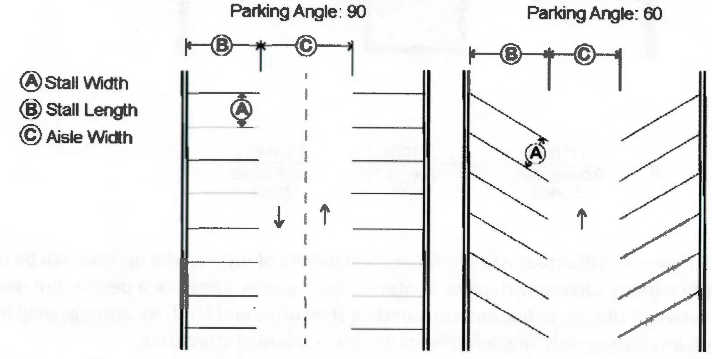
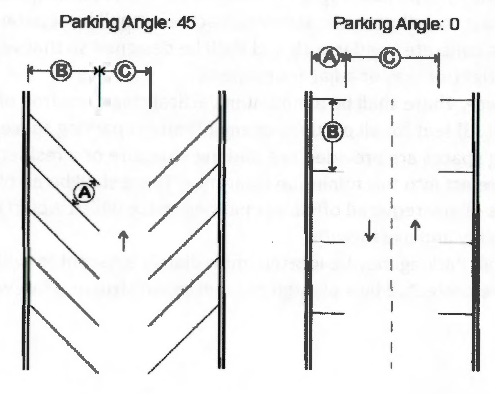
Parking dimensions table.
b.
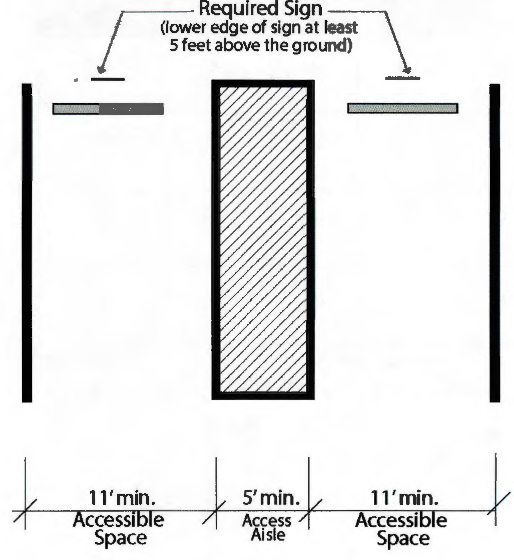
Accessible. Accessible parking spaces shall comply with ADA Accessibility Guidelines (ADADG). Individual spaces shall have an additional five foot-wide, diagonally striped aisle abutting the passenger side of the space. If such spaces are provided in adjacent pairs, then one five-foot aisle may be shared between the two spaces. The aisle must be at the same grade as the accessible space and any adjacent sidewalk must slope to meet the grade of the aisle. The slope may not exceed 1:12. The spaces shall be painted and striped with a four-inch striping.
3.
Striping. All off-street parking spaces and means of ingress and egress shall be laid out on the parking surface with paint or plastic striping which provide a permanent delineation between spaces, aisles, and surrounding structures and land. No striping shall be required on lots having only single-family or duplex residential structures.
4.
Separation from public right-of-way. All off-street parking areas, aisles and access driveways that abut public street right-of-way shall be separated by a six-inch Portland cement concrete header curb and shall be designed so that vehicles do not overhang public right-of-way or adjacent property.
5.
Clearance. There shall be a minimum vertical clearance free of all obstructions to a height of eight feet for all portions of any off-street parking space, except when off-street parking spaces are provided in a parking structure or a residential garage. No obstruction shall project into this minimum clearance. There shall be no obstruction within or near the bounds of any required off-street parking space which would interfere with the normal availability and use thereof.
6.
Location. Parking may be located immediately adjacent to buildings or structures provided they are protected by a planted or landscaped strip or a sidewalk and curb.
G.
Off street parking within or adjacent to residential district. Whenever off-street parking lots serving churches, schools, commercial, industrial, parks, public, or multifamily facilities are to be located within or adjacent to a residential district, the following provisions shall apply.
1.
All sides of the lot within or abutting the residential district shall be enclosed with a screening wall, fence, or landscaping as specified under section 215-505.E, required buffers.
2.
No commercial parking shall be permitted within a front yard in a residential district.
3.
Driveways used for ingress and egress shall be confined to and shall not exceed 25 feet in width, exclusive of curb returns, unless approved by the city staff.
4.
All of the lot used for parking and driveway purposes shall be paved with a sealed surface pavement.
5.
Whenever lighting is provided, it shall be arranged so that all light is deflected from adjoining residential uses, and according to section 215-506.
H.
Accessible parking.
1.
Required accessible parking spaces table.
2.
Signs. Accessible parking spaces must be identified by signs that include the international symbol of accessibility and according to the Americans with Disabilities Act (ADA). Signs should be mounted so that the lower edge of the sign is at least five feet above the ground.
3.
Location.
a.
At least one accessible route shall be provided from accessible parking and accessible passenger loading zones, and public streets or sidewalks to the accessible building entrance they serve.
b.
At least one accessible route shall connect accessible buildings, facilities, elements, and spaces that are on the same site.
c.
At least one accessible route shall connect accessible building or facility entrances with all accessible spaces and elements and with all accessible dwelling units within the building or facility.
I.
Queuing. Where queuing spaces are provided (number of queuing spaces required can be found in section 215-504.L.); they shall conform to the following standards:
1.
No queuing space may occupy any portion of a public right-of-way.
2.
Queuing spaces shall be a minimum of nine feet in width and 18 feet in length.
3.
Queuing spaces may not be used to satisfy the off-street parking or loading requirements of this section.
4.
Queuing spaces may be provided in the primary access aisle leading to a drive-in or drive-through facility.
5.
Double queuing lanes are allowed, provided all other standards are met.
J.
Aisle standards.
1.
Aisles located immediately adjacent to buildings or structures shall be separated by one of the following methods:
a.
A planted or landscaped strip not less than five feet in width, excluding curb, protected by a six-inch concrete curb;
b.
A sidewalk of not less than four feet in width, excluding curb, protected by a six-inch concrete curb.
2.
A drive-in window shall not project more than one foot into an aisle.
K.
Off-street loading.
1.
Off-street loading space required. Every new industrial, commercial, office and civic building hereafter erected or expanded shall provide space, as indicated herein, for loading and unloading of vehicles. The number of off-street loading spaces required by this section shall be considered as the absolute minimum, and the owner/applicant shall evaluate his own needs to determine if they are greater than the minimum specified by this section.
2.
Size of off-street loading spaces. All off-street loading spaces shall have the minimum dimensions of 12 feet by 60 feet and 15 feet overhead clearance. In no case shall a required off-street loading space encroach upon off-street parking space required under this section, or on public right-of-way. No maneuvering shall be permitted on public right-of-way.
3.
Number of off-street loading spaces required.
a.
Retail, commercial and industrial: 0—12,000 square feet of gross floor area, none required; 12,001—48,000 square feet of gross floor area, one space required; and 48,001 and over square feet of gross floor area, two spaces required.
b.
Office and civic: 0—48,000 square feet of gross floor area, none required; 48,000—100,000 square feet of gross floor area, one space required; and 100,001 and over of square feet of gross floor area, two spaces are required.
4.
Design of loading space. Off-street loading spaces shall be designed so that vehicles shall maneuver entirely within the property lines of the premises and not on public right-of-way. Unenclosed off-street loading areas shall be permanently paved with hard-surfaced pavement. A six-inch header curb must also be constructed to separate a loading area from public right-of-way.
L.
Off-street parking requirements. The following lists uses and corresponding off-street parking requirement. In cases where a use has no specific off-street parking requirement the director, or designated representative shall make a determination of requirement.
Table L.1: Residential Uses Off-Street Parking
Requirements
Table L.2: Public/Institutional Uses Off-Street Parking Requirements
Table L.3: Commercial Uses Off-Street Parking
Requirements
Table L.4: Industrial Uses Off-Street Parking
Requirements
Schedule A: Off-street Parking for Warehousing/
vehicle service/manufacturing area
5.
Off-street parking requirements reductions. The number of required parking spaces may be reduced by utilizing any of the following methods, provided the total reduction does not exceed 15 percent of the minimum parking requirement.
a.
Increased landscaping. For each reduction in one parking space ten additional plant points shall be provided.
b.
Bicycle parking. The number of required parking spaces may be reduced by one space for every two bicycle parking spaces installed, provided:
i.
Bicycle parking is located no farther than the closest vehicle parking space and is located proximate to a pedestrian connection to the main building.
ii.
Each space is constructed on or over a paved surface and includes a durable, securely anchored device, of a style illustrated below, that supports the frame of the bicycle in a minimum of one place and accommodates a U-shaped lock or cable lock to secure the frame and at least one wheel.
c.
Motorcycle and scooter parking. The number of required parking spaces may be reduced by one space for every two motorcycle or scooter parking spaces installed, provided the minimum size of each individual space is four feet by seven feet.
d.
On-street parking. The number of required parking spaces may be reduced by one space for every one delineated on-street parking space immediately abutting the site, provided:
i.
The on-street parking space is located within 200 feet of the building; and
ii.
Pedestrian access is provided from the on-street parking to the building
e.
Administrative adjustment. If the maximum parking reduction of 15 percent has been met by the options above, the director, or designee, may approve an additional reduction of up to five percent in the number of required parking spaces for a particular site, so long as it clearly can be determined that the reduced number of parking spaces can accommodate the anticipated parking demand of the site, and there will be no adverse impact to the abutting streets or other uses in the vicinity. The request for administrative adjustment must be made in writing and should outline the justification demonstrating that the proposed parking is sufficient.
f.
Central business. No minimum off-street parking shall be required within the central business district.
g.
I-40 corridor overlay. Shared parking shall be allowed to reduce the off-street parking requirements within the overlay, provided the applicant supplies a written justification demonstrating that the proposed parking is sufficient.
h.
Authority to reimpose. If the parking, once reduced, is found to be insufficient for the use, causing disruption to traffic flow on the public way or parking occurring where not allowed the director, or designee, shall have the authority to revoke the off-street parking reduction and require compliance with section 215-504.L, off-street parking requirements.
(Ord. No. 1438, § I, 8-1-2023)
Sec. 215-505. - Landscaping and screening.
A.
Purpose and intent. The purpose of this section is to ensure that landscaping is provided to:
1.
Protect and enhance the visual appeal of the City of Yukon.
2.
Contribute to high-quality development.
3.
Conserve water resources by using sustainable design, maintenance techniques, and plant species that are drought-tolerant and regionally appropriate.
4.
Reduce stormwater runoff in parking areas and other impervious areas.
5.
Buffer potentially incompatible neighboring land uses.
B.
Applicability. These landscaping and screening standards shall apply to all new development and redevelopment unless otherwise exempted in this UDC.
1.
Expansions and enlargements. These landscaping standards shall apply to the following:
a.
The gross floor area of an existing structure is expanded or enlarged by 25 percent or more.
b.
There is a change of use of the existing building that requires an increase in off-street parking.
c.
Any expansion or enlargement of a structure or use that requires a special permit.
2.
Site improvements. These landscaping standards shall apply when major parking area improvements are made including reconfiguring, reconstructing, or other similar projects. These standards shall also apply to a significant remodel to the exterior of a structure (facade) amounting to more than 50 percent of an exterior change. Significant remodel does not include painting or ordinary maintenance and repairs. Resurfacing and re-striping projects are not considered major improvements.
C.
Exemptions. These landscaping and screening standards shall not apply to:
1.
Development in the agricultural district.
2.
Development in the central business district, except for new surface parking lots within 20 feet of right-of-way.
3.
Public parks and open spaces.
4.
Cemetery, home day care, telecommunication facility, transportation facility, and utility uses.
5.
Reconstruction of any building that is damaged or destroyed by tornadoes, straight-line winds, ice storms, accidental fire, floods, hail, lighting, or other forces beyond the reasonable control of the property owner.
6.
Any nonresidential or mixed-use development of less than 5,000 square feet.
7.
Temporary uses as outlined in article 3, section 215-307 of this UDC.
8.
Any expansion or enlargements that do not meet the thresholds identified in section 215-505.B, applicability.
D.
Required landscaping.
1.
The following are the minimum landscape standards required for commercial, industrial, multifamily, mixed-use, mobile/manufactured home park, group living, and public/institutional uses.
a.
A minimum of eight percent of the total site area shall be landscaped for all applicable districts. Not less than 50 percent of this area shall be in the front and side yards.
b.
A minimum of ten percent of the total site area shall be landscaped in the OR, Office Research District, and the 1-40 Corridor Overlay District. Not less than 50 percent of this area shall be in the front and side yards.
c.
For industrial uses that do not abut residential uses or districts the minimum landscaping may be reduced to four percent of the total site area.
d.
There shall be a minimum of 20 plant points provided for every 400 square feet of required landscape area.
i.
A minimum of 50 percent of total plant points required shall be trees. No single tree species should account for more than 33 percent of the new trees on sites where 150 or more tree plant points are required.
ii.
A minimum of 25 percent of total plant points shall be evergreen.
e.
For each additional parking space provided over the required amount two additional plant points shall be required.
f.
No parking space shall be more than 75 feet from a tree.
g.
Trees shall not be planted with trunks closer than five feet to any underground utility.
h.
Plant materials with a mature height of greater than two feet shall not be planted in sight triangles.
i.
Plant materials with a mature height of greater than 20 feet shall not be planted under overhead utilities.
2.
The following are the minimum landscape standards required for single-family (attached, detached, zero lot line), mobile/manufactured home subdivision, duplex, triplex and fourplex uses.
a.
At least one street or shade tree, or two small or ornamental trees, shall be planted within the front yard for every 75 feet or fraction thereof of frontage.
E.
Required buffers. Buffers are intended to create a smooth transition between residential and non-residential areas by providing an attractive physical buffer between the uses or residential developments and arterial streets. The buffers in this section are required in addition to the required landscaping in subsection D, above.
1.
Perimeter landscape buffers. Where development within commercial, industrial districts, or PUD or SPUD with commercial or industrial uses/tracts abuts agricultural or residential districts must provide one of the following buffering methods along the entire length of the abutting lot line(s):
a.
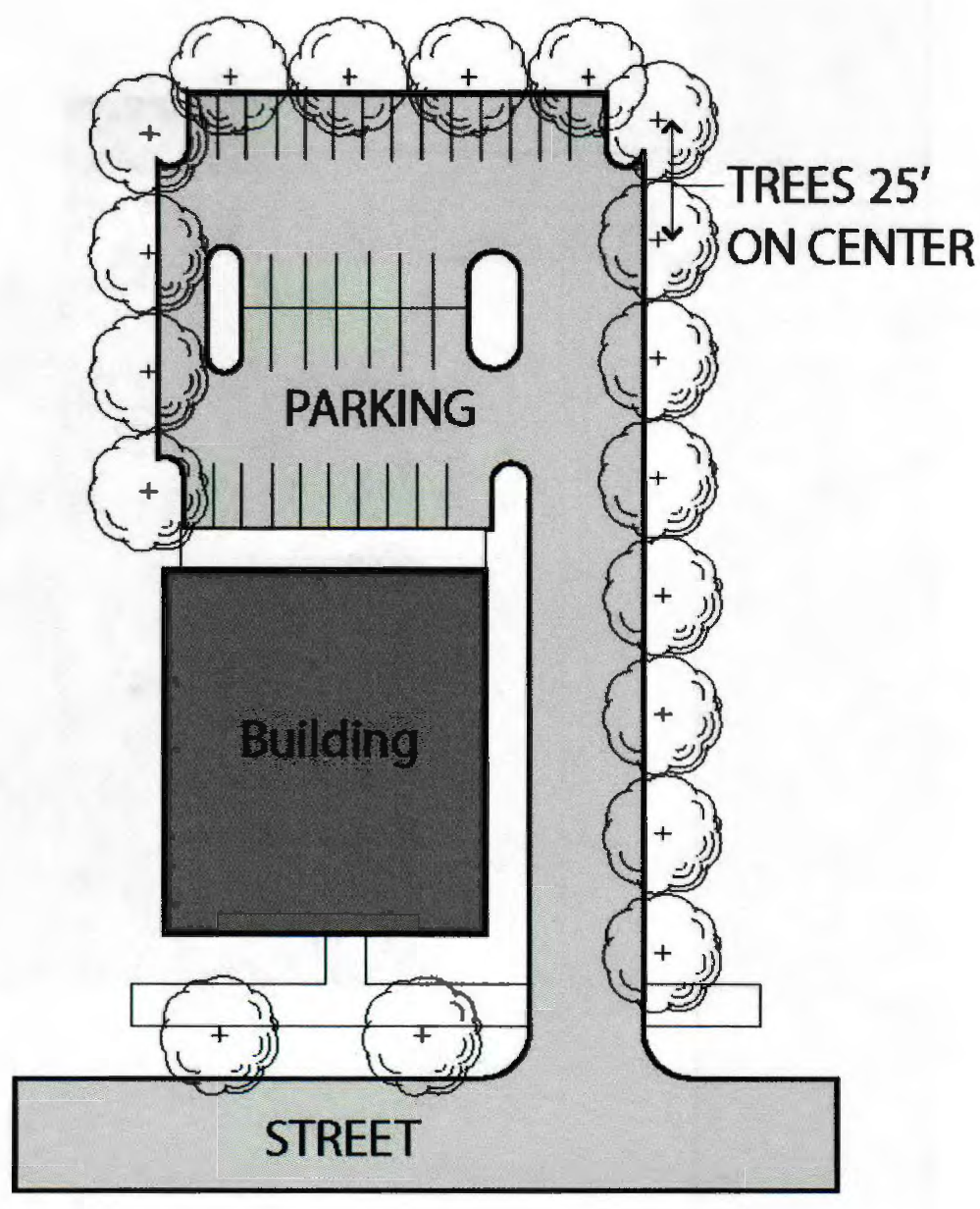
A sight-proof fence and trees planted 25 feet on center.
b.
A sight-proof fence and evergreen trees/shrubs planted 25 feet on center.
c.
An evergreen buffer, six feet in width, planted with evergreen plantings of at least six feet in height at time of planting, and spaced in a manner to provide and opaque visual barrier.
2.
Residential subdivision buffers. The purpose of residential subdivision buffers is to provide a landscaped buffer consisting of any combination of trees, shrubs, grasses, groundcovers arranged in a manner to achieve visual continuity and located on the outside of a residential subdivision (single-family, zero lot line, duplex, triplex, four plex, mobile/manufactured home park or subdivision) where adjacent to arterial streets. If a fence is provided or required, the residential subdivision buffer shall be located on the outside of the fence.
a.
A minimum of four plant points for every 20 feet of frontage along an arterial street shall be required.
b.
No single species shall account for more than 33 percent of required plant points.
c.
Plantings with mature heights over 20 feet shall not be planted beneath overhead utility lines.
F.
Plant units and landscape materials.
1.
A list of suggested landscape materials can be found on record with the development services department. The list is not meant to be exhaustive or prohibit the planting of species other than those found on the list.
2.
Species planted shall be appropriate to Yukon's climate and USDA Hardiness Zone.
G.
Landscaping plan. A landscaping plan shall be submitted for all building permits on projects to which landscaping requirements apply in section 215-505.B. The landscaping plan shall include the following information:
1.
North arrow and scale.
2.
Location of existing property lines and dimensions of the tract.
3.
The location of all existing and proposed buildings, sidewalks, and parking areas, including the exact number of parking spaces provided.
4.
The location, size, type, spaces, and quantity of all proposed plant materials, including common and/or scientific name of species.
5.
Method of irrigation.
6.
A table listing the following:
a.
Total site area in square feet.
b.
Percentage of landscaped area required, and square footage of landscaped area required.
c.
Square footage of landscaped area required in front and side yards, and square footage of landscaped area provided in front and side yards.
d.
Number of parking spaces required.
e.
Number of parking spaces provided and corresponding additional plant points.
f.
Total plant points required and provided including.
i.
Evergreen plant units.
ii.
Tree plant units.
H.
Irrigation.
1.
All landscaped areas shall be irrigated by one of the following methods:
a.
A hose attachment within 100 feet of all required landscape areas.
b.
An automatic or manual underground, or automatic water saving system, equipped with rain and freeze sensors.
2.
Method of irrigation shall be in place and working at the time of inspection for occupancy and shall be kept operational at all times.
3.
The development services director, or designee, may allow alternative irrigation systems provided the applicant can demonstrate that compliance with the above provisions is not feasible, and the proposed alternative system will be sufficient to ensure plant health.
I.
Compliance.
1.
The development services director, or designee, is expressly authorized to approve an alternative compliance landscape plan for installation of plant materials in alternative locations when circumstances prevent planting within the areas described in this section or when compliance would result in a poor growing environment for the plant materials or damage to public or private improvements as long as the intent of this UDC and section are met.
2.
Any landscaping found by the development services director or their designee to be dead or in declining condition shall be replaced within 30 days of written notice thereof by regular or certified mail to the owner or owner's address or, if unknown, to the owner at the property address or as shown on the rolls of the county assessor.
3.
The property owner has the responsibility to maintain all landscaping on site.
(Ord. No. 1438, § I, 8-1-2023)
Sec. 215-506. - Outdoor lighting.
A.
Purpose and intent. The outdoor lighting regulations of this section are intended to help ensure adequate lighting for motorized and nonmotorized travelers; provide for the efficient use of energy; and reduce the impacts of nuisance lighting and glare on nearby uses.
B.
Applicability and exemptions. The outdoor lighting regulations of this section apply to all outdoor lighting installed after the effective date of this chapter, except that they do not apply to any of the following:
1.
Motion sensor lights which shine for not longer than 20 minutes after activation;
2.
Public street lights;
3.
Airport runway and aviation safety lights required by the FAA;
4.
Spotlighting of official government flags if the spotlighting is contained within the area of the flag;
5.
Outdoor lighting used exclusively for and during public recreational activities, sporting events at stadiums and ball fields or other outdoor public spaces or venues;
6.
Outdoor lighting used for emergency equipment and work conducted in the interest of law enforcement or for public, health, safety or welfare;
7.
Outdoor lighting in association with special events approved by the city council;
8.
Outdoor lighting used for a temporary use lasting no more than ten days;
9.
Lighting fixtures with a light output of no more than 1,100 lumens; and
10.
Temporary holiday light displays between October 1 to January 31, provided it does not create a hazard or nuisance.
11.
Lights that are owned and maintained by OG&E.
C.
General standards. All outdoor lighting must comply with the following general standards:
1.
Canopy-mounted lights. Recessed fixtures must be used in all under-canopy lighting. No lamps, reflectors, refractors or focusing or diffusing may extend below the underside of the canopy surface.
2.
Wall pack lights. Wall packs on buildings may be used at entrances to a building, not to provide general building or site lighting. Wall packs on exterior of a nonresidential building shall be fully shielded (true cut-off type bulb or light source not visible from off-site) where abutting residential district or use.
3.
Arrangement and shielding.
a.
Lighting must be installed to shield and direct light away from abutting lots that are not under common ownership or control with the lot on which the lights are located. Shielding must be designed and installed to ensure that the light-producing element of the fixture is not visible from on the abutting property, as measured five feet above grade.
b.
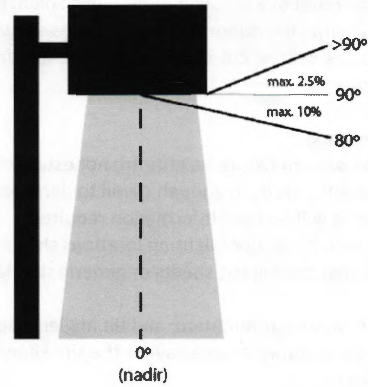
Light-producing elements must be concealed or shielded with cutoffs so that no more than two and one-half percent of the light emitted directly from the lamp or indirectly from the fixture is projected at an angle of more than 90 degree) above nadir (zero) and no more than ten percent of the light emitted directly from the lamp or indirectly from the fixture is projected at an angle of more than 80 degrees above nadir (zero).
4.
Spillover light. Light trespass along the lot line of the subject property may not exceed 0.5 foot-candles when abutting an agricultural or residential zoning district and may not exceed three foot-candles when abutting any other zoning district or public right-of-way. Maximum illumination levels are measured three feet above grade or from the top of any opaque screening fence or wall along the property line.
5.
Maximum fixture heights. Allowable heights of light fixtures must be measured from the light-emitting surface to finished grade at the base of the pole. Maximum allowed light fixture heights are based on the (ground-level) horizontal distance between the light fixture and any agricultural or residential zoning district, or right-of-way as established in Table 506-1. These heights may be exceeded if shown to be in compliance through a photometric plan/study as outlined in section 215-506.5.C.
D.
Lighting plans.
1.
General. Outdoor lighting plans demonstrating compliance with the standards of this section are required with the submittal of a building permit in all non-residential districts. Applicants have two options for the format of the required lighting plan.
a.
Submit a lighting plan that complies with the fixture height lighting plan requirements of section 215-506.C.
b.
Submit a photometric plan/study demonstrating that compliance will be achieved using taller fixture heights.
2.
Option 1: Fixture height stand lighting plan. This option establishes maximum light fixture heights but does not require submittal of a detailed photometric plan. Information required:
a.
A scaled drawing of the site with all outdoor lighting locations shown;
b.
Fixture specifications, including catalog cut-sheets or generic standards;
c.
Pole type and height of fixture;
d.
Lamp type and size; and
e.
Fixture mounting and orientation.
3.
Option 2: Photometric study. Maximum fixture heights are not established, but applicants are required to submit a photometric study in enough detail to demonstrate that all applicable outdoor light standards will be met. Information required:
a.
A scale drawing of the site with all outdoor lighting locations shown;
b.
Fixture specifications, including catalog cut-sheets or generic standards;
c.
Lamp type and size;
d.
Fixture mounting heights, mounting orientation, and tilt angles if applicable; and
e.
A representative point-by-point illumination array for the site showing property lines and all off-site lighting impacts.
E.
Nonconforming light fixtures. All outdoor lighting fixtures legally existing and installed prior to the effective date of this UDC and which is not exempted shall be considered nonconforming and shall be brought into compliance by the property owner as follows:
1.
Compliance is required when applying for a building permit, sign permit, new business license, site plan review or similar city permit; or if site improvements, construction, reconstruction, expansion, alterations, or modifications cumulatively equal or exceed 50 percent of the existing site or structure.
2.
All damaged or inoperative nonconforming lighting shall be replaced or repaired only with lighting equipment and fixtures compliant with this chapter.
3.
All outdoor lighting not exempted shall be brought into conformance with this section within ten years form the effective date of this UDC.
F.
Residential light trespass.
1.
Definitions. For the purpose of the ordinance codified in this subsection, the following definitions apply:
Light trespass: Any artificial light emitted from a residential property that strays beyond the boundaries of the property and illuminates neighboring properties.
Glare: Excessive brightness that causes visual discomfort or reduces visibility.
Direct light: Light emitted directly from the light source, as opposed to light that is reflected off surfaces.
Non-essential: Outdoor lighting that is not required for safety, security, or public utility purposes. This includes decorative lighting, landscape lighting, and other lighting that does not serve a functional purpose during certain hours (e.g., between 11:00 p.m. and 6:00 a.m.).
2.
General requirements.
a.
Shielding: All exterior lights must be fully shielded to prevent light from trespassing onto adjacent properties. This includes, but is not limited to, floodlights, spotlights, and security lights.
b.
Direction: Exterior lights must be directed downward and away from adjacent properties.
c.
Glare control: Lighting must be designed and positioned to minimize glare and not interfere with the use and enjoyment of neighboring properties.
d.
Automatic controls: The use of motion detectors, timers, and other automatic control devices is encouraged to reduce unnecessary lighting.
3.
Specific standards.
a.
Illumination levels: The illumination level at the property line of the light source shall not exceed 0.5 foot-candles, measured in a vertical plane.
b.
Height restrictions: Exterior lights mounted on poles or structures shall not exceed a height of 16 feet above ground level.
c.
Curfew: Non-essential lighting shall be turned off between 11:00 p.m. and 6:00 a.m., except for motion-activated security lighting which shall turn off within 20 minutes of activation.
4.
Exceptions.
a.
Emergency lighting: Temporary lighting required for emergency situations or repair work by public utilities or contractors.
b.
Holiday lighting: Decorative holiday lighting between October 1 to January 31, provided it does not create a hazard or nuisance.
c.
City street lighting that ensures residential areas are adequately illuminated for vehicular and pedestrian traffic enhancing safety and accessibility.
5.
Applicability and enforcement.
a.
The outdoor lighting regulations of this section apply to all outdoor residential lighting installed after the effective date of this chapter. Existing outdoor residential lighting shall be required to comply with these outdoor lighting regulations within 60 days of the passage of this amendment.
b.
Inspection: The city manager or their designee is authorized to inspect properties for compliance with the ordinance.
c.
Violations: Any person found to be in violation of this ordinance shall be issued a notice of violation given ten days to correct the violation.
d.
Remediation: Continued failure to comply shall result in further enforcement action as determined by the city.
(Ord. No. 1438, § I, 8-1-2023; Ord. No. 1465, § 1, 12-3-2024; Ord. No. 1468, § 1, 12-17-2024; Ord. No. 1469, 2-18-2025; Ord. No. 1481, 8-13-2025)
Sec. 215-507. - Outdoor storage and display.
Within all districts, all activities must be conducted entirely within an enclosed structure, except for the following uses and activities:
1.
Parking lots.
2.
Park/playground, conservation areas, and similar open space uses.
3.
Establishments with a permitted outdoor component, including, but not limited to, agriculture; heavy manufacturing; vehicles and equipment; major retail; major entertainment facilities; major utility facilities; transportation facilities; storage yards; waste and salvage operations; outdoor dining; and similar businesses.
4.
Permitted outdoor storage, and outdoor sales and display areas.
5.
Permitted outdoor temporary uses.
(Ord. No. 1438, § I, 8-1-2023)
Sec. 215-508. - Signs.
A.
Purpose and intent. It is the intent and purpose of this section to establish effective sign regulations which recognize the public as well as private interest and investment in our environment. This chapter is intended to promote economic and business development while protecting and reducing distractions and obstructions that may contribute to traffic accidents by prohibiting unsafe signs. Further, the purpose of this chapter is also to regulate the number, size, and location of signs, cause the removal of abandoned signs, and protect the health, safety, welfare, convenience, and enjoyment of the city for its residents and visitors. This section shall apply to the display, construction, erection, alteration, use, location, and maintenance of all signs within the city. This section does not apply to public informational and safety signs, or signs required by local, state, or federal law.
B.
Measurement standards. See article 2, section 215-204, rules of measurement.
C.
Signs permitted.
a.
Agricultural and residential districts.
b.
Commercial and industrial districts.
c.
Special purpose districts.
D.
Development standards.
a.
On-premises signs.
i.
Freestanding signs may be either pole or monument type but must be installed on an adequate base and foundation to support the sign.
ii.
No portion of a projecting sign shall extend more than four feet from the face of the building and the outermost portion of a projecting sign shall project no closer than five feet from a curbline or shoulder of a public street.
iii.
Signs shall be constructed of durable materials, using non-corrosive fastenings and be structurally safe.
iv.
Signs which project over a sidewalk or other public or private path shall have a minimum clearance of eight feet.
b.
Off-premises signs.
i.
Signs shall be constructed of durable materials, using non-corrosive fastenings and be structurally safe.
ii.
Display surface area shall not exceed 672 square feet per sign face, except for a 20-percent allowance for extensions and cutouts.
iii.
Maximum sign width shall be 60 feet.
iv.
Maximum sign height shall be 35 feet above grade; and 35 feet above elevated road level if adjacent to elevated roadway.
v.
Minimum clearance of 12 feet shall be maintained from ground level at base of sign to the bottom of the sign face or to the bottom of the deck, whichever is lower.
vi.
Regardless of the applicable zoning, no sign displayed to be read from a divided, limited access roadway with four or more traffic lanes, shall be constructed, erected, placed, or replaced closer than 1,000 feet to another off-premises sign facing in the same direction and on the same side of the roadway from which the sign is intended to be read.
vii.
No off-premises sign shall be constructed, erected, placed, or replaced closer than 300 feet to the nearest residentially zoned property.
c.
Electronic message display (EMD) Signs.
i.
Such signs shall display static images for a period of at least eight seconds before transitioning to another static image.
ii.
Transitions from one static image to the next may display frame effects so long as the use of animation and/or flashing as defined in this chapter are prohibited.
iii.
No such sign, if the illuminated portion of such sign is visible from an R zoning district other than street, highway or freeway right-of-way, or if the illuminated portion of such sign is visible from a designated residential development area, shall be located within 300 feet of such district or area. The 300 feet shall be measured in a straight line from the nearest visible illuminated point on a sign structure to the nearest point of an R zoning district or residential development area boundary line.
iv.
No sign shall exceed a brightness of 0.3 foot candles above ambient light as measured using a foot candle (Lux) meter at a preset distance depending on sign area. The measurement distance shall be calculated with the following formula: The square root of the product of the sign area and 100.
1.
Example using a 12 square foot sign: Measurement Distance = √(12 Sq. Ft. x 100) = 34.6
2.
The standard for brightness adjustment as ambient light intensity declines shall be a maximum increase in light intensity from the digital sign of 0.3 foot candles over ambient levels as measured using a foot candle meter at a pre-set distance in accordance with the following procedure:
3.
At least 30 minutes past sunset, record the ambient light using a foot candle meter for the area while the sign is off or displaying all black copy, with the meter located directly in front of and aimed directly at the sign at the appropriate distance.
4.
Turn on the sign to display all white and take another measurement in accordance with the same procedure.
5.
If the difference between the measurements is 0.3 foot candles or less, the brightness is properly adjusted, otherwise the sign must be adjusted to comply with the brightness adjustment standard set forth above.
a.
No such sign shall display an illuminative brightness of such intensity or brilliance that it impairs the vision or endangers the safety and welfare of any pedestrian, cyclist, or person operating a motor vehicle.
b.
No such sign shall resemble or simulate any warning or danger signal, or any official traffic control device, sign, signal or light.
v.
The display area of the sign shall utilize dimming technology which automatically adjusts the brightness of the sign based on ambient light conditions. A certificate signed by the sign contractor that the electronic message display (EMD) sign will be so equipped.
vi.
The display area of the sign is not allowed to resemble or simulate any warning or danger signal or any official traffic control device, sign, signal or light or to cause a driver to mistake the sign for a warning or danger sign.
vii.
The display area of the sign is not allowed to operate unless it is equipped with a default mechanism that shall freeze the sign in one position of static message if a malfunction occurs or shall be manually turned off within six hours of a reported malfunction.
viii.
Use of sound is prohibited in all zoning areas.
ix.
For illuminated signs, a statement declaring the sign's brightness, image change rate and transition time shall be submitted; along with electronic sign application which declare the type of software used, programming details and specify how the photo cell will operate.
E.
Restrictions.
a.
No light, sign or other device shall be designed or erected to imitate or resemble any official traffic sign, signal, or device or otherwise direct maneuvering of vehicles or creates in any way an unsafe distraction for motor vehicle operators.
b.
No sign shall be attached to or painted on any tree, utility pole, curb, sidewalk or streetlight.
c.
No sign shall be located within the sight triangle of any intersection.
d.
No sign shall be placed in or project into any public easement or right-of-way without first receiving approval of a Revocable/Right-of-way Permit.
e.
Only nonintermittent white lighting of signs shall be permitted.
f.
The following signs shall not be permitted, erected or maintained in the city:
i.
Flares.
ii.
Wind signs, except for grand opening signs.
iii.
Signs which incorporate projected images or emit any sound which is intended to attract attention.
iv.
Any sign, together with its supporting structure, now or hereafter existing which, 90 days or more after the premises have been vacated.
v.
Any sign which identifies a home-based business defined in article 3, section 215-306.
vi.
Signs not permanently affixed or attached to the ground or to any structure, including A-frame-type signs, except for real estate signs attached to posts driven into the ground, window signs and temporary barriers. A-frame-type signs shall be permitted in the urban core overlay district as long as a four-foot-wide clear path can be maintained up on the public sidewalk.
vii.
Any sign or sign structure which is structurally unsafe; constitutes a hazard to safety or health by reason of inadequate maintenance or dilapidation; is not kept in good repair; is abandoned; or is capable of causing electrical shocks to persons likely to come into contact with the sign.
g.
Any sign which obstructs free ingress to or egress from a required door, window, fire escape or other required exit way.
h.
Garage sale signs, other than those issued by the city.
i.
Portable message center signs, including vehicle signs or those attached to trailer chassis.
F.
Nonconforming signs. Any sign constructed before the effective date of this UDC, which does not comply with the provisions of this article, may continue in existence if it is properly maintained in good condition. These provisions shall not prevent the repair or restoration to a safe condition of any sign, but a nonconforming sign shall not be:
a.
Changed to another nonconforming sign except where only the face or copy is changed;
b.
Structurally alters so as to increase the degree of non-conformity of the sign;
c.
Expanded or enlarged;
d.
Reestablished after its removal; or
e.
Moved to a new location, unless the location would bring the sign into conformance with the provisions of this article.
G.
Permit procedures.
a.
Except where not required it shall be unlawful to display, erect, relocate, or alter any sign without first filing with the development services director or designee and application in writing and obtaining a sign permit.
b.
When a sign permit has been issued by the development services director or designee, it shall be unlawful to change, modify, alter, or otherwise deviate from the terms or conditions of said permit without prior approval of the development services director or designee. A written record of such approval shall be documented upon the original permit application and maintained in the files of the development services department.
c.
The application for a sign permit shall be made by the owner or a sign contractor licensed by the city. Such applications shall be made in writing on forms furnished by the development services department and shall be signed by the applicant.
d.
The application for a sign permit shall be accompanied by the following plans and other information:
i.
The name, address and telephone number of the owner or persons entitled to possession of the sign and of the sign contractor or erector.
ii.
The location by street address and legal description of the site of the proposed sign structure.
iii.
Plans indicating the scope and structural detail of the work to be done including details of all connections, guy lines, supports and footings and material to be used.
iv.
A site plan drawn to scale showing the location of the building structure and lotto which the sign is to be attached or erected.
v.
The position of the sign in relation to nearby buildings or structures.
vi.
Two sets of plans and a digital copy submitted in PDF format.
vii.
Specifications and method of construction.
viii.
Method of attachment to the building or ground when required by the development services director or his designee.
ix.
Copy of documents which provide information to ensure compliance with the International Building Code.
x.
Application for an electrical permit and required information shall be a licensed electrician making the electrical connection.
xi.
Such other information as required by the development services director or designee to show full compliance with all ordinances.
e.
A permit fee shall be paid to the city for each sign permit issued under this article. All such permit fees shall be set by the city council of the City of Yukon by resolution.
f.
Signs erected or remodeled shall bear a clearly legible identification plat that is accessible from ground level, not exceeding 15 square inches in area, stating the name of the person or company responsible for the construction, with installation date and permit number. Such information shall be kept current. Electrical signs shall be marked with input amperes at full load input.
g.
All signs for which a permit is required shall be subject to inspection by the development services director or designee, including footing inspections.
h.
All signs containing electrical wiring shall be subject to the provisions of the governing electrical code and the electrical components used shall bear the label of an approved testing agency.
i.
If the development services director or designee finds that work under any permit issued is not in accordance with the information supplied in the permit application and/or is in violation of this chapter or any other pertinent ordinance, or should they find that there has been any misrepresentation in connection with the application for the permit, they shall notify the owner or sign contractor of such findings and that the violation must be corrected without delay. If such correction is not made, the development services director or designee shall revoke the permit and serve written notice thereof upon the owner or sign contractor. No person shall proceed with any part of such work after such notice is received.
j.
If substantial actual work either on or off site is not commenced under any permit issued within 60 days from the date of such permit, and/or if substantial building operations under any permit issued under this article are suspended for a period of 60 consecutive days, the permit shall be deemed revoked.
k.
Delays which are not a result of willful acts or neglect of the contractor, owner or person obtaining the permit the development services director or designee may grant an extension of time in which to start or resume operations. All requests for extension and approval thereof shall be in writing.
l.
When any permit has been revoked under the terms of this subsection, permit fees shall not be refunded.
H.
Permits not required. All applicable provisions of this chapter shall apply, except that setback requirements shall not apply nor shall a sign permit or a sign permit fee be required for the following signs in all districts.
a.
Painting, repainting, cleaning, or other normal maintenance and repair of a sign, not involving structural changes or changes in the electrical components of the sign; as long as sign area, sign height, or sign dimensions are not changed.
b.
Signs inside a building, or enclosed structure, not meant to be viewed from the outside, and are located greater than three feet from the window.
c.
Holiday and seasonal decorations.
d.
Personal expression signs of any type, provided that they do not exceed three square feet in area per side, are non-commercial, and not internally illuminated.
e.
Up to two signs stating address, number and/or name of occupants of the premises and do not include any commercial advertising or other identification.
i.
Residential districts: Signs not to exceed three square feet in area.
ii.
Non-residential districts: Signs not to exceed five square feet in area.
f.
Public signs erected or required by government agencies or utilities, including traffic, utility, safety, railroad crossing, and identification or directional signs for public facilities.
g.
Signs or emblems of a religious, civil, philanthropic, historical or education organization that do not exceed four square feet in area.
h.
Private drive signs, one sign per driveway entrance, not to exceed two square feet in area.
i.
Security and warning signs.
i.
Residential districts: Not to exceed three square feet in area.
ii.
Nonresidential districts: Not to exceed five square feet in area.
j.
Flags.
i.
Residential districts: No more than two flags per lot. Maximum flag size is 24 square feet.
ii.
Nonresidential districts: No more than three flags per lot. Maximum flag size is 35 square feet.
iii.
If the flag contains commercial messaging they shall be permitted as freestanding signs according to the zoning district allowance, and shall be included in and limited by, the computation of allowable area for signs.
k.
Legal notices.
l.
Vending machine signs.
m.
Memorial, public monument, plaque, or historical identification signs, not to exceed three square feet in area.
n.
Directional signs which do not exceed four square feet in area, or five square feet in height, and are non-illuminated.
o.
Art and murals.
p.
Temporary signs.
i.
Must be labeled with date of erection. As defined in article 2, temporary signs are those that in use for no more than 60 days.
ii.
Residential districts: No more than one per frontage, measuring 12 square feet in total area and six feet in height.
iii.
Non-residential districts: No more than one per 200 feet of frontage, measuring 32 square feet in area and eight feet in height.
I.
Maintenance and removal.
a.
Every sign shall be always maintained in good condition.
b.
Any sign constructed, erected, relocated, placed or altered on or after the effective date of this article, including those for which a permit is not required, which is not in accordance with the requirements listed in this section, shall be considered in violation of this UDC.
c.
The development services director or designee may order removal of any sign that is not maintained in accordance with the provisions of this section.
d.
If the development services director or his designee shall find that any sign is erected or maintained in violation of this section, he shall give written notice which may be served personally to the owner or his agent, sign contractor or person having the beneficial use of the building or structure upon which such sign is located. If such person fails to alter or remove the sign to comply with this section within 48 hours after receipt of such notice, the city manager is authorized to cause removal or obliteration of such sign. The city may institute any property action in a court of competent jurisdiction to prevent, enjoin, restrain, abate or otherwise to correct any violation of this chapter. The city manager or his designee may cause any sign or other advertising structure which is an immediate peril to persons or property to be removed summarily without notice.
e.
Any sign which is unlawfully placed in the right-of-way, or signs which are pasted, nailed, painted on, or otherwise unlawfully displayed upon structures, utility poles, trees, fences or other signs, may be removed summarily by the city manager or his designee without notice, including garage sale signs.
(Ord. No. 1438, § I, 8-1-2023)
Sec. 215-509. - Design standards.
A.
Duplex, triplex, four-plex and multifamily design requirements. The following design standards shall apply to dwelling categories of duplexes, triplexes, fourplexes and multifamily.
1.
Building materials. Exterior building materials shall consist of long-lasting, high-quality materials, such as brick, stucco, wood, cementitious board or siding, native stone, glass, metal, or other masonry units.
a.
Limited materials. Aluminum, steel or other architectural metal may be used as decorative or detail elements for up to 25 percent of the façade's finish material. Exterior insulation and finish system (EFIS) and other insulated wall cladding materials may be used as decorative or detail elements for up to 25 percent of the facade's finish, above the ground floor.
b.
Prohibited materials.The following materials are prohibited as exterior finish materials: plain or painted concrete block, tilt-up concrete panels, prefabricated steel panels, or corrugated metal siding.
2.
Two- to four-family (duplex, triplex and four-plex).
a.
Parking and driveways. Garages shall be located on the lot so as to not be the dominant physical feature.
i.
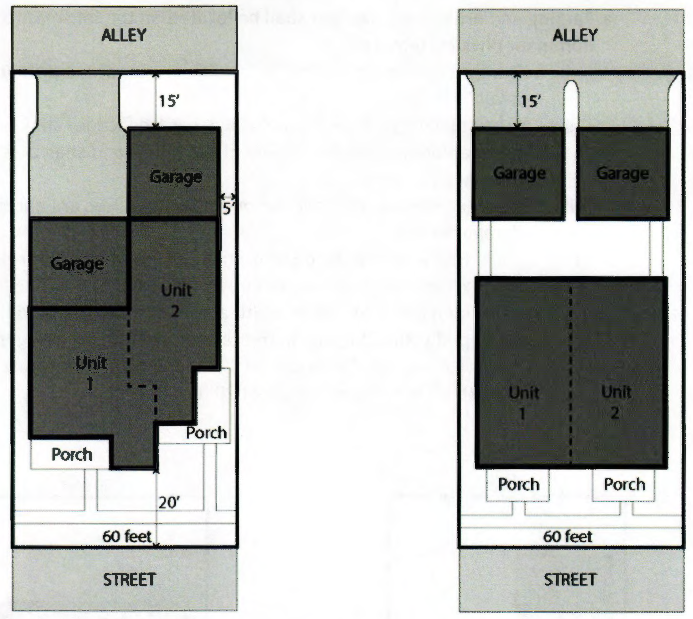
Garages should be located to the side or rear of the primary facade of the dwelling unit.
ii.
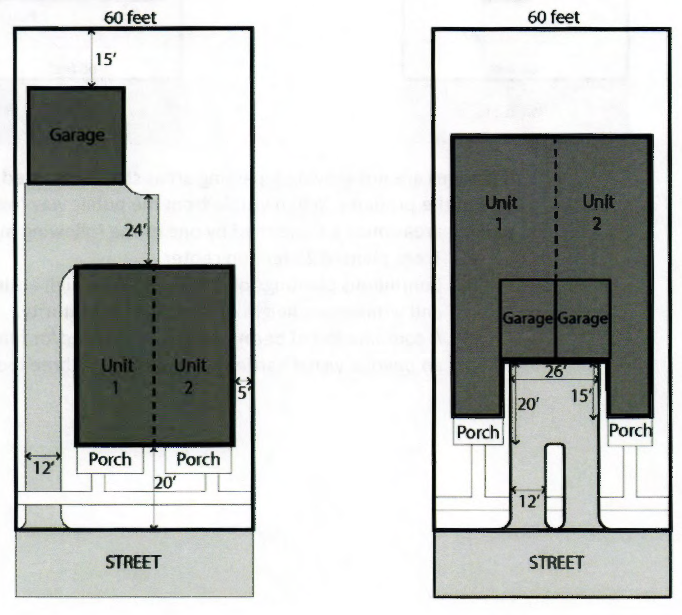
If front facing garages are provided, garage facades shall be at least 15 feet behind the primary facade of the house and shall be a single garage entrance per unit.
iii.
Rear garages can be attached or detached. Alleys are encouraged for garage access.
iv.
Each driveway shall be no more than 12 feet in width for the entire length that extends beyond the primary front facade of the dwelling. Driveways can widen up to 24 feet in width at a point that is behind the line of the primary dwelling façade. In the case of front facing garages (section 215-305.B.2.ii.) a paved area can be located in front of the garage entrance at a width of 26 feet and length of 20 feet.
v.
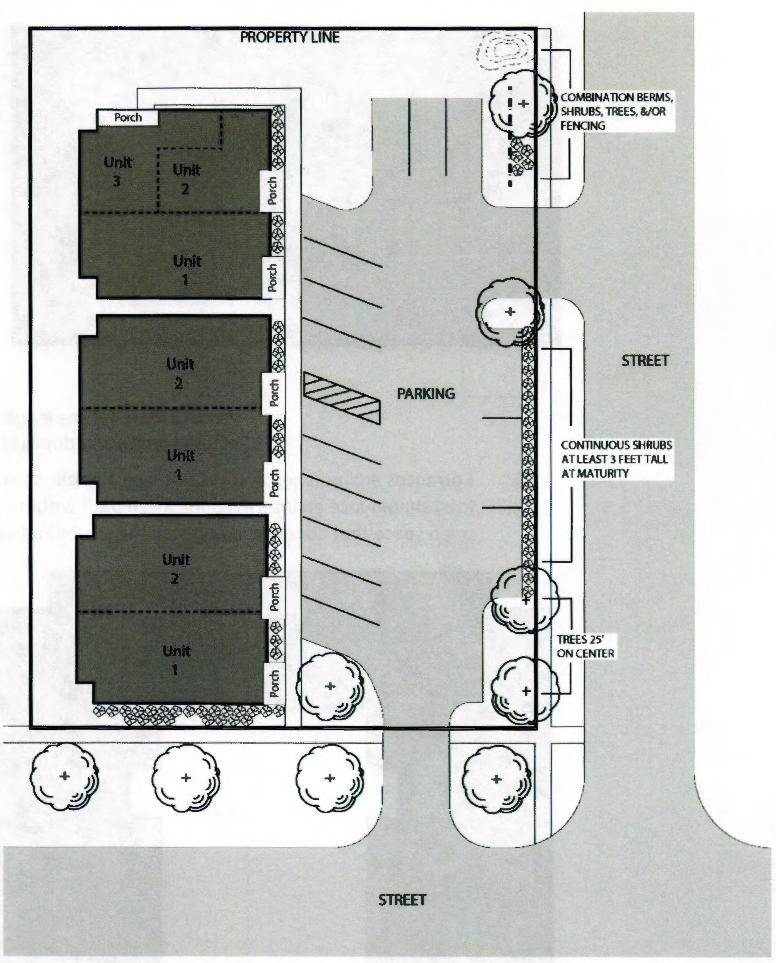
If garages are not provided, parking areas shall be located in the rear or side of the property. When visible from the public way (except alleys) parking areas must be screened by one of the following methods:
a)
Trees planted 25 feet on center.
b)
Continuous plantings of shrubs at two-foot high at time of planting, and a minimum height of three feet at maturity.
c)
A combination of berms, shrubs, trees, and/or fencing to create an opaque visual barrier with a height of three feet.
b.
Entries. Primary building entrances (individual or shared) should be visibly distinguished and accessible from a sidewalk.
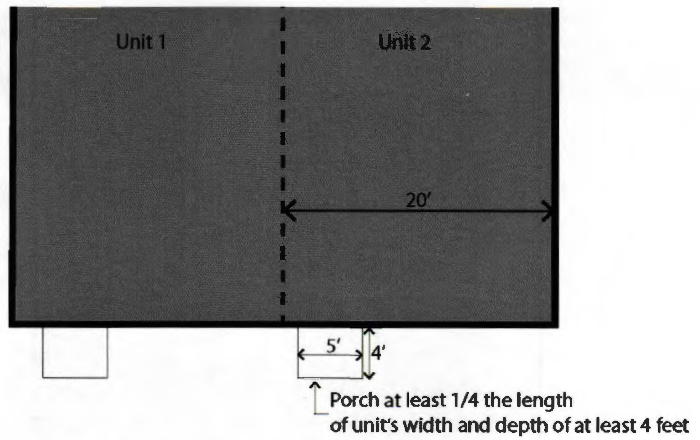
i.
Porches shall be provided for each unit, at least ¼ the length of the unit's width and a depth of not less than four feet. Units should be oriented so that porch or stoops face the street.
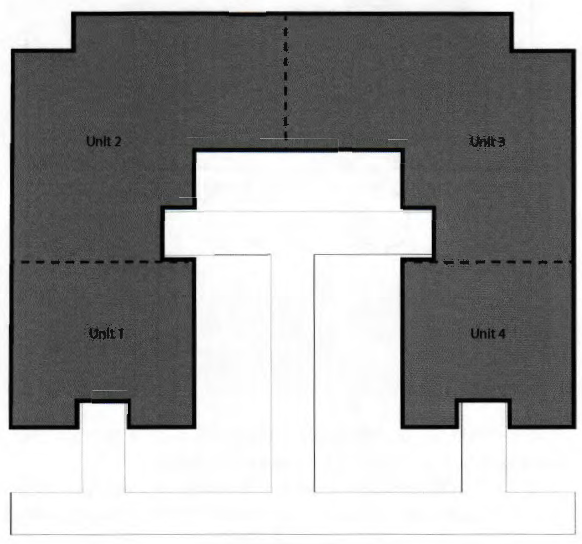
ii.
Entrances and porches that cannot face a public street (i.e. deep or large lots) should face an internal pedestrian path within a courtyard or shared open space that connects directly to the street and sidewalk.
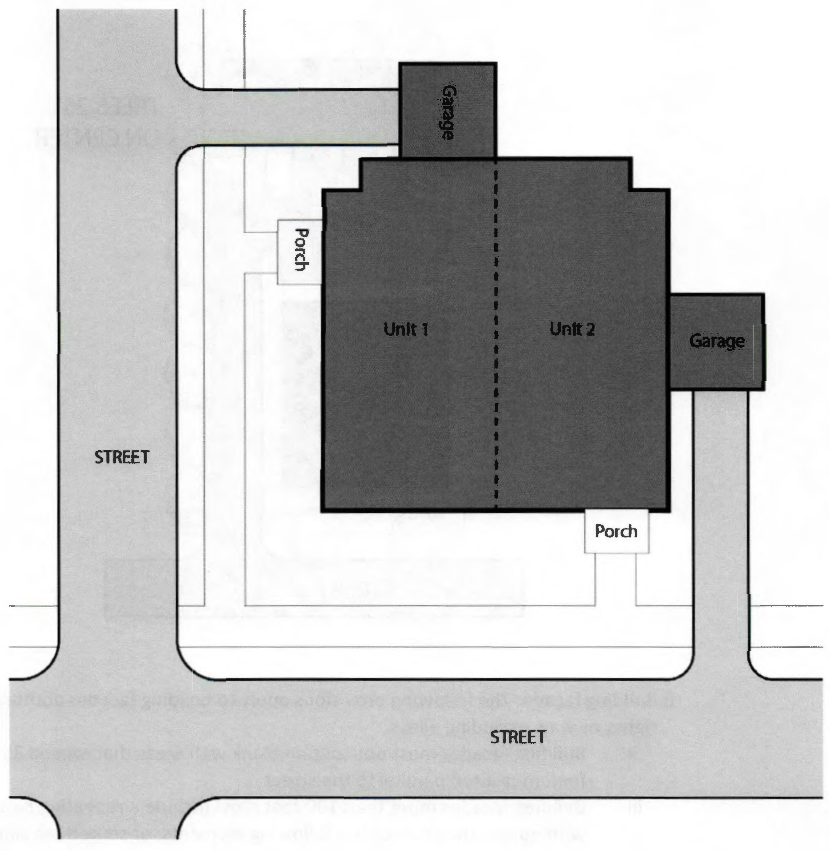
c.
Corner lots. Dwellings located on corner lots shall be designed with entries located on opposite street frontages. Where no alley is available for vehicular access, separate driveways should be placed on opposite streets.
3.
Multifamily. Dwellings with more than four units shall be constructed in accordance with the following standards:
a.
Parking lots. Parking lots shall be located to the side and/or behind buildings and shall not be located in the front yard area.
i.
Parking areas must be screened by one of the following methods:
a.
Trees planted 25 feet on center.
b.
Continuous plantings of shrubs at two-foot high at time of planting, and a minimum height of three feet at maturity.
c.
A combination of berms, shrubs, trees, and/or fencing to create an opaque visual barrier with a height of three feet.
b.
Building façade. The following provisions apply to building facades abutting public rights-of-way, excluding alleys:
i.
Building facades must not contain blank wall areas that exceed 35 linear feet, measured parallel to the street.
ii.
Building facades more than 100 feet must include a repeating pattern with no less than two of the following elements, or something similar: color change, texture change, material change, wall articulation changes of no less than two feet in depth. These can be accomplished through varying roof lines, offsets, balconies, projections such as overhangs or porches, and window reveals as some examples.
iii.
Buildings must have differentiation among individual unit front entry designs by variation in porch roof designs, columns, entry courts (courtyard walls, gates, paving and landscaping), as some examples.
c.
Open space. Developments with more than 20 units shall include open space of at least 15 percent of the gross site area, including at least 144 square feet of active recreation space. This can be achieved through landscaped areas, play areas, and common open space. Paved parking areas shall not count towards open space.
d.
Siting.
i.
Units adjacent to public or private streets shall have the primary building entrances located on the facade facing the street.
ii.
The site shall be designed so that there is safe pedestrian access to the buildings or complex from the public right-of-way and safe pedestrian circulation within the development.
B.
Commercial design requirements. The following requirements apply in commercial districts within the city limits of Yukon. The development services director, or designee shall have authority to review commercial projects for compliance with this section.
1.
Concrete and metal walls. In all applicable commercial zoning districts of this section, exposed exterior metal walls or untreated concrete block, including painted concrete block and unfinished or untreated concrete panels shall not be permitted unless the adjacent buildings on two sides have been previously constructed with exposed metal walls, untreated concrete block, including painted concrete block or unfinished concrete panels or are in subdivisions wherein at least five structures have been erected using the exposed metal wall construction or untreated concrete block, including painted concrete block or unfinished, untreated concrete panels.
2.
Metal buildings. When allowed, as in subsection B.1, above, exposed exterior metal walls shall be no more than 25 percent of the front façade on all sides of the building. In computing the 25 percent area for each wall, the portion of the wall containing the windows, window frames, doors and signs shall be excluded.
3.
Roofs. In all applicable commercial zoning districts, where any portion of any roof is visible to an observer standing on ground level at any place along the property lines of the subject property, then in that event, no roofs of metal construction shall be permitted unless the same is of standing seam construction or a functional and architectural equivalent thereof. Any new construction incorporating flat roof shall make use of a mansard or other architectural treatment on all sides of the new building to achieve compatibility with the surrounding area.
4.
Siting. The site shall be designed so that there is safe pedestrian access to the building or center from the public right-of-way and safe pedestrian circulation within the development.
5.
Utility meters. Whenever possible, utility meters shall be installed in the rear or side yards of the building site in order to minimize the visibility from the adjoining streets.
(Ord. No. 1438, § I, 8-1-2023; Ord. No. 1441, 12-5-2023)
Sec. 215-510. - Sidewalks.
A.
Purpose and intent. It is the purpose and intent of this section to prioritize pedestrian safety through the construction of sidewalks and implementation of the City of Yukon's ADA Transition Plan.
B.
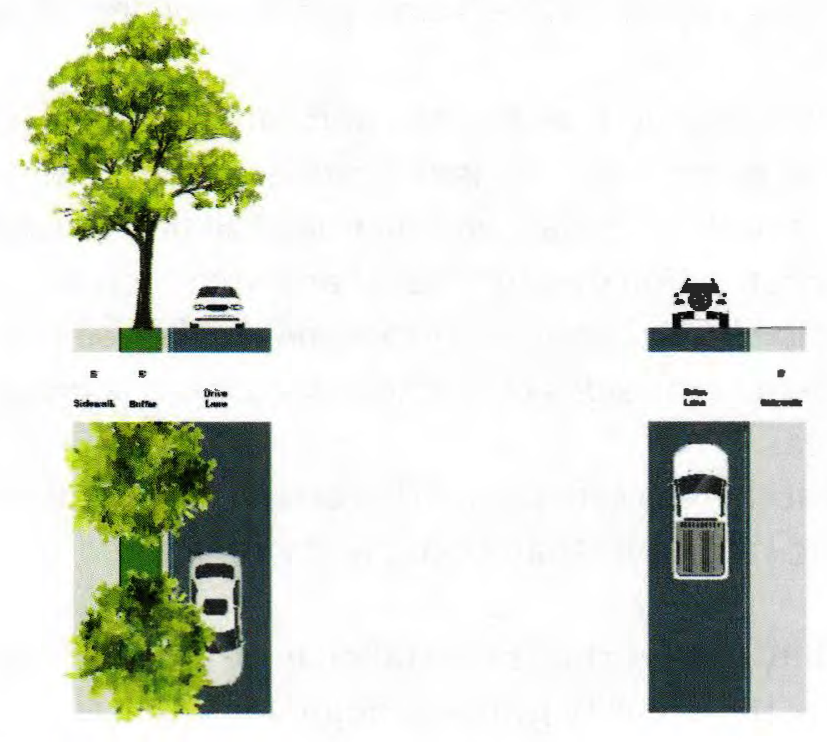
Sidewalks along all streets other than local. That from and after the time of the adoption of this UDC all arterial and collector streets as defined in the comprehensive plan and this UDC shall have sidewalks on both sides of said street five feet in width. Arterial streets shall also have a greenbelt or planting strip of a minimum of five feet between the sidewalk and the roadway. If there is insufficient room to provide the planting strip a six-foot sidewalk at the curb must be constructed.
C.
Sidewalks along local streets. That from and after the time of the adoption of this UDC, all streets within a new subdivision in the corporate limits of the City of Yukon, Oklahoma, dedicated to the public use, not falling in the above category, to be known as local streets, shall have sidewalks on both sides of said minor street four feet in width.
D.
Sidewalk construction. Sidewalks shall have a width as required above of four inches thick of 3,000-pound test concrete over a four-inch ODOT Class "A" type aggregate rock base on a properly prepared subgrade to be approved by the development services director or designee. When a sidewalk crosses a drive, the sidewalk concrete shall be six inches thick.
E.
Sidewalk specifications. New sidewalks after the adoption of this UDC shall meet Americans with Disabilities Act Standards for specifications, percent grade, and slope.
F.
Plans to be submitted. That sidewalk plans shall be submitted at the same time the street paving plans are submitted by the developer of the subdivision, or that a building permit is filed in the case of a nonresidential subdivision.
G.
Deposit to be made. The development services director or designee shall withhold his final inspection until said sidewalk is constructed to city standards; or a cash deposit equal to 150 percent of the amount of the estimated cost of the construction of the sidewalks is submitted to the City of Yukon.
(Ord. No. 1438, § I, 8-1-2023)

