
Zeeland City Zoning Code
ARTICLE VIII
SITE DEVELOPMENT1
State Law reference— Submission and approval of site plan; procedures and requirements, MCL 125.3501.
Sec. 8.100.- Site plan review.
(a)
Intent. It is the intent of this section to require site plan review approval prior to issuance of a land use or building permit for certain buildings, structures, and uses that can be expected to have a significant impact on natural resources, traffic patterns, adjacent parcels, and the character of future development, and for all special land uses, to ensure that all such buildings, structures, and uses are in conformity with the provisions of this ordinance.
(b)
Uses subject to site plan review by planning commission.
(1)
The following shall be subject to site plan review by the planning commission:
a.
All permitted uses within all districts, except for permitted uses within the R-1 and R-2 districts, which include the construction of a building addition with a floor area greater than 25 percent of the existing building floor area, and/or construction of a new building or structure with a floor area of 7,000 square feet or greater; and,
b.
Also except permitted uses which are subject to the review of the zoning administrator pursuant to Subsection (d) of this section.
(2)
Special land uses within any district.
(c)
Uses subject to site plan review by site plan review committee. The following shall be subject to site plan review by the site plan review committee, except as noted in Subsections (b) and (d) of this section: All uses within all districts, except for permitted uses within the R-1 and R-2 districts, which include the construction of a building addition with a floor area equal to or less than 25 percent of the existing building floor area, or construction of a new building or structure with a floor area of less than 7,000 square feet.
(d)
Uses subject to site plan review by the zoning administrator.
(1)
The following shall be subject to site plan review by the zoning administrator. Such review shall ensure that the setbacks, yards, parking, and other specific zoning ordinance requirements are met. No public hearing is required for plans reviewed by the zoning administrator:
a.
All permitted uses within the R-1, and R-2 districts.
b.
Construction solely on the interior of a building that does not increase usable floor area or change the parking requirement of the use.
c.
Single-family detached and two-family dwellings in the R-3 district.
d.
Open air businesses, such as Christmas tree sales, fertilizer sales, sidewalk sales, and gardening supply and plant sales, provided that such sales meet the following criteria:
1.
Such sales do not interfere with a safe pedestrian access;
2.
Such sales do not impede the vision of motor vehicle operators; and,
3.
Such sales occur on property owned or leased by the party conducting the sale.
e.
All permitted uses and land use and structures within all districts which are smaller than 500 square feet and which are valued at less than $50,000.00, or which consist of playground improvements within public parks.
(e)
Site plan review procedures.
(1)
No permit shall be issued for any construction, reconstruction, erection, and/or expansion, except in accordance with a site plan approved by the planning commission or site plan review committee, or zoning administrator, except as herein provided.
(2)
Preliminary sketches of proposed site plans may be submitted for review to the planning commission or site plan review committee prior to submission for final approval.
(3)
The planning commission or site plan review committee shall advise the applicant as to the general acceptability of the proposed plan, but shall not be bound by any statements or indications of acceptance of the plan.
(4)
The zoning administrator shall determine the number of plans to be submitted. Unless the zoning administrator determines that some of the following information is not reasonably required, sketch plans shall include, at a minimum:
a.
Identification of project.
1.
The applicant's name;
2.
Name of the development;
3.
Date of preparation and any revisions;
4.
North arrow;
5.
Small scale location sketch of sufficient size and scale.
b.
Existing features.
1.
Property lines and dimensions, drawn to scale;
2.
Zoning and current land use of applicant's property and all abutting properties and of properties across any public or private street from the site;
3.
Lot lines and all structures on the property and within 100 feet of the site's property lines;
4.
Locations of significant natural features;
5.
Location of any access points on both sides of the street within 100 feet of the site along streets where access to the site is proposed.
c.
Proposed construction.
1.
Building footprints, and setbacks, for all proposed structures;
2.
Location of proposed identification signs;
3.
Location and dimensions of parking spaces, and calculations;
4.
A general landscape plan indicating proposed plant locations as well as proposed berms, retaining walls or fences;
5.
Exterior lighting locations; and,
6.
General site circulation and access including:
(i)
Indication of street right-of-way and pavement widths and pavement type;
(ii)
Access points, including deceleration or passing lanes; and,
(iii)
Location of pedestrian paths.
(5)
Applications for site plan approval shall be submitted to the zoning administrator in accordance with the following:
a.
Site plans reviewed by the planning commission at least 30 days prior to the date of first consideration by the commission.
b.
Site plans reviewed by the site plan review committee at least 30 days prior to the date of first consideration by the site plan review committee.
(6)
The site plan review application materials shall include all the following information, unless the zoning administrator determines that some of the required information is not reasonably necessary for the consideration of the site plan:
a.
Current proof of ownership or evidence of a contractual ability to acquire such land, such as an option or purchase agreement or a written statement from the property owner indicating permission for the filing of the application.
b.
Sheet size of submitted drawings shall be at least 24 inches by 36 inches, with graphics at an engineers scale of one inch equals 20 feet for sites of 20 acres or less; and one inch equals 100 feet or less (i.e., one inch equals 20 to 100 feet) for sites over 20 acres.
c.
Written documentation that the proposal meets the standards of Subsection (f) of this section.
d.
Copies of plan sheets providing the information listed below in the quantity as specified on the site plan review application. The information required below may be provided on a single sheet if clarity can be maintained. Individual site plan requirements may be waived if deemed unnecessary by the zoning administrator.
1.
Identification of project.
(i)
The applicant's name;
(ii)
Name of the development;
(iii)
The preparer's name and professional seal of architect, engineer, surveyor or landscape architect indicating license in the State of Michigan;
(iv)
Date of preparation and any revisions;
(v)
North arrow;
(vi)
Complete and current legal description and size of property in acres; and,
(vii)
Small scale location sketch of sufficient size and scale.
2.
Existing features.
(i)
Property lines and dimensions;
(ii)
Zoning and current land use of applicant's property and all abutting properties and of properties across any public or private street from the site;
(iii)
Lot lines and all structures on the property and within 100 feet of the site's property lines;
(iv)
Locations of significant natural features;
(v)
Location of any access points on both sides of the street within 100 feet of the site along streets where access to the site is proposed; and,
(vi)
Existing topography at a minimum of five-foot contours.
3.
Proposed construction.
(i)
Building footprints, setbacks, floor plans and elevations showing height and materials for all proposed structures, including any residential units, with the acreage allotted to each use;
(ii)
Size, height, type and location of proposed identification signs;
(iii)
Proposed locations of utility services (with sizes), including storm drainage, retention or detention ponds, fire hydrants, and any public or private easements;
(iv)
Runoff calculations used for determination of stormwater management;
(v)
Proposed topography with a site grading plan with topography at a minimum of two-foot contour intervals;
(vi)
Location and method of screening for all waste dumpsters;
(vii)
Location and dimensions of parking spaces, and calculations;
(viii)
A landscape plan indicating proposed plant locations with common plant name, number, and size at installation. Berms, retaining walls or fences shall be shown with elevations from the surrounding average grade;
(ix)
Details of exterior lighting including locations, height, method of shielding; and,
(x)
Details of site circulation and access design, including:
A.
Indication of street right-of-way and pavement widths and pavement type;
B.
Street horizontal and vertical dimensions, including curve radii;
C.
Dimensions of access points, including deceleration or passing lanes, distance from adjacent driveways or intersecting streets, including those across a street, boulevard dimensions, etc.;
D.
Identification of width and material to be used for pedestrian paths;
E.
Names of abutting public streets, proposed access driveways and parking areas, and existing and proposed pedestrian/bicycle paths; and,
F.
Written verification of access easements or agreements, if applicable.
e.
If a phased development is proposed, identification of the areas included in each phase. For residential uses identify the number, type, and density of proposed housing units within each phase.
f.
A completed application form, supplied by the zoning administrator, and an application fee.
(7)
The planning commission or the site plan review committee, prior to granting approval of a site plan, may request from the applicant any additional graphics or written materials, prepared by a qualified person to assist in determining the appropriateness of the site plan. Such material may include, but need not be limited to: aerial photography; photographs; estimated impact on public schools and utilities; traffic impacts; impact on significant natural features and drainage; soil tests; and estimated construction costs.
(8)
For site plan reviews conducted by the planning commission or by the site plan review committee, as noted in Subsection (b) of this section, the chairperson of the planning commission shall schedule a public hearing. Notice of the public hearing shall be provided in accordance with Section 2.101.
(9)
Except as noted in Subsections (c) and (d) of this section, the planning commission or the site plan review committee, shall approve, approve with conditions, or deny the site plan, based on compliance of the plan with the standards of Subsection (f) of this section. If denied, the planning commission shall cite reasons for denial. If approved, the applicant may submit the necessary plans and documents for a building or land use permit.
(10)
The planning commission staff shall affix a stamp and signature to two copies of the approved site plan, one of which is kept by the zoning administrator, the other by the applicant.
(11)
A record of the decision of the planning commission, the reason for the decision reached, and any conditions attached to such decision shall be kept and made a part of the minutes of the planning commission.
(12)
The zoning administrator may make periodic investigations of developments for which site plans have been approved. Noncompliance with the requirements and conditions of the approved site plan shall constitute grounds for the planning commission to terminate said approval following a public hearing.
(f)
Standards for approval; intent.
(1)
The intent of the planning commission, which is included as a part of these standards for approval, is to minimize any adverse impacts that a proposed site plan may have on the neighboring properties, the neighborhood in general and its character, and the community as a whole.
(2)
Based upon the following standards, the planning commission may recommend denial, approval, or approval with conditions, a site plan:
a.
The uses proposed will not harm the public health, safety, or welfare. All elements of the site plan shall be designed to take into account the site's topography, the size and type of plot, the character of adjoining property and the type and size of buildings. The site shall be developed so as not to impede the normal and orderly development or improvement of surrounding property for uses permitted in this ordinance.
b.
Safe, convenient, uncongested, and well-defined vehicular and pedestrian circulation within and to the site shall be provided. Drives, streets and other elements shall be designed to promote safe and efficient traffic operations within the site and at its access points.
c.
The arrangement of public or common ways for vehicular and pedestrian circulation shall be connected to existing or planned streets and pedestrian or bicycle pathways in the area. There shall be provided a pedestrian circulation system which is separated from the vehicular circulation system. In order to ensure public safety, special pedestrian measures, such as crosswalks, crossing signals and other such facilities may be required in the vicinity of schools, playgrounds, local shopping areas and other uses which generate a considerable amount of pedestrian traffic.
d.
The landscape shall be preserved in its natural state, insofar as practical, by removing only those areas of vegetation or making those alterations to the topography which are reasonably necessary to develop the site in accordance with the requirements of this ordinance. Landscaping shall be preserved and/or provided to ensure that proposed uses will be adequately buffered from one another and from surrounding public and private property.
e.
Public water and sewer facilities shall be provided for by the applicant as part of the site development.
f.
Appropriate measures shall be taken to ensure that removal of surface waters will not adversely affect neighboring properties or the public storm drainage system. Provisions shall be made to accommodate stormwater, prevent erosion and the formation of dust. The use of detention/retention ponds may be required. Surface water on all paved areas shall be collected at intervals so that it will not obstruct the flow of vehicular or pedestrian traffic or create standing water.
g.
All buildings or groups of buildings shall be arranged so as to permit necessary emergency vehicle access as required by the fire department and police department.
h.
All outside storage areas, including refuse storage stations, shall be screened from the view of the street and/or adjacent properties.
i.
Exterior lighting shall be arranged so that it is deflected away from adjacent properties and so that it does not impede the vision of traffic along adjacent streets. Flashing or intermittent lights shall not be permitted.
(g)
Conditions of approval.
(1)
As part of an approval of the site plan, the planning commission or the site plan review committee may impose any additional conditions or limitation which in its judgment may be necessary for protection of the public interest.
(2)
Such conditions shall be related to and ensure that the approval standards of Subsection (f) of this section are met.
(3)
Approval of a site plan, including conditions made as part of the approval, is attached to the property described as part of the application and not to the owner of such property.
(4)
A record of conditions imposed shall be maintained. The conditions shall remain unchanged unless an amendment to the site plan is approved.
(h)
Validity of approved site plans.
(1)
Approval of the site plan is valid for a period of one year. If actual physical construction of a substantial nature of the improvements included in the approved site plan has not commenced and proceeded meaningfully toward completion during that period, the approval of the site plan shall be null and void. Substantial improvements shall include the installation of one or more underground utility systems, the installation of streets or the installation of one or more building foundations. Upon written application, filed prior to the termination of the one-year period, the planning commission may authorize a single extension of the time limit for approval of a site plan for a further period of not more than one year.
(2)
Site plans whose approval has expired shall require resubmission as an initial application.
(3)
Approval of the site plan shall void any corresponding site plan previously approved for any portion of the site.
(i)
Amendments to approved site plans. Amendments to an approved site plan may occur only under the following circumstances:
(1)
An applicant who has been granted site plan approval shall notify the zoning administrator of any proposed amendment to such approved site plan. Site plans previously approved may be amended pursuant to the requirements of this section.
(2)
Minor changes may be approved by the zoning administrator upon certification in writing to the planning commission that the proposed revision does not alter the basic design nor any specified conditions of the plan as agreed upon by the planning commission. In considering such a determination, the zoning administrator shall consider the following to be a minor change:
a.
Reduction of the size of any building and/or sign.
b.
Movement of buildings and/or signs by no more than ten feet.
c.
Plantings approved in the site plan landscape plan may be replaced by similar types of landscaping on a one-to-one or greater basis.
d.
Changes of building materials to a higher quality, as determined by the zoning administrator.
e.
Changes in floor plans which do not alter the character of the use.
f.
Internal rearrangement of a parking lot which does not affect the number of parking spaces or alter access locations or design.
g.
Changes required or requested by the city for safety reasons shall be considered a minor change.
(3)
Should the zoning administrator determine that the requested modification to the approved site plan is not minor, resubmission to the planning commission for an amendment shall be required and conducted in the same manner as an original application.
(j)
Appeals of site plans.
(1)
Any person aggrieved by the decision of the planning commission or site plan review committee with respect to an approval or denial of a site plan shall have the right to appeal the decision to the zoning board of appeals. The appeal shall be filed within five business days of the decision of the planning commission. The appeal shall be filed in writing and shall state the aggrieved party's grounds for appeal.
(2)
The filing of such appeal shall act to stay the issuance of any building or other permit for improvements to the property which is the subject of the appeal.
(3)
On hearing such appeal, the zoning board of appeals shall review the record before that was placed before the planning commission or site plan review committee, and shall determine whether or not there was support on the record for the original decision. The appellant shall not have the right to present new evidence not available to the planning commission or site plan review committee.
(4)
The zoning board of appeals shall affirm the decision of the planning commission if the requirements of this ordinance and other applicable city ordinances are met. The zoning board of appeals may reverse the decision of the planning commission or site plan review committee if, in its opinion, the planning commission or site plan review committee failed to properly apply the standards of Subsection (f) of this section or other applicable standards, in reaching its decision.
Sec. 8.101. - Landscaping and screening.
(a)
Intent. It is the intent of this section to require landscape screening to reduce the negative impacts between incompatible land uses and to provide for landscaping within parking lots. It is further intended to preserve and enhance the aesthetic qualities, character, privacy, and land values of property within the City of Zeeland.
(b)
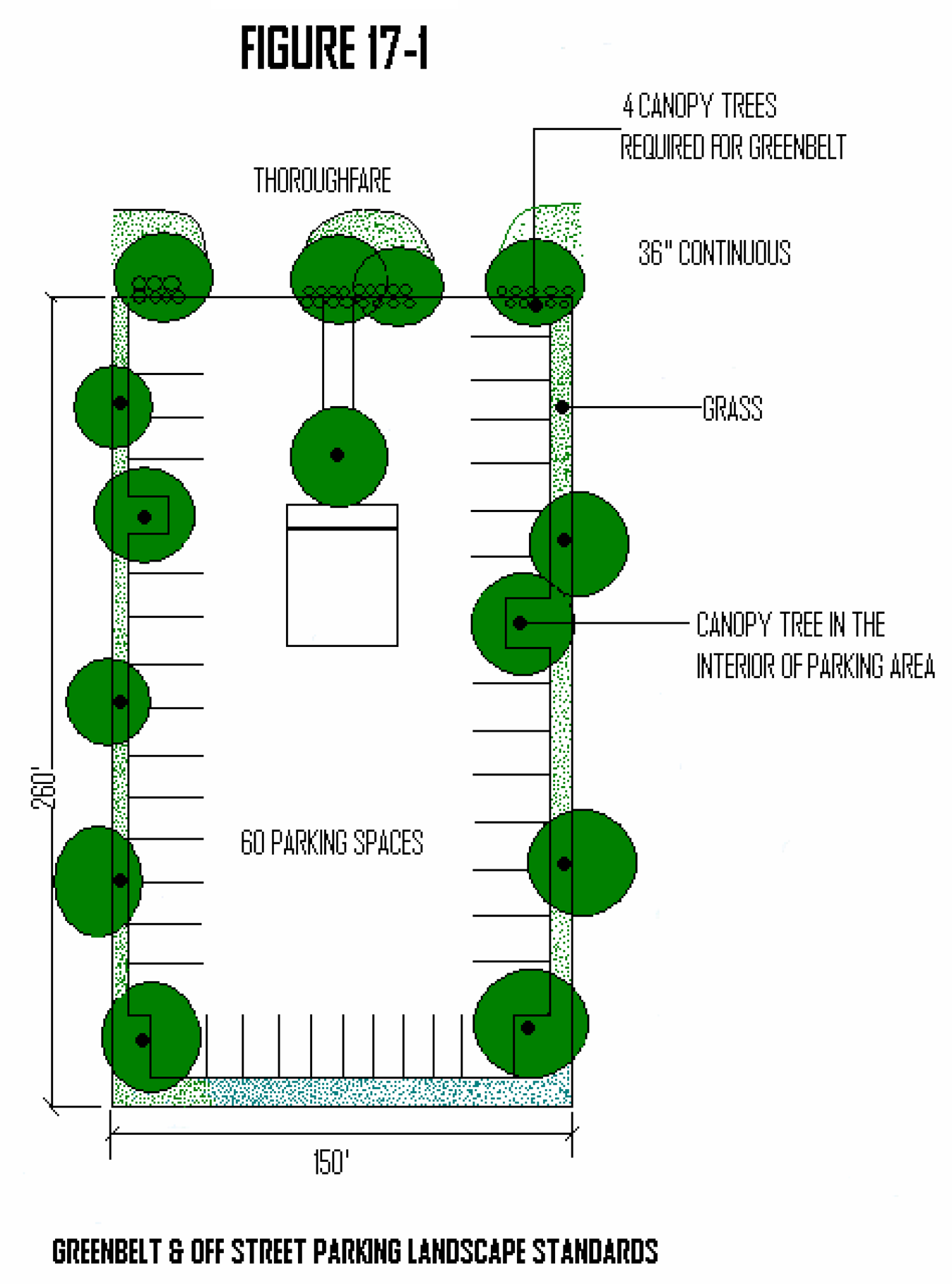
Off-street parking landscaped areas. (See Figure 17-1.)
(1)
Off-street parking areas containing six or more parking spaces shall be provided with landscaping in accordance with the following:
(2)
In no case shall any greenbelts required in Subsection (c) of this section be considered as part of the off-street parking landscaped area.
(3)
Required off-street parking landscaped areas shall comply with the following standards:
a.
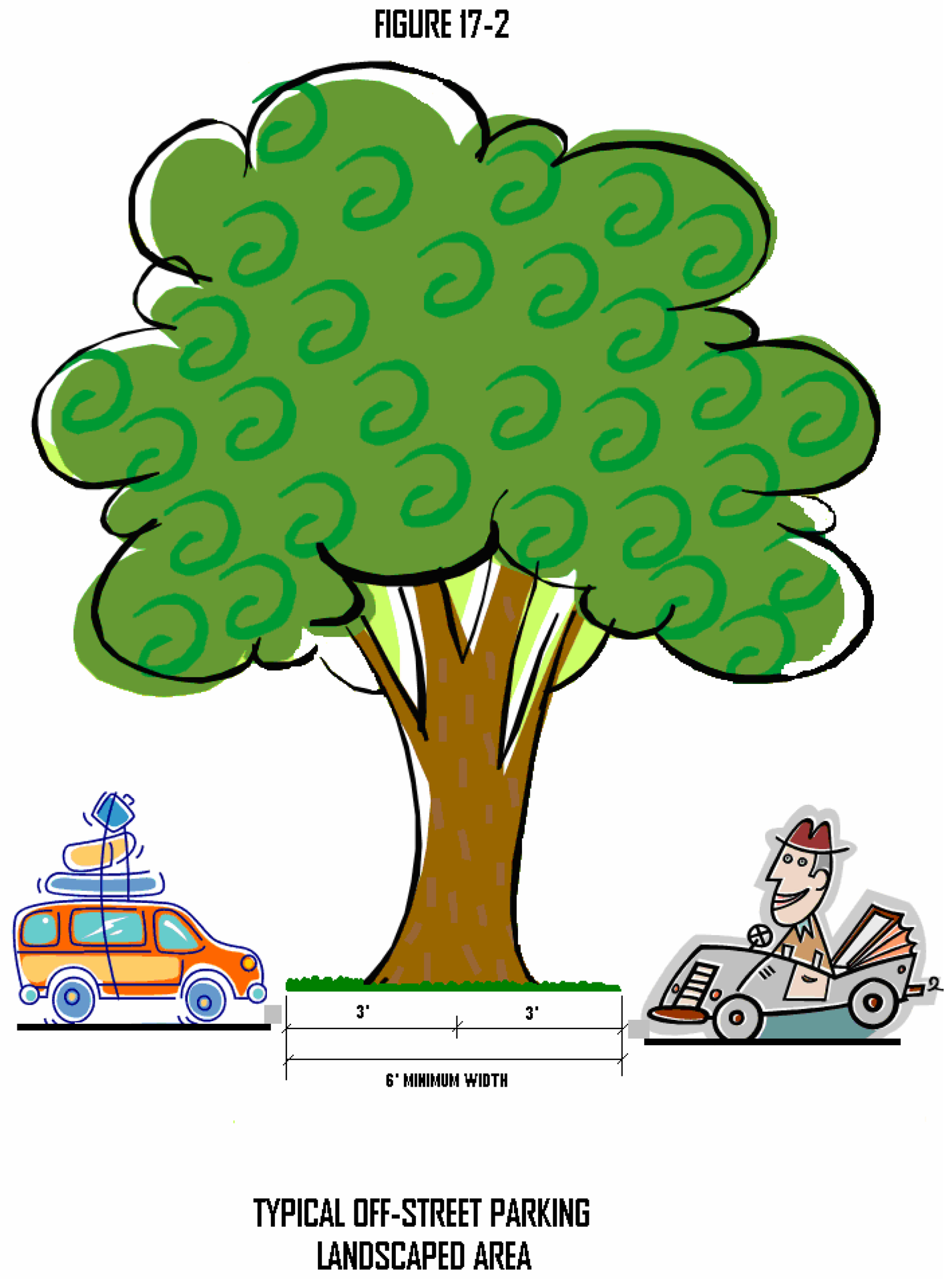
The minimum size of a landscaped area shall be 60 square feet and at least six feet wide.
b.
Landscaped areas shall be covered by grass or other living ground cover, wood mulch, or native stone.
c.
Each landscaped area shall contain at least one canopy tree. The tree shall be located to prevent damage by any surrounding vehicle (See Figure 17-2).
d.
The planning commission shall review the location of required off-street parking landscaped areas using the following criteria:
1.
Landscaping shall be installed such that, when mature, it does not obscure traffic signs, fire hydrants, lighting, drainage patterns on the site or adjacent properties, or obstruct vision for safety of ingress or egress.
2.
Landscaping shall be dispersed evenly throughout the entire area of the parking lot in order to break up large expanses of pavement.
3.
Fifty percent of the required trees shall be installed in the interior of the parking area and 50 percent on the perimeter. The interior shall be considered as any point ten feet from the outside boundary of the parking area.
e.
All landscaped areas shall be protected by a raised, standard concrete curb.
f.
Where any parking area, with the exception of parking serving single-family or two-family dwellings, abuts or faces a street, a screen shall be required between the parking area and the road right-of-way. Such screen shall consist of, at a minimum, a strip of land at least five feet in width as well as any combination of hedge, wall or berm which measures at least three feet in height. Such screen shall not obscure traffic signs, fire hydrants, lighting, drainage patterns on site or adjacent properties, or obstruct vision for safety of ingress or egress.
g.
All applicable requirements of Subsection (d) of this section, shall be met.
(c)
Greenbelts.
(1)
Greenbelts shall be required where any lot abuts or faces a street in the R-3, R-4, OS, C-1, C-3, PF, I-1, or I-2 districts.
(2)
In no case shall off-street parking landscaped areas required in Subsection (b) of this section be considered as part of any greenbelt requirement.
(3)
All greenbelts shall comply with the following standards:
a.
The equivalent of one canopy tree for every 40 linear feet, or part thereof, of frontage abutting a street.
b.
All greenbelts shall be covered by grass.
c.
The width of the greenbelt shall correspond to the required front setback requirements for off-street parking areas contained in Section 3.201, footnote (4).
d.
All applicable standards in Subsection (d) of this section.
(d)
General landscape development standards.
(1)
Minimum plant material standards.
a.
All plant material shall be hardy to Ottawa County, be free of disease and insects, and conform to the American Standard for Nursery Stock of the American Association of Nurserymen.
b.
All plant materials shall be installed in such a manner so as not to alter drainage patterns on the site or adjacent properties, or obstruct vision for safety of ingress or egress.
c.
All plant material shall be planted in a manner so as to not cause damage to utility lines (above and below ground) and public roadways.
d.
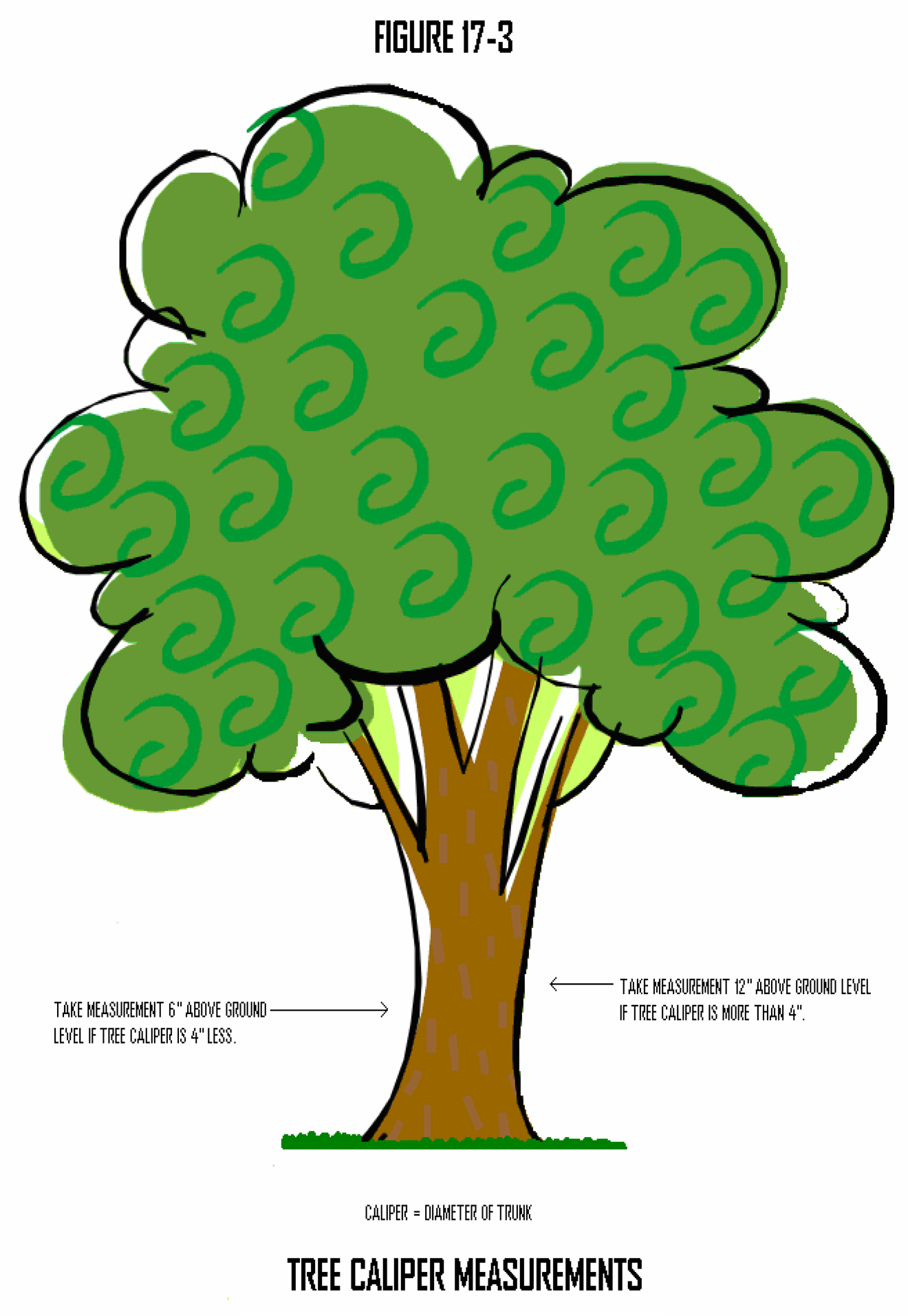
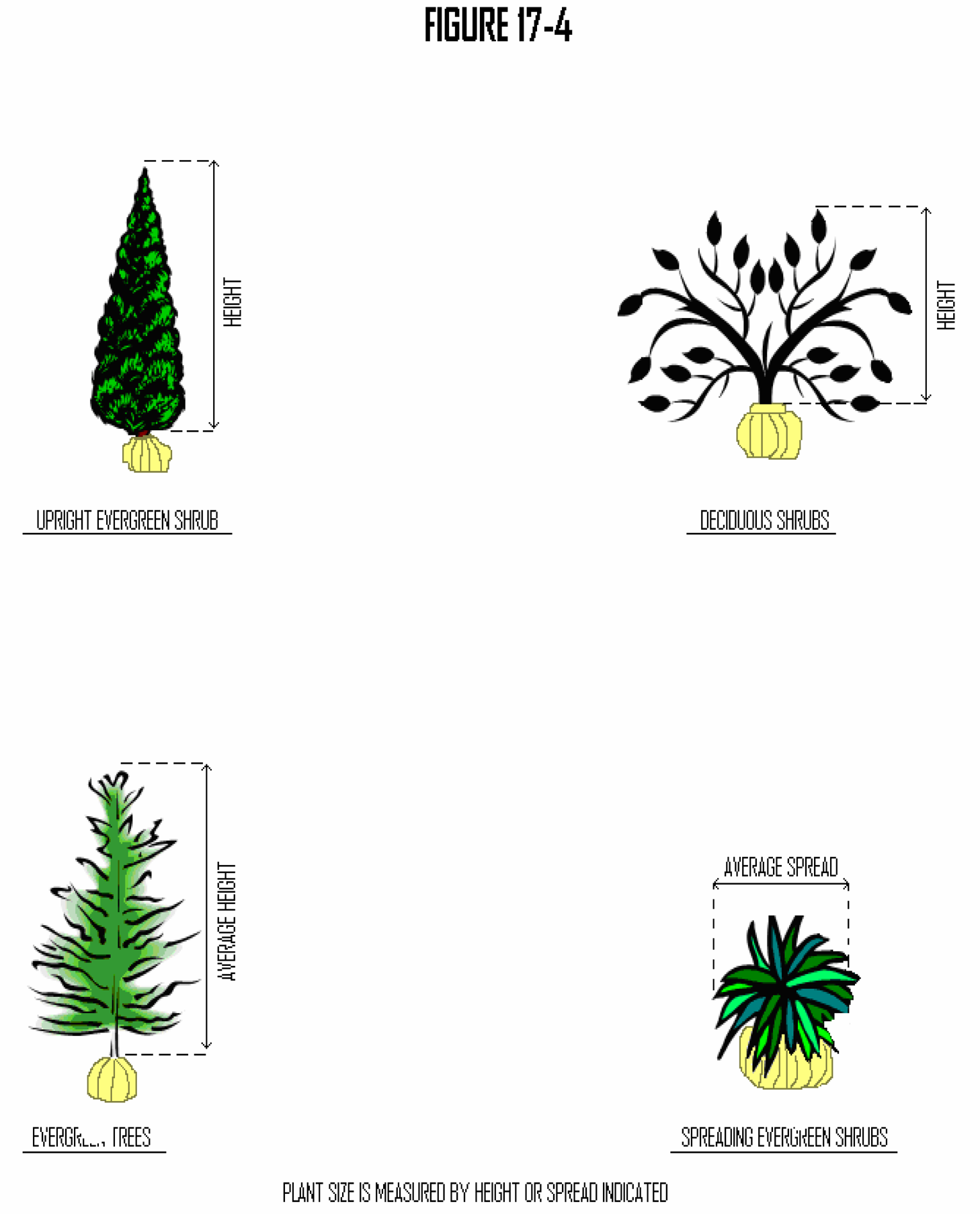
Minimum plant sizes at time of installation (See Figures 17-3, 17-4):
e.
Existing plant material which complies with the standards and intent of this ordinance, as determined by the planning commission, shall be credited toward meeting the landscape requirements.
f.
The installed plant material shall achieve its horizontal and vertical screening effect within four years of initial installation.
g.
The overall landscape plan shall not contain more than 33 percent of any one plant species.
h.
The following trees are not permitted as they split easily; their wood is brittle and breaks easily; their roots clog drains and sewers; and they are unusually susceptible to disease or insect pests:
(2)
Minimum standards for berms.
a.
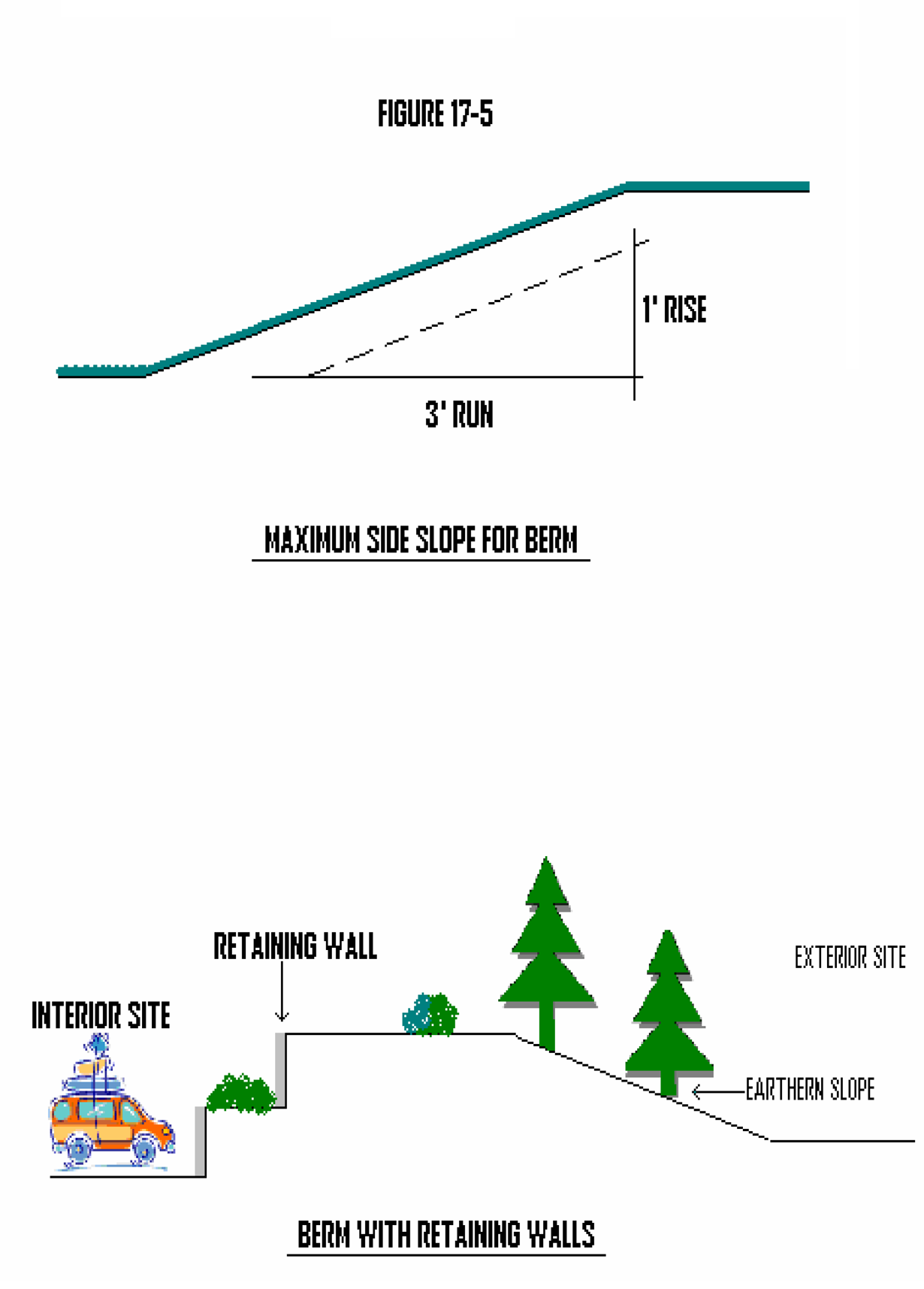
Where possible, berms shall be constructed so as to maintain a side slope not to exceed a one-foot rise to a three-foot run ratio. (See Figure 17-5) When topography or other site condition prevents construction of berms at this ratio, retaining walls or terracing may be permitted. If a berm is constructed with a retaining wall or by terracing, the earthen slope shall face the exterior of the site. (See Figure 17-5)
b.
Berm areas not containing planting beds shall be covered with grass or other living ground cover maintained in a healthy condition.
c.
Berms shall be constructed in such a manner so as not to alter drainage patterns on the site or adjacent properties, or obstruct vision for safety of ingress or egress.
(3)
Minimum standards for screen walls and fences.
a.
All screen walls and fences required for screening shall be constructed with new, durable, weather resistant, and easily maintainable materials. Chain link and barbed wire fences are not permitted to serve as screen fencing.
b.
The wall or fence may be constructed with openings that do not exceed 20 percent of the wall or fence surface. The openings shall not reduce the intended obscuring effect of the wall or fence.
c.
Screen walls or fences shall not be constructed so as to alter drainage on site or adjacent properties, or obstruct vision for safety of ingress or egress.
(4)
Detention/retention areas. Detention/retention areas shall be permitted within greenbelts provided they do not hamper the screening intent of the greenbelt or jeopardize the survival of the plant materials.
(5)
Waste dumpsters. Waste dumpsters shall be screened on all sides by a continuous opaque screen at least six feet high. The screen may be comprised of berms, plant material, screen walls or fences, or any combination of these elements. Gates shall be provided on waste dumpsters and shall be kept closed except when the waste dumpster is being serviced.
(6)
Installation and maintenance provisions.
a.
The planning commission or zoning administrator may require a financial guarantee, in accordance with the provisions of Section 2.103(b), of a sufficient amount to ensure the installation of all required landscaping.
b.
All required landscaping shall be completed within six months from the date of occupancy of the building, unless a performance bond is submitted in accordance with the provisions of Section 2.103(b).
(7)
Stone beds. Stone beds shall not be used within ten feet of any street, driveway, public sidewalk, walking path, or bicycle path.
(8)
Waiver from landscaping and screening requirements. The planning commission or site plan review committee during site plan review may determine, upon inspection, that existing landscaping or screening identified on the site plan to be retained would provide adequate landscaping and screening, or that dimensional conditions unique to the parcel would prevent development of required off-street parking landscaped areas, or greenbelts, these requirements may be waived in whole or in part. Criteria which shall be used when considering a waiver shall include, but shall not be limited to:
a.
Existence of natural vegetation.
b.
Topography.
c.
Existence of areas of poor soils.
d.
Existing and proposed building placement.
e.
Building heights.
f.
Adjacent land uses.
g.
Distance between land uses.
h.
Dimensional conditions unique to the parcel.
i.
Traffic sight distances and traffic operational characteristics on and off site.
j.
Visual, noise, and air pollution levels.
k.
Health, safety and welfare of the City of Zeeland.
Sec. 8.102. - Landscape buffer adjacent to residential uses and zoning.
Whenever a nonresidential use is adjacent to a residential use or residentially zoned parcel, a buffer consisting of a landscaped area of not less than six feet in width comprised of a fence, wall, berm, plantings, or a combination thereof shall be provided and maintained. Such a buffer shall be located both in the rear and side yards of a parcel adjacent to the residential use or residentially zoned parcel. If a berm is utilized, it shall meet the standards as provided in the Zeeland zoning ordinance Section 8.101(d)(2).
Sec. 8.103. - Lawn and maintenance requirements.
(a)
All landscaping shall be maintained in a healthy, neat and orderly state free from refuse and debris. Any dead or diseased plants shall be replaced.
(b)
Lawns shall be maintained to be a height of ten inches or less, except that such ten-inch requirements shall not be applicable on industrially, commercially, and agriculturally zoned properties in areas outside of the required setback areas. In addition, such ten-inch requirement shall not be applicable to ornamental lawn grasses which are planted and maintained as decorative and accent plantings, or to cultivated flowers, garden plants, and grains such as wheat, oats, rye and barley.
Sec. 8.104. - Access drives and off-street parking and loading.
(a)
General requirements.
(1)
Unless otherwise provided for in this ordinance, off-street parking shall not be located within the required front yard.
(2)
Except for the C-2 district, off-street parking for all nonresidential districts and uses shall be either on the same lot or within 300 feet of the building or use it is intended to serve, measured from the nearest public entrance of the building to the nearest point of the off-street parking lot. In the C-2 and in the PF districts, parking shall be provided on the same lot as the use, unless the property adjoins or has access to a community parking lot, or common parking area maintained by participating property owners.
(3)
The storage of merchandise or products, motor vehicles displayed for sale, or the repair of vehicles is prohibited in any off-street parking lot.
(4)
Residential off-street parking spaces shall consist of a parking strip, parking bay, driveway, garage, or combination thereof and shall be located on the premises they are intended to serve. Such parking spaces shall be paved with an asphalt or Portland cement binder so as to provide a permanent, durable and dustless service and shall occupy no greater than 33 percent of the required front yard. No residential parking of motor vehicles shall be permitted on lawns, on dirt, or on any unpaved surfaces.
(5)
No nonresidential parking of motor vehicles, trailers or other vehicles shall be permitted on lawns, on dirt, or on any unpaved surfaces except as permitted by the planning commission on a temporary basis during such time as a site is being developed.
(6)
Minimum required off-street parking spaces shall not be replaced by any other use unless and until equal facilities are provided elsewhere, in compliance with this section.
(7)
Off-street parking existing at the effective date of this ordinance, or amendment thereto, in connection with the operation of an existing building or use, shall not be reduced to an amount less than required for a similar new building or new use.
(8)
Two or more buildings or uses may collectively provide the required off-street parking. For the C-1, C-2, C-3, I-1, I-2, and/or for the PF districts, a parking lot may be constructed in conjunction with an adjacent parcel and no setback for the parking lot or parking lot driveways shall be required from the common property line, provided that the following requirements are met:
a.
All parcels on which the joint parking lot is located must be zoned C-1, C-2, C-3, I-1, I-2, and/or PF;
b.
All property owners whose property provides a portion of the joint parking lot must enter into a reciprocal parking lot easement in perpetuity in a form and with the substance of such easement to be approved by the planning commission prior to the construction of such a joint parking lot; and
c.
The parking lot must be constructed in accordance with the standards of the zoning ordinance, except for the setback and the landscaping requirements required at the property line between the participating properties.
(9)
The planning commission may defer construction of the required number of parking spaces if the following conditions are met:
a.
Areas proposed for deferred parking shall be shown on the site plan, and shall be sufficient for construction of the required number of parking spaces in accordance with the standards of this ordinance for parking area design and other site development requirements.
b.
Alterations to the deferred parking area may be initiated by the owner or required by the zoning administrator, and shall require the approval of an amended site plan, submitted by the applicant accompanied by evidence documenting the justification for the alteration.
(10)
Parking of semi-trucks, including the tractor and trailers, and commercial vehicles exceeding one ton shall be prohibited in any residential district.
(11)
A curb cut and an access drive shall only be constructed in a location which is approved by the City of Zeeland. Approval of curb cuts and access drives shall be required for all lots and developments, including for lots and developments which would not otherwise require site plan review approval. A new, reconstructed, or re-paved driveway from the public roadway to the property line shall be constructed or improved with a raised cement curb in accordance with the city's standards for such curbs for all uses except for one- and two-family residential units. An access drive shall be provided with a pavement having an asphalt or Portland cement binder so as to provide a permanent, durable and dustless surface. In addition, an access drive shall be constructed so as to permit proper drainage. Drainage shall be in accordance with the requirements of the City of Zeeland and the Ottawa County Drain Commission.
(12)
No additional curb cut and access drive may be added for a parcel once a site plan has been approved or if a principal building which is not a single-family dwelling has been built on a site without the holding of a site plan review hearing and approval by the planning commission.
(b)
Parking lot design standards.
(1)
Minimum dimensions of parking spaces and maneuvering aisles shall be in accordance with the following requirements:
(2)
Minor adjustments of the dimensions prescribed in this section may be authorized by the zoning administrator or planning commission, depending on which is approving the site plan if consistent with generally recognized design standards for off-street parking facilities.
(3)
All parking lots shall be provided with a pavement having an asphalt or Portland cement binder so as to provide a permanent, durable and dustless surface.
(4)
All parking lots shall be constructed so as to permit proper drainage and prevent puddling or storage of water within the lot. Drainage shall be in accordance with the requirements of the City of Zeeland and the Ottawa County Drain Commission.
(5)
All parking lots shall be provided with adequate lighting. Parking lot lighting shall be shielded so as to prevent light from spilling onto adjacent residential districts or uses.
(6)
No permit will be issued for major changes to an existing parking lot unless the parking lot is made to comply with the requirements of this ordinance. A major change consists of one or more of the following:
a.
Replacement or alteration of existing drainage elevations or structures affecting more than 50 percent of the existing parking lot.
b.
Any expansion or addition of a parking lot equal to or greater than 25 percent of the area of the existing parking lot.
c.
Reconstruction of the parking lot, including the removal of existing pavement or drainage structures, which affects more than 25 percent of the existing parking lot.
d.
Any other change which, in the opinion of the zoning administrator, constitutes a major change.
(c)
Off-street parking requirements.
(1)
Required off-street parking spaces are noted in the table below for the uses listed. For those uses not specifically mentioned, the requirements for off-street parking shall be in accord with a use which the planning commission or zoning administrator considers similar in type.
(2)
When units of measurement determining the number of required off-street parking spaces result in the requirement of a fractional space, that fraction shall require one parking space.
(3)
The minimum number of off-street parking spaces shall be determined in accordance with the following tables:
(d)
Off-street loading requirements.
(1)
On the same premises with every building or structure involving the receipt or distribution of vehicles, materials or merchandise there shall be provided and maintained on the lot adequate space for standing, loading and unloading. This space shall be placed so as to avoid undue interference with public use of dedicated rights-of-way and parking areas.
(2)
In the C-1 and in the C-3 districts, all loading spaces shall be located in the rear yard in the ratio of at least ten square feet per front foot of building and shall be computed separately from off-street parking requirements.
(3)
In the C-2 district, loading areas shall be located in a place other than within the road right-of-way.
(4)
In the OS district and for nonresidential uses in residential districts, all loading spaces shall be located in the rear yard in the ratio of at least five square feet per front foot of building and shall be computed separately from off-street parking requirements.
(5)
I-1 and I-2 districts.
a.
In the I-1 and I-2 districts at least one loading space shall be provided. All loading spaces shall be at least ten feet by 50 feet, or a minimum of 500 square feet in area. A minimum 14-foot clearance height shall be provided.
b.
Loading spaces shall only be permitted off-street and in the rear yard or interior side yard.
(6)
Where an alley exists in the rear yard, loading requirements may be computed from the center of the alley.
(7)
All dedicated loading spaces shall be provided with a pavement having an asphalt or Portland cement binder so as to provide a permanent, durable and dustless surface.
(Ord. No. 922, § 1, 9-17-2012)
Sec. 8.105. - Signs and windows.
(a)
Intent. This section is intended to protect and further the health, safety, and welfare of the residents of the City of Zeeland; to maintain and improve the appearance of the City of Zeeland; to conserve community character; to prevent traffic hazards; to provide safer conditions for pedestrians; and to promote economic development by regulating the construction, alteration, repair, maintenance, size, location, and number of signs.
(b)
Sign definitions.
Awning means a retractable or fixed shelter constructed of nonrigid materials on a supporting framework that projects from the exterior wall of a building.
Awning sign means a sign affixed flat against the surface of an awning, or hung from underneath an awning or a canopy.
Balloon sign means a sign composed of a non-porous bag of material filled with air.
Banner sign means a fabric, plastic, or other sign made of non-rigid material without an enclosing structural framework.
Billboard means a sign which advertises an establishment, product, service, or activity not available on the lot on which the sign is located.
Construction sign means a sign which identifies the owners, financiers, contractors, architects, and engineers of a project under construction.
Directional sign means a sign which gives directions, instructions, or facility information for the use on the lot on which the sign is located, such as parking or exit and entrance signs.
Event sign means a sign which is a free standing sign within the Public Facilities Zone District, but which also advertises events occurring on the premises for its members or for the general public.
Facility means a building with a principal use within the Public Facilities Zone District.
Freestanding sign means a sign supported on poles not attached to a building or wall.
Government sign means a temporary or permanent sign erected by the City of Zeeland, Ottawa County, or the state or federal government.
Ground sign means a sign resting directly on the ground or supported by short poles not attached to a building or wall.
Marquee means a permanent structure constructed of rigid materials that projects from the exterior wall of a building.
Marquee sign means a sign affixed flat against the surface of a marquee.
Mural means a design or representation painted or drawn on a wall which does not advertise an establishment, product, service, or activity.
Placard means a sign not exceeding two square feet which provides notices of a public nature, such as "No Trespassing" or "No Hunting" signs.
Political sign means a temporary sign used in connection with an official City of Zeeland, school district, county, state, or federal election or referendum.
Portable sign means a sign designed to be moved easily and not permanently attached to the ground, a structure, or a building.
Projecting sign means a double-faced sign attached to a building or wall that extends more than 12 inches but not more than 48 inches from the face of the building or wall.
Reader board means a portion of a sign on which copy is changed.
Real estate sign means a sign advertising the real estate upon which the sign is located as being for sale, rent, or lease.
Roof line means the top edge of a roof or parapet wall, whichever is higher, but excluding any cupolas, chimneys, or other minor projections.
Roof sign means a sign erected above the roof line of a building.
Sign means a device, structure, fixture, or placard using graphics, symbols, and/or written copy designed specifically for the purpose of advertising or identifying an establishment, product, service, or activity.
Special event sign means temporary signs, including portable signs, containing public messages concerning special events sponsored by governmental agencies or nonprofit organizations.
Temporary sign means signs which are not weather resistant, such as signs made out of paper or cardboard, and which are intended to be displayed for a short period of time.
Wall sign means a sign painted or attached directly to and parallel to the exterior wall of a building extending no greater than 12 inches from the exterior face of the wall to which it is attached.
Window sign means a sign installed inside a window and intended to be viewed from the outside.
(c)
General sign provisions.
(1)
No person shall erect, alter, place or permit to be placed, or replace any sign without first obtaining a building permit, provided the following signs shall not require a building permit:
a.
Directional signs of six square feet in size or less;
b.
Placards;
c.
Temporary sale signs of four square feet in size or less;
d.
Window signs;
e.
Political signs; and,
f.
Uniform traffic control signs.
(2)
Signs shall be maintained free of peeling paint or paper, fading, staining, rust, or other condition which impairs legibility or intelligibility.
(3)
Sign supports, braces, guys and anchors shall be maintained in such a manner as not to cause a hazard.
(4)
Signs, may be internally illuminated or if externally illuminated, except for home occupation signs which shall not be illuminated, the source of the light shall be enclosed and directed to prevent the source of light from shining directly onto traffic or residential property.
(5)
No sign shall be placed in, upon or over any public right-of-way, alley, or other public place, except as may be otherwise permitted by this section.
(6)
No light pole, utility pole, or other supporting member shall be used for the placement of any sign unless specifically designed and approved for such use.
(7)
No sign shall be erected in any place where it may, by reason of its position, shape, color, or other characteristic, interfere with, obstruct the view of, or be confused with any authorized traffic sign, signal, or device, or constitute a nuisance per se.
(8)
No commercial vehicles, which in the opinion of the zoning administrator has the intended function of acting as a sign, shall be parked in any area abutting the street, unless no other parking area is available.
(9)
No sign shall employ any flashing, moving, oscillating, blinking, or variable intensity light, provided variable time-temperature signs may be permitted.
(10)
No sign shall contain any moving or animated parts nor have the appearance of having any moving or animated parts.
(11)
Balloons, strings of light bulbs, pennants, streamers, or flags (other than those of a governmental nature not used for the purpose of commercial advertisement) hung overhead to draw attention to a business or its merchandise on display shall be prohibited.
(12)
No wall sign shall extend beyond the edge of the wall to which it is affixed, and no wall sign shall extend above the roof line of a building.
(13)
No sign shall be erected above the roof line of a building.
(14)
Ground signs must be located on a landscaped yard or on a landscaped island. Ground signs shall not be located on concrete or asphalt areas of a site.
(d)
Exempted signs. The following signs shall be exempt from the provisions of the City of Zeeland Zoning Ordinance, except for the provisions of Subsection (c) of this section:
(1)
Historical markers;
(2)
Window signs;
(3)
Memorial signs or tablets;
(4)
Murals, except for murals in R-1, R-2, or R-3 Zone Districts;
(5)
Signs not visible from any street;
(6)
Signs for essential services;
(7)
Placards not exceeding two square feet;
(8)
Signs with address, owner, or occupant name, of up to two square feet in area attached to a mailbox, light fixture or exterior wall;
(9)
Traffic signs which are uniform traffic control signs and which are erected pursuant to the order of the City of Zeeland traffic control engineer;
(10)
Flags or insignia of any nation, state, city, community organization, or educational institution; and,
(11)
Signs which are temporarily permitted by the city council or by the city manager to be hung over a public street to advertise a festival or activity which is open to the general public or which will promote the general health, safety, and/or welfare of the public.
(e)
Nonconforming signs, illegal signs, and signs accessory to nonconforming uses.
(1)
Every permanent sign which does not conform to the height, size, area, or location requirements of this section as of the date of the adoption of this ordinance, is hereby deemed to be nonconforming.
(2)
Nonconforming signs may not be altered, expanded, enlarged, or extended; however, nonconforming signs may be maintained and repaired so as to continue the useful life of the sign.
(3)
For purposes of this article, a nonconforming sign may be diminished in size or dimension or the copy of the sign amended or changed without jeopardizing the privilege of nonconforming use.
(4)
Any nonconforming sign destroyed by fire or other casualty loss shall not be restored or rebuilt if reconstruction will constitute more than 50 percent of the value of the sign on the date of loss.
(5)
Any sign which for a period of one year or more no longer advertises a bona fide business conducted or product sold shall be removed by the owner of the building, structure, or property upon which such sign is located, within 30 days of receipt of written notice by the zoning administrator.
(6)
A sign accessory to a nonconforming use may be erected in the city in accordance with the sign regulations for the subject zoning district.
(f)
Units of measurement.
(1)
The area of a sign shall be measured as the area within a single, continuous perimeter composed of any straight line geometric figure which encloses the extreme limits of writing, representation, emblem, logo, or any other figure of similar character, together with any frame or other material or color forming an integral part of the display or used to differentiate the sign from the background against which it is placed, excluding only the structure necessary to support the sign.
(2)
The area of a freestanding, ground, or projecting sign that has two or more faces shall be measured by including the area of all sign faces, except if two such faces are placed back-to-back and are of equal size, the area of the two back-to-back faces shall be counted as one face. If the two back-to-back faces are of unequal size, the larger of the two sign faces shall be counted as the one face.
(3)
The height of a sign shall be measured as the vertical distance from the highest point of the sign to the grade of the adjacent street or the average grade of the ground immediately beneath the sign, whichever is less.
(4)
For buildings with multiple tenants, the sign areas for wall signs, projecting signs and awning signs shall be determined by taking that portion of the front wall of the building applicable to each tenant and computing sign requirements for that portion of the total wall.
(g)
Sign regulations applicable to all zoning districts. The following sign regulations are applicable to all zoning districts:
(1)
Portable signs, billboards, temporary signs, and balloon signs are not permitted, unless otherwise specifically permitted by this ordinance.
(2)
All ground, wall and freestanding signs may include reader boards.
(3)
Any sign, including awnings to which signs are affixed or displayed, not resting directly on the ground shall maintain a minimum clear space of eight feet from the bottom of the sign to the ground.
(4)
A political sign shall be subject to the same regulations and shall be permitted as are other permitted signs within a zone district, so far as such regulations are applicable to political signs, provided that if there are no similarly permitted signs, that a political sign may be placed on one's property if it is not greater than six square feet, if it is not located within 15 feet from any side or rear property line, and if it is not higher than six feet.
(5)
Real estate signs shall be removed within 30 days after completion of the sale or lease of the property.
(6)
Construction signs are permitted within any zone district, subject to the following restrictions:
a.
Construction signs shall be no larger than 32 square feet and not exceed eight feet in height.
b.
Construction signs not be erected until a building permit has been issued for the project which is the subject of the proposed sign and construction activity has begun.
c.
Construction signs shall be removed immediately upon the issuance of any occupancy permit for the building or structure which is the subject of the construction sign.
(7)
Special event signs, including banner signs, are permitted in any zone district, subject to the following restrictions:
a.
No more than five such signs shall be displayed for each special event. Such signs may be located either on or off the lot on which the special event is held, and shall not be placed closer than 300 feet from the next such sign which is located on the same street frontage.
b.
The display of such signs shall be limited to 15 days immediately preceding the special event which is being advertised.
c.
Such signs shall have a maximum size of 32 square feet in area, and a maximum height of five feet and shall be set back from any side or rear property line a minimum of 15 feet.
d.
Such signs shall be removed within 48 hours of the conclusion of the special event which is being advertised.
e.
In no event, shall a special event sign remain posted for more than 60 days or the length of the event.
f.
All special event signs must be maintained in good condition during the term of advertising an event. Special event signs must be repaired, replaced, and/or removed if they are torn, tattered, or if they are not in good condition during the term of a special event.
(8)
Directional signs are permitted subject to the following restrictions:
a.
A directional sign may contain a logo of an on-premises establishment, but no advertising copy.
b.
No such sign shall exceed six square feet in area or four feet in height.
c.
Directional signs shall be limited to traffic control functions only.
(9)
Garage and estate sale signs are permitted subject to the following restrictions:
a.
One sign per lot or parcel is permitted, located on the lot or parcel on which such sale is being conducted, and set back a minimum of 15 feet from any side or rear property line.
b.
Such sign shall not exceed six square feet in area.
c.
Such sign shall only be exhibited on the day of the sale.
(10)
Government signs shall be required to comply with the regulations which are applicable to a zone district. Unless exempted, a government sign shall not be erected without a permit.
(11)
No sign shall be placed within the public right-of-way by any person or entity, except by the City of Zeeland, without first applying for and being granted a written easement from the City of Zeeland. Such easement shall be required to be in the form required by the City of Zeeland, and may require an annual rental fee for the placing of a sign within the public right-of-way.
(h)
Zoning district sign regulations. Signs in each zoning district shall be subject to the following regulations:
A-1, R-1, R-2, R-3, AND R-4 ZONING DISTRICTS - PERMITTED SIGNS
OS OFFICE/PERSONAL SERVICE DISTRICT - PERMITTED SIGNS
C-1 NEIGHBORHOOD SHOPPING DISTRICT - PERMITTED SIGNS
C-2 CENTRAL BUSINESS DISTRICT - PERMITTED SIGNS
C-3 HIGHWAY COMMERCIAL DISTRICT - PERMITTED SIGNS
I-1 LIGHT INDUSTRIAL DISTRICT - PERMITTED SIGNS
I-2 GENERAL INDUSTRIAL DISTRICT - PERMITTED SIGNS
PF PUBLIC FACILITIES DISTRICT - PERMITTED SIGNS
(i)
Special land use approval. Additional signs or signs which do not meet the requirements of the zoning ordinance may be approved by the planning commission as a special land use in all zone districts except for the R-1, Single-Family Residence District and for the R-2, Two-Family Residence District. In the R-1 and R-2 Zone Districts, no signs other than those authorized by the zoning ordinance shall be permitted.
(j)
Windows in structures in C-1, C-2, C-3, I-1, I-2 and WMU districts. All windows in structures which are located in the C-1 Neighborhood Shopping District, in the C-2 Central Business District, in the C-3 Highway Commercial District, in the I-1 Light Industrial Zone District, in the I-2 General Industrial District, and in the Washington Avenue Mixed Use District are to remain transparent so that at least 70 percent of the windows shall permit views through the windows. Windows in the said zone districts shall not be painted, bricked shut, boarded over, covered, frosted, or blocked to reduce such 70 percent viewability requirement. In addition, signs shall not be placed in windows so as to reduce the minimum viewability requirement of a window. Window display cases or areas with at least a three foot space for products, crafts or art may be placed behind windows. These regulations shall not be applicable or are modified as follows, however, in the following situations:
(1)
In office windows if such view is reduced by tinted glass, window shades, curtains, or blinds;
(2)
If the view from a window is blocked for a period of no more than seven days during which time special sales or customer promotions are occurring;
(3)
If construction is occurring on the premises and the view from a window is blocked for a period of no more than six months; or,
(4)
If the room in which the window is located is a restroom.
Sec. 8.106. - Electronic changeable copy sign regulations.
(a)
Definition. An electronic changeable copy sign is a sign or portion thereof that electronically displays text information or pictorial information in which each alphanumeric character, graphic, or symbol is defined by a small number of matrix elements using different combinations of light emitting diodes (LEDs), fiber optics, light bulbs or other illumination devices within the display area. Electronic changeable copy signs include computer programmable, microprocessor controlled electronic displays. Electronic changeable copy signs do not include official or time and temperature signs. Electronic changeable copy signs include projected images or messages with these characteristics onto buildings or other objects.
(b)
Standards. Electronic changeable copy signs must meet all of the following standards:
(1)
Location. The sign must be located on the site of the use identified or advertised by the sign.
(2)
District limitations. The sign may only be located within the C-1 Neighborhood Shopping District, the C-3 Highway Commercial District, the Office/Personal Service District, the I-1 Light Industrial District, the I-2 General Industrial District, the PF, Public Facilities District and the WMU Washington Avenue Mixed Use District as special land uses. LED signs shall not be permitted in any other district unless a use variance has been granted by the zoning board of appeals.
(3)
Setback from residential structure. The edge of the sign must be a minimum distance of 50 feet from a residential structure except that for electronic changeable signs in Office/Personal Service District, the minimum setback from an adjacent residential structure shall be a minimum distance of 25 feet.
(4)
Setback from other electronic changeable copy signs. Electronic changeable copy signs must be separated from other electronic changeable copy signs by at least 35 feet.
(5)
Duration. Electronic message panel changes may occur no less than 30 seconds apart for electronic signs in the PF, the public facilities zone district and no less than seven seconds apart in the other permitted zone districts. The methods of change shall be limited to instantaneous, roll, splice, unveil, Venetian, zoom and face as interpreted by the zoning administrator. Messages may not advertise off-site locations, events or products.
(6)
Limited text. The text of the sign must be limited to ten words to allow passing motorists to read the entire copy with minimal distraction.
(7)
Audio or pyrotechnics. Audio speakers or any form of pyrotechnics are prohibited in association with an electronic changeable copy sign.
(8)
Brightness. The sign may not have a luminance level of more than 0.2 foot-candles over the ambient light levels measured at a distance of 150 feet from the face of the sign.
(9)
Certification. The owner of the sign shall have a licensed engineer or a trained sign company employee certify that the sign meets the requirements of the zoning ordinance at the time of the sign's installation.
(10)
Dimmer control. Signs must have an automatic dimmer control to produce a distinct illumination change from a higher illumination level to a lower level for the time period between one half-hour before sunset and one half-hour after sunrise. The dimmed sign shall have a setting which shall be five percent of the daylight brightness setting.
(11)
Substitute and Size Limitation. An electronic changeable copy sign may be used in place of an otherwise permitted ground sign, wall sign, or freestanding sign for a parcel, if such a sign is permitted within the applicable district. As such, and subject to any requirements of this section, an electronic changeable copy sign shall also be required to meet the requirements of a ground sign, wall sign, or freestanding sign for the said district, provided that the most restrictive requirements shall be controlling, and further provided that for any wall sign the maximum permitted size of an LED sign shall be one-half the size of a maximum permitted wall sign. The maximum size for an electronic changeable sign in the Office/Personal Service District shall be 16 square feet.
(12)
Prohibitions.
a.
An electronic changeable copy sign shall not be programmed to flash, blink or fluctuate the intensity of lights so as to operate intermittently or so as to create a strobe light effect.
b.
In no case shall illumination in any way be designed or arranged to confuse or to be confused with standard traffic safety devices. Red, green, or yellow circular lights, or undiffused or unshielded light sources, except neon signs allowed by this article, which are visible from a public street are prohibited.
c.
No direct light or significant glare from any sign shall be cast onto any adjacent lot that is zoned for residential purposes, and except as otherwise expressly allowed, all direct sources of lighting shall be shielded from neighboring uses.
d.
For the purpose of reducing glare, no LED sign shall have a white background behind the sign message.
(c)
Standard modifications. The planning commission may modify the standards for an electronic changeable copy sign if the property owner files an application for a modification of the standards and if the planning commission determines that for good cause such standards may be modified. In the event that an application for a modification of standards is filed, the planning commission shall first hold a public hearing on the proposed modifications of the standards for an electronic changeable copy sign after notice has been given as required for a special land use prior to making its determination as to whether good cause has been shown.
(Ord. No. 963, § 1, 1-16-2017; Ord. No. 1008, § 1, 1-3-2022)

