
Zeeland City Zoning Code
ARTICLE III
- DISTRICT REGULATIONS
DIVISION 3. - A-1 AGRICULTURAL DISTRICT[1]
State Law reference— Michigan Right To Farm Act, MCL 286.471 et seq.
DIVISION 13. - AO ALCOHOL SALES OVERLAY DISTRICT[3]
State Law reference— Michigan Liquor Control Code of 1998, MCL 436.1101 et seq.
Sec. 3.100. - Districts established.
For the purposes of this ordinance, the City of Zeeland is hereby divided into the following zoning districts:
Sec. 3.101. - District boundaries.
(a)
Boundaries. The boundaries of the districts listed in Section 3.100 are hereby established as shown on the City of Zeeland Zoning Ordinance Map, which is made a part of this ordinance by reference and kept on file in the office of the city clerk.
(b)
Interpretation of district boundaries. Where uncertainty exists with respect to the boundaries of the various districts as shown on the zoning map, the following rules shall apply:
(1)
Boundaries indicated as approximately following the center lines of streets, highways, or alleys shall be construed to follow such center lines.
(2)
Boundaries indicated as approximately following platted lot lines or city limits shall be construed as following such lot lines or city limits.
(3)
Boundaries indicated as following railroad lines shall be construed to be the midpoint between the main tracks.
(4)
Boundaries indicated as parallel to or extensions of features indicated in Subsection (b)1—3 of this section shall be so construed. Distances not specifically indicated on the zoning map shall be determined by the scale of the map.
(5)
Where physical or natural features existing on the ground differ from those shown on the zoning map, or in other circumstances not covered by this section, the zoning administrator shall interpret the district boundaries.
(6)
For the sake of map clarity, various districts may not cover public rights-of-way. It is intended that such district boundaries extend to the center of any public right-of-way.
Sec. 3.102. - Zoning of annexed areas.
Whenever any area is annexed to the City of Zeeland, one of the following rules shall apply:
(1)
Land zoned previous to annexation shall be a district of the class to which it most nearly conforms under this ordinance. The planning commission shall recommend the classification to the city council, which shall determine by resolution the zoning classification into which the property will be placed; or,
(2)
Land not zoned prior to annexation shall be automatically classified as an R-1 district until a zoning map for the area has been adopted by the city council. The planning commission shall recommend the appropriate zoning districts for such area within three months after the city council shall have referred the matter to the commission.
Sec. 3.103. - Zoning of vacated areas.
Whenever all or part of a street, alley or other public way is vacated, it shall automatically become a part of the district to which it attaches. If a vacated area is bordered by two different districts, the area is divided along a line halfway between them according to the adjacent zone, unless the city council shall otherwise designate.
Sec. 3.104. - Use authorization and limitation.
Each district, as created in this zoning ordinance, shall be subject to the regulations contained in this ordinance. Uses not expressly permitted are prohibited. Uses for enterprises or purposes that are contrary to federal, state or local laws or ordinances are prohibited. Use variances and special land uses are permitted only in accordance with the governmental action which authorized such use. A nonconforming use may continue only if authorized by this ordinance.
(Ord. No. 915, § 1, 12-19-2011)
Sec. 3.200. - Schedule of regulations.
Unless specified elsewhere in this ordinance, all uses, structures and buildings on all zoning lots shall conform to the schedule of regulations shown in this division.
DISTRICT REGULATIONS CHART
Sec. 3.201. - District regulations footnotes.
The following are footnoted regulations pertaining to the schedule of regulations. The regulations hereafter specified are applicable in those districts in which the footnote is located in the schedule.
(1)
For all nonresidential principal uses and all buildings associated with the use, the setbacks on all sides shall be the same as for residential buildings or equal to the height of main buildings, whichever is greater.
(2)
The area used for computing density shall be the total site area exclusive of dedicated public right-of-ways of either interior or bounding roads.
(3)
No single elevation of any wall of a multiple-family building shall be longer than 180 feet without a change in linear angle of 45 degrees or greater for a minimum length of 25 feet.
(4)
Off-street parking shall be permitted to occupy any required yard area, provided that a minimum unobstructed setback of 20 feet be maintained between any public or private street right-of-way line and the nearest portion of the off-street parking area. This greenbelt area shall be landscaped in accordance with the requirements of Section 8.101(c).
(5)
No side yards are required along the interior side lot lines of the district, except as otherwise required by the currently adopted state construction code provided that if such walls of structures facing interior side lot lines contain windows or other openings, side yards of not less than ten feet shall be provided. On a corner lot which has a common lot line with a residential district there shall be provided a setback of 20 feet on the side which borders the street serving the residential district. Where a lot borders on a residential district there shall be provided a setback of not less than ten feet on the side bordering the residential district. The applicable provisions of Section 4.130 shall also be met.
(6)
The side yard and rear yard setbacks for uses and structures for parcels within the R-3, OS, C-1, C-2, C-3, I-1, I-II, and PF districts are ten feet for setbacks from railroad right-of-ways.
(7)
For a corner lot within the R-1 residential district only, a corner lot shall be deemed to have two front yards and two side yards.
(8)
A parcel with an existing dwelling and an existing garage which has less than the required ten feet side yard setback for attached garages may construct a breezeway or connector structure provided that all of the following conditions are met:
a.
The connector structure is constructed with a side yard setback that is off-set from the side building line of the dwelling, but in no case may the connector structure be closer to the side property line than seven feet;
b.
The existing garage must have a minimum side yard of three feet from the drip edge and a minimum rear yard of 25 feet;
c.
The connector structure must be completed to have an exterior design and finish that is similar to the exterior of the dwelling;
d.
The connector structure exterior walls must contain a minimum of 12 percent of the wall area as windows and/or doors; and,
e.
The connector structure may have no more than 50 percent of its area used for storage. Stored items may not be placed in front of any window or door area. A property owner with a lot which is less than 70 feet in width may construct a new garage, a new dwelling, or a new garage and dwelling with a connector between such structures, provided that the above specifications are met.
(9)
In the case of a rear yard abutting a side yard, the side yard setback abutting a street shall not be less than the minimum front yard setback of the district in which it is located and all regulations applicable to the front yard shall apply.
Sec. 3.300. - Intent.
The A-1 Agricultural District is intended to provide land for farms and other land uses related to farming, provided customary agricultural operations are employed. Single-family dwellings not accessory to agricultural uses are permitted, but only at a low density that preserves the rural character of this district.
Sec. 3.301. - Permitted uses.
Land and/or buildings in the A-1 district shall be used for the following purposes by right:
(1)
Farming, including keeping of livestock, crop cultivation, horticulture, and forestry.
(2)
Sales and distribution of agricultural products.
(3)
Single-family detached dwellings.
(4)
Family child care homes.
(5)
State-licensed residential facilities.
(6)
Accessory buildings, structures, and uses.
Sec. 3.302. - Special land uses.
Land and/or buildings in the A-1 district shall be used for the following purposes when approved by the planning commission in accordance with the requirements of Article IX or other applicable zoning ordinance provisions:
(1)
Utility and public service buildings, without storage yards, but not including essential public services such as poles, wires, and underground utility systems.
(2)
Private noncommercial recreation areas and institutional or community recreation centers.
(3)
Antennas and towers for antennas.
Sec. 3.303. - Site development requirements.
All permitted uses, land uses, and special land uses are subject to the following site development requirements:
(1)
Site plan review is required for all special land uses in accordance with Section 8.100.
(2)
Landscaping and screening are required in accordance with Section 8.101.
(3)
Parking is required in accordance with Section 8.104.
(4)
Signs are permitted in accordance with the requirements of Section 8.105.
(5)
Setbacks, height, area, and lot dimensions are required as in Section 3.200.
(6)
Sidewalks shall be constructed on all sides of the property abutting a public street, in accordance with city standards. The planning commission may waive the requirement for a sidewalk when, in the opinion of the commission, no good purpose would be served by the sidewalk.
(7)
All trucks and farm machinery shall be stored either within a building or not less than 100 feet from any street or lot line.
(8)
All operations, except for temporary agricultural operations such as loading and unloading, shall not occur on any public street.
Sec. 3.400. - Intent.
The R-1 Single-Family Residential District is intended to provide a low-density, single-family residential living environment and to foster stable, high-quality neighborhoods. At the same time the regulations for this district recognize the need to preserve existing housing stock, allow infill development within older subdivisions, and provide housing that is affordable for the present and future residents of Zeeland. Nonresidential uses are only allowed to the extent that they serve to further the creation of stable residential neighborhoods.
Sec. 3.401. - Permitted uses.
Land and/or buildings in the R-1 district shall be used for the following purposes by right:
(1)
Single-family detached dwellings.
(2)
Family child care homes.
(3)
State-licensed residential facilities.
(4)
Accessory buildings, structures, and uses.
Sec. 3.402. - Special land uses.
Land and/or buildings in the R-1 district shall be used for the following purposes when approved by the planning commission in accordance with the requirements of Article IX:
(1)
Utility and public service buildings, without storage yards, but not including essential public services such as poles, wires, and underground utility systems.
(2)
Private noncommercial recreation areas and institutional or community recreation centers.
(3)
Planned unit developments.
(4)
Site plan condominiums for single-family homes which meet the site development requirements of Article IX.
Sec. 3.403. - Site development requirements.
All permitted uses, land uses, and special land uses are subject to the following site development requirements:
(1)
Site plan review is required for all special land uses in accordance with Section 8.100.
(2)
Landscaping and screening are required in accordance with Section 8.101.
(3)
Parking is required in accordance with Section 8.104. A minimum of one enclosed parking space in a garage or in an enclosed accessory building is required for each dwelling unit.
(4)
Signs are permitted in accordance with the requirements of Section 8.105.
(5)
Setbacks, height, area, and lot dimensions are required as noted in the table in Section 3.200.
(6)
No structure shall have an open or covered stairway outside the regular framework of the house, except those which provide access to patios, exterior decks, and other similar features.
(7)
Sidewalks shall be constructed on all sides of the property abutting a public street, in accordance with city standards. The planning commission may waive the requirement for a sidewalk when, in the opinion of the commission, no good purpose would be served by the sidewalk.
Sec. 3.500. - Intent.
The R-2 Single- and Two-Family Residential District is intended to provide a low-density, single- and two-family residential living environment and to foster stable, high quality neighborhoods while providing for additional variety in housing opportunities and choices. At the same time, the regulations for this district recognize the need to preserve existing housing stock, allow infill development within older subdivisions, and provide housing that is affordable for the present and future residents of Zeeland. Nonresidential uses are only allowed to the extent that they serve to further the creation of stable residential neighborhoods.
Sec. 3.501. - Permitted uses.
Land and/or buildings in the R-2 district shall be used for the following purposes by right:
(1)
Single-family detached dwellings.
(2)
Two-family dwellings, including conversions of single-family detached dwellings to two-family dwellings.
(3)
Family child care homes.
(4)
State-licensed residential facilities.
(5)
Accessory buildings, structures, and uses.
Sec. 3.502. - Special land uses.
Land and/or buildings in the R-2 district shall be used for the following purposes when approved by the planning commission in accordance with the requirements of Article IX:
(1)
Utility and public service buildings, without storage yards, but not including essential public services such as poles, wires, and underground utility systems.
(2)
Private noncommercial recreation areas and institutional or community recreation centers.
(3)
Planned unit developments.
(4)
Group day care homes.
(5)
Bed and breakfast establishments.
Sec. 3.503. - Site development requirements.
All permitted uses, land uses, and special land uses are subject to the following site development requirements:
(1)
Site plan review is required for all special land uses in accordance with Section 8.100.
(2)
Landscaping and screening are required in accordance with Section 8.101.
(3)
Parking is required in accordance with Section 8.104. A minimum of one enclosed parking space in a garage or in an enclosed accessory building is required for each dwelling unit.
(4)
Signs are permitted in accordance with the requirements of Section 8.105.
(5)
Setbacks, height, area, and lot dimensions are required as noted in Section 3.200.
(6)
No structure shall have an open or covered stairway outside the regular framework of the house, except those which provide access to patios, exterior decks, and other similar features.
(7)
Sidewalks shall be constructed on all sides of the property abutting a public street, in accordance with city standards. The planning commission may waive the requirement for a sidewalk when, in the opinion of the commission, no good purpose would be served by the sidewalk.
Sec. 3.600. - Intent.
The R-3 Two-Family and Multiple-Family Residential District is intended to provide areas for two-family and multiple-family residential living environment to provide for additional variety in housing opportunities and choices. The R-3 district should also provide high-quality residential dwellings. The regulations for this district recognize the need to provide affordable housing opportunities. Nonresidential uses are only allowed to the extent that they serve to further this intent.
Sec. 3.601. - Permitted uses.
Land and/or buildings in the R-3 district shall be used for the following purposes by right:
(1)
Single-family detached dwellings.
(2)
Two-family dwellings, including conversions of single-family dwellings to two-family dwellings.
(3)
Multiple-family dwellings.
(4)
Family and group day care homes.
(5)
State-licensed residential facilities.
(6)
Accessory buildings, structures, and uses.
Sec. 3.602. - Special land uses.
Land and/or buildings in the R-3 district shall be used for the following purposes when approved by the planning commission in accordance with the requirements of Article IX:
(1)
Utility and public service buildings, without storage yards, but not including essential public services such as poles, wires, and underground utility systems.
(2)
Private noncommercial recreation areas and institutional or community recreation centers.
(3)
Planned unit developments.
(4)
State-licensed residential group home care facilities for seven or more residents, not including the house parents, provided that such facility is not located closer than 1,500 feet from an existing or proposed similar state-licensed residential facility, including group care facilities, but not including state-licensed residential facilities caring for four or fewer minors.
(5)
Bed and breakfast establishments.
(6)
Housing for the elderly.
Sec. 3.603. - Site development requirements.
All permitted uses, land uses, and special land uses are subject to the following site development requirements:
(1)
Site plan review is required for multiple-family dwellings and all special land uses in accordance with Section 8.100.
(2)
Landscaping and screening are required in accordance with Section 8.101.
(3)
Parking is required in accordance with Section 8.104. A minimum of one enclosed parking space in a garage or in an enclosed accessory building is required for each dwelling unit.
(4)
Signs are permitted in accordance with the requirements of Section 8.105.
(5)
Setbacks, height, area, density, and lot dimensions are required as noted in Section 3.200.
(6)
No structure shall have an open or covered stairway outside the regular framework of the house, except those which provide access to patios, exterior decks, and other similar features.
(7)
Sidewalks shall be constructed on all sides of the property abutting a public street, in accordance with city standards. The planning commission may waive the requirement for a sidewalk when, in the opinion of the commission, no good purpose would be served by the sidewalk.
Sec. 3.800. - Intent.
The OS Office/Personal Service District is intended to accommodate uses which can provide office and personal services to the residents of Zeeland. The uses established in this district are intended to be of a low-intensity nature, of appropriate scale and appearance, and are to be generally compatible with most other uses, including residential uses. Among other purposes, this district may serve as a transitional area between residential and commercial or industrial districts and between major thoroughfares and residential districts.
Sec. 3.801. - Permitted uses.
Land and/or buildings in the OS district shall be used for the following purposes by right:
(1)
Office buildings for any of the following occupations:
a.
Executive, administrative, professional, accounting, drafting, and other similar professional activities, as determined by the zoning administrator.
b.
Medical and dental offices.
(2)
Banks, credit unions, savings and loan associations, and other similar uses as determined by the zoning administrator, exclusive of drive-through facilities.
(3)
Personal service establishments conducting services on the premises, including barber and beauty shops, travel agencies, and other similar uses, as determined by the zoning administrator.
(4)
Child care centers.
(5)
Accessory buildings, structures, and uses.
Sec. 3.802. - Special land uses.
Land and/or buildings in the OS district shall be used for the following purposes when approved by the planning commission in accordance with the requirements of Article IX:
(1)
Funeral homes and mortuary establishments.
(2)
Restaurants, exclusive of drive-through facilities.
(3)
Banks, credit unions, savings and loan associations, and other similar uses as determined by the zoning administrator, having drive-through facilities.
(4)
Utility and public service buildings, without storage yards, but not including essential public services such as poles, wires, and underground utility systems.
Sec. 3.803. - Site development requirements.
All permitted uses, land uses, and special land uses are subject to the following site development requirements:
(1)
Site plan review is required for all permitted and special land uses in accordance with Section 8.100.
(2)
Landscaping and screening are required in accordance with Section 8.101.
(3)
Parking is required in accordance with Section 8.104.
(4)
Signs are permitted in accordance with the requirements of Section 8.105.
(5)
Setbacks, height, area, and lot dimensions are required as in Section 3.200.
(6)
The outdoor storage of goods or materials is prohibited.
(7)
In the case of a rear yard abutting a side yard, the side yard setback abutting a street shall not be less than the minimum front yard setback of the district in which it is located, and all regulations applicable to the front yard shall apply.
(8)
Sidewalks shall be constructed on all sides of the property abutting a public street, in accordance with city standards. The planning commission may waive the requirement for a sidewalk when, in the opinion of the commission, no good purpose would be served by the sidewalk.
Sec. 3.900. - Intent.
The C-1 Neighborhood Shopping District is intended to accommodate uses which can provide office, personal services, and convenience (day-to-day) commercial goods to the residents of Zeeland. The uses established in this district are intended to be of a low-intensity nature, of appropriate scale and appearance, and are to be generally compatible with most other uses, including residential uses.
Sec. 3.901. - Permitted uses.
Land and/or buildings in the C-1 district shall be used for the following purposes by right:
(1)
Office buildings for any of the following occupations:
a.
Executive, administrative, professional, accounting, drafting, and other similar professional activities, as determined by the zoning administrator.
b.
Medical and dental offices.
(2)
Banks, credit unions, savings and loan associations, and other similar uses as determined by the zoning administrator, exclusive of drive-through facilities.
(3)
Personal service establishments conducting services on the premises, including barber and dry cleaning service outlets, beauty shops, travel agencies, and other similar uses, as determined by the zoning administrator.
(4)
Grocery stores.
(5)
Drugstores and pharmacies.
(6)
Indoor recreational facilities, excluding bowling alleys.
(7)
Child care centers.
(8)
Accessory buildings, structures, and uses.
(9)
Open air businesses which meet the requirements for an open air business.
Sec. 3.902. - Special land uses.
Land and/or buildings in the C-1 district shall be used for the following purposes when approved by the planning commission in accordance with the requirements of Article IX:
(1)
Funeral homes and mortuary establishments.
(2)
Restaurants, exclusive of drive-through facilities.
(3)
Banks, credit unions, savings and loan associations, and other similar uses as determined by the zoning administrator, with drive-through facilities.
(4)
Utility and public service buildings, without storage yards, but not including essential public services such as poles, wires, and underground utility systems.
Sec. 3.903. - Site development requirements.
All permitted uses, land uses, and special land uses are subject to the following site development requirements:
(1)
Site plan review is required for all permitted and special land uses in accordance with Section 8.100.
(2)
Landscaping and screening are required in accordance with Section 8.101.
(3)
Parking is required in accordance with Section 8.104.
(4)
Signs are permitted in accordance with the requirements of Section 8.105.
(5)
Setbacks, height, area, and lot dimensions are required as in Section 3.200.
(6)
The outdoor storage of goods or materials is prohibited.
(7)
In the case of a rear yard abutting a side yard, the side yard setback abutting a street shall not be less than the minimum front yard setback of the district in which it is located, and all regulations applicable to the front yard shall apply.
(8)
Sidewalks shall be constructed on all sides of the property abutting a public street, in accordance with city standards. The planning commission may waive the requirement for a sidewalk when, in the opinion of the commission, no good purpose would be served by the sidewalk.
Sec. 3.1000. - Intent.
The C-2 Central Business district is intended to accommodate uses which can provide personal services, convenience (day-to-day), and comparison commercial goods for visitors to and residents of Zeeland, and to provide for offices on second floors and in the rear portions of buildings for certain areas of the C-2 Central Business District. The regulations of this district are intended to preserve a retail and mixed-use environment, to encourage pedestrian traffic, to promote retail uses on ground floor sites, and to promote residential and other commercial uses on sites above the ground floor level.
Sec. 3.1001. - Permitted uses.
Land and/or buildings in the C-2 district shall be used for the following purposes by right:
(1)
Retail stores.
(2)
Restaurants, not including drive-through facilities for restaurants, bakeries, delicatessens, ice cream stores, coffee shops, and grocery stores.
(3)
Hotels.
(4)
Open air businesses which meet the requirements for an open air business.
(5)
Outdoor restaurant; outdoor cafe tables; produce, craft, and sale tables and racks; booths; temporary tents and temporary awnings; festival vendors; and festival events.
(6)
Personal service establishments providing services on the premises, including barber and dry cleaning service outlets, beauty shops, shoe repair shops, photography studios, tailors, printers, fitness centers, travel agencies, massage parlors, dance studios, and other similar uses, as determined by the zoning administrator.
(7)
Offices for executive, administrative, professional, accounting, drafting, and other similar professional activities, as determined by the zoning administrator which are located above or below the ground floor of buildings.
(8)
Offices on the ground floor in the rear 60 percent of buildings which have a front wall or side wall adjacent to Main Avenue between and including the parcels at and from 47 East Main Avenue to 237 East Main Avenue, provided that the primary entrance for such offices shall not be from Main Avenue and that signs along Main Avenue for a permitted office business only include the name of the business and location of its entrance, and utilize less than 50 percent of the permitted sign space along Main Avenue for such building.
(9)
Residential dwelling units not on the ground floor of a building with a commercial use.
(10)
City parks and public gathering areas.
(11)
Accessory uses.
(Ord. No. 938, § 1, 5-5-2014)
Sec. 3.1002. - Special land uses.
Land and/or buildings in the C-2 district shall be used for the following purposes when approved by the planning commission in accordance with the requirements of Article IX:
(1)
Banks, credit unions, and savings and loan associations, including banks with drive-through facilities, but not including offices whose financial services are primarily provided by stockbrokers and investment advisors.
(2)
General offices for executive, administrative, professional, accounting, drafting, and other similar professional activities, as determined by the zoning administrator, which are not permitted uses within the C-2 district.
(3)
All offices and show rooms which existed in the C-2 district as of September 30, 2008. (For a listing of offices and show rooms which existed on September 30, 2008, see Section 9.169.)
(4)
Motels.
(5)
Utility and public service buildings, without storage yards, but not including essential public services such as poles, wires, and underground utility systems.
(6)
Garages.
(7)
Off-street parking lots.
(8)
Redevelopment of existing buildings.
(Ord. No. 933, § 1, 9-16-2013)
Sec. 3.1003. - Site development requirements.
All permitted uses and special land uses are subject to the following site development requirements:
(1)
Site plan review is required for all permitted and special land uses in accordance with Section 8.100.
(2)
Landscaping and screening are required in accordance with Section 8.101.
(3)
Parking is required in accordance with Section 8.104.
(4)
Signs are permitted in accordance with the requirements of Section 8.105.
(5)
Setbacks, height, area, and lot dimensions are required as in Section 3.200.
(6)
The outdoor storage of goods or materials is prohibited.
(7)
Sidewalks shall be constructed on all sides of the property abutting a public street, in accordance with city standards. The planning commission may waive the requirement for a sidewalk when, in the opinion of the commission, no good purpose would be served by the sidewalk.
(8)
No structure shall have an open or covered stairway outside the regular framework of a structure, except those which provide access to patios, exterior decks, and other similar features, provided that any permitted open stairway does not serve a second floor.
(9)
For residences not on the ground floor of the C-2 district, the property owner and/or the residential occupant, as applicable, must comply with all of the following additional provisions:
a.
If the property owner does not own and provide private parking spaces within one block of the residential unit for each vehicle of a residential occupant, the occupant must apply for and pay a permit fee to park in a downtown parking lot.
b.
A residential occupant shall only park in a designated parking area in accordance with the terms of his parking permit and must comply with all parking regulations of the city.
c.
Only one parking permit shall be granted to each licensed residential occupant for a vehicle which is currently licensed and registered. Parking permits shall only be granted for cars, pickups, passenger vans and motorcycles. No more than three parking permits per dwelling unit shall be granted.
d.
For residences between Elm Street and Church Street, the property owner must contract on behalf of the residential occupants for garbage service through the garbage company which services the common garbage dumpsters within the municipal parking lot.
e.
The property owner must supply proof, not less than annually, to the city that the fees for the residential occupant's garbage service have been or are being paid.
f.
No garbage or refuse from a C-2 dwelling unit between Elm Street and Church Street shall be deposited in any garbage container outside of a structure except in a common garbage dumpster in the municipal parking lot. Nor shall any garbage or refuse from a C-2 dwelling unit be dumped or placed in an area or location outside of a permitted garbage dumpster or garbage can.
g.
A separate residential entrance shall be established outside of the space occupied by the main floor commercial use by either constructing a lobby or vestibule area on the main floor or by having a separate exterior entry.
h.
Failure to comply with any of these regulations shall be deemed to be the unlawful use of a residential unit and may result in the cancellation of a certificate of compliance under the city's rental registration and inspection ordinance.
(10)
No garbage bag or other waste container shall be permitted to be placed outside of a building or outside of a fully screened in area between Elm Street and Church Street and Cherry Avenue and Washington Avenue if a building is located adjacent to a municipal parking lot unless the placement of such a garbage bag or other waste container is a permitted special land use by the planning commission or is present at a site during an active construction project.
(Ord. No. 971, § 1, 12-4-2017)
Sec. 3.1100. - Intent.
The C-3 Highway Commercial District is intended to accommodate uses which can provide office, personal services, and commercial goods for visitors to and residents of Zeeland, including auto-related uses which would ordinarily be incompatible with the character of residential and other commercial districts.
Sec. 3.1101. - Permitted uses.
Land and/or buildings in the C-3 district shall be used for the following purposes by right:
(1)
Office buildings for any of the following occupations:
a.
Executive, administrative, professional, accounting, drafting, and other similar professional activities, as determined by the zoning administrator.
b.
Medical and dental offices and clinics.
(2)
Banks, credit unions, savings and loan associations, and other similar uses as determined by the zoning administrator, including those with drive-through facilities.
(3)
Personal service establishments conducting services on the premises, including barber and dry cleaning service outlets, beauty shops, fitness centers, travel agencies, and other similar uses, as determined by the zoning administrator.
(4)
Retail stores, provided that no goods shall be stored or displayed within any required setback.
(5)
Drugstores and pharmacies.
(6)
Restaurants, exclusive of drive-through facilities.
(7)
Private clubs, fraternal organizations, and lodge halls.
(8)
Dry cleaning and laundry establishments performing cleaning operations on the premises, including retail/service operations.
(9)
Indoor recreational facilities, excluding bowling alleys.
(10)
Child care centers.
(11)
Accessory buildings, structures, and uses.
(12)
Open air businesses which meet the requirements for an open air business.
Sec. 3.1102. - Special land uses.
Land and/or buildings in the C-3 district shall be used for the following purposes when approved by the planning commission in accordance with the requirements of Article IX:
(1)
Funeral homes and mortuary establishments.
(2)
Hotels and motels.
(3)
Theaters, concert halls, or similar places of public assembly, as determined by the zoning administrator.
(4)
Restaurants with drive-through facilities.
(5)
Vehicle service stations, excluding body shops.
(6)
Vehicle wash establishments, either self-serve or automatic.
(7)
Bus passenger stations.
(8)
Open air businesses.
(9)
Lumberyards.
(10)
Veterinary hospitals and veterinary clinics
(11)
Bowling alleys.
(12)
Utility and public service buildings, without storage yards, but not including essential public services such as poles, wires, and underground utility systems.
(13)
Antennas and towers for antennas.
(14)
Light vehicle repair facilities.
(Ord. No. 983, § 1, 8-20-2018)
Sec. 3.1103. - Site development requirements.
All permitted uses, land uses, and special land uses are subject to the following site development requirements:
(1)
Site plan review is required for all permitted and special land uses in accordance with Section 8.100.
(2)
Landscaping and screening are required in accordance with Section 8.101.
(3)
Parking is required in accordance with Section 8.104.
(4)
Signs are permitted in accordance with the requirements of Section 8.105.
(5)
Setbacks, height, area, and lot dimensions are required in Section 3.200.
(6)
The outdoor storage of goods or materials is prohibited, except as allowed for open air businesses.
(7)
Sidewalks shall be constructed on all sides of the property abutting a public street, in accordance with city standards. The planning commission may waive the requirement for a sidewalk when, in the opinion of the commission, no good purpose would be served by the sidewalk.
Sec. 3.1200. - Intent.
(a)
The WMU Washington Avenue Mixed Use District is established to improve the sense of place and community; improve the environment for businesses, including smaller, locally-owned businesses; support a healthy economy by providing a vibrant mix of office, residential, service, and industrial uses in close proximity; and to strike a balance between the needs of the car and pedestrian by creating pleasant and safe surroundings.
(b)
The standards and requirements of this chapter division are designed to make the Washington Avenue area a more vibrant, livable place and increase citizen pride in its development. The standards are designed to establish an important engine in job creation, a strengthened tax base, and an incubator for new, entrepreneurial, locally-owned businesses and entry-level job opportunities. The standards and requirements are also intended to protect the property values of nearby residential areas.
(c)
The provisions of this chapter division are based, in part, on the findings of the market study conducted for the Washington Avenue corridor in 2004.
Sec. 3.1201. - Permitted uses.
Land and/or buildings in the Washington Avenue Mixed Use District shall be used for the following purposes by right:
(1)
Single-family detached units, existing as of the effective date of this ordinance.
(2)
Multiple-family dwellings in townhouse/row house style.
(3)
Family and group day care homes.
(4)
State-licensed residential family and group care home facilities.
(5)
Housing for the elderly.
(6)
Office buildings for any of the following occupations:
a.
Executive, administrative, professional, accounting, drafting, and other similar professions, as determined by the zoning administrator.
b.
Medical and dental offices.
(7)
Banks, credit unions, savings and loan associations, and other similar uses as determined by the zoning administrator, exclusive of drive-through facilities.
(8)
Personal service establishments.
(9)
Residential uses above and below the first floor and in the same building with another permitted use.
(10)
Child care centers.
(11)
The following industrial uses, provided that the side and rear property lines abut an I-1 or I-2 district or a railroad right-of-way.
a.
Research and development facilities, including production activities.
b.
Laboratories (experimental, film, or testing).
c.
The manufacture, compounding, processing, packaging, warehousing, or treatment of such products as foodstuffs (excepting slaughterhouses or other similar uses), cosmetics, pharmaceuticals, pottery or other ceramic products, musical instruments, toys, furniture, molded rubber products, electrical appliances, electronic instruments, signs, light sheet metal products, hardware, tool, die, gauge, and machine shops.
d.
Wholesale establishments.
(12)
Accessory structures, uses, and buildings.
(Ord. No. 957, § 1, 1-18-2016)
Sec. 3.1202. - Special land uses.
Land and/or buildings in the Washington Avenue Mixed Use district shall be used for the following purposes when approved by the planning commission in accordance with the requirements of Article IX:
(1)
Banks, credit unions, savings and loan associations, and other similar uses as determined by the zoning administrator, with drive-through facilities.
(2)
The following uses, provided that the side and rear property lines abut an I-1 or I-2 district or a railroad right-of-way:
a.
Contractor's showrooms and storage yards.
b.
Antennas and towers for antennas.
c.
The manufacture, compounding, processing, packaging, or treatment of products requiring stamping or punch press operations.
(3)
Retail uses.
(4)
Restaurants, including drive-through facilities.
Sec. 3.1203. - Site development requirements.
All permitted uses and special land uses are subject to the following site development requirements:
(1)
Site plan review.
a.
Site plan review is required for all special land uses in accordance with Section 8.100.
b.
Site plans shall be reviewed by the zoning administrator to determine conformance with the provisions of this ordinance, and specifically the requirements of this division. A site plan meeting all of the requirements of Subsections (2)—(7) of this section may be approved by the zoning administrator. Prior to the zoning administrator approving a site plan, however, written notice shall first be given to the owners and occupants of all parcels within 300 feet of the lot for which site plan approval has been requested. Such notice shall inform such interested parties that:
1.
A proposed site plan has been filed with the city;
2.
They as interested parties may review the proposed site plan in the zoning administrator's office; and,
3.
If any interested parties have any input regarding the proposed plan, they should submit their written comments to the zoning administrator's office prior to a specified date so that their comments, if any, may be considered by the person or body who is granted authority to approve the site plan.
c.
Any deviations or exceptions (as defined in Subsection (8) of this section) from the requirements of this section shall be subject to the requirements of Subsection (8) of this section.
(2)
Landscaping and screening.
a.
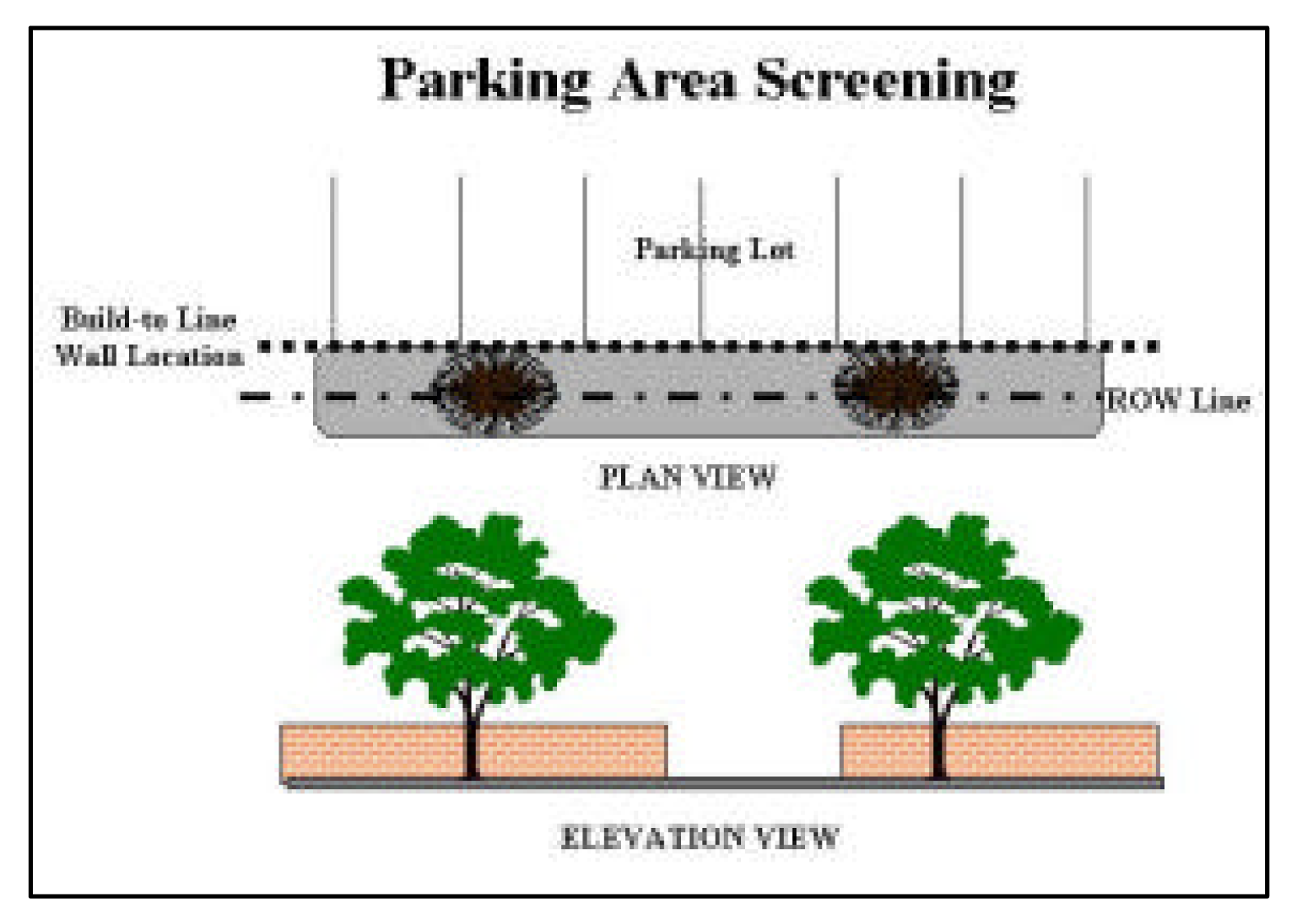
Landscaping within parking lots is not required, provided that the parking areas are not in the front yard. Front yard parking areas shall comply with the provisions of Section 8.101(b) and Subsection (2)b of this section.
b.
In order to enclose the portion of the parking exposed to view of public streets, parking lots abutting the street shall be screened by a decorative masonry wall no greater than three feet high, constructed at the build-to line of the lot. Alternatively, landscaping of the same height (at planting) may be used if it screens the parking area with a least 75 percent opacity. However, any walls or landscaping must be broken up at intervals no greater than 50 feet to allow pedestrian access.
c.
No parking lot areas shall extend for a width of more than 70 feet along the street frontage, if parking is provided in a side yard abutting a street.
d.
Street trees. A minimum of one deciduous canopy tree per 30 feet of street frontage, or fraction thereof, shall be required. Trees must have a caliper of at least four inches and be located between the sidewalk and the curb.
e.
The waiver provisions of Section 8.101(d)(8) shall not apply to this district.
(3)
Parking.
a.
The minimum number of motor vehicle parking spaces required by Section 8.104 is the maximum number allowed. Upon written request of the applicant, the city manager may permit additional parking if supported by documented evidence provided by the applicant of actual use or demand.
b.
In no case shall parking areas use more than 50 percent of the gross site area.
c.
The parking requirements may be waived for retail uses of 2,000 square feet or less, that portion of restaurant seating which is outdoors and adjacent to the street, day care uses, and other uses not generally considered as accessory to other principal uses.
d.
Shared parking is encouraged for nonresidential uses. Where formal shared parking arrangements are made, the individual calculation of the required spaces may be reduced by up to 25 percent with city manager approval. A written agreement between the participating property owners for shared parking shall be submitted to the manager prior to approval.
e.
For multiple-family uses all off-street parking places shall be to the side or the rear of the building. Garages or carports shall be located a minimum of 20 feet behind the front wall of the building.
f.
All other applicable provisions of Section 8.104 shall apply.
(4)
Signs.
a.
Except as modified below, the provisions of Section 8.105 shall apply to all signs.
b.
Sign requirements are as noted in the following table. No other sign types are permitted. Sign requirements for home occupations shall be as required for all residential districts, as noted in Section 8.105(g).
(5)
Lot and building requirements.
a.
Build-to line.
1.
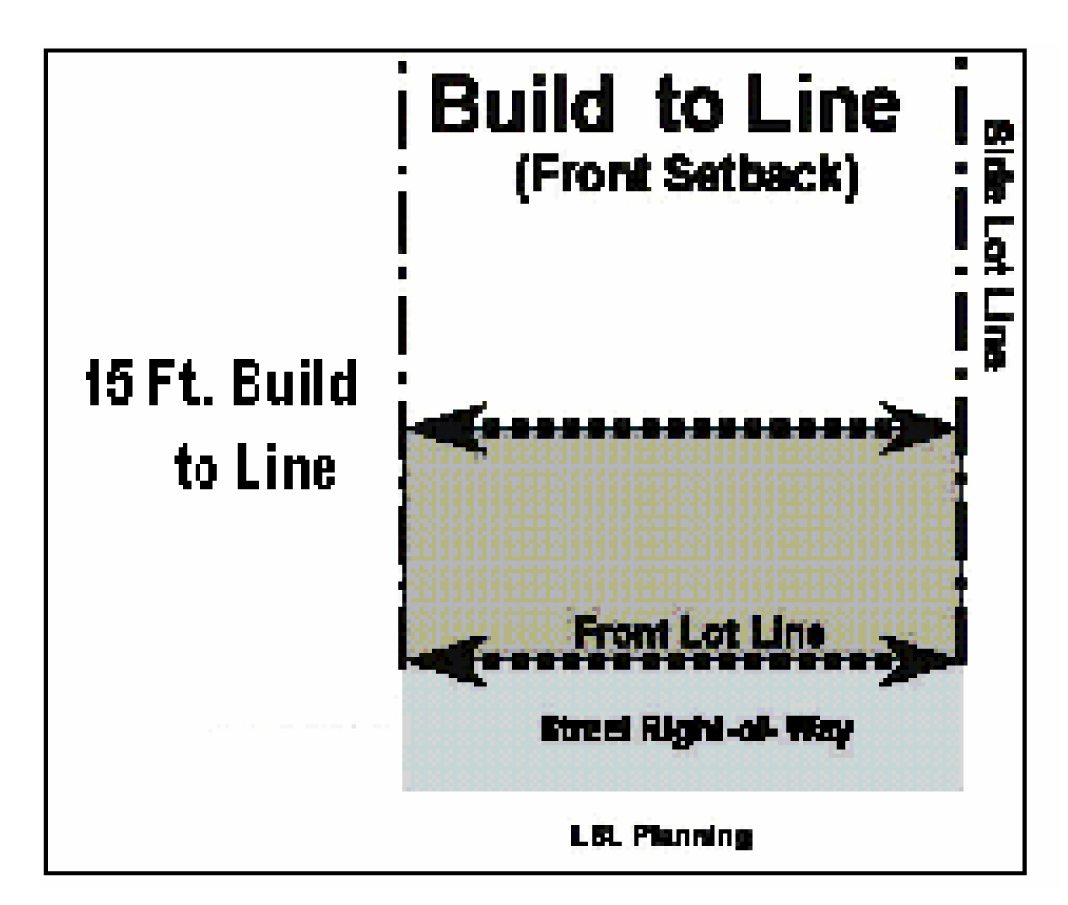
For purposes of this section, the term "build-to line" is defined as the line at which construction of a building facade is to occur on a lot. A build-to line runs parallel to the front property line and is established to create an even (or more-or-less even) building facade line on a street. The build-to line is considered the front setback.
2.
The intent of a build-to line is to pull the building facade close to the street and sidewalk. By doing so, building facades along a block face will be aligned to form a street edge that frames the public realm, while retaining sufficient width for people to walk.
3.
When considering the location of a build-to line, the building front wall shall, in all instances, be no closer than 15 feet from the road right-of-way in order to leave space for adequate sidewalks and landscaping.
4.
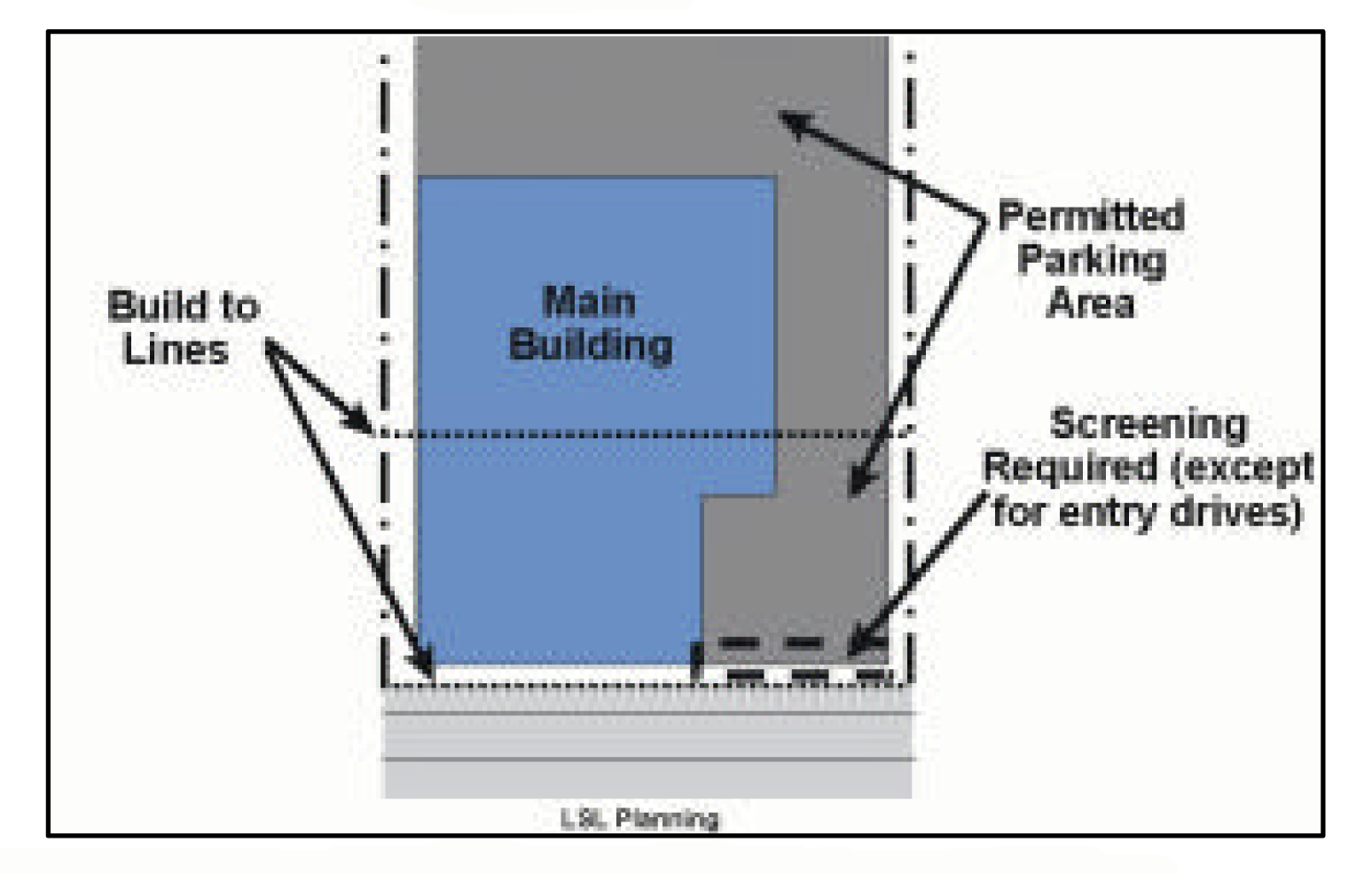
The build-to line for the WMU Washington Avenue Mixed Use District shall be not less than 15 feet from the front property line and no greater than 20 feet from the front property line, for at least 70 percent of the front building wall, and with the remainder of the front of the building being not closer than the build-to line. For corner and through lots, the build-to line shall apply on all frontages, provided that the required corner setbacks are maintained.
5.
The city manager may approve a more distant build-to front building wall percentage for uses that require additional areas for outdoor public assembly or activities, but in no case shall the percentage of a building's front build-to line vary from this division's requirements by more than 50 percent.
6.
Unless prevented by safety considerations or physical limitations related to the site, as determined by the city manager, the primary pedestrian entrance to the main building shall be along the build-to line front wall. The entrance shall be clearly identified using an awning, paving treatments, change in roofline or other features, such as canopies, porticos, arcades, arches, wing walls, and integral planters. (A primary pedestrian entrance is that which is the most architecturally prominent entryway containing operable doors.)
7.
For all parcels, a five-foot curb lawn shall be maintained and a sidewalk which is parallel to the street of not less than five feet in width shall be constructed.
b.
Side and rear yards. No side or rear yards shall be required, except for nonresidential buildings and uses shall maintain a minimum of 20 feet from the side or rear lot line of any residential district.
c.
Long walls. No more than 30 feet of horizontal distance of wall shall be provided without articulation or architectural design variations for building walls facing the street to ensure that the building is not monotonous in appearance. Acceptable variations include, but are not limited to, the following:
1.
Recess and projections along the building facade. Variations in depth must be a minimum of ten feet.
2.
Architectural details or features.
3.
Enhanced ornamentation around building entryways.
4.
Streetscape elements.
5.
Variations in building height.
d.
Building height.
1.
New buildings shall generally respect the existing development patterns for height of buildings within the area they are constructed.
2.
Buildings constructed after the effective date of this ordinance shall not exceed 35 feet in height or three stories, whichever is lower, except that a maximum height of 45 feet shall be permitted for buildings that are located entirely at the 20-foot build-to line.
3.
For buildings located at the 20-foot build-to line, the city manager may approve building heights up to 55 feet for multiple-family residential buildings or when the nature of the uses located therein requires a taller building and the height exceptions of Section 4.114 do not apply.
e.
Lot coverage. There shall be no lot coverage requirement except for parking areas, as noted in Subsection (3)b of this section.
f.
Building materials.
1.
The predominant building materials should be materials that are characteristic of Michigan such as brick, decorative tilt-up panels, wood, native stone and tinted/textured concrete masonry units and/or glass products.
2.
Other materials such as smooth-faced concrete block, undecorated tilt-up concrete panels, or pre-fabricated steel panels may only be used as accents and not dominate the building exterior of the structure.
g.
Roof design.
1.
Roofs should be designed to reduce the apparent exterior mass of a building, add visual interest and be appropriate to the architectural style of the building.
2.
Variations in architectural style are highly encouraged. Visible roof lines and roofs that project over the exterior wall of a building enough to cast a shadow on the ground are highly encouraged, with a minimum overhang of 12 inches.
3.
Architectural methods shall be used to conceal flat roof tops and mechanical equipment.
4.
Overhanging eaves, sloped roofs and multiple roof elements are highly encouraged.
h.
Community amenities. Community amenities such as patio/seating areas, water features, artwork or sculptures, clock towers, pedestrian plazas with park benches or other features located adjacent to the primary entrance to the buildings are highly encouraged and may be calculated as part of the landscaping requirement.
i.
Building and sign colors. Exterior colors shall be of low reflectance, subtle, neutral or earth tone colors. The use of high intensity colors such as neon, metallic or fluorescent for the facade and/or roof of the building are prohibited except as approved by the city manager for building trim. The use of trademark colors will require approval by the city manager.
j.
Facade transparency.
1.
The first floors of all buildings must be designed to encourage and complement pedestrian-scale activity. It is intended that this be accomplished principally by the use of windows and doors arranged so that the uses within the building are visible from and/or accessible to the street. Active uses of visual interest to the pedestrian may be displayed, including office or lobby areas, pressrooms, showrooms, kitchens, or manufacturing processes. Parking areas, truck loading areas, and vehicular access ways are not active uses.
2.
Facade transparency requirements shall apply to the area of the facade between two and eight feet above the sidewalk. Only clear or lightly tinted, nonreflective glass in windows, doors, and display windows shall be considered transparent. A minimum of 60 percent of the street level facade on the front of a building shall be transparent. A minimum of 40 percent of the street level facade on all other sides of a building facing public right-of-way (except alleys) or plazas shall be transparent.
3.
Facade transparency requirements shall not apply to portions of structures in residential use, nor to the assembly area of theaters, auditoriums, churches, and similar uses, provided that facade is enhanced by architectural detailing, artwork, landscaping or similar features.
(6)
Sidewalks.
a.
Continuous pedestrian walkways shall be provided from the public sidewalk or rights-of-way to the customer entrance of all main buildings. Walkways shall connect with points of pedestrian activity such as, but not limited to, street crossings.
b.
Buildings with nonresidential uses on the ground floor shall have a sidewalk across the entire frontage with a minimum width of seven feet. Buildings with residential uses on the ground floor shall have a sidewalk across the entire frontage with a minimum width of five feet.
c.
If a different sidewalk width is present on each side of the building, the sidewalk shall conform to the existing widths, or an average thereof.
(7)
Lighting. Lighting, if installed, shall be pedestrian-style lighting along all sidewalks and within parking areas. For pole lighting, light fixtures must be no more than 20 feet high. Building, wall, and freestanding exterior lighting fixtures shall be directed downward in order to reduce glare onto adjacent properties and streets. Any fixtures or structures used in relation to lighting shall be architecturally compatible with the remainder of the structure.
(8)
Deviations and exceptions.
a.
Definitions. For the purpose of this section, an exception may be defined as a request to waive one or more of the requirements of Subsections (2)—(7) of this section. A deviation is defined as a modification of one or more of the requirements of Subsections (2)—(7) of this section.
b.
Deviations.
1.
Deviations from the requirements of the provisions of Subsections (2)—(7) of this section may be granted by the city manager upon a finding that the following criteria are met:
(i)
The proposed construction is consistent with the overall intent of these minimum development standards and requirements;
(ii)
The applicant proves a practical difficulty in complying fully with the provisions of this section, owing to conditions peculiar to the land or structure and not the result of the action of the applicant, would result from strict adherence to these standards and requirements; and,
(iii)
The deviation is no more than what is necessary to relieve the applicant's practical difficulty.
2.
In addition to the deviations that may be granted above, deviations to the build-to line may be granted by the city manager if the proposed construction includes an existing structure which has been designated as a historic property, or has historic significance because it is potentially eligible for listing on the national or local register, and maintaining a view of the existing historic structure is in the public interest.
c.
Exceptions. Exceptions, as defined in Subsection (8)a of this section shall be reviewed by the planning commission through a site plan review, in accordance with the requirements of Section 8.100. Exceptions may be approved by the planning commission upon a finding that the following criteria are met:
1.
The proposed construction is consistent with the overall intent of these minimum development requirements;
2.
The applicant proves a practical difficulty in complying with the provisions of this section, owing to conditions peculiar to the land or structure and not the result of the action of the applicant, would result from strict adherence to these requirements; and,
3.
That the site plan meets the requirements of Section 8.100(f).
d.
Appeal. Any person aggrieved by a decision rendered by the city manager or planning commission as allowed by this division may appeal the decision to the zoning board of appeals, in accordance with the provisions of Section 2.202(1).
Sec. 3.1300. - Intent.
The AO Alcohol Sales Overlay District is a zoning overlay district which shall be applicable to parcels which are zoned as being parcels within the Alcohol Sales District. The purpose of the Alcohol Sales District is to designate parcels from which alcohol may be sold and to establish certain other regulations regarding the use of such parcels. A parcel which is zoned as being within the Alcohol Sales District shall also be zoned as being within another district, such as the C-1, C-2, C-3, or the Washington Avenue Mixed Use District. The primary district for a parcel shall be the Non-Alcohol Sales Overlay District. The Alcohol Sales Overlay District shall be the secondary zoning district of a parcel.
Sec. 3.1301. - Zoning of parcels.
A parcel within the Alcohol Sales Overlay District may be zoned so as to permit the following types of alcohol sales:
(1)
As a parcel for which sales of alcohol shall be permitted for the consumption of alcohol on such premises (an on-premises parcel);
(2)
As a parcel for which sales of alcohol shall be permitted only for the taking out of alcohol from such premises for consumption off such premises (an off-premises parcel); or,
(3)
As a parcel for which sales of alcohol shall permit either consumption of alcohol on such premises and/or the taking out of alcohol from such premises for consumption off such premises (an on- and off-premises parcel).
Sec. 3.1302. - Permitted use.
Alcohol sales, the giving of alcohol, and the distribution of alcohol from a parcel within the Alcohol Overlay Sales District shall only be permitted in accordance with the regulations of division and the alcohol sales regulations of the City of Zeeland.
Sec. 3.1303. - Prohibited alcohol sales.
Alcohol sales are prohibited in all districts except for parcels which are zoned as being within the Alcohol Overlay Sales District.
Sec. 3.1304. - Special land use and site plan review hearing.
Prior to any alcohol sales being permitted from a parcel, a site plan review hearing shall be conducted in accordance with the site plan review provisions of this ordinance. No property owner shall operate an establishment which sells alcohol unless the site plan for such sales operation has been approved by the planning commission. The planning commission shall have the right to establish conditions for the operation of a facility which sells alcohol in accordance with the discretion which is given to it under this ordinance and state law for the approval of site plans and special land uses. Such conditions shall govern such items which include, but which are not limited to, the following items: building exteriors, parking, signs, lighting, internal facility displays-layouts, and landscaping.
If a parcel is licensed for on-premises alcohol sales, and if a parcel is also zoned as an off-premises alcohol sales parcel, the property owner may apply for and be granted a special land use permit so as to permit the sale of alcohol for off-premises consumption provided that the on-premises alcohol license is in effect and remains in effect at all times. If a special land use permit is granted for off-premises sales, the parcel must comply with all site requirements which are established in the zoning ordinance, by the planning commission, or elsewhere in the Zeeland City Code.
(Ord. No. 925, § 1, 3-18-2013)
Sec. 3.1305. - Site development requirements.
All permitted uses, land uses, and special land uses are also subject to the site development requirements of the primary district for a parcel. The primary district for a parcel shall be the district of a parcel other than the alcohol sales district.
Sec. 3.1306. - Precedence.
In the event of any inconsistency in the regulations of parcels within the alcohol sales district, the provisions of this division shall be controlling over the provisions of any other chapter of this zoning ordinance. In addition to the provisions of this zoning ordinance, a property owner shall be subject to the terms and conditions of the Alcoholic Liquors chapter of the Zeeland City Code and to the terms of any permit and/or alcohol license which has been approved by the Zeeland City Council.
Sec. 3.1400. - Intent.
The I-1 Light Industrial District is intended to accommodate wholesale, warehousing, light manufacturing, storage, and other industrial-related uses which have less potential to impact surrounding property than general industrial uses.
Sec. 3.1401. - Permitted uses.
Land and/or buildings in the I-1 district shall be used for the following purposes by right:
(1)
Office buildings for executive, administrative, professional, accounting, drafting, and other similar professional activities, as determined by the zoning administrator.
(2)
Banks, credit unions, savings and loan associations, and other similar uses as determined by the zoning administrator, including those with drive-through facilities.
(3)
Research and development facilities, including production activities.
(4)
Wholesale establishments.
(5)
The manufacture, compounding, processing, packaging, warehousing, or treatment of such products as foodstuffs (excepting slaughterhouses or other similar uses), cosmetics, pharmaceuticals, pottery or other ceramic products, musical instruments, toys, furniture, molded rubber products, electrical appliances, electronic instruments, signs, light sheet metal products, hardware, tool, die, gauge, and machine shops, excluding stamping operations.
(6)
Laboratories (experimental, film, or testing).
(7)
Dry cleaning and laundry establishments performing cleaning operations on the premises, excluding retail/service operations.
(8)
Trade or industrial schools.
(9)
Utility and public service buildings, including storage yards, but not including essential public services such as poles, wires, and underground utility systems.
(10)
Contractor's showrooms and storage yards.
(11)
Company stores.
(12)
Accessory buildings, structures, outside storage, and uses.
Sec. 3.1402. - Special land uses.
Land and/or buildings in the I-1 district shall be used for the following purposes when approved by the planning commission in accordance with the requirements of Article IX or other applicable zoning ordinance provisions:
(1)
Body shops.
(2)
Commercial kennels.
(3)
Lumber and planing mills.
(4)
Metal plating, buffing, and polishing.
(5)
Commercial storage warehouses.
(6)
The manufacture, compounding, processing, packaging, or treatment of products requiring stamping or punch press operations.
(7)
Planned industrial parks.
(8)
Recycling centers.
(9)
Connector corridors.
(10)
Antennas and towers for antennas.
(11)
Indoor recreational and indoor public assembly uses.
(12)
Medical offices and buildings used for medical purposes.
(13)
Light vehicle repair facilities.
(14)
Large vehicle repair facilities.
(Ord. No. 983, § 2, 8-20-2018)
Sec. 3.1403. - Site development requirements.
All permitted uses, land uses, and special land uses are subject to the following site development requirements:
(1)
Site plan review is required for all permitted and special land uses in accordance with Section 8.100.
(2)
Landscaping and screening are required in accordance with Section 8.101.
(3)
Parking is required in accordance with Section 8.104.
(4)
Signs are permitted in accordance with the requirements of Section 8.105.
(5)
Setbacks, height, area, and lot dimensions are required as in Section 3.200.
(6)
The outdoor storage of goods or materials may not occur in any required setback nor in any primary or secondary front yard. Outdoor storage must be screened so as to not be visible from adjoining properties or rights-of way, except that items may be stored to a height which does not exceed an angle of 45 degrees above the top of the screening; provided, however, that the outdoor storage shall not be permitted to exceed 20 feet in height within 100 feet of any property line and if such outdoor storage is farther than 100 feet from any property line, then the outdoor storage shall not be permitted to exceed 40 feet in height. No fence which provides screening, however, may exceed the height of eight feet. Any plantings which are used as screening must provide the required height and density for screening immediately at the time of planting. All other sections of the zoning ordinance which are applicable to fences and plantings shall be applicable to this section, to the extent which they are not inconsistent with this section. For any property where the outdoor storage area exceeds the building floor area, the following additional requirements shall be applicable:
a.
The outdoor storage shall only be permitted following a public site plan review hearing.
b.
All outdoor storage must comply with the fire prevention code with regard to aisles, setbacks, etc.
c.
The occupant must provide for dust control and road and driveway maintenance to prevent tire dirt from being tracked onto the public streets.
d.
A berm of eight feet in height complying with the berm requirements of this ordinance must be constructed, upon which a fence with a maximum height of eight feet, other solid screening, or solid plantings must be provided to screen in the storage area.
e.
The outdoor storage must meet the front yard, side yard, and rear yard setback requirements for structures of this zoned district.
f.
Additional storage conditions may be required by the planning commission.
(7)
All industrial activities shall be conducted wholly within a completely enclosed building, except for loading and unloading operations and on-site parking of vehicles.
(8)
Sidewalks shall be constructed on all sides of the property abutting a public street, in accordance with city standards. The planning commission may waive the requirement for a sidewalk when, in the opinion of the commission, no good purpose would be served by the sidewalk.
Sec. 3.1500. - Intent.
The I-2 General Industrial District is intended to accommodate wholesale, warehousing, general manufacturing, storage, and other industrial-related uses which have a greater potential to impact surrounding property than light industrial uses.
Sec. 3.1501. - Permitted uses.
Land and/or buildings in the I-2 district shall be used for the following purposes by right:
(1)
Any permitted use as listed in Section 3.1401.
(2)
Utility and public service buildings, including storage yards, provided that the building height for buildings and towers for gas-fired electrical generating facilities shall be permitted to be 120 feet if the front, side, and rear setbacks for a building or tower for such a gas-fired electrical generating facility shall be equal to the height of such structures in those instances in which a building or tower exceeds the height otherwise permitted within the I-2 General Industrial District.
Sec. 3.1502. - Special land uses.
Land and/or buildings in the I-2 district shall be used for the following purposes when approved by the planning commission in accordance with the requirements of Article IX or other applicable zoning ordinance provisions:
(1)
Body shops.
(2)
Commercial kennels.
(3)
Lumber and planing mills.
(4)
Metal plating, buffing, and polishing.
(5)
Commercial storage warehouses.
(6)
The manufacture, compounding, processing, packaging, or treatment of products requiring stamping or punch press operations.
(7)
Planned industrial parks.
(8)
Recycling centers.
(9)
Adult bookstores, adult live entertainment theaters, adult motion picture theaters, and massage parlors.
(10)
Junkyards.
(11)
Truck terminals.
(12)
Outdoor storage, display area, and sale of farm implements and commercial construction equipment.
(13)
Manufacture of corrosive acid or alkali, cement, lime, gypsum, or plaster of Paris.
(14)
Petroleum or other inflammable liquids, production, refining, or storage.
(15)
Connector corridors.
(16)
Antennas and towers for antennas.
(17)
Indoor recreational and indoor public assembly uses.
(18)
Medical offices and buildings used for medical purposes.
(19)
Rooming houses.
(20)
Light vehicle repair facilities.
(21)
Large vehicle repair facilities.
(Ord. No. 983, § 2, 8-20-2018)
Sec. 3.1503. - Site development requirements.
All permitted uses, land uses, and special land uses are subject to the following site development requirements:
(1)
Site plan review is required for all permitted and special land uses in accordance with Section 8.100.
(2)
Landscaping and screening are required in accordance with Section 8.101.
(3)
Parking is required in accordance with Section 8.104.
(4)
Signs are permitted in accordance with the requirements of Section 8.105.
(5)
Setbacks, height, area, and lot dimensions are required in Section 3.200.
(6)
The outdoor storage of goods or materials may not occur in any required setback nor in any primary or secondary front yard. Outdoor storage must be screened so as to not be visible from adjoining properties or rights-of-way, except that items may be stored to a height which does not exceed an angle of 45 degrees above the top of the screening; provided, however, that the outdoor storage shall not be permitted to exceed 20 feet in height within 100 feet of any property line, and if such outdoor storage is farther than 100 feet from any property line, then the outdoor storage shall not be permitted to exceed 40 feet in height. No fence which provides screening, however, may exceed the height of eight feet. Any plantings which are used as screening must provide the required height and density for screening immediately at the time of planting.
(7)
All other sections of the zoning ordinance which are applicable to fences and plantings shall be applicable to this section, to the extent which they are not inconsistent with this section. For any property where the outdoor storage area exceeds the building floor area, the following additional requirements shall be applicable:
a.
The outdoor storage shall only be permitted following a public site plan review hearing.
b.
All outdoor storage must comply with the fire prevention code with regard to aisles, setbacks, etc.
c.
The occupant must provide for dust control and road and driveway maintenance to prevent tire dirt from being tracked onto the public streets.
d.
A berm of eight feet in height complying with the berm requirements of this ordinance must be constructed, upon which a fence with a maximum height of eight feet, other solid screening, or solid plantings must be provided to screen in the storage area.
e.
The outdoor storage must meet the front yard, side yard, and rear yard setback requirements for structures of this district.
f.
Additional storage conditions may be required by the planning commission.
(8)
All industrial activities shall be conducted wholly within a completely enclosed building, except for loading and unloading operations and on-site parking of vehicles.
(9)
Sidewalks shall be constructed on all sides of the property abutting a public street, in accordance with city standards. The planning commission may waive the requirement for a sidewalk when, in the opinion of the commission, no good purpose would be served by the sidewalk.
Sec. 3.1600. - Intent.
The PF Public Facilities District and regulations are established in order to achieve the following purposes:
(1)
To provide a proper zoning classification for government, civic, welfare, and recreational facilities in proper locations and extent to promote the general safety, convenience, comfort, and welfare;
(2)
To protect the public and semi-public facilities and institutions from the encroachment of certain other uses, and to make such uses compatible with adjoining residential uses; and,
(3)
To provide an environment for the proper functioning of public facilities in relation to the master plan and other plans for community facilities.
Sec. 3.1601. - Permitted uses.
Land and/or buildings in the PF district shall be used for the following purposes by right:
(1)
Municipal, county, state, and federal buildings and uses.
(2)
Civic uses, including:
a.
Churches.
b.
Public art galleries.
c.
Libraries.
d.
Museums.
e.
Places for public assembly.
f.
Memorials and monuments.
g.
Cemeteries.
(3)
Primary and secondary public, private, or parochial schools and institutions of higher education.
(4)
Medical clinics.
(5)
Nonprofit corporation offices and other offices.
(6)
Cafeterias for employees working at the site.
(7)
Chapels.
(8)
Media centers.
(9)
Art studios.
(10)
Respite care providers.
(11)
Parks, recreation fields and playgrounds, lakes, beaches, pools, public gardens, and publicly-owned golf courses.
(12)
Utility and public service buildings, without storage yards, but not including essential public services such as poles, wires, and underground utility systems.
(13)
Accessory buildings, structures, and uses.
Sec. 3.1602. - Special land uses.
Land and/or buildings in the PF district shall be used for the following purposes when approved by the planning commission in accordance with the requirements of Article IX:
(1)
Cafeterias and banquet facilities for the public.
(2)
Senior citizen centers not in a church or a school.
(3)
Youth centers not in a church or a school.
(4)
Children's day care providers not in a church or a school.
(5)
Overnight lodging programs and care providers.
(6)
Private and public social services agencies and counselors providing services to clients at the site.
(7)
Skill coaches, teachers, and personal trainers.
(8)
Medical equipment loan and re-use suppliers.
(9)
Thrift stores and distribution centers for the needy.
(10)
Conference centers.
(11)
Exercise centers, health and fitness clubs, and indoor recreation centers.
(12)
General and psychiatric hospitals.
(13)
Theaters, concert halls, and other places for public assemblies.
(14)
Outside storage yards which are accessory to a permitted use as listed in Section 3.1601.
(15)
Incinerators which are accessory to a permitted use as listed in Section 3.1601.
(16)
Indoor police small arms firing ranges.
(17)
Antennas and towers for antennas.
(18)
Therapy clinics.
(19)
Accessory buildings.
(20)
Nonprofit bus and van transportation companies.
(Ord. No. 966, § 1, 6-19-2017)
Sec. 3.1603. - Site development requirements.
All permitted uses, land uses, and special land uses are subject to the following site development requirements:
(1)
Site plan review is required for all permitted uses and special land uses in accordance with Section 8.100, except that all site plan reviews for a municipally owned city park shall be conducted before the entire planning commission.
(2)
Landscaping and screening are required in accordance with Section 8.101.
(3)
Parking is required in accordance with Section 8.104.
(4)
Signs are permitted in accordance with the requirements of Section 8.105.
(5)
Setbacks, height, area, and lot dimensions are required as noted below and in Section 3.200.
a.
Area requirements.
1.
The area or parcel of land for a permitted public facility shall not be less than required to provide a site adequate for the main and accessory buildings, off-street parking, and other accessory uses, yards, and open spaces to accommodate the facility and maintain the character of the neighborhood. The area or parcel of land for a permitted public facility shall be approved by the planning commission.
2.
Building site coverage shall not exceed 40 percent of the total area devoted to the public facility.
b.
Yard regulations.
1.
Front yards. The front yard setback shall not be less than the required front yard setback for any adjacent district at the street right-of-way. Where two districts are adjacent to the use at the street right-of way, the average of the two setbacks shall be used, provided that the front yard setback for a public facility's building from the foundation may be 20 feet if all of the following criteria are met:
(i)
That the area of the structure not complying with the aforesaid front setback requirement is located more than 200 feet from any other adjacent non-public facility's zoned property having frontage on the same block on the same side of the street;
(ii)
That not more than 40 percent of the structure's frontage have less than the otherwise required front setback;
(iii)
That the reduced setback area be not closer than 50 feet to an intersection; and,
(iv)
That the public facility have at least 400 feet of frontage on the street for which the reduced setback will be applicable.
2.
Side and rear yards. The side and rear yards for each public facility building shall not be less than the requirements set forth in the following schedule:
(i)
Sites on which public facility's buildings have been constructed prior to June 19, 1989:
A.
Side yards. A minimum of 15 feet plus one-half the height over 20 feet of the vertical wall of the building adjacent to the lot line, if such vertical wall is greater than 20 feet.
B.
Rear yards. 20 feet.
(ii)
Sites on which public facility's buildings are to be constructed after June 19, 1989:
(iii)
The side yard and rear yard setback for uses and structures for parcels within the PF district is ten feet for setbacks from railroad right-of-ways.
3.
Driveways and parking areas serving the public facility may be located within front yard, side yard, or rear yard setback, except that driveways and parking areas shall be located at least ten feet from any adjacent lot lines and shall be landscaped in accordance with the requirements of Section 8.101(b), except as such specifications may have been modified by Subsection (5)b.4 of this section. Play areas may be constructed up to an adjacent property line, except that all playground equipment shall be located at least 20 feet from the adjacent property line.
4.
Screening requirements.
(i)
Where any public facility use abuts another district, other than commercial or industrial zones, the public facility shall provide a six-foot high opaque screen, or an opaque screen at such other height as may be determined to be appropriate by the planning commission so as to protect an adjacent use, between the public facility property and the other district. Such a screen need not be provided for another district if such other district is across the street from a public facility.
(ii)
Screening specifications. Such an opaque screen may consist of a wall, a solid fence, evergreen plants, or a berm, or a combination thereof. Such screening shall be required to be opaque within three years from the time of planting or installation. Such screening shall be maintained for as long as the public facility is in existence. The planning commission may, upon review of the site plan, approve an alternate location for screening, such as on the opposite side of an alley.
c.
Building heights for public facilities shall not exceed the height of the taller of any adjacent building on an adjacent lot which is not a public facility zoned parcel, or where no adjacent building exists on an adjacent lot, the nearest building, in either a residential or nonresidential district, by more than 25 percent. A public facilities building for which its lot is bounded by at least three public streets, however, shall be permitted to construct buildings to a height not exceeding 45 feet, provided that no setback variance is requested.
d.
In the case of a rear yard abutting a side yard, the side yard setback abutting a street shall not be less than the minimum front yard setback of the district in which located and all regulations applicable to the front yard shall apply.
e.
Unenclosed overhangs or canopies may project into a required front, rear, or side yard, in accordance with the following requirements:
1.
Such unenclosed overhangs or canopies shall have a minimum clear space of ten feet from the bottom of the overhang or canopy to the ground.
2.
Canopies may extend into the required front or rear yards provided that any structural supports for such unenclosed overhangs or canopies shall be located no nearer the front or rear lot line than the minimum required building line.
3.
For properties abutting a residential district or use, the unenclosed overhang or canopy, including any structural supports, shall not extend nearer than ten feet to a side lot line. For properties which do not abut a residential district or use the unenclosed overhang or canopy shall not extend nearer than five feet to the side lot line.
4.
Canopies are structures which are adjacent to building entrances and buildings, and are designed to provide protection from the weather. Canopies, as permitted and regulated in this section, shall be structures whose sides are not enclosed by more than 25 percent on three sides, and whose primary component part is a roof. The width of a canopy shall be the dimension parallel and adjacent to the building which it is attached. The width of a canopy shall not be more than 30 feet.
(6)
Sidewalks shall be constructed on all sides of the property abutting a public street, in accordance with city standards. The planning commission may waive the requirement for a sidewalk when, in the opinion of the commission, no good purpose would be served by the sidewalk.

