
Addison City Zoning Code
ARTICLE II
- ADMINISTRATION AND PROCEDURES
Sec. 2.1. - Purpose.
This article describes the review and approval procedures for land use and development applications in the Town.
Sec. 2.2. - Organization.
This article is divided into the following sections:
A.
§ 2.3: Summary Table of Review Procedures — Summarizes the development procedures in this UDC.
B.
§ 2.4: Common Review Procedures — Describes the standard procedures that apply to most development application types.
C.
§ 2.5: Rezoning, Zoning Text, and Plan Amendment Procedures — Contains criteria and any modifications to the common review procedures for major planning and zoning applications.
D.
§ 2.6: Site Planning and Miscellaneous Permits — Contains approval criteria and any modifications to the common review procedures for administratively approved site-specific development applications.
E.
§ 2.7: Engineering Plans, Studies, and Site Development Permits — Describes plans and studies that may be required to inform the review and approval of development applications.
F.
§ 2.8: Agreements — Describes formal agreements that applicants may enter into with the Town.
G.
§ 2.9: Platting Procedures — Contains approval criteria and any modifications to the common review procedures for applications related to the division and conveyance of land.
H.
§ 2.10: Flexibility and Relief Procedures — Contains approval criteria and any modifications to the common review procedures for applications to vary from strict conformance with this UDC or to obtain other forms of relief.
Sec. 2.3. - Summary table of review procedures.
The table below lists the development applications authorized in this UDC, including recommended or required pre-application activities and the role of Town review and decision-making authorities.
Sec. 2.4. - Common review procedures.
2.4.1.
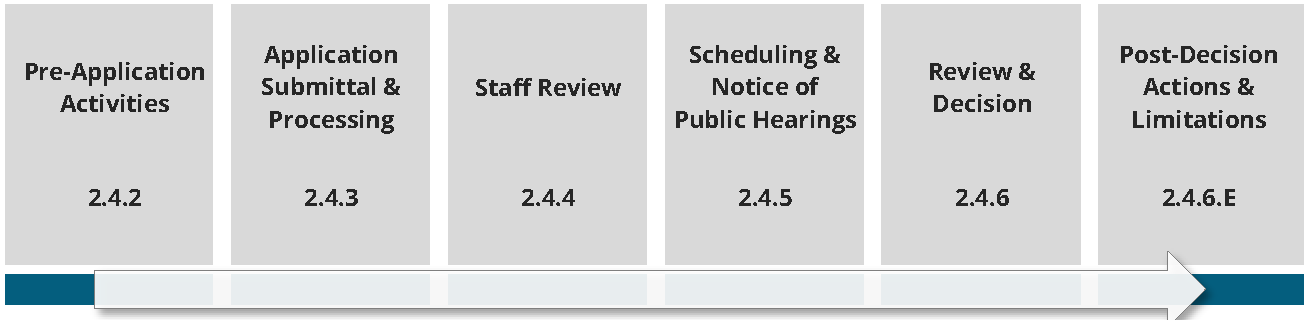
Purpose. This section describes the standard procedures and rules applicable to all development applications unless otherwise stated in this UDC. Common review procedures include six steps, as shown below, not all of which are applicable to every application. Application-specific procedures in § 2.5: Rezoning, Zoning Text, and Plan Amendment Procedures through § 2.10: Flexibility and Relief Procedures identify additional procedures and rules beyond those in this section.
2.4.2.
Pre-application conference.
A.
Purpose. The pre-application conference is intended to provide an opportunity for the potential applicant to meet with Town staff to review applicable submittal requirements and review procedures associated with the proposed application request.
B.
When required. A pre-application conference is required for certain application types according to § 2.3: Summary Table of Review Procedures, and is optional for all other applications.
C.
Procedure.
1.
The potential applicant shall submit a request for a pre-application conference through the Development and Neighborhood Services Department website. Planning staff shall schedule the pre-application conference and notify appropriate staff and the potential applicant of the time and location of the meeting.
2.
To maximize the benefit of this meeting, the potential applicant shall submit a concept sketch and narrative description of their proposal with the pre-application conference request.
3.
At the meeting, Town staff will assist the potential applicant to identify key issues and concerns regarding the proposed development project so the potential applicant may address them as part of their formal application submittal. At the conclusion of the pre-application conference, Town staff will summarize key outcomes from the meeting and will provide a projection of anticipated development review timelines based on the information presented at the meeting.
D.
Effect. Any comments or commitments made by Town staff during the pre-application conference are preliminary in nature and may change significantly as the project is more clearly defined in later stages of the development review process. Discussions of potential conditions to mitigate impacts do not reflect actions by the decision-making body until and unless a decision-making body takes formal action to attach that condition to a development approval.
2.4.3.
Application submittal and processing.
A.
Authority to submit application. Unless expressly stated otherwise in this UDC, a development application shall be submitted by:
1.
The owner of the land on which development is proposed;
2.
A person authorized to submit the application on behalf of the owner, as evidenced by a letter or document signed by the owner; or
3.
If there are multiple owners, all such persons shall sign the application or a letter or document consenting to the application.
B.
Application content.
1.
The application shall be submitted to the Development and Neighborhood Services Department on a form established by the Director in accordance with the Town's established application submittal calendar.
2.
The applicant shall ensure that an application contains sufficient information to demonstrate compliance with all application requirements specific in this UDC, the Administrative Manual and associated Criteria Manuals, and any additional application requirements specified by the Director during a pre-application conference.
3.
Application processing will not begin until the Director determines that the application materials submitted are complete and sufficient.
C.
Waivers of submittal requirements. The Director may waive certain submittal requirements in order to reduce the burden on the applicant and to tailor the requirements to the information necessary to review a particular application. The Director may waive such requirements upon finding that the projected size, complexity, anticipated impacts, or other factors associated with the proposed development clearly, in his or her opinion, support such waiver.
D.
Application fees.
1.
Application fees, as set forth in Chapter 2, Article IX of the Code of Ordinances, shall be paid at the time of submittal according to the type of application.
2.
All required fees shall be paid to and collected by the Development and Neighborhood Services Department.
E.
Submittal and review schedule. The Director shall establish a submittal and review schedule for development applications and shall post that schedule on the Development and Neighborhood Services Department website. The Director may amend the schedule to ensure effective and efficient review under this UDC.
F.
Determination of application completeness.
1.
Application materials.
a.
No application is complete unless all of the information required by this UDC, the Administrative Manual and associated Criteria Manuals, and any application materials required by the Development and Neighborhood Services Department, are included, and all required filing fees are paid.
b.
An application is not considered filed until it is complete pursuant to § 2.4.3.F.2.
c.
The applicant shall file an application in advance of any required public hearing or public meeting where the application is to be considered.
d.
The Director may establish a schedule for filing and reviewing any application that requires action by a Town review or decision-making body. The schedule shall provide adequate time for notice and/or publication consistent with the applicable state statutes and this article.
e.
Completed applications shall be filed according to the published schedule. The Director may accept applications filed in conflict with the published submittal and review schedule at their discretion.
2.
Review procedure.
a.
A determination of completeness shall not constitute a determination of compliance with the substantive requirements of this UDC, other ordinances of the Town, or state or federal law.
b.
No later than ten business days after an application is submitted, the Director shall determine whether the application is complete and shall transmit a written determination via personal delivery, electronic mail, or first-class mail to the applicant. If the written determination is not made within this time period, the application is deemed complete. Failure to complete this review within the specified time does not constitute approval and does not give rise to any cause of action against the Town.
c.
If the application is determined to be incomplete, the Director shall provide notice to the applicant via personal delivery, electronic mail, or first-class mail. The notice shall specify the necessary documents or other information required to resolve the identified application deficiencies and the date the application will expire if those deficiencies are not addressed. The Director shall provide this notice no later than the 10th business day after the date the application is filed.
d.
Pursuant to TLGC Chapter 245, the application shall expire on or after the 45th day after the date the application is filed if:
i.
The Director provides the notice described in § 2.4.3.F.2.b, above; and
ii.
The applicant fails to provide the specified documents or other information required to resolve identified deficiencies within 45 days following notice.
e.
If an application expires, the Town shall not process the application. The applicant shall file a new application and pay the required fees to have their request processed.
3.
Time limits triggered by complete application. Whenever this article establishes a time period for processing an application, the time period does not begin until the Director has reviewed the application for completeness and the applicant has corrected all deficiencies in the application. The fact that a Town employee reviewed an application to determine whether it is complete shall not be binding on the Town as the official acceptance of the application for filing.
4.
Appeal of application completeness determination. If the application is determined to be incomplete, the applicant may appeal that decision in writing within ten calendar days of the determination to the Board of Zoning Adjustment pursuant to § 2.10.4: Appeal of Administrative Decision.
G.
Concurrent applications. Review and decision-making bodies considering applications submitted simultaneously shall render separate recommendations and decisions on each application based on the specific standards applicable to each approval.
H.
Application withdrawal.
1.
After an application has been accepted for review, the applicant may withdraw the application at any time by submitting a letter of withdrawal to the Director.
2.
An applicant is not entitled to a refund of application fees for withdrawn applications; however, the Director may refund fees where staff review or public notice has not been substantially initiated for the application.
3.
If an applicant fails to respond to staff comments within 45 days, or an application is otherwise determined by the Director to be inactive for a period of 45 days, then the application is no longer valid.
I.
Resubmittal of an application. A development application denied by the Town, or approved and subsequently revoked pursuant to § 1.7: Enforcement, may be resubmitted only if the applicant makes significant changes to address the reasons stated for the denial or revocation and if the application is submitted within one year of the denial or revocation, unless an alternative timeframe is specified in this section. The Director will determine if the changes are sufficient to allow a resubmittal.
2.4.4.
Staff review.
(1)
Referral to staff and review agencies. The Director shall distribute the complete application to appropriate staff and review agencies.
(2)
Staff review and application revisions. Staff shall review the application and shall consult with applicable Town departments and other participating reviewing agencies. Staff shall submit recommendations and comments to the applicant in a form established by the Director. The application shall not move forward for further review until the Director determines that the applicant has adequately responded to the Town's recommendations and comments, or the applicant requests that the application move forward without responding to the Town's recommendations and comments.
(3)
Applications subject to staff recommendation.
a.
Staff report. If an application is subject to staff review and recommendation to the Planning and Zoning Commission, Board of Zoning Adjustment, and/or City Council per § 2.3: Summary Table of Review Procedures, staff shall prepare a written staff report that summarizes the proposal, findings, and recommendations.
b.
Distribution and availability of application and staff report. The Director shall submit a copy of the staff report to the review and/or decision-making body and shall make the staff report and related application materials available for public review prior to the hearing at which the application is scheduled to be heard.
D.
Applications subject to staff decision.
1.
Decision. If an application is subject to staff review and a final decision by the Director per § 2.3: Summary Table of Review Procedures, the Director shall make a decision based on the review standards applicable to the application type. The decision shall be in writing and shall clearly state reasons for a denial or for conditions of approval.
2.
Appeals. Appeals of administrative decisions may be made pursuant to § 2.10.4: Appeal of Administrative Decision.
2.4.5.
Scheduling and notice of public hearings.
A.
Neighborhood meeting.
1.
Purpose. The purpose of a neighborhood meeting is to provide an opportunity to inform the residents and landowners of the surrounding neighborhood(s) of the details of a proposed development, how the applicant intends to meet the standards contained in this UDC, and to receive public comment and encourage dialogue at an early time in the review process.
2.
Applicability. A neighborhood meeting is recommended for applications for Rezoning, Rezoning to PUD, and Special Use Permit, or as required by the Director in their discretion. The Director may require a neighborhood meeting for proposed developments with demonstrated community interest, that require a Traffic Impact Analysis, or are of a size or complexity that warrant a neighborhood meeting. The neighborhood meeting is optional unless expressly stated otherwise in Table 2.3-1: Summary Table of Review Procedures.
3.
Notice of neighborhood meeting.
a.
An applicant holding a neighborhood meeting is encouraged to provide mailed notice of the meeting as described in the Administrative Manual.
b.
Notice is required if the neighborhood meeting is required by the Director or this UDC. The applicant shall notify the Director in writing of the meeting date, time, and location no less than 14 days prior to the scheduled date of the meeting, if the meeting was required to be held by the Director or this UDC.
c.
The applicant shall be responsible for providing mailed notice to residential and nonresidential property owners within the public hearing notice area required by § 2.4.5.D.2: Mailed Notice if elected or required.
d.
Additional electronic notice is encouraged for:
i.
The head of any homeowners association, or community/neighborhood appointed representative adjoining the project site; and
ii.
Other interested parties as determined by the Director.
4.
Attendance at neighborhood meeting. The applicant shall be responsible for scheduling, coordinating, and facilitating the meeting, and for retaining an independent facilitator if needed. The meeting shall be held prior to the first public meeting to consider the application. Attendance at the meeting by Town staff is not required and will be determined by the Director on a case-by-case basis.
5.
Summary of neighborhood meeting. The applicant shall prepare and deliver a written summary of the neighborhood meeting to be included in the main application submittal. The written summary shall be included in the staff report provided to the decision-making body at the time of the first public meeting to consider the application. At a minimum, the following information shall be included in the meeting summary:
a.
Date, time, and location of the meeting;
b.
A copy of the meeting sign-in sheet; and
c.
A summary description of how the applicant has or has not addressed or proposes to address the issues, concerns, and objections identified during the meeting.
B.
Scheduling of public hearings and public meetings.
1.
If an application is subject to a public hearing or public meeting per § 2.3: Summary Table of Review Procedures, the Director shall schedule the public hearing for either a regularly scheduled meeting or special meeting of the appropriate review and/or decision-making body.
2.
The public hearing or meeting shall be scheduled to allow sufficient time to prepare a staff report per § 2.4.4: Staff Review.
3.
The Development and Neighborhood Services Department website shall include a submittal and review schedule that the Town will follow if the applicant submits a complete application that addresses staff review feedback by the deadline established for each step in the submittal and review process. The submittal and review schedule is based on time frames established by state statute for reviewing agency response times and minimum requirements for notice of public hearings.
4.
Public meetings shall include a time for citizen comment on items that do not require a public hearing.
C.
Notice format and content for public meetings. Electronic notice of a public meeting shall be posted to the Town's website a minimum of 72 hours prior to the public meeting.
D.
Notice format and content for public hearings.
1.
Content of mailed and published notices. At a minimum, required notice shall:
a.
Identify the application by type and case number;
b.
Describe the land involved by street address, or by legal description and the nearest cross street, and project area (size) that is the subject of the application;
c.
Provide a general description of the proposed project;
d.
Specify the date, time, and location of the hearing being noticed;
e.
Include a telephone number, email address, and/or website for additional information;
f.
Include a statement that the public may appear at the public hearing or be heard and submit evidence and written comments with respect to the application; and
g.
Provide any additional information as may be required by the Administrative Manual or state law.
2.
Mailed notice. Applications requiring mailed notice in accordance with this UDC shall comply with the following:
a.
Notice of a public hearing shall be sent to the owner of the property for which the approval is sought.
b.
Notice of a public hearing shall be sent to all owners of property, as indicated by the most recently adopted municipal tax roll, that is located within 200 feet in all directions of any property affected by the proposal.
c.
Notice of a public hearing shall be sent to any other parties entitled to receive written notice by mail under state law.
d.
The mailed notice will be postmarked at least 11 days prior to the date of the public hearing at which the item will be considered, except residential Replats subject to TLGC § 212.015 that shall be postmarked at least 15 days prior to the date of the public hearing.
e.
The notice may be served by using the last known address as reflected by the Dallas Central Appraisal District, and depositing the notice, properly addressed and postage paid, in the United States mail.
3.
Posted notice. Applications requiring posted notice in accordance with this UDC shall comply with the following:
a.
The Town shall post a minimum of one sign on the subject property at least ten days prior to the date of the public hearing before the Planning and Zoning Commission. The Director may require additional signs based on access and configuration of the property.
b.
The signs shall be posted at a prominent location adjacent to a public street and be easily visible from the street.
c.
Photos of the posted notification signs and a required affidavit shall be provided to the Development and Neighborhood Services Department in accordance with the Administrative Manual.
d.
The applicant is responsible for maintaining the required number of notification signs posted on the subject property until final action is taken on the application by the City Council.
e.
Signs shall be constructed and posted in accordance with the Administrative Manual.
f.
Signs shall include the following information:
i.
Type of application.
ii.
Public hearing requirement.
iii.
Town logo.
iv.
Website and phone number to learn more about the application.
g.
The signs shall be removed within ten days after final action on the application by the City Council.
h.
It is unlawful to intentionally or knowingly remove a notification sign that has been posted pursuant to this UDC, or to in any way tamper with or conceal the sign message.
4.
Published notice. Applications requiring published notice in accordance with this UDC shall comply with the following:
a.
When published notice is required, the Director shall prepare the content of the notice and publish the notice in an official newspaper or a newspaper of general circulation in the Town. The content and form of the published notice shall be consistent with the requirements of the applicable provisions of state law.
b.
The first date of the publication shall be at least 16 days prior to the date of the public hearing at which the item will be considered.
E.
Public hearing notice. All public hearings required by this UDC shall be preceded by the notices identified in the table below. Procedures not listed in the table do not require public hearing notice.
F.
Constructive notice.
1.
Minor defects in any notice shall not impair the notice or invalidate proceedings pursuant to the notice if a bona fide attempt has been made to comply with applicable notice requirements. Minor defects in a notice shall be limited to non-substantive errors in a property description or typographical or grammatical errors that do not impede communication of the notice to affected parties. In all cases, however, the requirements for the timing of the notice and for specifying the time, date, and place of a hearing shall be strictly construed.
2.
Failure of a party to receive notice shall not invalidate subsequent action. If questions arise at the public hearing regarding the adequacy of notice, the decision-making body shall make a formal finding as to whether there was substantial compliance with the notice requirements of this UDC.
3.
In addition to notice by the means set forth above, the Town may give notice of the hearing in a specific case in such other manner as it deems necessary or appropriate.
G.
Protest procedures. A proposed zoning action may be protested pursuant to TLGC Chapter 211 and the requirements below. A valid, written protest shall require an affirmative vote of at least three-fourths of all members of the governing body for approval of the protested zoning action.
1.
Submittal requirements.
a.
A written protest may be submitted by a minimum of 20 percent of the property owners located within 200 feet of the area covered by the proposed change.
b.
A written protest shall be submitted on a form provided by the City and shall contain the following information:
i.
Description of the zoning case at issue;
ii.
Email and phone number of the protest petitioner(s);
iii.
The names and original signatures of all persons protesting the proposed zoning action; and
iv.
A description or address of the area of lots or land owned by the protesting parties.
c.
The written protest form must be signed by the owner of the property, or by their authorized representative. The signature of any one owner of a property with multiple owners shall bind the entire property to the protest.
d.
In the case of a property owned by a corporation, the protest must be signed by the president, a vice president, an attorney-in-fact authorized to sign the protest on behalf of the corporation, or other person authorized to sign on behalf of the property. In the case of a property owned by a general or limited partnership, the protest must be signed by a general partner or by an attorney-in-fact authorized to sign the protest on behalf of the partnership.
e.
For condominium lots or land to be included in calculating the lots or land area protesting a zoning action, the written protest form must state that the governing body of the condominium has authorized a protest in accordance with procedures required by its bylaws, and that the person signing the protest is authorized to act on behalf of the governing body of the condominium. A written protest signed by the owner of an individual condominium unit shall not be accepted unless the filing party produces legal documents governing the condominium which clearly establish the right of an individual owner to act with respect to the owner's respective undivided interest in the common elements of the condominium.
f.
Except for those properties owned by corporations or jointly owned by multiple people as described in §§ 2.4.5.G.1.d and 2.4.5.G.1.e, all signatures on a written protest form shall be notarized or witnessed. The notary requirement is fulfilled if the person who obtains the signatures signs a certification stating that:
i.
They witnessed those signatures; and
ii.
The signatory represented their authority to sign the petition.
g.
In all cases where a written protest form has been properly signed pursuant to this section, the City shall presume that the signatures are authentic and that the persons or officers whose signatures appear on the protest form are either owners of the property or authorized to sign on behalf of one or more owners as represented. The City Attorney may advise the governing body that this presumption of validity should not be followed in a specific case based on evidence presented.
2.
Filing deadline.
a.
A written protest must be filed with the City Secretary before 5:00 p.m. of the 4th business day prior to the public hearing when the proposed zoning action is scheduled to be acted upon. A written protest form sent through the mail must be received by the City Secretary before the deadline.
b.
Before the public hearing on the zoning action begins, the filing deadline for a protest is automatically extended whenever the public hearing is re-advertised in the official newspaper of the City pursuant to statutory notice requirements.
c.
After the public hearing has begun, the filing deadline may only be extended by calling a subsequent public hearing and advertising that public hearing in the official newspaper of the City pursuant to statutory notice requirements or if the item is tabled or continued. In such a case, the new filing deadline is noon of the 2nd business day immediately preceding the newly advertised public hearing date or the date to which the item is tabled or continued.
3.
Withdrawal of protest signature(s) or protest form(s).
a.
A protest, once filed, remains in effect unless withdrawn in accordance with this section, irrespective of any amendments made to the zoning proposal. Requests to withdraw a protest form or individual protest signature(s) that have been filed must be in writing and filed with the City Secretary before the filing deadline.
b.
The provisions of this section governing the form and filing of protests apply equally to withdrawals.
4.
Conflicting submissions. If multiple protests and withdrawals are filed on behalf of the same owner, the submission with the latest date and time of execution controls.
2.4.6.
Review and decision.
A.
Hearing, review, and decision.
1.
The application shall be subject to hearings, review, recommendations, and decisions as indicated in § 2.3: Summary Table of Review Procedures.
2.
If the application is subject to a public hearing, the applicable review and/or decision-making body shall hold a public hearing in accordance with § 2.4.5: Scheduling and Notice of Public Hearings.
3.
The City Council may hold a joint public hearing with the Planning and Zoning Commission as provided for by state law. In case of a joint hearing, the City Council may not act on the request until it receives the report of the Planning and Zoning Commission.
4.
The applicable review and/or decision-making body shall consider the following:
a.
The application and supportive material submitted by the applicant;
b.
The testimony of the applicant;
c.
The testimony of the public during the public hearing, when applicable;
d.
The Development and Neighborhood Services Department staff report; and
e.
Such other additional information as may be required by the review and/or decision-making body to evaluate the application.
5.
The applicable review and/or decision-making body may approve, approve with conditions, or deny the application based on the applicable approval criteria listed in the application-specific procedures in §§ 2.5 through 2.10. The review and/or decision-making body may also continue the hearing in accordance with the review and/or decision-making body's adopted rules and procedures.
6.
If the review involves a public hearing, the recommendation or decision (as applicable) shall:
a.
Be based only on the record of the public hearing;
b.
Be in writing;
c.
Include findings of fact based on competent, material, and substantial evidence presented at the hearing;
d.
Reflect the determination of contested facts; and
e.
State how the findings support compliance with applicable review standards.
7.
The applicable review and/or decision-making body shall clearly state the factors considered in making its recommendation or decision, as well as the basis or rationale for the recommendation or decision.
8.
All approvals and decisions under this UDC require the weighing of facts and applicable laws and regulations and thus are discretionary, unless clearly indicated otherwise by the use of wording requiring ministerial, non-discretionary approval (e.g., "shall issue," or "shall approve" upon request).
B.
Public hearing procedures. Whenever a public hearing is required by this UDC, the following public hearing procedures shall apply:
1.
Conduct of public hearings.
a.
Generally. Any person can appear at a public hearing and testify or submit evidence. Each person appearing at a public hearing must be identified by name and address.
b.
Exclusion of testimony. If necessary, the review or decision-making body conducting the public hearing can establish time limits for testimony and may exclude testimony or evidence that is irrelevant, immaterial, or repetitious.
c.
Tabling of public hearing. The review or decision-making body conducting the public hearing can, on its own motion or at the request of staff, the applicant, or the property owner(s), table the public hearing to a specified date. Tabling may occur more than once. However, tabling for more than 40 days without the applicant's consent is not permitted. Every effort must be made to conduct each public hearing expeditiously and without undue delay.
2.
Public hearing order of proceedings. The order of proceedings at a public hearing will be as follows. The applicable review and/or decision-making body may adjust this order as necessary.
a.
Narrative and description. The Director presents a narrative and/or graphic description of the project.
b.
Staff report. The Director presents a staff report addressing compliance with relevant Town plans and standards contained in this UDC and the recommendations of review boards and commissions.
c.
Applicant presentation. The applicant may present testimony or evidence in support of the project.
d.
Public testimony. The public may present evidence and testimony concerning the proposed project.
e.
Applicant response. The applicant may respond to any evidence or testimony presented by the public.
f.
Town staff response. The Director, City Attorney, or any other Town staff may respond to the evidence and testimony offered by the applicant and the public, as well as questions from the review or decision-making body.
g.
Decision of review or decision-making body. The review or decision-making body makes its decision or recommendation to approve, approve with conditions, or deny the application.
h.
Notice of decision. The Director notifies the applicant in writing of the review or decision-making body decision within a reasonable time after the decision.
i.
Record. The audio and/or video of the hearing, minutes, all applications, exhibits, and papers submitted during the proceedings, Development and Neighborhood Services Department files, staff report, and decision of the review or decision-making body constitute the complete record. The record will remain in the possession of the Town.
C.
General approval criteria.
1.
Generally.
a.
Unless otherwise specified in this UDC, Town review and decision-making bodies shall review all development applications submitted pursuant to this article for compliance with the general review criteria stated below.
b.
The application may also be subject to additional review criteria specific to the type of application, as set forth in § 2.5: Rezoning, Zoning Text, and Plan Amendment Procedures through § 2.10: Flexibility and Relief Procedures.
c.
If there is a conflict between the general review criteria in this section and the specific review criteria in § 2.5: Rezoning, Zoning Text, and Plan Amendment Procedures through § 2.10: Flexibility and Relief Procedures, the specific review criteria in § 2.5: Rezoning, Zoning Text, and Plan Amendment Procedures through 2.10: Flexibility and Relief Procedures control.
2.
Compliance with UDC and other applicable plans and regulations. The proposed use and development shall comply with all other Town regulations and with all applicable regulations of the federal or state governments and other relevant entities with jurisdiction over the property or the current or proposed use of the property, including but not limited to this UDC, the Comprehensive Plan, and where applicable, other master plans and Town-wide studies.
3.
Compliance with prior approvals. The proposed use and development shall be consistent with the terms and conditions of any prior land use, plan, or plat approval for all or part of the property that is in effect and not proposed to be changed. This includes consistency with any approved phasing plan for development and installation of public improvements and amenities.
4.
Compliance with phasing plans. If the proposal involves phases, each phase of the proposed development shall contain all of the required streets, utilities, landscaping, open space, and other improvements that are required to comply with the project's cumulative development to date and shall not depend upon subsequent phases for those improvements.
D.
Conditions of approval.
1.
Where this UDC authorizes a review and/or decision-making body to approve or deny an application subject to applicable criteria, the review and/or decision-making body may approve the application with conditions necessary to bring the proposed development into compliance with this UDC or other regulations, or to mitigate the impacts of that development on the surrounding properties and streets.
2.
All conditions of approval shall be reasonably related to the anticipated impacts of the proposed use or development or shall be based upon standards duly adopted by the Town. Such conditions may include those necessary to carry out the purpose and intent of the Comprehensive Plan, other adopted plans, and this UDC.
3.
During its consideration, the review and/or decision-making body may consider alternative potential conditions, and no discussion of potential conditions shall be deemed an attempt or intent to impose any condition that would violate the federal or state constitutions, statutes, or regulations. Discussions of potential conditions to mitigate impacts do not reflect actions by the review and/or decision-making body unless and until the review and/or decision-making body takes formal action to attach that condition to a development approval.
4.
Unless otherwise provided in this UDC, any representations of the applicant in submittal materials or during public hearings shall be binding as conditions of approval.
5.
Any conditions shall be listed in or attached to the approval document, and violation of any approved condition shall be a violation of this UDC.
E.
Development agreement.
1.
Purpose.
a.
The City Council finds and determines that development agreements may be useful to both the Town and developers of land in the Town by providing more regulatory certainty, establishing a schedule for development, assisting both developers and the Town to coordinate the provision of adequate public facilities to serve development, coordinating the phasing of development, administering management efforts to maintain open space and environmentally sensitive lands, and furthering the goals of the Comprehensive Plan.
b.
The purpose of this section is to authorize development agreements to be entered into between a developer and the City Council in accordance with the procedures and standards of this section to encourage comprehensive planning and capital facilities planning, ensure the provision of adequate public facilities for development, encourage the efficient use of resources, while providing certainty in the process of obtaining development permits and approvals, and reduce the economic costs of development by providing greater regulatory certainty.
2.
Applicability. The City may enter into a development agreement with a developer, subject to TLGC § 212.172. In entering into a development agreement, the City may not exercise any authority or make any commitment not authorized by general or local law and may not impose any tax or fee not authorized by otherwise applicable law.
3.
Standards. A development agreement shall meet and be subject to all requirements and provisions in TLGC § 212.172.
4.
Recordation. A Development Agreement shall be recorded in accordance with TLGC § 212.172.
5.
Effect of approval. Development pursuant to the Development Agreement shall be subject to the terms and conditions of the agreement and to the laws in force at the time of execution of the agreement unless otherwise provided by specific provisions in the agreement or TLGC § 212.172.
6.
Periodic review. At least every 12 months following execution of the agreement, the Director shall conduct a periodic review during which the developer shall be required to demonstrate good faith compliance with the terms of the agreement. If the periodic review finds a material breach of the terms or conditions of the Development Agreement has occurred, notice of the breach and a reasonable opportunity to correct it shall be provided. If the breach is not cured within the time given by the Director, the Town may terminate or modify the Development Agreement.
7.
Expiration, termination, or modification of agreement.
a.
A Development Agreement shall expire in accordance with the provision of the agreement, and may be terminated or modified by mutual consent of the parties to the agreement or their successors in interest, or in accordance with the provisions of this section or TLGC § 212.172.
b.
Major modification of the agreement shall follow the same procedures as required for initial approval of a Development Agreement.
c.
With the mutual consent of the other parties to the agreement, the Director may approve Minor Modifications of the Development Agreement, without following the same procedures as required for initial approval of the agreement. Before doing so, the Director shall make written findings that the proposed Minor Modifications would not significantly change the use, intensity, or design of the development, would be consistent with the purposes and goals of the agreement, would comply with this UDC, and would not adversely affect the public health, safety, or general welfare.
2.4.7.
Post-decision actions and limitations.
A.
Notice of decision.
1.
Within ten days after a final decision on an application, the Director shall provide written notification of the decision via personal delivery, electronic mail, or first-class mail to the applicant and make a copy of the decision available to the public in the Development and Neighborhood Services Department.
2.
If the review involves a public hearing, the Director shall, within ten days after a final decision on the application, also provide a written notification of the decision via personal delivery, electronic mail, or first-class mail to the owner(s) of the subject site, and any other person that submitted a written request for a copy of the decision before its effective date.
B.
Effect of approval.
1.
Approval of any development application in accordance with this Code, whether granted or deemed granted by expiration of a "shot clock," (a time limit for a municipality to act on certain applications) authorizes only the particular use, plan, or other specific activity approved, and not any other development requiring separate application.
2.
Approvals, whether granted or deemed granted, do not vary or change this Code or excuse non-compliance, except to the extent specified in a Variance, interpretation, special exception, or amendment that is duly approved in writing by the authorized decision-maker.
3.
If one development permit or approval is a prerequisite to another permit or approval (e.g., Variance approval prior to a Site Plan approval), development may not take place until all required permits and approvals are obtained. Approval of one application does not necessarily guarantee approval of any subsequent application.
C.
Appeal.
1.
A party aggrieved or adversely affected by any decision by the City Council, Planning and Zoning Commission, or Board of Zoning Adjustment may seek review of the decision in accordance with applicable state law.
2.
A party aggrieved by other final decisions may appeal the decision in accordance with the procedures and standards in § 2.10.4: Appeal of Administrative Decision.
D.
Expiration and revocation of approval.
1.
Expiration of approval. If a specific time period for expiration is not specified within the approval of an application, the approval shall expire after two years following the date upon which the final approval became effective, if none of the following have occurred:
a.
The subject property has been improved for the development for which it was approved, and a Building Permit has been issued and construction commenced and is being diligently pursued toward completion of the site for which the approval was originally granted; or
b.
A Certificate of Occupancy has been issued for structure(s) that were the subject of the application; or
c.
The site has been occupied for a permitted use if no Building Permit or Certificate of Occupancy is required.
d.
For purposes of this section, progress towards completion of the project is as defined in TLGC Chapter 245.
2.
Revocation of approval. Upon expiration, the approval shall be considered revoked, unless a request for a time extension is made by the applicant to the Director at least 15 days prior to the date of the expiration of the original approval in accordance with established application submittal scheduling requirements.
3.
Request for extension of approval. Unless otherwise specified in a specific procedure, the original approval body may grant extensions of the expiration time period for up to one year, following a written request to the Director for such extension prior to the expiration date. The request shall include reasonable cause for an extension. No more than one extension may be granted.
E.
Modification or amendment of approval.
1.
Minor changes allowed. Development authorized by any approval under this article may incorporate minor changes from the approved plan, permit, or conditions of approval, as appropriate, without the need for a new application, subject to the limitations below.
a.
Authorized minor changes are limited to those that appear necessary in light of technical or engineering considerations first discovered during the preparation of final engineering and building plans and were not reasonably anticipated during the initial approval process, as long as they comply with the standards of this UDC and any other applicable approval conditions or design criteria.
b.
Minor changes may include minor deviations in the building footprint or relocation of infrastructure (roads and water or sewage lines) so long as the relocation complies with the conditions of any approval and this UDC.
c.
Minor changes shall not include reductions in the amount of open space, buffering, or increases in gross floor area.
d.
The Director shall determine whether the proposed minor changes:
i.
Comply with the standards of this UDC and applicable design criteria;
ii.
Are necessary to meet conditions of approval; and
iii.
Would not significantly alter the function, form, intensity, character, demand on public facilities, or impact on adjacent properties as approved.
2.
Major changes. Any modification of an approved plan, permit, or condition of approval that the Director determines does not meet the criteria in § 2.4.7.E.1 above shall require a new application that is submitted and reviewed in accordance with the applicable procedure and fee requirements.
F.
Limitation on subsequent similar applications. Following denial of an application, the decision-making body shall deny any applications that are the same or substantially similar within one year of the previous denial. This waiting period may be waived by the decision-making body provided that:
1.
There is a substantial change to circumstances, or new information available, relevant to the issues or facts considered during the previous application review; or
2.
The new application is materially different from the previous application, as determined by the Director.
G.
Site development permit.
1.
Prior to the commencement of any improvements associated with an approved project, the applicant must obtain all necessary Site Development Permits from the Town.
2.
No permit for excavation for any building shall be issued before application has been made for a Site Development Permit.
H.
Building permits. All applications for Building Permits shall be accompanied by an accurate plat and approved development plan in accordance with the Town's administrative procedures.
I.
Certificate of occupancy.
1.
Compliance required. No building hereafter erected or structurally altered shall be used, occupied, or changed in use until a certificate of occupancy has been issued by the Building Official or Director.
2.
Procedures.
a.
Following the approval of the necessary Building Permits for each project type, the applicant shall submit an application for a certificate(s) of occupancy. The necessary certificate(s) of occupancy shall be issued within ten days after the erection or structural alteration of such building shall have been completed in conformity with the provisions of this UDC.
b.
Certificates of occupancy shall be applied for following a change in ownership or tenant of buildings requiring a Building Permit.
3.
Record of certificate of occupancy. A record of all certificates shall be kept on file in the Development and Neighborhood Services Department and copies shall be furnished in accordance with the Town's administrative procedures upon request to any person having a propriety or tenancy interest in the building affected.
Sec. 2.5. - Rezoning, zoning text, and plan amendment procedures.
2.5.1.
Special use permit.
A.
Purpose. The Special Use Permit review procedure provides a mechanism for the Town to evaluate proposed development and land uses that have unique or widely varying operating characteristics or unusual site development features to ensure compatibility with surrounding areas and the goals of the Comprehensive Plan and this UDC. The procedure considers the location, design, configuration, intensity, density, natural hazards, and other relevant factors pertaining to the proposed use to evaluate the potential impacts of such uses on surrounding properties and to ensure that such uses are compatible with surrounding properties and that adequate mitigation is provided to minimize potential impacts on those surrounding properties and/or the Town.
B.
Applicability. Special use permit review is required for certain land uses and zoning districts as specified in § 4.2.7: Table of Allowed Uses. Special use permit review approval is also required for modification or expansion of an existing special use.
C.
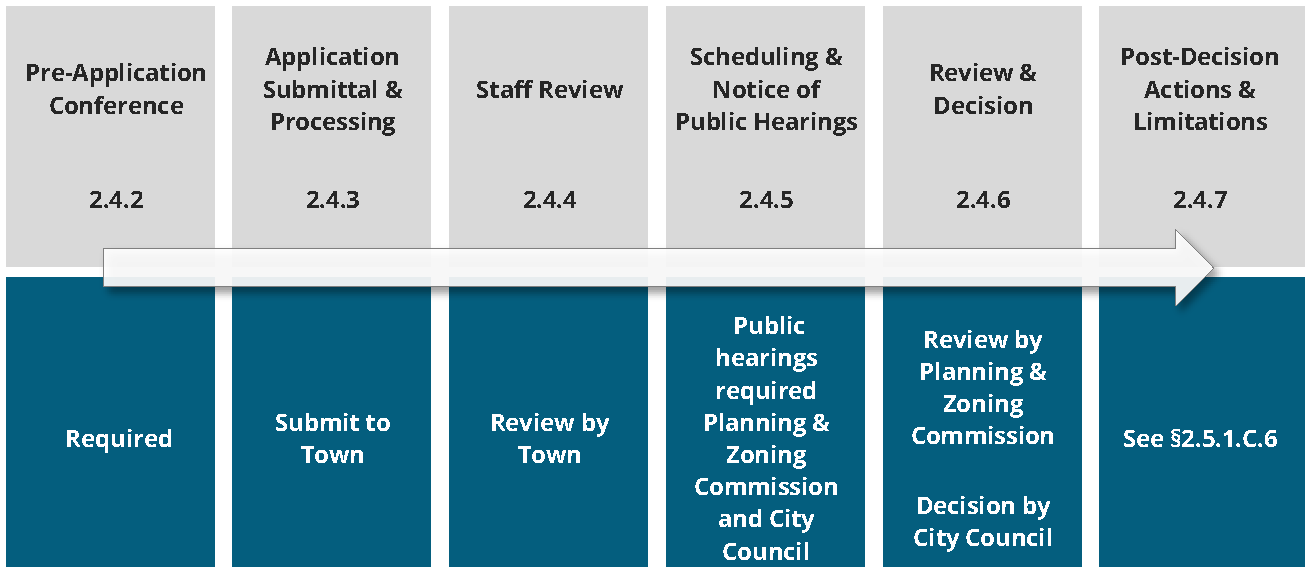
Special use permit procedure. The process diagram below identifies the applicable steps from § 2.4: Common Review Procedures, that apply to the review of Special Use Permit applications. Additions or modifications to the common review procedures are noted below.
1.
Pre-application conference. A pre-application conference is required in accordance with § 2.4.2: Pre-Application Conference.
2.
Application Submittal and Processing. The application shall be submitted, accepted, revised, and may be withdrawn, in accordance with § 2.4.3: Application Submittal and Processing.
3.
Staff review. The staff shall review the application and prepare a staff report and recommendation in accordance with § 2.4.4: Staff Review.
4.
Scheduling and notice of public hearings.
a.
Neighborhood meeting. A neighborhood meeting is recommended in accordance with § 2.4.5.A: Neighborhood Meeting.
b.
Public hearings. The application shall be scheduled for public hearings before the Planning and Zoning Commission and City Council and shall be noticed pursuant to § 2.4.5: Scheduling and Notice of Public Hearings.
5.
Review and decision. The application shall be reviewed and decided upon by the City Council in accordance with § 2.4.6: Review and Decision, with the following modifications:
a.
Planning and zoning commission review and recommendation. The Planning and Zoning Commission shall review the application in accordance with the approval criteria in § 2.5.1.D: Review Criteria and shall forward its recommendation to the City Council.
b.
City Council review and decision. The City Council may review and approve, approve with conditions, or deny the application in accordance with the approval criteria in § 2.5.1.D: Review Criteria, and in consideration of the following:
i.
Whether the request complies with all site specifications adopted by the City, including the base zoning district and/or the PD entitlements;
ii.
Whether the site, buildings, and use meet the criteria specified for the use in § 4.3: Use-Specific Standards;
iii.
Whether the proposed use will be detrimental to the adjacent properties or to the City as a whole;
iv.
Whether the proposed uses are compatible in terms of scale (building massing, form, orientation, and location), intensity, and operating characteristics with uses and structures on adjacent properties and properties in the vicinity of the proposed application; and
v.
Whether potential impacts associated with such use are adequately mitigated through enhanced site or building design, including, but not limited to, additional landscaping, buffers, or screening, to minimize adverse impacts on surrounding uses and the City.
6.
Post-decision actions and limitations. All common procedures in § 2.4.7: Post-Decision Actions and Limitations, shall apply with the following modifications:
a.
Final decision. The City Council decision is a final action and may not be appealed.
b.
Lapse of permit. If no Building Permit has been issued within one year of date of approval of the Special Use Permit, such permit shall lapse and construction shall not be permitted, nor use be established, until a new application for Special Use Permit is submitted and approved for the intended use.
c.
Extension. If the applicant requests an extension of the Special Use Permit in writing at least 60 days prior to the date of lapse to the City Council, the City Council shall consider such extension request, prior to the expiration date. For good cause shown, the permit may be extended for a period not to exceed one year.
d.
Effect. Every Special Use Permit granted under the provisions of this article shall be considered as an amendment to the zoning ordinance as applicable to such property.
e.
Certificate of occupancy. In granting the Special Use Permit, the City Council may impose conditions that shall be complied with by the grantee before a Certificate of Occupancy may be issued by the Building Official for the use of the buildings on such property pursuant to said Special Use Permit. Such conditions shall not be construed as conditions precedent to the granting of a Special Use Permit for the change in zoning of such property but shall be construed as conditions precedent to the granting of the Certificate of Occupancy.
f.
Revocation. The City Council may revoke approval of a Special Use Permit pursuant to § 1.7, Enforcement, if it determines that the conditions of the approval have not been met or if the plan contains, or is based upon, incorrect information which affects a significant health or safety interest.
D.
Review criteria. In reviewing a proposed Special Use Permit application, the review and decision-making body shall consider the general approval criteria in § 2.4.6.C: General Approval Criteria, and if the proposed Special Use Permit:
1.
Provides adequate public services and facilities. Adequate public service and facility capacity shall exist to accommodate uses permitted under the proposed development at the time the needs or demands arise, while maintaining adequate levels of service to existing development. Public services and facilities include, but are not limited to, streets, potable water, sewer, stormwater management infrastructure, schools, public safety, fire protection, parks, trails, open space, and recreation features, and vehicle/pedestrian connections and access within the site and to adjacent properties.
2.
Minimizes or mitigates adverse impacts.
a.
The proposed use and development shall not result in the excessive destruction, loss, or damage of any natural, scenic, or historic feature of significant importance, as determined by the Town.
b.
The proposed development shall not cause significant adverse impacts on surrounding properties nor create any nuisances described in Chapter 34 of the Code of Ordinances including, but not limited to noise and property maintenance.
c.
The hours of operation, outside lighting, and trash and waste collection shall not pose a hazard, hardship, or nuisance to the neighborhood.
d.
The applicant shall make a good-faith effort to address concerns of the adjoining property owners in the immediate neighborhood as defined in the pre-submittal neighborhood meeting process for the specific use proposal.
2.5.2.
Rezoning.
A.
Purpose. Under the provisions of TLGC Chapter 211, the City Council is authorized to amend by ordinance the boundaries of the various zoning districts. The Rezoning procedure is intended to make amendments to the Official Zoning Map of the Town to reflect changes in public policy, changed conditions, or to advance the welfare of the Town. The purpose is neither to relieve particular hardships nor to confer special privileges or rights on any person.
B.
Applicability.
1.
A Rezoning may be approved by the City Council following review and recommendation by the Planning and Zoning Commission.
2.
Rezonings should not be used when a Special Use Permit, or Minor Modification could be used to achieve a similar result.
3.
A Rezoning to a Planned Development is a distinct type of amendment to the Official Zoning Map and shall follow the procedures in § 2.5.3: Rezoning to Planned Development.
C.
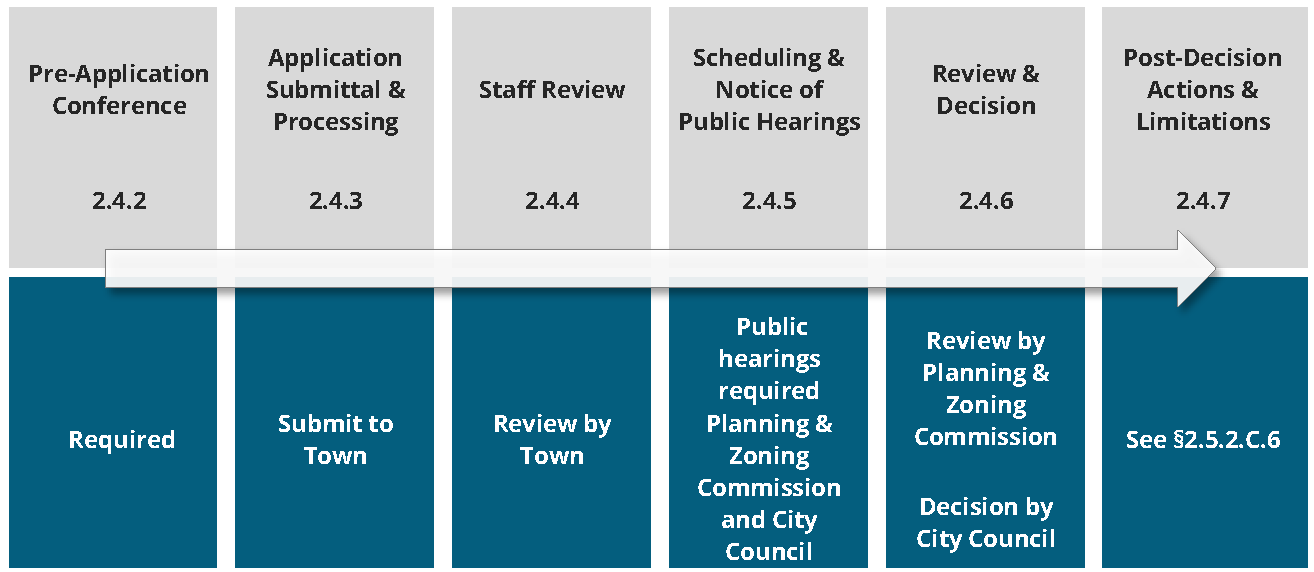
Zoning map amendment procedure. The process diagram below identifies the applicable steps from § 2.4: Common Review Procedures, that apply to the review of Zoning Map amendment applications. Additions or modifications to the common review procedures are noted below.
1.
Pre-application conference. A pre-application conference is required in accordance with § 2.4.2: Pre-Application Conference.
2.
Application submittal and processing. The application shall be submitted, accepted, revised, and may be withdrawn, in accordance with § 2.4.3: Application Submittal and Processing.
3.
Staff review. The staff shall review the application and prepare a staff report and recommendation in accordance with § 2.4.4: Staff Review.
4.
Scheduling and notice of public hearings.
a.
Neighborhood meeting. A neighborhood meeting is recommended in accordance with § 2.4.5.A, Neighborhood Meeting.
b.
Public hearings. The application shall be scheduled for public hearings before the Planning and Zoning Commission and City Council and shall be noticed pursuant to § 2.4.5: Scheduling and Notice of Public Hearings.
5.
Review and decision. The application shall be reviewed and decided upon by the Planning and Zoning Commission and City Council in accordance with § 2.4.6: Review and Decision, with the following modifications:
a.
Planning and zoning commission review and recommendation. The Planning and Zoning Commission shall review the application in accordance with the approval criteria in § 2.5.2.D and shall forward its recommendation to the City Council.
b.
City Council review and decision. The City Council may review and approve, approve with conditions, or deny the application in accordance with the approval criteria in § 2.5.2.D.
6.
Post-decision actions and limitations. All common procedures in § 2.4.7: Post-Decision Actions and Limitations, shall apply with the following modifications:
a.
If a written protest against such proposed amendment has been filed pursuant to § 2.4.5.G: Protest Procedures, the amendment shall not become effective except by the favorable vote of the majority of the members of City Council.
b.
Where there is not a written protest against such a proposed amendment, supplement or change, and the decision of the Planning and Zoning Commission is for denial, a three-fourths vote of all of the City Council shall be required to overrule the decision of the Planning and Zoning Commission.
c.
Following approval of a Rezoning by City Council, the Director shall prepare a revision to the Official Zoning Map.
D.
Review criteria. In reviewing a proposed Rezoning application, the review and decision-making body shall consider if the proposed Rezoning application:
a.
Is consistent with the Comprehensive Plan and the purposes of this UDC;
b.
Is consistent with the purpose statement of the proposed zoning district;
c.
There have been significant changes in the area to warrant a zoning change;
d.
The intensity of development in the new zoning district is not expected to create significantly adverse impacts to surrounding properties or the neighborhood; and
e.
Public facilities and services are available to adequately serve the subject property while maintaining adequate level of service to existing development; and/or:
f.
There was an error in establishing the current zoning.
2.5.3.
Rezoning to planned development (PD).
A.
Purpose. The Rezoning to Planned Development (PD) procedure is intended to achieve greater flexibility than allowed by the strict application of this UDC, and to encourage unique or innovative land use concepts, while providing greater benefit to the Town and to ensure efficient provision of services and utilities. The Rezoning to PD procedure shall not be used when a Special Use Permit, Variance, Minor Modification, or Rezoning to an existing base zoning district could achieve a similar result.
B.
Applicability.
1.
This procedure applies to new PD proposals, and to any proposed amendment to an existing PD that would affect either the text of the PD district ordinance or the general layout of any element of the preliminary PD plan, and that does not contain its own amendment procedures or qualify for approval pursuant to § 2.10.3: Minor Modification.
2.
Any property owner in a zoning district other than the Mixed-Use zoning districts may propose a PD zoning district in accordance with these procedures.
3.
A parcel proposed for a PD is not required to be under single ownership. However, if not under single ownership, the multiple owners shall all consent to the development of their individual properties consistent with the requirements of the proposed PD district ordinance. Any transfer of land within the development resulting in ownership within the development by two or more parties after an application has been filed shall not alter the applicability of the regulations contained in this UDC.
4.
All applications that involve subdivision of a lot or parcel shall also be subject to the platting procedures in § 2.9: Platting Procedures.
C.
Overview of two-step PD process. Evaluation and approval of an application for Rezoning to PD shall occur in two phases, each of which is further detailed in the sections that follow.
1.
Preliminary PD concept plan.
a.
The purpose of the Preliminary PD Concept Plan is to allow the applicant, the Town, and the public to evaluate and discuss basic concepts of the proposed PD and to consider whether the development of the property as a PD will result in a significant improvement over its development within a base zoning district.
b.
The review and consideration of the preliminary PD plan provides the opportunity to discuss and evaluate conceptual issues such as the appropriate number and types of residential units and commercial areas; the types of uses and dimensional standards; the development standards applicable to the site; the general locations intended to be developed; and the initial planning for delivery of utilities and infrastructure and whether they will be provided on-site and/or connected to public systems.
c.
The outcome of the Preliminary PD Concept Plan review shall be an identification of issues and concerns that the applicant shall address to receive approval for a Final PD Site Plan from the Town.
2.
Final PD site plan. The purpose of the Final PD Site Plan is for the applicant to respond to the issues raised during the review of the Preliminary PD Concept Plan and to prepare detailed engineering solutions to those issues and concerns that conform to the approved Preliminary PD Concept Plan.
D.
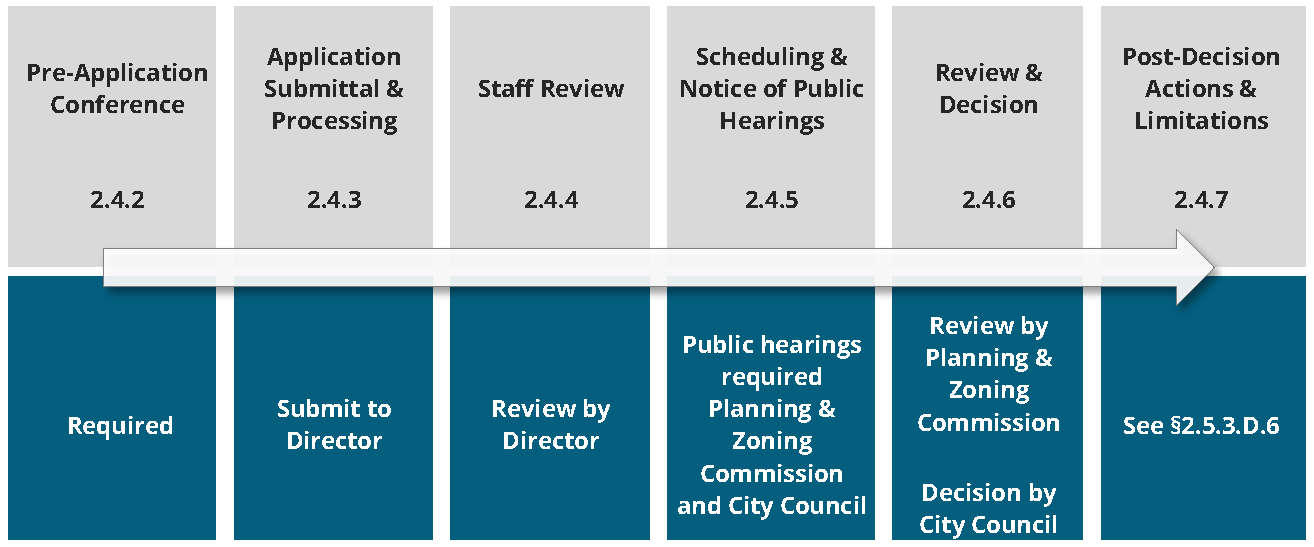
Preliminary PD procedure. The process diagram below identifies the applicable steps from § 2.4: Common Review Procedures, that apply to the review of preliminary PD applications. Additions or modifications to the common review procedures are noted below.
1.
Pre-application conference. A pre-application conference is required in accordance with § 2.4.2: Pre-Application Conference.
2.
Application submittal and processing. The application shall be submitted, accepted, revised, and may be withdrawn, in accordance with § 2.4.3: Application Submittal and Processing, with the following modifications:
a.
Preliminary PD concept plan. The complete Preliminary PD Concept Plan submittal requirements are identified in the Administrative Manual.
b.
PD standards.
i.
The PD standards shall specify the terms and conditions defining the development parameters, including applicable uses and development standards and any authorized deviations from the standards of this Code, and shall provide for the management and maintenance of development.
ii.
The PD standards shall establish the responsibility of the developer to design and construct or install required and proposed on- and off-site public facilities in compliance with applicable Town, state, and federal regulations. This shall include the responsibility to dedicate to the public the rights-of-way and easements necessary for the construction and installation of such improvements.
c.
Phasing plan. If development in the proposed PD is proposed to be phased, the Preliminary PD Concept Plan and standards shall include a development phasing plan that includes the general sequence and timing of development, including types and number of units and the timing of infrastructure and public improvements.
3.
Staff review. The staff shall review the application and prepare a staff report and recommendation in accordance with § 2.4.4: Staff Review.
4.
Scheduling and notice of public hearings.
a.
Neighborhood meeting. A neighborhood meeting is recommended in accordance with § 2.4.5.A, Neighborhood Meeting.
b.
Public hearings. The application shall be scheduled for public hearings before the Planning and Zoning Commission and City Council and shall be noticed pursuant to § 2.4.5: Scheduling and Notice of Public Hearings.
5.
Review and decision. The application shall be reviewed and decided upon by the City Council in accordance with § 2.4.6: Review and Decision, with the following modifications:
a.
Planning and zoning commission review and recommendation. The Planning and Zoning Commission shall review the application in accordance with the approval criteria in § 2.5.3.F: Review Criteria and shall forward its recommendation to the City Council.
b.
City Council Review and Decision. The City Council may review and approve, approve with conditions, or deny the application in accordance with the approval criteria in § 2.5.3.F: Review Criteria.
6.
Post-decision actions and limitations. All common procedures in § 2.4.7: Post-Decision Actions and Limitations, shall apply with the following modifications:
a.
Expiration of approval.
i.
If a Final PD Site Plan has not been submitted within two years following approval of the Preliminary PD Concept Plan and PD standards, the approval shall expire unless the property owner requests an extension prior to the expiration of the two-year period.
ii.
The Planning and Zoning Commission and City Council have the option to extend these time periods upon written request prior to the expiration. The burden is on the applicant to present evidence showing:
a.
Failure to proceed with development of the Final PD Site Plan was beyond the applicant's control; and
b.
There is a reasonable likelihood that the next step in the development application will be submitted in the next calendar year.
iii.
Permitted time frames do not change with successive owners.
b.
Effect of approval. Approval of a Preliminary PD Concept Plan shall be deemed to authorize the applicant to submit to the Town an application for a Final PD Site Plan pursuant to the procedure below. It shall not constitute final approval for the PD. Preliminary PD Concept Plan approval vests no development rights.
E.
Final PD procedure. The process diagram below identifies the applicable steps from § 2.4: Common Review Procedures, that apply to the review of final PD applications. Additions or modifications to the common review procedures are noted below.
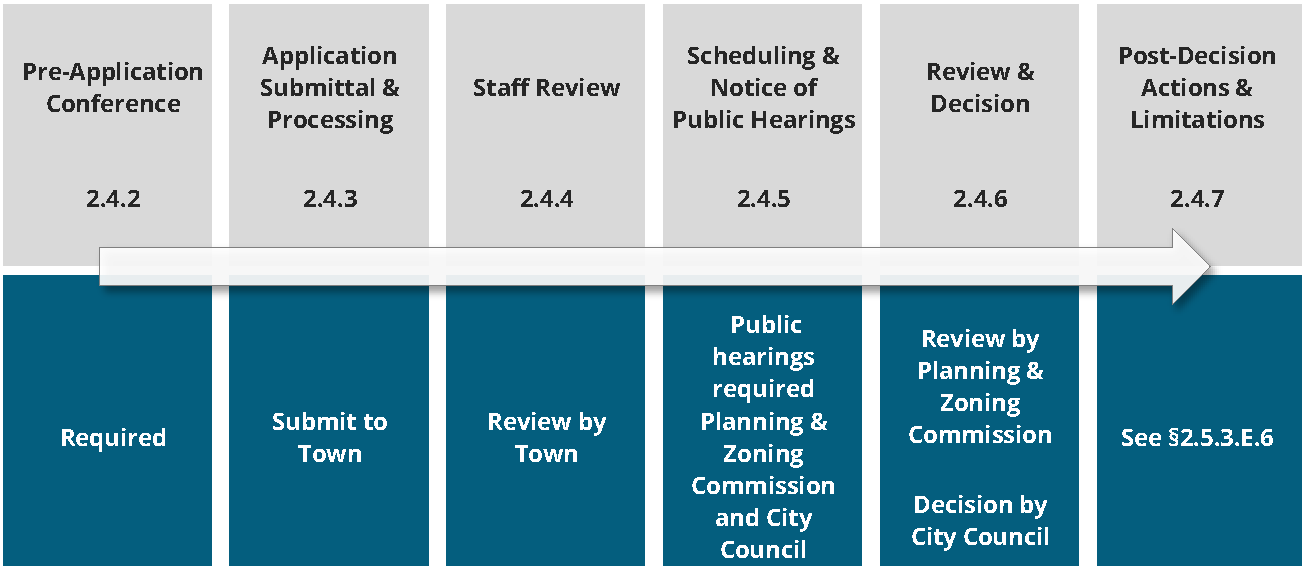
1.
Pre-application conference. A pre-application conference is required in accordance with § 2.4.2: Pre-Application Conference.
2.
Application submittal and processing. The application shall be submitted, accepted, revised, and may be withdrawn, in accordance with § 2.4.3: Application Submittal and Processing, with the following modifications:
a.
Plan requirements. The Final PD Site Plan submittal requirements are identified in the Administrative Manual.
b.
Public benefit. An analysis of how the proposed PD addresses a demonstrated community need or otherwise results in one or more benefits that offset the impacts of the requested flexibility from the requirements of this UDC per the Decision-Making Principles of the Comprehensive Plan.
c.
Conformance with the preliminary PD concept plan and standards. The Final PD Site Plan shall conform to the approved Preliminary PD Concept Plan and PD standards and any associated conditions of approval. If the Final PD Site Plan includes any of the following modifications from the Preliminary PD Concept Plan, then the application shall not be approved and a new application for a Preliminary PD Concept Plan shall be required.
i.
A reduction by greater than five percent of the open space proposed;
ii.
An increase by greater than ten percent in the proposed commercial gross floor area;
iii.
An increase by greater than five percent of the approved number of residential dwelling units; or
iv.
Any change that is substantially inconsistent with a condition of the preliminary PD plan approval.
3.
Staff review. The staff shall review the application and prepare a staff report and recommendation in accordance with § 2.4.4: Staff Review.
4.
Scheduling and notice of public hearings.
a.
Neighborhood meeting. A neighborhood meeting is recommended in accordance with § 2.4.5.A, Neighborhood Meeting.
b.
Public hearings. The application shall be scheduled for public hearings before the Planning and Zoning Commission and City Council and shall be noticed pursuant to § 2.4.5: Scheduling and Notice of Public Hearings.
5.
Review and decision. The application shall be reviewed and decided upon by the City Council in accordance with § 2.4.6: Review and Decision, with the following modifications:
a.
Planning and Zoning Commission review and recommendation. After receipt of the staff report, the Planning and Zoning Commission shall conduct a public hearing on the application for the Final PD Site Plan. The Planning and Zoning Commission shall recommend to the City Council to approve, approve with conditions, or deny the application for a Final PD Site Plan and PD standards based on the criteria in § 2.5.3.F: Review Criteria and whether it conforms to the approved Preliminary PD Concept Plan.
b.
City Council review and decision. After receipt of a recommendation from the Planning and Zoning Commission, the City Council shall conduct a public hearing on the application for the Final PD Site Plan, PD standards, and the authorizing ordinance. The City Council shall approve, approve with conditions, or deny the application for a Final PD Site Plan and standards based on the criteria in § 2.5.3.F: Review Criteria and whether it conforms to the approved Preliminary PD Concept Plan.
6.
Post-decision actions and limitations. All common procedures in § 2.4.7: Post-Decision Actions and Limitations, shall apply with the following modifications:
a.
Map revision. Following approval of a Rezoning to PD, the Director shall prepare an appropriate revision to the Official Zoning Map.
b.
Effect of approval. Review of a Final PD Site Plan may be conducted simultaneously with Preliminary Plat review pursuant to § 2.9: Platting Procedures, if applicable. Platting requirements otherwise applicable to the development may be modified by the Planning and Zoning Commission using the procedure described in § 2.10.3: Minor Modification where it finds that such modification is not in conflict with zoning district standards and regulations and the approved Preliminary PD Concept Plan.
c.
Binding approval. An approved Final PD Site Plan shall be binding upon the petitioner, their successors and assigns, and shall limit and control the issuance and validity of all Zoning Verification Letters.
d.
Expiration or termination of approval.
i.
If a Building Permit has not been obtained within two years following approval of the Final PD Site Plan, the Final PD Site Plan shall expire unless the property owner requests an extension prior to the expiration of the two-year period.
ii.
If the Final PD Site Plan consists of more than a single use, the property owner must make substantial progress in obtaining Building Permits for the remainder of the uses authorized by the Final PD Site Plan, in accordance with an adopted phasing plan. The Planning and Zoning Commission or the City Council may initiate review of the development in order to determine whether significant progress is being made. In the event that the City Council determines that significant progress is not being made, following notice and a public hearing, the City Council may terminate the PD plan and PD standards or may attach additional conditions to the extension of the PD plan or PD standards.
iii.
The Planning and Zoning Commission and City Council have the option to extend these time periods upon written request prior to the expiration. The burden is on the applicant to present evidence showing:
a.
Failure to proceed with development of the PD plan was beyond the applicant's control; and
b.
There is a reasonable likelihood that the next step in the development application will be submitted within the next calendar year.
iv.
Permitted time frames do not change with successive owners.
e.
Reversion to previous zoning. If a Final PD Site Plan expires, the Director may initiate a Rezoning process to consider a reversion to the prior zoning designation.
f.
Relationship to Code. Except as expressly provided otherwise in a Final PD Site Plan, all development of property within the PD district shall conform to all other standards of this UDC. If the approved Final PD Site Plan falls silent concerning a requirement but this UDC does not, the UDC shall be the controlling document. If the Final PD Site Plan conflicts with this UDC, the Final PD Site Plan shall control.
g.
Amendments to preliminary concept and final planned development site plan.
i.
Generally.
a.
The applicant or its successors may request amendments to the Preliminary PD Concept Plan and PD standards or the Final PD Site Plan.
b.
Amendments to the approved Preliminary PD Concept Plan or Final PD Site Plan shall be delineated as major or minor amendments, according to the criteria set forth in this section.
c.
Amendments to the approved Preliminary PD Concept Plan or Final PD Site Plan will not affect buildings or portions of the district not included in the proposed amendment.
d.
Upon receipt of a PD amendment application, the Director shall determine if the proposed amendment constitutes a major or minor amendment subject to the criteria in §§ 2.5.3.E.6.g.ii and 2.5.3.E.6.g.iii below.
ii.
Major amendments.
a.
An amendment will be deemed major if it involves any one of the following:
i.
A change in the overall PD district boundary;
ii.
A change of ten percent or more of the gross square footage of nonresidential building area;
iii.
A change of five percent or more of the approved number of projected dwelling units;
iv.
Any change to any included public or private parks and/or open space;
v.
Any change in land use or density that is likely to substantially impact or burden public facilities and utilities infrastructure as determined by the Director;
vi.
Any change in land use or density that is likely to substantially impact or burden mobility adjacent to the PD district or to the overall major street system;
vii.
Any other proposed change to the Preliminary PD Concept Plan or Final PD Site Plan, which substantively alters one or more components of the PD district.
b.
If the Director determines the amendment to be major, the amendment request shall be processed under the Rezoning procedure described in this section.
iii.
Minor amendments. Amendments not meeting one or more of the criteria listed above for major amendments shall be considered minor. If the Director determines the amendment to be minor, the Director may administratively act on the amendment and attach stipulations or conditions of approval thereto, to protect the public health, safety, and welfare.
F.
Review criteria. Amending the Official Zoning Map to approve a PD is a matter committed to the legislative discretion of the City Council. In deciding the application, the Planning and Zoning Commission in their review and recommendation, and the City Council in their decision shall consider whether and the extent to which the proposed PD meets the general approval criteria for Rezoning in § 2.5.2.D, and also the following:
1.
Whether the proposed PD plan:
a.
Implements the goals and actions of the Comprehensive Plan;
b.
Provides benefit to the Town;
c.
Incorporates innovative design, layout, or configuration resulting in enhanced development feasibility and quality over what could have been accomplished through strict application of a base zoning district or other standards of this UDC. The improvements in quality may include, but are not limited to:
i.
Improvements in open space provision and access;
ii.
Enhanced landscape;
iii.
Environmental protection;
iv.
Tree/vegetation preservation;
v.
Creation of multiple-use projects including residential, commercial, and social amenities;
vi.
Efficient provision of streets, utilities, and public services; or
vii.
Increased diversity of housing options and neighborhood typologies;
2.
Whether the proposed PD plan meets the other standards of this UDC not expressly modified by the Final PD Site Plan or PD standards; and
3.
The applicant's proposal is impractical to achieve within one of the Residential, Mixed-Use, or Nonresidential zoning districts in accordance with Article III: Zoning Districts, but is consistent with the above criteria.
2.5.4.
Zoning text amendment.
A.
Purpose. Under the provisions of TLGC Chapter 211, the City Council is authorized to amend, change, or supplement by ordinance the text of this UDC. The Zoning Text Amendment procedure is intended to provide a method for changing the text of this UDC.
B.
Applicability. The provisions of this UDC may periodically be amended or repealed.
C.
Zoning text amendment procedure. The process diagram below identifies the applicable steps from § 2.4: Common Review Procedures, that apply to the review of Zoning Text Amendment applications. Additions or modifications to the common review procedures are noted below.
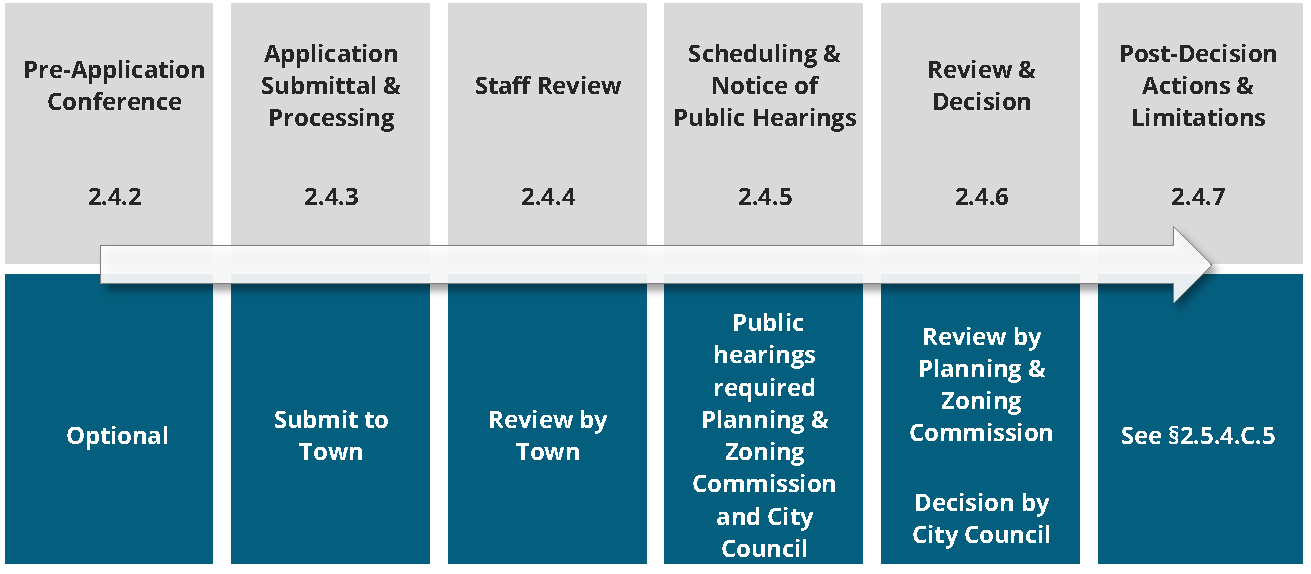
1.
Application submittal and processing. The application shall be submitted, accepted, revised, and may be withdrawn, in accordance with § 2.4.3: Application Submittal and Processing, with the following modification:
a.
A zoning text amendment application shall be prepared by the Director. If the Zoning Text Amendment is initiated by the Planning and Zoning Commission or City Council, the Director shall prepare the application at the request of the Planning and Zoning Commission or City Council.
2.
Staff review. The staff shall review the application and prepare a staff report and recommendation in accordance with § 2.4.4: Staff Review.
3.
Scheduling and notice of public hearings.
a.
Neighborhood meeting. A neighborhood meeting is recommended in accordance with § 2.4.5.A, Neighborhood Meeting.
b.
Public hearings. The application shall be scheduled for public hearings before the Planning and Zoning Commission and City Council and shall be noticed pursuant to § 2.4.5: Scheduling and Notice of Public Hearings.
4.
Review and decision. The application shall be reviewed and decided upon by the City Council in accordance with § 2.4.6: Review and Decision, with the following modifications:
a.
Planning and Zoning Commission review and recommendation. The Planning and Zoning Commission shall review the application in accordance with the approval criteria in § 2.5.4.D: Review Criteria and shall forward its recommendation to the City Council.
b.
City Council review and decision. The City Council may review and approve, approve with conditions, or deny the application in accordance with the approval criteria in § 2.5.4.D: Review Criteria.
5.
Post-decision actions and limitations. All common procedures in § 2.4.7: Post-Decision Actions and Limitations, shall apply with the following modifications:
a.
Approval of a Zoning Text Amendment authorizes the approved revision to the text of this UDC only. A Zoning Text Amendment shall not authorize specific development activity.
b.
A Zoning Text Amendment shall remain valid until the revised text of this UDC is subsequently amended in accordance with this § 2.5.4: Zoning Text Amendment.
D.
Review criteria. In reviewing a proposed Zoning Text Amendment application, the review and decision-making body shall consider if the proposed Zoning Text Amendment:
1.
Is consistent with the Comprehensive Plan, other adopted plans, and other Town policies;
2.
Does not conflict with other provisions of this UDC or other provisions in the Code of Ordinances or state law;
3.
Is necessary to address a demonstrated community need;
4.
Is necessary to respond to changes in conditions and/or policy;
5.
Is necessary to correct an omission or error in this UDC; and/or
6.
Is consistent with the general purpose and intent of this UDC.
2.5.5.
Comprehensive plan amendment.
A.
Purpose. The Comprehensive Plan Amendment procedure is intended to provide a mechanism for the Town to amend the text and maps of the Comprehensive Plan or for adoption of a new Comprehensive Plan. The amendment process is established to provide flexibility in response to changing circumstances and to reflect changes in public policy, and to advance the general welfare of the Town.
B.
Applicability. An amendment to the Comprehensive Plan may be initiated by the City Council, the Planning and Zoning Commission, or the Director.
C.
Comprehensive plan amendment procedure. The process diagram below identifies the applicable steps from § 2.4: Common Review Procedures, that apply to the review of Comprehensive Plan Amendment applications. Additions or modifications to the common review procedures are noted below.
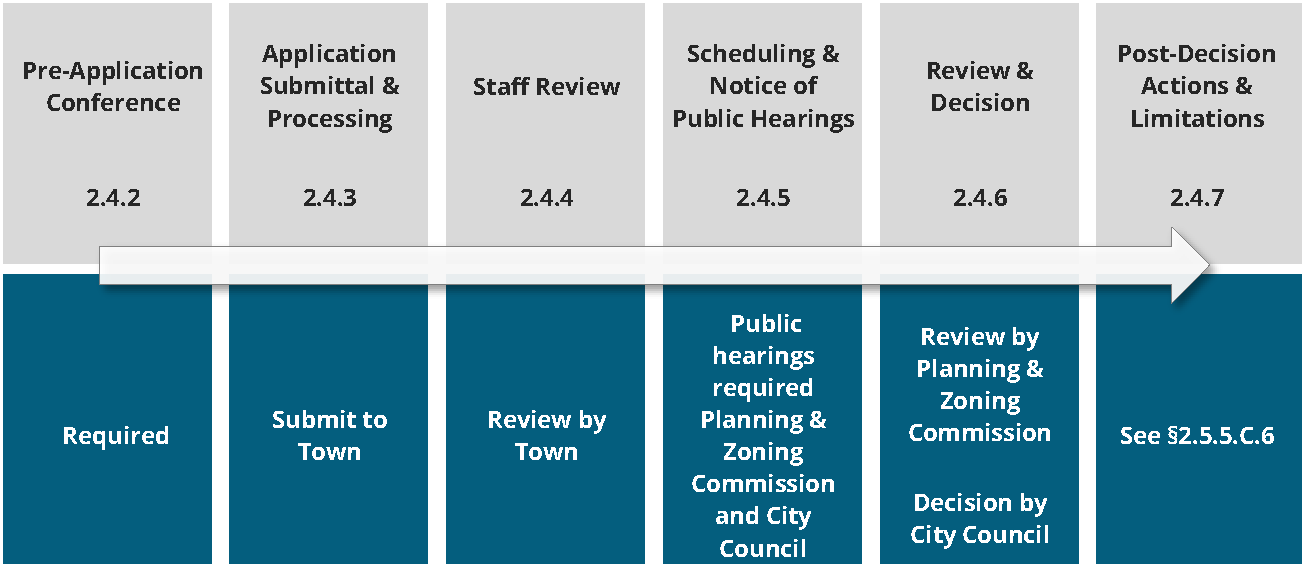
1.
Pre-application conference. A pre-application conference is required in accordance with § 2.4.2: Pre-Application Conference.
2.
Application submittal and processing. The application shall be submitted, accepted, revised, and may be withdrawn, in accordance with § 2.4.3: Application Submittal and Processing.
3.
Staff review. The staff shall review the application and prepare a staff report and recommendation in accordance with § 2.4.4: Staff Review.
4.
Scheduling and notice of public hearings.
a.
Neighborhood meeting. A neighborhood meeting is recommended in accordance with § 2.4.5.A, Neighborhood Meeting.
b.
Public hearings. The application shall be scheduled for public hearings before the Planning and Zoning Commission and City Council and shall be noticed pursuant to § 2.4.5: Scheduling and Notice of Public Hearings.
5.
Review and decision. The application shall be reviewed and decided upon by the City Council in accordance with § 2.4.6: Review and Decision, with the following modifications:
a.
Planning and Zoning Commission review and recommendation. The Planning and Zoning Commission shall review the application in accordance with the approval criteria in § 2.5.5.D, and shall forward its recommendation to the City Council.
b.
City Council review and decision. The City Council may review and approve, approve with conditions, or deny the application in accordance with the approval criteria in § 2.5.5.D.
6.
Post-decision actions and limitations. The City Council decision is a final action and may not be appealed.
D.
Review criteria. In reviewing a proposed Comprehensive Plan Amendment application, the review and decision-making body shall consider if:
1.
There was an error in the original Comprehensive Plan adoption;
2.
Events, trends, or facts after adoption of the Comprehensive Plan have changed the City Council's original findings made upon plan adoption; and/or
3.
Events, trends, or facts after adoption of the Comprehensive Plan have changed the character or condition of an area so as to make the proposed amendment necessary.
4.
The amendment is not in conflict with any portion of the goals and policies of the Comprehensive Plan.
5.
The amendment constitutes a substantial benefit to the Town and is not solely for the good or benefit of a particular landowner or owners at a particular point in time.
6.
The proposed amendment and other amendments in the general area are compatible with the land use goals of the Comprehensive Plan and that they avoid creation of isolated uses that will cause incompatible community form and a burden on public services and facilities.
2.5.6.
Annexation.
A.
Procedure. Annexation into the Town may occur in accordance with the procedures in:
1.
TLGC Chapter 43;
2.
TLGC § 212.172;
3.
Section 1.04 of the Town's Charter; and
4.
Other applicable Town ordinances.
B.
Concurrent zoning. In the event that the Planning and Zoning Commission holds a hearing on proposed Annexation, it may, at its discretion, at the same time hold a hearing upon the initial zoning that is to be given to the area or tract to be annexed, and make a recommendation on both matters to the City Council so that the City Council can, if it desires, act on the matter of initial zoning and Annexation at the same time.
C.
Newly annexed territory. Unless an initial zoning is concurrently approved at the time of Annexation, all territory annexed to the Town hereafter shall be temporarily classified for R-1 single-family dwelling purposes only until otherwise zoned by the governing body of the Town. The Planning and Zoning Commission shall, as soon as practicable after Annexation of any of the territory to the Town, institute proceedings on its own motion to give the newly annexed territory an initial zoning, and the procedure to be followed shall be the same as is in § 2.5.2: Rezoning.
Sec. 2.6. - Site planning and miscellaneous permits.
2.6.1.
Concept plan.
A.
Purpose. The Concept Plan review procedure is intended to provide a mechanism for review of large and/or complex or phased projects as well as to provide an option to assist any applicant for development in determining the general feasibility of their project. A Concept Plan may be submitted either in conjunction with an application for Rezoning or as a precursor to the preparation and submittal of the more specific and detailed plans required for Preliminary Plat or Preliminary Replat, Major Site Plan, or Special Use Permit approvals.
B.
Applicability.
1.
A Concept Plan shall be required for any application that meets either of the following criteria:
a.
The application proposes to phase initiation of the development over three or more years; or
b.
The Director determines that the application is unusually complex or raises potentially unique or serious impacts on the Town or the surrounding areas as it related to the Comprehensive Plan.
2.
A Concept Plan is optional for any Preliminary Plat or Preliminary Replat, Major Site Plan, or Special Use Permit application.
C.
Concept plan for rezoning procedure. The process diagram below identifies the applicable steps from § 2.4: Common Review Procedures, that apply to the review of Concept Plan applications submitted in conjunction with a request for Rezoning. Additions or modifications to the common review procedures are noted below.
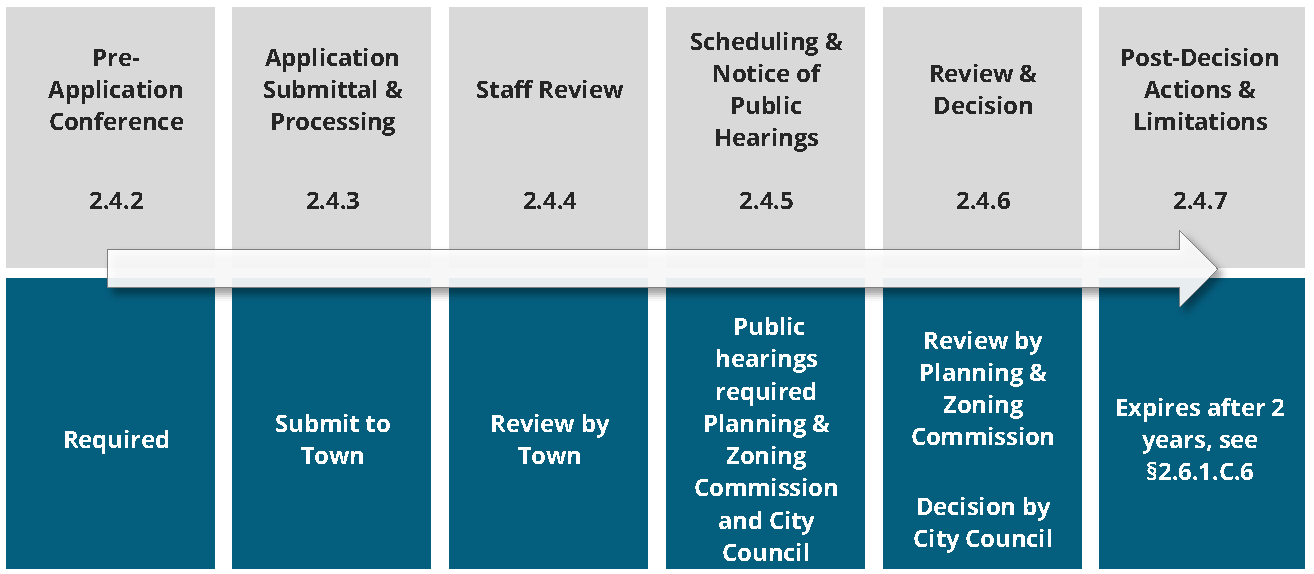
1.
Pre-application conference. A pre-application conference is required in accordance with § 2.4.2: Pre-Application Conference.
2.
Application submittal and processing. The application shall be submitted, accepted, revised, and may be withdrawn, in accordance with § 2.4.3: Application Submittal and Processing.
3.
Staff review. The staff shall review the application and prepare a staff report and recommendation in accordance with § 2.4.4: Staff Review.
4.
Scheduling and notice of public hearings.
a.
Neighborhood meeting. A neighborhood meeting is recommended in accordance with § 2.4.5.A, Neighborhood Meeting.
b.
Public hearings. The application shall be scheduled for public hearings before the Planning and Zoning Commission and City Council and shall be noticed pursuant to § 2.4.5: Scheduling and Notice of Public Hearings.
5.
Review and decision. The application shall be reviewed and decided upon by the Planning and Zoning Commission and City Council in accordance with § 2.4.6: Review and Decision, with the following modifications:
a.
Planning and Zoning Commission review and recommendation. The Planning and Zoning Commission shall review the application in accordance with the approval criteria in § 2.6.1.E and shall forward its recommendation to the City Council.
b.
City Council review and decision. The City Council may review and approve, approve with conditions, or deny the application in accordance with the approval criteria in § 2.6.1.E.
6.
Post-decision actions and limitations. All common procedures in § 2.4.7: Post-Decision Actions and Limitations shall apply.
D.
All other concept plans procedure. The process diagram below identifies the applicable steps from § 2.4: Common Review Procedures, that apply to the review of Concept Plan applications that are not associated with requests for Rezoning. Additions or modifications to the common review procedures are noted below.
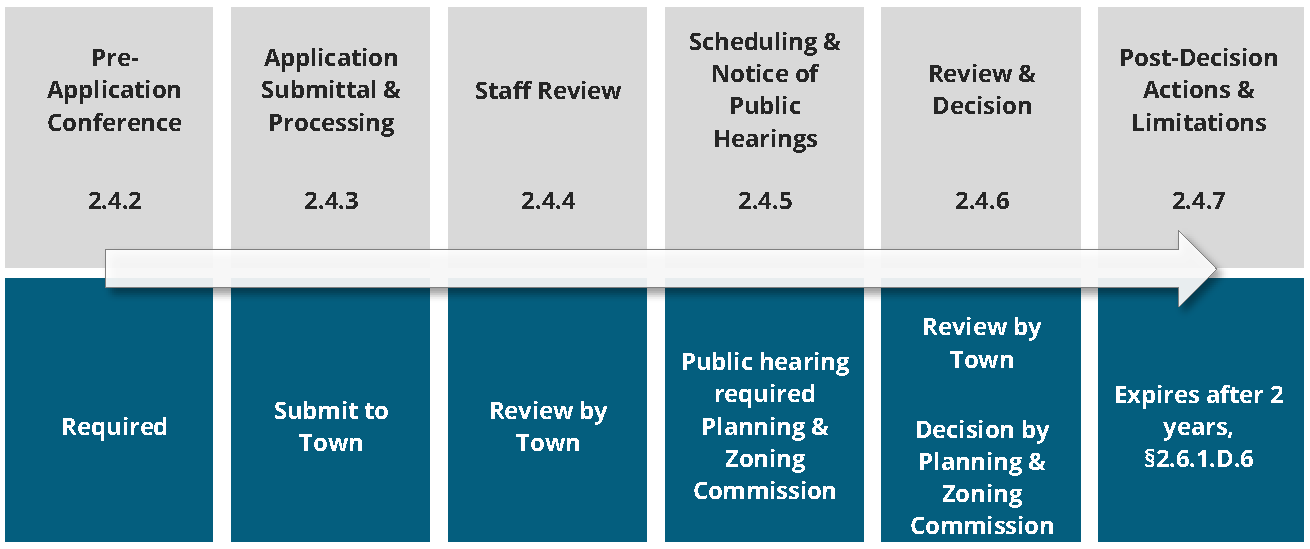
1.
Pre-application conference. A pre-application conference is required in accordance with § 2.4.2: Pre-Application Conference.
2.
Application submittal and processing. The application shall be submitted, accepted, revised, and may be withdrawn, in accordance with § 2.4.3: Application Submittal and Processing, with the following modifications:
a.
The Concept Plan must contain a general site layout plan that includes the following:
i.
Overall property boundary;
ii.
Proposed and existing thoroughfares, boulevards and large streets;
iii.
A time schedule of development;
iv.
Identification of development areas such as districts, blocks or parcels, with proposed phasing; and
v.
All other features necessary to show the arrangement and pattern of public and private land uses.
3.
Staff review. The staff shall review the application and prepare a staff report and recommendation in accordance with § 2.4.4: Staff Review.
4.
Scheduling and notice of public hearings. The application shall be scheduled for a public hearing before the Planning and Zoning Commission and shall be noticed pursuant to § 2.4.5: Scheduling and Notice of Public Hearings.
5.
Review and decision. The application shall be reviewed and decided upon by the Planning and Zoning Commission in accordance with § 2.4.6: Review and Decision, and the approval criteria in § 2.6.1.E.
6.
Post-decision actions and limitations. All common procedures in § 2.4.7: Post-Decision Actions and Limitations shall apply.
E.
Review criteria. In reviewing a proposed Site Plan application, the review and decision-making body shall consider the general approval criteria in § 2.4.6.C: General Approval Criteria.
2.6.2.
Site plan review.
A.
Purpose. The Site Plan review process is intended to ensure compliance with the development and design standards of this UDC and to encourage quality development reflective of the adopted goals and objectives of the Town. The Site Plan review process also ensures that proposed development applications address and mitigate potential adverse impacts prior to issuance of a building or Site Development Permit.
B.
Applicability.
1.
Review required. Major or Minor Site Plan review is required for the following types of activities:
a.
New construction of nonresidential buildings, or residential buildings or sites resulting in three or more additional dwelling units;
b.
Change in use that involves or requires other site improvements such as parking, landscaping, screening, buffering, drainage facilities, or other changes to the site that may be required by this UDC;
c.
Modifications to site improvements such as parking, landscaping, screening, buffering, drainage facilities, or other changes to the site that may be required by this UDC; and
d.
As a component of any Special Use Permit, request to rezone to Planned Development, or request to amend an existing Planned Development or Special Use Permit.
2.
Exemptions from site plan review. Site Plan review is not required for the following activities, but such activities shall be subject to the standards of this UDC and Building Permit review:
a.
Construction of a single-family detached dwelling on a single lot or duplex dwelling on a single lot and/or additions to such dwellings or structures accessory to such dwellings;
b.
A change in use that does not involve a Rezoning or Special Use Permit, or require other site improvements such as parking, landscaping, screening, buffering, drainage facilities, or other changes to the site that may be required by this UDC;
c.
Tenant improvements that do not involve a Rezoning or Special Use Permit, or require other site improvements such as parking, landscaping, screening, buffering, drainage facilities, or other changes to the site that may be required by this UDC;
d.
Construction or erection of accessory buildings or structures, fences, or screening walls;
e.
Construction or erection of temporary uses or structures; and
C.
Thresholds for site plan review type.
1.
Minor site plan. The following types of projects may be approved by the Director through the Minor Site Plan approval process:
a.
Any new nonresidential structure less than 5,000 square feet in gross floor area.
b.
Any application that does not exceed the thresholds for minor redevelopment (Tier 1), listed below:
i.
Expansions, alterations, or modifications that increase the gross floor area of an existing structure by the greater of 10,000 square feet or between ten and 50 percent;
ii.
Expansions, alterations, or modifications that increase or decrease the total number of existing dwelling units on a lot by the lesser of ten dwelling units or between ten and 25 percent;
iii.
The alteration or expansion of any vehicular parking area by the greater of six spaces or 50 percent, excluding resurfacing or restriping;
iv.
The removal or relocation of one or more existing driveways or portions of driveways; or
v.
Any expansion or enlargement of a structure or land use that requires a Special Use Permit.
2.
Major site plan. All other applications that meet the criteria in § 2.6.2.B, Applicability, but that may not be processed as Minor Site Plans shall require a Major Site Plan.
D.
Minor site plan procedure. The process diagram below identifies the applicable steps from § 2.4: Common Review Procedures, that apply to the review of Minor Site Plan applications. Additions or modifications to the common review procedures are noted below.
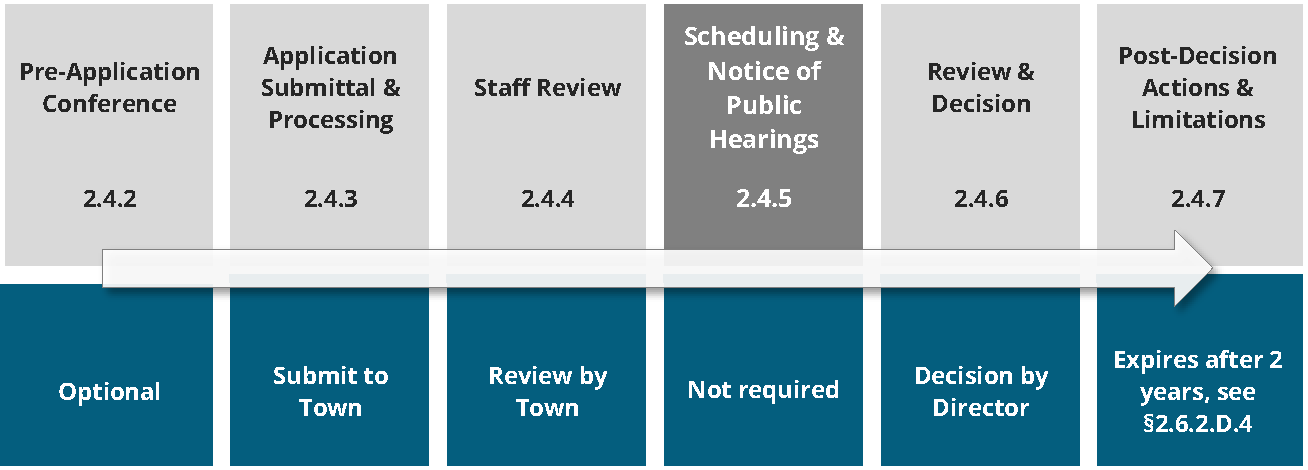
1.
Application submittal and processing. The application shall be submitted, accepted, revised, and may be withdrawn, in accordance with § 2.4.3: Application Submittal and Processing.
2.
Staff review. The staff shall review the application in accordance with § 2.4.4: Staff Review.
3.
Review and decision. The application shall be reviewed and decided upon by the Director in accordance with § 2.4.6: Review and Decision, and the review criteria in § 2.6.2.F: Review Criteria.
4.
Post-decision actions and limitations. All common procedures in § 2.4.7: Post-Decision Actions and Limitations, shall apply with the following modification: Site Plan review expires after two years.
E.
Major site plan procedure. The process diagram below identifies the applicable steps from § 2.4: Common Review Procedures, that apply to the review of Major Site Plan applications. Additions or modifications to the common review procedures are noted below.
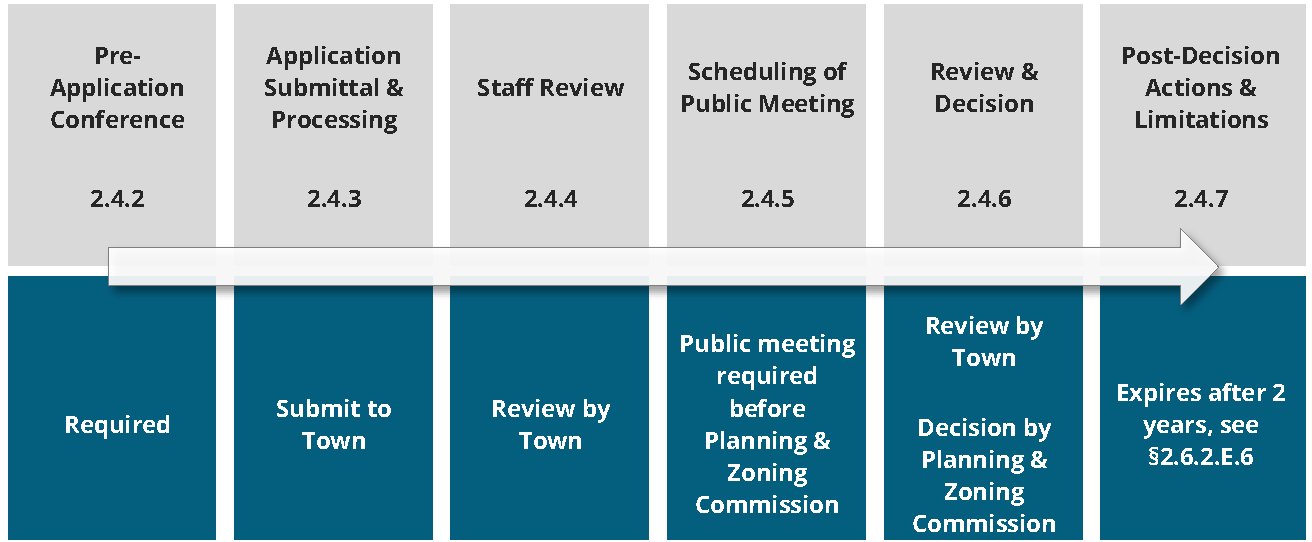
1.
Pre-application conference. A pre-application conference is required in accordance with § 2.4.2: Pre-Application Conference.
2.
Application submittal and processing. The application shall be submitted, accepted, revised, and may be withdrawn, in accordance with § 2.4.3: Application Submittal and Processing.
3.
Staff review. The staff shall review the application and prepare a staff report and recommendation in accordance with § 2.4.4: Staff Review.
4.
Scheduling and notice of public meeting.
a.
Neighborhood meeting. A neighborhood meeting is recommended in accordance with § 2.4.5.A: Neighborhood Meeting.
b.
Public meeting. The application shall be scheduled for a public meeting before the Planning and Zoning Commission.
5.
Review and decision. The application shall be reviewed and decided upon by the Planning and Zoning Commission in accordance with § 2.4.6: Review and Decision, and the approval criteria in § 2.6.2.F: Review Criteria.
6.
Post-decision actions and limitations. All common procedures in § 2.4.7: Post-Decision Actions and Limitations, shall apply with the following modification: Site Plan review expires after two years.
F.
Review criteria. In reviewing a proposed Site Plan application, the Director shall consider the general approval criteria in § 2.4.6.C: General Approval Criteria.
2.6.3.
Tree permit.
A.
Purpose.
B.
Applicability.
1.
No person shall prune, remove or transplant a tree listed in the Pre-Approved Plant List in the Administrative Manual without first obtaining a Tree Permit approved by the Director of Parks and Recreation pursuant to § 2.6.3: Tree Permit. For purposes of this section, "person" means the owner, tenant, and/or subtenant of, and/or any entity or individual with any interest in, the land on which a tree is located, and/or any contractor or subcontractor of any of them.
2.
This section shall apply to shade trees four-inch caliper or larger, measured six inches from the soil surface, and two and one-half to three-inch caliper ornamental trees or larger measured six inches from the soil surface.
3.
A Tree Permit shall be obtained by a utility company before any trimming and/or removal of tree(s) by or for a utility company, except in the case of emergency repairs.
4.
Branches less than one-half inch in diameter and not more than five percent of the canopy can be removed without a permit.
C.
Tree permit procedure. The process diagram below identifies the applicable steps from § 2.4: Common Review Procedures, that apply to the review of Tree Permit applications. Additions or modifications to the common review procedures are noted below.
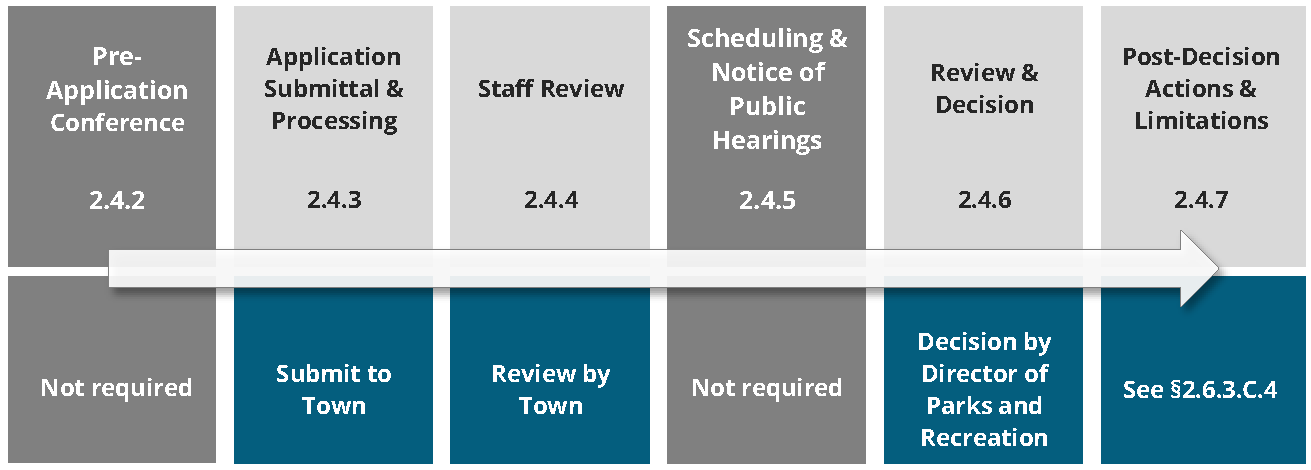
1.
Application submittal and processing. The application shall be submitted, accepted, revised, and may be withdrawn, in accordance with § 2.4.3: Application Submittal and Processing, with the following modification:
a.
Tree Permit applications shall require the same submittal requirements as a Minor Site Plan as identified in the Administrative Manual. This includes aerial imagery of the subject lot and tree(s) to be pruned, removed, or transplanted, unless the Director of Parks and Recreation determines the extent of work does not warrant such imagery.
2.
Staff review. The staff shall review the application in accordance with § 2.4.4: Staff Review.
3.
Review and decision.
a.
The application shall be reviewed and decided upon by the Director in accordance with § 2.4.6: Review and Decision, and the review criteria in § 2.6.3.D: Review Criteria.
b.
The Director of Parks and Recreation shall review the application and may conduct field inspections of the site or development and/or refer the permit application to other departments for review and recommendations as deemed necessary and appropriate by the Director of Parks and Recreation.
c.
Trees shall not be removed or transplanted (or trimmed, in the case of a utility company) unless the Director of Parks and Recreation approves the Tree Permit.
4.
Post-decision actions and limitations. All common procedures in § 2.4.7: Post-Decision Actions and Limitations shall apply with the following modification:
a.
An approved Tree Permit shall expire within six months of the date of the approval of the permit by the Director of Parks and Recreation if substantial progress has not been made toward the approved work.
D.
Review criteria. In reviewing a proposed Tree Permit application, the Director of Parks and Recreation shall consider:
1.
Whether the removal of the protected tree is permitted by this section;
2.
Whether or not a reasonable accommodation or alternative solution can be made to accomplish the desired activity without the removal of the protected tree;
3.
The effect of the removal of the protected tree on erosion, soil moisture, retention, flow of surface waters and drainage systems;
4.
The need for buffering of residential areas from the noise, glare, and the visual effects of nonresidential uses;
5.
Whether the removal of the protected tree affects the public health, safety, or welfare of the Town;
6.
Whether the application demonstrates the attempt to preserve existing trees on the site; and
7.
How the tree removal will be mitigated.
2.6.4.
Temporary use permit.
A.
Purpose. The Temporary Use Permit review procedure is intended to provide a mechanism for enforcement of the temporary use regulations of this UDC, in order to allow short-term and minor deviations for uses that are temporary in nature, that will not adversely impact surrounding properties and land uses, and that can be terminated and removed at will.
B.
Applicability. A Temporary Use Permit is required before establishing, constructing, or installing any temporary or seasonal use or structure designated as requiring a Temporary Use Permit in § 4.2.7: Table of Allowed Uses or § 4.5: Temporary Uses and Structures.
C.
Temporary use permit procedure. The process diagram below identifies the applicable steps from § 2.4: Common Review Procedures, that apply to the review of Temporary Use Permit applications. Additions or modifications to the common review procedures are noted below.
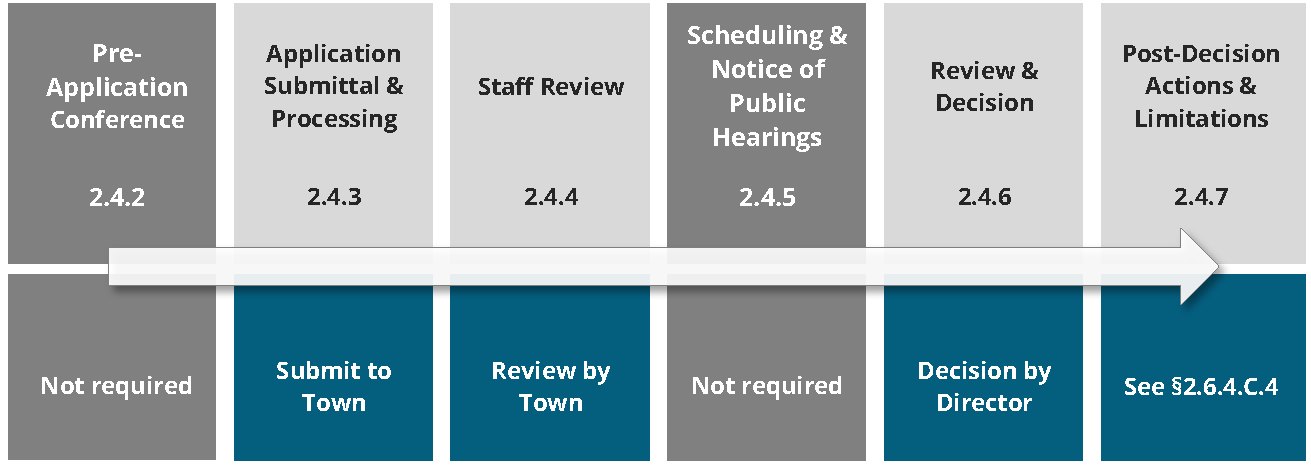
1.
Application submittal and processing. The application shall be submitted, accepted, revised, and may be withdrawn, in accordance with § 2.4.3: Application Submittal and Processing.
2.
Staff review. The staff shall review the application in accordance with § 2.4.4: Staff Review.
3.
Review and decision. The application shall be reviewed and decided upon by the Director in accordance with § 2.4.6: Review and Decision, and the review criteria in § 2.6.4.D: Review Criteria.
4.
Post-decision actions and limitations. All common procedures in § 2.4.7: Post-Decision Actions and Limitations, shall apply with the following modifications:
a.
Effect of approval. A Temporary Use Permit authorizes establishment, construction, or installation of the approved temporary use or structure in accordance with the terms and conditions of the permit.
b.
Expiration of approval.
i.
A Temporary Use Permit shall be valid beginning on the date specified on the permit and shall remain valid for the time period indicated on the permit, but in no event, longer than 180 days.
ii.
Upon request, the Director may grant a one-year extension; however, in no case shall a Temporary Use Permit be valid for more than one year after its original expiration date. This one-year extension period may not be further extended.
iii.
Any Temporary Use Permit requesting an approval period beyond one year shall require a Special Use Permit approval pursuant to § 2.5.1: Special Use Permit.
c.
Removal and restoration. Before the expiration of a Temporary Use Permit, the permittee shall discontinue all temporary uses and remove all temporary structures, and associated property and equipment, and free the temporary use site from all trash, litter, and debris to the satisfaction of the Director.
D.
Review criteria. In reviewing a proposed Temporary Use Permit application, the Director shall consider the general approval criteria in § 2.4.6.C: General Approval Criteria, and the standards in § 4.5: Temporary Uses and Structures.
2.6.5.
Sign permit.
A.
Purpose. The Sign Permit procedure is intended to provide a mechanism for enforcement of the sign regulations of this UDC in order to:
1.
Establish for all signs located on any premises a reasonable and impartial means to permit adequate communication;
2.
Control confusing sign displays that present a hazard to pedestrians and motorists along streets;
3.
Ensure light, air, and open space;
4.
Protect the natural beauty and environment of the Town;
5.
Safeguard and enhance property values;
6.
Protect public and private investment in buildings and open spaces;
7.
Protect the public health, safety, and general welfare; and
8.
Comply with all state and federal laws and settled case law applicable to the Town concerning freedom of expression.
B.
Applicability. No person shall cause a sign to be erected, constructed, relocated, altered, repaired, or maintained until a permit for such has been issued and the fee paid, except as otherwise provided in this UDC.
C.
Sign permit procedure. The process diagram below identifies the applicable steps from § 2.4: Common Review Procedures, that apply to the review of Sign Permit applications. Additions or modifications to the common review procedures are noted below.
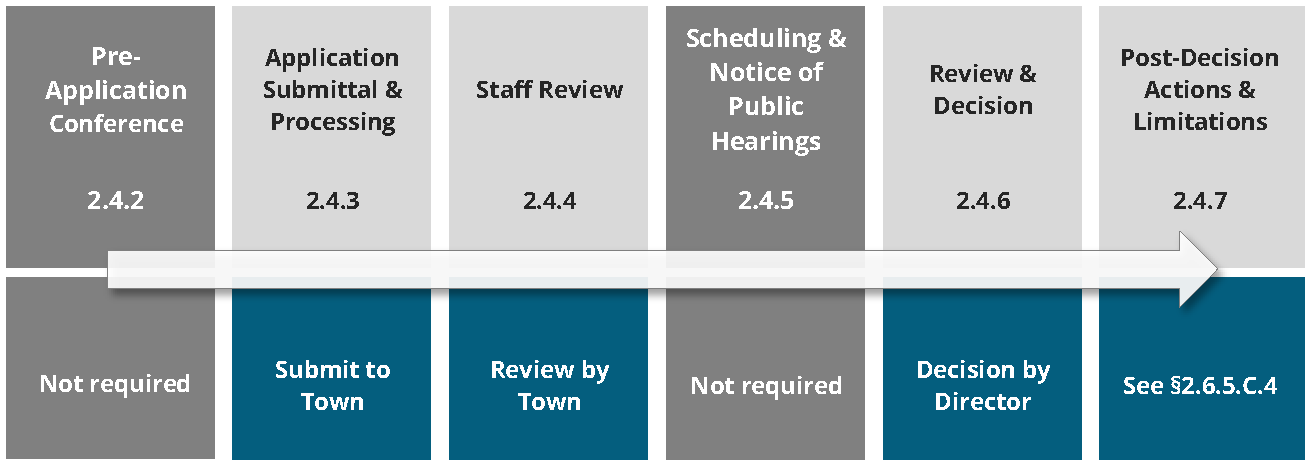
1.
Application submittal and processing. The application shall be submitted, accepted, revised, and may be withdrawn, in accordance with § 2.4.3: Application Submittal and Processing, with the following modification:
a.
Application contents. All applications for permits under this article shall include a drawing to scale of the proposed sign, all existing signs maintained on the premises and visible from the right-of-way, a Site Plan or property survey, and façade plan indicating the proposed location of the sign and specifications.
2.
Staff review. The staff shall review the application in accordance with § 2.4.4: Staff Review.
3.
Review and decision. The application shall be reviewed and decided upon by the Director in accordance with § 2.4.6: Review and Decision, and the review criteria in § 2.6.5.D: Review Criteria.
4.
Post-decision actions and limitations. All common procedures in § 2.4.7: Post-Decision Actions and Limitations, shall apply with the following modifications:
a.
Electrical permit. Prior to issuance of a Sign Permit for a sign in which electrical wiring and connections are to be used, an electrical permit must be obtained. The electrical inspector shall examine the plans and specifications submitted with the application to ensure compliance with the Electrical Code. No sign shall be erected in violation of the Electrical Code.
b.
Lapse of sign permit. A Sign Permit shall lapse automatically if not renewed or if the Certificate of Occupancy of business registration for the premises expires, is revoked, or is not renewed.
c.
Duration. If the work authorized by a Sign Permit issued under this UDC has not commenced within 180 days after the date of issuance, the permit shall become null and void.
d.
Abandoned signs. Within 30 days after any business has abandoned its location or tenant space, the building or former tenant owner, or the building or former tenant agent, or the person having beneficial use of the building, structure, or the lot or tract where such business was located shall remove all signs related to such business or have the sign face replaced with a weatherproof, blank face constructed of professional quality materials. Plywood is prohibited.
e.
Notice of condemnation. Signs adjudged by the Director to be structurally unsafe or to be more than 50 percent destroyed or dilapidated may be referred to the Board of Zoning Adjustment for consideration for condemnation. A condemnation letter will be sent to the owner of the property stating that the sign must be demolished within 15 days of the receipt of the letter. If the sign is not removed within the period allotted, the Town may remove the sign at the property owner's expense.
D.
Review criteria. In reviewing a proposed Sign Permit application, the review and decision-making body shall consider the general approval criteria in § 2.4.6.C: General Approval Criteria, and the standards in § 5.9: Signs.
2.6.6.
Zoning verification letter.
A.
Purpose. The Zoning Verification Letter review procedure is intended to provide a mechanism for the Town to issue a formal confirmation of a property's zoning. The Zoning Verification Letter is an informational document not intended to grant approval for land development in any way and does not verify compliance with ordinances of the Town beyond this UDC.
B.
Applicability. A Zoning Verification Letter can be requested by any property owner or entity seeking to confirm the zoning of a property.
C.
Zoning verification procedure. The process diagram below identifies the applicable steps from § 2.4: Common Review Procedures, that apply to the review of Zoning Verification Letter applications. Additions or modifications to the common review procedures are noted below.
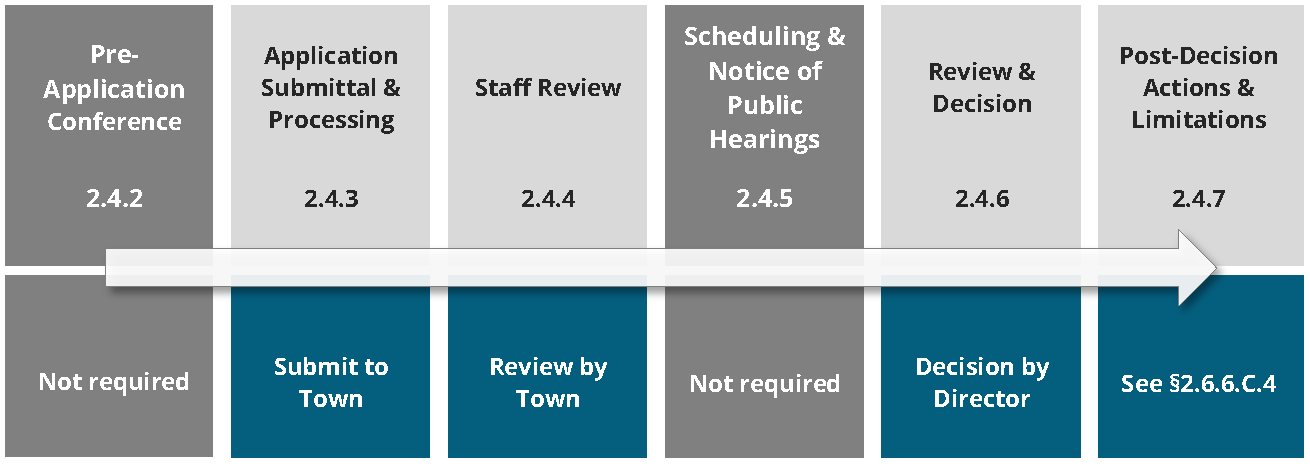
1.
Application submittal and processing. The application shall be submitted, accepted, revised, and may be withdrawn, in accordance with § 2.4.3: Application Submittal and Processing.
2.
Staff review. The staff shall review the application in accordance with § 2.4.4: Staff Review.
3.
Review and decision. The application shall be reviewed and decided upon by the Director in accordance with § 2.4.6: Review and Decision.
4.
Post-decision actions and limitations. All common procedures in § 2.4.7: Post-Decision Actions and Limitations, shall apply with the following modification: A Zoning Verification Letter serves as confirmation of the zoning of a property.
2.6.7.
Change or elimination of nonconformity.
A.
Purpose. The Change or Elimination of Nonconformity review procedure is intended to provide a mechanism for the Town to review minor changes to nonconforming properties and issue a formal confirmation of a property's loss of nonconforming status.
B.
Applicability. A Change or Elimination of Nonconformity is required:
1.
For all applications by a property owner for maintenance or minor repair of a legal nonconformity;
2.
To reflect changes in ownership tenancy, or management of property with an existing nonconformity; and
3.
To provide evidence of and confirm the loss of nonconforming status as described in § 1.6.2.A: Authority to Continue.
C.
Change or elimination of a nonconformity procedure. The process diagram below identifies the applicable steps from § 2.4: Common Review Procedures, that apply to the review of Change or Elimination of a Nonconformity applications. Additions or modifications to the common review procedures are noted below.
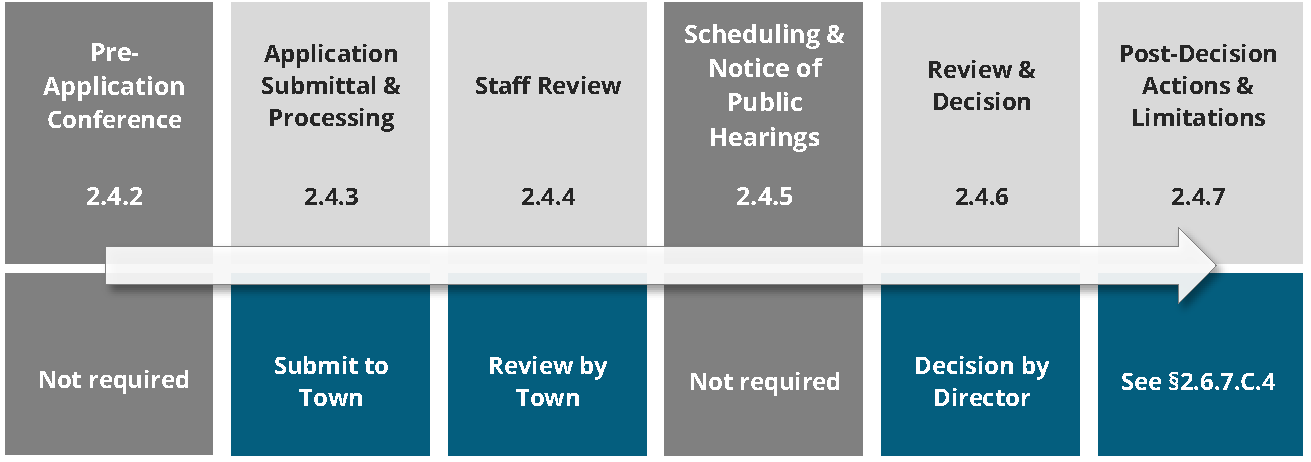
1.
Application submittal and processing. The application shall be submitted, accepted, revised, and may be withdrawn, in accordance with § 2.4.3: Application Submittal and Processing.
2.
Staff review. The staff shall review the application in accordance with § 2.4.4: Staff Review.
3.
Review and decision. The application shall be reviewed and decided upon by the Director in accordance with § 2.4.6: Review and Decision.
4.
Post-decision actions and limitations. All common procedures in § 2.4.7: Post-Decision Actions and Limitations shall apply.
D.
Review criteria. In reviewing a proposed Change or Elimination of a Nonconformity application, the Director shall consider the general approval criteria in § 2.4.6.C: General Approval Criteria and the standards in § 1.6: Nonconformities.
Sec. 2.7. - Engineering plans, studies, and site development permits.
2.7.1.
Purpose. The engineering plans, studies, and site development procedure is intended to ensure compliance with the development standards of this UDC and technical standards of associated Criteria Manuals and to protect the general health, safety, and welfare of the public by reducing the risk of flooding private property and public rights-of-way and ensure that development provides the facilities necessary to accommodate the traffic impacts of the proposed development.
2.7.2.
Applicability.
A.
This procedure shall be required for the following plans, studies, and permits:
1.
Civil engineering plans.
2.
Minor and major Traffic Impact Analysis.
3.
Parking study.
4.
Drainage study.
5.
Utility study.
6.
Site development permit.
7.
Flood hazard development permit.
B.
The plans, studies, and permits listed above may be submitted concurrently with any other required development application with the approval of the Director of Public Works and Engineering and Director of Development and Neighborhood Services.
C.
Flood hazard development permits shall also comply with the following:
1.
A Flood Hazard Development Permit must be obtained before construction or development begins within any special flood hazard area (SFHA) and known flood prone areas to ensure conformance with the provisions of this UDC.
2.
Compliance with the standards in this UDC shall not relieve any person of the independent obligation to comply with all applicable standards and practices established in federal and state law and all other applicable rules, regulations, standards and specifications of the Town regarding development within a SFHA.
2.7.3.
Procedures. The process diagram below identifies the applicable steps from § 2.4: Common Review Procedures, that apply to the review of the applications listed in § 2.7.2: Applicability. Additions or modifications to the common review procedures are noted below.
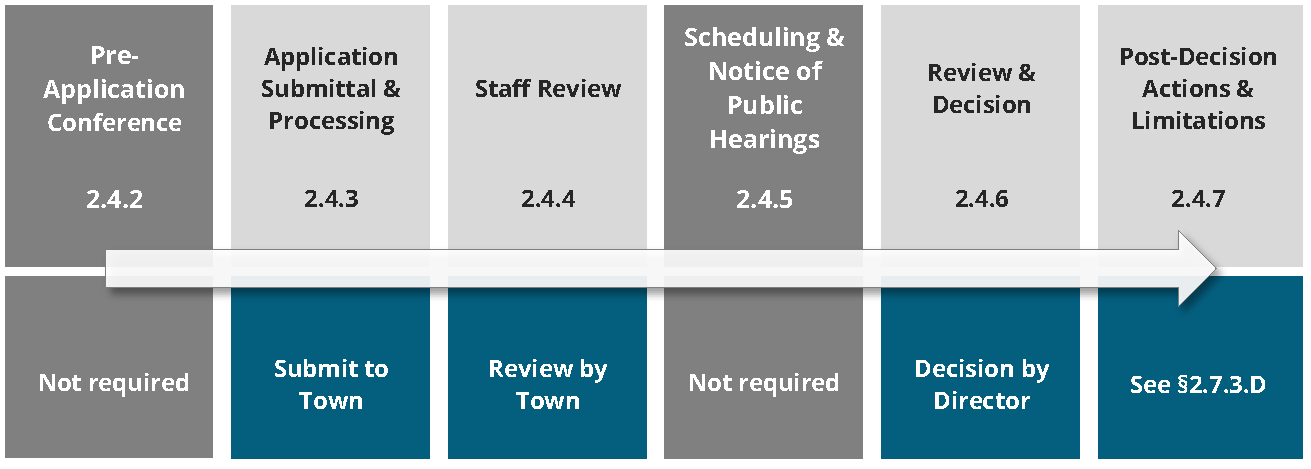
A.
Application submittal and processing. The application shall be submitted, accepted, revised, and may be withdrawn, in accordance with § 2.4.3: Application Submittal and Processing.
B.
Staff review. The staff shall review the application in accordance with § 2.4.4: Staff Review.
C.
Review and decision. The application shall be reviewed and decided upon by the Director or Floodplain Administrator in accordance with § 2.4.6: Review and Decision, and the review criteria in § 2.7.4: Review Criteria.
D.
Post-decision actions and limitations. All common procedures in § 2.4.7: Post-Decision Actions and Limitations, shall apply with the following modifications:
1.
Construction of public improvements.
a.
Construction shall be supervised by the Public Works and Engineering Department.
b.
Completion of construction in accordance with the approved plans and standard specifications of the Town is the entire responsibility of the developer and their contractors. The responsibility of the Public Works and Engineering Department is to assure conformance to the approved plans and specifications.
c.
Any change in design required during construction shall be made by the engineer whose seal and signature are shown on the plans and shall be approved by the Director of Public Works and Engineering. Such changes shall be minor and shall not substantially impact or burden public facilities and utility infrastructure or substantively alter one or more components of the proposed development.
2.
Acceptance of public improvements.
a.
After completion of all items required in the plans and specifications, the contractor shall submit a bond in the amount of ten percent of the contract amount guaranteeing workmanship and materials for a period of one year from the date of final acceptance by the Town. The Director of Public Works and Engineering shall verify that all items have been completed, including filing of the plat and all related easements and documents, and payment of all applicable development fees.
b.
The Director of Public Works and Engineering shall conduct a final inspection of the project and, if all work is found to be acceptable, shall issue a letter of acceptance. Any items of exception noted in the acceptance letter shall be satisfied within the timeframe specified in the letter.
c.
Acceptance of the public improvements shall mean that title to all public improvements is vested in the Town. The applicant and their contractor shall, however, be bound to the Town for a period of one year to repair any defects in the improvements.
3.
Record drawings. Within 30 days of acceptance of the public improvements, the applicant shall submit a complete set of drawings of the paving, drainage, water, and sewer improvements showing all changes made in the plans during construction and containing on each sheet a stamp bearing the signature of the Director of Public Works and Engineering and the date. In addition, one reproducible drawing of the utility plan sheets shall be submitted to the Public Works and Engineering Department.
2.7.4.
Review criteria.
A.
Review criteria for flood hazard permits. In reviewing a proposed Flood Hazard Development Permit application, the review and decision-making body shall consider the standards of § 5.3: Floods, general approval criteria in § 2.4.6.C: General Approval Criteria, and the following relevant factors:
1.
The danger to life and property due to flooding or erosion damage;
2.
The susceptibility of the proposed facility and its contents to flood damage and the effect of such damage on the individual owner;
3.
The danger that materials may be swept onto other lands to the injury of others;
4.
The compatibility of the proposed use with existing and anticipated development;
5.
The safety of access to the property in times of flood for ordinary and emergency vehicles;
6.
The costs of providing governmental services during and after flood conditions including maintenance and repair of streets and bridges, and public utilities and facilities such as sewer, gas, electrical, and water systems;
7.
The expected heights, velocity, duration, rate of rise and sediment transport of the floodwaters and the effects of wave action, if applicable, expected at the site;
8.
The necessity to the facility of a waterfront location, where applicable;
9.
The availability of alternative locations, not subject to flooding or erosion damage, for the proposed use; and
10.
The relationship of the proposed use to the Comprehensive Plan for that area.
B.
Review criteria for all other engineering plans, studies, and site development permits. In reviewing Civil Engineering Plans, a minor or major Traffic Impact Analysis, a Parking Study, a Drainage Study, a Utility Study, or a Site Development Permit, the review and decision-making body shall consider the general approval criteria in § 2.4.6.C: General Approval Criteria, and all applicable requirements of the associated Criteria Manuals.
Sec. 2.8. - Agreements.
2.8.1.
Parking management agreement.
A.
Purpose. The purpose of this section is to establish the process by which parking reductions or alternatives are documented. Parking Management Agreements ensure the development will continue to provide the parking management strategy that allowed the development to obtain a parking reduction or alternative.
B.
Applicability. This section shall apply to any development for which a parking reduction or parking alternative is proposed in accordance with § 5.5.6: Parking Alternatives.
C.
Procedure. The process diagram below identifies the applicable steps from § 2.4: Common Review Procedures, that apply to the review of Parking Management Agreements. Additions or modifications to the common review procedures are noted below.
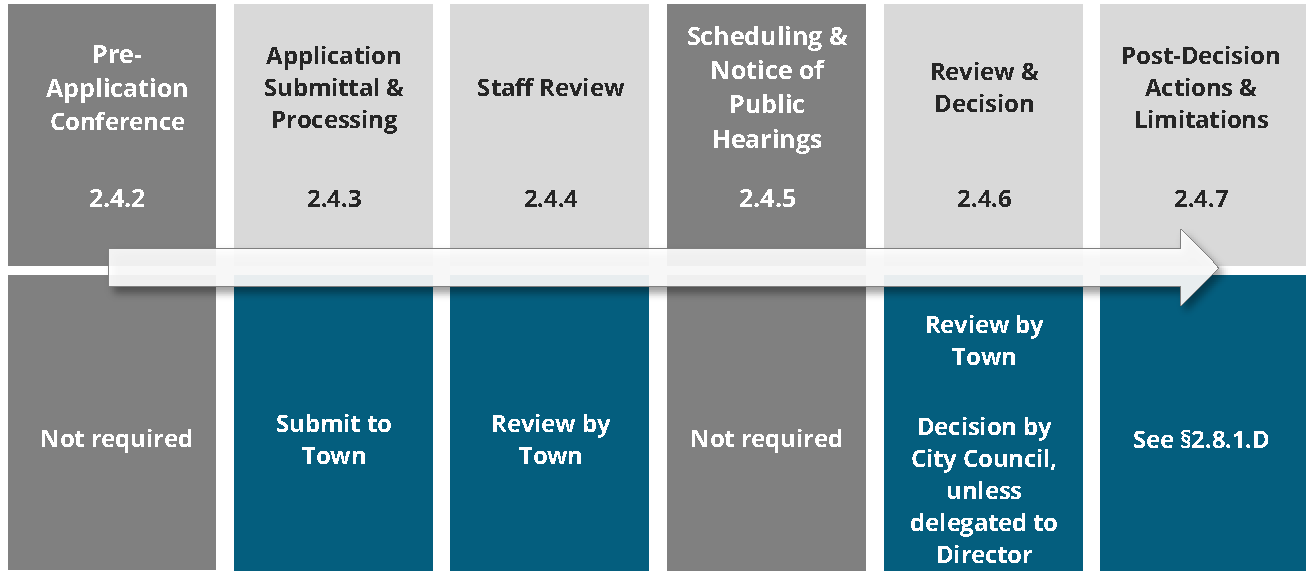
A.
Application submittal and processing. The application shall be submitted, accepted, revised, and may be withdrawn, in accordance with § 2.4.3: Application Submittal and Processing.
B.
Staff review. The staff shall review the application and prepare a staff report and recommendation in accordance with § 2.4.4: Staff Review.
C.
Review and decision.
1.
The application shall be reviewed and decided upon by the City Council in accordance with § 2.4.6: Review and Decision, unless the decision is delegated to the Director by City Council. The City Council may remove the item from the consent agenda at a regular meeting and refer the decision to the Director if they determine the Parking Management Agreement is minor in nature.
2.
The City Council or Director may review and approve, approve with conditions, or deny the application in accordance with the approval criteria in § 2.8.1.E: Review Criteria.
D.
Post-decision actions and limitations. All common procedures in § 2.4.7: Post-Decision Actions and Limitations, shall apply with the following modifications:
1.
No Certificate of Occupancy shall be issued until the City Council or Director has approved the Parking Management Agreement.
2.
Parking Management Agreements shall run with the land and any subsequent change of use that requires more parking shall require subsequent action to satisfy the additional parking requirement.
3.
If the Parking Management Agreement is later terminated or modified and the City Council or Director determine that the termination or modification has resulted in traffic congestion, overflow parking in residential neighborhoods, or threats to pedestrian, bicycle, or motor vehicle safety, the property owners involved in the agreement may be held in violation of this UDC.
E.
Review criteria. The City Council or Director may approve the Parking Management Agreement if they determine that the proposed reduction in parking or alternative parking meets the applicable requirements of § 5.5.6: Parking Alternatives.
Sec. 2.9. - Platting procedures.
2.9.1.
Standards that apply to all platting procedures.
A.
Applicability.
1.
Generally. This article shall apply to all land and all developments within the corporate limits of the Town, except as otherwise provided in this section.
2.
Land included. Except where otherwise specifically provided for in this article, all the provisions of this article shall apply to the following lands located within the corporate limits of the Town:
a.
Any tract of land that has not been recorded by plat in the plat records of Dallas County, Texas, and that is intended to be sold, leased, or otherwise subdivided from another tract of land or which is intended or proposed to be used for the purpose of development.
b.
Any lot of record prior to and upon which no development has been constructed or placed prior to the effective date of this article.
c.
The division of any previously platted lot into two or more parts.
d.
The removal of one or more lot lines of any platted lot so as to permit the combining of two or more contiguous platted lots into one or more new lots.
e.
Any easements for right-of-way, access, utilities, and drainage included on a plat.
3.
Exemptions. The following are exempt from the subdivision regulations of this article, but are subject to all other standards in this UDC:
a.
The division of land into two or more parts, other than for purposes of development, if the smallest resulting parcels, tract, or site is five acres or larger in size where each part has access and no public improvement is being dedicated.
b.
Construction of additions or alterations to an existing building where no drainage, street, utility extension or improvement, additional parking or street access changes required to meet the standards of this article are necessary to support such building addition or alterations.
c.
Construction of accessory structures or fences.
d.
Dedication of easement or right-of-way by separate document recordable in the county records if approved by Town.
e.
Cemeteries complying with all state and local laws and regulations.
f.
Divisions of land created by order of a court of competent jurisdiction.
g.
A change in ownership of a property through inheritance or the probate of an estate.
h.
Divisions of land resulting from acquisition or condemnation to support public projects.
B.
Zoning. All divisions of land shall conform to all applicable zoning regulations. A plat submission reflecting a condition not in conformity with applicable zoning regulations shall not be approved until any available relief from the Board of Zoning Adjustment has been finally obtained. If the property is not zoned as required for the proposed division of land, zoning shall be requested. Application for zoning includes completion of application forms, payment of required fees, and performance of other requirements of the UDC and the rules and regulations of the Town, as amended.
C.
Finding of proportionality. Any payment of fees or construction costs or required easement, dedication, or reservation of land included on any plat application required in this section shall meet the requirements of TLGC § 212.904.
D.
Completeness review. If the Director determines that any plat is incomplete or does not meet all requirements, the Director shall provide written confirmation of the determination and the reasons therefore. If the applicant disagrees with a determination that the plat does not comply with all requirements, the applicant shall submit a written objection to the Director within five business days of the postmark date of the written confirmation. If a written objection is submitted, the Director shall schedule the plat for consideration by the Planning and Zoning Commission. The official filing date for any plat that is not checked and verified as to its completeness within ten days of its submission shall be the 11th day after its submission.
E.
Failure to act. If the Director does not approve any plat application, with or without conditions, within 30 days after it has been submitted and deemed complete, the plat shall be considered approved. A certificate showing the acceptance date and the failure to take action on the application within the timeframe prescribed in this section shall, on demand by the applicant, be issued by the Director. In lieu of the written endorsement or other evidence of approval typically required in this section, such a certificate shall be sufficient for recordation.
2.9.2.
Preliminary plat or preliminary replat.
A.
Purpose. The Preliminary Plat and Preliminary Replat review procedure is intended to provide a mechanism for the Town to review an overall plan for proposed platting or replatting of land to ensure compliance with this UDC, the Comprehensive Plan, and the adequate provision of facilities and services within the Town.
B.
Applicability.
1.
A Preliminary Plat is required if the proposed subdivision meets any of the following:
a.
Is on land that has not yet been platted;
b.
Is on land that will be developed in phases;
c.
Will include the dedication of public right-of-way, other public tracts, or public improvements not determined to be eligible for Minor or Amending Plat processing; or
d.
Is not eligible to be processed as a Minor or Amending Plat, pursuant to § 2.9.5: Minor or Amending Plat.
2.
A Preliminary Replat is required if:
a.
A Replat necessitates the construction of public infrastructure or requires amendments to previously approved infrastructure construction plans;
b.
The Director determines a proposed Replat is unusually complex or raises potentially unique or serious impacts on the Town or the surrounding areas; or
c.
The applicant of a Replat requests a Preliminary Replat review.
C.
Preliminary plat procedure. The process diagram below identifies the applicable steps from § 2.4: Common Review Procedures, that apply to the review of Preliminary Plat and Preliminary Replat applications. Additions or modifications to the common review procedures are noted below.
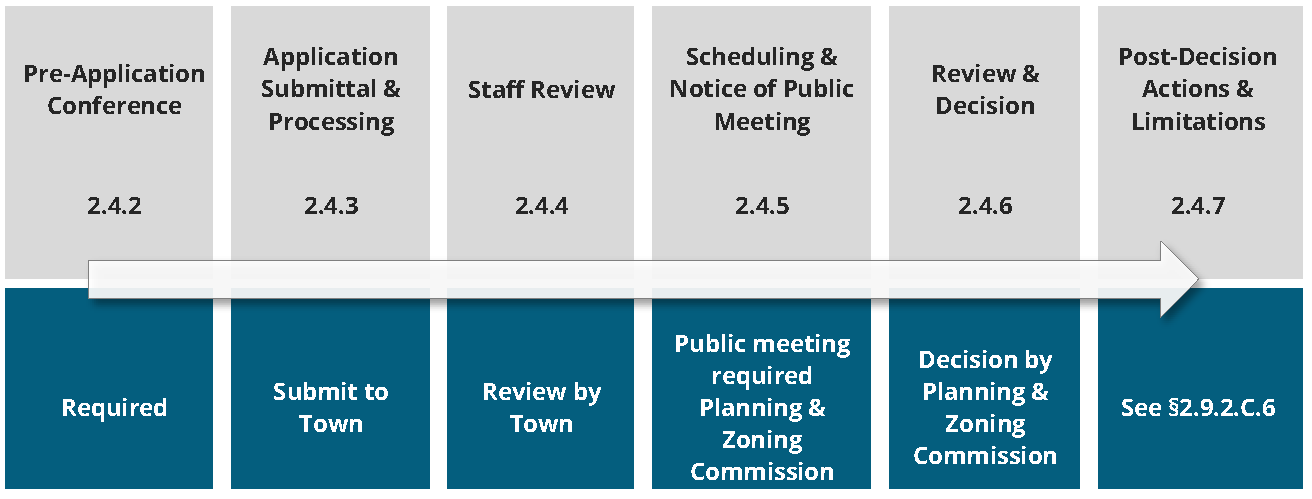
1.
Pre-application conference. A pre-application conference is required in accordance with § 2.4.2: Pre-Application Conference.
2.
Application submittal and processing. The application shall be submitted, accepted, revised, and may be withdrawn, in accordance with § 2.4.3: Application Submittal and Processing, with the following modification:
a.
The application is also subject to the standards in § 2.9.1: Standards that Apply to All Platting Procedures.
3.
Staff review. The staff shall review the application and prepare a staff report and recommendation in accordance with § 2.4.4: Staff Review.
4.
Scheduling and notice of public meetings.
a.
Neighborhood meeting. A neighborhood meeting is recommended in accordance with § 2.4.5.A, Neighborhood Meeting.
b.
Public meeting. The application shall be scheduled for a public meeting before the Planning and Zoning Commission and shall be noticed pursuant to § 2.4.5: Scheduling and Notice of Public Hearings.
5.
Review and decision. The application shall be reviewed and decided upon by the Planning and Zoning Commission in accordance with § 2.4.6: Review and Decision.
6.
Post-decision actions and limitations. All common procedures in § 2.4.7: Post-Decision Actions and Limitations, shall apply with the following modifications:
a.
Effect of approval. Approval of the Preliminary Plat or Preliminary Replat shall in no way constitute final acceptance or approval of the subdivision.
b.
Preliminary plat expiration.
i.
When a Preliminary Plat or Preliminary Replat has been approved, a Final Plat or Replat for all or a part of the area shall be submitted within two years; otherwise, the approval of the Preliminary Plat or Preliminary Replat shall terminate and shall be void. However, prior to the expiration of such approval, the time for filing of the application for Final Plat or Replat may be extended at the written request of the property owner. The first filing extension (not to exceed 90 days) shall be granted by the Director. Any further requests for extensions shall be considered by the Planning and Zoning Commission.
ii.
If a Final Plat or Replat for any portion of the area shown on the Preliminary Plat or Preliminary Replat has been filed for record with the County Clerk, the Preliminary Plat or Preliminary Replat approval shall remain valid indefinitely for the remaining portions of the area shown.
iii.
If no Final Plat or Replat is filed, the Preliminary Plat or Preliminary Replat approval shall remain valid for so long as any associated Development Agreement or Annexation Agreement remains binding or in effect.
iv.
Following the expiration of the Preliminary Plat or Preliminary Replat, the property owner may submit a new Preliminary Plat or Preliminary Replat for Planning and Zoning Commission approval following the procedures and regulations then in effect.
D.
Review criteria. In reviewing a proposed Preliminary Plat or Preliminary Replat application, the review and decision-making body shall consider the general approval criteria in § 2.4.6.C: General Approval Criteria and if the proposed Preliminary Plat or Preliminary Replat:
1.
Is consistent with the intent and complies with applicable use requirements of the underlying zoning district;
2.
Complies with applicable dimensional and development standards in this UDC;
3.
Does not affect a recorded easement without approval from the easement holder;
4.
Provides a layout of lots, streets, utilities, drainage, and other public facilities and services that minimize the disturbance to sensitive natural areas or resources;
5.
Provides evidence of public water and sewer provision; and
6.
Proposes reasonable phasing as it relates to infrastructure capacity.
2.9.3.
Final plat.
A.
Purpose. The purpose of the Final Plat procedure is to demonstrate compliance with an approved Preliminary Plat and applicable standards of this UDC.
B.
Final plat procedure. The process diagram below identifies the applicable steps from § 2.4: Common Review Procedures, that apply to the review of Final Plat applications. Additions or modifications to the common review procedures are noted below.
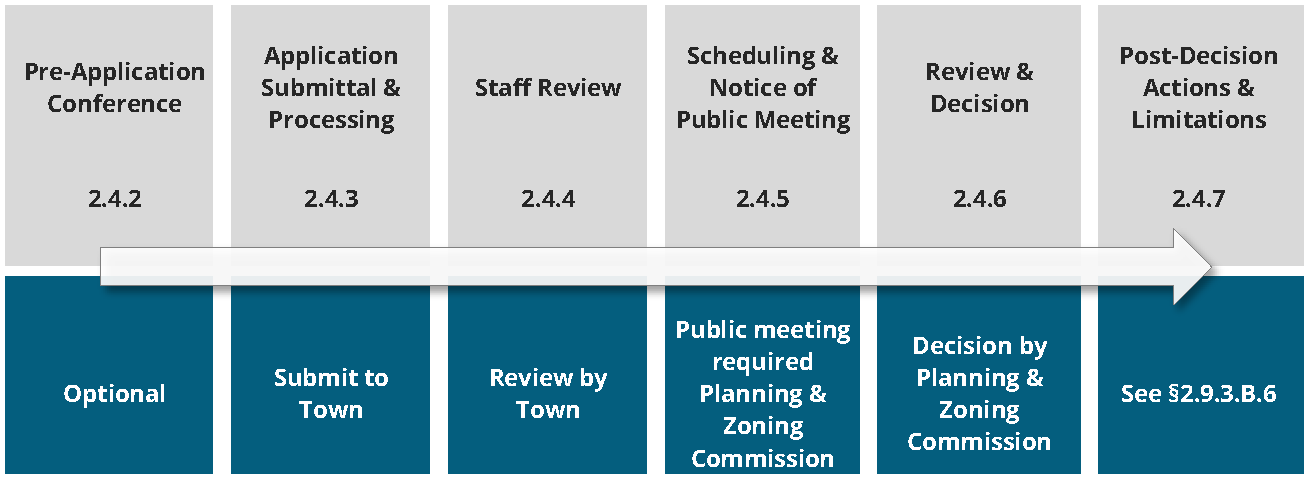
1.
Pre-application conference. A pre-application conference is optional, and if elected shall be held in accordance with § 2.4.2: Pre-Application Conference.
2.
Application submittal and processing. The application shall be submitted, accepted, revised, and may be withdrawn, in accordance with § 2.4.3: Application Submittal and Processing, with the following modifications:
a.
The application is also subject to the standards in § 2.9.1: Standards that Apply to All Platting Procedures.
b.
The Final Plat application shall be submitted within two years of Preliminary Plat approval and shall not be submitted prior to the approval and implementation of all required civil engineering and construction plans.
3.
Staff review. The staff shall review the application and prepare a staff report and recommendation in accordance with § 2.4.4: Staff Review.
4.
Scheduling and notice of public hearings. The application shall be scheduled for a public meeting before the Planning and Zoning Commission and shall be noticed pursuant to § 2.4.5: Scheduling and Notice of Public Hearings.
5.
Review and decision. The application shall be reviewed and decided upon by the Planning and Zoning Commission in accordance with § 2.4.6: Review and Decision, with the following modification:
a.
The Planning and Zoning Commission shall not approve any Final Plat of any subdivision within any area where a petition or ordinance for Annexation or a recommendation for Annexation to the Town is pending before the City Council.
6.
Post-decision actions and limitations. All common procedures in § 2.4.7: Post-Decision Actions and Limitations, shall apply with the following modifications:
a.
Recording. After approval of the Final Plat by the Planning and Zoning Commission, the applicant shall submit the required number of copies for recording, along with all tax certificates required for recording by the County Clerk to the Development and Neighborhood Services Department. These copies shall bear all signatures but those of the Town officials. After signature by the Town officials, the Development and Neighborhood Services Department shall complete the recording process and return two filed copies to the applicant or the applicant may elect to complete the recording process. Said copies shall show the volume and page of the map and plat records into which the plat was filed by the County Clerk.
b.
Expiration. A recorded Final Plat shall not expire.
C.
Review criteria. In reviewing a proposed Final Plat application, the Planning and Zoning Commission shall consider the general approval criteria in § 2.4.6.C: General Approval Criteria.
2.9.4.
Replat.
A.
Purpose. The Replat procedure is intended to provide a process for replatting any portion of an approved Final Plat, other than those used to amend through Minor or Amending Plats or vacate the plat through the vacation procedures.
B.
Applicability.
1.
A Replat of a subdivision or part of a subdivision may be recorded and controls over the preceding plat without vacation of that plat if the Replat:
a.
Is signed and acknowledged by the owners of the property being replatted;
b.
Is approved in accordance with TLGC Chapter 212; and
c.
Does not attempt to amend or remove any covenants or restrictions.
2.
In the instance of large tracts or blocks of land contained within a recorded subdivision and intended or designed for replatting into smaller tracts, lots, or building sites, the replatting shall comply with all provisions of this UDC.
C.
Replat procedure. The process diagram below identifies the applicable steps from § 2.4: Common Review Procedures, that apply to the review of Replat applications. Additions or modifications to the common review procedures are noted below.
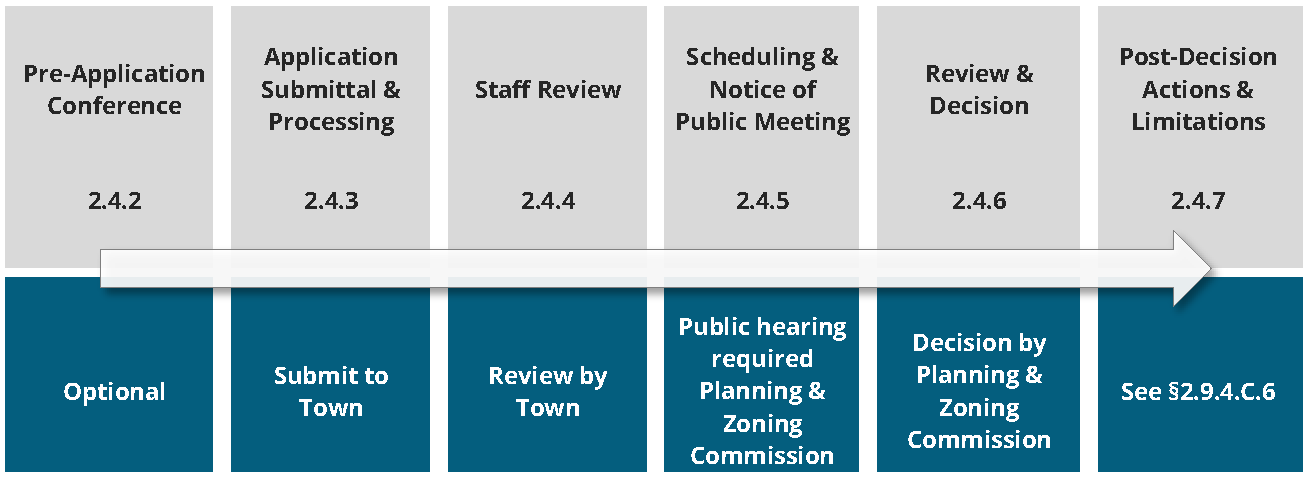
1.
Pre-application conference. A pre-application conference is optional, and if elected shall be held in accordance with § 2.4.2: Pre-Application Conference.
2.
Application submittal and processing. The application shall be submitted, accepted, revised, and may be withdrawn, in accordance with § 2.4.3: Application Submittal and Processing, with the following modification:
a.
The application is also subject to the standards in § 2.9.1: Standards that Apply to All Platting Procedures.
3.
Staff review. The staff shall review the application and prepare a staff report and recommendation in accordance with § 2.4.4: Staff Review.
4.
Scheduling and notice of public hearings. The application shall be scheduled for a public hearing before the Planning and Zoning Commission and shall be noticed pursuant to § 2.4.5: Scheduling and Notice of Public Hearings, with the following modifications:
a.
For any proposed Replat that requires Subdivision Variance pursuant to § 2.10.2: Subdivision Variance, a public hearing shall be held prior to taking action on the proposed Replat.
b.
If the proposed Replat requires § 2.10.2: Subdivision Variance and is protested in accordance with § 2.4.5.G: Protest Procedures, the proposed Replat must receive, in order to be approved, the affirmative vote of at least three-fourths of the members present of the Planning and Zoning Commission. For a legal protest, written instruments signed by the owners of at least 20 percent of the area of the lots or land immediately adjoining the area covered by the proposed Replat and extending 200 feet from that area, but within the original subdivision, must be filed with the Planning and Zoning Commission prior to the close of the public hearing. In computing the percentage of land area under this section, the area of streets and alleys shall be included.
5.
Review and decision. The application shall be reviewed and decided upon by the Planning and Zoning Commission in accordance with § 2.4.6: Review and Decision, with the following modification:
a.
If a proposed Replat for a Residential zoning district or deed-restricted property as specified in TLGC § 212.015 does not require a Variance or exception and is approved by the Planning and Zoning Commission, the Town will deliver a written notice by mail regarding the approval of the Replat no later than the 15th day after the date the Replat is approved to each owner of a lot in the original subdivision that is within 200 feet of the lots that were replatted according to the most recent Town tax roll.
6.
Post-decision actions and limitations. All common procedures in § 2.4.7: Post-Decision Actions and Limitations, shall apply with the following modifications:
a.
Recording. After approval of the Replat by the Planning and Zoning Commission, the applicant shall submit the required number of copies for recording, along with all tax certificates required for recording by the County Clerk to the Development and Neighborhood Services Department. These copies shall bear all signatures but those of the Town officials. After signature by the Town officials, the Development and Neighborhood Services Department shall complete the recording process and return two filed copies to the applicant or the applicant may elect to complete the recording process. Said copies shall show the volume and page of the map and plat records into which the plat was filed by the County Clerk.
b.
Expiration. A recorded Replat shall not expire.
2.9.5.
Minor or amending plat.
A.
Purpose. The Minor or Amending Plat review procedure is intended to provide a mechanism for administrative platting decisions, to address plat errors, and to apply minor adjustments to property boundaries.
B.
Applicability.
1.
The Minor Plat procedure shall apply to plats that:
a.
Involve four or fewer lots;
b.
Front onto an existing street;
c.
Do not require dedication of public right-of-way or other public improvements; and
d.
Do not require the creation of any new street or the extension of municipal facilities.
2.
The Director shall also have authority to approve Amending Plats using this procedure provided the Amending Plat is intended for one or more of the following purposes:
a.
To correct an error in a course or distance shown on the preceding plat;
b.
To add a course or distance that was omitted on the preceding plat;
c.
To correct an error in a real property description shown on the preceding plat;
d.
To indicate monuments set after the death, disability, or retirement from practice of the engineer or surveyor responsible for setting monuments;
e.
To show the location or character of a monument that has been changed in location or character or that is shown incorrectly as to location or character on the preceding plat;
f.
To correct any other type of scrivener or clerical error or omission previously approved by the municipal authority responsible for approving plats, including lot numbers, acreage, street names, and identification of adjacent recorded plats;
g.
To correct an error in courses and distances of lot lines between two adjacent lots if:
i.
Both lot owners join in the application for amending the plat;
ii.
Neither lot is abolished;
iii.
The amendment does not attempt to remove recorded covenants or restrictions; and
iv.
The amendment does not have a material adverse effect on the property rights of the other owners in the plat.
C.
Minor or amending plat procedure. The process diagram below identifies the applicable steps from § 2.4: Common Review Procedures, that apply to the review of Minor or Amending Plat applications. Additions or modifications to the common review procedures are noted below.
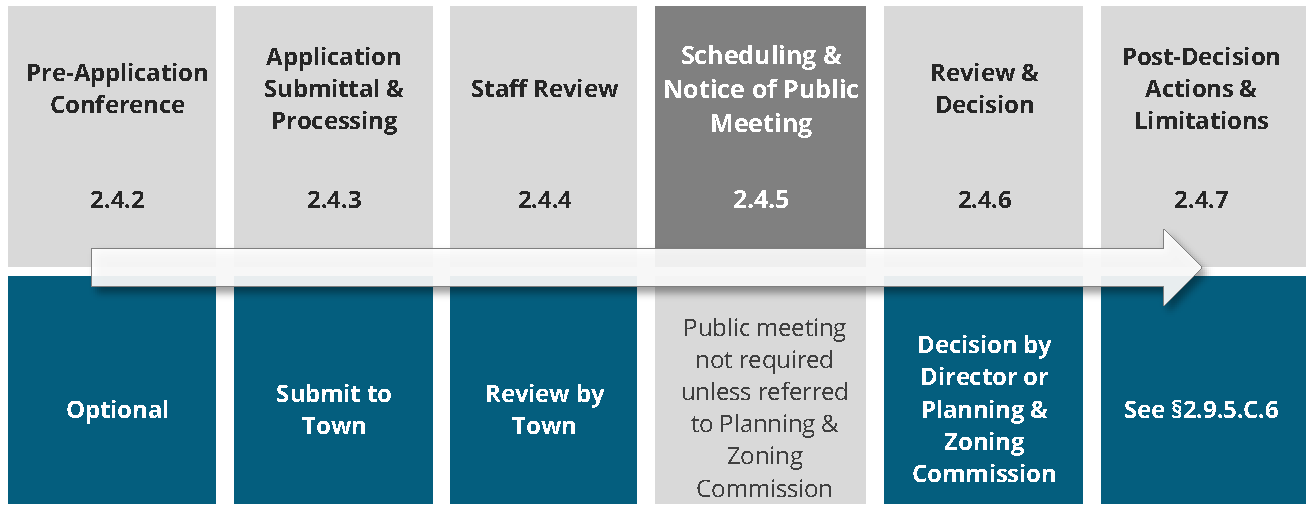
1.
Pre-application conference. A pre-application conference is optional, and if elected shall be held in accordance with § 2.4.2: Pre-Application Conference.
2.
Application submittal and processing. The application shall be submitted, accepted, revised, and may be withdrawn, in accordance with § 2.4.3: Application Submittal and Processing with the following modification:
a.
The application is also subject to the standards in § 2.9.1: Standards that Apply to All Platting Procedures.
3.
Staff review. The staff shall review the application and if referred to Planning and Zoning Commission, prepare a staff report and recommendation, in accordance with § 2.4.4: Staff Review.
4.
Scheduling and notice of public meeting. Public notice and a public meeting is not required unless the Director refers a Minor or Amending Plat application to the Planning and Zoning Commission for review and decision. If the application is referred to the Planning and Zoning Commission, then the application shall be scheduled for a public meeting before the Planning and Zoning Commission.
5.
Review and decision. The application shall be reviewed and decided upon by the Director in accordance with § 2.4.6: Review and Decision, with the following modifications:
a.
The Director shall review the Minor or Amending Plat application according to the approval criteria in § 2.9.5.D, below.
b.
The Director may, for any reason, elect to refer the Minor or Amending Plat to the Planning and Zoning Commission for approval.
6.
Post-decision actions and limitations. All common procedures in § 2.4.7: Post-Decision Actions and Limitations, shall apply with the following modification:
a.
Recording. Following approval of a Minor or Amending Plat, the applicant shall submit, and the Town shall record the plat in accordance with the requirements for Final Plats in § 2.9.3: Final Plat.
D.
Review criteria. In reviewing a proposed Minor or Amending Plat application, the Director shall consider the general approval criteria in § 2.4.6.C: General Approval Criteria and if the proposed Minor or Amending Plat:
1.
Is consistent with the intent and complies with the applicable use requirements of the underlying zoning district;
2.
Complies with applicable dimensional and development standards in this UDC;
3.
Does not affect a recorded easement without approval from the easement holder, unless otherwise approved by the Director;
4.
Will not result in adverse impacts to surrounding property; and
5.
Will not limit the Town's ability to provide adequate and sufficient facilities or services.
2.9.6.
Vacating plat.
A.
Purpose. The Vacating Plat review procedure is intended to outline the process for vacation of all or a portion of a prior-approved plat.
B.
Applicability. The property owner of the tract covered by a plat may vacate the plat pursuant to TLGC § 212.013.
C.
Vacating Plat Procedure. The process diagram below identifies the applicable steps from § 2.4: Common Review Procedures, that apply to the review of Vacating Plat applications. Additions or modifications to the common review procedures are noted below.
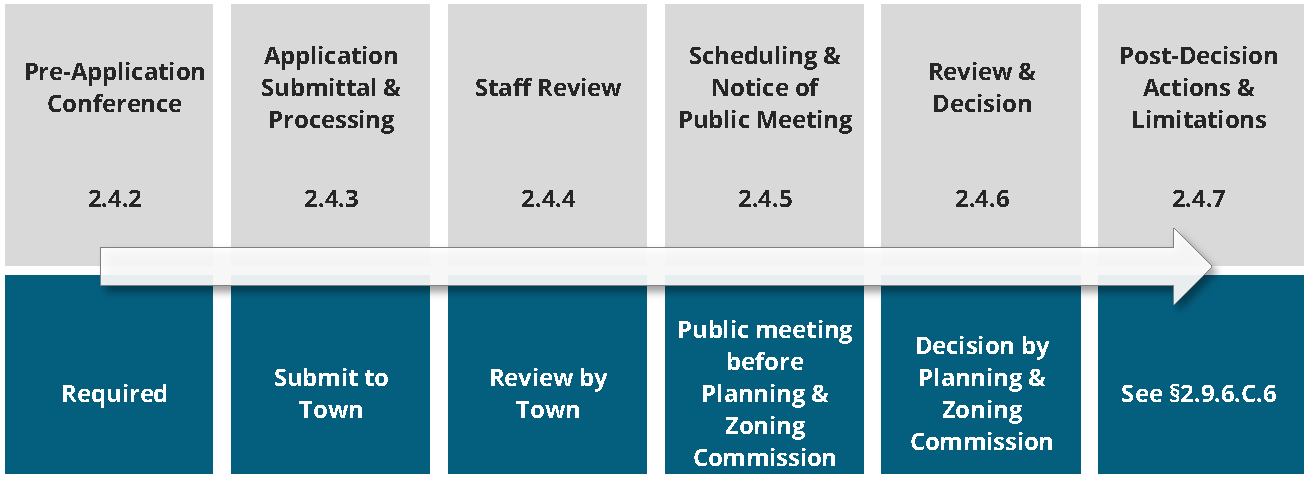
1.
Pre-application conference. A pre-application conference is required in accordance with § 2.4.2: Pre-Application Conference.
2.
Application submittal and processing. The application shall be submitted, accepted, revised, and may be withdrawn, in accordance with § 2.4.3: Application Submittal and Processing.
3.
Staff review. The staff shall review the application and prepare a staff report and recommendation in accordance with § 2.4.4: Staff Review.
4.
Scheduling and notice of public meeting. The application shall be scheduled for a public meeting before the Planning and Zoning Commission and shall be noticed pursuant to § 2.4.5: Scheduling and Notice of Public Hearings.
5.
Review and decision. The application shall be reviewed and decided upon by the Planning and Zoning Commission in accordance with § 2.4.6: Review and Decision.
6.
Post-decision actions and limitations. All common procedures in § 2.4.7: Post-Decision Actions and Limitations, shall apply with the following modification:
a.
Following approval of a Vacating Plat, the applicant shall submit, and the Town shall record the plat in accordance with the requirements for Final Plats in § 2.9.3: Final Plat.
D.
Review criteria. In reviewing a proposed Vacating Plat application, the Planning and Zoning Commission shall consider the general approval criteria in § 2.4.6.C: General Approval Criteria.
Sec. 2.10. - Flexibility and relief procedures.
2.10.1.
Variance.
A.
Purpose. The Variance procedure provides a mechanism for the Town to authorize Variances from the development standards of this UDC when it is demonstrated that such a Variance will not be contrary to the public interest or the spirit of this UDC, where, owing to special conditions, literal enforcement of this UDC will result in practical difficulties or unnecessary hardship.
B.
Applicability. Any property owner seeking relief from this UDC may request a Variance when the strict application of this UDC meet the approval criteria listed in § 2.10.1.D. Requests for relief from the provisions of Article VI: Subdivision Standards shall not be included in this section and shall comply with § 2.10.2: Subdivision Variance.
C.
Variance procedure. The process diagram below identifies the applicable steps from § 2.4: Common Review Procedures, that apply to the review of Variance applications. Additions or modifications to the common review procedures are noted below.
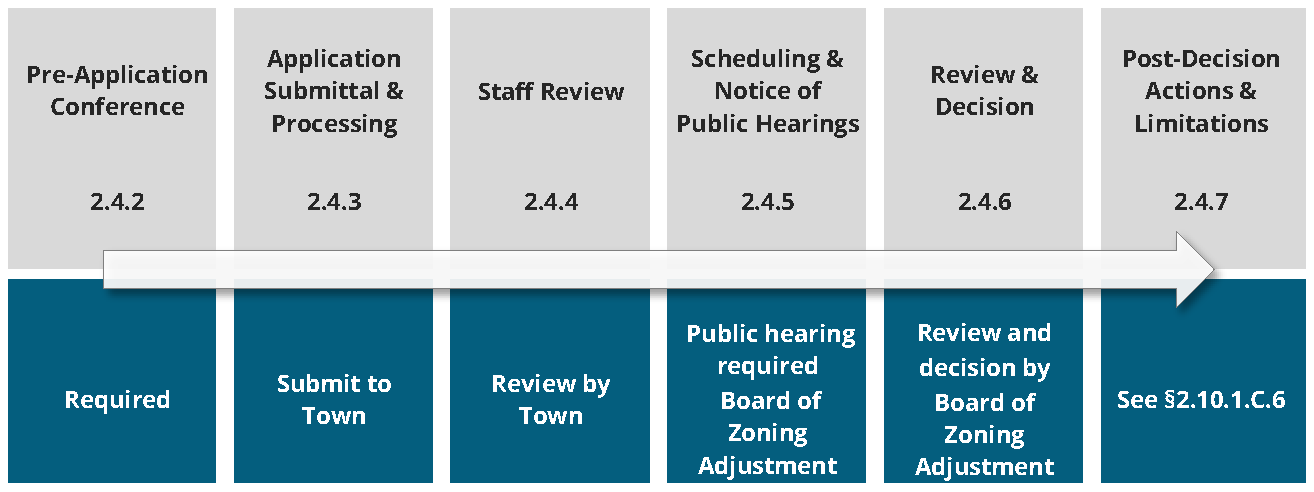
1.
Pre-application conference. A pre-application conference is required in accordance with § 2.4.2: Pre-Application Conference.
2.
Application submittal and processing. The application shall be submitted, accepted, revised, and may be withdrawn, in accordance with § 2.4.3: Application Submittal and Processing.
3.
Staff review. The staff shall review the application and prepare a staff report and recommendation in accordance with § 2.4.4: Staff Review.
4.
Scheduling and notice of public hearings. The application shall be scheduled for public hearings before the Board of Zoning Adjustment and shall be noticed pursuant to § 2.4.5: Scheduling and Notice of Public Hearings.
5.
Review and decision.
a.
The application shall be reviewed and decided upon by the Board of Zoning Adjustment in accordance with § 2.10.1.D.
b.
After closing the public hearing, the Board of Zoning Adjustment shall take action consistent with this UDC and state law. A concurring vote of the majority of members of the Board of Zoning Adjustment shall be required to approve a Variance request.
6.
Post-decision actions and limitations. All common procedures in § 2.4.7: Post-Decision Actions and Limitations, shall apply.
D.
Review criteria.
1.
In reviewing a Variance application, the Board of Zoning Adjustment shall find that all of the following exist:
a.
Special circumstances or conditions apply to the lot or parcel for which the Variance is sought, which circumstances or conditions are peculiar to such lot or parcel and do not apply generally to other lot or parcels in the same zoning district or neighborhood and that said circumstances or conditions are such that the strict application of the provisions of this UDC would deprive the applicant of the reasonable use of such lot or parcel;
b.
The granting of the Variance will not be detrimental to the public welfare or injurious to other property or improvements in the zoning district or neighborhood in which the lot or parcel is located;
c.
The Variance requested is the minimum Variance that will accomplish this purpose;
d.
The literal enforcement and strict application of the provisions of this UDC will result in an unnecessary hardship inconsistent with the general provisions and intent of this UDC and that in granting such Variance the spirit of the UDC will be preserved and substantial justice done;
e.
The granting of a Variance is not solely for the purpose of mitigating a financial hardship; and
f.
The condition or feature that creates the need for the Variance did not result from the owner's actions.
2.
Any person desiring to erect or increase the height of any structure, or permit the growth of any object of natural growth or use his property, in violation of the airport zoning regulations prescribed in § 3.8.1: AO - Airport Overlay shall comply with the following standards:
a.
The applicant shall provide determination from the Federal Aviation Administration as to the effect of the proposal on the operation of air navigation facilities and the safe, efficient use of navigable airspace.
b.
Such Variances shall be allowed where it is duly found that a literal application or enforcement of the regulations will result in unnecessary hardship and the relief granted would not be contrary to the public interest, but will do substantial justice, and will be in accordance with the spirit of § 3.8.1: AO - Airport Overlay - pursuant to V.T.C.A., Local Government Code Chapter 41.
c.
No application for Variance to the requirements of § 3.8.1: AO - Airport Overlay shall be considered by the Board of Zoning Adjustment unless a copy of the application has been furnished to the Building Official for advice as to the aeronautical effects of the Variance. If the Building Official does not respond to the application within 15 days after receipt, the Board of Zoning Adjustment may act on its own to grant or deny such application.
2.10.2.
Subdivision variance.
A.
Purpose.
1.
The Subdivision Variance procedure provides a mechanism for the Town to authorize Variances from the strict application of the UDC, where literal enforcement of the UDC will result in an unnecessary hardship from the subdivision regulations and where a Subdivision Variance is necessary to develop a specific parcel of land which cannot otherwise be developed in the same manner allowed for other similar parcels due to unique conditions on the property.
2.
The Subdivision Variance procedure may not allow a use in a zoning district where it is not currently permitted or alleviate inconveniences or financial burdens imposed on landowners.
B.
Applicability. Any property owner seeking relief from the standards in Article VI: Subdivision Standards may request a Subdivision Variance when the strict application of this UDC meet the approval criteria listed in § 2.10.2.D: Review Criteria.
C.
Subdivision variance procedure. The process diagram below identifies the applicable steps from § 2.4: Common Review Procedures, that apply to the review of Subdivision Variance applications. Additions or modifications to the common review procedures are noted below.
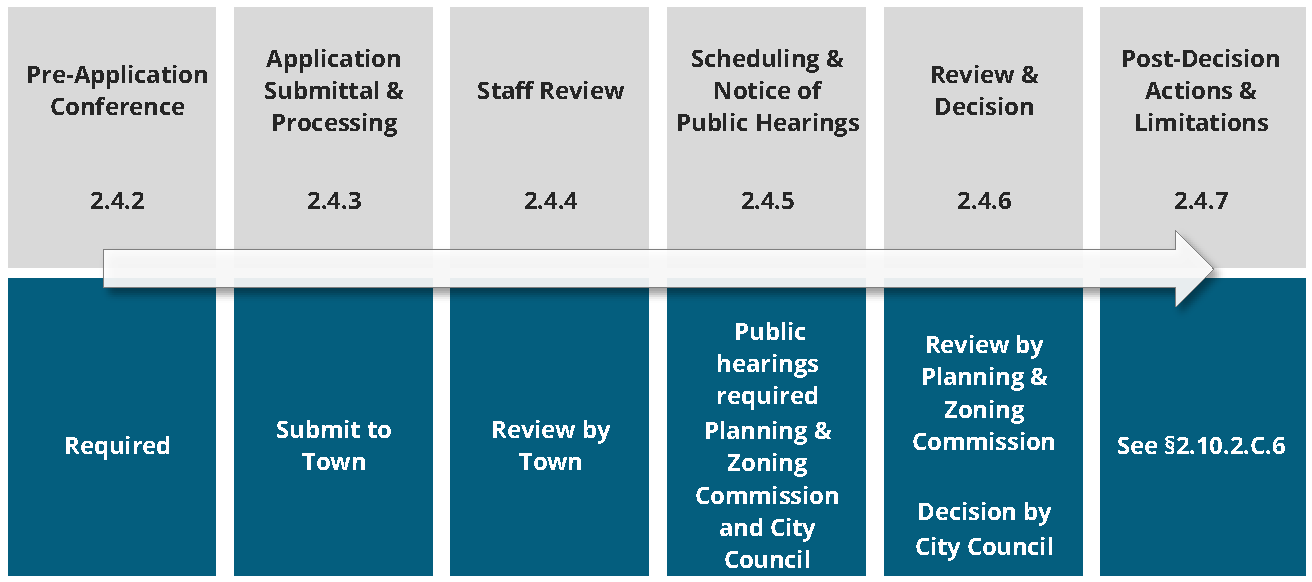
1.
Pre-application conference. A pre-application conference is required in accordance with § 2.4.2: Pre-Application Conference.
2.
Application submittal and processing. The Subdivision Variance application shall be submitted at the same time as the underlying application from which a Variance is being sought. The application shall be submitted, accepted, revised, and may be withdrawn, in accordance with § 2.4.3: Application Submittal and Processing.
3.
Staff review. The staff shall review the application and prepare a staff report and recommendation in accordance with § 2.4.4: Staff Review.
4.
Scheduling and notice of public hearings. The application shall be scheduled for public hearings before the Planning and Zoning Commission and shall be noticed pursuant to § 2.4.5: Scheduling and Notice of Public Hearings.
5.
Review and decision. The application shall be reviewed and decided upon by the Planning and Zoning Commission in accordance with § 2.10.2.D: Review Criteria, with the following modification:
a.
The Planning and Zoning Commission shall make written findings of fact and conclusions of law stating the facts upon which it relied when making its legal conclusions in reversing, affirming, or modifying any order, requirement, decision, or determination which comes before it under the provision of this UDC.
6.
Post-decision actions and limitations. All common procedures in § 2.4.7: Post-Decision Actions and Limitations, shall apply.
D.
Review criteria. In reviewing a Subdivision Variance application, the Planning and Zoning Commission shall find that all of the following exist:
1.
The proposed Subdivision Variance is appropriate based on a finding that unreasonable hardships or difficulties may result from strict compliance with the subdivision regulations or the purposes of the regulations may be served to a greater extent by an alternative proposal;
2.
The granting of the Subdivision Variance will not be detrimental to the public safety, health, or welfare or injurious to other property;
3.
Because of the particular physical surroundings, shape or topographical conditions of the specific property involved, a particular hardship to the owner would result, as distinguished from a mere inconvenience, if the strict letter of the subdivision regulations is carried out;
4.
The Subdivision Variance will not in any manner vary the provisions of the Comprehensive Plan or the UDC, except that those documents may be amended in the manner prescribed by law; and
5.
The special or peculiar conditions upon which the request is based did not result from or were not created by the act or commission of the owner or any prior owner, subsequent to the date of creation of the requirement from which a Subdivision Variance is sought.
2.10.3.
Minor modification.
A.
Purpose. The purpose of the Minor Modification procedure is to allow adjustments, modifications, or deviations from the dimensional or numerical standards of this UDC. Minor modifications are intended to provide greater flexibility when necessary without requiring a formal zoning amendment. The Minor Modification procedure is not a waiver of standards, but rather a procedure for modifying standards up to a specified amount when circumstances or site conditions warrant such modification.
B.
Applicability.
1.
Table of allowable minor modifications. An application for a Minor Modification that is not related to a request for reasonable accommodation under the Federal Fair Housing Act Amendments of 1988 (FFHA) or the Religious Land Use and Institutionalized Persons Act of 2000 (RLUIPA) may request only the types of modifications shown below.
2.
Limitations on minor modifications. The Minor Modification procedure shall not be used to:
a.
Modify standards outside of this UDC;
b.
Modify the uses or activities allowed on the property;
c.
Modify the standards that apply to a specific use or activity, including dimensional and numerical standards; or
d.
Modify a standard that is already modified through a separate Minor Modification, Variance, or other adjustment procedure.
3.
Reasonable accommodations under the FFHA.
a.
The Town may approve a Minor Modification to accommodate requirements under the FFHA provided:
i.
The modification is the minimum change from the provisions of this UDC necessary to comply with the requirements of the FFHA; and
ii.
The modification will not cause adverse impacts on the surrounding area.
b.
The Town may approve a type of accommodation that is different than the applicant's request if the Town deems such accommodation would satisfy the requirements of the FFHA and have fewer impacts on the surrounding area.
c.
The Town may be required to approve requests for reasonable accommodations under the FFHA regardless of whether such request qualifies as a Minor Modification.
4.
Accommodations under RLUIPA.
a.
The Town may approve a modification beyond those listed in the above table to avoid or eliminate a substantial burden on religious exercise as guaranteed by RLUIPA.
b.
Under no circumstance may the Town approve a modification that allows a use, structure, or activity in a zoning district where such use, structure, or activity is prohibited.
c.
The Town may approve a modification to accommodate a person's free exercise of religion pursuant to RLUIPA.
C.
Minor modification procedure.
1.
Application.
a.
An application for a Minor Modification may only be submitted and reviewed as part of a concurrent application for a Special Use Permit, Major or Minor Site Plan, Temporary Use Permit, or platting procedure. Standalone Minor Modification applications shall not be considered.
b.
Multiple requests for eligible modifications pursuant to Table 2.10-1: Table of Allowable Minor Modifications may be considered under the same Minor Modification application.
2.
Review and decision.
a.
Applications approved administratively. When the request for a Minor Modification is submitted concurrently with and associated with an application that requires approval by the Director, the Director shall review and approve, approve with conditions, or deny the modification in accordance with the criteria in § 2.10.3.D below.
b.
Applications approved by the Planning and Zoning Commission or City Council. When the request for a Minor Modification is submitted concurrently with and associated with an application that requires approval by the Planning and Zoning Commission or City Council, the applicable final decisionmaker shall review the modification and approve, approve with conditions, or deny the modification in accordance with the criteria in § 2.10.3.D below.
3.
Post-decision actions and limitations. All common procedures in § 2.4.7: Post-Decision Actions and Limitations, shall apply with the following modifications:
a.
Effect of approval.
i.
Approval of a Minor Modification only authorizes the modifications as approved and only on the subject property associated with the application.
ii.
A Minor Modification may be suspended or revoked after notice and an opportunity to be heard is provided to the applicant, if there is:
a.
A failure to comply with related provisions of this UDC; or
b.
A failure to comply with any conditions included with the Minor Modification.
b.
Expiration of minor modification. Approval of a Minor Modification shall automatically expire if the development application or permit associated with the Minor Modification is denied or otherwise deemed invalid by the approving body.
D.
Review criteria.
1.
In reviewing a request for a Minor Modification, the decisionmaker shall consider whether the Minor Modification would result in development that complies with or exceeds the intent of the standard being modified and the overall intent of this UDC, and the extent to which the requested Minor Modification:
a.
Is technical in nature;
b.
Compensates for an unusual site condition or circumstance not shared by surrounding properties in general;
c.
Meets all other applicable building and safety codes;
d.
Benefits the Town by protecting community assets, features, and sensitive areas in alignment with the Comprehensive Plan; and
e.
Avoids creating adverse impacts to surrounding areas.
2.
An application shall be approved if the application supports the criteria listed above, and the applicant has provided any additional data and references, if requested by the Director, the Planning and Zoning Commission, or the City Council.
2.10.4.
Appeal of administrative decision.
A.
Purpose. The Appeal of Administrative Decision procedure is intended to establish a remedy whereby persons claiming to have been aggrieved by a decision of the Director or other administrative official in administering this UDC may appeal that decision.
B.
Applicability. Any person may appeal a decision of the Director or other officer of the Town made in the administration or enforcement of this UDC. Appeals shall be made to the appropriate body as indicated in § 2.3: Summary Table of Review Procedures, and in accordance with state law.
C.
Appeal of administrative decision procedure. The process diagram below identifies the applicable steps from § 2.4: Common Review Procedures, that apply to the review of Appeal of Administrative Decision applications. Additions or modifications to the common review procedures are noted below.
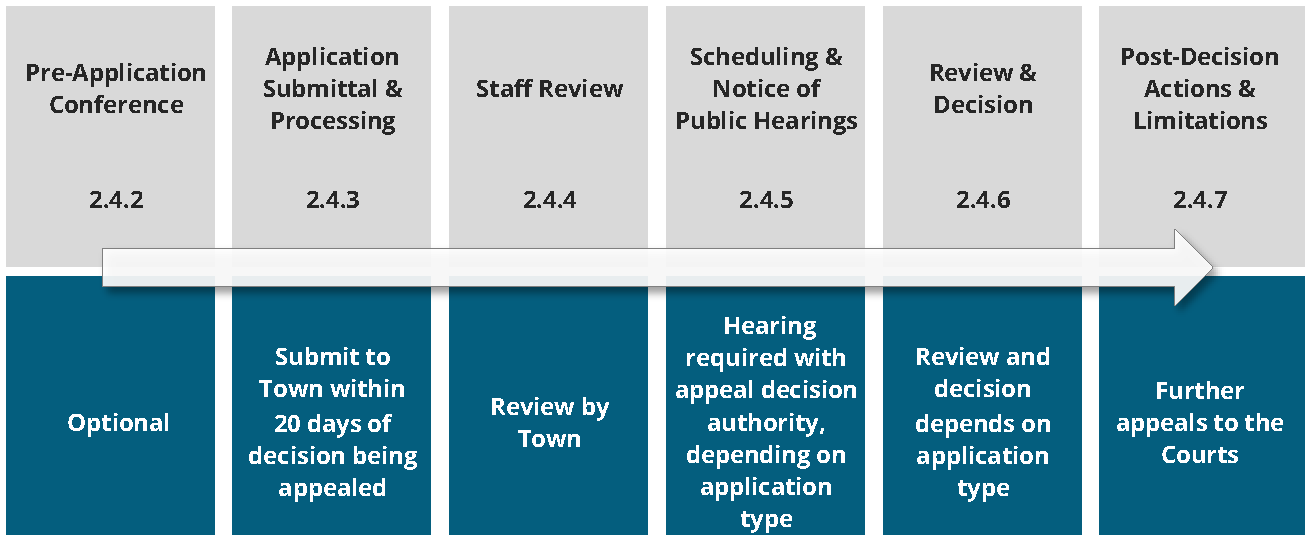
1.
Pre-application conference. A pre-application conference is optional, but if elected such meeting shall be held in accordance with § 2.4.2: Pre-Application Conference.
2.
Application submittal and processing. The application shall be submitted, accepted, revised, and may be withdrawn, in accordance with § 2.4.3: Application Submittal and Processing, with the following modifications:
a.
Time limit. Appeals shall be made in writing and filed with the Director within 20 calendar days of the action or decision being appealed.
b.
Pause of proceedings. An appeal pauses all proceedings from further action unless the Director determines that a stay would create adverse impacts to the health, safety, or welfare of the Town. In such case, proceedings shall not be stayed, otherwise than by a restraining order which may be granted by the Board of Zoning Adjustment or by a court of record or application on notice to the officer from whom the appeal is taken and on due cause shown.
3.
Staff review. The staff shall review the application and prepare a staff report and recommendation in accordance with § 2.4.4: Staff Review.
4.
Scheduling and notice of public hearings. The application shall be scheduled for public hearings before the appropriate appeal authority and shall be noticed pursuant to § 2.4.5: Scheduling and Notice of Public Hearings.
5.
Review and decision.
a.
The appropriate appeal authority may affirm, reverse, or amend a decision or interpretation made by the Director or an administrative official in accordance with the approval criteria in § 2.10.4.D: Review Criteria.
b.
The appropriate appeal authority may reverse a previous decision in whole or in part, or may modify the order, requirement, decision, or determination appealed from.
c.
The appropriate appeal authority may attach conditions of approval on any appeal to ensure the health, safety, and welfare of the Town.
6.
Post-decision actions and limitations. All common procedures in § 2.4.7: Post-Decision Actions and Limitations. Any further appeals from the appropriate appeal authority shall be made to the courts in accordance with state law.
D.
Review criteria. In reviewing a proposed Appeal of Administrative Decision application, the appropriate appeal authority shall consider the following:
1.
The facts stated in the application, as presented by the appellant and/or the Director;
2.
The written and oral testimony of the public;
3.
The testimony of the appellant;
4.
The requirements and intent of the applicable standards from this UDC compared to the written decision that is being appealed; and
5.
The testimony of the administrative official or body from which the appeal is taken.
2.10.5.
Interpretations.
A.
Purpose. The interpretations procedure is intended to provide a uniform mechanism for rendering formal written interpretations of this UDC.
B.
Applicability. Responsibility for making interpretations of provisions of this UDC is assigned as follows:
1.
The Director shall be responsible for all interpretations of the zoning and platting provisions in the text of this UDC, including, but not limited to:
a.
Interpretations as to which is the stricter and thus controlling provision in case of conflict with this UDC and other provisions of the Code of Ordinances;
b.
Interpretations of compliance with a condition of approval;
c.
interpretations of whether an unspecified use falls within a use classification, use category, or use type allowed in a zoning district; and
d.
Interpretations of the zoning district boundaries on the Official Zoning Map and application of Place Type and Spectrum of Change maps.
2.
The Director of Public Works and Engineering shall be responsible for all interpretations of the floodplain management and engineering provisions in the text of this UDC.
3.
The Building Official or Fire Marshall shall be responsible for all interpretations of Building and Fire Code provisions as they relate to this UDC including interpretations relating to issuance of a Certificate of Compliance/Occupancy.
C.
Interpretation procedure. The process diagram below identifies the applicable steps from § 2.4: Common Review Procedures, that apply to the review of interpretation applications. Additions or modifications to the common review procedures are noted below.
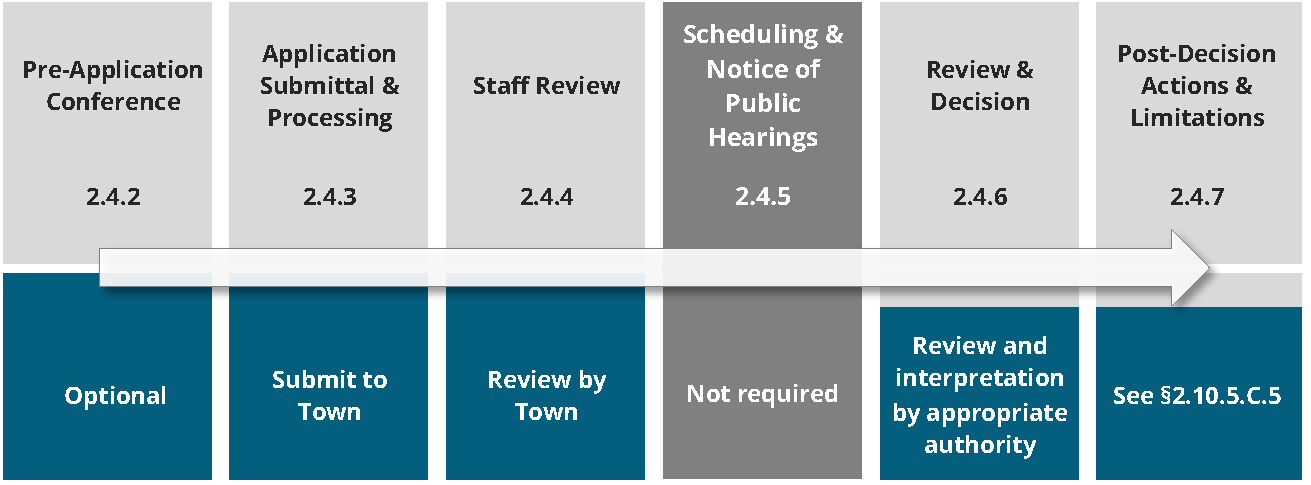
1.
Pre-application conference. A pre-application conference is optional, but if elected such meeting shall be held in accordance with § 2.4.2: Pre-Application Conference.
2.
Application submittal and processing. The application shall be submitted, accepted, revised, and may be withdrawn, in accordance with § 2.4.3: Application Submittal and Processing, with the following modification:
a.
A request for administrative interpretation may be filed by any person having a legal or equitable interest in property that gives rise to the need for an interpretation; provided that interpretations shall not be sought by any person based solely on hypothetical circumstances or where the interpretation would have no effect other than as an advisory opinion.
3.
Staff review. The staff shall review the application and may choose to prepare a staff report and recommendation in accordance with § 2.4.4: Staff Review, as determined by the Director.
4.
Review and decision. The application shall be reviewed and decided upon by the appropriate interpretation authority in accordance with § 2.10.5.D: Review Criteria. The decision shall be in the form of a written interpretation and the decision-maker shall consult with the City Attorney and affected Town officials before rendering the interpretation.
5.
Post-decision actions and limitations. All common procedures in § 2.4.7: Post-Decision Actions and Limitations, shall apply with the following modifications:
a.
Effect of approval. The written interpretation shall be binding on subsequent decisions by the Director or other Town administrative officials in applying the same provision of this UDC or the Official Zoning Map in the same circumstance, unless the interpretation is reversed or modified on appeal to the Board of Zoning Adjustment pursuant to § 2.10.4: Appeal of Administrative Decision.
b.
Official record of interpretations. The Director shall maintain a record of written interpretations that shall be available for public inspection, on reasonable request, during normal business hours.
D.
Review criteria. In reviewing a proposed interpretation application, the Director, Director of Public Works and Engineering, the Building Official, or Fire Marshall shall consider the following:
1.
Statutory references. Unless otherwise specified, statutory references are to be construed as currently amended or superseded.
2.
Text provisions. Interpretation of text provisions and their application shall be based on the standards in § 7.1: Rules of Construction, and the following considerations:
a.
The clear and plain meaning of the provision's wording, as defined by the meaning and significance given specific terms used in the provision as established in Article VII: Definitions.
b.
The intended purpose of the provision, as indicated by purpose statements, its context and consistency with surrounding and related provisions, and any legislative history to its adoption;
c.
The intent to give every provision meaning;
d.
The general purposes served by this UDC, as set forth in § 1.3: Purpose; and
e.
Consistency with the Comprehensive Plan and other applicable Town policies.
3.
Unspecified uses. Interpretation of whether an unspecified use falls within a use classification, use category, or use type allowed in a zoning district shall be based on the standards in § 4.2.5: Classification of New and Unlisted Uses, and the Comprehensive Plan.
4.
Zoning map boundaries. Interpretation of zoning district boundaries on the Official Zoning Map shall be in accordance with the standards in § 3.2.2: Zoning District Boundaries, and consistent with the Comprehensive Plan.

