
Addison City Zoning Code
ARTICLE V
- DEVELOPMENT STANDARDS
Sec. 5.1. - Purpose.
This article includes standards that regulate the physical layout and design of development within Addison to ensure the protection of the health, welfare, safety, and quality of life and to implement the Addison Comprehensive Plan. These standards address the physical relationship between development and adjacent properties, public streets, neighborhoods, and the natural environment, in order and create and maintain an attractive, efficient, and livable community.
Sec. 5.2. - Applicability.
Except as otherwise provided in this article, the standards of this article shall apply to all development located within the Town, pursuant to the TLGC and § 1.4: Authority, Applicability, and Jurisdiction, and as further detailed below.
5.2.1.
Development standards applicability table.
A.
Table 5.2-1 below identifies activities that trigger compliance with specific development standards contained in Article V: Development Standards. These standards shall not exempt development activity that falls below the thresholds identified in §§ 5.2.2 or 5.2.3 from complying with applicable standards of this UDC or any applicable federal, state, or local regulations.
B.
For purposes of this section:
1.
"Entire site" shall mean the total area of the lot on which development is occurring.
2.
"Development impact area" shall mean those areas of the lot or those portions of the structure that are included in the project area or that are affected by the proposed development, as defined in Article VII: Definitions.
C.
Specific applicability thresholds and applicable exemptions are provided in Sections 5.3 through 5.9.
5.2.2.
Minor redevelopment: Tier 1.
A.
Expansions, alterations, or modifications that increase the gross floor area of an existing structure by the greater of 10,000 square feet or between ten and 50 percent;
B.
Expansions, alterations, or modifications that increase the total number of existing dwelling units on a lot by the lesser of ten dwelling units or between ten and 25 percent;
C.
The alteration or expansion of any vehicular parking area by the greater of six spaces or 50 percent, excluding resurfacing or restriping; or
D.
Any expansion or enlargement of a structure or land use that requires a Special Use Permit for at least one tenant.
5.2.3.
Major redevelopment: Tier 2.
A.
Expansions, alterations, or modifications that increase the gross floor area of an existing structure by more than 50 percent;
B.
Expansions, alterations, or modifications that increase the total number of existing dwelling units on a lot by more than 25 percent; or
C.
An existing principal structure is relocated on the lot.
5.2.4.
Timing of applicability.
A.
The standards in this article shall become applicable to each individual lot at such time a Site Plan is submitted for review or an application for a Building Permit on such lot is made.
B.
When this UDC becomes applicable to a lot, its requirements are binding on all current and subsequent owners of the lot.
5.2.5.
Planned development (PD). Development within any new planned development (PD) established after the effective date of this UDC shall be subject to this Article V: Development Standards, unless alternative standards are adopted as part of the PD approval that, in the determination of the Director, are at least equal to the standards set forth in this article.
Sec. 5.3. - Floods.
5.3.1.
Generally.
A.
Statutory authorization. Local governments are authorized by State law to adopt regulations designed to minimize flood losses, and to take all necessary and reasonable actions to comply with the requirements and criteria of the National Flood Insurance Program.
B.
Applicability. This section applies to all areas of special flood hazard within the jurisdiction of the Town.
C.
Penalties for noncompliance. No structure or land shall hereafter be constructed, located, extended, converted, or altered, or have its use changed without full compliance with the terms of this section and all other applicable regulations. Violation of the provisions of this section by failure to comply with any of its requirements, including violations of conditions and safeguards established in connection with conditions, shall constitute a misdemeanor. Any person who violates this section or fails to comply with any of its requirements shall upon conviction thereof be fined not more than $2,000.00 for each violation in accordance with § 1.7: Enforcement. Each day a violation continues to exist will constitute a new and separate violation. Nothing contained in this section shall prevent the Town from taking such other lawful action as is necessary to prevent or remedy any violation.
D.
Interpretation. In the interpretation and application of this section, all provisions shall be:
1.
Considered as minimum requirements;
2.
Liberally construed in favor of the Town; and
3.
Deemed neither to limit nor repeal any other powers granted under state statutes.
E.
Purpose. It is the purpose of this section to promote the public health, safety, and general welfare, and to minimize public and private losses due to flood conditions in specific areas by provisions designed to:
1.
Protect human life and health;
2.
Minimize expenditure of public money for costly flood control projects;
3.
Minimize the need for rescue and relief efforts associated with flooding and generally undertaken at the expense of the general public;
4.
Minimize prolonged business interruptions;
5.
Minimize damage to public facilities and utilities such as water and gas mains, electric, telephone and sewer lines, streets and bridges located in floodplains;
6.
Help maintain a stable tax base by providing for the sound use and development of flood-prone areas in such a manner as to minimize future flood blight areas; and
7.
Ensure that potential buyers are notified that property is in a flood area.
F.
Basis for establishing the areas of special flood hazard. The areas of special flood hazard identified by the Federal Emergency Management Agency in the most recently updated Flood Insurance Rate Maps and Flood Boundary-Floodway Maps (FIRM and FBFM) for the Town.
G.
Abrogation and greater restrictions. This section is not intended to repeal, abrogate, or impair any existing easements, covenants, or deed restrictions. However, where this section and another ordinance, easement, covenant, or deed restriction conflict or overlap, whichever imposes the more stringent restrictions shall prevail.
H.
Methods of reducing flood losses. In order to accomplish its purposes, this section includes methods and provisions for:
1.
Restricting or prohibiting uses that are dangerous to health, safety or property in times of flood, or that cause excessive increases in flood heights or velocities;
2.
Requiring that uses vulnerable to floods, including facilities which serve such uses, be protected against flood damage at the time of initial construction;
3.
Controlling the alteration of natural floodplains, stream channels, and natural protective barriers, which help accommodate or channel flood waters;
4.
Controlling filling, grading, dredging and other development which may increase flood damage; and
5.
Preventing or regulating the construction of flood barriers which will unnaturally divert floodwaters, or which may increase flood hazards to other areas.
I.
Warning and disclaimer or liability. The degree of flood protection required by this section is considered reasonable for regulatory purposes and is based on scientific and engineering considerations. On rare occasions greater floods can and will occur and flood heights may be increased by manmade or natural causes. This section does not imply that land outside the areas of special flood hazards or uses permitted within such areas will be free from flooding or flood damages. This section shall not create liability on the part of the Town or any officer or employee thereof for any flood damages that result from reliance on this section or any administrative decision lawfully made under this section.
5.3.2.
Flood hazard reduction.
A.
General standards. In all areas of special flood hazards the following standards are required:
1.
Anchoring. All new construction or substantial improvements must be designed (or modified) in such a manner that they are adequately anchored to prevent flotation, collapse or lateral movement of the structure resulting from hydrodynamic and hydrostatic loads, including the effects of buoyancy.
2.
Construction materials and methods.
a.
All new construction or substantial improvements must be constructed by methods and practices that minimize flood damage.
b.
All new construction or substantial improvements must be constructed with materials resistant to flood damage.
3.
Utilities.
a.
All new construction and substantial improvements must be constructed with electrical, heating, ventilation, plumbing, and air conditioning equipment and other service facilities that are designed and located so as to prevent water from entering or accumulating within the components during conditions of flooding.
b.
All new and replacement water supply systems must be designed to minimize or eliminate infiltration of floodwaters into the system.
c.
All new and replacement sanitary sewage systems must be designed to minimize or eliminate infiltration of flood waters into the system, and to minimize or eliminate discharge from the systems into flood waters.
d.
On-site waste disposal systems must be located to avoid impairment to them or contamination from them during flooding.
B.
Specific standards. In all areas of special flood hazards where base flood elevation data has been provided as set forth in § 5.3.1.F (regarding the basis for establishing the area of special flood hazard), § 1.9.6.A (pertaining to the use of other base flood data), or § 5.3.2.C (pertaining to standards for subdivision proposals), the following provisions are required:
1.
Residential construction. New construction and substantial improvement of any residential structure must have the lowest floor, including basement, elevated at least two feet above the base flood elevation. A registered professional engineer, architect, or land surveyor shall submit a certification to the Floodplain Administrator that this standard is satisfied. The Floodplain Administrator shall maintain a record of such certification.
2.
Nonresidential construction. New construction and substantial improvements of any commercial, industrial or other nonresidential structure must either have the lowest floor, including basement, elevated at least two feet above the base flood elevation, or together with attendant utility and sanitary facilities, be designed so that below the base flood elevation the structure is watertight with walls substantially impermeable to the passage of water and with structural components having the capability of resisting hydrostatic and hydrodynamic loads and effects of buoyancy. A registered professional engineer or architect shall develop or review the structural design, specifications, and plans for the construction, and shall certify to the Floodplain Administrator that the design and methods of construction are in accordance with accepted standards of practice as outlined in this section. A record of such certification that includes the specific elevation (in relation to mean sea level) to which such structures are floodproofed must be maintained by the Floodplain Administrator.
3.
Enclosures. New construction and substantial improvements with fully enclosed areas below the lowest floor that are usable solely for parking of vehicles, building access or storage in an area other than a basement and which are subject to flooding, must be designed to automatically equalize hydrostatic flood forces on exterior walls by allowing for the entry and exit of floodwaters. Designs for meeting this requirement must either be certified by a registered professional engineer or architect or meet or exceed the following minimum criteria:
a.
A minimum of two openings having a total net area of not less than one square inch for every square foot of enclosed area subject to flooding must be provided.
b.
The bottom of all openings must be no higher than one foot above grade.
c.
Openings equipped with screens, louvers, valves, or other coverings or devices must permit the automatic entry and exit of floodwaters.
4.
Manufactured homes.
a.
Manufactured homes to be placed within Zone A on the FHBM or FIRM must be installed using methods and practices that minimize flood damage. For the purposes of this requirement, manufactured homes must be elevated to two feet above the base flood elevation and anchored to resist flotation, collapse, or lateral movement. Methods of anchoring may include, but are not limited to, use of over-the-top or frame ties to ground anchors. This requirement is in addition to applicable state and local anchoring requirements for resisting wind forces.
b.
Manufactured homes that are placed or substantially improved within Zones A1-30, AH, and AE on the FIRM on sites (i) outside of a manufactured home park or subdivision, (ii) in a new manufactured home park or subdivision, (iii) in an expansion to an existing manufactured home park or subdivision, or (iv) in an existing manufactured home park or subdivision on which a manufactured home has incurred "substantial damage" as a result of a flood, must be elevated on a permanent foundation such that the lowest floor of the manufactured home is elevated to or above the base flood elevation and be securely anchored to an adequately anchored foundation system to resist flotation, collapse, and lateral movement.
c.
Manufactured homes placed or substantially improved on sites in an existing manufactured home park or subdivision within Zones A1-30, AH and AE on the FIRM that are not subject to the provisions of § 5.3.2.B.5.b. must be elevated so that either:
i.
The lowest floor of the manufactured home is at or above the base flood elevation, or
ii.
The manufactured home chassis is supported by reinforced piers or other foundation elements of at least equivalent strength that are no less than 36 inches in height above grade and are securely anchored to an adequately anchored foundation system to resist flotation, collapse, and lateral movement.
5.
Recreational vehicles. Recreational vehicles placed on sites within Zones A1-30, AH, and AE on the FIRM must either:
a.
Be on the site for fewer than 180 consecutive days;
b.
Be fully licensed and ready for highway use; or
c.
Meet the permit requirements of § 2.7 and the elevation and anchoring requirements for "manufactured homes" in § 5.3.2.B.4. A recreational vehicle is ready for highway use if it is on its wheels or jacking system, is attached to the site only by quick disconnect type utilities and security devices and has no permanently attached additions.
C.
Standards for subdivision proposals.
1.
All subdivision proposals, including the placement of manufactured home parks and subdivisions, must be consistent with the need to minimize flood damage.
2.
All proposals for the development of subdivisions, including the placement of manufactured home parks and subdivisions, must meet development permit requirements of this section.
3.
Base flood elevation data must be provided for subdivision proposals and other proposed development, including the placement of manufactured home parks and subdivisions, that is greater than 50 lots or five acres, whichever is less, if not otherwise provided pursuant to § 5.3.1.F regarding the basis for establishing the areas of special flood hazard or § 1.9.6.A pertaining to the use of other base flood data.
4.
All subdivision proposals, including the placement of manufactured home parks and subdivisions, must have adequate drainage provided to reduce exposure to flood hazards.
5.
All subdivision proposals, including the placement of manufactured home parks and subdivisions, must have public utilities and facilities such as sewer, gas, electrical and water systems located and constructed to minimize or eliminate flood damage.
D.
Standards for areas of shallow flooding (AO/AH Zones). Located within the areas of special flood hazard established in § 5.3.1.F, are areas designated as shallow flooding. These areas have special flood hazards associated with base flood depths of one to three feet where a clearly defined channel does not exist and where the path of flooding is unpredictable and where velocity flow may be evident. Such flooding is characterized by ponding or sheet flow; therefore, the following provisions apply:
1.
All new construction and substantial improvements of residential structures must have the lowest floor (including basement) elevated above the highest adjacent grade at least as high as the depth number specified in feet on the FIRM (at least two feet if no depth number is specified).
2.
All new construction and substantial improvements of nonresidential structures must:
a.
Have the lowest floor (including basement) elevated above the highest adjacent grade at least as high as the depth number specified in feet on the FIRM (at least two feet if no depth number is specified);
b.
Together with attendant utility and sanitary facilities be designed so that below the base flood level the structure is watertight with walls substantially impermeable to the passage of water and with structural components having the capability of resisting hydrostatic and hydrodynamic loads of effects of buoyancy.
3.
A registered professional engineer or architect shall submit a certification to the Floodplain Administrator that the standards of this section are satisfied.
4.
Within Zones AH and AO, adequate drainage paths must be provided around structures on slopes to guide flood waters around and away from proposed structures.
E.
Floodways. Located within areas of special flood hazard established in § 5.3.1.F, are areas designated as floodways. Since the floodway is an extremely hazardous area due to the velocity of floodwaters that carry debris, potential projectiles and erosion potential, the following provisions apply:
1.
Encroachments are prohibited, including fill, new construction, substantial improvements and other development, within the adopted regulatory floodway, unless it has been demonstrated through hydrologic and hydraulic analyses performed in accordance with standard engineering practice that the proposed encroachment would not result in any increase in flood levels within the Town during the occurrence of the base flood discharge, as determined by the Floodplain Administrator.
2.
If § 5.3.2.E.1 above is satisfied, all new construction and substantial improvements must comply with all applicable flood hazard reduction provisions of this section.
3.
Under the provisions of the National Flood Insurance Program Regulations, a community may permit encroachments within the adopted regulatory floodway that would result in an increase in base flood elevations, provided that the community first completes all of the provisions required by the National Flood Insurance Program Regulations.
F.
Severability. If any section, clause, sentence, or phrase of this section is held to be invalid or unconstitutional by any court of competent jurisdiction, then said holding shall in no way affect the validity of the remaining portions of this section.
Sec. 5.4. - Access and circulation.
5.4.1.
Purpose. The purpose of this section is to support the creation of a highly connected transportation system within the Town in order to:
A.
Promote multimodal travel in Addison by providing options for automobiles, transit, bicycles, and pedestrians;
B.
Connect neighborhoods to each other;
C.
Connect neighborhoods to local destinations such as employment, schools, parks, and shopping centers;
D.
Reduce vehicle miles of travel and travel times;
E.
Mitigate the traffic impacts of new development and redevelopment;
F.
Reduce stormwater runoff, reduce heat island effect from large expanses of pavement, improve water quality, and minimize dust pollution;
G.
Improve air quality; and
H.
Reduce emergency response times. Generally, access and circulation systems associated with any development shall provide for multiple travel modes (vehicular, transit, bicycle, and pedestrian), as appropriate to the development's size, character, and relationship to existing and planned community transportation systems. Vehicular, transit, bicycle, and pedestrian access and circulation systems shall be coordinated and integrated as necessary to offer the development's occupants and visitors improved transportation choices while enhancing safe and efficient mobility throughout the development and the community.
5.4.2.
Applicability. Except as otherwise provided in this section, the standards of this section shall apply to all development as established in § 5.2: Applicability.
5.4.3.
Developer responsibility for access and circulation improvements.
A.
On-site circulation.
1.
If a street is proposed within a development site, the developer shall provide roadway, bikeway, sidewalk, and other access and circulation improvements in accordance with the standards in this section, the Comprehensive Plan, the Master Transportation Plan, the City-wide Trails Master Plan, current engineering design standards, and shall dedicate any required rights-of-way or easements as determined necessary by the Town.
2.
If a development site includes the proposed corridor of a street designated on an adopted plan, the development shall incorporate provision of the street into the design of the development and shall dedicate right-of-way that meets the right-of-way width standards for the street. If a Traffic Impact Analysis shows that the development itself is expected to generate sufficient traffic to warrant design of the street as a principal or minor arterial thoroughfare, the developer shall be responsible for constructing the street (including any bikeway, sidewalk, and other associated access and circulation improvements) in accordance with the Town's standards for a principal or minor arterial thoroughfare, as appropriate; otherwise, the developer shall be responsible for constructing the street (including any bikeway, sidewalk, and other associated access and circulation improvements) to meet at least those standards in the Master Transportation Plan for a local or collector street as determined by the Director.
B.
Off-site circulation.
1.
If a development site fronts on and obtains vehicular access from an existing street, the developer shall be required to dedicate additional right-of-way along the street frontage or in the vicinity of the development and to provide roadway, bikeway, sidewalk, and other access and circulation improvements within the street right-of-way that are reasonably necessary to ensure the safe, convenient, efficient, and orderly accommodation of vehicular and pedestrian traffic demands and impacts generated by the proposed development.
2.
Such improvements may include, but are not limited to, turn lanes, deceleration and acceleration lanes, widening or paving of substandard roadways, medians, bikeways, sidewalks, sidewalk ramps and crossings, street lights, bus shelters, and the relocation or improvement of utility lines and facilities needed to accommodate street improvements. The extent of required dedications and improvements related to the abutting street shall be roughly proportional to the traffic demands and impacts generated to and along that street by the proposed development.
5.4.4.
Streets, alleys, and vehicular circulation.
A.
Uniform street standards. All streets and related improvements shall be constructed in accordance with the standards in the Master Transportation Plan and current engineering design standards.
B.
Cross access between abutting development. To facilitate vehicular, pedestrian, and bicycle access between abutting developments, encourage shared parking, and minimize access points along streets, new single-family attached, multifamily, nonresidential, and mixed-use development shall comply with the following standards:
1.
The internal circulation system shall be designed to allow for intentional, safe, and comfortable connections between the development's common use areas and common use areas in an abutting single-family attached, multifamily, nonresidential, or mixed-use development, or to the boundary of abutting vacant land zoned to allow single-family attached, multifamily, nonresidential or mixed-use development.
2.
Required vehicular cross access between the abutting lots shall be provided through the use of a frontage or service street (if the lots front on a major arterial thoroughfare right-of-way), a single two-way driveway or drive aisle, or two one-way driveways or aisles that are sufficiently wide to accommodate traffic by automobiles, service vehicles, loading vehicles, and emergency vehicles.
3.
The Director, in conjunction with the Director of Public Works and Engineering, may waive or modify the requirement for cross access on determining that such cross access is impractical or undesirable because it would require crossing a significant physical barrier or environmentally sensitive area (e.g., railroad, watercourse, floodplain, wetlands, steep slopes), or would create unsafe conditions or impede the application of other design requirements in this UDC.
Figure 5-1: Internal Circulation System for Cross Access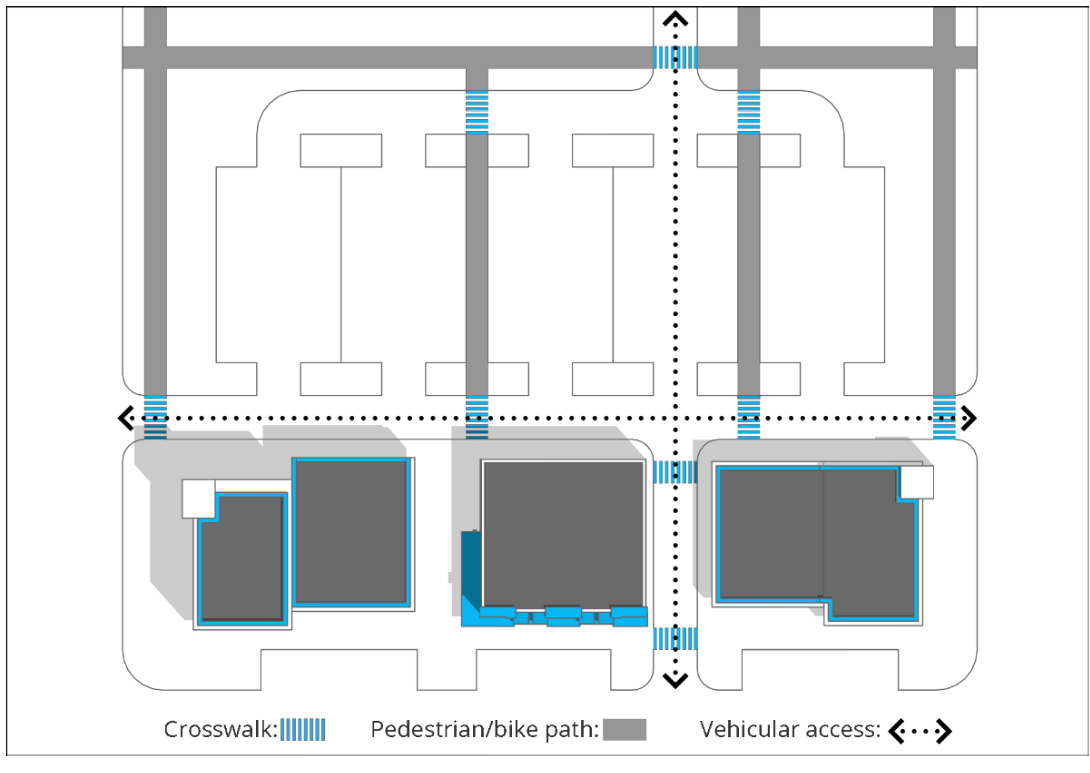
C.
Use and maintenance.
1.
Access and circulation routes are intended to provide pedestrian, bicycle, and vehicle access. Vehicle parking, garbage containers, merchandise storage or display, utility boxes and poles, signs, trees, and other obstructions shall not encroach into the required minimum width of any required access or circulation route, unless otherwise authorized by this UDC.
2.
Access and circulation routes required by this UDC shall be maintained in usable condition throughout the year as determined by the Director of Public Works and Engineering.
5.4.5.
Driveways and access.
A.
Access.
1.
The number of access points to any property shall be limited to one, unless it can be shown that the development will generate sufficient volumes to require two points of access for safe internal operations or unless required by Fire Code.
2.
All driveways shall meet the spacing, clearance, and design requirements set forth in the Transportation Technical Standards.
3.
In the M-1, M-2, M-3, and M-4 zoning districts, site access and curb cuts shall be limited to two curb cuts per block, unless no other legal access alternative is available.
B.
Location.
1.
In the M-1, M-2, M-3, and M-4 zoning districts, driveways shall have a minimum setback of five feet from side lot lines measured to the edge of driveway pavement. This requirement shall not apply to zero-lot-line developments, provided there is a five-foot wide landscaping strip between driveways.
2.
In all other zoning districts, driveway surfaces must be located a minimum of two feet from an interior side property line unless prior approval, recorded in the property records of Dallas County, Texas, has been obtained from the adjoining property owner. Where driveways are located parallel and adjacent to a side street property line, a minimum of five feet shall be provided between the surface and the property line.
3.
Driveways located near intersections shall maintain the vision triangle areas as required by § 5.4.6, and the Transportation Technical Standards.
C.
Removing or relocating driveways.
1.
Where the removal or relocation of one or more existing driveways or portions of driveways is necessary to comply with this UDC, any driveway or portion of driveway that is removed shall be replaced with the installation of curb and gutter along the gutter line of the street, in accordance with Public Works and Engineering Department specifications.
2.
If there is no existing curb and gutter on the street, the driveway shall be removed in the manner specified by the Director of Public Works and Engineering.
3.
The removal or relocation of one or more existing driveways or portions of driveways shall require the developer to maintain or improve drainage patterns to meet the standards of this UDC.
4.
The removal or relocation of a driveway shall also require the installation of landscape treatments for that portion of the site pursuant to the standards in this UDC.
D.
Surfacing.
1.
All driveways and access drives to improved parking surfaces shall be constructed as a continuous improved surface of concrete, brick pavers over concrete base, approved pavestone, or other approved surfacing material approved by the Director of Public Works and Engineering.
2.
Driveways and improved parking surfaces shall be designed and constructed in compliance with the improved driveway standards of the Town.
E.
Vehicle maneuvering.
1.
Except for on-street vehicle parking spaces approved by the Director of Public Works and Engineering, groups of more than five vehicle parking spaces per lot shall be provided with adequate aisles or turn-around areas so that all vehicles may enter the public right-of-way in a forward manner.
2.
Groups of more than five vehicle parking spaces shall be served by a driveway designed and constructed to facilitate the flow of traffic on or off the site, with due regard to pedestrian, bicycle, and vehicle safety, and shall be clearly and permanently marked and defined.
3.
Vehicle surface parking lots exceeding 100 spaces shall be designed with a clear hierarchy of circulation. The hierarchy shall consist of:
a.
Major entry driveways without parking spaces; then
b.
Major circulation drives with little or no parking; then
c.
Parking aisles for direct access to parking spaces.
Figure 5-2: Vehicle Maneuvering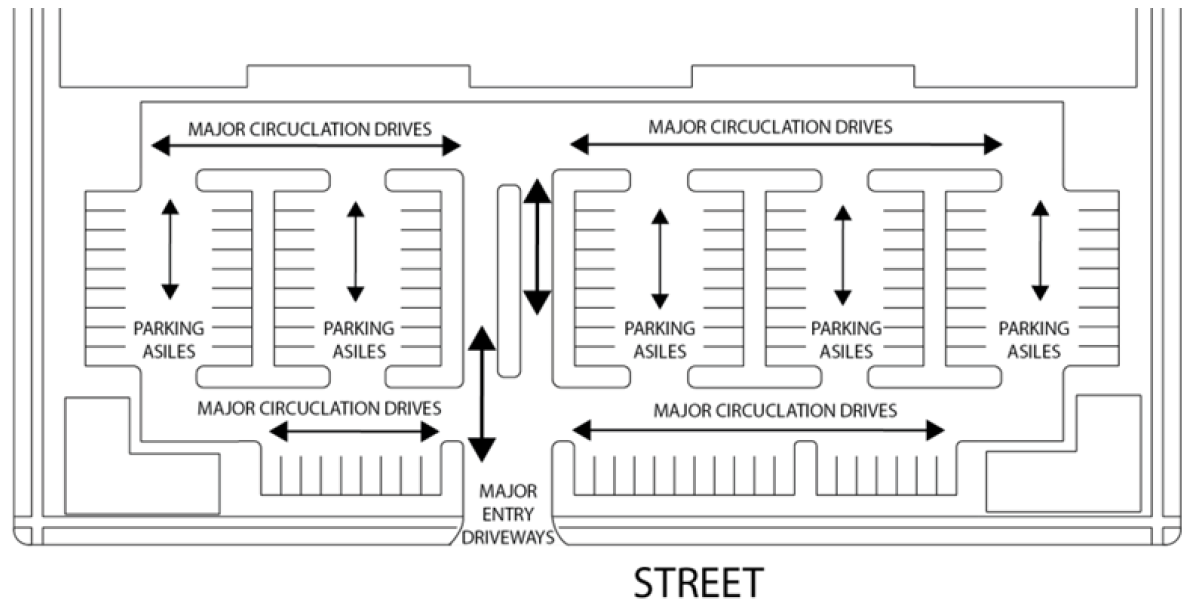
5.4.6.
Vision triangle.
A.
For all lots on which a front setback or build-to is required, no obstruction over 18 inches that will obscure or partly obscure the view of vehicles drivers shall be placed within the triangular area determined by site-specific AASHTO standards.
B.
This restriction shall not apply to traffic control signs and signals, street signs, or utility poles placed within such area by the Town.
C.
The use of plant material in a vision triangle is intended to provide aesthetic appeal while not unduly limiting or restricting visibility, whether as a pedestrian or a passenger in a vehicle. Plants shall not reduce or limit visibility to such an extent that a safety hazard is presented.
D.
Trees within the vision triangle may be placed subject to approval by the Director and shall be single trunked and have a minimum branching clearance of six feet from the ground to the first branch.
E.
Vertical measurement shall be made from the top of the curb on the street adjacent to the nearest street of the vision triangle or, if no curb exists, from the edge of the nearest traveled way.
5.4.7.
Pedestrian circulation.
A.
Sidewalks. Sidewalks shall be installed on both sides of all streets and within and along the frontage of all new development or redevelopment, as required by the Comprehensive Plan, Master Transportation Plan, Trails Master Plan, and Belt Line Master Plan.
1.
Where required.
a.
Sidewalks shall be provided by the developer to allow convenient pedestrian access through or across the development and joining with pedestrian ways of adjacent properties.
b.
Sidewalks shall be installed on both sides of all arterials, collector streets, and local streets, and within and along the frontage of all new development and redevelopment.
2.
Design and materials. Sidewalks shall be constructed in accordance with the Comprehensive Plan, Master Transportation Plan, City-wide Trails Master Plan, Belt Line Master Plan, and current engineering design standards.
B.
On-site pedestrian walkways. All multifamily, nonresidential, and mixed-use development shall provide an on-site system of pedestrian walkways that meets the following standards:
1.
Areas to connect. On-site pedestrian walkways shall provide connections to and between:
a.
The primary entrance or entrances to each building, including pad-site buildings;
b.
Any sidewalks, walkways, or multi-use paths on adjacent properties that extend to the boundaries shared with the development;
c.
Any parking areas intended to serve the development as described in § 5.4.7.C: Pedestrian Access through Parking Areas;
d.
Any sidewalk system along the perimeter streets adjacent to the development;
e.
Any public transit station areas, transit stops, park and ride facilities, or other transit facilities on-site or along an adjacent street; and
f.
Any adjacent or on-site public park, trail system, open space, greenway, or other public or civic use or amenity.
2.
Walkway design. Required on-site pedestrian walkways shall be a minimum width of five feet. All required walkways shall:
a.
Be distinguishable from areas used by vehicles using one or more of the following techniques:
i.
Changing surfacing material, patterns, and/or paving color, but not including the painting of the paving material;
ii.
Changing paving height;
iii.
Decorative bollards;
iv.
Raised median walkways with landscaped buffers;
b.
Be designed with similar and/or complementary details, colors, and finishes as other interconnected walkways;
c.
Have adequate lighting for security and safety;
d.
Be conveniently and centrally located on the subject property;
e.
Be ADA-accessible; and
f.
Not include barriers that limit pedestrian access between the subject property and required connections to adjacent properties.
C.
Pedestrian access through parking areas. All parking lots that contain more than two double rows of vehicle parking shall include pedestrian walkways through the parking lot to the primary building entrance or a sidewalk providing access to the primary building entrance. At a minimum, walkways shall be provided for every three driving aisles or at a distance of not more than 150-foot intervals, whichever is less.
Figure 5-3: Parking Access through Parking Areas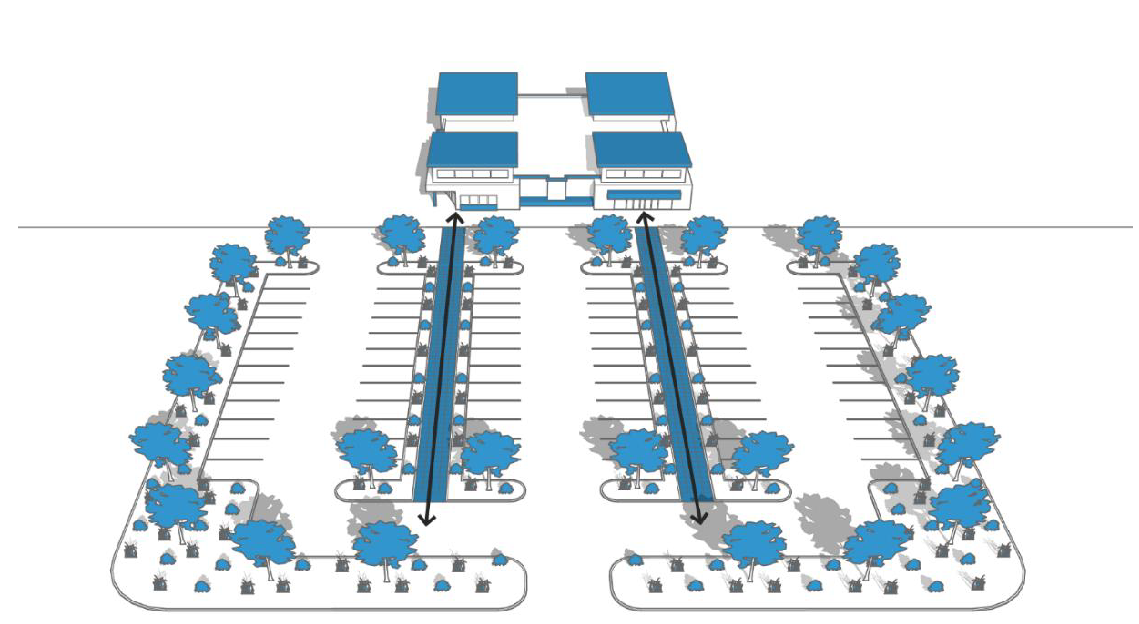
D.
Pedestrian access through parking garages. Pedestrian walkways shall be provided through parking garages from the parking area to the abutting public right-of-way and sidewalk and/or to the primary entrance of the building served. Pedestrian walkways shall not use vehicle entrance or exit driveways from the parking area to a public right-of-way.
E.
Active transportation connectivity. Off-street trails, enhanced pedestrian paths, and active transportation corridors shall be installed in all new development or redevelopment, as required by the Comprehensive Plan, Master Transportation Plan, and City-wide Trails Master Plan.
5.4.8.
Bicycle circulation.
A.
Bicycle routes shall be established in accordance with the Comprehensive Plan, Master Transportation Plan, City-wide Trails Master Plan, and Public Works and Engineering Department specifications.
B.
The development's internal bicycle circulation system shall permit safe, convenient, efficient, and orderly movement of bicycles between the development's internal origin and destination points and adjacent parts of an existing or planned external, community-wide and regional bicycle circulation system, as well as any adjacent transit stations, bus stops and shelters, public parks, greenways, schools, community centers, and shopping areas.
Sec. 5.5. - Parking and loading.
5.5.1.
Purpose. This section is intended to regulate the amount and design of off-street parking and loading for different land uses and to help protect the public health, safety, and general welfare by:
A.
Avoiding and mitigating traffic congestion and adverse impacts on residential neighborhoods;
B.
Providing necessary access for service and emergency vehicles;
C.
Providing for safe and convenient interaction between vehicles, bicycles, pedestrians, and other modes of travel;
D.
Encouraging multi-modal transportation options and enhanced pedestrian safety;
E.
Providing flexibility to respond to the transportation, access, and loading impacts of various land uses in different areas of the Town;
F.
Reducing stormwater runoff, reducing heat island effect from large expanses of pavement, improving water quality, and minimizing dust pollution; and
G.
Avoiding and mitigating the adverse visual impact and inefficient land use of large concentrations of exposed parking;
H.
Maximizing the use of on-street parking, except along arterial thoroughfares.
5.5.2.
Applicability. The standards of this section shall apply to all development that meets the applicability thresholds established in § 5.2: Applicability.
5.5.3.
Calculations.
A.
Generally.
1.
All parking and loading requirements that are based on square footage shall be calculated on the basis of gross floor area of the subject use, unless otherwise specified.
2.
When measurements of the minimum number of required parking spaces for vehicles or bicycles result in a fractional number, any fraction of 0.5 or larger shall be rounded up to the next higher whole number.
3.
When measurements of the maximum number of required parking spaces for vehicles or bicycles result in a fractional number, any fraction shall be rounded down to the next lowest whole number.
4.
The following types of parking spaces shall not count towards the maximum parking requirement:
a.
On-street parking spaces provided pursuant to § 5.5.6.C: On-Street Parking;
b.
Designated accessible parking;
c.
Parking spaces intended for storage of business vehicles, such as fleet vehicles or delivery vehicles; and
d.
Structured parking, underground parking, and parking within, above, or beneath the building(s) it serves.
5.
Lots containing more than one use may provide parking and loading based on the shared parking calculations in § 5.5.6: Parking Alternatives.
B.
Unlisted uses. For uses not listed in § 5.5.4: Minimum Off-Street Vehicle Parking Requirement or 5.5.5: Maximum Off-Street Vehicle Parking Allowed, the Director is authorized to establish minimum and maximum parking requirements pursuant to § 5.5.4.A: Director Determination Based on Demand Study.
5.5.4.
Minimum off-street vehicle parking requirement. Each development or land use subject to this section pursuant to § 5.5.2: Applicability, shall provide at least the minimum number of off-street vehicle parking spaces required below, unless otherwise provided in this UDC.
A.
Director determination based on demand study. Uses in § 5.5.4: Minimum Off-Street Vehicle Parking Requirement, that reference this section have varied parking and loading demands, making it difficult to specify a single standard for off-street parking or loading requirements. With an application for a use that is subject to this section, the Director shall apply the off-street parking and loading standards on the basis of a demand study prepared by the applicant. Such study shall estimate the parking and loading demand based on recommendations of the Institute of Traffic Engineers, Urban Land Institute, the International Council of Shopping Centers, the American Association of State Highway and Transportation Officials, the American Planning Association, or other acceptable source of parking demand data for uses and/or combinations of uses of comparable activities, scale, bulk, area, and location.
B.
Unlisted uses. For uses not listed in § 5.5.4: Minimum Off-Street Vehicle Parking Requirement, the Director is authorized to:
1.
Apply the minimum off-street parking space requirement specified in § 5.5.4: Minimum Off-Street Vehicle Parking Requirement, for the listed use that is deemed most similar to the proposed use; or
2.
Establish the minimum off-street parking space requirement by reference to standards in parking resources published by the National Parking Association, American Planning Association, Institute of Traffic Engineers (ITE), or other acceptable sources of parking data; or
3.
Establish the minimum off-street parking space requirement based on local or national best practices; or
4.
Establish the minimum off-street parking space requirement based on a demand study prepared by the applicant. Such a study shall be prepared according to § 5.5.4.A: Director Determination Based on Demand Study.
C.
Accessible parking. All areas of newly designed or newly constructed buildings and facilities required to be accessible under federal and state law shall comply with the standards set forth in the Texas Accessibility Standards of the Architectural Barriers Act, Tex. Rev. Civ. Stat. Art. Ann. §9102 (Vernon Supp 2000.), the International Building Code (IBC) as adopted in the Code of Ordinances, and the American with Disabilities Act (ADA), as amended.
D.
Garages. Off-street parking spaces within garages shall not contribute to the minimum off-street vehicle parking requirement if they are converted into storage or living space.
5.5.5.
Maximum off-street vehicle parking allowed.
A.
Nonresidential uses. In no case shall any nonresidential use provide more than 125 percent of the minimum number of off-street parking spaces required by § 5.5.4: Minimum Off-Street Vehicle Parking Requirement, unless otherwise provided in this UDC.
B.
Change of use. Any development that exceeds the maximum parking requirements as a result of a change in use shall not add additional spaces, but is not required to remove previously constructed parking spaces.
5.5.6.
Parking alternatives. The Director may approve parking alternatives that result in a cumulative adjustment not to exceed 25 percent of the minimum or maximum vehicle parking spaces required by § 5.5.4: Minimum Off-Street Vehicle Parking Requirement and § 5.5.5: Maximum Off-Street Vehicle Parking Allowed, in accordance with the following standards.
A.
Shared parking facilities.
1.
When reviewing a shared parking proposal, the Director shall consider any additional reductions in minimum parking requirements that might otherwise apply pursuant to § 5.5.6.B through § 5.5.6.D below, but such additional reductions shall not apply to further reduce the shared parking requirements approved by the Development and Neighborhood Services Department.
2.
Where a minimum number of parking spaces is required by § 5.5.4: Minimum Off-Street Vehicle Parking Requirement, the owners of two or more properties may join together to provide the required parking spaces for their respective uses. Upon request by the owners and after review of the request, the Director may authorize the shared use of parking facilities subject to the following:
a.
Any property using shared parking facilities shall be located within 500 feet of such parking facility, using established sidewalks and crosswalks that meet current standards of the Master Transportation Plan and further the intent of the City-wide Trails Master Plan and Comprehensive Plan.
b.
The parking for the specific uses occurs at alternating time periods, as determined by a parking demand study pursuant to § 5.5.4.A: Director Determination Based on Demand Study.
3.
Required parking shall be determined based on parking demand for the peak parking period.
4.
The owners of record involved in the joint use of shared parking facilities shall submit a Parking Management Agreement in accordance with § 2.8.1.
B.
Proximity to transit. Except for single-family detached dwelling uses, the minimum vehicle parking required for development within one-quarter mile, measured radially in a straight line, of a fixed transit station, such as a commuter or light rail stop, may be reduced from those required by § 5.5.4: Minimum Off-Street Vehicle Parking Requirement by 20 percent.
C.
On-street parking. Any on-street vehicle parking may be counted toward the minimum number of required vehicle parking spaces on a one-to-one basis, subject to the following:
1.
On-street parking may not be used to meet the minimum vehicle parking requirements for single-family detached and duplex dwellings;
2.
On-street parking along an arterial street as classified in the Master Transportation Plan shall not be used to meet any minimum vehicle parking requirements for any use;
3.
Only those street parking spaces abutting any lot line of the subject property, and with over one-half the length of a parking space located between the imaginary extension of the side property lines into the street right-of-way, may be counted.
4.
Each on-street parking space may only be counted once toward the parking requirements of the abutting lot, regardless of the number of individual buildings or tenants on the lot;
5.
On-street parking spaces shall be available for general public use at all times. No signage or actions limiting general public use of on-street spaces shall be permitted; and
6.
No development or use approved with an on-street parking credit shall be considered nonconforming if the on-street parking is later removed by Town action and the remaining off-street vehicle parking does not meet the minimum vehicle parking requirements of this section.
D.
Parking demand study.
1.
If an applicant submits a parking demand study pursuant to § 5.5.4.A: Director Determination Based on Demand Study, demonstrating that anticipated off-street vehicle parking demand for the proposed development, use, or combination of uses will be less or more than that calculated from § 5.5.4: Minimum Off-Street Vehicle Parking Requirement or § 5.5.5: Maximum Off-Street Vehicle Parking Allowed, and the Director determines that the information and assumptions used in the study are reasonable and that the study accurately reflects anticipated off-street vehicle parking demand for the proposed development, use, or combination of uses, the Director may authorize a reduction or increase in required off-street vehicle parking spaces based on that study.
2.
The Director may require any parking spaces that have been approved to exceed the maximum off-street vehicle requirements be constructed using permeable materials such as pavers, permeable asphalt, or concrete.
5.5.7.
Vehicle parking layout and design.
A.
At-grade parking standards.
1.
Single-family, duplex, triplex, fourplex, and manufactured home dwellings.
a.
Vehicle parking for single-family detached, single-family attached, duplex, triplex, fourplex, and manufactured home dwelling uses shall only be allowed in a garage or on an approved surface. All other off-street vehicle parking within a required front setback area shall be prohibited.
b.
In cases where the side or rear setback area is accessible via an improved alley, no front yard drive or parking shall be permitted. The required parking area shall directly access the alley. Determinations of whether an alley allows for safe access shall be made by the Director.
Figure 5-4: Parking Area Accessed by Improved Alley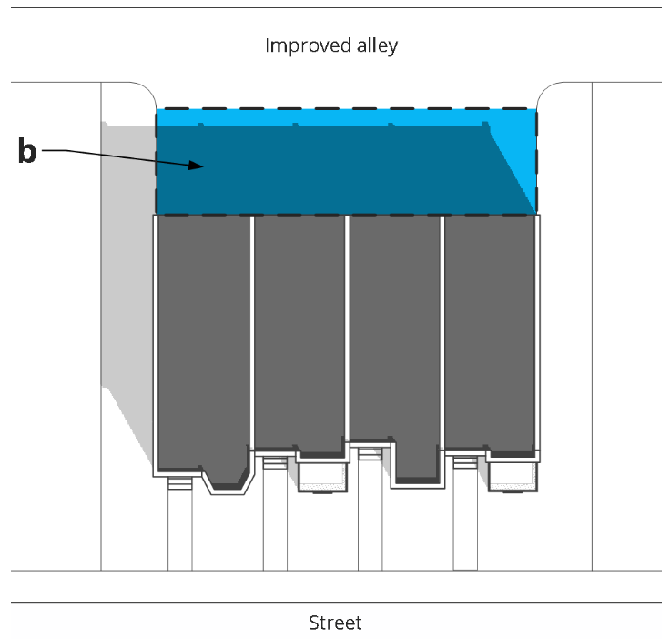
c.
Where vehicle parking is permitted within the front setback area, the width of the driveway between the front building façade and the street shall not exceed the width of the garage door of an attached garage or 22 feet where there is no attached garage.
Figure 5-5" Driveway Width Requirements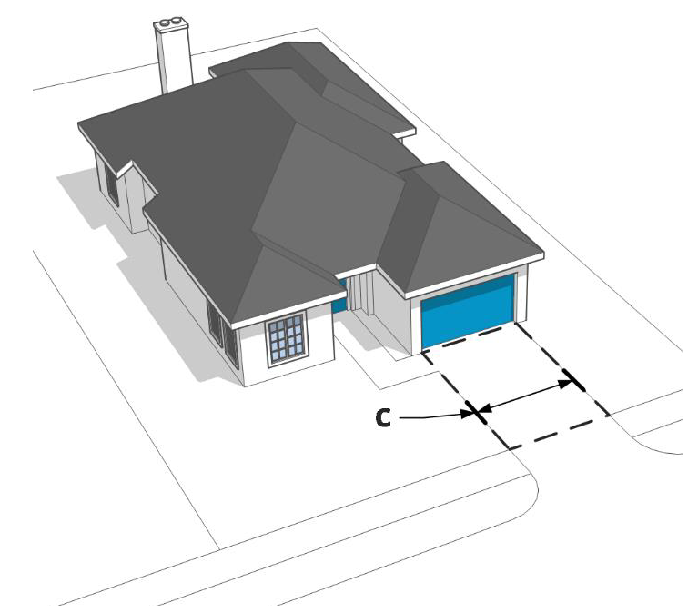
2.
All other uses. Vehicle parking areas located between the front building façade and the adjacent street frontage is prohibited, unless the subject property satisfies all of the following standards:
a.
It is not located within the M-1, M-2, and M-3 zoning districts;
b.
It adjoins either side of an arterial street, as defined in the Master Transportation Plan;
c.
Development with 100 or fewer off-street vehicle parking spaces shall be limited to no more than two rows of vehicle parking or 80 feet, whichever is less, between the front building façade and the adjacent street frontage;
d.
Development with 100 or more off-street vehicle parking spaces shall be limited to no more than four rows of parking or 160 feet, whichever is less, between the front building façade and the adjacent street frontage; and
e.
Vehicle parking areas shall be setback a minimum of ten feet from the adjacent right-of-way and shall satisfy the landscape and screening requirements established in § 5.6.4.D: Parking Area Landscaping.
B.
Below-grade parking standards.
1.
Below-grade vehicle parking shall be constructed in accordance with § 5.3: Floods.
2.
Below-grade vehicle parking is permitted to property lines; but shall be designed to satisfy the landscape requirements established in § 5.6: Landscaping, Buffering, and Fences.
C.
Structured parking standards.
1.
Location.
a.
Parking structures shall be located an additional ten feet beyond the minimum setbacks required in the district to allow for additional landscape screening.
b.
Parking structures shall not be located between the front building façade and the adjacent street frontage.
c.
Parking structures are not required to meet minimum building height requirements, where applicable.
2.
Exterior design.
a.
Parking structures that have frontage on public streets shall comply with the building design standards established in § 5.7.5: Parking Structure Design.
b.
Ramps shall not be expressed on the facades of parking structures fronting, or visible from, public streets.
c.
Steel parking garages and steel guard cables on garage facades are prohibited.
d.
The maximum frontage of parking structures along any one block face shall be limited to 250 feet. If additional frontage is requested, the ground floor of the structure shall include retail, commercial, or other active ground floor uses.
Figure 5-6: Structured Parking Design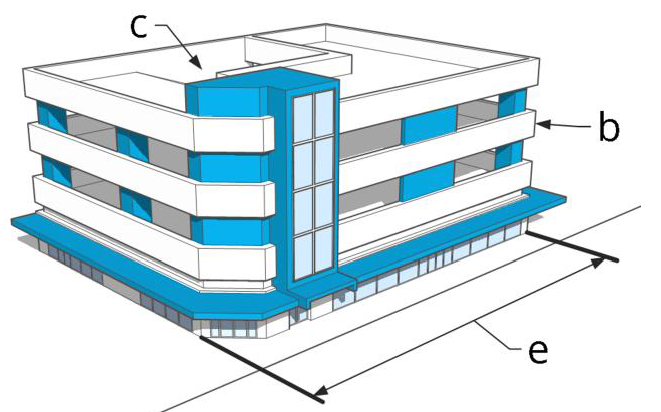
D.
Dimensions of parking spaces and drive aisles. All off-street parking and maneuvering areas shall be constructed according to the following dimensional standards:
1.
All dead-end parking aisles shall terminate with a five foot bump-out for turnaround maneuverability, unless required to connect to another drive aisle or other form of additional turnaround for fire lane purposes.
2.
Unobstructed, direct, and convenient access for vehicles to and from a public street shall be provided for all off-street parking spaces. Access from any parking area to a public street shall be designed to allow vehicles to enter and exit in forward drive.
3.
Parking spaces and drive aisles shall comply with the following dimensional standards. The letters (A through D) in Figure 4.10 correspond with the dimensions (in feet) in the table below:
Figure 5-7: Parking Space and Drive Aisle Dimensions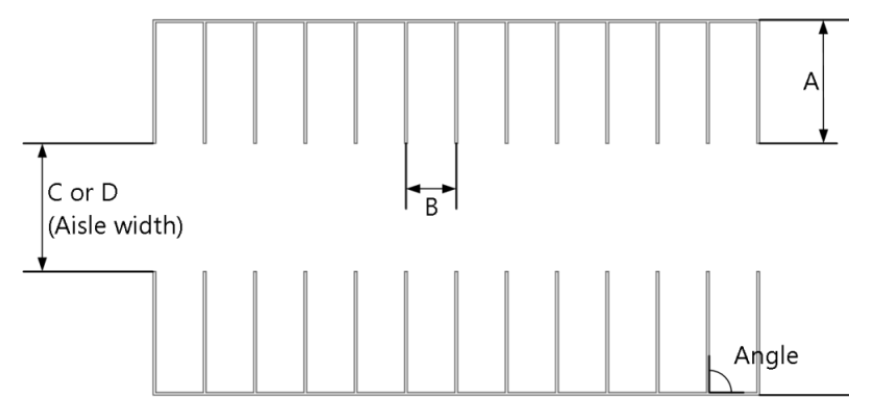
4.
The final decision-making body may approve alternative standards based on a professionally recognized source of parking lot design, pursuant to the Minor Modification process outlined in § 2.10.3: Minor Modification.
E.
Stormwater drainage.
1.
Parking lots shall be constructed such that all surface water is directed into an approved landscape bumpout, island, or endcap containing one or more approved Best Management Practices (BMPs) in accordance with the Drainage Criteria Manual. A stormwater professional with PE or LEED certification for environmental design shall design all BMPs or other Low Impact Design (LID) systems.
2.
Water draining from a parking lot shall not flow across a sidewalk.
3.
Stormwater drainage plans for off-street vehicle parking areas shall be reviewed and approved by the Town.
4.
For all new parking lots containing ten or more spaces, the following best management practices shall be used to improve stormwater infiltration and water quality:
a.
Permeable pavement materials shall be installed in non-fire lane areas covering at least 25 percent of the total parking lot area; or
b.
Treatments such as culvert outfalls, bioretention basins, or vegetated swales designed to the specifications of the Public Works and Engineering Department shall be installed; or
c.
Other combinations of best management practices for stormwater infiltration and water quality subject to approval by the Development and Neighborhood Services and Public Works and Engineering Departments as outlined in the Drainage Criteria Manual.
Figure 5-8: Parking Area Stormwater Drainage Standards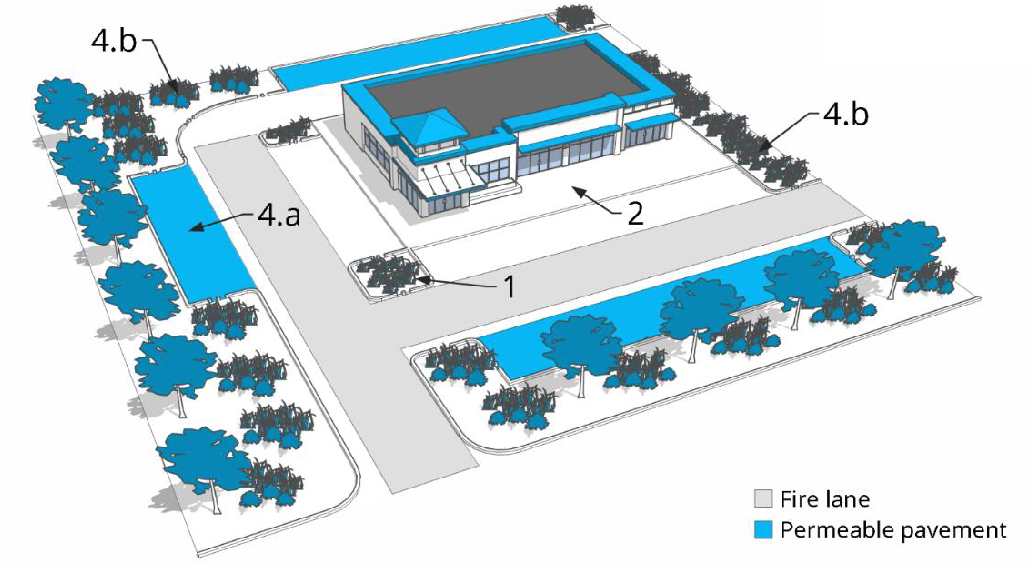
F.
Surface material.
1.
Except as stated in § 5.5.7.E: Stormwater Drainage, or an exception is provided elsewhere in this UDC, all areas used for vehicle parking shall be an improved surface of concrete, asphalt, brick pavers, or other approved material.
2.
All new driveway aprons onto a street shall be surfaced with concrete. Enlargement or modification of an existing driveway shall require the driveway apron to be surfaced with concrete. All driveway aprons shall be designed in accordance with Public Works and Engineering Department standards.
3.
Areas using permeable parking pavers shall receive relief from impervious surface calculations in accordance with Public Works and Engineering Department standards.
4.
Except for single-family attached, single-family detached, duplex, triplex, fourplex, manufactured home dwelling uses, and display areas for vehicle sales and rental uses, all off-street parking spaces shall be striped or otherwise designated to clearly mark each space.
5.
All driving lanes and parking aisles in vehicle parking lots shall be curbed, unless an alternative design allowing for adequate stormwater management is approved.
G.
Electric vehicle charging. Parking areas with 40 or more vehicle parking spaces shall provide a minimum of one vehicle parking space dedicated to electric vehicles for every 25 vehicle parking spaces provided on site. Electric vehicle parking spaces shall count toward the minimum required number of vehicle parking spaces, but shall not count toward the maximum allowed. The electric vehicle parking space shall be:
1.
Located on the same lot as the principal use;
2.
Signed in a clear and conspicuous manner, such as special pavement marking or signage, indicating exclusive availability to electric vehicles; and
3.
Outfitted with an electric vehicle charging station as approved by the Director.
H.
Parking area landscaping. All development shall comply with § 5.6.4.D: Parking Area Landscaping.
I.
Parking area lighting. All development shall comply with § 5.8.5.E: Surface Parking Area Lighting.
J.
Pedestrian and bicycle circulation. All development shall comply with § 5.4.7: Pedestrian Circulation and § 5.4.8: Bicycle Circulation.
5.5.8.
Vehicle loading areas.
A.
Number and size of loading berths required.
1.
The Director may approve a variation from the required loading berth requirements if warranted by the building use.
2.
The number and size of loading berths shall be provided pursuant to the table below:
B.
Design and use of service and loading areas.
1.
Location.
a.
Required off-street loading spaces shall not be permitted between the primary building façade and the street.
b.
Streets or rights-of-way shall not be used for loading and unloading purposes, unless otherwise authorized in this UDC.
c.
Alleys may be used for loading or unloading materials or merchandise for periods not to exceed 30 consecutive minutes so long as sufficient width of the roadway is available for free movement of vehicular traffic access to abutting property is maintained.
d.
Off-street loading spaces shall be located on the same lot or parcel as the structure or use for which it is provided or on the lot adjacent to a private alley or private service drive.
e.
Delivery vehicles parked in a loading area shall not encroach into required parking spaces or required building setbacks.
f.
Delivery vehicles loading or unloading materials shall not block required on-site access and circulation routes or fire lanes.
2.
Maneuvering. Loading areas shall be designed to provide for delivery vehicle backing and maneuvering on-site and not from or within a public right-of-way, unless otherwise authorized by this UDC.
3.
Screening. Service and loading areas visible from a Residential zoning district or a public right-of-way shall be screened pursuant to § 5.6.9.E: Off-Street Loading Spaces.
5.5.9.
Drive-through facilities.
A.
Number of stacking spaces required.
1.
The Director may approve a variation from the required stacking requirements if warranted by the building use. The Director may require a stacking study for uses expected to generate higher than normal queuing.
2.
All drive-through facilities shall provide at least the number of on-site stacking spaces required by the table below.
B.
Location and design of drive-through facilities.
1.
Each stacking space shall be 20 feet in length unless otherwise approved by the Director. Required stacking distances shall be measured from the end of the queuing lane or property line to the first point of service.
2.
Vehicle stacking spaces shall be integrated into the site layout and shall not interfere with site access points, access to parking or loading spaces or areas, or internal circulation routes.
3.
Drive-through service windows and speakers shall be oriented away from pedestrian areas, Residential zoning districts, and public streets to the maximum extent practicable.
4.
Audible electronic devices such as loudspeakers, vehicle service order devices, and similar instruments shall not be audible beyond the property line within any Residential zoning district.
5.5.10.
Bicycle parking.
A.
Purpose. Bicycle parking is required in order to encourage the use of bicycles by providing safe and convenient places to park bicycles.
B.
Applicability. The following standards shall apply to all principal uses except for single-family attached, single-family detached, duplex, triplex, fourplex, cottage development, and manufactured home development residential uses.
C.
Required bicycle parking.
1.
Generally. Development subject to this section shall provide a minimum of six short- or long-term bicycle parking spaces or the number of bicycle parking spaces required in the table below, whichever is more. Short-term bicycle parking spaces are those that are typically used for two hours or less.
2.
Mixed-use developments. In all zoning districts, developments with both nonresidential and residential uses shall provide the cumulative required number of bicycle parking spaces as calculated for the respective nonresidential and residential requirements.
3.
Building expansions or changes of use. Building expansions or changes of use that require additional vehicle parking spaces pursuant to § 5.5.2: Applicability, shall also provide additional bicycle parking spaces based on the percentages in the table above, applied to the building expansion area or the additional parking required by the change of use.
4.
Existing public bicycle parking spaces. Permanent bicycle parking spaces available for public use, such as Town installed bicycle racks or bike corrals that exist at the time of development, expansion, or change of use, and are located within 100 feet of the primary entrance to the primary building may be used to satisfy up to two required bicycle parking spaces.
5.
Bicycle parking reduction. Subject to the approval of the Director, the number of bicycle parking spaces may be reduced if:
a.
Unique or unusual characteristics exist on a development site such as topography, size, or relation to a public street that would preclude safe travel of bicycles to and from the site; or
b.
Existing bicycle parking facilities are located within the public right-of-way and within 100 feet of the building's main entrance, provided that a minimum of four bicycle parking spaces are provided on-site.
D.
Bicycle parking layout and design.
1.
Bicycle parking spaces shall not be located fully or partially within a public right-of-way without prior approval of the Town.
2.
Required bicycle parking spaces shall be designed to allow bicycles to be secured with a lock to a fixed object and shall comply with the rack types and standards established in the Administrative Manual.
3.
Short-term bicycle parking shall be located within 100 feet of the main entrance of each principal building on site and shall not be located farther than the closest motor vehicle parking space, excluding accessible vehicle parking spaces.
4.
Bicycle parking spaces must be at least six feet long, two feet wide, and provide a minimum of seven feet of overhead clearance.
5.
A five-foot aisle for bicycle maneuvering shall be maintained beside or between each row of bicycle parking.
6.
Areas designated for bicycle parking shall be clearly marked and reserved for bicycle parking only.
5.5.11.
Use of parking areas.
A.
Exclusive use.
1.
Unless a shared parking agreement has been established in accordance with § 5.5.6.A: Shared Parking Facilities, required vehicle and bicycle parking spaces shall be designed, maintained, and used exclusively for the tenants, occupants, and patrons of the buildings or uses on the site.
2.
Excess or unused vehicle or bicycle parking spaces or loading areas may not be rented or leased to the general public or to those who are not tenants, occupants, or patrons of the buildings or uses where the parking is located unless:
a.
Otherwise allowed under the shared parking standards pursuant to § 5.5.6.A: Shared Parking Facilities; or
b.
A parking facility is listed as a permitted or special use in the zoning district where the parking lot or parking garage is located pursuant to § 4.2.7: Table of Allowed Uses.
B.
Storage of vehicles or equipment. Vehicle parking spaces, including both required and excess parking spaces, shall not be used for storing vehicles that are not used in conjunction with the primary use of the lot.
C.
Vehicles and tailers. Except for uses where vehicle repair is authorized, the parking of vehicles or trailers of any type without current state registration or in an inoperable condition shall be prohibited for periods in excess of 30 days, unless such vehicle or trailer is completely enclosed within a building.
D.
Storage, occupancy, or similar uses. Vehicles, campers, or tractor/trailers of any type shall not be used for the purpose of storage, occupancy, or similar use.
E.
Overnight parking. Overnight parking of any truck-tractor, road-tractor, semitrailer, bus, truck, or trailer with more than three-quarter ton rated capacity between the hours of 12:00 a.m. and 6:00 a.m. shall be prohibited within the R-1, R-2, R-3, A, and PD-TH zoning districts.
5.5.12.
Maintenance. All improved parking surfaces shall be maintained in good and safe condition and be free of holes, cracks or other failures that may affect the use, safety, appearance or drainage of the surface or of the adjoining property. Driveways and improved parking surfaces shall be maintained in good and safe condition and be free of holes, cracks, spalling, or other failures that may affect the use, drainage from the property, drainage on adjoining property or the longevity of the material.
Sec. 5.6. - Landscaping, buffering, and fences.
5.6.1.
Purpose. The intent of this section is, through the preservation, protection, maintenance, and planting of trees and other plant materials, to:
A.
Provide visual buffering and enhance the visual appeal of the Town;
B.
Realize the environmental benefits of landscaping such as: storm water retention; recharging groundwater; retaining soil moisture; preventing erosion; providing bird and wildlife habitat; and mitigating air quality, water pollution, dust, noise, heat, and glare;
C.
Conserve water resources by using sustainable design and maintenance techniques and native and/or adapted plant species that are low water-use and regionally appropriate;
D.
Provide screening to minimize the visual impacts of some types of facilities, structures, and equipment;
E.
Establish an attractive streetscape that contributes to the character and appearance of the Town; and
F.
Improve the appearance of development to protect and enhance public and private investments and property values.
5.6.2.
Applicability.
A.
Generally. Unless otherwise exempted by § 5.6.2.B below, the standards of this section shall apply to all development that meets the applicability thresholds established in § 5.2: Applicability.
B.
Exemptions. Properties containing only single-family detached and/or duplex uses where only one such structure is constructed are exempt from all parts of this section except for the following:
1.
§ 5.6.6.D: Application to Residential Districts; and
2.
§ 5.6.8: Buffering.
C.
Establishment and modification of planned development districts and special use permits.
1.
The City Council shall, at a minimum, impose landscaping requirements that are reasonably consistent with the standards and purposes of this section as a part of any ordinance establishing or amending a planned development district, or amending a Special Use Permit.
2.
All landscaping requirements imposed by the City Council shall be reflected in landscape plans that comply in form and content with the requirements of § 5.6.3.
D.
Special exceptions to landscaping requirements. The Board of Zoning Adjustments may grant a special exception to the landscaping requirements of this section upon making a special finding from the evidence presented that strict compliance with the requirements of this section will result in substantial financial hardship to the applicant (as defined in TLGC Section 211.09) without sufficient corresponding benefit to the Town and its residents in accomplishing the objectives and purposes of this section. To be considered for special exception, the applicant shall submit a justification statement that describes which of the requirements set forth in this section will be met with modifications, which project conditions justify using alternatives, and how the proposed measures equal or exceed normal compliance.
5.6.3.
Landscape plans.
A.
Submittal. Landscape plans that meet the requirements established in the Administrate Manual shall be submitted with applications for Site Plan Review or as part of Building Permit applications if Site Plan Review is not required.
B.
Certificate of occupancy. It shall be unlawful to issue an occupancy permit prior to the approval and complete installation of the landscape plans pursuant to § 5.6.11: Installation and Maintenance.
C.
Evaluation of landscape plans. The Director of Parks and Recreation shall review each landscape plan to determine whether it complies with the requirements of this section, including the landscape design standards in § 5.6.5: General Landscape Standards and Specifications. The following considerations shall be used to evaluate proposed plans:
1.
The landscape design should have proportion, balance, unity, variety of species, and a variety of color through the seasons.
2.
Landscape designs should define spaces including entrance areas, pedestrian paths, vehicular avenues, parking areas, sitting areas, etc.
3.
As an architectural feature, landscape designs should visually soften the mass of the buildings, parking areas, and other structures.
4.
Native or adapted Texas Smartscape or Xeriscape landscape materials or those materials on the Pre-Approved Plant List in the Administrative Manual should be selected.
5.
Landscaping should use best management practices that reduce the reliance on irrigation, thus conserving the public water supply, and reduce the reliance on inorganic fertilizer and pesticides; thus reducing the amounts carried off by runoff to lakes and streams.
5.6.4.
Minimum landscaping required.
A.
General.
1.
Trees and other plant material shall be provided according to this section.
2.
Existing landscaping may be used to satisfy the landscaping requirements of this section.
3.
Where fractional number results, the number of trees, shrubs, or perennials shall be rounded to the next highest whole number.
B.
Minimum landscaped area. In the districts listed in the following table, a minimum percentage of the gross site shall be maintained as landscaped area meeting the standards of § 5.6.5: General Landscape Standards and Specifications. All required screening, parking perimeter, and interior parking landscaping shall count toward this minimum landscaped area requirement. This shall include front, side, and rear landscaping abutting the building foundation.
C.
Street landscape buffer.
1.
Mixed-use districts. The following standards apply in the mixed-use zoning districts:
a.
Streetscape standards.
i.
Location-specific streetscape standards may apply as determined by the Director of Parks and Recreation and are established in the Administrative Manual for both residential and nonresidential ground-level frontages. Nonresidential ground-floor frontages shall not be required to provide additional landscaping beyond that required in the Administrative Manual.
ii.
Where on-street parking is adjacent to landscaping, a 1.5-foot dismount strip shall be provided behind the curb to facilitate passengers exiting from parked cars.
iii.
Residential ground-floor frontages shall be required to landscape a minimum of five feet between the edge of sidewalk and the primary building facade, excluding access to sidewalks, stairs, stoops, porches and patios. This area may be landscaped with ground cover, low shrubs, ornamental trees and street trees. In addition, street tree wells may also be landscaped. Landscaping for this area is limited to ground cover and low shrubs.
iv.
Any bicycle parking in the public right-of-way should be located within the band created by street trees and pedestrian streetlights; however, it must be placed in a manner that avoids conflicts with pedestrian and vehicular paths.
Figure 5-9: Mixed-Use District Streetscape Standards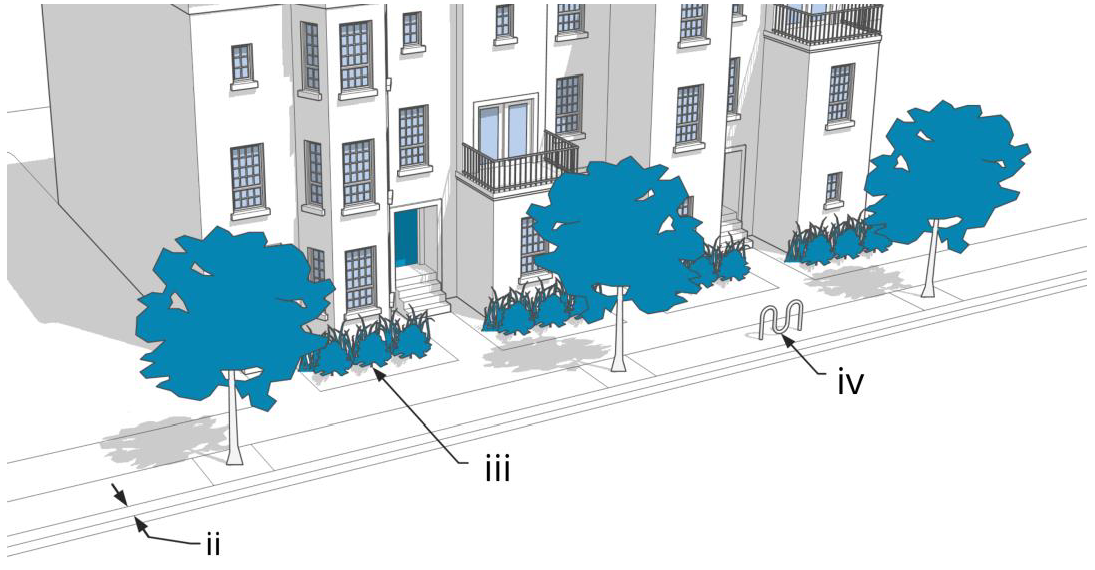
b.
Plant material. Front yards shall be landscaped except at building entries, seating areas, and adjacent to commercial uses, where the front yard may be paved. Plant materials shall consist of shade trees, ornamental trees, shrubs, evergreen ground covers, vines, turf, and seasonal color.
c.
Street trees. Street trees shall be provided in accordance with the following:
i.
Each street shall have street trees planted at uniform spacing of 50 feet on center, commencing 40 feet from the face of curb of intersecting streets. Street trees may be clustered or strategically spaced if needed to provide adequate room for underground utility lines or to ensure proper view corridors for commercial tenants as long as the minimum required number of trees is provided.
ii.
Typically, street trees shall be planted two and one-half feet from back of curb, except on side streets, where trees shall be placed eight and one-half feet from back of curb.
iii.
Street trees shall be large shade tree species having a minimum caliper of four inches selected in accordance with the Pre-Approved Plant List in the Administrative Manual. The Director of Parks and Recreation may allow the substitution of ornamental trees where space is limited by utilities, existing structures, or other built features abutting the landscape buffer strip.
iv.
Street trees shall be located and placed in a manner that does not block pedestrian lighting.
2.
All other districts.
a.
In all other zoning districts except the Mixed-Use zoning districts, a 20-foot wide landscape buffer strip measured from back of curb, including sidewalks, shall be provided along the entire length of the portion of the perimeter of the lot where a public or private street exists, exclusive of driveways and access ways to points of ingress and egress to and from the lot. The property owner shall be responsible for landscaping, irrigation, and maintenance of any right-of-way area between the property line and the curb line.
b.
Town right-of-way shall be included in the 20-foot wide buffer and shall reduce the amount of required landscaping area of the lot by that amount (square foot for square foot).
c.
The minimum requirement for street landscape buffers shall be one four-inch caliper shade tree for each 30 linear feet of frontage and evergreen shrubs planted three to three and one-half feet on center depending on the species selected. Plant material planted in the street landscape buffer strip can be massed together to create visual interest at key entry points or focal points.
d.
No tree may be planted closer than 36 inches to any paved surfaces without being placed in a tree well.
Figure 5-10: Street Landscape Buffer Requirements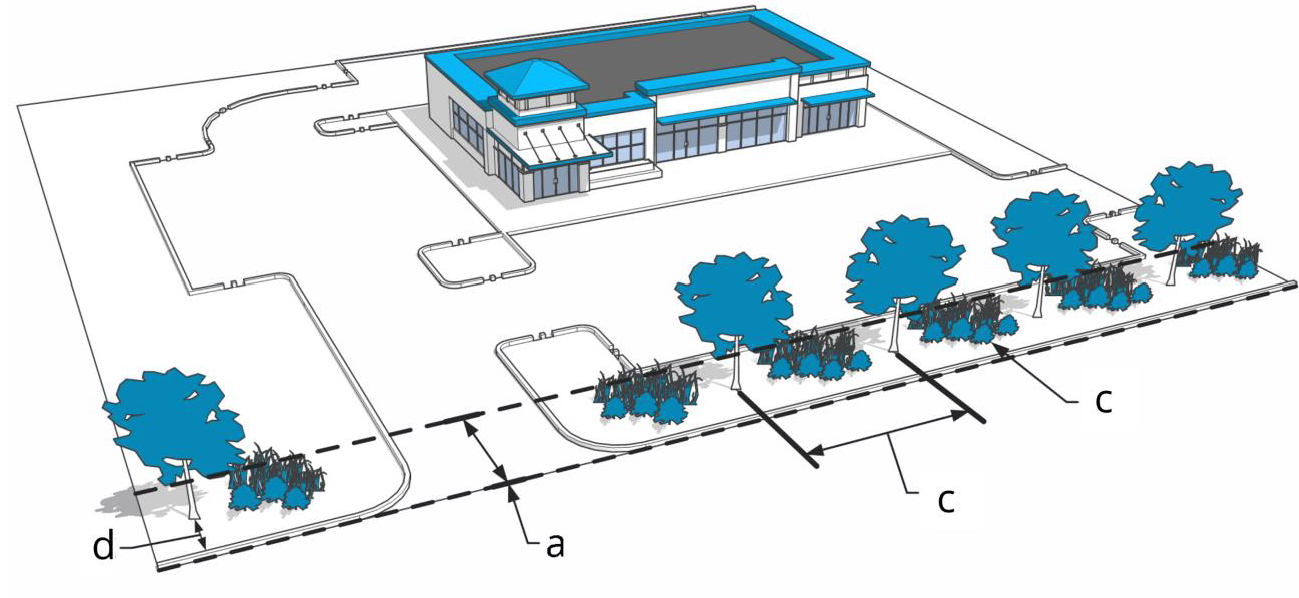
D.
Parking area landscaping.
1.
Screening from adjacent streets.
a.
Screening shall be provided for all surface parking lots to screen the site from all adjacent streets. The screening shall extend along the entire street frontage of the surface parking lot, exclusive of driveways and access ways at points of ingress and egress to and from the site, and vision triangles.
b.
The surface parking lot screening shall be at least three and one-half feet higher than the finished elevation of the adjacent parking lot. The screening may be provided by using one of the following, unless the Director of Parks and Recreation approves an alternative screening plan capable of providing a solid appearance:
i.
Evergreen shrubs planted three feet on center in a single row in a bed at least 42 inches wide;
ii.
A berm at least three and one-half feet high with a slope not to exceed 33 percent. The minimum crown width must be three feet. Berms must be covered in live vegetation;
iii.
A fence or wall at least three and one-half feet high constructed of materials compatible with the principle building. One-third of any fence or wall must be screened with plant material.
2.
Perimeter parking lot landscaping.
a.
A perimeter parking lot landscape strip shall be provided around the site perimeter, with a minimum width based on the size of the site.
i.
For sites 10,000 square feet or more, the perimeter strip shall be at least ten feet wide and shall be planted with a minimum of one four-inch caliper shade tree for each 35 linear feet of perimeter and one shrub planted three to three and one-half feet on center.
ii.
For a site smaller than 10,000 square feet, the perimeter strip shall be at least three feet wide and shall be planted with a minimum of one evergreen shrub planted three to three and a half feet on center.
b.
Required perimeter landscaping between adjacent parking lots does not preclude the need to provide vehicular access between lots.
3.
Interior parking lot landscaping.
a.
The required percentage of interior parking lot landscaping shall be determined based on the following sliding scale:
b.
To calculate the total parking area and the subsequent percentage of required interior lot planting, total the square footage of all areas within the lot's perimeter including:
i.
Planting islands;
ii.
Curbed areas;
iii.
Corner lots;
iv.
Parking spaces; and
v.
All interior driveways and aisles except those with no parking spaces located on either side.
c.
Landscaped areas located outside the parking lot including perimeter parking lot landscaping shall not be used to meet the interior planting requirement; however, building front, side, or rear landscaping abutting the building foundation may be credited toward the interior planting requirement.
d.
Curbs or wheel stops shall be provided to prevent cars from parking too close to trees or damaging shrubs and screens.
e.
All planting islands located parallel to and between parking spaces shall be at least nine feet wide to prevent cars from damaging trees and shrubs.
f.
Large shade trees shall be provided in each parking lot at a minimum average density of one shade tree for each ten required parking spaces on the lot. Acceptable tree species are listed in the Administrative Manual.
g.
No required parking space may be located further than 50 feet from the trunk of a shade tree, or farther than 75 feet from two or more shade trees.
h.
Parking spaces shall not exceed ten spaces in a row without being interrupted by a landscaped island. Islands shall be planted with a minimum of one shade tree per every ten cars.
i.
No landscaping shall be required for the interior of structured parking facilities.
5.6.5.
General landscape standards and specifications.
A.
General standards.
1.
The best professional practices of the American Society of Landscape Architects, the International Society of Arboriculture, the American Nursery and Landscape Association and Texas Nursery and Landscape Association regarding planting installation, trimming, pruning, and fertilization shall apply to the landscape standards and specifications included in this section.
2.
Nursery standards shall be based on the American Standard for Nursery Stock, ANSI Z60.1-2004.
3.
Pruning standards shall be based on the International Society of Arboriculture Pruning Guidelines ANSI A300 - Pruning Guidelines.
B.
Tree and plant materials specifications.
1.
Suggested tree and plant lists. The Town maintains a suggested list of trees and plants for replacements and that are suitable for new plantings in the Administrative Manual. Other species may be acceptable for new plantings; however, their suitability for the proposed planting area shall be approved by the Director of Parks and Recreation.
2.
Minimum tree size standards.
a.
General.
i.
Caliper measurements shall be taken six inches above grade for trees under four inches in diameter and 12 inches above grade for trees four inches in diameter and larger.
ii.
Tree heights shall be measured from the tops of root balls to the nominal tops of plants.
iii.
Tree spread refers to nominal outer width of the tree, not to the outer leaf tips.
b.
Shade trees.
i.
Shade trees shall have a minimum caliper of four inches.
ii.
Minimum branching height for all shade trees shall be six feet.
iii.
Minimum size for newly planted shade trees shall be four inches in diameter, 14 to 16 feet in height. The maximum height shall not exceed 16 feet.
c.
Ornamental trees.
i.
Ornamental trees shall have a minimum caliper of two and one-half inches.
ii.
Minimum size for ornamental flowering trees shall be eight to ten feet in height.
d.
Evergreens. Minimum size for evergreen trees shall be eight to ten feet in height.
3.
Minimum tree species mix. In order to ensure biodiversity and protect against tree disease, if ten or more trees are planted, no one species of tree may exceed 50 percent of the total new trees on the site.
4.
Tree quality and selection.
a.
Trees shall be healthy, vigorous, full-branched, well-shaped with symmetrical crowns. Root balls shall be firm, neat, slightly tapered and well burlapped. Trees shall be free of physical damage such as scrapes, bark abrasions, split branches, mistletoe or other parasitic growth. The Town shall reject any trees delivered and/or planted not meeting the minimum size and shape standards set forth above.
b.
Red Oaks other than Shumard Oak (Quercus shumardii) or Texas Oak (Quercus texana) shall be rejected. The owner or contractor shall be responsible for providing certification that Red Oaks are true to variety.
c.
Shade trees shall not be planted closer than ten feet from either side of the outermost overhead utility obstruction. The average mature size of a shade tree shall be used to determine the ten-foot distance requirement.
d.
Ornamental trees shall be substituted for shade trees in cases where maturing shade trees would otherwise interfere with overhead or underground utilities.
5.
Tree preservation evaluation required. Existing trees intended for preservation shall be evaluated by a licensed arborist prior to submitting an application for development, or prior to issuance of a grading or Building Permit. The arborist's written evaluation shall include an assessment of the likelihood of the survivability of the trees based on proximity to any grading activity on the site and recommendations for tree preservation during grading and construction activities.
6.
Addison airport trees.
a.
Tree planting is prohibited on the airside of the Addison Airport.
b.
Any proposed tree mitigation shall meet the standards in § 5.6.6, Tree Protection and Replacement and shall be paid for by the property owner or developer.
7.
Shrubs.
a.
The minimum size for shrub containers shall be five gallons. Substitution of three-gallon material meeting the height requirement of five-gallon shrubs is acceptable. Shrubs shall be full bodied, well-shaped and symmetrical.
b.
All shrub beds shall be edged using steel, concrete, masonry, or pre-cast concrete edging and all plant materials mulched with a two-inch layer of shredded hardwood mulch. Plastic edging shall not be acceptable.
8.
Ground cover. Ground cover spacing shall be eight inches on center maximum for four-inch pots and 16 inches on center maximum for one-gallon containers.
9.
Artificial turf. Artificial turf may be used as long as the minimum standards of this section are satisfied and provided it complies with Table 5.6-3: Artificial Turf Installation Standards.
10.
Plant material substitutions. Due to seasonal planting concerns and a lack of plant availability, approved landscape plans may require minor revisions. Planting plans shall be accepted if there is no reduction in the quality of plant material or no significant change in size or location of plant materials, and if the new plants are of the same general category (i.e., shade, ornamental, or evergreen trees) and have the same general design characteristics (mature height, crown spread) as the materials being replaced. Proposed materials must also be compatible with the area to ensure healthy plant growth. If these criteria are not fulfilled, changes to approved plans must be resubmitted and reviewed anew by the Director of Parks and Recreation.
11.
Conflict with drainage and utility easements. Trees shall not be placed within existing or proposed drainage or utility easements without proper mitigation as approved by the Director of Parks and Recreation. The trunk of a tree shall not be planted within eight feet of an existing or proposed utility or drainage line when measured from the outside edge of the trunk to the outside edge of the line without approval from the Director of Parks and Recreation.
C.
Artificial turf installation standards.
1.
New installations of artificial turf shall be watered/sprinkled and, if available, include anti-microbial infill.
2.
Property owners shall install and maintain the artificial turf in a first-class condition as determined by the Director of Parks and Recreation, and in accordance with the maintenance requirements set forth in the table below. The Director of Parks and Recreation may require repair or replacement of existing artificial turf. Any future turf installation shall comply with turf component, appearance and installation requirements defined in the table below.
3.
No person shall modify existing artificial turf installations or install new artificial turf without first completing the appropriate permit application and subsequently receiving an artificial turf permit approved by the Director of Parks and Recreation.
4.
The Homeowners' Association (HOA) shall require and guarantee compliance of the requirements set forth in this section by property owners. Town staff are authorized to enforce the provisions of this section, including the issuance of citations to a property owner, in the event the HOA fails to guarantee and require compliance to the satisfaction of the Director of Parks and Recreation. The City Council directs and authorizes Town staff to enter into an agreement with an HOA related to the compliance and enforcement of this section, and the HOA shall execute said agreement within 60 days of the effective date of this section.
D.
Irrigation system design and standards.
1.
All required minimum landscape areas (including street trees and planting within the public right-of-way) shall be provided with adequate, inconspicuous, and properly maintained automatic irrigation systems.
2.
Irrigation systems shall be professionally designed by a licensed irrigator.
3.
Irrigation systems shall be designed to prevent water from spraying on impervious surfaces adjacent to landscape areas, neighboring properties, and adjacent buildings; shall use drip irrigation where appropriate to minimize run-off from sprinklers; and shall incorporate moisture sensors to reduce water consumption.
4.
Reclaimed water may be used for irrigation following TCEQ guidelines. If the system is not supplemented by a potable water system, the irrigation plans must include a water storage container. Plans must provide calculations that verify the system is sized to provide adequate irrigation throughout the year as established by the Texas Water Development Board in the Texas Manual on Rainwater Harvesting.
5.
Backflow prevention devices shall be placed per the Public Works and Engineering Department's standards.
6.
Install separate valves for turf and non-turf areas to accommodate different water use requirements within the landscaped area.
7.
Irrigation controllers shall be set to water between midnight and 5:00 a.m. This shall not apply to watering of newly planted turf or landscaping for a period of 90 days after installation.
8.
Irrigation controllers for public space shall be tied into the Addison Central Control by Interspec.
9.
All automatically controlled irrigation systems required to be installed shall include rain and freeze shut-off devices and sensors or other technology designed to inhibit or interrupt operation of the irrigation system during periods of rainfall or freezing temperatures. Repairs to existing automatic irrigation systems on all properties subject to this section that require replacement of an existing controller must include an operational sensor or other technology designed to inhibit or interrupt operation of the irrigation system during periods of freezing weather and rainfall.
10.
Irrigation systems adjacent to any street, sidewalk, alley, highway, or parking lot shall not operate so as to cause damage to other property or to interfere with the free movement of any vehicle or pedestrian.
E.
Vision triangle. The design and placement of landscaping materials shall be at the discretion of the owner or landscape architect; however, the landscaping shall not obstruct the view between access drives and dedicated streets, parking aisles, or access drives of parking lots as established in § 5.4.6: Vision Triangle.
F.
Structures and fixture features allowed in landscaped area.
1.
The following structures and fixtures may be included in a required landscape or buffer area, in addition to the required landscaping:
a.
Street furniture (e.g., benches);
b.
Up to 25 percent hardscape (e.g., brick pavers, scored concrete); and
c.
Structures to protect trees (e.g., tree grates and curbs).
2.
In Residential and Mixed-Use zoning districts:
a.
Paving material in front yards and on sidewalks shall be concrete or natural materials such as brick and stone.
b.
Asphalt and gravel as paving materials is prohibited.
G.
Sustainable landscapes.
1.
The Town encourages sustainable landscaping. Sustainable landscapes are managed by using practices that preserve limited and costly natural resources, reduce waste generation, and help prevent air, water, and soil pollution. The goal is to minimize environmental impacts and maximize value received from dollars expended.
2.
The Town encourages the use of water-conserving system design and materials including the use of drip irrigation and native plants.
5.6.6.
Tree protection and replacement.
A.
Maintain existing natural landscape character.
1.
The existing natural landscape character (especially native oaks, elms, and pecan trees) shall be preserved to the extent reasonable and feasible. In an area of the street frontage containing a stand of trees, the property owner shall use best good-faith efforts to preserve such trees.
2.
Indiscriminate clearing or stripping of the natural vegetation on a lot or other property is prohibited.
3.
In determining whether there is compliance with this section, the Director of Parks and Recreation shall consider topographical constraints on design, drainage, access and egress, utilities, and other factors reasonable related to the health, safety, and welfare of the public which necessitated disturbance of the existing natural landscape character; economic usefulness of the property without disturbance of its natural character; the nature and quality of the landscaping installed to replace it; and such other factors as may be relevant and proper.
B.
Replacement trees.
1.
General.
a.
Every property owner shall replace dead, removed, missing, improperly pruned, or damaged trees, by any act or omission, within 30 days after notification by the Town, unless the existing season, climate, or calendar dictates postponement of the tree replacement beyond the said period of 30 days as agreed to by the Town. In the event of such postponement, a property owner shall replace any such tree within the time period identified in the notification from the Town. This provision shall also apply to trees that have been severely damaged, or disfigured by improper pruning, including, but not limited to, lion-tailing or topping.
b.
Acceptable types of replacement trees are designated in the Pre-Approved Plant List in the Administrative Manual.
c.
If the physical limitations of the subject property are such that all of the replacement trees cannot be properly placed on the subject property, the property owner may pay a one-time fee per site to the Tree Mitigation Fund in lieu of tree replacements, as approved by the Director of Parks and Recreation.
d.
The removal of a heritage, significant, or protected tree without a permit or significant health impacts to such trees shall require the mitigation described below and a fine of $500.00 per caliper inch shall be paid into the Tree Mitigation Fund.
2.
Mitigation. Any tree that is removed, topped, severely damaged, or disfigured by improper pruning methods without the prior written approval of the Director of Parks and Recreation shall be replaced as follows:
a.
Heritage trees.
i.
An existing tree of more than 30 caliper inches (heritage tree) shall not be removed or replaced unless the City Council determines no other alternatives for development are possible and the proposed removal is the minimum relief required for development on the property in a reasonable manner.
ii.
Heritage trees shall be replaced at a 1:2 caliper inch ratio.
b.
Significant trees. An existing tree between 20 and 30 caliper inches (significant tree) shall be replaced at a 1:1.5 caliper inch ratio.
c.
Protected trees. An existing tree between four and 19 caliper inches (protected tree) shall be replaced at a 1:1 caliper inch ratio.
C.
Tree permit.
1.
No person shall prune, remove or transplant a tree listed in the Pre-Approved Plant List in the Administrative Manual without first obtaining a Tree Permit approved by the Director of Parks and Recreation pursuant to § 2.6.3: Tree Permit. For purposes of this section, "person" means the owner, tenant, and/or subtenant of, and/or any entity or individual with any interest in, the land on which a tree is located, and/or any contractor or subcontractor of any of them.
2.
This section shall apply to shade trees four-inch caliper or larger, measured six inches from the soil surface, and two and one-half to three-inch caliper ornamental trees or larger measured six inches from the soil surface.
3.
A Tree Permit shall be obtained by a utility company before any trimming and/or removal of tree(s) by or for a utility company, except in the case of emergency repairs.
4.
Branches less than one-half inch in diameter and not more than five percent of the canopy can be removed without a permit.
D.
Application to residential districts. On lots containing only a single-family detached and/or duplex dwelling in the Residential zoning districts, the provisions of this § 5.6.6 shall apply only to trees listed in § 5.6.4: Minimum Landscaping Required that are located within the right-of-way adjacent to the street.
5.6.7.
Trees and plant materials on public property.
A.
Trees on public property. The Director of Parks and Recreation shall have exclusive jurisdiction and supervision over all trees and plant materials planted or growing in public property. The Director of Parks and Recreation shall have the authority and it shall be their duty to plant, trim, spray, treat, preserve and remove trees and plant materials in public property to ensure safety or preservation of the symmetry and beauty of such public property.
B.
Permit for removal or planting of plant materials on public property. No person shall trim, spray, treat, remove, or plant any plant materials in any public property or excavate, trench, grade, remove, or fill dirt upon public property which may endanger or affect trees or plant materials growing thereon without first obtaining a permit from the Director of Parks and Recreation pursuant to this section. The Town shall issue a permit under this section when it is determined that the desired action is necessary, that the proposed methods are satisfactory and that the proposed plantings conform with this section and Town standards and practices.
1.
Trim, spray, treat, or remove plant materials. Any person desiring a permit to trim, spray, treat, or remove plant materials in any public property shall submit a written application that sets forth the following:
a.
The number, kind, and size of plant materials to be trimmed, sprayed, treated, preserved or removed;
b.
The kind of treatment to be administered;
c.
The kind and condition of the nearest plant material upon adjoining property; and
d.
Such other information as the Director of Parks and Recreation shall find reasonably necessary to a fair determination of whether a permit should be issued.
2.
Excavate, trench, grade, remove, or fill dirt. Any person desiring to excavate, trench, grade, remove, or fill dirt thereby endangering any plant material in a public property or area shall submit a written application setting forth the following:
a.
A diagram of the area showing the proposed work and location of plant materials;
b.
The number, location and variety of plant materials;
c.
A method of excavating, trenching, grading, removing or filling to be used; and
d.
Such other information as the Director of Parks and Recreation shall find reasonably necessary to a fair determination of whether a permit should be issued.
3.
New plant materials. Any person desiring a permit to plant any plant materials in any public property shall submit a written application with the information described in the Administrative Manual.
5.6.8.
Buffering.
A.
Where required. To mitigate the impacts of significant differences in property use, size, or scale, landscaped buffers shall be provided along rear and side lot lines where a multifamily, mixed-use, or any nonresidential land use abuts:
1.
The R-1, R-2, or R-3 zoning districts; or
2.
Any property containing a single-family detached or duplex residential dwelling.
B.
Exemptions.
1.
Rear and side lot buffers are not required between properties that are separated by a street.
2.
Areas with sidewalks, walkways, multi-use paths, vehicle access, or other improvements allowing access from one property to another are exempt from buffering requirements.
3.
Rear and side lot buffers are not required along any portion of the lot line covered by an access easement (e.g., vehicular connections, pedestrian walkways, etc.). In these cases, an equivalent amount of landscaping shall be installed on remaining portions of the side or rear lot lines, as applicable.
C.
Buffer options. Required side and rear buffers shall conform to one or a combination of the following options:
1.
A landscape buffer with a minimum width of 15 feet planted at a minimum rate of two evergreen trees and three shrubs per 250 square feet with spacing designed to minimize sound, light, and noise impacts on adjacent properties; or
2.
A solid wall or fence no less than six feet in height; or
3.
The Director of Parks and Recreation may approve alternative screening methods if the intent of this section is met.
5.6.9.
Screening.
A.
Credits toward required landscaping. Any landscaping provided to meet screening standards will be credited towards the overall landscaping requirements enumerated in this section.
B.
Mechanical and utility equipment. All mechanical and utility equipment, including, but not limited to, air-conditioning, heating and soft water tanks, television antennas, satellite dishes, security apparatus, and above ground electric and gas equipment shall be integrated into the building design, screened from public view, or enclosed in a suitable accessory structure, pursuant to the following standards:
1.
Location.
a.
To the extent practicable, ground mounted mechanical and utility equipment shall be located out of view of public rights-of-way, customer entrances, and other public areas.
b.
Ground-mounted mechanical and utility equipment shall be located outside of vision triangle areas in order to avoid obscuring vision at intersections.
2.
Design.
a.
Materials and landscaping. Materials used for walls, fences, or enclosures shall be wood or masonry. Landscaping materials may be used in accordance with § 5.6.9.B.2.b.ii below.
b.
Ground-mounted equipment. Ground-mounted mechanical and utility equipment located within view of customer entrances or public rights-of-way shall be integrated into the overall site design, the architectural design of the building, and screened from public view using one or a combination of the following:
i.
Decorative wall, fence (at least 80 percent opaque), or enclosure that is constructed of materials that are compatible with the overall architectural design of the development and of a height that is not less than the height of the equipment to be screened; or
Figure 5-11: Ground-mounted Equipment Screening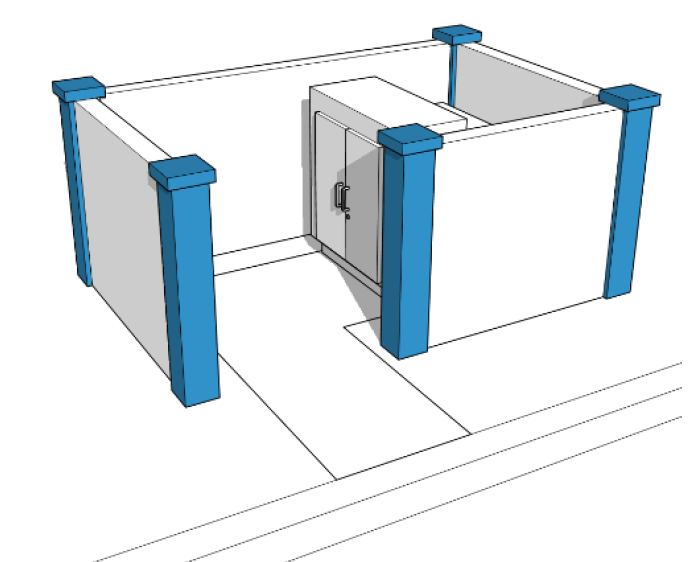
ii.
Landscaping that is of sufficient height at maturity and of opacity to effectively soften and screen the equipment, and that is integrated into the overall landscaping plan. Landscaping shall maintain a minimum two feet of clearance from equipment, unless a larger clearance distance is required by a utility company.
Figure 5-12: Ground-mounted Equipment Landscaping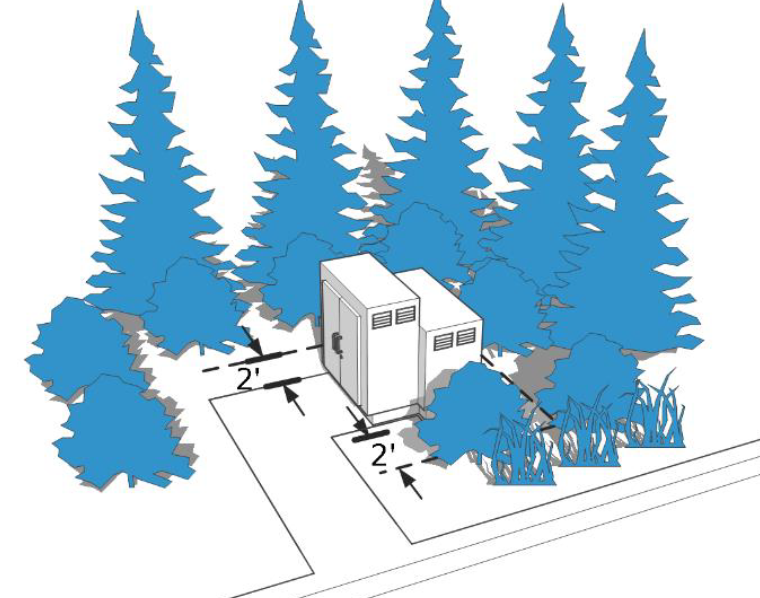
c.
Roof-mounted equipment. Roof-mounted equipment shall be an integral part of the building's overall architectural design and shall be screened from view to the extent practicable from public rights-of-way, public parking areas, and/or adjacent properties using parapet walls or other means of screening. When reviewing the type and amount of screening, the Director of Parks and Recreation shall consider the following:
i.
Whether the height of the parapet walls or screening adequately mitigates the visual impact that roof-mounted equipment may have.
ii.
The number and size of roof-mounted equipment. The greater the number and/or size, the more screening may be warranted.
Figure 5-13: Roof-mounted Equipment Screening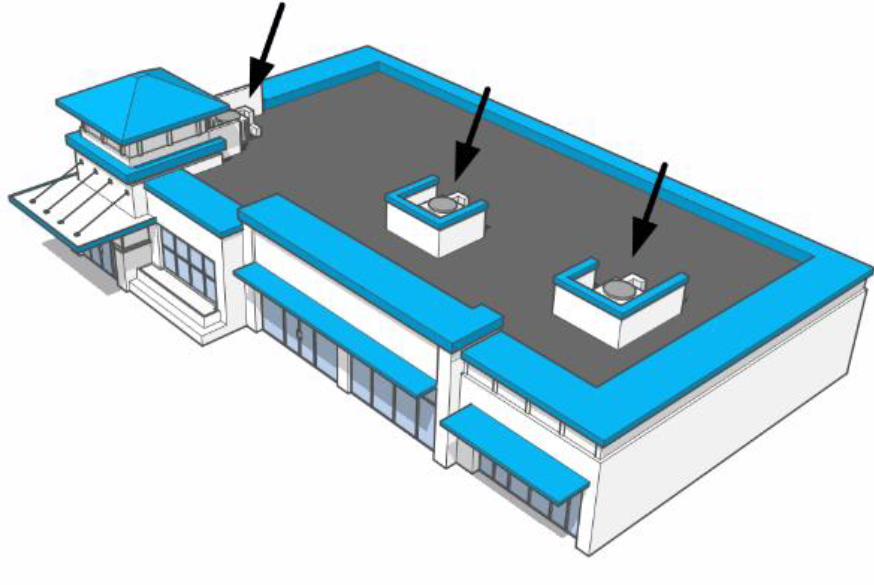
C.
Refuse containers. All refuse and refuse containers shall be screened from all public rights-of-way. Such containers shall be placed on a designed reinforced concrete pad and approach.
1.
Enclosures required. Refuse containers that cover an area of 40 square feet or greater shall be located within an enclosure.
2.
Location.
a.
Refuse container enclosures shall be located at the rear of the property to the extent practicable and shall be sited to allow for easy vehicular access such that access does not require backing movements onto public rights-of-way, with the exception of alleys.
b.
Refuse container enclosures shall be placed to avoid direct access to pedestrian walkways to the extent practicable and kept closed at all times except for pickup.
3.
Design and materials.
a.
Refuse container enclosures shall be of sufficient height to screen containers but shall not exceed eight feet in height unless screening a refuse container taller than eight feet.
b.
Enclosures shall be visually compatible with materials used on the primary building. In no case shall enclosures consist of chain link or corrugated metal.
4.
Landscaping. Landscaping shall be used to soften the appearance of the enclosure where such enclosure is located within a side yard or can be viewed from public rights-of-way.
Figure 5-14: Refuse Enclosure Landscaping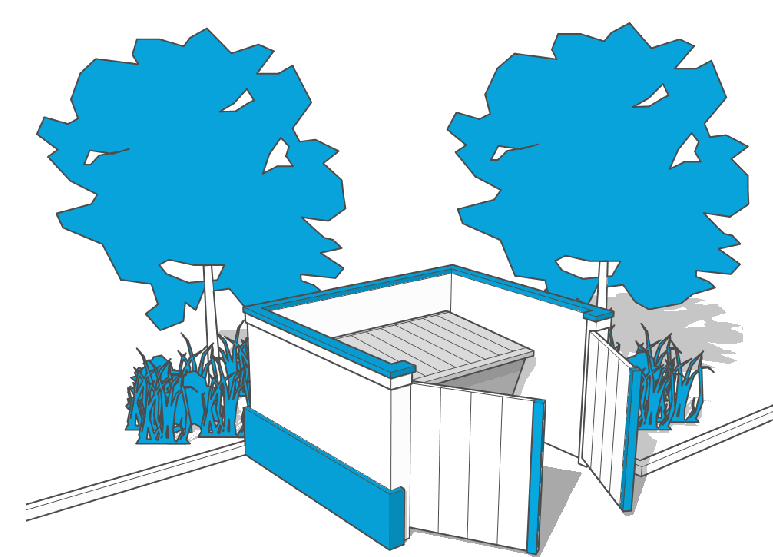
D.
Outdoor storage areas. Outdoor storage areas shall be screened from view of public rights-of-way and from adjacent residential land uses or districts using any one or a combination of fences, walls, berms, or landscaping that is at least six feet in height and provides a permanent, opaque, year-round screen.
E.
Off-street loading spaces. All off-street loading spaces on a site shall be screened from all public and private streets adjacent to that site.
1.
All screening shall be at least six feet in height measured from the horizontal plane passing through the nearest point of the off-street loading space and may be provided by using any one or combination of the following, subject to approval by the Director of Parks and Recreation:
a.
Evergreen shrubs planted three feet on center, in a single row; or
b.
Evergreen trees planted six feet on center, unless the Director of Parks and Recreation approves an alternative planting density as being capable of providing a solid appearance within one year; or
c.
A fence, wall, or berm. Fences and walls shall not consist of corrugated metal, corrugated fiberglass, sheet metal, chain link or wire mesh.
2.
When screening for off-street loading spaces is provided by earthen berm or evergreen plant materials, the following regulations apply:
a.
An earthen berm shall be planted with ground cover recommended for local area use by the Director of Parks and Recreation. The slope of the berm shall not exceed 33 percent for lawn areas and shall have a minimum crown width of three feet.
b.
Evergreen plant materials shall be recommended for local area use by the Director of Parks and Recreation. In addition, the plant materials:
i.
Shall be located in a bed that is at least three feet wide; and
ii.
Shall be placed a maximum of 36 inches on center in a single row over the entire length of the bed, unless the Director of Parks and Recreation approves an alternative planting density as being capable of providing a solid appearance within one year; and
iii.
Shall provide a six-foot high visual barrier of the required height within one year.
F.
Parking or storage of vehicle on unimproved surface. The parking or storage of any vehicle within a residential side yard or the residential rear yard of a corner lot, of a residential single-family, duplex, or Townhouse lot or tract, upon any surface other than an improved parking surface is prohibited, unless otherwise concealed from view from all public street rights-of-way by:
1.
A solid, opaque, screening fence or wall at least six feet in height;
2.
Vegetation consisting of a solid hedgerow of evergreen shrubs, or trees and shrubs, providing full screening from the ground to a minimum height of six feet within one year;
3.
Any combination of the above that effectively conceals the vehicle from view and accomplishes the required screening height; or
4.
Any other form of compatible and appropriate screening as so determined by the Building Official.
5.6.10.
Fences.
A.
Height and location.
1.
General height standards.
a.
Front yard. Walls and fences within a required front yard or on the front property line shall not exceed three feet in height.
b.
Side and rear yards. Walls and fences along the interior side or rear lot lines shall not exceed eight feet in height provided, that the wall or fence does not extend into any required front yard.
c.
Corner lots. Walls and fences located between a primary structure and a public or private street shall not exceed six feet in height.
Figure 5-15: Fence Height Standards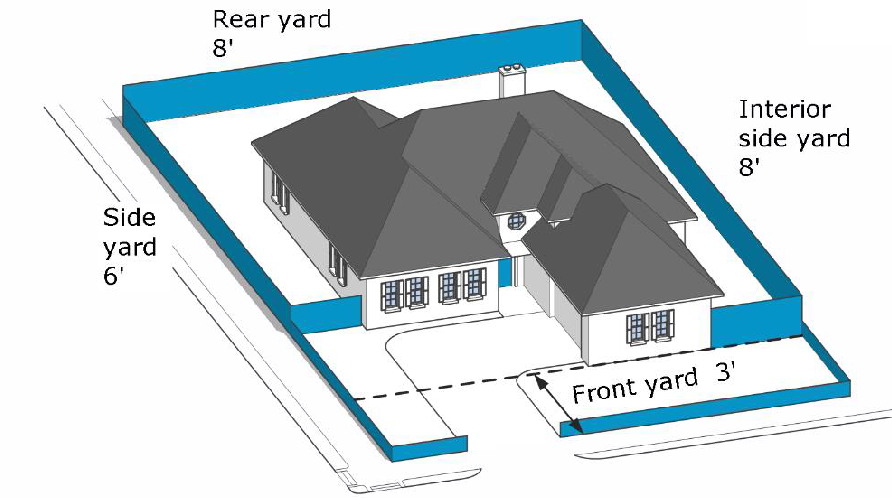
2.
Maximum fence height. No person shall build, erect, construct, or maintain any fence within the Town limits at a height exceeding eight feet as measured from ground level on the opposite side of the fence.
3.
Alternative fence height standards. Walls and fences exceeding eight feet in height may be allowed if:
a.
They are temporary fences on construction sites erected for protection purposes during the period of construction only; or
b.
They enclose loading, service, or refuse areas in Mixed-Use or Nonresidential zoning districts outside the front setback area; or
c.
They enclose outdoor storage areas in Mixed-Use or Nonresidential zoning districts outside the front setback area.
4.
Walls and fences in easement areas.
a.
Permanent walls and fences, except for standard wooden board fences, shall not be constructed within or across Town utility easements.
b.
Permanent walls and fences shall not be constructed within drainage easements in a way that obstructs the natural flow of water runoff.
B.
Fence materials.
1.
Residential and mixed-use districts.
a.
Within Residential and Mixed-Use zoning districts, fences shall be constructed of new materials or products, such as wood planks and boards, masonry as defined by the Building Code, and wrought iron or ornamental iron.
b.
Used or secondhand materials shall not be used in the construction of any fence in a Residential or Mixed-Use zoning district.
2.
Prohibited fence materials. The following are prohibited as fence materials:
a.
Rope, string, or netting;
b.
Wire and wire products including, but not limited to, barbed wire, razor ribbon wire, chicken wire, wire fabric, and welded wire fabrics;
c.
Chain;
d.
Cut or broken glass;
e.
Paper;
f.
Corrugated metal panels;
g.
Plywood; and
h.
Other wood, metal, or plastic products that are designed specifically for uses other than fence construction.
3.
Front yard. The combination of materials used for walls and fences within a required front yard or on the front property line shall maintain a minimum 50 percent opaqueness. This restriction does not apply to property owned by the Town.
C.
Fence design.
1.
General fence design.
a.
Fences shall be of uniform construction throughout the fence. Once a pattern of materials and construction method is established, it shall be carried throughout the entire length of the fence section from corner post to corner post.
b.
No fence shall be erected that alters the natural or planned drainage on any residential lot.
c.
All fence materials, construction, and workmanship shall comply with all requirements of the Building Code and all approved plans and specifications.
Figure 5-16: General Fence Design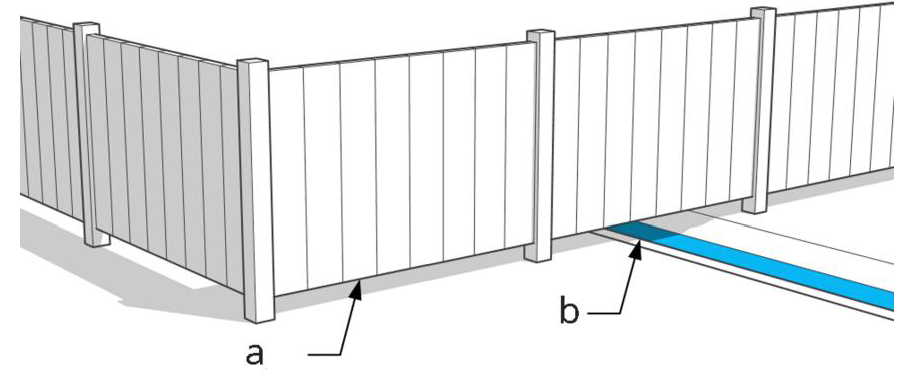
2.
Compatible design. Walls and fences shall be designed as an integral part of a new development project and shall be architecturally compatible with principal buildings in terms of materials, colors, and design.
3.
Articulation and alignment. Portions of walls or fences that face any public street right-of-way, public open space, or public trail shall incorporate the following features to break up the massing:
a.
If the wall or fence exceeds 20 feet in length, a landscape area a minimum of three feet in width shall be provided and planted with a minimum of four shrubs for each 20 linear feet of wall; and
b.
If the wall exceeds 40 feet in length, architectural features such as columns, vertical pilasters, changes in wall alignment, or terracing of walls shall be provided and planted with a minimum of four shrubs for each 20 linear feet of wall.
Figure 5-17: Compatible Design for Walls and Fences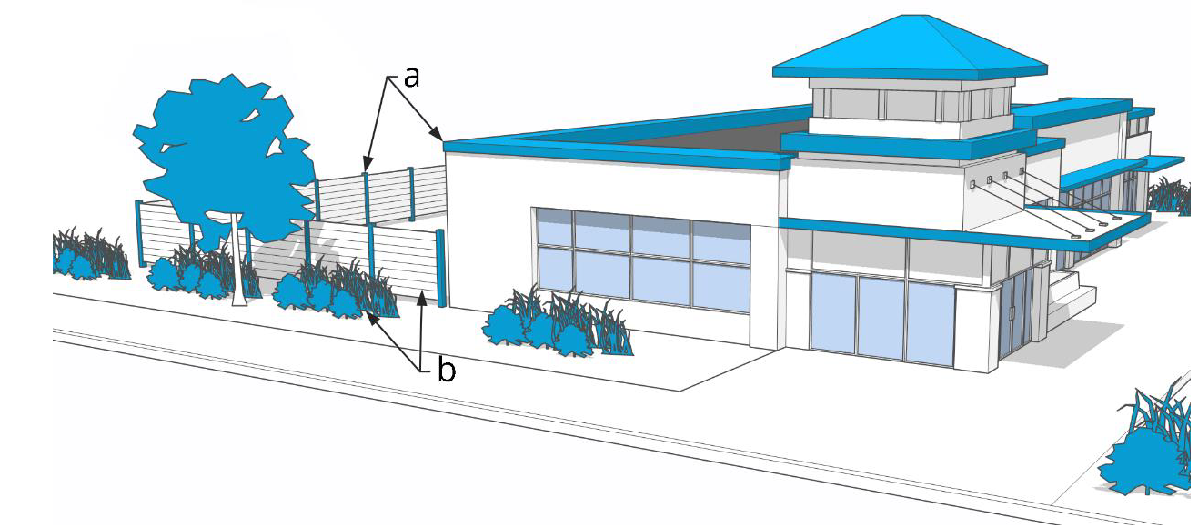
D.
Gates and access.
1.
Generally. It shall be unlawful for any person to erect, construct, or maintain any fence without providing a gate or other means of entrance and exit into and out of the area which the fence encloses, and it shall further be unlawful for any person to erect, construct, or maintain any fence along or near a rear property line that adjoins an alley or easement without providing and maintaining a reasonable means of access to such alley or easement.
2.
Emergency personnel access. In order to allow ingress and egress for emergency personnel and equipment, there shall be at least one gate or opening with a minimum width of three feet in each fence that is adjacent to or running parallel to any public alley, drainage easement or utility easement, except this standard shall not apply to utility easements that the Town has allowed to be completely fenced in. Equipment providing emergency personnel access through such gate may be required.
3.
Electric charge. No fence erected on property zoned for residential use or used for residential use, including residential units in a mixed-use development, shall be electrically charged in any manner or form.
E.
Fences for public or private schools. Notwithstanding other provisions of this section, the owner or operator of any public or private school as defined in this UDC may erect upon school property a fence to protect any schoolyard or playground, provided that no fence shall be erected or maintained in such a position or manner as to cause danger to traffic by obstructing the view.
F.
Inspection and maintenance. Upon completion of installation, the Building Official shall be called upon for inspection. A certificate of acceptance will then be issued or a rejection slip indicating the defects in fence. All fences constructed under the provisions of this section shall be maintained to comply with the requirements of this section at all times.
5.6.11.
Installation and maintenance.
A.
Timing of installation. The developer shall install all landscape improvements including operable irrigation systems prior to receiving a Certificate of Occupancy. This requirement may be modified by the Director of Parks and Recreation if security is provided pursuant to § 5.6.11.B below and the developer identifies an alternative timeframe for landscaping and/or irrigation system installation.
B.
Maintenance bond. When a property owner seeks a Certificate of Occupancy, the Director of Parks and Recreation may, in their discretion, require a maintenance bond, letter of credit, cash escrow, or other security acceptable to the Director of Parks and Recreation that guarantees and secures maintenance of newly installed landscape for a period not to exceed two years. The amount of security shall be based on itemized cost estimates of all landscaping and irrigation system improvements, as well as related labor costs. Itemizations shall be generated from a qualified landscape architect, irrigation system specialist, and/or a local or regional landscaping nursery or garden center.
C.
Landscape inspections. The installation of the approved landscape plan shall be inspected and approved by the Director of Parks and Recreation prior to issuance of a Certificate of Occupancy.
D.
Maintenance. Every property owner and any tenants shall keep their landscaping in a well-maintained, safe, clean, and attractive condition at all times. Such maintenance includes, but is not limited to, the following:
1.
Prompt removal of all litter, trash, refuse and waste;
2.
Lawn mowing on a weekly basis during the growing season;
3.
Shrub pruning according to accepted practices of landscape professionals to maintain plants in a healthy condition;
4.
Tree pruning according to tree-pruning guidelines approved by an arborist registered with the Town after obtaining a tree pruning permit;
5.
Pruning/thinning that removes no more than one fourth of the tree canopy annually;
6.
Watering of landscaped areas on a regular basis to maintain good plant health;
7.
Sprinkler run times set on controllers to water between midnight and 5:00 a.m.;
8.
Keeping landscape lighting in working order;
9.
Keeping lawn and garden areas alive, free of weeds, and attractive;
10.
Cleaning of abutting waterways and landscaped areas lying between public right-of-way lines and the property unless such streets, waterways or landscaped areas are expressly designated to be maintained by applicable governmental authority; and
11.
Proper placement and maintenance of metal edging.
12.
Any plant that dies shall be replaced with a similar living plant, including trees, as determined by the Director of Parks and Recreation, within 30 days after notification by the Town.
E.
Discharge of vegetation waste. The discharge, deposit, blowing or sweeping of grass, leaves, other vegetation, or litter debris into public or private streets or alleys or storm drains is prohibited. In connection with yard or landscape maintenance, lawn or grass clippings, leaves, other vegetation, and litter debris caused by or resulting from such maintenance shall be promptly removed from any public or private street or alley adjacent to the property being maintained and shall be disposed of in a manner to prevent the material from blowing or falling from a maintenance truck, trailer, or disposal container. Lawn clippings, leaves, other vegetation, and litter debris shall be removed from sidewalks, streets and street gutters, and alleys after mowing and edging is performed to prevent collection in the storm water system.
F.
No obligation on town. Nothing in this section shall be deemed to impose any obligation upon the Town or upon any of its officers or employees or to relieve the property owner from the duty to keep trees and other plant materials in a safe condition.
Sec. 5.7. - Site and building design.
5.7.1.
Purpose. This section is intended to:
A.
Promote high-quality development and construction that directly contributes to the attractiveness, safety, and function of the street and public areas;
B.
Ensure compatibility between residential neighborhoods and adjacent commercial and mixed-use areas;
C.
Mitigate negative impacts created by the scale and bulk of large buildings;
D.
Provide variety and visual interest in the exterior design of buildings;
E.
Enhance the streetscape and diminish the prominence of garages and parking areas;
F.
Promote an environment that is friendly toward multiple modes of transportation and accommodates varying ages and abilities;
G.
Promote building designs and construction practices that are sustainable and adaptable to multiple uses for extended building lifecycles;
H.
Promote building designs and construction in a manner, and with materials, that are highly durable and will continue to endure and be attractive over a long time, especially adjacent to public and pedestrian areas.
I.
Minimize negative impacts of on-site activities to adjacent uses; and
J.
Balance the community's economic and aesthetic concerns.
5.7.2.
Applicability.
A.
General applicability. Unless otherwise exempted by § 5.7.2.B below, the standards of this section shall apply to all development that meets the applicability thresholds established in § 5.2: Applicability.
B.
Exemptions. Expansions and enlargements of a multifamily, mixed-use, or nonresidential use less than the greater of 1,000 square feet or ten percent of the building's square footage.
C.
Conflicting standards. Where the site and building design standards in this section conflict with the design standards applicable to an overlay district or Planned Development, the standards in the overlay district or Planned Development shall govern.
D.
Alternative compliance. Alternatives to these standards may be approved by the Director if the applicant demonstrates that the proposed alternative:
1.
Achieves the intent of the subject standard to the same or better degree than the subject standard;
2.
Advances the goals and policies of the Comprehensive Plan and this UDC to the same or better degree than the subject standard;
3.
Results in benefits to the community that are equivalent to or exceed benefits associated with the subject standard; and
4.
Imposes no greater impacts on adjacent properties than would occur through compliance with the specific requirements of this UDC.
5.7.3.
Residential site and building design.
A.
Single-family, duplex, triplex, and fourplex dwellings.
1.
Building mass. Exterior walls shall be broken by recessed entryways, bay windows, use of more than one exterior finish material, use of architectural details, or such other technique or combinations of techniques to prevent the appearance of featureless walls.
Figure 5-18: Residential Building Mass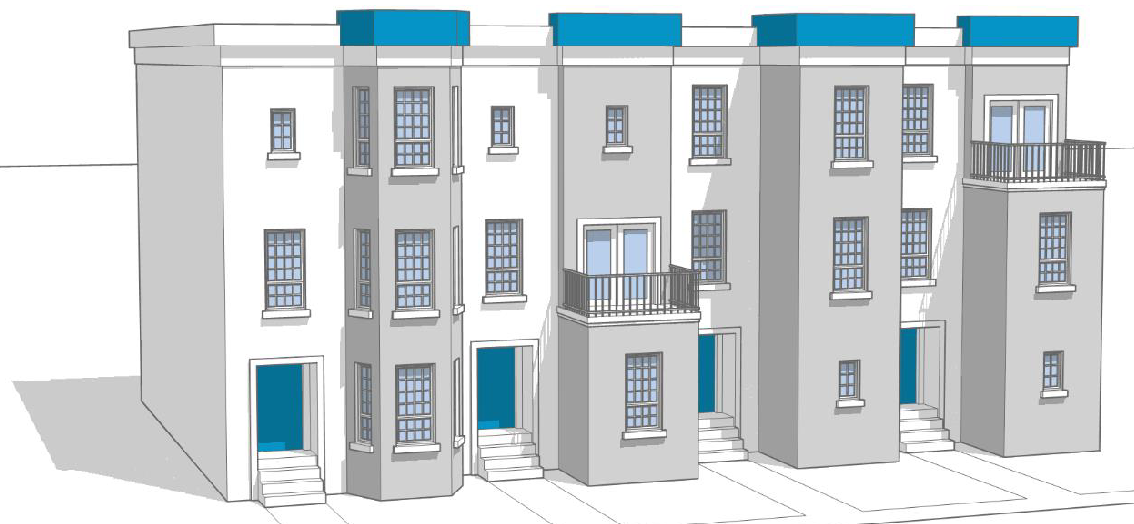
2.
Exterior finish materials.
a.
Exterior cladding (including garages and accessory buildings) shall be composed of not more than two materials, excluding glass and roofing materials. Glass shall be clear or tinted, not reflective.
b.
Exterior cladding materials shall be applied across the façade using a consistent visual design, and not an inconsistent or fragmented application of materials.
c.
At least 80 percent of the exterior cladding of all buildings (including garages and accessory buildings) shall be the following allowed materials:
3.
Colors. There are no restrictions on colors, except that fluorescent colors are prohibited.
B.
Multifamily dwellings.
1.
Building placement and orientation.
a.
The siting of a building shall reflect the natural topography and preserve existing trees and landscaping material pursuant to § 5.6: Landscaping, Buffering, and Fences.
b.
The minimum percentage of building façades shall be built parallel to the street frontage at build-to-ranges as established in Article 3: Zoning Districts. Where a build-to-range is not established, a minimum of 60 percent of the primary building façade shall be parallel to the primary street frontage.
2.
Multi-building developments. For multifamily developments with three or more buildings, the buildings shall be arranged using one or more of the following techniques:
a.
Organize units around a central courtyard that maintains a consistent side yard setback between units along the street frontage;
b.
Locate the buildings on the corner of an adjacent street intersection or entry point to the development to frame the corner;
c.
Provide common gathering spaces between buildings; and/or
d.
Other site improvements as approved by the Director.
3.
Building entrances.
a.
The primary building entrance shall face a public or private street. For buildings on corners, there shall either be an additional entrance on the side street frontage, or the primary entrance shall be on the corner. A façade containing a primary building entrance may be curved or angled toward an intersection at street intersections.
b.
Primary building entrances shall be defined and articulated with architectural elements such as pediments, columns, porticos, porches, overhangs, or other elements approved by the Director.
c.
For buildings with multiple tenant entries, each entrance shall be defined and articulated with architectural elements.
d.
All ground-floor pedestrian entrances shall be covered or inset.
Figure 5-19: Building Entrance Requirements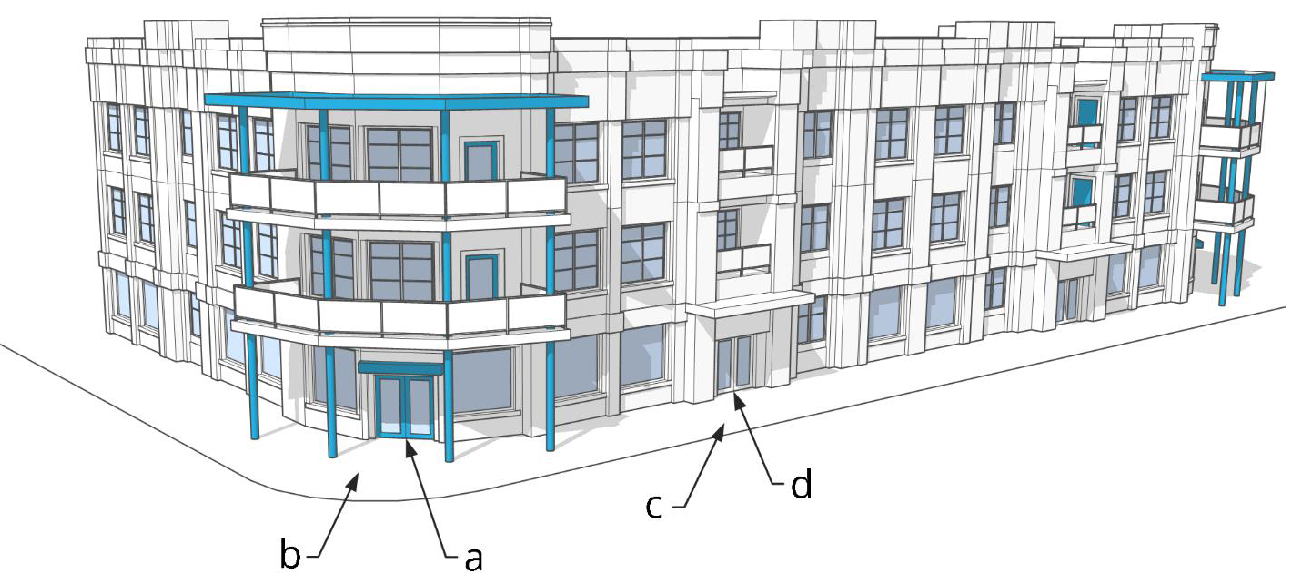
4.
Building mass. Buildings shall not extend more than 60 continuous feet without incorporating at least two of the following elements for each 60-foot segment:
a.
Projections, recessions, or reveals such as columns, pilasters, cornices, and bays, and having a change of wall plane that is a minimum depth of two feet and has the effect of casting shadows;
b.
Changes in materials, colors, patterns, or textures;
c.
Changes in roof form pursuant to § 5.7.3.B.5: Roof Form;
d.
Windows, doors, and openings pursuant to minimum transparency requirements in § 5.7.3.B.6: Transparency (Windows, Doors, and Openings); and/or
e.
Alcoves, porticoes, awnings, and other architectural features to provide visual interest and relief.
5.
Roof form. Buildings shall be designed to avoid any continuous roofline longer than 60 feet. Rooflines longer than 60 feet shall include at least one vertical elevation change of at least two feet in height. Sloped rooflines shall provide variation in overhangs and architectural elements to provide visual relief.
Figure 5-20: Roof line Variation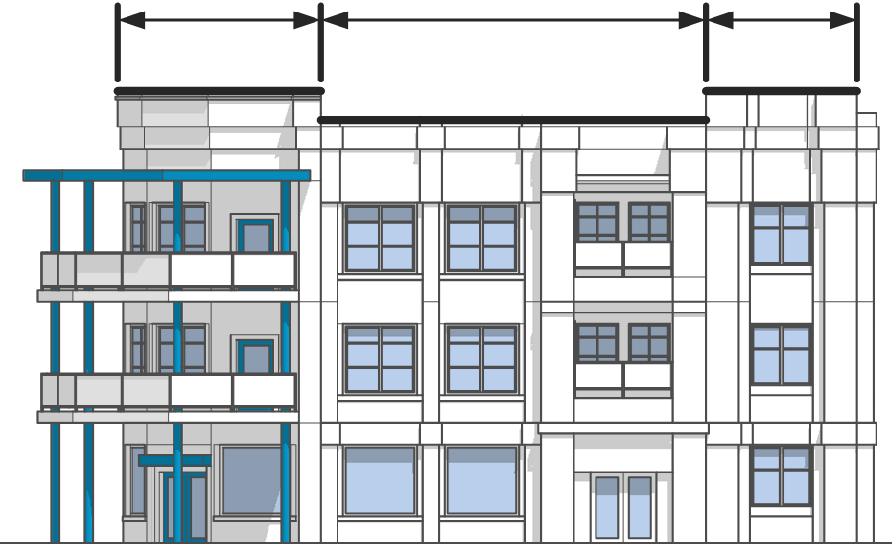
6.
Transparency (windows, doors, and openings).
a.
At least 25 percent of the ground-floor wall area, as measured from floor plate to floor plate, of any façade facing a public street or other public area such as a plaza, park, or open space shall contain windows, other transparent materials, or doorways. Such windows, transparent materials, or doorways shall be unobstructed and allow views into working areas or lobbies, pedestrian entrances, and display areas.
b.
At least 20 percent of each upper-floor wall area, as measured from floor plate to floor plate, of all building façades shall contain windows or other transparent materials.
c.
Requirements for ground-floor transparency shall allow views into common areas such as foyers, hallways, and entryways, but may be translucent or opaque for individual dwelling units.
d.
Windows and other materials intended to meet the minimum transparency requirements shall be clear or tinted and shall not be reflective.
e.
Reductions to these minimum standards may be approved by the Director if required to comply with local energy codes.
Figure 5-21: Transparency Requirement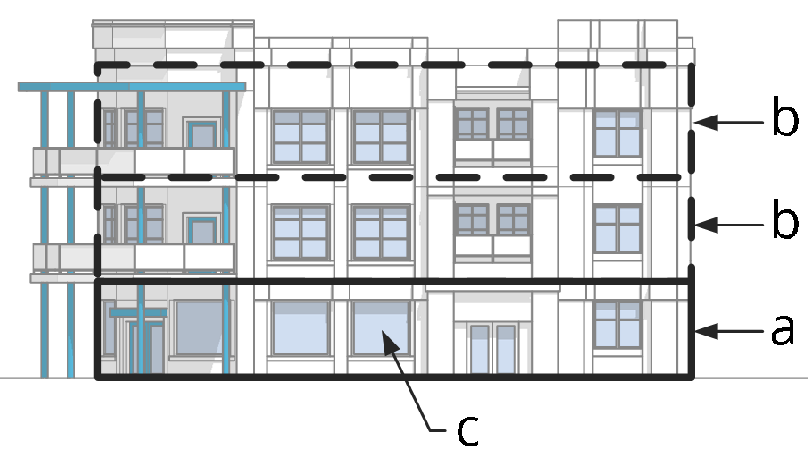
7.
Exterior finish materials.
a.
The exterior cladding of all multifamily dwellings (including garages and accessory buildings) shall be composed of not more than three materials, excluding glass and roofing materials.
b.
Exterior cladding materials shall be applied across the façade using a consistent visual design, and not an inconsistent or fragmented application of materials.
c.
At least 80 percent of the exterior cladding of all multifamily dwellings (including garages and accessory buildings) shall be one or more the following allowed materials:
8.
Colors. There are no restrictions on colors, except that fluorescent colors are prohibited.
5.7.4.
Mixed-use (vertical or horizontal) and nonresidential site and building design.
A.
Building placement and orientation. The minimum percentage of building façades shall be built parallel to the street frontage at build-to-ranges as established in Article III: Zoning Districts.
B.
Large and/or multi-building developments. Developments with more than 100,000 square feet of gross floor area shall be organized to create pedestrian-friendly spaces and streetscapes. This shall be accomplished by using the buildings to frame and enclose at least one of the following:
1.
The corners of street intersections or entries into the development site;
2.
A "main street" pedestrian or vehicle access corridor within the development site; and/or
3.
A plaza, pocket park, square, or other outdoor gathering space for pedestrians; and/or
4.
Other site improvements as approved by the Director.
C.
Building entrances.
1.
Each building and separate lease space at grade along the street edge shall have a functioning primary entry from the sidewalk. Corner entries may count as a primary entry for both intersecting street frontages. A façade containing a primary building entrance may be curved or angled toward an intersection at street intersections.
2.
Primary building entrances shall be defined and articulated with architectural elements such as pediments, columns, porticos, porches, overhangs, or other elements approved by the Director.
3.
For buildings with multiple tenant entries, each entrance shall be defined and articulated with architectural elements.
4.
All ground-floor pedestrian entrances shall be covered or inset.
D.
Building mass.
1.
Buildings that are located on axis with a terminating street or at the intersection of streets shall be considered a landmark building. Such buildings shall be designed with landmark features which take advantage of that location, such as an accentuated entry and a unique building articulation that is off-set from the front wall planes and goes above the main building eave or parapet line.
2.
Buildings shall not extend more than 60 continuous feet without incorporating at least two of the following elements for each 60-foot segment:
a.
Projections, recessions, or reveals such as columns, pilasters, cornices, and bays, and having a change of wall plane that is a minimum depth of two feet and has the effect of casting shadows;
b.
Changes in materials, colors, patterns, or textures;
c.
Windows, doors, and openings pursuant to minimum transparency requirements in § 5.7.4.G: Transparency (Windows, Doors, and Openings); and/or
d.
Alcoves, porticoes, awnings, and other architectural features to provide visual interest and relief.
E.
Architectural features.
1.
Residential at grade.
a.
All buildings that have residential unit floor plates within six feet of finished grade shall include a primary front door entrance into the unit accessible from the sidewalk.
b.
The entry shall be located a minimum of two feet above the sidewalk elevation and include a minimum 24 square foot stoop.
c.
Units must also include windows that provide residents a view of the street and sidewalk area.
d.
Lobbies to upper stories may be located at grade level.
e.
Balcony and patio railings and fences shall be constructed of wrought iron or metal. Wood fences and railings and chain-link fencing are prohibited. Masonry columns may be used on patios provided that they are used as accents.
2.
Nonresidential at grade.
a.
The ground floor entry must be located at the elevation of the adjacent sidewalk.
b.
Retail uses adjacent to the sidewalk at grade shall:
i.
Have a minimum clear height of 14 feet between finished floor and the bottom of the structure above. Mezzanines within the retail space shall be allowed per Building Code; and
ii.
Have an awning or canopy that extends at least six feet over the sidewalk for at least 75 percent of the frontage on any portion of a building. Such awning or canopy shall maintain a minimum seven and one-half foot clearance over the sidewalk.
Figure 5-22: Nonresidential Uses at Grade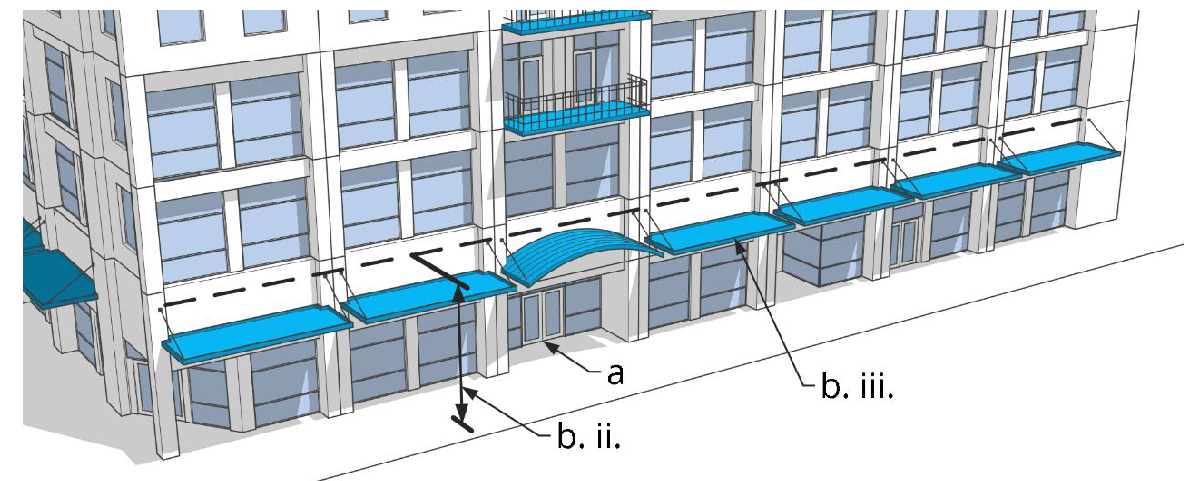
3.
In the M-1 district, any structures fronting Addison Circle between Mildred Place/Lewis Place and Dallas Parkway shall have a minimum floor-to-ceiling height of 12 feet to accommodate ground-level nonresidential uses.
F.
Exterior finish materials.
1.
The exterior cladding of all mixed-use and nonresidential buildings (including garages and accessory buildings) shall be composed of not more than three materials, excluding glass and roofing materials.
2.
Exterior cladding materials shall be applied across the façade using a consistent visual design, and not an inconsistent or fragmented application of materials.
3.
Unpainted metal, or metal subject to ordinary rusting shall not be used as a building material. Factory finished metal elements as well as metals that develop an oxidized finish, such as copper, galvanized metal, or weathering steel, may be used as architectural accents.
4.
Walls attached to buildings shall be developed as architectural extensions of the building, constructed of the same material and in the same style.
5.
At least 80 percent of the exterior cladding of all mixed-use and nonresidential buildings (including garages and accessory buildings) shall be one or more the following allowed materials:
G.
Transparency (windows, doors, and openings).
1.
For live/work dwellings and residential uses, requirements for ground-floor transparency shall allow views into common areas such as foyers, hallways, and entryways, but may be translucent or opaque for individual dwelling units.
2.
Windows, except for retail at grade, shall be vertical in proportion and have at least a four-inch reveal.
3.
No glass curtain wall shall be permitted, except as approved by the Director.
4.
Windows and other materials intended to meet the minimum transparency requirements shall be clear or tinted and shall not be reflective.
5.
At least 50 percent and no more than 80 percent of the ground-floor wall area between three and eight feet above grade of any building façade facing a public street or other public area such as a plaza, park, or open space shall contain windows, other transparent materials, or doorways. Such windows, transparent materials, or doorways shall be unobstructed and allow views into working areas or lobbies, pedestrian entrances, and display areas.
6.
At least 20 percent of each upper-floor wall area, as measured from floor plate to floor plate, of all building façades shall contain windows or other transparent materials.
7.
Modifications to these standards may be approved by the Director if required to comply with local energy codes.
H.
Colors. There are no restrictions on colors, except that fluorescent colors are prohibited.
5.7.5.
Parking structure design. The following standards shall apply to all above-ground parking garages or structures, whether freestanding or incorporated into a building:
A.
Each façade or a parking garage adjacent to a public street or public space shall have an external skin designed to conceal the view of all parked cars. Examples include heavy gauge metal screen, precast concrete panels, live green or landscaped walls, laminated or safety glass, or decorative photovoltaic panels.
B.
In mixed-use zoning districts, all parking garages or structures shall be designed to meet the building design standards applicable in the zoning district in which it is located. Alternative designs may be approved pursuant to § 2.10.3: Minor Modification.
C.
No horizontal length of the parking garage façade shall extend longer than 50 feet without the inclusion of architectural elements such as decorative grillwork, louvers, translucent screens, alternating building materials, and other external features to avoid visual monotony. Facade elements shall align with parking levels.
D.
Internal circulation shall allow parking surfaces to be level (without any slope) along each parking garage façade adjacent to a public street or public space. All ramps between levels shall be located along building façades that are not adjacent to a public street or public space or shall be located internally so they are not visible from adjacent public streets or public spaces.
E.
The location of elevators and stairs shall be highlighted through the use of architectural features or changes in façade colors, textures, or materials so that visitors can easily identify these entry points.
F.
Interior garage lighting shall not produce glaring sources toward adjacent properties while providing safe and adequate lighting levels. The use of sensor dimmable LEDs and white stained ceilings are recommended to control light levels on-site while improving energy efficiency.
G.
Vent and fan locations shall not be located on parking garage façades facing public streets or public spaces, or adjacent to residential uses, to the greatest extent practicable.
H.
Any parking garage with more than 100 parking spaces shall be designed with at least two vehicular access points unless a traffic study is submitted.
5.7.6.
Neighborhood transition standards.
A.
Setbacks. Buildings abutting a property in the R-1, R-2, or R-3 zoning districts, or Planned Development districts with abutting residential uses shall comply with the minimum front setback of the adjacent Residential zoning district along the common property line or the minimum building setback of the zoning district where the building is located, whichever is greater.
B.
Building height.
1.
Any portion of a building within 50 feet of a property in the R-1, R-2, or R-3 zoning districts, or Planned Development districts with abutting residential uses shall not exceed the maximum building height allowed in the abutting Residential zoning district or the maximum building height of the zoning district where the building is located, whichever is lower. Where a lot abuts two or more Residential zoning districts, the Residential zoning district with the lowest maximum building height shall govern.
2.
Any portion of a building between 50 feet and 100 feet of a property in the R-1, R-2, or R-3 zoning districts shall not exceed the maximum building height allowed in the abutting Residential zoning district, plus one story (not to exceed 15 feet); or the maximum building height of the zoning district where the building is located, whichever is lower. Where a lot abuts two or more Residential zoning districts, the Residential zoning district with the lowest maximum building height shall govern.
3.
Any portion of a building beyond 100 feet from a property in the R-1, R-2, or R-3 zoning districts shall not exceed the allowed building height of the zoning district where the building is located.
4.
Building features referenced in § 3.9.5.C: Exceptions to Height Requirements shall be designed to minimize visibility from adjacent Residential zoning districts and fit within the allowed building height of the zoning district where the building is located, to the maximum extent practicable.
Figure 5-23: Neighborhood Transition Standards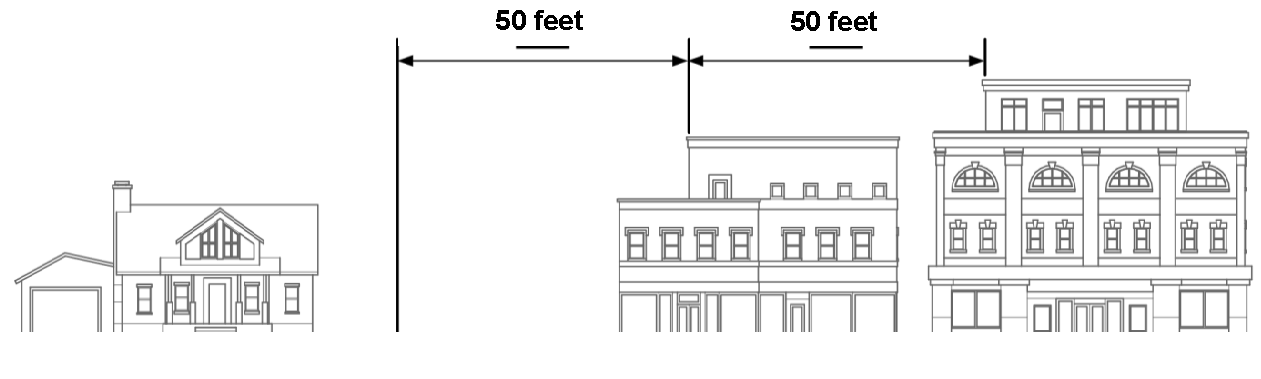
Sec. 5.8. - Exterior lighting.
5.8.1.
Purpose. The purpose of this section is to provide for exterior lighting that enhances safety, preserves the Town's nighttime character, and improves the ability to view the nighttime sky from within the Town. This section is intended to:
A.
Decrease light pollution;
B.
Increase energy efficiency;
C.
Promote high-quality lighting design as it relates to the built environment;
D.
Ensure that parking areas, public gathering places, and other public places have adequate outdoor illumination;
E.
Ensure that light levels are uniform to enhance night vision and security;
F.
Minimize adverse impacts on public safety and neighborhood enjoyment due to excessive glare; and
G.
Minimize spillover of light onto adjacent or nearby properties.
5.8.2.
Applicability.
A.
Applicability. Unless otherwise exempted by § 5.8.2.B below, the standards of this section shall apply to all development that meets the applicability thresholds established in § 5.2: Applicability.
B.
Exemptions.
1.
Single-family detached and duplex dwellings.
a.
Soffit or wall-mounted lights permanently attached to the dwelling shall be exempt from the exterior lighting regulations, provided the lights do not exceed the height of the eave; and
b.
Such lights shall be downcast and directed away from abutting properties.
2.
Emergency lighting. Lighting used only under emergency conditions shall not be subject to this § 5.8.
3.
Seasonal lighting. Temporary seasonal lighting between Thanksgiving and January 15 shall not be subject to this § 5.8, provided such lighting does not create glare to motorists, result in light trespass onto adjacent properties, or flash at a speed that may result in medical issues for motorists or other passerbys. This exemption shall not apply to permanent exposed string lighting typically used for patio ambiance lighting.
4.
Lighting required by Federal Aviation Administration (FAA) or Federal Communications Commission (FCC). Lighting required by the FAA or the FCC shall not be subject to this § 5.8.
5.
Special events. Special events that have been issued a Temporary Use Permit pursuant to § 2.6.3 shall be allowed temporary lighting for the duration of the event, provided such lighting does not create glare to motorists or result in light trespass onto adjacent properties and complies with § 62-273 of the Code of Ordinances.
6.
Street lighting. With the exception of shielding requirements, this UDC does not apply to street lighting within Town and state rights-of-way.
7.
Underwater lighting. Underwater lighting used for the illumination of swimming pools and decorative water fountains shall not be subject to this § 5.8, though they must conform to all other provisions of this UDC.
8.
Lighting required by building code. Any lighting that is required by the Building Code for life safety purposes such as stairway lighting, walkways, and building entrances, shall not be prohibited by this § 5.8 but shall be subject to the lighting standards.
5.8.3.
Administration.
A.
Lighting districts established.
B.
Evaluation of compliance.
1.
Lighting plan submittal required.
a.
All new multifamily, mixed-use, or nonresidential developments shall provide a lighting plan with the applicable Site Plan application and/or Building Permit.
b.
Lighting plans shall show the following:
i.
The location and height above grade of light fixtures;
ii.
The type of light source (such as incandescent, fluorescent, high pressure sodium, metal halide, LED), rated lumens, and wattage of each light source;
iii.
The type of fixture (such as full-cutoff, cut-off, lantern, wall pack);
iv.
The Backlight, Uplight, Glare (BUG) rating for each fixture;
v.
Calculations for site illumination resulting from the lighting, measured in footcandles including minimum, maximum and average footcandles and uniformity ratios;
vi.
If building walls are to be illuminated, or if façade-mounted fixtures are to be used, drawings of all relevant building elevations showing the fixtures and the portions of the walls to be illuminated calculated point-by-point and light levels; and
vii.
Other information deemed necessary to document compliance with the provisions of this section.
2.
Plan approval. If the Director determines that any proposed lighting does not comply with this UDC, the associated permit shall not be issued or the application approved unless an alternative is approved pursuant to § 5.8.3.B.3 below.
3.
Discretionary approval of lighting alternatives. The Director may approve alternative lighting designs, materials, or methods of installation or operation not specifically prescribed by this UDC provided the proposed alternative:
a.
Results in approximate equivalence to the applicable specific requirement of this UDC;
b.
Complies with the intent of this UDC; and
c.
Complies with building safety and property maintenance codes.
5.8.4.
Prohibited lighting types. The following types of exterior lighting are prohibited unless allowed elsewhere in this UDC:
A.
Unshielded lights, lamps, or floodlights that produce glare and light trespass in excess of that allowed in §5.8.5.B.1: Maximum Lighting Trespass Levels;
B.
Lights affixed to the top of a roof, except where required by Building Code;
C.
Lights that flash, move, revolve, blink, flicker, vary in intensity, change color, or use intermittent electrical pulsation, except for holiday lighting pursuant to § 5.8.2.B.3: Seasonal Lighting;
D.
Mercury vapor and low-pressure sodium lighting;
E.
Activities and uses that create lighting which makes it difficult for pilots to distinguish between airport lights and nonairport lights, or that create glare in the eyes of pilots using the airport; and
F.
Upward-directed lighting that allows spillage into the sky.
5.8.5.
General lighting standards.
A.
On-site lighting level. Maximum on-site illumination, including spillage from doorways, signs, and windows, shall not exceed 10 footcandles, unless otherwise allowed in this UDC.
B.
Light trespass.
1.
Maximum lighting trespass levels. The maximum measured light levels (footcandles) shall not exceed those provided in the following table:
2.
Measurement.
a.
Methodology.
i.
Light trespass shall be measured at grade level unless otherwise noted. Two measurements shall be taken: one at any point along the property line (point A), and one taken ten feet (measured perpendicular to property line) onto the property being trespassed (point B). Where grade changes or obstructions prohibit measurements at the same grade level, measurements shall be taken on the same horizontal plane.
ii.
Lighting measurements shall be taken under normal conditions. Measurements to determine compliance shall not be taken when conditions are present that will influence the outcome of measurements including snow, snowpack, rain, fog, or other influences.
b.
Cumulative light readings. Light sources from a property shall be measured as cumulative of all sources on the subject property, except for internally illuminated signs.
3.
Transitions between lighting districts. The maximum light level for light trespass in any lighting district that borders a different lighting district shall be the lower of the two, along that border only. Where separated by a public street or right-of-way, the levels shall apply at the center line of the street adjacent to the light source.
C.
Shielding and light trespass.
1.
All light fixtures are required to be fully shielded, unless approved by the Director pursuant to § 5.8.3.B.3: Discretionary Approval of Lighting Alternatives.
2.
All light fixtures shall be aimed and shielded so that the direct illumination shall be confined to the property boundaries of the source. Lighting shall not be aimed onto adjacent properties, except in cases of shared parking, shared pedestrian pathways, or for coordinated development sites spanning multiple parcels.
3.
Light trespass onto adjacent public rights-of-way may be allowed subject to approval of the Director pursuant to § 5.8.3.B.3: Discretionary Approval of Lighting Alternatives.
D.
Uplighting.
1.
Subject to the approval of the Director, uplighting or ground-mounted lighting may be allowed to accent unique features of a building and/or surrounding landscaping such as exceptional architectural features, specimen trees with dense year-round foliage, or large native shrub masses. Uplighting or ground-mounted lighting shall be designed and installed to minimize glare with special consideration to vehicular and pedestrian traffic.
2.
All lighting that is directed upward shall be located so that the angle of the lamp does not exceed 45 degrees measured from a horizontal plane to a line projected through the center of the lamp, and fixtures shall be fully shielded to contain and direct the light onto the featured to be illuminated.
3.
All uplighting shall be selected, designed, installed, and aimed so that there is a minimum amount of spill beyond the area intended to be lighted.
Figure 5-24: Ground-mounted and Uplighting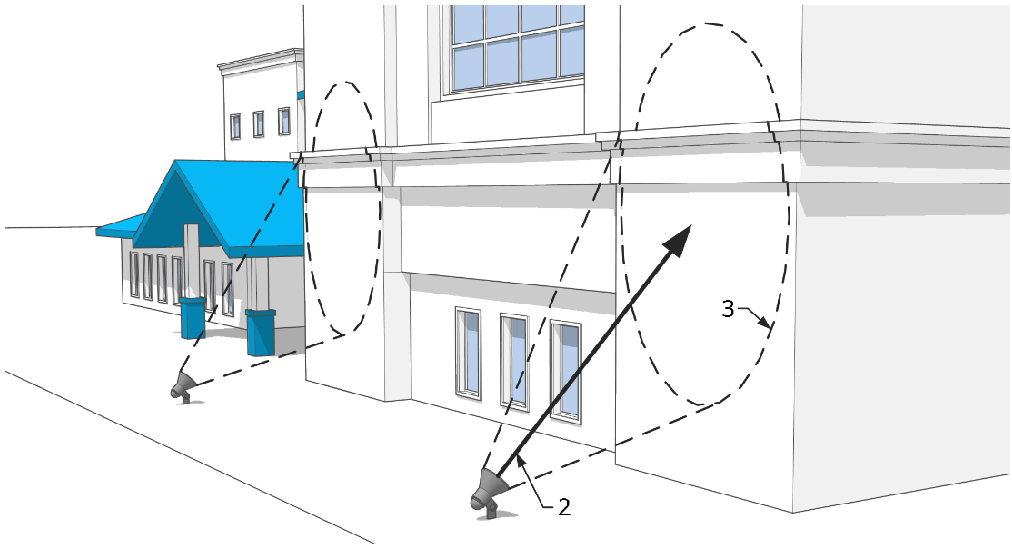
E.
Surface parking area lighting.
1.
All lighting for surface parking lots and upper uncovered decks of parking structures shall use full cut-off fixtures.
2.
Parking lot lighting poles shall not exceed 35 feet in height in District 1 and 20 feet in height in District
3.
In District 3, parking area lighting shall be prohibited except for public or quasi-public facilities requiring exterior parking lot illumination; such facilities shall comply with the parking area lighting standards for District 2.
4.
Parking lot lighting used for after-hours security shall not exceed three footcandles at the designated area illuminated and shall comply with § 5.8.5.G: Security Lighting.
F.
Pedestrian-scale lighting.
1.
Low-level pedestrian lighting must be provided on all required walkways pursuant to the following: Shall direct light downward;
2.
Shall use shatterproof lamp coverings;
3.
Shall not cause the site to exceed the maximum trespass pursuant to § 5.8.5.B.1: Maximum Lighting Trespass Levels;
4.
Shall not be located to present hazards for pedestrians or vehicles; and
5.
Post or bollard-type lights shall be painted dark colors such as black, dark gray, dark brown, or dark earth tone.
Figure 5-25: Pedestrian-Scale Lighting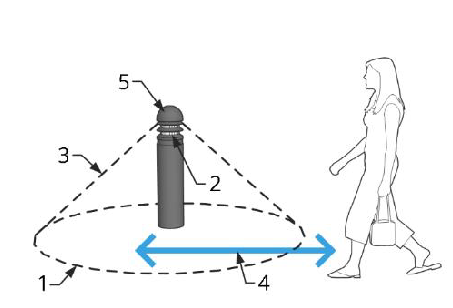
G.
Security lighting.
1.
Applicability. Security lighting must be provided in Lighting Districts 1 and 2 in all areas accessible to the public. Security lighting shall be allowed in Lighting District 3 pursuant to the standards within this UDC.
2.
Standards.
a.
Examples of appropriate security lighting techniques.
i.
Recessed lights under a canopy.
ii.
Full cut-off fixtures on parking lot poles.
iii.
Fully shielded wall packs or other fixtures.
iv.
Floodlights that are down-directed, fully shielded, and are controlled by motion sensors.
b.
Fixtures.
i.
Security lighting fixtures shall be fully shielded and directed only to the designated area.
ii.
Security lighting shall not be directed above a horizontal plane through the top of the lighting fixture.
iii.
Security lighting fixtures shall include shields that prevent the light source from being visible from adjacent properties and roadways to the maximum extent practicable.
c.
Light levels.
i.
Security lighting may illuminate ingresses and egresses of buildings up to a level eight feet above grade or the bottom of doorways, windows, or entries, whichever is greater.
ii.
Security lighting on a parcel in District 1 that shares a common lot line with a parcel located in Districts 2 or 3 shall comply with specifications for light levels and maximum mounting heights as noted in District 2.
iii.
Security lighting for entrances, stairways, and loading docks shall not exceed five footcandles at the designated area illuminated.
H.
Service station canopies.
1.
Canopies shall be illuminated so that the minimum horizontal illuminance at grade level is at least five footcandles. The maximum horizontal illuminance under canopies shall be 25 footcandles.
2.
Light fixtures mounted on canopies shall be installed so that the lens cover is recessed or flush with the bottom surface (ceiling) of the canopy or the fixture.
3.
Lights shall not be mounted on the top or sides of the canopy. The sides (fascias) of the canopy shall not be illuminated for any purpose, with the exception of internally illuminated signage which shall comply with the sign regulations of this UDC.
5.8.6.
Installation and maintenance.
A.
Compliance with building code and other applicable codes. Exterior lighting fixtures shall comply with the Building Code and other applicable codes as adopted by the Town.
B.
Maintenance. Exterior lighting shall be maintained in good structural condition at all times.
C.
Electrical service underground. New electrical service required for exterior lighting shall be located underground unless the fixtures are directly mounted on utility poles.
Sec. 5.9. - Signs.
5.9.1.
Purpose. The regulation of the location, size, and placement of signs is necessary to enable the public to locate goods, services, and facilities located within the corporate limits of the Town, to encourage the general attractiveness of the community, and to protect property values. The general objectives of these standards are to promote public health, safety, and welfare, and specifically to achieve the following:
A.
Safety. To promote the safety of persons and property by providing that signs do not:
1.
Create a hazard due to collapse, fire, decay or abandonment;
2.
Obstruct public safety response; and/or
3.
Create traffic hazards by confusing or distracting pedestrians.
B.
Communications efficiency. To promote the efficient transfer of information in sign messages providing that:
1.
Signs that provide messages and information most needed and sought by the public are given priority;
2.
Businesses and services may identify themselves;
3.
Customers and other persons may locate a business or service;
4.
No person or group is arbitrarily denied the use of the sight lines from the public right-of-way for communication purposes; and
5.
Persons exposed to signs are not overwhelmed by the number of messages presented and are able to exercise freedom of choice to observe or ignore such messages, according to the observer's purpose.
C.
Landscape and built environment quality and preservation. To protect the public welfare and to enhance the appearance and economic value of the landscape, by providing signs that:
1.
Do not interfere with scenic views;
2.
Do not create a nuisance to persons using the public rights-of-way;
3.
Do not create a nuisance to occupants of adjacent and contiguous property by their brightness, size, height or movement;
4.
Are not detrimental to land or property values;
5.
Do not contribute to visual blight or clutter; and
6.
Are architecturally compatible and harmonious with the structure to which they pertain and to neighboring structures.
5.9.2.
Authority and jurisdiction. The terms and conditions of this section shall apply to all signs located within the Town, pursuant to TLGC Chapter 216. The provisions of this section shall be administered and enforced by the Director. Allegations of errors in orders, decisions, and/or determinations by the Director shall be handled in accordance with § 2.10.4: Appeal of Administrative Decision.
5.9.3.
General procedures.
A.
Permit required.
1.
Sign permit.
a.
Except as provided in § 5.9.5, no person shall erect, construct, enlarge, alter, repair, display, maintain, or use a sign, whether temporary or permanent, until a permit for the same has been issued by the Director in accordance with § 2.6.5: Sign Permit.
b.
Each sign shall require a separate Sign Permit.
2.
Electrical permit. Each sign requiring the installation of an electric power source shall require a separate electrical permit and inspection as required in the Electrical Code.
3.
Building permit. When determined by the Building Official a sign, pole or structure must be sealed by a professional engineer for structural and/or electrical compliance with the Building and Electrical Codes.
B.
Contractor registration required.
1.
No person shall install or erect, relocate, or maintain any sign, or contract for such service, until such person has applied through the Development and Neighborhood Services Department for a Contractor Registration to install, erect, relocate, and maintain such sign, and such registration has been approved and issued, except as otherwise provided in this section.
2.
All sign contractors shall comply with the licensing requirements of Texas Occupations Code §§ 1305.160,1305.166, and 1305.167.
5.9.4.
Removal of certain signs.
A.
Removal of public nuisance or hazardous signs. All of the following signs shall be considered a public nuisance, and the Town may, without notice, remove and impound any of the following signs:
1.
Any sign erected or existing that constitutes a traffic hazard;
2.
Any sign erected without a permit, either prior to or after the adoption of this section, if a permit was required;
3.
Any sign erected in violation of the provisions of this section; and
4.
Any sign erected in or over a public right-of-way, either prior to or after adoption of this section.
B.
Recovery and disposal of impounded signs.
1.
Impounded signs may be recovered by the owner within 15 days of the date of impoundment by paying the fee established by the Town.
2.
Signs not recovered within 15 days of impoundment may be disposed of by the Town in any manner it shall elect.
5.9.5.
Signs allowed without sign permit. All signs listed in this section may be erected and maintained under the conditions listed and shall not require a Sign Permit, provided all other provisions of this section are met.
A.
Signs in airport overlay district. Air side signs that are located outside the view of primary public areas and/or on the rear or side of buildings shall not require a Sign Permit. All primary, secondary, and tertiary signs as defined in the Airport Master Plan that are visible from the primary public areas of the airport including the public right-of-way, access roads, pedestrian areas, and parking areas, shall require a Sign Permit.
B.
Construction banner signs.
1.
Construction banner signs shall be allowed without a Sign Permit subject to the following:
a.
Such signs shall not be erected prior to the issuance of a building or Site Development Permit for the project to which the sign pertains and shall be removed prior to the issuance of a certificate of occupancy.
b.
Such signs shall be affixed to construction fences and firmly attached on all four corners.
c.
No sign shall contain more than 36 square feet in sign area.
2.
All other construction signs shall require a Sign Permit.
C.
Flags. Flags shall be allowed without a Sign Permit subject to the following:
1.
Flags are limited to three per property.
2.
Each flag shall not exceed 40 square feet in size.
3.
Flagpoles shall not exceed 30 feet in height.
4.
Flags smaller than six square feet are exempt from the limitations of §§ 5.9.5.C.1 and 5.9.5.C.2 above.
5.
Approval of an alternative sign design as set forth in § 5.9.6 is required for flags or flagpoles that exceed the above size and height limitations.
D.
Government signs. Signs required to protect the public health, safety, and welfare of the Town and other regulatory purposes, including traffic signs, emergency and warning signs, information signs erected by the Town or other government agency, signs required to be displayed by law and signs of public service companies indicating danger and/or aids to service or safety shall be allowed without a Sign Permit.
E.
Menu boards and drive-through signs. Menu boards placed for the purpose of listing food or beverages available for sale and signs adjacent to, within, or above drive-through or drive-in lanes directing vehicles shall be allowed without a Sign Permit.
F.
Residential property. Residential property signs shall be allowed without a Sign Permit subject to the following:
1.
A residential property may display up to three detached, non-illuminated signs per lot. Each sign shall not exceed six square feet.
2.
Temporary signs during an election event are not subject to the three-sign limit set forth in above and shall comply with § 5.9.8.B and V.T.C.A. Election Code § 259.003, as amended.
G.
Signs not readable from the public right-of-way. Signs shall be considered not readable from the public right-of-way and therefore allowed without a Sign Permit subject to the following:
1.
The sign or display is located entirely inside of a building and not visible from the building's exterior; or
2.
Any letters, figures, or symbols are less than two inches in height and project no more than one inch from the surface on which the sign is mounted.
H.
Vehicular signs. Vehicular signs shall be allowed without a Sign Permit and may be attached to vehicles subject to the following:
1.
The vehicle is owned and operated by the Town or another governmental entity; or
2.
The primary purpose of the vehicle is not for display of the sign; and
3.
The signs are painted upon or applied directly to an integral part of the vehicle;
4.
The vehicle is in operating condition, currently registered and licensed to operate on public streets, and actively used in the daily function of the business to which such sign relates; and
5.
The vehicle, when on the premises of the business to which such sign relates, shall be parked in a location that does not unreasonably impact standard operating businesses.
I.
Window signs. Window signs shall be allowed without a Sign Permit subject to the following:
1.
Each sign shall be no more than four square feet in area.
2.
Signs in windows visible from public rights-of-way are limited to 20 percent of the total area of each architecturally distinct ground floor window area.
3.
The outlining of a window on two or more of any sides with lighting, gaseous tubing, or similar means shall constitute 100 percent of the total window area as a sign.
4.
In buildings with multiple tenants, these provisions shall be applied to each individual tenant based on the size of the windows located within that portion of the facade adjacent to the tenant's leased premises.
J.
Works of art. Works of art, including murals, that do not advertise a product or business as determined by the Director shall be allowed without a Sign Permit provided they comply with the dimensional standards for wall signs in the applicable district.
5.9.6.
Alternative sign designs.
A.
Purpose. It is not the intention of these regulations to discourage innovation. Applications for alternative sign designs may be submitted that, while clearly not conforming to this section and thus not allowable under these criteria, have obvious merit in not only being appropriate to the particular site or location, but also in making a positive contribution to the visual environment.
B.
Approval criteria. The City Council may approve an alternative sign design if it:
1.
Is necessary because enforcement of the requirement prevents any reasonable opportunity to provide adequate signs on the site, considering the unique features of a site including its dimensions, landscaping, or topography;
2.
Will not have a substantially adverse effect on neighboring properties; and
3.
Will not substantially conflict with the purpose and standards of this article.
5.9.7.
Prohibited signs. The following signs are specifically prohibited, except as otherwise prescribed within this section:
A.
Animated or moving sign. Any sign that includes animation, parts which move, or flashing or blinking lights that may be distracting to motorists. This includes feather signs and a person holding or carrying wind devices, flags, balloons, or other sign structures. This prohibition does not include time and temperature signs. Signs that have copy that changes, moves, flashes, or blinks in no less than eight-minute intervals shall not be considered as animated.
B.
Building code. Any sign in violation of the Building Code.
C.
Hazardous or nuisance signs. Any sign illuminated to an intensity to cause glare or brightness to a degree that could constitute a hazard or nuisance. Moving, flashing, intermittently lighted, changing color, beacons, revolving or similarly constructed signs shall not be allowed.
D.
Electronic/digital sign. Any sign or portion thereof that displays electronic, static images, static graphics, or static pictures, with or without text information, defined by a small number of matrix elements using light emitting diodes (LEDs), fiber optics, light bulbs, other illumination devices, or a combination thereof, within the display area where the message change sequence is accomplished immediately or by means of fade, repixelization, or dissolve modes. Noncommercial components of electronic signs are exempt from this prohibition.
E.
Fence sign. Any sign painted on or attached to the outside of a fence, railing or a wall that is not a structural part of a building, whether or not such fence, railing or wall is on the property line, except as a temporary sign which shall conform to § 5.9.108: Election Event Signs.
F.
Imitation of emergency signs and signals. Any sign using any combination of forms, colors, or lights which imitate emergency signs or signals.
G.
Inflatable sign. Any inflatable sign, including balloons, anchored to the ground, a building or other structure.
H.
Interchangeable copy. Any sign that allows for manual interchangeable copy, unless directly associated with and located on the same lot as a vehicle fuel station.
I.
Luminescent gaseous tubing. Any sign that uses exposed tubes that contain luminescent inert gases, including, but not limited to, neon, argon and krypton, and that are visible from the exterior of structures, except as an attached sign which shall conform to § 5.9.10: Permanent On-Site Signs.
J.
Mobile billboards. Any wheeled vehicle equipped with one or more poster panel units used primarily for the display of general advertising, by means of traversing upon any public street or parking on any public street in a manner that the advertising image(s) on the vehicle are visible from any portion of the public right-of-way.
K.
Off-premises signs. Any off-premises sign is prohibited, unless specifically allowed by this UDC.
L.
Portable signs. Portable signs are prohibited.
M.
Roof signs. Any sign on the roof or project over the roofline of a building. This does not apply to signs located above structural elements of the building, but remain below the roof of the facade on which the sign is located.
N.
Searchlights. Searchlights are prohibited.
O.
Signs in rights-of-way. Any sign that is erected or affixed within or projected over any public right-of-way or extended across a railroad right-of-way. This includes signs attached to or painted on any sidewalk, curb, gutter, street, tree, or public or private utility pole or structure. No sign shall be erected closer than ten feet from the existing public right-of-way except as otherwise authorized by this section.
P.
Wind-driven signs. Any sign consisting of one or a series of two or more banners, flags, pennants, ribbons, spinners, streamers, captive balloons or other objects or material fastened in such a manner as to move, upon being subjected to pressure by wind or breeze.
5.9.8.
Temporary signs.
A.
Standards applicable to all temporary signs.
1.
Sign location.
a.
Signs shall be located so as not to create a hazard for pedestrian or vehicular traffic and comply with minimum setback and vision triangle requirements.
b.
Unless otherwise specified in this section, temporary signs approved per this section may be located off-premises with the permission of the property owner, and may be allowed on a parcel in addition to the maximum amount of temporary and permanent signage permitted on that parcel.
2.
Sign illumination. Illumination of temporary signs is prohibited.
3.
Sign permit. Unless otherwise specified in this section, temporary signs require a Sign Permit.
B.
Election event signs. Election event signage shall be allowed without a Sign Permit subject to the following:
1.
Duration. For a period of 60 days prior to a state, local, or national election, election event signs may be permitted by this section. The election event signs shall be removed within two days following the election.
2.
Size and features. No election event sign shall:
a.
Have a sign area greater than 36 square feet;
b.
Exceed eight feet in height;
c.
Be illuminated; or
d.
Have any moving elements.
3.
Location.
a.
Election event signage shall be located on private real property with the consent of the property owner. For purposes of this requirement, "private real property" does not include real property subject to an easement or other encumbrance that allows a municipality, including the Town, to use the property for a public purpose.
b.
Election event signs are not permitted within the public right-of-way or on any real property owned by the Town, with the following exceptions:
i.
On properties with single-family attached or detached dwellings, election event signs may be placed in any portion of the front or side yard that may include the public right-of-way, if the sign is placed at least three feet away from the edge of the street. In locations with sidewalks, signs must be located behind the sidewalk so as to not obstruct the sidewalk.
ii.
On any Town-owned property that has been designated as an election polling place, election event signs may be placed in an area designated by Town staff while the property is serving as an active polling place. Such signs shall not:
a.
Have an effective area greater than three square feet.
b.
Exceed 18 inches tall and 24 inches wide.
c.
Be illuminated.
d.
Have any moving elements.
C.
Public or private special event signs. Unless sponsored by the Town and open to the public, special event signs shall comply with the following:
1.
A maximum of one banner sign per vendor internal to the premises and up to ten banners on the perimeter oriented outwards may be issued in conjunction with a special event permit or Temporary Use Permit. The Director may determine that a special event should be further limited or allowed additional signage based on the total area of the event, number of vendors, and potential adverse impact to neighboring properties.
2.
The permit shall specify the location and removal dates of the temporary signs allowed in conjunction with the permit. If dates are not specified in the permit, such signs may be displayed no more than 14 days prior to the special event and must be removed within two days after the conclusion of the special event.
3.
Banner signs shall not exceed 50 square feet of sign area, per side. Yard signs shall not exceed six square feet in sign area, per side.
4.
Banner signs shall not be located in the public right-of-way and shall be firmly affixed to a stabilized structure such as tent or table on all four corners.
D.
Temporary sidewalk signs.
1.
Temporary sidewalk signs are only permitted in the M-4 zoning district and within the M-1, M-2, M-3, and PD zoning districts for businesses that have an entrance immediately adjacent to a public sidewalk, businesses within a multi-tenant structure, or as permitted by previously approved Sign Districts or Master Sign Plans.
2.
Each tenant shall be allowed one sidewalk sign.
3.
Each sign shall not exceed six square feet in sign area.
4.
A minimum of four feet of clear sidewalk shall be maintained at all times.
5.
Such signs shall be displayed during operating business hours only.
E.
Temporary banner signs.
1.
Temporary banner signs are prohibited in all zoning districts in the Town except for the following:
a.
Any nonresidential establishment may display one banner sign for a maximum of 60 consecutive days at the same location, one time during the first three months after the issuance of a certificate of occupancy or change in ownership; or
b.
The Director may allow additional temporary banner signs displaying a noncommercial message for a maximum of 30 days.
2.
Temporary banners allowed by §§ 5.9.8.E.1.a and 5.9.8.E.1.b above shall not exceed 50 square feet in sign area.
3.
Contractor registration is not required for the installation of a temporary banner sign when approved and installed by the business operator.
F.
Undeveloped real estate site signs.
1.
On undeveloped real estate sites, each lot may have one non-illuminated sign per each public right-of-way provided that each frontage is at least 300 feet in length and the signs are spaced at least 50 feet apart. Such signs shall not be placed on public or private utility or light poles and shall not be located within the public right-of-way, including roadway median strips.
2.
The sign shall not exceed 36 square feet in sign area per sign face.
3.
The sign shall be a maximum height of 16 feet.
4.
Signs up to 20 square feet in sign area per face shall be set back a minimum of ten feet from the property line and signs up to 36 square feet in sign are per face shall be set back a minimum of 15 feet from the property line.
5.
The sign shall comply with the vision triangle standards in § 5.4.6: Vision Triangle.
5.9.9.
General sign regulations.
A.
Sign measurement and calculations.
1.
Sign area. Sign area is calculated as the area enclosed by drawing a rectangle of horizontal and vertical lines that fully contain all extremities of the sign, including architectural design elements such as decorative bordering, but exclusive of the sign supports.
2.
Sign height. Sign height is measured as the vertical distance between ground elevation and the top of the sign, including all backgrounds and support structures, exclusive of any filling, berming, mounding, or landscaping, solely done for the purpose of locating the sign.
3.
Sign setback. The setback of a sign is measured from the property line to the outermost perimeter of the sign, including support structures unless an alternative measurement is designated in this section or approved by the Director.
B.
Signs displaying noncommercial messages. Notwithstanding any other provision of this section, any sign that may display a commercial message may also display a noncommercial message, either in place of or in addition to the commercial messages, so long as the sign complies with other requirements of this section or other ordinances that do not pertain to the content of the message displayed.
C.
Lighting.
1.
No sign lighting shall reflect onto any structure or constitute a hazard to the safe and efficient operation of vehicles upon a street.
2.
Signs shall not exceed 0.3 footcandles over ambient light conditions.
D.
Maintenance.
1.
Every sign in the Town, regardless of whether any permit is required for such sign, shall be maintained in a safe, presentable and sound structural and operational condition at all times, including the replacement of nonfunctioning, broken, defective, or missing parts including lighting elements, painting, repainting, cleaning and any other acts required for the maintenance of such sign. All signs and sign supports, brackets and frames shall be kept painted or otherwise treated to prevent rust, rot or deterioration.
2.
Damaged or deteriorated signs shall be repaired within 30 days of notification by the Town.
3.
Signs not meeting the standards imposed by this section shall be subject to removal or repair as set forth in § 5.9.4: Removal of Certain Signs.
5.9.10.
Permanent on-site signs.
A.
Applicability. This section shall apply to all attached and detached signs in the Mixed-Use and Nonresidential zoning districts.
B.
Requirements by sign type. Unless otherwise allowed by § 5.9.10.C: Additional Allowances for Specific Sign Types, all signs shall comply with the following standards:
C.
Additional allowances for specific sign types.
1.
Site directional signs. Site directional signs may be erected at any occupancy or upon any site, other than a single-family detached or duplex dwelling, provided that such signs shall comply with the following:
a.
Each sign shall not exceed two square feet in sign area.
b.
Each sign shall not exceed 30 inches tall above grade.
c.
Each sign shall be set back at least ten feet from the back of curb provided it complies with vision triangle standards and does not impede pedestrian or vehicular movement or visibility, and located behind the sidewalk..
d.
A maximum of two site directional signs per public access drive may be located on each parcel.
e.
Site directional signs must be spaced at least 25 feet apart.
D.
Additional allowances for specific zoning districts.
1.
M-2, M-3, M-4, CL, CG, and LI. Each tenant shall be allowed one additional projecting or under-canopy sign. The sign:
a.
Shall not extend more than 36 inches from the building façade.
b.
Shall not exceed 24 inches in height.
c.
Shall be located a minimum of eight feet above grade.
2.
CL, CG and LI. Attached signs located at a height of up to 36 feet are limited to one and one-half square feet of sign area for each linear foot of building frontage not to exceed 200 feet. All other provisions of § 5.9.10.B shall apply.
E.
Additional standards for pole-mounted banners. All pole-mounted banner signs shall:
1.
Maintain a minimum eight-foot clearance from grade level to the bottom of the banner;
2.
Not exceed two feet in width and six feet in length.
Figure 5-26: Pole-mounted Banners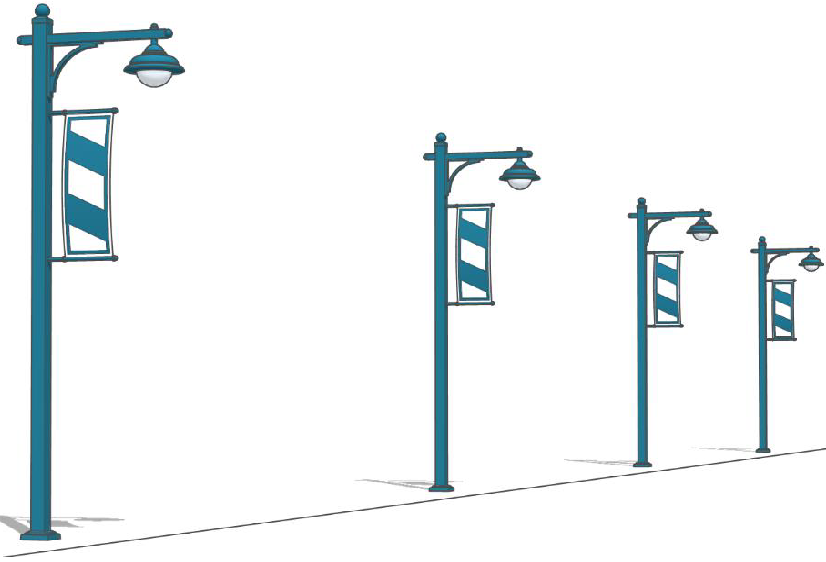
F.
Sign materials.
1.
Wall signs. Metal backing is required for all attached wall signs. Wood backing is prohibited.
2.
Pole signs.
a.
Sign supports shall consist of round or steel structural steel tubing or masonry wrapped steel supports up to 50 square inches in area. Structural support tubing shall be limited to single- or double- support structures and installed in accordance with the figure below. Unpainted metal, or metal subject to ordinary rusting shall not be used.
Figure 5-27: PoleSign Supports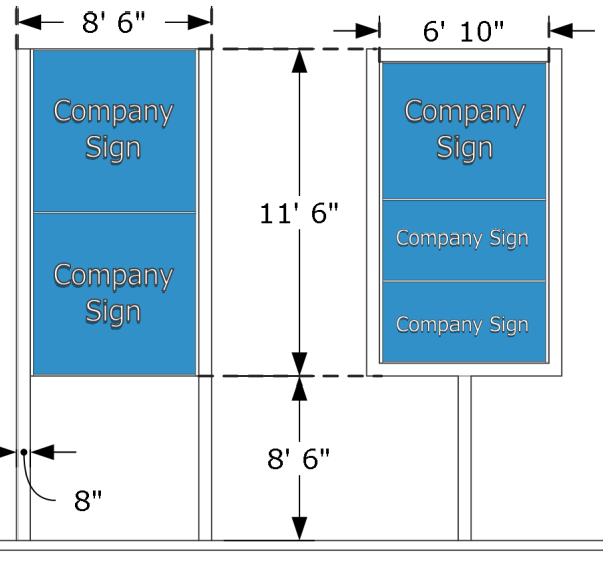
b.
The sign face shall be a plastic or metal sheet. Unused panels shall be solid neutral colors.
c.
The sign supports and cabinet color shall be compatible with currently installed pole signs to the maximum extent practicable.
3.
Monument signs. Plastic faces may be used on monument signs provided only the letters, numbers or logo elements emit light.
G.
Location.
1.
Attached signs.
a.
All signs shall be mounted parallel to the building surface to which they are attached.
b.
No sign shall project more than 18 inches from the surface to which they are attached.
c.
No sign shall be located on the roof or project over the roofline of a building. This does not apply to signs located on structural elements that project above the roofline of the building, but that remain below the uppermost point of the facade on which the sign is located.
2.
Detached signs.
a.
Detached signs shall comply with the vision triangle standards as set forth in § 5.4.6: Vision Triangle.
b.
Detached signs shall be no closer than 150 feet apart, with no two detached signs of any type being closer than 50 feet apart, measured from center to center of both signs.
5.9.11.
Master sign plan.
A.
Purpose. For some developments, alternative standards and flexibility in the established standards may enhance the aesthetic qualities of the development and the community. Approval of a Master Sign Plan allows for unified presentation of signage throughout a development site, flexibility to provide for unique environments, and pre-approval of designs and design elements to make sign review more efficient.
B.
Applicability. A Master Sign Plan shall be available for multi-tenant buildings, commercial, and mixed-use developments containing more than one building in a Mixed-Use, Commercial, or Planned Development zoning district.
C.
Master sign plan requirements.
1.
An application for a Master Sign Plan shall be submitted by the single developer, property owner, or property management company for the site or if all property owners within the development provide their approval, a managing member may be identified to submit an application for a Master Sign Plan and any amendments to a Master Sign Plan.
2.
An application for a Master Sign Plan shall identify all proposed signage for an entire parcel or development site and shall include the following information:
a.
Sign dimensions and approximate locations;
b.
Materials and colors;
c.
Proposed illumination, including illumination levels;
d.
Maximum numbers of tenant signs per sign face;
e.
A design theme with illustrative examples of each sign type and the proposed general locations of each sign type;
f.
A demonstration that the Master Sign Plan will improve the aesthetics of the development and will not have an adverse impact on the use, enjoyment, or value of adjacent properties; and
g.
Any other maps, drawings or materials as required by the Director (including a colored rendering of the sign(s) to adequately describe the sign proposal. The application and any exhibits shall become the property of the Town).
D.
Standards.
1.
Prohibited signs and sign elements. Prohibited signs and sign elements are not eligible for inclusion in a Master Sign Plan unless specifically indicated in this section.
2.
Architectural theme. All signs shall be architecturally integrated into or complimentary to the design of the building(s) and character of the site, and shall use similar and coordinated design features, materials, and colors. The Master Sign Plan shall establish an integrated architectural vocabulary and cohesive theme for the development site.
3.
Review criteria. The height, area, number, and location of signs permitted through the Master Sign Plan may deviate from the standards of this section and shall be determined based on the following criteria:
a.
Subsections 5.9.11.D.1 and 5.9.11.D.2 above;
b.
The overall size of the development site and the scale of the use or uses located or anticipated to be located there (larger land areas and scales of use tend to favor larger signs and/or more signs);
c.
Relationship between the building setback and sign location (additional signage may be appropriate for buildings with less visibility, particularly where buffering is providing an aesthetic and/or environmental benefit to the Town);
d.
Length of frontage on a public right-of way (larger frontages may justify more or larger signs, particularly if the size of the frontage tends to prevent sign clutter from multiple adjacent parcels);
e.
Access and visibility to the site;
f.
Intended traffic circulation pattern and the need for wayfinding;
g.
Hierarchy of signage;
h.
Relationship between the site and adjacent uses; and
i.
The desired function of the site.
4.
Nonconforming signs. If there are existing signs on-site, they shall be treated in accordance with § 5.9.12: Nonconforming Signs upon adoption of the Master Sign Plan.
E.
Master sign plan review.
1.
Generally. An application for a Master Sign Plan shall be reviewed as part of the Major Site Plan process in § 2.6.2: Site Plan Review.
2.
Planning and zoning commission approval. Master Sign Plans require approval by and a public meeting with the Planning and Zoning Commission.
F.
Individual sign permits. Individual Sign Permits are required for signs installed in compliance with an approved Master Sign Plan that conforms with the provisions of this section.
G.
Amendments.
1.
A Master Sign Plan may be amended by the Director if the proposed amendments do not:
a.
Deviate from the original approval of number of signs and size of signs by more than ten percent;
b.
Include significant changes to the locations of three or more signs; and
c.
Result in a significant change to the architectural theme.
2.
If the proposed amendments exceed the standards above, a full Master Sign Plan review is required.
H.
Sign districts. Those areas previously established as sign districts shall comply with the standards in Appendix A.
5.9.12.
Nonconforming signs.
A.
Purpose. The purpose of this section is to ensure that in time all privately owned signs shall either conform to the provisions of this section or be removed.
B.
Generally.
1.
No presently illegal sign shall be deemed to have been legalized unless such sign complies with all current standards under the terms of this section and all other ordinances of the Town.
2.
Any sign that does not conform to all provisions of this section shall be either:
a.
A nonconforming sign if it legally existed as a conforming or nonconforming sign under the terms of this section under prior ordinances; or
b.
An illegal sign if it did not exist as a conforming or nonconforming sign under prior ordinances.
C.
Repair and removal.
1.
Except for nonconforming signs created by action of the Town or other government agency, no nonconforming sign shall be repaired or renovated, except to reface a sign without structurally altering the shape and size of the sign. Otherwise, a nonconforming sign shall be brought into compliance with the provisions of § 5.9: Signs.
2.
Any nonconforming sign that is damaged in excess of 50 percent of its current value shall be demolished and not repaired unless such proposed repairs would bring the sign into compliance with the provisions of § 5.9: Signs. Damaged signs shall be repaired within 30 days of notification by the Town.
3.
Upon voluntary demolition of a primary structure, a nonconforming sign that identified the primary structure shall be removed or modified to comply with § 5.9: Signs within 30 days of the completion of the demolition.
4.
The Town will follow all applicable state regulations in the removal of nonconforming signs. Upon requirement of removal, the Town will institute any necessary procedures before any legal boards required by state legislation.

