
Addison City Zoning Code
ARTICLE VII
- DEFINITIONS
Sec. 7.1. - Rules of construction.
7.1.1.
Meanings and intent. All provisions, terms, phrases, and expressions contained in this UDC shall be construed according to the general purpose set forth in § 1.3, and the specific purpose statements set forth throughout this UDC. When, in a specific section of this UDC, a different meaning is given for a term defined for general purposes in this UDC, the specific section's meaning and application of the term shall control.
7.1.2.
Headings, illustrations, and text. In the event of a conflict or inconsistency between the text of this UDC and any heading, caption, figure, illustration, table, or map, the text shall control.
7.1.3.
Lists and examples. Unless otherwise specifically indicated, lists of items or examples that use terms such as "for example," "including," and "such as," or similar language are intended to provide examples and are not exhaustive lists of all possibilities.
7.1.4.
Computation of time. The time in which an act is to be done shall be computed by excluding the first day and including the last day. If a deadline or required date of action falls on a Saturday, Sunday, holiday observed by the Town, or other day that Town offices are not open, the deadline or required date of action shall be the next day that is not a Saturday, Sunday, holiday observed by the Town, or other day that Town offices are not open. References to days are calendar days unless otherwise stated.
7.1.5.
Technical and non-technical terms. Words and phrases shall be construed according to the common and approved usage of the language, but technical words and phrases that may have acquired a peculiar and appropriate meaning in law shall be construed and understood according to such meaning.
7.1.6.
Mandatory and discretionary terms. The words "shall," "must," and "will" are mandatory, establishing an obligation or duty to comply with the particular provision. The words "may" and "should" are discretionary.
7.1.7.
Conjunctions. Unless the context clearly suggests the contrary, conjunctions shall be interpreted as follows:
A.
"And" indicates that all connected items, conditions, provisions, or events apply;
B.
"Or" indicates that one or more of the connected items, conditions, provisions, or events apply; and
C.
"And/or" indicates that the connected words or provisions may apply singularly or in any combination.
7.1.8.
Tenses, plurals, and gender. Whenever appropriate with the context, words used in the present tense include the future tense. Words used in the singular number include the plural. Words used in the plural number include the singular, unless the context of the particular usage clearly indicates otherwise. Words used in the masculine gender include the feminine gender, and vice versa.
7.1.9.
Titles and headings. All titles and headings of articles, sections, or subsections of this UDC are to be used for convenience in arrangement only and shall not be construed to alter the intended meaning.
Sec. 7.2. - Use-related definitions.
7.2.1.
Residential uses.
Household Living. Uses characterized by residential occupancy of a dwelling unit by a "Family." Common accessory uses include recreational activities, raising of household pets, personal gardens, personal storage buildings, hobbies, and resident parking. Specific use types include:
Cottage Development. A cluster of at least five detached single-family dwellings located within a common development that use shared access, parking, and common spaces. Cottage developments can include homes on individual lots, homes owned as condominiums, or leased homes. This use can include communities of five or more factory built small single-family detached dwellings, provided that each home meets applicable Building Codes or the Federal Manufactured Housing Construction and Safety Standards Law of 1974 (42 U.S.C. 5401 et seq.), and that each dwelling has any wheels removed, is mounted on a permanent foundation, and is connected to public water, sewer, and electric services. This definition does not include a "Manufactured Home Development (HUD-Code)".
Dwelling, Duplex. A single building on a single lot or tract containing two dwelling units under one roof, each of which is occupied by one family or two dwelling units that are attached side by side under one roof that share a common vertical side or rear wall reaching from the building foundation to the roof structure, each of which is occupied by one family on its own lot or tract.
Dwelling, Fourplex. A single building on a single lot or tract containing four dwelling units under one roof, each of which is occupied by one family.
Dwelling, Live-Work. A dwelling unit containing an integrated living and working space in different areas of the unit.
Dwelling, Multifamily. One or more buildings or portion of buildings on a single lot or tract that contains five or more individual dwelling units, where each unit is occupied by one family living independently of each other and maintaining separate cooking facilities and where each unit has an individual entrance to the outdoors or to a common hallway. This definition includes condominium units as defined by the Texas Property Code.
Dwelling, Single-Family (Attached). Three or more single-family dwelling units that are attached side by side under one roof that share a common vertical side or rear wall reaching from the building foundation to the roof structure, each of which is occupied by one family on its own lot or tract. This definition includes Townhouses.
Dwelling, Single-Family (Detached). A dwelling designed and constructed for occupancy by one family and located on a single lot or tract that has no physical connection to a building located on any other lot or tract. This definition includes a "Zero-Lot-Line Dwelling" and "Manufactured Home (HUD-Code) Dwelling."
Dwelling, Triplex. A single building on a single lot or tract containing three dwelling units under one roof, each of which is occupied by one family.
Manufactured Home Development (HUD-Code). A development on a single lot divided into more than one space for the placement of manufactured home (HUD-Code) dwellings, accessory uses, and service facilities, meeting all requirements of this UDC and any other applicable deed restrictions and state laws.
Group Living. Uses characterized by residential occupancy of a structure by a group of people who do not meet the definition of "Household Living." Tenancy is arranged on a monthly or longer basis and the size of the group may be larger than a "Family." Generally, group living structures have a common eating area for residents. Residents may receive care, training, or treatment, and caregivers may or may not also reside at the site. Accessory uses are limited to recreational facilities and vehicle parking for occupants and staff. Specific use types within the group living use category include:
Assisted Living Facility. A facility combining housing, supportive services, personalized assistance, and health care, designed to respond to the individual needs of those who need help with activities of daily living, such as dressing, grooming and bathing, diet, financial management, evacuation of a residence in the event of an emergency, or medication prescribed for self-administration, but do not require hospitalization. An "assisted living facility" does not contain equipment for surgical care or for treatment of disease or injury.
Continuing Care Facility. An establishment for care of individuals that has common facilities and provides licensed intermediate and skilled nursing facilities for its residents, as well as other supportive services. This use generally incudes a variety of housing types and provides a variety of levels of assistance and care so that its residents may obtain higher levels of care and service as they age without having to move to another residential care facility. A "continuing care facility" does not contain equipment for surgical care or for treatment of disease or injury.
Group Care Home, FHAA. A residential dwelling or facility where persons are living, together with staff, as a single housekeeping unit providing care, supervision, and treatment for the exclusive use of citizens protected by the provisions of the Federal Fair Housing Act Amendments of 1988, as defined in that Act and interpreted by the courts, or by any similar legislation of the State of Texas, including but not limited to facilities providing housing for handicapped, mentally ill, or developmentally disabled persons.
Group Care Home, FHAA Small. A facility designed for and occupied by eight or fewer residents living together.
Group Care Home, FHAA Large. A facility designed for and occupied by nine or more residents living together.
Supportive Housing. A dwelling where persons are living, together with staff, as a single housekeeping unit providing care, supervision, and treatment for the exclusive use of persons requiring medical, correctional, or other mandated supervision or a protective environment to avoid past or likely future violence or addiction and whose right to live together is not protected by the Federal Fair Housing Act Amendments, as amended and as interpreted by the courts, and that does not meet the definition of another use in this UDC. This includes and is not limited to:
1)
An owner-occupied or nonprofit residential dwelling for the exclusive use of at least two but not more than eight persons, who, together with staff, live as a single housekeeping unit but do not require 24-hour medical or nursing care.
2)
A shelter for persons experiencing temporary homelessness.
3)
A domestic violence shelter, which is a public or private building or structure housing residents for the purpose of the rehabilitation or special care for victims of domestic violence or emotional or mental abuse.
Supportive Housing, Small. A facility designed for and occupied by eight or fewer residents living together.
Supportive Housing, Large. A facility designed for and occupied by nine or more residents living together.
7.2.2.
Public, institutional, and civic uses.
Community and Cultural Facilities Uses including buildings, structures, or facilities to provide a service to the public. Accessory uses may include limited retail, concessions, parking, and maintenance facilities. Specific use types include:
Police, Fire, or Rescue Facility. An establishment operated by a government agency for the protection of citizens and property and for providing public responses to crime, fire, injury, or other emergencies. This use may include administrative offices, storage of equipment, temporary detention facilities, and the open or enclosed parking of associated vehicles.
Club or Lodge. A nonprofit membership organization that holds regular meetings, whose members pay dues, that is organized for a common interest, usually cultural, civic, religious, or social, and that has formal written membership requirements. A "club or lodge" may, subject to other regulations controlling such uses, maintain dining facilities; engage in professional entertainment for the enjoyment of members and their guests; or store, sell, possess, or serve any alcoholic beverage permitted by the law of the State of Texas and the Town. This definition does not include any form of sleeping accommodations.
Day Care Center, Adult or Child. A facility, other than a "Day Care Home, Adult or Child," "Assisted Living Facility," or "Continuing Care Facility," where children or elderly and/or functionally impaired adults receive care from a provider for a period of less than 24 hours per day. The term "Day Care Center" includes but is not limited to the following: nursery schools, child care centers, kindergartens and play groups; but does not include kindergartens accredited or recognized by the Texas State Board of Education or that are supported in whole or in part by state tax funds. A "Day Care Center" exempt from state licensing requirements shall provide proof of exemption.
Day Care Home, Adult or Child. A residential dwelling unit used as the primary residence of the day care provider where adults or children receive care from the provider less than 24 hours per day. This use includes licensed, listed, and registered child care homes as defined by Texas Health and Human Services. Where required by state law, adult or child day care homes shall be and remain licensed, registered, or listed by the state and shall be operated in accordance with their license and all applicable state laws. An "adult or child day care home" exempt from state licensing requirements shall provide proof of exemption.
Funeral Facility. An establishment for the care, preparation, or disposition of the deceased for burial and the display of the deceased and rituals connected with and conducted before burial or cremation. This use includes mortuaries, which are facilities in which dead bodies are prepared for burial or cremation and funeral homes.
Library. A facility for storing and loaning books, periodicals, reference materials, audio and video media, and other similar media. A library may also include meeting rooms, offices for library personnel, and similar support facilities.
Museum. An establishment operated as a repository for a collection of nature, scientific, literary curiosities, or objects of interest or works of art, not including the regular sale or distribution of the objects collected. A museum may also include meeting rooms, offices for museum personnel, retail sales of goods that are related in topic with the primary purpose of the museum, and similar support facilities.
Park or Open Space, Active. Areas for recreational uses that require constructed facilities for organized activities including playing fields, playgrounds, and ball courts. Accessory uses may include group picnic shelters, hard surfaced pathways, restrooms, parking lots, and similar facilities.
Park or Open Space, Passive. Areas for recreational uses related to the functions and values of a natural area that require limited and low-impact site improvements, including trails, signs, pedestrian bridges, seating, viewing blinds, and observation decks. Accessory uses may include drinking fountains, picnic tables, restrooms, parking lots, and similar facilities.
Place of Worship. Structures and outdoor or indoor facilities used for public worship and accessory educational, cultural, and social activities. Accessory uses may include offices related to the operation of the organization, meeting rooms, columbariums pursuant to Section 711.008 of the Health and Safety Code, and similar support facilities.
Educational Facilities. Uses in this category include public, private, and parochial institutions at the primary, elementary, secondary, or post-secondary level, or vocational or trade schools. Accessory uses commonly include cafeterias, indoor and outdoor recreational and sport facilities, auditoriums, and day care facilities. Specific use types include:
School, College or University. A post-secondary institution of higher learning other than a "School, Vocational or Trade" that provides full-time or part-time education beyond high school.
School, Public or Private. Any public or private school meeting all requirements of the compulsory education laws of the State of Texas. A facility or area for nursery, preschool, pre-kindergartens, kindergartens, learning center, elementary, or secondary education supported by a private organization, including a church or parish organization. This definition includes licensed private preschool facilities in which the principal use of the property is for preschool and charter schools. This does not include home-schooling facilities that are located within residential structures or other structures on a part time basis, "School, Vocational or Trade", or "School, College or University".
School, Vocational or Trade. A private or public educational facility offering instruction in a professional, vocational, or technical field. This use includes establishments providing instruction focused upon usable skills that prepares students for jobs in a trade or in industry, construction, or commerce, and meeting all applicable state requirements for a facility of its type.
Healthcare Facilities. Uses characterized by activities focusing on medical services, particularly licensed public or private institutions that provide preventative health care, primary health services, and medical or surgical care to persons suffering from illness, disease, injury, or other physical or mental conditions. Accessory uses may include laboratories, outpatient, or training facilities, or other amenities primarily for the use of employees in the firm or building. Specific use types include:
Hospital. An institution designed for the diagnosis, treatment, and care of human illness or infirmity and providing health services, primarily for inpatients, and emergency medical services including related facilities, laboratories, outpatient departments, training facilities, and staff offices. Facilities and services operate on a continuous 24-hour basis with overnight beds and services for persons suffering from illness, injury, or conditions requiring medical services. This does not include "Assisted Living Facility" or "Medical Clinic".
Medical Clinic. A health care facility where patients are admitted for examination and treatment on an outpatient basis by one or more physicians, dentists, other licensed health care practitioners, psychologists, or social workers, and where patients are not lodged overnight. This definition includes emergency and urgent care facilities without ambulance services and outpatient surgery centers. Accessory uses may include incidental retail sales of products incidental to the services provided.
7.2.3.
Commercial uses.
Agricultural and animal uses. This category includes agricultural activities, including nurseries and facilities for processing and selling agricultural products. Agricultural uses involve apiculture, horticulture, floriculture, viticulture, and animal husbandry. Animal-related uses include the boarding and care of animals on a commercial basis. Accessory uses may include confinement facilities for animals, parking, and storage areas.
Kennel, Commercial. An establishment where any person engages in a business involving boarding, breeding, buying, keeping, letting for hire, training for a fee, or selling dogs, cats, or other domestic animals. This definition includes uses such as animal day care, animal grooming, obedience schools, and other veterinary services.
Plant Nursery or Greenhouse. An establishment for the growth, display, and/or wholesale of plants, shrubs, trees, and materials used in indoor or outdoor planting, conducted within or outside of an enclosed building.
Urban Agriculture, Noncommercial. The cultivation of food and/or horticultural crops, composting, aquaponics, aquaculture and/or hydroponics. Such use may include the production and sale of food products from food grown on the premises including eggs from backyard chickens. Noncommercial urban agriculture may be divided into separate plots for cultivation by one or more individuals and may include common areas maintained and used by users of the site. This definition includes gardens, container gardens, edible landscapes, residential greenhouses, herb gardens, rooftop gardens, berry patches, vegetable gardens and other similar activities. Urban agriculture uses shall not include the raising of animals, except as permitted elsewhere in the Code of Ordinances.
Veterinary Hospital or Clinic. Facility for the diagnosis, treatment, or hospitalization of domestic animals, operated under the supervision of a licensed veterinarian. The incidental temporary overnight boarding of animals that are recuperating from treatment is included in this definition. This use does not include a "Kennel."
Recreation and Entertainment. This category includes indoor and outdoor recreation and entertainment activities. Accessory uses may include limited retail, concessions, parking, and maintenance facilities. Specific use types include:
Recreation Facility, Indoor. A commercial recreational use conducted entirely within a building, including arcades, bowling alleys, billiard parlors, skating rinks, motion picture theaters, spectator sports, assembly halls, athletic and health clubs, auditorium or exhibition hall, dance hall, community centers, gymnasiums, sports courts, sport fields, field house, swimming pools, or any other indoor recreational activity. Accessory uses may include limited retail, concessions, and maintenance facilities. This definition does not include "Sexually Oriented Business."
Recreation Facility, Outdoor. Recreation and entertainment activities operated by a commercial enterprise that are mostly outdoors or partially within a building, including picnic areas, outdoor swimming pools, skateboard parks, sport courts, sport fields, golf courses, outdoor golf driving ranges, outdoor miniature golf course, amphitheaters, outdoor arenas, outdoor movie picture theaters, or any other outdoor recreational activity. Accessory uses may include limited retail, concessions, and maintenance facilities but such accessory uses are only allowed in Mixed-Use and Nonresidential zoning districts.
Sexually Oriented Business. An adult arcade, adult bookstore, adult video store, adult cabaret, adult motel, adult motion picture theater, adult theater, escort agency, nude model studio, or sexual encounter center.
Food and Beverage. Establishments involved in serving prepared food or beverages for consumption on or off the premises. Specific use types include:
Beer and Wine Sales, Off-Premises Consumption. A licensed retail sales establishment selling packaged and sealed alcoholic beer and wine for consumption off-site.
Brewpub, Distillery, or Winery. An establishment that may produce malt liquor, ale, beer, cider, spirits, wine, or other alcohol for consumption on or off the premises from a lawful container to the extent the sales or offers are allowed under the establishment's valid licenses or permits. Product produced on-site shall not be sold to other drinking establishments or restaurants. Such uses may operate in conjunction with a restaurant.
Catering Establishment. An establishment that prepares food on-site, then transports and serves the food at a secondary location. On-site sale or consumption of food or beverages to patrons is prohibited.
Hookah Bar. An establishment providing for the sale of on-site consumption of smoked flavored tobacco or herbs.
Liquor Sales, Off-Premises Consumption. A licensed retail sales establishment selling packaged and sealed alcoholic liquors (including spiritous liquors) for consumption off-site.
Microbrewery. A small-scale commercial operation engaged in the production and distribution of beer, wine, liquor, mead, or cider that may include a tap room and typically offers retail sales for consumption on site or off the premises.
Mobile Food Truck Park. An area of land on which one or more food trucks sell food and/or beverages to the public, and on which the public may consume food and/or beverages. This use does not include mobile food trucks.
Restaurant. An establishment that sells food or beverages in a ready-to-consume state, in individual servings, that the customer consumes while seated at tables or counters located in or immediately adjacent to the building in which the use is located, and that may include carry-out service. This includes any portion of an establishment used for seating for the consumption of food on the premises that sells prepared food or beverages, such as a bakery, delicatessen, cafes, and coffee shops. Accessory uses may include an outdoor dining area or sidewalk café.
Lodging. Establishments that provide lodging services for a defined period of time with incidental food, drink, and other sales and services intended for the convenience of guests. Accessory uses may include food preparation areas, offices, and parking. Specific use types include:
Bed and Breakfast. A single-family detached dwelling that is owner-occupied or occupied by a resident manager in which rooms are rented and meals may be served to transient guests on an overnight basis for a period of time less than 30 consecutive days.
Hotel, Full Service. A building or group of buildings providing transient lodging accommodations to the general public for compensation for periods of time not exceeding 30 consecutive days that includes ancillary facilities and services such as restaurants, meeting rooms, personal services, recreational facilities, daily housekeeping service, and 24-hour front desk service. The term "Hotel, Full Service" does not include "Bed and Breakfast," "Hotel, Limited Service," "Residence Hotel," or "Supportive Housing."
Hotel, Limited Service. A building or group of buildings providing transient lodging accommodations to the general public for compensation for periods of time not exceeding 30 consecutive days and that is not classified as "Hotel, Full Service" or "Residence Hotel."
Residence Hotel. Any hotel that offers more than five percent of its guest rooms for stays extending 30 consecutive days or more, or a multi-dwelling unit extended-stay lodging facility consisting of efficiency units or suites with a complete kitchen suitable for long-term (30 days or more) occupancy. Accessory uses include meeting rooms, clubhouse, and recreational facilities intended for the use of residents and their guests. This definition shall not include other dwelling units as defined by this UDC.
Office, Business, Professional, and Personal Services. Uses in this category provide executive, management, administrative, governmental, or professional services, but do not sell merchandise except as incidental to a permitted use or provide individual services related to personal needs directly to customers at the site of the business, or that receive goods from or return goods to the customer, which have been treated or processed at that location or another location. Typical uses include real estate, insurance, property management, investment, employment, travel, advertising, law, architecture, design, engineering, accounting, call centers, and similar offices. Accessory uses may include cafeterias, health facilities, parking, or other amenities primarily for the use of employees in the firm or building. Specific use types include:
Bank or Financial Institution. A federal- or state-regulated facility that provides financial and banking services to individuals and businesses. These services may include deposit banking and closely related functions such as making loans, investments, and fiduciary activities. This definition does not include "Credit Access Business." Accessory uses may include automatic teller machines and offices.
Credit Access Business. A credit services organization that obtains for a consumer or assists a consumer in obtaining an extension of consumer credit in the form of a deferred presentment transaction or a motor vehicle title loan, as established in Texas Finance Code, § 393.601, as amended.
Laundromat, Self-Service. An establishment providing washing or drying on the premises for rental use where the patron may personally supervise the washing and handling of their laundry. This definition includes automatic, self-service only, or hand laundries.
Office. A building where services are provided and/or business is conducted including administrative, professional, governmental, or clerical operations. Typical examples include fire service, ambulance, judicial court or government offices, post office, real estate, political and philanthropic offices, television and radio broadcasting, call centers, insurance, property management, investment, financial, employment, travel, advertising, law, architecture, design, engineering, accounting, and similar offices. This use includes accessory uses such as restaurants, coffee shops, health facilities, limited retail sales, or other amenities primarily for the use of employees in the business or building.
Personal Services. Establishments primarily engaged in providing services involving the care of a person or of the care or repair of his or her personal goods or apparel. Personal services usually includes, but is not limited to: laundry (including cleaning and pressing service), beauty shops, barbershops, shoe repair, personal copying/shipping services, health spas, licensed massage therapy, photographic studios, tailor/seamstress shop, indoor equipment/party/event rental, tanning salon, bicycle and sports equipment repair, small appliance repair, and similar uses. This definition does not include "Laundromat, Self-Service" or "Commercial Laundry Facility."
Retail Sales. Uses involving the sale, lease, or rent of new or used products directly to the final consumer. Accessory uses may include offices, parking, storage of goods, assembly, repackaging, or repair of goods for on-site sale. Specific use types include:
Building Supply Store. A business involved in the sale, storage, and distribution of building supplies and services including but not limited to lumber, brick, tile, cement, insulation, floor covering, lighting, plumbing supplies, electrical supplies, cabinetry and roofing materials. Accessory uses may include repair or delivery services, outside sale of plants and gardening supplies, and incidental wholesale trade.
Pawn Shop. A retail operation which provides for the lending of money with personal items held as collateral, or the purchasing, or the repurchasing of gold, silver, jewelry, watches, and gems in addition to other merchandise. ;b21; Retail Sales. Establishments engaged in selling goods or merchandise to the general public for personal or household consumption and rendering services incidental to the sale of such goods. This use does not include any form of retail sales or other use listed separately in § 4.2.7: Table of Allowed Uses.
Retail Sales, Less than 15,000 Square Feet GFA. A retail sales establishment with less than 15,000 square feet of gross floor area.
Retail Sales, 15,000 to 50,000 Square Feet GFA. A retail sales establishment with between 15,000 and 50,000 square feet of gross floor area.
Retail Sales, More than 50,000 Square Feet GFA. A retail sales establishment with more than 50,000 square feet of gross floor area.
Transportation, Vehicles, and Equipment. Uses in this category include a broad range of uses including those primarily associated with transit facilities or uses for the maintenance, sale, or rental of motor vehicles and related equipment. Accessory uses may include incidental repair and storage and offices.
Equipment Sales or Rental. An establishment engaged in the display, sale, and rental of equipment, tools, supplies, machinery or other equipment used for commercial, industrial, or construction enterprises, such as, but not limited to, trucks, trailers, semi-tractor trailers, farm equipment, bulldozers, cranes, backhoes, rollers, loaders, or lifts. This use includes the selling of farm-specific vehicles such as tractors, tillers, farm trailers, back hoes, graders, boom lifts, and front-end loaders. This definition does not include "Vehicle Sales or Leasing".
Fleet Services. A central facility for the storage of licensed and operable vehicles used regularly in business operation, long-term storage of operating vehicles, and where such vehicles are not available for sale or lease. This definition includes but is not limited to couriers, delivery and express services, recreational touring fleets, taxi fleets, limousine services, and mobile-catering vehicle storage.
Parking Facility, Private. As a principal use, the lease, operation, or management of a commercial surface parking lot, above-ground parking structure, or below-ground parking structure in which fees are charged.
Parking Facility, Public. As a principal use, the lease, operation, or management of a public-owned surface parking lot, above-ground parking structure, or below-ground parking structure in which fees may or may not be charged.
Transit Terminal or Station. As a principal use, a facility where public transit vehicles load and unload patrons, and where patrons may transfer from between public transit lines. This definition includes park-and-ride or ride-sharing facilities but does not include the repair or maintenance of transit vehicles.
Vehicle Fuel Station. A facility limited to retail sales to the public of gasoline, biodiesel, electricity, ethanol fuel blends, hydrogen, natural gas or other fuels for motor vehicles, as well as motor oil, lubricants, travel aides, and minor automobile accessories. Accessory uses may include convenience food and beverage sales and an automatic free-standing vehicle wash.
Vehicle Repair, Major. An establishment primarily engaged in vehicle repair, rebuilding, reconditioning, or mechanical servicing of motor vehicle engines, transmissions, frames, including auto body repairs, frame work, welding, and major painting. This definition does not include "Vehicle Fuel Station" or "Vehicle Wash."
Vehicle Repair, Minor. An establishment primarily engaged in providing minor motor vehicle repair services such as lubrication, oil and tire changes, engine tune-ups, brake repair, tire replacement, interior and exterior cleaning and polishing, installation of after-market accessories such as tinting, anti-theft devices, spoilers, sunroofs, headlight covers, and similar items. This definition does not include engine degreasing or other major repairs included in the definition for "Vehicle Repair, Major." This definition does not include "Vehicle Fuel Station" or "Vehicle Wash."
Vehicle Sales or Leasing. An establishment that specializes in the sale, display, lease, rental, or storage of light motor vehicles, including automobiles, vans, light trucks, light trailers, boats, ATVs, snowmobiles, and recreational vehicles. This definition does not include salvage operations, scrap operations, vehicle impound yards, or private parking facilities available for short-term use.
Vehicle Wash. A facility for washing, cleaning, drying, and waxing of passenger vehicles, recreational vehicles, or other light motor vehicles. This definition includes a facility that is self-service or attended by an employee.
7.2.4.
Industrial.
Manufacturing and Processing. Uses in this category includes the excavation, transporting, manufacture, fabrication, processing, reduction, destruction, or any other treatment of any article, substance, or commodity, in order to change its form, character, or appearance. Accessory uses may include retail sales, offices, storage, cafeterias, employee amenities, parking, warehousing, and repair facilities. Specific use types include:
Commercial Laundry Facility. An establishment that cleans clothing, carpeting, drapes, leather, and other cloth or synthetic fiber materials using a chemical process.
Data Center. A facility used to house computer systems and associated components, telecommunications systems, and storage systems for the purpose of collection, processing, storage, or retrieval of data. This use generally includes redundant or back-up power supplies, redundant data communications connections, environmental controls (such as air conditioning and fire suppression), and security devices.
Food Production or Processing. A facility that produces food, including, but not limited to, candy, baked goods, tortillas, ice cream, or any other food for human consumption in its final form. Such food is then distributed to retailers or wholesalers for resale off the premises.
Manufacturing, Artisan. An establishment or business where an artist, artisan, or craftsperson teaches, makes, or fabricates crafts or products by hand or with minimal automation and may include direct sales to consumers. This definition includes, but is not limited to, small-scale fabrication, manufacturing, and other small-scale low-impact industrial uses and processes such as welding and sculpting.
Manufacturing, Low-Impact. Industrial operations relying on the research and development, assembly, distributing, fabricating, manufacturing, packaging, processing, recycling, repairing, servicing, storing, or wholesaling of goods or products, using parts previously developed from raw material. Low-impact manufacturing uses include only those uses that will not create noise, smoke, fumes, odors, glare, or health or safety hazards outside of the building or lot where such assembly, fabrication, or processing takes place, and where such processes are housed entirely within an enclosed building.
Resource or Mineral Extraction. The exploration or extraction of natural resources or mineral deposits, including, but not limited to, hydrocarbon substances, limestone, coal, sand, rock, clay, dirt, gravel, and other materials, and quarry aggregate from their natural occurrences on affected land.
Storage and Warehousing. Uses in this category are engaged in the storage or movement of goods for themselves or other businesses. Goods are generally delivered to other businesses or the final consumer, except for some will-call pickups. There are typically few customers present. Accessory uses may include offices, truck fleet parking, and maintenance areas. Specific use types include:
Contractor's Office. A building used to store and maintain construction equipment and other materials and facilities customarily required in the building trade by a construction contractor. This use may include showrooms and shops for the display and sale of electrical, plumbing, heating, air conditioning, sheet metal, and other material in connection with contracting services.
Storage, Self-Service. A building or group of buildings consisting of individual, self-contained units that are leased to individuals, organizations, or businesses for self-service storage of personal property.
Storage, Outdoor. The storage of any material outside of an enclosed building for a period greater than 24 hours, including but not limited to storage of items awaiting processing or repair. This definition does not include "Parking Facility, Public," "Parking Facility, Private," "Fleet Services," or any outdoor display areas for "Vehicle Sales and Leasing" and "Equipment Sales and Rental."
Warehouse or Wholesale Facility. A building or area for storage, wholesale, and/or distribution of goods and materials, supplies, and equipment that are manufactured or assembled off-site, and where all related activities are housed entirely within an enclosed building. This definition does not include the bulk storage of materials that are flammable or explosive or that create hazardous or commonly recognized offensive conditions. Accessory uses may include associated retail and office uses.
7.2.5.
Utilities and communication. Uses including all lines, buildings, easements, passageways, or structures used or intended to be used by any public or private utility related to the provision, distribution, collection, transmission, or disposal of power, oil, gas, water, sanitary sewage, communication signals, or other similar public services at a local level. Specific use types include:
Public Utility, Major. A facility used to convert electric power, natural gas, telephone signals, cable/fiber optic communications, and water services from a form appropriate for transmission over long distances to a form appropriate for residential household or commercial use, or vice versa. This use includes, but is not limited to, electric substations, natural gas regulator stations, telephone switching stations, water pressure control facilities, and sewage lift stations, regional stormwater drainage facilities, and water and sewer treatment facilities. Major public utilities are of a size and scale found only in scattered sites throughout the Town.
Public Utility, Minor. A facility used to convert electric power, natural gas, telephone signals, cable/fiber optic communications, and water services from a form appropriate for transmission over long distances to a form appropriate for residential household or commercial use, or vice versa. Minor public utilities are of a size and scale commonly found in all areas of the Town including but not limited to electrical distribution lines, poles, or cables; switch boxes; transformer boxes; relay and booster devices; and well, water and sewer pump stations.
Satellite Earth Station. An accessory structure for the principal use of receiving communications from a transmitter or transmitter relay located in planetary orbit.
Solar Energy System. A device or combination of devices or elements that rely on direct sunlight for the following uses; heating or cooling of a structure or building; heating or pumping of water; or generating electricity.
Wind Energy System, More than 100 kW. A facility or equipment that converts wind energy into electrical power for the primary purpose of sale, resale, or off-site use and that has an output rating greater than 100 kW.
Wind Energy System, Less than 100 kW. A facility or equipment that converts wind energy into electrical power primarily to support the principal use(s) on the same property, that is mounted to the ground or a rooftop, and that has a rated capacity of 100 kW or less.
Wireless Communication Facility (WCF). A facility used to provide personal wireless services as defined at 47 U.S.C. Section 332(c)(7)(C); or wireless information services provided to the public or to such classes of users as to be effectively available directly to the public via licensed or unlicensed frequencies; or wireless utility monitoring and control services. A wireless communications facility includes an antenna or antennas, including without limitation, directional, omni-directional and parabolic antennas, support equipment and their permitted supporting structure, but does not include the support structure to which the wireless communications facility or its components are attached if the use of such structure for the wireless communications facility is not the primary use. The term does not include ham radio operations or mobile transmitting devices used by wireless service subscribers, such as vehicle or hand-held radios/telephones and their associated transmitting antennas.
Building-Mounted. A WCF that is mounted on a building with a primary purpose to be a use other than as an antenna support structure.
Roof-Mounted. A WCF that is mounted on a structure that is located on the roof of a building.
Ground-Mounted. A WCF that is mounted on a freestanding support structure, such as a monopole or tower.
7.2.6.
Accessory uses. A use that is incidental and subordinate to the principal use of the lot, building, or another structure on the same lot. Specific use types include:
Alcohol Sales, On-Premises Consumption. The accessory or incidental sale of alcoholic liquors (including beer, wine, and spirituous liquors) by a licensed establishment, including restaurants, for consumption on-site.
Drive-Through. An establishment, building feature, or equipment that allows an occupant of a vehicle to make use of the principal service or business on the lot without leaving their vehicle.
Donation Box, Self Service. An accessory or incidental use that serves as a drop-off point for temporary storage for non-hazardous recoverable or recyclable goods such as, but not limited to, newspapers, glassware, plastics, and metal cans. This definition also includes a portable container for the acceptance of nonhazardous donations that can be emptied and readily moved. This definition does not include the on-site processing of such items.
Dwelling, Accessory (ADU). A subordinate dwelling unit added to, created within, or detached from a single-family residence, that contains a dwelling that is subordinate to a principal single-family detached dwelling and that provides basic requirements for living, sleeping, cooking, and sanitation. A HUD-Code manufactured home, mobile home, camper, or recreational vehicle shall not be considered an accessory dwelling unit.
Event Space. A facility designed to accommodate and support meetings or conferences and incorporated into a hotel or office facility and may include eating and drinking facilities.
Home Occupation. An activity or occupation carried on within a dwelling by members of the family occupying the dwelling, and where the use of the home as an occupation shall be incidental and subordinate to the use of the home as a dwelling, and are managed in such a way that does not change the character of the dwelling or adversely affect surrounding properties. This definition does not include uses protected by the provisions of the Federal Fair Housing Act Amendments of 1988.
Valet Parking Service. A parking service offered to patrons of a businesses where the patron allows their vehicle, bicycle, or other means of travel to be parked for them by an attendant. This definition includes vehicle drop-off and pick-up areas as well as associated attendant desks, and/or podiums.
Caretaker's Quarters. A residential dwelling unit located on the premises of another principal use for the occupancy of a caretaker, security guard, or other person charged with oversight or protection of the principal use.
7.2.7.
Temporary uses. Any use that is established only for a fixed period of time, which must be discontinued upon the expiration of the time limit provided in this UDC, and that does not involve the construction or alteration of any permanent structure as distinguished from the same uses when permitted in full compliance with all applicable zoning, Site Plan, construction, and permit requirements. Temporary uses shall include uses conducted from tents, trailers, and other temporary structures not erected under the state and city permit processes for permanent buildings. The term "temporary use" shall not include events sponsored by the public on park, right-of-way, or other public lands. Specific use types include:
Construction support activities. A temporary modular building located at a construction site which serves only as an office or for security purposes until the given construction work is completed. This includes, but is not limited to, contractor's offices, equipment storage, and portable lavatories.
Mobile Food Truck. A motor vehicle or trailer with a current vehicle registration designed and equipped for the preparation and sale of food and/or beverages.
Outdoor Retail and Display. An area for the outdoor retail and display of goods, produce, plants, and/or handcrafts that is on the same lot or parcel as the principal business with which such activities are associated. This definition includes merchandise dispensing units placed adjacent to and outside of a business. This definition does not include the display of merchandise customarily found on fuel pumps or fuel pump islands.
Portable Storage Structure. Any container, storage unit, shed-like container, or other portable structure that can or is used for the storage of personal property of any kind and which is located for such purposes outside an enclosed building other than an accessory building or shed complying with the Building Code and this UDC.
Real Estate Sales or Model Home. A dwelling or dwelling unit representative of other dwellings or units offered for sale or lease or to be built in an area of residential development within the Town. Before occupancy by a family, a model home may be used as a temporary sales office serving the development in which it is located.
Seasonal Sales. The temporary sale of goods or products associated with the season or a cultural event, including but not limited to the sale of healthy and nonhazardous cut or live evergreen trees, wreaths, tree stands, pumpkins, fireworks, and seasonal produce.
Special Event. A temporary use on public or private property that extends beyond the normal uses and standards allowed by this UDC. "Special event" includes, but is not limited to, fundraising activities, educational, historic, religious, and patriotic displays or exhibits, circuses, amusements, outdoor concerts, festivals, revivals, street fairs, outdoor arts and crafts fairs, and other organized community events.
Sec. 7.3. - Other defined terms.
The following words, terms and phrases when used in this UDC, shall have the meanings ascribed to them in this article, except where the context clearly indicates a different meaning:
7.3.1.
Flood definitions.
Alluvial Fan Flooding. Flooding occurring on the surface of an alluvial fan or similar landform which originates at the apex and is characterized by high-velocity flows; active processes of erosion, sediment transport, and deposition; and unpredictable flow paths.
Apex. A point on an alluvial fan or similar landform below which the flow path of the major stream that formed the fan becomes unpredictable and alluvial fan flooding can occur.
Appurtenant Structure. A structure which is on the same parcel of property as the principal structure to be insured and the use of which is incidental to the use of the principal structure.
Area of shallow Flooding. A designated AO, AH, or VO zone on the Flood Insurance Rate Map (FIRM) with a one percent or greater annual chance of flooding to an average depth of one to three feet where a clearly defined channel does not exist, where the path of flooding is unpredictable and where velocity flow may be evident. Such flooding is characterized by ponding or sheet flow.
Area of Special Flood Hazard. The land in the floodplain subject to a one percent or greater chance of flooding in any given year. The area may be designated as Zone A on the Flood Hazard Boundary Map (FHBM). After detailed ratemaking has been completed in preparation for publication of the FIRM, Zone A usually is refined into Zone A, AE, AH, AO, A1-99, VO, V1-30, VE or V.
Base Flood. The flood having a one percent chance of being equaled or exceeded in any given year.
Base Flood Elevation (BFE). The elevation shown on the Flood Insurance Rate Map (FIRM) and found in the accompanying Flood Insurance Study (FIS) for Zones A, AE, AH, A1-A30, AR, V1-V30, or VE that indicates the water surface elevation resulting from the flood that has a one percent chance of equaling or exceeding that level in any given year, also called the base flood.
Basement. Any area of the building having its floor sub-grade (below ground level) on all sides.
Certified Floodplain Manager (CFM). An individual who has demonstrated their expertise in floodplain management through the national certification program through the Association of State Floodplain Managers.
Critical Feature. An integral and readily identifiable part of a flood protection system, without which the flood protection provided by the entire system would be compromised.
Development. Any manmade change to improved or unimproved real estate, including, but not limited to, buildings or other structures, mining, dredging, filling, grading, paving, excavation or drilling operations or storage of equipment or materials.
Elevated Building. A non-basement building (i) built, in the case of a building in Zones A1-30, AE, A, A99, AO, AH, B, C, X, and D, to have the top of the elevated floor, or in the case of a building in Zones V1-30, VE, or V, to have the bottom of the lowest horizontal structure member of the elevated floor elevated above the ground level by means of pilings, columns (posts and piers), or shear walls parallel to the floor of the water and (ii) adequately anchored so as not to impair the structural integrity of the building during a flood of up to the magnitude of the base flood. In the case of Zones A1-30, AE, A, A99, AO, AH, B, C, X, and D, "elevated building" also includes a building elevated by means of fill or solid foundation perimeter walls with openings sufficient to facilitate the unimpeded movement of flood waters. In the case of Zones V1-30, VE, and V, "elevated building" also includes a building otherwise meeting the definition of "elevated building," even though the lower area is enclosed by means of breakaway walls if the breakaway walls meet the standards of Section 60.3(e)(5) of the National Flood Insurance Program regulations.
Existing Construction. For the purposes of determining rates, structures for which the "start of construction" commenced before the effective date of the FIRM or before January 1, 1975, for FIRMs effective before that date. "Existing construction" may also be referred to as "existing structures."
Existing Manufactured Home Park or Subdivision. A manufactured home park or subdivision for which the construction of facilities for servicing the lots on which the manufactured homes are to be affixed (including, at a minimum, the installation of utilities, the construction of streets, and either final site grading or the pouring of concrete pads) is completed before the effective date of this UDC.
Expansion to an Existing Manufactured Home Park or Subdivision. The preparation of additional sites by the construction of facilities for servicing the lots on which the manufactured homes are to be affixed (including the installation of utilities, the construction of streets, and either final site grading or the pouring of concrete pads).
Flood or Flooding. A general and temporary condition of partial or complete inundation of normally dry land areas from:
1)
The overflow of inland or tidal waters; or
2)
The unusual and rapid accumulation or runoff of surface waters from any source.
Flood Elevation Study. An examination, evaluation and determination of flood hazards and, if appropriate, corresponding water surface elevations, or an examination, evaluation and determination of mudslide (i.e., mudflow) and/or flood-related erosion hazards.
Flood Insurance Rate Map (FIRM). The official map on which the Federal Emergency Management Agency has delineated both the areas of special flood hazards and the risk premium zones.
Flood Insurance Study (FIS). See flood elevation study.
Floodplain or Flood-Prone Area. Any land area susceptible to being inundated by water from any source (see definition of flooding).
Floodplain Administrator. The individual appointed by the City Manager to administer and implement the standards set forth in § 5.3: Floods and other appropriate sections of Title 44 of the UDC of Federal Regulations (National Flood Insurance Program Regulations) pertaining to floodplain management.
Floodplain Management. The operation of an overall program of corrective and preventive measures for reducing flood damage, including, but not limited to, emergency preparedness plans, flood control works and floodplain management regulations.
Floodplain Management Regulations. Zoning ordinances, subdivision regulations, building codes, health regulations, special purpose ordinances (such as a floodplain ordinance, grading ordinance and erosion control ordinance) and other applications of police power, in any combination thereof, which provide standards for the purpose of flood damage prevention and reduction.
Flood Protection System. Those physical structural works for which funds have been authorized, appropriated and expended, and which have been constructed specifically to modify flooding in order to reduce the extent of the areas subject to a "special flood hazard" and the extent of the depths of associated flooding. Such a system typically includes hurricane tidal barriers, dams, reservoirs, levees or dikes. These specialized flood modifying works are those constructed in conformance with sound engineering standards.
Floodproofing. Any combination of structural and non-structural additions, changes, or adjustments to structures which reduce or eliminate flood damage to real estate or improved real property, water and sanitary facilities, structures and their contents.
Floodway (Regulatory Floodway). The channel of a river or other watercourse and the adjacent land areas that must be reserved in order to discharge the base flood without cumulatively increasing the water surface elevation more than a designated height.
Functionally Dependent Use. A use that cannot perform its intended purpose unless it is located or carried out in close proximity to water. The term includes only docking facilities, port facilities that are necessary for the loading and unloading of cargo or passengers, and ship building and ship repair facilities, but does not include long-term storage or related manufacturing facilities.
Highest Adjacent Grade. The highest natural elevation of the ground surface prior to construction next to the proposed walls of a structure.
Historic Structure. Any structure that is:
1)
Listed individually in the National Register of Historic Places (a listing maintained by the Department of Interior) or preliminarily determined by the Secretary of the Interior as meeting the requirements for individual listing on the National Register;
2)
Certified or preliminarily determined by the Secretary of the Interior as contributing to the historical significance of a registered historic district or a district preliminarily determined by the Secretary to qualify as a registered historic district;
3)
Individually listed on the state's inventory of historic places; or
4)
Individually listed on a local inventory or historic places in communities with historic preservation programs that have been certified either:
a)
By an approved state program as determined by the Secretary of the Interior or;
b)
Directly by the Secretary of the Interior in states without approved programs.
Levee. A manmade structure, usually an earthen embankment, designed and constructed in accordance with sound engineering practices to contain, control, or divert the flow of water so as to provide protection from temporary flooding.
Levee System. A flood protection system that consists of a levee, or levees, and associated structures, such as closure and drainage devices, which are constructed and operated in accordance with sound engineering practices.
Lowest Floor. The lowest floor of the lowest enclosed area (including basement). An unfinished or flood resistant enclosure usable solely for parking or vehicles, building access or storage in an area other than a basement area is not considered a building's lowest floor; provided that such enclosure is not built so as to render the structure in violation of the applicable non-elevation design requirement of Section 60.3 of the National Flood insurance Program regulations.
Manufactured Home. A structure transportable in one or more sections, which is built on a permanent chassis and is designed for use with or without a permanent foundation when connected to the required utilities. The term "manufactured home" does not include a "recreational vehicle."
Manufactured Home Park of Subdivision. A parcel (or contiguous parcels) of land divided into two or more manufactured home lots for rent or sale.
Mean Sea Level. For purposes of the National Flood Insurance Program, the National Geodetic Vertical Datum (NGVD) of 1929 or other datum, to which base flood elevations shown on the Flood Insurance Rate Map are referenced.
National Flood Insurance Program Regulations. Those regulations contained in Chapter 1 of Title 44 of the Code of Federal Regulations (CFR) pertaining to floodplain management.
New Construction. For the purpose of determining insurance rates, structures for which the "start of construction" commenced on or after the effective date of an initial FIRM or after December 31, 1974, whichever is later, and includes any subsequent improvements to such structures. For floodplain management purposes, "new construction" means structures for which the "start of construction" commenced on or after the effective date of a floodplain management regulation adopted by a community and includes any subsequent improvements to such structures.
New Manufactured Home Park or Subdivision. A manufactured home park or subdivision for which the construction of facilities for servicing the lots on which the manufactured homes are to be affixed (including at a minimum, the installation of utilities, the construction of streets, and either final site grading or the pouring of concrete pads) is completed on or after the effective date of floodplain management regulations adopted by a community.
Recreational Vehicle. A vehicle that is:
1)
Built on a single chassis;
2)
400 square feet or less when measured at the largest horizontal projections;
3)
Designed to be self-propelled or permanently towable by a light duty truck; and
4)
Designed primarily not for use as a permanent dwelling, but as temporary living quarters for recreational, camping, travel, or seasonal use.
Start of Construction. For other than new construction or substantial improvements under the Coastal Barrier Resources Act (Pub. L. 97-348) includes substantial improvement and means the date the Building Permit was issued, provided the actual start of construction, repair, reconstruction, rehabilitation, addition, placement, or other improvement was within 180 days of the permit date. The actual start means either the first placement of permanent construction of a structure on a site, such as the pouring of slab or footings, the installation of piles, the construction of columns, or any work beyond the stage of excavation; or the placement of a manufactured home on a foundation. Permanent construction does not include land preparation, such as clearing, grading and filling; nor does it include the installation of streets and/or walkways; nor does it include excavation for basement, footings, piers or foundations or the erection of temporary forms; nor does it include the installation on the property of accessory buildings, such as garages or sheds not occupied as dwelling units or not part of the main structure. For a substantial improvement, the actual start of construction means the first alteration of any wall, ceiling, floor, or other structural part of a building, whether or not that alteration affects the external dimensions of the building.
Structure. A walled and roofed building, including a gas or liquid storage tank and a manufactured home, that is principally above ground.
Substantial Damage. Damage of any origin sustained by a structure whereby the cost of restoring the structure to its before damaged condition would equal or exceed 50 percent of the market value of the structure before the damage occurred.
Substantial Improvement. Any reconstruction, rehabilitation, addition, or other improvement of a structure, the cost of which equals or exceeds 50 percent of the market value of the structure before "start of construction" of the improvement. This includes structures that have incurred "substantial damage," regardless of the actual repair work performed. The term does not, however, include either:
1)
Any project for improvement of a structure to correct existing violations of state or local health, sanitary, or safety code specifications which have been identified by the Building Official and which are the minimum necessary conditions; or
2)
Any alteration of a "historic structure," provided that the alteration will not preclude the structure's continued designation as a "historic structure."
Violation. The failure of a structure or other development to be fully compliant with the community's floodplain management regulations. A structure or other development without the elevation certificate, other certifications, or other evidence of compliance required in Section 60.3(b)(5), (c)(4), (c)(10), (d)(3), (e)(2), (e)(4), or (e)(5) is presumed to be in violation until such time as that documentation is provided.
Water Surface Elevation. The height, in relation to the North American Vertical Datum (NAVD) of 1988 (or other datum, where specified), of floods of various magnitudes and frequencies in the floodplains of coastal or riverine areas.
7.3.2.
Airport definitions.
Abandon. That property has been left on non-leased property at the airport without the consent of the Town for a period of 48 hours or more without the owner moving or claiming it, or on leased property at the airport without the consent of the tenant.
Airport. The area of land owned by the Town and known as Addison Airport.
Airport, Private-Owned. A private-owned facility designed, used, or intended to be used for aircraft, including all necessary aircraft storage and tie-down areas, hangars, and other necessary buildings and open spaces. This definition includes, but is not limited to, the following:
1)
Areas for other aviation uses;
2)
Areas used for an airport building, including a building or facility for the shelter, supply, repair, and maintenance of aircraft and related purposes;
3)
Airport buildings or facilities located on an appurtenant area;
4)
Buildings for office use; and
5)
Related uses and buildings and other uses and buildings incidental to any of the foregoing.
Airport, Public-Owned. A landing area, runway, or other public-owned facility designed, used, or intended to be used for the landing or taking off of aircraft, including all necessary taxiways, aircraft storage and tie-down areas, hangars, and other necessary buildings and open spaces. This definition includes, but is not limited to the following:
1)
Areas for other aviation uses;
2)
Areas used for an airport building or other airport facility or right-of-way, including a building or facility for the shelter, supply, repair, and maintenance of aircraft and related purposes;
3)
Airport buildings or facilities located on an appurtenant area;
4)
Facilities for the fueling of aircraft;
5)
Buildings for office use; and
6)
Related uses and buildings and other uses and buildings incidental to any of the foregoing.
Airport Elevation. The established elevation of the highest point on the usable landing area measured in feet from mean sea level.
Airport Hazard. A structure or object of natural growth that obstructs the air space required for the taking off, landing, and flight of aircraft or that interferes with visual, radar, radio, or other systems for tracking, acquiring data relating to, monitoring, or controlling aircraft.
Airport Hazard Area. An area of land or water on which an airport hazard could exist.
Airport Reference Point. The point established as the approximate geographic center of the airport landing area and so designated.
Approach Surface. A surface longitudinally centered on the extended runway centerline, extending outward and upward from the end of the primary surface and at the same slope as the approach zone height limitation slope set forth in section 14-123. In plan the perimeter of the approach surface coincides with the perimeter of the approach zone.
Approach, Transitional, Horizontal and Conical Zones. The zones set forth in § 3.8.1.B: Airport Overlay District Established.
Conical Surface. A surface extending outward and upward from the periphery of the horizontal surface at a slope of 20 to one for a horizontal distance of 4,000 feet.
Employee. For purposes of airport regulations, an individual who works for an aircraft owner, and for which the aircraft owner files federal income taxes and tax withholding with the IRS on behalf of the employee.
Entity. For purposes of airport regulations, a person, firm, corporation, partnership, limited liability company, or other entity recognized in law.
Hazard to Air Navigation. An obstruction determined to have a substantial adverse effect on the safe and efficient utilization of the navigable airspace.
Height. For the purpose of determining the height limits in all zones set forth in the Airport Overlay District and shown on the zoning map, the datum shall be mean sea level elevation unless otherwise specified.
Horizontal Surface. A horizontal plane 150 feet above the established airport elevation, the perimeter of which plane coincides with the perimeter of the horizontal zone.
Landing Area. The surface area of the airport used for the landing, take-off or taxiing of aircraft.
Lease. For purposes of airport regulations, a written contractual agreement by and between the Town and an entity granting the entity the exclusive right to use and occupy certain airport land and/or facilities in consideration of the payment of rent and other terms and conditions. In addition, lease also includes a sublease agreement between an airport tenant (who has a legal and authorized lease with the Town) and an entity in which the tenant grants to the entity a right to use and occupy all or a portion of the airport land and/or facilities that the tenant leases from the Town, but only if the sublease was properly contracted, executed and agreed to according to the rules and regulations and was consented to in writing by the Town.
Obstruction. Any structure, growth, or other object, including a mobile object, which exceeds a limiting height set forth in § 3.8.1.D: Height Limitations.
Precision Instrument Runway. A runway having an existing instrument approach procedure utilizing an instrument landing system (ILS) or a precision approach radar (PAR). It also means a runway for which a precision approach system is planned and is so indicated on an approved airport layout plan or any other planning document.
Primary Surface. The width of the primary surface which is 1,000 feet.
Runway. A defined area on an airport prepared for landing and take-off of aircraft along its length.
Sign, Air Side. A sign located in the area of an airport that is enclosed by a security barrier, to which aircraft have access, and to which the general public does not have access, including runways, taxiways, aprons, and ramps.
Sign, Landside. In the Airport Overlay District, signs that serve the passenger and cargo terminals and the access system, that includes parking, roads, public transport facilities, and loading and unloading areas.
Structure. For the purpose of the Airport Overlay District, an object constructed or installed by one or more persons and includes a building, tower, smokestack and overhead transmission line.
Transitional Surfaces. Surfaces that extend outward at 90-degree angles to the runway centerline and the runway centerline extended at a slope of seven feet horizontally for each foot vertically from the sides of the primary and approach surfaces to where they intersect the horizontal and conical surfaces. Transitional surfaces for those portions of the precision approach surfaces, which project through and beyond the limits of the conical surface, extend a distance of 5,000 feet measured horizontally from the edge of the approach surface and at 90-degree angles to the extended runway centerline.
7.3.3.
Sign definitions.
Animation. Copy or other images that flash or move or otherwise change.
Commercial Message. A message placed or caused to be placed before the public by a person or business enterprise directly involved in the manufacture or sale of the products, property, accommodations services, attractions, or activities or possible substitutes for those things which are the subject of the message and that:
1)
Refers to the offer for sale or existence for sale of products, property, accommodations, services, attractions, or activities; or
2)
Attracts attention to a business or to products, property, accommodations, services, attractions, or activities that are offered or exist or sale or for hire.
Copy. Letters, characters, illustrations, logos, graphics, symbols, writing or combination thereof, designed to communicate information of any kind, or to advertise, announce the purpose of, or identify the purpose of a person or entity, or to identify or advertise a business or business product, or to advertise the sale or lease of a premises.
Facade. Any separate face of a building, including parapet walls and omitted wall lines. Any part of a building oriented in the same direction, or in directions within 45 degrees of one another are considered a part of a single facade.
Festoon Lighting (String Lighting). A string of outdoor lights suspended between two points as more fully defined in the National Electrical Code (NEC).
Flag. Any fabric or bunting containing distinctive colors, patterns, symbols or graphic depictions or text.
Luminescent Gaseous Tubing. Exposed tubes used in or as signs and which contain luminescent inert gases including, but not limited to, neon, argon and krypton.
Noncommercial Message. Any message that is not a commercial message.
Mural. A painting or picture applied to and made part of a wall which may be pictorial or abstract and is characteristically visually set off or separated from the background color or architectural environment.
Premises. A lot or tract, or a combination of contiguous lots or tracts if the lot or tract, or combination, is under single ownership and is reflected as a single premises in the plat records of the Town.
Roofline. For the purpose of Section 5.9, Signs, the uppermost line or point of the facade or parapet of a flat roof structure, or the lower edge of an eave, gable or rake of the uppermost sloped roof structure
Searchlight. An apparatus containing a light and reflector on a swivel, for projecting a strong, far-reaching beam in any direction.
Sign. Any device, flag, light, figure, picture, letter, word, message, symbol, plaque or poster visible from outside the premises on which it is located and designed to inform or attract attention.
Sign, Animated or Moving. Any sign that includes animation, parts which move, or flashing or blinking lights that may be distracting to motorists. This includes feather signs and a person holding or carrying wind devices, flags, balloons, or other sign structures.
Sign, Attached. Any sign attached to, applied on or supported by any part of a building (such as a wall, roof, window, under-canopy, awning, arcade, projecting or marquee) that encloses or covers usable space.
Sign, Banner. A temporary sign composed of lightweight material secured or mounted so as to allow movement caused by wind.
Sign, Construction Banner. A temporary banner erected and maintained on a site during the period of construction.
Sign, Detached. Any sign connected to the ground that is not an attached sign, but excluding signs on vehicles that are moving or are parked only temporarily, incidental to their principal use for transportation.
Sign, Electronic/Digital. Any sign or portion thereof that displays electronic, static images, static graphics, or static pictures, with or without text information, defined by a small number of matrix elements using light emitting diodes (LEDs), fiber optics, light bulbs, other illumination devices, or a combination thereof, within the display area where the message change sequence is accomplished immediately or by means of fade, repixelization, or dissolve modes.
Sign, Feather. A flexible or rigid pole to which one side of a flexible fabric, generally in the shape of a feather or similar shape, is attached, and which is used for the primary purpose of advertising or attention-getting by the public display of visually communicative images.
Sign, Fence. Any sign painted or attached to the outside of a fence, railing or a wall that is not a structural part of a building, whether or not such fence, railing or wall is on the property line.
Sign, Government. Signs required to protect the public health, safety, and welfare of the Town and other regulatory purposes, including traffic signs, emergency and warning signs, signs required to be displayed by law and signs of public service companies indicating danger and/or aids to service or safety shall be allowed without a Sign Permit.
Sign, Hazardous or Nuisance. Any sign illuminated to an intensity to cause glare or brightness to a degree that could constitute a hazard or nuisance including moving, flashing, intermittently lighted, changing color, beacons, revolving or similarly constructed signs.
Sign, Imitation of Emergency Signs and Signals. Any sign using any combination of forms, colors, or lights which imitate emergency signs or signals.
Sign, Inflatable. Any inflatable sign, including balloons, anchored to the ground, a building or other structure.
Sign, Interchangeable Copy. Any sign that allows for manual interchangeable copy.
Sign, Luminescent Gaseous Tubing. Any sign that uses exposed tubes that contain luminescent inert gases, including, but not limited to, neon, argon and krypton, and that are visible from the exterior of structures.
Sign, Mobile Billboards. Any wheeled vehicle used primarily for the display of general advertising, by means of traversing upon any public street or parking on any public street in a manner that the advertising image(s) on the vehicle are visible from any portion of the public right-of-way.
Sign, Monument. A freestanding sign having a low profile and made of stone, concrete, metal, brick or similar materials, including individual lettering, which repeat or harmonize with the architecture of the establishment it serves.
Sign, Menu Board and Drive Through. Menu boards placed adjacent to, within, or above drive-through or drive-in lanes directing vehicles.
Sign, Not Readable from the Public-Right-of-Way. A sign located entirely inside of a building and not visible from the building's exterior or a sign that displays letters, figures, or symbols less than two inches in height and project no more than one inch from the surface on which the sign is mounted.
Sign, Off-Premises. Any sign which is not located on the premises of the advertised business.
Sign, On-Site. Any sign that identifies or advertises the location, products, persons, accommodations, services or activities of or on the premises where the sign is located, or the sale, lease or construction of those premises.
Sign, Pole. A free-standing sign, usually double-faced, mounted on a round pole, square tube, or other fabricated element without any type of secondary support.
Sign, Portable. Any sign that is moveable and not permanently attached to the ground or to a structure or another sign permanently attached to the ground, excluding sidewalk signs.
Sign, Projecting. A sign attached to and projecting out from a building face or wall, generally at right angles to the building.
Sign, Residential Property. A sign located on a residential lot, excluding multifamily dwellings and assisted living and continuing care facilities.
Sign, Right-of-way. Any sign that is erected or affixed within or projected over any public right-of-way or extended across a railroad right-of-way.
Sign, Roof. Any sign on the roof or project over the roofline of a building. This does not apply to signs located above structural elements of the building, but remain below the roof of the facade on which the sign is located.
Sign, Sidewalk. A sign composed of a sign panel and spring-mounted supporting structure intended to be located on or near a sidewalk with the ability to be readily moved, and that is not affixed to a building, vehicle, or the ground. A-frame signs are not considered sidewalk signs.
Sign, Site Directional. A sign located at a vehicular access point or that directs vehicular or pedestrian movement within the premises on which the site directional sign is located.
Sign, Under-Canopy. A sign suspended beneath a canopy, ceiling, roof, marquee, or similar structure.
Sign, Vehicular. A sign or other advertising device painted on or otherwise affixed to a car, truck, trailer, or other similar vehicle.
Sign, Wind-Driven. Any sign consisting of one or a series of two or more banners, flags, pennants, ribbons, spinners, streamers, or other objects or material fastened in such a manner as to move, upon being subjected to pressure by wind or breeze.
Sign, Window. Any sign located on or within eight feet of an exterior window.
Sign Support. Any pole, post, strut, cable or other structural fixture or framework necessary to hold and secure a sign, providing that such fixture or framework is not imprinted with any picture, symbol or word using characters in excess of one inch in height, or is internally or decoratively illuminated.
7.3.4.
All other definitions.
Abutting. Bordering or touching, such as sharing a common lot line. Lots that are separated by a street, right-of-way, or platted alley are not abutting.
Access or Access Way. The place, means, or way by which pedestrians or vehicles shall have safe, adequate, and usable ingress/egress to a property or use as required by this UDC.
Administrative Manual. The document containing the submittal requirements that applicants must submit in order to have a complete application and allow the Town to begin reviewing those applications and other additional details about development review requirements and processes such as fees, licensing, and document specifications.
Administrative Official. That person within a Town department having the final decision-making authority within the department relative to a zoning issue such as the Building Official or Director of Public Works and Engineering or their designees.
Adult Arcade. Any place to which the public is permitted or invited wherein coin-operated or slug-operated or electronically, electrically, or mechanically controlled still or motion picture machines, projectors, or other image producing devices are maintained to show images to five or fewer persons per machine at any one time, and where the images so displayed are distinguished or characterized by the depicting or describing of specified sexual activities or specified anatomical areas.
Adult Bookstore or Adult Video Store. A commercial establishment which as one of its principal business purposes openly advertises, displays or offers for sale or rental for any form of consideration any one or more of the following:
1)
Books, magazines, periodicals or other printed matter, or photographs, films, motion pictures, videocassettes or video reproductions, slides, or other visual representations which depict or describe specified sexual activities or specified anatomical areas; or
2)
Instruments, devices, or paraphernalia which are designed for use in connection with specified sexual activities.
Adult Cabaret. A dance hall, nightclub, bar, restaurant, or similar commercial establishment which regularly features:
1)
Persons who appear in either a state of nudity or a state of seminudity, or a state of simulated nudity;
2)
Live performances which are characterized by the exposure of specified anatomical areas or by specified sexual activities;
3)
Films, motion pictures, video cassettes, slides, or other photographic reproductions which are characterized by the depiction or description of specified sexual activities or specified anatomical areas; or
4)
Dance, drama, opera, musical, lingerie modeling, or other similar live performances presented to the public and which are advertised either on or off the premises as:
a)
Topless;
b)
Adult entertainment;
c)
X-rated;
d)
Nude;
e)
Seminude; or
f)
By other terms calculated to attract patrons with nudity, or seminudity.
Adult Motel. A hotel, motel or similar commercial establishment which:
1)
Offers accommodations to the public for any form of consideration, provides patrons with closed-circuit television transmissions, films, motion pictures, video cassettes, slides, or other photographic reproductions which are characterized by the depiction or description of specified sexual activities or specified anatomical areas, and has a sign visible from the public right-of-way which advertises the availability of this adult type of photographic reproductions;
2)
Offers a sleeping room for rent for a period of time that is less than ten hours; or
3)
Allows a tenant or occupant of a sleeping room to subrent the room for a period of time that is less than 10 hours.
Adult Motion Picture Theater. A commercial establishment which, as one of its principal business purposes, regularly shows for any form of consideration films, motion pictures, videocassettes, slides, or similar photographic reproductions which are characterized by the depiction or description of specified sexual activities or specified anatomical areas.
Adult Theater. A theater, concert hall, auditorium, or similar commercial establishment which regularly features persons who appear in a state of nudity, simulated nudity and/or seminudity, or live performances which are characterized by the exposure of specified anatomical areas or by specified sexual activities.
Alley. A minor or secondary right-of-way that provides only a secondary means of access to abutting property and that is used primarily for vehicular service to the back or side of properties that otherwise front on a street. See also "Mews."
Applicant. The owner(s), developer(s), or their representative(s) with written authorization to act on behalf of said parties from all of the lots in the proposed subdivision or property owners' association, as the context allows.
Berth. An off-street space provided for cargo vehicles to load or unload.
Best Management Practices (BMP). Methods, measures, practices, schedules of activities, and maintenance procedures to prevent or reduce nonpoint source pollutants, such as those found in stormwater runoff. Best management practices may include treatment requirements, operating procedures, and practices to control plant site runoff, spillage or leaks, sludge or waste disposal, or drainage from raw material storage. With regard to construction, best management practices may include structural devices or nonstructural practices that are designed to prevent pollutants from entering water or to direct the flow of water.
Board of Zoning Adjustment. The Board of Zoning Adjustment appointed to hear appeals under this UDC.
Building. Any structure or building for the support, shelter, and enclosure of persons, animals, possessions, or movable property of any kind. For purposes of airport regulations, the main portion of each structure, all projections or extensions therefrom, and any additions or changes thereto including, but not limited to, garages, outside platforms, docks, carports, canopies, eaves, and porches.
Building Façade, Primary. Any façade that fronts a public or private street or open space.
Building Height. The height of a building measured as the vertical distance above the average finished grade measured to the highest point of the roof of a flat roof or to the deck line of a mansard roof, or to the midpoint of the highest gable of a pitched or hipped roof.
Figure 7-1: Building Height Measurement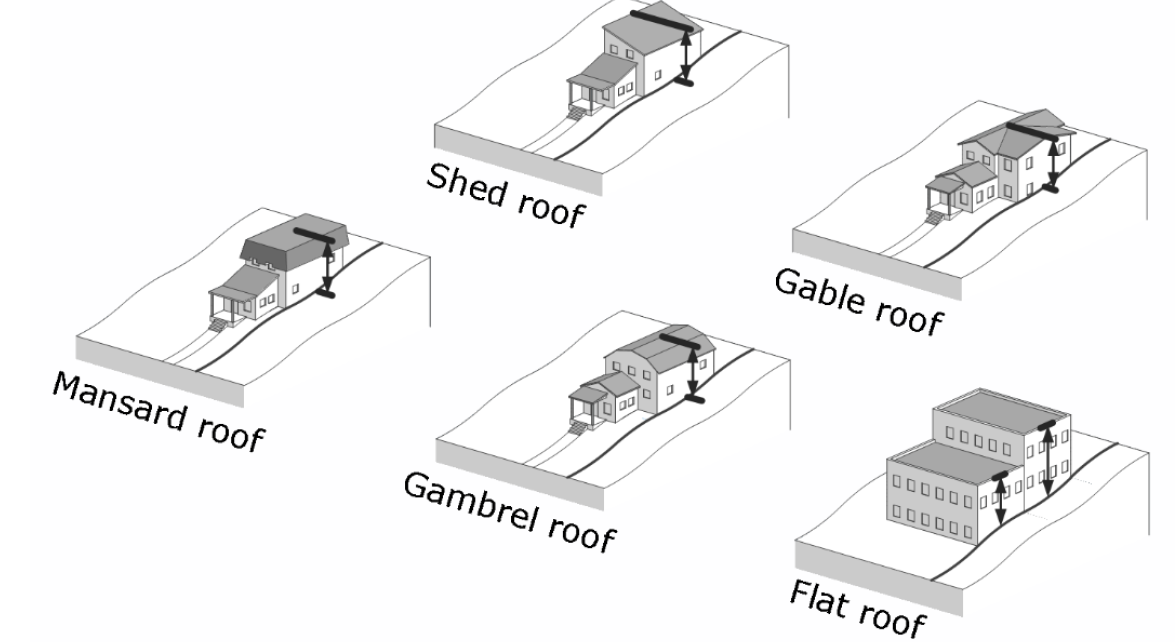
Building Official. The Building Official of the Town of Addison or their designated representative.
Build-to. An alignment establishing a certain distance from the front or street side property line where a building must be constructed.
Figure 7-2: Build-to Line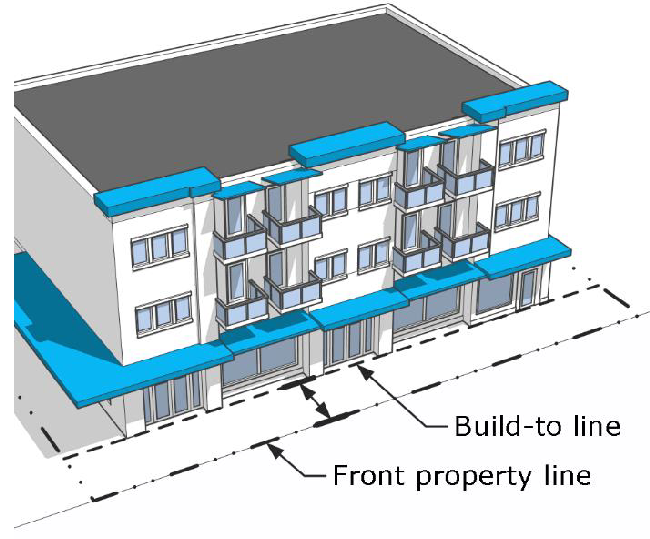
Business. Any for-profit or non-profit commercial, industrial, or professional operation, occupation, work, or trade, or any other business of any kind, including, without limitation, any sole proprietorship, partnership, limited partnership, joint venture, association, corporation, limited liability company, franchisee, cooperative, or any other entity recognized by law that owns, leases, or occupies any premises.
City Council (or "Council"). The City Council of the Town of Addison, Texas.
City Manager. The City Manager of the Town of Addison or their designee.
Code of Ordinances. The Code of Ordinances of the Town of Addison, Texas, as amended.
Collocation. The mounting or installation of transmission equipment on an eligible support structure for the purpose of transmitting and/or receiving radio frequency signals for communications purposes.
Criteria Manual. Any document containing formally established design standards for the Town of Addison including but not limited to engineering technical standards, construction details, and other technical specifications.
Dedication. An offer of real property by its owner(s) and its acceptance by the Town for any general or public use.
Design Capacity. When used in the context of parking or occupancy regulations, the approved capacity of building or facility based on the Fire or Building Code.
Development. The new construction or the enlargement of any exterior dimension of any building, structure, or improvement.
Development Site. That area of a development that includes all lands for development, land dedicated or conveyed to the Town for any public facility other than a park, recreational area or floodplain area, or any street right-of-way for a proposed street when such street is not necessitated by the development of the subject lot.
Director. Unless otherwise specified, the Director of Development and Neighborhood Services or their designee.
Director of Parks and Recreation. Unless otherwise specified, the Director of Parks and Recreation or their designee.
Director of Public Works and Engineering. Unless otherwise specified, the Director of Public Works and Engineering or their designee.
Driveway. The primary improved or unimproved parking surface that provides egress and ingress from a garage, carport, or off-street parking area to an adjacent street or alley.
Dwelling Unit. A building or portion of a building which is arranged, occupied, or intended to be occupied as living quarters.
Easement. The portion of a lot or lots reserved for present or future use by a person or agency other than the legal fee owner(s) of the property. The easement may be for use under, on or above said lot or lots.
Eligible Facilities Request. Any request for modification of an existing Wireless Community Facility (WCF) that involves the collocation of new transmission equipment, removal of transmission equipment, or replacement of transmission equipment.
Eligible Support Structure. Any Wireless Community Facility (WCF) as defined in this Unified Development Code (UDC) that is existing at the time an application is filed.
Escort. A person who, for consideration, agrees or offers to act as a companion, guide, or date for another person, or who agrees to offer to privately model lingerie or to privately perform a striptease for another person.
Escort Agency. A person or business association who furnishes, offers to furnish or advertises to furnish escorts as one of its primary business purposes, for a fee, tip, or other consideration.
Existing. For the purpose of Section 4.3.6.E, Wireless Communication Facilities (WCF), a constructed WCF that was reviewed and approved in accordance with all requirements of applicable law as of the time of an eligible facilities request.
Family. Any number of individuals living together as a single housekeeping unit, in which not more than four individuals are unrelated by blood, marriage, or adoption.
Feeder Lines. Those high voltage supply electric lines that emanate from substations used to distribute power throughout an area.
Fence. A vertical device used as a boundary or means of providing protection, confinement or privacy.
Final Plat. The Final Plat of a subdivision prepared for recording in conformance with § 2.9.3: Final Plat.
Fire Marshal. The Fire Chief or the Fire Chiefs designee.
Frontage. The width of a lot or parcel abutting a public right-of-way measured at the front property line.
Grade, Finished. The average of the ground elevations at the center of all walls of a building, following completion of site grading. If a wall is parallel to and within five feet of a sidewalk, finished grade is measured at the sidewalk.
Gross Floor Area (GFA). The total floor area of all stories of a building or buildings, measured by taking the outside dimensions of the building at each floor level intended for occupancy or storage (including basements), but not including any uncovered or unenclosed porches, patios, or decks, unless otherwise permitted in this UDC.
Impervious Coverage. Any hard surface, manmade area that does not absorb water, including, but not limited to, principal and accessory building roofs, sidewalks, paved parking, driveways, and other paved surfaces.
Improved Parking Surface. An area used for the parking or storage of vehicles that is overlaid or otherwise paved with concrete, asphalt, paving stones or other approved hard surfaced durable material.
Infill Development. Development, redevelopment, or reuse of vacant and underutilized sites surrounded by existing development and where street access is available.
Landscape Plan. A detailed drawing that identifies the quantities or numbers, placement, type, and common and botanical names of plant materials to be used on a development site.
Lateral Lines. Those electric lines used to distribute power from a feeder line to an end user. These electric lines are normally connected to a feeder line through a sectionalizing device such as a fuse.
Light Trespass. The shining of light produced beyond the boundaries of the property on which it is located, where light is produced by a light fixture or reflected light.
Lot or Lot of Record. A designated parcel, tract or area of land established by a plat to be used, developed, or built upon as a unit.
Lot Area. The total horizontal area within the lot lines of a lot, said area to be exclusive of street right-of-way.
Lot Depth. The horizontal distance from the midpoint of the rear of lot line to the midpoint of the front lot line.
Lot Lines. A boundary of a lot. "Lot line" is synonymous with "property line."
Lot Width. The horizontal distance between the side lines, measured from the point on the building line that is closest to the front lot line. The lot width for a corner lot shall be measured along the right-of-way upon which the address is assigned.
Low Impact Development (LID). Development that minimizes stormwater runoff from a lot or parcel by implementing site design techniques, natural grades and features, and soil treatment to allow cleansing and infiltration of stormwater on-site.
Masonry. Building materials consisting of clay brick, natural and manufactured stone, granite, marble, architectural concrete block, tilt wall concrete panels and other similar materials. This definition does not include cementitious siding or EIFS.
Maximum Extent Feasible. As determined by the Director, no feasible and prudent alternative exists, and all possible efforts to comply with the regulation or minimize potential harm or adverse impacts have been undertaken. Economic considerations may be taken into account but shall not be the overriding factor in determining "maximum extent feasible."
Maximum Extent Practicable. As determined by the Director, under the circumstances, reasonable efforts have been undertaken to comply with the regulation, the costs of compliance clearly outweigh the potential benefits to the public or would unreasonably burden the proposed project, and reasonable steps have been undertaken to minimize any potential harm or adverse impacts resulting from noncompliance with the regulation.
Mews. A minor street or service lane that provides access to properties in a residential area.
Minor or Amending Plat. A map, drawing, or chart prepared according to the provisions of this UDC, and containing all engineering and legal data, dedications, and certificates necessary to the recording of same in the map and plat records of the county, and meeting the criteria defined in § 2.9.5: Minor or Amending Plat.
Nonconforming Lot. A lawfully established lot created prior to adoption of this UDC or any amendment thereafter that does not comply with lot dimensional requirements of this UDC.
Nonconforming Sign. A lawfully established sign constructed or installed prior to adoption of this UDC or any amendment thereafter that does not comply with the sign regulations of this UDC.
Nonconforming Site Feature. Any site feature that that lawfully existed prior to adoption of this UDC or any amendment thereafter but does not comply with the standards of this UDC.
Nonconforming Structure. A lawfully established building or structure constructed or installed prior to adoption of this UDC or any amendment thereafter that does not comply with the area, height, or placement regulations of this UDC. A nonconforming structure shall not be deemed to include signs.
Nonconforming Use. A use that lawfully existed prior to adoption of this UDC or any amendment thereafter, but does not comply with the terms of this UDC.
Nonconformity. An existing use, structure, lot of record, site feature, or sign that was lawfully established prior to the effective date of this UDC or any amendment thereafter and that does not conform to one or more provisions of this UDC.
Nonconformity, Illegal. Any site feature or land use that did not lawfully exist per Town regulations at the time of construction, and is, therefore, not protected under the nonconformities section of this UDC.
Nude Model Studio. Any place where a person, who appears in a state of nudity, simulated nudity and/or seminudity, or displays specified anatomical areas, is provided, to be observed, sketched, drawn, painted, sculpted, photographed, or similarly depicted by other persons who pay money or any form of consideration.
Parking Area. An area designed and constructed for the parking, storage and maneuvering of vehicles.
Parking Space. A space within a public or private parking area, exclusive of driveways, ramps, columns, offices, and work areas, which is for the temporary parking or storage of one vehicle.
Person. An individual, assumed name entity, partnership, joint venture, association, corporation, or other legal entity, including the Town and other governmental entities. For purposes of airport regulations, an individual, corporation, company, association, firm, partnership, society, government, tenant, lessee, concessionaire, passenger, visitor, customer, contractor, and other entities doing business on, employed at, or otherwise using Town property as the context shall deem appropriate. It includes a trustee, receiver, assignee, successor, or similar representative of any of them.
Pervious Pavement or Paving. Paving materials that provide surfaces able to absorb water or allow the passage of water through the paving material to the ground below such as previous interlocking concrete paving blocks, concrete grid pavers, and perforated brick pavers.
Planning and Zoning Commission. The Planning and Zoning Commission of the Town of Addison, Texas.
Preliminary Plat. A map showing the conceptual design of a proposed development as required by this UDC submitted for the purpose of preliminary consideration prior to the submission of a Final Plat or Replat.
Plat. The graphic presentation of one or more lots or tracts of land, or of a subdivision, resubdivision, combination, or recombination of lots or tracts.
Property Owner. The owner, manager, or other person in control of property or his agent or designee.
Public Improvements. Any drainage way or easement, street, culvert, pedestrian way, sidewalk, street sign, monument, flood control or storm drainage system, sewage disposal system, or other facility for which the municipality may ultimately assume the responsibility for maintenance and operation, or that may affect an improvement for which municipal responsibility is established.
Public Property. Interests in easements, rights-of-way, fee simple property and public ways owned by the Town.
Replat. A change in a map of an approved or recorded subdivision plat if such change affects any street layout on such map or area reserved thereon for public use or any lot line or if it affects any map or plan legally recorded prior to the adoption of any regulations controlling subdivisions.
Right-of-Way. The surface of and the space above and below, any street, road, highway, freeway, tollway, lane, path, drainageway, channel, fee interest, public way or place, sidewalk, alley, boulevard, parkway, drive, fire lane, or other easement now or hereafter held by the Town or over which the Town exercises any rights of management or control and shall include, but not be limited to, all easements now held, or hereafter held, by the Town, but shall specifically exclude private property.
Service Line. Those electric lines used to connect between the utilities' supply system and the end user's service entrance.
Setback. The minimum distance between a lot line and a building or structure required by this UDC.
Figure 7-3: Setbacks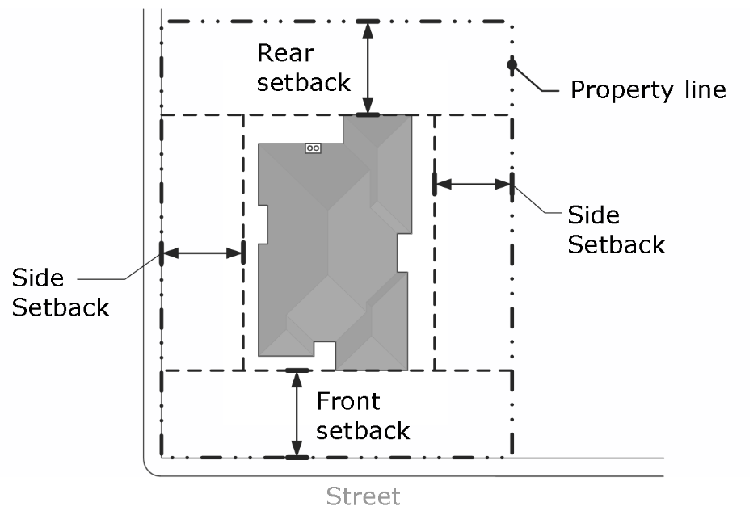
Sexual Encounter Center. A business or commercial enterprise that, as one of its primary business purposes, offers for any form of consideration:
1)
Physical contact in the form of wrestling or tumbling between persons of the opposite sex; or
2)
Activities between male and female persons and/or persons of the same sex when one or more of the persons is in a state of nudity or seminudity.
Site.
1)
For the purpose of § 4.3.6.E: Wireless Communication Facilities (WCF), the current boundaries of the leased or owned property surrounding the tower and any access or utility easements currently related to the site, and, for other eligible support structures, further restricted to that area in proximity to the structure and to other transmission equipment already deployed on the ground. The current boundaries of a site are the boundaries that existed as of the date that the original support structure or a modification to that structure was last reviewed and approved by the Town, if the approval of the modification occurred prior to the Spectrum Act or otherwise outside of the section 6409(a) process.
2)
In all other instances, any lot, plot, or parcel of land or combination of contiguous lots or parcels of land.
Site Plan, Major. See § 2.6.2.C.2.
Site Plan, Minor. See § 2.6.2.C.1.
Special Flood Hazard Area (SFHA). The land subject to a one percent or greater chance of flooding in any given year. The SFHAs within the Town are generally identified as such on the Incorporated Area Flood Insurance Rate Map prepared by the Federal Emergency Management Agency (FEMA), as amended, revised, and prepared by the Federal Emergency Management Agency with the most recent date.
Street. Any thoroughfare or public driveway, other than an alley or mew, that has been dedicated or deeded to the public for public use.
Structure. Any manmade construction in, on, or over the ground or water that is affixed to a site or usually left in one place for an indefinite period of time.
Subdivision. The division of any tract or parcel of land into two or more lots for the purpose, whether immediate or future, of sale or building development, and shall include resubdivision. "Subdivision" shall also mean the division or redivision of an existing subdivision together with any change of lot size therein or with the relocation of any street. "Subdivision" shall also mean the combination of lots or tracts into one or more lots and shall include recombination. "Subdivision" shall also mean a tract of land intended to be built upon and for which a Building Permit is required.
TLGC. The Texas Local Government Code.
Town. The Town of Addison, Texas. Where approval, enforcement, or other act on the part of the Town is referred to herein, the Town shall act by and through its Town ordinances unless otherwise specifically indicated.
Transmission Equipment. Equipment that facilitates transmission for any Federal Communications Commission-licensed or authorized wireless communication service, including, but not limited to, radio transceivers, antennas, coaxial or fiber-optic cable, and regular and backup power supply. The term includes equipment associated with wireless communications services including, but not limited to, private, broadcast, and public safety services, as well as unlicensed wireless services and fixed wireless services such as microwave backhaul.
Unified Development Code (UDC). This Code, including any and all amendments to this UDC.
Utility Services. The facilities of any person, firm or corporation providing electrical, telephone, television cable or any other such item or service for public use that are within the present or future Town limits of the Town of Addison, Texas.
Vacating Plat. A plat that is granted pursuant to the terms of § 2.9.6: Vacating Plat.
Variance. A development application authorizing a deviation from the standards of this Code where strict application of this Code results in a hardship due to circumstances with a particular lot and that is reviewed and decided pursuant to § 2.10.1: Variance or § 2.10.2: Subdivision Variance.
Zoning District. A specific delineated area on the Zoning Map established by this UDC within which a prescribed set of use and development standards are applied to various types of development.

