
Aiken County Unincorporated
City Zoning Code
City Zoning Code
ARTICLE X
- ADMINISTRATION, APPLICATION AND REQUIRED PERMITS
Sec. 24-10.1.- Purpose.
This article sets forth the procedures required for obtaining building permits, development permits, sign permits, and certificates of occupancy. It also establishes procedures for processing land development applications, and defines the duties, powers, and limitations of officials, departments, commissions, boards, and other groups which are or may be involved in the administration and enforcement of this chapter.
(Ord. No. 07-6-12, § 5, 6-5-07)
Sec. 24-10.2. - Platting authority.
No plat of a subdivision within the county shall be entitled to be recorded in the office of the Aiken County Registrar of Mesne Conveyance and no building permit may be issued until the plat has the final approval of the planning commission or planning and development director inscribed thereon. The county registrar of mesne conveyance may not accept, file, or record a subdivision plat involving a land area subject to land development regulations adopted pursuant to this chapter unless the subdivision has been properly approved. The filing or recording of a plat of a subdivision without the final approval as required by this chapter is declared to be a misdemeanor and is subject to the penalties as provided by law. A public official who violates the provisions of this section is, in each instance, subject to penalty as provided by law, and the affected governing body, private individual, or corporation has rights and remedies as to enforcement or collection as are provided, and may enjoin any violations of them.
(Ord. No. 07-6-12, § 5, 6-5-07; Ord. No. 14-12-18, § 1, 12-9-14)
Sec. 24-10.3. - Use of plat.
The owner or agent of the owner of any land to be subdivided shall be prohibited from transferring, selling or conveying such land by reference to, exhibition of or other use of a plat of such proposed subdivision before such plat has been approved in accordance with this chapter and recorded in the office of the county registrar of mesne conveyance. A transfer of title in violation of this section is a misdemeanor and, upon conviction, must be punished in the discretion of the court. The inclusion of a metes and bounds description in the instruments that transfer or sell shall not validate the transaction. The county may enjoin or invalidate any transaction or grievance involving the conveyance of any lots not approved in conformance with this chapter.
Nothing in this section shall prohibit any person from entering into a contract to sell any lot in a proposed subdivision provided that the consideration for the contract of sale is nominal and there is a clause in the contract which would make the contract contingent upon final approval of the subdivision being granted. In addition, there shall be a notice in the contract of sale in conspicuous language which informs the potential buyer that the subdivision has not received final plat approval and that the contract is contingent upon final approval. For the purposes of this section, nominal consideration shall not be more than one hundred dollars ($100.00).
(Ord. No. 07-6-12, § 5, 6-5-07)
Sec. 24-10.4. - Erection of buildings.
No permit shall be issued and no building shall be erected on any lot in the county unless the street giving access thereto has been designed and approved in accordance with the provisions of this chapter; or unless such street has otherwise obtained the legal status of a "public street"; or is a properly maintained private street in accordance with sections 24-7.3.8 and 24-7.9.1; or unless that lot is provided legal access by duly recorded access easement. If a plat is recorded showing such easement, there must be a deed of conveyance or a recorded declaration of easement which references the easement as shown on said plat in order to qualify as a duly recorded access easement (refer to section 24-7.9.4). Any building erected in violation of this section shall be deemed an unlawful structure, and the county building official may bring appropriate action to enjoin such erection or cause it to be vacated or removed.
A "public street" as used in this section may be maintained by a public body or may be privately maintained. A "public street" may be dedicated by a deed, prescription or by dedication. A street may be public even if it has never been accepted by or maintained by a public body such as the Aiken County Government. A street may be public even if there is no deed conveying the road to Aiken County. There are no standards as to the condition required of a public street, such as width, construction, etc., when a landowner wishes to obtain a building permit. Such standards are only applicable when a property owner wishes to subdivide property.
(Ord. No. 07-6-12, § 5, 6-5-07; Ord. No. 16-08-13, § 1, 8-16-16)
Sec. 24-10.5. - Responsibility.
(a)
All requests for permits and licenses required by this chapter, chapter change, or variance from the terms of this chapter shall be in the form of an application. The provisions of this article shall govern the basic requirements for processing different types of applications from initiation to final action and issuance of a permit.
(b)
It shall be the responsibility of the planning and development director (or the building official if section 24-2.10 of this chapter is involved) to administer the requirements for processing applications and issuing permits in accord with the provisions of this chapter.
(c)
It shall be the responsibility of an applicant to provide the required information to process a permit application, to secure or renew a license or permit, and to present facts about circumstances which would justify a proposed change or modification to the terms and/or application of this chapter.
(d)
The Aiken County Planning and Development Department is the designated intake point for all applications. It is also the records center of all activity authorized by this chapter.
(Ord. No. 07-6-12, § 5, 6-5-07; Ord. No. 14-12-18, § 1, 12-9-14)
Sec. 24-10.6. - Types of applications.
The applicant shall request from the planning and development department staff a determination of application and permit processing requirements. The staff shall, in turn, evaluate the nature of the applicant's request, and direct the applicant accordingly.
Types of applications for processing matters subject to the requirements of this chapter include:
(Ord. No. 07-6-12, § 5, 6-5-07)
Sec. 24-10.6.1. - Applications to develop or alter the use of land.
This section includes all land use and development activity covered by this chapter. Applications to develop or alter the use of land are classified for administrative purpose into four (4) categories.
(a)
Small subdivision is one which (1) does not involve the creation of more than ten (10) lots, (2) is no larger than ten (10) acres, and (3) does not involve the creation of any new street or substantial change of an existing street. The term small subdivision includes manufactured home subdivisions.
(b)
Major subdivision is any subdivision other than an exempt or small subdivision. The term major subdivision includes manufactured home subdivisions.
(c)
Land development is any land development or land-altering activity requiring a permit from the county, other than a subdivision or major land development. Land development does not include the construction of single-family or two-family residential dwellings or the installation of individual manufactured homes.
(d)
Major land development includes business and industrial parks, manufactured home parks, shopping centers, multiple-occupancy buildings, and other developments, or additions thereto defined by section 24-10.10.6 of this chapter.
(Ord. No. 07-6-12, § 5, 6-5-07)
Sec. 24-10.6.2. - Applications for change (rezoning) or variance.
This section includes applications for changes to and/or a variance from any part or provision of this chapter, of which there are three (3) types of applications:
(a)
Amendment is a change to the text or map (rezoning) of the chapter.
(b)
Variance is an adjustment or modification of any regulation alleged to impose an unnecessary hardship on the use or development of land. Also refer to definition in article XI.
(c)
Appeal is a petition by an applicant to reverse or modify a decision of an administrative officer, board, commission or council.
(Ord. No. 07-6-12, § 5, 6-5-07)
Sec. 24-10.7. - Eligible applicants.
Parties and individuals required and/or eligible to initiate an application to alter, develop, subdivide or utilize land for purposes and activities regulated by this chapter, or to seek a variance from or to change requirements of this chapter are identified on Table 10.
Parties not listed below may petition the planning commission and/or council to initiate a change, but neither the commission nor the council is bound to act on behalf of such non-listed petitioner.
Table 10: Applicant Eligibility Requirements
(Ord. No. 07-6-12, § 5, 6-5-07; Ord. No. 14-12-18, § 1, 12-9-14)
Sec. 24-10.8. - Application procedures for change (rezoning or text amendment) or variance.
(1)
Administrative examination. Upon receipt of an application, the planning and development director or building official, as appropriate, shall examine it for completeness, and shall, within ten (10) days, either return the application for additional information or deem it complete. An application must be deemed complete at a point at least thirty (30) days prior to the date of the next regularly scheduled meeting of the planning commission or board of appeals, as appropriate, in order to be placed on the agenda of that meeting.
(2)
Public notice.
a.
All applications. Public notice shall include announcing the application for change (rezoning or text amendment) or variance in a newspaper of general circulation in Aiken County at least fifteen (15) days prior to the date the application is scheduled for a public hearing. The notice shall state the nature of the change or variance and the time, date, and place of the hearing.
b.
Application for zoning map change or variance. Notice of an application for a map change (amendment) or variance shall be in accord with the provisions of section 24-9.3.4, paragraphs (4) and (5).
(3)
Public hearing.
a.
The planning commission and the county council shall each conduct a public hearing on all applications for change involving the text of the land management regulations chapter or for change involving the zoning map(s) (rezoning).
b.
The board of appeals (BA) shall conduct a public hearing on all applications for relief involving variances and appeals.
(4)
Review and action.
a.
By the planning commission.
1.
The planning commission shall act on a completed application within forty-five (45) days after receipt thereof to recommend either denial or approval. The decision shall be determined by at least a majority of a quorum. Failure to act within said time frame shall constitute a recommendation of approval. However, said forty-five-day time-frame may be extended by the mutual agreement of the planning commission and the applicant.
2.
The planning commission shall evaluate the proposed amendment and prepare a report relative to the following:
i.
How the proposed amendment relates to and affects the comprehensive plan.
ii.
The need to correct an error or deficiency in the chapter.
iii.
The relationship of the proposed amendment to surrounding land uses.
iv.
Whether the uses permitted by the proposed amendment would be appropriate.
v.
Other circumstances and conditions affecting the property, surrounding land and the community at large.
Within thirty (30) days of making its decision, the planning commission shall submit its report and a recommendation to county council for final action.
b.
By the county council. County council shall consider the recommendation of the planning commission and vote to approve, deny, or modify the proposed amendment, refer it back to the planning commission for further study, or take other action as the council may deem necessary.
c.
By the board of appeals. Applications for a variance shall be evaluated by the board of appeals in accord with the applicable conditions prescribed by subsections 24-9.3.5(2) and (3), as appropriate, of this chapter.
(5)
Notification.
a.
All applicants for change (rezoning or text amendment) or variance from the provisions of this chapter shall be notified in writing of final action by the county council or the board of appeals, as appropriate.
b.
A variance or appeal approved by the board of appeals shall be confirmed by an order of the board of appeals, issued by the county attorney.
(6)
Appeals.
a.
Of a planning commission decision.
1.
An appeal from decision of the planning commission must be taken to the circuit court within thirty (30) days after actual notice of the decision is mailed.
2.
A property owner whose land is the subject of a decision of the planning commission may appeal by filing a notice of appeal with the circuit court accompanied by a request for pre-litigation mediation in accordance with section 6-29-1155 of the Code of Laws of South Carolina 1976, as amended.
b.
Of a county council decision. No challenge to the adequacy of notice or challenge to the validity of a regulation or map, or amendment to it, whether enacted before or after the effective date of this section, may be made sixty (60) days after the decision of the county council if there has been substantial compliance with the notice requirements of this section or with established procedures of the county council or the planning commission.
c.
Of a board of appeals decision.
1.
A person who may have a substantial interest in any decision of the board of appeals may appeal from a decision of the board to the circuit court in and for the county, by filing with the clerk of the court a petition in writing settling forth plainly, fully, and distinctly why the decision is contrary to law. The appeal must be filed within thirty (30) days after the decision of the board is mailed.
2.
A property owner whose land is the subject of a decision of the board of appeals may appeal either:
i.
As provided in subsection (1) immediately above; or
ii.
By filing a notice of appeal with the circuit court in and for Aiken County accompanied by a request for pre-litigation mediation in accordance with section 6-29-825 of the Code of Laws of South Carolina 1976 as amended. Any notice of appeal and request for pre-litigation mediation must be filed within thirty (30) days after the decision of the board is postmarked.
(7)
Consideration of denied applications. Neither the planning commission, nor the county council, nor the board of appeals shall reconsider an application for change (rezoning) or variance to the same lot, parcel or portion thereof, within a period of one (1) year from the date of final determination and notification of a denied application.
(Ord. No. 07-6-12, § 5, 6-5-07; Ord. No. 14-12-18, § 1, 12-9-14)
Sec. 24-10.9. - Application procedures for land development projects.
Applications for land development projects, defined herein in section 24-10.6.1, subsection (c), shall include filing the necessary forms required by section 24-10.13 and submitting the permit data required by Table 11.
(Ord. No. 07-6-12, § 5, 6-5-07)
Sec. 24-10.10. - Application procedures for subdivisions and major land development projects.
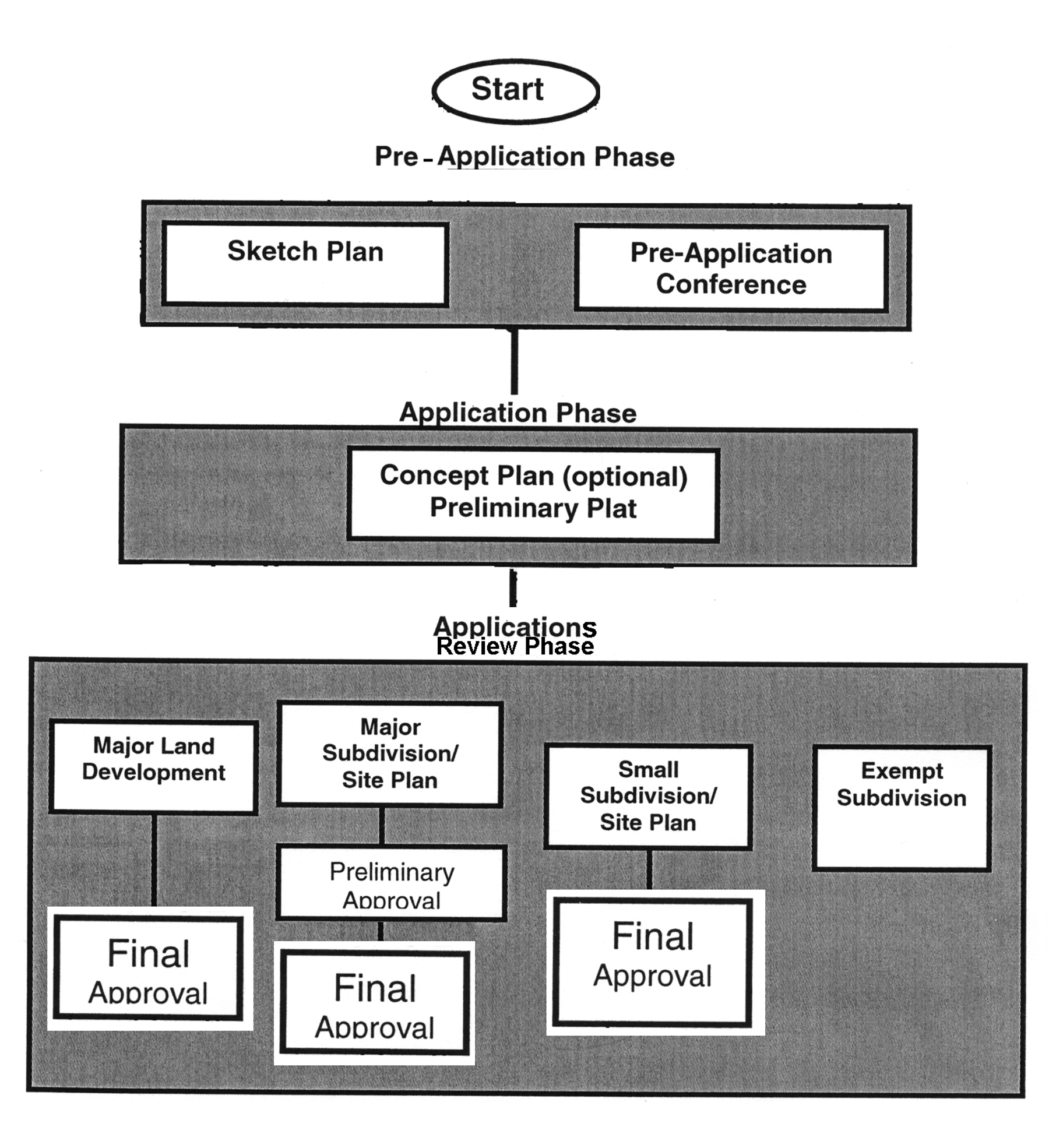
The application process consists of three (3) phases:
(1)
Pre-application (optional).
(2)
Application.
(3)
Review.
These three (3) phases are described below. Refer also to section 24-24-10.10.7.
(Ord. No. 07-6-12, § 5, 6-5-07)
Sec. 24-10.10.1. - Pre-application (optional).
For the purpose of securing advice in the formative stages of development design, expediting applications, and reducing development costs, the applicant is encouraged to request a pre-application conference and/or submit a sketch plan for review and consultation, as follows:
(1)
Pre-application conference. At the request of the applicant, the planning and development director shall arrange a pre-application conference to discuss requirements of this chapter, suggested best management practices (BMPs) land development practices, proposed plans of the applicant, suitability of the site for development, applicable provisions of the comprehensive plan, and related matters. The administrator may invite to the conference or consult with other county departments and other agencies.
Procedures for Processing Subdivision and/or Major Land Development Applications
a.
Sketch plan. In addition to or as an alternative to the pre-application conference, the applicant may request an informal review of a sketch plan for the proposed subdivision or other development. All data, correspondence and other information relating to a preliminary sketch plan shall be kept strictly confidential. Information concerning a proposed development becomes available to the public only in the event of the submittal to the planning and development department of a concept plan application or a preliminary or final plat application.
The sketch plan shall be reviewed on the basis of its relationship to the comprehensive plan, suitability of the site for development, availability of necessary services and facilities, and requirements of this chapter and all other applicable ordinances and regulations.
Sec. 24-10.10.2. - Application.
Applications will be assigned to one (1) of the following four (4) categories, as determined by the planning and development director, and processed accordingly:
(1)
An exempt subdivision; or
(2)
A small subdivision; or
(3)
A major subdivision; or
(4)
A major land development project.
The designated responsibility for reviewing and approving each of the above is as follows:
(Ord. No. 07-6-12, § 5, 6-5-07; Ord. No. 14-12-18, § 1, 12-9-14)
Sec. 24-10.10.3. - Exempt subdivisions.
Applicants for subdivisions which are exempt from the requirements of this chapter (see article XI, definitions) shall nonetheless submit to the planning and development director three (3) copies of the plats of such exempt subdivisions, such plats to be drawn to the requirements of the Aiken County Plat Standards, Aiken County Survey Tie-down Standards and the Minimum Standards Manual for the Practice of Land Surveying in South Carolina.
(Ord. No. 07-6-12, § 5, 6-5-07; Ord. No. 14-12-18, § 1, 12-9-14)
Sec. 24-10.10.4. - Small subdivisions.
(1)
Applicants requesting approval of a proposed small subdivision, as defined by this chapter, shall submit to the planning and development director an application meeting all the requirements of section 24-10.13.
(2)
The planning and development director shall review the application for compliance with the requirements of this chapter, and if the planning and development director finds the application to be in compliance, the planning and development director will instruct the applicant to prepare a final plat, including all requirements for final plat approval listed in Table 11.
(3)
Action on the final plat shall be taken by the planning and development director. If the plat is approved, said approval shall be so noted on the plat for recording.
The planning and development director shall act on said plat within sixty (60) days of submission of a complete application or the plat shall be deemed approved. The approval will be noted on the plat for recording.
Action by the planning and development director may be appealed to the planning commission by any party in interest, and shall be acted on by the commission within sixty (60) days of receipt of the appeal by the commission.
(Ord. No. 07-6-12, § 5, 6-5-07; Ord. No. 14-12-18, § 1, 12-9-14)
Sec. 24-10.10.5. - Major subdivisions.
Applications requesting approval of a major subdivision, as defined by this chapter, shall submit a preliminary plat, including the information required by section 24-10.10.7, if applicable, and a final plat in accord with the following procedures:
(1)
Preliminary plat approval.
a.
The applicant shall submit to the planning and development director eleven (11) paper copies and one (1) CAD file of the preliminary plat, together with all information and documents stipulated by section 24-10.13.
b.
The planning and development director shall review the application for compliance with the requirements of this chapter, and submit copies to all affected county and state agencies for review and comment.
c.
Upon completion of these reviews, the planning and development director shall forward the preliminary plat to the planning commission, together with all staff and agency comments and recommendations. The planning commission shall act on the application within sixty (60) days of receipt of the application. In its deliberation, the planning commission shall approve, approve conditionally, or disapprove the plat. If the preliminary plat is disapproved or approved conditionally, the reasons for such action shall be conveyed to the applicant. The reasons for disapproval shall refer specifically to those parts of the comprehensive plan or land management regulations chapter with which the plat does not conform. In the event of conditional approval, the commission may require the applicant to resubmit the preliminary plat with all required changes before approving said plat.
d.
If the preliminary plat is found to conform to all requirements of the comprehensive plan and all applicable ordinances and regulations, approval shall be given by the planning commission and a certificate of preliminary plat approval shall be inscribed on the plat as follows: "Pursuant to the Land Development Regulations of Aiken County, South Carolina, all requirements for Preliminary Plat Approval having been fulfilled, this preliminary plat was given approval by the Aiken County Planning Commission _______ 20___. This certificate of Preliminary Plat Approval shall expire and be null and void on _______, 20___." This certificate may be executed on behalf of the Aiken County Planning Commission by the Planning and Development Director.
(2)
Effect of preliminary plat approval.
a.
Preliminary plat approval shall confer upon the applicant the following rights for the time specified in the certificate of approval, unless extended by the planning commission upon written application by the applicant:
1.
To proceed under the supervision of the county with the installation of site improvements; and
2.
To proceed with the preparation of a final plat.
b.
Preliminary plat approval shall not authorize the applicant to sell or otherwise transfer lots or parcels within the platted subdivision. Lots may be pre-sold however, provided the applicant has guaranteed the final installation of all required improvements in accord with section 24-10.11.
c.
Revocation of preliminary plat approval may occur, following due public notice and a hearing by the planning commission, if the commission finds that a material change in conditions involving the subdivision has occurred which would adversely affect public health, safety or welfare.
(3)
Preliminary plat time limitation.
a.
An applicant may, within two (2) years from the date of approval of a preliminary plat, submit an application for the approval of a final plat, as specified in subsection (5) below.
b.
If an applicant does not submit a final plat application within the two-year period and has not received an extension of time by the planning commission as provided in subsection (4) below, the preliminary plat approval of the planning commission is automatically voided.
c.
Also see section 24-10.19, vested rights.
(4)
Preliminary plat time extension.
a.
Before expiration of the allowed two-year period for filing a final plat application, an applicant may request in writing an extension of time. If the planning commission finds sufficient reason, it may grant one (1) twelve-month extension. The decision to grant or to deny an extension shall be communicated to the applicant in writing.
b.
If an applicant allows the two-year period for filing a final plat application to expire without requesting a time extension request, the planning commission shall not grant a time extension and all work in the subdivision must be suspended; in order to continue work, the applicant must file a request for a preliminary plat approval which satisfies all requirements of this chapter and of any other applicable county ordinances, including payment of prescribed fees. Further, if the two-year period is allowed to lapse, all other permits, such as development permits, shall also expire effective with the end of the one-year period. A nonrefundable fee as provided for in the current fiscal year budget for the county shall be paid to the county before the request for an extension of preliminary plat approval is placed before the planning commission.
c.
Further, if the original two-year period or the one-year extension period is allowed to lapse, all permits, such as grading permits and development permits, except building permits, shall also expire effective with the end of said two-year or one-year period. However, a validly issued building permit does not expire or is not revoked upon expiration of a vested right, except for public safety reasons or as prescribed by the applicable building code. Regardless of the date of expiration of a vested right, the expiration of a building permit is prescribed by the building code.
d.
A nonrefundable fee as provided for in the current fiscal-year budget for the county shall be paid to the county before the request for an extension of preliminary plat approval is placed before the planning commission.
e.
Also see section 24-10.19, vested rights.
(5)
Final plat approval.
a.
Final plat approval is an administrative action. No public notice or hearing is required in connection with approval proceedings involving the final plat.
b.
An applicant requesting final plat approval shall submit to the planning and development director an application with all materials stipulated in section 24-10.13, including a maintenance bond as described in section 24-7.18 and/or a performance guarantee as described in section 24-10.11 to assure completion of those improvements not yet installed. A computer-file version of the final plat, in a format acceptable to the county GIS-mapping division shall be required if the plat is produced using electronic means. Final plat approval shall be granted or denied within sixty (60) days after submission of a complete application to the planning and development director or within such further time as may be consented to by the applicant.
c.
No subdivision or major land development plat, portion, or phase thereof shall be accepted for recording by the registrar of mesne conveyance (RMC) until the plat has been approved by the planning commission or planning and development director, and so indicated on the plat by the signature of the authorized agent. No such signature shall be affixed to the plat until the applicant has completed all required improvements or has posted a performance guarantee in accord with the requirements of section 24-10.11.
(6)
Effect of final plat approval Final plat approval shall confer upon the applicant the following rights:
a.
To have the plat recorded by the planning and development director in the RMC office; and
b.
Once the plat is recorded, to proceed with the sale and/or transfer of lots and parcels in accord with the approved and recorded plat.
(7)
Recording.
a.
Upon approval of a final plat and within thirty (30) days of the satisfaction of all requirements, conditions and contingencies of such approval, the planning and development director shall have the official copy of the final plat recorded in the RMC office.
b.
The reproducible copy and one (1) copy of the recorded final plat, along with all required certifications (section 24-7.19) inscribed thereon, shall be retained by the planning and development department.
c.
In addition to the RMC office, a copy of the recorded final plat shall be provided by the planning and development department to the applicant, tax assessor, county engineer, county E-911 addressing division, the affected US post office, and the affected offices of DHEC.
(Ord. No. 07-6-12, § 5, 6-5-07; Ord. No. 14-12-18, § 1, 12-9-14)
Sec. 24-10.10.6. - Major land development projects.
(a)
No development permit or building permit shall be issued for a shopping center; apartment or condominium complex; commercial, business, or industrial park; manufactured home park; or other multi-use or multi-occupant project or addition thereto, unless and until an applicant for such use submits to the planning and development director the information required by section 24-10.10.7, if applicable; section 24-10.13; and by Table 11 for major land developments. The planning commission and planning and development director shall evaluate the application in relation to the following design and improvement criteria:
(1)
Ingress and egress to the project site shall be designed to maximize automotive and pedestrian safety and facilitate traffic flow.
(2)
Off-street parking, off-street loading, refuse-collection facilities and service areas shall be designed to minimize their visual and physical impact on neighboring property. Where a project generates the need for one hundred (100) or more off-street parking spaces, a traffic-impact analysis shall be required in accordance with the provisions of section 24-10.10.7.
(3)
Street right-of-way, and pavement design and construction shall be adequate to accommodate the type and volume of traffic anticipated. Refer to section 24-10.10.7 below.
(4)
Where the project will create a need for off-site improvements, including improvements to streets, drainage systems, sidewalks, and curbs, the planning commission may require the installation of such improvements as a condition of approval.
(b)
If, upon review of these standards, the project is determined to be in compliance, the planning commission shall approve the land development application and cause the issuance of a development permit.
(c)
Any proposed changes to an approved project shall be resubmitted to the planning commission and reevaluated in light of the above.
(Ord. No. 07-6-12, § 5, 6-5-07; Ord. No. 14-12-18, § 1, 12-9-14)
Sec. 24-10.10.7.1. - Purpose.
It is the purpose of this section to guide development in accordance with the existing and future needs of Aiken County and in order to protect, promote and improve the public health, safety, and general welfare of the county.
(Ord. No. 07-6-12, § 5, 6-5-07)
Sec. 24-10.10.7.2. - Intent.
(a)
To enable the county to conduct an appropriate review and evaluation of the traffic impact of proposed development, to provide for the ability of the county to furnish adequate road facilities to all the citizens, and to prescribe necessary road mitigation measures as outlined in professionally prepared traffic impact analysis plans;
(b)
To ensure that no development approvals are granted unless road facilities with adequate capacity to accommodate the traffic generated by the proposed development are available concurrently with the scheduled opening of development, unless adequate mitigation and/ or performance guarantees are provided;
(c)
To coordinate better the short-term growth potential of the county with the immediately available road system capacity, taking into account exempt developments to the extent to which these may be eligible for development plan approval, without being subject to the traffic impact analysis plan requirements of this section;
(d)
To coordinate better the long-term growth potential of the county with a realistic assessment of the road capacity which is currently and may in the future become available, recognizing the limitations of the county's limited financial resources, the constraints presented by geography, and the desire to preserve the county's aesthetic quality and environmental resources;
(e)
To coordinate better the type, location, amount, timing, and rate of development for proposed land uses, pursuant to the comprehensive plan and the zoning regulations and map, with the present and projected future availability of road systems capacity; and
(f)
To establish and maintain a traffic monitoring system to determine regularly the volume of traffic on the county's road systems and the degree to which capacity limits (i.e. thresholds) are approached or exceeded.
(Ord. No. 07-6-12, § 5, 6-5-07)
Sec. 24-10.10.7.3. - Applicability.
The traffic impact analysis plan, monitoring and mitigation requirements and procedures set forth herein are applicable to development as defined in this chapter, except for that specifically exempted below.
(Ord. No. 07-6-12, § 5, 6-5-07)
Sec. 24-10.10.7.4. - Exemptions.
(a)
Activities and uses not constituting development, or exempt from development plan approval as defined in this chapter.
(b)
Any development that would generate fewer than five hundred (500) AVT (average vehicle trips per day). A second or subsequent phase, or an addition that takes a property over the trip limitation when taken as a whole, shall require a traffic impact analysis plan even though the development may not qualify on its own. Trip generations shall be taken from section 24-10.10.7.7(d)(2) below or from the most current edition of the Institute of Transportation Engineers' Trip Generation Manual (ITE Manual); provided however that an applicant may elect to perform a trip-generation study which may be submitted to the county to consider as a possible alternative. A qualified transportation engineering firm shall undertake such trip-generation study. For proposed uses not specifically listed in the ITE Manual, the planning and development director shall determine the most appropriate trip-generation rate. Staff may accept input from the applicant in making this decision.
(Ord. No. 07-6-12, § 5, 6-5-07; Ord. No. 14-12-18, § 1, 12-9-14)
Sec. 24-10.10.7.5. - Traffic impact approval required.
A traffic impact study shall be required (1) with applications for any development, redevelopment, or subdivision that is projected to generate five hundred (500) or more AVT based on trip-generation rates contained herein or taken from the latest edition of the Institute of Transportation Engineers' Trip Manual; (2) and/or when a project is a truck or bus terminal, including service facilities designed principally for such uses. The planning and development director or his designee shall also be authorized to require traffic impact studies when it is determined by the planning and development director or his designee that a proposed development or redevelopment is likely to have a significant impact on transportation capacity, transportation levels or service or traffic safety in the vicinity of the proposed development.
(Ord. No. 07-6-12, § 5, 6-5-07; Ord. No. 14-12-18, § 1, 12-9-14)
Sec. 24-10.10.7.6. - Traffic impact study scope.
When a traffic impact study is required, the type and scope of the study shall be determined during an initial meeting with the planning and development director. The meeting may also involve representatives of or result in a request for assessments from other agencies or departments. The elements of the study to be determined during the meeting shall include the following:
(a)
The possible types of reports to be included: a letter report, full traffic impact analysis report or special report (i.e., sight-distance survey).
(b)
The points of access and key streets and intersections that may be affected by development of the subject tract shall define the impact area. Traffic recorder and turning movement assessment locations shall be determined if necessary.
(c)
Periods of analysis that may include, but are not limited to: daily traffic, morning and afternoon peak hours, or weekends.
(d)
Scenarios for analysis to be included: existing conditions with and without the development.
(e)
The process for determining trip generation and distribution including: trip-generation category, diversion assumptions and distribution assumptions.
(f)
The rate of growth assumed in background traffic assumptions.
(g)
Developments in the area that have been approved or are currently under review.
(Ord. No. 07-6-12, § 5, 6-5-07; Ord. No. 14-12-18, § 1, 12-9-14)
Sec. 24-10.10.7.7. - Traffic impact study elements.
A letter report or full traffic impact analysis report shall include those elements agreed upon in the initial meeting. A full traffic impact study shall include the following elements:
(a)
Existing condition survey.
(1)
The street system shall be described, including geometric features, lane usage, traffic control, signage, sight distances, and adjacent uses and curb cuts.
(2)
Existing traffic volumes shall be provided for the impact area including both AVT (average vehicle trips per day) and "design" volumes. AVT may be derived from current counts of the South Carolina Department of Transportation (if available) or may be done from field counts. Data shall be adjusted for daily and seasonal variations. Turning movement counts shall be provided for critical intersections.
(3)
Existing unused capacity of signalized and unsignalized intersections.
(4)
Other items may be required at the discretion of the planning and development director depending upon the type and scale of the project.
(b)
Traffic standards (roadway and street intensity and service level standards).
(1)
Road classification..
a.
In order to carry out the purposes of subsection (a) above, all streets and roads in Aiken County are hereby classified on the basis of their traffic carrying capacities, and their design function in the circulation system.
b.
The classification system is based on concepts and criteria contained in the latest edition of the "FHWA Highway Functional Classification System". These guidelines classify streets and roads into one (1) of these functional categories: (1) principal arterial streets, (2) minor arterial streets, (3) collector streets, and (4) local streets; all for urbanized areas.
1.
Minor local (residential) street: A minor local street is one designed primarily to access abutting residential properties. This street normally terminates in a cul-de-sac, loop or other turnaround, usually with only one access point but with no more than two (2) access points.
2.
Major local (residential) street: A major local street is one designated primarily to access abutting residential properties. This street is characterized as one having two (2) or more access points, and receiving traffic from minor local streets.
3.
Collector street: A collector street is one that carries primarily residential traffic, but which provides no or only limited residential frontage and/or access.
4.
Arterial street: A street designated (1) to carry traffic from collector streets to the major arterial system, (2) to carry through traffic and (3) to carry intercounty traffic. Arterials are characterized as having access control, channelized intersections, restricted parking and signalization. The concept of service to abutting land is subordinate to the provision of travel service. The term includes minor arterial streets and principal arterial streets.
(2)
Service level classification.
a.
The level of service for streets and roads is defined in terms of vehicular delay. Delay is a measure of driver discomfort, frustration, fuel consumption, and lost travel time. Varied and complex factors contributing to delay include intersection geometry, frequency of curb cuts, traffic volumes, signalization and cycle length, etc.
b.
The various levels of service are classified A through F, depending on the delay factor and traffic flow conditions, as follows:
1.
Level of service A:
Free flow conditions
Low volumes
Little or no delays
Uninterrupted flow
No restriction on maneuverability
Drivers maintain desired speed
2.
Level of service B:
Stable flow conditions
Operating speeds beginning to be restricted
3.
Level of service C:
Stable flow but speed and maneuverability restricted by higher traffic volume
Satisfactory operating speed for urban conditions
Some delays at signals
4.
Level of service D:
High density, but stable flow
Restricted speeds
Noticeable delays at signals
Little freedom to maneuver
5.
Level of service E:
Low, but relatively uniform operating speeds
Volumes at or near capacity
Approaching unacceptable delays at signals
6.
Level of service F:
Force flow conditions
Stop and go operation
Volumes below capacity may be zero
Average vehicle delay at signals is greater than one (1) minute
(3)
Standards. The following design capacity standards and service level designations shall govern the intensity of development along streets and roads in Aiken County. (Refer to the current SCDOT Chart entitled "TOTAL Capacity for SCDOT Travel Demand Models" for level of service C and to the federal Functional Classification System Map for complete details. Both documents are available either from SCDOT or from the planning and development director.)
*
AVT (Average Vehicle Trips per day)
**
Refer to said current chart "TOTAL Capacity for SCDOT Travel Demand Models."
(4)
Traffic generation standards. The following table of traffic generation standards may be used in computing the number of trips to be generated by a given use. Also, traffic generated by existing uses on the impacted street shall be calculated by the table to determine aggregate daily traffic volumes and the capacity of the street to accommodate the proposed new use. However, the trip generation rates in the latest edition of the Institute of Traffic Engineers' Trip Manual also may be used.
TRAFFIC GENERATION STANDARDS
(Ord. No. 07-6-12, § 5, 6-5-07; Ord. No. 14-12-18, § 1, 12-9-14)
Sec. 24-10.10.7.8. - Mitigation plan.
(a)
Where the study indicates that the project will create significant deficiencies in the impact area, (i.e., when the study indicates (a) that the proposed development will generate AVT in excess of the limits established in section 24-10.10.7.7(b)(3) (immediately above); (b) and/or will increase traffic on roads which already exceed said AVT standards; (c) and/or will create a lower level of service than designated in said section 24-10.10.7.7(b)(3), improvements shall be recommended in the traffic impact analysis plan which shall include projected cost estimates and the project will be referred to the planning commission for review and decision as to required improvements. The traffic impact analysis shall include all appropriate mitigation projects, including road-widening, new road construction, turn lanes, signalization, alternate transportation modes, connection of new streets with existing streets, and shared driveways. The traffic impact analysis also shall assess the connection of the property to adjoining properties. Where the use, scale of development, or size of adjoining properties is such that trips would be anticipated between the proposed uses and the other properties, the analysis shall make recommendations on interconnections. The analysis shall recommend interconnections to provide a smooth flow of traffic between uses along arterials and collector roads to ensure that as much traffic as possible uses secondary roads and other interconnections rather than major roads for short trips. Mitigation plans are required to address only the additional traffic created by a specific development project, not those forecast traffic problems resulting from other development projects.
(b)
The design of improvements shall be in accordance with specifications of the South Carolina Department of Transportation or as approved by county staff. Where county staff or the planning commission, where applicable, determines that a mitigation plan is not adequate to address the traffic impacts of the project, such determination may serve as a basis for denial of the application request to develop.
(Ord. No. 07-6-12, § 5, 6-5-07)
Sec. 24-10.10.7.9. - Consultants.
The planning and development director may require that a mutually agreed-upon independent consultant be hired by the county to perform required traffic impact studies or to review all or part of a study prepared by the applicant's consultants. The planning and development director is authorized to administer the contracts for such independent consultants based upon the approval by the county council of said contracts.
(1)
The planning and development director shall determine the scope of services to be performed by the independent consultant and receive a cost estimate of such services from the independent consultant.
(2)
The applicant shall provide an amount equal to the estimate of the cost for the study to the county, which will deposit the amount in an escrow or special account set up for this purpose. Any funds not used for the independent consultant shall be returned to the applicant at the completion of the project in a timely manner without interest.
(3)
The planning and development director may require additional fees for the independent review if: the county staff or the planning commission, as appropriate expands the scope of the required review; the applicant substantially amends the application; additional meetings involving the consultants are requested by the applicant; the consultant's appearance is requested at more planning commission or county council meetings than was initially anticipated; and/or the consultant's attendance is required at meetings with regional, state, or federal agencies or boards which were not anticipated in the earlier scope of services.
(Ord. No. 07-6-12, § 5, 6-5-07; Ord. No. 14-12-18, § 1, 12-9-14)
Sec. 24-10.10.7.10. - Action on traffic impact analysis plan.
Following review of the required traffic impact analysis plan, the planning and development director or, where applicable, the planning commission shall take one of the following actions:
(1)
Approve the traffic impact analysis plan as submitted by the applicant; or
(2)
Approve the traffic impact analysis plan with conditions or modifications. An acceptable traffic impact analysis plan with traffic mitigation measures may include the reduction of the density or intensity of the proposed development; phasing of the proposed development to coincide with state- and/or county-programmed transportation improvements; applicant provided transportation improvements; or any other reasonable measures to insure that the adopted traffic service level goals are met as established in section 10.10.7(d)(2). If mitigation is required, it shall be required as a condition of any approval from Aiken County; or
(3)
Deny a traffic impact analysis plan which does not meet the county traffic standards of section 24-10.10.7(d)(2).
(Ord. No. 07-6-12, § 5, 6-5-07; Ord. No. 14-12-18, § 1, 12-9-14)
Sec. 24-10.10.7.11. - Timing of implementation.
If a traffic mitigation program is part of an approved traffic impact analysis plan, the developer may be required to provide a performance guarantee for all traffic mitigation improvements required as a result of his project. This requirement may arise if the timing of the improvements needs to be synchronized with other scheduled improvements anticipated for the area.
(Ord. No. 07-6-12, § 5, 6-5-07)
Sec. 24-10.10.7.12. - Responsibility for costs of improvements.
The costs of implementation of an approved mitigation program shall be the responsibility of the applicant. No building permits shall be issued unless all provisions of the transportation impact analysis are met.
(Ord. No. 07-6-12, § 5, 6-5-07)
Sec. 24-10.10.8. - Public notification and hearing for applications.
Public notification is required for applications for preliminary plat review of all major subdivisions and for applications for all major land development projects. Public notification and hearing shall conform to the notification requirements of section 24-9.3.4, paragraphs (4) and (5).
(Ord. No. 07-6-12, § 5, 6-5-07)
Sec. 24-10.11.1. - Policy.
It shall be the general policy of Aiken County that all improvements required by this chapter be completed prior to final plat approval. However, recognizing that completion of all required improvements prior to obtaining final plat approval may not in some cases be feasible, practical, or financially possible, this section provides a mechanism by which final approval may be granted, contingent upon required improvements being completed as and when specified by the planning and development director and upon the applicant providing financial guarantees for the completion of such required improvements.
No more than twenty-five (25) percent of the estimated costs, as determined by the county engineer, of materials and installation of required improvements may be placed under a performance guarantee.
(Ord. No. 07-6-12, § 5, 6-5-07; Ord. No. 14-12-18, § 1, 12-9-14)
Sec. 24-10.11.2. - Financial guarantees.
(a)
Where final plat approval is requested by the applicant prior to the completion of all required improvements, the planning and development director shall accept financial guarantees of such type and in such amounts (not less than one hundred twenty-five (125) percent of cost of remaining materials and installation, as calculated by the county engineer) sufficient to guarantee with reasonable certainty that the required improvements will be completed. Said financial guarantees to be used for such purposes may include one (1) or more of the following types, if approved by the county attorney and the planning and development director:
(1)
Security bond from a corporate surety which is licensed to do business in South Carolina.
(2)
Irrevocable letter of credit from a bank licensed by the State of South Carolina or from a federally insured lending institution.
(3)
Escrow account where applicant may deposit cash, or other instruments readily convertible into cash at face value, with the county in escrow with a bank.
(b)
Any document providing such financial guarantee required by the planning and development director under this section shall be in such form and substance as specified by and satisfactory to the county attorney. The required financial guarantee (completed and fully executed) shall be a condition of final plat approval and shall be delivered to and approved by the planning and development director and the county attorney prior to the recordation of the final plat and/or prior to the subdivision of the affected property by plat, deed, or otherwise. In no case shall the performance guarantee be valid for more than one (1) year, or for less than six (6) months.
(Ord. No. 14-12-18, § 1, 12-9-14)
Sec. 24-10.11.3. - Option to refuse guarantee.
The planning and development director shall have the right to refuse any of the optional financial guarantees and require construction and installation of all improvements by the applicant, where:
(1)
Past performance of the applicant is unsatisfactory; or
(2)
The selected option is unacceptable; or
(3)
For other reasons so stated by the planning and development director.
(Ord. No. 07-6-12, § 5, 6-5-07; Ord. No. 14-12-18, § 1, 12-9-14)
Sec. 24-10.11.4. - Allocation of guarantee.
Any funds received from financial guarantees required by this section shall be used only for the purpose of making the improvements for which said guarantees are provided. When the improvements have been completed in conformity with these regulations, the performance guarantee may be released and returned to the applicant.
(Ord. No. 07-6-12, § 5, 6-5-07)
Sec. 24-10.11.5. - Default of guarantee.
In the event the applicant fails to install or construct the required improvements during the specified time allotted and in conformity with these regulations, the performance guarantee shall be forfeited to the county to be used for completion of the improvements.
(Ord. No. 07-6-12, § 5, 6-5-07)
Sec. 24-10.11.6. - Extension of guarantee.
If it appears to the applicant that he may not complete construction of the required improvements before expiration of the performance guarantee, it shall be the applicant's obligation, at least forty-five (45) days prior to the expiration date, to submit an extended guarantee request. Such extension, if approved by the county attorney and the planning and development director, shall be for a period of six (6) months. A maximum of two such six-month extensions shall be allowed.
(Ord. No. 07-6-12, § 5, 6-5-07; Ord. No. 14-12-18, § 1, 12-9-14)
Sec. 24-10.11.7. - Acceptable format for performance guarantee and financial guarantee.
The performance guarantee and financial guarantee shall be in forms available from the planning and development department, and shall be submitted to the planning and development director for review and approval by the county attorney. Any deviation from the approved forms may delay acceptance of these instruments.
(Ord. No. 07-6-12, § 5, 6-5-07; Ord. No. 14-12-18, § 1, 12-9-14)
Sec. 24-10.12. - Variances.
Regulations governing subdivisions and major land development projects defined by section 24-10.6 are the minimum required for achieving the objectives of section 24-7.1. However, where a regulation, except for the requirements of Tables 1 and 2 of this chapter, would cause demonstrably unique and undue hardship as it applies to any particular development project, the planning commission, by a majority vote of its membership present, may grant a variance from the strict application of the regulations; provided the variance does not nullify the stated objectives of section 24-7.1. In granting the variance, the planning commission may impose conditions that will secure the objectives of the particular regulation being varied. A complete record of the reasons for the approval of a variance shall be entered in the official minutes of the planning commission. Refer also to sections 24-9.3 and 24-10.6.2 through 24-10.8 for other provisions concerning variances.
(Ord. No. 07-6-12, § 5, 6-5-07; Ord. No. 07-11-25, § 1, 11-27-07)
Sec. 24-10.13. - Application requirements and fees.
(a)
All applications shall be filed on forms provided by the county planning and development department and contain or be accompanied by the information required on Table 11.
(b)
Fees to help cover the cost of processing land development and subdivision applications shall be as established by county council. A schedule of all required fees is available at the planning and development department.
Table 11: Information Required To Support Applications
(Ord. No. 07-6-12, § 5, 6-5-07; Ord. No. 08-4-17, § 1, 4-1-08; Ord. No. 09-08-17, § 1(LMR 6), 8-18-09; Ord. No. 14-12-18, § 1, 12-9-14)
Sec. 24-10.14. - Required permits.
(a)
No building or development activity, including the following, shall be commenced until all required permits have been issued:
(1)
Building activity not specifically exempt by this chapter.
(2)
Changing the use of any part of a structure or lot, including any increase in the number of families or dwelling units occupying a building or lot.
(3)
The installation of a manufacturing or other industrial use whose operation may not meet the performance standards in section 24-3.3.
(4)
Installation of any sign for which a permit is required.
(5)
The establishment of a temporary use described in section 24-3.20.
(6)
Electric or gas utility companies and/or cooperatives extending service or utilities to a given site.
(b)
No building, structure or land shall be used; nor shall any building, structure or land be converted, wholly or in part to any other use, until all applicable and appropriate licenses, certificates and permits have been issued certifying compliance with the requirements of this chapter and related codes and regulations.
(b)
No permits inconsistent with the provisions of this chapter shall be issued unless accompanied by an approved variance or deviation.
(c)
The provisions of this section shall not apply to the necessary construction, replacement or maintenance by a public utility of its outside plant facilities, including such items as poles, cross-arms, guys, wire, cable and drops.
(Ord. No. 07-6-12, § 5, 6-5-07)
Sec. 24-10.15. - Types of required permits.
One or more of the following permits shall be required in advance of any land alteration or development in Aiken County:
(1)
Development permit.
(2)
Building permit.
(3)
Sign permit.
Failure to obtain a required permit shall be a violation of this chapter and punishable under section 24-10.21.
(Ord. No. 07-6-12, § 5, 6-5-07)
Sec. 24-10.15.1. - Development permits.
A development permit shall be required prior to any land-disturbing activity except that a development permit is not required for the construction of single-family or two-family residential dwellings or for the installation of individual manufactured homes. No development permit shall be issued unless and until a land development project described in section 24-10.6.1, (a) through (d), has been approved by the planning commission and/or the planning and development director, or a building or sign permit has been issued.
(Ord. No. 07-6-12, § 5, 6-5-07; Ord. No. 14-12-18, § 1, 12-9-14)
Sec. 24-10.15.2. - Building permits.
A building permit shall be required of all proposed buildings unless expressly exempted by the county building code. Whenever a development permit is required, the development permit shall be issued prior to the issuance of related building permits.
(Ord. No. 07-6-12, § 5, 6-5-07)
Sec. 24-10.15.3. - Sign permits.
Where a sign permit is required by article VI of this chapter, the permit application shall be accompanied by the following:
(1)
A common signage plan, where applicable, in accord with the requirements of section 24-6.4.
(2)
Identification of landowner and/or leaseholder of property on which the sign is to be erected, including street address.
(3)
Name and address of owner of the sign.
(4)
Site plan sketch with dimensions (non-professionally drawn plan is acceptable) showing the location of the sign with respect to the property and right-of-way lines, building and setback lines, and buildings, parking areas, existing freestanding signs, and buffer areas.
(5)
Accurate size, shape, configuration, face area, height, nature, number, and type of sign to be erected, including the size of letters and graphics.
(6)
The value of the sign and sign structure.
(7)
Signs exceeding thirty-six (36) square feet in area shall be accompanied by a drawing and written certification from a registered South Carolina engineer or architect that the sign is structurally sound and safe, does not constitute a hazard to persons or property on the premises, on adjoining property, or in the vicinity, and that the sign is in compliance with all building or other construction codes and the requirements of this chapter.
(8)
The planning and development director may waive any of the informational requirements listed above deemed unnecessary to process an application.
(Ord. No. 07-6-12, § 5, 6-5-07; Ord. No. 14-12-18, § 1, 12-9-14)
Sec. 24-10.16. - Certificates of occupancy; change of occupancy of existing structures; conversion of houses; enlargement.
(1)
Certificates of occupancy. It shall be unlawful to use or occupy or permit the use or occupancy of any building or premises, or both, or parts thereof hereafter created, erected, changed, converted, or wholly or partly altered or enlarged in its use of structure until a certificate of occupancy has been issued by the planning and development director and/or building official stating that the proposed use of the building and/or land conforms to the requirements of this chapter and the county building code. A temporary certificate of occupancy may be issued for a portion of a building or installation, subject to any conditions required by the planning and development director and/or building official.
(2)
Change of occupancy of existing structures; conversion of houses; enlargement.
a.
Change of occupancy for a nonresidential use of a structure previously occupied by a nonresidential use shall require compliance with the required parking standards of Table 1 of this chapter. Change of occupancy for a manufacturing use (see sector 31—33 of Table 1 and the provisions of section 24-5.4.3 of this chapter) of a structure previously occupied by either a manufacturing use or other nonresidential use shall require compliance with all parking, landscaping, buffering, and other requirements of this chapter for manufacturing uses, including the provisions of section 24-3.3, manufacturing uses and the provisions of section 24-5.4.3 where required of this chapter.
b.
Change of occupancy of a structure also shall require compliance with the provisions of the most current version of Section 3406 of the International Building Code, which reads as follows as of April, 2007:
No change shall be made in the use or occupancy of any building that would place the building in a different division of the same group of occupancy or in a different group of occupancies, unless such building is made to comply with the requirements of this code (IBC) for such division or group of occupancy. Subject to the approval of the building official, the use or occupancy of existing buildings shall be permitted to be changed and the building is allowed to be occupied for purposes in other groups without conforming to all the requirements of this code (International Building Code) for those groups, provided the new or proposed use is less hazardous, based on life and fire risk, than the existing use.
c.
Conversion of a house to a nonresidential use shall require compliance with all applicable codes for nonresidential structures. Where a house will be converted for use both as a dwelling and for a nonresidential use, that section of the house that will be open to the public shall meet all applicable code requirements for a nonresidential building. Conversion of a house, whether partly or entirely, for commercial use shall require compliance with all parking, landscaping, buffering, and other requirements of this chapter for nonresidential use, including section 24-5.4.3 where required.
(3)
Enlargement of existing building, structure, or vehicular use area. Refer to section 24-5.4.3, where required of this chapter.
(Ord. No. 07-6-12, § 5, 6-5-07; Ord. No. 14-12-18, § 1, 12-9-14)
Sec. 24-10.17. - Inspections for compliance.
The planning and development director or his designee, including the building official, may enter into private property to make inspections of any land use or land-disturbing activity, construction or maintenance operation to ascertain compliance with the provisions of this chapter and to ascertain compliance with approved permit applications, plats, plans, and/or certificates.
(Ord. No. 07-6-12, § 5, 6-5-07; Ord. No. 14-12-18, § 1, 12-9-14)
Sec. 24-10.18. - Expiration of permits.
A development permit or sign permit is valid for a period of two (2) years from its date of approval. However, before the permit expires, the permit-holder may request in writing an extension of one (1) year. If a permit expires, it must be renewed in the original manner of approval. Refer also to section 24-10.19.2 below for expiry of building permits.
(Ord. No. 07-6-12, § 5, 6-5-07; Ord. No. 07-11-25, § 1, 11-27-07)
Sec. 24-10.19. - Vested rights.
(1)
Definitions.
a.
Landowner means an owner of a legal or equitable interest in real property including the heirs, devisees, successors, assigns, and personal representatives of the owner. "Landowner" may include a person holding a valid option to purchase real property pursuant to a contract with the owner to act as his agent or representative for purposes of submitting a proposed site-specific development plan or a phased-development plan pursuant to this chapter.
b.
Phased development plan means a development plan submitted to the Aiken County Planning Commission or to county staff by a landowner that shows the types and density or intensity of uses for a specific property or properties to be developed in phases, but which do not satisfy the requirements for a site-specific development plan.
c.
Site-specific development plan means a development plan submitted to the planning commission or to county staff by a landowner describing with reasonable certainty the types and density or intensity of uses for a specific property or properties. The plan may be in the form of, but is not limited to, the following plans or approvals: planned unit development; subdivision plat; preliminary or general development plan; variance; conditional use plan; mobile home park or mobile home subdivision; or other land use approval designations as are used by Aiken County.
d.
Vested right means the right to undertake and complete the development of property under the terms and conditions provided in this section.
(2)
Duration and extension.
a.
A vested right is established for two (2) years upon the approval of plans for any of the following four (4) categories of land development projects: (1) a PUD project, including a phased-development PUD; (2) a preliminary plan for a major subdivision; (3) a land development project; and/or (4) a major land development project; all such four (4) categories of developments as provided for in sections 24-2.5 and 24-10.6.
b.
A vested right may be extended before the end of the two-year vesting period for an additional twelve (12) months upon request by the applicant and a determination by the planning commission that there is just cause for extension and that the public interest is not adversely affected. The commission's decision shall be communicated to the landowner in writing.
c.
If the landowner has not commenced work authorized by the approval of a plan by the planning commission by the end of the two-year vesting period and has not received an extension of time by the planning commission as provided above, the original approval by the planning commission is automatically voided, the planning commission shall not grant a time extension. Similarly, if the landowner has not commenced work authorized by the original approval of the plan by the planning commission by the end of an extension of time granted by the commission, the original approval by the commission is automatically voided and the planning commission shall not grant any further extension of time. In order to commence work after expiration of the vested-rights period and any extension thereof, the landowner must file a request for plan approval which satisfies all requirements of this chapter and of any other applicable county codes, including payment of prescribed fees.
d.
However, prior to the landowner filing such request to commence work in a PUD development after expiration of the vested-rights period and any extension thereof, the planning and development director shall review the circumstances and recommend to the planning commission one (1) of the following three (3) options:
1.
That PUD zoning for the entire area be continued with revised time limits; or
2.
That PUD zoning be continued for part of the area, with or without revised time limits, and the remainder be rezoned to an appropriate category; or
3.
That the entire district be rezoned from PUD to an appropriate category. Such recommendations shall include proposals for appropriate action in respect to any legal instruments in that case.
e.
The planning commission shall consider the planning and development director's recommendation pursuant to the procedure described in section 24-10.8, application procedures for change, of this chapter. The commission shall make its recommendation to county council as prescribed by section 24-10.8(4). Council shall consider the planning commission's recommendation pursuant to the same section 24-10.8(4).
f.
Further, if the original two-year approval period or the one-year extension approval period is allowed to lapse, all permits, such as grading permits and development permits, except building permits, shall also expire effective with the end of said two-year or one-year period. However, a validly issued building permit does not expire or is not revoked upon expiration of a vested right, except for public safety reasons or as prescribed by the applicable building code. Regardless of the date of expiration of a vested right, the expiration of a building permit is prescribed by the applicable building codes and regulations.
g.
A nonrefundable fee as provided for in the current fiscal year budget for the county shall be paid to the county before the request for an extension approval is placed before the planning commission.
(3)
Amendment.
a.
A vested site-specific development plan or vested phased development plan may be amended if approved by the planning commission or county council, as applicable, pursuant to the provisions of this chapter.
b.
The planning director shall determine whether proposed revisions of an approved preliminary plat are of sufficient significance as to warrant resubmission to the planning commission for approval. If so, the procedures applicable to the original submission shall apply, including the payment of fees. If the commission approves the revised preliminary plat, the vested right time periods and deadlines established at the time of the original preliminary plat subdivision approval or extension remain unchanged and are not affected or extended by the granting by the planning commission of approval of the revised preliminary plat.
(4)
Revocation. A vested right to a site-specific development plan or phased development plan is subject to revocation by the planning commission or county council, as applicable, upon determination by the commission or council after notice and public hearing, that there was a material misrepresentation by the landowner or substantial noncompliance with the terms and conditions of the original or amended approval; or if the planning commission determines that a material change in conditions has occurred affecting the proposed subdivision, including new information regarding the physical conditions of the site of proposed public works, which would adversely affect to substantial degree public health, safety, or welfare.
(5)
Applicability of other regulations.
a.
A vested site-specific development plan or vested phased development plan is subject to later-enacted federal, state, or local laws adopted to protect public health, safety, and welfare including, but not limited to, building, fire, plumbing, electrical, and mechanical codes and nonconforming structure regulations and nonconforming use regulations which do not provide for the grandfathering of the vested right. The issuance of a building permit vests the specific construction project authorized by the building permit to the building, fire, plumbing, electrical, and mechanical codes in force at the time of the issuance of the building permit.
b.
A vested site-specific development plan or vested phased development plan is subject to subsequent local governmental overlay zoning that imposes site plan-related requirements but does not affect allowable types, height as it affects density or intensity of uses, or density or intensity of uses.
c.
A change in the zoning district designation or land use regulations made subsequent to vesting that affect real property does not operate to affect, prevent, or delay development of the real property under a vested site-specific development plan or vested phased development plan without consent of the landowner.
d.
Each phase of a phased development must be approved by the planning commission when each phase becomes site-specific. Each phase must comply with the development regulations in effect at the time of vesting.
e.
A site-specific development plan or phased development plan for which a variance is necessary does not confer a vested right until the variance is obtained.
f.
The board of appeals does not have the authority to grant a vested right and no such right shall accrue as a result of their decisions.
g.
The planning commission or county council, as applicable, must not require a landowner to waive his vested rights as a condition of approval of a site-specific development plan or a phased development plan.
(6)
Vested right to run with property. A vested right pursuant to this section is not a personal right, but attaches to and runs with the applicable real property. The landowner and all successors to the landowner who secure a vested right pursuant to this section may rely upon and exercise the vested right for its duration subject to applicable federal, state, and local laws adopted to protect public health, safety, and welfare including, but not limited to, building, fire, plumbing, electrical, and mechanical codes and nonconforming structure regulations and nonconforming use regulations which do not provide for the grandfathering of the vested right exists pursuant to other statutory provisions. This section does not affect the provisions of a development agreement executed pursuant to the South Carolina Local Government Development Agreement Act in Chapter 31 of Title 6.
(7)
References. Refer also to the following sections of the Aiken County Code of Ordinances:
a.
Section 24-2.7 PUD, planned use district, of this chapter.
b.
Sections 24-10.10.5(4) and 24-10.10.5(5), major subdivisions, of this chapter.
c.
Article XI, definitions, of this chapter.
d.
Section 5-81, conditions, of chapter 5, buildings and building regulations, of the Aiken County Code of Ordinances.
(Ord. No. 07-6-12, § 5, 6-5-07; Ord. No. 07-11-25, § 1, 11-27-07; Ord. No. 14-12-18, § 1, 12-9-14)
Sec. 24-10.20. - Reasons for denial of permit.
If the planning and development director disapproves or conditionally approves an application for a permit, the reasons for such action shall be conveyed to the applicant if requested by the applicant.
(Ord. No. 07-6-12, § 5, 6-5-07; Ord. No. 14-12-18, § 1, 12-9-14)
Sec. 24-10.21. - Complaints regarding violations; stop work orders.
(1)
Whenever a violation of this chapter occurs, or is alleged to have occurred, the planning and development director shall record and investigate such complaint, and take such action as provided by this chapter complaints may be filed in writing or verbally, stating fully the cause and basis thereof.
(2)
Upon notice from the planning and development director that work on any development is being done contrary to the provisions of this chapter, such work shall be stopped immediately.
(3)
Such notice shall be in writing and shall be given to the owner, his agent or to the person doing the work and shall state the condition under which the work may continue. Stop work orders are subject to appeal to the board of appeals.
(4)
Any person who shall continue any work on the development after having been served with a stop work order, except such work as that person is directed to perform to remove a violation or unsafe condition, shall be subject to penalties as prescribed by law.
(Ord. No. 07-6-12, § 5, 6-5-07; Ord. No. 14-12-18, § 1, 12-9-14)
Sec. 24-10.22. - Penalties for violations.
(a)
Any person violating any provisions of this chapter shall upon conviction be guilty of a misdemeanor and shall be fined as determined by the court for each offense.
(b)
Where any building, structure, or sign is or is proposed to be erected, constructed, reconstructed, altered, converted or maintained, or any building, structure, sign, or land is or is proposed to be used in violation of this chapter, the planning and development director may in accord with the provisions of Section 56-7-80 of the South Carolina Code of Laws 1976, as amended, issue an ordinance summons, or institute injunction, mandamus, or other appropriate action or proceeding to prevent such unlawful erection, construction, reconstruction, alteration, conversion, maintenance, or use; to correct or abate the violation or to prevent the occupancy of the building, structure, or land. Each day such unlawful erection, construction, reconstruction, alteration, conversion, maintenance, or use continues shall be deemed a separate offense.
(Ord. No. 07-6-12, § 5, 6-5-07; Ord. No. 14-12-18, § 1, 12-9-14)

