
Aiken County Unincorporated
City Zoning Code
City Zoning Code
ARTICLE XI
DEFINITIONS
Words not defined herein shall have the meanings stated in the International Building Code, International Plumbing Code, International Gas Code, or International Fire Prevention Code. Words not defined in the Codes shall have the meanings in Webster's Tenth Edition Collegiate Dictionary, as revised.
Words in the present tense include the future tense. Words used in the singular include the plural, and words used in the plural include the singular.
The words "shall" and "must" are always mandatory.
The word "may" is permissive.
The word "lot" includes the word "plot" or "parcel."
The word "person" includes a firm, association, organization, partnership, trust company, or corporation, as well as an individual.
The word "used" or "occupied" as applied to any land or building shall be construed to imply that said land or building is in actual use or occupancy and shall be construed to include the words "intended," "arranged," or "designed to be used or occupied."
The word "map" or "zoning map" shall mean the Official Zoning Map of Aiken County, South Carolina.
The term "planning commission" refers to the Aiken County Planning Commission.
The term "planning director" refers to the Director of the Aiken County Planning and Development Department.
The term "council" refers to the Aiken County Council.
The term "board of appeals" refers to the Aiken County Board of Appeals.
Other words and terms defined herein are as follows:
Abutting. Sharing a common border; physically touching.
Access. A means of pedestrian or vehicular approach or entry to or exit from property.
Airport. A tract of land maintained for the landing and takeoff of airplanes and for receiving and discharging passengers and/or cargo, and usually including facilities for the shelter, supply, and repair of planes. This definition also includes related uses generally associated with airport operations, and publicly owned and privately owned airports and related uses and facilities. It does not include privately owned airports, airfields, airstrips, runways, or related uses which serve and/or house fewer than three (3) aircraft on a regular and/or frequent basis. This definition includes the Aiken Municipal Airport, Perry Airport, Twin Lakes Executive Air Park, and Sizemore Air Park.
Airport elevation. The established elevation of the highest point on the usable landing area. The airport elevation at Aiken Municipal Airport is 529′ msl (mean sea level).
Airport hazard. Any structure, tree, or use of land which obstructs the airspace required for, or is otherwise hazardous to the flight of aircraft in landing or taking off at the airport.
Airport reference point. The point established as the appropriate geographic center of the airport landing areas and so designated.
Alley. A public way which provides secondary access to the rear or side of abutting property.
Antenna. Any structure or device used for the purpose of collecting or transmitting electromagnetic waves, including but not limited to directional antennas such as panels, microwave dishes and satellite dishes and omni-directional antennas such as whip antennas.
Applicant. The owner, developer, subdivider, or agent thereof, of property proposed for development who applies for development approval, for change or amendment of zoning classification, for variance, or for other action described in this chapter.
Appreciably. In a manner capable of being perceived or measured.
Area of shallow flooding. A designated AO or VO Zone shown on Flood Insurance Rate Maps (FIRM) with base flood depths of one to three feet, where a clearly defined channel does not exist, where the path of flooding is unpredictable and indeterminate, and where velocity flow may be evident.
Area of special flood hazard. The land in the flood plain subject to a one percent or greater chance of flooding in any given year.
Automotive wrecking yard. A location (1) where vehicles are retained on the premises without current license tags; and/or (2) where such vehicles are damaged so as not to comply with state or federal safety regulations, or are incapable of self-propulsion or are partially dismantled; and/or (3) where such vehicles and/or their parts are bought, traded, exchanged, sold, packaged or disassembled for profit, trade or hire.
Base flood. The flood having a one (1) percent chance of being equaled or exceeded in any given year.
Bed and breakfast inn. Any owner-occupied dwelling or portion thereof offering rooms and meals at breakfast to transient lodgers in return for compensation.
Boarding house. A dwelling or part thereof, in which lodging is provided by the owner or operator to more than three (3) boarders, who for a consideration are furnished sleeping accommodations and may be furnished meals or other services as part of the consideration.
Buildable area. The portion of a lot remaining after required yards and bufferyards have been provided and any conservation or preservation areas, submerged lands, easements or road rights-of-way have been subtracted from the lot area.
Building. Any structure having a roof supported by columns or walls and intended for the shelter, housing, or enclosure of any individual, animal, process, equipment, goods, or materials of any kind. By this definition, all buildings are structures, but not all structures are buildings.
Building, accessory. A subordinate structure on the same lot as the principal or main building or use occupied or devoted to a use incidental to the principal use. Included in this definition are private garages, storage sheds, workshops, animal shelters, pool houses, etc., when detached from the principal buildings, and carports attached to the principal building when at least seventy-five (75) percent open or unenclosed.
Building, alteration. Any act or process that changes one or more of the exterior architectural features of a structure, including, but not limited to, the erection, construction, reconstruction, or removal of any structure.
Building, principal. A building in which is conducted, or in which is intended to be conducted, the main or principal use of the lot on which it is located.
CAFO (concentrated animal feeding operation). An agricultural facility where one hundred (100) or more swine are confined and fed or maintained for a total of forty-five (45) days or more in a twelve-month period, and crops, vegetated forage growth, or post-harvest residues are not sustained in the normal growing season over any portion of the lot or facility. Structures used for the storage of swine waste from swine in the operation also are part of the operation. The term CAFO includes slaughterhouses as defined in this section, but does not include agricultural facilities for animals other than swine.
Caliper. The diameter of a tree trunk as measured six (6) inches above the ground.
Canopy tree. A deciduous tree that forms the top layer of vegetation in a forest. Examples of such trees include oaks, hickories, maples, poplars, and others.
Certificate of occupancy. A document allowing the occupancy or use of a building or certifying that the structure or use has been constructed or will be used in compliance with all applicable provisions of this chapter and the building codes.
Child/adult day care services. Day care services shall mean and include any home, center, agency, or place, however styled, where children, elderly, and other persons not related to the operator are received for custodial care, apart from their parents, whether for compensation, reward, or otherwise during part or all of the day or any number of successive days.
Church. A building wherein persons regularly assemble for religious worship, and which is maintained and controlled by a religious body organized to sustain worship.
Cluster home development. A development design technique that concentrates buildings in specific areas on the site to allow the remaining land to be used for recreation, common open space, and preservation of environmentally sensitive features.
Collocate. Locating wireless communications equipment from more than one carrier on a single tower or site.
Commercial. The use of land, building or structure for the purpose of buying, selling and/or production of commodities and/or supplying of services.
Common open space. Land and/or water bodies within or related to a development used for recreation, amenity or buffer, not individually owned or dedicated for public use, which is designed and intended for the common use or enjoyment of the residents of the development and may include such complementary structures and improvements as are necessary and appropriate.
Communication tower. See the definition of "tower, communication."
Community center.
(1)
Any tract of land or building or buildings or any part of any buildings used for community activities whether used for commercial purposes or not, the control of which is vested in the government, a local government-appointed board, or agent thereof.
(2)
A building or part of a building used for community activities without purpose of gain.
Concentrated animal feeding operations. See the definition of "CAFO."
Conditional use. A use of land or structure, which is permitted in a district under conditions specified in this chapter.
Condominium. A unit in a multi-unit structure owned by an individual who has use of all common areas associated with that structure.
Dedication. The transfer of property interests from private to public ownership for a public purpose. The transfer may be of fee-simple interest or of a less than fee interest, including an easement.
Density. The number of dwelling units per acre of land developed or used for residential purposes. Density requirements in this chapter are based on the total land area within a development tract or subdivision, excluding nothing.
Detention facility. A facility designed to detain stormwater runoff temporarily for a minimum length of time as determined by the County Engineer, and then release the detained water at a predevelopment-design flow. Detention facilities must be designed so that no stormwater remains in the facility during dry weather conditions. Aiken County will not accept for maintenance any detention facility which retains water on a permanent basis, i.e, a retention facility.
Developed lot. See the definition of Lot, Developed.
Developer. An individual, partnership, or corporation (or agent therefor) that undertakes the activities covered by these regulations.
Development. Any manmade change to improved or unimproved real estate, including, but not limited to, buildings or other structures, or subdivision of land; or mining, dredging, filling, grading, paving, excavation, or drilling operations.
DHEC. South Carolina Department of Health and Environmental Control.
Domestic animal shelter. A pen, shelter, or structure where no more than three dogs or small domestic animals, not to include horses, cows, goats, swine including pot bellied pigs, sheep, ponies, grazing animals, and fowl of any kind, are boarded and kept.
Drainage. The removal of surface water or groundwater from land by drains, grading, or other means.
Driveway. A paved or unpaved area used for ingress and egress of vehicles, allowing access from a street to a building or other structure or facility. A driveway shall provide access to no more than two (2) parcels of land.
Dwelling. A building or portion of a building arranged or designed exclusively for human habitation.
Dwelling, apartment. See the definition of "dwelling, multifamily."
Dwelling, attached. A single-family dwelling unit attached to two or more single-family dwelling units by common vertical walls. See also the definition of "dwelling, multifamily."
Dwelling, cluster development. A development design technique that concentrates buildings in specific areas on the site to allow the remaining land to be used for recreation, common open space and preservation of environmentally sensitive features. The design technique is applied principally to single-family residential subdivisions.
Dwelling, detached. A single dwelling unit, surrounded by open space or yards and which is not attached to any other dwelling by any means.
Dwelling, duplex. A building containing two (2) dwelling units.
Dwelling, group-occupied. A dwelling unit occupied by five (5) or more individuals unrelated by blood, marriage, adoption, or guardianship living together as a single housekeeping unit.
Dwelling, multifamily. A building containing five (5) or more dwelling units which share access from a common hall, stairs or balcony. See also the definition of "dwelling, attached."
Dwelling, patio-house A single-family detached or semi-detached dwelling unit. It is built on a small lot generally enclosed by walls which provide privacy. The term is synonymous with zero-lot-line dwellings.
Dwelling, Quadruplex. A building containing four (4) dwelling units.
Dwelling, residential-design manufactured home . A single-family dwelling unit built according to the Federal Manufactured Housing Construction and Safety Standards (24 CFR 3280) HUD Code, 6-15-76, and which:
(1)
Has a minimum width over twenty (20) feet (multiple-section); and
(2)
Has a minimum of nine hundred (900) square feet of enclosed living area; and
(3)
Has a minimum 3:12 roof pitch and has a type of shingle commonly used in standard residential construction; and
(4)
Is covered with an exterior material customarily used on site built homes, including vinyl or aluminum lap siding, wood, Masonite, or other materials similar to the exterior siding commonly used in standard residential construction; and
(5)
Has a roof overhang of not less than eight (8) inches.
Dwelling, single-family. A building containing one (1) dwelling unit.
Dwelling, standard-design manufactured home. A single-family dwelling unit built according to the Federal Manufactured Housing Construction and Safety Standards (24 CFR 3280) HUD Code, 6-15-76, and which does not meet the definition of a "residential designed manufactured home."
Dwelling, townhouse. A series of attached single-family dwelling units on separate lots, which may or may not have a common roof and are separated from each other by common vertical walls.
Dwelling, triplex. A single building containing three (3) dwelling units.
Dwelling unit. A single unit providing complete, independent living facilities for one or more persons including permanent provisions for living, sleeping, eating, cooking, and sanitation.
Dwelling, zero-lot-line. a zero-lot-line dwelling is a single-family detached unit which, instead of being centered on a lot, is placed against at least one of the side lot lines. The term is synonymous with patio homes.
Easement. A right-of-use granted by a property owner to another party for a specific limited use, such as access, drainage facilities, or utilities.
Easement, access. A right granted by a property owner to another party for ingress and egress to another property.
Elevated building. A non-basement building constructed to have the lowest floor elevated above the ground level by means of fill, solid foundation perimeter walls, pilings, columns, (post and piers), shear walls, or breakaway walls.
Evergreen tree. A coniferous or other tree that remains green throughout the year.
Fall zone. An area, generally circular, into which a structural engineer has predicted a communications tower will collapse under catastrophic failure caused by mechanical fatigue, wind, seismic activity, and/or icing conditions.
Family. One (1) or more persons related by blood, marriage, adoption, or guardianship, and not more than four (4) persons not so related, except that mentally and physically handicapped persons for whom care is provided on a twenty-four-hour basis shall be construed to be a family, in accord with the provisions of Section 6-29-770 (E) of the South Carolina Code of Laws.
Family day-care home. Where permitted as an accessory use, shall mean a home in which care is given by a family member and no others, during the day only, for one (1) and not more than seven (7) children, including the day care parents' own children, and/or for handicapped, aged adults.
Farm. Any tract or real property which is principally used to raise, harvest or store crops, feed, breed, or manage livestock or to produce plants, trees, fowl or animals useful to man, including the preparation of the products raised thereon for man's use and disposed of by marketing or other means.
Federal Manufactured Home Construction and Safety Standards. Regulations promulgated by the United States Department of Housing and Urban Development (HUD) governing the design and construction, strength and durability, transportability, fire resistance, energy efficiency, and quality of manufactured housing. These standards also set performance requirements for heating, plumbing, air conditions, thermal, and electrical systems.
Feedlot.An open or closed compound, where livestock is fed, graded, bought, sold, or maintained for transfer.
Firing range, commercial or club; pistol, rifle, or skeet range. A facility or use which is located out-of-doors and operated either commercially or as a club for the purpose of discharging a rifle, pistol, or shotgun and which includes the following activities: construction of more than two (2) fixed or moving targets and the conduct of scheduled events involving firing by more than four (4) persons in the same general area. Legal hunting of wildlife, military or governmental activities, and occasional events such as "turkey shoots" operated on a temporary basis for fund-raising purposed by nonprofit and eleemosynary and organizations such as volunteer fire departments and civic organizations are not included in this definition. Indoor firing ranges are not included in this definition.
Flood. See section 24-2.10.12 of this chapter.
Floor. The top surface of an enclosed area in a building (including basement), i.e. top of slab in concrete slab construction or top of wood flooring in wood frame construction. The term does not include floor of a garage used solely for parking vehicles.
Floor area ratio. The ratio of permitted floor area to the gross land area of the lot.
Gambling industries. Establishments primarily engaged in operating gambling facilities, such as casinos, bingo halls and video-gaming terminals, or in the provision of gambling services, such as lotteries and off-track betting.
Garage, private. (As defined by the International Building Code.)
Garage, public. (As defined by the International Building Code.)
Gross floor area (GFA). The sum of the floor area for each of a building's stories measured from the exterior limits of the faces of the structure, including basement floor area. It does not include unenclosed porches or any floor space in an accessory building or in the principal building floor space which is designed for parking of motor vehicles.
Hardship, unique and undue. A condition resulting from the strict applications of these regulations to land which possesses unique shapes, sizes, geological and/or topographical characteristics. For the purpose of this chapter, the term "hardship" does not indicate or recognize a condition of personal or economic disadvantage, but one of reasonable application of land-use regulations. Financial consideration alone shall not constitute justification for the granting of a variance.
Hazard to air navigation. An obstruction determined to have a substantial adverse effect on the safe and efficient utilization of the navigable airspace.
Hazardous materials. Any substance identified on the List of Extremely Hazardous Substances of the Comprehensive Environmental Response, Compensation, and Liability Act (CERCLA), 40 CFR Part 355 - Appendix A, as amended, which are present in an amount or amounts above the threshold planning quantity, as specified in said Appendix A to Part 355.
Hazardous waste. Materials or substances which are not biodegradable and which, due to such fact, pose a threat to living organisms through chemical contamination of the ecosystem. Materials and substances considered to be hazardous waste are those contained within the listing published by the U.S. Environmental Protection Agency, as amended, under the provisions of the Toxic Substances Control Act of 1976. A further listing of such materials is found in Regulation No. 61-79.1 et seq. (especially subsection 61-79.261.3) of the South Carolina Department of Health and Environmental Control (DHEC), appended to the 1976 Code of Laws of South Carolina, as amended.
Height. The vertical distance between the mean elevation at the finished grade along the front of the structure to the highest point of the structure, including towers, or in the case of buildings to the highest point of a flat or mansard roof or to the mean height between eaves and ridge for a pitched roof. The term also applies to vegetation and signs.
Home occupation. An occupation or occupations for gain or support conducted entirely within a dwelling by a member of the family residing in such dwelling. Home occupations must comply with the conditions listed in section 24-3.16, home occupations.
Individual subsurface disposal system. A system which will treat and dispose of domestic sewage from a single house or residence without creating a nuisance or a potential health hazard. The term is synonymous with the term "septic tank".
Industrial solid waste. Solid waste that results from industrial processes including, but not limited to, factories and treatment plants.
Impervious surface. Surfaces that do not absorb rain. All buildings, parking areas, driveways, roads, sidewalks, and any areas in concrete and asphalt shall be considered impervious surfaces within this definition. In addition, other areas determined by the planning and development director to be impervious within the meaning of this definition will also be classed as impervious surfaces.
Impervious surface ratio. A measure of the intensity of land use. It is determined by dividing the total area of all impervious surfaces within the site by the total site area.
Improvement. Any manmade immovable item that becomes part of, placed upon, or is affixed to real estate.
Junk. The term "junk" shall include, but is not limited to, abandoned barrels or drums, dismantled or inoperable industrial or commercial equipment or machinery (not including ACM machinery), and the following old, scrap, or used items: metal, rope, rages, batteries, paper, cardboard, plastic, rubber, pallets, appliances, motors, industrial or commercial fixtures, rubbish, debris, and wrecked, dismantled or disabled motor vehicles or parts thereof. The term shall also mean, but not be limited to, old or scrap copper, brass, aluminum, rope, rags, paper trash, tire carcasses, rubber debris, old vehicle parts, non-working major appliances, and other old ferrous or no-ferrous materials.
Junkyard or salvage yard. Any premises, whether or residential, industrial, commercial or other nature, where salvage or junk as defined herein is found and has been permitted to remain outside a completely enclosed building with the consent of the owner, lessee, or person(s) responsible for maintenance of such premises. See the definition of "wrecking, junk and salvage yards."
Kennel. An establishment, facility or structure where four (4) or more dogs or other small animals are boarded principally outdoors for compensation, or where such dogs or other small animals are raised and/or bred on a commercial scale, or where such dogs or other small animals are boarded, raised and/or bred for the benefit of clubs, associations, or other organizations. This definition does not include veterinary clinics or other animal boarding facilities where the boarding of the animals is enclosed.
Landfill. A disposal facility or part of a facility where solid waste is placed in or on land, and which is not a land treatment facility, a surface impoundment, or an injection well.
Landfill, construction and demolition debris. A facility that is used solely for the disposal of wastes resulting from construction, remodeling, repair and demolition of structures, road building, and land clearing. The wastes include, but are not limited to, bricks, concrete, and other masonry materials, soil, rock, lumber, road spoils, paving material, and tree and brush stumps. Solid waste from agricultural or silvicultural operations is not included.
Landfill, industrial solid waste. An area of land or an excavation that receives industrial solid wastes. Industrial solid waste landfills are classified based on results obtained from a TCLP (toxicity characteristic leaching procedure) test.
Landfill, inert. A landfill which receives construction and demolition debris, land-clearing debris, and yard trash.
Landfill, land clearing debris. An area of land or excavation that receives solid waste generated solely from land clearing activities. Solid waste from agricultural or silvicultural operations is not included in the types of waste allowed in this type of landfill.
Landfill, sanitary. A land-disposal site employing an engineered method of disposing of solid waste on land in a manner that minimizes environmental hazards and meets the design and operation requirements of DHEC.
Landfill, solid-waste. Any sanitary landfill or landfill unit, publicly or privately owned, that receives household waste.
Landowner. An owner of a legal or equitable interest in real property including heirs, devisees, successors, assigns, and personal representatives of the owner. "Landowner may include a person holding a valid option to purchase real property pursuant to a contract with the owner to act as his agent or representative for purposes of submitting a proposed site-specific development plan or a phased development plan pursuant to this chapter.
Landscaping area. A type of open space permanently devoted to and maintained for the growing of shrubbery, grass, and other plants and decorative features to the land.
Lighting fixture, full cut-off. A flush-mounted outdoor lighting fixture, such as used under canopies and soffits, that is designed or shielded in such a manner that all light rays emitted by the fixture are directed downward and projected below a horizontal plane running through the lowest point on the fixture where light is emitted.
Livestock. Chickens, turkeys, cattle, hogs, horses, mink, rabbits, sheep, goats or any other domestic animal used for human consumption.
Loading area, off-street Space logically and conveniently located for pickups and deliveries off public right-of-way, scaled to delivery vehicles, expected to be used, and accessible to such vehicles.
Lot. A parcel of land considered as a unit. The terms "lot", "lot of record." "property," or "tract," whenever used in this chapter, are interchangeable.
Lot, corner. A lot located at the intersection of two (2) or more streets.
Lot, developed. A developed lot or parcel is one which contains fifty thousand dollars ($50,000.00) in commercial, industrial or business improvements, according to records in the county tax assessor's office or receipt of a valid building permit in such amount.
Lot, flag. A lot which may have less road frontage than is normally required in a zoning district; however, minimum road-frontage width of flag lots may not be less than thirty (30) feet. The "flagpole" portion of the lot is used as an access corridor for the greater, buildable area of the lot located behind lots having normally required street frontage.
Lot, through or double-frontage. A lot which has frontage on more than one (1) street; also known as reverse-frontage lot.
Lot, interior. A lot, other than a corner lot, which has frontage on only one street other than an alley.
Lot depth. The average horizontal distance between front and rear lot lines.
Lot line. The boundary line of a lot; a line bounding a lot which divides one (1) lot from another or from a street or any other public or private space.
Lot of record. A lot, the boundaries of which are filed as legal record.
Lot, reverse-frontage. See the definition of "lot, through" or "double-frontage."
Lot width. The horizontal distance between the side lines of a lot measured at right angles to its depth along a straight line parallel to the front lot line at the minimum required building setback line.
Lot area. The area contained within the boundary line of a lot.
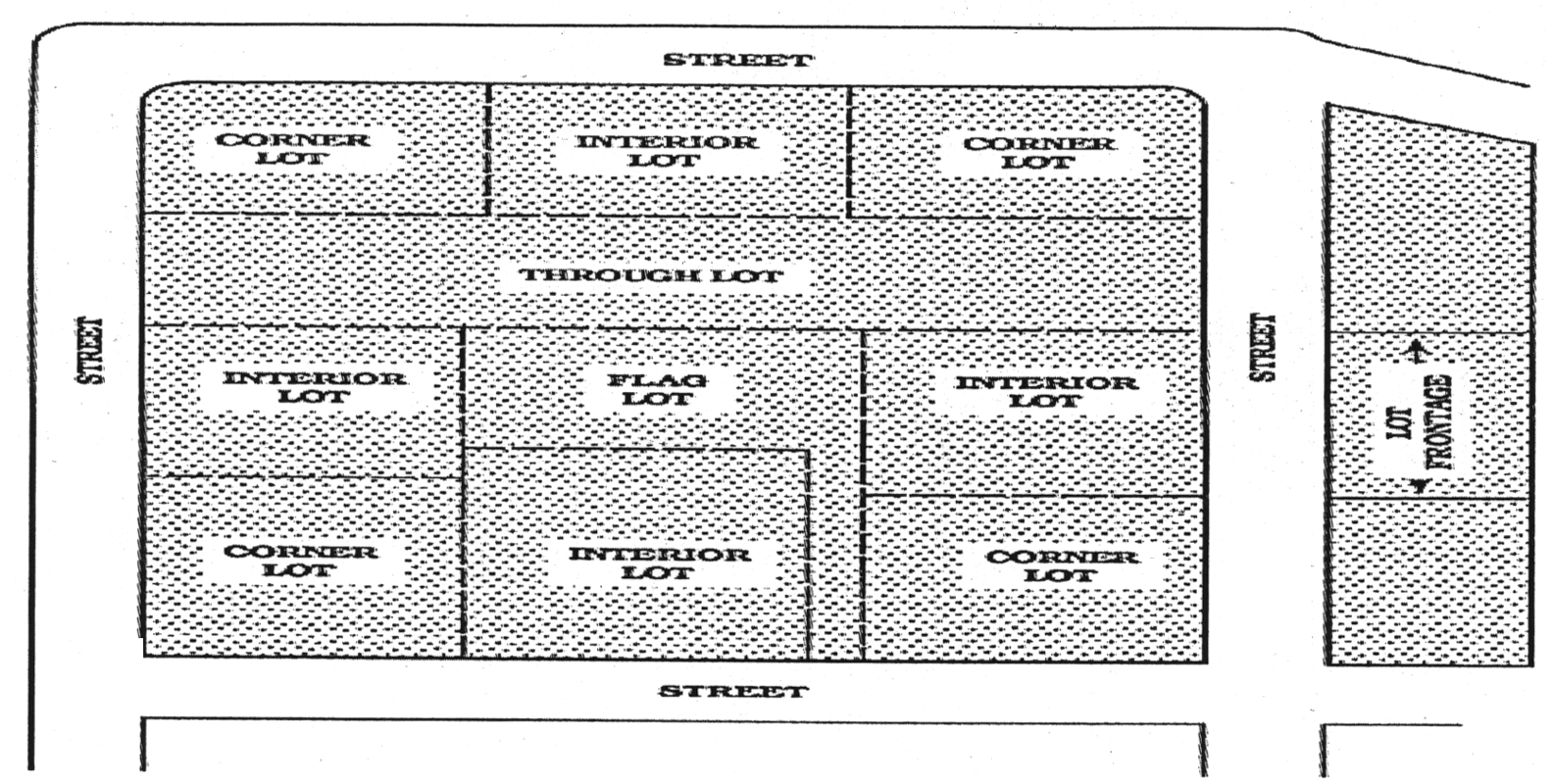
Lots
Manufactured home park. Any parcel of land or combination of contiguous or adjoining parcels of land owned by one (1) person or group of persons doing business as one (1) entity being used for the purpose of supplying parking space for five (5) or more manufactured homes and which may include buildings, structures, vehicles, or enclosures used or intended for use as part of such manufactured home park. Land subdivided and subsequently sold for the purpose of siting manufactured homes is not considered a manufactured home park under this chapter. Such subdivision of land is subject to the provisions of article VII of this chapter.
Manufactured home park space. A plot or ground within a manufactured home park designed for the accommodation of one (1) unit.
Mining. The act or process of digging, excavating or tunneling for the purposes or removing some natural material.
Miniwarehouse. A building or group of buildings in a controlled-access and fenced compound that contains individual compartmentalized and controlled-access stalls or lockers for the dead storage of customer's goods or wares.
Mixed-occupancy building Any building that is used for two (2) or more occupancies classified by different occupancy-use groups.
Modular home, building unit or other structure. Any building of closed construction, regardless of type of construction or occupancy classification, other than a mobile or manufactured home, constructed off-site in accordance with the applicable codes, and transported to the point of use for installation or erection. When meeting the requirements of the Modular Buildings Construction Act (23-43-10 of the S. C. Code of Laws), said building unit or structure may be located in any zoning district.
Nonconformity. Any lot of record, use, building, structure or vegetation in existence prior to the adoption, revision, or amendment of this chapter, but which fails, by reason of such adoption, revision or amendment, to conform to the present requirements of this chapter.
Nonresidential use. A principal use of land for other than residential purposes, i.e. commercial, industrial, institutional, or other uses.
Occupancy.To reside in as owner or tenant on a permanent or temporary basis.
Offstreet parking space. An area, not in a street or alley, permanently reserved for the temporary storage of one (1) automobile and connected with a street or alley by a driveway which provides ingress and egress.
Open space ratio. A measure of the intensity of land use. It is arrived at by dividing the total amount of open space within the site by the total site area.
Open storage. Any accessory storage in the open air and outside of a principal or main building or structure on a lot, including the storage of equipment, goods, raw or processed materials, or merchandise outside of any building or structure, but not including wrecking, junk or salvage materials, as defined by this chapter.
Parcel. A land area bounded by property lines that is recognized as such by the county assessor's office.
Person. An individual, proprietorship, partnership, corporation, association, or other legal entity.
Phased-development plan A development plan submitted to the Aiken County Planning Commission or to county staff by a landowner that shows the types and density or intensity of uses for a specific property or properties to be developed in phases, but which do not satisfy the requirements for a site-specific development plan.
Planning director. The Director of the Aiken County Planning and Development Department or his designee.
Plat. A map or drawing showing a plan of a subdivision or other land development.
Plat, final. A plat describing a subdivision or other land development that has been recorded in the office of the registrar of mesne conveyance.
premises. A lot, plot, or parcel of land including the buildings or structures thereon, under control by the same owner or operator together with all adjacent land.
Residential district. Any of the following zoning districts: RC, RD, RM, and OR.
Retail establishment. A store or part thereof in which foods, wares, merchandise, substances, articles, or other items are offered or kept for sale directly to the public at retail. The term "retail establishment" includes restaurants and department stores.
Right-of-way. A strip of land acquired by reservation, dedication, prescription, or condemnation and intended for a purpose such as ingress/egress or utility location.
Road. See the definition of "street."
Salvage. Any materials consisting of waste matter, discarded matter or salvage matter which is bought, sold, exchanged, stored, baled, packaged or disassembled for profit, trade or hire. The term shall also mean any vehicle without current license tags which is (1) damaged so as not to comply with state or federal safety regulations, or (2) incapable of self-propulsion, or (3) partially dismantled; if such vehicle is retained on the premises for more than (30) days unless scheduled for repair as evidenced by a repair order not more than (6) months old. The term shall also mean, but not be limited to, old or scrap copper, brass, aluminum, rope, rags, paper, trash, tire carcasses, rubber debris, old vehicle parts, non-working major appliances, and other old ferrous or non-ferrous material. See also the definition of "junkyard or salvage yard."
School. A public school, a separate school, a university, a college or a private school authorized by the authority having jurisdiction and operated on a not-for-profit basis; includes a day nursery and residence building for staff and students, provided that such buildings are on the same lot as the place of instruction; excludes schools such as dance schools, karate schools, gymnastic schools, and similar commercial instructional or educational facilities.
Septic tank. See the definition of "individual subsurface disposal system."
service establishment. A building or part thereof used for the provision of services, such as repair of motor vehicles; exhaust system replacement; repair of television and other electronic devices; appliance repairs; and similar facilities, including automotive service stations for the servicing and repairing of motor vehicles and for the sale of fuel, oils, accessories for motor vehicles, food, and refreshments.
Setback, front. A setback extending the full width of the front of a lot in the area between the front (street) right-of-way line or property line and the front building line.
Setback, rear. A setback extending the full width of the lot in the area between the rear lot line and the rear building line.
Setback, required. That part of a lot between a lot line and the minimum required building setback line, within which no structure shall be located except as provided by this chapter.
Setback, side. A setback extending the full length of the lot in the area between the side lot line and a side building line.
Sexually oriented business For purposes of this chapter, the term "sexually oriented business" shall mean and include the following:
(1)
Adult arcade means any place to which the public is permitted or invited wherein coin-operated or slug-operated or electronically , electrically , or mechanically controlled still or motion picture machines, projectors, or other image-producing devices are maintained to show images to five (5) or fewer persons per machine at any one time, and where the images so displayed are distinguished or characterized by the depicting or describing of "specified sexual activities" or "specified anatomical areas."
(2)
Adult bookstore or adult-video store means a commercial establishment, which, as one of its principal business purposes, offers for sale or rental for any form of consideration any one or more of the following:
a.
Books, magazines, periodicals or other printed matter, or photographs, films, motion pictures, video cassettes or video reproductions, slides or other visual representations which depict or describe "specified sexual activities" or "specified anatomical areas"; or
b.
Instruments, devices, or paraphernalia, which are designed for use in connection with "specified sexual activities." A commercial establishment may have other principal business purposes that do not involve the offering for sale or rental of material depicting or describing "specified sexual activities" or "specified anatomical areas" and still be categorized as an adult bookstore or adult-video store. Such other business purposes will not serve to exempt such commercial establishment from being categorized as an adult bookstore or adult-video store so long as: one of its principal business purposes is the offering for sale or rental for consideration the specified materials which depict or describe "specified sexual activities" or "specified anatomical areas."
(3)
Adult cabaret means a nightclub, bar, restaurant or similar commercial establishment, which regularly features:
a.
Persons who appear in a state of nudity; or
b.
Live performances which are characterized by the exposure of "specified anatomical areas" or by "specified sexual activities"; or
c.
Films, motion pictures, videocassettes, slides, or other photographic reproductions, which are characterized by the description of "specified sexual activities" or "specified anatomical areas".
(4)
Adult motel means a hotel, motel or similar commercial establishment which:
a.
Offers accommodations to the public for any form of consideration; provides patrons with closed-circuit television transmissions, films, motion pictures, video cassettes, slides, or other photographic reproductions which are characterized by the depiction or description of "specified sexual activities" or "specified anatomical areas"; and has a sign visible from the public right-of-way which advertises the availability of this adult type of photographic reproductions; or
b.
Offers a sleeping room for rent for a period of time that is less than ten (10) hours; or
c.
Allows a tenant or occupant of a sleeping room to subrent the room for a period of time that is less than ten (10) hours.
(5)
Adult motion picture theater means a commercial establishment where, for any form of consideration, films, motion pictures, video cassettes, slides or similar photographic reproductions are regularly shown which are characterized by the depiction or description of "specified sexual activities" or "specified anatomical areas".
(6)
Adult theater means a theater, concert hall, auditorium or similar commercial establishment which regularly features persons who appear in a state of nudity or live performances which are characterized by the exposure of "specified anatomical areas" or by "specified sexual activities".
(7)
Sexual-encounter center means a business or commercial enterprise that, as one (1) of its primary business purposes, offers for any form of consideration:
a.
Physical contact in the form of wrestling or tumbling between persons of the opposite sex; or
b.
Activities between male and female persons and/or persons of the same sex when one (1) or more of the persons is in a state of nudity or seminudity.
Sign. Any object, device, display or structure, or part thereof, situated outdoors or indoors, which is used to advertise, identify, display, direct or attract attention to an object, person, institution, organization, business, product, service, event or location by any means, including words, letters, figures, design, symbols, fixtures, colors, illumination or projected images. The term "sign" includes banners, posters, inflatable signs, tethered balloons and pennants.
Sign, abandoned. A sign structure not containing a sign for one hundred twenty (120) continuous days or a sign not in use for one hundred twenty (120) continuous days, or a sign advertising a business no longer occupying the site on which the sign exists or to which it refers.
Sign, animated. Any sign that uses movement or change of lighting to depict action or to create a special effect or scene. See the definition of "sign, changeable copy."
Sign, awning, canopy or marquee. A sign that is mounted or painted on or attached to an awning, canopy or marquee.
Sign, bench. A sign located on any part of the surface of a bench or seat placed on or adjacent to a public right-of-way.
Sign, building. Any sign attached to any part of a building.
Sign, changeable-face/copy/electronic message board. A sign designed to allow the changing of letters, words, logos, or symbols through manual, electronic, or digital means only in a static manner without altering the face or surface of the sign, or creating movement or the appearance of movement upon the sign face or by any other structural component. A sign on which the message changes statically more than once every ten (10) seconds provided the message does not changes through flashing, scrolling, or any type of animation shall be considered an animated sign and not a changeable-face/copy/electronic message board sign for purpose of this chapter. See the definition of "sign, animated". Images displayed using electronic/digital technology must be static messages and the content shall not include animated, flashing, scrolling, or full-motion video elements. All digital business signs shall have a method for controlling the illumination intensity or brilliance of the sign so that it shall not cause glare or impair the vision of motorists. These signs shall not exceed a maximum illumination of seven thousand five hundred (7,500) nits (candelas per square meter) during daylight hours and a maximum illumination of five hundred (500) nits between dusk to dawn as measured from the sign face. This illumination can be regulated either by an automatic dimmer and photo cell sensor or through the use of computerized controls that accurately replicates these maximum illumination requirements.
Sign face. The area or display surface of a sign used for the message.
Sign, freestanding. Any nonmovable sign not affixed to a building.
Sign, identification. A sign giving the nature, logo, trademark, or other identifying symbol; address; or any combination of the name, symbol, and address of a building, business, development, or establishment on the premises where it is located.
Sign, incidental. A sign not to exceed six (6) square feet in area, generally informational, that has a purpose secondary to the use of the zone lot on which it is located, such as "no parking", "entrance", "loading only", "telephone", and other similar directives. No sign with a commercial message legible from a position off the zone lot on which the sign is located shall be considered incidental.
Sign, monument. A ground-level, freestanding sign not mounted on a pole or poles. The area of the structure supporting the sign shall not exceed sixty (60) percent of the total combined area of the sign and the supporting structure.
Sign, permanent. A sign attached to a building, structure or the ground in some manner and made of materials intended for more than short term use.
Sign, political. A temporary sign announcing or supporting political candidates or issues in connection with any national, state or local election.
Sign, portable. A sign that is not permanent or affixed to a building or other structure or to the ground.
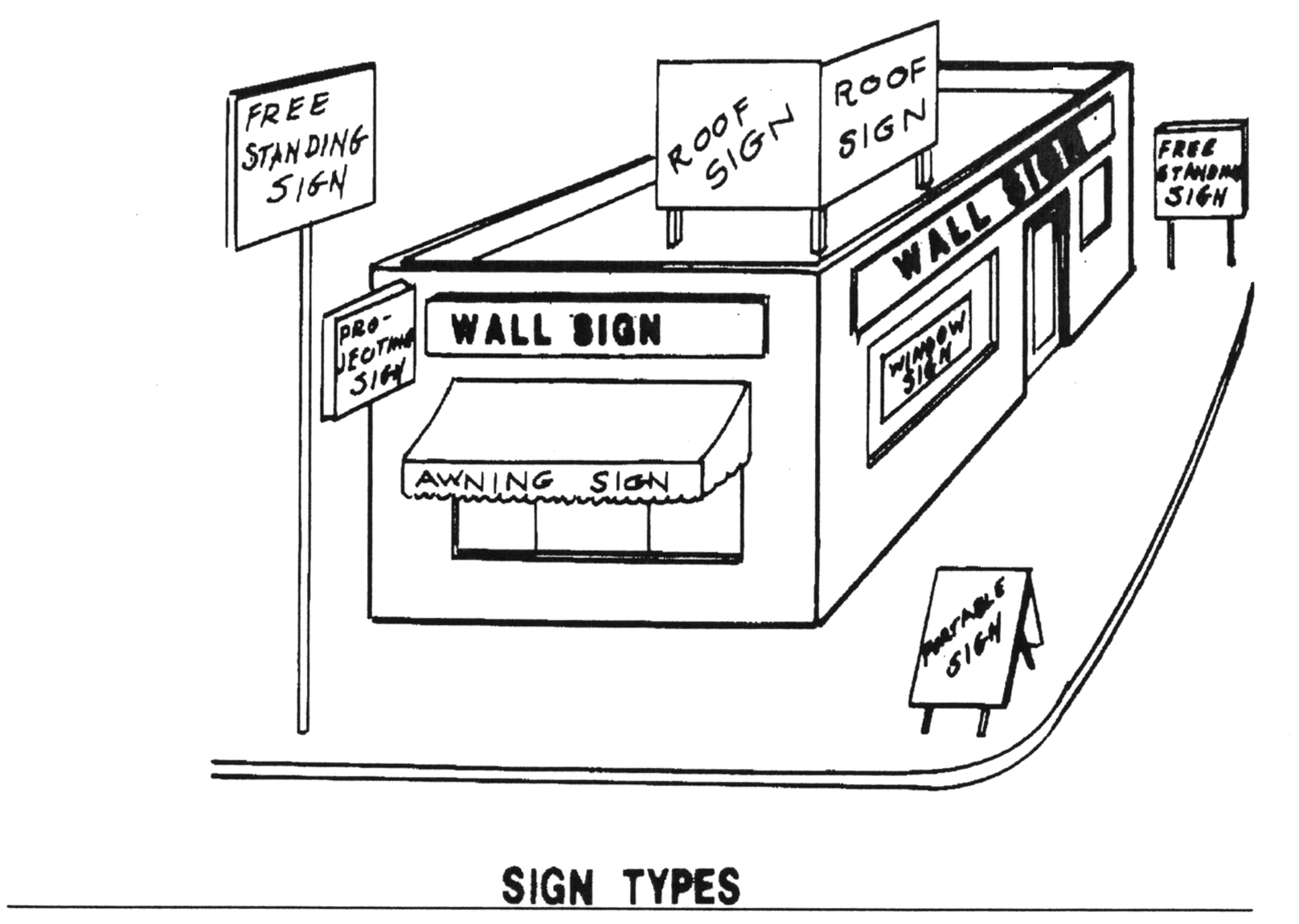
Sign, projecting. A sign that is wholly or partly dependent upon a building for support and which projects more than twelve (12) inches from such building.
Sign, roof. A sign that is mounted on the roof of a building or which is wholly dependent upon a building for support and which projects above the point of a building with a flat roof, the ridge line of a building with a gambrel, gable, or hip roof or the deck line of a building with a mansard roof. Signs mounted on the sloping section of a roof or the gable end of a roof shall be classified as a wall sign.
Sign, roof-integral. A sign whose structure is integratedo the structure of the roof, and is an integral part thereof.
Sign, temporary. A sign that is used only for a short period of time and is not permanently mounted.
Sign, wall. Any sign attached to and within six inches of a wall, painted on the wall surface, or erected and confined within the limits of an outside wall of any building or structure, which is supported by such wall or building, and which displays only one (1) sign surface.
Sign, window. A sign that is applied or attached to the exterior or interior of a window or located in such manner within a building that it can be seen from the exterior of the structure through a window.
Site-specific development plan. A development plan submitted to the Aiken County Planning Commission or to county staff by a landowner describing with reasonable certainty the types and density or intensity of uses for a specific property or properties. The plan may be in the form of, but is not limited to, the following plans or approvals: planned unit development; subdivision plat; preliminary or general development plan; variance; conditional-use plan; mobile home park or mobile home subdivision; or other land-use-approval designations as are used by Aiken County.
Slaughterhouse means an agricultural facility which slaughters or processes more than two hundred (200) pounds of livestock, hogs, aquatic animals, equine, chickens, turkeys, poultry, or other food normally raised for food, mules, cattle, sheep, goats, rabbits, or similar farm animals for commercial purposes. Also see definition of "CAFO."
Smoke or vape shop. Any retail store with more than an incidental or ancillary use, as defined herein, that displays, sells, distributes, delivers, offers, furnishes or markets one (1) or more of the following:
(1)
Alternative nicotine products;
(2)
Vape products;
(3)
Tobacco products;
(4)
Cigarettes, cigars, dried or shredded plant material, flowers, smoking blends, and similar products that are smoked or inhaled and contain cannabis product, hemp or synthetic cannabinoids; or
(5)
Smoking paraphernalia. For purposes of this definition, "incidental or ancillary use" is defined as a display or sale by a grocery store, supermarket, convenience store, gas station, or similar retail business that uses no more than two (2) percent of the total square footage of the business, or two hundred (200) square feet, whichever is less, for the display, sale, distribution, delivery, offering, furnishing, stocking, storage or marketing of one (1) or more such products; or, as to any such retail business consisting of two hundred fifty (250) square feet or less, as no more than five (5) square feet being used for such purposes. For purposes of this definition, the area of a business used for such purposes shall be determined based upon the square footage devoted to such use plus an additional customer aisle area measuring eighteen (18) inches in width perpendicular to and along each customer-facing portion of such display or other use.
a.
Alternative nicotine product. A product or device not consisting of or containing tobacco that provides for the ingestion into the body of nicotine, whether by chewing, absorbing, dissolving, inhaling, snorting, sniffing, or by any other means. An "alternative nicotine product" does not include tobacco products, or any product approved by the United States Food and Drug Administration as a non-tobacco product for sale as a tobacco cessation product, as a tobacco dependence product, or for other medical purposes, which is being marketed and sold solely for that approved purpose.
b.
Ancillary use. A subsidiary or secondary use that is closely associated with, and supports the primary use of a building or land.
c.
Incidental use. A subordinate or ancillary use of a building or land that is secondary to the primary use.
d.
Smoking paraphernalia. Any paraphernalia, equipment, device, or instrument that is designed or manufactured for the smoking, chewing, absorbing, dissolving, inhaling, snorting, sniffing, or ingesting by any other means into the body of tobacco products, cannabis products, hemp, alternative nicotine product, synthetic cannabinoids, or controlled substances as defined in S.C. Code Ann. § 44-53-110. Items classified as smoking paraphernalia include but are not limited to: pipes, ice pipes or chillers, air-driven pipes, water pipes, bongs, water bongs, hookahs, punctured metal bowls, and roach clips.
e.
Synthetic cannabinoids. A class of artificially made chemicals that are cannabinoid receptor agonists intended to replicate, mimic, or cause a similar reaction to the psychoactive effects of marijuana. These compounds may be found in products marketed as incense, herbal blends or mixtures, synthetic marijuana, or potpourri, and labeled as spice, K2, green giant, smacked, wicked X, AK-47, geeked up, ninja, caution, red giant, keisha kole, XXX ultra, skunk, atomic and other names, however named.
f.
Tobacco product. Any product containing, made, or derived from tobacco that is intended for human consumption, whether chewed, smoked, absorbed, dissolved, inhaled, snorted, sniffed, or ingested by any other means, or any component, part, or accessory of a tobacco product including but not limited to cigarettes; cigars; cheroots; stogies; perique; granulated, plug-cut, crimp-cut, ready rubbed and other smoking tobacco; snuff; snuff flowers; cavendish; plug and twist tobacco; fine-cut and other chewing tobaccos; shorts; refuse scraps, clippings, cuttings and sweepings of tobacco and other kinds and forms of tobacco, prepared in such a manner as to be suitable for chewing or smoking in a pipe, or other tobacco related devices. Tobacco products do not include any tobacco product that has been approved by the United States Food and Drug Administration for sale as a tobacco cessation product, as a tobacco dependence product, or for other medical purposes, and is being marketed and sold solely for such an approved purpose.
g.
Vape product. Any non-combustible product, which may or may not use or contain a cannabis product, hemp, alternative nicotine product, or synthetic cannabinoid, that employs a heating element, power source, electronic circuit, or other electronic, chemical or mechanical means, regardless of shape or size, that can be used to produce vapor from a liquid solution or any other form, to be inhaled, snorted, sniffed, consumed or ingested by any other means. "Vape product" includes devices called e- cigarettes, electronic cigars, electronic pipes, vaporizers, vaporizer cartridges, vapes, e-hookahs, vape pens, pod mods, box mods, puff bars, tanks or mods, sub-ohm tanks, vaporizers, dab pen, or similar product or device. "Vape product" also includes e-juice, vape juice, and e-liquid containing an alternative nicotine product, cannabis product, hemp or synthetic cannabinoids. "Vape product" does not include any product regulated as a drug or device by the United States Food and Drug Administration under Chapter V of the United States Food, Drug, and Cosmetic Act.
Solid waste. Includes any garbage, refuse, or sludge from a waste treatment facility, water supply plant, or air pollution control facility and other discarded material, including solid, liquid, semi-solid, or contained gaseous material resulting from industrial, commercial, mining, and agricultural operations and from community activities. This term does not include solid or dissolved material in domestic sewage, recovered materials, or solid or dissolved materials in irrigation return flows or industrial discharges which are point sources subject to NPDES permits under the Federal Water Pollution Control Act, as amended, or the Pollution Control Act of South Carolina.
South Carolina Manufactured Housing Board. The board which is authorized by South Carolina State statute to regulate the construction, repair, modification, installation, tie-down, hook-up, and sale of manufactured homes in South Carolina, which Board has adopted for regulation of manufactured homes the Federal Manufactured Housing Construction and Safety Standards, promulgated by HUD, and contained in the Board's Manufactured Housing Regulations, May 26, 1990.
Storage. The containment of solid waste, either on a temporary basis or for a period of years, in such manner as not to constitute disposal of such solid waste; provided, however, that storage in containers by persons of solid waste resulting from their own activities on their property, leased or rented property, if the solid waste in such containers is collected at least once a week, shall not constitute "storage" for purposes of this act. The term does not apply to containers provided by or under the authority of the county for the collection and temporary storage of solid waste prior to disposal.
Stormwater detention facility. See the definition of "detention facility."
Street. Any publicly maintained or privately maintained thoroughfare (drive, byway, avenue, circle, way, or boulevard) or space which has been dedicated, deeded or designated for vehicular traffic and which serves more than two (2) parcels of land. The term is synonymous with the term "road" and includes the term "alley." The term does not include driveways (see the definition of "driveway"). New streets must be built to meet the Aiken County standards for street construction.
Street, arterial. Includes all state primary and federal aid highways and streets that serve to circulate traffic, having signals at important intersections, and stop signs on side streets, and/or having controlled access and channelized intersections.
Street, collector. A street designed principally to collect traffic from subdivisions and to feed arterial streets.
Street, cul-de-sac. A street with a single common ingress and egress and with a turnaround at the end.
Street, dead-end. A street with a single common ingress and egress point and without a turnaround at the end.
Street, minor local. A street designed principally to provide access to abutting property.
Street, private. A street not dedicated for public use or maintenance.
Street, public. A street maintained by a public body.
Structure. Anything erected, built, or constructed, the use of which requires temporary or permanent location on or in the ground or soil, or attached to anything having temporary or permanent location on or in the ground or soil or, but not including pavements, curbs, walks, open-air surfaced areas, moving vehicles, or fences less than six feet in height. By this definition, all buildings are structures, but not all structures are buildings.
Structural alteration. Any change in the supporting members of a building, such as the bearing walls, beams, or girders, or any change in the dimension or configuration of the roof or exterior walls.
Subdivision. All divisions of a tract or parcel of land into two or more lots, building sites, or other divisions for the purpose, whether immediate or future, of sale, lease, or building development; the term includes all division of land involving a new street or change in existing streets, and includes re-subdivision which would involve the further division or relocation of lot lines of any lot or lots within a subdivision previously made and approved or recorded according to law; or, the alteration of any streets or the establishment of any new streets within any subdivision previously made and approved or recorded according to law; and the term includes combinations of lots of record.
Subdivision, exempt. A subdivision which meets any of the following conditions:
(1)
The combination or recombination of portions of previously platted lots where the total number of lots is not increased and the resultant lots are equal to the standards of this chapter and other applicable regulations.
(2)
The division of land into parcels of five (5) acres or more where no new street is involved; plats of these exceptions must be received as information by the Aiken County Planning and Development Department, which Department shall indicate that fact on the plats.
(3)
The combination or recombination of entire lots of record where no new street or change in existing streets is involved.
(4)
The partition of land by court decree.
(5)
A one-hundred-percent transfer of ownership in a parcel of property.
(6)
A division of property among the heirs of an estate. However, this exemption does not relieve the estate from following the accessibility provisions found in section 24-7.9 of this chapter.
(7)
The sale or division of property by an owner of a tract of land if the owner is not in the business of developing real property. For the purposes of this exemption, a person is determined to be in the business of developing real property if that person has, within the preceding twelve (12) months, created and recorded six (6) or more new parcels. However, this exemption does not relieve the subdivision from the accessibility provisions found in section 24-7.9 of this chapter. This exemption shall not apply to businesses, corporations, or associations, etc., but only to natural people.
The Aiken County Planning and Development Department must approve and may retain a copy of the plats of the above-described exempt subdivisions.
Subdivision, major. Any subdivision other than an exempt or minor subdivision.
Subdivision, small. A subdivision which does not involve any of the following: (a) the creation of more than ten lots, (b) the creation of any new street, (c) the extension of public water or sewer lines, or (d) the installation of drainage improvements through one or more lots to serve one or more other lots.
Substantial improvement. Any repair, reconstruction, rehabilitation, addition, or other improvement of a structure, the cost of which equals or exceeds fifty (50) percent of the market value of the structure before the start of construction of the improvement. This term includes structures, which have incurred substantial damage, regardless of the actual repair work performed. The term does not, however, include either: (1) any project of improvement to a structure to correct existing violations of State or local health, sanitary, or safety code specifications which have been identified by the local code enforcement official and which are the minimum necessary to assure safe living conditions (does not include Americans with Disabilities Act compliance standards): or (2) any alteration of a historic structure, provided that the alteration will not preclude the structure's continued designation as a historic structure. Permits shall be cumulative for a period of five (5) years.
Tower, communication. Any ground- or roof-mounted pole, spire, or combination thereof of height greater than fifteen (15) feet, including supporting lines, cables, wires, braces, and masts, which is intended primarily for the purpose of mounting a communications antenna, meteorological device, or similar apparatus above grade.
Travel trailer or recreational vehicle. A structure that (1) is intended to be transported over the streets and highways (either as a motor vehicle or attached to or hauled by a motor vehicle), and (2) is designed for temporary use as sleeping quarters, but that does not satisfy one or more of the definitional criteria of a mobile or manufactured home or modular unit.
Trucking terminal. A use included in NAICS category number 484, Truck Transportation. The term also includes truck-staging operations. Also refer to section 24-3.23 of this chapter.
Understory tree. A small deciduous tree that forms the layer of vegetation under the canopy trees in a forest. Examples of such trees include dogwoods, sourwoods, fruit trees and others.
Use. The purpose or activity, for which land or any building thereon is designed, arranged or intended, or for which it is occupied or maintained.
Use, accessory. See the definition of "building, accessory."
Use, nonconforming. See the definition of "Nonconformity."
use, principal. The primary purpose for which land is used.
Variance. A modification of the regulations of this chapter, granted by the board of appeals, where such modification will not be contrary to the public interest, and where, owing to conditions peculiar to the property, a literal enforcement of the chapter would result in unnecessary and undue hardship, and where such modification will not authorize a principal or accessory use of the property which is not permitted within the zoning district in which the property is located.
Vegetation. Any object of natural growth.
Vendor. A temporary or occasional operation the primary activity of which is retail sales, such as produce stands, fireworks stands, etc.
Vested right. The right to undertake and complete the development of property under the terms and conditions provided in this section.
Wetlands. Areas of one-quarter (.25) acre or more where standing water is retained for a portion of the year and unique vegetation has adapted to the area. Jurisdictional wetlands are those over which the U.S. Corps of Engineers and/or the State of South Carolina has permitting jurisdiction.
Wrecking yards, junkyards, and salvage yards. Any land or structure used for a salvaging operation, including but not limited to the storage and sale of waste paper, rags, scrap metal, discarded materials, consumer goods, equipment and the collection, dismantlement, storage and salvage of ten (10) or more unlicensed or inoperative vehicles; or a place where junk, waste, discarded or salvaged materials are bought, sold, exchanged, stored, baled, packed, disassembled or handled, including automobile wrecking yards, house wrecking and structural steel materials and equipment, but not including the purchase or storage of used furniture and household equipment, used cars in operable condition or used or salvaged materials as part of manufacturing operations. Also see the definition of junkyard or salvage yard.
Yard. An open space that lies between the principal or accessory building or buildings and the nearest lot line. Such yard is unoccupied and unobstructed from the ground upward except as may be specifically provided by this chapter.
Zoning district. A specifically delineated area or district within which regulations and requirements govern the use, placement, spacing and size of land and buildings.
(Ord. No. 07-6-12, § 5, 6-5-07; Ord. No. 07-11-25, § 1, 11-27-07; Ord. No. 11-04-10, § 1, 4-19-11; Ord. No. 13-05-13, § 1, 5-21-13; Ord. No. 14-12-18, § 1, 12-9-14; Ord. No. 25-12-33, § 1, 12-16-25)

