
Alamosa City Zoning Code
ARTICLE XI
MEASUREMENTS, CALCULATIONS, RULES OF CONSTRUCTION, ACRONYMS, AND DEFINITIONS
Sec. 21-11-101. - Measurements.
(a)
Height.
(1)
Buildings.
a.
Building height is measured from a horizontal reference plane at the elevation of the average existing grade across the front building line, measured at major building corners, to the highest point among the following:
1.
The midpoint of a sloped (gable, hip or gambrel) roof;
2.
The top of the parapet of a flat roof system; or
3.
The deck line of a mansard roof.
b.
The following building elements and appurtenances are excepted from the building height measurement, but only to the minimum degree necessary to achieve compliance with applicable building codes (or if not regulated by building codes, to provide for appropriate function):
1.
Chimneys,
2.
Vents (e.g., attic fans, cupola vents, radon mitigation, plumbing vents, etc.), and
3.
Light collection domes for daylighting systems.
c.
In addition to the elements and appurtenances described in subsection (a)(1)b., above, with regard to multifamily and nonresidential buildings, the following are also excepted from the building height measurement:
1.
Non-habitable towers, spires, belfries, and domes;
2.
Screened mechanical equipment;
3.
"Green roof" vegetation;
4.
Roof access, elevator, and stair towers; and
5.
Clock towers.
(2)
Fences, walls, and retaining walls.
a.
The height of fences, walls, or retaining walls is measured as the vertical distance from a point of measurement at the average finished grade for each interval on the outside of the enclosed area (or the side closest to the property line if the fence or wall does not enclose anything) to the highest point at the top of the fence or wall for that interval, excluding posts and pilasters.
b.
In general, fence or wall height is measured in forty (40) foot horizontal intervals, or the distance between posts or pilasters, whichever is shorter.
(3)
Monopoles and towers. The height of a monopole or tower is measured from the lowest point of the anchored base of the tower, at its grade, to the highest point of the structure. For antenna towers, height shall be measured inclusive of any antennas placed on the tower. For wind turbines, height shall be measured to the top of the rotor at its highest point during rotation.
(4)
Roofed structures other than buildings. The height of roofed structures other than buildings (e.g., gazebos) is measured as the distance from the grade plane at the base of the structure to the top of the highest point on the structure, including attachments thereto.
(b)
Building coverage. Building coverage is measured as the area of a lot or parcel that is occupied by principal and accessory buildings at ground level. For the purpose of this UDC, building coverage is measured as the footprint of the principal and any accessory buildings at grade, including any carport (whether enclosed or not). Eaves, overhangs, and decks that project less than two feet from the building walls are not included in the measurement of building coverage. Overhangs, covered porches, cantilevers, and decks that project more than two feet from building walls are included in the measurement of building coverage.
(c)
Floor area. Floor area is measured as the horizontal floor area included within the outside walls of a building or portion thereof, including habitable tenant houses and attic space, but not including vent shafts, courts, or uninhabitable areas below ground level or in attics.
(d)
Lot area. Lot area is the total planar area within a lot that is enclosed by its lot lines.
(e)
Lot depth. Lot depth is the average horizontal distance between front and rear lot lines.
(f)
Lot width. Lot width is the horizontal distance between the side lot lines of a lot, measured at right angles to the line establishing the lot depth at the established building setback line.
(g)
Setbacks. Setbacks are measured horizontally at right angles to the affected lot line to the nearest point of the building or structure for which the setback is being measured.
(Ord. No. 33-2017, § 1, 12-6-17)
Sec. 21-11-102. - Calculations.
(a)
Building coverage ratio. Building coverage ratio is calculated as building coverage divided by lot area.
(b)
Density. Density is calculated as the number of dwelling units per acre of land of a lot or subject property, as applicable to the circumstances of the calculation.
(c)
Open space ratio. Open space ratio is calculated as the total area of open space on a subject property divided by the total area of the subject property.
(d)
Luminance. One (1) Nit is equal to one (1) candela per square meter.
(e)
Value. Value of land and or improvements shall be based on the records of the Alamosa County Assessor, or a current valuation provided by a licensed real estate appraiser.
(Ord. No. 33-2017, § 1, 12-6-17; Ord. No. 27-2024, § 7, 11-6-24)
Sec. 21-11-201. - Rules of construction.
The words and terms used, defined, interpreted, or further described in this chapter may be construed as follows:
(1)
The particular controls the general.
(2)
The word "shall" is mandatory.
(3)
The word "may" is permissive.
(4)
Words used in the present tense include the future unless the context clearly indicates the contrary.
(5)
Words used in the singular include the plural, and words used in the plural include the singular, unless the context clearly indicates the contrary.
(Ord. No. 33-2017, § 1, 12-6-17)
Sec. 21-11-202. - Table of acronyms.
Table 21-11-202 sets out the abbreviations and acronyms that are used in this UDC.
(Ord. No. 33-2017, § 1, 12-6-17)
Sec. 21-11-203. - Definitions.
The following words, terms and phrases, when used in this Code, shall have the meanings ascribed to them in this section, except where the context clearly indicates a different meaning:
Accessory structure means a structure that is accessory to a principal building or structure, such as a shed or detached garage.
Accessory use means a use of property that is incidental or subordinate to the principal use, such as a home occupation.
Adaptive lighting controls means a device or devices such as motion sensors, timers, and dimmers used in concert with outdoor lighting equipment to vary the intensity or duration of operation of lighting.
Administrator means the Public Works Director or his or her designee.
Adult day care means a facility that is certified by the State of Colorado to provide health and social services on a less than 24-hour basis to elderly, blind, or disabled adults.
Airport means an area of land that is used for the landing and takeoff of aircraft (fixed-wing or helicopter). An airport may be private or public, and may include related buildings and facilities, such as fixed-base operators, hangars, terminals, fueling and de-icing facilities, maintenance facilities, and car rental agencies, gift shops, and restaurants.
Alcoholic beverage sales means the retail sale of beer, wine, spirits, or other alcoholic beverages for off-premises consumption. The phrase "alcoholic beverage sales" applies to those uses which must obtain a Colorado retail liquor store license.
Alley means a minor right-of-way or easement for motor vehicles that gives a secondary means of access to the back or side of lots or parcels that otherwise abut a street. Alleys are often used for service access and utility installations.
Alternative tower structure means artificial trees, clock towers, bell steeples, light poles and similar alternative design mounting structures that are visually compatible with their context (e.g., a natural setting or surrounding buildings or structures), which camouflage or conceal the presence of antennas or towers. The phrase "alternative tower structure" also includes any antenna or antenna array attached to the alternative tower structure.
Amateur radio antenna means an antenna used by an amateur radio (a.k.a. "HAM Radio") operator pursuant to 47 C.F.R. 97, Subpart A.
Antenna means any structure, including but not limited to a monopole antenna, tower, parabolic, or disk-shaped device in single or multiple combinations of either solid or mesh construction, intended for the purpose of receiving or transmitting communication to or from another antenna, orbiting satellite, cell phone, television, radio, or other telecommunications device, as well as supporting equipment necessary to install or mount the antenna on an antenna tower or building.
Antenna tower means any structure that is designed and constructed primarily for the purpose of supporting one or more antennae. This includes guyed mast, lattice towers, monopoles, alternative tower structures, and towers that are taller than ten feet that are installed or mounted on top of a building, along with any separate building or structure on the same lot used to house any supporting electronic equipment.
Arcade frontage means that the street-facing frontage of the principal building includes an integrated colonnade that is covered by upper stories of the building, and that shelters the sidewalk or walkway in front of the building frontage.
Assisted living or congregate care means a residential facility that provides meals or assistance with daily activities, such as dressing, grooming, and bathing, for the elderly or adults who are unable to manage these activities themselves.
Bar, tavern, or nightclub means a use engaged in the sale of alcoholic beverages for on-premises consumption, where such sales account for more than fifty (50) percent of gross revenues. The use does not include temporary sales of alcohol for on-premise consumption.
Bed and breakfast inn means an adaptive re-use of a single-family detached building as a place of overnight accommodation, in which: (i) eight or fewer guest rooms are rented for daily or weekly terms; (ii) breakfast is provided to guests; and (iii) the operator resides on the premises.
Berm means a mound of earth typically used to shield, screen, and buffer undesirable views and to separate potentially incompatible land uses.
Board of adjustment means the City of Alamosa Zoning Board of Adjustment.
Boarding or rooming house means a residential building in which three or more bedrooms are available to be rented to guests on a short-term or long-term basis. Some services (e.g., meals or laundry) may be provided, and common areas, such as kitchens, living areas, or bathrooms, may be shared.
Bufferyard means open spaces, landscaped areas, fences, walls, berms, or any combination thereof, used to physically separate or screen one use or property from another so as to visually shield or block buildings, structures, storage areas, noise, lights, or other nuisances. Bufferyards are classified into five classifications, with specific uses, locations, or purposes calling for specific bufferyard classifications. See Table 21-5-306(c) for classifications.
Building means an enclosed structure built for the shelter or enclosure of persons, animals, chattels, property or substances of any kind, excluding fences.
Building Line means an imaginary line drawn across a face of a building. A building line is not a setback."
Business services means commercial services, such as printing and copy centers, 3D print shops, repair services and shops (except automobile, truck, and heavy equipment repair), parcel service drop-off locations and mailbox services, and data recovery shops.
Caliper means the diameter of a tree trunk, measured six inches above the soil. Caliper measurements are used to measure single-trunk trees that are grown in nurseries. Trees that are already established on a subject property are measured using a diameter at breast height ("DBH") technique. See Diameter at breast height ("DBH").
Campground or RV park means an area of land developed and intended for use to provide the traveling public with short-term accommodations for recreational vehicles, motor homes, travel trailers, truck campers, park models, and tents.
Campus means a master-planned collection of buildings and grounds that typically include a variety of uses and activities for an academic institution (e.g., a college campus), non-academic institution (e.g., a hospital campus), or a business or group of related businesses (e.g., a research park campus), which are normally designed to provide common areas and amenities that provide focal points within the master plan.
Cemetery/mausoleum means any place in which there is provided space either below or above the surface of the ground for the interment of the remains of human bodies.
Central Business District means the area bounded by Fourth Street on the north, Denver Avenue on the east, Sixth Street on the south and Edison Avenue on the west.
Changeable copy panel means a portion a sign with characters, letters, or illustrations that can be manually (not electronically) changed or rearranged without structurally altering the surface of the sign.
Child care center means a facility, by whatever name known, which is maintained for the whole or part of a day for the care of five or more children under the age of 16 years and not related to the owner, operator, or manager thereof, whether such facility is operated with or without compensation for such care and with or without stated educational purposes. The term includes: (i) facilities commonly known as "day care centers," "day nurseries," "nursery schools," "kindergartens," "preschools," "play groups," "day camps," "summer camps," "centers for mentally retarded children," and (ii) facilities that provide 24-hour care for dependent and neglected children, and (iii) facilities for children under the age of six years with stated educational purposes operated in conjunction with a public, private, or parochial college or a private or parochial school, except that the term does not apply to any kindergarten maintained in connection with a public, private, or parochial elementary school system of at least six grades. Child care centers are classified as either "small" (five to 12 children) or "large" (13 or more children).
City facilities means a building, structure, storage yard, or major utility installation that is owned, operated, and used by the City, that the City determines is necessary for its operations or the advancement of the health, safety and welfare of City residents.
Code enforcement officer means an employee or contractor of the City who is designated by the City Manager to make inspections and issue notices and orders to correct violations of this UDC.
Co-housing community means a community of cottage dwellings, including tiny homes or small duplex dwellings that are clustered around commonly-owned open space, and that share a common house.
Co-location means locating one or more antennae for more than one provider on a single antenna tower.
Color temperature or correlated color temperature (CCT), is measure (in Kelvins, K) of the warmth or coolness of the appearance of a light source. Light sources with a CCT of less than three thousand two hundred (3,200) K are yellowish, pinkish, or orange-white in tone and considered "warm" in appearance. Light sources with a CCT greater than four thousand (4,000) K are bluish-white and considered "cool" in appearance.
Commercial agriculture means the science and art of production of plants, fungi, and animals useful to humans, including the preparation of these products for human use and their disposal by marketing or otherwise, and includes horticulture, fungiculture, floriculture, viticulture, forestry, dairy, livestock, poultry, bee, and any and all forms of farm products and farm production for commercial purposes. Commercial agriculture does not include: (i) commercial equestrian facilities; or (ii) concentrated animal feeding operations.
Commercial equestrian facilities means an establishment that boards horses or teaches, tests, or advances the skills of horses or horse riders.
Commercial Mobile Radio Service ("CMRS") means a Federal Communications Commission designation for any carrier or licensee whose wireless network is connected to the public switched telephone network and/or is operated for profit. CMRS is more specifically defined in 47 CFR § 20.9, as amended from time to time, which shall control this definition in the event of a conflict.
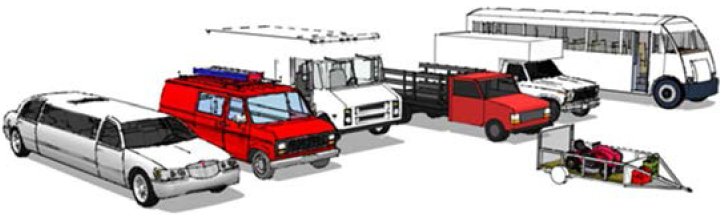
Commercial vehicle means:
(1)
Any motor vehicle, trailer, or semi-trailer that:
a.
Is designed or used to carry freight, other vehicles, equipment, passengers for a fee, or merchandise in the furtherance of any business enterprise; and
b.
Has a gross weight of more than ten thousand (10,000) pounds;
(2)
Any step van or truck that is designed for commercial moving or parcel delivery services;
(3)
Any truck that is used for mobile retail sales (e.g., ice cream, lunches);
(4)
Any vehicle with more than four (4) wheels that is used for business purposes;
(5)
Any trailer that is used to haul machinery, supplies, or equipment for business purposes (horse trailers, boat trailers, motorcycle trailers, RV trailers, and car trailers put to personal use are not included in the definition);
(6)
Any trailer that is used for commercial hauling (e.g., waste, junk, or lawn clippings), or commercial moving services;
(7)
Any vehicle which has permanently mounted outside brackets or holders for ladders, tools, pipes, or other similar equipment, unless such vehicle is used for on-call emergency services contracted by the city or other governmental entity.
| ILLUSTRATIVE COMMERCIAL VEHICLES |
|---|
 |
Common house is a building that is commonly owned by residents of a co-housing community, which may include a kitchen and dining area, laundry, recreational space, shared amenities, and up to three guest rooms.
Common open space means a parcel of land or an area of water or a combination of both land and water within a subdivision or a planned unit development. Common open space does not include streets, alleys, parks, off-street parking and loading areas, public open space, or other facilities dedicated by the developer for public use or for motor vehicle use. Common open space is substantially free of structures, but may contain such improvements that are approved as part of the planned unit development and are appropriate for recreation purposes.
Common property means a parcel or parcels of land, together with the improvements thereon, the use and enjoyment of which are shared by the owners and occupants of the individual building sites in a planned unit development or subdivision.
Community garden means land where plants are grown and maintained by a group of individuals in the community. Community gardens may produce food for individual consumption or food for sale, may be designed for beautification of the community, or may be used for educational purposes.
Compatible or compatibility means that the characteristics of different uses or activities, or their design (including site layout, architecture, landscaping, lighting, and noise mitigation), allow them to be located near or adjacent to each other in harmony. Some elements affecting compatibility include height, scale, massing and bulk of structures, noise, lights, odors, traffic patterns, and environmental and safety risks. Compatibility does not mean "the same as." Rather, compatibility refers to whether proposed development maintains the character of existing development, or establishes a desired pattern or type of development as envisioned in the comprehensive plan or applicable design standards.
Comprehensive plan means the comprehensive plan for the city which has been officially approved to provide long-range development policies for the city and which includes, among other things, the plan for future land use, multimodal circulation, and public facilities.
Concentrated animal feeding operation ("CAFO") means a facility where large numbers of animals are raised in confinement, as more specifically defined by 40 CFR § 122.23, as may be amended from time to time.
Corner lot means a lot that abuts two streets at their intersection, or upon two parts of the same street, and where, in either case, the interior angle formed by the intersection of street centerlines does not exceed one hundred thirty-five (135) degrees.
Cottage dwelling. See Dwelling, cottage.
Cottage industry means a business that is operated out of a dwelling unit or accessory building on a residential or agricultural lot, which involves: (i) employment of up to four unrelated people who do not live in the dwelling unit; (ii) commercial deliveries from semi-trailer trucks; (iii) a light industrial use that does not involve pick-ups or deliveries by semi-trailer trucks; or (iv) on-site parking of commercial vehicles.
Day-night average sound level ("DNL") means the average noise level over a 24-hour period. The noise between the hours of 10:00 p.m. and 7:00 a.m. is artificially increased by 10 dB. This noise is weighted to take into account the decrease in community background noise of 10dB during this period.
Diameter at breast height ("DBH") means the diameter of a single-trunk tree, measured at four and one-half (4½) feet above the ground. Diameter at breast height is used to measure existing, established trees on a subject property. Nursery stock is measured using the caliper technique. See "Caliper."
District means an area or areas within the limits of the City, within which the regulations and requirements governing use, lot, and bulk of building and premises are uniform.
DNL zone means an area within corresponding noise contours on the noise exposure map of an airport, identified in accordance with the requirements of 14 CFR Part 150.
Double-loaded block means a block that includes two columns of lots, whether or not separated by an alley.
Drive-in facility means a facility that is designed to provide, wholly or in part, service to customers while they remain in their automobiles parked upon the premises. Drive-in facilities are commonly (but not necessarily) associated with restaurants, banks, dry-cleaners, convenience stores, and coffee shops.
Duplex or twin house dwelling. See "Dwelling, duplex or twin house."
Dwelling unit (or dwelling) means any building or part thereof, constituting a separate independent housekeeping establishment (with areas for cooking, bathing, and sleeping) that is designed to be occupied, in whole or in part, for residential purposes. The word "dwelling" includes the residential component of a live-work unit, but does not include hotels, motels, resorts, boarding or rooming houses, assisted living units, congregate care units, nursing home rooms, convalescent care rooms, memory care rooms, tents, recreational vehicles, or other structures designed or used primarily for temporary or transient occupancy.
Dwelling, cottage means a single-family dwelling unit that contains less than 1,000 square feet of floor area.
Dwelling, duplex or twin house means a dwelling unit that is located in a building that contains two dwelling units that are separated by either a common wall or a floor.
Dwelling, multifamily means a dwelling unit that is located in a building that includes three or more dwelling units, or that is located within a mixed-use building that is not classified as "live-work" (i.e., dwelling units above a downtown storefront are classified as multifamily dwelling units, regardless of how many dwelling units are in the building). The phrase "multifamily dwelling" does not include townhouse or rowhouse.
Dwelling, single-family detached means a dwelling unit that is located within a building that is free-standing and surrounded on all sides by open areas or yards, that is designed for use and occupancy by one (1) family, and that is so used by one (1) family in a manner that does not exceed the occupancy limits established in the International Residential Code and/or the International Property Maintenance Code as adopted by the City.
Dwelling, townhouse or rowhouse means a dwelling unit that is located in a building that includes three or more dwelling units that are accessed from the outside and separated by common walls.
Easement means authorization by a property owner for the use of any designated part of the owner's property by the public or another person or entity (e.g., neighboring property owner, ditch company, or utility company) for specific purposes.
Employees, for the purposes of evaluating compliance with parking standards that are related to the number of employees, means all persons, including proprietors, working on a premises during the largest shift at peak season.
Essential governmental or public utilities services means gas, electrical, steam, or water transmission distribution systems, collection, communication, and supplier-disposal systems. Such services may include poles, wires, mains, drains, sewers, pipes, conduits, cables, fire alarm boxes, police call boxes, traffic signals, hydrants, cabinets, pedestals, and other similar equipment and accessories in connection therewith, reasonably necessary for the furnishing of adequate service by such public utilities or municipal departments or commissions or for the public health, safety or general welfare.
Family means a single individual, cooking and living upon a premises as a separate, independent housekeeping unit; or a group of persons doing their own cooking and living together upon the premises, sharing household responsibilities as a separate housekeeping unit in a domestic relationship based upon birth, marriage, or adoption; or a group of unrelated persons doing their own cooking and living together upon a premises as a single housekeeping unit.
Family child care home means a private residence used for the daytime care of up to six children who are not related to the operator of the family child care home.
Fence or garden wall means a free-standing structure of metal, masonry, composition, wood, or any combination thereof resting on, or partially buried in the ground and rising above ground level, which is used for confinement, screening or decorative purposes. The phrase "fence or garden wall" does not include retaining walls.
Floodplain is defined in section 8-5, Alamosa Municipal Code.
Forecourt frontage means that the street-facing elevation of the building includes a functional courtyard between the sidewalk and the building.
Fraternity, sorority, dormitory or group student house means a building occupied by and maintained exclusively for students affiliated with an academic or vocational institution.
Frontage means that portion of a lot, parcel, tract or block that abuts a street, or, in the case of building frontage, that portion of a building that faces a street.
Funeral home means a building that is used principally for: (i) human funeral services; (ii) embalming and the performance of other services used in the preparation of the dead for burial; or (iii) the performance of autopsies and other tests or surgical procedures on human remains. In addition to these functions, funeral homes may also store caskets, urns, hearses, and other vehicles used in funeral processions.
Gallery frontage means that the street-facing elevation of the principal building includes an intergrated colonnade that shelters the sidewalk or walkway in front of the building.
Garage, private means an accessory building or an enclosed portion of a principal building that is designed for the shelter or storage of motor vehicles owned or operated by occupants of the main building only.
Gasoline service station or light motor vehicle repairs and services means a building or premise on, or in which, the principal use is one or more of the following: (i) retail sale of gasoline, oil, or other fuel for motor vehicles; (ii) routine service to passenger vehicles which generally takes less than ninety (90) minutes to complete (e.g., tire rotation and balance, brake service, oil changes, glass repair and replacement, fluid changes, etc.); or (iii) repairs and service to motorcycles, scooters, snowmobiles, ATVs, riding lawnmowers, and other vehicles with engines of less than one thousand five hundred (1,500) cc displacement. The phrase "gasoline service station or light motor vehicle repairs and services" does not include liquefied petroleum gas distribution facilities, heavy automotive repairs and services, or automotive sales and rental.
Grade means the elevation of ground level.
Grade plane means the average elevation of the finished ground level at the center of all walls of a building or at the center of a structure.
Group home means a dwelling unit, in which care or assistance with daily tasks is provided for not more than eight unrelated individuals. There are four types of group homes:
Group home for developmentally disabled persons means a state-licensed group home exclusively for the care of persons with developmental disabilities, as defined and regulated by the Colorado Department of Human Services, Division for Developmental Services, and the Colorado Department of Public Health and Environment.
Group home for elderly persons means a group home of persons sixty (60) years of age or older who do not require medical attention associated with a residential health care facility. Group homes for elderly persons are licensed by the Colorado Department of Public Health and Environment as either an assisted living residence or an alternative care facility.
Group home for mentally ill persons means a state-licensed group home exclusively for the care of persons with mental illness, as defined and regulated by the Colorado Department of Public Health and Environment.
Group home for children awaiting disposition means a state-licensed group home for children up to eighteen (18) years of age who are not related to the head of the household, and who are awaiting disposition to foster homes or other accommodations.
Guest house means an accessory building that is physically detached from a single-family dwelling unit, does not contain cooking facilities, is serviced through the same utility meters or connections as the single-family dwelling unit, and is intended for occupancy only by guests of the family that resides in the single-family dwelling unit.
Guest room means a room in a hotel, motel, bed and breakfast inn, or rooming or boarding house that is offered to the public for compensation, in which room no provision is made for in-room cooking, and which room is used only for transient occupancy.
Guyed mast tower means a tall, thin, vertical structure that receives support from guy lines.
Heavy industry means industrial uses (that are not specifically defined elsewhere in this Code) that can be described in one of the following four ways:
(1)
Primary processing or manufacturing or repair operations not specifically defined elsewhere in this Code or this definition, which involve: (i) a material risk of significant environmental contamination, explosion, or fire; (ii) perceptible ground vibration at the property line; (iii) excessive noise or dust emissions at the property line and downwind; (iv) large-scale outdoor storage of inputs or products; (v) significant outdoor installations of processing equipment; (vi) outside emission of objectionable odors; (vii) more than five trips by semi trailer trucks per day; or
(2)
Processing of minerals (except precious and semi-precious stone cutting for jewelry or precision instruments such as lasers or watches), ores, logs, pulpwood, or fossil fuels; or
(3)
Activities that are required to undergo New Source Review under the Federal Clean Air Act, or are subject to construction or operation permits pursuant to the Colorado Stationary Sources Program or Title V of the Federal Clean Air Act; or
(4)
Activities that are required to obtain a Certificate of Designation under C.R.S. § 25-15-201 (hazardous waste disposal sites), Title 30, Article 20, Colorado Revised Statutes (various other types of disposal sites).
For illustrative purposes, uses classified as heavy industry may include (if they meet the thresholds of this definition), but are not limited to: (i) coal cleaning plants with thermal dryers; coke oven batteries; carbon black plants (furnace process); petroleum refineries; petroleum storage and transfer units (except retail gasoline stations); and bulk fuel dealers; (ii) facilities used in the primary or secondary production of metals (e.g., primary zinc, copper, or lead smelters; primary aluminum ore reduction plants; iron and steel mills; sintering plants; secondary metal production plants; and blacksmith shops); (iii) portland cement plants; (iv) sawmills and pulp mills; (v) incinerators with the capacity to charge more than 250 tons of refuse per day; (vi) lime plants; phosphate rock processing plants; sulfur recovery plants; and hydrofluoric, sulferic, or nitric acid plants; (vii) fossil fuel combustion (except for electricity generation) totaling more than 250 million BTUs per hour of heat input; (viii) fabrication of motor vehicles, manufacturing equipment, durable goods, or pre-fabricated homes or home components; (ix) drycleaner processing plants that use large quantities of PERC or comparable petrochemical solvents; (x) manufacture of plastic products (except assembly of parts that are manufactured elsewhere); (xi) hot mix asphalt plants; (xii) composting facilities; (xiii) meat processing involving butchering of large animal carcasses; and (xiv) processing and extraction of hemp and CBD (cannabidiol) products.
Heavy logistics center means a wholesaling, warehousing, and/or distribution use that provides a central location for receiving, storing and distributing raw materials, semi-finished goods, or finished goods. Heavy logistics centers may be warehouses in which goods are stored (a.k.a. "product warehouses"), or truck terminals in which goods are transferred between trucks or between trucks and trains or other transportation modes (a.k.a. "truck terminals" or "logistics centers"), or moving warehouses (including indoor storage of portable on-demand storage containers), or wholesaling operations (but not wholesale membership clubs in which memberships are available to the general public). Heavy logistics centers are expected to generate at least 10 heavy truck trips per day. Warehousing and distribution uses that involve fewer than 10 heavy truck trips per day are classified as light industry.
Heavy motor vehicle repairs and services means repairs to passenger vehicles that are not included in the definition of the gasoline service station or light automotive repairs and services use, such as body repair, paint, upholstery, engine replacement or reconditioning, air conditioning replacement, tire recapping, and custom body work (but not including installation of audio, video, and navigation systems); and any type of repairs to commercial vehicles or construction vehicles.
Heavy retail means retail or service activities in which more than 25 percent of the area put to the use is located outside or in partially enclosed structures. Illustrative heavy retail uses include manufactured home sales, boat sales, heavy equipment sales or rental, retail greenhouses and garden supply stores, and outdoor lumberyards. Heavy retail does not include uses that are specifically defined elsewhere in this Code, such as motor vehicle sales and rental.
Hedge means a dense row of shrubs or low trees planted in a regular pattern such that they function as a garden wall.
Helistop means an area of land or portion of a building or structure that is used for the landing and takeoff of helicopters, for private use or public safety purposes.
Historic sign means a sign that has been recognized as part of an historic designation that is on the National, State, or Local Register of Historic Places; or a sign that is attached to a building or structure that is part of such historic designation, if the sign was installed during the period of significance of the designation.
Home occupation means an occupation carried on in a dwelling unit (or accessory building on a residential lot) by members of the family occupying the dwelling unit, with no servant, employee, or other person being so engaged, such that the residential character of the building and lot is maintained and the occupation is conducted in such a manner as not to give an outward appearance nor manifest any characteristic of a business in the ordinary meaning of the term nor infringe upon the right of neighboring residents to enjoy the peaceful use and occupancy of their homes.
Homeowners association means an incorporated organization operating under recorded land agreements through which: (i) each lot or homeowner in a subdivision, planned unit development, or other described land area is automatically a member; (ii) each lot is automatically subject to charge for a proportionate share of the expenses for the organization's activities, such as maintaining a common property, and (iii) the charge, if unpaid, becomes a lien against the property.
Hospital or emergency room means an institution that is licensed, certified, or approved as a "hospital" by the Colorado Department of Public Health and Environment ("CDPHE"), where sick or injured persons are given medical care and, in the course of same, may be housed overnight, fed, and provided nursing and related services. The phrase also includes a free-standing emergency department.
Hotel or motel means an establishment that principally provides temporary lodging in guest rooms, and in which meals, conference rooms, exercise rooms, swimming pools, retail sales, entertainment, and personal services may also be available to guests or the general public.
Indoor amusement, recreation, and entertainment means uses that provide commercial amusement or recreation activities indoors (except sexually-oriented businesses or indoor firing/gun ranges), including, but not limited to bowling alleys; indoor playgrounds (may include conventional playground equipment, inflatables, trampolines, rock climbing walls, zip lines, and comparable equipment); indoor skating rinks (ice or roller); laser tag; local area network ("LAN") gaming centers; pool or billiard rooms; game arcades (e.g., video games, skee ball, and comparable amusement machines); dance halls; martial arts facilities; yoga studios; indoor athletic courts or fields; fitness centers; indoor pools; and recreation centers. Indoor amusement, recreation, and entertainment does not include skilled gaming businesses.
Indoor firing/gun range means an indoor facility for shooting firearms at targets.
Intensive agriculture means (1) concentrated animal feeding operations ("CAFOs") of any size, as defined by 40 C.F.R. § 122.23, Concentrated Animal Feeding Operations; (2) concentrated aquatic animal production facilities, as defined by 40 C.F.R. § 122.24, Concentrated Aquatic Animal Production Facilities; (3) any use where animals are tightly confined in buildings or outdoor pens or pastures with more than one animal equivalent unit per acre, including feedlots, hog farms, and poultry operations; or (4) any other agricultural use that is required to obtain a discharge permit under the Federal Clean Water Act due to animal wastes.
Junk (salvage) means scrap iron, scrap tin, scrap brass, scrap copper, scrap lead, scrap zinc, and all other scrap metals and their alloys, bones, rags, used cloth, used rubber, used rope, used foil, used bottles, old cotton; used utensils, used boxes or crates, used pipe or pipe fittings, used automobiles or airplane parts, and other manufactured goods that are so worn, deteriorated or obsolete as to make them unusable in their existing condition; and all other products subject to being dismantled or recycled.
Lattice antenna tower means a self-supporting tower with multiple legs and cross bracing of structural steel or other material.
Level of service ("LOS") means, with respect to streets and intersections, a measure of the mobility characteristics of a street segment or intersection, as determined by the volume-capacity ratio or vehicle delay, as set out in the HIGHWAY CAPACITY MANUAL, as may be revised from time to time, published by the Transportation Research Board ("TRB").
Light, fully shielded means a fixture that allows no emission above a horizontal plane passing through the lowest light-emitting part of the fixture.
Lighting means any source of light that does not include natural light emitted from celestial objects or fire. The term includes any type of lighting, fixed or movable, designed or used for outdoor illumination of buildings or homes, including lighting for billboards, streetlights, canopies, gasoline station islands, searchlights used for advertising purposes, externally or internally illuminated on- or off-premises advertising signs, and area-type lighting. The term includes luminous elements or lighting attached to structures, poles, the Earth, or any other location.
Light industry means land uses that involve research and development, assembly, remanufacturing, compounding, packaging, testing, or treatment of products, generally from previously prepared materials or components or from organic materials, with limited outside storage and limited external impacts or risks (such that the use is not defined as heavy industry or heavy logistics). Light industry also includes wholesaling, warehousing, and distribution uses that involve fewer than ten (10) truck trips per day. Light industry does not include marijuana uses.
For illustrative purposes, light industry uses include: (i) assembly, testing, repair, or refurbishing of products, instruments, electronics, office and computing machines, and fixtures using pre-manufactured components; (ii) offices of general contractors; specialty subcontractors; tradesmen; or telecommunications providers which include overhead door access to indoor storage of tools, parts, and materials, parking of commercial vehicles or a fleet of cars, vans, or light trucks that are used in the business; or limited outdoor storage areas; (iii) food production (e.g., commercial kitchen or bakery) and packaging, but not meat processing involving butchering of large animal carcasses, marijuana uses, or restaurants of any type; (iv) beverage production (alcoholic and non-alcoholic) and bottling; (v) furniture making or refinishing; (vi) manufacture, printing, or dyeing of textiles or apparel (except low volume production at a retail store); (vii) printing and publishing, except copy centers, and except printing presses that require a Stationery Source permit or Title V permit for air emissions; (viii) research, development, and testing laboratories (e.g., for development of products, equipment, or materials), if not classified as "office" or "heavy industry"; (ix) disassembly of consumer electronics and/or appliances into component parts, where all operations and storage are within an enclosed building; (x) manufacture of glass products (e.g., window panes, bottles and jars), including hand-blown products; (xi) fabrication of building materials such as countertops, drywall, and cut stone (if not classified as heavy industry); (xii) manufacture or compounding of pharmaceutical products, dietary supplements, health and beauty products, and herbal products (except compounding pharmacies, which are retail sales and service uses, and except marijuana uses and Natural Medicines); (xiii) packaging of products; (xiv) storing, selling, and/or distributing merchandise for or to retailers; industrial, commercial, institutional, or professional business users; (xv) wholesalers, except that wholesale membership clubs that offer memberships to the general public are not Light Industrial uses; or (xvi) processing and extraction of Natural Medicine products.
Live-work unit means a building or portion of a building that combines a dwelling unit with an integrated workspace.
Lot means a parcel of land that is described with reference to a recorded plat, which is intended for private ownership, development, and use.
Lot, double frontage means a lot that runs through a block from street to street.
Lot, interior means a lot other than a corner lot.
Lot line, front means the property line that divides a lot from the abutting street right-of-way. With respect to residential corner lots, the front lot line is typically the shortest street right-of-way line. With respect to nonresidential corner lots, the front lot line is typically the lot line that abuts the street with the larger capacity.
Lot line, rear means, except on a double frontage lot, the property line opposite the front lot line.
Lot line, side means any lot line other than a front or rear lot line.
Lot of record (or, where context suggests, "lot") means a parcel of land with boundaries that have been established by a legal instrument such as a recorded plat, recorded deed, or court order, which is used as a single development or building site, and which is recognized as a distinct property for purposes of transfer of title. A single lot of record may include multiple or fractional platted lots if said lots have been combined for the purposes of transfer of title or for the purposes of creating a building site.
Mail processing center means a central facility that processes and dispatches part or all of incoming mail and/or parcels and outgoing mail. It may also provide direct mail services, mailbox services, a parcel service drop-off location, and unattended collection boxes. Minimal retail sales may occur on site.
Major subdivision means a division of land into six or more new lots, or a division of land into any number of lots if it also includes dedications of public easements, rights-of-way, or other areas of land for public use. For the purpose of this definition, "public easements" do not include easements for utilities or drainage that serve only the lots in the subdivision.
Major utility facilities means: (i) non-nuclear electrical generation facilities of any type; (ii) substations used for switching, regulating, transforming, or otherwise modifying the characteristics of electricity; (iii) transmission lines operated at one hundred ten (110) kilovolts or more; (iv) structures and equipment associated with such substations or transmission lines; (v) centralized water treatment plants; or (vi) centralized wastewater treatment plants. Major utility facilities do not include facilities related to telecommunications.
Manufactured home means a structure transportable in one or more sections, which is built on a permanent chassis and is designed for use with or without a permanent foundation when connected to the required utilities, and which has certification required by the United States Secretary of Housing and Urban Development and was constructed is in compliance with the requirements of 42 U.S.C. § 5401, et seq., Manufactured Home Construction and Safety Standards, and the regulations of the Department of Housing and Urban Development that are promulgated thereunder. The phrase "manufactured home" does not include a recreational vehicle, nor does it include a mobile home.
Manufactured home park or subdivision means a parcel of land that is divided (or, in the case of the subdivision, platted) into two or more lots for long-term lease or sale, with infrastructure designed for the installation of manufactured homes.
Marijuana use means: (i) a medical marijuana center; (ii) a medical marijuana-infused product manufacturer; (iii) an optional premises cultivation operation; (iv) a medical marijuana testing facility; (v) a retail marijuana store; (vi) a retail marijuana cultivation facility; (vii) a retail marijuana products manufacturing facility; or (viii) a retail marijuana testing facility, as the same are defined by the Colorado Statutes or rules of the Colorado Department of Revenue, Marijuana Enforcement Division, from time to time.
Marquee means any permanent roof-like structure projecting beyond a building or extending along and projecting beyond the wall of the building, generally designed and constructed to provide protection from the weather and to provide a large vertical plane for the display of signage, often including changeable copy panels.
Maximum extent feasible shall mean that no feasible and prudent alternative exists, and all possible efforts to comply with a regulation or minimize potential harm or adverse impacts have been undertaken.
Medical office or clinic means a facility that provides medical, psychiatric, or surgical service for sick or injured persons, or provides preventative care or monitoring, exclusively on an outpatient basis. Services may include diagnostic services, treatment, training, administration, and related services to outpatients, employees, or visitors, with or without appointment. The phrase also includes immediate care facilities, where urgent (non-emergency) care treatment is the dominant form of care provided at the facility, medical laboratories to the extent necessary to carry out diagnostic services for the medical clinic's patients, and physical therapy, licensed massage, chiropractic, acupuncture, hypnotherapy, nutrition counseling, homeopathy, Ayurveda, and other comparable services.
Minor subdivision means a subdivision of land into two to five new lots, or that consolidate two or more lots, or that move existing lot lines between or among lots. Minor subdivisions do not include subdivisions that involve any new or changed dedications of public easements, rights-of-way, or public land. For the purpose of this definition, "public easements" do not include easements for utilities or drainage that serve only the lots in the subdivision.
Mobile home means a structure transportable in one or more sections, which is built on a permanent chassis and is designed for use with or without a permanent foundation when connected to the required utilities, and which does not have certification required by the United States Secretary of Housing and Urban Development and was not constructed is in compliance with the requirements of 42 U.S.C. § 5401, et seq., Manufactured Home Construction and Safety Standards, the regulations of the Department of Housing and Urban Development that are promulgated thereunder, or the residential building codes of the City of Alamosa, Colorado.
Monopole tower means a slender un-guyed self-supporting tower (that does not include any lattice cross bracing structure) on which antennas can be placed.
Motor vehicle parking, as a principal land use, means a surface parking lot or parking structure that provides parking spaces for one or more uses that are located on a separate lot or parcel.
Motor vehicle sales and rental means a business engaged in the sale or rental of motor vehicles, in which some or all of the motor vehicle inventory is stored on-site.
Multifamily dwelling. See "Dwelling, multifamily."
Multiplex means a multifamily building that is architecturally designed to resemble a large single-family detached building (i.e., the boundaries of the individual dwelling units are not easily discernible from outside the building, garage doors are screened from view, and entry doors are arranged so that there appears to be only one principal entrance to the building).
Natural medicine means psilocybin or psilocyn. Natural medicine may include a product infused with these compounds intended for consumption. Natural medicine does not mean a synthetic or synthetic analog of these compounds, nor does it include Dimethyltryptamine, ibogaine, or Mescaline, unless and until the state of Colorado approves the use of these compounds as natural medicines pursuant to C.R.S. § 12-170-104.
Natural medicine facilitator means an individual who is twenty-one (21) years of age or older; has the necessary qualifications, training, experience, and knowledge, as required pursuant to state licensing authority, to perform and supervise Natural Medicine Services for a participant; and is licensed by the state to engage in the practice of facilitation.
Natural medicine healing center means a facility where an entity is licensed by the state licensing authority pursuant to Article 50 of Title 44 Colorado Revised Statutes that permits a Natural Medicine Facilitator to provide and supervise Natural Medicine Services for a participant.
Natural medicine services means a preparation session, administration session, and integration session provided pursuant Article 170 of Title 44, Colorado Revised Statutes.
Nonconforming sign means a sign that was lawfully erected and in use prior to the effective date of this UDC, or any amendment thereto which does not conform to the regulations of this UDC.
Nonconforming structure or use means a structure or use that was allowed before the effective date of this UDC, which does not meet the requirements of this UDC.
Nursing home, convalescent center, or memory care means a facility that provides continuous day and night room and board, personal services, and medical care for compensation, for two or more elderly or infirm persons who are not related to the owner or operator facility.
Off-street loading space means a space located outside of a public street or alley, intended for the discharge of passengers, or a space directly accessible to the building it serves for bulk pickups and deliveries by delivery vehicles.
Off-street parking area means any parking area located wholly within the limits of one or more lots or parcels.
Open space means land that is at least 95 percent open from surface to sky, which may be vegetated but which may not be paved for motor vehicle use. Open space may include buildings or structures that are directly related to the function of the open space, such as park shelters, grandstands, boathouses, or clubhouses.
Outdoor commercial amusement means an outdoor entertainment venue that includes such facilities as amusement rides (e.g., roller coasters, zip lines, carnival rides), batting cages, mini-golf, bumper cars, bumper boats, go-cart racing, and / or water slides. Outdoor commercial amusement may also include indoor or outdoor areas with games, expositions, tent shows, rodeos, incidental food service, and incidental retail uses (e.g., souvenir shops) that are subordinate to the principal outdoor entertainment uses.
Outdoor storage yard means an area of land that is used for the storage of materials, merchandise, stock, supplies, machines, operable vehicles, equipment, manufacturing materials, or chattels of any nature that are not kept in a structure having at least four walls and a roof, regardless of how long such materials are kept on the premises. The phrase does not include: (i) storage or display of items that are offered for sale to the general public, such as new and used cars, recreational vehicles, boats, manufactured homes, landscape and building materials, where such items are permitted for sale in the zoning district in which they are located; (ii) the storage of wrecked or inoperable vehicles (see "salvage or junk yard"); or (iii) outdoor parking of motor vehicles that are regularly used in connection with the operation of a business or institution, or parked for less than forty-eight (48) hours for maintenance service.
Park means an outdoor place for passive or active recreation, which may include facilities such as playgrounds, racquetball courts, fitness courses, picnic areas, botanical gardens, jogging trails, cycling facilities, tot-lots, playing fields, outdoor swimming pools, tennis courts, golf courses, and wildlife sanctuaries.
Parking module means an access aisle with a row of parking on each side, or an access aisle with a row of parking on one side if parking is not provided on both sides.
Parking space means an improved area of land that is designated for parking a single vehicle.
Permitted use means a use that is specifically allowed within a district.
Personal communications services ("PCS") means wireless services that are similar to cellular telephone services (e.g., Time Division Multiple Access, Code Division Multiple Access, and Global System for Mobile communications technologies), but that operate within the 1,850 to 1,990 MHz frequency bands.
Personal services means an establishment engaged in the provision of informational, instructional, personal improvement, personal care, and similar services, such as portrait shops, photography studios, art and music schools, driving schools, handicraft or hobby instruction, laundry and dry-cleaning retail outlets, beauty and barber shops, shoe repair, and tailor/alterations shops.
Place of assembly means a building in which people assemble for scheduled civic, educational, religious, or cultural purposes, such as civic clubs, lecture halls, places of worship, conference centers, and meeting halls.
Planned unit development means a project of a single owner or a group of owners acting jointly, involving a related group of residences, or businesses, or industries and associated uses, planned as a single entity and therefore subject to development and regulation as one land use unit rather than as an aggregation of individual buildings located on separate lots. The planned unit development includes usable, functional, open space for the benefit of the entire development, and is designed to provide variety and diversity through creative design that may include the modification of zoning and subdivision standards, so that maximum long-range benefits can be gained and the unique features of the development or site are preserved or enhanced, while still being in harmony with the surrounding neighborhood.
Planning commission means the City of Alamosa Planning Commission.
Porch frontage means that the street-facing elevation of the principal building includes a porch that shelters the principal building entrance, and does not include overhead doors.
Porte-cochère means a porch-like or portico-like structure at a main or secondary entrance to a building, through which a motor vehicle can pass, in order for the occupants to access the building from the motor vehicle (or vice-versa) under cover, protected from the weather.
Premises means a general term that encompasses part or all of any lot parcel or tract or part or all of any building or structure or group of buildings or structures located thereon.
Private utility means any utility other than a municipally owned and operated utility, including telephone, electric, gas, and other privately owned and operated utilities.
Professional or business offices means offices from which professional, business, or financial services are provided. The phrase includes such services as accounting, auditing and bookkeeping; advertising and graphic design; architectural, engineering, and surveying services; attorneys and court reporters; "back-office" operations of banks, mortgage companies, insurance companies, and financial services ("front office" services are classified as "retail sales and services"); call centers; computer programming; corporate headquarters or administrative offices; counseling services (except medical counseling services); consulting services; data processing, data mining, and word processing services; detective agencies; interior design; real estate offices; retail catalog, internet, and telephone order processing (but not warehousing); and virtual office services.
Property line means the boundary of any lot, parcel or tract as the same is described in the conveyance to the owner, and shall not include the streets or alleys upon which the lot, parcel or tract may abut.
Protective care means a facility that provides custodial care and treatment in a protective living environment for persons residing voluntarily or by court placement including, without limitation, correctional and post-correctional facilities, juvenile detention facilities, "halfway houses" (but not sober houses), and temporary custody facilities. Protective care also includes uses that would be classified as sheltered care facility or rehabilitation center, or a group home, if the use involves treatment of sexual offenders or people with a known tendency to commit acts of violence.
Public hearing means a meeting of the Planning Commission, Board of Adjustment, or City Council, at which a recommendation or decision under this UDC is considered, and for which public notice is generally given and the opportunity for the applicant and the general public to be heard is provided.
Recording or television studio means a facility for the recording and production of audio or video material, such as the recording of music, voice, video, for live broadcast or post-production.
Recreational vehicle ("RV") means a motor vehicle or a trailer that may be pulled by a passenger vehicle or light truck (e.g., a camper, motor home, or fifth-wheel trailer), that provides less than four hundred (400) sf. of living and sleeping area.
Redevelopment means any change to the subject property that requires approval under the UDC.
Residential zone means the following zones, individually and collectively: Established Neighborhoods (EN), Residential Estate (RE), Residential Light (RL), Residential Medium (RM), or Residential High (RH).
Resource extraction, mineral means the extraction of coal or mineral resources (including sand and gravel, but not oil and gas) from the land (surface or subsurface).
Resource extraction, oil and gas means the exploration for or extraction of oil and gas resources.
Restaurant, drive-in or drive-through means an establishment engaged in the sale of pre-prepared or rapidly prepared food or beverages to customers in a ready-to-consume state, for consumption either within the restaurant building, outside but on the premises, or off the premises, and which includes a drive-in or drive-through facility. The design or principal method of operation involves two or more of the following characteristics: (i) the elimination, in whole or in part, of table service, thus requiring customers to place orders at the counter where the orders are filled; (ii) service of food in edible containers or in paper, plastic, foil or other disposable containers; or (iii) insufficient facilities for on premises consumption of the total volume of food sold by the establishment.
Restaurant, indoor means an establishment engaged in the sale of food and beverages in a ready-to-consume state, where all activities are conducted indoors. The use may also include the production and sale of fermented malt beverages, malt, special malt and vinous and spirituous liquors for consumption on the premises.
Restaurant, outdoor means an establishment engaged in the sale of food and beverages in a ready-to-consume state, where some or all of the dining areas are outdoors. The use may also include the production and sale of fermented malt beverages, malt, special malt and vinous and spirituous liquors for consumption on the premises.
Retail means any sale of goods to the ultimate consumer for direct consumption or use (and not for resale).
Retail sales and services, type 1 means a use involving the sale, lease, or rental of consumer, home, and business goods to consumers. Such uses include but are not limited to department stores, furniture stores, clothing stores, and establishments providing the following products or services: antiques, appliances, art, art supplies, beauty supplies, bicycles, books, magazines and newspapers, craft supplies, copies, costumes, dry goods, electronics, fabric, framing, garden supplies, gifts, groceries, hardware, home improvement goods, household products, jewelry, music, musical instruments, office supplies, party supplies, pet supplies, pharmaceuticals, phones, photography equipment, produce, signs, sporting goods, stationery, toys, and videos; and new automotive parts and accessories. The phrase also includes services such as banking, picture framing, installation of electronics (e.g., audio systems and navigation systems) into motor vehicles; repairs of products sold by the establishment (e.g., a computer store may also repair computers), repairs of consumer electronics, and comparable services.
The phrase "Retail Sales and Services, Type 1" does not include uses that are classified or defined more specifically in this Code, including but not limited to Retail Sales and Services, Type 2; Restaurants (all types); Sexually-Oriented Businesses; retail Marijuana Uses (whether medical or recreational); and Motor Vehicle Sales and Rentals.
Retail sales and services, type 1 uses are generally conducted indoors. However, the phrase also includes uses in which not more than twenty-five (25) percent of the area used for storage and display of products is located outside or in partially enclosed structures.
Retail sales and services, type 2 means the following types of establishments: attended charitable donation collection centers; coin laundries; off-track betting centers; second-hand stores; thrift shops; consignment stores; head shops or drug paraphernalia stores; tobacconists, vape and e-cigarettes shops, and other establishments characterized by significant or substantial sales, stock, or floor space is related to tobacco and nicotine products; tattoo parlors; check cashing stores; payday loan providers; and pawn shops. Retail sales and services, type 2 uses are conducted indoors.
Right-of-way, public means all streets, roadways, sidewalks, alleys and all other areas reserved for present or future use by the public, as a matter of right, for the purpose of vehicular or pedestrian travel.
Rowhouse dwelling. See "Dwelling, townhouse or rowhouse."
Salvage or junk yard means any establishment that is maintained, used, or operated for storing, buying, or selling wrecked, scrapped, ruined, or dismantled motor vehicles or motor vehicle parts. This use is also referred to by the Colorado statutes as "automobile graveyard." See C.R.S. § 43-1-502.
School means a public or private licensed preschool; a public, private, or charter K-8, elementary (which may also include kindergarten), middle, junior high, or high school; or a vocational or language school.
Screening means decorative fencing, evergreen hedges or earth berms maintained for the purpose of concealing from view the area behind such screening.
Self-storage means the provision of individual storage compartments for household or commercial goods within a building. Storage spaces may be accessed from interior hallways or individual outside doors. This use may also include quarters for one or more persons employed by and residing at the self-storage facility for the purpose of on-site management and security.
Setback line means a line or lines designating the area outside of which buildings and certain other structures may not be erected.
Sexually-oriented business means a "sexually-oriented theater/dancing establishment" or a "sexually-oriented retail establishment."
Sexually-oriented theater/dancing establishment means any of the following uses:
Adult arcade, which means any commercial establishment or private club where, for any form of consideration, one or more video displays, still or motion picture projectors, slide projectors, or similar machines, or other image producing machines, for viewing by five or fewer persons per machine at any one time, are used to regularly show digital images or video, films, motion pictures, video cassettes, slides, or other photographic reproductions or digitally, mechanically, electronically, or chemically reproduced visual materials characterized by an emphasis upon the depiction, display or exhibition of specified sexual activities or specified anatomical areas.
Adult cabaret, which means a nightclub, bar, restaurant, concert hall, auditorium, or other commercial establishment or private club that regularly features or presents live adult entertainment with an emphasis upon the display or exhibition of specified sexual activities or specified anatomical areas.
Nude model studio, which means any place where a person who appears nude, semi-nude, or who otherwise displays specified anatomical areas, is provided to be observed, sketched, drawn, painted, sculptured, photographed, or similarly depicted by other persons. The phrase "nude model studio" does not include a proprietary school licensed by the State of Colorado or a college, junior college or university supported entirely or in part by public taxation; a private college or university which maintains and operates educational programs in which credits are transferable to a college, junior college, or university supported entirely or partly by taxation; or a business in a structure: (i) that has no sign visible from the exterior of the structure and no other advertising that indicates a nude or semi-nude person is available for viewing; and (ii) where in order to participate in a class a student must enroll at least three days in advance of the class; and (iii) where no more than one nude or semi-nude model is on the premises at any one time.
Adult motel, which means a hotel, motel or similar commercial establishment which: (i) offers accommodations to the public for any form of consideration and provides patrons with closed-circuit television transmissions, films, motion pictures, video cassettes, digital images or video, slides, or other photographic reproductions or digitally, mechanically, electronically, or chemically reproduced visual materials which are characterized by an emphasis upon the depiction, display or exhibition of specified sexual activities or specified anatomical areas; and has a sign visible from the public right-of-way which advertises the availability of this adult type of photographic reproduction; or offers a sleeping room for rent for a period of time that is less than 10 hours; or allows a tenant or occupant of a sleeping room to sub-rent the room for a period of time that is less than 10 hours.
Adult motion picture theater, which means a commercial establishment or private club, where for any form of consideration, digital images or video, films, motion pictures, video cassettes, slides, or similar photographic reproductions or digitally, mechanically, electronically, or chemically reproduced visual materials characterized by an emphasis upon the depiction, display or exhibition of specified sexual activities or specified anatomical areas are regularly shown. An establishment meeting the definition of an adult arcade is not an adult motion picture theater.
Adult theater, which means a theater, concert hall, auditorium, or similar commercial establishment which, for any form of consideration, regularly features persons who appear nude or live performances which are characterized by exposure of specified anatomical areas or by specified sexual activities.
Sexual encounter center, which means a business or commercial establishment or private club that offers, for the purpose of sexual arousal, pleasure, gratification, or abuse, for any form of consideration, a place where two or more persons may congregate, associate, or consort and observe, view, participate, or engage in specified sexual activities or expose specified anatomical areas.
Sexually-oriented retail establishment means a commercial establishment that:
(1)
Devotes a significant or substantial portion of its business to the rental or sale of any one or more of the following ("adult items"): (a) books, magazines, periodicals, or other printed matter or photographs, films, motion pictures, digital video, video cassettes, slides, or other photographic reproductions or digitally, mechanically, electronically, or chemically reproduced visual materials that are characterized by an emphasis upon the depiction, display or exhibition of specified sexual activities or specified anatomical areas; or (b) instruments, devices, or paraphernalia which are designed for use or marketed primarily for engaging in specified sexual activities; or
(2)
Is characterized by one or more of the following: (a) a significant or substantial portion of its stock in trade consists of Adult Items; or (b) a significant or substantial portion of its revenues is derived from the rental or sale of Adult Items; or (c) a significant or substantial portion of its floor space, shelf space or storage space is devoted to Adult Items; or (d) a significant or substantial portion of its advertising is devoted to Adult Items.
Sheltered care facility means: (i) facilities, other than group homes, in which residents live in an institutional environment and are, generally, under the care or control of staff; (ii) in-patient drug and alcoholism hospitals and rehabilitation centers, in which residents have institutional care, or are given medical treatments by staff in an institutional setting. The phrase sheltered care facility does not include assisted living, congregate care, convalescent center, Alzheimer's care, memory care, or nursing home uses. The phrase sheltered care facility does not include "sober houses," which are classified according to the type of residential use in which the use is located (e.g., a rooming or boarding house or multifamily use).
Shopfront frontage means that the street-facing elevation of the principal building abuts the sidewalk (except for a recessed entry, if provided), the principal entrance is at the same grade as the sidewalk, and display windows provide transparency into the building from street-level views.
Shopping center means a composite arrangement of shops and stores which provide a variety of goods and services to the general public, when developed as an integral unit.
Sight triangle (also referred to as "vision clearance area") means a triangular area located at the intersection of two streets, a street and a driveway, or a street and a railroad, within which visual obstructions are restricted. Two sides of the sight triangle are line segments measured from the corner intersection of the extension of the right-of-way lines to a distance specified in this Code, and the third side is a line segment joining the ends of the other two sides.
Sign means any object, device or part thereof situated outdoors, or indoors within three feet of a window, if oriented for viewing outside of the window, that is used to advertise, identify, display, direct or attract attention to an object, person, institution, organization, business, product, service, event, idea, or location by any means, including words, letters, figures, designs, symbols, fixtures, colors, motion, illumination or projected images. Signs do not include merchandise or products that are displayed behind windows.
Sign, abandoned means any sign or any portion of a multi-element sign that meets any of the following criteria:
i.
a sign (except an historic sign) that, for a consecutive period of more than 12 months, identifies or advertises an activity, business, product, or service that is no longer conducted, produced, performed, or sold on the premises, or a sign that does not contain a message;
ii.
A sign that identifies a time, event or purpose that has passed or no longer applies;
iii.
An off-premises advertising sign that, for a consecutive period of twelve months, is vacant of copy or that advertises an establishment, service(s), goods or product(s) that no longer exists.
Sign, animated means any sign or part of a sign which changes physical position by any movement or rotation, or which uses moving images or flashing lights of any sort.
Sign, awning means a sign that is a part of or attached to an awning that shelters a door, building entrance, or window. Marquees and canopies are not awnings.
Sign, canopy means any sign that is a part of or attached to a canopy or other plastic or structural shelter over a door, entrance, window, or outdoor service area. Awnings and marquees are not canopies.
Sign, flashing means any directly or indirectly illuminated sign either stationary or animated, which exhibits changing natural or artificial light or color effects by any means whatsoever.
Sign, ground (a.k.a. freestanding sign) means a sign supported by poles, uprights or braces extending from the ground, or an object on the ground but not attached to any part of any building. Freestanding signs are presumed to have front and back sides. Maximum sign height shall be measured from the average grade of the facing portion of the associated building to highest point of the sign.
Sign, historic means any sign or marker recognized as part of a building's historic designation by the National, State, or Local Register of Historic Places.
Sign, illuminated means a sign lighted by or exposed to artificial lighting either by lights on the sign or directed toward the sign.
Sign, integral roof means any sign that is erected or constructed as an integral or essentially integral part of a normal roof structure of any design, such that no part of the sign extends vertically above the highest portion of the roof, and such that no part of the sign is separated from the rest of the roof by a space of more than six (6) inches.
Sign, marquee means any sign attached to integrated into a marquee.
Sign, multi-element means a sign composed of a single structure that supports multiple sign cabinets, elements, faces, panels, or advertisements (collectively an "element").
Sign, obsolete means a sign (except an historic sign), or any element of a multi-element sign, that identifies or advertises an activity, business, product, or service which is no longer conducted, produced, performed, or sold on the premises, or a sign that does not contain a message for a period of more than six (6) months.
Sign, projecting means a sign that is affixed to a building or wall in such a manner that its leading edge extends more than six (6) inches beyond the surface of such building or wall.
Sign, roof means any sign that is erected and constructed wholly on and over the roof of a building, that is supported by the roof structure, and that extends vertically above the highest portion of the roof.
Sign, suspended means a sign that is suspended from the underside of a horizontal plane surface, and is supported by such surface.
Sign, temporary means a sign that is designed or intended to be displayed for a short period of time, not to exceed six (6) months. Such signs may be made from material not suitable for permanent signs, such as cloth, canvas, lightweight fabric, cardboard, vinyl banners, feather banners, wallboard, wood or other light materials, with or without frames. However, any material used must remain in good repair for the duration of the sign's display.
Sign, V-sign means a sign consisting of two essentially equal faces, positioned at an angle subtending less than one hundred seventy-nine (179) degrees and more than ninety (90) degrees. A sign positioned at an angle extending ninety (90) degrees or less is considered a projecting sign.
Sign, wall means a sign attached to, painted on, or erected against or within six inches of a wall of a building, with a single display surface that is parallel to the face of the building to which the sign is attached, and wholly confined to an area within the boundaries of the surface of the wall.
Sign, window means a sign which is applied or attached to or located within three feet of the interior of a window, which sign can be seen through the window from the exterior of the structure.
Single-family detached dwelling. See "Dwelling, single-family detached."
Skilled gaming business means any business or facility that offers or provides a forum for risking any money, credit, deposit, or other thing of value for gain contingent in whole or in part upon lot, chance, the operation of a gaming or gambling device, or the happening or outcome of an event, including a sporting event, over which the person taking a risk has no control, including, but not limited to (i) slot machine(s), (ii) gambling device(s), (iii) simulated gambling device(s) as defined in C.R.S. § 18-10.5-102, as that statute may be amended from time to time, or (iv) any mechanical, electrical, video, electronic, or other device, contrivance or machine which after insertion or conveyance of a coin, debit card, credit card, cash, token or similar object or upon payment of any required consideration whatsoever by a player, is available to be played or operated, and which, whether by reason of the skill of the player or application of the element of chance, or both, may deliver or entitle the player operating the machine to receive monetary compensation and/or redeemable game credits, or any other thing of value. This definition expressly includes "fish game," "fish game table," "fish game gambling table," however denominated, that consists of a tabletop electronic display with one or more stations featuring buttons, joysticks, or other control(s) that delivers to the player cash, cash premiums, redeemable game credits or any other thing of value for successful play, whether the redeemable payout is made from the machine, another machine, or from an employee of the business.
This definition expressly excludes any business location which features bona fide amusement devices that pay nothing of value, cannot be adjusted to pay anything of value, provide only unredeemable free games, or provide only tickets redeemable for nonmonetary prizes consisting of toys or novelties of nominal value; crane games; BINGO operations, coin-operated music machines; or any bona fide amusement device authorized within restaurants by C.R.S. § 44-3-103(47), as that statute may be amended from time to time. This definition also does not include:
(1)
Bona fide contests of skill, speed, strength, or endurance in which awards are made only to entrants or the owners of entries;
(2)
Bona fide business transactions which are valid under the law of contracts;
(3)
Any game, wager, or transaction that is incidental to a bona fide social relationship, is participated in by natural persons only, and in which no person is participating, directly or indirectly in professional gambling;
(4)
Any use of or transition involving a crane game, as defined in section C.R.S. § 44- 39-109(9), as that statute may be amended from time to time;
(5)
Sports Betting conducted in accordance with C.R.S. § 44-30-1501 et seq. and applicable rules of the limited gaming control commission, as that statute and those rules may be amended from time to time.
Small wireless facility means a wireless telecommunications facility on which each wireless provider's antenna(s) could fit within an enclosure of no more than six (6) cubic feet in volume, and for which all wireless equipment associated with the wireless telecommunications facility, whether ground-mounted or pole-mounted, is cumulatively no more than twenty-eight (28) cubic feet in volume, not including any electric meter, concealment element, telecommunications demarcation box, grounding equipment, power transfer switch, cut-off switch, vertical cable run for the connection of power or other service, wireless provider antenna, or cable that is immediately adjacent to or directly associated with a particular collocation, unless the cable is a wireline backhaul facility (in which case the cable should be included in calculating the total volume of the associated equipment).
Smoking lounge means a retail tobacco businesses in which on-premises smoking is allowed, or a private club in which tobacco is smoked on the premises.
Sober house means a residential use that is occupied by people who are recovering from substance abuse, which provides a structured environment that supports sobriety, and which serves as an interim environment between rehabilitation and mainstream society. Sober houses may provide on-site counseling, but do not provide on-site medical treatment. Comparable facilities that provide institutional care or on-site medical treatment are classified as "sheltered care."
Solid waste disposal means facilities for the disposal of non-nuclear waste or fill. The phrase "solid waste disposal" includes solid waste disposal sites and facilities, as defined by C.R.S. § 30-20-101; and hazardous waste disposal sites, as defined by C.R.S. § 25-15-200.3.
Special flood hazard area is defined in Section 8-5, Definitions, City of Alamosa Municipal Code.
Specified anatomical areas means and includes any of the following: (i) less than completely and opaquely covered human genitals, pubic region, buttocks, anus, or female breasts below a point immediately above the top of the areolae; or (ii) human male genitals in a discernibly turgid state, even if completely and opaquely covered.
Specified sexual activities means and includes any of the following: (i) the fondling or other intentional touching of human genitals, pubic region, buttocks, anus, or female breasts; (ii) sex acts, actual or simulated, including intercourse, oral copulation, masturbation, or sodomy; (iii) flagellation, mutilation or torture for purposes of sexual arousal, gratification, pleasure, or abuse; (iv) human genitals in a state of sexual stimulation, arousal, or tumescence; or (v) excretory functions as part of or in connection with any of the activities specified above.
Stoop frontage means that the street-facing elevation of the principal building includes stairs that lead to an elevated "stoop" at the principal building entrance. The stoop may be covered or open.
Street means the entire width between the boundary line of every way that provides for public use for the purpose of vehicular and pedestrian traffic and placement of utilities and including the term "road," "highway," "land," "placing," "avenue" or other similar designations, but not including the term "alley."
Street, collector means any street designed primarily to gather traffic from local or residential streets and carry it to the arterial system.
Street frontage means that portion of a property boundary that is shared with the boundary of a public street.
Street, marginal access (frontage) means a local street lying parallel to and adjoining an arterial street or freeway right-of-way, that provides access to abutting properties and protection from through traffic.
Street, minor arterial means any street serving major traffic movements that is designed primarily as a traffic carrier between various sections of the City, that forms part of a network of through streets, and that provides service and access to abutting properties only as a secondary function and serves a collector function for access to principal arterial streets.
Street, principal arterial means a highway that is designed primarily as a traffic carrier between cities.
Structural alteration means any change to the supporting members of a building, including foundations, bearing walls, or partitions, columns, beams, or girders, or any structural change in the roof.
Structure means anything constructed or erected with a fixed location from the ground above grade, but not including ground-level paving, poles, lines, cables, or other transmission or other distribution facilities of public utilities.
Structure, nonconforming. See "Nonconforming structure or use."
Subject property means any legally described lot or parcel of land that is designated by the owner or developer as land to be used or developed as a single unit, or that has been developed as a unit as determined by the City. A subject property may be subdivided to create individual lots and tracts.
Telecommunication tower means a support structure for wireless telecommunications facilities the primary purpose of which is for such wireless telecommunications use rather than for another purpose (such as buildings, flagpoles, church steeples, cupolas, ball field lights, water towers, etc.). In the context of wireless telecommunications facilities, support structures whose primary use is a purpose other than wireless telecommunications are referred to as multiple-use facilities.
Temporary sign means a sign that is designed or intended to be displayed for a short period of time.
Townhouse dwelling. See "Dwelling, townhouse or rowhouse."
Transfer station means the use of land or a facility, regardless of name or title, to unload waste of any kind or type from vehicles, and, with or without intermediate processing such as compaction, sorting, or shredding, subsequently re-load the waste onto other vehicles for delivery to another transfer site, storage site, or disposal site. The phrase includes a facility for drop-off of recyclable materials (e.g., waste paper, motor oil, scrap metal, polystyrene foam, porcelain, batteries, electronic components, textiles, plastics, discarded shoes, cardboard, and other discarded household materials), where the materials are sorted, temporarily stored, and then shipped in bulk to other locations for processing. The phrase does not include a wastewater treatment facility.
Unattended collection box means a drop-off box, container, receptacle, or similar facility that accepts textiles, shoes, books, household goods, or other salvageable personal property items to be used by the operator for distribution, resale, or recycling. The phrase "unattended collection box" does not include dumpsters and recycling containers that are intended for solid waste processing.
University or college means an educational institution that is authorized by the State of Colorado or other nationally recognized accrediting entity to award associates' or higher degrees.
Use means the purpose for which land or a structure is designed, arranged or intended, or for which it is occupied or maintained.
Use, accessory. See "Accessory use."
Use, nonconforming. See "Nonconforming structure or use."
Use, principal means the main use of land or structures as distinguished from a subordinate or accessory use.
Vehicle wash means any area or business using self-service, in-bay automatic, or conveyor equipment for cleaning and washing motor vehicles on a commercial basis.
Vertically Mixed Development means a mixed commercial-residential development which consists of residential apartments or condominiums located above retail shops. The entire ground floor must be commercial.
Veterinary and animal hospital facilities means veterinary clinics and animal hospitals that provide care for small domestic animals, large animals, or livestock, which may include facilities that provide daytime or overnight boarding of small domestic animals.
Whip antenna means an antenna in the form of a long flexible wire or rod.
Wholesale nursery or greenhouse means land that is used to raise trees, shrubs, flowers, and other plants that are sold at wholesale to retailers or landscape professionals.
Wholesale trade business means the wholesale of manufactured products, supplies, and equipment, which may include accessory offices and showrooms. Products may be picked up on-site or delivered to the customer. The use may also include related product repair, minor fabrication services, or repackaging of goods.
Wireless telecommunications facilities (a.k.a. wireless telecommunication services facilities or equipment) means a facility used to provide personal wireless services as defined at 47 U.S.C. § 332 (c)(7)(C); or wireless information services provided to the public or to such classes of users as to be effectively available directly to the public via licensed or unlicensed frequencies; or wireless utility monitoring and control services. The phrase does not include a facility entirely enclosed within a permitted building where the installation does not require a modification of the exterior of the building; nor does it include a device attached to a building, used for serving that building only and that is otherwise permitted under other provisions of this Code. The phrase "wireless telecommunications services facility or equipment" includes an antenna or antennas, including without limitation, directional, omni-directional and parabolic antennas, base stations, support equipment, alternative tower structures, and towers. It does not include the support structure to which the facility, equipment, or components thereof are attached if the use of such structures for such facility, equipment, or components is not the primary use. The phrase does not include mobile transmitting devices used by wireless service subscribers, such as vehicle or hand held radios/telephones and their associated transmitting antennas, nor does it include antennae that are incidental to residential uses, including residential satellite dish antenna under two feet in diameter, radio or television receivers, or amateur radio (HAM radio) antennae, or other facilities specifically excluded from this Code.
Yard means an open space on a lot that is unobstructed from the ground upward except as otherwise provided in this Code.
Yard, front means the yard extending between the side lot lines, from the front lot line to the principal structure.
Yard, rear means the yard extending between the side lot lines, from the rear lot line to the principal structure.
Yard, side means the yard extending between the principal structure and the side lot line, not including areas that are part of the front yard or the rear yard.
Zoo means a place where live animals are kept and exhibited to the public. The animals may also be studied, given medical treatment, and bred. The term "zoo" does not include agricultural uses or uses that sell live animals.
(Ord. No. 33-2017, § 1, 12-6-17; Ord. No. 20-2018, § 2, 7-18-18; Ord. No. 5-2020, § 13—21, 3-4-20; Ord. No. 15-2023, §§ 2, 4, 8-16-23; Ord. No. 7-2024, §§ 1, 2, 5-15-24; Ord. No. 21-2024, §§ 2—4, 10-2-24; Ord. No. 27-2024, § 8, 11-6-24; Ord. No. 34-2024, §§ 2, 3, 1-15-25; Ord. No. 35-2024, § 5, 1-15-25)

