
Alamosa City Zoning Code
ARTICLE VIII
ADMINISTRATION AND ENFORCEMENT
Sec. 21-8-101. - Administrator.
(a)
Generally. The administrator is the public works director or his or her designee, or such other employee of or contractor to the city as may be designated by the city manager from time to time.
(b)
Authority and responsibilities.
(1)
The administrator is designated to administer and enforce this UDC.
(2)
The administrator shall have the power to make inspections of buildings and premises to carry out the duties of the enforcement of this UDC.
(c)
Recommendations. The administrator shall make recommendations to the planning commission, zoning board of adjustment, and city council as to recommendations or decisions that said bodies are assigned under this UDC.
(d)
Decisions. The administrator shall decide the following types of applications:
(1)
Temporary use permits;
(2)
Use permits or change in use permits;
(3)
Limited use permits;
(4)
Final plats;
(5)
Site plans;
(6)
Standard-form development agreements;
(7)
Minor modifications.
(Ord. No. 33-2017, § 1, 12-6-17)
Sec. 21-8-102. - City engineer.
(a)
Generally. The city engineer is the official who is responsible for the approval, inspection, and acceptance of public improvements. The city engineer shall be the public works director or his or her designee.
(b)
Authority and responsibilities. The city engineer has the following authority and responsibilities:
(1)
The city engineer shall review plans for public improvements and verify that the proposed collateral for same is sufficient under this UDC.
(2)
The city engineer shall inspect public improvements and grant preliminary and final acceptance of same.
(3)
The city engineer shall conduct such other activities as directed by the city manager from time to time.
(c)
Decisions. The city engineer shall decide the following types of applications:
(1)
Stormwater management plans; and
(2)
Construction plans for public improvements.
(Ord. No. 33-2017, § 1, 12-6-17; Ord. No. 5-2020, § 22, 3-4-20)
Sec. 21-8-103. - Planning commission.
(a)
Generally. The planning commission is established pursuant to Article XIV, Section 1, of the Charter of the City of Alamosa ("Charter").
(b)
Powers and duties. The planning commission shall have the powers and duties set forth in Article XIV, Section 2, of the Charter, and shall perform the following additional functions described in this UDC.
(c)
Decisions. The planning commission shall hear and decide or make recommendation upon, as the case may be, the following types of applications:
(1)
Conditional use (subject to ratification by the city council as set forth in subsection 21-8-105(c)(1), below).
(2)
Preliminary plat (subject to ratification by the city council as set forth in subsection 21-8-105(c)(2), below).
(3)
Final development plans (subject to ratification by the city council as set forth in subsection 21-8-105(c)(3), below).
(4)
Comprehensive plan amendments.
(5)
Variances that are applied to subdivision plats.
(d)
Recommendations. The planning commission shall make recommendations with respect to the following types of applications:
(1)
Rezoning;
(2)
Certificate of designation;
(3)
Preliminary development plan (and major amendments to PDP);
(4)
Vacation of plats;
(5)
Abandonment of easements or rights-of-way;
(6)
Text amendments to this UDC.
(e)
Membership and qualifications. Membership and qualifications shall be as set out in Article XIV, Section 1, of the Charter.
(f)
Appointment; term. The method and term of appointments shall be as set out in Article XIV, Section 1, of the Charter.
(g)
Alternate members. City council may establish, modify, or abolish by resolution one (1) or two (2) additional planning commission positions to serve in the following capacities:
(1)
The first position (the "primary alternate") may serve as an alternate in proceedings where the planning commission would otherwise be without a quorum of members eligible to vote on an issue, or who are able to participate in proceedings on a given matter. The primary alternate may also be used to establish a fully constituted planning commission during those times when a vacancy exists for a particular ward or for an at-large position when a qualified, willing person has not been appointed, despite the city's reasonable efforts to fill such position.
(2)
The second position (the "secondary alternate") is identical to the primary alternate, and shall operate identically, except that it shall serve when need arises only after the primary alternate is either already serving or cannot serve or vote.
(h)
Vacancies. if a vacancy occurs during the term of a planning commission member, the vacancy shall be filled as provided in Article XIV, Section 1, of the Charter.
(i)
Meetings.
(1)
Meetings shall be held at the call of the chair or administrator and at such other times that the majority of the members of the commission shall determine.
(2)
All meetings shall be open to the public, except that the commission may go into executive session in accordance with the Open Meetings Law.
(3)
Open meetings shall be recorded.
(4)
A quorum of the commission shall consist of three (3) voting members, and a majority vote of the members present shall constitute action by the commission.
(5)
The chair shall decide all points of order or procedure unless otherwise directed by a motion approved by a majority of the commission members present at the time.
(6)
The commission shall keep minutes of its proceedings, showing the vote of each member on every matter or, if absent or failing to vote, indicating such fact, and it shall also keep records of such proceedings, and such records shall be filed with the city clerk.
(j)
Rules. The planning commission may adopt procedural rules for the conduct of its business, which shall not be inconsistent with the requirements of this UDC.
(k)
Officers. The planning commission shall, at its first regular meeting of each calendar year, choose one (1) of its members to act as chair and one (1) member to serve as vice-chair. The chair shall preside at all meetings of the commission, except that, in his or her absence, the vice-chair shall preside. The city manager or designee shall act as secretary to the planning commission.
(l)
Consultants. The planning commission may retain consultants and technical advisors as provided in Article XIV, Section 1, of the Charter.
(m)
Compensation; reimbursement. Planning commission members serve without pay. Members may be reimbursed for expenses incurred upon approval of the city council.
(Ord. No. 33-2017, § 1, 12-6-17)
Sec. 21-8-104. - Zoning board of adjustment.
(a)
Generally. Pursuant to Article XIV, Section 5, of the Charter of the City of Alamosa ("Charter"), the Alamosa Planning Commission, established under Article XIV, Section 1, of the Charter, shall serve and act as needed, from time to time, as the zoning board of adjustment. The planning commission is appointed to this role pursuant to the power invested in the city council under Section 2(e) of said Article XIV of the Charter.
(b)
Powers and duties. The zoning board of adjustment has the following powers and duties:
(1)
To hear and decide all questions on appeal from final decisions of the administrator.
(2)
To hear and decide appeals where it is alleged by the appellant that there is an error in any order, requirement, decision or determination made by an administrative official based on or made in the enforcement of this UDC.
(3)
To hear and decide (grant or deny) applications for variances, except variances applied to subdivision plats.
(4)
To hear and decide such other matters as the city council may prescribe by ordinance.
(c)
Decisions.
(1)
The zoning board of adjustment shall decide applications for variances from this UDC.
(2)
The zoning board of adjustment shall decide administrative appeals from final decisions of the administrator.
(d)
Membership and qualifications. The planning commission shall serve as the zoning board of adjustment.
(e)
Meetings. The meetings shall be held at the call of the chair and at such other times as the zoning board of adjustment may determine. The chair or, in his or her absence, the vice-chair, may administer oaths and compel the attendance of witnesses. All meetings shall be open to the public.
(f)
Rules.
(1)
The concurring vote of four (4) members of the board of adjustment shall be required to overturn decisions made by the administrator presented to the zoning board of adjustment.
(2)
Any other matters shall require a majority vote of members present of the zoning board of adjustment.
(3)
The zoning board of adjustment may adopt rules necessary to the conduct of its affairs and in keeping with the provisions of this UDC.
(g)
Officers. The zoning board of adjustment shall be the same as the officers of the planning commission.
(h)
Records. The zoning board of adjustment shall keep minutes of its proceedings showing the vote of each member upon each decision; or, if absent or failing to vote, indicating that. It shall keep records of its examinations and other official actions, all of which shall be a public record and filed immediately in the office of the board of adjustment.
(Ord. No. 33-2017, § 1, 12-6-17)
Sec. 21-8-105. - City council.
(a)
Generally. The city council is formed as provided in the Article III, of the Charter of the City of Alamosa. The city council delegates certain responsibilities for the administration of the UDC as provided herein.
(b)
Decisions. The city council retains the authority to decide the following types of applications:
(1)
Rezonings;
(2)
Certificates of designation;
(3)
Development agreements (except standard-form development agreements);
(4)
Text amendments to this UDC;
(5)
Preliminary development plans (and major changes to PDPs);
(6)
Vacations of plats;
(7)
Abandonment of easements or rights-of-way.
(c)
Ratifications.
(1)
The city council ratifies the following decisions of the planning commission:
a.
Conditional use;
b.
Preliminary plat;
c.
Final development plans.
(2)
City council ratification is by consent agenda, but in extraordinary circumstances, a planning commission decision may be removed from the consent agenda and heard by the council as provided in section 21-8-512.
(Ord. No. 33-2017, § 1, 12-6-17; Ord. No. 15-2022, § 17, 7-20-22)
Sec. 21-8-201. - Approvals or permits required.
Approvals or permits are required for development in the city unless specifically exempted by this UDC. Most of the required approvals and permits are described in this division. Planned unit development approvals are detailed in division 3, planned unit development and campus master plans. Annexations are detailed in division 4, annexation and disconnection.
(Ord. No. 33-2017, § 1, 12-6-17)
Sec. 21-8-202. - Administrative approvals and permits.
(a)
Generally. Administrative approvals and permits are issued by the administrator or city engineer upon a finding of compliance with the requirements of this UDC. No public hearing is required.
(b)
Administrative approvals and permits established. The administrative approvals and permits that are required by this UDC are set out in Table 21-8-202(b), Administrative Approvals and Permits. These approvals and permits are in addition to other reviews, approvals, and permits that may be required for compliance with other laws, statutes, or regulations, such as:
(1)
State or federal law, including, but not limited to, the Clean Water Act, the Clean Air Act, or the Endangered Species Act;
(2)
Adopted building and safety codes;
(3)
Ordinances that require permits for activities on public land or within public rights-of-way; or
(4)
Business licensing ordinances.
(Ord. No. 33-2017, § 1, 12-6-17)
Sec. 21-8-203. - Discretionary approvals.
(a)
Generally. Discretionary approvals and permits are issued by the city after compliance with all applicable requirements of this UDC is demonstrated to the respective decision-maker(s) at a hearing.
(b)
Discretionary permits established. The discretionary approvals and permits that are required by this UDC are set out in Table 21-8-203(b), Discretionary Approvals and Permits. These approvals and permits are in addition to other reviews, approvals, and permits that may be required for compliance with other laws, statutes, or regulations, such as:
(1)
State or federal law, including, but not limited to, the Clean Water Act, Clean Air Act, and the Endangered Species Act;
(2)
Further administrative permits (e.g., site plans or final plats);
(3)
Adopted building codes;
(4)
Ordinances that require permits for activities in public the rights-of-way; or
(5)
Business licensing ordinances.
(Ord. No. 33-2017, § 1, 12-6-17; Ord. No. 12-2018, § 7, 5-2-18; Ord. No. 5-2020, §§ 22, 29, 3-4-20; Ord. No. 15-2022, § 18, 7-20-22)
Sec. 21-8-301. - Purpose and application of division.
(a)
Purpose. The purpose of this division is to:
(1)
Establish standards and procedures to allow for creative, innovative, and beneficial development patterns, facilities, or mixes of land uses that were not contemplated by this UDC and therefore may not otherwise be allowed by this UDC.
(2)
Establish standards for the approval and implementation of campus master plans to facilitate the development of campuses within the CA Zone.
(b)
Application.
(1)
Planned unit development is approved in a two-step process. The first step is a preliminary development plan ("PDP"), which sets out the general parameters for the development. The second step is the final development plan ("FDP") which sets out specific development standards for some or all of the property within the boundaries of the PDP. Planned unit development is used to modify development standards as provided in this Division. If individual lots are to be created, PDP applications are processed concurrently with preliminary plats, and FDP applications are processed concurrently with final plats.
(2)
Campus master plans are approved in a one-step process. The campus master plan details the proposed general locations and intensities of land uses, buildings, parking areas, and open spaces, conceptual traffic and pedestrian circulation systems, and the classes of buffers or techniques for transition between the CA Zone and adjoining property in other zones. The campus master plan may also include thresholds for development after which off-site improvements will be required to mitigate the impacts of the campus. Upon approval of a campus master plan, further approvals of the uses, buildings, and infrastructure set out in the campus master plan are administrative. Campus master plans are intended to be long-term documents that are implemented in conjunction with long-term capital improvements plans, and may be vested pursuant to the requirements of this UDC for periods in excess of ten (10) years.
(Ord. No. 33-2017, § 1, 12-6-17)
Sec. 21-8-302. - Scope.
(a)
Planned unit development.
(1)
Zones where allowed. Application for a planned unit development may be made for land located in any zoning district.
(2)
Modification of standards. Development standards for a planned unit development are controlled by the criteria and standards established in section 21-8-304.
(b)
Campus master plan. Campus master plans are allowed in the CA Zone.
(Ord. No. 33-2017, § 1, 12-6-17; Ord. No. 12-2018, § 8, 5-2-18)
Sec. 21-8-303. - Types of planned unit development.
(a)
Generally.
(1)
The following types of planned unit developments may be established by overlaying a PUD development plan over the applicable existing zoning district or districts. The overlays are as follows:
a.
PUD-R (a planned residential development within an RE, RL, RM, or RH Zone);
b.
PUD-C (a planned commercial development within a CB Zone); and
c.
PUD-I (a planned industrial development within an I Zone).
d.
PUD-A (a planned development for a use allowable within an A Zone).
(2)
A zoning change is not required; however, the area included in each approved planned unit development shall be indicated on the zoning map.
(b)
Planned residential development (PUD-R).
(1)
Generally. Property within the RE, RL, RM, and RH Zones may be developed as PUD-R, planned residential development.
(2)
Land use. Within the PUD-R district the following uses may be permitted by the city council:
a.
Uses permitted by right, by limited use approval, or by conditional use approval in the underlying zone or zones;
b.
Commercial uses, if the planned unit development contains six hundred (600) or more dwelling units. Such commercial uses shall be subject to the following requirements:
1.
Parking related to the commercial uses must be included as an integral part of the PUD and shall not occupy more than one and one-half (1½) percent of the total area of the PUD.
2.
Commercial uses in any phase shall not be open to use prior to the completion of, and issuance of certificate of occupancy for, at least fifty (50) percent of the dwelling units in that phase.
3.
Unless modified by the city council, all requirements applicable to the MU Zone are applicable to the commercial center in the PUD-R district.
4.
Commercial uses shall be limited to categories reasonably necessary to efficiently serve residents of the development in which the uses are located.
(3)
Income-restricted housing. Provision for low- and moderate-income housing may be required in a residential planned development. If required, the number of low and moderate income units shall be determined by the city council in accordance with current city policies.
(4)
Density. Density shall be limited according to the maximum density of the underlying zone.
(c)
Planned commercial development (PUD-CB). The PUD-CB district is created to provide for the development of planned business and shopping centers. It is intended to promote the grouping of professional and commercial uses and to provide areas large enough to establish harmonious relationships between structures, people and the automobile through the use of well-planned parking, access, pedestrian walkways, courtyards, malls and open spaces. Any commercial zoned area may be developed as a PUD-C district. Uses that are permitted by right, by limited use approval, or by conditional use approval in the underlying zone may be permitted in the PUD-C district.
(d)
Planned industrial development (PUD-I). The PUD-I district is created to provide for the development of planned industrial areas. It is intended to promote the grouping of industrial uses and to group these uses in such a manner that they provide well-planned parking and access, landscaped open areas, and harmonious relationships among buildings and structures. Any industrial zoned area may be developed as a PUD-I development. Uses that are permitted by right, by limited use approval, or by conditional use approval in the underlying zone may be permitted in the PUD-I district.
(e)
Planned agricultural development (PUD-A). The PUD-A district is created to provide for the development of large planned uses allowed in agricultural areas, such as RV parks. It is intended to promote the development of these uses in such a manner that they provide well-planned parking and access, landscaped open areas, and harmonious relationships among buildings and structures and in relation to adjoining property. Any agricultural zoned area may be developed as a PUD-A development. Uses that are permitted by right, by limited use approval, or by conditional use approval in the underlying zone may be permitted in the PUD-A district.
(Ord. No. 33-2017, § 1, 12-6-17; Ord. No. 12-2018, §§ 8, 9, 5-2-18)
Sec. 21-8-304. - Standards that may be modified in a planned unit development.
(a)
Generally. The standards that are set out in this section may be modified in a planned unit development.
(b)
Open space.
(1)
Open space, in addition to required landscape areas and park and school dedications may be required by the city council upon recommendation by the planning commission. The requirement for additional open space will be based on the following factors:
a.
The city's adopted comprehensive plan;
b.
Drainage, vegetation, natural features, and other physical conditions of the subject property;
c.
The types, densities, and intensities of development, employment, and residential use;
d.
The overall projected demand for open space and recreational facilities by residents or employees of the development.
(2)
Such open space shall be owned and maintained as common open space by the developer or an organization established for the ownership and maintenance of common open space, unless the city council accepts dedication of the open space.
(c)
Residential lot and building standards. The minimum lot area per dwelling unit requirements as set out in div. 4-2, housing palette, apply to the planned unit development, except that the city council may modify such requirements to allow for new housing types or configurations that meet market demands within the city and that provide comparable private or public outdoor use areas.
(d)
Other lot and building standards. Other lot and building standards, including building height, may be modified by the city council.
(Ord. No. 33-2017, § 1, 12-6-17)
Sec. 21-8-305. - Approval criteria for modification of standards in a planned unit development.
(a)
Generally. The standards identified in section 21-8-304, may be modified if the development plan demonstrates compliance with the criteria set out in this section.
(b)
Approval criteria. A final development plan that proposes modification of the standards in this UDC shall meet each of the following criteria (or demonstrate that the criteria are not applicable):
(1)
There is an appropriate relationship to the surrounding area;
(2)
Circulation in terms of internal street circulation system is designed for the type of traffic generated, safety, separation from living areas, convenience, access, and noise and exhaust control, and there is proper circulation in parking areas in terms of safety, convenience, separation and screening;
(3)
If residential uses are proposed, there is consideration of, and provision for, low and moderate income housing;
(4)
Functional open space is provided in terms of optimum preservation of natural features including trees and drainage areas, recreation, views, density relief, and convenience of function;
(5)
The development provides a variety of housing types, densities, facilities and open space;
(6)
The development provides for privacy in terms of the needs of individuals, families, and adjoining property;
(7)
Pedestrian and bicycle traffic is facilitated in terms of safety, separation from vehicular traffic, convenience, access points of destination and attractiveness;
(8)
Building types are appropriate in terms of density, site relationship, bulk, and massing;
(9)
Building design creates a "sense of place" in terms of architectural design, orientation, relationship to open space, spacing among buildings, quality of materials, harmonious color palette, complimentary textures, screened storage areas, and appropriate lighting;
(10)
Signs are complimentary to the scale, architecture, and cladding materials used on the principal buildings; and
(11)
Landscaping of subject property is high quality and serves functional purposes in terms of screening, defining outdoor spaces, providing shelter for pedestrians, and softening building masses.
(Ord. No. 33-2017, § 1, 12-6-17)
Sec. 21-8-306. - Construction procedures and building permits.
(a)
Building permits. The appropriate official shall issue building permits for buildings and structures in the area covered by an approved final development plan or campus master plan, provided that:
(1)
The time limit established by the planned unit development's tentative development schedule or the duration of the campus master plan, as applicable, has not expired;
(2)
The final development plan or campus master plan has been recorded in the public records of Alamosa County;
(3)
If the subject property was also subdivided, the final plat has been recorded in the public records of Alamosa County;
(4)
All infrastructure required by an improvements agreement or campus master plan is in place and preliminary acceptance has been granted; and
(5)
The buildings or structures are in conformity with the approved final development plan or campus master plan and with all other applicable ordinances and regulations.
(b)
Certificate of occupancy. The appropriate official shall issue a certificate of occupancy for any completed building or structure located in an area covered by the approved final development plan or campus master plan if the completed building or structure conforms to the requirements of the approved final development plan or campus master plan, applicable building codes, and all other applicable ordinances and regulations.
(c)
Expiration of PUD approval. If the time limit established by the development schedule has passed or if the campus master plan has expired, no building permits shall be issued until after the planning commission has reviewed the development plan or campus master plan for conformance to this UDC (the planning commission may require such modification as may be necessary to ensure such conformance) and approved a new development schedule.
(Ord. No. 33-2017, § 1, 12-6-17)
Sec. 21-8-307. - Amendments to the final development plan or campus master plan.
(a)
Generally. No changes may be made in the approved final development plan or campus master plan during the construction of the planned unit development, except upon application to the appropriate administrative body under the procedures provided below.
(b)
Minor changes. Minor changes may be approved by the Administrator pursuant to section 21-8-701.
(c)
Major changes.
(1)
All changes in use or increases in the density of the final development plan or campus master plan must be approved by the city council, under the procedures authorized by this UDC for the amendment of the zoning map.
(2)
All other changes that do not qualify for administrative approval pursuant to section 21-8-701, must be approved by the city council under the procedures authorized for final development plan or campus master plan approval.
(d)
Recordation of amendments. Any changes that are approved for the final development plan or campus master plan must be recorded as amendments to the recorded copy of the final development plan or campus master plan.
(Ord. No. 33-2017, § 1, 12-6-17)
Sec. 21-8-308. - Enforcement of development schedule.
(a)
Generally. From time to time the planning commission shall compare the actual development accomplished in the various planned unit developments or campuses with the approved tentative development schedules.
(b)
Revocation or extension of approval. If the owner or owners of property in the planned unit developments or campuses have failed to meet the approved development schedule, the commission may initiate proceedings to revoke the approved final development plan or campus master plan. Upon recommendation of the planning commission and for good cause shown by the property owner, the city council may extend the limits of the development schedule.
(c)
Assurances for common open space. The city council may require adequate assurance, in a form and manner which it approves, that the common open space shown in the final development plan will be provided and developed.
(Ord. No. 33-2017, § 1, 12-6-17)
Sec. 21-8-309. - Control of development following completion.
(a)
Enforceability. Unless the subject property is owned by the State of Colorado, the provisions of a final development plan or campus master plan relating to the use of land and the location of common open space shall run in favor of the city and shall be enforceable at law or in equity by the city without limitation on any power or regulation otherwise granted by law.
(b)
Certificate of completion for planned unit development.
(1)
Timing. The administrator shall issue a certificate certifying the completion of the planned unit development, and the city clerk shall note the issuance of the certificate on the approved final development plan.
(2)
Effect. After the certificate of completion has been issued, the use of the land and the construction, modification or alteration of any buildings or structures within the planned development will be principally controlled by the approved final development plan. Where the final development plan is silent as to a particular matter addressed by this UDC, this UDC shall apply unless the administrator finds that such application would collaterally prevent the exercise of rights granted by the final development plan.
(3)
Subsequent amendment. After the certificate of completion has been issued, no changes may be made in the approved final development plan except upon application to the appropriate agency as follows:
a.
The administrator may approve changes to single-family detached and duplex buildings as provided in Article IV, Lot, Building, and Structure Standards.
b.
The planning commission may approve the minor extension, alteration, or modification of existing buildings or structures if the extension, alteration, or modification is consistent with the purposes and intent of the final development plan and does not increase any dimension of a building or structure by more than ten (10) percent.
c.
The city council may approve uses that are not authorized by the approved final development plan, but otherwise may be allowed in the planned unit development as a use by right, by limited use approval, or by conditional use approval in the underlying zone in which the planned development is located.
(c)
Restoration of damaged buildings or structures. A building or structure that is totally or substantially destroyed may be reconstructed only in compliance with the final development plan or campus master plan unless an amendment to the final development plan or campus master plan is approved in accordance with this article.
(d)
Changes of use or dimensions of open space; other changes. Changes in the use or dimensions of common space, and all other changes not listed in this section, may be authorized only by an amendment to the final development plan or campus master plan approved by the city council, which shall be processed in the same manner as a new final development plan.
(e)
No effect on covenants. No changes in the final development plan or campus master plan that are approved under this section are to be considered as a waiver of the covenants limiting the use of land, buildings, structures, and improvements within the area of the planned unit development.
(Ord. No. 33-2017, § 1, 12-6-17)
Sec. 21-8-401. - Annexation and disconnection procedure.
All annexation of unincorporated territory to the city shall comply with the requirements and procedures set out in the Municipal Annexation Act, C.R.S. § 31-12-101, et seq., as amended from time to time. Any disconnection of incorporated territory from the city shall be done in accordance with C.R.S. §§ 31-12-501 to 503 thereof, as amended from time to time.
(Ord. No. 33-2017, § 1, 12-6-17)
Sec. 21-8-402. - Required annexation agreement.
(a)
Generally. Except as to an annexation of an enclave without the consent of the property owner or owners, or as to an annexation upon election, the requirements of this division and any additional conditions determined in the discretion of the city council shall be contained in a written annexation agreement to be executed by the land owner and developer (if applicable) prior to final city council action on the annexation.
(b)
Conditions. In addition to any conditions imposed in the discretion of the city council, the following items shall be addressed in annexation agreement unless specifically waived in the annexation agreement:
(1)
Floodplain. The city may require that upon annexation, any area of land that is situated within an area of special flood hazard shall be dedicated to the city or protected from development by an appropriate conservation easement.
(2)
Water rights. If the subject property will be connected to the city's water system, the annexation agreement shall contain a description of the water rights that are appurtenant to the property to be annexed, a warranty of merchantable title, and an agreement to convey such water rights as the city chooses to have conveyed. Upon the approval of both parties, the annexation agreement may provide for the lease-back of such water for a stated annual rental until the property is developed. In the absence of water rights associated with the property to be annexed in an amount or type sufficient to offset the estimated increased water usage of the property at the time of development the City may require the Applicant to provide water rights or payment of an amount to offset such estimated usage as determined by the city.
(3)
Extensions of utility services and public improvements. The city may require the applicant to:
a.
Pay all costs for design and construction of all public improvements and utility services necessary to serve the subject property, including but not limited to, roads, curbs, gutters, sanitary and drainage sewers, water, street lights, electricity, telephone, gas, and cable television service all in accordance with applicable city, public utility company, or service provider standards and specifications;
b.
Dedicate to the city, public utility company, or service provider (as applicable) without charge, free and clear of all liens and encumbrances that may be inconsistent with the easement, those easements or rights-of-way that are necessary for installation and maintenance of said utility and service lines and other public improvements (including public streets and trails), and in addition shall convey the public improvements to the appropriate entity upon completion and acceptance of the improvements.
(4)
Public dedications. In addition to those dedications required in subsection (3)b. of this section, the city may require the applicant to dedicate, without charge and free and clear of any liens and encumbrances, such real property as is required to provide for public uses that will be needed in the annexed area (e.g., parks, public schools, utility facilities, etc.).
(5)
Title insurance. For real estate that will be dedicated to the city, the applicant shall:
a.
Provide evidence of the status of title in the form of a title insurance commitment by a title insurance company acceptable to the city; and
b.
Upon acceptance of the status of title by the city, shall insure title in the city on a policy form acceptable to city, in an amount designated by the administrator, which amount shall be reasonably calculated to cover the actual value to city of the affected real estate after the improvements are completed.
(c)
Annexation handbook. The city council may approve an annexation handbook by resolution. The annexation handbook may include additional requirements for annexation, and may include standard forms for petitions, resolutions, ordinances, and agreements related to annexation.
(Ord. No. 33-2017, § 1, 12-6-17)
Sec. 21-8-403. - Approval criteria.
All annexations shall be reviewed for compliance with the following criteria. However, annexation is a discretionary legislative act. The city shall never be compelled to annex, unless otherwise required by state law, even if all these approval criteria have been satisfied.
(1)
The proposed annexation is in compliance with the Municipal Annexation Act of 1965 (CRS § 31-12-101, et seq., as amended from time to time).
(2)
The annexation implements or does not frustrate the comprehensive plan, and the best interests of the city would be served by annexation of the subject property.
(3)
The property is capable of being integrated into the city and developed in compliance with all applicable provisions of this UDC.
(4)
At the time any development of the property proposed to be annexed is completed, there will be capacity to adequately serve residents of such area with all necessary utilities and facilities.
(5)
The criteria set forth in the Annexation Handbook are satisfied.
(Ord. No. 33-2017, § 1, 12-6-17; Ord. No. 12-2021, § 5, 8-18-21)
Sec. 21-8-404. - Zoning of annexed property.
(a)
Generally. Zoning of land in the process of annexation may be done in accordance with the procedure and notice requirements of this division. The proposed zoning amendment shall not be passed on final reading prior to the date when the annexation ordinance is passed on final reading, but the ordinance annexing the property may also zone the property. If the zoning process is commenced prior to the effective date of the annexation ordinance, the legal protest area for rezoning shall be determined solely on geographic location, irrespective of whether the land in such legal protest area is within or without or partly within and partly without the boundaries of the city.
(b)
Application of UDC. Any area annexed shall be brought under the provisions of this chapter and the map thereunder within ninety (90) days from the effective date of the annexation ordinance, irrespective of any legal review which may be instituted challenging the annexation. During such 90-day period, or such portion thereof as is required to zone the territory, the city shall refuse to issue any building permit for any portion of all of the newly annexed area.
(Ord. No. 33-2017, § 1, 12-6-17)
Sec. 21-8-405. - Execution of annexation agreement; recordation of approval.
(a)
Annexation agreement. Following approval of an annexation or conditional approval of an annexation with all conditions being agreed to, the annexation agreement, which shall have all conditions of approval expressly noted therein, shall be signed by the mayor, and shall be attested by the city clerk.
(b)
Recording of ordinance and map.
(1)
The city shall file:
a.
One (1) copy of the annexation map with the original annexation ordinance with the city clerk;
b.
Three (3) certified copies of the annexation ordinance and map with the Alamosa County Clerk and Recorder, which shall record one (1) copy and distribute the other copies as provided in C.R.S. § 31-12-113(2).
(2)
The applicant shall pay all required recording fees, and it shall be the applicant's responsibility to ensure that such recording was successfully completed.
(Ord. No. 33-2017, § 1, 12-6-17)
Sec. 21-8-501. - Standardized review process.
(a)
Generally. The standard development approval procedures of this division apply to all applications for approvals or permits that are set out in div. 8-2, permits and approvals.
(b)
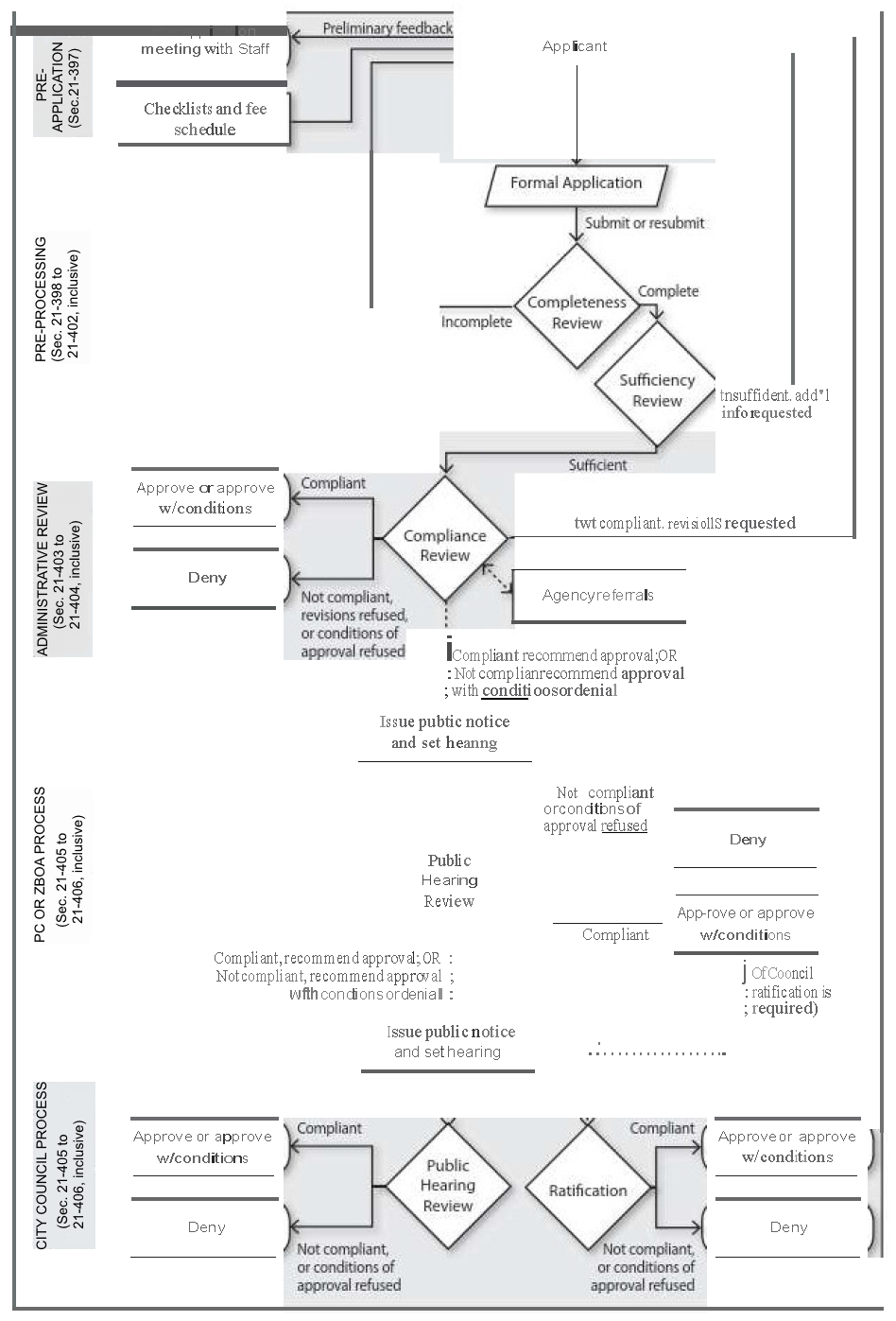
Process. The approval procedures set out in section 21-8-503 to section 21-8-512, inclusive, are undertaken in sequence until an application is considered and decided by the designated decision-maker for the type of application at issue. Table 21-8-501(b)(1), Standardized Procedures, lists the approval steps that are required, based on the decision-maker. Figure 21-8-501(b)(2), Standardized Procedures, illustrates the flow of application processing.
(c)
Special review types. The communications uses that are listed in Table 21-37(a), Utility and Communications Land Use Table, are subject to the standardized review procedures, as modified by section 21-8-521, special procedures for wireless telecommunications facilities.
FIGURE 21-8-501(b)(2)
STANDARDIZED PROCEDURES
(Ord. No. 33-2017, § 1, 12-6-17)
Sec. 21-8-502. - Ex parte communications.
(a)
Generally. It is the policy and practice of the city to decide applications only on the merits presented in the application, on-record public comments, and at public hearings (if public hearings are required). Therefore, ex parte communications are not allowed.
(b)
Timing. The prohibition on ex parte communications begins on the date of application and ends when the appeal period for an issued development order has expired.
(c)
Inadvertent communications.
(1)
It is not always possible to prevent ex parte communications. Elected and appointed officials who hear applications required by this UDC shall not privately discuss the merits of a pending application or appeal.
(2)
If a communication is received outside of the record (e.g., it is not in the application, agency comments, or public comments, nor was it presented at a noticed public hearing), then the official shall disclose the communication, including the speaker and the substance of the communication, on the record of the public hearing before the application is heard.
(3)
The decision-maker or recommending body must base its decision only on the evidence presented on the record. The contents of the ex parte communication shall not be considered part of the record for decision-making unless the information in the communication is also presented at the hearing (other than through the required disclosure).
(Ord. No. 33-2017, § 1, 12-6-17)
Sec. 21-8-503. - Pre-application meeting.
(a)
Generally. A pre-application meeting is an opportunity for the potential applicant to meet with city staff before filing an application, in order to:
(1)
Identify the applicable review procedures and likely timelines;
(2)
Review preliminary materials and identify potential issues and related information requirements; and
(3)
Identify what fees will be due, including whether an escrow payment will be required for professional consultant review.
(b)
When required. A pre-application meeting is required for all application types, except permits for signs, home occupations, and cottage industries. Informal meetings may be scheduled prior to a pre-application meeting, at the discretion of the administrator.
(c)
Meeting logistics.
(1)
The administrator is authorized, but not required, to establish a regular schedule for pre-application meetings.
(2)
Pre-application meetings may be conducted in person, by telephone, or by internet-based communication tools, as may be agreed between the potential applicant and the administrator.
(d)
Meeting materials. The potential applicant shall bring to (or submit prior to) the pre-application meeting sufficient supporting materials to explain, as applicable to the type of application to be submitted:
(1)
For all applications:
a.
The location of the project;
b.
The proposed uses (in general terms);
c.
The relationship of the proposal to existing development; and
d.
Any other conditions or items that the potential applicant believes are relevant to the processing of the application.
(2)
For applications that involve new construction:
a.
The proposed arrangement of buildings, parking, access points, open spaces, and drainage facilities (including water quality and stormwater detention facilities);
b.
The general locations and extent of natural or man-made hazards, irrigation ditches, open water, floodplains, and floodways on and adjacent to the subject property; and
c.
For subdivisions, the proposed general lot layout.
(3)
For applications that involve renovation, rehabilitation, or re-use of existing buildings:
a.
A brief history of the building; and
b.
The number of square feet of floor area affected by the application.
(4)
The administrator may request that the applicant bring completed application forms (in draft form) for the types of permits being sought.
(e)
Summary. Upon request by the potential applicant, within twenty-one (21) calendar days of the pre-application meeting, the administrator shall deliver to the applicant:
(1)
A checklist of submittal materials that will be necessary for the type(s) of application(s) sought; and
(2)
A copy of the city's application fee schedule.
(f)
Courtesy presentations. At the pre-application meeting, a potential applicant may request an opportunity to make a courtesy presentation of a proposed development concept or conceptual subdivision map in a design charrette process. Attendees may include appropriate staff, referral agencies, design professionals, and other persons identified by the administrator or the potential applicant.
(Ord. No. 33-2017, § 1, 12-6-17)
Sec. 21-8-504. - Application.
(a)
Generally. Every application for development approval required by this UDC shall be submitted on a form approved by the administrator, along with the corresponding application fee (fees are established by resolution of the city council). Unless waived by the administrator, all applications shall include electronic versions of all attachments in a format approved by the administrator.
(b)
Forms.
(1)
The administrator shall promulgate and periodically revise, as necessary, forms for each type of application required by this UDC. Minimum application requirements and provisions for waiving application requirements may be provided in an appendix to this UDC.
(2)
Application forms shall include the specific information that is required to process each type of application. The specific information requirements shall be established and periodically revised by the Administrator, and have the purpose of facilitating:
a.
The evaluation of applications for compliance with the standards of this UDC; and
b.
The administration of this UDC.
(3)
The administrator is authorized to establish a standardized format for each type of required submittal, and to allow deviations from the format in instances where the administrator finds that an alternative format would provide for more efficient review.
(c)
Schedule. The administrator is authorized, but not required, to establish regular intake days or times for any or all classifications of applications for development approval, except sign permits and administrative appeals.
(Ord. No. 33-2017, § 1, 12-6-17)
Sec. 21-8-505. - Application fees and escrows.
(a)
Generally. Fees shall be charged to offset the cost of application processing (including any application for amendments of existing approvals), reviews, public notices, hearings, document recording, and recordkeeping. Application fees to be charged by the city shall be established, from time to time, by resolution adopted by the city council.
(b)
Recording fees. Recording fees assessed by the Alamosa County Clerk and Recorder's Office shall be paid by the city at the time of any required recording.
(c)
Referral agency fees. The applicant may be required to pay any fees assessed by referral agencies in advance of their review and comment. Failure to obtain comments from referral agencies due to failure to pay review fees may result in delay or denial of an application.
(d)
Escrow for consultant review.
(1)
Consultant review authorized.
a.
The administrator is authorized to retain professional consultants at the applicant's expense to assist in the review of proposed development.
b.
The administrator may make an initial determination as to the use of consultants at the time of the pre-application meeting, and may revise the determination at the time of application if new or changed information in the application materials justifies the revision.
(2)
Initial escrow payment.
a.
If the administrator determines that an application will require review by professional consultants, then the applicant shall execute an escrow agreement in a form approved by the city attorney, and make an initial escrow payment in an amount sufficient to cover the estimated review costs.
b.
The administrator shall provide the applicant with a preliminary estimate of professional consultant review fees at a time established during the pre-application meeting by agreement with the applicant. Alternatively, the administrator may advise the applicant regarding the amount of a fixed-fee that has been established in advance for the type of application presented.
(3)
Use of escrow payment. The city may draw upon the escrow to pay the fees and expenses of professional consultants retained by the City to review the application.
(4)
Additional escrow funds. The administrator may require additional escrow funds to be paid for additional services related to the application, should they become necessary. If a balance is due at the time an application is approved, it shall be paid by the applicant as a condition of approval.
(5)
Return of escrow funds. Escrow funds shall be returned to the applicant as follows:
a.
If the administrator decides not to use consultants, then escrow funds shall be returned to the applicant within thirty (30) days of the decision.
b.
If the applicant withdraws the application, then the administrator shall notify the consultants to stop work within twenty-four (24) hours of the withdrawal. The administrator shall then return the escrow to the applicant, less the amount required to pay the consultant for work actually performed.
c.
When the application is decided, any positive escrow balance shall be returned to the applicant within sixty (60) days.
(6)
Account reports. Applicants shall be provided with a monthly accounting of the use of escrow funds.
(7)
Fixed-fee consultant review. The administrator is authorized to establish:
a.
A roster of consultants that are pre-qualified to conduct reviews of various types; and
b.
For routine application types with predictable review fees, a schedule of fixed-fees for consultant review.
(Ord. No. 33-2017, § 1, 12-6-17; Ord. No. 12-2021, § 7, 8-18-21)
Sec. 21-8-506. - Completeness review.
(a)
Generally. The administrator shall review all submitted applications for completeness. A complete application includes all of the materials required on the application forms, materials requested at the pre-application conference, any required professional certifications, and all fees and escrows that are required for application processing.
(b)
Schedule. Generally, all applications shall be reviewed for completeness within seven (7) calendar days after an application is submitted.
(c)
Incomplete applications.
(1)
Incomplete applications shall be returned to the applicant, along with any fee included with the application, with a written explanation that describes in general terms the materials that must be submitted in order to complete the application.
(2)
An application that does not include the applicable processing fee shall not be considered complete.
(3)
Incomplete applications are not considered filed.
(d)
Complete applications. Complete applications shall be processed according to the applicable procedures of this article.
(e)
Waiver of application information requirements. The administrator may waive any of the information requirements of a particular application type if it is obvious to the administrator that they do not relate to the processing of the application for which the waiver is requested. The administrator may not waive application fees.
(Ord. No. 33-2017, § 1, 12-6-17)
Sec. 21-8-507. - Sufficiency review.
(a)
Generally. All applications shall be technically sufficient for review, meaning that:
(1)
The application materials are internally consistent and are presented as required by this UDC and the applicable application forms.
(2)
Materials are prepared by qualified professionals (where such qualifications are required), and signatures and certifications are present, if required.
(3)
The application materials are technically sufficient (e.g., legal descriptions and calls and distances on surveys describe closed polygons within acceptable tolerances, calculations that are provided are performed according to the methodologies set out in this UDC, etc.) to demonstrate compliance with applicable standards of this UDC.
(b)
Insufficient applications.
(1)
An application is insufficient if it does not meet the standards of subsection (a), above.
(2)
If an application is determined to be insufficient, the administrator shall notify the applicant and provide a written explanation regarding the materials that must be submitted, or revisions that must be made, in order to continue processing the application.
(3)
The applicant shall provide the materials or revisions that are required to make the application sufficient within fourteen (14) days of the date of the notice.
(4)
If an applicant fails to submit the required materials within the time period specified in subsection (b)(3), above, or if the applicant fails to submit a sufficient application after three rounds of review, then the application fee shall be retained and the application shall be returned to the applicant as insufficient.
(c)
Sufficient applications. Technically sufficient applications shall be processed according to the applicable standards and procedures of this UDC.
(Ord. No. 33-2017, § 1, 12-6-17)
Sec. 21-8-508. - Stale applications.
(a)
Generally. This section is intended to extinguish applications that become stale due to inaction by the applicant.
(b)
Expiration of stale applications. When an action by the applicant is required for further processing of an application (for example, if revisions are requested after agency referrals), the application shall become void:
(1)
Six (6) months after the date that the action is requested if the applicant either fails to take action or fails to request an extension of time pursuant to subsection (c) below; or
(2)
Upon failure to timely provide requested information to make an application technically sufficient pursuant to section 21-8-507.
(c)
Extension of time. The time for expiration of an application may be extended by up to six (6) additional months upon written request of the applicant before the end of the period set out in subsection (b), above.
(Ord. No. 33-2017, § 1, 12-6-17)
Sec. 21-8-509. - Administrative review.
(a)
Generally. Upon determination that an application is complete and sufficient, the administrator shall cause the application to be reviewed for technical compliance with all applicable requirements of this UDC, as follows:
(1)
Appropriate city staff or consultants shall review the application; and
(2)
The application shall be promptly referred to applicable referral agencies and individuals for review and comment pursuant to section 21-8-510.
(b)
Recommended revisions.
(1)
The administrator shall provide comments from city staff or consultants (collectively, "staff comments"). The staff comments shall provide staff or consultant input and address or include comments by referral agencies and interested individuals. The applicant shall revise and resubmit the application with appropriate changes based on staff comments, and with responses to staff comments that did not result in changes to the application.
(2)
Upon receipt of the re-submittal, the administrator may refer the application to referral agencies again if the changes substantially affect the interests of the agency in ways not anticipated by the agency's original comments (or lack thereof), or require the agency's technical expertise for appropriate review.
(3)
The re-submittal shall not require an application fee unless both of the following conditions are met:
a.
The revisions are inappropriate or incomplete; and
b.
Repeated failure to address comments requires more than three (3) rounds of revisions.
(c)
Administrative recommendation, decision, or referral. Promptly after determination that a complete application addresses the comments and recommendations provided pursuant to subsection (b), above (or, after finding that no revisions will be required):
(1)
If the application is for an administrative approval or permit, then the administrator shall:
a.
Approve, approve with conditions, or deny the application, as appropriate; or
b.
Upon a determination that the development, as proposed, may have material impacts on neighboring properties or city resources that are unusual in kind or degree, or that there is material potential for disagreement regarding whether the application complies with the standards of this UDC, the administrator may refer the application to the planning commission for review and recommendation and city council for decision, according to the applicable standards of this UDC.
(2)
If the application is for a public hearing approval or permit, then the Administrator shall make a recommendation regarding the application and forward the recommendation and the application materials and referral comments to the next body that will consider it for further recommendation or approval.
(d)
Meeting logistics.
(1)
If the application is for a public hearing approval or permit, then the administrator shall set the application on the agenda of the next body that will consider the application.
(2)
Generally, the application shall be heard during the next regular meeting of the body which meets the following two (2) conditions:
a.
There is sufficient time to meet applicable public notice requirements; and
b.
There is available room on the agenda.
(3)
The administrator shall coordinate with recommending and decision-making bodies to fix reasonable times for hearings. Said bodies are authorized to convene special meetings to hear applications as they determine appropriate.
(4)
The administrator, or a designee, shall notify the applicant regarding the time and place of the public hearings.
(Ord. No. 33-2017, § 1, 12-6-17)
Sec. 21-8-510. - Referrals.
(a)
Generally. Applications may be referred for additional review by agencies or consultants according to the procedures set out in this section.
(b)
Inter-jurisdictional referrals.
(1)
As part of the review process, the city may seek review and comment by referral agencies that have expertise in the subject matter impacted by the application, that have jurisdiction over one or more aspects of the proposed development, or whose operations will likely be affected by the proposed development. Referral agency comments are advisory to the city.
(2)
The administrator may refer an application to any agency, jurisdiction, ditch company, land management entity, utility, or department that the administrator determines is likely to be materially affected by the application. The administrator's determination regarding referrals is not appealable.
(3)
The agency referral period is twenty-one (21) calendar days, which can be extended by up to thirty (30) additional days by mutual consent of the applicant and the administrator.
(4)
Failure of an agency to respond within the prescribed time period (or extended period) is interpreted as consent by that agency to the contents of the application. However:
a.
Such consent does not waive the authority of agencies which have concurrent jurisdiction with the city; and
b.
Such consent is not implied if the applicant fails to pay the agency's required review fees.
(c)
Consultant review. Upon notice to the applicant, the administrator may refer the application to consultants selected by the city, in order to obtain technical review and recommendations. The cost of such referrals shall be borne by the applicant.
(Ord. No. 33-2017, § 1, 12-6-17)
Sec. 21-8-511. - Public notice.
(a)
Generally. For applications that require public notice, public notice shall be provided according to the standards of this section.
(b)
Contents of public notice. Public notice shall include the following elements:
(1)
The phrase "Public Notice" at the top of the notice.
(2)
A brief description of the type of application (e.g., rezoning from zone X to zone Y).
(3)
The date, time, and place of the hearing.
(4)
A brief summary of what the applicant is requesting (e.g., approval of a ten thousand (10,000) square foot commercial retail development).
(5)
The physical address of the subject property, or if an address is not available, a location map of the property or a statement that the legal description is on file with the administrator.
(6)
A notice that interested persons may obtain more information from the administrator.
(7)
Contact information for the administrator.
(c)
Types of public notice. Table 21-8-511(c), Types of Public Notice, sets out standardized requirements for publication, posting, and mail notice that are used for different application types and different phases of the application process. The types of notice that are set out in the table are used to establish notice requirements for each type of application in Table 21-8-511(d), Required Public Notice by Application Type.
(d)
Type of public notice required by application type. Table 21-8-511(d), Required Public Notice by Application Type, sets out the notices that are required at each state of processing for each type of application for which notice is required.
(e)
Standards for required notices.
(1)
Publication. Published notice shall be printed in a newspaper of general circulation in the City of Alamosa.
(2)
Posting. Posted notice shall be on a sign in a form approved by the city.
(3)
Mail. Mailed notice shall be delivered via first class U.S. Mail.
(f)
Optional notices.
(1)
Electronic mail. Electronic mail notice may be delivered to an opt-in distribution list that is created for the purpose of notifying people about applications for approvals and permits in the city. Electronic mail notice shall include the subject line "PUBLIC NOTICE OF PROPOSED DEVELOPMENT," and the statement in the body of the e-mail that "Electronic mail notice is provided as a courtesy to opt-in subscribers. Failure of an e-mail communication to reach a subscriber does not constitute failure of public notice."
(2)
Internet. Internet notice may be posted on the official web site of the city, on a page or pages that are designated for such notices. However, internet notice is also provided as a courtesy and is not official notice. Therefore, failure of internet notice shall not constitute a failure of public notice.
(Ord. No. 33-2017, § 1, 12-6-17; Ord. No. 4-2020, § 3, 2-19-20)
Sec. 21-8-512. - Public meetings and public hearings.
(a)
Generally. Public meetings and public hearings shall be carried out in accordance with the procedural rules of the body conducting the meeting or hearing.
(b)
City council ratification.
(1)
Decisions that require city council ratification shall be placed on the next available consent agenda of the city council after the planning commission meeting at which the approval was granted.
(2)
Prior to the council meeting, the administrator shall forward the materials that were considered by the planning commission and a summary of the decision by the planning commission to the city council.
(3)
Notwithstanding any code or policy provision to the contrary, decisions may be removed from the consent agenda only by majority vote. If an item is removed from the consent agenda, the city council may ask questions of the administrator, and may thereafter ratify the decision or place it on the next available city council agenda for public hearing.
(4)
The administrator shall promptly notify the applicant regarding the city council's decision.
(5)
Council review of a decision at public hearing shall be de novo.
(Ord. No. 33-2017, § 1, 12-6-17; Ord. No. 15-2022, § 19, 7-20-22)
Sec. 21-8-513. - Continuances and withdrawal.
(a)
Continuances. Requests for continuance by the applicant of any proceeding called for in this UDC may be granted at the discretion of the body holding the public meeting or public hearing. If granted, the Applicant shall pay all additional costs associated with the rescheduling of the proceeding.
(b)
Withdrawal. Any application may be withdrawn, either in writing or on the record, prior to or during the meeting or hearing at which the application is considered, provided that it is withdrawn before official action is taken on the application.
(Ord. No. 33-2017, § 1, 12-6-17)
Sec. 21-8-514. - Successive applications.
(a)
Generally. It is the policy of the city not to hear successive applications for the same approval or permit after a substantially similar application is denied. The limitations of this section prevent the consideration of successive applications.
(b)
Time required between substantially similar applications. If an application for a permit or approval is denied, a substantially similar application will not be accepted for:
(1)
Six (6) months from the date of denial in the case of administrative permits; and
(2)
Twelve (12) months from the date of denial for all other permits or approvals.
(c)
Exceptions to successive application restrictions. The administrator may allow exceptions to this section if there has been a material change of circumstances that justifies consideration of a substantially similar application. By way of example and not limitation:
(1)
If a spacing requirement was the reason for the denial, and the use from which spacing is required moved away; or
(2)
If a subsequent amendment to this UDC now allows for approval of the application.
(Ord. No. 33-2017, § 1, 12-6-17)
Sec. 21-8-515. - Recording of approvals.
(a)
Generally. The following permits and approvals shall be recorded in the public records of Alamosa County at the applicant's expense:
(1)
Annexation agreements, maps, and ordinances;
(2)
Final plats;
(3)
Preliminary development plans;
(4)
Final development plans;
(5)
Conditional use approvals;
(6)
Development agreements, public improvements agreements, and reimbursement agreements.
(7)
Variances.
(b)
Timing.
(1)
Upon approval of a final plat, preliminary development plan, or final development plan, the applicant shall provide final mylar drawings to the administrator within ninety (90) days for execution by the city and recording.
(2)
The final mylar drawings shall include:
a.
All required signatures except those to be provided by the city; and
b.
All modifications that were required as conditions of approval.
(3)
Failure of an applicant to timely submit a conforming plan to the administrator shall, upon the enactment of a resolution by the city council finding that the submittal was untimely, void the approval.
(Ord. No. 33-2017, § 1, 12-6-17; Ord. No. 12-2021, §§ 8, 9, 8-18-21)
Sec. 21-8-516. - Effect of approvals.
(a)
Generally. It is the intent of the city that development approved pursuant to this UDC be carried out in a timely manner pursuant to the specifications, terms, and conditions of approval; and that the steps within each approval process be carried out with diligence.
(b)
Effect of approval or permit.
(1)
Approval of an application means that the city consents to the particular use, plan, or other specific activity for which the approval was granted. Physical development of land may require a sequence of related (and increasingly detailed) approvals.
(2)
Supplemental materials that are provided in support of an approval become part of the approval (e.g., elevations, lists of building materials, etc.) unless otherwise noted in the approval itself.
(3)
Approvals and permits may be transferred to a subsequent owner of the property for which the approval or permit was issued, unless the approval or permit is specifically designated as non-transferable by condition of approval. Transferred permits shall continue to be valid for their full original terms, and the transferee may apply for an amendment to the approval or permit in the same manner as the original applicant.
(Ord. No. 33-2017, § 1, 12-6-17)
Sec. 21-8-517. - Duration of approvals.
(a)
Administrative approvals. The administrative approvals described in Table 21-8-202(b), Administrative Approvals and Permits, except a final plat or development agreement, shall be valid for one (1) year from the date of approval.
(b)
Discretionary approvals. Discretionary approvals will lapse and be of no further force or effect if a complete application for the next stage of approval is not filed before the deadline set out in this subsection:
(1)
The discretionary approvals described in Table 21-8-203(b), Discretionary Approvals and Permits, shall lapse as follows:
a.
One (1) year from date of approval:
1.
Conditional use permit.
2.
Variance.
b.
Two (2) years from date of approval:
1.
Certificate of designation.
2.
Preliminary plat.
3.
Preliminary development plan.
c.
Three (3) years from date of approval:
1.
Final development plan.
(c)
Development agreements. A development agreement is valid for the term set out in the development agreement.
(d)
Approvals that do not lapse. Rezonings, vacations or abandonments of easements or rights-of-way, UDC text amendments, comprehensive plan amendments, recorded final plats, and administrative appeals do not lapse.
(Ord. No. 33-2017, § 1, 12-6-17)
Sec. 21-8-518. - Extensions of approvals.
(a)
Generally. The term of permits and approvals may be extended by written request according to the standards and procedures of this section.
(b)
Timing of application for extension. Expired permits and approvals cannot be extended. Written requests for extensions shall be received not later than thirty (30) days prior to the expiration of the permit or approval. Untimely requests for extensions will not be granted unless it is demonstrated that extraordinary circumstances (e.g., an unusual severe weather event) justify the request.
(c)
Extensions for extraordinary circumstances. The city council may, by resolution, extend the term of all permits and approvals city-wide or in designated areas of the city in response to extraordinary circumstances, such as flood, wildfire, tornado, or other natural or man-made disaster which makes it temporarily infeasible to commence or continue with construction. The period of such extensions shall be determined by the city council.
(d)
Administrative extensions. Unless otherwise provided in the permit or approval, the administrator may grant one extension of any permit or approval for a period not to exceed the original term or eighteen (18) months, whichever is shorter. Such extensions may be granted upon timely written request with good cause shown.
(e)
Extensions after hearing.
(1)
Unless otherwise provided in the permit or approval, a hearing is required for:
a.
Extensions for terms that are longer than those which can be granted by the administrator pursuant to subsection (d), above; and
b.
Second (and subsequent) extensions.
(2)
Extensions of discretionary permits and approvals pursuant to this subsection shall be heard by the body that granted the original approval. Extensions of administrative permits and approvals pursuant to this subsection shall be heard by the board of adjustment.
(3)
Extensions may be granted after hearing if it is demonstrated that:
a.
There is good and reasonable cause for the request; and
b.
The applicant has provided reasonable assurances that it will perform (or cause to be performed) the work authorized by the permit or approval within the extended term.
(f)
Extensions pursuant to permit or approval terms. If a method of extension is provided within a permit, or approval, or related development agreement between the applicant and the city, then such method of extension shall supersede this section with respect to said permit or approval.
(g)
Effect of appeals, litigation, or mediation.
(1)
If there is an appeal, litigation, or mediation during the time period that limits the applicant's ability to use or develop land pursuant to a permit or approval granted by the city, then the term of the permit or approval shall be tolled for the duration of the appeal, litigation, or mediation, and the date shall be recalculated upon conclusion of the appeal, litigation, or mediation.
(2)
The new expiration date shall be established by adding the number of days that the approval would have remained valid before the appeal, litigation, or mediation commenced to the date the appeal, litigation, or mediation was concluded by:
a.
The expiration of the subsequent appeal period after final judgment or order in the initial appeal or litigation, or, if no appeal is available, after issuance of the final judgment or order; or
b.
The termination of mediation by resolution of the conflict or impasse.
(3)
This subsection does not apply to litigation which is related to enforcement of a violation of this UDC.
(Ord. No. 33-2017, § 1, 12-6-17)
Sec. 21-8-519. - Correction of approvals.
(a)
Generally. Permits and approvals may be corrected pursuant to this section.
(b)
Correction of recorded final plats. If it is discovered that there is a minor survey or drafting error in a recorded final plat, a request, in writing, to record a corrected plat shall be submitted to the administrator. The request shall be accompanied with an affidavit witnessed by a professional land surveyor. The surveyor witnessing this corrected plat shall be an impartial observer having no personal interest in the platted land. The administrator shall thereupon record the corrected plat at the applicant's expense.
(c)
Correction of scrivener's errors. Development approvals other than final plats may be corrected by the administrator or upon application to the administrator as follows:
(1)
Generally. The administrator may approve an application to reform a scrivener's error in a development approval, including an error in an application or notice, which error causes the permit or approval to inaccurately reflect the decision-maker's intent, and where it is demonstrated that:
a.
The correction does not include a change of judgment, policy, or prior intent of the decision-maker;
b.
The reformation of the permit or approval is essential to ensure that the documentation reflects the intent and decision of the decision-maker;
c.
The record, including, but not limited to, the staff recommendation, minutes, and motion, evidences the clear intent of the decision-maker;
d.
The substance of the decision was clearly evident at the time of the decision, and there was no intent to deceive the public or the decision-maker on the part of the current applicant at any time;
e.
Failure to approve the reformation would lead to an unjust result;
f.
The error in the development approval did not mislead anyone in a way that would cause them to be prejudiced by the reformation; and
g.
Any errors related to public notice did not affect the legal sufficiency of the required notice.
(2)
Correction within thirty (30) days. In the alternative, the administrator, within thirty (30) days of the decision on an application for development approval, may correct a clerical or scrivener's error in the development approval if:
a.
The error is not related to public notice;
b.
The error causes the approval, as written, to inaccurately reflect the clear decision of the decision-maker; and
c.
The administrator promptly notifies the applicant and the decision-maker regarding the corrections.
(d)
Effect on approval. A permit or approval that is modified pursuant to this section shall relate back to the date of the corrected approval, such that the effective date of the corrected language shall be deemed to be the same as the effective date of the original approval.
(Ord. No. 33-2017, § 1, 12-6-17)
Sec. 21-8-520. - Vacation of easements, rights-of-way, or plats.
(a)
Generally. Easements or rights-of-way that are granted to the city by deed, agreement, or final plat may be vacated as provided in this section.
(b)
Administrative vacation. The administrator may:
(1)
Vacate the city's interest in an easement or right-of-way if:
a.
The easement or right-of-way is not for roadway purposes;
b.
The city does not have a fee-simple interest in the right-of-way;
c.
The easement or right-of-way has not been put to use for its intended purpose;
d.
The easement or right-of-way is not necessary to provide services or non-vehicular access to property other than the subject property, or there are reasonable alternative ways to provide such services or public access; and
e.
The easement or right-of-way is intended to serve or provide non-vehicular access to development for which related approvals have lapsed or been abandoned.
(2)
Vacate a platted or recorded public utility dedicated to and accepted by the City of Alamosa in a form approved by the city attorney if:
a.
The easement has not been put to use for its intended purpose, or such purpose appears to have been abandoned;
b.
The easement is not necessary to provide services to any property or properties, or there are reasonable alternative ways to provide such services;
c.
The administrator has sent notice of the intention to vacate said easement to the registered agent of each public utility company by certified mail; and
d.
The administrator has not received an objection to the vacation from any public utility company within thirty (30) days.
(c)
City council vacation. The city council may by ordinance vacate the city's interest in an easement or right-of-way, or vacate a plat, if it finds:
(1)
The statutory requirements of C.R.S. § 43-2-301, et seq. are met if the easement or right-of-way is for roadway purposes, or if platted roadways are affected;
(2)
The vacation does not conflict with adopted plans;
(3)
The vacation does not landlock any parcel of land or restrict the access such that it is unreasonable or economically prohibitive;
(4)
The vacation will not result in adverse impacts on the health, safety, or welfare of city residents and business owners, or reduce the quality of public facilities or public services (including emergency response services) provided to any parcel of land.
(Ord. No. 33-2017, § 1, 12-6-17; Ord. No. 15-2023, § 7, 8-16-23)
Sec. 21-8-521. - Special procedures for wireless telecommunications facilities.
(a)
Generally. The procedures of this section apply to communications uses that are listed in Table 21-2-207(a), Utility and Communications Land Use Table.
(b)
Shot Clock. The Federal Communications Commission has established mandatory time frames for review of different types of applications for the communications uses that are listed in Table 21-2-207(a), Utility and Communications Land Use Table.
(1)
The "shot clock" commences at the time the application is filed, whether the application is complete or not. With respect to communications uses, subsection 21-8-507(b) and (c), are modified as follows:
a.
The city shall respond to the applicant with regard to whether the application is complete within thirty (30) days after it is filed. The notice from the CITY shall specifically delineate all missing information, and specify the code provision, ordinance, application instruction, or other publicly-stated procedure that requirements the information. Such determination of incompleteness tolls the "shot clock."
b.
Applications that are incomplete shall be retained by the city.
c.
The city shall evaluate a resubmittal for completeness and respond to the applicant within ten (10) days.
1.
If the city requests information that had previously been identified in the notice issued pursuant to subsection (c)(1)a., above, the "shot clock" shall be tolled again.
2.
If the city requests additional information that was not identified in the notice, the shot clock shall continue to run.
(2)
The "shot clock" concludes:
a.
One hundred fifty (150) days after commencement for new installations that are regulated by 47 U.S.C. § 332(c)(7).
b.
Ninety (90) days after commencement for substantial changes to existing installations (e.g., co-locations that are not subject to 47 U.S.C. § 1455).
c.
Sixty (60) days after commencement for "eligible facilities" as defined in 47 U.S.C. § 1455.
(3)
In addition to the tolling that occurs under subsection (c)(1), the "shot clock" may be tolled by agreement with the applicant.
(c)
Approval of application. Approvals shall be in writing and shall specify all design elements that are intended to conceal the wireless telecommunications facility.
(d)
Denial of application. Denials shall be in writing and shall specify the reasons for denial, including reference to substantial evidence in the record that supports the denial.
(Ord. No. 33-2017, § 1, 12-6-17)
Sec. 21-8-522. - Special procedures for water projects for export outside the San Luis Valley.
Land use applications that involve water projects or any portions thereof intended to export water out of the San Luis Valley shall be governed by the provisions of Chapter 17 of this Code, "Guidelines and Regulations for Water Projects for Export Outside the San Luis Valley as Designated as Matters of State Interest of the City of Alamosa."
(Ord. No. 6-2024, § 2, 4-17-24)
Sec. 21-8-601. - Applications.
(a)
Generally. Except as otherwise provided in subsection (b) below, an application for approval of a site-specific development plan, as well as the approval, conditional approval or denial of approval of the plan, shall be governed only by the land use regulations in effect at the time an application is submitted to the city. For the purposes of this Section, land use regulations include this UDC, as well as any zoning or development regulations that have previously been adopted that apply to the subject property and that remain in effect at the time of the application for approval of the plan.
(b)
Exceptions. Notwithstanding the limitations contained in subsection (a) above, the city council may adopt a new or amended regulation when necessary for the immediate preservation of public health and safety and may enforce such regulation in relation to applications pending at the time such regulation is adopted.
(Ord. No. 33-2017, § 1, 12-6-17)
Sec. 21-8-602. - Vested property rights; establishment.
(a)
Site specific development plans. The following types of site-specific development plan approvals will establish vested property rights in accordance with Article 68, Title 24, C.R.S.:
(1)
Final planned unit development ("PUD") plan.
(2)
Final subdivision plat.
(3)
Conditional use permit.
(4)
Development agreement.
(b)
Other approvals; additional vested development rights. A development agreement may provide for vesting of additional development rights, or for a longer vesting period than provided for in Article 68, Title 24, C.R.S. Such a development agreement may be part of a final PUD, final subdivision, or conditional use permit approval, or a development agreement may provide for vesting rights in additional types of site-specific development plans than those specified above, including but not limited to annexation agreements.
(c)
Establishment of vested rights. A vested property right shall be deemed established with respect to any property upon the approval or conditional approval by resolution or ordinance of a site-specific development plan establishing vested right, following notice and public hearing.
(d)
Effect of vested rights. A vested property right shall attach to and run with the subject property and shall confer upon the landowner the right to undertake and complete the development and use of said property under the terms and conditions of the site-specific development plan or development agreement, including any amendments thereto.
(Ord. No. 33-2017, § 1, 12-6-17)
Sec. 21-8-603. - Notice of hearing and decision; form of approval.
(a)
Generally. No site-specific development plan which establishes a vested property right shall be approved unless and until notice thereof has been given and a public hearing thereon has been conducted.
(b)
Timing of notice of public hearing. At least fourteen (14) days' notice of the time and place of the hearing shall be published in a newspaper of general circulation in the city. Notice of said public hearing shall include language stating that the approval or conditional approval of the site-specific development plan will create a vested property right.
(c)
Form of approval. Final approval from the city council shall be by ordinance or resolution. A site-specific development plan shall be deemed approved on the effective date of the approving ordinance or resolution.
(Ord. No. 33-2017, § 1, 12-6-17)
Sec. 21-8-604. - Notice of final approval.
(a)
Generally. Approval of vested rights shall be subject to all rights of referendum and judicial review; except that the period of time permitted by law for the exercise of such right to referendum or judicial review shall not begin to run until the date of publication, in a newspaper of general circulation within the city, of the notice specified in this Section advising the general public of the site-specific development plan approval and creation of a vested property right pursuant to Title 24, Article 68, C.R.S.
(b)
Notice of final approval. As soon as practicable following the date a site-specific development plan is approved, and not later than fourteen (14) days following such approval date, the city clerk shall cause a notice to be published advising the general public of the site-specific development plan approval and creation of a vested property right pursuant to Article 68, Title 24, C.R.S. Such notice shall be substantially in the following form:
(Ord. No. 33-2017, § 1, 12-6-17)
Sec. 21-8-605. - Requirements of ordinance or resolution.
Any ordinance or resolution approving a site-specific development plan shall, but not by way of limitation, include the following provisions, unless expressly exempted by the city council:
(1)
The rights granted by the site-specific development plan shall remain vested for a period of three years (or such longer period as may be established in a development agreement) from the effective date of the approval. However, any failure to abide by any of the terms and conditions attendant to the approval shall result in the forfeiture of said vested property rights. Failure to properly record all plats and agreements required of the developers to be recorded by city ordinance shall also result in the forfeiture of said vested property rights.
(2)
The approval granted hereby shall be subject to all rights of referendum and judicial review, except that the period of time permitted by law for the exercise of such rights shall not begin to run until the date of publication provided for in UDC § 21-8-604.
(3)
Zoning that is not part of the site-specific development plan approved hereby shall not result in the creation of a vested property right.
(4)
Nothing in this approval shall exempt the site-specific development plan from subsequent reviews and approvals required by this approval or the general rules, regulations and ordinances of the city, provided that such reviews and approvals are not inconsistent with this approval.
(5)
The establishment of a vested property right shall not preclude the application of ordinances or regulations which are general in nature and are applicable to all property subject to land use regulations by the city, including but not limited to building, fire, plumbing, electrical, and mechanical codes. In this regard, as a condition of this site-specific development approval, the applicant shall abide by any and all such applicable building, fire, plumbing, electrical, and mechanical codes, unless an exemption therefrom is granted in writing.
(Ord. No. 33-2017, § 1, 12-6-17)
Sec. 21-8-606. - No rights created.
Nothing in this division is intended to create any vested property right other than those that are available to applicants pursuant to the provisions of the Vested Rights Statute (Article 68, Title 24, C.R.S.) In the event of the repeal or invalidation of the Vested Rights Statute, this division shall be deemed to be repealed and the provisions hereof no longer effective.
(Ord. No. 33-2017, § 1, 12-6-17)
Sec. 21-8-607. - Exceptions.
A vested property right, once established by this approval, shall preclude any zoning or land use action by the city or pursuant to an initiated measure which would alter, impair, prevent, diminish or otherwise delay the development or use of the property as set forth in the site-specific development plan, except:
(1)
With the consent of the applicant;
(2)
Upon the discovery of natural or man-made hazards on or in the immediate vicinity of the property, which hazards could not reasonably have been discovered at the time of this approval, and which hazards, if uncorrected, would pose a serious threat to the public health, safety and welfare; or
(3)
To the extent that compensation is paid as provided in Article 68, Title 24, C.R.S.
(Ord. No. 33-2017, § 1, 12-6-17)
Sec. 21-8-701. - Administrative modifications.
(a)
Purpose. The purpose of an administrative modification is to provide an efficient process for minor change to permits or approvals, including those related to site plans, preliminary plans, and planned unit developments, provided that the changes do not substantially alter the approved development parameters.
(b)
Range of administrative flexibility. The items listed in this subsection qualify for an administrative amendment within the ranges specified. If an item does not qualify as an administrative amendment, it is considered a major change and must be processed in the same manner as a new application. The administrator may approve:
(1)
Floor area. Up to a ten (10) percent increase in nonresidential floor area for any institutional, commercial or industrial development (including planned unit development). The increase is limited to hallways, stairways, restrooms, and storage, or a proven necessity for the operational safety of the project. An amended floor plan shall accompany the final application and be included as a part of the approved documents.
(2)
Building height. An increase in building height up to twenty (20) percent, provided that adequate fire protection is available, and the height increase will not unreasonably affect single-family detached or duplex lots within one hundred fifty (150) feet.
(3)
Building spacing. A reduction up to ten (10) percent for the minimum distance between buildings within the development. However, the reduction shall not authorize a violation of applicable building or fire codes.
(4)
Building setbacks. A reduction in building setbacks as provided in section 21-4-402, setback flexibility.
(5)
Building footprints.
a.
A ten (10) percent increase in the area of building footprints. However, this shall not reduce required open space or landscape surface to less than the minimum applicable requirements of this UDC (or approved planned unit development), nor reduce parking or setbacks, nor increase the maximum height or density from those approved.
b.
A reduction in building footprints.
c.
Relocation of building envelopes or footprints, provided that the relocation does not change any of development restrictions that are set out in the permit or approval, and an analysis of impacts to the originally approved drainage study demonstrate that there will be no material negative impact on drainage.
(6)
Open space or landscape surface. An increase in open space or landscape surface.
(7)
Public improvements. Changes to the specifications of public improvements, provided that the changes are consistent with current city requirements.
(8)
Lighting, landscaping, trash disposal. Changes to lighting, landscaping, or trash disposal areas, provided that the changes are consistent with the requirements of this UDC.
(c)
Specific exclusions. The following are not eligible for approval as an administrative modification under any circumstances:
(1)
Addition of new land uses to the list of approved uses in a planned unit development;
(2)
An increase in residential density;
(3)
An application that requires additional right-of-way dedications, vacations of public improvements, or modification of an existing development agreement or improvements agreement;
(4)
A transfer of density from one development phase to another, or from one site to another (where density by area or phase is specified on an approved development plan);
(5)
Increases of building height of more than twenty (20) percent; and
(6)
Subdivision related changes (such as lot lines, easements, rights-of-way, internal roadways, vacations and / or drainage systems) that require a replat or plat correction.
(d)
Decision.
(1)
The applicant shall submit required application materials, along with a letter of intent that details how the proposed modification meets the applicable amendment criteria set out in subsection (e), below.
(2)
The administrator will make a determination as to the proposal's eligibility to be processed administratively.
(3)
The administrator may refer any request for an administrative amendment to the planning commission for consideration at a regular meeting. The administrator will notify the applicant if it is determined that planning commission review will be required.
(e)
Approval criteria. Administrative modifications shall meet the following criteria:
(1)
The modification implements or does not reduce the potential for implementation of the comprehensive plan;
(2)
The modification is consistent with the efficient development and preservation of the development approval or permit;
(3)
The modification will not adversely affect reasonable development expectations or the use and enjoyment of adjacent land or the public interest;
(4)
The modification is in keeping with the spirit and intent of this UDC and will not weaken the purposes of the regulations; and
(5)
The modification will not adversely affect the public health, safety, and welfare.
(f)
Conditions. The administrator may impose conditions of approval that will secure substantially the objectives of the standard that is modified, and that will substantially mitigate potential adverse impacts on the environment or on adjacent properties, including but not limited to additional landscaping or buffering.
(g)
Major modifications and amendments. Modifications and amendments that are not authorized by this Section shall be processed in the same manner as a new application for permit or approval.
(Ord. No. 33-2017, § 1, 12-6-17)
Sec. 21-8-702. - Variances.
(a)
Subdivision and planned unit development plan variances. The planning commission may authorize variances from provisions of this UDC that apply to a proposed subdivision or planned unit development plan in cases where, due to exceptional topographical conditions or other conditions peculiar to the subject property, an unnecessary hardship is placed on the applicant. Such variances shall not be granted if it would be detrimental to the public good or impair the intent and purposes of this UDC. The variance shall be in keeping with the intent of the comprehensive plan.
(b)
Other variances. The board of adjustment may grant or deny variances from the provisions of this UDC when:
(1)
The strict application of this UDC would result in peculiar and exceptional practical difficulties to, or exceptional and undue hardship upon, the owner of such property;
(2)
The relief may be granted without substantial detriment to the public good and without substantially impairing the intent and purpose of this UDC;
(3)
There are unique physical circumstances or conditions such as exceptional irregularity, narrowness, or shallowness of a specific piece of property at the time of the enactment of this UDC, or by reason of exceptional topographic or other physical conditions, or other extraordinary and exceptional situation or condition peculiar to the affected property;
(4)
That the unusual circumstances or conditions do not exist throughout the neighborhood or zone in which the subject property is located;
(5)
That because of such physical circumstances or conditions, the subject property cannot reasonably be developed in conformity with the provisions of this UDC;
(6)
That such unnecessary hardship has not been created by the applicant;
(7)
That the variance, if granted, will not alter the essential character of the neighborhood or zone in which the property is located, nor substantially or permanently impair the appropriate use or development of adjoining property;
(8)
That the variance, if granted, is a minimum variance that will afford relief and is the least modification possible of the provisions which are in question.
(c)
Referral to planning commission. The zoning board of adjustment may request a recommendation from the planning commission to assist it in determining if the above requirements have been satisfied. Further, the zoning board of adjustment may require that a special variance application form be completed by the appellant to ensure that the appellant fully understands the criteria on which the board must base its findings.
(d)
Prohibitions. The zoning board of adjustment may not grant variances from the provisions of this UDC covering the use or density of land or buildings, or the provisions governing planned unit developments. In granting any variance, the zoning board of adjustment may attach such reasonable conditions and safeguards as it may deem necessary to implement the purposes of this UDC.
(Ord. No. 33-2017, § 1, 12-6-17; Ord. No. 12-2021, § 10, 8-18-21)
Sec. 21-8-703. - Administrative appeals.
(a)
Hearings, appeals and notices.
(1)
Appeals to the board of adjustment may be taken by any person aggrieved by any administrative decision based upon or made in the course of the administration or enforcement of the provisions of this UDC.
(2)
Any such an appeal must be made, within twenty-one (21) days from the date the administrative decision was communicated to the applicant, which shall be the date of emailing or hand delivery, or, if the decision was communicated by mail only, three (3) days from the date of mailing. The form or any other procedure relating thereto, shall be as specified in any rules of procedure adopted by the board of adjustment, but shall in any event comply with the provisions concerning the notice of appeal set forth below.
(b)
Notice of appeal. The appellant shall file with the board of adjustment a notice of appeal specifying the grounds thereof, with a copy to the administrator. The administrator shall promptly forward all papers constituting the record of action upon which the appeal was taken to the board of adjustment.
(c)
Notice of hearing. Upon receipt of the notice of appeal and record, the board of adjustment shall place the hearing of the appeal at the next available regularly scheduled meeting, which shall be not less than seven (7) days from the filing of the notice of appeal. A notice of the hearing shall be provided as set out in Section 21-8-511, public notice, and written notice shall also be sent by first class mail to the party appealing and the owner of the property that is the subject of the appeal.
(d)
Hearing procedure. At the hearing, any party may appear in person or by agent or attorney. The board of adjustment may affirm, reverse (wholly or partly), or modify the order, requirement, decision or determination appealed and may make such order, requirement, decision or determination as in their opinion ought to be made in the premises, and to that end shall have all powers of the officer from whom the appeal is taken.
(e)
Decision. The concurring vote of four (4) members of the board of adjustment shall be necessary to reverse any order, requirement, decision or determination of an administrative official or agency.
(Ord. No. 33-2017, § 1, 12-6-17; Ord. No. 15-2022, § 11, 7-20-22)

