
Alexandria City Zoning Code
ARTICLE II
- DEFINITIONS
Sec. 2-100 - Definitions.
For the purposes of this ordinance, the following words and phrases shall have the meaning assigned below, except in those instances where the context clearly indicates a different meaning.
2-101 - Abandonment.
To stop the use of property intentionally. When the use of a property has ceased and the property has been vacant for 12 months, abandonment of use will be presumed unless the owner can show that a diligent effort has been made to sell, rent or use the property for a legally permissible use. For the effect of abandonment on a noncomplying or nonconforming use, see Article XII.
2-102 - Abutting property.
All property that touches the property in question and any property that directly faces (and, in the case of a corner lot, diagonally faces) the property in question.
2-105 - Addition.
Any construction which increases the area or cubic content of a building or structure. The construction of walls which serve to enclose completely any portion of an existing structure, such as a porch, shall be deemed an addition within the meaning of this title.
2-107 - Alley.
A public or private right-of-way primarily designed to afford access to the side or rear of properties whose principal frontage is on a street.
2-108 - Alteration, nonstructural.
Any change in a structure or building other than a structural alteration.
2-109 - Alteration, structural.
Any change in the supporting members of a building such as bearing walls, columns, beams or girders, excepting such alterations as may be required for the safety of the building.
2-110 - Animal care facility.
A place where common household pets are cared for, such as a grooming, training, and temporary boarding facilities, veterinary/animal hospitals, but not including businesses that meet the definition of animal shelter.
2-111 - Animal shelter.
Any place designated to provide for the temporary accommodation of four or more common household pets which are stray or abandoned by their owners.
2-113 - Arbor.
A freestanding structure consisting of a trellis or interwoven lattice pieces typically covered with climbing shrubs or vines. These structures usually define a point of entry or the division of two places along a path.
2-113.1 - Architectural feature.
Awnings, cornices, eaves, sills, canopies, gutters, overhangs or similar features (not including bay windows and balconies) that are unenclosed projections that extend beyond an exterior face of a wall or column.
2-113.2 - Attic.
A space or room, usually with sloping ceilings, created partially or wholly from the space immediately beneath a roof and above the uppermost story of rooms with finished ceilings.
2-114 - Automobile oriented use.
A use of land which provides fuel or service directly to a motor vehicle or which provides goods and products to occupants of a motor vehicle while seated therein.
2-115 - Automobile repair, general.
Service and repair of motor vehicles including painting, body and fender work, frame straightening, undercoating, tire retreading or recapping, and the like.
2-116 - Automobile repair, light.
Service and repair work of automobiles or light trucks including tune up, lubrication, alignment, fuel system, brakes, mufflers, upholstering, engine or transmission including rebuilding or replacement, and replacement of small items but not to include general automobile repair services.
2-117 - Automobile service station.
Any premises used for supplying motor fuels and lubrication to vehicles, including but not limited to gasoline and oil, including minor accessories and light auto repair.
2-118 - Automobiles, recreational vehicles, and trailer rental or sales area. An automobile related use which may consist of:
(A)
An open, outdoor display area for automobiles, recreational vehicles, or trailers for rent, lease or sale; provided, that such display area shall not be used for required accessory parking, and no repair work of any description shall be performed on such display area;
(B)
Buildings for the indoor display and sale of automobiles, recreational vehicles, or trailers, and for the display and sale of motor vehicle tires, batteries, accessories, or parts, for accessory light automobile repair, or for accessory office and storage space; or
(C)
Buildings for accessory general auto repair at the location of a franchised automobile dealership having at least 14,000 square feet of gross building floor area (including all buildings at the location) used in the operation of the dealership.
2-119.2 - Awning or canopy.
A small roof projection with or without columns made of solid material, usually suspended or cantilevered from the building wall entrance(s) and/or windows.
2-120 - Basement.
A story partly or wholly underground. For the purpose of floor area measurement, a basement shall be counted as floor area where the average finished grade is four feet or more below the bottom of first floor construction.
2-120.1 - Bay window.
A window or series of windows projecting from the outer wall of a building and forming an alcove in a room. It may have its foundation in the ground or cantilevered from the outer wall. Such a space shall have a minimum of 65 percent of the surface area composed of glass.
2-121.05 - Bedroom.
A room designated for sleeping that meets the standards for a sleeping room in the Virginia Uniform Statewide Building Code incorporated in the City of Alexandria Code by section 8-1-2 of the City Code.
2-121.1 - Block.
A parcel of land or group of lots completely surrounded by streets, or a parcel of land or group of lots having frontage along one side of a dedicated public street either in excess of 750 feet and consisting of five acres, or between two dedicated intersecting public streets, or between one dedicated intersecting public street and the corporate limits of the city.
2-122 - Block face.
The street frontage on both sides of a street located between two intersecting streets or one intersecting street and a street dead end; provided, that the street frontage between two intersecting streets or one intersecting street and a street dead end shall not constitute a block face if the frontage on either side of the street contains less than ten lots or is less than 400 feet in length, as measured along the front lot lines.
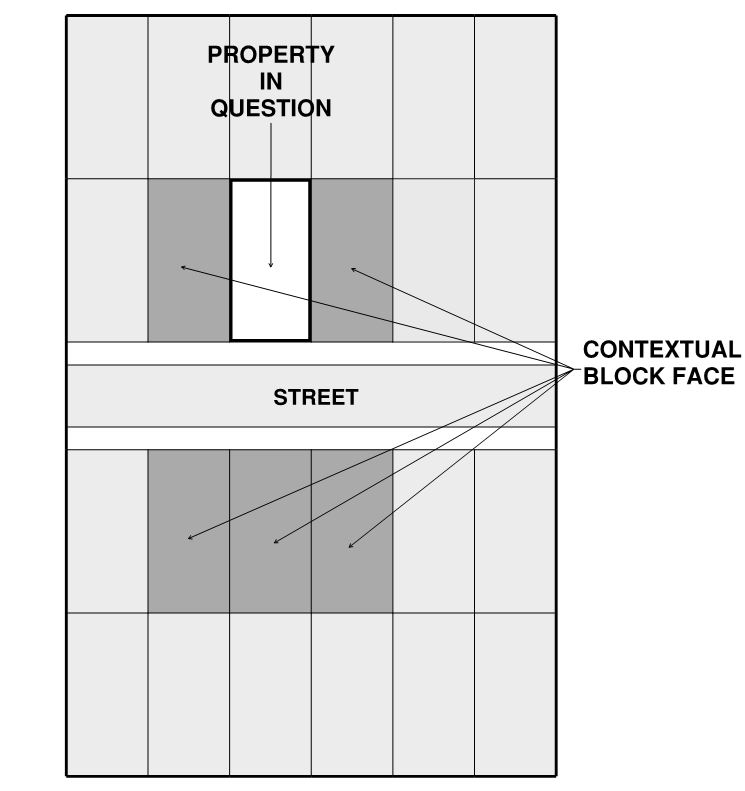
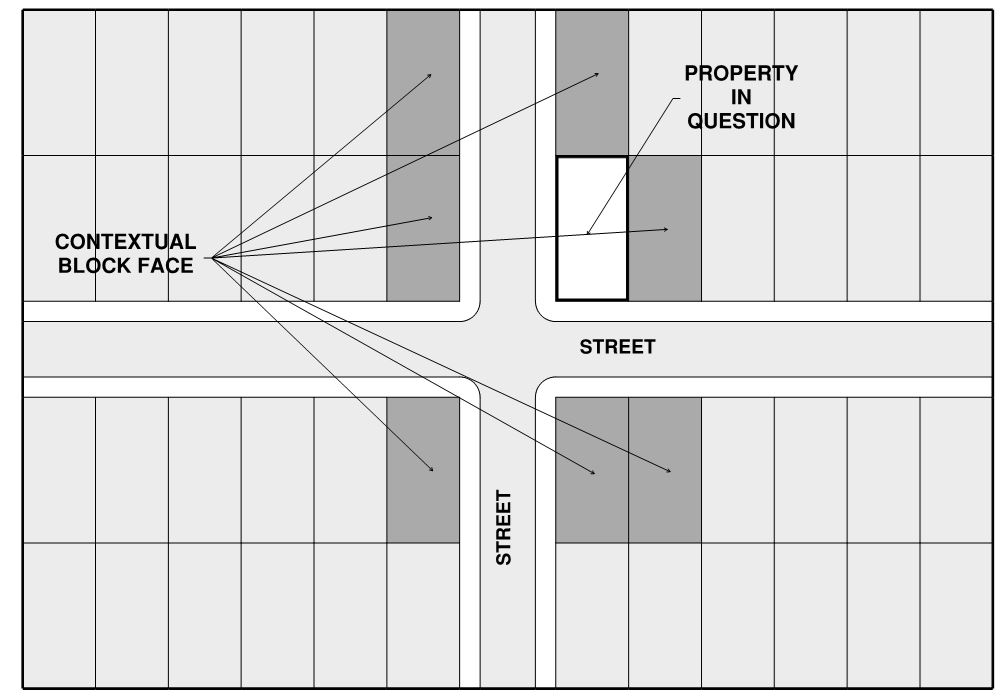
2-122.1 - Block face, contextual.
Abutting property developed with buildings that share a common street frontage or frontages with the property in question.
2-123 - Building.
A structure having a roof for the shelter, support or enclosure of persons, animals, chattels or property of any kind.
2-123.1 - Building, accessory.
A building which is clearly subordinate to the principal building. An accessory building shall not exceed the height of the principal building. An accessory building's gross floor area shall not exceed one-third of the principal building's gross floor area.
2-123.2 - Building, principal or main.
A building in which the principal use of the lot on which the building is located is conducted.
2-124 - Building or setback line.
A line beyond which no part of any building or structure except footings shall project.
2-125 - Building, public.
A building owned by a governmental agency. Nothing in this definition is intended to interfere with or restrict the use of a dwelling unit as that term is defined in this title wherever such use is allowed in the zones.
2-125.1 - Building wall, front.
The wall of a principal structure located in the closest proximity to a front property line.
2-126 - Business and professional office.
Any room, studio, clinic, suite or building in which the primary use is the conduct of a business such as accounting, correspondence, research, editing, administration or analysis; or the conduct of a business by a salesperson, sales representative or manufacturer's representatives; or the conduct of a business by professionals such as engineers, architects, land surveyors, artists, musicians, lawyers, accountants, real estate brokers, insurance agents and landscape architects but not including health professional offices or offices for day labor agencies.
2-127 - Child care home.
A dwelling unit which offers care, protection and supervision to no more than a total of nine children at a time under 12 years of age during any 24-hour period and then only for part of the 24-hour day.
2-127.1 - Check cashing business.
A business regulated by section 6.2-2100 et seq. of the Virginia Code.
2-128 - Commission.
The City of Alexandria Planning Commission.
2-128.1 - Commercial complex.
A building or group of buildings, including mixed-use buildings, in a commercial or mixed-use zone and under common ownership and control which include at least two commercial businesses and provides shared parking.
2-128.2 - Committed affordable housing.
Rental or ownership dwelling units available to eligible households through income and/or occupancy restrictions required under federal, state, or local programs.
2-129 - Congregate housing facility.
A structure other than a single-unit, two-unit, townhouse, or multi-unit dwelling where unrelated persons reside under supervision or 24 hour on-site management and may receive special care, treatment or training, on a temporary or permanent basis.
2-129.1 - Congregate recreational facilities.
A public use devoted to recreational activities typically or often pursued as a group or team, such as athletic fields, indoor and outdoor swimming pools, amphitheaters, band shells, and outdoor theaters, skating rinks, miniature golf courses, and community recreation buildings, not including drive-in theaters.
2-129.2 - Continuum of care facility.
A facility specifically designed for domiciliary use and/or care of four or more aged, infirm, or disabled adults, which may provide for housing progressing from independent living, with or without kitchen facilities, and culminating in assisted living with or without provisions for memory care services, where all related uses are located on the same lot. Such facility shall include services integral to the maintenance or care of residents and be regulated as an assisted living facility under Code of Virginia, title 63.2, as amended. The facility shall be administered in such a manner as to restrict occupancy of independent living units only to persons 55 years of age or older. One person in the unit must satisfy the 55 years of age or older requirement. This term excludes nursing or convalescent homes or hospice, and medical facilities.
2-130 - Convalescent home.
See nursing home.
2-131 - Co-ordinate station.
A station established under the provisions of sections 55-287 through 55-297 of the Code of Virginia and its amendments, known as the Virginia Co-ordinate System, as based on the co-ordinate positions established by the U.S. Coast and Geodetic Survey and extended by others with the approval of the director of transportation and environmental services, which has been permanently marked or so referenced to provide for the replacement at the exact position originally established.
2-131.1 - Crematorium.
A facility containing a furnace which is designed and licensed by the Commonwealth of Virginia for cremation of either animal or human remains. A crematorium shall not be considered an accessory use to a funeral home.
2-133 - Day care center.
A facility other than a dwelling unit which receives children or adults for care, protection and supervision during part of a 24-hour day unattended by a parent or guardian. The term includes a child care center, preschool, nursery school and day nursery, and includes half day and full day programs.
2-133.1 - Day labor agency.
A place where assignments for employment are made, characterized by the daily gathering of workers. A day labor agency operates a dispatch service at a location to which at least some of the workers physically report, apply and wait for work on a daily basis, and return at the conclusion of the work day to receive their pay. Day labor is labor that is occasional or irregular for which the laborer is assigned for not longer than the time period required to complete the assigned work. The majority of day laborers are not assigned to perform clerical, administrative or professional work.
2-134 - Director.
The director of planning and zoning unless otherwise indicated.
2-135 - Drive through facility.
Any use of land which provides goods or services to customers while the customer remains in his car, such as a drive-through bank or restaurant or, in addition, a car wash.
2-136 - Dwelling.
A building or portion thereof, containing one or more dwelling units.
2-136.1 - Dwelling, accessory.
A building or portion thereof containing one dwelling unit that is subordinate to a principal residential use. An accessory dwelling shall be considered an accessory use.
2-136.2 - Dwelling, auxiliary.
A portion of a commercial building containing up to four dwelling units located on a ground floor or floors above or below retail or commercial uses.
2-136.3 - Dwelling, co-living.
A portion of a building containing five or six private living spaces, a shared kitchen, as defined by the Uniform Statewide Building Code, and other communal areas. Each private living space must include a bedroom but may or may not include a private bathroom. Cooking facilities, specifically a stove or oven, shall not be provided within a private living space. Typically, private living spaces within a co-living dwelling are leased on an individual basis.
2-137 - Dwelling, multi-unit.
A building or portion thereof containing three or more dwelling units, located on a single lot or parcel of ground.
2-138 - Dwelling, townhouse.
One of a series of three or more attached dwelling units separated from one another by continuous vertical walls without openings from basement to roof or roofs.
2-139 - Dwelling, single-unit.
A detached building containing one dwelling unit.
2-140 - Dwelling, two-unit.
A detached building containing two dwelling units. This use shall include both duplex (one dwelling unit above another in a single detached building) and semi-detached (two dwelling units having common vertical walls) dwellings. In the case of a semi-detached dwelling, no less than 50 percent of the common wall of one of the two dwelling units shall be opposite the common wall of the other.
2-141 - Dwelling unit.
One or more rooms used for living and sleeping purposes containing no more than one kitchen and at least one bathroom as these terms are defined by the Uniform Statewide Building Code.
2-142 - Elder care home.
A dwelling unit which offers care, protection and supervision to no more than a total of nine adults over 55 years of age at any time during a 24-hour period and then only for part of the 24-hour day.
2-142.1 - Enhanced transit area.
An area with access to high capacity transit service, as depicted on the enhanced transit area map dated December 18, 2017 and as amended December 16, 2023, which is kept on file in the office of the city clerk.
2-144 - First floor.
The floor of a building which is at, or first above, average finished grade.
2-145 - Floor area.
(A)
For residential dwellings in the R-20, R-12, R-8, R-5, R-2-5, and single- and two-unit dwellings in the RA and RB zones (not including property located within the Old and Historic Alexandria and Parker-Gray Districts), the floor area of the building or buildings on a lot or tract of land (whether "main" or "accessory") is the sum of all gross horizontal areas under roof on a lot. These areas shall be measured from exterior faces of walls or any extended area under roof and are to be measured from the shared lot line in the case of party walls. Floor area with a ceiling height 15 feet or greater shall be counted twice. Floor area with a ceiling height 25 feet or greater shall be counted three times. This space shall be based on permanent construction whether or not provided with a finished floor or ceiling. Excluded from floor area shall be:
(1)
Stairs, and elevators. The term stairs includes ramps and other similar structures deemed necessary to provide access to persons with disabilities.
(2)
Floor space used for utilities, which may include accessory water tanks, cooling towers, mechanical and electrical equipment, and any similar construction not susceptible to storage or occupancy (but not including ductwork, pipes, radiators or vents).
(3)
Basements.
(4)
Attic floor area with a ceiling height of less than seven feet or where the space with the ceiling height of seven feet or more is less than four feet wide, as measured from the attic floor or floor joists if there is no floor, to the bottom of the roof rafters or underside of the roof deck if there are no rafters.
(5)
Porticos and portions of porches, including wrap-around porches, up to eight feet in depth located on the first or ground floor without second-story enclosed construction above the portico or porch.
(6)
Free-standing garages to the rear of the main building in accordance with section 7-2501. The floor area excluded pursuant to this subsection shall not exceed the total floor area exclusions listed in section 2-145(A)(12).
(7)
Architectural features up to a maximum projection of 30 inches extending beyond an exterior face of a building wall or column.
(8)
Space under open balconies (decks) and similar structures projecting from the first floor or below.
(9)
Space under open balconies and similar structures projecting from a floor above the first floor up to a maximum depth of eight feet.
(10)
Retractable awnings not enclosed by a wall, pole, or fence on three sides and that do not use poles or posts for structural support.
(11)
Sheds and other small accessory buildings in accordance with section 7-202(C)(2). The floor area excluded pursuant to this subsection shall not exceed the total floor area exclusions listed in section 2-145(A)(12).
(12)
Floor area devoted to an accessory dwelling within an accessory building in accordance with section 7-203. The total floor area excluded pursuant to sections 2-145(A)(6), (11) and this subsection shall not exceed:
(a)
One hundred square feet for lots less than 2,500 square feet,
(b)
Three hundred fifty square feet for lots 2,500 square feet or greater, or
(c)
Six hundred square feet for lots 8,000 square feet or greater.
(13)
Pergolas in accordance with section 7-202(A)(5).
(B)
For properties except for those specified in subsection (A), above, the floor area of the building or buildings on a lot or tract or tract of land (whether "main" or "accessory") is the sum of all gross horizontal areas under roof on a lot. These areas shall be measured from the exterior faces of walls or any extended area under roof and are to be measured from the shared lot line in the case of party walls. This space shall be based on permanent construction whether or not provided with a finished floor or ceiling. Excluded from floor area shall be:
(1)
Stairs and elevators. The term stairs includes ramps and other similar structures deemed necessary to provide access to persons with disabilities.
(2)
Floor space used for utilities, which may include accessory water tanks, cooling towers, mechanical and electrical equipment, and any similar construction not susceptible to storage or occupancy (but not including ductwork, pipes, radiators or vents).
(3)
Lavatories of which only a maximum of 50 square feet of each lavatory can be excluded. The maximum total of excludable area for lavatories shall be no greater than of ten percent of gross floor area.
(4)
Basements (except shall be included for purposes of calculating the off-street parking requirements pursuant to Article VIII).
(5)
Architectural features up to a maximum projection of 30 inches extending beyond an exterior face of a building wall or column.
(6)
Space under open balconies (decks) and similar structures projecting from the first floor or below.
(7)
Space under open balconies and similar structures projecting from a floor above the first floor up to a maximum of depth of eight feet.
(8)
Shade structures made of fabric and open on at least three sides.
(9)
Loading spaces of which only a maximum of 850 square feet for each required loading space per section 8-200(B)(2) can be excluded.
(10)
Loading space pursuant to section 7-2503.
(11)
Any floor area that was used as a private or public garage prior to March 17, 2018 with a height of less than seven feet six inches.
(12)
Floor area excluded as part of a development site plan that was approved prior to March 17, 2018 within a Coordinated Development District.
(13)
Sheds and other small accessory buildings in accordance with section 7-202(C)(2). The floor area excluded pursuant to this subsection shall not exceed the total floor area exclusion listed in section 2-145(B)(14).
(14)
Awnings, porticos and portions of porches, including wrap-around porches, up to eight feet in depth located on the first or ground floor without second-story enclosed construction above the portico or porch.
(15)
Floor area devoted to an accessory dwelling within an accessory building in accordance with section 7-203. The total floor area excluded pursuant to section 2-145(B)(12) and this subsection shall not exceed 65 square feet.
(16)
Areas with a ceiling height of less than seven feet, except in an above grade parking garage constructed after March 17, 2018. Areas in a parking garage constructed after that date, regardless of height, may not be excluded.
(17)
Pergolas in accordance with section 7-202(A)(5).
2-146 - Floor area ratio.
The floor area ratio of the building or buildings on any lot or tract or tract of land is the total aggregate floor area of such building or buildings divided by the area of that lot or tract or tract of land.
2-147 - Fraternal or private clubs.
An establishment of a private not-for-profit organization, including fraternal organizations, which provides social, physical, recreational, educational or benevolent services. Such establishment shall not be operated for the purpose of carrying on a trade or business, and no part of the net earnings shall inure to the benefit of any member of such organization or any other individuals, although regular employees may be paid reasonable compensation for services rendered.
2-148 - Freight distribution center.
Land and buildings used as a relay station for the transfer of a load from one vehicle to another or one party to another. The facility may include storage areas for trucks, buildings or areas for the repair of trucks associated with the terminal and areas for the temporary storage of loads in the process of being transferred.
2-148.1 - Front porch.
A porch that adjoins a building wall which faces a street.
2-148.2 - Funeral home.
Establishments used for undertaking services such as burial preparation and where funeral services may be arranged and held. A crematorium shall not be considered an accessory use to a funeral home.
2-149 - Garage, private.
A structure designed for the storage of not more than three motor-driven vehicles, including carports and other covered parking structures.
2-150 - Garage, public.
Any building or premises designed, used or intended to be used for housing more than three motor driven vehicles.
2-150.1 - Garden center, outdoor.
A retail enterprise that sells plants, garden supplies and services, and similar items not to include heavy equipment such as farm machinery. Notwithstanding any provisions of this ordinance to the contrary, all or portions of the use may be located outside of an enclosed structure if properly sited, as determined by special use permit approval.
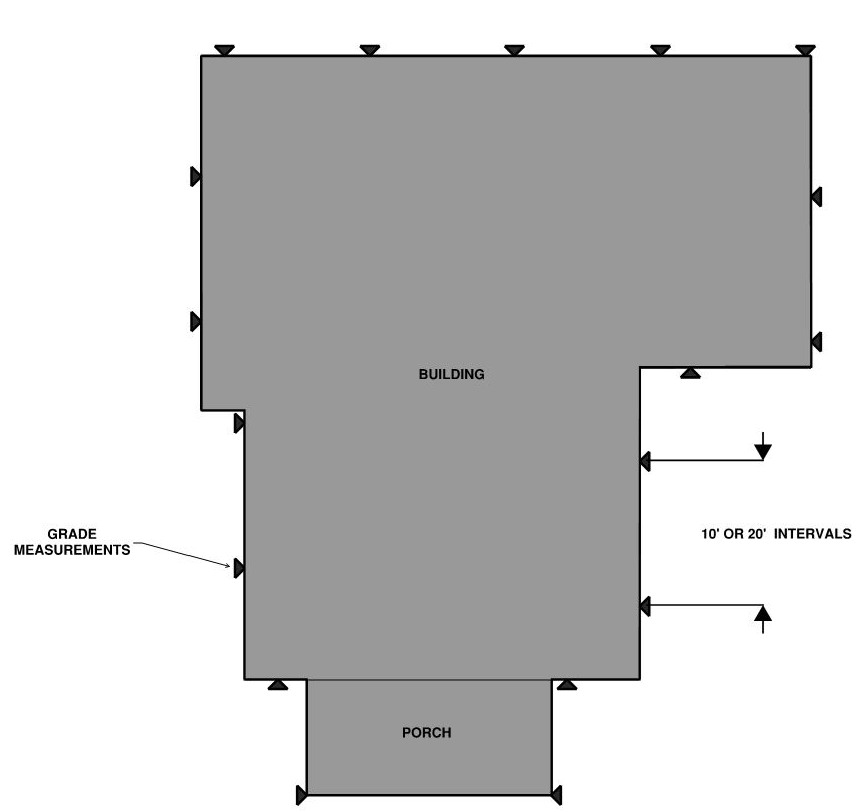
2-150.2 - Grade, average finished.
The elevation obtained by averaging the finished ground surface elevation at intervals of ten feet at the perimeter of a single-unit, two-unit or townhouse dwelling and intervals of 20 feet at the perimeter of any other building.
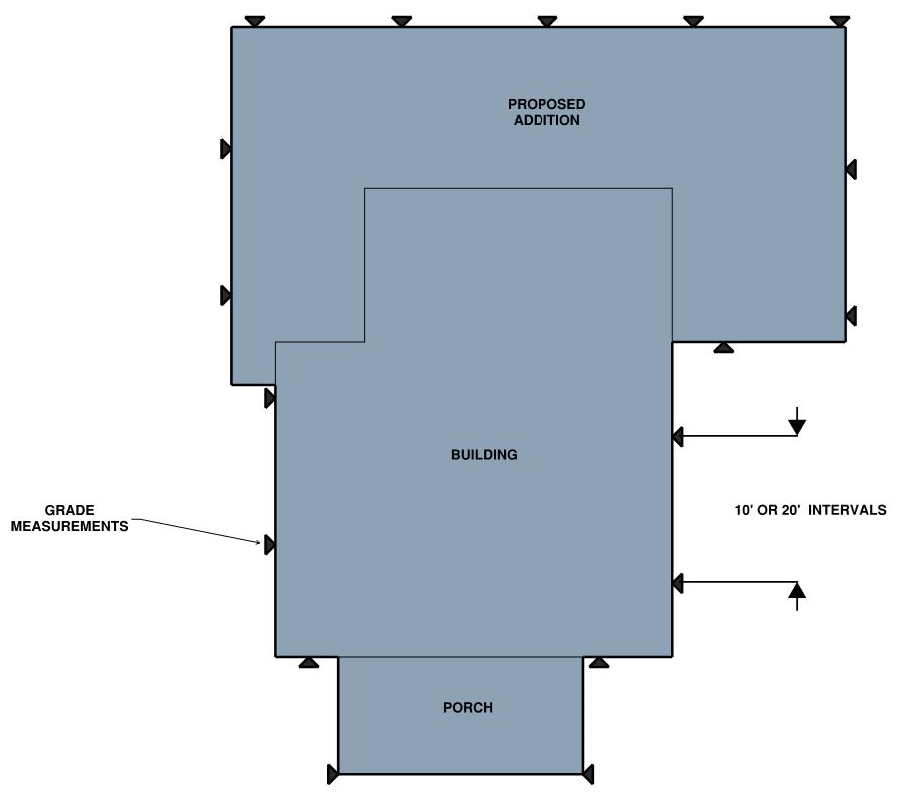
2-150.3 - Grade, average pre-construction.
The elevation obtained by averaging the ground surface elevation at intervals of ten feet at the perimeter of an existing or proposed single-unit, two-unit, or townhouse dwelling and intervals of 20 feet at the perimeter of any other building prior to construction. For accessory buildings less than 250 square feet, there shall be at least four ground surface elevations spaced at fixed intervals around the perimeter of an existing or proposed accessory building.
2-150.4 - Grade, curb.
The elevation of the established curb in front of a building measured at the midpoint of the frontage of such building. Where no curb exists, the director of transportation and environmental services shall establish the curb grade for the existing or proposed street in accordance with the existing master street grading plans of the city.
2-151 - Ground disturbing activity.
Any movement of earth or substrate, manually or mechanically, including, but not limited to, any modification of existing grade by dredging, demolition, excavation or fill, grading, scraping, vegetation removal, landscaping, coring, well drilling, pile driving, undergrounding utility lines, trenching, bulldozing, sheeting, shoring and excavation for laying or removing foundations, pilings or other purposes, for which any permit or approval is required under the provisions of the city code.
2-152 - Guest house.
Living quarters within a detached accessory building located on the same premises with the main building for use by temporary guests or the occupants of the premises. Such quarters shall not have kitchen facilities and shall not be rented or otherwise used as a separate dwelling.
2-153.1 - Health and athletic club or fitness studio.
An establishment which provides facilities, equipment and/or programs for exercise, athletics, and/or fitness in both individual and class formats.
2-153.2 - Health profession office.
A building or portion thereof with a gross floor area of 20,000 square feet or less used for medical, psychiatric, surgical, massage or physical therapy, abortion services or other health-related services primarily on an outpatient basis.
2-154 - Height of building.
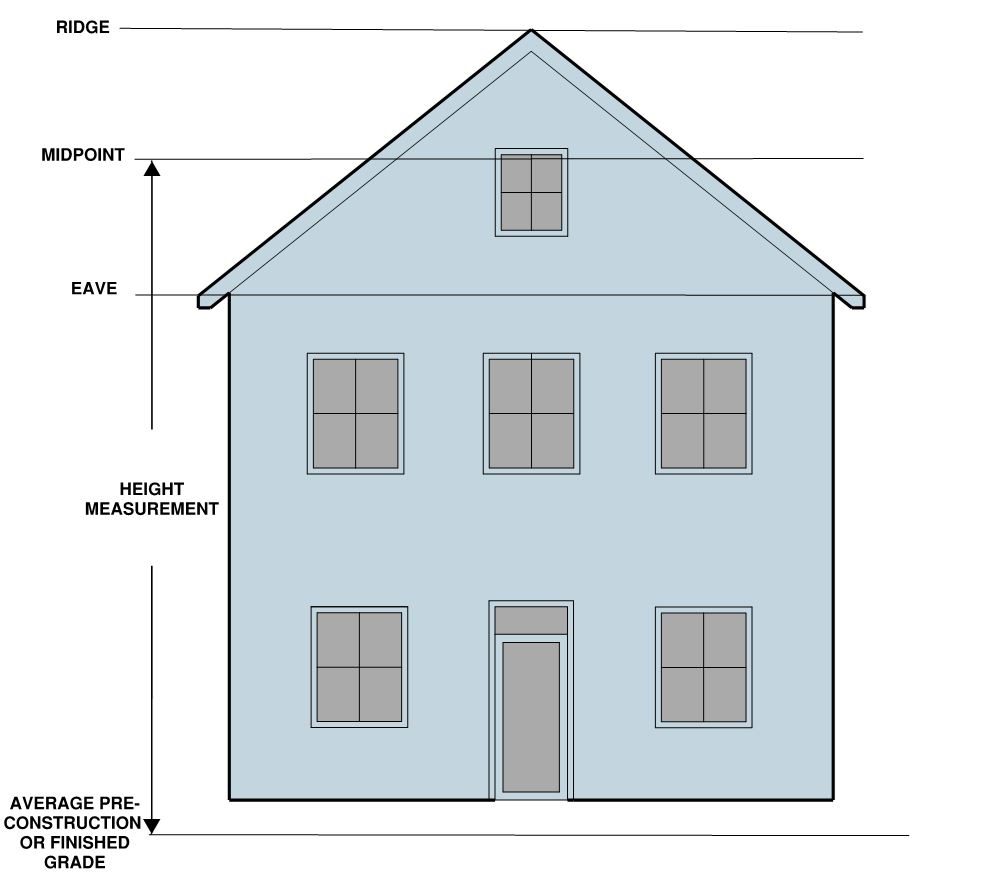
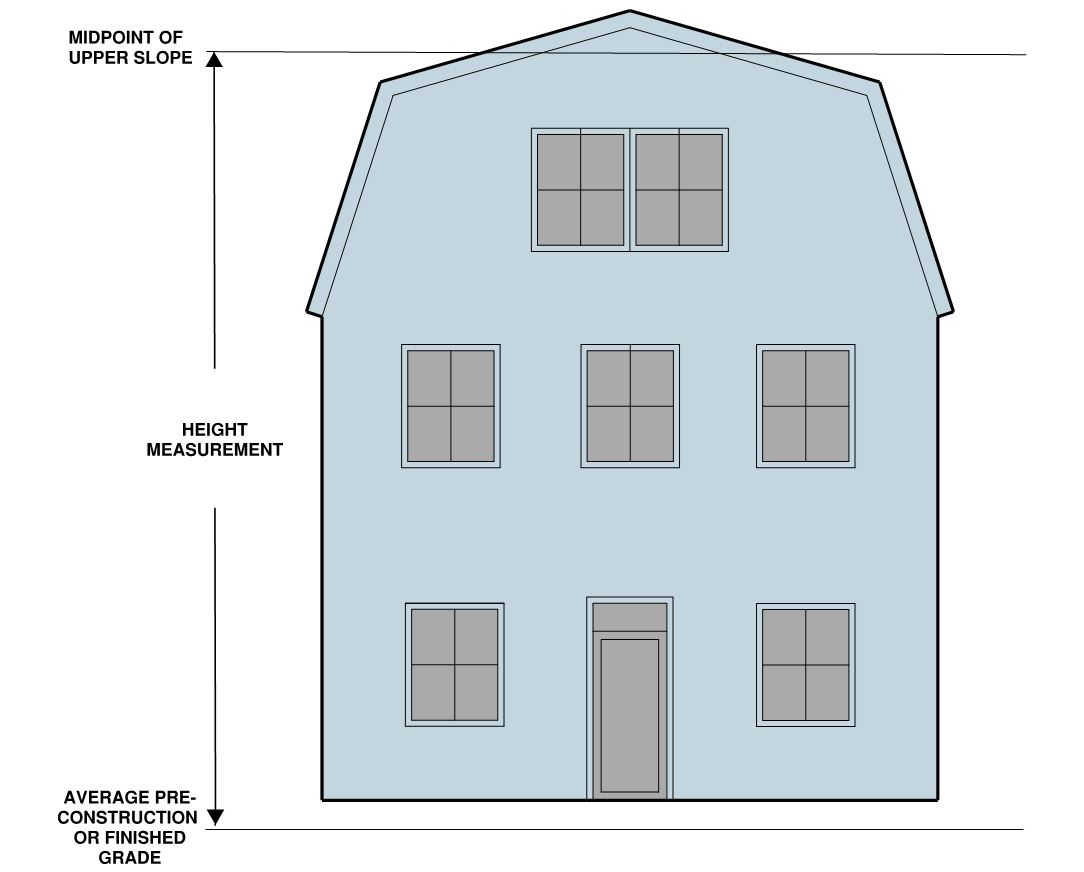
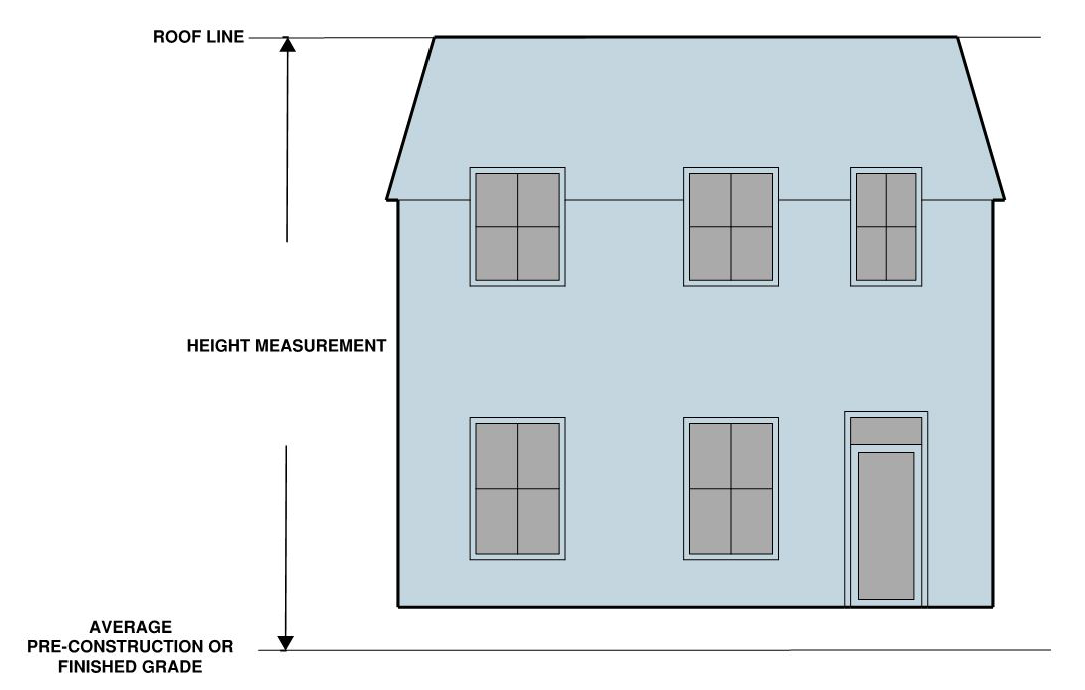
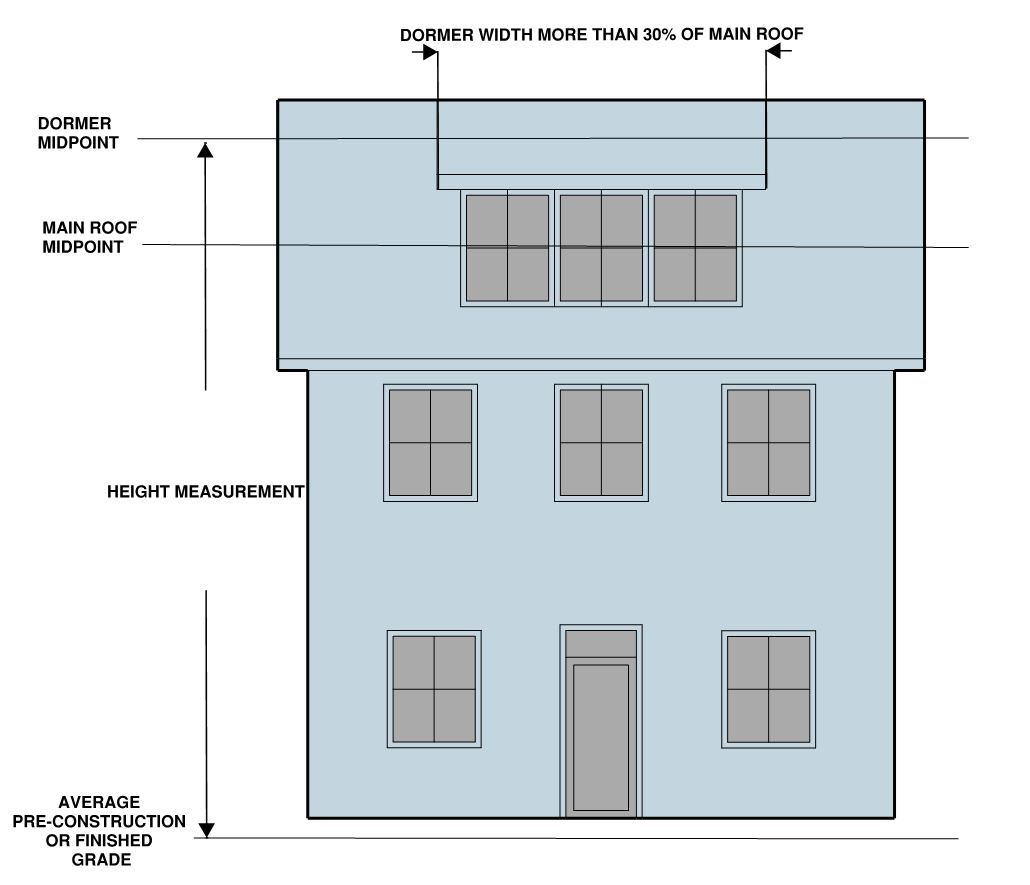
The vertical distance measured from average finished grade to the highest point of the building, except that:
(A)
Gable or hip roof. In the case of a gable or hip roof, height shall be measured to the midpoint between the eaves and the ridge, regardless of orientation of the gable to the street.
(B)
Gambrel roof. In the case of a gambrel roof, height shall be measured to the midpoint of the upper slope of the roof.
(C)
Mansard roof. In the case of a mansard roof, height shall be measured to the roof line.
(D)
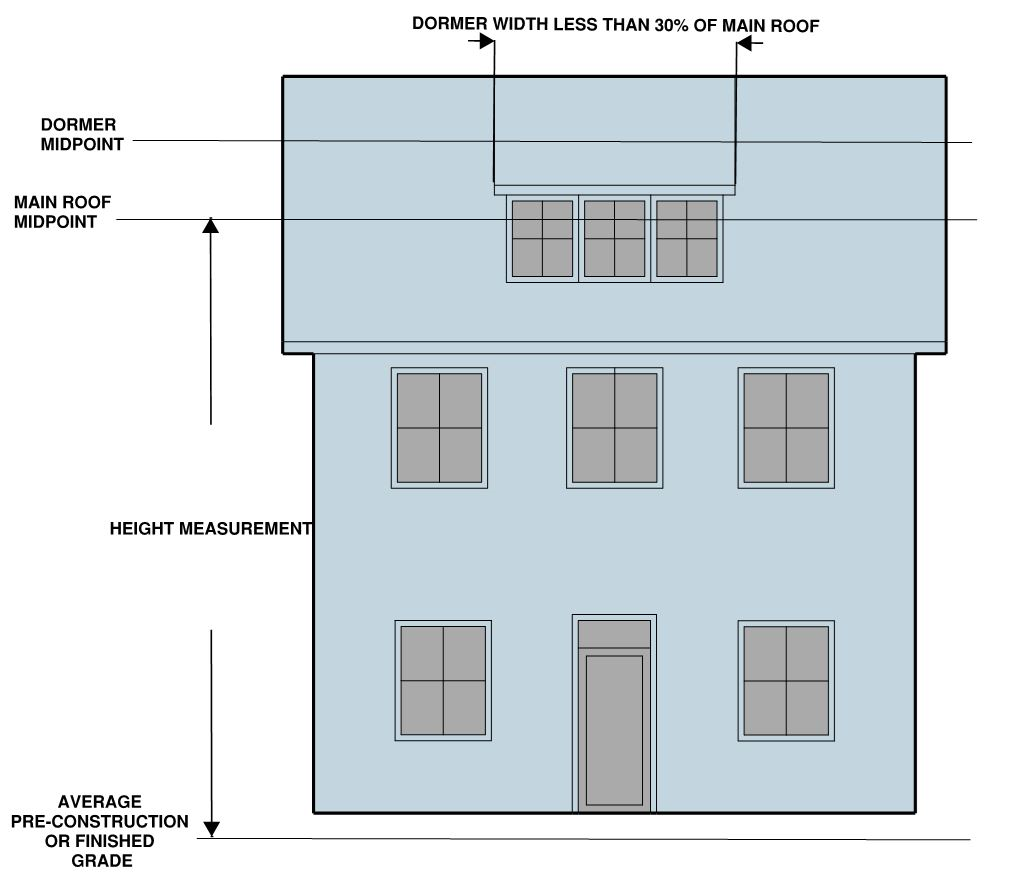
Dormers. In the case of dormers, height shall be measured to the midpoint between the dormers eaves and the ridge. For buildings in the R-20, R-12, R-8, R-5, R- 2-5, and single- and two-unit dwellings in the RA and RB zones, not including property located within the Old and Historic Alexandria and Parker-Gray Districts, height shall be measured to the midpoint of the dormers if the total width of all dormers is more than 30 percent of the horizontal width of the roof.
(E)
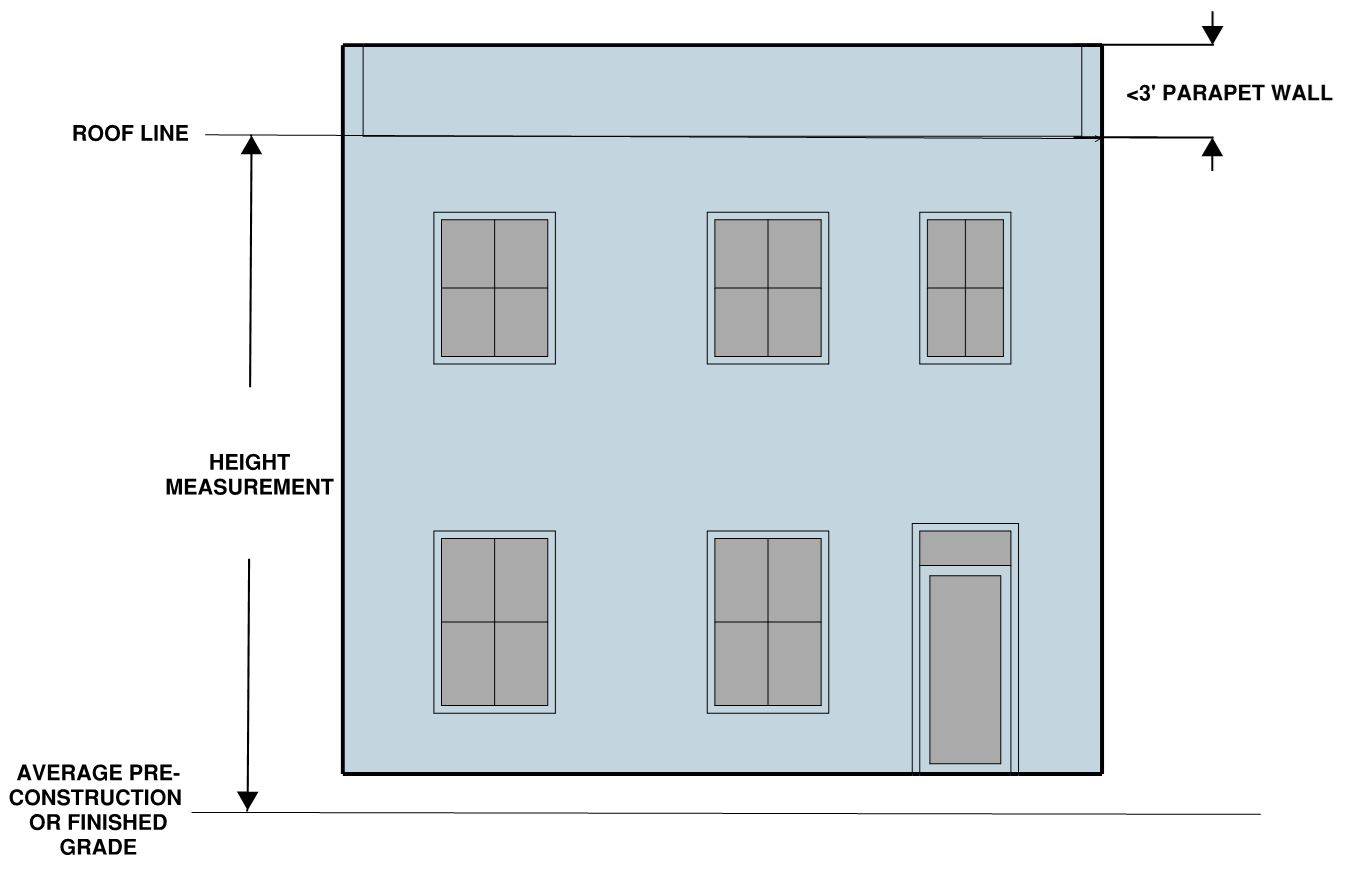
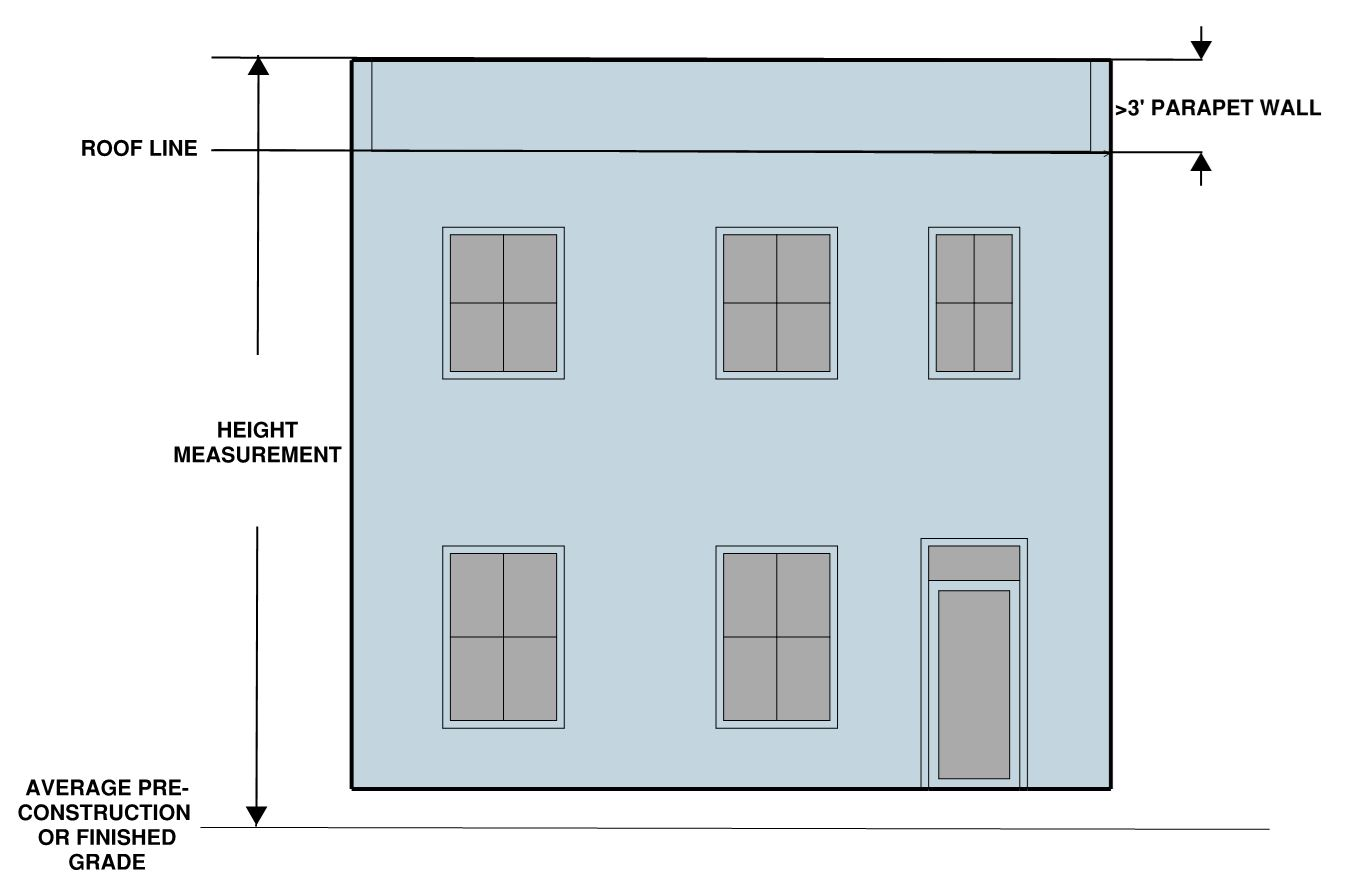
In the case of a flat roof with a parapet wall which is three feet in height or less, the highest point shall be the roof line.
(F)
Reserved.
(G)
For buildings in the R-20, R-12, R-8, R-5, R-2-5, and single- and two-unit dwellings in the RA and RB zones not including property located within the Old and Historic Alexandria and Parker-Gray Districts, height shall be measured from the average pre-construction grade.
(H)
For treatment of rooftop appurtenances, church steeples, reception or transmission structures, noncomplying buildings and structures, lighting for congregate recreational facilities and dog parks and roof decks and guards, see section 6-403.
2-154.1 - Height, threshold.
The vertical distance, as measured from the average pre-construction grade along a building wall which faces a street, to the top of the finished first floor.
2-155 - Helistop.
A temporary or permanent helicopter landing area either at ground level or elevated on a structure, for the sole purpose of pickup and discharge of passengers and cargo and not including facilities for maintenance and overhaul, fueling service, storage space or hangers.
2-157 - Home occupation.
A business, profession, occupation or trade conducted for gain or support entirely within a residential building, or a structure accessory thereto, which is incidental and secondary to the use of such building for dwelling purposes and which does not change the essential residential character of such building. For permitted home occupations, see section 7-300.
2-158 - Homeless shelter.
A building or group of buildings specifically configured in whole or in part for short-term residential use without charge by persons who have no fixed place of abode operated under the supervision and control of a bona fide charitable or government organization. Facilities provided are limited to living, sleeping, bathing, dining and food preparation, all serving residents and staff of the shelter only, together with such additional uses as may be authorized by special use permit.
2-159 - Hospice.
See nursing home.
2-160 - Hospital.
A health care institution with an organized medical and professional staff and with inpatient beds available on a 24-hour basis, which has as its primary function to provide inpatient medical, nursing, and other health-related services to patients for both surgical and nonsurgical conditions, and which usually provides some outpatient services, particularly emergency care.
2-161 - Hotel.
A nonresidential building or portion thereof under common management or ownership used or intended to be used for transient, as defined in City Code section 3-2-141, occupancy.
2-161.1 - Industrial or flex space center.
A building or complex of buildings under common ownership and control, which is no more than two stories in height, includes at least three independent businesses within it, and consists of at least 45,000 square feet of floor area.
2-162 - Junkyard.
Any land or building used for the storage of abandoned items, for the keeping, collecting or baling of paper, rags, scrap metals, other scrap or discarded materials, or for the abandonment, demolition, dismantling, storage or salvaging of automobiles or other vehicles not in running condition or machinery or parts thereof.
2-163.1 - Light assembly, service and crafts.
Assembly under this definition is a use engaged in the assembly, predominantly from previously prepared materials, of finished products or parts, and may include processing, assembly, treatment, packaging, incidental storage and sales of such consistent with the definition of light assembly and crafts. Crafts is a use engaged in by artists or craftspersons for the production or creation of individual handmade objects, not mass produced, such as furniture, sculpture, paintings, pottery, glassware, specialized bookbinding and clothing, and may include accessory exhibition and retail space for products created on the premises. It is specifically anticipated that assembly, service and craft uses under this definition will not be uses typically associated with industrial uses; will have no discernible impact, including noise, odor, light, glare or vibration, at the nearest property line; that all operations, including storage, will be housed completely within an enclosed building, and will operate with a minimal number of pickups and deliveries by trucks larger than a pickup or a van. No uses related to automobiles or other vehicles or heavy equipment are permitted, and all uses must be designed and operated so as to demonstrate compatibility with the character of neighboring uses and all uses permitted in the zone.
2-164 - Light truck.
A motor vehicle with a gross vehicle weight rating of 8,500 pounds or less.
2-164.1 - Live entertainment.
Entertainment as the primary attraction at a commercial use. Event advertising and admission or a cover fee are frequently associated with live entertainment.
2-164.2 - Limited live entertainment.
Entertainment as subordinate to the principal function of a commercial use. Background entertainment that does not require an admission or cover fee are associated with limited live entertainment.
2-165 - Loading space.
An off-street space on the same lot with a building or contiguous to a group of buildings, for the temporary parking of a commercial vehicle while loading or unloading merchandise or materials, and which abuts on a street or other appropriate means of access. Loading space may also be located within a building and include areas used for circulation and maneuvering such as drive aisles and other similar areas.
2-166 - Lot.
A unit of land at all times above elevation +3.0 feet mean sea level, U.S. Coast and Geodetic Survey, usable as a building site, having frontage on a public street and in compliance with the requirements of the zone in which it is situated and recorded. Ground which through accretion or fill is raised to a level so that it is at all times above elevation +3.0 feet mean sea level, U.S. Coast and Geodetic Survey, shall be deemed land for purposes of this definition.
2-167 - Lot, corner.
A lot fronting on two or more streets at their intersection.
2-168 - Lot, depth.
The mean horizontal distance between front and rear lot lines measured perpendicular to the street or radially to the street when the street lies on a curve.
2-169 - Lot, interior.
A lot with frontage on but one street.
2-170 - Lot lines.
Lines bounding a lot and recorded.
2-170.1 - Lot frontage.
The length of a front lot line.
2-170.2 - Lot width.
The distance along a straight line measured between the side lot lines or, in the case of a corner lot, a side lot line and secondary front lot line, at the zone's minimum front yard requirement. The front yard requirement established by a contextual block face shall not apply to lot width determination.
2-171 - Lot, through.
A lot extending through a block from one street to another.
2-172 - Manufactured housing.
A residential structure built according to the provisions of the 1976 HUD (U.S. Department of Housing and Urban Development) Manufactured Home Construction and Safety Standards.
2-173 - Manufacturing.
Assembly, processing, fabrication or manufacture of the following products:
Food and beverage products;
Furniture, metal and wood;
Ice;
Metal and rubber stamps, stencils, badges, jewelry, toys and novelties;
Musical instruments;
Office equipment;
Photographic equipment;
Pottery, figurines and other ceramic products using previously ground or treated minerals and earths;
Professional and scientific instruments;
Small appliances; and
Wood products, excluding products obtained by distillation.
2-174 - Medical care facility.
Buildings or portions thereof with a gross floor area greater than 20,000 square feet used for medical, psychiatric, surgical, massage or physical therapy, abortion services or other health-related services, under common ownership or control, primarily on an outpatient basis. This term shall not include a nursing or convalescent home or hospice or a continuum of care facility.
2-175 - Medical laboratory.
A facility for diagnostic analysis of medical, dental or human products where no care or treatment is rendered to patients.
2-176.1 - Monument.
Permanent concrete or stone markers not less than five inches in diameter and not less than 30 inches in length, with an appropriate center mark of nonferrous metal pin or plate.
2-177 - Motor vehicle parking or storage.
Any land, building or structure where motor vehicles are parked or stored as a principal use.
2-179 - Nursing or convalescent home or hospice.
An establishment which provides 24 hour convalescent or chronic care, or both, for three or more individuals who are not related to the operator and who, by reason of advanced age, chronic illness or infirmity, are unable to care for themselves. No intensive medical care or surgical or obstetrical services shall be provided in such an establishment. This definition shall include an establishment or dwelling, also known as a "hospice," which provides full-time palliative and supportive care for terminally ill individuals and their families but shall not include a hospital.
2-179.1 - Office complex.
A building or group of buildings under common ownership and control which is four or more stories in height and primarily office use, but may include other uses, and which is a minimum of 50,000 square feet in size.
2-180 - Open and usable space. That portion of a lot at ground level which is:
(A)
No less than eight feet in width and length.
(B)
Unoccupied by principal or accessory buildings;
(C)
Unoccupied by principal or accessory structures except for fences, walls, or trellises and pergolas in accordance with section 7-202(A)(5);
(D)
Unobstructed by other than recreational facilities; and
(E)
Not used in whole or in part as roads, alleys, emergency vehicle easement areas, driveways, maneuvering aisles or off-street parking or loading berths.
The purpose of open and usable space is to provide areas of trees, shrubs, lawns, pathways and other natural and manmade amenities which function for the use and enjoyment of residents, visitors and other persons.
That single-unit, two-unit, townhouse, and multi-unit dwellings on lots for which emergency vehicle easement areas were counted as open space in the site plan or special use permit approval therefor, existing on March 1, 2000, or for which a building permit application or preliminary site plan application was filed, and was pending or had been approved on March 1, 2000, shall not be subject to the provisions of section 2-l 80(D) as amended by this subsection, shall not be characterized as noncomplying structures, and shall be characterized as structures grandfathered under prior law, pursuant to section 12-500 of this Code.
2-181 - Open fence.
A fence structure the surface of at least 50 percent of which is uncovered.
2-181.1 - Outdoor dining enclosure.
Barriers surrounding a dining area which provide a clear separation between the approved dining area and pedestrian area.
2-181.2 - Outdoor dining furniture.
Any movable tables, chairs, planters, umbrellas or other components used for the outdoor dining. This does not include outdoor dining enclosures.
2-181.2.1 - Outdoor dining.
An open-air seating area associated with uses that sell prepared food including, but not limited to, restaurants and food trucks.
2-181.2.2 - Outdoor market.
An open-air market held on a regular or seasonal basis, where individual sellers offer goods or services, new or used, for sale to the public. The outdoor market use shall not include garage sales, outdoor display or sales associated with retail establishments that are principally located in indoor facilities, or vehicle sales, rental or leasing facilities.
2-181.3 - Outlot.
Any unit of land that does not meet the requirements of section 11-1700.
2-181.4 - Parcel.
A unit of land of such size and dimensions that it may be divided into two or more lots in accordance with the requirements of the zone in which it is situated.
2-181.5 - Park.
A lot, parcel, or tract of land reserved for public use. A park may include natural or horticultural landscaping; natural or unimproved geographical features such as woodlands, meadowlands, or wetlands; wildlife sanctuaries and preserves; water courses, streams, lakes and ponds and other similar features. A park may contain memorials and recreational facilities including but not limited to: court game facilities; hiking, walking, and bicycle trails; fitness areas; commons, greens, squares, and picnic and sitting areas; playgrounds; fishing sites, and other similar facilities.
2-182 - Parking area.
An open area, other than a street or alley, used for the parking of automotive vehicles.
2-182.05 - Parking ratio.
A measurement that indicates the relationship between the number of parking spaces and the specified indicator in a particular land use such as square footage, number of seats, units, bedrooms.
2-182.1 - Payday loan business.
A business regulated by section 6.2-1800 et seq. of the Virginia Code.
2-183 - Pergola.
A structure of colonnades or pillars supporting an open roof of crossing rafters or trellis that may be freestanding or connected to a building.
2-183.1 - Personal service.
A commercial operation providing personal, financial, technical or repair services, assistance or advice to individual consumers, including, but not limited to:
Animal care facility with no overnight accommodation;
Arts and crafts studios;
Appliance repair and rental;
Banks, savings and loans, and credit unions;
Bicycle repair;
Contractors' offices, without accessory storage;
Dressmakers and tailors;
Dry-cleaning and laundry pickup stations;
Furniture upholstering;
Laundromat;
Locksmiths;
Musical instrument repair;
Pawnshops;
Printing and photocopy service;
Professional photographer's studios;
Shoe repair;
Tattoo parlors;
Watch repair;
Personal service establishments do not include, as either a primary or accessory use, automobile oriented uses; the sale, rental, storage, service or repair of any motor vehicles, including automobiles, trucks, buses, trailers, recreational vehicles and motorcycles; or any use separately listed in a zone.
2-183.2 - Plat.
A schematic representation of land divided or to be divided.
2-183.3 - Porch.
A covered, open structure that adjoins the exterior of a dwelling. A porch shall not be enclosed with walls, glass, screens, or similar. Railings shall be permitted no higher than three-and-one-half feet or the minimum height required by the Virginia Uniform Statewide Building Code (USBC), whichever is higher. Balusters shall be spaced so as to leave at least 50 percent of the perimeter length of the railings open.
2-183.4 - Portico.
A porch that adjoins any entrance of a dwelling, does not project more than six feet from a building wall, and is not more than nine feet in length. These dimensions shall include any roof overhang.
2-184 - Place of worship.
A building or structure intended for organized religious services and activities.
2-186 - Private school, academic.
A parochial or private institution offering academic or religious curriculum which is accredited or licensed by the state to grant a degree or other indication of successful completion of an instructional program. This definition includes elementary, middle and high schools, colleges and universities.
2-187 - Private school, commercial.
A use devoted to giving instruction in vocational, professional, musical, dramatic, artistic or other special subjects, with the exception of fitness studios, in a class format and typically operated for commercial gain.
2-187.1 - Public recycling center.
A collection site for acceptance by donation or redemption of recyclable materials from the public. Such center may not include permanent structures or buildings (other than fences and screens), but typically consist of portable containers which can be readily moved to be emptied or relocated.
2-187.2 - Public school.
An early childhood, elementary, secondary, post-secondary, collegiate school or university that is governed by a public entity and is maintained solely or in part by public funding.
2-188 - Recreational vehicle.
A transportation structure not more than eight feet in width and either self-propelled or capable of being towed by a passenger car, station wagon or small pick-up truck, and primarily designed or constructed either to provide temporary, movable living quarters for recreational, camping or travel use or to carry equipment for such uses, but not for profit or commercial use. Recreational vehicles shall include the following and no other:
(A)
Trailer, trailer coach and fifth wheel trailer. Vehicles constructed with integral wheels to make them mobile, that are intended to be towed by passenger cars, station wagons and/or light pick-up trucks and similar motor vehicles, but not by truck tractors of any type.
(B)
Camping trailer. A type of trailer or trailer coach, the walls of which are so constructed as to be collapsible and made out of either canvas or similar cloth, or some form of rigid material such as fiberglass or plaster or metal. The walls are collapsed while the recreational vehicle is being towed and are raised or unfolded when the vehicle becomes temporary living quarters and is not being moved.
(C)
Pick-up (slide-in) camper and truck cap. Structures designed to be mounted temporarily or permanently in the beds of light trucks, with the trucks having either single or double rear wheels and with or without an assisting, extra tag axle and wheels mounted either on the camper chassis or the truck chassis behind the truck's rear wheels. These campers can be readily demounted from the truck bed.
(D)
Chassis mount, motor home and mini-motor homes. Recreational structures constructed integrally with a truck or motor van chassis and incapable of being separated therefrom. The truck or motor van chassis may have single or double rear wheels.
(E)
Converted and chopped vans. Structures which are created by altering or changing an existing auto van to make it into a recreational vehicle meeting the requirements of the first paragraph of this definition.
(F)
Boat, motorcycle, utility or snowmobile trailer. A vehicle on which a boat, motorcycle, snowmobile or other recreational, camping or travel equipment may be transported and which is towable by a passenger car, station wagon, pick-up truck or mobile recreational vehicle as defined in (D) and (E) above. If the trailer is enclosed with a box or structure, the box or structure may not exceed the permissible length as set forth in section 7-1100 of this ordinance.
(G)
Boat. A transportation structure used or capable of being used as a means of transportation on water. A boat placed on a boat trailer shall constitute one recreational vehicle for purposes of section 7-1100 of this ordinance.
2-188.1 - Recreation and entertainment use.
Commercial uses for indoor or outdoor participation in or observation of games, arts, culture, recreation or similar activities. Recreation uses in this definition are other than those listed in section 2-129.1 for congregate recreational facilities. Recreation and entertainment uses include but are not limited to:
Amusement parks;
Athletic fields;
Billiard halls;
Bowling alleys;
Children's play areas;
Court game facilities;
Dog play area;
Game rooms;
Golf courses, miniature or otherwise, and driving ranges;
Skating rinks;
Swimming pools;
Theaters;
Video arcades.
2-189 - Recycling and materials recovery facility.
A building in which previously used materials are separated, sorted or processed primarily for reuse, for shipment to others for final reprocessing or for use in the manufacturing of new products.
2-190 - Restaurant.
An establishment engaged in the preparation and sale of food and beverages to customers for on-site consumption at tables or counters and may include carry out or delivery. Commercial banquet facilities or event spaces for hosting gatherings, receptions, or conferences with food and beverage service shall also be classified as a restaurant.
2-191 - Retail.
A store or shop engaged in the sale of commodities or goods to individual consumers for personal use rather than for resale, including, but not limited to:
Antique and secondhand articles;
Appliances;
Art galleries, commercial;
Art and craft supplies;
Auto parts without service or installation on premises;
Beauty and grooming sales and services, including barber shops, hair and skincare salons and spas;
Books;
Candy;
Clothing and accessories;
Floor coverings;
Florists;
Food and beverage production (limited to a maximum of 5,000 square feet);
Furniture;
Groceries and convenience stores;
Hardware, paint and wallpaper;
Household goods;
Jewelry, leather goods and luggage;
Lawn and garden supplies;
Musical instruments;
Optical products;
Pharmacies;
Photographic equipment and supplies;
Sporting goods;
Tobacco products, nicotine vapor products, alternative nicotine products, hemp products intended for smoking, as defined in the Code of Virginia, as amended;
Toys.
Retail does not include, as either a primary or accessory use, automobile oriented uses; the sale, rental, storage, service or repair of any motor vehicles, including automobiles, trucks, buses, trailers, recreational vehicles and motorcycles; catering operations; or any use separately listed in a zone.
2-193 - Setback ratio.
The ratio of the horizontal distance between any part of a building or structure and the nearest side or rear property line or the nearest building or the center line of a street or alley to the height of that part of the building above average finished grade of such line, except that for buildings in the R-20, R-12, R-8, R-5, R-2-5 and single-unit and two-unit dwellings in the RA and RB zones not including property located within the Old and Historic Alexandria and Parker-Gray Districts, height shall be measured from the average pre-construction grade of such line.
2-194 - Social service use.
A building or structure for social, educational or cultural activity provided such use is not operated primarily for commercial gain.
2-194.1 - Solar energy system.
An energy system that consists of one or more solar collection devices, solar energy related balance of system equipment, and other associated infrastructure with the primary intention of generating electricity from the sun, storing electricity, or otherwise converting solar energy to a different form of energy.
2-194.2 - Stairs.
A series of two or more risers leading from one level or floor to another. For the purposes of calculating floor area, a stair shall include a landing at each end which shall have the same width as the corresponding stair flight and extends for four feet from the stair. The term stairs includes escalators.
2-195 - Story.
That portion of a building included between the surface of any floor and the surface of the next floor above it, or any space which has or may have a floor with a minimum clear headroom that shall be deemed habitable space by the Virginia Uniform Statewide Building Code (USBC).
2-196 - Street.
A public right-of-way dedicated or otherwise acquired for general public access to private properties and other streets, including but not limited to use for utilities, walks and vehicular traffic.
2-196.1 - Street, private.
A privately owned right-of-way, established by an easement shown on a recorded subdivision plat, providing access to private properties and other streets, including but not limited to, use for utilities, walks and vehicular traffic.
2-197 - Structure.
That which is built or constructed, an edifice or building of any kind or any piece of work artificially built up or composed of parts joined together in some definite manner.
2-197.1 - Structure, accessory.
A structure, which is clearly subordinate to the principal building or structure. An accessory structure generally does not exceed the height of the principal building or structure.
2-197.2 - Structure, ornamental.
An individual structure fixed to the ground having a purely decorative or commemorative quality or value, or designed exclusively for the outdoor display of an object having a purely decorative or commutative quality or value, and containing no storage, mechanical, habitable, or occupiable space.
2-197.3 - Structure, principal.
A structure which serves the principal use of the lot as distinguished from an accessory structure.
2-197.4 - Subdivision.
The division of a lot, parcel or tract of land into two or more lots, plots, sites, parcels or other divisions for the purpose, whether immediate or future, of sale or building development and including the re-subdivision of existing lots, parcels, tracts or other divisions of existing and duly recorded subdivisions. Any tract of land upon which a street, alley or public right-of-way is dedicated shall be considered a subdivision.
2-197.5 - Title loan business.
A business regulated by section 6.2-2200 et seq. of the Virginia Code.
2-199 - Tract or tract of land.
A unit or units of land, whether at, above or below elevation +3.0 feet mean sea level, U.S. Coast and Geodetic Survey, under single ownership or control which are to be used, developed or built upon pursuant to a common development plan. A tract of land need not necessarily coincide with a lot of record.
2-200 - Trailer.
A portable or mobile structure used for residential, commercial, hauling or storage purposes. Removal of a trailer's wheels or placement on a permanent foundation shall not alter its classification as a trailer, except for manufactured housing that meets applicable building and foundation installation standards. This definition excludes recreational vehicles and temporary storage units in place for 30 days or less.
2-200.1 - Trellis.
A structure made of interwoven pieces of wood, metal or synthetic material that may be used to support and display climbing plants.
2-200.2 - Use, accessory.
A use which is clearly subordinate to and serves a permitted principal use; and is subordinate in area, extent and purpose to the principal use served. An accessory use occupies less than one-third of the gross floor area of the principal use and does not change the character of the principal use.
2-200.3 - Use, principal.
The primary activity for which a lot, structure or building is used, as distinguished from an accessory use.
2-201 - Valet parking.
The provision of parking for vehicles whereby vehicles are parked and unparked in a parking area, parking lot or any parking structure by a person other than the owner or operator of the vehicle.
2-201.1 - Variance.
A reasonable deviation from those provisions regulating the shape, size, or area of a lot or parcel of land or the size, height, area, bulk, or location of a building or structure when the strict application of the ordinance would unreasonably restrict the utilization of the property, and such need for a variance would not be shared generally by other properties, and provided such variance is not contrary to the purpose of the ordinance. It shall not include a change in use, which change shall be accomplished by a rezoning or by a conditional zoning.
Editor's note—See Code of Virginia § 15.2-2201.
2-201.2 - Veterinary/animal hospital.
A type of animal care facility where common household pets are provided with preventative care and/or are treated for illness, injury, or disease, but does not include animal shelters.
2-201.3 - Walkability index.
A City of Alexandria scoring system used to measure the degree to which a person can travel on foot between places to work, live and play. The index considers the presence of neighborhood services, civic and community facilities, retail and community anchors. It also considers the presence of sidewalks and other physical infrastructure which contribute to a safe and pleasant pedestrian experience.
2-202 - Wetlands.
That definition provided in section 13-103 of this ordinance regarding the Chesapeake Bay Preservation Overlay District.
2-203 - Wholesale business.
The buying or selling or arranging for sale of goods or commodities, usually in bulk, for purchasers other than individual customers, to include offices but not to include freight distribution centers, large storage facilities or the use of delivery trucks in the routine operation of the business.
2-204 - Yard.
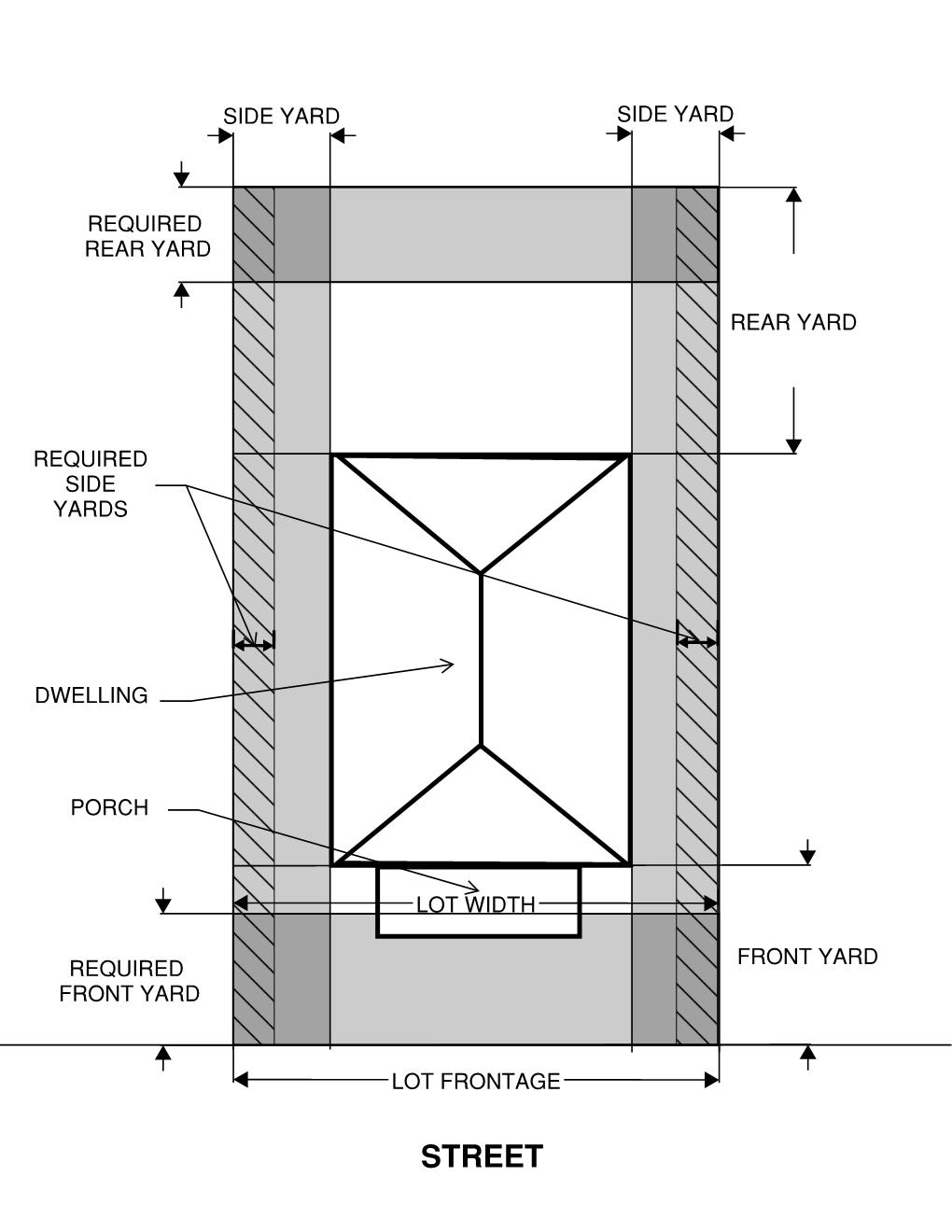
The required open area on the same lot with a building or group of buildings, which open area lies between the building or group of buildings and the nearest lot line or between one building and another building and is unoccupied and unobstructed from the ground upward.
2-205 - Yard, front.
A yard extending across the width of a lot between the front lot line and the main building or any projection thereof not permitted in section 7-202. For a corner lot, the two yards lying between the main building and the intersecting streets shall both be deemed to be front yards and any additional yards shall be deemed to be side yards. For a through lot, the two or more yards lying between the main building and the two or more public streets shall be deemed to be front yards.
2-205.1 - Yard, front primary.
The front yard of a corner or through lot facing a street, which contains a building's main architectural entrance.
2-205.2 - Yard, front secondary.
The other front yard or yard(s) of a corner or through lot facing a street, which may include an entrance but not a building's main entrance.
2-206 - Yard, rear.
The area extending across the rear of a lot measured between the side lot lines and being the minimum horizontal distance between the rear lot line and the main building or any projection thereof not permitted in section 7-202(A).
2-207 - Yard, side.
An open, unoccupied space on the same lot with the building, between the building and the side lot line and extending from the front yard to the rear yard and being the minimum horizontal distance between the side lot line and the main building or any projection thereof not permitted in section 7-202(A).
2-208 - Zoning, conditional.
As part of classifying land into zones by legislative action, the allowing of reasonable conditions governing the use of such property, such conditions being in addition to the regulations provided for a particular zone by the zoning ordinance.
(Ord. No. 3606, §§ 1—3, 12-12-92; Ord. No. 3654, § 1, 6-30-93; Ord. No. 3673, § 1, 10-16-93; Ord. No. 3741, § 2, 6-18-94; Ord. No. 3746, § 2, 6-28-94; Ord. No. 3774, § 1, 1-21-95; Ord. No. 3800, § 1, 5-13-95; Ord. No. 3841, § 1, 1-20-96; Ord. No. 3845, § 1, 2-24-96; Ord. No. 3912, § 1, 1-25-97; Ord. No. 3946, § 1, 6-24-97; Ord. No. 4041, §§ 1, 3, 4-17-99; Ord. No. 4049, §§ 1, 2, 5, 5-15-99; Ord. No. 4078, § 1, 10-16-99; Ord. No. 4119, §§ 1, 2, 4-15-00; Ord. No. 4178, § 1, 12-16-00; Ord. No. 4272, § 1, 10-19-02; Ord. No. 4328, §§ 1, 2, 1-24-04; Ord. No. 4399, § 6, 5-14-05; Ord. No. 4483, § 1, 5-12-07; Ord. No. 4493, § 1, 6-26-07; Ord. No. 4556, § 1, 6-24-08; Ord. No. 4573, § 1, 12-13-08; Ord. No. 4677, § 2, 6-22-10; Ord. No. 4712, § 1, 3-12-11; Ord. No. 4948, § 1, 5-15-15; Ord. No. 5035, § 1, 6-28-16; Ord. No. 5067, § 1, 6-24-17; Ord. No. 5074, § 1, 6-27-17; Ord. No. 5113, § 1, 2-24-18; Ord. No. 5122, §§ 1—4, 3-17-18; Ord. No. 5127, § 1, 4-14-18; Ord. No. 5151, §§ 1—7, 6-23-18; Ord. No. 5155, §§ 1—4, 6-26-18; Ord. No. 5171, § 1, 11-17-18; Ord. No. 5205, § 2, 3-16-19; Ord. No. 5206, §§ 1—10, 3-16-19; Ord. No. 5208, §§ 1—3, 3-16-19; Ord. No. 5227, §§ 1—5, 5-18-19; Ord. No. 5234, §§ 1—9, 7-9-19; Ord. No. 5247, §§ 1—4, 10-19-19; Ord. No. 5254, §§ 1—4, 11-16-19; Ord. No. 5259, §§ 1, 2, 12-14-19; Ord. No. 5300, §§ 2—6, 10-17-20; Ord. No. 5303, § 1, 10-17-20; Ord. No. 5328, §§ 1—3, 3-13-21; Ord. No. 5374, §§ 2—13, 10-16-21; Ord. No. 5383, § 1, 11-13-21; Ord. No. 5405, § 1, 2-12-22; Ord. No. 5447, § 1, 7-5-22; Ord. No. 5449, § 1, 9-17-22; Ord. No. 5468, § 1, 12-17-22; Ord. No. 5488, § 1, 5-13-23; Ord. No. 5490, § 1, 5-13-23; Ord. No. 5503, § 1, 7-5-23; Ord. No. 5515, § 2, 12-16-23; Ord. No. 5529, § 1, 4-13-24; Ord. No. 5566, § 1, 12-14-24; Ord. No. 5552, § 1, 7-2-24; Ord. No. 5579, § 1, 4-26-25; Ord. No. 5580, § 1, 4-26-25; Ord. No. 5614, § 1, 1-24-26)

