
Alexandria City Zoning Code
ARTICLE IV
- COMMERCIAL, OFFICE AND INDUSTRIAL ZONES
4-101 - Purpose.
The CL zone is intended to provide for small scale retail and service uses offering pedestrian oriented shopping and services for individual consumers and households located primarily in nearby residential areas. Proximity to residences requires that commercial operations be conducted at a scale and intensity commensurate with nearby residential development, be developed and designed so as to be in character with such development and be of such characteristics as not to be detrimental or a nuisance to nearby residential properties.
4-102 - Permitted uses.
The following uses are permitted in the CL zone:
(A)
Single-unit dwelling;
(A.1)
Two-unit dwelling;
(A.2)
Townhouse dwelling;
(B)
Multi-unit dwelling;
(B.1)
Auxiliary dwelling, not to exceed four units;
(C)
Business and professional office;
(D)
Cemetery;
(D.1)
Child or elder care home, as permitted by section 7-500;
(E)
Day care center;
(E.1)
Fraternal or private club;
(E.2)
Funeral home;
(F)
Medical laboratory;
(F.1)
Health and athletic club or fitness studio, indoor;
(G)
Health profession office;
(G.1)
Motor vehicle parking or storage for 20 vehicles or fewer;
(G.2)
Outdoor dining located on private property at a commercial complex;
(H)
Personal service;
(H.1)
Place of worship;
(H.2)
Private school, academic;
(I)
Private school, commercial;
(I.1)
Public building;
(J)
Public school;
(J.1)
Recreation and entertainment use, indoor;
(J.2)
Restaurant, pursuant to section 7-1900;
(K)
Retail, up to 20,000 gross square feet;
(L)
Seminary, convent or monastery;
(L.1)
Social service use;
(M)
Utilities, as permitted by section 7-1200;
(N)
Accessory uses, as permitted by section 7-100.
4-102.1 - Administrative special uses.
The following uses may be allowed in the CL zone with administrative approval, subject to section 11-513 of this ordinance:
(A)
Animal care facility with overnight accommodation if located in a commercial complex;
(A.1)
Co-living dwelling, not to exceed two units;
(B)
Child or elder care home, other than pursuant to section 4-102;
(C)
Outdoor garden center;
(D)
Outdoor market;
(E)
Outdoor dining on private property;
(F)
Valet parking;
4-103 - Special uses.
The following uses may be allowed in the CL zone pursuant to a special use permit:
(A)
Animal care facility with overnight accommodation, other than pursuant to section 4-102.1;
(A.1)
Any use with live entertainment;
(B)
Co-living dwelling, other than pursuant to section 4-102.1;
(C)
Congregate housing facility;
(C.1)
Day labor agency;
(D)
Continuum of care facility;
(E)
Reserved;
(F)
Reserved;
(G)
Reserved;
(H)
Motor vehicle parking or storage for more than 20 vehicles;
(I)
Medical care facility;
(J)
Nursing or convalescent home or hospice;
(J.1)
Outdoor dining on private property, other than pursuant to sections 4-102 and 4-102.1;
(J.2)
Outdoor market, other than pursuant to section 4-102.1;
(J.3)
Outdoor garden center, other than pursuant to section 4-102.1;
(K)
Recreation and entertainment use, outdoor;
(L)
Retail, larger than 20,000 gross square feet.
4-104 - Prohibited uses.
Any use which is not a permitted, special or accessory use pursuant to this section 4-100 is prohibited.
4-105 - Area regulations.
(A)
Nonresidential. For nonresidential uses there are no lot size or frontage requirements.
(B)
Residential.
(1)
Lot size. Each single-unit dwelling shall be located on a lot with a minimum land area of 5,000 square feet. In the case of a two-unit dwelling, the lot shall contain 2,500 square feet of land area for each dwelling unit. Each townhouse dwelling shall be located on a lot with a minimum land area of 1,980 square feet.
(2)
Frontage. When measured at both the front lot line and the front building line, each single-unit dwelling, two-unit duplex dwelling and multi-unit dwelling requires a minimum of 50 feet of frontage, a semi-detached dwelling requires a minimum frontage of 25 feet for each dwelling unit, and each townhouse dwelling requires a minimum of 18 feet of frontage for interior lots, 26 feet of frontage for end lots and 38 feet of frontage for interior corner lots.
(C)
Mixed use. When a development includes both residential and nonresidential uses, the residential lot size and frontage regulations shall apply to the residential component of the development.
(D)
Continuum of care facility. For a continuum of care facility there are no lot size or frontage requirements.
4-106 - Bulk regulations.
(A)
Yards and open space.
(1)
Nonresidential. For nonresidential uses, there are no yard or open space requirements except as may be applicable pursuant to the supplemental yard and setback regulations of section 7-1000.
(2)
Residential. For residential uses the following yard and open space requirements apply:
(a)
Front yards. For residential uses, the required front yard shall be between the range established by the front yards within the contextual block face. If the minimum front yard, including the front yard of the property in question, within this range exceeds 20 feet, each residential use shall provide a front yard of at least 20 feet.
(b)
Side yards. Each single, two-unit, and townhouse dwelling shall provide two side yards, each based on a setback ratio of 1:3 and a minimum of eight feet. For townhouse dwellings, the side yard requirement shall only apply to interior end lots wider than 25 feet. Each multi-unit dwelling shall provide two side yards, each based on a setback ratio of 1:2 and a minimum of 16 feet. No side yards shall be required on lots less than 25 feet wide.
(c)
Rear yards. Each residential use shall provide a rear yard based on a 1:1 setback ratio and a minimum of eight feet.
(d)
Open space. Each residential use shall provide 35 percent of the area of the lot as open and usable space, the location and shape of which shall be subject to the director's determination that it is functional and usable space for residents, visitors and other persons. Such open space may be located on landscaped roofs or other areas fully open to the sky which are not at ground level if the director determines that such space functions as open space for residents to the same extent that ground level open space would.
(3)
Mixed use. When a development includes both residential and nonresidential uses, the residential yard and open space regulations shall be applicable to the residential component of the development.
(4)
Continuum of care facility. For a continuum of care facility, the following yard and open space requirements apply:
(a)
Yards. There are no yard requirements except as may be applicable pursuant to the supplemental yard and setback regulations of section 7-1000.
(b)
Open space. The development shall provide a minimum of 25 percent of land area as open and usable space, the location and shape of which shall be subject to the director's determination that it is functional and usable space for residents, visitors and other persons. Such open space may be located on landscaped roofs or other areas fully open to the sky which are not at ground level if the director determines that such space functions as open space for residents to the same extent that ground level open space would.
(B)
Floor area ratio.
(1)
Nonresidential. For lots of 5,500 square feet or less, the maximum permitted floor area ratio for nonresidential uses is .75. For lots larger than 5,500 square feet, the maximum permitted floor area ratio is .5 except that the floor area ratio may be increased to an amount not to exceed .75 with a special use permit.
(2)
Residential. The maximum permitted floor area ratio for residential uses is .75, not to exceed a maximum of 22 units for each acre for townhouse development, except that for single-unit, two-unit, and townhouse dwellings within the Old and Historic Alexandria and Parker-Gray Districts only, the maximum permitted floor area ratio is 1.50 not to exceed a maximum of 30 dwelling units for each acre.
(3)
Continuum of care facility. The maximum permitted floor area ratio shall not exceed .75 and a maximum of 50 percent of the floor space of the proposed development may be residential use. If a special use permit is approved, a maximum of 70 percent of the floor space of the proposed development may be residential use.
(C)
Height. The maximum permitted height of a building is 35 feet except that the height may be increased with a special use permit, provided:
(1)
The gross height may not exceed 45 feet; and
(2)
The roof shall be sloped with the ridge line of the roof running parallel to the street.
4-107 - Use limitations.
(A)
All storage shall be conducted within a completely enclosed building.
(B)
Reserved.
(C)
Reserved.
(D)
Reserved.
(E)
All uses shall manage onsite vibration, dust, odor, smoke, gas, and fumes so they do not create a nuisance by creating a substantial and unreasonable interference with the health, safety, peace, or comfort of persons beyond the property line. When either two or more complaints from the same complainant concerning the same condition or one or more complaints from two or more distinct complainants concerning the same condition are received and verified, the director will send written notice to the person responsible. Within 30 days, the person responsible shall submit a written control plan to the director. The control plan must specify corrective measures and a timeline for implementation, drawing on best available control technologies and recognized industry best practices. The director may require modifications to the control plan, impose reasonable deadlines, and require monitoring or inspections to verify compliance.
(F)
Reserved.
(G)
Reserved.
(H)
Day care centers and private academic schools for compulsory school age students shall submit for the director's review a pick-up and drop-off plan that adequately ensures the safe transfer of students and creates minimal impact on pedestrian and vehicular traffic. Day care centers and private academic schools must obtain approval of the plan prior to opening its place of business.
(I)
The placement or construction of items that block the visibility through windows of the interior of the commercial space from the street and sidewalk, including, but not limited to, walls, window film, storage cabinets, carts, shelving, boxes, coat racks, storage bins, and closets, shall be prohibited. All windows shall remain transparent. This is not intended to prevent retailers from displaying their goods in display cases that are oriented towards the street frontage.
(J)
Retail with a principal use selling tobacco products, nicotine vapor products, alternative nicotine products, or hemp products intended for smoking are prohibited on property within 1,000 linear feet of a child day care center, or a public or private academic early childhood, elementary, middle, or high school. Any such use in operation prior to July 1, 2024, may continue to operate at its existing location, but Article XII does not apply.
4-108 - Auxiliary dwellings.
Up to four auxiliary dwelling units are permitted and shall be categorized as nonresidential for the purpose of applying the area and bulk regulations of this zone. Such dwellings shall comply with section 8-200(A)(16) for parking and where parking is required spaces may be compact size or tandem. Auxiliary dwellings are allowed behind a first floor commercial use, if the depth of the building is more than 50 feet measured from the front building wall and the building is setback no further than 30 feet from front property line.
4-109 - Co-living dwellings.
Up to two co-living dwellings shall be categorized as nonresidential for the purpose of applying the area and bulk regulations of this zone, and each such co-living dwelling shall provide the parking required under section 8-200(A)(22). For proposals with greater than two co-living dwellings, each will be counted as a dwelling unit subject to the same area and bulk regulations as multi-unit dwellings in this zone.
(Ord. No. 3612, § 1, 1-23-93; Ord. No. 3629, §§ 1—4, 5-15-93; Ord. No. 3753, § 1, 9-27-94; Ord. No. 3841, § 2, 1-20-96; Ord. No. 3893, § 1, 11-16-96; Ord. No. 3912, §§ 3, 4, 1-25-97; Ord. No. 4049, §§ 3, 5, 5-15-99; Ord. No. 4280, §§ 1, 4, 11-16-02; Ord. No. 4573, § 1, 12-13-08; Ord. No. 4677, § 3, 6-22-10; Ord. No. 5035, § 1, 6-28-16; Ord. No. 5155, §§ 6—8, 6-26-18; Ord. No. 5259, §§ 14—16, 12-14-19; Ord. No. 5303, § 3, 10-17-20; Ord. No. 5321, § 2, 1-23-21; Ord. No. 5383, § 3, 11-13-21; Ord. No. 5405, § 3, 2-12-22; Ord. No. 5449, § 2, 9-17-22; Ord. No. 5490, § 3, 5-13-23; Ord. No. 5515, § 4, 12-16-23; Ord. No. 5566, § 3, 12-14-24; Ord. No. 5552, § 2, 7-2-24; Ord. No. 5614, § 3, 1-24-26)
4-201 - Purpose.
The CC zone is intended to provide for small scale retail and service uses offering both automobile and pedestrian oriented shopping and services for those selected sites that need special treatment because they are adjacent to both major roads and residential development. Proximity to residences requires that commercial uses be limited to those most compatible with nearby residential development. Direct access to a major roadway makes appropriate certain uses which are not permitted in the more restrictive CL zone.
4-202 - Permitted uses.
The following uses are permitted in the CC zone:
(A)
Single-unit dwelling;
(A.1)
Two-unit dwelling;
(A.2)
Townhouse dwelling;
(B)
Multi-unit dwelling;
(B.1)
Auxiliary dwelling, not to exceed four units;
(C)
Business and professional office;
(D)
Cemetery;
(D.1)
Child or elder care home; as permitted by section 7-500;
(E)
Day care center;
(E.1)
Fraternal or private club;
(E.2)
Funeral home;
(F)
Medical laboratory;
(F.1)
Health and athletic club or fitness studio, indoor;
(G)
Health profession office;
(G.1)
Motor vehicle parking or storage for 20 vehicles or fewer;
(G.2)
Outdoor dining located on private property at a commercial complex;
(H)
Personal service establishment;
(H.1)
Place of worship;
(H.2)
Private school, academic;
(H.3)
Private school, commercial;
(H.4)
Public building;
(I)
Public school;
(I.1)
Recreation and entertainment use, indoor;
(I.2)
Restaurant, pursuant to section 7-1900;
(J)
Retail, up to 20,000 gross square feet;
(K)
Seminary, convent or monastery;
(K.1)
Social service use;
(L)
Utilities, as permitted by section 7-1200;
(M)
Accessory uses, as permitted by section 7-100.
4-202.1 - Administrative special uses.
The following uses may be allowed in the CC zone with administrative approval, subject to section 11-513 of this ordinance:
(A)
Animal care facility with overnight accommodation, if located in a commercial complex;
(A.1)
Co-living dwelling, not to exceed two units;
(B)
Child or elder care home, other than pursuant to section 4-202;
(C)
Outdoor garden center;
(D)
Outdoor market;
(E)
Outdoor dining on private property;
(F)
Valet parking.
4-203 - Special uses.
The following uses may be allowed in the CC zone pursuant to a special use permit:
(A)
Reserved;
(A.2)
Automobile service station;
(B)
Bus shelter on private property;
(C)
Co-living dwelling, other than pursuant to section 4-202.1;
(D)
Congregate housing facility;
(E)
Continuum of care facility;
(F)
Reserved;
(G)
Drive through facility;
(H)
Reserved;
(I)
Live entertainment, with any use;
(J)
Reserved;
(K)
Light automobile repair;
(L)
Motor vehicle parking or storage for more than 20 vehicles;
(M)
Medical care facility;
(M.1)
Outdoor dining on private property, other than pursuant to sections 4-202 and 4-202.1;
(N)
Nursing or convalescent home or hospice;
(N.1)
Outdoor market, other than pursuant to section 4-202.1;
(N.2)
Outdoor garden center, other than pursuant to section 4-202.1;
(O)
Recreation and entertainment use, outdoor;
(P)
Retail shopping, larger than 20,000 gross square feet.
4-204 - Prohibited uses.
Any use which is not a permitted, special or accessory use pursuant to this section 4-200 is prohibited.
4-205 - Area regulations.
(A)
Nonresidential. For nonresidential uses there are no lot size or frontage requirements.
(B)
Residential.
(1)
Lot size. Each single-unit dwelling shall be located on a lot with a minimum land area of 5,000 square feet. In the case of a two-unit dwelling, the lot shall contain 2,500 square feet of land area for each dwelling unit. Each townhouse dwelling shall be located on a lot with a minimum land area of 1,980 square feet.
(2)
Frontage. When measured at both the front lot line and the front building line, each single-unit dwelling, two-unit duplex dwelling and multi-unit dwelling requires a minimum of 50 feet of frontage, a semi-detached dwelling requires a minimum frontage of 25 feet for each dwelling unit, and each townhouse dwelling requires a minimum of 18 feet of frontage for interior lots, 26 feet of frontage for end lots and 38 feet of frontage for interior comer lots.
(C)
Mixed use. When a development includes both residential and nonresidential uses, the residential lot size and frontage regulations shall apply to the residential component of the development.
(D)
Continuum of care facility. For a continuum of care facility there are no lot size or frontage requirements.
4-206 - Bulk regulations.
(A)
Yards and open space.
(1)
Nonresidential. For nonresidential uses, there are no yard or open space requirements except as may be applicable pursuant to the supplemental yard and setback regulations of section 7-1000.
(2)
Residential. For residential uses the following yard and open space requirements apply:
(a)
Front yards. For residential uses, the required front yard shall be between the range established by the front yards within the contextual block face. If the minimum front yard, including the front yard of the property in question, within this range exceeds 20 feet, a residential use shall provide a front yard of at least 20 feet.
(b)
Side yards. Each single, two-unit, and townhouse dwelling shall provide two side yards, each based on a setback ratio of 1:3 and a minimum of eight feet. For townhouse dwellings, the side yard requirement shall only apply interior end lots wider than 25 feet. Each multi-unit dwelling shall provide two side yards, each based on a setback ratio of 1:2 and a minimum of 16 feet. No side yards shall be required on lots less than 25 feet wide.
(c)
Rear yards. Each residential use shall provide a rear yard based on a 1:1 setback ratio and a minimum of eight feet.
(d)
Open space. Each residential use shall provide 35 percent of the area of the lot as open and usable space, the location and shape of which shall be subject to the director's determination that it is functional and usable space for residents, visitors and other persons. Such open space may be located on landscaped roofs or other areas fully open to the sky which are not at ground level if the director determines that such space functions as open space for residents to the same extent that ground level open space would.
(3)
Mixed use. When a development includes both residential and nonresidential uses, the residential yard and open space regulations shall be applicable to the residential component of the development.
(4)
Continuum of care facility. For a continuum of care facility, the following yard and open space requirements apply:
(a)
Yards. There are no yard requirements except as may be applicable pursuant to the supplemental yard and setback regulations of section 7-1000.
(b)
Open space. The development shall provide a minimum of 25 percent of land area as open and usable space, the location and shape of which shall be subject to the director's determination that it is functional and usable space for residents, visitors and other persons. Such open space may be located on landscaped roofs or other areas fully open to the sky which are not at ground level if the director determines that such space functions as open space for residents to the same extent that ground level open space would.
(B)
Floor area ratio.
(1)
Nonresidential. The maximum permitted floor area ratio for nonresidential uses is .5.
(2)
Residential. The maximum permitted floor area ratio for residential uses is .75, not to exceed a maximum of 22 units for each acre for townhouse development.
(3)
Continuum of care facility. The maximum permitted floor area ratio shall not exceed .75 and a maximum of 50 percent of the floor space of the proposed development may be residential use. If a special use permit is approved, a maximum of 70 percent of the floor space of the proposed development may be residential use.
(C)
Height. The maximum permitted height of a building is 35 feet except that the height may be increased to an amount not to exceed 45 feet with a special use permit.
4-207 - Use limitations.
(A)
All storage shall be located within a completely enclosed building.
(B)
Automobile service stations, car washes and drive through facilities shall only be located along an arterial (100 feet) or primary collector (80 feet) road, to include any associated service road.
(C)
Reserved.
(D)
Reserved.
(E)
All uses shall manage onsite vibration, dust, odor, smoke, gas, and fumes so they do not create a nuisance by creating a substantial and unreasonable interference with the health, safety, peace, or comfort of persons beyond the property line. When either two or more complaints from the same complainant concerning the same condition or one or more complaints from two or more distinct complainants concerning the same condition are received and verified, the director will send written notice to the person responsible. Within 30 days, the person responsible shall submit a written control plan to the director. The control plan must specify corrective measures and a timeline for implementation, drawing on best available control technologies and recognized industry best practices. The director may require modifications to the control plan, impose reasonable deadlines, and require monitoring or inspections to verify compliance.
(F)
Reserved.
(G)
Day care centers and private academic schools for compulsory school age students shall submit for the director's review a pick-up and drop-off plan that adequately ensures the safe transfer of students and creates minimal impact on pedestrian and vehicular traffic. Day care centers and private academic schools must obtain approval of the plan prior to opening its place of business.
(H)
The placement or construction of items that block the visibility through windows of the interior of the commercial space from the street and sidewalk, including, but not limited to, walls, window film, storage cabinets, carts, shelving, boxes, coat racks, storage bins, and closets, shall be prohibited. All windows shall remain transparent. This is not intended to prevent retailers from displaying their goods in display cases that are oriented towards the street frontage.
(I)
Retail with a principal use selling tobacco products, nicotine vapor products, alternative nicotine products, or hemp products intended for smoking are prohibited on property within 1,000 linear feet of a child day care center, or a public or private academic early childhood, elementary, middle, or high school. Any such use in operation prior to July 1, 2024, may continue to operate at its existing location, but Article XII does not apply.
4-208 - Auxiliary dwellings.
Up to four auxiliary dwelling units are permitted and shall be categorized as nonresidential for the purpose of applying the area and bulk regulations of this zone. Such dwellings shall comply with section 8-200(A)(16) for parking and where parking is required spaces may be compact size or tandem. Auxiliary dwellings are allowed behind a first floor commercial use, if the depth of the building is more than 50 feet measured from the front building wall and the building is setback no further than 30 feet from front property line.
4-209 - Co-living dwellings.
Up to two co-living dwellings, shall be categorized as nonresidential for the purpose of applying the area and bulk regulations of this zone, and each such co-living dwelling shall provide the parking required under section 8-200(A)(22). For proposals with greater than two co-living dwellings, each will be counted as a dwelling unit subject to the same area and bulk regulations as multi-unit dwellings in this zone.
(Ord. No. 3612, § 1, 1-23-93; Ord. No. 3629, §§ 1—4, 5-15-93; Ord. No. 3753, § 1, 9-27-94; Ord. No. 3841, § 2, 1-20-96; Ord. No. 3912, §§ 3, 4, 1-25-97; Ord. No. 4280, §§ 1, 4, 11-16-02; Ord. No. 4573, § 1, 12-13-08; Ord. No. 4677, § 3, 6-22-10; Ord. No. 5035, § 1, 6-28-16; Ord. No. 5155, §§ 9—11, 6-26-18; Ord. No. 5259, §§ 17—19, 12-14-19; Ord. No. 5303, § 3, 10-17-20; Ord. No. 5321, § 3, 1-23-21; Ord. No. 5383, § 4, 11-13-21; Ord. No. 5405, § 3, 2-12-22; Ord. No. 5449, § 2, 9-17-22; Ord. No. 5490, § 3, 5-13-23; Ord. No. 5515, § 4, 12-16-23; Ord. No. 5566, § 3, 12-14-24; Ord. No. 5552, § 2, 7-2-24; Ord. No. 5614, § 3, 1-24-26)
4-301 - Purpose.
The CSL zone is intended to provide for light service and industrial uses compatible in operations and character with nearby residential neighborhoods and properties. Proximity to residences requires that commercial operations be conducted at a scale and intensity commensurate with nearby residential development, be developed so as to be in character with such development and be of such characteristics and effect so as not to be detrimental or a nuisance to nearby residential properties.
4-302 - Permitted uses.
The following uses are permitted in the CSL zone:
(A)
Single-unit dwelling;
(A.1)
Two-unit dwelling;
(A.2)
Townhouse dwelling;
(B)
Multi-unit dwelling;
(B.1)
Auxiliary dwelling, not to exceed four units;
(C)
Business and professional office;
(D)
Cemetery;
(D.1)
Child or elder care home; as permitted by section 7-500;
(E)
Day care center;
(E.1)
Fraternal or private club;
(E.2)
Funeral home;
(F)
Medical laboratory;
(F.1)
Health and athletic club or fitness studio, indoor;
(G)
Health profession office;
(G.1)
Motor vehicle parking or storage for 20 vehicles or fewer;
(G.2)
Outdoor dining located on private property at a commercial complex;
(H)
Personal service;
(H.1)
Place of worship;
(H.2)
Private school, academic;
(H.3)
Private school, commercial;
(H.4)
Public building;
(I)
Public school;
(I.1)
Recreation and entertainment use, indoor;
(J)
Retail, up to 20,000 gross square feet;
(J.1)
Restaurant, pursuant to section 7-1900;
(K)
Seminary, convent or monastery;
(K.1)
Social service use;
(L)
Utilities, as permitted by section 7-1200;
(M)
Accessory uses, as permitted by section 7-100.
4-302.1 - Administrative special uses.
The following uses may be allowed in the CSL zone with administrative approval, subject to section 11-513 of this ordinance:
(A)
Animal care facility with overnight accommodation, if located in a commercial complex;
(A.1)
Co-living dwelling, not to exceed two units;
(B)
Child or elder care home, other than pursuant to section 4-302;
(C)
Outdoor garden center;
(D)
Outdoor market;
(E)
Outdoor dining on private property;
(F)
Valet parking.
4-303 - Special uses.
The following uses may be allowed in the CSL zone pursuant to a special use permit:
(A)
Animal care facility with overnight accommodation, other than pursuant to 4-302.1;
(A.1)
Reserved;
(A.2)
Automobile service station;
(B)
Automobile, recreational vehicles, and trailer rental or sales area;
(B.1)
Food and beverage production exceeding 5,000 square feet, which includes a retail component;
(C)
Building materials storage and sales;
(D)
Reserved;
(E)
Catering operation;
(E.1)
Co-living dwelling, other than pursuant to section 4-302.1;
(F)
Congregate housing facility;
(G)
Continuum of care facility;
(H)
Reserved;
(H.1)
Day labor agency;
(I)
Reserved;
(J)
Drive through facility;
(K)
Reserved;
(L)
Reserved;
(M)
Glass shop;
(N)
Live entertainment, with any use;
(O)
Laundry, dry cleaning operation;
(O.1)
Light assembly, service and crafts;
(P)
Light automobile repair;
(Q)
Motor vehicle parking or storage for more than 20 vehicles;
(R)
Medical care facility;
(S)
Nursing or convalescent home or hospice;
(S.1)
Outdoor dining on private property, other than pursuant to sections 4-302 and 4-302.1;
(S.2)
Outdoor market, other than pursuant to section 4-302.1;
(S.3)
Outdoor garden center, other than pursuant to section 4-302.1;
(T)
Parcel delivery;
(U)
Recreation and entertainment use, outdoor;
(V)
Research and testing laboratory;
(W)
Retail, larger than 20,000 gross square feet;
(X)
Storage buildings and warehouses, not to include freight distribution centers;
(Y)
Wholesale business.
4-304 - Prohibited uses.
Any use which is not a permitted, special or accessory use pursuant to this section is prohibited.
4-305 - Area regulations.
(A)
Nonresidential. For nonresidential uses there are no lot size or frontage requirements.
(B)
Residential.
(1)
Lot size. Each single-unit dwelling shall be located on a lot with a minimum land area of 5,000 square feet. In the case of a two-unit dwelling, the lot shall contain 2,500 square feet of land area for each dwelling unit. Each townhouse dwelling shall be located on a lot with a minimum land area of 1,980 square feet.
(2)
Frontage. When measured at both the front lot line and the front building line, each single-unit dwelling, two-unit duplex dwelling, and multi-unit dwelling requires a minimum of 50 feet of frontage, a two-unit, semi-detached dwelling requires a minimum frontage of 25 feet for each dwelling unit, and each townhouse dwelling requires a minimum of 18 feet of frontage for interior lots, 26 feet of frontage for end lots and 38 feet of frontage for interior corner lots.
(C)
Mixed use. When a development includes both residential and nonresidential uses, the residential lot size and frontage regulations shall apply to the residential component of the development.
(D)
Continuum of care facility. For a continuum of care facility there are no lot size or frontage requirements.
4-306 - Bulk regulations.
(A)
Yards and open space.
(1)
Nonresidential. For nonresidential uses, there are no yard or open space requirements except as may be applicable pursuant to the supplemental yard and setback regulations of section 7-1000.
(2)
Residential. For residential uses the following yard and open space requirements apply:
(a)
Front yards. For each residential use, the required front yard shall be between the range established by the front yards within the contextual block face. If the minimum front yard, including the front yard of the property in question, within this range exceeds 20 feet, a residential use shall provide a front yard of at least 20 feet.
(b)
Side yards. Each single-unit, two-unit, and townhouse dwelling shall provide two side yards, each based on a setback ratio of 1:3 and a minimum of eight feet. For townhouse dwellings, the side yard requirement shall only apply to interior end lots wider than 25 feet. Each multi-unit dwelling shall provide two side yards, each based on a setback ratio of 1:2 and a minimum of 16 feet. No side yards shall be required on lots less than 25 feet wide.
(c)
Rear yards. Each residential use shall provide a rear yard based on a 1:1 setback ratio and a minimum of eight feet.
(d)
Open space. Each residential use shall provide 35 percent of the area of the lot as open and usable space, the location and shape of which shall be subject to the director's determination that it is functional and usable space for residents, visitors and other persons. Such open space may be located on landscaped roofs or other areas fully open to the sky which are not at ground level if the director determines that such space functions as open space for residents to the same extent that ground level open space would.
(3)
Mixed use. When a development includes both residential and nonresidential uses, the residential yard and open space regulations shall be applicable to the residential component of the development.
(4)
Continuum of care facility. For a continuum of care facility, the following yard and open space requirements apply:
(a)
Yards. There are no yard requirements except as may be applicable pursuant to the supplemental yard and setback regulations of section 7-1000.
(b)
Open space. The development shall provide a minimum of 25 percent of land area as open and usable space, the location and shape of which shall be subject to the director's determination that it is functional and usable space for residents, visitors and other persons. Such open space may be located on landscaped roofs or other areas fully open to the sky which are not at ground level if the director determines that such space functions as open space for residents to the same extent that ground level open space would.
(B)
Floor area ratio.
(1)
Nonresidential. The maximum permitted floor area ratio for nonresidential use is .5.
(2)
Residential. The maximum permitted floor area ratio for residential uses is .75, not to exceed a maximum of 22 units for each acre for townhouse development, except that for single-unit, two-unit, and townhouse dwellings within the Old and Historic Alexandria and Parker-Gray Districts only, the maximum permitted floor area ratio is 1.50 not to exceed a maximum of 30 dwelling units for each acre.
(3)
Continuum of care facility. The maximum permitted floor area ratio is .75 and a maximum of 50 percent of the floor space of the proposed development may be residential use. If a special use permit is approved, a maximum of 70 percent of the floor space of the proposed development may be residential use.
(C)
Height. The maximum permitted height of a building is 50 feet.
4-307 - Use limitations.
(A)
All storage shall be located within a completely enclosed building.
(B)
Reserved.
(C)
Reserved.
(D)
Automobile service stations, car washes and drive through facilities shall only be located along an arterial (100 feet) or primary collector (80 feet) road, including any associated service road.
(E)
All uses shall manage onsite vibration, dust, odor, smoke, gas, and fumes so they do not create a nuisance by creating a substantial and unreasonable interference with the health, safety, peace, or comfort of persons beyond the property line. When either two or more complaints from the same complainant concerning the same condition or one or more complaints from two or more distinct complainants concerning the same condition are received and verified, the director will send written notice to the person responsible. Within 30 days, the person responsible shall submit a written control plan to the director. The control plan must specify corrective measures and a timeline for implementation, drawing on best available control technologies and recognized industry best practices. The director may require modifications to the control plan, impose reasonable deadlines, and require monitoring or inspections to verify compliance.
(F)
Reserved.
(G)
Day care centers and private academic schools for compulsory school age students shall submit for the director's review a pick-up and drop-off plan that adequately ensures the safe transfer of students and creates minimal impact on pedestrian and vehicular traffic. Day care centers and private academic schools must obtain approval of the plan prior to opening its place of business.
(H)
The placement or construction of items that block the visibility through windows of the interior of the commercial space from the street and sidewalk, including, but not limited to, walls, window film, storage cabinets, carts, shelving, boxes, coat racks, storage bins, and closets, shall be prohibited. All windows shall remain transparent. This is not intended to prevent retailers from displaying their goods in display cases that are oriented towards the street frontage.
(I)
Retail with a principal use selling tobacco products, nicotine vapor products, alternative nicotine products, or hemp products intended for smoking are prohibited on property within 1,000 linear feet of a child day care center, or a public or private academic early childhood, elementary, middle, or high school. Any such use in operation prior to July 1, 2024, may continue to operate at its existing location, but Article XII does not apply.
4-308 - Auxiliary dwellings.
Up to four auxiliary dwelling units are permitted and shall be categorized as nonresidential for the purpose of applying the area and bulk regulations of this zone. Such dwellings shall comply with section 8-200(A)(16) for parking and where parking is required spaces may be compact size or tandem. Auxiliary dwellings are allowed behind a first floor commercial use, if the depth of the building is more than 50 feet measured from the front building wall and the building is setback no further than 30 feet from front property line.
4-309 - Co-living dwellings.
Up to two co-living dwellings, shall be categorized as nonresidential for the purpose of applying the area and bulk regulations of this zone, and each such co-living dwelling shall provide the parking required under section 8-200(A)(22). For proposals with greater than two co-living dwellings, each will be counted as a dwelling unit subject to the same area and bulk regulations as multi-unit dwellings in this zone.
(Ord. No. 3612, § 1, 1-23-93; Ord. No. 3629, §§ 1—4, 5-15-93; Ord. No. 3741, § 1, 6-18-94; Ord. No. 3753, § 1, 9-27-94; Ord. No. 3841, § 2, 1-20-96; Ord. No. 3912, §§ 3, 4, 1-25-97; Ord. No. 3946, § 2, 6-24-97; Ord. No. 4049, §§ 3, 5, 5-15-99; Ord. No. 4280, §§ 1, 4, 11-16-02; Ord. No. 4573, § 1, 12-13-08; Ord. No. 4677, § 3, 6-22-10; Ord. No. 5035, § 1, 6-28-16; Ord. No. 5155, §§ 12—14, 6-26-18; Ord. No. 5208, § 4, 3-16-19; Ord. No. 5259, §§ 20—22, 12-14-19; Ord. No. 5303, § 3, 10-17-20; Ord. No. 5321, § 4, 1-23-21; Ord. No. 5383, § 5, 11-13-21; Ord. No. 5405, § 3, 2-12-22; Ord. No. 5449, § 2, 9-17-22; Ord. No. 5490, § 3, 5-13-23; Ord. No. 5515, § 4, 12-16-23; Ord. No. 5566, § 3, 12-14-24; Ord. No. 5552, § 2, 7-2-24; Ord. No. 5614, § 3, 1-24-26)
4-401 - Purpose.
The CG zone is intended to provide for retail and service uses, including automobile oriented businesses, in community serving shopping centers along major roads. Although office uses are permitted, the zone is not intended as an area for office centers.
4-402 - Permitted uses.
The following uses are permitted in the CG zone:
(A)
Single-unit dwelling;
(A.1)
Two-unit dwelling;
(A.2)
Townhouse dwelling;
(B)
Multi-unit dwelling;
(B.1)
Auxiliary dwelling, not to exceed four units;
(C)
Business and professional office;
(D)
Cemetery;
(D.1)
Child or elder care home; as permitted by section 7-500;
(E)
Day care center;
(E.1)
Fraternal or private club;
(E.2)
Funeral home;
(E.3)
Health and athletic club or fitness studio, indoor;
(F)
Medical laboratory;
(F.1)
Outdoor dining located on private property at a commercial complex;
(G)
Health profession office;
(H)
Motor vehicle parking or storage for 20 vehicles or fewer;
(H.1)
Place of worship;
(H.2)
Private school, academic;
(H.3)
Private school, commercial;
(I)
Personal service;
(I.1)
Public building;
(J)
Public school;
(J.1)
Recreation and entertainment uses, indoor;
(J.2)
Restaurant, pursuant to section 7-1900;
(K)
Retail, up to 20,000 gross square feet;
(L)
Seminary, convent or monastery;
(L.1)
Social service use;
(M)
Utilities, as permitted by section 7-1200;
(N)
Accessory uses, as permitted by section 7-100.
4-402.1 - Administrative special uses. The following uses may be allowed in the CG zone with administrative approval, subject to section 11-513 of this ordinance:
(A)
Child or elder care home, other than pursuant to section 4-402;
(A.1)
Co-living dwelling, not to exceed two units;
(B)
Restaurant;
(C)
Outdoor garden center;
(D)
Outdoor market;
(E)
Outdoor dining on private property;
(F)
Valet parking.
4-403 - Special uses.
The following uses may be allowed in the CG zone pursuant to a special use permit:
(A)
Reserved;
(B)
Animal care facility with overnight accommodation, other than pursuant to section 4-402.1;
(C)
Automobile service station;
(D)
Automobile, recreational vehicles, and trailer rental or sales area;
(E)
Co-living dwelling, other than pursuant to section 4-402.1;
(F)
Congregate housing facility;
(G)
Continuum of care facility;
(H)
Day labor agency;
(I)
Drive through facility;
(J)
Food and beverage production exceeding 5,000 square feet, which includes a retail component;
(K)
Reserved;
(L)
Reserved;
(M)
Reserved;
(N)
Reserved;
(O)
Hospital;
(P)
Hotel;
(Q)
Laundry, dry cleaning operation;
(R)
Light automobile repair;
(R.1)
Live entertainment, with any use;
(S)
Medical care facility;
(T)
Motor vehicle parking or storage for more than 20 vehicles;
(U)
Reserved;
(V)
Nursing or convalescent home or hospice;
(V.1)
Outdoor dining on private property, other than pursuant to sections 4-402 and 4-402.1;
(V.2)
Outdoor market, other than pursuant to section 4-402.1;
(V.3)
Outdoor garden center, other than pursuant to section 4-402.1;
(W)
Recreation and entertainment use, outdoor;
(X)
Retail, larger than 20,000 gross square feet.
4-404 - Prohibited uses.
Any use which is not a permitted, special or accessory use pursuant to this section 4-400 is prohibited.
4-405 - Area regulations.
(A)
Nonresidential. For nonresidential uses there are no lot size or frontage requirements.
(B)
Residential.
(1)
Lot size. Each single-unit dwelling shall be located on a lot with a minimum land area of 5,000 square feet. In the case of a two-unit dwelling, the lot shall contain 2,500 square feet of land area for each dwelling unit. Each townhouse dwelling shall be located on a lot with a minimum land area of 1,980 square feet.
(2)
Frontage. When measured at both the front lot line and the front building line, each single-unit dwelling, two-unit duplex dwelling and multi-unit dwelling requires a minimum of 50 feet of frontage, a semi-detached dwelling requires a minimum frontage of 25 feet for each dwelling unit, and each townhouse dwelling requires a minimum of 18 feet of frontage for interior lots, 26 feet of frontage for end lots and 38 feet of frontage for interior corner lots.
(C)
Mixed use. When a development includes both residential and nonresidential uses, the residential lot size and frontage regulations shall apply to the residential component of the development.
(D)
Continuum of care facility. For a continuum of care facility there are no lot size or frontage requirements.
4-406 - Bulk regulations.
(A)
Yards and open space.
(1)
Nonresidential. For nonresidential uses, there are no yard or open space requirements except as may be applicable pursuant to the supplemental yard and setback regulations of section 7-1000.
(2)
Residential. For residential uses the following yard and open space requirements apply:
(a)
Front yards. For each residential use, the required front yard shall be between the range established by the front yards within the contextual block face. If the minimum front yard, including the front yard of the property in question, within this range exceeds 20 feet, a residential use shall provide a front yard of at least 20 feet.
(b)
Side yards. Each single, two-unit, and townhouse dwelling shall provide two side yards, each based on a setback ratio of 1:3 and a minimum of eight feet. For townhouse dwellings, the side yard requirement shall only apply to interior end lots wider than 25 feet. Each multi-unit dwelling shall provide two side yards, each based on a setback ratio of 1:2 and a minimum of 16 feet. No side yards shall be required on lots less than 25 feet wide.
(c)
Rear yards. Each residential use shall provide a rear yard based on a 1:1 setback ratio and a minimum of eight feet.
(d)
Open space. Each residential use shall provide 35 percent of the area of the lot as open and usable space, the location and shape of which shall be subject to the director's determination that it is functional and usable space for residents, visitors and other persons. Such open space may be located on landscaped roofs or other areas fully open to the sky which are not at ground level if the director determines that such space functions as open space for residents to the same extent that ground level open space would.
(3)
Mixed use. When a development includes both residential and nonresidential uses, the residential yard and open space regulations shall be applicable to the residential component of the development.
(4)
Continuum of care facility. For a continuum of care facility, the following yard and open space requirements apply:
(a)
Yards. There are no yard requirements except as may be applicable pursuant to the supplemental yard and setback regulations of section 7-1000.
(b)
Open space. The development shall provide a minimum of 25 percent of land area as open and usable space, the location and shape of which shall be subject to the director's determination that it is functional and usable space for residents, visitors and other persons. Such open space may be located on landscaped roofs or other areas fully open to the sky which are not at ground level if the director determines that such space functions as open space for residents to the same extent that ground level open space would.
(B)
Floor area ratio.
(1)
Nonresidential. The maximum permitted floor area ratio for nonresidential uses is .5.
(2)
Residential. The maximum permitted floor area ratio for residential uses is .75, not to exceed a maximum of 22 units for each acre for townhouse development.
(3)
Continuum of care facility. The maximum permitted floor area ratio is .75 and a maximum of 50 percent of the floor space of the proposed development may be residential use. If a special use permit is approved, a maximum of 70 percent of the floor space of the proposed development may be residential use.
(C)
Height. The maximum permitted height of a building is 50 feet.
4-407 - Use limitations.
(A)
All storage shall be located within a completely enclosed building.
(B)
Automobile service stations, car washes and drive through facilities shall only be located along an arterial (100 feet) or primary collector (80 feet) road, to include any associated service road.
(C)
All uses shall manage onsite vibration, dust, odor, smoke, gas, and fumes so they do not create a nuisance by creating a substantial and unreasonable interference with the health, safety, peace, or comfort of persons beyond the property line. When either two or more complaints from the same complainant concerning the same condition or one or more complaints from two or more distinct complainants concerning the same condition are received and verified, the director will send written notice to the person responsible. Within 30 days, the person responsible shall submit a written control plan to the director. The control plan must specify corrective measures and a timeline for implementation, drawing on best available control technologies and recognized industry best practices. The director may require modifications to the control plan, impose reasonable deadlines, and require monitoring or inspections to verify compliance.
(D)
Reserved.
(E)
Day care centers and private academic schools for compulsory school age students shall submit for the director's review a pick-up and drop-off plan that adequately ensures the safe transfer of students and creates minimal impact on pedestrian and vehicular traffic. Day care centers and private academic schools must obtain approval of the plan prior to opening its place of business.
(F)
The placement or construction of items that block the visibility through windows of the interior of the commercial space from the street and sidewalk, including, but not limited to, walls, window film, storage cabinets, carts, shelving, boxes, coat racks, storage bins, and closets, shall be prohibited. All windows shall remain transparent. This is not intended to prevent retailers from displaying their goods in display cases that are oriented towards the street frontage.
(G)
Retail with a principal use selling tobacco products, nicotine vapor products, alternative nicotine products, or hemp products intended for smoking are prohibited on property within 1,000 linear feet of a child day care center, or a public or private academic early childhood, elementary, middle, or high school. Any such use in operation prior to July 1, 2024, may continue to operate at its existing location, but Article XII does not apply.
4-408 - Auxiliary dwellings.
Up to four auxiliary dwelling units are permitted and shall be categorized as nonresidential for the purpose of applying the area and bulk regulations of this zone. Such dwellings shall comply with section 8-200(A)(16) for parking and where parking is required spaces may be compact size or tandem. Auxiliary dwellings are allowed behind a first floor commercial use, if the depth of the building is more than 50 feet measured from the front building wall and the building is setback no further than 30 feet from front property line.
4-409 - Co-living dwellings.
Up to two co-living dwellings shall be categorized as nonresidential for the purpose of applying the area and bulk regulations of this zone, and each such co-living dwelling shall provide the parking required under section 8-200(A)(22). For proposals with greater than two co-living dwellings, each will be counted as a dwelling unit subject to the same area and bulk regulations as multi-unit dwellings in this zone.
(Ord. No. 3612, § 1, 1-23-93; Ord. No. 3629, §§ 1—4, 5-15-93; Ord. No. 3753, § 1, 9-27-94; Ord. No. 3841, § 2, 1-20-96; Ord. No. 3912, §§ 3, 4, 1-25-97; Ord. No. 3946, § 2, 6-24-97; Ord. No. 4049, §§ 3, 5, 5-15-99; Ord. No. 4280, §§ 1, 4, 11-16-02; Ord. No. 4328, §§ 3, 6, 1-24-04; Ord. No. 4573, § 1, 12-13-08; Ord. No. 4677, § 3, 6-22-10; Ord. No. 5035, § 1, 6-28-16; Ord. No. 5155, §§ 15—17, 6-26-18; Ord. No. 5259, §§ 23—25, 12-14-19; Ord. No. 5303, § 3, 10-17-20; Ord. No. 5321, § 5, 1-23-21; Ord. No. 5383, § 6, 11-13-21; Ord. No. 5405, § 3, 2-12-22; Ord. No. 5449, § 2, 9-17-22; Ord. No. 5490, § 3, 5-13-23; Ord. No. 5515, § 4, 12-16-23; Ord. No. 5529, § 3, 4-13-24; Ord. No. 5566, § 3, 12-14-24; Ord. No. 5614, § 3, 1-24-26)
4-501 - Purpose.
The CD zone is intended to provide for an urban mix of retail, office, service, hotel, residential and civic functions for the city's downtown business core. The location of the zone in and near the Old and Historic Alexandria District requires that such uses be compatible with nearby residential housing and with that area generally.
4-502 - Permitted uses.
The following uses are permitted in the CD zone:
(A)
Single-unit dwelling;
(A.1)
Two-unit dwelling;
(A.2)
Townhouse dwelling;
(B)
Multi-unit dwelling;
(B.1)
Auxiliary dwelling, not to exceed four units;
(C)
Business and professional office;
(D)
Cemetery;
(D.1)
Child or elder care home; as permitted by section 7-500;
(E)
Reserved;
(F)
City sponsored farmers' market;
(F.1)
Day care center;
(F.2)
Fraternal or private club;
(F.3)
Funeral home;
(G)
Medical laboratory;
(G.1)
Health and athletic club or fitness studio, indoor;
(H)
Health profession office;
(H.1)
Motor vehicle parking or storage for 20 vehicles or fewer;
(H.2)
Outdoor dining located on private property at a commercial complex;
(I)
Personal service;
(I.1)
Place of worship;
(I.2)
Private school, academic;
(J)
Private school, commercial;
(J.1)
Public building;
(K)
Public school;
(L)
Radio or TV broadcasting office and studio;
(L.1)
Recreation and entertainment use, indoor;
(L.2)
Restaurant, pursuant to section 7-1900;
(M)
Retail, up to 20,000 gross square feet;
(N)
Seminary, convent or monastery;
(N.1)
Social service use;
(O)
Utilities, as permitted by section 7-1200;
(P)
Accessory uses, as permitted by section 7-100.
4-502.1 - Administrative special uses.
The following uses may be allowed in the CD zone with administrative approval, subject to section 11-513 of this section:
(A)
Animal care facility with overnight accommodation if located in a commercial complex;
(A.1)
Co-living dwelling, not to exceed two units;
(A.2)
Child or elder care home, other than pursuant to section 4-502;
(B)
Outdoor garden center;
(C)
Outdoor market;
(D)
Outdoor dining on private property;
(E)
Valet parking.
4-503 - Special uses.
The following uses may be allowed in the CD zone pursuant to a special use permit:
(A)
Reserved;
(A.1)
Animal care facility with overnight accommodation, other than pursuant to section 4-502.1;
(B)
Reserved;
(C)
Reserved;
(D)
Catering operation;
(E)
Co-living dwelling, other than pursuant to section 4-502.1;
(F)
Congregate housing facility;
(G)
Continuum of care facility;
(G.1)
Day labor agency;
(H)
Reserved;
(H.1)
Drive through facility, limited to banks, savings and loan institutions and credit unions on Washington Street; provided, that access to the drive through facility is solely provided on the exclusive property of the bank, savings and loan institution or credit union offering the drive through facility;
(I)
Food and beverage production exceeding 5,000 square feet, which includes a retail component;
(I.1)
Fraternal or private club;
(J)
Homeless shelter;
(K)
Hospital;
(L)
Hotel;
(M)
Live entertainment, with any use;
(N)
Medical care facility;
(O)
Motor vehicle parking or storage for more than 20 vehicles;
(P)
Newspaper office, including printing and publishing facilities;
(Q)
Nursing or convalescent home or hospice;
(R)
Outdoor dining on private property, other than pursuant to sections 4-502 and 4-502.1;
(S)
Outdoor market, other than pursuant to section 4-502.1;
(T)
Outdoor garden center, other than pursuant to section 4-502.1;
(U)
Recreation and entertainment use, outdoor;
(V)
Retail, larger than 20,000 gross square feet;
(W)
Wholesale business.
4-504 - Prohibited uses.
Any use which is not a permitted, special or accessory use pursuant to this section 4-500 is prohibited.
4-505 - Area regulations.
(A)
Nonresidential. For nonresidential uses there are no lot size or frontage requirements.
(B)
Residential.
(1)
Lot size. Each single-unit, two-unit and townhouse dwelling shall provide a minimum land area of 1,452 square feet.
(2)
Frontage.
(a)
When measured at both the front lot line and the front building line, each multi-unit dwelling requires a minimum of 50 feet of frontage.
(b)
For single- and two-unit duplex dwellings, the minimum lot width at the front building line and the minimum lot frontage at the front lot line shall be 25 feet. For two-unit semi-detached dwellings, the minimum lot frontage shall be 25 feet for each dwelling unit.
(c)
For townhouse dwellings, the minimum lot width at the front building line and the front lot line shall be 18 feet for interior lots; provided however that the planning commission may approve a lot width reduction on an interior lot to a minimum of 15 feet where the commission finds the reduction necessary and appropriate and:
(1)
Three or more townhouses are being developed contemporaneously; and
(2)
The average lot width and lot frontage in the development is at least 18 feet.
(C)
Mixed use. When a development includes both residential and nonresidential uses, the residential lot size and frontage regulations shall apply to the residential component of the development, provided the residential component consists of three or more dwelling units.
(D)
Continuum of care facility. For a continuum of care facility there are no lot size or frontage requirements.
4-506 - Bulk regulations.
(A)
Yards and open space.
(1)
Nonresidential. For nonresidential uses, there are no yard or open space requirements except as may be applicable pursuant to the supplemental yard and setback regulations of section 7-1000.
(2)
Residential. For residential uses, the following yard and open space requirements apply:
(a)
Front yard. The front building line shall be the same as the front lot line unless a majority of the existing buildings with frontage on the same side of the block as the proposed building have a greater setback, in which case the front building line shall be the average distance of the existing buildings from the front lot line. If there are no existing buildings, the front building line shall be the front lot line. It is the intent of this provision that in the CD zone residential buildings shall abut the sidewalk unless a greater setback has been established by the existing buildings on the same side of the block.
(b)
Side yards.
(1)
Each single and two-unit dwelling shall provide two side yards of a minimum size of five feet. Each interior end lot unit in a group of townhouses shall provide one side yard of a minimum size of five feet. No side yards shall be required on lots less than 25 feet wide.
(2)
Each multi-unit dwelling shall provide two side yards based on a 1:3 setback ratio and of a minimum of 25 feet each.
(c)
Rear yard.
(1)
Each single-unit, two-unit, and townhouse dwelling shall provide a rear yard based on a setback ratio of 1:2 and a minimum size of 16 feet.
(2)
Each multi-unit dwelling shall provide a rear yard based on a setback ratio of 1:1 and a minimum size of 25 feet.
(d)
Multi-unit open space. Each residential use shall provide 35 percent of the area of the lot as open and usable space, the location and shape of which shall be subject to the director's determination that it is functional and usable space for residents, visitors and other persons. Such open space may be located on landscaped roofs or other areas fully open to the sky which are not at ground level if the director determines that such space functions as open space for residents to the same extent that ground level open space would.
(e)
Single-unit, two-unit, and townhouse open and usable space.
(1)
Each single-unit, two-unit, and townhouse dwelling shall provide open and usable space in an amount equal to the lesser of the following:
(a)
35 percent of the lot area, or
(b)
The amount existing on June 24, 1992.
(2)
No additions to any new or existing dwelling and no accessory structure which will reduce the open and usable space below that required under section 4-506(A)(2)(e)(1) above shall be allowed to be built in back or side yards.
(3)
Driveways and alleys shall not be considered open space for the purpose of this section 4-506(A)(2)(e). Where two or more parking spaces are provided, one parking space may be considered open space.
(3)
Mixed use. When a development includes both residential and nonresidential uses, the residential yard and open space regulations shall be applicable to the residential component of the development.
(4)
Continuum of care facility. For a continuum of care facility, the following yard and open space requirements apply:
(a)
Yards. There are no yard requirements except as may be applicable pursuant to the supplemental yard and setback regulations of section 7-1000.
(b)
Open space. The development shall provide a minimum of 25 percent of land area as open and usable space, the location and shape of which shall be subject to the director's determination that it is functional and usable space for residents, visitors and other persons. Such open space may be located on landscaped roofs or other areas fully open to the sky which are not at ground level if the director determines that such space functions as open space for residents to the same extent that ground level open space would.
(B)
Floor area ratio.
(1)
Nonresidential. The maximum permitted floor area ratio for nonresidential uses is 1.5 except that the floor area ratio may be increased to an amount not to exceed 2.5 with a special use permit.
(2)
Residential. The maximum permitted floor area ratio for multi-unit residential uses is 1.25. The maximum permitted floor area ratio for single-unit, two-unit, and townhouses dwellings is 1.50.
(3)
Continuum of care facility. The maximum permitted floor area ratio is 1.5 and a maximum of 50 percent of the floor space of the proposed development may be residential use. Except that, if a special use permit is approved, a maximum floor area ratio may be increased to an amount not to exceed 2.5 and a maximum of 70 percent of the floor space of the proposed development may be residential use.
(4)
Public buildings. The maximum permitted floor area ratio for a public building constructed prior to January 24, 1998 is 2.5.
(C)
Height. The maximum permitted height of a building is 50 feet except that the maximum permitted height of a single-unit family, two-unit, family or townhouse dwelling is 35 feet, provided however that such maximum height may be increased to an amount not to exceed 45 feet if the ridge line of the roof is parallel to the street and the slope of the roof is compatible with neighboring buildings. For a public building constructed prior to January 24, 1998, the maximum permitted height is 75 feet.
4-507 - Use limitations.
(A)
All storage shall be located within a completely enclosed building.
(B)
Reserved.
(C)
All uses shall manage onsite vibration, dust, odor, smoke, gas, and fumes so they do not create a nuisance by creating a substantial and unreasonable interference with the health, safety, peace, or comfort of persons beyond the property line. When either two or more complaints from the same complainant concerning the same condition or one or more complaints from two or more distinct complainants concerning the same condition are received and verified, the director will send written notice to the person responsible. Within 30 days, the person responsible shall submit a written control plan to the director. The control plan must specify corrective measures and a timeline for implementation, drawing on best available control technologies and recognized industry best practices. The director may require modifications to the control plan, impose reasonable deadlines, and require monitoring or inspections to verify compliance.
(D)
Reserved.
(E)
Day care centers and private academic schools for compulsory school age students shall submit for the director's review a pick-up and drop-off plan that adequately ensures the safe transfer of students and creates minimal impact on pedestrian and vehicular traffic. Day care centers and private academic schools must obtain approval of the plan prior to opening its place of business.
(F)
The placement or construction of items that block the visibility through windows of the interior of the commercial space from the street and sidewalk, including, but not limited to, walls, window film, storage cabinets, carts, shelving, boxes, coat racks, storage bins, and closets, shall be prohibited. All windows shall remain transparent. This is not intended to prevent retailers from displaying their goods in display cases that are oriented towards the street frontage.
(G)
Retail with a principal use selling tobacco products, nicotine vapor products, alternative nicotine products, or hemp products intended for smoking are prohibited on property within 1,000 linear feet of a child day care center, or a public or private academic early childhood, elementary, middle, or high school. Any such use in operation prior to July 1, 2024, may continue to operate at its existing location, but Article XII does not apply.
4-508 - Auxiliary dwellings.
Up to four auxiliary dwelling units are permitted and shall be categorized as nonresidential for the purpose of applying the area and bulk regulations of this zone. Such dwellings shall comply with section 8-200(A)(16) for parking and where parking is required spaces may be compact size or tandem. Auxiliary dwellings are allowed behind a first floor commercial use, if the depth of the building is more than 50 feet measured from the front building wall and the building is setback no further than 30 feet from front property line.
4-509 - Co-living dwellings.
Up to two co-living dwellings shall be categorized as nonresidential for the purpose of applying the area and bulk regulations of this zone, and each such co-living dwelling shall provide the parking required under section 8-200(A)(22). For proposals with greater than two co-living dwellings, each will be counted as a dwelling unit subject to the same area and bulk regulations as multi-unit dwellings in this zone.
(Ord. No. 3612, § 1, 1-23-93; Ord. No. 3629, §§ 4—8, 5-5-93; Ord. No. 3713, § 2, 3-19-94; Ord. No. 3753, § 1, 9-27-94; Ord. No. 3800, § 2, 5-13-95; Ord. No. 3807, § 1, 6-17-95; Ord. No. 3841, § 2, 1-20-96; Ord. No. 3912, §§ 3, 4, 1-25-97; Ord. No. 3946, § 2, 6-24-97; Ord. No. 4049, §§ 3, 5, 5-15-99; Ord. No. 4280, §§ 1, 4, 11-16-02; Ord. No. 4328, §§ 3, 6, 1-24-04; Ord. No. 4573, § 1, 12-13-08; Ord. No. 4677, § 3, 6-22-10; Ord. No. 5035, § 1, 6-28-16; Ord. No. 5155, §§ 18—20, 6-26-18; Ord. No. 5259, §§ 26—28, 12-14-19; Ord. No. 5303, § 3, 10-17-20; Ord. No. 5321, § 6, 1-23-21; Ord. No. 5383, § 7, 11-13-21; Ord. No. 5405, § 3, 2-12-22; Ord. No. 5449, § 2, 9-17-22; Ord. No. 5490, § 3, 5-13-23; Ord. No. 5515, § 4, 12-16-23; Ord. No. 5529, § 3, 4-13-24; Ord. No. 5566, § 3, 12-14-24; Ord. No. 5580, § 3, 4-26-25; Ord. No. 5614, § 3, 1-24-26)
4-601 - Purpose.
The CD-X zone is intended to provide for an urban mix of retail, office, service, hotel, residential and civic functions for the Old Town North area of the city.
4-602 - Permitted uses.
The following uses are permitted in the CD-X zone:
(A)
Single-unit dwelling;
(A.1)
Two-unit dwelling;
(A.2)
Townhouse dwelling;
(B)
Multi-unit dwelling;
(B.1)
Auxiliary dwelling, not to exceed four units;
(C)
Business and professional office;
(D)
Child or elder care home; as permitted by section 7-500;
(D.1)
Day care center;
(D.2)
Fraternal or private club;
(D.3)
Funeral home;
(E)
Medical laboratory;
(E.1)
Health and athletic club or fitness studio, indoor;
(F)
Health profession office;
(F.1)
Motor vehicle parking or storage for 20 vehicles or fewer;
(F.2)
Outdoor dining located on private property at a commercial complex;
(G)
Personal service establishment;
(G.1)
Place of worship;
(H)
Private school, academic;
(H.1)
Private school, commercial;
(I)
Public building;
(I.1)
Public school;
(J)
Radio or TV broadcasting facility;
(J.1)
Recreation and entertainment use, indoor;
(K)
Retail, up to 20,000 gross square feet;
(K.1)
Restaurant, pursuant to section 7-1900;
(L)
Seminary, convent or monastery;
(L.1)
Social service use;
(M)
Utilities, as permitted by section 7-1200;
(N)
Accessory uses, as permitted by section 7-100.
4-602.1 - Administrative special uses.
The following uses may be allowed in the CD-X zone with administrative approval, subject to section 11-513 of this ordinance:
(A)
Animal care facility with overnight accommodation if located in a commercial complex;
(A.1)
Co-living dwelling, not to exceed two units;
(B)
Child or elder care home, other than pursuant to section 4-602;
(C)
Outdoor garden center;
(D)
Outdoor market;
(E)
Outdoor dining on private property;
(F)
Valet parking.
4-603 - Special uses.
(A)
Reserved;
(A.1)
Animal care facility with overnight accommodation, other than pursuant to section 4-602.1;
(B)
Reserved;
(C)
Catering operation;
(D)
Co-living dwelling, other than pursuant to section 4-602.1;
(E)
Congregate housing facility;
(F)
Continuum of care facility;
(F.1)
Day labor agency;
(G)
Food and beverage production exceeding 5,000 square feet, which includes a retail component;
(H)
Homeless shelter;
(I)
Hospital;
(J)
Hotel;
(K)
Live entertainment, with any use;
(L)
Medical care facility;
(M)
Motor vehicle parking or storage for more than 20 vehicles;
(N)
Newspaper office, including printing and publishing facilities;
(O)
Nursing or convalescent home or hospice;
(P)
Outdoor dining on private property, other than pursuant to sections 4-602 and 4-602.1;
(Q)
Outdoor market, other than pursuant to section 4-602.1;
(R)
Outdoor garden center, other than pursuant to section 4-602.1;
(S)
Recreation and entertainment use, outdoor;
(T)
Retail, larger than 20,000 gross square feet;
(U)
Wholesale business.
4-604 - Prohibited uses.
Any use which is not a permitted, special or accessory use pursuant to this section 4-600 is prohibited.
4-605 - Area regulations.
(A)
Nonresidential. For nonresidential uses there are no lot size or frontage requirements.
(B)
Residential.
(1)
Lot size. Each single-unit dwelling shall be located on a lot with a minimum land area of 5,000 square feet. In the case of a two-unit dwelling, the lot shall contain 2,500 square feet of land area for each dwelling unit. Each townhouse dwelling shall provide a minimum land area of 1,245 square feet per dwelling unit except that the minimum land area per dwelling unit may be reduced to 436 square feet with a special use permit.
(2)
Frontage. When measured at both the front lot line and the front building line, each single-unit dwelling, two-unit duplex dwelling and multi-unit dwelling requires a minimum of 50 feet of frontage, and a semi-detached dwelling requires a minimum frontage of 25 feet for each dwelling unit. When measured at both the front lot line and the front building line, each townhouse dwelling requires a minimum of 18 feet of frontage; provided, however that the planning commission may approve a lot width reduction on an interior lot to a minimum of 15 feet where the commission finds the reduction necessary and appropriate and:
(a)
Three or more townhouses are being developed contemporaneously; and
(b)
The average lot width and lot frontage in the development is at least 18 feet.
(C)
Mixed use. When a development includes both residential and nonresidential uses, the residential lot size and frontage regulations shall apply to the residential component of the development.
(D)
Continuum of care facility. For a continuum of care facility there are no lot size or frontage requirements.
4-606 - Bulk regulations.
(A)
Yards and open space.
(1)
Nonresidential. For nonresidential uses, there are no yard or open space requirements except as may be applicable pursuant to the supplemental yard and setback regulations of section 7-1000.
(2)
Residential. For residential uses the following yard and open space requirements apply:
(a)
Front yards. For each residential use, the required front yard shall be between the range established by the front yards within the contextual block face. If the minimum front yard, including the front yard of the property in question, within this range exceeds 20 feet, a residential use shall provide a front yard of at least 20 feet.
(b)
Side yards. Each single-unit, two-unit, and townhouse dwelling shall provide two side yards, each based on a setback ratio of 1:3 and a minimum of eight feet. For townhouse dwellings, the side yard requirement shall only apply to interior end lots wider than 25 feet. Each multi-unit dwelling shall provide two side yards, each based on a setback ratio of 1:2 and a minimum of 16 feet. No side yards shall be required on lots less than 25 feet wide.
(c)
Rear yards. Each residential use shall provide a rear yard based on a 1:1 setback ratio and a minimum of eight feet.
(d)
Open space. Each residential use shall provide 35 percent of the area of the lot as open and usable space. The location and shape of open and usable space shall be subject to the director's determination that it is functional and usable space for residents, visitors and other persons. Such open space may be located on landscaped roofs or other areas fully open to the sky which are not at ground level if the director determines that such space functions as open space for residents to the same extent that ground level open space would.
(3)
Mixed use. When a development includes both residential and nonresidential uses, the residential yard and open space regulations shall be applicable to the residential component of the development.
(4)
Continuum of care facility. For a continuum of care facility, the following yard and open space requirements apply:
(a)
Yards. There are no yard requirements except as may be applicable pursuant to the supplemental yard and setback regulations of section 7-1000.
(b)
Open space. The development shall provide a minimum of 25 percent of land area as open and usable space, the location and shape of which shall be subject to the director's determination that it is functional and usable space for residents, visitors and other persons. Such open space may be located on landscaped roofs or other areas fully open to the sky which are not at ground level if the director determines that such space functions as open space for residents to the same extent that ground level open space would.
(B)
Floor area ratio.
(1)
Nonresidential. The maximum permitted floor area ratio for nonresidential uses is 1.5, except that (1) the floor area ratio may be increased to an amount not to exceed 2.5 with a special use permit and (2) in the case of a lot or parcel developed under common ownership or control, which is 12,000 square feet or less in area and located in a retail focus area, the floor area ratio may be increased to 2.5 without a special use permit if underground parking is provided consistent with section 6-504.
(2)
Residential. The maximum permitted floor area ratio for residential uses is 1.25. Maximum density shall not exceed 35 dwelling units for each acre for single-unit, two-unit, and townhouse dwellings only. For single-unit, two-unit, and townhouse dwellings within the Old and Historic Alexandria and Parker-Gray Districts only, the maximum permitted floor area ratio is 1.50. For properties within the area bounded by First, Third, North Royal and North Fairfax Streets only, the floor area ratio may be increased to 2.0, not to exceed 100 units per acre with a special use permit subject to the following standards:
(a)
A minimum of five percent affordable housing shall be provided, or the proposal shall meet the requirements of the city wide affordable housing policy in effect at the time the application is submitted, whichever requirement is greater. The location of the affordable housing (on or off site) shall be determined by the city.
(b)
No parking reductions for residential and office uses shall be granted, and all such parking shall be located below grade.
(c)
All overhead utilities (existing and proposed) on all public street frontages shall be located underground.
(d)
Notwithstanding the provisions of subsection (C) of this section 4-606, the maximum height shall not exceed 50 feet, with portions of the buildings and/or townhouses providing significant variation in building heights less than 50 feet.
(e)
All units shall orient their facades with main entries toward a public street, and mews units are discouraged.
(f)
The buildings or townhouses shall be consistent with traditional architectural style, scale and treatment. Exterior materials shall be limited to masonry (brick, stone or precast), wood and comparable high quality materials.
(g)
Notwithstanding the provisions of subsection (A)(2)(b) of this section 4-606, a minimum of 25 percent ground level open and usable space shall be provided. Such space shall be visually and physically accessible from a public street. A portion of such space shall be subject to a public access and use easement. Public art and/or sculpture shall be provided within such space.
(h)
Pedestrian and streetscape improvements shall be provided, including, but not limited to, the provision of continuous brick sidewalks, street trees and public connections to the waterfront or existing parkland, to the extent possible.
(i)
Green and sustainable building technologies shall be incorporated as part of the building and building systems.
(j)
The development shall comply with the Old Town North Urban Design Guidelines.
(k)
The retail requirement within a retail focus area shall be a minimum of 10 percent of the area of each lot in the retail focus area, and subject to the provisions of section 6-500 of this ordinance.
(3)
Continuum of care facility. The maximum permitted floor area ratio is 1.5 and a maximum of 50 percent of the floor space of the proposed development may be residential use. Except that, if a special use permit is approved, the maximum floor area ratio may be increased to an amount not to exceed 2.5 and a maximum of 70 percent of the floor space of the proposed development may be residential use.
(C)
Height. The maximum permitted height of a building is that height indicated in the Old Town North Small Area Plan.
4-607 - Use limitations.
(A)
All storage shall be located within a completely enclosed building.
(B)
Reserved.
(C)
All uses shall manage onsite vibration, dust, odor, smoke, gas, and fumes so they do not create a nuisance by creating a substantial and unreasonable interference with the health, safety, peace, or comfort of persons beyond the property line. When either two or more complaints from the same complainant concerning the same condition or one or more complaints from two or more distinct complainants concerning the same condition are received and verified, the director will send written notice to the person responsible. Within 30 days, the person responsible shall submit a written control plan to the director. The control plan must specify corrective measures and a timeline for implementation, drawing on best available control technologies and recognized industry best practices. The director may require modifications to the control plan, impose reasonable deadlines, and require monitoring or inspections to verify compliance.
(D)
Reserved.
(E)
Day care centers and private academic schools for compulsory school age students shall submit for the director's review a pick-up and drop-off plan that adequately ensures the safe transfer of students and creates minimal impact on pedestrian and vehicular traffic. Day care centers and private academic schools must obtain approval of the plan prior to opening its place of business.
(F)
The placement or construction of items that block the visibility through windows of the interior of the commercial space from the street and sidewalk, including, but not limited to, walls, window film, storage cabinets, carts, shelving, boxes, coat racks, storage bins, and closets, shall be prohibited. All windows shall remain transparent. This is not intended to prevent retailers from displaying their goods in display cases that are oriented towards the street frontage.
(G)
Retail with a principal use selling tobacco products, nicotine vapor products, alternative nicotine products, or hemp products intended for smoking are prohibited on property within 1,000 linear feet of a child day care center, or a public or private academic early childhood, elementary, middle, or high school. Any such use in operation prior to July 1, 2024, may continue to operate at its existing location, but Article XII does not apply.
4-608 - Auxiliary dwellings.
Up to four auxiliary dwelling units are permitted and shall be categorized as nonresidential for the purpose of applying the area and bulk regulations of this zone. Such dwellings shall comply with section 8-200(A)(16) for parking and where parking is required spaces may be compact size or tandem. Auxiliary dwellings are allowed behind a first floor commercial use, if the depth of the building is more than 50 feet measured from the front building wall and the building is setback no further than 30 feet from front property line.
4-609 - Co-living dwellings.
Up to two co-living dwellings shall be categorized as nonresidential for the purpose of applying the area and bulk regulations of this zone, and each such co-living dwelling shall provide the parking required under section 8-200(A)(22). For proposals with greater than two co-living dwellings, each will be counted as a dwelling unit subject to the same area and bulk regulations as multi-unit dwellings in this zone.
(Ord. No. 3612, § 1, 1-23-93; Ord. No. 3629, §§ 1—4, 5-15-93; Ord. No. 3697, § 1, 1-22-94; Ord. No. 3753, § 1, 9-27-94; Ord. No. 3841, § 2, 1-20-96; Ord. No. 3912, §§ 3, 4, 1-25-97; Ord. No. 3946, § 2, 6-24-97; Ord. No. 4049, §§ 3, 5, 5-15-99; Ord. No. 4280, §§ 1, 4, 11-16-02; Ord. No. 4328, §§ 3, 6, 1-24-04; Ord. No. 4371, §§ 1, 2, 12-18-04; Ord. No. 4573, § 1, 12-13-08; Ord. No. 4677, § 3, 6-22-10; Ord. No. 4910, § 1, 11-15-14; Ord. No. 5035, § 1, 6-28-16; Ord. No. 5155, §§ 21—23, 6-26-18; Ord. No. 5259, §§ 29—31, 12-14-19; Ord. No. 5303, § 3, 10-17-20; Ord. No. 5321, § 7, 1-23-21; Ord. No. 5383, § 8, 11-13-21; Ord. No. 5405, § 3, 2-12-22; Ord. No. 5449, § 2, 9-17-22; Ord. No. 5490, § 3, 5-13-23; Ord. No. 5515, § 4, 12-16-23; Ord. No. 5529, § 3, 4-13-24; Ord. No. 5566, § 3, 12-14-24; Ord. No. 5593, § 2, 6-14-25; Ord. No. 5614, § 3, 1-24-26)
4-701 - Purpose.
The CR zone is intended to provide areas suitable for large scale shopping centers serving regional needs. Such centers are characterized by uses offering retail comparison shopper goods, locations accessible from regional highways, and an integrated and connected complex of structures with internal roadways.
4-702 - Permitted uses.
The following uses are permitted in the CR zone:
(A)
Reserved;
(A.1)
Recreation and entertainment use, indoor and outdoor;
(A.2)
Fraternal or private club;
(A.3)
Funeral home;
(B)
Health and athletic club or fitness studio, indoor;
(B.1)
Homeless shelter. This subsection shall expire on March 1, 2021. Any homeless shelters permitted under the authority of this subsection shall be removed by that date;
(C)
Light auto repair or drive through facility located in a freestanding building not part of an integrated and connected complex of structures;
(D)
Motor vehicle parking or storage;
(E)
Personal service;
(E.1)
Place of worship;
(E.2)
Outdoor dining located on private property at a commercial complex;
(E.3)
Private school, academic;
(E.4)
Private school, commercial;
(E.5)
Public building;
(E.6)
Public school;
(E.7)
Recreation and entertainment use, indoor and outdoor;
(F)
Restaurant, pursuant to section 7-1900;
(G)
Retail;
(H)
Utilities, as permitted by section 7-1200;
(I)
Accessory uses, as permitted by section 7-100.
4-702.1 - Administrative special uses.
The following uses may be allowed in the CR zone with administrative approval, subject to section 11-513 of this ordinance:
(A)
Animal care facility with overnight accommodation if located in a commercial complex;
(B)
Reserved;
(C)
Outdoor garden center;
(D)
Outdoor market;
(E)
Outdoor dining on private property;
(F)
Valet parking.
4-703 - Special uses.
The following uses may be allowed in the CR zone pursuant to a special use permit:
(A)
Automobile service station;
(A.1)
Animal care facility with overnight accommodation, other than pursuant to section 4-702.1;
(A.2)
Food and beverage production exceeding 5,000 square feet, which includes a retail component;
(B)
Reserved;
(C)
Live entertainment, with any use;
(D)
Reserved;
(E)
Drive through facility;
(F)
Hotel;
(G)
Interstate bus station;
(H)
Light automobile repair;
(I)
Medical care facility;
(J)
Outdoor dining on private property, other than pursuant to sections 4-702 and 4-702.1;
(K)
Outdoor market, other than pursuant to section 4-702.1;
(L)
Outdoor garden center, other than pursuant to section 4-702.1.
4-704 - Prohibited uses.
Any use which is not a permitted, special or accessory use pursuant to this section 4-700 is prohibited.
4-705 - Building regulations.
(A)
Floor area ratio. The maximum permitted floor area ratio is 1.0.
(B)
Height. The maximum permitted height of a building is 77 feet except that the height may be increased to an amount not to exceed 150 feet with a special use permit.
4-706 - Minimum size.
No site shall be zoned to CR unless it contains a minimum of 40 acres of land and no development proposal shall be approved unless it can accommodate 500,000 square feet of gross leasable floor space.
4-707 - Use limitations.
(A)
All storage shall be located within a completely enclosed building.
(B)
The placement or construction of items that block the visibility through windows of the interior of the commercial space from the street and sidewalk, including, but not limited to, walls, window film, storage cabinets, carts, shelving, boxes, coat racks, storage bins, and closets, shall be prohibited. All windows shall remain transparent. This is not intended to prevent retailers from displaying their goods in display cases that are oriented towards the street frontage.
(C)
Day care centers and private academic schools for compulsory school age students shall submit for the director's review a pick-up and drop-off plan that adequately ensures the safe transfer of students and creates minimal impact on pedestrian and vehicular traffic. Day care centers and private academic schools must obtain approval of the plan prior to opening its place of business.
(D)
Retail with a principal use selling tobacco products, nicotine vapor products, alternative nicotine products, or hemp products intended for smoking are prohibited on property within 1,000 linear feet of a child day care center, or a public or private academic early childhood, elementary, middle, or high school. Any such use in operation prior to July 1, 2024, may continue to operate at its existing location, but Article XII does not apply.
(E)
All uses shall manage onsite vibration, dust, odor, smoke, gas, and fumes so they do not create a nuisance by creating a substantial and unreasonable interference with the health, safety, peace, or comfort of persons beyond the property line. When either two or more complaints from the same complainant concerning the same condition or one or more complaints from two or more distinct complainants concerning the same condition are received and verified, the director will send written notice to the person responsible. Within 30 days, the person responsible shall submit a written control plan to the director. The control plan must specify corrective measures and a timeline for implementation, drawing on best available control technologies and recognized industry best practices. The director may require modifications to the control plan, impose reasonable deadlines, and require monitoring or inspections to verify compliance.
(Ord. No. 3612, § 1, 1-23-93; Ord. No. 3674, § 1, 10-16-93; Ord. No. 3841, § 2, 1-20-96; Ord. No. 3946, § 2, 6-24-97; Ord. No. 4573, § 1, 12-13-08; Ord. No. 4677, § 3, 6-22-10; Ord. No. 4759, § 1, 4-14-12; Ord. No. 4910, § 1, 11-15-14; Ord. No. 5035, § 1, 6-28-16; Ord. No. 5085, § 1, 10-14-17; Ord. No. 5155, § 24, 6-26-18; Ord. No. 5303, § 3, 10-17-20; Ord. No. 5321, § 8, 1-23-21; Ord. No. 5383, § 9, 11-13-21; Ord. No. 5490, § 3, 5-13-23; Ord. No. 5566, § 3, 12-14-24; Ord. No. 5593, § 2, 6-14-25; Ord. No. 5614, § 3, 1-24-26)
4-801 - Purpose.
The OC zone is designed to allow areas for primarily office use of moderate density and relatively low heights. Uses compatible with small scale offices such as retail, hotel, residential, commercial and service uses are also allowed.
4-802 - Permitted uses.
The following uses are permitted in the OC zone:
(A)
Single-unit dwelling;
(A.1)
Two-unit dwelling;
(A.2)
Townhouse dwelling;
(B)
Multi-unit dwelling;
(B.1)
Auxiliary dwelling, not to exceed four units;
(C)
Business and professional office;
(D)
Cemetery;
(E)
Child or elder care home, as permitted by section 7-500;
(E.1)
Day care center;
(E.2)
Fraternal or private club;
(E.3)
Funeral home;
(E.4)
Health and athletic club or fitness studio, indoor;
(F)
Medical laboratory;
(G)
Health profession office;
(G.1)
Motor vehicle parking or storage for 20 vehicles or fewer;
(G.2)
Outdoor dining located on private property at a commercial complex;
(H)
Personal service;
(H.1)
Place of worship;
(H.2)
Private school, academic;
(I)
Private school, commercial;
(I.1)
Public building;
(I.2)
Public school;
(J)
Radio or TV broadcasting office and studio;
(J.1)
Recreation and entertainment use, indoor;
(K)
Retail, up to 20,000 gross square feet;
(K.1)
Restaurant, pursuant to section 7-1900;
(L)
Seminary, convent or monastery;
(L.1)
Social service use;
(M)
Utilities, as permitted by section 7-1200;
(N)
Accessory uses, as permitted by section 7-100.
4-802.1 - Administrative special uses.
The following uses may be allowed in the OC zone with administrative approval, subject to section 11-513 of this ordinance:
(A)
Animal care facility with overnight accommodation if located in a commercial complex;
(A.1)
Co-living dwelling, not to exceed two units;
(B)
Child or elder care home, other than pursuant to section 4-802;
(C)
Outdoor garden center;
(D)
Outdoor market;
(E)
Outdoor dining on private property;
(F)
Valet parking.
4-803 - Special uses.
The following uses may be allowed in the OC zone pursuant to a special use permit:
(A)
Reserved;
(A.1)
Animal care facility with overnight accommodation, other than pursuant to section 4-802.1;
(B)
Reserved;
(C)
Automobile service station;
(D)
Catering operation;
(E)
Co-living dwelling, other than pursuant to section 4-802.1;
(F)
Congregate housing facility;
(G)
Continuum of care facility;
(H)
Day labor agency;
(I)
Drive through facility;
(J)
Food and beverage production exceeding 5,000 square feet, which includes a retail component;
(K)
Homeless shelter;
(L)
Hospital;
(M)
Hotel;
(N)
Interstate bus station;
(O)
Light automobile repair;
(P)
Live entertainment, with any use;
(Q)
Medical care facility;
(R)
Motor vehicle parking or storage for more than 20 vehicles;
(S)
Nursing or convalescent home or hospice;
(T)
Outdoor dining on private property, other than pursuant to sections 4-802 and 4-802.1;
(U)
Outdoor market, other than pursuant to section 4-802.1;
(V)
Outdoor garden center other than pursuant to section 4-802.1;
(W)
Research and testing laboratory;
(X)
Recreation and entertainment use, outdoor;
(Y)
Retail, larger than 20,000 gross square feet;
(Z)
Wholesale business.
4-804 - Prohibited uses.
Any use which is not a permitted, special or accessory use pursuant to this section 4-800 is prohibited.
4-805 - Area regulations.
(A)
Nonresidential. For nonresidential uses there are no lot size or frontage requirements.
(B)
Residential.
(1)
Lot size. Each single-unit dwelling shall be located on a lot with a minimum land area of 5,000 square feet. In the case of a two-unit dwelling, the lot shall contain 2,500 square feet of land area for each dwelling unit. Each townhouse use shall provide a minimum land area of 1,600 square feet.
(2)
Frontage. When measured at both the front lot line and the front building line, each single-unit dwelling, two-unit duplex dwelling and multi-unit dwelling requires a minimum of 50 feet of frontage, a semi-detached dwelling requires a minimum frontage of 25 feet for each dwelling unit, and each townhouse dwelling requires a minimum of 18 feet of frontage for interior lots, 26 feet of frontage for end lots and 38 feet of frontage for interior comer lots.
(C)
Mixed use. When a development includes both residential and nonresidential uses, the residential lot size and frontage regulations shall apply to the residential component of the development.
(D)
Continuum of care facility. For a continuum of care facility there are no lot size or frontage requirements.
4-806 - Bulk regulations.
(A)
Yards and open space.
(1)
Nonresidential. For nonresidential uses, there are no yard or open space requirements except as may be applicable pursuant to the supplemental yard and setback regulations of section 7-1000.
(2)
Residential. For residential uses the following yard and open space requirements apply:
(a)
Front yards. For each residential use, the required front yard shall be between the range established by the front yards within the contextual block face. If the minimum front yard, including the front yard of the property in question, within this range exceeds 20 feet, a residential use shall provide a front yard of at least 20 feet.
(b)
Side yards. Each single-unit, two-unit, and townhouse dwelling shall provide two side yards, each based on a setback ratio of 1:3 and a minimum of eight feet. For townhouse dwellings, the side yard requirement shall only apply to interior end lots wider than 25 feet. Each multi-unit dwelling shall provide two side yards, each based on a setback ratio of 1:2 and a minimum of 16 feet. No side yards shall be required on lots less than 25 feet wide.
(c)
Rear yards. Each residential use shall provide a rear yard based on a 1:1 setback ratio and a minimum of eight feet.
(d)
Open space. Each residential use shall provide 35 percent of the area of the lot as open and usable space, the location and shape of which shall be subject to the director's determination that it is functional and usable space for residents, visitors and other persons. Such open space may be located on landscaped roofs or other areas fully open to the sky which are not at ground level if the director determines that such space functions as open space for residents to the same extent that ground level open space would.
(3)
Mixed use. When a development includes both residential and nonresidential uses, the residential yard and open space regulations shall be applicable to the residential component of the development.
(4)
Continuum of care facility. For a continuum of care facility, the following yard and open space requirements apply:
(a)
Yards. There are no yard requirements except as may be applicable pursuant to the supplemental yard and setback regulations of section 7-1000.
(b)
Open space. The development shall provide a minimum of 25 percent of land area as open and usable space, the location and shape of which shall be subject to the director's determination that it is functional and usable space for residents, visitors and other persons. Such open space may be located on landscaped roofs or other areas fully open to the sky which are not at ground level if the director determines that such space functions as open space for residents to the same extent that ground level open space would.
(B)
Floor area ratio.
(1)
Nonresidential. The maximum permitted floor area ratio for nonresidential uses is 1.00.
(2)
Residential. The maximum permitted floor area ratio for residential uses is 1.25, not to exceed 22 units per acre for townhouse development, except that for single-unit, two-unit, and townhouse dwellings within the Old and Historic Alexandria and Parker-Gray Districts only, the maximum permitted floor area ratio is 1.50 not to exceed a maximum of 30 dwelling units for each acre.
(3)
Continuum of care facility. The maximum permitted floor area ratio shall not exceed 1.25 and a maximum of 50 percent of the floor space of the proposed development may be residential use. If a special use permit is approved, a maximum of 70 percent of the floor space of the proposed development may be residential use.
(C)
Height. The maximum permitted height of a building is 50 feet.
4-807 - Use limitations.
(A)
All storage shall be located within a completely enclosed building.
(B)
Reserved.
(C)
Automobile service stations, car washes and drive through facilities shall only be located along an arterial (100 feet) or primary collector (80 feet) road, to include any associated service road.
(D)
All uses shall manage onsite vibration, dust, odor, smoke, gas, and fumes so they do not create a nuisance by creating a substantial and unreasonable interference with the health, safety, peace, or comfort of persons beyond the property line. When either two or more complaints from the same complainant concerning the same condition or one or more complaints from two or more distinct complainants concerning the same condition are received and verified, the director will send written notice to the person responsible. Within 30 days, the person responsible shall submit a written control plan to the director. The control plan must specify corrective measures and a timeline for implementation, drawing on best available control technologies and recognized industry best practices. The director may require modifications to the control plan, impose reasonable deadlines, and require monitoring or inspections to verify compliance.
(E)
Reserved.
(F)
Day care centers and private academic schools for compulsory school age students shall submit for the director's review a pick-up and drop-off plan that adequately ensures the safe transfer of students and creates minimal impact on pedestrian and vehicular traffic. Day care centers and private academic schools must obtain approval of the plan prior to opening its place of business.
(G)
The placement or construction of items that block the visibility through windows of the interior of the commercial space from the street and sidewalk, including, but not limited to, walls, window film, storage cabinets, carts, shelving, boxes, coat racks, storage bins, and closets, shall be prohibited. All windows shall remain transparent. This is not intended to prevent retailers from displaying their goods in display cases that are oriented towards the street frontage.
(H)
Retail with a principal use selling tobacco products, nicotine vapor products, alternative nicotine products, or hemp products intended for smoking are prohibited on property within 1,000 linear feet of a child day care center, or a public or private academic early childhood, elementary, middle, or high school. Any such use in operation prior to July 1, 2024, may continue to operate at its existing location, but Article XII does not apply.
4-808 - Auxiliary dwellings.
Up to four auxiliary dwelling units are permitted and shall be categorized as nonresidential for the purpose of applying the area and bulk regulations of this zone. Such dwellings shall comply with section 8-200(A)(16) for parking and where parking is required spaces may be compact size or tandem. Auxiliary dwellings are allowed behind a first floor commercial use, if the depth of the building is more than 50 feet measured from the front building wall and the building is setback no further than 30 feet from front property line.
4-809 - Co-living dwellings.
Up to two co-living dwellings shall be categorized as nonresidential for the purpose of applying the area and bulk regulations of this zone, and each such co-living dwelling shall provide the parking required under section 8-200(A)(22). For proposals with greater than two co-living dwellings, each will be counted as a dwelling unit subject to the same area and bulk regulations as multi-unit dwellings in this zone.
(Ord. No. 3612, § 1, 1-23-93; Ord. No. 3629, §§ 1—4, 5-15-93; Ord. No. 3753, § 1, 9-27-94; Ord. No. 3841, § 2, 1-20-96; Ord. No. 3912, §§ 3, 4, 1-25-97; Ord. No. 3946, § 2, 6-24-97; Ord. No. 4280, §§ 1, 4, 11-16-02; Ord. No. 4328, §§ 3, 6, 1-24-04; Ord. No. 4573, § 1, 12-13-08; Ord. No. 4677, § 3, 6-22-10; Ord. No. 4843, § 1, 11-16-13; Ord. No. 5035, § 1, 6-28-16; Ord. No. 5155, §§ 25—27, 6-26-18; Ord. No. 5259, §§ 32—34, 12-14-19; Ord. No. 5303, § 3, 10-17-20; Ord. No. 5321, § 10, 1-23-21; Ord. No. 5383, § 10, 11-13-21; Ord. No. 5405, § 3, 2-12-22; Ord. No. 5449, § 2, 9-17-22; Ord. No. 5490, § 3, 5-13-23; Ord. No. 5515, § 4, 12-16-23; Ord. No. 5529, § 3, 4-13-24; Ord. No. 5566, § 3, 12-14-24; Ord. No. 5614, § 3, 1-24-26)
4-901 - Purpose.
The OCM (50) zone is designed to allow areas of primarily office use at moderate densities and heights in areas of the city where higher densities and heights are inappropriate either because the access to major transportation facilities is limited or because the area is close to residential areas or both.
4-902 - Permitted uses.
The following uses are permitted in the OCM (50) zone:
(A)
Single-unit dwelling;
(A.1)
Two-unit dwelling;
(A.2)
Townhouse dwelling;
(B)
Multi-unit dwelling;
(B.1)
Auxiliary dwelling, not to exceed four units;
(C)
Business and professional office;
(C.1)
Reserved;
(C.2)
Business offices with or without accessory indoor storage other than those listed in section 4-902(C);
(D)
Cemetery;
(E)
Child or elder care home, as permitted by section 7-500;
(E.1)
Day care center;
(E.2)
Fraternal or private club;
(E.3)
Funeral home;
(E.4)
Health and athletic club or fitness studio, indoor;
(F)
Medical laboratory;
(G)
Health profession office;
(G.1)
Motor vehicle parking or storage for 20 vehicles or fewer;
(G.2)
Outdoor dining located on private property at a commercial complex;
(H)
Personal service;
(H.1)
Place of worship;
(H.2)
Private school, academic;
(I)
Private school, commercial;
(I.1)
Public building;
(I.2)
Public school;
(J)
Radio or TV broadcasting office and studio;
(J.1)
Recreation and entertainment use, indoor;
(K)
Retail, up to 20,000 gross square feet;
(K.1)
Restaurant, pursuant to section 7-1900;
(L)
Seminary, convent or monastery;
(L.1)
Social service use;
(M)
Utilities, as permitted by section 7-1200;
(N)
Accessory uses, as permitted by section 7-100.
4-902.1 - Administrative special uses.
The following uses may be allowed in the OCM (50) zone with administrative approval, subject to section 11-513 of this ordinance:
(A)
Animal care facility with overnight accommodation if located in a commercial complex;
(A.1)
Catering operation in an industrial or flex space center;
(A.2)
Co-living dwelling, not to exceed two units;
(B)
Child or elder care home, other than pursuant to section 4-902;
(C)
Outdoor garden center;
(D)
Outdoor market;
(E)
Outdoor dining on private property;
(F)
Light assembly, service, and crafts in an industrial or flex space center;
(G)
Valet parking.
4-903 - Special uses.
The following uses may be allowed in the OCM (50) zone pursuant to a special use permit:
(A)
Reserved;
(A.1)
Animal care facility with overnight accommodation, other than pursuant to section 4-902.1;
(B)
Reserved;
(C)
Automobile service station;
(D)
Reserved;
(D.1)
Catering operation, other than pursuant to section 4-902.1;
(D.2)
Co-living dwelling, other than pursuant to section 4-902.1;
(D.3)
Congregate housing facility;
(D.4)
Continuum of care facility;
(E)
Day labor agency;
(F)
Drive through facility;
(G)
Food and beverage production exceeding 5,000 square feet, which includes a retail component;
(H)
Homeless shelter;
(I)
Hospital;
(J)
Hotel;
(K)
Interstate bus station;
(L)
Light assembly, service, and crafts, other than pursuant to section 4-902.1;
(M)
Light automobile repair;
(N)
Live entertainment, with any use;
(O)
Medical care facility;
(P)
Motor vehicle parking or storage for more than 20 vehicles;
(Q)
Nursing or convalescent home or hospice;
(R)
Outdoor dining on private property, other than pursuant to sections 4-902 and 4-902.1;
(S)
Outdoor garden center, other than pursuant to section 4-902.1;
(T)
Outdoor market, other than pursuant to section 4-902.1;
(U)
Recreation and entertainment use, outdoor;
(V)
Research and testing laboratory;
(W)
Retail, larger than 20,000 gross square feet;
(X)
Wholesale business.
4-904 - Prohibited uses.
Any use which is not a permitted, special or accessory use pursuant to this section 4-900 is prohibited.
4-905 - Area and bulk regulations.
(A)
Yards.
(1)
For nonresidential uses, there are no yard or open space requirements except as may be applicable pursuant to the supplemental yard or setback regulations of section 7-1000.
(2)
For residential uses the following yard requirements apply:
(a)
Front yards. For each residential use, the required front yard shall be between the range established by the front yards within the contextual block face. If the minimum front yard, including the front yard of the property in question, within this range exceeds 20 feet, a residential use shall provide a front yard of at least 20 feet.
(b)
Side yards. Each single-unit, two-unit, and townhouse dwelling shall provide two side yards, each based on a setback ratio of 1:3 and a minimum of eight feet. For townhouse dwellings, the side yard requirement shall only apply to interior end lots wider than 25 feet. Each multi-unit dwelling shall provide two side yards, each based on a setback ratio of 1:2 and a minimum of 16 feet. No side yards shall be required on lots less than 25 feet wide.
(c)
Rear yards. Each residential use shall provide a rear yard based on a 1:1 setback ratio and a minimum of eight feet.
(3)
Mixed use. When a development includes both residential and nonresidential uses, the residential yard regulations shall be applicable to the residential component of the development.
(4)
Continuum of care facility. There are no yard requirements except as may be applicable pursuant to the supplemental yard and setback regulations of section 7-1000.
(B)
Open space.
(1)
Each residential use shall provide 35 percent of the area of the lot as open and usable space, the location and shape of which shall be subject to the director's determination that it is functional and usable space for residents, visitors and other persons. Such open space may be located on landscaped roofs or other areas fully open to the sky which are not at ground level if the director determines that such space functions as open space for residents to the same extent that ground level open space would.
(2)
Continuum of care facilities shall provide a minimum of 25 percent of land area as open and usable space, the location and shape of which shall be subject to the director's determination that it is functional and usable space for residents, visitors and other persons. Such open space may be located on landscaped roofs or other areas fully open to the sky which are not at ground level if the director determines that such space functions as open space for residents to the same extent that ground level open space would.
(C)
Floor area ratio.
(1)
Nonresidential. The maximum permitted floor area ratio for nonresidential uses is 1.50.
(2)
Residential. The maximum permitted floor area ratio for residential uses is 1.50. For single-unit, two-unit, and townhouse dwellings only, the maximum density shall not exceed one dwelling unit for each 800 square feet of lot area or 54.45 units for each acre.
(3)
Continuum of care facility. The maximum permitted floor area ratio is 1.50 and a maximum of 50 percent of the floor space of the proposed development may be residential use. If a special use permit is approved, a maximum of 70 percent of the floor space of the proposed development may be residential use.
(D)
Height. The maximum permitted height of a building is 50 feet, except that additional height up to a maximum of 77 feet may be approved with a special use permit.
(E)
Lot size. Each single-unit dwelling shall be located on a lot with a minimum land area of 5,000 square feet. In the case of a two-unit dwelling, the lot shall contain 2,500 square feet of land area for each dwelling unit.
(F)
Frontage. When measured at both the front lot line and the front building line, each single dwelling and two-unit duplex dwelling requires a minimum of 50 feet of frontage, and a semi-detached dwelling requires a minimum frontage of 25 feet for each dwelling unit.
(G)
The placement or construction of items that block the visibility through windows of the interior of the commercial space from the street and sidewalk, including, but not limited to, walls, window film, storage cabinets, carts, shelving, boxes, coat racks, storage bins, and closets, shall be prohibited. All windows shall remain transparent. This is not intended to prevent retailers from displaying their goods in display cases that are oriented towards the street frontage.
4-906 - Use limitations.
(A)
All storage shall be located within a completely enclosed building.
(B)
Reserved.
(C)
Automobile service stations, car washes and drive through facilities shall only be located along an arterial (100 feet) or primary collector (80 feet) road, including any associated service road.
(D)
All uses shall manage onsite vibration, dust, odor, smoke, gas, and fumes so they do not create a nuisance by creating a substantial and unreasonable interference with the health, safety, peace, or comfort of persons beyond the property line. When either two or more complaints from the same complainant concerning the same condition or one or more complaints from two or more distinct complainants concerning the same condition are received and verified, the director will send written notice to the person responsible. Within 30 days, the person responsible shall submit a written control plan to the director. The control plan must specify corrective measures and a timeline for implementation, drawing on best available control technologies and recognized industry best practices. The director may require modifications to the control plan, impose reasonable deadlines, and require monitoring or inspections to verify compliance.
(E)
Reserved.
(F)
Day care centers and private academic schools for compulsory school age students shall submit for the director's review a pick-up and drop-off plan that adequately ensures the safe transfer of students and creates minimal impact on pedestrian and vehicular traffic. Day care centers and private academic schools must obtain approval of the plan prior to opening its place of business.
(G)
The placement or construction of items that block the visibility through windows of the interior of the commercial space from the street and sidewalk, including, but not limited to, walls, window film, storage cabinets, carts, shelving, boxes, coat racks, storage bins, and closets, shall be prohibited. All windows shall remain transparent. This is not intended to prevent retailers from displaying their goods in display cases that are oriented towards the street frontage.
(H)
Retail with a principal use selling tobacco products, nicotine vapor products, alternative nicotine products, or hemp products intended for smoking are prohibited on property within 1,000 linear feet of a child day care center, or a public or private academic early childhood, elementary, middle, or high school. Any such use in operation prior to July 1, 2024, may continue to operate at its existing location, but Article XII does not apply.
4-907 - Auxiliary dwellings.
Up to four auxiliary dwelling units are permitted and shall be categorized as nonresidential for the purpose of applying the area and bulk regulations of this zone. Such dwellings shall comply with section 8-200(A)(16) for parking and where parking is required spaces may be compact size or tandem. Auxiliary dwellings are allowed behind a first floor commercial use, if the depth of the building is more than 50 feet measured from the front building wall and the building is setback no further than 30 feet from front property line.
4-908 - Co-living dwellings.
Up to two co-living dwellings shall be categorized as nonresidential for the purpose of applying the area and bulk regulations of this zone, and each such co-living dwelling shall provide the parking required under section 8-200(A)(22). For proposals with greater than two co-living dwellings, each will be counted as a dwelling unit subject to the same area and bulk regulations as multi-unit dwellings in this zone.
(Ord. No. 3612, § 1, 1-23-93; Ord. No. 3629, §§ 1—4, 5-15-93; Ord. No. 3753, § 1, 9-27-94; Ord. No. 3841, § 2, 1-20-96; Ord. No. 3912, §§ 3, 4, 1-25-97; Ord. No. 3946, § 2, 6-24-97; Ord. No. 4049, §§ 3, 5, 5-15-99; Ord. No. 4280, §§ 1, 4, 11-16-02; Ord. No. 4328, §§ 3, 6, 1-24-04; Ord. No. 4573, § 1, 12-13-08; Ord. No. 4677, § 3, 6-22-10; Ord. No. 4843, § 1, 11-16-13; Ord. No. 5035, § 1, 6-28-16; Ord. No. 5073, § 1, 6-27-17; Ord. No. 5155, §§ 28—30, 6-26-18; Ord. No. 5259, §§ 35, 36, 12-14-19; Ord. No. 5303, § 3, 10-17-20; Ord. No. 5321, § 10, 1-23-21; Ord. No. 5383, § 11, 11-13-21; Ord. No. 5405, § 3, 2-12-22; Ord. No. 5449, § 2, 9-17-22; Ord. No. 5490, § 3, 5-13-23; Ord. No. 5515, § 4, 12-16-23; Ord. No. 5529, § 3, 4-13-24; Ord. No. 5566, § 3, 12-14-24; Ord. No. 5614, § 3, 1-24-26)
4-1001 - Purpose.
The OCM(100) zone is designed to allow areas of primarily office use at moderate densities in areas of the city where higher densities are inappropriate either because the access to major transportation facilities is limited or because the area is close to residential areas or both but where greater heights will not negatively impact adjacent areas.
4-1002 - Permitted uses.
The following uses are permitted in the OCM (100) zone:
(A)
Single-unit dwelling, except as limited by section 4-1003(BB.1);
(A.1)
Two-unit dwelling, except as limited by section 4-1003(BB.1);
(A.2)
Townhouse dwelling, except as limited by section 4-1003(BB.1);
(B)
Multi-unit dwelling, except as limited by section 4-1003(BB.1);
(B.1)
Auxiliary dwellings, not to exceed four units;
(C)
Business and professional office;
(C.1)
Reserved;
(C.2)
Business offices with or without accessory indoor storage other than those listed in section 4-1002(C);
(D)
Cemetery;
(E)
Child or elder care homes, permitted by section 7-500;
(E.1)
Day care center;
(E.2)
Fraternal or private club;
(E.3)
Funeral home;
(E.4)
Health and athletic club or fitness studio, indoor;
(F)
Medical laboratory;
(G)
Health profession office;
(G.1)
Motor vehicle parking or storage for 20 vehicles or fewer;
(G.2)
Outdoor dining located on private property at a commercial complex;
(H)
Personal service;
(H.1)
Place of worship;
(H.2)
Private school, academic;
(I)
Private school, commercial;
(I.1)
Public building;
(I.2)
Public school;
(J)
Radio or TV broadcasting office and studio;
(J.1)
Recreation and entertainment use, indoor;
(K)
Retail, up to 20,000 gross square feet;
(K.1)
Restaurant, pursuant to section 7-1900;
(L)
Seminary, convent or monastery;
(L.1)
Social service use;
(M)
Utilities, as permitted by section 7-1200;
(N)
Accessory uses, as permitted by section 7-100.
4-1002.1 - Administrative special uses.
The following uses may be allowed in the OCM (100) zone with administrative approval, subject to section 11-513 of this ordinance:
(A)
Animal care facility with overnight accommodation if located in a commercial complex;
(A.1)
Co-living dwelling, not to exceed two units;
(A.2)
Catering operation in an industrial or flex space center;
(A.3)
Child or elder care home, other than pursuant to section 4-1002;
(B)
Light assembly, service, and crafts in an industrial or flex space center;
(B.1)
Light auto repair in an industrial or flex space center;
(C)
Outdoor garden center;
(D)
Outdoor market;
(E)
Outdoor dining on private property;
(F)
Valet parking.
4-1003 - Special uses.
The following uses may be allowed in the OCM (100) zone pursuant to a special use permit:
(A)
Reserved;
(A.1)
Animal care facility with overnight accommodation, other than pursuant to section 4-1002.1;
(B)
Reserved;
(C)
Automobile service station;
(D)
Catering operation, other than pursuant to section 4-1002.1;
(E)
Co-living dwelling, other than pursuant to section 4-1002.1;
(F)
Congregate housing facility;
(G)
Continuum of care facility;
(H)
Day labor agency;
(I)
Drive through facility;
(J)
Continuum of care facility;
(K)
Homeless shelter;
(L)
Hospital;
(M)
Hotel;
(N)
Interstate bus station;
(O)
Light assembly, service, and crafts, other than pursuant to section 4-1002.1;
(P)
Light automobile repair, other than pursuant to section 4-1002.1;
(Q)
Live entertainment, with any use;
(R)
Medical care facility;
(S)
Motor vehicle parking or storage for more than 20 vehicles;
(T)
Nursing or convalescent home or hospice;
(U)
Outdoor dining on private property, other than pursuant to sections 4-1002 and 4-1002.1;
(V)
Outdoor market, other than pursuant to section 4-1002.1;
(W)
Outdoor garden center, other than pursuant to section 4-1002.1;
(X)
Research and testing;
(Y)
Recreation and entertainment use, outdoor;
(Z)
Retail, larger than 20,000 gross square feet;
(AA)
Single-unit, two-unit, townhouse, and multi-unit dwellings on lots located within 1,000 feet of the centerline of Eisenhower Avenue;
(BB)
Wholesale business.
4-1004 - Prohibited uses.
Any use which is not a permitted, special or accessory use pursuant to this section 4-1000 is prohibited.
4-1005 - Area and bulk regulations.
(A)
Yards.
(1)
For nonresidential uses, there are no yard or open space requirements except as may be applicable pursuant to the supplemental yard or setback regulations of section 7-1000.
(2)
For residential uses the following yard requirements apply:
(a)
Front yards. For each residential use, the required front yard shall be between the range established by the front yards within the contextual block face. If the minimum front yard, including the front yard of the property in question, within this range exceeds 20 feet, a residential use shall provide a front yard of at least 20 feet.
(b)
Side yards. Each single-unit, two-unit, and townhouse dwelling shall provide two side yards, each based on a setback ratio of 1:3 and a minimum of eight feet. For townhouse dwellings, the side yard requirement shall only apply to interior end lots wider than 25 feet. Each multi-unit dwelling shall provide two side yards, each based on a setback ratio of 1:2 and a minimum of 16 feet. No side yards shall be required on lots less than 25 feet wide.
(c)
Rear yards. Each residential use shall provide a rear yard based on a 1:1 setback ratio and a minimum of eight feet.
(3)
Mixed use. When a development includes both residential and nonresidential uses, the residential yard regulations shall be applicable to the residential component of the development.
(4)
Continuum of care facility. There are no yard requirements except as may be applicable pursuant to the supplemental yard and setback regulations of section 7-1000.
(B)
Open space.
(1)
Each residential use shall provide 35 percent of the area of the lot as open and usable space, the location and shape of which shall be subject to the director's determination that it is functional and usable space for residents, visitors and other persons. Such open space may be located on landscaped roofs or other areas fully open to the sky which are not at ground level if the director determines that such space functions as open space for residents to the same extent that ground level open space would.
(2)
Continuum of care facilities shall provide a minimum of 25 percent of land area as open and usable space, the location and shape of which shall be subject to the director's determination that it is functional and usable space for residents, visitors and other persons. Such open space may be located on landscaped roofs or other areas fully open to the sky which are not at ground level if the director determines that such space functions as open space for residents to the same extent that ground level open space would.
(C)
Floor area ratio.
(1)
Nonresidential. The maximum permitted floor area ratio for nonresidential uses is 1.50.
(2)
Residential. The maximum permitted floor area ratio for residential uses is 1.50. For single-unit, two-unit and townhouse dwellings only, maximum density shall not exceed one dwelling unit for each 800 square feet of lot area or 54.45 units for each acre.
(3)
Continuum of care facility. The maximum permitted floor area ratio is 1.50 and a maximum of 50 percent of the floor space of the proposed development may be residential use. If a special use permit is approved, a maximum of 70 percent of the floor space of the proposed development may be residential use.
(D)
Height. The maximum permitted height of a building is 100 feet, except that additional height up to a maximum of 150 feet may be approved with a special use permit.
(E)
Lot size. Each single-unit dwelling shall be located on a lot with a minimum land area of 5,000 square feet. In the case of a two-unit dwelling, the lot shall contain 2,500 square feet of land area for each dwelling unit.
(F)
Frontage. When measured at both the front lot line and the front building line, each single-unit dwelling and two-unit duplex dwelling requires a minimum of 50 feet of frontage, and a semi-detached dwelling requires a minimum frontage of 25 feet for each dwelling unit.
(G)
Mixed use. When a development includes both residential and nonresidential uses, the residential lot size and frontage regulations shall apply to the residential component of the development.
4-1006 - Use limitations.
(A)
All storage shall be located within a completely enclosed building.
(B)
Reserved.
(C)
Automobile service stations, car washes and drive through facilities shall only be located along an arterial (100 feet) or primary collector (80 feet) road, including any associated service road.
(D)
All uses shall manage onsite vibration, dust, odor, smoke, gas, and fumes so they do not create a nuisance by creating a substantial and unreasonable interference with the health, safety, peace, or comfort of persons beyond the property line. When either two or more complaints from the same complainant concerning the same condition or one or more complaints from two or more distinct complainants concerning the same condition are received and verified, the director will send written notice to the person responsible. Within 30 days, the person responsible shall submit a written control plan to the director. The control plan must specify corrective measures and a timeline for implementation, drawing on best available control technologies and recognized industry best practices. The director may require modifications to the control plan, impose reasonable deadlines, and require monitoring or inspections to verify compliance.
(E)
Reserved.
(F)
Day care centers and private academic schools for compulsory school age students shall submit for the director's review a pick-up and drop-off plan that adequately ensures the safe transfer of students and creates minimal impact on pedestrian and vehicular traffic. Day care centers and private academic schools must obtain approval of the plan prior to opening its place of business.
(G)
The placement or construction of items that block the visibility through windows of the interior of the commercial space from the street and sidewalk, including, but not limited to, walls, window film, storage cabinets, carts, shelving, boxes, coat racks, storage bins, and closets, shall be prohibited. All windows shall remain transparent. This is not intended to prevent retailers from displaying their goods in display cases that are oriented towards the street frontage.
(H)
Retail with a principal use selling tobacco products, nicotine vapor products, alternative nicotine products, or hemp products intended for smoking are prohibited on property within 1,000 linear feet of a child day care center, or a public or private academic early childhood, elementary, middle, or high school. Any such use in operation prior to July 1, 2024, may continue to operate at its existing location, but Article XII does not apply.
4-1007 - Auxiliary dwellings.
Up to four auxiliary dwelling units are permitted and shall be categorized as nonresidential for the purpose of applying the area and bulk regulations of this zone. Such dwellings shall comply with section 8-200(A)(16) for parking and where parking is required spaces may be compact size or tandem. Auxiliary dwellings are allowed behind a first floor commercial use, if the depth of the building is more than 50 feet measured from the front building wall and the building is setback no further than 30 feet from front property line.
4-1008 - Co-living dwellings.
Up to two co-living dwellings shall be categorized as nonresidential for the purpose of applying the area and bulk regulations of this zone, and each such co-living dwelling shall provide the parking required under section 8-200(A)(22). For proposals with greater than two co-living dwellings, each will be counted as a dwelling unit subject to the same area and bulk regulations as multi-unit dwellings in this zone.
(Ord. No. 3612, § 1, 1-23-93; Ord. No. 3629, §§ 1—4, 5-15-93; Ord. No. 3753, § 1, 9-27-94; Ord. No. 3841, § 2, 1-20-96; Ord. No. 3912, §§ 3, 4, 1-25-97; Ord. No. 3946, § 2, 6-24-97; Ord. No. 4049, §§ 3, 5, 5-15-99; Ord. No. 4104, §§ 1—3, 2-12-00; Ord. No. 4280, §§ 1, 4, 11-16-02; Ord. No. 4328, §§ 3, 6, 1-24-04; Ord. No. 4573, § 1, 12-13-08; Ord. No. 4677, § 3, 6-22-10; Ord. No. 4843, § 1, 11-16-13; Ord. No. 5035, § 1, 6-28-16; Ord. No. 5073, § 2, 6-27-17; Ord. No. 5155, §§ 31—33, 6-26-18; Ord. No. 5259, §§ 37, 38, 12-14-19; Ord. No. 5303, § 3, 10-17-20; Ord. No. 5321, § 11, 1-23-21; Ord. No. 5383, § 12, 11-13-21; Ord. No. 5405, § 3, 2-12-22; Ord. No. 5449, § 2, 9-17-22; Ord. No. 5490, § 3, 5-13-23; Ord. No. 5515, § 4, 12-16-23; Ord. No. 5529, § 3, 4-13-24; Ord. No. 5566, § 3, 12-14-24; Ord. No. 5580, § 3, 4-26-25; Ord. No. 5614, § 3, 1-24-26)
4-1101 - Purpose.
The OCH zone is designed to allow office centers in those areas suitable for high density and heights.
4-1102 - Permitted uses.
The following uses are permitted in the OCH zone:
(A)
Single-unit dwelling, except as limited by section 4-1103(Y.1);
(A.1)
Two-unit dwelling, except as limited by section 4-1103(Y.1);
(A.2)
Townhouse dwelling, except as limited by section 4-1103(A.1);
(B)
Multi-unit dwelling, except as limited by section 4-1103(Y.1);
(C)
Business and professional office;
(D)
Cemetery;
(E)
Reserved;
(E.1)
Day care center;
(E.2)
Fraternal or private club;
(E.3)
Funeral home;
(E.4)
Health and athletic club or fitness studio, indoor;
(F)
Hospital;
(G)
Medical care facility;
(H)
Medical laboratory;
(I)
Health profession office;
(I.1)
Motor vehicle parking or storage for 20 vehicles or fewer;
(I.2)
Outdoor dining located on private property at a commercial complex;
(J)
Personal service;
(J.1)
Place of worship;
(J.2)
Private school, academic;
(K)
Private school, commercial;
(K.1)
Public building;
(K.2)
Public school;
(L)
Radio or television broadcasting office and studio;
(L.1)
Recreation and entertainment use, indoor;
(L.2)
Restaurants, pursuant to section 7-1900;
(M)
Retail up to 20,000 gross square feet;
(N)
Seminary, convent or monastery;
(N.1)
Social service use;
(O)
Utilities, as permitted by section 7-1200;
(P)
Accessory uses, as permitted by section 7-100.
4-1102.1 - Administrative special uses.
The following uses may be allowed in the OCH zone with administrative approval, subject to section 11-513 of this ordinance:
(A)
Animal care facility with overnight accommodation if located in a commercial complex;
(A.1)
Catering operation in an industrial or flex space center;
(A.2)
Child or elder care home, other than pursuant to section 4-1102;
(B)
Co-living dwelling, not to exceed two units;
(B.1)
Light auto repair in an industrial or flex space center;
(C)
Outdoor garden center;
(D)
Outdoor market;
(E)
Outdoor dining on private property;
(F)
Valet parking.
4-1103 - Special uses.
The following uses may be allowed in the OCH zone pursuant to a special use permit:
(A)
Reserved;
(A.1)
Animal care facility with overnight accommodation, other than pursuant to section 4-1002.1;
(B)
Reserved;
(C)
Automobile service station;
(D)
Co-living dwelling, other than pursuant to section 4-1002.1;
(E)
Congregate housing facility;
(F)
Continuum of care facility;
(G)
Reserved;
(H)
Day labor agency;
(I)
Drive through facility;
(I.1)
Food and beverage production exceeding 5,000 square feet, which includes a retail component;
(J)
Homeless shelter;
(K)
Hotel;
(L)
Interstate bus station;
(M)
Light automobile repair;
(N)
Live entertainment, with any use;
(O)
Motor vehicle parking or storage for more than 20 vehicles;
(P)
Medical care facility;
(Q)
Nursing or convalescent home or hospice;
(R)
Outdoor dining on private property, other than pursuant to sections 4-1102 and 4-1102.1;
(S)
Outdoor market, other than pursuant to section 4-1102.1;
(T)
Outdoor garden center, other than pursuant to section 4-1102.1;
(U)
Recreation and entertainment use, outdoor;
(V)
Retail larger than 20,000 gross square feet;
(W)
Single-unit, two-unit, townhouse and multi-unit dwellings on lots located within 1,000 feet of the centerline of Eisenhower Avenue;
(X)
Wholesale business.
4-1104 - Prohibited uses.
Any use which is not a permitted, special or accessory use pursuant to this section 4-1100 is prohibited.
4-1105 - Area and bulk regulations.
(A)
Yards.
(1)
For nonresidential uses, there are no yard or open space requirements except as may be applicable pursuant to the supplemental yard or setback regulations of section 7-1000.
(2)
For residential uses the following yard requirements apply:
{a)
Front yards. For each residential use, the required front yard shall be between the range established by the front yards within the contextual block face. If the minimum front yard, including the front yard of the property in question, within this range exceeds 20 feet, a residential use shall provide a front yard of at least 20 feet.
(b)
Side yards. Each single-unit, two-unit, and townhouse dwelling shall provide two side yards, each based on a setback ratio of 1:3 and a minimum of eight feet. For townhouse dwellings, the side yard requirement shall only apply to interior end lots wider than 25 feet. Each multi-unit dwelling shall provide two side yards, each based on a setback ratio of 1:2 and a minimum of 16 feet. No side yards shall be required on lots less than 25 feet wide.
(c)
Rear yards. Each residential use shall provide a rear yard based on a 1:1 setback ratio and a minimum of eight feet.
(3)
Mixed use. When development includes both residential and nonresidential uses, the residential yard regulations shall be applicable to the residential component of the development.
(4)
Continuum of care facility. There are no yard requirements except as may be applicable pursuant to the supplemental yard and setback regulations of section 7-1000.
(B)
Open space.
(1)
Each residential use shall provide 35 percent of the area of the lot as open and usable space, the location and shape of which shall be subject to the director's determination that it is functional and usable space for residents, visitors and other persons. Such open space may be located on landscaped roofs or other areas fully open to the sky which are not at ground level if the director determines that such space functions as open space for residents to the same extent that ground level open space would.
(2)
Continuum of care facilities shall provide a minimum of 25 percent of land area as open and usable space, the location and shape of which shall be subject to the director's determination that it is functional and usable space for residents, visitors and other persons. Such open space may be located on landscaped roofs or other areas fully open to the sky which are not at ground level if the director determines that such space functions as open space for residents to the same extent that ground level open space would.
(C)
Floor area ratio.
(1)
Nonresidential. The maximum permitted floor area ratio for nonresidential uses is 2.0, except:
(a)
The maximum permitted floor area ratio may be increased to an amount not to exceed 3.0 with a special use permit; or
(b)
The maximum permitted floor area ratio is 3.0 for a lot of record existing on June 24, 1992 that contains less than 15,000 square feet all or a portion of which is within 1,000 feet of the King Street Metro Station; provided however that this subparagraph shall not apply to lots abutting King Street, nor to lots west of Daingerfield Road.
(2)
Residential. For residential uses other than those specified by the subsections below, the maximum permitted floor area ratio is 1.25. For single-unit, two-unit, and townhouse dwellings only, maximum density shall not exceed one dwelling unit for each 800 square feet of lot area or 54.45 units an acre.
(a)
For residential uses located within 1,000 feet of a metrorail station the maximum permitted floor area ratio is 2.0, except that the maximum floor area ratio may be increased to an amount not to exceed 3.0 with a special use permit.
(b)
For single-unit, two-unit, and townhouse dwellings within the Old and Historic Alexandria and Parker-Gray Districts only, the maximum permitted floor area ratio is 1.50 not to exceed a maximum of 30 dwelling units for each acre.
(3)
Transition special use permits. For land within the boundaries of a project approved by a transition special use permit which was valid as of November 1, 1994 and is located within 1,000 feet of a Metrorail station, the maximum permitted floor area ratio is 3.0, without regard to lot lines, with a special use permit.
(4)
Continuum of care facility.
(a)
The maximum permitted floor area ratio is 1.25 and a maximum of 50 percent of the floor space of the proposed development may be residential use. If a special use permit is approved, a maximum of 70 percent of the floor space of the proposed development may be residential use.
(b)
For continuum of care facilities located with 1,000 feet of a Metrorail station, the maximum permitted floor area ratio is 2.0 and a maximum of 50 percent of the floor space of the proposed development may be residential use. Except that, if a special use permit is approved, the maximum floor area ratio may be increased to an amount not to exceed 3.0 and a maximum of 70 percent of the floor space of the proposed development may be residential use.
(D)
Height. The maximum permitted height of a building is 100 feet, provided that additional height up to a maximum of 150 feet may be approved with a special use permit.
(E)
Lot size. Each single-unit dwelling shall be located on a lot with a minimum land area of 5,000 square feet. In the case of a two-unit dwelling, the lot shall contain 2,500 square feet of land area for each dwelling unit.
(F)
Frontage. When measured at both the front lot line and the front building line, each single-unit dwelling, and two-unit duplex dwelling requires a minimum of 50 feet of frontage, and a semi-detached dwelling requires a minimum frontage of 25 feet for each dwelling unit.
(G)
Mixed use. When a development includes both residential and nonresidential uses, the residential lot size and frontage regulations shall apply to the residential component of the development.
4-1106 - Use limitations.
(A)
All storage shall be located within a completely enclosed building.
(B)
Automobile service stations, car washes and drive through facilities shall only be located along an arterial (100 feet) or primary collector (80 feet) road, including any associated service road.
(C)
Reserved.
(D)
All uses shall manage onsite vibration, dust, odor, smoke, gas, and fumes so they do not create a nuisance by creating a substantial and unreasonable interference with the health, safety, peace, or comfort of persons beyond the property line. When either two or more complaints from the same complainant concerning the same condition or one or more complaints from two or more distinct complainants concerning the same condition are received and verified, the director will send written notice to the person responsible. Within 30 days, the person responsible shall submit a written control plan to the director. The control plan must specify corrective measures and a timeline for implementation, drawing on best available control technologies and recognized industry best practices. The director may require modifications to the control plan, impose reasonable deadlines, and require monitoring or inspections to verify compliance.
(E)
Reserved.
(F)
Day care centers and private academic schools for compulsory school age students shall submit for the director's review a pick-up and drop-off plan that adequately ensures the safe transfer of students and creates minimal impact on pedestrian and vehicular traffic. Day care centers and private academic schools must obtain approval of the plan prior to opening its place of business.
(G)
The placement or construction of items that block the visibility through windows of the interior of the commercial space from the street and sidewalk, including, but not limited to, walls, window film, storage cabinets, carts, shelving, boxes, coat racks, storage bins, and closets, shall be prohibited. All windows shall remain transparent. This is not intended to prevent retailers from displaying their goods in display cases that are oriented towards the street frontage.
(H)
Retail with a principal use selling tobacco products, nicotine vapor products, alternative nicotine products, or hemp products intended for smoking are prohibited on property within 1,000 linear feet of a child day care center, or a public or private academic early childhood, elementary, middle, or high school. Any such use in operation prior to July 1, 2024, may continue to operate at its existing location, but Article XII does not apply.
4-1107 - Certain structures, lots and uses inconsistent with these provisions.
Single-unit, two-unit, townhouse and multi-unit dwellings on lots located within 1,000 feet of the centerline of Eisenhower Avenue, existing on November 9, 1999, or for which a building permit application or preliminary site plan application was filed and was pending or had been approved on or before November 9, 1999, shall not be subject to the requirement for a special use permit, shall not be characterized as nonconforming or noncomplying uses or structures, and shall be characterized as uses or structures grandfathered under prior law, pursuant to section 12-500 of this ordinance.
4-1108 - Co-living dwellings.
Up to two co-living dwellings shall be categorized as nonresidential for the purpose of applying the area and bulk regulations of this zone, and each such co-living dwelling shall provide the parking required under section 8-200(A)(22). For proposals with greater than two co-living dwellings, each will be counted as a dwelling unit subject to the same area and bulk regulations as multi-unit dwellings in this zone.
(Ord. No. 3612, § 1, 1-23-93; Ord. No. 3629, §§ 1—3, 5-15-93; Ord. No. 3753, § 1, 9-27-94; Ord. No. 3807, § 2, 6-17-95; Ord. No. 3841, § 2, 1-20-96; Ord. No. 3912, §§ 3, 4, 1-25-97; Ord. No. 3946, § 2, 6-24-97; Ord. No. 4049, §§ 3, 5, 5-15-99; Ord. No. 4104, §§ 3—6, 2-12-00; Ord. No. 4280, §§ 2, 5, 11-16-02; Ord. No. 4328, § 6, 1-24-04; Ord. No. 4573, § 1, 12-13-08; Ord. No. 4677, § 3, 6-22-10; Ord. No. 4843, § 1, 11-16-13; Ord. No. 5035, § 1, 6-28-16; Ord. No. 5155, §§ 34—36, 6-26-18; Ord. No. 5259, §§ 39, 40, 12-14-19; Ord. No. 5303, § 3, 10-17-20; Ord. No. 5321, § 12, 1-23-21; Ord. No. 5383, § 13, 11-13-21; Ord. No. 5405, § 3, 2-12-22; Ord. No. 5490, § 3, 5-13-23; Ord. No. 5515, § 4, 12-16-23; Ord. No. 5529, § 3, 4-13-24; Ord. No. 5566, § 3, 12-14-24; Ord. No. 5614, § 3, 1-24-26)
4-1201 - Purpose.
The I zone is established to provide areas for light to medium industrial use, including service, distribution, manufacturing, wholesale and storage facilities at low densities in areas of the city which will not negatively impact adjacent neighborhoods.
4-1202 - Permitted uses.
The following uses are permitted in the I zone:
(A)
Ambulance service;
(A.1)
Animal care facility with overnight accommodation;
(B)
Animal shelter;
(C)
Automobile service station;
(D)
Bottling plant;
(E)
Building materials storage and sales;
(F)
Business or professional office;
(G)
Catering operations;
(H)
Drive through facility;
(I)
Health profession office;
(I.1)
Fraternal or private club;
(J)
Funeral home;
(K)
Glass shop;
(L)
Health and athletic club or fitness studio, indoor;
(L.1)
Ice and cold storage facility;
(M)
Laundry, dry cleaning operations;
(N)
Light assembly and crafts;
(N.1)
Light automobile repair;
(O)
Machine shop;
(P)
Manufacturing;
(Q)
Medical laboratory;
(Q.1)
Motor vehicle parking or storage for 20 vehicles or fewer;
(Q.2)
Outdoor dining located on private property at a commercial complex;
(R)
Parcel delivery;
(S)
Personal service;
(S.1)
Place of worship;
(T)
Printing and publishing facilities;
(T.1)
Private school, academic;
(T.2)
Private school, commercial;
(T.3)
Public building;
(T.4)
Public school;
(U)
Radio or television broadcasting office and studio;
(U.1)
Recreation and entertainment use, indoor;
(V)
Research and testing laboratory;
(V.1)
Restaurant, pursuant to section 7-1900;
(V.2)
Retail, up to 20,000 gross square feet;
(W)
Sheet metal shop;
(W.1)
Social service use;
(X)
Stone monument works;
(Y)
Storage buildings and warehouses;
(1)
Up to 40,000 gross square feet, or
(2)
Located within buildings existing prior to [DATE OF ADOPTION], regardless of size;
(Z)
Utilities, as permitted by section 7-1200;
(AA)
Wholesale businesses;
(BB)
Accessory uses, as permitted by section 7-100;
(CC)
Public recycling center.
4-1202.1 - Administrative special uses.
The following uses may be allowed in the I zone with administrative approval, subject to section 11-513 of this ordinance:
(A)
Automobiles, recreational vehicles, and trailer rental or sales area;
(A.1)
Day care center;
(B)
Motor vehicle parking or storage for more than 20 vehicles;
(C)
Outdoor garden center;
(D)
Outdoor market;
(E)
Outdoor dining on private property;
(F)
Valet parking.
4-1203 - Special uses.
The following uses may be allowed in the I zone pursuant to a special use permit:
(A)
Asphalt plant;
(B)
Automobiles, recreational vehicles, and trailer rental or sales area, other than pursuant to section 4-1202.1;
(C)
Business offices other than those listed in section 4-1202(F);
(D)
Reserved;
(E)
Concrete mixing and batching plant;
(F)
Crematorium;
(F.1)
Day labor agency;
(G)
Freight distribution center;
(G.1)
Fuel yard;
(H)
General automobile repair;
(I)
Helistop;
(J)
Homeless shelter;
(K)
Hospital;
(K.1)
Live entertainment, with any use;
(L)
Interstate bus station;
(M)
Junkyard;
(N)
Medical care facility;
(O)
Motor vehicle parking or storage for more than 20 vehicles, other than pursuant to section 4-1202.1;
(P)
Motor vehicle storage yard;
(P.1)
Outdoor dining on private property, other than pursuant to sections 4-1202 and 4-1202.1;
(P.2)
Outdoor market, other than pursuant to section 4-1202.1;
(P.3)
Outdoor garden center, other than pursuant to section 4-1202.1;
(Q)
Reserved;
(R)
Recycling and materials recovery facility;
(R.1)
Recreation and entertainment use, outdoor;
(R.2)
Retail, larger than 20,000 gross square feet;
(S)
Stone crushing operation;
(S.1)
Storage buildings and warehouses, other than pursuant to section 4-1202;
(T)
Vehicle towing service and associated impound lot;
(U)
Waste to energy plant;
(V)
Any other use not listed elsewhere in this ordinance.
4-1204 - Prohibited uses.
Any use which is not a permitted, special or accessory use pursuant to this section 4-1200 is prohibited.
4-1205 - Area and bulk regulations.
(A)
Yards. For nonresidential uses, there are no yard or open space requirements except as may be applicable pursuant to the supplemental yard or setback regulations of section 7-1000.
(B)
Floor area ratio. The maximum permitted floor area ratio is .85, except that the floor area ratio may be increased to an amount not to exceed 1.25 with a special use permit.
(C)
Height. The maximum permitted height of a building is 50 feet, provided that in the case of a use that requires greater height for a tower, stack or other feature due to the inherent nature of its operations, the additional height needed to accommodate such feature may be approved with a special use permit.
4-1206 - Use limitations.
(A)
All uses and operations shall be conducted within a completely enclosed building or an area enclosed on all sides with screening or buffering adequate and reasonable to protect adjacent nearby uses, as determined by the director.
(B)
All uses shall manage onsite vibration, dust, odor, smoke, gas, and fumes so they do not create a nuisance by creating a substantial and unreasonable interference with the health, safety, peace, or comfort of persons beyond the property line. When either two or more complaints from the same complainant concerning the same condition or one or more complaints from two or more distinct complainants concerning the same condition are received and verified, the director will send written notice to the person responsible. Within 30 days, the person responsible shall submit a written control plan to the director. The control plan must specify corrective measures and a timeline for implementation, drawing on best available control technologies and recognized industry best practices. The director may require modifications to the control plan, impose reasonable deadlines, and require monitoring or inspections to verify compliance.
(C)
Day care centers and private academic schools for compulsory school age students shall submit for the director's review a pick-up and drop-off plan that adequately ensures the safe transfer of students and creates minimal impact on pedestrian and vehicular traffic. Day care centers and private academic schools must obtain approval of the plan prior to opening its place of business.
(D)
The placement or construction of items that block the visibility through windows of the interior of the commercial space from the street and sidewalk, including, but not limited to, walls, window film, storage cabinets, carts, shelving, boxes, coat racks, storage bins, and closets, shall be prohibited. All windows shall remain transparent. This is not intended to prevent retailers from displaying their goods in display cases that are oriented towards the street frontage.
(E)
For buildings constructed after December 16, 2023, the following limitations apply:
(1)
No vehicular entrances to public garages, private garages, off-street parking spaces, or loading spaces shall face a street.
(2)
No off-street parking or loading spaces shall be located forward of a front building wall.
(F)
Retail with a principal use selling tobacco products, nicotine vapor products, alternative nicotine products, or hemp products intended for smoking are prohibited on property within 1,000 linear feet of a child day care center, or a public or private academic early childhood, elementary, middle, or high school. Any such use in operation prior to July 1, 2024, may continue to operate at its existing location, but Article XII does not apply.
(Ord. No. 3606, §§ 4, 5, 12-12-92; Ord. No. 3612, § 1, 1-23-93; Ord. No. 3697, §§ 2, 3, 1-22-94; Ord. No. 3912, §§ 3, 4, 1-25-97; Ord. No. 4049, §§ 3, 5, 5-15-99; Ord. No. 4280, §§ 3, 4, 11-16-02; Ord. No. 4328, §§ 3, 6, 1-24-04; Ord. No. 4573, § 1, 12-13-08; Ord. No. 4576, § 1, 1-24-09; Ord. No. 4677, § 3, 6-22-10; Ord. No. 4791, § 1, 2-23-13; Ord. No. 5035, § 1, 6-28-16; Ord. No. 5155, §§ 37, 38, 6-26-18; Ord. No. 5247, § 5, 10-19-19; Ord. No. 5303, § 3, 10-17-20; Ord. No. 5321, § 13, 1-23-21; Ord. No. 5383, § 14, 11-13-21; Ord. No. 5490, § 3, 5-13-23; Ord. No. 5515, § 4, 12-16-23; Ord. No. 5529, § 3, 4-13-24; Ord. No. 5566, § 3, 12-14-24; Ord. No. 5593, § 2, 6-14-25; Ord. No. 5614, § 3, 1-24-26)
4-1301 - Purpose.
The UT zone is established to provide land areas in the city for utility and transportation uses.
4-1302 - Permitted uses.
The following uses are permitted in the UT zone:
(A)
Electrical substation and/or switching station that covers a land area of less than 10,000 square feet including all land enclosed by fence, wall or other structure;
(B)
Railroad, bus and rail transit passenger stations;
(C)
Railroad switching yard;
(D)
Railroad tracks;
(E)
Telephone company dial center;
(F)
Utilities, as permitted by section 7-1200;
(G)
Utility company office;
(H)
Washington Metropolitan Area Transportation Authority stations and associated facilities and operations;
(I)
Water pumping station, tower and reservoir;
(J)
Accessory uses, as permitted by section 7-100.
4-1303 - Special uses.
The following uses may be allowed in the UT zone pursuant to a special use permit:
(A)
Reserved;
(B)
Electrical power generating plant;
(B.1)
Electrical substation and/or switching station that covers a land area of 10,000 square feet or more including all land enclosed by fence, wall or other structure;
(C)
Helistop;
(D)
Public utility service yard;
(E)
Railroad, bus and rail transit maintenance, repair and operating facilities;
(F)
Railroad car assembly operations;
(G)
Railroad engine service operations;
(H)
Railroad repair yards;
(I)
Utility and transportation equipment and outdoor storage yards.
4-1304 - Prohibited uses.
Any use which is not a permitted, special or accessory use pursuant to this section 4-1300 is prohibited.
4-1305 - Area and bulk regulations.
(A)
Yards. For nonresidential uses, there are no yard or open space requirements except as may be applicable pursuant to the supplemental yard or setback regulations of section 7-1000.
(B)
Floor area ratio. The maximum permitted floor area ratio is .25, except that the floor area ratio may be increased to an amount not to exceed .5 with a special use permit.
(C)
Height. The maximum permitted height of a building is 35 feet, except that the height may be increased to an amount not to exceed 50 feet with a special use permit.
4-1306 - Use limitations.
(A)
All uses shall manage onsite vibration, dust, odor, smoke, gas, and fumes so they do not create a nuisance by creating a substantial and unreasonable interference with the health, safety, peace, or comfort of persons beyond the property line. When either two or more complaints from the same complainant concerning the same condition or one or more complaints from two or more distinct complainants concerning the same condition are received and verified, the director will send written notice to the person responsible. Within 30 days, the person responsible shall submit a written control plan to the director. The control plan must specify corrective measures and a timeline for implementation, drawing on best available control technologies and recognized industry best practices. The director may require modifications to the control plan, impose reasonable deadlines, and require monitoring or inspections to verify compliance.
(B)
All uses and operations shall take place within a completely enclosed structure or an area enclosed on all sides with screening or buffering adequate and reasonable to protect adjacent nearby uses, as determined by the director.
4-1307 - Noncomplying use.
Notwithstanding the language of section 12-301 regarding the definition of noncomplying uses, electrical substation and switching stations that cover a land area of 10,000 square feet or more including all land enclosed by fence, wall or other structure that legally existed immediately before April 18, 2015 shall be deemed a noncomplying use and allowed to continue subject to the rules for noncomplying uses in section 12-302 of this ordinance.
(Ord. No. 3612, § 1, 1-23-93; Ord. No. 4941, § 1, 4-18-15; Ord. No. 5515, § 4, 12-16-23; Ord. No. 5614, § 3, 1-24-26)
4-1401 - Purpose.
The neighborhood retail zone is intended to revitalize Mount Vernon Avenue and the properties that abut Mount Vernon Avenue in Arlandria with a mix of uses, including pedestrian scale retail along the street, by allowing certain uses with standards and by imposing additional regulations designed to achieve a desirable, active urban environment which preserves the integrity of the adjacent residential neighborhoods.
The neighborhood retail zone is intended to:
(A)
Enhance the pedestrian-oriented commerce with greater opportunities for shopping, recreation and cultural activities, with a variety of uses, including retail shops and services, restaurants and cafes for residents, commuters and tourists;
(B)
Promote redevelopment of existing properties and infill development consistent with the principles articulated in the long-term vision for the Arlandria Neighborhood as adopted as part of the master plan and with the currently adopted Mount Vernon Avenue Design Guidelines;
(C)
Maintain and enhance the integrity and viability of the adjacent residential neighborhoods, park land, schools, and religious and cultural institutions.
The Arlandria neighborhood retail zone shall apply to land that abuts the Mount Vernon Avenue corridor between Four Mile Run to the north and the intersection of West Glebe Road and Mount Vernon Avenue to the south.
4-1402 - Development principles.
Any redevelopment, new development, or infill development that requires review by the city for a special use permit, site plan, or administrative permit pursuant to section 4-1404 or section 4-1407 shall be consistent with the currently adopted Mount Vernon Avenue Design Guidelines, the infill development principles, and the building and retail guidelines articulated in the long-term vision for the Arlandria Neighborhood plan as adopted as part of the master plan. The following shall apply as a statement of principle:
(A)
Maintain the strong mixed-use development pattern on Mount Vernon Avenue with ground floor retail, and residential and/or commercial uses on the floors above the ground floor;
(B)
Maintain the existing scale of the buildings with two to three story buildings oriented to Mount Vernon Avenue. Increased building height may be located in the interior of a site, with a setback from the street that limits visibility from the street and sidewalks and limits shadows on the street and on Four Mile Run Park, where applicable;
(C)
Infill development should expand the retail presence along the street;
(D)
In order to support and promote pedestrian access and activity along Mount Vernon Avenue, direct vehicular access from curb cuts on Mount Vernon Avenue is strongly discouraged. Vehicular access should be provided via existing alleys or newly created new streets or alleys in order to access off-street parking and to provide service access for trash removal and loading/unloading operations;
(E)
Provide visual and physical connections to Four Mile Run Park from Arlandria.
4-1403 - Permitted uses.
In order to provide an active pedestrian-oriented retail environment along Mount Vernon Avenue, especially along the sidewalk and pedestrian way, permitted uses in the NR zone are limited as follows.
(A)
Permitted ground floor uses. The following uses are permitted on the ground floor of buildings facing the sidewalk:
(1)
Retail;
(2)
Personal service, except, pawnshops, check cashing, payday loan and title loan businesses;
(3)
Banks, business and professional offices, medical laboratory, health profession offices, social service uses and laundromats, provided:
(a)
The business facade shall be no wider than 30 feet along the street;
(b)
No more than two such uses or entrances shall adjoin each other;
(4)
Restaurants, pursuant to section 7-1900;
(5)
Day care center, with a frontage of less than 30 feet along Mount Vernon Avenue;
(5.1)
Fraternal or private club, with a frontage of less than 30 feet along Mount Vernon Avenue;
(6)
Private school, commercial, with a frontage of less than 30 feet along Mount Vernon Avenue;
(7)
Recreation and entertainment use, indoor;
(8)
Health and athletic club or fitness studio, indoor, with a frontage of less than 30 feet along Mount Vernon Avenue;
(9)
Utilities, as permitted by section 7-1200;
(10)
Outdoor dining located on private property at a commercial complex;
(11)
Public building.
(B)
Permitted uses above the ground floor:
(1)
Uses listed under section 4-1403(A);
(2)
Auxiliary dwellings, not to exceed four units;
(3)
Place of worship;
(3.1)
Day care center;
(3.2)
Fraternal or private club;
(3.3)
Health and athletic club or fitness studio, indoor;
(4)
Private school, commercial.
4-1403.1 - Administrative special uses.
The following uses may be allowed in the NR zone with administrative approval, subject to section 11-513 of this ordinance:
(A)
Animal care facility with overnight accommodation located in a commercial complex;
(A.1)
Co-living dwelling, upper floor, not to exceed two units;
(A.2)
Reserved;
(A.3)
Outdoor dining on private property;
(A.4)
Outdoor display of retail goods;
(B)
Outdoor garden center;
(C)
Outdoor market;
(D)
Valet parking.
4-1404 - Special uses.
The following uses may be allowed with a special use permit:
(A)
Reserved;
(A.1)
Animal care facility with overnight accommodation, other than pursuant to section 4-1403.1;
(B)
Banks, business and professional offices, medical laboratories, health profession offices, social service uses and laundromats, other than pursuant to section 4-1403(A);
(C)
Co-living dwelling, other than pursuant to section 4-1403.1;
(C.1)
Congregate housing facility;
(C.2)
Continuum of care facility;
(D)
Fraternal or private club, with a frontage of 30 feet or more along Mount Vernon Avenue;
(E)
Health and athletic club or fitness studio, indoor, with a frontage of 30 feet or more along Mount Vernon Avenue;
(F)
Day care center with a frontage of 30 feet or more along Mount Vernon Avenue;
(G)
Reserved;
(H)
Live entertainment, with any use;
(H.1)
Medical care facility;
(I)
Nursing or convalescent home or hospice;
(I.1)
Outdoor dining on private property, other than pursuant to section 4-1403.1;
(I.2)
Outdoor garden center, other than pursuant to section 4-1403.1;
(J)
Outdoor market, other than pursuant to section 4-1403.1;
(K)
Private school, academic, with more than 20 students on the premises at one time;
(K.1)
Private school, commercial, with a frontage of 30 feet or more along Mount Vernon Avenue;
(L)
Reserved;
(L.1)
Public parking lot;
(M)
Recreation and entertainment use, outdoor;
(N)
Townhouse dwellings, subject to the RB regulations for density, lot requirements, bulk and open space, and height and; allowed only in locations where the development of residential units will not interfere with the existing or the creation of the desired streetscape pattern of contiguous and active retail uses.
4-1405 - Prohibited uses.
Any use which is not a permitted, special, or allowable use pursuant to this section 4-1400 is prohibited.
4-1406 - Certain structures and uses inconsistent with these provisions.
In order to support and promote an urban, pedestrian-oriented retail environment, the following existing inconsistent commercial uses are hereby deemed to be noncomplying uses subject to the provisions of section 12-302 of the zoning ordinance:
(A)
Automobile service station;
(B)
Check cashing uses;
(C)
Drive through facility;
(D)
Laundry, dry cleaning operation; except drop-off
(E)
Light automobile repair;
(F)
Motor vehicle parking or storage; except public parking facilities and private parking accessory, and clearly incidental to, a principal use;
(G)
Pawnshops;
(H)
Wholesale business;
(I)
Title loan business.
4-1407 - Parking.
The parking requirements of Article VIII of the zoning ordinance and with an administrative permit granted by the director of planning and zoning, the following provisions shall apply as to off-street parking:
(A)
In order to maintain the existing supply of private off-street parking spaces, these spaces shall be retained and may be shared until such time as centralized parking facilities are constructed. Such shared arrangements shall be reviewed and approved by the director of planning and zoning;
(B)
Reserved;
(C)
When there is a change in use to a use which has the same or lesser parking requirement than the previous use, no additional parking shall be required. When there is a change in use which has a greater parking requirement than the previous use and is located within 500 feet of a public parking lot or facility and when the development proposal complies with the design and retail guidelines, no additional off-street parking is required subject to review and approval by the director of planning and zoning;
(D)
The on-site parking requirement for newly constructed buildings or additions to existing buildings of up to 5,000 square feet shall be 40 percent of the requirement in article VIII, provided the subject property is located within 500 feet walking distance of a public parking facility;
(E)
Newly constructed buildings, except for buildings to be occupied by live theater, with greater than 5,000 square feet or more than 500 feet from a public parking facility shall provide the off-street parking required by article VIII of the zoning ordinance;
(F)
Newly constructed residential apartment units shall comply with off-street parking required by article VIII of the zoning ordinance for multi-unit buildings.
4-1408 - Bulk regulations.
The following bulk regulations shall apply:
(A)
Build-to line.
(1)
Build-to line. Each building shall meet a build-to line of 10 feet as measured from the front property line. In cases of exceptional design, desired restaurant use with outdoor seating or other public benefit where it is desirable to have an increased setback, the build-to line may be increased to a maximum of 20 feet as measured from the front property line, subject to the review and approval of the director of planning and zoning. Except as specifically approved by the director of planning and zoning to accommodate a desired urban form or where there is no other means of access to the rear of the site, the facade of buildings shall be constructed along the full length of the property facing the street. This requirement may be modified where the lot has frontage on more than one street.
(B)
FAR.
(1)
The maximum permitted floor area ratio is 0.5.
(2)
For a mixed use project that includes ground floor retail uses, the maximum floor area ratio is 1.5 with a special use permit.
(3)
The maximum permitted floor area ratio is 0.5 and a maximum of 50 percent of the floor space of the proposed development may be residential use. Except that, if a special use permit is approved, the maximum floor area ratio may be increased to an amount not to exceed 1.5 and a maximum of 70 percent of the floor space of the proposed development may be residential use.
(C)
Height. The maximum permitted building height along the street is 35 feet, except that the maximum permitted building height may be increased to an amount not to exceed 50 feet with a building step back of 15 feet from the facade of the building, and where it is found to be compatible with surrounding development. The minimum building height shall be 25 feet.
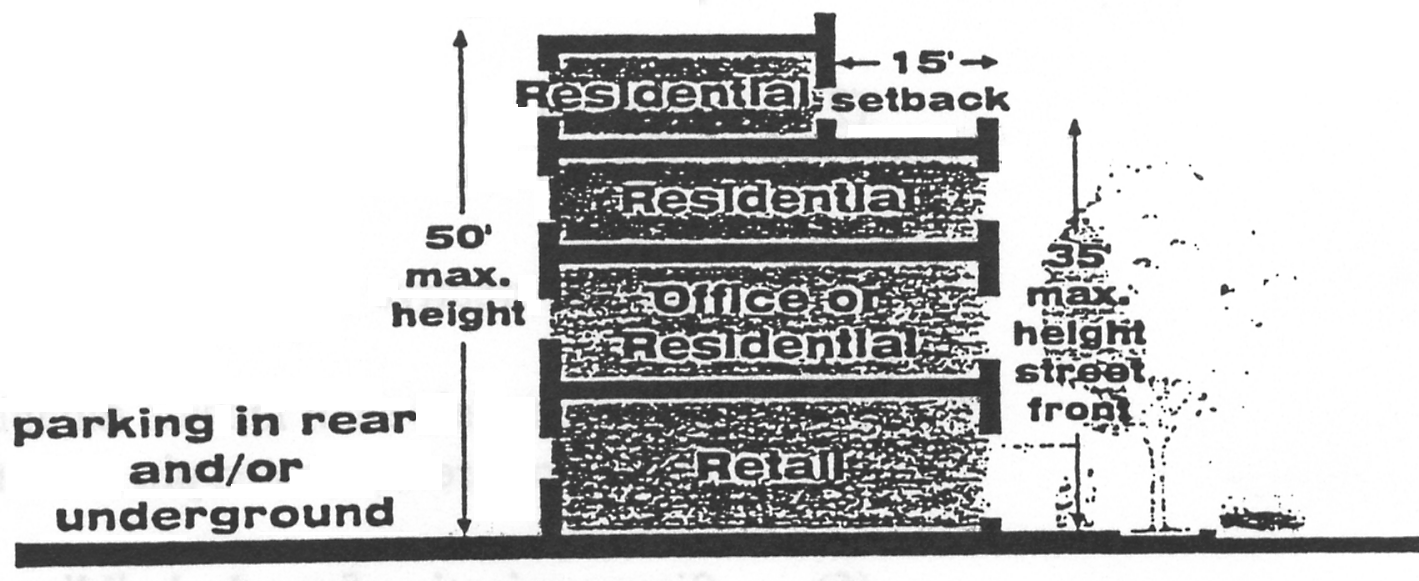
Building Height
4-1411 - Building and retail guidelines.
The following guidelines shall apply to any redevelopment or new development requiring a special use permit or administrative permit pursuant to section 4-1404 or 4-1407.
On any project requiring an administrative permit pursuant to section 4-1404 or 4-1407 conformance may be required to those guidelines listed herein that would be applicable
based on the scope of the work or construction to be undertaken as part of the administrative
permit.
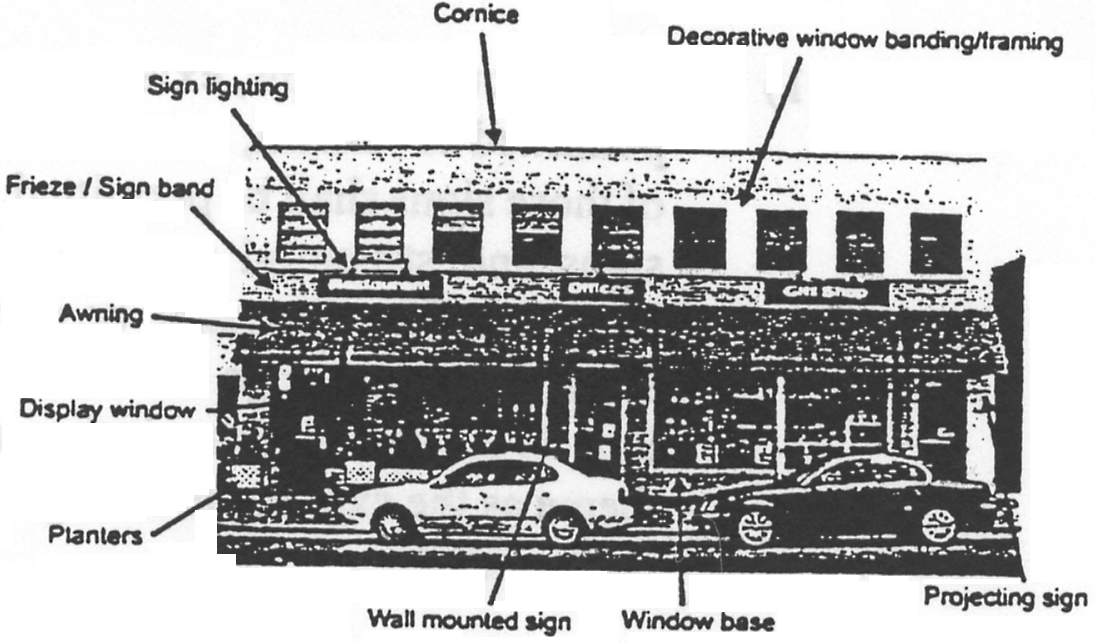
Building Facades
(A)
Building facades. New and remodeled facades should conform to the general historical Art Deco architectural style of the historic buildings in Arlandria. Decorative elements such as cornices and belt courses should be used to give scale and interest to the facades, to help define the building elements (base, middle, and top), and to create three dimensional richness to the facades.
(1)
Facade rhythms. The building facades should incorporate multiple rhythms or cadences (rather than a single repetitive rhythm) that is reflective of the pattern found in the historic and traditional buildings of the area. This is accomplished with a rich variety of surface treatments such as architectural features, large window and door frames, projecting bay window displays, canopies above the door, awnings, etc.;
Individual storefront facades should be narrow and change often to add a richness to the sidewalk, street, and neighborhood. The preferred width of the storefront is approximately 20-25 feet, and should have a maximum width of 50 feet;
(2)
Corner treatment. In cases where buildings are on a corner special treatment is encouraged for the buildings at these locations. This includes such things as rounded or cut corners, articulated corner entrances, accented display windows, special corner roof features, etc.;
(3)
'T' intersection treatment. In cases where buildings terminate the view down a street at a 'T' intersection, special treatment is encouraged including what is mentioned above, plus special facade treatments that line up with the street view it is terminating. These would include special accented architectural features, distinctive facade fenestration, accented roof profile, special building materials, etc.
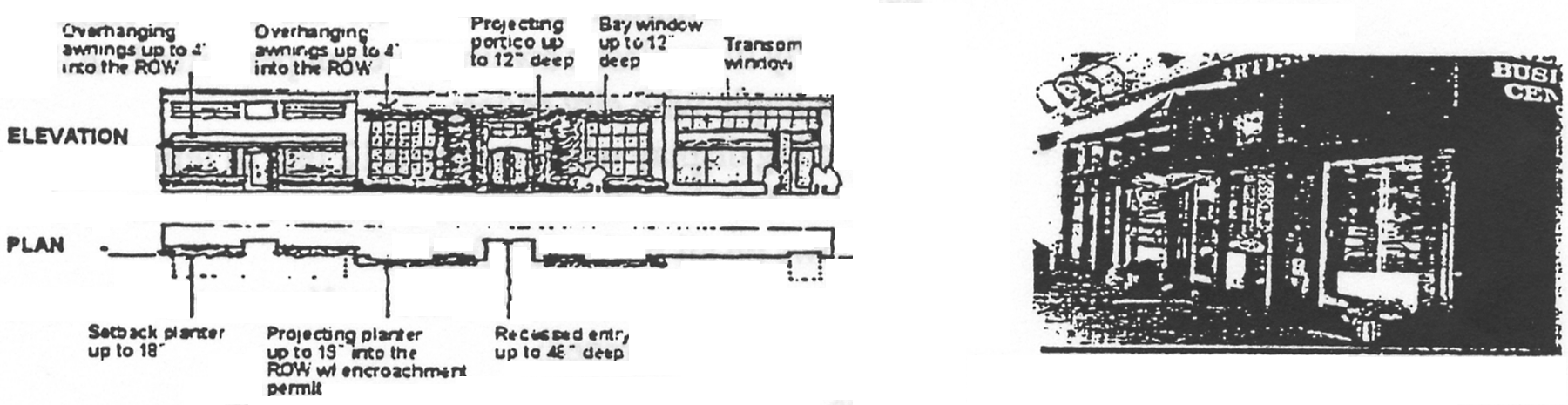
Storefront Design
(B)
Storefront design. The storefront should work with the architecture of the overall building facade, should clearly and simply present the name of the business and the type of services and products offered. It should give customers easy visibility into the store. The storefront design should contribute to a distinctive pedestrian and customer experience, and uniquely enhance the overall business district's identity and beauty.
Storefront design should include as many of the following items as possible:
•
Primary pedestrian entrances should be located directly fronting the sidewalk; entrances should be recessed up to 48 inches deep from the facade;
•
Detailed window frames with decorative moldings are encouraged;
•
A window base or bulkhead below storefront windows should be not less than 18 inches high, and not taller than 30 inches;
•
A pattern of transom windows, horizontal elements and mullions provides a unique rhythm of glass and trim elements in the storefront;
•
65—75 percent of the ground floor facade should be windows with clear glass;
•
Porticos around the entry door may project up to 12 inches into the public right-of-way;
•
Marquee structures or canopies may project from the building at entries (maximum ten feet in length, minimum height eight feet above the sidewalk and maximum projection of four feet into the public right-of-way). These shall comply with city codes and be reviewed on an individual basis as to design compatibility;
•
Awnings may overhang the sidewalks (awnings shall be below 14 feet in height, not less than eight feet above the sidewalk and project a maximum of four feet into the public right-of-way). Internally lit or plastic awnings are not permitted. All awnings shall comply with city codes;
•
Projecting display windows up to 12 feet in length may project up to 2 feet into the sidewalk, and are encouraged to have windows on all projecting faces;
•
Creative display of merchandise and/or services in storefront windows is encouraged;
•
Blank walls longer than six feet are prohibited;
•
Solid roll-down or sliding security grates are prohibited.
(C)
Lighting. Lighting dramatically enhances the appeal of storefronts at night, and makes the streets feel safe. Creative lighting should illuminate signs, window displays, and architectural details of the building while adding to the overall image of the street. The following guidelines apply:
•
Lighting should be carefully coordinated with nearby street lighting and other storefronts, and should not be too bright or glaring;
•
Light sources should be carefully concealed and blend in with the architecture. Sconces, downlights or other exterior mounted light fixtures should be used selectively to light signs and/or architectural features;
•
Lighting shall be provided along commercial store fronts from sundown until 11:00 p.m. on week days, and until midnight on weekends;
•
Neon banding is strongly discouraged;
•
All lighting must conform to city codes and regulations.
(D)
Greenery. Plants, flowers, planters, urns, and hanging baskets should be used to enhance and humanize the storefront and sidewalk in front of the stores. All greenery installations should conform to the currently adopted Mount Vernon Avenue Design Guidelines, the Landscape Guidelines, and the City Code.
4-1412 - Streetscape requirements.
(A)
All redevelopment and infill proposals should comply with the urban design standards set forth in the currently adopted Mount Vernon Avenue Design Guidelines and the long-term vision for the Arlandria Neighborhood as adopted as part of the master plan.
4-1413 - Use limitations.
(A)
All storage shall be located within a completely enclosed building.
(B)
Reserved.
(C)
All uses shall manage onsite vibration, dust, odor, smoke, gas, and fumes so they do not create a nuisance by creating a substantial and unreasonable interference with the health, safety, peace, or comfort of persons beyond the property line. When either two or more complaints from the same complainant concerning the same condition or one or more complaints from two or more distinct complainants concerning the same condition are received and verified, the director will send written notice to the person responsible. Within 30 days, the person responsible shall submit a written control plan to the director. The control plan must specify corrective measures and a timeline for implementation, drawing on best available control technologies and recognized industry best practices. The director may require modifications to the control plan, impose reasonable deadlines, and require monitoring or inspections to verify compliance.
(D)
Reserved.
(E)
Reserved.
(F)
Day care centers and private academic schools for compulsory school age students shall submit for the director's review a pick-up and drop-off plan that adequately ensures the safe transfer of students and creates minimal impact on pedestrian and vehicular traffic. Day care centers and private academic schools must obtain approval of the plan prior to opening its place of business.
(G)
The placement or construction of items that block the visibility through windows of the interior of the commercial space from the street and sidewalk, including, but not limited to, walls, window film, storage cabinets, carts, shelving, boxes, coat racks, storage bins, and closets, shall be prohibited. All windows shall remain transparent. This is not intended to prevent retailers from displaying their goods in display cases that are oriented towards the street frontage.
(H)
Retail with a principal use selling tobacco products, nicotine vapor products, alternative nicotine products, or hemp products intended for smoking are prohibited on property within 1,000 linear feet of a child day care center, or a public or private academic early childhood, elementary, middle, or high school. Any such use in operation prior to July 1, 2024, may continue to operate at its existing location, but Article XII does not apply.
4-1414 - Co-living dwellings.
Up to two co-living dwellings, shall be categorized as nonresidential for the purpose of applying the area and bulk regulations of this zone, and each such co-living dwelling shall provide the parking required under section 8-200(A)(22).
4-1415 - Auxiliary dwellings.
Up to four auxiliary dwelling units are permitted and shall be categorized as nonresidential for the purpose of applying the area and bulk regulations of this zone. Such dwellings shall comply with section 8-200(A)(16) for parking and where parking is required spaces may be compact size or tandem. Auxiliary dwellings are allowed behind a first floor commercial use, if the depth of the building is more than 50 feet measured from the front building wall and the building is setback no further than 30 feet from front property line.
(Ord. No. 4310, § 5, 6-14-03; Ord. No. 4573, § 1, 12-13-08; Ord. No. 4677, § 3, 6-22-10; Ord. No. 4712, § 2, 3-12-11; Ord. No. 4910, § 1, 11-15-14; Ord. No. 4948, § 2, 5-15-15; Ord. No. 5029, § 1, 6-18-16; Ord. No. 5035, § 1, 6-28-16; Ord. No. 5121, § 1, 3-17-18; Ord. No. 5155, §§ 39—42, 6-26-18; Ord. No. 5259, §§ 41, 42, 12-14-19; Ord. No. 5303, § 3, 10-17-20; Ord. No. 5321, § 14, 1-23-21; Ord. No. 5383, §§ 15, 16, 11-13-21; Ord. No. 5405, § 3, 2-12-22; Ord. No. 5449, § 2, 9-17-22; Ord. No. 5490, § 3, 5-13-23; Ord. No. 5515, § 4, 12-16-23; Ord. No. 5566, § 3, 12-14-24; Ord. No. 5579, § 2, 4-26-25; Ord. No. 5614, § 3, 1-24-26)

