
Alexandria City Zoning Code
ARTICLE VII
SUPPLEMENTAL ZONE REGULATIONS
Sec. 7-100 - Accessory buildings, uses and structures.
Accessory buildings, uses and structures shall be permitted, but only in connection with and incidental to a permitted principal building, use or structure and in compliance with the restrictions of this section 7-100.
7-101 - Permitted accessory buildings, uses and structures.
Permitted accessory buildings, uses and structures shall be limited to the following and any additional building, use or structure which the director finds is similar to those listed in scope, size and impact, is associated with a permitted building, use or structure, and is otherwise in compliance with this ordinance:
(A)
Private garage;
(B)
Private greenhouse;
(C)
Private tennis or outdoor recreational court;
(D)
Above ground deck;
(E)
Private swimming pool;
(F)
Storage structure;
(G)
Freestanding air conditioning machinery;
(H)
Fence or wall;
(I)
Guest house, accessory to a single-unit dwelling, provided it is used by temporary guests or occupants of the main residence, contains no kitchen facilities and is not rented or otherwise used as a separate dwelling;
(J)
Gazebo or treehouse;
(K)
Home occupation, subject to section 7-300;
(L)
Child or elder care home, subject to section 7-500;
(M)
Solar energy system.
(N)
Accessory dwelling, subject to section 7-203.
(O)
Structures or mechanical equipment associated with electrical vehicle charging.
(P)
Parking associated and not associated with the principal use on the parcel.
7-102 - Prohibited accessory buildings, uses and structures.
Prohibited buildings, uses and structures accessory to residential dwellings include, but are not limited to:
Outdoor storage; provided that a reasonable amount of cut firewood for personal use and building materials on a temporary basis for use on site may be stored on a residential lot.
7-103 - Accessory building, use and structure limitations.
The following limitations apply to accessory buildings, uses and structures:
(A)
For residential uses only, no accessory building, use or structure shall be located forward of a front building wall facing a primary front yard except as provided in sections 7-202(A) and 7-202(E). For all other uses, no accessory building shall be located forward of a front building wall facing a primary front yard except as provided in section 7-202(A).
(B)
No accessory building, use or structure shall be located in a required front, rear, or side yard, except as provided in section 7-202.
(C)
Accessory buildings and structures shall be included in the calculations required by this ordinance for the purpose of complying with height and bulk regulations.
(D)
An accessory building, use or structure shall be located on the same lot as the principal structure or use served, except where it is located on an adjoining lot which contains no principal building, use or structure and which is adjacent to and in common ownership with the lot on which the principal building, use or structure which it does serve is located or as otherwise expressly authorized by the provisions of this ordinance.
(E)
Outside of the Old and Historic Alexandria and the Parker-Gray Districts, if a principal dwelling on an abutting lot has any openings with sill or threshold heights lower than the height of the following proposed accessory buildings and structures, as measured from grade, facing the shared lot line and within three feet of the shared lot line, the following accessory structures and buildings shall be located at least five feet from the shared lot line along the width of the openings and for a minimum of five feet in each direction, along the shared lot line, beyond the width of the openings:
(1)
Arbors, trellises and pergolas;
(2)
Accessory buildings occupied by an accessory dwelling unit;
(3)
Freestanding private garages pursuant to section 7-2500;
(4)
Sheds and other small storage structures and
(5)
Fences exceeding four feet in height.
(Ord. No. 5208, § 5, 3-16-19; Ord. No. 5234, § 10, 7-9-19; Ord. No. 5247, § 6, 10-19-19; Ord. No. 5328, §§ 4, 5, 3-13-21; Ord. No. 5374, §§ 15—18, 10-16-21; Ord. No. 5447, § 2, 7-5-22; Ord. No. 5515, § 7, 12-16-23; Ord. No. 5580, § 6, 4-26-25; Ord. No. 5614, § 6, 1-24-26)
Editor's note— Ord. No. 5374, § 15, adopted Oct. 16, 2021, amended § 7-100, and in so doing changed the title of said section from accessory uses and structures to read as set out herein.
7-201 - General prohibition.
Every part of a required yard shall be open and unobstructed from the lowest point to the sky except as may be permitted in section 7-202.
7-202 - Permitted obstructions.
The following obstructions shall be permitted when located in a required yard and placed so as not to obstruct light and ventilation and when otherwise permitted by law:
(A)
In all yards:
(1)
Open fences which do not exceed four feet in height.
(2)
Awnings or canopies provided they do not project more than five feet in depth from the existing building face.
(3)
Bay or display windows, projecting 20 inches or less into the yard and gutters, eaves, cornices, window sills, and roof overhangs projecting 30 inches or less into the yard.
(4)
Chimneys projecting 30 inches or less into the yard, provided that such projection does not reduce the width of the remaining side or rear yard to less than five feet.
(5)
Arbors, trellises and pergolas, provided that such structures:
(a)
Shall not exceed ten feet in height. A trellis that exceeds six feet in height and 15 feet in length or any trellis that is attached to a fence shall comply with sections 7-202 and 7-1700;
(b)
Shall not be used for parking or storage of motor vehicles; and
(c)
Shall remain 80 percent open and uncovered by any material other than plantings.
(d)
Reserved.
(6)
Flag poles which do not exceed 15 feet in height.
(7)
Open stairs.
(8)
Ramps and similar structures necessary to provide access for the handicapped.
(9)
Porticos.
(10)
Walls which do not exceed two feet in height.
(11)
Fountains.
(12)
Structures or mechanical equipment associated with electric vehicle charging, provided that they comply with the noise level established in subsection 7-202(C)(3).
(B)
In any yard except a primary front yard:
(1)
Sandboxes, swings and other small items of children's play equipment.
(2)
Clotheslines.
(3)
Open terraces and decks not over two feet above the average level of the adjoining ground and two feet above ground at any property line of the lot but not including a roofed-over terrace or porch.
(C)
In any yard except a front yard.
(1)
Open and closed fences which do not exceed six feet in height.
(2)
Sheds and other small accessory buildings:
(a)
For lots developed with single and two-unit dwellings, not located in a historic district, such structures may not exceed 100 square feet in floor area in the aggregate and may have a building height no greater than ten feet.
(b)
For lots developed with townhouse or single or two-unit dwellings located within a historic district, such structures may not exceed 65 square feet of floor area in the aggregate and may have a building height no greater than eight feet.
(c)
Reserved.
(3)
Freestanding or wall mounted residential mechanical equipment, provided it can be demonstrated to the director that it will not exceed a noise level of 55 decibels (55 dB(A)) when measured at any property line of the lot, and provided it is placed in a location which has the least adverse impacts to adjoining lots of those locations available. Demonstration may be provided through the following methods:
(a)
A survey plat showing the proposed location of the equipment.
(b)
The method of screening for the equipment, if required.
(c)
Documentation provided by the manufacturer that the proposed equipment will not exceed 55 decibels and/or screening methods that will reduce the noise level.
(4)
Freestanding private garages to the rear of the main building in accordance with section 7-2501.
(5)
Accessory buildings occupied by accessory dwellings in accordance with section 7-203.
(D)
In the Old and Historic Alexandria and the Parker-Gray Districts, the requirement of sections 7-202(A)(1) and 7-202(C)(1) may be waived or modified by the board of architectural review where the board finds that a proposed fence would be architecturally appropriate and consistent with the character of the district.
(E)
For any residential lot, single-story front porches with a maximum depth of ten feet shall be permitted in any required front or side yard provided that the porch shall be located on the first floor or at ground level and the front yard shall not be reduced to less than ten feet. Front porches shall not extend into required side yards further than the walls that face the side yards of the existing dwelling unless such extension complies with the regulations for the zone in which it is located.
(F)
Open and closed fences which do not exceed ten feet in height shall be permitted in any required side or rear yard on any residential lot when such yard abuts a lot developed with a nonresidential use.
7-203 - Accessory dwellings.
(A)
Reserved.
(B)
Use limitations.
(1)
An accessory dwelling shall be permitted as an accessory use to a single-unit, two-unit, or townhouse dwelling only.
(2)
Only one accessory dwelling shall be permitted on any recorded lot including properties subject to section 7-103(D).
(3)
The gross floor area of an accessory dwelling within a principal dwelling shall not exceed one-third of the principal dwelling's gross floor area.
(4)
An accessory dwelling unit's kitchen shall contain a kitchen sink, a cooking appliance, a food preparation counter, storage cabinets, and a refrigerator.
(5)
The accessory and principal dwelling shall remain under common ownership.
(6)
Reserved.
(7)
Reserved.
(C)
Bulk and setback requirements for a detached accessory building. Regardless of other regulations in this zoning ordinance, an accessory building containing an accessory dwelling unit shall be permitted in accordance with the regulations in this section 7-203.
(1)
Size. The maximum floor area of the accessory building's first floor shall not exceed the greater of:
(a)
One-third of the floor area of the principal dwelling's first floor; or
(b)
Three hundred fifty square feet for lots 2,500 square feet or less and 500 square feet for lots larger than 2,500 square feet.
For the purposes of this section, floor area shall include space otherwise excluded pursuant to sections 2-145(A)(12) and 2-145(B)(14).
(2)
Height. The maximum height of the accessory building shall not exceed the lesser of the following:
(a)
The height of the principal dwelling; or
(b)
Twenty feet.
For purposes of this section, the maximum height shall include all rooftop appurtenances listed in section 6-403(B).
(3)
Side and rear yards. The accessory building shall be permitted in required side and rear yards subject to the following requirements:
(a)
Unless a lesser setback is required by the zone in which the property is located, the accessory building shall provide at least a one-foot setback, including architectural features, from side and rear lot lines; and
(b)
If the accessory building has walls with windows or doorways that face the nearest side or rear lot line, the setback shall be three feet unless a greater setback is required by subsections (c) or (d) [below];
(c)
Portions of an accessory building that exceed 13.5 feet in height and are 16 feet in height or less shall provide a setback of at least 2.5 feet;
(d)
Portions of accessory buildings more than 16 feet in height shall provide a setback of at least five feet.
(e)
Reserved.
(D)
Off-street parking. An accessory dwelling shall be exempt from providing off-street parking.
(E)
Access. Section 7-2501(B)(3) shall govern access to a detached accessory dwelling that contains off-street parking in a private garage.
(Ord. No. 3606, § 10, 12-12-92; Ord. No. 3697, § 4, 1-22-94; Ord. No. 3822, § 3, 9-16-95; Ord. No. 3923, § 6, 4-12-97; Ord. No. 4483, § 2, 5-12-07; Ord. No. 4556, § 1, 6-24-08; Ord. No. 4910, § 4, 11-15-14; Ord. No. 5049, § 1, 1-28-17; Ord. No. 5122, § 5, 3-17-18; Ord. No. 5127, § 2, 4-14-18; Ord. No. 5151, § 8, 6-23-18; Ord. No. 5208, § 6, 3-16-19; Ord. No. 5247, § 7, 10-19-19; Ord. No. 5254, § 5, 11-16-19; Ord. No. 5300, § 10, 10-17-20; Ord. No. 5328, §§ 6, 7, 3-13-21; Ord. No. 5374, §§ 19, 20, 10-16-21; Ord. No. 5515, § 7, 12-16-23; Ord. No. 5529, § 6, 4-13-24; Ord. No. 5575, § 1, 3-15-25; Ord. No. 5580, § 6, 4-26-25; Ord. No. 5593, § 5, 6-14-25)
Sec. 7-300 - Home occupations.
Home occupations are permitted in residential dwellings subject to the following limitations.
7-301 - Use limitations.
(A)
Up to two employees are permitted on site provided that only those persons who are bona fide residents of the premises may obtain a business license to operate the home occupation pursuant to section 7-304.
(B)
No mechanical or electrical equipment shall be employed on the premises other than machinery or equipment customarily found in a home, associated with a hobby or avocation not conducted for gain or profit, or customary for a small business, professional or health profession office.
(C)
No outside display of goods or outside storage of equipment or materials used in the home occupation shall be permitted.
(D)
The number of patrons or students shall be limited to a total of 12 per day with no more than two patrons or students present at any one time. Patrons or students may visit the home occupation between the hours of 7:00 a.m. and 9:00 p.m., daily.
(E)
No sign shall advertise the presence or conduct of the home occupation.
(F)
All parking required for the home occupation shall be accommodated in permissible driveway and garage areas on the lot.
(G)
There shall be no evidence that will indicate from the exterior of the premises that the building is being utilized in whole or in part for any purpose other than as a dwelling.
(H)
There shall be no audible noise, detectable vibration or odor beyond the confines of the subject dwelling unit or accessory building, including transmittal through vertical or horizontal party walls.
(I)
The total floor area which may be used for a home occupation shall not exceed 25 percent of the total floor area of the dwelling unit in which it is located, less any attached garages. As part of such home occupation floor area, no more than two percent of the total floor area of the dwelling unit or a maximum of 20 cubic feet, whichever is less, shall be used for storage of stock-in-trade. The storage of hazardous materials not otherwise and customarily associated with home use is prohibited.
(J)
The lot or property on which the home occupation is conducted shall not have any parking space added to it during the time the home occupation is being conducted; nor shall any parking space be used that was not customarily used prior to that time.
(K)
The total number of animals kept in a dwelling unit at any one time cannot exceed the limits set forth in City Code title 5, chapter 7.
(L)
No motor vehicle repairs, sales or internal combustion engine work shall be permitted.
(M)
Not more than one commercial vehicle having a capacity not greater than one ton shall be parked on the property and then only in accordance with applicable regulations of this ordinance.
(N)
No contracting equipment or materials shall be stored on the premises, except in a commercial vehicle used for transporting said equipment and materials between jobs, and no loading or unloading shall be done on or in the vicinity of the premises.
7-302 - Short-term residential rentals.
Section 7-300 does not apply to short-term residential rentals. Short-term residential rentals are regulated pursuant to section 7-1400.
7-304 - Home address for purpose of business license.
Notwithstanding any provision or limitation of this section 7-300, a residential address may be used for the purpose of obtaining a business license, provided that a business license is actually obtained and kept current, business taxes are paid and the residential premises are used only for residential purposes unless the business is permitted as a home occupation pursuant to this section 7-300 and its limitations.
(Ord. No. 5155, §§ 59, 60, 6-26-18; Ord. No. 5208, § 7, 3-16-19; Ord. No. 5303, § 6, 10-17-20; Ord. No. 5374, §§ 21—23, 10-16-21; Ord. No. 5447, § 2, 7-5-22; Ord. No. 5575, § 2, 3-15-25)
Sec. 7-400 - Reserved.
Editor's note— Ord. No. 5529, § 6, adopted April 13, 2024, repealed § 7-400, which pertained to bed and breakfast accommodations and derived from prior code.
Sec. 7-500 - Child and elder care homes.
Child and elder care homes are permitted subject to the following limitations:
(A)
Requirements for child and elder care homes for one to five persons. A child or elder care home for one to five persons is allowed as a permitted use in the zones in which it is listed and must comply with the following:
(1)
All homes shall be registered with the city pursuant to title 12 of the city code;
(2)
When calculating the total number of children cared for, resident children under the age of 12 shall be included. When calculating the total number of adults, all resident adults shall be included.
(3)
The home shall be the principal residence of the operator of the home;
(4)
The home shall comply with all requirements of the city and state codes.
(Ord. No. 5035, § 1, 6-28-16)
7-601 - New hospitals not permitted.
It is the intent of this ordinance that no new hospital be allowed to locate in any residential zone and that hospitals legally existing in residential zones on June 24, 1992 be allowed to continue as legal uses and structures, but subject to the strict terms and conditions of the existing special use permit(s) governing their use and provided that no change in that permit(s) be allowed except, at a minimum, upon findings made by the city council as follows:
(A)
That the proposed hospital use is compatible with the development allowed under the basic provisions of this ordinance for the area in which it is proposed and it is not of such a nature in height, bulk or scale as to exercise any influence contrary to the purpose and intent of this ordinance.
(B)
That the proposed hospital use is compatible with and/or implements planning goals and objectives of the city, as contained in the master plan, applicable small area plan, and other pertinent policy resolutions, particularly in terms of:
(1)
Land use policy;
(2)
Housing goals;
(3)
Traffic impact and parking;
(4)
Impact on schools, public services and facilities;
(5)
Essential character of the neighborhood; and
(6)
Any neighborhood planning goals contained in the applicable small area plan or consolidated master plan of the city.
(C)
That the proposed use of any office or examining rooms within the hospital by a physician for treatment of his or her private patients is required because such practice or treatment is not feasible outside the hospital.
(D)
That the existing or proposed utility services are adequate for the proposed hospital use.
7-602 - Change from hospital use to nursing home.
That a change in the use of an existing hospital to a nursing or convalescent home may be considered pursuant to a special use permit, but only if, at a minimum, those limitations and conditions of the hospital special use permit(s) which are applicable to the new use be agreed to by the applicant as part of the new special use permit, including without limitation maintenance of open space easements and size, intensity and expansion restrictions.
7-701 - Definitions.
For the purposes of this section 7-700, low- and moderate-income housing units shall be determined in accordance with regulations which are issued by the city manager and approved by the city council and which reflect the following guidelines.
(A)
Low- and moderate-income rental units are rental units for which the combined cost of rent and utilities does not exceed 30 percent of the maximum income limits used by the United Sates Department of Housing and Urban Development for its section 8 and Housing Voucher programs, as adjusted for family size and corresponding number of bedrooms, and which are occupied by persons or households whose gross income does not exceed the limits applicable to the section 8 program.
(B)
Low- and moderate-income sales units are units with sales prices for which a person or household whose gross annual income is at or below the median income for the Washington, D.C., Metropolitan Statistical Area, adjusted for family size, could qualify using the lending criteria applied by the Virginia Housing Development Authority in its single-family mortgage assistance program and which are occupied by persons or households whose gross annual income is at or below such median income level.
7-702 - When increases and reductions may be allowed.
Increases in allowable floor area ratio, density and height and reductions in required off-street parking may be allowed for a building which contains one or more dwelling units or a project which includes one or more such buildings through a special use permit when:
(A)
The applicant for the special use permit commits to providing low and moderate income sales or rental housing units in conjunction with the building or project which is the subject of the permit application in compliance with the following:
1.
Number of units required: The number of units required shall be equivalent to at least one-third (⅓) of the increase achieved by the bonus approved under this section 7-700. Equivalency can be established with a different number of units if the size (square footage or number of bedrooms) of the units provided achieves an equivalent contribution as determined by the director of housing and approved with this SUP.
2.
Location of units: The units may be provided within the building or project which is the subject of the permit application, or with the consent of the applicant and the director of housing and the director of planning and zoning and approval of this special use permit, the units may be provided:
i.
at an off-site location provided that:
1.
a specific plan for the off-site location is approved with this SUP;
2.
the off-site location meets all zoning requirements to include the units; and
3.
the total contribution value of the off-site units is equivalent to the total contribution value of what would have been provided on site; or
ii.
by a cash contribution to the City of Alexandria Housing Trust Fund in an amount equivalent to the value of the units that would have been provided on-site, or
iii.
A combination of i and ii above if the total contribution is equal to the value of the units that would have been provided on site.
(B)
The applicant for the special use permit agrees and provides sufficient assurance, by way of contract, deed or other recorded instrument acceptable to the city attorney, that the low-and/or moderate-income housing units to be provided will remain in these categories for the period of time specified in the special use permit.
(C)
City council determines that the building or project which is subject to the special use permit, with the increase in allowable floor area ratio, density and height and the reduction in required off-street parking, meets the standards for the issuance of a special use permit set forth in section 11-500.
7-703 - Limits on increases which may be allowed.
(A)
Floor area ratio and density may not be increased pursuant to this section 7-700 by more than 30 percent of the floor area ratio and density otherwise permitted by this ordinance, unless a greater percentage increase is specifically designated in a small area plan chapter of the Master Plan. The increase permitted under this section 7-700 is exclusive of any other floor area ratio and density increases allowable under any other section of this ordinance.
(B)
Height may not be increased pursuant to this section by more than 25 feet beyond the height otherwise permitted by this ordinance; provided, however, that no building located in any zone or height district where the maximum allowable height is 50 feet or less may be allowed to exceed such height limits.
(Ord. No. 4858, § 1, 2-22-14; Ord. No. 5065, § 1, 6-24-17)
7-801 - Vision clearance required.
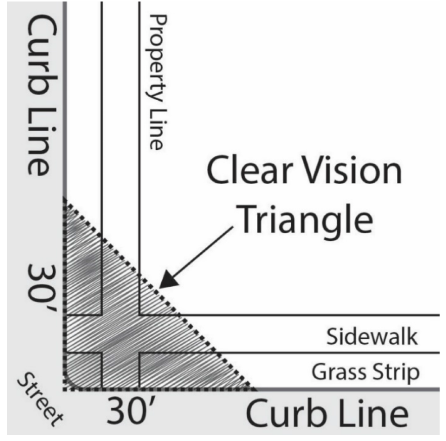
For the purposes of safety of travel on streets and highways, buildings on corner lots shall observe the setback provisions of the respective streets on which the building is located; provided, that within the area enclosed by a diagonal line connecting two points located 30 feet from the intersecting curb line, there shall be no structure, fences, shrubbery or other obstruction to vision more than four feet above the curb grade with the following exception:
(A)
Trunk of a tree but not branches or foliage less than eight feet in height as measured from grade.
7-802 - Board of architectural review waiver.
The requirements of this section 7-800 may be waived by the board of architectural review where to do so would be consistent with the historic character of the district. In the case of such a waiver and where necessitated thereby the board of architectural review may also waive any applicable yard or setback requirement.
(Ord. No. 5189, § 2, 12-15-18; Ord. No. 5254, § 6, 11-16-19)
Sec. 7-900 - Reserved.
Editor's note— Ord. No. 5515, § 7, adopted Dec. 16, 2023, repealed § 7-900, which pertained to provisions applying at lines of zone change and derived from Ord. No. 5254, § 7, adopted Nov. 16, 2019; and Ord. No. 5447, § 2, adopted July 5, 2022.
7-1001 - Setbacks for garages.
One private garage may be erected within one foot of the front lot line when the floor of such garage is not lower than the established curb grade and the roof of such garage is entirely below the surface of the finished yard. Private detached garages erected above the finished grade after June 28, 1973, shall comply with the yard requirements of their respective zones.
7-1003 - Rear yards abutting alleys.
Whenever any public or private alley occurs in any zone, one-half of the width of such alley shall be considered in the determination of the rear yard setback ratio requirement of any lot abutting on such alley.
7-1004 - Bus shelters.
The front yard requirements of this ordinance shall not apply to bus shelters for which a special use permit has been granted.
7-1005 - Parking in required yards.
Front, side and rear yards shall be deemed to be in compliance with this ordinance provided that not more than 50 percent of such front, side or rear yard is used for parking of automobiles, including driveways whether paved or unpaved.
7-1006 - Additional setback required.
Wherever the right-of-way widths or building setback lines provided in this section 7-1006 require a greater setback than the front yard or setback requirements found elsewhere in this ordinance, the requirements of these provisions shall govern. It is the intent of the following setback provisions to provide sufficient area for use as sidewalks and highway right-of-way and in order to provide for a consistent building line along certain streets.
(A)
The setback line of each side of Mount Vernon Avenue from Braddock Road north to the corporate limits shall be at least ten feet from the front lot line in every case.
(B)
The building setback line on both sides of Duke Street from Diagonal Road to Quaker Lane shall be at least 60 feet from the existing centerline of Duke Street, and from Quaker Lane west to the corporate limits, such setback line shall be at least 75 feet from the existing centerline of Duke Street.
(C)
The building setback line on King Street (Leesburg Pike) from Braddock Road northwest to the corporate limits shall be at least 75 feet from the existing centerline of King Street (Leesburg Pike).
(D)
The building setback line on Seminary Road from Quaker Lane west to the corporate limits shall be at least 60 feet from the existing centerline of Seminary Road.
(E)
The building setback line on Beauregard Street from the west corporate limits to the north corporate limits shall be at least 80 feet from the centerline of Beauregard Street.
(F)
The building setback line on South Pickett Street shall be at least 50 feet from the centerline of the street.
(G)
The term "existing centerline," as used in this section, shall mean the centerline of the public right-of-way as established by maps, plats and plans on file in the office of the director of transportation and environmental services on March 1, 1960, and more particularly in the case of Duke Street from Roberts Lane west to the corporate limits, the term refers to the centerline as shown on road plans denominated Virginia State Highway Department Plan Number 236, Project Number 368-1AR:1; Virginia State Highway Department Plan Number 236; Project Numbers 113-AW-4, 113-AW-3, 113-AW-2; Virginia State Highway Department Plan Number 236, Project Number 113-AW-6.
7-1007 - Land without frontage.
Whenever a unit of land otherwise usable as a building site does not have frontage on a public street, it shall be deemed to meet the street frontage requirements if a special use permit is granted.
(Ord. No. 4457, § 1, 6-27-06; Ord. No. 4472, § 1, 1-20-07; Ord. No. 4556, § 1, 6-24-08; Ord. No. 4653, § 1, 4-17-10)
Editor's note— It should be noted that § 1 of Ord. No. 4514, adopted January 12, 2008, provides, "That the sunset date set forth in Section 4 of Ordinance No. 4457, be, and the same hereby is, extended from December 31, 2007 until December 31, 2008."
7-1101 - Restrictions on parking trailers in any zone.
The parking of a trailer in any zone is hereby prohibited with the following exceptions:
(A)
One trailer may be parked or stored in a lawful, enclosed garage, provided that no living quarters or business premises shall be maintained in such trailer.
(B)
Trailers used as contractors' offices or equipment sheds may be parked on the site of an active construction project for the duration of construction authorized by an approved building permit.
(C)
Trailers used for temporary nonresidential purposes may be parked on a lot provided approval of an administrative special use permit has first been obtained, subject to section 11-513 of this ordinance.
(D)
Trailers are permitted on city-owned or Alexandria City Public School property. Alexandria City Public School trailers shall be used for school related activities where public schools are allowed in a zone.
7-1102 - Restrictions on parking recreational vehicles in residential zones.
Recreational vehicles may be parked in any residential zone only on a lot occupied and used for single-unit, two-unit, townhouse, or multi-unit (up to four units) dwelling purposes and only subject to the following:
(A)
The total length of any such recreational vehicle shall not exceed 25 feet in the R-8, R-12 and R-20 residential zones and 20 feet in all other residential zones;
(B)
Not more than one recreational vehicle shall be permitted on each lot, except that any number of such recreational vehicles may be permitted if parked within an approved, enclosed garage or storage building; and
(C)
Any such recreational vehicle shall be unoccupied and parked behind the front building line or within an approved, enclosed garage or storage building.
(Ord. No. 5034, § 1, 6-28-16; Ord. No. 5515, § 7, 12-16-23; Ord. No. 5614, § 6, 1-24-26)
7-1201 - Permitted utilities.
The following utilities are permitted in any zone in the city: the erection, construction, alteration or maintenance by public utilities, public service corporations, municipal departments, public commissions or public authorities of underground gas, steam, water or sewage supply, collection or disposal systems and underground or overhead electric, communication, telephone or cable transmission or distribution systems, including poles, wires, lines, mains, drains, sewers, pipes, conduits, cables, fire alarm boxes, traffic signals, hydrants, freestanding pad mounted transformers and electric switches, and other similar equipment and accessories in connection therewith reasonably necessary for the furnishing of adequate services by such utilities, corporations, departments, commissions or authorities, or for the public health, safety or general welfare; provided, that such freestanding pad mounted transformers and electric switches have been approved after public hearing by site plan, special use permit or certificate of appropriateness or as part of the city's capital improvement program, or have been approved either by both the director of transportation and environmental services and the director of planning and zoning, in accordance with guidelines established by the directors and approved by city council, after affording informal notice and opportunity to comment to affected parties or by city council, after public hearing, on an appeal from disapproval by one or both directors. Notwithstanding the foregoing, small cell facilities shall be regulated by sections 7-1206 through 7-1212.
7-1202 - Special use utilities.
(A)
Special use permit required. The following utility uses are permitted by public utilities, public service corporations, municipal departments, public commissions or public authorities only with a special use permit:
(1)
Tanks, towers, standpipes or other facilities for storing water, sewage or other liquids or gases, electric power substations, telephone exchange buildings and structures, and pumping stations; and
(2)
Overhead transmission, distribution, or communication wires, lines, or cables, and facilities for the transmission of wireline communications that are suspended, mounted on, or carried by poles, towers or other structures which:
(i)
Exceed 50 feet in height;
(ii)
Have one or more arms, cross arms or similar apparatus which would extend out more than six feet from the side thereof;
(iii)
Have a diameter in excess of three feet if it is a pole-like structure; or
(iv)
Exceed four square feet in area at any cross section, or have a side exceeding two feet in width if it is a tower or other type structure.
(B)
Exception. Notwithstanding the foregoing, wireless facilities shall be regulated by sections 7-1206 through 7-1212.
7-1203 - Uses not considered utilities.
The following are not included in the above-named lists of uses: buildings, offices, motor vehicles, bus or car barns, garages, shops, railroad yards or siding, freight terminals, warehouses, service or storage yards or facilities or any use separately listed in a zone.
7-1204 - Compliance with other regulations.
Notwithstanding anything to the contrary in this section 7-1200, all development shall comply with chapter 3, title 5, of the city code pertaining to underground utilities.
7-1205 - Radio and television reception or transmission structures.
All non-small cell facility radio and television reception or transmission structures require an administrative permit to be issued by the director based on the following criteria:
(1)
Whether the proposed size and height of the structure is compatible with the height and scale of adjacent buildings and is the minimum necessary to conduct the anticipated transmission or reception activity;
(2)
Whether the proposed location of the structure is one that has the least negative impact on surrounding buildings and neighborhoods of the locations available and is the least visible position which still provides adequate transmission and reception; if there is no unobtrusive location for the structure, whether alternative methods of achieving transmission or reception are reasonably feasible; and
(3)
Whether the proposed material and screening of the structure is adequate and appropriate to minimize the visual impact of the structure. This section does not apply to small cell facilities, standard facilities, or receiving antennas subject to 47 C.F.R. Section 1.4000.
7-1206 - General provisions pertaining to installation of wireless facilities.
(A)
Definitions. For purposes of sections 7-1206 through 7-1212, the following definitions apply:
(1)
Antenna means communications equipment that transmits or receives electromagnetic radio signals used in the provision of any type of wireless communications services.
(2)
Ancillary equipment means wireless facilities other than antennas and associated cabling, and includes radio transceivers, power supplies, and other equipment associated with an antenna but not integrated with an antenna into a single component.
(3)
Co-locate means to install, mount, maintain, modify, operate, or replace a wireless facility on, under, within, or adjacent to a base station, building, existing structure, utility pole, or wireless support structure.
(4)
Existing structure means any structure that is installed or approved for installation at the time a wireless services provider or wireless infrastructure provider provides notice to the city or the Department of Transportation of the Commonwealth of Virginia of an agreement with the owner of the structure to co-locate equipment on that structure. Existing structure includes any structure that is currently supporting, designed to support, or capable of supporting the attachment of wireless facilities, including lattice towers, monopoles, buildings, utility poles, light poles, flag poles, signs, and water towers.
(5)
Micro-wireless facility means a small cell facility that is not larger in dimension than 24 inches in length, 15 inches in width, and 12 inches in height and that has an exterior antenna, if any, not longer than 11 inches.
(6)
New structure means a wireless support structure that has not been installed or constructed or approved for installation or construction, at the time a wireless services provider or wireless infrastructure provider applies to a locality for any required zoning approval. New structure does not include any utility pole as defined in section 7-1206(A)(10).
(7)
Public right-of-way means the surface, the air space above the surface, and the area below the surface of any public street, highway, lane, path, alley, sidewalk, boulevard, drive or bridge, in which the city holds a property interest or which is under the control or management of the city for use by the travelling public.
(8)
Small cell facility means a wireless facility that meets each of the following conditions:
(a)
The facilities:
(i)
Are mounted on structures 50 feet or less in height including their antennas; or
(ii)
Are mounted on structures no more than ten percent taller than other adjacent structures; or
(iii)
Do not extend existing structures on which they are located to a height of more than 50 feet or by more than ten percent, whichever is greater;
(b)
Each antenna associated with the deployment, excluding ancillary equipment, is no more than three cubic feet in volume;
(c)
All other wireless equipment associated with the structure, including the wireless equipment associated with the antenna and any pre-existing associated equipment on the structure, is no more than 28 cubic feet in volume;
(d)
The facilities do not require antenna structure registration under Federal Communications Commission regulations; and
(e)
The facilities do not result in human exposure to radio frequency radiation in excess of the applicable safety standards specified in Federal Communications Commission regulations.
(9)
Standard facility means a wireless facility that does not meet the definition of small cell facility in section 7-1206(A)(8).
(10)
Utility pole means a structure owned, operated, or owned and operated by a public utility, the city, or the Commonwealth of Virginia that is designed specifically for and used to carry lines, cables, or wires for communications, cable television, or electricity.
(11)
Wireless facility means equipment at a fixed location that enables wireless communications between user equipment and a communications network, including:
(i)
Equipment associated with wireless services, such as private, broadcast, and public safety services, as well as unlicensed wireless services and fixed wireless services, such as microwave backhaul; and
(ii)
Radio transceivers, antennas, coaxial, or fiber-optic cable, regular and backup power supplies, and comparable equipment, regardless of technological configuration.
(iii)
Wireless facility does not include radio or television broadcast facilities or amateur radio facilities, which are subject to section 7-1205.
(12)
Wireless infrastructure provider means any person that builds or installs transmission equipment, wireless facilities, or wireless support structures, but that is not a wireless services provider.
(13)
Wireless services means (a) personal wireless services as defined in 47 U.S.C. § 332(c)(7)(C)(i); (b) personal wireless service facilities as defined in 47 U.S.C. § 332(c)(7)(C)(ii), including commercial mobile services as defined in 47 U.S.C. § 332(d) provided to personal mobile communication devices through wireless facilities; and (c) any other fixed or mobile wireless service, using licensed or unlicensed spectrum, provided using wireless facilities.
(14)
Wireless services provider means a provider of wireless services.
(15)
Wireless support structure means a freestanding structure, such as a monopole, tower, either guyed or self-supporting, or suitable existing structure or alternative structure designed to support or capable of supporting wireless facilities. Wireless support structure does not include any telephone or electrical utility pole or any tower used for the distribution or transmission of electrical service.
(B)
Microwireless facilities. Notwithstanding anything to the contrary in this article, the installation, placement, maintenance, or replacement of microwireless facilities that are suspended on cables or lines that are strung between existing utility poles in compliance with national safety codes shall be exempt from the permitting requirements and fees of this article.
(C)
Applications to include proposed wireless facilities. Any application for a new structure under this article shall include and identify the facilities to be attached to the proposed new structure. The director shall reject as incomplete any application for a new structure under this section that does not also propose installation of specific wireless facilities to be attached to the new structure.
(D)
Conditions of approval. Notwithstanding any other provision of this article, an applicant may voluntarily submit, and the city may accept, any conditions that otherwise address potential visual or aesthetic effects resulting from the placement of small cell facilities or standard facilities.
(E)
Abandoned facilities. Nothing in this subsection shall preclude the director from adopting reasonable rules with respect to the removal of abandoned wireless support structures or wireless facilities within 12 months in accordance with section 2-101.
(F)
Construction period. If the director or the city council approve an application and construction of the approved project has not commenced within two years of final approval any approved permit shall be deemed automatically revoked. If construction has commenced within two years of final approval, but has not been completed in that time, the director may request that the successful applicant demonstrate that construction is continuing and is being diligently pursued; if the director is not satisfied that construction will be completed within a reasonable time, the director may revoke any approved permit.
Editor's note— See Code of Virginia § 15.2-2316.3 related to subsections (A)(1), (A)(3) through (A)(6), (A)(9) through (A)(15); see 47 C.F.R. § 1.6002(l) related to subsection (A)(8); see Code of Virginia § 15.2-2316.4(C) related to subsection (B); see Code of Virginia § 15.2-2316.4(B)(5) related to subsection (D); see Code of Virginia § 15.2-2316.4(B)(6) related to subsection (E); and see Code of Virginia § 15.2-2316.4:2(A)(10) related to subsection (F).
7-1207 - Installation of small cell facilities on existing structures.
(A)
Administrative approval. Notwithstanding any other provisions of this zoning ordinance, no special exception, special use permit, or variance shall be required for any small cell facility installed by a wireless services provider or wireless infrastructure provider on an existing structure, provided that the wireless services provider or wireless infrastructure provider:
(1)
Has permission from the owner of the structure to co-locate equipment on that structure; and
(2)
Applies pursuant to this section.
(B)
Application process. An applicant for a permit under this section shall file an application with the director on such forms and subject to such procedures as the director may establish for the purpose which shall include a statement identifying the applicant and providing a valid electronic mail address for the applicant. The application may include up to 35 permit requests on the same application. Within ten days after receipt of an application and a valid electronic mail address for the applicant, the director shall notify the applicant by electronic mail whether the application is incomplete and specify any missing information; otherwise, the application shall be deemed complete.
(C)
Filing fee. The fee for processing the application shall be $100.00 each for the first five permits requested on a single application and $50.00 for each additional permit request on an application.
(D)
Action by the director. The application must be approved or disapproved by the director within 60 days of receipt of the complete application. Any disapproval of the application shall be in writing and accompanied by an explanation for the disapproval including the specific reason for disapproval pursuant to section 7-1207(E). The application shall be deemed approved if the director fails to act within the 60-day period. Approval for a permit shall not be unreasonably conditioned, withheld, or delayed.
(E)
Reasons for disapproval limited. The director may disapprove a proposed location or installation of a small cell facility on an existing structure only for the following reasons:
(1)
Material potential interference with other pre-existing communications facilities or with future communications facilities that have already been designed and planned for a specific location or that have been reserved for future public safety communications facilities;
(2)
The public safety;
(3)
Other critical public service needs;
(4)
In the case of an installation on or in the public rights-of-way or on other publicly owned or publicly controlled property, aesthetic impact as further specified in section 7-1212, except for attachments to utility poles and other privately-owned structures where the applicant has an agreement for attachment to the structure;
(5)
In the case of an installation on or in the public rights-of-way or on other publicly owned or publicly controlled property, the absence of all required approvals from all departments, authorities, and agencies with jurisdiction over such property, except for attachments to utility poles and other privately owned structures where the applicant has an agreement for attachment to the structure; or
(6)
Conflict with the regulations in article X, historic districts and buildings, of this ordinance.
(F)
Exception. This section does not apply to any eligible facilities request, as defined in section 7-1211(A).
Editor's note— See Code of Virginia § 15.2-2316.4(A) related to subsection (A); see Code of Virginia § 15.2-2316.4(B) related to subsection (B); see Code of Virginia § 15.2-2316.4(B)(2) related to subsection (C); see Code of Virginia §§ 15.2-2316.4(B)(1) and 15.2-2316.4(B)(3) related to subsection (D); and see Code of Virginia § 15.2-2316.4(B)(4) related to subsection (E).
7-1208 - Installation of standard facilities on existing structures.
(A)
Administrative approval. Notwithstanding any other provisions of this zoning ordinance, no special exception, special use permit, or variance shall be required for any standard facility installed by a wireless services provider or wireless infrastructure provider on an existing structure, provided that the wireless services provider or wireless infrastructure provider applies pursuant to this section.
(B)
Application process. An applicant for a permit under this section shall file an application with the director on such forms and subject to such procedures as the director may establish for the purpose which shall include a statement identifying the applicant and providing a valid electronic mail address for the applicant. Within ten days after receipt of an application and a valid electronic mail address for the applicant, the director shall notify the applicant by electronic mail whether the application is incomplete and specify any missing information; otherwise, the application shall be deemed complete.
(C)
Filing fee. The fee for processing the application shall be $500.00.
(D)
Action by the director. The application must be approved or disapproved by the director within 60 days of receipt of the complete application. Any disapproval of the application shall be in writing and accompanied by an explanation for the disapproval including:
(i)
The specific reason for disapproval; and
(ii)
Any modifications to the project described in the application that if made would permit the city to approve the application. The 60-day period may be extended by the director in writing for a period not to exceed an additional 30 days. The application shall be deemed approved if the director fails to act within the initial 60 days or the extended 30-day period, provided that the director and the applicant may agree to extend the applicable deadlines by mutual consent.
(E)
Reasons for disapproval. The director may disapprove a proposed location or installation of a standard facility on an existing structure for any reason that is consistent with the standards of 47 U.S.C. § 332(c)(7), provided that the director shall not disapprove an application on the basis of:
(1)
The applicant's business decision with respect to its designed service, customer demand for service, or quality of its service to or from a particular site;
(2)
The applicant's specific need for the project, including the applicant's desire to provide additional wireless coverage or capacity; or
(3)
The wireless facility technology selected by the applicant for use at the project.
(F)
[Release of written record.] The director shall release any written record supporting the written explanation required by section 7-1208(D) within 30 days following the written notice of disapproval.
(G)
Prohibited application requirements. The city shall not impose any requirement on an applicant that is prohibited by section 15.2-2316.4:2 of the Code of Virginia.
(H)
Exception. This section does not apply to any eligible facilities request, as defined in section 7-1211(A).
Editor's note— See Code of Virginia §§ 15.2-2316.3 and 15.2-2316.4:1(A) related to subsection (A); see Code of Virginia § 15.2-2316.4:1(C)(1) related to subsection (B); see Code of Virginia § 15.2-2316.4:1(B)(1) related to subsection (C); see Code of Virginia §§ 15.2-2316.4(B)(1), 15.2-2316.4:1(C)(2)(b), and 15.2-2316.4:1(E), related to subsection (D); see Code of Virginia §§ 15.2-2316.4:1(F)(2) and 15.2-2316.4:2 related to subsection (E); and see Code of Virginia § 15.2-2316.4:2 related to subsection (F).
7-1209 - Installation of new structures to support small cell facilities.
(A)
Administrative approval. Notwithstanding any other provisions of this zoning ordinance, no special exception, special use permit, or variance shall be required for any application by a wireless infrastructure provider or wireless services provider, for the installation of a new structure to support small cell facilities.
(B)
Application process. An applicant for a permit under this section shall file an application with the director on such forms and subject to such procedures as the director may establish for the purpose which shall include a statement identifying the applicant and providing a valid electronic mail address for the applicant. Within ten business days after receipt of an application and a valid electronic mail address for the applicant, the director shall notify the applicant by electronic mail whether the application is incomplete and specify any missing information; otherwise, the application shall be deemed complete.
(C)
Filing fee. The fee for processing the application shall be $100.00 each for the first five permit requests and $50.00 for each additional permit request on an application.
(D)
Action by the director. The application must be approved or disapproved by the director within 60 days of receipt of the complete application. Any disapproval of the application shall be in writing and accompanied by an explanation for the disapproval including (i) the specific reason for disapproval pursuant to section 7-1209(E); and (ii) any modifications to the project described in the application that if made would permit the city to approve the application. The director shall release any written record supporting the written explanation required by this section within 30 days following the written notice of disapproval. The application shall be deemed approved if the director fails to act within the initial 60 days or the extended 30-day period.
(E)
Reasons for disapproval. The director may disapprove a proposed location or installation of a small cell facility on a new structure for any reason that is consistent with the standards of 47 U.S.C. § 332(c)(7), provided that the director shall not disapprove an application on the basis of:
(1)
The applicant's business decision with respect to its designed service, customer demand for service, or quality of its service to or from a particular site;
(2)
The applicant's specific need for the project, including the applicant's desire to provide additional wireless coverage or capacity;
(3)
The wireless facility technology selected by the applicant for use at the project; or
(4)
Any conflict with an applicable height restriction.
(F)
Prohibited application requirements. The city shall not impose any requirement on an applicant that is prohibited by section 15.2-2316.4:2 of the Code of Virginia.
Editor's note— See Code of Virginia §§ 15.2-2316.3 and 15.2-2316.4:1(A) related to subsection (A); see Code of Virginia § 15.2-2316.4:1(C)(1) related to subsection (B); see Code of Virginia §§ 15.2-2316.4(B)(2) and 15.2-2316.4:1(B)(1) related to subsection (C); see Code of Virginia §§ 15.2-2316.4(B)(1), 15.2-2316.4:1(C)(2)(b), 15.2-2316.4:1(E), and 15.2-2316.4:1(F)(2) related to subsection (D); see Code of Virginia § 15.2-2316.4:2 related to subsection (E); and see Code of Virginia 15.2-2316.4:2 related to subsection (F).
7-1210 - Installation of a new structure to support standard facilities.
(A)
Application process.
(1)
An applicant for a standard facility permit shall file an application with the director on such forms and subject to such procedures as the director may establish for the purpose, which shall include a statement identifying the applicant and providing a valid electronic mail address for the applicant.
(2)
The director shall determine whether the proposed new structure exceeds a maximum height of 50 feet. If the proposed new structure falls below the specified maximum height, the application shall be reviewed in accordance with the administrative process set forth in section 7-1210(C). If the proposed new structure exceeds the specified maximum height, the applicant shall obtain a special use permit, pursuant to the procedures set forth in section 7-1210(D). Notwithstanding any provision of the zoning ordinance, the fees and processing periods for such a special use permit shall not exceed those set forth in this section.
(3)
Within ten business days after receipt of an application and a valid electronic mail address for the applicant, the director shall notify the applicant by electronic mail whether the application is incomplete and specify any missing information; otherwise, the application shall be deemed complete. The director shall also notify the applicant if the director has determined that the applicant must obtain a special use permit.
(B)
Prohibited application requirements. The city shall not impose on an applicant for a standard facility to be installed on a new structure any requirement that is prohibited by section 15.2-2316.4:2 of the Code of Virginia.
(C)
Administrative approval.
(1)
If a proposed new structure does not exceed the maximum permitted height as listed in section 7-1210(A)(2), the application must be approved or disapproved by the director within 150 days of receipt of the complete application. Any disapproval of the application shall be in writing and accompanied by an explanation for the disapproval including (i) the specific reason for disapproval pursuant to section 7-1210(C)(2); and (ii) any modifications to the project described in the application that if made would permit the city to approve the application.
(2)
The director may disapprove a proposed location or installation of a standard facility on a new structure that falls below the maximum height permitted for the zone or height district in which the proposed new structure is to be located for any reason that is consistent with the standards of 47 U.S.C. § 332(c)(7), provided that the director shall not disapprove an application on the basis of:
(i)
The applicant's business decision with respect to its designed service, customer demand for service, or quality of its service to or from a particular site;
(ii)
The applicant's specific need for the project, including the applicant's desire to provide additional wireless coverage or capacity;
(iii)
The wireless facility technology selected by the applicant for use at the project.
(D)
Special use permit required.
(1)
If a proposed new structure exceeds the maximum permitted height as listed in section 7-1210(A)(2), a special use permit is required. Any application for a special use permit under this subsection must be approved or disapproved by the city council within 150 days of receipt of the complete application. Any disapproval of the application shall be in writing and accompanied by an explanation for the disapproval including:
(i)
The specific reason for disapproval pursuant to section 7-1210(D)(2); and
(ii)
Any modifications to the project described in the application that if made would permit the city to approve the application. The director shall release any written record supporting the written explanation required by this section within 30 days following the written notice of disapproval.
(2)
The council may disapprove a proposed location or installation of a new structure under this subsection if the proposed location or installation conflicts with the criteria set out in section 11-504, provided that the reason for denial is consistent with the standards of 47 U.S.C. § 332(c)(7)(B) and that the council shall not disapprove an application on the basis of:
(i)
The applicant's business decision with respect to its designed service, customer demand for service, or quality of its service to or from a particular site;
(ii)
The applicant's specific need for the project, including the applicant's desire to provide additional wireless coverage or capacity; or
(iii)
The wireless facility technology selected by the applicant for use at the project.
(E)
Filing fee. The fee for processing an application under section 7-1210(C) shall be $5,250.00. The fee for processing an application under section 7-1210(D) shall be (1) $5,250.00 if for construction of a new standard facility on a support structure or (2) $335.00 for approval as part of a development site plan application in accordance with section 11-400.
Editor's note— See Code of Virginia 15.2-2316.4:1(C)(1) related to subsection (A)(3); see Code of Virginia § 15.2-2316.4:2 related to subsection (B); see Code of Virginia § 15.2-2316.4:1(C)(2)(a) related to subsection (C)(1); see Code of Virginia §§ 15.2-2316.4(B)(4) and 15.2-2316.4:2 related to subsection (C)(2); see Code of Virginia §§ 15.2-2316.4:1(C)(2)(a), 15.2-2316.4:1(E), and 15.2-2316.4:1(F)(2) and 47 CFR § 1.6003(c)(iv) related to subsection (D)(1); see Code of Virginia § 15.2-2316.4:2 related to subsection (D)(2); and see Code of Virginia §§ 15.2-2316.3 and 15.2-2316.4:1(B)(2) related to subsection (E).
7-1211 - Modification, replacement, or installation of additional wireless facilities on an existing structure.
(A)
Definition. For purposes of this section 7-1211, the term "eligible facilities request" shall have the same meaning as in 47 C.F.R. § 1.6100, or any successor regulation.
(B)
Application required. A wireless services provider or wireless infrastructure provider shall apply for a permit for any eligible facilities request.
(C)
Application process.
(1)
An applicant for an eligible facilities request permit shall file an application with the director on such forms and subject to such procedures as the director may establish for the purpose, which shall include a statement identifying the applicant and providing a valid electronic mail address for the applicant.
(2)
The director shall determine whether the proposed modification, replacement or installation constitutes an eligible facilities request. Within 30 days after receipt of an application and a valid electronic mail address for the applicant, the director shall notify the applicant by electronic mail whether the application qualifies as an eligible facilities request.
(3)
If the proposed modification, replacement or installation does constitute an eligible facilities request, the application shall be further reviewed in accordance with 47 C.F.R. § 1.6100 and the application may be approved in accordance with the timeframes and procedures of that regulation.
(4)
If the proposed modification, replacement or installation is for a small cell facility and does not constitute an eligible facilities request the application shall be reviewed in accordance with this section.
(5)
If the proposed modification, replacement or installation is for a standard facility and does not constitute an eligible facilities request the application shall be reviewed in accordance with the procedures and standards set forth in this section.
(D)
Filing fee. The fee for processing an application under this section shall be (1) $500.00 for standard facilities per application and (2) shall be $100.00 each for the first five permit requests and $50.00 for each additional permit request on an application for small cell facilities.
Editor's note— See 47 CFR §1.6100 related to subsections (A) through (C), and see Code of Virginia §§ 15.2-2316.4(B)(2) and 15.2-2316.4:1(B)(1) related to subsection (D).
7-1212 - Aesthetic standards governing wireless facility installations.
(A)
Design guidelines. The director may develop and promulgate design guidelines applicable to each of the following types of facility installations:
(1)
Wireless facilities installed on existing structures in the public rights-of-way;
(2)
Wireless facilities installed on rooftops and building facades;
(3)
Wireless support structures designed to support standard facilities; and
(4)
Wireless support structures designed to support small cell facilities.
(B)
Scope of guidelines. The design guidelines may include reasonable requirements regarding:
(1)
The kinds of materials of which a wireless support structure may be composed;
(2)
The color, shape, texture, and general appearance of wireless support structures, ancillary equipment cabinets, and antennas;
(3)
The arranging, screening, camouflaging, or landscaping of wireless facilities and wireless support structures; and
(4)
Such other characteristics or factors that the director deems appropriate, consistent with the goal of allowing the deployment of wireless facilities in a manner consistent with the aesthetic character of the city and the zoning district in which an applicant proposes to install its facilities.
(C)
Historic districts. The director shall develop and submit to the board of architectural review for approval design guidelines for the city's historic districts that are consistent with this section and the existing design guidelines for the historic districts.
(D)
Compliance with design guidelines. In developing application forms and related requirements, the director may require applicants to submit information demonstrating that proposed installations of wireless facilities and wireless structures comply with the design guidelines pertinent to the types of facilities proposed in each application. Applicants shall comply with all such applicable design guidelines in designing and constructing wireless facilities and wireless structures. The director may reject any application that includes a proposed design that does not comply with any applicable guideline.
(E)
Setbacks. Applications shall meet all setback requirements for the district in which the wireless facilities are to be located. The director may reject any application that includes a proposed design that does not comply with such setback requirements.
(F)
Publication of guidelines. The final design guidelines shall be made available to the public, wireless providers, and wireless infrastructure providers before they take effect and shall be readily available on the city's website.
Editor's note— See Code of Virginia §§ 15.2-2316.4(B)(4)(c), 15.2-2316.4(B)(4)(d) and 15.2-2316.4:2(A)(6) related to subsection (A); see Code of Virginia § 15.2-2316.4:2(A)(6) related to subsection (B); see Code of Virginia § 15.2-2316.4(B)(4)(d) related to subsection (D); and see Code of Virginia § 15.2-2316.4:2(A)(9) related to subsection (F).
(Ord. No. 3653, §§ 1, 2, 6-22-93; Ord. No. 3774, § 2, 1-21-95; Ord. No. 3844, § 1, 2-24-96; Ord. No. 5092, § 2, 11-18-17; Ord. No. 5271, §§ 1—10, 3-14-20; Ord. No. 5374, § 24, 10-16-21)
Sec. 7-1300 - Mobile food vendors in residential zones.
The operation of mobile food vendors is permitted, under the following conditions, on properties zoned for residential use:
(A)
The property is under development or redevelopment;
(B)
The vendor is operating on the property for the purpose of serving persons associated with its development or redevelopment; and
(C)
The vendor is on the property for no more than two periods of twenty minutes or less in any day.
7-1401 - Purpose.
The purpose of this section 7-1400 is to ensure that the use of land as authorized in the zoning ordinance is undertaken in an orderly and proper manner that furthers the public health, safety and welfare and makes adequate provision for assuring the availability of appropriate public and private services and amenities and for minimizing the adverse effects of such use.
7-1402 - Definitions.
(A)
Operator. A party having a legal interest in any dwelling offered as a short-term residential rental.
(B)
Registered local agent. A party designated by the operator to perform obligations under city law related to a short-term residential rental.
(C)
Short-term residential rental. The provision of a room or space that is suitable or intended for occupancy for dwelling, typically for a period of fewer than 30 consecutive days, in exchange for a charge for the occupancy.
7-1403 - Regulations.
All short-term residential rentals shall comply with the following:
(A)
Occupancy. Occupancy is limited to two people per legal bedroom, as defined by the Uniform Statewide Building Code, plus two additional people, exclusive of children ages three years and under, at all times. The maximum occupancy for a rental with five or more bedrooms is limited to ten people and three people for an accessory dwelling, exclusive of children ages three years and under, at all times.
(B)
Events.
(1)
Residential zones. Activities, including luncheons, banquets, parties, weddings meetings, fundraising, or any other gathering of people exceeding the maximum number of occupants are prohibited at all times.
(2)
Commercial, office, industrial, and mixed-use zones. Short-term residential rentals located in commercial, office, industrial, or mixed-use zones may host occasional events as an accessory use and must comply with the following:
(a)
Hours of events shall be limited to 9:00 a.m. to 10:00 p.m. Sunday through Thursday, 9:00 a.m. to 11:00 p.m. Friday and Saturday.
(b)
Loading, unloading, and deliveries for events shall be prohibited between 11:00 p.m. and 7:00 a.m.
(c)
Food, beverages, and other materials associated with events shall not be stored outside.
(d)
Trash and garbage shall be stored inside or in sealed containers that do not allow odors to escape or invasion by animals. Trash and debris shall not be allowed to accumulate outside of those containers.
(e)
Litter on the site and on public rights-of-way within 75 feet shall be monitored and picked up at the end of events and more often, if necessary.
(C)
Parking.
(1)
Operators shall provide a minimum of 0.75 spaces per bedroom if the short-term residential rental is located outside the enhanced transit area or 0.25 spaces per bedroom if located within the enhanced transit area.
(2)
If required parking cannot be provided on-site, no more than two on-street parking spaces may be counted toward the minimum parking requirement. Within parking permit districts, up to two on-street visitor permits, issued pursuant to city code section 5-8-77, may be used to meet the parking requirement.
(3)
Required parking which cannot be provided either on-site or on-street, may be provided within 500 linear feet of the short-term residential rental through a signed parking agreement or by another arrangement approved by the director if the short-term residential rental is located within the enhanced transit area.
(4)
Parking shall otherwise comply with article VIII of this ordinance.
(D)
Noise. Operators and occupants shall comply with City Code title 11, chapter 5, noise control.
(E)
Trash and recycling. Operators shall comply with City Code title 5, chapter 1, solid waste control.
(F)
Accessory dwelling units. Operators shall not list or lease both a principal dwelling unit and accessory dwelling unit on the same lot as a short-term residential rental simultaneously.
(G)
Good Neighbor Guide. Operators or their registered local agents shall provide occupants with the following information no less than 24 hours prior to arrival and shall also post the information conspicuously inside the short-term residential rental on such forms as the planning director may prescribe or any other planning director approved format:
(1)
Name and phone number of the operator or registered local agent who is available 24 hours per day, seven days per week.
(2)
Maximum occupancy.
(3)
Notice that exceeding the maximum occupancy is prohibited at all times.
(4)
Notice that indoor and outdoor quiet hours are between 11:00 p.m. and 7:00 a.m. daily.
(5)
Notice that noise levels, both indoors and outdoors, must be kept to a minimum at all times. This includes, but is not limited to, shouting, cheering, loud conversations, amplified sounds from televisions, speakers, radios, or cell phones, barking dogs, and the dragging of objects.
(6)
Notice that waste and recycling containers must not overflow and instructions for proper waste and recycling disposal including pickup days, times, and location.
(7)
Notice that pet waste must be collected and disposed of properly.
(8)
Location of designated on-site and off-site parking spaces, notice of the maximum number of vehicles permitted on site, parking expectations and rules, and alternative off-street parking locations.
(9)
Local transit information.
(H)
Complaint resolution. Operators and their registered local agents shall be reachable via telephone 24 hours per day, seven days per week, to resolve complaints related to the short-term residential rental as set out below:
(1)
Violations of maximum occupancy limits, party and event regulations, or noise control requirements must be addressed within one hour of receiving notification from the city. If the operator or registered local agent fails to take corrective action within the specified time, the operator may be held liable for failure to act, which may include, but is not limited to, civil penalties.
(2)
All other violations of city law shall be resolved within the period established by city codes and ordinances.
(I)
Inspections. The city reserves the right to inspect all short-term residential rental properties during the application process and while the permit is in effect. Any interior inspection shall occur upon prior notification to the operator or local registered agent, at a reasonable time, and with the operator or its registered local agent present for the inspection.
7-1404 - Permits.
(A)
Application. An application for a permit to operate a short-term residential rental for more than ten days per year shall be submitted to the director on such forms as the director may prescribe and shall include the following:
(1)
Street address of the proposed short-term residential rental.
(2)
Whether the short-term residential rental will be owner occupied or unoccupied.
(3)
Name, street address, telephone number, and email of the operator.
(4)
Name, street address, telephone number, and email of the registered local agent, if applicable.
(5)
A statement identifying the applicant, who shall be the owner, contract purchaser, lessee or other party having a legal interest in the subject property. It shall include a clear and concise statement identifying the applicant and, if different, the owner of the property, including the name and address of each person or entity owning an interest in the applicant or owner and the extent of such ownership interest unless any of such entities is a corporation or a partnership, in which case only those persons owning an interest in excess of three percent in such corporation or partnership need be identified by name, address and extent of interest. For purposes of this section, the term ownership interest shall include any legal or equitable interest held at the time of the application in the real property which is the subject of the application.
(6)
Documentation establishing a legal interest in or ownership of the property.
(a)
If the property is leased, the applicant must obtain and provide written consent from the owner of the property for the short-term residential rental and provide contact information for the owner.
(b)
Owner occupied short-term residential rentals must provide two additional documents acceptable establishing residency.
(7)
Total number of bedrooms.
(8)
Proposed maximum occupancy.
(9)
Maps indicating parking locations to meet parking requirements and excess off-site parking, as well as any signed parking agreements.
(10)
Photos of and signed certification that all safety equipment including smoke detectors, fire extinguishers, and carbon monoxide detectors are installed and in compliance with city law.
(11)
Photos of and signed certification that the "Good Neighbor Guide" has been posted conspicuously inside the short-term residential rental.
(B)
Notice. Upon the director's acceptance of the application, applicants shall, by registered or certified mail, send written notice to the owner of the subject property, if different from the applicant, and all abutting properties on such forms as the director may prescribe. In the case of a condominium, written notice may be sent to the president of the board of the unit owners' association instead of to each individual unit owner. Restricted delivery or return receipt is not required. The administrative permit shall be granted only after confirmation of proper written notice. Any change in the information listed on the written notice during the operation of the short-term residential rental shall require renotification. Written notice shall include, but is not limited to, the following:
(1)
Street address of the short-term residential rental.
(2)
Permit number and expiration date.
(3)
Maximum occupancy.
(4)
Name, phone number and email address of the short-term residential rental operator and the registered local agent, if applicable, who is available 24 hours per day, seven days per week; and
(5)
Methods to submit a City Code or Zoning Ordinance violation complaint to the city.
(C)
Failure to obtain permit. Failure to obtain a permit shall result in a civil citation pursuant to section 11-200. Upon two or more repeated violations of the permit requirement, and upon notice, the operator shall be prohibited from applying for a permit for said property and from offering that property for short-term residential rental for a period of one year.
(D)
Revocation or denial of a permit.
(1)
A permit may be revoked with 30 days' notice or denied for any of the following reasons:
(a)
An incomplete application.
(b)
False or misleading information provided in the application or during inspections.
(c)
Three or more violations of the same city law within the permit year related to the operation of a short-term residential rental.
(d)
Five or more violations of separate sections of city law within the permit year related to the operation of a short-term residential rental.
(2)
The director may revoke a permit immediately and without 30 days' notice, if there is a violation of city law related to the operation of the short-term residential rental and the violation endangers the health and safety of short-term residential rental occupants or occupants of abutting properties. The director will issue a notice of revocation to the operator, hand-delivered or mailed, return receipt requested, setting forth the grounds upon which the permit was revoked, the date and time the revocation took effect, and describing the appeals procedure. Upon receipt of the notice, operation of the activity must cease.
7-1405 - Non-contravention.
Nothing in this section shall be construed to supersede or limit contracts or agreements between or among private parties related to the use of real property.
(Ord. No. 5575, § 3, 3-15-25)
Editor's note— Ord. No. 5515, § 7, adopted Dec. 16, 2023, repealed § 7-1400, which pertained to rooming houses and derived from prior code.
Sec. 7-1500 - Reserved.
Editor's note— Ord. No. 5490, § 6, adopted May, 13, 2023, repealed § 7-1500, which pertained to outdoor display, sales or storage of goods or merchandise and outdoor dining in a parklet and derived from Ord. No. 3606, adopted Dec. 12, 1992; Ord. No. 3642, adopted June 12, 1993; Ord. No. 5383, adopted Nov. 13, 2021.
Sec. 7-1600 - Townhouses.
(A)
No group of townhouses shall exceed eight dwelling units in a single structure, except that a greater number may be approved with a special use permit in zones where townhouses are a permitted use, subject to the restrictions of this section.
(B)
No such special use permit shall be approved in the RA, RB, RM, RS, RT, CD and CL zones.
(C)
No such special use permit shall be approved which authorizes a total length of any single structure in excess of 212 feet.
(D)
No such special use permit shall be approved unless there is significant variation in the architectural details of individual units sufficient to break the mass of the group of the townhouses. The significant variation shall include at least two or more of the following:
1.
Significant variations in building materials and colors;
2.
Significant variations in roof, including variation in roof-line, roof materials and roof types;
3.
Significant variations in fenestration;
4.
Significant variations in the setbacks of the townhouses; and
5.
Significant variations in other architectural treatments.
(E)
No such special use permit shall be approved unless, in lieu of the otherwise applicable side yard setback requirements between end unit townhouses, such special use permit includes a condition, assented to in writing by the applicant, for the provision of fire resistive construction and/or fire protection system requirements, not otherwise required by the Uniform Statewide Building Code, and reasonably calculated to the satisfaction of the fire marshal to offset the diminution in fire safety occasioned by the relaxation of the otherwise applicable side yard setback requirements.
(F)
Location of parking. Lots created for townhouse dwelling units may include areas used, in whole or in part, for private alleys or driveways providing shared access to parking spaces in the rear or side yard for more than one dwelling unit and less than 17 dwelling units. Such shared access will require an access easement or other legal right as part of a development approval and may only be approved if the planning commission finds that the following factors have been met.
(a)
Open space. Sufficient open space and/or landscape areas are provided to mitigate the impact of the private alley or driveway, and should include either:
i.
A rear and/or side yard of sufficient depth to provide useable yard space of ten feet or more in depth; or
ii.
Enhanced landscape planting areas on the lot, and decorative pavement and/or a permeable paving surface on all private alleys or driveways that cross the property.
(b)
Compatibility. The proposed shared private alley or driveway allows for a design solution that is compatible with and reinforces the urban form and character of adjoining and nearby properties.
(c)
Minimum separation from access way. If the proposal includes two rows of townhouses that back up to each other, or one row that backs up to an existing row of townhouses then to provide adequate separation between the rows of townhouses on opposing sides of the shared private alley or driveway the minimum distance between the principle townhouse structures should be a 1:1 ratio of horizontal separation to building height.
(Ord. No. 3673, § 2, 10-16-93; Ord. No. 4027, § 1, 11-14-98; Ord. No. 4897, § 2, 6-24-14)
7-1701 - Open and closed fences less than six feet in height.
Notwithstanding any other provisions of this ordinance save the permitted obstructions listed in section 7-200 and vision clearance requirements of section 7-800, open and closed fences not exceeding six feet in height shall be permitted on corner and through lots in required secondary front yards when in compliance with this section 7-1700.
7-1702 - Corner lots.
On corner lots, open and closed fences not exceeding six feet in height shall be located behind the front building wall facing the primary front yard. These fences shall be setback a minimum horizontal distance from the secondary front lot line established by either subsection (A) or (B), below:
(A)
Except for cases governed by section 7-1702(B) fences shall be setback from the edge of the sidewalk by two feet or if there is no sidewalk at least two feet from the secondary front lot line.
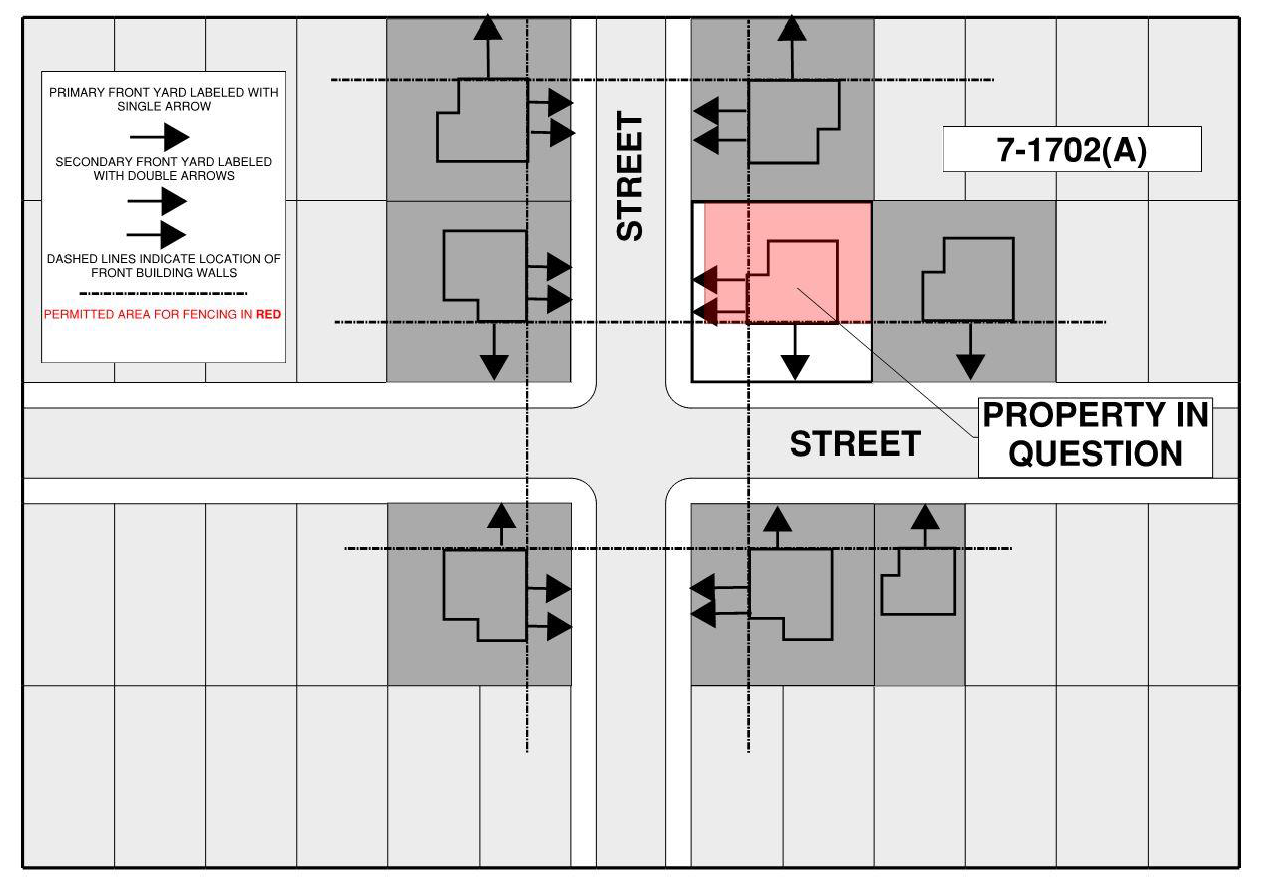
(B)
Where the secondary front yard of the property in question is located on a block face on which the principal structures on the abutting properties face the street, fences shall be permitted if located no closer to the secondary front lot line than half the distance between the secondary front lot line and the front building wall facing the secondary front yard.
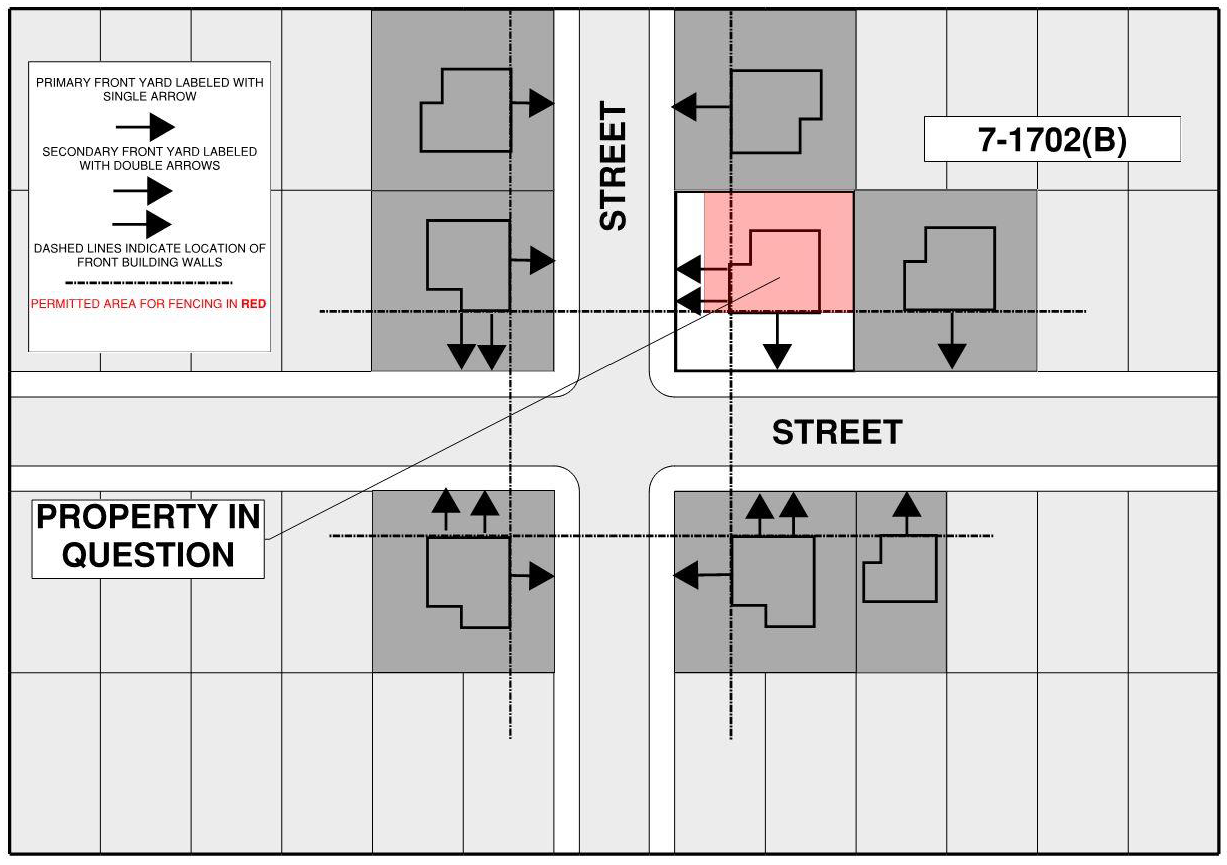
7-1703 - Through lots.
On through lots, open and closed fences not exceeding six feet in height shall be setback a minimum horizontal distance from the secondary front lot line established by either subsection (A) or (B), below:
(A)
Where the secondary front yard of the property in question is located on a block face on which the principal structures on the abutting properties on the same side of the street face that street, fences shall be permitted if located no closer to the secondary front lot line than half the distance between the secondary front lot line and the average setback utilizing the two abutting properties.
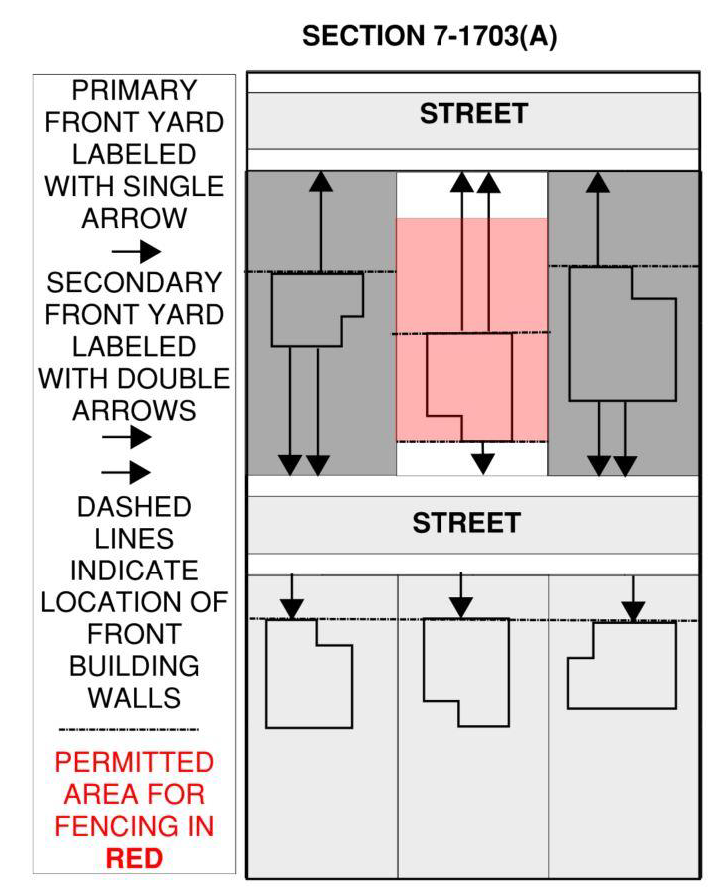
(B)
Where the secondary front yard of the property in question is located on a block face on which the principal structures on the abutting properties on the same side of the street do not face such street or there is no abutting house(s), fences shall be permitted if located at least three feet from the secondary front lot line.
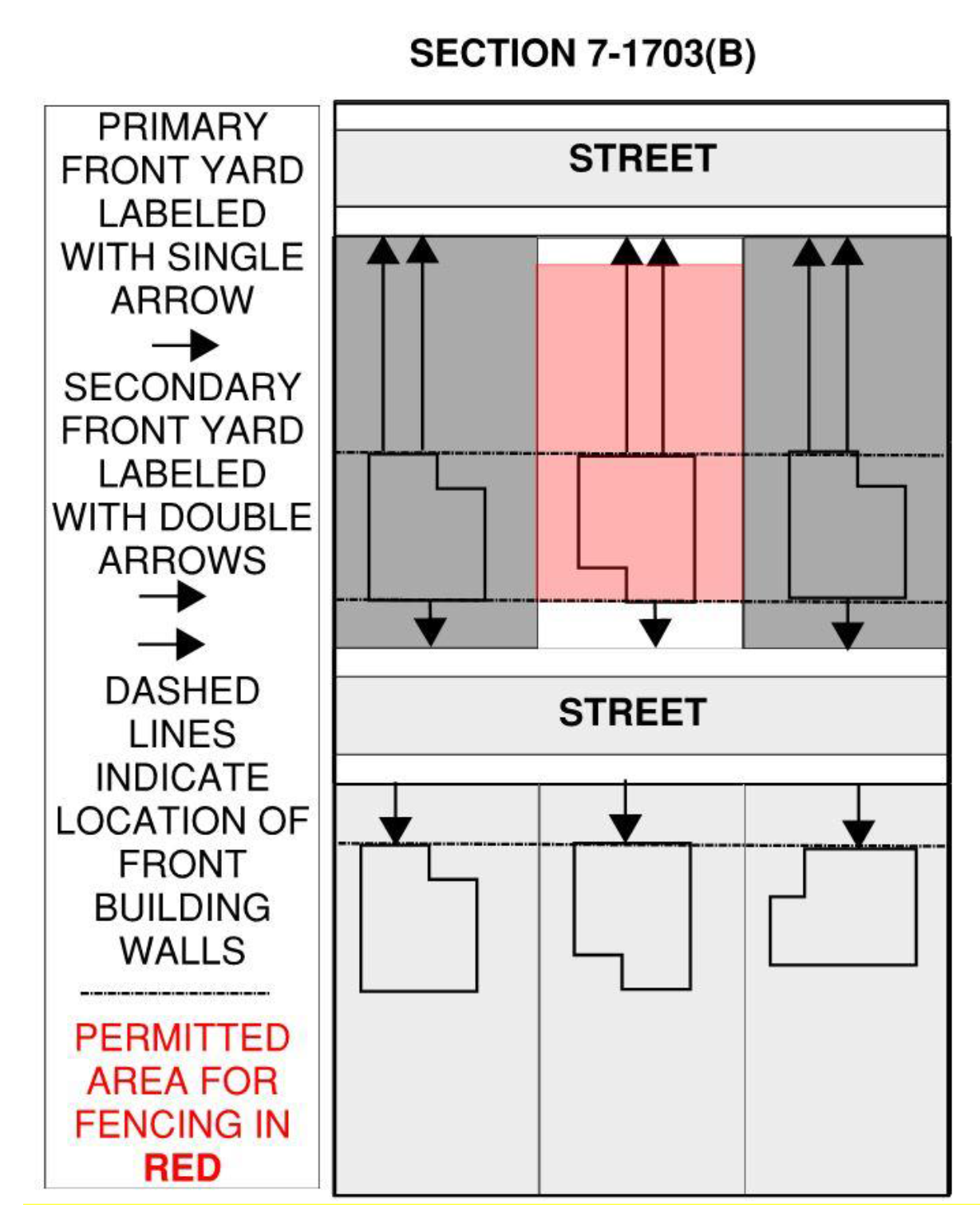
(Ord. No. 3898, § 1, 12-14-96; Ord. No. 5254, § 8, 11-16-19; Ord. No. 5300, §§ 11—13, 10-17-20)
Sec. 7-1800 - Installation of ATM and similar machines on the exterior of buildings in the Historic Districts.
(A)
Within the Old and Historic Alexandria District and the Parker Gray District, machines for dispensing money, tickets, postage, and similar paper records, and providing electronic transactions and services, but not to include the sale or provision of other products or merchandise or lottery tickets, may be installed on the exterior of a building, or as an outdoor freestanding machine, provided:
(1)
The director determines that the installation is consistent with each of the following minimum criteria:
(a)
No machine may be installed on the exterior of a contributing structure to the district as determined at the time of application using the Secretary of Interior's Guidelines. A list of noncontributing structures within each district is maintained by the Department of Planning and Zoning.
(b)
No more than one machine may be installed per individual building.
(c)
No freestanding machine may be installed outside of a completely enclosed space within the interior of a building, unless located within an open court or similar area within the footprint of a noncontributing building.
(d)
No machine shall face residentially zoned land.
(e)
The exterior surface of the machine shall not exceed 8.0 square feet in size.
(f)
One bank identification sign shall be allowed abutting the top of the machine. The width of the sign shall not exceed the width of the machine, and the height of the sign shall not exceed one-third of the width of the machine. Backlit signs shall not be permitted.
(g)
No surround shall be permitted. Network logos may be displayed provided they are contained within the borders of the machine or the bank identification sign and a monochromatic (gray scale) color scheme is used.
(h)
Lighting elements shall be the minimum possible to meet safety requirements, and shall not exceed 2.0 foot candles measured at a radius of five feet from the source
(i)
The building on or within the foot print of which the machine is located shall be located in a commercial zone.
(B)
The installation of the machine, including without limitation its specific size and location and the extent of its signage and lighting, shall require approval by the Board of Architectural review pursuant to Articles IX and X of this ordinance.
(C)
Except as provided in this section, the installation of machines for dispensing money, tickets, postage, and similar paper records, and providing electronic transactions and services, and for the sale or provision of other products or merchandise or lottery tickets, on the exterior of a building or structure, or as an outdoor freestanding machine, within the Old and Historic Alexandria District and the Parker Gray District is prohibited.
(Ord. No. 4282, § 1, 11-16-02)
Sec. 7-1900 - Restaurant use limitations.
(A)
The restaurant operator shall conduct employee training sessions on an ongoing basis to advise employees of these use limitations.
(B)
No food, beverages, or other materials shall be stored outside, with the exception of materials otherwise specified in this section 7-1900.
(C)
Delivery vehicles operated and managed by the restaurant operator are permitted. Delivery vehicles must park off-street when not delivering.
(D)
Indoor limited live entertainment and live entertainment, pursuant to the use limitations of the zone, are allowed.
(E)
Chemicals, detergents, and cleaners stored outside the building shall be kept in an enclosure with a roof.
(F)
If used cooking oil is stored outside, the drum shall be kept securely closed with a bung (a secure stopper that seals the drum). When the drum is not receiving used oil, it shall be placed on secondary containment, and it shall be kept under cover to prevent rainwater from falling on it.
(G)
Trash and garbage shall be stored in sealed containers that do not allow odors to escape, invasion by animals, or leaking. No trash or debris shall be allowed to accumulate outside of those containers. Outdoor containers shall be maintained to the satisfaction of the director and the director of transportation and environmental services, including replacing damaged lids and repairing or replacing damaged dumpsters.
(H)
Kitchen equipment, including floor mats, shall not be cleaned outside, nor shall any cooking residue or wash water be washed into the public right-of-way or storm sewers.
(I)
All waste products including but not limited to organic compounds (solvents and cleaners) shall be disposed of in accordance with all local, state, and federal laws or regulations.
(J)
Supply deliveries and loading and unloading activities shall not occur between the hours of 11 p.m. and 7 a.m.
(Ord. No. 5614, § 6, 1-24-26)
Sec. 7-2000 - Day labor agencies.
Any day labor agency approved under this section shall, in addition to other conditions appropriate to the specific location and circumstances in a given case, be subject to the following regulations and requirements:
(A)
No such use shall be permitted within 300 feet of land in a residential or mixed use zone.
(B)
Attended indoor restrooms shall be available two hours prior to the hours of operation of the use for the benefit of laborers.
(C)
Trash receptacles shall be provided to the satisfaction of the director.
(D)
All litter on the site, on the public right-of-way, and on spaces adjacent to or within 100 feet of the premises of the use shall be picked up at least twice a day and at the close of business, and more often if necessary, to prevent an unsightly or unsanitary accumulation, on each day that the business is open.
(E)
No amplified sound shall be audible at the property line.
(F)
When deemed necessary by the director, and at the expense of the operator of the use, a private security service, or such other dedicated personnel of the operator approved by the director, shall be employed to discourage loitering, public urination, or consumption of alcoholic beverages, and to control noise associated with the congregation of laborers. This security service shall commence prior to the time laborers arrive and remain until after laborers disperse in both the morning and afternoon or evening hours.
(Ord. No. 4328, § 4, 1-24-04)
Sec. 7-2100 - Increased density and height for public elementary and secondary schools.
Notwithstanding any contrary provision of this ordinance, a public elementary or secondary school, located in a residential or mixed-use zone, may be constructed, expanded or reconstructed to a size which exceeds the density and height otherwise permitted by the regulations in such zone; provided, that a special use permit is approved, and, provided further, that no increase in floor area ratio greater than 0.75, and no increase in height greater than 60 feet, shall be approved.
(Ord. No. 4327, § 1, 1-24-04; Ord. No. 5301, § 1, 10-17-20)
Sec. 7-2200 - Tree coverage requirement.
The supplemental regulations in this section apply to residential lots in the R-20, R-12, R-8, R-5, R-2-5, and lots developed or proposed to be developed with single-unit and two-unit dwellings in the RA and RB zones, not including property located within the Old and Historic Alexandria and Parker-Gray Districts. The tree coverage requirements are as follows:
(A)
For all construction that requires a grading plan, trees must be planted, or existing trees preserved to provide a minimum of 25 percent canopy cover over the lot. Refer to the City of Alexandria Landscape Guidelines to determine tree crown coverage allowances.
(B)
The director shall approve this requirement as part of the grading plan.
(Ord. No. 5234, § 11, 7-9-19; Ord. No. 5515, § 7, 12-16-23)
Sec. 7-2300 - Increased density for private schools, academic.
Notwithstanding any contrary provision in this ordinance, a private school, academic, located in a residential zone, whose campus consists of two or more lots or parcels of land, at least one of which is vacant and is separated from the balance of the campus by a public right-of-way, may be constructed, expanded or reconstructed to a size which exceeds the density permitted by the applicable zone regulations; provided, that such construction, expansion or reconstruction is approved by special use permit; and, provided further, that no increase in height above the height permitted in the zone shall be approved. Any density increase attributable to the transfer of density from the vacant lot or parcel and utilized for the construction, expansion or reconstruction of the use shall reduce the density available for any development of the vacant lot or parcel. A notice of such reduction in density on the vacant lot or parcel shall be approved by the city and recorded among the land records. Such reduction shall run with the and, and bind successors in interest.
(Ord. No. 4522, § 1, 3-15-08)
Sec. 7-2400 - Outdoor display of rental bicycles.
Notwithstanding any regulation in this ordinance to the contrary, the outdoor display of bicycles for rent is permitted within the city to the following extent, and pursuant to the following guidelines:
(a)
A business which rents bicycles may display those bicycles directly outside the building in which its business is located if a permit by the director is approved subject to this section 7-2400.
(b)
An application under this section for outdoor display of bicycles shall be accompanied by a plan showing the proposed display and, at a minimum, the following:
(1)
the location of the display;
(2)
the arrangement of bicycles within the display;
(3)
the number of bicycles proposed to be displayed;
(4)
any barriers proposed or required to surround the display area;
(5)
any additional features proposed to be part of the display.
(c)
The display must, at a minimum, comply with the following:
(1)
The display must be consistent with this section 7-2400 and with the plan approved pursuant to section 7-2400(b), including any conditions that are made part of the approval.
(2)
All bicycles must be maintained in an orderly arrangement;
(3)
All bicycles must be retained within the area permitted for the display, which may not include a flower or tree bed, the area within two feet of the curb where vehicle parking is permitted, or the area adjacent to the display where a clear, safe and adequate pedestrian passageway must be maintained.
(4)
The bicycle display may not block a doorway or fire hydrant.
(5)
No signs are permitted as part of the display except as permitted on the building by the zoning ordinance for the business.
(6)
All improvements used in an outdoor display area on the public right-of-way must be readily removable without damage to the surface of the right-of-way.
(7)
Within a historic district, the design of the area shall comply with any board of architectural review approved design guidelines for such displays.
(d)
The rental of bicycles is permitted from the display area.
(e)
The display may be located on the public right-of-way, if permitted in the approved plan and subject to the requirements for encroachments under section 5-2-29 of the City Code.
(f)
Bicycle means a device propelled solely by human power, upon which a person may ride either on or astride a regular seat attached thereto, having two or more wheels in tandem, including children's bicycles, except a toy vehicle intended for use by young children.
(Ord. No. 4609, § 1, 6-23-09)
7-2501 - Freestanding private garages to the rear of the main building.
The supplemental regulations in this section 7-2501 apply to residential lots developed or proposed to be developed with dwellings in the R-20, R-12, R-8, R-5, R-2-5, and only single or two-unit dwellings in the RA and RB zones, not including property located within the Old and Historic Alexandria and Parker-Gray Districts. Freestanding private garages located within required yards or excluded from floor area shall be permitted subject to the following standards:
(A)
Regardless of other regulations in this zoning ordinance, a freestanding garage is permitted to the rear of the main building in accordance with the regulations in this section 7-2501 so long as it is the only garage on the lot or adjacent vacant lot under common ownership. The floor area of such a garage constructed in accordance with the standards of this section will be excluded from the floor area calculated under the provisions of section 2-145(A)(6).
(B)
Standards.
(1)
Size. For lots with a minimum of 2,500 square feet and with less than 8,000 square feet lot area, the garage shall have a floor area not greater than 250 square feet and a height not greater than 11.50 feet. For lots 8,000 square feet or larger, the garage shall have a floor area not greater than 500 square feet and a height not greater than 13.50 feet. The director may modify the height permitted in this section 7-2501(B)(1) when the height and design of the garage are appropriate and compatible with the main dwelling and with the character of the immediate neighborhood.
(2)
Setback. The freestanding garage may be located in the required side or rear yard if it complies with the following:
(a)
The garage and any architectural features shall be setback a minimum of one foot from any side or rear property line if the garage wall facing that property line has no windows or doors or if that lot line borders an alley;
(b)
If the conditions of item (a) above are not met, the setback, including all architectural features, shall be three feet; and
(c)
The freestanding garage must be located completely behind the rear wall of the dwelling unless, the director determines that locating the garage completely behind the rear building wall is not possible due to topography, shape of the lot, placement of the existing dwelling on the lot or other environmental concerns, in these cases the garage must be located completely behind the front building wall, and approved by the director as to location.
(d)
Reserved.
(3)
Access. If there is no direct access to the freestanding garage from an alley, any new or replaced driveways providing access to the freestanding garage must be constructed of a permeable material and may be located in the side yard for access to the garage. Permeable-surfaced driveways can be composed of grass with ring and grid structure, gravel with a grid structure beneath, paving strips, a grid-based surface, or other treatments without significant compaction of the base, but must be approved by the directors of planning and zoning and transportation and environmental services. Either director can grant an exemption to the permeable-surfaced driveway requirement in cases of steep slopes, adverse soil conditions, constructability, or other conditions that for safety or environmental reasons would require the use of non-permeable surfacing material. Tandem parking in the driveway is permitted. Curb cuts must be approved in accordance with section 5-2-2 of the City Code and section 8-200(C)(5) of this zoning ordinance. The number of vehicles permitted on the lot is limited by section 8-200(C)(6).
(4)
Compatibility. The freestanding garage shall be compatible with the principal structure in regards to materials and design.
(5)
Use. The freestanding garage shall be dedicated to the use and storage of motor vehicles.
7-2502 - Attached private garages.
The supplemental regulations in this section 7-2502 apply to residential lots developed or proposed to be developed with dwellings in the R-20, R-12, R-8, R-5, R-2-5, and only single and two-unit dwellings in the RA and RB zones, not including property located within the Old and Historic Alexandria and Parker-Gray Districts. Private garages attached to the principal structure are only permitted when in compliance with the following standards:
(A)
An attached garage shall be no closer to the front property line than the front building wall facing the primary front yard and must be in compliance with the required yards established by the zone, and shall have the vehicle opening facing the side or rear yard, unless:
(1)
For interior lots an attached garage is permitted if it complies with the following:
(a)
It is located within a contextual block face where 50 percent of the developed lots have attached garages with the vehicle opening facing a primary front yard on the same street the new vehicle opening will face;
(b)
The width of the vehicle opening is less than 33 percent of the width of the dwelling facing the front property line;
(c)
The front wall of the garage is set back at least eight feet from the front building wall facing the primary front yard and;
(d)
The vehicle opening is located at least 18.50 feet from the interior edge of the public sidewalk or 20 feet from the property line if there is no sidewalk.
(2)
For corner or through lots an attached private garage is permitted if it complies with the following:
(a)
The vehicle opening faces a secondary front yard and;
(b)
The garage wall is no closer to the front property line than the front building wall facing the primary front yard.
7-2503 - Loading space floor area exclusion.
Notwithstanding any contrary provision of this ordinance, loading space may be excluded from floor area with a special use permit obtained pursuant to section 11-500. No special use permit shall be approved unless the loading space contributes to improved site design and an enhanced public realm.
(Ord. No. 5234, § 12, 7-9-19; Ord. No. 5374, § 25, 10-16-21; Ord. No. 5468, § 2, 12-17-22; Ord. No. 5515, § 7, 12-16-23; Ord. No. 5529, § 6, 4-13-24; Ord. No. 5593, § 5, 6-14-25)
Editor's note— Ord. No. 5234, § 12, adopted July 9, 2019, repealed § 7-2500 in its entirety and enacted new provisions to read as herein set out. Former § 7-2500 pertained to infill registration for single- and two-family residential zones, and derived from Ord. No. 4556, § 1, adopted June 24, 2008; Ord. No. 4653, § 2, adopted April 17, 2010; Ord. No. 4724, § 1, adopted June 25, 2011; Ord. No. 5049, § 2, adopted Jan. 28, 2017; Ord. No. 5151, § 9, adopted June 23, 2018; Ord. No. 5206, §§ 19, 20, adopted March 16, 2019; and Ord. No. 5208, § 8, adopted March 16, 2019.

