
Algonac City Zoning Code
ARTICLE I
- IN GENERAL
Sec. 50-1.- Citation.
This article shall be known and may be cited as the "City of Algonac Zoning Ordinance."
(Ord. No. 96-5, § 100, 3-5-1996)
Sec. 50-2. - Construction of language.
The following rules of construction apply to the text of this chapter:
(1)
The particular shall control the general.
(2)
In the case of any difference of meaning or implication between the text of this article and any caption or illustration, the text shall control.
(3)
The term "shall" is always mandatory and not discretionary. The term "may" is permissive.
(4)
Words used in the present tense shall include the future, and words used in the singular number shall include the plural, and the plural the singular, unless the context clearly indicates the contrary.
(5)
A "building" or "structure" includes any part thereof.
(6)
The phrase "used for" includes "arranged for," "designed for," "intended for," "maintained for" or "occupied for."
(7)
The term "person" includes an individual, a corporation, a partnership, an incorporated association or any other similar entity.
(8)
Unless the context clearly indicates the contrary, where a regulation involves two or more items, conditions, provisions, or events connected by the conjunction "and," "or," "either…or," the conjunction shall be interpreted as follows:
a.
"And" indicates that all the connected items, conditions, provisions or events shall apply.
b.
"Or" indicates that the connected item, conditions, provisions or events may apply singly or in any combination.
c.
"Either…or" indicates that the connected items, conditions, provisions or events shall apply singly but not in combination.
(9)
Terms not herein defined shall have the meaning customarily assigned to them.
(Ord. No. 96-5, § 200, 3-5-1996)
Sec. 50-3. - Definitions.
The following words, terms and phrases, when used in this chapter, shall have the meanings ascribed to them in this section, except where the context clearly indicates a different meaning:
Accessory use oraccessory means a use which is clearly incidental to, customarily found in connection with, and located on the same zoning lot unless otherwise specified as the principal use to which it is related. When the term "accessory" is used in this text, it shall have the same meaning as accessory use. An accessory use includes, but is not limited to, the following:
(1)
Residential accommodations for servants and/or caretakers.
(2)
Outdoor swimming pools, hot tubs and saunas for the use of occupants of a residence or their guests.
(3)
Domestic or agricultural storage in a barn, shed, tool room or similar accessory building or other structure.
(4)
A newsstand primarily for the convenience of the occupants of a building, which is located wholly within such building and has no exterior signs or displays.
(5)
Storage of merchandise normally carried in stock in connection with a business or industrial use, unless such storage is excluded in the applicable district regulations.
(6)
Storage of goods used in or produced by industrial uses or related activities, unless such storage is excluded in the applicable district regulations.
(7)
Accessory off-street parking spaces, open or enclosed, subject to the accessory off-street parking regulations for the district in which the zoning lot is located.
(8)
Uses clearly incidental to a main use, such as, but not limited to, offices of an industrial or commercial complex located on the site of the commercial or industrial complex.
(9)
Accessory off-street loading, subject to the off-street loading regulations for the district in which the zoning lot is located.
(10)
Accessory signs, subject to the sign regulations for the district in which the zoning lot is located.
(11)
Common household gardening in a residential district when located only in the rear yard and/or nonrequired side yard areas.
(12)
Solar panel, wind generators, television reception antenna and air conditioning units.
Alley means any dedicated public way affording a secondary means of access to abutting property and not intended for general traffic circulation.
Alterations means any change, addition or modification in construction or type of occupancy, or in the structural members of a building such as walls or partitions, columns, beams or girders, the consummated act of which may be referred to herein as "altered" or "reconstructed."
Amusement device means any machine or device which, upon the insertion of a coin, currency, slug, token, plate or disc, operates or may be operated as a game or contest of skill or amusement when the element of skill in such operation predominates over chance or luck. The term "amusement device" includes mechanical, electrical, or electronic video games, mechanical grabbing devices pinball games, mechanical, electrical, or electronic baseball, football, basketball, hockey and similar sports-type games, mechanical, electrical, or electronic card games, shooting games, target games, or any other machine, device or apparatus which may be used as a game of skill and wherein the player initiates, employs or directs any force generated by such machine.
Apartment, efficiency, means a dwelling unit consisting of not more than one room in addition to kitchen, dining and necessary sanitary facilities.
Apartments means a suite of rooms in a multiple-family building arranged and intended for a place of residence of a single-family or a group of individuals living together as a single housekeeping unit.
Arcade means any place open to the public in which four or more amusement devices are located for public use.
Architectural features means steps, window sills, belt courses, brick and/or wrought iron wing walls, chimneys, architraves, pediments.
Automobile repair, major, means the general repair, engine rebuilding, rebuilding or reconditioning of motor vehicles; collision service, such as body, frame or fender straightening and repair; and painting of automobiles.
Automobile repair, minor, means repairs other than major repair including engine tune up, muffler shops, shock absorber replacement shops, undercoating shops and tire stores.
Basement means that portion of a building which is partly or wholly below grade but so located that the vertical distance from the average grade to the floor is greater than the vertical distance from the average grade to the ceiling. A basement shall not be counted as a story.
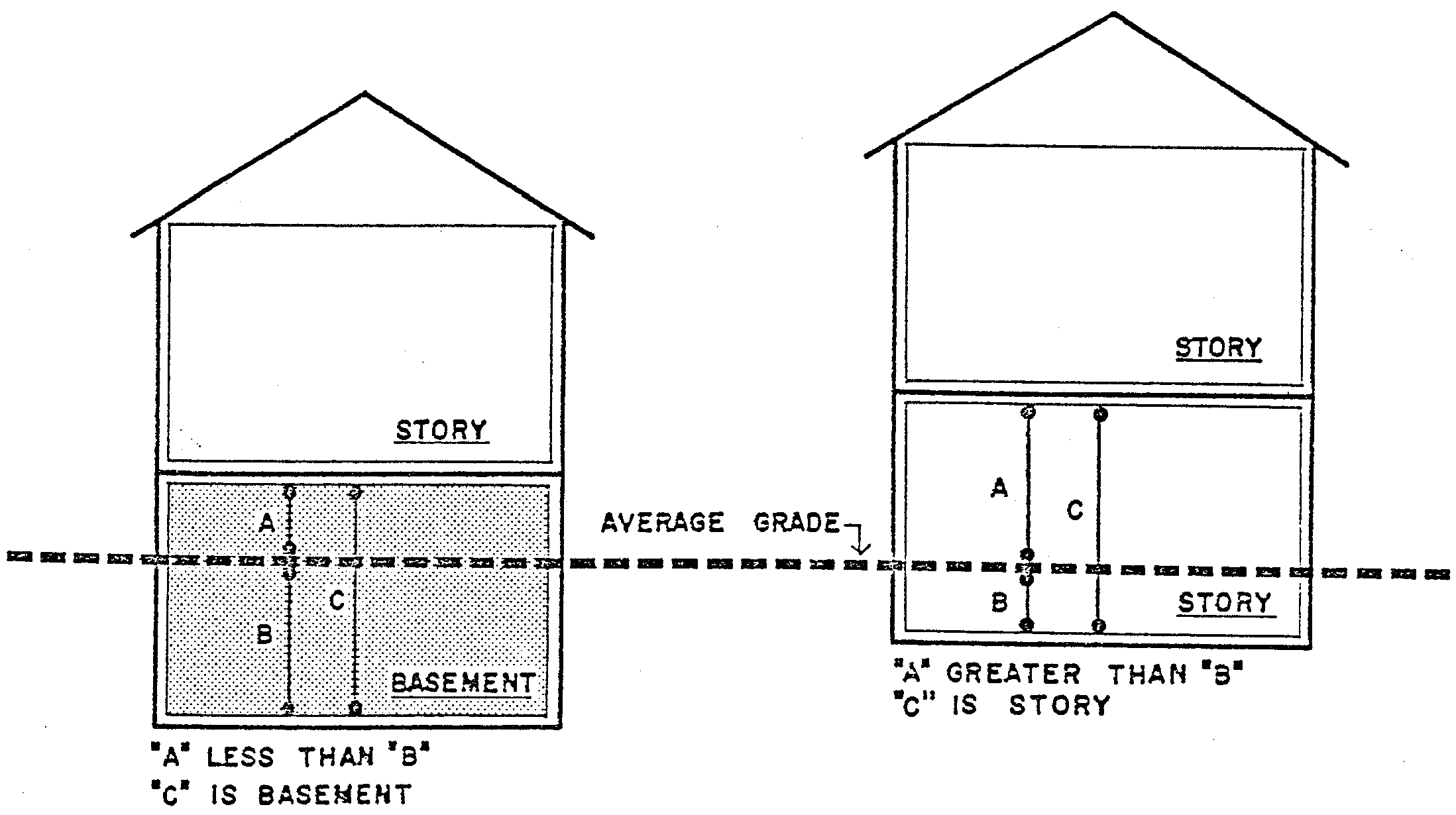
BASEMENT AND STORY
Bed and breakfast means a use which is subordinate to the principal use of a dwelling unit, and a use in which transient guests are provided sleeping room and board for payment.
Berm, obscuring, means an earthen mound of definite height and location to serve as an obscuring device in carrying out the requirements of this chapter.
Block means the property abutting one side of a street and lying between the two nearest intersecting streets (crossing or terminating), or between the nearest such street and railroad right-of-way, unsubdivided acreage, lake, river or live stream; or between any of the foregoing and any other barrier to the continuity or development, or corporate boundary lines of the city.
Board means the zoning board of appeals as established under this chapter.
Boardinghouse, roominghouse or lodginghouse means a building containing a single-dwelling unit and guestrooms providing lodging with or without meals, for compensation on a weekly, daily or monthly basis.
Boat orvessel means every description of watercraft used or capable of being used as a means of transportation on water.
Building means any structures, either temporary or permanent, having a roof supported by columns or walls and intended for the shelter or enclosure of persons, animals, chattels or property of any kind. The term "building" includes tents, awnings or vehicles situated on private property and used for such purposes.
Building height means the vertical distance measured from the established grade to the highest point of the roof surface for flat roofs; to the deck line of mansard roofs; and to the average height between eaves and ridge for gable, hip and gambrel roofs. Where a building is located on sloping terrain, the height may be measured from the average ground level of the grade at the building wall (see illustration "building height")
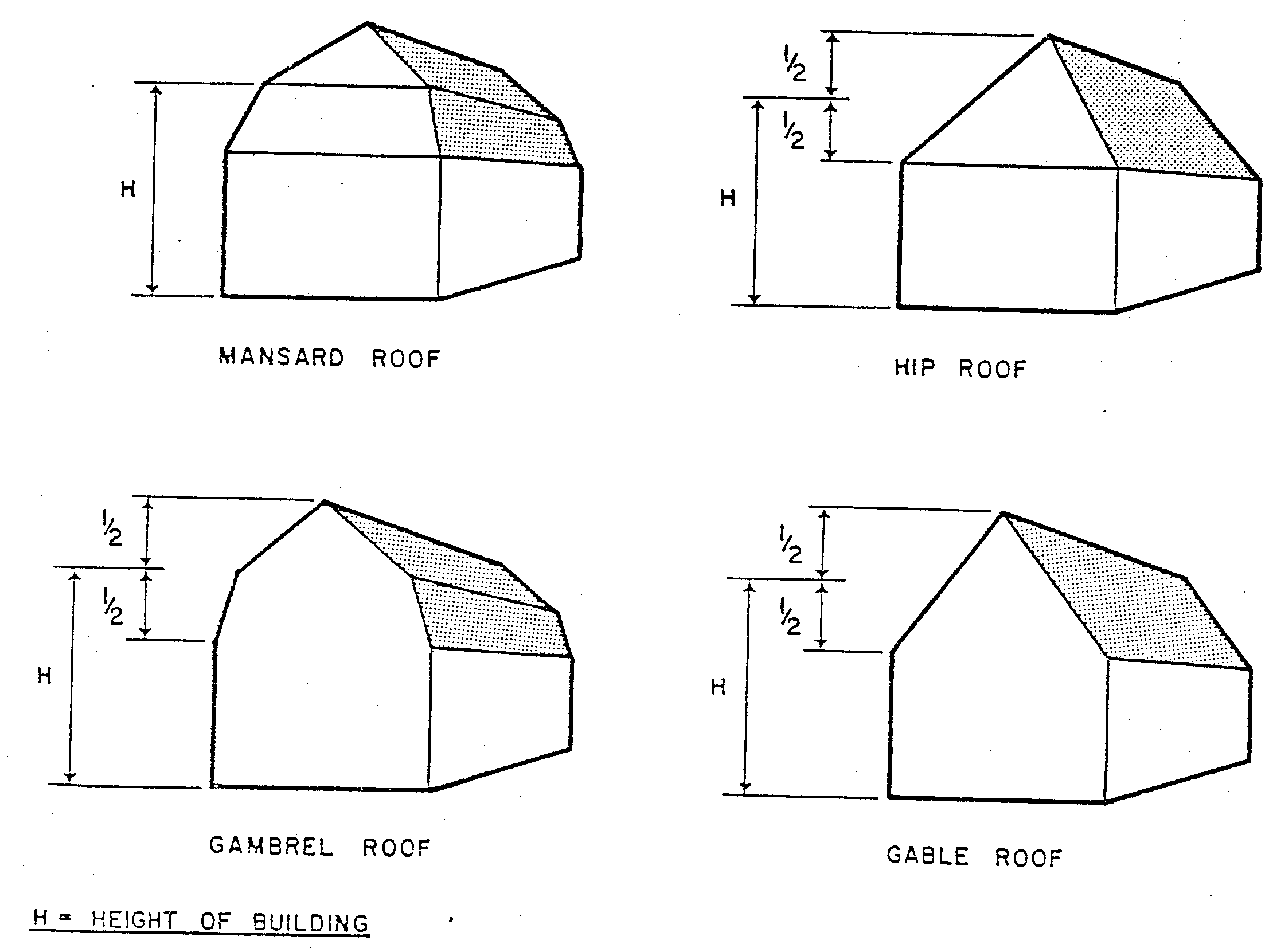
BUILDING HEIGHT
Building line means a line formed by the face of the building and, for the purposes of this article, the same as a front setback line (see illustration "building line").
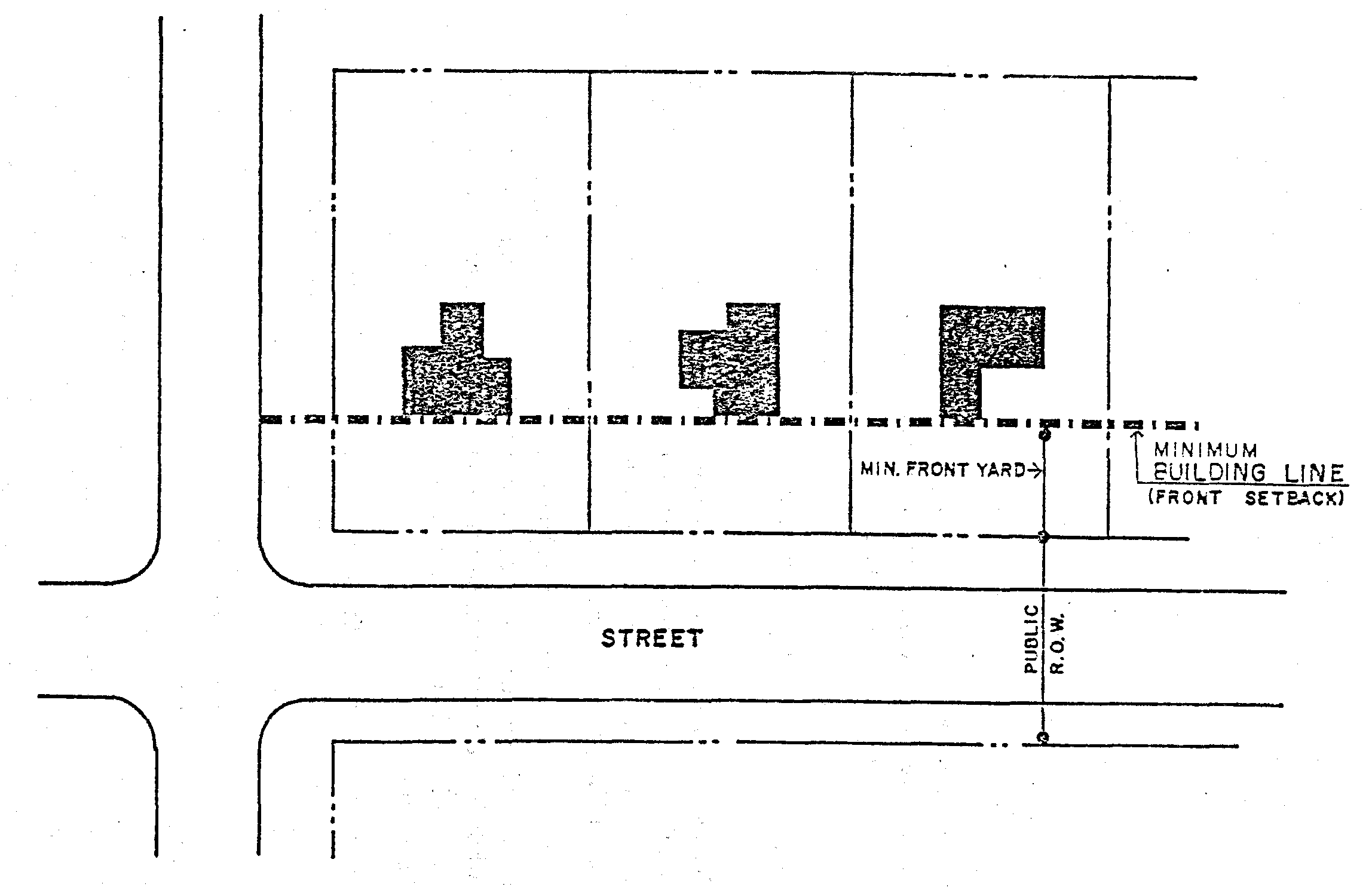
BUILDING LINE
Building, main or principal, means a building in which is conducted the principal use of the lot on which it is situated.
Child care center means a group facility for more than six children which gives care to children away from their homes.
Club means an organization of persons for special purposes or for the promulgation of sports, arts, sciences, literature, politics or the like, but not operated for profit.
Collector street (secondary thoroughfare) means a street used primarily to carry traffic from minor (local) streets to major thoroughfares.
Condominium subdivision plan means the site, survey and utility plans; floor plans; and sections, as appropriate, showing the existing and proposed structures and improvements including the location thereof on the land.
Condominium subdivision (site condominium) means a method of subdivision where land ownership of sites is regulated by the condominium act, Public Act No. 59 of 1978 (MCL 559.101 et seq.) as opposed to the land division act, Public Act No. 288 of 1967 (MCL 560.101 et seq.). The term "condominium subdivision" shall be equivalent to the term "subdivision" as used in this chapter and the subdivision regulations in chapter 22.
Convalescent or nursing home means a structure with sleeping rooms, where persons are housed or lodged and are furnished with meals, nursing and limited medical care.
Day care home for elderly adults means a one-family dwelling which receives not more than six elderly or infirmed adults for care during the day.
Development means the construction of a new building or other structure on a zoning lot, the relocation of an existing building on another zoning lot, or the use of open land for a new use.
District means a portion of the incorporated area of the city within which certain regulations and requirements or various combinations thereof apply under the provisions of this chapter.
Drive-in means an establishment where food, frozen desserts or beverages are sold to the customers in a ready-to-consume state and where the customer consumes food, frozen dessert or beverages in an automobile parked upon the premises or at other facilities provided for customers which are located outside the building.
Drive-through means an establishment so developed that some portion of its retail or service character is dependent upon providing a driveway approach and staging area specifically designed for motor vehicles so as to serve patrons while in their motor vehicles, rather than within a building or structure, for carrying out and consumption or use after the vehicle is removed from the premises.
Dwelling, multiple-family, means a building or a portion thereof designed exclusively for occupancy by three or more families living independently of each other.
Dwelling, one-family, means a building designed for and occupied exclusively by one family.
Dwelling, two-family, means a building designed exclusively for occupancy by two families living independently of each other.
Dwelling unit, manufactured, means a dwelling unit which is substantially built, constructed, assembled and finished off the premises upon which it is intended to be located.
Dwelling unit, site-built, means a dwelling unit which is substantially built, constructed, assembled and finished on the premises which is intended to serve as its final location. Site-built dwelling units shall include dwelling units constructed of precut materials and panelized wall, roof and floor sections when such sections require substantial assembly and finishing on the premises which is intended to serve as its final location.
Erected means built, constructed, altered, reconstructed, moved upon, or any physical operations on the premises which are required for construction, excavation, fill, drainage and the like shall be considered a part of erection.
Essential services means the erection, construction, alteration or maintenance by public utilities or municipal departments of underground, surface or overhead gas, electrical, steam, fuel or water transmission or distribution systems, collection, supply or disposal systems, including poles, wires, mains, drains, sewers, pipes, conduits, cables, fire alarm and police call boxes, traffic signals and hydrants in connection herewith, but not including buildings which are necessary for the furnishing of adequate service to the city by such utilities or municipal departments for the general health, safety or welfare. Wireless communication towers, devices and facilities are not defined as an essential service.
Excavation means any breaking of ground, except common household gardening and ground care.
Family means one or more persons related by blood, marriage, civil union, or adoption; or a group of not more than four persons who need not be so related and who are living together in a dwelling unit and maintaining a common household.
Family child care home means a private home in which one but fewer than seven minor children are received for care and supervision for compensation for periods of less than 24 hours a day, unattended by a parent or legal guardian, except children related to an adult member of the family by blood, marriage, or adoption. The term "family child care home" includes a home in which care is given to an unrelated minor child for more than four weeks during a calendar year. A family child care home does not include an individual providing babysitting services for another individual. As used in this section, the term "providing babysitting services" means caring for a child on behalf of the child's parent or guardian when the annual compensation for providing those services does not equal or exceed $600.00 or an amount that would, according to the Internal Revenue Code of 1986, obligate the child's parent or guardian to provide a form 1099-MISC to the individual for compensation paid during the calendar year for those services.
Farm.
(1)
The term "farm" means all of the contiguous neighboring or associated land operated as a single unit on which bona fide farming is carried on directly by the owner-operator, manager or tenant farmer, by his own labor or with the assistance of members of his household or hired employees; provided, however, that land to be considered a farm hereunder shall include a continuous parcel of five acres or more in area; provided further, farms may be considered as including establishments operated as bona fide green-houses, nurseries, orchards, chicken hatcheries, poultry farms and apiaries; but establishments keeping or operating fur-bearing animals, riding or boarding stables, commercial dog kennels, stone quarries or gravel sand pits shall not be considered farms hereunder unless combined with bona fide farm operations on the same continuous tract of land of not less than 20 acres.
(2)
No farms shall be operated as piggeries or for the disposal of garbage, sewage, rubbish, offal or rendering plants, or for the slaughtering of animals except such animals as have been raised on the premises for at least a period of one year immediately prior thereto and for the use and consumption by persons residing on the premises.
Fence means a manmade structure or plant materials installed for the purpose of or to have the effect of enclosing or screening an area.
Fence, ornamental, means a manmade structure, the surface area of which is more than 75 percent open, to include plant materials not exceeding three feet six inches in height. Ornamental fences shall not be of chainlink or wire construction.
Filling means the depositing or dumping of any matter onto or into the ground, except common household gardening and ground care.
Floor area, residential, means for the purposes of computing the minimum allowable floor area in a residential dwelling unit, the sum of the horizontal areas of each story of the building shall be measured from the exterior faces of the exterior walls. The floor area measurement is exclusive of areas of basements, unfinished attics, attached garages, breezeways, and enclosed and unenclosed porches (see illustration "basic structural terms").
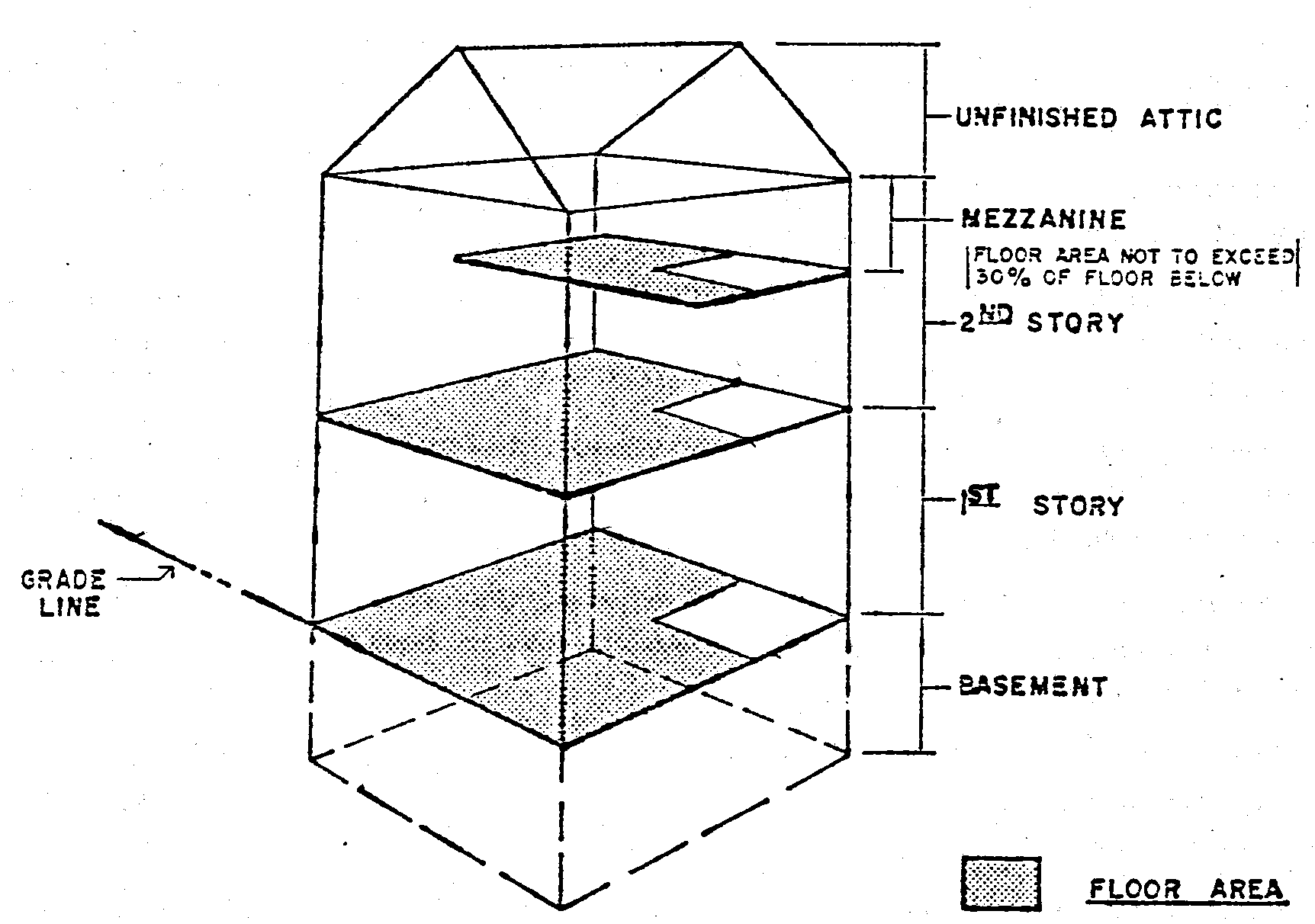
BASIC STRUCTURAL TERMS
Floor area, usable (for purposes of computing parking lot), means that area used for or intended to be used for the sale of merchandise or services, or for use to serve patrons, clients or customers. Such floor area which is used or intended to be used principally for the storage or processing of merchandise, hallways or for utilities or sanitary facilities, shall be excluded from this computation of usable floor area. Measurement of usable floor area shall be the sum of the horizontal areas of the several floors of the building, measured from the interior faces of the exterior walls.
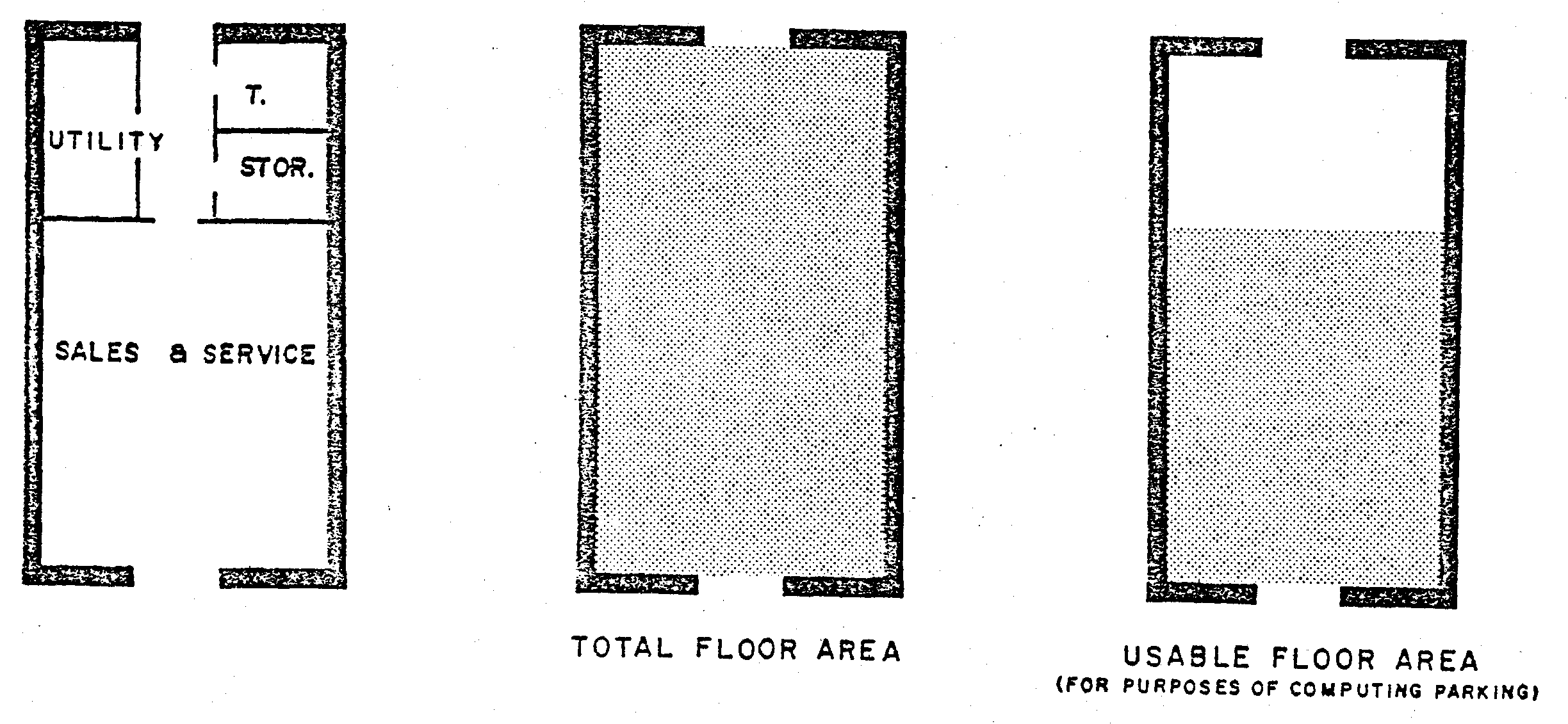
FLOOR AREA
Garage sale means any sale of tangible personal property of any description whatsoever, which is advertised by any means whereby the public is, or can be made, aware of such, and includes all such sales commonly known as attic, lawn or rummage sales. The term "garage sale" does not include business or trade sales which are regulated by any other ordinance of the city.
Gasoline service station means a place for the dispensing, sale or offering for sale of motor fuels directly to users of motor vehicles, together with the sale of minor accessories and services for motor vehicles but not including major automobile repair.
Grade means the ground elevation or height of land on a site or a parcel for the purpose of regulating the height of a building. When referring to "building grade," it shall mean the elevation of the ground at the edge of a building. Generally, the building grade of a building shall be set at 18 inches above the road at a point adjacent to the building if the ground is level. If the ground is not entirely level, the building grade shall be the average elevation of the ground at each face or side of the building.
Greenbelt means a strip of land of definite width and location reserved for the planting of shrubs and/or trees to serve as an obscuring screen or buffer strip in carrying out the requirements of this chapter.
Group child care home means a private home in which more than six but not more than 12 minor children are given care and supervision for periods of less than 24 hours a day unattended by a parent or legal guardian, except children related to an adult member of the family by blood, marriage, or adoption. Group child care home includes a home in which care is given to an unrelated minor child for more than four weeks during a calendar year.
Guarantee means a cash deposit, certified check, irrevocable bank letter or credit, or such other instrument acceptable to the city.
Guestroom means a sleeping room offered for compensation for permanent or transient occupancy containing no less than 100 square feet, measured from the interior faces of the walls of such room.
Hardship means situations created by circumstances unique to an individual property that do not generally occur to land or buildings in the neighborhood or zoning district of the property in question and which circumstances make the use of such property infeasible under conditions imposed by this chapter. The term "hardship" shall not include personal or financial hardship or economic disadvantage nor shall it constitute circumstances that are self-created.
Home occupation means an occupation carried on by an occupant of a dwelling unit as a secondary use which is clearly subservient to the use of the dwelling for residential purposes.
Hospice means a lodging place for the ill where persons are housed and furnished meals and attendant care.
Hotel means a building or part of a building, with a common entrance in which the dwelling units or rooming units are used primarily for transient occupancy, and in which one or more of the following services are offered: maid service, furnishing of linen, telephone, secretarial or desk service, and bellboy service. A hotel may include a restaurant or cocktail lounge, public banquet halls, ballrooms or meeting rooms.
Improvements means those features and actions associated with a project which are considered necessary by the city to protect natural resources or the health, safety and welfare of the residents of the city, and future users or inhabitants of the proposed project or project area, including parking areas, landscaping, roadways, lighting, utilities, sidewalks, screening and drainage. Improvements do not include the entire project which is the subject of zoning approval.
Junkyard means an area where waste, used or secondhand materials are bought and sold, exchanged, stored, baled, packed, disassembled or handled, including, but not limited to, scrap iron and other metals, paper, rags, rubber tires and bottles. The term "junkyard" includes automobile wrecking yards and includes any open area of more than 200 square feet for storage, keeping or abandonment of junk.
Kennel, commercial, means any lot or premises on which three or more dogs, cats or other household pets are either permanently or temporarily boarded or bred and raised for remuneration.
Loading space means an off-street space on the same lot with a building or group of buildings, for the temporary parking of a commercial vehicle while loading and unloading merchandise or materials.
Lot means a parcel of land occupied, or intended to be occupied, by a main building or a group of such buildings and accessory buildings, or utilized for the principal use and uses accessory thereto, together with such yards and open spaces as are required under the provisions of this chapter. A lot may or may not be specifically designated as such on public records. The term "lot" shall mean the same as homesite and condominium unit in site condominium developments.
Lot area means the total horizontal area within the lot lines of the lot.
Lot, corner, means a lot where the interior angle of two adjacent sides at the intersection of two streets is less than 135 degrees. A lot abutting upon a curved street or streets shall be considered a corner lot for the purposes of this article if the arc is of less radius than 150 feet and the tangents to the curve, at the two points where the lot lines meet the curve or the straight street line extended, form an interior angle of less than 135 degrees.
Lot coverage means that percent of the total lot area occupied by buildings, including accessory buildings (see illustration "lots and areas").
Lot depth means the horizontal distance between the front and rear lot lines, measured along the median between the side lot lines.
Lot, double-frontage, means any interior lot (through lot) having frontage on two more or less parallel streets as distinguished from a corner lot. In case of a row of double-frontage lots, all sides of said lots adjacent to streets shall be considered frontage, and front yards shall be provided as required (see illustration "interior, through and corner lots").
Lot, interior, means any lot other than a corner lot (see illustration "interior, through and corner lots").
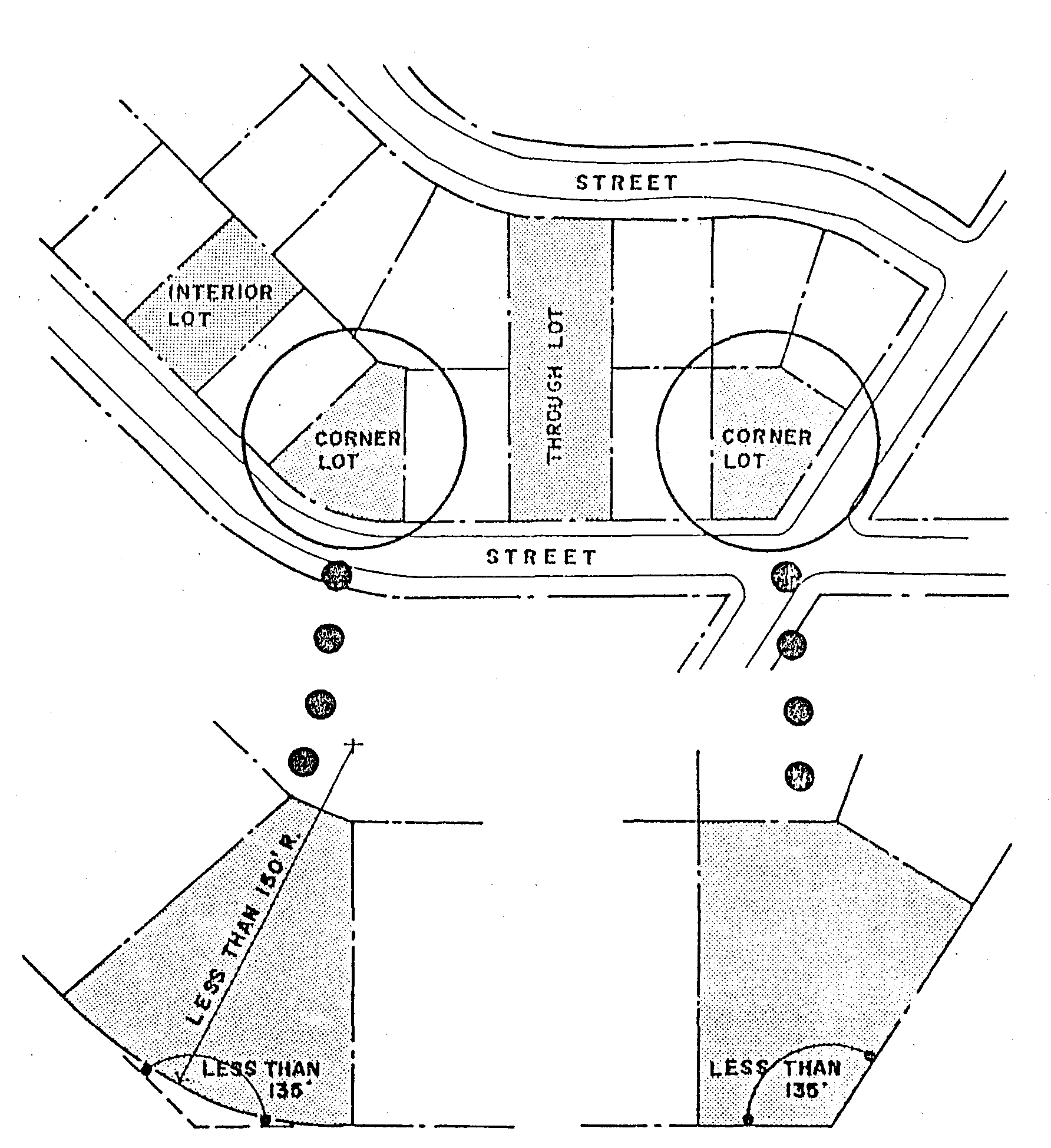
INTERIOR, THROUGH AND CORNER LOTS
Lot lines means the lines bounding a lot as defined herein:
(1)
Front lot line. In the case of an interior lot, that line separating such lot from the street. In case of a corner lot or double-frontage lot, that line separating such lot from that street which is designated as the front street in the plat and in the application for a certificate occupancy.
(2)
Rear lot line. The opposite the front lot line. In the case of a lot pointed at the rear, the rear lot line shall be an imaginary line parallel to the front lot line, not less than ten feet long lying farthest from the front lot line and wholly within the lot.
(3)
Side lot line. Any lot line other than the front or rear lot line. A side lot line separating a lot from a street is a side street lot line. A side lot line separating a lot from another lot or lots is an interior side lot line.
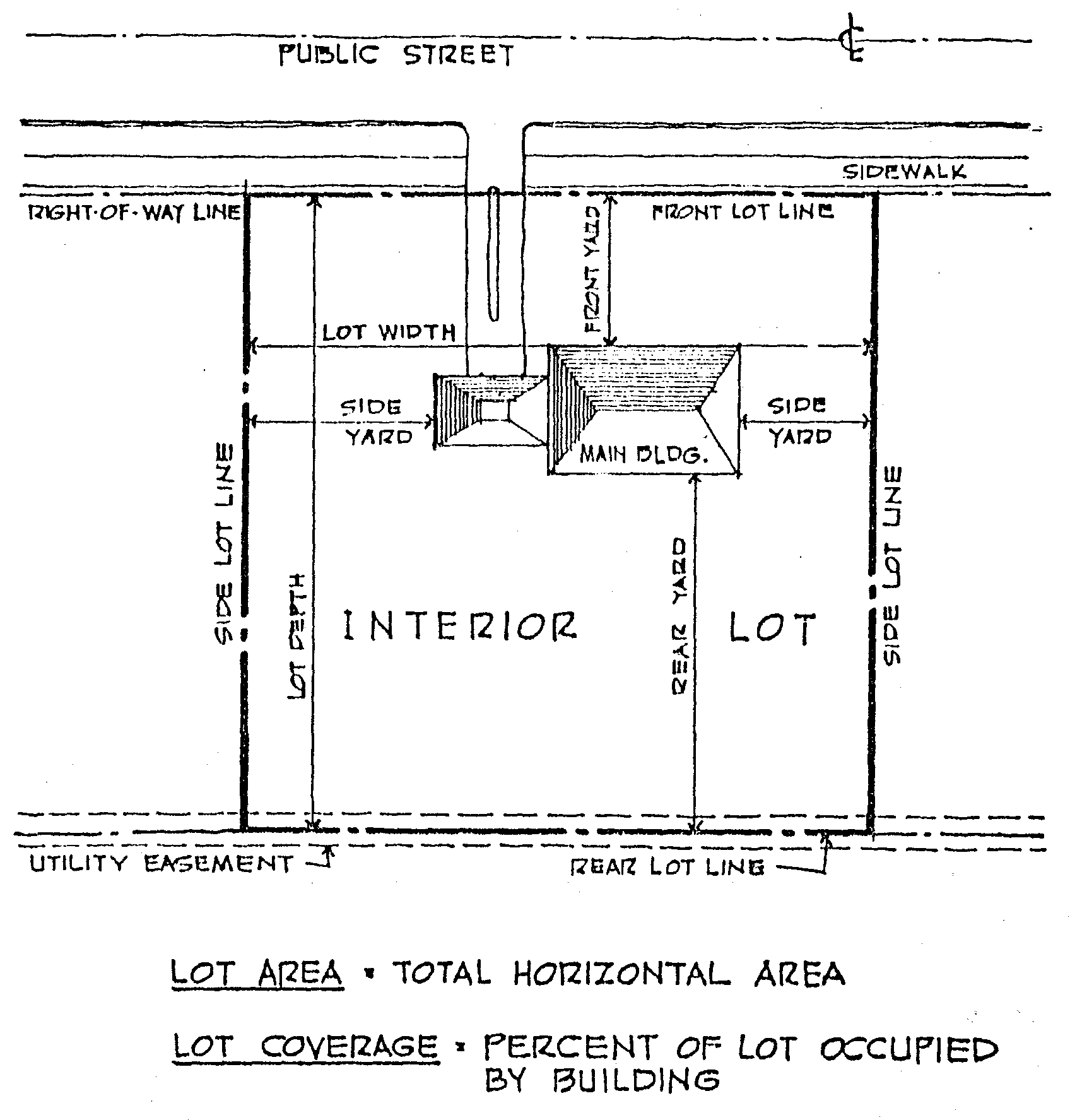
LOTS AND AREAS
Lot of record means a parcel of land, the dimensions of which are shown on a recorded plat on file with the county register of deeds at the time of adoption of this chapter or in common use by municipal or county officials and which actually exists as so shown, or any part of such parcel held in a record ownership separate from that of the remainder thereof.
Lot width means the horizontal distance between the side lot lines, measured at the two points where the building line, or setback, intersects the side lot lines.
Lot, zoning, means a single tract of, land, located within a single block which, at the time of filing for a building permit, is designated by its owner or developer as a tract to be used, developed, or built upon as a unit, under single ownership or control.
Main building means a building in which is conducted the principal use of the lot upon which it is situated.
Main use means the principal use to which the premises are devoted and the principal purpose for which the premises exist.
Major thoroughfare means an arterial street which is intended to serve as a large volume trafficway for both the immediate municipal area and the region beyond, and is designated as a major thoroughfare, parkway, freeway, expressway or equivalent term on the major thoroughfare plan to identify those streets comprising the basic structure of the major thoroughfare plan.
Master plan means the comprehensive community plan, including graphic and written proposals indicating the general location for streets, parks, schools, public buildings and all physical development of the city, and includes any unit or part of such plan, and any amendment to such plan or parts thereof.
Mezzanine/loft means an intermediate floor in a story occupying not more than one-third of the floor area of such story.
Mini storage units means storage buildings for lease to the general public for storage of office or business effects not including the warehousing of products or supplies.
Mobile home means any building or structure, transportable in one or more sections, which is built on a chassis and designed to be sold as a dwelling with or without permanent foundation, when connected to the required utilities, and includes the plumbing, heating, air conditioning and electrical systems contained in the structure. The term "mobile home" does not include recreational equipment.
Mobile home park means a parcel or tract of land under the control of a person upon which three or more mobile homes are located on a continual nonrecreational basis and which is offered to the public for that purpose regardless of whether a charge is made therefore, together with any building, structure, enclosure, street, equipment, or facility used or intended for use incidental to the occupancy of a mobile home.
Motel means a series of attached, semidetached or detached rental units containing a bedroom and closet space. Units shall provide for overnight lodging and are offered to the public for compensation, and shall cater primarily to the public traveling by motor vehicle.
Nonconforming structure means a structure or portion thereof lawfully existing at the effective date of the ordinance from which this chapter is derived, or amendments thereto, and that does not conform to the provisions of the ordinance in the district in which it is located.
Nonconforming use means a use which lawfully occupied a building or land at the effective date of the ordinance from which this chapter is derived, or amendments thereto, and that does not conform to the use regulations of the district in which it is located.
Nonconforming use or structure, class A, means a nonconforming use or structure which has been designated to be allowed to be perpetuated and improved under the provisions of this chapter.
Nonconforming use or structure, class B, means a nonconforming use or structure which has been designated to be allowed to be continued within the restricted provisions of this chapter.
Nuisance factors means an offensive, annoying, unpleasant or obnoxious thing or practice, a cause or source of annoyance, especially a continuing or repeating invasion of any physical characteristics of activity or use across a property line which can be perceived by or affects a human being, or the generation of an excessive or concentrated movement of people or things, such as, but not limited to:
(1)
Noise;
(2)
Dust;
(3)
Smoke;
(4)
Odor;
(5)
Glare;
(6)
Fumes;
(7)
Flashes;
(8)
Vibration;
(9)
Shock waves;
(10)
Heat;
(11)
Electronic or atomic radiation;
(12)
Objectionable effluent;
(13)
Noise of congregation of people, particularly at night;
(14)
Passenger traffic;
(15)
Invasion of nonabutting street frontage by traffic;
(16)
A burned structure;
(17)
A condemned structure.
Nursery, plant materials, means a space, building or structure, or combination thereof, for the storage of live trees, shrubs or plants offered for retail sale on the premises including products used for gardening or landscaping. The term "nursery," within the meaning of this chapter, does not include any space, building or structure used for the sale of fruits, vegetables or Christmas trees.
Nursery school means a facility which has as its main objective a development program for preschool children and whose staff meets the educational requirements established by the state.
Nursing home means a structure with sleeping rooms where persons are housed or lodged and are furnished with meals, nursing and medical care.
Off-street parking lot means a facility providing off-street vehicular parking spaces and drives or aisles for the parking of more than three vehicles.
Open storage means the storage of any materials or objects outside the confines of a building.
Parking means the parking of a motor vehicle for short duration, and possessing the element of a vehicle in use, being temporarily parked or placed until it is about to be again put into service or use. Temporary, for the purpose of this definition, shall be measured by hours or at most by not more than three days.
Parking spaces means an area of definite length and width, said area shall be exclusive of drives, aisles or entrances giving access thereto, and shall be fully accessible for the parking of permitted vehicles.
Performance standards means criterion developed to control nuisance factors.
Plot plan means a plan drawn for use in applying for a building permit as required by this chapter.
Principal use means the main use to which the premises are devoted and the principal purpose for which the premises exist.
Private club means a facility intended to house the activities of fraternal organizations or other organizations which are not generally open to the public but are established for special purposes, such as for the promulgation of the arts, sciences, literature or the like.
Public utility means a person, firm, cooperation, municipal department, board or commission duly authorized to furnish and furnishing under federal, state, or municipal regulations to the public: gas, steam, electricity, sewage disposal, communication, telegraph, transportation or water.
Reasonable accommodation use means provisions for providing housing opportunities suited for the needs of persons entitle to housing accommodation under law.
Recreational equipment means travel trailers, camp trailers, truck camber bodies, folding tent trailers, utility trailers, horse trailers, snowmobiles, off-road vehicles or any other altered vehicles designed for off-road use as well as any trailers or other transportation equipment designed for, or used in conjunction with, any of the above listed items. Also manufactured motor busses or any vehicle of a like or similar nature uses, or designed for use, as a temporary dwelling for travel, recreational, or vacation purposes. The term "recreational equipment" includes not only all specially listed items, but all items of a like or similar nature.
Setback means the distance required to obtain front, side or rear yard open space provisions of this chapter.
Sign. The term "sign" includes the following definitions:
(1)
Sign means any announcement, declaration, display, billboard, illustration and insignia when designed and placed so as to attract general public attention. The term "sign" shall include any banner, bulbs or other lighting devices, streamer, pennant, inflated or deflated membrane device, propeller, flag (other than the official flag of any nation or state) and any similar device of any type or kind whether bearing lettering or not.
a.
Decorative display means a decorative, temporary display designed for the entertainment or cultural enrichment of the public and having no direct or indirect sales or advertising content.
b.
Freestanding sign means a sign, other than a ground sign or portable sign, which is not attached to a building and is capable of being moved from one location to another on the site on which it is located.
c.
Ground sign means a permanent display sign supported by one or more columns, uprights or braces or mounted directly in and upon the ground surface and having a height not in excess of six feet.
d.
Marquee sign means a sign on or attached to a permanent overhanging shelter that projects from the face of the building and is supported entirely by the building.
e.
Portable sign means a sign and sign structure which is designed to facilitate the movement of the sign from one zoning lot to another. The sign may or may not have wheels, changeable lettering and or hitches for towing. A sign shall be considered portable only if such sign is manifestly designed to be portable to manifest its movement form one zoning lot to another. Signs utilized to be movable, other than from one zoning lot to another, shall be considered freestanding signs under this chapter.
f.
Projecting sign means a sign which is affixed to any building or structure, other than a marquee, and any part of which extends beyond the building wall or structure more than 15 inches.
g.
Pole sign means a display sign supported by one or more columns, uprights or braces in the ground surface and having a height in excess of six feet.
h.
Temporary sign means a display sign, banner or other advertising device constructed of cloth, canvas, fabric, plastic or other light temporary material, inflated devices with or without a structural frame, or any other sign intended for a limited period of display, but not including decorative displays for holidays or public events.
i.
Wall sign means a display sign which is painted on or attached directly to the building wall.
(2)
Sign, accessory, means a sign which pertains to the principal use of the premises.
(3)
Sign, nonaccessory, means a sign which does not pertain to the principal use of the premises.
(4)
Sign, alteration, means the changing, enlarging or relocating of any sign, excluding the changing of movable parts of an approved sign that is designed for such changes or the repainting or reposting of original display matter, shall be deemed an alteration.
(5)
Erect means to build, construct, attach, hang, place, suspend, suspend, affix or paint.
Single housekeeping unit means all of the associated rooms in a dwelling unit available to and occupied by all of the occupants with a single set of cooking facilities also available to all of the occupants of the dwelling unit.
Site condominium. The following definitions are related to site condominiums:
(1)
Condominium act means Public Act No. 59 of 1978 (MCL 559.101 et seq.).
(2)
Condominium documents means the master deed, recorded pursuant to the condominium act, and any other instrument referred to in the master deed or bylaws which affects the rights and obligations of a co-owner in the condominium.
(3)
Condominium subdivision plan means the drawings and information prepared in accordance with section 66 of the condominium act (MCL 559.166).
(4)
Condominium unit means that portion of the condominium project designed and intended for separate ownership and use, as described in the master deed, regardless of whether it is intended for residential, office, industrial, business, recreational, use as a timeshare unit, or any other type of use.
(5)
Consolidating master deed means the final amended master deed for a contractible or expandable condominium project, or a condominium project containing convertible land or convertible space, which final amended master deed fully describes the condominium project as completed.
(6)
Contractible condominium means a condominium project from which any portion of the submitted land or buildings may be withdrawn in accordance with this chapter and the condominium act.
(7)
Conversion condominium means a condominium project containing condominium units some or all of which were occupied before the filing of a notice of taking reservations under section 71 of the condominium act (MCL 559.171).
(8)
Expandable condominium means a condominium project to which additional land may be added in accordance with this chapter and the condominium act.
(9)
Master deed means the condominium document recording the condominium project to which are attached as exhibits and incorporated by reference the bylaws for the project and the condominium subdivision plan for the project, and all other information required by section 8 of the condominium act.
(10)
Notice to proceed action means the notice required by section 71 of the condominium act (MCL 559.171), to be filed with the city and other agencies.
(11)
Site condominium means a condominium development containing residential, commercial, office, industrial or other structures for uses permitted in the zoning district in which located, in which each co-owner owns exclusive rights to a parcel of and herein defined as a condominium unit, as described in the master deed, as well as described space in a building located in a condominium unit.
(12)
Yards, condominium subdivisions (site condominiums), means:
a.
Front yard setback shall be equal to the distance between the front yard area line and the condominium dwelling.
b.
Rear yard setback shall be equal to the distance between the side yard area line and the condominium dwelling.
c.
Side yard setback shall be equal to the distance between the side yard area line and the condominium dwelling.
Story means that part of a building, except a mezzanine as defined herein, included between the surface of one floor and the surface of the next floor or, if there is no floor above, then the ceiling next above. The term "story" shall not be counted as a story when more than 50 percent, by cubic content, is below the height level of the adjoining ground.
Story, half, means an uppermost story lying under a sloping roof, the usable floor area of which, at a height of four feet above the floor does not exceed two-thirds of the floor area in the story directly below, and the height above at least 200 square feet of floor space is seven feet six inches.
Street means a right-of-way dedicated to public use which provides vehicular and pedestrian access to adjacent properties, whether designated as a street, highway, thoroughfare, parkway, road, avenue, lane or however otherwise designated.
Structure means anything constructed or erected, the use of which requires location on the ground or attachment to something having location on the ground except walls or pavement.
Subdivide orsubdivision means the partitioning or splitting of a parcel or tract of land by the proprietor thereof or by his heirs, executors, administrators, legal representatives, successors, or assigns for the purpose of sale, or lease of more than one year, or of building development that results in one or more parcels of less than 40 acres or the equivalent, and that is not exempted from the platting requirements of this state law by MCL 560.108 and 560.109. The term "subdivide" or "subdivision" does not include a property transfer between two or more adjacent parcels, if the property taken from one parcel is added to an adjacent parcel; and any resulting parcel shall not be considered a building site unless the parcel conforms to the requirements of state law or the requirements of an applicable local ordinance.
Temporary use of building means a use or building permitted by the board of appeals to exist during periods of construction of the main building or use for special events or as otherwise permitted in this chapter.
Tourist home means a building containing a single dwelling unit and guestrooms offered to the public for compensation and catering primarily to the public traveling by motor vehicle.
Usable floor area means, for the purposes of computing parking, that area used or intended to be used for the sale of merchandise or services or for use to serve patrons, clients or customers. Such floor area which is used or intended to be used principally for the storage of processing of merchandise or for utilities shall be excluded from this computation of "usable floor area." Measurement of floor area shall be the sum of the gross horizontal areas of the several floors of the building, measured from the exterior faces of the exterior walls (see illustration "floor area").
Use means the purpose for which land or a building is arranged, designed, or intended or for which land or a building is or may be occupied.
Wall (fence) means a completely obscuring structure of definite height and location to serve as an obscuring screen in carrying out the requirements of this chapter.
Yard means the open spaces on the same lot with a main building unoccupied and unobstructed form the ground upward except as otherwise provided in this chapter, and as defined herein:
(1)
Front yard means an open space extending the full width of the lot, the depth of which is the minimum horizontal distance between the front lot line and the nearest point of the main building. All yards abutting on a street shall be considered as front yards for setback purposes and all lots having water frontage shall consider both the street side and waterfront as front yards for setback purposes.
(2)
Rear yard means an open space extending the full width of the lot, the depth of which is the minimum horizontal distance between the rear lot line and the nearest point of the main building. In the case of a corner lot, the rear yard shall be opposite the front building facade side of such lot.
(3)
Side yard means an open space between a main building and the side lot line, extending from the front yard to the rear yard, the width of which is the horizontal distance from the nearest point on the side lot line to the nearest point of the main building.
(4)
Side yard, interior, means a side yard abutting a side yard on an adjacent lot.
(5)
Side yard, exterior, means a side yard abutting a street.
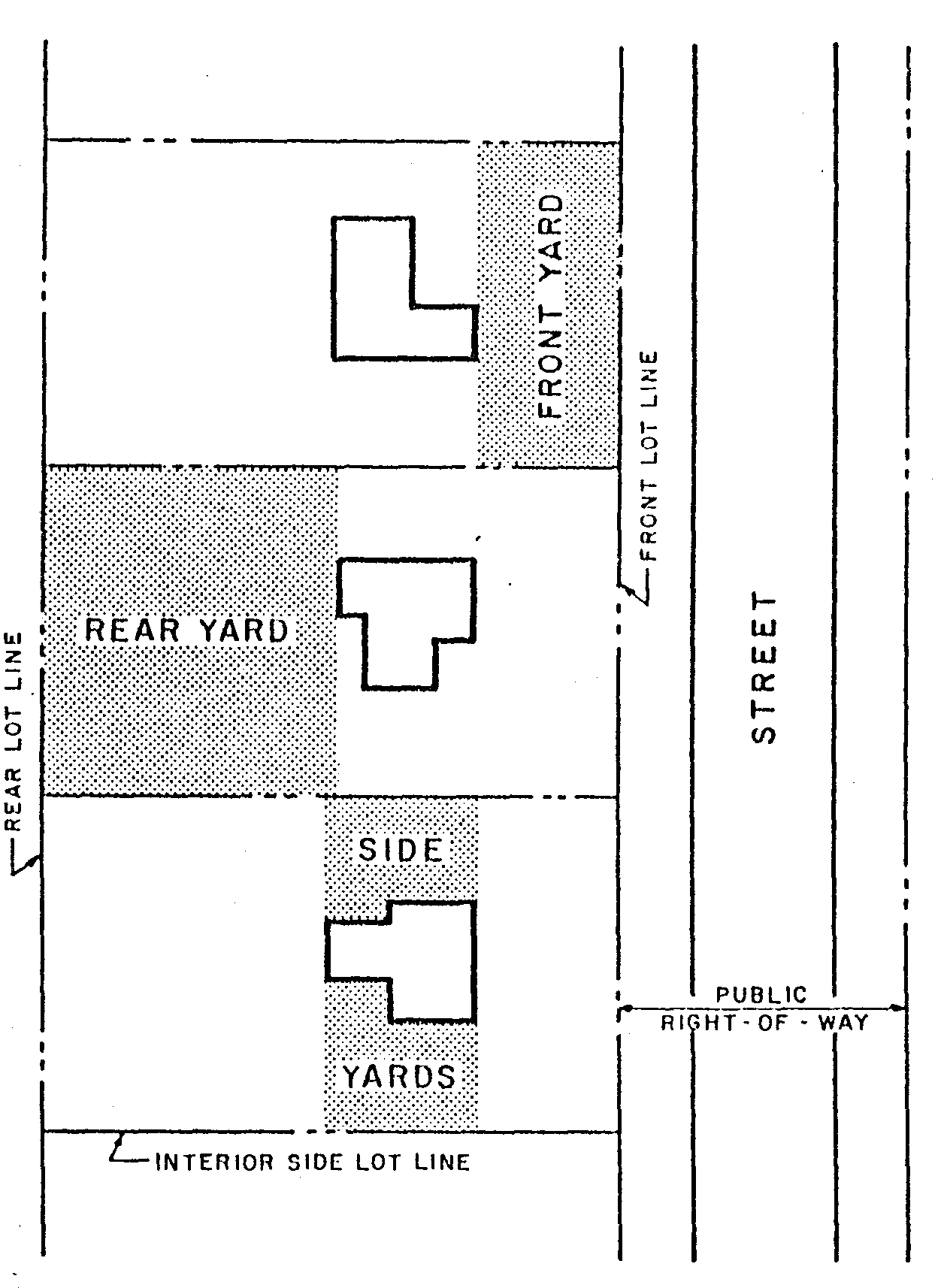
YARDS
(Ord. No. 96-5, §§ 201—208, 3-5-1996; Ord. No. 98-2, 3-3-1998; Ord. No. 98-2, 3-3-1999; Ord. No. 2000-2, 3-21-2000; Ord. No. 2000-05, 8-15-2000; Ord. No. 2006-02, 9-5-2006)
Sec. 50-4. - Zoning exceptions and variances.
A use permitted only after review of an application by the board of appeals or planning commission other than the administrative official (building inspector), such review being necessary because the provisions of this article covering conditions, precedent or subsequent, are not precise enough to all applications without interpretation and such review is required by this chapter.
(Ord. of 5-6-2005; Ord. No. 96-5, § 209, 3-5-1996)
Sec. 50-5. - Repeal of prior ordinances.
Any and all previous ordinances adopted by the city and all amendments thereto are hereby repealed. The repeal of the above ordinances and their amendments does not affect or impair any act done, offense committed or right accruing, accrued or acquired or liability, penalty, forfeiture or punishment incurred prior to the time enforced, prosecuted or inflicted.
(Ord. No. 96-5, art. XXII, 3-5-1996)
Sec. 50-6. - Interpretation.
In their interpretation and application, the provisions of this chapter shall be held to be minimum requirements adopted for the promotion of the public health, morals, safety, comfort, convenience or general welfare. It is not intended by this chapter to repeal, abrogate, annul or in any way impair or interfere with any existing provisions of law or ordinance other than the above described zoning chapter or with any rules, regulations or permits previously adopted or issued or which shall be adopted or issued pursuant to the law relating to the use of buildings or premises; provided, however, that where this chapter imposes a greater restriction than is required by existing ordinance or by rules, regulations or permits, the provisions of this chapter shall control.
(Ord. No. 96-5, art. XXIII, 3-5-1996)
Sec. 50-7. - Vested right.
Nothing in this chapter should be interpreted or construed to give rise to any permanent vested rights in the continuation of any particular use, district, zoning classification or any permissible activities therein; and they are hereby declared to be subject to subsequent amendment, change or modification as may be necessary to the preservation or protection of public health, safety and welfare.
(Ord. No. 96-5, art. XXIV, 3-5-1996)

