
Alice City Zoning Code
CHAPTER 2
- INTERPRETATION AND PURPOSES
Sec. 2-1.- Interpretation and purposes.
In their interpretation and application, the provisions of this ordinance shall be held to be the minimum requirements adopted for the promotion of the public health, safety and welfare. The zoning regulations and districts as herein established have been made in accordance with a comprehensive plan, for the purpose of promoting health, safety, morals and the general welfare of the City of Alice; they have been designed, among other things[,] to lessen congestion in the streets, to secure safety from fire, panic and other dangers, to provide adequate light and pure air; to avoid undue concentration of population, and to facilitate adequate provisions for transportation, water, sewerage, schools, parking areas and other public requirements.
Sec. 2-2. - Scope.
It is not intended by this ordinance to repeal, abrogate, annul or in any way impair or interfere with existing provision of other laws or ordinances, except as the same may be specifically repealed by the terms of this ordinance, or with private restrictions placed upon property by covenant, deed, easement or other private agreement. Where this ordinance imposes a greater restriction upon land, buildings, or structures than is imposed or required by other laws, ordinances, deeds, covenants or agreements, the provisions of this ordinance shall govern.
Sec. 2-3. - Definitions.
For the purpose of this ordinance certain terms and word[s] are herewith defined as follows:
[Generally.] Words used in the present tense include the future; words in the singular number include the plural, and words in the plural number include the singular; the word "building" includes the word "structure," the word "shall" is mandatory, and not directory. The words "used" or "occupied" include the words "intended," "designed," or "arranged to be used or occupied." The word "lot" includes the words "plot" or "parcel."
Accessory building or use. A subordinate building having a use customarily incident to and located on the same lot occupied by the main building; or a use customarily incident to the main or principal use of the property. A building housing an accessory use is considered an integral part of the main building when it has any part of a wall in common with the main building, or is under an extension of the main roof and designed as an integral part of the main building.
Alley. A public minor way which is used primarily for vehicular service access to the back or side of properties otherwise abutting on a street or highway.
Animal hospital or clinic. Animal hospital or clinic shall mean a facility operated by a licensed doctor of veterinary medicine for the treatment and hospitalization of household pets, such as birds, dogs, cats and other small animals, as distinguished from farm and ranch animals.
Apartment. A room or suite of rooms in an apartment house arranged, designed or occupied as a dwelling unit residence by a single family, individual, or group of individuals.
Apartment hotel. Any building larger than an apartment house designed or built to be occupied as a series of separate apartments and by persons living independently of each other.
Apartment house. Any building, or portion thereof, which is designed, built, rented, leased, let or hired out to be occupied as three or more apartments or dwelling units or which is occupied as the home or residence of three or more families living independently of each other and maintaining separate cooking facilities.
Automobile sales area. An open area or lot used for the display or sale of automobiles, where no repair work is done except minor reconditioning of the cars to be displayed and sold on the premises, and no dismantling of cars or sale or keeping of used car parts or junk on the premises.
Basement. A building story which is partly underground but having at least one-half of its height above the average level of the adjoining ground. A basement shall be counted as a story in computing building height.
Block. An area enclosed by streets and occupied by or intended for buildings; or if said word is used as a term of measurement, it shall mean the distance along a side of a street between the nearest two streets which intersect said street on the said side. In cases where platting is incomplete or disconnected the zoning administrative official shall determine the outline of the block.
Board. The zoning board of adjustment as established in section 3-1.
Boardinghouse. A building other than a hotel, where lodging and meals for five or more persons are served for compensation.
Breezeway. A covered passage one story in height and six feet or more in width connecting a main structure and an accessory building. A breezeway shall be considered an accessory building.
Buildable area. The portion of a lot remaining after required yards have been provided.
Building. Any structure built for the support, shelter and enclosure of persons, animals, chattels or movable property of any kind. When subdivided in a manner sufficient to prevent the spread of fire each portion, so subdivided may be deemed a separate building.
Building, height of. The vertical distance measured from the curb level to the highest point of the roof surface, if a flat roof; to the deck line of a mansard roof; and to the mean height level between eaves and ridge for a gable, hip or gambrel roof; provided, however, that where buildings are set back from the street line, the height of the building may be measured from the average elevation of the finished grade along the front of the building.
Building line. A line parallel or approximately parallel to the street line at a specific distance therefrom marking the minimum distance from the street line that a building may be erected.
Business. Includes local retail, commercial, industrial, and manufacturing uses and districts as herein defined.
Cellar. A building story with more than one-half its height below the average level of the adjoining ground. A cellar shall not be counted as a story in computing building height.
Certificate of occupancy (or permit). An official certificate issued by the city through the administrative official which indicates conformance with or approved conditional waiver from the building or zoning regulations and authorizes legal use and occupancy of the premises for which it is issued.
City council. The governing body of the City of Alice, Texas.
Clinic. Offices for one or more physicians, surgeons, or dentists engaged in treating the sick or injured, but not including rooms for the abiding of patients.
Community center. A building dedicated to social or recreational activities, serving the city or a neighborhood and owned and operated by the city, or by a nonprofit organization dedicated to promoting the health, safety, morals or general welfare of the city.
Convalescent home. Any structure used for or occupied by persons recovering from illness or suffering from the infirmities of old age.
Court. An open, unoccupied space, bounded on three or more sides by the walls of a building. An inner court is a court entirely surrounded by the exterior walls of a building. An outer court is a court having no side open to a street, alley, yard or other permanent space.
Day care center. A child care facility which provides care for more than 12 children under 14 years of age, provided further that such care shall be for a time period of less than 24 hours per day and that the maximum number of employees allowable shall be determined [by] state regulations.
District (zoning). A section of the City of Alice, Texas, for which the regulations governing the area, height, or use of the land and buildings are uniform.
Drive-in restaurant or refreshment stand. Any place or premises used for sale, dispensing, or serving of food, refreshments, or beverages in automobiles, including those establishments where customers may serve themselves and may eat or drink the food, refreshments, or beverages on the premises.
Dwelling, one-family. A detached residential dwelling unit other than a mobile home, designed for and occupied by one family only.
Dwelling, two-family. A detached residential building containing two dwelling units, designed for occupancy by not more than two families.
Dwelling, three-family. A detached residential building containing three dwelling units, designed for occupancy by not more than three families.
Dwelling, four-family. A detached residential building containing four dwelling units, designed for occupancy by not more than four families.
Dwelling, multiple family. A residential building designed for or occupied by five or more families, with the number of families in residence not exceeding the number of dwelling units provided, including but not limited to apartment houses, row houses, tenements, condominiums and townhouses.
Dwelling, mobile home. A detached residential dwelling unit designed for transportation after fabrication on streets or highways on its own wheels or on flatbed or other trailers, and arriving at the site where it is to be occupied as a dwelling complete and ready for occupancy except for minor and incidental unpacking and assembly operations, location on jacks or other temporary or permanent foundations, connections to utilities, and the like. A travel trailer is not to be considered as a mobile home.
Dwelling unit. One room, or rooms connected together, constituting a separate, independent housekeeping establishment for owner occupancy, or rental or lease on a weekly, monthly, or longer basis, and physically separated from any other rooms or dwelling units which may be in the same structure, and containing independent cooking and sleeping facilities.
Efficiency apartment. An apartment having a combination living and bedroom (no separate bedroom).
Family. One or more persons who are related by blood or marriage, living together and occupying a single housekeeping unit with single kitchen facilities, or a group of not more than five (excluding servants) living together by joint agreement and occupying a single housekeeping unit with single kitchen facilities, on a nonprofit cost-sharing basis.
Floor area. The total (gross) square feet of floor space within the outside dimensions of a building including each floor level, but excluding cellars, attics, carports or garages that are not designed for residential or business occupancy.
Floor area ratio (FAR). An indicated ratio between the number of square feet of total floor area in the main building(s) on a lot and the total square footage of land in the lot; it is the number resulting from dividing the main building floor area by the lot area.
Frontage. All the property abutting on one side of the street between two intersecting streets, measured along the street line.
Garage, private. An enclosed accessory building for storage only of motor vehicles, boats, travel trailers, and household goods owned and used by the owners or tenants of the premises.
Garage, public. A building or portion thereof designed or used for the storage, sale, hiring, care or repair of motor vehicles, which is operated for commercial purposes.
Garage, storage (parking). A building or portion thereof, other than a private garage, used exclusively for parking or storage of self-propelled vehicles, but with no other services provided except facilities for washing.
Grade:
a.
For buildings having walls adjoining one street only, it is the elevation of the sidewalk at the center of the wall adjoining the street;
b.
For buildings having walls adjoining more than one street, it is the average of the elevation of the sidewalk at the center of all walls adjoining the street;
c.
For buildings having no wall adjoining the street, it is the average level of the finished surface of the ground adjacent to the exterior wall of the building.
Any wall approximately parallel to and not more than five feet from a street line is to be considered as adjoining the street. Where no sidewalk has been constructed, the building inspector [building official] shall establish such sidewalk level or its equivalent for the purpose of these regulations.
Group day care home. A facility that provides care in the caretaker's own residence for seven to 12 children including the caretaker's own children under 14 years of age; provided further that such care shall be for a time period of less than 24 hours per day.
Height of buildings. The vertical distance of a building measured from the average established grade at the street line or from the average natural front yard ground level, whichever is higher, (1) to the highest point of the roof's surface if a flat surface, (2) to the deck line of mansard roofs or (3) to the mean height level between eaves and ridge for hip and gable roofs and, in any event, excluding chimneys, cooling towers, elevator bulkheads, penthouses, tanks, water towers, radio towers, ornamental cupolas, domes or spires, and parapet walls not exceeding ten feet in height. If the street grade has not been officially established, the average front yard grade shall be used for a base level.
Height of yard or court. The vertical distance from the lowest level of such yard or court to the highest point of any boundary wall.
Hobby shop. An accessory use housed in a dwelling or in an accessory building in which the residents of the premise engaged in recreational activities, none of which shall disturb the neighbors on either side or in the rear thereof and from which no revenue may be derived, and in which no goods may be publicly displayed, offered for sale or advertised for sale, nor may any sign be used in connection therewith.
Home occupation. An occupation conducted in a dwelling unit, provided that:
a.
No person other than members of the family residing on the premises shall be engaged in such occupation;
b.
The use of the dwelling unit for the home occupation shall be clearly incidental and subordinate to its use for residential purposes by its occupants, and not more than 25 percent of the floor area of the dwelling unit shall be used in the conduct of the home occupation;
c.
There shall be no change in the outside appearance of the building or premises, or other visible evidence of the conduct of such home occupation other than one sign, not exceeding one square foot in area, nonilluminated, and mounted flat against the wall of the principal building;
d.
No home occupation shall be conducted in any accessory building;
e.
No traffic shall be generated by such home occupation in greater volumes than would normally be expected in a residential neighborhood, and any need for parking generated by the conduct of such home occupation shall be met off the street and other than in a required front yard;
f.
No equipment or process shall be used in such home occupation which creates noise, vibration, glare, fumes, odors, or electrical interference detectable to the normal senses off the lot, if the occupation is conducted in a single-family residence, or outside the dwelling unit if conducted in other than a single-family residence. In the case of electrical interference, no equipment or process shall be used which creates visual or audible interference in any radio or television receivers off the premises, or causes fluctuations in line voltage off the premises.
Hotel. One or more buildings containing individual living or sleeping units specially designed as temporary quarters for transient guests, including provisions for meals and personal services. A hotel includes a tourist hotel, a motor hotel, and a motel, but does not include an apartment hotel.
Junk. The term "junk" is defined to mean and shall include scrap iron, scrap tin, scrap brass, scrap copper, scrap lead or scrap zinc and all other scrap metals and their alloys, and bones, rags, used cloth, used rubber, used rope, used tinfoil, used bottles, old cotton, or used machinery, used tools, used appliances, used fixtures, used utensils, used boxes or crates, used pipe or pipe fittings, used automobiles or airplane tires, and other manufactured goods that are so worn, deteriorated or obsolete as to make them unusable in their existing condition; subject to being dismantled for junk.
Kennel. Any lot or premises on which four or more dogs, cats, or other domestic animals, at least four months of age, are housed or accepted for boarding, trimming, grooming and/or bathing for which remuneration is received.
Kindergarten. A school other than a public school for children of pre-public school age in which constructive endeavors, object lessons and helpful games are prominent features of the curriculum.
Legal nonconforming use, building or yard. A use, building or yard existing legally at the time of the passage of this ordinance which does not by reason of design, use, or dimensions conform to the regulations of the district in which it is situated. A use, building or yard established after the passage of this ordinance, which does not conform to regulations of the district in which it is situated shall be considered an illegal nonconforming use.
Living unit. Same as dwelling unit.
Loading space, off-street. Space logically and conveniently located for bulk pickups and deliveries, scaled to delivery vehicles expected to be used, and accessible to such vehicles when required off-street parking spaces are filled. Required off-street loading space is not to be included as off-street parking space in computation of required off street-parking space.
Lot. For purposes of this ordinance, a lot is a parcel of land of at least sufficient size to meet minimum zoning requirements for use, coverage, and area, and to provide such yards and other open spaces as are herein required. Such lot shall have frontage on an improved public street, or on an approved private street, and may consist of:
a.
A single lot of record;
b.
A portion of a lot of record;
c.
A combination of complete lots of record, of complete lots of record and portions of lots of record, or of portions of lots of record;
d.
A parcel of land described by metes and bounds; provided that in no case of division or combination shall any residual lot or parcel be created which does not meet the requirements of this ordinance.
Lot coverage. The percentage of the total area of a lot occupied by the base (first story or floor) of buildings located on the lot.
Lot frontage. The frontage of a lot shall be construed to be the portion nearest the street. For the purposes of determining yard requirements on corner lots and through lots, all sides of a lot adjacent to streets shall be considered frontage, and yards shall be provided as indicated under yards in this section.
Lot lines. The lines bounding a lot as defined herein.
Lot line, front. The boundary between a lot and the street on which it fronts.
Lot line, rear. The boundary line which is opposite and most distant from the front street line; except that in the case of uncertainty the building inspector [building official] shall determine the rear line.
Lot line, side. Any lot boundary line not a front or rear line thereof. A side line may be a party lot line, a line bordering on an alley or place or side street line.
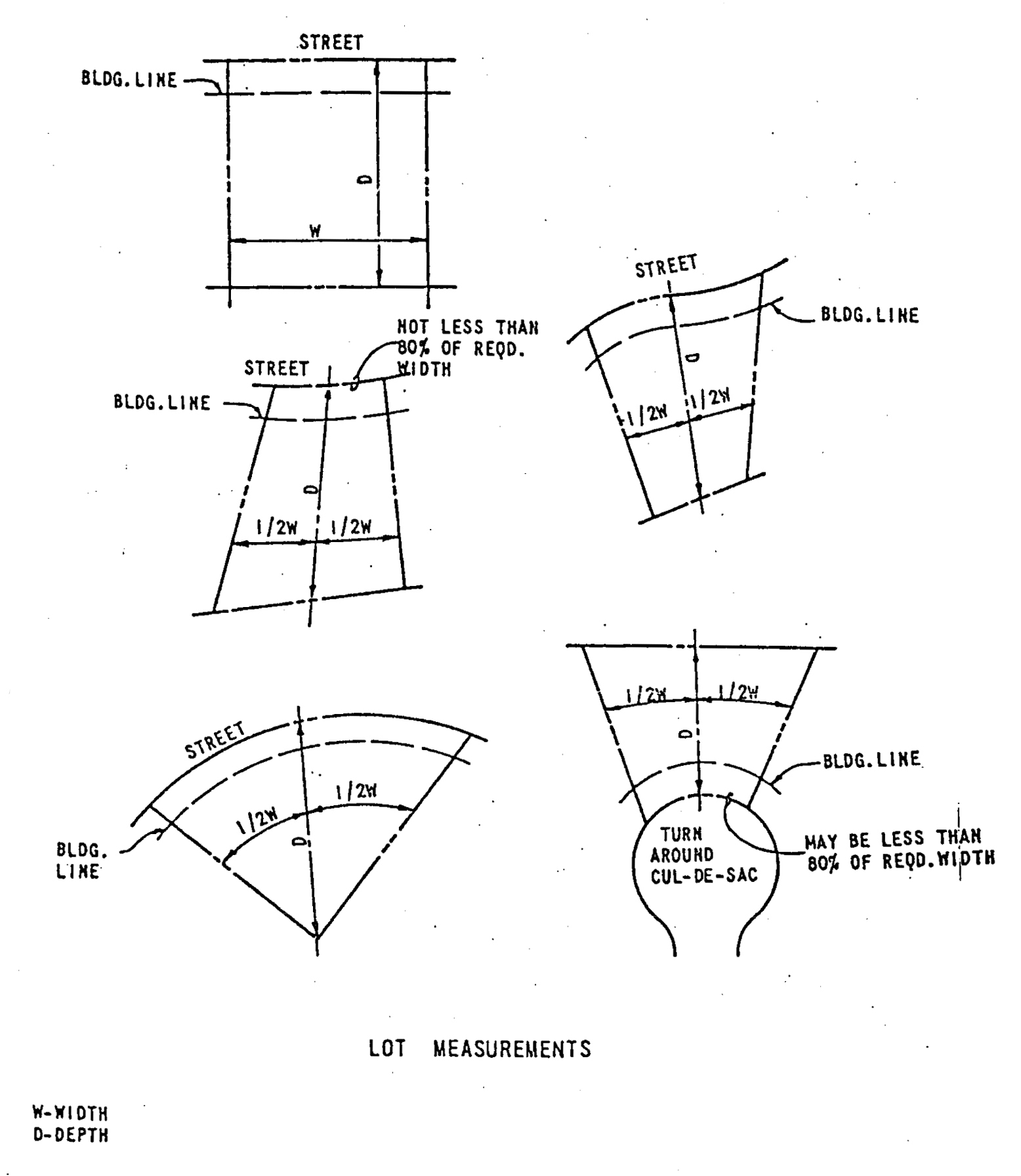
Lot measurements:
Area of the lot shall be the net area of the lot, expressed in square feet or acreage, and shall not include portions of any public street or alley.
Depth of a lot shall be considered to be the distance between the midpoints of straight lines connecting the foremost points of the side lot lines in front and the rearmost points of the side lot lines in the rear (the mean horizontal distance between the front and rear lot line).
Width of a lot shall be considered to be the distance between straight lines connecting front and rear lot lines at each side of the lot, measured across the rear of the required front yard; provided, however, that width between side lot lines at their foremost points (where they intersect with the street line) shall not be less than 80 percent of the required lot width except in the case of lots on the turning circle of cul-de-sac, where the 80 percent requirement shall not apply.
Lot of record. A lot which is part of a subdivision recorded in the office of the county clerk, or a lot or parcel described by metes and bounds, the description of which has been so recorded prior to the adoption of this ordinance.
Lot types:
Corner lot. A lot abutting upon two or more streets at their intersection. A corner lot shall be deemed to front on that street on which it has its least dimension, unless otherwise specified by the building inspector [building official].
Cul-de-sac lot. A lot whose frontage is along the turnaround portion of a street which has only one opening and terminates with a turnaround at the closed end.
Interior lot. A lot other than a corner lot with only one street frontage and whose side lot lines do not abut upon any street.
Through lot. A lot other than a corner lot with frontage on more than one street. Through lots abutting two streets may be referred to as "double frontage" lots.
Main (principal) building. The building or buildings on a lot which are occupied by the primary use.
Mobile home. See dwelling, mobile home.
Mobile home park. Any tract or parcel of land used in whole or in part for the accommodation of mobile homes with the occupants of the mobile homes not owning such tract or parcel of land or any part thereof.
Mobile home subdivision. Any tract or parcel of land subdivided into lots to be sold as locations for mobile homes with the occupants of the mobile homes owning said land as well as the mobile home.
Motor vehicle. A motor vehicle is a vehicle subject to registration under the certificate of title act (V.T.C.A., Transportation Code § 501.001 et seq.) or any other device designed to be self-propelled or transported on a public highway.
Nonconforming use. A building, structure or use of land lawfully occupied at the time of the effective date of this ordinance or amendments thereto, and which does not conform to the use regulations of the district in which it is situated.
Occupancy. The use or intended use of the land or buildings by proprietors or tenants.
Open space. Area included in any side, rear or front yard or any unoccupied space on the lot that is open and unobstructed to the sky except for the ordinary projections of cornices, eaves or porches.
Parking space, off-street. For the purposes of this ordinance, an off-street parking space shall consist of a space adequate for parking an automobile with room for opening doors or both sides, together with properly related access to a public street or alley and maneuvering room. Required off-street parking areas for three or more automobiles shall have individual spaces marked, and shall be so designed, maintained, and regulated that no parking or maneuvering incidental to parking shall be on any public street, walk, or alley, and so that any automobile may be parked and unparked without moving another. For purposes of rough computation, an off-street parking space and necessary access and maneuvering room shall be estimated at 300 square feet for residential uses and 400 square feet for nonresidential uses, but off-street parking requirements will be considered to be met only when actual spaces meeting the requirements above are provided and maintained, improved in a manner appropriate to the circumstances of the case, and in accordance with all ordinances and regulations of the city.
Planning and zoning commission. The agency appointed by the city council as an advisory body to it and which is authorized
to recommend changes in the Zoning [Ordinance].
Plat. A plan of a subdivision of land creating building lots or tracts and showing all essential dimensions and other information essential to comply with the subdivision standards of the City of Alice and subject to approval by the planning and zoning commission. Reference to a plat in this ordinance means an official plat of record, which has been approved by the planning and zoning commission and filed in the plat records of Jim Wells County.
Premises. Land together with any buildings or structures occupying it.
Private club. An association of persons meeting regularly for their mutual benefit or for the promotion of some common purpose, supported jointly through payment of membership dues, all members having the right to vote on policies and business.
Private drive (street or place). An open, unoccupied space, other than a street or alley, permanently established or reserved or dedicated in private ownership as the principal means of vehicular access to property abutting thereon.
Registered family home. A facility that regularly provides care in the caretaker's own residence for not more than six children under 14 years of age, including the caretaker's own children, and who provides care after the school hours observed by the Alice Independent School District for not more than six additional elementary school siblings of the other children given care, but the total number of children, including the caretaker's own, does not exceed 12 at any and all times; provided further, that such care shall be for a time period of less than 24 hours per day.
Residence. Same as a dwelling; also when used with the word district, an area of residential regulations.
Room. A building or portion of a building which is arranged, occupied or intended to be occupied as living or sleeping quarters but not including toilet or cooking facilities.
Roominghouse. A building other than a hotel where lodging for three but not more than 12 persons is provided for definite periods for compensation pursuant to previous arrangement.
Screening wall. Solid structure of wood or masonry with no visible penetrations, except for passage. Shall be six-foot [feet] in height.
Servants' quarters. An accessory building located on the same lot or grounds with the main building and used as living quarters for servants employed on the premises and not rented or otherwise used as a separate domicile.
Setback. The minimum horizontal distance between the front wall of any projection of the building, excluding steps and the street line. (Same as building line.)
Sign. Any device designed to inform or attract the attention of persons not on the premises on which the sign is located; provided, however, than [that] the following shall not be included in the application of the regulations herein:
a.
Signs not exceeding one square foot in area and bearing only property numbers, post box numbers, names of occupants of premises, or other identification of premises not having commercial connotations;
b.
Flags and insignia of any government except when displayed in connection with commercial promotion.
Travel trailers. A mobile vehicle built on a chassis and designed and used as a temporary place of dwelling and of such size and design as to be subject to licensing for towing on the highway by a passenger motor vehicle or other prime mover and not requiring a special permit for moving on the highway as contrasted to a mobile home.
Variance. A variance is a relaxation of the terms of the Zoning Ordinance where such variance will not be contrary to the public interest and where owing to conditions peculiar to the property, and not the result of the actions, of the applicant, a literal enforcement of the ordinance would result in unnecessary and undue hardship. As used in this ordinance, a variance is authorized only for height, area, and size of structure or size of yards and open spaces; establishment or expansion of a use otherwise provided shall not be allowed by variance, nor shall a variance be granted because of the presence of nonconformities in the zoning district or uses in an adjoining zoning district.
Vehicle. Every mechanical device, in, upon or by which any person or property is or may be transported or drawn upon a public highway, including motor vehicles, commercial motor vehicles, truck-tractors, trailers, and semi-trailers, severally, as hereinafter defined, but excepting devices moved by human power or used exclusively upon stationary rails or tracks.
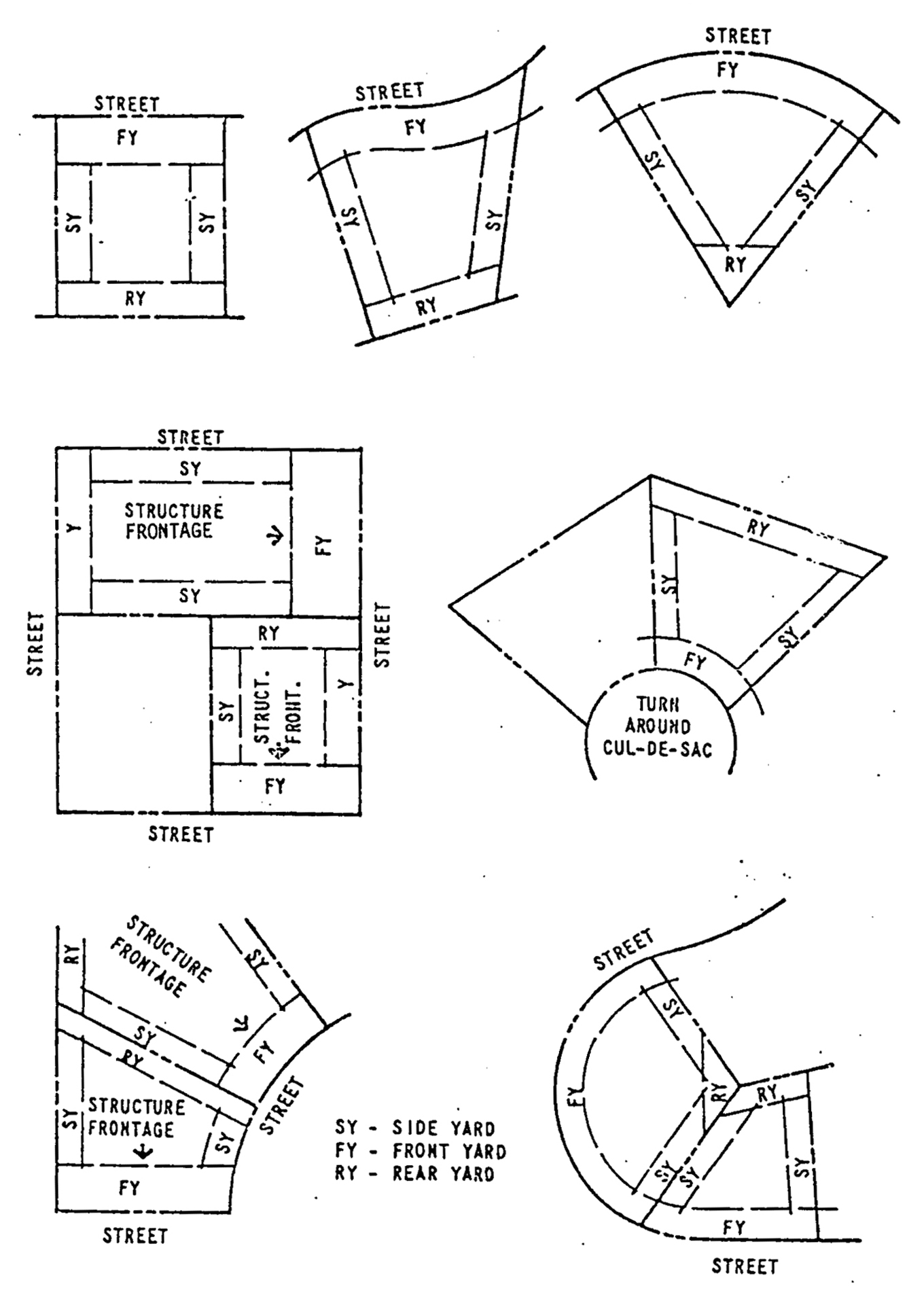
Yard. A required open space other than a court unoccupied and unobstructed by any structure or portion of a structure from 30 inches above the general ground level of the graded lot upward; provided, however, that fences, walls, poles, posts, and other customary yard accessories, ornaments, furniture, and roof overhangs not exceeding 24 inches, may be permitted in any yard subject to height limitations and requirements limiting obstruction of visibility.
Yard, front. A yard extending between side lot lines across the front of a lot adjoining a public street. In the case of through lots, unless the prevailing front yard pattern on adjoining lots indicates otherwise, front yards shall be provided on all frontages. Where one of the front yards that would normally be required on a through lot is not in keeping with the prevailing yard pattern, the administrative official may waive the requirement for the normal front yard and substitute therefor a special yard requirement which shall not exceed the average of the yards provided on adjacent lots. In the case of corner lots, which do not have reversed frontage, a front yard of the required depth shall be provided in accordance with the prevailing yard pattern and a second front yard of half the depth required generally for front yards in the district shall be provided on the other frontage. In the case of reversed frontage corner lots, a front yard of the required depth shall be provided on either frontage, and a second front yard of half the depth required generally for front yards in the district shall be provided on the other frontage. In the case of corner lots with more than two frontages, the administrative official shall determine the front yard requirements, subject to the following limitations:
a.
At least one front yard shall be provided having the full depth required generally in the district;
b.
No other front yard on such lot shall have less than half the full depth required generally.
Depth of required front yards shall be measured at right angles to the front lot line being the street right-of-[way] line and/or the greatest length of lot line which is located on that side of any building considered to be the primary frontage.
Yard, side. A yard extending from the rear line of the required front yard to the rear lot line, or in the absence of any clearly defined rear lot line to the point on the lot farthest from the intersection of the lot line involved with the public street. In the case of through lots, side yards shall extend from the rear lines of front yards required. In the case of corner lots, yards remaining after full and half-depth front yards have been established shall be considered side yards. Width of a required side yard shall be measured in such a manner that the yard established is a strip of the minimum width required by district regulations with its inner edge parallel with the side lot line.
Yard rear. A yard extending across the rear of the lot between inner side yard lines. In the case of through lots and corner lots, there will be no rear yards, but only front and side yards. Depth of a required rear yard shall be measured in such a manner that the yard established is a strip of the minimum width required by district regulations with its inner edge parallel with the rear lot line. In cases that a rear lot line is not evident or that side lot lines intersect at a point and no rear lot line exists, a rear yard shall be required whose depth shall be no less than ten percent of the lot depth and no more than 25 percent of the lot depth.
Yard, special. A yard being any required yard adjacent to a public street, required to perform the
same functions as a side or rear yard, but adjacent to a lot line so placed or oriented
that neither the term "side yard" nor the term "rear yard" clearly applies. In such
cases, the administrative official shall require a yard with minimum dimensions as
generally required for a side yard or a rear yard in the district, determining which
shall apply by the relation of the portion of the lot on which the yard is to be located
to the adjoining lot or lots, with due regard to the orientation and location of structures
and buildable areas thereon.
(Ord. No. 1065, § 1(17-2-3), 6-28-1983; Ord. No. 1455, § 1, 3-27-1989; Ord. No. 1456, § 1, 3-27-1989)
Sec. 2-4. - Exemption fees.
(a)
Subject to compliance with the remaining provisions of this section, construction and/or rehabilitation of single-family, owner occupied housing by nonprofit, charitable organization and governmental entities, conducting programs of construction and/or rehabilitation of single-family, owner occupied housing for low-and moderate-income families, shall be exempt from the payment of all fees assessed under this chapter.
(b)
An application for exemption shall be made on a form provided by the city to the city manager for each property for which an exemption is sought under this section. The city manager shall determine within ten business days of the filing of the application with the city that the housing proposed for exemption:
(1)
Is qualified for the exemption under the provisions of this section;
(2)
Is being constructed or rehabilitated by a qualified entity as set out herein; and
(3)
Is intended to be occupied only by families satisfying the low-and moderate-income limits for the city as established by the U.S. Department of Housing and Urban Development (HUD).
(c)
If the city manager determines that the contents of the application are true and satisfy all criteria established by this section, the exemption shall be approved. If the city manager determines that the contents of the application are not true and do not satisfy all criteria set out herein, the application for exemption shall be denied. The city manager shall provide written notice of the approval or disapproval of the application for exemption to the applicant by:
(1)
U.S. certified mail, return receipt requested;
(2)
Facsimile transmittal;
(3)
Electronic mail; or
(4)
Delivery in person.
(d)
The denial of an application for exemption under this section may be appealed to the city council by filing a written notice of appeal with the city clerk within five business days of the receipt of the written notice of disapproval. Upon timely appeal of a decision of disapproval, the city clerk shall place the appeal on the agenda for the next available regular meeting of the city council. The city council may overturn the decision of the city manager only if the city council finds that the housing proposed for exemption:
(1)
Is qualified for the exemption under the provisions of this section;
(2)
Is being constructed or rehabilitated by a qualified entity as set out herein; and
(3)
Is intended to be occupied only by families satisfying the low-and moderate-income limits for the city as established by the U.S. Department of Housing and Urban Development (HUD).
(e)
An exemption from payment of fees granted under this section shall not exempt the construction of any such property, nor the builder thereof, from the obligation to comply fully with the city's building codes and ordinances applicable to said construction.
(f)
The city manager may revoke or suspend any permit issued under this section if at any time the city manager finds that the applicant has made a material misrepresentation of any fact contained in the application for exemption or that at any time prior to the completion of the construction that the property is no longer qualified for any exemption under this section. An appeal from the city manager's decision to revoke or suspend a permit may be made to the city council in the same manner as the appeal of a decision to deny a permit under subsection (d) of this section.
(g)
The city manager may delegate duties assigned under this section to a qualified member of city staff. However, any decision to deny, revoke or suspend a permit issued under this section must be made by the city manager.
(Ord. No. 1747, § 1, 1-12-2004)

