
Alma City Zoning Code
ARTICLE V
- PLANNED UNIT DEVELOPMENT3
State Law reference— Planned unit development, MCL 125.3503.
Sec. 60-108.- Purpose and intent.
The provisions of this article provide enabling authority and standards for the submission, review, and approval of applications for planned unit developments (PUD). It is the intent of this article to authorize the use of PUD regulations for the purpose of: encouraging the use of land in accordance with its character and adaptability, conserving natural resources and energy, encouraging innovation in land use planning, providing enhanced housing, employment, shopping, traffic circulation and recreational opportunities for the people of the city, and bringing about a greater compatibility of design and use.
(Ord. No. 691, § 1(32-62), 5-4-2005)
Sec. 60-109. - PUD regulations.
(a)
A PUD may be applied for in any zoning district. The approval of a PUD application shall require a rezoning by way of amendment of this chapter upon the recommendation of the planning commission and approval of the city commission. The process for PUD approval shall be in accordance with section 60-110.
(b)
Generally, proposed uses shall be consistent with the underlying zoning designation before application to PUD and the future land use map in the master plan. However, it is recognized that the PUD option may allow mixed uses and flexibility in use. In this regard, mixed uses may be allowed as part of a PUD application, provided that uses are consistent with the goals and objectives of the master plan and subject to adequate public health, safety, and welfare protection mechanisms, which are designed into the development to ensure the compatibility of varied land uses both inside and outside the development.
(Ord. No. 691, § 1(32-63), 5-4-2005)
Sec. 60-110. - PUD eligibility.
The applicant for a PUD must demonstrate all of the following criteria as a condition to being entitled to PUD treatment:
(1)
Granting the planned unit development will result in one of the following:
a.
A recognizable and material benefit to the ultimate users of the project and to the community, where such benefit would otherwise be unfeasible or unlikely to be achieved without application of the PUD regulations;
b.
Longterm protection and preservation of natural resources and natural features of a significant quantity, where such benefit would otherwise be unfeasible or unlikely to be achieved without application of the PUD regulations;
c.
Longterm protection of historic structures or significant architecture worthy of historic preservation; or
d.
A nonconforming use shall, to a material extent, be rendered more conforming, or less offensive, to the zoning district in which it is situated.
(2)
The proposed type and density of use shall not result in an unreasonable increase in the need for or burden upon public services, facilities, roads and utilities.
(3)
The proposed PUD shall be harmonious with the public health, safety and welfare of the city.
(4)
The proposed PUD shall not result in an unreasonable negative environmental impact or loss of a historic structure on the subject site or surrounding land.
(5)
The proposed PUD shall not result in an unreasonable negative economic impact upon surrounding properties.
(6)
The proposed PUD shall be under single ownership and/or control such that there is a single person, corporation, or partnership having responsibility for completing the project in conformity with this chapter.
(7)
The proposed PUD shall be consistent with the goals and policies of the master plan.
(8)
The proposed use or uses shall be of such location, size, density and character as to be in harmony with the zoning district in which it is situated, and shall not be detrimental to the adjoining zoning districts.
(9)
The proposed PUD is not an attempt by the applicant to circumvent the strict application of zoning standards.
(Ord. No. 691, § 1(32-64), 5-4-2005)
Sec. 60-111. - Residential and nonresidential PUD standards.
(a)
Residential uses. All residential uses may be permitted with the following general density guidelines, based upon the zoning district in which the property is situated immediately prior to classification under this article. In the event the property is already zoned PUD or if an application for PUD requests a different density other than what is allowed as currently zoned, density shall be allowed at the discretion of the planning commission and city commission, based on the master plan, surrounding land use, and a demonstration that the proposed PUD provides quality design with minimal impacts to surrounding properties. Land area under water, public road rights-of-way and private road easements shall not be included in the density calculation.
Additional density greater than specified above for residential uses may be allowed in the discretion of the planning commission based upon a demonstration by the applicant of design excellence in the PUD resulting in a material benefit to all or a significant portion of ultimate residential uses of the project, including, without limitation, development of innovative design producing significant energy efficiency, pedestrian or vehicular safety, or long term aesthetic beauty.
(b)
Nonresidential uses. Nonresidential uses shall be permitted as part of a common development with residential units to the extent the applicant demonstrates by expert analysis and the planning commission finds, in its discretion, that the nonresidential uses shall principally serve the persons residing in the residential units in the project.
(c)
Mixed uses. The planning commission and city commission may allow a residential PUD in areas having a nonresidential base zoning subject to compliance with the master plan or a determination by the planning commission and city commission that the proposed development meets the general intent of section 60-108.
(d)
Other nonresidential uses. A PUD incorporating nonresidential uses such as commercial, industrial, institutional or a mix of nonresidential and residential uses may also be allowed subject to the design standards of this article.
(Ord. No. 691, § 1(32-65), 5-4-2005; Ord. No. 812, § 1, 8-13-2019)
Sec. 60-112. - General design standards.
(a)
All regulations within this article applicable to setback, parking and loading, general provisions, and other requirements shall be met in relation to each respective land use in the PUD based upon the zoning districts in which the use is listed as a permitted use. Notwithstanding the immediately preceding, deviations with respect to such regulations may be granted as part of the overall approval of the PUD. The deviations may be considered, provided there are features or elements demonstrated by the applicant and deemed adequate by the city commission and planning commission designed into the project plan for the purpose of achieving the objectives of this article.
(b)
The uses proposed will have a beneficial effect, in terms of public health, safety, welfare, or convenience, on the present and future potential surrounding land uses.
(c)
The uses proposed will not adversely affect the existing public utilities, public streets, traffic access, surrounding properties, or the environment.
(d)
The public benefit shall be one which could not be achieved under the regulations of the underlying district alone or that of any other zoning district.
(e)
The number and dimensions of off-street parking shall be sufficient to meet the minimum required of article VIII. However, when warranted by overlapping or shared parking arrangements, the planning commission or city commission may reduce the required number of parking spaces.
(f)
All streets and parking areas within the proposed PUD shall meet the minimum construction and other requirements of city ordinances, unless modified by planning commission and city commission.
(g)
Landscaping shall be preserved and/or generously provided to ensure that proposed uses will be adequately buffered from one another and from surrounding public and private property. Off street parking areas shall be attractively landscaped and/or screened.
(h)
Efforts shall be made to preserve significant natural, historical, and architectural features and the integrity of the land, including MDEQ regulated and non-MDEQ regulated wetlands or floodplains. Quality architecture and landscaping shall be required as part of the PUD review.
(i)
Thoroughfare, drainage, and utility designs shall meet or exceed the standards otherwise applicable in connection with each of the respective types of uses served. On site stormwater management shall meet or exceed county or state standards.
(j)
There shall be underground installation of utilities, including electricity and telephone unless otherwise permitted by the city.
(k)
The pedestrian circulation system, and its related walkways and safety paths, shall be separated from vehicular thoroughfares. Where possible, pedestrian connectivity will be provided to surrounding uses and/or downtown areas.
(l)
Signage, lighting, landscaping, architecture and building materials for the exterior of all structures, and other features of the project, shall be designed and completed with the objective of achieving a quality, integrated and controlled development consistent with the character of the community, surrounding development or developments, and natural features of the area.
(m)
Where nonresidential uses adjoin residentially zoned or used property outside the proposed PUD, noise reduction and visual screening mechanisms such as earthen and/or landscape berms and/or decorative walls, shall be employed in accordance with section 60-278.
(n)
The proposed PUD shall provide a minimum of ten percent of the gross site acreage as open space. Gross site area for the purposes of computing required open space does not include private and public rights-of-way. Such open space will remain undisturbed and reserved for passive enjoyment of the users of the development, and shall not include retention ponds or other bodies of water, required yards around residential building lots, or other similar features. This open space requirement may be waived by the city commission, if determined to be not applicable due to the type and character of development.
(Ord. No. 691, § 1(32-66), 5-4-2005; Ord. No. 812, §§ 2—7, 8-13-2019)
Sec. 60-113. - Procedure for review.
(a)
Pre-application conference. Prior to the submission of an application for a PUD consideration, the applicant shall meet with the representatives of the building / zoning departments and/or any other city officials who might have an interest in the proposed development. The applicant shall present at such conference, or conferences, at least a sketch plan of the proposed PUD, as well as the following information: total size of the project; a statement of the number of residential units, if any, the number and type of nonresidential uses, the size of the area to be occupied by each type of use, the known deviations from ordinance regulations, the number of acres to be preserved as open or recreational space, and all known natural features or historic features to be preserved. The purpose of the conference shall be to inform other officials of the concept of the proposed development and to provide the applicant with information regarding land development policies, procedures, standards, and requirements of the city and other agencies. The applicant is encouraged to present schematic plans, site data and other information that will explain the proposed development.
(b)
PUD eligibility. Following the pre-application conference, the applicant shall submit preliminary sketch plans and/or other written documentation explaining the proposed project and request review of PUD eligibility from the planning commission. The planning commission shall evaluate these preliminary plans for compliance with PUD regulations outlined in section 60-109. The planning commission shall review the development request based upon the criteria and convey written or verbal comments to the applicant regarding the PUD eligibility.
(c)
Neighborhood review. The applicant is encouraged to meet with any neighborhood associations and surrounding land owners prior to submittal of preliminary plans to the planning commission and seek informal input pertaining to design and potential impact to surrounding areas.
(d)
Preliminary plan submittal. Following a determination of eligibility by the planning commission, the applicant shall submit a preliminary site plan of the proposed PUD. A narrative report shall accompany the site plan providing a description of the project, discussion of the market concept of the project, and explanation of the manner in which the criteria set forth in the preceding design standards have been met. The preliminary site plan for a PUD shall contain, at a minimum, the following information:
(1)
One copy of the preliminary planned unit development site plan in an electronic or digital format suitable for projection or on clear acetate or similar material suitable for use with an overhead projector.
(2)
In addition to the 8½-inch by 11-inch transparency, large size plans shall also be submitted. Sheet size of submitted drawings shall be at least 24 inches by 36 inches, with graphics and scale.
(3)
Plans providing:
a.
The applicant's name;
b.
Name of the development;
c.
The preparer's name and professional seal of architect, engineer, surveyor or landscape architect indicating license in the state;
d.
Date of preparation and any revisions;
e.
North arrow;
f.
Property lines and dimensions;
g.
Complete and current legal description and size of property in acres;
h.
Small location sketch of the subject site and area within one-half mile; at a scale of no less than 1 inch = 1,000 feet;
i.
Zoning and current land use of applicant's property and all abutting properties and of properties located across any abutting public or private street from the planned unit development site;
j.
Lot lines and all structures on the property and within 100 feet of the PUD property lines;
k.
Location of any access points on both sides of the street within 100 feet of the PUD site along streets where access to the PUD is proposed.
l.
Existing locations of significant natural, historical, and architectural features, existing drainage patterns, surface water bodies, floodplain areas, MDEQ designated or regulated wetlands with supporting documentation and a tree survey indicating the location and diameter (in inches, measured four feet above grade) of trees greater than six inches in diameter.
m.
Existing and proposed topography at five-foot contour intervals or two-foot contour intervals (two-foot intervals required for final site plan), and a general description of grades within 100 feet of the site.
n.
Dimensions of existing and proposed rights-of-way lines, names of abutting public streets, proposed access driveways and parking areas, and existing and proposed pedestrian and/or bicycle paths.
o.
Location of existing buildings, utility services (with sizes), and any public or private easements, noting those which will remain and which are to be removed.
p.
Layout and typical dimensions of proposed lots, footprints and dimensions of proposed buildings and structures; uses with the acreage allotted to each use. For residential developments: the number, type and density of proposed housing units.
q.
General location and type of landscaping proposed (evergreen, deciduous, berm, etc.) noting existing trees and landscaping to be retained.
r.
Size, type and location of proposed identification signs.
s.
If a multi-phase PUD is proposed, identification of the areas included in each phase. For residential uses, identify the number, type, and density of proposed housing units within each phase.
t.
Any additional graphics or written materials requested by the planning commission or city commission to assist in determining the appropriateness of the PUD such as, but not limited to: aerial photography, market studies, impact on public primary and secondary schools and utilities, traffic impacts using trip generation rates recognized by the Institute of Transportation Engineers for an average day and peak hour of the affected roadways, impact on significant natural, historical, and architectural features and drainage, impact on the general area and adjacent property, description of how property could be developed under the regulations of the underlying district, preliminary architectural sketches, building elevations, and conceptual plans or lists of building materials and estimated construction cost.
u.
An explanation of why the submitted PUD plan is superior to a plan that could have been prepared under strict adherence to related sections of this article.
v.
Any of the above information requirements may be waived or modified by the zoning department or planning commission upon a determination that the required items of information are not applicable.
(e)
Preliminary plan action. The preliminary plan shall be noticed for a public hearing before the planning commission in accordance with applicable state laws, including Public Act No. 110 of 2006, as amended. Following the public hearing, the planning commission shall report its conclusions, determine a basis for its recommendation and transmit summary comments received at the public hearing to the city commission. The planning commission shall review the preliminary site plan and recommend the following actions to the commission:
(1)
Approval. Upon finding that the preliminary plan meets the criteria set forth in sections 60-108—60-112, the planning commission may recommend approval of the preliminary PUD plan. Approval shall constitute approval of the uses and design concept as shown on the preliminary plan and shall confer upon the applicant the right to submit the preliminary PUD plan to the city commission. Recommended approval of the preliminary plan by the planning commission shall not bind the city commission to approval of the preliminary plan.
(2)
Approval with changes or conditions. The planning commission may recommend conditional approval subject to modifications as performed by the applicant.
(3)
Postponement. Upon finding that the preliminary plan does not meet the criteria set forth in sections 60-108—60-112, but could meet such criteria if revised, the planning commission may postpone action until a revised preliminary plan is submitted.
(4)
Denial.
a.
Upon finding that the preliminary plan does not meet the criteria set forth in sections 60-108—60-112, the planning commission shall recommend denial of the preliminary PUD plan.
b.
The preliminary PUD plan shall be submitted to the city commission in conjunction with comments from the planning commission. Following review, the city commission shall take one of the following actions: approval, approval with conditions, postponement or denial. The city commission decision shall be based upon criteria established within this article.
(f)
Final plan. Within six months following receipt of the planning commission's comments on the preliminary plan and favorable city commission action, the applicant shall submit a final plan and supporting materials conforming to this section. If a final plan is not submitted within six months following city commission action, the preliminary plan approval becomes null and void. A final site plan and application for a PUD shall contain the following information:
(1)
A site plan meeting section 60-307 requirements or site condominium requirements, or a tentative preliminary plat in accordance with the subdivision ordinance.
(2)
A plan showing the type, location and density of all uses.
(3)
All open spaces including preserves, recreational areas, and the like, and each purpose proposed for such areas.
(4)
A separately delineated specification of all deviations from this chapter which would otherwise be applicable to the uses and developments proposed in the absence of this article.
(5)
A detailed landscape plan.
(6)
A specific schedule of the intended development and construction details, including phasing and timing.
(7)
A specific schedule of the general improvements to constitute a part of the development, including, without limitation, lighting, signage, the mechanisms designed to reduce noise, utilities, and visual screening features.
(8)
A specification of the exterior building materials with respect to the structures proposed in the project.
(9)
Signatures of all parties having an interest in the property.
(10)
Draft PUD agreement with preliminary conditions.
(g)
Final plan action. The planning commission shall review the final site plan and shall take one of the following actions:
(1)
Approval. Upon finding that the final plan meets the criteria established in sections 60-108—60-112, the planning commission may recommend final approval.
(2)
Approval with changes or conditions. The planning commission may recommend conditional approval subject to modifications as performed by the applicant as long as the plan meets the criteria established in sections 60-108—60-113.
(3)
Postponement. Upon finding that the final plan does not meet the criteria set forth in sections 60-108—60-113, the planning commission may postpone action until a revised plan is submitted.
(4)
Denial. Upon finding that the final plan does not meet the criteria set forth in sections 60-108—60-113, the planning commission shall recommend denial of final approval.
(h)
Review. If the proposed development has been approved or approved with conditions or recommended for denial, the planning commission recommendation shall be submitted to and reviewed by the city commission. Following deliberations and review, the city commission shall report its conclusions and establish a basis for its decision. The city commission shall take one of the following actions:
(1)
Approval. Upon finding that the final plan meets the criteria established in sections 60-108—60-112 and any conditions placed by the planning commission, the city commission may grant final approval. If the final PUD is in the form of a subdivision, final PUD approval shall also grant the application permission to submit for approval additional phases of plat review including final preliminary plat and final plat in accordance with the subdivision ordinance.
(2)
Approval with changes or conditions. The city commission may grant approval and attach additional conditions if the plan meets the criteria established in sections 60-108—60-113.
(3)
Postponement. Upon finding that the final plan does not meet the criteria set forth in sections 60-108—60-113, the city commission may postpone action until a revised plan is submitted.
(4)
Denial.
a.
Upon finding that the planning commission has denied the application for final plan and that the application does not meet the criteria set forth in sections 60-108—60-113, the city commission shall deny said application.
b.
All actions on the preliminary plan or final plan by the planning commission and the city commission shall state the reasons for approval, conditional approval, postponement or denial within the body of the motion. Action by the planning commission shall not bind the city commission to approval of the final plan.
(i)
Amendment of zoning map. Approval of the final PUD by the city commission shall constitute amendment of the official zoning map. The applicant shall then be authorized to proceed with any necessary permits such as final platting or construction submittals, for building department approval.
(Ord. No. 691, § 1(32-67), 5-4-2005)
Sec. 60-114. - PUD conditions.
(a)
Reasonable conditions may be required by the planning commission before the approval of a PUD, to the extent authorized by law, for the purpose of ensuring that existing public services and facilities affected by a proposed land use or activity will be capable of accommodating increased service and facility loads caused by the land use or activity, protecting the natural environment and conserving natural resources and energy, ensuring compatibility with adjacent uses of land, and promoting the use of land in a socially and economically desirable manner.
(b)
Permit conditions may be drafted in writing specifying conditions of approval and use. Conditions may stipulate that the PUD may only be used for selective land uses provided the restraint: advance, rather than injure, the interests of adjacent landowners, are a means of harmonizing private interests in land thus benefiting the public interest, are for the purposes of ensuring that the PUD fulfills the purposes and intent of this section and thus benefit the public interest; and/or possess a reasonable relationship to the promotion of the public health, safety, and welfare. A change of land use from that which was previously approved will render the PUD null and void or will require application for a revised PUD.
(c)
Conditions imposed shall be designed to protect natural resources and the public health, safety, and welfare of individuals in the project and those immediately adjacent, and the community as a whole, are reasonably related to the purposes affected by the PUD, and, necessary to meet the intent and purpose of this chapter; and related to the objective of ensuring compliance with the standards of this chapter. All conditions imposed shall be made a part of the written record of the approved planned unit development, which shall include a site plan and written PUD permit conditions signed by the city and the applicant.
(d)
In the event that conditions set forth herein are not complied with, the zoning administrator or enforcing officer shall have the right to following enforcement procedures pursuant to section 60-312. Additional conditions may be imposed by the city commission, or the applicant may be required to submit a new PUD application.
(Ord. No. 691, § 1(32-68), 5-4-2005)
Sec. 60-115. - Phasing and commencement of construction.
(a)
Phasing. Where a project is proposed for construction in phases, the planning and designing shall be such that, upon completion, each phase shall be capable of standing on its own in terms of the presence of services, facilities, and open space, and shall contain the necessary components to ensure protection of natural resources and the health, safety, and welfare of the users of the planned unit development and the residents of the surrounding area. In addition, in developments which include residential and nonresidential uses, the relative mix of uses and the scheduled completion of construction for each phase shall be disclosed and determined to be reasonable by the city commission after recommendation from the planning commission.
(b)
Commencement and completion of construction. Construction shall be commenced within one year following final approval of a PUD and shall proceed in conformance with the schedule set forth by the applicant. If construction is not commenced within such time, any approval of a site plan on the project shall expire and be null and void; however, an extension for a specified period may be granted by the planning commission upon good cause shown if such request is made to the planning commission prior to the expiration of the initial period. Moreover, in the event a site plan has expired, the city commission shall take action, in accordance with article XIII, amending the zoning ordinance, to reclassify the property to its previous zoning designation, by adopting an amendment to the zoning ordinance, after planning commission review and public hearing(s) as required by section 60-377.
(Ord. No. 691, § 1(32-69), 5-4-2005)
Sec. 60-116. - Effect of approval.
When approved, the PUD, with all conditions imposed, if any, shall constitute the land use authorization for the property, and all improvements and uses shall be in conformity with such PUD. Notice of adoption of the final PUD site plan and PUD permit conditions shall be recorded with the county register of deeds at the applicant's expense. The zoning administrator may require the submittal of an "as built survey" upon completion of final construction.
(Ord. No. 691, § 1(32-70), 5-4-2005)
Sec. 60-117. - Deviations from approved final PUD site plan.
Deviations from the approved final PUD site plan may occur only under the following conditions:
(1)
An applicant or property owner who has been granted final PUD site plan approval shall notify the zoning administrator or enforcing officer of any proposed amendment to such approved site plan or PUD conditions.
(2)
Minor changes may be approved by the zoning administrator or enforcing officer upon certification in writing to the city commission that the proposed revision does not alter the basic design nor any conditions of the plan imposed upon the original approval by the city commission. In considering such a determination, the zoning administrator or enforcing officer shall consider the following to be a minor change:
a.
For residential buildings, the size of structures may be reduced or increased by up to five percent, provided that the overall density of units does not increase;
b.
Square footage of nonresidential buildings may be decreased or increased by up to five percent or 10,000 square feet, whichever is smaller;
c.
Horizontal and/or vertical elevations may be altered by up to five percent;
d.
Movement of a building footprint by no more than ten feet as long as required setbacks are not compromised;
e.
Designated "areas not to be disturbed" may be increased;
f.
Plantings approved in the final PUD landscape plan may be replaced by similar types of landscaping on a one-to-one or greater basis;
g.
Improvements to site access or circulation, such as inclusion of deceleration lanes, boulevards, curbing, pedestrian/bicycle paths, etc.;
h.
Changes of building materials to others of higher quality, as determined by the zoning official;
i.
Changes in floor plans which do not alter the character of the use;
j.
Slight modification of sign placement or reduction of size;
k.
Relocation of sidewalks and/or refuse storage stations;
l.
Internal rearrangement of parking lots which do not affect the number of parking spaces or alter access locations or design;
m.
Changes required or requested by the city for safety reasons shall be considered a minor change.
(3)
Should the zoning administrator or enforcing officer determine that the requested modification to the approved final PUD site plan is not minor or if a change in land use has occurred which is different than land uses previously approved, re-submittal to the planning commission shall be necessary, and a new public hearing and notification under section 60-113(e) shall be required.
(4)
Should the planning commission determine that the modifications to the final PUD site plan significantly alter the intent of the preliminary PUD site plan, a new submittal illustrating the modification shall be required.
(5)
Any deviation from the approved PUD site plan, except as authorized in this section, shall be considered a violation of this article and treated as a violation subject to section 60-312. Further, any such deviation shall invalidate the PUD designation.
(Ord. No. 691, § 1(32-71), 5-4-2005)
FIGURE 8
CITY OF ALMA
PUD PROCESS
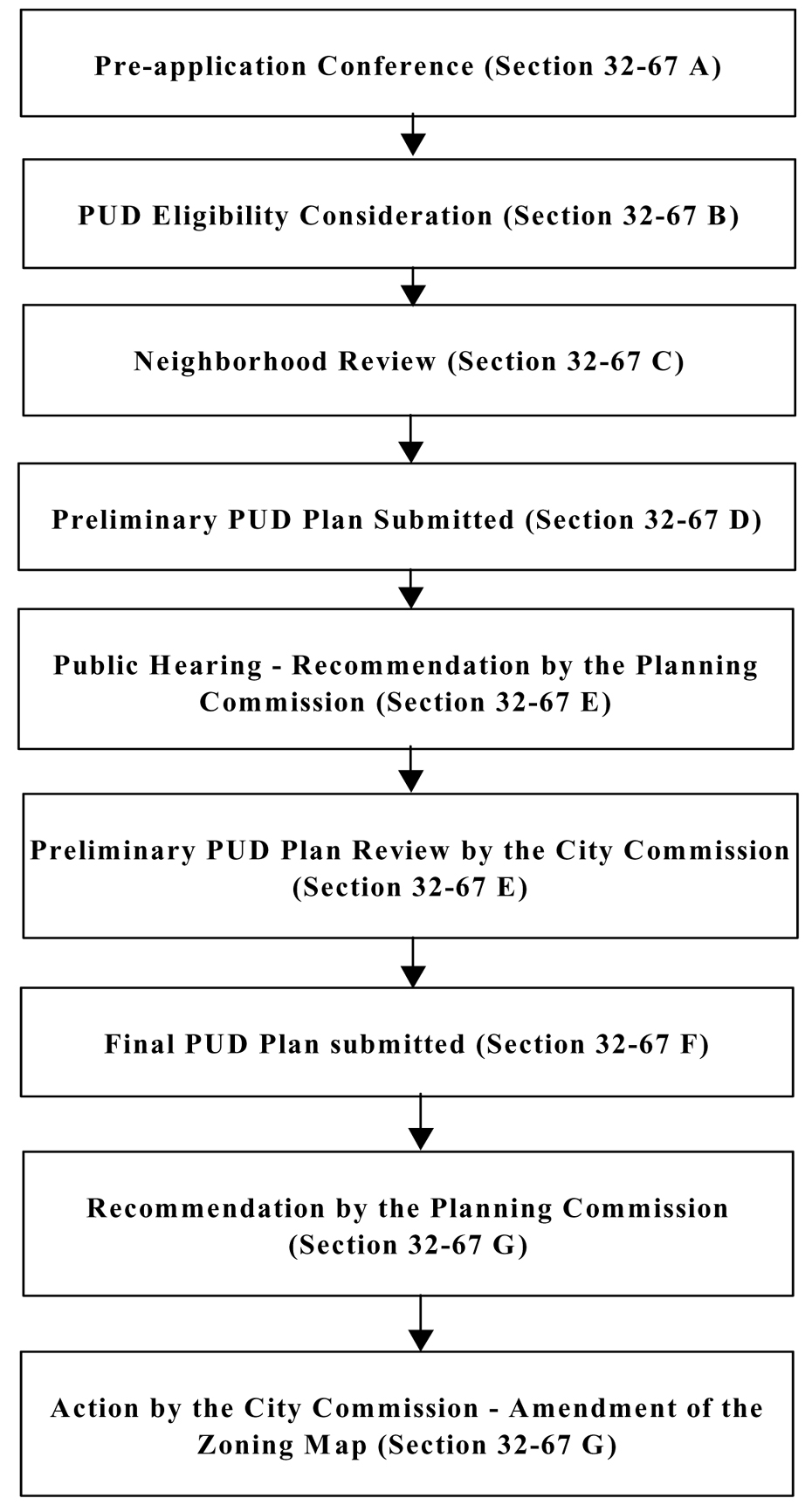
Note: The above is an overview of the PUD ordinance and is not intended to replace the specific regulations of the PUD ordinance, but rather to provide a guide to the process.

