
Alma City Zoning Code
ARTICLE VIII
OFF-STREET PARKING, LOADING AND UNLOADING REQUIREMENTS
Sec. 60-207.- Purpose.
It is the purpose of this article to improve and maintain the safety of the streets and highways in the city by requiring off-street parking, loading and unloading spaces for all uses permitted by this chapter in order to provide for the proper function and safety in the use of streets and highways as traffic ways which are intended to be limited to moving automotive vehicles.
(Ord. No. 691, § 1(32-133), 5-4-2005)
Sec. 60-208. - Off-street parking requirements.
In all zoning districts, off-street parking facilities for the storage and parking of self-propelled motor vehicles for the use of occupants, employees, and patrons of the buildings hereafter erected, altered, or extended after the effective date of the ordinance from which this chapter is derived, shall be provided as herein prescribed. Such space shall be maintained and shall not be encroached upon so long as said main building or structure remains, unless an equivalent number of such spaces are provided elsewhere in conformance with this chapter.
(1)
Fractional requirements. When units or measurements determining number of required parking spaces result in requirement of a fractional space, any fraction up to, and including one-half may be disregarded, and fractions over one-half shall require one parking space.
(2)
Requirements for and location of parking for one and two family dwellings. The number of required parking spaces for one- and two-family dwellings shall be sufficient to accommodate the occupancy load of the dwelling. The off-street parking facilities required for one- and two-family dwellings shall be located on the same lot or plot of ground as the building they are intended to serve, but shall not be considered a parking lot under the provisions of section 60-209.
(3)
Location of parking for multiple-family dwellings. The off-street parking facilities for multiple-family dwellings shall be located on the same lot or plot of ground as the dwellings they are intended to serve, and shall consist of a parking lot as set forth in section 60-209.
(4)
Location of parking for other land uses. The off-street parking facilities required for all other uses shall be located on the lot or within 500 feet of the permitted uses requiring such off-street parking, such distance to be measured along lines of public access to the property between the nearest point of the parking facility to the building to be served.
(5)
Seating capacity or seats. As used in this article for parking requirements, seats shall mean that each 24 inches of seating facilities shall be counted as one seat, except that where specifications and plans filed with the enforcing officer specify a certain seating capacity for a particular building, such specified seating capacity shall be used as the basis for requiring parking space.
(6)
Similar uses and requirements. In the case of a use which is not specifically mentioned in this article but is similar to a use which is specified, the requirements of off-street parking facilities for the similar use shall apply.
(7)
Floor area. For the purpose of this article, the floor area used to determine the required number of parking spaces shall be as defined in article II of this chapter.
(8)
Collective provisions. Nothing in this section shall be construed to prevent collective provisions of off-street parking facilities for two or more buildings or uses, provided such facilities collectively shall not be less than the sum of the requirements for the various individual uses computed separately in accordance with section 60-210. Written documentation of recorded parking easement agreements may be required by the building department prior to approval of a site plan. Parking facilities for one use shall not be considered as providing the required parking facilities for any other use, except churches.
(9)
Parking duration. Except when land is used as storage space in connection with the business of a repair or service garage, a 72-hour time limit for parking in nonresidential off-street parking areas shall prevail, it being the purpose and intention of the foregoing that the requirement of maintaining vehicle storage or parking space is to provide for the public safety in keeping parked cars off the streets, but such requirement is not designed or intended to provide, and it shall be unlawful to permit, the storage or prolonged parking on any such parking area in any such district wrecked or junked cars, or for creating a junkyard or a nuisance in such areas.
(10)
Restriction on parking on private property. It shall be unlawful for any person, firm, or corporation to park any motor vehicle on any private property, or use of said private property for vehicle storage, or use any portion of any private property as parking space, without the expressed or implied consent, authorization, or ratification of the owner, holder, occupant, lessee, agent, or trustee of such property.
(11)
Barrier free parking space requirements. In those cases where barrier-free parking areas are required by state barrier-free design laws, such parking areas, signs, curb cuts, etc., shall be in full compliance with such laws of the state and/or adopted building codes.
(12)
Off-street parking and off-street loading requirements in B-1 central business district. For permitted uses and special uses allowed within B-1 district, off-street parking and off-street loading requirements shall not apply if the following conditions are met:
a.
The use is within 500 feet of a municipal parking lot.
b.
The use will not create unusual parking demands and will not disrupt the parking arrangements of residential neighborhoods or existing commercial areas.
c.
The use is within the B-1 district bounded by Downie Street, Pine Street, Center Street, and Wright Avenue and Lincoln Streets.
d.
That where practical, any available land on the owner's premises shall accommodate the required number of parking spaces for those uses as specified by the off-street parking requirement table in section 60-210.
(13)
Types of vehicles in residential districts/recreational vehicle parking. Outdoor parking of motor vehicles in all residential districts shall be limited to passenger vehicles, plus four residential type recreational vehicles per dwelling unit, and not more than one commercial vehicle of the light delivery type, not to exceed one rear axle and a three-ton payload capacity, per dwelling unit. The outdoor parking of any other type of commercial vehicle or bus, except for those parked on school or church property, is prohibited in all residential districts. Parking space requirements for vehicles may be provided either in garages, carports or outdoor parking areas conforming to the provisions of this chapter.
(14)
Parking lot deferment/banked parking. Where the property owner can demonstrate that the required amount of parking is excessive, the planning commission may approve a smaller parking area, provided that an area of sufficient size to meet the parking space requirements of this article, is retained as open space, and the owner agrees to construct the additional parking at the direction of the planning commission based on observed usage within six months of being informed of such request in writing by the zoning administrator or enforcing officer. The site plan shall note the area where parking is being deferred, including dimensions, and dotted parking lot layout.
(15)
Commercial activities. No commercial repair work, servicing, selling or other commercial activities of any kind shall be conducted on any required parking area except that which is specifically permitted by this chapter.
(16)
Driveway approaches. Refer to section 60-209 et seq.
(17)
Planning commission discretion. The planning commission may, at its discretion, modify the numerical requirements for off-street parking as established in section 60-210, based upon evidence provided by the applicant that establishes that another parking standard would be more reasonable. In considering any such modification, the planning commission may consider:
• Parking generation standards published by the Institute of Transportation Engineers, or other similar parking studies which document anticipated parking needs.
• Current or future levels of employment or patrons.
• Peak period usage versus normal usage.
• Banked or reserved parking for future use.
• Environmental factors which accommodate additional landscaping, low-impact development standards, and the minimization of impervious areas.
• Other factors bearing on the necessity of modification of off-street parking requirements.
(Ord. No. 691, § 1(32-134), 5-4-2005; Ord. No. 746, § 1, 3-13-2012)
Sec. 60-209. - Design standards for off-street parking.
The construction of any parking lot shall be in accordance with the requirements of the provisions of this chapter and such construction shall be completed and approved by the zoning administrator or enforcing officer and the city engineer before actual use of the property as a parking lot and before a certificate of occupancy is issued. Plans for the development of any parking lot must be submitted to the building inspector, prepared at a scale of not less than one inch equals fifty feet (1″ = 50′) and indicating existing and proposed grades, drainage, pipe sizes, parking of all dimensions, type of curbing, drive and aisle dimensions, lighting, adjacent main buildings, sidewalks, landscaping, surfacing and base materials to be used and the layout of the proposed parking lot. The plans are to be prepared in a presentable form by person(s) competent in such work and shall reflect conformance with the following provisions:
(1)
Surface. All such parking lots required for uses other than single- or two-family residential shall be hard-surfaced with a pavement consisting of asphalt or concrete, shall be graded and drained so as to dispose of surface water which might accumulate within or upon such area, and shall be completely constructed prior to a certificate of occupancy being issued. No surface water from such parking area shall be permitted to drain onto adjoining private property.
(2)
Driveway parking. For single-family and two-family zoning districts, parking on the grassed area of the front lawn/front yard shall be prohibited. Parking shall be restricted to paved or graveled driveway areas only, as defined in article II, section 60-36.
(3)
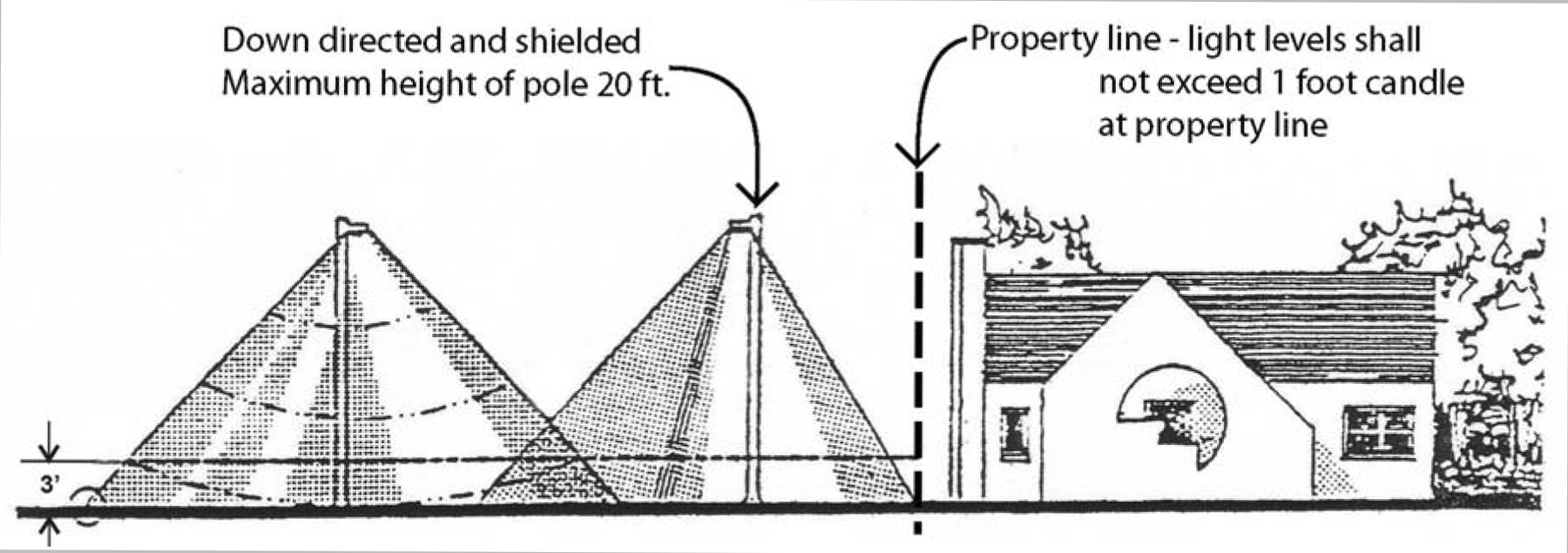
Parking area illumination. All illumination for or on all such parking lots shall be deflected away from adjacent premises and public streets. All site lighting shall be down directed and shielded. Light levels shall not exceed one footcandle at perimeter property lines. The maximum height of parking lot light fixtures and poles shall be 20 feet (see figure 9).
Figure 9
Parking Lot Lighting
(4)
Setbacks between uses. When a nonresidential parking lot such as funeral homes, golf courses, schools and commercial and industrial uses or parking area is situated on a parcel which adjoins a residentially zoned district, the side and/or rear yard setback adjacent to this residential district shall be screened with a six-foot solid wall constructed of face brick, poured-in-place face brick, pre-cast brick face panels having simulated face brick, or stone. In lieu of a required screening wall, the developers may request, upon planning commission approval, the construction of a landscape buffer in accordance with section 60-278.
(5)
Required setback depth. The depth of the front yard setback line from the street as established for houses in any block in any given residential area shall be continued and made applicable to parking space in such residential area, and it shall be unlawful to use the space between such setback line and the street line for the parking of motor vehicles.
(6)
Ingress and egress. Adequate ingress and egress to the parking lot, by means of limited and clearly defined drives, shall be provided for all vehicles.
(7)
Bumper blocks/curbs. Bumper blocks or curbs shall be provided and so located as to prevent any vehicle from projecting over the lot or setback lines.
(8)
Landscaping. Parking lots containing more than 20 spaces shall be landscaped in accordance with sections 60-278 of this chapter.
(9)
Parking lot plans. Plans for the layout of off-street parking facilities shall be in accordance with the following minimum regulations:
Off-Street Parking Standards
(10)
Drainage. All off-street parking areas shall be drained so as to prevent any increase in drainage to abutting properties and shall be constructed with a pavement consisting of asphalt or concrete.
(11)
Backing onto a public street. All off-street parking areas that make it necessary for vehicles to back out directly onto a public street are prohibited, except for single-family and duplex residential driveways.
(12)
Maximum number of continuous spaces. Not more than 20 parking spaces shall be permitted in a continuous row in commercial and industrial districts without being interrupted by landscaping.
(Ord. No. 691, § 1(32-135), 5-4-2005; Ord. No. 729, 12-14-2010; Ord. No. 820, § 1, 5-25-2021)
Sec. 60-210. - Off-street parking space requirements.
The amount of required off-street parking space for new uses or buildings, additions thereto, and additions to existing buildings as specified above shall be determined in accordance with the following table, and the space so required shall be stated in the application for a building permit and shall be irrevocably reserved for such use and/or shall comply with the initial part of this section:
Ord. No. 691, § 1(32-136), 5-4-2005)
Sec. 60-211. - Truck and equipment parking.
After the effective date of the ordinance from which this chapter is derived, it shall be unlawful for the owner, tenant, or lessee to permit or allow the open storage or parking, either day or night, on any lot, parcel, or tract of land in a residential district or in the residential area of any other district, or on any public street, semi-trucks and commercial trailers, mobile homes, tractors, bulldozers, earth carriers, drag lines, cranes and/or any other equipment or machinery. It is provided, however, that the owner, tenant, or lessee of a farm may openly store the machinery and equipment used on his farm; and it is further provided that equipment necessary to be parked overnight on a lot, parcel, or trace of land during the construction work thereon shall be excepted from this restriction. Nothing contained herein shall be deemed to prohibit the owner or occupant of a residential parcel from parking one over the road semi-tractor in a garage or other approved designated parking area beyond the front yard setback located upon such parcel if the owner or occupant is engaged or employed in the operation of such vehicle; and provided, further, that said owner or occupant shall not cause such vehicle to idle for more than 15 minutes prior to or after operating such vehicle. Violations shall be considered a municipal civil infraction and shall be subject to the fines and penalties enumerated in chapter 30. This shall not apply to pickup or panel trucks.
(Ord. No. 691, § 1(32-137), 5-4-2005)
Sec. 60-212. - Off-street loading and unloading requirements.
On the same premises with every building or part thereof, erected, and occupied for manufacturing, storage, warehouse, goods, display, department store, wholesale market, hotel, hospital, laundry, dry cleaning or other uses similarly involving the receipt or distribution of vehicles, material or merchandise, there shall be provided and maintained on the lot adequate space for standing, loading and unloading services in order to avoid undue interference with street or parking areas.
(1)
Plan requirements. Plans and specifications showing required loading and unloading spaces, including the means of ingress and egress and interior circulation, shall be submitted for review at the time of application for a zoning permit for the establishment or enlargement of a use of land, building or structure.
(2)
Dimensions. Such loading and unloading space, unless completely and adequately provided for within a building, shall be an area ten feet by 50 feet, with a 14 foot height clearance, and shall be provided according to the following schedule:
(3)
Location. A loading-unloading space may occupy all or any part of any required side or rear yard, except the side yard adjacent to a public street in the case of a corner lot. No part of a required front yard may be occupied by a loading space. A minimum setback of 50 feet is required when located adjacent to any residential lot or parcel unless wholly within a completely enclosed building, or unless enclosed on all sides by a berm, wall, fence, or compact planting not less than six feet in height.
(4)
Double count. Off-street loading space areas shall not be construed as, or counted toward, the supplying of area required as off-street parking space area.
(5)
Multiple occupants. When two or more uses are located on a lot or parcel, the total requirements for off-street loading-unloading facilities shall be the sum of all the uses.
(6)
Backing onto a public street. All off-street loading-unloading facilities that make it necessary to back out directly into a public street shall be prohibited.
(7)
Other uses. If a use is not specifically listed, the requirements of a similar or related use shall apply.
(Ord. No. 691, § 1(32-138), 5-4-2005)
Sec. 60-213. - Off-street stacking space for drive-through facilities.
(a)
Drive-through facilities. In addition to meeting off-street parking requirements, all uses which provide drive-through facilities for serving customers within their automobiles shall provide adequate off-street stacking space within a defined stacking lane which meets the following requirements:
(1)
Each stacking space shall be computed on the basis of 12 feet in width and 20 feet in length.
(2)
Clear identification and delineation between the drive-through facility and the parking lot shall be provided. Drive-through facilities shall be designed in a manner that promotes pedestrian and vehicular safety.
(3)
Each drive-through facility shall have an escape lane of no less than 12 feet in width, to allow other vehicles to pass those waiting to be served. The planning commission may waive the requirement for an escape lane where it can be demonstrated that such a waiver will not result in an adverse effect on public safety or the convenience of patrons of the facility.
(4)
The number of stacking spaces per service lane shall be provided for the uses as follows. When a use is not specifically mentioned, the requirements for off-street stacking space for a similar use shall apply.
(b)
Off-street waiting space. Uses such as day cares, schools, hospitals, nursing homes and churches shall provide a safe and efficient means for passengers to be dropped off and picked up. Such off-street waiting spaces shall be clearly delineated so as to ensure the safety of pedestrians and motorists.
(Ord. No. 691, § 1(32-139), 5-4-2005)

