
Alma City Zoning Code
ARTICLE IX
SIGNS5
State Law reference— Highway advertising act, MCL 252.301 et seq.
Sec. 60-235.- Purpose.
The purpose and intent of this article is to regulate the size, placement, general appearance, and other characteristics of signs to:
(1)
Protect the public welfare and city-wide property values by preserving the aesthetic qualities of the unique natural environment that distinguishes the city. The preservation of such environment from excessive and obtrusive signs is a matter of critical importance to the city due to the natural beauty of the land in the city, while not unlawfully infringing on an individual or group's rights under the First Amendment to the United States Constitution. The intent is for sign regulations to be content-neutral.
(2)
Promote the safety of persons and property by providing that signs do not create traffic problems, distractions, or other hazards due to collapse, fire, collision, decay, or abandonment. The number, size, and illumination method of signs may be distracting to motorists and pedestrians and can create a traffic hazard. The number and size of signs can also reduce the effectiveness of signs needed to direct the public and may mar the appearance of the landscape. The provisions of this section are intended to apply the minimum amount of regulation in order to avoid these problems.
(3)
Promote the efficient transfer to the general public of commercial and other identification or information by improving the legibility and effectiveness of signs through the control of their number, location, size, appearance, illumination, and animation.
(4)
Regulate and/or eliminate signs that are deemed to be a public nuisance or are nonconforming.
(5)
Protect the public's ability to identify and locate establishments and premises.
(6)
Protect the natural beauty and distinctive character of the city.
(7)
Protect commercial, business, office, and industrial districts and areas from visual chaos and clutter.
(8)
Provide an environment that fosters the reasonable growth and development of business and commerce.
(9)
Protect and enhance property values.
(10)
Balance the individual rights of property owners to communicate their message with the public's right to be free of unreasonable distractions and aesthetic intrusions.
(Ord. No. 691, § 1(32-143), 5-4-2005; Ord. No. 835, 11-9-2022)
Sec. 60-236. - Definitions.
The following words, terms, and phrases, when used in this article, shall have the meanings ascribed to them in this section, except where the context clearly indicates a different meaning:
Banners. Any sign of lightweight fabric or similar material that is attached to a building or other structure erected for a purpose other than holding or displaying the banner. The term "banner" does not include feather flag signs.
Feather flag sign. A freestanding temporary sign typically constructed of a single plastic or metal shaft driven in the ground with an attached pennant that is vertically elongated and attached to the shaft.
Flag. A device generally made of flexible material, usually cloth, paper or plastic. The term "flag" does not include feather flag signs. Flags may only be displayed when attached to a flagpole. The maximum size of a flag is three feet in height and five feet in width for residential districts and four feet in height and six feet in width in all other districts.
Flagpole. A pole constructed out of metal, wood, fiberglass, or other durable material for the purpose of displaying a flag. Flag poles may project from an existing structure, vertically or horizontally. If projecting vertically from a structure, the combined height may not exceed the maximum structure height for the zoning district. A flagpole may project from the ground. When projecting from the ground it may be no taller than 20 feet in height and setback a distance equal to its total height in feet. Ground mounted flagpoles with a height greater than ten feet require a footing and building permit for installation.
Sign. A device which is affixed to or otherwise located or set upon a building, structure, or parcel of land. Signs are defined as follows:
(1)
Abandoned sign. A sign which shows deterioration due to lack of maintenance.
(2)
Awning. Any covered projection attached to the face of a building which is supported entirely by the building and projects beyond the building wall.
(3)
Canopy. Any covered structure attached to a building that projects beyond the building wall and is carried by a frame partially supported by the ground or sidewalk below it.
(4)
Awning/canopy sign. Any sign attached to or constructed within or on an awning or on a canopy or other fabric, plastic or structural protective cover over a door, entrance, window or outdoor service area. A marquee is not an awning/canopy and a protective roof over gasoline filling station areas shall not be considered a canopy for purposes of this chapter.
(5)
Billboard. A surface erected within view of a public roadway and is regulated in accordance with regulations governed by the Highway Advertising Act, Public Act No. 106 of 1972 (MCL 252.301 et seq.), as amended.
(6)
Changeable copy sign. A sign or portion thereof with characters, letters, or illustrations that can be changed or rearranged without altering the face or surface of a sign.
(7)
Electronic message center. A video terminal or electronic changeable copy sign in which the copy or animation consists of an array of lights activated and deactivated simultaneously with a frequency of message change of not less than two seconds. For purposes of this definition, "message" shall be defined as the written text or associated symbolism, excluding the background.
(8)
Facade. A continuous area on the front or back of the building which is free of windows and doors.
(9)
Facing or surface. The surface of a sign upon, against, or through which the message is displayed or illustrated on the sign.
(10)
Ground sign. Any sign supported by uprights or braces placed in, or anchored to, the ground and not attached to any building.
(11)
Illuminated sign. Any sign which has characters, letters, figures, designs, or outlines illuminated by an electric light or luminous tubes as a part of the sign proper.
(12)
Marquee. A permanent canopy, usually of metal and glass, brightly lighted which projects over an entrance to a building, such as a theater or hotel.
(13)
Portable sign. A sign, usually of a temporary nature, not securely anchored to the ground or to the building or structure adjacent to it, and which obtains some or all its structural stability with respect to wind or other normally applied forces by means of its geometry or character. A portable sign is not defined to include a sidewalk sign.
(14)
Projecting sign. Any sign which is attached to a building or other structure which extends more than eight inches beyond the face of the building or structure or eight inches beyond the surface of that portion of the building or structure to which it is attached and is perpendicular or nearly perpendicular to the building surface and is permanently attached to the building or structure surface. A projecting sign shall not include or be a part of any canopy, awning, or marquee sign.
(15)
Roof sign. A sign which is erected, constructed, and maintained above the roof of a building.
(16)
Sidewalk sign. A portable nonpermanent sign placed within the pedestrian public right-of-way of a public sidewalk during regular business hours; consisting of an "A" frame or "T" frame or other temporary style, typically with not more than two flat surfaces, and is not permanently affixed to any structure or to the sidewalk itself.
(17)
Sign. Every sign, billboard, ground sign, wall sign, roof sign, illuminated sign, projecting sign, temporary sign, marquee, awning and canopy placed out-of-doors in view of the general public.
(18)
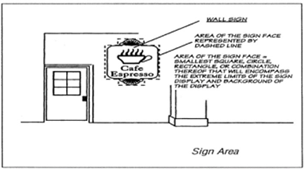
Sign area (measurement of). The entire area within a circle, triangle, or parallelogram enclosing the extreme limits of writing, representation, emblem, or any figure or similar character, together with any frame or other material or color forming an integral part of the display or used to differentiate such sign from the background against which it is placed; excluding the necessary supports on which such signs are placed but including any sign tower shall be included in measuring the area of the sign. Where a sign has two or more faces, the areas of all faces shall be included in determining the area of the sign, except that where two such faces are placed back to back and are at no point more than two feet from one another, the area of the sign shall be taken at the area of one face if the two faces are of equal area, or at the area of the larger face if the two faces are of unequal area. In the case of a circle or sphere, the total area of the circle or sphere is divided by two for the purposes of determining the maximum permitted sign area (see figure 11).
Figure 11
(19)
Sign height. The height of a sign shall be computed as the distance from the base of the sign at normal grade to the top of the highest attached component of the sign. Normal grade shall be construed to be the lower of existing grade prior to construction or mounding or excavating solely for the purpose of locating the sign. In cases in which the normal grade cannot reasonably be determined, sign height shall be computed on the assumption that the elevation of the normal grade at the base of the sign is equal to the elevation of the nearest point of the crown of a public street or the grade of the land at the principal entrance to the principal structure on the zoning lot, whichever is lower.
(20)
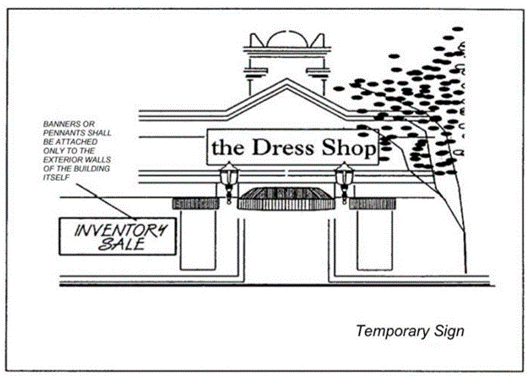
Temporary sign. A sign or other device constructed of light, temporary materials, with or without a structural frame, intended to be used for a limited time.
Figure 12
(21)
Wall sign. All flat signs of solid face construction which are placed against a building or other structure and attached to the exterior front, rear, or side wall of any building or other structure.
(Ord. No. 691, § 1(32-144), 5-4-2005; Ord. No. 696, §§ 1, 2, 4-11-2006; Ord. No. 759, § 2, 2-11-2014; Ord. No. 835, 11-9-2022)
Sec. 60-237. - Exempt signs.
The following signs are specifically exempt for the sign permit requirements but are subject to the following regulations and standards:
(1)
Owner/tenant signs. Signs of up to two square feet in area mounted on the wall of a commercial building.
(2)
Parking lot signs/directional sign. Placed within a permitted parking lot, such signs are a maximum of six feet in height and do not exceed 16 square feet in area.
(3)
Public signs. Signs erected by, or on the order of a public officer or zoning official in the performance of public duty.
(4)
Regulatory, directional and street signs. Erected by a public agency in compliance with state manual of uniform traffic control devices.
(Ord. No. 691, § 1(32-145), 5-4-2005; Ord. No. 835, 11-9-2022)
Sec. 60-238. - Residential sign exceptions.
(a)
Residential signs shall not be subject to the permit requirement contained in section 60-241.
(b)
All ground signs and wall signs shall be prohibited except the following:
(1)
Six signs of any type, excluding flags, per dwelling unit with a maximum sign area of eight square feet and no more than five feet in height. All signs must be setback five feet.
(2)
Three flags per dwelling mounted on one or more flagpoles.
(3)
One sign for each granted special use or lawful nonconforming use. No sign shall exceed 18 square feet in area, be higher than eight feet above grade if a ground sign or extend above the first story of the buildings if a wall sign.
(4)
One sign for each lawful home occupation or bed and breakfast use which shall not exceed two square feet in area.
(5)
Ground signs are not to exceed 32 square feet in area for the sign face with an additional 48 square feet allowed for a base consisting of brick or stone framework and not to exceed eight feet in height located upon a parcel with a primary use dedicated to a church, school or hospital. One sign is permitted on each public street with a minimum frontage of 400 feet on each street but not to exceed two signs total for each site. Each sign shall be mounted perpendicular to the associated street frontage so as to advertise to that frontage. Such signs may be internally illuminated only between the hours of 7:00 a.m. and 11:00 p.m.
(6)
No sign permitted in a residential district, except for those specifically listed above, shall be internally illuminated. Ground mounted floodlamps which light only the sign shall be permitted.
(7)
One permanent sign per campus entry area which does not exceed 32 square feet in area for the sign face with an additional 48 square feet allowed for a base consisting of brick or stone framework and with a maximum height of eight feet.
(8)
Four additional signs of any type 60 days prior to and up to six days after an officially scheduled local, state, or federal election. Each individual sign may not exceed eight square feet in area and no more than five feet in height. All additional signs must be setback five feet.
(Ord. No. 691, § 1(32-146), 5-4-2005; Ord. No. 835, 11-9-2022)
Sec. 60-239. - Prohibited signs.
Unless otherwise permitted by this chapter, by variance or by legal nonconforming status as provided in this chapter, the following signs shall not be permitted.
(1)
Abandoned signs. A sign which shows deterioration due to lack of maintenance.
(2)
Signs which are of a size, location, movement, or manner of illumination which may be confused with or construed as a traffic-control device or which hide from view any traffic or street sign or signal or which obstruct the view in any direction at a street or road intersection.
(3)
Signs in any public right-of-way, except as allowed by the city commission, the county road commission, or the state department of transportation (MDOT).
(4)
Signs that are pasted or attached to utility poles or signs placed upon trees, fences, rocks or in an unauthorized manner to walls or other signs.
(5)
Any sign displayed on an automobile, truck, or other motorized vehicle when that vehicle is used primarily for the purpose of such advertising display.
(6)
All portable or nonstructural signs except as allowed under other sections of this chapter. For purposes of this article, a sign shall be considered nonstructural if it has no permanently mounted, self-supporting structure or is not an integral part of a building to which it is accessory.
(7)
Flashing signs with moving or blinking lights, or signs with exposed incandescent light bulbs.
(8)
Any sign (except electronic message centers or other scrolling signs) which has any visible moving parts, visible revolving parts, visible mechanical movement of any description, or other apparent visible movement achieved by electrical, electronic, or mechanical means, including intermittent electrical pulsations of less than 30 seconds, or by action of normal wind current, except as otherwise provided for in this article.
(9)
Street furniture signs with the exception of signage on table umbrellas used for outdoor cafe style dining.
(10)
A rotating search light or similar device that emits beams of light.
(11)
Signs on public or private towers. Any type of signage shall not be permitted on a public or private radio, television, cellular phone, or water towers unless specifically erected by the municipality or approved by the city zoning board of appeals.
(12)
Any sign or sign structure which is structurally unsafe, constitutes a hazard to safety or health by reason of inadequate maintenance, dilapidation or abandonment, is not kept in good repair, or is capable of causing electrical shock to persons likely to come in contact with it.
(13)
Any sign that obstructs a window, door, or other opening that could be used for fire escape.
(14)
Any sign unlawfully installed, erected, or maintained.
(Ord. No. 691, § 1(32-147), 5-4-2005; Ord. No. 697, § 1, 4-11-2006; Ord. No. 835, 11-9-2022)
Sec. 60-240. - Roof signs; requirements; prohibitions.
(a)
All roof signs shall be constructed entirely of metal or other approved noncombustible material, except as allowed for ornamental features and sign facings as specifically addressed by the local building code.
(b)
There shall be a clear space of not less than six feet between the lowest part of the sign and the roof level, except for necessary structural supports.
(c)
No roof sign shall have a surface or facing exceeding 300 square feet or its highest point extent more than 20 feet above the roof level.
(d)
No roof sign shall be erected or maintained with a face thereof nearer than five feet to the outside wall toward which the sign faces.
(e)
Every roof sign shall be thoroughly secured to the building by iron or other metal anchors, bolts, supports, rods or braces. When erected upon buildings which are not constructed entirely of fireproof material, the bearing plates of the sign shall be supported or anchored to the wooden framework of a building.
(f)
Roof signage shall be included in the total percentage of coverage allowed with the prominent wall signage it faces.
(Ord. No. 691, § 1(32-148), 5-4-2005; Ord. No. 835, 11-9-2022)
Sec. 60-241. - General sign regulations.
It is unlawful for any person to erect or maintain within the city any sign without first having obtained a permit from the zoning administrator or enforcing officer and making payment of the fee hereinafter provided. All illuminated signs are subject, in addition, to the provisions of the electrical code and any permit fees required hereunder.
(1)
Application for permit, contents, requisites. Application shall be provided by the zoning administrator or enforcing officer and shall contain the following information:
a.
Name and address of the applicant;
b.
Location of building, structure, or lot to which or upon which the sign is to be attached or erected;
c.
Position of the sign in relation to nearby buildings or structures and to property lines;
d.
One blueprint or ink drawing of the plans and specifications and method of construction or attachment to the building or on the ground;
e.
If required by the zoning administrator or enforcing officer, copy of stress sheets and calculations showing the structure is designed for deadload and wind pressure in any direction in any amount required by this and all laws and ordinances of the city;
f.
Names of persons erecting the structures;
g.
Written consent of the owner of the building or structure to which or on which the sign is to be erected;
h.
Any electrical permit required and issued for the sign;
i.
If required by the zoning administrator or enforcing officer, an insurance policy statement attesting that adequate liability insurance is provided; and
j.
Such other information as the zoning administrator or enforcing officer may require in order to show full compliance with this article.
(2)
Issuance of permit. If, upon examination of the submitted plans and other data, it appears that the proposed sign is in compliance with all the requirements of this article, then the zoning administrator or enforcing officer shall issue a permit. If the work authorized under the permit has not been completed within six months after date of issuance, the permit will be null and void.
(3)
Permit fee. Every applicant, before being granted a permit, shall pay to the city treasurer a permit fee as established by the city commission.
(4)
Revocation of permit. All rights and privileges acquired under the provisions of this article are mere licenses revocable at any time, and all such permits shall contain this provision.
(5)
Inspection required. Every sign may be subject to a periodic inspection by the zoning administrator or enforcing officer to ascertain whether the same is secure and whether it is in need of repair.
(6)
Construction standards.
a.
All signs shall be designed and constructed in a safe and stable manner in accordance with the state construction code.
b.
All signs shall be designed to comply with minimum wind pressure and other requirements set forth in the state construction code.
c.
All signs shall be designed so that the supporting framework, other than the supporting poles on a freestanding sign, is contained within or behind the face of the sign or within the building to which it is attached so as to be screened from view.
(7)
Illumination.
a.
In all zoning districts, indirectly or internally illuminated signs are permitted providing such signs are so shielded as to prevent direct light rays from the source of light from being visible from the public right-of-way or any adjacent residential property.
b.
In no case shall any sign exceed a level of illumination of one-half footcandle when measured at the property line.
(8)
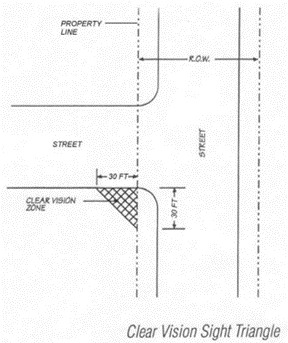
Clear vision sight triangle. No fence, wall, hedge, screen, sign, or other structure or planting shall be higher than three feet, measured above the centerline of either street or pavement, on any corner lot in any residential or business district requiring front and side yards within the triangular area formed by the intersecting street right-of-way lines and a straight line joining the two street lines at points which are 30 feet distance from the point of intersection, measured along the street right-of-way line. Trees may be planted in this triangular area, provided that the lowest foliage is 12 feet or higher from the ground.
Figure 13
(9)
Location.
a.
Within a public right-of-way. No sign shall be located within, project into or overhang a public right-of-way, except as otherwise permitted herein.
b.
Compliance with setback requirements. All signs shall comply with the setback requirements except as otherwise permitted herein.
(10)
Measurement.
a.
Sign area (see definition).
(Ord. No. 691, § 1(32-149), 5-4-2005; Ord. No. 835, 11-9-2022)
Sec. 60-242. - Permitted signs in nonresidential districts.
The following signs shall be permitted in districts zoned for nonresidential use including districts zoned SR, BMR, OS, ORT, WF, B-1, B-2, LI, GI:
(1)
Wall signs. Wall signs shall be permitted in nonresidential districts subject to the following regulations:
a.
Sign extension. No wall sign shall project beyond the ends or top of the wall to which it is attached.
b.
Sign depth. No wall sign shall extend more than eight inches beyond the building face and if above the sidewalk or other walking area, the sign shall not be attached to a wall at a height of less than eight feet, six inches.
c.
Secure attachment. All wall signs shall be safely and securely attached to the building walls.
d.
Materials. All one-piece wall signs exceeding 64 square feet in area or located above the first story of the building shall be of incombustible material.
e.
Size limitations. Ten percent of the building facade may be allotted for wall signage. In no case shall a building be restricted to a wall sign of less than 30 square feet.
(2)
Ground signs. Ground signs shall be permitted in nonresidential districts subject to the following regulations:
a.
Number. One ground sign shall be permitted per street or highway frontage on each parcel. Corner lots shall be allowed one ground sign per street frontage. Total square footage of both signs for a corner lot shall not exceed the square footage based upon one street frontage. In multitenant buildings or shopping centers the sign area may used to identify the name of the shopping center or multitenant building.
b.
Size. The total area of the ground sign shall not exceed one square foot per lineal foot of lot frontage, but in no case shall the ground sign exceed 200 square feet in area. Shopping centers or multitenant complexes may be allowed one ground not exceeding 300 square feet.
c.
Ground signs in the B-1. Ground signs in the B-1 or downtown zoning district shall be subject to the above regulations in this section except square footage shall not exceed one-half square feet per lineal foot of frontage. In no case shall a ground sign in the B-1 district exceed 100 square feet.
d.
Setback from the right-of-way. Ground signs may be located in the required front yard, provided that no portion of any such sign shall be located closer than ten feet to the rightof-way line. Ground signs shall also be setback a minimum of ten feet from side property lines. If a parcel is served by a private road or service road, no portion of a ground sign shall be closer than ten feet to the edge of the road or private road easement/right-of-way.
e.
Setback from residential districts. Ground signs shall be located no closer to any residential district than indicated in the following table:
f.
Height. The maximum allowable height from grade for ground signs in nonresidential zoning districts shall be regulated as follows (unless otherwise stipulated in ordinance):
(3)
Projecting signs.
a.
B-1 zoning district. Each business establishment within the B-1 zoning district may be allowed either one wall sign or one projecting sign. Projecting signs are subject to the following regulations:
1.
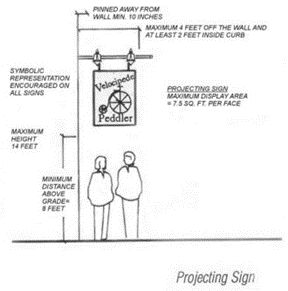
Total signage area for a projecting sign shall not exceed 15 square feet (both sides) or a maximum of seven and one-half square feet per side.
2.
A projecting sign shall provide at least eight feet of clearance above the pedestrian public right-of-way of a public sidewalk or other pedestrian area. Also, the sign shall not be installed above a maximum mounting height of 14 feet and in no event above the highest area surface of the wall upon which the sign is attached. The distance between the wall upon which the sign is attached and the surface of the sign nearest the wall shall not exceed ten inches.
3.
No portion of a projecting sign, including the frame, shall extend more than four feet beyond the surface of the building or wall to which it is attached, and shall not project over a sidewalk, to a point which is less than two feet from the face of the curb or over vehicular areas.
4.
Any attaching bracket and the sign itself shall be constructed of metal or noncombustible materials and attached directly to the building surface or wall in accordance with all applicable building code requirements. Projecting signs shall not have more than two sign faces. A projecting sign shall be allowed a thickness or depth not to exceed six inches and such thickness or depth shall not be considered to be a sign face.
5.
Projecting signs shall only be externally lighted, provided that such lighting does not interfere with vehicular or pedestrian traffic.
6.
Brackets used to attach a projecting sign to a building surface shall be constructed to meet the minimum specification necessary to safely support the sign.
7.
Business establishments having frontage on two public rights-of-way are deemed to have two building fronts and may have a projecting sign upon each such front. Alternatively, a single angular projecting sign may be located at the corner of the building fronts projecting toward the adjacent street corner. If a single angular projecting sign is used, no other projecting sign shall be permitted on either of the building fronts.
8.
The area of a projecting sign shall be measured as the entire area within a single rectangle, oval, circle or square, enclosed the extreme limits of the writing, representation, or any figure of similar character, together with any sign frame, background, or other material, or color forming an integral part of the display used to articulate or enhance such sign. The measurement of sign area shall not include any attaching bracket.
9.
Any supporting or attaching bracket shall be designed in accordance with all applicable building and construction codes and shall provide support for the sign as not to detract from the sign message or become a part of the sign design.
10.
Every projecting sign shall be maintained so as not to deteriorate or fall into disrepair and shall be kept painted or protected with other approved coatings or materials. Any projecting sign not so maintained shall be removed within three days of notification by the zoning enforcement officer.
11.
For shopping centers or multitenant buildings in the B-1 zoning district, each business shall be allowed one projecting sign subject to the above regulations. Establishments using a projecting sign shall not, however, be allowed a wall sign.
Figure 14
b.
Projecting signs prohibited. Projecting signs are prohibited in all other districts.
(4)
Canopy and awning signs.
a.
Canopies may be constructed of cloth or metal hood, provided that all frames and supports must be of metal.
b.
No canopy shall be supported by framework resting on public right-of-way.
c.
Awnings may be constructed of cloth or metal, provided, that all frames and supports must be of metal. The traditional wood frame construction may be used with awnings upon complying with the building code.
d.
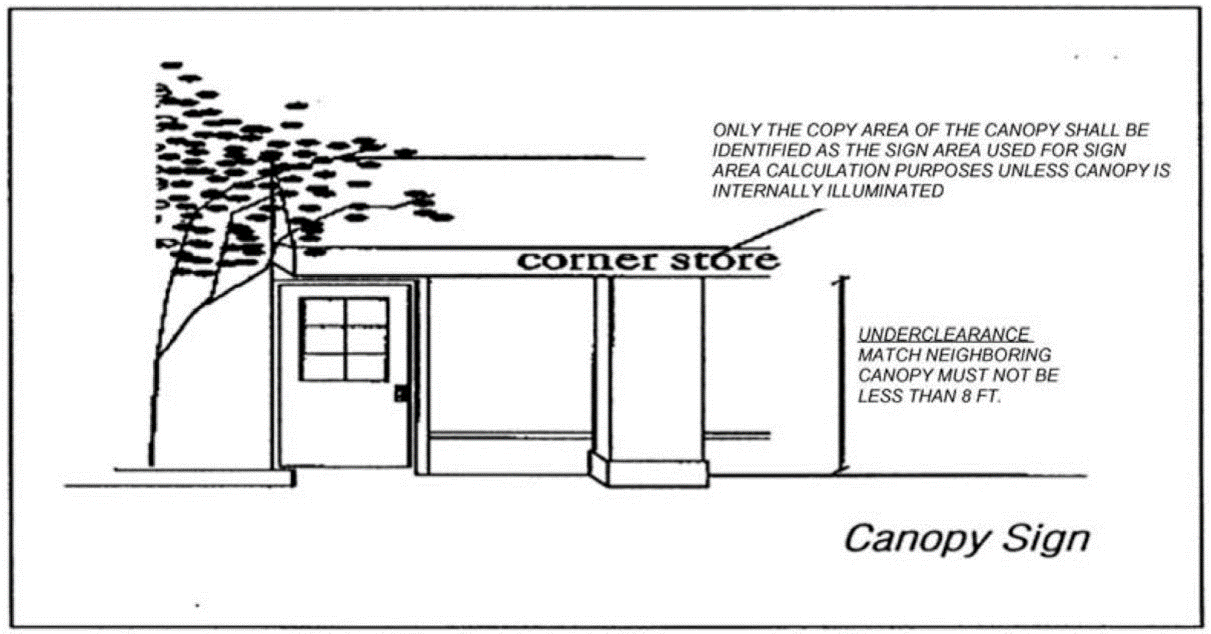
All awnings shall be constructed or erected so that the lowest portion thereof is not less than eight feet above the level of the sidewalk or public thoroughfare, including valance. Canopies shall be erected so that the lowest portion thereof is not less than nine feet above the level of the sidewalk or public thoroughfare (see figure 15).
Figure 15
e.
No awning shall be permitted to extend beyond five feet over public sidewalk, or a point two feet inside the curbline, whichever is more restrictive.
f.
Every awning shall be secured to and supported by the building. No posts or columns are permitted beyond the building line within the public right of way.
g.
No canopy shall be supported by framework resting on public right-of-way.
h.
The entire square footage of a canopy or awning shall be considered to be a wall sign when a translucent fabric canopy with signage is internally illuminated.
(5)
Portable signs. All portable signs are subject to the following regulations:
a.
No flashing lights, oscillating lights, flashing arrows, or other intermittent operation will be allowed.
b.
The portable sign may be used only twice a year (no longer than a 30-day period), and 30 days must elapse between the two periods.
c.
Placement of a portable sign must be on commercially zoned property, not be in the right-of-way, and not interfere with any vision clearance, traffic flow, sidewalk, and such.
d.
The portable sign must be removed on the date stated and cannot be stored on the property unless covered in the rear yard or in a building.
e.
The electrical hook-up must be in conformity with the electrical code and approved by the electrical inspector with jurisdiction.
f.
All portable signs shall be anchored or weighted to prevent overturning.
g.
The portable sign shall not exceed 60 square feet.
(6)
Electronic message centers/time/temperature/stock market signs/other scrolling signs. Said signs shall be permitted in the B-1, B-2, OS, LI and GI zoning districts. Said signs shall be governed by all of the provisions of this chapter and shall also be subject to the following conditions:
a.
Within all of the above referenced zoning districts, the number of such signs permitted per site shall be limited to one.
b.
Within the B-1 zoning district, such signs shall only be wall mounted and shall comply with the size requirements as set forth within this chapter, but in no case shall the size for any such sign exceed 40 square feet.
c.
Within the B-1 zoning district, such signs shall cease operating between the hours of 10:00 p.m. and 6:00 a.m. Within the B-2, OS, LI and GI zoning districts, such signs shall cease operating between the hours of 10:00 p.m. and 6:00 a.m. if said sign is located directly adjacent to a residential use or a residential zoning district.
d.
Such signs shall be used for the purpose of advertising on-site products and services. Community-based public service announcements shall also be a permitted use for these types of signs. The advertising of off-site private or commercial type products and services is prohibited.
(7)
Sidewalk and projecting signs in the central business (B-1) district. Within the B-1 district, each site shall be limited to the signage requirements in section 60-240, plus either one sidewalk or one projecting sign. However, in the case of no other wall or ground signage, a property owner may have both a sidewalk and projecting sign.
(8)
Sidewalk signs. Within the B-1 zoning district, one sidewalk sign may be placed at the public entrance to a business establishment, upon a private or public sidewalk, subject to the following restrictions and requirements:
a.
Sidewalk signs shall be displayed only during normal business hours. All permitted sidewalk signs shall be stored indoors at all other times.
b.
In no event shall such sign, including frame, exceed a height of more than 42 inches in height and 30 inches in width.
c.
Sidewalk sign faces may be of any shape. Each sign face shall be attached to a supporting frame constructed of sufficient strength to resist reasonable loads from sign faces and from impact loads caused by passing pedestrians or weather conditions.
d.
All sidewalk signs shall be constructed of weather resistant materials and shall be maintained in good repair, so that such signs do not become a hazard to either property or to the general public. Sidewalk signs shall be removed from the public right-of-way at any time that weather conditions render the presence of such signs a hazard (i.e., high wind conditions or snow and ice conditions).
e.
Sidewalk signs shall not be lit artificially or contain any moving parts or displays.
f.
Every sidewalk sign shall be maintained and shall be kept painted or protected with other approved coatings or materials such that such sign shall be at all times free of broken, loose, rotting, crumbling, missing or inadequately finished materials.
(Ord. No. 691, § 1(32-150), 5-4-2005; Ord. No. 698, § 1, 4-11-2006; Ord. No. 763, §§ 1, 2, 12-9-2014; Ord. No. 785, § 1, 4-12-2016; Ord. No. 835, 11-9-2022)
Sec. 60-243. - Signs within the campus-institutional (CI) district.
Within the campus-institutional district, private educational facilities which are owned and operated by an educational institution or residential institution shall be subject to the following regulations:
(1)
Each institutional facility, building or site shall be allowed one ground sign or one wall sign.
(2)
The size of the ground sign or wall sign shall not exceed 32 square feet.
(3)
A ground sign shall be setback a minimum of ten feet from the right-of-way or side property lines.
(4)
The maximum height of a ground sign shall be eight feet.
(5)
A campus-institutional area shall be allowed one permanent sign per campus entry area, which does not exceed 32 square feet in area for the sign face with an additional 48 square feet allowed for a base consisting of brick or stone framework and not to exceed a maximum height of eight feet.
(Ord. No. 691, § 1(32-151), 5-4-2005; Ord. No. 744, § 4, 12-13-2011; Ord. No. 835, 11-9-2022)
Sec. 60-244. - Billboards.
(a)
No billboard shall be erected or established in the geographic boundaries of the City of Alma subsequent to the effective date of the ordinance from which this section is derived. The erection and maintenance of any billboard(s) and/or outdoor advertising signs on any parcel of land within the city, or the use of any such parcel for said purpose, is/are hereby prohibited; as described herein, however, this section shall not apply to billboards or outdoor advertising signs lawfully in existence at the time the ordinance from which this section is derived becomes effective, nor to those specific signs which are expressly allowed by the district regulations contained in this section or such other lawfully-adopted ordinance(s) by the city or any public body thereof.
(b)
Nothing herein shall be deemed to prohibit or preclude any billboard in the city that has already been erected and established at the time of the effective date of the ordinance from which this section is derived.
(c)
Any billboard that has already been erected and established at the time of the effective date of the ordinance from which this section is derived shall be permitted to continue to exist in the same or substantially the same state as it was at the time of the effective date of the ordinance from which this section is derived for the entirety of the billboard's useful life. Any such already-existing billboard(s) may be maintained but may not be improved or expanded. At the time that an already-existing billboard(s) ceases to be used for the purposes of a billboard, the billboard's useful life shall be determined to have expired; under such circumstances, the use of a billboard at that location shall be extinguished and terminated and no other billboard may be erected or established.
(d)
Where permitted, all billboards shall be subject to all regulations established by the Michigan Highway Advertising Act, Public Act No. 106 of 1972 (MCL 252.301 et seq.), as amended.
(Ord. No. 691, § 1(32-152), 5-4-2005; Ord. No. 835, 11-9-2022; Ord. No. 844, § III, 7-9-2024)
Sec. 60-245. - Temporary signs/banners and feather flag signs.
(a)
Temporary signs/banners.
(1)
Maximum size. Temporary signs and banners of combustible construction shall not be more than ten feet in one dimension or more than 60 square feet in total area, unless otherwise regulated in this section.
(2)
Location. No temporary sign or banner shall be erected so as to extend over or into any street, alley, sidewalk, or other public thoroughfare unless a permit has been obtained from the city manager or his designee. No permit shall be granted if the proposed sign will in any way endanger persons or property or obstruct the view of any traffic signal. No temporary sign shall be erected so as to project over any wall opening or so as to prevent free ingress to or egress from any door, window, or fire escape.
(3)
Supports. Temporary signs and banners shall be constructed and fastened to supports which will withstand the design loads set forth in this section or in the state construction code.
(4)
Erection. Temporary signs and banners which are attached to or suspended from a building and which are constructed of cloth or other combustible material shall be securely supported. Such signs and banners shall be removed as soon as torn or damaged. All other temporary signage shall be authorized for a period of not exceeding 30 continuous days.
(5)
Permits. Temporary signs and banners, which are in compliance with this section, shall be exempt from any sign permit requirement, provided that not more than three such signs shall be in place at any one time on any parcel. Temporary signs and banners in place for a period of time greater than that permitted above, or greater in number than permitted herein, must meet all permanent wall sign requirements as set forth in this section, including the percent of total wall coverage allowed for wall signs.
(6)
Maintenance. Temporary signs and banners are subject to the maintenance requirements of subsection 60-247(c).
(b)
Feather flag signs.
(1)
Maximum size. Each feather flag sign shall not exceed 32 square feet in total area.
(2)
Location. Feather flag signs must be located outside of the public right-of-way and any clear vision triangle. The number of feather flag signs is limited to one per every 40 linear feet of road frontage along the roadway where the primary business sign is installed.
(3)
Permits. No feather flag sign shall be erected or installed except pursuant to a permit issued by the zoning administrator.
(4)
Maintenance. Feather flag signs are subject to the maintenance requirements of subsection 60-247(c).
(Ord. No. 691, § 1(32-153), 5-4-2005; Ord. No. 759, § 3, 2-11-2014; Ord. No. 835, 11-9-2022)
Sec. 60-246. - Nonconforming signs and sign structures.
Nonconforming signs and sign structures may remain except as qualified below:
(1)
No nonconforming sign shall be reconstructed, relocated, or changed in size unless such action will make the sign conforming in all respects.
(2)
Nothing in this section shall be deemed to prevent keeping a nonconforming sign in good repair, including sign maintenance, repainting, change of copy, and replacement of broken or deteriorated parts of the sign itself. Supporting structures for nonconforming signs shall not be replaced, unless such replacement will make the sign and sign structure conforming in all respects.
(3)
A nonconforming sign or sign structure which is destroyed or damaged by any casualty may be restored within six months after such destruction or damage only after the owner has shown that the damage did not exceed 50 percent of its replacement cost.
(4)
A nonconforming sign or sign structure shall be removed within 30 days if the building containing the use is demolished or destroyed to an extent exceeding 50 percent of the building's appraised value.
(5)
Nonconforming signs shall not be reestablished after the activity, business, or use to which it relates has been discontinued for 30 days or longer.
(Ord. No. 691, § 1(32-154), 5-4-2005; Ord. No. 835, 11-9-2022)
Sec. 60-247. - Maintenance of signs.
(a)
All signs and sign components thereof, including, without limitation, supports, braces, and anchors, shall be kept in a state of good repair.
(b)
All ground signs and the premises surrounding the same shall be maintained by the owner thereof in a clean, sanitary, and inoffensive condition, being free and clear of all noxious substances, rubbish, and weeds.
(c)
The owner of any sign shall have the sign and all supports properly painted at least once every two years, unless they are galvanized or otherwise treated to prevent rust. Any cracked, faded, torn, ripped, broken or otherwise damaged temporary sign, banner or feather flag sign shall be immediately removed from public view until repaired or replaced.
(d)
If the zoning administrator or enforcing officer shall find that any sign is unsafe or insecure, or is a menace to the public, written notice shall be given to the owner, agent, or person having the beneficial interest in the building or the premises on which such sign is located. Correction of the condition that caused the zoning administrator or enforcing officer to give such notice shall be effected within ten days after receipt of the notice. If such condition is not corrected after the conclusion of such ten-day period, the building department is hereby authorized to cause the sign to be removed forthwith at the expense of the owner, agent, or person having the beneficial interest in the building or premises on which such sign is located. Notwithstanding the foregoing provision, the zoning administrator or enforcing officer is authorized to cause any sign to be removed summarily and without notice, at the expense of the owner, agent, or person having the beneficial interest in the building or premises on which such sign is located, whenever he determines that such sign is an immediate peril to persons or property.
(e)
If the message portion of a sign is removed, leaving only the supporting "shell" of a sign, the owner of the property where the sign is located or other person having control over such sign shall, within 30 days of the removal of the message portion of the sign, either replace the entire message portion of the sign or remove the remaining components of the sign. This subsection shall not be construed to alter the effect of section 60-246, nonconforming signs and sign structures, which prohibits the replacement of a nonconforming sign, nor shall this subsection be construed to prevent the changing of the message of a sign.
(Ord. No. 691, § 1(32-155), 5-4-2005; Ord. No. 759, § 4, 2-11-2014; Ord. No. 835, 11-9-2022)
Sec. 60-248. - Appeals.
The zoning board of appeals may, in its discretion, vary or adapt the strict application of any of the requirements of this article in the case of exceptional conditions whereby such strict application would result in practical difficulty or unnecessary hardship that would deprive the applicant for such variance of the reasonable use of his land or building involved, but in no other case. In granting any variance, the zoning board of appeals shall prescribe any conditions that it deems necessary or desirable and prior to considering any application for such variance may require the applicant to submit such drawings, engineers' reports, or other data as shall be necessary or helpful to the zoning board of appeals in considering such application; however, no variance in the strict application of any provision of this article shall be granted by the zoning board of appeals unless it finds:
(1)
That there are special circumstances or conditions fully described in the findings applying to the land, buildings, or sign for which the variance is sought which are peculiar to such land, building, or sign and do not apply generally in the neighborhood and further, and that the strict application of the provisions of this article would deprive the applicant of the right to erect and maintain a reasonable sign upon his premises;
(2)
That the granting of such variance will constitute no unnecessary hazard to the safety or welfare of any person, persons, or public in general;
(3)
That the granting of the variance will be in harmony with the general purpose and intent of this article.
(Ord. No. 691, § 1(32-156), 5-4-2005; Ord. No. 835, 11-9-2022)
Sec. 60-249. - Enforcement.
The zoning administrator or enforcing officer is hereby charged with the enforcement of this article. He or she shall notify all persons violating any of the provisions of this article and shall, in the notice, give the violator reasonable time, but in no event longer than 30 days, in which to remedy the violation. If a person fails to remedy the violation within the specified time, he or she shall be responsible for a civil infraction and subject to the fines and penalties provided in chapter 30 of this Code, dealing with establishing civil infraction actions and establishment of a municipal ordinance violations bureau.
(Ord. No. 691, § 1(32-157), 5-4-2005; Ord. No. 774, § 1, 6-9-2015; Ord. No. 835, 11-9-2022)

