
Alma City Zoning Code
ARTICLE VII
SUPPLEMENTAL REGULATIONS
Sec. 60-152.- Purpose.
The intent of this article is to provide for those regulations which generally apply to all uses regardless of the particular zoning district, as well as those uses specifically identified as special land uses in article IV.
(Ord. No. 691, § 1(32-88), 5-4-2005)
Sec. 60-153. - Dwelling lots or sites.
Every dwelling, cottage, cabin, occupied mobile home or pre-manufactured dwelling erected outside of a mobile park shall be located on a lot or site, and no more than one such dwelling shall be erected on such lot or site except as otherwise provided in this chapter.
(Ord. No. 691, § 1(32-89), 5-4-2005)
Sec. 60-154. - Accessory building provisions.
Except as otherwise permitted in this chapter, accessory buildings and uses shall be subject to the following regulations:
(1)
Authorized accessory buildings may be erected as part of the principal building, be connected to the principal building by a roofed porch, patio, breezeway, or similar structure, or be completely detached from the principal building.
(2)
All accessory buildings shall meet front and side yard requirements, except where such accessory buildings are located completely to the rear of the principal building, in which case an accessory building may be located no nearer than five feet to any side or rear lot line.
(3)
On a corner lot in any residential district, no accessory building shall be located nearer to the side lot line than the side yard setback of the principal building on said lot. When the rear lot line forms a part or all of a side lot line of an adjacent lot, a garage shall be no nearer than five feet to the rear lot line.
(4)
An accessory building/structures shall not occupy more than 30 percent of the area of any rear yard.
(5)
In any residential district, private swimming pools are permitted as an accessory use, provided that they are accessory to a dwelling and are connected to adequate sanitary systems, and shall be subject to regulations contained in section 60-177.
(6)
No accessory building shall be built upon a lot or parcel unless and until a principal building is erected.
(7)
With the exception of wind energy conversion systems allowed as an accessory use in the R-3 Residential district, subject to the regulations set forth in section 60-186; accessory buildings within residential zoning districts shall not exceed 15 feet in height to mean roof level.
(8)
An accessory building shall not be located within a dedicated utility or drainage easement or right-of-way.
(9)
A trailer, trailer box, boat, camper or pickup topper shall not be used for storage or as an accessory building; and shall not be located nearer any property line than the applicable front, side, or rear setback.
(Ord. No. 691, § 1(32-90), 5-4-2005; Ord. No. 734, § 1, 1-25-2011; Ord. No. 787, § 1, 4-12-2016)
Sec. 60-155. - Use of yard space.
No required yard surrounding a dwelling, building or structure utilized for dwelling purposes shall be used, occupied or obstructed by accessory buildings or structures, either permanently or temporarily, provided, however, that a side or rear yard may be used for the parking of not more than five passenger automobiles in active service when parked on a designated hard surfaced parking area for each vehicle, but not for the location, parking, disposition, storage, deposit or dismantling in whole or in part of junked vehicles, machinery, secondhand building materials or other discarded, disused or rubbish-like materials or structures.
(Ord. No. 691, § 1(32-91), 5-4-2005)
Sec. 60-156. - One-family dwelling unit standards.
No site built, mobile home, modular housing, or prefabricated housing located outside a mobile home park shall be permitted unless said dwelling unit conforms to the following standards:
(1)
Square footage. A dwelling unit shall comply with the minimum floor area requirements as stated in section 60-71.
(2)
Dimensions. A dwelling unit shall have a minimum width across any front, side, or rear elevation of 20 feet.
(3)
Foundation. A dwelling unit shall be firmly attached to a permanent foundation constructed on the site in accordance with the building code and shall be securely anchored to the foundation in order to prevent displacement during windstorms. Dwelling units shall not be installed with attached wheels. Additionally, no dwelling shall have any exposed towing mechanism, undercarriage, or chassis.
(4)
Architecture and compatibility. The compatibility of design and appearance shall be first determined by the zoning administrator or enforcing officer. The zoning administrator or enforcing officer may also refer any determination of compatibility to the planning commission. Any determination of compatibility shall be based upon the character, design, roof pitch, and appearance of one or more residential dwellings located within 300 feet of the subject dwelling. All dwellings shall be aesthetically compatible in design and appearance with other residences in the vicinity. All dwellings shall have a roof overhang of not less than six inches on all sides with roof drainage systems concentrating roof drainage at specified collection points. The dwellings shall not have less than two exterior doors with the second one being in either the rear or side of the dwelling. Steps shall also be required for exterior door areas or to porches connected to said door areas.
(5)
Additions. A dwelling unit shall contain no addition or room or other area which is not constructed with similar quality workmanship as the original structure, including permanent attachment to the principal structure and construction of a foundation as required herein.
(6)
Code compliance. A dwelling unit shall comply with all pertinent building and fire codes. Where a dwelling is required by law to comply with any federal or state standards or regulations for construction that are different than those imposed for single-family site built housing then such federal or state standards or regulations shall apply.
(7)
Building permit. All construction required herein shall commence only after building permits have been obtained.
(8)
Sewage disposal or water supply. Each such unit shall be connected to a public sewer and water supply or to such private facilities approved by the local health department.
(9)
Storage area. Each such dwelling unit shall contain a storage capability area either in a basement located under the dwelling, in an attic area, or in a separate or attached structure of standard construction similar to or of better quality than the principal dwelling which storage area shall be equal to ten percent of the square footage of the dwelling or 100 square feet, whichever shall be less.
(10)
Code compliance. Each such dwelling unit shall comply with all pertinent building and fire codes. In the case of a mobile home, all construction and all plumbing, electrical apparatus, and insulation within and connected to said mobile home shall be a type and quality conforming to the "Mobile Home Construction and Safety Standards" as promulgated by the United States Department of Housing and Urban Development, being 24 CFR 3280, and as from time to time such standards may be amended. Additionally, all dwellings shall meet or exceed all applicable roof snow load and strength requirements.
(Ord. No. 691, § 1(32-92), 5-4-2005)
Sec. 60-157. - Manufactured housing park requirements.
The Manufactured Housing Code, as established by the manufactured housing commission and the state department of public health rules under the authority of the Mobile Home Commission Act, Public Act. No. 96 of 1987 (MCL 125.2301 et seq.), as amended, regulates development of mobile home parks. All mobile home parks must be constructed according to the standards of the Code. In addition to the rules and standards of the state, the city imposes the following conditions:
(1)
Mobile home parks shall be constructed, licensed, operated, and managed in accordance with the provisions of the Mobile Home Commission Act, Public Act No. 96 of 1987 (MCL 125.2301 et seq.), as amended, and subsequently adopted rules and regulations governing mobile home parks.
(2)
Mobile home parks shall not be permitted on parcels less than 10 acres in size.
(3)
Individual mobile home sites within a mobile home park shall have a minimum lot size of 5,500 square feet per mobile home being served. This 5,500 square foot minimum may be reduced by 20 percent, provided that the individual site shall be equal to at least 4,400 square feet. For each square foot of land gained through this reduction of the site below 5,500 square feet, an equal amount of land shall be dedicated as open space. In no case shall the open space requirements be less than that required under R125.1946, rule 946 of the state administrative code.
(4)
The on-site storage of boat trailers, boats, camping units, horse trailers and similar recreational equipment shall be prohibited on mobile home sites and in designated open space areas.
(5)
Mobile home parks shall be landscaped as follows:
a.
If the mobile home park abuts an existing residential development, the park shall be required to provide screening along the park boundary abutting the residential development.
b.
If the park abuts a nonresidential zoning district development, the park need not provide screening.
c.
In all cases, however, a park shall provide screening along the park boundary abutting a public right-of-way. The landscaping shall consist of evergreen trees or shrubs a minimum three feet in height which are spaced so they provide a continuous screen at maturity.
(6)
Mobile home parks shall be subject to preliminary site plan review requirements in accordance with the Mobile Home Commission Act, Public Act No. 96 of 1987 (MCL 125.2301 et seq.), as amended.
(7)
A permit shall not be required for the construction or erection of canopies or awnings which are open on three sides. A building permit shall be required, however, before the construction of erection of any screened, glassed-in, or otherwise enclosed awning or canopy.
(Ord. No. 691, § 1(32-93), 5-4-2005)
Sec. 60-158. - Accessory building as dwelling.
No accessory building or structure on the same lot with a principal building shall be used for dwelling purposes.
(Ord. No. 691, § 1(32-94), 5-4-2005)
Sec. 60-159. - Basements as dwelling.
No basement structure shall be used for human occupancy unless a completed story is situated immediately above the basement structure and is used as a dwelling, except underground homes designed and built in accordance with the construction code in effect in the city.
(Ord. No. 691, § 1(32-95), 5-4-2005)
Sec. 60-160. - Damaged buildings and structures.
Any building that has been partially destroyed or is in such a state of disrepair as to be uninhabitable and/or a hazard to the public health and safety shall either be entirely removed or repaired within six months from the date of the occurrence of the damage. This shall not apply to damaged buildings or structures currently involved in criminal prosecution.
(Ord. No. 691, § 1(32-96), 5-4-2005)
Sec. 60-161. - Required water supply and wastewater disposal facilities.
All required water supply and wastewater disposal facilities shall meet the requirements established by the city, county and those of the state department of health.
(Ord. No. 691, § 1(32-97), 5-4-2005)
Sec. 60-162. - Access to a public street or highway.
Any lot of record created prior to the effective date of the ordinance from which this chapter is derived without any frontage on a public street right-of-way shall not be occupied, except where access to a public street right-of-way is provided by a public or private easement or other right-of-way no less than 20 feet in width, and which meets the city street construction requirements.
(Ord. No. 691, § 1(32-98), 5-4-2005)
Sec. 60-163. - Frontage on a public or private street or highway.
In any zoning district, every use, building or structure shall be on a lot or parcel that fronts upon a public or private street right-of-way that meets all of the requirements for street construction as specified by the city.
(Ord. No. 691, § 1(32-99), 5-4-2005)
Sec. 60-164. - Visibility at intersections.
No fence, wall, hedge, screen, sign, structure, vegetation, planting, snow pile or other obstruction shall be higher than three feet above street grade on any corner lot or parcel in any zoning district requiring front and side yards within the triangular area formed by the intersecting street rights-of-way lines and a straight line joining the two street lines at points which are 30 feet from the point of intersection, measured along the street rights-of-way lines.
(Ord. No. 691, § 1(32-100), 5-4-2005)
Sec. 60-165. - Street closures.
Whenever any street, alley, or other public way is vacated by official action, the zoning district adjoining each side of such public way shall automatically be extended to the center of such vacation, and all area included therein shall henceforth be subject to all appropriate regulations of that district within which such area is located.
(Ord. No. 691, § 1(32-101), 5-4-2005)
Sec. 60-166. - Unsafe buildings.
Nothing in this chapter shall prevent compliance with an order by the code enforcement officer to correct, improve, or strengthen or restore to a safe condition any building or any part of a building declared to be unsafe.
(Ord. No. 691, § 1(32-102), 5-4-2005)
State Law reference— Dangerous buildings, MCL 125.538 et seq.
Sec. 60-167. - Building grades.
Any building requiring yard space shall be located at such elevations that a finished grade shall be maintained to cause the flow of surface water to run away from the walls of the building. The finished grade shall be a sloping grade, beginning at the sidewalk level, and shall be maintained and established from the center of the front lot line to the finished grade line at the front of the building, and, in the absence of appropriate drainage at the rear lot line, a finished grade shall be maintained form the rear lot line to the front lot line, both grades sloping to the front property line. However, this shall not prevent the grading of a yard space to provide sunken or terraced areas, provided proper means are constructed and maintained to prevent the run-off of surface water from flowing onto adjacent properties. Finished grade elevations for roads without curves shall be determined by using the elevation at the centerline of the road in front of the lot as the established grade, or such grades as may be otherwise determined by the code enforcement officer.
(1)
When a new building is constructed on a vacant lot between two existing buildings or adjacent to an existing building, the code enforcement officer shall use the existing established grade, as defined in article II, in determining the proper grade around the new building. The yard around the new building shall be graded in such a manner as to meet existing codes and to preclude normal run-off of surface water to flow onto the adjacent property.
(2)
Final grades shall be approved by the code enforcement officer, who may require a grading plan which has been duly completed and certified by a registered engineer or land surveyor.
(3)
All grades shall be established and maintained so that surface water run-off damage does not occur to adjoining properties prior to, during, and after construction.
(Ord. No. 691, § 1(32-103), 5-4-2005)
Sec. 60-168. - Buildings to be moved.
(a)
No permit shall be granted for the moving of buildings or structures from without or within the limits of the city to be placed on property within said limits unless the code enforcement officer shall have made an inspection of the building to be moved and has found that it is structurally safe, will not adversely affect the character of existing buildings in the neighborhood of the new location, and will fully comply with the building code and other codes regulating the health, safety, and general welfare. A performance bond as established by the city commission of sufficient amount to insure cost of completing building for occupancy within a period of not less than six months from the date of permit shall be furnished before permit is issued.
(b)
Any building moved within a district and placed upon a foundation or any building moved into a district from without shall be considered a new building and shall be subject to all the limitations and requirements herein set forth relating to uses, construction, permits, and certificates.
(Ord. No. 691, § 1(32-104), 5-4-2005)
State Law reference— Moving buildings or obstructions, MCL 247.188.
Sec. 60-169. - Dwellings in nonresidential districts.
No residential dwelling shall be erected in a nonresidential zoning district. However, the sleeping quarters of a watchman or caretaker may be permitted by the planning commission as a special approval use.
(Ord. No. 691, § 1(32-105), 5-4-2005)
Sec. 60-170. - Side yard reduction.
For residential lots adjoining an alley in the same subdivision, the least width of a required side yard may be measured to the centerline of that alley, provided that no building shall be erected any closer than three feet to the nearer alley right-of-way line.
(Ord. No. 691, § 1(32-106), 5-4-2005)
Sec. 60-171. - Rear yard reduction.
When a lot of record in any residential district has a depth of less than 115 feet prior to the effective date of the ordinance from which this chapter is derived, the rear yard of the lot may be reduced one-fourth of the distance the lot depth is less than 115 feet, provided that the rear yard shall not be less than 20 feet in depth. Measurements of the depth of the rear yard of a lot in a residential district may be made to the centerline of any alley upon which the lot abuts for its full width, provided the alley is in the same subdivision.
(Ord. No. 691, § 1(32-107), 5-4-2005)
Sec. 60-172. - Yard encroachments permitted.
(a)
Paved terraces and patios shall be permitted to encroach upon the required yard area, provided:
(1)
The paved area is unroofed and without walls, parapets, or other forms of solid, continuous enclosure, that so link the paved area to the principal building that an enclosed area is formed, appearing functionally a part of the principal building.
(2)
The highest finished elevation of the paved area is not over three feet above the average surroundings finished ground grade;
(3)
No portion of the paved area is closer than four feet from any lot line.
The paved areas may have an opening railing or fence not over three feet high, and may have noncontinuous windbreak or visual screen fences or walls not over six feet high and not enclosing more than one-half of the perimeter of the paved area.
(b)
Unenclosed porches, roofed or unroofed, may project into a required yard area a distance not to exceed eight feet, provided:
(1)
The porch is unenclosed, no higher than one story, and is erected on piers;
(2)
The porch shall not be closer than four feet ay ant point to any lot line;
(3)
That no building shall have more than one porch in any one yard.
(c)
Enclosed porches, either one-story, two-story, or any unenclosed porch having solid foundations and capable of being enclosed, shall be considered an integral part of the building and shall, therefore, be subject to all yard and area dimensional requirements established for principal buildings.
(d)
Special structural elements such as cornices, sills, belt-courses, chimneys, gutters, eaves, pilasters, and similar structural features, may project into any yard area up to a maximum of 2½ feet.
(e)
Bays, including attached eaves, cornices, and gutters, may project into any required yard area up to a maximum of three feet, provided that the sum of such projections on any wall does not exceed one-third the length of the wall.
(f)
Fire escapes, outside stairways, and balconies, if of open construction, may project into any one required yard up to a maximum of 4½ feet.
(Ord. No. 691, § 1(32-108), 5-4-2005)
Sec. 60-173. - Supplementary height regulations.
(a)
The following structural appurtenances shall be permitted to exceed the height limitations for authorized uses in any district:
(1)
Those purely ornamental in purpose, such as church spires, belfries, domes and cupolas.
(2)
Those necessary to mechanical or structural functions such as chimneys, smoke stacks, water tanks, elevator and stairway penthouses, ventilators, bulkheads, heating and cooling units, and fire towers.
(3)
Cellular communication facilities and their towers, subject to section 60-92, cellular communication facilities and their towers.
(4)
Hub or relay antennas, subject to section 60-181, hub or relay antennas.
(5)
Apparatus and associated support structures which transmit or receive amateur (HAM) radio signals, citizens band (CB) radio signals, or dispatch communications associated with an individual business establishment, institution or a governmental agency.
(6)
Those necessary for proper building design such as cornices and parapet walls which shall not exceed the height limitations by more than five feet and shall have no window openings.
(7)
With the exception of the R-1, R-1A, and R-2 residential districts, wind energy conversion systems, subject to the regulations set forth in section 60-186.
(b)
The foregoing permitted exceptions may be authorized only when the following conditions are satisfied:
(1)
No portion of any building or structure permitted as an exception to height limitations shall be used for human occupancy or commercial purposes.
(2)
Any structure permitted as an exception to a height limitation shall be erected no higher than such height as may be necessary to accomplish the purpose it is intended to serve.
(3)
Structures permitted as exceptions to height limitations shall not occupy more than 20 percent of the gross roof area of any building upon which they must be located.
(Ord. No. 691, § 1(32-109), 5-4-2005; Ord. No. 735, § 1, 1-25-2011)
Sec. 60-174. - Trash.
Trash containers in all zoning districts other than single-family shall be screened on four sides with an opaque fence or wall at least as high as the trash container and shall be constructed of material which is compatible with the architectural materials used in the site development. Gates which provide access to the container for maintenance shall be made of an opaque material also compatible with the architectural materials used in the site development. The location of the dumpster or other trash container, unless specific exception is provided by the planning commission, shall be 15 feet from any building or lot line. The container shall not constitute a hazard and shall not be within the required yard setbacks of that zoning district. The commission may further require internal storage and/or the use of trash compactors where, in the determination of the commission, the public health, safety, and welfare is served.
(Ord. No. 691, § 1(32-110), 5-4-2005)
Sec. 60-175. - Temporary dwellings.
No structure shall be used for dwelling purpose that is not considered a standard dwelling structure as defined in this chapter and in the building code of the city. No garage or other accessory building, trailer, cabin, basement, partial structure, or other temporary structure, whether of a fixed or portable construction, shall be erected or moved onto a lot and used for any dwelling purposes for any length of time unless authorized by the issuance by the board of appeals of a temporary permit as provided in this chapter.
(Ord. No. 691, § 1(32-111), 5-4-2005)
Sec. 60-176. - Essential services.
Essential services shall be permitted as authorized and regulated by law and other ordinances of the city. The construction of buildings associated with essential services shall be subject to article XI, site plan review procedures. Otherwise, the construction, maintenance, and alteration of essential services shall be exempt from the provisions of this chapter.
(Ord. No. 691, § 1(32-112), 5-4-2005)
Sec. 60-177. - Swimming pools, hot tubs, jacuzzis, whirlpools and other pools.
(a)
Definitions. For purposes of this section, the term "pool" or "pools" shall mean and include all swimming pools, hot tubs, jacuzzis, whirlpools and other pools not contained and enclosed within any principal or accessory building or structure. The terms "depth" or "pool depth" shall mean the greater of the water depth or the pool wall depth.
(b)
Exempted pools. All inflatable pools, "kiddie pools," or those otherwise temporary in nature and which are seasonally erected and dismantled and are 24 inches or less in depth, are exempt from the provisions of this section.
(c)
Pool requirement. All pools more than 24 inches in depth shall be permitted as an accessory use, provided they meet the following requirements:
(1)
Setback from property line. There shall be a distance of not less than five feet between each adjoining property line from the outside of the pool wall and associated bracing.
(2)
Pool location. All pools shall be located completely within a side or rear yard.
(Ord. No. 691, § 1(32-113), 5-4-2005)
Sec. 60-178. - Home occupations.
Home occupations which are clearly incidental to the principal residential use are permitted in any residential district. Typical home occupations include hairdressing, accounting, home truck gardening, real estate and insurance sales, and professional offices. Home occupations shall be permitted for the sale of services while the on-premises sale of products shall not be permitted. The following conditions for home occupations shall be met:
(1)
The occupation shall utilize no more than 25 percent of the total floor area of any one story of the residential structure so used.
(2)
The home occupation shall involve no employees other than members of the immediate family residing on the premises.
(3)
All home occupation activities shall be conducted indoors, except gardening.
(4)
No structural alterations or additions which will alter the residential character of the structure shall be permitted to accommodate a home occupation.
(5)
Only customary domestic or household equipment, or equipment judged by the zoning administrator not to be injurious or a nuisance to the surrounding neighborhood shall be permitted.
(6)
There shall be no external evidence of such occupations except a small announcement sign as specified by article IX of this chapter.
(7)
No commodity or product shall be sold on the premises in connection with the home operation.
(8)
No home occupation shall be permitted which is injurious to the general character of the residential district and which creates a congested or otherwise hazardous traffic or parking condition.
(9)
A home occupation use shall not create a nuisance or endanger the health, safety, welfare, or enjoyment of any other person in the area, by reason of noise, vibration, glare, fumes, odor, unsanitary or unsightly conditions, fire hazards, or the like, involved in or resulting from such home occupation.
(10)
No storage or display of goods within the dwelling unit shall be visible from outside the dwelling unit.
(11)
The home occupation shall not require additional off-street parking spaces or loading/unloading areas.
(Ord. No. 691, § 1(32-114), 5-4-2005)
State Law reference— Residence used to give instruction in craft or fine art, MCL 125.3204.
Sec. 60-179. - Outdoor displays of products or materials intended for retail sale or rental.
(a)
General standards.
(1)
An outdoor display shall be considered an accessory to the principal business use conducted on the premises.
(2)
The exterior of the premises shall be kept clean, orderly and maintained.
(3)
The city shall not be held liable or responsible for any type of damage, theft or personal injury which may occur as a result of an outdoor display.
(b)
Standards within the B-1 district. All sales and business operations within the B-1 district shall be conducted within a fully enclosed building. This shall exclude temporary outdoor sales regulated by permit.
(Ord. No. 691, § 1(32-115), 5-4-2005)
Sec. 60-180. - Sidewalk cafe service.
An outdoor cafe or sidewalk cafe service operated by a restaurant or other food establishment which sells food for immediate consumption may be permitted in the B-1 or WF zoning districts subject to the following conditions:
(1)
An application depicting the location and layout of the cafe facility shall be submitted to the planning commission. Site plan approval shall be required. A permit shall remain in effect, unless there is a change in ownership or the operation of the cafe fails to meet the standards contained herein.
(2)
A sidewalk cafe may be located in front of or adjacent to the establishment. A sidewalk cafe that extends beyond the property lines of the applicant shall require the written permission of the affected property owners.
(3)
The sidewalk cafe operation will leave a clear and unencumbered area of not less than six feet in width from the building line on the sidewalk for the safe and efficient passage of pedestrian traffic. Tables, chairs, food carts, trash receptacles and/or grills may be interchangeable pursuant to the proposed site plan.
(4)
The eating areas shall be provided with trash receptacles of an adequate number to service the sidewalk grill. The property owner/operator of the establishment shall keep the area clean and free of all paper trash, refuse and debris.
(5)
Notwithstanding the provisions of article IX of this chapter, no outdoor advertising will be permitted on any structures, tables or umbrella-type shades that may be utilized in conjunction with the outdoor cafe.
(6)
The outdoor cooking and the sale of food is subject to any applicable state department of public health and fire code regulations.
(7)
Materials used in conjunction with the outdoor cafe, including tables, chairs, food carts, trash receptacles, etc. shall be fully and completely removed from the sidewalk and kept elsewhere when the cafe is not in operation.
(8)
A sidewalk cafe shall be allowed only during normal operating hours of the establishment.
(9)
Encroachment onto public property shall require prior city commission approval and comply with city policy agreement - (outdoor cafe permit).
(Ord. No. 691, § 1(32-116), 5-4-2005)
Sec. 60-181. - Satellite dish antennas.
Satellite dish antennas larger than one meter (39.37 inches) in diameter shall be subject to the following requirements when being installed or constructed in any zoning districts:
(1)
Satellite dishes shall be considered accessory structures and must comply with all yard and height requirements in this chapter.
(2)
No satellite dish antenna including any platform or structure upon which the antenna is mounted shall extend more than 12 feet above the highest portion of a roof.
(3)
The satellite dish antenna shall be permanently attached to a foundation or structure.
(4)
No part of the satellite dish antenna shall exhibit any commercial advertising other than a name or symbol not exceeding two square feet.
(5)
A satellite antenna shall not exceed 12 feet in diameter, in ground installations, or six feet in diameter in roof-mounted installations.
(6)
No audio or video signal received with a satellite antenna shall be transmitted or conveyed to any building or structure unless such building or structure is located upon the same parcel as the antenna.
(7)
All cables and/or wiring for the transmission of electrical current or video or audio signals shall be installed underground, except in roof-mounted installations.
(8)
Satellite antennas shall be enclosed or concealed within a suitable buffer material, including, but not limited to, fences, shrubbery or trees, provided, however, that nothing contained herein shall require such an enclosure as would impair signal reception.
(Ord. No. 691, § 1(32-117), 5-4-2005)
Sec. 60-182. - Yard sales.
The sale of goods on a residential parcel owned by the owner or occupant of the principal dwelling, anywhere on the lot or parcel of land is permitted, provided that the duration of such sales shall not be for more than three days at any one time period, and such sales shall not occur more than two times each calendar year.
(Ord. No. 691, § 1(32-118), 5-4-2005)
Sec. 60-183. - Ratio of lot width to depth.
All lots and parcels created subsequent to the adoption of this chapter shall have a ratio which shall not exceed a depth of four times the width.
(Ord. No. 691, § 1(32-119), 5-4-2005)
Sec. 60-184. - Fences, walls and screens.
(a)
Within the limits of the front yard space, or, in the case of corner lots, if abutting a side street or within 15 feet of the side property line which abuts the front yard of an adjacent property, of a lot within a residential district, no fence, wall or other screening structure shall exceed four feet in height. Notwithstanding anything else stated herein, no fence, wall, berm or other screening structure or partition that is located in the front yard of a parcel shall exceed four feet in height. Notwithstanding anything else stated herein, no fence, wall, berm or other screening structure or partition that is located in the side and/or rear yard of a parcel shall exceed six feet in height.
(b)
In a commercial, industrial, or research office district, no fence, wall, berm, or other screening structure that is located in the front yard of a parcel or parcels shall not exceed six feet, the side yard, and/or rear yard of a parcel or parcels shall not exceed 12 feet in height.
(c)
Barbed wire, spikes, nails, or any other sharp point or instrument of any kind on top or on sides of any fence, electric current, or charge in said fences is prohibited. Barbed wire cradles may be placed on top of fences enclosing public utility buildings or wherever deemed necessary in the sole discretion of the City of Alma in the interests of public safety.
(Ord. No. 691, § 1(32-120), 5-4-2005; Ord. No. 848, § III, 3-11-2025)
Sec. 60-185. - Hub or relay antennas.
The installation of hub or relay antennas, as defined in article II of this chapter, is permitted in the B-1 central business, B-2 general business, LI limited industrial and GI general industrial zoning districts as an accessory use, subject to the following:
(1)
Hub or relay antennas must be attached to an existing structure or building. Ground mounting of hub or relay antennas shall be prohibited.
(2)
Hub or relay antennas may not extend higher than 12 feet above the highest structural component of the building upon which they are installed. For the purpose of this section, the highest structural component of the building shall not include ornamental appurtenances or other receiving or transmitting devices.
(3)
This section in not meant to inhibit the installation of over-the-air reception devices (OTARD), pursuant to 47 CFR 1.4000, as defined in article II of this chapter.
(Ord. No. 699, § 2, 4-11-2006)
Sec. 60-186. - Wind energy conversion systems.
(a)
Intent. It is the intent of the City of Alma to promote the effective and efficient use of wind energy conversion systems (WESC) by regulating the siting, design, and installation of such systems to protect the public health, safety, and welfare. In no case shall this ordinance guarantee the wind rights or establish access to the wind.
(b)
Approval required. Except where noted in this section, it shall be unlawful to construct, erect, install, alter, or locate any WECS project within the City of Alma unless approval for a:
(1)
Private WECS: A permit has been obtained from the building department as an accessory use and subject to section 60-186. Only one private WECS shall be permitted per lot, and the private WECS shall not be allowed within either a required or nonrequired front yard area. A private WECS shall not be allowed in the R-1, R-1A, and R-2 zoning districts.
(2)
Commercial WECS: A special land use has been obtained pursuant to article IV and this section. Commercial WECS shall only be allowed in the B-2, LI, or GI zoning districts.
(3)
Temporary WECS: A permit has been obtained from the building department.
(c)
General standards. The following standards shall apply to wind energy conversion systems in the City of Alma:
(1)
Design safety certification. The safety of the design of all WECS structures shall comply with all current applicable State of Michigan guidelines and standards.
(2)
Setbacks. All private WECS structures (horizontal axis or vertical axis wind turbines) must be setback from property lines at a distance equal to or greater than one and one-tenth (1.1) times the height of the structure, measured from the base of the structure to the highest reach of its blade. (See figure 60-186) All commercial WECS structures (horizontal axis or vertical axis wind turbines) shall be set back according to the following standards:
a.
Occupied buildings. Each commercial wind turbine shall be set back from the nearest residence, school, hospital, church, public library, or any other occupied buildings a distance no less than the greater of: (a) two times the height of the tower, or (b) 1,000 feet.
b.
Boundaries with nonparticipating parcels. Commercial wind turbines shall not be located within 1½ times the tower height of the property line of a nonparticipating parcel.
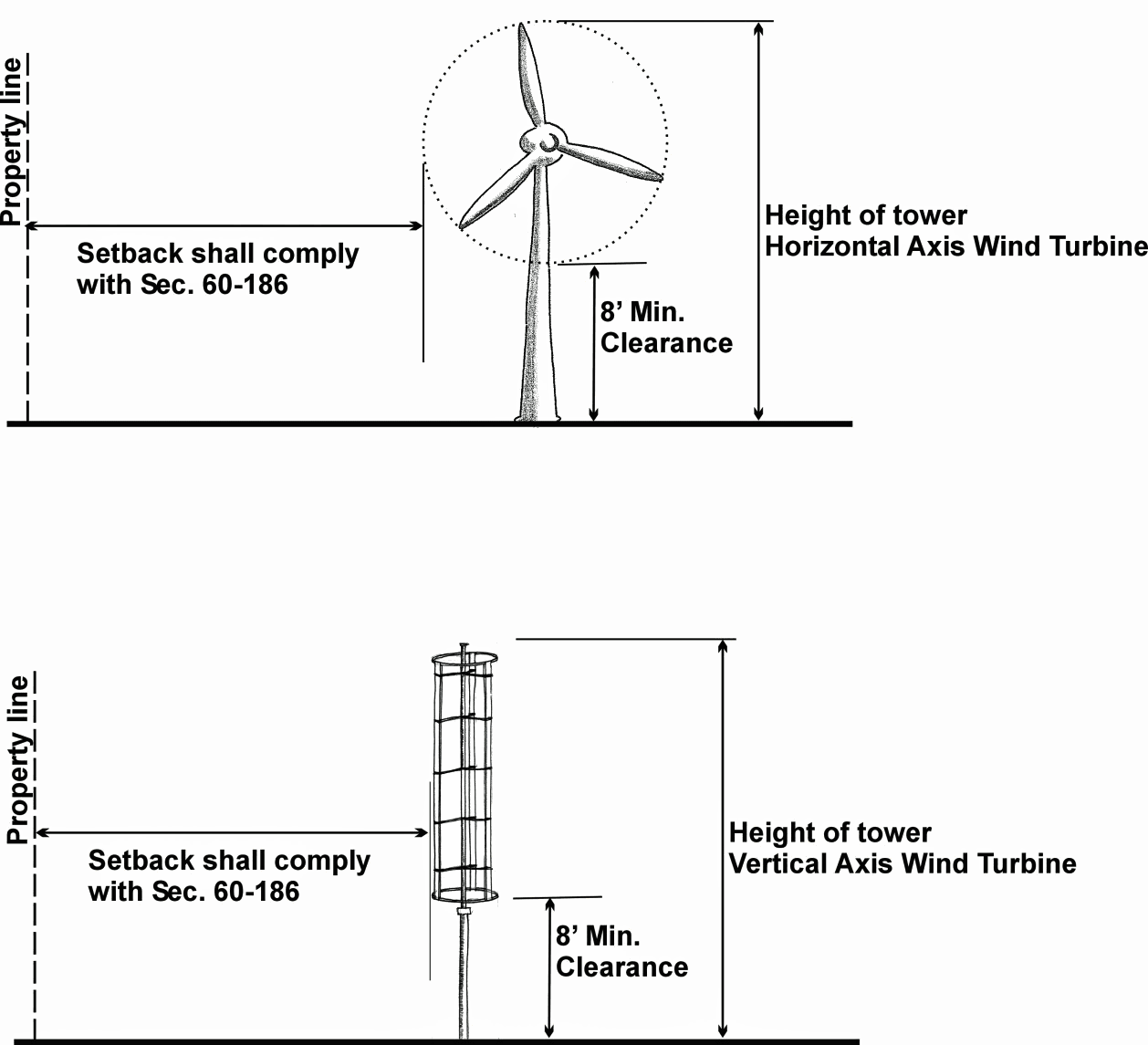
Figure 60-186
c.
Interference. All WECS structures shall be certified by the manufacturer to minimize or mitigate interference with existing electromagnetic communications, such as radio, telephone, microwave or television signals.
d.
Noise. The sound pressure level shall not exceed 55 dB(A) (A-weighted decibels) at the property line closest to the wind energy system This sound pressure level may be exceeded during short-term events such as utility outages and/or severe wind storms. If the ambient sound pressure level exceeds 55 dBA, the standard shall be ambient dBA plus five dBA.
e.
Safety. All moving parts including blades or rotating cylinders shall be located at least eight feet above the ground and a safe distance from human interference (See figure 60-186). The support system, footings and tower shall be constructed in accordance with all applicable building codes governing structural integrity and wind loads.
f.
Height. All private and commercial WECS structures shall be subject to the height restrictions of section 60-186. However, private WECS structures within the R-3 zoning district shall not exceed a maximum height of 40 feet, and shall be subject to the setback regulations as noted in figure 60-186.
(3)
Additional standards for commercial WECS structures. The following additional standards shall apply to all commercial wind energy conversion systems in the City of Alma:
a.
Color. Towers and blades shall be a nonreflective neutral color.
b.
Controls and brakes. All commercial WECS structures shall be equipped with manual and automatic controls to limit rotation of blades to a speed below the designed limits of the WECS. The professional engineer must certify that the rotor and over speed control design and fabrication conform to applicable design standards. No changes or alterations from certified design shall be permitted unless accompanied by a professional engineer's statement of certification.
c.
Compliance with FAA. It shall be the responsibility of the applicant to obtain the appropriate FAA permits for the WECS structure, or to obtain a determination of no significant impact to air navigation from the FAA.
d.
Climb prevention. All commercial WECS structures must be protected by anti-climbing devices.
e.
Warnings. A visible warning sign of "High Voltage" may be required to be placed at the base of all commercial WECS structures. The sign must have at a minimum, six-inch letters with three-fourths-inch stroke. Such signs shall be located a maximum of 300 feet apart and at all points of site ingress and egress.
f.
Performance bond. The city shall have on file a performance bond for removal of a commercial structure. The value of the bond shall be in the amount given prior to construction for the cost of removal and any other costs deemed necessary by the city.
g.
Removal. A condition of every approval of a commercial WECS shall be adequate provision for removal of all or part of the facility by users and owners upon the occurrence of one or more of the following events:
1.
When the facility has not been used for 180 days or more. For purposes of this section, the removal of equipment from the facility, or the cessation of operations (transmission of electrical power or prolonged periods of no movement of the WECS) shall be considered as the beginning of a period of nonuse.
2.
Six months after new technology is available at reasonable cost, as determined by the planning commission, which permits the operation of the WECS without the requirement of the support structure.
3.
The situations in which removal of a facility is required, as set forth in paragraphs 1. and 2. above, may be applied and limited to portions of a facility.
4.
Upon the occurrence of one or more of the events requiring removal, the property owner or persons who had used the facility shall immediately apply for any required demolition or removal permits, proceed with, and complete the demolition/removal.
5.
If the required removal of a facility or a portion thereof has not been lawfully completed within 60 days of the applicable deadline, and after at least 30 days' written notice, the city may remove or secure the removal of the facility or required portions thereof, with its actual cost and reasonable administrative charge to be drawn, collected and/or enforced from or under the security posted at the time of application.
(Ord. No. 736, § 1, 1-25-2011)
Sec. 60-187. - Donation boxes.
(a)
No person or other legal entity shall cause or permit the installation or placement of a donation box upon any property within the city, whether public or private, except in accordance with this section.
(b)
Donation boxes are permitted within the city upon compliance with all of the following:
(1)
All proceeds are dedicated to the use of an entity which is qualified by the Internal Revenue Service as a 501(c)(3) charitable institution, or is a governmental entity.
(2)
The donation box is located upon the premises of an entity which is qualified by the Internal Revenue Service as a 501(c)(3) charitable institution, or is a governmental entity.
(3)
The donation box is no more than six feet high, with a ground footprint of not more than 25 square feet.
(4)
No more than two donation boxes shall be located on any parcel.
(5)
The donation box shall be located so as not to interfere with any sight triangles and on-site circulation. The donation box shall be located at least 15 feet from any building, 20 feet from the front property line, and 5 feet from the side and rear property lines. The donation box shall not be located so as to block the view of any business signage.
(6)
The donation box shall be placed upon a concrete or asphalt surface.
(7)
The donation box shall be emptied with such frequency and regularity as to ensure that it does not overflow, and materials do not accumulate outside the donation box.
(8)
The donation box shall not be used as a receptacle for any hazardous or potentially hazardous waste.
(9)
The issuance of a permit pursuant to subsection (c), below.
(c)
The zoning administrator shall issue a permit, annually, for a compliant donation box upon receipt of an annual permit fee in an amount to be established from time to time by resolution of the city commission; and of an application containing all of the following:
(1)
Proof of the applicant's status as a charitable institution or as a governmental entity.
(2)
A site plan indicating the placement of the donation box, in compliance with all the above siting requirements.
(3)
The name, address, telephone number and email address of the applicant and of the owner of the donation box, if different than the applicant.
(4)
The name, address, telephone number and email address of the person who will be available during regular business hours and will be responsible for compliance.
(5)
A photograph of the donation box to be installed.
(6)
The signed and dated consent of the property owner, consenting to the location of the box.
(Ord. No. 761, § 3, 8-12-2014)
Sec. 60-188. - Marihuana facilities and marihuana establishments.
(a)
Applicable standards for grower facilities.
(1)
Only one medical marihuana grower or recreational marihuana grower facility license is permitted per parcel or lot;
(2)
All grower facilities and operations must be within an enclosed building;
(3)
A licensee may occupy the same premises if holding a grower and processor license for the premises;
(4)
Any building or unit housing medical marihuana or recreational marihuana operations shall be located at least 500 feet from a residential zoned district, city park, or any K-12 school;
(b)
Applicable standards for processor facilities.
(1)
Only one medical marihuana or recreational marihuana processor facility licensed permitted per parcel or lot;
(2)
All processing operations must be conducted within an enclosed building;
(3)
A licensee may occupy the same premises if holding a grower and processor license for the premises;
(4)
Any building or unit housing medical marihuana or recreational marihuana operations shall be located at least 500 feet from a residential zoned district, city park or any K-12 school.
(c)
Applicable standards for secure transporter.
(1)
Any building or unit housing medical marihuana or recreational marihuana operations shall be located at least 500 feet from a residential zoned district, city park or any K-12 school.
(d)
Applicable standards for safety compliance.
(1)
Safety compliance facilities shall be located at least 500 feet from any residential zoned district, city park or any K-12 school.
(e)
Applicable standards for provisioning centers and marihuana retailers.
(1)
Only one provisioning center/marihuana retailer licensed per parcel or lot;
(2)
All provision center/marihuana retailer activities must be conducted within an enclosed building;
(3)
Any building or unit housing medical marihuana or recreational marihuana operations shall be located at least 500 feet from a residential zoned district, city park or any K-12 school.
(f)
General provisions.
(1)
The location criteria contained in this section is applicable to any proposed change in the location of an existing marihuana facility and marihuana establishment;
(2)
A licensee shall not operate a marihuana facility or marihuana establishment at any place in the city other than the address provided in the application on file with the city clerk;
(3)
A licensee shall operate the licensed facility in compliance with all applicable stated and city regulations for that type of facility;
(4)
The distances described in this section shall be computed by direct measurement in a straight line from the nearest property line of the land used for the purposes stated in the section above, to the nearest portion of the building or unit in which the medical marihuana facility is located;
(5)
The separation distances contained in this section are applicable to marihuana facilities and protected used located in adjacent governmental jurisdictions;
(6)
Any marihuana facility or marihuana establishment in operation on the effective date of the ordinance from which this section is derived is deemed an unlawful public nuisance, absent appropriate licensure under the Medical Marihuana Facilities Licensing Act, MCL 333.27101 et seq. or the Michigan Regulation and Taxation of Marihuana Act, MCL 333.27951 et seq. and applicable city ordinances. Noncompliance with this provision shall subject the owner and/or operator of the facility or establishment to applicable criminal and civil sanctions for violation of this provision;
(7)
Nothing in this section shall be construed to "grandfather" or provide any legal, equitable or property right to the owner or occupier of property on which a medical marihuana facility is operating, before a city operating license for such facility or business is issued, to continue such use.
(Ord. No. 792, § 1, 8-22-2017; Ord. No. 802, § 7, 7-24-2018; Ord. No. 836, § 7, 12-27-2022)

