
American Fork City Zoning Code
CHAPTER 17
5 SUPPLEMENTARY REGULATIONS
Sec 17.5.101 Intent
The intent of this section is to provide for several miscellaneous land development standards which are applicable in more than one zone. The requirements of this section shall be in addition to development standards contained within the various zones. Where the provisions of this section may be in conflict with other provisions of this code, the more stringent shall prevail.
Sec 17.5.102 Yard Space For One Building Only
All required yards shall be situated on the same lot as the building or structure to which it applies. No required yard, area, or other open space around a building or use which is needed to comply with the area, setback, or open space requirements of this code shall be considered as providing the required area, yard, setback or open space for any other building or use; nor shall any area, yard, setback, or other required open space on an adjoining lot be considered as providing the area, setback, or open space requirement of a building or use.
Sec 17.5.103 Sale Or Lease Of Required Space Prohibited
No space needed to meet the area, frontage, width, coverage, off-street parking, frontage on a public street, or other requirement of this code for a lot or building may be sold, bequeathed, or leased apart from such lot or building unless other space so complying is provided, nor shall any land be sold which will result in an existing or future lot that does not comply with all of the provisions of this code.
Sec 17.5.104 Each Dwelling To Be On A Zoning Lot
Only one building which contains a dwelling shall be located and maintained on a zoning lot.
Sec 17.5.105 Area Of Accessory Buildings
- Accessory Buildings shall comply with all requirements of the underlying zoning and land use in addition to the following:
- General Requirements:
- A building permit is required for all buildings larger than 200 sq.ft.
- In addition to the review of plans by the Building Authority, all other approvals contemplated herein, as applicable, shall be received prior to the issuance of a building permit.
- Site plans, inclusive of utilities, shall be provided for all buildings larger than 200 sq.ft.
- The Administrative Land Use Authority shall have the authority to approve Site Plans for Accessory Buildings.
- Civil engineering plans, in addition to standard building plans shall be provided for Accessory Buildings larger than 750 sq.ft.
- The City Engineer shall have authority to approve the civil plans identified in A(1)(c).
- Storm Water Pollution Prevention Plans (SWPPP) shall be provided for Accessory Buildings larger than 750 sq.ft. if the accessory building is withing 50 feet of a water of the state wetland, watershed outfall, or ditches, slough, or similar waterways.
- The City Engineer shall have authority to approve SWPPP.
- Accessory Buildings shall be located in the rear yard.
- Unique lots, such as corner lots or those with increased width and minimum depth, may seek a variance from the Board of Adjustment for the allowance of an Accessory Building in a side yard.
- The footprint of the Accessory Building may not cover more than 25% of the rear yard (or side yard if a variance is granted, as provided for above).
- No building, or portion thereof, including eaves, shall be within the applicable setbacks or within the easement areas.
- A building permit is required for all buildings larger than 200 sq.ft.
- Residential, and Planned Residential Zones
- The use of an Accessory Building shall be subordinate to the primary structure on the lot.
- The materials of the Accessory Buildings shall be consistent with the existing structure.
- The maximum height of the Accessory Building:
- Shall not exceed the height of the primary structure;
- Shall not exceed 25 feet at its highest point; and
- Shall not exceed 20 feet within 10 feet of any property line.
- Setbacks:
- From main building: Accessory Buildings shall be set back not less than 12 feet to the rear of the closest rear wall of the main building and not less than 12 feet from the closest side wall of the main building.
- Accessory buildings that are located 12 feet or closer to a main building shall be considered as part of the main building, for setback determination only.
- Side setback – corner lot – side abutting street: Accessory Buildings shall be set back not less than forty feet from the side lot line which abuts on a street.
- Side and rear setback – interior lot line: Accessory buildings shall be set back not less than five feet from the lot line.
- From main building: Accessory Buildings shall be set back not less than 12 feet to the rear of the closest rear wall of the main building and not less than 12 feet from the closest side wall of the main building.
- Residential-Agricultural Zones
- The use of an Accessory Building shall be subordinate to the primary structure on the lot.
- The Accessory Building may be the only building on the lot.
- The materials of the Accessory Building shall be compatible with the existing character of the immediate vicinity, as to appear consistent in style and aesthetic.
- The maximum height of the Accessory Building shall not exceed 35 feet.
- Setbacks:
- From main building: Accessory Buildings shall be set back not less than 12 feet to the rear of the closest rear wall of the main building and not less than 12 feet from the closest side wall of the main building.
- Accessory buildings that are located 12 feet or closer to a main building shall be considered as part of the main building for setback determination only.
- Where no main building exists on the lot, a detached Accessory Building shall be set back no less than 75 feet from the front lot line.
- Side setback – corner lot – side abutting street: Accessory Buildings shall be set back not less than forty feet from the side lot line which abuts on a street.
- Side and rear setback – interior lot line: Accessory buildings shall be set back not less than five feet from the lot line.
- From main building: Accessory Buildings shall be set back not less than 12 feet to the rear of the closest rear wall of the main building and not less than 12 feet from the closest side wall of the main building.
- The use of an Accessory Building shall be subordinate to the primary structure on the lot.
- General Requirements:
- Appeals.
- An applicant may appeal the interpretation of the building code by the Building Official by filing an appeal within 10 days of the denial of a building permit. Said appeal shall be filed, in writing, with the American Fork City Development Services Department. The appeal authority for said appeals shall be the American Fork City IBC Appeals Board.
- An applicant may appeal the denial of a site plan, engineered plans, and/or SWPPP, or the denial of a building permit for any reason other than that set forth in B(1), by filing an appeal within 10 days of the denial. Said appeal shall be filed, in writing, with the American Fork Development Services Department. The appeal authority for said appeals shall be the American Fork Planning Commission.
(Ord. No. 2000-10-31; Ord. No. 08-05-26; Ord. No. 2013-06-21, § 1, 6-11-2013)
Amended by Ord. 2024-06-28 on 6/11/2024
Sec 17.5.106 Accessory Building Prohibited As Living Quarters
Living and sleeping quarters shall not be permitted in any accessory building.
Sec 17.5.107 Storage Of Junk And Debris Prohibited
No yard or other open space shall be used for the storage of junk, debris, or obsolete vehicles; and no land shall be used for such purposes, except as specifically permitted herein.
Sec 17.5.108 Yards To Be Unobstructed - Projections Excepted
Every part of a required yard shall be open to the sky and unobstructed except for permitted accessory buildings and except for ordinary and customary projection of sills, belt courses, cornices, and other ornamental features and unenclosed steps and unwalled stoops, porches, and carports, which may project up to three feet into a required yard. Canopies over gasoline pumps may extend into a required yard but not closer than three feet to the property lines.
Sec 17.5.109 Exception To Front And Side Setback Requirements
The setback from the street for any dwelling located between two existing dwellings may be the same as the average for said two existing dwellings, provided the existing dwellings are on the same side of the street, and are located within one hundred fifty feet of each other, and provided that no dwelling shall be located closer than twenty feet from the right-of-way or easement line of said street.
Sec 17.5.110 Clear View Of Intersection Sight Distances
Intersection sight distances for public and private streets shall meet the following criteria.
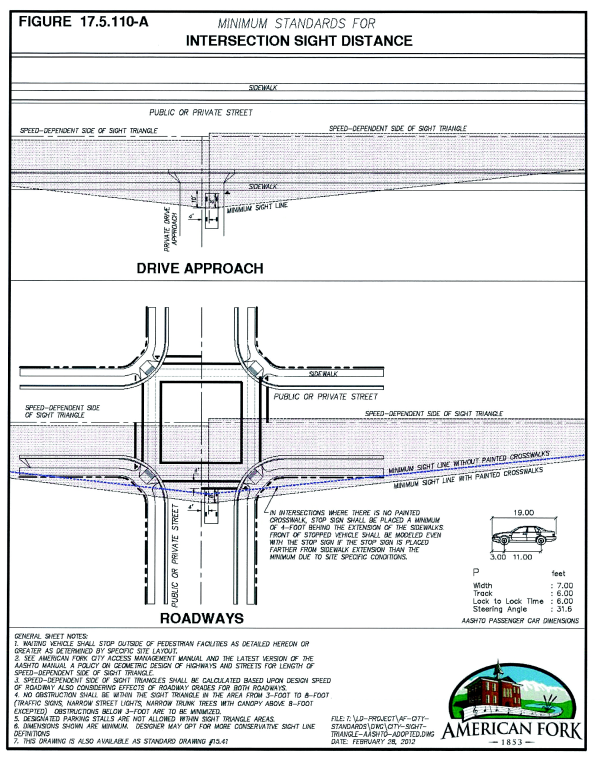
- Intersection sight distances shall comply with the terms of that certain document entitled "A policy on Geometric Design of Highways and Streets" as promulgated by the American Association of State Highway Officials (AASHTO), which is hereby adopted for use within the city, as further defined on Figure 17.5.110-A.
- Sight obstructions are not permitted within the sight triangle, except that trees may be permitted provided that they are pruned to a height of not less than eight feet. Also light poles and similar uses may be permitted, provided they do not create a visual impairment to traffic.
- "Approach standards" shall be applied to streets without any stop control as set forth in AASHTO Figure 9.50(a).
- "Departure" standards shall be applied to intersecting streets with stop control devices, as set forth in AASHTO Figure 9.50(b). The distance identified as "a" on said drawings is measured from a driver located eight feet behind the stop sign/stop bar/cross walk.
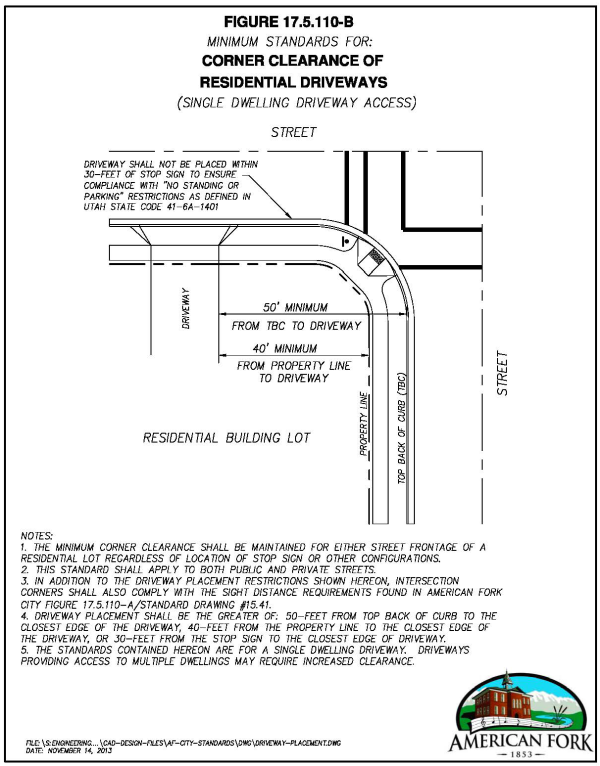
- Stop signs/stop bars shall be placed a minimum of four feet behind the painted cross walk or sidewalk extension (where no painted cross walk exists.
- Stop signs shall be placed a minimum of two feet behind the sidewalk at all locations, or drive approaches where the sidewalk extends through the travel way.
 (Ord. No. 2012-02-05, pt. I(§ 3), 2-28-2012; Ord. No. 2014-01-02, § 2, 1-14-2014)
Sec 17.5.111 Setback Of Buildings From Proposed Streets
The front or side setback for structures abutting on a proposed future street or an existing street needing to be widened, as shown on the major street plan as a future street, shall be measured from the planned street line. For purposes of determining the setback requirement and similar locational standards, said planned street line shall be considered as the property line.
(Ord. No. 4-81-2-5-A)
Sec 17.5.112 Additional Height Allowed For Public Buildings
Public buildings and churches in residential zones may be erected to any height provided the building is set back from required building setback lines a distance of at least one foot for each additional foot of building height above the maximum height otherwise permitted in the zone in which the building is located.
Sec 17.5.113 Location Of Barns
No barn, corral, or coop shall be constructed closer than one hundred feet to any existing dwelling nor shall any corral, pen or coop be constructed or maintained closer than twenty feet to any open waterway that drains into a natural stream. Surface drainage from corrals, pens, or coops shall not be permitted to drain into a waterway that drains into a natural stream.
Sec 17.5.114 Drainage
Surface water from roof tops shall not be allowed to drain onto adjacent lots or streets, except after written agreement between the two parties.
Sec 17.5.115 Fences, Walls And Hedges
- Intent. It is the intent of this section to establish minimum standards for the placement, height and opacity of fences in residential zones for the purpose of facilitating safety of pedestrians and motor vehicle users in connection with ingress and egress to private property, driveways and parking areas
- Fence placement and height.
- Fences having a height no greater than forty-two inches may be constructed and maintained in any portion of a residential lot, provided that where all portions of the fence fabric higher than forty-two inches are to be of the chain link or other open mesh type, (not greater then forty percent opacity) and will remain non sight obscuring, the maximum height may be increased to not greater than forty-eight inches.
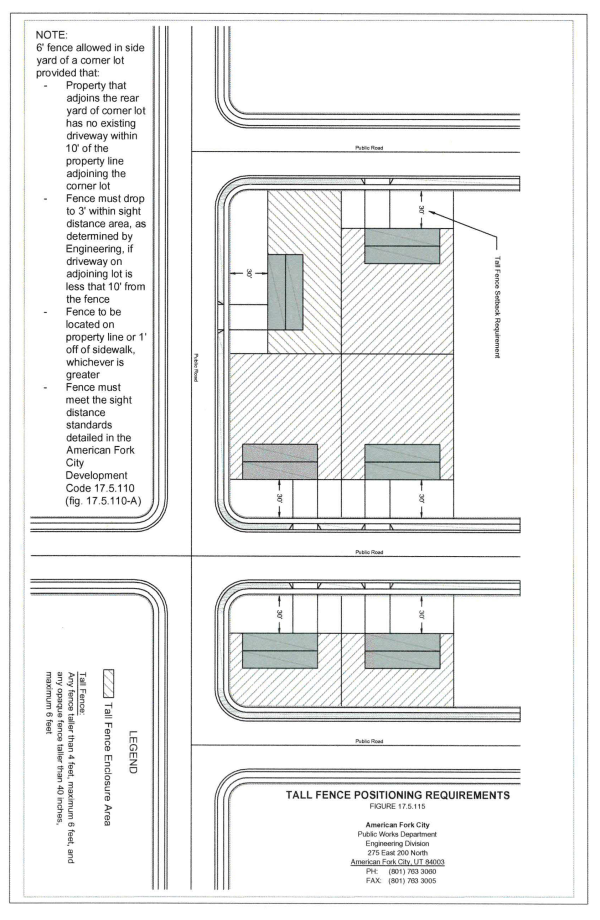
- Fences having a height of not greater than six feet (tall fence) may be constructed and maintained in any portion of the tall fence enclosure area of a residential lot, as defined on Figure 17.5.115. The height of a fence shall be measured from the grade upon which it is to be placed. Said fences may be open mesh or sight obscuring.
- Fence permit required—Building inspector to approve—Appeals. Before commencing construction of any fence or wall having a height greater than forty-eight inches a plan showing the proposed placement and design of the fence shall be submitted by the lot owner (or any individual or company retained by the lot owner to construct the fence) to the building division. If found to comply with the terms of this section, the building division shall issue a permit for the construction of the fence, except when it is determined by the chief building official that it is impractical to adhere to the provisions of this section in a literal manner, as discussed in the paragraph below. Any applicant aggrieved by a decision of the building division may appeal said decision to the board of adjustments, which shall have the authority to reverse, affirm or modify any decision of the building division.
In the case of a unique or unusual shaped parcel (i.e. triple-frontage lots), or a parcel on which a home's placement makes it difficult to differentiate between the front and rear of the home; and, whereby it is impractical to adhere to the provisions of this section (Section 17.5.115.C) in a literal manner as determined by the chief building inspector, an application shall be presented to the board of adjustments for review and determination of fence placement. Upon review, and with the recommendation of the chief building official, the board of adjustments shall have the authority to make the determination of fence placement. - Exceptions to height requirements. Fences, walls and similar structures exceeding six feet in height may be permitted under the following circumstances and conditions.
- Required by other government regulation. Where the additional height is required by law or other governmental regulation.
- Required for increased safety and security. Where additional height is needed to provide more adequate security for one of the following:
- Utility facility compound area (i.e., gas regulating stations, electric substations, well sites, etc.), subject to receipt of a building permit.
- Swimming pools and open water impoundment areas, subject to receipt of a building permit.
- Vehicle impoundment yards, self service storage facilities (mini-warehouses) and materials and equipment storage compounds (limited to commercial and industrial zones), subject to the prior approval of a site plan by the planning commission in accordance with the provisions of Section 17.6.101.
- Containment barriers for tennis courts, sport courts, batting cages, etc. Permanent fence type containment barriers for uses such as tennis courts, sport courts, ball diamond backstops, batting cages etc. may be erected to a height not greater than eighteen feet provided:
- Such containment barrier does not constitute a part of a fence enclosing property.
- All portions of the enclosure shall be located within the rear yard area of the lot.
- The containment barrier shall be set back from the property line of the lot to which it is appurtenant for a distance of not less than ten feet and will not occupy any portion of a public utility easement.
- No portion of the containment barrier shall be located closer than ten feet to the main building to which it is appurtenant.
- The fabric used for the containment barrier shall be of an open mesh type not exceeding 15 percent opacity.
- The placement of the containment barrier shall have been approved by the planning commission in accordance with the provisions of Section 17.6.101.
- Double-frontage lots. On lots which qualify as double-frontage lots, a tall fence may be used to enclose the rear yard area of the lot, subject to the following:
- The fence shall not exceed six feet in height; and
- Placement of the fence shall be in accordance with the following:
- In the location shown on the approved subdivision or development plan, or in the instance that no location is shown on the approved plan, at the property line.
- The sidewalk adjacent to the rear fence shall be not less than five feet in width and conform with the clear vision criteria for corner lots (see Figure 17.5.115).
- Placement of the fence in the location proposed shall not result in the establishment of a hazardous condition to the public or adjacent properties, as determined by the city chief of police or his designated representative.
- The fence may include gates providing incidental access from the adjacent sidewalk, provided:
- The gate is not intended as a primary access to the dwelling and is designed to swing inward or slide parallel to the alignment of the fence.
- Any gate intended to be used for access by vehicles shall require construction of a curb cut or mountable curb and an increased thickness of sidewalk concrete in accordance with city standard for driveways.
- General requirements.
- Fence materials. All fences and walls shall be constructed of substantial material and the design and construction shall be consistent with the quality of dwellings and other improvements within the surrounding area.
- Barbed wire fences prohibited. It shall be unlawful for any person to erect or cause to be erected or to maintain any barbed wire fence along or adjacent to any public street within a residential or commercial zone.
- Existing non-compliant fences declared to be legal nonconforming use. Any fence or wall in existence as of the effective date of the ordinance codified in this section, excluding any fences between forty-two inches and six feet high within the thirty-foot front setback area, shall not be considered grandfathered and were still subject to enforcement.
 (Ord. No. 2000-10-31; Ord. No. 2011-10-26, pt. I(§ 1), 10-25-2011; Ord. No. 2015-06-37 , pt. I, §§ 1, 2, 6-23-2015; Ord. No. 2016-09-44 , pt. I, § 1, 9-13-2016)
Sec 17.5.116 Pollution Prevention
Any use shall be prohibited which emits or discharges gasses, fumes, or other pollutants into the atmosphere in amounts which exceed the standards as prescribed by the Utah State Air Conservation Board, the board of health, or such appropriate body as may be appointed by the city council. Any use shall also be prohibited which emits or discharges liquids or solid material onto the soil or water in amounts which result in pollutants entering any water or drainage system in amounts exceeding the standards prescribed by the Utah State Water Pollution Control Board or the state board of health.
Sec 17.5.117 Concessions In Public Parks And Playgrounds
Concessions, including but not limited to amusement devices, recreational buildings, and refreshment stands, shall be permitted in a public agency park or playground when approved by the city council.
Sec 17.5.118 Fractional Numbers
Any computation or measurement resulting in a fractional number shall be rounded down to the next smaller whole number, i.e. 23.75 inches would be truncated to twenty-three inches.
Sec 17.5.119 Off-Street Parking
- Intent. Regulations relating to off-street parking have been established to increase safety and lessen congestion in the public streets, to provide adequately for parking needs associated with the development of land and increased automobile usage, to set standards for off-street parking according to the amount of traffic generated by each use, and to reduce the on-street storage of vehicles.
- Number of spaces, etc. The number of spaces, conditions and standards relating to access, circulation, lighting, landscaping, location, control, and continuity shall be provided in accordance with American Fork City standards as established by resolution by the city council.
Sec 17.5.120 Motor Vehicle Access
- Intent. Regulations relating to motor vehicle access have been established to increase safety and to facilitate the movement of vehicles between streets and adjacent property.
- Access standards. Access to all lots and parcels of land having frontage on a public street shall be provided in accordance with American Fork City standards as established by resolution by the city council.
Sec 17.5.121 Landscaping
- Intent. The purpose of the landscaping standards and requirements shall be to enhance, conserve and stabilize property values by encouraging pleasant and attractive surroundings thereby creating the necessary atmosphere for the orderly development of a pleasant community. These standards seek to further the mission statement of the city: Safeguard the health, safety and welfare of the citizens of American Fork by providing essential services, and opportunities for an enhanced quality of life while honoring its heritage of values, culture and traditions. Landscaping also contributes to the relief of heat, noise, and glare through the proper placement of green plants and trees.
- Applicability. The provisions of this section shall be included as part of the site plan submittal for all new construction and expansion in all of the following:
- Multi-family structures in residential zones (R3-7500, R4-7500) including common areas in planned residential development projects.
- All commercial and planned commercial zones except CC-1 and CC-2.
- All industrial and planned industrial zones.
- All large scale developments.
- All landscape buffer areas when included as part of the development plan for subdivisions and similar development located along collector and arterial class roads.
- An expansion shall be defined as an increase in the footprint of a building or parking area.
- Amount and type of landscape required. The amount and type of landscape required shall be as set forth under the following schedule:
Notes to table:Zoning of Proposed Development Landscape Requirement Location of Landscaping on Site RA zones, R2-7500, R1-7500 through R1-20000 zones, R3-7500, R4-7500, PR zones, GC-1, BP-1, PO-1, SC-1, GC-2, PF, M-1 If other than lots zoned for single family or two-family dwelling use: One tree per two thousand five hundred square feet of improved area, with no more than twenty percent of the total being ornamental trees or evergreens. One five-gallon shrub per three hundred square feet of improved area; and where applicable in Section 17.5.121. Parking lot, street frontage, common areas and buffer areas for subdivisions located along collector and arterial class roads PI-1 As required in Section 17.5.121.K. and in other sections of 17.5.121 where applicable Street frontage, parking lots I-1 As required in Section 17.5.121.K. and in other sections of 17.5.121 where applicable Street frontage (including perimeter of parking lot along street frontage) - Twenty-five percent of the required shrubs may be converted to turf based on one five-gallon shrub per fifty square feet of turf.
- Ten percent of the required shrubs may be converted to perennials and/or ground covers at a ratio of three one-gallon perennials and/or ground covers for one five-gallon shrub.
- Species diversity: The percent of any one type of shrub that can be planted in a development shall be as follows:
- 10—19 shrubs: Fifty percent.
- 20—39 shrubs: Thirty-three percent.
- 40—59 shrubs: Twenty-five percent.
- 60 or more shrubs: Fifteen percent.
- Species diversity: The percent of any one type of tree that can be planted in a development shall be as follows:
- 0—5 trees: No limitation.
- 6—21 trees: No more than fifty percent of one species.
- 21 or more trees: No more than twenty percent of one species.
- When calculating tree and shrub quantities, any fraction of a shrub or tree or other requirement is rounded up to the next whole number.
- With the approval of the planning department, the number of shrubs may be reduced in exchange for additional trees or tree size at a rate of three shrubs per caliper inch.
- Improved area means the total (gross) lot area being used including the building, parking lot, and storage or display areas.
- Landscaping to conform with city standard. Landscaping in connection with the development of property shall be provided and maintained in accordance with American Fork City standards as established by resolution by the city council. The provisions as found in Ordinance No. 07-11-63, "Tree Ordinance," as well as the recommended types of trees as found in the document titled, "Street Tree Selection Guide for Parking Strips in American Fork Utah" dated July 2001, are hereby stated as reference and shall be adhered to as part of this Section 17.5.121.
- Scope of requirement. Where landscaping is required, such landscaping shall comply with the requirements of this code for the specific use and location. The planning commission shall determine to what extent landscaping is feasible and sufficient for the CC-1 and CC-2 zone districts. Landscaping for new developments shall occur in all interior parking areas, along the perimeter of the property, around new and existing structures, and along street frontages, unless otherwise specified herein. All new development and redevelopment must install and maintain landscaping as required by this code.
- Screening requirements. Where landscape screening is required, said screening shall consist of evergreen shrubs, closely spaced and maintained at substantially the specified height of said required screening. When not otherwise specified, natural screening shall be maintained at a height from four to six feet.
- Plant quantities. The amount of landscaping is based on gross area of proposed development.
- Landscape plans and equivalent plants—General standards.
- Landscape plan required. Where landscaping is required, a landscape plan shall be submitted. Said plan shall consist of a plot plan showing the proposed landscape development, watering system, and use of the property. Said plan shall be submitted to the planning department. The same plan used to show parking layout or other requirements for the issuance of a building permit may be used to show the type and size of plant materials, structures, and other features to be included, provided the features are detailed adequately. The planning department may disapprove of such plans if it is determined that such plans are not adequate or if they are inconsistent with the purposes of this code. However, any dispute with the decision of the planning department relating to said landscape plan may be appealed to the planning commission for their determination.
- Landscape plans and equivalent plants.
- Landscape plans must identify the species, sizes and quantities of vegetation.
- All landscaping shall be installed as shown on the approved plan.
- An equivalent species may be substituted in the field without prior approval, provided a revised drawing is submitted to the planning department. Plants are "equivalent" if they have the same growth habit and rate, same cover, leafing, shade characteristics and function, have similar water requirements, thrive in the same microclimate, soils and water conditions.
- All other changes to the landscape plan require prior approval from the planning department and/or the planning commission.
- All development plans shall designate required landscaping areas. Subdivision plats shall designate required landscaping areas.
- Standards and criteria—General standards.
- Minimum plant sizes. Minimum plant sizes are:
- Shade tree, two and one-inch caliper (measured six inches above root ball) at time of planting. At maturity, a shade tree has a height and/or spread of thirty feet or greater. If two and one-inch caliper trees are not available due to seasonal shortages or shortages in desired varieties, the planning commission may approve the installation of smaller trees, provided the proportional difference in caliper inches is compensated for by installing additional trees.
- Ornamental tree, one and one-half inch caliper (measured six inches above root ball) at time of planting. At maturity, an ornamental tree has a spread and height between fifteen feet and thirty feet.
- Evergreen tree, six feet tall at time of planting.
- Deciduous shrub, five-gallon container.
- Evergreen shrub, five-gallon container.
- Perennials and ground covers, one-gallon container.
- Turf mix, native grasses and wild flower mix are the only vegetation that may be planted as seed.
- Irrigation. All vegetation and landscaped areas must be provided with a permanent irrigation system.
- An underground pressurized irrigation system and/or drip system is required for all landscape areas on the property.
- Native grasses must have a permanent irrigation source that is zoned separately from high water demand landscapes. Once the grasses are established, irrigation to native grass areas can be reduced to a level that maintains coverage typical of the grass mix and to suppress weed growth.
- Preservation of significant landscape features. Existing landscape features such as escarpments, large or old trees or stands, heavy vegetative cover, ponds and bluffs shall be identified by the planning department and/or the planning commission as part of the development review process. To the extent the planning department and/or planning commission deems practicable, such features shall be preserved by the final plans and to such extent, count toward landscape and open space area requirements. Features to be preserved shall be protected throughout site development. If a significant live feature which was to be preserved dies or is substantially damaged the developer shall replace it with an equivalent feature as determined by the planning department and/or planning commission. No person shall kill or damage a landscape feature required to be preserved by this section.
- During construction, fencing or similar barriers shall isolate and protect the landscape features to be preserved.
- All protection measures shall be clearly identified on the construction and landscape plans.
- No vehicles or equipment shall be driven or parked nor shall any materials be piled within the canopy drip line of any tree to be preserved.
- Protection of landscape areas. All landscape areas shall be protected from vehicles through the use of concrete curbing, large rocks, or other similar obstructions.
- Utility lines. If the location of utilities conflict with the landscaping provisions, the planning department may approve an equivalent alternative.
- Utility plans must be submitted with landscape plans.
- Trees which will grow to a height of greater than fifteen feet at maturity shall not be planted under electrical lines.
- Ornamental and evergreen trees planted under an electrical line may count towards the total tree requirement.
- Sight distance. The owner shall maintain all vegetation, fences, walls and berms so that there is no site distance hazard nor road or pedestrian hazard.
- Trees.
- Trees should not be planted near a light pole if eclipsing of light will occur at maturity. Placing light poles in the parking lot, away from landscape area and between parking bays, helps eliminate this conflict and should be considered.
- Tree canopies may overlap by up to twenty percent of the diameter of the tree at maturity. Tree clustering may be allowed with some species so long as clustering does not adversely affect the mature canopy.
- At planting, tree trunks must be reasonably straight with minimal doglegs.
- Wire baskets, burlap wrappings, rope, twine or any similar shipping materials shall be removed before planting.
- The minimum square footage of planting area for a shade tree is one hundred forty square feet. The planning commission may vary the minimum square footage.
- Maintenance and restoration. The owners, tenants and occupants for all proposed new and existing uses in the city must:
- Demonstrate that all provisions of this code regarding landscaping have been met prior to the issuance of a certificate of occupancy and/or a business license.
- Maintain landscaping in a healthy, growing, neat and well maintained condition.
- Maintenance includes watering, weeding, pruning, pest control, trash and litter removal, replacement of dead or diseased plant material, reseeding and other reasonable efforts.
- Any plant that dies must be replaced with an equivalent live plant within ninety days of notification or, if during the winter, by the next April 1.
- On his own or based on a citizen complaint, any member of the planning department, planning commission or zone enforcement officer may, without notice and without a warrant, walk on the landscaped portion of the property from time to time to inspect the condition of landscaping.
- Minimum plant sizes. Minimum plant sizes are:
- Parking lots—Design standards.
- Interior landscaping requirement. Landscaping is required in the interior of parking lots to direct traffic, to shade cars and structures, to reduce heat and glare and to screen cars from adjacent properties. (See Development Services Design Standards for further information.) The interior of all parking lots shall be landscaped as follows:
- One landscaped island, parallel to parking spaces, is required for each twenty linear parking spaces. In lieu of the standard landscape island, one "orchard style" landscape island may be used for every six linear parking spaces. The orchard style landscape islands shall be evenly spaced between end landscape islands.
- Landscape islands must be at least one hundred forty square feet. The narrowest/smallest dimension of a parking lot island shall be eight feet, measured from back of curb to back of curb.
- Orchard style landscape islands shall be six feet by six feet square minimum.
- One landscaped divider island, parallel to the parking lot drive aisles, designed to prevent diagonal movement across the parking lot, shall be located for every three parking lot drive aisles.
- A landscape island is required at the end of every row of parking spaces, regardless of length or number of spaces.
- Barrier curbing on all sides adjacent to the parking lot surface is required to protect each landscape islands from vehicles.
- A corner area (where it is not feasible to park a vehicle) may be considered an end island for the rows on the perimeter of the parking lot.
- Landscaping of the interior of a parking lot shall include trees, shrubs and landscape boulders.
- Pedestrian crossing areas in parking lots shall be constructed of surface pavers, such as brick, stone blocks, interlocking brick pavers, stamped concrete or other materials as may be approved by the city engineer which form a smooth surface but contrast with asphalt.
- Parking lot perimeter. Landscaping is required around the entire perimeter of a parking lot to assist in the shading of cars, to assist in the abatement of heat and to reduce the amount of glare from glass and metal, and to assist in the screening of cars from adjacent properties. The perimeter of a parking lot is defined as the curb line defining the outer boundaries of the parking lot, including dumpster enclosures, bike racks, or other support facilities that are adjacent to the outer curb. Entry drives between a parking lot and the street, drives connecting two internal parking lots or building entry plazas are not included in the perimeter area. (See Figure 17.5.121-A.)
- The minimum dimension allowed for the parking lot perimeter landscape strip is six feet unless adjacent to a public right-of-way where a minimum of fourteen feet is required. The width of a landscape strip can be modified by the planning commission, provided a finding that the intent of this section is met.
- Landscaping along the perimeter of parking lots shall include trees, shrubs and landscape boulders.
- Parking lots shared by more than one owner shall be landscaped around the perimeter of the combined lots.
- Interior landscaping requirement. Landscaping is required in the interior of parking lots to direct traffic, to shade cars and structures, to reduce heat and glare and to screen cars from adjacent properties. (See Development Services Design Standards for further information.) The interior of all parking lots shall be landscaped as follows:
- Dumpster enclosures—Design standards. The design of each dumpster enclosure shall conform to the design standards for dumpster enclosures as set forth in the American Fork Planning, Zoning, & Building Supplementary Design Standards.
- Street frontage landscape.
- Street frontages. Within all zones (with the exception of lots zoned for one or two dwellings and the CC-1 and CC-2 zones), the owner shall provide and maintain a minimum fourteen-foot-wide street frontage landscape adjacent to the public right-of-way.
- A minimum of seventy-five percent of the street frontage landscape shall be covered by plant material at maturity.
- The planning commission may allow for up to fifty percent of the fourteen-foot-wide street frontage to be turf, or up to one hundred percent turf coverage may be allowed if the parking lot setback from the right-of-way exceeds thirty feet. Low water usage turf is encouraged.
- Landscaping within the street frontage shall include trees, shrubs and landscape boulders. Street trees shall be provided in the street frontage landscape, including one tree for every forty feet of street frontage. Clustering is allowed provided that it does not adversely affect the mature canopy.
- Residential subdivision perimeter enclosures.
- Intent. The planning commission and/or city council may approve (if requested by the applicant) or require (where deemed necessary or required by other sections of this code) perimeter enclosures (fences and/or walls) around all or part of the perimeter of a residential subdivision or planned unit development. Perimeter enclosures shall be designed to meet the following objectives of protecting public health, safety and welfare: screen negative impacts of adjoining land uses, including streets, protect privacy, maintain a consistent or complementary appearance with enclosures in the vicinity, maintain consistent appearance of the subdivision.
- Required perimeter enclosures. The planning commission and/or city council may require a perimeter enclosure as a condition of the final approval if:
- Use or enjoyment of property within the development or in the vicinity of the development might be impaired without a perimeter enclosure.
- A perimeter enclosure is necessary to maintain a consistent and complementary appearance with existing or proposed perimeter enclosures in the vicinity.
- A perimeter enclosure is necessary to control ingress and egress for the development.
- A perimeter enclosure is necessary to promote the safety of the public or residents in the vicinity.
- A perimeter enclosure is needed to comply with the purpose, objectives or regulations of the subdivision requirements.
- Specifications. Unless specified otherwise at the time of final approval: a perimeter enclosure includes fences (excluding chain-link), walls or berms, and combinations thereof.
- The height shall be six feet; however, an enclosure constructed on a berm shall not extend more than eight feet above the adjoining sidewalk or crown of road, whichever is lower.
- New enclosures shall be compatible with existing enclosures in the vicinity, if such enclosures meet the requirements of this code.
- A perimeter wall must have a column or other significant architectural feature every thirty feet.
- Landscape buffer corridors. The following corridors are major points of entry into the city and as such, should include enhanced landscape treatment in order to provide a "sense of arrival" into American Fork. These corridors shall contain a five-foot-wide landscape buffer area between the perimeter enclosure and right-of-way.
- 900 West, east side of 900 West from 1120 North to 700 North.
- Mt. Timpanogos Boulevard, both sides from 1300 North to 700 North.
- 100 West, both sides from approximately 700 South to the Boat Harbor.
- 570 West, both sides from 330 South to Shoreline Protection Area.
- Vineyard Connector, both sides of future alignment along residential development.
The landscape buffer area shall remain part of the adjacent lot, if part of a standard subdivision, and maintenance shall be provided by the city, through a special assessment district, or, if part of a planned unit development (PUD), the buffer area shall be located in a separate tract owned and maintained by a home owner's association. Standard 17.5.121.C. illustrates this buffer area. In the landscape buffer, one tree per forty linear feet of perimeter must be provided. Clustering is allowed provided it does not adversely affect the mature canopy.
- Construction of perimeter enclosures. The perimeter enclosure and any required landscape buffer area shall be installed by the developer.
- PI-1 zone landscape—Design standards.
- Parking lot interior landscape. Landscaping for the parking lot interior shall be per Section 17.5.121.G.1., with the following additions:
- Shade trees are to be provided at a rate of one shade tree for every six parking spaces and distributed throughout the landscape islands, perimeter landscape and screens to maximize shade and screening.
- A minimum of one shrub shall be provided for every twenty-five square feet of each landscape island.
- Parking lot perimeter landscape. Landscaping for the parking lot perimeter shall be per Section 17.5.121.G.2. with the following addition:
- Turf may be allowed for up to fifty of the parking lot perimeter, at the director's discretion. Low water usage turf is encouraged.
- A minimum of seventy-five percent of the parking lot perimeter landscape shall be covered by plant material at maturity.
- Street frontage landscape. Landscaping for the street frontage shall be per Section 17.5.121.I. with the following additions:
- Vegetation in the sight triangle in the street frontage must not exceed thirty inches in height at maturity.
- One tree for every forty linear feet of street frontage (excluding curb cuts) must be provided, eighty percent of which must be shade trees.
- Side yard landscape. The first fifty feet of side yard (beginning at the front property line) shall be landscaped.
- Maintenance. Each owner or the owner's association shall maintain all landscaping.
- Parking lot interior landscape. Landscaping for the parking lot interior shall be per Section 17.5.121.G.1., with the following additions:
- I-1 zone landscape - Design Standards
- Street frontage landscape (including perimeter of parking lot along street frontage). Landscaping for the street frontage shall be per Section 17.5.121.I. with the following additions:
- Vegetation in the site triangle in the street frontage must not exceed thirty inches in height at maturity.
- One tree for every forty linear feet of street frontage (excluding curb cuts) must be provided, eighty percent of which must be shade trees.
- Vegetation in the site triangle in the street frontage must not exceed thirty inches in height at maturity.
- Maintenance. Each owner or the owner's association shall maintain all landscaping.
- Side yard landscape. The first fifty feet of side yard (beginning at the front property line) shall be landscaped unless otherwise approved by the planning department based upon the project's proximity to non-industrial uses and the reasonableness of the request. In the event the planning department approves a variation to the side yard landscape, fencing and/or other forms of screening, approved by the planning department, shall be required to shield neighboring properties from the industrial use on the property.
- Street frontage landscape (including perimeter of parking lot along street frontage). Landscaping for the street frontage shall be per Section 17.5.121.I. with the following additions:
(Ord. No. 2009-11-36; Ord. No. 2010-12-26, § 1, 12-14-2010; Ord. No. 2011-10-27, pt. I(§ 1), 10-25-2011; Ord. No. 2015-04-24, pt. I, § 1, 4-14-2015)
Amended by Ord. 2023-10-41 on 10/10/2023
Amended by Ord. 2024-03-12 on 3/26/2024
Sec 17.5.122 Temporary And Seasonal Uses
- Intent. The intent of this section is to authorize and set forth regulations governing the establishment and operation of certain transitory or seasonal uses within the city and to ensure their termination at the end of the specified period of time.
- Temporary and seasonal uses authorized.
- In commercial zone districts. The temporary and seasonal uses listed under paragraph C. may be permitted on a temporary basis within all commercial zone districts, subject to compliance with the term of this Section and the approval of a business license therefore by the city fire authority, police authority and zone clearance officer.
- In other zone districts. The temporary and seasonal uses listed under paragraph C. may be permitted in other than commercial districts upon a finding that the intended use is part of a community sponsored celebration event, when located within a public building or public park, or when approved by the city council, and subject to compliance with the terms of this section and the approval of a business license therefore by the city fire authority, police authority and zone clearance officer.
- List of temporary and seasonal uses. Said uses may include, but will not be limited to:
- Temporary uses (not to exceed ten consecutive days).
- Auction establishments.
- Carnivals and circuses.
- Itinerant merchants.
- Movie productions (may be allowed in additional zones and/or for longer time period with approval of the city council).
- Outdoor music festivals.
- Outdoor political rallies.
- Promotional displays and exhibits.
- Bazaars and boutiques.
- Other uses determined by the zone clearance officer to be similar to the above.
- Seasonal Uses (more than ten consecutive days, not to exceed the time limits shown, or four months, whichever is shorter).
- Christmas tree lots (not to exceed forty-five days).
- Firework sales stands (limited to the period of time as set forth under state law).
- Individual agricultural produce stands and open-air farmers markets for the sale of agricultural produce (not to exceed the length the local outdoor growing season).
- Shaved ice and food stands.
- Spook alleys (not to exceed forty-five days).
- Rock chip repair stands.
- Other uses determined by the zone clearance officer to be similar to the above.
The provisions of this section shall not be interpreted to exclude customary public assemblies or programs held within churches, schools, auditoriums, city parks, city amphitheater or other permanent structure designed to accommodate such gatherings.
- Temporary uses (not to exceed ten consecutive days).
- Application for temporary and seasonal uses. Prior to the establishment of any temporary or seasonal use, an application for a temporary use permit and business license shall be submitted to and approved by the city zone clearance officer. said application shall contain the following information:
- A description of the proposed use.
- A description of the property to be used, rented or leased for the temporary use, including all information necessary to accurately portray the property.
- A copy of the lease agreement with the property owner/ manager of the parcel proposed for placement of the temporary/seasonal use ("host parcel") indicating the right of the applicant to occupy the site.
- Sufficient information concerning the proposed use to determine the amount of space intended to be occupied, adequacy of setback from the street and primary use, availability of sanitary facilities for employees and patrons (where required), adequacy of parking and vehicular access (availability of adequate rest room facilities in reasonable proximity for employees in accordance with OSHA standards as stated in 29 CFR 1910.141).
- A detailed site plan, showing the location of the stationary stand and any adjacent area to be occupied by the proposed use. Said plan shall be drawn to scale, including dimensions.
- No temporary or seasonal use shall have the practical effect of utilizing space or interfering with the access routes or parking areas which are necessary for the proper operation of the primary use.
- Findings and criteria required for approval. The city zone clearance officer may approve said application subject to the following criteria and findings:
- The proposed use is listed as a permitted temporary or seasonal use, or in the opinion of the zone clearance officer, is similar to the listed uses.
- The temporary or seasonal use will be clearly incidental to the primary use and can be accommodated on the site without diminishing the available parking or impacting traffic safety.
- The proposed temporary or seasonal use will not create excessive traffic hazards, disruption of the circulation pattern for the primary use, or other unsafe conditions in the area, and if traffic control is required, it will be provided at the expense of the applicant.
- Each host parcel may contain only one temporary or seasonal use, except that the zone clearance officer may approve additional temporary or seasonal uses, subject to a finding that the proposed host parcel has sufficient area, parking and circulation to safely accommodate additional use(s).
- The proposed use shall occupy the site for a period not to exceed the time period specified under paragraph C. above.
- The terms of the lease agreement provides for cleanup and restoration of the site to its original condition.
- Signs will be limited to one temporary, accessory sign, not larger than twenty-four square feet, to be placed in the immediate vicinity of the temporary or seasonal use and outside the safe site distance triangle area (when located on a corner parcel or adjacent to a driveway).
- Adequate solid waste disposal facilities shall be provided.
- Adequate restroom facilities for the specific use are provided, as required under paragraph D.4. above.
- The required application and business license fee shall be paid. In granting approval, the zone clearance officer may attach additional conditions deemed appropriate to ensure that the use will not pose any detriment to persons or property.
- Continuing obligation. All temporary and seasonal uses shall be operated in accordance with the terms of this section and any conditions attached pursuant hereto. Upon approval by the zone clearance officer the applicant shall be eligible to acquire a temporary/seasonal use permit to operate. Issuance of the temporary/seasonal use permit shall be conditioned upon continued performance of the conditions of approval and may be refused or revoked upon failure to operate the use in accordance therewith.
- Appeal. Any applicant for a temporary or seasonal use aggrieved by a refusal to grant a temporary or seasonal use permit or any requirement imposed as a condition of approval may appeal the determination to the city council who shall have the authority to overturn said determination or requirement.
(Ord. No. 2010-02-07; Ord. No. 2011-10-26, pt. I(§ 3), 10-25-2011)
Sec 17.5.123 Home Occupations
- Intent. The following regulations have been established to provide minimum standards for the establishment and operation of home occupations within the city.
- Application and approval required. Home occupations may be permitted by the zoning administrator following receipt of an application and subject to the following conditions:
- Home occupation is listed as a permitted use in the zone.
- The home occupation is conducted entirely within a dwelling and is carried on in the dwelling only by members of the residing family.
- The home occupation does not involve the use of any accessory buildings or yard space for storage or activities outside of the dwelling.
- The home occupation shall contain no facilities for the display of goods. Any sale of goods and services shall constitute a clearly incidental part of the operation of the home occupation.
- No commercial vehicles are used except one delivery truck which does not exceed three-fourths ton rated capacity.
- The home occupation is clearly incidental and secondary to the use of the dwelling for dwelling purposes and does not change the character of the building from that of a dwelling.
- Signs are limited to one non flashing sign not larger in area than two square feet.
- Not more than the equivalent of twenty-five percent of the ground floor area of the dwelling is devoted to the home occupation.
- The home occupation shall be registered with the business license agency of the city.
- Entrance to the home occupation from outside shall be the same entrance normally used by the residing family except when required otherwise by regulation of the state health department or other public agency.
- The physical appearance, traffic, and other activities in connection with the home occupation are not contrary to the intent of the zone in which the home occupation is located and do not depreciate surrounding values as determined by the zoning administrator.
- The nature of home occupation shall not require any modification of the residential structure to comply with the provisions of the building, mechanical, electric, plumbing or fire codes, nor be conducted at a level which will require the providing of off-street parking to accommodate the patrons thereof.
- Conditions may be attached. In order to achieve the objectives of this code and to protect the health, safety and quality of life in the city the zoning administrator may attach reasonable conditions to the granting of a home occupation consistent with the standards hereinabove stated.
- Continuing obligation—Business license required. All home occupations shall be operated in compliance with the conditions hereinabove set forth and any conditions which may be attached as part of the approval. Upon approval of a home occupation the applicant shall be eligible to acquire a business license to operate. Issuance of the business license shall be conditioned upon continued performance of the conditions of approval and said license shall be refused or revoked upon failure to maintain or operate the home occupation in accordance therewith.
The approval shall be valid for the remainder of the calendar year in which it is first granted. Thereafter beginning January 1 of each succeeding year the approval will be extended for successive one year periods, provided: (1) that the home occupation remains substantially the same as initially approved and (2) that the home occupation has remained active as evidenced by the acquisition of a valid business license for the previous year. - Termination of approval permitted—Procedure. The city may revoke the approval of the home occupation or refuse renewal of the business license upon a determination made by the city council, following notice and hearing on the matter, that the home occupation is not in compliance with the provisions of this section or the conditions attached at the time of approval. The zoning administrator shall have a reasonable right of entry for the purpose of inspection of the premises to determine compliance with the provisions of this section.
Sec 17.5.124 Recreational Vehicles And Mobile Homes Prohibited; Exceptions
It shall be unlawful to place any recreation vehicle on any lot or parcel of land in the area covered by the zoning map and to use the same for human habitation, except when located in a vacation vehicle court or when used as temporary sleeping quarters when located on the same lot as a dwelling for a period of not more than fifteen days in any one calendar year; or, subject to subsection 2 below. It shall be unlawful to place a mobile home or recreation vehicle on any lot or parcel of land in an area covered by the zoning map and to use the same for human habitation, except in compliance with one or more of the following conditions:
- When located in a licensed mobile home park or in a vacation vehicle court.
- When placed on a lot on which a main building is being constructed subject to the following:
- The mobile home or recreation vehicle will be connected to the city's water and sewer system.
- Assurances will be given to the city in the form of a bond, mortgage, or other consideration in the amount of three hundred dollars as a guarantee that the mobile home will be removed from the premises upon completion of the main building, but no later than one year from the date of the issuance of the permit for the main building.
- A recreation vehicle must disconnect from the city's water and sewer system upon completion of the main building. Use of the recreation vehicle for human habitation shall be prohibited except as otherwise allowed for temporary sleeping quarters, for a period of not more than fifteen days in any one calendar year.
(Ord. No. 2015-05-31, pt. I, § 1, 5-26-2015)
Sec 17.5.125 Moved Buildings
- Intent. Since moved buildings have often been constructed in a time period prior to the adoption of a building code, and are frequently left in an unsafe and unattractive condition, extra precautions shall be taken to insure that the buildings meet the code and that the appearance of the premises is in keeping with buildings in the surrounding area.
- Standards and procedures. No permit shall be issued for the moving of any building which has had prior use, from one site within the city to another site within the city or from a site outside of the city to a site, without a pre-inspection being made by the building official prior to moving. The fee for conducting a pre-inspection shall be established by resolution of the city council.
- Application. The following information shall be filed with the building official at the time the application is made:
- Location and address of the old and new site.
- Plot plan of the new location, also showing adjacent lots on all sides of the property and indicating all structures and improvements on said lots.
- Plans and specifications for the proposed improvements at the new location, including plans for landscaping.
- Photographs of the buildings to be moved.
- City council to approve. The application shall then be submitted to the city council for approval.
- Application. The following information shall be filed with the building official at the time the application is made:
Sec 17.5.126 Minimum Level Of Improvements Required Prior To Issuance Of Building Permit
- Minimum level of improvements policy—Definition. It is hereby declared city policy that each lot or parcel which is or is proposed to be occupied as a dwelling, commercial or industrial project shall be served by a full level of urban improvements (full lot improvements). Said full lot improvements shall consist of and include those improvement required pursuant to Sections 17.8.401 (paved street), 17.8.412 (sewer), 17.8.403 (culinary and PI water), 17.8.304 (curb, gutter and sidewalk), 17.8.411 (piping of irrigation ditches), 17.8.112.C. (storm water drainage facilities), and conveyance of right-of-way area to accommodate placement of improvements where applicable.
- For undeveloped parcel. No building permit shall be issued for the construction of a new dwelling or commercial or industrial use or structure which is to be located on an unimproved or partially unimproved lot or parcel unless said lot or parcel shall be: (1) fully improved as defined under paragraph A., or (2) eventual construction of any absent lot improvements is secured through the posting of a performance guarantee as provided for under Chapter 17.9 of this code.
- For major improvement on existing developed parcels. No building permit shall be issued for the construction of a major expansion of an existing dwelling or commercial or industrial use or structure which is located on an unimproved or partially unimproved lot or parcel unless said lot or parcel shall be: (1) served by full lot improvements as defined under paragraph A., or (2) eventual construction of any absent improvements is secured through the posting of a performance guarantee as provided for under Chapter 17.9 of this code. For purposes of application of this provision, a major expansion shall be deemed to include one or more of the following:
- The addition of a additional story to the existing structure which increases the habitable area of the structure in an amount greater than twenty-five percent of the main floor area. Provided, that this provision shall not be applicable in the instance of an interior finish permit for a pre-existing residential basement.
- The construction of improvements to the existing primary structure and /or addition or improvement of accessory buildings wherein the estimated cost of the proposed improvements is more than five times the estimated cost of the required full lot improvements required under paragraph A.
- The proposed activity on site constitutes a change in use or is sufficient in scope to require submission and approval of a site plan by the planning commission.
- The city engineer may, at their discretion, provide curb grading information for residential lots required to add curb under the terms of this section.
(Ord. No. 2009-01-02, 1-13-2009; Ord. No. 2010-08-19, § 1, 8-10-2010)
Amended by Ord. 2024-05-21 on 5/14/2024
Sec 17.5.127 Water Rights To Be Conveyed As Condition Of Building Permit
No building permit shall be issued for the construction of a dwelling or other habitable structure without first conveying to the city water rights, in an amount sufficient to meet the anticipated demand for the proposed use, as determined in accordance with the provisions of Section 17.1.400 of this code. Any water rights previously conveyed as part of an annexation or project development approval shall be considered as a credit toward satisfying the conveyance requirements.
(Ord. No. 03-5-12)
Sec 17.5.128 Signs And Advertising Structures
The purpose of this section is to provide standards and requirements relating to the location and design of accessory signs and similar structures.
- Permitted signs in all zone districts. With permission of the property owner, the following accessory signs shall be permitted in all zones; provided, that no sign shall be positioned in such a manner as to result in the creation of an unsafe visual clearance at any intersection or driveway location.
- Signs not requiring a permit. The following signs shall be permitted without the necessity of requiring a permit:
- Real estate sales signs. One sign per street frontage advertising the sale, rental, or lease of the premises, provided that such signs shall not exceed six square feet in residential zones or eight square feet in other zones.
- Political signs. Signs for the purpose of promoting the candidacy of any person or persons seeking public office or measures on election ballots, provided that such signs shall be removed within seven days following the election.
- Produce signs. One accessory sign announcing the sale of locally produced agricultural products, provided that such signs shall be removed at the end of the local season for said produce.
- Unlighted identification nameplates. Accessory name plates for professional persons or home occupations, which shall not exceed two square feet.
- Governmental Signs. Signs erected by a governmental unit for regulatory or informational purposes, such as traffic signs, street signs, and public notices.
- Public signs. Signs of a non-advertising nature intended to identify a condition or provide information to the public, such as public utility information signs, safety and danger signs, "no trespass" signs, and entrance and exit signs, provided no sign shall exceed two square feet in area.
- Signs requiring a permit. The following temporary and permanent accessory signs shall be permitted in all zones upon the acquisition of a permit:
- Building project identification signs. One sign per street frontage of a building which is under construction or structural alteration or repair, announcing the character of the building enterprise or the purpose for which the building is intended, including names of architects, engineers, contractors, developers, financiers, and others, provided the area of such sign shall not exceed sixteen square feet in residential zones or thirty-two square feet in other zones, and provided the sign shall be removed upon completion of construction.
- Subdivision project identification. One sign per street entrance to the subdivision located on the property to be subdivided, provided such sign shall not exceed thirty-two square feet in area. Such a sign may not be erected until the subdivision has received final approval by the appropriate city officials and may be displayed for a period of one year from the date of such approval, or until all lots are sold, whichever is less.
- Development project identification signs. A sign denoting the name of any apartment structure containing five or more units, or the name of any residential, commercial or industrial complex, provided such sign shall not exceed twelve square feet in area.
- Directional and public services sign. Signs which identify or provide direction to scenic or historic areas or points of interest, public buildings, sports facilities, etc., or which convey community service information; provided, that no such sign shall have a sign face exceeding twenty-four square feet, except when approved by the city council.
- Institutional identification signs. One sign, with or without a changeable text bulletin board, or electronic display sign, located on the premises and denoting the name of the public building, school, or charitable or religious institution; provided, that such sign shall contain a sign face area of not more than twenty-four square feet. Any electronic display sign at an institutional location within any residential zone shall be operated solely between the hours of 7:00 a.m. to 10:00 p.m. after which the sign shall automatically shut off.
- Community entrance signs. Monument signs erected adjacent to an arterial or collector class street, at or near the municipal boundary of the City, for the purpose of providing notice of entrance to or exit from American Fork City. Each sign shall include the name of the city and may include a message of welcome. The design and placement of each sign shall conform with the city standards for monument signs.
- Public Property. No signs for the purpose of advertisement, political promotion or announcement shall be permitted in the public right-of-way or on public property.
- Signs not requiring a permit. The following signs shall be permitted without the necessity of requiring a permit:
- Establishment of sign overlay zones—Zone boundaries established. To more adequately facilitate the placement and regulation of accessory signs, there is hereby established the following sign location overlay zones.
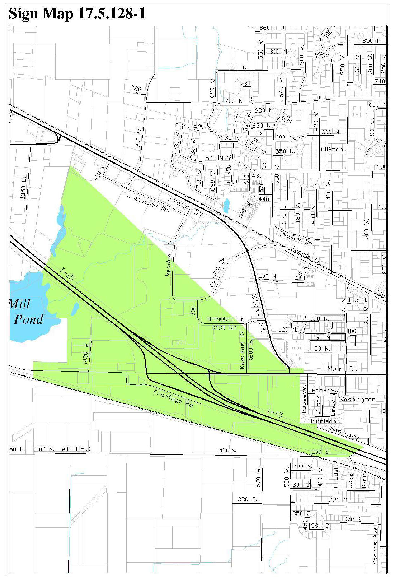
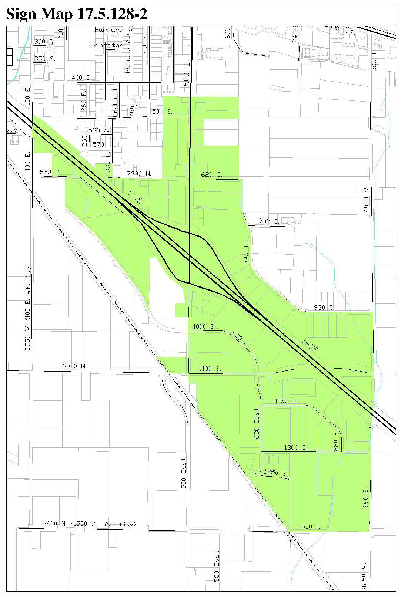
- I-15 corridor sign location zone. The boundaries of the I-15 corridor sign location overlay zone shall be as set forth in Maps 17.5.128-1 and 17.5.128-2.
- General commercial and industrial sign location zones. The boundaries of the general commercial and industrial sign location overlay zones shall be coterminous with the boundaries of any CC-1 and CC-2 central commercial zone, GC-1 and GC-2 general commercial zone, SC-1 shopping center zone, or I-1 industrial zone, except for those portions of such zones as are within the boundaries of the I-15 corridor sign location overlay zone.
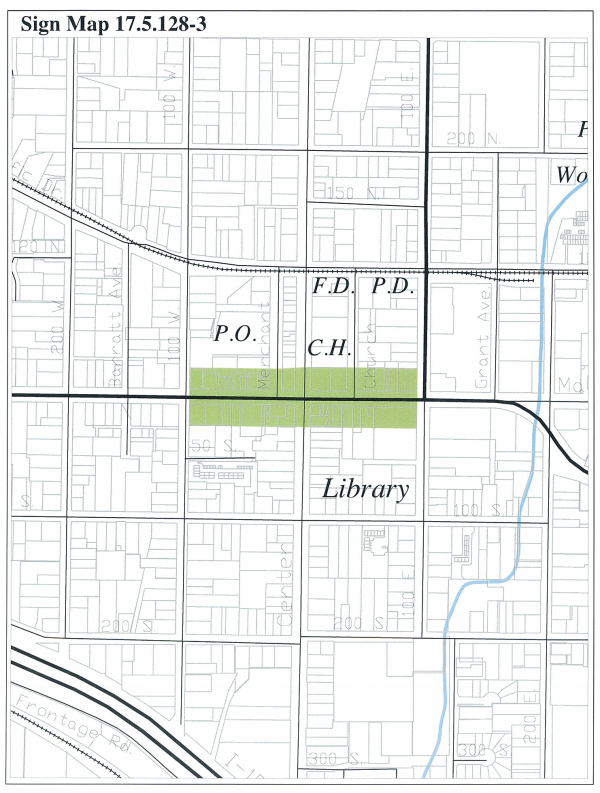
- Downtown a-frame overlay zone. The boundaries of the downtown a-frame overlay zone shall be as set forth on Map 17.5.128-3.
- Requirements regarding accessory signs within the I-15 corridor sign location zone. In addition to the signs permitted under paragraph A of this section, the following accessory signs shall be permitted in the commercial and industrial zones located within the boundaries of the I-15 Corridor Sign Location Zone, subject to the conditions specified herein and upon the acquisition of a sign permit.
- Facia and canopy signs. Accessory facia and canopy signs identifying and advertising the names of the business, the products sold, trade names and/or the business or activity conducted, subject to the following:
- There shall be not more than two signs per building street frontage. Where a building fronts on more than one street, each street shall be considered a separate frontage.
- Where a building contains more than one owner or tenant (e.g. a strip mall), the portion applicable to each owner/tenant shall be considered as a separate building street frontage.
- The maximum sign face area of all facia and canopy sign(s) shall be determined by the size of the building face, or that portion of the building face occupied by an owner/tenant (in the instance of a multi-tenant building), in accordance with the provisions of Chart 17.5.128-A.
- Each sign shall be painted upon or attached to the wall of the building most nearly parallel to the applicable fronting street. No portion of the sign shall project more than fifteen inches from the vertical face of the building to which it is attached.
- The entire sign face area shall be located entirely within limits of the building wall face area, except that up to twenty percent of the sign face area may project above the roof line of the building, but not greater than fifteen feet above the roof line of the building to which it is attached.
- Free-standing monument signs. Permanent accessory, free-standing monument signs identifying and advertising the name of the business, the products sold, trade names and/or the business activity conducted, subject to the following:
- There shall be not more than one sign per street frontage for each building.
- The sign shall have a maximum of two sign faces, a sign face area of not more than sixty square feet, and be designed and constructed in accordance with the sign design standards as adopted by the city (Chart 17.5.128-D).
- No free-standing monument sign shall be placed or constructed in such a manner as to produce an unsafe visual clearance at any intersection or driveway location.
- Incidental directional signs. Permanent signs providing instruction (entrance, exit, etc.) when approved by the city as part of a site plan, or upon the acquisition of a sign permit if proposed for addition after initial site plan approval.
- Project identification signs. In addition to the above permitted signs, a planned commercial or industrial project shall be entitled to not more than two free-standing project identification signs, subject to the following:
- The commercial or industrial project to which the project identification sign applies shall contain three or more separate users or tenants and shall qualify and be approved as a planned commercial or industrial development project in accordance with the applicable provisions of Section 17.7.601 or 17.7.701.
- The project area shall contain not less than twenty-five contiguous acres and shall have not less than five hundred continuous feet abutting upon the right-of-way of I-15 Interstate Highway.
- The sign shall have a maximum of two sign faces, each with a maximum sign face area of not more than one thousand four hundred square feet per side.
- The sign shall include a notation identifying the name of the project. The sign may include an electronic display sign subject to the provisions as found in Section 17.12.219.6.e of the Development Code, but any such electronic display shall not exceed seventy percent of each allowable sign face area.
- The sign shall be located within the project area and not further than 45 feet from the closest adjacent right-of-way line of I-15 ("reference right-of-way"). The sign shall have a maximum height of eighty-five feet as measured from the top of the closest travel lane within the reference right-of-way.
- Any proposed project identification sign shall be approved by the planning commission.
- The sign shall not be located closer than seven hundred fifty feet along the same side of the right-of-way from any other existing or approved project identification sign or any non-accessory sign located within the boundaries of the same project that has been approved in accordance with the provisions of Section 17.6.115.
- The documentation for the planned commercial or industrial project shall provide that the sign constitutes a common amenity for the entire project area and that any tenant or occupant of a premises within the project area shall be eligible to advertise their business on the project identification sign under the terms and conditions as established by the project developer or owner.
- Free-standing pylon signs. Permanent, accessory, free-standing pylon signs identifying and advertising the name of the business, the products sold, trade names and/or the business activity conducted may be erected upon the premises occupied by the business, subject to the following:
- The premises upon which the sign is to be erected shall contain not less than five and one-half contiguous acres and shall have not less than five hundred continuous feet abutting upon the right-of-way of the I-15 Interstate Highway.
- The premises upon which the sign is to be erected shall not be included in any project for which a project identification sign has been approved.
- The maximum height of any pylon sign shall be thirty-five feet as measured from the elevation of the closest freeway travel lane or the top of any intervening opaque freeway center barrier which obstructs the line-of-sight between the sign and occupants of vehicles as measured at a point adjacent to and at a right angle to the sign, whichever is greater.
- Each sign shall have a maximum of two sign faces. The maximum area of each sign face shall be determined by the length of the freeway frontage along which the sign is to be placed and the number of separate establishments located within the project area entitled to be identified on the sign face, in accordance with the provisions of Chart 17.5.128-C. The sign may include an electronic display, but any such electronic display shall not exceed fifty percent of each allowable sign face area and shall be subject to the provisions as found in Section 17.12.219.6.e of the development code.
- No free-standing monument or pylon sign shall be placed or constructed in such a manner as to produce an unsafe visual clearance at any intersection or driveway location.
- No portion of any sign shall project into the air space above a public right-of-way.
- In the event that the project area contains more than one commercial establishment, the request for sign approval shall include provisions identifying which establishments within the project area are entitled to be identified on the sign face (whether only one or all establishments) and how such provisions are to be enforced. The request shall also include a detailed sign design.
- Facia and canopy signs. Accessory facia and canopy signs identifying and advertising the names of the business, the products sold, trade names and/or the business or activity conducted, subject to the following:
- Requirements within the general commercial and industrial sign location overlay zone. In addition to the signs permitted under Subsection A. of this section, the following accessory signs shall be permitted in the general commercial and industrial sign location overlay zone, subject to the conditions specified and the prior acquisition of a permit.
- Facia and canopy signs. Accessory facia and canopy signs identifying and advertising the names of the business, the products sold, trade names and/or the business or activity conducted, subject to the following:
- There shall be not more than two signs per building street frontage. Where a building fronts on more than one street, each street shall be considered a separate frontage.
- Where a building contains more than one owner or tenant (e.g. strip mall), the portion applicable to each owner/tenant shall be considered as a separate building street frontage.
- The maximum sign face area of all facia and canopy sign(s) shall be determined by the size of the building face, or that portion of the building face occupied by an owner/tenant (in the instance of a multi-tenant building), in accordance with the provisions of Chart 17.5.128-A.
- Each sign shall be painted upon or attached to the wall of the building most nearly parallel to the applicable fronting street. No portion of the sign shall project more than fifteen inches from the vertical face of the building to which it is attached.
- The sign shall not extend above the roof line of the structure to which it is attached.
- Projecting signs. Accessory projecting signs identifying and advertising the name of the business, the products sold, trade names and/or the business or activity conducted subject to the following:
- There shall be not more than one projecting sign for each owner/tenant. Each sign shall be attached to the building face adjacent to the portion of the building face occupied by the owner/tenant to which it applies.
- The sign shall not extend above the wall to which it is attached.
- No projecting sign shall exceed thirty square feet in area. Also, where the owner/tenant utilizes a facia or canopy sign, the combined total of the projecting sign and facia or canopy sign shall be not greater than the maximum area allowed for facia or canopy signs in accordance with the provisions of Chart 17.5.128-A.
- No such sign shall be placed above or project into the air space above a public right-of-way.
- The sign shall have a minimum clearance of twelve feet above the ground and fourteen feet above a driveway, alley or other vehicular access.
- Accessory free-standing pylon sign. A permanent, accessory, free-standing pylon sign identifying and advertising the name of the business, the products sold, trade names and/or the business activity conducted may be erected upon the premises occupied by the business, subject to the following:
- The sign shall be located upon the same parcel as the structure containing the business. The parcel shall abut upon a public street adjacent to the proposed location of the sign. The length of the abutting side parcel to which the sign is appurtenant shall be not less than one hundred fifty lineal feet; except that, the placement of a pylon sign on a parcel having an abutting side less than one hundred fifty lineal feet may occur upon the following findings: the substandard abutting side has not been created for the primary purpose of establishing an entitlement to an additional pylon sign, the parcel includes adequate width for vehicular access to the business activity and the sign can be located without establishing a safety hazard.
- Each separate parcel shall include not more than one free-standing pylon sign.
- The maximum height of any pylon sign shall be thirty-five feet above the level of the closest public street.
- Each pylon sign shall have a maximum of two sign faces. The maximum area of each sign face shall be determined by the length of the abutting lot boundary adjacent to the street closest to the proposed location of the sign, in accordance with the provisions of Chart 17.5.128-B.
- No portion of any sign shall project into the air space above a public right-of-way.
- No free-standing pylon sign shall be placed or constructed in such a manner as to produce an unsafe visual clearance at any intersection or driveway location.
- Accessory free-standing monument sign(s). Permanent, accessory, free-standing monument sign(s) identifying and advertising the name of the business, the products sold, trade names and/or the business activity conducted may be erected upon the premises occupied by the business, subject to the following:
- Each free-standing monument sign shall be separated not less than one hundred feet from any other free-standing monument sign or any approved pylon sign, common project sign or project identification sign on the same or an adjacent parcel, as measured along the boundary of the parcel.
- Each free-standing monument sign shall have a maximum of two sign faces. Each face shall have a maximum sign face area of not more than sixty square feet and shall be designed and constructed in accordance with Chart 17.5.128-D.
- No free-standing monument sign shall be placed or constructed in such a manner as to produce an unsafe visual clearance at any intersection or driveway location.
- A free-standing monument sign may be substituted for the free-standing pylon sign Authorized pursuant to subsection 3. above.
- Accessory common project signs for multi-tenant projects authorized. Where a project area contains more than four acres and includes five or more separate business establishments, whether located on individual lots or a common lot, the city, at the request of the developer, may allow the use of a common project sign(s) in lieu of independent pylon and/or monument signs (as authorized under subsections 3. and 4. above). Where a developer proposes the use of the common project sign option, such sign shall conform with the following:
- The project area for which a common project sign is proposed shall meet the criteria for qualification, set forth above, and shall be approved as a planned shopping center or planned commercial development project in accordance with the applicable provisions of Section 17.7.602 or Section 17.6.601.
- A project area shall be permitted to contain one free-standing common project sign. Said sign shall be located adjacent to the project area boundary which abuts a collector or arterial class street (as shown on the city's major street plan), in the vicinity of the project entrance and in the location shown on the approved project site plan.
- Where the project area abuts upon two or more collector or arterial class roads (as shown on the city's major street plan), for a distance of not less than three hundred feet along each road, the city may approve an additional free-standing common project sign for each such additional frontage. Said additional sign(s) shall be located adjacent to the project area boundary which abuts the additional collector or arterial street, but not less than five hundred lineal feet from any other common project sign.
- The maximum height of any common project sign shall be thirty-five feet above the level of the adjacent street.
- Each common project sign shall have a maximum of two sign faces. The maximum area of each sign face shall be determined by the length of the abutting lot boundary adjacent to the street closest to the proposed location of each sign, in accordance with the provisions of Chart 17.5.128-B. The sign may include an electronic display, but any such electronic display shall not exceed fifty percent of each allowable sign face area and shall be subject to the provisions as found in Section 17.12.219.6.e of the development code.
- The sign face shall include a notation identifying the name of the project and may include a registry identifying the owners/tenants of businesses within the project. Independent free-standing pylon or monument signs identifying a specific owner/tenant within the project shall be prohibited.
- No portion of any common project sign shall project into the air space above a public right-of-way.
- No common project sign shall be placed or constructed in such a manner as to produce an unsafe visual clearance at any intersection or driveway location.
- Project identification signs for major commercial projects authorized. The provisions of this paragraph shall be applicable to major commercial projects as defined in this code. In addition to other signs, a commercial development project which qualifies as a major commercial project shall be entitled to one or more project identification signs, subject to the following:
- Each project identification sign shall be located at the perimeter of the project area, unless approval is granted for interior project identification signage, subject to subsection e. below, located adjacent to the outer boundary of the project area abutting a collector or arterial class street (as shown on the city's major street plan), in the vicinity of the project entrance and at the location shown on the approved project site plan.
- Where the outer boundary of the project area abuts upon a collector or arterial class street for a continuous distance of more than one thousand lineal feet, an additional project identification sign shall be permitted for each additional one thousand lineal feet. For purposes of compliance with this paragraph, a project area boundary intersected by public or private streets shall be considered as a continuous boundary. For purposes of determining length of the continuous boundary, any portion of the segment occupied by intersecting public and private streets shall be included.
- Each project identification sign shall be separated a distance of not less than four hundred seventy-five feet from any other project identification sign or pylon sign located on the same side of the street within the project.
- The sign shall have a maximum of two sign faces, each with a maximum sign face area of not more than three hundred fifty square feet per side. The maximum height of the sign shall be thirty-five feet above the adjacent ground level. The sign may include an electronic display, but any such electronic display shall not exceed fifty percent of each allowable sign face area and shall be subject to the provisions as found in Section 17.12.219.e of the development code.
- Where a project plan proposes the use of a project identification signs, all sign age for individual establishments or multi-tenant buildings within the project area, whether located on separately described parcels or common property, shall consist only of monument signs conforming to the provisions of subsection 4. above. No other individual pylon signs or common project signs shall be permitted within the boundaries of the project area; unless approval is granted by the planning commission, after review of a site plan illustrating where placement is proposed.
- Each sign face shall include a notation identifying the name of the major commercial project, which shall occupy not less than fifteen percent of the total sign face area, and may include a registry identifying the name of any commercial establishment located within the project area.
- No project identification sign shall project into the air space above a public right-of-way.
- No project identification sign shall be placed or constructed in such a manner as to produce an unsafe visual clearance at any intersection or driveway or to project into the air space above a public right-of-way.
- The documentation for the major commercial project shall provide that the project identification sign constitutes a common amenity of the project. The documentation shall include provisions establishing ownership of the project identification sign as a common amenity and, in the instance where the sign is situated on property owned by a party other than the owner of the sign, the right to construct and maintain the sign.
- For purposes of compliance with the provisions of this code, any project identification sign shall, when approved pursuant to the provisions of this paragraph, be considered an approved non-accessory sign.
- Facia and canopy signs. Accessory facia and canopy signs identifying and advertising the names of the business, the products sold, trade names and/or the business or activity conducted, subject to the following:
- Regulations for A-frame signs within the downtown A-frame overlay zone. In addition to the signs permitted under subsections A. and D. of this section, A-frame signs shall be permitted within the downtown A-frame overlay zone, subject to the conditions as specified below.
- A-Frame signs shall be placed solely within that portion of the sidewalk designated as the "furnishing zone" (see Exhibit 17.5.128-F).
- A-Frame signs shall have a sign face measuring no larger than twenty-four inches × thirty-six inches, with a maximum sign height of three feet six inches.
- A-Frame signs shall consist of durable, weather resistant material such as wood, steel, aluminum and PVC. Cardboard, paper, fabric and other non-rigid materials are prohibited.
- A-Frame signs shall only be placed outside during regular business hours and shall be brought inside upon close of business. A-frame signs shall not be left out overnight.
- Each business fronting Main Street within the downtown A-frame overlay zone is entitled to one A-frame sign.
- A-Frame signs shall be secured so they do not move from the location where they were placed during the day.
- Signage plan required. Any commercial or industrial development project which requires approval of a site plan by the planning commission, pursuant to the terms of the city's Development Code, shall include a signage plan, showing the intended location of all signs and the general design and maximum size of each proposed sign, as part of the materials required to be submitted for review by the planning commission; notwithstanding, however, any subsequent request for signage, after initial site plan approval, shall require the acquisition of a sign permit pursuant to an administrative review by staff.
- Prohibited signs. Except as specified herein, the following signs shall be prohibited within the city.
- Non-accessory signs—Billboards. Non-accessory signs shall not be permitted within the city except when located and approved in accordance with the applicable provisions of Section 17.6.115, 17.5.128.D.6., or other provision of this code which specifically authorizes non-accessory signs.
- Temporary signs. Except as may be specifically authorized by other provisions of the development code, temporary signs shall not be permitted.
- Hazardous signs. Sign which purports to be or resembles an official traffic sign or signal or which is constructed or maintained in such a manner as to conflict or be confused with an official traffic sign or signal.
- Banner signs. Permanent banner signs shall be prohibited, except that banner signs may be permitted on a temporary basis in the instance of a new or relocated business establishment until such time as the permanent signs have been installed, but not to exceed ninety days.
- Portable Signs. Portable signs shall be prohibited, except that portable signs may be permitted on a temporary basis in the instance of a new or relocated business establishment until such time as the permanent signs have been installed, but not to exceed ninety (90) days.
- Handbill signs.
- No person shall paint, mark, write on, post or otherwise affix any handbill or sign to or upon any public utility pole, street lamp pole, street sign, traffic sign, tree, fence, hydrant, or stake.
- Any handbill or sign found posted upon any public property contrary to the provisions of this paragraph may be removed by the police department, zoning administrator or other person designated by the city for that purpose. The person responsible for such posting shall be liable for the cost incurred in the removal, storage and/or disposal thereof and the city is authorized to effect the collection of said cost.
- Electronic display signs. Except as otherwise permitted in this Section 17.5.128, all electronic display signs are prohibited.
- A-frame signs. Except as otherwise permitted in this Section 17.5.128, all A-Frame signs are prohibited.
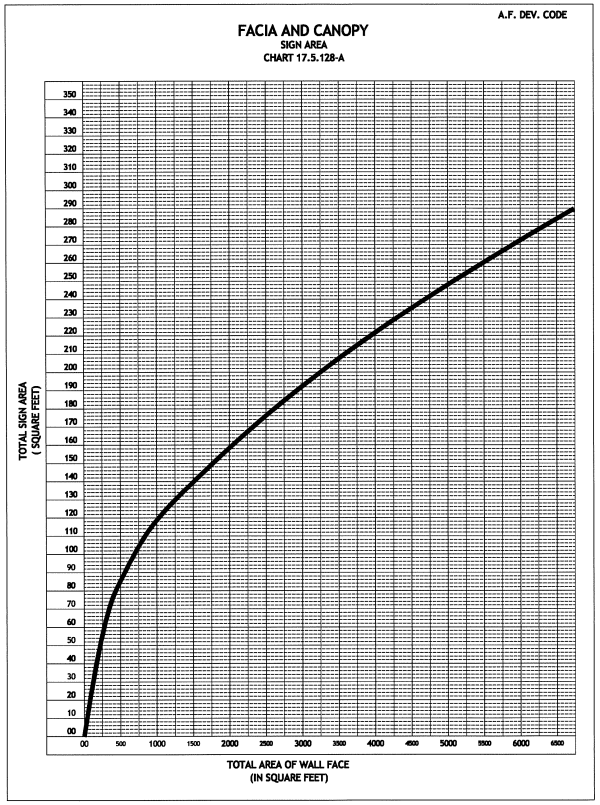
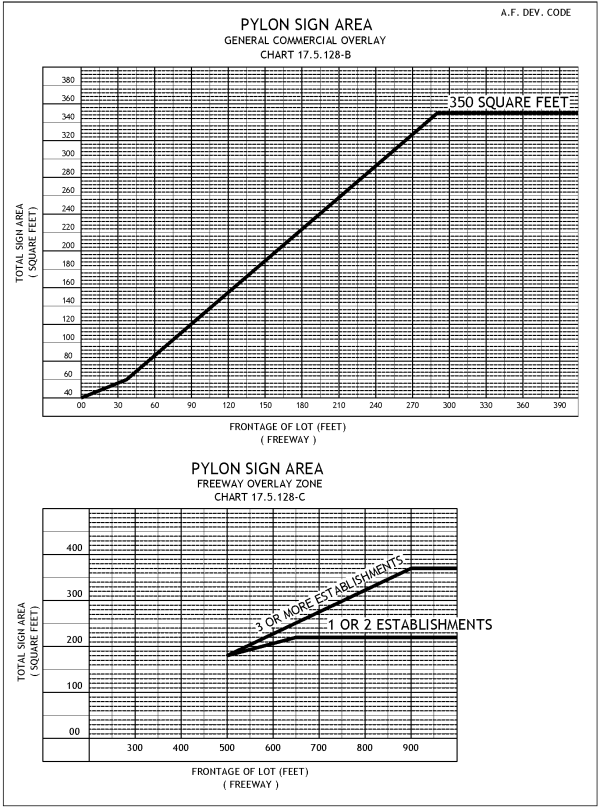
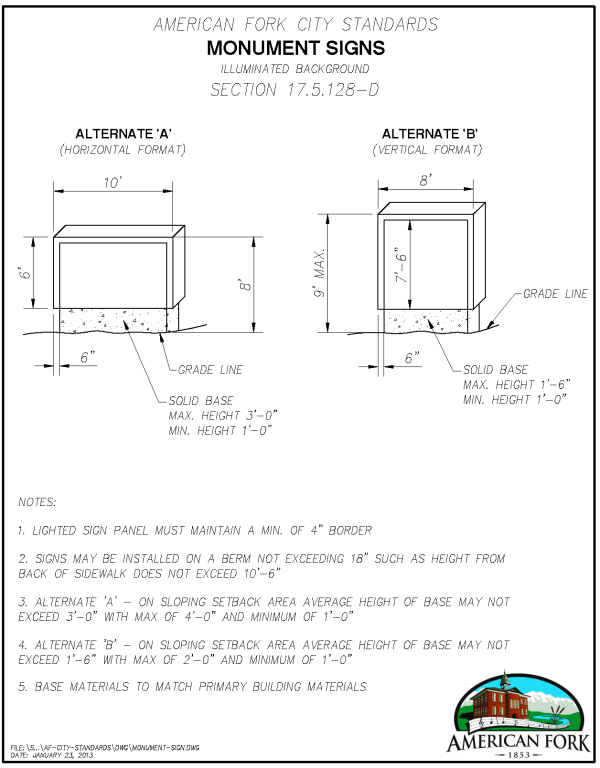 CHART 17.5.128-E Sign Area Versus Measurement Distance *For signs with an area in square feet other than those specifically listed in the table, the measurement distance may be calculated with the following formula:
Area of Sign (sq. ft.) Measurement Distance (ft.) 10 32 15 39 20 45 25 50 30 55 35 59 40 63 45 67 50 71 55 74 60 77 65 81 70 84 75 87 80 89 85 92 90 95 95 97 100 100 110 105 120 110 130 114 140 118 150 122 160 126 170 130 180 134 190 138 200 141 220 148 240 155 260 161 280 167 300 173
Measurement Distance=√Area of Sign Sq. Ft. × 100
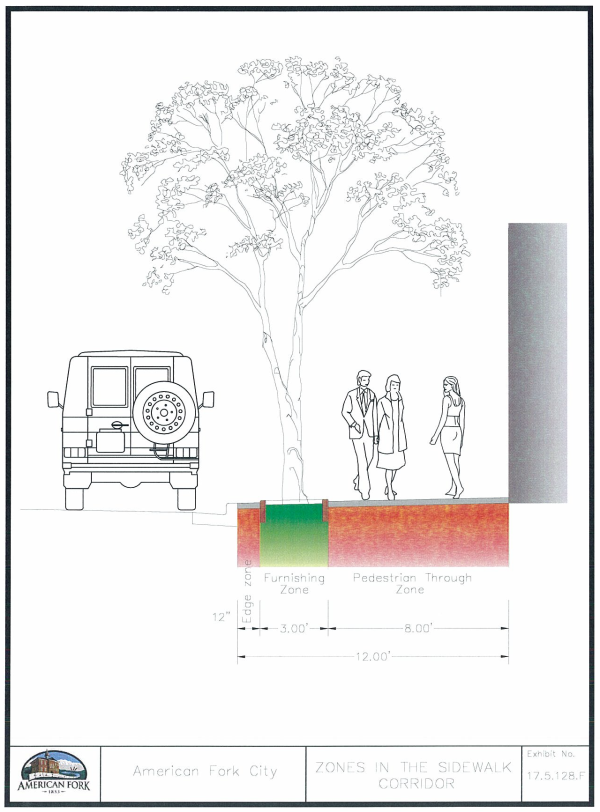 (Ord. No. 03-08-29; Ord. No. 03-10-36; Ord. No. 04-04-13; Ord. No. 09-11-37; Ord. No. 2010-08-18, §§ 1, 2, 8-10-2010; Ord. No. 2013-03-10, pt. I, 3-26-2013; Ord. No. 2013-05-16, §§ 1—5, 5-14-2013; Ord. No. 2013-09-34, §§ 1, 2, 9-24-2013; Ord. No. 2014-06-21, §§ 1—6, 6-10-2014; Ord. No. 2015-08-49, pt. I, § 1, 8-11-2015; Ord. No. 2016-11-56, Pt. I, § 1, 11-22-2016; Ord. No. 2017-07-35, Pt. I, § 1, 7-11-2017)
Amended by Ord. 2020-05-29 on 5/26/2020
Sec 17.5.129 Special Provisions Relating To Dwellings
- Application. The provisions of this sub-section shall be applicable to dwellings located on individual lots, but shall not apply to dwellings located within approved mobile home parks.
- Standards and criteria.
- The dwelling shall meet the requirements of the current edition of the Uniform Building Code as adopted by the city of American Fork or, in the instance of a manufactured housing unit, the current version of the HUD Code.
- In the event that the dwelling has had prior occupancy the dwelling shall meet the requirements of the existing applicable code, and in addition to the provisions of this sub-section shall be approved as a moved building in accordance with the provisions of Section 17.5.125.
- The dwelling shall be approved for permanent connection to all required utilities.
- Each dwelling shall have a code approvable site-built foundation capable of transferring design dead loads and live loads and any other design loads unique to local homes (i.e., wind, seismic or water conditions etc.) that are imposed by or upon the structure into the underlying soil or bedrock without failure, and shall be adequately tied to the foundation. All foundations and all tie-down devices shall be in accordance with the city's adopted building codes, the manufacturer's recommendations, or an approved engineered design.
- The space beneath the structure shall be enclosed at the perimeter with a foundation which meets the requirements of the Uniform Building Code or, in the instance of a manufactured housing unit a concrete or masonry skirting wall. The perimeter foundation or skirting wall shall be continuous, except for the placement of doors, windows or access openings and shall be placed upon footings which are not less than thirty inches below grade, as measured to the bottom of the footing, for frost protection.
- In the instance of a factory built dwelling or moved structure, any tongues, axles, wheels or other devices required for the transportation of a dwelling and not required to retain the structural integrity of the building shall be removed at the time of installation.
- Dwellings shall have a roof surface of wood shakes, asphalt, composition, wood shingles, concrete, fiberglass or slate tiles, or built up gravel materials.
- Where the design provides for a pitched roof, the pitch shall be not less than 2.5:12. There shall be a roof overhang at the eaves and gable ends of not less than six inches, excluding the rain gutters, as measured from the outer surface of the adjacent vertical wall. The roof overhang requirement shall not apply to areas above porches, alcoves, and similar appendages, which together do not exceed twenty percent of the length of the structure.
- Dwellings shall have exterior siding material consisting of wood, hardboard, brick, concrete, stucco, glass, metal or vinyl lap, tile or stone.
- Each dwelling shall be provided with a garage or carport providing not less than one covered parking space for each dwelling unit.
- At each exit door there must be a landing that is a minimum of thirty-six inches by thirty-six inches and constructed to meet the requirements of the building code.
- The planning commission may approve deviations from one or more of the developmental or architectural standards set forth above, upon receipt of an application from the owner and a finding that: (1) the proposed deviation provides compensating features meeting the intent of the standard appealed from and, (2) the appearance of the proposed dwelling, including any proposed deviation, will be compatible and harmonious with existing structures in the vicinity. A determination made by the planning commission may be appealed to the city council.
Sec 17.5.130 Rules For Determining Height Of Buildings
Wherever the terms of this title contain regulations regarding height of building, said height shall be the vertical distance from the "average finished grade elevation" of the structure to the "roof line of the structure." For purposes of compliance with this title:
- "Average finished grade elevation" shall be the proposed finish grade of each corner of the structure fronting upon the adjacent street(s), divided by the number of corners.
- "Roof line of the structure" shall be as follows, as applicable:
- Flat roof. The highest part of a flat roof or top of any adjacent parapet wall, whichever is higher.
- Mansard type roof. The deck line.
- Gable, hip or gambrel roof. The elevation measured at the highest part of the roof ridge line, not including incidental chimneys, antennas, cupola etc.
Sec 17.5.131 Water And Sewer Connection Standards
- Residential uses.
- Culinary water and pressurized irrigation. Each dwelling unit shall be served by the city's culinary water and pressurized irrigation system. Each dwelling unit shall be served by an individual service lateral and meter with the following exceptions:
- In the instance of multi-story multi-unit structures on a single lot, the city, at their sole discretion, may authorize the use of oversize connections and a master meter.
- In the instance of a multi-story multi-unit building where the property boundaries of each unit are confined to the extents of the structures and there are no exterior landscaping areas located within the unit's property boundaries, an individual pressurized irrigation service lateral is not required.
- For multiple-family dwelling structures under separate ownership for each unit, separate service laterals and meters are required for each unit. The city administrator, with the advice and recommendation of the city engineer, may in their sole discretion, reduce the required number of meters and service laterals. A common lateral, or multiple common laterals, and single meter for each lateral (or fewer laterals and meters than the number required for each dwelling unit) may be permitted, and are encouraged, to reduce the number of connections to the main line if the following conditions are met:
- The applicant shall provide adequate documentation and guarantees to assure adequacy of water delivery including adequate water pressure to all services branching from the common lateral.
- The water meter for the common lateral shall be placed within a public right-of-way or within a designated culinary water line easement dedicated to the City per easement requirements found in the Municipal Code.
- Each unit shall have their own service lateral branching from the common lateral that can be shut off individually for each unit.
- The common lateral shall be owned by an HOA.
- It shall be the responsibility of the HOA for payment and maintenance of the common lateral.
- Submittal of a utility liability indemnification document, indemnifying the city against damages that may occur to tenants within the building as a result of a malfunction of the common utility system and agreeing to retro-fit the utility system to provide individual water and sewer laterals to each unit in the event of a malfunction or as required by the City Engineer. This document shall be recorded at the Utah County Recorder’s office in perpetuity for all affected lots.
- In the instance of multi-story multi-unit structures on a single lot, the city, at their sole discretion, may authorize the use of oversize connections and a master meter.
- Sewer. Each dwelling unit shall be served by the city's sewer collection system. Each dwelling unit shall be connected to the sewer collection system by an individual lateral, except that in the instance of multi-story multi-unit structures on a single lot, the city engineer, may in their sole discretion, reduce the required number of service laterals. A common lateral, or multiple common laterals (or fewer laterals than the number required for each dwelling unit) may be permitted, and are encouraged, to reduce the number of connections to the main line if the following conditions are met:
- The common lateral shall be owned by an HOA.
- It shall be the responsibility of the HOA for payment and maintenance of the common lateral.
- Submittal of a utility liability indemnification document, indemnifying the city against damages that may occur to tenants within the building as a result of a malfunction of the common utility system and agreeing to retro-fit the utility system to provide individual water and sewer laterals to each unit in the event of a malfunction or as required by the City Engineer. This document shall be recorded at the Utah County Recorder’s office in perpetuity for all affected lots.
- The common lateral shall be owned by an HOA.
- Culinary water and pressurized irrigation. Each dwelling unit shall be served by the city's culinary water and pressurized irrigation system. Each dwelling unit shall be served by an individual service lateral and meter with the following exceptions:
- Commercial, industrial, mixed uses, and institutional uses. Minimum standards for culinary water, pressurized irrigation and sewer connections for commercial, industrial, mixed uses, and institutional uses are as follows:
- Buildings. At a minimum, each building shall be served by a separate water and sewer connection which is connected directly to city water and sewer laterals having sufficient capacity to accommodate the anticipated demand from the proposed use.
- Lots. Each lot shall be served by an individual service lateral and meter connected to the city's pressurized irrigation system.
- Multi-tenant. Each multi-tenant building shall conform to the following standards, as applicable:
- In the instance of a single-story building where the units in the building are designed to be divided into separate units and intended to be owned by separate owners, each unit shall be served by individual water and sewer service laterals connected directly to a city water and sewer line having sufficient capacity to accommodate the anticipated demand from the proposed use.
- In the instance of a single-story building where all of the units within the building are to remain in single ownership, the city may authorize the use of a single water and/or sewer connection for the entire building subject to: (1) the providing of adequate assurances of continued unified ownership, (2) submittal of a document, acceptable to the city, indemnifying the city against damages that may occur to tenants within the building as a result of a malfunction of the common utility system and agreeing to retro-fit the utility system to provide individual water and sewer laterals to each unit in the event of a sale of any of the units within the building to a separate owner.
- In the instance of a multi-unit building intended to be divided into separately owned units (condominium project), except as otherwise stated herein, each unit utilizing culinary water and/or sewer shall be served by an individual water service lateral and meter which are connected directly to a city water line and each unit shall be served by an individual sewer service lateral which is connected to a city or private sewer line having sufficient capacity to accommodate the anticipated demand from the proposed use.
- The City may permit only a single water line and single sewer service lateral to the entire building upon the following findings by the City Engineer: (1) the building is subject to a valid condominium ownership association, (2) use of water and sewer is limited only to common areas of the building, (3) an indemnification agreement indemnifying the city against damage that may occur to units within the building as a result of a malfunction of the common utility system has been received, and (4) an agreement to retro-fit the utility system to provide individual water and sewer laterals to each unit in the event of dissolution or termination of the condominium ownership association has been received.
- The City may permit only a single water line and single sewer service lateral to the entire building upon the following findings by the City Engineer: (1) the building is subject to a valid condominium ownership association, (2) use of water and sewer is limited only to common areas of the building, (3) an indemnification agreement indemnifying the city against damage that may occur to units within the building as a result of a malfunction of the common utility system has been received, and (4) an agreement to retro-fit the utility system to provide individual water and sewer laterals to each unit in the event of dissolution or termination of the condominium ownership association has been received.
- In the instance of a multi-story, multi-unit, mixed use building where all units within the structure are to remain in single ownership, the city may authorize the use of a single water and/or sewer connection for each land use type within the structure subject to: (1) the providing of adequate assurances of continued unified ownership, (2) submittal of a document, acceptable to the city, indemnifying the city against damages that may occur to tenants within the building as a result of a malfunction of a common utility system and agreeing to retro-fit the utility system to provide individual water and sewer laterals to each unit in the event of a sale of any of the units within the building to a separate owner.
- Buildings. At a minimum, each building shall be served by a separate water and sewer connection which is connected directly to city water and sewer laterals having sufficient capacity to accommodate the anticipated demand from the proposed use.
(Ord. No. 08-05-26)
Amended by Ord. 2020-06-32 on 6/30/2020
Amended by Ord. 2021-08-44 on 8/24/2021
Amended by Ord. 2025-01-01 on 1/14/2025
Sec 17.5.132 Sexually Oriented Businesses
- Definitions. For the purposes of this chapter, the following words shall have the following meanings: Sexually oriented business. Seminude entertainment businesses, sexually oriented outcall services, adult businesses and seminude dancing agencies, as defined by Municipal Ordinance No. 07-08-41.
- Permitted zones.
- It is unlawful for any sexually oriented business to do business at any location within the city not zoned for such business.
- Sexually oriented businesses shall only be permitted in areas zoned:
- I-1 Industrial Zone.
- Restrictions.
- Sexually oriented businesses shall not be located within one mile (five thousand two hundred eighty feet) of the same type of business inside or outside the American Fork City geographical boundaries. This distance shall be measured from the exterior walls of the buildings.
- Sexually oriented businesses shall be limited to one business per twelve thousand in population, to include all residents in American Fork City within the city's geographic boundaries. The total population figures shall be based on the U.S. Census Bureau's annual estimates.
- Sexually oriented businesses shall not be located within one thousand feet of any school, church, or public park.
- Design requirements.
- The color of the building shall be restricted to earth tones or shall match the design theme of the surrounding buildings in keeping with the aesthetic qualities of the area.
- The use of bars, chains or similar security devices that are visible from a public street or sidewalk shall be prohibited.
- The use of neon lighting shall be prohibited on the building exterior, exclusive of building signage.
- Compliance with existing laws.
- The sexually oriented business shall conform to all applicable building, safety and health codes and requirements.
- Sexually oriented businesses shall comply with all applicable city codes and ordinances, state and federal laws.
- Violation.
- A violation of any provision in this chapter shall be subject to prosecution as a Class B misdemeanor, for each separate violation, with the corresponding statutory fines and penalties pursuant to Utah State Law.
(Ord. No. 2009-03-13, § 1, 3-10-2009; Ord. No. 2014-08-30, § 1, 8-26-2014)
Sec 17.5.133 Off-Street Parking Standards
- Title. This section shall be entitled the Off-Street Parking Standards Ordinance of American Fork, Utah.
- Application of standards. Wherever the terms of the American Fork Development Code or other ordinance of the city require that off-street parking facilities be required in conjunction with a specific use or development project, the minimum number of spaces to be provided, the location of off-street parking facilities, vehicular access to and circulation within the parking area, the layout and design, and the landscape treatment of the areas designated for off-street parking shall conform to the terms of this section.
- Number of required parking spaces. The minimum number of off-street parking spaces required for a specific use shall be as set forth on the following schedule:
- Residential uses.
- One-family dwelling: Two spaces per dwelling unit. All spaces shall be located on the same parcel as the dwelling. No portion of a front or side setback area adjacent to a street, including any portion thereof used as a driveway, shall be construed as part of the required off-street parking area.
- Multiple family dwelling: Two spaces per dwelling unit, plus 0.25 spaces per dwelling unit for visitor parking. Visitor parking shall be evenly distributed throughout the project.
- Long-term patient care facilities (assisted living centers, rest homes nursing homes): One space for each employee during the maximum care period, plus one space for each four patient rooms for visitors.
- Retail/service commercial uses.
- General retail: Four and one-half spaces per one thousand square feet of gross floor area.
- Personal care service: Two spaces per treatment station, but not less than four spaces per one thousand square feet of gross floor area.
- Grocery: Five spaces per one thousand square feet of gross floor area.
- Retail shopping center projects (centers containing no cinema and not more than five percent dining space): Four and one-half spaces per one thousand square feet of gross floor area.
- Discount superstores: Five and one-half spaces per one thousand square feet of gross floor area. Areas intended for outside display and sales (garden areas) shall not be included in calculating compliance with the parking standard.
- Home improvement centers: Four and one-half spaces per one thousand square feet of gross floor area, not including areas for outside display and sales (garden areas). Areas intended for outside display and sales (garden areas) shall not be included in calculating compliance with the parking standard.
- Motor vehicle sales and service: The sum of the following:
- Three spaces per one thousand square feet of gross floor area used for display, sales and administration.
- One and one-half spaces per one thousand square feet of area used for warehouse of parts and materials.
- Four spaces per service bay.
- Car wash: Two spaces, plus one and one-half additional space for each two employees on highest shift.
- Retail and service commercial/warehouse: Four and one-half spaces per one thousand square feet for portion used for retail purposes, plus one space per one thousand square feet for the total floor area.
- Multi-tenant/strip commercial buildings: For any proposed multi-tenant/strip commercial building wherein the occupancy is unknown at the time of request for approval, parking requirements shall be calculated as follows:
- One-half of the gross floor area of the building at the rate of four and one-half spaces per one thousand square feet (general retail standard)
- One-half of the gross floor area of the building at the rate of twelve spaces per one thousand square feet of dining floor area (fast food restaurant standard).
In addition, the city may require a written agreement with the city to the effect that the amount of floor area devoted to restaurant use will not exceed the amount identified on the approved plan.
- Office and business uses.
- General business office—Fixed wall construction: Four spaces per one thousand square feet of gross floor area excluding portion devoted to stairs and elevator and open atrium spaces above the ground floor.
- Business office—Open wall/telemarketing and customer support center: The sum of the following:
- For portion of building having fixed-wall construction, four spaces per one thousand square feet of gross floor area excluding portion devoted to stairs and elevator and open atrium spaces above the ground floor.
- For open-wall portion of building, six spaces per one thousand square feet of open-wall area.
- Medical office: Four and one-half spaces per one thousand square feet of gross floor area.
- Medical clinics: Five spaces per one thousand square feet of gross floor area.
- Bank with drive-in: Five spaces per one thousand square feet of gross floor area.
- Office/warehouse: Four spaces per one thousand square feet used for office purpose, plus one space per one thousand square feet used for warehouse purpose, up to eighty percent of the total floor area.
- Light manufacturing: Five spaces per one thousand square feet used for office purpose, plus one space per work station or one space for each employee during the greatest shift, which ever is greater.
- Food and beverage uses.
- Restaurant (sit-down): Whichever of the following is greater:
- Twenty spaces per one thousand square feet of dining floor area; or
- One space for each three seats, plus one space per employee during the largest shift.
- Fast-food with sit-down and take-out: Twelve spaces per one thousand square feet of dining floor area. Where take-out window is included, the outside order and stacking lane shall provide an automobile stacking lane for not less than ten vehicles.
- Restaurant (sit-down): Whichever of the following is greater:
- Public assembly uses.
- Churches (single session occupancy): One parking space for each three seats or seating spaces within the portion of the building used for assembly. In the instance where seating is by pews or benches, eighteen inches of bench length shall be considered as one seat.
- Churches (overlapping session occupancy): Two times the number of spaces for single session occupancy.
- Cinemas: One parking space for each three seats.
- Elementary schools (students below minimum driver age):
- Parking. The sum of the following: One parking space for each teaching station, plus one space for each administrative and support employee, plus one space for each ten students.
- Student drop-off and pick-up. In addition to the off-street parking area, the layout of the school site shall include an area and facilities sufficient to accommodate anticipated student drop-off and pick-up by school bus and private vehicle.
- Secondary schools (students above minimum driver age): The sum of the following: One parking space for each teaching station, plus one space for each administrative and support employee, plus one space for each three and one-half students.
- Uses not specifically listed. For uses not identified in the above schedule, the number of off-street parking spaces shall be determined by the planning commission. The determination shall be based upon the requirements for the most comparable use listed, and/or that certain table entitled recommended parking ratio requirements set forth under part 3 p. 246 of that certain book entitled Planning and Urban Design Standards, 2006 Edition, which is set out below, and/or upon an independent determination of parking demands for such uses in comparable locations, all at the discretion of the planning commission.
RECOMMENDED PARKING RATIO REQUIREMENTS*Use Parking Spaces Required Comments Residential Sleeping rooms 1 per unit or room plus 2 for owner/manager Commercial lodgings 1.25 per guest room, plus 10 per ksf restaurant lounge, plus 30 per ksf meeting/banquet room (<50 ksf per guest room) or 20 per ksf meeting/banquet room (>50 ksf per guest room) Peak spaces for each component shown; use shared parking analysis to determine appropriate parking ratio for particular hotel 3 Elderly housing, independent living 0.6 per dwelling unit 1 Elderly housing, assisted living 0.4 per dwelling unit 1 Group, convalescent, and nursing homes 1 per room 1 Day care center 0.35 per person (licensed capacity) 1 Hospital/medical center 0.4 per employee, plus 1 per 3 beds, plus 1 per 5 average daily outpatient treatments, plus 1 per 4 medical staff, plus 1 per student/faculty/staff Retail/Service General retail (not in shopping center) 3.5 per ksf GFA** Grocery (freestanding) 6.0 per ksf GFA 1 Discount superstores/clubs (freestanding) 6.0 per ksf GFA 1 Home improvement superstores 5.0 per ksf GFA 1 Other heavy/hard goods (furniture, appliances, building materials, etc.) 3.0 per ksf GFA 1 Shopping centers 4.0 per ksf GLA up to 400 ksf, 4.0 to 4.5 per ksf GFA sliding scale between 400 and 600 ksf; 4.5 per ksf GLA over 600 ksf With up to 10 percent GLA in dining/entertaining; over 10 percent use shared parking analysis 2 Personal care services 2 per treatment station but not less than 4.3 per ksf Coin-operated laundries 1 per 2 washing and drying machines Motor vehicle sales and service 2.7 per ksf GFA interior sales area, plus 1.5 ksf GFA interior or storage/display area, plus 2 per service bay Motor vehicle laundries 2, plus 1 per each 2 peak shift employees Food and Beverage Fine dining 21.5 per ksf GFA 3 Casual restaurant (with bar) 22.5 per ksf GFA 3 Family restaurant (without bar) 16.0 per ksf GFA 3 Fast food 15.0 per ksf GFA 3 Office and Business Services (3) General business offices suburban/low-rise 3.6 per ksf GFA <250 ksf, 3.35 per ksf GLA >250 ksf 1 Office downtown/mid-high-rise business center 3.0 per ksf GLA 1 Consumer service offices (freestanding) 4 per ksf GLA 1 Data processing/telemarketing/operations 6.0 per ksf GFA 1 Medical offices (multitenant) 4.5 per ksf GFA 1 Clinic (medical offices with outpatient treatment; no overnight stays) 5.5 per ksf GFA 1 Bank branch with drive-in 5.5 per ksf GFA 1 Bank headquarters (with admin offices, etc.) 4.4 per ksf GFA 1 Industrial/storage/wholesale utility 2 per ksf GFA Add spaces as required for office, sales, or similar use when more than 10 percent GFA Manufacturing/light industrial (single use) 1.5 per ksf Industrial park (multitenant or mix of service, warehouse) 2.0 per ksf 1 Warehouse 0.7 per ksf GFA Mini-warehouse 0.25 per ksf GFA 1 Governmental As determined by zoning administrator Educational Elementary and secondary schools 0.35 per student 1 College or university Determined by parking study specific to subject institution Cultural/Recreational/Entertainment Public assembly 0.25 per person in permitted capacity Museum 1.5 per 1,000 annual visitors 1 Library 4.5 per ksf GFA 1 Religious centers 0.6 per seat 1 Cinemas Single-screen: 0.5 per seat; Up to 5 screens: 0.33 per seat 50 to 10 screens: 0.3 per seat Over 10 screens: 0.27 per seat 3 Theaters (live performance) 0.4 per seat 3 Arenas and stadiums 0.33 per seat 3 Health clubs and recreational facilities 2 per player or 1 per 3 persons permitted capacity 3
Source: Adopted from Transportation Planning Handbook, 2nd ed. Washington DC: Institute of Transportation Engineers, 1999, unless otherwise noted. * All parking recommendations presented here should be considered in the context of local conditions, parking requirements, and other factors that may affect the actual number of parking spaces needed.
1 Adopted from Parking Generation, 3rd ed. Washington DC: Institute of Transportation Engineers, 2004. 2 Adopted from Parking Requirements for Shopping Centers, 2nd ed. Washington DC: ULI-The Urban Land Institute and International Council of Shopping Centers, 1999. 3 Adopted from Shared Parking, 2nd ed. Washington DC: ULI-The Urban Land Institute and International Council of Shopping Centers, 2004.
- Residential uses.
- Adjustments permitted.
- The planning commission may recommend to the city council an increase or decrease to the number of off-street parking spaces herein specified upon a finding, made following a study on the matter, that the use characteristics of the proposed use warrant adjustment. Provided, however, no reduction in the parking requirement shall be permitted based on the projected demand of the initial occupant of a new retail, office or similar use for which a subsequent change in tenancy to another user is probable.
- After receiving a recommendation (positive or negative) from planning commission regarding the number of off-street parking spaces, the city council shall have the authority to increase or decrease the number of off-street parking spaces herein specified upon a finding, made following a study on the matter, that the use characteristics of the proposed use warrant adjustment. Provided, however, no reduction in the parking requirement shall be permitted based on the projected demand of the initial occupant of a new retail, office or similar use for which a subsequent change in tenancy to another user is probable.
- Exception to standard in downtown area. Notwithstanding the provisions of subsection C of this section, on street parking along the frontage of the project lot may be used to meet the required minimum number of off-street parking spaces required for a specific use within the "Downtown" area of the city, as shown in the figure below, subject to the following:
- The proposed project is located wholly within the designated downtown area as set forth on the following map.
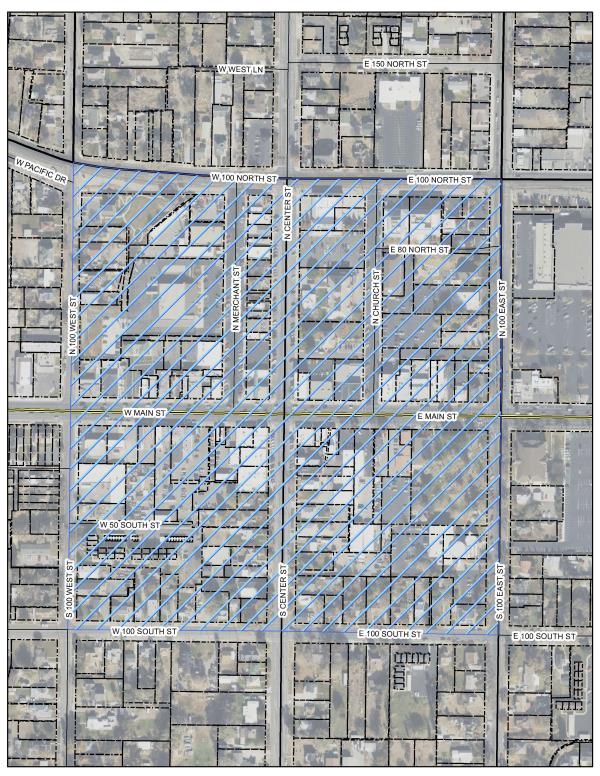
- The proposed reconstruction or expansion will not reduce the number of off-street parking spaces along the frontage of the project lot, unless approved by the Development Services Director.
- The project shall install and/or replace all existing curb, gutter, & sidewalk along the frontage of the project lot in compliance with current city code.
- The project shall install and/or replace all parking islands and driveway approaches in compliance with current city code.
- The proposed project is located wholly within the designated downtown area as set forth on the following map.
- Exception to off-street parking standard in the CC-1 Zone, excluding the Downtown Area. Notwithstanding the provisions of subsections C and E of this section, additional off-street parking spaces will be required as a condition of approval for any new construction, reconstruction of an existing building, or incidental expansion of any building in the CC-1 zone subject to either one of the following criteria:
- Residential uses: Either of the following off-street parking calculations may be requested by the applicant and may be approved by the city council.
- Two spaces per dwelling unit, plus 0.25 spaces per dwelling unit for visitor parking. Visitor parking shall be evenly distributed throughout the project. However, if any of the conditions found in Table A of this subsection apply, the City Council may, after review and recommendation (positive or negative) from the Planning Commission, decrease the required number of off-street parking spaces as shown. The visitor parking requirement shall not be affected by this reduction and remains at 0.25 spaces per dwelling unit. Under no circumstance shall the per-unit parking requirement drop below 1.75 spaces per dwelling unit, accept as referenced in 17.5.133(D).
Table A
Condition Parking Reduction Per Dwelling Unit Bike Room1 0.05 Grocery Store2 0.10 Off-Site Parking3 0.15 Transit4 0.15 Public5 Agency/HUD Up to 0.15 Definitions: 1 - Bike Room: A secured bike room of sufficient size to accommodate a minimum of one bicycle per dwelling unit shall be located within the structure. In the event of a multi-structure project each building shall have a secured bike room of sufficient size to accommodate a minimum of one bicycle per dwelling unit in the building. The applicant can opt to either (1) show how the required number of bicycles is accommodated in the room or (2) provide a minimum of 40 square feet per bicycle in the room. 2 – Grocery Store: The location of the grocery store shall be less than 1320 feet walking distance from the main entrance of the most distant dwelling unit in the project. 3 – Off-Site Parking: Additional public or shared parking shall be located less than 1320 feet walking distance from the main entrance of the most distant dwelling unit in the project. Parking equivalent to the 0.15 space per dwelling unit reduction shall be secured via agreement with the property owner and recorded. A parking study shall accommodate the agreement so that it can be ensured that the parking facility will not be overallocated. 4 – Transit: The stop location of the high-capacity transit line (light rail, “Trax”, heavy rail, “FrontRunner”, streetcar, high-capacity Bus Rapid Transit, “BRT”) shall be less than 1320 feet walking distance from the main entrance of the most distant dwelling unit in the project. 5- Public Agency/HUD: Projects that are owned and operated by a public agency or have received a subsidy by HUD or other public agency may be eligible for a reduction of up to 0.15 stalls per unit upon a study that a reduction is warranted. - Parking shall be required per unit size as depicted in Table B of this subsection, plus 0.25 spaces per dwelling unit for visitor parking. Visitor parking shall be evenly distributed throughout the project. The visitor parking requirement shall not be affected by this reduction and remains at 0.25 spaces per dwelling unit. Under no circumstance shall the per-unit parking requirement including visitor parking drop below 1.75 spaces per dwelling unit, accept as referenced in 17.5.133(D).
Table B
Unit Size Parking Requirement Per Unit (Add 0.25 for visitor parking per unit to derive the aggregated requirement.) 0-350 square feet 1.50 351-600 square feet 1.75 Above 600 square feet 2.00
- Two spaces per dwelling unit, plus 0.25 spaces per dwelling unit for visitor parking. Visitor parking shall be evenly distributed throughout the project. However, if any of the conditions found in Table A of this subsection apply, the City Council may, after review and recommendation (positive or negative) from the Planning Commission, decrease the required number of off-street parking spaces as shown. The visitor parking requirement shall not be affected by this reduction and remains at 0.25 spaces per dwelling unit. Under no circumstance shall the per-unit parking requirement drop below 1.75 spaces per dwelling unit, accept as referenced in 17.5.133(D).
Table A
- Residential uses: Either of the following off-street parking calculations may be requested by the applicant and may be approved by the city council.
- Location of off-street parking areas. All off-street parking areas shall be located on the same parcel as the use intended to served thereby, except that for uses other than dwellings, the planning commission may approve the placement of some of the required parking spaces on adjacent lands, upon a finding that:
- The use is part of a combined parking facility as authorized under subsection I.1 of this section, and
- The location of the proposed off-site spaces are reasonable and conveniently accessible to the use they are intended to serve.
- Parking space and driveway dimension requirements and parking lot layout requirements. All parking spaces, access driveway and the layout of parking lot areas shall conform to the typical design standards, set forth below.
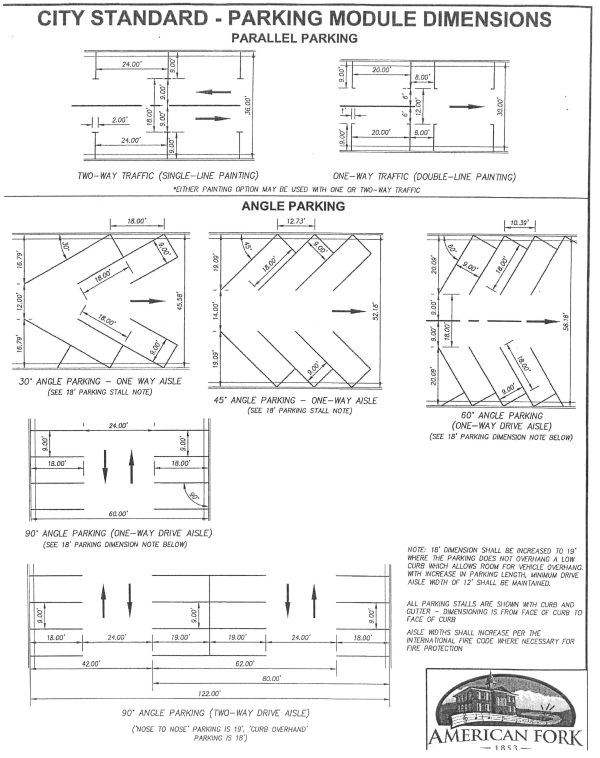
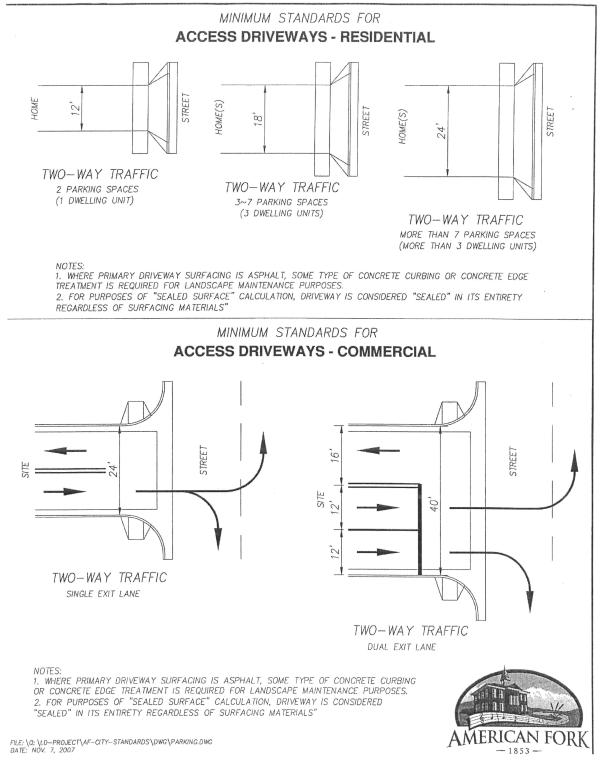
- Parking areas to be located in the same zone district as primary use. Off-street parking and loading space which is required in connection with a particular use shall constitute a portion of the use and shall not be permitted to extend into an adjacent zone district unless specifically permitted within the adjacent zone district.
- Combined parking areas and shared parking arrangements authorized—Conditions.
- Combined parking authorized. The off-street parking for a project containing two or more adjacent buildings or uses may be combined, provided that the total number of spaces shall be not less than the sum of the requirements for each of the individual uses and that the area devoted to off-street parking area is part of the common amenities of the project and/or the right of use and access to the combined parking area by all uses within the project is assured through reciprocal cross-easements and agreements and/or other legal documents which prohibit the reservation of a portion of the off-street parking area to a specific owner or tenant and which establish responsibility for maintenance thereof.
- Shared parking arrangements authorized. The off-street parking for a development project containing a variety of uses having different parking demand characteristics and time-of-day demand may be combined, subject to the following:
- The total number of spaces shall be sufficient to meet the maximum time-of-day requirement for the project (as determined by the city).
- The area devoted to off-street parking shall be part of the common amenities of the project and/or the right of use and access to the combined parking area by all uses within the project is assured through reciprocal cross-easements and agreements and/or other legal documents which prohibit the reservation of a portion of the off-street parking area by a specific owner or tenant and which establish responsibility for maintenance thereof.
- The location and design of the parking areas within the project area shall provide an adequate number of spaces in the proximity of the use intended to be served.
- Parking area to have hard surface. All off-street parking stalls, loading spaces, maneuvering areas, and driving aisles shall be paved with asphalt, concrete, paving stone, or masonry to a sufficient thickness to withstand repeated vehicular traffic, or based on a geotechnical evaluation by a licensed geotechnical engineer. Where this requirement may conflict with any other parking requirement, the more stringent shall prevail.
(Ord. No. 2015-10-67, pts. I (§§ 1—3), II, 10-27-2015)
Amended by Ord. 2020-07-35 on 7/14/2020
Amended by Ord. 2021-12-61 on 12/14/2021
Amended by Ord. 2022-04-18 on 4/26/2022
Amended by Ord. 2025-08-25 on 8/12/2025
Sec 17.5.134 Accessory Apartments
Accessory apartments are permitted within the city subject to compliance with the conditions and criteria hereinafter set forth.
- Intent. The intent of this section is to recognize the residential character of American Fork City, while providing for supplementary living accommodations in the community. These provisions are intended to provide additional opportunities for affordable housing, with limitations, to minimize the impact on neighboring properties and neighborhoods.
- Conditions and criteria.
- A maximum of one accessory apartment may be allowed in a single-family home within all single-family residential zones. Accessory apartments shall not be calculated as additional density. No accessory apartment may be allowed in any multi-family dwelling unit, or on any lot or parcel that cannot satisfy the parking requirements.
- Owner occupied. No accessory apartment shall be created or occupied in a single-family home unless the owner of the property occupies either the main dwelling or the accessory apartment. For the purpose of this section, the term "owner occupied" shall be defined as full time residency within the home by the bona fide property owner(s) as shown on the Utah County tax assessment rolls.
- Occupancy. The occupants of an accessory apartment shall be limited by one of the following family categories:
- One person living alone; or
- Two or more persons related by blood, marriage, or adoption, and not more than two unrelated persons; or
- Up to four unrelated individuals.
- Parking. Two off-street parking spaces, in addition to the two spaces required for a single-family home, are required for an accessory apartment. No parking spaces may be located within a front or side yard; except within an approved driveway. Tandem parking within a driveway is allowed to meet the parking requirement.
- Utility meters. A single family home with an accessory apartment may have separate meters for each water, gas, and electricity utility service. Each utility meter shall be in the property owner's name and the property owner shall be responsible for payment of all utilities.
- Address. The principal dwelling unit and the accessory apartment shall have the same address number, but shall refer to the principal dwelling as unit "A and the accessory apartment as unit "B". Address must be located in a visible location on the street frontage side of the home.
- Appearance. The outside appearance of a single family home with an accessory apartment shall not be changed from that of a single family home.
- Entrances. An accessory apartment shall have a dedicated entrance located on any side or rear of the single family home or at the front of the home if it is below grade and maintains the characteristics of a single family home.
- Separate living areas. An accessory apartment must provide living areas for eating, sleeping and sanitation facilities separate from the principal dwelling unit.
- Interior access. An interior access between the main living area and an accessory apartment must be maintained.
- Building code. All construction and remodeling shall comply with building codes and ordinance requirements in effect at the time of construction or remodeling, in accordance with Utah State Code Section 10-9a-511.5, Changes to dwellings - Egress windows.
- Not intended for sale. The accessory apartment shall not be intended for sale or detached by deed and shall only be rented.
(Ord. No. 2016-06-31, pt. I, § 1, 6-14-2016)
Editor's note—Ord. No. 2016-06-31, pt. I, § 1, adopted June 14, 2016, set out provisions intended for use as § 17.5.132. Inasmuch as there were already provisions so designated, said provisions have been included herein as § 17.5.134 at the discretion of the editor.
Amended by Ord. 2019-05-29 on 5/28/2019
Sec 17.5.135 Installation Of Communication Infrastructure Design Standards
The publication known as the American Fork City Developer Installed Communications Infrastructure Design Standards, adopted October 25, 2022, and as amended by motion of the city council, one copy of which is filed in the office of the city recorder, is adopted by reference, in its entirety, as presently constituted and shall be known as Section 17.5.135 of the American Fork Municipal Code.
Adopted by Ord. 2022-10-52 on 10/25/2022

