
American Fork City Zoning Code
CHAPTER 17
6 ADMINISTRATIVE SITE PLAN AND CONDITIONAL USE REVIEW CRITERIA
Sec 17.6.101 Administrative Site Plan Review
- When Required. Site plans shall be required for any proposed development, construction upon, revision or addition to or other improvement to a property or site in a nonresidential zone, a nonresidential use in a residential zone, or to obtain a conditional use permit in any zone. Additionally, a site plan shall be required whenever the terms of the American Fork Municipal Code otherwise require. No development, construction, revision, or additions shall take place on the site until the site plan has been approved by the City, final plats if required have been recorded, the necessary bonds have been posted, and the appropriate permits have been obtained. All applicable development, construction, revisions, or additions shall take place in compliance with an approved site plan for that specific property.
No proposed development, construction, revision or additions, or other improvements to a property or site shall be placed over property lines. Any proposal that does so, shall seek a final plat, or an amended final plat approval prior to a site plan approval. - Submittal. Site plan applications shall be submitted to the Development Services Department on the forms provided by the City and shall be accompanied by maps and drawings, to scale, showing the following, unless otherwise required by City Engineer or Development Services Director:
- ALTA Survey (identify Geodetic Datum used)
- Civil Engineering Design Plan Set using NAVD 88 vertical datum and including the following:
- Cover sheet, General Notes, Site Plan, Grading and Drainage Plan, Utility Plan showing all existing and proposed wet and dry utilities (including street lights), Plan and Profile sheet for all proposed public utilities, Erosion Control Plan, American Fork Standard Details.
- Application Fees
- Drainage Report identifying drainage sub-basins
- Phasing Plan
- Timpanogos Special Service District Form
- Title Report (Dated within 60 days of date of application)
- Zoning Clearance Letter
- The location of all existing and proposed buildings and structures on the site with full dimensions showing the distance between buildings and distances from buildings to adjacent property lines.
- The location of all parking spaces, driveways, and points of vehicular ingress and egress.
- A landscaping plan showing the location, types, percentages, and initial sizes of all planting materials to be used together with the location of fences, walls, hedges, and decorative materials.
- Preliminary elevations of main buildings showing the general appearance and types of external materials to be used and including dimension height.
- The locations of solid waste receptacles and trash pick-up areas. Include preliminary elevations of solid waste receptacles showing the general appearance, types of external materials to be used, and dimensions.
- Geotechnical Report (require each phase being planned to have test pits identified within the specific phases that will be brought forward). Geotechnical Report must be dated within 3 years of date of application, or a new Geotechnical Report is required. Geotechnical report shall include percolation rates, identify liquefaction hazards, wetlands, groundwater elevations and information required to confirm the existence or non-existence of sensitive lands as identified in the Sensitive Lands Ordinance. Boring depths up to 70’ deep may be required as per the Sensitive Lands Ordinance.
- A traffic study prepared by an independent, professional traffic engineer if a site plan proposes any of the following: i) seventy-five (75) or more parking stalls; ii) a drive-up window; iii) more than two drive approaches from dedicated streets; iv) a corner lot where one or more of the streets is a collector or arterial street; or as required based on requirements set forth in the Traffic Impact Study requirements
- The final approving authority may impose traffic mitigation requirements based on the impacts identified by a traffic study prepared by the applicant, the City or any qualified independent traffic consultant. Nothing in this Section shall preclude the City from performing its own traffic study.
- The Development Services Director, after consultation with the Public Works Director, may waive the requirements of a traffic study if a new traffic study would be unnecessarily cumulative or otherwise not add to the information already available to the Development Services Director.
Upon determination of a complete submittal, the site plan application shall be provided to the Development Review Committee for review.
- Determination of Required Documents.
- Required Documents. Required submittal documents as outlined in Section 17.6.101.B shall be determined by the Development Services Director and Public Works Director after the mandatory Concept Plan Meeting is held.
- Upon determination of a complete submittall, the application shall be provided to the Development Review Committee for full review and determination of the appropriate approval process as outlined in Subsection D.
- Required Documents. Required submittal documents as outlined in Section 17.6.101.B shall be determined by the Development Services Director and Public Works Director after the mandatory Concept Plan Meeting is held.
- Approval. After full review of the site plan application, the DRC shall take action to (1) administratively approve the site plan application, or (2) move the proposed site plan to the final approval authority, as applicable. DRC shall only administratively approve or move forward a proposed site plan if it complies fully with the American Fork General Plan and the American Fork City Code, City ordinances, resolutions, and policies.
- DRC Administrative Approval. A concept plan meeting shall be scheduled through the Development Services Department to determine if proposed modifications to a site qualify for an a amended administrative site plan approval process. The Development Review Committee may exercise administrative approval authority for amendments to existing site plans, or for site or structure alterations to existing buildings and sites that do not have a site plan under the following conditions:
- The proposed amendments to the existing site plan are minor in nature and enhance the overall site, as determined by the DRC. Minor amendments include, but are not limited to, the following:
- Increasing the amount of parking;
- Restriping the parking areas;
- Reducing building size;
- Change of use in an existing building;
- Building additions, including new structures, where the proposed additions do not exceed 10% of the original approved site plan approved by Planning Commission;
- Relocating on site utility services;
- Installing new utility services;
- Minor modifications to on-site grading;
- Altering the exterior site lighting;
- Increasing the amount of landscaping;
- Modifying existing landscaping to water efficient standards;
- Altering or relocating covered parking stalls;
- Changing the exterior finishing materials from one acceptable material to another; and
- Additions to an existing building that do not increase the Gross Floor Area of the building such as awnings, canopies, decks, patios, and architectural features designed solely to enhance the aesthetic appeal of the building provided that the value of the proposed addition does not exceed five percent (5%) of the replacement value of the building.
- Increase in internal floor area by introducing additional floors lofts, mezzanines, etc. in an existing structure or shell.
- Cell tower upgrades
- As determined by the Development Services Director, in consultation with the Public Works Director to be a minor enough amendment as to not constitute a full site plan review.
- The proposed amendments to the existing site plan are minor in nature and enhance the overall site, as determined by the DRC. Minor amendments include, but are not limited to, the following:
- Planning Commission to Approve. Except as otherwise specified in this subsection C.1, the Planning Commission, acting in an administrative capacity, shall be the final approval authority for all proposed site plans forwarded by the Development Review Committee and shall have the power to approve, approve with conditions if granted the authority by City ordinance, or deny a proposed site plan.
- DRC Administrative Approval. A concept plan meeting shall be scheduled through the Development Services Department to determine if proposed modifications to a site qualify for an a amended administrative site plan approval process. The Development Review Committee may exercise administrative approval authority for amendments to existing site plans, or for site or structure alterations to existing buildings and sites that do not have a site plan under the following conditions:
- Considerations. The recommending authority and approval authority for the site plan shall consider all of the following items when reviewing a proposed site plan:
- Whether the proposed site plan complies with the American Fork City General Plan, the American Fork City Code, ordinances, resolutions, and policies.
- Whether the proposed site plan promotes the health, safety and welfare of the community. In making this determination, the recommending authority and the final approving authority for the site plan, shall consider, among other things, the overall safety of the site, the impact the site will have on traffic and on surrounding properties, and the adequacy of police, fire, and utility services that can be provided to the site.
- Appeals permitted. Any person aggrieved by a determination of the Development Review Committee or the Planning Commission may request a hearing before the city council who shall have the authority to reverse, affirm or modify any decision of the underlying approval authority. Any such appeal shall be filed within ten days of the decision being appealed.
- Issuance of a permit. A building permit shall not be issued for any building or structure or external alterations thereto until the provisions of this section have been complied with. Any construction not in conformance with an approved site plan shall be considered a violation of this code. Any building permit issued shall ensure that development is undertaken and completed in conformity with the plans as approved.
- Expiration of Site Plan Approval.
- An application for site plan approval shall expire if the application has not been approved or scheduled for review and approval by the approving authority within twelve (12) months after the date it was submitted.
- A site plan approval issued pursuant to this section shall expire and have no further force or effect if the building, activity, construction, or occupancy authorized by the approval is not commenced within twelve (12) months of the date of the approval. The approval authority that granted the original site plan approval may, at its discretion and upon written request submitted prior to the expiration date, grant an extension of up to six (6) months of the site plan approval.
Adopted by Ord. 2023-03-11 on 3/14/2023
Repealed & Replaced by Ord. 2025-07-23 on 7/8/2025
Amended by Ord. 2025-10-29 on 10/14/2025
Sec 17.6.102 Utility Buildings And Structures In Residential Zones To Be Approved By City - Exceptions And Conditions
- Utility buildings and structures not otherwise specifically regulated by this code, including but not limited to, electric substation and transformer facilities, gas pressure regulating stations, and telephone switching terminal stations, may be constructed in residential zones, subject to a finding by the city that the facility is reasonably necessary in the location proposed, and subject to approval by the planning commission in accordance with the terms of Section 17.6.101.
- Provided, that no such approval shall be required in the instance of electric transmission lines having a capacity of less than forty-five KV; when the line or facility is placed entirely underground, i.e., a pipe line; or in the instance of switching terminals, service pedestals and similar systems having an aboveground structure with a maximum profile of less than four square feet.
- The planning commission may attach conditions to such approval which it believes are or may be reasonably necessary to protect surrounding property values and residential amenities.
Sec 17.6.103 Recreation Vehicle Courts
Recreation vehicle courts may be constructed upon approval of a site plan by the planning commission and subject to the following terms and conditions:
- Recreation vehicle courts are listed as a permitted use in the zone.
- The recreation vehicle court shall contain a total area of not less than two acres.
- A plan showing the design of any proposed recreation vehicle court or any significant amendment to an existing recreation vehicle court shall have been submitted to and approved by the planning commission. The layout of court and conditions of operation shall be in accordance with the following standards:
- Type of occupancy. A recreation vehicle court may provide one or a combination of the following occupancy types: (1) tent camper facilities, (2) overnight or short term occupancy areas (less than thirty days), (3) longer term occupancy areas. Provided, that not more than sixty percent of the total court area shall be developed or used for longer term occupancy. The areas provided for each occupancy type shall be clearly defined on the plan and each area shall conform to the applicable design and operational requirements for each type. Short term occupants may be placed in areas designated for longer term. However, long term occupancy of areas designated as short term shall not be permitted.
- Standards and criteria—General.
- All open areas except driveways, parking areas, and utility areas shall be landscaped in accordance with a detailed landscape plan to be approved concurrently with the approval of the site plan.
- The perimeter of the court, except for designated driveways and ingress and egress routes, shall be enclosed with a fence or wall at least six feet in height. Provided that in the instance of court boundaries which front upon a public street, the city may waive the requirement or reduce the required height of the fence or wall adjacent to the street where: (1) all recreation vehicle sites are to be set back not less than twenty feet from the street lot line, (2) the street setback area shall be landscaped and (3) the design of the court is such as to discourage direct access to the individual sites from the street and on-street parking of patrons or visitors of the park. Fences on individual sites shall not be permitted. Provided that the city may approve fences separating different occupancy type areas.
- Streets within the court shall be designed to provide safe and convenient traffic circulation and movement of recreation vehicles. Streets shall be not less than twenty-five feet wide and shall be hard-surfaced (asphalt or concrete). Parking shall not be allowed on court streets.
- Central recreation areas shall be established in each court. The recreation area shall contain not less than ten percent of the gross area of the court and shall be centrally located and accessible from all sites.
- Each court shall have a permanent building for office use. Such building may include a single-family dwelling for the exclusive use of a resident manager.
- Sanitation facilities including toilet, showers and lavatories shall be provided. Said facilities shall be conveniently accessible to all occupants of the court and in accordance with applicable state health standards.
- Each court shall provide one or more laundry rooms. Laundry drying lines shall not be permitted on any recreation vehicle site.
- Each recreation vehicle site within the court (not including designated tent camp areas) shall be served with water, sewer and electricity hookup facilities. All such facilities shall be conveniently located and readily accessible to the vehicle. Lengthy above ground extensions shall not be permitted. The owner of the court shall be responsible for compliance with the requirements of this paragraph.
- All utility distribution facilities, including television antenna service lines serving individual sites shall be placed underground. Transformers, terminal boxes, pedestals, stand pipes and other necessary appurtenances to such underground facilities may be placed above ground.
- Propane (LP) fuel tanks shall be not larger than fifty gallons in capacity and shall be mounted and securely attached to the recreation vehicle which they serve. No recreation vehicle shall have more than two such attached tanks. Provided however, that larger tanks may be permitted in areas approved for longer term occupancy, subject to the terms set forth in paragraph 5. below.
- Skirting or external insulation around the base of the recreation vehicle shall not be permitted except during the period from November 1 to April 1 of each year. All insulation shall be covered with skirting which is designed for the purpose and compatible with the surface of the recreation vehicle to which it is applied. The area under the recreation vehicle shall not be used for storage. There shall be no removal of axles, wheels or tires from the recreation vehicle.
- There shall be no separate mail boxes, street address designations or similar accessories which would facilitate or give the appearance of a condition of permanent occupancy of a recreation vehicle site.
- The owners or manager of any recreation vehicle court shall provide a copy of the standards set forth in this section to all occupants who are tenants of the park for more than thirty days.
- The owner and manager shall be responsible to ensure that the tenants conform to the standards set forth herein.
- Each park which permits self-contained recreation vehicles shall provide a sanitary dump station as part of the park facilities.
- Occupancy of the court shall be limited to tents (when provided for in the approved plan) and similar portable shelters and recreation vehicles conforming to the definition of recreation vehicles. Mobile homes shall not be permitted in a recreation vehicle court.
- A recreation vehicle court may provide a separate secured storage area for boats, utility trailers and similar vehicles.
- No utility shed or similar outbuilding shall be placed on any recreation vehicle site.
- All dogs and other household pets shall be retained on the recreation vehicle site occupied by the owner/master. Any dog or other household pet not within the recreation vehicle shall be on a leash and under the control of the owner/master.
- Design criteria—Tent site area.
- A recreation vehicle court may contain an area for the placement and occupancy of tents and similar portable shelters. Any such tent camper area shall designate the maximum number of tent spaces provided.
- The area proposed for tent camper uses shall contain not less than three hundred square feet for each campsite unit and shall be covered with turf.
- Off-street parking area shall be provided for the tent camper area at the rate of one space for each tent space.
- The plan shall provide one or more water hydrants on the tent camp area which shall be readily accessible to all areas of the tent camp area.
- The tent camp area shall be readily accessible to a sanitation facility which is designed, located and maintained in accordance with applicable state health standards.
- Design criteria—Short term occupancy area.
- Each recreation vehicle site shall abut upon a travel trailer street for a distance of not less than twenty feet. Each site shall be not less than twenty feet in width and sufficient in length to accommodate the recreation vehicle placed upon it, but not less than forty feet.
- Each recreation vehicle site shall contain one area designated for automobile parking. No portion of the vehicular access road shall be considered in meeting this off-street parking requirement.
- The water, sewer and electrical connections shall be installed and maintained in accordance with applicable regulations of the state departments of health or environmental quality (or their successor agencies), Utah plumbing code and the National Electric Code, as applicable.
- Design criteria—Longer term occupancy area.
- Each recreation vehicle site shall abut upon a travel trailer street for a distance of not less than twenty feet. Each site shall be not less than twenty feet in width, be sufficient in length to accommodate the recreation vehicle placed upon it, but not less than forty feet, and have a total area of not less than one thousand square feet.
- Each recreation vehicle site shall contain one area designated for automobile parking. No portion of the vehicular access road shall be considered in meeting this off-street parking requirement. In addition to the above, the court shall provide one visitor or overflow parking space for each two sites designated for longer term occupancy.
- The water, sewer and electrical connections shall be installed and maintained in accordance with applicable regulations of the state departments of health or environmental quality (or their successor agencies), Utah plumbing code and the National Electric Code, as applicable.
- In those portions of the court designated and approved for longer term occupancy, each recreation vehicle site may also contain one propane fuel tank not larger than one hundred fifty gallons capacity which may be placed on the ground, provided: (1) the tank is provided and maintained by a commercial propane supplier and (2) any such tank shall be adequately protected from being struck by automobiles or similar hazard. The owner shall be responsible for insuring compliance with all conditions of this paragraph. An annual business license shall be required for the operation of the court and it shall be unlawful to operate a recreation vehicle court without a valid business license. Failure of the owner to operate the court in accordance with the terms of this paragraph or the conditions attached at the time of approval shall be grounds for termination of the license.
(Ord. No. 2018-05-27, Pt. I(§ 1), 6-26-2018)
Sec 17.6.104 Landscape Structures In Front And Side Yard Areas Adjacent To The Streets
- Landscape area designated. The provisions of this section shall apply to those portions of the front and side yard, appurtenant to an existing dwelling, designated on the following diagram (Figure 17.6.104A) as primary and secondary landscape area.
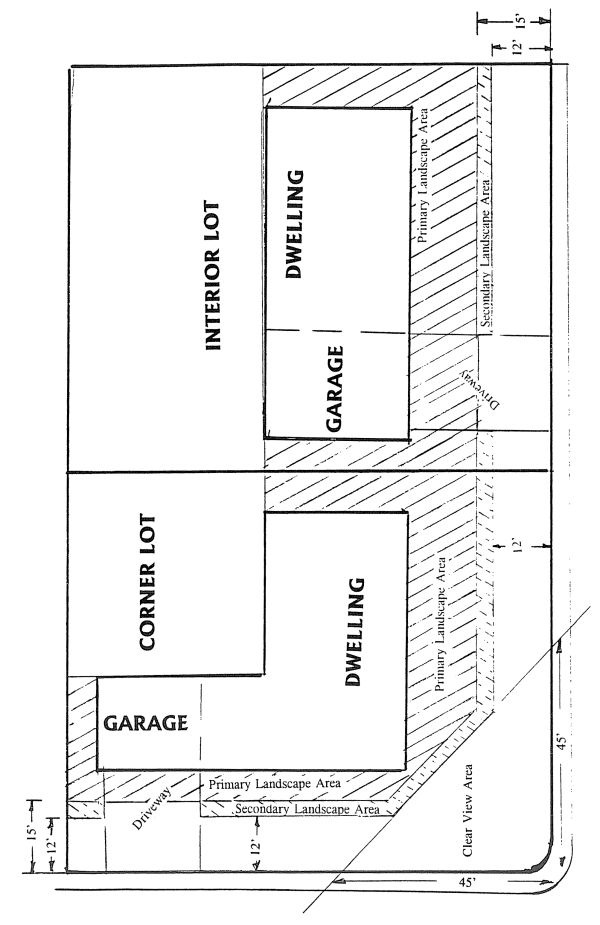 Figure 17.6.104A
 - Privacy screens. Privacy screens will be permitted within the primary landscape area, but not including the driveway portion thereof. Said screens may be extended into the secondary landscape area where it can be shown that all base plants proposed to be placed closer than twelve feet to the property line abutting upon the street will be of a type which will not grow to a height greater than forty-two inches. All privacy screens shall be subject to the conditions and criteria hereinafter set forth.
- No portion of the screen shall exceed six feet in height as measured from the finished grade; provided that this height limitation shall not apply to flag poles, light poles, occasional stanchions necessary for the support of overhead lattice structures, or to similar incidental vertical structural elements.
- The screens shall be so situated that all the landscape area shall remain open and accessible. No portion shall be enclosed.
- The screen shall be freestanding (i.e. not attached to a fence or wall of a dwelling).
- The screen shall not be continuous, but shall be divided into one or more sections not greater than twelve feet in length.
- Openings between individual screen sections shall be not less than thirty-six inches. Any opening between screen sections which is less than thirty-six inches shall be considered as a continuation and shall not be considered as satisfying the separation requirement.
- No portion of a screen shall extend into the clear view area of a corner lot, as required under Section 17.5.110.
- Overhead lattice structures. Overhead lattice structures are permitted within the primary and secondary landscape areas, subject to the following conditions and criteria.
- No portion of the overhead lattice structure shall have an opaque or closed-in roof (i.e., covered patios).
- No lattice covering shall exceed forty percent of any two foot square of surface area.
- No portion of the overhead lattice structure shall be higher than the eave line of the roof adjacent to the lattice structure or ten feet above ground level, whichever is less.
- The area beneath the overhead lattice structure shall remain open. The total length of any vertical wall section(s) constructed within the area lying beneath an overhead structure shall not exceed sixty percent of the total perimeter distance of the overhead, and not less than forty percent of said perimeter distance shall be permanently open from the ground to the roof. For the purposes of this code, the wall of the main building adjacent to an overhead lattice structure shall be included in determining the vertical wall requirements, unless all portions of the overhead lattice structure are located not less than seven feet from the closest part of the main building.
- No enclosed structures (i.e. storage shed, green house) shall be constructed or maintained within the landscape area.
- Approval—Site plan required.
- Prior to the erection of any privacy screen or overhead lattice structure within the front yard area or the side yard area of a lot, a site plan showing the location of the main building, all proposed privacy screens and overhead lattice structures, and all major vegetative elements shall be submitted to and approved by the zoning administrator and a permit issued therefor.
- Where, in the opinion of the administrator, the plan does not comply with the above criteria, he shall refer the application to the board of adjustment for action. Any applicant aggrieved by a decision of the administrator may appeal said decision to the board of adjustment, who shall have the authority to reverse, affirm or modify any decision of the administrator.
Sec 17.6.105 Ancillary Commercial Structures
- Intent. The following regulations have been established to provide the minimum standards for the establishment and operation of ancillary commercial Structures such as shaved ice shops, flower sales, bank teller machines, post office kiosks, key making shops and photographic film drop stations.
- Application and approval required. Ancillary commercial structures may be permitted by action of the planning commission, subject to the approval of a site plan as set forth Section 17.6.101 and upon a finding that placement of the use on the site proposed will not result in the creation of a condition detrimental to the health, safety or general welfare of the public and that the proposed use and attendant structures will be located, erected and operated in compliance with the following standards and requirements.
- Ancillary commercial structures are listed as permitted use within the zone.
- The structure will be located on the same lot as a host structure and the ancillary structure and appurtenant facilities, excluding off-street parking, will occupy a site area of not more than one hundred fifty square feet.
- Each host area shall contain not more than one ancillary commercial structure, except that the city may authorize the placement of more than one ancillary structure on a host lot where (a) the host lot has sufficient area, frontage, points of ingress and egress, off-street parking, and internal circulation to safely accommodate the additional ancillary structure, (b) the location of the additional structure in relation to existing ancillary Structures on the same or adjacent lots will not result in establishment of an unsafe or hazardous condition and © the sanitation facilities of the host structure are adequate to accommodate the additional structure.
- Adequate access, off-street parking, solid waste receptacles, and other essential elements for the proposed use will be provided. No part of the public right-of-way shall be included as part of the site area.
- The area of the lot upon which the structure and all attendant facilities (parking, display, tables) are located shall be hard surfaced. The layout of the proposed use will be coordinated with the access, parking, circulation, and other significant elements of the host use to provide safe and convenient access to patrons. The city may require the placement of barriers, screens, or other structural elements to channel traffic movement or otherwise promote a more safe condition.
- All buildings shall be permanently attached upon footings and foundations in accordance with the building code, or may be placed directly upon the hard topped surface. Provided, that any building not attached with footings and foundations shall be securely anchored to the ground at not less than four points as directed by the city engineer.
- A building permit shall be required for all structure. All structures shall be constructed in accordance with the provisions of the city's building code, except for the footing and foundation elements when approved by the city as provided in paragraph 6. above, and will be served by permanent independent electrical service installed in accordance with city standards.
- Independent water and sewer service shall be provided to all manned structures, provided that where, in the opinion of the city, the proposed use is of a size or character which will not require on-site water and sewer (i.e. no preparation of food on premises or no indoor seating of patrons), this requirement may be waived. Any request for waiver of this requirement shall provide: (1) written evidence that the host structure will provide permanent rest room facilities for the employees and that such facilities are conveniently located to the structure and will be accessible during all periods of operation and; (2) written evidence from the city-county health department that all food will be prepared and delivered from an approved commissary and that all waste resulting from the operation of the use will be properly disposed of.
- The total surface area of all signs associated with the ancillary structure shall be not more than thirty-two square feet.
- The area used in locating the ancillary structure and the appurtenant area and advertising signs associated therewith shall not have the effect of decreasing the off-street parking, access, sign areas or other regulated elements of the host structures to less than required under the zone.
- The right to occupy the location shall be secured by written agreement with the owner of the host parcel. Said agreement shall address the question of use of rest room facilities by employees where required, responsibility for maintenance and restoration of the site upon termination of use. A copy of the proposed agreement shall be submitted as part of the application.
- Continuing obligation. All ancillary uses and structures shall be operated in accordance with the terms of this section and any conditions attached pursuant hereto. Upon approval by the planning commission the applicant shall be eligible to acquire a business license to operate. Issuance of the license shall be conditioned upon continued performance of the conditions of approval and said license shall be refused or revoked upon failure of the owner and/or operator to maintain or operate the use in accordance therewith.
- Length of approval.
- Approval for those structures placed on permanent foundations and not requiring periodic health approval shall be without limitation as to time.
- Approval for non-permanent structures and those requiring periodic health department approval shall be valid for a period of one year but will be automatically renewed upon acquisition of a business license for the current year and upon determination by the city that the operation is substantially the same as when initially approved.
- Uses which are seasonal in nature may be reopened during the succeeding season provided that any use involving the dispensing of food shall, prior to reopening, provide to the city written notice of re-certification from the city-county health department.
Sec 17.6.106 Schools And Other Public Buildings And Structures To Be Approved
Prior to the construction of any public or parochial school building or other building or structure by a governmental entity or any specialty school or church, a site plan for the same shall be submitted to and approved by the city in accordance with the provisions of Section 17.6.101. For schools and similar structures located in residential zones, required setbacks shall be established by the building inspector based on the intended use of the structure. Where the building inspector determines that the intended use and structural characteristics of proposed building require a setback greater than the minimums set forth by this code, said determination shall prevail, but in no event shall the setback be less than the amount set forth for the zone or, when applicable, Section 17.5.112.
(Ord. No. 85-02-06)
Sec 17.6.107 - Sec 17.6.109 (Reserved)
Editor's note—Ord. No. 2017-09-48 , § 1, adopted Sept. 12, 2017, repealed §§ 17.6.107—17.6.109, which pertained to placement and operation of residential facilities for disabled persons; placement and operation of residential facilities for elderly persons and residential health care facilities (small scale); and youth group housing facilities and derived from Ord. No. 94-11-42; Ord. No. 01-10-52; Ord. No. 07-11-58.
Sec 17.6.110 Self Service Storage Facilities (Mini-Warehouses)
- Intent. It is the intent of this section to set forth the standards and criteria for the design, construction, operation and occupancy.
- Standards and criteria. All self service storage facilities (mini-warehouses) shall be designed, constructed, operated and occupied in accordance with the following:
- Self service storage facilities shall be located only in those zones in which such uses are specifically listed as a permitted use.
- The size of individual units within the project shall not exceed the following:
- I-1 zone—Up to one thousand square feet.
- All goods and wares shall be stored within an enclosed building, except that boats, travel trailers, motor homes and automobiles in running order, may be stored in screened exterior areas which shall have shown on the site plan and approved for that purpose. This provision shall not be interpreted to permit the storage of partially dismantled, wrecked or inoperable vehicles.
- No self service storage facility or any unit within such facility shall be used for the storage of hazardous materials in violation of the provision of the Uniform Fire Code, 1988 edition, or the Uniform Building Code.
- Because of the danger from fire or explosion caused by the accumulation of vapors, from gasoline, paint remover and similar flammable materials, the repair, construction, or reconstruction of any boat, motor vehicle, small engine, furniture or other item which includes the use of such substances shall be prohibited.
- It shall be unlawful for any owner or operator of a self service storage facility or any tenant of a unit located therein to offer for sale or sell any item of personal property located within the facility, or to conduct any type of commercial activity on the premises, other than the leasing of the storage units, or to permit the same to occur.
- The perimeter of the facility shall be enclosed. The enclosing barrier may consist of either the solid facade of the storage structure or a fence, wall or similar structure. If the barrier is to be provided by a fence or wall, the barrier shall be not less than six feet in height and shall be constructed of opaque material that will prevent the passage of light and debris. Where the barrier is to be provided by the building facade, said facades shall be in accordance with the setback requirements applicable to the zone in which it is located.
- The maximum height of structures shall be as set forth below, or as may be established pursuant other applicable requirements within the zone, whichever is lower.
- I-1 zone—Twenty-five feet.
- Access to the compound area shall be provided through an access way not less than thirty feet in width. On-site circulation shall be provided by travelways having a minimum of twenty-five feet in width when providing access to units on both sides of the travelway or twenty feet when providing access to units on one side only. The circulation system shall provide for access throughout the facility by continuous forward motion. Off-street parking shall be provided at the rate of two spaces for the caretaker dwelling plus one space for each forty units in the facility.
- All outdoor lighting shall be shielded to direct light and glare only onto the premises.
- The facility shall be served by adequate fire water system, including, as determined necessary, the installation of fire hydrants. No individual units shall be supplied with water or sewer facilities.
- The design and improvement of the facility shall make adequate provision for storm water and snow removal.
- The facility may contain a caretaker dwelling as a residence for the project manager. The structure containing the residence shall be considered as an integral part of the facility and be constructed in accordance with the building code.
- All required setback areas shall be landscaped. Also, all portions of the facade fronting on a public street shall be architecturally compatible with other uses in the zone.
(Ord. No. 01-10-52)
Sec 17.6.111 Pre-Schools And Child Care-Nurseries - Quasi Public
- Intent. The following criteria and conditions have been established to provide minimum standards for the approval and operation of preschool, childcare nurseries and similar child care facilities operated within churches or similar quasi public structures when located within certain residential zones.
- Criteria and conditions. Preschool and child care nurseries may be permitted by the planning commission within churches and similar quasi-public structures following receipt of an application and subject to the following criteria and conditions:
- The use of the structure as a child care facility shall be clearly incidental to the primary use of the building. Such use could occupy not more than thirty percent of the square footage of the structure.
- The church or other sponsoring entity shall provide written evidence of approval for use of the structure for the purpose and an acceptance of liability for such use.
- The applicant shall provide evidence of approval of the facility for the intended purpose by the State or that the facility would meet the state guidelines for physical facilities for the number of occupants proposed, where state approval is not required. The city may also require inspection and approval of local fire and health authorities. The proposed facility shall include an outdoor play area which conforms to state guidelines for such a facility.
- Maximum number of students: One for each thirty-five square feet of floor space devoted to preschool and childcare purposes.
- The sponsoring entity shall provided adequate access and off-street parking.
- The application shall contain a site plan, prepared in substantial compliance with the provisions of Section 17.6.101. The plan shall show both the entire property and a floor plan of the structure and shall identify those portions proposed to be used for childcare purposes.
- The facility shall be registered with the business license division of the city and an annual business license secured.
- Signs shall be limited to one facility identification sign. Said sign shall be included as an integral part of the institutional identification sign for the sponsoring structure and shall contain no advertising.
- The structure shall contain adequate rest room and kitchen facilities.
(Ord. No. 91-06-07)
Sec 17.6.112 Low Power Radio Service Antenna Facilities (Cellular Phone Transmission Towers And Facilities)
- Intent. It is the intent of this section to establish an approval procedure and placement standards and criteria too more adequately address the various planning issues relating to the placement of low power radio service antenna facilities within the city—including issues of demand, visual mitigation, noise, engineering, residential impacts, health, safety and facility sites—while ensuring that such procedure, standards, and/or criteria do not unreasonably discriminate among competing wireless telecommunications service providers.
- Procedure for approval. The applicable procedure to be followed in securing approval of a low power radio service antenna facility shall be as follows:
- When proposed for placement within the I-1 Industrial, CC-1 Central Commercial or GC-1 General Commercial zones, approval shall be sought and obtained from the planning commission in accordance with the provisions of Section 17.6.101.
- When proposed for placement in any other zone, approval shall be sought and obtained from the city council following receipt of a recommendation from the planning commission.
- The appropriate governmental body under subsections B.1. and B.2. above (i.e., the approval authority) shall act on a request for such approval within a reasonable period of time.
- Standards and criteria—Definitions. For purposes of facilitating regulation, low power radio service antenna facilities are divided into three categories. The characteristics of each category and the specific standards and criteria applicable to each shall be as hereinafter set forth.
- Monopole antenna. (A single cylindrical steel or wooden pole attached directly to the ground that acts as the support structure for the antenna and antennas)
- Location. Monopole antennas shall be permitted in any zone or development project in which low power radio service antenna facilities are listed as a permitted or conditional use. The pole may be placed on a separate site owned by the user and dedicated exclusively as an antenna or may be "co-located" on a site occupied by a primary or "host" structure and occupied on a lease basis. The placement site shall have adequate access, and in the instance of a lease site shall not have the effect of reducing the requirements applicable to the host structure or use in violation of the development code or an approved development plan.
- Maximum height. The maximum height of any monopole structure shall be sixty feet as measured from the prevailing ground surface in the vicinity of the pole to the top of the pole or the top of the highest antenna attached thereto, whichever is higher, except when authorized pursuant to the provisions of paragraph k. of this section. Each monopole structure shall be freestanding and shall not require the use of guy wires for support. In addition, a monopole may contain one whip type antenna which extends above the monopole, provided, that the point of attachment to the monopole is at or below the maximum height as set forth in this paragraph and does not extend more than ten feet above the top of the antenna array.
- Antenna(s). Each monopole may contain one or more antenna structures. The size, type and placement of each antenna structure attached to the monopole shall be in accordance with the standards for antenna type as set forth on Figures 1 and 2 of this section. Any proposal to add an additional antenna or antenna array to an existing monopole, additional base facilities, rungs, or other modification to an approved cell tower shall require a separate approval.
- Spacing. Except as specifically provided herein, no monopole structure shall be located closer than one-half mile from any other monopole structure. A monopole structure described and provided for in subsection k.(1) of this section may be located closer than one-half mile from another monopole structure described and provided for by such subsection.
- Distance from residences.
- New monopole. No monopole structure shall be located closer than six hundred fifty feet from any residence when the pole is located in a residential zone, or six hundred fifty feet from any residential zone boundary when proposed for placement in a professional office, commercial, industrial or public facilities zone.
- Additional antenna on existing monopole. Notwithstanding the provisions of subparagraph (1) above, additional antenna may be added to an existing monopole structure located in any commercial or industrial zone provided, that the existing pole is located not closer than four hundred feet from any residence or the boundary of any residential zone district located within the city.
- Placement on undeveloped parcels not permitted. Monopoles proposed to be located within a residential zone shall be placed only upon property currently developed, e.g., park, golf course, and school campus property. No such facility shall be permitted on lands which are currently vacant, used for agriculture, or otherwise considered probable for development for residential purposes.
- Lighting. No portion of the antenna or structure shall be lighted and no such structure shall be permitted in a location which requires the use of flashing or other warning lights.
- Color. The color of the monopole and antenna structure shall be white, or such other color as will blend with the surrounding environment, as approved by the approval authority.
- On-site placement. Co-located monopole structures shall be placed in the interior yard area of the host lot. Such structures shall not be placed in required landscape areas or required parking spaces.
- Accessory facilities. Appurtenant buildings or facilities shall comply with the setback requirements of the zone or development plan. Monopoles shall be protected from unauthorized access through the use of an enclosure fence having a height of six feet, and by ensuring that the climbing pegs are removed from the lower twenty feet of the pole. All electric power lines leading to any free standing accessory building or structure shall be underground.
- Exception to height and lighting restrictions. The height and lighting restrictions of paragraphs C.1.b. and C.1.g. may be waived by the approval authority where the low power radio service antenna facility is to be mounted on the following types of poles or monopoles, subject to the conditions set forth herein:
- When proposed for placement on a municipal or public utility pole used for other purposes. An antenna structure may be attached to a municipal or public utility pole that is lawfully erected and maintained and is used for a primary purpose other than that of providing low power telecommunications service (e.g. electric transmission, street lights, and ball park lighting), subject to the following: (a) the proposed antenna structure shall be situated not more than twenty feet above the location of the primary (i.e., not telecommunications-related) facilities on the pole (e.g. the sports field lighting cluster) or eighty feet above the prevailing ground surface in the vicinity of the pole, whichever is lower, (b) the pole shall contain not more than one antenna structure (or cluster), (c) the pole is already in existence at the time that an application is made for approval of the placement of the antenna structure, or is a proposed replacement of an existing pole (including a proposed replacement at a greater height than the pole being replaced, but only if the approval authority finds that the proposed enlarged replacement is consistent with the intent of this code and with the vicinity where the proposed replacement is requested to occur - considering such factors as zoning, public safety, location and aesthetics); and (d) the pole conforms to all other provisions related to monopole structures as set forth under this section.
- When proposed for placement on an existing communication monopole. Additional antenna structures may be attached to an existing monopole that lawfully exists under current law and was erected and is used primarily for low power telecommunications service, subject to the following: (a) the existing pole is capable of accommodating the proposed antenna cluster without structural modifications, (b) the pole and antenna structure conform to all other applicable provisions of this section and (c) no portion of the proposed antenna structure shall be higher than permitted under paragraph C.1.b. above, except that in the event the pre-existing monopole was initially constructed at a height greater than permitted under paragraph C.1.b., the maximum height of any portion of an additional antenna shall be eighty feet.
- When proposed for placement in an I-1 industrial zone located south of 1500 South. When proposed to be placed within any portion of the I-1 industrial zone located south of 1500 South Street, the maximum height of a monopole may be increased to ninety feet and the minimum spacing of monopole structures may be reduced to one thousand feet.
- Monopole overlay zone authorized—Maximum height allowed within a designated cell tower overlay zone—Other condition. To more adequately facilitate placement and regulation of monopoles in areas containing adverse topographic conditions, there is hereby established the following cell tower overlay zone. The boundaries of said zone and the specific elevation applicable thereto shall be as hereafter adopted by the city council. (See ordinance)
The maximum height of a monopole located within the cell tower overlay zone shall be not more than forty-five feet above the elevation of the topography surrounding the overlay zone or eighty feet, whichever is less. In addition, the design of the monopole shall utilize a stealth design resembling trees or other natural condition which is acceptable to the city.- Distance from boundary of historic district. No monopole structure shall be located closer than six hundred fifty feet from the boundary of any designated historic district.
- Wall mounted antenna. (An antenna or series of individual antennas mounted against the vertical wall of a building.
- Location. Wall-mounted antennas shall be permitted in any zone or development project in which low power radio service antenna facilities are listed as a permitted or conditional use.
- Antenna placement. The size, type and placement of antenna structure shall be in accordance with the standards for antenna type as set forth on Figure 3. No portion of the antenna shall project above the wall to which it is attached.
- Color, architectural compatibility. Antennas, equipment and supporting structure shall be painted or otherwise colored to match the building facade, structure or background against which they are most commonly seen, and shall be architecturally compatible with the building to which they are attached.
- Accessory facilities. All facilities and equipment for the operation of the antenna shall be located within the structure to which the antenna is attached.
- Roof mounted antenna. An antenna or series of individual antennas mounted on a flat roof, mechanical room or penthouse of a building.
- Location. Roof-mounted antennas shall be permitted in any zone or development project in which low power radio service antenna facilities are listed as a permitted or conditional use.
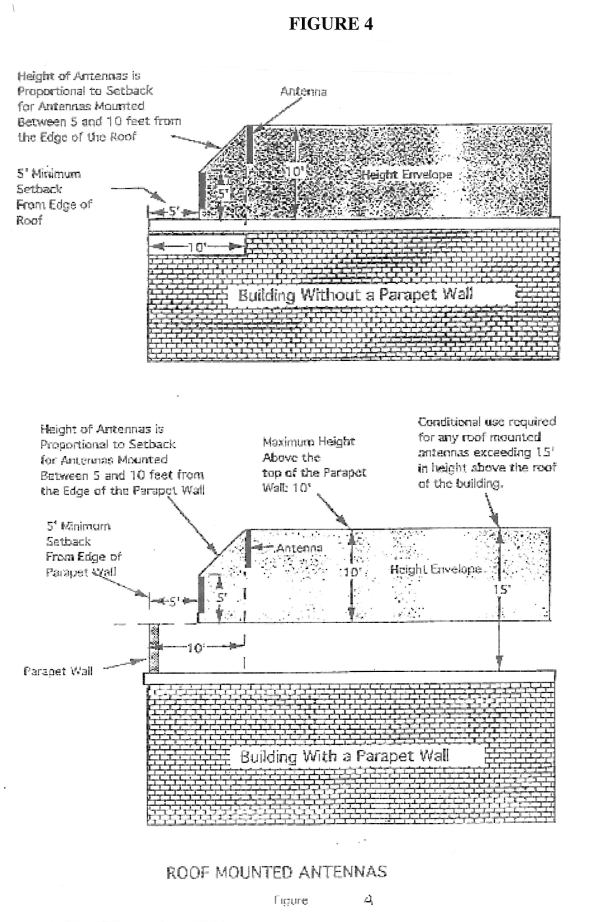
- Antenna placement. The size, type and placement of antenna structure shall be in accordance with the standards for antenna type as set forth on Figure 4 and shall be located within the placement envelope as defined therein.
- Roof placement. Roof-mounted antennas shall be permitted only on a flat roof, and shall be screened, constructed and/or colored to match the structure to which they are attached.
- Monopole antenna. (A single cylindrical steel or wooden pole attached directly to the ground that acts as the support structure for the antenna and antennas)
- Review criteria—Additional requirements may be attached. In conducting its review and/or making its determination, the approval authority and/or reviewing body shall, in addition to any other matters it may choose to consider, consider the following:
- Compatibility of the proposed structure with the height and mass of existing buildings in the area.
- Whether placement of the structure in the proposed location will result in a significant impact to other uses or the reception or transmission of existing facilities.
- The location of the antenna in relation to existing vegetation, topography, and buildings—to obtain the best visual screening.
- Visual and economic impacts upon the adjacent properties.
- Compliance with Federal Communications Commission (FCC) emission standards.
The approval authority may deny placement of a low power radio service antenna facility which does not conform to the required standards and criteria, or which is inconsistent with the review criteria of this subsection; or it may require changes or additional measures in order to more fully protect the interests of adjacent properties and the public and to accomplish the purposes of this section.
- Denial.
- The approval authority may not deny a request for approval of a proposed low power radio service antenna facility unless it satisfies the requirements of this subsection:
- Evidence, facts, arguments, comments, advice, and/or recommendations, not otherwise protected from disclosure by law or legally-recognized privilege, which are relied upon by the approval authority in denying the request, must be reduced to written form.
- The approval authority shall prepare and issue its findings, conclusions, final decision or determination, and supporting reasons therefor, in writing.
- The approval authority, or any recommending governmental body or officer, may require the applicant, city staff members, and/or interested member(s) of the public to prepare their comments and arguments in the form of written submissions to the approval authority.
- Written minutes of any public meeting of the city wherein a request made under this section results in a denial shall be kept in accordance with the Utah Open Meetings Act.
- The official minutes of the public meeting(s), along with the written submissions and documentation referenced above in this subsection, shall constitute the approval authority's written record as required by provisions of the Telecommunications Act of 1996; shall be made available upon request to the applicant and the public pursuant to the Utah Government Records Access and Management Act; and shall constitute the official written record for the purpose of any legal, equitable, or administrative review of said denial.
- The approval authority may not deny a request for approval of a proposed low power radio service antenna facility unless it satisfies the requirements of this subsection:
- Continuing obligation—Business license required.
- Every antenna, pole or support structure, and all ancillary facilities, comprising a low power radio service antenna facility, shall at all times be maintained in good structural and aesthetic condition. The owner of any property on which any such antenna, pole, support structure, or ancillary facility or facility, is located— and those responsible for or receiving benefit from its placement—shall keep the area clean and free from noxious or offensive substances, rubbish, and/or flammable waste material.
- In addition to complying with any and all standards and criteria, review criteria, conditions, and requirements of the city under this section, a low power radio service antenna facility is expected to and shall fully comply with all other applicable ordinances of this city, and with all applicable state and federal laws and regulations, including but not limited to the regulations of the FCC (including emissions standards of any radio frequency emissions emitted, discharged, or otherwise radiating from such facility); the Federal Aviation Administration (FAA), and the Environmental Protection Agency (EPA).
- Each separate low power radio service antenna facility shall be considered as a separate use; and an annual business license shall be required for each such facility.
- Failure:
- To properly maintain the low power radio service antenna facility, or the premises upon which it is located, as set forth in subsections F.1. and F.2. of this section; or
- To secure and maintain the required business license for a continuous period of one year—shall be considered an abandonment of said low power radio service antenna facility.
- Failure to comply with any of the requirements of this section, any applicable ordinance of this city, or any state or federal law or regulation, may constitute grounds to revoke the business license of and pertaining to the low power radio service antenna facility, under Chapter 5.04 of the American Fork City Code.
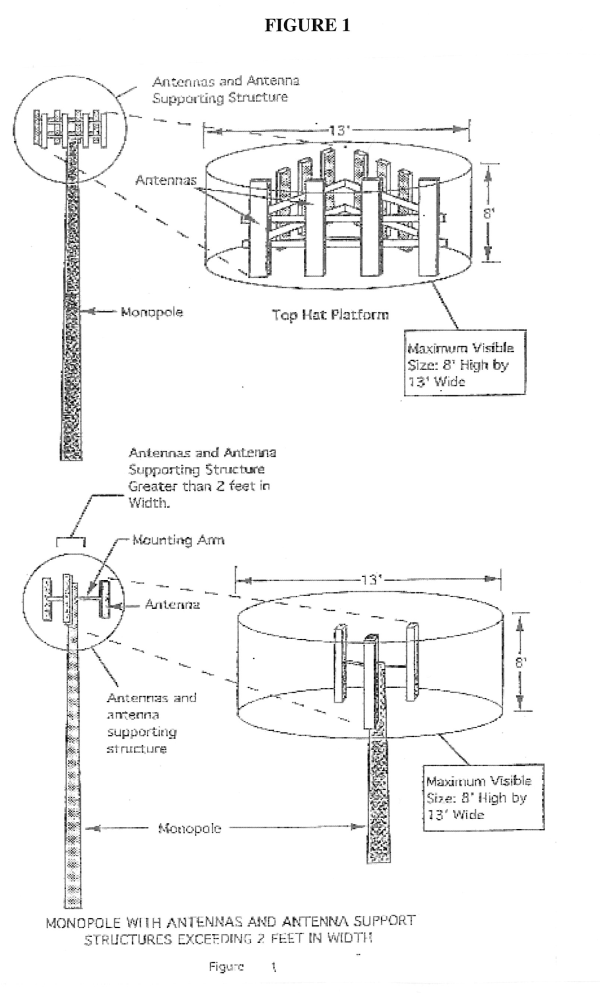
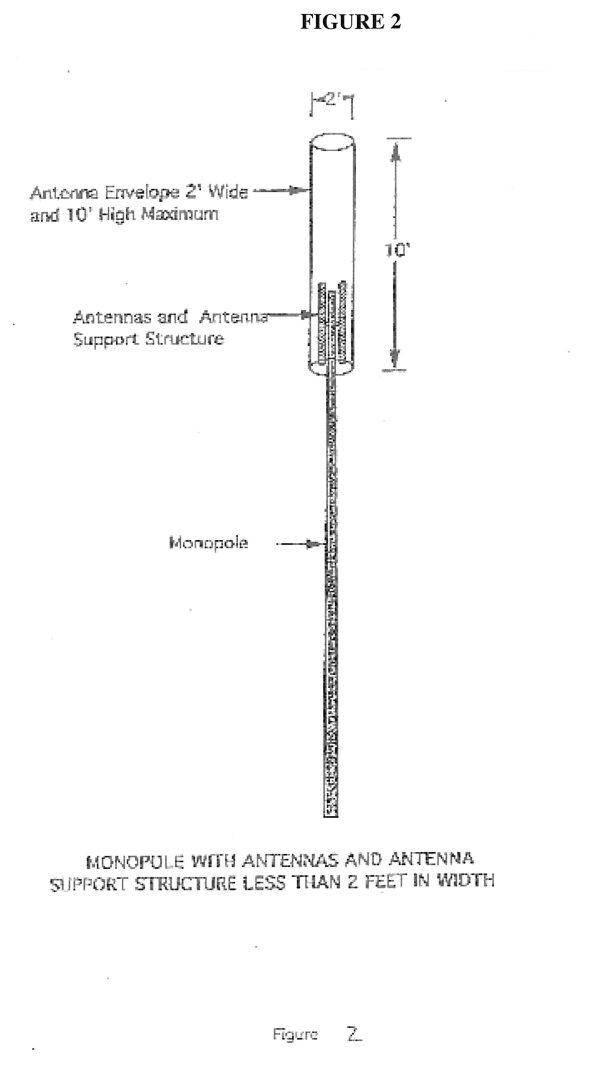
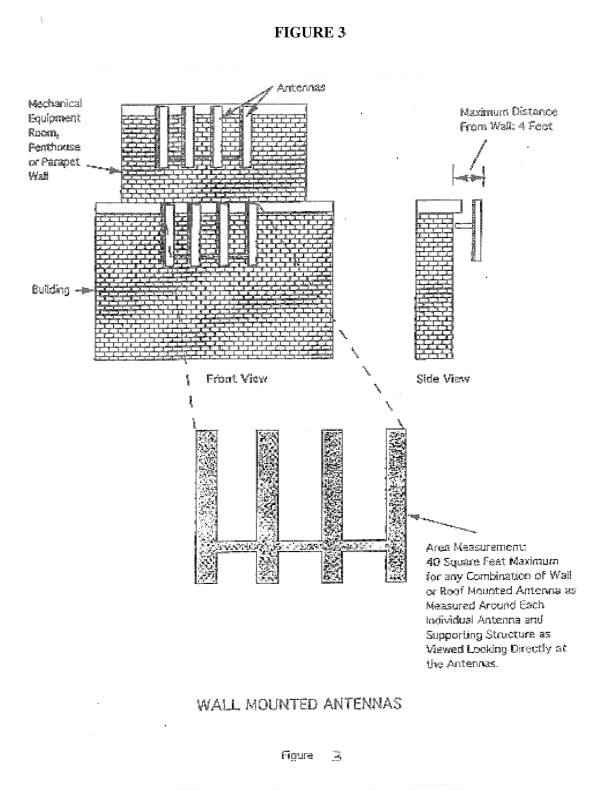
 (Ord. No. 96-05-21; Ord. No. 05-07-37; Ord. No. 98-11-46; Ord. No. 2000-8-24; Ord. No. 01-07-41; Ord. No. 2008-12-48, 12-16-2008; Ord. No. 2010-12-27, § 1, 12-14-2010)
Amended by Ord. 2023-07-26 on 7/11/2023
Sec 17.6.113 Private Home/Charter Schools
Private home/charter schools may be permitted as a conditional use following approval by the planning commission and subject to the following conditions.
- Private home/charter schools are listed as a permitted or conditional use within the zone.
- The maximum number of students in attendance at any one time shall not exceed the occupancy load limitations as set forth the building code or fifty students, whichever is less.
- The parcel upon which the school is located shall contain sufficient area to accommodate the building, the minimum outdoor play area, the required off-street parking, and a safe vehicular drop-off and pick-up lane.
- The school shall abut upon and be accessed from a street having a right-of-way width not less than sixty feet and improved with adjacent sidewalk for a distance of not less than five hundred feet from the proposed school.
- The layout of the safe drop-off lane and the vehicular access and circulation plan shall be approved by the chief of police or his designated representative, with the concurrence of the city engineer.
- The number of off-street parking spaces on the site shall be not less than one space for each teacher and staff member, one space for each student of driving age, and one additional visitor space for each classroom.
- The applicant shall provide evidence of approval of the facility for the intended purpose by the state or that the facility would meet the state guidelines for physical facilities for the number of occupants proposed, where state approval is not required. The city may also require inspection and approval of local fire and health authorities.
- The proposed facility shall include an outdoor play area of not less than fifty square feet per student for the maximum number of students authorized.
- The structure shall conform to all building code requirements applicable to the intended use and shall be capable of use as a school facility without structural or landscaped alterations that would change the residential character of the structure.
- The application shall contain a site plan, prepared in substantial compliance with the provisions of Section 17.6.101. The plan shall show both the entire property and a floor plan of the structure and shall identify those portions proposed to be used for school purposes.
- The facility shall be registered with the business license division of the city and an annual business license secured.
- Signs shall be limited to one facility identification sign containing not less than eight square feet and shall contain no advertising.
- The structure shall contain adequate rest room and kitchen facilities to accommodate the number of students and staff as established pursuant to the terms of the building code and shall conform with all applicable standards of the Americans With Disabilities Act.
- The parcel upon which the school is located shall contain and be served by all required public improvements, constructed in accordance with city standards, as determined by the city engineer.
(Ord. No. 01-04-19)
Sec 17.6.114 Check Cashing And Other Similar Businesses
- Definitions. For the purposes of this section, the following words shall have the following meanings:
- Bank or financial institution An organization involved in deposit banking, finance, investment, mortgages, trusts, and the like. Typical uses include commercial banks, credit unions, finance companies, and savings institutions.
- Cashing services. An organization involved in providing loans or other consideration to customers in exchange for personal property, such as property titles or personal checks. Such services shall include check cashing businesses licensed and/or defined by the state pursuant to the Check Cashing Registration Act, car title loan businesses, deferred deposit loan businesses, and businesses of a similar nature offering such services as a primary function. The phrase financial service shall not include fully automated stand alone services, such as automated teller machines, nor those uses defined herein as pertaining to bank or financial institutions.
- Check cashing business. A person or business that, for compensation, engages in cashing a check for consideration or extending a deferred deposit loan. Check cashing business does not include depository institutions, as defined by the State of Utah. In addition, check cashing business does not include a retail seller engaged primarily in the business of selling goods or services to retail buyers that cash checks or issue money orders for a minimum flat fee not exceeding one percent of the check or one dollar as a service fee that is incidental to its main purpose or business.
- Payday loan business. An establishment providing loans to individuals in exchange for personal checks or assignment of wages as collateral.
- Title loan business. An establishment providing short term loans to individuals in exchange for the title of a motor vehicle, mobile home, or motorboat as collateral.
- Deferred deposit lender. A business that conducts transactions where a person presents to a check cashier a check written on that person's account or provides written or electronic authorization to a check cashier to effect a debit from that person's account using an electronic payment, and the check cashier provides the maker an amount of money that is equal to the face value of the check or the amount of the debit less any fee or interest charged for the transaction, and agrees not to cash the check or process the debit until a specific date.
- Similar businesses. Any other business that offers deferred deposit loans, title loans, check cashing services and loans for payment or a percentage fee exceeding one percent of the check or one dollar as a service fee that is incidental to its main purpose or business.
- For purposes of this section, check cashing businesses, payday loan businesses, title loan businesses, and deferred deposit lender businesses shall be referred to collectively as "check cashing" businesses.
- Criteria and conditions. Check cashing and other similar businesses shall be located and maintained in accordance with the following standards and conditions:
- It is unlawful for any check cashing or other similar business to do business at any location within the city not zoned for such business.
- Check Cashing or other similar businesses shall only be permitted in areas zoned PC - planned community zone, CC-1 - central commercial zone, GC-2 - planned commercial zone, and CC-2, central commercial zone. Additionally, check cashing and other similar businesses shall be subject to the following restrictions:
- Shall not be located within five thousand two hundred eighty feet (one mile) of the same type of business inside or outside the American Fork City geographical boundaries. This distance shall be measured from the exterior walls of the buildings or portions thereof in which the businesses are conducted or proposed to be conducted.
- Shall conform to the architectural design guidelines enumerated below:
- The color of the building shall be restricted to earth tones or shall match the design theme of the center of which it is a part in keeping with the aesthetic qualities of the center or area.
- At least twenty-five percent of the first floor facade that faces a public street or sidewalk shall be windows or doors of clear or lightly tinted glass that allows views into and out of the building at eye level.
- The use of bars, chains or similar security devices that are visible from a public street or sidewalk shall be prohibited.
- The use of neon lighting shall be prohibited on the building exterior exclusive of building signage.
- Shall conform to the sign regulations as described in Section 17.5.128 of the American Fork City Development Code.
- Shall be limited to one check cashing or other similar business per ten thousand in population, to include all residents in American Fork City within the city's geographic boundaries. The total population figures shall be based on the U.S. Census Bureau's annual estimates.
- The structure shall conform to all applicable building, safety and health codes and requirements.
- Check cashing and other similar businesses shall comply with all applicable city codes and ordinances.
- All check cashing and other similar businesses shall comply with the bonding requirements set forth in Section 5.04.100 of the American Fork City Code.
Sec 17.6.115 Non-Accessory Signs And Billboards
Non-accessory signs and billboards may be permitted as a conditional use following approval of an application and site plan by the planning commission and subject to the following conditions:
- Non-accessory signs and billboards are listed as a permitted use within the zone district or large scale development project, and are not otherwise precluded from placement on the property under the terms of the annexation agreement or other legal instrument.
- The maximum area of the sign, including any border or frame shall not exceed 800 square feet.
- The maximum dimensions of the sign face areas shall not exceed sixteen feet in height or fifty feet in length, and no portion of the sign shall be higher than thirty-five feet from closest adjacent freeway travel lane surface.
- No non-accessory sign shall be located closer than eight hundred feet along the same side of the right-of-way to an existing non-accessory sign or an accessory project identification sign approved in accordance with the provisions of Section 17.5.128.C.4., or the site of a previous non-accessory sign which has been relocated pursuant to the terms of Section 10-9a-511 to 513 UCA Annotated, 1953, as amended. Any request for placement of an additional non-accessory sign closer than eight hundred feet to the prior location of a sign which has been relocated pursuant to 10-9a-511 to 513 UCA shall constitute an expansion of the nonconforming use and is prohibited pursuant to the terms of Section 17.1.5 of this code.
- The sign, support members, electrical components shall be constructed in compliance with Volume V of the Uniform Building Code relating to signs, which code is hereby adopted by reference.
- Prior to the erection of a sign, a permit therefore shall be issued by the building inspector.
- Every sign shall be maintained in good structural condition at all times. All signs shall be kept neatly painted and maintained including all metal parts that are not galvanized or rust resistant. The owner of any property on which a sign is located and those responsible for the conditions of the area in the vicinity of the sign shall keep the area clean and free from noxious or offensive substances, rubbish, and flammable waste material.
- A non-accessory sign/billboard may use an electronic display subject to the following:
- All electronic displays shall come equipped with automatic dimming technology which automatically adjusts the sign's brightness in direct correlation with natural ambient light conditions at all times. No electronic display shall exceed a brightness level of more than three-tenths foot candles above ambient light as measured using a foot candle (lux) meter, perpendicular to the electronic display sign face at a distance determined by the size of the sign face and called out on Chart 17.5.128-E. Prior to the issuance of any permit for an electronic display, the owner shall provide the city with a certification from the sign manufacturer stating that the sign is capable of complying with the above brightness provisions.
- The images and messages displayed must be static, and the transition from one static display to another must be instantaneous with no special effects.
- Electronic displays on non-accessory signs and billboards shall not include animation, full motion video, flashing, scrolling, strobing, racing, blinking, changes in color, fade in or fade out in any manner imitating movement, or any other means not providing constant illumination.
- Each message shall be illuminated for at least eight seconds before transitioning to a new message.
- A minimum annual business license shall be required for each sign. Failure to maintain the sign in the manner identified in subsection 7. above shall be grounds for denial of the license. Failure of the owner to maintain the sign or sign premises, or to secure the required license for a continuous period of one year shall be considered an abandonment of the sign.
- The city council may, after ten-day written notice to the owner and following a hearing held thereon, cause to be removed any sign for which a building permit has not been issued or annual license maintained or which is found to be materially, structurally, or electrically defective.
- Where the provisions of this section conflict with any state regulations concerning billboards, the more stringent shall prevail.
(Ord. No. 2010-02-07; Ord. No. 2013-03-10, pt. I, 3-26-2013)
Sec 17.6.116 Body Art Establishments
- Number of establishments. Body art establishments shall be located and maintained only in those zone districts where they are specifically listed as a permitted use. Additionally, body art establishments shall be subject to the following restrictions:
- Body art establishments shall not be located within five thousand two hundred eighty feet (one mile) of the same type of business inside or outside the American Fork City geographical boundaries. This distance shall be measured from the exterior walls of the buildings or portions thereof in which the businesses are conducted or proposed to be conducted.
- Body art establishments shall be limited to one establishment per twelve thousand in population, to include all residents in American Fork City within the city's geographic area. The total population figures shall be based on the U.S. Census Bureaus annual estimate.
- Design restrictions.
- Body art establishments shall conform to the architectural design guidelines enumerated below:
- The color of the building shall be restricted to earth tones or shall match the design theme of the center of which it is a part in keeping with the aesthetic qualities of the center or area.
- At least twenty-five percent of the first floor facade that faces a public street or sidewalk shall be windows or doors of clear or lightly tinted glass that allows views into and out of the building at eye level.
- The use of bars, chains or similar security devices that are visible from a public street or sidewalk shall be prohibited.
- The use of neon lighting shall be prohibited on the building exterior exclusive of building signage.
- Body art establishments shall conform to the architectural design guidelines enumerated below:
- Compliance with other requirements.
- In addition to the provisions of the development code, body art establishments shall comply with the following:
- The provisions of Ordinance 2009-03-12.
- The provisions of all applicable building, safety and health codes and requirements.
- The provisions of all applicable city codes and ordinances and all state and federal regulations.
- In addition to the provisions of the development code, body art establishments shall comply with the following:
(Ord. No. 2009-08-30, 8-11-2009)
Sec 17.6.117 Vehicle Impound Yards
Vehicle impound yards are permitted within the city subject to the approval of a site plan by the planning commission as set forth under Section 17.6.101 and compliance with the conditions and criteria hereinafter set forth.
- Conditions and criteria:
- Vehicle impound yards are listed as a permitted use within the zone.
- Placement of a vehicle within the vehicle impound yard shall be limited to vehicles which have been impounded from public or private property at the direction of a peace officer or judicial decree as prescribed by law.
- In addition to all other requirements, the vehicle impound yard shall meet or exceed all standards required by the State of Utah for qualification as an acceptable vehicle impound yard.
- The vehicle storage portion shall be graded and paved with asphalt or concrete surfacing to ensure that all surface water generated from the site shall be retained on site and to prohibit percolation of surface water and VOCs from stored vehicles.
- All portions of the vehicle storage area readily visible from the public street or otherwise visible to the public shall be enclosed by an eight-foot high masonry decorative wall. All other portions of the storage area not bordered by the wall shall be enclosed by a fence having a height of not less than eight feet to discourage vandalism. In addition, landscaping adjacent to all portions of the wall observable from adjacent streets or otherwise visible to the public is required.
- No vehicles shall be dismantled (including, but not limited to, the removal of tires), salvaged or crushed on site.
- No sale or advertising the sale of vehicles shall be permitted.
- No vehicle shall remain on the site for a period of no longer than one hundred twenty days unless a longer period is specifically directed by a peace officer or the courts.
- An annual zoning inspection is authorized. Failure to comply with the terms of the site plan or conditions of approval shall constitute grounds for withholding of business license or the initiation of other appropriate enforcement measures.
(Ord. No. 2013-05-17, § 1, 5-14-2013)

