
Annapolis City Zoning Code
Division IV
OVERLAY DISTRICT REGULATIONS
Chapter 21.52 - INTRODUCTORY PROVISIONS
Section:
21.52.010 - Purpose and applicability.
A.
The provisions of the overlay districts in this division supplement the underlying zoning district regulations in order to support the purposes of each overlay district.
B.
The provisions of the overlay districts apply to all land designated by the overlay or overlays on the City of Annapolis Zoning District Map.
C.
The provisions of the overlay district shall control in the event of conflict with any underlying zoning district regulation.
(Ord. O-1-04 Revised (part), 2005)
21.54.010 - Purpose.
The purpose of the critical area overlay district is to foster more sensitive development activity for certain shoreline areas so as to minimize damage to water quality and natural habitats. This district is consistent with and supports the State critical area law and critical area criteria as well as the City of Annapolis Critical Area Program.
(Ord. O-1-04 Revised (part), 2005)
21.54.020 - Map.
A.
The Critical Area Overlay District Map is maintained as part of the Zoning Map for the City of Annapolis. The Critical Area Map delineates the extent of the Critical Area Overlay District that shall include:
1.
All waters of and lands under the Chesapeake Bay and its tributaries to the head of tide and all state and private wetlands designated under Title 16 of the Environment Article of the Annotated Code of Maryland, or its successors; and
2.
All land and water areas within one thousand feet beyond the landward boundaries of state or private wetlands and the heads of tides designated under Title 16 of the Environment Article of the Annotated Code of Maryland, or its successors.
B.
Within the designated Critical Area Overlay District, all land shall be assigned one of the following land management and development area classifications:
1.
Intensely developed area (IDA).
2.
Limited development area (LDA).
3.
Resource conservation area (RCA).
C.
The Critical Area Overlay District Map may be amended by the Annapolis City Council in compliance with amendment provisions in this chapter, the Maryland Critical Area Law, and the Code of Maryland Regulations (COMAR) Title 27, or its successors.
(Ord. O-1-04 Revised (part), 2005)
(Ord. No. O-35-20, § I, 10-12-2020)
21.54.030 - Enforcement.
A.
No permit shall be issued for any use of land unless the Director of Planning and Zoning finds that the use conforms to the requirements of this chapter.
B.
The Planning and Zoning Director shall have the authority to enforce this chapter as provided in Chapter 21.36.
(Ord. O-1-04 Revised (part), 2005)
(Ord. No. O-12-16 Amended, § I, 5-23-2016; Ord. No. O-35-20, § I, 10-12-2020)
21.54.040 - Applicability.
The critical area overlay district is an overlay district. As such, the provisions in this section shall serve as a supplement to the underlying zoning district regulations. The uses, minimum lot requirements, minimum yard requirements, maximum height, accessory uses, signs and parking requirements shall be determined by the regulations applicable to the district or districts over which the critical area district is superimposed. Where a conflict exists between the provisions of this chapter and those of any underlying zoning district, the more restrictive provisions shall apply.
(Ord. O-1-04 Revised (part), 2005)
21.54.050 - Notification of project approval.
The Director of Planning and Zoning shall send copies of applications for all projects including but not limited to development activity, subdivisions, site plans, variances, and administrative variances wholly or partially within the Critical Area as specified in COMAR 27.03.01.04, or its successors, to the State of Maryland Critical Area Commission for the Chesapeake and Atlantic Coastal Bays ("the Critical Area Commission") for review and comment.
A.
The following types of applications are required to be submitted to the Critical Area Commission as specified in COMAR 27.03.01.04:
1.
All initial and subsequent applications for rezoning and floating zones that occur wholly or partially within the Critical Area.
2.
All applications for special exceptions or conditional uses that allow industrial, commercial, institutional, nonresidential, or multifamily uses that occur wholly or partially within an LDA or an RCA.
3.
All applications for variances from Critical Area requirements.
4.
All proposed and approved major Buffer Management Plans associated with those applications covered in Subsection (B)(1) and (B)(2) below and all approved Buffer Management Plans associated with shore erosion control projects.
B.
The following types of applications are exempted from this requirement if what is proposed does not result in a physical disturbance to the buffer:
1.
Applications that would occur wholly or partially within the IDAs:
a.
A single family dwelling unit;
b.
A structure that is necessary to a single family dwelling unit which may include, but is not limited to, a pool, garage, porch, shed, or tennis court;
c.
Development in which the land disturbance does not exceed fifteen thousand square feet;
d.
Subdivisions resulting in ten lots or less, or ten dwelling units or less;
2.
Applications that would occur wholly or partially within LDAs:
a.
Those listed in Subsection (B)(1)(a—c) of this section;
b.
A subdivision resulting in three lots or less which does not affect growth allocation;
3.
Applications occurring wholly or partially within RCAs for which the land disturbance does not exceed five thousand square feet.
C.
The application shall be accompanied by a completed "Project Notification Application" form downloaded from the Critical Area Commission's website.
D.
After receipt of a copy of an application from the Director of Planning and Zoning, the Commission shall send written notice of receipt to the City before the close of the fifth business day. A failure of the Commission to send a timely notice shall render Subsection (D) of this regulation inapplicable as to that application.
E.
The Director of Planning and Zoning may not process an application, which has been sent to the Critical Area Commission for notification until it has received notice of receipt by the Critical Area Commission.
F.
Any action by the City of Annapolis in violation of these procedures shall be void.
(Ord. No. O-35-20, § I, 10-12-2020)
Editor's note— Ord. No. O-35-20, § I, adopted Oct. 12, 2020, repealed § 21.54.050 in its entirety and enacted new provisions to read as herein set out. Former § 21.54.060 pertained to definitions and derived from Ord. No. O-1-04 Revised (part), adopted in 2005.
21.54.060 - Development requirements generally.
A.
Vegetation. Cutting and clearing of vegetation shall occur in accordance with Section 17.09.070 of the Annapolis City Code and with planting guidelines determined by the Department of Planning and Zoning.
B.
New solid or hazardous waste collection or disposal facilities, or sanitary landfills or rubble fills, including transfer stations, may not be permitted in the Critical Area unless no environmentally preferable alternative exists outside the Critical Area, and these development activities or facilities are needed in order to correct an existing water quality wastewater management problem. Existing permitted facilities shall be subject to the standards and requirements of the Maryland Department of the Environment.
C.
Development and redevelopment shall be subject to the Habitat Protection Area requirements prescribed in this chapter.
D.
Development and redevelopment shall be subject to the water-dependent facilities requirements of this chapter and as further described in [Sections] 21.54.105, 21.54.106 and 21.54.120;
E.
Utility Transmission Facilities.
1.
Utility transmission facilities, except those necessary to serve permitted uses, or where regional or interstate facilities shall cross tidal waters, may be permitted in the Critical Area provided:
a.
The facilities are located in Intensely Developed Areas; and
b.
Only after the activity or facility has demonstrated to all appropriate local and State permitting agencies that there shall be a net improvement in water quality to the adjacent body of water.
2.
These provisions do not include power plants.
F.
Roads, bridges, and utilities are prohibited in a Habitat Protection Area unless no feasible alternative exists. If a road, bridge or utility is authorized the design, construction and maintenance shall:
1.
Provide maximum erosion protection;
2.
Minimize negative impacts on wildlife, aquatic life and their habitats; and
3.
Maintain hydrologic processes and water quality.
G.
All development activities that shall cross or affect streams shall be designed to:
1.
Prevent increases in flood frequency and severity that are attributable to development;
2.
Retain tree canopy so as to maintain stream water temperature within normal variation;
3.
Provide a natural substrate for stream beds;
4.
Avoid adverse water quality and quantity impacts of stormwater; and
5.
Avoid impacts to steep slopes and highly erodible soils, unless performing restoration activities.
H.
Requests for Reasonable Accommodations for the Needs of Disabled Citizens.
1.
An applicant seeking relief from the Critical Area standards contained in this chapter in order to accommodate the reasonable needs of disabled citizens shall have the burden of demonstrating by a preponderance of evidence the following:
a.
The requested relief shall benefit persons with a disability within the meaning of the Americans with Disabilities Act as may be amended;
b.
Literal enforcement of the provisions of this chapter would result in discrimination by virtue of such disability or deprive a disabled resident or user of the reasonable use and enjoyment of the property;
c.
A reasonable accommodation would reduce or eliminate the discriminatory effect of the provisions of this chapter or restore reasonable use or enjoyment of the property by the disabled resident or user;
d.
The accommodation requested shall not substantially impair the purpose, intent, or effect, of the provisions of this chapter as applied to the property; and
e.
The accommodation would be environmentally neutral with no greater negative impact on the environment than the literal enforcement of the statute, ordinance, regulation, or other requirement; or would allow only the minimum environmental changes necessary to address the needs resulting from the particular disability of the applicant/appellant.
2.
The Director of Planning and Zoning shall determine the nature and scope of any accommodation under this chapter and may award different or other relief than requested after giving due regard to the purpose, intent, or effect of the applicable provisions of this chapter. The Director may also consider the size, location, and type of accommodation proposed and whether alternatives exist which accommodate the need with less adverse effect.
3.
The Director may require, as a condition of approval, that upon termination of the need for accommodation, that the property be restored to comply with all applicable provisions of this chapter. Appropriate bonds may be collected or liens placed in order to ensure the City's ability to restore the property should the applicant fail to do so.
I.
Subdivision Access.
1.
New public streets developed as part of a subdivision and necessary to provide legal access to subdivision lots shall be considered as contributing to the lot coverage requirements of this chapter. The Planning and Zoning Director and the Director of Public Works may, however, allow subdivision redesign in order to minimize the amount of subdivision land dedicated to streets.
2.
Modifications in road standards may be allowed to reduce potential impacts to the site and critical area resources, where the reduced standards do not significantly affect safety, as determined by the Director of Public Works.
(Ord. O-1-04 Revised (part), 2005)
(Ord. No. O-35-20, § I, 10-12-2020)
21.54.070 - Buffer exemption areas. (Repealed)
(Ord. O-1-04 Revised (part), 2005; repealed by Ord. No. O-35-20, § I, 10-12-2020)
21.54.080 - Development requirements—Intensely developed areas.
A.
All efforts shall be made to direct intense development outside the critical area. If intense development is proposed in the critical area, it shall be directed toward the intensely developed areas.
B.
Development and redevelopment shall be subject to the Habitat Protection Area requirements prescribed in this chapter and as further described in [Sections] 21.54.105, 21.54.106 and 21.54.120.
C.
Stormwater Management. All development and redevelopment activities shall include stormwater management technologies that reduce pollutant loadings by at least ten percent below the level of pollution on the site prior to development or redevelopment as provided in Critical Area 10% Rule Guidance Manual - Fall 2003 and as may be subsequently amended, or in accordance with Chapter 17.10, as applicable.
D
Lot coverage. Lot coverage in the IDA of the Critical Area shall be limited to the following maximum percentages of the development site:
E.
Erosion and Sediment Control. Erosion and sediment control measures shall be required in accordance with City Code, Chapter 17.08.
F.
Cluster Development. Cluster development is encouraged, to the extent practicable, to reduce impervious surfaces and maximize areas of natural vegetation.
G.
Trees. Cutting and clearing of trees shall occur in accordance with Section 17.09.070 of the Annapolis City Code and with planting guidelines determined by the Department of Planning and Zoning.
H.
Steep Slopes and Their Buffers. Development is not permitted on slopes greater than or equal to twenty-five percent, including a twenty-five-foot buffer on sites larger than or equal to forty thousand square feet and a five-foot buffer on sites smaller than forty thousand square feet, unless it can be shown that such development is the only effective way to maintain or improve the stability of the slope.
I.
Development Requirements on Lots Larger Than Forty Thousand Square Feet.
1.
Wildlife Corridors.
a.
If a development site contains a natural area, which might be used as a wildlife corridor or is designated as a greenway by a City or County plan, and there are such areas adjacent, then a development proposal shall incorporate the wildlife corridor and greenway into the site design.
b.
The wildlife corridor incorporated into the site should connect the largest undeveloped or most vegetative tracts of land within and adjacent to the site in order to provide continuity of existing wildlife and plant habitats with off-site habitats.
c.
The developer shall grant a conservation easement to the City or establish a landscape maintenance agreement to ensure that the wildlife corridor is maintained.
2.
Forests and Developed Woodlands.
a.
Forests and developed woodlands are to be maintained in accordance with Section 17.09.070 and within planting guidelines as determined by the Department.
b.
Tree replacement and fees in lieu of tree replacement shall be allowed in accordance with the provisions of Section 17.09.070.
c.
All forests designated on development plans shall be maintained to the maximum extent practicable, through conservation easements, restrictive covenants, or other protective instruments.
d.
The afforested area shall be maintained as forest cover through easements, restrictive covenants, or other protective instruments.
e.
An applicant may not clear more than thirty percent of a forest or developed woodlands on a lot or parcel, unless the Board of Appeals grants a variance and the applicant replaces forest or developed woodlands at a rate of three times the areal extent of the forest or developed woodlands cleared.
f.
The developer shall protect any habitat protection areas located in forests, developed woodlands, or undeveloped open space.
3.
Streams and Their Buffers.
a.
If the project involves development activities which would cross or affect streams (perennial and intermittent streams on all sites, including ephemeral on sites forty thousand square feet or greater), the developer shall identify any such stream and their buffers or expanded buffers (at least one hundred feet for perennial and intermittent streams, twenty-five feet for ephemeral streams) in the project area, including those off-site, which might be affected by the project.
b.
The developer shall show, as part of the site plan review requirements, that the development will:
(1)
Not cause increases in the frequency and severity of floods;
(2)
Retain existing tree canopy within the stream buffers;
(3)
Provide for the retention of the natural substrate for streambeds; and
(4)
Minimize adverse impacts to water quality and stormwater run-off.
4.
Soils with Development Constraints. Development is discouraged on soils with development constraints. Development may be allowed by the Department of Public Works if adequate mitigation measures are implemented to address the identified constraints and if the development will not adversely affect water quality or plant, fish, or wildlife habitat.
5.
Stormwater Management. Stormwater management technologies shall be required to minimize adverse water quality impacts caused by stormwater run-off in accordance with Chapter 17.10.
(Ord. O-1-04 Revised (part), 2005)
(Ord. No. O-12-16 Amended, § I, 5-23-2016; Ord. No. O-35-20, § I, 10-12-2020)
21.54.090 - Development requirements—Limited development areas.
A.
Proposed low-intensity and moderate-intensity development may be permitted in the limited development areas, but shall be subject to strict regulation to prevent adverse impacts on habitat or water quality.
1.
A developer shall identify and protect any habitat protection area in accordance with [Sections] 21.54.105, 21.54.106 and 21.54.120.
B.
Wildlife Corridors.
1.
If a development site contains a natural area, which might be used as a wildlife corridor, and there are such areas adjacent, then a development proposal shall incorporate the wildlife corridor into the site design.
2.
The wildlife corridor incorporated into the site should connect the largest undeveloped, or most vegetative tracts of land within and adjacent to the site in order to provide continuity of existing wildlife and plant habitats with off-site habitats.
3.
The developer shall grant a conservation easement to the City to ensure that the wildlife corridor is maintained.
C.
Forests and Developed Woodlands.
1.
Forests and developed woodlands are to be maintained in accordance with Section 17.09.070 and within planting guidelines as determined by the Department of Planning and Zoning.
2.
Tree replacement and fees in lieu of tree replacement shall be allowed in accordance with the provisions of Section 17.09.070.
3.
All forests designated on development plans shall be maintained to the extent practicable, through conservation easements, restrictive covenants, or other protective instruments.
4.
The afforested area shall be maintained as forest cover through easements, restrictive covenants, or other protective instruments.
5.
An applicant may not clear more than thirty percent of a forest or developed woodlands on a lot or parcel, unless the Board of Appeals grants a variance and the applicant replaces forest or developed woodlands at a rate of three times the areal extent of the forest or developed woodlands cleared.
D.
Steep Slopes and Their Buffers. Development is not permitted on slopes greater than or equal to fifteen percent, including a twenty-five-foot buffer on sites larger than or equal to forty thousand square feet and a five-foot buffer on sites smaller than forty thousand square feet, unless it can be shown that such development is the only effective way to maintain or improve the stability of the slope.
E.
Soils with Development Constraints. Development is discouraged on soils with development constraints. Development may be allowed by the Department of Public Works if adequate mitigation measures are implemented to address the identified constraints and if the development will not adversely affect water quality or plant, fish and wildlife habitat.
F.
Stormwater Management. Stormwater management technologies shall be required to minimize adverse water quality impacts caused by stormwater run-off in accordance with Chapter 17.10.
G.
Except as otherwise provided in Section 21.54.150, for stormwater runoff, lot coverage is limited to fifteen percent of a parcel or lot.
H.
Erosion and Sediment Control. Erosion and sediment control measures shall be required in accordance with Chapter 17.08.
I.
Cluster Development. Cluster development is encouraged, to the extent practicable, to reduce impervious surfaces and maximize areas of natural vegetation.
J.
Streams and Their Buffers.
1.
If any project involves development activities which would cross or affect streams (perennial or intermittent), the developer shall identify any such stream and its buffer or expanded buffer in the project area, including those off-site, which might be affected by the project. On sites forty thousand square feet or greater, ephemeral channels located on-site shall also be identified.
2.
The developer shall show, as part of the site plan review requirements, that the development will:
a.
Not cause increases in the frequency and severity of floods;
b.
Retain existing tree canopy within the stream buffers;
c.
Provide for the retention of the natural substrate for streambeds; and
d.
Minimize adverse impacts to water quality and stormwater runoff.
(Ord. O-1-04 Revised, 2005; Ord. No. O-35-20, § I, 10-12-2020)
21.54.100 - Development requirements—Resource conservation areas.
A.
Development shall be limited in the resource conservation areas, which shall be chiefly designated for habitat protection.
B.
New residential development is permitted if the density of such development does not exceed one dwelling unit per twenty acres, or as permitted under the requirements of Section 20.24.130(G) and (H).
C.
New commercial, industrial and institutional development is not permitted except as provided for in the City's growth allocation provisions or as listed below. Additional land may not be zoned or used for industrial, commercial, or institutional development, except as provided for in the City's growth allocation provisions:
1.
A home occupation as an accessory use on a residential property and as provided for in the City's zoning ordinance;
2.
A cemetery; provided lot coverage is limited to fifteen percent of the site or twenty thousand square feet, whichever is less;
3.
A bed and breakfast facility located in an existing residential structure;
4.
Family child care homes pursuant to §§ 21.64.190—21.64.210;
5.
A group home or assisted living facility with no more than eight residents.
6.
Other similar uses determined by the Director of Planning and Zoning to be similar to those listed above and approved by the Critical Area Commission.
D.
New development within the Resource Conservation Area shall conform to the same requirements as those set forth in Sections 21.54.090 and 21.54.150 for Limited Development Areas. If a grandfathered lot less than an acre in size is split between LDA and RCA designations, the development may follow LDA standards based on the entire site if all of the development occurs within the LDA portion of the lot per Section 21.54.150.
(Ord. O-10-05 § 1 (part), 2005: Ord. O-1-04 Revised (part), 2005)
(Ord. No. O-35-20, § I, 10-12-2020; Ord. No. O-1-25, § I, 5-27-2025)
21.54.105 - The buffer.
A.
Applicability and Delineation. An applicant for a development activity or a change in land use shall apply all of the required standards as described below. The buffer shall be delineated in the field and shall be shown on all applications as follows:
1.
A buffer of at least one hundred feet is delineated, and expanded as described in Subsection (A)(3), based on existing field conditions landward from:
a.
The mean high water line of a tidal water;
b.
The edge of each bank of a tributary stream; and
c.
The upland boundary of a tidal wetland.
2.
Applications for a subdivision or development activity on land located within the RCA requiring site plan approval after July 1, 2008, shall include a minimum buffer of at least two hundred feet from a tidal waterway or tidal wetlands. In the following instances, the two-hundred-foot buffer does not apply and the buffer shall be delineated in accordance with Subsections (A)(1) and (A)(3):
a.
The application for subdivision or site plan approval was submitted before July 1, 2008, and legally recorded (subdivisions) or received approval (site plans), by July 1, 2010; or
b.
The application involves the use of growth allocation.
3.
The buffer shall be expanded beyond one hundred feet as described in Subsection A.1. above, and beyond two hundred feet as described in Subsection (A)(2) above, to include the following contiguous land features:
a.
A steep slope at a rate of four feet for every one percent of slope or the entire steep slope to the top of the slope, whichever is greater:
i.
In instances where expansion in [Subsection] (A)(3)(a) above only extends to the top of the slope, and is on land forty thousand square feet or greater, the buffer shall be expanded to at least twenty-five feet at the top of twenty-five percent slopes twenty-five feet on fifteen percent slopes that also have highly erodible soils within or immediately downslope, and five feet on fifteen percent slopes without highly erodible soils;
ii.
In instances where expansion in [Subsection] (A)(3)(a) above only extends to the top of the slope, and is on land less than forty thousand square feet the buffer shall be expanded to at least five feet at the top of slopes.
b.
A nontidal wetland to the upland boundary of the nontidal wetland;
c.
The one-hundred-foot buffer that is associated with a Nontidal Wetland of Special State Concern as stated in COMAR 26.23.06.01, or its successors;
d.
For an area of hydric soils or highly erodible soils, the lesser of:
i.
The landward edge of the hydric or highly erodible soils; or
ii.
Three hundred feet where the expansion area includes the minimum one-hundred-foot buffer.
e.
And other sensitive areas as may be determined by Planning and Zoning.
B.
Development Activities in the Buffer. The Director of Planning and Zoning may authorize disturbance to the buffer for the following activities, provided mitigation is performed in accordance with Subsection (D) of this section and an approved Buffer Management Plan is submitted as required per Subsection (F) of this section:
1.
A new development or redevelopment activity associated with a water-dependent facility as described in Section 21.54.110.
2.
A shore erosion control activity constructed in accordance with COMAR 26.24.02 ,or its successors, or a shore erosion control measure under COMAR 26.24.04, or its successors, and this chapter.
3.
A slope stabilization activity, as defined in [Section] 21.72.010, if the applicant demonstrates erosive conditions and the proposed stabilization method minimizes land disturbance and clearing of existing vegetation and maximizes replanting in the stabilized area.
4.
Direct riparian access that is six feet wide or less with a landing no greater than six-foot by six-foot in size.
5.
A new development or redevelopment activity on a lot or parcel that was created before January 1, 2010, where:
a.
The buffer is expanded for highly erodible soil on a slope less than fifteen percent or is expanded for a hydric soil and the expanded buffer occupies at least seventy-five percent of the lot or parcel;
b.
The development or redevelopment is located in the expanded portion of the buffer and not within the one-hundred-foot buffer; and
c.
Mitigation occurs at a 2:1 ratio based on the lot coverage of the proposed development activity that is in the expanded buffer.
6.
A development or redevelopment activity approved in accordance with the variance provisions of this chapter.
C.
Buffer Establishment.
1.
The requirements of this regulation are applicable to:
a.
A development or redevelopment activity that occurs on a lot or parcel that includes a buffer to tidal waters, a tidal wetland, or a tributary stream, if that development or redevelopment activity is located outside the buffer; and
b.
The approval of a subdivision that includes a buffer to tidal waters, a tidal wetland, or a tributary stream.
2.
If an applicant for a subdivision of a lot uses or leases the lot for an agricultural purpose, the applicant:
a.
In accordance with City land recordation requirements, shall record an approved Buffer Management Plan under Subsection (F) of this section; and
b.
If authorized by the City, may delay implementation of the Buffer Management Plan until the use of the lot is converted to a nonagricultural purpose.
3.
The requirements of this regulation are not applicable to an in-kind replacement of a structure.
4.
The Director of Planning and Zoning shall require an applicant to establish the buffer in vegetation in accordance with the table below and Subsection (E) of this section and to provide a Buffer Management Plan under Subsection (F) of this section when an applicant applies for:
a.
Approval of a subdivision;
b.
Conversion from one land use to another land use on a lot or a parcel; or
c.
Development and redevelopment on a lot or a parcel created before January 1, 2010.
5.
When the buffer is not fully forested or is not fully established in existing, naturally occurring woody or wetland vegetation, an applicant shall establish the buffer to the extent required in the following table.
Table 3(C)(5). Buffer establishment requirements.
6.
The Department of Planning and Zoning may authorize an applicant to deduct from the total establishment requirement an area of lot coverage removed from the buffer if:
a.
The lot coverage existed before February 13, 1989 or was allowed by local procedures; and
b.
The total area is stabilized.
D.
Mitigation for Impacts to the Buffer. An applicant for a development activity that includes disturbance to the buffer shall mitigate for impacts to the buffer and shall provide a Buffer Management Plan in accordance with the standards set forth in this section.
1.
All authorized development activities shall be mitigated according to COMAR 27.01.09.01-2, or its successors.
2.
Mitigation for slope stabilization per Section 21.54.105(B)(3) is permitted at a ratio of 1:1 for the area of disturbance in the buffer.
3.
Mitigation for direct riparian access per Section 21.54.105(B)(4) is permitted at a ratio of 2:1 for the area of permanent disturbance in the buffer plus 1:1 for area of canopy removed.
4.
All unauthorized development activities in the buffer shall be mitigated at a ratio of 4:1 for the area of disturbance in the buffer.
5.
Planting for mitigation shall be planted onsite within the buffer. If mitigation planting cannot be located within the buffer, then the Director of Planning and Zoning may permit planting in the following order of priority:
a.
On-site and adjacent to the buffer; and
b.
On-site elsewhere in the Critical Area.
6.
The installation or cultivation of new lawn or turf in the buffer is prohibited.
E.
Buffer Planting Standards.
1.
An applicant that is required to plant the buffer to meet establishment or mitigation requirements shall apply the planting standards set forth in COMAR 27.01.09.01-2 and 01-4, or its successors.
2.
A variance to the planting and mitigation standards of this chapter is not permitted.
F.
Required Submittal of Buffer Management Plans. An applicant that is required to plant the buffer to meet establishment or mitigation requirements shall submit a Simplified, Minor, or Major Buffer Management Plan in accordance with COMAR 27.01.09.01-3, or its successors, and as described in [Section] 21.54.105(F)(8) below. The provisions of this section do not apply to maintaining an existing grass lawn or an existing garden in the buffer.
1.
Any permit for a development activity that requires buffer establishment or buffer mitigation shall not be issued until a Buffer Management Plan is approved by the Director of Planning and Zoning.
2.
An applicant may not obtain final approval of a subdivision application until the Buffer Management Plan has been reviewed and approved by the Director of Planning and Zoning.
3.
The Director of Planning and Zoning may not approve a Buffer Management Plan unless:
a.
The plan clearly indicates that all planting standards under Subsection (E) of this section shall be met; and
b.
Appropriate measures are in place for the long-term protection and maintenance of all buffer areas as approved by the Director of Planning and Zoning.
4.
For a Buffer Management Plan that is the result of an authorized disturbance to the buffer, a permit authorizing final use and occupancy shall not be issued until the applicant:
a.
Completes the implementation of a Buffer Management Plan; or
b.
Provides financial assurance to cover the costs for:
i.
Materials and installation; and
ii.
If the mitigation or establishment requirement is at least five thousand square feet, long-term survivability requirements as set forth in COMAR 27.01.09.01-2, or its successors.
5.
If an applicant fails to implement a Buffer Management Plan, that failure shall constitute a violation of this chapter. A permit for development activity shall not be issued for a property that has the violation.
6.
An applicant shall post a subdivision with permanent signs prior to final recordation in accordance with COMAR 27.01.09.01-2, or its successors.
7.
Buffer Management Plans that include natural regeneration shall follow the provisions of COMAR 27.01.09.01-4, or its successors.
8.
In accordance with the requirements of this section, the type of buffer management plan submitted shall be determined based on the type of activity in the buffer, as described below.
a.
An applicant shall submit a Simplified Buffer Management Plan as part of the application associated with any of the following activities:
i.
Providing access up to three feet wide to a private pier or shoreline that is up to three feet wide;
ii.
Manually removing invasive or noxious vegetation;
iii.
Filling to maintain an existing grass lawn;
iv.
Managing storm damage;
v.
Except for an emergency situation under [Subsection] (vi), cutting up to five dead, diseased, dying, invasive, or hazardous trees;
vi.
If cutting a tree in the buffer is immediately necessary because of an emergency situation, the applicant shall submit a Simplified Buffer Management Plan at the earliest possible time after the tree has been cut.
b.
An applicant shall submit a Minor Buffer Management Plan as part of the application associated with any of the following activities:
i.
Establishment of less than five thousand square feet of the buffer for an application listed under Section 21.54.105(C); or
ii.
A requested disturbance that requires less than five thousand square feet of mitigation for an application listed under Section 21.54.105(B);
c.
An applicant shall submit a Major Buffer Management Plan as part of the application associated with any of the following activities:
i.
Establishment of at least five thousand square feet of the buffer; or
ii.
A requested disturbance that requires at least five thousand square feet of mitigation.
G.
Fee-In-Lieu of Buffer Mitigation. A fee in-lieu of mitigation shall be collected if the planting requirements of Subsection (D) above cannot be fully met onsite, in accordance with the following standards:
1.
Fee-in-lieu monies shall be collected and held in a special fund, which may not revert to the City of Annapolis General Fund;
2.
Fee-in-lieu shall be assessed according to the fee schedule as adopted by the City Council for required buffer mitigation, but will be no less than one dollar and fifty cents per square foot;
3.
Provided minimum mitigation requirements are met, a portion of fee-in-lieu money can be used for management and administrative costs; however, this cannot exceed twenty percent of the fees collected; and
4.
Fee-in-lieu monies shall be used for the following projects:
a.
To establish the buffer on sites where planting is not a condition of development or redevelopment;
b.
For water quality and habitat enhancement projects as approved by the Critical Area Commission or by memorandum of understanding between the City of Annapolis and the Critical Area Commission.
c.
Other projects with environmental benefits as approved by the Critical Area Commission or by memorandum of understanding between the City of Annapolis and the Critical Area Commission.
(Ord. No. O-35-20, § I, 10-12-2020)
21.54.106 - Modified Buffer Area (MBA).
A.
Applicability. The following provisions are intended to accommodate limited use of the Buffer and apply to areas designated and mapped by the City of Annapolis as Modified Buffer Areas (MBA) and shown on maps available to the public held by the City of Annapolis. All MBA maps and provisions shall be approved by the Critical Area Commission.
B.
Development and Redevelopment Standards. New development or redevelopment activities, including structures, roads, parking areas, and other impervious surfaces shall not be permitted in the buffer in a designated MBA unless the applicant can demonstrate that there is no feasible alternative and the Director of Planning and Zoning finds that efforts have been made to minimize buffer impacts and the development shall comply with the following standards:
1.
Development and redevelopment activities have been located as far as possible from mean high tide, the landward boundary of tidal wetlands, or the edge of each bank of tributary streams.
2.
Commercial, industrial, institutional, recreational, and multi-family residential development and redevelopment shall meet the following standards:
a.
New development, including accessory structures, shall minimize the extent of intrusion into the buffer. New development shall not be located closer to the water (or edge of tidal wetlands) than the minimum required setback for the zoning district or fifty feet, whichever is greater. Structures on adjacent properties shall not be used to determine the setback line.
b.
Redevelopment, including accessory structures, shall minimize the extent of intrusion into the buffer. Redevelopment shall not be located closer to the water (or edge of tidal wetlands) than the local setback for the zoning district or thirty feet, whichever is greater. Structures on adjacent properties shall not be used to determine the setback line. A new structure may be constructed on the footprint of an existing structure.
3.
Single family and two family residential development and redevelopment shall meet the following standards:
a.
New development or redevelopment, including principle and accessory structures, shall minimize the shoreward extent of intrusion into the buffer. New development and redevelopment shall not be located closer to the water, or the edge of tidal wetlands, than principal structures on adjacent properties or the local setback for the zoning district, whichever is greater. In no case shall new development or redevelopment be located less than thirty feet from the water, or the edge of tidal wetlands.
b.
Existing principal or accessory structures may be replaced in the same footprint.
c.
If the waterway yard setback is greater than thirty feet, new open terraces and decks not over four feet above the average level of the adjoining ground may be located closer to the water than the setback, up to thirty feet from the water, if the Director of Planning and Zoning has determined there are no other locations for the structures. The total area of all structures shall not exceed five hundred square feet within fifty feet of the water and may not exceed one thousand square feet in the buffer.
4.
Variances to other local setback requirements shall be considered before additional intrusion into the buffer is permitted.
5.
Development and redevelopment may not impact any Habitat Protection Area (HPA) other than the buffer, including nontidal wetlands, perennial and intermittent streams on all sites, and ephemeral streams on sites forty thousand square feet or greater, other state or federal permits notwithstanding.
6.
The Modified Buffer Area (MBA) designation shall not be used to facilitate the filling of tidal wetlands that are contiguous to the buffer or to create additional buildable land for new development or redevelopment.
7.
Mitigation for development or redevelopment in the MBA approved under the provisions of this subsection shall be implemented as follows:
a.
Vegetation of an area twice the extent of the footprint of the development activity within the one-hundred-foot buffer shall be planted on site in the buffer or at another location approved by the Director of Planning and Zoning.
b.
Applicants who cannot fully comply with the planting requirement in [Subsection] (a) above, may offset the mitigation requirement by removing an equivalent area of existing lot coverage in the buffer.
c.
Applicants who cannot comply with either the planting or offset requirements in [Subsections] (a) or (b) above shall pay into a fee-in-lieu program. Fee-in-lieu shall be assessed according to the fee schedule as adopted by the City Council for required buffer mitigation;
d.
Any fees-in-lieu collected under these provisions shall be placed in an account that shall assure their use only for projects within the Critical Area to enhance wildlife habitat, improve water quality, or otherwise promote the goals of the City of Annapolis Critical Area Program. The funds cannot be used to accomplish a project or measure that would have been required under existing local, state, or federal laws, regulations, statutes, or permits. The status of these funds shall be reported in the City of Annapolis's quarterly reports.
e.
Any required mitigation or offset areas shall be protected from future development through appropriate measures as approved by the Director of Planning and Zoning.
C.
Notwithstanding its designation as an MBA, per Section 21.54.105(F), no vegetation may be removed in the buffer except with an approved Buffer Management Plan.
(Ord. No. O-35-20, § I, 10-12-2020)
21.54.110 - Water-dependent facilities.
A.
Applicability. The provisions of this section apply to those structures or works associated with industrial, maritime, recreational, educational, or fisheries activities that require location at or near the shoreline within the buffer. An activity is water-dependent if it cannot exist outside the buffer and is dependent on the water by reason of the intrinsic nature of its operation.
B.
Identification. Water-dependent facilities include, but are not limited to, ports, the intake and outfall structures of power plants, water-use industries, marinas, and other boat docking structures, public beaches and other public water-oriented recreation areas, and fisheries activities. Excluded from this regulation are individual private piers installed or maintained by riparian landowners, and which are not part of a subdivision that provides community piers.
C.
Standards. The following standards shall apply to new or expanded development activities associated with water-dependent facilities:
1.
New or expanded water-dependent development activities may be permitted in the buffer in intensely developed and limited development areas provided that the applicant shows:
a.
That the activity is water-dependent;
b.
That the project meets a recognized private right or public need;
c.
That adverse effects on water quality, and fish, plant, and wildlife habitat are minimized;
d.
That, insofar as possible, non-water-dependent structures or operations associated with water-dependent projects or activities are located outside the buffer; and
e.
That the facilities are consistent with an approved local plan.
f.
The above criteria shall not apply to individual private piers installed or maintained by riparian landowners which are not part of a subdivision which provides community piers.
2.
In addition to the above criteria, developers of projects that are water-dependent shall prepare a statement showing that the proposed project meets the following requirements:
a.
That the activities shall not significantly alter existing water circulation patterns or salinity regimes;
b.
That the water body upon which these activities are proposed has adequate flushing characteristics in the area;
c.
That disturbance to wetlands, submerged aquatic plant beds, or other areas of important aquatic habitats shall be minimized;
d.
That adverse impacts to water quality that may occur as a result of these activities, such as non-point-source runoff sewage discharge from land activities or vessels, or from boat cleaning and maintenance operations, is minimized;
e.
That shellfish beds shall not be disturbed or be made subject to discharge that shall render them unsuitable for harvesting;
f.
That dredging shall be conducted in a manner, and using a method, which causes the least disturbance to water quality and aquatic and terrestrial habitats in the area immediately surrounding the dredging operation or within the critical area, generally;
g.
That dredged spoil shall not be placed within the buffer or elsewhere in that portion of the critical area which has been designated as a habitat protection area except as necessary for:
i.
Backfill for permitted shore erosion protection measures,
ii.
Use in approved vegetated shore erosion projects,
iii.
Placement on previously approved channel maintenance spoil disposal areas, and
iv.
Beach nourishment;
h.
That interference with the natural transport of sand shall be minimized.
D.
Industrial Facilities. New, expanded, or redeveloped industrial facilities and the replacement of these facilities may be permitted only in those portions of Intensely Developed Areas that have been designated as Modified Buffer Areas as described in this chapter and are subject to the provisions set forth in that section.
E.
Marinas and Other Commercial Maritime Facilities. New, expanded, or redeveloped marinas may be permitted in the buffer within Intensely Developed Areas and Limited Development Areas subject to the requirements set forth in this chapter. New marinas or related maritime facilities may not be permitted in the buffer within Resource Conservation Areas except as provided in Part H below. Expansion of existing marinas may be permitted by the City within Resource Conservation Areas provided that it is sufficiently demonstrated that the expansion shall not adversely affect water quality, and that it shall result in an overall net improvement in water quality at or leaving the site of the marina. New and existing marinas shall meet the sanitary requirements of the Department of the Environment as required in COMAR 26.04.02, or its successors. New marinas shall establish a means of minimizing the discharge of bottom wash waters into tidal waters.
F.
Community Piers. New or expanded community marinas and other non-commercial boat-docking and storage facilities may be permitted in the buffer subject to the requirements in this chapter provided that:
1.
The facilities are community-owned and established and operated for the benefit of the residents of a platted and recorded riparian subdivision;
2.
The facilities are associated with a residential development approved by the City for the Critical Area and consistent with all State requirements and program requirements for the Critical Area;
3.
Disturbance to the buffer is the minimum necessary to provide a single point of access to the facilities;
4.
These facilities may not offer food, fuel, or other goods and services for sale and shall provide adequate and clean sanitary facilities; and
5.
If community piers, slips, or moorings are provided as part of the new development, private piers in the development are not allowed.
G.
Number of Slips or Piers Permitted. The number of slips or piers permitted at the facility shall be the lesser of [Subsections] (1) or (2) below:
1.
One slip for each fifty feet of shoreline in the subdivision in the Intensely Developed and Limited Development Areas and one slip for each three hundred feet of shoreline in the subdivision in the Resource Conservation Area; or
2.
A density of slips or piers to platted lots or dwellings within the subdivision in the Critical Area according to the following schedule:
Table G(2). Number of slips permitted.
H.
Public Beaches and Other Public Water-oriented Recreation or Education Areas. Public beaches or other public water-oriented recreation or education areas including, but not limited to, publicly owned boat launching and docking facilities and fishing piers may be permitted in the buffer in Intensely Developed Areas. These facilities may be permitted within the buffer in Limited Development Areas and Resource Conservation Areas provided that:
1.
Adequate sanitary facilities exist;
2.
Service facilities are, to the extent possible, located outside the buffer;
3.
Permeable surfaces are used to the extent practicable, if no degradation of groundwater would result;
4.
Disturbance to natural vegetation is minimized; and
5.
Areas for passive recreation, such as nature study, hunting and trapping, and for education, may be permitted in the buffer within Resource Conservation Areas if service facilities for these uses are located outside of the buffer.
I.
Research Areas. Water-dependent research facilities or activities operated by state, federal, or local agencies or educational institutions may be permitted in the Buffer, if non-water-dependent structures or facilities associated with these projects are, to the extent possible, located outside of the buffer.
(Ord. O-1-04 Revised (part), 2005)
(Ord. No. O-35-20, § I, 10-12-2020)
21.54.120 - Habitat protection.
A.
Identification. An applicant for a development activity, redevelopment activity, or change in land use shall identify all applicable Habitat Protection Areas using the process described in Section 21.54.105, Section 21.54.106, and Section 21.54.120.B.1. below and follow the standards contained in this section. Habitat Protection Areas include:
1.
The Buffer as outlined in [Section] 21.54.105;
2
The Modified Buffer Area as outlined in [Section] 21.54.106;
3.
Threatened or endangered species or species in need of conservation;
4.
Colonial waterbird nesting sites;
5.
Historic waterfowl staging and concentration areas in tidal waters, tributary streams or tidal and nontidal wetlands;
6.
Existing riparian forests;
7.
Forest areas utilized as breeding areas by forest interior dwelling birds and other wildlife species;
8.
Other plant and wildlife habitats determined to be of local significance;
9.
Natural Heritage Areas;
10.
Anadromous fish propagation waters;
11.
Non-tidal wetlands and associated twenty-five-foot buffers in accordance with COMAR 27.01.09.02 as may be amended; and
12.
Any perennial or intermittent streams, and on sites larger than forty thousand square feet any ephemeral streams.
B.
Standards.
1.
An applicant for a development activity proposed for a site within the Critical Area that is in or near a Habitat Protection Area listed above; shall comply with COMAR 27.01.09 as may be amended and shall request review by the Department of Natural Resources Wildlife and Heritage Service (DNR WHS), and, as necessary the United States Fish and Wildlife Service (USFWS), for comment and technical advice. Based on the Department's recommendations, additional research and site analysis may be required to identify the location of threatened and endangered species and species in need of conservation on a site.
2.
If the presence of any Habitat Protection Area is confirmed by the Department of Natural Resources, the applicant shall follow all recommendations from the DNR WHS, and, as necessary the USFWS.
a.
If potential FIDS habitat is identified, the proposed development shall conform to the Critical Area Commission's FIDS Guidance Manual, dated June 2000 and as updated.
b.
If potential anadromous fish propagation waters are identified, the proposed development shall conform to the policies and criteria listed in COMAR 27.01.09.05, or its successors.
3.
The specific protection and conservation measures recommended by the Department of Natural Resources' Wildlife and Heritage Service and the U.S. Fish and Wildlife Service shall be included on the site plan and shall be considered conditions of approval for the project.
(Ord. O-1-04 Revised (part), 2005)
(Ord. No. O-35-20, § I, 10-12-2020)
21.54.130 - Site design plan review. (Repealed)
(Ord. O-1-04 Revised (part), 2005; repealed by Ord. No. O-35-20, § I, 10-12-2020)
21.54.140 - Change of area designation.
A.
Growth Allocation Acreage and Deduction.
1.
The City of Annapolis' original growth allocation acreage is eleven acres based on five percent of the RCA acreage within the City. The City of Annapolis' current growth allocation acreage remaining is eleven acres, as of October 12, 2020.
2.
The City of Annapolis shall deduct acreage from its growth allocation reserves in accordance with COMAR 27.01.02.06-4, or its successors.
B.
Purpose. Growth Allocation is available for use in a Resource Conservation Area (RCA) or in a Limited Development Area (LDA) in the City of Annapolis Critical Area Overlay District. The purpose is to authorize a change in the Critical Area classification to develop at a higher density or use than the current classification allows.
C.
Process. An applicant shall submit to the City of Annapolis a complete application for growth allocation that complies with the submittal and environmental report requirements of COMAR 27.01.02.06-1—.06-2, or its successors. A Growth Allocation request shall be approved by the City of Annapolis prior to submission to the Critical Area Commission as a zoning map amendment pursuant to Chapter 21.34.
D.
Standards. When locating new Intensely Developed or Limited Development Areas the following standards shall apply:
1.
A new Intensely Developed Area shall only be located in a Limited Development Area or adjacent to an existing Intensely Developed Area.
2.
A new Limited Development Area shall only be located adjacent to an existing Limited Development Area or an Intensely Developed Area.
3.
A new Limited Development Area or Intensely Developed Area shall be located in a manner that minimizes impacts to a Habitat Protection Area as defined herein and in COMAR 27.01.09, or its successors, and in an area and manner that optimizes benefits to water quality;
4.
A new Intensely Developed Area or Limited Development Area shall only be located where it minimizes impacts to the defined land uses of the Resource Conservation Area;
5.
A new Intensely Developed Area or a Limited Development Area in a Resource Conservation Area shall be located at least 300 feet beyond the landward edge of tidal wetlands or tidal waters;
6.
New Intensely Developed or Limited Development Areas to be located in Resource Conservation Areas shall conform to all criteria of the City of Annapolis for such areas, shall be so designated on the City of Annapolis Critical Area Maps and shall constitute an amendment to this chapter subject to review and approval by the Planning Commission, the City Council, and the Critical Area Commission as provided herein.
7.
For a growth allocation for a residential subdivision, comply with the requirements and procedures under Environment Article 9-206, Annotated Code of Maryland, and Land Use Article, Title 1, Subtitle 5, and 5-104, Annotated Code of Maryland.
E.
Additional Factors. In reviewing map amendments or refinements involving the use of growth allocation, the City of Annapolis shall consider the following factors:
1.
Consistency with the City of Annapolis adopted comprehensive plan and whether the growth allocation would implement the goals and objectives of the adopted plan.
2.
For a map amendment or refinement involving a new Limited Development Area, whether the development is:
a.
A completion of an existing subdivision;
b.
An expansion of an existing business; or
c.
To be clustered.
3.
For a map amendment or refinement involving a new Intensely Developed Area, whether the development is:
a.
To be served by a public wastewater system;
b.
To have a demonstrable economic benefit.
4.
The use of existing public infrastructure, where practical;
5.
Consistency with State and regional environmental protection policies concerning the protection of threatened and endangered species and species in need of conservation that may be located on- or off-site;
6.
Impacts on a priority preservation area;
7.
Environmental impacts associated with wastewater and stormwater management practices and wastewater and stormwater discharges to tidal waters, tidal wetlands, and tributary streams; and
8.
Environmental impacts associated with location in a coastal hazard area or an increased risk of severe flooding attributable to the proposed development.
(Ord. O-1-04 Revised (part), 2005)
(Ord. No. O-35-20, § I, 10-12-2020)
21.54.150 - Grandfathering provisions.
The following types of land may be developed in accordance with the following density requirements in effect prior to February 13, 1989, notwithstanding the density provisions of this chapter:
A.
Existing Land Uses. Existing land uses as of February 13, 1989 may continue. Alterations or expansion of nonconforming land uses shall not be permitted, unless a variance is granted under the procedures described in Section 21.54.160;
B.
Single-Family Dwelling. A single lot or parcel that was legally of record on February 13, 1989, may be developed with a single family dwelling, notwithstanding that such development may be inconsistent with the density provisions of Chapter 21.54.
C.
Development Activity. Any land on which development activity has progressed to the point of the pouring of foundation footings or the installation of structural members as of February 13, 1989;
D.
Individual Parcels of Land, Not Part of a Subdivision. Any legal parcel of land that was recorded as of December 1, 1985 and not part of a recorded or approved subdivision is grandfathered;
E.
Subdivision Before June 1, 1984. Subdivision of land approved prior to June 1, 1984 is grandfathered, subject to the following conditions:
Recorded legally buildable lots in subdivisions which received the City's approval prior to June 1, 1984 may be consolidated or reconfigured in accordance with Section 21.54.180.
F.
Land that was subdivided into recorded, legally buildable lots, where the subdivision received the final approval between June 1, 1984 and December 1, 1985.
G.
Land that was subdivided into recorded, legally buildable lots, where the subdivision received final approval after December 1, 1985, provided that development of any such land conforms to the critical area criteria.
H.
Nothing in this regulation may be interpreted as altering any requirements for development activities set out in Section 21.54.110, Water Dependent Facilities, and Sections 21.54.105, 21.54.106, and 21.54.120, the Habitat Protection Areas provisions, of this Zoning Code.
I.
For purposes of implementing this regulation, the City has determined, based on land uses and development in existence on December 1, 1985, which land areas fall within the three types of development areas described in Section 21.54.080, 21.54.090 and 21.54.100.
J.
In the case of any legal parcel of land in the limited development area or resource conservation area the following apply:
1.
If a parcel or lot one-half acre or less in size existed on or before December 1, 1985, lot coverage is limited to 25 percent of the parcel or lot.
2.
If a parcel or lot greater than one-half acre and less than one acre in size existed on or before December 1, 1985, lot coverage is limited to fifteen percent of the parcel or lot.
3.
If an individual lot one acre or less in size is part of a subdivision approved after December 1, 1985, lot coverage of the lot may not exceed twenty-five percent of the lot. However, the total lot coverage over the entire subdivision may not exceed fifteen percent.
4.
The Director of Planning and Zoning may allow a property owner to exceed the lot coverage limits provided in Subsections (J)(1) and (J)(2) of this section if the following conditions exist:
a.
New lot coverage on the site have been minimized;
b.
For a lot or parcel one-half acre or less in size, total lot coverage does not exceed lot coverage limits in Subsection J.1. of this section by more than twenty-five percent or five hundred square feet, whichever is greater;
c.
For a lot or parcel greater than one-half acre and less than one acre in size, total lot coverage does not exceed lot coverage limits in Subsection (J)(2) of this section or five thousand four hundred forty-five square feet, whichever is greater;
d.
Water quality impacts associated with runoff from the new lot coverage can be and have been minimized through site design considerations or use of best management practices approved by the City to improve water quality;
e.
The property owner performs on-site mitigation at a rate of one native tree or three native shrubs for every one hundred square feet and part thereof for lot coverage that exceeds the limits provided in Subsections (J)(1) and (J)(2) to the maximum limit, to offset potential adverse water quality impacts from the new lot coverage, or the property owner pays a fee to the City of Annapolis in lieu of performing the on-site mitigation;
f.
All fees in lieu collected by the City of Annapolis shall be used to fund projects that improve water quality within the critical area; and
g.
Cluster development is encouraged, to the extent practicable, to reduce lot coverage and maximize areas of natural vegetation.
K.
Where a revision of the Critical Area Overlay District Map for the City of Annapolis increases the critical area of a lot of record existing as of October 12, 2020, lot coverage limitations are to be determined by using the provisions described in this section.
(Ord. O-1-04 Revised (part), 2005)
(Ord. No. O-35-20, § I, 10-12-2020)
21.54.160 - Variances.
A.
Variances to the provisions of this City of Annapolis critical area program shall be considered due to special features of a site or other circumstances or where a literal enforcement of provisions within the critical area program would result in unwarranted hardship to an applicant.
B.
Applications for variances and administrative variances shall be made in writing to the Planning and Zoning Director with a copy to the Environmental Commission for sites forty thousand square feet or greater in accordance with the procedures in Section 21.28.020 and 21.28.030 of this Zoning Code and for administrative variances, the procedures in Section 21.18.020 of this Zoning Code. A copy of all variances and administrative variances shall be provided to the Critical Area Commission in accordance with COMAR 27.03.01.04.D as may be amended.
C.
In accordance with Natural Resources Article 8-1808(d)(3)(ii) as may be amended, a variance to the critical area program requirements may not be granted unless based on written findings, that the applicant has overcome the presumption that the specific development activity for which the variance is required does not conform with this chapter and the applicant has satisfied each of the following standards. The written findings may be based on evidence introduced and testimony presented by the applicant, any City agency or another government agency, or a person deemed appropriate by the Planning Director or Board of Appeals.
1.
Due to special features of the site or special conditions or circumstances peculiar to the land or structure involved, a literal enforcement of provisions and requirements of this Critical Area chapter would result in unwarranted hardship;
2.
A literal interpretation of the provisions of this chapter shall deprive the applicant of the use of land or a structure permitted to others in accordance with the provisions of this Critical Area chapter;
3.
The granting of a variance shall not confer upon an applicant any special privilege that would be denied by this Critical Area chapter to other lands or structures within the Critical Area;
4.
The variance request is not based upon conditions or circumstances which are the result of actions by the applicant, including the commencement of development activity before an application for a variance has been filed;
5.
The request does not arise from any condition relating to land or building use, either permitted or non-conforming on any neighboring property; and
6.
The granting of a variance shall not adversely affect water quality or adversely impact fish, wildlife, or plant habitat within the Critical Area; and
7.
The granting of the variance shall be in harmony with the general spirit and intent of the State Critical Area Law and this Critical Area chapter.
D.
After-the-Fact Requests.
1.
The Director of Planning and Zoning may not accept an application of a variance to legalize a violation of this subtitle, including an unpermitted structure or other development activity until the Director of Planning and Zoning:
a.
Issues a notice of violation; and
b.
Assesses an administrative or civil penalty for the violation.
2.
The Board of Appeals may not approve an after-the-fact variance unless an applicant has:
a.
Fully paid all administrative, civil and criminal penalties imposed under Natural Resources Article, §8-1808(c)(l)(iii)14-15 and (2)(i), Annotated Code of Maryland;
b.
Prepared a restoration or mitigation plan, approved by the Director of Planning and Zoning, to abate impacts to water quality or natural resources as a result of the violation; and
c.
Performed the abatement measures in the approved plan in accordance with the local Critical Area program.
3.
If the Board of Appeals denies the requested after-the-fact variance, then the Director of Planning and Zoning shall:
a.
Order removal or relocation of any structure; and
b.
Order restoration of the affected resources.
E.
Conditions and Mitigation. The Board of Appeals shall impose conditions on the use or development of a property which is granted a variance as it may find reasonable to ensure that the spirit and intent of this chapter is maintained including, but not limited to the following:
1.
Adverse impacts resulting from the granting of the variance shall be mitigated as recommended by the Director of Planning and Zoning, but not less than by planting on the site per square foot of the variance granted at no less than a three to one basis.
2.
New or expanded structures or lot coverage shall be located the greatest possible distance from mean high water, the landward edge of tidal wetlands, tributary streams, nontidal wetlands, or steep slopes.
3.
An applicant who cannot comply with the above mitigation requirements is required to pay into the fee-in-lieu program established under Chapter 17.09 as established by the City Council.
4.
Any required reforestation/mitigation/offset areas shall be protected from future development by a conservation easement granted to the City or a landscape maintenance agreement as approved by the Director of Planning and Zoning.
F.
Critical Area Commission Notification. Within ten working days after a written decision regarding a variance application is issued, a copy of the decision shall be sent to the Critical Area Commission. The Director of Planning and Zoning may not issue a permit for the activity that was the subject of the application until the applicable thirty-day appeal period has elapsed.
G.
In accordance with Natural Resources Article, 8-1808(d)(2), Annotated Code of Maryland, as may be amended, if a person meets the threshold standing requirements under federal law, the person shall have standing to participate as a party in a variance or administrative variance.
(Ord. O-1-04 Revised (part), 2005)
(Ord. No. O-35-20, § I, 10-12-2020)
21.54.170 - Administrative variances.
A.
The purpose of this section is to authorize delegation of Board of Appeals approval authority to the Planning and Zoning Director to apply the standards as specified in Section 21.54.160 to the following type of Critical Area variance requests.
In the case of residential structures currently located within the designated one hundred-foot Critical Area buffer, an expansion of these structures; provided, that the expansion occurs parallel to the shoreline and does not further encroach into the waterway yard.
B.
Administrative variances are subject to the following conditions:
1.
This section applies to new development or redevelopment within the critical area buffer.
2.
This section only applies to single-family lots of record at the time of program approval, December 1, 1985.
3.
Development may not impact any habitat protection areas other than the Critical Area buffer.
4.
The applicant shall be required to maintain existing natural vegetation in the Critical Area buffer to the extent possible.
5.
The disturbance to the Critical Area buffer shall be the least intrusion necessary.
6.
Any development in the Critical Area buffer shall require mitigation/enhancement/or offsets, as follows:
a.
The extent of the lot or parcel shoreward of the new development or redevelopment shall be required to remain, or shall be established and maintained, in natural vegetation; and
b.
Natural vegetation of an area three times the extent of the lot coverage shall be created in a Critical Area buffer offset area or other location as may be determined by the City.
7.
An applicant who cannot comply with the above planting or offset requirements is required to pay into the fee-in-lieu program established under Chapter 17.09 as established by the City Council.
Any fees-in-lieu collected under these provisions shall be placed in an account that shall assure their use only for projects within the critical area for the benefit of wildlife habitat, water quality improvements or environmental education. The status of these funds shall be reported at the time of comprehensive review. If it is not possible to carry out offsets or other mitigation within the critical area, any plantings or other habitat/water quality improvement should occur within the affected watershed.
8.
Any required reforestation/mitigation/offset areas . shall be protected from future development by a conservation easement granted to the City or a landscape maintenance agreement as approved by the Director of Planning and Zoning.
9.
A copy of all administrative variances shall be provided to the Critical Area Commission in accordance with COMAR 27.03.01.04.D as may be amended.
10.
Within ten working days after a written decision regarding an administrative variance application is issued, a copy of the decision shall be sent to the Critical Area Commission. The Director of Planning and Zoning may not issue a permit for the activity that was the subject of the application until the applicable thirty-day appeal period has elapsed.
11.
The request for an administrative variance and all supporting documentation shall be reviewed by the Director of Planning and Zoning per the standards set forth in Section 21.54.160. The Director of Planning and Zoning shall, within days, issue a decision with regard to the proposed variance as to whether the variance shall be granted, denied or granted subject to specified terms and conditions.
12.
The Critical Area Commission may appeal an administrative variance granted by the Planning and Zoning Director to the Board of Appeals in conformance with the provisions of Chapter 21.30.
C.
Administrative variances shall follow the procedures in Section 21.18.020 of this Zoning Code, except that the proposed variance is subject to the standards in Section 21.54.160.
(Ord. O-1-04 Revised (part), 2005)
(Ord. No. O-12-16 Amended, § I, 5-23-2016; Ord. No. O-35-20, § I, 10-12-2020)
21.54.180 - Lot consolidation and reconfiguration.
A.
Applicability. The provisions of this part apply to a consolidation or a reconfiguration of any nonconforming legal grandfathered parcel or lot. These provisions do not apply to the reconfiguration or consolidation of parcels or lots which are conforming or meet all Critical Area requirements. Nonconforming parcels or lots include:
1.
Those for which a Critical Area variance is sought or has been issued; and
2.
Those located in the Resource Conservation Area and are less than twenty acres in size.
B.
Procedure. An applicant seeking a parcel or lot consolidation or reconfiguration shall provide the required information required in COMAR 27.01.02.08.E, or its successors, to the Director of Planning and Zoning.
1.
The Director of Planning and Zoning may not approve a proposed parcel or lot consolidation or reconfiguration without making written findings in accordance with COMAR 27.01.02.08.F., or its successors.
2.
The Director of Planning and Zoning shall issue a final written decision or order granting or denying an application for a consolidation or reconfiguration. After a final written decision or order is issued, the Director of Planning and Zoning shall send a copy of the decision or order and a copy of any approved development plan within ten business days by U.S. mail to the Critical Area Commission's business address.
3.
The Director of Planning and Zoning may not issue a building permit until the appeal time has expired in accordance with COMAR 27.01.02.08.H as may be amended.
(Ord. O-1-04 Revised (part), 2005)
(Ord. No. O-7-12 Amended, § I, 7-9-2012; Ord. No. O-35-20, § I, 10-12-2020)
Editor's note— Ord. No. O-35-20, § I, adopted Oct. 12, 2020, changed the title of § 21.54.180 from "Variances in conjunction with subdivisions" to read as herein set out.
21.54.190 - Appeals.
An appeal may be made to the Board of Appeals, in accordance with Chapter 21.30, by a person, firm or corporation aggrieved or affected by a decision of the Planning and Zoning Director in accordance with this chapter.
(Ord. O-1-04 Revised (part), 2005)
21.58.010 - Purpose.
The purpose of the OCD Office and Commercial Design Overlay district is to protect the character of existing neighborhoods and to ensure the compatibility of new development with surrounding properties in designated parts of the City. The general purpose includes:
A.
Protection of the architectural massing, composition and styles as well as neighborhood scale and character;
B.
Compatibility of new construction and structural alterations with the existing scale and character of surrounding properties;
C.
Encouragement of existing types of land uses that reflect the mixture and diversity of uses that have historically existed in the community; and
D.
Preservation of streetscapes.
(Ord. O-1-04 Revised (part), 2005)
21.58.020 - Applicability.
The provisions of the OCD overlay district apply to all commercial and office districts with the suffix -OCD on the official zoning map (for example, B1-OCD, B2-OCD, P-OCD).
(Ord. O-1-04 Revised (part), 2005)
21.58.030 - Regulations.
In the OCD district the following regulations apply:
A.
Uses. In addition to the uses permitted in the underlying zoning district the following use is permitted in the OCD overlay district:
Bed and breakfast homes, subject to the standards for bed and breakfast homes in Chapter 21.64.
B.
Front Yards.
1.
The front yard for principal uses shall be the lesser of the minimum specified in the bulk regulations table for the underlying zoning district or the established front yard pursuant to Chapter 21.38.
2.
Building additions may maintain the front yard of the existing structure.
3.
If a structure is demolished for the purposes of new construction, the new structure must maintain either the front yard of the previously demolished structure or the front yard as required under Subsection (B)(1) of this section.
C.
Side Yards. Notwithstanding the provisions of the underlying zoning district, there is no side yard requirement in the OCD district.
D.
Height.
1.
Except as provided in Subsections (D)(2) and (D)(3) of this section, no building shall exceed the lesser of either the maximum height in the bulk regulations table for the underlying zoning district or the average height of all structures on the block face.
2.
New construction behind the ridgeline (i.e., roofline) of an existing structure, or if no structure is extant, behind the average front setback of ridgelines on the block face, may maintain the height limitation in the bulk regulations table for the underlying zoning district.
3.
The Director of Planning and Zoning may grant a ten percent adjustment to the average height of all structures on the block face in Subsection (D)(1) of this section, pursuant to the procedures set forth in Chapter 21.18 of this Zoning Code. This adjustment shall not be construed to permit buildings greater in height than the maximum height allowed in the district.
E.
Site Design Plan Review. Where development is subject to Site Design Plan Review, the following design standards shall apply in addition to the general standards set forth in Chapter 21.62.
1.
The following guidelines shall be applied at the time of site design plan review, shall control in the event of conflict with the provisions of Chapter 21.22, and shall be applied to all uses in the OCD district. No design plans shall be approved by the Department of Planning and Zoning until findings consistent with these guidelines have been made:
a.
Where new buildings, structures, structural alterations or structural rehabilitations, enlargements or reductions are proposed, their design shall be compatible with the historic character and design of the area and shall promote the existing spatial and visual qualities in the OCD area, including height and scale of buildings, orientation, spacing, site coverage, and exterior features such as porches, roof pitch and direction and landscaping.
b.
All buildings shall observe the established, historic front setbacks and building heights, if any, for the block on which they are proposed.
c.
All new structures or buildings, enlargement of existing structures or buildings and all substantial rehabilitation, reduction and/or alteration of existing structures or buildings shall have bulk, massing and scale similar to the structures on the block face.
d.
The proposed alterations or new construction shall preserve and enhance the vernacular streetscape of the neighborhood.
e.
Exterior structural alterations to historic and contributing structures along the street frontage shall be kept to a minimum.
f.
Design for new construction and enlargements to all existing buildings or structures in the OCD area shall conform to the guidelines for the relation of proposed structures to adjacent developments established in Section 21.62.020 and shall be compatible with the distinguishing, contributing characteristics of the majority of surrounding properties on the block face.
g.
In cases where approval of an application is dependent upon preserving all or part of an existing structure, and its structural integrity is in question, the Director of Planning and Zoning may require a structural analysis of a building, by a registered structural engineer, to determine if it is sound and not a threat to public health and safety before site design approval is granted.
2.
Where new buildings, structures, structural alterations or structural rehabilitations, enlargements or reductions are proposed, their design shall be compatible with the historic character and design of the area and shall promote the existing spatial and visual qualities of the area. Design considerations shall include the following:
a.
Height and scale of buildings,
b.
Orientation,
c.
Spacing,
d.
Site coverage, and
e.
Exterior features such as porches, roof pitch and direction, landscape elements, and glazing and configuration of glazing.
3.
Exterior structural alterations along the street frontage to historic structures and other structures contributing to the prevailing character of the area structures shall be kept to a minimum.
F.
Uses Deemed Conforming.
1.
The following uses are deemed to be conforming, pursuant to Section 21.68.030 of this Zoning Code, provided they were legally existing on November 19, 1990:
a.
Single-family attached and detached dwellings and two-family dwellings.
b.
Nonresidential uses, except for uses listed in Subsection (F)(2) of this section.
2.
Warehouse, storage and/or distribution uses and automotive service uses legally existing on November 19, 1990 are not deemed to be conforming. However, these uses may apply for a special exception, pursuant to Chapter 21.26, to become conforming, provided that such application is made while the use retains its nonconforming rights under Chapter 21.68 of this Zoning Code.
3.
Expansion of Uses Deemed Conforming.
a.
Single-family attached and detached dwellings and two-family dwellings deemed conforming may be expanded for residential use if they otherwise meet the requirements of the underlying district, including the setback and height limitations in accordance with single-family detached dwellings.
b.
Any increase in the building bulk of nonresidential uses that become conforming under this section requires special exception approval pursuant to Chapter 21.26 of this Zoning Code.
G.
Demolitions.
a.
The Planning and Zoning Director shall review and decide all applications for demolition of buildings or structures, pursuant to Chapter 21.14, Demolition Permits.
b.
In addition to the Review Criteria in Section 21.14.040, the Director of Planning and Zoning shall make additional written findings based on the following:
i.
Loss of the structure would not be adverse to the district or the public interest by virtue of the structure's uniqueness or its contribution to the significance of the district;
ii.
Demolition would not have an adverse effect on the character and surrounding environment of the district;
iii.
Demolition is not for the purposes of assembling properties for the construction of a large-scale structure, if such assemblage is determined to be incompatible with the purposes and intent of the OCD district;
iv.
The replacement structure or parts of the structure is designed and sited in a fashion that reflects the compatibility objectives of this chapter;
v.
The proposed partial demolition will not impact the stability or structural integrity of the remaining portions of the structure and appropriate measures are proposed to stabilize the building during demolition and construction. In the case of total demolition a structural analysis and evaluation has been conducted and determined the building to be unsound and is a threat to the public health and safety. The department of planning and zoning may require that such an evaluation be prepared by a certified structural engineer at the applicant's cost;
vi.
In order to approve any demolition request, the Director of Planning and Zoning may require a structural analysis of a structure or building, by a registered structural engineer, to determine if it is sound and not a threat to public health and safety before a demolition is authorized.
c.
For the purposes of this chapter, demolition is defined as involving the entire removal of more than one exterior wall or the entire removal of the roof structure. These standards do not apply to demolition limited to the interior of a structure.
(Ord. O-05-06 Amended § 1 (part), 2007: Ord. O-15-05 Revised Amended § 1 (part), 2005: Ord. O-1-04 Revised (part), 2005)
(Ord. No. O-25-11 Amended, § I, 6-10-2013)
21.59.010 - Purpose.
A.
The purpose of the Eastport Gateway Conservation Overlay district is to ensure the preservation of the Eastport view of the downtown historic waterfront and to support and promote development and redevelopment in a character that is attractive and welcoming to the Eastport community and promotes pedestrian access to the neighborhood. The general purpose includes:
1.
Preservation of an unobstructed view of the historic waterfront from Sixth Street;
2.
Encouragement of new development and redevelopment to include design criteria that is in keeping with the residential and maritime character of the neighborhood and is sensitive to the pedestrian scale; and
3.
Encouragement of landscaping, signage and lighting that supports a welcoming atmosphere and is sensitive to pedestrians.
B.
The compatible relationship of architecture along Sixth Street to the existing architecture in Eastport is of critical concern. Design review is not meant to stifle innovative architecture but to ensure respect for existing historic character and building types, and to reduce incompatible and adverse impacts on the visual experience in Eastport. Sensitivity to architectural detail and character are key elements to be considered.
(Ord. O-30-05 Revised § 1 (part), 2006)
21.59.020 - Applicability.
The provisions of the Eastport Gateway Conservation Overlay District shall apply to all land as designated on an overlay to the existing underlying district, with the designation of EG on the official zoning map. These provisions shall serve to supplement the underlying zoning district regulations, and shall control in the event of conflict with any underlying zoning district regulations. The Application, Review and Submittal process shall follow the same procedures as set forth in the Eastport Residential Conservation Overlay District Design Guidelines. This guideline is primarily based on Chapters 21.54 and 21.22 of this code.
(Ord. O-30-05 Revised § 1 (part), 2006)
21.59.030 - Enforcement.
In the EG conservation overlay district, enlargements, new construction or substantial alterations to existing structures shall be reviewed for compliance with this chapter by the Department of Planning and Zoning in accordance with the provisions of Chapter 21.22 of this code, Site Design Plan Review. For the purpose of this chapter, "alteration" refers to the act of causing to be different in some particular characteristic without changing in substance. Changes made to increase the bulk of a structure are deemed to be enlargements.
(Ord. O-30-05 Revised § 1 (part), 2006)
21.59.040 - Administrative variance.
Any of the Eastport Gateway Conservation Overlay District regulations set forth herein may be modified or waived by the Director of Planning and Zoning if the Director determines that the modification or waiver will have minimal adverse effect upon adjacent properties, will not result in incompatible uses or structures on the subject property or is necessary in order to further the purposes of this District. An applicant requesting an Administrative Waiver or Modification under this Section shall specify the modification or waiver requested in the application. The procedures for requesting an Administrative Waiver or Modification shall be the same procedures set forth in Section 21.18.020 of this code. The Review Criteria and Findings and Appeal procedures shall be the same as those set forth in Section 21.18.040 and 21.18.060, respectively, of this code.
(Ord. O-30-05 Revised § 1 (part), 2006)
21.59.050 - Definitions of Zone 1 and Zone 2.
A.
"Zone 1" is defined by two angles measured from an imaginary straight line from the centerline of the right-of-way at the metal seam at the South base of the Eastport bridge end to the centerline of the right-of-way one hundred twenty feet along Sixth Street. The first angle extends forty-three degrees to the right in an easterly direction from the one hundred twenty-foot point to a point along the existing bulkhead located approximately one hundred feet South East from the North West corner of the bulkhead serving parcel 295. The second angel extends twenty-seven degrees to the left in a westerly direction from the one hundred twenty-foot point to the St. Anne's Church steeple as is shown on Zoning Map 52D.
B.
"Zone 2" is defined as encompassing all properties, according to their legal boundaries, immediately adjacent to Sixth Street between Bay Ridge Avenue and the Eastport Bridge, excepting that part of the Board of Education property that lies outside a line fifty feet from the boundary of the Sixth Street right-of-way so long as it is owned and used by the Board of Education as shown in Zoning Map 52D.
(Ord. O-30-05 Revised § 1 (part), 2006)
(Ord. No. O-41-15, § I, 1-11-2016)
21.59.060 - Site design guidelines.
Site design requirements of the EG conservation overlay district shall be in addition to those of the underlying zone. Where conflicting, requirements of the overlay zone shall apply.
A.
Zone 1. No buildings or structures over four feet above the sidewalk of Sixth Street shall be permitted in Zone 1, as measured from a point immediately adjacent to, but not part of, the Eastport Bridge. Notwithstanding the foregoing, in Zone 1, boats of any size and type and structures such as cranes, boat lifts, boat stands, boat trailers and other related structures and/or devices used to accommodate boatyard activities including in-water and on-land boat storage and the moving of boats, are expressly permitted. Low growing landscaping or trees with high canopies that will not block the view are also permitted.
B.
Zone 2. All structures (enlargements, new construction or substantial alterations) shall undergo site design plan review by the Department of Planning and Zoning, following Section 21.22 of this code.
C.
General Considerations.
1.
Lot Coverage. As this is to be an urban district, lot coverage shall have no limit as long as parking and landscaping requirements as established by the Department of Planning and Zoning are met. Critical Area Guidelines for the Eastport peninsula shall be the final determinant for the limit on overall coverage.
2.
Site/Streetscape Elements. Landscaping, lighting, signs, benches, retaining walls, planters, fences, bike paths, trash enclosures, and bollards shall be compatible with the general Eastport neighborhood character and shall be consistent with the design elements reflected in the Fourth and Sixth Street Streetscape Design Plan adopted by the Planning Commission on March 17, 2005.
3.
Utilities. Utility lines shall be located underground (See Section 21.62.140). Wherever existing utility installations remain above ground, they shall be located or reconfigured so as to have a harmonious relation to the newly developed site and neighboring properties.
4.
Site Access. The quantity and width of curb cuts and driveways shall be minimized in order to promote pedestrian safety and accessibility. This shall be accomplished by closing unnecessary curb cuts and driveways and by encouraging consolidation of multiple curb cuts on a property into fewer curb cuts.
(Ord. O-30-05 Revised § 1 (part), 2006)
21.59.070 - Building design guidelines.
A.
Zone 1. No buildings or structures over four feet above the sidewalk of Sixth Street shall be permitted in Zone 1, as measured from a point immediately adjacent to, but not part of, the Eastport Bridge. Notwithstanding the foregoing, in Zone 1, boats of any size and type and structures such as cranes, boat lifts, boat stands, boat trailers and other related structures and/or devices used to accommodate boatyard activities including in-water and on-land boat storage and the moving of boats, are expressly permitted. Low growing landscaping or trees with high canopies that will not block the view are also permitted.
B.
Zone 2.
1.
Buildings. Zone 2 buildings shall be compatible with the traditional architectural character of the Eastport peninsula, with special emphasis placed on Eastport's Fourth Street business district and the west side of Sixth Street between Severn and Chesapeake Avenues. Design compatibility is to include aspects such as width, façades, articulation, glazing, materials, lighting, mass, roof forms, accessory structures, fencing, and signage. The character of the buildings should be less suburban and more urban in character, and less commercial in appearance and more reminiscent of the maritime and residential flavor of the community. In general, all development shall be human in scale, with building façade articulation (doors, windows, surface treatment and details) open spaces and access systems designed to relate to the pedestrian rather than automobile traffic.
2.
Building Setbacks. The front yard setback shall be five feet from the property line. Structures shall be located close to the street whenever possible. A significant portion of the structures frontage shall be located within five feet of the property line to promote parking behind the structure instead of in front. Buildings located at corners shall be within five feet from the property line on both street faces, subject to safety standards defined by motorist sight lines and the presence of traffic control devices. No side yards are required except as deemed necessary by Planning and Zoning in areas needed to supply an adequate supply of light and air to adjacent property. Alleys between structures shall be encouraged.
This Zone 2 "Building Setback" regulation set forth above at in subsection (B)(2) of this section is not applicable to the land known as Tax Map 52D, Parcel 160, located to the west of 6th Street and adjacent to the waters of Spa Creek.
3.
Height.
a.
The height of that portion of the building located between the five foot front property line setback permitted by this overlay and the front setback permitted by the underlying zoning district shall be no greater than thirty feet from grade and not exceed two and one-half stories in height.
b.
The height of that portion of the building located within the setback permitted by the underlying zoning shall be governed by the underlying zoning.
4.
Uses. Wherever commercial or maritime uses for new or existing property are considered, residential dwellings are encouraged on the upper floors.
(Ord. O-30-05 Revised § 1 (part), 2006)
(Ord. No. O-41-15, § I, 1-11-2016)
21.59.080 - Reserved.
Editor's note— Ord. No. O-31-14 Amended, § I, adopted February 9, 2015, repealed § 21.59.080, which pertained to signs. See also the Code Comparative Table. The user is also directed to § 21.70.095, which pertains to Signs in the Eastport Gateway Conservation Overlay District.
21.59A.010 - Purpose.
A.
The purpose of the Tyler Avenue Complete Community overlay district is to improve conditions along the Tyler Avenue corridor and ensure compatibility of new development with existing properties through guidelines for streetscape enhancement, tree canopy expansion, community open space, and housing options designed to protect neighborhood character while also addressing community needs.
B.
New development within the Tyler Avenue Complete Community overlay district is characterized by the following:
1.
New buildings designed to be compatible and consistent in size and character with the existing housing stock of the corridor;
2.
A diversity of housing types regarding size and affordability is encouraged to meet the current and future needs of the community;
3.
Streetscape improvements that encourage safe walking, biking, and transit use are integral to all new construction;
4.
Functional open space areas designed for the benefit of residents and connected to adjacent open space whenever possible; and
5.
The preservation and expansion of tree canopy, particularly along the streetscape.
(Ord. No. O-29-25, § I, 10-13-2025)
21.59A.020 - Applicability.
The provisions of the Tyler Avenue Complete Community overlay district apply to all properties located within the district boundaries on the zoning map.
(Ord. No. O-29-25, § I, 10-13-2025)
21.59A.030 - Standards.
A.
In the Tyler Avenue Complete Community overlay district, the following standards apply:
1.
Uses. In addition to the uses permitted in the underlying zoning district, the following uses are permitted in the Tyler Avenue Complete Community overlay district, provided the minimum lot size requirements are met:
a.
Dwellings, single-family attached, subject to the standards for Dwellings, single-family attached in Chapter 21.64;
b.
Dwellings, two-family, subject to the standards for Dwellings, two-family in Chapter 21.64;
c.
Dwellings, three-family, subject to the standards for Dwellings, three-family in Chapter 21.64;
d.
Dwellings, four-family, subject to the standards for Dwellings, four-family in Chapter 21.64; and
e.
Dwellings, Cottage Court, subject to the standards for Cottage Court in Chapter 21.64.
2.
Minimum Lot Size.
a.
The minimum lot size for a single-family detached or attached dwelling is 2,700 square feet.
b.
The minimum lot size for a two-family detached dwelling is 5,400 square feet.
c.
The minimum lot size for a three-family or four-family dwelling is 10,800 square feet.
d.
The minimum lot size for Cottage Court dwellings is 16,200 square feet. The allowable number of dwelling units for a Cottage Court is determined using the minimum lot sizes of the other dwelling types.
3.
Minimum Lot Width.
a.
The minimum lot width for single-family detached dwellings is 30 feet.
b.
The minimum lot width for single-family attached dwellings is 16 feet.
c.
The minimum lot width for two-family, three-family, or four-family dwellings is 40 feet.
d.
The minimum lot width for Cottage Court dwellings is 75 feet.
4.
Front Yards.
a.
The front yard setback requirement for all permitted uses shall be 25 feet, of which 10 feet shall be dedicated as a public easement.
b.
Porches and stoops may project into the front setback area.
c.
Building additions may maintain the front yard of the existing structure.
d.
Fences and walls may not encroach into the public easement area of the setback.
5.
Side Yards.
a.
The side yard setback requirement for all permitted residential uses shall be five feet. All other permitted uses shall follow the bulk standards of the underlying district.
b.
The side setback requirement on corner lots adjacent to the street shall be 10 feet.
6.
Rear Yards.
a.
The rear yard setback requirement for all permitted residential uses shall be 15 feet. All other permitted uses shall follow the bulk standards of the underlying district.
b.
All lots adjoining the northern terminus of Marda Lane must dedicate an additional 20 feet of setback area as a public easement if redeveloped to allow for a future improvement of Marda Lane.
7.
Height.
a.
The maximum allowable building height for all permitted residential uses is three 2.5 stories, or 35 feet.
b.
The maximum allowable height for all other permitted uses shall follow the bulk standards of the underlying zoning district.
8.
Open Space.
a.
For developments including three or more buildings, at least 40% of the lot must be dedicated to useable open space.
b.
Required setback areas may be included to fulfill the open space requirement.
c.
The primary intent of the required open space is to ensure that an adequate amount of natural area is integrated with new development to benefit residents.
d.
The required open space can be designed to fulfill stormwater management requirements.
B.
Site Design Plan Review.
1.
Where development is subject to Site Design Plan Review, the following design guidelines shall apply in addition to the general standards set forth in Chapter 21.62; and
a.
These guidelines shall be applied at the time of site design plan review, take precedence in the event of conflict with the provisions of Chapter 21.22, and apply to all uses in the Tyler Avenue Complete Community overlay district;
b.
The Department of Planning and Zoning must find that site design Plans are consistent with these guidelines before they can be approved.
2.
Where new buildings, structures, structural alterations or structural rehabilitations, enlargements or reductions are proposed, their design shall be compatible with the character and design of the Tyler Avenue Complete Community overlay district area and shall enhance the existing spatial and visual qualities of the area. Design considerations shall include the following:
a.
Height and scale of buildings;
b.
Orientation;
c.
Spacing;
d.
Exterior features such as porches, roof pitch and direction; and
e.
Landscape elements
3.
All new structures or buildings, enlargements of existing structures or buildings and substantial rehabilitation, reduction and/or alteration of existing structures or buildings shall have bulk, massing and scale similar to those on the blockface.
a.
The proposed alterations or new construction shall preserve and enhance the vernacular streetscape character of the neighborhood.
b.
For developments that include three or more buildings, clearly defined common open space must be integrated with the arrangement of the buildings.
c.
Cottage Court dwellings must be designed around a shared common open space.
d.
Common open space may also be designed to address stormwater management requirements.
e.
Native canopy trees must be an integral element of all common open space areas.
f.
Opportunities to link common open space areas to existing open spaces, trails, and across lots should be implemented to expand greenway networks where feasible.
g.
All fencing and walls must be shown on site design plans and meet the requirements of Chapter 21.60.
h.
Fencing at the front setback area must not encroach on the areas dedicated as public easement.
i.
In addition to the requirements of Chapter 21.62, parking areas shall be designed to limit lot coverage to the greatest extent possible and located so as not to conflict with the use of open space areas.
(Ord. No. O-29-25, § I, 10-13-2025)
21.56.010 - Authority and purpose.
A.
The Mayor and City Council of the City of Annapolis, Maryland, derives authority for this chapter by virtue of its conformance with provisions of the State of Maryland Enabling Act for Historic Area Zoning, the Land Use Article, Annotated Code of Maryland, as amended.
B.
The preservation of sites, structures, and districts of historical, cultural, archaeological, or architectural significance together with their appurtenances and environmental settings is a public purpose.
C.
It is the further purpose of this article to preserve and enhance the quality of life and to safeguard the historical and cultural heritage of Annapolis by preserving sites, structures, or districts which reflect the elements of the City's cultural, social, economic, political, archaeological, or architectural history; to strengthen the local economy; to stabilize and improve property values in and around such historic areas; to foster civic beauty, and to preserve and promote the preservation and appreciation of historic sites, structures and districts for the education and welfare of the citizens of the City.
(Ord. O-1-04 Revised (part), 2005)
(Ord. No. O-28-13, § I, 10-28-2013)
21.56.020 - Definitions.
For the purposes of this chapter, the following words and phrases shall have the meanings respectively ascribed to them:
"Alteration" shall mean any exterior changes that would affect the historic, cultural or architectural significance of a designated site or structure, any portion of which is visible or intended to be visible from a public way including, but not limited to, construction, reconstruction, moving or demolition.
"Appurtenances and environmental settings" shall mean all that space of grounds and structures thereon which surrounds a designated site or structure and to which it related physically and/or visually. Appurtenances and environmental settings shall include, but not be limited to, walkways and driveways (whether paved or not), trees, landscape elements, waterways, open space, setbacks, parks, public spaces, and rocks.
"Certificate of approval" shall mean a certificate issued by the Historic Preservation Commission indicating its approval of plans for construction, alteration, reconstruction, rehabilitation, restoration, moving, or demolition of an individually designated landmark, site, or structure or of a site or structure within a designated historic district.
"Cultural" shall mean that which relates to the artistic, historic, intellectual, educational, archaeological, or architectural aspects of the City of Annapolis.
"Demolition" shall mean any act which destroys, in whole or in part, an individually designated landmark, site, or structure, or a site or structure within a designated historic district not including appurtenances and environmental settings.
"Demolition by neglect" shall mean any neglect of a designated landmark, site, or structure, or a site or structure within a designated historic district, not including any appurtenances and environmental settings, which results in deterioration of foundations, exterior walls, roofs, chimneys, doors, windows, or any other physical element regulated under Chapter 21.56 and which creates or permits to exist a hazardous or unsafe condition, or which will or could result in substantial or permanent damage, injury, or loss of or loss to foundations, exterior walls, roofs, chimneys, doors or windows, or any other physical element regulated under Chapter 21.56. A determination of demolition by neglect shall not depend on or otherwise take into consideration an owner's financial ability or inability to maintain or repair such landmark, site, or structure.
"Historic district" shall mean a significant concentration, linkage, or continuity of sites or structures united historically, architecturally, archaeologically, or culturally, by plan or physical development. An historic district shall include all property within its boundaries as defined and designated by the City Council.
"Exterior features" shall mean the architectural style, design, and general arrangement of the exterior of an historic structure, including the nature and texture of building material, and the type and style of all windows, doors, light fixtures, signs or similar items found on or related to the exterior of an historic structure.
"Landmark" shall mean any site or structure, designated by the City Council, that is of exceptional historic, cultural, archaeological, or architectural significance.
"Maintenance" shall mean work that does not alter the exterior fabric or features of a landmark, site or structure and has no material effect on the historical, archaeological, or architectural or cultural significance of the historical landmark, site or structure.
"New construction" shall mean construction which is characterized by the introduction of new elements, sites, buildings, or structures or additions to existing buildings and structures in historic districts.
"Preservation" shall mean actions taken to prevent or keep a structure from decay or degradation.
"Reconstruction" shall mean the process of reproducing, by new construction, the exact form and detail of a vanished structure, or part thereof, as it appeared at a specific period of time.
"Rehabilitation" shall mean the act or process of returning a property or building to usable condition through repair, alteration, and/or preservation of its features which are significant to its historical, architectural, and cultural values.
"Repair" shall mean the process of rehabilitation which warrants additional work beyond simple maintenance, repair, includes patching, piecing in, splicing, consolidating or otherwise, reinforcing materials according to recognized preservation methods.
"Restoration" shall mean the process of accurately recovering the form and details of a property as it appeared at a specific period of time by means of removal of later work and the replacement of work missing from that period.
"Site" shall mean the location of an event of historic significance or the location of a structure whether standing or ruined, which possesses historic, architectural, archaeological, or cultural significance.
"Structure" shall mean a combination of material to form a construction that is stable including, but not limited to, buildings, stadiums, reviewing stands, platforms, stagings, observation towers, radio towers, water tanks and towers, trestles, bridges, piers, paving, bulkheads, wharves, sheds, coal bins, shelters, fences, small cell systems, and display signs visible or intended to be visible from a public way. The term "structure" shall be construed as if followed by the words, "or part thereof."
(Ord. O-1-04 Revised (part), 2005)
(Ord. No. O-34-18, § I, 1-14-2019; Ord. No. O-29-20, § I, 3-22-2021)
21.56.030 - Boundaries.
A.
The boundaries of the Annapolis historic district are established as follows:
Beginning for the same at the intersection of the centerline of Southgate Avenue with the tidewaters of Spa Creek; thence leaving the beginning point and running with the tidewaters of Spa Creek westerly one hundred fifty feet, more or less, to intersect a line drawn parallel to and distant southwesterly one hundred fifty feet, as measured at right angles from the centerline of Southgate Avenue; thence leaving the tidewaters of Spa Creek and running northwesterly with the line parallel to Southgate Avenue to intersect the centerline of Franklin Street; thence leaving Franklin Street, continuing parallel to Southgate Avenue one hundred feet, more or less, to intersect a line drawn parallel to and distant northwesterly one hundred feet as measured at right angles from the centerline of Franklin Street; thence leaving the line parallel to Southgate Avenue and running with the line parallel to Franklin Street northeasterly to intersect the centerline of Shaw Street from the point of intersection running northwesterly following the centerline of Shaw Street northwesterly to a point one hundred fifty-five feet distant as measured from the intersection of the centerline of Shaw Street and the centerline of Lafayette Avenue; thence leaving the point of intersection and running in a southwesterly direction for eighty feet following the east property line of Lot 45 as shown on a plat of City Gate, section 1, recorded among the land records of Anne Arundel County in plat book 77, page 26; thence leaving the line and running in a northwesterly direction following the rear property lines of Lots 45a, 44, 43, 42 and 41 as shown on the plat to a point intersecting the centerline of Lafayette Avenue; thence following the centerline of Lafayette Avenue in a northerly direction for a distance of two hundred feet; thence leaving the centerline of Lafayette Avenue and running in an easterly direction following the southerly property line of Parcel 546 as shown on Tax Map 30 of Annapolis, as prepared by the Maryland Department of Assessments and Taxation, to a point intersecting the centerline of Water Street; thence following the centerline of Water Street in a northerly direction to a point intersecting with the centerline of Larkin Street; thence following the centerline of Larkin Street in an easterly direction to a point intersecting the centerline of City Gate Lane; thence following the centerline of City Gate Lane in a northerly direction to a point intersecting the centerline of West Street; thence running with the centerline of West Street easterly one hundred feet to intersect the centerline of Calvert Street; thence running with the centerline of Calvert Street northerly to intersect the centerline of Northwest Street; thence westerly with the centerline of Northwest Street to a point distant one hundred feet from the centerline of the eastbound lane of the Roscoe Rowe Boulevard; thence parallel with the eastbound lane of Roscoe Rowe Boulevard to the shoreline of College Creek; thence leaving the parallel to Roscoe Rowe Boulevard and running with the shoreline in a general northerly and northeasterly direction to intersect the present property line of the United States Naval Academy; thence leaving the shoreline of College Creek and running with the present divisional lines between the United States Naval Academy and the City of Annapolis to the intersection of the northeast side of Prince George Street with the shoreline of Spa Creek; thence leaving the United States Naval Academy property and the present property line and running with the shoreline generally in a westerly direction to the place of beginning. Excepting all that property known as St. Anne's cemetery.
Saving and excepting all that property known as Southgate Harbor shown on a plat filed among the plat records of Anne Arundel County, Maryland, in plat book 41, folios 3 and 4, which is the same property conveyed by E. Nyce Feldmeyer, unmarried, to C. Edward Hartman, II and Patricia M. Hartman, his wife, by deed dated April 26, 1956, and recorded among the land records of Anne Arundel County in liber G.T.C. 1559, folio 161.
B.
The City Council may designate boundaries for landmarks, sites, structures, or districts of historic, cultural, archaeological, or architectural significance.
C.
Recommendations for designation of landmarks, sites, structures and districts shall be submitted to the City Council for consideration. The Historic Preservation Commission may, after making full and proper study, recommend any area within the limits of the City for designation as a landmark, site, structure, or district of historic, cultural, archaeological, or architectural significance. The Commission shall recommend boundaries for the landmarks, sites, structures, and districts.
D.
The City Council or the Commission may petition the Maryland Historical Trust to make an analysis of and recommendation concerning the preservation of landmarks, sites, structures, or districts of historic, archaeological, architectural, or cultural significance within the City. Such report may include proposed boundaries of sites, structures, or districts, as well as recommendations for the identification and designation of particular sites, structures, or districts to be preserved.
(Ord. O-1-04 Revised (part), 2005)
21.56.035 - Sales of historic real property.
A contract for the sale of real property located in the Historic District as defined by Section 21.56.030 shall include a highlighted statement that the subject property is in the District and that the buyer should visit the website of the Historic Preservation Commission to learn about the various requirements that apply to properties located in the District. The buyer shall be request to initial this statement indicating that the buyer is aware that the property is in the District. If this highlighted statement is not included in the sales contract, then the contract is voidable up until the execution of the deed.
(Ord. O-19-06 Amended § 1, 2007)
21.56.040 - Certificate of approval.
A.
When Required. Before a person may undertake the construction, alteration, reconstruction, rehabilitation, restoration, moving, or demolition of a designated landmark, site, or structure, or a site or structure within a designated historic district, if any exterior change is made which would affect the historic, archaeological, architectural, or cultural significance of a site or structure within a designated district or a designated landmark, site, or structure any portion of which is visible or intended to be visible from a public way, the person, individual, firm, or corporation proposing to make the construction or change shall file an application for a certificate of approval with the Commission for permission to construct, alter, rehabilitate, restore, reconstruct, move, or demolish the landmark, site, or structure.
B.
Application. An application for a certificate of approval shall be filed with the clerk to the Historic Preservation Commission. Each application shall include maps, plans and other necessary data and documents required by the rules of the Commission and shall be advertised in the manner provided in the rules. Additionally, the property shall be posted in accordance with the rules and regulations adopted by the Commission. Application fees shall be determined by the Department of Planning and Zoning.
C.
Referral to and Consideration by the Commission. Every application shall be referred to and considered by the Commission and accepted, accepted with modifications, or rejected by the Commission. An application which is identical to a rejected application may not be resubmitted within a period of one year after the rejection. No certificate of approval shall be granted until the Commission has acted thereon as hereinafter provided.
(Ord. O-1-04 Revised (part), 2005)
21.56.050 - Certificate of approval—Demolition.
An application for demolition of a structure shall include plans for a replacement structure. Approval for the demolition of a structure may be conditioned upon the construction of an acceptable replacement structure, or landscape or park plan. A bond or other financial guaranty in the amount of the cost of the replacement structure may be required in order to assure the construction of the replacement structure, or park, or landscape plan.
(Ord. O-1-04 Revised (part), 2005)
21.56.060 - Application review.
A.
In reviewing applications, the Commission shall give consideration to the historic, cultural, archaeological, or architectural significance of the landmark, site, or structure and its relationship to the historic, cultural, archaeological, or architectural significance of the surrounding area; the relationship of the exterior architectural features of a landmark, site, or structure to the remainder of the landmark, site, or structure and to the surrounding area; the general compatibility of proposed exterior design, scale, proportion, arrangement, texture, and materials to the landmark, site, or structure and to the surrounding area; and any other relevant and probative factors, including aesthetic factors, which the Commission deems to be pertinent.
B.
The Commission shall consider only exterior features of a landmark, site, or structure and shall not consider any interior arrangements.
C.
The Commission shall not disapprove an application except with respect to the several factors specified in Subsection A of this section.
D.
The Commission shall be strict in its judgment of plans for landmarks, sites or structures determined by research to be of historic, cultural, archaeological, or architectural significance. The Commission shall be lenient in its judgment of plans for landmarks, sites or structures of little historic, cultural, archaeological, or architectural significance, or of plans involving new construction, unless in the Commission's judgment such plans would seriously impair the historic, cultural, archaeological, or architectural significance of surrounding landmarks, sites or structures. The Commission is not required to limit construction, reconstruction, or alteration to any one period of architectural style.
E.
Special Considerations.
1.
If an application is submitted for construction, reconstruction, or alteration affecting a landmark, site or the exterior of a structure or for the moving or demolition of a structure, the preservation of which the Commission considers to be of unusual importance to the City, State, or Nation, the Commission shall attempt to formulate an economically feasible plan with the owner(s) of the site or structure for the preservation of the landmark, site or structure.
2.
In the circumstances described above in Subsection (E)(1) of this section, unless the Commission is satisfied that the proposed construction, alteration, or reconstruction will not materially impair the historic, cultural, archaeological, or architectural significance of the landmark, site or structure, the Commission shall reject the application, filing a copy of its rejection with the Department of Planning and Zoning.
3.
If an application is submitted for construction, reconstruction, or alteration, or for the moving or demolition of a landmark, site or structure that the Commission considers to be of unusual importance and no economically feasible plan can be formulated, the Commission shall have ninety days, from the time it concludes that no economically feasible plan can be formulated, to negotiate with the owner(s) and other parties in an effort to find a means of preserving the landmark, site or structure. At the end of such ninety day period, if no means of preserving the landmark, site or structure has been found, the Commission shall either approve, approve with modifications, or reject the application.
4.
In the case of a landmark, site or structure considered to be valuable for its historic, cultural, archaeological, or architectural significance, the Commission may approve the proposed construction, reconstruction, alteration, moving, or demolition despite the provisions of Subsection (E)(2) of this section, if the Commission finds that:
a.
The landmark, site or structure is a deterrent to a major improvement program which will be of substantial benefit to the City;
b.
Retention of the landmark, site or structure would cause undue financial hardship to the owner; or
c.
Retention of the landmark, site or structure would not be in the interests of a majority of persons in the City.
(Ord. O-1-04 Revised (part), 2005; Ord. No. O-34-17, § I, 10-23-2017; Ord. No. O-14-25, § I, 10-13-2025)
21.56.070 - Certificate of approval—Commission decision.
A.
The Commission shall file with the Department of Planning and Zoning a certificate of approval certifying its approval or modification of each application and plans submitted to it for review. If an application is rejected, the Commission shall notify the Department of Public Works.
B.
Work shall not be commenced on any project until such a certificate of approval has been filed, and the Department of Planning and Zoning shall not issue a building permit for such change or construction unless it has received such a certificate of approval.
C.
Failure of the Commission to act upon a completed application within forty-five days from the date the completed application was filed shall be deemed to constitute automatic approval of the proposed changes unless an extension of the forty-five day period is mutually agreed upon by the applicant and the Commission or the application has been withdrawn and except as provided by Section 21.56.060(E)(3) of this section.
(Ord. O-1-04 Revised (part), 2005; Ord. No. O-14-25, § I, 10-13-2025)
21.56.080 - Certificate of approval—Expiration.
A.
A certificate of approval of the Commission shall expire automatically, unless extended by the Commission, if:
1.
In the case of an application for the demolition, moving or alteration of a structure, the work has not commenced within six months and been completed within one year from the date of issuance of the certificate of approval;
2.
In the case of an application for the construction of a new structure, the work has not commenced within one year from the date of issuance of the certificate of approval and been completed within three years; or
3.
For the purposes of this section, application for extension of approval shall be treated and considered as a new application before the Commission.
B.
Tolling of certificates of approval. Notwithstanding the provisions of Section 21.56.080A of this Code, certificates of approval granted by the Historic Preservation Commission pursuant to Sections 21.56.040 through 21.56.070 of this Code and extensions thereof which are active and valid as of June 30, 2012, shall be tolled until June 30, 2014, so that all such certificates of approval and extensions shall expire on, or any applicable extension request shall have been requested by, June 30, 2014, provided that this shall not apply to a historic property that has been a subject of a final determination of demolition by neglect as defined under Section 21.56.020.
C.
Any changes to plans previously approved under an issued certificate of approval that are required in response to Section 17.04.630(B)1 referencing the City of Annapolis Code in force at the time construction commences, must be referred to the Historic Preservation Commission for re-evaluation if there is a necessary change to the exterior as approved.
(Ord. O-1-04 Revised (part), 2005)
(Ord. No. O-33-10 Amended, §§ II, V, 12-20-2010; Ord. No. O-33-10 Amended, § IV, 12-20-2010, eff. 10-1-2011; Ord. No. O-21-12 Amended, § II, 6-18-2012)
21.56.090 - Maintenance, repair, and demolition by neglect.
For the purposes of this section, "Director" means "the Director of Planning and Zoning, or his designee."
A.
Nothing in this section shall be construed so as to prevent maintenance that does not alter the exterior fabric or features of a designated landmark, site, or structure, or landscape elements, and which will have no material effect on the historic, cultural, archaeological, or architectural significance of a designated landmark, site, structure, or district.
B.
If the Director becomes aware through any source that a designated landmark, site, or structure, or a site or structure within a designated historic district may meet the definition of demolition by neglect, the Director shall investigate the history of the site or structure and develop a record. The record shall include but not be limited to historical documentation of the site or structure and current photographs of the site and the interior, if reasonably necessary to complete the investigation, and exterior of the structure. The Director may consult with and retain consultants and experts in the field of historic preservation to construct the record and for other purposes related to the investigation.
C.
In connection with the commencement of the investigation, the Director shall give written notice to the owner or the owner's authorized agent that the site or structure is under investigation for possible demolition by neglect and the legal authority for the investigation, and shall also advise that entry onto the property and, if reasonably necessary to complete the investigation, into the structure shall be required and the date or dates of entry and the identity of the persons who will do so. If such dates are not known at the time of the notice, the Director shall send a separate written notice indicating such dates. The Director shall seek to obtain consent for entry from the owner or owner's authorized agent. In the event consent is not obtained, the Director may serve a municipal infraction citation on the owner or the owner's authorized agent, or seek an administrative warrant, or seek other relief as authorized by Section 1.20.070 of the City Code. Pursuant to such notices, the Director and retained consultants and experts, and any other person who the Director deems necessary for investigatory purposes, shall be permitted onto the site and, if reasonably necessary to complete the investigation, into the structure for such purposes from time to time. Neither the owner nor the owner's authorized agent nor any other person shall require a waiver of liability or impose any other unreasonable condition upon those persons who require access onto the site and into the structure to perform and complete the investigation.
D.
After completion of the investigation, the Director shall prepare a written report of the results of the investigation. The report shall, at a minimum, identify all materials used in the investigation, all consultants and experts who participated in the investigation, and contain the following:
1.
A description of the existing condition of the exterior of the site or structure;
2.
A description of the level of deterioration of the exterior of the site or structure exhibited by the existing condition;
3.
Whether the level of deterioration meets the definition of demolition by neglect and, if so, how; and
4.
A list of all maintenance, repairs or replacement required to abate the demolition by neglect.
E.
The Director shall provide a copy of the report to the owner or the owner's authorized agent. Whether or not the Director makes findings that there is demolition by neglect, the Director shall schedule a public hearing before the Historic Preservation Commission not earlier than forty-five days after the submission of the report to the owner or the owner's authorized agent. The Director shall give notice of the hearing in accordance with Section 21.10.020 of this title. Such notice shall be made at least fifteen days before the date of the public hearing.
F.
If the Commission determines as a result of a public hearing that the owner's property meets the definition of demolition by neglect, the Commission shall pass an order of abatement. The Commission's order shall set forth findings of fact which support the determination, the terms for abatement, and a deadline to complete the abatement. The Director of Planning and Zoning, in consultation with the Chief of Historic Preservation, shall thereafter enforce the Commission's order in accordance with his/her powers as authorized by this Zoning Code.
G.
Any person aggrieved by a decision of the Historic Preservation Commission may seek judicial relief in the Circuit Court for Anne Arundel County by filing a petition for judicial review within thirty days of the decision and in accordance with the Maryland Rules of Procedure.
(Ord. O-1-04 Revised (part), 2005)
(Ord. No. O-34-18, § I, 1-14-2019)
21.56.100 - Undergrounding of utilities.
A.
The City may require that utility companies relocate underground existing overhead lines and facilities within a defined part of the district or the entire district, and require that the connection thereto be placed underground, if necessary by private owners then receiving service from the overhead lines and facilities. The City shall provide:
1.
That the estimated cost to property owners, for work to be performed on private property, be determined and made available to affected property owners;
2.
That financing of these costs to private owners be provided including any charges for the amortization of the bonds issued to initially cover such private costs. The City may enter into agreement with individual property owners whereupon it will advance funds to cover the property owner's costs involved in the conversion of the overhead lines and facilities and may appropriate funds, levy taxes or borrow funds to pay and advance the costs of such conversion. The City may also impose a benefit assessment against the property in the district for which the conversion is made in order to recapture such expended costs and make appropriate provisions for the collection thereof; and
3.
For any other provisions reasonably related to the objectives of placing underground overhead lines and facilities, and the administration of such projects.
B.
Notwithstanding any other provision in this section, the Public Service Commission shall prescribe the amount of the monthly surcharge required to support the net capital costs and determine which customers of the applicable utility are subject to the surcharge, or the Commission shall include the related net capital costs in the rate base, or shall adopt any other method to appropriately apportion the said costs. However, in no event shall the utility be required to pay more than fifty percent of the net capital costs. The City is authorized to make appropriations for such relocation projects from any appropriate Federal, State and local funds it receives for this purpose.
(Ord. O-1-04 Revised (part), 2005)
21.56.110 - Appeals.
A.
Any person or persons, firm or corporation aggrieved by a decision of the Commission has a right of appeal to the Circuit Court for Anne Arundel County and a further appeal to the Court of Special Appeals of Maryland.
B.
Appeal requests must be filed within 30 days from the date of the Commission decision.
C.
An appeal filed with the court pursuant to this section does not stay the action from which the appeal is taken unless mandated by State law or pursuant to an order entered by a court of competent jurisdiction.
(Ord. O-1-04 Revised (part), 2005; Ord. No. O-33-24, § I, 6-9-2025)
21.56.120 - Historic preservation violations.
A.
Any person(s) who willfully performs or allows to be performed any work without first obtaining a certificate of approval, fails to comply with any final notice issued pursuant to this article, or disregards a decision of the Commission will be in violation of the provisions of this article. A violation of the article shall be deemed a municipal infraction as stated in the City Code. Each and every day that the violation continues shall be deemed a separate offense. Violators may be assessed a fine as established by the City Council for each day that the violation continues.
B.
In addition to other remedies and penalties, where there is a violation of this article, the Planning and Zoning Director, through the City Attorney, shall institute appropriate action to prevent, enjoin, abate or remove the violation.
(Ord. O-1-04 Revised (part), 2005)
21.56.130 - Severability.
If any provisions of this article or the application thereof to any person(s) or circumstances are held invalid for any reason, such invalidity shall not affect the other provisions of any other application of this article which can be given effect without the invalid provisions or application, and to this end, all the provisions of this article are declared to be severable.
(Ord. O-1-04 Revised (part), 2005)
21.56.140 - Statutory authority.
The authorities for this law is the Land Use Article of the Annotated Code of Maryland as may be amended from time to time. Nothing in this law shall be construed to limit the authority of the Historic Preservation Commission of the City to review proposals with respect to height and bulk.
(Ord. O-1-04 Revised (part), 2005)
(Ord. No. O-28-13, § I, 10-28-2013)
21.56.150 - Purpose.
The purpose of this article is to provide for light and the circulation of air, to prevent the congestion of population, to implement the purpose set forth in § 21.56.010, and to better preserve the existing historical and architectural character of the historic district by limiting the height and bulk of buildings in the historic district.
(Ord. O-1-04 Revised, 2005; Ord. No. O-14-25, § I, 10-13-2025)
21.56.160 - Applicability.
The special height and bulk limits apply only to land within the historic district and are intended to be supplementary and in addition to the more general factors of compatibility set forth in § 21.56.010 of Article I of this chapter.
(Ord. O-1-04 Revised, 2005; Ord. No. O-14-25, § I, 10-13-2025)
21.56.170 - Height measurement.
The height of buildings shall be determined in the following manner:
A.
All measurements shall be taken from the center of the building at the front setback line; provided, however, that if the building is greater than forty-four feet wide, the massing shall conform to Section 21.56.210. In buildings greater than forty-four feet in width, the building height measurement shall be taken at the highest point of each building element at the front setback line.
[B.
Reserved.]
C.
For the purpose of achieving a permanent height limit, the height of a building shall not be allowed to increase because of an increase in the elevation of the front setback line occurring after the effective date of this Zoning Code.
1.
Exception. Buildings that must comply with the Federal Emergency Management Agency (FEMA) floodplain management elevation requirement for AE flood zones are exempted from subsection C above. The area included is found in the FEMA flood insurance rate map (FIRM) which encompasses the site limits of the City Dock Resilience and Revitalization Project as defined in the City Dock Action Committee Final Report.
2.
Exception Criteria. Exempted structures will be measured from the new grade, otherwise known as the new base flood elevation, at the front setback. The resulting new elevation will be base flood elevation, as defined in Section 17.11.128, plus one foot.
D.
Height Measurement in Special Height Limit Districts.
1.
Two limits are established for each height district:
a.
The height of a building at its highest point.
b.
The height of a cornice or lower roofline of the building at the front setback line.
2.
The height of a building behind the front setback line may be increased provided it does not exceed a plane projected at an angle of forty-five degrees upward from the maximum allowable cornice or lower roofline height at the front setback line. The plane may contain roof dormers provided the sum of their widths does not exceed fifty percent of the street front linear dimensions of the building.
3.
For gambrel and gable roofs with ridge lines perpendicular to the street, the height of a cornice or lower roofline will be measured at the side wall at the front setback line, and the height of the building at its highest point will be measured at the ridge line.
Illustration for height measurement.
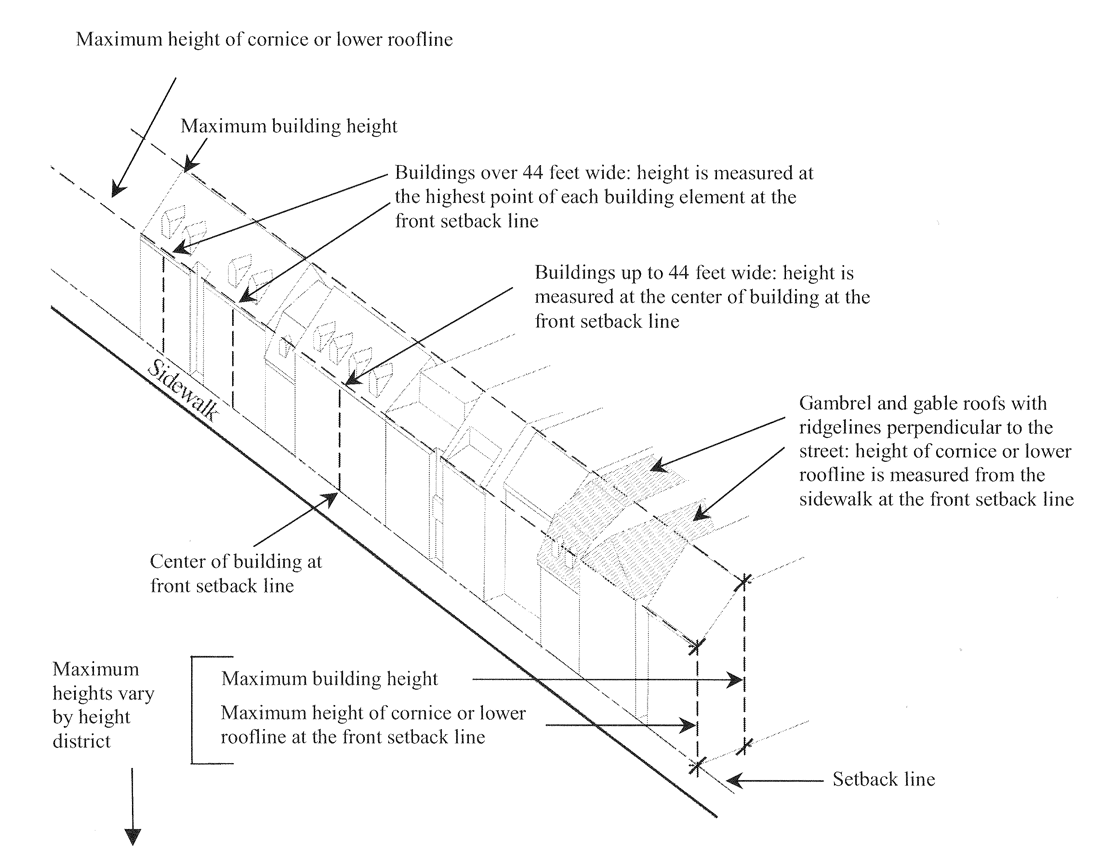
(Ord. O-1-04 Revised (part), 2005; Ord. No. O-15-23, § I, 7-10-2023; Ord. No. O-14-25, § I, 10-13-2025)
21.56.180 - Special height limit districts.
A.
Establishment. Three special height limit districts are established: district 1, district 2 and district 3.
B.
Location and Boundaries. The location and boundaries of the special height limit districts are as set forth on the map entitled "Historic District Special Height Limits," certified copies of which are maintained by the Department of Planning and Zoning, which constitutes a part of the "City of Annapolis Zoning District Map," established by Section 21.06.020
C.
Applicability. The special height and bulk limits in these districts shall govern over any other height and bulk limits established in other provisions of this Zoning Code.
D.
Regulations.
1.
No building in the special height limit district 1 may exceed a total height of thirty-two feet and a height of twenty-two feet at the cornice or lower roofline measured at the front setback line.
2.
No building in the special height limit district 2 may exceed a total height of thirty-eight feet and a height of twenty-eight feet at the cornice or lower roofline measured at the front setback line.
3.
No building in the special height limit district 3 may exceed a total height of forty-five feet and height of thirty-five feet at the cornice or lower roofline measured at the front setback line.
(Ord. O-1-04 Revised (part), 2005)
(Ord. No. O-41-15, § I, 1-11-2016)
21.56.190 - Front setback for replacement buildings.
1.
Within the limits of the historic district, front setback provisions for the C1, C1A, C2, C2A and C2P districts shall be modified to provide that where a new building is constructed which takes the place of an existing building, the new building may be constructed with the same front setback as existed for the building it replaces; otherwise, the new building shall be subject to the provisions of the bulk regulations for those districts.
2.
Where, on property with frontage on Dock Street between Craig Street and the eastern-most terminus of Dock Street, a new building is to be constructed with the same front setback as the building it replaces. The maximum allowable architectural bulk of the new building shall be constrained by the application of the height and setback provisions of this chapter, rather than the floor area ratio standard applicable to the C2 District.
(Ord. O-1-04 Revised, 2005; Ord. No. O-14-25, § I, 10-13-2025)
21.56.200 - Side yards.
Within the limits of the historic district the interior side yard requirement specified in the bulk regulations table for the C-1 district shall be modified to require:
A.
Existing Yards. Existing side yards shall be maintained; provided, that they are not required to be greater than five feet.
B.
New Construction.
1.
Where a new building or building addition replaces a building or part of a building that had a side yard, the side yard shall be maintained; provided, that it is not required to be greater than five feet.
2.
Where a new building replaces a building which did not have side yard, then a side yard is not required.
3.
In all other cases of new building, a side yard of five feet is required.
(Ord. O-1-04 Revised (part), 2005)
21.56.210 - Width of buildings.
A.
The width of new buildings is governed by the width of their individual building elements (as defined in Subsection C of this section) which should be compatible with the massing of structures in the surrounding neighborhood and with the historic district to maintain the historic and architectural character of the historic district.
B.
The width of individual building elements may not exceed twice the height of the lower roofline of the building as measured at the front setback line.
C.
"Building elements" means an unbroken roof ridge line, cornice or lower roofline, or wall. A building element will be considered broken if it is significantly offset from another building element, or separated from another building element by a projection or recess creating a substantial and distinct shadow line.
(Ord. O-1-04 Revised (part), 2005)
21.56.220 - Existing buildings.
No building lawfully existing on the effective date of this Zoning Code shall be considered to be nonconforming because of a failure to comply with the provisions of this article, and nothing in this article prevents the restoration of a damaged or destroyed building, subject, however, to the approval of the Historic Preservation Commission and Section 21.68.020.
(Ord. O-1-04 Revised (part), 2005)
21.56.230 - Purpose and criteria.
The purpose of this article is to promote the public health, safety and welfare, and safeguard the historical and cultural heritage of Annapolis through the regulation of placement, type, appearance, servicing, and insuring of newsracks on public rights-of-way in the Historic District so as to:
A.
Provide for pedestrian and driving safety and convenience.
B.
Restrict unreasonable interference with the flow of pedestrian or vehicular traffic including ingress into or egress from any residence or place of business, or from the street to the sidewalk by persons exiting or entering parked or standing vehicles.
C.
Provide for public and property safety during severe weather conditions.
D.
Provide reasonable access for the use and maintenance of poles, posts, traffic signs or signals, hydrants, mailboxes and access to locations used for public transportation purposes.
E.
Preserve and enhance a district which reflects the City's archaeological, architectural, cultural, and social history.
F.
Relocate and/or replace newsracks which result in a visual blight and/or excessive space allocation on the public rights-of-way or which unreasonably detract from the aesthetics of store window displays, adjacent landscaping and other improvements, as well as to have abandoned newsracks removed.
G.
Maintain and protect the values of surrounding properties.
H.
Reduce unnecessary exposure of the public to personal injury or property damage.
I.
Treat all newsracks equally regardless of their size, content, circulation, or frequency of publication.
J.
Maintain and preserve freedom of the press.
K.
Cooperate to the maximum extent possible with newspaper distributors.
(Ord. No. O-20-09, § I, 11-23-2009)
21.56.240 - Definitions.
For the purposes of this article, the following words and phrases shall have the meaning respectively ascribed to them:
"Chief" means the Chief of Historic Preservation for the City of Annapolis.
"Equivalent newsrack" means any newsrack of the same size, dimensions and style of the specified newsrack.
"Historic District" means the area of Annapolis as described in Section 21.56.030 of this Code, as amended from time to time.
"If demand warrants" or "warranted demand" means that the measured newspaper stack height needed to meet the newspapers publisher's or distributor's peak annual distribution at the requested newsrack location, as proven by the newspaper publisher or distributor, exceeds fourteen inches.
"Newsracks" means any type of unmanned device for the vending or free distribution of newspapers or news periodicals.
"Public right-of-way" means any public street, highway, sidewalk, parkway or alley.
(Ord. No. O-20-09, § I, 11-23-2009)
21.56.250 - Certificate of approval required.
No person shall place, affix, erect, construct or maintain a newsrack in the Historic District without first obtaining a one-time only Certificate of Approval for each newsrack in accordance with the provisions of this article.
(Ord. No. O-20-09, § I, 11-23-2009)
21.56.260 - Application and issuance of certificate of approval.
A.
Issuing authority. The issuing authority and coordinator shall be the Chief of Historic Preservation. The Chief is responsible for fairly coordinating and administering the physical placement of newsracks of the type and location herein specified, and upon compliance with provisions of this article, is responsible for issuing the certificates of approval.
B.
Approving authority. The approving authority shall be the Chief of Historic Preservation. The Chief shall provide review and administrative approval; the Chief shall circulate the application for consideration and comment by the Public Works Administration, the Police Department, and the Planning and Zoning Department.
C.
Enforcing authority. The enforcing authority shall be the director of the Department of Planning and Zoning.
D.
Applications. The applicant shall file with the Chief of Historic Preservation a Historic Preservation Commission Administrative Approval Application for an installation Certificate of Approval that shall contain the following information:
1.
The name, address and telephone number of the applicant who is the owner and/or principal in responsible charge of the newsrack.
2.
The name, address and telephone number of a responsible person whom the City may notify or contact at any time concerning the applicant's newsracks.
3.
The number of newsracks and the proposed location of each shown on a drawing provided by the Public Works Administration as in Subsection D. of this section.
4.
Names of newspapers or periodicals to be contained in each newsrack.
5.
Type or brand of newsracks, including an illustration and description of the newsrack and mount if other than a single pedestal, TK-80PM, or K-80PM SHORACK, or TK-80 or K-80 SHORACK with special pedestal and 14-inch square base plate (allowed only if demand warrants at the installation location) or equivalent, as per Section 21.56.310 of this Code.
E.
Procedure. In consultation with the Public Works Department and the Department of Planning and Zoning, and with the approval of the Historic Preservation Commission, the Chief shall:
1.
Develop a map of a large enough scale to show permitted locations of newsracks in the Historic District.
2.
Request a list of proposed newsrack locations, marked on the above map, from each distributor.
3.
Prepare a scale drawing or aerial photograph of each newsrack location showing the position and name of each newsrack at that location.
4.
Review for approval newsrack drawings.
5.
Obtain confirmation approvals of the above approved newsrack drawings from each distributor.
6.
Have the public works survey crew, following Certificate of Approval issuance, then mark placement locations with a template so that installation crews will have no problem.
F.
Issuance of certificate of approval. Upon a finding by the Chief that the applicant is in compliance with the provisions of this article, the Chief shall cause to be issued a certificate of approval for installation by the newspaper publishing and or distribution company. Such issuance shall be made within ten working days of the City's receipt of the completed application.
G.
Denial of certificate of approval. If a Certificate of Approval for some newsrack location applied for shall be denied, the applicant shall be notified within ten working days of the City's receipt of the completed application. The applicant shall be advised of the specific cause of such denial by the Chief, who may suggest alternative locations. The applicant may reapply for substitute alternative location at no additional certificate of approval fee.
H.
Additional certificate of approval. If at any time initial application for an installation certificate of approval a publisher wishes to install additional newsracks, then Subsections D and E of this section are to be repeated in accordance with the provisions of this article. Additional certificate of approval fees shall be in accordance with Section 21.56.270 of this Code.
(Ord. No. O-20-09, § I, 11-23-2009; Ord. No. O-12-16 Amended, § I, 5-23-2016)
21.56.270 - Fees.
There shall be a one-time only certificate of approval fee in an amount established by resolution of the City Council for each newspaper publisher and or distributor. Failed inspections are subject to a reinspection fee. All of the above fees will be used to defray administrative expenses relating to this article only, and any revenues over expenses remaining after the implementation of this article will be returned to the newspaper publishers in proportion to their respective contributions.
(Ord. No. O-20-09, § I, 11-23-2009)
21.56.280 - Appeals.
Any applicant who has been denied a certificate of approval pursuant to the provisions of this article may file an appeal by requesting a review and determination, in writing, to the Historic Preservation Commission. A further appeal may be made to the Circuit Court for Anne Arundel County, in accordance with Section 21.56.110 of this Code.
(Ord. No. O-20-09, § I, 11-23-2009)
21.56.290 - Placement generally.
Subject to the prohibitions set forth in Section 21.56.320 of this Code, newsracks shall be placed parallel to and not less than five inches nor more than twenty inches from the edge of the curb. Newsracks placed near the wall of a building must be placed parallel to and not more than six inches from the wall.
(Ord. No. O-20-09, § I, 11-23-2009)
21.56.300 - Installation and maintenance.
A.
Newsracks shall be single pedestal, TK-80PM or K-80PM SHORACK, or TK-80 or K-80 SHORACK with special pedestal and fourteen-inch square base plate (allowed only if demand warrants at the installation location) or equivalent.
B.
Newsracks shall have beige, brown, blue, white or black, or combinations of these colors, for the pedestals, sides, door and coinbox. The height of the cabinet top of all newsracks shall be forty-nine inches above the finished grade level.
C.
Newsracks shall carry no cardholders or advertising, but may display the name, with lettering and background of any colors, of the newspaper being dispensed, in spaces in the locations and sizes set forth below:
1.
On the front of the newsrack, the lettering size shall not exceed one and three-quarters inches height. The lettering shall be placed within a colored-band space not exceeding two and one-half inches in height above the door hinge.
2.
On the sides and back of the newsrack, the lettering size shall not exceed two and one-half inches in height. The lettering shall be placed within a colored-band space not exceeding four and one-half inches in height and beginning one (1) inch from the top of the newsrack.
D.
Newsracks for free newspapers may omit the coinbox and may have the pull bar welded to the door to produce a "hono rack."
E.
Newsracks shall be maintained in good working order at all times, neatly painted and with unbroken hoods.
F.
Mounts, if applicable, shall be bolted in place through four standard holes in the base place in accordance with standards provided in section 9 (mounting standards). Newsrack cabinet tops shall be installed and checked for level; a water-soluble, paintable, ten-year calk of comparable color shall be applied and wiped to seal around the base plate and the mounting surface.
(Ord. No. O-20-09, § I, 11-23-2009)
21.56.310 - Specific prohibitions.
Within the Historic District, no newsrack shall be placed, installed, used or maintained:
A.
Within five feet of any marked crosswalk.
B.
Within ten feet of any unmarked crosswalk.
C.
Within ten feet of any fire hydrant, fire callbox, or other emergency facility.
D.
Within five feet of any driveway.
E.
Within five feet ahead of, and fifteen feet to the rear of any sign marking a designated bus stop, measured along the edge of pavement.
F.
Within two feet of any bus bench, or plaza bench.
G.
At any location whereby the clear space for passageway of pedestrians is reduced to less than six feet.
H.
Where a vertically protruding member of the newsracks is on or within twelve inches of any area improved with lawn or hedges or within three feet of flowers or trees.
I.
Within three feet of any display window of any building abutting the sidewalk or parkway or in such a manner as to impede or interfere with the reasonable use of such window display purpose, or within five feet of a building entrance.
J.
On or within two feet of signs, parking meters, street lights or utility poles.
K.
In areas designated as parks or plazas.
(Ord. No. O-20-09, § I, 11-23-2009)
21.56.320 - Enforcement procedures—Nonconforming newsracks.
Within one hundred twenty days of the effective date of the ordinance from which this article is derived and at any time thereafter, any newsrack in violation of any provision of this article shall be subject to remedy and due process under the Department of Planning and Zoning.
(Ord. No. O-20-09, § I, 11-23-2009; Ord. No. O-12-16 Amended, § I, 5-23-2016)
21.56.330 - Same—Abandoned newsracks.
A.
If any newsrack installed pursuant to this article does not contain the publication specified therefor within a period of forty-eight hours after release of the current issue, the Department of Planning and Zoning may deem the newsrack abandoned and take appropriate action for an ordinance violation.
B.
In the event a newspaper publishing company or its distributor desires to voluntarily abandon a newsrack location, the distributor shall notify the director, completely remove the newsrack and mount, and restore the public right-of-way to a safe condition, leaving no holes or projections in the mounting surface.
(Ord. No. O-20-09, § I, 11-23-2009; Ord. No. O-12-16 Amended, § I, 5-23-2016)

