
Annapolis City Zoning Code
Division VI
GENERAL TERMS AND RULES OF MEASUREMENT
21.72.010 - Terms.
A.
Construction. In the construction of this Zoning Code, the rules and definitions contained in this chapter shall be observed and applied, except when the context clearly indicates otherwise.
B.
Definitions. Except as provided for elsewhere in this Zoning Code, terms used in this Zoning Code shall have the definition provided in any standard dictionary, unless specifically defined below or in any other provision of this Zoning Code.
C.
Generic Definitions.
1.
Purpose of Generic Definitions. Certain terms in this chapter are defined to be inclusive of many uses in order to eliminate overly detailed listings of uses in the zoning districts established by this title. These terms are referred to in this title as "generic" definitions. Examples of generic definitions used in this title are "retail goods establishment," "amusement establishment" and "light manufacturing."
2.
Components of Generic Definitions. A generic definition has three components: (1) a brief listing of examples of uses intended to be included within the scope of the definition; (2) an identification (where appropriate) of certain uses which are not meant to be included by the term; and (3) a statement that for the purposes of each zoning district, any other uses specifically listed within the particular zoning district shall not be construed as falling within the generic definition.
3.
Uses Not Listed or Not Within Scope of Generic Definition. A use which is not specifically listed in a zoning district, or which does not fall within a generic definition as defined in this chapter, or as interpreted by the Director of Planning and Zoning pursuant to Chapter 21.16 is prohibited.
D.
List of Definitions.
"Abatement" means the act of putting an end to a land alteration or development activity or reducing the degree or intensity of the alteration or activity.
Accessory building or use. See Use, accessory.
"Accessory dwelling unit" means an accessory building, or portion of a building, designed or used exclusively for residential occupancy that is located in a single family dwelling or on the same lot and is subject to the use standards in Section 21.64.010 of this Zoning Code and the bulk regulations for buildings accessory to single-family dwellings.
"Accessory structure" means a structure that is detached from the principal structure, located on the same lot and customarily incidental and subordinate to a principal structure.
"Addition" means construction that increases the size of a structure.
"Adult bookstore" means any commercial establishment which includes in its stock books, periodicals, photographs, drawings, sculpture, motion pictures, films or other visual representations which depict sadomasochistic abuse, sexual conduct or sexual excitement, as defined by Article 27, Section 416a of the Annotated Code of Maryland, and which otherwise does not qualify as a theater or nonprofit, free-lending library.
"Adverse impact" means any deleterious effect on waters or wetlands, including their quality, quantity, surface area, species composition, aesthetics or usefulness for human or natural uses. Such deleterious effect is or potentially may be harmful or injurious to human health, welfare, safety or property, to biological productivity, diversity or stability; or unreasonably may interfere with the enjoyment of life or property, including outdoor recreation.
"Afforestation" means the establishment of a tree crop on an area from which it has always or very long been absent, or the planting of open areas that are not presently in forest cover.
"Agriculture" means all methods of production and management of livestock, crops, vegetation, and soil. This includes, but is not limited to, the related activities of tillage, fertilization, pest control, harvesting, and marketing. It also includes, but is not limited to, the activities of feeding, housing, and maintaining animals such as cattle, dairy cows, sheep, goats, hogs, horses, and poultry and handling their by-products.
"Alley" means a public or private right-of-way primarily designated to serve as secondary access to the side or rear of those properties whose principal frontage is on some other public way.
"Alteration" means any change in size, shape, character or use of a building or structure.
Amusement establishment, indoor. "Indoor amusement establishment" means a commercial establishment where the principal use or purpose is providing diversions or activities for entertainment, recreation, or pleasure. The term "amusement establishment, indoor" includes, but is not limited to amusement arcades, bowling alleys, dance halls, pool halls swimming pools and skating rinks. The term "amusement establishment, indoor" does not include any use that is otherwise listed specifically in the Table of Permitted Uses for the zoning district where the term is used.
"Anadromous fish" means fish that travel upstream (from their primary habitat in the ocean) to freshwater in order to spawn.
"Anadromous fish propagation waters" means those streams that are tributary to the Chesapeake Bay and Atlantic Coastal bays in which the spawning of anadromous species of fish (e.g., rockfish, striped bass, yellow perch, white perch, shad, and river herring) occurs or has occurred. The streams are identified by the Department of Natural Resources.
"Anchor tenant" means the largest tenant or tenants in a shopping center. Shopping center anchor tenants are typically grocery stores or department stores.
"Animal hospital" means a building or portion of a building designed or used for the care, observation or treatment of domestic animals. Animal hospital includes veterinarian office.
"Antenna" means a device designed for telephone, radio, or television communications through sending and/or receiving of electromagnetic waves.
Antenna, flush mounted. "Flush mounted antenna" means an antenna mounted on the side of a building or structure.
"Antenna tower" means a structure used to support antennas for providing wireless voice, data and image transmission within a designated service area. Antenna tower includes monopole.
"Apartment hotel" means an apartment building in which not more than ten percent of the accommodations are available for occupancy by nonpermanent guests, and which provides such services as maid service, laundering or furnishing of linens, telephone and secretarial or desk service.
"Aquaculture" means:
(a)
Farming or culturing of finfish, shellfish, other aquatic plants or animals or both, in lakes, streams, inlets, estuaries, and other natural or artificial water bodies or impoundments;
(b)
Activities include hatching, cultivating, planting, feeding, raising, and harvesting of aquatic plants and animals and the maintenance and construction of necessary equipment, buildings, and growing areas; and
(c)
Cultivation methods include, but are not limited to, seed or larvae development and grow out facilities, fish ponds, shellfish rafts, rack and longlines, seaweed floats and the culture of clams and oysters on tidelands and subtidal areas.
For the purpose of this definition, related activities such as wholesale and retail sales, processing and product storage facilities are not considered aquacultural practices.
"Arts and crafts store" means an establishment where the principal use or purpose is the sale of goods, products and merchandise for the practice and enjoyment of arts and crafts. The term "arts and crafts store" includes but is not limited to antique stores, art and school supply stores, coin and stamp stores, gift shops, and hobby shops. The term "art and craft store" does not include any use that is otherwise listed specifically in the Table of Permitted Uses for the zoning district where the term is used.
"Arts and crafts studio" means an establishment where the principal use or purpose is practicing, producing, or selling arts and crafts. The term "art and craft studio" includes but is not limited to china and glassware stores, picture framing, jewelry sales and repair, musical instruments sales and repair, and interior decorating shops. The term "art and craft studio" does not include any use that is otherwise listed specifically in the Table of Permitted Uses for the zoning district where the term is used.
"Automated purchasing machine or APM" means any self-service automated device that, without the physical presence of a human agent, is capable of taking possession of and dispensing payment for any one or more types of personal property, other than cash (also known as reverse vending machines).
"Bake shop" means an establishment where only bread, pastries and other baked goods are made and offered for sale.
"Bakeries" mean an establishment where only bread, pastries and other baked goods are made and offered for sale, and the products are sold wholesale and not for immediate consumption.
"Bar and tavern" mean establishments primarily engaged in the retail sale of drinks, such as beer, ale, wine, liquor and other alcoholic beverages, with food only incidental to the sale of alcohol.
"Basement" means a portion of a building located partly or wholly underground and having more than one-half of its floor-to-ceiling height below the average grade of the adjoining ground.
"Bed and breakfast home" mean a single-family, owner-occupied, detached dwelling which provides only transient lodging in not more than five rooms with a maximum stay of fourteen consecutive nights.
"Best Management Practices" (BMPs) means conservation practices or systems of practices and management measures that control soil loss and reduce water quality degradation caused by nutrients, animal waste, toxics and sediment. Agricultural BMPs include, but are not limited to, strip cropping, terracing, contour stripping, grass waterways, animal waste structures, ponds, minimal tillage, grass and naturally vegetated filter strips, and proper nutrient application measures.
"Block" means a tract of land bounded by streets, or by a combination of streets and public parks, cemeteries, railroad rights-of-way, shorelines of waterways or boundary lines of the City.
"Boat repair and maintenance" means, including but not limited to, vessel repair and maintenance; maritime engineer/mechanical repair; boat, yacht and watercraft haul-out facilities and maintenance operations; fuel storage and refueling facilities for marine craft; and accessory on-land material storage.
Boatyard, working. "Working boatyard" means areas on land and in the water consisting of spaces used for the repair, construction, maintenance, and temporary storage of vessels to include: piers, slips, mooring piles, wharves or buoys together with facilities for launching and hauling vessels such as travellift, marine rail, crane, or ramp.
Buffer, Critical Area. "Critical Area Buffer" means an area that based on conditions at the time of development, is immediately landward from mean high water of tidal waterways, the edge of a bank of a tributary stream, or the edge of a tidal wetland; and the area exists, or may be established in, natural vegetation to protect a stream, tidal wetland, tidal waters or terrestrial environments from human disturbance. The buffer includes an area of at least one hundred feet, even if that area was previously disturbed by human activity, and also includes any expansion for contiguous areas, including a steep slope, hydric soil, highly erodible soil, nontidal wetland, or a Nontidal Wetland of Special State Concern as defined in COMAR 26.23.01.01.
Buffer Area, Modified. "Modified Buffer Area" means an area of land where an existing pattern of residential, industrial, commercial, or recreational development in the one-hundred-foot buffer prevents the buffer from fulfilling the functions stated in COMAR 27.01.09.01B. This area includes only those areas of land that are shown on maps approved by the Critical Area Commission and on file with the City of Annapolis.
"Buffer Management Plan" means a narrative, graphic description, or plan of the buffer that is necessary when an applicant proposes a development activity that shall affect a portion of the buffer, affect buffer vegetation, or require the establishment of a portion of the buffer in vegetation. Buffer Management Plan includes a Major Buffer Management Plan, a Minor Buffer Management Plan, or a Simplified Buffer Management Plan as described in this Chapter.
"Bufferyard" means a landscaped yard that creates separation, transition, or enhanced spacing between zoning districts, uses, or rights-of-way.
"Building" means any structure built for the support, shelter or enclosure of persons, animals, chattels or movable property of any kind, and which is permanently affixed to the land.
Building, completely enclosed. "Completely enclosed building means" a building separated on all sides from the adjacent open space, or from other buildings or other structures, by a permanent roof and by exterior walls or party walls, pierced only by windows and normal entrance or exit doors.
Building, detached. "Detached building" means a building surrounded by an open space on the same lot.
"Building height" means the vertical distance from the lowest point of a structure at its front elevation at grade to the highest point of the structure, not including accessory fixtures attached to the structure. See illustration.
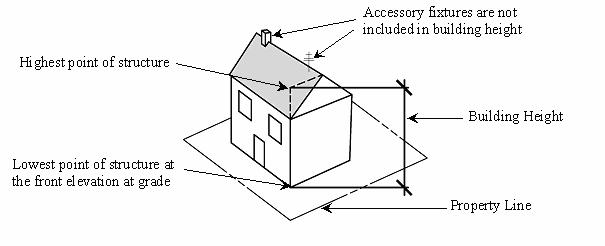
Refer to Chapter 21.56 for measurement of building height in the historic district.
Building, principal. "Principal building" means a non-accessory building in which the principal use of the lot on which it is located is conducted.
"Bulk" means the size and setbacks of buildings or structures and the location of the buildings or structures with respect to one another, and includes the following:
a.
Size and height of buildings;
b.
Location of exterior walls at all levels in relation to lot lines, streets or to other buildings;
c.
Gross floor area of buildings in relation to lot area (floor area ratio);
d.
All open spaces allocated to buildings;
e.
Amount of lot area provided per use.
"Business establishment" means a place of business carrying on operations, the ownership and management of which are separate and distinct from those of any other place of business located on the same zoning lot.
"Canopy tree" means a tree that when mature commonly reaches a height of at least thirty-five feet.
"Capacity in persons" means the maximum number of persons that can avail themselves of the services or goods of an establishment or use, at any one time, with reasonable comfort, as determined in the Annapolis Building Code.
"Car wash" means an area or structure equipped with facilities for washing automobiles.
"Charitable institution" means a building or group of buildings devoted to and supported by charity.
Child care.
A.
"Child care center" has the same meaning as defined in Education Article, § 9.5-301 of the Maryland Code:
1.
"Child care center" means an agency, institution, or establishment that, for part or all of a day, or on a 24-hour basis on a regular schedule, and at least twice a week, offers or provides child care to children who do not have the same parentage except as otherwise provided for in law or regulation.
2.
"Child care center" shall include a nonpublic nursery school in which an instructional program is offered or provided for children who are under the age of five years.
3.
"Child care center" does not include:
a.
A nonpublic kindergarten in which an instructional program is offered or provided for children who are at least five years old;
b.
A nonpublic elementary school in which an instructional program is offered or provided for children who are in grades 1 through 8;
c.
A child care home, a child care institution, or other child care facility that offers or provides a residential placement for a child and is established, licensed, or registered under Title 9 of the Human Services Article, or Title 10 of the Health - General Article of the Maryland Code; or
d.
A family child care home or large family child care home that is required to be registered or is registered by the state.
B.
"Family child care home" has the same meanings as defined in Education Article, § 9.5-401 of the Maryland Code:
1.
"Family child care" and means the care given to a child younger than 13 years old or to a developmentally disabled person younger than 21 years old in place of parental care for less than 24 hours a day, in a residence other than the child's residence, for which the provider is paid in cash or in kind.
2.
"Family child care home" means a residence in which family child care is provided for up to eight children.
3.
"Family child care provider" means an individual who cares for children in a registered family child care home or a registered large family child care home.
4.
"Large family child care home" means a residence in which family child care is provided for at least nine children, but not more than 12 children.
"Cigar lounge" means an area or areas within a tobacco shop that primarily sells premium cigars and pipe tobacco, as defined in Maryland Business Regulation Code Annotated § 16.5-101, and related products, where customers of the tobacco shop may use the products sold by the tobacco shop and where a bar or tavern use for the sale of alcohol by the tobacco shop may be permitted as accessory to the primary activities of the tobacco shop, notwithstanding requirements for bars or taverns as a primary use.
"Clearing" means any activity that removes the vegetative ground cover while leaving the root mat intact.
"Cluster development" means a residential development in which dwelling units are concentrated in a selected area or selected areas of the development tract so as to provide natural habitat or other open space uses on the remainder.
"Co-location" means use of an antenna tower or site by more than one antenna or telecommunications service provider.
"Coffee shop" means a type of food establishment of no more than two thousand square feet gross floor area whose principle business is the sale of coffee and other hot beverages. Pastries, sandwiches and other light fare may also be sold incidental to the service of coffee. A food service establishment that otherwise meets this definition shall not be a coffee shop if it serves alcoholic beverages or is otherwise required to have an alcoholic beverage license under this code.
"Colonial nesting water birds" means herons, egrets, terns, and glossy ibis. For the purposes of nesting, these birds congregate (that is "colonize") in relatively few areas, at which time, the regional populations of these species are highly susceptible to local disturbances.
"COMAR" means the Code of Maryland Regulations, as from time to time may be amended, including any successor provisions.
"Commission, Critical Area. "Critical Area Commission" means the Critical Area Commission for the Chesapeake and Atlantic Coastal Bays.
"Community piers" means boat docking facilities associated with subdivisions or similar residential areas, and with condominium, apartment and other multiple family dwelling units. Private piers are excluded from this definition.
"Comprehensive Plan" means the policies, statements, goals, and interrelated plans for private and public land use, transportation, and community facilities documented in texts and maps and adopted by resolution of the City Council to constitute the guide for future development of the municipality. The "Comprehensive Plan" includes a general plan, master plan, functional plan, or community plan adopted in accordance with Title 3 of the Land Use Article of the Annotated Code of the State of Maryland and subsequent amendments to that plan.
"Conforming" means a parcel or lot that meets all Critical Area requirements. Conforming does not include a parcel or lot for which a Critical Area variance is sought or has been issued; or that is located in the Resource Conservation Area and is less than twenty acres.
"Consistency" means an action taken that shall further, and not be contrary to, the following items in the Comprehensive Plan:
A.
Policies;
B.
Timing of the implementation of the plan;
C.
Timing of development;
D.
Timing of rezoning;
E.
Development of patterns;
F.
Land uses; and
G.
Densities or intensities.
"Conservation easement" means a non-possessing interest in land which restricts the manner in which the land may be developed in an effort to reserve natural resources for future use.
"Consolidation" means a combination of any legal parcel of land or recorded legally buildable lot into fewer lots or parcels than originally existed. It includes a lot line abandonment, a boundary line adjustment, a replatting request, and a lot line adjustment.
"Convenience store" means a retail establishment, selling a limited number of food items, household items and some items prepared on the premises, including reheating, which can be immediately consumed, of no more than four thousand square feet gross floor area.
"Critical Area" means all lands and waters defined in §8-1807 of the Natural Resources Article, Annotated Code of Maryland. Critical Area includes:
a.
All waters of and lands under the Chesapeake Bay and Atlantic Coastal Bays and their tributaries to the head of tide;
b.
All State and private wetlands designated under Title 16 of the Natural Resources Article, Annotated Code of Maryland;
c.
All land and water areas within one thousand feet beyond the landward boundaries of State or private wetlands and the heads of tides designated under Title 16 of the Natural Resources Article, Annotated Code of Maryland; and
d.
Modification to these areas through inclusions or exclusions approved by the Commission as specified in §8-1807 of the Natural Resources Article, Annotated Code of Maryland.
"Curb level" means the level of the established curb in front of a building measured at the center of the front. Where no curb elevation has been established, the mean elevation of the finished lot grade immediately adjacent to a building shall be considered the curb level.
"Cutting" means felling or removal of a tree or any procedure the result of which is to cause the death or substantial destruction of a tree. Cutting does not include normal pruning or trimming.
"Delicatessen" means a type of food service establishment which has as a substantial portion of its business the carry-out of foods for immediate consumption. Delicatessens shall exhibit both of the following characteristics:
The establishment does not provide more than ten seats; and
Food items prepared for consumption generally are not prepackaged, but are made to specific order. A limited number of prepackaged items may be sold, but only as accessory to the principal use of service of food for immediate consumption.
"Density" means the number of dwelling units per gross acre.
"Department" means the Department of Planning and Zoning.
"Department store" means store selling a wide variety of goods and arranged in several departments.
"Developed woodlands" means those areas which predominantly contain trees and natural vegetation and which also include residential, commercial or industrial structures and uses. Within the City of Annapolis, developed woodlands are further defined as those areas where greater than half of the area extent consists of a recognizable canopy of mature species typical of a climax stage of forest succession.
"Developer" means a person who undertakes development activity as defined in this ordinance; or a person who undertakes development as defined in Natural Resources Article 8-1802 as may be amended and in the criteria of Chapter 21.54.
"Development activities" means the construction or alteration of residential, commercial, industrial, institutional or transportation facilities or structures. In the Critical Area, "development activity" includes human activity that results in disturbance to land, natural vegetation, or a structure.
"District" means a portion of the territory of the City within which certain uniform regulations and requirements, or various combinations of regulations and requirements, apply under the provisions of this Zoning Code.
"Disturbance" means an alteration or change to the land. It includes any amount of clearing, grading, or construction activity. Disturbance does not include gardening or maintenance of an existing grass lawn.
"Director of Planning and Zoning" shall be read to include his or her designee.
"Drive-through facilities" means any vehicular aisle or opening in the wall of a building or structure used or intended to be used to provide for sales and/or service to patrons who remain in their vehicles.
"Dwelling" means a building, or portion of a building, designed or used exclusively for residential occupancy. Includes the following unit types:
a.
Single-family detached dwellings;
b.
Single-family attached dwellings;
c.
Multifamily dwellings;
d.
Two-family dwellings;
e.
Three-family dwellings;
f.
Four-family dwellings;
g.
Cottage Court dwellings; and
h.
Dwellings above the ground floor of nonresidential uses.
The term "dwelling" does not include house trailers and hotels.
Dwelling, Cottage Court. "Cottage Court dwelling" means a grouping of at least four small single-family detached dwellings or single-family attached dwellings arranged around a shared common open space.
Dwelling, Four-Family. "Four family dwelling" means a building containing four dwelling units.
Dwelling, Multi-Family. See illustration. "Multi-family dwelling" means a building, or portion of a building, containing three or more dwelling units.
Dwelling, Single-Family Detached. See illustration. "Single-family detached dwelling" means a building containing one dwelling unit that is surrounded entirely by open space on the same lot.
Dwelling, Single-Family Attached. See illustration. "Single-family attached dwelling" means one of a series of two or more dwellings that can be joined to another dwelling at one or more sides by a party wall or walls, with each unit having its own separate exterior entrance(s). For example, townhouse, rowhouse, two-family dwelling, and quadraplex units are single-family attached dwellings.
Dwelling, Three-Family. "Three-family dwelling" means a building containing three dwelling units.
Dwelling, Two-Family. See illustration. "Two-family dwelling" means a building containing two dwelling units. Examples:
a.
A detached dwelling containing an apartment is a two-family detached dwelling.
b.
A duplex is a two-family detached dwelling with the units separated by one vertical party wall without openings extending from the basement floor to the roof along the dividing lot line.
"Dwelling unit" means any habitable room or a group of adjoining habitable rooms located within a dwelling and forming a single unit with facilities which are used or intended to be used for living, sleeping, cooking and eating of meals.
Illustrations for dwelling unit definitions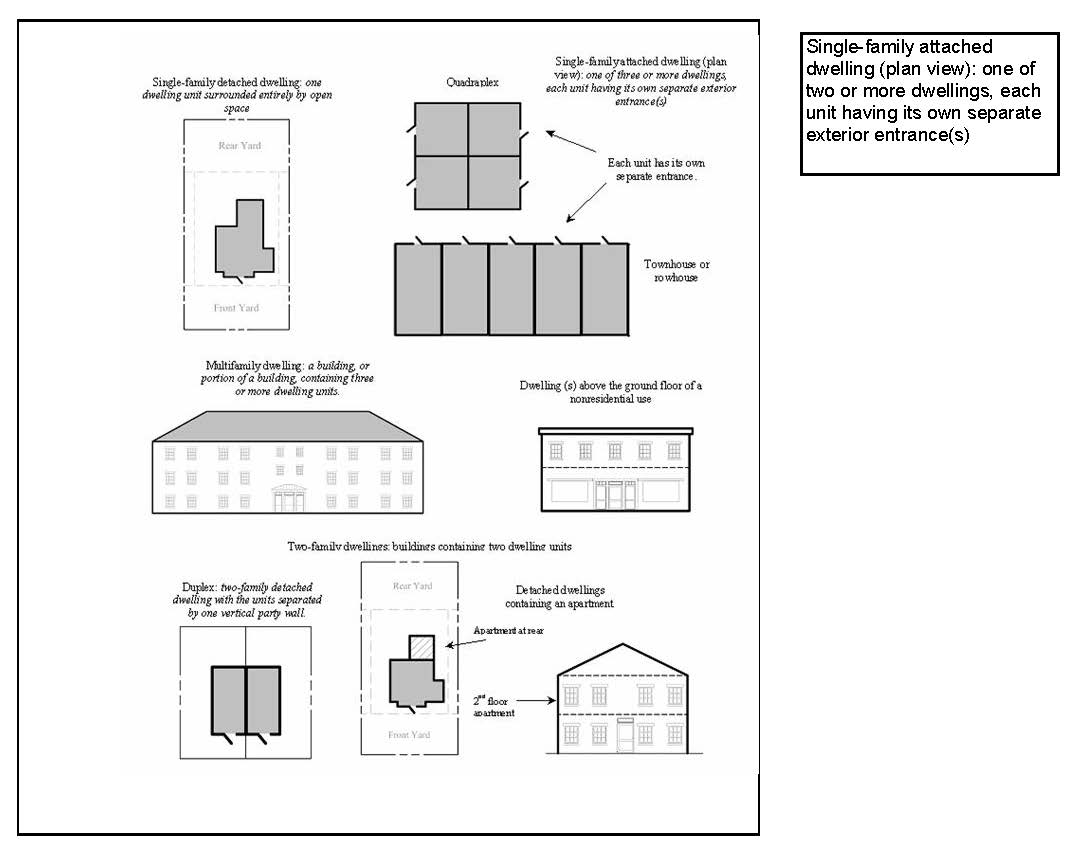
"Efficiency unit" means a dwelling unit consisting of one principal room exclusive of bathroom, kitchen, hallway, closets or dining alcove directly off the principal room, providing the dining alcove does not exceed one hundred twenty-five square feet in area.
"Electric substation," for determining setbacks, means and includes any piece of electrical equipment or electrical apparatus required to transform voltage of electricity. It excludes fences, planting, and other aesthetic treatments.
"Endangered species" means any species of fish, wildlife, or plants that have been designated as endangered by regulation by the Secretary of the Department of Natural Resources. Designation occurs when the continued existence of these species as viable components of the State's resources are determined to be in jeopardy. This includes any species determined to be an "endangered" species pursuant to the Federal Endangered Species Act, 16 U.S.C. § 1431 et seq., as amended.
"Ephemeral stream" means a stream that flows only in direct response to precipitation in the immediate watershed or in response to the melting of a cover of snow or ice, and which has a channel bottom that is always above the local water table.
"Established front yard" means the front yard for a block or portion of a block that has been created by any existing legally constructed building or buildings, whether or not this yard meets the minimum yard requirements for the zoning district where the building or buildings are located.
"Establishment' means the planting or regeneration of native vegetation throughout the buffer.
"Family" means one or more persons, each related to the other by blood, marriage or adoption, who are living together in a single dwelling and maintaining a common household. A family includes any domestic servants and not more than one gratuitous guest residing with the family.
"Fences and walls" mean an artificially constructed exterior barrier of wood, masonry, stone, wire, metal, plastic, or any other manufactured material or combination of materials, for which the primary purpose is to mark boundaries, control access, or to screen views. For the purpose of this title, the term "fences and walls" does not include retaining walls.
"Fences and walls height" mean the vertical distance, measured to the nearest integral foot, from the elevation at grade directly below the structure to the top of the structure, not including supporting posts. If the fence or wall has been elevated through the use of a retaining wall, the creation of a berm or another method for the primary purpose of increasing the overall height of the fence or wall, then the fence or wall height shall be measured from the ground elevation prior to the grade modification.
"Financial assurance" means a performance bond, letter of credit, cash deposit, insurance policy, or other instrument of security acceptable to the City. Financial assurance may be required to ensure that mitigation plantings that die within twenty-four months of installation shall be replaced.
"Fisheries activities" means commercial water dependent fisheries facilities including structures for the parking, processing, canning, or freezing of finfish, crustaceans, mollusks, amphibians, and reptiles and also including related activities such as wholesale and retail sales product storage facilities, crab shedding, off-loading docks, shellfish culture operations, and shore-based facilities necessary for aquacultural operations.
"Floor area" means the sum of the gross horizontal areas of the stories of a building measured from the exterior faces of the exterior walls or sloped roofs where, in lieu of a wall, a sloped roof forms an exterior boundary of the building (such as in an attic), or from the centerline of walls separating two buildings.
a.
Calculation of Floor Area for Determining Floor Area Ratio.
i.
The following areas shall be included in the calculation:
(A)
Elevator shafts and stairwells at each floor;
(B)
Floor space used for mechanical equipment (except equipment, open or enclosed, located on the roof);
(C)
Penthouses;
(D)
Attic space having headroom of seven feet ten inches or more;
(E)
Interior balconies and mezzanines;
(F)
Enclosed porches;
(G)
Floor area devoted to accessory uses; and
(H)
In Waterfront Maritime districts only, space devoted to off-street parking structures at or above ground level.
ii.
The floor area of structures devoted to bulk storage of materials, including, but not limited to, grain elevators and petroleum storage tanks, is determined on the basis of height in feet; i.e., ten feet in height equals one floor.
b.
Calculation of Floor Area For Determining Off-Street Parking Requirements.
i.
The following areas shall be included in the calculation:
(A)
Penthouses;
(B)
Attic space having headroom of seven feet ten inches or more;
(C)
Interior balconies and mezzanines;
(D)
Enclosed porches;
(E)
Accessory storage areas located within selling or working space such as counters, racks or closets; and
(F)
Basement floor area devoted to retailing activities, to the production or processing of goods, or to business or professional offices.
ii.
The following areas shall not be included in the calculation:
(A)
Areas devoted primarily to storage purposes except those included above in Subsection (b)(i)(E) of this definition;
(B)
Areas devoted to off-street parking or loading facilities, including aisles, ramps and maneuvering space; or
(C)
Basement floor area other than areas devoted to uses included above in Subsection (b)(i)(F) of this definition.
"Floor area ratio (F.A.R)" means the floor area of the building or buildings on a zoning lot divided by the area of the zoning lot, or, in the case of planned developments, by the net site area. The floor area ratio requirements as set forth in the zoning district bulk regulations tables determine the maximum floor area allowable for the building or buildings (total floor area of both principal and accessory buildings) in direct ratio to the gross area of the zoning lot.
"Food and beverage-related use" means a commercial or nonprofit enterprise engaged in the preparation and sale of food, beverages or frozen desserts. Food service may or may not be the principal business of the establishment. Food and beverage-related uses include the following uses:
a.
Bake shops;
b.
Candy stores;
c.
Catering establishments;
d.
Clubs, lodges and meeting halls, with on-premises food or beverage preparation facilities;
e.
Coffee shops;
f.
Convenience stores;
g.
Delicatessens;
h.
Fast food restaurants;
i.
Food service marts;
j.
Ice cream stores;
k.
Standard restaurants;
l.
Supermarkets;
m.
Wine bars.
"Food service mart" means an establishment whose principal purpose is the sale of food items for home consumption, either prepared on premises or prepackaged. A food service mart shall exhibit all of the following characteristics:
a.
The principal operation of the establishment is the sale of food items for home consumption, either prepared on the premises or prepackaged;
b.
No seating is provided on the premises; and
c.
The gross square footage of the establishment does not exceed four thousand square feet.
"Food store" means a retail establishment selling dry groceries, produce and household items, but having no food prepared on the premises for immediate consumption.
"Forest" means a biological community dominated by trees and other woody plants, and that has at least 100 live trees per acre, with at least 50% of those trees having a two-inch or greater diameter at four and one-half feet above the ground and larger.
"Forest Interior Dwelling Birds" means species of birds which require relatively large, forested tracts in order to breed successfully (for example, various species of flycatchers, warblers, vireos, and woodpeckers).
"Fuel dock" means a facility offering fuel for sale for watercraft from a dock located in or over navigable waterway.
"Fully established buffer" means the buffer contains as much diverse, native vegetation as necessary to support a firm and stable riparian habitat capable of self-sustaining growth and regeneration.
"General maritime" means general office and research functions contributing to maritime activities including, but not limited to, marine salvage, testing, research and environmental services; maritime associations; oceanographic laboratories and experimental facilities; facilities for marine pollution control, oil spill cleanup, and servicing of marine sanitation devices; tugboat, vessel towing services, fireboat, pilotboat, harbormaster and similar services; specialized professional services to the maritime industry; marine transport operations, including shipping offices; marine photography, printmaking and chart-making; yacht and sailing club offices; yacht finance; recreational boating clubs and offices; and maritime service organizations.
Grade, lot. "Lot grade" means the average level of the finished surface of the ground adjacent to the exterior walls of a building or structure.
"Grandfathered parcel" or "Grandfathered lot" means a parcel of land that was created or a lot created through the subdivision process and recorded as a legally buildable lot prior to August 10, 1970 or, for Critical Area requirements, in accordance with [Section] 21.54.150.
"Group home" means any residential structure used to house a group of individuals in need of special residential facilities, but without extra medical or institutional services, guards or procedures, provided the facility is certified under guidelines and control of the State Departments of Health, Social Services or Juvenile Services.
"Growth allocation" means the number of acres of land in the Critical Area that the City may use to create new Intensely Developed Areas and new Limited Development Areas in accordance with [Section] 21.54.140.
"Habitat Protection Area" means an area that is designated for protection under Natural Resources Article, § 8-1806, Annotated Code of Maryland, and regulations adopted under that authority. It includes:
a.
The buffer as described in COMAR 27.01.01.01B(8);
b.
A nontidal wetland as defined in COMAR 26.23.01.01;
c.
Streams (perennial, intermittent, and on sites forty thousand square feet or greater ephemeral);
d.
A habitat of a threatened species as defined in COMAR 27.01.09.03;
e.
A habitat of an endangered species as defined in COMAR 27.01.09.03;
f.
A habitat of a species in need of conservation as defined in COMAR 27.01.09.03;
g.
A plant habitat as defined in COMAR 27.01.09.04;
h.
A wildlife habitat as defined in COMAR 27.01.09.04;
i.
Anadromous fish propagation waters as defined in COMAR 27.01.09.05.
Half-story. See "Story, half."
"Hedge, boundary" means a linear row of closely planted shrubs or low-growing trees put in place to accomplish the same effect as a fence or wall.
"Height."
a.
For buildings, see building height.
b.
For fences and walls, see fences and walls height.
c.
For signs, see Section 21.70.050(B).
"High-value transit (HVT)" means a fixed transportation route that includes enhanced reliability and service frequency with headways of at least 20 minutes; dedicated transit infrastructure (e.g., travel lanes); comprehensive station upgrades with real-time arrival/departure information; multi-modal integration with walking, biking, and micro-transit; and seamless intermodal connectivity.
"Highly erodible soils" means those soils with a slope greater than fifteen percent; or those soils with a K value greater than .35 and with slopes greater than five percent.
"Historic waterfowl staging and concentration area" means an area of open water and adjacent marshes where waterfowl gather during migration and throughout the winter season. These areas are historic in the sense that their location is common knowledge and because these areas have been used regularly during recent times.
"Home occupation" means a business use conducted entirely within a dwelling unit or accessory building to a dwelling unit by a resident of the dwelling unit and which is clearly incidental and secondary to the use of the principal building on the zoning lot for dwelling purposes.
"Hotel" means an establishment which is open to transient guests and which provides customary hotel services including maid service, the furnishing and laundering of linen, telephone and secretarial or desk service, the use and upkeep of furniture, and bellboy service.
"Hydric soils" means soils that are wet frequently enough to periodically produce anaerobic conditions, thereby influencing the species composition of growth, or both, of plants on those soils.
"Impervious surface" means those areas which do not have a vegetative cover with a natural soil substrate or a stormwater management reservoir.
"In-kind replacement" means the removal of a structure and the construction of another structure that is smaller than or identical to the original structure in use, footprint area, width, and length.
"In-water boat storage" means docks, slips, piers and other facilities at which boats are berthed, only in conjunction with other maritime uses; yacht and sailing clubs, and member services; and sailing schools.
"Incompatible use" means a use that is unsuitable for direct association with certain other uses because it is contradictory, incongruous or discordant.
"Inn" means a hotel which has no more than twenty sleeping rooms and/or suites for use by transient guests, and which has no food and beverage service other than that provided for guests of the inn, and which may provide meeting or conference facilities for guests of the inn.
"Institution for the care of the aged" means a building or buildings that provide housing for senior citizens aged sixty-two and older and which include seniors-specific amenities and services that meet the nutritional, social, recreational, medical, safety and transportation needs of the residents. This requirement may be met through the provision, for example, of meal service with common dining facilities, physical therapy facilities and activities, social and recreation facilities and activities, exercise facilities, meeting rooms and library service, health care service including a dedicated medical examination room, and personal services such as either an internal trash chute or trash pickup for each unit, an emergency response system for each unit and cleaning services for each unit. The term "institution for the care of the aged" includes acute care facilities such as nursing homes, assisted living facilities, and independent living facilities.
"Integrated sign program" means a coordinated program of signage for a zoning lot or lots where the materials, colors, shapes, and sizes of signage establish a unity of design compatible with the site, architecture, and the context.
"Intensely Developed Areas" means those areas where residential, commercial, institutional and/or industrial developed land uses predominate, and where relatively little natural habitat occurs.
"Intermittent stream" means a stream as defined in COMAR 26.23.01.01 and includes those areas that are surface waters, contained within a defined channel or bed, that flow at least once per year and confirmed by field verification. A defined channel or bed is indicated by hydraulically sorted sediment, or the removal of vegetative litter, or loosely rooted vegetation by the action of moving water.
"Kennel" means a premises on which dogs or cats are maintained, boarded, bred or cared for, in return for remuneration, or are kept for the purpose of sale.
"Land-disturbing activity" means those activities that involve land surface and/or subgrade that are altered from existing conditions and that are regulated under Titles 14, 15, 17, 19, 20 and 21 of the City Code.
"Landscape elements" means the components of a landscape including planting, lighting, paving, fencing, grading, and walls.
"Landward edge" means the limit of a site feature that is farthest away from a tidal water, tidal wetland, or tributary stream.
"Limited Development Areas" means those areas that are currently developed in low-intensity or moderate-intensity uses. They also contain areas of natural plant and animal habitats.
Living space, minimum. "Minimum living space" means the minimum amount of space that shall be provided in a dwelling unit when required in the bulk regulations table for a zoning district. Minimum living space is determined by measuring from the inside walls of the dwelling unit. Gross square footage is expressed as gross square footage and may include closets and interior hallways, but may not include common hallways or storage areas located outside the dwelling unit.
"Lot" means a zoning lot, except when the context indicates a lot of record, in which case a "lot" is a lot of record. Lot includes "piece," "parcel" and "plot."
Lot, contiguous. "Contiguous lot" is a lot of record that shares a boundary line with another lot of record. In the case of two or more lots, each lot shares a boundary line with at least one of the other lots.
Lot, corner. See illustration. "Corner lot" means a lot situated at the intersection of two streets, the interior angle of the intersection not exceeding one hundred twenty-five degrees.
Lot, reversed corner. See illustration. "Reversed corner lot" means a corner lot, the street side lot line of which is substantially a continuation of the front lot line of the first lot to its rear.
Lot, through. See illustration. "Through lot" means a lot having a pair of opposite lot lines along two more or less parallel public streets, and which is not a corner lot. On a through lot both street lines shall be deemed front lot lines.
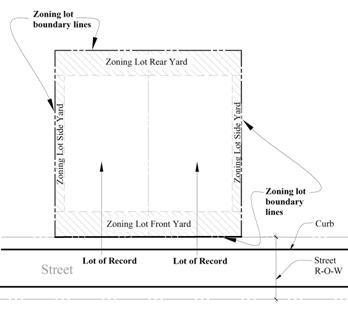
Lot, zoning. See illustration. "Zoning lot" means a single tract of land located within a single block which, at the time of filing for a building permit, is designated by its owner or developer as a tract to be used, developed or built upon as a unit, under single ownership or control. Therefore, a "zoning lot" may or may not coincide with a "lot of record."
"Lot coverage" means the amount of surface area of a lot that is covered by the sum of all structures, including accessory structures. Walks, driveways and fences shall not be considered structures for the purpose of this definition, but parking pads, parking lots and swimming pools are considered structures. Paved surfaces constructed of permeable materials allowing direct storm water absorption shall be exempted from the coverage calculation if approved by the Planning and Zoning Director.
Lot Coverage, Critical Area. "In the Critical Area, Lot Coverage" means the percentage of a total lot or parcel located in the Critical Area that is: occupied by a structure, accessory structure, parking area, driveway, walkway, or roadway; or covered with a paver, gravel, stone, shell, impermeable decking, permeable pavement, or any other manmade material. Lot coverage includes the ground area covered or occupied by a stairway or impermeable deck, but does not include: a fence or wall that is less than one foot in width that has not been constructed with a footer; a walkway in the buffer or expanded buffer, including a stairway, that provides direct access to a community or private pier; a wood mulch pathway; or a deck with gaps to allow water to pass freely. Gravel under such decks is not considered lot coverage in the Intensely Developed Area.
Lot depth. See illustration. "Lot depth" means the mean horizontal distance between the front lot line and the rear lot line of a lot, measured within the lot boundaries.
Lot line, front. See illustration. "Front lot line" means the boundary of a lot which is along an existing or dedicated public street. In the case of a corner lot, the Director of Planning and Zoning shall determine which lot line is the front lot line at the time of first application for review and approval pursuant to Division II of Title 21.
Lot line, rear. See illustration. "Rear lot line" means the boundary of a lot that is most distant from and is, or is most nearly, parallel to the front lot line.
Lot Lines, Lot Width, Lot Depth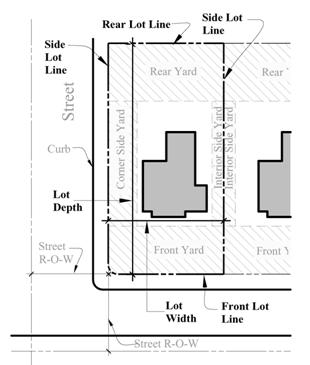
Corner Lot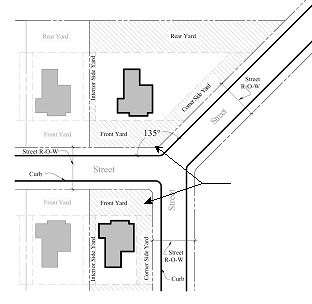
Zoning Lot
Reversed Corner Lot
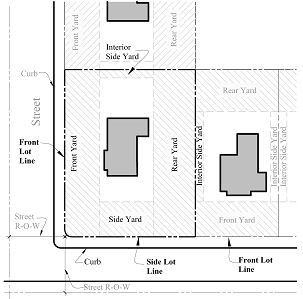
Side lot line is a continuation of the front lot line of the lot to the rear.
Through Lot
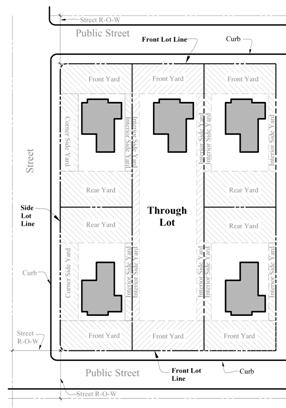
Lot line, side. See illustration. "Side lot line" means any boundary of a lot which is not a front lot line or a rear lot line.
"Lot of record" means a lot which is part of a subdivision, the plat of which has been recorded in the office of the recorder of deeds of Anne Arundel County; or a parcel of land, the deed to which was recorded in the office of the recorder prior to the effective date of this Zoning Code.
Lot width. See illustration. "Lot width" means the horizontal distance between the side lot lines of a lot. Lot width is measured as follows:
a.
Single-family detached dwellings in the R1-A district: at the narrowest width within the first fifty feet of lot depth immediately in back of the front yard setback line;
b.
All uses in all other districts: at the narrowest width within the first thirty feet of lot depth immediately in back of the front yard setback line or established front yard if applicable.
"Marina" means any facility for the mooring, berthing, storing or securing of watercraft, but not including community piers and other noncommercial boat docking and storage facilities.
"Marine fabrication" means, including but not limited to, sail and canvas accessory manufacture; spar and rigging construction; maritime carpentry; construction and laying up of marine molds; metal casting for marine use; marine industrial welding and fabrication; and boat manufacture.
"Maritime institutions" means marine educational facilities; marine museums and aquariums; and maritime service organizations.
"Maritime retail" means display, sale, and storage of marine parts, supplies, accessories, and provision of other goods including, but not limited to marine hardware; fishing tackle; marine chandeliers; yacht furniture; marine maps, magazines, catalogues and other publications.
"Maritime services" means functions necessary to serve in-water and on-land boat storage and working boatyards, including, but not limited to boat dealers, brokers and manufacturers' representatives; boat rentals, charters, and charters services; marine parts, supplies, accessory distributors; marine transportation and water taxis; marine documentation; boat show management and promotion; nautical component servicing; yacht designers; and marine surveyors.
"Maritime trigger" means one or more of the following:
1.
A working boatyard of at least twenty thousand square feet and a thirty-ton boat lift;
2.
Seafood processing of nine thousand square feet;
3.
On-land boat storage of at least twenty-five thousand square feet; or
4.
Yacht and sailing clubs providing in-water and on-land boat storage to their members; or
5.
Fuel dock.
"Maritime use setback" means an open-air location for water-dependent maritime uses. The setback is one hundred feet deep measured parallel to the shoreline. Non water-dependent uses are permitted in the maritime use setback if certain bulk requirements are met.
Marquee sign. See Sign, marquee.
"Marquee" means a permanent roof-like structure projecting beyond a building or extending along and projecting beyond the wall of the building, generally designed and constructed to provide protection from the weather.
"Massage parlor" has the meaning given it in Chapter 7.32 of the Annapolis City Code.
"Mean High Water Line" (MHWL) means the average level of high tides at a given location.
"Medical cannabis dispensary" means a licensed premises of a licensed dispensary of medical cannabis as defined in Maryland Administrative Code 10.62.01.01.
"Mezzanine" means an intermediate or fractional story between the floor and ceiling of a full story, used for a purpose accessory to the principal use. Normally, a mezzanine is just above the ground or main floor, extending over only part of the main floor.
"Micro wireless facility." Micro wireless facility means:
1.
Any equipment otherwise within the definition of "small wireless system" whose radio transceiver and associated housing equipment has dimensions no larger than twenty-four inches in length, fifteen inches in width, and twelve inches in height and an exterior antenna, if any, no longer than eleven inches; and
2.
Where such equipment is suspended on strand strung between existing utility poles in compliance with applicable codes by a communications service provider authorized to occupy the rights-of-way.
"Mitigation" means an action taken to compensate for adverse impacts to the environment resulting from development, development activity, or a change in land use or intensity.
"Modified Buffer Area (MBA)" means an area mapped by the City and approved by the Critical Area Commission as a Modified Buffer Area, where it has been sufficiently demonstrated that the existing pattern of residential, industrial, commercial, institutional, or recreational development prevents the buffer from fulfilling its water quality and habitat functions, and where development in accordance with specific MBA provisions can be permitted in the buffer without a variance.
Mooring slip, private. "Private mooring slip" means any dock, arrangement of piles, lift or method used to store a boat over fifteen feet long, owned or used by the owner of the property, the owner's immediate family or tenants of the property.
Mooring slip, public. "Public mooring slip" means any dock, device or method for storing any boat owned or leased by a person other than the landowner, the owner's immediate family or tenants of the property.
"Motel" means an establishment consisting of a group of attached or detached living or sleeping accommodations with bathroom and closet space, located on a single zoning lot and designed for use by transient automobile tourists. A motel furnishes customary hotel services such as maid service and laundering of linen, telephone and secretarial or desk service, and the use and upkeep of furniture. In a motel, less than fifty percent of the living and sleeping accommodations are occupied or designed for occupancy by persons other than transient automobile tourists.
"Motor vehicle" means any passenger vehicle, truck, truck-trailer, trailer or semi-trailer propelled or drawn by mechanical power.
"Multi-tenant facility" means two or more businesses under single ownership or under unified control. Multi-tenant office or commercial buildings, industrial parks, shopping centers are multi-tenant facilities.
"Nameplate" means a sign indicating the name and address of a building, or the name of an occupant of a building and the practice of a permitted occupation in a building.
"Natural features" means components and processes present in or produced by nature, including but not limited to soil types, geology, slopes, vegetation, surface water, drainage patterns, aquifers, recharge areas, climate, floodplains, aquatic life, and wildlife.
"Natural forest vegetation" means vegetation consisting of canopy trees, understory trees, shrubs, and herbaceous plants that are typically found in riparian areas in the State of Maryland. Areas of natural forest vegetation planted to meet the mitigation requirements in this ordinance shall resemble the structure and species composition of natural forests.
"Natural Heritage Area" means any communities of plants or animals that are considered to be among the best Statewide examples of their kind, and are designated by regulation of the Secretary of the Department of Natural Resources.
"Natural parks" means areas of natural habitat that provide opportunities for those recreational activities that are compatible with the maintenance of natural conditions.
"Natural regeneration" means the natural establishment of trees and other vegetation with at least four hundred free-to-grow seedlings per acre, which are capable of reaching a height of at least twenty feet at maturity.
"Natural vegetation" means those plant communities that develop in the absence of human activities.
"Nature-dominated" means a condition where landforms or biological communities, or both, have developed by natural processes in the absence of human intervention.
"Nonconforming structure" means a building or structure lawfully constructed prior to the effective date of the Zoning Code, or an amendment to the Zoning Code, that does not comply with the applicable bulk regulations or other development or design standards of the Zoning Code in the zoning districts in which the building or structure is located.
Nonconforming Use. See Use, nonconforming.
"Non-point source pollution" means pollution generated by diffuse land use activities rather than from an identifiable or discrete facility. It is conveyed to waterways through natural processes, such as rainfall, storm runoff, or groundwater seepage rather than by deliberate discharge. Non-point source pollution is not generally corrected by "end-of-pipe" treatment, but rather by changes in land management practices.
"Nontidal wetlands" means those areas regulated under Subtitle 26 of the Environment Article of the Annotated Code of Maryland that are inundated or saturated by surface water or groundwater at a frequency and duration sufficient to support, and that under normal circumstances does support, a prevalence of vegetation typically adapted for life in saturated soil conditions, commonly known as hydrophytic vegetation. The determination of whether an area is a nontidal wetland shall be made in accordance with the publication known as the "Federal Manual for Identifying and Delineating Jurisdictional Wetlands" published in 1989, as may be amended. Nontidal wetlands do not include tidal wetlands regulated under Title 16 of the Environment Article of the Annotated Code of Maryland.
Nursing home. See Rest home.
"Off-site parking facility" means a parking facility located on land other than the zoning lot on which the use requiring the parking is located.
Office, medical. "Medical office" means an organization of specializing physicians, dentists, chiropractors, osteopaths or similar licensed or registered practitioners who have their offices in a common building. A medical office does not include in-patient care.
"Office and business services establishment" means an establishment providing business services for office and business uses. The term "office and business services" includes but is not limited to are blueprinting and Photostatting, business machine sales and service, camera and photographic supply, computer and communications products supply and service facilities, office supply stores, package mailing service establishments, fax and telegraph facilities, and photocopying and reproduction shops. The term "office and business services" does not include any used that is otherwise listed specifically in the Table of Permitted Uses for the zoning district where the term is used.
"Offsets" means structures or actions that compensate for undesirable impacts.
"On-land boat storage" means open areas, paved or unpaved, and structures providing for on-land boat and marine equipment storage and display; and structures existing as of August 24, 1987, providing for on-land boat and marine equipment storage and display.
"Overlay district" means a district established to respond to special features or conditions of a land area, such as historic value, physical characteristics, location, or other circumstances. An overlay district supplements the regulations of the underlying zoning district.
"Paddlecraft" refers to any type of water vessel that is propelled and steered by human power without reliance on motors.
"Perennial stream" is a stream that flows continuously throughout the year.
"Person" means an individual, partnership, corporation, contractor, property owner, or any other person or entity.
"Personal care establishment" means an establishment providing services for the customary comfort, convenience or care of individuals. The term "personal care establishment" includes but is not limited to barbershops, beauty parlors, dressmaking/tailoring stores, drugstores, and photography studios. The term "personal care establishment" does not include any that is otherwise listed specifically in the Table of Permitted Uses for the zoning district where the term is used.
"Personal fitness studio" means an establishment, as distinguished from a health club, that specializes in small group and individual physical training, exercise, or health and wellness counseling led by an instructor. The total floor area of the establishment devoted to exercise space shall not exceed two thousand square feet. The term "personal fitness studio" includes, but is not limited to, aerobics, boxing or martial arts, step, yoga, Pilates, strength training, self-defense, and nutrition and weight control classes. Hours of operation are between 6:00 a.m. and 10:00 p.m.
"Pet grooming facility" means a business establishment, other than a kennel or animal hospital, that provides basic grooming for domestic animals, but does not board animals for a fee. For the purposes of this title, a veterinary clinic that provides basic grooming is not a pet grooming facility.
"Physical health facilities" means health clubs, gymnasiums and other facilities in which membership is offered to individuals to use physical exercise equipment, including, but not limited to, saunas, whirlpools, weightlifting rooms, steam rooms, and exercise machines.
"Physiographic features" means the soils, topography, land slope and aspect, and local climate that influence the form and species composition of plant communities.
"Pier" means any pier, wharf, dock, walkway, bulkhead, breakwater, piles or other similar structure. Pier does not include any structure on pilings or stilts that was originally constructed beyond the landward boundaries of State or private wetlands.
"Planned development" means a tract of land that contains or will contain one or more principal buildings, the development of which is allowed greater flexibility and, consequently, achieves more creative and beneficial design than may be possible under conventional zoning district regulations. There are three types of planned development:
a.
Residential planned development is a planned development that is substantially residential in character.
b.
Business planned development is a planned development that is substantially commercial or industrial in character.
c.
Special mixed planned development is a planned development that is substantially mixed in character and that may contain a wide range of planned development uses.
Planned development use. See Use, planned development.
"Plant habitat" means a community of plants commonly identifiable by the composition of its vegetation and its physiographic characteristics.
"Port" means a facility or area established or designated by the State or local jurisdiction for purposes of waterborne commerce.
"Principal structure" means the primary or predominant structure on any lot or parcel. For residential parcels or lots, the principal structure is the primary dwelling.
"Professional person" means an individual, as distinguished from a corporation, partnership, group, or other entity, who is pursuing a vocation involving labor or skill which is predominately mental or intellectual, rather than physical or manual, in which a knowledge of a science or field of learning is used by its practical application to the affairs of others, either in advising, treating or teaching them, or in serving their interests or welfare in the practice of the art founded on that science or field.
Program amendment, Critical area. "Critical area program amendment" means any change or proposed change to an adopted program that is not determined by the Chairman of the Critical Area Commission to be a program refinement.
"Program refinement, Critical area" means any change or proposed change to an adopted program that the Chairman of the Critical Area Commission determines shall result in a use of land or water in the Chesapeake Bay Critical Area or Atlantic Coastal Bays Critical Area in a manner consistent with the adopted program, or that shall not significantly affect the use of land or water in the Critical Area. Program refinement may include:
a.
A change to an adopted program that results from state law;
b.
A change to an adopted program that affects local processes and procedures;
c.
A change to a local ordinance or code that clarifies an existing provision; and
d.
A minor change to an element of an adopted program that is clearly consistent with the provisions of State Critical Area law and all the criteria of the Critical Area Commission.
"Project approvals" means the approval of development, other than development by the State or local government, in the Chesapeake Bay Critical Area by the appropriate local approval authority. The term includes approval of subdivision plats and site plans; inclusion of areas within floating zones; issuance of variances, special exceptions, and conditional use permits; and issuance of zoning permits. The term does not include building permits.
"Property lines" means the lines bounding a zoning lot, as defined in this chapter.
"Property owner" means a person holding title to a property or two or more persons holding title to a property under any form of joint ownership.
"Public water access" means the right for the general public to access by foot an area fronting a waterway on property with a business open to the general public. The area of access may be used for one or more of the following:
1.
A water taxi pick-up and drop-off location;
2.
A walkway, bench or other area from which the public may view activities on the water;
3.
A location for the launch and recovery of paddlecraft; or
4.
A location for crabbing or fishing.
Public water access shall be available during such times as the restaurant or retail business on that same property is open to the general public, but at a minimum during daylight hours. Water access does not require available parking but must be ADA-compliant as required by law, and must provide a clear pedestrian passage from the closest public roadway. The access may be subject to reasonable restrictions to address public safety concerns and shall include clear signage denoting the allowed public use and any such reasonable restrictions, as determined by the Director of Planning and Zoning. A fee for public access may not be imposed. The provisions of MD. Ann. Code, Natural Resources Article, Sections 5-1101—1109, as may be amended, govern those properties providing public access.
"Public water-oriented recreation" means shore-dependent recreation facilities or activities provided by public agencies that are available to the general public.
"Public way" means any sidewalk, street, alley, highway, waterway or other public thoroughfare.
"Pumpout station" means a facility that pumps or receives human body wastes out of Type III marine sanitation devices installed on board vessels.
"Reconfiguration" means a change of the configuration of an existing lot or parcel line of any legal parcel of land or recorded legally buildable lot. This includes a lot line adjustment, a boundary line adjustment, and a replatting request.
"Redevelopment" means the expansion, significant rehabilitation, or reconstruction, or substantial improvement of any structure on a site which has previously been built upon. The construction or structures on previously undeveloped land or land on which structures have been demolished for the purposes of replacement development is not considered redevelopment.
"Reforestation" means the establishment of a forest through artificial reproduction or natural regeneration.
"Resource conservation areas" means those areas that are characterized by nature-dominated environments (i.e., wetlands, natural drainage areas for wetlands, forests, developed woodlands).
"Rest home or nursing home" means a private home, not age restricted, for the care of children or the aged or infirm, or a place of rest for those suffering bodily disorders. This home does not contain equipment for surgical care or for the treatment of disease or injury.
Restaurant, fast food. "Fast food restaurant" means an establishment, other than a bake shop, candy or ice cream store, which provides as a principal use the sale of foods or beverages in a ready-to-consume state, for consumption off the premises. A fast-food establishment's design or principal method of operation includes two or more of the following characteristics:
a.
Food or beverages are service in edible containers, or in paper, plastic or other disposable containers. Eating utensils, if provided, are disposable;
b.
The line of food or beverages is limited, and is usually prepared in advance of the customer's order;
c.
Food or beverages are served over a general service counter for the customer to carry to a seating facility within the restaurant, or carry-out off premises, or to an occupant of a motor vehicle while seated in the vehicle, such as through a drive-in window; and
d.
Carry-out sales, including delivery service, constitute over ten percent of the food service business.
Restaurant, standard. "Standard restaurant" means an establishment whose principal business is the sale of foods or beverages to customers in a ready-to-consume state. Carry-out foods or beverages may constitute not more than ten percent of the business. A standard restaurant has a design or principal method of operation which includes one or both of the following characteristics:
a.
Patrons usually and customarily are provided with individual menus, and are served their food or beverages by a restaurant employee at the same table or counter at which the items are consumed;
b.
Service is provided by a cafeteria-type operation where foods or beverages are served on non-disposable plates or containers and nondisposable eating utensils are provided.
"Rest home" or "nursing home" means a private home for the care of children or the aged or infirm, or a place of rest for those suffering bodily disorders. This home does not contain equipment for surgical care or for the treatment of disease or injury.
"Restoration" means the act of returning a site or area to an original state or any action that reestablishes all or a portion of the ecological structure and functions of a site or area.
"Retail goods store" means an establishment where the principal use or purpose is the sale of physical goods, products, and merchandise directly to the consumer. The term "retail goods store" includes, but is not limited to clothing and apparel stores, dry goods stores, leather goods and luggage stores, furrier shops, medical appliance and supply stores, pawnshops, pet shops, shoe shops, sporting goods stores, and toy shops. The term "Retail goods store" does not include any use or other type of establishment that is otherwise listed specifically in the Table of Permitted Uses for the zoning district where the term is used.
"Riparian habitat" means a habitat that is strongly influenced by water and which occurs adjacent to streams, shorelines, and wetlands.
"Road" means a public thoroughfare under the jurisdiction of the State, a county, a municipal corporation, or any other public body. "Road" does not include a drive aisle or driveway.
Rowhouse. See Dwelling, attached.
"Sailing school" means instruction of accredited sailing programs for two hundred or more students with vessels that have keels on a minimum two-acre parcel subject to standards.
"Sailmaker" means a person or company that cuts, assembles, sews, and repairs sails and canvas parts for boats.
"Seafood industrial" means landing, distribution, processing, brokerage, wholesale and retail sales of fish and shellfish.
"Seasonal outdoor sales" means a retail operation on public or private property without a permanent structure and only offering outdoor shopping. Such an operation is seasonal in nature and features on-farm produced as well as locally produced and related agricultural products and handmade crafts.
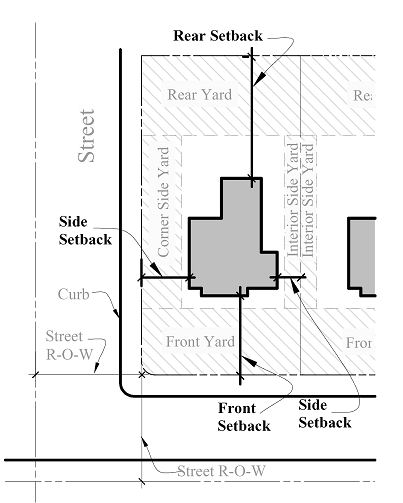
Setback. See illustration. "Setback" means the minimum horizontal distance between a lot line or public street right-of-way and the nearest point of a structure or projection thereof.
"Shopping center" means a complex of retail stores sharing common parking facilities. Non-retail uses such as offices and residential uses can be incorporated into a shopping center. A shopping center contains at least six retail stores and 30,000 square feet of retail space.
"Shore erosion control activities" means those structures or measures constructed or installed to prevent or minimize erosion of the shoreline in the Critical Area.
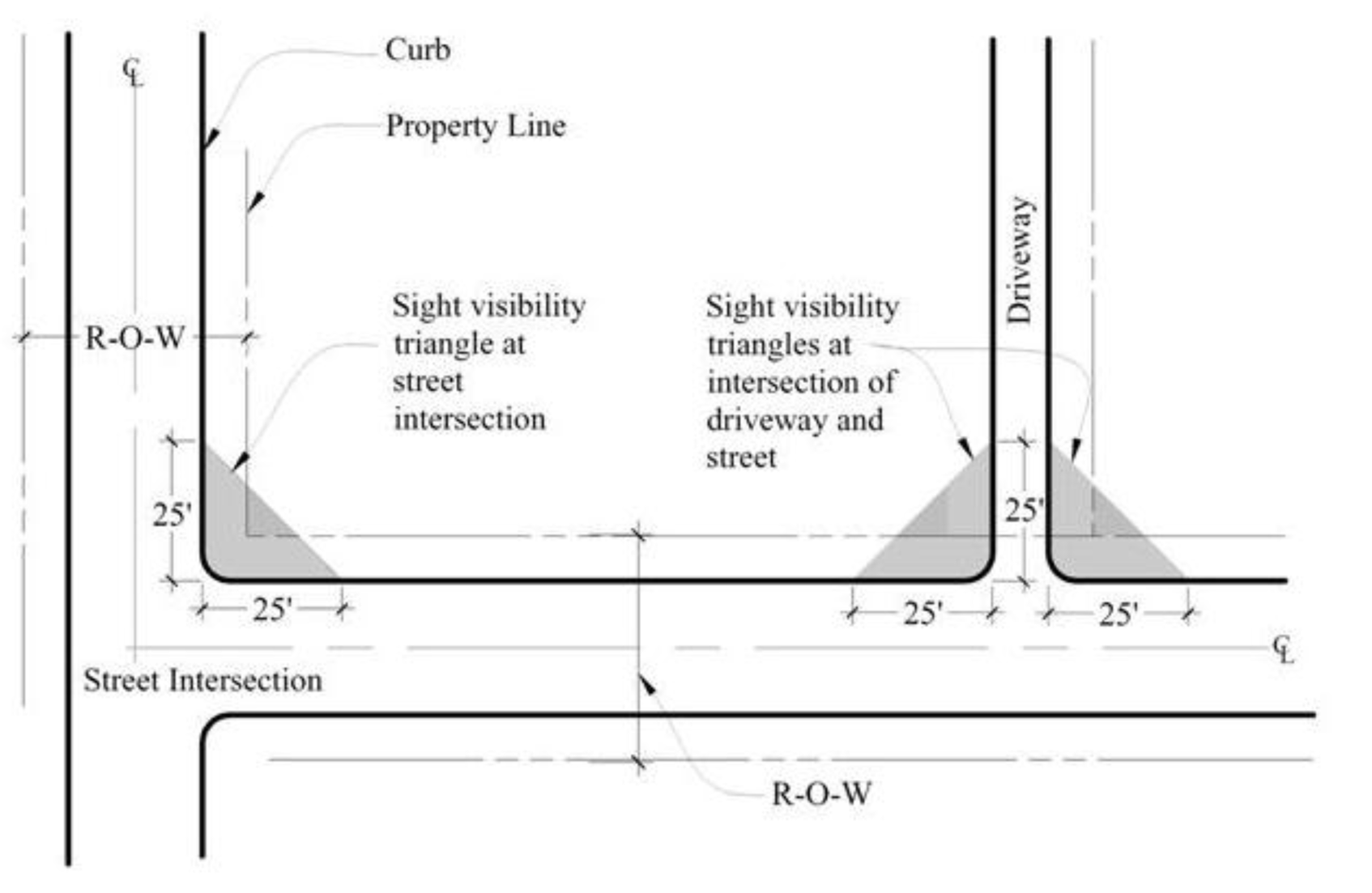
Sight Visibility Triangle. See illustration. "Sight visibility triangle" means a triangular area intended to remain free of visual obstructions to prevent potential traffic hazards across all property corners formed by two intersecting streets or the intersection of an alley and a street or the intersection of a driveway and a street. The sight visibility triangle is determined by drawing a diagonal line across the corner of the lot between two points each measured twenty-five feet back from the vertex of the extended curblines of the intersecting streets, alleys or driveways.
"Sign" means any name, identification, description, display or illustration which is affixed to, or represented directly or indirectly upon, a building, structure or piece of land, and which directs attention to an object, product, place, activity, person, institution, organization or business. The term "sign" includes signs erected or installed in the interior of a structure if the sign is situated in a manner to indicate that its prime purpose is for viewing from the exterior of the structure. The prime purpose of an interior sign is exterior viewing if it is visible from the exterior and if no public access is permitted between the sign and the exterior window of the structure.
The term "sign" does not include the following:
1.
Display of official court or public office notices;
2.
The flag, emblem or insignia of a nation, political unit, school or religious group; or
3.
A sign located completely within an enclosed building and not visible to the outside of the building.
Sign, business community identification. "Business community identification sign" means a sign representing an area consisting of no less than six distinct businesses located on separate parcels of land.
Sign, freestanding. "Freestanding sign" means any sign supported by structures or supports that are placed on, or anchored in, the ground and that are independent from any building or other structure.
Sign, ground. "Ground sign" means a sign where the entire bottom of the sign is in contact with or in close proximity to the ground. A "monument sign" is a ground sign.
Sign, pole. "Pole sign" means a sign supported by one or more poles and otherwise separated from the ground by air.
Sign, marquee. "Marquee sign" means a sign attached to or made part of a marquee. A marquee sign is a type of wall-mounted sign.
Sign, projecting. "Projecting sign" means a sign affixed to a building or wall in such manner that its leading edge extends more than six inches beyond the surface of the building or wall.
Sign, temporary. "Temporary sign" means a sign that advertises community or civic projects or special events on a temporary basis, or a political sign.
Sign, wall-mounted. "Wall-mounted sign" means any sign attached parallel to, but within six inches of, a wall, painted on the wall surface of, or erected and confined within the outside limits of an outside wall of any building or structure, which is supported by such wall or building, and which displays only one sign face. A marquee sign is a type of wall-mounted sign. Signs placed on canopies or awnings are considered to be wall-mounted signs.
"Sky exposure plane" means a defined plane above a lot into which no part of a structure is permitted to intrude.
"Slope stabilization activities" means the prevention of soil movement by any of various vegetative and/or structural means. Stabilization could include minimal grading; retaining walls; erosion control mats, blankets and fiber logs; or other environmentally sensitive practices. It does not include the use of accessory structures including but not limited to patios or terraces.
"Small cell system." Small cell system means any short range equipment installed for the purpose of supplementing or extending wireless communications coverage in a localized area. "Small cell system" includes:
1.
Any pole, strand, or other structure used to support a system or to which a system is attached; and
2.
Any radio transceiver, antenna, coaxial or fiber-optic cable, regular or back-up power supply, and comparable equipment, regardless of technological configuration; and any ancillary or accessory structure or equipment to house any part of the system.
"Small cell system" does not include a micro wireless facility.
Special exception. See Use, special exception.
"Specialty convenience retail store" means an establishment where the principal use or purpose is the sale of convenience products directly to the consumer. These stores usually specialize in one type or line of inter-related products. The term "specialty convenience retail goods store" includes but is not limited to book and stationery stores, camera and photographic supply stores, florists, and hardware, paint and wallpaper stores. The term "specialty convenience retail store" does not include any use that is otherwise listed specifically in the Table of Permitted Uses for the zoning district where the term is used. The term "specialty convenience retail store" does not include a "Convenience store" as defined in this chapter.
Special mixed planned development. See Planned development.
"Species in need of conservation" means those fish and wildlife whose continued existence as part of the State's resources are in question and which may be designated by regulation by the Secretary of Natural Resources as in need of conservation pursuant to the requirements of Natural Resources Article §§ 10-2A-06 and 4-2A-03, Annotated Code of Maryland.
"Stealth structure" means a structure used to enclose and screen antennas from view. Flag poles, bell towers, clock towers, and masts are examples of stealth structures.
"Steep slopes" means slopes of fifteen percent or greater incline.
"Story" means the space in a building between two adjacent floor levels or between a floor and the roof. A basement, as defined in this title, is not a story.
Story, Half. "Half story" means a story containing floor area not exceeding 50% of the floor area next below.
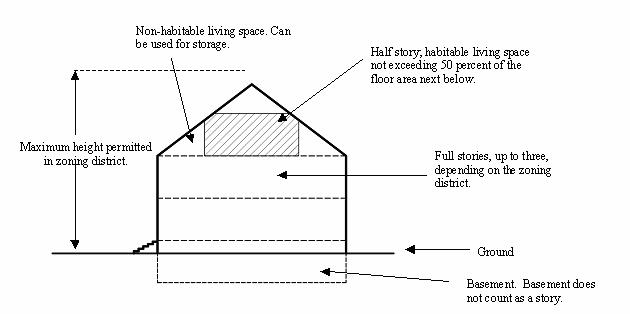
"Street" means a public or private right-of-way which affords a primary means of vehicular access to abutting property, whether designated as a street, avenue, highway, road, boulevard, lane, throughway or however otherwise designated, but does not include driveways to individual buildings. For the purposes of dedication to the City for City maintenance, "street" does not include parking lots, or parking lot access roads.
"Streetscape improvements" means architectural or functional facilities or structures which occur on site but are not part of the building and which encourage and facilitate human interaction with the environment. Examples include, but are not limited to the following: decorative light fixtures, fountains, sculpture, benches and tables, planters, retaining walls, pedestrian and bicycle paths, bicycle parking structures, trash receptacles and enclosures, vendor areas, bollards and fences.
"Structural alteration" means any change, other than incidental repairs, which would prolong the life of the supporting members of a building, such as the addition, removal or alteration of bearing walls, columns, beams, girders or foundations.
"Structure" means anything constructed or erected with a fixed location on the ground or which is attached to something having a fixed location on or in the ground.
"Substantial alteration" means any repair, reconstruction, or improvement of a principal structure, where the proposed total footprint is at least fifty percent greater than that of the existing principal structure that is the subject of the application.
"Supermarket" means a retail establishment selling dry groceries, produce, household items, and limited food prepared on the premises which is immediately consumable, such as bakery or delicatessen items.
Tavern. See Bar and Tavern.
"Tax incremental financing" (TIF) means, a public financing mechanism in which the City designates a defined district and fixes a base year taxable value for property therein; thereafter, the increase in property tax revenue above the base (the "tax increment") is captured and deposited into a dedicated fund to pay for eligible public improvements that benefit the district, including transportation, utility, streetscape, parks, environmental remediation, and transit-supportive infrastructure. TIF may be implemented on a pay-as-you-go basis or used to secure bonds or other obligations, with repayment limited to the tax increment and any other pledged revenues. Establishment of a TIF district does not by itself raise tax rates, and use of TIF revenues shall be limited to purposes and expenditures authorized by the creating ordinance and applicable law within or benefiting the district.
"Telecommunications facility" means any facility established for the purpose of providing wireless voice, data and image transmission within a designated service area. A telecommunications facility consists of one or more antennas and equipment attached to a support structure and related equipment. Equipment may be within a building, an equipment cabinet or within an equipment room within an existing building. The term "telecommunications facility" does not include "antenna tower."
"Telephone transmission equipment building" means a building containing equipment used for switching and interconnection of public message communication circuits.
"Tent" means any structure or enclosure, the roof of which and/or one-half or more of the sides, are constructed of silk, cotton, canvass, fabric or a similar light material.
"Threatened species" means any species of fish, wildlife, or plants designated as such by regulation by the Secretary of the Department of Natural Resources that appear likely, within the foreseeable future, to become endangered, including any species of wildlife or plant determined to be a "threatened" species pursuant to the federal Endangered Species Act, 16 U.S.C. § 1431, et seq., as may be amended.
Townhouse. See Dwelling, attached.
"Trailer" means any vehicle, house-car, camp-car or any portable or mobile vehicle on wheels, skids, rollers or blocks, either self-propelled or propelled by any other means, which is used or designed to be used for residential, living, sleeping or commercial purposes.
"Transient boater services" means services such as laundry, pool, recreation and/or exercise facilities, and sales of convenience items.
"Transit-oriented development (TOD)" means development sited and designed to prioritize access to high-quality public transit and active transportation. TOD is characterized by increased residential and/or employment density within walking distance of transit stops, pedestrian-oriented site and street design, safe and direct bicycle and pedestrian connections to transit, integration of Transportation Demand Management measures, and reduced automobile-oriented parking. Mixed use is encouraged but not required where demonstrated high-quality transit service, multimodal access, and TDM commitments are provided.
"Transportation demand management (TDM)" means a package of strategies, programs, and services designed to reduce reliance on single-occupant vehicle trips, improve system efficiency, and shift travel toward high-value transit, walking, biking, and other low-emission modes. TDM measures may include transit subsidies, carshare/vanpool integration, bicycle infrastructure and amenities, telework/flex scheduling, on-site mobility coordination, and information-sharing platforms.
"Tree" means a large, woody plant having one or several self-supporting stems or trunks and numerous branches that reach a height of at least twenty feet at maturity.
"Tributary streams" means a perennial stream or an intermittent stream within the critical area that has been identified by site inspection or in accordance with local program procedures approved by the Commission.
"Unwarranted hardship" means that without a variance, an applicant would be denied reasonable and significant use of the entire parcel or lot for which the variance is requested.
"Upland boundary" means the landward edge of a tidal wetland or nontidal wetland.
Use, accessory. "Accessory use" means a building or use that:
a.
Is subordinate in purpose to, and serves, a principal building or principal use;
b.
Contributes to the comfort, convenience or necessity of occupants of the principal building or principal use served; and
c.
Is located on the same zoning lot as the principal building or use served, with the single exception of accessory off-street parking facilities permitted to locate elsewhere than on the same zoning lot with the building or use served.
Uses accessory to a special exception are permitted only when a special exception has been granted.
Use, nonconforming. "Nonconforming use" means a principal or accessory use lawfully established prior to the effective date of the Zoning Code, or an amendment to the Zoning Code, that does not conform to the use regulations of the Zoning Code in the zoning districts in which such use is located.
Use, permitted. "Permitted use" means a use which may be established lawfully in a particular district or districts, provided it conforms with all requirements and regulations of the district.
Use, planned development. "Planned development use" means a use, including a special exception use, that is not normally permissible as a permitted use or use subject to standards in a zoning district, but that may be permitted as part of a planned development provided that the planned development as a whole meets the criteria for approval set forth in this Zoning Code. Use regulations for planned developments are listed in Section 21.24.020 of this Zoning Code.
Use, principal. "Principal use" means the main use of land or buildings as distinguished from a subordinate or accessory use. A principal use may be a permitted use, a special exception use, or a use subject to standards.
Use, special exception. "Special exception use" means a land use or activity that, due to its unique characteristics and potential impacts on surrounding properties, requires approval by the Board of Appeals for a specific location and site plan, based on standards established in this Zoning Code. A use that existed as a conditional use, as defined under this code prior to the adoption of Ordinance O-39-97 on January 12, 1998, shall be deemed a legal special exception if lawfully existing on the effective date of any amendment to this title making that use a special exception use.
Used for. The term "used for" includes the phrases "arranged for," "designed for," "intended for," "maintained for" and "occupied for."
"Utility transmission facilities" means fixed structures that convey or distribute resources, wastes, or both, including but not limited to electrical lines, water conduits, and sewer lines.
"Valet parking" means an area where cars are parked and unparked by an attendant in the employ of or under contract to the owner of the parking area rather than by the owner or operator of the vehicle.
"View cone" means a space defined by a series of projected lines from the centerline of a street right-of-way that is to be kept free of obstructions so as to preserve a distant view.
See illustration for calculation of view cone:
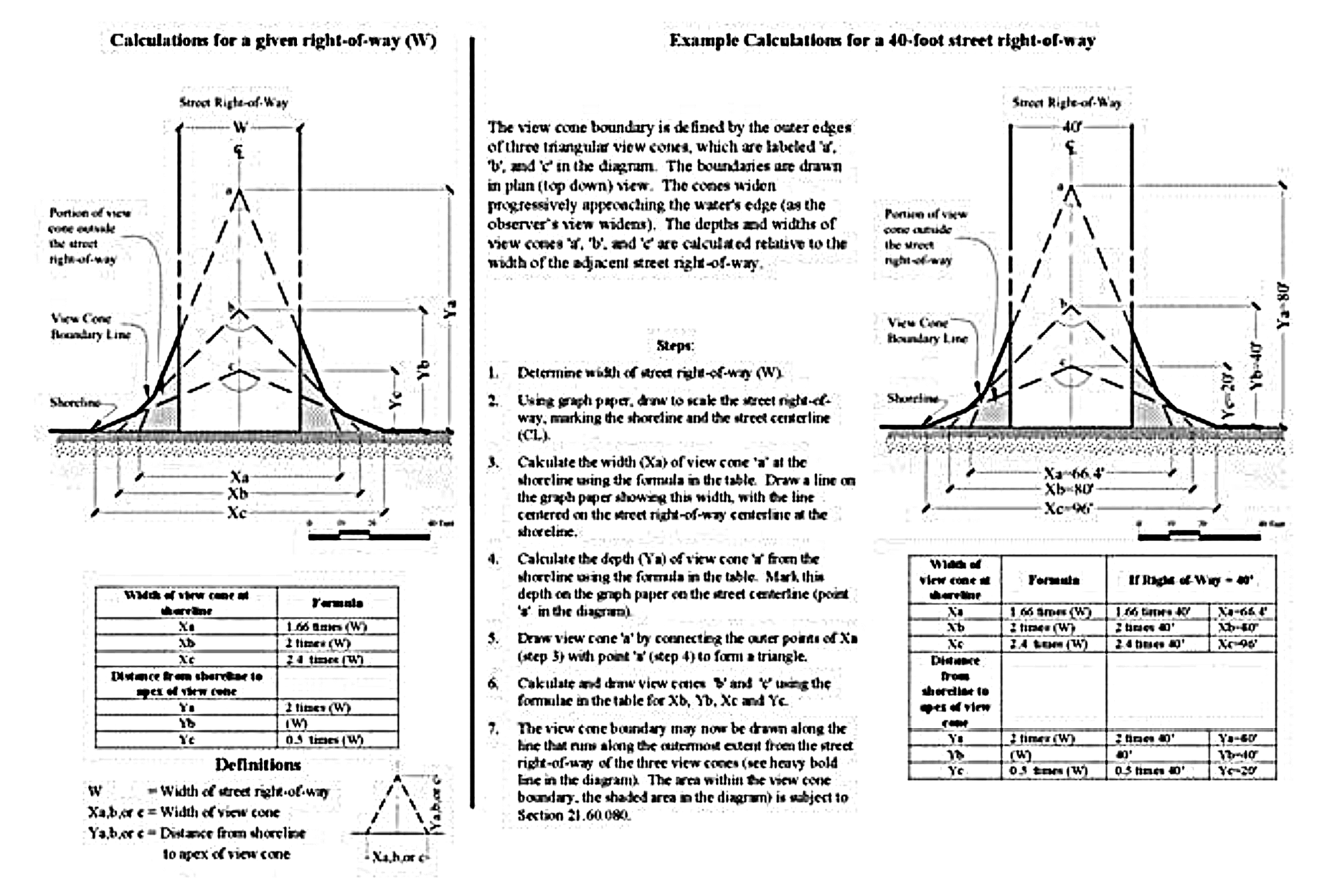
Illustration for calculation of view cone
Wall-mounted sign. See Sign, wall-mounted.
"Water-dependent facilities" means those structures or works associated with industrial, maritime, recreational, educational, or fisheries activities that require location at or near the shoreline within the buffer. An activity is water-dependent if it cannot exist outside the buffer and is dependent on the water by reason of the intrinsic nature of its operation. Such activities include, but are not limited to, ports, marinas, and other boat docking structures, public beaches, and other public water-oriented recreation areas, and fisheries activities.
"Water-dependent structure" means a structure or accessory building associated with maritime activities involving seafood industrial, in-water boat storage or marine fabrication use that, in the determination of the Planning and Zoning Director, requires location within one hundred feet of the bulkhead or mean high water line for efficiency of operation.
"Waterway" means a body of water subject to tidal action.
"Wildlife corridor" means a strip of land having vegetation that provides a safe passageway for wildlife, or any area identified as a greenway in a City or County plan.
"Wildlife habitat" means those plant communities and physiographic features that provide food, water and cover, nesting, and foraging or feeding conditions necessary to maintain populations of animals in the Critical Area.
"Wine bar" means an establishment primarily engaged in the retail sale of wine and to a lesser extent the sale of beer, light fare such as pastries, sandwiches, and other food items are incidental to the sale of wine and beer.
"Yacht and sailing club" means an organization with at least three hundred members which provides at the club facility on-site in-water and/or on-land boat storage to at least one hundred fifty keel boats over twenty feet in length (said vessels constituting a yacht and sailing club not including boats such as kayaks, canoes, dinghies, paddleboards, personal watercraft and the like) and interior meeting/social space exclusive to the yacht and sailing club of at least one thousand square feet and restroom facilities to its members. this definition applies to the maritime trigger associated with yacht and sailing clubs.
Yard. See illustration. "Yard" means open space on the same zoning lot with a building or structure, unoccupied and unobstructed from the ground upward, except as permitted in Section 21.60.080. A yard extends along a lot line, and to a depth or width specified in the yard requirements for the zoning district in which the zoning lot is located.
Yard, buffer. See Bufferyard.
Yard, corner side. See illustration. "Corner side yard" means a side yard which adjoins a public street.
Yard, front. See illustration. "Front yard" means a yard extending along the full length of the front lot line between the side lot lines.
Yard, interior side. See illustration. "Interior side yard" means a side yard that is located immediately adjacent to another zoning lot or to an alley separating the side yard from another zoning lot.
Yard, rear. See illustration. "Rear yard" means a yard extending along the full length of the rear lot line between the side lot lines.
Yard, side. See illustration. "Side yard" means a yard extending along a side lot line from the front yard to the rear yard.
Yard, transitional. "Transitional yard" means a yard, which serves as a buffer, that may be required on a zoning lot in a non-residential district, which adjoins a zoning lot in a residential or non-residential district.
Yard, waterway. "Waterway yard" means a yard contiguous to a waterway.
Illustration for Yards
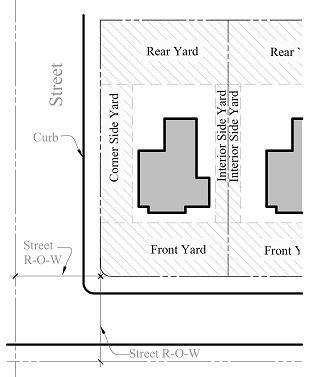
"Zoning district" means an area or areas within the City for which the regulations and requirements governing use, lot and bulk of buildings and premises are uniform.
(Ord. O-40-06 Revised § 1 (part), 2007: Ord. O-23-05 Revised § 1 (part), 2006; Ord. O-1-04 Revised (part), 2005)
(Ord. No. O-23-15, § I, 7-27-2015; Ord. No. O-31-14 Amended, § I, 2-9-2015; Ord. No. O-6-14 Amended, § I, 7-14-2014; Ord. No. O-25-11 Amended, § 1, 6-10-2013; Ord. No. O-26-13 Amended, § 1, 9-23-2013; Ord. No. O-47-11 Amended, § I, 10-28-2013; Ord. No. O-42-18, § I, 5-13-2019; Ord. No. O-35-20, § 1, 10-12-2020; Ord. No. O-29-20, § I, 3-22-2021; Ord. No. O-9-21, § I, 10-11-2021; Ord. No. O-25-21, § I, 10-25-2021; Ord. No. O-6-22, § I, 7-25-2022; Ord. No. O-10-23, § I, 10-23-2023; Ord. No. O-6-24, § I, 12-9-2024; Ord. No. O-1-25, § I, 5-27-2025; Ord. No. O-30-24, § I, 6-9-2025; Ord. No. O-9-25, § I, 7-28-2025; Ord. No. O-14-25, § I, 10-13-2025; Ord. No. O-29-25, § I, 10-13-2025)
21.72.020 - Rules of measurement.
Measurement of Distances. All measured distances shall be to the nearest integral foot. If a fraction is one-half foot or less, the integral foot next below shall be taken.
(Ord. O-1-04 Revised, 2005)

