
Atlantic Beach City Zoning Code
ARTICLE 18
2. - PROCEDURES
18.2.1. - Summary Development Review Table.
A.
How to Use This Article.
1.
Article 18-2 is comprised of four (4) sections: A section setting out the summary review table; a section establishing the advisory and decision-making bodies with responsibilities under this Ordinance; a section containing a set of common (or standard) review procedures; and a section with a set of specific development application review procedures.
2.
The summary table in Section 18.2.1 describes all the specific development application review procedures in this Ordinance and the review and decision-making bodies who review and decide them.
3.
Section 18.2.2 describes the powers and duties and the rules of procedure for each review and decision-making body - this section describes the rules governing how decisions are made.
4.
Section 18.2.3 describes the common review procedures, or the set of standardized procedures that apply to all types of development applications. For example, pre-application conferences, application submittal, application completeness determination, staff review and report, public notification, public meeting or hearing procedures, and notification of decision steps are all addressed in the common review procedures section.
5.
Section 18.2.4 describes the steps in each type of application review process, the review criteria specific to that type of procedure, and any other provisions that apply in addition to or instead of the common review procedures.
6.
An applicant for development in Atlantic Beach should first consult the specific review procedures summary table to determine which review and decision-making bodies review or decide the application. Then, an applicant should review the common review procedures to understand the steps in the application process. Finally, an applicant should review the individual specific development review procedure related to their application type. Applicants who are unsure of how to proceed should schedule a pre-application conference with Town Staff (see Section 18.2.3.C, Pre-application Conference) to better understand the review requirements and procedural steps associated with their particular application.
B.
Table Contents. Table 18.2.1.B, Specific Review Procedures Summary Table, identifies the review authority for development applications reviewed under this Ordinance. The table also identifies:
1.
The relevant section of this Ordinance where detailed procedural information may be found; and
2.
If a public hearing is required.
18.2.2. - Development Review Responsibilities.
A.
Overview. The following review authorities have powers and responsibilities in administering and reviewing development applications under this Ordinance:
1.
UDO Administrator;
2.
Building Inspector;
3.
Technical Review Committee (TRC);
4.
Planning Board;
5.
Town Council; and
6.
Board of Adjustment (BOA).
B.
UDO Administrator.
1.
Powers and Duties. The UDO Administrator shall have the following powers and duties:
a.
Application Review and Decision. To review and decide applications for:
i.
CAMA Minor Permits;
ii.
Interpretations;
iii.
Sign Permits;
iv.
Temporary Use Permits; and
v.
Zoning Permits.
b.
Recommendation Authority. To make recommendations on the following applications:
i.
Special Use Permits; and
ii.
Right-of-Way Encroachments.
c.
Other Powers and Duties.
i.
To conduct pre-application conferences in accordance with Section 18.2.3.C, Pre-Application Conference.
ii.
To investigate violations and enforce this Ordinance in accordance with Article 18-9: Enforcement.
iii.
To conduct inspections of premises and, upon finding that any of the provisions of this Ordinance are being violated, notify in writing the person responsible for such violations, indicating the nature of the violation and ordering the action necessary to correct it.
iv.
To establish application content requirements and a submission schedule for review of applications and appeals.
v.
To ensure proper public notification regarding pending development applications is provided in accordance with state law.
vi.
To serve as Chair of the TRC and prepare a report of its review and recommendations to the Planning Board or Town Council.
vii.
To review development applications for compliance with this Ordinance and submit staff reports to advisory and decision-making bodies.
viii.
To conduct meetings with applicants for development approval as necessary or appropriate.
ix.
To maintain the Official Zoning Map and related materials.
x.
To provide expertise and technical assistance to Town staff and decision-making bodies, upon request.
xi.
To maintain all records pertaining to the provisions of this Ordinance and make records available for public inspection.
xii.
To provide technical support for the implementation of the Land Use Plan.
xiii.
To perform any other related duties that the Town Manager may direct.
xiv.
To exercise other powers and authority provided by the Town Council, this Ordinance, or state law.
C.
Building Inspector.
1.
Powers and Duties. The Building Inspector shall have the following powers and duties:
a.
Application Review and Decision. To review and decide applications for:
i.
Building Permits;
ii.
Certificates of Occupancy;
iii.
Floodplain Development Permits;
iv.
Land Disturbance Permits; and
v.
Floodplain Development Permit.
b.
Other Powers and Duties.
i.
To serve as the Floodplain Administrator, or designate another professional level Town staff member to serve in the capacity of Floodplain Administrator.
ii.
To administer the North Carolina State Building Code;
iii.
To conduct inspections of construction and development sites to ensure health, safety, and compliance with applicable laws; and
iv.
To assist the UDO Administrator in the enforcement and administration of this Ordinance.
2.
When some or all of the powers and duties of the Building Inspector are provided by another agency in accordance with G.S. 160D-402(c), all powers and duties not provided by the Building Inspector shall be provided by the UDO Administrator or their designee.
D.
Reserved.
E.
Technical Review Committee (TRC). The Technical Review Committee (TRC) is hereby established.
1.
Powers and Duties.
a.
Application Review and Decision. To review and/or decide applications for:
i.
Major Site Plans;
ii.
Minor Site Plans;
iii.
Final Plats; and
iv.
Minor Subdivisions.
b.
Other Powers and Duties. To provide its expertise and technical assistance to the UDO Administrator in establishing application content requirements and a submission schedule for review of applications and appeals.
2.
Composition.
a.
Membership. The TRC may include, but not necessarily be limited to, the following governmental agencies, governmental officials, organizations, and individuals:
i.
UDO Administrator;
ii.
Town Manager;
iii.
Town Council member (appointed quarterly by Council at large);
iv.
Building Inspector;
v.
Public Services Director;
vi.
CAMA Local Permit Officer;
vii.
Fire Department;
viii.
Police Department;
ix.
Planning Board member (assigned on a quarterly basis by the Planning Board);
x.
Town Attorney;
xi.
Utilities providers;
xii.
Carteret County Health Department;
xiii.
Carteret County Board of Education;
xiv.
Downeast Rural Planning Organization;
xv.
NC Department of Transportation (NCDOT);
xvi.
NC Department of Environmental Quality;
xvii.
NC Division of Water Quality;
xviii.
NC Division of Coastal Management;
xix.
US Army Corps of Engineers;
xx.
Consulting engineer (as designated by the Town Manager); and
xxi.
Other Town representatives appointed by the Town Manager.
b.
Officers. The UDO Administrator shall serve as the Chair of the TRC to preside over its meetings, document the proceedings, and may request the participation of professional experts or a representative from an adjacent municipality, county, regional or state agency if the UDO Administrator determines that such entities can provide expertise concerning the proposed development.
3.
Rules of Procedure.
a.
Regular meetings of the TRC shall be held according to a schedule established from time to time by the Chair.
b.
The Chair shall prepare written summaries that include the date, the members present, and the determinations of the committee.
c.
The applicant and representatives may be invited by the Chair to attend.
F.
Planning Board. The Planning Board is hereby established in accordance with G.S. 160D-301.
1.
Powers and Duties.
a.
Recommendation Authority. To make recommendations on the following applications:
i.
Preliminary Plats;
ii.
Development Agreements;
iii.
Major Site Plans;
iv.
Text Amendments; and
v.
Zoning Map Amendments.
b.
Other Powers and Duties.
i.
To prepare and, from time to time, amend and revise a comprehensive and coordinated plan for the physical development within the Town (CAMA Land Use Plan).
ii.
To prepare and recommend to the Town Council ordinances providing orderly development along the lines indicated in the comprehensive plan.
iii.
To gather maps and aerial photographs of manmade and natural physical features of the area, statistics on past trends and present conditions with respect to population, property values, the economic base of the community, land use, and such other information as is important or likely to be important in determining the amount, direction, and kind of development to be expected.
iv.
To report its recommendations to the Town Council upon the extent, location, and design of all public structures and facilities; on the acquisition and disposal of public properties; on the establishment of building lines, mapped street lines, and proposals to change existing street lines.
v.
To establish principles and policies for guiding action in the development within the Town.
vi.
To perform any other duties which may lawfully be assigned to it by this Ordinance, the Town Council, and State law.
2.
Composition.
a.
Membership.
i.
The Planning Board shall consist of seven (7) members who reside inside the Town limits and shall be appointed by the Town Council.
ii.
The seven (7) members of the Planning Board shall have three-year staggered terms of office with three (3) members being appointed in successive years and four (4) members in the following year.
iii.
Regular attendance at meetings of the Planning Board is to be considered a prerequisite to continued membership, and upon certification by the Chair of the Planning Board that any member has missed four (4) meetings within a calendar year, then the appointment to the Planning Board shall be declared open and the appointing body may replace the member.
iv.
Absences due to sickness, death in the family, or other emergencies of a similar nature shall be regarded as approved absences and shall not affect the member's status on the Planning Board; except that in the event of a long illness or other such case resulting in a prolonged absence, the member may be replaced.
v.
Unless removed, Planning Board members serve until their replacements are appointed.
b.
Officers. The Planning Board shall elect from its members a Chair and Vice Chair for a one-year term of office commencing on January 1.
3.
Rules of Procedure.
a.
Rules of Conduct.
i.
The Planning Board may adopt rules for transaction of its business and shall keep a record of its members' attendance and of its resolutions, discussions, findings, and recommendations, which record shall be of public record, unless otherwise provided by law.
ii.
A majority of the appointed and serving members of the Planning Board shall constitute a quorum for official action.
b.
Meetings.
i.
All Planning Board meetings shall be open to the public and shall be conducted in accordance with the North Carolina Open Meetings Law in G.S. ch. 143, art. 33B.
ii.
The dates of the regularly scheduled Planning Board meetings shall be adopted by Town Council.
G.
Reserved.
H.
Town Council.
1.
Powers and Duties. The Town Council shall have the following powers and duties:
a.
Application Review and Decision. To review and decide applications for:
i.
Major Site Plans;
ii.
Preliminary Plats;
iii.
Development Agreements;
iv.
Text Amendments; and
v.
Zoning Map Amendments.
b.
Other Powers and Duties.
i.
To comment on concept plans for Major Site Plans.
ii.
To approve, by resolution, a schedule of fees governing:
a)
Applications for permits and other development approvals reviewed under this Ordinance; and
b)
Civil penalties for violations of this Ordinance.
iii.
To adopt temporary, strategic moratoria on development in accordance with G.S. 160D-107.
iv.
To take any other action not delegated to the Planning Board, BOA, TRC, UDO Administrator, or Building Inspector, as the Town Council may deem desirable and necessary to implement the provisions of this Ordinance.
v.
To exercise any other powers provided under G.S. 160D.
I.
Board of Adjustment (BOA). The Board of Adjustment (BOA) is hereby established in accordance with G.S. 160D-302.
1.
Powers and Duties. The Board of Adjustment shall have the following powers and duties:
a.
Application Review and Decision. To review and decide applications for:
i.
Appeals of decisions of the UDO Administrator, Building Inspector, or other Town staff member;
ii.
Right-of-Way Encroachments;
iii.
Special Use Permits; and
iv.
Variances.
b.
Other Powers and Duties.
i.
To hear and decide appeals from and review any order, requirement, decision, or determination made by the UDO Administrator or Building Inspector with regard to Chapter 6, Article 6 of the Town Code of Ordinances (the Minimum Housing Standards).
ii.
To exercise other powers and authority provided to it by G.S. 160D-302 or this Ordinance.
2.
Composition.
a.
Membership. The BOA shall consist of five (5) regular members and up to five (5) alternate members.
b.
Residence Location and Appointment. Members shall be residents of the Town of Atlantic Beach and shall be appointed by the Town Council.
c.
Alternate Members.
i.
The BOA Chair may appoint alternate members to serve in the absence or temporary disqualification of regular members.
ii.
Each alternate member attending a meeting and serving in the absence of a regular member has and may exercise all the powers and duties of a regular member.
iii.
In no case, shall more than five (5) regular members or combination of regular members and the alternate members be empowered to vote on any matter that comes before the BOA.
d.
Member Terms.
i.
Members may serve a three-year term and shall continue to serve until their successors are appointed, provided that upon initial appointment the terms of office may be staggered.
ii.
The terms of all members shall not expire at the same time.
iii.
Vacancies shall be filled by a new member or an alternate member appointed to serve for the remainder of the unexpired term.
e.
Officers.
i.
The BOA shall elect from its members a Chair and Vice Chair for a one-year term of office commencing on January 1.
ii.
The Chair shall preside over all meetings.
iii.
In the absence of the Chair, the Vice Chair shall preside over meetings.
iv.
If both the Chair and Vice Chair are absent, the BOA membership shall vote to determine who shall serve as acting Chair for the meeting.
f.
Staff. The Town Clerk shall:
i.
Provide administrative support to the BOA;
ii.
Record the minutes of all meetings;
iii.
Conduct all correspondence of the BOA;
iv.
Supervise all clerical work;
v.
Administer oaths to witnesses coming before the BOA, as appropriate; and
vi.
Provide other technical support, as needed.
3.
Rules of Procedure.
a.
Schedule. The BOA shall hold at least one (1) regular meeting in each month unless the Chair determines that there are no agenda items for consideration.
b.
Publication of Notice. Notice of all meetings shall be provided in accordance with Section 18.2.3.H, Public Notification, and applicable State law.
c.
Open Meetings. All meetings and hearings shall be open to the public, and conducted in accordance with the North Carolina Open Meetings Law in G.S. ch. 143, art. 33B.
d.
Official Record.
i.
The BOA shall keep minutes of its proceedings, showing the vote of each member upon every action or, if absent or failing to vote, indicate such fact.
ii.
The BOA shall keep records of its examinations and other official actions.
iii.
All records and minutes shall be public record.
e.
Quorum.
i.
No official business of the BOA may be conducted without a quorum present.
ii.
A quorum is the majority of the BOA membership, excluding vacancies.
f.
Voting. Voting shall be in accordance with the standards in G.S. 160D-406(i).
g.
Oaths. When required, either the Chair or the Clerk to the BOA shall administer required oaths to witnesses in any matter coming before the BOA.
h.
Continuance. The BOA may continue a public hearing or delay voting on any matter to a subsequent meeting, upon a showing of good cause, in accordance with Section 18.2.3.Q, Deferral and Continuance.
i.
Absence.
i.
Members shall inform the UDO Administrator of any anticipated absence immediately after receipt of the agenda.
ii.
A regular member who misses three (3) consecutive regular meetings or thirty-three (33) percent or more of the regular meetings shall be removed from the BOA.
iii.
Absences due to sickness, death in the family, or other emergencies of a similar nature shall be regarded as approved absences and shall not affect the member's status on the BOA; except that in the event of a long illness or other such case resulting in a prolonged absence, the member may be replaced.
j.
Rules of Procedure.
i.
The BOA may adopt rules necessary to conduct its affairs and establish its organization, committees, procedures, meeting notice, and meeting conduct.
ii.
The BOA's rules of procedure shall be made available for public inspection in the Planning, Zoning, and Inspections Department.
J.
Conflicts of Interest.
1.
Town Council.
a.
A Council member shall not participate in or vote on any legislative decision regarding a development regulation where the outcome of the matter being considered is reasonably likely to have a direct, substantial, and readily identifiable financial impact on the member.
b.
A Council member shall not participate in or vote on any zoning amendment if the landowner of the property subject to a zoning map amendment petition or the applicant for a text amendment is a person with whom the member has a close familial, business, or other associational relationship.
c.
A Council member shall not participate in or vote on any final decision on an administrative decision if the outcome of that decision would have a direct, substantial, and readily identifiable financial impact on the Council member or if the applicant or other person subject to that decision is a person with whom the Council member has a close familial, business, or other associational relationship.
2.
Planning Board.
a.
Planning Board members shall not participate in or vote on any advisory decision regarding a development regulation where the outcome of the matter being considered is reasonably likely to have a direct, substantial, and readily identifiable financial impact on the member.
b.
A Planning Board member shall not participate in or vote on any zoning amendment if the landowner of the property subject to a zoning map amendment petition or the applicant for a text amendment is a person with whom the member has a close familial, business, or other associational relationship.
c.
If an objection is raised to a Planning Board member's participation at or prior to the hearing or vote on a particular matter and that member does not recuse himself or herself, the remaining members of the Planning Board shall by majority vote rule on the objection.
3.
UDO Administrator and Building Inspector.
a.
Neither the UDO Administrator nor the Building Inspector shall make a final decision on an administrative decision if the outcome of that decision would have a direct, substantial, and readily identifiable financial impact on the UDO Administrator or Building Inspector or if the applicant or other person subject to that decision is a person with whom the UDO Administrator or Building Inspector has a close familial, business or other associational relationship.
b.
If the UDO Administrator or Building Inspector has a conflict of interest under this section, the decision shall be assigned to the supervisor of that person or such other staff person as may be designated by the UDO or other ordinance.
c.
Neither the UDO Administrator nor the Building Inspector shall be financially interested or employed by a business that is financially interested in a development subject to regulations of the UDO unless the UDO Administrator or Building Inspector is the owner of the land or building involved. Neither the UDO Administrator, Building Inspector, nor other individual or an employee of a company contracting with a local government to provide staff support shall engage in any work that is inconsistent with his or her duties or with the interest of the Town of Atlantic Beach.
4.
Technical Review Committee.
a.
Technical Review Committee members shall not participate in or vote on make a final decision on an administrative decision if the outcome of that decision would have a direct, substantial, and readily identifiable financial impact on the UDO Administrator or Building Inspector or if the applicant or other person subject to that decision is a person with whom the UDO Administrator or Building Inspector has a close familial, business, or other associational relationship.
b.
If a Technical Review Committee member has a conflict of interest under this section, the decision shall be assigned to the supervisor of that person or such other staff person as may be designated by the UDO or other ordinance.
c.
Technical Review Committee members shall not be financially interested or employed by a business that is financially interested in a development subject to regulations of the UDO unless the member is the owner of the land or building involved. No member or other individual or an employee of a company contracting with a local government to provide staff support shall engage in any work that is inconsistent with his or her duties or with the interest of the Town of Atlantic Beach.
5.
Board of Adjustment.
a.
A Board of Adjustment member shall not participate in or vote on any quasi-judicial matter in a manner that would violate affected persons' constitutional rights to an impartial decision maker. Impermissible violations of due process include, but are not limited to, a member having a fixed opinion prior to hearing the matter that is not susceptible to change, undisclosed ex parte communications, a close familial, business, or other associational relationship with an affected person, or a financial interest in the outcome of the matter.
b.
If an objection is raised to a Board of Adjustment member's participation at or prior to the hearing or vote on a particular matter and that member does not recuse himself or herself, the remaining members of the Board of Adjustment shall by majority vote rule on the objection.
6.
Familial Relationship. For purposes of this section, a "close familial relationship" means a spouse, parent, child, brother, sister, grandparent, or grandchild. The term includes the step, half, and in-law relationships.
(Ord. No. 21-06-02, 6-28-2021)
18.2.3. - Common Review Procedures.
A.
General. This section describes the standard procedural steps and rules generally applicable to development applications reviewed under this Ordinance, unless otherwise specified in Section 18.2.4, Specific Review Procedures.
B.
Purpose and Intent. This common review procedures section establishes the procedures used by the Town for the processing of development applications. It is the intent of this section to establish a uniform set of processes to foster greater efficiency and predictability for applicants, Town residents, Town staff, and elected and appointed officials during the review of development applications.
C.
Pre-application Conference.
1.
Purpose. The purpose of a pre-application conference is to provide an opportunity for the applicant to learn about the submittal requirements, procedures, and standards applicable to a development application. A pre-application conference is also an opportunity for Town staff to become familiar with, and offer preliminary comments about, the scope, features, and impacts of the proposed development, as it relates to the standards in this Ordinance.
2.
Applicability.
a.
Pre-Application Conference Required. A pre-application conference between the applicant and the UDO Administrator shall be held before submittal of the following applications:
i.
Special Use Permits;
ii.
Development Agreements;
iii.
Major Site Plans;
iv.
Major Subdivision (Preliminary Plats);
v.
Text Amendments; and
vi.
Zoning Map Amendments to establish a more intense zoning district designation.
b.
Pre-Application Conference Optional. A pre-application conference may be requested and held at the applicant's option for any development application other than those listed in Section 18.2.3.C.2.a, Pre-Application Conference Required.
3.
Scheduling. Applicants shall contact the UDO Administrator to schedule a pre-application conference.
4.
Procedure.
a.
Following receipt of a request for a pre-application conference, the UDO Administrator shall schedule the conference and notify the applicant of the time and location. During the conference, the UDO Administrator will explain the application review process and any special issues or concerns regarding the subject proposal.
b.
In cases where a pre-application conference is required, the UDO Administrator shall forward a brief written summary of the issues discussed at the pre-application conference to the applicant for inclusion with the application materials.
5.
Effect.
a.
When required, a completed pre-application conference entitles an applicant to take the next step in the application process.
b.
Discussions at a pre-application conference are not binding on the Town, and do not constitute submittal or formal review of an application.
D.
Neighborhood Meeting.
1.
Purpose. The purpose of the neighborhood meeting is to inform landowners and occupants of nearby lands about a development application that is going to be reviewed under this Ordinance, and to provide the applicant an opportunity to hear comments and concerns about the development proposal as a means of resolving conflicts and outstanding issues, where possible.
2.
Applicability.
a.
A neighborhood meeting is encouraged (but not required) for any development application type listed in this Ordinance.
b.
The Town Council may direct an applicant to conduct a neighborhood meeting prior to taking action on a development application. The Town Council may require a neighborhood meeting by a simple majority vote on a motion.
c.
Whether the neighborhood meeting is optional or required, it shall be conducted in accordance with Section 18.2.3.D.3, Procedure.
d.
Applications for an appeal, interpretation, or text amendment should not include a neighborhood meeting.
3.
Procedure. If a neighborhood meeting is conducted, it shall comply with the following procedures:
a.
Timing.
i.
The applicant shall hold the neighborhood meeting prior to submittal of an application.
ii.
In the event an applicant is directed to conduct a neighborhood meeting by the Town Council after an application has been submitted, the neighborhood meeting shall be conducted prior to a decision being made on the application.
b.
Form. The neighborhood meeting may take the form of a gathering, or a telephone communication between the applicant or the applicant's representative and landowners or other parties. Nothing shall prohibit gatherings, or telephone communications from taking place.
c.
Notification.
i.
Prior to the neighborhood meeting, the applicant shall post notice of the neighborhood meeting upon the property.
ii.
Prior to the neighborhood meeting, the applicant shall provide a mailed letter or notice of the neighborhood meeting, as appropriate, to all landowners of land abutting the land subject to the application, as shown on the County tax listing.
iii.
Failure of a party to receive notice of the neighborhood meeting shall not invalidate the application.
d.
Information Provided. The applicant shall provide the following information as part of notification:
i.
A description of the proposed development;
ii.
The purpose of the neighborhood meeting;
iii.
The development review procedure(s) the application will follow;
iv.
The potential for changes in the applicant's development proposal as it proceeds through the review process;
v.
Sources of further information about the development review process; and
vi.
Any additional information that would promote understanding of the development proposal.
e.
Conduct of Meeting. As part of the neighborhood meeting, the applicant shall explain the development proposal and application, inform notified parties about the application review process and the potential for change to the proposal as it proceeds through the process, respond to questions and concerns notified parties raise about the application, and propose ways to resolve conflicts and concerns.
f.
Written Summary. Either along with the application materials, or within three (3) days of the completion of a neighborhood meeting conducted after an application has been submitted, the applicant shall submit a written summary of the neighborhood meeting that includes:
i.
The date, time, location, and form of the meeting (e.g., letter, gathering, or telephone communication);
ii.
The method and date of notification about the meeting;
iii.
A list of landowners notified about the meeting;
iv.
The description of the development proposal presented to the notified parties; and
v.
A summary of attendee comments, ideas, and suggestions from notified parties to be incorporated into the development proposal.
4.
Staff Attendance. Town staff may, but are not required to, attend a neighborhood meeting. Staff members shall not act as facilitators or become involved in discussion about a development proposal though they may provide information about Town requirements or procedures.
E.
Reserved.
F.
Application Submittal and Acceptance.
1.
Authority to File Applications. Unless expressly stated otherwise in this Ordinance, development applications reviewed under this Ordinance shall be submitted by the landowner, a lessee, or other person having a recognized property interest in the land on which development is proposed.
2.
Application Fees.
a.
The Town Council shall establish application fees, and may amend and update those fees as necessary.
b.
No application approval shall be issued until all required application fees are paid in full.
3.
Application Submittal.
a.
Applications shall be submitted to the UDO Administrator in the form established by the UDO Administrator, along with the appropriate application fee.
b.
Except for applications initiated by the Town Council, no development application requiring approval by the Town Council may be filed that includes land subject to a pending appeal being considered by the BOA or the courts.
c.
An application shall not be considered submitted until it has been determined to be complete in accordance with Section 18.2.3.F.4, Completeness Review.
4.
Completeness Review. On receiving a development application, the UDO Administrator shall determine, within fourteen (14) days, whether the application is complete or incomplete. A complete application is one that:
a.
Contains all information and material established by the UDO Administrator as required for submittal of the particular type of application;
b.
Is in the form and number of copies required by the UDO Administrator;
c.
Is legible and printed to scale, where appropriate;
d.
Includes information in sufficient detail to evaluate whether or not the application complies with the applicable review standards in this Ordinance;
e.
Includes material associated with a pre-application conference, if one (1) is required; and
f.
Includes the written summary of a neighborhood meeting, if one (1) was conducted.
5.
Application Incomplete. If the application is incomplete, the UDO Administrator shall notify the applicant of the deficiencies. The applicant may correct the deficiencies and resubmit the application for completeness determination.
6.
Application Complete. On determining that the application is complete, it shall be considered as submitted, and the UDO Administrator shall commence review in accordance with the procedures and standards of this Ordinance.
G.
Staff Review and Action.
1.
Staff Review.
a.
Applications shall be reviewed during the review cycle in place when the application is determined to be complete.
b.
When an application is determined complete, it shall be distributed by the UDO Administrator to all appropriate staff and review agencies for review and comment, and the preparation of a staff report, if appropriate.
c.
In considering the application, the UDO Administrator, the TRC, or other Town staff, as appropriate, shall review the application, relevant support material, and any comments or recommendations from other staff and review agencies to which the application was referred.
d.
If deficiencies in complying with applicable standards of this Ordinance are identified, the UDO Administrator shall notify the applicant of such deficiencies and provide the applicant a reasonable opportunity to discuss them and revise the application accordingly.
2.
Staff Report and Recommendation.
a.
The UDO Administrator shall prepare a written staff report for any application to be reviewed or decided by the Planning Board, Town Council, or Board of Adjustment.
b.
The staff report shall conclude whether the application complies with all applicable review standards of this Ordinance, and recommend one (1) of the decisions authorized for the particular type of application, based on the review standards applicable to the application type, in accordance with Section 18.2.4, Specific Review Procedures. The staff report may identify and recommend conditions of approval addressing how compliance deficiencies might be corrected and how adverse effects of the development application might be mitigated.
c.
A staff report is not required for an application decided by the UDO Administrator, the Building Inspector, or the TRC, though one (1) may be prepared.
3.
Distribution and Availability of Application and Staff Report. In cases where a development application is reviewed or decided by the Planning Board, Town Council, or Board of Adjustment (see Table 18.2.1.B, Specific Review Procedures Summary Table), the UDO Administrator shall take the following actions within a reasonable time period before the application is scheduled for review:
a.
Schedule and ensure any required notice of the application, if appropriate, is prepared in accordance with Section 18.2.3.H, Public Notification;
b.
Transmit the application, related materials, and staff report to the appropriate review authority;
c.
Transmit a copy of the staff report to the applicant; and
d.
Make the application, related materials, and staff report available for examination by the public in the Planning, Zoning, and Inspections Department during normal business hours.
4.
Applications Subject to Decision by Staff.
a.
Decision. In cases where a development application is decided by the UDO Administrator, the Building Inspector, or the TRC (see Table 18.2.1.B, Specific Review Procedures Summary Table), the appropriate Town staff member shall approve, approve subject to conditions necessary to bring the application into compliance with this Ordinance, or disapprove the application, based on the review standards set forth in Section 18.2.4, Specific Review Procedures, for the particular type of application.
b.
Conditions of Approval. Conditions of approval shall be limited to those deemed necessary to ensure compliance with the standards of this Ordinance. They shall be related in both type and amount to the anticipated impacts of the proposed development on the public and surrounding development. All conditions of approval shall be expressly set forth in the development permit or approval.
H.
Public Notification.
1.
Public Hearing Scheduling. When a development application is subject to a public hearing, the UDO Administrator shall ensure that the public hearing is scheduled for a regular meeting or a meeting specially called for that purpose by the advisory or decision-making body.
2.
Public Notification. All development applications subject to public notification shall comply with standards in G.S. 160D-601, 160D-602, and 160D-406(b), the provisions listed in Table 18.2.3.H, Public Notification Requirements, the provisions of this section, and other provisions in this Ordinance related to public notice.
a.
Notification Requirements. The UDO Administrator shall ensure public notification is provided in accordance with the timing requirements in Table 18.2.3.H, Public Notification Requirements, for the type of application and the type of notice. In computing the required time periods, the day the notice is published, mailed, or posted shall not be included, but the day of the hearing shall be included.
b.
Notice Requirements. The content, form, and location of required notice shall comply with the North Carolina General Statutes.
I.
Reserved.
J.
Quasi-judicial Public Hearing Procedure. If the development application is subject to a quasi-judicial public hearing by a decision-making body, the decision-making body shall hold a quasi-judicial public hearing in accordance with the following procedures:
1.
Opportunity to Present Testimony and Evidence. Any party with standing shall be afforded a reasonable opportunity to present testimony and evidence in support of or in opposition to the application, and to ask questions of the applicant, the applicant's representatives, Town staff, and the Town staff's representatives.
2.
Limitation on Evidence. The Chair or other presiding officer may limit or exclude incompetent evidence, immaterial evidence, repetitive evidence, and ad hominem attacks.
3.
Conflicts of Interest. A member shall not participate in or vote on any quasi-judicial matter in a manner that would violate affected persons' constitutional rights to an impartial decision maker as required in Section 18.2.3.J.5.
4.
Ex Parte Communication. Ex parte communications between an applicant or an affected party and a member of the decision-making body are prohibited. If it occurs, it shall be disclosed during the quasi-judicial public hearing.
K.
Review by Advisory Body. If an application requires review and a recommendation by an advisory body, such as the Planning Board, it shall review the application in accordance with the following procedures:
1.
General. The advisory body, as appropriate, shall consider the application, relevant support materials, staff report, and any public comments. One (1) of the decisions authorized for the particular type of application shall be recommended, based on the review standards applicable to the application type, as set forth in Section 18.2.4, Specific Review Procedures.
2.
Vote.
a.
A decision to recommend approval shall be decided by a simple majority of the members present, a quorum being present.
b.
A tie vote by members of the advisory body shall be forwarded without a recommendation.
3.
Timing. Unless an application is deferred or continued in accordance with Section 18.2.3.Q, Deferral and Continuance, a recommendation on an application shall be made within sixty (60) days from the date of the initial meeting where it is considered.
4.
Failure to Recommend. If the advisory body fails to make a recommendation in the time allotted for an application to be reviewed and decided by the Town Council, the application shall be forwarded to the Town Council without a recommendation from the advisory body.
L.
Review and Action by Decision-making Body. If an application is subject to a decision by the Planning Board, Town Council, or BOA, the decision-making body shall review and decide the application in accordance with the following procedures:
1.
General. The decision-making body shall conduct any required public hearing(s) and consider the application, relevant support materials, staff report, any advisory body recommendations, and public comments. After the conclusion of the public hearing, it shall make one (1) of the decisions authorized for the particular type of application based on the review standards applicable to the application type, as set forth in Section 18.2.4, Specific Review Procedures.
2.
Quasi-Judicial Procedures. Required quasi-judicial public hearings (see Table 18.2.1.B, Specific Review Procedures Summary Table) shall be conducted in accordance with Section 18.2.3.J, Quasi-Judicial Public Hearing Procedures.
3.
Remand. The decision-making body may remand the application to Town staff or the appropriate advisory body for further consideration of new information or specified issues or concerns, if appropriate. In addition, the Town Council may, in accordance with Section 18.2.3.D, Neighborhood Meeting, require the applicant to conduct a neighborhood meeting before rendering a decision on the application.
4.
Application Revision. The quasi-judicial decision-making body may revise an application to apply more restrictive requirements, or to ensure the application better serves the purpose and intent of this Ordinance. In cases where an application is revised by a decision-making body in this manner, additional public notification or public hearings are not required.
5.
Vote.
a.
Quasi-Judicial Hearing. Members of a decision-making body making a quasi-judicial decision shall not participate in or vote in a manner that would violate affected person's constitutional rights to an impartial decision maker. Impermissible violations of due process include, but are not limited to: a member having a fixed opinion prior to hearing the matter that is not susceptible to change; undisclosed ex parte communications; a close familial, business, or other associational relationship with an affected person, or a financial interest in the outcome of the matter.
b.
Legislative Public Hearing. A board member shall recuse themselves from voting on an application where the outcome of the matter being considered is reasonably likely to have a direct, substantial, or readily identifiable financial impact on them or a member of their immediate family.
6.
Timing. The decision-making body shall take action on the application as promptly as reasonably possible in consideration of the public interest.
7.
Decisions. Each quasi-judicial decision shall be reduced to writing, reflect the board's determination of contested facts and their application to the applicable standards, and be approved by the board and signed by the chair or other duly authorized member of the board. A quasi-judicial decision is effective upon filing the written decision with the clerk to the board or such other office or official as the development regulation specifies. The decision of the board shall be delivered within a reasonable time by personal delivery, electronic mail, or first-class mail to the applicant, landowner, and any person who has submitted a written request for a copy prior to the date the decision becomes effective.
M.
Conditions of Approval.
1.
Conditions of approval related to quasi-judicial decisions shall be limited to those that address:
a.
The conformance of the development to this Ordinance or other applicable Town ordinances;
b.
The conformance of the development to the Land Use Plan or other applicable adopted plan; and
c.
The impacts reasonably expected to be generated by the development in accordance with G.S. 160D-705.
2.
The Town must obtain applicant's/landowner's written consent to conditions related to a special use permit to ensure enforceability.
N.
Notification of Decision or Action.
1.
Timing. Except where otherwise stated in this Ordinance, the UDO Administrator shall provide the applicant written notification of a decision or action within ten (10) business days after a final decision on a development application.
2.
Copy of Decision. In addition, the UDO Administrator shall make a copy of the decision available to the public in the offices of the Planning, Zoning, and Inspections Department, during normal business hours.
O.
Effect of Development Approval.
1.
Approval Limited. Approval of a development application in accordance with this Ordinance authorizes only the particular use, plan for development, or other specific activity approved.
2.
Permit Prerequisite. In the event a permit or development approval is a prerequisite to another permit or development approval (e.g., variance approval prior to a site plan approval), development may not take place until all prerequisite approvals are obtained. Approval of one (1) development application does not guarantee approval of any subsequent development application.
P.
Reserved.
Q.
Deferral and Continuance. An applicant may request that an advisory or decision-making body's consideration of a development application at public hearing be deferred or continued by submitting a written request for deferral to the UDO Administrator.
1.
UDO Administrator Action. If public notification has not been provided in accordance with this Ordinance, the UDO Administrator shall consider and decide the deferral or continuance request. A request for deferral or continuance shall be approved only in cases where the applicant needs additional time to prepare evidence, secure approval from outside agencies, or bring the application into closer alignment with the Land Use Plan or the requirements of this Ordinance.
2.
Advisory or Decision-Making Body Action.
a.
If public notification has been provided in accordance with this Ordinance, the request for deferral or continuance shall be placed on the public hearing agenda of the advisory or decision-making body on the date the application is to be considered and acted upon by the body. The advisory or decision-making body may approve the request for good cause.
b.
The applicant shall be responsible for any additional public notification expenses.
3.
General Requirements.
a.
No more than one (1) deferral or continuance may be granted.
b.
The deferral or continuance shall not exceed six (6) months in duration.
c.
A second deferral request shall be considered as withdrawal of the application.
R.
Withdrawal.
1.
An applicant may withdraw an application at any time.
2.
If an applicant withdraws an application for the same land after public notification two (2) times within a single calendar year, the same application may not be resubmitted for a period of one (1) year from the date of the second withdrawal.
S.
Limitation on Subsequent Similar Applications.
1.
If a development application requiring a public hearing is denied, no application proposing the same or similar development on all or part of the same land shall be submitted within one (1) year after the date of denial. For the purposes of this section, "the same or similar development" shall mean:
a.
The same use type(s) in the same locations with increase or reduction of less than ten (10) percent gross floor area, measured in square feet;
b.
The same use type(s) with relocation, increase, or reduction in footprint locations of less than ten (10) percent, measured in square feet;
c.
The same use type(s) with heights increase or reduction by less than 10%, measured in linear feet; or
d.
The same use type(s) with parking, buffering, landscaping, or screening numerical or dimensional standard provisions increase by less than ten (10) percent, measured in applicable numerical or dimensional measurement.
T.
Expiration of Permit or Development Approval.
1.
General.
a.
Development approvals granted in accordance with this Ordinance shall expire as provided in Section 18.2.4, Specific Review Procedures, for the particular type of development permit or approval.
b.
If no expiration period is provided in Section 18.2.4, Specific Review Procedures, then the development approval expires in accordance with G.S. 160D-108.
c.
A change in ownership of the land shall not affect the established expiration time period. The filing of an appeal shall delay the established expiration period until final resolution of the appeal.
(Ord. No. 18-08-01, 8-27-2018; Ord. No. 21-06-02, 6-28-21; Ord. No. 23-02-01, 2-27-23)
18.2.4. - Specific Review Procedures.
A.
Purpose and Intent. This section sets out supplemental procedures, review criteria, and related information for each of the specific review procedures identified in Table 18.2.1.B, Specific Review Procedures Summary Table. The standards in this section apply in addition to the procedures set forth in Section 18.2.3, Common Review Procedures. In cases where the standards in this section conflict with the standards in Section 18.2.3, Common Review Procedures, the standards in this section shall control.
B.
Overview.
1.
Development application provisions in this section are organized in alphabetical order in accordance with the sequence of procedures in Table 18.2.1.B, Specific Review Procedures Summary Table.
2.
Each development application review procedure in this section includes a procedural flowchart that depicts the steps in the review process. White boxes indicate actions of the applicant. Light blue boxes indicate actions of Town staff. Black boxes show quasi-judicial public hearings, and grey boxes show public hearings or public meetings (as appropriate). Boxes with dashed lines show optional steps.
C.
Appeal.
FIGURE 18.2.4.C
APPEAL PROCEDURE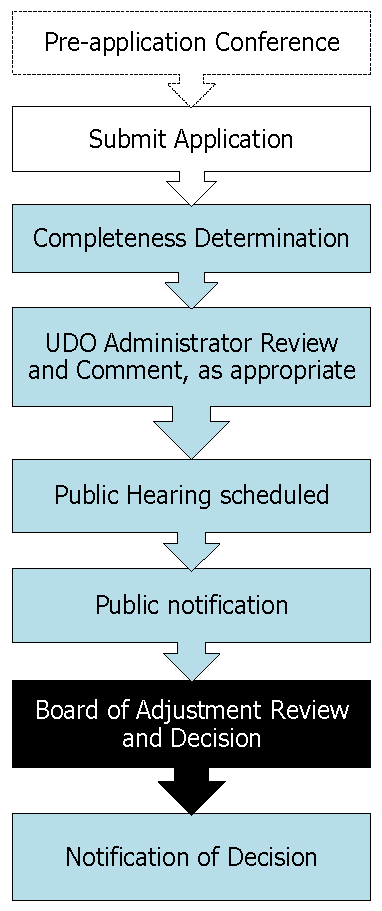
1.
Applicability.
a.
Unless otherwise provided by State law or this Ordinance, this section sets out the procedure and standards for appealing any decision or interpretation by a Town official made pursuant to this Ordinance or any other ordinance that regulates land use or development authorized by G.S. Chapter 160D.
b.
In the event an applicant wishes to appeal a standard outside this Ordinance, or a decision by a staff member not addressed by this Ordinance, the appeal is made to the Town Manager in accordance with Town policy, not this appeal procedure.
2.
Initiation. An appeal shall be initiated by filing a written notice of appeal with the UDO Administrator within thirty (30) days of the date the written determination or decision being appealed is received by the applicant (except where otherwise specified in this Ordinance).
3.
Appeal Procedure.
a.
Pre-Application Conference. Optional (see Section 18.2.3.C, Pre-Application Conference).
b.
Application Submittal and Acceptance.
i.
Applicable (see Section 18.2.3.F, Application Submittal and Acceptance).
ii.
The written notice of appeal shall include a statement of the error or improper decision, the date of the decision or interpretation, the grounds for the appeal, and all related support materials.
c.
Staff Review and Action.
i.
Applicable (see Section 18.2.3.G, Staff Review and Action).
ii.
On accepting a notice of appeal, the UDO Administrator shall transmit to the BOA the record of material considered by the decision-maker in making the decision or interpretation.
d.
Public Notification. Applicable (see Section 18.2.3.H, Public Notification).
e.
BOA Review and Decision.
i.
Applicable (see Section 18.2.3.L, Review and Action by Decision-making Body, and Section 18.2.3.J, Quasi-Judicial Public Hearing Procedures).
ii.
The BOA, at the conclusion of a quasi-judicial public hearing, shall decide the application for the appeal.
iii.
The decision shall be based on the competent, material, and substantial evidence in the record of the appeal, as supplemented by arguments presented at the quasi-judicial hearing, and the standards in Section 18.2.4.C.4, Appeal Review Standards.
iv.
The decision shall be one (1) of the following:
a)
Affirmation of the decision or interpretation (in whole or in part);
b)
Modification of the decision or interpretation (in whole or in part); or
c)
Reversal of the decision or interpretation (in whole or in part).
v.
A vote to reverse or modify a decision or determination shall require approval of a majority of a quorum present at the hearing.
vi.
Each decision shall be made in writing and reflect the BOA's determination of contested facts and their application to the standards in this Ordinance.
vii.
The written decision shall be signed by the Chair or other duly authorized member of the BOA.
viii.
The decision of the BOA shall be effective upon the filing of the written decision.
f.
Notification of Decision. The decision of the BOA shall be delivered by personal service, electronic mail, or by first-class mail to the applicant, the landowner, and to any person who has submitted a written request for a copy prior to the date the decision becomes effective. The person providing notification of decision shall certify that proper notification has been made.
4.
Appeal Review Standards.
a.
The BOA is limited to the following determinations in considering the appeal, which shall be based on:
i.
Whether the decision-maker erred in the interpretation of this Ordinance; and
ii.
Whether the decision-maker erred in determining whether a standard of this Ordinance was met.
b.
The BOA shall not hear any evidence or make any decision based on hardships or special conditions except as part of an application for a variance.
5.
Effect.
a.
An appeal stays all proceedings in furtherance of the action appealed, unless the Town official from whom the appeal is taken certifies to the BOA, after notice of appeal has been filed, that because of facts stated in the certificate a stay would, in the Town official's opinion, cause imminent peril to life or property or because the violation is transitory in nature, a stay would seriously interfere with enforcement of this Ordinance.
b.
If certification by a Town official is filed, administrative proceedings shall not be stayed except through issuance of a restraining order by a court of competent jurisdiction.
c.
If the appeal is not stayed, the appellant may file for an expedited hearing of the appeal, and the BOA shall meet to consider the appeal with fifteen (15) days of the date the request is filed.
d.
The filing of an appeal prevents the filing of an application for a zoning map amendment or special use permit for the same land subject to an appeal application, as well as the filing of a text amendment application by the same party filing the appeal until the appeal application is decided or appealed to the courts.
6.
Appeal.
a.
Any decision by the BOA shall be subject to Superior Court of Carteret County review by proceedings in the nature of certiorari.
b.
Petitions for review must be field with the Clerk of Court within thirty (30) days of the date of the decision is filed in the office of Planning, Zoning, and Inspections.
D.
Building Permit.
1.
Applicability. Unless exempted in accordance with the State Building Code, no construction, addition, alteration, repair, movement to another site, removal, or demolition of any building or structure may occur until a building permit is approved in accordance with the procedures and standards of this section.
FIGURE 18.2.4.D
BUILDING PERMIT PROCEDURE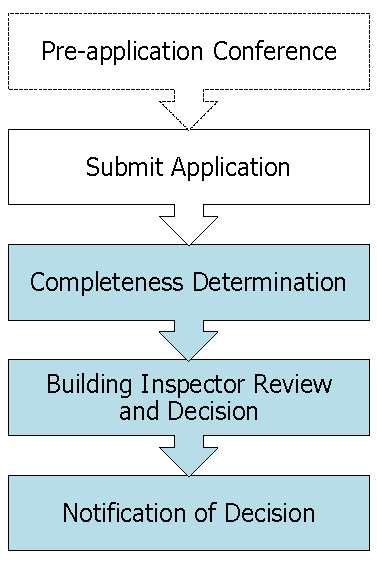
2.
Building Permit Procedure.
a.
Pre-Application Conference. Optional (see Section 18.2.3.C, Pre-Application Conference).
b.
Application Submittal and Acceptance. Applicable (see Section 18.2.3.F, Application Submittal and Acceptance).
c.
Staff Review and Action. Applicable (see Section 18.2.3.G, Staff Review and Action).
3.
Building Permit Review Standards. A building permit shall be issued if the application complies with:
a.
The State Building Code;
b.
The applicable requirements of the County Health Department;
c.
All standards or conditions of any prior, applicable permits and development approvals; and
d.
All other applicable requirements of this Ordinance, the Town Code of Ordinances, or State or federal law.
4.
Effect. Applicable (see Section 18.2.3.O, Effect of Development Approval).
5.
Amendment. Amendment of a building permit may only be reviewed and considered in accordance with the procedures and standards established for its original approval.
6.
Expiration.
a.
A building permit shall expire and become null and void if the development it authorizes is not commenced within six (6) months of the permit issuance.
b.
If development authorized by a building permit commences but fails to achieve at least one (1) passing inspection (foundation, footing, framing, mechanical, etc.) for a continuous period of twelve (12) months, the permit shall expire and become null and void.
7.
Appeal. An appeal of a decision on a building permit may be filed with the North Carolina Commissioner of Insurance, in accordance with G.S. 160D-1127.
E.
Reserved.
F.
CAMA Minor Permit.
1.
Applicability.
a.
This section sets out the procedure and standards for Town review of minor forms of development proposed in an Area of Environmental Concern (AEC) - areas in or near the water, near a water supply, beach dunes, marshes, or other areas of environmental significance as part of the Coastal Area Management Act (CAMA) of 1974.
b.
CAMA minor permits are regulated by the Coastal Resources Commission. In the case of conflict, the rules and regulations of the North Carolina Administrative Code regarding CAMA shall control.
FIGURE 18.2.4.F
CAMA MINOR PERMIT PROCEDURE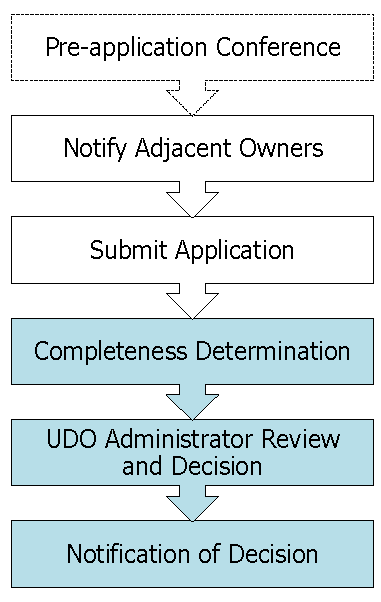
2.
CAMA Minor Permit Procedure.
a.
Pre-Application Conference. Optional (see Section 18.2.3.C, Pre-Application Conference).
b.
Adjacent Owner Notification. Applicants for a CAMA minor permit shall notify all adjacent landowners who own riparian (or waterfront) property that an application for a CAMA minor permit has been filed.
c.
Application Submittal and Acceptance.
i.
Applicable (see Section 18.2.3.F, Application Submittal and Acceptance).
ii.
The application shall be on a form adopted by the CRC.
d.
Staff Review and Action.
i.
Applicable (see Section 18.2.3.G, Staff Review and Action).
ii.
Upon receipt of an application, the UDO Administrator shall forward a copy to the NC Department of Environmental Quality (DEQ).
iii.
The UDO Administrator shall decide an application within twenty-five (25) days of the date it is deemed complete. The UDO Administrator may request, and shall be granted one (1) additional twenty-five-day period to make a decision when the complexity of the application requires such evaluation. The applicant shall be notified via certified mail in cases where an extension is required.
iv.
Failure of the UDO Administrator to make a decision within the time allotted shall be deemed an approval.
3.
CAMA Minor Permit Review Standards. A CAMA minor permit shall be issued if the application complies with:
a.
All applicable standards for development in an AEC found in the North Carolina Administrative Code (Sections 15A NCAC 7H .0208-310 or .0405-6);
b.
G.S. 113A-120(a)(1)—(10); and
c.
Applicable Land Use Plan policy guidance; and
d.
Any applicable local development regulations.
4.
Effect.
a.
Applicable (see Section 18.2.3.O, Effect of Development Approval).
b.
The applicant shall display the CAMA minor permit approval in full view on the site where development is taking place.
5.
Amendment. Amendment of a CAMA minor permit may only be reviewed and considered in accordance with the procedures and standards established for its original approval.
6.
Expiration. Applicable (see Section 18.2.3.T, Expiration of Permit or Development Approval).
7.
Appeal.
a.
An appeal of a decision on a CAMA minor permit may be filed with the Coastal Resources Commission within twenty (20) days of the date of the permit decision.
b.
No action subject to a CAMA minor permit shall take place while an appeal of the UDO Administrator's decision is pending.
G.
Certificate of Occupancy.
1.
Applicability. No land, newly erected building or structure, or existing building or structure that has been moved or enlarged or changed in use shall be occupied or used until a certificate of occupancy is approved and issued in accordance with this section, certifying that the land, building, or structure, and its use complies with this Ordinance and the applicable standards of the State Building Code.
FIGURE 18.2.4.G
CERTIFICATE OF
OCCUPANCY
PROCEDURE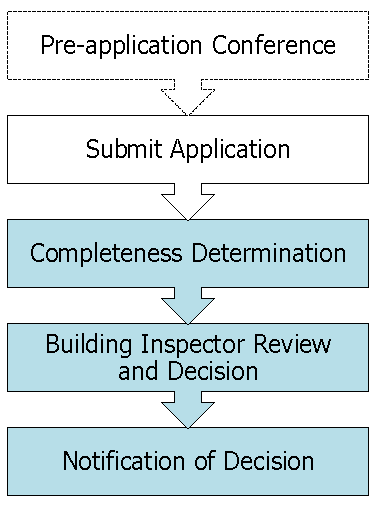
2.
Certificate of Occupancy Procedure.
a.
Pre-Application Conference. Optional (see Section 18.2.3.C, Pre-Application Conference).
b.
Application Submittal and Acceptance. Applicable (see Section 18.2.3.F, Application Submittal and Acceptance).
c.
Staff Review and Action. Applicable (see Section 18.2.3.G, Staff Review and Action).
3.
Certificate of Occupancy Review Standards. A certificate of occupancy shall be approved if the land, building, structure, or proposed use complies with:
a.
All relevant standards of this Ordinance;
b.
Any other applicable Town requirements;
c.
All applicable conditions of approval; and
d.
The applicable State Building Code requirements.
4.
Effect. Approval of a certificate of occupancy allows a building, structure, or site to be occupied or used in accordance with the approved purpose.
5.
Performance Guarantee. The Building Inspector may require the applicant to submit a performance guarantee (see Section 18.7.4, Performance Guarantees) in an amount necessary to ensure that any work not completed as specified in the development permit or approval will be completed within the specified timeframe for a certificate of occupancy.
6.
Temporary Certificate of Occupancy. A temporary certificate of occupancy may be issued by the Building Inspector prior to the completion of all construction or changes if occupancy will not violate any health or safety considerations of any applicable codes.
a.
The Building Inspector shall specify the duration of the temporary certificate of occupancy, which shall not exceed ninety (90) days.
b.
If all remaining work is not completed within the specified timeframe of the temporary certificate of occupancy, the Building Inspector shall order the applicant to cease occupancy immediately.
7.
Amendment. Amendment of a certificate of occupancy may only be reviewed and considered in accordance with the procedures and standards established for its original approval.
8.
Appeal.
a.
Appeals may be filed in accordance with the procedure in Section 18.2.4.C, Appeal.
b.
An appeal pertaining to a State Building Code issue shall be filed with to the North Carolina Commissioner of Insurance in accordance with G.S. 160D-1127.
H.
Development Agreements.
FIGURE 18.2.4.H
DEVELOPMENT
AGREEMENT
PROCEDURES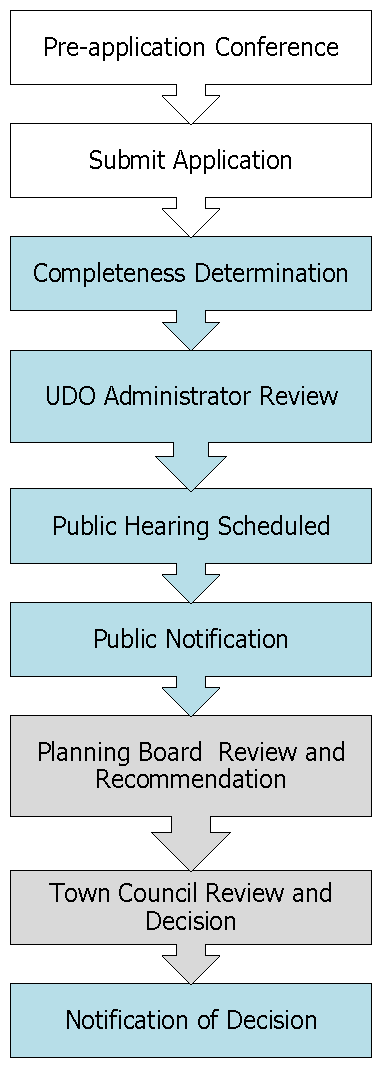
1.
Applicability. In order to provide more regulatory certainty, establish a schedule for development, coordinate the provision of public facilities, and improve management of environmentally sensitive lands, the Town Council may enter into a development agreement with a developer, subject to G.S. 160D, Article 10, and the provisions of this section. In entering into a development agreement the Town may not exercise any authority or make any commitment that is unauthorized by general or local act, and may not impose any unauthorized tax or fee.
2.
Development Agreement Procedure.
a.
Pre-Application Conference. Applicable (see Section 18.2.3.C, Pre-Application Conference).
b.
Application Submittal and Acceptance. Applicable (see Section 18.2.3.F, Application Submittal and Acceptance).
c.
Staff Review and Action.
i.
Applicable (see Section 18.2.3.G, Staff Review and Action).
ii.
The UDO Administrator shall prepare a staff report in accordance with Section 18.2.4.H.3, Development Agreement Review Standards.
d.
Public Notification. Applicable (see Section 18.2.3.H, Public Notification).
e.
Review and Action by Decision-making Body.
i.
Applicable (see Section 18.2.3.L, Review and Action by Decision-making Body).
ii.
The Town Council, after the conclusion of a public hearing, shall decide the application in accordance with Section 18.2.4.H.3, Development Agreement Review Standards.
iii.
The action taken shall be one (1) of the following:
a)
Enter into the development agreement, as submitted;
b)
Enter into the development agreement, subject to changes agreed to in writing by the developer; or
c)
Not enter into the development agreement.
f.
Recordation. Within fourteen (14) days after entering into a development agreement, the applicant shall record the agreement in the office of the Register of Deeds for Carteret County.
3.
Development Agreement Review Standards. For consideration of the Town to participate in a development agreement, a development subject to the agreement must:
a.
Comply with the requirements in G.S. 160D, Article 10;
b.
Indicate proposed phasing;
c.
Demonstrate the impact on existing and future provisions of capital improvements by the Town, including at least one (1) of the following: transportation, potable water, solid waste, stormwater management, parks and recreation, and health systems and facilities;
d.
The development agreement shall, at a minimum, include all of the following:
i.
A description of the property subject to the agreement and the names of its legal and equitable property owners; and
ii.
The duration of the agreement. However, the parties are not precluded from entering into subsequent development agreements that may extend the original duration period; and
iii.
The development uses permitted on the property, including population densities and building types, intensities, placement on the site, and design; and
iv.
A description of public facilities that will serve the development, including who provides the facilities, the date any new public facilities, if needed, will be constructed, and a schedule to assure public facilities are available concurrent with the impacts of the development. In the event that the development agreement provides that the local government shall provide certain public facilities, the development agreement shall provide that the delivery date of such public facilities will be tied to successful performance by the developer in implementing the proposed development, such as meeting defined completion percentages or other performance standards; and
v.
A description, where appropriate, of any reservation or dedication of land for public purposes and any provisions agreed to by the developer that exceed existing laws related to protection of environmentally sensitive property; and
vi.
A description, where appropriate, of any conditions, terms, restrictions, or other requirements for the protection of public health, safety, or welfare; and
vii.
A description, where appropriate, of any provisions for the preservation and restoration of historic structures.
4.
Effect.
a.
Burdens and Benefits. The burdens of the development agreement are binding upon, and the benefits of the agreement shall inure to, all successors in interest to the parties to the agreement.
b.
Rights and Obligations. Rights and obligations established by a development agreement shall not preclude or supersede rights and obligations established pursuant to other law regarding building permits, site specific development plans, phased development plans, or other provisions of law.
c.
Building and Housing Code. A development agreement shall not exempt the property landowner or developer from compliance with the State Building Code or applicable Minimum Housing Code.
d.
Identify Subsequently Enacted Laws. Unless the development agreement specifically provides for the application of subsequently enacted laws, the laws applicable to development of the property subject to a development agreement are those in force at the time of execution of the agreement.
e.
Application of Subsequently Adopted Laws. Except for grounds specified in G.S. 160D-108(c) or 160D-108.1(f), the Town may not apply subsequently adopted ordinances or development policies to a development that is subject to a development agreement.
f.
Change in State or Federal Law. If state or federal law is changed after a development agreement has been entered into and the change prevents or precludes compliance with one (1) or more provisions of the development agreement, the Town, by ordinance after notice and a hearing, may modify the affected provisions, upon a finding that the change in state or federal law has a fundamental effect on the development agreement.
g.
Vested Rights. This Ordinance does not abrogate any rights preserved by G.S. 160D-108, or that may vest pursuant to common law or otherwise in the absence of a development agreement.
5.
Approval of Debt. If any of the obligations of the Town in the development agreement constitute debt, the Town shall comply, at the time of the obligation to incur the debt and before the debt becomes enforceable against the Town, with any applicable constitutional and statutory procedures for the approval of the debt. The agreement shall be signed by the Town Manager, Town Attorney, and the Town Clerk.
6.
Periodic Review and Breach of Agreement.
a.
Annual Review. During any period of time in which a permit or development approval subject to a development agreement is active, the UDO Administrator shall review the development at least once every year for compliance with the agreement and file a report with the Town Council. The developer must demonstrate good faith compliance with the terms of the development agreement. Failure to meet a commencement or completion date specified in the development agreement shall not, in and of itself, constitute a material breach of the agreement, but must be judged based upon the totality of the circumstances.
b.
Material Breach. If the Town Council finds and determines that the developer has committed a material breach of the terms or conditions of the development agreement, the Town Attorney shall serve written notice of the breach upon the developer within a reasonable time after the periodic review. Such notice shall set forth with reasonable particularity the nature of the breach and the evidence supporting the finding and determination, and shall provide the developer a reasonable time in which to cure the material breach.
c.
Failure to Cure Material Breach. If the developer fails to cure the material breach within the time given, then the Town Council may unilaterally terminate or modify the development agreement, provided that notice of termination or modification may be appealed to the BOA in accordance with G.S. 160D-405.
7.
Amendment.
a.
Mutual Consent. A development agreement may be amended or canceled by mutual consent of the parties to the agreement or by their successors in interest.
b.
Changes are Amendments. Consideration of a proposed change of a development agreement beyond the scope of a change shall be reviewed and considered in accordance with the procedures and standards established for the original approval of a development agreement.
I.
Reserved.
J.
Floodplain Development Permit.
FIGURE 18.2.4.J
FLOODPLAIN
DEVELOPMENT
PERMIT PROCEDURE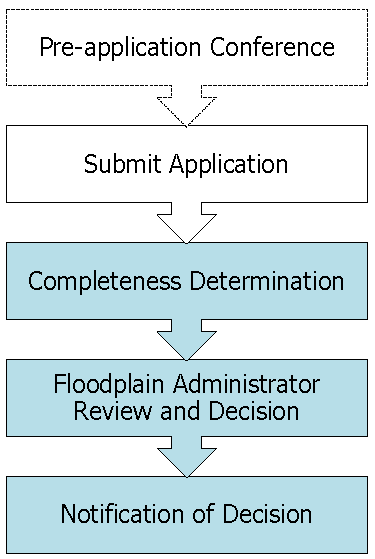
1.
Applicability. To reduce the potential for damage to land and life from flooding or floodwaters, development proposed on land in a special flood hazard area within the Town's zoning jurisdiction shall obtain a floodplain development permit in accordance with this section prior to or concurrent with an application for a site plan, building permit, or zoning permit, as appropriate.
2.
Floodplain Development Permit Procedure.
a.
Pre-Application Conference. Optional (see Section 18.2.3.C, Pre-Application Conference).
b.
Application Submittal and Acceptance. Applicable (see Section 18.2.3.F, Application Submittal and Acceptance).
c.
Staff Review and Action.
i.
Applicable (see Section 18.2.3.G, Staff Review and Action).
ii.
The Floodplain Administrator shall review and decide the application in accordance with Section 18.2.4.J.3, Floodplain Development Permit Review Standards.
3.
Floodplain Development Permit Review Standards. A floodplain development permit shall be approved if the application complies with the following:
a.
The permit is issued prior to the commencement of development; and
b.
The development complies with all applicable standards in Section 18.6.3, Flood Damage Prevention.
4.
Effect. Approval of a floodplain development permit authorizes an applicant to obtain all required elevation certificates or other required certificates and proceed with development following issuance of a building permit.
5.
Amendment. Amendment of a floodplain development permit approval may only be reviewed and considered in accordance with the procedures and standards established for its original approval.
6.
Expiration. A floodplain development permit shall expire and become null and void if the development it authorizes is not commenced within six (6) months of permit issuance.
7.
Appeal. Appeals may be filed in accordance with the procedure in Section 18.2.4.C, Appeal.
K.
Interpretation.
1.
Applicability. The UDO Administrator is responsible for written interpretations of all provisions of this Ordinance, including, but not limited to:
FIGURE 18.2.4.K
INTERPRETATION
PROCEDURE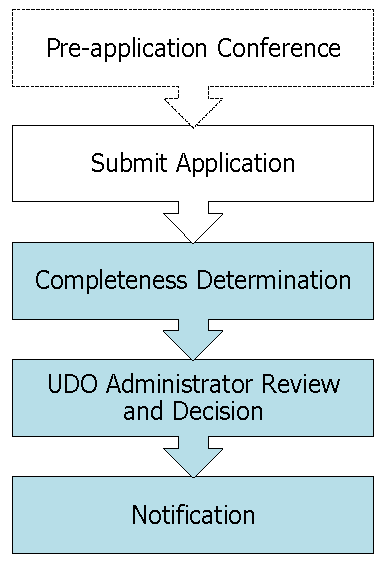
a.
Interpretations of the meaning of the text;
b.
Interpretations of the zoning district boundaries on the Official Zoning Map;
c.
Interpretations of whether an unlisted use in Table 18.4.1.G, Principal Use Table, is comparable to a listed use or not, and should be allowed in a zoning district or prohibited in that district; and
d.
Interpretations of compliance with a condition of approval.
2.
Interpretation Procedure.
a.
Pre-Application Conference. Optional (see Section 18.2.3.C, Pre-Application Conference).
b.
Application Submittal and Acceptance.
i.
Applicable (see Section 18.2.3.F, Application Submittal and Acceptance).
ii.
An application for a formal written interpretation may be initiated by any person having an interest in the matter in question.
c.
Staff Review and Action.
i.
Applicable (see Section 18.2.3.G, Staff Review and Action).
ii.
The UDO Administrator shall review the request and make interpretations in accordance with Section 18.2.4.K.3, Interpretation Review Standards.
iii.
The UDO Administrator may request additional information as necessary to make an interpretation.
iv.
Prior to rendering an interpretation, the UDO Administrator may consult with the Town Attorney and other affected Town officials.
3.
Interpretation Review Standards.
a.
Zoning District Map Boundaries. Interpretation of zoning district boundaries on the Official Zoning Map shall be in accordance with the standards in Section 18.3.1.D.4, Interpretation of Official Map Boundaries, and consistent with the Town's adopted policy guidance.
b.
Unlisted Uses. Interpretation of whether an unlisted use is similar to a use identified in Table 18.4.1.G, Principal Use Table, may consider consistency with the Town's adopted policy guidance and the following standards:
i.
The function, product, or physical characteristics of the use;
ii.
The impact on adjacent lands created by the use;
iii.
The type, size, and nature of buildings and structures associated with the use;
iv.
The type of sales (retail, wholesale), and the size and type of items sold and displayed on the premises;
v.
The types of items stored (such as vehicles, inventory, merchandise, chemicals, construction materials, scrap and junk, and raw materials including liquids and powders);
vi.
The volume and type of vehicle traffic generated by the use, and the parking demands of the use;
vii.
Any processing associated with the use, including assembly, manufacturing, warehousing, shipping, distribution, and whether it occurs inside or outside a building;
viii.
How the use is treated in the North American Industrial Classification System (NAICS) manual;
ix.
Any dangerous, hazardous, toxic, or explosive materials associated with the use;
x.
The amount and nature of any nuisances generated on the premises, including but not limited to noise, smoke, odor, glare, vibration, radiation, and fumes; and
xi.
Any prior interpretations made by the UDO Administrator or decisions made by the BOA.
c.
Text Provisions. Interpretation of the text and its application shall be based on the standards in Section 18.10.1, Rules of Language Construction.
4.
Effect.
a.
General.
i.
A written interpretation shall be binding on subsequent decisions by the UDO Administrator or other administrative officials in applying the same provision of this Ordinance or the Official Zoning Map in the same circumstance, unless the interpretation is modified in accordance with this section, the interpretation is later determined to have been made in error, or the text of this Ordinance is amended.
ii.
The UDO Administrator shall maintain a record of written interpretations that shall be available in the Planning, Zoning, and Inspections Department for public inspection, on reasonable request, during normal business hours.
b.
Approval of Unlisted Use.
i.
After the UDO Administrator determines the use category or use type in which the unlisted use is best classified, then the unlisted use shall be subject to all applicable requirements of that use category or use type.
ii.
After making an interpretation of an unlisted use, the UDO Administrator shall determine whether the unlisted use is likely to be common or recur frequently, and whether its omission is likely to lead to uncertainty and confusion. On determining that the unlisted use is likely to be common and would lead to confusion if unlisted, the UDO Administrator shall initiate an application for a text amendment. Until final action is taken on the text amendment, the UDO Administrator's decision shall be binding.
iii.
If after making an interpretation of an unlisted use, the UDO Administrator determines that the unlisted use is of an unusual or transitory nature, and unlikely to recur frequently, the determination shall be binding without further action or amendment of this Ordinance.
5.
Appeal. Appeals may be filed in accordance with the procedure in Section 18.2.4.C, Appeal.
L.
Reserved.
M.
Land Disturbance Permit.
FIGURE 18.2.4.M
LAND DISTURBANCE PERMIT PROCEDURE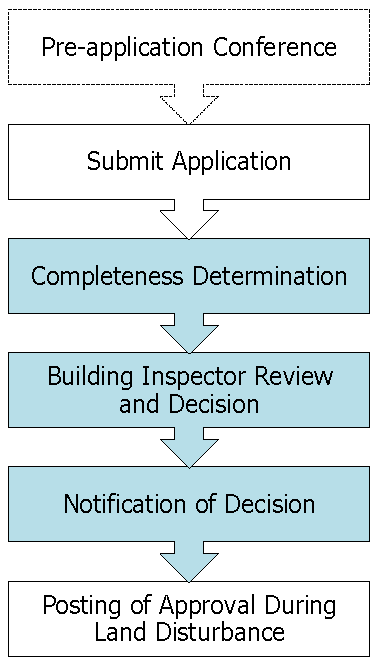
1.
Applicability. In order to avoid groundwater contamination, sediment accumulation in drainage conveyances and surface waters, unnecessary loss of erodible soils, and increased stormwater runoff onto abutting lots, land-disturbing activities require approval of a land disturbance permit in accordance with this section, prior to commencement. For the purposes of this section, "land-disturbing activities" include any fill, grading, or disturbance of land other than activities listed in Section 18.2.4.M.2, Exemptions.
2.
Exemptions. The following activities are exempted from the requirement to obtain a land disturbance permit:
a.
Land-disturbing activities subject to permit approval by the North Carolina Department of Environmental Quality;
b.
Gardening and landscaping that does not alter the preexisting topography;
c.
Movement of sand or soil in an amount not exceeding one hundred (100) square feet of surface area.
3.
Land Disturbance Permit Procedure.
a.
Pre-Application Conference. Optional (see Section 18.2.3.C, Pre-Application Conference).
b.
Application Submittal and Acceptance. Applicable (see Section 18.2.3.F, Application Submittal and Acceptance).
c.
Staff Review and Action.
i.
Applicable (see Section 18.2.3.G, Staff Review and Action).
ii.
The Building Inspector shall review and decide the application in accordance with Section 18.2.4.M.4, Land Disturbance Permit Review Standards.
4.
Land Disturbance Permit Review Standards.
a.
No professionally designed plan is required if the project does not alter the pre-existing topography of the subject lot and does not include fill. A land disturbance permit without a professionally designed plan shall be approved provided that:
i.
Land disturbance may not increase the amount or velocity of stormwater flowing onto abutting lots in a two-year 24-hour precipitation event.
ii.
Activity requiring a land disturbance permit shall not cause sediment, trash, debris or other material to leave the site.
iii.
Disturbed land shall be stabilized by vegetation, mulching, sodding, or other approved means no later than twenty-one (21) days after the completion of land-disturbing activity.
iv.
Silt fencing or other approved soil erosion prevention device shall be installed along the perimeter of the project for the duration of the work.
b.
A professionally designed plan is required if the project alters the pre-existing topography of the subject lot and/or includes fill. A professionally designed plan must be designed and sealed by a Professional Engineer or Professional Landscape Architect licensed to practice in the State of North Carolina. A land disturbance permit with a professionally designed plan shall be approved provided that the plan complies with the following standards:
i.
The land disturbance may not increase the amount or velocity of stormwater flowing onto abutting lots in a two-year 24-hour precipitation event.
ii.
The first two inches of stormwater generated from new impervious surfaces are retained on site in accordance with Section 18.6.1.
iii.
Except for the instances set forth below in Section 18.2.4.M.b.iv, fill material may be used to raise the grade of the subject lot up to, but not above, the average finished grade elevation of abutting lots.
iv.
The only instances in which fill material may be used to raise the grade of the subject lot above the averaged finished grade elevation of abutting lots are as follows:
1.
As required by onsite wastewater system permit issued by the County.
2.
As necessary in order to drain surface water away from building foundations. The amount of fill shall be limited to the amount required to achieve positive drainage.
3.
As necessary under driveways and walkways to connect a structure to the street.
4.
As necessary to provide a consistent grade between the elements listed above in Subsections 1, 2 and 3 of Section 18.2.4.M.b.iv., provided that no fill is placed within five (5) feet of a property line.
5.
As necessary for shoreline stabilization in accordance with state and federal regulatory and permitting requirements, in which case fill may be placed within the first five (5) feet from the landward edge of the shoreline stabilization device.
v.
Stormwater runoff in excess of the retained amounts required in Section 18.2.4.M.4.b.i. and Section 18.2.4.M.4.b.ii. may leave the subject parcel provided that:
1.
The excess stormwater runoff does not increase the amount or velocity of stormwater onto abutting lots in a two-year 24-hour precipitation event.
2.
The excess stormwater runoff is not diverted into a piped conveyance towards any property line.
3.
The excess stormwater runoff is sheet-flowed through vegetated conveyances, such as swales.
4.
The sheet-flowed excess stormwater runoff flows into swales or other approved retention method within the Town-owned right-of-way, to be installed and maintained by the applicant.
vi.
The land disturbance shall not cause sediment, trash, debris or other material to leave the site subject to the permit;
vii.
Disturbed land shall be stabilized by vegetation, mulching, sodding, or other approved means no later than twenty-one (21) days after the completion of land-disturbing activity.
viii.
Silt fencing or other approved soil erosion prevention device shall be installed along the perimeter of the project prior to beginning land disturbance and remain in place for the duration of the land disturbance.
ix.
Installation of the professionally designed plan shall be inspected and approved by the designing Professional Engineer or Professional Landscape Architect or other Professional Engineer or Professional Landscape Architect licensed to practice in the State of North Carolina prior to issuance of a certificate of occupancy.
5.
Effect.
a.
Applicable (see Section 18.2.3.O, Effect of Development Approval).
b.
The applicant shall post the approved land disturbance permit in a prominent location on the site where the land disturbance is occurring at all times while it is in effect.
6.
Amendment. Amendment of a land disturbance permit may only be reviewed and considered in accordance with the procedures and standards established for its original approval.
7.
Expiration. The land disturbance permit shall be null and void if work authorized is not commenced within six (6) months from the issuance of the permit.
8.
Appeal. Appeals may be filed in accordance with the procedure in Section 18.2.4.C, Appeal.
N.
Right-of-Way Encroachment.
1.
Applicability. This section establishes the procedure for review of non-permanent encroachments into the public right-of-way, including buildings, structures, or site features.
2.
Encroachment Review Procedure.
a.
Pre-Application Conference. Optional (see Section 18.2.3.C, Pre-Application Conference).
FIGURE 18.2.4.N
RIGHT-OF-WAY
ENCROACHMENT
PROCEDURE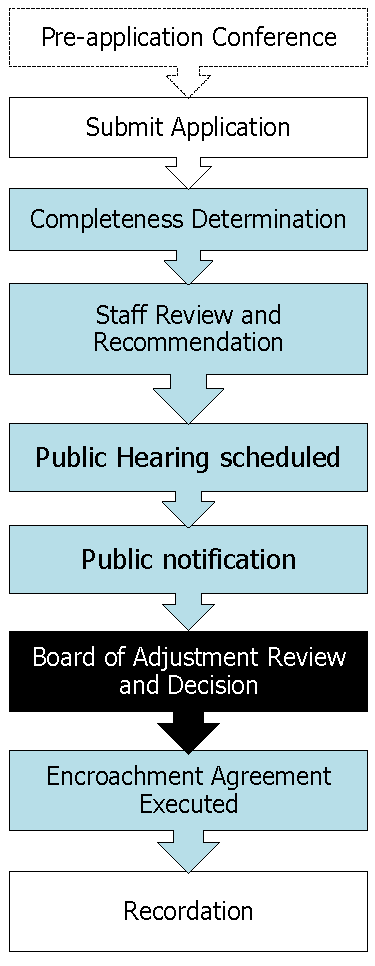
b.
Application Submittal and Acceptance.
i.
Applicable (see Section 18.2.3.F, Application Submittal and Acceptance).
ii.
An application shall include:
a)
A detailed explanation of why the applicant cannot make reasonable use of their property without the requested encroachment;
b)
A survey prepared by a registered land surveyor, registered professional landscape architect, or licensed professional engineer showing the location and size of the encroachment; and
c)
A description of any public infrastructure which must be relocated.
c.
Staff Review and Action.
i.
Applicable (see Section 18.2.3.G, Staff Review and Action).
ii.
The UDO Administrator shall prepare a staff report and provide a recommendation on whether or not the application complies with the requirements in this Ordinance. In cases where the application does not comply, the staff report may identify ways in which the application could be modified to comply.
iii.
The staff report shall include review comments (if any) by the Town personnel responsible for public works and emergency services provision.
d.
Public Notification. Applicable (see Section 18.2.3.H, Public Notification).
e.
Review and Action by Decision-making Body.
i.
Applicable (see Section 18.2.3.L, Review and Action by Decision-making Body), and Section 18.2.3.J, Quasi-Judicial Public Hearing Procedures).
ii.
The Board of Adjustment, after the conclusion of a quasi-judicial public hearing, shall decide the application in accordance with Section 18.2.4.N.3, Right-of-Way Encroachment Review Standards. The decision shall be the one (1) of the following:
a)
Approval of the encroachment as proposed;
b)
Approval of a revised encroachment; or
c)
Denial of the encroachment.
3.
Right-of-Way Encroachment Review Standards. A right-of-way encroachment shall be approved if the applicant demonstrates the proposed encroachment:
a.
Is necessary for the applicant's reasonable use of their property and no reasonable alternative is available;
b.
Will not interfere with the public's use of the affected right(s)-of-way and is not in violation of any State, federal, or local regulation; and
c.
Will not interfere with any Town service or service from any public service company, including without limitation: provision of water, sewer, electricity, telephone, cable, drainage, garbage collection, or emergency services.
4.
Encroachment Agreement Required.
a.
Approval of a right-of-way encroachment shall require execution of an encroachment agreement between the Town and an applicant in accordance with the following:
i.
The Board of Adjustment may require any conditions of approval necessary for the protection of the public's continued and unobstructed use of the right(s)-of-way to be included within the encroachment agreement.
ii.
The encroachment agreement shall not be deemed effective until such time as the applicant records a copy with the Carteret County Register of Deeds and returns a recorded copy of the agreement to the Town Clerk.
b.
An encroachment granted pursuant to the UDO is a grant of a license to the applicant. It does not create a real property interest held by the applicant. An encroachment is terminable at will by the Town.
5.
Relocation of Public Infrastructure.
a.
In the event approval of a right-of-way encroachment results in the need to relocate any public infrastructure, the encroachment agreement shall be subject to a performance guarantee for the relocation.
b.
The performance guarantee shall provide for the completion of all relocation activities within one (1) year of the date of approval of the encroachment and shall be in an amount equal to one hundred twenty-five (125) percent the estimated cost of such relocation, including the cost of restoring the right-of-way to its original or better condition and to the satisfaction of the Town.
6.
Effect. Applicable (see Section 18.2.3.O, Effect of Development Approval).
7.
Removal May be Required.
a.
In the event the Town requires the applicant, or the applicant's heirs, successors, or assigns, to remove the right-of-way encroachment, its removal shall take place within thirty (30) days of the Town's notice to do so.
b.
In no event shall the Town be required to provide a reason for such removal, though one (1) may be provided.
c.
Right-of-way encroachment removal shall take place without expense to the Town.
d.
If removal is not completed within thirty (30) days of notice from the Town, the Town may remove the encroachment and restore the right-of-way to its original or better condition and recover the costs incurred from the applicant, and the applicant's heirs, successors, or assigns.
8.
Appeal. Appeals may be filed in accordance with the procedure in Section 18.2.4.C, Appeal.
O.
Sign Permit.
1.
Applicability. All signs, unless exempted in accordance with Section 18.5.10, Signage, shall obtain a sign permit in accordance with this section before being erected, replaced, relocated, or altered.
2.
Sign Permit Procedure.
FIGURE 18.2.4.O
SIGN PERMIT
PROCEDURE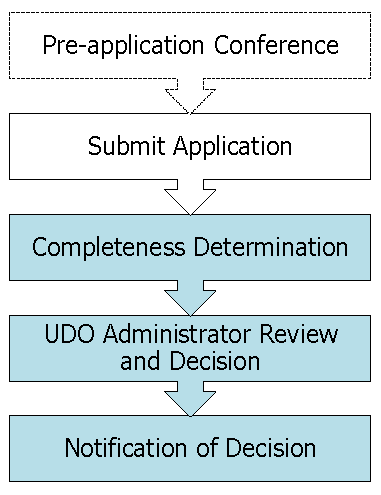
a.
Pre-Application Conference. Optional (see Section 18.2.3.C, Pre-Application Conference).
b.
Application Submittal and Acceptance. Applicable (see Section 18.2.3.F, Application Submittal and Acceptance).
c.
Staff Review and Action.
i.
Applicable (see Section 18.2.3.G, Staff Review and Action).
ii.
The UDO Administrator shall review and decide the application in accordance with Section 18.2.4.O.3, Sign Permit Review Standards.
3.
Sign Permit Review Standards. A sign permit shall be approved if the application complies with:
a.
The standards in Section 18.5.10, Signage;
b.
The State Building Code;
c.
All standards or conditions of any prior applicable permits and developments approvals; and
d.
All other applicable requirements of this Ordinance and the Town Code of Ordinances.
4.
Effect. Applicable (see Section 18.2.3.O, Effect of Development Approval).
5.
Amendment. Amendment of a sign permit may only be reviewed and considered in accordance with the procedures and standards established for its original approval.
6.
Expiration. If the work authorized by a sign permit is not commenced within six (6) months from the date of issuance, the permit shall become null and void.
7.
Appeal. Appeals may be filed in accordance with the procedure in Section 18.2.4.C, Appeal.
P.
Site Plan (Major/Minor).
1.
Applicability. Site plan review shall be required for any development activity that includes constructing a building or increasing the amount of impervious surface other than those forms of development listed in Section 18.2.4.P.2, Exemptions from Site Plan Requirements.
2.
Exemptions from Site Plan Requirements. The following forms of development are not required to obtain site plan approval but are subject to the requirements for a zoning permit (see Section 18.2.4.Z, Zoning Permit), or building permit (see Section 18.2.4.D, Building Permit):
FIGURE 18.2.4.P.4
MAJOR SITE PLAN
PROCEDURE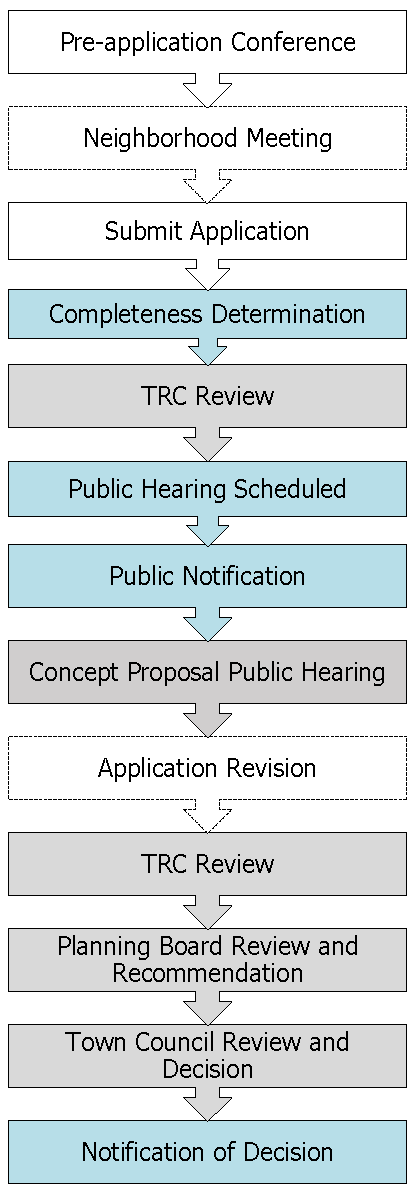
a.
Construction of a single-family detached home on an individual lot except in the Residential Single-Family Conservation (RSC) district;
b.
Establishment of an accessory use or structure;
c.
Enlargements of existing principal structures by up to twenty (20) percent of the total gross floor area, provided the enlargement does not result in a need for additional parking spaces or landscaping; and
d.
Changes of use that do not result in increased lot coverage, the need for additional parking spaces, or additional landscaping.
3.
Site Plans Distinguished.
a.
Major Site Plan. A major site plan shall be required for the following types of development:
i.
Residential developments greater than five (5) units;
ii.
Residential developments involving two (2) or more principal structures on an individual lot;
iii.
Single-family detached residential development within the RSC district;
iv.
Nonresidential developments greater than two thousand five hundred (2,500) square feet of gross floor area;
v.
Nonresidential development within the CIR and COR districts;
vi.
Duplex, multi-family, or upper-story residential development within the CIR and COR districts; and
vii.
Any form of development not exempted from site plan review or reviewed as a minor site plan.
b.
Minor Site Plan. A minor site plan approval shall be required for the following forms of development:
i.
Development of a duplex on an individual platted lot;
ii.
Development of a three or more-unit multi-family residence on an individual platted lot; and
iii.
Nonresidential development of less than two thousand five hundred (2,500) square feet of gross floor area located outside the CIR or COR zoning districts.
4.
Major Site Plan Procedure. Review of a major site plan shall consist of two (2) phases. Phase I is the review and comment on a concept proposal by the Town Council and Planning Board at a public hearing conducted for that purpose. Phase II is the preparation of a detailed major site plan for review by the TRC.
a.
Pre-Application Conference. Applicable (see Section 18.2.3.C, Pre-Application Conference).
b.
Neighborhood Meeting. Optional (see Section 18.2.3.D, Neighborhood Meeting).
c.
Application Submittal and Acceptance.
i.
Applicable (see Section 18.2.3.F, Application Submittal and Acceptance), except that application submittal shall be organized into two (2) phases. Phase I includes the site plan application form and concept proposal. Phase II includes the detailed major site plan and associated materials.
ii.
If a land disturbance plan is required, it shall be submitted concurrently with the Phase II application materials.
iii.
Concept Proposal. The concept proposal shall include, at a minimum, the following materials:
a)
A written description of the proposed development, including detail on density, number of units, floor area, lot coverage, and the configuration of site features such as required parking, landscaping, exterior lighting and other features required in Article 18-5: Development Standards;
b)
A description of how the development will comply with the standards in Article 18-6: Environment;
c)
A preliminary or concept-level sketch of the proposed development site showing lot lines, required setbacks, proposed building outlines, and generalized site configuration features like required parking, landscaping, fences and walls, solid waste collection and service areas, and a description of adjacent development;
d)
Preliminary or conceptual building elevations of proposed structures as seen from the right-of-way, the waterfront (if adjacent), and any adjacent development;
e)
A basic description of primary exterior materials and material configurations proposed for principal buildings in the development; and
f)
When the subdivision of property is proposed, the applicable requirements under Article 18-2: Procedures, Section 18.2.4, S, 3, b, Preliminary Plat Review Standards, and Article 18-7, Subdivisions, must be met and shown on Concept Proposal site plan.
iv.
Phase II. The Phase II submittal should reflect the applicable requirements under Article 18-2: Procedures, Section 18.2.4, S, 4, c, Final Plat Review Standards, and Article 18-7, Subdivisions, when the subdivision of property is proposed.
d.
Staff Review and Action.
i.
Applicable (see Section 18.2.3.G, Staff Review and Action).
ii.
The TRC shall prepare a staff report in accordance with Section 18.2.4.P.6, Site Plan Review Standards.
e.
Public Notification. Applicable (see Section 18.2.3.H, Public Notification).
f.
Concept Proposal Public Hearing.
i.
Prior to initial review by Town staff, the Planning Board and Town Council shall conduct a joint public hearing to review and comment on the concept proposal associated major site plan application. Concept plan review shall only be conducted for approval or disapproval based on demonstrated compliance with the requirements of this Ordinance or other applicable codes. The Town Council may give advisory opinions on general aspects of a Concept plan.
ii.
Public comment provided during a concept proposal public hearing shall be limited to whether or not the concept proposal does or does not comply with the Ordinance requirements.
iii.
An applicant for a major site plan may choose to address the comments received during the concept proposal hearing in the Phase II application materials. Phase II application materials may differ from the Concept Proposal application materials. Phase II application materials that differ from Concept Proposal application materials are considered to be a different site plan if they differ in one or more of the following ways:
a)
Increase in density.
b)
Increase in impervious coverage.
c)
Increase in number of buildings.
d)
Decrease in active or passive open space.
e)
Increase in width, depth, height, or square feet of one (1) or more buildings or site features such as paving by more than ten (10) percent.
g.
Staff Review and Action.
i.
Applicable (see Section 18.2.3.G, Staff Review and Action).
ii.
The TRC shall prepare a staff report in accordance with Section 18.2.4.P.6, Site Plan Review Standards.
h.
Review and Decision by Decision-Making Body.
i.
Applicable (See Section 18.2.3.L, Review and Action by Decision-Making Body).
ii.
During a regular meeting, the Planning Board shall review the application during a public meeting in accordance with Section 18.2.4.P.6, Site Plan Review Standards. The decision shall be one of the following:
a)
Recommendation of approval of the major site plan as proposed to the Town Council;
b)
Remand major site plan to TRC.
iii.
Following review of the major site plan application by the Planning Board, the Town Council shall review and decide the application during a public meeting in accordance with Section 18.2.4.P.6, Site Plan Review Standards. The decision shall be one of the following:
a)
Approval of the major site plan as proposed;
b)
Remand major site plan to TRC.
FIGURE 18.2.4.P.5
MINOR SITE PLAN
PROCEDURE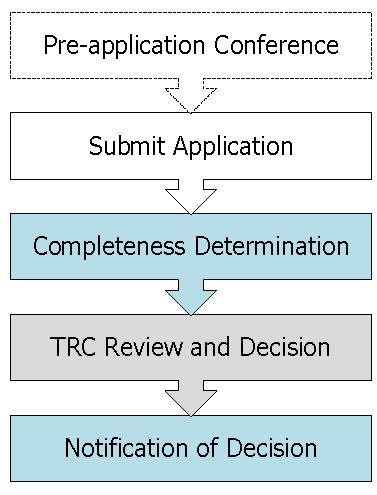
5.
Minor Site Plan Procedure.
a.
Pre-Application Conference. Optional (see Section 18.2.3.C, Pre-Application Conference).
b.
Application Submittal and Acceptance.
i.
Applicable (see Section 18.2.3.F, Application Submittal and Acceptance).
ii.
If a land disturbance plan is required, it shall be submitted concurrently with the site plan application.
c.
Staff Review and Action.
i.
Applicable (see Section 18.2.3.G, Staff Review and Action).
ii.
The TRC shall review and decide the application in accordance with Section 18.2.4.P.6, Site Plan Review Standards.
6.
Site Plan Review Standards. A site plan shall be approved if the application complies with:
a.
All standards or conditions of any prior applicable permits and development approvals; and
b.
All applicable requirements of this Ordinance, the Town Code of Ordinances, and State and federal laws.
7.
Effect. Approval of a site plan authorizes the submittal of construction plans, if applicable, and the submittal of an application for a building permit in accordance with Section 18.2.4.D, Building Permit, or a zoning permit in accordance with Section 18.2.4.Z, Zoning Permit. When subdivision is proposed, approval of the Phase II site plan shall allow its recordation and conveyance of lots and serves as final plat approval.
8.
Amendment. Amendment of a site plan approval may only be reviewed and considered in accordance with the procedures and standards established for its original approval, unless it is a minor amendment to a major site plan. A minor amendment to a major site plan only differs in one or more of the following ways:
a)
Reduction in density.
b)
Reduction in impervious coverage.
c)
Reduction in number of buildings.
d)
Increase in active or passive open space.
e)
Increase in width, depth, height, or square feet of one or more buildings or site features such as paving by no more than 10%.
f)
Reconfiguration of site features as long as the minimum requirements are met.
g)
Reduction in the number of lots or reconfiguration of lot lines as long as the number of lots is not increased.
A minor amendment to an existing approved major site plan may be applied for in accordance with this article, but will begin review under the second phase of the procedure as it is considered to be the same concept. When a site plan amendment is considered in any case, the unaffected components of the site plan shall not be considered for re-approval.
9.
Expiration.
a.
Site plan approval shall expire and become null and void if the development approved in the site plan does not begin within twenty-four (24) months of issuance of the site plan approval.
b.
Long-term projects of at least 25 acres, called "multi-phased developments" are vested in accordance with G.S. 160D-108(f).
10.
Appeal. Appeals of a decision on a minor site plan application may be filed in accordance with the procedure in Section 18.2.4.C, Appeal.
Q.
Reserved.
R.
Special Use Permit.
1.
Applicability. Uses identified as requiring a special use permit in Table 18.4.1.G, Principal Use Table, shall only be approved as a special use permit in accordance with the procedures and standards of this section. A special use permit is a use that may be appropriate in a zoning district, but because of its nature, extent, and external effects, requires special consideration of its location, design, and methods of operation before it can be deemed appropriate in the district and compatible with its surroundings. A special use permit is issued to authorize development or land uses in a particular zoning district upon presentation of competent, material, and substantial evidence establishing compliance with one or more general standards requiring that judgment and discretion be exercised as well as compliance with specific standards.
FIGURE 18.2.4.R
SPECIAL USE PERMIT PROCEDURE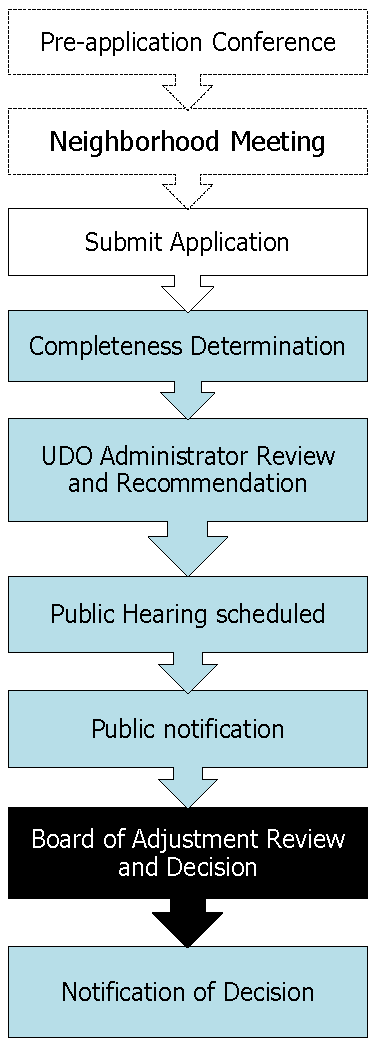
2.
Special Use Permit Procedure.
a.
Pre-Application Conference. Optional (see Section 18.2.3.C, Pre-Application Conference).
b.
Neighborhood Meeting. Optional (see Section 18.2.3.D, Neighborhood Meeting).
c.
Application Submittal and Acceptance.
i.
Applicable (see Section 18.2.3.F, Application Submittal and Acceptance).
ii.
An application shall be submitted only by the landowner(s), and shall include a site plan.
d.
Staff Review and Action.
i.
Applicable (see Section 18.2.3.G, Staff Review and Action).
ii.
The UDO Administrator shall prepare a staff report and provide a recommendation on whether or not the application complies with the requirements in this Ordinance. In cases where the application does not comply, the staff report may identify ways in which the application could be modified to comply.
e.
Public Notification. Applicable (see Section 18.2.3.H, Public Notification).
f.
Review and Action by Decision-making Body.
i.
Applicable (see Section 18.2.3.L, Review and Action by Decision-making Body, and Section 18.2.3.J, Quasi-Judicial Public Hearing Procedure).
ii.
The BOA, after the conclusion of a quasi-judicial public hearing, shall decide the application in accordance with Section 18.2.4.R.3, Special Use Permit Review Standards. The decision shall be one (1) of the following:
a)
Approval of the special use permit as proposed;
b)
Approval of a revised special use permit; or
c)
Denial of the special use permit.
g.
Notification of Decision. The decision of the BOA shall be delivered by personal service, electronic mail, or by first-class mail to the applicant, the landowner, and to any person who has submitted a written request for a copy prior to the date the decision becomes effective. The person providing notification of decision shall certify that proper notification has been made.
3.
Special Use Permit Review Standards. A special use permit shall be approved if the applicant demonstrates the proposed special use:
a.
Will not materially endanger the public health or safety if located where proposed;
b.
Complies with all required standards, conditions, and specifications of this Ordinance, including Article 18-4: Use Standards, or is considered to be the use type, "Government facility, major";
c.
Will not substantially injure the value of the abutting land, or the special use is a public necessity;
d.
Will be in harmony with the area in which it is to be located; and
e.
Is in general conformity with the Town's adopted policy guidance.
4.
Conditions of Approval. Applicable (see Section 18.2.3.M, Conditions of Approval).
5.
Effect.
a.
Applicable (see Section 18.2.3.O, Effect of Development Approval).
b.
A special use permit and the associated site plan approval are perpetually binding and run with the land, unless amended.
c.
An action invalidating a condition of approval for any reason shall render the special use permit null and void.
6.
Amendment.
a.
Minor Changes.
i.
The BOA may approve a minor change to a special use permit requested by the applicant without a public hearing, upon receipt of a report from the TRC on the proposed minor change.
ii.
A minor change includes changes to conditions of a special use permit or associated site plan which will result in equal or better performance of the conditions and that do not alter the objectives and purposes of the special use.
iii.
In granting a minor change, the BOA may require such conditions as will address the objectives of the requirements or conditions changed.
b.
Material Changes are Amendments.
i.
Material changes to a special use permit or to an associated site plan that alter the objectives and purposes of the requirements or conditions of the special use constitute an amendment to the special use permit.
ii.
An amendment includes but is not limited to:
a)
Boundary changes;
b)
Use changes; and
c)
Increases in density or intensity of development.
iii.
Amendments of a special use permit may only be reviewed and considered in accordance with the procedures and standards established for its original approval.
7.
Expiration.
a.
A special use permit shall expire and become null and void twenty-four (24) months after the date of issuance if an initial inspection for the development approved has not been passed or an applicant has not requested an extension.
b.
If development approved with a special use permit is discontinued for a period exceeding twelve (12) months, or if a special use is replaced by a use otherwise permitted by right in the zoning district, the special use permit approval is deemed abandoned and the approval is null and void.
8.
Appeal.
a.
Any decision by the BOA shall be subject to Superior Court of Carteret County review by proceedings in the nature of certiorari.
b.
Petitions for review must be filed with the Clerk of Court within thirty (30) days of the date of the decision is filed in the office of Planning, Zoning, and Inspections.
S.
Subdivision, Major.
1.
Subdivisions Distinguished. Subdivisions of land are classified as major subdivisions and minor subdivisions. Minor subdivisions are subdivisions of land divided into five (5) or fewer lots with no associated extension of public streets or public infrastructure. Subdivisions creating six (6) or more lots from a parent parcel in existence on October 23, 2017 or subdivisions of any size that include new public streets or the extension of public infrastructure are major subdivisions. Major subdivisions are reviewed in two (2) steps: a preliminary plat and a final plat. Minor subdivisions only require review of a final plat.
FIGURE 18.2.4.S.3
PRELIMINARY PLAT PROCEDURE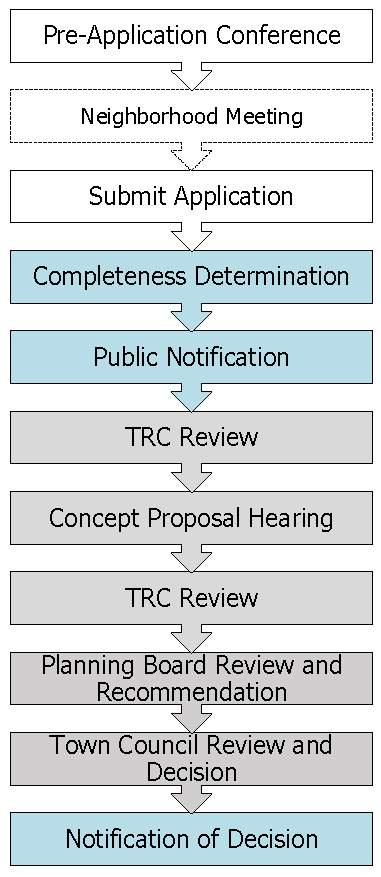
2.
Applicability. Unless exempted in accordance with G.S. 160D-802 of the North Carolina General Statutes, all divisions of land including six (6) or more lots, including new streets, or extension of public infrastructure, shall comply with the provisions of this section.
3.
Preliminary Plat.
a.
Preliminary Plat Review Procedure.
i.
Pre-Application Conference. Applicable (see Section 18.2.3.C, Pre-Application Conference).
ii.
Neighborhood Meeting. Optional (see Section 18.2.3.D, Neighborhood Meeting).
iii.
Application Submittal and Acceptance.
a)
Applicable (see Section 18.2.3.F, Application Submittal and Acceptance).
b)
A preliminary plat shall be prepared by a licensed professional surveyor, registered professional landscape architect, or licensed professional engineer.
iv.
Public Notification. Applicable (see Section 18.2.3.H, Public Notification).
v.
Staff Review and Action.
a)
Applicable (see Section 18.2.3.G, Staff Review and Action).
b)
The TRC shall prepare a staff report in accordance with Section 18.2.4.S.3.b, Preliminary Plat Review Standards.
vi.
Preliminary Plat Public Hearing.
a)
Prior to initial review by Town staff, the Planning Board and Town Council shall conduct a joint public hearing to review and comment on the preliminary plat application. A decision on the application shall not be made during the concept proposal hearing.
b)
An applicant for a preliminary plat may choose to revise the application in accordance with the comments received during the concept proposal hearing.
vii.
Staff Review and Action.
a)
Applicable (see Section 18.2.3.G, Staff Review and Action).
b)
The TRC shall prepare a staff report in accordance with Section 18.2.4.S.3.b, Preliminary Plat Review Standards.
viii.
Review and Decision by Decision-Making Body.
a)
Applicable (See Section 18.2.3.L, Review and Action by Decision-Making Body).
b)
During a regular meeting, the Planning Board shall review the application during a public meeting in accordance with Section 18.2.4.S.3.b, Preliminary Plat Review Standards. The decision shall be one (1) of the following:
i)
Recommendation of approval of the preliminary plat as proposed to the Town Council;
ii)
Remand preliminary plat to TRC.
c)
Following review of the major site plan application by the Planning Board, the Town Council shall review and decide the application during a public meeting in accordance with Section 18.2.4.S.3.b, Preliminary Plat Review Standards. The decision shall be one (1) of the following:
i)
Approval of the preliminary plat as proposed;
ii)
Remand preliminary plat to TRC.
b.
Preliminary Plat Review Standards.
i.
An application for a preliminary plat shall be approved if the application complies with:
a)
All applicable standards in Article 18-7: Subdivisions;
b)
All standards or conditions of any prior applicable permits and development approvals; and
c)
All other applicable requirements of this Ordinance and in the Town Code of Ordinances.
ii.
In cases where land subject to a preliminary plat is located within an AEC, lots shall be configured to allow the placement of structures without altering frontal dunes. Approved preliminary plats shall bear a certification from the Town certifying compliance with all AEC requirements.
c.
Effect. Approval of a preliminary plat authorizes the submittal of construction plans and/or a final plat.
d.
Amendment. Amendment of a preliminary plat approval may only be reviewed and considered in accordance with the procedures and standards established for its original approval.
e.
Expiration. An approved preliminary plat shall be valid for two (2) years from the date of approval.
f.
Appeal. Appeals may be filed in accordance with the procedure in Section 18.2.4.C, Appeal.
4.
Final Plat.
FIGURE 18.2.4.S.4
FINAL PLAT
PROCEDURE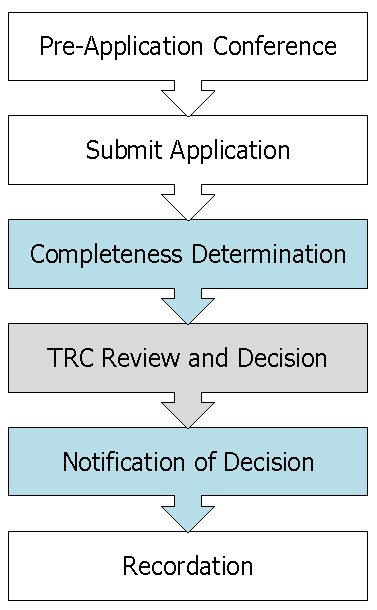
a.
Applicability. A final plat, reviewed and approved in accordance with this section, shall be required for all subdivisions of land required to obtain a preliminary plat under this Ordinance. A landowner shall not submit an application for final plat review until a preliminary plat is approved and all required improvements serving the subdivision are installed and inspected by the Town, or the developer provides a performance guarantee in accordance with Section 18.7.4, Performance Guarantees.
b.
Final Plat Review Procedure.
i.
Pre-Application Conference. Applicable (see Section 18.2.3.C, Pre-Application Conference).
ii.
Application Submittal and Acceptance. Applicable (see Section 18.2.3.F, Application Submittal and Acceptance).
iii.
Staff Review and Action.
a)
Applicable (see Section 18.2.3.G, Staff Review and Action).
b)
The TRC shall review and decide the application in accordance with Section 18.2.4.S.4.c, Final Plat Review Standards.
iv.
Recordation. Once a final plat is approved, a signed statement by the UDO Administrator shall be entered on the face of the plat. The final plat may not be recorded without this certification. Failure to record the final plat in accordance with Section 18.2.4.S.4.f, Expiration, shall render the plat null and void.
c.
Final Plat Review Standards. A final plat shall be approved if the application complies with the following:
i.
The final plat is prepared and sealed by a licensed professional land surveyor or professional engineer.
ii.
The final plat is in substantial conformance with the preliminary plat and all applicable requirements in Article 18-7: Subdivisions;
iii.
All required improvements depicted on the preliminary plat and final plat are installed and inspected by the Town, or are subject to a performance guarantee (see Section 18.7.4, Performance Guarantees);
iv.
The final plat complies with all standards and conditions of any applicable permits and development approvals; and
v.
The final plat complies with all other applicable requirements in this Ordinance and the Town Code of Ordinances.
d.
Effect.
i.
General. Approval of a final plat allows the sale or conveyance of lots within the subdivision. Building permits may be issued following recordation of the final plat.
ii.
Acceptance of Public Infrastructure.
a)
Unless infrastructure has not yet been completed and is subject to a performance guarantee, approval and recordation of a final plat constitutes an offer of dedication by the owner and acceptance by the Town and the public of the right-of-way of each public street, alley, and utility easement shown on the plat. Approval of the final plat constitutes acceptance for maintenance responsibility of any existing improvements within such right-of-way or easement, but the Town assumes no responsibility to open, operate, repair, or maintain any new improvements, including but not limited to paved streets, until it is in the public interest to do so. This subsection does not apply to utility easements and infrastructure intended to be offered to and accepted by an entity other than the Town.
b)
The subdivider shall retain responsibility for public improvements until maintenance responsibility is accepted by the Town, NCDOT, or a public utility provider, as appropriate.
e.
Amendment. Amendment of a final plat approval may only be reviewed and considered in accordance with the procedures and standards established for its original approval.
f.
Expiration.
i.
A final plat shall be null and void unless it is recorded in the office of the Carteret County Register of Deeds within sixty (60) days of approval.
ii.
If a final plat is not recorded within two (2) years of the associated preliminary plat approval, or if there is a lapse of more than two (2) years between the recording of different sections or phases, then the preliminary plat shall expire.
g.
Appeal. Appeals may be filed in accordance with the procedure in Section 18.2.4.C, Appeal.
T.
Subdivision, Minor.
1.
Applicability. Unless exempted in accordance with G.S. 160D-802 of the North Carolina General Statutes, all divisions of land including five (5) or fewer lots with no extension of public streets or other public infrastructure shall comply with the provisions of this section.
FIGURE 18.2.4.T
MINOR SUBDIVISION PROCEDURE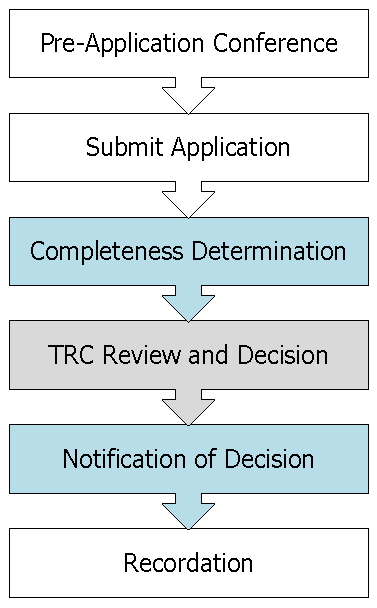
2.
Minor Subdivision Procedure.
a.
Pre-Application Conference. Applicable (see Section 18.2.3.C, Pre-Application Conference).
b.
Application Submittal and Acceptance. Applicable (see Section 18.2.3.F, Application Submittal and Acceptance).
c.
Staff Review and Action.
i.
Applicable (see Section 18.2.3.G, Staff Review and Action).
ii.
The TRC shall review and decide the application in accordance with Section 18.2.4.T.2.e, Minor Subdivision Review Standards.
d.
Recordation. Once a minor subdivision is approved, a signed statement by the UDO Administrator shall be entered on the face of the plat. The minor subdivision plat may not be recorded without this certification. Failure to record the minor subdivision plat in accordance with Section 18.2.4.T.2.h, Expiration, shall render the minor subdivision plat null and void.
e.
Minor Subdivision Review Standards. A minor subdivision shall be approved if the application complies with the following:
i.
The minor subdivision is prepared and sealed by a licensed professional land surveyor or professional engineer;
ii.
The minor subdivision is in substantial conformance with all applicable requirements in Article 18-7: Subdivisions;
iii.
The minor subdivision complies with all standards and conditions of any applicable permits and development approvals; and
iv.
The minor subdivision complies with all other applicable requirements in this Ordinance and the Town Code of Ordinances.
f.
Effect. Approval of a minor subdivision allows the sale or conveyance of lots within the subdivision. Building permits may be issued following recordation of the minor subdivision plat.
g.
Amendment. Amendment of a minor subdivision approval may only be reviewed and considered in accordance with the procedures and standards established for its original approval.
h.
Expiration.
i.
Applicable (see Section 18.2.3.T, Expiration of Permit or Development Approval).
ii.
A minor subdivision plat shall be null and void unless it is recorded in the office of the Carteret County Register of Deeds within sixty (60) days of approval.
i.
Appeal. Appeals may be filed in accordance with the procedure in Section 18.2.4.C, Appeal.
U.
Reserved.
V.
Temporary Use Permit.
1.
Applicability. The provisions of this section shall apply to all proposed temporary uses and structures set forth in Section 18.4.9, Temporary Uses and Structures.
2.
Temporary Use Permit Procedure.
a.
Pre-Application Conference. Optional (see Section 18.2.3.C, Pre-Application Conference).
b.
Application Submittal and Acceptance. Applicable (see Section 18.2.3.F, Application Submittal and Acceptance).
c.
Staff Review and Action.
i.
Applicable (see Section 18.2.3.G, Staff Review and Action).
ii.
The UDO Administrator shall review and decide the application in accordance with Section 18.2.4.V.3, Temporary Use Permit Review Standards.
FIGURE 18.2.4.V
TEMPORARY USE
PERMIT PROCEDURE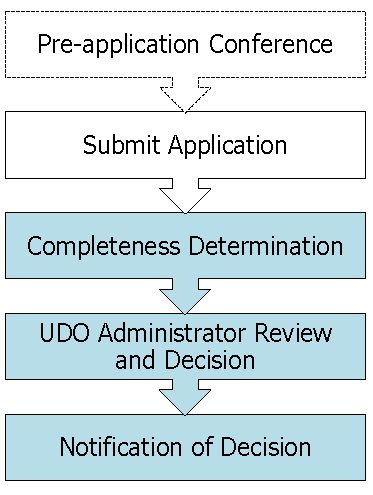
3.
Temporary Use Permit Review Standards. A temporary use permit shall be approved if the applicant demonstrates the proposed temporary use or structure complies with the relevant standards in Section 18.4.9, Temporary Uses and Structures.
4.
Effect. Applicable (see Section 18.2.3.O, Effect of Development Approval).
5.
Amendment. Amendment of a temporary use permit approval may only be reviewed and considered in accordance with the procedures and standards established for its original approval.
6.
Expiration. Approval of a temporary use permit shall be effective beginning on the date of approval and shall remain effective for the period indicated in the permit.
7.
Appeal. Appeals may be filed in accordance with the procedure in Section 18.2.4.C, Appeal.
W.
Text Amendment.
1.
Applicability. This section provides a uniform means for amending the text of this Ordinance whenever the public necessity, changed conditions, convenience, general welfare, or appropriate land use practices justify or require doing so. This procedure shall apply to amendments to any development regulation authorized under G.S. Chapter 160D.
2.
Text Amendment Procedure.
FIGURE 18.2.4.W
TEXT AMENDMENT
PROCEDURE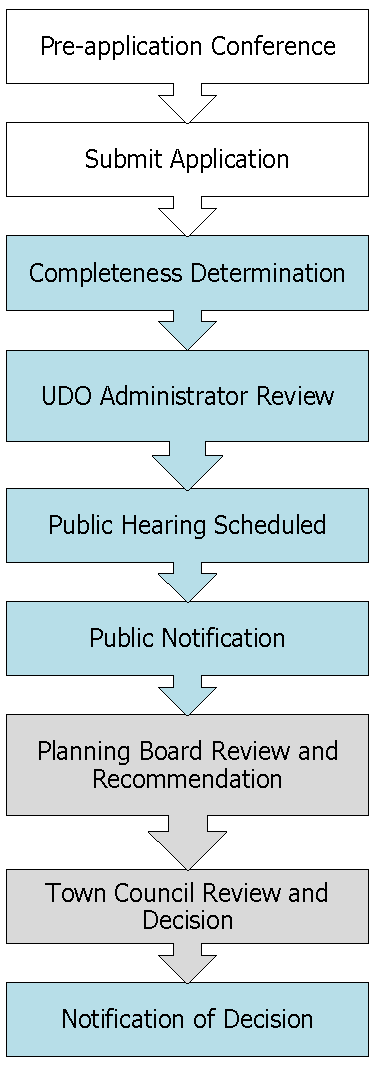
a.
Pre-Application Conference. Applicable (see Section 18.2.3.C, Pre-Application Conference).
b.
Application Submittal and Acceptance.
i.
Applicable (see Section 18.2.3.F, Application Submittal and Acceptance).
ii.
An application for a text amendment may be filed by anyone.
iii.
No text amendment that down-zones property shall be initiated nor is it enforceable without the written consent of all property owners whose property is the subject of the down-zoning amendment, unless the down-zoning amendment is initiated by the local government. For purposes of this section, "down-zoning" means an ordinance authorized under G.S. 160D that affects an area of land in one of the following ways:
a)
By decreasing the development density of the land to be less dense than was allowed under its previous usage.
b)
By reducing the permitted uses of the land that are specified in a zoning ordinance or land development regulation to fewer uses than were allowed under its previous usage.
c.
Staff Review and Action.
i.
Applicable (see Section 18.2.3.G, Staff Review and Action).
ii.
The UDO Administrator shall prepare a staff report in accordance with Section 18.2.4.W.3, Text Amendment Review Standards.
d.
Public Notification. Applicable (see Section 18.2.3.H, Public Notification).
e.
Review and Decision by Decision-making Body.
i.
Applicable (see Section 18.2.3.L, Review and Action by Decision-making Body).
ii.
During a public meeting, the Planning Board shall review the application and make a recommendation in accordance with Section 18.2.4.W.3, Text Amendment Review Standards. The Planning Board shall comment on whether or not the text amendment is consistent with the Town's adopted policy guidance, including any plan adopted according to G.S. 160D-501.
iii.
After consideration of the application by the Planning Board, the Town Council shall conduct a public hearing on the application. The Town Council shall decide the application in accordance with Section 18.2.4.W.3, Text Amendment Review Standards. The decision shall be one (1) of the following:
a)
Adoption of the text amendment as proposed by ordinance;
b)
Adoption of a revised text amendment by ordinance;
c)
Denial of the text amendment; or
d)
Remand of the text amendment application to the Planning Board for further consideration.
iv.
In making its decision, the Town Council shall adopt a written statement of consistency and reasonableness that:
a)
Describes whether the decision is consistent with the Town's adopted policy guidance; and
b)
Explains why the decision is reasonable and in the public interest.
3.
Text Amendment Review Standards. The advisability of amending the text of this Ordinance is a matter committed to the legislative discretion of the Town Council and is not controlled by any one (1) factor.
4.
Effect. Applicable (see Section 18.2.3.O, Effect of Development Approval).
5.
Amendment. Amendment of a text amendment approval may only be reviewed and considered in accordance with the procedures and standards established for its original approval.
X.
Variance.
1.
Applicability.
a.
Development that would otherwise be subject to unnecessary hardship from the applications of the standards in this Ordinance may seek relief from the standards in accordance with this section.
b.
A variance shall not be requested to:
i.
Vary from density or intensity beyond that allowed in a base zoning district; or
ii.
Permit a use not allowed in a zoning district.
FIGURE 18.2.4.X
VARIANCE PROCEDURE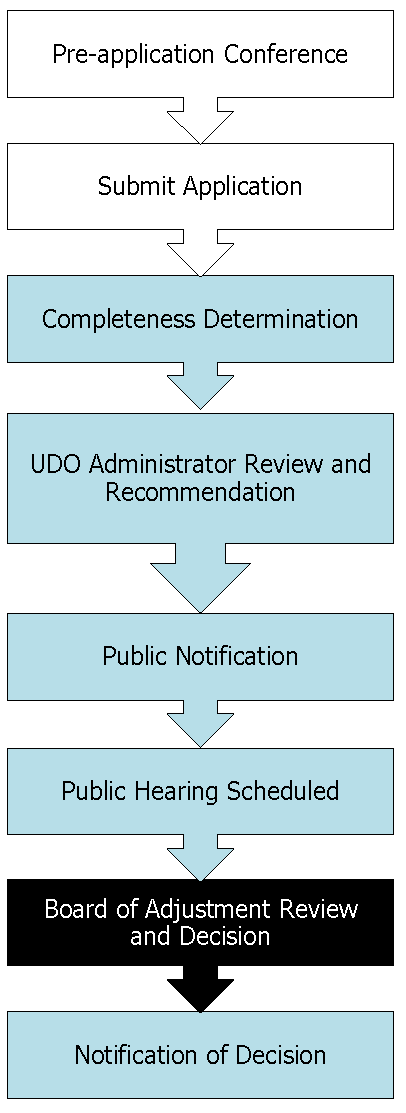
2.
Variance Procedure.
a.
Pre-Application Conference. Applicable (see Section 18.2.3.C, Pre-Application Conference).
b.
Application Submittal and Acceptance. Applicable (see Section 18.2.3.F, Application Submittal and Acceptance).
c.
Staff Review and Action.
i.
Applicable (see Section 18.2.3.G, Staff Review and Action).
ii.
The UDO Administrator shall review the application, prepare a staff report, and provide a recommendation in accordance with Section 18.2.4.X.3, Variance Review Standards.
d.
Public Notification. Applicable (see Section 18.2.3.H, Public Notification).
e.
Review and Action by a Decision-making Body.
i.
Applicable (see Section 18.2.3.L, Review and Action by Decision-making Body, and Section 18.2.3.J, Quasi-Judicial Public Hearing Procedures).
ii.
The BOA, after the conclusion of a quasi-judicial public hearing, shall decide the application for a variance.
iii.
The decision shall be based on the competent, material, and subsequent evidence in the record, as supplemented by the arguments presented at the quasi-judicial hearing, and the standards in Section 18.2.4.X.3, Variance Review Standards.
iv.
The decision shall be one (1) of the following:
a)
Approval of the variance as proposed;
b)
Approval of the variance with revisions; or
c)
Denial of the variance.
v.
Each decision shall be made in writing and reflect the BOA's determination of contested facts and their application to the standards in this Ordinance.
vi.
The written decision shall be signed by the Chair or other duly authorized member of the BOA.
vii.
The decision of the BOA shall be effective upon the filing of the written decision.
f.
Notification of Decision. The decision of the BOA shall be delivered by personal service, electronic mail, or by first-class mail to the applicant, the landowner, and to any person who has submitted a written request for a copy prior to the date the decision becomes effective. The person providing notification of decision shall certify that proper notification has been made.
3.
Variance Review Standards.
a.
General Variance Standards.
i.
Required Findings. A variance shall be approved on finding the applicant demonstrates all of the following:
a)
Unnecessary hardship would result from the strict application of the Ordinance. It shall not be necessary to demonstrate that, in the absence of the variance, no reasonable use can be made of the property.
b)
The hardship results from conditions that are peculiar to the property, such as location, size or topography. Hardships resulting from personal circumstances, as well as hardships resulting from conditions that are common to the neighborhood or the general public, may not be the basis for granting a variance. A variance may be granted when necessary and appropriate to make a reasonable accommodation under the Federal Fair Housing Act for a person with a disability.
c)
The hardship did not result from actions taken by the applicant or the property owner. The act of purchasing property with knowledge that circumstances exist that may justify the granting of the variance shall not be regarded as a self-created hardship.
d)
The requested variance is consistent with the spirit, purpose, and intent of the Ordinance, such that public safety is secured, and substantial justice is achieved.
ii.
Other Considerations. In addition to making the required findings in subsection (i) above, the BOA must also consider that none of the following may be used as the basis or approving a variance:
a)
A request for a particular use that is expressly, or by inference, prohibited in the zoning district;
b)
Hardships resulting from factors other than application of the relevant standards of this Ordinance;
c)
The fact that land or a structure may be utilized more profitably or be more marketable with a variance; or
d)
Financial hardship.
b.
Additional Flood Damage Prevention Variance Standards.
i.
Required Findings. A flood damage prevention variance shall be approved on finding the applicant demonstrates that provisions in Section 18.6.3.C.5, Variance Procedures are met.
4.
Conditions of Approval. In granting a variance the BOA may prescribe conditions of approval to ensure compliance with the standards of this Ordinance and to address any impacts reasonably expected to be generated by the development.
a.
A variance granted subject to a condition of approval shall be permitted as long as there is compliance with the condition.
b.
Violation of a condition of approval shall be deemed a violation of this Ordinance.
c.
If a violation or invalidation of a condition of approval occurs, the UDO Administrator may revoke the certificate of occupancy for the development subject to the variance.
5.
Effect.
a.
General. Approval of a zoning variance or flood damage prevention variance authorizes only the particular regulatory relief approved by the BOA. It does not exempt the applicant from the responsibility to obtain all other permits or development approvals required by this Ordinance or any other applicable laws, and does not indicate that the development for which the variance is granted should receive other permits or development approvals under this Ordinance unless the relevant and applicable portions of this Ordinance are met.
b.
Notification Regarding Flood Insurance Costs.
i.
An applicant for whom a flood damage prevention variance is approved shall be provided written notice by the Floodplain Administrator specifying the difference between the base flood elevation (BFE) and the elevation to which the structure is built. The notice shall inform the applicant about the risks to life and property from construction below the BFE and that issuance of a variance to construct a structure below the BFE will result in increased premium rates for flood insurance.
ii.
The notification shall be maintained by the UDO Administrator with the record of the flood damage prevention variance action.
c.
Records. Upon request, the UDO Administrator shall report all flood damage prevention variances approved in accordance with this section to the Federal Emergency Management Agency and the State of North Carolina.
6.
Amendment. Amendment of a variance may only be reviewed and considered in accordance with the procedures and standards established for its original approval.
7.
Expiration. If the BOA does not include a time period by which development subject to a zoning variance or a flood damage prevention variance expires, development shall commence within twelve (12) months of the date of issuance of the variance or the variance shall expire and become null and void.
8.
Appeal.
a.
Any decision by the BOA shall be subject to Superior Court of Carteret County review by proceedings in the nature of certiorari.
b.
Petitions for review must be field with the Clerk of Court within thirty (30) days of the date of the decision is filed in the office of Planning, Zoning, and Inspections.
Y.
Zoning Map Amendment.
1.
Applicability. A zoning map amendment is an amendment to a zoning regulation for the purpose of changing the zoning district that is applied to a specified property or properties. This section provides a uniform means for reviewing and deciding proposed amendments to the Official Zoning Map whenever the public necessity, general welfare, the Town's adopted policy guidance, or appropriate land use practices justify or require doing so.
2.
Zoning Map Amendment Procedure.
a.
Pre-Application Conference. Applicable when a more intense zoning map designation is requested (see Section 18.2.3.C, Pre-Application Conference).
FIGURE 18.2.4.Y
ZONING MAP
AMENDMENT
PROCEDURE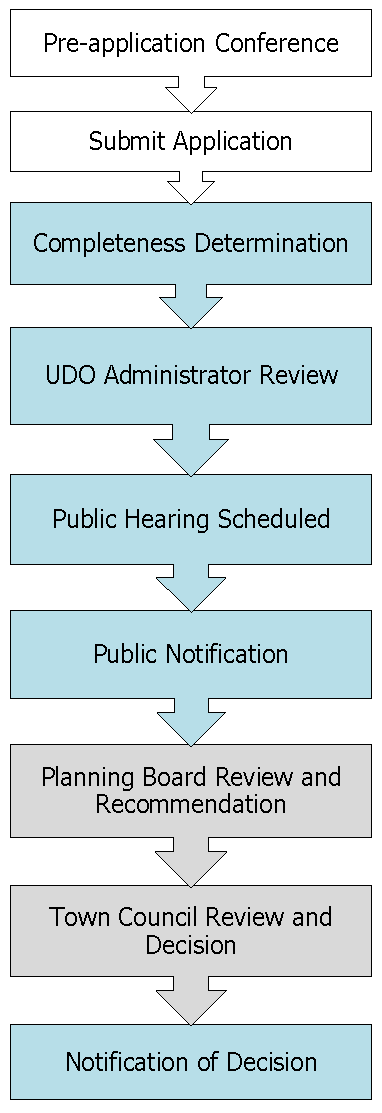
b.
Application Submittal and Acceptance.
i.
Applicable (see Section 18.2.3.F, Application Submittal and Acceptance).
ii.
Applications may be initiated by the Town Council or any person who may submit applications in accordance with Section 18.2.3.F.1, Authority to File Applications.
iii.
No zoning map amendment that down-zones property shall be initiated nor is it enforceable without the written consent of all property owners whose property is the subject of the down-zoning amendment, unless the down-zoning amendment is initiated by the local government. For purposes of this section, "down-zoning" means an ordinance authorized under G.S. 160D that affects an area of land in one of the following ways:
a)
By decreasing the development density of the land to be less dense than was allowed under its previous usage.
b)
By reducing the permitted uses of the land that are specified in a zoning ordinance or land development regulation to fewer uses than were allowed under its previous usage.
c.
Staff Review and Action.
i.
Applicable (see Section 18.2.3.G, Staff Review and Action).
ii.
The UDO Administrator shall prepare a staff report, in accordance with Section 18.2.4.Y.3, Zoning Map Amendment Review Standards.
d.
Public Notification. Applicable (see Section 18.2.3.H, Public Notification).
e.
Review and Action by Decision-making Body.
i.
Applicable (see Section 18.2.3.L, Review and Action by Decision-making Body).
ii.
During a public meeting, the Planning Board shall review the application and make a recommendation in accordance with Section 18.2.4.Y.3, Zoning Map Amendment Review Standards. The Planning Board shall comment on whether or not the zoning map amendment is consistent with the Town's adopted policy guidance, including any plan adopted according to G.S. 160D-501.
iii.
After consideration of the application by the Planning Board, the Town Council shall conduct a public hearing on the application. The Town Council shall decide the application in accordance with Section 18.2.4.Y.3, Zoning Map Amendment Review Standards. The decision shall be one (1) of the following:
a)
Adoption of the zoning map amendment as proposed;
b)
Adoption of a revised zoning map amendment;
c)
Denial of the zoning map amendment; or
d)
Remand of the zoning map amendment application to the Planning Board for further consideration.
iv.
In making its decision, the Town Council shall adopt a written statement that includes each of the following:
a)
Whether the zoning map amendment is approved or denied; and
b)
The degree to which the zoning map amendment is or is not consistent with the Town's Land Use Plan; and
c)
The ways in which the zoning map amendment is or is not consistent with the Town's Land Use Plan; and
d)
Whether approval of the zoning map amendment also amends or does not amend the Town's Land Use Map; and
e)
If the Land Use Map is amended as part of the application approval, a description of the change in conditions to meet the development needs of the Town that were taken into account as part of the approval; and
f)
An explanation of why the action taken by the Town Council is reasonable; and
g)
An explanation of why the action taken by the Town Council is in the public interest.
f.
Designation on Official Zoning Map. The UDO Administrator shall make changes to the Official Zoning Map promptly after approval of a map amendment application by the Town Council.
3.
Zoning Map Amendment Review Standards. The advisability of an amendment to the Official Zoning Map is a matter committed to the legislative discretion of the Town Council and is not controlled by any one (1) factor. Town Council may consider factors noted in G.S. 160D-605(b).
4.
Effect. Applicable (see Section 18.2.3.O, Effect of Development Approval).
5.
Amendment. Amendment of an approved zoning map amendment may only be reviewed and considered in accordance with the procedures and standards established for its original approval.
6.
A zoning map amendment that results in an amendment to the Future Land Use Map of the adopted CAMA Land Use Plan is not effective until it goes through the CAMA plan amendment process as required in G.S. 160D-501 and G.S. 113A-110.
Z.
Zoning Permit.
1.
Applicability. Approval of a zoning permit is required for:
a.
Construction of a single-family detached dwelling on an individual lot;
FIGURE 18.2.4.Z
ZONING PERMIT
PROCEDURE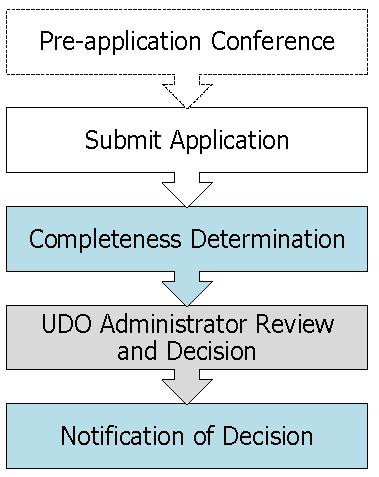
b.
Additions, enlargements or expansions of a building footprint or outdoor use area (e.g. equipment storage); and
c.
Development that does not require a building permit, such as a fence.
2.
Zoning Permit Procedure.
a.
Pre-Application Conference. Optional (see Section 18.2.3.C, Pre-Application Conference).
b.
Application Submittal and Acceptance. Applicable (see Section 18.2.3.F, Application Submittal and Acceptance).
c.
Staff Review and Action.
i.
Applicable (see Section 18.2.3.G, Staff Review and Action).
ii.
The UDO Administrator shall review and decide the application in accordance with Section 18.2.4.Z.3, Zoning Permit Review Standards.
3.
Zoning Permit Review Standards. A zoning permit shall be approved if the application complies with:
a.
All standards or conditions of any prior applicable permits and developments approvals; and
b.
All applicable requirements of this Ordinance, the Town Code of Ordinances, and any applicable State or federal requirements.
4.
Effect. Approval of a zoning permit authorizes an applicant to commence construction or move forward with the approved development.
5.
Amendment. Amendment of a zoning permit may only be reviewed and considered in accordance with the procedures and standards established for its original approval.
6.
Expiration. A zoning permit shall expire and become null and void if development it authorizes is not commenced within twelve (12) months of permit issuance.
7.
Appeal. Appeals may be filed in accordance with the procedure in Section 18.2.4.C, Appeal.
(Ord. No. 18-08-01, 8-27-2018; Ord. No. 19-02-02, 2-25-2019; Ord. No. 19-05-01, 5-20-2019; Ord. No. 19-05-02, 5-20-2019; Ord. No. 19-11-01, 11-25-2019; Ord. No. 20-01-01, 1-27-2020; Ord. No. 20-04-05, 4-27-2020; Ord. No. 21-06-02, 6-28-21; Ord. No. 23-02-01, 2-27-23)

