
Atlantic Beach City Zoning Code
ARTICLE 18
7. - SUBDIVISIONS
18.7.1. - Subdivision Design Standards.
All subdivisions shall be designed in accordance with the following design standards:
A.
Monuments.
1.
Permanent concrete monuments four (4) inches in diameter or square, and three (3) feet long, shall be placed at not less than two (2) corners of the subdivision provided that additional monuments shall be placed where necessary so that no point within the subdivision lies more than five hundred (500) feet from a monument.
2.
Two (2) or more of the required monuments shall be designated as control corners.
3.
The top of each monument shall have an indented cross, metal pin, or metal plate to identify properly the location of the point.
4.
All monuments shall be shown on the final plat.
B.
Ties and Markers.
1.
Property Corner Tie.
a.
At least one (1) corner of the property surveyed shall be designated by course and distance (tie) from a readily discernible reference marker.
b.
If a corner is within two thousand (2,000) feet of the U.S. Coast and Geodetic Station or state grid system coordinated monument, then this corner shall be accurately tied to this station or monument by computed x and y coordinates which shall appear on the map with a statement identifying this station or monument and to an accuracy of 1:15000.
c.
When such a monument or station is not available, the tie shall be made to some pertinent and readily recognizable land mark or identifiable point, physical object, or structure.
2.
Markers. All lot corners, all points where the street lines intersect the exterior boundaries of the subdivision, all angle points and points of curve in each street shall be marked with iron pipe not less than three-fourths (¾) inch in diameter and thirty (30) inches long, driven so as to be two (2) inches above the finished grade.
C.
Easements.
1.
Generally.
a.
Easements for underground or aboveground utilities shall be provided, where necessary, across lots or centered on rear or side lot lines and shall be at least twenty (20) feet wide for water and sanitary sewer lines and as required by the companies involved for telephone, gas, power lines, and cable TV (see Figure 18.7.3.C: Easements).
b.
The TRC shall determine whether one (1) easement is sufficient or whether several easements are necessary to accommodate the various facilities.
c.
The subdivider shall provide for all required easements.
2.
Utility Easements. Easements centered on rear or side lot lines shall be provided for utilities where necessary and shall be at least six (6) feet wide.
3.
Drainage Easements.
a.
Where a subdivision is traversed by a watercourse, drainageway, channel, or stream, there shall be provided a stormwater easement or drainage right-of-way conforming substantially with the lines of such watercourse, and such further width or construction, or both, as will be adequate for the purpose. Parallel streets or parkways may be required in connection therewith.
b.
Lakes, ponds, creeks, or similar areas will be accepted for maintenance only if sufficient land is dedicated as a public recreation area or park or if such area constitutes a necessary part of the drainage control system. Such areas must be approved by the Planning Board before approval of the final plat.
FIGURE 18.7.1.C: EASEMENTS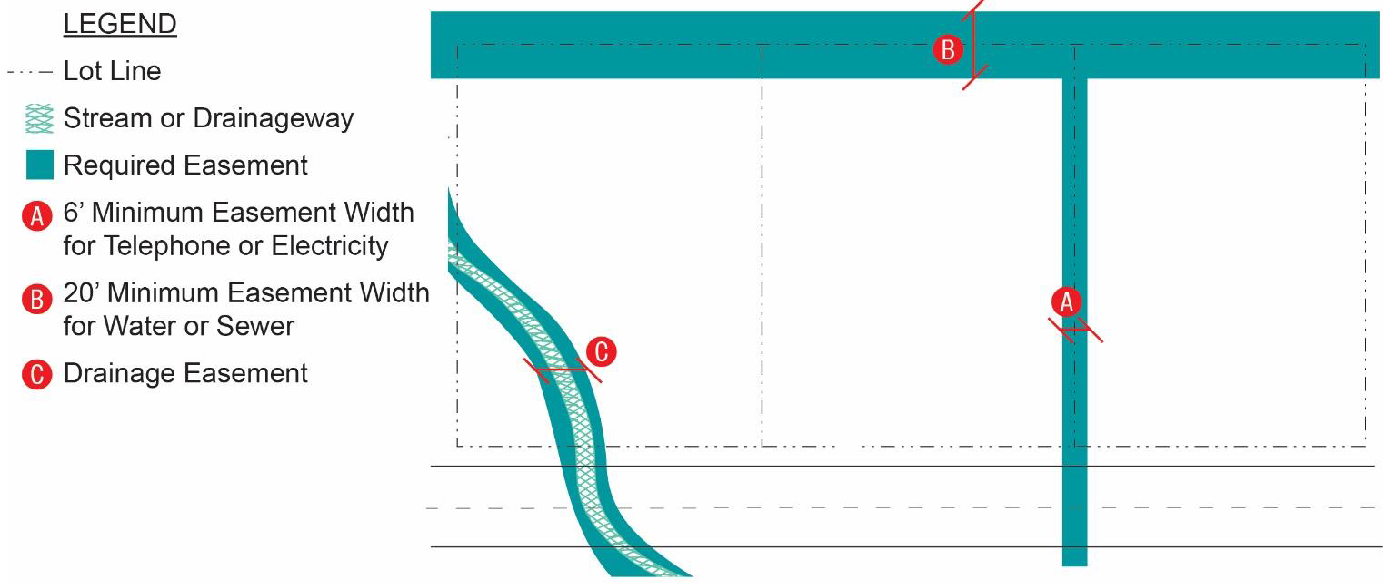
18.7.2. - Streets.
New streets and accessways in the Town shall be configured in accordance with the standards in Section 18.5.2, Access and Circulation, and the following:
A.
Layout and Design.
1.
Standards.
a.
In any new subdivision the street layout shall conform to the arrangement, width, and location indicated on any official plans or maps for the Town.
b.
In areas for which such plans have not been completed, the streets shall be designed and located in proper relation to existing and proposed streets, to the topography, to such natural features as streams and tree growth, to public convenience and safety, and to the proposed use of land to be served by such streets.
c.
The proposed street layout shall be made according to good land planning practice for the type of development proposed, and shall be coordinated with the street system of the surrounding areas.
d.
All streets must provide for the continuation or appropriate projection of principal streets in surrounding areas and provide reasonable means of ingress and egress for surrounding acreage tracts.
e.
All street design and layout standards for new right-of-way development are subject to review and approval by the TRC.
B.
Gated/Controlled Access Subdivisions. Gated or controlled access preliminary subdivision plats shall not be approved until an emergency/service access agreement has been reviewed by the TRC and the Town Attorney as to legal form and effect, and approved by the UDO Administrator.
C.
Street Names and Signs.
1.
Street names of all subdivision plats shall be subject to approval of the Planning Board.
2.
New street names shall not duplicate or be similar to existing street names and existing street names shall be projected wherever possible.
3.
Street name signs shall be installed by the developer at each street intersection as appropriate to identify all street names. Street name signs, poles and brackets will be provided through the Town of Atlantic Beach Public Services Department.
4.
Determinations regarding new street names, or changes in street names, shall be reviewed by the Carteret County Emergency Management Department.
D.
Traffic-Control Devices.
1.
Traffic-control devices such as stop, yield, and speed limit signs, but not including electric or electronic traffic signals, shall be installed on public streets by the developer at the appropriate locations, as determined by NCDOT.
2.
Installation standards and materials shall be in conformance with NCDOT standards for the devices.
E.
Acceptance of Streets. No street shall be maintained by the Town nor street dedication accepted for maintenance in any subdivision for which a plat is required to be approved unless and until the final plat has been approved by the Town.
18.7.3. - Street Lighting.
A.
Purpose. The purpose of this section is to establish the standards for to the installation of street lights for the purposes of traffic safety and crime control.
B.
Applicability. This section shall apply to all public rights-of-way within the municipal limits of the Town of Atlantic Beach and any public rights-of-way annexed in the future until such time that this section is altered, modified, or rescinded by the Town Council.
C.
Standards.
1.
Street Light Installation Required. The owner, developer, or subdivider of a site plan or subdivision shall be required to install street lighting via underground distribution unless specifically approved otherwise by the Town Council, along all proposed streets and along all adjoining existing streets and thoroughfares in accordance with this section.
2.
Standards may be Exceeded.
a.
Through the site plan and subdivision plan approval process, the Town Council may approve street lighting which exceeds these standards for residential streets so as to reduce the length of sag vertical curves, provided the street lights are operational prior to the issuance of any certificates of occupancy for development on streets.
b.
The minimum allowable length of sag vertical curves shall be as follows:
i.
Residential streets: 20A; and
ii.
Cul-de-sacs and loop roads: 15A.
3.
Street Lighting Specifications. All underground electrical distribution systems for street lighting within the corporate limits of the Town of Atlantic Beach shall be installed according to the following standards:
a.
Underground Electrical Service. Underground service for light fixtures shall be installed by the developer in conformance with local electric service provider and Town of Atlantic Beach standards, at the developer's expense.
b.
Light Placement.
i.
A street light shall be provided at all street intersections.
ii.
The placement of street lighting fixtures in residential areas shall be at four hundred to six hundred-foot intervals unless:
a)
The roadway length is less than four hundred (400) feet but more than two hundred (200) feet, in which case a street light will be provided at the end of the street; or
b)
Where the roadway length is less than two hundred (200) feet and a street light is placed at the intersection and no natural features create a problem, no street light will be placed at the end of the roadway; or
c)
The vertical and horizontal street alignment or natural features necessitate shorter spacing intervals.
iii.
The placement of street lighting along thoroughfares, marginal access streets, and collector streets and in nonresidential areas shall be in accordance with the latest revision of the Illuminating Engineering Society's "American National Standards for Roadway Lighting."
4.
Lamp Specifications. Street light fixtures shall conform to the following:
a.
All fixtures in residential areas shall be either 5,800- or 9,500-lumen enclosed high pressure sodium lamps on standard local electric utility provider poles twenty-five (25) feet in height. The 5,800-lumen fixture shall be placed only at the "neck" of cul-de-sacs.
b.
All fixtures along thoroughfares shall be 28,500-lumen enclosed high pressure sodium lamps on standard fiberglass poles thirty (30) feet in height or 50,000 lumen enclosed high pressure sodium lamps on standard fiberglass poles thirty-five (35) feet in height. The 28,500 lumen fixtures shall be placed in residential areas when spillover from the 50,000 lumen fixtures would be excessive, in the determination of the UDO Administrator.
5.
Timing for Installation.
a.
Authorization for street light installations shall occur at such time as:
i.
A developer, through the Town of Atlantic Beach, requests the installation of street lights prior to the issuance of any certificates of occupancy. The developer shall incur a monthly electrical expense billed from the local electric utility provider equal to the monthly electrical expense incurred by the Town of Atlantic Beach, for each street light installed. The developer will be billed the local electric utility provider for the period beginning with installation of the street light and ending with notification to the Town of Atlantic Beach, by the Developer, of issuance of a certificate of occupancy in the immediate area of each street light location; or
ii.
A certificate of occupancy is issued in the immediate area of the proposed street light location; or
iii.
A thoroughfare, marginal access street, or collector street is constructed or widened as a part of development. Thoroughfares, marginal access streets, and collector streets that are constructed or widened by the Town of Atlantic Beach shall be lighted immediately after construction, dependent on the availability of funds.
b.
Street lighting facilities and street lights shall be installed by the developer on any roadway, portion of roadway, or widening prior to the Town of Atlantic Beach's acceptance of that roadway for routine maintenance unless otherwise approved by the Public Works Director.
6.
Relocation or Replacement.
a.
Relocation or replacement of street lighting may occur in accordance with the following:
i.
Residents along a street may request the relocation of a street light provided that the proposed street light location meets Town standards and the relocation is approved by the Public Works Director.
ii.
Residents living at the cul-de-sac end of a street may request the replacement of an existing 9,500-lumen semi-enclosed light fixture with a 5,800-lumen semi-enclosed light fixture.
iii.
A petition, signed by all persons owning property fronting on the street within the boundaries of the next closest installed or proposed street lights, shall be required.
iv.
The relocation or replacement cost and all facilities abandonment costs must be paid in full to the local electric utility provider in advance by the resident(s) requesting the relocation or replacement.
b.
A developer may request to use decorative or "private" street lighting within a development provided:
i.
Street light fixture types and locations must meet the minimum criteria set forth in these standards and must be approved by the Town of Atlantic Beach.
ii.
The developer and/or homeowner's association shall be responsible for all installation costs and monthly operating costs above what is accepted by policy of the Atlantic Beach Town Council associated with the street lights.
iii.
The developer and/or homeowner's association shall be responsible for any costs associated with deletion of the street lights and any costs associated with installing the Town's standard street lights.
iv.
The developer shall include all responsibilities of the homeowner's association pertaining to the street lighting in the development covenants. The developer shall inform all purchasers of property in the development of these same responsibilities.
18.7.4. - Performance Guarantees.
A.
General. A performance guarantee, prepared in accordance with G.S. 160D-804.1 and the standards in this section, shall be required to ensure the completion of public infrastructure improvements that are required as part of an approved preliminary plat, but that are not approved as complete before approval of a final plat.
B.
Term of Performance Guarantees. The term of the performance guarantee shall reflect any time limit for completing installation of required improvements that is included in the preliminary or final plat, as appropriate, but in any case, the term shall not exceed eighteen (18) months. The UDO Administrator, for good cause shown, may grant up to one (1) extension of time, for a time period not exceeding one (1) year.
C.
Form of Performance Guarantee.
1.
The applicant shall propose the form(s) of the performance guarantee, which shall be provided in one (1) or more of the following forms:
a.
Cash, Irrevocable Letter of Credit, or Equivalent Security.
i.
The developer shall deposit cash, or other instrument readily convertible into cash at face value (at the developer's discretion), such as an irrevocable letter of credit, either with the Town or in escrow with a financial institution.
ii.
If cash or other instrument is deposited in escrow with a financial institution, an agreement between the financial institution and the developer shall be filed with the Town guaranteeing the following:
a)
That the escrow account shall be held in trust until released by the Town and may not be used or pledged by the developer for any other matter during the term of the escrow; and
b)
That in case of a failure on the part of the developer to complete or repair the improvements, the financial institution shall, upon notification by the Town, immediately pay the funds deemed necessary by the Town to complete or repair the improvements up to the full balance of the escrow account, or deliver to the Town any other instruments fully endorsed or otherwise made payable in full to the Town.
iii.
The financial institution holding the cash or other instrument shall indicate to the Town its notification requirements for release or payment of funds.
b.
Surety Bond.
i.
The developer shall obtain a surety bond from a surety bonding company authorized to issue surety bonds in North Carolina.
ii.
The bond shall be payable to the Town and shall be in an amount as required by this subsection.
2.
The performance guarantee shall distinguish between the portion of the guarantee provided for public improvements as well as the portion of the guarantee provided for private improvements, as appropriate.
3.
The performance guarantee shall be conditioned on the performance of all work necessary to complete the installation of the required improvements within the term of the financial guarantee.
D.
Apportionment of Performance Guarantee. The performance guarantee shall be conditioned on the performance of all work necessary to complete the installation of the required improvements within the term of the performance guarantee.
E.
Amount of Performance Guarantee.
1.
General. Performance guarantees shall be in an amount equal to 125 percent of the estimated cost of completing the installation of the required improvements, including the costs of materials, labor, and project management.
2.
Estimated Costs. Estimated costs of completing installation of required public improvements shall be itemized by improvement type and certified by the developer's licensed professional engineer, and is subject to approval by the UDO Administrator.
F.
Release or Reduction of Performance Guarantees.
1.
Requirements for Release or Reduction. The UDO Administrator, as appropriate, shall release or reduce a performance guarantee only after:
a.
The owner or developer has submitted to the Town a written request for a release or reduction of the performance guarantee that includes certification by the owner's or developer's engineer or contractor, whichever is appropriate, that installation of the guaranteed improvements has been completed in accordance with approved plans and specifications, and as-builts (if applicable);
b.
The UDO Administrator has performed an inspection of the improvements and certified in writing that installation of the guaranteed improvements is completed in accordance with approved plans and specifications; and
c.
No release or reduction in performance guarantee amounts will be considered until more than twenty-five (25) percent of the work is in place and approved.
2.
Acceptance Shall Be Documented. The UDO Administrator shall provide written notice of the Town's final acceptance of the improvements subject to performance guarantees.
G.
Default and Forfeiture of Performance Guarantees.
1.
Notice of Failure to Install or Complete Improvements. If the owner or developer fails to complete installation of the guaranteed improvements within the term of the performance guarantee (as may be extended), the UDO Administrator shall give the owner or developer thirty (30) days written notice of the scope and degree of the default, by certified mail.
2.
Town Completion of Improvements. After the thirty-day notice period expires, the Town may draw on the guarantee and use the funds to perform work necessary to complete installation of the guaranteed improvements. After completing such work, the Town shall provide a complete accounting of the expenditures to the owner or developer. In the event of a default triggering the use of the financial guarantee, the Town shall return any of the unused deposited cash funds or other security.
(Ord. No. 21-06-02, 6-28-21)
18.7.5. - Owner Associations.
A.
Purpose. The purpose of this section is to set out the requirements for establishment of a homeowner's or property owner's association (hereinafter "association") that shall be responsible for the long-term maintenance of common areas, common features, and private infrastructure in a subdivision. This section also sets out the requirements associated with transfer of subdivision control and maintenance responsibility from the subdivider to the association.
B.
Applicability. The standards in this section shall apply to any development established after October 23, 2017 that includes an association.
C.
Establishment of Association.
1.
Documents for the creation of the association shall be submitted to the Town for review and approval prior to approval of the final plat (see Section 18.2.4.S.4, Final Plat). Documentation shall include, but not be limited to the information in Section 18.7.5.D, Documentation Requirements.
2.
The association shall be established by the subdivider prior to the sale of the first lot in the subdivision.
3.
The structure and operating provisions of the association shall be in accordance with the Town-approved documentation recorded prior to approval of the final plat.
4.
The association documents shall establish that the subdivider shall maintain the common area, common facilities, and infrastructure until seventy-five (75) percent of the lots are sold; and
5.
Responsibility for maintaining the subdivision's common areas, common facilities, and private infrastructure shall be transferred in accordance with the standards in Section 18.7.5.F, Transfer of Maintenance Responsibility.
D.
Documentation Requirements.
1.
The association documents submitted to the county for review and approval shall include, but not be limited to, the following:
a.
A declaration of all restrictive covenants;
b.
A declaration of all deed restrictions;
c.
A declaration that the association is responsible for liability insurance and all applicable taxes;
d.
A declaration of common ownership and maintenance responsibilities of all on-site improvements not dedicated to a local or State agency, including but not limited to streets, drainage systems, wastewater systems, open space areas, recreational facilities, and private infrastructure;
e.
A description of the structural organization and operating procedures of the association;
f.
Association by-laws;
g.
A legal description of all private common open space areas and other lands owned in common;
h.
Provisions establishing the legal authority of the association to maintain control over all common areas, common features, and private infrastructure in the subdivision, following transfer of control by the subdivider;
i.
Provisions authorizing the association to compel contributions from owners in the development to cover their proportionate share of maintenance costs associated with common areas, common features, and private infrastructure;
j.
Provisions authorizing the association to increase the amount of mandatory fees or assessments, when necessary, for the continued maintenance of common areas, common features, or private infrastructure;
k.
Provisions authorizing the association to convert any member's unpaid assessments into a lien on the real property; and
l.
Evidence related to the establishment of a reserve fund to support the continued maintenance and upkeep of common areas, common features, and private infrastructure.
2.
Following approval of the required documentation by the County Attorney, the subdivider shall record all required documentation with the Carteret County Register of Deeds.
E.
Membership Requirements.
1.
Following establishment of the association by the subdivider, membership in the association shall be automatic and mandatory for all purchasers of land within the subdivision and their successors in title.
2.
All members of an association shall be responsible for contributions to the association's reserve fund to cover their proportionate share of maintenance costs associated with common areas, common features, and private infrastructure.
F.
Transfer of Maintenance Responsibility.
1.
The subdivider shall be responsible for maintenance of all common areas, common features, and private infrastructure until maintenance responsibility is transferred to the association in accordance with the standards in this subsection.
2.
The subdivider shall cede maintenance responsibility for common areas, common features, regulatory permits (e.g., stormwater permits), and private infrastructure to the association upon sale of seventy-five (75) percent of the lots in a subdivision.
3.
Maintenance responsibility is not transferred from the subdivider to the association until all of the following occur:
a.
At least seventy-five (75) percent of the total number of lots in the subdivision are sold; and
b.
The subdivider commissions a report prepared by a registered professional engineer indicating that all common areas, common features, and infrastructure elements comply with the minimum standards in this Ordinance. The report shall also include verification of the reserve fund balance in accordance with the standards in this section; and
c.
Town staff reviews and approves the report; and
d.
A reserve fund dedicated to the continued maintenance and upkeep of common areas, common features, and private infrastructure is established with a banking institution acceptable to the Town in the name of the association that contains a minimum balance that includes the following:
i.
Ten (10) percent of the road construction costs for streets not maintained by NCDOT at the time of transfer (gravel base and asphalt only);
ii.
Except for sidewalks and street trees, ten (10) percent of the construction costs of common features and private infrastructure;
iii.
Liability insurance and taxes for two (2) years; and,
iv.
Facilities, stormwater, and landscaping maintenance costs, as appropriate, for two (2) years.
e.
In the event the association has not collected sufficient assessment funds from the lot owners in the subdivision to meet the minimum balance requirements of the reserve fund, the subdivider shall be responsible for the difference needed to meet the minimum balance requirements.
4.
Applications to turn over maintenance responsibility to the association for common areas, common features, or private infrastructure prior to conveyance of seventy-five (75) percent of the lots in the subdivision may be reviewed by the Town Council. The Town Council, at the request of the subdivider, shall allow transfer of maintenance responsibility upon a finding that the association has sufficient financial capacity to assume maintenance responsibility for common areas, common facilities, and private infrastructure.
G.
Failure to Maintain is a Violation. Failure to maintain common areas, common features, or infrastructure is a violation of this Ordinance and is subject to the penalties and remedies in Article 18-9: Enforcement.

