
Avondale Estates City Zoning Code
ARTICLE 6
- SITE DEVELOPMENT FEATURES
Sec. 21-6.1.1. - Setbacks.
A.
Permitted obstructions. Setbacks shall be unobstructed and unoccupied from the ground to the sky except as expressly allowed in subsection B.
B.
Features allowed to encroach in required setbacks. Building and site features are allowed to obstruct or encroach into required setbacks to the extent indicated in the following table. If no distance is specified, the feature is allowed to extend up to two (2) feet from the applicable property line(s):
Sec. 21-6.1.2. - Building height.
A.
Building height is regulated by zoning district in section 21-2.1.3 and section 21-2.2.3 - dimensional standards for residential and commercial districts and table 21-3.2.9 - façade types for the central business district.
B.
Exceptions.
1.
Farm buildings and farm-related structures are not subject to building height limits when located on bona fide farms.
2.
Belfries, clock towers, cupolas, domes, flag poles and spires may exceed maximum building limits, provided they are not intended for human occupancy.
3.
Bulkheads, elevator and equipment penthouses, chimneys, water tanks and similar structures may exceed maximum height limits, provided they do not cover more than twenty-five (25) percent of the total roof area of the building on which they are located.
4.
Telecommunications towers and antennas are subject to their own special height limits (see division 5.8 - wireless communications).
5.
Building-mounted solar energy systems shall not extend more than three (3) feet above the roof line (see also section 21-5.9.14 - solar energy systems) and shall comply with maximum building height.
Sec. 21-6.1.3. - Building design standards.
A.
Intent. These criteria are intended to address a building's appearance and integration into commercial districts. The criteria are intended to elicit high quality materials, enhanced pedestrian experience, an appropriate scale, and a development pattern that effectively implements the city's planning and visioning documents.
B.
Applicability. The building design regulations of this section apply to all buildings in the O-I and GC Districts, unless otherwise expressly stated.
1.
Applicable façades. The building design standards apply to all façades visible from the street, facing streets, facing main parking lots, and adjacent to or visible from required open spaces, unless otherwise noted.
C.
Exterior finish materials:
1.
Primary building materials shall be used on at least seventy (70) percent of any building façade,
2.
Secondary building materials may be used on up to thirty (30) percent of any exterior building façade, calculated on the basis of each individual façade.
3.
Building materials, other than those expressly identified in this Section, may be used on up to ten (10) percent of any exterior building façade, provided they have not been prohibited by this section.
4.
Material proportion calculations shall not include building foundations, window systems, and doors. Proportions are calculated on the basis of each individual façade.
5.
Materials shall continue around the corner of the building onto façades not visible from the public street a minimum depth of one (1) architectural bay.
6.
Prohibited materials. Synthetic stucco, concrete masonry units (CMU), and vinyl are not permitted as exterior finish materials.
7.
Building façades shall be constructed of no more than three (3) primary materials and/or colors. Additional materials may be used as secondary, trim, or accent materials.
8.
Awnings. Plastic and vinyl awnings are prohibited. Materials repurposed into textiles for use on an awning is permitted.
9.
Exterior wall finish materials are required, as follows:
a.
Primary: Brick, including full-depth and half-depth masonry brick; stone, including unpainted natural stone, unpainted cast stone having the appearance of natural stone; and unpainted terracotta.
b.
Secondary: Metal panels and siding; wood, including natural wood or cement-based artificial wood siding.
D.
Building articulation.
1.
In order to avoid large expanses of flat (one-dimensional) exterior walls along sidewalks, building façades over fifty (50) feet in length along a street, including abutting attached houses, shall incorporate wall projections or recesses a minimum of twelve (12) inches in depth. The combined length of such recesses and projections shall constitute at least twenty (20) percent of the total façade length along the public street.
2.
One (1) of the following articulations is required to divide the façade into vertical divisions at increments no greater than one hundred (100) feet, as measured along the base of the façade:
a.
A change of façade material and window system from grade to roof; or
b.
Change of building height of at least one (1) story; or
c.
A change in façade composition and/or architectural style from grade to roof; or
d.
An open space or pedestrian passage with a minimum width of fifteen (15) feet and a minimum depth of thirty (30) feet.
e.
Similar means intended to convey the impression of separate buildings.
f.
Change in color alone, window system alone, or setback alone, may not be used to satisfy this requirement.
3.
Building roof lines along street-facing façades shall change at least once every two hundred (200) feet of façade length. This change shall occur for a minimum length of twenty (20) feet and be accomplished through at least one (1) of the following:
a.
A change of roof parapet wall height and material;
b.
A change of roof cornice design;
c.
A change in the number of stories;
d.
A change in roof-shape.
E.
Blank walls. Blank wall area applies to ground and upper story façades visible from a street (not including an alley) or open space.
1.
There shall be no more than twenty (20) feet of blank wall area.
2.
Blank wall area can be broken up or interrupted to meet these provisions with any one (1) of the following interventions:
a.
Fenestration; or
b.
Substantial material change. Paint color alone does not constitute a material change; or
c.
Façade articulation greater than twelve (12) inches in depth; or
d.
Patterns and designs articulated with building materials.
e.
Vertical green walls.
f.
Signage and murals as permitted in chapter 5 - sign regulations.
3.
Blank wall area is measured in linear feet applied in both vertical and horizontal directions. See figure 21-6.1.3.E blank wall area.
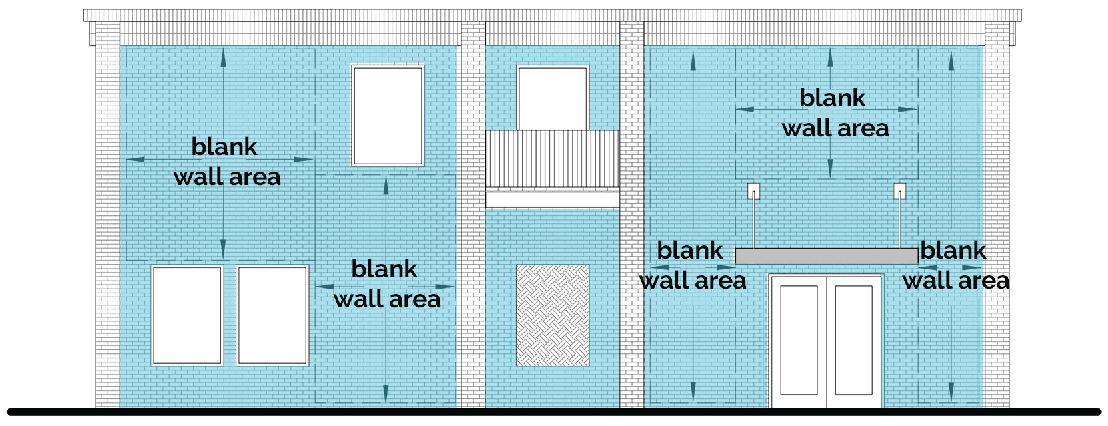
Figure 21-6.1.3.E Blank Wall Area
F.
Residential balconies.
1.
Where balconies are incorporated into building design, they shall be integral to the façade.
2.
Balconies on stepped-back stories may be independently secured, extending from the façade as a cantilever.
3.
Juliet balconies are prohibited.
G.
Window systems.
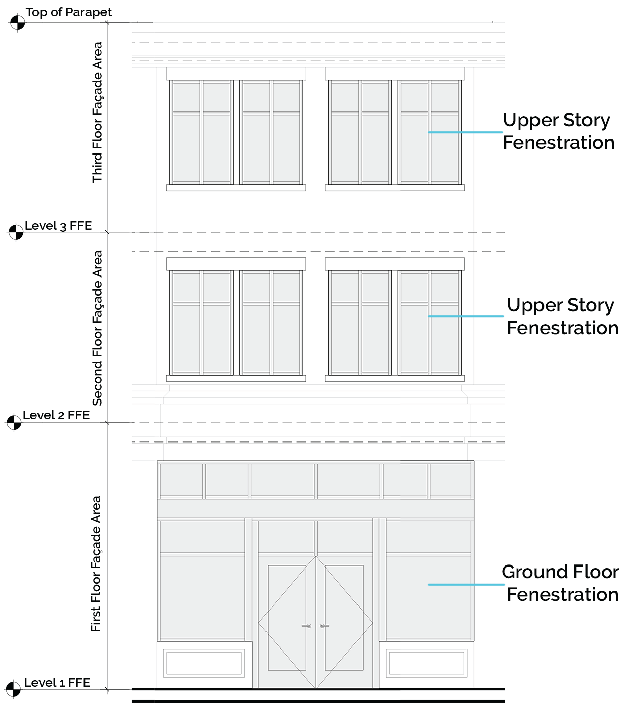
Figure 21-6.1.3.G Fenestration Calculation Area
1.
Façades on commercial and MF-zoned lots shall provide a minimum ground floor fenestration of forty (40) percent on the ground story and twenty-five (25) percent on upper stories.
2.
Fenestration is the minimum percentage of window and door glass that must cover a façade, It is calculated based façade area and by floor. The façade area used to determine fenestration is measured from the top of the finished door to the top of the finished floor above or top of a roof parapet.
3.
Fenestration requirements apply to façades that abut a public or private street (not including an alley), or a required open space.
4.
Glass used to satisfy fenestration requirements shall be unpainted, shall have a transparency (visible light transmission) higher than seventy (70) percent and shall have an external reflectance of less than fifteen (15) percent. Transparency and external light reflectance shall be established using the manufacturer's specifications.
5.
Window frames, sashes, mullions, and similar features that are integral to the window system count towards fenestration requirements. Opaque doors and windows do not.
6.
No shades, blinds, or other coverings are permitted on the ground floor fenestration of any non-residential building.
7.
Grilles, inoperable shutters, and other faux window treatments are prohibited.
8.
Window systems shall be recessed from the façade of the building a minimum of three (3) inches. This reveal shall be accomplished through the design of the window casing reveals and frames.
H.
Pedestrian access. The pedestrian access regulations of section 21-6.2.13 - pedestrian access and circulation apply.
Sec. 21-6.1.4. - Lot standards.
A.
Development shall conform to minimum lot standards in article 2 - base zoning districts, as applicable.
B.
The term "lot" shall not include any portion of a dedicated right-of-way.
C.
Lot size square footage calculations shall also exclude any areas reserved for easements or rights-of- way upon which, by the nature thereof, construction is prohibited (i.e., easements for ingress and egress to other lots or properties, major power line transmission easements, etc.).
D.
Where an official line has been established for the future widening or opening of a street or major thoroughfare upon which a lot abuts, the depth of a front or side yard shall be measured from such official line to the nearest line of the building.
E.
Dimension, size, and shape orientation. The lot area, width, shape, and orientation in subdivisions shall be in accordance with requirements of the city zoning and land development ordinances.
F.
Creation of regular lots. Side lot lines shall be substantially at right angles or radial to street lines as they extend from the front lot line to the front building line.
G.
Frontage. Each lot shall front upon a paved private or public street. For single-family attached uses, this requirement shall apply to the parent lot so as to not require fee simple ownership. All buildings in the central business district (CBD) shall front on a paved public or private street.
H.
Buildable area. Lots shall contain adequate buildable area that is suitable for the intended use.
I.
Corner lots. Corner lots shall provide extra width of not less than fifteen (15) feet to meet the minimum street front and street side yard requirements on the lot edges adjacent to all streets. The street side yard of a corner lot shall be along the street frontage having the greatest dimension; therefore, the other frontage shall be considered the street front yard.
J.
Through lots. Through lots are discouraged in subdivisions except along limited access highways, such as interstate highways. Where it is necessary to provide separation of residential development from arterials or to overcome specific disadvantages of topography and orientation, lots fronting such features may be platted in greater depth so that dwellings may be set back an additional distance from the arterial or other feature. Such lots may obtain vehicular access from a rear alley or internal subdivision streets and do not constitute prohibited through lots.
K.
Spite strips. The creation of spite strips is prohibited.
L.
Flag lots. The creation of flag lots is prohibited.
Sec. 21-6.1.5. - Underground electric and communication utilities.
A.
Undergrounding utilities. Utilities, including telephone, electric power, and cable television in both public and private rights-of-way shall be placed underground for all new developments with total floor areas fifty thousand (50,000) square feet or over. This requirement does not apply to high voltage power lines.
B.
Fee in lieu. Except when extreme conditions of underlying rock, the expense to bury overhead utilities is deemed to be unreasonably costly due to the complexity of the work, or other conditions prevent this requirement from being met, the developer may request approval from the city manager for a fee in lieu arrangement meeting the following:
1.
A city fund, known as the "The City of Avondale Estates Utility Conversion Fund" is hereby created. The purpose of said fund is to accept deposits as described herein, along with other funds or grants apportioned by the board of mayor and commissioners, and the use of such funds shall be restricted for the sole purpose of offsetting the cost of projects undertaken by the city that bury or relocate power lines from streets and sidewalks.
2.
Developer shall contribute toward the city's utility conversion fund in lieu of requiring burial of the utilities. Such fee in lieu arrangement shall be based on a cost per linear foot of such underground relocation of utilities established by the board of mayor and commissioners, and it may be adjusted from time to time by city ordinance.
C.
Sequencing. Fee in lieu or burial of utilities shall be done prior to issuance of any certificate of occupancy being issued for structures in any phase abutting the right-of-way within which the overhead utilities are situated.
Sec. 21-6.2.1. - Purpose.
A.
The parking regulations of this division are intended to ensure that off-street parking facilities are provided to meet the basic day-to-day needs of shoppers, employees, visitors and residents while also avoiding the negative impacts that can result from requiring excessive quantities of off-street parking.
B.
The provisions of this article are also intended to help protect the public health, safety, and general welfare by:
1.
Promoting economically viable and beneficial use of land; and
2.
Providing flexible methods of responding to the transportation and access demands of various land uses in different areas of the city.
Sec. 21-6.2.2. - Applicability.
A.
General. Off-street parking shall be provided and maintained in accordance with the provisions of this article. Unless otherwise expressly stated, the regulations apply to all zoning districts and uses.
B.
New uses and development. The parking regulations of this article apply to all new buildings constructed and all new uses established in all zoning districts.
C.
Change of use. If a new use of a building or structure requires more off-street parking than the use that most recently occupied the building or structure, the new use shall comply with the parking requirements of this division-that includes the addition of all parking requirements for the added spaces, including landscaping. There is no requirement to address parking deficits associated with existing, lawfully established buildings or uses.
D.
Enlargements and expansions. The parking regulations of this article apply whenever an existing building or use is enlarged or expanded to include additional dwelling units, floor area, seating capacity, or other units of measurement used in establishing off-street parking requirements. Additional spaces are required only to serve the enlarged or expanded area, not the entire building or use-that includes the addition of all parking requirements for the added spaces, including landscaping. There is no requirement to address parking deficits associated with existing, lawfully established buildings or uses.
E.
Maintenance. Off-street parking spaces required by this Zoning Ordinance shall be maintained for the life of the principal use.
F.
Damage or destruction. When a use that has been damaged or destroyed is re-established, off-street parking or loading facilities shall also be re-established or continued in operation in an amount equal to the number maintained at the time of such damage or destruction. It is not necessary, however, to restore or maintain parking or loading facilities in accordance with those required by this zoning ordinance.
Sec. 21-6.2.3. - Parking requirements.
Unless otherwise expressly stated in this zoning ordinance, off-street motor vehicle and bicycle parking spaces shall be provided in accordance with the maximum (motor vehicle) and minimum (bicycle) ratios in table 21-6.2.3 - parking requirements.
Sec. 21-6.2.4. - Location and use of off-street parking.
A.
General. Except as otherwise expressly stated in this division, required off-street parking areas shall be located on the same lot as the use they are required to serve.
B.
Front façade. Motor vehicle parking shall not be located between a public street and a principal building's front façade for any commercial, mixed-use, or multi-unit building uses.
C.
Parking in setbacks and yards. Motor vehicle parking is prohibited in front setbacks, except on a driveway, or in a roofed carport or enclosed garage for on R-zoned lots.
Sec. 21-6.2.5. - Parking layout and design.
A.
Applicability. The parking layout and design regulations of this section apply to all off-street parking lots. Table 21-6.2.3 - parking requirements enumerates parking requirements, whether they are provided in a parking lot, driveway, parking pad, or otherwise.
B.
Subdivision regulations. Each parking space and parking lot, including all internal circulation driveways, shall comply with the requirements of appendix B - subdivision regulations, except as otherwise expressly stated.
C.
Access drives.
1.
All off-street parking lots shall have access to a public or private street and be served by a paved access drive.
2.
All vehicular access gates shall be prohibited, unless approved as a conditional use pursuant to division 7.5 - amendments and conditional uses.
3.
Interparcel access. For any commercial, mixed-use, and MF-zoned districts, the property owner shall grant a vehicular and pedestrian access easement to each adjoining property. This easement shall be submitted to the city manager and recorded by the applicant or property owner with the DeKalb County Superior Court Clerk. Physical connections shall be developed concurrent with the site development process and shall provide paved vehicular and pedestrian access.
D.
Parking lot geometrics. Parking lots shall comply with the geometric design standards of the Institute of Traffic Engineers (ITE) and in accordance with the following:
1.
Parking stall size.
a.
Compact spaces. In parking lots containing twenty (20) or more parking spaces, up to forty (40) percent of the spaces may be designated and designed as compact parking spaces.
i.
Compact parking spaces shall be at least eight (8) feet in width and fifteen (15) feet in depth.
ii.
Spaces shall be identified as a compact car with paint at the front of each space.
b.
Standard spaces. All standard (non-compact) parking spaces shall be at least eight and one-half (8.5) feet in width and eighteen (18) feet in depth.
2.
Wheel bumpers.
a.
Shall be placed at the head of all parking spaces that do not abut a curb and any spaces that abut a sidewalk.
b.
Shall be made of concrete and securely fastened to the pavement by steel re-bars or steel anchors.
c.
Individual wheel bumpers shall be placed a minimum of twenty-four (24) inches from the end of each required parking space.
E.
Marking. In parking areas with more than four (4) parking spaces, the location of each parking space shall be identified by surface markings or other effective means and be maintained so as to be readily visible at all times.
F.
Surfacing. All off-street parking areas and access drives shall be surfaced and maintained with an asphaltic or Portland cement binder concrete or other dustless, all-weather surface approved by the city manager. This is not intended to prohibit engineered pervious pavement.
G.
Vertical clearance. All required parking spaces shall have overhead vertical clearance of at least ten (10) feet.
H.
Lighting. All lighting used to illuminate off-street parking areas shall comply with division 6.7 - outdoor lighting.
I.
Landscaping. See division 6.3 - landscaping and other site features for landscape regulations.
J.
Parking garages. The following supplemental requirements apply to parking garages:
1.
Vehicular access.
a.
Vehicular access shall be designed in a manner that minimizes disruption to motorized travel, non-motorized travel and the streetscape.
b.
Vehicular ingress and egress shall be provided from an alley or secondary street. When alley access or side-street access is not possible, then vehicular ingress and egress shall be permitted from the primary street.
c.
Free-flow parking garage entries (i.e., without attendants, gates or ticket-dispensing machines) shall provide at least one (1) off-street vehicle stacking space per entry lane.
d.
Parking garage entries that include automatic ticket-dispensing machines or automatic key readers at entries shall provide at least two (2) off-street vehicle stacking spaces per entry lane.
e.
Parking garage entries that include manual ticket-dispensing machines at entries shall provide at least three (3) off-street vehicle stacking spaces per entry lane.
f.
Required vehicle stacking spaces at entries shall be located so that they do not obstruct sidewalks.
2.
Design.
a.
Ramps and sloping floors shall be located so as not to be visible from the front-street facing sides of the parking garage.
b.
In order to de-emphasize the horizontal nature of the parking garage, vertical divisions at least two (2) feet in width and extending the full height of the parking garage structure are required at least every thirty (30) feet (measured horizontally).
c.
A parking garage shall not span more than two hundred (200) feet on any block face, unless fully lined and concealed by habitable/occupiable spaces on all floors.
d.
All parking garages shall provide pedestrian access from the ground level parking to the public sidewalk or building entrance.
e.
Perimeter landscaping is required pursuant to section 21-6.3.4 - landscaping for parking garages.
f.
Table 21-6.2.5 - design standards for parking garages illustrates the required design standards for garages based on street frontage types and adjacency to city open spaces.
Sec. 21-6.2.6. - EV readiness.
All new developments in any commercial, mixed-use, and MF-zoned districts are required to provide electric vehicle supply equipment (EVSE) infrastructure to accommodate the future installation of electric vehicle supply equipment. The infrastructure shall be provided per this section.
A.
The EVSE infrastructure shall be installed per the requirements of the current edition of the National Electrical Code (NFPA 70), as adopted and amended by the State of Georgia.
1.
The off-street parking provided shall have EVSE infrastructure installed at the parking spaces dedicated for the use of the building.
2.
The ratio of electric vehicle parking spaces to non-electrical vehicle parking spaces shall be 1:5, and only applies to the total new parking spaces.
B.
All new off-street parking, or the expansion of existing off-street parking for buildings shall include EVSE infrastructure based on the total number of parking spaces established in section 21-6.2.6.A.2.
C.
The EVSE infrastructure shall include a raceway, which is continuous from the branch circuit/feeder panel location to the future PHEV/EV parking space. The raceway shall be sized and installed per the National Electrical Code; however, in no case, shall the EVSE infrastructure raceway be less than one (1) inch in size. The EVSE infrastructure raceway shall include a pull rope or line installed for future conductor installation, with the raceway sealed and labeled for future use.
D.
The electrical equipment room, shall have a dedicated space for the future installation of EVSE. This space shall be identified on all construction documents submitted for review, and the dedicated space shall not allow for violation of the National Electrical Code prescriptive requirements regulating working space clearances around equipment, or violation of the National Electrical Code prescriptive requirements governing the entrance to and egress from electrical equipment working space.
E.
During construction of the electrical equipment room, all raceways installed for the EVSE infrastructure shall terminate at the space dedicated for the future EVSE installation.
F.
Prior to the final electrical inspection approval, the space dedicated within the electrical equipment room for the future EVSE installation shall have the wall stenciled or marked legibly with the following text: "Future electric vehicle charging equipment and panels."
G.
The placement of EVSE shall not create a trip hazard or violation of the accessible path of travel when the cord is connected to an EV or PHEV.
Sec. 21-6.2.7. - Parking credits.
Exceptions to the off-street motor parking ratios can be accommodated as follows:
A.
Electric vehicle charging stations.
1.
Electric vehicle charging stations are permitted in all off-street surface parking lots and multi-level parking structures in the city.
2.
Each parking space equipped with electric vehicle charging equipment shall not count against the parking maximums of table 21-6.2.3 - parking requirements. To receive credit, each electric vehicle charging station-equipped parking space shall have unobstructed access.
3.
Spaces for electric vehicle charging shall be identified by pavement markings and by appropriate signage. Signage shall not count against the maximum aggregate sign area permitted on a lot.
4.
Any commercial, mixed-use, and MF-zoned projects requiring compliance with division 6.8 - resiliency requirements and that has a parking lot of twenty (20) parking spaces or greater shall equip at least two (2) parking spaces on its property with electric vehicle charging stations prior to receiving a certificate of occupancy. EV spaces shall not count against the parking maximums.
5.
The owner of the property shall be responsible for the installation, maintenance, and operation of electric vehicle charging stations.
B.
Motorcycle and scooter parking. Motorcycle or scooter parking spaces shall not count against the parking maximums. Space shall be provided on concrete or other paved surface and dimensioned four (4) feet by eight (8) feet.
C.
On-street parking.
1.
Development of on-street parking shall not count against the parking maximums.
2.
The spaces shall be dedicated to the city and shall be used as public parking that shall not be signed or assigned to a single site once in use.
3.
Parallel-parking on-street parking stalls shall be marked and shall measure a minimum of eight (8) feet in width and twenty-two and one-half (22.5) feet in length.
D.
Transfer of parking rights.
1.
The purpose of the transfer of parking rights program is to transfer quantities from eligible sending sites to eligible receiving sites through a voluntary process that supports market-driven parking solutions lot by lot without compromising overall parking ratios necessary for public benefit and economic development.
2.
Sending site.
a.
Sending site means the entire parcel or lot qualified to send parking from the subject lot to a receiving site.
b.
Qualification of a sending site shall demonstrate the amount of parking proposed on the site is not required for the current use. Only the difference between the number of existing or proposed spaces and the maximum number of spaces on the sending site may be transferred to an eligible receiving site.
c.
For instance, if a sending site currently has ten (10) spaces, and the maximum number of spaces on the sending site is twenty (20) spaces, the sending site may transfer up to ten (10) spaces to an eligible receiving site.
3.
Receiving site.
a.
Receiving site means the entire parcel or lot qualified to receive parking rights from an eligible sending site,
b.
Qualification of a receiving site shall demonstrate the amount of parking proposed on the site is necessary for the proposed use. The receiving site may exceed the stated parking maximums of this division, provided all requirements of the transfer of parking rights are met.
4.
Submittal requirements and methodology.
a.
Applicants proposing to use transfer of parking rights as a means of reducing overall motor vehicle parking requirements shall submit:
i.
The names and addresses of the uses and of the owners or tenants that are transferring or receiving the parking rights;
ii.
The location and number of parking spaces that are being transferred;
iii.
A parking analysis;
iv.
A legal instrument such as an easement or deed restriction guaranteeing access to the parking for the parking users.
b.
The required parking analysis shall be based on the latest edition of the Urban Land Institute (ULI) parking model or be prepared by an engineer who is registered in the State of Georgia and who has expertise in parking and transportation.
c.
The parking analysis shall demonstrate that the peak parking demands of the subject uses occur at different times and that the parking area will be large enough for the anticipated demands of both uses.
d.
Recordation of parking agreements. Shared parking agreements shall be in writing in a form approved by the city attorney, shall be signed by the owners of each of the affected properties or uses, shall run with the land of the properties involved in perpetuity, and shall be recorded with the clerk of superior court, and a copy of the recorded document provided to the city manager. No parking agreement shall be canceled except with the prior approval by staff after review of the change of conditions that render the agreement unnecessary.
e.
Change in use. Any subsequent change in land uses within the participating developments shall require proof that adequate and not excessive parking below maximums will be available. Prior to any change in use, the owner shall apply to the city manager for an evaluation and confirmation of the change. If the city manager finds that the parking arrangement is no longer justified, the city manager shall notify the owner to construct or demolish the number of parking spaces necessary to meet the difference in the required parking between the proposed and previous uses.
Sec. 21-6.2.8. - Minimum bicycle parking requirements.
A.
Minimum parking ratios. Short-term and long-term bicycle parking spaces shall be provided in accordance with the minimum ratios established in table 21-6.2.3 - parking requirements.
B.
Design and location.
1.
General.
a.
All bicycle parking spaces are subject to the general design and location requirements of this section.
b.
Bicycle parking spaces shall be illuminated if accessible to users after dark.
c.
Bicycle parking spaces shall be located to be readily visible by the public or by building users, except in the case of long-term parking spaces located in secure areas accessible only to employees, staff, or residents;
d.
Bicycle parking spaces shall be accessible without climbing stairs, going up or down a slope of more than twelve (12) percent and via a route on the property that is designed to minimize conflicts with motor vehicles and pedestrians.
e.
All bike racks shall be located at least two (2) feet in all directions from any obstruction, including pedestrian zones, other bike racks, walls, doors, posts, or columns.
f.
All required bicycle parking spaces shall have minimum dimensions of two (2) feet in width by six (6) feet in length, with a minimum overhead vertical clearance of seven (7) feet.
2.
Long-term bicycle parking. In addition to the general bicycle parking design and location requirements of section 21-6.2.6.C.1 - general, all required long-term bicycle parking shall meet the following requirements:
a.
Long-term bicycle parking spaces may not be in dwelling units or on dwelling unit balconies.
b.
Unless clearly visible from the main building entrance, a sign indicating the location of all long-term bicycle parking spaces shall be prominently displayed near the main entrance to the building or facility, and additional signs shall be provided as necessary to ensure easy way-finding. A "bicycle parking" sign shall also be displayed on or adjacent to any indoor room or area designated for bicycle parking.
c.
Long-term bicycle parking spaces shall protect the entire bicycle, its components, and accessories against theft and inclement weather, including wind-driven rain and snow. Acceptable forms of protection include:
i.
Individual bicycle lockers;
ii.
Attended parking areas;
iii.
Video-monitored parking areas;
iv.
Restricted-access parking areas; or
v.
Other comparable arrangements a proved by the city manager.
d.
Except in the case of bicycle lockers with a separate access door for each bike or attended facilities, all long-term bicycle parking spaces shall be designed to allow bicycles to be securely locked to a bicycle rack.
3.
Short-term bicycle parking. In addition to the general bicycle parking design and location requirements of section 21-6.2.6.C.1 - general, all required short-term bicycle parking shall meet the following requirements:
a.
Short-term bicycle parking shall be visible from the main public building entrance and be at least as conveniently located as the most convenient non-disabled motor vehicle parking space serving the subject use. If no motor vehicle parking is provided, short-term bicycle parking spaces shall be located within seventy-five (75) feet of a building entrance.
b.
Short-term bicycle parking spaces shall be located on private property unless the city manager approves a location within the public right-of-way.
c.
No primary structure, other than single-family residential uses, shall have fewer than three (3) bicycle parking spaces nor be required to exceed thirty (30) spaces.
d.
Racks or other spaces shall not intrude on sidewalk zones, or other pedestrian walkways or trails.
Sec. 21-6.2.9. - Stacking spaces.
A.
This section applies only to existing drive-thru uses undergoing redevelopment that will maintain the nonconforming status as identified in division 8.3 - nonconformities. All new drive-thru uses are prohibited.
B.
Spaces required. In addition to the parking required for each use, establishments with drive-thru facilities shall provide stacking spaces for each drive-thru station as indicated in table 21-6.2.3 - parking requirements.
C.
Dimensions. Each lane of stacking spaces shall be at least nine (9) feet in width and at least eighteen (18) feet in length. Edges of stacking lanes shall be delineated with pavement markings.
D.
Bypass lane. Drive-thru restaurants shall include a bypass lane adjacent to the required stacking lane. The bypass lane shall have minimum width of ten (10) feet and be designed to allow vehicles to circumvent or leave the stacking lane without waiting for other queuing vehicles to exit.
E.
Location and design. Stacking lanes shall be located on the subject property. They may not be located within required driveways or drive aisles, parking spaces or loading areas and may not interfere with access to parking and ingress and egress from the street. Stacking lanes and drive-thru windows may not be located between the principal building and the front street unless approved in accordance with the conditional use process of division 7.5 - amendments and conditional uses.
F.
Pedestrian access. The principal pedestrian access to the entrance of the use from a public sidewalk shall not cross the drive-thru facility stacking lane.
G.
Noise. Speakers associated with drive-thru facilities shall not be audible from abutting R-zoned lots. Sound attenuation walls, landscaping or other mitigation measures may be required to ensure that the facility will not have adverse noise-related impacts on nearby residential uses.
Sec. 21-6.2.10. - Recreational and commercial vehicles.
A.
Commercial motor vehicles. The parking of commercial motor vehicles (as defined in O.C.G.A § 40-1-1) is prohibited on R-zoned lots. This prohibition does not apply to:
1.
Law enforcement vehicles;
2.
Vehicles actively engaged in construction, or contractor services on the subject property;
3.
Vehicles within a completely enclosed building;
4.
The temporary parking of vehicles for the purpose of active loading/unloading; or
5.
When the subject lot is occupied by an allowed non-residential use.
B.
Recreational vehicles.
1.
The parking and storage of trailers and recreational vehicles is prohibited outside of an enclosed building in the following areas on R-zoned lots:
a.
The front or street side yard;
b.
Within ten (10) feet of an interior side lot line; or
c.
Within 20 feet of the rear lot line.
2.
Recreational vehicles and trailers may not be parked on an R-zoned lot that does not contain a permanent dwelling unit or other structure intended for permanent human habitation.
3.
Recreational vehicles and trailers may be parked, for the limited purpose of storage between travel, on unpaved surfaces including gravel or a similar material that prevents the vehicle's or trailer's tires from making direct contact with the earth, soil, sod or mud so long as the unpaved surface prevents tracking of earth, soil, sod or mud onto public streets when the vehicle or trailer is moved from the property.
4.
Recreational vehicles may only be occupied for human habitation in the O-I district. Habitation may occur for a maximum of fourteen (14) days in any thirty (30) day period.
C.
Exemptions. Restrictions on vehicles regulated by this section shall not apply when:
1.
Vehicle/trailer is located within a completely enclosed building or structure;
2.
Vehicle/trailer is temporarily parked for the purpose of active loading/unloading;
3.
The subject lot is occupied by a permitted non-residential use.
4.
Vehicle is designed or intended for the transport of the physically impaired; or
5.
Vehicle is being used for active construction, or other professional service being performed on the subject property.
Sec. 21-6.2.11. - Loading.
A.
General. All uses that regularly receive materials or merchandise carried by delivery vehicles shall provide off-street loading facilities.
B.
Regulations.
1.
Off-street loading areas shall be designed so that all vehicle maneuvering and loading/unloading operations will occur on private property and not interfere with or create safety hazards for motorized or non-motorized circulation.
2.
Unenclosed off-street loading areas may not be located within twenty-five (25) feet of any abutting R-zoned properties.
3.
Loading spaces are prohibited in the front yard.
4.
A loading space shall have minimum dimensions of twelve (12) feet wide and thirty-five (35) feet deep.
5.
The loading space shall maintain overhead clearance of fourteen (14) feet.
6.
All off-street loading spaces shall have access from an alley, or if there is no alley, from a street.
7.
All loading spaces shall be posted with "No Idling" signs.
8.
All loading areas and access drives shall be surfaced and maintained with an asphaltic or Portland cement binder concrete or other dustless, all-weather surface approved by the city engineer.
9.
Loading docks shall be located a minimum of ten (10) feet from any adjacent sidewalk or supplemental zone.
10.
Loading dock entrances shall be screened so that loading docks and related activity are not visible from any public space or public right-of-way.
11.
Prohibited hours.
a.
On-street loading shall be prohibited between the hours of 11:00 p.m. and 7:00 a.m.
b.
All loading within two hundred (200) feet of any R-zoned lot shall be prohibited between the hours of 11:00 p.m. and 7:00 a.m.
12.
See division 6.3 - landscaping and other site features for landscape and screening regulations.
13.
Minimum loading space requirements for commercial, mixed-use, and multi-unit building uses:
a.
One (1) loading space required for every fifty thousand (50,000) square feet of gross floor area, or fraction thereof.
b.
A minimum of one (1) loading space is required based on the calculation above.
Sec. 21-6.2.12. - Street and driveway standards.
A.
General standards for streets.
1.
Public and private streets shall comply with the requirements for public streets found in appendix B - subdivision regulations, and other applicable sections of the City Code.
2.
All improvements shall be constructed and dedicated by the developer.
B.
Curbing. The maximum allowed curb radius at any intersection or curb is twenty (20) feet.
C.
Access.
1.
Curb cuts may not exceed twenty-four (24) feet in width.
2.
Access driveways shall be perpendicular to the abutting street.
3.
Gates and security arms are prohibited on public and private streets.
4.
Driveways, except for a driveway to reach the side yard or rear yard or an on-site parking facility, are not permitted between the sidewalk and a building, and shall be perpendicular to any adjacent street.
5.
No more than one (1) curb cut shall be permitted for each development, provided that properties with more than one (1) street frontage may have one (1) curb cut located on each street frontage.
6.
Two (2) curb cuts serving two (2) one-way driveways shall only be counted as one (1) curb cut, provided that each curb cut does not exceed one (1) lane and twelve (12) feet in width.
7.
Entrances to garages and carports that serve R-zoned lots, and that are not located behind the principal structure, shall face the rear yard, or a side yard that has no street frontage.
8.
All contiguous ground-floor residential units shall share one (1) common drive, located in rear yards or side yards without street frontage, to serve garages, carports, and parking areas.
D.
External agency reviews.
1.
Should the DeKalb County Fire Marshal requirements herein conflict, the fire marshal requirements shall govern without the need for additional relief from the Code.
2.
The following provisions apply to lots that abut a right-of-way controlled by the Georgia Department of Transportation (GDOT):
a.
Should any of the requirements herein conflict, the GDOT requirements shall govern without the need for additional relief from the Code.
b.
An approved permit for proposed access or improvements is required from GDOT and shall be incorporated into the construction drawings for the project before the issuance of a land disturbance permit.
Sec. 21-6.2.13. - Pedestrian access and circulation.
A.
Applicability. An on-site circulation system for pedestrian and non-motorized travel shall be provided in accordance with the regulations of this section. Lots occupied by fewer than four (4) residential dwelling units are not subject to these regulations.
B.
Connection to the street or other rights-of-way. The on-site pedestrian circulation system shall connect all adjacent public rights-of-way to the main building entrance. The connection shall follow a direct route and not involve significant out-of-direction travel for system users.
C.
Multi-use paths.
1.
Every property located within four hundred (400) feet of the PATH Foundation's Stone Mountain Trail shall provide means to access the trail via a paved sidewalk or path a minimum of eight (8) feet in width.
2.
Any trail or path identified in a master plan adopted by the board of mayor and commissioners, whether on-street or off, shall be designed and constructed by the applicant.
D.
Internal connections. The on-site pedestrian circulation system shall connect all buildings on the site and provide connections to other areas of the site likely to be used by pedestrians and non-motorized travel, such as parking areas, bicycle parking, open space and recreation areas, and similar amenity features.
E.
Design. Unless otherwise specified, required on-site pedestrian circulation facilities shall be designed and constructed in accordance with the regulations of this section.
1.
The on-site pedestrian circulation system shall be paved and be at least six (6) feet in width.
2.
When the on-site pedestrian circulation system crosses drive aisles, it shall be clearly differentiated through the use of elevation changes, different paving material or other equally effective methods of safely accommodating non-motorized travel, as approved by the city manager. Striping alone does not meet this requirement.
3.
All sidewalk paving materials shall be continued across any intervening driveway at the same prevailing grade and cross slope as on the adjacent sidewalk clear zone.
4.
When the on-site pedestrian circulation system is parallel and adjacent to a motor vehicle travel lane, it shall be a raised path at least eight (8) inches above the vehicle travel lane surface or be separated from the vehicle travel lane by a raised curb, bollards, landscaping or another physical barrier. If a raised path is used, the ends of the raised portions shall be equipped with accessible curb ramps.
5.
The on-site pedestrian circulation system shall be illuminated to ensure that it can be used safely at night by employees, residents, and customers. Lighting shall be at height appropriate to a pedestrian pathway system.
F.
Relationship of building to street.
1.
The primary pedestrian access to all sidewalk-level uses and business establishments with public or private street frontage:
a.
Shall face and be visible from the street when located adjacent to such street.
b.
Shall be directly accessible and visible from the sidewalk adjacent to such street
c.
Shall remain unlocked during business hours for non-residential uses.
2.
Storage, utility rooms, restrooms, or other accessory service uses shall not be located adjacent to the pedestrian or supplemental zones. Uses adjacent to these zones shall be occupied by active components of the building program open to general members of the public.
3.
Buildings with more than four (4) residential units at the street level shall have front-facing entrances that are directly connected to the street-facing sidewalk with a pedestrian walkway a minimum of five (5) feet wide. Such access shall be perpendicular to the street, unless topography prohibits, and shall be permitted to share said walkway with one (1) adjacent unit.
4.
An entrance providing both ingress and egress, operable to residents at all times or customers during business hours, is required. Additional entrances off another street, pedestrian area, or internal parking area are permitted and encouraged.
5.
Required walkways must be paved surfaces that connect the pedestrian entrance to the closest street-facing sidewalk.
Sec. 21-6.3.1. - Purpose and requirements.
A.
The landscaping and screening regulations of this division are intended to advance the general purposes of this zoning ordinance and to help:
1.
Maintain and enhance the city's appearance;
2.
Maintain and improve air quality;
3.
Protect surface water quality and reduce the negative impacts of stormwater run-off by reducing impervious surface area and providing vegetated areas that filter and retain greater amounts of stormwater on site;
4.
Moderate heat by providing shade;
5.
Encourage preservation and replacement of existing trees and landscaping; and
6.
Augment the tree protection and preservation requirements of chapter 5, article X.
B.
Submittal of landscape plan. The location and description of landscape materials, treatments, decorative paving, amenities, sidewalk furniture or other decorative elements, if any, shall be indicated on a landscape plan to demonstrate compliance with all required provisions.
Sec. 21-6.3.2. - Parking lot perimeter landscape.
A.
The parking lot perimeter landscape regulations of this section are intended to help mitigate the visual and operational impacts of surface parking lots when such areas are adjacent to public streets or R-zoned districts.
B.
Unless otherwise expressly stated, the parking lot perimeter landscape regulations of this section apply to the construction or expansion of any surface parking area except those on lots occupied by residential buildings containing fewer than four (4) dwelling units.
C.
In meeting the requirements of this section, reference section 21-6.3.6 - plant and landscape materials and section 21-6.3.7 - maintenance.
D.
Parking lots subject to these regulations shall be screened from view of public streets using buildings, landscaping, or a combination of buildings and landscaping. Landscaping provided to meet this requirement shall include comply with one (1) of the following options:
1.
A landscape strip at least five (5) feet wide containing shrubs planted to provide a solid visual screen at least three (3) feet in height at the end of the first growing season, with the remainder of the landscape strip covered with groundcover plants or annual or perennial vegetation; or
2.
A landscape strip at least three (3) feet in width containing a solid masonry or stone wall at least two (2) feet in height, with the remainder of the landscape strip covered with groundcover plants, sod, or annual or perennial vegetation; or
3.
A strip at least three (3) feet wide containing paving for an expanded sidewalk zone with tree wells bounded by seat walls at least two (2) feet in height. Tree wells shall have a minimum area of twenty-five (25) square feet.
E.
Shade trees shall be provided within required parking lot perimeter landscape strips at the rate of at least one (1) tree per thirty (30) feet on center of parking lot frontage adjacent to a street or sidewalk. A minimum of one (1) tree is required if the length of the frontage is less than thirty (30) feet. Rate can be increased to sixty (60) feet on center for overstory trees.
F.
In addition to the requirements of division 6.4 - transitional buffers, parking lots shall be screened from any adjacent or abutting R-zoned lots using buildings or one (1) of the following options:
1.
An opaque fence at least six (6) feet in height and at least one (1) tree per thirty (30) linear feet of fence;
2.
A masonry wall with a minimum height of six (6) feet;
3.
A dense evergreen hedge with a minimum height of five (5) feet at the time of planting; or
4.
A row of evergreen trees with a minimum height of six (6) feet at the time of planting.
Sec. 21-6.3.3. - Interior parking lot landscape.
A.
Unless otherwise expressly stated, the parking lot interior landscape regulations of this section apply to the construction or expansion of any surface parking area containing more than twenty (20) motor vehicle parking spaces. In the case of a parking lot expansion triggering compliance with these regulations, the minimum requirements for landscape area and plant material are calculated solely on the expanded area.
B.
In meeting the requirements of this section, reference section 21-6.3.6 - plant and landscape materials and section 21-6.3.7 - maintenance.
C.
Parking lots subject to these interior parking lot landscape regulations shall include at least thirty-five (35) square feet of landscape area per motor vehicle parking space within the parking lot. When at least fifty (50) percent of interior parking lot landscape area consists of depressed bioretention areas used for stormwater management, the minimum interior parking lot landscape requirement is reduced from thirty-five (35) square feet per parking space to twenty-five (25) square feet per parking space. To receive this bioretention credit, the ponding area shall be at least six (6) inches and not more than eighteen (18) inches in depth and planted with native wildflowers/herbs, grasses, shrubs, or other appropriate plant material.
D.
Plant material shall be provided within the interior of parking lots in accordance with table 21-6.6.3.
E.
Interior parking lot landscaping shall be reasonably distributed throughout the parking lot and provided in landscape islands or medians that comply with all of the following requirements:
1.
Each island shall be at least two hundred (200) square feet in area, not including any curb and gutter;
2.
Each island shall include at least one (1) shade tree per island and be covered with ground cover plants or mulch;
3.
Each island shall be protected by curbs or other barriers, which may include breaks or inlets to allow stormwater runoff to enter the land- scape island; and
4.
Parking rows that end abutting a paved driving surface shall have a landscape terminal island (end cap) at that end of the parking row. All other parking lot landscape islands shall be located to comply with all applicable regulations of this section.
F.
The city manager is expressly authorized to approve landscape plans that do not provide terminal islands at the end of each parking row or that otherwise provide for reduced dispersal of interior parking lot landscape areas when proposed landscape planting areas are combined to form functional bioretention areas or to preserve existing trees and vegetation.
Sec. 21-6.3.4. - Landscaping for parking garages.
A.
A landscape strip at least ten (10) feet in width shall be provided around the immediate perimeter of all parking garages, except along sides lined by habitable/occupiable floor space. Such required landscape strips shall contain at least one (1) tree and ten (10) shrubs per twenty (20) linear feet, with the remainder of the landscape strip covered with groundcover plants, sod, or annual or perennial vegetation (See also the parking garage design regulations of section 21-6.2.5.J - parking garages).
B.
In meeting the requirements of this Section, reference section 21-6.3.6 - plant and landscape materials and section 21-6.3.7 - maintenance.
Sec. 21-6.3.5. - Open space.
A.
Intent. To provide open space as an amenity that promotes physical and environmental health and access to a variety of active and passive recreation options in support of the vision for the character of Avondale Estates.
B.
Applicability.
1.
On-site open space shall be provided for all development sites except single-family detached dwellings that are single-lot developments.
2.
Single-family attached and detached projects do not have to comply with the amenity requirements in section 21-6.3.5.E.6.
C.
In meeting the requirements of this section, reference section 21-6.3.6 - plant and landscape materials and section 21-6.3.7 - maintenance.
D.
Minimum open space ratio. A minimum of ten (10) percent on-site open space shall be provided for each applicable development site, unless more is required by the supplemental use regulations of division 5.3 - residential uses.
E.
General requirements. On-site open space shall be provided on all sites in accordance with these regulations:
1.
Access.
a.
Open spaces shall have unobstructed access from the nearest right-of-way or adjacent building.
b.
Each open space shall be adjacent to a public sidewalk, or other public space, or directly accessible with a connected path.
c.
When a building or individual ground-story commercial establishment adjoins an open space, pedestrian access (both ingress and egress), operable to residents or customers, shall be provided.
2.
Private open space. Rooftop patios, rooftop decks, shared tenant amenity spaces, green roofs, or any other controlled access or private open spaces are permitted and encouraged but shall not be used to satisfy open space requirements.
3.
Landscape requirements. Other landscape requirements of this Code (e.g.: parking lot landscaping) shall not be counted to meet minimum open space requirements.
4.
Supplemental zones. The area of supplemental zones may be counted toward minimum open space requirements, provided the following are met:
a.
Where a development site provides more than the minimum width of a supplemental zone, the additional area may be counted toward required open space, provided the width does not exceed the maximum permitted for a supplemental zone.
b.
All other requirements of open spaces shall be met for the area being counted in this subsection. The 50-foot dimension shall be required only on the edge most parallel to the street, and the minimum area identified in table 21-6.3.5.G - open space dimensions is not required for any supplemental zone counted toward open space.
5.
Measuring size. The size of the open space is measured to include all landscape and paving, not including required streetscape sidewalks or other non-pedestrian paving surfaces.
6.
Required amenities.
a.
Each required open space shall accommodate seating for a minimum of three (3) people per two thousand five hundred (2,500) square feet of open space area.
b.
One (1) additional amenity from the following list shall be provided for every ten thousand (10,000) square feet of open space area:
i.
Public art installation identified from a list maintained by the city manager.
ii.
Incorporation of tree planting, to include a minimum of six (6) caliper inches per two thousand five hundred (2,500) square feet of open space. The tree density used for this credit shall not count toward any other minimum planting requirements.
iii.
Bioretention facilities engineered to store and treat stormwater with the combination of soils and plant material and designed to be dry within twenty-four (24) hours of storm event.
iv.
Decorative water feature.
v.
Community garden.
vi.
Playground/recreational equipment.
vii.
Plaza.
viii.
Putting green.
ix.
Climbing wall.
x.
Picnic shelter.
xi.
Fire pit.
xii.
Public outdoor dining area.
xiii.
Other amenity approved by the city manager.
7.
Stormwater. Stormwater management practices, such as normally dry storage and retention facilities or ponds that retain water, may be integrated into open spaces, subject to the following:
a.
Stormwater features in required open spaces shall be designed by a qualified professional as formal or natural amenities with additional uses other than stormwater management, such as an amphitheater, sports field, or a permanent pond or pool as part of the landscape design.
b.
Stormwater features may not be fenced or enclosed by retaining walls over twenty-four (24) inches in height. Any walls shall be a minimum of ten (10) feet apart for terraces.
8.
Tree planting. Required tree plantings used to satisfy minimum open space requirements shall be in accordance with section 21-6.3.6 - plant and landscape materials and section 21-6.3.7 - maintenance.
9.
Certificate of Occupancy. All open space requirements shall be fully met before issuance of a certificate of occupancy for the development. Bonds may be submitted in lieu of a landscape installation per division 6.9 - guarantees and sureties.
10.
Open space minimum dimensional standards. The following description and illustrations in table 21-6.3.5.G open space dimensions describe the open space dimensional standards required by this Code.
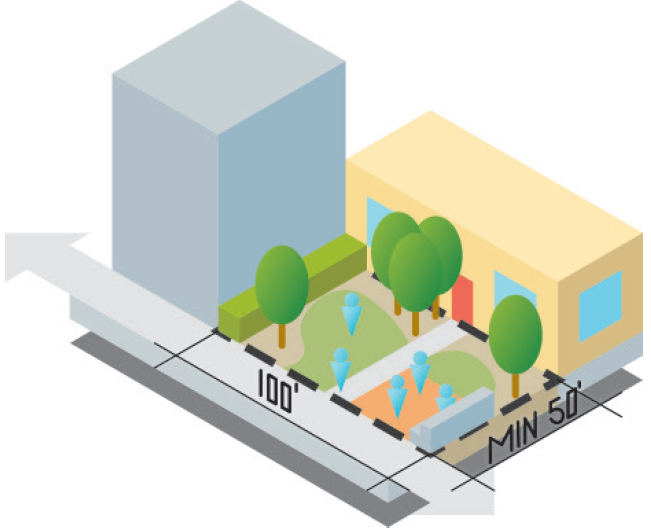 | Table 21-6.3.5 - Open Space Dimensions | |
|---|---|---|
| Measurements | ||
| Minimum Size | 2,500 sq. ft. | |
| Minimum Length | 50 sq. ft. | |
| Open Space Coverage Maximum | ||
| Impervious Surfaces | 50% | |
| Decorative Water Feature | 25% | |
F.
Alternative compliance. Requirements of this section shall be met by open space provided on the subject development site, unless an off-site open space provision is approved in accordance with these standards:
1.
Off-site. In lieu of open space dedication on site, a developer or property owner may transfer the required land area to be dedicated to open space to a receiving site.
a.
The purpose of the off-site open space program is to transfer required quantities of open space area from eligible sending sites (subject lots) to eligible receiving sites through a voluntary process that supports usable greenspaces of adequate scale and spacing without compromising efficient and sound land planning practices. This alternative compliance is anticipated to be used primarily in multi-lot projects being developed on similar construction schedules.
b.
To count toward the subject site's required open space, the following shall be met:
i.
The area counted toward the subject lot's open space shall be newly planned. It may not be already planned, under permit review, permitted, under construction, or completed at the time the open space is requested to be counted to the off-site alternative compliance provisions.
ii.
The area on the receiving site shall be under construction within six (6) months of the sending site (subject lot) receiving a certificate of occupancy.
iii.
If the previous standard is not met, the sending site (subject lot) shall submit a bond equal to one hundred fifty (150) percent of the value of the open space. The bond shall not be released until such a time that the open space is completed on the receiving site.
iv.
The receiving site shall be located within one thousand five hundred (1,500) feet of the sending site.
v.
All other open space standards shall be met for the combined open space.
2.
Maximum area. A maximum of fifty (50) percent of the required open space is permitted to be fulfilled by this alternative compliance section. However, if the subject lot is less than one (1) acre, ninety (90) percent of the open space may be fulfilled by this alternative compliance section.
Sec. 21-6.3.6. - Plant and landscape material.
A.
Deciduous trees used to satisfy the landscaping and screening regulations of this ordinance shall have a minimum caliper size of three (3) inches at time of planting. Evergreen trees shall have minimum height of six (6) feet at time of planting. Trees shall have a minimum mature height of thirty (30) feet. Tree varieties shall be selected from division 10.1 - landscaping specifications.
1.
Required street tree plantings and landscape zones shall not count toward the minimum open space tree plantings and vice versa.
2.
On-site tree plantings shall be spaced a minimum of thirty (30) feet on-center for understory trees and sixty (60) feet on center for overstory trees.
B.
Shrubs used to satisfy the landscaping and screening regulations of this division shall have a minimum container size of three (3) gallons. Shrubs shall have a minimum mature height of two (2) feet.
C.
Ground cover plants or landscape material shall consist of shrubs, pine straw, mulch, or other similar landscape material.
D.
Preserved trees shall be credited toward satisfying the tree planting requirements of this ordinance on the following basis:
1.
Preserved trees larger than six (6) inches DBH, up to twelve (12) inches DBH will be credited as two (2) trees;
2.
Preserved trees that are more than twelve (12) inches DBH up to twenty-four (24) inches DBH will be credited as five (5) trees; and
3.
Preserved trees that are more than twenty-four (24) inches DBH will be credited as ten (10) trees.
E.
Landscaped areas.
1.
All landscaped areas shall be protected by wheel stops, curbs, or other physical barriers where adjacent to vehicle use areas and shall be covered with grass, organic mulch or low maintenance ground cover.
2.
Landscaped bioretention areas are encouraged for natural drainage channels to reduce runoff and increase infiltration of water into the soil.
Sec. 21-6.3.7. - Maintenance.
A.
Required landscaping and screening shall be continuously maintained, including necessary watering; weeding; pruning; pest control; litter and debris clean-up; and replacement of dead, diseased or damaged plant material.
B.
Trees shall be limbed to at least ten (10) feet in height above the sidewalk or any transportation route.
C.
Failure to comply with an approved landscaping plan, including failure to maintain required landscaping and screening and failure to replace dead, diseased or damaged landscaping, constitutes a violation of this zoning ordinance and is subject to penalties and enforcement under division 8.2 - enforcement.
Sec. 21-6.3.8. - Design alternatives.
A.
Design Alternatives. To accommodate creativity in landscape and screening design and to allow for flexibility in addressing atypical, site-specific development/ redevelopment challenges, the city manager is authorized to approve alternative compliance landscape plans prepared by a landscape architect licensed to practice in the State of Georgia. In order to approve such alternative designs, the city manager shall determine that the proposed landscape plans will provide an equal or better means of meeting the intent of the landscaping and screening regulations of this division or that one (1) or more of the following conditions or opportunities are present:
1.
The site has space limitations or an unusual shape that makes strict compliance with the regulations of this division impossible or impractical;
2.
Physical conditions on or adjacent to the site such as topography, soils, vegetation or existing structures or utilities are such that strict compliance is impossible, impractical or of no value in terms of advancing the general purposes of this division; or
3.
Safety considerations such as intersection visibility, utility locations, etc., make alternative compliance necessary.
Sec. 21-6.4.1. - Applicability.
When a commercial, CBD, or MF-zoned lot abuts any R-zoned lot, a transitional buffer shall be provided on the subject lot to help ensure effective buffering and visual screening of more intensive uses.
Sec. 21-6.4.2. - Location and width of transitional buffers.
A.
The following buffer specification table states the minimum buffer specifications required for each proposed zoning district or use.
B.
The required buffer strip shall be permitted to be included in the minimum yard area as specified in the appropriate zoning district in the table 21-6.4.2 - buffer specifications.
C.
In meeting the requirements of this section, reference section 21-6.3.6 - plant and landscape materials and section 21-6.3.7 - maintenance.
Sec. 21-6.4.3. - Regulations.
A.
Required transitional buffers.
1.
Shall comply with the minimum buffer depth requirement established for the proposed and adjacent uses and be left undisturbed expect as expressly stated in this section;
2.
Shall not be paved or otherwise covered with impervious surfaces; and
3.
Shall not be used for parking, loading, storage, stormwater detention, or any other use, except that the city manager is authorized to permit the placement of utilities within areas when the applicant shows that it is impractical to place such utilities outside required transition buffers.
B.
Trees and existing vegetation shall not be removed from required transition buffer areas unless such trees are dead or diseased, as determined by a certified arborist. The city manager is authorized to require the installation of new trees and plants when necessary to provide buffering and visual screening that is equivalent to that provided by the buffer before the dead or diseased trees were removed.
C.
The natural topography of the land within required transition buffer areas shall be preserved except that a slope easement may be cleared and graded when approved by the city manager to prevent soil erosion. Such easements may not cover more than twenty (20) percent of the required transitional buffer area and shall be immediately replanted upon completion of easement improvements. Such work shall be conducted to avoid disturbance of the soil within the dripline of trees within the transition buffer zone. The city manager is authorized to require the installation of new trees, and landscape screening material, including plants and fences, when determined to be necessary to provide an effective visual screen and sound buffer within transition buffer areas.
D.
Any grading or construction adjacent to the transitional buffer shall avoid disturbance of or encroachment upon the transition buffer.
E.
Access shall be provided as required for utilities and to ensure adequacy of fire protection services.
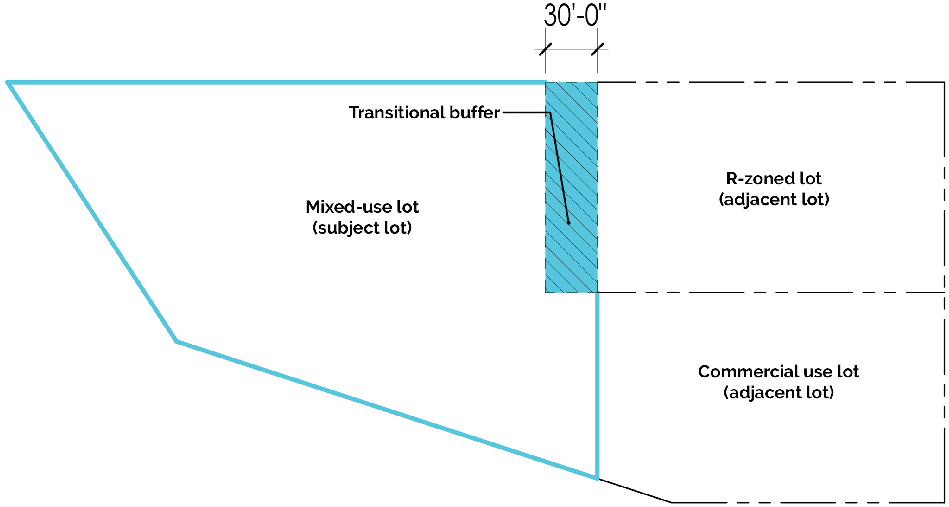
Figure 21-6.4.3 Transitional Buffers
Sec. 21-6.5.1. - General conditions.
Provisions of this section shall pertain to fences and walls in any district.
A.
Height.
1.
Wall and fence heights are measured from finished grade at the base of the fence or wall to the highest point of the fence or wall.
2.
For fences or walls built on a berm, mound or wall (fences only), the combined height of the fence and berm, mound or wall must not exceed the allowable fence or wall height.
3.
On sloping ground, the fence or wall must follow the slope or step with the slope so as not to exceed the allowable height at any point along the fence or wall.
4.
Greater fence or wall height achieved through filling or mounding on a site shall not be permitted.
B.
Design.
1.
The finished side of all fences shall face the abutting property and public right-of-way.
2.
Fence and wall columns, posts, and ornaments are permitted to exceed maximum allowed fence and wall heights by up to one (1) foot.
3.
Fences and walls over three (3) feet in height shall include a column or decorative element at least every twenty (20) linear feet (measured horizontally) to provide architectural variations and eliminate large expanses of blank area.
C.
Materials.
1.
Chain link fences are prohibited in any commercial, mixed-use, or multi-unit building districts.
2.
Vinyl fencing is prohibited in any district.
3.
Fences are not permitted to contain barbed wire, spikes, or similar devices, or an electric charge.
D.
Prohibited fences.
1.
Fences and walls surrounding entire developments are prohibited. For the purposes of this sub- section, the term, "entire development" does not refer to an individually developed single-family lot.
2.
Vehicular gates are prohibited, unless a conditional use permit is secured through the conditional use process outlined in division 7.5 - amendments and conditional uses.
E.
Other provisions.
1.
When this zoning ordinance or a condition of zoning approval requires a wall or fence to be constructed, the wall or fence shall be in place before issuance of a certificate of occupancy/ completion for the principal structure.
2.
Lawfully established existing retaining walls that do not comply with this Section (height materials, location, etc.) may be repaired and replaced as long as the repair or replacement does not increase the degree of nonconformity. The footprint of the existing retaining wall is allowed to increase by up to ten (10) percent as a function of the replacement to accommodate structure or other conforming materials.
Sec. 21-6.5.2. - Residential fences and walls.
A.
Fences and all walls other than retaining walls are prohibited in the front yard of any R-zoned lot.
B.
Retaining walls shall not exceed two and one-half (2.5) feet in height when located in the front yard of any R-zoned lot.
C.
Residential fences and walls shall not exceed six (6) feet in height when located in any other (non-front) yard.
D.
Retaining walls on R-zoned lots shall be set back from side and rear property lines a distance of at least three (3) feet.
Sec. 21-6.5.3. - Non-residential fences and walls.
A.
Fences and walls shall not exceed three (3) feet in height when located in the front yard or six (6) feet in height when located in any other (non-front) yard for any commercial, mixed-use, or multi-unit building use.
B.
Gates may be up to four (4) feet in height in front yards.
Sec. 21-6.5.4. - Intersection visibility.
Fences, walls, parking of vehicles (including on-street parking), and other visual obstructions over three (3) feet in height shall not be placed or maintained on corner lots within the triangular area formed by two (2) lines that begin at the point of intersection of the street right-of-way lines and extend for a distance of twenty (20) feet along each intersecting street right-of-way line and a third connecting line that forms the triangle.
Sec. 21-6.6.1. - Dumpsters.
A.
A solid fence on three (3) sides shall enclose all dumpsters.
1.
The height of the fence shall be a minimum of six (6) feet in height and in accordance with division 6.5 - fences and walls.
2.
The visible materials of the fence shall be made up of brick, stucco, wood, or stone.
B.
The operable side of the dumpster shall be concealed with a gate equal to the height of the dumpster. The gate shall be opaque and constructed of durable materials.
C.
Dumpsters shall be placed in the rear yard and shall be located a minimum of five (5) feet from property lines.
D.
In no case, shall loading activities hinder or obstruct the free movement of vehicles, and pedestrians over a street, sidewalk, alley, or to interrupt parking lot circulation.
E.
Service activities within three hundred (300) feet of residential uses, including single-family detached, single-family attached, multifamily and mixed-use development with a residential component shall only be permitted Monday through Saturday from 7:00 a.m.—11:00 p.m. and prohibited on Sundays. This measurement shall be the shortest distance between the dumpster or dumpster enclosure and any point on the property line of the residentially used property. These restrictions shall also apply to any service activities within a mixed-use development located within three hundred (300) feet of any residential unit within that development. In this case, the measurement shall be the shortest distance between the dumpster or dumpster enclosure to the exterior wall of a residential unit.
F.
Access to dumpsters shall be provided via a paved, dust-free surface.
G.
Temporary construction trash and recycling dumpsters are regulated in section 21-5.10.1 - temporary construction structures.
Sec. 21-6.6.2. - Screening.
A.
Building mechanical and accessory features. The provisions of this section apply to any commercial, mixed-use, or MF-zoned districts.
1.
All equipment shall be located to the side or rear of the principal structure or on the roof and shall be in the location of least visible from the public right-of-way.
2.
Screening with plant or fence materials shall be required if the equipment is otherwise visible from any public space or public right-of-way.
3.
When located on rooftops, these features shall be incorporated in the design of the building and screened with building materials similar to the building utilizing an architectural element such as a parapet.
4.
Equipment shall not be permitted between the building and any public street.
Sec. 21-6.7.1. - Purpose.
The regulations of this division are intended to:
A.
Permit reasonable uses of outdoor lighting for nighttime safety, utility, security, productivity, enjoyment and commerce;
B.
Curtail and reverse the degradation of the nighttime visual environment and the night sky;
C.
Preserve the dark night sky for astronomy;
D.
Minimize glare, obtrusive light and artificial sky glow by limiting outdoor lighting that is misdirected, excessive or unnecessary;
E.
Conserve energy and resources to the greatest extent possible; and
F.
Help protect the natural environment from the damaging effects of night lighting from human-made sources.
Sec. 21-6.7.2. - Applicability.
A.
Unless otherwise exempted in section 21-6.7.3 - exempt lighting, the regulations of this section apply:
1.
To all new developments and new buildings that require a permit;
2.
When a development or building project exceeds the seventy (70) percent redevelopment threshold as indicated in table 21-8.3.9 - redevelopment improvements.
3.
Whenever existing outdoor lighting constituting sixty (60) percent or more of the permitted lumens for the parcel is modified or replaced, no matter the actual amount of lighting already on the site.
4.
To all new fixture additions or replacements. In such case, any new fixtures shall comply with the fixture requirements of this division. Full plans described in section 21-6.7.6 - plans may not be required.
Sec. 21-6.7.3. - Exempt lighting.
The following luminaries and lighting systems are expressly exempt from the regulations of this division:
A.
Underwater lighting used for the illumination of swimming pools and fountains;
B.
Temporary holiday lighting;
C.
Lighting required and regulated by the Federal Aviation Administration, or other authorized federal, state or local government agency;
D.
Emergency lighting used by police, fire, or medical personnel, or at their direction;
E.
All outdoor light fixtures producing light directly from the combustion of fossil fuels, such as kerosene and gasoline;
F.
Signage that conforms with the standards of chapter 5 - sign regulations;
G.
Streetscape lights authorized by the city.
Sec. 21-6.7.4. - Prohibited lighting.
The following are expressly prohibited:
A.
Aerial lasers;
B.
Searchlight-style lights;
C.
Light sources that exceed two hundred thousand (200,000) lumens or intensity in any direction of two million (2,000,000) candelas or more;
D.
Mercury vapor lamps;
E.
Low-sodium vapor lamps;
F.
Visually exposed neon lighting;
G.
LED light strips; and
H.
Light directed onto neighboring properties or onto roadways as to adversely impact reasonable use and enjoyment of the property or driver safety.
Sec. 21-6.7.5. - Regulations.
A.
General regulations.
1.
Outdoor lighting fixtures shall be full cutoff and placed so as to allow no light above the horizontal as measured at the luminaire, except as herein noted in this section (as in the case of period fixtures, cutoff fixtures may be used).
2.
Outdoor lighting fixtures shall be located, aimed or shielded to minimize glare and stray light trespassing across lot lines and into the public right-of-way.
3.
Flood or spot lamps must be positioned no higher than forty-five (45) degrees above straight down (half-way between the vertical and the horizontal) when the source is visible from any off-site residential property or public roadway but even lower than forty-five (45) degrees, if necessary, in order to facilitate compliance with section 21-6.7.5.D.2.
4.
All light fixtures that are required to be shielded shall be installed and maintained in such a manner that the shielding is effective as described herein for fully shielded fixtures.
5.
Lighting on sites consisting of multiple uses shall conform to the standards of the respective uses, and where a conflict exists, with the more restrictive provisions.
6.
Illumination levels are measured from any height and orientation of the measuring device at any location along the property line except the lighting of parking lots must be measured at grade with the meter sensor held horizontally at the surface.
7.
Maximum illuminance levels on a subject property shall meet the standards in table 21-6.7.5.A.7 - maximum perimeter illuminance in accordance with the use adjacent to the subject property.
8.
Parking lot illuminance levels on a subject property shall meet the standards in table 21-6.7.5.A.8 - parking lot illuminance standards in accordance with the use adjacent to the subject property.
B.
Specific uses and activities. This subsection establishes supplemental lighting regulations for specific types of uses and activities. All lighting not directly associated with the special use areas designated below shall comply with all other applicable regulations of this division.
1.
Outdoor sports, recreation fields and performance areas. Lighting of outdoor recreational facilities (public or private), such as, but not limited to, outdoor athletic fields, courts, tracks, special event or show areas shall comply with table 21-6.7.5.B - light trespass limitations for sports lighting and the following regulations:
a.
Facilities designed for municipal leagues, elementary to high school levels of play and training fields for recreational or social levels of play, college play, semi-professional, professional or national levels of play shall utilize luminaries with minimal up light consistent with the illumination constraints of the design. Where fully shielded fixtures are not utilized, acceptable luminaries include only those that:
i.
Are provided with internal and/or external glare control louvers or lenses, and are installed so as to minimize up light and off-site light trespass and glare, and
ii.
All lighting installations shall be designed to achieve the illuminance levels for the activity as recommended by the Illuminating Engineering Society of North America (IESNA RP-6).
2.
All events shall be scheduled so as to complete all activity no later than 10:30 p.m. Illumination of the playing field, court or track is permitted after the curfew only to conclude a scheduled event that was unable to conclude before the curfew due to unusual circumstances. Field lighting for these facilities must be turned off within thirty (30) minutes of completion of the last event of the night.
3.
All light poles shall be set back a minimum sixty (60) feet from any residential property line or right-of-way.
E1 = Areas with intrinsically dark landscapes, such as national parks, areas of outstanding natural beauty, etc.
E2 = Areas of low ambient brightness, including sensitive residential areas.
E3 = Areas of medium ambient brightness, generally being urban residential areas.
E4 = Areas of high ambient brightness, which would include dense urban areas with mixed residential and commercial use with high levels of nighttime activity.
C.
Service station canopies and parking garages.
1.
All luminaries mounted on or recessed into the lower surface or service station canopies and parking structures shall be fully shielded and utilize flat lenses.
2.
The total light output of luminaries mounted on the lower surface, or recessed into the lower surface of the canopy, and any lighting within signage or illuminated panels over the pumps, shall not exceed fifty (50) foot-candles. The total light output of other illuminated areas of a service station shall not exceed fifteen (15) foot-candles.
3.
Illuminance levels for the interior of parking structures, where interior lighting is visible from outside the structure, shall conform to IESNA recommendation RP-20.
4.
Lights shall not be mounted on the top or sides of a canopy, and the sides of the canopy shall not be illuminated.
D.
Security lighting.
1.
Security lighting shall be directed towards the targeted area and shall not be on poles taller than twenty (20) feet.
2.
Security lighting shall be maintained in such a manner as to prevent glare and lighting into properties of others or into a public right-of-way, and the system also shall be designed and maintained so that lights are not activated by activity off of the subject property.
E.
Pedestrian path lighting. Lighting posts for pedestrian path lighting shall not exceed sixteen (16) feet in height from finished grade.
F.
Architectural accent lighting.
1.
Fixtures used to accent architectural features, materials, colors, style of buildings, landscaping, or art shall be located, aimed and shielded so that light is directed only on those features. Such fixtures shall be aimed or shielded to minimize light spill into the dark night sky in conformance with the luminaire standards.
2.
Lighting fixtures shall not generate glare, or direct light beyond the façade onto a neighboring property, streets or into the night sky.
G.
Parking areas (including decks).
1.
All lighting fixtures servicing parking areas shall be directed downward and not towards buildings or other areas.
2.
Parking areas shall be illuminated to a minimum illumination level of 0.4 foot-candles at grade level, and the ratio of the average illumination to the minimum illumination shall not exceed 4:1.
3.
Light poles used in parking areas with one hundred (100) parking spaces or less shall not exceed twenty (20) feet in height, including the base. Light poles used in parking lots with more than one hundred (100) parking spaces shall not exceed thirty (30) feet in height, including the base.
H.
Temporary lighting permits. The city manager may grant permits for temporary lighting if the total output from the luminaries does not exceed fifty (50) foot-candles, subject to the following regulations:
1.
The lighting shall not remain for more than thirty (30) days, except that permits for a major construction project may extend to completion.
2.
The lighting shall be designed in such a manner as to minimize light trespass and glare.
3.
Temporary recreational lighting allowed by permit shall be extinguished by 10:30 p.m.
Sec. 21-6.7.6. - Plans.
A.
Applicants for any permit for any R-zoned property required by any provision of the ordinances of the city involving outdoor lighting fixtures shall submit evidence that the proposed work will comply with the outdoor lighting regulations of this division.
1.
The submission shall include the following information with the application for the required permit:
a.
Description, count, and location of all proposed outdoor illuminating devices, fixtures, lamps, supports, reflectors. The description may include, but is not limited to, catalog cuts and illustrations by manufacturers.
B.
Applicants for any permit for any non-R-zoned property required by any provision of the ordinances of the city involving outdoor lighting fixtures shall submit evidence that the proposed work will comply with the outdoor lighting regulations of this section.
1.
The submission shall include the following information with the application for the required permit:
a.
Plans indicating the location on the premises of each outdoor illuminating device, both proposed and any already existing on the site.
b.
Description of all proposed illuminating devices, fixtures, lamps, supports, reflectors. The description shall include, but is not limited to, catalog cuts, and illustrations by manufacturers.
c.
Photometric data, such as that furnished by manufacturers or similar, showing the angle of cut-off of light emissions.
d.
Photometric plans shall include the maximum and average light layout.
2.
The above-required plans, descriptions, and data shall be complete and accurate so that the city planning and community development department is able to readily determine whether the proposal will comply with the standards of this division.
Sec. 21-6.8.1. - Applicability.
The resiliency measures in this section shall be addressed by all new developments and redevelopments that exceed the forty (40) percent thresholds of table 21-8.3.9 - redevelopment improvements.
Sec. 21-6.8.2. - Calculation and evaluation.
A.
Minimum points required.
1.
Commercial, mixed-use, and MF-zoned projects.
a.
Projects shall achieve a minimum of six (6) points from any combination of the resiliency measures as valued in table 21-6.8.3 - resiliency measures and values.
b.
Points shall be obtained by implementing measures from a minimum of two (2) different parent "categories" identified in table 21-6.8.3 - resiliency measures and values. Categories include: tree canopy, energy, water, transportation, public health, arts, and alternate. For PUDs enabled in division 3.3 - planned unit development (PUD) district, a minimum of three (3) categories shall be utilized. Implementation of only one (1) measure from the arts category may count toward the minimum points required.
c.
Projects with parking lots of twenty (20) spaces or greater are required to provide EV charging spaces in accordance with section 21-6.2.7.A - electric vehicle charging stations.
2.
Each lot for single-family development shall achieve a minimum of three (3) points from any combination of measures as valued in table 21-6.8.3 - resiliency measures and values (i.e.: each lot in a project).
B.
Minimum requirements. All points shall be awarded based on meeting the minimum requirements of each resiliency measure, as indicated in this division.
C.
Newly constructed measures. Measures count only if they are part of the new development application; measures already in place at the time of application do not count, unless otherwise approved by the city manager.
D.
Required documentation. The following documentation is required:
1.
Documentation of which measures and total number of points the applicant will achieve shall be indicated on the development or building permit application submitted to the city.
2.
Documentation is required to clearly illustrate the extent to which the minimum requirements of each of the selected measures is to be met through permanent construction or policies.
Sec. 21-6.8.3. - Resiliency measures.
A.
Tree canopy category measures.
1.
Full-site preservation. Preserve all existing trees over six (6) inches DBH on the development site.
2.
Surplus tree planting. Addition of ten (10) percent improvement over the tree canopy requirements above any city regulations, provided the additional tree canopy is advisable and will not impact overall survivability or health of existing or added trees. Tree varieties shall be large deciduous shade trees from parks and greenspace trees from official tree species list provided in section 17-46.
3.
Specimen tree preservation. Preservation of a minimum of two (2) specimen trees on the property,
4.
Specimen stand preservation. Preservation of a contiguous grouping of specimen trees and other high-value trees. Determination is based upon the following criteria:
a.
A relatively mature, even-aged stand.
b.
A stand with purity of species composition or of a rare or unusual nature.
c.
A stand of historical significance.
d.
A stand with exceptional aesthetic quality.
B.
Energy category measures.
1.
Energy efficiency. Newly constructed buildings demonstrate an average ten (10) percent improvement over the energy code currently in effect in the city.
2.
Renewable energy. Incorporate renewable energy generation on-site with production capacity of at least five (5) percent of the building's annual electric or thermal energy, established through an accepted building energy performance simulation tool. The following renewable energy generation sources are applicable: solar thermal or photovoltaics, ground-sourced heating or cooling. Fuel cells or microturbines using non-fossil fuel, wind energy conversion. Other means of generating electricity without using a fuel, such as kinetic, heat exchange, approved by the city manager.
3.
Green roof. Install a vegetated roof for at least fifty (50) percent of any building roof area or roof deck. Green roofs used to satisfy this resiliency measure shall not count toward any other open space requirement. A minimum of two thousand five hundred (2,500) square feet is required to receive credit.
4.
Heat island reduction. Use of any combination of the following strategies for thirty-five (35) percent of all on-site, non-roof hardscape areas, including sidewalks, plazas, courtyards, parking lots, parking structure, and driveway: coverage of the surface canopy tree maturity in fifteen (15) years, and/or solar reflective paving and roofing with a solar reflectance of greater than 0.25.
5.
Energy efficient fixtures. Installation of ENERGY STAR appliances and LED light bulbs for a minimum of eighty (80) percent of the fixtures and equipment. If there is not an ENERGY STAR option available in the market, those fixtures do not need to be included in the calculation.
C.
Water category measures.
1.
Building water efficiency. Installation of WaterSense plumbing fixtures with the following minimum efficient rates:
a.
Toilets: 1.1. gpf
b.
Urinal: 0.125 gpf 3
c.
Faucets/aerator: 1.0 gpm, unless a higher flow rate is dictated by sink use (e.g., kitchen prep sink).
2.
Water-efficient landscaping. Reduce potable water used for landscape irrigation by fifty (50) percent from a calculated midsummer baseline case by using either one (1) of the following methods: utilizing all xeriscape plant materials and providing no permanent irrigation system or using only captured rainwater with an irrigation system.
3.
Green infrastructure. Install bioswales or other green infrastructure in lieu of a minimum of ten (10) percent traditional stormwater facilities. Easements shall be recorded at DeKalb Superior Court with a minimum radius extending five (5) feet out from the bioswale boundaries to ensure installments are maintained in perpetuity.
4.
Pervious pavement. Install an open grid or pervious pavement system on sixty-five (65) percent of all hardscape surface areas, including sidewalks, plazas, courtyards, parking lots, and driveways. The water shall be directed into the groundwater or other acceptable storm accommodation per the city manager. To receive credit for this measure, the installation shall be accompanied by a maintenance schedule to ensure the pavement maintains its designed performance.
5.
Water reclamation. Install a water collection device to be used in lieu of potable water for irrigation, water features, etc.
D.
Transportation category measures.
1.
Bicycle repair center. Provide a designated bicycle repair center open to the public and consisting of, at least one (1) air pump, water, and basic tools for minor repairs.
2.
Electric vehicle parking with charging. Provide a minimum of five (5) percent of parking spaces dedicated to electric vehicle charging, with not less than two (2) spaces provided. Spaces shall be equipped with at least level 2 chargers and shall be signed accordingly. Spaces used to satisfy this resiliency measure shall not count toward any other EV parking requirement.
3.
Rideshare drop-off. Construct a turnout on development property and dedicate curb space for a minimum of two (2) rideshare drop-off locations adjacent to street right-of way. Spaces shall be signed accordingly.
E.
Public heath category measures.
1.
Health impact assessment. Commission a health impact assessment and address a minimum of ten (10) percent of the design-related recommendations.
2.
Walkability. Increase the width of any required sidewalk so the dimension of the unimpeded sidewalk is a minimum of either nine (9) feet (small) or eleven (11) feet (large) wide. If the minimum sidewalk width is greater than this walkability standard, it shall not be counted toward minimum resiliency requirements.
3.
Physical activity. Provide graded and grassed lawns to support running and active play. Physical activity measures will receive credit for providing lawns that are a minimum of either one hundred (100) feet wide by fifty (50) feet deep (small) or one hundred fifty (150) feet wide by seventy-five (75) feet deep (large). Credit will only be given if the space allocated for physical activity is above and beyond the minimum requirements of section 21-6.3.5 - open space.
F.
Arts measures.
1.
Visual public art. Incorporate public art into the design of the project. The city manager shall maintain a list of public art installations that are approved for purposes of this section. By incorporating approved public art into the design of the project, credit will be given per this section. However, a single art installation may not be used for credit under this section and be used concurrently to satisfy the amenity requirements of section 21-6.3.5 - open space.
2.
Outdoor performing arts facility. Provide a stage or other surface for the use or rental of the community to perform outdoor concerts and performances. The venue shall allow for space for an audience of at least thirty (30) people standing to experience the performances.
3.
Open air market. Provide facilities for a minimum of five (5) booths at least one hundred (100) square feet in size a piece in an open-air market. Facilities shall be equipped with access to power, loading areas, and shall provide visibility and pedestrian access for patrons when the space is activated.
4.
Arts space or venue. Allocate and program a minimum of two thousand (2,000) square feet or ten (10) percent of the building area, whichever is less, to an arts use. Examples of art uses include museums, galleries, classroom and/or production space, and performing arts venues. To receive credit for this measure, the space shall be deed restricted until such a time that redevelopment occurs or an alternate resiliency measure is fulfilled.
G.
Sustainable certification. Certification through EarthCraft, LEED, Green Globes (three (3) globes minimum to receive credit for this measure), National Green Building Standard (NGBS) (silver minimum to receive credit for this measure), or another comparable third-party certification program approved by the city manager.
H.
Alternative measures. The applicant may submit an alternative resiliency development measure for approval by the city manager. The measure shall further a resiliency goal and shall not be considered standard practice for current developments. The measure shall be unrelated to any of the other measures defined in this section. Based upon their review, the city manager shall approve for the number of points to be awarded. Required documentation shall clearly illustrate that the measure furthers a resiliency goal.
Sec. 21-6.9.1. - General.
Before plat recordation, land disturbance permit, building permit, or other project close-out, the city manager shall certify that the developer/subdivider has obtained the necessary bonds, other sureties, and/ or agreements that ensure completion of all required public and private improvements on the subject property. Three (3) types of guarantees and sureties may be provided for as a part of the final plat approval and development permitting process:
A.
Performance guarantees.
B.
Maintenance guarantees.
C.
Maintenance agreements/inspections.
Sec. 21-6.9.2. - Performance guarantees.
Performance guarantees shall be allowed for required site improvements (public or private) not yet completed. In lieu of requiring the completion, installation, and dedication of any and all improvements (e.g., water, sewer, street lights, landscaping, sidewalks, etc.) prior to approval of a final plat or certificate of occupancy/completion (CC/CO), the city may enter into a written agreement with the developer or subdivider whereby the developer or subdivider shall agree to complete all required improvements prior to the release of the performance guarantee.
A.
The performance guarantee shall be payable to the city and shall be in an amount equal to one and one-half (1.5) times the entire cost, as estimated by the developer or subdivider and verified by the city, of installing all outstanding required improvements.
B.
The duration of the guarantee shall be for no longer than twelve (12) months, or until such lesser time that the improvements are accepted by the city. Guarantee funds are forfeited if the improvements are not completed and accepted within twelve (12) months.
Sec. 21-6.9.3. - Maintenance guarantees.
Maintenance guarantees shall be provided for all improvements to be publicly dedicated and/or maintained (e.g.: streets, sidewalks, landscaping) to guarantee the quality and ongoing performance of the installations. Prior to approval of a final plat or final certificate of occupancy/completion (CC/CO), the city may enter into a written agreement with the developer or subdivider whereby the developer or subdivider shall agree to maintain in good repair and living condition all applicable improvements prior to the release of the maintenance guarantee.
A.
The maintenance guarantee shall be payable to the city and shall be in an amount equal to sixty (60) percent of the construction value for all public improvements, as estimated by the developer or subdivider and verified by the city.
B.
The duration of the surety shall be for a period of twenty-four (24) months following the date of approval of development conformance, marked by the approval of a final plat or final certificate of occupancy/completion (CC/CO).
Sec. 21-6.9.4. - Maintenance guarantees (stormwater).
Stormwater maintenance guarantees shall be provided as required in chapter 20 for the ongoing maintenance of stormwater management facilities and features. Prior to approval of a final plat or final certificate of occupancy/completion (CC/CO), the city may enter into a written agreement with the developer or subdivider whereby the developer or subdivider shall agree to maintain in good repair and working order all applicable improvements prior to the release of the maintenance guarantee.
A.
The stormwater maintenance guarantee shall be payable to the city and shall be in an amount equal to $5.00/cubic foot of storage provided by the stormwater management facility, as estimated by the developer or subdivider and verified by the city.
B.
The duration of the surety shall be for a period of twenty-four (24) months following the date of approval of development conformance, marked by the approval of a final plat or final certificate of occupancy/ completion (CC/CO).
C.
The guarantee shall be accompanied by the appropriate agreements outlined in section 21-6.9.5 - maintenance agreements/Inspections (stormwater).
Sec. 21-6.9.5. - Maintenance agreements/inspections (stormwater).
Prior to the issuance of any project close-out, final plat, or certificate of completion/occupancy requiring a stormwater management facility or practice hereunder and for which the city requires ongoing maintenance, the applicant or owner of the site must, unless an on-site stormwater management facility or practice is dedicated to and accepted by the city, execute an inspection and maintenance agreement, and/or a conservation easement, if applicable, that shall be binding on all subsequent owners of the site.
A.
The inspection and maintenance agreement, if applicable, must be approved by the city prior to approval, and recorded in the deed records of the office of the Clerk of the Superior Court of DeKalb County, Georgia. The inspection and maintenance agreement shall identify, by name or official title, the person(s) responsible for carrying out the inspection and maintenance.
B.
Unless the city accepts ownership or an easement as provided for by chapter 20 of the City Code, responsibility for the operation and maintenance of a stormwater management facility or practice shall remain with the property owner and shall pass to any successor owner. If portions of the land are sold or otherwise transferred, legally binding arrangements shall be made to pass the inspection and maintenance responsibility to the appropriate successors in title. These arrangements shall designate for each portion of the site, the person to be permanently responsible for its inspection and maintenance.
C.
As part of the inspection and maintenance agreement, a schedule shall be developed for when and how often routine inspection and maintenance will occur to ensure proper function of the stormwater management facility or practice, including their associated landscaping measures. The agreement shall also include plans for annual inspections to ensure proper performance of the facility between scheduled maintenance and shall also include remedies for the default thereof.
D.
In addition to enforcing the terms of the inspection and maintenance agreement, the city may also enforce all of the provisions for ongoing inspection and maintenance in chapter 20.
E.
The city, in lieu of an inspection and maintenance agreement, may accept dedication of any existing or future stormwater management facility for maintenance, provided such facility meets all the requirements of this ordinance and includes adequate and perpetual access and sufficient area, by easement or otherwise, for inspection and regular maintenance.
Sec. 21-6.9.6. - Guarantee specifications.
The developer or subdivider shall provide either one (1), or a combination, of the following guarantees in the amounts and durations specified in this division. Any expenses associated with the cost verification by the city shall be paid entirely by the applicant.
A.
Bond. Bond(s) shall be secured from a surety bonding company authorized to do business in the state. The bond shall be payable to the city.
B.
Cash or equivalent security. The developer or subdivider shall deposit cash, an irrevocable letter of credit, or other instrument readily convertible into cash at face value, either with the city or in escrow with a financial institution designated as an official depository of the city.
C.
If cash or other instrument is deposited in escrow with a financial institution as provided above, then the applicant shall file with the City of Avondale Estates an agreement between the financial institution and the applicant guaranteeing the following:
1.
That said escrow amount will be held in trust until released by the city manager and may not be used or pledged by the applicant in any other transaction during the term of the escrow; and
2.
That in case of a failure on the part of the developer or subdivider to complete said improvements/maintenance, the financial institution shall, upon notification of the city to the financial institution of an estimate of the amount needed to complete the improvements, immediately pay to the city the funds estimated to complete the improvements, up to the full balance of the escrow account, or deliver to the city any other instruments fully endorsed or otherwise made payable in full to the city.
Sec. 21-6.9.7. - Default.
Upon default, meaning failure on the part of the applicant to complete the required improvements in the time allowed by this chapter or as spelled out in the performance or maintenance bond or escrow agreement, then the surety, or financial institution holding the escrow account, shall, if requested by the city, pay all or any portion of the bond or escrow fund to the city up to the amount needed to complete the improvements or maintenance based on an estimate by the city. Notification may take place following abandonment of the project for more than ninety (90) continuous days. Upon payment, the city, in its discretion, may expend such portion of said funds as it deems necessary to complete all or any portion of the required improvements. The city shall return to the applicant any funds not spent in completing the improvements.
Sec. 21-6.9.8. - Release of guarantee security.
The city may release a portion of any security posted as the improvements are completed or maintenance period completed and approved by the city manager. When the city manager approves said improvements, the city manager shall inspect the premises, and if work is found to be completed and satisfactory in accordance with ordinance regulations and approved plans, the city manager shall release the portion of the security posted which covers the approved cost of the improvements and maintenance of satisfactorily completed work that was subject to the security. It shall be the responsibility of the applicant to petition the city for release of guarantees and sureties and to warrant that all improvements subject to the guarantee or surety have been completed to fulfill the requirements of this ordinance.
Sec. 21-6.10.1. - General.
A.
Pathways shall form a logical, safe and convenient system for pedestrian or bike access to all dwelling units and other buildings and facilities.
B.
Pathways shall be so located and safeguarded as to minimize contacts with automotive traffic.
C.
Pathways that are appropriately located, designed and constructed may be combined with other easements and used by emergency and service vehicles, but shall not be used by other automotive traffic.
D.
Sidewalks shall be located along both sides of all streets and shall have minimum widths as specified in table 21-3.2.8.E streetscape dimensions for the CBD, or a five (5)-foot landscape strip, 7-10-foot sidewalk, and 5-10-foot supplemental zone for all other streetscapes.
Sec. 21-6.10.2. - Sidewalk installation and timing.
A.
Residential subdivision projects. Sidewalks shall be installed on new internal streets (both sides including "eyebrow" turnarounds, cul-de-sac, and hammerheads) and on adjacent external streets prior to the recordation of the final plat, unless a performance bond is secured pursuant to division 6.9 - guarantees and sureties.
B.
Nonresidential subdivision projects. Sidewalks shall be installed on new internal streets (both sides including cul-de-sac, hammerheads, and "eyebrow" turnarounds) and on adjacent external streets prior to the recordation of the final plat, unless a performance bond is secured pursuant to division 6.9 - guarantees and sureties.
C.
Nonsubdivision projects. Required sidewalks shall be installed prior to the issuance of a certificate of occupancy/completion, unless a performance bond is secured pursuant to division 6.9 - guarantees and sureties.
Sec. 21-6.10.3. - Sidewalk site preparation and material standards.
A.
Cross slope. Sidewalks shall be constructed with a cross slope of 0.25 inch per foot. Sidewalks shall maintain this cross slope at driveway crossings or transition the sidewalk to a driveway with ramps and detectable warnings.
B.
Material. Class "B" (as defined by Georgia Department of Transportation) with a minimum strength of two thousand two hundred (2,200) PSI at twenty-eight (28) days.
C.
Final stabilization. Disturbed areas resulting from sidewalk construction shall be backfilled, stabilized, and grassed or landscaped.
D.
Sidewalk curb ramp construction standards. Intersection radius curb ramps shall be provided at street intersections. Straight ramps may be provided at intersections of curbed driveways and at streets without sidewalks. Curb ramps shall meet the requirements of DeKalb County.
E.
Damage repair. Damage to sidewalks and ramps caused by construction or development activity shall be repaired at no cost to the city within thirty (30) days, or prior to issuance of a certificate of occupancy, whichever is earlier.
Sec. 21-6.10.4. - Street preparation and material standards.
Streets shall be designed and constructed in accordance with the DeKalb County standards for new street construction.
Sec. 21-6.10.5. - Deferral and fee in lieu of improvements.
The city manager may grant a deferral and/or allow payment of a fee in lieu of improvements for some or all of the street and streetscape-related improvements required pursuant to this chapter, provided that dedication of necessary right-of-way may not be deferred or satisfied through payment of a fee in lieu.
A.
The city manager's decision regarding deferral or payment of a fee in lieu must take into account the best interest of the city and, among other considerations, the following criteria:
1.
Proximity to similar improvements or lack thereof, within the roadway corridor;
2.
Continuity of infrastructure improvements within the public right-of-way;
3.
Pending projects programmed within the corridor that may impact the street frontage of the subject property;
4.
Safety considerations;
5.
Traffic volumes and travel patterns;
6.
Storm drainage needs;
7.
Any input received from city departments and service providers.
B.
For those improvements either deferred or for which a fee in lieu is paid, the city shall require that the applicant do one (1) or more of the following:
1.
Execute and record an agreement to defer completion of the required improvements by the applicant until such time as the city determines the improvements are needed; or
2.
Pay a fee in lieu of improvements based on the city's estimated costs to complete the required improvements; or
3.
Execute a combination of a deferral and payment of a fee in lieu of improvements, provided that the applicant's combined obligation does not exceed the extent of the total requirements for such improvements.
C.
For those improvements that are deferred, the design and construction standards in effect at the time improvements are made shall apply.

