
Baker City Zoning Code
ARTICLE 17
20 - DEFINITIONS
17.0.241 - Purpose and intent.
The purpose and intent of this article is to define words, terms and phrases that are important in the application of this ordinance, and require specification beyond the definitions in a common dictionary to describe their applicability in this ordinance.
17.0.242 - Hierarchy of references for definitions.
When a term is not defined in this ordinance, the following references shall be used, in the order listed below, to determine the applicable definition. The term shall be defined for the purposes of this ordinance as it is defined in the first of the references below to contain a definition for the term. Where a reference provides more than one definition for a term, the zoning administrator shall determine which definition shall be used in this ordinance.
A. A definition located elsewhere in City Codes.
B. Title 76, MCA
C. Title 7, MCA
D. Titles 70 and 75, MCA
E. Black Law Dictionary
F. Merriam Webster Online (http://www.merriam-webster.com).
G. https://thelawdictionary.org
17.0.243 - Use of singular and plural.
Unless otherwise specified, the terms listed apply the plural as well as singular. A term in the singular shall includes the plural and a term shall include singular.
17.0.244 - Definitions.
1.
Accessory use, building. Accessory uses and buildings are separate uses or buildings that are customarily associated with and clearly subordinate to the principal use or principal building, ordinarily located on the same lot.
2.
Accessory use, structure. Accessory uses and buildings are separate uses or structures that are customarily associated with and clearly subordinate to the principal use or principal building, ordinarily located on the same lot.
3.
Adjacent/adjoining. Includes all lots or parcels that directly border a subject lot or parcel on which a development is proposed, and all lots or parcels separated from that subject lot or parcel by only a public or private easement or right-of-way, including streets, railroads, and irrigation canals, or by a creek. Lots or parcels that adjoin only corner-to-corner, including those lots or parcels where corners are separated by a public or private easement or right-of-way, or creek are adjacent and adjoining.
4.
Administrator. The City of Baker employee(s) or contractor(s) appointed by the Mayor and confirmed by the council, who is (are) responsible for the administration of this ordinance or any part of it. Also includes the zoning administrator.
5.
Alley. A public way approximately twenty feet in width which is not designed for general travel; which is used as a means of access to the rear of residences and business establishments and affords only a secondary means of access to the property abutting its length.
6.
Applicant. The property owner, developer, or designated agent who submits an application for development under this ordinance.
7.
Arterial street. A street designed to move a high volume of traffic and generally connects major parts of the City of Baker and major traffic generators.
8.
Assisted living. A congregate residential setting that provides or coordinates for the residents of the property personal care and assistance that is to occur on less than a twenty-four-hour basis. The care and assistance may be both scheduled and unscheduled and include activities and health-related services. Assisted living does not include a nursing home or long-term care facilities.
9.
Banners or pennants. Any announcement device affixed to poles, wires, or ropes for the purpose of announcing or promoting community events or activities or decorations for holidays.
10.
Bed and breakfast. A single-household dwelling which remains owner-occupied at all times providing one or more guest rooms for compensation, and where food service is limited to breakfast which may be served to overnight guests only.
11.
BOA. The board of adjustment, as required by Section 76-2-222. MCA.
12.
Buffer. A landscaped area designed to effectively separate or screen land uses.
13.
Building. A structure enclosed by a roof and walls on all sides that is used or intended to be used to shelter any use or occupancy, including the parking or storage of vehicles.
14.
Building identification. A wall sign, free-standing sign, or sign letters painted on the building, which states the name of the building and does not advertise any business or product.
15.
Building height. The vertical distance from mean natural grade to the highest point on a building. Building height excludes chimneys, vents and antennae.
16.
Commercial. Land uses that provide, or intend to provide, for the sale of commodities or the performance of services in return for payment or trade.
17.
Commercial entertainment. A commercial business that provides entertainment to the general public and includes movie theater, musical and performance theater, bowling alley, indoor skating rink, amusement game arcade and similar activities.
18.
Commercial Retail. A commercial establishment or business that conducts retail sales of general merchandise, convenience goods or services.
19.
Conditional Use. A land use which is not permitted by right but may be allowed in specified zoning districts upon issuance of a Conditional Use Permit.
20.
Conflict of Interest. A circumstance in which an official's or employee's personal or financial interest conflicts or appears to conflict with official responsibility or when any private economic benefit may result from his or her official service. Specifically, applicable state law is Section 2-2-105, MCA.
21.
Compliance. The compliance with all standards and regulations established by applicable code(s), laws, regulations, ordinances and other requirements. If all standards are not met, the building or property or use or other activity is nonconforming and may be illegal.
22.
Construction, Start of. The commencement of any and all activity necessary and incidental to the erection, demolition, assembling, altering, remodeling of buildings.
23.
Development. A generic term covering any and all activities for which a permit is required by this ordinance including construction.
24.
Dwelling unit. One or more rooms designed, occupied or intended for occupancy as separate living quarters for a single household and containing a single kitchen and facilities for sleeping and bathroom.
25.
Existing manufactured home park or subdivision. A development or subdivision for manufactured homes where the facilities were completed before the effective date of these regulations.
26.
Façade. The exterior portion of a building at the front of a lot and any side of a building on a corner lot that faces a street without obstruction of a structure on a different lot.
27.
Family. An individual or two or more persons living together as a single household unit.
28.
Frontage. The side of the lot that is considered the front and has the shortest dimension to an abutting street. Notwithstanding a lot may have multiple street fronts.
29.
Hazardous materials. All substances that are physical and health hazards and subject to regulation as hazardous by the Fire and Safety Code. They include items such as explosives and blasting caps, compressed gasses, flammable and combustible liquids, flammable solids, organic peroxides, oxidizers, pyrophoric materials, unstable (reactive) materials, toxic materials, and other health hazards.
30.
Historic building. A structure originally erected before 1930 and designated as historic by a state or national agency or organization that has as its mission the preservation of historic structures, such as the National Trust for Historic Preservation.
31.
Home occupation. A commercial or light industrial activity conducted by the resident(s) of a dwelling as an accessory use to their dwelling. Alcohol and Marijuana sales are not allowed as home occupations.
32.
Impervious coverage. Any surface which has been compacted or covered with a layer of material so that it is highly resistant to infiltration by water. It includes surfaces such as compacted gravel, streets, driveways, sidewalks, parking areas, buildings, and other similar structures.
33.
Includes/including. Any list or example following either of these words is not to be considered complete or comprehensive.
34.
Industrial. Land uses that process, manufacture, assemble, package, treat or fabricate materials and products from previously manufactured materials or from raw materials, usually for the mass sale to wholesalers or other industrial uses.
35.
Intensity. The extent to which a use or uses occurs. Intensity may be said to increase in a variety of ways, such as by expansion of physical area for a use, added hours of operation, and any change that increases traffic or noise or other nuisances.
36.
Junk Vehicle. A vehicle that meets the definition found in 75-10-501(4) MCA.
37.
Light industrial. The manufacturing, fabricating or casting of individual components of a larger unit or a complete unit. All such processing must occur indoors and would not typically generate noise, vibration, smoke, dust or odor detectable at the property boundary line. Furthermore, all new materials and final components should be limited in size, bulk and weight so that they could be handled by one worker without the aid of machines.
38.
Long term care facility. A congregate residential setting that provides or coordinates for the residents of the property personal care, twenty-four-hour supervision and assistance, both scheduled and unscheduled, and activities and health-related services. Long term care facility includes nursing home facilities but does not include assisted living facilities.
39.
Lot. Used as both a generic term for any development site, and to refer to any parcel of land created and described by a record of survey or plat or otherwise permitted by law.
40.
Lot coverage. That portion of a lot or parcel in which any improvement is situated in a manner that prevents direct infiltration of water, including rooftops, paved areas, and other totally or largely impervious surfaces.
41.
Main Street Program. The Montana Main Street Program is a program helping communities strengthen and preserve their historic downtown commercial districts by focusing on economic development, urban revitalization, and historic preservation through long-range planning, organization, design, and promotion.
42.
Manufacturing and assembly. Establishments or businesses that engage in the on-site production, processing or assembling or goods, generally requiring truck delivery of products and materials, and the use of tools and equipment.
43.
Montana Subdivision and Platting Act. Section 76-3-101, et seq., MCA.
44.
Neighborhood commercial uses. Commercial uses typically found in residential neighborhoods providing services at a small scale directly to residents in the area and designed to fit into the surrounding landscape. Examples include but are not limited to pharmacies, floral shops, coffee shops, bakery, grocery stores or convenience stores without automobile services or gas pumps.
45.
New construction. Structures for which construction, substantial improvement, or alteration commences on or after the effective date of this ordinance.
46.
Nonconforming. A structure or use that fails to comply with all applicable standards of this ordinance. The degree of nonconformity is the measured extent to which an existing building or use fails to comply; for example, the degree of nonconformity of a parking lot that has four spaces, but serves a use requiring nine, is five parking spaces.
47.
Planning Board. The Fallon County Consolidated Planning Board with City representation as authorized by Section 76-1-112 and 76-1-211, et seq., MCA.
48.
Occupancy. The use or habitation of a building, structure or lot. A change in occupancy is the change from the existing use to another use identified in the allowed uses tables of this ordinance.
49.
Outdoor storage. The keeping, stockpiling, or storing of materials for any reason in the out of doors.
50.
Permit. An action by the City of Baker that allows a proposed development to proceed.
51.
Pharmacy. A retail establishment where prescription drugs and medicine are sold. A pharmacy can be a standalone facility or combined with an establishment that sells other retail items. A pharmacy does not include a marijuana dispensary.
52.
Recreational vehicle. A motor home, travel trailer, truck camper or camping trailer that is:
a.
Built on a single chassis;
b.
Four hundred (400) square feet or less when measured at the largest horizontal projections;
c.
Designed to be self-propelled or permanently tow-able by a light duty truck; and
d.
Designed primarily for use as temporary living quarters for recreation, camping, travel, seasonal, or emergency use, and not for use as a permanent dwelling.
53.
Retail. See commercial retail.
54.
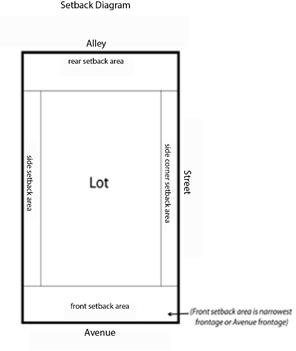
Setback. The shortest distance between the property line and extremity of the building.
a.
Front setback is the distance between the nearest point on a structure and the right-of-way at the front of the lot.
b.
Rear setback is the distance between the nearest point on a structure and the rear property line opposite the front setback.
c.
Side setback is the distance between the nearest point on a structure and the side property lines that are perpendicular, or more or less perpendicular, to the front setback.
55.
Sewerage. Refers to the entire system (mains, treatment plant, etc.) used to collect, and treat and discharge sewage wastes.
56.
Sexually oriented business. Sexually oriented business means an adult arcade, adult bookstore or adult video store, adult cabaret, adult motel, adult motion picture theater, escort agency, nude model studio, or similar facilities.
57.
Short term rental. Rental or lease of all or part of dwelling to a single entity for less than thirty-continuous days. Owner occupancy not required but collection and payment of bed tax and inspection and licensure as a public accommodation is required.
58.
Side street. A street not parallel to an alley.
59.
Sign. Any object or structure used to identify, advertise, or in any way attract or direct attention to any use, building, person, or product by any means, including, but not limited to, the use of lettering, words, pictures, and other graphic depictions or symbols.
60.
Single-household dwelling. A building or part of a building designed for occupancy by one family. By state law, this includes foster and youth homes, community residential facilities, and manufactured homes that:
a.
Manufactured off site in a factory after January 1, 1990; and
b.
Comply with the National Manufactured Home Construction and Safety Standards Act (42 USC 5401, as amended) or the IRC or IBC; and
c.
Are at least one thousand square feet in size; and
d.
Are attached to a permanent foundation and, where available, permanently connected to municipal utilities; and
e.
Have a pitched roof and siding materials typically found on site- built homes in Baker. Mobile homes, recreational vehicles, and travel trailers are not single-household dwellings.
61.
Site plan. A map which details property lines, structure placement, parking lots and other features on the property.
62.
Sketch plan. A general or conceptual site plan of a development.
63.
Structure. Any object constructed, installed, or placed by man, including, but not limited to, buildings, towers, smokestacks, earth formations, liquid storage tanks, fences, and overhead transmission lines.
64.
Substantial damage. Damage sustained by a structure where the cost of restoring the structure to its condition before damage would equal or exceeds fifty percent of the floor area of the structure before the damage occurred.
65.
Substantial improvement. Any repair, reconstruction, or improvement of a structure, the cost of which equals or exceeds fifty percent of the floor area of the structure either before the improvement or repair is started or, if the structure is damaged and is being restored, before the damage occurred. Substantial improvement occurs when the first construction to any wall, ceiling, floor, or other structural part of the building commences. The term does not include:
a.
Any project for improvement of a structure to comply with existing state or local health, sanitary, or safety code specifications which are solely necessary to assure safe living conditions; or
b.
Any alteration of a structure listed on the National register of Historic Places or state inventory of historic places.
66.
Such as. Any list or example following this phrase is not to be considered complete or comprehensive.
67.
Use. A purpose or activity on a lot or in a structure.
68.
Variance. A modification of the specification or performance standards of any code, law, regulation, or requirement, where the modification sought or permitted for a specific property, lot or parcel is not normally allowed.
69.
Warehousing. A building or property where goods, merchandise or equipment are stored for eventual distribution to retail or other establishments. Warehousing includes the storage of commodities, refrigerated items, and general merchandise.
70.
Written (or writing). Includes any form in which words are provided in a visual form that can be copied, filed, stored, forwarded (as opposed to spoken or oral words) and, unless specifically excluded, includes electronic composition, delivery, and storage (e.g., e-mail).
71.
Zoning administrator. The city employee(s) or contractor(s) appointed by the mayor and confirmed by the city council, who is (are) responsible for the administration of this Code or any part of it.
72.
Zoning commission. Residents of the City of Baker duly appointed by the city council to recommend the boundaries of the various zoning districts and appropriate regulations to be enforced therein and to consider changes, modifications or amendments to the boundaries and regulations.

