
Bay City City Zoning Code
ARTICLE II
RULES OF CONSTRUCTION AND DEFINITIONS
Sec. 122-31.- Rules of construction.
The following rules of construction apply to the text of this chapter:
(1)
The particular shall control the general.
(2)
Words used in the present tense shall include the future.
(3)
Words used in the singular number shall include the plural and the plural shall include the singular, unless the context clearly indicates the contrary.
(4)
The word "shall" is always mandatory and not discretionary. The word "may" is permissive.
(5)
The masculine gender includes the feminine and neuter.
(6)
All measurements shall be to the nearest integer, unless otherwise specified herein.
(7)
The phrase "used for" includes "arranged for," "designed for," "intended for," "occupied for," and "maintained for."
(8)
The word "building" includes the word "structure." The word "build" includes the words "erect" and "construct." A "building" or "structure" includes any part thereof.
(9)
The word "person" includes an individual, a corporation, a partnership, an incorporated association, or any similar entity.
(10)
Whenever a word or term defined hereinafter appears in the text of this chapter, its meaning shall be construed as defined herein. Words or terms not herein defined shall have the meaning customarily assigned to them.
(11)
Unless the context clearly indicates the contrary, where a regulation involves two or more items, conditions, provisions, or events connected by the conjunction "and," "or," or "either/or," the conjunction shall be interpreted as follows:
a.
"And" indicates that all the connected items, conditions, provisions, or events shall apply.
b.
"Or" indicates that the connected items, conditions, provisions, or events may apply singularly or in any combination.
c.
"Either/or" indicates that the connected items, conditions, provisions or events shall apply singularly but not in combination.
(12)
Catch words and catch lines shall in no way by their presence or absence limit or affect the meaning of this chapter.
(13)
Unless the context clearly indicates to the contrary, where an illustration accompanies any item within this chapter, the written text shall have precedence over the illustration.
(14)
Where a specific agency, department, law, or rule is referred to in this chapter, such reference shall include any successor agency, department, law or rule.
(Ord. No. 2005-11, 11-21-05)
Sec. 122-32. - Definitions.
Whenever used in this chapter, the following words and phrases shall have the meaning ascribed to them in this section:
Accessory apartment means a type of dwelling unit that is accessory to and contained within a single-family dwelling that is leased or rented to someone that is not a member of the homeowner's family.
Accessory building means a building that: a) has a roof that is supported by columns or walls, b) is intended for the shelter or enclosure of persons, animals, goods or chattel, and c) is further intended to be used in a manner that is clearly incidental to, customarily found in connection with, subordinate to, and located on the same lot as the principal use to which it is exclusively related. Examples of accessory buildings include garages, carports, storage sheds, gazebos, and greenhouses.
Accessory structure means anything constructed or erected, the use of which requires permanent location on the ground or attachment to something having such location, and which is intended to be used in a manner that is clearly incidental to, customarily found in connection with, subordinate to, and located on the same lot as the principal use to which it is exclusively related.
Accessory use means a use that is clearly incidental to, customarily found in connection with, subordinate to, and located on the same lot as the principal use to which it is related.
Adult foster care facility means an establishment licensed and regulated by the State of Michigan Public Act 218 of 1979 that provides foster care to adults who are aged, mentally ill, developmentally disabled, or physically handicapped who require supervision on an ongoing basis, but who do not require continuous nursing care.
"Adult foster care facility" does not include nursing homes, hospitals, alcohol or substance abuse rehabilitation centers, or a residential center for persons released from or assigned to a correctional facility.
"Adult foster care facilities" include the following:
(1)
Adult foster care family home means a private residence with the approved capacity to receive six or fewer adults to be provided with foster care for five or more days a week or for two or more consecutive weeks. The adult foster care family home licensee must be a member of the household and an occupant of the residence.
(2)
Adult foster care small group home means a facility with the approved capacity to receive 12 or fewer adults who are provided supervision, personal care, and protection in addition to room and board, for 24 hours a day, five or more days a week, and for two or more consecutive weeks for compensation.
(3)
Adult foster care large group home means a facility with approved capacity to receive at least 13 but not more than 20 adults to be provided supervision, personal care, and protection in addition to room and board, for 24 hours a day, five or more days a week, and for two or more consecutive weeks for compensation.
Alley means a dedicated public way, usually between or behind buildings, that affords a secondary means of vehicular access to abutting property, but is not intended for general traffic circulation.
Alterations means any change, addition or modification to a building, structure, use of land or buildings, occupancy, or any change in the structural members of a building, such as walls or partitions, columns, or beams or girders, or any change in location of a building, or any change that may be referred to herein as "altered" or "reconstructed".
Animal hospital. See "veterinary clinic."
Apartment. See "dwelling, multiple-family."
Architectural features means the features of a building, including but not limited to cornices, eaves, gutters, belt courses, sills, lintels, chimneys, and decorative ornaments.
Automobile. See "motor vehicle."
Basement means that portion of a building that is partially or totally below grade, where the vertical distance from the average grade to the basement floor is greater than the vertical distance from the average grade to the ceiling. This definition shall not apply to earth-bermed or earth-sheltered homes. A basement shall not be counted as a story. A basement shall be deemed a full story when the vertical distance from the average grade to the floor below is less than the vertical distance from the average grade to the ceiling.
Bed and breakfast inn means a dwelling that was originally constructed for single family residential use, is the principal residence of the innkeeper, and the principal use for which is the renting of bedrooms on a nightly basis to guests.
Berm. See article XXVIII, landscaping and screening.
Block means the property bounded by a street or by a combination of streets and public lands, rights-of-way, a waterway, boundary lines of the city, or any other barrier to the continuity of development.
Board of appeals means the city zoning board of appeals, created pursuant to the provisions of Michigan Public Act 207 of 1921, as amended.
Boarding house means a dwelling where lodging and meals are provided for compensation or by prearrangement for definite periods of time of not less than one week. This term shall not be construed to include the term bed and breakfast.
Buildable area means the area of a lot that is defined by the minimum setback regulations within which building construction is permitted by the terms of this chapter.
Buildable area, net means that portion of a site that is not encumbered by state-regulated wetlands (except as specifically noted), steep slopes, street rights-of-way, easements, structures or lots, or other existing or proposed features that would prevent construction of a building or use of the site for a use permitted in the district in which the site is located.
Building means any structure, either temporary or permanent, having a roof or other covering and used or built for the shelter or enclosure of persons, animals, chattels, or property or materials of any kind.
Building, accessory. See "accessory use, building, or structure."
Building height means the vertical distance measured from the established grade to:
(1)
The highest point of the coping of a flat roof;
(2)
The deck line of a mansard roof;
(3)
The average height between the eaves and the ridge for a gable, hip, studio (shed), or gambrel roof; or
(4)
Seventy-five percent of the height of an A-frame.
Where a building is located on sloping terrain, the height shall be computed using the average grade measured at the building wall on all four sides. See Illustration 2-1.
Illustration 2-1. Building Heights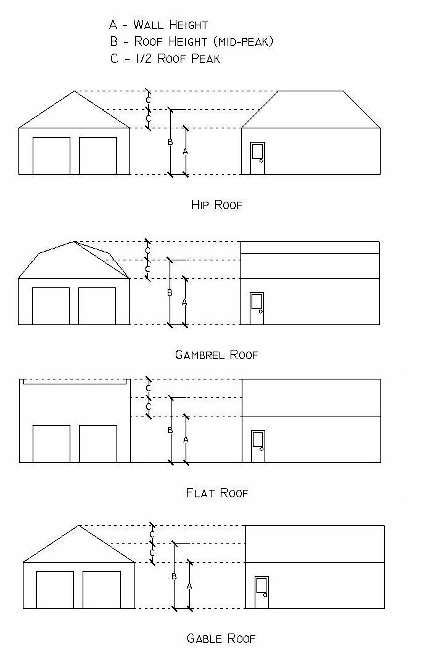
Bulk means a general term indicating floor area, height, and setbacks of buildings and other structures in relation to lot lines and other buildings, and minimum lot area and lot coverage regulations.
Canopy means an unenclosed fixed structure that has a fixed roof, is supported by one or more supporting columns, and may be freestanding or attached to a building.
Carport means a roofed structure that is used for the parking of motor vehicles and is not enclosed.
Car wash means a business contained within a building or premises or portion thereof where motor vehicles are washed.
Child care organization means a facility for the care of children under 18 years of age, as licensed and regulated by the state under Michigan Public Act 116 of 1973, and the associated rules promulgated by the state department of human services. Such organizations shall be further defined as follows:
(1)
Foster family home means a private home in which one but not more than four minor children, who are not related to an adult member of the household by blood, marriage, or adoption, are given care and supervision for 24 hours a day, for four or more days a week, for two or more consecutive weeks, unattended by a parent or legal guardian.
(2)
Foster family group home means a private home in which more than four but less than seven children, who are not related to an adult member of the household by blood, marriage, or adoption, are provided care for 24 hours a day, for four or more days a week, for two or more consecutive weeks, unattended by a parent or legal guardian.
(3)
Family day care home means a private home in which one but not more than six minor children are received for care and supervision for periods of less than 24 hours a day, unattended by a parent or guardian, excluding children related to an adult member of the family by blood, marriage, or adoption. It includes a home that gives care to an unrelated child for more than four weeks during a calendar year.
(4)
Group day care home means a private home in which more than six but not more than 12 minor children are given care and supervision for periods of less than 24 hours a day unattended by a parent or legal guardian, excluding children related to an adult member of the family by blood, marriage, or adoption. Group day care home includes a home that gives care to an unrelated minor child for more than four weeks during a calendar year.
Club or fraternal organization means an organization of persons for special purposes or for the promulgation of sports, arts, science, agriculture, literature, politics, or similar activities, but not operated for profit. See Institutional use.
Composting center means a lot or portion thereof where organic matter consisting primarily of yard waste is delivered from off-site for a large-scale composting operation.
Community garden means a parcel of land that is used for the collective growing of fruits, vegetables, and/or flowers.
Condominium means dwelling units, offices, retail or industrial establishments, boat slips, and other similar individual uses that are owned individually, and the structure or structures, common areas, and facilities that are owned by all the owners on a proportional undivided basis.
Congregate housing means a senior housing facility containing common kitchen, dining, and living areas, and which may provide special support services, such as transportation and limited medical care.
Contractor's yard means a lot or portion thereof used for the storage of construction or excavation equipment, other vehicles, tools, building materials, and other appurtenances used in or associated with the building or construction industry. This is not intended to refer to concrete batch plants.
Convenience store means any retail establishment offering for sale prepackaged or freshly prepared food products for off-site consumption, household items, newspapers, or magazines.
Day care center means a facility, other than a private residence, providing group care for periods of less than 24 hours a day, and where the parent, guardian, or caregiver is not immediately available. The facility is generally described as an adult day care or activity center, child care center, day care center, day nursery, nursery school, parent cooperative, preschool, play group, or drop-in center.
Deck means an unroofed structure that may be attached to a home or other building, or which may be freestanding, and is typically elevated above ground level.
Drive-through means a business establishment that provides service to customers while they are in their motor vehicle.
Duplex. See "dwelling, two-family."
Dwelling means any building, or part thereof, containing sleeping, kitchen, and bathroom facilities designed for and occupied by one family.
Dwelling, single-family means a detached dwelling designed for occupancy by one family.
Dwelling, single-family attached or townhouse means an attached single-family dwelling unit, with its own front and rear entrances, separated from adjoining dwelling units by party walls, and located in a building containing three or more such units.
Dwelling, two-family means a building designed and constructed for the purpose of providing two single-family dwelling units, also known as a duplex.
Dwelling, multiple-family means a building that contains three or more dwelling units.
Dwelling, manufactured means factory-built dwellings that meet the National Manufactured Home Construction and Safety Standards Act (42 U.S.C. Sec. 5401, U.S. Department of Housing and Urban Development), also known as a mobile home.
Dwelling unit means one or more rooms, along with bathroom, kitchen facilities, and storage facilities designed as a dwelling for one family.
Essential services means services and utilities needed for the health, safety, and general welfare of the community, such as underground, surface, or overhead electrical, gas, telephone, steam, water, sewerage, and other utilities and the equipment and appurtenances necessary for such systems to furnish an adequate level of service for the area in which it is located. This term does not include wireless communication towers and antennas.
Established building line means a line parallel to the street lot line touching that part of a building closest to the street, excluding unenclosed porches, decks, patios and terraces.
Family means either of the following:
(1)
A domestic family, that is, one or more persons living together and related by the bonds of consanguinity, marriage, or adoption, together with servants of the principal occupants and not more than one additional unrelated person, with all of such individuals being domiciled together as a single, domestic, housekeeping unit in a dwelling.
(2)
The functional equivalent of the domestic family consists of persons living together in a dwelling unit whose relationship is of a permanent and distinct character and is the functional equivalent of a domestic family with a demonstrable and recognizable bond which constitutes the functional equivalent of the bonds which render the domestic family a cohesive unit, and who cook and otherwise conduct housekeeping activities as a single, nonprofit unit. This definition shall not include any society, club, fraternity, sorority, association, lodge, coterie, organization or group where the common living arrangement and/or the basis for the establishment of the functional equivalency of the domestic family is likely or contemplated to exist for a limited or temporary duration.
Floor area, gross means the total area of a building measured by taking the outside dimensions of the building at each floor level intended for occupancy or storage.
Floor area, usable residential means the gross floor area minus areas in basements, unfinished attics, attached garages, breezeways, decks, and enclosed or unenclosed porches.
Floor area, usable nonresidential means the sum of the horizontal areas of each floor, measured from the interior faces of the exterior walls, including all areas used for, intended to be used for, and accessible for the sale of merchandise, provision of services, or service to patrons, clients or customers. Floor area which is used for or intended to be used for the storage or processing of merchandise, or for utilities shall be excluded from the computations of usable nonresidential floor area (see illustration 2-2).
Illustration 2-2. Floor Area Terminology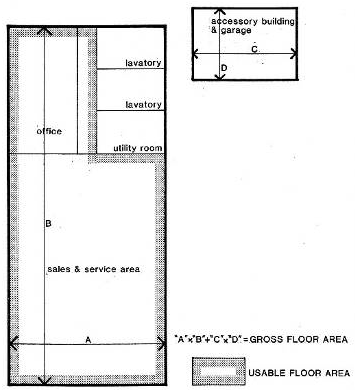
Frontage, building means the length or width of a building measured generally parallel to a front lot line.
Frontage, lot means the distance between side lot lines where they intersect the front lot line.
Garage, private means an accessory building for parking or storage of motor vehicles owned and used by the occupants of the building to which it is accessory, but not including public repair facilities.
Group day care home means a private home in which more than six but not more than 12 minor children are given care and supervision for periods of less than 24 hours a day unattended by a parent or legal guardian, excluding children related to an adult member of the family by blood, marriage, or adoption. Group day care home includes a home that gives care to an unrelated minor child for more than four weeks during a calendar year.
Half-way house means a facility where people who have left an institution, such as a hospital, chemical dependency program, correctional institution, or by court appointment are sent to live under in-house supervision and helped to readjust to the outside world prior to their full release from supervision. For the purpose of this chapter, a voluntary transitional housing facility, such as one provided through the Michigan Prisoner Reentry Initiative, shall not be considered a half-way house.
Home occupation means an occupation or profession conducted within a dwelling or on a residential lot by the inhabitants thereof, where such use is clearly incidental to the principal use of the dwelling as a residence.
Hotel means a building containing nine or more rooms occupied as a temporary abiding place for individuals who are lodged with or without meals in rooms consisting of a minimum of one bedroom and a bath, occupied for hire, and which typically provides hotel services such as maid service, the furnishing and laundering of linens, telephone and secretarial or desk service, a dining room and general kitchen, and meeting rooms.
Independent living group home means a home shared by individuals with disabilities who do not require supervision on an ongoing basis.
Indoor recreation facility means any establishment that provides indoor recreation facilities such as bowling establishments, tennis courts, billiard halls, skating rinks, indoor archery or driving ranges, and similar uses.
Innkeeper means the manager or owner of a bed and breakfast inn.
Institutional use means a nonprofit, religious, or public use, such as a church, library, service club or fraternal organization, public or private school, or government owned or operated building, or land use for public purpose.
Kennel means a municipal or privately owned facility in which dogs or domesticated animals are housed, bred, and boarded for a fee or free.
Legal nonconforming lot of record means a lot, the area, dimensions, or location of which was lawful prior to the adoption, revision, or amendment of this chapter but that fails by reason of such adoption, revision, or amendment to conform to the present regulations of the zoning district in which it is located.
Legal nonconforming building or structure means a structure or building, the size, dimensions, or location of which was lawful prior to the adoption, revision, or amendment of this chapter but that fails by reason of such adoption, revision, or amendment to conform to the present regulations of the zoning district in which it is located.
Legal nonconforming use means a use or activity that was lawful prior to the adoption, revision, or amendment of this chapter but that fails by reason of such adoption, revision, or amendment to conform to the present regulations of the zoning district in which it is located.
Loading space means an area of land used for the temporary parking of delivery vehicles during the loading and unloading of merchandise and materials.
Lot means a tract of land occupied, or intended to be occupied, by a main building or a group of such buildings and accessory buildings, or utilized for the principal use and uses accessory thereto, together with such yards and open spaces as are required under the provisions of this chapter.
Illustration 2-3. Lot Types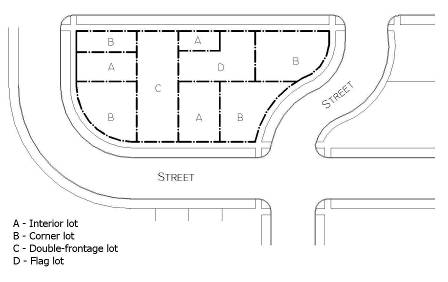
Lot, corner means a lot abutting on and at the intersection of two or more streets, provided that the streets intersect at an angle of not more than 135 degrees. Where a lot has frontage on a curved street, if the tangents through the extreme point of the street lines make an interior angle of not more than 135 degrees, it shall be considered a corner lot. In the case of a corner lot with curved street frontage, the corner is that point on the street lot line nearest to the point of intersection of the tangents described above. A tangent is a straight line extended from the outer edges of a curve which intersect to form a corner (see illustration 2-3).
Lot coverage means the percentage of a lot that is occupied by buildings and structures, excluding uncovered decks.
Lot depth means the horizontal distance between front and rear lot lines. Lot, double frontage means a lot other than a corner lot having frontage on two nonintersecting streets, also known as a through lot (see illustration 2-3).
Lot, flag means a lot not meeting minimum lot width regulations and where access to the public street is by way of a narrow private right-of-way or driveway located fully within the lot lines of such lot (see illustration 2-3).
Lot, interior means a lot other than a corner lot or through lot that has frontage on one street (see illustration 2-3).
Lot lines means the lines bounding a lot as follows:
(1)
Front lot line means the lot line separating a lot from a public or private street. In the case of a corner lot the front lot line shall be that lot line having the narrowest frontage on the public or private street.
(2)
Rear lot line means the lot line that is opposite and most distant from the front lot line. In the case of irregularly-shaped lots, the rear lot line shall be an imaginary line parallel to the front lot line, not less than ten feet in length between side lot lines, lying farthest from the front lot line and wholly within the lot.
(3)
Side lot line means any lot line other than a front, rear or side street lot line.
(4)
Side street lot line means a lot line that is opposite from a side lot line and has frontage on a public or private street.
Illustration 2-4. Lot Lines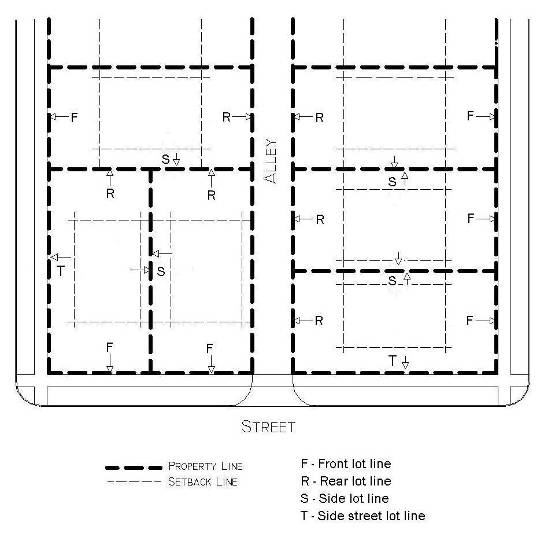
Lot of record means a lot in a platted subdivision or described by metes and bounds that is recorded in the office of the county register of deeds.
Lot width means the straight line distance between the side lot lines, measured at the two points where the minimum front yard setback line intersects the side lot lines.
Medical clinic means an out-patient medical facility that may include laboratories and pharmacies.
Mini-storage. See "self-service storage facility."
Mobile home. See "dwelling, manufactured."
Mobile home park means a parcel or tract of land, under the control of a person, upon which three or more mobile homes are located on a continual nonrecreational basis and which is offered to the public for that purpose regardless of whether a charge is made therefore, together with any building, structure, enclosure, street, equipment, or facility used or intended for use incident to the occupancy of a mobile home, subject to conditions set forth in the Mobile Home Commission Rules and Michigan Public Act 96 of 1987, as amended.
Motel means a building or group of buildings occupied as a temporary abiding place for individuals who are lodged with or without meals in rooms consisting of a minimum of a bedroom and bath, occupied for hire, and which provides customary motel services such as maid service, linen service, telephone and/or desk service, and the use of furniture. Motels typically provide exterior entrances and on-site parking for each unit. A motel may also include conference room or banquet facilities, a dining room or standard restaurant, and manager or caretaker living quarters. The term "motel" shall include buildings designed as "auto-courts," "tourist courts," "motor courts," "suites" and similar terms.
Motor vehicle means any vehicle including by way of example, cars, trucks, vans, motorcycles, and the like.
Motor vehicle dealership means a building or premises used primarily for the sale of new and used motor vehicles.
Motor vehicle filling station means a place used for the retail sale and dispensing of fuel or lubricants, and excluding motor vehicle repair, that may also incorporate a convenience store, restaurant, or car wash.
Motor vehicle repair:
(1)
Minor repair means engine tune-ups, servicing of brakes, air conditioning or exhaust systems; oil change or lubrication; wheel alignment or balancing; or similar servicing or repairs that do not normally require any significant disassembly or storage of motor vehicles on the premises overnight.
(2)
Major repair means engine and transmission rebuilding and general repairs, rebuilding or reconditioning; collision service such as body, frame or fender straightening or repair; and similar servicing, rebuilding or repairs that normally do require significant disassembly or storage of motor vehicles on the premises overnight.
Motor vehicle repair garage means an enclosed building where minor and major motor vehicle repair services may be carried out.
Motor vehicle service station means a place where gasoline or other fuel, kerosene, motor oil and lubricants, and other commodities are sold directly to the public. A service station may include the sale and installation of minor accessories (such as tires, batteries, brakes, shock absorbers, window glass), minor repair, and temporary storage.
Nuisance means any offensive, annoying, or disturbing practice or object that prevents the free use of one's property, or which renders its ordinary use or physical occupation uncomfortable. Nuisance commonly involves continuous or recurrent acts that give offense to the senses, violate the laws of decency, obstruct reasonable and comfortable use of property, or endanger life and health.
Nursing home, convalescent home, rest home or hospice means a facility, other than a hospital, for the care of the aged, infirm, or those suffering from bodily disorders, wherein seven or more persons are housed or lodged and furnished with nursing care. This definition does not include a unit in a state correctional facility, a hospital, or a veterans facility created under Michigan Public Act 152 of 1885, as amended.
Occupancy or use, change of means the term "change of occupancy" shall mean a discontinuance of an existing use and the substitution of a use of a different kind or class, or, the expansion of a use.
Occupied means used in any way at the time in question.
Outdoor retail sales means the display and sale of products and services primarily outside of a building or structure, including garden supplies, gas, tires and motor oil, food and beverages, farm equipment, motor homes, burial monuments, building and landscape materials, and lumber yards.
Place of worship means this may include a church, synagogue, or mosque, and may also include a parsonage, rectory, convent, school, day care center, activity center, food pantry, and indoor and outdoor recreation facilities, subject to the provisions of section 122-482.
Porch, enclosed means a roofed area with direct access to a building that projects out from the main wall of such building, and which is totally enclosed by walls, windows, canvas, screens, or solid masonry.
Porch, unenclosed means a roofed area with direct access to a building that projects out from the main wall of such building, and which is unenclosed except for columns and railings.
Principal building means a building or group of buildings in which a principal use is conducted.
Principal use means the primary or predominant use of any lot.
Recreation facility means a place designed and equipped for the conduct of sports and leisure-time activities.
Recreational vehicle shall include the following:
(1)
Travel trailer means a portable vehicle on a chassis, which is designed to be used as a temporary dwelling during travel, recreational, and vacation uses.
(2)
Pickup camper means a structure designed to be mounted on a pickup truck or truck chassis, that is designed to be used as a temporary dwelling during travel, recreational, and vacation uses.
(3)
Motor home means a motor vehicle that is designed to be used as a temporary dwelling during travel, recreational, and vacation uses.
(4)
Folding tent trailer means a folding structure, mounted on wheels and designed for travel and vacation use.
(5)
Boats and boat trailers means boats, floats, rafts, canoes, personal watercraft, and the normal equipment used to transport them on the highway.
The term "recreational vehicle" shall also include snowmobiles, all terrain or special terrain vehicles, and the normal equipment used to transport them on the highway.
Restaurant means any establishment whose principal business is the sale of food and beverages to the customer in a ready-to-consume state.
(1)
Restaurant, carry-out means a restaurant whose method of operation involves sale of food, beverages, and/or frozen desserts in disposable containers or wrappers in a ready-to-consume state for consumption off the premises.
(2)
Restaurant, drive-in means a restaurant whose method of operation involves delivery of prepared food so as to allow its consumption in a motor vehicle or elsewhere on the premises, but outside of an enclosed building.
(3)
Restaurant, fast-food means a restaurant whose method of operation involves minimum waiting for delivery of ready-to-consume food to the customer at a counter for consumption at the counter where it is served, or at tables, booths, or stands inside the building or out, or for consumption off the premises, but not in a motor vehicle at the site. Such restaurants may or may not include drive-through service.
(4)
Restaurant, standard means a restaurant whose method of operation involves either:
a.
The delivery of prepared food by waiters and waitresses to customers seated at tables within a completely enclosed building, or
b.
Customers acquiring prepared food at a cafeteria line and consuming it at tables within a completely enclosed building.
(5)
Bar/lounge means a type of restaurant that is operated primarily for the dispensing of alcoholic beverages, although the sale of prepared food or snacks may also be permitted.
Secondary access drive means a street that meets the following criteria:
(1)
It is generally parallel to and adjacent to an arterial or collector street.
(2)
It is designed to provide access to abutting properties, so that such properties are separated from through traffic on the arterial or collector street.
(3)
The flow of traffic on the arterial or collector street is not impeded by direct driveway access from a large number of abutting properties.
Also known as a marginal access road.
Illustration 2-5. Secondary Access Road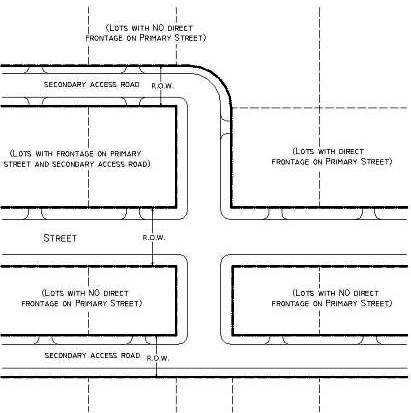
Self-service storage facility means a building or group of buildings, each of which contains individual storage units, with each unit having a separate door and lock and which can be leased on an individual basis, also known as mini-storage.
Service club or fraternal organization means an organization of persons for special purposes or for the promulgation of sports, arts, science, agriculture, literature, politics, or similar activities, but not operated for profit. See Institutional use.
Setback means the minimum distance between a front, side, or rear lot line and the nearest portion of a building or structure. Also known as a required yard.
Shopping center means a grouping of retail businesses and service uses arranged as a coherent unit on a single lot with common off-street parking. Also known as a strip mall.
Sign means any device, structure, fixture, or placard that displays or depicts words, numbers, figures, graphic designs, logos or trademarks to convey information visually for the purpose of informing or attracting the attention of persons.
Street means any public or private thoroughfare or right-of-way, other than a public or private alley, dedicated to or designed for travel and access to any land, lot, or parcel. Various types of streets are defined as follows:
(1)
Private street means any street that has not been accepted for maintenance by the city or any other governmental entity.
(2)
Collector street means a street whose principal function is to carry traffic between local and arterial streets, but may also provide direct access to abutting properties.
(3)
Local street means a street whose sole function is to provide access to properties.
(4)
Arterial street means a street or highway that is intended to service a large volume of traffic for both the immediate area and the region beyond, and which serves as an avenue for circulation of traffic into, out of, or around the city.
(5)
Residential street means a street whose principal function is to provide direct access to residential properties in a subdivision or other type of residential development.
(6)
Major thoroughfare means a main traffic artery designated by the city master plan as a principal arterial or minor arterial on the National Functional Road Classification Map.
Structure means anything constructed or erected including, but not limited to, principal and accessory buildings, towers, decks, antennae, and signs.
Townhouse. See "dwelling, single-family attached."
Temporary mobile storage container means a mobile storage container that is used for on-site storage at a residence or business. The container is able to be transported to another location via truck, trailer or other form of transportation.
Use means the purpose for which land, lots, or buildings thereon is designed, arranged or intended, or for which it is occupied, maintained, let or leased.
Veterinary clinic means a facility for the care, diagnosis, and treatment of sick or injured animals. A veterinary clinic may include fully enclosed pens or cages for the overnight boarding of animals and such related facilities as laboratories, testing services, and offices, also known as an animal hospital.
Yard means an open space between a building and a lot line.
(1)
Front yard means a space extending the full width of the lot between any building and the front lot line and measured perpendicular to the building at the closest point to the front lot line.
(2)
Rear yard means a space extending across the full width of the lot between the principal building and the rear lot line and measured perpendicular to the building to the closest point of the rear lot line.
(3)
Side yard means a space extending from the front yard to the rear yard between the principal building and the side lot line and measured perpendicular from the side lot line to the closest point of the principal building.
(4)
Side-street side yard means a side yard that has frontage on a public or private street.
Illustration 2-6. Yards Terms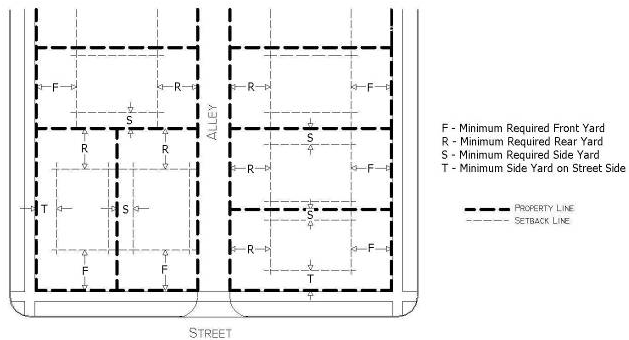
Zoning administrator means the person designated by the city as being responsible for administration of this chapter.
(Ord. No. 2005-11, 11-21-05; Ord. No. 2010-2, § 1, 2-15-10; Ord. No. 2010-4, § 1, 4-5-10; Ord. No. 2012-8, § 2, 6-18-12; Ord. No. 2019-10, § 1, 7-1-19; Ord. No. 2019-11-A, § 1, 7-1-19)

