
Bay City City Zoning Code
ARTICLE III
GENERAL PROVISIONS
Sec. 122-51.- Administrative regulations.
The maintenance of front, side and rear yards, other open space, minimum lot area, lot width, minimum floor area and maximum building or structure height shall be a continuing obligation of the owner of a building or property for as long as the building is in existence. No portion of a lot used in complying with the provisions of this chapter in connection with an existing or planned building shall again be used to qualify or justify any other building or structure existing or intended to exist at the same time.
No required front, side or rear yard or other required open space shall be diminished, nor shall any building be erected, converted, enlarged, reconstructed or structurally altered, except in conformity with the provisions of this chapter.
(Ord. No. 2005-11, 11-21-05)
Sec. 122-52. - Accessory buildings and structures.
(a)
General regulations.
(1)
Timing of construction. No accessory building, including private garages and utility buildings, shall be constructed upon or moved to any parcel of property until the principal building or use is at least two-thirds completed, except for the construction of an attached private garage which may proceed with the construction of the dwelling to which it is attached.
(2)
Conformance with lot coverage standards. Accessory buildings and structures shall be included in computations to determine compliance with maximum lot coverage regulations.
(3)
Construction on easements. Accessory buildings and structures shall not encroach on any easement unless the terms of the easement permit such encroachment.
(4)
Attached accessory buildings. Unless permitted by this section, an attached accessory building shall comply with the lot coverage and setback regulations established by applicable zoning district regulations for the principal building to which it is attached.
(5)
Use restrictions. No detached accessory building or portion thereof shall be used or occupied for dwelling purposes.
(b)
Accessory buildings in residential zoning districts as provided in article V.
(1)
Location.
a.
A detached or attached accessory building or portions thereof shall not be erected in nor extend into a required front yard setback.
b.
A detached accessory building or portions thereof shall not extend beyond the established building line of the dwelling.
c.
An attached accessory building may extend beyond the established building line of the dwelling provided it does not extend into a required front yard.
(2)
Setbacks.
a.
Accessory buildings on interior lots. Detached accessory buildings on interior lots shall be erected no closer than two feet from a side or rear lot line and shall be set back at least 20 feet from the front lot line.
b.
Accessory buildings in side yards. Accessory buildings located between any portion of a dwelling and a side lot line shall comply with setback regulations applicable to dwellings.
c.
Setbacks from alleys. When vehicle access to a building is by way of an alley, the building shall be set back not less than four feet from the lot line adjacent to the alley.
d.
Accessory buildings on corner lots:
1.
When an entrance for vehicles to a detached or attached accessory building faces a side street, the accessory building shall be set back at least 20 feet from the side street lot line.
2.
If the rear lot line of a corner lot is also the rear lot line of an adjacent lot then the required setback from the side street lot line shall be ten feet, when an entrance for vehicles to a detached or attached accessory building faces a front street.
e.
Double frontage lots. On double frontage lots, accessory buildings shall comply with applicable front yard setback regulations on both street frontages.
(3)
Floor area. Detached accessory buildings shall not exceed a floor area of 864 square feet.
(4)
Length. The length of an accessory building may not exceed 36 feet. This requirement shall not apply to carports and garages in multiple-family developments.
(5)
Building and wall height. Detached accessory buildings may have a building height of 14 feet. In rear yards, accessory building height may be increased where the roof pitch of a proposed detached accessory building is equal to, but not greater than, the roof pitch of the principal building. In such cases, planning department staff shall be provided with elevations of the proposed accessory building to make final determination. This height restriction shall not apply to attached accessory buildings.
Walls shall not exceed more than ten feet in height above grade.
(6)
Distance from other buildings. There shall be a minimum distance of two feet between detached accessory buildings and the principal building, provided that the buildings comply with the setback and fire rating regulations in the building and fire codes.
(7)
Number. There shall be no more than three accessory buildings on a residential lot.
(Ord. No. 2005-11, 11-21-05; Ord. No. 2008-17, § 3, 12-15-08; Ord. No. 2010-1, § 1, 1-2-10; Ord. No. 2012-8, § 3, 6-18-12)
Sec. 122-53. - Porches.
(a)
New enclosed and unenclosed front porches must be constructed in accordance with applicable side lot line setback requirements.
(b)
Unenclosed porches may be constructed within ten feet of a front or side street lot line.
(c)
Enclosed porches may not encroach into required setbacks.
(d)
Existing unenclosed porches located less than 15 feet from a front or side street lot line shall not be enclosed.
(e)
Existing unenclosed porches located less than ten feet from a front or side street lot line may be repaired or reconstructed provided no dimensional increases are made during repair or reconstruction.
(Ord. No. 2005-11, 11-21-05; Ord. No. 2010-21, § 1, 12-20-10)
Sec. 122-54. - Decks, stoops, steps, and terraces.
(a)
Decks.
(1)
Decks shall not be located between the front lot line and the front wall of dwellings.
(2)
If the rear lot line of a corner lot is also the rear lot line of an adjoining corner lot, a deck may be constructed within ten feet of a side street lot line.
(3)
If the side street lot line of a corner lot is a continuation of the front lot line of an adjoining corner or interior lot, a deck must be set back not less than 15 feet from that side street lot line.
(4)
An unattached deck may be located in the rear yard at least two feet from the principal building and not be attached to the principal building in any manner. In such cases, a deck may be constructed within two feet of a side or rear lot line.
(5)
A deck that is considered attached to a principal building may be set back ten feet from a rear lot line, and must comply with the side lot line setback requirements applicable to the principal building.
(b)
Stoops and steps.
(1)
Stoops are elevated masonry or wood platforms that provide landing space for stairs leading to an entrance to a building or dwelling.
(2)
Unenclosed stoops and steps required by the city's building code and not more than 30 square feet in size, exclusive of steps, are exempt from setback regulations applicable to decks and unenclosed porches. Stoops shall not project farther than five feet from the front wall of a dwelling.
(3)
Enclosed stoops are subject to setback regulations applicable to enclosed porches.
(c)
Terraces.
(1)
Terraces are level, landscaped, and/or surfaced areas, also referred to as a patio, directly adjacent to a principal dwelling at or within three feet of finished grade and not covered with a permanent roof.
(2)
New terraces may be constructed of earth, masonry, concrete or other hardscape materials, excluding wood.
(3)
Terraces existing before December 20, 2010 may be covered with wood decks, provided that the new decking does not expand the size of the existing terrace.
(4)
Terraces are subject to setback regulations applicable to unenclosed porches.
(Ord. No. 2005-11, 11-21-05; Ord. No. 2008-17, § 4, 12-15-08; Ord. No. 2010-21, § 2, 12-20-10; Ord. No. 2012-8, § 4, 6-18-12)
Sec. 122-55. - Barrier free access ramps.
In all zoning districts, barrier free access ramps are exempt from setback and lot coverage regulation. Barrier free access ramps located within any regulated historic preservation district shall be subject to review and approval by the historic district commission.
(Ord. No. 2005-11, 11-21-05; Ord. No. 2008-17, § 5, 12-15-08; Ord. No. 2012-8, § 1, 6-18-12)
Sec. 122-56. - Home occupations.
(a)
General regulations. A home occupation shall be allowed as a permitted accessory use, provided that all of the following conditions are met:
(1)
Home occupations must be clearly incidental and secondary to the use of the dwelling as a residence and conducted entirely within the dwelling or in an accessory building.
(2)
The home occupation shall not change the residential character or appearance of the home. The appearance of home shall not be altered, nor shall the home occupation be conducted in a manner which would cause the home to differ from its residential character either by the use of colors, materials, construction, and lighting.
(3)
The residents of the home and not more than one employee who does not reside in the home may be engaged in the home occupation.
(4)
No outdoor display and/or storage of materials, goods, supplies, or equipment used in the home occupation shall be permitted on the premises in residential districts. No retail sales shall be permitted on the premises, with the exception that telephone orders or other orders taken off the premises may be filled on the premises.
(5)
There shall be no noise, vibration, smoke, dust, odors, heat or glare generated by the home occupation that is noticeable at or beyond the property line.
(6)
The home occupation shall occupy not more than 25 percent of the home based on the floor area of the first story of the dwelling.
(7)
The home occupation shall provide additional off street parking to accommodate all needs created by the home occupation.
(8)
One nonilluminated sign, not more than two square feet in area, attached to the building where the business is located and one yard sign, not more than two square feet in area, shall be permitted. Said yard sign shall be hung on one or two posts, the top of the sign shall not more than four feet in height and shall be placed no closer than ten feet from any lot line.
(Ord. No. 2005-11, 11-21-05)
Sec. 122-57. - Essential services.
Essential services shall be permitted as authorized and regulated by franchise agreements and by state, federal, and local ordinances and laws. Essential services will be permitted in all zoning districts subject to applicable district regulations.
Essential services buildings and uses should be reasonably necessary for the public convenience, and should be designed, erected and landscaped to conform harmoniously with the general architecture and character of such district.
(Ord. No. 2005-11, 11-21-05)
Sec. 122-58. - Entranceway structures.
Entranceway structures, such as walls, columns, gates, gatehouses or similar structures that mark the entrance to nonresidential and residential developments shall be permitted within required front, side and rear yard setbacks. Such structures shall not be located in the public right-of-way without an encroachment permit from the city engineering department.
(Ord. No. 2005-11, 11-21-05)
Sec. 122-59. - Exceptions to height standards.
The following structures may exceed the height limitations of the zoning district in which they are located by no more than 20 feet: roof structures for the housing of elevators, stairways, tanks, ventilating fans, or similar equipment required to operate and maintain the building; fire or parapet walls; skylights, solar collectors, steeples, stage lofts and screens; flagpoles, chimneys, smokestacks, individual domestic radio and television aerials and whip antennas, and satellite dishes; water tanks or similar structures. Such structure shall not have a total area of greater than 25 percent of the roof area of the building. Such structure shall not be used for any purpose other than a use incidental to the main use of the building. This exception shall not apply to wireless communication towers and antennas regulated by section 122-70.
(Ord. No. 2005-11, 11-21-05)
Sec. 122-60. - Lighting.
Subject to the provisions set forth below, walkways, driveways, building entryways, off-street parking and loading areas, and building complexes with common areas involving commercial, industrial, office, multiple-family uses, or manufactured housing parks shall be illuminated in accordance with the following regulations.
(1)
Permitted lighting. Only nonglare, color-corrected lighting shall be permitted. Lighting shall be placed and shielded so as to focus the light downward onto the site and not onto adjoining property. The lighting source shall not be directly visible from adjoining properties. Lighting shall be shielded so that it does not cause glare or interfere with the vision of motorists (see Illustration 3-1).
(2)
General regulations.
a.
All outdoor lighting shall be shielded.
b.
Nonessential lighting shall be turned off after business hours, leaving only that lighting that is necessary for site security.
c.
Light trespass from a property shall not to exceed 0.3 foot-candles at any property line that abuts residentially zoned property or 0.5 foot-candles at the property line for any other zoning district, measured five feet from the ground.
d.
Parking lot and building-mounted security lighting shall be full cut-off fixtures that are directed downward. Fixtures shall be designed and shielded so as to prevent light from projecting above a 90 degree horizontal plane (see Illustration 3-1).
e.
Uplighting of buildings for aesthetic purposes shall be confined to the target surface.
f.
Canopies and similar structures used by gas stations, banks, and other uses shall be limited to providing fully recessed lighting fixtures so that sources of illumination and glare are not visible from adjoining lots, sidewalks, and streets. The total lamp output shall be limited to 20.0 foot-candles maximum under the canopy.
(3)
Intensity. In parking areas, the light intensity shall average a maximum of 10.0 foot-candles. In motor vehicle dealerships, the light intensity shall average a maximum 15.0 foot-candles and shall be confined within the lot lines of the lot on which the dealership is located. Illumination used for pedestrian areas, shall average a minimum of 2.0 foot-candles.
(4)
Height. Except as noted below, lighting fixtures shall not exceed a height of 20 feet measured from the ground level to the centerline of the light source. Fixtures should provide an overlapping pattern of light at a height of approximately seven feet above ground level. The planning commission or planning department staff may modify these height standards in commercial and industrial districts during site plan review, special use, and PUD review and approval procedures, based on consideration of the following:
a.
The position and height of buildings, other structures, and trees on the site;
b.
The potential off-site impact of the lighting;
c.
The character of the proposed use; and
d.
The character of surrounding land use.
(5)
Sign lighting. Signs shall be illuminated in accordance with the regulations set forth in article XX.
(6)
Site plan regulations. All lighting, including lighting that is intended to be primarily decorative in nature, shall be shown on site plans in sufficient detail to allow determination of the effects of such lighting upon adjacent properties, traffic safety, and overhead sky glow.
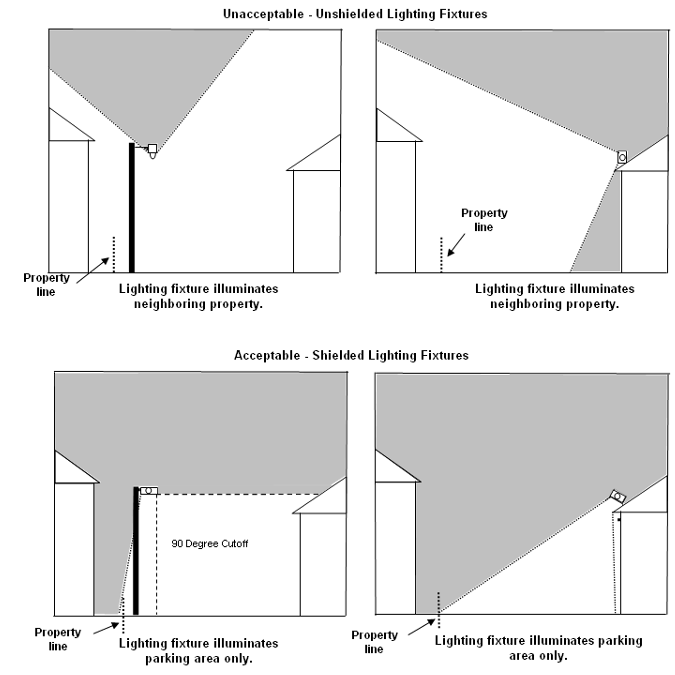
Illustration 3-1. Lighting orientation and shielding
(Ord. No. 2005-11, 11-21-05; Ord. No. 2010-21, § 3, 12-20-10)
Sec. 122-61. - Performance guarantee.
(a)
Intent and scope of regulations. To insure compliance with the provisions of this chapter and any conditions imposed thereunder, the planning commission or city commission may require that a performance guarantee be deposited with the city to insure faithful completion of improvements, in accordance with section 4(e) of the City and Village Zoning Act, Public Act 207 of 1921, as amended.
Improvements means those features and/or actions considered necessary by the city planning commission to protect natural resources or the health, safety, and welfare of the city residents and/or the future users or inhabitants of the proposed project. Improvements for which the planning commission may require a performance guarantee include, but are not limited to, roadways, parking, lighting, utilities, sidewalks, screening and drainage.
(b)
General regulations. The performance guarantee shall meet the following regulations:
(1)
The city may require a deposit of a performance guarantee in accordance with the City and Village Act PA 207 of 1921 as amended.
(2)
The performance guarantee shall be submitted at the time of issuance of the permit authorizing the activity or project. If appropriate, based on the type of performance guarantee submitted, the city shall deposit the funds in an interest-bearing account in a financial institution with which the city regularly conducts business.
(3)
The amount of the performance guarantee shall be sufficient to cover the estimated cost of the improvements for which the performance guarantee is required. The applicant shall provide an itemized schedule of estimated costs to complete all such improvements. The exact amount of the performance guarantee shall be determined by planning department staff.
(4)
The entire performance guarantee, plus interest accrued, if any, shall be returned to the applicant following inspection by city staff and a determination that the required improvements have been completed satisfactorily. The performance guarantee may be released to the applicant in proportion to the work completed on various elements, provided that a minimum of ten percent shall be held back on each element until satisfactory completion of the entire project.
(5)
An amount not less than ten percent of the total performance guarantee may be retained for a period of at least one year after installation of landscape materials to insure proper maintenance and replacement, if necessary. This amount shall be released to the applicant upon certification by the zoning administrator that all landscape materials are being maintained in good condition.
(c)
Unsatisfactory completion of improvements. Whenever required improvements are not installed or maintained within the time stipulated or in accordance with the standards set forth in this chapter, the city may complete the necessary improvements itself or by contract to an independent developer, and assess all costs of completing said improvements against the performance guarantee. If the performance guarantee is not sufficient to cover the cost of required improvements, the city may complete the required improvements and then place a lien on the property to recover the full cost of such improvements. Prior to completing said improvements, the city shall notify the owner, site plan review applicant, or other firm or individual responsible for completion of the required improvements.
(Ord. No. 2005-11, 11-21-05)
Sec. 122-62. - Reception antennae.
Reception antennae are permitted in all zoning districts, subject to the following regulations:
(1)
Ground or tower-mounted antennas shall comply with the setback regulations for the district in which they are located.
(2)
Ground or tower-mounted antennas in a residential zoning district shall not be located in a required front yard or closer to any street than an existing building, whichever is greater.
(Ord. No. 2005-11, 11-21-05)
Sec. 122-63. - Sidewalks.
Sidewalks shall be required where deemed necessary to facilitate safe pedestrian and nonmotorized travel as a condition of site plan, PUD, or plat approval of nonresidential, residential, or new subdivision developments. Sidewalks shall be subject to the following regulations:
(1)
General regulations.
a.
Location and width. Required sidewalks shall have a minimum width of five feet and shall be located one foot off the property line in the street right of way. The planning commission may modify this requirement in consideration of the location of utilities, existing landscaping, or other site improvements.
b.
Design standards. Sidewalks shall be constructed in accordance with the city's established design and construction standards.
c.
Alignment with adjacent sidewalks. Sidewalks shall be aligned horizontally and vertically with existing sidewalks on adjacent properties. The planning commission may modify this requirement if existing adjacent sidewalks are not constructed in conformance with the standards set forth herein.
d.
Signage. The planning commission may require installation of signage for the purposes of safety, such as to separate vehicular traffic from pedestrian and bicycle traffic, or where it is necessary to alert vehicular traffic of the presence of the sidewalks.
(Ord. No. 2005-11, 11-21-05)
Sec. 122-64. - Standards for dwellings.
Any residential structure or addition to a structure, including manufactured housing not located in manufactured housing parks, shall be erected or constructed only if in compliance with the following residential design standards. These standards shall not be construed to prohibit innovative design concepts involving solar energy, efforts to preserve natural features on a site, or efforts to adjust to the contour of the site.
(1)
Area and bulk regulations. Residential dwellings shall comply with the minimum floor area regulations specified for the zoning district where such structure is located. Residential dwellings are encouraged to be compatible in height, size and shape to surrounding residential structures.
(2)
Fenestration and entrance. Total fenestration (rough window openings) on the front elevation of a dwelling shall range between ten percent and 30 percent of the total surface area of that elevation. Sliding glass patio doors shall not be used on the front elevation of a dwelling, when visible from the street.
(3)
Roof design. The pitch of the main roof shall have a minimum vertical rise of one foot for each four feet of horizontal run, and the minimum distance from the eaves to the ridge shall be ten feet, except where the specific housing design dictates otherwise (i.e., art deco, Italianate, etc.).
(4)
Exterior materials. All bare wood surfaces utilized on the exterior of any dwelling or portion thereof shall be painted or stained. Chimneys whether functional or ornamental shall be of masonry construction or be faced with brick veneer, stone, or stucco on all exposed surfaces.
(5)
Manufactured housing.
a.
If the dwelling is a mobile home, it must either be:
1.
New and certified by the manufacturer and/or appropriate inspection agency as meeting the Mobile Home Construction and Safety Standards of the U.S. Dept. of Housing and Urban Development, as amended, or any similar successor or replacement standards which may be promulgated; or
2.
Used and certified by the manufacturer and/or appropriate inspection agency as meeting the standards referenced in section 122-64(E)(1)(a).
b.
All manufactured housing must meet the following regulations:
1.
Manufactured housing shall be securely anchored to its foundation in order to prevent displacement during windstorms. The wheels, tongue and hitch assembly, and other towing appurtenances, shall be removed before attaching a manufactured housing unit to its permanent foundation.
2.
All dwellings shall comply with all applicable building, electrical, plumbing, fire energy and other similar codes which are or may be adopted by the city, and with applicable federal or state standards or regulations for construction.
3.
The dwelling shall comply with the minimum floor area regulations of the zoning district in which it is located and shall have a minimum horizontal dimension across any front, side or rear elevation of 20 feet at time of manufacture, placement or construction.
4.
The foregoing standards shall not apply to a manufactured home located in a mobile home park licensed by the Michigan Manufactured Housing Commission and approved by the city according to the provisions of article VI.
(Ord. No. 2005-11, 11-21-05)
Sec. 122-65. - Streets, roads, and other means of access.
(a)
Intent. The regulations of this article are intended to promote the efficient use of public streets, provide safe access to land within the city, provide adequate police and fire protection, and other public services. The standards and specifications set forth below are determined to be the minimum standards and specifications necessary to meet these objectives.
(b)
Public access required/minimum frontage. All newly created lots shall have frontage on and access to a public street or private easement. Frontage shall meet the minimum lot width required in article XIV, schedule of regulations.
(c)
Easements required for private streets. When private streets are created all easements necessary to provide access to private lots must meet the following standards:
(1)
Easements shall be recorded with the county register of deeds;
(2)
Easements shall have a width of not less than 60 feet, except where an easement of record existed prior to the adoption of this section; and
(3)
Easements shall be improved with streets constructed to city specifications. The owners of lots having frontage on such easements shall be responsible for all costs associated with the construction and maintenance of such streets. All such lots shall have frontage on such easements in accordance with applicable zoning district lot width regulations as if the easement were a public right-of-way.
(d)
Access across residential zoned land. The means of vehicular access to land in a nonresidential district shall not traverse land in a residential zoning district.
(e)
Service roads/secondary access roads. Provisions for circulation between contiguous lots can be provided through coordinated or jointly constructed parking areas, service roads, and secondary access roads (see section 122-32(91) and Illustration 2-5). Accordingly, the planning commission shall have the authority to require the construction of service roads and secondary access roads, if during site plan review, special use, or PUD procedures it determines that such roads are necessary to limiting the number of driveways providing access to two or more contiguous lots for the purpose of:
(1)
Reducing or mitigating potentially hazardous traffic conditions that would result from the construction of an excessive number of driveways on contiguous lots; and
(2)
Reducing or mitigating a potential reduction in the carrying capacity of an adjoining public street.
Such roads shall be improved in accordance with generally acceptable street construction standards.
The planning commission shall also have the authority to require the establishment of easements across contiguous lots to provide for future cross-lot access service road and secondary access road construction.
(f)
Dimensions for public rights-of-way. All public rights-of-way shall be designed in accordance with the following standards and illustrations provided below.
(1)
Major thoroughfare, 80 feet.
(2)
Arterial street, 80 feet.
(3)
Collector street, 66 feet.
(4)
Local street, 60 feet.
(5)
Cul-de-sac, 60 feet.
(6)
Marginal access street, 60 feet.
(7)
Alley, 20 feet.
MAJOR THOROUGHFARE
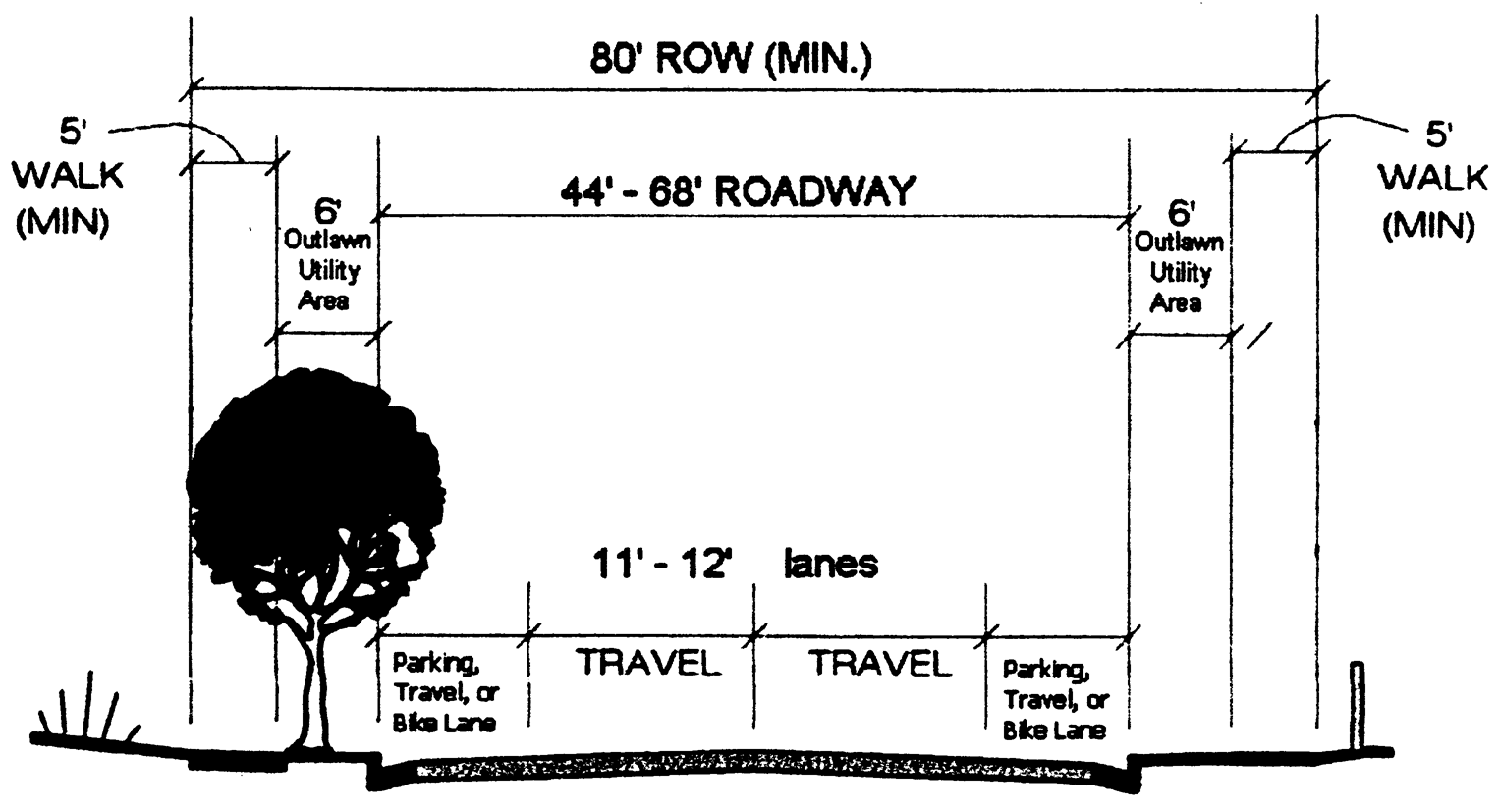
Major Thoroughfare
Roadway width: Maximum 68 feet wide. Roadway width may be reduced if on-street parking is not provided.
Right-of-way width: 80 feet.
Travel lanes: Two to four lanes, 11 feet to 12 feet wide, bike lanes 7 feet to 8 feet.
Left turn lanes: 12 feet wide at intersections, where needed.
Parking: On-street parking may be permitted within designated areas.
Sidewalk: 5 feet (min.) width.
Median: Optional.
Where used: These specifications shall apply to streets classified as principal arterial or minor arterial and serve as a main traffic artery, when the average daily traffic volume is anticipated to be over 20,000 vehicles per day.
Design speed: 35—45 mph.
Curb and gutter: Vertical.
ARTERIAL STREET
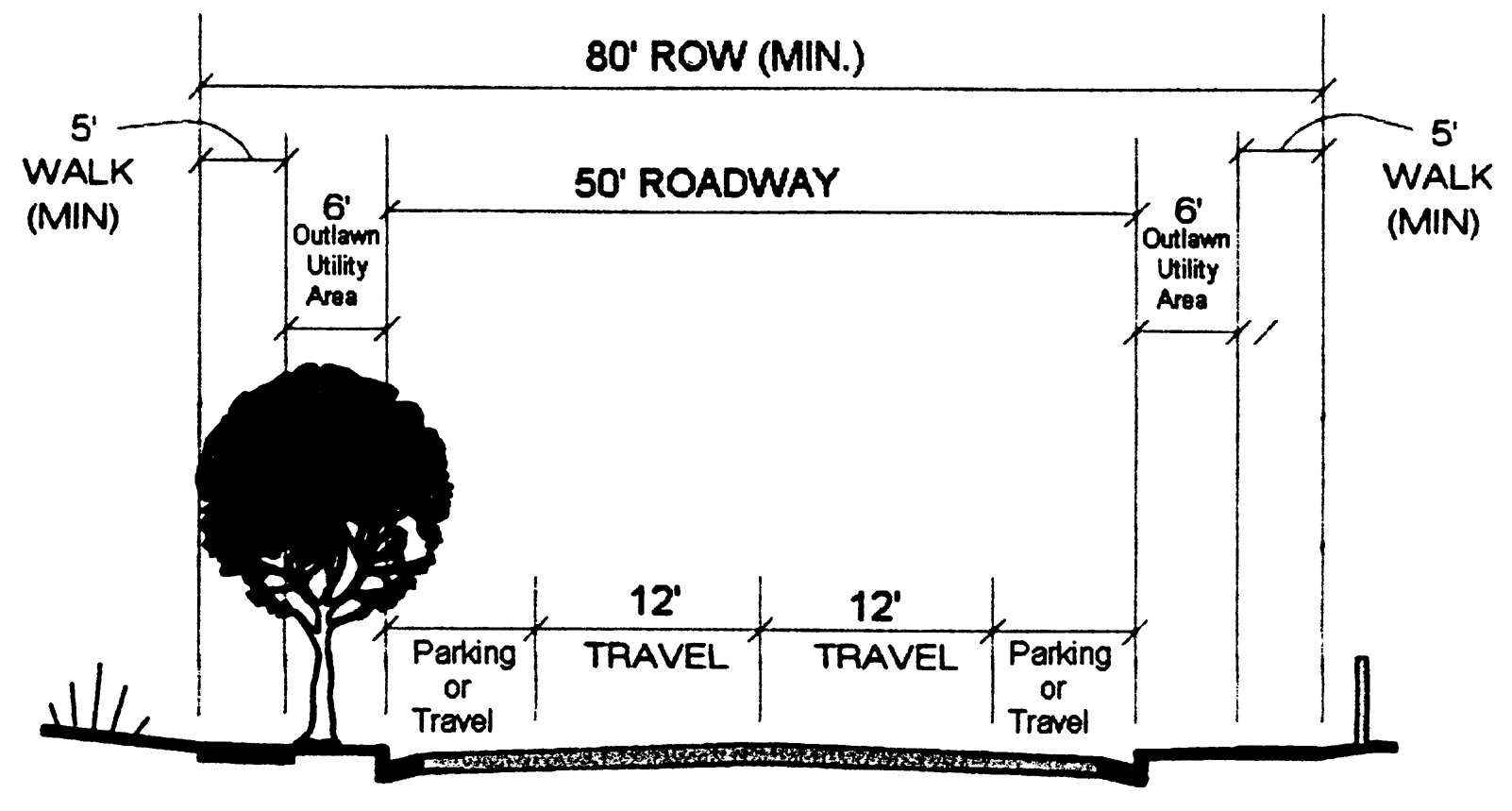
Arterial Street
Roadway width: 50 feet wide (with parking). Roadway width may be reduced if on-street parking is not provided.
Right-of-way width: 80 feet (min.).
Travel lanes: Two to four lanes, 12 feet wide.
Left turn lanes: 12 feet wide at intersections, where needed.
Parking: On-street parking is permitted within designated areas.
Sidewalk: Five feet (min.) width.
Median: Additional right-of-way required for medians.
Where used: These specifications shall apply to streets intended to serve a large volume of traffic for both the immediate area and the region, when the average daily traffic volume on the street is anticipated to be in the range of 10,000 to 20,000 vehicles per day.
Design speed: 25-35 mph.
Curb and gutter: Vertical.
COLLECTOR STREET
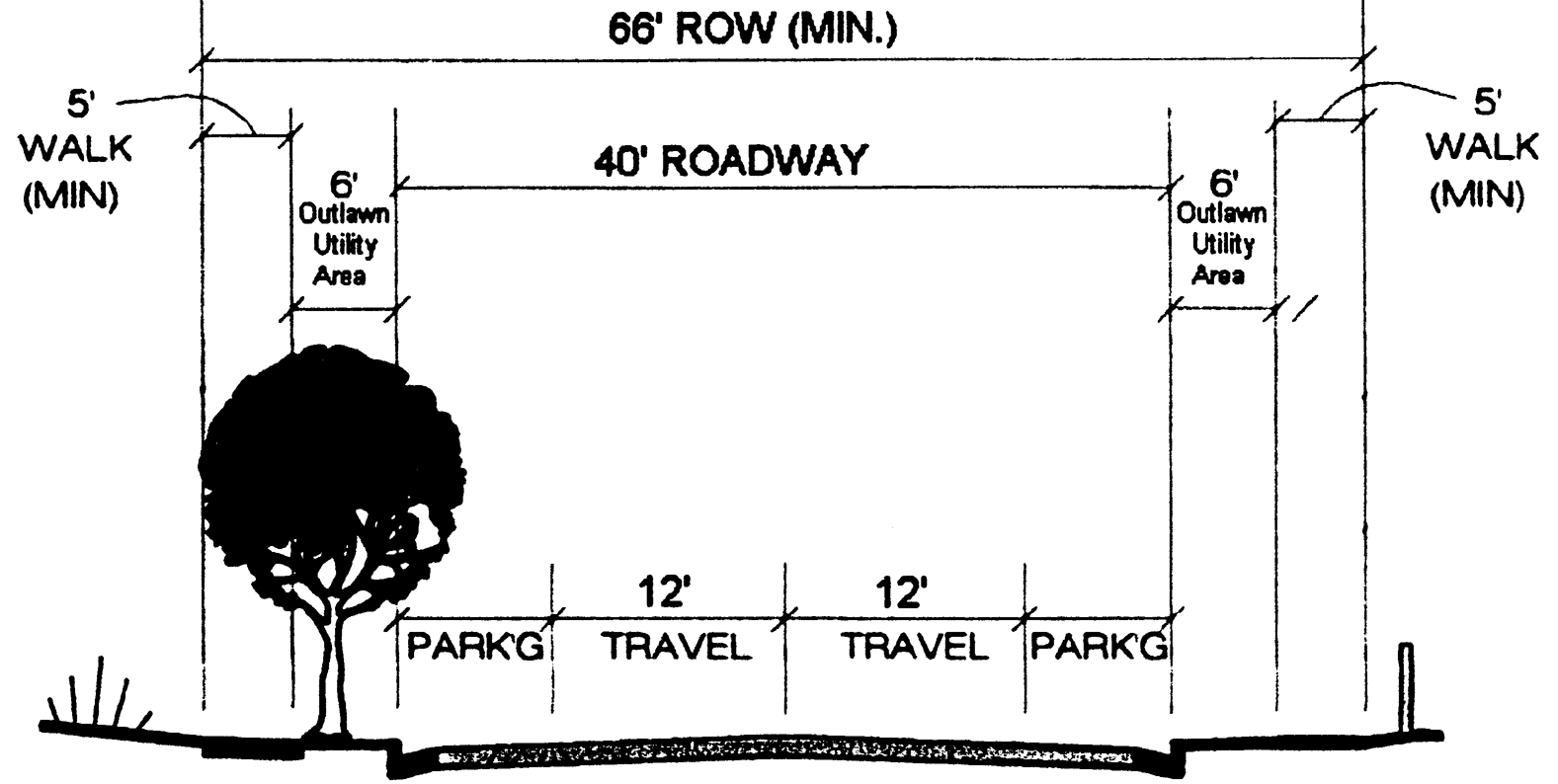
Collector Street
Roadway width: 40 feet wide (with parking). Roadway width may be reduced if on-street parking is not provided.
Right-of-way width: 66 feet (min.).
Travel lanes: Two lanes, 12 feet wide.
Left turn lanes: 12 feet wide at intersections, where needed.
Parking: On-street parking is permitted within designated areas.
Sidewalk: Five feet (min.) width.
Median: Additional right-of-way required for medians.
Where used: These specifications shall apply to streets whose function is to carry traffic between local and arterial roads, when the average daily traffic volume on the street is anticipated to be in the range of 1,000 to 9,999 vehicles per day.
Design speed: 25—35 mph.
Curb and gutter: Vertical.
LOCAL/RESIDENTIAL STREET
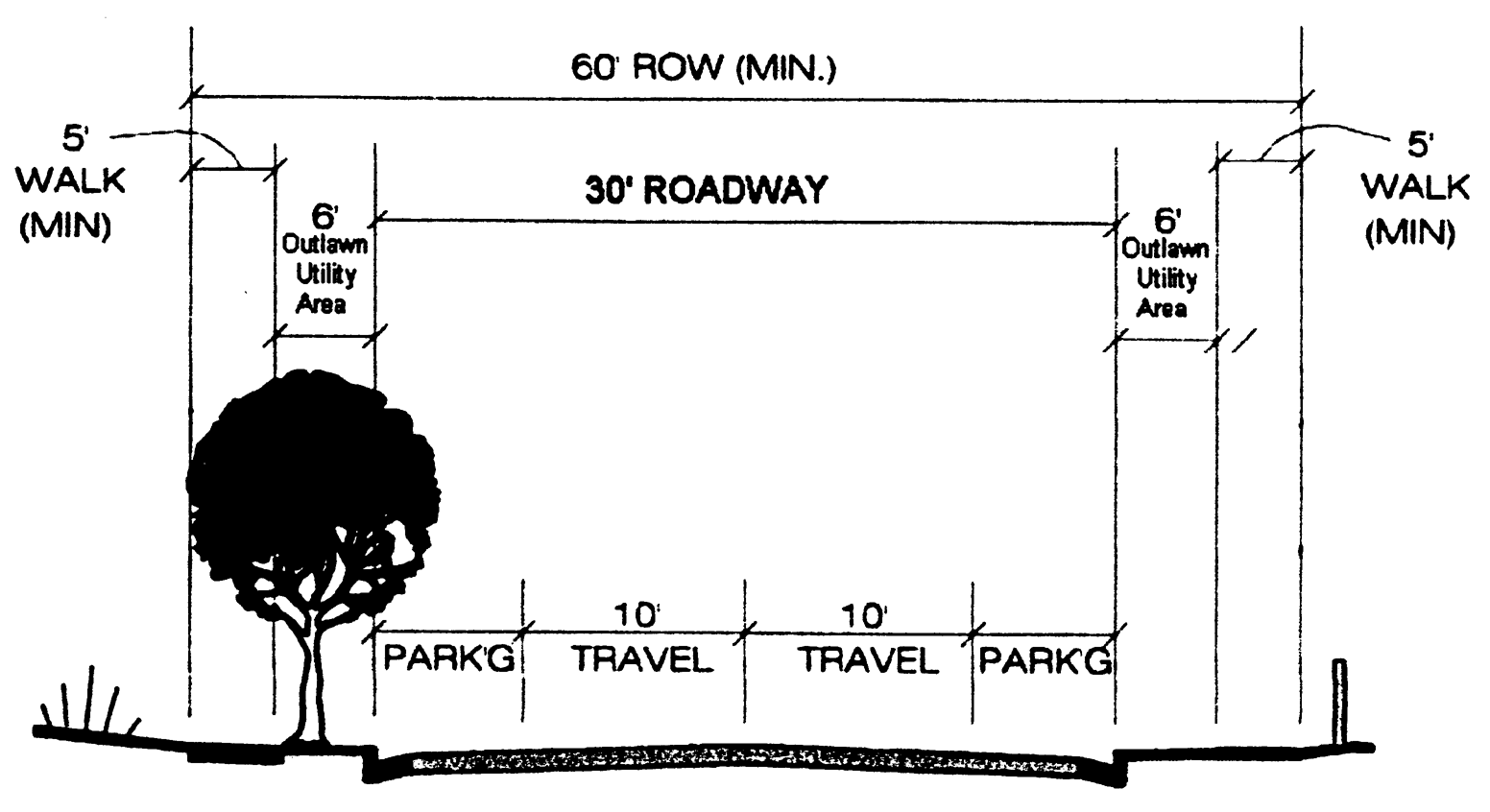
Local/Residential Street
Roadway width: 24 feet wide (with parking on one side) to 30 feet wide (with parking on two sides). Roadway width may be reduced if on-street parking is not provided.
Right-of-way width: 60 feet (min.).
Travel lanes: One or two lanes, 10 feet wide.
Left turn lanes: None.
Parking: Permitted.
Sidewalk: Five feet (min.) width.
Median: Additional right-of-way required for medians.
Where used: These specifications shall apply to streets used in residential areas for local access and circulation, when the average daily traffic volume on the street is anticipated to be in the range of 1 to 999 vehicles per day.
Design speed: 25 mph.
Curb and gutter: Vertical.
(Ord. No. 2005-11, 11-21-05)
Sec. 122-66. - Temporary structures including modular buildings, enclosures, portable toilets, trailers, trucks, or similar vehicles used for nonresidential purposes.
Temporary structures are permitted in all zoning districts, subject to the following regulations:
(1)
Temporary structures housing construction contractor offices, temporary sales offices, concrete batch plants, and similar facilities shall be permitted only when the intended use is by a contractor or builder in conjunction with a construction project.
(2)
The use and location of temporary structures shall be subject to review and approval by planning department staff and the building official.
(3)
Temporary structures shall be removed upon completion of the construction project and as a condition of issuance of a certificate of occupancy for the project.
(4)
The use of temporary structures for sales or storage of material in connection with a commercial or industrial land use is prohibited.
(Ord. No. 2005-11, 11-21-05; Ord. No. 2008-17, § 6, 12-15-08)
Sec. 122-67. - Temporary mobile storage container.
Mobile storage containers are permitted in all zoning districts, subject to the following regulations:
(1)
Mobile storage containers are to be used on a temporary basis and may not be stored for more than 120 days in any 12 month period.
(2)
Mobile storage containers are not to be placed within a required front yard setback or closer than five feet to a side yard setback, unless it is determined by planning department staff that no other option exists and that placement within these areas will not have an adverse affect on neighboring properties.
(Ord. No. 2005-11, 11-21-05)
Sec. 122-68. - Trash dumpsters and other refuse receptacles.
Adequate refuse disposal facilities shall be required in all districts. Dumpsters for multiple-family, and any nonresidential uses shall be located and screened in accordance with the following regulations:
(1)
Location.
a.
Dumpsters shall not be located in a front yard or side-street side yard. Dumpsters shall be located so as to minimize their visibility from adjacent streets and properties, and shall be set back at least ten feet from any side or rear lot line.
b.
Dumpsters shall have an adequate means of vehicular access, shall not encroach on a required parking area, and shall not conflict with entrances to principal buildings.
(2)
Concrete pad. Dumpsters shall be placed on a concrete pad. The concrete pad should extend a minimum of three feet in front of the dumpster enclosure.
(3)
Enclosure.
a.
A dumpster shall be placed within an enclosure consisting of a masonry wall or opaque fence, which is equipped with gate(s) that are of adequate height to screen it from view from adjoining property and streets.
b.
Such screening shall not be required where M-2, general industrial zoned property abuts other M-2 zoned property.
(4)
Bollards. Bollards (concrete filled metal posts) or similar protective devices shall be installed at the gated opening of the enclosure to prevent damage to the screening wall or fence.
(5)
Maintenance. Masonry walls, fences, and gates must be maintained in a serviceable condition and must be repaired as requested by the zoning administrator, so as to provide for continued compliance with this section. Dumpsters must remain within the enclosures at all times.
(Ord. No. 2005-11, 11-21-05)
Sec. 122-69. - Unobstructed sight zone.
No sign, fence, wall, structure, parking or planting shall be erected, established, or maintained on any lot which will obstruct the view of drivers in vehicles approaching an intersection of two streets or the intersection of a street and a driveway, except as provided below. This area shall be known as the unobstructed sight zone.
The unobstructed sight zone shall be determined as follows:
(1)
The area formed at the corner intersection of two public right-of-way lines, or of two drive lanes in commercial districts. The two sides of the triangular area being 15 feet in length measured along abutting public rights-of-way lines or of two drive lanes if applicable, and third side being a line connecting these two sides, or
(2)
The area formed at the corner intersection of a public right-of-way and a driveway or alley, the two sides of the triangular area being ten feet in length measured along the right-of-way line and edge of the driveway or alley, and the third side being a line connecting these two sides.
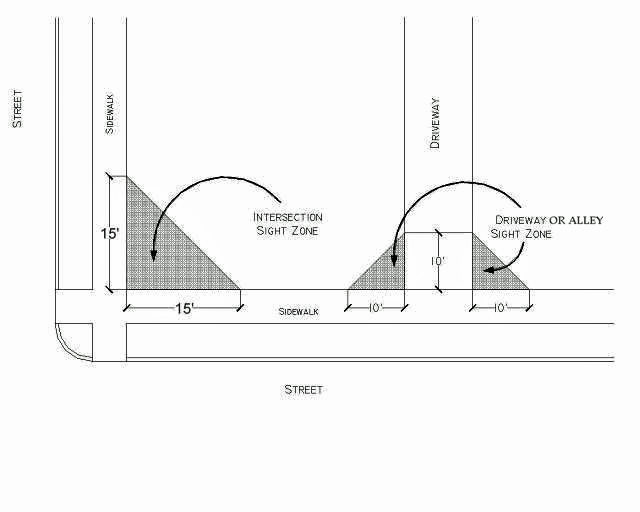
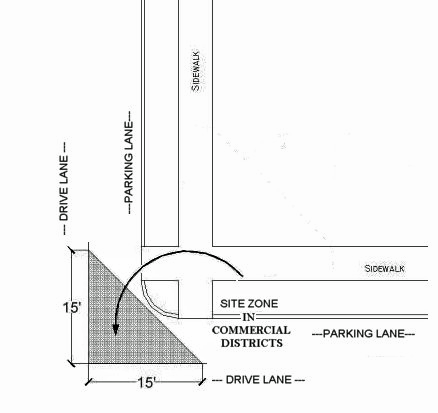
Fences, walls, structures, or plantings located in the unobstructed sight zone shall not be permitted to obstruct cross-visibility and shall not exceed a height of 3 feet above the curb level.
Within the limits of sight zones, fences shall not exceed three feet in height above grade, except that such restriction shall not apply to fences that are at least 50% open (see illustration 3-3).
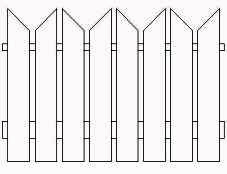
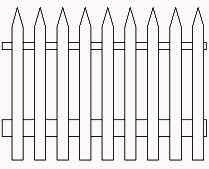
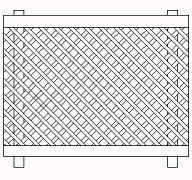
Illustration 3-3. Fences
Trees shall be permitted in the unobstructed sight zone provided that limbs and foliage are trimmed so that they do not extend into the cross-visibility area or otherwise create a traffic hazard. Landscaping, except required grass or ground cover, shall not be located closer than three feet to the edge of any driveway or street pavement within the unobstructed sight zone.
(Ord. No. 2005-11, 11-21-05; Ord. No. 2010-21, § 4, 12-20-10)
Sec. 122-70. - Wireless communication towers and antennas.
(a)
Background.
(1)
The city has received or expects to receive requests to site wireless communication towers (hereinafter referred to as towers) and antennas (hereinafter referred to as antennas) within its corporate boundaries;
(2)
The city finds that it is in the public interest to permit towers, antennas and the collocation of antennas on alternative structures within those boundaries;
(3)
It is the city's intent to permit the location of towers and antennas within its boundaries;
(4)
It is the city's intent to protect and promote the public health, safety or welfare by regulating the location of towers and antennas within its boundaries; and
(5)
The city has determined that the presence of numerous towers, particularly if located within residential and historic preservation zoning districts, would decrease the attractiveness and have an adverse impact on the intent, purpose, character and integrity of such districts.
(b)
Purpose and intent. The provisions of this section are intended to enable the city to accomplish the following:
(1)
Authorize the installation of towers and antennas required for the operation of wireless communication systems within the city's corporate boundaries;
(2)
Protect and promote the public health, safety or welfare of the city and its residents;
(3)
Minimize the total number of towers and antennas throughout the city;
(4)
Provide for the location of towers and antennas in commercial and industrial districts;
(5)
Promote:
a.
The placement of antennas on alternative tower structures;
b.
The joint use of existing tower sites; and
c.
The collocation of antennas on existing towers and alternative tower structures rather than the construction of additional towers;
(6)
Promote the location of towers and antennas in areas where their potential for creating an adverse impact on the city is minimal;
(7)
Promote effective and efficient telecommunications and data communications services;
(8)
Minimize the adverse impacts of technological obsolescence of towers, antennas and operating facilities by requiring the removal of abandoned towers, antennas and facilities; and
(9)
Minimize the negative visual impact of towers, antennas, and buildings housing operating equipment and equipment cabinets, on neighborhoods, community landmarks, and historic sites and buildings, by utilizing careful design, siting, landscaping, screening and innovative camouflaging techniques.
(c)
Applicability.
(1)
Towers and antennas shall not be regulated or permitted as essential services, public utilities, or private utilities. They shall be regulated and permitted pursuant to this section.
(2)
All new wireless communications towers and antennas and the collocation of new antennas on existing towers and alternative structures shall be subject to the provisions of this section.
(3)
Any tower or antenna that is owned and operated by a federally-licensed amateur radio station, or is used exclusively for receive-only data, voice or television reception shall not be subject to the provisions of this section.
(d)
Definitions.
Alternative tower structure: Buildings, water towers, bell steeples, church spires, light poles, elevator bulkheads and similar alternative-design mounting structures that camouflage or conceal the presence of antennas or towers.
Antenna: Any exterior transmitting or receiving device mounted on a tower, building or alternative tower structure and used in communications that radiate or capture electromagnetic waves, digital signals, analog signals, radio frequencies, radar signals, wireless communications signals or other communication signals.
Height: For the purpose of this section, and when referring to a tower or other building or structure upon which an antenna is mounted, the distance measured from finished grade of the lot at the center of the front of the tower or other building or structure to the highest point on the tower or other building or structure, including the base pad and any antenna.
Tower: Any structure that is designed and constructed primarily for the purpose of supporting one or more antennas, including self-supporting lattice towers, guyed lattice towers, or monopole towers, used for the transmission or reception of radio, telephone, cellular or digital telephone, television, microwave or any other form of telecommunication signals. The term includes the structure and any support for the structure.
(e)
Special use approval required. The location of new towers, or new antennas on alternative tower structures, shall be permitted subject to special use approval in accordance with the provisions of article XVI, except as provided in section 122-70(h).
(f)
Administrative review. Collocating new antennas on existing towers or additional antennas on existing alternative tower structures shall be permitted subject to administrative review by planning department staff and subject to the standards for collocation in accordance with the provision of this section.
(g)
Location.
(1)
New towers are permitted as a special, use in the C-2B, M-1, and M-2 districts.
(2)
The collocation of wireless communication antennas on alternative tower structures is permitted in all districts subject to special approval in accordance with the provisions of article XVI.
(h)
General regulations. In addition to the other provisions of this article and the standards applicable to the review and approval of special uses under section 122-357, all wireless communication facilities regulated by this article shall be subject to the following regulations:
(1)
Wireless communication towers, antennas, accessory buildings and cabinets housing operating equipment shall be designed to minimize distraction, reduce visibility, maximize aesthetic appearance, and ensure compatibility with surrounding buildings and uses.
(2)
New towers shall not exceed 120 feet in height. Existing towers shall not be modified so as to exceed 120 feet in height.
(3)
All new towers shall be designed and constructed to accommodate the collocation of additional antennas.
(4)
Buildings and cabinets housing operating equipment shall not exceed 12 feet in height.
(5)
New towers, as well as buildings and cabinets housing operating equipment, shall be set back 100 feet from the lot line that separates the lot on which the facility is located from any lot in a residential or waterfront zoning district. In all other cases towers, buildings and cabinets shall comply with the setback regulations for the zoning district in which they area located.
(6)
Driveways for service vehicles shall be provided and paved in accordance with the regulations of subsection 122-381(b)(5).
(7)
Wireless communication towers may be located as individual uses on individual lots, or as an additional use on a leased portion of a lot provided that compliance with the provisions of this article can be attained. The division of a lot for the purpose of siting a tower is permitted subject to the lot size, lot width and other applicable zoning district regulations.
(8)
Roof-mounted buildings and cabinets housing operating equipment shall be designed or screened so as to be architecturally compatible with the building on which they are located.
(9)
Advertising signs shall not be allowed on an antennas, towers or on the exterior of buildings or cabinets housing operating equipment or on fences enclosing antenna or tower facilities.
(i)
Removal of abandoned and obsolete wireless communication facilities. Wireless communication facilities shall be removed by their owners within six months of the date on which such facilities are no longer used or which become obsolete for the purpose or purposes for which they were granted special use.
(Ord. No. 2005-11, 11-21-05; Ord. No. 2008-17, § 7, 12-15-08)
Sec. 122-71. - Yard and bulk regulations.
(a)
Minimum lot size. Every lot created subsequent to the effective date of this chapter shall comply with the minimum lot area and width regulations of applicable zoning district regulations.
(b)
Yard and setback regulations. No yards in existence on the effective date of this chapter, shall subsequently be reduced below, or further reduced if already less than, the minimum yard regulations of this chapter.
(c)
Front lot lines on through lots. On through lots both street rights-of-way shall be considered front lot lines and front yard setbacks shall apply.
(d)
Number of principal uses per lot. Only one principal building shall be placed on a lot in R-1 or R-2, single-family residential zoning districts. In a single-family site condominium project, only one principal building shall be placed on each condominium lot.
(e)
Projections into required yards.
(1)
In any zoning district, fire escapes, fire towers, chimneys, platforms, balconies, boiler flues, and similar projections shall be considered part of the building, subject to setback regulations for the district in which the building is located.
(2)
Bay windows, window sills, belt courses, cornices, eaves, overhanging eaves, and other architectural features may project into a required yard not more than two inches for each one foot of width of such yard.
(f)
Air conditioning equipment. In residential zoning districts, permanent air conditioning equipment shall not be permitted in a required front yard.
(Ord. No. 2005-11, 11-21-05)
Sec. 122-72. - Use of legal nonconforming lots of record.
A legal nonconforming lot of record, may be used for any use allowed in the zoning district in which such lot is located subject to compliance with setbacks, lot coverage and other provisions applicable to the zoning district.
(Ord. No. 2005-11, 11-21-05)
Sec. 122-73. - Uses prohibited by law.
Any business or organization in violation of local, state or federal law is prohibited from locating or operating within the corporate limits of the city.
(Ord. No. 2010-21, § 5, 12-20-10)
Sec. 122-74. - Recreational marihuana facilities.
(a)
The following types of marihuana facilities, pursuant to the Michigan Regulation and Taxation of Marihuana Act, MCL 333.27951 et seq., (hereafter the "Act" or "MRTMA"), shall be allowed as permitted uses only in the following zoning districts:
(1)
Marihuana grower, which is a "person" (used throughout this ordinance as that term is defined in the MRTMA) licensed to cultivate marihuana and sell or otherwise transfer marihuana to marihuana establishments, shall be a permitted use in the M-1, light industrial district, and the M-2, general industrial district;
(2)
Marihuana microbusiness, which is a person licensed to cultivate not more than 150 marihuana plants; process and package marihuana; and sell or otherwise transfer marihuana to individuals who are 21 years of age or older or to a marihuana safety compliance facility, but not to other marihuana establishments, shall be a permitted use in the C-1, neighborhood business district, C-2-A, general business district, C-2-B, highway business district, C-3, central business district, M-1, light industrial district, and M-2, general industrial district;
(3)
Marihuana processor, which is a person licensed to obtain marihuana from marihuana establishments; process and package marihuana; and sell or otherwise transfer marihuana to marihuana establishments, shall be a permitted use in the C-1, neighborhood district, C-2-A, general business district, C-2-B, highway business district, C-3, central business district, M-1, light industrial district and M-2, general industrial district;
(4)
Marihuana retailer, which is a person licensed to obtain marihuana from marihuana establishments and to sell or otherwise transfer marihuana to marihuana establishments and to individuals who are 21 years of age or older, shall be a permitted use in the C-1, neighborhood district, C-2-A, general business district, C-2-B, highway business district, C-3, central business district, M-1, light industrial business district, and M-2, general industrial district;
(5)
Marihuana secure transporter, which is a person licensed to obtain marihuana from marihuana establishments in order to transport marihuana to marihuana establishments, shall be a permitted use in the C-1, neighborhood business district, C-2-A, general business district, C-2-B, highway business district, C-3, central business district, M-1, light industrial district, and M-2, general industrial district;
(6)
Marihuana safety compliance facility, which is a person licensed to test marihuana, including certification for potency and the presence of contaminants, shall be a permitted use in the C-1, neighborhood business district, C-2-A, general business district, C-2-B, highway business district, C-3, central business district, M-1, light industrial district, and M-2, general industrial district.
(7)
Designated consumption establishment is a commercial space that is licensed and authorized to permit adults 21 years of age and older to consume marihuana products at the location indicated on the state license shall be a permitted use in the C-1, neighborhood business district, C-2-A, general business district, C-2-B, highway business district, C-3, central business district.
(8)
Class A marihuana microbusiness license authorizes the following: cultivate not more than 300 plants; package marihuana; purchase marihuana concentrate and marihuana-infused products from a licensed marihuana processor; sell or transfer marihuana and marihuana products to an individual 21 years of age or older only; transfer marihuana to a marihuana safety compliance facility for testing shall be a permitted use in the C-1, neighborhood business district, C-2-A, general business district, C-2-B, highway business district, C-3, central business district, M-1, light industrial district, and M-2, general industrial district.
(b)
The following types of marihuana facilities, pursuant to the Michigan Regulation and Taxation of Marihuana Act, MCL 333.27951 et seq. (hereinafter "MRTMA"), shall be allowed as permitted uses only in the following zoning districts:
(1)
Marihuana grower, which is a "person" licensed to cultivate marihuana and sell or otherwise transfer marihuana to marihuana establishments, shall be a permitted use in the M-1, light industrial district, and the M-2, general industrial district;
(2)
Marihuana microbusiness, which is a person licensed to cultivate not more than 150 marihuana plants; process and package marihuana; and sell or otherwise transfer marihuana to individuals who are 21 years of age or older or to a marihuana safety compliance facility, but not to other marihuana establishments, shall be a permitted use in the C-1, neighborhood business district, C-2-A, general business district, C-2-B, highway business district, C-3, central business district, M-1, light industrial district, and M-2, general industrial district;
(3)
Marihuana processor, which is a person licensed to obtain marihuana from marihuana establishments; process and package marihuana; and sell or otherwise transfer marihuana to marihuana establishments, shall be a permitted use in the M-1, light industrial district and M-2, general industrial district;
(4)
Marihuana retailer, which is a person licensed to obtain marihuana from marihuana establishments and to sell or otherwise transfer marihuana to marihuana establishments and to individuals who are 21 years of age or older, shall be a permitted use in the C-1, neighborhood district, C-2-A, general business district, C-2-B, highway business district, C-3, central business district, M-1, light industrial business district, and M-2, general industrial district;
(5)
Marihuana secure transporter, which is a person licensed to obtain marihuana from marihuana establishments in order to transport marihuana to marihuana establishments, shall be a permitted use in the C-1, neighborhood business district, C-2-A, general business district, C-2-B, highway business district, C-3, central business district, M-1, light industrial district, and M-2, general industrial district;
(6)
Marihuana safety compliance facility, which is a person licensed to test marihuana, including certification for potency and the presence of contaminants, shall be a permitted use in the C-1, neighborhood business district, C-2-A, general business district, C-2-B, highway business district, C-3, central business district, M-1, light industrial district, and M-2, general industrial district.
(c)
Separation requirements from property line to property line: notwithstanding the provisions of subsections (a) and (b) above, none of the persons licensed as set forth in (a)(1)—(8) or (b)(1)—(6) shall be allowed to locate or establish a licensed business within the following boundaries:
(1)
At least 100 feet from any church property or religious institution;
(2)
At least 500 feet from any pre-existing public or private school providing education in any grades pre-K through 12;
(3)
At least 50 feet from a court facility or public safety office, including law enforcement centers and fire stations. This provision is not applicable to secure transporter or safety compliance facilities;
(4)
At least 100 feet from any public park as identified in the city's parks and recreation plan. For the purposes of this chapter, the Bay City Railtrail/Riverwalk non-motorized pathway is exempt from this requirement.
(Ord. No. 2019-11-B, § 1, 7-1-19; Ord. No. 2023-20, § 1, 6-19-23)

