
Bay City City Zoning Code
ARTICLE XXVIII
ACCESS MANAGEMENT—EUCLID AVENUE
Sec. 122-631.- Access management—Euclid Avenue, intent and purpose.
A primary function of a state highway such as Euclid Avenue is to move traffic through the corridor and to points beyond. Euclid Avenue also has a secondary, but important, function to provide access to adjacent and nearby land uses.
The need for access management regulations is based on safety and traffic operation issues currently being experienced along Euclid Avenue. Continued development along the corridor will increase traffic volumes and without management of access points introduce additional conflict points which will further erode traffic operations and increase the potential for crashes. Numerous published studies and reports document the relationship between systems and traffic operations and safety. Those reports and experiences of other communities demonstrate standards on the number and placement of access points (driveways and side street intersections) that can preserve the capacity of the roadway and reduce the potential for and/or severity of crashes. The standards herein are based on recommendations published by various national and state agencies that were refined during preparation of the Euclid Avenue corridor access management plan.
Among the specific purposes of this article are to:
(1)
Preserve the capacity of Euclid Avenue by regulating the number, location, and design of access points, and requiring alternate means of access through shared driveways, service drives, and access off cross streets in certain locations.
(2)
Encourage efficient flow of traffic by minimizing the disruption and conflicts between through traffic and turning movements.
(3)
Improve safety and reduce the potential for crashes.
(4)
Implement the recommendations of the Euclid Avenue corridor access management plan.
(5)
Address situations where existing development within the corridor area does not conform with the standards of this article.
(6)
Avoid the need for unnecessary and costly reconstruction which disrupts business operations and traffic flow.
(7)
Improve safety for pedestrians and other non-motorized travelers through reducing the number of conflict points at access crossings.
(8)
Establish a uniform process to ensure fair and rational or reasonable application.
(9)
Provide landowners with reasonable access.
(10)
Promote a more coordinated development review process for the city with the Michigan Department of Transportation (MDOT).
(Ord. No. 2015-15, § 1, 11-16-15)
Sec. 122-632. - Applicability.
The standards of this section shall apply to all lands with frontage along Euclid Avenue. The regulations herein apply in addition to, and simultaneously with, the other applicable regulations of the zoning ordinance. Permitted and special land uses along the corridor shall be as regulated in the applicable zoning district (as designated on the zoning map), and shall meet all the applicable requirements for that district, with the following additional provisions:
(1)
The standards of this article do not apply to essential service facilities.
(2)
Access spacing from intersections and other driveways shall meet the standards within this article and the guidelines of the applicable road agency, currently the Michigan Department of Transportation (MDOT).
(3)
Any building or off-street parking area that is constructed or enlarged by 3,000 square feet or more shall meet the regulations and shall be maintained consistent with the standards herein.
(4)
Any land division or subdivision or site condominium project shall comply with the access spacing standards herein.
(5)
Any proposal to change to a use that may generate more traffic on a site that does not meet the access standards of this article shall require a site plan to be submitted so that the MDOT can review the current access permit and determine if any changes will be required.
(6)
The standards herein were developed collaboratively between the city and the MDOT. These standards apply in addition to the access design standards of the city and the MDOT. Where conflicts occur, the more restrictive regulations shall apply.
(Ord. No. 2015-15, § 1, 11-16-15)
Sec. 122-633. - Additional submittal information.
(a)
In addition to the submittal information required for site plan review in article XV, the following shall be provided with any application for site plan or special approval use review. The information listed in items (1)—(4) below shall be required to be reviewed by the planning department prior to approval of a land division.
(1)
Identify on site plans the following access points:
a.
The nearest access points on either side of the Euclid Avenue frontage,
b.
Access points on the frontage on the opposite side of Euclid Avenue and the nearest on either side of that frontage, and
c.
In the case of a corner property, (a) and (b) should be replicated for the adjoining street.
(2)
The applicant shall submit evidence indicating that the sight distance requirements of the MDOT are met.
(3)
Dimensions shall be provided between proposed and existing access points.
(4)
Where shared access is proposed as a method of compliance with the access spacing standards, a shared access and maintenance agreement shall be recorded with the county register of deeds. Any access shall be at least 24 feet wide and constructed to the edge of the property. As an alternative, an applicant can provide an easement with the connection to be constructed in the future concurrent with development or redevelopment of an adjacent site.
(5)
Dimensions shall be provided for driveways (width, radii, throat length, length of any deceleration lanes or tapers, pavement markings, and signs) and all curb radii within the site.
(6)
The site plan shall illustrate the route and dimensioned turning movements of any expected truck traffic, tankers, delivery vehicles, waste receptacle vehicles, and similar vehicles. The plan should confirm that routing the vehicles will not disrupt operations at the access points nor impede maneuvering or parking within the site.
(7)
The submittal of a traffic impact study may be required for any special land use that would be expected to generate 100 or more directional vehicle trips during any peak hour, or 1,000 or more vehicle trips daily, or where modifications from the generally applicable access spacing standards are requested. The traffic impact study shall be prepared by a firm or individual that is a member of the Institute of Transportation Engineers with demonstrated experience in production of such studies. The methodology and analysis of the study shall be in accordance with accepted principles as described in the handbook "Evaluating Traffic Impact Studies, a Recommended Practice for Michigan," developed by the MDOT and other Michigan transportation agencies. The MDOT may require calculations or micro-scale modeling to illustrate future operations at the access points and nearby intersections and/or to evaluate various access alternatives.
(8)
The applicant shall provide evidence that a proposed site plan has been submitted to and received by the MDOT for review and comment. Any correspondence from the MDOT shall be considered during the site plan review process. The MDOT shall approve the number and location of access points prior to final approval of the proposed site plan. Approval of a site plan does not negate the responsibility of an applicant to subsequently secure access permits from the MDOT.
(Ord. No. 2015-15, § 1, 11-16-15)
Sec. 122-634. - Access management standards.
(a)
Access management standards. Access points shall meet the following standards. The spacing standards specified below shall be required to be measured from all other roads and driveways. If there is a change in use from residential to a non-residential use, the planning commission shall require access to be brought into conformance with the requirements of this section.
(1)
Each lot shall be permitted reasonable access. Reasonable access may consist of a shared access with an adjacent use or access via a service drive, frontage road, or side street.
(2)
The access point location shall be in accordance with the standards of this section and shall provide the opportunity for shared access with adjoining lots where applicable and practical as determined by the city. Each lot developed under this article may be required to grant shared access easements to adjoining lots to allow for future shared access. Where a proposed parking lot is located adjacent to the parking lot of a similar use, there shall be a vehicular connection where feasible, as determined by the MDOT and the planning commission.
(3)
For building or parking lot expansions in excess of 3,000 feet, or changes in use to a more intensive use, the planning commission shall determine the extent of upgrades to bring the site into greater compliance with the access standards of this district. In making its decision, the planning commission shall consider the existing and projected traffic conditions, any sight distance limitations, site topography or natural features, impacts on internal site circulation, and any recommendations from the MDOT. Required improvements may include removal, rearrangement, or redesign of site access points.
(4)
In cases where an individual driveway is permitted, an additional driveway may be permitted by the planning commission upon finding that one of the conditions below exists. The additional driveway may be required to be along a side street or a shared access with an adjacent site.
a.
The site has adequate frontage to meet the spacing standards between access points listed below, and the additional access will not prevent adjacent lands from complying with the access spacing standards when such lands develop or redevelop in the future.
b.
An individual driveway or driveways maybe permitted where the standards of this article are met, provided such driveway(s) may be required to be placed to facilitate shared access by adjacent lots.
c.
A traffic impact study, prepared in accordance with accepted practices as described in section 122-633, demonstrates the site will generate over 300 trips in a peak hour or 3,000 trips daily, or 400 and 4,000, respectively, if the site has access to a traffic signal, and the traffic study demonstrates the additional driveway will provide improved conditions for the motoring public and will not create negative impacts on through traffic flow.
d.
The MDOT staff has reviewed the request and concur.
(5)
In order to comply with the accessibility requirements of the Michigan Land Division Act, land divisions shall not be permitted that may prevent compliance with the access location standards of this article.
(6)
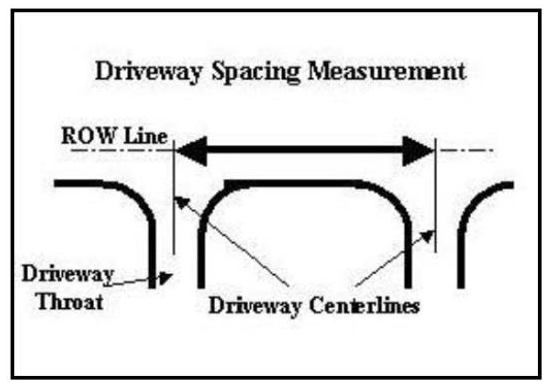
Access points shall provide the following spacing from other access points along the same side of the public street (measured from centerline to centerline as shown on the figure), based on the posted speed limit along the public street segment.
TABLE 1
MINIMUM DRIVEWAY SPACING SAME SIDE OF ROAD
Unless greater spacing is required by the MDOT or required to meet other standards herein.
(7)
Where the subject site adjoins land that may be developed or redeveloped in the future, including adjacent lands or potential out lots, the access shall be located to ensure the adjacent site(s) can also meet the access location standards in the future.
(8)
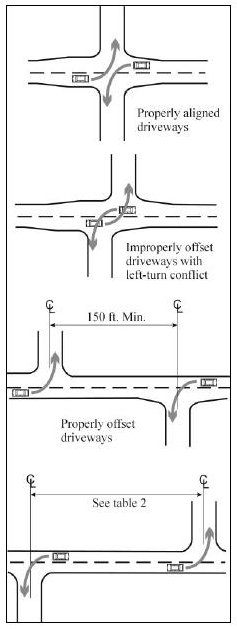
Access points shall be aligned with driveways on the opposite side of the street or offset the distance indicated in the following table, measured centerline to centerline. The planning commission may reduce this to not less than 150 feet where the offsets are aligned to not create left-turn conflicts.
TABLE 2
MINIMUM OPPOSING DRIVEWAY OFFSET
(9)
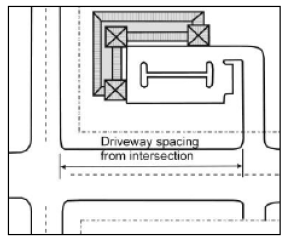
Minimum spacing of access points from intersections shall be in accordance with the table below (measured from pavement edge to pavement edge as shown on the figure):
TABLE 3
MINIMUM DRIVEWAY SPACING FROM INTERSECTION*
*Unless greater spacing is required by the MDOT or required to meet other standards herein.
**Greater spacing may be required based upon the posted speed of the road and the spacing distances required by table 1.
(10)
Where direct access consistent with the various standards above cannot be achieved, access shall be via a shared driveway or service drive or side street. In cases where access is from the side street, the access point must be located as far from an intersection as feasible.
(b)
Sight distance. Driveways shall be located to provide safe sight distance as determined by the MDOT.
(c)
Public facilities in right-of-way. No driveway shall interfere with municipal facilities such as street light or traffic signal poles, signs, fire hydrants, cross walks, bus loading zones, utility poles, fire alarm supports, drainage structures, or other necessary street structures.
(d)
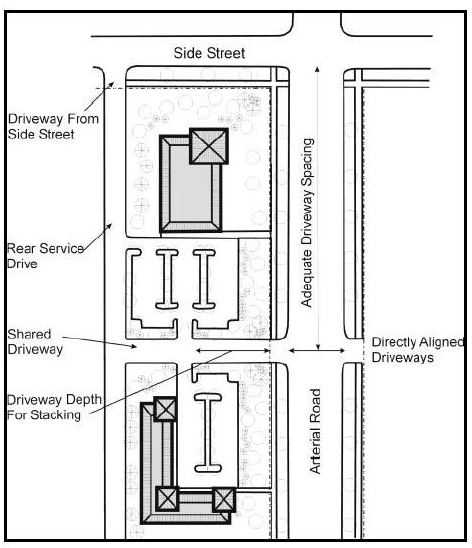
Shared commercial driveways, frontage roads, and service drives. Shared commercial driveways, frontage roads, or rear service drives connecting two or more lots or uses shall be required in instances where the planning commission and the MDOT determine that reducing the number of access points will have a beneficial impact on traffic operations and safety. In particular, service drives shall be required where recommended in a sub-area master plan; near existing traffic signals or near locations having potential for future signalization; where service drives may minimize the number of driveways; and along segments with a relatively high number of crashes or limited sight distance. Frontage roads or service drives shall be constructed in accordance with the following standards:
(1)
Service roads shall generally be parallel or perpendicular to the front property line and may be located either in front of, adjacent to, or behind, principal buildings. In considering the most appropriate alignment for a service road, the planning commission and the MDOT shall consider the setbacks of existing buildings and anticipated traffic flow for the site.
(2)
The service road shall be within an access easement permitting traffic circulation between properties. This easement shall be recorded with the county register of deeds. The required width shall remain free and clear of obstructions and parking, unless otherwise approved by the planning commission. The easement shall set forth each owner's responsibility for maintenance of the easement and service drive.
(3)
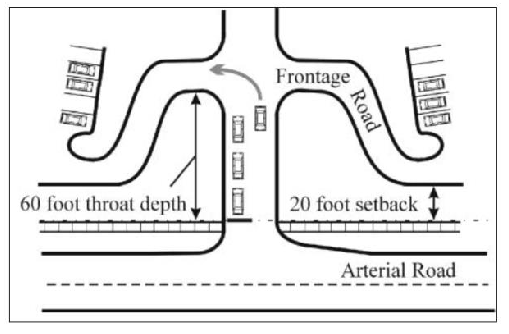
Service drives and frontage roads shall be set back as far as reasonably possible from the intersection of the access driveway with the public street. A minimum of 20 feet shall be maintained between the public street right-of-way and the pavement of the frontage road, with a minimum 60 feet of throat depth provided at the access point, measured between the public street right-of-way and the pavement of the parallel section of the frontage road.
(4)
Service roads shall have a minimum pavement width of 24 feet and be constructed of a base, pavement and curb with gutter that is in accordance with public street standards. The planning commission may modify these standards based upon site conditions, anticipated traffic volumes and types of truck traffic.
(5)
The service road is intended to be used exclusively for circulation. The planning commission may require the posting of "no parking" signs along the service road. One-way roads or two way roads constructed with additional width for parallel parking may be allowed on the side of the road closest to the building if it can be demonstrated through site plan review that parking along the service road will not significantly affect the capacity, safety or operation of the service road.
(6)
The site plan shall indicate the proposed elevation of the service road at the property line so that the city can maintain a record of all service road elevations and their grades can be coordinated with future developments.
(7)
The alignment of the service drive can be refined to meet the needs of the site and anticipated traffic conditions, provided the resulting terminus allows the drive to be extended through the adjacent site(s). This may require use of aerial photographs, property line maps, topographic information and other supporting documentation.
(8)
In cases where a shared access facility is recommended, but is not yet available, temporary direct access may be permitted, provided the plan is designed to accommodate the future service drive, and a written agreement is submitted that the temporary access will be removed by the applicant, when the alternative access system becomes available.
(9)
With the redevelopment of existing sites where it is not possible to develop separate service drives, the planning commission and the MDOT may instead require a drive connecting parking lots.
(Ord. No. 2015-15, § 1, 11-16-15)
Sec. 122-635. - Modification of access standards.
(a)
Given the variation in existing physical conditions along the corridors, modifications to the spacing and other standards above may be permitted by the planning commission as part of the site plan review process. The planning commission shall consider all of the following conditions and shall prepare a finding of fact for each:
(1)
Full compliance with the standards is not practical due to physical features on the property or adjacent parcels.
(2)
The MDOT staff support the proposed access design.
(3)
The proposed modification is consistent with the intent of the Euclid Avenue corridor plan's recommendations and complies to a reasonable extent with the standards of this article.
(4)
The applicant shall demonstrate with dimensioned drawings that such modification shall not create non-compliant access to adjacent lands that may develop or redevelop in the future.
(5)
Any necessary improvements at the access point, in the right-of-way, will be made to improve overall traffic operations prior to the project completion or occupancy of the first building.
(6)
Such modification shall be demonstrated to be the minimum necessary to provide reasonable access, will not impair public safety and is not simply for convenience of the development.
(b)
The decision of the planning commission may be appealed to the zoning board of appeals, as provided in article XXIII of this chapter. In consideration of appeal, the zoning board of appeals shall apply the above standards.
(Ord. No. 2015-15, § 1, 11-16-15)

