
Bay Village City Zoning Code
Title Eleven
ZONING APARTMENT AND BUSINESS DISTRICTS
Chapter 1171 - ADMINISTRATIVE OFFICE AND APARTMENT HOUSE DISTRICT[25]
Cross reference— Approval of structures—see P. & Z. Ch. 1177. Signs, yard and height regulations—see P. & Z. Ch. 1179 et seq. Illumination of off-street parking—see P. & Z. 1191.10.
Chapter 1173 - RETAIL BUSINESS DISTRICT[26]
Cross reference— Approval of structures—see P. & Z. Ch. 1177. Signs, yard and height regulations—see P. & Z. Ch. 1179 et seq. Illumination of off-street parking—see P. & Z. 1191.10. Conduct of business operations—see BLDG. Ch. 1358.
Chapter 1175 - COMMERCIAL BUSINESS DISTRICT[27]
Editor's note— The provisions of this chapter were approved by the electors at an election on May 5, 1970.
Cross reference— Approval of structures—see P. & Z. Ch. 1177. Signs, yard and height limitations—see P. & Z. Ch. 1179 et seq. Illumination of off-street parking—see P. & Z. 1191.10. Conduct of business operations—see BLDG. Ch. 1358.
Chapter 1179 - SIGN CONTROL[28]
Editor's note— Ord. No. 21-110, § 1, adopted Dec. 20, 2021, amended Ch. 1179 in its entirety to read as herein set out. Former Ch. 1179, §§ 1179.01—1179.11, 1179.99, pertained to similar subject matter, and derived from Ord. 75-43, Passed 6-16-75; Ord. 76-63, Passed 6-7-76.
Chapter 1181 - YARDS, APARTMENT AND BUSINESS DISTRICTS[29]
Cross reference— Yards in residence areas—see P. & Z. Ch. 1153.
Chapter 1183 - HEIGHT LIMITATIONS, APARTMENT AND BUSINESS DISTRICTS[30]
Cross reference— Height regulations of buildings—see Ohio R. C. 713.08.
1171.01 - Permitted uses.
In an Administrative Office and Apartment House District buildings, structures and land shall be used, and buildings erected, altered, enlarged, moved or maintained in whole or in part only for the uses set forth on the following schedules and regulations:
(a)
Apartment houses.
(b)
Administrative, sales, professional offices and financial institutions.
(c)
Assembly rooms, provided the activity is conducted within a building which is sufficiently soundproofed to confine the noise to the premises.
(Ord. 61-20. Passed 4-3-61; Ord. 61-196. Passed 11-20-61.)
1173.01 - Permitted uses.
In a Retail Business District, buildings, structures and land shall be used, and buildings erected, altered, enlarged, moved or maintained in whole or in part only for the uses set forth in the following schedules and regulations:
(a)
Administrative, sales, professional offices and financial institutions.
(b)
Assembly rooms, provided the activity is conducted within a building which is sufficiently soundproofed to confine the noise to the premises.
(c)
Retail stores and services dealing directly with consumers, conducted wholly within enclosed buildings except filling stations as noted in subsection (10) below and devoted primarily to supplying new products and providing services to the following limited extent:
(1)
The sale of all foods.
(2)
The sale of malt beverages or wine by package for consumption off the premises where sold.
(3)
Retail and/or wholesale sale of spirituous liquor by a State operated Liquor Store.
(4)
The sale of drugs, gifts, flowers, periodicals, music, radio and television equipment and tobacco.
(5)
The sale of clothing and accessories, shoes, sporting goods, notions, department and variety stores.
(6)
The sale of hardware, household appliances, furniture, floor and wall covering, paint and garden supplies.
(7)
The sale and consumption of soft drinks, juices, ice cream, the operation of restaurants.
(8)
Personal services, such as beauty parlors and barber shops, dry cleaning agencies, tailoring shops, laundry agencies, shoe and hat repair shops.
(9)
Amusement services, such as assembly halls, bowling alleys, provided the uses are conducted within a building which is sufficiently sound insulated to confine the noise to the premises.
(10)
Automotive service stations limited to the retail sale of motor fuels and oils, retail sale and installation of automotive accessories, minor repairs, provided that all lubrication and minor repair services are performed wholly within an enclosed building. Only the parking of customers' cars and sales of gasoline and oil may be permitted in an open area. (Ord. 69-158. Passed 1-26-70.)
(d)
Attached housing that complies with Chapter 1158. The minimum development site for Attached Housing in the Retail Business District shall be one acre. The density of development shall not exceed eight units per acre.
(Ord. 10-85. Passed 7-19-10.)
1173.02 - Similar main uses permitted.
Any other retail store, shop or service shall be permitted if it is determined by the Board of Zoning Appeals to be similar to the uses listed in C. O. 1173.01(B) in terms of the following standards.
(1)
Such use is not listed in any other classification of permitted buildings or uses, and
(2)
Such a use is more appropriate to and conforms to the basic characteristics of this classification; and
(3)
Such a use does not create dangers to health and safety, and does not create offensive noise, vibration, dust, heat, smoke, odor, glare or other objectionable influences to an extent greater than normally resulting from other uses listed in the classification to which it is to be added; and
(4)
Such a use does not create traffic to a greater extent than the other uses listed in the classification to which it is to be added.
(Ord. 57-60. Passed 4-16-57.)
1173.03 - Accessory buildings or uses.
(1)
Accessory off street parking facilities shall be required as set forth in Chapter 1191.
(2)
Any accessory uses such as storage of goods and processing operations customarily incident to the conduct of a retail business or service permitted as a main use, providing that such use does not create danger to health, safety and welfare of the citizens of the City, and does not create offensive noise, vibration, dust, heat, smoke, odor, glare or other objectionable influences to an extent greater than normally resulting from the main use.
(Ord. 57-60. Passed 4-16-57.)
1173.04 - Prohibitions.
(a)
The rebuilding, overhauling or dismantling of a motor vehicle or the storage of motor or body parts in an open yard is prohibited, nor shall anyone store, place or allow to remain a motor vehicle in an inoperative condition, or unfit for further use as motor vehicles, and/or automobile parts on retail property unless kept within a building. Any repairing of any type of motor vehicle in any Retail District by owners of the retail establishment, or employees of the retail establishment, shall be completed within a period of 30 days and if repairs are such that more than 30 days are necessary to repair the motor vehicle, the repairs shall not be performed in any Retail District located within the City, unless kept within a building.
(Ord. 92-113. Passed 10-19-92.)
1175.01 - Permitted uses.
In a Commercial Business District, buildings and land shall be used, and buildings erected, altered, enlarged, moved or maintained in whole or in part only for uses set forth in the following schedules and regulations:
(A)
Buildings, structures or uses permitted and as regulated in a Retail Business District.
(B)
Stores, services, storage establishments and work shops, conducted primarily within enclosed buildings to the following extent:
(1)
Sales, stores, retail or wholesale stores and store rooms; equipment such as electrical, plumbing, heating;
(2)
Storage; warehouses, public utility materials and equipment;
(3)
Automotive services; auto sales rooms, storage and repair garages, auto laundries;
(4)
Cleaning establishments; laundries, dyeing, carpet cleaning, dry cleaning, linen and towel supply;
(5)
Repair shops, electrical and household appliances, furniture;
(6)
Work shops; contractors, carpentry, woodworking, plumbing, heating, electrical, ornamental iron, upholstery, printing;
(7)
Mortuaries.
(Ord. 69-102. Passed 11-17-69.)
1175.02 - Similar main uses permitted.
Any other retail store, shop or service shall be permitted if it is determined by the Board of Zoning Appeals to be similar to the uses listed in subsection (B) of C.O. 1175.01 in terms of the following standards.
(1)
Such use is not listed in any other classification of permitted buildings or uses; and
(2)
Such a use is more appropriate to and conforms to the basic characteristics of this classification, than any other classification, and
(3)
Such a use does not create dangers to health and safety, and does not create offensive noise, vibration, dust, heat, smoke, odor, glare or other objectionable influences to an extent greater than normally resulting from other uses listed in the classification to which it is to be added; and
(4)
Such a use does not create traffic to a greater extent than the other uses listed in the classification to which it is to be added.
(Ord. 69-102. Passed 11-17-69.)
1175.03 - Accessory buildings or uses.
Except where the use is for a Senior Citizens' Residence, as hereinafter provided:
(1)
Accessory off-street parking facilities shall be required as set forth in Chapter 1191.
(2)
Any accessory use, such as storage of goods and processing operations customarily incident to the conduct of a commercial or wholesale business, service or shop permitted as a main use, providing that such use does not create danger to health, safety and welfare of the citizens of the City, and does not create offensive noise, vibration, dust, heat, smoke, odor, glare or other objectionable influences to an extent greater than normally resulting from this main use.
(Ord. 69-102. Passed 11-17-69.)
1175.04 - Senior citizens' housing.
In a Commercial Business District, buildings, structures and land may be used and buildings erected for Senior Citizens' housing if approved in accordance with the procedures, standards, criteria and conditions set forth herein.
Senior Citizens' housing means a building or group of buildings, containing apartments or other dwelling units designed and administered for the special needs of elderly persons, together with related recreation, social and health facilities, administered in such a manner as to restrict occupancy to persons 62 years of age or older or, in the case of married couples, one of whom is 62 years of age or older.
Sites shall be selected and Senior Citizens' housing shall be designed, erected, altered, maintained and occupied only in accord with the criteria, regulations and conditions as set forth in this section.
(a)
General purposes, criteria. Provisions for the development of Senior Citizens' housing are established in order to achieve, among others, the following purposes:
(1)
To provide appropriate sites for the development of such housing and essentially related facilities in locations convenient and within safe walking distance to the community's social and welfare facilities, convenient to shops and public transportation and otherwise satisfying the occupant's physiological needs;
(2)
To regulate the density of population so as to provide ample outdoor livable space, to retain a sense of personal identity, intimacy and humane scale within the development;
(3)
To provide in such developments, ample meeting rooms and recreational facilities for the comfort and convenience of the occupants;
(4)
To regulate the bulk, height and spacing of buildings, the circulation and parking pattern within the development in order to obtain adequate light, air, privacy and open space for passive recreation and landscaped amenities; and
(5)
To protect adjacent residential properties by requiring adequate yards and screening and to protect and insulate the development from surrounding incompatible uses.
(b)
Main and accessory uses.
(1)
Permitted main uses for occupants shall be dwellings, such as apartments or attached dwellings.
(2)
Permitted accessory uses for occupants, guests and employees shall be:
A.
Health facilities, medical and nursing care rooms;
B.
Social facilities, assembly and semiprivate rooms;
C.
Recreation facilities, hobby, craft, physical therapy rooms;
D.
Services, dining, snack bar;
E.
Storage, for housekeeping functions and storage of occupants' possessions;
F.
Administrative and maintenance services;
G.
Off-street parking and garage facilities;
H.
Other related facilities and services.
(c)
Occupancy and area of dwelling unit.
(1)
Occupancy. The occupancy of any of the dwelling units shall be limited to not more than two persons in an efficiency unit (living, dining and sleeping area combined) or in a one-bedroom unit. Any owner, manager, operator or persons in charge of such a housing development who knowingly allows occupancy of any such unit in violation of this provision shall be deemed guilty of a misdemeanor.
(2)
Floor area. The "finished livable floor area," as defined in Section 1121.17, for the various types of dwelling units shall be not less than the following:
Efficiency or no-bedroom dwelling unit: 340 square feet
One-bedroom dwelling unit: 450 square feet
The floor area of each residential building assigned to health, social and recreational facilities, as enumerated in part in subsection (b) herein, shall be not less than 20 square feet per dwelling unit.
(d)
Lot area regulations.
(1)
Lot area. The lot area to be provided for such housing shall be not less than 400 square feet for each dwelling unit in the development.
(2)
Land coverage. The maximum land coverage by the building shall not exceed 20 percent of the area of the lot. The minimum outdoor livable area, lot area minus ground area of buildings, driveways and parking areas, shall be not less than 35 percent of the lot area.
(e)
Yard regulations. The buildings shall be arranged so as to assure privacy between adjacent residential buildings and intersecting wings of buildings, from streets, parking areas and so as to provide insulation from adjacent nonresidential buildings and uses.
(1)
Setbacks. The setbacks shall be not less than that required in the Third Residential District, provided the front yard depth measured from the abutting street right-of-way line shall be not less than the height of the building at the respective wall lines.
(2)
Side and rear yards. The side and rear yards and yards between buildings shall be related to the height and length of the building and the use of adjacent yards. The side and rear yards between a Senior Citizens' residential building and the common lot lines with an adjoining residential or nonresidential use, shall be not less than the height plus the length of the building divided by the factor eight. The distance between residential buildings or side yards within a Senior Citizens' development shall be not less than the total height plus length of the walls of opposing buildings, divided by the factor six.
(3)
Location of parking areas and driveways. Parking areas and driveways shall be located not less than 25 feet from the exterior walls of the main building if the wall contains windows of habitable rooms. At the building entrance, the driveway shall be located for the convenience, protection and safety of the passengers.
(f)
Height regulations. The maximum height of any main building shall not exceed three floors or 35 feet above grade. In addition, there may be a penthouse to enclose the mechanical equipment if designed as an integral part of the building as well as additional height for a chimney and radio tower.
(g)
Off-street parking. Off-street parking areas and driveways shall be designed and constructed in accord with the provisions of Sections 1191.05 and 1191.07 to 1191.09. Parking spaces shall be provided as follows: one-third space for each one-bedroom and each efficiency unit.
(h)
Exterior illumination. Exterior illumination shall be provided for the safety and convenience of residents and their guests and employees, but shall not be of excessive brightness and shall not be placed in such a way so as to cause annoying glare or reflections on neighboring premises, the public streets or the occupants of the building.
(i)
Site planning criteria. In addition to the standards and criteria set forth hereinbefore in this section, a Senior Citizens' housing project shall be designed specially for this age group, incorporating necessary safety and convenience features. In general, the site amenities provided shall be more attractive than for multi-family projects, since these people spend nearly all their time inside or on the site.
The yards and passive recreation areas shall be fully landscaped. There should be a composition of small, intimate, private yard and court areas for a variety of passive activities. Safety must be emphasized in the design. The interior of the site shall be assigned generally to pedestrian use. Vehicular circulation drives shall be located at the perimeter of the project. Parking areas may penetrate into the perimeter of the site. Abrupt grades shall be avoided and all changes in grades in the walk system shall be accomplished by ramps.
All buildings of two or more stories shall be served by at least two elevators, the minimum size being five feet by seven feet each.
(j)
Plan review and approval. A site plan and general building plans showing the proposed development of the site and the design, location and uses of buildings, other structures and open spaces as proposed, together with applications for approval thereof, shall be submitted to the Planning Commission. On the date of such filing, a copy of each of such documents shall also be filed by the applicant with the Building Commissioner.
The Commission shall, within 60 days after such filing, and after public hearing, approve, deny or approve with conditions, such application. Such approval of an application shall be given if the Commission finds that the building, structure or use will, in the judgment of the Commission, comply with the applicable provisions of the Zoning Code, substantially serve the public convenience and welfare and will not substantially and permanently injure or interfere with the appropriate or existing permitted use of neighboring property.
Within five days after approval, the secretary of the Commission shall file a certified copy thereof with the Clerk of Council and a copy with the Building Commissioner. The filing with the Clerk of Council shall be reported by the Clerk of Council to Council at the next regular meeting thereof following such filing. Thirty days thereafter, the action of the Commission shall become effective unless prior thereto Council by resolution, adopted by a concurring vote of two-thirds of the members thereof, shall have reversed such action. However, if, prior to the expiration of such 30 days, Council by a concurring vote of a majority of the members elected thereto shall approve such action, the same shall thereupon become effective.
No modification or change in any building, structure or use so approved shall be made except upon application to the Commission and after approval thereof as required herein for the building, structure or use, sought to be modified or changed.
(Ord. 69-102. Passed 11-17-69; Ord. No. 21-104, § 1, 12-20-2021)
1175.05 - Prohibitions.
(a)
The rebuilding, overhauling, or dismantling of a motor vehicle or the storage of motor or body parts in an open yard is prohibited, nor shall anyone store, place, or allow to remain a motor vehicle in an inoperative condition, or unfit for further use as motor vehicles, and/or automobile parts on commercial property unless kept within a building. Any repairing of any type of motor vehicle in any Commercial District by owners of the commercial establishment, or employees of the commercial establishment, shall be completed within a period of 30 days and if repairs are such that more than 30 days are necessary to repair the motor vehicle, the repairs shall not be performed in any Commercial District located within the City, unless kept within a building.
(Ord. 92-114. Passed 10-19-92.)
1176.01 - Conformity.
No building, structure or premises shall be used or occupied, and no building or part thereof or other structure shall be erected, raised, moved, placed, reconstructed, extended, enlarged or altered in a Research Development and Limited Manufacturing District except in conformity with the regulations established by this chapter.
(Ord. 61-24. Passed 3-20-61.)
1176.02 - Reserved.
Editor's note— This section was repealed by Ord. No. 73-46, passed March 19, 1973.
1176.03 - Accessory uses or buildings.
Accessory uses or buildings which are subordinate uses or buildings customarily incident to and located on the same lot with the main use or building, shall be permitted in a Research Development and Limited Manufacturing District. Such accessory uses may include, but shall not be limited to the following:
(a)
Parking garages, off-street parking, loading and unloading areas.
(b)
Maintenance and storage facilities, wholly enclosed and approved structures.
(c)
Commercial signs, nameplates, development signs.
(d)
Incineration facilities, wholly enclosed within an approved structure.
(Ord. 61-24. Passed 3-20-61.)
1176.04 - Lot sizes.
The area of a lot occupied by a main use shall contain a minimum of 60,000 square feet and shall have a minimum frontage of 150 feet on a dedicated and accepted and improved public street.
(Ord. 61-24. Passed 3-20-61.)
1176.05 - Yard sizes.
(a)
Percentage of lot occupancy. The ground area occupied by all structures on any lot shall cover no more than 30 percent of the lot area.
(b)
Front yard. No structure shall be permitted closer than 75 feet from the center line of any abutting street.
(c)
Side yard. There shall be a side yard on each side of the main building. The sum of the two required side yards shall be not less than 40 feet, and no side yard shall be less than ten feet. Side yards which abut a residential district shall be not less than 100 feet, and the 60 feet of such side yard which is nearest to a residential district shall be planted and maintained in a orderly wooded fashion.
(d)
Rear yard. There shall be a rear yard of not less than 100 feet. Rear yards which abut a residential district shall be not less than 160 feet, and the 60 feet of such rear yard which is nearest to a residential district shall be planted and maintained in an orderly wooded fashion.
(Ord. 61-24. Passed 3-20-61.)
1176.06 - Use of yard areas.
(a)
Front yard. Off-street parking for visitors may be permitted in a required front yard provided the visitor parking abuts or is located immediately adjacent to the front of the main structure.
(b)
Side yard and rear yard. Off-street parking and off-street loading shall be permitted in the required side yard or rear yard.
(Ord. 61-24. Passed 3-20-61.)
1176.07 - Landscaping and protective barriers.
All portions of required yards in which no off-street parking or loading spaces are located shall be developed as lawn or planted areas or maintained in an orderly wooded state. Where a rear or side lot line abuts a residential district, a fence and hedge, or a wall and hedge of at least six feet in height shall be constructed. The fence and hedge or the wall and hedge shall be approved by the Planning Commission and shall be maintained by the owner.
(Ord. 61-24. Passed 3-20-61.)
1176.08 - Lighting.
Sources of light for illumination of structures, off-street parking areas, off-street loading areas or any other light sources shall be shielded so as not to be objectionable or hazardous to occupants of adjacent property or users of the public streets.
(Ord. 61-24. Passed 3-20-61.)
1176.09 - Height regulations.
No structures shall exceed 35 feet above the grade of adjacent streets, provided, however, towers or other similar accessory structural features may exceed the 35-foot limitation.
(Ord. 61-24. Passed 3-20-61.)
1176.10 - Off-street parking facilities.
Required off-street parking facilities shall be located on the same lot as the main building or use served. One and one-half off-street parking spaces shall be provided for each employee. In cases of two or more shifts, two off-street parking spaces shall be provided for each employee in the maximum employment period. Additional spaces shall be provided for all transportation equipment. A minimum "space" shall be not less than nine feet by 20 feet. All parking area and driveways shall be surfaced with asphalt or concrete in accordance with the standard specifications established by the Director of Public Service and Properties. All parking areas and driveways shall be graded and drained so that water shall not drain onto any adjoining property or public streets. Bumper guards shall be provided to establish the limits of the parking area except at exits and entrances. Driveway entrances and exits shall be limited to two lanes.
The width of such entrances and exits shall conform to the following schedule:
The radius of the edge of the driveway apron where it intersects with the paved portion of a street shall be at least 15 feet so that a car may enter or leave the curb lane without obstructing vehicles in other traffic lanes. The maximum curb cut shall be limited to the width of the entrance or exit plus the radius of the apron.
(Ord. 61-24. Passed 3-20-61.)
1176.11 - Off-street loading and unloading facilities.
On the same lot with every building there shall be provided a loading and unloading space. One off-street loading and unloading space shall be required for each 10,000 square feet or part thereof of gross floor area of a building. Off-street loading and unloading space shall be not less than 12 feet wide and not less than 40 feet in length, with a vertical clearance of at least 14 feet, and shall be so located that a public street or sidewalk will not be occupied during the loading or unloading operation. The area devoted for off-street loading or unloading shall be of sufficient size to permit the usual size of truck employed for loading or unloading to maneuver. Space required and allocated for off-street loading and unloading shall not be allocated or used to satisfy the space requirements for required off-street parking, and such off-street loading and unloading area shall not be used for repairing or servicing of motor vehicles. Off-street loading and unloading areas shall be provided with hard top surface improvements as are required for off-street parking areas and driveways in a Research Development and Limited Manufacturing District.
(Ord. 61-24. Passed 3-20-61.)
1176.12 - Use restrictions.
(a)
Enclosed buildings. All main and accessory uses shall be conducted wholly within enclosed buildings, including the storage of all goods, products and equipment, except that outdoor overnight parking of cargo carriers in the process of loading or unloading may be permitted in loading spaces.
(b)
Fire and explosive hazards. The storage, handling and use of flammable or explosive materials shall be permitted only in structures having incombustible exterior walls. All activities concerned with flammable or explosive materials shall be provided with adequate safety and protective devices against hazards of fire and explosion as well as with adequate firefighting and suppression equipment and devices standard to the operation involved. All buildings shall be accessible to firefighting equipment and shall comply with other fire prevention codes of the City.
(c)
Waste materials. All liquid wastes other than storm water shall be discharged into the sanitary sewer system. No wastes which are deleterious or combustible shall be discharged into any sewer system. No waste or scrap may be stored or placed outside an enclosed building.
(d)
Smoke. The basic fuel used for manufacturing processes and heating or other purposes shall be other than coal.
(e)
Toxic or noxious matter. The emission of toxic, noxious, corrosive or odorous matter, fumes or gases which would be demonstrably injurious to property, vegetation, animals or human health, at or beyond the boundaries of the lot upon which the use is located shall be not be permitted.
(f)
Glare and heat. Any use producing intense glare or heat shall be performed within an enclosed building and in such manner as to be not visible from any residential district line or public street.
(g)
Noise. The sound pressure level of any individual use, including the operation of auto calls, bells, sirens or any other sounds, shall not exceed the average intensity of the street traffic noise at the nearest residential district line, and shall not be objectionable due to intermittence, beat frequency or shrillness.
(h)
Vibration. Operations which create earth-shaking vibrations which would be perceptible without the aid of instruments at any residential lot line shall not be permitted.
(i)
Radioactive or electrical disturbance. Radioactive or electrical disturbances which adversely affect any equipment at or beyond the boundaries of the lot shall not be permitted.
(Ord. 61-24. Passed 3-20-61.)
1176.13 - Signs.
(a)
The following types of signs shall be permitted:
(1)
Real estate and development signs, directing attention to the promotion, development, rental, sale or lease of property on which they are located, or a sign indicating a name, owner or manager of a development on the side of the street on which it is located, on the lot, or area, to be sold or developed.
(2)
Directional signs on any lot in the district.
(3)
Name plates on the same lot as the establishment or use to which it is directed.
(b)
The following designs of signs shall be permitted:
(1)
Wall or projecting signs, attached to the wall of the building to which they are accessory.
(2)
Ground or pole signs, on the same lot as the use to which they are accessory.
(3)
Roof signs are prohibited.
(c)
Area of signs. For any business the total area of all the surfaces of the signs visible at any location along the street shall not exceed one square foot for each lineal foot of building frontage. On corner lots building frontage on each street may be accumulated. The area of all the visible surfaces of any one sign shall not exceed 125 square feet.
(d)
Location of signs.
(1)
Wall signs shall not project more than 18 inches in front of the building wall and shall not project beyond the top of the front wall or a corner.
(2)
Projecting signs shall be attached to the wall of the building and project at an angle therefrom, and may extend above the top of the wall, but not more than 35 percent of the total height of the sign may extend above the wall.
(3)
Pole signs shall be set back from any street line at least 25 feet. The maximum size of any face of any pole sign shall not exceed 35 square feet.
(4)
Ground signs—the maximum size of any face of a ground sign shall not exceed 40 square feet or exceed ten feet in height. Only one such sign for each establishment shall be permitted. Ground signs must be set back from any street line at least 25 feet. Directional ground signs, if not exceeding eight square feet in area, may be located within a required front yard.
(5)
No sign shall be located within 50 feet of a residential district.
(e)
Height of signs. The lowest member of any sign which is not integral with a wall surface, shall be at least eight and one-half feet above a sidewalk or other pedestrian way and at least 14 feet above a pavement used for vehicular traffic if over or within two feet of the vertical projection of such pavement.
(Ord. 61-24. Passed 3-20-61.)
1176.14 - Development plans.
Submittal of plan on all building structures and site developments shall be in accordance with Chapter 1177 of this Planning and Zoning Code.
(Ord. 61-24. Passed 3-20-61.)
1177.01 - Plans and approval required.
On all public buildings, apartments, business structures and cluster developments a rendered "bird's eye perspective" (in pencil, ink or paint, drawn to scale and free of excessive distortion) and a site plan and general building plans showing the proposed development of the site and lot, and the design, location and uses of buildings, structures and open spaces as proposed, together with application for approval thereof and a nonrefundable fee of $50.00, shall be submitted to the Building Commissioner who shall promptly refer same to the Planning Commission for its consideration. The Commission shall review the development drawings and data for conformance with specific requirements of the Planning and Zoning Code and any supplementary rules and regulations which have been adopted and published. The Commission shall hold a public hearing on any such application after publishing notice of the time and place of such hearing at least once in a newspaper of general circulation in the City. The Commission shall make the recommendation to the Building Commissioner within 60 days from the date of referral; otherwise same shall be deemed as being recommended by the Planning Commission.
(Ord. 01-06. Passed 1-10-01.)
1179.01 - Purpose.
The purpose of this Chapter is to create the legal framework for a comprehensive, aesthetically balanced system of visual communication devices, hereinafter referred to as free standing ground and pole signs, monument signs, development monument signs, wall signs, roof signs, and projecting signs and thereby to facilitate an easy and pleasant communication between people and their environment. It is essential to the general welfare of the community that they shall be strictly regulated and that such signs should be the reasonable minimums for identifying activities and locations within the City. This chapter is based on the premise that signs are as much subject to control as noise, odors, debris and other similar characteristics of land use, that if not regulated, can become a nuisance to adjacent properties or the community in general, or depreciate the value of other properties within the community. It is also the intent of this chapter to guarantee equal treatment under the laws through accurate record keeping and consistent enforcement.
(Ord. No. 21-110, § 1, 12-20-2021)
1179.02 - Table of basic design elements.
A table of basic design elements for signs is hereby attached to and made a part of this Chapter, and shall be in full force and effect immediately upon enactment of this Chapter. No signs may be erected, displayed, or substantially altered or reconstructed except in conformance with the table of basic design elements. All signs in existence prior to the date of the ordinance's passage are exempt from this section so long as they were in conformance with the prior ordinance; however, any substantial alteration or replacement will be made under the following table. For purposes of this ordinance, a "sign" is any surface used for the public display of pictorial or literary matter, containing letters, symbols, numbers or combinations of these, which can be seen from the right-of-way of a street or highway. This section does not apply to public safety signs and governmental flags.
SIGN CONTROL
TABLE OF BASIC DESIGN ELEMENTS
RETAIL BUSINESS District
COMMERCIAL BUSINESS District
ADMINISTRATIVE OFFICE & APARTMENT District
RESEARCH DEVELOPMENT & LIMITED MANUFACTURING District
AUTOMOBILE PARKING District
* height of free standing ground sign shall be measured from the grade at the edge of the right-of-way
(Ord. No. 21-110, § 1, 12-20-2021)
1179.03 - Items of information allowed.
(A)
Each commercial activity is entitled to display a sign or signs on the primary street or highway to which it has access. Each commercial activity is entitled to display a sign or signs on the secondary street or highway to which it has access. Each commercial activity is entitled to display a sign or signs of no more than six square feet at rear entrance for identification or instruction purposes. Signs should be commonly designed as part of the building or architectural style.
(B)
Signs may be displayed as free standing ground signs, wall signs, projecting signs, and window signs within the limitations and restrictions as further provided by this Chapter. Roof signs, pole signs, and monument signs are subject to Planning Commission approval.
(C)
Planning Commission has the right to adjust the provisions above where it is obvious that an alternative plan meets the basic intent of this Chapter.
(Ord. No. 21-110, § 1, 12-20-2021)
1179.04 - Design criteria.
(A)
Free standing ground signs. Any sign supported by uprights or braces attached to the ground and not attached to any building.
(1)
Any activity or group of activities may display one free standing ground sign of the area and height indicated in the Table of Basic Design Elements, provided:
(a)
The activity is accessible by automobile and has off-street parking on the premises; or
(b)
The front of the building or structure in which the activity is conducted is set back at least 35 feet from edge of the adjacent street right-of-way.
(2)
Free standing ground signs are also subject to the following additional limitations:
(a)
A free standing ground sign which is six square feet or more in area may be displayed only on a frontage of 80 feet or more.
(b)
Where frontage exceeds 80 feet, only one free standing ground sign shall be permitted for common multiple use. For each 80 feet of frontage no more than eight items of information shall be displayed. Eight items of information may be displayed on one or both sides of a free standing ground sign.
(c)
An activity may have both free standing ground and projecting signs but only one of these signs may be six square feet or more in size.
(B)
Monument sign. A sign that is supported and mounted directly from the ground or a structure other than a building. This does not include pole signs. When a monument sign is permitted on a site that has more than one tenant, it is the property owner's responsibility to determine if the sign area shall be devoted to identification of the building(s), the anchor tenant, all tenants, or some combination thereof. Identification monument signs may have up to 50 percent of the permitted sign area set forth in this section devoted to changeable copy.
(1)
Restrictions.
(a)
Size. The sign facing can be shaped in any dimensional configuration, limited by the allowable sign face square footage. The entire sign structure is to allow for the various sign face dimensional configurations, but shall not exceed the maximum structure's stated limitations.
1.
Maximum height: 6 feet.
2.
Maximum width: 8 feet.
3.
Maximum area: 40 square feet per face. A monument sign may not display more than two faces, located on opposite sides of the sign.
(b)
Location.
1.
A monument sign shall be permitted on a lot only when the lot has not less than 80 feet of frontage at grade along a street.
2.
In determining the appropriate location of a monument sign along the property frontage, a minimum separation of 80 feet from other monument signs shall be maintained. Monument signs shall be located in an approved landscaped base and may be placed on the front property line but no closer than 10 feet from each of the following: curb, principal structure, driveway, and side lot line, except when a side lot line coincides with a residential zoning district boundary line, then the side lot line setback shall be 20 feet.
3.
On corner lots, no sign shall be allowed within a triangle formed between points on the front and side property lines within 25 feet from their intersection.
(c)
Quantity. One monument sign shall be permitted per project or development, except for facilities on corner lots.
(d)
Permit. The Planning Commission shall review and act on applications for the design and construction criteria set forth in the Table of Design Elements of this Chapter.
(C)
Development Monument Sign. A development monument sign shall be permitted as an option for the development with multiple tenants and buildings for a large scale development of 1.5 contiguous acres or 60,000 square feet or more. The exercise of this option is contingent that no other monument sign which is visible from the public right-of-way shall be erected at any time within the development.
(1)
Restrictions.
(a)
Size. The sign facing can be shaped in any dimensional configuration, limited by the allowable sign face square footage. The entire sign structure is to allow for the various sign face dimensional configurations, but shall not exceed the maximum structure's stated limitations.
1.
Maximum Height: 8 feet
2.
Maximum Width: 12 feet
3.
Maximum Area: 60 square feet per face. A monument sign may display not more than two faces, location on opposite faces of the sign.
(b)
Location. A monument sign shall be permitted on the development at grade along a street.
(c)
Quantity. One monument sign shall be permitted per development.
(d)
Permit. The Planning Commission shall review and act on applications for the design and construction criteria set forth in the Table of Design Elements of this Chapter.
(D)
Wall, window, and roof signs.
Wall sign. Any sign painted on, attached to, or erected against or integrated into the wall of a building or structure, with the exposed face of the sign in a plane parallel to the plane of the wall.
Window Sign. Any sign lettered directly on a window or placed on the inside of a window so as to be read from the outside. The glass or clear plastic portion of an exterior door shall be considered a window for purposes of this definition. Temporary window signs do not require a permit and are limited to six square feet and may be displayed for not more than 30 days.
Roof sign. Any sign erected, constructed and maintained wholly upon or over the roof or parapet wall of any building, with the principal support on the roof structure.
(1)
Any activity or group of activities may display wall or window signs, or a combination of both, subject to the requirements of the Table of Basic Design Elements. Wall signs may be attached flat to or pinned away from the wall, but may not project from the wall by more than 12 inches. Window signs shall not cover more than 20 percent of the glazed window area.
(2)
The permitted area of wall, window, and roof signs is shown by the Table of Basic Design Elements, which indicates the percentage of the signable area of the building or structure which may be utilized for wall and roof signs. "Signable area" of the building means an area of the facade of the building up to the roof line which is free of windows and doors or major architectural detail. Signable area for window signs means the glazed area of each window. One signable area may be chosen for each activity, and the square footage for such area shall be calculated as an imaginary rectangle or square enclosed therein. Window and wall sign or window and roof sign combinations are permitted.
(3)
In calculating the signable wall area of a building which may be used for wall and roof signs the following provisions also apply:
(a)
The total area of the sign, including the background, is counted as part of the signable area, if the sign is enclosed by a box or outline.
(b)
Only the rectangular area of the letter is counted as part of the signable area if the sign consists of individual letters.
(4)
Wall, window, and roof signs are subject to the following limitations:
(a)
Wall signs placed in the vertical space between windows may not exceed in height more than ⅔ of the distance between the top of a window and the sill of the window above, or major architectural details related thereto.
(b)
All or a portion of the signable area may be contained in a roof sign. For commercial activities, no roof sign may be higher than the pole sign permitted by Planning Commission approval and by the Table of Basic Design Elements for the same activity at the same location. No roof signs shall be permitted above a first floor roof.
(c)
Wall signs may not extend above the roof line.
(d)
A sign may not cover or interrupt major architectural features.
(5)
Where it is obvious that an alternative plan meets the basic intent of this Chapter, the Review Committee has the right to adjust the provisions above.
(E)
Projecting signs. Any sign with two faces that extends outward at an angle from the wall to which it is attached.
(1)
Any activity or group of activities may display one projecting sign, subject to the requirements of the Table of Basic Design Elements, on each street frontage.
(2)
The following additional regulations also apply to projecting signs:
(a)
Projecting signs must clear sidewalks by at least ten feet and may project no more than four feet from the building;
(b)
Projecting signs must be pinned away from the wall at least six inches;
(c)
Projecting signs are not permitted at the intersection of corners, except at right angles to a building front;
(d)
Projecting signs may not extend vertically beyond the roof eave or parapet;
(e)
No projecting signs may be closer than 25 feet to any other projecting signs.
(F)
Temporary Construction/Development Signs. Temporary construction or development signs announcing any proposed building or a building under construction, remodeling or reconstruction, or advertising the sale, rental, or lease of any building, buildings or part thereof, shall comply with the following:
(1)
Such signs shall be located on the lot to be occupied or occupied by the building or use advertised not less than 15 feet from the right-of-way.
(2)
In an R-1 and R-3 district the maximum area shall be six square feet and maximum height shall be three feet.
(3)
In a mixed-use or commercial district the maximum area shall be 48 square feet and the maximum height shall be eight feet.
(4)
A temporary sign permit shall be obtained from the Building Department as part of the construction permit process before placement of any temporary construction or development sign.
(G)
Informational Signs. Informational signs provide directions, alerts, and warnings such as "No Trespassing", "Private Property", "No Dumping", "Beware of Dog", "Warning Electrical Shock Hazard", and other like signs. Size of sign is limited to one square foot except in cases where a sign is required to be a specific size per state building, electrical, or fire code and at prescribed intervals. Signs not prescribed to be at certain intervals may be displayed so that not more than two signs can be seen and read from any one point. Informational signs do not require a permit.
(Ord. No. 21-110, § 1, 12-20-2021)
1179.05 - Areas of special control.
It is recognized that the regulations provided in this Chapter cannot sensitively handle all of the sign situations in an area as diverse as that covered by the City of Bay Village. Therefore, the Council on recommendation by the Planning Commission, by ordinance, and following notice and hearing, may designate any of the following areas as areas of special control and locate them on a special map designed for that purpose, and authorize special provisions by ordinance:
(A)
Architectural, historic or scenic areas whose special and unique visual characteristics, or whose natural beauty, require special sign regulations to insure that all signs used within the area are compatible with each other. Generally it is expected that sign regulations in these areas will be more restrictive than those which would otherwise be applicable under this Chapter.
(B)
Shopping centers are, along with projects using Chapter 1189 for development, shall submit their sign plans to the Planning Commission along with site and general building plans when requesting a building permit.
(Ord. No. 21-110, § 1, 12-20-2021)
1179.06 - Permits.
No signs other than temporary window signs permitted, permitted residential or single-family home signs, or information signs may be displayed unless Application for Sign Permit is made to the Building Director who refers it to the Architectural Board of Review. This Board by their approval authorizes issuances of a permit for the display of the sign. (See C.O. 1305.02(f) Fees for Sign Permits.) The Board may determine the manner in which application to display a sign is made; may require the application be accompanied by the name, address and telephone number of the owner as well as the applicant; the location of the structure to which or upon which the sign is to be painted, attached, or erected; the position of the sign in relation to other nearby structures; a site plan, drawings, or other suitable illustrations sufficient to indicate the character of the sign and of the surroundings in which it is to be displayed; the illumination source, if any; and may attach to its approval of an application for sign permit, those conditions which in its judgment, are reasonable having regard to the character of the sign and of the surroundings in which it is to be displayed.
(Ord. No. 21-110, § 1, 12-20-2021)
1179.07 - Auxiliary design elements.
(A)
City Council may authorize the Architectural Board of Review to adopt rules governing the display of Auxiliary Design Elements for activities, having regard to the limitations established by this Section and the character of the activity and of the surroundings in which it is located.
(B)
Rules may be enacted for the following Auxiliary Design Elements, subject to the limitations established for each sign:
(1)
Awnings, canopies, and marquees are permitted for all activities in all areas. A single identifying double-faced name plate sign may be suspended from a canopy, at right angles to an establishment or store unit. Dimensions of such a sign shall be no greater than 12 inches high and 74 inches wide and shall be centered at the symmetrical center line of the canopy ceiling. Such signs shall be surface mounted to the underside of the canopy.
(2)
Temporary window signs are permitted for all except industrial activities in all areas. They may not exceed 20 percent of the area of the window in which they are displayed and must be attached to the inside of the window. "Temporary" for purposes of this Chapter is considered to be 30 days.
(C)
Permitted are the following types of illumination and mechanical movement for all activities in all areas, subject to the limitations indicated in this Section:
(1)
Colored light. White is the only color of light which is permitted for institutional activities or in areas designated as residential or within 500 feet of such areas.
(2)
Mechanical movement refers to animation, revolution, movement up and down, or movement sideways. Signs which move mechanically may be permitted only for motion picture theaters, amusement and recreation services, or as permitted in areas of special control. Windblown devices such as pennants, spinners, and streamers are not permitted for any activity.
(3)
Flashing signs which consist of a light which is intermittently on and off are prohibited.
(4)
Banners are prohibited except by permission of Council and as temporary signs in residential districts.
(5)
Illuminated surface colors. Internal illumination, i.e., a light source concealed or contained within the sign, and which becomes visible in darkness through a translucent surface.
(6)
Indirect illumination, i.e., a light source not seen directly.
(7)
Floodlight illumination, provided that the flood light or spotlight is positioned so that none of the light shines onto an adjoining property or in the eyes of pedestrians or motorists.
(8)
Neon tube illumination, i.e., a light source supplied by a neon tube which is bent to form letters, symbols, or other shapes.
(9)
Illumination controls. Flashing, moving, rotating intermittently lighted signs or other mechanically rotated or eye-catching devices shall be prohibited. Display signs illuminated by electricity, or equipped in any way with electric devices or appliances, shall conform with respect to wiring and appliances to provisions of the current edition in effect of the NFPA 70 National Electrical Code or its equivalent, relating to electrical installations.
(a)
Light sources to illuminate signs shall be shielded from all adjacent buildings and streets and shall not be of such brightness so as to cause flare hazardous to pedestrians or motorists or so as to cause reasonable objection from adjacent residential districts. The level of brightness shall be no greater than .3-foot candles measured perpendicular to the light source on the property line.
(b)
Electronic Message Centers shall not exceed .3-foot candles over ambient lighting conditions when measured from a distance or 60 feet perpendicular to the sign.
(c)
Pole signs shall not contain Electronic Message Centers and may be internally illuminated under the conditions of section 1179.07(C)(9)(a).
(D)
Trailered signs are prohibited.
(Ord. No. 21-110, § 1, 12-20-2021)
1179.08 - Signs permitted in residential districts.
The purpose of this section is to specify permitted signs on private property in residential districts.
(A)
All permitted land uses other than residences shall apply the provisions of Sections 1179.01 through 1179.08, and in addition, the following signs when specially authorized by resolution of Council:
(1)
An announcement sign or bulletin board for the use of public, charitable or religious institution lawfully occupying and using the premises.
(2)
A sign identifying the occupant of any permitted building or structure other than a dwelling or apartment house and indicating the nature of the permitted use. Such sign shall not exceed 12 square feet in area and, if illuminated, must have the light source shielded from highways and adjoining properties. Conditions of Section 1179.07(C)(9)(a) shall apply.
(B)
Single-family and two-family homes are permitted:
(1)
A sign not exceeding two square feet in area bearing the house number and name of the occupant of any permitted dwelling, or as permitted under Section 1141.04(D) Accessory buildings, structures, and uses.
(2)
Up to three temporary signs not exceeding six square feet in area each, and not exceeding four feet in height above grade, or one banner up to 15 square feet displayed no higher than 18 feet above grade, none of which shall advertise a product, good, or service.
(a)
A "banner sign" is a sign constructed of fabric or any non-rigid material with no enclosing framework.
(b)
A "flag" is any fabric, banner, or bunting containing distinctive colors, patterns, or symbols used as a symbol of a government or political subdivision. Such flag does not count toward the temporary sign maximum.
(3)
One temporary sign, not exceeding six square feet in area, advertising the premises on which it is maintained as being for sale or lease, and one temporary sign, not exceeding six square feet in area, advertising the fact that the property has been sold, which latter sign may remain for a period of no longer than two weeks from the date of sale, provided, however, two such signs shall be permitted on a single parcel which abuts two or more streets. Such sign shall not extend more than 36 inches above grade level.
(4)
Temporary signs shall not be illuminated.
(5)
Any sign found to be placed on public property which is in violation of the provisions of this subsection (b) shall be confiscated by the City and removed to the City Police Station. The owner of such sign may claim the same upon the payment of a storage charge of $5.00.
(Ord. No. 21-110, § 1, 12-20-2021)
1179.09 - Severability clause.
If any section, subsection, sentence, clause, phrase or portion of this chapter is for any reason held invalid or unconstitutional by any court of competent jurisdiction, such portion shall be deemed to be a separate, distinct and independent provision and such holding shall not affect the validity of the remaining provisions of this chapter.
(Ord. No. 21-110, § 1, 12-20-2021)
1179.99 - Penalty.
(a)
Whoever violates any provision of this chapter, except Section 1179.08, shall be fined not more than $250.00 and costs. Each day of violation shall be considered and constitute a separate chargeable offense.
(b)
Whoever violates any provision of Section 1179.08 is guilty of a minor misdemeanor. (See Section 501.99 for penalties applicable to any misdemeanor classification.)
(Ord. No. 21-110, § 1, 12-20-2021)
1181.01 - Minimum yards required.
For every main or accessory building in all Business Districts in an Administrative Office and Apartment House District, minimum yards shall be provided as set forth in this chapter.
(Ord. 57-60. Passed 4-16-57.)
1181.011 - Minimum frontage.
All lots and lands divided, subdivided, allotted, re-allotted or otherwise laid out after the effective date of this section, within an Administrative Office and Apartment House District, Retail Business District or Commercial Business District, shall have a minimum frontage of 100 feet on a dedicated, accepted and improved public street. No structure or use permitted by Chapters 1171, 1173 or 1175 shall be permitted on lands containing less than 100 feet fronting on a dedicated, accepted and improved public street (when such lands have been rezoned from a more restrictive use classification after the effective date of this section).
(Ord. 62-7. Passed 4-2-62.)
1181.02 - Front yards.
(1)
There shall be a setback of not less than 15 feet from the street line unless shown otherwise on the Zone Map. The area between the setback line and the street may not be used as an off-street parking facility or for the parking or storage of motor vehicles in any manner whatsoever in an Administrative Office and Apartment House District. Such area may be used for off-street parking in Retail Business Districts or in Commercial Business Districts, but not within 15 feet of the dedicated portion of any street. (Ord. 63-21. Passed 3-18-63.)
(2)
There shall be a set back of not less than 55 feet from and parallel to the center line of such street for buildings used exclusively for dwelling purposes in Retail and Commercial Business Districts. In Administrative Office and Apartment House Districts the yard requirements established for the least restrictive contiguous Residence District shall apply to single and double residence dwellings. (Ord. 78-145. Passed 12-4-78.)
(3)
If a business building or apartment house abuts upon two major or secondary streets and is adjacent to a Residential District, said building shall have a setback along a side street of not less than the setback required for the adjoining Residential District, unless shown otherwise on the Zone Map.
(4)
No structure shall be erected or merchandise displayed in front of said building line, except that gasoline pumps constituting part of a service station or garage may be erected in front of the building line if they are located not less than 15 feet from a lot line, and if all driveways, platforms and curbs of such service stations are designed to service vehicles standing only within the premises. (Ord. 57-60. Passed 4-16-57.)
(5)
Whenever any lot in existence as such on April 29, 1954 is of such restricted area that it cannot be appropriately improved without constructing beyond the building line established by this Zoning Code for such lot on special permit construction beyond such building line may be authorized to an extent necessary to secure an improvement of such lot appropriate to the surrounding neighborhood.
(Ord. 54-42. Passed 4-29-54. Art. VII, §2)
1181.03 - Side yards.
Side yard regulations required by C.O. 1153.03 shall be applied to all dwellings in Business Districts. In Administrative Office and Apartment House Districts the side yard required for the least restrictive contiguous Residence District shall apply to single and double dwellings. However, buildings in all Business Districts and Administrative Office and Apartment House Districts shall have a side yard of not less than 15 feet on the adjoining side. Business buildings within a Business District shall have either no side yard and be on the side property line or be located not less than five feet from the nearest business building.
(Ord. 78-145. Passed 12-4-78.)
1181.04 - Rear yards.
In Business Districts the depth of a required rear yard shall equal at least 15 percent of the depth of the lot, provided, however, such depth shall not be required to exceed 30 feet, and provided further, however, that where at its rear lot line such lot abuts wholly upon lots located in the same district in which such lot is located, such rear yard may be occupied by required parking spaces. In Administrative Office and Apartment House Districts the rear yard requirements for the least restrictive contiguous Residence District shall apply to dwellings. However, business buildings, office buildings or apartment houses shall have a rear yard of not less than 30 feet when adjoining a Residential District.
(Ord. 78-145. Passed 12-4-78.)
1181.05 - Yard, general.
When side or rear yards of a Retail or Commercial or Administrative Office and Apartment House District are adjacent to a Residential District, a wall, fence or hedge uniformly treated and maintained, not less than six feet high and ground cover planting may be required along adjoining property lines by the Planning Commission. Upon reviewing plans as set forth in Chapter 1177, the Commission may require yard structures and landscape planting on other parts of a business property if deemed necessary.
(Ord. 57-60. Passed 4-16-57.)
1181.06 - Subsequent reduction or reconsideration of area.
No lot area used for the purpose of meeting the requirements of this Zoning Code for any building, structure or use in an Apartment or Business District shall be reduced or again considered as any part of the lot area required for any other building, structure or use.
(Ord. 54-42. Passed 4-29-54. Art. VII, 14)
1183.01 - Height.
Except as hereinafter otherwise provided, no main building or structure hereafter built, rebuilt, enlarged or altered shall exceed 35 feet in height, or two stories in a Retail Business or Commercial Business District or Administrative Office and Apartment House District and no accessory building or structure shall exceed 15 feet in height, provided, however, that such limitation shall not apply to restrict the height of a church spire, belfry, clock tower, wireless tower, chimney, air intake, cooling tower, flue, water tank or elevator bulkhead, and provided further, however, that such limitation shall not apply to prevent the erection of a parapet wall or cornice for ornamental purposes and without windows so long as the same does not extend more than three feet above such height limit.
(Ord. 57-60. Passed 4-16-57.)
1185.01 - Intent.
An Apartment District and its regulations are established in order to achieve, among other, the following purposes:
(A)
To regulate bulk and location of buildings in relation to the land in order to obtain proper light, air, privacy and usable open spaces on each zoning lot appropriate for the district; and
(B)
To regulate density and distribution of population in accordance with a plan to avoid congestion and to maintain adequate services; and
(C)
To protect the desirable characteristics of both existing and planned development, to maintain stability; and
(D)
To promote the most desirable and beneficial use of land based on the Master Plan and directed to bring about the eventual conformity with said Master Plan as it may be amended.
(Ord. 74-52. Passed 7-1-74.)
1185.02 - Development plans.
Preliminary and final development plans shall be required for all proposed development in an Apartment District.
(A)
Preliminary plans.
(1)
Plan requirements.
(a)
Survey. A survey of the property and topography, showing the land owned and proposed for development.
(b)
Buildings. The locations, size, height and use of all main and accessory buildings and their general design and color.
(c)
Streets. The proposed pattern of vehicular circulation, including estimated traffic volumes, service access and relationship to existing streets.
(d)
Utilities. Evidence of adequacy of all required utilities and services.
(e)
Parking. General layout and estimate of spaces provided, both open and enclosed.
(f)
Miscellaneous. Other site improvement, including general drainage pattern.
(2)
Submittal of plans.
(a)
Presentation of preliminary plans shall be made concurrently with the Building Department (to file an application for construction) and to the Planning Commission.
(b)
A nonreturnable application fee in the amount of $10.00 per suite shall accompany application in the Building Department.
(c)
Planning Commission shall submit plans to the appropriate departments within the City for their comments, i.e. Fire, Police and Service.
(3)
Approval of plans.
(a)
If preliminary plans are not acceptable to the Planning Commission, based on the requirements and intent of this chapter, a revised preliminary may be submitted.
(b)
If preliminary or revised preliminary plans are acceptable to the Planning Commission with slight modification, final plans, including such modifications, may be submitted.
(B)
Final development plans.
(1)
Plan requirements.
(a)
Site plan. All items submitted for preliminary approval, with modifications as requested.
(b)
Utilities plan. Detailed drawings of all required utilities, including water, sewers and underground electric and telephone systems.
(c)
Fire protection plan. Water mains, hydrants and other appurtenances.
(d)
Landscape plan. Landscaping, buffers, drainage and grading.
(e)
Miscellaneous. Construction schedule and disposition program and any other information specifically required by the Planning Commission.
(2)
Submittal of plans.
(a)
Presentation of final plans shall be made to the Planning Commission.
(b)
Planning Commission shall submit plans to the appropriate departments within the City for their comments, i.e., Fire, Police, Service, and Building.
(c)
When development given preliminary approval is to be constructed in two or more phases, final plans shall be submitted separately for each phase, prior to scheduled construction.
(3)
Approval of plans.
(a)
If final plans are not acceptable to the Planning Commission based upon the requirements and intent of this chapter, revised final plans may be submitted.
(b)
Only when final or revised final plans are acceptable to the Planning Commission without modification, shall final approval be given.
(Ord. 74-52. Passed 7-1-74.)
1185.03 - Building and occupancy permits.
(A)
No building permit for the improvement of a parcel or a portion thereof or for the erection of any building shall be issued for any building or structure in an Apartment District unless and until a final development plan has been approved by the Planning Commission in accordance with the provisions of this Chapter. If and when any proposed final development plan has been so approved, the Building Commissioner shall then issue the necessary building and other permits upon payment of the required fees and compliance with applicable codes.
(B)
An occupancy permit shall be issued by the Building Commissioner if the use qualifies under the various restrictions of the Planning and Zoning Code and the inspections required by Chapter 1304 of the Codified Ordinances have been made and the work approved.
(C)
Occupancy permits will not be granted until all required improvements, including landscaping, are completed in compliance with this chapter.
(Ord. 74-52. Passed 7-1-74.)
1185.04 - Permitted buildings, structures and uses.
In an Apartment District, the following buildings, structures and uses are permitted: Apartment houses.
(Ord. 74-52. Passed 7-1-74.)
1185.05 - Accessory buildings, structures and uses.
The following accessory buildings, structures and uses are permitted in an Apartment District:
(A)
Automobile storage facilities including enclosed garages.
(B)
Recreation facilities such as swimming pools, sauna baths and tennis courts, for the exclusive use of residents and their guests.
(C)
Landscape features including gardens, fountains, sidewalks, lawns, patios, decorative walls and fences.
(D)
Master radio and television antenna, air conditioning and ventilation equipment and necessary utility equipment as permitted under this ordinance.
(E)
Any building, structure or use customarily accessory or incidental to a permitted use, on special permit.
(Ord. 74-52. Passed 7-1-74.)
1185.06 - Definitions.
The various area and height regulations of the area to be developed are defined in this section and scheduled in the following section:
(A)
Density. "Density" means the maximum permitted dwelling units per acre.
(B)
Gross floor area of dwelling unit. The minimum gross area of all the floors of a dwelling unit, excluding the whole area of garages and one-half the area of balconies, porches.
(C)
Building coverage. "Building coverage" means the maximum ratio of the ground floor area of the dwelling or apartment buildings to the lot area. Garage roofs, if below grade and landscaped or if developed as a terrace or similar landscape feature, may be excluded from the ground floor building area for this purpose.
(D)
Maximum height. "Maximum height" refers to the height to which any main building may be constructed above the designed finished grade at center of front elevation.
(E)
Dwelling unit. "Dwelling unit" means a space within a dwelling comprising a living room, a dining room, a kitchen, and a sleeping room or rooms, storage closets and space and equipment for bathing and toilet facilities, all used by one family.
(Ord. 74-52. Passed 7-1-74.)
1185.07 - Area and height regulations.
Land and buildings shall be used in an Apartment District and buildings shall be designed, erected, altered, moved or maintained in such District in accordance with the following:
(A)
Development area. The minimum development site in an Apartment District shall be five acres.
(B)
Density. The density of development for apartments shall not exceed 30 dwelling units per acre.
(C)
Gross floor areas of dwelling units. Schedule as follows:
(D)
Restrictions on units. One-bedroom units shall total no more than 30 percent of all units. Three-bedroom units shall total no more than 30 percent of all units. Efficiency units and units having more than three bedrooms are specifically not permitted.
(E)
Building coverage. The building coverage shall not exceed 25 percent of the land area.
(F)
Height of main buildings. Buildings shall be limited to 35 feet in height, except that within an Apartment District, master radio or television antennae, chimneys, domes, elevator penthouse, skylights, spires, stacks, towers, ventilators or other necessary appurtenant features usually carried above roofs of structures shall be permitted when erected upon and as an integral part of a building, and if such structures are not used for human occupancy, may be erected above the 35-foot building height limit, but in no case shall any such feature exceed ten feet above the finished roof line.
(Ord. 74-52. Passed 7-1-74; Ord. No. 21-105, § 1, 12-20-2021)
1185.08 - Yard and related requirements.
In an Apartment District, the following yard and related requirements shall be observed:
(A)
Frontage requirement. Frontage at each entrance to the development shall be at least 300 feet wide including a minimum buffer of 30 feet on each side of the paved access, except that frontage at pedestrian entrances need not exceed 50 feet in width including minimum buffers of 20 feet on each side of the walk.
(B)
Building line setbacks. Placement and erection of all buildings shall be 80 feet from the property line adjoining a dedicated street.
(C)
Minimum yards. No building or structure, except as provided in (E), below, may be placed or erected within 40 feet of any site boundary, except that when such boundary is a present or planned dedicated street, the 80-foot setback as set forth in C.O. 1185.08(B) shall apply.
(D)
Distances between buildings. The minimum distance between any two adjacent buildings shall be determined by the relationships between their respective main walls according to the requirements of Schedule 1185.08(D) where:
Cross reference— See Diagram 2, on page 60I.
(E)
Distances from accessory uses to main buildings or boundaries. The minimum distances from any multi-family building to parking areas, driveways, walks and recreation areas and to the development area boundaries, as set forth below, are intended as desirable criteria and are to be applied in the site planning insofar as possible:
*or attached to building
The minimum distances set forth in the above schedule are intended to be applied to:
(1)
The main wall, meaning any exterior wall containing the principal windows, of a living, dining or sleeping room or rooms.
(2)
The end wall, meaning any exterior wall, other than a main wall, containing minor windows of a dining or sleeping room, or principal or minor windows of a kitchen or bathroom, or a blank surface.
(3)
Private drives at all locations except at the garage entrance or main entrance of the dwelling served.
(4)
Walks used by the public at all locations except at the entrance to the dwelling served.
(5)
Recreation areas, meaning areas used for active play.
(F)
Projections of building features:
(1)
Intent. A projection is that part or feature of a building which extends outside of the enclosing walls and makes the enclosed space more usable. It is intended that certain features may project into required yards, but they shall be regulated as herein set forth so that they will not substantially interfere with the reception of sun, light and air on adjacent lots.
(2)
Types of projecting features. The following definitions shall apply to the terms used in the section:
(a)
Architectural feature means a belt course, balcony, bay window, cornice. chimney, solid overhang, or shading device.
(b)
Entrance feature means a platform, landing, steps, terrace or other features not extending above the level of the floor of the first floor level of a building.
(c)
Shelters, enclosed means an enclosed entry or porch.
(d)
Shelters, unenclosed means an entrance hood or open but roofed porch.
(e)
Front main entrance feature means a portico or other similar front projection having a maximum height of 18 feet.
(3)
Projection limitations. Building features may project into required front and side yards of a dwelling, but shall not project more than set forth in the following schedule:
(Ord. 74-52. Passed 7-1-74.)
1185.09 - Parking requirements.
(A)
The parking of automobiles and other motor vehicles on private or public street within an Apartment District is prohibited. All automobile parking lots shall be screened from adjoining streets and properties by the planting of shrubbery or the construction of a decorative fence or wall. Parking areas shall be permitted at convenient locations throughout the development except that:
(1)
No parking areas or access drives shall be constructed within 20 feet of any apartment building.
(2)
No parking area shall be closer than 20 feet from the side or rear property line.
(3)
No parking area shall be closer than 65 feet from the front property line nor physically situated between the building (or its allowable projection) and the front property line.
(B)
Off-street parking shall be provided in an Apartment District at the minimum rate of two spaces per dwelling unit, of which a minimum of one space per unit shall be underground or otherwise enclosed.
(C)
In view of the desire to preserve natural open space within the development. Off-street parking shall not exceed minimum requirements pursuant to Codified Ordinance 1185.09(B) by more than 20 percent.
(Ord. 74-52. Passed 7-1-74.)
1185.10 - Street and access requirements.
(A)
All proposed streets and access within an Apartment District shall be in accord with an approved overall plan conducive to the safe and efficient access and circulation of automobiles and safety and service vehicles.
(B)
All vehicular pavement in an Apartment District shall be constructed in accordance with the standards established by the City of Bay Village.
(C)
Each building shall be served by private drives connecting onto a dedicated street at a location where the traffic can be effectively controlled.
(D)
Services to the building shall be separate from pedestrian and vehicular circulation routes.
(E)
A comprehensive walkway system adequately separated from vehicular circulation shall be provided.
(Ord. 74-52. Passed 7-1-74.)
1185.11 - Open space requirements.
(A)
Open Space as used in this Chapter means that portion of the total acreage not devoted to buildings and pavement. Open Space includes the spaces between buildings, required yards and setbacks, landscaped buffers and lawn areas, tennis courts, swimming pools or other recreational improvements. Area under portions of the building are not considered open space.
(B)
No less than 35 percent of the total acreage shall be devoted to open space.
(Ord 74-52. Passed 7-1-74.)
1185.12 - Landscape planting and design.
All development within an Apartment District shall be landscaped according to a landscape plan accepted as part of the Final Development Plan. Plantings, walls, fencing and screens shall be so designed and located as to optimize privacy and aesthetic quality without encroaching upon required automobile sight distances. Natural wooded areas shall be preserved whenever possible.
(Ord. 74-52. Passed 7-1-74)
1185.13 - Other site improvements
In an Apartment District, the following other site improvements shall be required:
(A)
Water supply. An adequate source of potable water shall be brought to the Apartment District from the City of Cleveland Water System and must be approved by the City of Bay Village, the City of Cleveland and the State of Ohio.
(B)
Sewer system. The Landowner shall at its sole expense construct a sanitary sewage system meeting all requirements of the City of Bay Village, title of which is recognized by Council by the acceptance of dedication of the street. Plans and specifications must be approved by the City of Bay Village Sanitary Engineering Department and the State Department of Water and Health.
(C)
Electric and telephone systems. Plans and specifications must be approved by the appropriate utilities serving this area.
(D)
Fire protection. Plans and specifications must be approved by the Fire Prevention Bureau.
(Ord. 74-52. Passed 7-1-74.)
1185.14 - Maintenance and use of public and common areas.
(A)
As a condition to approval of a proposed development under provisions of this Chapter, plans for the care, maintenance, use and disposition of all public and common area, if any, shall be approved by the City Planning Commission providing for:
(1)
The public dedication and acceptance for maintenance by the City of property found by the Council to be of benefit to the general public, or
(2)
The retention of property in common ownership of the individual owners through appropriate legal means with appropriate legal provisions to insure continuous maintenance and use for the purpose intended.
(B)
All areas proposed for dedication to the City must be acceptable as to size, shape, location and improvement and shown by the applicant to be of benefit to the general public. Title of all land dedicated to public use shall be unencumbered at the time of conveyance and all areas shall be fully improved by the applicant, as required by the City Planning Commission, including all utilities, public walkways and streets through or abutting the property.
(C)
For all areas proposed for common ownership by the residents, all rights of development other than for the use specified in the approved Final Development Plan shall be subject to approval of the City. However, each proposal for such use, including parking areas, private access ways, private parks and recreational facilities, and common service facilities shall be accompanied by appropriate legal documents which provide for the management and maintenance of common facilities. Legal instruments providing for dedications, covenants, home associations and subdivision controls shall:
(1)
Place title of common property in a form of common ownership by the owners and/or residents of the area, e.g., a duly constituted and legally responsible home association, cooperative, etc.
(2)
Appropriately limit the use of common property.
(3)
Place responsibility for management and maintenance of common property. Council, at its discretion may require the applicant to obtain City services for maintenance of commonly held properties where the public health, safety and/or welfare may require.
(4)
Place responsibility for enforcement of covenants.
(5)
Permit the subjection of each lot to assessment for its proportionate share of maintenance costs.
(D)
All common property shall be fully improved by the applicant, as required by Council, including all utilities, public walkways and streets through or abutting the property.
(E)
The use, condition and maintenance of all common properties shall comply with City ordinances and existing regulations in all respects.
(Ord. 74-52. Passed 7-1-74.)
1185.15 - Solid waste disposal.
Arrangements for the performance of rubbish and garbage collection and removal shall be set forth in writing and subject to City approval. Any subsequent modification as said arrangements shall be presented to the City for review.
(Ord. 74-52. Passed 7-1-74.)
1185.16 - Compliance with code.
(A)
All rules and regulations contained in the Codified Ordinance of the City of Bay Village shall be applicable except those which are specifically excepted by C.O. 1185.01 through 1185.16.
(B)
Noncompliance with the provisions of this Chapter shall be subject to penalty as set forth in C.O. 1123.99.
(Ord. 74-52. Passed 7-1-74.)
1187.01 - Intent.
An Office District and its regulations are established in order to achieve, among others, the following purposes:
(A)
To provide for buildings in areas near residential neighborhoods of such types as do not create large volumes of pedestrian and vehicular traffic, nor excessive noise;
(B)
To provide consolidated ingress/egress to a major street;
(C)
To provide employment opportunities;
(D)
To create an attractive development as to size, avoiding buildings that use one small lot;
(E)
To provide services for nearby residential neighborhoods which are not intensive commercial uses;
(F)
To protect the desirable characteristics of both existing and planned residential development, to maintain stability; and
(G)
To promote the most desirable and beneficial use of the land based on the Master Plan and directed to bring about the eventual conformity with said Master Plan as it may be amended.
(Ord. 74-53. Passed 7-1-74.)
1187.02 - Development plans.
Preliminary and final development plans shall be required for all proposed development in an Office District:
(A)
Preliminary plans.
(1)
Plan requirements.
(a)
Survey. A survey of the property and topography, showing the land owned and proposed for development.
(b)
Buildings. The locations, size, height and use of all main and accessory buildings and their general design and color.
(c)
Streets. The proposed pattern of vehicular circulation, including estimated traffic volumes, service access and relationship to existing streets.
(d)
Utilities. Evidence of adequacy of all required utilities and services.
(e)
Parking. General Layout and estimate of spaces provided, both open and enclosed.
(f)
Miscellaneous. Other site improvement. including general drainage pattern.
(2)
Submittal of plans.
(a)
Presentation of preliminary plans shall be made concurrently with the Building Department (to file an application for construction) and to the Planning Commission.
(b)
A nonreturnable application fee in the amount of $10.00 per each 1,000 square feet of gross floor space shall accompany application in the Building Department.
(c)
Planning Commission shall submit plans to the appropriate departments within the City for their comments, i. e. Fire, Police and Service.
(3)
Approval of plans.
(a)
If preliminary plans are not acceptable to the Planning Commission, based on the requirements and intent of this chapter, a revised preliminary may be submitted.
(b)
If preliminary or revised preliminary plans are acceptable to the Planning Commission with slight modification, final plans, including such modifications, may be submitted.
(B)
Final Development Plans.
(1)
Plan Requirements.
(a)
Site plan. All items submitted for preliminary approval, with modifications as requested.
(b)
Utilities plan. Detailed drawings of all required utilities, including water, sewers and underground electric and telephone systems.
(c)
Fire protection plan. Water mains, hydrants and other appurtenances.
(d)
Landscape plan. Landscaping, buffers, drainage and grading.
(e)
Miscellaneous. Construction schedule and disposition program and any other information specifically required by the Planning Commission.
(2)
Submittal of plans.
(a)
Presentation of final plans shall be made to the Planning Commission.
(b)
Planning Commission shall submit plans to the appropriate departments within the City for their comments, i.e., Fire, Police, Service and Building.
(c)
When development given preliminary approval is to be constructed in two or more phases, final plans shall be submitted separately for each phase, prior to scheduled construction.
(3)
Approval of plans.
(a)
If final plans are not acceptable to the Planning Commission, based upon the requirements and intent of this chapter, revised final plans may be submitted.
(b)
Only when final or revised final plans are acceptable to the Planning Commission without modification, shall final approval be given.
(Ord. 74-53. Passed 7-1-74.)
1187.03 - Building and occupancy permits.
(A)
No building permit for the improvement of a parcel or a portion thereof or for the erection of any building shall be issued for any building or structure in an Office District unless and until a final development plan has been approved by the Planning Commission in accordance with the provisions of this Chapter. If and when any proposed final development plan has been so approved, the Building Commissioner shall then issue the necessary building and other permits upon payment of the required fees and compliance with applicable codes.
(B)
An occupancy permit shall be issued by the Building Commissioner if the use qualifies under the various restrictions of the Planning and Zoning Code and the inspections required by Chapter 1304 of the Codified Ordinances have been made and the work approved.
(C)
Occupancy permits will not be granted until all required improvements, including landscaping, are completed in compliance with this chapter.
(Ord. 74-53. Passed 7-1-74.)
1187.04 - Permitted buildings, structures and uses.
In an Office District, the following buildings, structures and uses are permitted: Office Buildings.
(Ord. 74-53. Passed 7-1-74.)
1187.05 - Accessory buildings, structures and uses.
The following accessory buildings, structures and uses are permitted in an Office District:
(A)
Restaurant, pharmacy, assembly room, newsstand, barber or beauty shop, or similar convenience services, all of which are accessory to and totally enclosed within the main office building. Accessory uses outlined above shall not occupy any more than 20 percent of the total floor area of the building and shall have no exterior entrance or identification signing excepting a restaurant which may have one exterior identification sign as controlled under Section 1187.08(G).
(B)
Apartment dwelling units are permitted provided such units are contained within the office building and the floor area of such units does not exceed ten percent of the floor area of the building nor change the requirements of Chapter 1185 (Apartment District) of the Codified Ordinances, which apply insofar as possible.
(C)
Parking garages and off-street parking and loading areas as permitted.
(D)
Maintenance, storage and waste disposal facilities provided they are totally enclosed within the main building or parking garage and conform to all health, fire and safety ordinances in the City.
(E)
Landscape features including gardens, fountains, sidewalks, lawns, patios, decorative walls and fences.
(F)
Master radio and television antenna, air conditioning and ventilation equipment and necessary utility equipment as permitted under this chapter.
(Ord. 74-53. Passed 7-1-74.)
1187.06 - Definitions.
The various area and height regulations of the area to be developed are defined in this section and scheduled in the following section:
(A)
Floor area. The sum of horizontal area of the floor or floors in a building measured from the exterior faces of the walls and shall be considered gross floor area expressed in square feet including all space unless otherwise specified.
(B)
Building coverage. Building coverage means the maximum ratio of the ground floor area of the office buildings to the lot area. Garage roofs, if below grade and landscaped or if developed as a terrace or similar landscape feature, may be excluded from the ground floor building area for this purpose.
(C)
Maximum height. Maximum height refers to the height to which any main building may be constructed above the designed finished grade at center of front elevation.
(Ord. 74-53. Passed 7-1-74.)
1187.07 - Area and height regulations.
Land and buildings shall be used in an Office District and buildings shall be designed, erected, altered, moved or maintained in such District in accordance with the following schedule:
(A)
Development area. The minimum development site in an Office District shall be two acres.
(B)
Building coverage. The building coverage shall not exceed 20 percent of the land area.
(C)
Height of main buildings. Buildings shall be limited to 35 feet in height, except that the master radio or television antennae, chimneys, domes, mechanical penthouse, skylights, spires, stacks, towers, ventilators, or other necessary appurtenances usually carried above roofs of structures shall be permitted when erected upon and as an integral part of a building, and if such appurtenances are not used for human occupancy, may be erected above the stated 35-foot building height limit, but in no case shall any such feature exceed ten feet above the finished roof line.
(Ord. 74-53. Passed 7-1-74; Ord. No. 21-106, § 1, 12-20-2021)
1187.08 - Yard and related requirements.
In an Office District, the following yard and related requirements shall be observed:
(A)
Frontage requirement. Frontage at each entrance to the development shall be at least 300 feet wide including a minimum buffer of 30 feet on each side of the paved access, except that frontage at pedestrian entrances need not exceed 50 feet in width including minimum buffers of ten feet on each side of the walk.
(B)
Building line setbacks. Placement and erection of all buildings shall be 60 feet from the property line adjoining a dedicated street.
(C)
Minimum yards. No building or structure except as provided in (E) below may be placed or erected within 30 feet of any site boundary, except that when such boundary is a present or planned dedicated street, the 60 feet setback as set forth in Codified Ordinance 1187.08(B) shall apply.
(D)
Distances between buildings. The minimum distance between any two adjacent buildings shall be determined by the relationships between their respective main walls according to the requirements of Schedule 1187.08(D) where:
Cross reference— See diagram 3, on page 60S.
(E)
Distances from accessory uses to main buildings or boundaries. Minimum distances from any office building to parking areas, driveways, walks and recreation areas and to the development area boundaries shall be provided as set forth in the following table:
*or attached to building
(F)
Projections of building features:
(1)
Intent. A projection is that part or feature of a building which extends outside of the enclosing walls and makes the enclosed space more usable and the design more attractive. It is intended that certain features may project into required yards, but they shall be regulated as herein set forth so that they will not substantially interfere with the reception of sun, light and air on adjacent lots.
(2)
Types of projecting features. The following definitions shall apply to the terms used in this section:
(a)
Architectural feature. A belt course, balcony, bay window, cornice, chimney, solid overhang, or shading device.
(b)
Entrance feature. A platform, landing, steps, terrace or other features not extending above the level of the floor of the first floor level of a building.
(c)
Shelters, enclosed. An enclosed entry or porch.
(d)
Shelters, unenclosed. An entrance hood or open but roofed porch.
(e)
Front main entrance feature. A portico or other similar front projection having a maximum height of 18 feet.
(3)
Projection limitations. Building features may project into required front and side yards of a building, but shall not project more than set forth in the following schedule:
(G)
Signs. The type, number, size and design of signs permitted in Office Districts shall be in accordance with the following regulations:
(1)
Type, number and size.
(a)
One business sign not extending above the coping or cornice, whichever is higher, and limited to the display of either the name of the occupant or the name of the building is permitted only along the building face nearest to being parallel to the street line. The area of the permanent business sign on the premises shall not exceed one square foot for each lineal foot of the building face nearest to being parallel to the street line, or 50 square feet, whichever is the lesser. On a corner lot, either frontage may be used, but the frontage so selected shall be the front wall of the building for the purposes of this section.
(b)
Business signs in office district may be wall, canopy, or ground signs; however, ground signs may not be greater than 32 square feet in area or five feet in height and must be no less than 25 feet from the front street line.
(c)
Accessory restaurant within an office building may have one exterior identification sign no greater than 12 square feet and attached to the building.
(2)
Illumination and color.
(a)
In any Office District, no illumination which is permitted on any sign authorized by this ordinance shall be so designed, arranged or used as to be directed or reflected into any residential area or to cause annoying glare in any other area. Illumination of permanent business signs is permitted, but shall be of the indirect, outline, or tube lighting variety, and the use of goose-neck reflector or "naked" bulb lighting is specifically prohibited. No signs shall be illuminated by flashing or moving lights, and no signs shall be revolving, oscillating, or otherwise moving. Illumination of signs shall only be permitted while the premises are occupied and open for business.
(b)
No sign visible from any public street shall display any light or a color authorized by law to be used in traffic control signals, or so near to any such color as to tend in the opinion of the Safety Director, to confuse operators of motor vehicles on any public street.
(c)
All signs in Office Districts may be illuminated.
(3)
This entire section pertaining to signs is to remain in the Office District Ordinance until such time as a comprehensive Street Graphics Ordinance is approved by Council. After such approval, this section will be replaced by a single paragraph referencing applicable provisions of the Street Graphics Ordinance.
(Ord. 74-53. Passed 7-1-74.)
1187.09 - Parking requirements.
(A)
The parking of automobiles and other motor vehicles on public streets within an Office District is prohibited. All automobile parking lots shall be screened from adjoining streets and properties by the planting of shrubbery or the construction of a decorative fence or wall. The yards and parking areas shall be illuminated to protect the public safety and shall be reduced in intensity at the close of the main business use.
(B)
Off-street parking shall be provided in in accordance with the provisions of Chapter 1191 (Off Street Parking).
(C)
Required parking for Accessory Uses shall be provided in accordance with the provisions of Chapter 1191 (Off-Street Parking) of the Codified Ordinances.
(D)
Parking spaces shall be 9 x 20 feet in conformance with Chapter 1191, but in parking lots of greater than 100 parking spaces, the Planning Commission may permit up to ten percent of the number of spaces to be exclusively designed and used for smaller cars. The reduced sized spaces shall be in collected and clearly identified areas and shall be controlled in use for small vehicles. These spaces may, with the approval of the Commission, be reduced to eight feet by 18 feet.
(E)
In view of the desire to preserve natural open space within the development, off- street parking shall not exceed minimum requirements pursuant to Codified Ordinance 1187.09(B) by more than 20 percent.
(Ord. 74-53. Passed 7-1-74; Ord. No. 22-144, § 1, 12-19-2022)
1187.10 - Street and access requirements.
(A)
All proposed streets and access drives within an Office District shall be in accord with an approved overall plan conducive to the safe and efficient access, control and circulation of automobiles and safety and service vehicles.
(B)
All vehicular pavement in an Office District shall be constructed in accordance with current standards required by the City of Bay Village.
(C)
Each building shall be served by private drives connecting onto a dedicated street at a location where the traffic can be effectively controlled.
(D)
A comprehensive walkway system adequately separated from vehicular circulation shall be provided.
(Ord. 74-53. Passed 7-1-74.)
1187.11 - Open space requirements.
(A)
Open Space as used in this Chapter means that portion of the total acreage not devoted to buildings and pavement. Open Space includes the spaces between buildings, required yards and setbacks, landscaped buffers and lawn areas. Areas under portions of the building are not considered open space.
(B)
No less than 25% of the total acreage shall be devoted to open space.
(Ord. 74-53. Passed 7-1-74.)
1187.12 - Landscape planting and design.
All development within an Office District shall be landscaped according to a landscape plan accepted as part of the Final Development Plan. Plantings, walls, fencing and screens shall be so designed and located as to optimize aesthetic quality without encroaching upon required automobile sight distances. Natural wooded areas shall be preserved whenever possible.
(Ord. 74-53. Passed 7-1-74.)
1187.13 - Other site improvements.
In an Office District the following other site improvements shall be required:
(A)
Water supply. An adequate source of potable water shall be brought to the Office District from the City of Cleveland water system and must be approved by the City of Bay Village, the City of Cleveland and the State of Ohio.
(B)
Sewer system. The landowner shall at its sole expense construct a sanitary sewage system meeting all requirements of the City of Bay Village, title of which is recognized by Council by the acceptance of dedication of the street. Plans and specifications must be approved by the City of Bay Village Sanitary Engineering Department and the State Department of Water and Health.
(C)
Electric and telephone systems. Plans and specifications must be approved by the appropriate utilities serving this area.
(D)
Fire protection. Plans and specifications must be approved by the Fire Prevention Bureau.
(Ord. 74-53. Passed 7-1-74.)
1187.14 - Maintenance and use of public and common areas.
(A)
As a condition to approval of a proposed development under provisions of this Chapter, plans for the care, maintenance, use and disposition of all public and common area, if any, shall be approved by the City Planning Commission providing for:
(1)
The public dedication and acceptance for maintenance by the City of property found by the Council to be of benefit to the general public, or
(2)
The retention of property in common ownership of the individual owners through appropriate legal means with appropriate legal provisions to insure continuous maintenance and use for the purpose intended.
(B)
All areas proposed for dedication to the City must be acceptable as to size, shape, location and improvement and shown by the applicant to be of benefit to the general public. Title of all land dedicated to public use shall be unencumbered at the time of conveyance and all areas shall be fully improved by the applicant, as required by the City Planning Commission, including all utilities, public walkways and streets through or abutting the property.
(C)
For all areas proposed for common ownership by the residents, all rights of development other than for the use specified in the approved Final Development Plan shall be subject to approval of the City. However, each proposal for such use, including parking areas, private access ways, private parks and recreational facilities, and common service facilities shall be accompanied by appropriate legal documents which provide for the management and maintenance of common facilities. Legal instruments providing for dedications, covenants, home associations and subdivision controls shall:
(1)
Place title of common property in a form of common ownership by the owners and/or residents of the area, e.g., a duly constituted and legally responsible home association, cooperative, etc.
(2)
Appropriately limit the use of common property.
(3)
Place responsibility for management and maintenance of common property. Council, at its discretion, may require the applicant to obtain City services for maintenance of commonly held properties where the public health, safety and/or welfare may require.
(4)
Place responsibility for enforcement of covenants.
(5)
Permit the subjection of each lot to assessment for its proportionate share of maintenance costs.
(D)
All common property shall be fully improved by the applicant, as required by Council, including all utilities, public walkways and streets through or abutting the property.
(E)
The use, condition and maintenance of all common properties shall comply with City ordinances and existing regulations in all respects.
(Ord. 74-53. Passed 7-1-74.)
1187.15 - Solid waste disposal.
Arrangements for the performance of rubbish and garbage collection and removal shall be set forth in writing and subject to City approval. Any subsequent modification of said arrangements shall be presented to the City for review.
(Ord. 74-53. Passed 7-1-74.)
1187.16 - Compliance with code.
(A)
All rules and regulations contained in the Codified Ordinance of the City of Bay Village shall be applicable except those which are specifically excepted by Codified Ordinance 1187.01 through 1187.16.
(B)
Noncompliance with the provisions of this Chapter shall be subject to penalty as set forth in Codified Ordinance 1123.99.
(Ord. 74-53. Passed 7-1-74.)
1188.01 - Screening from view.
All commercial compactors, storage bins, refuse containers and mechanical equipment shall be contained wholly within enclosed buildings, or enclosed by a solid wall or fence of such nature and height as to conceal completely all operations thereof from grade level.
(Ord. 95-106. Passed 9-5-95.)
1189.01 - Purpose.
This District is intended to encourage a predominance of compact mix of housing, retail, service, and office uses in a manner that reflects human scale, prioritizes pedestrians and emphasizes connectivity between development sites and adjacent amenities. New developments will be required to reflect the overall appearance, form, pattern, and design set forth in District regulations.
To the maximum extent feasible, new development in the district will be required to preserve and protect scenic and natural landscape qualities, as well adhere to prevailing best practices to protect Lake Erie and its waterways.
(Ord. No. 21-24, § 1, 5-17-2021; Ord. No. 21-58, § 1, 6-28-2021)
1189.02 - Intent.
(a)
The objective of the mixed-use overlay district is to provide a framework that allows for the development of mixed-use zoned properties in a manner consistent with the Bay Village Master Plan. The overlay district is intended to allow greater flexibility of development standards and building types than what would be permitted under the base zone of the site.
(b)
Mixed-Use developments can be horizontally or vertically integrated. Horizontal mixed-use development consists of two or more attached or detached buildings of differing permitted use categories within the same project area. Vertical mixed-use developments consist of one or more different use placed over another use within the same building. A project area may encompass a single parcel or multiple parcels.
(c)
District regulations are designed to promote development appropriately designed and located to achieve, among others, the following objectives:
(1)
Create dense, walkable, mixed-use centers wherein daily goods and services and employment opportunities are located within short distances of residents.
(2)
Promote pedestrian accessibility by discouraging uses that attract large-scale automobile and truck traffic that tend to make pedestrian circulation difficult and/or unsafe.
(3)
Improve the pedestrian environment through building orientation, attractive building facades, and pedestrian amenities.
(4)
Promote the grouping, clustering and compactness of buildings to further encourage both pedestrian access to retail sales and services as well as comparative shopping.
(5)
Allow for a diversity of small business uses that complement and strengthen one another.
(6)
Expand residential and lifestyle options.
(7)
Increases mobility choices with greater focus on pedestrians and cyclists.
(8)
Retain the unique historic and architectural characteristics of the City of Bay Village while accommodating new development.
(9)
Enhance the overall quality of life for Bay Village residents, business owners and visitors.
(Ord. No. 21-24, § 1, 5-17-2021; Ord. No. 21-58, § 1, 6-28-2021)
1189.03 - Definitions.
(a)
The following words, terms and phrases, when used in this Code, shall have the meanings ascribed to them in this section:
(1)
Access drive shall mean a way or means of approach, other than a street or road, to provide vehicular entrance to a property. See "driveway."
(2)
Accessory building shall mean a building detached from a principal building and customarily used with, and clearly incidental and subordinate to, the principal building or use, and ordinarily located on the same lot with such principal building.
(3)
Accessory structure shall mean a structure detached from a principal building and customarily used with, and clearly incidental and subordinate to, the principal building or use, and ordinarily located on the same lot with such principal building.
(4)
Accessory use shall mean a use of land or of a building or portion thereof customarily used with, and clearly incidental and subordinate to, the principal use of the land or building and ordinarily located on the same lot with such principal use.
(5)
Antenna shall mean a device, designed and intended for transmitting or receiving television, radio or microwave signals. An antenna includes all mounting and stabilizing items, such as a tower, a pole, a bracket, guy wires, hardware, connection equipment and related items. For purposes of this Code, "antenna" does not include "wireless telecommunication antenna" as defined and used elsewhere in this Code and does not include amateur radio antennas. Antennas are also "structures" within the meaning of this Code.
(6)
Applicant shall mean a developer, landowner, or other person with a legal property interest, including heirs, successors, and assigns, who has filed an application for subdivision or development.
(7)
Application for subdivision or development shall mean the application form and all accompanying submittal documents and exhibits required of an applicant by an approving authority for review of site plans, conditional uses, subdivisions, and other similar development or land use purposes.
(8)
Art gallery shall mean an institution or business devoted to the exhibition and/or sale of works of art to the public.
(9)
Artisan studio shall mean the workshop of an artist, sculptor, or craftsperson.
(10)
Assembly or meeting halls shall mean an establishment primarily providing space for group meetings and engaged in the preparation and serving of meals and/or beverages to either the private membership of the establishment or to groups on a prearranged and contractual basis.
(11)
Assisted living shall mean residences for individuals that provide rooms, meals, personal care, and supervision of self-administered medication. They may provide other services, such as recreational activities, financial services, and transportation.
(12)
Automated teller machine (ATM) shall mean a mechanized consumer banking device operated by a financial institution for the convenience of its customers, whether outside or in an access-controlled facility.
(13)
Automobile repair and services shall mean any building, land area, or other premises, or portion thereof, used for the servicing and minor repair of automobiles and as permitted accessory uses the sale, application, or installation of lubricants, tires, batteries, and similar vehicle accessories. "Automobile repair and services" shall not include premises where automobile repair activities of automobile painting and body work are conducted.
(14)
Automobile service station shall mean any building, land area, or other premises, or portion thereof, used for the retail dispensing or sale of vehicular fuels; servicing and minor repair of automobiles; and as a permitted accessory use the sale, application, or installation of lubricants, tires, batteries, and similar vehicle accessories. "Automobile service stations" shall not include premises where automobile repair activities of automobile painting, and body work are conducted.
(15)
Bank or financial institution shall mean establishments engaged in deposit banking. Typical uses include commercial banks, savings institutions, and credit unions.
(16)
Bar or tavern shall mean an establishment providing or dispensing by the drink for on-site consumption fermented malt beverages, and/or malt, special malt, vinous or spirituous liquors, and in which the sale of food products such as sandwiches and light snacks is secondary.
(17)
Bedroom shall mean a private room planned and intended for sleeping, separated from other rooms by a door, and accessible to a bathroom without crossing another bedroom.
(18)
Berm, in the context of landscaping or buffer yard requirements, shall mean a mound of earth typically used to shield, screen, and buffer undesirable views and to separate potentially incompatible land uses.
(19)
Bikeway shall mean either of the following:
a.
Bicycle lane shall mean a portion of the roadway designated for bicycles by striping, signage and/or pavement markings for preferential or exclusive use of bicycles. Bike lanes must be located on both sides of the road to accommodate bicyclists traveling in the same direction as the adjacent vehicular lane.
b.
Bicycle path shall mean a facility physically separated from the roadway and intended for bicycle use.
(20)
Building shall mean any permanent structure built for the shelter or enclosure of persons, animals, chattels or property of any kind, which is governed by the following characteristics:
a.
Is permanently affixed to the land;
b.
Has one or more floors and a roof; and
c.
Is bounded by either open space or the lot lines of a lot.
(21)
Building, principal shall mean the building or structure on a lot used to accommodate the primary permitted use, such use possibly occurring in more than one building or structure.
(22)
Buffer shall mean open spaces, landscaped areas, fences, walls, berms, or any combination thereof, used to physically separate or screen one use or property from another so as to visually shield or block noise, lights, or other nuisances.
(23)
Bus shelter shall mean a small, roofed structure, usually having three walls, located near a street and designed primarily for the protection and convenience of bus passengers.
(24)
Character shall mean those attributes, qualities, and features that make up and distinguish a development project and give such project a sense of purpose, function, definition and uniqueness.
(25)
Church shall mean a building or structure, or groups of buildings or structures, and associated accessory uses that by design and construction are primarily intended for conducting organized religious services.
(26)
Clinic. See "medical clinic."
(27)
Commercial development includes office, retail, service business, and other similar nonresidential development.
(28)
Compatible or compatibility shall mean the characteristics of different uses or activities or design which allow them to be located near or adjacent to each other in harmony. Some elements affecting compatibility include height, scale, mass, and bulk of structures. Other characteristics include pedestrian or vehicular traffic, circulation, access and parking impacts. Other important characteristics that affect compatibility are landscaping, lighting, noise, odor and architecture. "Compatibility" does not mean "the same as." Rather, compatibility refers to the sensitivity of development proposals in maintaining the character of existing development with respect to lot size, building setbacks, location and use of driveways, location and use of open space, preservation of historic resources, and preservation of natural resources so as to be harmonious with and not at variance to nearby existing development.
(29)
Connecting walkway shall mean (1) any street sidewalk, or (2) any walkway that directly connects a building entrance(s) to the street sidewalk, and connects other origins and destinations for pedestrians, including, but not limited to, commercial establishments, schools, parks, dwellings, work places, and transit stops, without requiring pedestrians to walk across parking lots or driveways, around buildings, or follow parking lot outlines that are not aligned to a logical route.
(30)
Convenience store shall mean a retail establishment offering for sale food products and beverages for off-site consumption, household items, newspapers and magazines, and other general merchandise. The retail dispensing or sale of vehicular fuels as an accessory use to a convenience store may be permitted.
(31)
Corner lot shall mean a lot that abuts two or more streets that intersect at one or more corners of the lot.
(32)
Curb shall mean a stone, concrete, or other improved boundary usually demarcating the edge of a roadway, parking lot, or other paved area.
(33)
Curb cut shall mean the opening along the curb line at which point vehicles may enter or leave the roadway.
(34)
Day care center shall mean a building or structure where care, protection, and supervision are provided for individuals on a regular basis away from their primary residence for less than 24 hours a day, with or without compensation and with or without stated educational purposes. The term includes, but is not limited to, facilities commonly known as day-care centers, day nurseries, nursery schools, preschools, play groups, day camps, summer camps, and centers for children with intellectual disabilities, but specifically excludes any family day care home or group home as defined in this chapter.
(35)
Density. See "density, net."
(36)
Density, net shall mean the measure of dwelling units permitted per acre of land area contained in the development, excluding streets, easements, public open space, land under water, and certified wetlands and floodplains. Wetland and other sensitive area setbacks and private open space shall not be excluded in calculating net density. Unless otherwise indicated in this Code, any specified residential density shall be net density.
(37)
Developer shall mean the legal or beneficial owner or owners of a lot or of any land included in a proposed development, including the holder of an option or contract to purchase or other persons having enforceable property interests in such land.
(38)
Development shall mean the carrying out of any building activity or mining operation, the making of any material change in the use or appearance of any structure or land, but shall not include the dividing of land into two or more parcels (see "subdivision").
a.
Development shall include:
1.
Any construction, placement, reconstruction, alteration of the size, or material change in the external appearance of a structure on land;
2.
Any change in the intensity of use of land, such as an increase in the number of dwelling units in a structure or on a tract of land or a material increase in the intensity and impacts of the development;
3.
Any change in use of land or a structure;
4.
Any alteration of a shore or bank of a river, stream, lake, pond, reservoir, or wetland;
5.
The clearing of land as an adjunct of construction;
6.
The commencement of drilling (except to obtain soil samples), mining, stockpiling of fill materials, filling or excavation on a parcel of land;
7.
The demolition of a structure;
8.
The deposit of refuse, solid or liquid waste, or fill on a parcel of land; and
9.
The installation of landscaping within the public right-of-way, when installed in connection with the development of adjacent property.
b.
Development shall not include:
1.
Work by a highway or road agency or railroad company for the maintenance or improvement of a road or railroad track, if the work is carried out on land within the boundaries of the right-of-way;
2.
Work by any utility and other entity or person(s) engaged in the distribution or transmission of gas or water, for the purpose of inspecting, repairing, renewing, or constructing, on established rights-of-way, any sewers, mains, pipes, cables, utility tunnels, power lines, towers, poles, tracks, or the like;
3.
A change in the ownership or form of ownership of any parcel or structure; and
4.
The creation or termination of rights of access, easements, covenants concerning development of land, or other rights in land.
c.
When appropriate in context, development shall also mean the act of developing or the result of development.
(39)
District shall mean a zone or zoning district.
(40)
Drive-through use shall mean an establishment which by design, physical facilities, service, or packaging procedures encourages or permits customers to receive services, obtain goods, or be entertained while remaining in their motor vehicles.
(41)
Driveway shall mean a private roadway providing access to a street or highway from a building or structure.
(42)
Driveway, shared shall mean a single driveway serving two or more adjoining lots or uses.
(43)
Duplex. See "dwelling, duplex."
(44)
Dwelling shall mean a building used principally for residential occupancy, including single-family dwellings, duplexes, and multi-family dwellings, and that contains:
a.
A minimum of 800 square feet of floor area, or
b.
In the case of a permitted accessory dwelling a minimum of 500 square feet of floor area and a maximum of 850 square feet of floor area.
The term dwelling shall not include structures designed or used primarily for temporary or transient occupancy.
(45)
Dwelling, accessory shall mean a second dwelling unit either within or added to an existing single-family detached dwelling, or in a separate accessory structure on the same lot as the main dwelling, for use as a complete, independent living facility with provision within the accessory dwelling for cooking, eating, sanitation, and sleeping.
(46)
Dwelling, duplex shall mean a dwelling designed and built to contain two dwelling units, side-by-side and totally separated from each other by an unpierced wall extending from ground to roof.
(47)
Dwelling, mixed use shall mean a dwelling that is located on the same lot or in the same building as a non-residential use.
(48)
Dwelling, multi-family shall mean a building containing five or more dwelling units, typically including units located one over the other, but not including hotels, motels, fraternity houses and sorority houses and similar group accommodations.
(49)
Dwelling, single-family shall mean a dwelling containing no more than one dwelling unit.
(50)
Dwelling, single-family attached shall mean a single-family building of three but no more than four single-family dwellings by common attached walls and typically arranged in a cluster configuration. The term includes triplexes and quadruplexes but does not include multi-family dwellings, such as apartment buildings, and does not include other dwelling types more specifically defined in this section such as duplexes or townhome dwellings.
(51)
Dwelling, single-family detached shall mean a single-family dwelling which is not attached to any other dwelling or building by any means.
(52)
Dwelling, townhome shall mean a single-family dwelling in a row of at least three such units in which each unit has its own front and rear access to the outside, no unit is located over another unit, and each unit is separated from any other unit by one or more vertical common fire-resistant walls.
(53)
Dwelling unit shall mean one or more rooms and a single kitchen and at least one bathroom, designed, occupied or intended for occupancy as separate quarters for the exclusive use of a single-family for living, cooking and sanitary purposes, located in a single-family, duplex, or multi-family dwelling or mixed-use building.
(54)
Easement shall mean a grant of one or more property rights (e.g., access) by the owner to, or for the use by, the public, a corporation, or another person or entity.
(55)
Elderly shall mean a person 62 years of age or older.
(56)
Employees shall mean the total number of persons reasonably anticipated to be employed in a building or on land during normal periods of use.
(57)
Entertainment facilities and amusement facilities shall mean a building or part of a building devoted to providing entertainment for a fee, including movie theaters and theatrical space for dramatic, musical, or live performances, indoor pinball/video arcades, bowling alleys, and including such activities as billiards and pool, other table games, and similar-scale amusements.
(58)
Entrance drive. See "access drive" and "driveway."
(59)
Exterior architectural feature shall mean the architectural style and general arrangement of the exterior of a structure, including the type and texture of building materials, all windows, doors, lights, and signs and other fixtures appurtenant thereto.
(60)
Family shall mean an individual living alone, or a group of individuals not necessarily related by blood, marriage, adoption, or guardianship, living together in a dwelling unit as a single household, under a common housekeeping management plan based on an intentionally structured relationship that provides organization and stability. See "household."
(61)
Family day care home shall mean a facility for child care in the permanent residence of the provider for the purpose of providing day care and training for a child under the age of 16 years who is not related to the provider and in which no more than three children are under two years of age, including the children of the provider. A family day care home shall provide care, protection, and supervision to no more than 12 children at one time, including the children of the provider.
(62)
Fence shall mean an artificially constructed barrier of any material or combination of materials erected to enclose, screen, or separate areas.
(63)
Frontage shall mean the distance across the front of a lot between side lot lines, normally the width of the lot abutting the street to which the lot has access.
(64)
Funeral home shall mean a building used for the preparation of the deceased for burial or cremation, for the display of the deceased, and/or for ceremonies or services related thereto, including cremation and the storage of caskets, funeral urns, funeral vehicles, and other funeral supplies.
(65)
Garage shall mean an accessory building for the private use of the owner or occupant of a principal building situated on the same lot as the principal building and intended for the storage of motor vehicles and equipment with facilities for mechanical service or repair of a commercial or public nature.
(66)
Government administrative offices shall mean lands and buildings owned or operated by a local, state, federal, or international governmental entity to provide legislative, judicial, administrative, or regulatory services for the public, but not including essential public utility and public services.
(67)
Government public works and service facilities shall mean lands and buildings owned and operated by a local, county, state, federal, or international governmental entity as a repair, storage, or production facility or public works yard including, but not limited to, water treatment plant, sanitary sewer treatment plant, and public power and services equipment and material storage.
(68)
Grade shall mean the vertical alignment of a surface of land, as it exists or as rendered by cut and/or fill activities.
(69)
Grade, finished shall mean the final elevation of the ground level after topsoil has been applied to graded slopes, as measured six feet from the exterior walls of the structure.
(70)
Grade, natural shall mean the elevation of the undisturbed natural surface of the ground prior to any excavation or fill.
(71)
Grading shall mean rearrangement of the earth's surface by stripping, cutting, filling, or stockpiling of earth or land, including the land in its cut or filled condition, to create new contours or grades when the total amount of earth or land rearranged or disturbed is more than three cubic yards. "Grading" shall also mean the rearrangement of the earth's surface by stripping, cutting, filling, or stockpiling of earth or land, including the land in its cut or filled condition, to create new contours or grades, regardless of the total amount of earth or land rearranged or disturbed, when the rearrangement or disturbance of earth is within five feet of any property line. "Grading" shall not include the placement of mulch on the earth's surface for landscaping purposes.
(72)
Height shall mean the distance above a given level.
(73)
Home occupation shall mean an activity carried out for monetary gain by a resident conducted as a customary, incidental, and accessory use in the resident's dwelling unit.
(74)
Hospital shall mean an institution providing primary health services and medical or surgical care to persons, primarily inpatients, suffering from illness, disease, injury, deformity, and other abnormal physical or mental conditions and including, as an integral part of the institution, related facilities, such as laboratories, outpatient facilities, training facilities, medical offices, and staff residences.
(75)
Household shall mean a family living together in a single dwelling unit, with common access to and common use of all living and eating areas and of all areas and facilities for the preparation and serving of food within the dwelling unit. See "family."
(76)
Institutional/civic/public use shall mean an educational, religious, health, or public use, such as a church, library, museum, public or private school, hospital, institutional residences such as intermediate or long-term care facilities for the elderly or developmentally disabled, or government-owned or operated building, structure, or land used for public purpose, and in which goods, merchandise, and services are not provided for sale on the premises.
(77)
Landscaping shall mean any combination of living plants such as trees, shrubs, plants, vegetative ground cover and turf grasses, and may include structural features such as walkways, fences, benches, works of art, reflective pools, fountains and the like. "Landscaping" shall also include irrigation systems, mulches, topsoil use, soil preparation, revegetation, and the preservation, protection, and replacement of existing trees.
(78)
Liquor store shall mean a retail establishment licensed by the State of Ohio Department of Liquor Control to sell alcoholic beverages in containers, including wine, beer, and hard liquor, for consumption off-premises (carry-out).
(79)
Lodging shall mean a facility containing five or more guest rooms and offering transient overnight accommodations at a daily rate to the general public and may provide additional services, such as restaurants, meeting rooms, entertainment, and recreational facilities.
(80)
Lot shall mean a piece or parcel of land established by plat, subdivision, or otherwise permitted by law to be used, occupied, or intended to be occupied by one or more buildings, structures, or uses, together with such open spaces and access to or frontage on a public street, as required by this Code.
(81)
Lot area or size shall mean the amount of horizontal (plan view) land area within lot lines expressed in acres or square feet, based on deed description or registered surveyor's survey, excluding any street rights-of-way. One acre equals 43,560 square feet.
(82)
Lot depth shall mean the horizontal distance between the mid-point of the front and of the rear lot lines.
(83)
Lot line shall mean any of the lines describing the perimeter of a lot.
(84)
Lot line, front shall mean the lot line describing the edge of the lot abutting the street to which the structure is oriented. Orientation shall be determined by factors such as the formal entrance and the placement of the main mass. For existing development on a corner lot, the front lot line shall be determined by the location of the front entrance of the structure.
(85)
Lot line, rear shall mean the line opposite the front lot line.
(86)
Lot line, side shall mean any lot lines other than front lot line or rear lot line.
(87)
Lot width shall mean the horizontal (plan view) distance between the side lot lines as measured along the building front setback line.
(88)
Maximum extent feasible shall mean that no feasible and prudent alternative exists, and all possible efforts to comply with the regulation or minimize potential harm or adverse impacts have been undertaken. Economic considerations may be taken into account but shall not be the overriding factor in determining maximum extent feasible.
(89)
Medical clinic shall mean an establishment where patients are admitted for examination and treatment on an outpatient basis by more than one physician, dentist, other medical personnel, psychologist, or social worker, and where patients are not usually lodged overnight.
(90)
Mixed-use shall mean the development of a lot, tract or parcel of land, building or structure with two or more different uses including, but not limited to, residential, office, retail, public uses, personal service or entertainment uses, designed, planned and constructed as a unit.
(91)
Nonconforming building shall mean a building that was lawful under prior law on the day before the effective date of this Code or subsequent amendment thereof, but that fails by reason of such adoption, revision, or amendment, to conform to all the present setback, height, or other site development requirements of this Code.
(92)
Nonconforming lot shall mean a lot whose area, dimensions, or location were lawful under prior law on the day before the effective date of this Code or subsequent amendment thereof, but that fails by reason of such adoption, revision, or amendment, to conform to all the present requirements of this Code.
(93)
Nonconforming sign shall mean any sign lawfully existing under prior law on the day before the effective date of this Code or subsequent amendment thereof, but that fails by reason of such adoption, revision, or amendment, to conform to all the present requirements of this Code.
(94)
Nonconforming structure shall mean a structure that was lawful under prior law on the day before the effective date of this Code or subsequent amendment thereof, but that fails by reason of such adoption, revision, or amendment, to conform to all the present setback, height, or other site development requirements of this Code.
(95)
Nonconforming use shall mean a use that was lawful under prior law on the day before the effective date of this Code or subsequent amendment thereof, but that fails by reason of such adoption, revision, or amendment, to conform to all the present requirements of this Code.
(96)
Nonconformities shall mean a nonconforming use, sign, structure, or building.
(97)
Nonresidential development shall mean any public or private development, including civic, commercial, industrial, institutional, and other projects that does not provide housing or dwelling units for occupation other than on a transient basis (such as hotels). Any residential portion of a mixed-use development shall be defined as a residential development for purposes of the residential allocation system.
(98)
Off-street parking area shall mean all off-street areas and spaces designed, used, required or intended to be used for the parking, storage, maintenance, service, repair, display, or operation of, motor vehicles, including driveways, entrance drives, or access drives in and to such areas, but not including public streets and rights-of-way.
(99)
Off-street parking space shall mean a demarcated area within a parking lot abutting an access lane and of such dimensions, as specified by this Code, to accommodate one vehicle.
(100)
Office, business or professional shall mean an establishment providing executive, management, administrative, or professional services, including medical or dental services, but not involving the sale of merchandise, except as incidental to a permitted use. Such uses include, but are not limited to, real estate, insurance, property management, investment, travel, advertising, law, doctor, dentist, out-patient medical laboratories, architecture, design, engineering, accounting, and similar offices.
(101)
Orient shall mean to bring in relation to, or adjust to, the surroundings, situation, or environment; to place with the most important parts facing in certain directions; to set or arrange in a determinate position: to orient a building.
(102)
Outdoor sales shall mean any enterprise, operation, or activity that occurs in an unroofed area as part of a permitted use on a lot and any outdoor display of materials, machinery, vehicles, or things that may or may not be for sale or rent.
(103)
Outdoor storage shall mean the keeping, in an unroofed area, of any equipment, goods, junk, material, merchandise, or vehicles in the same place for more than 24 hours.
(104)
Overlay shall mean a zoning district that encompasses one or more underlying zones and that imposes additional or alternative requirements to that required by the underlying zone.
(105)
Parking access shall mean the area of a parking lot that allows motor vehicle ingress and egress from the street or way.
(106)
Parking aisle shall mean the traveled way by which cars enter and depart parking stalls or spaces.
(107)
Parking area shall mean any public or private area, under or outside a building or structure, designed and used for parking motor vehicles including parking lots, garages, private driveways, and legally designated areas of public streets.
(108)
Parking lot shall mean an off-street, ground-level open area for the temporary storage of motor vehicles.
(109)
Parking, shared shall mean joint use of a parking lot or area for more than one use.
(110)
Parking stall or space shall mean the space or area in which vehicles park in a private or public parking lot or structure.
(111)
Parking structure shall mean a building or structure consisting of more than one level and used to temporarily park or store motor vehicles.
(112)
Pedestrian path shall mean a facility physically separated from the roadway and intended for pedestrian use. A walking path is designed for the use of two-lane, two-way pedestrian traffic. Paths may be located within open space through a development, along an abandoned rail line or adjacent to an existing road.
(113)
Pedestrian way. See "pedestrian path."
(114)
Personal services shall mean establishments primarily engaged in providing services generally involving the care of the person or such person's apparel, such as laundry and dry-cleaning retail outlets, portrait/photographic studios, beauty and barber shops, mailing and quick copy shops. "Personal services" shall also mean establishments engaged in the provision of informational, instructional, personal improvement, and similar services, such as portrait shops, photography studios, art and music schools, licensed massage therapists, driving schools, health and fitness studios, and handicraft or hobby instruction.
(115)
Photography shop shall mean a retail establishment that sells photography equipment, materials, and related supplies such as photo albums and frames, and which may also provide instruction and classes in photography.
(116)
Photography studio shall mean the workshop of a photographer, which may include the retail sale of portraits and/or photographs produced by the photographer and a photography shop.
(117)
Places of religious worship shall mean a building containing a hall, auditorium or other suitable room or rooms used for the purpose of conducting religious or other services or meetings of the occupants of such structure. "Places of worship" shall include churches, synagogues and the like, but shall not include buildings used for commercial endeavors, including, but not limited to, commercial motion picture or stage productions.
(118)
Preschool. See "day care center."
(119)
Principal use shall mean the primary or predominant use of any lot or parcel.
(120)
Public facilities shall mean transportation systems or facilities, water systems or facilities, waste water systems or facilities, storm drainage systems or facilities, fire, police and emergency medical services or facilities, electric utilities, gas utilities, cable facilities, and other public utilities.
(121)
Public hearing shall mean a formal meeting held pursuant to public notice, intended to inform and obtain public comment, prior to taking action in accordance with this Code.
(122)
Public safety and emergency services shall mean a public use that provides police or fire services or services for personal injury or life threatening events including, but not limited to, ambulance, paramedic, or fire and rescue services.
(123)
Public utility shall mean a common carrier supplying electricity, telephones, natural gas, water, sewage disposal, railroads or similar public services, but shall not include mass transit or railroad depots or terminals or any similar traffic generating activity, or any person or entity that provides wireless telecommunication services to the public. See "essential public utility and public services."
(124)
Recording, radio, or television studio shall mean a place for radio (oral), television (visual), or musical recording production. Radio or television studio shall mean only that part of a radio or television station from which the signal originates and shall not include the transmitter or antenna parts of the station.
(125)
Recreational facility shall mean a place designed and equipped for the conduct of sports and passive and active recreational activities.
(126)
Recreational facility, commercial shall mean a privately owned, for-profit recreational facility open to the public at large for a fee.
(127)
Recreational facility, indoor shall mean a permanently enclosed recreational facility.
(128)
Recreation facility, outdoor shall mean a recreational facility devoted to active sports or recreation such as go-cart tracks, miniature golf, golf driving ranges, skating rinks, archery ranges, and the like, but shall not include concert halls, stadiums, race tracks of any kind, or other similar facilities intended to attract large crowds in excess of 1,000 persons.
(129)
Recreational vehicle and equipment shall mean a vehicular-type portable structure without permanent foundation that can be towed, hauled, or driven and may be designed as a temporary living accommodation for recreation, camping, and travel use and including, but not limited to, travel trailers, truck campers, camping trailers, and self-propelled motor homes or designed to be used for recreational transportation, including but not limited to boats, boat trailers, small jet powered boats ridden by straddling a seat, and snowmobiles and their trailers.
(130)
Repair services shall mean an establishment primarily engaged in the provision of repair services to individuals, households, or other businesses, but excluding automotive or other vehicle repair and farm machinery and tractor repair. Typical uses include appliance repair shops, furniture repair and re-upholstery shops, watch or jewelry repair shops, and musical instrument repair shops.
(131)
Restaurant shall mean an establishment where the principal business is the sale of food and beverages in a ready-to-consume state where
a.
fermented malt beverages, malt, special malt and vinous and spirituous liquors may be produced on the premises as an accessory use;
b.
where there is no service to a customer in an automobile; and
c.
where the design or principal method of operation consists of one or more of the following:
1.
A sit-down restaurant where customers, normally provided with an individual menu, are generally served food and beverages by a restaurant employee at the same table or counter at which the food and beverages are consumed; or
2.
A cafeteria or cafeteria-type operation where food and beverages generally are served in non-disposable containers and consumed within the restaurant;
3.
A carryout and/or take out where food is prepared on the premises for consumption off the premises.
(132)
Restaurant, drive-through shall mean an establishment in which the principal business is the sale of foods or beverages to the customer in a ready-to-consume state and in which the design or principal method of operation of all or any portion of the business is to allow food or beverages to be served directly to the customer in a motor vehicle without the need for the customer to exit the motor vehicle.
(133)
Required parking shall mean the minimum number of parking spaces required to be provided in connection with the particular use of a lot as specified by this Code.
(134)
Retail shall mean establishments that sell or rent commonly used goods and merchandise for personal or household use, but excludes those uses classified more specifically in this section (e.g., adult businesses or restaurants). Typical uses include grocery stores, department stores, furniture stores, clothing stores, and establishments providing the following products or services: household electronic equipment, sporting goods, bicycles, office supplies, home furnishings, household appliances, wallpaper, carpeting and floor coverings, art supplies, kitchen utensils, jewelry, drugs, cosmetics, books, notions, antiques, or automotive parts and accessories.
(135)
Right-of-way shall mean a strip of land dedicated to and/or improved for vehicular and/or pedestrian travel by the public.
(136)
Roadway or road. See "street."
(137)
School, elementary, secondary, or post-secondary shall mean any building or part thereof used for instructional purposes and licensed by the state to provide elementary, secondary, or post-secondary education.
(138)
Screening, as required or recommended by this Code, shall mean the use of landscaping or berms, fences, walls, or the like to mask structures or property uses from the view of users of public streets or occupants of adjacent properties.
(139)
Setback shall mean the minimum or maximum distance a building or structure shall be required to be situated from an adjacent lot line, except as modified according to this Code. Certain building projections and uses of the lot may extend into the setback area only as expressly allowed in this Code.
(140)
Setback line shall mean an imaginary line within a lot describing the limits within which building construction can occur, or any part of such line, as established by the required front, side, and rear yard depths for each zone district.
(141)
Sidewalk shall mean a paved, surfaced, or leveled area, paralleling and usually separated from the street, used as a pedestrian walkway.
(142)
Sign shall mean any visual communication display, object, device, graphic, structure or part, situated indoors or outdoors, or attached to, painted on or displayed from a building or structure, in order to direct or attract attention to, or to announce or promote, an object, product, place, activity, person, institution, organization, or business or the like, by means of letters, words, model, banner, flag, pennant, insignia, device, designs, colors, symbols, fixtures, images, illuminations or representation used as, or which is in the nature of an announcement, direction, or advertisement. For the purpose of this Code, the word "sign" does not include flag, pennant, badge, or insignia of any government or governmental agency.
(143)
Site shall mean any lot, plot, or parcel of land or combination of contiguous lots or parcels of land.
(144)
Site development shall mean the improvement of a site in accordance with an approved site plan and zoning certificate (where applicable), including construction of buildings and structures and the rearrangement of the land surface.
(145)
Site plan shall mean the proposed layout of a lot showing all elements of the site development as well as utility and drainage lines, and existing buildings, structures, trees, and vegetation to remain.
(146)
Small antenna includes the following:
a.
An antenna that is designed to receive direct satellite service, including direct-to-home satellite service, that is one meter or less in diameter,
b.
An antenna that is designed to receive video programming services via multipoint distribution services, including multichannel multipoint distribution services, instruction television fixed services, and local multipoint services, and that is one meter or less in diameter or diagonal measurement, and
c.
An antenna that is designed to receive television broadcast or radio signals and is not parabolic in shape.
(147)
Stormwater management plan shall mean a plan to govern the collection, retention, and release of stormwater in a manner to minimize damage to downstream property.
(148)
Stormwater detention basin shall mean a facility for the temporary storage of stormwater runoff, constructed to receive and temporarily hold stormwater for release at a controlled rate. Such devices may include graded depressions in the ground, parking lots with concave surfaces, roof tops, or buried tanks or pipes.
(149)
Stormwater retention basin shall mean a facility, such as a pond, pool or basin, used for the permanent storage of stormwater runoff, constructed to receive and hold stormwater for release at a controlled rate.
(150)
Story means that portion of a building, between the surface of a floor and the ceiling immediately above it.
(151)
Stream shall mean a system including permanent or seasonally flowing water, a defined channel, flood plain, and riparian ecosystem. Streams have no defined size range, but generally are considered smaller than rivers.
(152)
Stream corridor shall mean the corridor defined by the stream's ordinary high water mark.
(153)
Street shall mean an improved vehicular passage within a right-of-way that primary means of access to abutting lots. The term "street" includes avenue, drive, circle, road, roadway, parkway, boulevard, or any other similar term.
(154)
Street, arterial shall mean a major arterial street and consisting of one of the following roadway or roadway segments:
a.
Dover Center Road.
b.
Wolf Road.
(155)
Street, collector shall mean a roadway other than an arterial street or a local street, that meets one or more of the following criteria: serves both land access and traffic circulation in residential and commercial/industrial areas, penetrates residential neighborhoods, distributes and channels traffic between local streets and arterial streets.
(156)
Street, cul-de-sac shall mean a street with a single common ingress and egress and with a turnaround at the end.
(157)
Street, local shall mean a roadway that meets one or more of the following criteria: provides direct access to adjacent land, provides access to collector streets, carries no through traffic movement.
(158)
Street, public shall mean a right-of-way intended to be used for travel by the public, improved for such purpose, and accepted by the City of Bay Village for perpetual maintenance.
(159)
Streetscape shall mean a design term referring to all the elements that constitute the physical makeup of a street and that, as a group, define its character, including building frontage, street paving, street furniture, landscaping, including trees and other plantings, awnings and marquees, signs, and lighting.
(160)
Structure shall mean any manmade construction in, on, or over the ground or water. The term structure includes buildings and, among other things, stadiums, platforms, radio towers, sheds, storage bins, fences, and display signs.
(161)
Townhome. See "dwelling, townhome."
(162)
Traffic impact study shall mean a report analyzing anticipated roadway conditions with and without an applicant's development and may also include a parking study and overall access management plan for the development site.
(163)
Trailer shall mean any vehicle or structure constructed in such a manner as to permit occupancy thereof as sleeping quarters or the conduct of any business, trade, or occupation, or use as a selling or advertising devise, or use for the storage or conveyance for tools, equipment or machinery and so designed that it is or may be mounted on wheels and used as a conveyance on highways and streets, propelled or drawn by its own or other motor power.
(164)
Trailer, utility means a non-motorized vehicle which is generally pulled by a motorized vehicle and features an open-top or enclosed cargo area and is used for the hauling.
(165)
Tree shall mean any self-supporting woody plant, usually having a single woody trunk, and a potential diameter at breast height of two inches or more.
(166)
Tree, significant shall mean any tree with a diameter at breast height of nine inches or more.
(167)
Truck shall mean a motorized vehicle with a manufacturer-defined "curb weight" (fully-fueled vehicle weight with no passengers or cargo) of three tons (6,000 pounds) or more and which is licensed by the Ohio Bureau of Motor Vehicles as a truck.
(168)
Use shall mean the purpose for which land or a building is arranged, designed, or intended, or for which either land or a building is or may be occupied or maintained.
(169)
Use, principal. See "principal use."
(170)
Variance shall mean a grant by the Building and Zoning Board of Appeals permitting deviation from the provisions of this Code when the property is otherwise being used for a permitted use under this Code because the Board finds that exceptional or unusual conditions exist that are not common to other areas similarly situated and practical difficulty may result from strict compliance with a particular zoning standard, provided that such relief will not have the effect of nullifying or impairing the intent and purpose of the zoning standard. In determining "practical difficulty", the Board shall be guided by the factors set forth in Section 1127.04(d). The term "variance" does not include a grant to allow a use not specifically permitted in this Code or a use expressly or by implication prohibited under the terms of this Code for the zoned district containing the property for which the variance is sought.
(171)
Vegetation shall mean trees, shrubs, or vines.
(172)
Vehicle repair/services shall mean any building, premises, or land in which or upon which a business, service, or industry involving the maintenance, servicing, repair, or painting of automobile, light trucks or vans, trailers, or recreational vehicles is conducted or rendered.
(173)
Vehicle and equipment rentals shall mean the use of any building, land area, or other premises for the rental of cars, light trucks, and/or light equipment, and shall not include vehicle repair/services.
(174)
Vehicle sales shall mean the use of any building, land area, or other premises for the display and sale or lease of any new or used car or light truck, and including outside storage of inventory, any warranty repair work, and other repair service conducted as an accessory use.
(175)
Veterinary facility/small animal clinic shall mean any facility maintained by or for the use of a licensed veterinarian in the diagnosis, treatment, and prevention of animal diseases wherein the animals are limited to dogs, cats and other comparable household and domestic pets and wherein short-term, overnight, indoor boarding of said animals is allowed as an accessory use.
(176)
Walkway. See "pedestrian path."
(177)
Yard shall mean the front, side, or rear area of a lot between the lot line and the setback line, extending open and unobstructed from the ground upward except as otherwise provided in this Code, and the depth of which is specified by the regulations for the zone district in which the lot is located.
(178)
Yard depth shall mean the shortest distance between a lot line and the adjacent parallel setback line on a lot.
(179)
Yard, front shall mean the yard between the front lot line and the front building line and extending to the side lot lines, and measured perpendicular to the building at its closest point to the front lot line.
(180)
Yard, rear shall mean the yard extending the full width of the lot between the rear lot line and rear building line and measured perpendicular to the building at its closest point to the rear lot line.
(181)
Yard, side shall mean the yard between the side lot line and the building, extending from the front yard to the rear yard, and measured perpendicular from the side lot line to the closest point of the building.
(182)
Zero lot line shall mean the location of a building on a lot in such a manner that one or more of the building's sides rest directly on a lot line.
(183)
Zone or zoning district shall mean a contiguous area of land on all parts of which the same uniform opportunities for development apply.
(184)
Zoning district boundary shall mean the perimeter line completely enclosing a zone district.
(185)
Zoning Map shall mean the official zoning map, showing all zone district and their boundaries, adopted by the City by ordinance, and as amended.
(Ord. No. 21-24, § 1, 5-17-2021; Ord. No. 21-58, § 1, 6-28-2021)
1189.04 - Applicability.
(a)
Relationship between overlay district standards and base district standards. For property within a mixed-use overlay district, the regulations in this Chapter allow mixed-use development as an alternative to the type of development allowed under the base (underlying) district standards.
(b)
Base district standards.
(1)
The provisions in this Chapter shall apply to all properties with mixed-use overlay district designation, but the provisions do not supersede the underlying base district provisions until a property is developed in compliance with the provisions of this Chapter.
(2)
New projects may be developed in compliance with the existing underlying base district, provided that all standards and requirements of the underlying base district are met.
(3)
Regulations, development standards, and requirements in the underlying base district shall continue to apply to those projects that are currently developed according to the existing standards.
(4)
For legal nonconforming uses (i.e., uses that do not comply with the provisions of the base district or this Chapter), the provisions in Chapter 1124.04 (Nonconforming use, structure, or site condition) shall apply.
(c)
Option to apply mixed-use overlay district standards.
(1)
The owner or developer of any property within the mixed-use overlay district may choose to develop in compliance with the standards and procedures in this Chapter.
(2)
In order to exercise the option to develop under the provisions in this Chapter, approval of a development plan shall be required in compliance with Chapter 1129 (Approval Process —Conditional uses, Attached housing, cluster development and business/commercial structures).
(d)
Applicable regulations after completion of development. Once a property is developed in compliance with the provisions in this Chapter, the provisions of this Chapter completely supersede the provisions of the underlying base district. Whenever the requirements of the overlay district impose a more or less restrictive standard than the provisions of the underlying base district, the requirements of the overlay district shall govern.
(e)
Location of a Mixed-Use Overlay District. The mixed-use overlay district may only be applied to the following base districts:
(1)
Retail Business District.
(2)
Commercial Business District.
(3)
Apartment District.
(4)
Office District.
(5)
Automobile Parking District.
However the mixed use overlay district shall not be applied to Permanent Parcels 204-01-079, 201-01-080, and 201-01-081 also known as 630 Columbia Road and Permanent Parcels 204-01-082, 204-01-083, and 201-01-084 also known as 25513 Eaton Way.
(Ord. No. 21-24, § 1, 5-17-2021; Ord. No. 21-58, § 1, 6-28-2021)
1189.05 - Permitted uses.
(a)
Residential.
(1)
Assisted living facilities.
(2)
Dwelling units stacked above or mixed with offices or other commercial space.
(3)
Single-family, detached.
(4)
Single-family, attached.
(5)
Townhomes.
(b)
Commercial/retail. Permitted uses shall not exceed 5,000 square feet of gross floor area.
(1)
Artisan studios, photography shops and studios, and art galleries.
(2)
Assembly and meeting halls.
(3)
Banks or other financial institutions, except drive-through bank teller or ATM facilities.
(4)
Bars/taverns, located further than 200 feet of a single-family residential district.
(5)
Medical clinics.
(6)
Offices, business or professional services.
(7)
Recording, radio, or television studios.
(8)
Restaurants, except drive-through restaurants, with a ground floor footprint.
(9)
Retail uses.
(10)
Services, personal, business, or repair, except for vehicle repair.
(c)
Institutional/civic/public.
(1)
Government administrative offices.
(2)
Public, non-profit, or private cultural facilities including, but not limited to, libraries and museums.
(3)
Public park or recreation areas, including multipurpose trails.
(4)
Public recreational facilities, indoor or outdoor.
(5)
Essential public utility and public services installations, including bus shelters and bus stops, but not including water towers, power generating stations, transfer stations, or outdoor storage.
(d)
Similar main uses permitted.
(1)
Any other retail store, shop or service shall be permitted if it is determined by the Planning Commission to be similar to the uses listed in Chapter 1189.05(b) in terms of the following standards.
a.
Such use is not listed in any other classification of permitted buildings or uses, and
b.
Such a use is more appropriate to and conforms to the basic characteristics of this classification; and
c.
Such a use does not create dangers to health and safety, and does not create offensive noise, vibration, dust, heat, smoke, odor, glare or other objectionable influences to an extent greater than normally resulting from other uses listed in the classification to which it is to be added; and
d.
Such a use does not create traffic to a greater extent than the other uses listed in the classification to which it is to be added.
(e)
Accessory uses. Permitted uses and approved conditional uses shall be deemed to include accessory uses, structures, and activities that are necessarily and customarily incidental and subordinate to the principal uses allowed in the zoning overlay, unless specifically prohibited. Accessory uses, structures, and activities shall be subject to the following regulations in addition to the same regulations that apply to principal uses in the zoning overlay.
(1)
Residential accessory uses. Residential uses shall include the following accessory uses, activities, and structures:
a.
Off-street parking spaces as required by Chapter 1191.
b.
Antennas that are designed to receive television broadcast signals
c.
Fences and walls, residential, subject to Section 1163.05.
d.
In a dwelling or apartment used by a person as a private residence: A customary home occupation carried on by such person, provided, however, that no person other than members of the household shall be employed in connection therewith, and provided also, however, that no window display or sign shall be used to advertise such occupation.
e.
Playhouses, patios, cabanas, porches, gazebos, and incidental household storage buildings, provided that the height of such structures shall not exceed sixteen feet and provided that no storage building shall exceed 200 square feet in gross floor area.
f.
On-premise signs subject to the standards set forth in Chapter 1179.
g.
Dish antennas subject to the standards set forth in Chapter 1339.
(2)
Nonresidential accessory uses. Commercial and retail shall include the following accessory uses, activities, and structures:
a.
Automated teller machine (ATM) located inside the structure housing the principal use
b.
Fences and walls,
1.
The maximum height (excluding incidental decorative items) at any point shall not exceed four feet above the elevation of the surface of the ground at such point,
2.
Commercial fences and walls may, in any required rear or side yard, exceed four feet but shall not exceed at any point eight feet in height above the elevation of the surface of the ground at such point, provided that on a corner lot, abutting in the rear the side lot line of another lot, no fence or wall greater than four feet in height may be located forward of the adjacent lot's minimum front yard setback. No hedges, fences or walls shall be permitted which constitute a visual obstruction hazardous to persons using the street or sidewalks.
3.
No hedges or other types of growing plants or shrubs exceeding 30 inches in height, except deciduous trees, shall be planted within the street right-of-way.
4.
Measurement of maximum fence height in feet. Height shall be measured as the vertical distance between the natural grade of land and highest point of the fence, excluding incidental decorative items.
c.
On-premises signs, subject to the standards set forth in Chapter 1179.
d.
Outdoor dining areas for a restaurant, however, outdoor dining areas within 200 feet of a single-family residential use requires conditional use approval.
e.
Parking garages and off-street parking areas.
f.
Retail sales as an accessory use to artisan and photography studios, provided the works of art or photographs for sale shall be work product from the principal studio use.
g.
Storage of merchandise and non-hazardous materials when located in the same building as the principal use.
(3)
Accessory Use Development and Operational Standards. The following standards shall apply to all accessory uses and structures:
a.
Front setback. No accessory use, structure, or activity, except for permitted fences or walls shall be located or take place within a front yard.
b.
Rear setback. An accessory structure shall not be required to comply with the rear setback/yard requirement for the principal use. Except for permitted fences or walls erected on a property line and except as otherwise expressly allowed by the applicable zoning overlay regulations, accessory structures shall be set back from rear and side lot lines and shall not be closer than the applicable minimum rear and side yard setback.
c.
Side setbacks. No accessory structure shall be located within a side yard, except for permitted fences or walls and on corner lots the majority of the floor area of any accessory structure shall not be located within a side yard.
d.
Setbacks from easements. No accessory structure shall be located within any platted or recorded easement or over any known utility, without the written permission obtained from the easement holder of utility owner.
e.
Height. Except for television antennas and as otherwise expressly limited or allowed, no accessory structure shall exceed 18 feet in height.
f.
Building separation. Unless attached to the principal structure, accessory structures shall be located at least five feet from any other structure. Nothing in this section shall prohibit an accessory garage located ten feet or more from the principal dwelling unit to be attached to the principal building by a breezeway or similar structure.
g.
Dwelling unit prohibited. Except as otherwise expressly allowed, no dwelling unit shall be located in any accessory structure or building.
h.
Outdoor storage of equipment. Except as otherwise expressly limited or allowed in this section, the outdoor storage of construction, landscape, or other similar equipment is not permitted in zoning overlay district.
(Ord. No. 21-24, § 1, 5-17-2021; Ord. No. 21-58, § 1, 6-28-2021)
1189.06 - Conditional Uses.
(a)
Commercial/retail.
(1)
Any permitted use that exceeds 5,000 square feet of gross floor area, provided that any structure must be broken up into storefront modules not exceeding 40 feet in width. Each module shall have display windows and other architectural features to distinguish it from adjacent modules.
(2)
Automobile service stations.
(3)
Bars/taverns located within 200 feet of a single-family residential district.
(4)
Day care centers.
(5)
Entertainment and indoor amusement facilities.
(6)
Funeral homes.
(7)
Lodging.
(8)
Liquor stores.
(9)
Recreational or sports training facilities, commercial.
(10)
Retail uses with outdoor sales or storage.
(11)
Veterinary facility, small animal clinic (allow overnight, indoor boarding).
(12)
Parking structure as a principal use.
(b)
Institutional/civic/public.
(1)
Convention or conference centers.
(2)
Places of religious worship, including churches and synagogues. Religious schools and day care centers may be permitted as accessory uses within the same structure as the principal conditional use.
(3)
Public safety and emergency services.
(4)
Schools, public or private (preschool, elementary, secondary, or post-secondary.
(Ord. No. 21-24, § 1, 5-17-2021; Ord. No. 21-58, § 1, 6-28-2021)
1189.07 - Property development/design standards.
(a)
Provisions of Chapter 1158.04 Development Requirements shall apply, except as modified within.
(b)
Maximum net density.
(1)
Townhomes: 20 dwellings units per acre.
(2)
Multi-family: 30 dwelling units per acre.
(c)
Open space. Refer to Chapter 1158.04(c)(1)(a) through (d)1—3.
(d)
Common areas. Refer to Chapter 1158.04(d)(1)a through e and (2)—(3).
(e)
Mix of uses. Mixed-use developments shall be strongly encouraged in mixed-use overlay district, subject to the following standards:
(1)
More than one principal commercial/retail use permitted by-right or conditionally may be developed or established together on a single lot or site, or within a single structure, provided all applicable requirements set forth in this Chapter and Code and all other applicable ordinances are met.
(2)
Any combination of residential and commercial/retail uses that are permitted by-right or conditionally may be developed or established together on a single lot or site, or within a single structure, provided all applicable requirements set forth in this Chapter and Code, and all other applicable ordinances, are met.
(f)
Large parcel development.
(1)
The Planning Commission shall pay special attention to development plans that involve at least 1.5 acres or 60,000 square feet of floor area, whichever is less to ensure:
a.
Plans meet the spirit of this Chapter and promote the mixture of uses to the greatest extent possible.
b.
A minimum of 50 percent of the linear first floor building frontage along primary streets shall be designed for retail, restaurant, and/or service uses, with a floor to ceiling height of at least ten feet.
c.
A minimum of 60 percent of the street-facing building façade between twwo feet and eight feet in height shall comprise clear windows that permit views into the interior of the building and/or product display areas.
(2)
All parking structures shall be screened with other permitted uses along the primary street frontage.
(g)
Environmental standards. See Chapter 1308. (Post-Construction Water Quality Runoff)
(h)
Driveway curb cuts.
(1)
Single-family detached: No more than one driveway curb cut per lot.
(2)
Single-family attached and multi-family: No more than two driveway curb cuts per development site.
(3)
Non-residential uses: No more than one driveway curb cut per lot, except that when the lot is wider than 150 feet then no more than two driveway curb cuts per lot.
(i)
Pedestrian circulation.
(1)
A coordinated pedestrian system shall be provided throughout the development, including connections between uses on the site, and between the site and adjacent properties and rights-of-way. Pedestrian connections shall be provided to properties across streets wherever feasible.
(2)
The site shall be connected to adjacent properties and pedestrian facilities to the maximum extent feasible.
(3)
Continuous sidewalks or other pedestrian facilities shall be provided between the primary entrances to buildings, all parking areas that serve the buildings, pedestrian facilities on adjacent properties that extend to the boundaries shared with the development, any public sidewalk along perimeter streets, or other community amenities or gathering spaces.
(4)
Sidewalks at least five feet wide shall be provided on all sides of a lot that abut a public street, way, or open space.
(5)
Sidewalks at least five feet wide shall be provided along the full length of a building facade that features a customer entrance and along any building facade abutting a public parking area.
(j)
Vehicular circulation.
(1)
Circulation systems shall be designed to efficiently facilitate traffic flow yet designed to discourage speeds and volumes that impede pedestrian activity and safety.
(2)
Street designs are encouraged to incorporate traffic calming devices and techniques.
(3)
Common or shared access points are encouraged.
(4)
To the maximum extent feasible, common or shared service and delivery access shall be provided between adjacent parcels or buildings and provided to the rear of buildings.
(5)
Traffic impact studies, when required by the Planning Commission, shall be provided as part of the review process.
(k)
Streetscape improvements.
(1)
A Streetscape Plan shall be submitted for the entire site. The Streetscape Plan shall address the relationship between vehicular, bicycle and pedestrian traffic, pedestrian facilities, street and sidewalk lighting, landscaping, street furniture, trash receptacles, and transit stops.
(2)
Streetscape plan should be consistent with City of Bay Village standards and/or adjacent property private streets.
(3)
The design of streets, pedestrian ways, landscaping, lighting, and street furniture shall be coordinated and integrated throughout the site.
(4)
Pedestrian-scale lighting fixtures shall be provided along all sidewalks and walkways to provide ample lighting during nighttime hours.
(5)
Bike lanes should be installed whenever possible.
(6)
Vehicular streets and driveways shall be designed to be compatible with pedestrian ways to encourage a pedestrian friendly environment.
(7)
Decorative sidewalk materials, such as brick pavers, shall be provided at key intersections or streets as approved by the Planning Commission.
(8)
Street furniture or other amenities are required, such as plazas, benches, and decorative pedestrian light fixtures and shall be provided as a part of Streetscape Plan.
(l)
Landscaping and screening.
(1)
General requirements.
a.
A landscaping plan shall be submitted for the entire site. The standards contained in Chapter 1187.12 are considered to be minimum standards for this district, with additional landscaping provided where needed to mitigate off-site visual impacts or to improve the internal landscaping on the site.
b.
Landscaping shall be used to define public entrances using signature landscaping elements.
c.
A year round visual screen shall be provided between the site and any adjacent single family uses, except where planned pedestrian connections are provided.
d.
Entryways shall be planted with ornamental plant materials such as ornamental trees, flowering shrubs, and perennials, and ground covers.
e.
Landscaping should be designed and constructed to promote on-site water management and infiltration through the use of native plants and porous landscape detention, swales, and filter strips.
(2)
Uses fronting on arterials. Landscaped buffers shall be required within the front yard setback area of all uses fronting an arterial street. The landscaped buffer shall meet the following standards:
a.
Trees of three inch caliper or greater shall be planted no less than every 100 feet of front yard length.
b.
Trees shall be planted in a random pattern, interspersing sizes of trees based on future full-growth dimensions.
c.
Native species should be utilized.
(3)
Non-residential uses fronting non-arterial roadways. In all non-residential developments fronting non-arterial streets, at least ten percent of the total front yard area adjacent to the public or private street shall be landscaped with a mixture of trees, shrubs, planting beds and/or perennials.
(4)
Landscaping for parking lots.
a.
General requirements.
1.
Parking lots containing twenty or more vehicular parking spaces should provide interior landscaping of the peninsular or island types of uncompacted, well-drained soil that contains a minimum of six inches of top soil mix, as well as perimeter landscaping.
2.
All parking lots shall provide perimeter landscaping and fencing.
3.
Planning Commission may consider alternatives that accomplish the stated goals.
b.
Interior landscape requirements for parking lots.
1.
For every ten parking spaces or fraction thereof, the applicant shall provide not less than 160 square feet of interior landscaped parking lot areas containing at least one tree with a minimum diameter at breast height of two inches and four shrubs.
2.
The minimum landscape area permitted shall be 160 square feet with a minimum planting width of nine feet.
3.
Maximum contiguous area. In order to encourage the required landscape areas to be properly dispersed, and to break up large expanses of parking, no individual landscape area shall be larger than 500 square feet in size in vehicular use areas less than 30,000 square feet and no individual area shall be larger than 2,000 square feet in vehicular use areas over 30,000 square feet. Individual landscape areas larger than above are permitted as long as the additional area is in excess of the required minimum total.
c.
Perimeter landscape requirements for parking lots. Where a parking lot is located within 20 feet of a lot line, perimeter landscaping shall be required along the corresponding edge of the parking lot in conformance the following and Table below:
1.
The minimum landscape strip shall be measured from the back of curb and shall not include any parking space overhang area.
2.
Landscaping for front and corner side yards shall consist of evergreen or dense deciduous shrubs. Landscaping in rear and interior side yards shall consist of dense evergreen landscaping.
3.
In determining the number of trees required, the figure shall be rounded to the nearest whole number.
4.
The minimum height of shrubs may be reduced if berming is provided so that the combined height of shrubs and berming is not less than the minimum required height.
5.
Plantings in rear and interior side yards shall be concentrated into shrub masses, typically containing seven to nine shrubs per shrub mass.
(m)
Outdoor Dining. Outdoor Dining may be granted an accessory use.
(1)
Location. Outdoor Dining shall only be permitted as an accessory use to an indoor restaurant. Outdoor seating shall not obstruct a public right-of-way or sidewalk nor any entrance or exit to any structure.
(2)
Number of seats. The number of seats permitted outdoor shall be no greater than 30 percent of the number of seats inside the restaurant.
(3)
Additional standards.
a.
Outdoor seating areas shall be limited to seating only, and shall not include table bussing facilities, cooking facilities, or trash facilities.
b.
Outdoor heaters may be permitted pursuant to all applicable Code requirements.
(Ord. No. 21-24, § 1, 5-17-2021; Ord. No. 21-58, § 1, 6-28-2021)
1189.08 - Lot and density regulations.
(a)
Provisions of Chapter 1158.04 Development Requirements shall apply, except as modified within.
(b)
Setbacks.
(1)
Front yard.
a.
Residential uses - Five feet.
b.
Non-Residential uses.
1.
Minimum: Zero feet.
2.
Maximum: Ten feet.
3.
Averaging may be required for setbacks: When the two immediately adjoining properties contain existing development in compliance with Chapter 1189 (Mixed-Use Overlay), then the front setback shall not differ by more than ten percent from the front yard setbacks existing on either one of the two properties immediately adjoining the subject property unless approved by the Planning Commission.
(2)
Side yard.
a.
General requirements.
1.
Residential uses.
◦ Single-family uses: Eight feet.
◦ Multi-family uses: Ten feet.
2.
Non-Residential uses.
◦ Minimum: None, provided that abutting walls are constructed of fireproof masonry material in accordance with state and/or city building code.
◦ Maximum: One third the height of the principal building.
b.
Corner lots. On a corner lot, the exterior side yard shall be as set forth in Chapter 1189.08(b)(1), Front Yard, above.
c.
Transitions with Residence Zone Districts. Non-residential side yards abutting any residence district shall be no less than 20 feet. In addition to this increased setback, a landscaped buffer of at least ten feet shall also be provided and shall include a solid brick wall of at least six feet in height, pursuant to Chapter 1165.05, Buffer Area Regulations.
(3)
Rear yard.
a.
Minimum rear yard setback:
1.
Residential uses.
◦ Principal structure: 20 feet.
◦ Accessory structure: Five feet.
2.
Non-Residential uses: Ten feet.
b.
Transitions with Residence Zone Districts: Non-residential rear yards abutting any residence district shall be no less than 20 feet. In addition to this increased setback, a landscaped buffer of at least ten feet shall also be provided and shall include a solid brick wall of at least six feet in height, pursuant to Chapter 1165.05, Buffer Area Regulations.
(Ord. No. 21-24, § 1, 5-17-2021; Ord. No. 21-58, § 1, 6-28-2021)
1189.09 - Height requirements.
(a)
General requirements.
(1)
Minimum: Two stories.
(2)
Maximum: The maximum height of a principal structure shall be pursuant to Figures 1189.09-A, 1189.09-B, and 1189.09-C below. Parcels with overlay applied that are not shown in Figures 1189.09-A, 1189.09-B, and 1189.09-C shall have a maximum height of 45 feet.
(3)
Notwithstanding the above requirements, Planning Commission may establish site-specific height restrictions as part of the overall site plan approval to promote design compatibility with the surrounding area and to minimize negative visual impacts, particularly on adjacent or nearby residential areas.
(b)
Measuring minimum building height. The minimum height of a principal structure shall be measured at the street frontage portion of the building. The remainder of the building may step down to one story. Architectural features may be used to meet minimum building height requirement.
(c)
Rooftop mechanical equipment. Rooftop mechanical housing and equipment may extend up to ten feet above the maximum height limit and shall be designed as an integral part of the principal building or concealed with similar architectural treatment and materials as the exterior of the building.
Figure 1189.09-A
Maximum Height Requirements
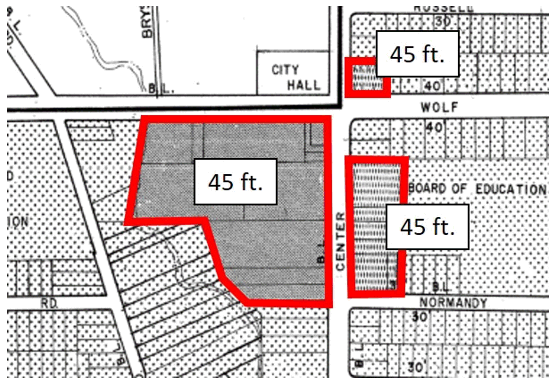
Dover Center - Wolf Road Mixed Use Overlay
Figure 1189.09-B
Maximum Height Requirements
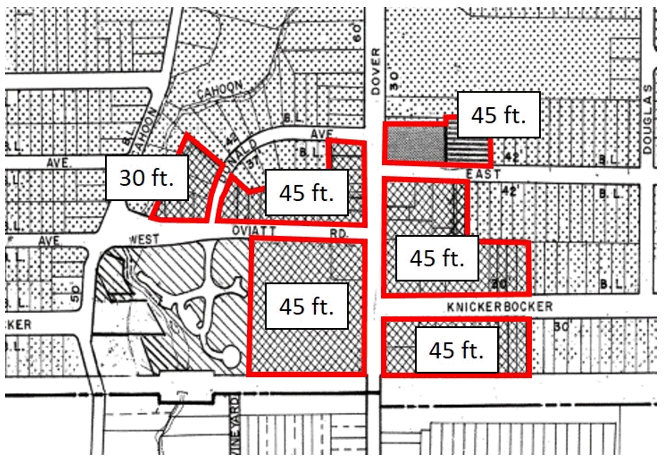
Dover Center Road - Knickerbocker Road Mixed Use Overlay
Figure 1189.09-C
Maximum Height Requirements
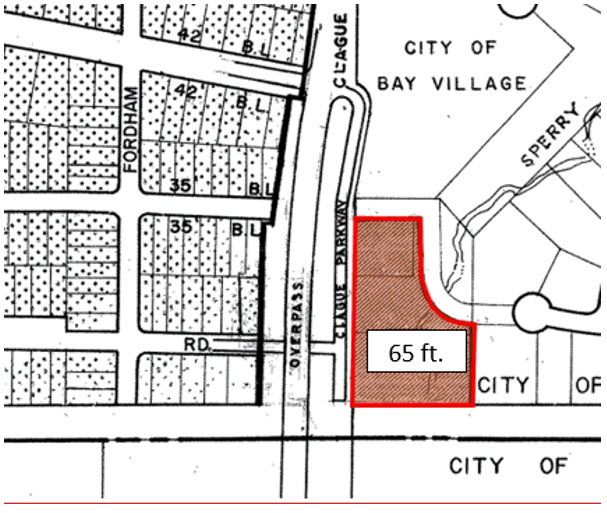
Clague Parkway Mixed Use Overlay
(Ord. No. 21-24, § 1, 5-17-2021; Ord. No. 21-58, § 1, 6-28-2021)
1189.10 - Design standards and principles.
(a)
Building siting and orientation. The following building siting and orientation requirements shall apply to new development in the mixed-use overlay district:
(1)
General requirements.
a.
High activity uses such as retail are encouraged on the first floor, with uses such as offices and residential encouraged on upper floors.
b.
Buildings shall be designed to respect the street context, to form street walls where appropriate, and to respect or create view corridors.
c.
Buildings and sites shall be designed to emphasize pedestrian scale, human scale architecture, and landscaping, while avoiding large expanses of paved areas, large featureless buildings, and monotonous or franchise-style architecture.
d.
All sides of a building open to view by the public shall display a similar level of architectural quality and shall be subdivided and proportioned using features such as windows, entrances, arcades, awnings, or other such features.
e.
Wherever feasible, buildings shall be designed to provide massing configurations with a variety of different wall planes. Plain, monolithic structures with long monotonous walls and roof plane surfaces are prohibited.
f.
Each building facade shall incorporate design elements for each 20 horizontal feet, such as changes in color or texture; projections, recesses, and reveals; arcades or pergolas providing pedestrian interest; or equivalent elements that subdivides the wall into human scale proportions.
g.
Buildings shall have well defined rooflines with attention to architectural detail. Consideration should be given to the prevailing pattern of roofs in the area surrounding and within the district.
h.
Sloping roofs, where used, shall have one or more of the following architectural features: gables, hips, horizontal or vertical breaks, or other similar techniques that are integrated into the building architecture.
i.
Buildings shall be designed and arranged to define the public and private space with open views and surveillance for public areas and privacy for private areas.
(2)
Principal residential structures-single-family detached.
a.
The main entrance(s) to the residence shall face the street.
b.
The front wall of the principal structure shall be parallel to the street or perpendicular to a radius of the curve of the street extended through the approximate center of the main mass, if the street is curved.
c.
Private garages.
1.
Doors of attached garages shall not face the street.
2.
An attached garage shall be sited so that its door is not visible from the primary direction of approach.
3.
Detached garages shall be in the rear yard.
(3)
Principal residential structures-single-family attached, townhomes, and multi-family.
a.
The entrance to at least one dwelling unit within each building shall face the street.
b.
The front wall of the principal structure, or the front wall of at least one principal structure in a multi-building development, shall be parallel to the street or perpendicular to a radius of the curve of the street extended through the approximate center of the main mass, if the street is curved.
c.
Private garages.
1.
Doors of attached garages shall not face the street.
2.
An attached garage shall be sited so that its door is not visible from the primary direction of approach.
3.
Detached garages shall be in the rear yard.
(4)
Principal residential structures on corner lots.
a.
In general, the structure shall face one of the streets and not the corner.
b.
Private garages.
1.
Doors of attached garages shall not face the street.
2.
An attached garage shall be sited so that its door is not visible from the primary direction of approach.
3.
Detached garages shall be in the rear yard.
(5)
Non-residential development.
a.
Commercial/retail buildings shall maintain a continuous wall plane at the front property line. External architectural features, such as bay windows, may project beyond this plane no more than 30 inches at a minimum height of 12 feet above the sidewalk.
b.
The main entrance to the principal structure shall face the street.
c.
The front wall of the principal structure shall be parallel to the street or perpendicular to a radius of the curve of the street extended through the approximate center of the main mass, if the street is curved.
d.
First floor facades facing streets or pedestrian ways should incorporate large amounts of clear windows that permit views into the interior of the building and/or product display areas.
e.
Building facades shall have highly visible customer service entrances that feature canopies, overhangs, arcades, distinctive roof forms, arches, display windows, or landscaped features. Primary entrances should face and be visible from the street on which they are located and shall be directly accessible and visible from the sidewalk.
(Ord. No. 21-24, § 1, 5-17-2021; Ord. No. 21-58, § 1, 6-28-2021)
1189.11 - Building materials.
(a)
Building materials shall be limited to brick, masonry, stucco, wood, fiber cement siding, wood shingle, wood siding, cultured stone, or other similar materials as determined by the Planning Commission.
(b)
Prohibited materials include vinyl siding, dryvit-type products on the lowest eight feet of any structure, split faced block, aluminum or vinyl siding, and other similar materials.
(Ord. No. 21-24, § 1, 5-17-2021; Ord. No. 21-58, § 1, 6-28-2021)
1189.12 - Parking requirements.
The provisions of Chapter 1191 (Off-Street Parking) shall apply except as modified herein. Where there is a conflict between a provision in this section and a provision in Chapter 1191, the requirements of this Chapter shall prevail.
(a)
Modified parking standards.
(1)
Parking for any residential uses shall be separate from parking for other non-residential uses.
(2)
Guest parking for multi-family residential projects shall be 0.25 spaces per unit. Guest parking requirements may be satisfied by non-residential use parking spaces and on-street parking.
(3)
Off-street parking shall be in the rear or side yard, not at street frontage. Parking shall be screened with fencing and landscaping when abutting sidewalk or street.
(4)
On-street parking (if present) may be counted toward minimum required parking spaces when on-street parking is within 300 feet of use or as a part of the overall minimum required parking spaces for a proposed development. Such parking shall be properly defined as parking spaces and not intrude into the lanes of travel.
(5)
Connecting walkways must be provided between any on-street parking or off-street parking and the uses being served.
(6)
Due to variations in parking demand and needs of mixed use projects, vehicle parking requirements and the design of the parking areas, including ingress and egress, may be reduced or modified as part of the review process, by the Planning Commission, based upon information contained in a parking demand study prepared by an independent traffic engineer, at the developer's expense.
(7)
The Planning Commission may authorize up to a 25 percent reduction of required parking spaces if transit service is available to the site at the time of project approval.
(b)
Joint or collective parking facilities. Shared parking facilities are strongly encouraged and are permitted if multiple uses cooperatively establish and operate the facilities and if these uses generate parking demands primarily during hours when the remaining uses are not in operation. The applicant shall have the burden of proof for a reduction in the total number of required off-street parking spaces, and documentation shall be submitted substantiating their reasons for the requested parking reduction. Shared parking may be approved if:
(1)
A sufficient number of spaces are provided to meet the highest demand of the participating uses;
(2)
Evidence to the satisfaction of the Planning Commission, has been submitted by the parties operating the shared parking facility, describing the nature of the uses and the times when the uses operate so as to demonstrate the lack of potential conflict between them; and
(3)
The Planning Commission may require additional documents, including, but not limited to, covenants, deed restrictions, or other agreements. Said documents, if required by the Planning Commission shall be recorded on the applicable properties. These efforts by the Planning Commission are to ensure that the required parking spaces provided are maintained and uses with similar hours and parking requirements as those uses sharing the parking facilities remain for the life of the development.
(4)
Shared parking spaces shall be located no more than 300 feet from the uses they are intended to serve.
(5)
Changes in shared parking agreements must be reported to the Planning Commission in timely manner.
(c)
Bicycle parking requirements.
(1)
Bicycle parking shall be provided for each commercial structure located within any mixed-use development.
(2)
Bicycle parking shall not interfere with pedestrian passage, leaving a clear area of at least 36 inches between bicycles and other existing and potential obstructions.
(3)
Each building with commercial uses shall have an equivalent number of bicycle parking spaces equal to ten percent of required motor-vehicle parking spaces, with a minimum of two bike spaces.
(4)
For buildings with multiple uses, bicycle parking standards shall be calculated at ten percent of the total required motor vehicle parking, with a minimum of three bike spaces.
(Ord. No. 21-24, § 1, 5-17-2021; Ord. No. 21-58, § 1, 6-28-2021)
1189.13 - Signage.
In addition to complying with Chapter 1179, sign plan submittals should:
(1)
Enhance and protect the physical appearance of the community.
(2)
Promote and maintain visually attractive, residential, retail, commercial and industrial districts.
(3)
Ensure that signs are located and designed to reduce sign distraction and confusion that may be contributing factors in traffic congestion and accidents and maintain a safe and orderly pedestrian and vehicular environment.
(Ord. No. 21-24, § 1, 5-17-2021; Ord. No. 21-58, § 1, 6-28-2021)
1189.14 - Conditional use standards.
(a)
General provisions. Conditional uses are listed in this Chapter. Only those uses expressly listed as conditional uses may be considered. All applications for a conditional use shall demonstrate compliance with the general criteria and standards in this section.
(b)
Conditional uses: General criteria and standards. All applications for a conditional use shall demonstrate that:
(1)
The use is consistent with the policies and intent of the Mixed-Use Overlay and/or set forth in the Bay Village Master Plan (as amended from time to time).
(2)
The use is physically and operationally compatible with the surrounding neighborhood and surrounding existing uses. Conditions may be imposed on a proposed conditional use to ensure that potential significant adverse impacts on surrounding existing uses will be reduced to the maximum extent feasible, including, but not limited to, conditions or measures addressing:
a.
Location on a site of activities that generate potential adverse impacts such as noise and glare;
b.
Hours of operation and deliveries;
c.
Location of loading and delivery zones;
d.
Light intensity and hours of full illumination;
e.
Placement and illumination of outdoor vending machines;
f.
Loitering;
g.
Litter control;
h.
Placement of trash receptacles;
i.
On-site parking configuration and facilities;
j.
On-site circulation;
k.
Privacy concerns of adjacent uses.
(3)
The use can generally be accommodated on the site consistent with any architectural and design standards set forth in any applicable code, and in conformance with all dimensional, site development, grading/drainage, performance, and other standards for the district in which it will be located.
(4)
To the maximum extent feasible, access points to the property are located as far as possible, in keeping with accepted engineering practice, from road intersections and adequate sight distances are maintained for motorists entering and leaving the property proposed for the use.
(5)
On-site and off-site traffic circulation patterns related to the use shall not adversely impact adjacent uses or result in hazardous conditions for pedestrians or vehicles in or adjacent to the site.
(6)
The use will be adequately served by public facilities and services. Public facilities and services that may be considered in light of this standard include, but are not limited to, water, sewer, electric, schools, streets, fire and police protection, storm drainage, public transit, and public parks/trails.
(7)
The use provides adequate off-street parking on the same property as the use, in compliance with standards set forth in Chapter 1191.
(8)
Unless addressed in the special conditions and standards set forth below, the use will be screened with fencing and/or landscaping in excess of what is required in Section 1189.07(l), as appropriate, if the use may otherwise result in an adverse impact on adjacent property benefitting from such screening.
(9)
The residential use is proposed at a density consistent with that of the existing neighborhood density or is compatible by its use of architecture, orientation of nearby structures and parking, and landscape buffer.
(10)
A traffic impact study may be requested that assesses the impacts of the proposed use on existing roads, intersections, and circulation patterns. Study may set forth mitigation measures to eliminate or substantially reduce such impacts.
(Ord. No. 21-24, § 1, 5-17-2021; Ord. No. 21-58, § 1, 6-28-2021)
1189.15 - Application process.
(a)
Permit required. Mixed-use developments shall require a development permit for each such development. Such permit shall be subject to the regulations and requirements of this section and shall be processed in accordance with the terms of this Chapter, including a public hearing before the Planning Commission.
(b)
Processing. Such application shall be reviewed by the Planning Commission. Such review shall include a public hearing. Planning Commission shall approve, disapprove, or approve subject to conditions deemed appropriate by the Planning Commission. The Planning Commission may require Architectural Board of Review approval prior to final approval.
(c)
Application contents. Every application for a mixed-use development shall be accompanied by the following:
(1)
A legal description or boundary survey map of the property. (A tentative subdivision map may be substituted for this requirement if the applicant proposes to subdivide the property.)
(2)
A plot plan and description of the property involved showing the location of all existing and proposed buildings, plans and descriptions of the proposed use of the property with ground plans and elevations for all proposed buildings.
(3)
A general development plan with at least the following details shown to scale and dimensioned:
a.
The proposed land ownerships, the uses, dimensions and locations of all proposed structures and of areas reserved for vehicular and pedestrian circulation, open spaces, landscaping, recreation or other public uses,
b.
Architectural drawings and sketches showing the design and character of the proposed uses and their relation to one another. A sample material board is to be submitted detailing colors to be used along with samples of the building materials.
c.
Location and design of parking areas and signs,
d.
Type of surfacing proposed for walks and driveways,
e.
A Stormwater Management Plan shall be required to be submitted, which must show the proposed method for control and disposal of water flowing into, across or from the development,
f.
Tables showing the total number of acres and their distribution by use, and the percentage of the whole designated for dwellings of different types, nonresidential uses, streets, off-street parking, public uses and open spaces,
g.
Streetscape Plan that addresses the relationship between vehicular, bicycle and pedestrian traffic, and provides pedestrian facilities, street and sidewalk lighting, landscaping, street furniture, trash receptacles, and transit stops.
h.
Landscape design plans showing the types of planting materials to be used. A plant material plan is to be submitted providing photographs of all types of plant materials proposed to be used. The landscape design plan shall include a site elevation scheme accurately showing projected landscape heights at the time of development and a second design showing landscape heights five years after development,
i.
A time schedule for the proposed development with evidence of the intent and the ability of the applicant to carry out the plan within such time,
j.
Operational characteristics of proposed use(s), including days and hours of operation, number of employees, etc., if applicable,
k.
A scaled model showing the proposed project and the adjacent areas within 500 feet of the site (may be digital model),
l.
Such other pertinent information as the City may reasonably require at the time of submittal or that the Planning Commission may reasonably require at the time of its consideration of the development in order to complete its evaluation of the intent and impact of the proposal.
(Ord. No. 21-24, § 1, 5-17-2021; Ord. No. 21-58, § 1, 6-28-2021)
1189.16 - Public hearing.
(a)
Following the receipt in proper form of any mixed-use overlay permit application, and upon determination by the City of a "complete application", the City shall schedule a public hearing before the Planning Commission in accordance with Chapter 115.08
(b)
Public hearings as provided for in this Chapter shall be held before the Planning Commission at the time and place for which public notice has been given as required in this Section. A summary of all pertinent testimony offered at a public hearing, together with the names and addresses of all persons testifying shall be recorded and made a part of the permanent files of the case. Any such hearing may be continued; provided, that prior to the adjournment or recess thereof, the presiding officer at such hearing shall announce the time and place to which such hearing will be continued.
(Ord. No. 21-24, § 1, 5-17-2021; Ord. No. 21-58, § 1, 6-28-2021)
1189.17 - Planning commission review.
(a)
The commission shall not recommend approval of the proposal unless it finds that the mixed-use development is or may be conditioned to be in full conformance to the general purposes of this Chapter, and in particular unless it finds as follows:
(1)
That the location, design and proposed uses are compatible with the character of existing structures, surrounding uses, and development patterns;
(2)
That the plan will produce, internally, an environment of stable and desirable character;
(3)
The plan will not tend to cause any traffic congestion on surrounding or access streets;
(4)
That there is on-site compatibility of residential and non-residential uses;
(5)
That the project combines residential with nonresidential uses in the same building or building site in a manner that creates an active street life, enhance the vitality of businesses, and reduces the need for automobile travel;
(6)
That a meaningful blend of residential and non-residential uses enhances and builds upon the City's commercial base;
(7)
That the project provides a variety of housing options for individuals, who want to live near their workplace and/or near retail and other non-residential uses;
(8)
That there is substantial compliance with the spirit and intent of this Chapter.
(b)
The Planning Commission shall make a determination of approval, approval with conditions, or denial of an application considered by it pursuant to this Chapter along with any permits and/or applications considered in conjunction with such application.
(c)
Any decision rendered by the Planning Commission shall be in writing and shall be transmitted to the applicant and the property owner.
(d)
The decision rendered by the Planning Commission shall be final but subject to Chapter 115.06.
(Ord. No. 21-24, § 1, 5-17-2021; Ord. No. 21-58, § 1, 6-28-2021)
1189.18 - Conformance.
(a)
The approved mixed-use development plan shall be dated and signed by the Chair of the Planning Commission. One copy of the final written decision of the Planning Commission, which includes all the project conditions and/or mitigation measures, shall be mailed to the applicant. No permits shall thereafter be issued for any building, structure or use except in substantial conformance with the approved plan. The Building Director may approve minor modifications provided they are in keeping with the spirit and intent of the Planning Commission.
(Ord. No. 21-24, § 1, 5-17-2021; Ord. No. 21-58, § 1, 6-28-2021)
1189.19 - Violation.
(a)
In the event that the property owner/business operator violates or fails to comply with any of the conditions of approval of this permit, the City may take measures to cure such violations, including but not limited to, administrative citation and full reimbursement of the City for its costs and expenses, including but not limited to, attorney's fees, in undertaking such corrective action. Reimbursement of enforcement costs shall constitute a civil debt and may be collected by any means permitted by law. If violations of this permit occur, the City shall refrain from issuing further permits, licenses or other approvals until such violations have been fully remedied.
(b)
Further, the Planning Commission may hold a public hearing, and if satisfied that any provision of the mixed-use overlay district, applicable regulation, development standard, general provision or condition is not being complied with, or if the Planning Commission finds that a change in conditions on the property or as a result of the use of the property has occurred which makes the continuation of the permit incompatible with the general welfare of the surrounding neighborhood, may do one or more of the following:
(1)
Impose additional conditions on the property.
(2)
Revoke any applicable conditional use permits associated with the property.
(3)
Revoke and/or preclude the issuance of business licenses associated with the property.
(4)
Revoke and/or preclude the issuance of building or demolition permits.
(5)
Revoke, preclude, suspend or otherwise render void any other entitlements to use and/or develop the property as is reasonable under the circumstances and serves to ensure future compliance with this Chapter and approved mixed-use development plan.
(Ord. No. 21-24, § 1, 5-17-2021; Ord. No. 21-58, § 1, 6-28-2021)
1189.20 - Expiration.
(a)
If construction on an approved mixed-use development plan has not commenced within two years from final approval of the plan by the Planning Commission, said plan approval shall expire and become null and void. However, a one year extension may be approved by the Planning Commission upon the submission of substantial evidence to support the extension.
(Ord. No. 21-24, § 1, 5-17-2021; Ord. No. 21-58, § 1, 6-28-2021)

