
Benbrook City Zoning Code
CHAPTER 17
74 - "MU" MIXED USE DISTRICT2
Editor's note— Ord. No. 1398, § 4, adopted August 18, 2016, amended Ch. 17.74 in its entirety to read as herein set out. Former Ch. 17.74, §§ 17.74.010—17.74.040, pertained to similar subject matter, and derived from Ord. No. 1344, § 1, adopted Oct. 18, 2012; Ord. No. 1356, § 2, adopted Oct. 17, 2013; and Ord. No. 1393, § 21, adopted Jan. 21, 2016.
17.74.010 - Purpose.
The purpose of the "MU" Mixed Use District is to provide areas with a combination of residential, commercial, office, and institutional uses. The mix of uses are intended to be commingled in a pedestrian and bicycle-friendly environment, while accommodating automobile and surface parking within designated areas. Emphasis shall be placed on the on the form of the building and adequate civic and open space.
(Ord. No. 1398, § 4, 8-18-2016)
17.74.012 - General development principles.
A.
Support economic development and reinvestment along major corridors. The "MU" District is designed to implement corresponding standards to enable a sustainable tax base, and further job creation by establishing predictable private redevelopment. The predictability of the redeveloped area will support and leverage investment in and around existing commercial corridors.
B.
Cultivate a development pattern offering convenient pedestrian, bicycle and vehicular access between a mix of compatible uses that support the safe and efficient movement of people and goods. The "MU" District is designed to provide convenient access to residential neighborhoods as well as provide opportunities for a variety of uses-shopping, employment, civic, housing and neighborhood retail.
C.
Graphic standards are provided to promote high quality design and to guide building placement and block standards. Such standards promote flexibility in land use, walkable mixed use developments, transitions to existing neighborhoods and transportation choice.
D.
Encourage civic space and the preservation of natural features that minimize negative impacts on natural resources, enhance the character of the built environment, promote public health and safety, and provide for outdoor recreation.
(Ord. No. 1398, § 4, 8-18-2016)
17.74.020 - Use regulations.
In the "MU" Mixed Use District, no building or land shall be used and no buildings shall be hereafter erected, reconstructed, altered, or enlarged, unless otherwise provided in this chapter, except for uses identified in Table 17.20.070, and one or more uses in Sections 17.74.022—17.74.026 below.
(Ord. No. 1398, § 4, 8-18-2016)
17.74.022 - Permitted uses.
The following are permitted uses in the "MU" Mixed Use District:
A.
Residential Uses: All residential uses are permitted, and shall have a minimum square footage of seven hundred fifty square feet.
B.
Non-Residential Uses:
1.
Antique shop.
2.
Auditorium, theaters, cinemas.
3.
Bakeries, providing that the floor area does not exceed five thousand square feet.
4.
Barber and beauty shops.
5.
Bicycles and bicycle repair shops, providing that the floor area does not exceed five thousand square feet.
6.
Book or stationary stores, or newsstands.
7.
Business colleges, trade schools, or private schools operated as a commercial enterprise.
8.
Cigar or tobacco stores.
9.
Cleaning, dyeing and pressing works; laundry and washaterias, providing that the floor area does not exceed five thousand square feet for separate or combined uses.
10.
Commercial amusement centers and bowling alleys, including miniature golf driving tee and the like (indoor operations only).
11.
Confectionery stores.
12.
Custom dressmaking or millinery shops; tailor, clothing or wearing apparel shops.
13.
Dancing schools.
14.
Kindergartens and day care facility (twelve children or less or as provided under state and federal law).
15.
Delicatessen shops.
16.
Department stores.
17.
Health Service Facilities: Clinics, offices of dentists, doctors and other practitioners of the healing arts licensed or similarly recognized under the laws of the State of Texas; offices for specialists in supportive health service fields such as physical, audio and speech therapy, podiatry and psychological testing and counseling; dental, medical and optical laboratories and blood banks; ambulance dispatch stations, prescription pharmacies and offices, stores and display rooms for the sale and rental of medical supplies and equipment.
18.
Drug stores.
19.
Dry goods and notions stores.
20.
Duplicating service, printing, lithographing, multigraphing and offset printing, providing that the floor area does not exceed five thousand square feet.
21.
Appliances and supply sales, electrical and gas repair and installation services, providing that the floor area does not exceed five thousand square feet for separate or combined uses.
22.
Fabric stores.
23.
Financial institutions.
24.
Florist or gift shops.
25.
Garages, storage only.
26.
Guidance and life care services, personal improvement.
27.
Grocery stores/meat markets.
28.
Hardware, paint, wallpaper stores and other home improvement items.
29.
Health and physical fitness centers, martial arts school.
30.
Hotel/motel/motor hotel.
31.
Household and office furniture, furnishings and appliances.
32.
Jewelry stores, optical goods.
33.
Leather and leather goods shops, providing that the floor area does not exceed five thousand square feet.
34.
Museums, galleries, libraries, fine arts centers, parks, playgrounds, community centers or recreational areas.
35.
Medical Care Facilities: Nursing and care homes; hospitals with their related facilities and supportive retail and personal service uses operated by or under the control of the hospital primarily for the convenience of patients, staff and visitors.
36.
Offices, professional administrative and business.
37.
Outdoor display or sale of merchandise.
38.
Photograph, portrait or camera shops and photo finishing.
39.
Piano stores, musical instruments and supplies.
40.
Postal or mailing services.
41.
Radio and television sales and servicing.
42.
Restaurants, tea rooms, cafeterias, fast food and take-out food restaurants.
43.
Retail stores, businesses, pawn shops, or shops for custom work or the manufacturing of articles to be sold at retail on the premises, providing that in such manufacture the total mechanical power shall not exceed five horsepower for the operation of any one machine provided that the space occupied by the manufacturing use permitted herein shall not exceed fifty percent of the total floor area of the permitted use and provided further that such manufacturing use is not noxious or offensive by reason of vibration, noise, odor, dust, smoke or fumes, beyond the space occupied by the retail business.
44.
Sporting goods including gun sales and repair.
45.
Toy or hobby shop.
46.
Public, private, and parochial elementary and secondary schools whose curricula satisfy the requirements of the state public school laws and the requirements of the state board of education.
47.
Higher Education Institutions: Junior and senior colleges, universities, conservatories and seminaries, offering curricula recognized by collegiate, academic and professional organization accrediting boards.
48.
Religious institutions, churches and facilities for related activities including those of worship, fellowship, assembly and education.
49.
Accessory buildings and uses customarily incident to any of the above uses including air conditioners, ice and refrigerating plants purely incidental to the main activity permitted on the premises. No accessory use shall be constructed to permit the keeping of articles or materials in the open or outside the building.
50.
Antennae and towers not exceeding the maximum height allowed in the District (see Section 17.56.030 below), antennae attached to existing structures and not increasing the overall height of the existing structure by more than ten feet, and dish antennae not exceeding two meters in diameter. Except for satellite dish antennae, no antennae or support structure shall be located within the required front, side or rear yard setback. To protect traffic safety and community appearance, no satellite dish antennae or support structure shall be located within the required front or second front yard setback, unless the zoning board of adjustment finds that such an encroachment is necessary to prevent impairment of installation, maintenance or reception and that a traffic sight restriction is not created.
51.
Temporary structure to be used for construction purposes only, and which shall be removed upon completion or abandonment of construction work or removed upon request of the city manager. Permits shall be issued for such temporary buildings for a period of six months only, with a renewal clause for similar period.
52.
Skating rinks, ice and roller.
C.
[Wind Energy Systems:] Wind energy systems that do not exceed the maximum height specified in Section 17.74.030 below and comply with the provisions of Section 17.84.130.A.
D.
[Solar Photovoltaic Systems and Solar Water Heaters:] Solar photovoltaic systems and solar water heaters not exceeding one thousand square feet of surface area and comply with the provisions of Section 17.84.130.B.
E.
[Geothermal Heat Pump Systems:] Geothermal Heat Pump Systems that comply with the provisions of Section 17.84.130.C.
(Ord. No. 1398, § 4, 8-18-2016)
17.74.024 - Conditional uses.
The following are conditional uses in the "MU" Mixed Use District:
A.
Any uses allowed in the "G" District, with the exception of agricultural uses; unless specifically identified in Table 17.20.070 or Sections 17.74.022 and 17.74.026.
B.
Drive-through commercial uses.
C.
Utility facilities.
D.
Artists' studios when located within a building where all or a portion of the building is designated for residential uses.
E.
Small animal pet grooming or veterinary services.
F.
Wind energy systems that exceed the maximum height specified in Section 17.74.030 below. Compliance with the provisions of Section 17.84.130.A is required.
G.
Solar photovoltaic systems and solar water heaters exceeding one thousand square feet in surface area. Compliance with the provisions of Section 17.84.130.B is required.
H.
Food truck park in accordance with Section 17.84.150.
I.
Antennae and towers exceeding the height allowed in district.
(Ord. No. 1398, § 4, 8-18-2016)
17.74.026 - Special exception uses.
Special exception uses when authorized by the board of adjustment under the provision of Chapter 17.16.
(Ord. No. 1398, § 4, 8-18-2016)
17.74.030 - District design standards.
The district design standards are intended to raise the level of quality for mixed use developments within a regulatory structure, while offering options and flexibility. The district design standards are comprised of five major components:
1.
Building form and development standards, addressing the physical form and placement of buildings in relation to various street types;
2.
Building design standards, addressing building orientation, and massing and scale;
3.
Streetscape standards, addressing the natural and built fabric of the street and its visual effect;
4.
Civic space and open space standards, addressing recreational areas and the preservation and enhancement of natural resources; and
5.
Neighborhood transition standards, addressing the compatibility of new and existing developments.
A.
Building Form and Development Standards:
The following standards place an emphasis on the form of the building and the open spaces, whether a pedestrian plaza or a civic space. The goal is to build structures that can be utilized for a variety of uses and, thereby, extend the functional and economic viability of the building. Where any of the building standards within this chapter conflict with the standards of the International Building Code (IBC) adopted at the time of development, the IBC standards shall prevail.
The following street designations shall be established for all streets within the "MU" District. Street designations shall be based on the functions of the street and in accordance with the below street types as defined in Chapter 7 of the Comprehensive Plan and the Master Thoroughfare Plan:
1.
Arterial Street. The arterial street is a major thoroughfare connecting the City to adjacent cities and to the freeway system. The arterial shall establish a hybrid development context in the "MU" District that has a more pedestrian friendly development context at the intersections of streets and major driveways. Auto-related functions and surface parking is accommodated in the middle of the block. Surface parking shall be screened from the arterial with a "slip lane," on-street parking and/or landscaping.
2.
Collector Street. The Collector Street carries traffic which connects local residential and commercial areas within the City. The Collector is intended to balance pedestrian orientation with automobile accommodation.
3.
Local Street. The local street is intended to provide the most pedestrian-friendly development context. Buildings along local streets shall be held to the highest standard of pedestrian-oriented design. The local street carries traffic from within a neighborhood to collector and arterial streets.
4.
Alley. A public way permanently reserved as a secondary means of access.
5.
Interior Street. A vehicular driveway located in the interior of lots providing access to parking and outbuildings and may contain utility easements. Interior streets which provide access across a lot shall comply with the streetscape standards.
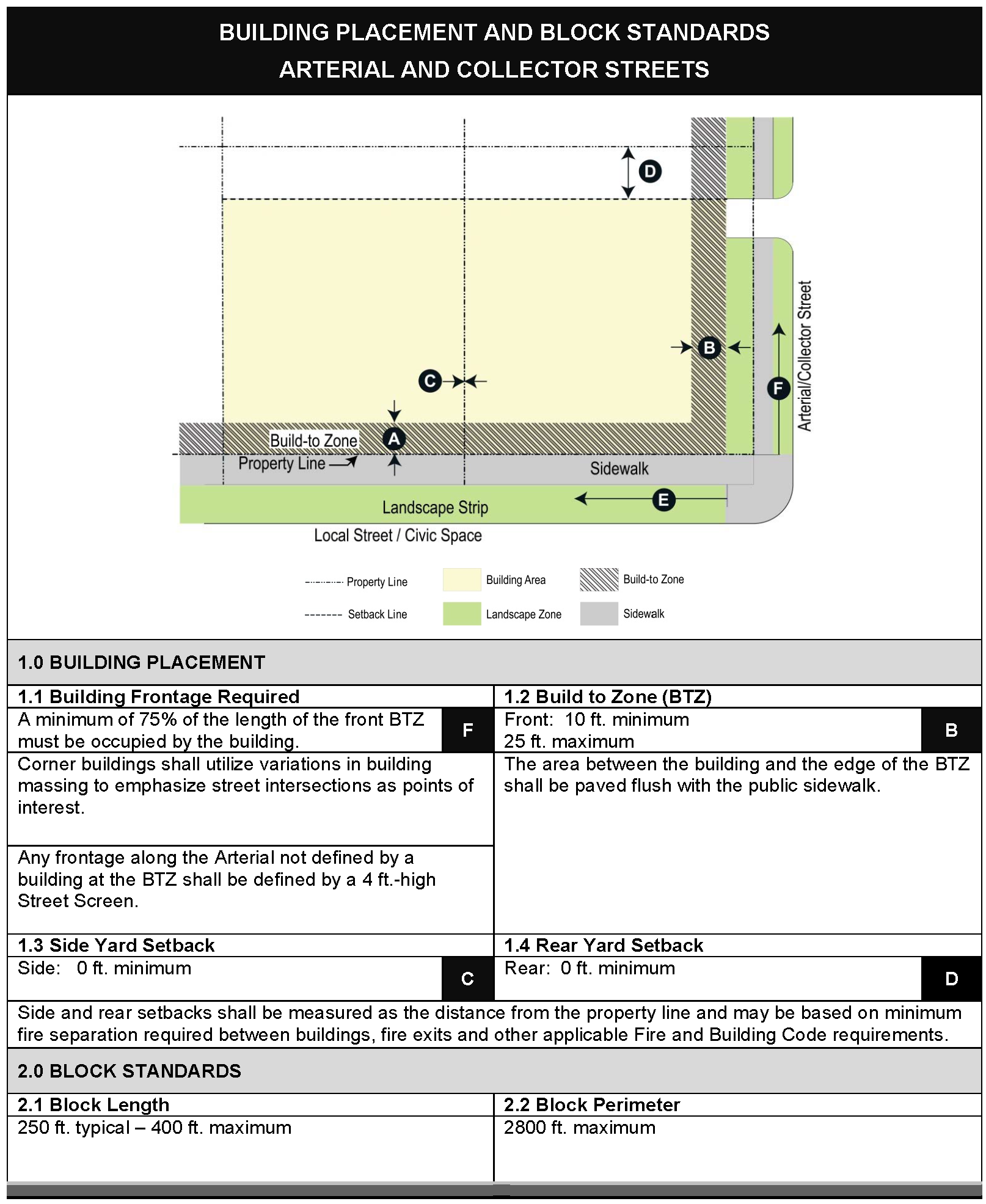
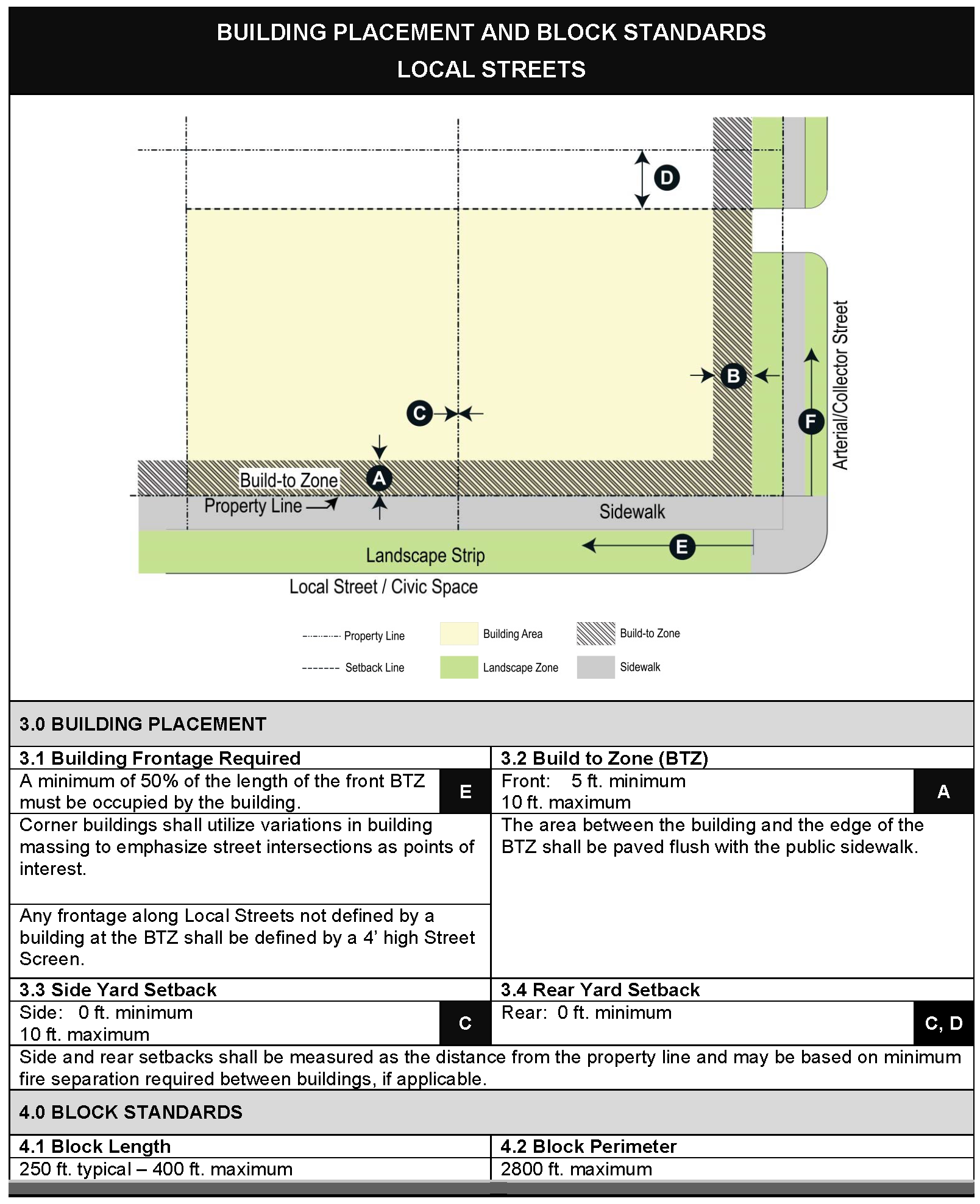
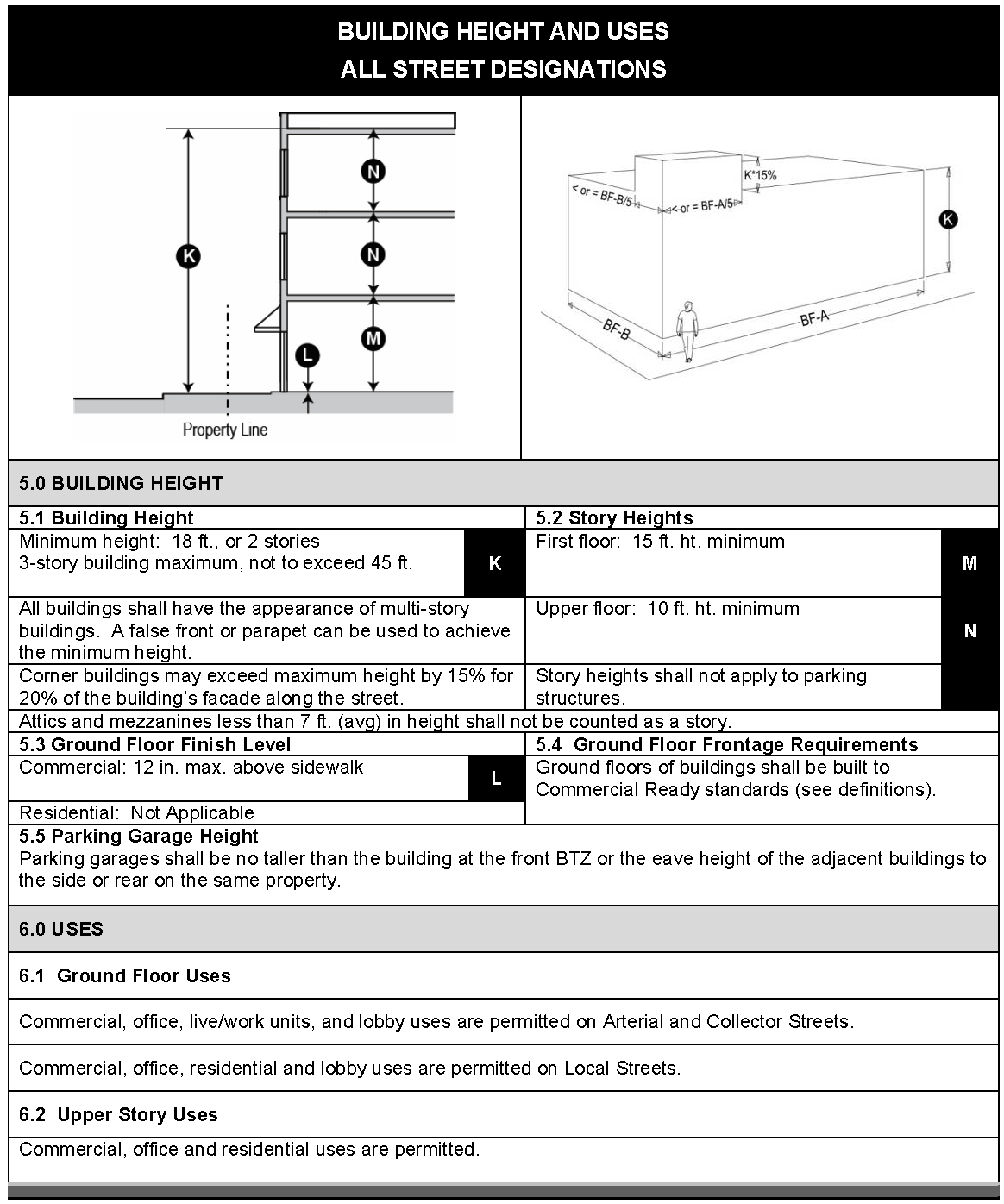
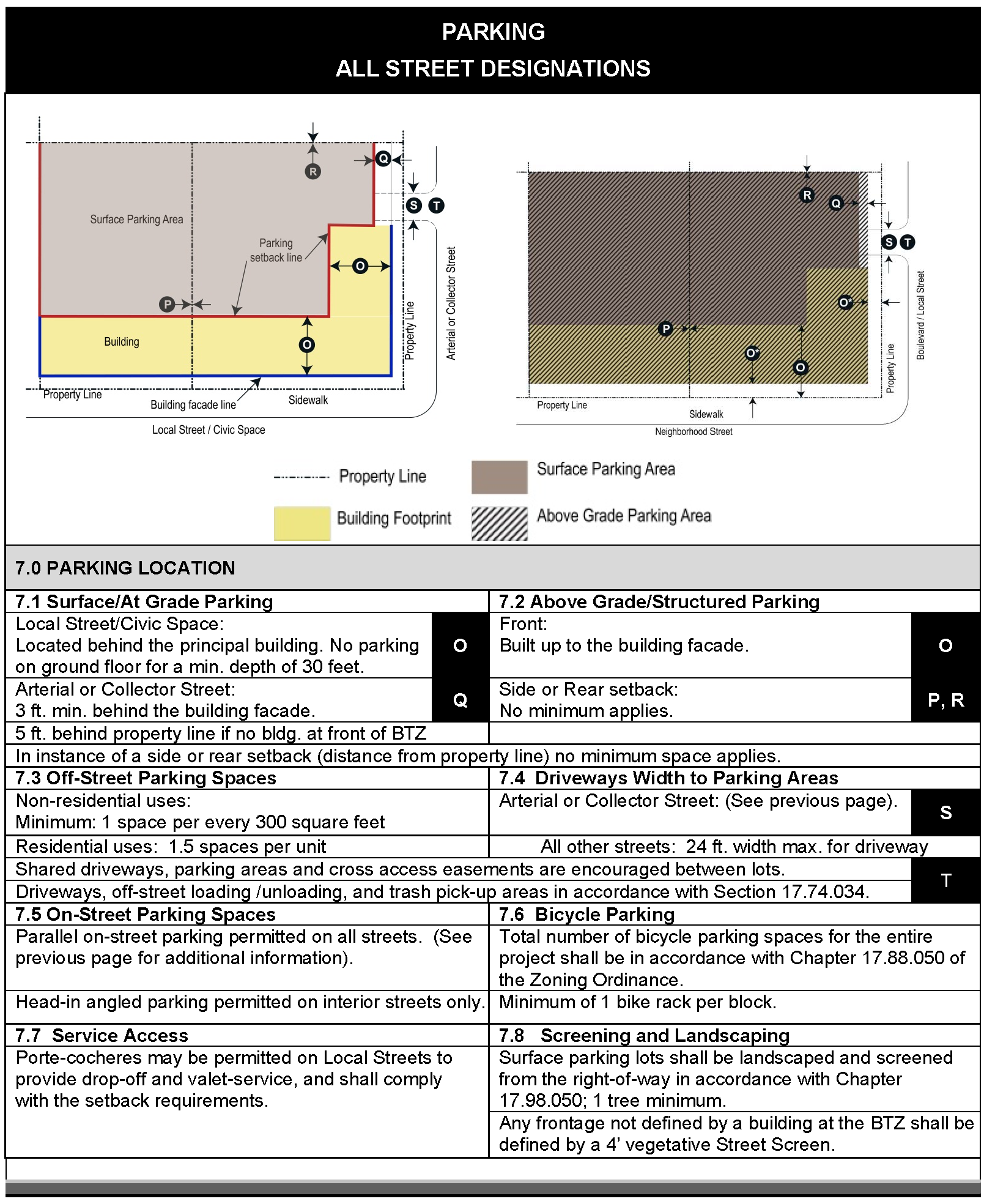
The following text corresponds with the graphic standards in the following pages. Use the text and graphic standards in conjunction with the district design standards below, and in accordance with the street designations from the city's comprehensive plan.
1.0 Building placement—arterial and collector streets.
1.1 Building frontage required.
a.
A minimum of seventy-five percent of the length of the front build-to-zone (BTZ) must be occupied by the building. The BTZ is defined as the area between the minimum and maximum setbacks within which the principal building's front façade is to be built.
b.
Corner buildings shall utilize variations in building massing to emphasize street intersections as points of interest.
c.
Any frontage along the arterial not defined by a building at the BTZ shall be defined by a vegetative street screen that is four feet in height located at the setback line along the corresponding frontage. The street screen shall include shrubs planted to be opaque at maturity. Species shall be selected from the recommended list of shrubs from Table 17.98.070 of the zoning ordinance.
1.2 Build to zone (BTZ).
a.
There shall be a front yard setback of not less than ten feet, and no greater than twenty-five feet.
b.
The area between the building and the edge of the BTZ shall be paved flush with the public sidewalk.
1.3 Side yard setback.
a.
There shall be a minimum side yard setback of zero feet.
b.
Side yard setbacks shall be measured as the distance from the property line and may be based on a minimum fire separation required between buildings, if applicable.
1.4 Rear yard setback.
a.
There shall be a minimum rear yard setback of zero feet.
b.
Rear yard setbacks shall be measured as the distance from the property line and may be based on a minimum fire separation required between buildings, fire exits and other applicable Fire and Building Code requirements.
2.0 Block standards.
2.1 Block length.
a.
The minimum block length shall be two hundred fifty feet and a maximum block length of four hundred feet.
2.2 Block perimeter.
a.
The maximum block perimeter length shall be two thousand eight hundred feet.
3.0 Building placement—Local streets.
3.1 Building frontage required.
a.
A minimum of fifty percent of the length of the front BTZ must be occupied by the building.
b.
Corner buildings shall utilize variations in building massing to emphasize street intersections as points of interest.
c.
Any frontage along local streets not defined by a building at the BTZ shall be defined by a vegetative street screen that is four feet in height located at the setback line along the corresponding frontage. The street screen shall include shrubs planted to be opaque at maturity. Species shall be selected from the recommended list of shrubs from Table 17.98.070 of the zoning ordinance.
3.2 Build to zone (BTZ).
a.
There shall be a front yard setback of not less than five feet, and no greater than ten feet.
b.
The area between the building and the edge of the BTZ shall be paved flush with the public sidewalk.
3.3 Side yard setback.
a.
There shall be a minimum side yard setback of zero feet.
b.
Side yard setbacks shall be measured as the distance from the property line and may be based on a minimum fire separation required between buildings, if applicable.
3.4 Rear yard setback.
a.
There shall be a minimum rear yard setback of zero feet.
b.
Rear yard setbacks shall be measured as the distance from the property line and may be based on a minimum fire separation required between buildings, if applicable.
4.0 Block standards.
4.1 Block length.
a.
The minimum block length shall be two hundred fifty feet and a maximum block length of four hundred feet.
4.2 Block perimeter.
a.
The maximum block perimeter length shall be two thousand eight hundred feet.
5.0 Building height—All street designations.
5.1 Building height.
a.
All buildings shall have the appearance of multi-story buildings. The minimum building height shall be two stories, or eighteen feet.
i.
A false front or parapet can be used to achieve the minimum height.
ii.
Parapets shall surround the entire building and shall provide consistency and uniformity with exterior building materials and components.
iii.
Parapets shall have a minimum height of two feet.
b.
The maximum building height shall be three-stories, not to exceed forty five feet.
c.
Corner buildings may exceed the maximum height by fifteen percent for twenty percent of the building's façade along the street.
d.
Attics and mezzanines less than seven feet average in height shall not be counted as a story.
5.2 Story heights.
a.
The minimum story height on the first floor shall be fifteen feet.
b.
The minimum story height on upper floors shall be ten feet.
c.
Story heights shall not apply to parking structures.
5.3 Ground floor finish level.
a.
Commercial: Twelve inches maximum above the sidewalk. Any ground floor finish level above seven inches must be ADA compliant.
b.
Residential: n/a
5.4 Ground floor frontage requirements.
a.
Ground floors of all buildings shall be built to commercial ready standards (See definition located within Section 17.08.020 of the zoning ordinance)
5.5 Parking garage height.
a.
Parking garages shall be no taller than the building at the front BTZ or the eave height of the adjacent buildings to the sides or rear, on the same property.
6.0 Uses.
6.1 Ground floor uses.
a.
Commercial, office, live-work units and lobby uses are permitted along arterial and collector streets.
b.
Commercial, office, residential and lobby uses are permitted on local streets.
6.2 Upper story uses.
a.
Commercial, office and residential uses are permitted.
7.0 Parking location—All street designations.
7.1 Surface/At grade parking.
a.
Local Streets: Surface/at grade parking shall be located behind the principle building. No parking on ground floor for a minimum depth of thirty feet.
b.
Arterial/Collector Streets: Surface/at grade parking shall be a minimum of three feet behind the building façade and five feet behind the property line if there is no building at the front BTZ.
c.
In instance of a side or rear setback (distance from property line), no minimum distance applies.
d.
New surface lots shall include a submittal of a conceptual plan depicting the location of future buildings for approval by the planning director.
e.
New surface parking lots shall not be located within thirty feet of any street intersection
7.2 Above grade/Structured parking.
a.
Local Streets: No parking uses on the ground floor at the BTZ. Ground floor parking is allowed, if setback a minimum depth of thirty feet.
b.
Local Streets: The shortest dimension of the parking structure shall be along the local street frontage(s) to minimize the impact of the structure.
c.
Arterial and Collector Streets: The distance of parking structures from the property line shall match the distance of the adjacent building(s) from the property line.
d.
All Streets: Buildings shall not have exposed structural parking at the ground floor level.
e.
All Streets: A parking structure façade that faces a public street shall be designed to incorporate contextual architectural elements that complement adjacent buildings or buildings in the area.
f.
All Streets: Parking structure openings shall not exceed fifty percent of the total ground floor façade.
g.
All Streets: Parking structures and adjacent sidewalks shall be designed to ensure that pedestrians are clearly visible to entering and exiting automobiles.
7.3 Off-street parking spaces.
a.
Nonresidential uses: Minimum one space/three hundred square feet (gross).
b.
Residential: One and a half spaces/unit
7.4 Driveway width to parking area.
a.
Arterial and collector streets are subject to the city standards in accordance with the Design Standards and Criteria Manual.
b.
Roadways which are operated and maintained by TxDOT shall comply with either TxDOT or the city standards, whichever is most restrictive.
c.
All other streets: Maximum twenty-four feet width
d.
Shared driveways, parking areas and cross access easements are encouraged between lots.
e.
Driveways, off-street loading/unloading, and trash pick-up areas shall be in accordance with this chapter, unless more restrictive guidelines are required for safety reasons, as determined by the community development department.
7.5 On-street parking spaces.
a.
All on-street parking spaces shall be a minimum of nine feet in width by twenty-two feet in length.
b.
All on- street parking spaces shall comply with Figures 17.88.020-1 and 17.88.020-2 (90, 60 and 45-degree standards; and maneuvering space standards) of the zoning ordinance.
c.
Parallel on-street parking is permitted on all streets.
d.
Head-in, angled parking is permitted on interior streets only.
e.
All on-street parking areas shall be approved by the city engineer and shall comply with city regulations and standards.
7.6 Bicycle parking.
a.
The total number of bicycle parking spaces for the entire project shall be in accordance with Section 17.88.050 of the zoning ordinance.
b.
A minimum of one bike rack per block is required.
c.
Each required parking space shall include a means to secure individual bicycles.
7.7 Service access.
a.
Porte-cocheres may be permitted on local streets to provide drop-off and valet service, and shall conform to the setback requirements of the "MU" zoning district.
7.8 Screening and landscaping of parking areas.
a.
Surface parking lots shall be landscaped in accordance with Section 17.98.050 of the zoning ordinance. A minimum of one tree is required.
b.
Any frontage not defined by a building at the BTZ, shall be defined by a four-foot high vegetative street screen composed of shrubs planted to be opaque at maturity.
The shrub species shall be selected from Table 17.98.070 of the zoning ordinance. The required street screen shall be located at the setback line along the corresponding frontage.
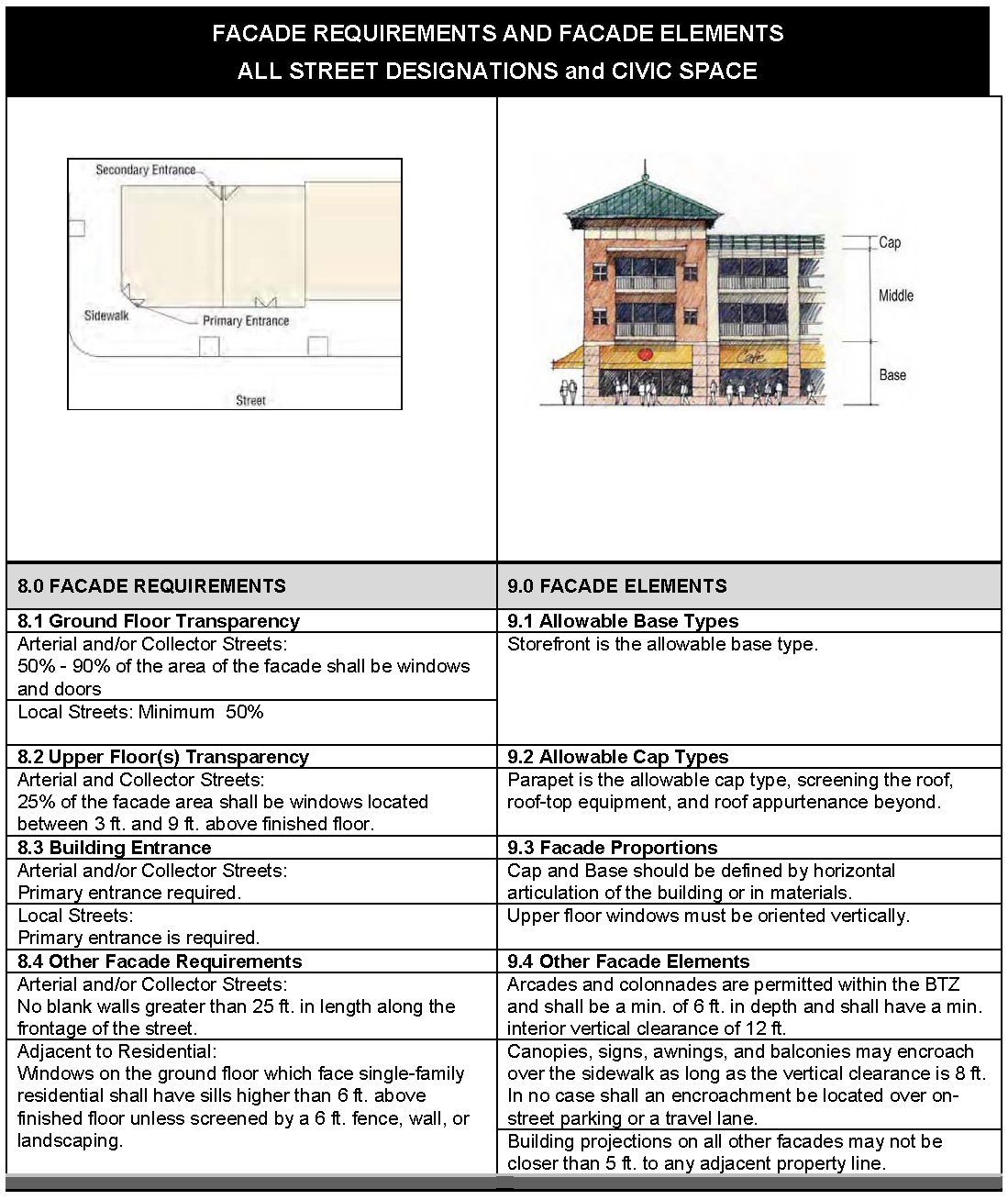
8.0 Façade requirements and façade elements—All street designations.
8.1 Ground floor transparency.
a.
Arterial and/or Collector Streets: Fifty though ninety percent of the area of the façade shall be windows and doors. No wall may run in a continuous plane greater than twenty-five feet, and no blank walls greater than twenty-five feet, without an opening. Openings fulfilling this requirement shall provide clear views into the interior and out of the interior of the building.
b.
Local Streets: A minimum of fifty percent of the area of the façade shall be windows and doors. No wall may run in a continuous plane greater than twenty-five feet, and no black walls greater than twenty-five feet, without an opening. Openings fulfilling this requirement shall provide clear views into the interior and out of the interior of the building.
8.2 Upper floor(s) transparency.
a.
Arterial and Collector Streets: Twenty-five percent of the façade shall be windows located between three feet and nine feet above the finished floor.
8.3 Building entrance.
a.
Primary entrances shall be accessed directly from the public street and sidewalk and shall be easily identifiable.
b.
A second primary entrance for corner buildings is optional.
8.4 Other façade requirements.
a.
Arterial and/or Collector Streets: No blank walls greater than twenty-five feet in length along the frontage of the street.
b.
Adjacent to Residential: Windows on the ground floor which face single family residential shall have sills higher than six feet above finished floor unless screened by a six feet fence, wall or landscaping.
9.0 Façade elements.
9.1 Allowable base types.
a.
Storefront is the allowable base type for all nonresidential uses.
9.2 Allowable cap types.
a.
Parapet is the allowable cap type, screening the roof and roof appurtenance beyond.
9.3 Façade proportions.
a.
Cap and base should be defined by horizontal articulation of the building or in materials.
b.
Upper floor windows must be oriented vertically.
9.4 Other façade elements.
a.
Buildings shall incorporate arcades, roofs, alcoves, porticoes and awnings that protect pedestrians from the rain and sun.
b.
Arcades and colonnades are permitted within the BTZ and shall be a minimum of six feet in depth and shall have a minimum interior vertical clearance of twelve feet.
c.
Canopies, signs, awnings and balconies may encroach over the sidewalk as long as the vertical clearance is eight feet. In no case shall an encroachment be located over on-street parking or a travel lane.
d.
Metal siding shall not occupy more than fifteen percent of a building's frontage and must be finished with enamel or anodized.
e.
Building projections on all other facades may not be closer than five feet to any adjacent property line.
f.
To the extent practicable, buildings shall maintain a twenty-five foot building façade width or multiples of twenty-five foot.
i.
Variations in the rhythms within individual building facades shall be achieved within any block of building facades.
ii.
Breaks in the predominant rhythm may also be used to reinforce changes in massing and important elements such as building entrances.
B.
Building Design Standards:
Key building design standards establish essential goals for the "MU" District to ensure the preservation, sustainability and visual quality of different areas within the development. The design of buildings and their relationship to the street shall depend on the context of the development. Generally, buildings shall be located and designed so that they provide visual interest and create enjoyable, human-scaled spaces. The overall key design standards are:
•Blocks shall have a minimum residential use of twenty percent or more of gross floor area and minimum retail, office, eating uses of ten percent or more of the building gross floor area.
•New buildings shall utilize building elements and details to achieve a pedestrian-oriented public realm within the project area, along street frontages and at street intersections. Elements include active storefronts by using enhanced lighting, quality materials and creative displays.
•Building facades shall include appropriate architectural details and ornament to create variety and interest. Lower floors are to be architecturally different from, but still compatible with upper floors through level of detail and design.
•Pedestrian and bicycle mobility shall be provided for connectivity along street frontages and is encouraged throughout a development, where appropriate.
•Developments shall preserve existing natural features and environmentally sensitive areas, and where possible, incorporate these features into the development as an amenity.
1.
Building Orientation:
The following regulations are in addition to the standards outlined and depicted in Section 17.74.030.A above.
a.
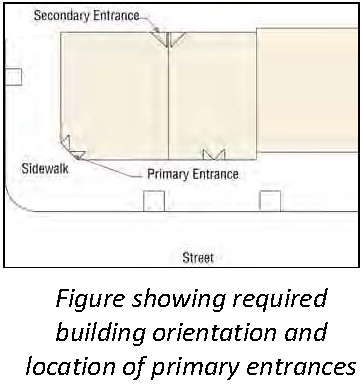
Buildings shall be oriented towards the street and/or civic spaces.
b.
Primary entrance to buildings shall be located on the street along which the building is oriented. At intersections, corner buildings may have their primary entrances oriented at an angle.
c.
All primary entrances shall be oriented to the public sidewalk for ease of pedestrian access. Secondary and service entrances may be located from internal parking areas.
d.
Design of building and layout of site shall comply with Section 17.84.140 of the zoning ordinance (CPTED - Crime Prevention Through Environmental Design).
e.
Garages, carports, or new surface parking shall be located and accessed from local streets or alleys and shall be located at the rear of buildings, or side of buildings, where appropriate.
2.
Building Massing and Scale:
The following architectural standards supersede Section 17.84.100 of the zoning ordinance.
a.
Building massing:
i.
Buildings shall be simple, rectilinear forms that relate to its site, use and to massing of adjacent buildings.
ii.
A building's massing shall serve to define entry points and help orient pedestrians.
b.
Building scale:
i.
Building height, width, and architectural treatments shall be proportionate to adjacent buildings along a street frontage, and shall comply with the building height and uses graphic depicted in 17.74.030.A.
3.
Architectural Elements and Features:
a.
The approved development site plan and associated building form standards shall specify the architectural style for the development. Building form standards not addressed with the approved development site plan shall be governed by the city Zoning ordinance.
b.
Architectural elements are the individual components of a building, including, but not limited to walls, doors, windows, cornices, parapets, roofs, pediments and other features.
C.
Streetscape Standards:
1.
General Requirements:
a.
Streets in the "MU" District should balance all forms of mobility while maximizing convenience for residents and visitors.
b.
The development site plan shall designate the required and recommended street network within the development. This section specifies the typical configuration of streets. The specifications address vehicular lane width, parkway widths, ROW widths, number of travel lanes, on-street parking and bicycle and pedestrian accommodations.
c.
New streets shall be addressed on a project by project basis and shall be reviewed and approved by the community development department.
2.
Streetscape & Landscape Requirements:
a.
Streetscape standards shall apply to all streets within the "MU" District, including private streets. Streetscape standards shall address all elements between the building face and edge of the curb. Typical streetscape elements addressed are street trees, lighting, street furniture and pedestrian and bicycle amenities, and materials. All streetscape elements shall be maintained in accordance to the city standards and ordinances.
3.
Street Trees and Landscaping:
a.
Alley: Street trees shall be required on all streets except alleys.
b.
Interior Streets and Private Streets: Street tree location along interior streets and private streets shall comply with the approved Development Site Plan. Spacing shall be an average of seventy-five feet on center (measured per block face). On center (o.c.) indicates the measurement from the center of one component (planting hole) to the center of the next component (planting hole) should be the number of feet specified. Owners shall be responsible for providing sidewalk design and streetscape improvement features.
c.
Local, Collector, and Arterial Streets:
i.
Spacing shall be an average of seventy-five feet on center (measured per block face) along local, collector, and arterial streets; however, they shall not be placed in visibility triangles at intersections and nonresidential driveways.
ii.
Trees shall not be planted closer than twenty-five feet from the curb line of intersections of streets or alleys, and not closer than ten feet from private driveways (measured at the back edge of the sidewalk), fire hydrants, or utility poles.
iii.
Street trees shall not be planted closer than twenty feet to light standards. Except for public safety, no new light standard location shall be positioned closer than ten feet to any existing street tree, and preferably such locations will be at least twenty feet distant.
iv.
The minimum caliper size for each tree shall be two inches and shall be a minimum of six feet in height at planting.
v.
Each tree shall be planted in a planting area no less than thirty-six square feet. However, the tree well area may be no smaller than twenty-five square feet. Space between the tree and hard surface may be covered by permeable non-permanent hard surfaces such as grates, bricks on sand, or paver blocks.
d.
Turf and groundcover: When clearly visible from the street and alleys, all unpaved ground areas shall be planted with low growing shrubs or ground cover, ornamental grasses, or a combination thereof. Turf grass must be installed as solid sod and not seeded.
e.
Species shall be selected and planted in accordance with the Section 16.28.050.D of the subdivision ordinance.
f.
Where there are overhead power lines, tree species are to be chosen that will not interfere with those lines.
g.
Trees, as they grow, shall be pruned to provide at least eight feet of clearance above sidewalks and fifteen feet above street roadway surfaces. The responsibility for pruning is in accordance with this Code.
h.
Existing trees may be used as street trees if there will be no damage from the development which will kill or weaken the tree. Sidewalks of variable width and elevation may be utilized to save existing street trees, subject to approval by the planning director.
i.
Street Screen required: Any frontage along a street not defined by a building or civic space located within the build-to-zone (BTZ) shall be defined by a four-foot high vegetative street screen, composed of shrubs planted to be opaque at maturity.
4.
Street Furniture, Lighting, and Materials:
a.
Street Furniture:
i.
Spacing shall be an average of seventy-five feet on center (measured per block face) along local, collector, and arterial streets; however, they shall not be placed in visibility triangles at intersections and nonresidential driveway. Trash receptacles and bike racks shall be required along local, collector, and arterial streets. Total number of required bicycle parking spaces shall be calculated in accordance with Chapter 17.88 of the zoning ordinance. The approved development site plan shall show locations of street furniture. A minimum of one trash receptacle and bicycle rack is required per block along the street frontage.
ii.
Street furniture and pedestrian amenities such as benches are recommended along all streets.
iii.
All street furniture shall be located in such a manner as to allow a clear sidewalk passageway of a minimum of six feet.
b.
Lighting:
i.
Pedestrian scale lighting, with the top of fixture being no more than twenty feet from the ground, shall be provided along all streets except alley.
ii.
Street lights shall be placed at each intersection and at a maximum spacing of seventy-five feet on center, approximately three feet behind the curb line.
iii.
The light standard selected shall be compatible with the design of the street and the approved building form standards.
iv.
Lights shall be fully shielded to minimize light trespass on residential zones. "Fully Shielded" means a technique or method of construction or manufacture which does not allow any light dispersion to shine above the horizontal plane from the lowest light emitting point of the light fixture. Any structural part of the light fixture providing this shielding shall be permanently affixed to the light fixture.
c.
.....Materials selected for paving and street furniture shall be of durable quality and require minimal maintenance.
D.
Civic space and open space standards.
This chapter establishes the private open space and public civic space standards for the "MU" District. Detailed standards for each type are included in this section. These standards include general character, typical size, frontage requirements, and typical uses and amenities.
1.
Private open space standards. All new residential and lodging uses shall meet the private open space standards established in this section.
Table 17.74.030 D1
Private Open Space Standards and Criteria
Table 17.74.030 D2
Private Open Space Types
2.
Public Civic Space Standards. All new mixed use and commercial uses shall meet the public civic space standards established in this section. The design of public civic space shall be regulated by the civic space standards herein which shall create a well-designed network of open spaces that recognizes the natural qualities of the area while providing a range of both passive and active recreational opportunities. These opportunities may be accommodated in a variety of spaces ranging from larger parks to local-scaled greens to urban squares and plazas. Where appropriate, the open space network will be serviced by an interconnected network of trails and paths for pedestrians and bicyclists alike.
a.
In an effort to preserve and enhance natural and ecological community resources, the following designated creeks and environmental buffer areas shall be incorporated into each new development as a civic space with amenities, where appropriate:
i.
Designated stream protection areas shall be considered positive design elements and incorporated in the overall design of a given project.
ii.
When a creek area is disturbed or without vegetation, native riparian plant materials shall be planted in and adjacent to the creek to enhance the creek habitat.
iii.
100-year floodplain shall be preserved to the extent possible.
b.
A minimum of five percent of the total land area shall consist of one or more public civic space types, including amenities, as identified in Table 17.74.030 D3 below. The below is not considered a comprehensive list and civic space types and amenities are interchangeable. Appropriate alternative proposals may be provided, subject to meeting the intent of the public civic space standards and the "MU" zoning district.
Table 17.74.030 D3
Public Civic Space Types and Amenities
E.
Neighborhood Transition Standards:
1.
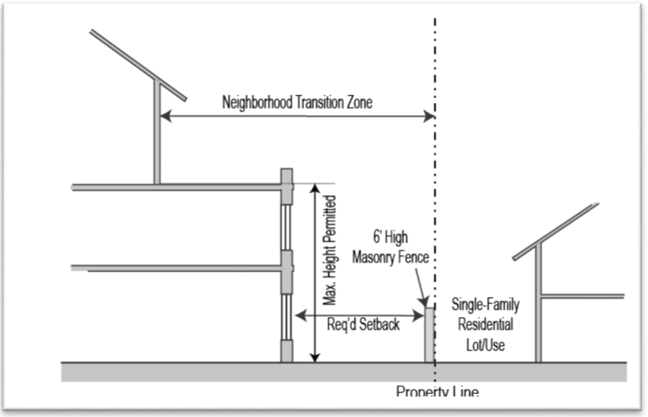
A Transition zone shall be established on all development sites adjacent to single family residences. The zone shall be comprised of an area that is twenty-five feet parallel to any lot line that is common with an existing single family residential lot.
2.
The maximum height of any building and/or parking structure within the transition zone shall not exceed two floors or twenty-five feet.
3.
Screening:
a.
Fencing shall be in accordance with Chapter 17.96 of the zoning ordinance and shall be required for any new development within the "MU" District when abutting existing single family residential lots.
b.
A privacy fence, in accordance with Chapter 17.96, is optional when adjacent to existing nonresidential uses.
c.
All maintenance requirements shall be in accordance with Chapter 17.96 of the zoning ordinance.
(Ord. No. 1398, § 4, 8-18-2016)
17.74.032 - Additional design requirements.
A.
Building and Screening Standards:
1.
Other screening and buffering shall be provided as follows:
a.
Refuse Container Screen. Refuse containers or disposal areas shall be screened from view from any public right-of-way by placement of a masonry wall and/or masonry fence from six to eight feet in height in compliance with the city design standards and criteria. All refuse materials shall be contained within the refuse area.
b.
Service Corridor and Loading Dock Screen. When adjacent to residential uses, commercial and industrial service corridors and loading docks shall be screened. Location and design of such service areas shall reduce the adverse effects of noise, odor and visual clutter upon adjacent residential uses.
c.
Mechanical equipment and similar areas are not permitted to be visible from the street nor are permitted between the building and the street and must be screened in an opaque manner such as masonry or vegetative screening. Roof top and roof-mounted equipment shall be screened with a parapet.
d.
All areas not covered by buildings, parking, etc., shall be landscaped in accordance with the definition of landscape area found in Chapter 17.08 of the Zoning Ordinance.
B.
Other Requirements. The regulations of the "MU" District are intended to supplement the standards of the zoning ordinance with new or different regulations. In the event of a conflict between standards of the "MU" District and the zoning ordinance, the standards described herein shall prevail. In the event that standards are not addressed or are silent within the "MU" zoning district, the standards shall be governed by the zoning ordinance of the city.
(Ord. No. 1398, § 4, 8-18-2016)
17.74.034 - Design specifications applicable to specific uses within the district.
A.
Design Standards for Residential Buildings.
1.
Buildings shall utilize at least three of the following design features to provide visual relief along the front of the residence:
a.
Dormers,
b.
Gables,
c.
Recessed entries,
d.
Cupolas,
e.
Pillars or posts
f.
Bay window (min. twenty-four inch projection)
g.
Covered front porches
2.
No more than five adjacent detached single family homes or contiguous groups of attached single family homes may be of the same design and floor plan.
3.
Windows shall be provided with trim. Windows shall not be flush with exterior wall treatment. Windows shall be provided with an architectural surround at the jamb.
4.
Flat roofs are permitted only when accompanied by a parapet.
5.
Exterior finishes shall be primarily masonry, stone, horizontal wood or other high quality substitute.
B.
Design standards for nonresidential and mixed use buildings (nonresidential and mixed use buildings and their lots are those that combine nonresidential and residential uses).
1.
Orientation and Scale:
a.
Buildings shall have their primary orientation toward the street rather than the parking area. Public sidewalks shall be provided adjacent to a public street along the street frontage.
b.
Trash storage areas, mechanical equipment, and similar areas are not permitted to be visible from the street nor are permitted between the building and the street, and must be screened in an opaque manner such as masonry or vegetative screening. Gasoline pumps must be screened from the street by an E bufferyard, as specified in Chapter 17.98 of this title. Off-street loading areas shall be located at the rear or side of a building and shall be hidden from the street.
c.
Buildings shall incorporate lighting and changes in mass, surface or finish, giving emphasis to entrances.
d.
Prominent horizontal lines at levels similar to surrounding buildings shall be maintained along the street-facing side of the building.
C.
Noise. Normal business activities shall not create a sound level at the adjacent property line that exceeds sixty-five A-weighted decibels from 7:00 a.m. to 10:00 p.m. and fifty-five decibels from 10:00 p.m. to 7:00 a.m.
D.
Signs. Signs shall be regulated in accordance with Chapter 17.92 of this title, with the exception that projecting and/or suspended signs may be allowed if approved as part of the development site plan.
(Ord. No. 1398, § 4, 8-18-2016)
17.74.040 - Development site plan.
A.
A development site plan shall meet the intent of the "MU" Mixed Use District, shall be required for each block or group of blocks, and shall be approved by the planning and zoning commission, following a public hearing, and shall contain the following information. The community development department may request additional information deemed necessary to ensure public health, welfare and safety:
1.
Project name.
2.
Vicinity map.
3.
Scale.
4.
North arrow.
5.
Date.
6.
Street names and locations of all existing and proposed streets within or on the boundary of the proposed development, street designations, pavement widths, sidewalks, bikeways, and on-street parking.
a.
Streetscape standards including all elements between the building face and edge of curb, including landscaping, lighting, street furniture, pedestrian and bicycle amenities, screening, etc.
b.
Photometric plan.
7.
Lot and block layout with dimensions for all lots and blocks, including building frontages, front, side and rear yard setbacks.
8.
Zoning designations adjacent to the proposed development.
9.
Location and use of all proposed and existing buildings, fences and structures within the proposed development. Indicate which buildings are to remain and which are to be removed.
10.
Infrastructure:
a.
Water lines and appurtenances (valves, fire hydrants, etc.).
b.
Sewers, manholes and cleanouts.
11.
The proposed:
a.
Connection to the Benbrook Water Authority water and sewer system,
b.
Method of drainage of the site, and
c.
Method of erosion and sedimentation control.
12.
Location of drainage ways, environmental buffer zones, or public utility easements in and adjacent to the proposed development.
13.
Locations, sizes and uses of contemplated and existing public civic space and private open space areas within the proposed development.
14.
A topographic map of the site at a contour interval of two feet or less.
15.
Location of all parking areas and all parking spaces, ingress and egress on the site, and onsite circulation, including garages, carports, parking garages and surface parking.
16.
Use designations for all areas not covered by buildings, parking, or landscaping.
17.
Locations of all significant landscape features including, but not limited to, any existing healthy trees greater than six inches dbh, generally forested areas, creeks, wetlands, 100-year floodplains, or existing ponds. Indicate any planned modifications to a natural feature and any proposed amenities.
18.
A landscape plan showing in detail the location, type, and size of the proposed landscaping and plantings, in accordance with the streetscape and landscape standards identified in Section 17.74.030.
19.
The elevations, surface area in square feet, illumination type, height, construction material and style, and locations of all proposed signs for the development.
20.
Building Form and Development Standards:
a.
Architectural elevations for all buildings proposed on the property. Such plans shall indicate material, color, texture, windows, doors, height, and other design features of the building, including all screening of mechanical equipment, such as for heating and cooling, roof-top equipment, etc. Elevations shall be submitted drawn to scale of one inch equals ten feet or greater.
21.
A written summary showing the following:
a.
The total area contained in the area proposed to be developed.
b.
The total number of parking spaces.
c.
The number of dwelling units in the development (include the units by the number of bedrooms in each unit, e.g. ten one-bedroom units, twenty-five two-bedroom units, etc.).
d.
Commercial uses proposed (office, restaurant, etc.)
e.
Total area and percentage of lot coverage by:
i.
Structures.
ii.
Streets, roads, and alleys.
iii.
Sidewalks, bicycle lanes, enhanced pavement areas, etc.
iv.
Recreation areas, including public civic space and private open space areas; including all proposed amenities within the development.
v.
Landscaping, including vegetative screening elements, etc.
vi.
Tree canopy at maturity of the trees.
vii.
Parking areas (and number of spaces).
B.
Traffic Impact Analysis Required:
1.
A traffic impact analysis (TIA) shall be required for any proposed site development that can be reasonably expected to generate more than one thousand vehicle trip ends during a single day and/or more than one hundred vehicle trip ends during a single hour. Determination of the applicability of this requirement shall be made by the planning director or city engineer using the latest edition of Trip Generation published by the Institute of Transportation Engineers.
2.
The traffic impact analysis (TIA) shall address at least the following areas:
a.
All proposed site access points.
b.
All intersections bordering or adjacent to the site frontage including the closest intersecting collector or arterial street.
c.
Any road segment or intersection where the proposed development can be expected to generate more than twenty-five additional vehicle trips during a single hour.
d.
Any road segment or intersection where the additional traffic volumes created by the proposed development is greater than ten percent of the current traffic volume (for road segments) or the current entering volume (for intersections).
3.
The analysis shall include the following study time frames: existing conditions, full site build-out conditions, and a five-year forecast.
4.
The TIA Report shall conform to the requirements of the subdivision ordinance.
C.
Storm Water Management Impact Analysis. A preliminary drainage plan shall be prepared in accordance with the requirements in Section 16.20.005 of the subdivision ordinance.
D.
Deviations from the Approved Development Site Plan.
1.
Minor Deviations from the Approved Development Site Plan: Minor deviations from the approved development site plan may be approved by the planning director or his/her designee. Minor deviations include the following:
a.
Corrections in spelling, distances and other labeling that does not affect the overall development concept.
b.
Changes in building position or layout that are less than ten feet or ten percent in size.
c.
Changes in parking layouts as long as the original design is generally maintained.
2.
Major Deviations from the Approved Development Site Plan: All major deviations from the approved development site plan shall be approved by the planning and zoning commission, following a public hearing.
(Ord. No. 1398, § 4, 8-18-2016)

