
Benbrook City Zoning Code
CHAPTER 17
84 - SUPPLEMENTARY DISTRICT REGULATIONS
17.84.010 - Uses generally, building and land.
A.
No building shall hereafter be erected, reconstructed, altered or enlarged, nor shall any building or land be used for any purpose other than is permitted in the district in which such building or land is located.
B.
No building shall hereafter be erected, reconstructed, altered or enlarged to exceed the height or bulk limit herein established for the district in which such building is located, nor shall any building be erected, reconstructed or altered as to provide a floor space smaller than the minimum prescribed by this title.
C.
No lot area shall be so reduced or diminished that the yards or other open spaces shall be smaller than prescribed by this title, nor shall the density of population be increased in any manner except in conformity with the area regulations herein established.
D.
Every building hereafter erected shall be located on a lot as herein defined, and in no case shall there be more than one building on one lot, except as herein provided.
(Ord. No. 1344, § 1, 10-18-2012)
17.84.012 - Pre-existing platted lot.
Any residentially-zoned lot having less area and/or width than herein required and which was platted of record and in separate ownership at the time of the passage of this title may be occupied by not more than a one-family structure. Nothing in this title shall prevent the residential use of any lot platted of record prior to the effective date of the ordinance from which this title derives provided that all front yard, side yard, rear yard, floor area, parking and all provisions other than lot area and/or lot width are met or exceeded.
(Ord. No. 1344, § 1, 10-18-2012)
17.84.014 - Access to lots and structures.
Every building hereafter erected or moved shall be on a lot adjacent to a public street or with access to an approved private street, and all structures shall be so located on lots as to provide safe and convenient access for servicing, fire protection and required off-street parking.
(Ord. No. 1344, § 1, 10-18-2012)
17.84.020 - Visibility at intersections.
On a corner lot in any district, nothing shall be erected, placed, planted or allowed to grow in such a manner as materially to impede vision between a height of two and one-half feet and ten feet above the center line grades of the intersecting streets in the area bounded by the street lines of such corner lots and a line joining points along said street lines thirty-five feet from the point of intersection.
(Ord. No. 1344, § 1, 10-18-2012)
17.84.030 - Accessory structures and uses.
Development standards for accessory structures and uses are as follows:
A.
Non-residential and multi-family accessory structures and uses:
1.
No accessory building or accessory use shall be erected or established on a lot that does not contain a principal structure or use in accordance with the zoning district. No accessory building shall be erected in any required yard, and no separate accessory building shall be erected within five feet of any other building.
B.
Single family residential accessory structures and uses:
1.
No accessory structure or use shall be erected or established on a lot that does not contain a principal structure or use, in accordance with the zoning district, nor shall any accessory structure be in the required front or second front yard setback, except where permitted elsewhere within this ordinance.
2.
Accessory structure height shall be measured from grade to the highest portion of the structure or roof.
3.
No accessory structure, which is fifteen feet or less in height, shall be located less than five feet from any side or rear property line. In addition, increases of height, over ten feet, shall increase the side and rear setbacks proportionally at a 1:1 ratio; however, in no case shall the accessory structure setback be required to exceed the minimum setback of the principal structure.
4.
No accessory structure, which is greater than fifteen feet in height, shall be located within any required setback, in accordance with the zoning district.
C.
The following accessory uses shall be permitted in all zoning districts:
1.
Wind energy systems that do not exceed the maximum height specified in the applicable zoning district below and comply with the provisions of Section 17.84.130.A.
2.
Solar photovoltaic systems and solar water heaters not exceeding one thousand square feet of surface area and that comply with the provisions of Section 17.84.130.B.
3.
Geothermal heat pump systems that comply with the provisions of Subsection 17.84.130.C.
D.
The following accessory uses shall require a conditional use permit in all zoning districts:
1.
Wind energy systems that exceed the maximum height specified in the applicable zoning district and complies with the provisions of Section 17.84.130.
2.
Except as exempted by state law (Subchapter C of Chapter 229 of the Local Government Code), solar photovoltaic systems and solar water heaters exceeding one thousand square feet in surface area and that comply with the provisions of Section 17.84.130.
E.
Garage sales shall be permitted within residential zoning districts. Garages sales, not exceeding two in number on the same premises in any one calendar year, are permitted provided that the duration of each such sale not exceed three calendar days and that no new merchandise acquired solely for the purpose of resale shall be sold at such occasional sale.
F.
Home occupations in accordance with section 17.84.160 are permitted in all residential districts or where residential uses are permitted by right.
G.
Accessory structures, which are incidental and customary to the primary use, in accordance with Section 17.84.030 of this Code are permitted within the "RE," "A," "B," and "BR" zoning districts.
H.
Unless otherwise permitted by this ordinance, accessory structures and uses, which are incidental and customary to the primary use and in accordance with Section 17.84.030 of this code, require a conditional use permit within the "CR," "C," and "D" zoning districts.
1.
Within the "CR" zoning district, a private garage may not provide space for more than one motor vehicle for each one thousand square feet of lot area.
2.
Detached building, including storage garages, are subject the same zoning standards as district "A."
I.
A subsidiary dwelling is only permitted within the "RE," "A," "B," and "BR" zoning districts and requires a conditional use permit.
J.
Unless otherwise prohibited or regulated, accessory buildings and uses, incidental and customary to the primary use, are permitted on properties zoned non-residential. No accessory use shall be construed to permit the keeping of articles or materials in the open or outside the building.
K.
Unless otherwise prohibited or regulated, temporary buildings may be used for construction purposes only, and which shall be removed upon completion or abandonment of construction work or removed upon request of the city manager. Permits shall be issued for such temporary buildings for a period of six months only, with a renewal clause for similar period.
L.
Unless otherwise prohibited or regulated, the "E," "F," "G," "HC," and "H" zoning districts shall allow temporary seasonal outdoor sales operations such as Christmas tree sales, firewood sales, crafts, new and/or used merchandise and food sales, such as snow-cone stands, food trucks, and the like when such temporary operation exceeds seventy-two hours in a twelve month period. Such temporary sales operations may be a principal use on a property or an outdoor operation in conjunction with and subordinate to any existing permitted permanent indoor retail establishment. Only one temporary seasonal outdoor sales operation is permitted on a tract or lot. Such temporary outdoor sales operations shall require the submittal of an operations site plan for approval by the planning director prior to setting up operations. The operations site plan shall show the proposed location of sales areas, storage areas, parking areas, traffic flow and street access, fencing and signage in relation to existing improvements to the property. Portable signs may be approved for the duration of the temporary outdoor sales operations when such sign is included in the approved operations site plan. A temporary outdoor sales operation on a single site shall not be approved for more than three occurrences in a calendar year, the total of which shall not exceed one hundred fifty days.
(Ord. No. 1415, § 7, 9-21-2017; Ord. No. 1433, § 18, 11-1-2018; Ord. No. 1487, § 14, 2-16-2023)
Editor's note— Ord. No. 1415, § 7, adopted Sept. 21, 2017, repealed the former § 17.84.030, and enacted a new § 17.84.030 as set out herein. The former § 17.84.030 pertained to accessory buildings/accessory use and derived from Ord. No. 1344, § 1, adopted Oct. 18, 2012.
17.84.040 - Erection of more than one structure on a lot.
In any district, more than one structure housing a permitted or permissible principal use may be erected on a single lot, provided that yard and other requirements of this title shall be met for each structure as though it were on an individual lot.
(Ord. No. 1344, § 1, 10-18-2012)
17.84.050 - Height-setback envelope.
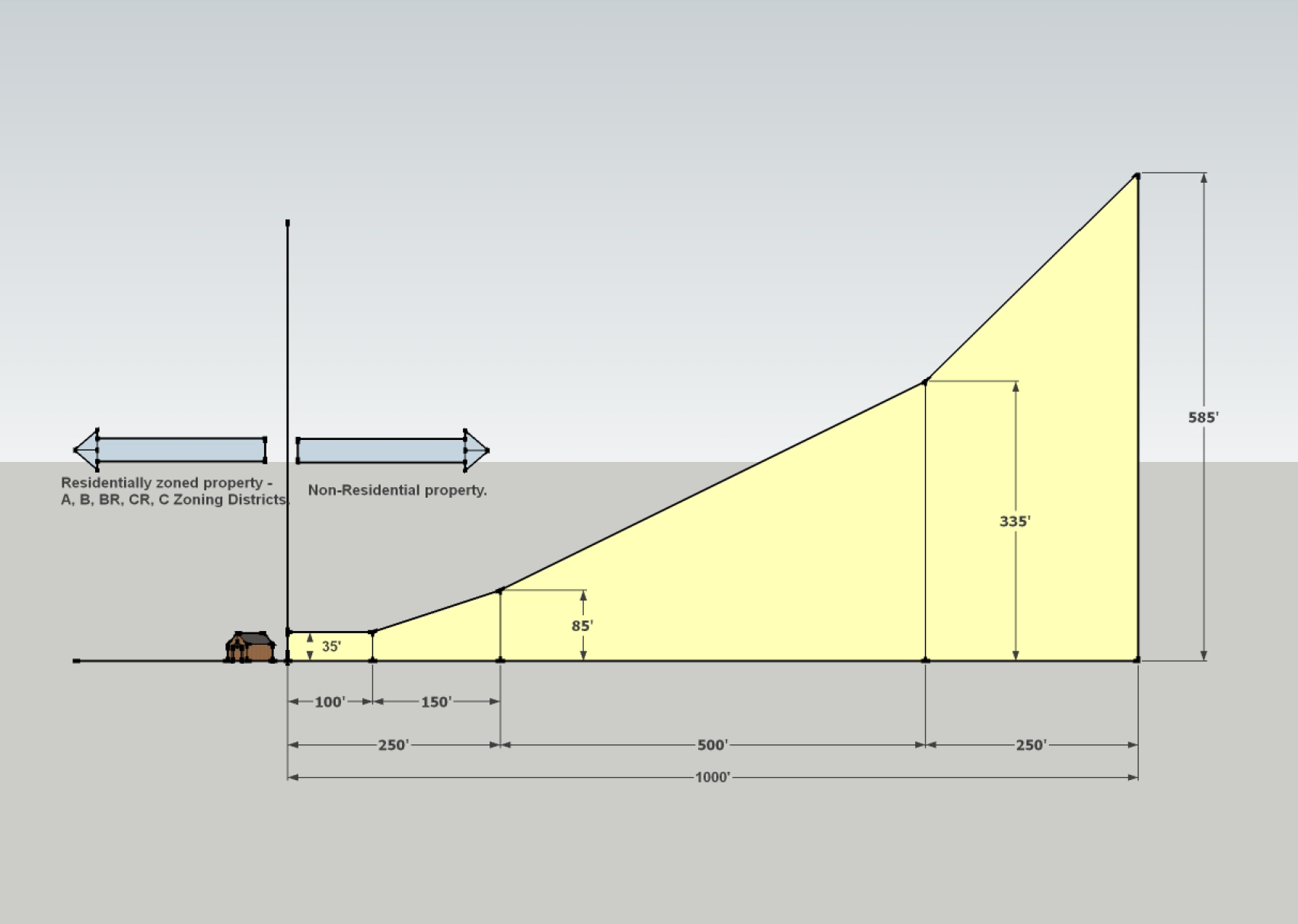
The height setback envelope is a plane projected upward and outward for one thousand feet from the property line of property zoned "A," "B," "BR," "CR," "C," or "D" residential district. When referring to height setback envelopes, all slopes are stated as horizontal run to vertical rise. The height-setback envelope is shown in Figure 17.84.050, and begins at a point of thirty-five feet above the immediate grade at the residential property line. For the first one hundred feet the envelope shall be thirty-five feet above the immediate grade at the residential property line. The envelope provides for a 3 to 1 slope for the next one hundred feet, a 2 to 1 slope for structures between two hundred fifty-one feet and seven hundred fifty feet, and a 1 to 1 slope between seven hundred fifty-one feet and one thousand feet. There is no height limitation for structures more than one thousand feet from a residential boundary line.
The allowable height of a structure shall be based on the elevation of the property zoned "A," "B," "BR," "CR," "C" or "D" district at the residential district property line, less any increased elevation of the height of the proposed elevation of the foundation of the structure being proposed. The allowable height of a building may be reduced because its elevation is higher than the adjacent property, but may not be increased if it is lower than the adjacent property.
Notwithstanding any other provision in this title, no structure within the city may exceed an elevation of one thousand one hundred fifty feet above mean sea level, nor shall any structure exceed the allowable height within the approach/departure clearance surface (slope), the conical surface, or the transitional surface, without the express permission of the City of Benbrook and the commanding officer of NAS Fort Worth Joint Reserve Base.
Figure 17.84.050 Height-Setback Envelope
(Ord. No. 1344, § 1, 10-18-2012)
17.84.060 - Living quarters in commercial districts.
In "E," "F," "HC," "G" and "H" Districts, not intended for residential use and where residential use is not a permitted use, living quarters may be provided for resident managers, resident security and maintenance personnel and the like provided that:
A.
The living quarters is clearly subordinate to the permitted use in "E," "F," "HC," "G" or "H" Districts.
B.
The living quarters are only occupied by a manager, security, maintenance or other individual employed with full time duties on the site on which the living quarters are located. This is not intended to preclude the additional occupancy of the living quarters by family members of the full time individual employed on the site.
C.
The living quarters are incorporated into the design of the permitted use in such a manner that the living quarters are not perceptible as such.
D.
Two off-street parking spaces are provided per living quarter in addition to the required parking for the permitted use.
E.
Not more than one such living quarter shall be authorized per platted lot without prior specific approval of the planning and zoning commission as a conditional use following procedures established in Chapter 17.80.
(Ord. No. 1344, § 1, 10-18-2012)
17.84.070 - Location of sexually oriented businesses.
A.
No person shall operate or cause to be operated a sexually oriented business within one thousand feet of:
1.
A church;
2.
A public or private elementary or secondary school;
3.
Any district zoned "RE" residential estates, "A" one-family, "B" one-family, "BR" one-family reduced, "CR" multiple-family restricted, "C" multiple-family, "D" multiple-family, or "MH" mobile home; inhabited residence; or
4.
A public park.
For the purposes of this provision, measurement shall be made in a straight line, without regard to intervening structures or objects, from the nearest portion of the building or structure used as a part of the premises where a sexually oriented business is conducted, to the nearest property line of the premises of a church, public or private elementary or secondary school, or to the nearest boundary of a public park or residentially-zoned district.
B.
No person shall operate or cause to be operated a sexually oriented business within one thousand feet of another sexually oriented business. For the purpose of this provision, the distance between any two sexually oriented businesses shall be measured in a straight line, without regard to intervening structures or objects, from the closest exterior wall of the structure in which each business is located.
C.
No person shall cause or permit the operation, establishment, or maintenance of more than one sexually oriented business in the same building, structure, or portion thereof, or the increase of floor area of any sexually oriented business in any building, structure, or portion thereof containing another sexually oriented business.
D.
A sexually oriented business lawfully operating as a conforming use after the effective date of the ordinance from which this article derives is not rendered a non-conforming use by the location, subsequent to the operation of the sexually oriented business, of a church, public or private elementary or secondary school, public park or residentially-zoned district within one thousand feet of the sexually oriented business.
(Ord. No. 1344, § 1, 10-18-2012)
17.84.080 - Standards for animal lots and stables.
(Refer also to Title 6, Chapter 6.04 of the City of Benbrook Municipal Code.)
A.
The minimum lot area for a commercial animal lot and/or stable or barn shall be five acres or one acre for each animal unit, whichever is greater. If animals are maintained on pasture as their primary source of feed, then in no case shall more than one animal unit be kept for each acre of land available. If horses are kept inside a building at all times (excluding exercise, then the maximum number of horses permitted shall be limited to the building capacity to house, show, and ride said horses.
B.
If horses are kept inside a building, then one sheltered stall shall be provided for each horse. A box stall shall be a minimum of ten feet by ten feet.
C.
Stables, barns, corrals, areas of natural congregation (as determined by the animal control officer) and piles of manure, feed, bedding shall be located at least fifty feet from any right-of-way or lot line and at least one hundred fifty feet from any adjacent existing residence to minimize odor and nuisance problems. Animal lot pasture may not extend within ten feet of the lot line. Runoff containing any animal waste shall be controlled from entering onto an adjacent residential lot.
(Ord. No. 1344, § 1, 10-18-2012)
17.84.090 - Standards for telecommunications towers and antennae.
The City of Benbrook has a goal of minimizing the number of new telecommu nications towers and antennae, while balancing the needs of telecommunication providers to establish a reasonable network to provide quality service.
A.
Before a conditional use permit is granted for a new telecommunications tower, the applicant must demonstrate a good faith effort to locate on an existing tower or other structure. Such effort shall be demonstrated by providing evidence that all potential existing structures were contacted and were determined unavailable, or engineering data showing that there were no acceptable existing structures that met the grid requirements.
B.
Any new telecommunications tower shall be designed to accommodate at least one additional antennae.
C.
Any antenna or tower that is not operated for a continuous period of twelve months shall be considered abandoned, and the owner of such antenna or tower shall remove same within ninety days of receipt of notice from the city notifying the owner of such abandonment. If such antenna or tower is not removed within said ninety days, the city may remove such antenna or tower at the owner's expense. If there are two or more users of a single tower, this provision shall not become effective until all users cease using the tower.
(Ord. No. 1344, § 1, 10-18-2012)
17.84.100 - Architectural standards for nonresidential buildings.
A.
Standards that apply to all nonresidential buildings exceeding one thousand two hundred square feet in the "CF" zoning district, and to all buildings in the "E", "F", "HC", and "G" zoning districts.
1.
Materials: All building facades that are visible from adjoining properties and/or public streets (excluding facades facing residential property that are screened by an eight-foot masonry wall or masonry fence) shall be of architectural block, face brick, granite, marble, stucco, stone, cast stone, face tile, or tinted, textured or split-faced concrete masonry units. Glazing and framed glazing with less than twenty percent reflectance are considered acceptable alternatives. Tilt-up concrete construction is permitted, providing the exterior surface is textured or covered with brick, stone, or material fabricated to simulate brick or stone. Stucco and ELFS (Exterior Insulation Finished System) are permitted, provided they are located ten feet above ground and do not exceed twenty percent of a façade area. Smooth concrete block and prefabricated metal panels are prohibited.
Glazing doors, windows and door frames, roof system trim, mansards, and similar visible exterior treatments shall be made of materials which complement construction materials. Accessory buildings shall be constructed of materials that complement the main structure. When rear facades are visible from adjoining properties and/or a public right-of-way, they shall be of a finished quality and consist of colors and materials that blend with the remainder of the building's primary facades.
A meritorious exception in accordance with paragraph D below may be granted to the above requirements for non-principal buildings (e.g. accessory buildings) that do not exceed one thousand two hundred square feet in floor area. In considering such an exception, the planning and zoning commission shall consider the character of the area, the reasonableness of the requirement, and may impose conditions on the exception to protect adjacent properties and promote community appearance.
For any non-façade walls that are not visible from adjacent property or a public right-of-way, the following materials shall be permitted:
a.
Smoothed-faced concrete block that is non-tinted or non-burnished;
b.
Tilt-up concrete panels that are unadorned or untextured; or
c.
Pre-fabricated steel panels.
2.
Colors: All surfaces shall be low-reflectance, subtle, neutral or earth tone colors (such as white, tan, brown and gray.) Metallic or fluorescent colors are prohibited. Trim and accent areas may feature brighter colors, including primary colors. Accent colors on each façade shall be limited to a maximum of twenty-five percent of the faced area for logo colors and a maximum of ten percent of the façade area for other accent colors. A logo color is a color commonly used by a large retail store as an identifying characteristic.
3.
Ground-Mounted and Roof Top Mechanical Equipment: All ground-mounted equipment shall be screened from view with masonry construction similar to the primary structure.
All roof-mounted equipment including, but not limited to, fans, vents, air conditioning units, cooling towers, and alternative energy systems (installed on a flat roof) shall be screened so as not to be visible at ground level from adjacent properties and/or public rights-of-way. The overall screening height shall be the height of the highest element of roof-mounted equipment. The outside of the screening device, if independent of the building façade, shall be painted or otherwise finished in a similar color to the color of the building façade, trim, or roof surface, whichever color is more effective in minimizing the visibility of the equipment and screen from ground level.
4.
Outdoor Storage, Service and Loading Areas:
a.
Areas for outdoor storage, truck parking, trash collection/compaction, loading and unloading, or other such uses shall not be visible from abutting streets, adjacent non-industrial properties and/or public/private streets. Service areas including, but not limited to, loading docks and truck courts shall be oriented away from the view of any freeway or public streets or adjacent residential zoning district or use unless screened by an eight-foot masonry wall and/or masonry fence extending the entire length of the service area. Such service areas shall have additional screening along the exterior side of the masonry wall and/or masonry fence in the form of evergreen landscaping which must be opaque and eight feet in height within eighteen months of planting.
b.
Permanent outdoor display, sales and storage: Merchandise may be stored or displayed for sale to customers in areas contiguous to the front or side of the building. This area shall be enclosed by a minimum eight-foot wall of like appearance to the building or a base of like appearance to the building topped by wrought iron or tubular steel fencing with the minimum total height being eight feet. The masonry base enclosing this area shall be at least three feet in height.
c.
Automotive service bays, overhead doors, or other service areas shall be oriented away from the view of any freeway, public street, or adjacent residential zoning district or use unless screened by a minimum eight-foot masonry wall and/or masonry fence.
d.
Shopping Cart Storage: Shopping carts may be stored outside the front of the building provided there are no more than two cart storage areas (one on each side of the entryway). The cart storage area shall be screened with building materials substantially similar to the building façade.
B.
Architectural Features that Apply to Single-Tenant Buildings over Five Thousand Square Feet in Floor Area or Multi-tenant Buildings with a Single Main Entrance.
1.
Horizontal Façade Articulation: No building façade shall extend for a distance greater than three times the mean elevation of the wall's height without having an offset of fifteen percent or more of the wall's height. This offset shall extend for a distance equal to at least twenty-five percent of the maximum length of either adjacent plane.
2.
Vertical Façade Articulation: No horizontal wall shall extend for a distance greater than three times the height of the wall without changing height by a minimum of fifteen percent of the wall's height. This height change shall continue for a minimum distance equal to at least twenty-five percent of the maximum length of either adjacent plane.
3.
Additional Architectural Features: Ground floor façade walls shall incorporate the following features:
a.
Entryway features (at least three of the five items from the following list):
i.
Raised cornice parapets over the door, peaked rook forms having an average slope greater than or equal to a minimum 5:12 pitch, arches, or architectural details such as tile work and moldings that are integrated into the building structure and design.
ii.
Integral planters or wing walls that incorporate landscaped areas and/or places for sitting;
iii.
Enhanced exterior lighting such as wall sconces, light coves with concealed light source, ground-mounted accent lights, or decorative pedestal lights;
iv.
Prominent three-dimensional entryway features projecting from the plane of the main exterior walls by a minimum of eight feet and raised above the adjoining parapet wall/roof by a minimum of three feet, clock towers and other similar architectural design elements; and
v.
Pilasters projecting from the plane of the wall by a minimum of eight inches and/or architectural or decorative columns to create visual breaks and interest in the façade walls and exterior walls.
b.
Detail Features: Building façade walls shall include a repeating pattern that incorporates no less than two of the five elements listed below. At least one of these elements shall repeat horizontally. All elements shall repeat at intervals of no more than thirty feet, either horizontally or vertically.
i.
Color change;
ii.
Texture change;
iii.
Material change;
iv.
Architectural or structural bays created through a change in plane no less than twenty-four inches wide such as an offset, reveal, or projecting rib; and/or
v.
Repetitive ornamentation including decorative applied features such as wall-mounted fixtures or applied materials. Repetitive ornamentation shall be located with a maximum spacing of fifty feet.
C.
Architectural Features that Apply to Multiple-Tenant Buildings Over Five thousand square feet in Floor Area with Separate Entrances for Each Tenant.
1.
Vertical Façade Articulation: No horizontal wall shall extend for a distance greater than three times the height of the wall without changing height by a minimum of fifteen percent of the wall's height. This height change shall continue for a minimum distance equal to at least twenty-five percent of the maximum length of either adjacent plane.
2.
Additional Architectural Features: Ground floor façade walls shall incorporate the following features:
a.
Entryway features (at least three items from the four in the following list):
i.
Integral planters or wing walls that incorporate landscaped areas and/or places for sitting;
ii.
Enhanced exterior lighting such as wall sconces, light coves with concealed light source, ground-mounted accent lights, or decorative pedestal lights;
iii.
Prominent three-dimensional entryway features projecting from the plane of the main exterior walls by a minimum of eight feet and raised above the adjoining parapet wall/roof by a minimum of three feet, clock towers and other similar architectural design elements; and
iv.
Pilasters projecting from the plane of the wall by a minimum of eight inches and/or architectural or decorative columns to create visual breaks and interest In the façade walls and exterior walls.
b.
Pedestrian Features:
i.
Arcades, covered walkways, architectural awnings, canopies or porticoes are required along one hundred percent of the primary façade and/or street facing facades.
ii.
Display windows, faux windows, decorative windows or regular fenestration are required along one hundred percent of the primary façade and/or street facing façade.
c.
Detail Features: Building façade walls shall include a repeating pattern that incorporates no less than two of the elements listed below. At least one of these elements shall repeat horizontally. All elements shall repeat at intervals of no more than thirty feet, either horizontally or vertically.
i.
Color change;
ii.
Texture change;
iii.
Material change;
iv.
Architectural or structural bays created through a change in plane no less than twenty-four inches wide such as an offset, reveal, or projecting rib; and/or
v.
Repetitive ornamentation including decorative applied features such as wall-mounted fixtures or applied materials. Repetitive ornamentation shall be located with a maximum spacing of fifty feet.
D.
Meritorious Exceptions.
The planning and zoning commission may waive any of the specific requirements of this subsection to approve alternate materials, colors, or architectural designs that meet the city's goal of attractive, human-scale architectural style in an innovative or unique manner.
In considering the request, the planning and zoning commission shall consider the following factors in determining the extent of any exception granted:
1.
The extent to which the application meets other specific standards of the architectural requirements;
2.
The extent to which the application meets the spirit and intent of this chapter through the use of alternative building materials, colors, and façade design to create a building of high quality and appearance;
3.
The positive or negative impact of the proposed project on surrounding property use, in comparison to the expected impact of a project, which could be built in conformance with standards of this section; and
4.
The extent to which the proposed project accomplishes city goals as stated in the comprehensive plan or other approved document.
A meritorious exception shall not be granted to only serve as a convenience to the applicant, or only for reasons related to economic benefit.
(Ord. No. 1344, § 1, 10-18-2012; Ord. No. 1350, § 11, 7-18-2013; Ord. No. 1393, § 23, 1-21-2016; Ord. No. 1398, § 6, 8-18-2016; Ord. No. >1407, § 1, 3-16-2017)
17.84.110 - Conditions for amusement arcades (indoor).
An amusement arcade (indoors) requiring an approved conditional use permit shall comply with the following:
A.
Permit and Certificates of Occupancy: If a conditional use permit is approved for an amusement arcade (indoor) prior to the commencement of business, a permit in accordance with Chapter 5.20 of the Benbrook Municipal Code, as amended, may be approved and issued by the city secretary. Once said permit is issued, the building official must approve and issue a certificate of occupancy.
B.
Location restrictions: No amusement arcade (indoors) may be located within three hundred feet of a church, school, or hospital, measured from property line to property line.
(Ord. No. 1344, § 1, 10-18-2012)
17.84.120 - Standards for natural gas compression stations.
All natural gas compression stations shall comply with the following requirements:
A.
Site Plan Required: Prior to construction, a site plan shall be submitted for review and approval by the city engineer and planning director.
B.
Landscaping and Screening: An F2 bufferyard (as specified in Chapter 17.98, including masonry wall and/or masonry fence) shall be installed on all four sides of the compression station pad, except for a reasonable opening on one side to allow access of maintenance and service vehicles. The bufferyard wall and/or vegetation shall be designed so that the equipment is not visible from an adjacent public roadway or residential area.
C.
Noise Abatement: The masonry wall and/or masonry fence shall be designed to reduce the noise level emanating from any equipment within the compression station at any adjacent property zoned or used for residential, church, hospital or public park uses to no greater than fifty-five decibels (55 dB(A)), such noise level to be measured at the property line of the protected use. The design shall account for transmitted, diffracted and reflected noise. The evaluation shall also consider the additive effects of other noise sources (aircraft, railroad, roadways) such that the addition of the compression station noise does not exceed fifty-five decibels (55 dB(A)), or existing ambient noise levels, whichever is greater.
D.
Signage: Signage on the site shall be limited to a single identification sign, either monument or wall mounted, not exceeding thirty-two square feet in area and six feet in height.
E.
Minimum Separation: Notwithstanding any other provision in this Ordinance, in relation to a protected use, no natural gas compression station shall be located:
1.
Within three hundred feet of property zoned or used for residential uses,
2.
Within six hundred feet of property zoned or used for residential uses with written consent obtained from each of the affected property owners, or
3.
Within one thousand feet of a hospital, religious institution, school, day care facility, library, or public park or building.
(Ord. No. 1344, § 1, 10-18-2012; Ord. No. 1356, § 6, 10-17-2013; Ord. No. 1393, § 24, 1-21-2016)
17.84.130 - Alternative energy systems.
Alternative energy systems, including wind, solar and geothermal, may be used where allowed within a zoning district, provided that they also comply with the following conditions:
A.
Wind Energy Systems:
1.
General Regulations: The following general regulations apply to all wind energy systems located within an approved district.
a.
Utility grid wind energy systems are prohibited within the City.
b.
Primary Structure Required on Lot: A wind energy system may be erected on a lot only after a primary structure has been constructed on the lot.
c.
Vertical or Tower System:
i.
Maximum Height: The maximum height shall be the height at the highest point of the tower or structure of the system including the height of any blades when attached thereto. The maximum height shall not exceed the maximum building height allowed within the zoning district plus five (5) feet, or as permitted by a Conditional Use Permit. Additionally, no tower height shall exceed the tower height recommended by the manufacturer or the distributor of the wind energy system. Any tower that exceeds one hundred feet (100') in height must obtain a letter of no objection from the Commanding Officer of the NAS Fort Worth JRB.
ii.
Location and Setbacks: No wind energy system shall be allowed in or extend into any front yard. The wind energy system may be no closer to the side and rear property line than a distance equal to the allowed maximum height of the system.
d.
Horizontal or Building System:
i.
Maximum Height. The maximum height shall be the height at the highest point of the structure of the system including the height of any blades or encasement when attached thereto. The maximum height of the structure and the attached system shall not exceed the maximum building height allowed within the zoning district plus five feet, or as permitted by a conditional use permit.
ii.
Location and Setbacks. The wind energy system shall be wholly attached to a permitted structure and shall not extend beyond the structure into any required setbacks.
e.
Signs: No advertising or other signs shall be allowed on a wind energy system.
f.
Building Permit Required: A building permit must be obtained prior to the construction or installation of a wind energy system. A complete application includes:
i.
The appropriate permit fee as established in the city's fee schedule and submitted once the application for the building permit has been approved.
ii.
A survey and legal description of the property on which the proposed wind energy system will be installed.
iii.
A plan view layout of the proposed wind energy system at a scale of one inch equals thirty feet (1″ = 30′) or larger on a single sheet not exceeding twenty-four inches by thirty-six inches (24″ by 36″) clearly showing:
a)
North arrow and scale;
b)
Orientation and dimension of all property lines;
c)
Location of all existing structures on the site;
d)
Location of all components of the system in respect to the structure and/or property on which the system will be built;
e)
Distance from the system to all property lines and easements;
f)
Required setbacks for the structures and the system;
g)
Maximum reach of any blade in any position;
h)
Identification of adjoining property;
i)
Adjacent land uses and zoning designations; and
j)
Natural features such as watercourses and trees.
iv.
Elevation drawings of the proposed wind energy system drawn to scale clearly showing:
a)
Elevation of the system structure and/or elevation of the structure on which the system will be installed with the highest point of the structure dimensioned;
b)
Dimension the maximum height of system;
c)
Detailed drawings of all system components.
v.
Standard Details. Standard installation drawings of the system including the wind turbine structure, tower, base, footings, fasteners, bracing and/or guyed wires, as applicable.
vi.
Electrical Plan Required. Building permit applications for wind energy systems shall be accompanied by a line drawing of the electrical components in sufficient detail to allow for a determination that the manner of installation conforms to the National Electric Code.
vii.
Certification by engineer. The application shall include standard details, engineer analysis of the system, and certification by a professional engineer (engineer's seal) demonstrating compliance of the system with the City's building code (International Building Code) in effect at the time of construction. An engineering analysis shall be provided and certified by a registered professional engineer in the State of Texas. This analysis is frequently supplied by the manufacturer. Wet stamps shall not be required.
viii.
Evidence of notice to the City's franchised electric utility for transmission and distribution, informing the electric utility of the customer's intent to install a grid-connected customer-owned wind energy system and that the customer's system meets the utility's approved specifications for interconnection.
2.
Construction Standards: A wind energy system must be installed according to the manufacturer's recommendations and under the seal of a professional engineer registered in the State of Texas. All components of a wind energy system shall comply with applicable state and Benbrook building codes.
a.
Sound Pressure Levels: Sound Pressure Levels shall not exceed fifty decibels (50 dB(A)) between the hours of 7:00 a.m. and 10:00 p.m. and thirty-five decibels (35 dB(A)) between the hours of 10:00 p.m. and 7:00 a.m. as measured from the property line closest to the wind energy system.
b.
Lights: All lighting not required by the Federal Aviation Administration (FAA) is prohibited. When obstruction lighting is required by the FAA, such lighting shall not exceed the minimum requirements of said agency. Upward lighting, flood lights or other lighting not strictly required by the FAA is prohibited.
c.
Building Codes/Safety Standards. To ensure the structural integrity of a wind energy system, the owner of such system must maintain the system in compliance with all provisions of the City of Benbrook's building code and zoning regulations. If, upon inspection, the city concludes that a wind energy system fails to comply with such codes and regulations and/or constitutes a danger to persons or property, then upon written notice to the owner of the wind energy system, the owner shall have thirty calendar days to bring such system into compliance with applicable standards. Failure to bring such system into compliance shall constitute grounds for the removal of the wind energy system at the owner's expense. This notice requirement shall not preclude immediate action by the building official as allowed by law if public safety requires such action.
d.
Compliance with State and Federal Requirements: All wind energy systems must meet or exceed current standards and regulations of the FAA and any other agency of the state or federal government with the authority to regulate wind energy systems at the date of permitting. If such standards and regulations are changed, and if the controlling state or federal agency mandates compliance, then the owners of the wind energy system governed by this title shall bring such wind energy system into compliance with the revised standards and regulations within six months of the effective date of such standards and regulations, unless a different compliance schedule is mandated by the controlling state or federal agency.
e.
Maintenance: A wind energy system shall be maintained at all times, including, but not limited to, painting and maintaining structural integrity.
f.
Upgrades and/or Modifications to an Existing System. Any upgrades, modifications or changes that materially alter the size or placement of an existing wind energy system shall comply with the provisions of this section.
g.
Removal of Unsafe Wind Energy System: Wind energy systems that have, due to damage, lack of repair, or other circumstances, become unstable, lean significantly out-of-plumb, or pose a danger of collapse shall be removed or brought into repair within sixty days following notice given by the building official. If the wind energy system is not made safe or removed within sixty days of notification from the city, the city may remove the wind energy system and place a lien upon the property for the costs of the removal. The building official may order immediate action to prevent an imminent threat to public safety or property.
h.
Abandonment:
i.
At such time as an owner plans to abandon or discontinue, or is required to discontinue, the operation of a wind energy system, such owner must notify the City by certified U.S. mail of the proposed date of abandonment or discontinuation of operations. Such notice shall be given no less than thirty (30) days prior to abandonment or discontinuation of operations.
ii.
In the event that an owner fails to give such notice, the wind energy system shall be considered abandoned if the wind energy system is not operated for a continuous period of twelve (12) months, unless the owner of said wind energy system provides proof of continued maintenance on a quarterly basis.
iii.
Upon abandonment or discontinuation of use, the person who constructed the wind energy system or the person who operated the wind energy system or the property owner shall physically remove the wind energy system within ninety (90) days from the date of abandonment or discontinuation of use. "Physically remove" shall include, but not be limited to:
a)
Removal of the tower, turbine and all other components of the wind energy system;
b)
Transportation of the tower, turbine and all other components of the wind energy system to an appropriate disposal site;
iv.
The owner of the wind energy system shall be responsible for all site reclamation including costs deemed necessary and reasonable to return the site to its pre-construction condition.
v.
If a party as stated in Subsection (g) above herein fails to remove a wind energy system in accordance with this section, the city shall have the authority to enter the subject property and physically remove the wind energy system. Costs for the removal of the wind energy system shall be charged to the landowner of record in the event the city must remove the wind energy system, and the city may place a lien on the property for such costs of removal.
vi.
Failure to remove an abandoned wind energy system as required by this Section shall constitute a violation and be subject to the penalties prescribed herein.
B.
Solar Energy Systems:
1.
General Regulations: The following general regulations apply to solar energy systems located within an approved district.
a.
Primary Structure Required on Lot: A solar energy system may be erected on a lot only after a primary structure has been constructed on the lot.
b.
Ground-Mounted Systems:
i.
Height: The height of system shall not exceed eight feet above the existing grade at the location of the installed system.
ii.
Placement:
a)
Front Yard: No system shall be located forward of the primary structure on the lot or within the front yard setback.
b)
Side and Rear Yard: No system shall be located less than ten feet from any side or rear property line.
c.
Roof-Mounted Systems:
i.
Height:
a)
Front and Side: System shall be installed parallel to the roof of the structure with no greater than six inches clearance between the bottom of the panel and the roof material.
b)
Rear: System may be installed with no greater than twelve inches clearance between the bottom of the panel and the roof material, and may be angled to increase efficiency.
ii.
Placement:
a)
Flat Roof: No portion of the system shall extend beyond the roof edges and shall be screened in accordance with the screening requirements in Chapter 17.84.100.A.3 of Zoning Ordinance regardless of floor area and use.
b)
Pitched Roof: No portion of the system shall extend beyond or above the roof ridge or edges.
d.
Any solar energy system that exceeds one thousand square feet in surface area must apply for a conditional use permit and obtain a letter of "no objection" from the commanding officer of the NAS Fort Worth JRB.
e.
Building Permit Required: A building permit must be obtained prior to the construction or installation of a wind energy system. A complete application includes:
i.
The appropriate permit fee as established in the city's fee schedule and submitted once the application for the building permit has been approved.
ii.
A survey and legal description of the property on which the proposed solar energy system will be installed.
iii.
A plan view layout of the proposed solar energy system at a scale of one inch equals thirty feet (1″ = 30′) or larger on a single sheet not exceeding twenty-four inches by thirty-six inches (24″ by 36″) clearly showing:
a)
North arrow and scale;
b)
Orientation and dimension of all property lines;
c)
Location of all existing structures on the site;
d)
Location of all components of solar energy system in respect to the structure and/or property on which the system will be built;
e)
Distance from the system to all property lines and easements;
f)
Required setbacks for the structures and system;
g)
Identification of adjoining property;
h)
Adjacent land uses and zoning designations; and
i)
Natural features such as watercourses and trees.
iv.
Elevation drawings of the proposed solar energy system drawn to scale clearly showing:
a)
Elevation of the system and/or elevation of the structure on which the system will be installed with the highest point of the structure dimensioned;
b)
Dimension the maximum height of system;
c)
Dimension the clearance(s) of a roof mounted system between the bottom of the panel and the roof material; and
d)
Detailed drawings of all system components.
v.
Electrical Plan Required: A line drawing of the electrical components of the solar energy system in sufficient detail to allow for a determination that the manner of installation conforms to the National Electric Code.
vi.
Standard Details: Standard installation drawings of the solar energy system and its structure, including a copy of the manufacturing specifications demonstrating compliance of the system with the city's building code (International Building Code) in effect at the time of construction.
vii.
Certification by Engineer. The application shall include a standard drawing and engineer analysis by professional engineer (engineer seal) providing certification of the roof structure. If the proposed installation causes the roof load to exceed the requirements of the International Residential Code or International Building Code, an engineered design is required.
2.
Construction Standards: Any solar energy system must be installed according to the manufacturer's recommendations and under the seal of a professional engineer registered in the State of Texas. All components of a solar energy system shall comply with applicable state and Benbrook building codes.
a.
Upgrades and/or Modifications to an Existing System. Any upgrades, modifications or changes that materially alter the size or placement of an existing solar energy system shall comply with the provisions of this section.
b.
Abandoned: If a solar energy system (ground- or roof-mounted) has been abandoned meaning not in operation for a period of six months or is defective or is deemed to be unsafe by the building official, the solar energy system shall be required to be repaired by the owner to meet federal, state and local safety standards, or be removed by the property owner within the time period allowed by the building official. If the owner fails to remove or repair the defective or abandoned solar energy system, the city may pursue legal action to the system removed at the owner's expense.
c.
Compliance with State and Federal Requirements: All solar energy systems must meet or exceed current standards and regulations of any other agency of the state or federal government with the authority to regulate solar energy systems at the date of permitting. If such standards and regulations are changed, and if the controlling state or federal agency mandates compliance, then the owners of the solar energy system governed by this title shall bring such solar energy system into compliance with the revised standards and regulations within six months of the effective date of such standards and regulations, unless a different compliance schedule is mandated by the controlling state or federal agency.
C.
Geothermal Heat Pump Systems:
1.
General Regulations: The following general regulations apply to all geothermal heat pump systems located within an approved district.
a.
Open-loop systems shall be prohibited.
b.
Placement: No portion of a closed-loop system may be constructed within five feet of a property line or within a dedicated easement without obtaining written permission from the city and/or all franchised utilities.
c.
Building Permit Required: A building permit must be obtained prior to the construction or installation of a closed-loop geothermal heat pump system. A complete application includes:
i.
The appropriate permit fee as established in the city's fee schedule and submitted once the application for the building permit has been approved.
ii.
A survey and legal description of the property on which the proposed system will be installed.
iii.
A plan view layout of the proposed system at a scale of one inch equals thirty feet (1″ = 30′) or larger on a single sheet not exceeding twenty-four inches by thirty-six inches (24″ by 36″) clearly showing:
a)
North arrow and scale;
b)
Orientation and dimension of all property lines;
c)
Location of all existing structures on the site;
d)
Location of all components of system in respect to the primary structure and/or property on which the system will be built;
e)
Distance from the system to all property lines and easements;
f)
Required setbacks for the structures and the system;
g)
Identification of adjoining property;
h)
Adjacent land uses and zoning designations; and
i)
Natural features such as soils, watercourses and trees.
iv.
Electrical Plan Required: A line drawing of the electrical components of the system in sufficient detail to allow for a determination that the manner of installation conforms to the National Electric Code.
v.
Standard Details: Standard installation drawings of the closed loop geothermal installation, including a copy of the manufacturing specifications demonstrating compliance of the system with the city's building code (International Building Code) in effect at the time of construction.
2.
Construction Standards: Any closed-loop geothermal heat pump system must be installed according to the manufacturer's recommendations and under the seal of a professional engineer registered in the State of Texas. All components of a closed-loop geothermal heat pump system shall comply with applicable state and Benbrook building codes.
a.
All closed-loop geothermal heat pump systems must be constructed in accordance with all applicable State regulations, including regulations of the Texas Department of Licensing and regulation for water well drillers.
b.
Compliance with State and Federal Requirements: All geothermal energy systems must meet or exceed current standards and regulations of any other agency of the state or federal government with the authority to regulate geothermal energy systems at the date of permitting. If such standards and regulations are changed, and if the controlling state or federal agency mandates compliance, then the owners of the geothermal energy system governed by this title shall bring such geothermal energy system into compliance with the revised standards and regulations within six months of the effective date of such standards and regulations, unless a different compliance schedule is mandated by the controlling state or federal agency.
c.
Upgrades and/or Modifications to an Existing System. Any upgrades, modifications or changes that materially alter the size or placement of an existing closed-loop geothermal heat pump system shall comply with the provisions of this section.
d.
Abandoned: If a closed-loop geothermal heat pump system has been abandoned meaning not in operation for a period of six (6) months or is defective or is deemed to be unsafe by the building official, the closed-loop geothermal heat pump system shall be required to be repaired by the owner to meet federal, state and local safety standards, or be removed by the property owner within the time period allowed by the building official in accordance with federal, state and local regulations. If the owner fails to remove or repair the defective or abandoned closed-loop geothermal heat pump system, the city may pursue legal action to the system removed at the owner's expense.
(Ord. No. 1344, § 1, 10-18-2012; Ord. No. 1347, § 1, 6-6-2013)
17.84.140 - Standards for crime prevention through environmental design (CPTED).
The City of Benbrook has a goal of promoting public safety through implementation of principles of crime prevention through environmental design. Every application for a site plan or plot plan for projects in the "D" multiple family, "E" commercial, "F" commercial, "HC" highway corridor, "G" commerce, "H" industrial, "MU" mixed use or "PD" planned development district shall be reviewed by a City of Benbrook CPTED review team made up of one law enforcement officer and one CPTED-trained planner or building inspector prior to approval. The applicant must respond to all suggestions and concerns noted by the CPTED team prior to consideration and approval and only the planning and zoning commission may grant waivers to the recommendations of the CPTED team.
The applicant is encouraged to consider the following principles and guidelines in the design of his/her project to assist in the creation and maintenance of developments that decrease the opportunity for crime and increases the perception of safety. The CPTED review shall encompass, but not be limited to the following principles:
A.
Provision of Natural Surveillance:
1.
The placement and design of physical features to maximize visibility. This will include building orientation, windows, entrances and exits, parking lots, walkways, guard gates, landscape trees and shrubs, fences and walls, signage and any other physical obstructions.
2.
The placement of persons and/or activities to maximize surveillance possibilities.
3.
Lighting that provides for nighttime illumination of parking lots, walkways, entrances and exits.
B.
Provision of natural access control:
1.
The use of sidewalks, pavement, lighting and landscaping to clearly guide the public to and from entrances and exits.
2.
The use of fences, walls or landscaping to prevent and/or discourage public access to or from dark and/or unmonitored areas.
C.
Provision of Territorial Enforcement: The use of pavement treatments, landscaping, art, signage, screening and fences to define and outline ownership of property.
D.
Maintenance: The use of low-maintenance landscaping and lighting treatments to facilitate CPTED principles of natural surveillance, natural access control and territorial reinforcement. All exterior lighting fixtures shall be maintained in an operative state and landscaping shall be maintained to present a healthy and orderly appearance and shall be kept free from refuse and debris.
(Ord. No. 1344, § 1, 10-18-2012)
17.84.150 - Food truck parks.
A.
A site plan is required in conjunction with the application for a conditional use permit showing the following:
1.
An accurate boundary survey;
2.
North arrow and true scale;
3.
Name(s) and address(es) of developer, licensed engineer or architect preparing site plan;
4.
Legal description by reference to name of subdivision or survey tract in which it is located;
5.
Ownership and zoning of subject property;
6.
Ownership and zoning of adjacent properties;
7.
All existing and proposed public or private streets and alleys;
8.
Paved food truck pad sites;
9.
Easements;
10.
Location and screening of dumpster;
11.
The points of ingress and egress from existing public streets;
12.
Existing and proposed finished grades with contour intervals of not less than two feet, or spot grades where the relief is limited;
13.
Building setback lines in accordance with zoning district regulations;
14.
The distances between the food truck pad sites and the property line, street line and/or alley line;
15.
Building footprint showing the distances between the restroom facility and the property line.
16.
Electricity utility service to each food truck pad site;
17.
Parking spaces in compliance with Chapter 17.88; and
18.
Location and width of sidewalks to and between each pad site.
B.
Floor plan and elevations are required of the proposed restroom facility.
(Ord. No. 1344, § 1, 10-18-2012; Ord. No. 1398, § 7, 8-18-2016)
17.84.160 - Home occupation.
A home occupation may be conducted in a dwelling unit, provided that it complies with the following:
A.
A home occupation shall be permitted only when it is an accessory use to a dwelling unit;
B.
A home occupation shall not involve any external structural alteration of the main building;
C.
The use of the dwelling unit for the home occupation shall be clearly incidental and subordinate to its use for residential purposes by its occupants, and not more than twenty percent of the total floor area of the dwelling unit shall be used in the conduct of the home occupation;
D.
Only one employee other than occupants of the residence may be employed in the home occupation. A person who receives a wage, salary or percentage of the profits directly related to the home occupation shall be considered an employee for the purposes of this section, provided that this definition shall not include the coordination or supervision of employees who do not regularly visit the dwelling for purposes related to the business;
E.
No outdoor storage of materials, goods, supplies or equipment shall be allowed;
F.
A person who engages in a home occupation shall not place a sign or display on the premises;
G.
A home occupation shall not involve more than one patron on the premises at one time;
H.
Any outdoor activities associated with a home occupation shall be screened from the neighboring property by a solid fence of at least six feet in height.
I.
A home occupation may include the sale of products on the premises provided that the business has a valid sales tax permit and that compliance is maintained with all other conditions specified herein; and
J.
A home occupation shall produce no offensive noise, vibration, smoke, electrical interference, dirt, odors, heat, or solid waste in excess of that normally found in residential areas. No toxic, explosive, flammable, combustible, corrosive, radioactive, or other hazardous materials shall be used or stored on the site for business purposes.
(Ord. No. 1344, § 1, 10-18-2012)

